EP2779604A2 - Verfahren und Vorrichtung zum Verwenden von Bluetooth und Bluetooth-Niederenergie - Google Patents
Verfahren und Vorrichtung zum Verwenden von Bluetooth und Bluetooth-Niederenergie Download PDFInfo
- Publication number
- EP2779604A2 EP2779604A2 EP13160575.0A EP13160575A EP2779604A2 EP 2779604 A2 EP2779604 A2 EP 2779604A2 EP 13160575 A EP13160575 A EP 13160575A EP 2779604 A2 EP2779604 A2 EP 2779604A2
- Authority
- EP
- European Patent Office
- Prior art keywords
- control circuit
- bluetooth
- low energy
- compatible transceiver
- compatible
- Prior art date
- Legal status (The legal status is an assumption and is not a legal conclusion. Google has not performed a legal analysis and makes no representation as to the accuracy of the status listed.)
- Granted
Links
Images


Classifications
-
- H—ELECTRICITY
- H04—ELECTRIC COMMUNICATION TECHNIQUE
- H04W—WIRELESS COMMUNICATION NETWORKS
- H04W4/00—Services specially adapted for wireless communication networks; Facilities therefor
- H04W4/80—Services using short range communication, e.g. near-field communication [NFC], radio-frequency identification [RFID] or low energy communication
-
- H—ELECTRICITY
- H04—ELECTRIC COMMUNICATION TECHNIQUE
- H04M—TELEPHONIC COMMUNICATION
- H04M1/00—Substation equipment, e.g. for use by subscribers
- H04M1/60—Substation equipment, e.g. for use by subscribers including speech amplifiers
- H04M1/6033—Substation equipment, e.g. for use by subscribers including speech amplifiers for providing handsfree use or a loudspeaker mode in telephone sets
- H04M1/6041—Portable telephones adapted for handsfree use
- H04M1/6075—Portable telephones adapted for handsfree use adapted for handsfree use in a vehicle
-
- H—ELECTRICITY
- H04—ELECTRIC COMMUNICATION TECHNIQUE
- H04M—TELEPHONIC COMMUNICATION
- H04M1/00—Substation equipment, e.g. for use by subscribers
- H04M1/72—Mobile telephones; Cordless telephones, i.e. devices for establishing wireless links to base stations without route selection
- H04M1/724—User interfaces specially adapted for cordless or mobile telephones
- H04M1/72403—User interfaces specially adapted for cordless or mobile telephones with means for local support of applications that increase the functionality
- H04M1/72409—User interfaces specially adapted for cordless or mobile telephones with means for local support of applications that increase the functionality by interfacing with external accessories
- H04M1/72412—User interfaces specially adapted for cordless or mobile telephones with means for local support of applications that increase the functionality by interfacing with external accessories using two-way short-range wireless interfaces
-
- H—ELECTRICITY
- H04—ELECTRIC COMMUNICATION TECHNIQUE
- H04W—WIRELESS COMMUNICATION NETWORKS
- H04W52/00—Power management, e.g. Transmission Power Control [TPC] or power classes
- H04W52/02—Power saving arrangements
- H04W52/0209—Power saving arrangements in terminal devices
- H04W52/0251—Power saving arrangements in terminal devices using monitoring of local events, e.g. events related to user activity
-
- H—ELECTRICITY
- H04—ELECTRIC COMMUNICATION TECHNIQUE
- H04W—WIRELESS COMMUNICATION NETWORKS
- H04W52/00—Power management, e.g. Transmission Power Control [TPC] or power classes
- H04W52/02—Power saving arrangements
- H04W52/0209—Power saving arrangements in terminal devices
- H04W52/0261—Power saving arrangements in terminal devices managing power supply demand, e.g. depending on battery level
- H04W52/0274—Power saving arrangements in terminal devices managing power supply demand, e.g. depending on battery level by switching on or off the equipment or parts thereof
- H04W52/028—Power saving arrangements in terminal devices managing power supply demand, e.g. depending on battery level by switching on or off the equipment or parts thereof switching on or off only a part of the equipment circuit blocks
-
- H—ELECTRICITY
- H04—ELECTRIC COMMUNICATION TECHNIQUE
- H04M—TELEPHONIC COMMUNICATION
- H04M2250/00—Details of telephonic subscriber devices
- H04M2250/02—Details of telephonic subscriber devices including a Bluetooth® interface
-
- Y—GENERAL TAGGING OF NEW TECHNOLOGICAL DEVELOPMENTS; GENERAL TAGGING OF CROSS-SECTIONAL TECHNOLOGIES SPANNING OVER SEVERAL SECTIONS OF THE IPC; TECHNICAL SUBJECTS COVERED BY FORMER USPC CROSS-REFERENCE ART COLLECTIONS [XRACs] AND DIGESTS
- Y02—TECHNOLOGIES OR APPLICATIONS FOR MITIGATION OR ADAPTATION AGAINST CLIMATE CHANGE
- Y02D—CLIMATE CHANGE MITIGATION TECHNOLOGIES IN INFORMATION AND COMMUNICATION TECHNOLOGIES [ICT], I.E. INFORMATION AND COMMUNICATION TECHNOLOGIES AIMING AT THE REDUCTION OF THEIR OWN ENERGY USE
- Y02D30/00—Reducing energy consumption in communication networks
- Y02D30/70—Reducing energy consumption in communication networks in wireless communication networks
Definitions
- the present disclosure relates to electronic devices, including but not limited to portable electronic devices that support BluetoothTM-based communications.
- Portable electronic devices include, for example, several types of mobile stations that are capable of wireless communications such as simple cellular telephones, so-called smartphones, wireless personal digital assistants (PDAs), and laptop computers with wireless 802.11 or Bluetooth capabilities.
- PDAs personal digital assistants
- Bluetooth refers to a very-short range (typically less than ten meters but sometimes effective up to thirty meters) two-way wireless communications protocol administered by the Bluetooth Special Interest Group and operating in the industrial, scientific, and medical (ISM) radio band.
- So-called classic Bluetooth refers to the protocol and specifications defined as IEEE Standard 802.15.1-2002 (the full contents of which are incorporated herein by this reference) with many later versions of Bluetooth (such as Bluetooth V2.0 and V3.0) being backwards compatible with that original standard.
- Bluetooth Low Energy is an alternative to the Bluetooth standard protocols introduced in versions V1.0 through V3.0 and requires an entirely new protocol stack that support very simple links. Bluetooth Low Energy is designed to support very-low power applications that run using small power sources such as a coin cell. The technical specifications and requirements for Bluetooth Low Energy appear in the published version of Bluetooth V4.0 as released by the aforementioned Bluetooth Special Interest Group, this publication also being fully incorporated herein by this reference.
- Bluetooth Low Energy offers considerable power-savings opportunities as compared to classic Bluetooth (hereinafter simply referred to as “Bluetooth” when presented without further leading or trailing modifiers), Bluetooth Low Energy is considerably less functionally and bandwidth capable than Bluetooth. Bluetooth Low Energy, for example, will not readily support voice applications.
- Bluetooth Low Energy when two paired devices are both Bluetooth compatible and Bluetooth Low Energy compatible, they will preferentially communicate with one another via Bluetooth Low Energy rather than Bluetooth. In the alternative, that preference can be switched in favor of Bluetooth instead of Bluetooth Low Energy.
- FIG. 1 is a flow diagram in accordance with the disclosure.
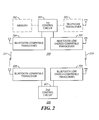
- FIG. 2 is a block diagram in accordance with the disclosure.
- FIG. 3 is a block diagram in accordance with the disclosure.
- the following describes an apparatus and method pertaining to using both Bluetooth-compatible and Bluetooth Low Energy-compatible transceivers when supporting wireless communications between two electronic communication devices such as a so-called smartphone and a hands-free accessory.
- the devices use Bluetooth and during a second operating state the devices use Bluetooth Low Energy.
- the first operating state correlates to when a first one of the devices is actively engaged in telephony and the second operating state correlates to when that first device is not actively engaged in telephony.
- a stand-alone accessory such as, for example, a battery-powered, visor-mounted, hands-free car-kit can be (and remain) actively paired to a corresponding smartphone using Bluetooth Low Energy during times when the smartphone is telephonically quiescent.
- the smartphone sources or receives a telephone call, however, the two devices can switch to Bluetooth for the duration of the call to thereby facilitate hands-free support of that call by the car-kit.
- the battery life of the hands-free car-kit can be greatly extended as compared to pairings that rely only on Bluetooth.
- FIG. 1 presents a process 100 that comports with many of the present teachings.
- a first control circuit of choice carries out this process 100. Further details will be provided further herein regarding this first control circuit.
- this process 100 provides for detecting (at 101) that presence of the second control circuit (using, for example, a Bluetooth-compatible detection methodology) and responsively automatically pairing (at 102) with the second control circuit using the Bluetooth pairing protocol.
- this process 100 can accommodate any of a variety of responses. Examples of responses in these regards can include temporal multitasking (pursuant to which the first control circuit conducts other tasks before returning to again monitor for the second control circuit) as well as continually looping back to essentially continuously monitor for the second control circuit. These teachings also accommodate supporting this detection activity via a real-time interrupt capability if desired.)
- the Bluetooth-based pairing can be configured to require the active participation of the user, if desired. For many application settings, however, it may best serve if the pairing occurs automatically. Because Bluetooth and Bluetooth Low Energy have different pairing processes with separate linkkeys it may be desirable to employ a suitable out-of-band pairing process to avoid needing multiple pairing events (similar, for example, to the tap pairing approach used in Near Field Communications (NFC)). In any event, Bluetooth detection and pairing comprises a well-understood area of prior an endeavor. Accordingly, further elaboration will not be provided here for the sake of brevity.
- the first control circuit determines the state of a particular monitored condition and/or capability.
- that condition/capability is presumed here to refer to telephony.
- this determination can comprise determining whether a monitored personal telephony device (of which the first control circuit may comprise a part) is actively engaged in telephony or is not actively engaged in telephony.
- telephony shall be understood to refer to telephone-styled two-way voice communications including both wireless and non-wireless communications of this sort.
- the first control circuit When the monitored condition/capability reveals a first operating state (such as, for example, that the monitored personal telephony device is actively engaged in telephony), at 104 the first control circuit communicates with the second control circuit via a Bluetooth-compatible transceiver. When the monitored condition/capability reveals instead a second operating state (that is different than the first operating state and which may comprise an opposite operating state in comparison to the first operating state), at 105 the first control circuit communicates with the second control circuit via a Bluetooth Low Energy-compatible transceiver instead of the Bluetooth-compatible transceiver. The first control circuit can then continue to monitor that predetermined condition/capability to determine whether to persist an existing communication methodology as described above or to switch to a different communication methodology per the foregoing description.
- this process 100 permits the latter to utilize a very low power approach to maintaining a linked connection between the two platforms.
- this process 100 allows the first control circuit to switch to a non-Bluetooth Low Energy approach (such as classic Bluetooth) when communicating with the accessory to thereby support activities such as the transmission of voice content back and forth between the personal wireless telephony device and the accessory.
- a non-Bluetooth Low Energy approach such as classic Bluetooth
- This voice content can comprise, for example, received voice that the personal wireless telephony device provides to the accessory for the accessory to render audible via a speaker as well as voice content the accessory captures from the user via a microphone and which the accessory provides to the personal wireless telephony device to transmit as part of the call.
- the frequency by which the first control circuit makes the determination at 103 can vary to some extent with the application setting. For many application settings a frequency of about fifty to sixty microseconds will likely provide adequate performance in these regards.
- FIG. 2 presents an illustrative example of an electronic device 200 having the aforementioned first control circuit 201.
- a control circuit 201 can comprise a fixed-purpose hard-wired platform or can comprise a partially or wholly programmable platform. These architectural options are well known and understood in the art and require no further description here.
- This control circuit 201 is configured (for example, by using corresponding programming as will be well understood by those skilled in the art) to carry out one or more of the steps, actions, and/or functions described herein.
- this control circuit 201 operably couples to a memory 202.
- the memory 202 may be integral to the control circuit 201 or can be physically discrete (in whole or in part) from the control circuit 201 as desired.
- This memory 202 can serve, for example, to non-transitorily store the computer instructions that, when executed by the control circuit 201, cause the control circuit 201 to behave as described herein.
- non-transitorily will be understood to refer to a non-ephemeral state for the stored contents (and hence excludes when the stored contents merely constitute signals or waves) rather than volatility of the storage media itself and hence includes both non-volatile memory (such as read-only memory (ROM) as well as volatile memory (such as an erasable programmable read-only memory (EPROM).)
- non-volatile memory such as read-only memory (ROM)
- EPROM erasable programmable read-only memory
- the first control circuit 201 can operably couple to an optional telephony transceiver 203.
- Various transceivers are known in these regards and include, for example, CDMA2000-compatible transceivers, Global System for Mobile Communications (GSM)-compatible transceivers, and so forth. Such transceivers are very well known in the art. As the present teachings are not overly sensitive to any particular choices made as amongst the available choices, further elaboration will not be provided here in these regards.
- the first control circuit 201 also operably couples to a Bluetooth-compatible transceiver 204 and a Bluetooth Low Energy-compatible transceiver 205.
- the present teachings are highly flexible in these regards. By one approach these two transceivers 204 and 205 can be logically and physically discrete from one another. By another approach, as when using a so-called dual-mode transceiver, a single transceiver can be configured to selectively serve in the alternative as one or the other type of transceiver.
- the first control circuit 201 can monitor the telephony status of the telephony transceiver 203 and can responsively switch (as per the description provided above) between use of the Bluetooth-compatible transceiver 204 and the Bluetooth Low Energy compatible transceiver 205 while remaining paired with a second control circuit 207 as comprises a part of a separate electronic device 206 (such as, but certainly not limited to, a hands-free communication accessory such as a visor-mounted hands-free car-kit as are known in the art).
- a separate electronic device 206 such as, but certainly not limited to, a hands-free communication accessory such as a visor-mounted hands-free car-kit as are known in the art.
- this second control circuit 207 is operably coupled to and has similar access to its own on-board Bluetooth-compatible transceiver 208 and Bluetooth Low Energy-compatible transceiver 209 (which again may be physically separate from one another or may, if desired, share a common platform such as a shared integrated circuit).
- the second control circuit 207 can be configured to respond to specific commands from the first control circuit 201 regarding which transceiver 208 and 209 to employ and when.
- the Bluetooth Low Energy-compatible transceiver 209 when using the Bluetooth Low Energy-compatible transceiver 209 to communicate with the first control circuit 201, the latter can issue a command via a Bluetooth Low Energy communication 210 that the second control circuit 207 now (or at some predetermined future point in time) switch to using the Bluetooth-compatible transceiver 208 to communicate with the first control circuit 201.
- the first control circuit 201 could issue a command via a Bluetooth communication 211 that the second control circuit 207 switch from the Bluetooth-compatible transceiver 208 to the Bluetooth Low Energy-compatible transceiver 209.
- both control circuits 201 and 207 can be configured to initially use their Bluetooth Low Energy-compatible transceivers 205 and 209 until the first control circuit 201 instructs the second control circuit 207 to switch to the Bluetooth-compatible transceiver 208 per the foregoing description.
- the aforementioned first control circuit 201 can comprise a part of a portable wireless telephony device.
- an exemplary portable communication device in these regards includes such a control circuit 201 to controls the overall operation of the portable electronic device.
- Corresponding telephony functions, including data and voice communications, are performed through a telephony transceiver 203.
- the telephony transceiver 203 supports calls via a wireless network 350.
- the wireless network 350 comprises a wireless telephony network (which may support data communications in addition to voice communications if desired).
- the portable communication device may utilize a Subscriber Identity Module or a Removable User Identity Module (SIM/RUIM) card 338 for communication with a network, such as the wireless network 350.
- SIM/RUIM Removable User Identity Module
- user identification information may be programmed into a memory 310.
- the control circuit 201 also operably couples to the aforementioned Bluetooth-compatible transceiver 204 and the Bluetooth Low Energy compatible transceiver 205.
- a power source 342 powers the electronic device.
- the control circuit 201 may interact with an accelerometer 336 that may be utilized to detect direction of gravitational forces or gravity-induced reaction forces.
- the control circuit 201 also interacts with a variety of other components, such as a Random Access Memory (RAM) 308, the aforementioned memory 202, an auxiliary input/output (I/O) subsystem 324, a data port 326, a speaker 328, a microphone 330, and other device subsystems of choice.
- RAM Random Access Memory
- I/O auxiliary input/output
- a display 312 can be disposed in conjunction with a touch-sensitive overlay 314 that operably couples to an electronic controller 316. Together these components can comprise a touch-sensitive display 318 that serves as a graphical-user interface. Information, such as text, characters, symbols, images, icons, and other items may be displayed on the touch-sensitive display 318 via the control circuit 201.
- the portable communication device includes an operating system 346 and software programs, applications, or components 348 that are executed by the control circuit 201 and are typically stored in a persistent, updatable store such as the memory 202. Additional applications or programs may be loaded onto the portable communication device through the wireless network 350, the data port 326, or even via the Bluetooth-compatible transceiver 204 or the Bluetooth Low Energy-compatible transceiver 205.
- a received signal such as a text message, an e-mail message, or web page download can be input to the control circuit 201.
- the control circuit 201 processes the received signal for output to the display 312 and/or to the auxiliary I/O subsystem 324.
- a user may generate data items, for example e-mail messages, that may be transmitted over the wireless network 350 through the communication subsystem. For voice communications, the overall operation of the portable electronic device is similar.
- the speaker 328 outputs audible information converted from electrical signals, and the microphone 330 converts audible information into electrical signals for processing (unless, of course, the control circuit 201 is utilizing the Bluetooth-compatible transceiver 204 to facilitate audio input/output functionality via an accessory such as a wireless hands-free headset, car-kit, or the like).
Landscapes
- Engineering & Computer Science (AREA)
- Signal Processing (AREA)
- Computer Networks & Wireless Communication (AREA)
- Human Computer Interaction (AREA)
- Telephone Function (AREA)
- Mobile Radio Communication Systems (AREA)
Applications Claiming Priority (1)
| Application Number | Priority Date | Filing Date | Title |
|---|---|---|---|
| US13/833,326 US9204243B2 (en) | 2013-03-15 | 2013-03-15 | Method and apparatus pertaining to use of bluetooth and bluetooth low energy |
Publications (4)
| Publication Number | Publication Date |
|---|---|
| EP2779604A2 true EP2779604A2 (de) | 2014-09-17 |
| EP2779604A9 EP2779604A9 (de) | 2016-04-20 |
| EP2779604A3 EP2779604A3 (de) | 2017-03-22 |
| EP2779604B1 EP2779604B1 (de) | 2018-10-03 |
Family
ID=47997104
Family Applications (1)
| Application Number | Title | Priority Date | Filing Date |
|---|---|---|---|
| EP13160575.0A Active EP2779604B1 (de) | 2013-03-15 | 2013-03-22 | Verfahren und Vorrichtung zum Verwenden von Bluetooth und Bluetooth-Niederenergie |
Country Status (2)
| Country | Link |
|---|---|
| US (1) | US9204243B2 (de) |
| EP (1) | EP2779604B1 (de) |
Cited By (1)
| Publication number | Priority date | Publication date | Assignee | Title |
|---|---|---|---|---|
| US20220030385A1 (en) * | 2015-11-13 | 2022-01-27 | Ford Global Technologies, Llc | Method and apparatus for wireless proximity based component information provision |
Families Citing this family (16)
| Publication number | Priority date | Publication date | Assignee | Title |
|---|---|---|---|---|
| KR102356925B1 (ko) * | 2014-02-21 | 2022-01-28 | 삼성전자주식회사 | 전자 장치 및 전자 장치의 절전 방법 |
| JP2016531479A (ja) * | 2014-06-17 | 2016-10-06 | 華為技術有限公司Huawei Technologies Co.,Ltd. | ワイヤレス接続スイッチング方法、ワイヤレス端末、及びそのシステム |
| US9924298B2 (en) * | 2014-10-31 | 2018-03-20 | Welch Allyn, Inc. | Wireless ambulatory care network |
| US9554240B2 (en) * | 2015-03-30 | 2017-01-24 | Nxp Usa, Inc. | Multiple connection management for bluetooth low energy devices |
| JP6776679B2 (ja) * | 2016-07-15 | 2020-10-28 | セイコーエプソン株式会社 | 無線通信装置、印刷装置、及び、制御方法 |
| CN108377482B (zh) * | 2016-11-07 | 2021-05-28 | 中兴通讯股份有限公司 | 一种终端连接蓝牙设备的方法、装置、系统及设备 |
| US10968669B2 (en) | 2017-08-30 | 2021-04-06 | Sensormatic Electronics, LLC | System and method for inductive power transfer to door |
| US10937262B2 (en) * | 2017-08-30 | 2021-03-02 | Sensormatic Electronics, LLC | Door system with power management system and method of operation thereof |
| US10943415B2 (en) | 2017-08-30 | 2021-03-09 | Sensormatic Electronics, LLC | System and method for providing communication over inductive power transfer to door |
| JP7041559B2 (ja) * | 2018-03-14 | 2022-03-24 | キヤノン株式会社 | 通信装置、データ転送装置およびそれらの制御方法、並びにプログラム |
| US20200053804A1 (en) * | 2018-08-08 | 2020-02-13 | North Inc. | Wireless personal area network coupling methods and systems |
| US11051154B2 (en) | 2018-10-03 | 2021-06-29 | Google Llc | Systems and methods for wirelessly coupling a wearable computing device |
| US11229071B2 (en) * | 2019-07-15 | 2022-01-18 | Ingersoll-Rand Industrial U.S., Inc. | Wireless communication between a tool and a controller |
| TWI789038B (zh) * | 2020-11-23 | 2023-01-01 | 瑞昱半導體股份有限公司 | 不支援藍牙低功耗技術也能實現自動配對功能的藍牙通信系統及相關的藍牙裝置 |
| CN115484577B (zh) * | 2021-06-15 | 2025-08-12 | Oppo广东移动通信有限公司 | 控制方法、装置、电子设备及存储介质 |
| CN115499040B (zh) * | 2022-09-09 | 2024-05-07 | 安克创新科技股份有限公司 | 蓝牙适配器及其连接方法 |
Family Cites Families (5)
| Publication number | Priority date | Publication date | Assignee | Title |
|---|---|---|---|---|
| WO2010046732A1 (en) * | 2008-10-24 | 2010-04-29 | Nokia Corporation | Feature selection in wireless communication |
| US20100302979A1 (en) * | 2009-05-28 | 2010-12-02 | Nokia Corporation | Power saving in wireless communication |
| US8737917B2 (en) * | 2009-07-24 | 2014-05-27 | Broadcom Corporation | Method and system for a dual-mode bluetooth low energy device |
| US8780961B2 (en) * | 2010-10-29 | 2014-07-15 | Broadcom Corporation | Mixed-mode wireless device operation |
| US8830889B2 (en) | 2011-02-23 | 2014-09-09 | Lg Electronics Inc. | Systems for remotely waking up application processor of mobile device |
-
2013
- 2013-03-15 US US13/833,326 patent/US9204243B2/en active Active
- 2013-03-22 EP EP13160575.0A patent/EP2779604B1/de active Active
Non-Patent Citations (1)
| Title |
|---|
| None |
Cited By (1)
| Publication number | Priority date | Publication date | Assignee | Title |
|---|---|---|---|---|
| US20220030385A1 (en) * | 2015-11-13 | 2022-01-27 | Ford Global Technologies, Llc | Method and apparatus for wireless proximity based component information provision |
Also Published As
| Publication number | Publication date |
|---|---|
| EP2779604B1 (de) | 2018-10-03 |
| US9204243B2 (en) | 2015-12-01 |
| US20140274033A1 (en) | 2014-09-18 |
| EP2779604A3 (de) | 2017-03-22 |
| EP2779604A9 (de) | 2016-04-20 |
Similar Documents
| Publication | Publication Date | Title |
|---|---|---|
| US9204243B2 (en) | Method and apparatus pertaining to use of bluetooth and bluetooth low energy | |
| US8271662B1 (en) | Selective pairing of devices using short-range wireless communication | |
| CN111935652B (zh) | 在无线通信网络中广播设备状态 | |
| EP2082587B1 (de) | Vorrichtung und verfahren zur reduzierung des stromverbrauchs und/oder der funkfrequenz-interferenz in einer mobilen berechnungsvorrichtung | |
| CN105684525B (zh) | 一种降低移动电子设备中的功耗的方法和装置 | |
| EP3125075B1 (de) | Verfahren, vorrichtung und system zur steuerung einer intelligenten, am körper tragbaren vorrichtung | |
| US10412565B2 (en) | Systems and methods for muting a wireless communication device | |
| US20140200053A1 (en) | Advanced thermal control algorithm | |
| CN112997471B (zh) | 音频通路切换方法和装置、可读存储介质、电子设备 | |
| US11076354B2 (en) | Cell handover method and terminal device | |
| CN111093259A (zh) | 一种蓝牙功率调整方法、装置、存储介质及终端 | |
| CN107734163A (zh) | 通话控制的方法和装置、计算机设备、可读存储介质 | |
| CN107567080A (zh) | 降低功耗的方法及终端设备 | |
| WO2022021787A1 (zh) | 一种天线控制方法、装置及终端设备 | |
| CN112152649A (zh) | 射频电路、终端设备、信号传输方法及存储介质 | |
| CN112653960B (zh) | 无线耳机控制方法、装置、电子设备和计算机存储介质 | |
| CN111642000A (zh) | 数据传输方法、装置、电子设备及计算机可读存储介质 | |
| CN112805988B (zh) | 通话控制方法和装置、计算机可读存储介质、电子设备 | |
| CN106255146B (zh) | 一种终端的省电控制方法、装置和终端 | |
| CN112740827B (zh) | 网络通信处理方法、计算机可读存储介质和电子设备 | |
| US20190174291A1 (en) | Methods and apparatus for providing access to emergency service providers | |
| CN112261712B (zh) | 功率调节方法及装置 | |
| WO2013078686A1 (en) | Smartphone including a power management component for long term use | |
| CA2814292C (en) | System and method for polling a network service | |
| CN108491285A (zh) | 应用于电子设备测试的数据保护方法及相关产品 |
Legal Events
| Date | Code | Title | Description |
|---|---|---|---|
| PUAI | Public reference made under article 153(3) epc to a published international application that has entered the european phase |
Free format text: ORIGINAL CODE: 0009012 |
|
| 17P | Request for examination filed |
Effective date: 20130322 |
|
| AK | Designated contracting states |
Kind code of ref document: A2 Designated state(s): AL AT BE BG CH CY CZ DE DK EE ES FI FR GB GR HR HU IE IS IT LI LT LU LV MC MK MT NL NO PL PT RO RS SE SI SK SM TR |
|
| AX | Request for extension of the european patent |
Extension state: BA ME |
|
| PUAL | Search report despatched |
Free format text: ORIGINAL CODE: 0009013 |
|
| AK | Designated contracting states |
Kind code of ref document: A3 Designated state(s): AL AT BE BG CH CY CZ DE DK EE ES FI FR GB GR HR HU IE IS IT LI LT LU LV MC MK MT NL NO PL PT RO RS SE SI SK SM TR |
|
| AX | Request for extension of the european patent |
Extension state: BA ME |
|
| RIC1 | Information provided on ipc code assigned before grant |
Ipc: H04W 4/00 20090101ALI20170216BHEP Ipc: H04M 1/725 20060101AFI20170216BHEP Ipc: H04W 52/02 20090101ALI20170216BHEP Ipc: H04M 1/60 20060101ALI20170216BHEP |
|
| GRAP | Despatch of communication of intention to grant a patent |
Free format text: ORIGINAL CODE: EPIDOSNIGR1 |
|
| STAA | Information on the status of an ep patent application or granted ep patent |
Free format text: STATUS: GRANT OF PATENT IS INTENDED |
|
| RIC1 | Information provided on ipc code assigned before grant |
Ipc: H04W 52/02 20090101ALI20180326BHEP Ipc: H04M 1/725 20060101AFI20180326BHEP Ipc: H04M 1/60 20060101ALI20180326BHEP Ipc: H04W 4/00 20090101ALI20180326BHEP |
|
| INTG | Intention to grant announced |
Effective date: 20180423 |
|
| GRAS | Grant fee paid |
Free format text: ORIGINAL CODE: EPIDOSNIGR3 |
|
| GRAA | (expected) grant |
Free format text: ORIGINAL CODE: 0009210 |
|
| STAA | Information on the status of an ep patent application or granted ep patent |
Free format text: STATUS: THE PATENT HAS BEEN GRANTED |
|
| AK | Designated contracting states |
Kind code of ref document: B1 Designated state(s): AL AT BE BG CH CY CZ DE DK EE ES FI FR GB GR HR HU IE IS IT LI LT LU LV MC MK MT NL NO PL PT RO RS SE SI SK SM TR |
|
| REG | Reference to a national code |
Ref country code: GB Ref legal event code: FG4D |
|
| REG | Reference to a national code |
Ref country code: CH Ref legal event code: EP Ref country code: AT Ref legal event code: REF Ref document number: 1049915 Country of ref document: AT Kind code of ref document: T Effective date: 20181015 |
|
| REG | Reference to a national code |
Ref country code: IE Ref legal event code: FG4D Ref country code: DE Ref legal event code: R096 Ref document number: 602013044381 Country of ref document: DE |
|
| REG | Reference to a national code |
Ref country code: NL Ref legal event code: MP Effective date: 20181003 |
|
| REG | Reference to a national code |
Ref country code: LT Ref legal event code: MG4D |
|
| REG | Reference to a national code |
Ref country code: AT Ref legal event code: MK05 Ref document number: 1049915 Country of ref document: AT Kind code of ref document: T Effective date: 20181003 |
|
| PG25 | Lapsed in a contracting state [announced via postgrant information from national office to epo] |
Ref country code: NL Free format text: LAPSE BECAUSE OF FAILURE TO SUBMIT A TRANSLATION OF THE DESCRIPTION OR TO PAY THE FEE WITHIN THE PRESCRIBED TIME-LIMIT Effective date: 20181003 |
|
| PG25 | Lapsed in a contracting state [announced via postgrant information from national office to epo] |
Ref country code: LV Free format text: LAPSE BECAUSE OF FAILURE TO SUBMIT A TRANSLATION OF THE DESCRIPTION OR TO PAY THE FEE WITHIN THE PRESCRIBED TIME-LIMIT Effective date: 20181003 Ref country code: FI Free format text: LAPSE BECAUSE OF FAILURE TO SUBMIT A TRANSLATION OF THE DESCRIPTION OR TO PAY THE FEE WITHIN THE PRESCRIBED TIME-LIMIT Effective date: 20181003 Ref country code: PL Free format text: LAPSE BECAUSE OF FAILURE TO SUBMIT A TRANSLATION OF THE DESCRIPTION OR TO PAY THE FEE WITHIN THE PRESCRIBED TIME-LIMIT Effective date: 20181003 Ref country code: LT Free format text: LAPSE BECAUSE OF FAILURE TO SUBMIT A TRANSLATION OF THE DESCRIPTION OR TO PAY THE FEE WITHIN THE PRESCRIBED TIME-LIMIT Effective date: 20181003 Ref country code: BG Free format text: LAPSE BECAUSE OF FAILURE TO SUBMIT A TRANSLATION OF THE DESCRIPTION OR TO PAY THE FEE WITHIN THE PRESCRIBED TIME-LIMIT Effective date: 20190103 Ref country code: NO Free format text: LAPSE BECAUSE OF FAILURE TO SUBMIT A TRANSLATION OF THE DESCRIPTION OR TO PAY THE FEE WITHIN THE PRESCRIBED TIME-LIMIT Effective date: 20190103 Ref country code: AT Free format text: LAPSE BECAUSE OF FAILURE TO SUBMIT A TRANSLATION OF THE DESCRIPTION OR TO PAY THE FEE WITHIN THE PRESCRIBED TIME-LIMIT Effective date: 20181003 Ref country code: HR Free format text: LAPSE BECAUSE OF FAILURE TO SUBMIT A TRANSLATION OF THE DESCRIPTION OR TO PAY THE FEE WITHIN THE PRESCRIBED TIME-LIMIT Effective date: 20181003 Ref country code: IS Free format text: LAPSE BECAUSE OF FAILURE TO SUBMIT A TRANSLATION OF THE DESCRIPTION OR TO PAY THE FEE WITHIN THE PRESCRIBED TIME-LIMIT Effective date: 20190203 Ref country code: CZ Free format text: LAPSE BECAUSE OF FAILURE TO SUBMIT A TRANSLATION OF THE DESCRIPTION OR TO PAY THE FEE WITHIN THE PRESCRIBED TIME-LIMIT Effective date: 20181003 Ref country code: ES Free format text: LAPSE BECAUSE OF FAILURE TO SUBMIT A TRANSLATION OF THE DESCRIPTION OR TO PAY THE FEE WITHIN THE PRESCRIBED TIME-LIMIT Effective date: 20181003 |
|
| PG25 | Lapsed in a contracting state [announced via postgrant information from national office to epo] |
Ref country code: GR Free format text: LAPSE BECAUSE OF FAILURE TO SUBMIT A TRANSLATION OF THE DESCRIPTION OR TO PAY THE FEE WITHIN THE PRESCRIBED TIME-LIMIT Effective date: 20190104 Ref country code: PT Free format text: LAPSE BECAUSE OF FAILURE TO SUBMIT A TRANSLATION OF THE DESCRIPTION OR TO PAY THE FEE WITHIN THE PRESCRIBED TIME-LIMIT Effective date: 20190203 Ref country code: RS Free format text: LAPSE BECAUSE OF FAILURE TO SUBMIT A TRANSLATION OF THE DESCRIPTION OR TO PAY THE FEE WITHIN THE PRESCRIBED TIME-LIMIT Effective date: 20181003 Ref country code: SE Free format text: LAPSE BECAUSE OF FAILURE TO SUBMIT A TRANSLATION OF THE DESCRIPTION OR TO PAY THE FEE WITHIN THE PRESCRIBED TIME-LIMIT Effective date: 20181003 Ref country code: AL Free format text: LAPSE BECAUSE OF FAILURE TO SUBMIT A TRANSLATION OF THE DESCRIPTION OR TO PAY THE FEE WITHIN THE PRESCRIBED TIME-LIMIT Effective date: 20181003 |
|
| REG | Reference to a national code |
Ref country code: DE Ref legal event code: R097 Ref document number: 602013044381 Country of ref document: DE |
|
| PG25 | Lapsed in a contracting state [announced via postgrant information from national office to epo] |
Ref country code: IT Free format text: LAPSE BECAUSE OF FAILURE TO SUBMIT A TRANSLATION OF THE DESCRIPTION OR TO PAY THE FEE WITHIN THE PRESCRIBED TIME-LIMIT Effective date: 20181003 Ref country code: DK Free format text: LAPSE BECAUSE OF FAILURE TO SUBMIT A TRANSLATION OF THE DESCRIPTION OR TO PAY THE FEE WITHIN THE PRESCRIBED TIME-LIMIT Effective date: 20181003 |
|
| PLBE | No opposition filed within time limit |
Free format text: ORIGINAL CODE: 0009261 |
|
| STAA | Information on the status of an ep patent application or granted ep patent |
Free format text: STATUS: NO OPPOSITION FILED WITHIN TIME LIMIT |
|
| PG25 | Lapsed in a contracting state [announced via postgrant information from national office to epo] |
Ref country code: SM Free format text: LAPSE BECAUSE OF FAILURE TO SUBMIT A TRANSLATION OF THE DESCRIPTION OR TO PAY THE FEE WITHIN THE PRESCRIBED TIME-LIMIT Effective date: 20181003 Ref country code: SK Free format text: LAPSE BECAUSE OF FAILURE TO SUBMIT A TRANSLATION OF THE DESCRIPTION OR TO PAY THE FEE WITHIN THE PRESCRIBED TIME-LIMIT Effective date: 20181003 Ref country code: EE Free format text: LAPSE BECAUSE OF FAILURE TO SUBMIT A TRANSLATION OF THE DESCRIPTION OR TO PAY THE FEE WITHIN THE PRESCRIBED TIME-LIMIT Effective date: 20181003 Ref country code: RO Free format text: LAPSE BECAUSE OF FAILURE TO SUBMIT A TRANSLATION OF THE DESCRIPTION OR TO PAY THE FEE WITHIN THE PRESCRIBED TIME-LIMIT Effective date: 20181003 |
|
| 26N | No opposition filed |
Effective date: 20190704 |
|
| PG25 | Lapsed in a contracting state [announced via postgrant information from national office to epo] |
Ref country code: SI Free format text: LAPSE BECAUSE OF FAILURE TO SUBMIT A TRANSLATION OF THE DESCRIPTION OR TO PAY THE FEE WITHIN THE PRESCRIBED TIME-LIMIT Effective date: 20181003 Ref country code: MC Free format text: LAPSE BECAUSE OF FAILURE TO SUBMIT A TRANSLATION OF THE DESCRIPTION OR TO PAY THE FEE WITHIN THE PRESCRIBED TIME-LIMIT Effective date: 20181003 |
|
| REG | Reference to a national code |
Ref country code: CH Ref legal event code: PL |
|
| PG25 | Lapsed in a contracting state [announced via postgrant information from national office to epo] |
Ref country code: LU Free format text: LAPSE BECAUSE OF NON-PAYMENT OF DUE FEES Effective date: 20190322 |
|
| REG | Reference to a national code |
Ref country code: BE Ref legal event code: MM Effective date: 20190331 |
|
| PG25 | Lapsed in a contracting state [announced via postgrant information from national office to epo] |
Ref country code: CH Free format text: LAPSE BECAUSE OF NON-PAYMENT OF DUE FEES Effective date: 20190331 Ref country code: LI Free format text: LAPSE BECAUSE OF NON-PAYMENT OF DUE FEES Effective date: 20190331 Ref country code: IE Free format text: LAPSE BECAUSE OF NON-PAYMENT OF DUE FEES Effective date: 20190322 |
|
| PG25 | Lapsed in a contracting state [announced via postgrant information from national office to epo] |
Ref country code: BE Free format text: LAPSE BECAUSE OF NON-PAYMENT OF DUE FEES Effective date: 20190331 |
|
| PG25 | Lapsed in a contracting state [announced via postgrant information from national office to epo] |
Ref country code: TR Free format text: LAPSE BECAUSE OF FAILURE TO SUBMIT A TRANSLATION OF THE DESCRIPTION OR TO PAY THE FEE WITHIN THE PRESCRIBED TIME-LIMIT Effective date: 20181003 |
|
| PG25 | Lapsed in a contracting state [announced via postgrant information from national office to epo] |
Ref country code: MT Free format text: LAPSE BECAUSE OF NON-PAYMENT OF DUE FEES Effective date: 20190322 |
|
| PG25 | Lapsed in a contracting state [announced via postgrant information from national office to epo] |
Ref country code: CY Free format text: LAPSE BECAUSE OF FAILURE TO SUBMIT A TRANSLATION OF THE DESCRIPTION OR TO PAY THE FEE WITHIN THE PRESCRIBED TIME-LIMIT Effective date: 20181003 |
|
| PG25 | Lapsed in a contracting state [announced via postgrant information from national office to epo] |
Ref country code: HU Free format text: LAPSE BECAUSE OF FAILURE TO SUBMIT A TRANSLATION OF THE DESCRIPTION OR TO PAY THE FEE WITHIN THE PRESCRIBED TIME-LIMIT; INVALID AB INITIO Effective date: 20130322 |
|
| PG25 | Lapsed in a contracting state [announced via postgrant information from national office to epo] |
Ref country code: MK Free format text: LAPSE BECAUSE OF FAILURE TO SUBMIT A TRANSLATION OF THE DESCRIPTION OR TO PAY THE FEE WITHIN THE PRESCRIBED TIME-LIMIT Effective date: 20181003 |
|
| REG | Reference to a national code |
Ref country code: DE Ref legal event code: R082 Ref document number: 602013044381 Country of ref document: DE Ref country code: DE Ref legal event code: R081 Ref document number: 602013044381 Country of ref document: DE Owner name: MALIKIE INNOVATIONS LTD., IE Free format text: FORMER OWNER: BLACKBERRY LIMITED, WATERLOO, ONTARIO, CA |
|
| REG | Reference to a national code |
Ref country code: GB Ref legal event code: 732E Free format text: REGISTERED BETWEEN 20240620 AND 20240627 |
|
| PGFP | Annual fee paid to national office [announced via postgrant information from national office to epo] |
Ref country code: GB Payment date: 20260319 Year of fee payment: 14 |
|
| PGFP | Annual fee paid to national office [announced via postgrant information from national office to epo] |
Ref country code: DE Payment date: 20260320 Year of fee payment: 14 |
|
| PGFP | Annual fee paid to national office [announced via postgrant information from national office to epo] |
Ref country code: FR Payment date: 20260323 Year of fee payment: 14 |