EP2778038A2 - Wakesurfboot und Rumpf für ein Wakesurfboot - Google Patents
Wakesurfboot und Rumpf für ein Wakesurfboot Download PDFInfo
- Publication number
- EP2778038A2 EP2778038A2 EP13170307.6A EP13170307A EP2778038A2 EP 2778038 A2 EP2778038 A2 EP 2778038A2 EP 13170307 A EP13170307 A EP 13170307A EP 2778038 A2 EP2778038 A2 EP 2778038A2
- Authority
- EP
- European Patent Office
- Prior art keywords
- hull
- water
- port
- starboard
- stern
- Prior art date
- Legal status (The legal status is an assumption and is not a legal conclusion. Google has not performed a legal analysis and makes no representation as to the accuracy of the status listed.)
- Withdrawn
Links
- XLYOFNOQVPJJNP-UHFFFAOYSA-N water Substances O XLYOFNOQVPJJNP-UHFFFAOYSA-N 0.000 claims abstract description 130
- 230000003247 decreasing effect Effects 0.000 claims description 8
- 230000009977 dual effect Effects 0.000 claims description 6
- 230000003068 static effect Effects 0.000 claims description 5
- 230000005484 gravity Effects 0.000 claims description 3
- 241001544487 Macromiidae Species 0.000 claims description 2
- 238000006073 displacement reaction Methods 0.000 description 5
- JTJMJGYZQZDUJJ-UHFFFAOYSA-N phencyclidine Chemical compound C1CCCCN1C1(C=2C=CC=CC=2)CCCCC1 JTJMJGYZQZDUJJ-UHFFFAOYSA-N 0.000 description 2
- 239000002352 surface water Substances 0.000 description 2
- 239000012530 fluid Substances 0.000 description 1
- 239000013505 freshwater Substances 0.000 description 1
- 230000005923 long-lasting effect Effects 0.000 description 1
- 230000000630 rising effect Effects 0.000 description 1
- 150000003839 salts Chemical class 0.000 description 1
- 230000001629 suppression Effects 0.000 description 1
Images


Classifications
-
- B—PERFORMING OPERATIONS; TRANSPORTING
- B63—SHIPS OR OTHER WATERBORNE VESSELS; RELATED EQUIPMENT
- B63B—SHIPS OR OTHER WATERBORNE VESSELS; EQUIPMENT FOR SHIPPING
- B63B34/00—Vessels specially adapted for water sports or leisure; Body-supporting devices specially adapted for water sports or leisure
- B63B34/70—Arrangements on vessels specially adapted for generating waves for surfing, wakeboarding or the like, e.g. ballast tanks
-
- B—PERFORMING OPERATIONS; TRANSPORTING
- B63—SHIPS OR OTHER WATERBORNE VESSELS; RELATED EQUIPMENT
- B63B—SHIPS OR OTHER WATERBORNE VESSELS; EQUIPMENT FOR SHIPPING
- B63B1/00—Hydrodynamic or hydrostatic features of hulls or of hydrofoils
- B63B1/02—Hydrodynamic or hydrostatic features of hulls or of hydrofoils deriving lift mainly from water displacement
- B63B1/04—Hydrodynamic or hydrostatic features of hulls or of hydrofoils deriving lift mainly from water displacement with single hull
- B63B1/042—Hydrodynamic or hydrostatic features of hulls or of hydrofoils deriving lift mainly from water displacement with single hull the underpart of which being partly provided with channels or the like, e.g. catamaran shaped
-
- B—PERFORMING OPERATIONS; TRANSPORTING
- B63—SHIPS OR OTHER WATERBORNE VESSELS; RELATED EQUIPMENT
- B63B—SHIPS OR OTHER WATERBORNE VESSELS; EQUIPMENT FOR SHIPPING
- B63B1/00—Hydrodynamic or hydrostatic features of hulls or of hydrofoils
- B63B1/16—Hydrodynamic or hydrostatic features of hulls or of hydrofoils deriving additional lift from hydrodynamic forces
- B63B1/18—Hydrodynamic or hydrostatic features of hulls or of hydrofoils deriving additional lift from hydrodynamic forces of hydroplane type
- B63B1/20—Hydrodynamic or hydrostatic features of hulls or of hydrofoils deriving additional lift from hydrodynamic forces of hydroplane type having more than one planing surface
Definitions
- the present invention relates to boats and boat hulls. More particularly, the present invention relates to wakesurfing boats, and hulls used for wakesurfing boats.
- Wakesurfing is a sport that is growing in popularity.
- a wakesurfer initially being towed behind a boat via a tow rope, rises to his feet on a surf board in a body of water (e.g., an ocean, a sea, a lake, or a river) similar to a waterskier or a wakeboarder.
- a body of water e.g., an ocean, a sea, a lake, or a river
- the boat In order to achieve an ideal wakesurfing ride, the boat should generate in its wake a wave that mimics as closely as possible, in view of the type of body of water, a size, a shape, a power, and a duration, of an ocean wave rising, cresting, and breaking near a beach, enabling the surfer to traverse back and forth on a face of the wake wave and ride a crest of the wake wave, similar to an ocean surfer.
- Wakesurfers have been attempting to surf in the wakes of traditional cruising boats, waterskiing boats, and wakeboarding boats. These traditional classes of boats typically are designed for one or more of speed, seaworthiness, and handling characteristics.
- a boat when passing through a body of water, creates separate waves that move in the boat's wake.
- separate wake waves originate, respectively, from the boat's bow, centerline, quarter, and stern.
- Each wake wave generally forms the arms of a V, with the source of the respective wake wave being at the point of the V (the boat), and transverse curled wave crests forming offset from the path of the boat.
- Wake wave height is a function of several factors, including for example a speed of the boat hull in the body of water, resistance to the boat hull as it moves through the body of water, Froude number, a shape of the hull, a length of the hull, a length/beam ratio (L/B) of the hull, a speed/length ratio (SLR) of the hull, an amount of the boat hull in contact with the body of water, and an amount of water displaced by the boat as it moves through the body of water.
- Traditional cruising boats, wakeboarding boats, and waterskiing boats typically are configured are configured with planning hulls, have an L/B greater than 3.0, have light displacements, experience minimal water resistance when moving through the water, and have optimal seaworthiness and handling characteristics.
- Wake wave shape can be affected by several factors, including length of the waterline (LWL), air trapped beneath the hull, water flowing under the hull, and water flowing past the bulwarks of the hull.
- LWL length of the waterline
- air trapped beneath the hull by being admitted below a raised bow of a traditional boat. This air, exiting at the stern of the hull, creates turbulence in the wake, giving the wake wave an undesirable muddy appearance.
- Water flowing under the hull and past the bulwarks of a traditional boat typically is directed away from the wake, resulting in a wave shape Ws with an undesirable wave aspect, slope, and/or power.
- a self-propelled wakesurfing boat, and a hull for a wakesurfing boat, is desired which will generate the largest, best-shaped, and longest-lasting wake waves possible in view of the boat's size, displacement, and speed.
- a wakesurfing boat, and a hull for a wakesurfing boat, for wakesurfing in a body of water substantially obviates one or more of the problems caused by the limitations and disadvantages of traditional boats.
- a wakesurfing boat operable in a body of water includes a hull.
- the hull includes a bow, a stern, port and starboard bulwarks, a bottom, a length, a beam, and a first waterline when the hull is at rest.
- a substantially central ridge extends a first depth below the hull bottom proximate the bow, extending along the length at progressively decreasing depths below the bottom to a substantially planar bottom portion midway between the bow and the stern.
- Port and starboard ridges extend second depths beneath the bottom proximate respective port and starboard bulwarks, defining with the central ridge a generally M-shaped cross section with port and starboard concave portions opening beneath the bow, the port and starboard ridges extending along the length at progressively decreasing depths below the bottom to the substantially planar bottom portion.
- Port and starboard lateral rounded sponsoons extend beneath the respective port and starboard bulwarks proximate the stem.
- each sponsoon is rounded with an approximately 150 mm fillet.
- a trim wedge extends from the hull below the stern, and extends forward, defining two generally triangular faces, toward the substantially planar portion.
- a first rounded stern portion is provided below the stern, immediately aft of, and attached to, the trim wedge.
- a second rounded stern portion is defined by the stern extending from the port sponsoon to the starboard sponsoon.
- a ballast system is supported by the hull, including a plurality of ballast tanks and a ballast watering system.
- the ballast tanks are configured and positioned within the hull to selectively receive ballast water and trim the hull, while the hull is moving through the water, in one of at least two operating modes, including a nonsurfing, or cruising, mode, and a dynamic surfing mode.
- a static surfing mode exists, wherein the ballast tanks are being flooded, but the hull is not moving through the water, prior to the dynamic surfing mode
- the hull In the cruising mode, with the ballast tanks substantially empty, the hull has a first trim angle, bow up, and a second waterline, higher on the bulwarks than the first waterline. A first amount of displaced water is displaced by the hull. A first amount of water enters the openings at the bow to the port and starboard concave portions of the generally M-shaped bottom, and flows under the bottom of the hull.
- the above features combine to give the hull a first LWL 1, and subject the hull to a first amount of water resistance.
- a first wake wave W1 In the wake of the hull, a first wake wave W1 is generated, having a first height Wh1, and a first shape Ws1.
- the hull In the dynamic surfing mode, with ballast tanks at least partially filled, or filled with ballast water, the hull has a second trim angle, stern down, and a third waterline higher on the bulwarks than the second waterline.
- a second amount of displaced water is displaced by the hull, greater than the first amount of displaced water.
- a second amount of water, greater than the first amount of water enters the openings at the bow of the concave portions of the generally M-shaped bottom, and flows under the hull.
- the above features combine to give the hull a second LWL, LWL2, greater than LWL 1, and further subject the hull to a second amount of water resistance, greater than the first amount of water resistance.
- a second wake wave W2 In the wake of the hull, a second wake wave W2 is generated, having a second wave height Wh2, and a second wave shape Ws2.
- the deep concave portions In order to decrease an amount of air under the hull, with its resultant loss of pressure, which produces the generally muddy-appearing water in the hull's wake, the deep concave portions have been defined in the hull bottom, and LWL has been increased to achieve improved performance and an increase in the wetted surface of the hull.
- the configuration of the concave portions proximate the bow suppresses a flow of air under the hull, resulting in a reduced loss of pressure under the hull.
- the combination of water passing around the rounded lateral sponsoons, water passing beneath the first rounded stern portion, water passing by the second rounded stern portion, and water passing by the surfaces of the trim wedge directs water to a convergent zone in the wake of the moving hull, generating the wake wave W2 with a wave shape Ws2 having an improved slope and power in comparison to a wake wave shape Ws1 generated by the hull in the cruising mode, and having a better shape than wake waves generated by traditional hulls.
- the wave created by the hull passing, rather than planning, in the water is due to a reinstatement of atmospheric pressure (1 bar at sea level) following a disturbance in the water created by passage of the hull therethrough, wherein surface water is pushed downward, increasing pressure in the water, with atmospheric pressure following immediately after passage of the hull, which typically creates pressure fluctuations, resulting in an unsatisfactory wave shape.
- the combined hull features of the present invention act together to increase the hull's wetted surface and its displacement, resulting in a higher water resistance thereto as it moves through the water in the dynamic surfing mode, generating a larger wake wave, while the structural hull features at the bow, i.e., the concave portions, both suppress entry of air beneath the hull, and act as a funnel, carrying water back to where the trim wedge and the rounded stern features to direct water into a convergent zone in the wake, to generate the wake wave with a desired shape, in terms of aspect, slope, and power.
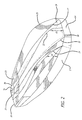
- a wakesurfing boat 10 includes a hull12.
- Hull12 includes a bow 14, a stern 16, a port bulwark 17, a starboard bulwark 18, a center of gravity CG, a first waterline WL 1 defined on the bulwarks when the boat is at rest in a body of water, a hull bottom 20, a length L, a beam B, and preferably a length to beam ratio L/B of less than 3.0.
- hull bottom 20 includes a substantially central ridge portion 22 extending a first depth d1 below the hull proximate the bow 14.
- the depth of the central ridge portion 22 extends along the length of the hull bottom 20 at progressively decreasing depths to a substantially planar portion 23 in the hull bottom 20 midway between the bow 14 and the stern 16.
- a port ridge portion 24 and a starboard ridge portion 25 each extend a second depth d2 below the hull proximate the respective port and starboard bulwarks 17 and 18.
- the central ridge portion 22, and the port and starboard ridge portions 24 and 25, combine to define a substantially M-shaped cross-sectional configuration, with port and starboard concave portions 26 and 27, defined between the substantially central ridge 22, and the respective port and starboard ridges 24 and 25.
- the port concave portion 26 is open to the body of water at an opening 28 proximate the bow 14
- the starboard concave portion 27 is open to the body of water at an opening 29, also proximate the bow 14.
- the respective depths of the port and starboard ridge portions 24 and 25 extend along the length of the hull bottom 20 at progressively decreasing depths below the hull bottom to the substantially planar portion 23.
- port and starboard lateral rounded sponsoons 30 and 32 extend beneath the respective port and starboard bulwarks 17 and 18 proximate the stern 16.
- each sponsoon is rounded with a lateral fillet 33 and 34 respectively.
- Each fillet preferably has a radius of approximately 150 mm.
- the port and starboard lateral sponsoons also are raised higher on the bulwarks 17 and 18, respectively.
- a trim wedge 35 extends below the stern 16 to a third depth d3. As broadly embodied in Figs. 2 and 3 , the trim wedge 35 extends forward toward the substantially planar portion 23, defining first and second generally triangular faces 36 and 37.
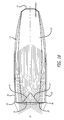
- the hull further comprises a first generally rounded stern portion 38 located below the stern 16, immediately aft of, and attached to, the trim wedge 35. It is further preferred, referring to Figs.3 , 13 , and 17 , that a second rounded portion 39 be provided at the stern 16, extending from the port sponsoon 30 to the starboard sponsoon 32.
- ballast system 40 is supported by the hull 12.
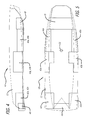
- ballast system 40 includes a plurality of ballast tanks, including sets of dual tanks, and single tanks 42a, 42b, 43a, 43b 44a, 44b, 45, and 46.
- a ballast watering system including at least one pump (not shown) is provided to selectively pump ballast water to various selected ballast tanks in order to trim the hull 12 in various selected trim angles during different operating modes, as explained in detail below.
- the ballast tanks are configured with a preselected volume capacity, and positioned on the hull 12, in order to obtain desired conditions of waterline, LWL, displacement, and trim angle, when the hull 12 is moving through the body of water.
- dual tanks 44a, 44b are positioned partly forward of the CG
- tank 45 is positioned forward of tanks 44a, 44b.
- Tank 46 positioned at the stern, has the largest capacity, greater than approximately 1100 liters of ballast water.
- the volumes of the hull when immersed in salt water, L/B ratios, LWL, and associated hull displacements and drafts be established in accordance with the charts below.
- the hull volumes will change when the hull is immersed in fresh water. Draft Displ.
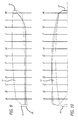
- Figs. 9 and 10 the hull 12 is depicted viewed from the side and from below, respectively, with a plurality of cross-sectional cut lines A-M.
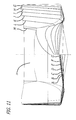
- Fig. 11 depicts the hull in cross-section viewed from the bow 14, depicting all of the crosssectional cut lines A-M.
- Figs. 12A-12M depict separate cross-sections, viewed from the bow 14, of each of the cross-sectional cuts A-M.
- FIG. 12M, 12L, and 12K depict the configuration of the port and starboard concave portions 26 and 27 at the bow 14 ( Fig. 12M ) and proximate, but approximately 1.6 m aft of the bow ( Figs. 12K and12L).
- the cross-sectional configuration of the concave portions 26 and 27 proximate and immediately aft of the bow 14 is significant because, as will be explained below, this configuration reduces pressure loss at the bow 14, thereby suppressing entry of air, that would otherwise be trapped under the hull12. Suppression of trapped air under the hull 12 subsequently suppresses turbulent flow of muddy-appearing water in the wake of the hull 12.
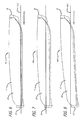
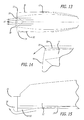
- hull 12 is depicted operating in a non-surfing, or cruising mode, Me.
- hull12 is depicted operating in a static surfing mode, Mss.
- hull 12 is depicted operating in a dynamic surfing mode, Msd.
- the hull 12 in the cruising mode, Me, the hull 12 is moving through the body of water, the ballast tanks are substantially empty, the hull 12 displaces a first amount of displaced water, the hull is trimmed bow up, a second waterline WL2 is defined on the bulwarks, higher on the bulwarks than the first at-rest waterline WL 1, a first amount of water enters the openings of the port and starboard concave portions 26 and 27, and traverses through the length of the concave portions 26 and 27, and the hull 12 encounters a first water resistance Wr1.
- the hull 12 generates a first wake wave W1 having a first wave height Wh1, and a first wave shape Ws1.
- the static surfing mode, Mss the hull 12 is not moving through the water, the ballast tanks are partially filled, the hull displaces an amount of displaced water intermediate the amounts of displaced water in the cruising mode Me and the dynamic surfing mode Msd, and the hull12 has a stern down trim intermediate the trims in the cruising mode Me and the dynamic surfing mode Msd.
- a third waterline WL3 is defined on the bulwarks, higher on the bulwarks than the second waterline WL2, resulting in more surface of the hull being in contact with the body of water, a second amount of water, greater than the first amount of water, enters the openings of the concave portions 26 and 27 and traverses the lengths of the concave portions 26 and 27, and the hull 12 encounters a second amount of water resistance Wr2, greater than the first amount of water resistance Wr1 encountered in the cruising mode Me.
- a second wave height Wh2 of second wake wave W2 is greater than the wave height Wh1 of wake wave W1 generated in the cruising mode Me.
- wake wave W2 also has a different wave shape Ws2.
- rounding of the lateral sponsoons 30 and 32 with the approximately 150 mm fillets 33 and 34 deflect portions of lateral flow of the body of water inward toward the wake of the hull 12.
- the first stern rounded portion 38 immediately aft of the trim wedge 35 directs flow of the body of water beneath the hull upward toward the surface in the wake of the hull 12.
- the second rounded stern portion 39 assists the lateral rounded sponsoons to direct water flowing past the bulwarks into the wake of the hull12.
- water passing below the hull 12 is further directed by contact with triangular faces 36 and 37 of trim wedge 35 to a center of the wake.
- Each of the above factors contributes to water flowing laterally past, and below, the hull12, being directed to a convergent zone Zc in the wake of the hull12, which contributes to generation of the wave shape Ws2 with an improved face and crest, having reduced turbulence.
- the increase in LWL as a result of the above-described factors in the dynamic surfing mode Msd achieves improved performance and an increase in the wetted surface of the hull.
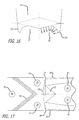
- the configuration of the concave portions 26 and 27 proximate the bow 14 maintain higher pressure below the concave portions, thereby suppressing entry of air under the hull at the bow, subsequently maintaining desired high pressure areas 50 under the hull, as shown in Fig. 17 .
- the wave created by the hull 12 passing, rather than planning, in the water is due to a reinstatement of normal atmospheric pressure 52 (1 bar at sea level) following disturbance in the water created by passage of the hull therethrough, wherein surface water is pushed downward, increasing pressure in the water, with atmospheric pressure following immediately after passage of the hull, which typically creates pressure fluctuations 53 which result in an unsatisfactory wave shape.
- the combined hull features discussed above act together to suppress pressure fluctuations 53 in the water.
- the structural hull features, including the concave portions26 ad 27, act as a funnel, carrying water back to where the trim wedge 35 and the rounded features proximate the stern 16, i.e. 33, 34, and 39, redirect water into the wake to convergent zone Zc, to generate the wake wave with a desired shape, in terms of aspect, slope, and power.
- the wakesurfing boat further includes a deck, visible in Fig.1 , and a pair of counter-rotating propellers (not shown) to propel the boat.
- the hull 12 can have the length L of a yacht, the length L of a cruiser, or the length L of a sport boat.
Landscapes
- Physics & Mathematics (AREA)
- Fluid Mechanics (AREA)
- Chemical & Material Sciences (AREA)
- Engineering & Computer Science (AREA)
- Combustion & Propulsion (AREA)
- Mechanical Engineering (AREA)
- Ocean & Marine Engineering (AREA)
- Other Liquid Machine Or Engine Such As Wave Power Use (AREA)
- Financial Or Insurance-Related Operations Such As Payment And Settlement (AREA)
- Polyamides (AREA)
Priority Applications (1)
| Application Number | Priority Date | Filing Date | Title |
|---|---|---|---|
| EP14180155.5A EP2842861B1 (de) | 2013-03-15 | 2013-06-03 | Wakesurfboot und Rumpf für ein Wakesurfboot |
Applications Claiming Priority (1)
| Application Number | Priority Date | Filing Date | Title |
|---|---|---|---|
| US13/835,660 US8590475B2 (en) | 2011-12-09 | 2013-03-15 | Wakesurfing boat and hull for a wakesurfing boat |
Related Child Applications (2)
| Application Number | Title | Priority Date | Filing Date |
|---|---|---|---|
| EP14180155.5A Division-Into EP2842861B1 (de) | 2013-03-15 | 2013-06-03 | Wakesurfboot und Rumpf für ein Wakesurfboot |
| EP14180155.5A Division EP2842861B1 (de) | 2013-03-15 | 2013-06-03 | Wakesurfboot und Rumpf für ein Wakesurfboot |
Publications (2)
| Publication Number | Publication Date |
|---|---|
| EP2778038A2 true EP2778038A2 (de) | 2014-09-17 |
| EP2778038A3 EP2778038A3 (de) | 2016-01-06 |
Family
ID=48539022
Family Applications (2)
| Application Number | Title | Priority Date | Filing Date |
|---|---|---|---|
| EP13170307.6A Withdrawn EP2778038A3 (de) | 2013-03-15 | 2013-06-03 | Wakesurfboot und Rumpf für ein Wakesurfboot |
| EP14180155.5A Not-in-force EP2842861B1 (de) | 2013-03-15 | 2013-06-03 | Wakesurfboot und Rumpf für ein Wakesurfboot |
Family Applications After (1)
| Application Number | Title | Priority Date | Filing Date |
|---|---|---|---|
| EP14180155.5A Not-in-force EP2842861B1 (de) | 2013-03-15 | 2013-06-03 | Wakesurfboot und Rumpf für ein Wakesurfboot |
Country Status (1)
| Country | Link |
|---|---|
| EP (2) | EP2778038A3 (de) |
Cited By (2)
| Publication number | Priority date | Publication date | Assignee | Title |
|---|---|---|---|---|
| EP3075646A1 (de) * | 2015-04-01 | 2016-10-05 | 3Madmen | Wakesurfing-boot |
| CN112839867A (zh) * | 2018-05-08 | 2021-05-25 | 科派克系统公司 | 改进的发动机控制 |
Family Cites Families (3)
| Publication number | Priority date | Publication date | Assignee | Title |
|---|---|---|---|---|
| US3503358A (en) * | 1968-10-29 | 1970-03-31 | Carl Moesly | Self-stabilizing boat hull |
| US6374762B1 (en) * | 1997-10-27 | 2002-04-23 | Correct Craft, Inc. | Water sport towing apparatus |
| US6250245B1 (en) * | 1998-09-22 | 2001-06-26 | Mangia Onda Co., Llc | M-shaped boat hull |
-
2013
- 2013-06-03 EP EP13170307.6A patent/EP2778038A3/de not_active Withdrawn
- 2013-06-03 EP EP14180155.5A patent/EP2842861B1/de not_active Not-in-force
Non-Patent Citations (1)
| Title |
|---|
| None |
Cited By (4)
| Publication number | Priority date | Publication date | Assignee | Title |
|---|---|---|---|---|
| EP3075646A1 (de) * | 2015-04-01 | 2016-10-05 | 3Madmen | Wakesurfing-boot |
| EP3144210A1 (de) * | 2015-04-01 | 2017-03-22 | 3Madmen | Wakesurfing-boot |
| CN112839867A (zh) * | 2018-05-08 | 2021-05-25 | 科派克系统公司 | 改进的发动机控制 |
| US11845523B2 (en) | 2018-05-08 | 2023-12-19 | Cpac Systems Ab | Engine control |
Also Published As
| Publication number | Publication date |
|---|---|
| EP2778038A3 (de) | 2016-01-06 |
| EP2842861B1 (de) | 2017-03-29 |
| EP2842861A2 (de) | 2015-03-04 |
| EP2842861A3 (de) | 2016-01-06 |
Similar Documents
| Publication | Publication Date | Title |
|---|---|---|
| US8857364B2 (en) | Wakesurfing boat and hull for a wakesurfing boat | |
| US6216622B1 (en) | Boat hull with center V-hull and sponsons | |
| US8955451B2 (en) | Foil structure for providing buoyancy and lift | |
| EP2602178A1 (de) | Wakesurfboot und Rumpf für ein Wakesurfboot | |
| EP3075646A1 (de) | Wakesurfing-boot | |
| US3760756A (en) | Watercraft construction | |
| US4924792A (en) | High speed planing boat | |
| EP2842861B1 (de) | Wakesurfboot und Rumpf für ein Wakesurfboot | |
| US2915031A (en) | Modified v-bottom boat | |
| JPS60163784A (ja) | 船底に空気噴出口を有する船 | |
| US4774902A (en) | Mid-planing hull | |
| US8813672B2 (en) | Swimming platform for a boat | |
| US7827926B2 (en) | Profiled pontoon for watercraft | |
| US6837176B1 (en) | Vessel transition hull | |
| CA2861799C (en) | Wakesurfing boat and hull for a wakesurfing boat | |
| RU2302356C2 (ru) | Корпус судна, имеющий центральный киль и бортовые скулы | |
| US5317982A (en) | Ship | |
| US11524750B1 (en) | Hull for a wakesurf boat | |
| US20070032146A1 (en) | Watercraft | |
| US6834605B1 (en) | Low-resistance boat hull | |
| RU144285U1 (ru) | Корпус глиссирующего судна | |
| WO2018126294A1 (en) | Channelled surfboard | |
| US9056149B2 (en) | Bodyboard with hull and planar sections | |
| JP2007522032A (ja) | 遷音速船体および遷音速ハイドロフィールド(iii) | |
| US7207286B2 (en) | Tri-point hydro sled |
Legal Events
| Date | Code | Title | Description |
|---|---|---|---|
| PUAI | Public reference made under article 153(3) epc to a published international application that has entered the european phase |
Free format text: ORIGINAL CODE: 0009012 |
|
| 17P | Request for examination filed |
Effective date: 20130603 |
|
| AK | Designated contracting states |
Kind code of ref document: A2 Designated state(s): AL AT BE BG CH CY CZ DE DK EE ES FI FR GB GR HR HU IE IS IT LI LT LU LV MC MK MT NL NO PL PT RO RS SE SI SK SM TR |
|
| AX | Request for extension of the european patent |
Extension state: BA ME |
|
| PUAL | Search report despatched |
Free format text: ORIGINAL CODE: 0009013 |
|
| AK | Designated contracting states |
Kind code of ref document: A3 Designated state(s): AL AT BE BG CH CY CZ DE DK EE ES FI FR GB GR HR HU IE IS IT LI LT LU LV MC MK MT NL NO PL PT RO RS SE SI SK SM TR |
|
| AX | Request for extension of the european patent |
Extension state: BA ME |
|
| RIC1 | Information provided on ipc code assigned before grant |
Ipc: B63B 43/06 20060101ALI20151201BHEP Ipc: B63B 1/20 20060101ALI20151201BHEP Ipc: B63B 1/04 20060101AFI20151201BHEP |
|
| R17P | Request for examination filed (corrected) |
Effective date: 20160706 |
|
| RBV | Designated contracting states (corrected) |
Designated state(s): AL AT BE BG CH CY CZ DE DK EE ES FI FR GB GR HR HU IE IS IT LI LT LU LV MC MK MT NL NO PL PT RO RS SE SI SK SM TR |
|
| 17Q | First examination report despatched |
Effective date: 20161110 |
|
| GRAP | Despatch of communication of intention to grant a patent |
Free format text: ORIGINAL CODE: EPIDOSNIGR1 |
|
| INTG | Intention to grant announced |
Effective date: 20170630 |
|
| STAA | Information on the status of an ep patent application or granted ep patent |
Free format text: STATUS: THE APPLICATION IS DEEMED TO BE WITHDRAWN |
|
| 18D | Application deemed to be withdrawn |
Effective date: 20171111 |