EP2777723A2 - Implantierbarer Gegenstand umfassend gezielt degradierbare Co-Polymere zur verbesserten Explantierbarkeit - Google Patents
Implantierbarer Gegenstand umfassend gezielt degradierbare Co-Polymere zur verbesserten Explantierbarkeit Download PDFInfo
- Publication number
- EP2777723A2 EP2777723A2 EP14152461.1A EP14152461A EP2777723A2 EP 2777723 A2 EP2777723 A2 EP 2777723A2 EP 14152461 A EP14152461 A EP 14152461A EP 2777723 A2 EP2777723 A2 EP 2777723A2
- Authority
- EP
- European Patent Office
- Prior art keywords
- polymer
- aptamer
- implant
- implantable article
- degradation
- Prior art date
- Legal status (The legal status is an assumption and is not a legal conclusion. Google has not performed a legal analysis and makes no representation as to the accuracy of the status listed.)
- Granted
Links
- 229920001577 copolymer Polymers 0.000 title claims abstract description 61
- 230000001976 improved effect Effects 0.000 title description 3
- 108091023037 Aptamer Proteins 0.000 claims abstract description 62
- 230000027455 binding Effects 0.000 claims abstract description 44
- 238000006731 degradation reaction Methods 0.000 claims abstract description 42
- 230000015556 catabolic process Effects 0.000 claims abstract description 41
- 238000000034 method Methods 0.000 claims abstract description 11
- 239000007943 implant Substances 0.000 claims description 58
- 239000010410 layer Substances 0.000 claims description 39
- 108090000994 Catalytic RNA Proteins 0.000 claims description 23
- 102000053642 Catalytic RNA Human genes 0.000 claims description 23
- 108091092562 ribozyme Proteins 0.000 claims description 23
- 230000000295 complement effect Effects 0.000 claims description 16
- 150000001875 compounds Chemical class 0.000 claims description 16
- 239000000126 substance Substances 0.000 claims description 15
- HRPVXLWXLXDGHG-UHFFFAOYSA-N Acrylamide Chemical compound NC(=O)C=C HRPVXLWXLXDGHG-UHFFFAOYSA-N 0.000 claims description 7
- 230000004962 physiological condition Effects 0.000 claims description 7
- LYCAIKOWRPUZTN-UHFFFAOYSA-N Ethylene glycol Chemical compound OCCO LYCAIKOWRPUZTN-UHFFFAOYSA-N 0.000 claims description 6
- WOBHKFSMXKNTIM-UHFFFAOYSA-N Hydroxyethyl methacrylate Chemical compound CC(=C)C(=O)OCCO WOBHKFSMXKNTIM-UHFFFAOYSA-N 0.000 claims description 6
- DNIAPMSPPWPWGF-UHFFFAOYSA-N Propylene glycol Chemical compound CC(O)CO DNIAPMSPPWPWGF-UHFFFAOYSA-N 0.000 claims description 6
- 239000000463 material Substances 0.000 claims description 6
- 230000001960 triggered effect Effects 0.000 claims description 6
- 229920002818 (Hydroxyethyl)methacrylate Polymers 0.000 claims description 4
- 241001465754 Metazoa Species 0.000 claims description 4
- XTXRWKRVRITETP-UHFFFAOYSA-N Vinyl acetate Chemical compound CC(=O)OC=C XTXRWKRVRITETP-UHFFFAOYSA-N 0.000 claims description 4
- 230000003993 interaction Effects 0.000 claims description 4
- JVTAAEKCZFNVCJ-UHFFFAOYSA-N lactic acid Chemical compound CC(O)C(O)=O JVTAAEKCZFNVCJ-UHFFFAOYSA-N 0.000 claims description 4
- 150000002772 monosaccharides Chemical class 0.000 claims description 4
- 239000011241 protective layer Substances 0.000 claims description 4
- 230000000747 cardiac effect Effects 0.000 claims description 3
- 238000004132 cross linking Methods 0.000 claims description 3
- 230000000694 effects Effects 0.000 claims description 3
- 239000000178 monomer Substances 0.000 claims description 3
- QNILTEGFHQSKFF-UHFFFAOYSA-N n-propan-2-ylprop-2-enamide Chemical compound CC(C)NC(=O)C=C QNILTEGFHQSKFF-UHFFFAOYSA-N 0.000 claims description 3
- 229920001542 oligosaccharide Polymers 0.000 claims description 3
- 239000007787 solid Substances 0.000 claims description 3
- 230000000638 stimulation Effects 0.000 claims description 3
- 150000005846 sugar alcohols Chemical class 0.000 claims description 3
- SJZRECIVHVDYJC-UHFFFAOYSA-M 4-hydroxybutyrate Chemical compound OCCCC([O-])=O SJZRECIVHVDYJC-UHFFFAOYSA-M 0.000 claims description 2
- IMROMDMJAWUWLK-UHFFFAOYSA-N Ethenol Chemical compound OC=C IMROMDMJAWUWLK-UHFFFAOYSA-N 0.000 claims description 2
- -1 L-form oligosaccharides Chemical class 0.000 claims description 2
- CERQOIWHTDAKMF-UHFFFAOYSA-M Methacrylate Chemical compound CC(=C)C([O-])=O CERQOIWHTDAKMF-UHFFFAOYSA-M 0.000 claims description 2
- WHNWPMSKXPGLAX-UHFFFAOYSA-N N-Vinyl-2-pyrrolidone Chemical compound C=CN1CCCC1=O WHNWPMSKXPGLAX-UHFFFAOYSA-N 0.000 claims description 2
- 239000002253 acid Substances 0.000 claims description 2
- 239000013543 active substance Substances 0.000 claims description 2
- 150000001413 amino acids Chemical class 0.000 claims description 2
- 238000010504 bond cleavage reaction Methods 0.000 claims description 2
- 230000002490 cerebral effect Effects 0.000 claims description 2
- 238000002316 cosmetic surgery Methods 0.000 claims description 2
- 239000004053 dental implant Substances 0.000 claims description 2
- 235000014655 lactic acid Nutrition 0.000 claims description 2
- 239000004310 lactic acid Substances 0.000 claims description 2
- ZTUGCJNAJJDKDC-UHFFFAOYSA-N n-(3-hydroxypropyl)-2-methylprop-2-enamide Chemical class CC(=C)C(=O)NCCCO ZTUGCJNAJJDKDC-UHFFFAOYSA-N 0.000 claims description 2
- PAPBSGBWRJIAAV-UHFFFAOYSA-N ε-Caprolactone Chemical compound O=C1CCCCCO1 PAPBSGBWRJIAAV-UHFFFAOYSA-N 0.000 claims description 2
- UQDJGEHQDNVPGU-UHFFFAOYSA-N serine phosphoethanolamine Chemical compound [NH3+]CCOP([O-])(=O)OCC([NH3+])C([O-])=O UQDJGEHQDNVPGU-UHFFFAOYSA-N 0.000 claims 1
- 229920000642 polymer Polymers 0.000 description 21
- 238000000576 coating method Methods 0.000 description 15
- 239000000243 solution Substances 0.000 description 15
- ZFXYFBGIUFBOJW-UHFFFAOYSA-N theophylline Chemical compound O=C1N(C)C(=O)N(C)C2=C1NC=N2 ZFXYFBGIUFBOJW-UHFFFAOYSA-N 0.000 description 13
- 239000011248 coating agent Substances 0.000 description 11
- 230000006870 function Effects 0.000 description 10
- 238000006243 chemical reaction Methods 0.000 description 7
- 229960000278 theophylline Drugs 0.000 description 7
- 125000003729 nucleotide group Chemical group 0.000 description 6
- 108091032973 (ribonucleotides)n+m Proteins 0.000 description 5
- 108091028043 Nucleic acid sequence Proteins 0.000 description 4
- FAPWRFPIFSIZLT-UHFFFAOYSA-M Sodium chloride Chemical compound [Na+].[Cl-] FAPWRFPIFSIZLT-UHFFFAOYSA-M 0.000 description 4
- ROOXNKNUYICQNP-UHFFFAOYSA-N ammonium persulfate Chemical compound [NH4+].[NH4+].[O-]S(=O)(=O)OOS([O-])(=O)=O ROOXNKNUYICQNP-UHFFFAOYSA-N 0.000 description 4
- 238000004519 manufacturing process Methods 0.000 description 4
- 239000002773 nucleotide Substances 0.000 description 4
- 230000008569 process Effects 0.000 description 4
- 235000000346 sugar Nutrition 0.000 description 4
- PYMYPHUHKUWMLA-LMVFSUKVSA-N Ribose Natural products OC[C@@H](O)[C@@H](O)[C@@H](O)C=O PYMYPHUHKUWMLA-LMVFSUKVSA-N 0.000 description 3
- HMFHBZSHGGEWLO-UHFFFAOYSA-N alpha-D-Furanose-Ribose Natural products OCC1OC(O)C(O)C1O HMFHBZSHGGEWLO-UHFFFAOYSA-N 0.000 description 3
- PYMYPHUHKUWMLA-UHFFFAOYSA-N arabinose Natural products OCC(O)C(O)C(O)C=O PYMYPHUHKUWMLA-UHFFFAOYSA-N 0.000 description 3
- SRBFZHDQGSBBOR-UHFFFAOYSA-N beta-D-Pyranose-Lyxose Natural products OC1COC(O)C(O)C1O SRBFZHDQGSBBOR-UHFFFAOYSA-N 0.000 description 3
- 229940079593 drug Drugs 0.000 description 3
- 239000003814 drug Substances 0.000 description 3
- 229910052739 hydrogen Inorganic materials 0.000 description 3
- 239000001257 hydrogen Substances 0.000 description 3
- 238000006460 hydrolysis reaction Methods 0.000 description 3
- 239000000203 mixture Substances 0.000 description 3
- XLYOFNOQVPJJNP-UHFFFAOYSA-N water Substances O XLYOFNOQVPJJNP-UHFFFAOYSA-N 0.000 description 3
- JKNCOURZONDCGV-UHFFFAOYSA-N 2-(dimethylamino)ethyl 2-methylprop-2-enoate Chemical compound CN(C)CCOC(=O)C(C)=C JKNCOURZONDCGV-UHFFFAOYSA-N 0.000 description 2
- AOYNUTHNTBLRMT-SLPGGIOYSA-N 2-deoxy-2-fluoro-aldehydo-D-glucose Chemical compound OC[C@@H](O)[C@@H](O)[C@H](O)[C@@H](F)C=O AOYNUTHNTBLRMT-SLPGGIOYSA-N 0.000 description 2
- SRBFZHDQGSBBOR-SOOFDHNKSA-N D-ribopyranose Chemical compound O[C@@H]1COC(O)[C@H](O)[C@@H]1O SRBFZHDQGSBBOR-SOOFDHNKSA-N 0.000 description 2
- WQZGKKKJIJFFOK-GASJEMHNSA-N Glucose Natural products OC[C@H]1OC(O)[C@H](O)[C@@H](O)[C@@H]1O WQZGKKKJIJFFOK-GASJEMHNSA-N 0.000 description 2
- MWCLLHOVUTZFKS-UHFFFAOYSA-N Methyl cyanoacrylate Chemical compound COC(=O)C(=C)C#N MWCLLHOVUTZFKS-UHFFFAOYSA-N 0.000 description 2
- YNAVUWVOSKDBBP-UHFFFAOYSA-N Morpholine Chemical compound C1COCCN1 YNAVUWVOSKDBBP-UHFFFAOYSA-N 0.000 description 2
- 239000007983 Tris buffer Substances 0.000 description 2
- 239000004480 active ingredient Substances 0.000 description 2
- PYMYPHUHKUWMLA-MROZADKFSA-N aldehydo-L-ribose Chemical compound OC[C@H](O)[C@H](O)[C@H](O)C=O PYMYPHUHKUWMLA-MROZADKFSA-N 0.000 description 2
- 230000003281 allosteric effect Effects 0.000 description 2
- 229910001870 ammonium persulfate Inorganic materials 0.000 description 2
- 230000008901 benefit Effects 0.000 description 2
- 230000015572 biosynthetic process Effects 0.000 description 2
- 239000008280 blood Substances 0.000 description 2
- 210000004369 blood Anatomy 0.000 description 2
- 230000008859 change Effects 0.000 description 2
- 239000003795 chemical substances by application Substances 0.000 description 2
- 238000007334 copolymerization reaction Methods 0.000 description 2
- 230000001419 dependent effect Effects 0.000 description 2
- 238000004090 dissolution Methods 0.000 description 2
- 230000005670 electromagnetic radiation Effects 0.000 description 2
- 238000005516 engineering process Methods 0.000 description 2
- 230000002255 enzymatic effect Effects 0.000 description 2
- 230000007717 exclusion Effects 0.000 description 2
- 230000007062 hydrolysis Effects 0.000 description 2
- 238000001727 in vivo Methods 0.000 description 2
- 230000001939 inductive effect Effects 0.000 description 2
- FQPSGWSUVKBHSU-UHFFFAOYSA-N methacrylamide Chemical compound CC(=C)C(N)=O FQPSGWSUVKBHSU-UHFFFAOYSA-N 0.000 description 2
- 125000005395 methacrylic acid group Chemical group 0.000 description 2
- UNEXJVCWJSHFNN-UHFFFAOYSA-N n,n,n',n'-tetraethylmethanediamine Chemical compound CCN(CC)CN(CC)CC UNEXJVCWJSHFNN-UHFFFAOYSA-N 0.000 description 2
- 150000002482 oligosaccharides Chemical class 0.000 description 2
- 238000002360 preparation method Methods 0.000 description 2
- 239000011780 sodium chloride Substances 0.000 description 2
- 230000008961 swelling Effects 0.000 description 2
- LENZDBCJOHFCAS-UHFFFAOYSA-N tris Chemical compound OCC(N)(CO)CO LENZDBCJOHFCAS-UHFFFAOYSA-N 0.000 description 2
- IAJILQKETJEXLJ-KKQCNMDGSA-N (2r,3r,4r,5s)-2,3,4,5-tetrahydroxy-6-oxohexanoic acid Chemical compound O=C[C@@H](O)[C@H](O)[C@@H](O)[C@@H](O)C(O)=O IAJILQKETJEXLJ-KKQCNMDGSA-N 0.000 description 1
- AEMOLEFTQBMNLQ-XVYLPRKHSA-N (2r,3s,4r,5s)-3,4,5,6-tetrahydroxyoxane-2-carboxylic acid Chemical compound OC1O[C@@H](C(O)=O)[C@@H](O)[C@@H](O)[C@@H]1O AEMOLEFTQBMNLQ-XVYLPRKHSA-N 0.000 description 1
- AOYNUTHNTBLRMT-KCDKBNATSA-N (2r,3s,4s,5r)-2-fluoro-3,4,5,6-tetrahydroxyhexanal Chemical compound OC[C@@H](O)[C@H](O)[C@H](O)[C@@H](F)C=O AOYNUTHNTBLRMT-KCDKBNATSA-N 0.000 description 1
- PXFBZOLANLWPMH-UHFFFAOYSA-N 16-Epiaffinine Natural products C1C(C2=CC=CC=C2N2)=C2C(=O)CC2C(=CC)CN(C)C1C2CO PXFBZOLANLWPMH-UHFFFAOYSA-N 0.000 description 1
- XWHHYOYVRVGJJY-QMMMGPOBSA-N 4-fluoro-L-phenylalanine Chemical compound OC(=O)[C@@H](N)CC1=CC=C(F)C=C1 XWHHYOYVRVGJJY-QMMMGPOBSA-N 0.000 description 1
- GUBGYTABKSRVRQ-XLOQQCSPSA-N Alpha-Lactose Chemical compound O[C@@H]1[C@@H](O)[C@@H](O)[C@@H](CO)O[C@H]1O[C@@H]1[C@@H](CO)O[C@H](O)[C@H](O)[C@H]1O GUBGYTABKSRVRQ-XLOQQCSPSA-N 0.000 description 1
- FBPFZTCFMRRESA-FSIIMWSLSA-N D-Glucitol Natural products OC[C@H](O)[C@H](O)[C@@H](O)[C@H](O)CO FBPFZTCFMRRESA-FSIIMWSLSA-N 0.000 description 1
- FBPFZTCFMRRESA-JGWLITMVSA-N D-glucitol Chemical compound OC[C@H](O)[C@@H](O)[C@H](O)[C@H](O)CO FBPFZTCFMRRESA-JGWLITMVSA-N 0.000 description 1
- 108020005199 Dehydrogenases Proteins 0.000 description 1
- 108010042407 Endonucleases Proteins 0.000 description 1
- 102000004533 Endonucleases Human genes 0.000 description 1
- 102000004190 Enzymes Human genes 0.000 description 1
- 108090000790 Enzymes Proteins 0.000 description 1
- 239000004386 Erythritol Substances 0.000 description 1
- UNXHWFMMPAWVPI-UHFFFAOYSA-N Erythritol Natural products OCC(O)C(O)CO UNXHWFMMPAWVPI-UHFFFAOYSA-N 0.000 description 1
- 108090000371 Esterases Proteins 0.000 description 1
- 108060002716 Exonuclease Proteins 0.000 description 1
- 229930091371 Fructose Natural products 0.000 description 1
- 239000005715 Fructose Substances 0.000 description 1
- RFSUNEUAIZKAJO-ARQDHWQXSA-N Fructose Chemical compound OC[C@H]1O[C@](O)(CO)[C@@H](O)[C@@H]1O RFSUNEUAIZKAJO-ARQDHWQXSA-N 0.000 description 1
- 108090001102 Hammerhead ribozyme Proteins 0.000 description 1
- LKDRXBCSQODPBY-NSHGFSBMSA-N L-fructose Chemical compound OCC1(O)OC[C@H](O)[C@H](O)[C@H]1O LKDRXBCSQODPBY-NSHGFSBMSA-N 0.000 description 1
- WQZGKKKJIJFFOK-DHVFOXMCSA-N L-galactose Chemical compound OC[C@@H]1OC(O)[C@@H](O)[C@H](O)[C@@H]1O WQZGKKKJIJFFOK-DHVFOXMCSA-N 0.000 description 1
- FZHXIRIBWMQPQF-VANKVMQKSA-N L-glucosamine Chemical compound O=C[C@@H](N)[C@H](O)[C@@H](O)[C@@H](O)CO FZHXIRIBWMQPQF-VANKVMQKSA-N 0.000 description 1
- WQZGKKKJIJFFOK-ZZWDRFIYSA-N L-glucose Chemical compound OC[C@@H]1OC(O)[C@@H](O)[C@H](O)[C@H]1O WQZGKKKJIJFFOK-ZZWDRFIYSA-N 0.000 description 1
- WQZGKKKJIJFFOK-JFNONXLTSA-N L-mannopyranose Chemical compound OC[C@@H]1OC(O)[C@H](O)[C@H](O)[C@H]1O WQZGKKKJIJFFOK-JFNONXLTSA-N 0.000 description 1
- GUBGYTABKSRVRQ-QKKXKWKRSA-N Lactose Natural products OC[C@H]1O[C@@H](O[C@H]2[C@H](O)[C@@H](O)C(O)O[C@@H]2CO)[C@H](O)[C@@H](O)[C@H]1O GUBGYTABKSRVRQ-QKKXKWKRSA-N 0.000 description 1
- 108090001060 Lipase Proteins 0.000 description 1
- 239000004367 Lipase Substances 0.000 description 1
- 102000004882 Lipase Human genes 0.000 description 1
- 229910000861 Mg alloy Inorganic materials 0.000 description 1
- 108090000417 Oxygenases Proteins 0.000 description 1
- 102000004020 Oxygenases Human genes 0.000 description 1
- 238000012879 PET imaging Methods 0.000 description 1
- 239000004952 Polyamide Substances 0.000 description 1
- 229920002732 Polyanhydride Polymers 0.000 description 1
- 229920001710 Polyorthoester Polymers 0.000 description 1
- 108091028664 Ribonucleotide Proteins 0.000 description 1
- 108091027076 Spiegelmer Proteins 0.000 description 1
- TVXBFESIOXBWNM-UHFFFAOYSA-N Xylitol Natural products OCCC(O)C(O)C(O)CCO TVXBFESIOXBWNM-UHFFFAOYSA-N 0.000 description 1
- 150000007513 acids Chemical class 0.000 description 1
- 150000003926 acrylamides Chemical class 0.000 description 1
- 230000004913 activation Effects 0.000 description 1
- PYMYPHUHKUWMLA-WISUUJSJSA-N aldehydo-L-xylose Chemical compound OC[C@H](O)[C@@H](O)[C@H](O)C=O PYMYPHUHKUWMLA-WISUUJSJSA-N 0.000 description 1
- 229930195726 aldehydo-L-xylose Natural products 0.000 description 1
- 230000008841 allosteric interaction Effects 0.000 description 1
- 229910045601 alloy Inorganic materials 0.000 description 1
- 239000000956 alloy Substances 0.000 description 1
- 125000004429 atom Chemical group 0.000 description 1
- 229920001400 block copolymer Polymers 0.000 description 1
- 210000001124 body fluid Anatomy 0.000 description 1
- 239000010839 body fluid Substances 0.000 description 1
- 229910052794 bromium Inorganic materials 0.000 description 1
- 125000004432 carbon atom Chemical group C* 0.000 description 1
- 230000003197 catalytic effect Effects 0.000 description 1
- 230000001413 cellular effect Effects 0.000 description 1
- 229910052801 chlorine Inorganic materials 0.000 description 1
- 238000003776 cleavage reaction Methods 0.000 description 1
- 239000000470 constituent Substances 0.000 description 1
- 239000002872 contrast media Substances 0.000 description 1
- 210000004351 coronary vessel Anatomy 0.000 description 1
- 230000008878 coupling Effects 0.000 description 1
- 238000010168 coupling process Methods 0.000 description 1
- 238000005859 coupling reaction Methods 0.000 description 1
- 230000007423 decrease Effects 0.000 description 1
- 230000003111 delayed effect Effects 0.000 description 1
- 238000009792 diffusion process Methods 0.000 description 1
- 235000019414 erythritol Nutrition 0.000 description 1
- UNXHWFMMPAWVPI-ZXZARUISSA-N erythritol Chemical compound OC[C@H](O)[C@H](O)CO UNXHWFMMPAWVPI-ZXZARUISSA-N 0.000 description 1
- 229940009714 erythritol Drugs 0.000 description 1
- 150000002148 esters Chemical group 0.000 description 1
- 102000013165 exonuclease Human genes 0.000 description 1
- 229910052731 fluorine Inorganic materials 0.000 description 1
- 235000013305 food Nutrition 0.000 description 1
- 229930182830 galactose Natural products 0.000 description 1
- 239000008103 glucose Substances 0.000 description 1
- 150000002303 glucose derivatives Chemical class 0.000 description 1
- 150000002337 glycosamines Chemical class 0.000 description 1
- 125000005843 halogen group Chemical group 0.000 description 1
- 230000003301 hydrolyzing effect Effects 0.000 description 1
- 230000002209 hydrophobic effect Effects 0.000 description 1
- 125000002887 hydroxy group Chemical group [H]O* 0.000 description 1
- 238000011534 incubation Methods 0.000 description 1
- 230000005865 ionizing radiation Effects 0.000 description 1
- 239000008101 lactose Substances 0.000 description 1
- 229960001375 lactose Drugs 0.000 description 1
- 235000019421 lipase Nutrition 0.000 description 1
- 239000000845 maltitol Substances 0.000 description 1
- VQHSOMBJVWLPSR-WUJBLJFYSA-N maltitol Chemical compound OC[C@H](O)[C@@H](O)[C@@H]([C@H](O)CO)O[C@H]1O[C@H](CO)[C@@H](O)[C@H](O)[C@H]1O VQHSOMBJVWLPSR-WUJBLJFYSA-N 0.000 description 1
- 235000010449 maltitol Nutrition 0.000 description 1
- 229940035436 maltitol Drugs 0.000 description 1
- 239000011159 matrix material Substances 0.000 description 1
- HEBKCHPVOIAQTA-UHFFFAOYSA-N meso ribitol Natural products OCC(O)C(O)C(O)CO HEBKCHPVOIAQTA-UHFFFAOYSA-N 0.000 description 1
- 230000002503 metabolic effect Effects 0.000 description 1
- 229910052751 metal Inorganic materials 0.000 description 1
- 239000002184 metal Substances 0.000 description 1
- 102000039446 nucleic acids Human genes 0.000 description 1
- 108020004707 nucleic acids Proteins 0.000 description 1
- 150000007523 nucleic acids Chemical class 0.000 description 1
- 235000016709 nutrition Nutrition 0.000 description 1
- 230000035764 nutrition Effects 0.000 description 1
- 125000004430 oxygen atom Chemical group O* 0.000 description 1
- 239000002504 physiological saline solution Substances 0.000 description 1
- 229920001432 poly(L-lactide) Polymers 0.000 description 1
- 229920002463 poly(p-dioxanone) polymer Polymers 0.000 description 1
- 229920000058 polyacrylate Polymers 0.000 description 1
- 229920002647 polyamide Polymers 0.000 description 1
- 229920000728 polyester Polymers 0.000 description 1
- 229920000570 polyether Polymers 0.000 description 1
- 229920002959 polymer blend Polymers 0.000 description 1
- 229920002635 polyurethane Polymers 0.000 description 1
- 239000004814 polyurethane Substances 0.000 description 1
- 108090000765 processed proteins & peptides Proteins 0.000 description 1
- 230000005855 radiation Effects 0.000 description 1
- 230000004044 response Effects 0.000 description 1
- 239000002336 ribonucleotide Substances 0.000 description 1
- 125000002652 ribonucleotide group Chemical group 0.000 description 1
- 125000000548 ribosyl group Chemical group C1([C@H](O)[C@H](O)[C@H](O1)CO)* 0.000 description 1
- 230000007017 scission Effects 0.000 description 1
- 239000011343 solid material Substances 0.000 description 1
- 239000000600 sorbitol Substances 0.000 description 1
- 229960002920 sorbitol Drugs 0.000 description 1
- 235000010356 sorbitol Nutrition 0.000 description 1
- 150000003445 sucroses Chemical class 0.000 description 1
- 150000008163 sugars Chemical class 0.000 description 1
- 230000003319 supportive effect Effects 0.000 description 1
- 238000007910 systemic administration Methods 0.000 description 1
- 208000037816 tissue injury Diseases 0.000 description 1
- 239000000811 xylitol Substances 0.000 description 1
- 235000010447 xylitol Nutrition 0.000 description 1
- HEBKCHPVOIAQTA-SCDXWVJYSA-N xylitol Chemical compound OC[C@H](O)[C@@H](O)[C@H](O)CO HEBKCHPVOIAQTA-SCDXWVJYSA-N 0.000 description 1
- 229960002675 xylitol Drugs 0.000 description 1
Images

Classifications
-
- A—HUMAN NECESSITIES
- A61—MEDICAL OR VETERINARY SCIENCE; HYGIENE
- A61L—METHODS OR APPARATUS FOR STERILISING MATERIALS OR OBJECTS IN GENERAL; DISINFECTION, STERILISATION OR DEODORISATION OF AIR; CHEMICAL ASPECTS OF BANDAGES, DRESSINGS, ABSORBENT PADS OR SURGICAL ARTICLES; MATERIALS FOR BANDAGES, DRESSINGS, ABSORBENT PADS OR SURGICAL ARTICLES
- A61L31/00—Materials for other surgical articles, e.g. stents, stent-grafts, shunts, surgical drapes, guide wires, materials for adhesion prevention, occluding devices, surgical gloves, tissue fixation devices
- A61L31/08—Materials for coatings
- A61L31/10—Macromolecular materials
-
- A—HUMAN NECESSITIES
- A61—MEDICAL OR VETERINARY SCIENCE; HYGIENE
- A61L—METHODS OR APPARATUS FOR STERILISING MATERIALS OR OBJECTS IN GENERAL; DISINFECTION, STERILISATION OR DEODORISATION OF AIR; CHEMICAL ASPECTS OF BANDAGES, DRESSINGS, ABSORBENT PADS OR SURGICAL ARTICLES; MATERIALS FOR BANDAGES, DRESSINGS, ABSORBENT PADS OR SURGICAL ARTICLES
- A61L27/00—Materials for grafts or prostheses or for coating grafts or prostheses
- A61L27/28—Materials for coating prostheses
- A61L27/34—Macromolecular materials
-
- A—HUMAN NECESSITIES
- A61—MEDICAL OR VETERINARY SCIENCE; HYGIENE
- A61L—METHODS OR APPARATUS FOR STERILISING MATERIALS OR OBJECTS IN GENERAL; DISINFECTION, STERILISATION OR DEODORISATION OF AIR; CHEMICAL ASPECTS OF BANDAGES, DRESSINGS, ABSORBENT PADS OR SURGICAL ARTICLES; MATERIALS FOR BANDAGES, DRESSINGS, ABSORBENT PADS OR SURGICAL ARTICLES
- A61L27/00—Materials for grafts or prostheses or for coating grafts or prostheses
- A61L27/50—Materials characterised by their function or physical properties, e.g. injectable or lubricating compositions, shape-memory materials, surface modified materials
- A61L27/58—Materials at least partially resorbable by the body
-
- A—HUMAN NECESSITIES
- A61—MEDICAL OR VETERINARY SCIENCE; HYGIENE
- A61L—METHODS OR APPARATUS FOR STERILISING MATERIALS OR OBJECTS IN GENERAL; DISINFECTION, STERILISATION OR DEODORISATION OF AIR; CHEMICAL ASPECTS OF BANDAGES, DRESSINGS, ABSORBENT PADS OR SURGICAL ARTICLES; MATERIALS FOR BANDAGES, DRESSINGS, ABSORBENT PADS OR SURGICAL ARTICLES
- A61L29/00—Materials for catheters, medical tubing, cannulae, or endoscopes or for coating catheters
- A61L29/08—Materials for coatings
- A61L29/085—Macromolecular materials
-
- A—HUMAN NECESSITIES
- A61—MEDICAL OR VETERINARY SCIENCE; HYGIENE
- A61L—METHODS OR APPARATUS FOR STERILISING MATERIALS OR OBJECTS IN GENERAL; DISINFECTION, STERILISATION OR DEODORISATION OF AIR; CHEMICAL ASPECTS OF BANDAGES, DRESSINGS, ABSORBENT PADS OR SURGICAL ARTICLES; MATERIALS FOR BANDAGES, DRESSINGS, ABSORBENT PADS OR SURGICAL ARTICLES
- A61L29/00—Materials for catheters, medical tubing, cannulae, or endoscopes or for coating catheters
- A61L29/14—Materials characterised by their function or physical properties, e.g. lubricating compositions
- A61L29/148—Materials at least partially resorbable by the body
-
- A—HUMAN NECESSITIES
- A61—MEDICAL OR VETERINARY SCIENCE; HYGIENE
- A61L—METHODS OR APPARATUS FOR STERILISING MATERIALS OR OBJECTS IN GENERAL; DISINFECTION, STERILISATION OR DEODORISATION OF AIR; CHEMICAL ASPECTS OF BANDAGES, DRESSINGS, ABSORBENT PADS OR SURGICAL ARTICLES; MATERIALS FOR BANDAGES, DRESSINGS, ABSORBENT PADS OR SURGICAL ARTICLES
- A61L31/00—Materials for other surgical articles, e.g. stents, stent-grafts, shunts, surgical drapes, guide wires, materials for adhesion prevention, occluding devices, surgical gloves, tissue fixation devices
- A61L31/14—Materials characterised by their function or physical properties, e.g. injectable or lubricating compositions, shape-memory materials, surface modified materials
- A61L31/148—Materials at least partially resorbable by the body
Definitions
- the invention relates to an implantable article comprising a layer comprising a co-polymer having an aptamer subunit, wherein, depending on a binding event to the aptamer, bonds in the co-polymer can be dissolved such that degradation of the co-polymer occurs.
- This allows for improved explantability.
- the invention relates to implantable articles in which the co-polymers are adapted to be degraded in the implanted state upon the occurrence of a predetermined stimulus, which may be endogenous or foreign to the body.
- Degradation of implants or parts of implants, especially coatings, is a process that has received much medical attention.
- coatings are known which positively influence the ingrowth behavior and thus the acceptance of the implant in the body by subjecting them to controlled degradation by the body's own milieu.
- implants are completely degraded in the body, eg. B. because a stent is no longer needed after a sufficient period of mechanical support of the respective vessel due to the body reactions.
- Polyesters which have a constant degradation behavior under physiological conditions.
- polymers which have a constant degradation behavior under physiological conditions.
- enzymes such as, for example, esterases, lipases, dehydrogenases or oxygenases
- most of these polymers are subject to general hydrolysis under physiological conditions and are thus degraded after contact with water over a longer period of time.
- These polymers can be controlled by their molecular composition (use of co-polymers, polymer blends, type and degree of crosslinking) in their degradation rate by combining the proportions of hydrolysis-sensitive binding units with non-degradable units, or hydrophilic and hydrophobic portions varies. This allows constant degradation rates of a few days to several months to be realized.
- PNIPAM polymers from the group of acrylamide, methacrylamide, dimethylaminoethyl methacrylate or a derivative of acrylamide, methacrylamide, dimethylaminoethyl methacrylate or poly N -Isopropylacrylamid and poly-N-isopropylacrylamide-co-allyl
- the object of the invention was therefore to provide an implantable article which is improved in terms of the controllability of its degradation behavior for the explant case.
- an implantable article comprising a solid body (implant base) disposed thereon a layer comprising a co-polymer containing an aptamer, wherein, depending on a binding event to the aptamer, bonds in the co-polymer can be dissolved, so that a degradation of the co-polymer takes place.
- An implantable object in the sense of the invention is an object which is designed such that it can be introduced into the human or animal body and remain in it for a period of at least 5 days.
- Implantable objects in the context of the present invention are such objects that are introduced into the body to fulfill functions that are not guaranteed by the aptamer ambience layer alone.
- a function of a suitably coated stem is primarily a supportive function for a vessel, while the function of the aptamer-containing layer is to ensure better explantability.
- the implantable articles according to the invention still enclose or at least partially cover a material deviating from them.
- This material is or comprises at least one solid material designated by the term "solid". It will usually be the major component of the implant (e.g., in the case of a stent, the corresponding alloy).
- An aptamer for the purposes of this invention is a polymer of ribonucleotides and / or deoxydribonucleotides and their analogs such.
- PNA peptide building blocks
- nucleotides with Phosphothioaten nucleotide analogues with morpholine and LNA (locked nucleic acid).
- PNA peptide building blocks
- nucleotides with Phosphothioaten nucleotide analogues with morpholine and LNA (locked nucleic acid).
- an additional chemical bond is introduced between the 2'O atom and the 4'C atom of the ribose residue within the RNA base. This makes it possible to fix the ribose in the 3'-
- a preferred variant of an aptamer is a aptamer.
- the aptamer is formed from non-naturally occurring, to naturally occurring at least in the subdomains in enatiomeren nucleotides.
- z the replacement of the natural D-ribose by the artificial L-ribose in the sugar unit of the nucleotide.
- the size of aptamers for the purposes of this invention is preferably 10-100 and particularly preferably 10-50 nucleotides or their analogs.
- a co-polymer is a polymer which, in addition to the aptamer, also comprises further monomer repeat units.
- Preferred in the context of the invention is a block co-polymer.
- “Bondings in the co-polymer” within the meaning of the invention are covalent bonds, hydrogen-bond bonds and ionic interactions.
- a co-polymer can be formed from different (block) subunits, which are interconnected by hydrogen bonds. This is the case, for example, when the co-polymer subunits each consist of an aptamer or a polyoligonucleotide complementary to this aptamer and another polymer.
- the hydrogen bonds between the aptamer and the complementary strand of one co-polymer subunit can bind these subunits together to form the co-polymer.
- Degradation of the co-polymer in the context of the present text means that the strength of the association of the total polymer is weakened, which as a rule takes place through binding solution.
- a binding event within the meaning of this invention is the attachment of at least one compound to a second compound or to a domain of a second compound.
- the domain of the second compound is an aptamer.
- the attachment can be carried out by any type of interactions, but preferred are ionic interactions, hydrogen bonds and covalent bonds.
- a layer which comprises an implantable object according to the invention is in particular a three-dimensional structure which has two main surfaces (one inner and one outer surface) (these are the two largest surfaces of the structure).
- a layer in the sense of the present text can that is, it completely encloses a (space) portion of the implantable article, or it may be open so that no fully closed space portion of the implant is confined by the layer. Preferred in the context of the present invention is that the layer is closed.
- a layer in turn may be partially or completely coated again. This is also preferred in some cases. In most cases, however, it is preferred that an aptamer-comprising layer form at least a portion of the surface of the implantable article, preferably the entire surface of the implantable article.
- Preferred layer thicknesses for the aptamer-containing layer of the article according to the invention are 0.1 ⁇ m-100 ⁇ m, but preferably 0.5 ⁇ m-10 ⁇ m and particularly preferably between 1 ⁇ m and 5 ⁇ m.
- the aptamer-containing layer does not comprise physiologically active substances.
- an implantable article according to the invention is that the stimulus which is intended to trigger the degradation of the co-polymer can be determined by a suitable selection of an aptamer.
- the connection between the tissue surrounding the implant and the implant would be weakened and ideally completely dissolved. In this way, the implant can be removed without much difficulty, especially without the body's own tissue is affected significantly.
- an implantable object is preferred, wherein the object is set up in such a way that the binding event occurs in the state implanted in a human or animal body, triggered by a systemically supplied compound and / or involving such a compound.
- Systemically added compound in this sense is a compound that is specifically added to the organism in which the implantable article is implanted.
- the systemically added compound is preferably a foreign substance or an endogenous substance that is added to the body in a concentration, so that sets an over-physiological concentration in the body.
- Preferred systemically added compounds are non-natural analogues of endogenous substances. Particularly suitable in this context and in many cases already well studied are substances that are used for diagnostic purposes and are accordingly biocompatible even in larger quantities. Particularly preferred in this context are three substance classes, namely:
- Substance class 1 halogenated mono- and oligosaccharides and sugar alcohols:
- halogen atom F, Cl, Br
- Glucose 2-fluoro-2-deoxy-D-glucose (contrast agent PET imaging)
- sucrose lactose
- xylitol sorbitol
- maltitol maltitol and / or erythritol.
- Substance class 2 (mono- and oligosaccharides in the L form):
- L-pentoses and L-hexoses in particular L-glucose, L-fructose, L-ribose, L-galactose, L-mannose, L-arabinose, L-xylose or
- Sugar acids and amino sugars in particular L-glucuronic acid, L-galacturonic acid, L-glucosamine.
- Substance class 3 Halogenated essential and nonessential amino acids:
- Physiological conditions in the sense of this text are the usual physiological concentrations of substances that are produced in the case of species-appropriate nutrition in the animal or preferably human organism.
- this term does not include metabolic states to be defined as illness and, in particular, only concentrations of the above-enumerated substance classes 1-3 of ⁇ 1,500 ppb, preferably 1-1,200 ppb, more preferably 120-1,000 ppb, in each case based on the total weight of one or the implantable object contacting body fluid.
- the binding event is triggered by a systemically delivered compound.
- the subject compound need not be directly involved in the binding event, but only has to be the cause of a reaction cascade leading to the binding event.
- the binding event involves a connection means that the connection is directly involved in the binding event.
- the advantage that the binding event is triggered by the triggers enumerated above is that it can thus be precisely determined under which conditions or when which physiological situation the degradation of the co-polymer takes place.
- Preferred within the meaning of the invention is an implantable object, wherein the aptamer is involved in a crosslinking of individual co-polymer (sub) units by binding to a strand which is at least partially complementary to it, and the bonding event resolves the bond to the at least partially complementary strand becomes.
- an affine sequence is known as an aptamer
- this sequence can be combined with a polymer to form a co-polymer in a manner well-suited to one skilled in the art.
- a sequence at least partially complementary to the aptamer can also be copolymerized with the same polymer.
- co-polymer subunits which can connect to each other via the aptamer and an at least partially complementary sequence to the co-polymer.
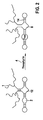
- FIG. 1 An example of the in Fig. 1 described situation represents the aptamer with the sequence AUACCAUAUGC, which has a higher affinity to theophylline than to its complementary sequence UAUGGUAUACG. If the aptamer and its complementary sequence each as a side chain function z. B. introduced into linear acrylate polymers, so a co-polymer matrix can be constructed, which degrades selectively with the addition of theophylline.
- the ratios can be specifically adjusted so that the degradation is triggered exclusively by the addition of theophylline.
- the aptamer is a constituent of a ribozyme.
- a ribozyme in the sense of this text is an RNA molecule with a well-defined tertiary structure, which allows to catalyze a specific chemical reaction.
- the chemical reaction can preferably be accelerated many times by the presence of a systemically supplied stimulus (allosteric interaction).
- the chemical reaction is preferably the hydrolysis reaction of a phosphodiester bond of a second RNA molecule. This second RNA molecule is part of the co-polymer backbone.
- Ribozymes may be designed so that their enzymatic activity relates to the cleavage of bonds within the co-polymer.
- ribozymes are capable of complementary strands of RNA bound to the ribozyme are to split.
- the system can be designed such that binding of the molecular stimulus to the aptamer unit increases the enzymatic activity of the ribozyme-bound unit (preferably by a multiple). As a result, the bound to the ribozyme complementary strand is split and detached.
- Allosteric means that the binding event takes place at a different site of the ribozyme than at the catalytically active center.
- a special embodiment of this version is the enzymatically active RNA sequence (a so-called hammerhead ribozyme), which can cleave an RNA sequence with the sequence motif UAG (so-called IVup motif), after a binding event at the allosterically linked to the ribozyme aptamer (chemical stimulation) is carried out by a systemically supplied compound in the context of this invention.
- a binding event at the allosterically linked to the ribozyme aptamer (chemical stimulation) is carried out by a systemically supplied compound in the context of this invention.
- the catalytic activity of the ribozyme increases by a multiple and thus makes it possible to specifically cleave the co-polymer specifically on the UAG sequence motif by addition of a chemical stimulus (see also R. Breaker, Engineered allosteric ribozymes as biosensor components).
- the loading of polymers and co-polymers with active ingredients is state of the art and, for example, in DE 10 2008 040 786 described in detail.
- B. the possibility of temporally constant degradable implants such.
- AMS Absorbable Metal Stent, stents consisting of a magnesium alloy, which degrades under physiological conditions
- a biodegradable implant such as a stent of biodegradable material.
- an article of the invention is preferred in which explantation is facilitated by the degradation of the co-polymer induced by the binding event.
- a pacemaker electrode so it is simplified to remove the implant again, z. B. after loss of function such as an electrode break.
- Systemic administration of a binding event triggering stimulus allows the implant to be detached from the surrounding tissue simply by dissolving the outer coating of the co-polymer and thereby reducing contact between the implant (eg, electrode). and tissue loosens. This significantly simplifies the removal (explantation) of the implant.
- Preferred implantable articles are articles selected from the group consisting of cardiac pacemaker, stent, pacemaker electrode, stimulation electrode, cerebral catheter, joint replacement, osteosynthesis implant, dental implant, and plastic surgery implant.
- the co-polymer to be used for the article according to the invention comprises, in addition to the aptamer (or a sequence complementary to the aptamer), monomers selected from the group consisting of acrylamide, hydroxyethyl methacrylate, ethylene glycol methacrylates, glucosylethyl methacrylate, hydroxypropyl methacrylamides, N -isopropylacrylamide, vinylpyrrolidone, vinyl alcohol, vinyl acetate, vinyl acetate caprolactone, hydroxybutyrate, lactic acid, lactic-co-glycolic acid, ethylene glycol, propylene glycol.
- monomers selected from the group consisting of acrylamide, hydroxyethyl methacrylate, ethylene glycol methacrylates, glucosylethyl methacrylate, hydroxypropyl methacrylamides, N -isopropylacrylamide, vinylpyrrolidone, vinyl alcohol, vinyl acetate, vinyl acetate caprolactone
- the true essence of the invention is the use of a layer comprising a co-polymer containing an aptamer, the layer being designed as described above for improving the explantability of an implantable article.
- the approach of assisting explantation through targeted degradation of a layer via the function of aptamers is new. It is also not essential that in the not yet implanted article the aptamer inconvenience layer forms the outermost layer: It may be desired that further layers are applied to the invention to be used aptamer restroomn layer. These may e.g. also be degradable and thus positively influence the ingrowth. These additional layers may or may not carry other agents. The same is true of course for the aptamer Vietnamese layer, which should ultimately simplify the explantation.
- the explant-supporting layer If further layers are applied to the explant-supporting layer, they can be degraded, for example, as part of the ingrowth process, so that the aptamer-containing layer is then that layer which comes into contact with the ingrowing tissue. But it is also possible in principle that the aptamer inconvenience layer is located in an inner region of the implant when an explantation is to be initiated. In this case, too, it can fulfill its function according to the invention, provided that it is only ensured that the trigger for the degradation can reach the layer.
- an explantation can also mean that the implantable object dissolves, ie it is not absolutely necessary to remove the implant by a targeted (surgical) procedure.
- the dissolution of the aptamer-containing layer or the partial degradation leads to the fact that the contact of the implant with the body tissue is reduced, preferably down to zero.
- such a zero-downshift also occurs when the aptamer-containing layer, prior to its degradation, acted as a protective layer of an implant degradable by the body.
- the explantation is simply a degradation of the implant by the body.
- Sequences 1 and 2 were each dissolved in 3 mM in 10 mM Tris (pH 8.0), 200 mM NaCl and 4% acrylamide (v / v) and degassed (solution A). Subsequently, a degassed mixture of 0.5 ml H 2 O, 0.05 ammonium persulfate and 25 ml tetraethylmethylenediamine was prepared (solution B). 1.4% (v / v) of solution B was added to solution A and polymerized for 2 min.
- the implant body e.g. AMS (Stent) or Pacemaker Electrode
- AMS Stenor
- Sequences 1 and 2 were each dissolved in 3 mM in 10 mM Tris (pH 8.0), 200 mM NaCl and 4% acrylamide (v / v) and degassed (solution A). Subsequently, a degassed mixture of 0.5 ml H 2 O, 0.05 ammonium persulfate and 25 ml tetraethylmethylenediamine was prepared (solution B). 1.4% (v / v) of solution B was added to solution A and polymerized for 2 min.
- the implant base is sprayed to activate with exclusion of moisture with methyl-2-cyanoacrylate. Subsequently, the activated implant base body is sprayed with the partially polymerized solution and polymerized for a further 10 minutes.
- the patient can be prepared for explantation in accordance with the invention by intravenously delivering, for example, intravenously to the aptamer used to construct the implant coating a molecule triggering a binding event.
- the delivery of these molecules causes the polymer used to build the implant coating to preferentially degrade.
- the molecule inducing the binding event is administered to the patient in a concentration which is above that of the physiologically detectable amount but below the maximum permitted concentration.
- a total volume of 5 ⁇ 10 -8 m 3 must be broken down. This results in a total amount of 150 nmol aptamer within the coating.
- 150 nmol of the binding event triggering molecule are necessary. Since these are appropriately diluted in the blood, it may generally be useful for the same concentration of the binding event triggering molecule to be present in the blood as prevalent in the implant coating. In the case described above, therefore, 3 mM.
- glucose analogs as the binding event triggering molecule is thus in a concentration range corresponding to the physiologically relevant concentration of D-glucose. In many cases, however, it is preferred that the concentration of the binding event inducing molecule be significantly lower, eg in the range of 1-1,500 ppb. Then a longer exposure time may be required.
Landscapes
- Health & Medical Sciences (AREA)
- Life Sciences & Earth Sciences (AREA)
- Veterinary Medicine (AREA)
- Public Health (AREA)
- General Health & Medical Sciences (AREA)
- Animal Behavior & Ethology (AREA)
- Epidemiology (AREA)
- Heart & Thoracic Surgery (AREA)
- Surgery (AREA)
- Vascular Medicine (AREA)
- Transplantation (AREA)
- Oral & Maxillofacial Surgery (AREA)
- Medicinal Chemistry (AREA)
- Dermatology (AREA)
- Chemical & Material Sciences (AREA)
- Materials For Medical Uses (AREA)
- Prostheses (AREA)
- Polyesters Or Polycarbonates (AREA)
Abstract
Description
- Die Erfindung betrifft einen implantierbaren Gegenstand, umfassend eine Schicht, umfassend ein Co-Polymer mit einer Aptameruntereinheit, wobei in Anhängigkeit von einem Bindungsereignis an das Aptamer Bindungen im Co-Polymer gelöst werden können, so dass eine Degradation des Co-Polymers erfolgt. Dies ermöglicht eine verbesserte Explantierbarkeit. Die Erfindung betrifft insbesondere implantierbare Gegenstände, bei denen die Co-Polymere so eingerichtet sind, dass sie bei Auftreten eines vorbestimmten Stimulus, der körpereigen oder körperfremd sein kann, im implantierten Zustand degradiert werden.
- Die Degradation von Implantaten oder Teilen von Implantaten, hier insbesondere von Beschichtungen ist ein Vorgang, dem aus medizinischen Gründen viel Aufmerksamkeit gewidmet wird. Zum einen ist eine Kontrolle der Abbaugeschwindigkeit von Implantaten im Körper wichtig, um zu gewährleisten, dass die Implantate für eine ausreichend lange Zeit ihre Funktion behalten. Im Extremfall ist also eine Degradation komplett unerwünscht. Andererseits führt eine Vielzahl von Materialien im Körper zu Unverträglichkeitsreaktionen. Diesem kann entgegnet werden, indem die Implantate mit Beschichtungen überzogen werden. Im Stand der Technik sind Beschichtungen bekannt, die das Einwachsverhalten und damit die Akzeptanz des Implantates im Körper positiv beeinflussen, indem sie einem kontrollierten Abbau durch das körpereigene Milieu unterliegen.
- Es kann auch erwünscht sein, dass Implantate komplett im Körper abgebaut werden, z. B. weil ein Stent nach einer ausreichenden Zeit mechanischer Unterstützung des jeweiligen Gefäßes aufgrund der Körperreaktionen nicht mehr benötigt wird.
- Ein weiterer Ansatz, bei dem es wünschenswert ist, dass Teile von Implantaten degradiert werden, ist folgender: Die äußeren Schichten eines Implantates werden mit Wirkstoffen beladen, die primär nicht durch Diffusion freigesetzt werden, sondern durch die Degradation der Wirkstoff tragenden Schicht. Damit ist ein verzögertes Freisetzen des Wirkstoffes möglich. Vor diesem Hintergrund ist es interessant, das Degradationsverhalten von Implantaten bzw. von Teilen der Implantate möglichst genau zu kontrollieren.
- Es existieren Polymere, die unter physiologischen Bedingungen ein konstantes Abbauverhalten aufweisen. So zeigen z.B. Polyester, Polyorthoester, Polyalkohole, Polyether, Polyamide, Polyurethane und Polyanhydride unter Einfluss von Enzymen (wie z. B. Esterasen, Lipasen, Dehydrogenasen oder Oxygenasen) eine konstante Degradationsgeschwindigkeit. Weiterhin unterliegen die meisten dieser Polymere der allgemeinen Hydrolyse unter physiologischen Bedingungen und werden somit nach Kontakt mit Wasser über einen längeren Zeitraum hin abgebaut. Diese Polymere lassen sich durch ihre molekulare Zusammensetzung (Verwendung von Co-Polymeren, Polymermischungen, Art und Grad der Vernetzung) in Ihrer Degradationsgeschwindigkeit steuern, indem man die Anteile an hydrolyseempfindlichen Bindungseinheiten mit nichtdegradierbaren Einheiten kombiniert, bzw. hydrophile und hydrophobe Anteile variiert. Damit lassen sich konstante Degradationsgeschwindigkeiten von wenigen Tagen bis mehreren Monaten verwirklichen.
- Ein konstantes Degradationsverhalten ist aber in vielen Fällen eine unzureichende Lösung: Es ist wünschenswert, dass eine möglichst differenzierte Steuerung der Degradation insbesondere von Polymerbeschichtungen auf Implantaten erfolgt. Dies gilt insbesondere für den Fall, dass ein Implantat wieder aus dem Körper entfernt werden soll: Insbesondere bei Implantaten, die längere Zeit im Körper verblieben sind, kommt es regelmäßig zu Einwachsprozessen. Dies ist meistens erwünscht, da so eine Stabilität des Implantates im Körper gewährleistet wird. Daher ist es spätestens zu dem Zeitpunkt, zu dem der Einwachsprozess abgeschlossen ist, wünschenswert, dass ein Implantat eine stabile Oberfläche besitzt.
- In vielen Fällen ist es aber wünschenswert oder sogar erforderlich, ein Implantat wieder aus dem Körper zu entfernen. Grund hierfür kann beispielsweise sein, dass das Implantat seine Funktion erfüllt hat und nicht weiter benötigt wird oder aber dass das Implantat beschädigt ist und ausgetauscht werden muss. Ein typisches Beispiel für einen letzteren Fall ist ein Elektronenbruch bei Herzschrittmachern. Durch das - an sich erwünschte-Einwachsen des Implantates in den Körper ist eine Explantation aber wesentlich erschwert. Durch den festen Kontakt zwischen körpereigenem Gewebe und Implantatoberfläche kommt es bei der Explantation häufig zu erheblichen Gewebeverletzungen. Dementsprechend ist es wünschenswert, dass eine Beschichtung eines Implantates erst dann degradiert, wenn das Implantat wieder aus dem Körper entnommen werden soll. Hierzu existieren im Stand der Technik Polymere die durch gezielte externe Beeinflussung das Abbauverhalten verändern. Zu diesen Einflüssen gehören unter anderem Änderungen von pH, Ionenstärke und Temperatur. Auch Bestrahlung mit elektromagnetischer Energie und sonstigen ionisierenden Strahlen bzw. Einwirkung von elektrischen oder magnetischen Feldern können ebenfalls zum Auslösen der Degradation herangezogen werden.
- So haben zum Beispiel Polymere aus der Gruppe von Acrylamid, Methacrylamid, Dimethylaminoethylmethacrylat oder einem Derivat von Acrylamid, Methacrylamid, Dimethylaminoethylmethacrylat oder poly N-Isopropylacrylamid und Poly-N-isopropylacrylamid-co-allylamin und bevorzugt PNIPAM mit Poly(p-dioxanon) als Hartsegment in Kombination mit z.B. Poly-L-Lactid als strukturgebendes und degradierbares Element ein temperaturabhängiges Quellvermögen in Wasser, das bei einer Temperaturerhöhung von 10 K um 30-50% sinkt. Diese veränderlichen Quellzustände erlauben es nun einen hydrolytischen Abbau von Esterfunktionen aufgrund des temperaturabhängigen Wassergehalts zu steuern.
- Die bisher bekannten Lösungen haben aber eine Reihe von Nachteilen:
- Die Beeinflussung der Degradation, basierend auf pH, Ionenstärke und/oder Temperaturänderung lassen sich in vivo nur sehr schwer durchführen, da der menschliche Organismus sehr empfindlich auf Änderung dieser Parameter reagiert und nur eine sehr geringe Abweichung vom Normalzustand toleriert. Elektromagnetische Strahlung hingegen kann in niedrigen Energiebereichen Gewebe nur unzureichend penetrieren, wodurch Polymere in tieferliegenden Gewebsschichten (z.B. auf Stents in Koronargefäßen) nicht erreicht werden können. Dahingegen stellt höherenergetische Strahlung ein grundsätzliches Gefährdungspotential für den Organismus dar, könnte aber zelluläres Gewebe sehr tief durchdringen (Röntgenstrahlen). Elektrische und magnetische Felder zeigen nicht die voran angeführten Einschränkungen, bedürfen aber eines erheblichen apparativen Aufwandes, was den Einsatz dieser Verfahren im medizinischen Bereich erheblich erschwert. Zudem wird eine zeitnahe, automatische Reaktion des Systems dadurch erschwert.
- Aufgabe der Erfindung war es daher, einen implantierbaren Gegenstand anzugeben, der hinsichtlich der Steuerbarkeit seines Degradationsverhaltens für den Explantationsfall verbessert ist.
- Diese Aufgabe wird gelöst durch einen implantierbaren Gegenstand, umfassend einen Festkörper (Implantatgrundkörper) darauf angeordnet eine Schicht, umfassend ein Co-Polymer, das ein Aptamer enthält, wobei in Abhängigkeit von einem Bindungsereignis an das Aptamer Bindungen im Co-Polymer gelöst werden können, so dass eine Degradation des Co-Polymers erfolgt.
- Ein implantierbarer Gegenstand im Sinne der Erfindung ist dabei ein Gegenstand, der so ausgestaltet ist, dass er in den menschlichen oder tierischen Körper eingebracht und für eine Zeit von wenigstens 5 Tagen in diesem verbleiben kann.
- Implantierbare Gegenstände im Sinne der vorliegenden Erfindung sind dabei solche Gegenstände, die in den Körper eingebracht werden um Funktionen zu erfüllen, die nicht durch die aptamerhaltige Schicht allein gewährleistet werden. So ist z.B. eine Funktion eines entsprechend beschichteten Stens primär eine Stützfunktion für ein Gefäß, während die Funktion der aptamerhaltigen Schicht das Gewährleisten einer besseren Explantierbarkeit ist.
- Für die erfindungsgemäßen implantierbaren Gegenstände ist es dementsprechend wichtig zu verstehen, dass die aptamerhaltigen Schichten im Sinne der vorliegenden Erfindung immer noch ein von ihnen abweichendes Material umschließen oder zumindest teilweise bedecken. Dieses Material ist oder umfasst zumindest ein festes Material, das mit dem Begriff "Festkörper" bezeichnet ist. Regelmäßig wird es sich dabei um den Hauptbestandteil des Implantates (z.B. im Falle eines Stents die entsprechende Legierung) handeln.
- Ein Aptamer im Sinne dieser Erfindung ist ein Polymer aus Ribonucleotiden und/oder Desoxydribonucleotiden sowie deren Analoga wie z. B. Nucleotidanaloga mit Peptidbausteinen (PNA), Nucleotide mit Phosphothioaten, Nucleotidanaloga mit Morpholinobausteinen und LNA (locked nucleic acid). Hier ist eine zusätzliche chemische Bindung zwischen dem 2'O Atom und dem 4'C Atom des Riboserestes innerhalb der RNA Base eingeführt. Dies ermöglicht es, die Ribose in der 3'-endo Konformation zu fixieren, was deren Stabilität gegenüber Endo- und Exonucleasen wesentlich erhöht.
- "Aptamere" im Sinne des vorliegenden Textes zeigen die Eigenschaft, unter Konformationsänderung an organische Moleküle zu binden. Diese Affinität kann beispielsweise durch sukzessive Selektionen von verschiedenen Kettenmolekülen bestehend aus den oben genannten Bausteinen massiv erhöht werden (SELEX-Prozess).
- Eine bevorzugte Variante eines Aptamers ist ein Spiegelmer. Hierbei wird das Aptamer aus nicht-natürlich vorkommenden, zu den natürlich vorkommenden wenigstens in den Teilbereichen in enatiomeren Nucleotiden gebildet. Hier ist z. B. zu nennen der Austausch der natürlichen D-Ribose gegen die künstliche L-Ribose in der Zuckereinheit des Nucleotides.
- Die Größe von Aptameren im Sinne dieser Erfindung ist bevorzugt 10 - 100 und besonders bevorzugt 10-50 Nucleotide bzw. deren Analoga.
- Ein Co-Polymer im Sinne dieser Erfindung ist ein Polymer, das neben dem Aptamer noch weitere repetitive Monomeruntereinheiten umfasst. Bevorzugt im Sinne der Erfindung ist ein Block-Co-Polymer.
- "Bindungen im Co-Polymer" im Sinne der Erfindung sind kovalente Bindungen, Wasserstoff-Brücken-Bindungen und ionische Wechselwirkungen. Das bedeutet, dass im Sinne der Erfindung ein Co-Polymer aus verschiedenen (Block-)Untereinheiten gebildet werden kann, die untereinander durch Wasserstoffbrückenbindungen verbunden sind. Dies ist zum Beispiel der Fall, wenn die Co-Polymeruntereinheiten jeweils aus einem Aptamer oder einem zu diesem Aptamer komplementären Polyoligonucleotid und einem weiteren Polymer bestehen. Dadurch können über die Wasserstoffbrückenbindungen zwischen dem Aptamer und dem komplementären Strang aus jeweils einer Co-Polymeruntereinheit diese Untereinheiten zusammen zum Co-Polymer gebunden sein.
- "Degradation des Co-Polymers" bedeutet im Sinne des vorliegenden Textes, dass die Festigkeit des Verbandes des Gesamt-Polymers geschwächt wird, was im Regelfall durch Bindungslösung erfolgt.
- Ein Bindungsereignis im Sinne dieser Erfindung ist das Anlagern wenigstens einer Verbindung an eine zweite Verbindung oder an eine Domäne einer zweiten Verbindung. Bevorzugt ist bei einem solchen Bindungsereignis die Domäne der zweiten Verbindung ein Aptamer. Dabei kann die Anlagerung durch beliebige Arten von Wechselwirkungen erfolgen, bevorzugt sind aber ionische Wechselwirkungen, Wasserstoffbrückenbindungen und kovalente Bindungen.
- Eine Schicht, die ein erfindungsgemäß implantierbarer Gegenstand umfasst, ist im Sinne der vorliegenden Erfindung insbesondere ein dreidimensionales Gebilde, das über zwei Hauptflächen (eine Innen- und eine Außenfläche) verfügt (das sind die beiden größten Flächen des Gebildes). Dabei die Wurzel des Flächeninhaltes der Außen- bzw. der Innenfläche jeweils um einen Faktor größer gleich ≥ 10, bevorzugt größer gleich ≥ 20, besonders bevorzugt größer gleich ≥ 100 größer als die mittlere Dicke des Raumes zwischen diesen beiden Flächen. Eine Schicht im Sinne des vorliegenden Textes kann geschlossen sein, das bedeutet, dass sie einen (Raum-)Teil des implantierbaren Gegenstandes vollständig umschließt oder aber sie kann offen sein, so dass kein vollständig geschlossener Raum-Teil des Implantates durch die Schicht begrenzt wird. Bevorzugt im Sinne der vorliegenden Erfindung ist, dass die Schicht geschlossen ist. Ferner kann eine Schicht ihrerseits wieder teilweise oder vollständig beschichtet sein. Dies ist in einigen Fällen ebenfalls bevorzugt. In den meisten Fällen ist es aber bevorzugt, dass eine Aptamer umfassende Schicht wenigstens einen Teil der Oberfläche des implantierbaren Gegenstandes, bevorzugt die gesamte Oberfläche des implantierbaren Gegenstandes bildet.
- Bevorzugte Schichtdicken für die aptamerhaltige Schicht des erfindungsgemäßen Gegenstandes sind dabei 0.1 µm - 100 µm, bevorzugt aber 0.5 µm - 10 µm und besonders bevorzugt zwischen 1 µm und 5 µm.
- In manchen Fällen kann es bevorzugt sein, dass die aptamerhaltige Schicht keine physiologisch wirksamen Substanzen umfasst.
- Der Vorteil eines erfindungsgemäß implantierbaren Gegenstandes liegt darin, dass durch eine geeignete Auswahl eines Aptamers gezielt der Stimulus bestimmt werden kann, der die Degradation des Co-Polymers auslösen soll. Insbesondere ist es möglich, rechtzeitig vor einer Explantation des implantierbaren Gegenstandes einen Stimulus zu setzen, der eine Degradation der aptamerhaltigen Schicht bewirkt. Durch diese Degradation würde die Verbindung zwischen dem das Implantat umgebenden Gewebe und dem Implantat geschwächt und idealerweise vollständig gelöst. Auf diese Art lässt sich das Implantat ohne große Schwierigkeiten wieder entfernen, insbesondere ohne dass das körpereigene Gewebe in erhebliche Mitleidenschaft gezogen wird.
- Dementsprechend ist im Sinne der Erfindung bevorzugt ein implantierbarer Gegenstand, wobei der Gegenstand so eingerichtet ist, dass im in einen menschlichen oder tierischen Körper implantierten Zustand das Bindungsereignis erfolgt, ausgelöst durch eine systemisch zugeführte Verbindung und/oder unter Beteiligung einer solchen Verbindung. Systemisch hinzugefügte Verbindung in diesem Sinne ist eine Verbindung, die gezielt dem Organismus zugegeben wird, in dem der implantierbare Gegenstand implantiert ist. Die systemisch zugeführte Verbindung ist dabei bevorzugt ein körperfremder Stoff oder ein körpereigener Stoff, der dem Körper in einer Konzentration zugefügt wird, so dass sich im Körper eine überphysiologische Konzentration einstellt.
- Bevorzugte systemisch hinzuzufügende Verbindungen sind dabei nicht-natürliche Analoga von körpereigenen Stoffen. Besonders geeignet in diesem Zusammenhang und in vielen Fällen auch bereits bestens untersucht sind dabei Stoffe, die für diagnostische Zwecke eingesetzt werden und dementsprechend auch in größeren Mengen körperverträglich sind. Besonders bevorzugt sind in diesem Zusammenhang drei Stoffklassen zu nennen, nämlich:
- Allgemein wird dabei die OH Gruppe am C2 oder C3 Atom des Zuckermoleküls durch ein Halogenatom (F, Cl, Br) ersetzt.
- Glucose: 2-Fluoro-2-deoxy-D-glucose (Kontrastmittel PET Imaging)
- Fructose: 2-Fluoro-2-deoxy-D-fructose
- Galactose: 2-Fluoro-2-deoxy-D-galactose
- Weiterhin bevorzugt ist fluorierte Saccharose, Lactose, Xylitol, Sorbit, Maltit und/oder Erythrit.
- Dabei handelt es sich um Zucker, die in der Natur und somit in der Nahrungskette nicht vorkommen. Da es sich um chemisch identische Strukturen mit physikalisch ähnlichen Eigenschaften handelt, können diese Substanzen problemlos auch in größeren Mengen eingenommen werden. Die chiralen Unterschiede der einzelnen Monosaccharide können von Aptameren erkannt werden.
- L-Pentosen und L-Hexosen, insbesondere L-Glucose, L-Fructose, L-Ribose, L-Galaktose, L-Mannose, L-Arabinose, L-Xylose oder
- Zuckersäuren und Aminozucker, insbesondere L-Glucuronsäure, L-Galacturonsäure, L-Glucosamin.
- Stoffklasse 3 Halogenierte essentielle und nicht essentielle Aminosäuren:
- Mit aus dem Stand der Technik bekannten Methoden ist es dabei dem Fachmann möglich, Aptamere zu entwickeln, die die für die Erfindung gewünschte Funktion (das Lösen von Bindungen im Co-Polymer nach Reaktion mit dem jeweiligen Stimulus) erfüllen können.
- Physiologische Bedingungen (wie auch physiologische Konzentration) sind dabei im Sinne dieses Textes die üblichen physiologischen Konzentrationen von Stoffen, die sich bei artgerechter Ernährung im tierischen oder bevorzugt menschlichen Organismus einstellen. Bevorzugt fallen unter diesen Begriff jedoch keine als Krankheit zu definierenden Stoffwechselzustände und insbesondere lediglich Konzentrationen der oben aufgezählten Stoffklassen 1-3 von ≥ 1.500 ppb, bevorzugt 1-1.200 ppb, weiter bevorzugt 120-1.000 ppb, jeweils bezogen auf das Gesamtgewicht einer oder der den implantierbaren Gegenstand kontaktierenden Körperflüssigkeit.
- Die Formulierung, dass "das Bindungsereignis erfolgt ausgelöst durch eine systemisch zugeführte Verbindung", bedeutet, dass die betreffende Verbindung nicht direkt an dem Bindungsereignis beteiligt sein muss, sondern nur ursächlich für eine Reaktionskaskade sein muss, die zu dem Bindungsereignis führt.
- "Das Bindungsereignis erfolgt unter Beteiligung einer Verbindung" bedeutet, dass die Verbindung direkt an dem Bindungsereignis beteiligt ist.
- Der Vorteil, dass das Bindungsereignis durch die oben aufgezählten Auslöser ausgelöst wird, liegt darin, dass somit genau bestimmt werden kann, unter welchen Bedingungen oder bei Eintritt welcher physiologischen Situation die Degradation des Co-Polymers erfolgt.
- Bevorzugt im Sinne der Erfindung ist ein implantierbarer Gegenstand, wobei das Aptamer durch Bindung an einen zu ihm wenigstens teilweise komplementären Strang an einer Vernetzung einzelner Co-Polymer(unter-)einheiten beteiligt ist und durch das Bindungsereignis die Bindung zu dem wenigstens teilweise komplementären Strang gelöst wird.
- Ist eine affine Sequenz als Aptamer bekannt, kann diese Sequenz in einer für den Fachmann geeigneten Weise mit einem Polymer zu einem Co-Polymer kombiniert werden. Außerdem kann eine dem Aptamer wenigstens teilweise komplementäre Sequenz mit dem gleichen Polymer ebenfalls copolymerisiert werden. Auf diese Weise entstehen Co-Polymeruntereinheiten, die sich über das Aptamer und einer wenigstens teilweise dazu komplementärem Sequenz sich miteinander zum Co-Polymer verbinden können.
-
Fig. 1 zeigt schematisch eine solche Bindungssituation, wobei die Bezugszeichen bedeuten: - 1 Polymereinheit
- 2 Aptamer
- 3 komplementärer Strang zum Aptamer
- 4 Bindungsereignis auslösendes Molekül (Theophyllin)
- 5 ungebundene komplementäre Sequenz
- 6 Aptamer mit Bindung an Theopyllin
- Ein Beispiel für die in
Fig. 1 beschriebene Situation stellt das Aptamer mit der Sequenz AUACCAUAUGC dar, das eine höhere Affinität zu Theophyllin aufweist als zu seiner Komplementärsequenz UAUGGUAUACG. Wird das Aptamer und seine komplementäre Sequenz jeweils als Seitenkettenfunktion z. B. in lineare Acrylatpolymere eingeführt, so kann eine Co-Polymer-Matrix aufgebaut werden, die selektiv unter Zugabe von Theophyllin degradiert. - Dementsprechend können durch Variation der Polymerblöcke im Co-Polymer gezielt die Verhältnisse so eingestellt werden, dass die Degradation ausschließlich durch Zugabe von Theophyllin ausgelöst wird.
- Bevorzugt ist ein erfindungsgemäß implantierbarer Gegenstand, wobei das Aptamer in Wechselwirkung mit einem Ribozym steht oder Teil eines Ribozyms ist und durch das Bindungsereignis die Aktivität des Ribozyms hin zu verstärkter Bindungsspaltung von Bindungen im Co-Polymer verschoben wird.
- Als Alternative oder zusätzliche Variante zu der direkten Bindungslösung von Aptameren zu ihren komplementären Sequenzen besteht erfindungsgemäß auch die Möglichkeit, dass das Aptamer ein Bestandteil eines Ribozyms ist.
- Ein Ribozym im Sinne dieses Textes ist ein RNA Molekül mit einer genau definierten Tertiärstruktur, welche es erlaubt, eine bestimmte chemische Reaktion zu katalysieren. Dabei kann bevorzugt die chemische Reaktion durch Anwesenheit eines systemisch zugeführten Stimulus um ein Vielfaches beschleunigt werden (allosterische Wechselwirkung). Dabei handelt es sich bei der chemischen Reaktion im Sinne dieses Textes bevorzugt um die Hydrolysereaktion einer Phosphordiesterbindung eines zweiten RNA Moleküls. Dieses zweite RNA Molekül stellt hierbei einen Teil des Co-Polymergrundgerüsts dar.
- Ribozyme können so ausgestaltet sein, dass sich ihre enzymatische Aktivität auf die Spaltung von Bindungen innerhalb des Co-Polymeres bezieht. So sind Ribozyme beispielsweise in der Lage, komplementäre RNA-Stränge, die an das Ribozym gebunden sind, zu spalten. Dabei ist das System so ausgestaltbar, dass Bindungen des molekularen Stimulus an die Aptamereinheit die enzymatische Aktivität der ribozymgebundenen Einheit gesteigert wird (bevorzugt um ein Vielfaches). Dadurch wird der an das Ribozym gebundene komplementäre Strang gespalten und abgelöst.
-
Fig. 2 stellt eine solche Situation dar. Dabei bedeuten die Bezugszeichen: - 1 Polymer
- 2 Aptamer
- 4 Ereignis auslösendes Molekül
- 8 Ribozym nach Bindungsereignis
- 12 Ribozym
- 14 Strangbruch
- Mit diesem bevorzugten System besteht eine weitere Möglichkeit ein erfindungsgemäßes Implantat auszugestalten und für eine Reihe von Anwendungen einzusetzen.
- Eine Ausgestaltungsmöglichkeit der Variation mit Ribozymen ist, dass ein allosterisch aktivierbares Ribozym eingesetzt wird. Allosterisch bedeutet dabei, dass das Bindungsereignis an einer anderen Stelle des Ribozyms erfolgt, als am katalytisch aktiven Zentrum.
- Eine besondere Ausgestaltung dieser Version ist die enzymatisch aktive RNA-Sequenz (einem sogenannten Hammerhead Ribozym), die eine RNA-Sequenz mit dem Sequenzmotiv UAG (sogenannte IVup Motiv) spalten kann, nachdem ein Bindungsereignis am allosterisch mit dem Ribozym verbundenen Aptamer (chemische Stimulation) durch eine systemisch zugeführte Verbindung im Sinne dieser Erfindung erfolgt ist. Durch dieses Bindungsereignis erhöht sich die katalytische Aktivität des Ribozyms um ein Vielfaches und ermöglicht es so, gezielt durch Zugabe eines chemischen Stimulus das Co-Polymer spezifisch an dem UAG Sequenzmotiv zu spalten (siehe auch hierzu R. Breaker, Engineered allosteric ribozymes as biosensor components).
- Bevorzugt ist ein implantierbarer Gegenstand, wobei das Co-Polymer mit einem Wirkstoff beladen ist, der bei Degradation des Co-Polymers verstärkt freigesetzt werden kann. Die Beladung von Polymeren und Co-Polymeren mit Wirkstoffen ist Stand der Technik und zum Beispiel in
DE 10 2008 040 786 ausführlich beschrieben. - Für viele Anwendungen bevorzugt ist ein erfindungsgemäßer Gegenstand, wobei das Co-Polymer eine äußere Schutzschicht bildet für unter physiologischen Bedingungen degradierbare Materialien.
- Dieser Ansatz eröffnet z. B. die Möglichkeit, zeitlich konstante degradierbare Implantate wie z. B. AMS (Absorbable Metal Stent; Stents bestehend aus einer Magnesiumlegierung, die unter physiologischen Bedingungen abgebaut wird) so lange vor einer Degradation zu schützen, bis durch die Gabe des Bindungsereignis auslösenden Stoffes (Stimulus) die äußere Schutzschicht aus Co-Polymer abgebaut wird, so dass die darunter liegenden Schichten dem unter physiologischen Bedingungen möglichen Abbau zugänglich gemacht werden.
- So ist es beispielsweise möglich, den genauen Zeitpunkt zu definieren, zu dem der Abbauprozess eines biologisch degradierbaren Implantates (wie z.B. eines Stents aus einem biologisch degradierbaren Material) beginnen soll.
- Für viele Anwendungen ist ein erfindungsgemäßer Gegenstand bevorzugt, bei dem die Explantation durch die durch das Bindungsereignis ausgelöste Degradation des Co-Polymers erleichtert wird.
- Ist das erfindungsgemäß einzusetzende Co-Polymer als äußerste Beschichtung eines Implantates, z. B. einer Schrittmacherelektrode, ausgeführt, so ist es vereinfacht, das Implantat wieder zu entfernen, z. B. nach Funktionsverlust wie einem Elektrodenbruch. Durch die systemische Gabe eines das Bindungsereignis auslösenden Stimulus (einer entsprechenden Verbindung) kann das Implantat von dem umschließenden Gewebe einfach dadurch abgelöst werden, dass sich die äußere Beschichtung aus dem Co-Polymer auflöst und so den Kontakt zwischen Implantat (z. B. Elektrode) und Gewebe lockert. Hierdurch wird die Wiederentnahme (Explantation) des Implantates deutlich vereinfacht. Bevorzugte implantierbare Gegenstände sind Gegenstände, ausgewählt aus der Gruppe bestehend aus Herzschrittmacher, Stent, Schrittmacherelektrode, Stimulationselektrode, cerebraler Katheter, Gelenkersatz, Implantat zur Osteosynthese, Dentalimplantat und Implantat der plastischen Chirurgie.
- Bevorzugt im Sinne der Erfindung ist es ferner, dass das für den erfindungsgemäßen Gegenstand einzusetzende Co-Polymer neben dem Aptamer (oder einer dem Aptamer komplementären Sequenz) Monomere umfasst, ausgewählt aus der Gruppe bestehend aus Acrylamid, Hydroxyethylmethacrylat, Ethylenglycolmethacrylate, Glucosylethylmethacrylat, Hydroxypropylmethacrylamide, N-isopropylacrylamid, Vinylpyrrolidon, Vinylalcohol, Vinylacetat, Vinylacetat Caprolacton, Hydroxybutyrat, Milchsäure, Lactic-co-gylcolic acid, Ethylenglycol, Propylenglycol.
- Der eigentliche Kern der Erfindung ist die Verwendung einer Schicht, umfassend ein Co-Polymer, das ein Aptamer enthält, wobei die Schicht ausgestaltet ist, wie weiter oben beschrieben, zur Verbesserung der Explantierbarkeit eines implantierbaren Gegenstandes.
- Der Ansatz durch ganz gezielte Degradierung einer Schicht über die Funktion von Aptameren eine Explantation zu unterstützen, ist hierbei neu. Dabei kommt es auch nicht zwingend darauf an, dass in dem noch nicht implantierten Gegenstand die aptamerhaltige Schicht die äußerste Schicht bildet: Es kann gewünscht sein, dass auf der erfindungsgemäß zu verwendenden aptamerhaltigen Schicht weitere Schichten aufgebracht sind. Diese können z.B. ebenfalls degradierbar sein und so das Einwachsverhalten positiv beeinflussen. Dabei können diese zusätzlichen Schichten weitere Wirkstoffe tragen oder auch nicht. Das gleiche gilt auch selbstverständlich für die aptamerhaltige Schicht, die letztendlich die Explantation vereinfachen soll.
- Sofern weitere Schichten auf der die Explantation unterstützenden Schicht aufgebracht sind, so können diese im Rahmen des Einwachsprozesses beispielsweise abgebaut werden, so dass die aptamerhaltige Schicht dann diejenige Schicht ist, die mit dem einwachsenden Gewebe in Berührung kommt. Es ist aber auch grundsätzlich möglich, dass die aptamerhaltige Schicht sich in einem inneren Bereich des Implantates befindet, wenn eine Explantation eingeleitet werden soll. Auch in diesem Fall kann sie ihre erfindungsgemäße Funktion erfüllen, sofern nur gewährleistet ist, dass der Trigger für die Degradierung die Schicht erreichen kann.
- Teil der Erfindung ist ferner ein Verfahren zum Explantieren eines Implantates, umfassend die Schritte:
- a) Bereitstellen eines implantierten Gegenstandes wie oben als implantierbarer Gegenstand definiert und
- b) Bewirken eines Bindungsereignisses an das Aptamer, so dass Bindungen im Co-Polymer gelöst werden, wodurch eine Degradation des Co-Polymers erfolgt.
- Mittels dieses Verfahrens ist es möglich, eine besonders einfache Explantation von implantierbaren Gegenständen zu gewährleisten. Dabei kann im weitesten Sinne eine Explantation auch bedeuten, dass sich der implantierbare Gegenstand auflöst, d.h. es ist nicht unbedingt erforderlich, durch einen gezielten (chirurgischen) Eingriff, das Implantat zu entfernen. Letztendlich führt die Auflösung der aptamerhaltigen Schicht bzw. die Teildegradation dazu, dass der Kontakt des Implantates mit dem Körpergewebe verringert, bevorzugt bis auf Null heruntergeführt wird. Ein solches Auf-Null-Herunterführen liegt selbstverständlich auch dann vor, wenn die aptamerhaltige Schicht vor ihrer Degradation als Schutzschicht eines durch den Körper abbaubaren Implantates fungierte. In diesem Falle ist die Explantation schlichtweg ein Abbau des Implantates durch den Körper.
- Im Folgenden wird ein Beispiel zur Herstellung eines aptamerhaltigen Co-Polymers beschrieben:
- Zur Kopplung der Aptamere an ein Polymer wird an dessen 5' Ende eine Methacrylgruppe eingeführt (Acrydite, Mosaic Technologies, Boston, Mass). Dies ermöglicht die Co-Polymerisation der RNA Sequenz mit z.B. Acrylamid, Hydroxyethylmethacrylat:
- Sequenz 1: 5'Acrydite-AAAA AUACCAUAUGC
- Sequenz 2: 5'Acrydite-AAAAUAUGGUAUACG
- Sequenz 1 und 2 wurden zu je 3 mM in 10 mM Tris (pH 8.0), 200mM NaCl und 4% Acrylamid (v/v) gelöst und entgast (Lösung A). Anschließend wurde eine entgaste Mischung aus 0.5 ml H2O, 0.05 Ammoniumpersulfat und 25 ml Tetraethylmethylendiamin hergestellt (Lösung B). 1.4% (v/v) der Lösung B wurden zu Lösung A hinzugefügt und für 2 min polymerisiert.
- Der Implantatgrundkörper [z.B. AMS (Stent) oder Schrittmacherelektrode] wird zur Aktivierung unter Feuchtigkeitsausschluss mit Methyl-2-cyanoacrylat besprüht. Anschließend wird der aktivierte Implantatgrundkörper mit der teilpolymerisierten Lösung besprüht und für weitere 10 min auspolymerisiert.
- Zur Kopplung des Ribozyms an ein Polymer wird an einem der Sequenzen an dessen 5' und 3' Ende eine Methacrylgruppe eingeführt (Acrydite, Mosaic Technologies, Boston, Mass). Dies ermöglicht die Co-Polymerisation der RNA Sequenz mit z.B. Acrylamid, Hydroxyethylmethacrylat:
- Sequenz 1: 5'Acrydite-AAAAGCCGUAGGUUGCCCAAA-Acrydite 3'

- Sequenz 1 und 2 wurden zu je 3 mM in 10 mM Tris (pH 8.0), 200mM NaCl und 4% Acrylamid (v/v) gelöst und entgast (Lösung A). Anschließend wurde eine entgaste Mischung aus 0.5 ml H2O, 0.05 Ammoniumpersulfat und 25 ml Tetraethylmethylendiamin hergestellt (Lösung B). 1.4% (v/v) der Lösung B wurden zu Lösung A hinzugefügt und für 2 min polymerisiert.
- Der Implantatgrundkörper wird zur Aktivierung unter Feuchtigkeitsausschluss mit Methyl-2-cyanoacrylat besprüht. Anschließend wird der aktivierte Implantatgrundkörper mit der teilpolymerisierten Lösung besprüht und für weitere 10 min auspolymerisiert.
- Wird die Explantation eines Implantats, hier insbesondere einer Schrittmacherelektrode, notwendig, so kann der Patient im Sinne der Erfindung dadurch zur Explantation vorbereitet werden, dass man dem zum Aufbau der Implantatsbeschichtung eingesetzten Aptamer entsprechend ein Bindungsereignis auslösendes Molekül beispielsweise intravenös zuführt. Das Zuführen dieser Moleküle bewirkt, dass das zum Aufbau der Implantatsbeschichtung verwendete Polymer bevorzugt abgebaut wird. Dazu wird dem Patienten das Bindungsereignis auslösende Molekül in einer Konzentration zugeführt, die über dem der physiologisch nachzuweisenden Menge, aber unter der maximal erlaubten Konzentration liegt.
- So muss beispielsweise bei der Explantation einer 40 cm langen Schrittmacherelektrode, welche mit einer 10 µm dicken Beschichtung versehen wurde ein Gesamtvolumen von 5*10-8 m3 abgebaut werden. Entsprechend ergibt sich eine Gesamtmenge von 150 nmol Aptamer innerhalb der Beschichtung. Um diese vollständig abzubauen sind ebenfalls 150 nmol des Bindungsereignis auslösenden Moleküls notwendig. Da diese entsprechend im Blut verdünnt werden, kann es generell sinnvoll sein, dass die gleiche Konzentration des das Bindungsereignis auslösenden Moleküls im Blut vorhanden ist, wie sie in der Implantatsbeschichtung vorherrscht. In dem zuvor beschriebenen Fall also 3 mM. Im Falle von Glucoseanaloga als das Bindungsereignis auslösendes Molekül liegt man damit in einem Konzentrationsbereich der der physiologisch relevanten Konzentration von D-Glucose entspricht. In vielen Fällen ist es aber bevorzugt, dass die Konzentration des das Bindungsereignis auslösenden Moleküls deutlich niedriger ist, z.B. im Bereich von 1-1.500 ppb. Dann kann eine längere Einwirkzeit erforderlich sein.
- Im zuerst vorgeschlagenen Fall werden somit z.B. 50 ml einer 30 mM Lösung von 2-Fluoro-Deoxyglucose in einer physiologischen Kochsalzlösung über einen Zeitraum von 10-20 min. infundiert. Nach einer Inkubationszeit von 2 h kann mit den Explantationsvorbereitungen begonnen werden.


Claims (11)
- Implantierbarer Gegenstand, umfassend einen Festkörper und darauf angeordnet eine Schicht, umfassend ein Co-Polymer, das ein Aptamer enthält, wobei in Abhängigkeit von einem Bindungsereignis an das Aptamer Bindungen im Co-Polymer gelöst werden können, so dass eine Degradation des Co-Polymers erfolgt.
- Implantierbarer Gegenstand nach Anspruch 1, wobei der Gegenstand so eingerichtet ist, dass im in einen menschlichen oder tierischen Körper implantierten Zustand das Bindungsereignis erfolgt, ausgelöst durch eine systemisch zugeführte Verbindung und/oder unter Beteiligung einer solchen Verbindung.
- Implantierbarer Gegenstand nach Anspruch 1 oder 2, wobei das Aptamer durch Bindung an einen zu ihm wenigstens teilweise komplementären Strang an einer Vernetzung einzelner Co-Polymereinheiten beteiligt ist und durch das Bindungsereignis die Bindung zu dem wenigstens teilweise komplementären Strang gelöst wird.
- Implantierbarer Gegenstand nach einem der vorangehenden Ansprüche, wobei das Aptamer in Wechselwirkung mit einem Ribozym steht oder Teil eines Ribozyms ist und durch das Bindungsereignis die Aktivität des Ribozyms hin zu verstärkter Bindungsspaltung von Bindungen im Co-Polymer verschoben wird.
- Implantierbarer Gegenstand nach einem der vorangehenden Ansprüche, wobei das Co-Polymer mit einem Wirkstoff beladen ist, der bei Degradation des Co-Polymers verstärkt freigesetzt werden kann.
- Implantierbarer Gegenstand nach einem der vorangehenden Ansprüche, wobei das Co-Polymer eine äußere Schutzschicht bildet für unter physiologischen Bedingungen degradierbare Materialien.
- Implantierbarer Gegenstand nach einem der vorangehenden Ansprüche, wobei das Bindungsereignis ausgelöst wird durch einen Stoff ausgewählt aus der Gruppe bestehend aus halogenierten Monosacchariden, halogenierten Polyoligosacchariden, halogenierten Zuckeralkoholen, Monosacchariden in L-Form, Oligosacchariden in L-Form und halogenierten Aminosäuren.
- Implantierbarer Gegenstand nach einem der vorangehenden Ansprüche, wobei das Co-Polymer Monomere umfasst, ausgewählt aus der Gruppe bestehend aus, Acrylamid, Hydroxyethylmethacrylat, Ethylenglycolmethacrylate, Glucosylethylmethacrylat, Hydroxypropylmethacrylamide, N-isopropylacrylamid, Vinylpyrrolidon, Vinylalcohol, Vinylacetat, Vinylacetat Caprolacton, Hydroxybutyrat, Milchsäure, Lactic-co-gylcolic acid, Ethylenglycol, Propylenglycol.
- Implantierbarer Gegenstand nach einem der vorangehenden Ansprüche, ausgewählt aus der Gruppe bestehend aus Herzschrittmacher, Stent, Schrittmacherelektrode, Stimulationselektrode, cerebraler Katheter, Gelenkersatz, Implantat zur Osteosynthese, Dentalimplantat und Implantat der plastischen Chirurgie.
- Verwendung einer Schicht, umfassend ein Co-Polymer, das ein Aptamer enthält, wobei die Schicht ausgestaltet ist wie in einem der vorhergehenden Ansprüche beschrieben, zur Verbesserung der Explantierbarkeit eines implantierbaren Gegenstandes.
- Verfahren zum Explantieren eines Implantates, umfassend die Schritte:a) Bereitstellen eines implantierten Gegenstandes wie in den Ansprüchen 1-9 als implantierbarer Gegenstand definiert undb) Bewirken eines Bindungsereignisses an das Aptamer, so dass Bindungen im Co-Polymer gelöst werden, wodurch eine Degradation des Co-Polymers erfolgt.
Applications Claiming Priority (1)
| Application Number | Priority Date | Filing Date | Title |
|---|---|---|---|
| US201361781023P | 2013-03-14 | 2013-03-14 |
Publications (3)
| Publication Number | Publication Date |
|---|---|
| EP2777723A2 true EP2777723A2 (de) | 2014-09-17 |
| EP2777723A3 EP2777723A3 (de) | 2015-01-14 |
| EP2777723B1 EP2777723B1 (de) | 2017-12-20 |
Family
ID=50030074
Family Applications (1)
| Application Number | Title | Priority Date | Filing Date |
|---|---|---|---|
| EP14152461.1A Active EP2777723B1 (de) | 2013-03-14 | 2014-01-24 | Implantierbarer Gegenstand umfassend gezielt degradierbare Co-Polymere zur verbesserten Explantierbarkeit |
Country Status (2)
| Country | Link |
|---|---|
| US (1) | US20140271771A1 (de) |
| EP (1) | EP2777723B1 (de) |
Families Citing this family (1)
| Publication number | Priority date | Publication date | Assignee | Title |
|---|---|---|---|---|
| GB201511969D0 (en) * | 2015-07-08 | 2015-08-19 | Univ Edinburgh | Biosensor |
Citations (1)
| Publication number | Priority date | Publication date | Assignee | Title |
|---|---|---|---|---|
| DE102008040786A1 (de) | 2008-07-28 | 2010-02-04 | Biotronik Vi Patent Ag | Biokorrodierbares Implantat mit einer Beschichtung enthaltend eine wirkstofftragende Polymermatrix |
Family Cites Families (5)
| Publication number | Priority date | Publication date | Assignee | Title |
|---|---|---|---|---|
| US5902329A (en) * | 1997-11-14 | 1999-05-11 | Pacesetter, Inc. | Explantable lead |
| US8734823B2 (en) * | 2005-12-14 | 2014-05-27 | The Invention Science Fund I, Llc | Device including altered microorganisms, and methods and systems of use |
| US8158595B2 (en) * | 2006-11-09 | 2012-04-17 | California Institute Of Technology | Modular aptamer-regulated ribozymes |
| WO2009026380A1 (en) * | 2007-08-20 | 2009-02-26 | The Board Of Regents Of The University Of Oklahoma | Medical device with biofunctionalized polymer coating |
| GB0816365D0 (en) * | 2008-09-08 | 2008-10-15 | Univ Belfast | Polymeric material |
-
2014
- 2014-01-24 EP EP14152461.1A patent/EP2777723B1/de active Active
- 2014-03-04 US US14/196,522 patent/US20140271771A1/en not_active Abandoned
Patent Citations (1)
| Publication number | Priority date | Publication date | Assignee | Title |
|---|---|---|---|---|
| DE102008040786A1 (de) | 2008-07-28 | 2010-02-04 | Biotronik Vi Patent Ag | Biokorrodierbares Implantat mit einer Beschichtung enthaltend eine wirkstofftragende Polymermatrix |
Also Published As
| Publication number | Publication date |
|---|---|
| EP2777723B1 (de) | 2017-12-20 |
| EP2777723A3 (de) | 2015-01-14 |
| US20140271771A1 (en) | 2014-09-18 |
Similar Documents
| Publication | Publication Date | Title |
|---|---|---|
| DE60217878T2 (de) | Expandierbare medizinische Vorrichtung zur Abgabe eines Heilmittels | |
| DE60117251T2 (de) | Verfahren zur beschichtung von medizinischen geräten unter verwendung von superkritischem kohlendioxid | |
| EP1562565B1 (de) | Verwendung eines oder mehrerer der elemente aus der gruppe yttrium, neodym und zirconium | |
| DE69429265T2 (de) | Medizinabgabe | |
| JP5693456B2 (ja) | 管腔内留置用医療デバイス及びその製造方法 | |
| DE60008918T2 (de) | Draht, schlauch oder katheter mit feuchthaltemittelbeschichtung | |
| EP1702592B1 (de) | System zur Behandlung ausgedehnter obliterierender Erkrankungen eines Gefässes | |
| EP1891992A2 (de) | Biodegradierbarer Stent mit einer aktiven Beschichtung | |
| WO2011147408A2 (de) | Medizinprodukt mit einer partikelfreien wirkstoff-abgebenden beschichtung | |
| WO2002080996A1 (de) | Medizinisches implantat und verfahren zu seiner herstellung | |
| EP1891996A2 (de) | Verbesserung der Stabilität biodegradierbarer metallischer Stents, Verfahren und Verwendungen | |
| WO2010086406A1 (de) | Nicht-virales transfektionsmittel | |
| DE102017011956B4 (de) | Beschichtung für Medizinprodukte | |
| EP0550875A1 (de) | Pharmazeutische Wirkstoffe enthaltende implantierbare Vorrichtung aus einem polymeren Material sowie Verfahren zu deren Herstellung | |
| EP2415489B1 (de) | Polylactid-beschichtetes Implantat aus einer biokorrodierbaren Magnesiumlegierung | |
| EP2147689A2 (de) | Implantat mit Beschichtung | |
| EP2055328B1 (de) | Stent mit einem Grundkörper aus einem bioinerten metallischen Implantatwerkstoff | |
| EP2777723B1 (de) | Implantierbarer Gegenstand umfassend gezielt degradierbare Co-Polymere zur verbesserten Explantierbarkeit | |
| DE102007041832A1 (de) | Arzneimittel und Verfahren zur Behandlung von Prostatakrebs | |
| EP2129408B1 (de) | Beschichtetes implantat | |
| EP2433660B1 (de) | Beschichtetes Implantat aus einer biokorrodierbaren Magnesiumlegierung | |
| DE102021125789B3 (de) | Biokorrodierbarer Festkörper und Verfahren zur Beschichtung eines Festkörpers | |
| DE102020207195B4 (de) | Nanopartikel als bioresorbierbare und röntgenopake Wirkstoffträger für die Therapie von Krebserkrankungen der Bauchspeicheldrüse | |
| WO2023242182A1 (de) | System zur verabreichung eines wirkstoffs | |
| WO2022161813A1 (de) | Beschichtete medizinische vorrichtungen |
Legal Events
| Date | Code | Title | Description |
|---|---|---|---|
| PUAI | Public reference made under article 153(3) epc to a published international application that has entered the european phase |
Free format text: ORIGINAL CODE: 0009012 |
|
| 17P | Request for examination filed |
Effective date: 20140124 |
|
| AK | Designated contracting states |
Kind code of ref document: A2 Designated state(s): AL AT BE BG CH CY CZ DE DK EE ES FI FR GB GR HR HU IE IS IT LI LT LU LV MC MK MT NL NO PL PT RO RS SE SI SK SM TR |
|
| AX | Request for extension of the european patent |
Extension state: BA ME |
|
| PUAL | Search report despatched |
Free format text: ORIGINAL CODE: 0009013 |
|
| AK | Designated contracting states |
Kind code of ref document: A3 Designated state(s): AL AT BE BG CH CY CZ DE DK EE ES FI FR GB GR HR HU IE IS IT LI LT LU LV MC MK MT NL NO PL PT RO RS SE SI SK SM TR |
|
| AX | Request for extension of the european patent |
Extension state: BA ME |
|
| RIC1 | Information provided on ipc code assigned before grant |
Ipc: A61L 31/10 20060101ALI20141205BHEP Ipc: A61L 29/14 20060101ALI20141205BHEP Ipc: A61L 27/58 20060101ALI20141205BHEP Ipc: A61L 31/14 20060101ALI20141205BHEP Ipc: A61L 27/34 20060101AFI20141205BHEP Ipc: A61L 29/08 20060101ALI20141205BHEP |
|
| R17P | Request for examination filed (corrected) |
Effective date: 20150623 |
|
| RBV | Designated contracting states (corrected) |
Designated state(s): AL AT BE BG CH CY CZ DE DK EE ES FI FR GB GR HR HU IE IS IT LI LT LU LV MC MK MT NL NO PL PT RO RS SE SI SK SM TR |
|
| GRAP | Despatch of communication of intention to grant a patent |
Free format text: ORIGINAL CODE: EPIDOSNIGR1 |
|
| INTG | Intention to grant announced |
Effective date: 20170831 |
|
| GRAS | Grant fee paid |
Free format text: ORIGINAL CODE: EPIDOSNIGR3 |
|
| GRAA | (expected) grant |
Free format text: ORIGINAL CODE: 0009210 |
|
| AK | Designated contracting states |
Kind code of ref document: B1 Designated state(s): AL AT BE BG CH CY CZ DE DK EE ES FI FR GB GR HR HU IE IS IT LI LT LU LV MC MK MT NL NO PL PT RO RS SE SI SK SM TR |
|
| REG | Reference to a national code |
Ref country code: GB Ref legal event code: FG4D Free format text: NOT ENGLISH |
|
| REG | Reference to a national code |
Ref country code: CH Ref legal event code: EP |
|
| REG | Reference to a national code |
Ref country code: IE Ref legal event code: FG4D Free format text: LANGUAGE OF EP DOCUMENT: GERMAN |
|
| REG | Reference to a national code |
Ref country code: AT Ref legal event code: REF Ref document number: 955788 Country of ref document: AT Kind code of ref document: T Effective date: 20180115 |
|
| REG | Reference to a national code |
Ref country code: DE Ref legal event code: R096 Ref document number: 502014006625 Country of ref document: DE |
|
| REG | Reference to a national code |
Ref country code: NL Ref legal event code: FP |
|
| PG25 | Lapsed in a contracting state [announced via postgrant information from national office to epo] |
Ref country code: NO Free format text: LAPSE BECAUSE OF FAILURE TO SUBMIT A TRANSLATION OF THE DESCRIPTION OR TO PAY THE FEE WITHIN THE PRESCRIBED TIME-LIMIT Effective date: 20180320 Ref country code: FI Free format text: LAPSE BECAUSE OF FAILURE TO SUBMIT A TRANSLATION OF THE DESCRIPTION OR TO PAY THE FEE WITHIN THE PRESCRIBED TIME-LIMIT Effective date: 20171220 Ref country code: SE Free format text: LAPSE BECAUSE OF FAILURE TO SUBMIT A TRANSLATION OF THE DESCRIPTION OR TO PAY THE FEE WITHIN THE PRESCRIBED TIME-LIMIT Effective date: 20171220 Ref country code: LT Free format text: LAPSE BECAUSE OF FAILURE TO SUBMIT A TRANSLATION OF THE DESCRIPTION OR TO PAY THE FEE WITHIN THE PRESCRIBED TIME-LIMIT Effective date: 20171220 |
|
| REG | Reference to a national code |
Ref country code: LT Ref legal event code: MG4D |
|
| PG25 | Lapsed in a contracting state [announced via postgrant information from national office to epo] |
Ref country code: RS Free format text: LAPSE BECAUSE OF FAILURE TO SUBMIT A TRANSLATION OF THE DESCRIPTION OR TO PAY THE FEE WITHIN THE PRESCRIBED TIME-LIMIT Effective date: 20171220 Ref country code: BG Free format text: LAPSE BECAUSE OF FAILURE TO SUBMIT A TRANSLATION OF THE DESCRIPTION OR TO PAY THE FEE WITHIN THE PRESCRIBED TIME-LIMIT Effective date: 20180320 Ref country code: HR Free format text: LAPSE BECAUSE OF FAILURE TO SUBMIT A TRANSLATION OF THE DESCRIPTION OR TO PAY THE FEE WITHIN THE PRESCRIBED TIME-LIMIT Effective date: 20171220 Ref country code: LV Free format text: LAPSE BECAUSE OF FAILURE TO SUBMIT A TRANSLATION OF THE DESCRIPTION OR TO PAY THE FEE WITHIN THE PRESCRIBED TIME-LIMIT Effective date: 20171220 Ref country code: GR Free format text: LAPSE BECAUSE OF FAILURE TO SUBMIT A TRANSLATION OF THE DESCRIPTION OR TO PAY THE FEE WITHIN THE PRESCRIBED TIME-LIMIT Effective date: 20180321 |
|
| PG25 | Lapsed in a contracting state [announced via postgrant information from national office to epo] |
Ref country code: SK Free format text: LAPSE BECAUSE OF FAILURE TO SUBMIT A TRANSLATION OF THE DESCRIPTION OR TO PAY THE FEE WITHIN THE PRESCRIBED TIME-LIMIT Effective date: 20171220 Ref country code: CY Free format text: LAPSE BECAUSE OF FAILURE TO SUBMIT A TRANSLATION OF THE DESCRIPTION OR TO PAY THE FEE WITHIN THE PRESCRIBED TIME-LIMIT Effective date: 20171220 Ref country code: EE Free format text: LAPSE BECAUSE OF FAILURE TO SUBMIT A TRANSLATION OF THE DESCRIPTION OR TO PAY THE FEE WITHIN THE PRESCRIBED TIME-LIMIT Effective date: 20171220 Ref country code: ES Free format text: LAPSE BECAUSE OF FAILURE TO SUBMIT A TRANSLATION OF THE DESCRIPTION OR TO PAY THE FEE WITHIN THE PRESCRIBED TIME-LIMIT Effective date: 20171220 Ref country code: CZ Free format text: LAPSE BECAUSE OF FAILURE TO SUBMIT A TRANSLATION OF THE DESCRIPTION OR TO PAY THE FEE WITHIN THE PRESCRIBED TIME-LIMIT Effective date: 20171220 |
|
| PG25 | Lapsed in a contracting state [announced via postgrant information from national office to epo] |
Ref country code: IS Free format text: LAPSE BECAUSE OF FAILURE TO SUBMIT A TRANSLATION OF THE DESCRIPTION OR TO PAY THE FEE WITHIN THE PRESCRIBED TIME-LIMIT Effective date: 20180420 Ref country code: IT Free format text: LAPSE BECAUSE OF FAILURE TO SUBMIT A TRANSLATION OF THE DESCRIPTION OR TO PAY THE FEE WITHIN THE PRESCRIBED TIME-LIMIT Effective date: 20171220 Ref country code: SM Free format text: LAPSE BECAUSE OF FAILURE TO SUBMIT A TRANSLATION OF THE DESCRIPTION OR TO PAY THE FEE WITHIN THE PRESCRIBED TIME-LIMIT Effective date: 20171220 Ref country code: PL Free format text: LAPSE BECAUSE OF FAILURE TO SUBMIT A TRANSLATION OF THE DESCRIPTION OR TO PAY THE FEE WITHIN THE PRESCRIBED TIME-LIMIT Effective date: 20171220 Ref country code: RO Free format text: LAPSE BECAUSE OF FAILURE TO SUBMIT A TRANSLATION OF THE DESCRIPTION OR TO PAY THE FEE WITHIN THE PRESCRIBED TIME-LIMIT Effective date: 20171220 |
|
| REG | Reference to a national code |
Ref country code: DE Ref legal event code: R097 Ref document number: 502014006625 Country of ref document: DE |
|
| PG25 | Lapsed in a contracting state [announced via postgrant information from national office to epo] |
Ref country code: MC Free format text: LAPSE BECAUSE OF FAILURE TO SUBMIT A TRANSLATION OF THE DESCRIPTION OR TO PAY THE FEE WITHIN THE PRESCRIBED TIME-LIMIT Effective date: 20171220 Ref country code: MT Free format text: LAPSE BECAUSE OF FAILURE TO SUBMIT A TRANSLATION OF THE DESCRIPTION OR TO PAY THE FEE WITHIN THE PRESCRIBED TIME-LIMIT Effective date: 20171220 |
|
| PLBE | No opposition filed within time limit |
Free format text: ORIGINAL CODE: 0009261 |
|
| STAA | Information on the status of an ep patent application or granted ep patent |
Free format text: STATUS: NO OPPOSITION FILED WITHIN TIME LIMIT |
|
| PG25 | Lapsed in a contracting state [announced via postgrant information from national office to epo] |
Ref country code: FR Free format text: LAPSE BECAUSE OF NON-PAYMENT OF DUE FEES Effective date: 20180220 Ref country code: LU Free format text: LAPSE BECAUSE OF NON-PAYMENT OF DUE FEES Effective date: 20180124 |
|
| REG | Reference to a national code |
Ref country code: FR Ref legal event code: ST Effective date: 20180928 |
|
| REG | Reference to a national code |
Ref country code: BE Ref legal event code: MM Effective date: 20180131 |
|
| 26N | No opposition filed |
Effective date: 20180921 |
|
| PG25 | Lapsed in a contracting state [announced via postgrant information from national office to epo] |
Ref country code: BE Free format text: LAPSE BECAUSE OF NON-PAYMENT OF DUE FEES Effective date: 20180131 Ref country code: DK Free format text: LAPSE BECAUSE OF FAILURE TO SUBMIT A TRANSLATION OF THE DESCRIPTION OR TO PAY THE FEE WITHIN THE PRESCRIBED TIME-LIMIT Effective date: 20171220 |
|
| PG25 | Lapsed in a contracting state [announced via postgrant information from national office to epo] |
Ref country code: SI Free format text: LAPSE BECAUSE OF FAILURE TO SUBMIT A TRANSLATION OF THE DESCRIPTION OR TO PAY THE FEE WITHIN THE PRESCRIBED TIME-LIMIT Effective date: 20171220 |
|
| REG | Reference to a national code |
Ref country code: AT Ref legal event code: MM01 Ref document number: 955788 Country of ref document: AT Kind code of ref document: T Effective date: 20190124 |
|
| PG25 | Lapsed in a contracting state [announced via postgrant information from national office to epo] |
Ref country code: TR Free format text: LAPSE BECAUSE OF FAILURE TO SUBMIT A TRANSLATION OF THE DESCRIPTION OR TO PAY THE FEE WITHIN THE PRESCRIBED TIME-LIMIT Effective date: 20171220 |
|
| PG25 | Lapsed in a contracting state [announced via postgrant information from national office to epo] |
Ref country code: AT Free format text: LAPSE BECAUSE OF NON-PAYMENT OF DUE FEES Effective date: 20190124 |
|
| PG25 | Lapsed in a contracting state [announced via postgrant information from national office to epo] |
Ref country code: HU Free format text: LAPSE BECAUSE OF FAILURE TO SUBMIT A TRANSLATION OF THE DESCRIPTION OR TO PAY THE FEE WITHIN THE PRESCRIBED TIME-LIMIT; INVALID AB INITIO Effective date: 20140124 Ref country code: PT Free format text: LAPSE BECAUSE OF FAILURE TO SUBMIT A TRANSLATION OF THE DESCRIPTION OR TO PAY THE FEE WITHIN THE PRESCRIBED TIME-LIMIT Effective date: 20171220 |
|
| PG25 | Lapsed in a contracting state [announced via postgrant information from national office to epo] |
Ref country code: MK Free format text: LAPSE BECAUSE OF NON-PAYMENT OF DUE FEES Effective date: 20171220 |
|
| PG25 | Lapsed in a contracting state [announced via postgrant information from national office to epo] |
Ref country code: AL Free format text: LAPSE BECAUSE OF FAILURE TO SUBMIT A TRANSLATION OF THE DESCRIPTION OR TO PAY THE FEE WITHIN THE PRESCRIBED TIME-LIMIT Effective date: 20171220 |
|
| PGFP | Annual fee paid to national office [announced via postgrant information from national office to epo] |
Ref country code: IE Payment date: 20230119 Year of fee payment: 10 |
|
| PGFP | Annual fee paid to national office [announced via postgrant information from national office to epo] |
Ref country code: NL Payment date: 20230124 Year of fee payment: 10 |
|
| P01 | Opt-out of the competence of the unified patent court (upc) registered |
Effective date: 20230607 |
|
| REG | Reference to a national code |
Ref country code: NL Ref legal event code: MM Effective date: 20240201 |
|
| PG25 | Lapsed in a contracting state [announced via postgrant information from national office to epo] |
Ref country code: NL Free format text: LAPSE BECAUSE OF NON-PAYMENT OF DUE FEES Effective date: 20240201 |
|
| PG25 | Lapsed in a contracting state [announced via postgrant information from national office to epo] |
Ref country code: NL Free format text: LAPSE BECAUSE OF NON-PAYMENT OF DUE FEES Effective date: 20240201 |
|
| PG25 | Lapsed in a contracting state [announced via postgrant information from national office to epo] |
Ref country code: IE Free format text: LAPSE BECAUSE OF NON-PAYMENT OF DUE FEES Effective date: 20240124 |
|
| PG25 | Lapsed in a contracting state [announced via postgrant information from national office to epo] |
Ref country code: IE Free format text: LAPSE BECAUSE OF NON-PAYMENT OF DUE FEES Effective date: 20240124 |
|
| PGFP | Annual fee paid to national office [announced via postgrant information from national office to epo] |
Ref country code: DE Payment date: 20250120 Year of fee payment: 12 |
|
| PGFP | Annual fee paid to national office [announced via postgrant information from national office to epo] |
Ref country code: CH Payment date: 20250201 Year of fee payment: 12 |
|
| PGFP | Annual fee paid to national office [announced via postgrant information from national office to epo] |
Ref country code: GB Payment date: 20250123 Year of fee payment: 12 |