EP2777274B1 - Upsampling of motion maps in resolution scalable video coding - Google Patents
Upsampling of motion maps in resolution scalable video coding Download PDFInfo
- Publication number
- EP2777274B1 EP2777274B1 EP12799276.6A EP12799276A EP2777274B1 EP 2777274 B1 EP2777274 B1 EP 2777274B1 EP 12799276 A EP12799276 A EP 12799276A EP 2777274 B1 EP2777274 B1 EP 2777274B1
- Authority
- EP
- European Patent Office
- Prior art keywords
- motion
- level
- resolution
- map
- information
- Prior art date
- Legal status (The legal status is an assumption and is not a legal conclusion. Google has not performed a legal analysis and makes no representation as to the accuracy of the status listed.)
- Active
Links
Images






Classifications
-
- H—ELECTRICITY
- H04—ELECTRIC COMMUNICATION TECHNIQUE
- H04N—PICTORIAL COMMUNICATION, e.g. TELEVISION
- H04N19/00—Methods or arrangements for coding, decoding, compressing or decompressing digital video signals
- H04N19/10—Methods or arrangements for coding, decoding, compressing or decompressing digital video signals using adaptive coding
- H04N19/134—Methods or arrangements for coding, decoding, compressing or decompressing digital video signals using adaptive coding characterised by the element, parameter or criterion affecting or controlling the adaptive coding
- H04N19/136—Incoming video signal characteristics or properties
- H04N19/137—Motion inside a coding unit, e.g. average field, frame or block difference
- H04N19/139—Analysis of motion vectors, e.g. their magnitude, direction, variance or reliability
-
- H—ELECTRICITY
- H04—ELECTRIC COMMUNICATION TECHNIQUE
- H04N—PICTORIAL COMMUNICATION, e.g. TELEVISION
- H04N19/00—Methods or arrangements for coding, decoding, compressing or decompressing digital video signals
- H04N19/10—Methods or arrangements for coding, decoding, compressing or decompressing digital video signals using adaptive coding
- H04N19/134—Methods or arrangements for coding, decoding, compressing or decompressing digital video signals using adaptive coding characterised by the element, parameter or criterion affecting or controlling the adaptive coding
- H04N19/136—Incoming video signal characteristics or properties
-
- H—ELECTRICITY
- H04—ELECTRIC COMMUNICATION TECHNIQUE
- H04N—PICTORIAL COMMUNICATION, e.g. TELEVISION
- H04N19/00—Methods or arrangements for coding, decoding, compressing or decompressing digital video signals
- H04N19/10—Methods or arrangements for coding, decoding, compressing or decompressing digital video signals using adaptive coding
- H04N19/169—Methods or arrangements for coding, decoding, compressing or decompressing digital video signals using adaptive coding characterised by the coding unit, i.e. the structural portion or semantic portion of the video signal being the object or the subject of the adaptive coding
- H04N19/187—Methods or arrangements for coding, decoding, compressing or decompressing digital video signals using adaptive coding characterised by the coding unit, i.e. the structural portion or semantic portion of the video signal being the object or the subject of the adaptive coding the unit being a scalable video layer
-
- H—ELECTRICITY
- H04—ELECTRIC COMMUNICATION TECHNIQUE
- H04N—PICTORIAL COMMUNICATION, e.g. TELEVISION
- H04N19/00—Methods or arrangements for coding, decoding, compressing or decompressing digital video signals
- H04N19/10—Methods or arrangements for coding, decoding, compressing or decompressing digital video signals using adaptive coding
- H04N19/189—Methods or arrangements for coding, decoding, compressing or decompressing digital video signals using adaptive coding characterised by the adaptation method, adaptation tool or adaptation type used for the adaptive coding
- H04N19/192—Methods or arrangements for coding, decoding, compressing or decompressing digital video signals using adaptive coding characterised by the adaptation method, adaptation tool or adaptation type used for the adaptive coding the adaptation method, adaptation tool or adaptation type being iterative or recursive
-
- H—ELECTRICITY
- H04—ELECTRIC COMMUNICATION TECHNIQUE
- H04N—PICTORIAL COMMUNICATION, e.g. TELEVISION
- H04N19/00—Methods or arrangements for coding, decoding, compressing or decompressing digital video signals
- H04N19/30—Methods or arrangements for coding, decoding, compressing or decompressing digital video signals using hierarchical techniques, e.g. scalability
-
- H—ELECTRICITY
- H04—ELECTRIC COMMUNICATION TECHNIQUE
- H04N—PICTORIAL COMMUNICATION, e.g. TELEVISION
- H04N19/00—Methods or arrangements for coding, decoding, compressing or decompressing digital video signals
- H04N19/30—Methods or arrangements for coding, decoding, compressing or decompressing digital video signals using hierarchical techniques, e.g. scalability
- H04N19/31—Methods or arrangements for coding, decoding, compressing or decompressing digital video signals using hierarchical techniques, e.g. scalability in the temporal domain
-
- H—ELECTRICITY
- H04—ELECTRIC COMMUNICATION TECHNIQUE
- H04N—PICTORIAL COMMUNICATION, e.g. TELEVISION
- H04N19/00—Methods or arrangements for coding, decoding, compressing or decompressing digital video signals
- H04N19/30—Methods or arrangements for coding, decoding, compressing or decompressing digital video signals using hierarchical techniques, e.g. scalability
- H04N19/33—Methods or arrangements for coding, decoding, compressing or decompressing digital video signals using hierarchical techniques, e.g. scalability in the spatial domain
-
- H—ELECTRICITY
- H04—ELECTRIC COMMUNICATION TECHNIQUE
- H04N—PICTORIAL COMMUNICATION, e.g. TELEVISION
- H04N19/00—Methods or arrangements for coding, decoding, compressing or decompressing digital video signals
- H04N19/46—Embedding additional information in the video signal during the compression process
-
- H—ELECTRICITY
- H04—ELECTRIC COMMUNICATION TECHNIQUE
- H04N—PICTORIAL COMMUNICATION, e.g. TELEVISION
- H04N19/00—Methods or arrangements for coding, decoding, compressing or decompressing digital video signals
- H04N19/50—Methods or arrangements for coding, decoding, compressing or decompressing digital video signals using predictive coding
- H04N19/503—Methods or arrangements for coding, decoding, compressing or decompressing digital video signals using predictive coding involving temporal prediction
- H04N19/51—Motion estimation or motion compensation
- H04N19/513—Processing of motion vectors
-
- H—ELECTRICITY
- H04—ELECTRIC COMMUNICATION TECHNIQUE
- H04N—PICTORIAL COMMUNICATION, e.g. TELEVISION
- H04N19/00—Methods or arrangements for coding, decoding, compressing or decompressing digital video signals
- H04N19/50—Methods or arrangements for coding, decoding, compressing or decompressing digital video signals using predictive coding
- H04N19/503—Methods or arrangements for coding, decoding, compressing or decompressing digital video signals using predictive coding involving temporal prediction
- H04N19/51—Motion estimation or motion compensation
- H04N19/513—Processing of motion vectors
- H04N19/517—Processing of motion vectors by encoding
- H04N19/52—Processing of motion vectors by encoding by predictive encoding
-
- H—ELECTRICITY
- H04—ELECTRIC COMMUNICATION TECHNIQUE
- H04N—PICTORIAL COMMUNICATION, e.g. TELEVISION
- H04N19/00—Methods or arrangements for coding, decoding, compressing or decompressing digital video signals
- H04N19/50—Methods or arrangements for coding, decoding, compressing or decompressing digital video signals using predictive coding
- H04N19/503—Methods or arrangements for coding, decoding, compressing or decompressing digital video signals using predictive coding involving temporal prediction
- H04N19/51—Motion estimation or motion compensation
- H04N19/523—Motion estimation or motion compensation with sub-pixel accuracy
-
- H—ELECTRICITY
- H04—ELECTRIC COMMUNICATION TECHNIQUE
- H04N—PICTORIAL COMMUNICATION, e.g. TELEVISION
- H04N19/00—Methods or arrangements for coding, decoding, compressing or decompressing digital video signals
- H04N19/50—Methods or arrangements for coding, decoding, compressing or decompressing digital video signals using predictive coding
- H04N19/503—Methods or arrangements for coding, decoding, compressing or decompressing digital video signals using predictive coding involving temporal prediction
- H04N19/51—Motion estimation or motion compensation
- H04N19/53—Multi-resolution motion estimation; Hierarchical motion estimation
-
- H—ELECTRICITY
- H04—ELECTRIC COMMUNICATION TECHNIQUE
- H04N—PICTORIAL COMMUNICATION, e.g. TELEVISION
- H04N19/00—Methods or arrangements for coding, decoding, compressing or decompressing digital video signals
- H04N19/50—Methods or arrangements for coding, decoding, compressing or decompressing digital video signals using predictive coding
- H04N19/59—Methods or arrangements for coding, decoding, compressing or decompressing digital video signals using predictive coding involving spatial sub-sampling or interpolation, e.g. alteration of picture size or resolution
Definitions
- Motion estimation is the process of determining motion vectors that describe the transformation from one picture to another, usually from adjacent frames in a video sequence. Motion estimation is typically based on an assumption that image values (brightness, color, etc., expressed in a suitable color space) remain constant over time, though their position in the image may change.
- the motion vectors may relate to the whole image (global motion estimation) or specific parts, such as rectangular blocks, arbitrary shaped patches or even per each element of the image.
- the map of all motion vectors ("motion map") can thus possess a different resolution from the image/frames to which it refers.
- motion map In case motion estimation calculated a motion vector per each element of the image (e.g., per each pixel of the frame of a video), the motion map (“accurate” or “dense” motion map) will have the same resolution as the image to which it refers.
- Motion maps are helpful for a variety of applications.
- the decoder can generate settings for the given element in the current frame based on settings of the element in the reference frame to which the motion vector points.
- basic motion estimation and motion compensation techniques have been employed in conventional video codecs (e.g., MPEG family codecs or other frequency-transform based / block-based codecs) in order to account for movement of an object in a moving picture of multiple sequential frames. For example, using block motion compensation (BMC), the frames can be partitioned into blocks of pixels.
- BMC block motion compensation
- Each block B in the current frame can be predicted based on a block B 0 of equal size in a reference frame.
- the position of the block B 0 in the reference frame with respect to the position of B in the current frame can be encoded as a motion vector.
- the motion vector indicates the opposite of the estimated x and y movement of the block of pixels (in particular, it indicates the opposite of the movement since it points from B to B 0 , while the movement is from B 0 to B).
- the motion vector is typically encoded with sub pixel precision (i.e., can specify movements also of fractions of a pixel) because the encoder wants to be able to capture also subtle movements of less than a full pixel.
- the blocks are not transformed other than being shifted to the position of the predicted block, and additional encoded information can indicate differences between block B 0 and block B.
- Estimating accurate/dense motion maps is very complex, so conventional motion estimation techniques rely either on block matching (a small region of the current frame is compared with similar sized regions in the reference frame, typically oversampled in order to allow for sub pixel motion estimation, until a vector that minimizes some error criterion is chosen) or on optical flow methods (the image is preprocessed so as to extract a few hundreds of features, then the algorithm tries to identify the precise motion of the features and calculates a dense motion map through interpolation).
- block matching a small region of the current frame is compared with similar sized regions in the reference frame, typically oversampled in order to allow for sub pixel motion estimation, until a vector that minimizes some error criterion is chosen
- optical flow methods the image is preprocessed so as to extract a few hundreds of features, then the algorithm tries to identify the precise motion of the features and calculates a dense motion map through interpolation.
- Motion maps are just specific examples of what we defined "auxiliary maps", i.e. maps of auxiliary information that is associated to a signal (which can be a 2D image, a 3D volumetric image, a 3D signal including both space and time-based dimensions, or even a signal featuring more than three dimensions) in a way that for given portions of the signal (e.g., in the case of dense auxiliary maps, for every plane element of the signal) the auxiliary map specifies suitable information and/or meta-information associated with that portion/element.
- auxiliary information is represented by the coordinates of the motion vector and by additional meta-information related to the motion vector.
- auxiliary maps are z-maps (which provide, for every portion/element of the signal, information relative to the depth of field / distance from the observer), simplified motion fields (which provide simplified information on the motion of every portion/element of the signal, e.g. highly quantized motion information suitable to distinguish between what moves with a motion within a given range of movements vs. what is still or moves with a movement outside of the range), class maps (which provide, for every portion/element of the signal, information relative to what class it belongs to, e.g., distinguishing in medical imaging between plane elements belonging to bones, soft tissues, fluids, metals, etc.), and so forth.
- simplified motion fields which provide simplified information on the motion of every portion/element of the signal, e.g. highly quantized motion information suitable to distinguish between what moves with a motion within a given range of movements vs. what is still or moves with a movement outside of the range
- class maps which provide, for every portion/element of the signal, information relative to what class it belongs to
- auxiliary maps present fairly homogenous areas separated by sharp discontinuities, and it is often inappropriate to modify their resolution (e.g., obtaining a more accurate map starting from a lower resolution one, or vice versa) by leveraging interpolation techniques or other standard upsampling/downsampling techniques.
- interpolation techniques e.g., obtaining a more accurate map starting from a lower resolution one, or vice versa
- interpolation techniques other standard upsampling/downsampling techniques.
- US 2006/088101 describes a method and an apparatus for improving the compression efficiency of a motion vector by efficiently predicting a motion vector in an enhancement layer from a motion vector in a base layer in a video coding method using a multi-layer.
- the method includes obtaining a motion vector in a base layer frame having a first frame rate from an input frame, obtaining a motion vector in a first enhancement layer frame having a second frame rate from the input frame, the second frame rate being greater than the first frame rate, generating a predicted motion vector by referring to a motion vector for at least one frame among base layer frames present immediately before and after the same temporal position as the first enhancement layer frame if there is no base layer frame at the same temporal position as the first enhancement layer frame, and coding a difference between the motion vector in the first enhancement layer frame and the generated predicted motion vector, and the obtained motion vector in the base layer.
- auxiliary map i.e., both upsampling or downsampling
- auxiliary maps e.g., the presence of fairly homogeneous areas with very sharp transitions among one another
- additional information and meta-data that can be available (e.g., the corresponding image to which the auxiliary map refers, and/or meta-data relative to the contents of the auxiliary map).
- Embodiments herein deviate with respect to conventional systems and methods, providing new methods to modify the resolution and the level of accuracy of auxiliary maps.
- embodiments illustrated herein refer to 2D auxiliary maps, and in particular to 2D motion maps (e.g., fields of two-dimensional motion vectors, with each vector providing an offset from the coordinates in the current 2D image to the coordinates in a reference 2D image), but the same concepts also apply for any other types of multi-dimensional auxiliary maps containing auxiliary information (e.g., in the form of auxiliary vectors - i.e., arrays of auxiliary values associated with each element of the auxiliary map - and/or meta-information related to auxiliary vectors).
- auxiliary information e.g., in the form of auxiliary vectors - i.e., arrays of auxiliary values associated with each element of the auxiliary map - and/or meta-information related to auxiliary vectors.
- auxiliary information examples include fields of z-order information indicating depth, fields of three-dimensional motion vectors each providing an offset from the coordinates in the current volumetric image to the coordinates in a reference volumetric image, etc.
- motion vector fields of three-dimensional motion vectors each providing an offset from the coordinates in the current volumetric image to the coordinates in a reference volumetric image, etc.
- auxiliary vector fields of three-dimensional motion vectors each providing an offset from the coordinates in the current volumetric image to the coordinates in a reference volumetric image
- scale factors of 2 are typically applied between any two different levels of quality, but the same concepts apply for any scale factor, including non-integer scale factors.
- the signals to which auxiliary maps are associated can represent pictures/frames of a video (encoded in a suitable color space, such as RGB, YUV, HSV, etc.), other multi-dimensional time-based signals (e.g., in which one of the dimensions represents time) or other types of signals (e.g., volumetric imaging, holographic imaging, plenoptic/light-field imaging, medical imaging, scientific imaging, thermal maps, etc.).
- a suitable color space such as RGB, YUV, HSV, etc.
- other multi-dimensional time-based signals e.g., in which one of the dimensions represents time
- other types of signals e.g., volumetric imaging, holographic imaging, plenoptic/light-field imaging, medical imaging, scientific imaging, thermal maps, etc.
- motion vectors coordinates can be represented with any suitable coordinate system (e.g., Cartesian systems, polar coordinate systems, etc.). This deviates from conventional systems and methods, which always use Cartesian coordinate systems for motion maps.
- Cartesian systems e.g., Cartesian systems, polar coordinate systems, etc.
- Embodiments herein include producing auxiliary maps such as motion maps at multiple levels of quality in a hierarchy.
- embodiments herein can include identifying and using color transition information of the images (e.g., either reference image or, if available, current image) at a second level of quality in order to determine values for motion vectors at the second level of quality.
- one embodiment herein includes identifying color information for sub-elements in the reference image at the second level of quality based on at least one motion vector associated with the selected element at the first level of quality and utilizing the color information to generate respective motion vectors for the sub-elements, values of the respective motion vectors being calculated also based on color transitions as indicated by the color information.
- the respective motion vectors can follow color transitions as indicated by the color information.
- one embodiment herein includes receiving a respective motion map of one or more vectors at one or more lower levels of quality and progressively refining, via novel upsampling operations, the motion map to higher levels of quality (e.g., to a higher resolution) up a hierarchy.
- the resolution of the motion map changes as the motion map is produced at the higher levels of quality.
- a signal processor receives and reconstructs a motion map.
- the motion map defines a relationship between elements in a current image with respect to elements in a reference image.
- the motion map can be encoded to identify the relationship and indicate movement of objects from one frame to the next.
- Each of the images in a sequence can be encoded at multiple different levels of quality in a hierarchy.
- the signal processor selects a given element from the motion map at a first level of quality.
- the signal processor subdivides the given element in the motion map at the first level of quality to create multiple sub-elements of a motion map at a second (e.g., next higher) level of quality in the hierarchy.
- Settings derived for the sub-divided elements in the motion maps at the next higher level of quality can be derived based on settings of multiple neighboring elements or nearby elements in a vicinity of the element being subdivided and upsampled to the next higher level of quality.
- the signal processor can produce a respective motion vector for each of the sub-elements for the motion map at the second level of quality.
- the signal processor can receive additional information (e.g., in the form of reconstruction data for the images) that allows to refine selected elements (i.e., modify selected motion vectors) of the motion map at the second level of quality.
- the signal processor can recreate one or more motion maps at yet higher and higher levels of quality for the current image to which the motion map pertains.
- the motion map for an image at the higher level of quality is a dense motion map facilitating reconstruction of a corresponding signal such as an image.
- Each frame in a sequence of video frames can be encoded to include a hierarchy of motion maps.
- one embodiment herein includes producing a respective motion map of one or more vectors at one or more lower levels of quality and progressively refining, via novel upsampling operations, the motion map to higher levels of quality up a hierarchy.
- the respective motion vectors in the motion map (i.e., auxiliary map) generated for each respective sub-element at the second level of quality for the current frame can indicate a corresponding element in the second level of quality of the reference frame to which the respective sub-element pertains.
- the motion vector for a given sub-element in the current frame can indicate the location of a respective element in the reference frame.
- the motion vector for the given sub-element indicates an amount, in a field of multiple elements, in which an object or other resource as represented by the given sub-element moved from a location in the reference frame to a location in the current frame.
- the respective motion vector generated for a respective sub-element of the multiple sub-elements at the second level of quality of the current frame can indicate movement, in a field, of an object as represented by a corresponding element in the reference frame to a location of the respective sub-element in the current frame.
- a signal processor can be configured to utilize a display setting of the corresponding element in the reference frame to which the respective sub-element in the current signal frame pertains at least in part to identify a display setting for the respective sub-element at the second level of quality in the current frame.
- a resolution of the motion vectors can be of sufficiently high resolution such that a corresponding motion vector can indicate fractional movements of an element from an element (e.g., first location) in the reference frame to an element (e.g., new location) in the current frame at a given level of quality.
- the resolution of the motion vector can be a higher resolution than a resolution of a respective motion map at a corresponding level of quality.
- embodiments herein can include a configuration of one or more computerized devices, routers, network, workstations, handheld or laptop computers, set-top boxes, etc., to carry out and/or support any or all of the method operations disclosed herein.
- one or more computerized devices or processors can be programmed and/or configured to operate as explained herein to carry out different embodiments.
- One such embodiment comprises a computer-readable, hardware storage resource (i.e., a non-transitory computer readable media) including computer program logic, instructions, etc., encoded thereon that, when performed in a computerized device having a processor and corresponding memory, programs and/or causes the processor to perform any of the operations disclosed herein.
- a computer-readable, hardware storage resource i.e., a non-transitory computer readable media
- computer program logic, instructions, etc. encoded thereon that, when performed in a computerized device having a processor and corresponding memory, programs and/or causes the processor to perform any of the operations disclosed herein.
- Such arrangements can be provided as software, code, and/or other data (e.g., data structures) arranged or encoded on a computer readable medium such as an optical medium (e.g., CD-ROM), floppy or hard disk or other a medium such as firmware or microcode in one or more ROM or RAM or PROM chips or as an Application Specific Integrated Circuit (ASIC).
- a computer readable medium such as an optical medium (e.g., CD-ROM), floppy or hard disk or other a medium such as firmware or microcode in one or more ROM or RAM or PROM chips or as an Application Specific Integrated Circuit (ASIC).
- the software or firmware or other such configurations can be installed onto a computerized device to cause the computerized device to perform the techniques explained herein.
- one particular embodiment of the present disclosure is directed to a computer program product that includes a computer-readable hardware storage medium having instructions stored thereon for supporting signal processing operations.
- the instructions when carried out by a processor of a respective computer device, cause the processor to: selecting an element from a rendition of the auxiliary map at the first level of quality; subdividing the selected element at the first level of quality into multiple sub-elements, the multiple sub-elements being at the second level of quality in the hierarchy for the auxiliary map, the second level of quality higher than the first level of quality; and based at least in part on auxiliary information assigned to at least one element in the auxiliary map at the first level of quality, generating respective auxiliary information for each of the sub-elements at the second level of quality of the auxiliary map.
- system, method, apparatus, instructions on computer readable storage media, etc., as discussed herein can be embodied strictly as a software program, as a hybrid of software, firmware, and/or hardware, or as hardware alone such as within a processor, or within an operating system or within a software application, etc.
- pel refers to a plane element; in 2-D, images are equivalent to pixels. Accordingly, a pixel is a type of pel.
- the motion map upsampling techniques as discussed herein can be used both at the encoder (e.., as one of the steps to produce a dense motion map) and at the decoder (e.g., as one of the steps to decode a dense motion map transmitted by the encoder leveraging the tier-based processing algorithm).
- the encoder also leverages motion map downsampling, which is easily derived from the motion map upsampling methodology, leveraging the same principles (it is basically an upsampling where the scale factor is lower than 1).
- the upsampling methodology aims at calculating each motion vector X i of the upsampled motion map at the next level of quality.
- the core concepts / innovations as discussed herein can include one or more of the following techniques:
- One way to simultaneously take into consideration the three sets of information described above is to leverage a filter whose kernel is the result of the multiplication of multiple distinct kernels, such as in the following example of trilateral filter ("trilateral" because the kernel is obtained by multiplying three distinct kernels):
- embodiments herein include implementing every possible combination of F with H and G, mentioning explicitly all of the possibilities: the final kernel of the filtering operation can be obtained as F alone, H ⁇ F, F ⁇ G, H ⁇ F ⁇ G. This is also due to the fact that not always do we have available motion vector metadata.
- embodiments herein can also leverage the same principles (and possibly the same formulas) to also calculate the metadata ⁇ i of the vector in position i, i.e. motion vector metadata for the next level of quality.
- one embodiment herein includes a method of generating an auxiliary map at a second level of quality in a hierarchy based on an auxiliary map at a first level of quality and a signal encoded at multiple different levels of quality in a hierarchy.
- the method comprises: selecting an element from a rendition of the auxiliary map at the first level of quality; subdividing the selected element at the first level of quality into multiple sub-elements, the multiple sub-elements being at the second level of quality in the hierarchy for the auxiliary map, the second level of quality higher than the first level of quality; and based at least in part on auxiliary information assigned to at least one element in the auxiliary map at the first level of quality, generating respective auxiliary information for each of the sub-elements at the second level of quality of the auxiliary map.
- the method can further comprise: selecting multiple elements from a rendition of the auxiliary map at the first level of quality; aggregating the multiple elements at the first level of quality into a parent element, the parent element being at a third level of quality in the hierarchy for the auxiliary map, the third level of quality lower than the first level of quality; and based at least in part on auxiliary information assigned to at least one element in the auxiliary map at the first level of quality, generating respective auxiliary information for the parent element at the third level of quality of the auxiliary map.
- the auxiliary map at the second level of quality is also an auxiliary map with respect to the signal at the second level of quality.
- the method can further comprise: creating a hierarchy of auxiliary maps at multiple different levels of quality, each auxiliary map including auxiliary information for the signal at a corresponding level of quality.
- the auxiliary information can support a process of reconstructing the signal based on reference image information at a respective level of quality.
- the auxiliary map can be a motion map including motion vectors, the motion vectors indicating a relationship from one element to another.
- the auxiliary map can be a z-map; and the auxiliary information can include auxiliary elements indicating a depth of elements of the signal to which the auxiliary map refers at a corresponding level of quality.
- auxiliary map can be a class map and auxiliary elements can include information related to a class assigned to each element of the signal to which the auxiliary map pertains.
- the auxiliary information associated to each plane element of the auxiliary map can include, along with auxiliary vectors, meta-information relative to the contents of auxiliary vectors; and the meta-information associated to each plane element of the auxiliary map includes statistical information with respect to the auxiliary vectors.
- motion vector coordinates can be expressed using a polar coordinate system.
- the method can further comprise: identifying a signal element corresponding to a given element in the auxiliary map; identifying a set of elements in the signal at the first level of quality that are contiguous with the identified signal element at the first level of quality; analyzing auxiliary vectors associated with the identified set of signal elements; and generating a respective auxiliary vector for a particular sub-element at the second level of quality in the auxiliary map depending on auxiliary vectors associated with the identified set of elements.
- the respective auxiliary vector at the second level of quality can be obtained by applying a linear filter to the auxiliary vectors associated with the identified set of elements at the first level of quality.
- the method can further comprise: responsive to detecting that a majority of elements at the first level of quality bordering a particular sub-element of a given element at the first level of quality are assigned a substantially same auxiliary vector value within a range, assigning a calculated auxiliary vector value to a particular sub-element of the multiple sub-elements, the calculated auxiliary vector value derived from a weighted average of the values of auxiliary vectors of neighboring elements, weights of which depend on a similarity of each auxiliary vector with respect to the substantially same auxiliary vector.
- the method can further comprise: producing the auxiliary map based at least in part on settings information of a current image in the signal, the auxiliary map pertaining to the current image.
- the method can further comprise: producing the auxiliary map based at least in part on settings information of a reference image in the signal, the auxiliary map pertaining to a current image in the signal that is derived at least in part based on the reference image.
- the method can further comprise: leveraging settings information from the reference image by using a higher resolution rendition of the reference image adapted by means of a lower resolution motion map.
- the method of leveraging settings information can include: identifying color information for sub-elements in the reference image at the second level of quality based on at least one auxiliary vector associated with the selected element at the first level of quality; utilizing the color information to generate respective auxiliary vectors for the sub-elements, values of the respective auxiliary vectors following color transitions as indicated by the color information.
- the method can further comprise: leveraging image settings information of either the current image or a reference image in the context of a tier-based hierarchy of auxiliary maps that refer to tier-based hierarchy of current images and reference images.
- the method can further comprise: producing an auxiliary map at a first level of quality by applying to the contents of auxiliary vectors of the map at the first level of quality a filter characterized by a kernel obtained by multiplying a linear kernel with a kernel based on image settings.
- the linear kernel can be a higher-order filter selected from a group consisting of: a bilinear filter, a bicubic filter, a Lanczos filter, a Mitchell-Netravali filter, and a Gaussian filter.
- the method can further comprise: applying, to the coordinates of auxiliary vectors of the auxiliary map at a first level of quality, a filter characterized by a kernel obtained by multiplying a non-linear kernel with a kernel that is a function of image settings.
- the method can further comprise: producing an auxiliary map by also leveraging meta-information relative to auxiliary vectors.
- the meta-information can include parameters that indicate the precision of each auxiliary vector, or the covariance information of each vector, or any suitable value representing the relative or absolute quality of the vector.
- the method can further comprise: leveraging image setting information and meta-information to produce a rendition of the auxiliary map at a second level of quality by applying, to the auxiliary vectors of the map at a first level of quality, a filter whose kernel is obtained by multiplying a linear kernel with a kernel dependent on image settings and then with a kernel that is a function of auxiliary vector meta-information.
- the method can further comprise: calculating meta-information for the auxiliary vectors of the auxiliary map at the new level of quality by filtering meta-information of the auxiliary map at the previous level of quality leveraging a kernel that is a function of the kernel used to produce auxiliary vector information.
- the method can further comprise: refining the auxiliary map via upsampling and generating a hierarchy of motion maps.
- the method can further comprise: decoding an auxiliary map, the decoding including: using steps recited in claim 1 to upsample an auxiliary map, adding reconstruction data after each upsample operation to reconstruct a rendition of the auxiliary map at the higher level of quality.
- the auxiliary map can be a motion map.
- the method can further comprise: decoding the auxiliary map in accordance with a multi-level tier-based decoding protocol.
- FIG. 1 For embodiments herein include a computer-readable storage hardware having instructions stored thereon, the instructions, when carried out by a processing device, cause the processing device to perform operations of: selecting an element from a rendition of an auxiliary map at a first level of quality; subdividing the selected element at the first level of quality into multiple sub-elements, the multiple sub-elements being at a second level of quality in the hierarchy for the auxiliary map, the second level of quality higher than the first level of quality; and based at least in part on auxiliary information assigned to at least one element in the auxiliary map at the first level of quality, generating respective auxiliary information for each of the sub-elements at the second level of quality of the auxiliary map.
- FIG. 1 is an example diagram illustrating settings of a current image with respect to a reference image; each encoded at different levels of quality according to embodiments herein.
- each column of signal settings information at multiple different levels of quality enables reproduction of a respective frame of elements at a higher level of quality for display.
- the objects captured by a rendition of the image at the lower level of quality for each frame are unrecognizable.
- the images are upsampled from a lower level of quality to a respective higher level of quality for playback.
- the images at the higher level of quality include discernible shapes such as object 120 that moves from one frame to another.
- settings of reference image 100 can represent a first frame in a sequence of video
- settings of current image 110 can represent a second frame in a sequence of video
- the object 120 moves with respect to the triangle from one frame to the next.
- sequence of columns (e.g., a frame) includes, in a respective hierarchy, settings of reference image 100, settings of current image 110, etc.
- Playback of the reconstructed images for the frames in the sequence can include decoding respective reconstruction data in the different columns and displaying moving images as captured by the images on a display screen.
- Reconstruction of an original signal (e.g., reconstruction data such as image setting information, motion maps, etc.) for a first frame can include repeated upsampling from one level of quality to the next.
- upsampling to produce a rendition of the reference image can include steps of upsampling the settings of reference image 100-1 from level of quality 101 to settings of reference image 100-2 at a next higher level of quality 102, upsampling the settings of reference image 100-2 from level of quality 102 to settings of reference image 100-3 at a next higher level of quality 103, and so on.
- Upsampling to produce a rendition of the current image can include a step of upsampling the settings of current image 110-1 from level of quality 101 to settings of current image 110-2 at a next higher level of quality 102, upsampling the settings of current image 110-2 from level of quality 102 to settings of current image 110-3 at a next higher level of quality 103, and so on.
- the elements in the FIG. 1 can represent any suitable type of data information.
- the elements at the different levels of quality can be image data, symbols, etc., indicating settings of each of multiple signal elements (e.g., pels/plane elements, pixels/picture elements, voxels/volumetric picture elements, etc.) in a respective image.
- the image can be two dimensional (e.g., pictures, video frames, 2D motion maps, etc.), three-dimensional (e.g., 3D/volumetric images, holographic images, CAT-scans, medical/scientific images, 3D motion maps, etc.), or even feature more than three dimensions.
- the settings of the signal elements indicate how to reconstruct the original signal for playback on a device.
- Each element can be defined by one or more settings such as color, hue, etc.
- the color component of an element in the signal data can be encoded in accordance with a suitable color space standard such as YUV, RGB, HSV, etc.
- the highest level of quality in a column represents a high-resolution rendition of the respective frame.
- Each frame of the signal can be encoded (via reconstruction data) according to one or more lower levels of quality in the hierarchy.
- the renditions of a respective frame at the lower level of quality beneath the highest level of quality are akin to lower resolution thumbnail representations of an original frame of the corresponding image signal.
- the reconstruction data for reproducing a rendition of the image signal have been downsampled to lower levels of quality.
- the reconstruction data at the lower levels of quality capture settings of lower resolution renditions of the image signal.
- the renditions of the respective frame at the lower levels of quality do not include all of the signal details as would renditions of the frames as the higher levels of quality.
- the renditions of a frame of the signal at the lower level of quality capture coarse attributes of the original signal, but not the more detailed finer attributes of the original signal. The detailed, finer attributes of the signal appear in the rendition of frame of the signal at higher levels of quality.
- the reference image can include a respective object 120 (e.g., circle) or multiple objects that appears to move with respect to a constant background over one or more other frames. That is, assume in this example that circle (e.g., object 120) moves in a sequence of frames. Note that objects become sufficiently large at the highest resolution of playback such that the lower resolution versions of the image signal for a respective frame include a version of the moving object. As shown, the object 120 may not appear in a rendition of a respective frame of the signal at one or more lower or lowest levels of quality. However, the object 120 becomes more detectable and refined at the higher levels of quality foe each of the frames.
- circle e.g., object 120
- objects become sufficiently large at the highest resolution of playback
- the lower resolution versions of the image signal for a respective frame include a version of the moving object.
- the object 120 may not appear in a rendition of a respective frame of the signal at one or more lower or lowest levels of quality. However, the object 120 becomes more detectable and refined at the higher levels of quality
- FIG. 2 is an example diagram illustrating the concept of a motion vector and sub-element precision according to embodiments herein.
- the motion vector 210 for element 200-2 indicates an offset between position of element 200-2 in the current image with respect to element 200-1 in the reference image.
- the motion vector 210 indicates that settings associated with the element 200-2 are related to or can be derived at least in part based on the settings associated with element 200-1 in the reference image.
- the precision of the motion vector can be greater than a resolution of elements at the corresponding level of quality.
- Each element, sub-element, etc., in the current image can have a motion vector pointing to a position of a corresponding element in the reference image.
- a respective motion vector for an element may be zero or null, indicating that the corresponding element in the current image is not related to elements in the reference image.
- the information included in the motion vector 210 can vary depending on the embodiment.
- the motion vector 210 specifies a positional offset value of the corresponding element in the current image with respect to an element in the reference image.
- Each motion vector can include additional information such as a parameter indicating a confidence level, precision, etc., associated with the offset value.
- the motion vector need not specify a corresponding element in the reference image.
- the values for each element in the motion map can be binary indicating whether there is motion associated with the element or not.
- FIG. 3A is an example diagram illustrating upsampling of an auxiliary map such as a motion map according to embodiments herein.
- the current image 110 has a corresponding motion map 310 (i .e., auxiliary map).
- the motion map 310 for the current image can be upsampled from a lower level of quality to the higher levels of quality in a hierarchy as shown.
- each element in a respective motion map can specify via a motion vector 210 (e.g., motion vector information or metadata), that images settings associated with a corresponding element can be derived from settings of an element in the reference image.
- a motion vector 210 e.g., motion vector information or metadata
- the motion vector 210 in motion map 310-2 specifies that settings of the element 200-2 in the current image is related to or can be derived from settings of element 200-1 in the reference image.
- the motion maps 310 e.g., motion map 310-1, 310-2, 310-3, ..., 310-N
- the motion maps 310 indicates a relationship of the elements (at different levels of quality) in the current image 110 (i.e., a current signal) with respect to the reference image (i.e., a reference signal).
- the motion maps for the current image can be repeatedly upsampled from a motion map 310-1 at a lower level of quality to a dense motion map 310-N at a higher level of quality.
- the motion vectors in the motion maps indicate an object, a location of which happens to be moving from one frame to the next in a video sequence of multiple frames.
- FIG. 3B is an example diagram illustrating current image setting and corresponding motion map information according to embodiments herein.
- the field of the image at level of quality 101 includes multiple elements labeled A.
- each of the elements labeled A at level of quality 101 is subdivided into multiple B-type elements at the next higher level of quality 102.
- element A1 subdivides into elements B1, B2, B3, and B4 as shown.
- each element in the current image can have a corresponding motion vector and metadata based on information stored in the corresponding motion map.
- W1 e.g., a motion vector
- a1 e.g., metadata
- W2 e.g., a motion vector
- a2 e.g., metadata
- X1 and b1 include information about element B1, X2 and b2 include information about element B2, and so on.
- an aggregation of the four elements B1, B2, B3, and B4 cover the same visual display area or volume as does the parent element A1.
- FIG. 4 is an example diagram illustrating multiple ways of upsampling according to embodiments herein.
- the signal processor 400-1 receives upsampling commands indicating to upsample a respective motion map.
- the motion map resolution changer 410-1 utilizes the image settings for the current image 110 at the level of quality K, the corresponding motion map for the current image at level of quality K, and the image settings of the current image at level of quality K+1 to derive the motion map at level K+1.
- processing includes upsampling a respective motion map.
- the signal processor 400-1 does not have available higher resolution renditions of the current image.
- the signal processor 400-1 can be configured to make the most out of what information is available, leveraging the higher resolution rendition of the reference image (the closest thing that we have to the current image).
- the signal processor 400-1 receives upsampling commands indicating to upsample a respective motion map.
- the motion map resolution changer 410-1 utilizes the image settings for the current image 110 at the level of quality K, the motion map for the current image at level of quality K, and the estimate of the image settings for the current image at level of quality K+1 to generate the motion map at level of quality K+1.
- the motion compensator 450-1 receives the motion map at level of quality K and the image settings for the reference image at level of quality K+1 to produce the estimate of the image settings for the current image at level of quality K+1.
- One non-limiting embodiment can include, instead of looking at color settings in the same positions as element W j , applying an offset equal to the closest motion vector in the lower resolution motion map.
- an offset equal to the closest motion vector in the lower resolution motion map.
- the resolution changer 410-1 as described herein is versatile: it can be used during upsampling (e.g., in a decoder) or downsampling (e.g., in a decoder).
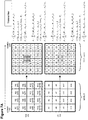
- FIGS. 5A , 5B , and 5C are example diagrams illustrating different techniques of upsampling according to embodiments herein.
- these figures show example embodiments of "simple" filters (unilateral filters, with kernel H) to upsample a motion map.
- the groupings of elements that are shown may just be a portion of an image at the two levels of quality (e.g., a 4x4 area of a much larger image, which should be upsampled into an 8x8 area), not necessarily the whole image.
- Unilateral filters can either be linear (i.e., Figure 5A , featuring as kernel/weights a matrix of fixed coefficients for every position i, regardless of the values of W).
- the unilateral filter can be non-linear (e.g., Figure 5B , featuring as kernel a matrix of coefficients that depends both on i and on the specific values of the motion vectors W).
- linear kernels would be bilinear filters (where every pel in the new level of quality is influenced by the four closest pels around it in the previous level of quality), bicubic filters (16 closest pels), Lanczos filters (64 closest pels), etc.
- FIG. 5C illustrates an example embodiment of a majority-based non-linear filter.
- the majority decision taken based on the vectors closer to X i influences the weights of a standard kernel (e.g., on the larger 4x4 block on which a standard bicubic filter applies), setting to zero the weights of motion vectors that are very different form the "majority motion vector", and then applying normalized bicubic filter weights with the remaining vectors.
- a standard kernel e.g., on the larger 4x4 block on which a standard bicubic filter applies
- these equations indicate how to derive a setting for sub-elements at the next higher level of quality in the hierarchy.
- the figures indicate that the motion map 310 at level K includes values W6, W7, W10, and W11.
- the weights W indicate motion vector information for a corresponding element at level of quality K.
- element W6 is sub-divided into four elements including element X1; element W7 is sub-divided into four elements including element X2; element W10 is sub-divided into four elements including element X3; element W11 is sub-divided into four elements including element X4; and so on.
- one embodiment herein includes generating motion vector settings information for element X1 in motion map 310-A at level of quality K+1 based on settings of elements W6, W7, W10, and W11; generating motion vector settings information for element X2 in motion map 310-A at level of quality K+1 based on settings of elements W6, W7, W10, and W11; generating motion vector settings information for element X3 in motion map 310-A at level of quality K+1 based on settings of elements W6, W7, W10, and W11; and so on.
- the values for H j are weights, magnitudes of which are determined based on filter H.
- the motion vector settings information for a respective sub-element (e.g., X1) into which the parent element (e.g., W6) is divided can be based on weightings of the settings associated with element W6, W7, W10 and W11;
- the motion vector settings information for a respective sub-element (e.g., X2) into which the parent element (e.g., W7) is divided can be based on weightings of the settings associated with element W6, W7, W10 and W11; and so on.
- the settings for sub-elements in the motion map during upsampling can be derived based on an expanded field of elements at the lower level of quality.
- the elements X in motion map 310-B are derived based on a corresponding set of equations that take into account setting sequence of frames of a wider field of motion vector information.
- the element X1 in motion map 310-B at level of quality K+1 can be derived from settings associated with elements W1, W2, W3, W4, W5, W6, W7, W8, W9, W10, W11, W12, W13, W14, W15, and W16.
- FIG. 6 is an example diagram illustrating implementation of a bilateral filter function to upsample a motion map according to embodiments herein.
- FIG. 7A is an example diagram illustrating implementation of a trilateral filter function to upsample a motion map according to embodiments herein.
- FIG. 7B is an example diagram illustrating different combinations of filters that can be used to upsample motion map information according to embodiments herein.
- the diagram illustrates high level representations of the concepts of multiplying kernels H, F and G to obtain the final kernel of the filter (in the non limiting example cases of using kernels that consider 16 motion vectors around the element i that must be calculated).
- the same final kernel of the filter can also be used to calculate the new metadata assigned to motion vectors of the motion map at the new level of quality.
- Formulas express H as non-linear, but it is important to specify that the linear case (H independent from W) is just a specific case of the more general non-linear case.
- any combination of filters can be used to upsample the motion maps.
- combinations are possible and include H alone (linear or non-linear), F alone, G alone, HF (both with H linear and with H non-linear), HG (both with H linear and with H non-linear), FG and HFG (both with H linear and with H non-linear).
- the kernels that are multiplied to obtain the final kernel for the filters can be used to generate the respective metadata for the element i.
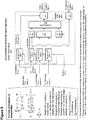
- FIG. 8 is a diagram illustrating a specific non-limiting example embodiment of a trilateral filter according to embodiments herein.
- the diagram illustrates a non-limiting embodiment using a bicubic kernel as H (which means that weights can be precalculated, since there are only four possible sets of weights depending on the position of i with respect to the 16 elements j), a weight based on the difference of color settings as F and a simple variation on weighted average for covariances, taking into account that higher covariance means lower confidence for the motion vector.
- H a bicubic kernel
- FIG. 8 illustrates how a specific motion vector X i of the higher resolution motion map is calculated, i.e., it calculates a single pel of the higher resolution map.
- this flow graph in order to upsample an entire motion map made of many pels: the whole processing can be either fully sequential or fully parallel or a mix thereof.
- FIG. 9 is an example diagram illustrating a method of upsampling according to embodiments herein.
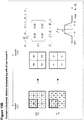
- FIG. 10A is an example diagrams illustrating upsampling of motion vectors using a simple H filter according to embodiments herein.
- the values in parenthesis for each element indicate Cartesian coordinates of the motion vectors.
- sub-elements are assigned values of (13.4,10.9), (53,35.6), (52.5,35.3), (60.1, 40.1).
- use of the H filter (such as in this example) may be undesirable because generated motion vector information may result in poor reconstruction of a sharp transition in an image.
- FIG. 10B is an example diagram illustrating upsampling of motion vectors using a simple H filter cascaded by an F filter that takes into account color settings (e.g., settings 20 and 80) of corresponding elements according to embodiments herein.
- the values in parenthesis for each element indicate Cartesian coordinates of the motion vectors.
- sub-elements are assigned values of color value setting 80 coordinate (-20,-10), 20 (60,40), 20 (60,40), and 20 (60, 40).
- the motion vector information is not averaged out.
- the generated motion vector information for the sub-elements preserves a sharp transition because the derived motion vector settings directly follow the color transition (e.g., border snapping).
- FIG. 10C is an example diagram illustrating upsampling of motion vectors using a combination H F G filter according to embodiments herein.
- the Cartesian coordinates and the color value setting for each element is the same as previous FIG. 10B .
- the values in parenthesis for each element indicate Cartesian coordinates of the motion vectors.
- the sub-elements are assigned values of color value setting 80 coordinate (-20, -10), 20 (60,40), 20 (60,40), and 20 (59.7, 39.5). This case takes into account confidence levels or variance of the motion vectors. The higher the variance, the lower the confidence for a respective motion vector. Motion vectors to which lower confidence values is assigned are given very low weight when determining a setting for a respective sub-element.
- the settings 20 (15, -40) 100 for the respective element is an outlier that has little upsampling weight when on producing setting 20 (59.7, 39.5) for the respective sub-element.
- the generated motion vector information for the sub-elements preserves a sharp transition because the motion vector settings directly follow the color transition (e.g., border snapping).
- FIG. 11 shows how the upsampling algorithm can be leveraged in order to produce more accurate motion maps starting from lower resolution ones.
- the upsampled motion map 480-1 is inputted to motion map finalizer 1120-1 to finalize motion estimation at level of quality 103 (e.g., level of quality K+1).
- level of quality 103 e.g., level of quality K+1
- motion map 310-3 at level of quality K+1 is estimated more effectively and with better computational efficiency.
- FIG. 12 is an example diagram illustrating how the upsampling algorithm as discussed herein can be leveraged in order to reconstruct a higher resolution rendition of a motion map starting with a lower resolution one according to embodiments herein.
- the resources in FIG. 12 can reside in a decoder that performs reconstruction via upsampling operation and use of residual data.
- Upsampled motion map 480-1 provides motion map reconstructor 1220-1 with a starting point to reconstruct a rendition of motion map 310-3 at level of quality 103 (e.g., level of quality K+1).
- Motion map reconstruction data 1250-1 e.g., residual data indicating adjustments to be made to motion vectors of unstapled motion map 480-1 allows motion map reconstructor 1220-1 to fully reconstruct a rendition of motion map 310-3 at level of quality 103.
- motion map information and/or residuals or both can be expressed in polar coordinate system.
- the motion map and residual data are not necessarily expressed in the same coordinate system.
- FIG. 13A is an example diagram illustrating a signal processor configured to downsample according to embodiments herein.
- the motion map resolution changer 410-1 receives downsampling commands.
- the motion map resolution changer 410-1 receives image settings of current image 110 for level of quality K, a respective motion map at level of quality K+1, and settings of current image at level of quality 103. Via the received information, the motion map resolution changer 410-1 produces a downsampled motion map for level of quality K.
- the signal processor 1300-1 repeats these steps for each of the multiple level of quality in the hierarchy down to the lowest level of quality.
- Fig. 13B is an example diagram illustrating bilateral motion map downsampling using a bilinear kernel H filter according to embodiments herein. As shown, embodiments herein include leveraging a bilateral filter where H is a simple bilinear kernel and f is a non-linear function of the differences between A1 and Bj.
- FIG. 14 is an example diagram illustrating encoding and decoding according to embodiments herein.
- FIG. 14 illustrates full-fledged application of the motion map resolution changer algorithm.
- the encoder receives a dense motion map at the highest level of quality for the signal 115 such as an image.
- the dense motion map 310 at the highest level of quality can indicate relationships of elements in the signal (at the respective level of quality) to an element in another a reference image.
- the encoder After motion estimation (i.e., after receiving from somewhere an accurate dense motion map at high resolution), the encoder downsamples the dense motion map at the high level of quality using the motion map resolution changer algorithm as discussed herein.
- the encoder downsamples the motion map to the lowest level of quality (e.g., LOQ #1) in the hierarchy.
- Reconstruction data 1450-3 can include information such as residual data indicating how to upsample the rendition of motion map 310-2 to rendition of motion map 310-3. As discussed in related applications, the residual data provides a way of refining settings of the motion maps during upsampling by the decoder.
- reconstruction data 1450-2 when downsampling rendition of motion map 310-2 to rendition of motion map 310-1.
- reconstruction data 1450-2 can include information such as residual data indicating how to upsample the rendition of motion map 310-2 to rendition of motion map 310-1, and so on.
- the signal processor 1400-1 in the encoder simulates the decoder in order to generate the reconstruction data 1450 at the different levels of quality.
- the decoder function receives the rendition of motion map 310-0 at the lowest level of quality.
- the rendition of motion map 310-0 provides a baseline for creating the more detailed motion maps at the higher level of quality.
- the decoder function upsamples the rendition of motion map 310-0 using the motion map resolution changer algorithm as discussed herein.
- the decoder receives reconstruction data 1450-1.
- the decoder uses the reconstruction data 1450-1 to tweak the settings of the upsampled motion map.
- the reconstruction data 1450-1 can include residual data to make adjustments.
- the decoder then upsamples the rendition of motion map 310-1 using the resolution changer algorithm as discussed herein.
- the rendition of motion map 310-1 provides a baseline for creating the more detailed motion maps at the next higher level of quality.
- the decoder function upsamples the rendition of motion map 310-1 using the motion map resolution changer algorithm as discussed herein.
- the decoder utilizes reconstruction data 1450-2 to tweak or adjust one or more settings of the elements in upsampled motion map.
- the signal processor 1400-2 e.g., decoder function
- the decoder function leverages the settings in the dense motion map to reduce the amount of data that is needed to reconstruct the original signal.
- the motion map e.g., auxiliary map
- the motion map can include motion vector information indicating settings of elements in a reference image to use as a basis for settings of elements in the current image being reproduced.
- processing as discussed with respect to FIG. 14 also can include techniques according to which, for example, it is possible to specify, via residual data, when there will be no residual data for the child elements at the higher levels of quality, potentially up to the highest level, for a given element and for all of its sub-elements.
- reconstruction data will just inherit zero adjustment values for that area (e.g., parent element, and child elements) of the image, which means that for those elements and from that level upwards, what we obtain with the upsampling operations will not be adjusted.
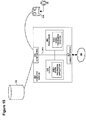
- FIG. 15 is an example block diagram of a computer system 800 that provides computer processing according to embodiments herein.
- Computer system 800 can be or include a computerized device such as a personal computer, processing circuitry, television, playback device, encoding device, workstation, portable computing device, console, network terminal, processing device, network device, operating as a switch, router, server, client, etc.
- a computerized device such as a personal computer, processing circuitry, television, playback device, encoding device, workstation, portable computing device, console, network terminal, processing device, network device, operating as a switch, router, server, client, etc.
- computer system 800 of the present example includes an interconnect 811 that couples computer readable storage media 812 such as a non-transitory type of media, computer readable, hardware storage medium, etc., in which digital information can be stored and retrieved.
- Computer system 800 can further include a processor 813, I/O interface 814, and a communications interface 817.
- I/O interface 814 provides connectivity to repository 180, and if present, display screen, peripheral devices 816 such as a keyboard, a computer mouse, etc.
- Computer readable storage medium 812 can be any suitable device and/or hardware such as memory, optical storage, hard drive, floppy disk, etc.
- the computer readable storage medium can be a non-transitory storage media to store instructions associated with signal processor 1400. The instructions are executed by a respective resource such as signal processor 1400 to perform any of the operations as discussed herein.
- Communications interface 817 enables computer system 800 to communicate over network 190 to retrieve information from remote sources and communicate with other computers, switches, clients, servers, etc.
- I/O interface 814 also enables processor 813 to retrieve or attempt retrieval of stored information from repository 180.
- computer readable storage media 812 can be encoded with signal processor application 140-1 executed by processor 813 as signal processor process 840-2.
- the computer system 800 or encoder 140 also can be embodied to include a computer readable storage medium 812 (e.g., a hardware storage media, non-transitory storage media, etc.) for storing data and/or logic instructions.
- a computer readable storage medium 812 e.g., a hardware storage media, non-transitory storage media, etc.
- Computer system 800 can include a processor 813 to execute such instructions and carry out operations as discussed herein. Accordingly, when executed, the code associated with signal processor application 840-1 can support processing functionality as discussed herein. As mentioned, signal processor 1400 can be configured to support encoding and/or decoding.
- processor 813 accesses computer readable storage media 812 via the use of interconnect 811 in order to launch, run, execute, interpret or otherwise perform the instructions of signal processor application 840-1 stored in computer readable storage medium 812. Execution of the signal processor application 840-1 produces processing functionality in processor 813.
- the encoder process 840-2 associated with processor 813 represents one or more aspects of executing signal processor application 840-1 within or upon the processor 813 in the computer system 800.
- the computer system 800 can include other processes and/or software and hardware components, such as an operating system that controls allocation and use of hardware processing resources to execute signal processor application 840-1.
- computer system may be any of various types of devices, including, but not limited to, a personal computer system, desktop computer, laptop, notebook, netbook computer, mainframe computer system, handheld computer, workstation, network computer, application server, storage device, a consumer electronics device such as a camera, camcorder, set top box, mobile device, video game console, handheld video game device, a peripheral device such as a switch, modem, router, or, in general, any type of computing or electronic device.
- a personal computer system desktop computer, laptop, notebook, netbook computer, mainframe computer system, handheld computer, workstation, network computer, application server, storage device, a consumer electronics device such as a camera, camcorder, set top box, mobile device, video game console, handheld video game device, a peripheral device such as a switch, modem, router, or, in general, any type of computing or electronic device.
- An algorithm as described herein, and generally, is considered to be a self-consistent sequence of operations or similar processing leading to a desired result.
- operations or processing involve physical manipulation of physical quantities.
- quantities may take the form of electrical or magnetic signals capable of being stored, transferred, combined, compared or otherwise manipulated. It has proven convenient at times, principally for reasons of common usage, to refer to such signals as bits, data, values, elements, symbols, characters, terms, numbers, numerals or the like. It should be understood, however, that all of these and similar terms are to be associated with appropriate physical quantities and are merely convenient labels.
Landscapes
- Engineering & Computer Science (AREA)
- Multimedia (AREA)
- Signal Processing (AREA)
- Compression Or Coding Systems Of Tv Signals (AREA)
- Investigating Or Analysing Biological Materials (AREA)
Applications Claiming Priority (3)
| Application Number | Priority Date | Filing Date | Title |
|---|---|---|---|
| US201161558302P | 2011-11-10 | 2011-11-10 | |
| US13/303,554 US9300980B2 (en) | 2011-11-10 | 2011-11-23 | Upsampling and downsampling of motion maps and other auxiliary maps in a tiered signal quality hierarchy |
| PCT/IB2012/002286 WO2013068825A1 (en) | 2011-11-10 | 2012-11-09 | Upsampling and downsampling of motion maps and other auxiliary maps in a tiered signal quality hierarchy |
Publications (2)
| Publication Number | Publication Date |
|---|---|
| EP2777274A1 EP2777274A1 (en) | 2014-09-17 |
| EP2777274B1 true EP2777274B1 (en) | 2021-05-19 |
Family
ID=47351870
Family Applications (1)
| Application Number | Title | Priority Date | Filing Date |
|---|---|---|---|
| EP12799276.6A Active EP2777274B1 (en) | 2011-11-10 | 2012-11-09 | Upsampling of motion maps in resolution scalable video coding |
Country Status (7)
| Country | Link |
|---|---|
| US (3) | US9300980B2 (https=) |
| EP (1) | EP2777274B1 (https=) |
| KR (1) | KR102263625B1 (https=) |
| CN (1) | CN104170388B (https=) |
| CA (1) | CA2858786A1 (https=) |
| IN (1) | IN2014CN04195A (https=) |
| WO (1) | WO2013068825A1 (https=) |
Families Citing this family (25)
| Publication number | Priority date | Publication date | Assignee | Title |
|---|---|---|---|---|
| CN104067317A (zh) | 2011-09-08 | 2014-09-24 | 宝福特控股私人有限公司 | 用于在真实世界视频剪辑内对合成对象进行可视化的系统和方法 |
| US9300980B2 (en) * | 2011-11-10 | 2016-03-29 | Luca Rossato | Upsampling and downsampling of motion maps and other auxiliary maps in a tiered signal quality hierarchy |
| EA201492099A1 (ru) * | 2012-05-14 | 2015-04-30 | Лука Россато | Разложение остаточных данных при кодировании, декодировании и реконструкции сигнала в многоуровневой иерархии |
| US20140301463A1 (en) * | 2013-04-05 | 2014-10-09 | Nokia Corporation | Method and apparatus for video coding and decoding |
| US20150030208A1 (en) * | 2013-07-29 | 2015-01-29 | Irida Labs S.A. | System and a method for motion estimation based on a series of 2d images |
| US20150124873A1 (en) * | 2013-11-01 | 2015-05-07 | Microsoft Corporation | Chroma Down-Conversion and Up-Conversion Processing |
| SG10201406217VA (en) | 2014-05-30 | 2015-12-30 | Paofit Technology Pte Ltd | Systems and methods for motion-vector-aided video interpolation using real-time smooth video playback speed variation |
| JP6336341B2 (ja) * | 2014-06-24 | 2018-06-06 | キヤノン株式会社 | 撮像装置及びその制御方法、プログラム、記憶媒体 |
| US9508026B2 (en) | 2014-07-01 | 2016-11-29 | Irida Labs S.A. | System and a method for camera motion analysis and understanding from a video sequence |
| KR101642200B1 (ko) * | 2014-12-19 | 2016-07-22 | 포항공과대학교 산학협력단 | 객체의 움직임 분석을 이용한 모션 효과 생성 장치 및 방법 |
| US10410398B2 (en) * | 2015-02-20 | 2019-09-10 | Qualcomm Incorporated | Systems and methods for reducing memory bandwidth using low quality tiles |
| WO2016166532A1 (en) | 2015-04-13 | 2016-10-20 | Richard Clucas | Encoding a plurality of signals with data rate target of a signal depending on complexity information |
| US9704298B2 (en) | 2015-06-23 | 2017-07-11 | Paofit Holdings Pte Ltd. | Systems and methods for generating 360 degree mixed reality environments |
| AU2018254591B2 (en) | 2017-04-21 | 2021-01-07 | Zenimax Media Inc. | Systems and methods for encoder-guided adaptive-quality rendering |
| US10432962B1 (en) * | 2018-03-13 | 2019-10-01 | Pixelworks, Inc. | Accuracy and local smoothness of motion vector fields using motion-model fitting |
| US11611773B2 (en) * | 2018-04-06 | 2023-03-21 | Qatar Foundation For Education, Science And Community Development | System of video steganalysis and a method for the detection of covert communications |
| EP3803273A4 (en) * | 2018-10-29 | 2021-11-17 | DJI Technology, Inc. | REAL-TIME MAPPING TECHNIQUES IN A MOBILE OBJECT ENVIRONMENT |
| GB2617783B (en) | 2019-03-20 | 2024-02-07 | V Nova Int Ltd | Temporal signalling for video coding technology |
| US11372126B2 (en) * | 2019-04-04 | 2022-06-28 | The Johns Hopkins University | Large volume holographic imaging systems and associated methods |
| CN114521327B (zh) | 2019-07-05 | 2026-02-10 | 威诺瓦国际有限公司 | 视频译码中的残差的量化 |
| CN110910324B (zh) * | 2019-11-19 | 2023-04-14 | 山东神戎电子股份有限公司 | 红外视频的去竖条纹方法 |
| GB2598701B (en) | 2020-05-25 | 2023-01-25 | V Nova Int Ltd | Wireless data communication system and method |
| JP2024513431A (ja) * | 2021-04-02 | 2024-03-25 | ヒョンダイ モーター カンパニー | 動的メッシュコーディングのための装置及び方法 |
| CN114025168B (zh) * | 2021-09-30 | 2023-08-04 | 浙江大华技术股份有限公司 | 视频图像的处理方法、处理设备、电子设备以及存储介质 |
| US20230177649A1 (en) * | 2021-12-03 | 2023-06-08 | Nvidia Corporation | Temporal image blending using one or more neural networks |
Family Cites Families (20)
| Publication number | Priority date | Publication date | Assignee | Title |
|---|---|---|---|---|
| US5477272A (en) * | 1993-07-22 | 1995-12-19 | Gte Laboratories Incorporated | Variable-block size multi-resolution motion estimation scheme for pyramid coding |
| US5612735A (en) * | 1995-05-26 | 1997-03-18 | Luncent Technologies Inc. | Digital 3D/stereoscopic video compression technique utilizing two disparity estimates |
| US20020196854A1 (en) * | 2001-06-15 | 2002-12-26 | Jongil Kim | Fast video encoder using adaptive hierarchical video processing in a down-sampled domain |
| JP2003037842A (ja) * | 2001-07-26 | 2003-02-07 | Monolith Co Ltd | 画像符号化方法、復号方法および画像符号化装置、復号装置 |
| US20060294113A1 (en) * | 2003-08-22 | 2006-12-28 | Deepak Turaga | Joint spatial-temporal-orientation-scale prediction and coding of motion vectors for rate-distortion-complexity optimized video coding |
| US8036494B2 (en) | 2004-04-15 | 2011-10-11 | Hewlett-Packard Development Company, L.P. | Enhancing image resolution |
| KR100664929B1 (ko) * | 2004-10-21 | 2007-01-04 | 삼성전자주식회사 | 다 계층 기반의 비디오 코더에서 모션 벡터를 효율적으로압축하는 방법 및 장치 |
| JP2006174415A (ja) * | 2004-11-19 | 2006-06-29 | Ntt Docomo Inc | 画像復号装置、画像復号プログラム、画像復号方法、画像符号化装置、画像符号化プログラム及び画像符号化方法 |
| US7479425B2 (en) * | 2005-01-20 | 2009-01-20 | Chartered Semiconductor Manufacturing, Ltd | Method for forming high-K charge storage device |
| WO2006124885A2 (en) * | 2005-05-12 | 2006-11-23 | Kylintv, Inc. | Codec for iptv |
| US20080111923A1 (en) * | 2006-11-09 | 2008-05-15 | Scheuermann W James | Processor for video data |
| US9204149B2 (en) * | 2006-11-21 | 2015-12-01 | Vixs Systems, Inc. | Motion refinement engine with shared memory for use in video encoding and methods for use therewith |
| WO2008115222A1 (en) * | 2007-03-16 | 2008-09-25 | Thomson Licensing | System and method for combining text with three-dimensional content |
| JP2009089332A (ja) * | 2007-10-03 | 2009-04-23 | Sony Corp | 動き予測方法及び動き予測装置 |
| JP4882956B2 (ja) * | 2007-10-22 | 2012-02-22 | ソニー株式会社 | 画像処理装置および画像処理方法 |
| JP2011522496A (ja) * | 2008-06-05 | 2011-07-28 | トムソン ライセンシング | テクスチャ合成による画像符号化方法 |
| WO2010033151A1 (en) * | 2008-09-18 | 2010-03-25 | Thomson Licensing | Methods and apparatus for video imaging pruning |
| EP2209086A1 (en) * | 2009-01-15 | 2010-07-21 | Telefonaktiebolaget L M Ericsson (publ) | Image processing |
| US9300980B2 (en) * | 2011-11-10 | 2016-03-29 | Luca Rossato | Upsampling and downsampling of motion maps and other auxiliary maps in a tiered signal quality hierarchy |
| US20140169467A1 (en) * | 2012-12-14 | 2014-06-19 | Ce Wang | Video coding including shared motion estimation between multple independent coding streams |
-
2011
- 2011-11-23 US US13/303,554 patent/US9300980B2/en active Active
-
2012
- 2012-11-09 IN IN4195CHN2014 patent/IN2014CN04195A/en unknown
- 2012-11-09 EP EP12799276.6A patent/EP2777274B1/en active Active
- 2012-11-09 CA CA2858786A patent/CA2858786A1/en not_active Abandoned
- 2012-11-09 CN CN201280066702.9A patent/CN104170388B/zh active Active
- 2012-11-09 KR KR1020147015734A patent/KR102263625B1/ko active Active
- 2012-11-09 WO PCT/IB2012/002286 patent/WO2013068825A1/en not_active Ceased
-
2016
- 2016-03-16 US US15/071,369 patent/US9628817B2/en active Active
-
2017
- 2017-04-05 US US15/479,966 patent/US9967568B2/en active Active
Non-Patent Citations (1)
| Title |
|---|
| None * |
Also Published As
| Publication number | Publication date |
|---|---|
| IN2014CN04195A (https=) | 2015-09-04 |
| US9300980B2 (en) | 2016-03-29 |
| US20130294514A1 (en) | 2013-11-07 |
| CA2858786A1 (en) | 2013-05-16 |
| EP2777274A1 (en) | 2014-09-17 |
| US20170208333A1 (en) | 2017-07-20 |
| US9628817B2 (en) | 2017-04-18 |
| WO2013068825A1 (en) | 2013-05-16 |
| US20160198159A1 (en) | 2016-07-07 |
| CN104170388A (zh) | 2014-11-26 |
| KR20140092898A (ko) | 2014-07-24 |
| US9967568B2 (en) | 2018-05-08 |
| CN104170388B (zh) | 2019-01-25 |
| KR102263625B1 (ko) | 2021-06-10 |
Similar Documents
| Publication | Publication Date | Title |
|---|---|---|
| EP2777274B1 (en) | Upsampling of motion maps in resolution scalable video coding | |
| US20250330603A1 (en) | Motion compensation and motion estimation leveraging a continuous coordinate system | |
| EP2074586B1 (en) | Image enhancement | |
| CA2842439A1 (en) | Adaptive upsampling for spatially scalable video coding |
Legal Events
| Date | Code | Title | Description |
|---|---|---|---|
| PUAI | Public reference made under article 153(3) epc to a published international application that has entered the european phase |
Free format text: ORIGINAL CODE: 0009012 |
|
| 17P | Request for examination filed |
Effective date: 20140609 |
|
| AK | Designated contracting states |
Kind code of ref document: A1 Designated state(s): AL AT BE BG CH CY CZ DE DK EE ES FI FR GB GR HR HU IE IS IT LI LT LU LV MC MK MT NL NO PL PT RO RS SE SI SK SM TR |
|
| DAX | Request for extension of the european patent (deleted) | ||
| RAP1 | Party data changed (applicant data changed or rights of an application transferred) |
Owner name: V-NOVA INTERNATIONAL LTD |
|
| RIN1 | Information on inventor provided before grant (corrected) |
Inventor name: ROSSATO, LUCA Inventor name: MEARDI, GUIDO |
|
| STAA | Information on the status of an ep patent application or granted ep patent |
Free format text: STATUS: EXAMINATION IS IN PROGRESS |
|
| 17Q | First examination report despatched |
Effective date: 20180222 |
|
| RIC1 | Information provided on ipc code assigned before grant |
Ipc: H04N 7/26 20181130AFI20130530BHEP |
|
| RIC1 | Information provided on ipc code assigned before grant |
Ipc: H04N 7/26 20060101AFI20130530BHEP |
|
| REG | Reference to a national code |
Ref country code: DE Ref legal event code: R079 Ref document number: 602012075616 Country of ref document: DE Free format text: PREVIOUS MAIN CLASS: H04N0007260000 Ipc: H04N0019513000 |
|
| GRAP | Despatch of communication of intention to grant a patent |
Free format text: ORIGINAL CODE: EPIDOSNIGR1 |
|
| STAA | Information on the status of an ep patent application or granted ep patent |
Free format text: STATUS: GRANT OF PATENT IS INTENDED |
|
| RIC1 | Information provided on ipc code assigned before grant |
Ipc: H04N 19/136 20140101ALI20201202BHEP Ipc: H04N 19/33 20140101ALI20201202BHEP Ipc: H04N 19/59 20140101ALI20201202BHEP Ipc: H04N 19/53 20140101ALI20201202BHEP Ipc: H04N 19/139 20140101ALI20201202BHEP Ipc: H04N 19/513 20140101AFI20201202BHEP |
|
| INTG | Intention to grant announced |
Effective date: 20201216 |
|
| RIN1 | Information on inventor provided before grant (corrected) |
Inventor name: ROSSATO, LUCA Inventor name: MEARDI, GUIDO |
|
| GRAS | Grant fee paid |
Free format text: ORIGINAL CODE: EPIDOSNIGR3 |
|
| GRAA | (expected) grant |
Free format text: ORIGINAL CODE: 0009210 |
|
| STAA | Information on the status of an ep patent application or granted ep patent |
Free format text: STATUS: THE PATENT HAS BEEN GRANTED |
|
| AK | Designated contracting states |
Kind code of ref document: B1 Designated state(s): AL AT BE BG CH CY CZ DE DK EE ES FI FR GB GR HR HU IE IS IT LI LT LU LV MC MK MT NL NO PL PT RO RS SE SI SK SM TR |
|
| REG | Reference to a national code |
Ref country code: GB Ref legal event code: FG4D |
|
| REG | Reference to a national code |
Ref country code: CH Ref legal event code: EP |
|
| REG | Reference to a national code |
Ref country code: DE Ref legal event code: R096 Ref document number: 602012075616 Country of ref document: DE |
|
| REG | Reference to a national code |
Ref country code: AT Ref legal event code: REF Ref document number: 1395140 Country of ref document: AT Kind code of ref document: T Effective date: 20210615 |
|
| REG | Reference to a national code |
Ref country code: IE Ref legal event code: FG4D |
|
| REG | Reference to a national code |
Ref country code: NL Ref legal event code: FP |
|
| REG | Reference to a national code |
Ref country code: LT Ref legal event code: MG9D |
|
| REG | Reference to a national code |
Ref country code: AT Ref legal event code: MK05 Ref document number: 1395140 Country of ref document: AT Kind code of ref document: T Effective date: 20210519 |
|
| PG25 | Lapsed in a contracting state [announced via postgrant information from national office to epo] |
Ref country code: AT Free format text: LAPSE BECAUSE OF FAILURE TO SUBMIT A TRANSLATION OF THE DESCRIPTION OR TO PAY THE FEE WITHIN THE PRESCRIBED TIME-LIMIT Effective date: 20210519 Ref country code: BG Free format text: LAPSE BECAUSE OF FAILURE TO SUBMIT A TRANSLATION OF THE DESCRIPTION OR TO PAY THE FEE WITHIN THE PRESCRIBED TIME-LIMIT Effective date: 20210819 Ref country code: HR Free format text: LAPSE BECAUSE OF FAILURE TO SUBMIT A TRANSLATION OF THE DESCRIPTION OR TO PAY THE FEE WITHIN THE PRESCRIBED TIME-LIMIT Effective date: 20210519 Ref country code: FI Free format text: LAPSE BECAUSE OF FAILURE TO SUBMIT A TRANSLATION OF THE DESCRIPTION OR TO PAY THE FEE WITHIN THE PRESCRIBED TIME-LIMIT Effective date: 20210519 Ref country code: LT Free format text: LAPSE BECAUSE OF FAILURE TO SUBMIT A TRANSLATION OF THE DESCRIPTION OR TO PAY THE FEE WITHIN THE PRESCRIBED TIME-LIMIT Effective date: 20210519 |
|
| PG25 | Lapsed in a contracting state [announced via postgrant information from national office to epo] |
Ref country code: SE Free format text: LAPSE BECAUSE OF FAILURE TO SUBMIT A TRANSLATION OF THE DESCRIPTION OR TO PAY THE FEE WITHIN THE PRESCRIBED TIME-LIMIT Effective date: 20210519 Ref country code: RS Free format text: LAPSE BECAUSE OF FAILURE TO SUBMIT A TRANSLATION OF THE DESCRIPTION OR TO PAY THE FEE WITHIN THE PRESCRIBED TIME-LIMIT Effective date: 20210519 Ref country code: GR Free format text: LAPSE BECAUSE OF FAILURE TO SUBMIT A TRANSLATION OF THE DESCRIPTION OR TO PAY THE FEE WITHIN THE PRESCRIBED TIME-LIMIT Effective date: 20210820 Ref country code: LV Free format text: LAPSE BECAUSE OF FAILURE TO SUBMIT A TRANSLATION OF THE DESCRIPTION OR TO PAY THE FEE WITHIN THE PRESCRIBED TIME-LIMIT Effective date: 20210519 Ref country code: IS Free format text: LAPSE BECAUSE OF FAILURE TO SUBMIT A TRANSLATION OF THE DESCRIPTION OR TO PAY THE FEE WITHIN THE PRESCRIBED TIME-LIMIT Effective date: 20210919 Ref country code: NO Free format text: LAPSE BECAUSE OF FAILURE TO SUBMIT A TRANSLATION OF THE DESCRIPTION OR TO PAY THE FEE WITHIN THE PRESCRIBED TIME-LIMIT Effective date: 20210819 Ref country code: PL Free format text: LAPSE BECAUSE OF FAILURE TO SUBMIT A TRANSLATION OF THE DESCRIPTION OR TO PAY THE FEE WITHIN THE PRESCRIBED TIME-LIMIT Effective date: 20210519 Ref country code: PT Free format text: LAPSE BECAUSE OF FAILURE TO SUBMIT A TRANSLATION OF THE DESCRIPTION OR TO PAY THE FEE WITHIN THE PRESCRIBED TIME-LIMIT Effective date: 20210920 Ref country code: ES Free format text: LAPSE BECAUSE OF FAILURE TO SUBMIT A TRANSLATION OF THE DESCRIPTION OR TO PAY THE FEE WITHIN THE PRESCRIBED TIME-LIMIT Effective date: 20210519 |
|
| PG25 | Lapsed in a contracting state [announced via postgrant information from national office to epo] |
Ref country code: RO Free format text: LAPSE BECAUSE OF FAILURE TO SUBMIT A TRANSLATION OF THE DESCRIPTION OR TO PAY THE FEE WITHIN THE PRESCRIBED TIME-LIMIT Effective date: 20210519 Ref country code: EE Free format text: LAPSE BECAUSE OF FAILURE TO SUBMIT A TRANSLATION OF THE DESCRIPTION OR TO PAY THE FEE WITHIN THE PRESCRIBED TIME-LIMIT Effective date: 20210519 Ref country code: CZ Free format text: LAPSE BECAUSE OF FAILURE TO SUBMIT A TRANSLATION OF THE DESCRIPTION OR TO PAY THE FEE WITHIN THE PRESCRIBED TIME-LIMIT Effective date: 20210519 Ref country code: DK Free format text: LAPSE BECAUSE OF FAILURE TO SUBMIT A TRANSLATION OF THE DESCRIPTION OR TO PAY THE FEE WITHIN THE PRESCRIBED TIME-LIMIT Effective date: 20210519 Ref country code: SK Free format text: LAPSE BECAUSE OF FAILURE TO SUBMIT A TRANSLATION OF THE DESCRIPTION OR TO PAY THE FEE WITHIN THE PRESCRIBED TIME-LIMIT Effective date: 20210519 Ref country code: SM Free format text: LAPSE BECAUSE OF FAILURE TO SUBMIT A TRANSLATION OF THE DESCRIPTION OR TO PAY THE FEE WITHIN THE PRESCRIBED TIME-LIMIT Effective date: 20210519 |
|
| REG | Reference to a national code |
Ref country code: DE Ref legal event code: R097 Ref document number: 602012075616 Country of ref document: DE |
|
| PLBE | No opposition filed within time limit |
Free format text: ORIGINAL CODE: 0009261 |
|
| STAA | Information on the status of an ep patent application or granted ep patent |
Free format text: STATUS: NO OPPOSITION FILED WITHIN TIME LIMIT |
|
| 26N | No opposition filed |
Effective date: 20220222 |
|
| PG25 | Lapsed in a contracting state [announced via postgrant information from national office to epo] |
Ref country code: IS Free format text: LAPSE BECAUSE OF FAILURE TO SUBMIT A TRANSLATION OF THE DESCRIPTION OR TO PAY THE FEE WITHIN THE PRESCRIBED TIME-LIMIT Effective date: 20210919 Ref country code: AL Free format text: LAPSE BECAUSE OF FAILURE TO SUBMIT A TRANSLATION OF THE DESCRIPTION OR TO PAY THE FEE WITHIN THE PRESCRIBED TIME-LIMIT Effective date: 20210519 |
|
| PG25 | Lapsed in a contracting state [announced via postgrant information from national office to epo] |
Ref country code: HU Free format text: LAPSE BECAUSE OF FAILURE TO SUBMIT A TRANSLATION OF THE DESCRIPTION OR TO PAY THE FEE WITHIN THE PRESCRIBED TIME-LIMIT; INVALID AB INITIO Effective date: 20121109 Ref country code: CY Free format text: LAPSE BECAUSE OF FAILURE TO SUBMIT A TRANSLATION OF THE DESCRIPTION OR TO PAY THE FEE WITHIN THE PRESCRIBED TIME-LIMIT Effective date: 20210519 |
|
| P01 | Opt-out of the competence of the unified patent court (upc) registered |
Effective date: 20230524 |
|
| PG25 | Lapsed in a contracting state [announced via postgrant information from national office to epo] |
Ref country code: MK Free format text: LAPSE BECAUSE OF FAILURE TO SUBMIT A TRANSLATION OF THE DESCRIPTION OR TO PAY THE FEE WITHIN THE PRESCRIBED TIME-LIMIT Effective date: 20210519 |
|
| REG | Reference to a national code |
Ref country code: CH Ref legal event code: U11 Free format text: ST27 STATUS EVENT CODE: U-0-0-U10-U11 (AS PROVIDED BY THE NATIONAL OFFICE) Effective date: 20251201 |
|
| PG25 | Lapsed in a contracting state [announced via postgrant information from national office to epo] |
Ref country code: TR Free format text: LAPSE BECAUSE OF FAILURE TO SUBMIT A TRANSLATION OF THE DESCRIPTION OR TO PAY THE FEE WITHIN THE PRESCRIBED TIME-LIMIT Effective date: 20210519 |
|
| PGFP | Annual fee paid to national office [announced via postgrant information from national office to epo] |
Ref country code: NL Payment date: 20251119 Year of fee payment: 14 Ref country code: LU Payment date: 20251119 Year of fee payment: 14 |
|
| PGFP | Annual fee paid to national office [announced via postgrant information from national office to epo] |
Ref country code: DE Payment date: 20251119 Year of fee payment: 14 |
|
| PGFP | Annual fee paid to national office [announced via postgrant information from national office to epo] |
Ref country code: GB Payment date: 20251121 Year of fee payment: 14 |
|
| PGFP | Annual fee paid to national office [announced via postgrant information from national office to epo] |
Ref country code: MC Payment date: 20251121 Year of fee payment: 14 |
|
| PGFP | Annual fee paid to national office [announced via postgrant information from national office to epo] |
Ref country code: IT Payment date: 20251125 Year of fee payment: 14 |
|
| PGFP | Annual fee paid to national office [announced via postgrant information from national office to epo] |
Ref country code: FR Payment date: 20251125 Year of fee payment: 14 |
|
| PGFP | Annual fee paid to national office [announced via postgrant information from national office to epo] |
Ref country code: BE Payment date: 20251119 Year of fee payment: 14 |
|
| PGFP | Annual fee paid to national office [announced via postgrant information from national office to epo] |
Ref country code: CH Payment date: 20251201 Year of fee payment: 14 |
|
| PGFP | Annual fee paid to national office [announced via postgrant information from national office to epo] |
Ref country code: IE Payment date: 20251121 Year of fee payment: 14 |
|
| PGFP | Annual fee paid to national office [announced via postgrant information from national office to epo] |
Ref country code: MT Payment date: 20251024 Year of fee payment: 14 |