EP2775673B1 - Vorrichtung zur schätzung von inhaltswiedergabeinformationen, verfahren und programm - Google Patents
Vorrichtung zur schätzung von inhaltswiedergabeinformationen, verfahren und programm Download PDFInfo
- Publication number
- EP2775673B1 EP2775673B1 EP12846372.6A EP12846372A EP2775673B1 EP 2775673 B1 EP2775673 B1 EP 2775673B1 EP 12846372 A EP12846372 A EP 12846372A EP 2775673 B1 EP2775673 B1 EP 2775673B1
- Authority
- EP
- European Patent Office
- Prior art keywords
- playback
- content
- state
- amount
- buffer
- Prior art date
- Legal status (The legal status is an assumption and is not a legal conclusion. Google has not performed a legal analysis and makes no representation as to the accuracy of the status listed.)
- Active
Links
Images






Classifications
-
- H—ELECTRICITY
- H04—ELECTRIC COMMUNICATION TECHNIQUE
- H04N—PICTORIAL COMMUNICATION, e.g. TELEVISION
- H04N21/00—Selective content distribution, e.g. interactive television or video on demand [VOD]
- H04N21/40—Client devices specifically adapted for the reception of or interaction with content, e.g. set-top-box [STB]; Operations thereof
- H04N21/43—Processing of content or additional data, e.g. demultiplexing additional data from a digital video stream; Elementary client operations, e.g. monitoring of home network or synchronising decoder's clock; Client middleware
- H04N21/44—Processing of video elementary streams, e.g. splicing a video clip retrieved from local storage with an incoming video stream or rendering scenes according to encoded video stream scene graphs
- H04N21/44004—Processing of video elementary streams, e.g. splicing a video clip retrieved from local storage with an incoming video stream or rendering scenes according to encoded video stream scene graphs involving video buffer management, e.g. video decoder buffer or video display buffer
-
- H—ELECTRICITY
- H04—ELECTRIC COMMUNICATION TECHNIQUE
- H04N—PICTORIAL COMMUNICATION, e.g. TELEVISION
- H04N21/00—Selective content distribution, e.g. interactive television or video on demand [VOD]
- H04N21/20—Servers specifically adapted for the distribution of content, e.g. VOD servers; Operations thereof
- H04N21/23—Processing of content or additional data; Elementary server operations; Server middleware
- H04N21/24—Monitoring of processes or resources, e.g. monitoring of server load, available bandwidth, upstream requests
- H04N21/2401—Monitoring of the client buffer
-
- H—ELECTRICITY
- H04—ELECTRIC COMMUNICATION TECHNIQUE
- H04N—PICTORIAL COMMUNICATION, e.g. TELEVISION
- H04N21/00—Selective content distribution, e.g. interactive television or video on demand [VOD]
- H04N21/40—Client devices specifically adapted for the reception of or interaction with content, e.g. set-top-box [STB]; Operations thereof
- H04N21/43—Processing of content or additional data, e.g. demultiplexing additional data from a digital video stream; Elementary client operations, e.g. monitoring of home network or synchronising decoder's clock; Client middleware
- H04N21/433—Content storage operation, e.g. storage operation in response to a pause request, caching operations
- H04N21/4333—Processing operations in response to a pause request
Definitions
- the present invention relates to a content playback information estimation apparatus, a method and a program. More particularly, the present invention relates to a content playback information estimation apparatus, a method and a program for performing estimation of playback quality of content, such as a video, of a progressive download type in a system for distributing content data via a network.
- the content distribution form is characterized in that a certain amount of buffering (initial buffering amount) is necessary until start of processing, and the effect of the network can be relieved by increasing the buffer amount.
- a certain amount of buffering initial buffering amount
- the time until start of data processing becomes long, so that the response becomes worse. Therefore, it is necessary to set an initial buffer amount of a proper size in consideration of various situations. For example, there is a method in which the initial buffer amount is changed based on transfer delay time of packets (refer to a non-patent document 1, for example).
- the playback buffer becomes lower than a predetermined amount (playback halt threshold), so that there is a case where playback is halted.
- the halt of playback causes a big effect on user sensory quality of the content.
- a technique is required for estimating and ascertaining playback halt states of content.
- each divided unit is called a chunk
- content data is stored in the playback buffer in units of chunks. That is, the playback buffer is managed by the number of chunks or the playback time length for the stored chunks.
- Non-patent document 1 Kouhei Fujimoto, Shingo Ata, Masayuki Murata, "Statistical Analysis of Packet delays in the Internet and Its Application to Playout Control for Streaming Applications," IEICE TRANSE. ON COMMUNICATION, VOL. E00-B, NO. 6 JUNE 2001
- two patterns can be considered, which are a case in which the estimation is performed in the inside of the terminal and a case where the estimation is performed outside the terminal.
- the present invention is contrived in view of the above-mentioned problem, and an object of the present invention is, in a system for providing a service for receiving and playing content data distributed via a network, to provide a content playback information estimation apparatus, a method and a program for performing estimation of a playback halt state in a terminal that receives and plays content data in the system by performing packet capturing and analysis on a distribution route without modifying a distribution side (distribution server) and a receiving side (playback terminal) in a content distribution system.
- an object of the present invention is to provide a content playback information estimation apparatus, a method and a program that can identify a playback halt cause and reflect the cause in estimation of the playback halt state.
- JP 2006174231A discloses estimating viewing-and-listening quality by calculating buffer size.
- the invention is in the apparatus of Claim 1.
- the present embodiments are targeted for a video distribution service of a progressive download type.
- an embodiment in the successive type is described as an embodiment 1
- an example in the chunk type is described as an example 2.
- the embodiment 1 includes embodiments 1-1 -1-5
- the example 2 includes examples 2-1 - 2-4.
- Example 2 is outside the scope of the invention but is retained to assist in understanding the embodiment 1.
- the present embodiment is targeted for the video distribution service of the progressive download type
- the present invention is not limited to the video distribution service of the progressive download type, and can be applied to various content distribution services.
- packet capturing and analysis are performed on a distribution route without modifying any program in either of the distribution side and the receiving side.
- Fig. 1 shows a system configuration in the embodiment 1.
- the system shown in Fig. 1 includes a content playback information estimation apparatus 100 for performing estimation of playback halt states in a terminal for receiving and playing content data, a playback terminal 200, and a content storing apparatus 300.
- the content playback information estimation apparatus 100 includes a packet information obtaining unit 110, a content received amount estimation unit 120, a playback start time estimation unit 130, a playback state estimation unit 140, and a playback halt time estimation unit 150.
- the playback terminal 200 includes a playback buffer 210 for buffering received content.
- the content storing apparatus 300 includes a content transmission unit 310 for transmitting content to a network, and a content storing unit 320 for storing contents to be transmitted.
- the packet information obtaining unit 110 obtains capture information (packet information) of packets to be transmitted and received via the network.
- the content received amount estimation unit 120 estimates time-series information of a data amount passed to a playback application on the terminal based on the obtained capture information.
- the content received amount estimation unit 120 can be implemented in a portion which is logically divided on the playback terminal 200. Also, the content received amount estimation unit 120 can be also implemented on any position on a communication route of the carrier network and the like.
- the playback start time estimation unit 130 estimates a playback start time based on the time-series information of the data amount estimated by the content received amount estimation unit 120.
- the playback state estimation unit 140 estimates a time period required for start of playback and playback/halt state of each time to estimate the playback state based on the data amount, estimated by the playback start time estimation unit 130, consumed at each time by the playback application on the playback terminal 200 after start of playback, and based on time-series information of data amount passed to the playback application estimated by the content received amount estimation unit 120.
- the playback halt time estimation unit 150 estimates a time at which the playback is halted and a period during which the playback is halted when the playback state estimation unit 140 determines that the playback is in a halt state.
- the content storing apparatus 300 is described as a content data distribution server (to be referred to as a distribution server hereinafter) including a measure for storing a plurality of pieces of content data and distributing content data of the progressive download type via the network.
- a content data distribution server to be referred to as a distribution server hereinafter
- the playback terminal 200 includes a measure for playing content received from the distribution server 300 while storing the content in the playback buffer 210.
- a content playback information estimation technique for analyzing packets captured on the distribution route and estimating playback halt states in the playback terminal 200, in the system that includes the content playback information estimation apparatus 100, the distribution server 300 and the playback terminal 200.
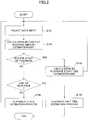
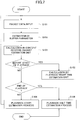
- Fig. 2 shows a flowchart in the embodiment 1-1.
- the packet information obtaining unit 110 obtains a part or all of pieces of information in packet information (packet data) exchanged between the distribution server 300 and the playback terminal 200.
- packet information obtaining unit 110 a general sniffer apparatus, program and the like can be used.
- the packet information obtaining unit 110 may be placed outside of the content playback information estimation apparatus of the present invention, so that captured packet information may be input to the content received amount estimation unit 120.
- the content received amount estimation unit 120 estimates time-series information of the data amount passed to the playback application in the playback terminal 200 based on a part or all of pieces of the packet information obtained by the packet information obtaining unit 110, and outputs the time-series information to the playback start time estimation unit 130.
- the time-series information of the data amount can be obtained by estimating received byte amount using a sequence number and time stamp information of RTP(Real-time Transport Protocol), for example, when RTP is used for distribution. Also, even though TCP(Transmission Control Protocol) is used, the received byte amount can be estimated by simulating behavior of the TCP protocol in the playback terminal 200.
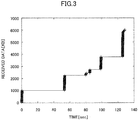
- Fig. 3 shows an example of an estimation result of the received amount in the content received amount estimation unit 120.
- Step 103) The playback start time estimation unit 130 estimates a time period required for start of playback based on time-series information of the data amount estimated in the content received amount estimation unit 120.
- the time period required for start of playback is a time required for receiving data to a threshold of the buffer amount at which the content is played initially. After this processing, the process returns to step 101.
- Step 104) It is determined whether playback starts by comparing the data amount estimated by the content received amount estimation unit 120 using packet information received by the packet information obtaining unit 110 with a predetermined playback start threshold. Then, in a case where playback has been started, and the size of content data is described in packet data so that it is determined that playback has not yet ended, or it is determined the flow is not disconnected, the playback state estimation unit 140 determines whether playback is continuing at arbitrary time after start of communication of the playback terminal 200 based on data amount consumed by the playback application on the playback terminal 200 at each time after playback starts. For example, determination is performed by the following procedure.
- Thp is used as a threshold of the buffer amount at which playback of content starts
- Th s is used as a threshold of a buffer amount at which playback of content halts.
- the buffer amount is increased / decreased by supplying the time-series data of the received amount obtained by the content received amount estimation unit 120 and a data amount consumed in each time after the playback time of the playback application. That is, when playback is continuing, if the received amount increases by ⁇ B at a time, the buffer amount is increased by ⁇ B, and if the data amount consumed by the playback application increases by ⁇ C, the buffer amount is decreased by ⁇ C.
- the remaining amount of the buffer amount becomes lower than Th s , "playback state" is changed to "halt state”.
- the playback state estimation unit 140 may obtain necessary data amount at each playback time, as data amount consumed in each time after start of playback of the playback application, by performing decoding in a pseudo manner based on packet information exchanged between the distribution server 300 and the playback terminal 200, or may obtain the data amount by assuming that the playback application consumes data at a fixed predetermined bit rate.
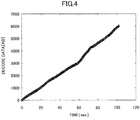
- the method for obtaining the data amount is not limited to these methods. For example, when the bit rate is assumed to be fixed 800kbps, it can be considered that a data amount of 100KB is consumed one second after the start of playback in total, and a data amount of 200KB is consumed two seconds after the start of playback in total. Accordingly, the data amount consumed by the playback application on the playback terminal 200 at each time after the start of playback is provided in a time-series manner.
- Fig. 4 shows an example of the data amount consumed by the playback application at each time after start of playback.
- Step 105) It is determined whether playback starts by comparing the data amount estimated by the content received amount estimation unit 120 using packet information received by the packet information obtaining unit 110 with a predetermined playback start threshold. If it is determined that playback has been started, and the size of content data is described in packet data so that it is determined that playback has ended, or, if it is determined that the flow is disconnected, the estimation result by the playback state estimation unit 140 becomes "halt state". Then, the playback halt time estimation unit 150 estimates information on playback state such as a time point or a time period at which playback halts.
- the playback halt time estimation unit 150 estimates the time and the length by which the playback is halted.
- the playback state estimation unit 140 stores each time point at which the playback state changes in an inside memory (not shown in the figure) as playback state change information, and the playback halt time estimation unit 150 obtains the information.
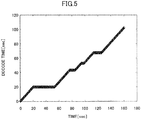
- Fig. 5 shows an example of an estimation result that is output. It is also possible to output a total halt time and a total halt number of times by processing the estimation result.
- Fig. 6 shows a system configuration in the embodiment 1-2.
- configuration parts the same as those in Fig. 1 are assigned the same reference, and the description is not given.
- the content playback information estimation apparatus 400 shown in Fig. 6 is configured by adding a buffer parameter estimation unit 410 to the configuration of the content playback information estimation apparatus 100 of Fig. 1 .
- Fig. 7 is a flowchart of processes in the second embodiment of the present invention, in which processes the same as those on the flow of the first embodiment shown in Fig. 2 are assigned the same step numbers.
- Step 101 The packet information obtaining unit 110 of the content playback information estimation apparatus 400 obtains a part or all of pieces of information exchanged between the distribution server 300 and the playback terminal 200.
- the buffer parameter estimation unit 410 estimates a buffer parameter based on packet information that is sent and received via the network obtained by the packet information obtaining unit 110.
- the buffer parameter is a threshold of a buffer amount for starting playback of content, a threshold of a buffer amount for halting playback of content, and a coding rate of video, and the like.
- Step 102) the content received amount estimation unit 120 estimates time-series information of data amount passed to the playback application in the playback terminal 200 based on a part or all of pieces of the packet information obtained by the packet information obtaining unit 110, and outputs the time-series information to the playback start time estimation unit 130.
- the playback start time estimation unit 130 estimates a time period required for start of playback based on time-series information of the data amount estimated in the content received amount estimation unit 120.
- the time period required for start of playback is a time required for receiving data to a buffer parameter estimated by the buffer parameter estimation unit 130 (a threshold of the buffer amount at which the content is played initially).
- Step 104) the playback state estimation unit 140 determines whether playback is continuing at any time after start of communication based on the data amount consumed at ach time after the playback application on the playback terminal 200 starts playback. For example, the determination is performed by the following procedure.
- thp is the threshold of a buffer amount for starting playback of content
- th s is the threshold of the buffer amount for halting playback of content.
- increase/decrease of the buffer amount is performed by inputting time-series data of the received amount and a data amount to be consumed at each time after playback time of the playback application which are obtained by the content received amount estimation unit 120. That is, in a case where the content is being played, when the received amount increases by ⁇ B at a time, the buffer amount is increased by ⁇ B, and when the data amount consumed by the playback application is increased by ⁇ C, the buffer amount is decreased by ⁇ C.
- the remaining amount of the buffer amount falls below th s , the state is changed from "playback state" to "halt state”.
- the data amount consumed at each time after the playback application starts playback can be obtained in the same way as the before-mentioned embodiment 1-1.
- Step 105) If the playback state estimated by the playback state estimation unit 140 is "halt state", the playback halt time estimation unit 150 estimates information on playback state such as the time point and time period at which playback halts. Although, increase/decrease of the buffer amount is performed similarly even in the halt state, since playback of content is halted, the data amount consumed by the application becomes 0, and only increment of received amount is added. If the remaining amount of the buffer amount exceeds Th p , it is determined that playback of content starts.
- the playback halt time estimation unit 150 estimates the time point and the time at which the playback halts based on the playback state estimation unit 140.
- Fig. 8 shows a system configuration in the embodiment 1-3.
- configuration parts the same as those in Figs. 1 and 6 are assigned the same reference, and the description is not given.
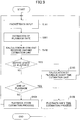
- Fig. 9 is a flowchart of processes in the embodiment 1-3, and description of processes similar to those shown in Figs. 2 and 7 is not given.
- a playback rate estimation unit 510 is provided for estimating a data amount read from the playback buffer 210 at each playback time of content data received by the playback terminal 200 based on packet information sent and received via the network in the first and the second embodiments, and the estimation result of the playback rate estimation unit 510 is supplied to the playback start time estimation unit 130.
- the playback rate estimation unit 510 reconstructs information that is sent and received between the distribution server 300 and the playback terminal 200 from packet information obtained by the packet information obtaining unit 110, extracts content played by the playback terminal 200, estimates decode amount at each playback time based on coded video/voice data, and supplies the decode amount to the playback start time estimation unit 130 as a data amount consumed at each time after start of playback (step 301).
- By estimating playback information of content based on information of packets it is possible to estimate the data amount consumed by the application of the terminal at each time more accurately.
- Processes other than the playback rate estimation unit 510 are the same as those in the before mentioned embodiments, and the description is not given.
- Fig. 10 shows a system configuration in the embodiment 1-4.
- configuration parts the same as those in Figs. 1 , 6 and 8 of the embodiments 1-1 - 1-3 are assigned the same reference.
- Fig. 11 is a flowchart of processing in the embodiment 1-4.
- the content playback information estimation apparatus 600 of the present embodiment includes a content information estimation unit 610 for estimating a total amount of content data received by the playback terminal 200 and a playback time length of the content based on the packet information sent and received via the network in the embodiments 1-1 and 1-2, and supplies the estimation result of the content information estimation unit 610 to the playback state estimation unit 140.
- an average bit rate of the content is considered as B/len.
- the data amount consumed at each time after start of playback of the application on the playback terminal 300 is linearly calculated from the average bit rate, and is supplied to the playback state estimation unit 140.
- Processes other than the playback rate estimation unit 510 are the same as those in the before mentioned embodiments, and the description is not given.
- the system configuration in this embodiment is similar to the configuration of the embodiment 1-4. But, in the present embodiment, the content information estimation unit 610 estimates a data amount read from the playback buffer in each playback time based on a predetermined playback rate fixed value for each content and content data received by the playback terminal 200, and the estimation result is supplied to the playback state estimation unit 140. At this time, the content data received by the playback terminal 200 is supplied to the content information estimation unit 610 via the packet information obtaining unit 110.
- playback rates are prepared as discrete values based on image quality information of content such as "high image quality ", "low image quality” and the like that are predetermined in the distribution system, for example. Also, content image quality information is estimated from exchanged information based on packet information, so that corresponding playback rate is determined as an average bit rate of the content data. By using the average bit rate, the data amount consumed at each time after start of playback by the application on the terminal is linearly calculated, and the data amount is supplied to the playback state estimation unit.
- each content playback estimation apparatus of Figs. 1 , 6 , 8 and 10 in the embodiment 1 can be constructed a program, and the program can be installed and executed in a computer used as the content playback information estimation apparatus, or the program can be circulated via a network.
- each content playback information estimation apparatus in the embodiment 1 can be realized by causing a computer to execute a program which describes the process content described in the present embodiment 1. More specifically, the function of each unit of the content playback information estimation apparatus can be realized by executing a program corresponding to processes performed by each unit by using hardware resources such as a CPU, memory and hard disk and the like in the computer which is used as the content playback information estimation apparatus.
- the program can be saved and distributed by recording the program in a computer readable recording medium (such as portable memory). Also, the program can be provided via a network such as the Internet, an electronic mail and the like.
- playback halt states in a terminal for receiving and playing content data in the system are estimated by performing packet capturing and analysis on the distribution route without modifying the system.
- Fig. 12 shows a configuration of the content playback information estimation apparatus in the example 2.
- the content playback information estimation apparatus 700 shown in the figure is connected to a distribution server 10 for performing distribution in units of chunks and a terminal 20, and includes a packet data obtaining unit 710, a storage unit 720, a playback state estimation unit 730, and a chunk state estimation unit 740.
- the terminal 20 includes at least a playback buffer and a playback application.
- the distribution server 10 distributes a piece of content to the terminal 20 by dividing the content into a plurality of chunks.
- the terminal 20 includes a playback buffer, and when a predetermined number of chunks are stored in the playback buffer, playback starts. While the content is being played, data necessary for playback is read from the playback buffer, and when the number of chunks stored in the playback buffer falls below a playback halt threshold, playback halts, and when the number of chunks exceeds a playback start threshold, playback starts.
- the packet data obtaining unit 710 obtains information of packets that are distributed in units of chunks from the distribution server 10 to the terminal 20, and stores the information in the storage unit 720.
- Pieces of information that are obtained are packet information (packet data), packet capture information for each chunk, content list and the like.
- the packet capture information in units of chunks are obtained by dividing capture data in units of packets into each chunk.
- the chunk state estimation unit 740 includes a chunk time length estimation unit 741 and a chunk obtaining time estimation unit 742.
- the chunk time length estimation unit 741 generates a list of playback time lengths of each chunk by reading chunk information or known content rules and the like from the storage unit 720.
- the list of the playback time lengths can be stored as an a one dimensional array, for example, and may be stored as a two dimensional array by associating the playback time lengths with chunk numbers.
- the chunk obtaining time estimation unit 742 reads packet capture information from the storage unit 720, estimates a time point at which sending and receiving of each chunk completes to generate a list of obtaining times of each chunk.
- the list of the obtaining times can be stored as a one dimensional array, for example, and may be stored as a two dimensional array by associating the obtaining times with chunk numbers.
- the playback state estimation unit 730 estimates the remaining number of chunks in the playback buffer at each time based on the list of playback time lengths of each chunk generated by the chunk time length estimation unit 741 and the list of obtaining times of each chunk generated by the chunk obtaining time estimation unit 742, so as to estimate whether the content is currently in a playback state, or in a halt state, and estimate playback information such as time required for start of playback.
- a system is assumed in which, in the terminal 20, playback starts when reception of at least one chunk completes, and, when the number of chunks becomes 0, playback halts.
- playback start request if it is assumed that the packet data obtaining unit 710 has received data of 3 chunks and that the data of 3 chunks has a content time length of 30 seconds, playback starts right after start of playback, and a playback state continues for 30 seconds. Also, while data of the next chunk does not arrive, a playback halt state continues, and at the time when reception of the next chunk data completes, playback restarts. After that, in the same way, playback states are estimated based the remaining number of data of chunks that have been received.
- the content playback information estimation apparatus 700 that is placed between the content data distribution server 10 and the terminal 20, in the packet data obtaining unit 710, obtains all or a part of pieces of information of packet data exchanged between the distribution server 10 and the terminal 20 in units of chunks, and stores the information in the storage unit 720.
- the packet data obtaining unit 710 can be replaced with a general packet monitoring apparatus, program and the like.
- the captured packet data may not be stored in the storage unit 720 and may be supplied directly to the chunk time length estimation unit 741 or to the chunk obtaining time estimation unit 742.
- the chunk time length estimation unit 741 and the chunk obtaining time estimation unit 742 include a memory (not shown in the figure), which stores a chunk time length list which is a list of chunk playback time lengths and a chunk obtaining time list.
- Fig. 13 is a flowchart showing an outline of operation in the example 2-1.
- the packet data obtaining unit 710 stores the packet data in the storage unit 720 (step 501), and the chunk playback time length estimation unit 741 reads the packet data from the storage unit 720 to estimate a chunk playback time length and update the chunk time length list (step 502). Also, the chunk obtaining time estimation unit 742 reads packet data from the storage unit 720 to estimate a chunk obtaining time and updates the chunk obtaining time list (step 503).
- the playback state estimation unit 730 performs processing (step 505).
- the chunk time length estimation unit 741 estimates a playback time length of each chunk passed to the playback application on the terminal based on a part or all of pieces of packet data (chunk numbers and time lengths) stored in the storage unit 720, and stores the playback time lengths in the memory (not shown in the figure) as the chunk time length list.
- a content list (file list) may be exchanged with the distribution server 10 with a predetermined format and the like, so that the playback time length of each chunk may be extracted from description of time length in the content list.
- the playback time length of each chunk is not constant, and may be a time length corresponding to a chunk playback time length that is obtained beforehand from content identifier and the like.
- the time length may be estimated from time stamp of corresponding codec and the like.
- a content list of a format complying with HLS(HTTP Live Streaming) (refer to R. Pantos, Ed., W. May, "HTTP Live Streaming," IETF Internet-Draft, Sept. 2011 .) can be used, wherein URI(Unified Resource Indicator) and a time length of each chunk file are described in the content list.
- the chunk obtaining time estimation unit 742 estimates obtaining time of each chunk passed to the playback application on the terminal 20 based on the chunk obtaining complete time obtained from the packet data, and stores the obtaining time in a memory (not shown in the figure) as the chunk obtaining time list.
- the obtaining time indicates a time at completion of obtaining each chunk. But, in a case where it is difficult to obtain obtaining completion time, obtaining start time can be used as a substitute of the obtaining completion time. When the obtaining start time is used, there is a small time lag.
- the playback state estimation unit 730 estimates playback states of content based on the playback time length of each chunk which is estimated and generated by the chunk time length estimation unit 741 and the obtaining time of each chunk estimated and generated by the chunk obtaining time estimation unit 742.
- estimation is performed in the following procedure.
- the chunk state estimation unit 740 estimates the number of chunks stored in the buffer of the terminal at any time based on the playback time length (list of chunk playback time length) of each chunk and obtaining time of each chunk (list of obtaining time of each chunk).
- the time at which th_p-th chunk is obtained is set to T_0 as an estimated playback start time.
- the time at which the number of chunks exceeds the threshold th_p of the number of chunks of start of playback is regarded as a playback start time estimated value.
- a variable i indicating a chunk number which is being played is set to 1, and the number of chunks currently stored in the buffer is set as n which is set to th_p. Also, T_0 is set to a target time T at which estimation of playback state is performed.
- every time is considered as a relative value from the playback start unless otherwise specified.
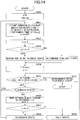
- Fig. 14 is a flowchart of a halt estimation procedure in the example 2-1.
- Step 601) The number (CNT) of chunks is counted in which, in the list recording obtaining time of each chunk, obtaining time is greater than a time T and equal to or less than T+len_i (T ⁇ t_i ⁇ T+len_i) wherein the time T indicates a time when the number n of chunks stored in the buffer is increased in the last time, and CNT is added to the number n of chunks that are currently stored in the buffer.
- Step 602 The number n of chunks that are currently stored in the buffer is decremented by 1.
- Step 603 The number n of chunks that are currently stored in the buffer is compared with the threshold th_s of the number of chunks at which playback halts. If n is greater, it is estimated that the content is in a playback state, and if n is equal to or less than th_s, it is estimated that the content is in a halt state.
- Step 605 In chunks that form the content, when all of the files described in the content list are not processed or when a predetermined number of chunks are not processed, it is determined that there is an unprocessed chunk, and if the state is determined to be the playback state in step 603, the process goes to step 601. On the other hand, in a case where there is an unprocessed chunk and the state is determined to be the halt state in step 603, the process goes to step 606. When all of the chunks have been processed, the process goes to step 610.
- the content list includes, at least, a content identifier (ID), and a chunk identifier (ID) for each chunk included in the content, and when the chunk that is a current target of processing is not the last chunk, it is determined that there is an unprocessed chunk.
- ID content identifier
- ID chunk identifier
- Step 606 If there is an unprocessed chunk and the state is the halt state, T is increased to a time when a next chunk is obtained (update the value of T), and the number n of chunks that are currently stored in the chunk is incremented by 1.
- Step 607) The number n of chunks that are currently stored in the buffer is compared with the threshold th_r of the number of chunks by which playback restarts. When n is greater than th_r, the process goes to step 608, and when n is equal to th_r or less than th_r, the process goes to step 609.
- Step 608 It is estimated that the state changes to a playback state.
- Step 609) It is estimated that the state is the halt state as before.
- Step 610) After that, all chunks are determined to be in the playback state, and a series of playback states of each time are output.
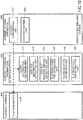
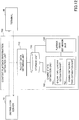
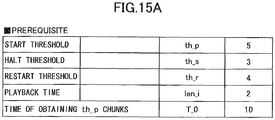
- Fig.15A and Fig. 15B show the concrete example.
- Fig. 15A shows a prerequisite, and
- Fig. 15B shows transitions of operation.
- n is equal to th_p, which is 5.
- the various thresholds may be values that dynamically change according to the playback state or the number of halt times and the like.
- a value derived from time intervals for obtaining chunks may be used as the chunk time length.
- estimation of playback states can be performed by estimating transitions of the number of obtained chunks. But, in a case where the state is determined to be the halt state based on capture data, it is not considered whether the playback halt is caused by the network or caused by behavior of the user.
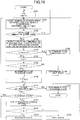
- Fig. 16 is a flowchart of the halt estimation procedure in the example 2-2.
- Step 702 In the list that records obtaining time of each chunk, the number of chunks is counted in which, obtaining time is greater than a time T and equal to or less than T+len_i (T ⁇ t_i ⁇ T+len_i) wherein the time T indicates a time when the number n of chunks stored in the buffer is increased in the last time, and the counted number is added to the number n of chunks that are currently stored in the buffer.
- Step 703 For chunks for adding in step 702, it is determined whether chunk numbers of i-th chunk and (i+1)-th chunk are discontinuous (the increased number of chunk is not 1) when the obtaining start times are sorted in a time series manner. If the numbers are continuous, the process goes to step 704, and if the chunk numbers are discontinuous, the process goes to step 701 to reset each counter since it is determined that fast-forward or fast-rewind to outside of the range of the stored chunk occurs by the user operation. Also, determination in this flow is terminated, and estimation starts from the detected discontinuous number ((i+1)-th).
- step 704 For each chunk that is the target for adding in step 702, a time period t from completion of obtaining of a chunk to start of obtaining a next chunk is calculated based on the chunk obtaining start time and the obtaining completion time.
- Step 705 If the time t calculated in step 704 is greater than a playback time length len_(i-1) of a chunk that is played right before by a certain amount ( ⁇ ), it is determined that playback is temporarily halted, then the process goes to step 706.
- the certain amount ( ⁇ ) is a value for absorbing an error between the estimated playback time and the actual playback time of each chunk.
- the chunk playback time itself which is the length of playback time of the chunk may be used, or a fixed value such as 1.1 times may be used, or a constant time length may be used, or a value considering dispersion of network delay time may be used.
- Accuracy changes according to how to determine the certain amount of time. In order to improve the accuracy, it is necessary to set the amount by having a width for allowing an error (gap) between the assumed chunk playback time length and the actual time length. On the other hand, it is necessary that the amount is an error smaller than a minimum time length that is desired to be identified as user operation. Therefore, it is desirable to use a fixed time length around 1 second as ⁇ . Also, an optimum value may be determined by performing evaluation for each service.
- Step 706 In a case where playback is temporarily halted in step 705, the data amount stored in the buffer is not decreased.
- the start time at which decrease of the buffer is stopped may be set as any time point from a value obtained by adding the chunk time length to the obtaining start time rr_j of the last received chunk, to a value obtained by adding the chunk time length to the obtaining complete time rs_j of the last received chunk. For example, if rr_j - rs_j is smaller than the chunk time length, the start time at which decrease of the buffer is stopped is set to be rs_j+chunk time length/2 and, if rr_j - rs_j is greater than the chunk time length, rr_i may be used. Also, when obtaining a next new chunk starts, the process goes to step 702.
- obtaining a new chunk is closely related to playback states.
- a chunk is not obtained unless playback of a chunk which is being played completes. Therefore, by focusing on a time period from completion of chunk download to start of next chunk download, it becomes possible to determine that temporal halt is caused by user operation when the time required for start of chunk playback to the end of chunk playback is longer than the chunk playback time length which is the length of the playback time of the chunk (step 705, Yes).
- step 703 it is determined that user operation is performed.
- Step 707) The number n of chunks that are currently stored in the buffer is decremented by 1.
- Step 708) The number n of chunks that are currently stored in the buffer is compared with the threshold th_s of the number of chunks at which playback halts. If n is greater, it is estimated that the content is in a playback state, and if n is equal to or less than th_s, it is estimated that the state becomes a halt state.
- Step 710) In chunks that form the content, when all of the files described in the content list are not processed or when a predetermined number of chunks are not processed, it is determined that there is an unprocessed chunk, and if the state is determined to be the playback state in step 708, the process goes to step 702. On the other hand, in a case where there is an unprocessed chunk and the state is determined to be halt state in step 708, the process goes to step 711. When all of the chunks have been processed, the process goes to step 715.
- the content list includes, at least, a content identifier (ID), and a chunk identifier (ID) for each chunk included in the content, and when the chunk that is a current target of processing is not the last chunk, it is determined that there is an unprocessed chunk.
- ID content identifier
- ID chunk identifier
- Step 711) If there is an unprocessed chunk and the state is the halt state, T is increased to a time when a next chunk is obtained (update the value of T), and the number n of chunks that are currently stored in the chunk is incremented by 1.
- Step 712 The number n of chunks that are currently stored in the chunk is compared with the threshold th_r of the number of chunks by which playback restarts. When n is greater than th_r, the process goes to step 713, and when n is equal to th_r or less than th_r, the process goes to step 714.
- Step 713 It is estimated that the state changes to a playback state.
- Step 714) It is estimated that the state is the halt state as before.
- Step 715) After that, all chunks are determined to be in a playback state, and a series of playback states of each time is output.
- the various thresholds may be values that dynamically change according to the playback state or the number of halt times and the like.
- a value derived from time intervals for obtaining chunks may be used as the chunk playback time length.
- chunks are downloaded before playback, and playback starts after a certain number of chunks are stored. Also, once playback starts, playback continues when there is a certain number of un-played chunks that are already obtained, but, when the number of the un-played chunks falls below the certain number, playback is halted. For example, when the number of un-played chunks that are already obtained is 0 and a chunk to be played next is being downloaded, playback cannot be continued. Thus, the state becomes a temporary halt state.
- the timing at which the number of obtained chunks changes is limited to a case where a new chunk is obtained and a case where playback of a chunk that is being played completes.
- the former case is estimated from capture data and the latter case is estimated based on an bit rate and an elapsed time of content so that the number of un-played chunks that have been obtained is estimated.
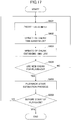
- Fig. 17 is a flowchart of operation in the example 2-3.
- the time length list and obtaining time list are generated beforehand from capture data.
- update of the two lists is performed in an random order each time when capture data is input.
- the playback state estimation unit 730 performs its processes so as to update the target time T at which playback state estimation is newly performed.
- "use a new chunk for playback" includes following two meanings:
- the chunk time length estimation unit 741 of the examples 2-1 and 2-2 estimates a playback time length of a chunk from a received byte amount and a playback rate, instead of directly obtaining the time.
- the received byte amount of the chunk can be easily obtained when the packet information obtaining unit 710 outputs information for each chunk.
- the playback rate may be a rate defined by a predetermined identifier (for example, a character string and the like indicating an image quality size in a URL indicating a content list or a chunk). Also, a rate that is directly described in the content list may be used.
- packet data is obtained on a route between the distribution server and the playback terminal in the content distribution system, and playback information is estimated based on the information, so that playback information can be obtained without modifying the distribution system.
- each component of the content playback information estimation apparatus of Fig. 12 it is possible to construct operation of each component of the content playback information estimation apparatus of Fig. 12 as a program, and to install and run the program in a computer used as the content playback information estimation apparatus, or to distribute the program via a network.
- the content playback information estimation apparatus of Fig. 12 can be realized by causing a computer to execute a program describing processing content described in the present example 2. More specifically, functions of each unit of the content playback information estimation apparatus can be realized by executing a program corresponding to processes performed by each unit, by using hardware resources such as a CPU, a memory and a hard disk included in the computer that forms the content playback information estimation apparatus. It is possible to preserve and distribute the program by recording the program in a computer readable recording medium (such as a portable memory). Also, it is possible to provide the program via a network such as the Internet and an email.
Landscapes
- Engineering & Computer Science (AREA)
- Multimedia (AREA)
- Signal Processing (AREA)
- Data Exchanges In Wide-Area Networks (AREA)
- Two-Way Televisions, Distribution Of Moving Picture Or The Like (AREA)
- Information Transfer Between Computers (AREA)
- Computer And Data Communications (AREA)
Claims (6)
- Inhaltswiedergabeinformations-Schätzvorrichtung (100) zur Verwendung in einem vernetzten System, in dem ein Verteilungsserver (300) Inhalt wie etwa Videoinhalt in Paketen an ein Wiedergabe-Endgerät (200) zum Speichern und Wiedergeben des Inhalts verteilt, wobei die Inhaltswiedergabeinformations-Schätzvorrichtung konfiguriert ist zum Schätzen eines Wiedergabe-Haltzustands von Inhaltsdaten im Endgerät, wobei die Inhaltswiedergabeinformations-Schätzvorrichtung Folgendes umfasst:eine Paketinformation-Ermittlungseinheit (110), konfiguriert zum Ermitteln von Paketinformation, die in über das Netz gesendeten und empfangenen Paketen enthalten ist;eine Pufferparameter-Schätzeinheit (410), konfiguriert zum Schätzen eines Pufferparameters auf der Basis der Paketinformation,eine Inhaltsempfangsmengen-Schätzeinheit (120), dazu konfiguriert, für jeden einer Vielzahl von Zeitpunkten die Menge von Inhaltsdaten, die im Wiedergabe-Endgerät (200) empfangen wird, auf der Basis der Paketinformation zu schätzen;eine Wiedergabestartzeit-Schätzeinheit (130), konfiguriert zum Schätzen einer Zeitperiode, die zum Starten von Wiedergabe im Wiedergabe-Endgerät erforderlich ist, indem die Menge von Inhaltsdaten verwendet wird, die von der Inhaltsempfangsmengen-Schätzeinheit geschätzt wird;eine Wiedergabezustands-Schätzeinheit (140), dazu konfiguriert, durch Verwenden der von der Inhaltsempfangsmengen-Schätzeinheit geschätzten Menge von Inhaltsdaten und des von der Pufferparameter-Schätzeinheit geschätzten Pufferparameters zu schätzen, ob zu jedem Zeitpunkt ein Zustand im Wiedergabe-Endgerät in einem Wiedergabezustand ist oder in einem Haltzustand, auf einer Datenmenge basierend, die von einer Wiedergabe-Anwendung des Wiedergabe-Endgeräts zu jedem Zeitpunkt nach dem Start der Wiedergabe verbraucht wird; undeine Wiedergabehaltzeit-Schätzeinheit (150), dazu konfiguriert, wenn die Wiedergabezustands-Schätzeinheit bestimmt, dass der Zustand in einem Haltzustand ist, einen Zeitpunkt zu schätzen, an dem die Wiedergabe angehalten wird, und eine Länge des Halts,worin das Wiedergabe-Endgerät (200) die Inhaltsdaten in einem Wiedergabepuffer speichert, die Wiedergabe startet, wenn Inhaltsdaten einer anfänglichen Puffermenge im Wiedergabepuffer gespeichert sind, die Daten liest, die zur Wiedergabe aus dem Wiedergabe-Speicher während der Wiedergabe benötigt werden, die Wiedergabe anhält, wenn eine Puffermenge, die im Wiedergabepuffer gespeichert ist, unter eine Wiedergabe-Haltschwelle fällt, und die Wiedergabe startet, wenn die Puffermenge, die im Wiedergabepuffer gespeichert ist, eine Wiedergabe-Startschwelle übersteigt; undworin die Wiedergabezustands-Schätzeinheit dazu konfiguriert ist, zu jedem Zeitpunkt Prozesse auszuführen, um die geschätzte Menge von im Puffer gespeichertem Inhalt um die Menge von empfangenen Inhaltsdaten zu erhöhen, und die geschätzten Menge von im Puffer gespeichertem Inhalt um die Menge von Daten zu reduzieren, die von der Wiedergabe-Anwendung verbraucht wird, um zu bestimmen, dass der Zustand in den Haltzustand wechselt, wenn die im Puffer gespeicherte geschätzte Menge von Inhalt unter die Wiedergabe-Haltschwelle fällt, und zu bestimmen, dass der Zustand in den Wiedergabezustand wechselt, wenn die geschätzte Menge von Inhalt, die im Puffer gespeichert ist, die Wiedergabe-Startschwelle im Haltzustand übersteigt, worin die Datenmenge, die von der Wiedergabe-Anwendung verbraucht wird, gleich 0 ist.
- Inhaltswiedergabeinformations-Schätzvorrichtung nach Anspruch 1, außerdem umfassend:eine Wiedergaberaten-Schätzeinheit, dazu konfiguriert, auf der Basis der Paketinformation eine Datenmenge zu schätzen, die während Wiedergabe der vom Wiedergabe-Endgerät empfangenen Inhaltsdaten aus dem Wiedergabepuffer ausgelesen wird;wobei die Wiedergabestartzeit-Schätzeinheit eine Einheit umfasst, die dazu konfiguriert ist, die für den Start der Wiedergabe erforderliche Zeit zu schätzen, indem die von der Wiedergaberaten-Schätzeinheit geschätzte Datenmenge verwendet wird.
- Inhaltswiedergabeinformations-Schätzvorrichtung nach Anspruch 1, außerdem umfassend:eine erste Inhaltsinformations-Schätzeinheit, konfiguriert zum Schätzen einer Datenmenge, die während der Wiedergabe aus dem Wiedergabepuffer ausgelesen wird, auf einer Gesamtmenge von Inhaltsdaten basierend, die vom Wiedergabe-Endgerät empfangen wird, der Paketinformation und einer Wiedergabezeitlänge des Inhalts,wobei die Wiedergabezustands-Schätzeinheit eine Einheit umfasst, die zum Schätzen konfiguriert ist, ob der Zustand im Wiedergabe-Endgerät im Wiedergabezustand oder im Haltzustand ist, indem die Datenmenge verwendet wird, die von der ersten Inhaltsinformations-Schätzeinheit geschätzt wird.
- Inhaltswiedergabeinformations-Schätzvorrichtung nach Anspruch 1, außerdem umfassend:eine zweite Inhaltsinformations-Schätzeinheit, konfiguriert zum Schätzen einer Datenmenge, die während der Wiedergabe aus dem Wiedergabepuffer ausgelesen wird, auf einem vorgegebenen festen Wert der Wiedergaberate für jeden Inhalt basierend, und Inhaltdaten, die vom Wiedergabe-Endgerät empfangen werden,wobei die Wiedergabezustands-Schätzeinheit eine Einheit umfasst, die zum Schätzen konfiguriert ist, ob der Zustand im Wiedergabe-Endgerät im Wiedergabezustand oder im Haltzustand ist, indem die Datenmenge verwendet wird, die von der zweiten Inhaltsinformations-Schätzeinheit geschätzt wird.
- Inhaltswiedergabeinformations-Schätzverfahren, in einem vernetzten System ausgeführt, in dem ein Verteilungsserver (300) Inhalt wie etwa Videoinhalt in Paketen an ein Wiedergabe-Endgerät (200) zum Speichern und Wiedergeben des Inhalts verteilt, wobei das Verfahren dem Schätzen eines Wiedergabe-Haltzustands von Inhaltsdaten im Endgerät dient, wobei das Inhaltswiedergabeinformations-Schätzverfahren Folgendes umfasst:Ermitteln von Paketinformation, die in über ein Netz gesendeten und empfangenen Paketen enthalten ist;Schätzen eines Pufferparameters auf der Basis der Paketinformation,für jeden einer Vielzahl von Zeitpunkten erfolgendes Schätzen einer Menge von in einem Wiedergabe-Endgerät empfangen Inhaltsdaten, auf der Paketinformation basierend;Schätzen einer für das Starten von Wiedergabe im Wiedergabe-Endgerät erforderlichen Zeitperiode durch Verwenden der geschätzten Menge von Inhaltsdaten;durch Verwenden der Menge von Inhaltsdaten und des Pufferparameters erfolgendes Schätzen, ob zu jedem Zeitpunkt ein Zustand im Wiedergabe-Endgerät in einem Wiedergabezustand ist oder in einem Haltzustand, auf einer Datenmenge basierend, die von einer Wiedergabe-Anwendung des Wiedergabe-Endgeräts zu jedem Zeitpunkt nach dem Start der Wiedergabe verbraucht wird; undeinen Wiedergabehaltzeit-Schätzschritt, in dem eine Wiedergabehaltzeit-Schätzeinheit, wenn der Wiedergabezustands-Schätzschritt bestimmt, dass der Zustand im Haltzustand ist, einen Zeitpunkt schätzt, an dem die Wiedergabe angehalten wird, und eine Länge des Halts,worin das Wiedergabe-Endgerät die Inhaltsdaten in einem Wiedergabepuffer speichert, die Wiedergabe startet, wenn Inhaltsdaten einer anfänglichen Puffermenge im Wiedergabepuffer gespeichert sind, die Daten liest, die zur Wiedergabe während der Wiedergabe aus dem Wiedergabepuffer benötigt werden, die Wiedergabe anhält, wenn eine Puffermenge, die im Wiedergabepuffer gespeichert ist, unter eine Wiedergabe-Haltschwelle fällt, und die Wiedergabe startet, wenn die Puffermenge, die im Wiedergabepuffer gespeichert ist, eine Wiedergabe-Startschwelle übersteigt; undworin der Schritt des Schätzens, ob ein Zustand im Wiedergabe-Endgerät in einem Wiedergabezustand oder in einem Haltzustand ist, zu jedem Zeitpunkt das Ausführen von Prozessen umfasst, um die geschätzte Menge von im Puffer gespeicherten Inhalt um die Menge von empfangenen Inhaltsdaten zu erhöhen, und die geschätzte Menge von im Puffer gespeichertem Inhalt um die Menge von Daten zu reduzieren, die von der Wiedergabe-Anwendung verbraucht wird, und zu bestimmen, dass der Zustand in den Haltzustand wechselt, wenn die im Puffer gespeicherte geschätzte Menge von Inhalt, die im Puffer gespeichert ist, unter die Wiedergabe-Haltschwelle im Wiedergabezustand fällt, und zu bestimmen, dass der Zustand in den Wiedergabezustand wechselt, wenn die geschätzte Menge von Inhalt, die im Puffer gespeichert ist, die Wiedergabe-Startschwelle im Haltzustand übersteigt, worin die Datenmenge, die von der Wiedergabe-Anwendung verbraucht wird, gleich 0 ist.
- Inhaltwiedergabeinformation-Schätzprogramm, um einen Computer zu veranlassen, als jede Einheit der Inhaltswiedergabeinformations-Schätzvorrichtung nach einem der Ansprüche 1-4 zu funktionieren.
Applications Claiming Priority (4)
| Application Number | Priority Date | Filing Date | Title |
|---|---|---|---|
| JP2011241173 | 2011-11-02 | ||
| JP2012031125 | 2012-02-15 | ||
| JP2012150926 | 2012-07-04 | ||
| PCT/JP2012/078392 WO2013065804A1 (ja) | 2011-11-02 | 2012-11-01 | コンテンツ再生情報推定装置及び方法及びプログラム |
Publications (3)
| Publication Number | Publication Date |
|---|---|
| EP2775673A1 EP2775673A1 (de) | 2014-09-10 |
| EP2775673A4 EP2775673A4 (de) | 2015-01-21 |
| EP2775673B1 true EP2775673B1 (de) | 2017-05-31 |
Family
ID=48192142
Family Applications (1)
| Application Number | Title | Priority Date | Filing Date |
|---|---|---|---|
| EP12846372.6A Active EP2775673B1 (de) | 2011-11-02 | 2012-11-01 | Vorrichtung zur schätzung von inhaltswiedergabeinformationen, verfahren und programm |
Country Status (5)
| Country | Link |
|---|---|
| US (1) | US9781474B2 (de) |
| EP (1) | EP2775673B1 (de) |
| JP (2) | JP5780684B2 (de) |
| CN (1) | CN103875218B (de) |
| WO (1) | WO2013065804A1 (de) |
Families Citing this family (13)
| Publication number | Priority date | Publication date | Assignee | Title |
|---|---|---|---|---|
| JP6078455B2 (ja) * | 2013-11-06 | 2017-02-08 | 日本電信電話株式会社 | プログレッシブダウンロード型映像サービス品質推定装置及び品質推定方法 |
| JP6053176B2 (ja) * | 2013-12-03 | 2016-12-27 | 日本電信電話株式会社 | 映像再生状態推定装置、映像再生状態推定方法、及びプログラム |
| JP6053180B2 (ja) * | 2014-02-18 | 2016-12-27 | 日本電信電話株式会社 | 映像再生状態推定装置、映像再生状態推定方法、及びプログラム |
| JP6148638B2 (ja) * | 2014-05-19 | 2017-06-14 | 日本電信電話株式会社 | 映像再生状態推定装置及び方法及びプログラム |
| JP6263443B2 (ja) * | 2014-05-30 | 2018-01-17 | 日本電信電話株式会社 | 映像品質推定装置及び方法及びプログラム |
| JP6228906B2 (ja) * | 2014-10-31 | 2017-11-08 | 日本電信電話株式会社 | 映像品質推定装置、方法およびプログラム |
| US20160164788A1 (en) * | 2014-12-05 | 2016-06-09 | Qualcomm Incorporated | Egress Rate Shaping To Reduce Burstiness In Application Data Delivery |
| US10904312B2 (en) * | 2014-12-10 | 2021-01-26 | Akamai Technologies, Inc. | Server-side prediction of media client steady state |
| US9846650B2 (en) * | 2015-03-09 | 2017-12-19 | Samsung Electronics Co., Ltd. | Tail response time reduction method for SSD |
| US10748646B2 (en) * | 2016-12-30 | 2020-08-18 | General Electric Company | Chunk-wise transmission of time-series data to mobile devices |
| US10986001B2 (en) * | 2018-01-25 | 2021-04-20 | Nokia Solutions And Networks Oy | System and method for quality of service detection of encrypted packet flows |
| WO2020158093A1 (ja) * | 2019-02-01 | 2020-08-06 | 株式会社Nttドコモ | 制御装置及び通信装置 |
| CN113435749A (zh) * | 2021-06-28 | 2021-09-24 | 上海华兴数字科技有限公司 | 一种工程设备调度方法及系统、一种工程设备 |
Family Cites Families (3)
| Publication number | Priority date | Publication date | Assignee | Title |
|---|---|---|---|---|
| JP2006174231A (ja) * | 2004-12-17 | 2006-06-29 | Nippon Telegr & Teleph Corp <Ntt> | ストリーミング視聴品質管理装置,ストリーミング視聴品質制御装置,ストリーミング視聴品質管理方法,ストリーミング視聴品質制御方法,ストリーミング視聴品質管理プログラムおよびストリーミング視聴品質制御プログラム |
| EP1833254A1 (de) * | 2004-12-28 | 2007-09-12 | Softbank BB Corp. | Betrachtungssystem und betrachtungsverfahren für fernsehsendungen |
| KR20110065100A (ko) * | 2009-12-09 | 2011-06-15 | 삼성전자주식회사 | 멀티미디어 스트리밍 서비스를 지원하는 방법 및 장치 |
-
2012
- 2012-11-01 JP JP2013541848A patent/JP5780684B2/ja active Active
- 2012-11-01 US US14/351,704 patent/US9781474B2/en active Active
- 2012-11-01 CN CN201280050761.7A patent/CN103875218B/zh active Active
- 2012-11-01 WO PCT/JP2012/078392 patent/WO2013065804A1/ja not_active Ceased
- 2012-11-01 EP EP12846372.6A patent/EP2775673B1/de active Active
-
2015
- 2015-05-25 JP JP2015105469A patent/JP5875725B2/ja active Active
Also Published As
| Publication number | Publication date |
|---|---|
| JPWO2013065804A1 (ja) | 2015-07-30 |
| EP2775673A4 (de) | 2015-01-21 |
| JP2015228648A (ja) | 2015-12-17 |
| CN103875218A (zh) | 2014-06-18 |
| CN103875218B (zh) | 2016-09-07 |
| EP2775673A1 (de) | 2014-09-10 |
| US20140241699A1 (en) | 2014-08-28 |
| US9781474B2 (en) | 2017-10-03 |
| JP5875725B2 (ja) | 2016-03-02 |
| JP5780684B2 (ja) | 2015-09-16 |
| WO2013065804A1 (ja) | 2013-05-10 |
Similar Documents
| Publication | Publication Date | Title |
|---|---|---|
| US9781474B2 (en) | Content playback information estimation apparatus and method and program | |
| EP2888844B1 (de) | Vorrichtung und verfahren für multimediakommunikationen mit adaptiver rate in einem drahtlosen netzwerk | |
| CN110192394B (zh) | 通过网络传送媒体内容的方法和服务器 | |
| US6968387B2 (en) | Stochastic adaptive streaming of content | |
| EP2888845B1 (de) | Vorrichtung und verfahren für multimediakommunikationen mit adaptiver rate in einem drahtlosen netzwerk | |
| JP5938015B2 (ja) | チャンクダウンロード完了判定装置、チャンクダウンロード完了判定方法、及びプログラム | |
| CN111886875B (zh) | 一种通过网络传送媒体内容的方法及服务器 | |
| US8873590B2 (en) | Apparatus and method for correcting jitter | |
| EP3391652A1 (de) | Steuerung der wiederauffindung in adaptivem streaming | |
| JP2016059037A (ja) | 少なくとも2つの連続するセグメントに分離されたマルチメディアコンテンツを受信するための方法およびクライアント端末、ならびに対応するコンピュータプログラム製品およびコンピュータ可読媒体 | |
| TW201537934A (zh) | 沿著用戶終端機與至少一伺服器間之傳輸路徑所設置快取記憶體之操作方法,及對應之快取記憶體 | |
| EP2928145A1 (de) | Verfahren zur Schätzung einer Bandbreite im Zusammenhang mit einer Verbindung zwischen einem Client-Endgerät und mindestens einem Server, zugehöriges Client-Endgerät | |
| CN107306199B (zh) | 网元数据回放的方法和装置 | |
| Yanev et al. | Retracted on December 7, 2023: Does TCP new congestion window validation improve HTTP adaptive streaming performance? | |
| JP6378631B2 (ja) | 映像配信システム、及び映像配信方法 | |
| CN103475906B (zh) | 用于多媒体流的测量方法和测量装置 | |
| CN117412120A (zh) | 视频传输方法、视频发送设备、系统以及存储介质 | |
| JP6093317B2 (ja) | ノンフリーズ型映像配信ネットワークシステム | |
| Ahsan et al. | DASHing towards hollywood | |
| KR101700370B1 (ko) | 지터 보정 방법 및 장치 | |
| WO2018021950A1 (en) | Device and method for controlling media streaming from a server to a client | |
| US10051025B2 (en) | Method and apparatus for estimating packet loss | |
| CN118044208A (zh) | 用于多源传递的数据速率和缓冲区估计的方法 | |
| JP6053176B2 (ja) | 映像再生状態推定装置、映像再生状態推定方法、及びプログラム | |
| PL227259B1 (pl) | Sposób i urzadzenie odbiorcze do adaptacyjnego pobierania tresci multimedialnych |
Legal Events
| Date | Code | Title | Description |
|---|---|---|---|
| PUAI | Public reference made under article 153(3) epc to a published international application that has entered the european phase |
Free format text: ORIGINAL CODE: 0009012 |
|
| 17P | Request for examination filed |
Effective date: 20140417 |
|
| AK | Designated contracting states |
Kind code of ref document: A1 Designated state(s): AL AT BE BG CH CY CZ DE DK EE ES FI FR GB GR HR HU IE IS IT LI LT LU LV MC MK MT NL NO PL PT RO RS SE SI SK SM TR |
|
| A4 | Supplementary search report drawn up and despatched |
Effective date: 20141222 |
|
| DAX | Request for extension of the european patent (deleted) | ||
| RIC1 | Information provided on ipc code assigned before grant |
Ipc: H04N 21/24 20110101AFI20150126BHEP |
|
| 17Q | First examination report despatched |
Effective date: 20151014 |
|
| REG | Reference to a national code |
Ref country code: DE Ref legal event code: R079 Ref document number: 602012033096 Country of ref document: DE Free format text: PREVIOUS MAIN CLASS: H04L0012700000 Ipc: H04N0021240000 |
|
| GRAP | Despatch of communication of intention to grant a patent |
Free format text: ORIGINAL CODE: EPIDOSNIGR1 |
|
| RIC1 | Information provided on ipc code assigned before grant |
Ipc: H04N 21/24 20110101AFI20161116BHEP |
|
| INTG | Intention to grant announced |
Effective date: 20161212 |
|
| GRAS | Grant fee paid |
Free format text: ORIGINAL CODE: EPIDOSNIGR3 |
|
| GRAA | (expected) grant |
Free format text: ORIGINAL CODE: 0009210 |
|
| AK | Designated contracting states |
Kind code of ref document: B1 Designated state(s): AL AT BE BG CH CY CZ DE DK EE ES FI FR GB GR HR HU IE IS IT LI LT LU LV MC MK MT NL NO PL PT RO RS SE SI SK SM TR |
|
| REG | Reference to a national code |
Ref country code: CH Ref legal event code: EP Ref country code: GB Ref legal event code: FG4D |
|
| REG | Reference to a national code |
Ref country code: AT Ref legal event code: REF Ref document number: 898399 Country of ref document: AT Kind code of ref document: T Effective date: 20170615 |
|
| REG | Reference to a national code |
Ref country code: IE Ref legal event code: FG4D |
|
| REG | Reference to a national code |
Ref country code: DE Ref legal event code: R096 Ref document number: 602012033096 Country of ref document: DE |
|
| REG | Reference to a national code |
Ref country code: NL Ref legal event code: MP Effective date: 20170531 |
|
| REG | Reference to a national code |
Ref country code: LT Ref legal event code: MG4D |
|
| REG | Reference to a national code |
Ref country code: AT Ref legal event code: MK05 Ref document number: 898399 Country of ref document: AT Kind code of ref document: T Effective date: 20170531 |
|
| PG25 | Lapsed in a contracting state [announced via postgrant information from national office to epo] |
Ref country code: HR Free format text: LAPSE BECAUSE OF FAILURE TO SUBMIT A TRANSLATION OF THE DESCRIPTION OR TO PAY THE FEE WITHIN THE PRESCRIBED TIME-LIMIT Effective date: 20170531 Ref country code: GR Free format text: LAPSE BECAUSE OF FAILURE TO SUBMIT A TRANSLATION OF THE DESCRIPTION OR TO PAY THE FEE WITHIN THE PRESCRIBED TIME-LIMIT Effective date: 20170901 Ref country code: FI Free format text: LAPSE BECAUSE OF FAILURE TO SUBMIT A TRANSLATION OF THE DESCRIPTION OR TO PAY THE FEE WITHIN THE PRESCRIBED TIME-LIMIT Effective date: 20170531 Ref country code: LT Free format text: LAPSE BECAUSE OF FAILURE TO SUBMIT A TRANSLATION OF THE DESCRIPTION OR TO PAY THE FEE WITHIN THE PRESCRIBED TIME-LIMIT Effective date: 20170531 Ref country code: ES Free format text: LAPSE BECAUSE OF FAILURE TO SUBMIT A TRANSLATION OF THE DESCRIPTION OR TO PAY THE FEE WITHIN THE PRESCRIBED TIME-LIMIT Effective date: 20170531 Ref country code: AT Free format text: LAPSE BECAUSE OF FAILURE TO SUBMIT A TRANSLATION OF THE DESCRIPTION OR TO PAY THE FEE WITHIN THE PRESCRIBED TIME-LIMIT Effective date: 20170531 Ref country code: NO Free format text: LAPSE BECAUSE OF FAILURE TO SUBMIT A TRANSLATION OF THE DESCRIPTION OR TO PAY THE FEE WITHIN THE PRESCRIBED TIME-LIMIT Effective date: 20170831 |
|
| PG25 | Lapsed in a contracting state [announced via postgrant information from national office to epo] |
Ref country code: NL Free format text: LAPSE BECAUSE OF FAILURE TO SUBMIT A TRANSLATION OF THE DESCRIPTION OR TO PAY THE FEE WITHIN THE PRESCRIBED TIME-LIMIT Effective date: 20170531 Ref country code: BG Free format text: LAPSE BECAUSE OF FAILURE TO SUBMIT A TRANSLATION OF THE DESCRIPTION OR TO PAY THE FEE WITHIN THE PRESCRIBED TIME-LIMIT Effective date: 20170831 Ref country code: IS Free format text: LAPSE BECAUSE OF FAILURE TO SUBMIT A TRANSLATION OF THE DESCRIPTION OR TO PAY THE FEE WITHIN THE PRESCRIBED TIME-LIMIT Effective date: 20170930 Ref country code: SE Free format text: LAPSE BECAUSE OF FAILURE TO SUBMIT A TRANSLATION OF THE DESCRIPTION OR TO PAY THE FEE WITHIN THE PRESCRIBED TIME-LIMIT Effective date: 20170531 Ref country code: LV Free format text: LAPSE BECAUSE OF FAILURE TO SUBMIT A TRANSLATION OF THE DESCRIPTION OR TO PAY THE FEE WITHIN THE PRESCRIBED TIME-LIMIT Effective date: 20170531 Ref country code: RS Free format text: LAPSE BECAUSE OF FAILURE TO SUBMIT A TRANSLATION OF THE DESCRIPTION OR TO PAY THE FEE WITHIN THE PRESCRIBED TIME-LIMIT Effective date: 20170531 |
|
| PG25 | Lapsed in a contracting state [announced via postgrant information from national office to epo] |
Ref country code: EE Free format text: LAPSE BECAUSE OF FAILURE TO SUBMIT A TRANSLATION OF THE DESCRIPTION OR TO PAY THE FEE WITHIN THE PRESCRIBED TIME-LIMIT Effective date: 20170531 Ref country code: RO Free format text: LAPSE BECAUSE OF FAILURE TO SUBMIT A TRANSLATION OF THE DESCRIPTION OR TO PAY THE FEE WITHIN THE PRESCRIBED TIME-LIMIT Effective date: 20170531 Ref country code: CZ Free format text: LAPSE BECAUSE OF FAILURE TO SUBMIT A TRANSLATION OF THE DESCRIPTION OR TO PAY THE FEE WITHIN THE PRESCRIBED TIME-LIMIT Effective date: 20170531 Ref country code: SK Free format text: LAPSE BECAUSE OF FAILURE TO SUBMIT A TRANSLATION OF THE DESCRIPTION OR TO PAY THE FEE WITHIN THE PRESCRIBED TIME-LIMIT Effective date: 20170531 Ref country code: DK Free format text: LAPSE BECAUSE OF FAILURE TO SUBMIT A TRANSLATION OF THE DESCRIPTION OR TO PAY THE FEE WITHIN THE PRESCRIBED TIME-LIMIT Effective date: 20170531 |
|
| PG25 | Lapsed in a contracting state [announced via postgrant information from national office to epo] |
Ref country code: IT Free format text: LAPSE BECAUSE OF FAILURE TO SUBMIT A TRANSLATION OF THE DESCRIPTION OR TO PAY THE FEE WITHIN THE PRESCRIBED TIME-LIMIT Effective date: 20170531 Ref country code: SM Free format text: LAPSE BECAUSE OF FAILURE TO SUBMIT A TRANSLATION OF THE DESCRIPTION OR TO PAY THE FEE WITHIN THE PRESCRIBED TIME-LIMIT Effective date: 20170531 Ref country code: PL Free format text: LAPSE BECAUSE OF FAILURE TO SUBMIT A TRANSLATION OF THE DESCRIPTION OR TO PAY THE FEE WITHIN THE PRESCRIBED TIME-LIMIT Effective date: 20170531 |
|
| REG | Reference to a national code |
Ref country code: DE Ref legal event code: R097 Ref document number: 602012033096 Country of ref document: DE |
|
| PLBE | No opposition filed within time limit |
Free format text: ORIGINAL CODE: 0009261 |
|
| STAA | Information on the status of an ep patent application or granted ep patent |
Free format text: STATUS: NO OPPOSITION FILED WITHIN TIME LIMIT |
|
| 26N | No opposition filed |
Effective date: 20180301 |
|
| PG25 | Lapsed in a contracting state [announced via postgrant information from national office to epo] |
Ref country code: SI Free format text: LAPSE BECAUSE OF FAILURE TO SUBMIT A TRANSLATION OF THE DESCRIPTION OR TO PAY THE FEE WITHIN THE PRESCRIBED TIME-LIMIT Effective date: 20170531 |
|
| PG25 | Lapsed in a contracting state [announced via postgrant information from national office to epo] |
Ref country code: MC Free format text: LAPSE BECAUSE OF FAILURE TO SUBMIT A TRANSLATION OF THE DESCRIPTION OR TO PAY THE FEE WITHIN THE PRESCRIBED TIME-LIMIT Effective date: 20170531 |
|
| GBPC | Gb: european patent ceased through non-payment of renewal fee |
Effective date: 20171101 |
|
| PG25 | Lapsed in a contracting state [announced via postgrant information from national office to epo] |
Ref country code: CH Free format text: LAPSE BECAUSE OF NON-PAYMENT OF DUE FEES Effective date: 20171130 Ref country code: LI Free format text: LAPSE BECAUSE OF NON-PAYMENT OF DUE FEES Effective date: 20171130 |
|
| PG25 | Lapsed in a contracting state [announced via postgrant information from national office to epo] |
Ref country code: LU Free format text: LAPSE BECAUSE OF NON-PAYMENT OF DUE FEES Effective date: 20171101 |
|
| REG | Reference to a national code |
Ref country code: FR Ref legal event code: ST Effective date: 20180731 Ref country code: BE Ref legal event code: MM Effective date: 20171130 |
|
| REG | Reference to a national code |
Ref country code: IE Ref legal event code: MM4A |
|
| PG25 | Lapsed in a contracting state [announced via postgrant information from national office to epo] |
Ref country code: MT Free format text: LAPSE BECAUSE OF NON-PAYMENT OF DUE FEES Effective date: 20171101 |
|
| PG25 | Lapsed in a contracting state [announced via postgrant information from national office to epo] |
Ref country code: FR Free format text: LAPSE BECAUSE OF NON-PAYMENT OF DUE FEES Effective date: 20171130 Ref country code: IE Free format text: LAPSE BECAUSE OF NON-PAYMENT OF DUE FEES Effective date: 20171101 |
|
| PG25 | Lapsed in a contracting state [announced via postgrant information from national office to epo] |
Ref country code: GB Free format text: LAPSE BECAUSE OF NON-PAYMENT OF DUE FEES Effective date: 20171101 Ref country code: BE Free format text: LAPSE BECAUSE OF NON-PAYMENT OF DUE FEES Effective date: 20171130 |
|
| PG25 | Lapsed in a contracting state [announced via postgrant information from national office to epo] |
Ref country code: HU Free format text: LAPSE BECAUSE OF FAILURE TO SUBMIT A TRANSLATION OF THE DESCRIPTION OR TO PAY THE FEE WITHIN THE PRESCRIBED TIME-LIMIT; INVALID AB INITIO Effective date: 20121101 |
|
| PG25 | Lapsed in a contracting state [announced via postgrant information from national office to epo] |
Ref country code: CY Free format text: LAPSE BECAUSE OF NON-PAYMENT OF DUE FEES Effective date: 20170531 |
|
| PG25 | Lapsed in a contracting state [announced via postgrant information from national office to epo] |
Ref country code: MK Free format text: LAPSE BECAUSE OF FAILURE TO SUBMIT A TRANSLATION OF THE DESCRIPTION OR TO PAY THE FEE WITHIN THE PRESCRIBED TIME-LIMIT Effective date: 20170531 |
|
| PG25 | Lapsed in a contracting state [announced via postgrant information from national office to epo] |
Ref country code: TR Free format text: LAPSE BECAUSE OF FAILURE TO SUBMIT A TRANSLATION OF THE DESCRIPTION OR TO PAY THE FEE WITHIN THE PRESCRIBED TIME-LIMIT Effective date: 20170531 |
|
| PG25 | Lapsed in a contracting state [announced via postgrant information from national office to epo] |
Ref country code: PT Free format text: LAPSE BECAUSE OF FAILURE TO SUBMIT A TRANSLATION OF THE DESCRIPTION OR TO PAY THE FEE WITHIN THE PRESCRIBED TIME-LIMIT Effective date: 20170531 |
|
| PG25 | Lapsed in a contracting state [announced via postgrant information from national office to epo] |
Ref country code: AL Free format text: LAPSE BECAUSE OF FAILURE TO SUBMIT A TRANSLATION OF THE DESCRIPTION OR TO PAY THE FEE WITHIN THE PRESCRIBED TIME-LIMIT Effective date: 20170531 |
|
| PGFP | Annual fee paid to national office [announced via postgrant information from national office to epo] |
Ref country code: DE Payment date: 20251119 Year of fee payment: 14 |
|
| REG | Reference to a national code |
Ref country code: DE Ref legal event code: R081 Ref document number: 602012033096 Country of ref document: DE Owner name: NTT, INC., JP Free format text: FORMER OWNER: NIPPON TELEGRAPH AND TELEPHONE CORPORATION, TOKYO, JP Ref country code: DE Ref legal event code: R082 Ref document number: 602012033096 Country of ref document: DE Representative=s name: DENNEMEYER & ASSOCIATES RECHTSANWALTSGESELLSCH, DE |