EP2770554A1 - Batteriesystem mit Absorptionsvorrichtung - Google Patents
Batteriesystem mit Absorptionsvorrichtung Download PDFInfo
- Publication number
- EP2770554A1 EP2770554A1 EP20130154164 EP13154164A EP2770554A1 EP 2770554 A1 EP2770554 A1 EP 2770554A1 EP 20130154164 EP20130154164 EP 20130154164 EP 13154164 A EP13154164 A EP 13154164A EP 2770554 A1 EP2770554 A1 EP 2770554A1
- Authority
- EP
- European Patent Office
- Prior art keywords
- battery system
- material layer
- battery
- frame
- support element
- Prior art date
- Legal status (The legal status is an assumption and is not a legal conclusion. Google has not performed a legal analysis and makes no representation as to the accuracy of the status listed.)
- Granted
Links
Images




Classifications
-
- H—ELECTRICITY
- H01—ELECTRIC ELEMENTS
- H01M—PROCESSES OR MEANS, e.g. BATTERIES, FOR THE DIRECT CONVERSION OF CHEMICAL ENERGY INTO ELECTRICAL ENERGY
- H01M10/00—Secondary cells; Manufacture thereof
- H01M10/42—Methods or arrangements for servicing or maintenance of secondary cells or secondary half-cells
- H01M10/52—Removing gases inside the secondary cell, e.g. by absorption
-
- H—ELECTRICITY
- H01—ELECTRIC ELEMENTS
- H01M—PROCESSES OR MEANS, e.g. BATTERIES, FOR THE DIRECT CONVERSION OF CHEMICAL ENERGY INTO ELECTRICAL ENERGY
- H01M10/00—Secondary cells; Manufacture thereof
- H01M10/60—Heating or cooling; Temperature control
- H01M10/62—Heating or cooling; Temperature control specially adapted for specific applications
- H01M10/625—Vehicles
-
- H—ELECTRICITY
- H01—ELECTRIC ELEMENTS
- H01M—PROCESSES OR MEANS, e.g. BATTERIES, FOR THE DIRECT CONVERSION OF CHEMICAL ENERGY INTO ELECTRICAL ENERGY
- H01M50/00—Constructional details or processes of manufacture of the non-active parts of electrochemical cells other than fuel cells, e.g. hybrid cells
- H01M50/20—Mountings; Secondary casings or frames; Racks, modules or packs; Suspension devices; Shock absorbers; Transport or carrying devices; Holders
- H01M50/233—Mountings; Secondary casings or frames; Racks, modules or packs; Suspension devices; Shock absorbers; Transport or carrying devices; Holders characterised by physical properties of casings or racks, e.g. dimensions
- H01M50/24—Mountings; Secondary casings or frames; Racks, modules or packs; Suspension devices; Shock absorbers; Transport or carrying devices; Holders characterised by physical properties of casings or racks, e.g. dimensions adapted for protecting batteries from their environment, e.g. from corrosion
-
- H—ELECTRICITY
- H01—ELECTRIC ELEMENTS
- H01M—PROCESSES OR MEANS, e.g. BATTERIES, FOR THE DIRECT CONVERSION OF CHEMICAL ENERGY INTO ELECTRICAL ENERGY
- H01M10/00—Secondary cells; Manufacture thereof
- H01M10/60—Heating or cooling; Temperature control
- H01M10/65—Means for temperature control structurally associated with the cells
- H01M10/656—Means for temperature control structurally associated with the cells characterised by the type of heat-exchange fluid
- H01M10/6567—Liquids
-
- H—ELECTRICITY
- H01—ELECTRIC ELEMENTS
- H01M—PROCESSES OR MEANS, e.g. BATTERIES, FOR THE DIRECT CONVERSION OF CHEMICAL ENERGY INTO ELECTRICAL ENERGY
- H01M50/00—Constructional details or processes of manufacture of the non-active parts of electrochemical cells other than fuel cells, e.g. hybrid cells
- H01M50/20—Mountings; Secondary casings or frames; Racks, modules or packs; Suspension devices; Shock absorbers; Transport or carrying devices; Holders
- H01M50/204—Racks, modules or packs for multiple batteries or multiple cells
- H01M50/207—Racks, modules or packs for multiple batteries or multiple cells characterised by their shape
- H01M50/209—Racks, modules or packs for multiple batteries or multiple cells characterised by their shape adapted for prismatic or rectangular cells
-
- H—ELECTRICITY
- H01—ELECTRIC ELEMENTS
- H01M—PROCESSES OR MEANS, e.g. BATTERIES, FOR THE DIRECT CONVERSION OF CHEMICAL ENERGY INTO ELECTRICAL ENERGY
- H01M50/00—Constructional details or processes of manufacture of the non-active parts of electrochemical cells other than fuel cells, e.g. hybrid cells
- H01M50/20—Mountings; Secondary casings or frames; Racks, modules or packs; Suspension devices; Shock absorbers; Transport or carrying devices; Holders
- H01M50/244—Secondary casings; Racks; Suspension devices; Carrying devices; Holders characterised by their mounting method
-
- H—ELECTRICITY
- H01—ELECTRIC ELEMENTS
- H01M—PROCESSES OR MEANS, e.g. BATTERIES, FOR THE DIRECT CONVERSION OF CHEMICAL ENERGY INTO ELECTRICAL ENERGY
- H01M50/00—Constructional details or processes of manufacture of the non-active parts of electrochemical cells other than fuel cells, e.g. hybrid cells
- H01M50/20—Mountings; Secondary casings or frames; Racks, modules or packs; Suspension devices; Shock absorbers; Transport or carrying devices; Holders
- H01M50/262—Mountings; Secondary casings or frames; Racks, modules or packs; Suspension devices; Shock absorbers; Transport or carrying devices; Holders with fastening means, e.g. locks
- H01M50/264—Mountings; Secondary casings or frames; Racks, modules or packs; Suspension devices; Shock absorbers; Transport or carrying devices; Holders with fastening means, e.g. locks for cells or batteries, e.g. straps, tie rods or peripheral frames
-
- H—ELECTRICITY
- H01—ELECTRIC ELEMENTS
- H01M—PROCESSES OR MEANS, e.g. BATTERIES, FOR THE DIRECT CONVERSION OF CHEMICAL ENERGY INTO ELECTRICAL ENERGY
- H01M2220/00—Batteries for particular applications
- H01M2220/20—Batteries in motive systems, e.g. vehicle, ship, plane
-
- Y—GENERAL TAGGING OF NEW TECHNOLOGICAL DEVELOPMENTS; GENERAL TAGGING OF CROSS-SECTIONAL TECHNOLOGIES SPANNING OVER SEVERAL SECTIONS OF THE IPC; TECHNICAL SUBJECTS COVERED BY FORMER USPC CROSS-REFERENCE ART COLLECTIONS [XRACs] AND DIGESTS
- Y02—TECHNOLOGIES OR APPLICATIONS FOR MITIGATION OR ADAPTATION AGAINST CLIMATE CHANGE
- Y02E—REDUCTION OF GREENHOUSE GAS [GHG] EMISSIONS, RELATED TO ENERGY GENERATION, TRANSMISSION OR DISTRIBUTION
- Y02E60/00—Enabling technologies; Technologies with a potential or indirect contribution to GHG emissions mitigation
- Y02E60/10—Energy storage using batteries
Definitions
- the present invention relates to a battery system comprising a plurality of cells in a battery case, with an absorption device disposed in the battery case can be bound by the leaked fluid in the battery case.
- Battery systems with multiple cells are used in particular as energy storage for the drive of electric and hybrid vehicles.
- the problem here is that, for example in the case of an accident of a vehicle equipped in this way, leaks and thus leakage of the temperature control medium can occur from the heat sink.
- the temperature control can then come into direct contact with the battery cells and trigger a short circuit by its conductivity.
- a storage module with a number of memory cells wherein an absorbent layer is arranged for receiving and binding leaking electrolyte in the region of a valve, via which an existing internal pressure in a storage cell and electrolyte can escape.
- the absorbent layer may comprise a double-layered structural film and may comprise a plurality of spaced-apart pockets or pads.
- a battery system comprising a multiplicity of cells in a battery housing, with an absorption device arranged in the battery housing being able to be bound by the escaped fluid in the battery housing, wherein the absorption device comprises absorbing elements which are received between the inner sides of a first and a second material layer wherein the material layers form pockets for receiving the absorbent elements, wherein the battery system comprises at least one support element, wherein the support element is designed both for forming the pockets and for attaching the absorption device to the battery housing.
- a battery system therefore has a means that simultaneously serves to form pockets in the layers of material, so that absorbent elements can be selectively positioned in the absorption device, as well as to attach the entire absorption device to the battery housing.
- the support element used causes both an attachment of the absorption device to the housing and a section-wise connection of the first material layer with the second material layer, so that pockets are formed for receiving absorbing elements between these sectional connections.
- the attachment of the absorption device to the battery case can be done directly on the support element or indirectly, via additional fastening means.
- the support element is frame-shaped or grid-shaped.
- the support element can bring about frame-shaped or grid-shaped connections between the first and second material layers, so that pockets for receiving the absorbent elements are formed between the frame-shaped or latticed connection points of the material layers.
- the first and / or the second material layer is permeable to the fluid formed, more preferably, both layers of material are designed to be fluid-permeable, so that the fluid can pass unhindered on all sides to the absorbing elements. It can also only one of the material layers, for example, the cell layer facing the material, be designed to be permeable to fluid, so that an inlet of the fluid allows, but a flow is difficult.
- the material layers can also be formed only partially fluid-permeable.
- the first and / or second material layer is made elastic.
- the material layers may be formed, for example, as a nylon fabric.
- the first material layer preferably has a thickness of less than 0.5 mm, in particular less than 0.3 mm or less than 0.1 mm. In this way, the section-wise connection between the layers of material can be simplified, for example by an easier penetration of the material layers by adhesive.
- the first material layer has passages in sections. This too can simplify the section-wise connection between the layers of material, since, for example, an adhesive or other means for connecting the two layers of material through the passages can act unhindered. Depending on the support element used, it may also be advantageous if the second material layer has passages in sections.
- the support element is mounted in an installed position, for example in a vehicle, at the bottom of the battery case.
- the support member may be secured by gluing or welding, or by rivets or screws on the battery case.
- the support element is preferably designed as a separate component, but may also be integrally formed with the battery case.
- the support element is a two-sided adhesive element, in particular a double-sided adhesive film, which is applied between the outside of the first material layer and the battery housing, wherein the first material layer and the adhesive of the adhesive element are formed such that the adhesive of the adhesive element is effective at least in sections through the first material layer.
- the effect of the adhesive through the first material layer can be made possible, for example, by a porous nature of the first material layer or by sections or passages or openings in the first material layer and by a sufficient thickness of the adhesive layer.
- a second double-sided adhesive element in particular a second double-sided adhesive film, may also be attached in sections between the first material layer and the second material layer, so that regions, for example at connecting lines in the interior of a predetermined frame which form a grid, in addition to the externally acting adhesive the adhesive element serving as a support element is another, second adhesive element is effective.
- the support element is a frame mounted between the outside of the first material layer and the battery housing, wherein a counter frame is attached to the pocket formation on the outside of the second material layer, wherein the frame and the counter frame are connectable to each other.
- the first material layer is also connected to the second material layer in the affected sections, thereby enabling pocket formation.
- Frame and counter frame may preferably be formed as a grid and counter-grid, so that formed with a respective element and counter element already a plurality of pockets can be.
- the frame or the grid and their counter-elements can be designed in particular rigid.
- the frame has first extensions and the counterframe second extensions, wherein the first and second extensions are inserted into one another.
- the formation of the pockets takes place here by simply inserting a counterframe or counter-grid in a, for example, already mounted on the battery case frame or grid.
- the frame and the counterframe or grid and counter-grid may alternatively or additionally also be welded together, glued, screwed, riveted or sewn.
- the frame may also be formed by the battery case.
- the counter frame may be formed by a heat sink.
- the frame and / or the counter frame made of plastic or metal, for example as a stamped grid.
- the preparation can also be done by injection molding.
- the cells are fastened by means of fastening sections, for example fastening strips, in the installed position at the bottom of the battery housing.
- fastening sections for example fastening strips
- the lower edges of the cells are advantageously higher than the absorbent elements.
- fluid emerging from the cells can reach the absorption device by gravity.
- a heat sink is arranged in the battery housing, which can be set up in particular for cooling the cells by means of a cooling fluid.
- the heat sink in particular cooling passages through which cooling fluid flows, are then particularly preferably higher in installation position than the absorbing ones Elements, so that exiting cooling fluid can easily get to the absorption device.
- the arrangement of the absorbing elements relative to the cooling channels can also be considered that the battery system, for example, if it is installed in a vehicle that can come to rest in an accident on the roof, the force of gravity can act in other directions than intended.
- an absorption device 10 of a battery system is shown, with an elastic and fluid-permeable first material layer 2.1 and an approximately parallel to the first material layer 2.1 elastic and fluid-permeable second material layer 2.2, wherein the first and the second material layers 2.1, 2.2 are partially connected to each other, so that pockets 9 are formed.
- the pockets 9 are each, not shown, absorbing elements, for example, as a nonwoven or as bulk material added.
- the pockets are formed by, in the plane of the material layers 2.1.2.2 lattice-shaped adhesive elements 3 on the underside of the first material layer 2.1, since the adhesive 3.1 of the adhesive elements 3 extends through the first material layer 2.1 and causes a connection with the second material layer 2.2.
- connection of the first material layer 2.1 with the second material layer 2.2 can also be effected by a separate second adhesive element 11 on both sides.
- the adhesive elements 3 also have on their underside adhesive for attachment to a battery case 5 (see Fig. 4 ), or may be attached to a battery case 5 by other suitable means.
- the grid-shaped support element can be both an adhesive element 3 and a frame 4.
- an absorption device 10 may be disposed in a battery case 5 so as to cover a large part of the area above the bottom of the battery case 5.
- the adhesive elements 3 of the absorption device 10 can be glued to the battery case 5.
- For attachment of cells 7 and / or a heat sink 8 are also mounted on the battery housing floor mounting portions 6, for example, from the ground raised mounting strips provided.
- the fastening strips can have flange surfaces 6.1.
- the assembly of cells 7 and heat sink 8 takes place in the installation direction above the absorbent elements 1 of the absorption device 10, for example, to facilitate a drainage of leaked fluid of the heat sink 8 on the absorbent elements 1.
- Fig. 7 an embodiment of the invention is shown, in which the support member is mounted between the outside of the first material layer 2.1 and the battery case 5 frame 4, wherein for pocket formation on the outside of the second material layer 2.2, a counter frame 4.1 is attached.
- the frame 4 has first extensions 11 and the counter frame 4.1 second extensions 12.
- the first and second extensions 11, 12 are plugged into each other so that the frame 4 and the counter frame 4.1 are connected to each other.
- Frame 4 and counter frame 4.1 are not yet plugged into each other, so that the material layers 2.1 and 2.2 are not yet connected in sections and pockets 9 are not yet formed.
- the formation of the pockets 9 is done by nesting of frame 4 and counter frame 4.1.
- the frame 4 is secured by suitable means to the bottom of a battery case 5 (not shown).
- the frame 4 may also be formed by the battery case 5.
- the counter frame 4.1 may also be formed by the heat sink 8.
- the invention thus provides a simple and inexpensive to produce battery system with a reliable absorption device.
Landscapes
- Chemical & Material Sciences (AREA)
- Chemical Kinetics & Catalysis (AREA)
- Electrochemistry (AREA)
- General Chemical & Material Sciences (AREA)
- Engineering & Computer Science (AREA)
- Manufacturing & Machinery (AREA)
- Battery Mounting, Suspending (AREA)
- Secondary Cells (AREA)
Abstract
Description
- Die vorliegende Erfindung betrifft ein Batteriesystem umfassend eine Vielzahl von Zellen in einem Batteriegehäuse, mit einer im Batteriegehäuse angeordneten Absorptionsvorrichtung durch die ausgetretenes Fluid im Batteriegehäuse gebunden werden kann.
- Batteriesysteme mit mehreren Zellen werden insbesondere als Energiespeicher für den Antrieb von Elektro- und Hybridfahrzeugen eingesetzt.
- Um eine optimale Funktion des Batteriesystems zu gewährleisten ist es sinnvoll, die Temperatur der Zellen in einem gewünschten Betriebsbereich zu halten. Um Überschreitungen und/oder Unterschreitungen der Betriebstemperatur zu verhindern werden aktive oder passive Temperiersysteme eingesetzt. Besonders bewährt hat sich der Einsatz von flüssigem Temperiermittel das gut wärmeleitend, meist in einem Kühlkörper, an den Batteriezellen entlanggeführt wird.
- Problematisch ist dabei jedoch, dass es, beispielsweise bei einem Unfall eines derart ausgestatteten Fahrzeuges, zu Leckagen und dadurch zum Austreten des Temperiermittels aus dem Kühlkörper kommen kann. Das Temperiermittel kann dann in direkten Kontakt mit den Batteriezellen gelangen und durch seine Leitfähigkeit einen Kurzschluss auslösen.
- Zur Erhöhung der Betriebssicherheit von Batteriesystemen ist es bekannt, Absorptionsvorrichtungen vorzusehen, durch die ausgetretenes Fluid im Batteriegehäuse gebunden werden kann.
- Aus der
DE 10 2010 010 844 A1 ist ein Speichermodul mit einer Anzahl an Speicherzellen bekannt, wobei zur Aufnahme und Bindung auslaufenden Elektrolyts im Bereich eines Ventils, über das ein in einer Speicherzelle vorhandener Innendruck abgebaut werden und Elektrolyt austreten kann, eine saugfähige Schicht angeordnet ist. Die saugfähige Schicht kann eine doppellagige Strukturfolie umfassen und kann eine Mehrzahl voneinander abgegrenzter Taschen oder Polster aufweisen. - Es ist eine Aufgabe der Erfindung, Batteriesysteme umfassend eine Vielzahl von Zellen in einem Batteriegehäuse, mit einer im Batteriegehäuse angeordneten Absorptionsvorrichtung zu verbessern und insbesondere ein einfach und kostengünstig herstellbares Batteriesystem mit einer zuverlässigen Absorptionsvorrichtung anzugeben.
- Die Lösung der Aufgabe erfolgt durch ein Batteriesystem umfassend eine Vielzahl von Zellen in einem Batteriegehäuse, mit einer im Batteriegehäuse angeordneten Absorptionsvorrichtung durch die ausgetretenes Fluid im Batteriegehäuse gebunden werden kann, wobei die Absorptionsvorrichtung absorbierende Elemente umfasst die zwischen den Innenseiten einer ersten und einer zweiten Materiallage aufgenommen sind, wobei die Materiallagen Taschen zur Aufnahme der absorbierenden Elemente ausbilden, wobei das Batteriesystem zumindest ein Stützelement umfasst, wobei das Stützelement sowohl zur Bildung der Taschen als auch zur Befestigung der Absorptionsvorrichtung am Batteriegehäuse ausgebildet ist. Erfindungsgemäß weist ein Batteriesystem daher ein Mittel auf, dass gleichzeitig dazu dient Taschen in den Materiallagen auszubilden, so dass absorbierende Elemente gezielt in der Absorptionsvorrichtung positioniert werden können, als auch dazu, die gesamte Absorptionsvorrichtung am Batteriegehäuse zu befestigen. Dazu bewirkt das eingesetzte Stützelement sowohl eine Befestigung der Absorptionsvorrichtung am Gehäuse als auch eine abschnittsweise Verbindung der ersten Materiallage mit der zweiten Materiallage, sodass zwischen diesen abschnittsweisen Verbindungen Taschen zur Aufnahme absorbierender Elemente ausgebildet werden.
- Die Befestigung der Absorptionsvorrichtung am Batteriegehäuse kann unmittelbar über das Stützelement erfolgen oder auch mittelbar, über zusätzliche Befestigungsmittel.
- Weiterbildungen der Erfindung sind in den abhängigen Ansprüchen, der Beschreibung sowie den beigefügten Zeichnungen angegeben.
- Bevorzugt ist das Stützelement rahmenförmig oder gitterförmig ausgebildet. Dadurch kann das Stützelement rahmenförmig oder gitterförmig Verbindungen zwischen der ersten und zweiten Materiallage bewirken, sodass sich zwischen den rahmenförmigen oder gitterförmigen Verbindungsstellen der Materiallagen Taschen zur Aufnahme der absorbierenden Elemente ausbilden.
- Bevorzugt ist die erste und/oder die zweite Materiallage durchlässig für das Fluid ausgebildet, besonders bevorzugt sind beide Materiallagen fluiddurchlässig ausgebildet, so dass das Fluid allseitig ungehindert zu den absorbierenden Elementen gelangen kann. Es kann auch nur eine der Materiallagen, beispielsweise die den Zellen zugewandte Materiallage, fluiddurchlässig ausgebildet sein, so dass ein Zulauf des Fluids ermöglicht, ein Ablauf aber erschwert wird. Die Materiallagen können auch nur abschnittsweise fluiddurchlässig ausgebildet sein. Bevorzugt ist die erste und/oder zweite Materiallage elastisch ausgeführt. Die Materiallagen können beispielsweise als Nylon-Gewebe ausgebildet sein.
- Bevorzugt weist die erste Materiallage eine Dicke kleiner als 0,5 mm, insbesondere kleiner als 0,3 mm oder kleiner als 0,1 mm auf. Hierdurch kann die abschnittsweise Verbindung zwischen den Materiallagen vereinfacht werden, beispielsweise durch eine einfachere Durchdringung der Materiallagen durch Klebstoff.
- Gemäß einer Ausführungsform weist die erste Materiallage abschnittsweise Durchgänge auf. Auch dies kann die abschnittsweise Verbindung zwischen den Materiallagen vereinfachen, da beispielsweise ein Klebstoff oder sonstiges Mittel zur Verbindung der beiden Materiallagen durch die Durchgänge ungehindert wirken kann. Je nach verwendetem Stützelement kann es auch vorteilhaft sein, wenn auch die zweite Materiallage abschnittsweise Durchgänge aufweist.
- Bevorzugt ist das Stützelement in einer Einbaulage, beispielsweise in einem Fahrzeug, am Boden des Batteriegehäuses befestigt. Insbesondere kann das Stützelement durch Kleben oder Schweißen, oder auch durch Nieten oder Schrauben am Batteriegehäuse befestigt sein. Das Stützelement ist bevorzugt als separates Bauteil ausgeführt, kann aber auch einstückig mit dem Batteriegehäuse ausgebildet sein.
- Gemäß einer Ausführungsform ist das Stützelement ein zwischen der Außenseite der ersten Materiallage und dem Batteriegehäuse angebrachtes beidseitiges Klebeelement, insbesondere beidseitige Klebefolie ist, wobei die erste Materiallage und der Klebstoff des Klebeelements so ausgebildet sind, dass der Klebstoff des Klebeelements zumindest abschnittsweise durch die erste Materiallage hindurch wirksam ist. Durch die Wirkung des Klebstoffs an der Innenseite der ersten Materiallage wird die erforderliche abschnittsweise Verbindung zwischen erster und zweiter Materiallage hergestellt, sodass eine Taschenbildung ermöglicht wird. Die Wirkung des Klebstoffs durch die erste Materiallage kann beispielsweise durch eine poröse Beschaffenheit der ersten Materiallage oder durch abschnittsweise Durchgänge bzw. Öffnungen in der ersten Materiallage sowie durch eine ausreichende Dicke der Klebeschicht ermöglicht sein.
- Gemäß einer Ausführungsform kann auch zwischen der ersten Materiallage und der zweiten Materiallage abschnittsweise ein zweites beidseitiges Klebeelement, insbesondere eine zweite beidseitige Klebefolie, angebracht sein, sodass bereichsweise, beispielsweise an Verbindungslinien im Inneren eines vorgegebenen Rahmens die ein Gitter bilden, zusätzlich zum von außen wirkenden Klebstoff des Klebeelements das als Stützelement dient ein weiteres, zweites Klebeelement wirksam ist.
- Gemäß einer Ausführungsform ist das Stützelement ein zwischen der Außenseite der ersten Materiallage und dem Batteriegehäuse angebrachter Rahmen, wobei zur Taschenbildung an der Außenseite der zweiten Materiallage ein Gegenrahmen angebracht ist, wobei der Rahmen und der Gegenrahmen miteinander verbindbar sind. Durch die Verbindung des Rahmens mit dem Gegenrahmen wird in den betroffenen Abschnitten auch die erste Materiallage mit der zweiten Materiallage verbunden und so eine Taschenbildung ermöglicht. Rahmen und Gegenrahmen können bevorzugt als Gitter und Gegengitter ausgebildet sein, so dass mit jeweils einem Element und Gegenelement bereits eine Vielzahl von Taschen gebildet werden können. Der Rahmen bzw. das Gitter und deren Gegenelemente können insbesondere starr ausgebildet sein.
- Bevorzugt weist der Rahmen erste Fortsätze auf und der Gegenrahmen zweite Fortsätze, wobei die ersten und zweiten Fortsätze ineinander gesteckt sind. Die Bildung der Taschen erfolgt hierbei durch einfaches Einstecken eines Gegenrahmens oder Gegengitters in einen, beispielsweise bereits am Batteriegehäuse montierten Rahmen bzw. Gitter.
- Der Rahmen und der Gegenrahmen bzw. Gitter und Gegengitter können alternativ oder zusätzlich auch miteinander verschweißt, verklebt, verschraubt, vernietet oder vernäht sein.
- Der Rahmen kann auch durch das Batteriegehäuse ausgebildet sein. Der Gegenrahmen kann durch einen Kühlkörper ausgebildet sein.
- Bevorzugt ist der Rahmen und/oder der Gegenrahmen aus Kunststoff oder aus Metall hergestellt, beispielsweise als Stanzgitter. Die Herstellung kann auch durch Spritzgießen erfolgen.
- Bevorzugt sind die Zellen mittels Befestigungsabschnitten, beispielsweise Befestigungsleisten, in Einbaulage am Boden des Batteriegehäuses befestigt. Insbesondere liegen vorteilhaft die Unterkanten der Zellen höher als die absorbierenden Elemente. Dadurch kann aus den Zellen austretendes Fluid durch Schwerkraft zur Absorptionsvorrichtung gelangen.
- Bevorzugt ist im Batteriegehäuse ein Kühlkörper angeordnet, der insbesondere zur Kühlung der Zellen mittels eines Kühlfluids eingerichtet sein kann. Der Kühlkörper, insbesondere von Kühlfluid durchströmte Kühlkanäle, liegen dann besonders bevorzugt in Einbaulage höher als die absorbierenden Elemente, so dass austretendes Kühlfluid einfach zur Absorptionsvorrichtung gelangen kann. Für die Anordnung der absorbierenden Elemente relativ zu den Kühlkanälen kann jedoch auch berücksichtigt werden, dass das Batteriesystem, beispielsweise wenn es in einem Fahrzeug verbaut ist, das bei einem Unfall auf dessen Dach zu liegen kommen kann, die Schwerkraft auch in anderen Richtungen wirken kann als vorgesehen.
- Die Erfindung wird im Folgenden beispielhaft unter Bezugnahme auf die Zeichnungen beschrieben.
- Fig. 1
- ist eine schematische Darstellung einer Absorptionsvorrichtung eines erfindungsgemäßen Batteriesystems von der Seite, entsprechend dem Schnitt A-A in
Fig. 2 . - Fig. 2
- ist eine schematische Darstellung der Absorptionsvorrichtung gem.
Fig. 1 von unten. - Fig. 3
- ist eine schematische Darstellung der Absorptionsvorrichtung in einem Batteriegehäuse von oben.
- Fig. 4
- ist eine schematische Darstellung gem. dem Schnitt A-A der
Fig. 3 von der Seite. - Fig. 5
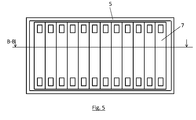
- ist eine schematische Darstellung eines erfindungsgenäßen Batteriesystems mit Zellen von oben.
- Fig. 6
- ist eine schematische Darstellung gem. dem Schnitt A-A der
Fig. 5 von der Seite. - Fig. 7
- ist eine schematische Darstellung einer Absorptionsvorrichtung eines erfindungsgemäßen Batteriesystems von der Seite.
- In den
Fig. 1 bis 2 ist eine Absorptionsvorrichtung 10 eines erfindungsgemäßen Batteriesystems dargestellt, mit einer elastischen und fluiddurchlässigen ersten Materiallage 2.1 und einer zur ersten Materiallage 2.1 annähernd parallelen elastischen und fluiddurchlässigen zweiten Materiallage 2.2, wobei die erste und die zweite Materiallage 2.1, 2.2 abschnittsweise miteinander verbunden sind, so dass Taschen 9 ausgebildet werden. In den Taschen 9 sind jeweils, nicht näher dargestellte, absorbierende Elemente, beispielsweise als Vlies oder als Schüttgut aufgenommen. Die Taschen werden durch, in der Ebene der Materiallagen 2.1,2.2 gitterförmige Klebeelemente 3 an der Unterseite der ersten Materiallage 2.1 ausgebildet, da der Klebstoff 3.1 der Klebeelemente 3 durch die erste Materiallage 2.1 hindurchreicht und eine Verbindung mit der zweiten Materiallage 2.2 bewirkt. Die Verbindung der ersten Materiallage 2.1 mit der zweiten Materiallage 2.2 kann auch durch ein separates zweites beidseitiges Klebeelement 11 erfolgen. Die Klebeelemente 3 weisen auch an deren Unterseite Klebstoff zur Befestigung an einem Batteriegehäuse 5 auf (sieheFig. 4 ), oder können mit anderen geeigneten Mitteln an einem Batteriegehäuse 5 befestigt sein. In der Darstellung derFig. 2 kann das gitterförmige Stützelement sowohl ein Klebeelement 3 als auch ein Rahmen 4 sein. - Wie in
Fig. 3 und4 gezeigt, kann eine Absorptionsvorrichtung 10 in einem Batteriegehäuse 5 derart angeordnet sein, dass sie einen großen Teil der Fläche über dem Boden des Batteriegehäuses 5 abdeckt. Die Klebeelemente 3 der Absorptionsvorrichtung 10 können dazu an das Batteriegehäuse 5 geklebt sein. Zur Befestigung von Zellen 7 und/oder eines Kühlkörpers 8 (sieheFig. 6 ) sind ebenfalls am Batteriegehäuseboden montierte Befestigungsabschnitte 6, beispielsweise vom Boden erhöht montierte Befestigungsleisten, vorgesehen. Die Befestigungsleisten können Flanschflächen 6.1 aufweisen. Die Montage von Zellen 7 und Kühlkörper 8 erfolgt in Einbaurichtung oberhalb der absorbierenden Elemente 1 der Absorptionsvorrichtung 10, um beispielsweise ein Abfließen von ausgetretenem Fluid des Kühlkörpers 8 auf die absorbierenden Elemente 1 zu erleichtern. - In
Fig. 7 ist eine Ausführungsform der Erfindung dargestellt, in welcher das Stützelement ein zwischen der Außenseite der ersten Materiallage 2.1 und dem Batteriegehäuse 5 angebrachter Rahmen 4 ist, wobei zur Taschenbildung an der Außenseite der zweiten Materiallage 2.2 ein Gegenrahmen 4.1 angebracht ist. Der Rahmen 4 weist erste Fortsätze 11 auf und der Gegenrahmen 4.1 zweite Fortsätze 12. Die ersten und zweiten Fortsätze 11, 12 sind ineinander steckbar sodass der Rahmen 4 und der Gegenrahmen 4.1 miteinander verbindbar sind. Im oberen Teil derFig. 7 sind Rahmen 4 und Gegenrahmen 4.1 noch nicht ineinander gesteckt, so dass die Materiallagen 2.1 und 2.2 noch nicht abschnittsweise miteinander verbunden sind und Taschen 9 noch nicht ausgebildet sind. Im unteren Teil derFig. 7 ist die Bildung der Taschen 9 durch ineinanderstecken von Rahmen 4 und Gegenrahmen 4.1 erfolgt. Der Rahmen 4 ist mit geeigneten Mitteln am Boden eines Batteriegehäuses 5 befestigt (nicht dargestellt). Der Rahmen 4 kann auch durch das Batteriegehäuse 5 ausgebildet sein. Der Gegenrahmen 4.1 kann auch durch den Kühlkörper 8 ausgebildet sein. - Die Erfindung gibt somit ein einfaches und kostengünstig herstellbares Batteriesystem mit einer zuverlässigen Absorptionsvorrichtung an.
-
- 1
- absorbierende Elemente
- 2.1
- erste Materiallage
- 2.2
- zweite Materiallage
- 3
- Klebeelement
- 3.1
- Klebstoff
- 4
- Rahmen
- 4.1
- Gegenrahmen
- 5
- Batteriegehäuse
- 6
- Befestigungsabschnitt
- 6.1
- Flanschflächen
- 7
- Zellen
- 8
- Kühlkörper
- 8.1
- Kühlkanal
- 9
- Tasche
- 10
- Absorptionsvorrichtung
- 11
- zweites beidseitiges Klebeelement
Claims (15)
- Batteriesystem umfassend eine Vielzahl von Zellen (7) in einem Batteriegehäuse (5), mit einer im Batteriegehäuse (5) angeordneten Absorptionsvorrichtung (10) durch die ausgetretenes Fluid im Batteriegehäuse (5) gebunden werden kann, wobei die Absorptionsvorrichtung (10) absorbierende Elemente (1) umfasst die zwischen den Innenseiten einer ersten und einer zweiten Materiallage (2.1, 2.2) aufgenommen sind, wobei die Materiallagen (2.1, 2.2) Taschen (9) zur Aufnahme der absorbierenden Elemente (1) ausbilden, dadurch gekennzeichnet, dass das Batteriesystem zumindest ein Stützelement (3, 4) umfasst, wobei das Stützelement (3, 4) sowohl zur Bildung der Taschen (9) als auch zur Befestigung der Absorptionsvorrichtung (10) am Batteriegehäuse (5) ausgebildet ist.
- Batteriesystem nach Anspruch 1,
dadurch gekennzeichnet, dass das Stützelement (3, 4) rahmenförmig oder gitterförmig ausgebildet ist. - Batteriesystem nach Anspruch 1 oder 2,
dadurch gekennzeichnet, dass die erste und/oder die zweite Materiallage (2.1, 2.2) durchlässig für das Fluid ausgebildet ist. - Batteriesystem nach zumindest einem der vorhergehenden Ansprüche,
dadurch gekennzeichnet, dass die erste Materiallage (2.1) eine Dicke kleiner als 0,5 mm, insbesondere kleiner als 0,3 mm oder kleiner als 0,1 mm aufweist. - Batteriesystem nach zumindest einem der vorhergehenden Ansprüche,
dadurch gekennzeichnet, dass die erste Materiallage (2.1) abschnittsweise Durchgänge aufweist. - Batteriesystem nach zumindest einem der vorhergehenden Ansprüche,
dadurch gekennzeichnet, dass das Stützelement (3, 4) in Einbaulage am Boden des Batteriegehäuses (5) befestigt ist, insbesondere durch Kleben oder Schweißen. - Batteriesystem nach zumindest einem der vorhergehenden Ansprüche,
dadurch gekennzeichnet, dass das Stützelement (3, 4) ein zwischen der Außenseite der ersten Materiallage (2.1) und dem Batteriegehäuse (5) angebrachtes beidseitiges Klebeelement (3), insbesondere eine beidseitige Klebefolie ist, wobei die erste Materiallage (2.1) und der Klebstoff (3.1) des Klebeelements (3) so ausgebildet sind, dass der Klebstoff (3.1) des Klebeelements (3) zumindest abschnittsweise durch die erste Materiallage (2.1) hindurch wirksam ist. - Batteriesystem nach Anspruch 7,
dadurch gekennzeichnet, dass zwischen der ersten Materiallage (2.1) und der zweiten Materiallage (2.2) abschnittsweise ein zweites beidseitiges Klebeelement (11), insbesondere eine zweite beidseitige Klebefolie, angebracht ist. - Batteriesystem nach zumindest einem der Ansprüche 1 bis 6, dadurch gekennzeichnet, dass das Stützelement (3, 4) ein zwischen der Außenseite der ersten Materiallage (2.1) und dem Batteriegehäuse (5) angebrachter Rahmen (4) ist, wobei zur Taschenbildung an der Außenseite der zweiten Materiallage (2.2) ein Gegenrahmen (4.1) angebracht ist, wobei der Rahmen (4) und der Gegenrahmen (4.1) miteinander verbindbar sind.
- Batteriesystem nach Anspruch 9,
dadurch gekennzeichnet, dass der Rahmen (4) erste Fortsätze (11) aufweist und der Gegenrahmen (4.1) zweite Fortsätze (12) aufweist, wobei die ersten und zweiten Fortsätze (11, 12) ineinander gesteckt sind. - Batteriesystem nach Anspruch 9,
dadurch gekennzeichnet, dass der Rahmen (4) und der Gegenrahmen (4.1) miteinander verschweißt, verklebt, verschraubt, vernietet oder vernäht sind, oder durch Rastnasen miteinander verbunden sind. - Batteriesystem nach einem der Ansprüche 9 bis 11,
dadurch gekennzeichnet, dass der Rahmen (4) durch das Batteriegehäuse (5) gebildet ist. - Batteriesystem nach einem der Ansprüche 9 bis 12,
dadurch gekennzeichnet, dass der Gegenrahmen (4.1) durch einen Kühlkörper (8) gebildet ist. - Batteriesystem nach zumindest einem der vorhergehenden Ansprüche,
dadurch gekennzeichnet, dass die Zellen (7) mittels Befestigungsabschnitten (6) in Einbaulage am Boden (13) des Batteriegehäuses (5) befestigt sind, wobei insbesondere die Unterkanten der Zellen (7) höher liegen, als die absorbierenden Elemente (1). - Batteriesystem nach zumindest einem der vorhergehenden Ansprüche,
dadurch gekennzeichnet, dass im Batteriegehäuse (5) ein Kühlkörper (8) angeordnet ist, wobei insbesondere der Kühlkörper (8) in Einbaulage höher liegt, als die absorbierenden Elemente (1).
Priority Applications (3)
| Application Number | Priority Date | Filing Date | Title |
|---|---|---|---|
| EP20130154164 EP2770554B1 (de) | 2013-02-06 | 2013-02-06 | Batteriesystem mit Absorptionsvorrichtung |
| CN201310537632.7A CN103972428B (zh) | 2013-02-06 | 2013-11-04 | 具有吸收设备的电池系统 |
| US14/174,556 US9356329B2 (en) | 2013-02-06 | 2014-02-06 | Battery system with absorption device |
Applications Claiming Priority (1)
| Application Number | Priority Date | Filing Date | Title |
|---|---|---|---|
| EP20130154164 EP2770554B1 (de) | 2013-02-06 | 2013-02-06 | Batteriesystem mit Absorptionsvorrichtung |
Publications (2)
| Publication Number | Publication Date |
|---|---|
| EP2770554A1 true EP2770554A1 (de) | 2014-08-27 |
| EP2770554B1 EP2770554B1 (de) | 2015-04-08 |
Family
ID=47715886
Family Applications (1)
| Application Number | Title | Priority Date | Filing Date |
|---|---|---|---|
| EP20130154164 Active EP2770554B1 (de) | 2013-02-06 | 2013-02-06 | Batteriesystem mit Absorptionsvorrichtung |
Country Status (3)
| Country | Link |
|---|---|
| US (1) | US9356329B2 (de) |
| EP (1) | EP2770554B1 (de) |
| CN (1) | CN103972428B (de) |
Cited By (2)
| Publication number | Priority date | Publication date | Assignee | Title |
|---|---|---|---|---|
| CN111180829A (zh) * | 2020-01-07 | 2020-05-19 | 福建中维动力科技股份有限公司 | 矿用汽车电池组冷却结构 |
| DE102020119727A1 (de) * | 2020-07-27 | 2021-04-01 | Carl Freudenberg Kg | Verwendung eines Absorbermaterials zur Aufnahme und/oder Verteilung von Flüssigkeiten in einem aktiv und/oder passiv gekühlten stromführenden System |
Families Citing this family (5)
| Publication number | Priority date | Publication date | Assignee | Title |
|---|---|---|---|---|
| WO2018139789A1 (ko) | 2017-01-26 | 2018-08-02 | 삼성에스디아이 주식회사 | 흡수층 및 절연 필름을 포함한 전지 하우징 |
| EP3355380B1 (de) * | 2017-01-26 | 2019-06-19 | Samsung SDI Co., Ltd. | Batteriegehäuse mit saugfähigen und isolierenden schichten. |
| CN110504392A (zh) * | 2018-05-18 | 2019-11-26 | 宁德新能源科技有限公司 | 电池 |
| US11590766B2 (en) * | 2019-02-22 | 2023-02-28 | Seiko Epson Corporation | Recording apparatus |
| CN110350121B (zh) * | 2019-07-24 | 2022-04-08 | 中车株洲电力机车有限公司 | 一种盛装车辆储能电源的箱体及其漏液防落装置 |
Citations (3)
| Publication number | Priority date | Publication date | Assignee | Title |
|---|---|---|---|---|
| DE102010010844A1 (de) | 2010-03-10 | 2011-09-15 | Bayerische Motoren Werke Aktiengesellschaft | Speichermodul zur Spannungsversorgung insbesondere eines Kraftfahrzeugs |
| DE102010012927A1 (de) * | 2010-03-26 | 2011-09-29 | Daimler Ag | Vorrichtung zur Detektion von Undichtheiten |
| EP2533346A1 (de) * | 2011-06-09 | 2012-12-12 | Carl Freudenberg KG | Vorrichtung zur Entfernung von Flüssigkeit aus einer Energiespeichervorrichtung |
Family Cites Families (3)
| Publication number | Priority date | Publication date | Assignee | Title |
|---|---|---|---|---|
| US6308728B1 (en) * | 1999-10-27 | 2001-10-30 | Douglas Frazier | Spill containment system and method |
| JP3727840B2 (ja) * | 2000-09-29 | 2005-12-21 | 株式会社東芝 | 電池パック及び携帯用電子機器 |
| CN107946689B (zh) * | 2011-04-15 | 2021-01-22 | Cps科技控股有限公司 | 具有外部热管理系统的电池系统 |
-
2013
- 2013-02-06 EP EP20130154164 patent/EP2770554B1/de active Active
- 2013-11-04 CN CN201310537632.7A patent/CN103972428B/zh active Active
-
2014
- 2014-02-06 US US14/174,556 patent/US9356329B2/en active Active
Patent Citations (3)
| Publication number | Priority date | Publication date | Assignee | Title |
|---|---|---|---|---|
| DE102010010844A1 (de) | 2010-03-10 | 2011-09-15 | Bayerische Motoren Werke Aktiengesellschaft | Speichermodul zur Spannungsversorgung insbesondere eines Kraftfahrzeugs |
| DE102010012927A1 (de) * | 2010-03-26 | 2011-09-29 | Daimler Ag | Vorrichtung zur Detektion von Undichtheiten |
| EP2533346A1 (de) * | 2011-06-09 | 2012-12-12 | Carl Freudenberg KG | Vorrichtung zur Entfernung von Flüssigkeit aus einer Energiespeichervorrichtung |
Cited By (5)
| Publication number | Priority date | Publication date | Assignee | Title |
|---|---|---|---|---|
| CN111180829A (zh) * | 2020-01-07 | 2020-05-19 | 福建中维动力科技股份有限公司 | 矿用汽车电池组冷却结构 |
| DE102020119727A1 (de) * | 2020-07-27 | 2021-04-01 | Carl Freudenberg Kg | Verwendung eines Absorbermaterials zur Aufnahme und/oder Verteilung von Flüssigkeiten in einem aktiv und/oder passiv gekühlten stromführenden System |
| CN112999831A (zh) * | 2020-07-27 | 2021-06-22 | 科德宝两合公司 | 吸收材料用于在主动和/或被动冷却的载流系统中吸收和/或分配液体的用途 |
| CN112999831B (zh) * | 2020-07-27 | 2023-04-18 | 科德宝两合公司 | 吸收材料用于在主动和/或被动冷却的载流系统中吸收和/或分配液体的用途 |
| US11857947B2 (en) | 2020-07-27 | 2024-01-02 | Carl Freudenberg Kg | Use of an absorber material for absorbing and / or distributing liquids in an actively and / or passively cooled current-carrying system |
Also Published As
| Publication number | Publication date |
|---|---|
| US20140220405A1 (en) | 2014-08-07 |
| EP2770554B1 (de) | 2015-04-08 |
| US9356329B2 (en) | 2016-05-31 |
| CN103972428A (zh) | 2014-08-06 |
| CN103972428B (zh) | 2017-03-01 |
Similar Documents
| Publication | Publication Date | Title |
|---|---|---|
| EP2770554B1 (de) | Batteriesystem mit Absorptionsvorrichtung | |
| DE102008028400A1 (de) | Vorrichtung zur Kühlung einer Fahrzeugbatterie | |
| DE102020207966A1 (de) | Kühlanordnung für elektronische Komponenten eines Kraftfahrzeugs | |
| DE102015115875B4 (de) | Kühlsystem zum Temperieren einer Kraftfahrzeugbatterie sowie Verfahren zum Betrieb einer Batterieanordnung | |
| DE102008059972A1 (de) | Batterie, insbesondere Fahrzeugbatterie | |
| EP3824502B1 (de) | Batterieträger und fahrzeug mit diesem batterieträger | |
| WO2012095201A1 (de) | Batteriezellenmodul, verfahren zur herstellung eines batteriezellenmoduls sowie batterie und kraftfahrzeug | |
| DE112019005681T5 (de) | Batteriepack-Wasserableitsystem | |
| DE102010019369A1 (de) | Kühleinrichtung | |
| DE102012200400A1 (de) | Anordnung eines elektrischen Energiespeichers und einer Kühleinrichtung | |
| DE102011082199A1 (de) | Batterie mit Temperiereinheit | |
| DE102008059941A1 (de) | Batterieeinheit mit einer Mehrzahl von zylindrischen Einzelzellen | |
| DE102017217118A1 (de) | Batteriemodul | |
| DE102019210191A1 (de) | Energiespeicherzellenstapel | |
| DE102019210198A1 (de) | Energiespeichermodul | |
| DE102019210197A1 (de) | Energiespeicherzellenstapel | |
| EP2701219A2 (de) | Energiespeicher | |
| DE102013222130A1 (de) | Wärmeübertrager | |
| EP2545603B1 (de) | Speichermodul zur spannungsversorgung, insbesondere eines kraftfahrzeugs | |
| DE102020100135A1 (de) | Batteriekasten | |
| DE102017203648A1 (de) | Akkumulatortemperieranordnung | |
| DE102012013731A1 (de) | Wasserablaufventil für den Wasserkasten eines Kraftfahrzeuges | |
| WO2018215112A1 (de) | Temperierplatte | |
| AT520693B1 (de) | Akkumulator | |
| DE102017005323A1 (de) | Batteriewanne |
Legal Events
| Date | Code | Title | Description |
|---|---|---|---|
| PUAI | Public reference made under article 153(3) epc to a published international application that has entered the european phase |
Free format text: ORIGINAL CODE: 0009012 |
|
| 17P | Request for examination filed |
Effective date: 20130206 |
|
| AK | Designated contracting states |
Kind code of ref document: A1 Designated state(s): AL AT BE BG CH CY CZ DE DK EE ES FI FR GB GR HR HU IE IS IT LI LT LU LV MC MK MT NL NO PL PT RO RS SE SI SK SM TR |
|
| AX | Request for extension of the european patent |
Extension state: BA ME |
|
| R17P | Request for examination filed (corrected) |
Effective date: 20140821 |
|
| RBV | Designated contracting states (corrected) |
Designated state(s): AL AT BE BG CH CY CZ DE DK EE ES FI FR GB GR HR HU IE IS IT LI LT LU LV MC MK MT NL NO PL PT RO RS SE SI SK SM TR |
|
| GRAP | Despatch of communication of intention to grant a patent |
Free format text: ORIGINAL CODE: EPIDOSNIGR1 |
|
| INTG | Intention to grant announced |
Effective date: 20141212 |
|
| RIC1 | Information provided on ipc code assigned before grant |
Ipc: H01M 10/52 20060101ALI20141128BHEP Ipc: H01M 10/625 20140101ALI20141128BHEP Ipc: H01M 10/60 20140101ALI20141128BHEP Ipc: H01M 10/6567 20140101ALI20141128BHEP Ipc: H01M 2/10 20060101AFI20141128BHEP |
|
| GRAS | Grant fee paid |
Free format text: ORIGINAL CODE: EPIDOSNIGR3 |
|
| GRAA | (expected) grant |
Free format text: ORIGINAL CODE: 0009210 |
|
| AK | Designated contracting states |
Kind code of ref document: B1 Designated state(s): AL AT BE BG CH CY CZ DE DK EE ES FI FR GB GR HR HU IE IS IT LI LT LU LV MC MK MT NL NO PL PT RO RS SE SI SK SM TR |
|
| REG | Reference to a national code |
Ref country code: GB Ref legal event code: FG4D Free format text: NOT ENGLISH |
|
| REG | Reference to a national code |
Ref country code: CH Ref legal event code: EP |
|
| REG | Reference to a national code |
Ref country code: DE Ref legal event code: R081 Ref document number: 502013000524 Country of ref document: DE Owner name: SAMSUNG SDI CO., LTD., YONGIN-SI, KR Free format text: FORMER OWNER: MAGNA STEYR BATTERY SYSTEMS GMBH & CO OG, GRAZ, AT |
|
| REG | Reference to a national code |
Ref country code: IE Ref legal event code: FG4D Free format text: LANGUAGE OF EP DOCUMENT: GERMAN |
|
| REG | Reference to a national code |
Ref country code: AT Ref legal event code: REF Ref document number: 721145 Country of ref document: AT Kind code of ref document: T Effective date: 20150515 |
|
| RAP2 | Party data changed (patent owner data changed or rights of a patent transferred) |
Owner name: MAGNA STEYR BATTERY SYSTEMS GMBH & CO OG |
|
| REG | Reference to a national code |
Ref country code: DE Ref legal event code: R096 Ref document number: 502013000524 Country of ref document: DE Effective date: 20150521 |
|
| REG | Reference to a national code |
Ref country code: DE Ref legal event code: R082 Ref document number: 502013000524 Country of ref document: DE Representative=s name: RAUSCH, GABRIELE, DIPL.-PHYS. DR.RER.NAT., DE Ref country code: DE Ref legal event code: R082 Ref document number: 502013000524 Country of ref document: DE Representative=s name: GULDE & PARTNER PATENT- UND RECHTSANWALTSKANZL, DE |
|
| REG | Reference to a national code |
Ref country code: DE Ref legal event code: R082 Ref document number: 502013000524 Country of ref document: DE Representative=s name: GULDE & PARTNER PATENT- UND RECHTSANWALTSKANZL, DE Ref country code: DE Ref legal event code: R081 Ref document number: 502013000524 Country of ref document: DE Owner name: SAMSUNG SDI CO., LTD., YONGIN-SI, KR Free format text: FORMER OWNER: MAGNA STEYR BATTERY SYSTEMS GMBH & CO OG, ZETTLING, AT |
|
| REG | Reference to a national code |
Ref country code: NL Ref legal event code: VDEP Effective date: 20150408 |
|
| RAP2 | Party data changed (patent owner data changed or rights of a patent transferred) |
Owner name: SAMSUNG SDI CO., LTD. |
|
| REG | Reference to a national code |
Ref country code: LT Ref legal event code: MG4D |
|
| PG25 | Lapsed in a contracting state [announced via postgrant information from national office to epo] |
Ref country code: NL Free format text: LAPSE BECAUSE OF FAILURE TO SUBMIT A TRANSLATION OF THE DESCRIPTION OR TO PAY THE FEE WITHIN THE PRESCRIBED TIME-LIMIT Effective date: 20150408 |
|
| PG25 | Lapsed in a contracting state [announced via postgrant information from national office to epo] |
Ref country code: LT Free format text: LAPSE BECAUSE OF FAILURE TO SUBMIT A TRANSLATION OF THE DESCRIPTION OR TO PAY THE FEE WITHIN THE PRESCRIBED TIME-LIMIT Effective date: 20150408 Ref country code: PT Free format text: LAPSE BECAUSE OF FAILURE TO SUBMIT A TRANSLATION OF THE DESCRIPTION OR TO PAY THE FEE WITHIN THE PRESCRIBED TIME-LIMIT Effective date: 20150810 Ref country code: HR Free format text: LAPSE BECAUSE OF FAILURE TO SUBMIT A TRANSLATION OF THE DESCRIPTION OR TO PAY THE FEE WITHIN THE PRESCRIBED TIME-LIMIT Effective date: 20150408 Ref country code: NO Free format text: LAPSE BECAUSE OF FAILURE TO SUBMIT A TRANSLATION OF THE DESCRIPTION OR TO PAY THE FEE WITHIN THE PRESCRIBED TIME-LIMIT Effective date: 20150708 Ref country code: FI Free format text: LAPSE BECAUSE OF FAILURE TO SUBMIT A TRANSLATION OF THE DESCRIPTION OR TO PAY THE FEE WITHIN THE PRESCRIBED TIME-LIMIT Effective date: 20150408 Ref country code: ES Free format text: LAPSE BECAUSE OF FAILURE TO SUBMIT A TRANSLATION OF THE DESCRIPTION OR TO PAY THE FEE WITHIN THE PRESCRIBED TIME-LIMIT Effective date: 20150408 |
|
| PG25 | Lapsed in a contracting state [announced via postgrant information from national office to epo] |
Ref country code: RS Free format text: LAPSE BECAUSE OF FAILURE TO SUBMIT A TRANSLATION OF THE DESCRIPTION OR TO PAY THE FEE WITHIN THE PRESCRIBED TIME-LIMIT Effective date: 20150408 Ref country code: GR Free format text: LAPSE BECAUSE OF FAILURE TO SUBMIT A TRANSLATION OF THE DESCRIPTION OR TO PAY THE FEE WITHIN THE PRESCRIBED TIME-LIMIT Effective date: 20150709 Ref country code: IS Free format text: LAPSE BECAUSE OF FAILURE TO SUBMIT A TRANSLATION OF THE DESCRIPTION OR TO PAY THE FEE WITHIN THE PRESCRIBED TIME-LIMIT Effective date: 20150808 Ref country code: LV Free format text: LAPSE BECAUSE OF FAILURE TO SUBMIT A TRANSLATION OF THE DESCRIPTION OR TO PAY THE FEE WITHIN THE PRESCRIBED TIME-LIMIT Effective date: 20150408 |
|
| REG | Reference to a national code |
Ref country code: DE Ref legal event code: R097 Ref document number: 502013000524 Country of ref document: DE |
|
| REG | Reference to a national code |
Ref country code: FR Ref legal event code: PLFP Year of fee payment: 4 |
|
| PG25 | Lapsed in a contracting state [announced via postgrant information from national office to epo] |
Ref country code: EE Free format text: LAPSE BECAUSE OF FAILURE TO SUBMIT A TRANSLATION OF THE DESCRIPTION OR TO PAY THE FEE WITHIN THE PRESCRIBED TIME-LIMIT Effective date: 20150408 Ref country code: DK Free format text: LAPSE BECAUSE OF FAILURE TO SUBMIT A TRANSLATION OF THE DESCRIPTION OR TO PAY THE FEE WITHIN THE PRESCRIBED TIME-LIMIT Effective date: 20150408 |
|
| PLBE | No opposition filed within time limit |
Free format text: ORIGINAL CODE: 0009261 |
|
| STAA | Information on the status of an ep patent application or granted ep patent |
Free format text: STATUS: NO OPPOSITION FILED WITHIN TIME LIMIT |
|
| PG25 | Lapsed in a contracting state [announced via postgrant information from national office to epo] |
Ref country code: SK Free format text: LAPSE BECAUSE OF FAILURE TO SUBMIT A TRANSLATION OF THE DESCRIPTION OR TO PAY THE FEE WITHIN THE PRESCRIBED TIME-LIMIT Effective date: 20150408 Ref country code: CZ Free format text: LAPSE BECAUSE OF FAILURE TO SUBMIT A TRANSLATION OF THE DESCRIPTION OR TO PAY THE FEE WITHIN THE PRESCRIBED TIME-LIMIT Effective date: 20150408 Ref country code: RO Free format text: LAPSE BECAUSE OF NON-PAYMENT OF DUE FEES Effective date: 20150408 Ref country code: PL Free format text: LAPSE BECAUSE OF FAILURE TO SUBMIT A TRANSLATION OF THE DESCRIPTION OR TO PAY THE FEE WITHIN THE PRESCRIBED TIME-LIMIT Effective date: 20150408 |
|
| 26N | No opposition filed |
Effective date: 20160111 |
|
| REG | Reference to a national code |
Ref country code: GB Ref legal event code: 732E Free format text: REGISTERED BETWEEN 20160218 AND 20160224 |
|
| REG | Reference to a national code |
Ref country code: GB Ref legal event code: 732E Free format text: REGISTERED BETWEEN 20160225 AND 20160302 |
|
| PG25 | Lapsed in a contracting state [announced via postgrant information from national office to epo] |
Ref country code: IT Free format text: LAPSE BECAUSE OF FAILURE TO SUBMIT A TRANSLATION OF THE DESCRIPTION OR TO PAY THE FEE WITHIN THE PRESCRIBED TIME-LIMIT Effective date: 20150408 |
|
| REG | Reference to a national code |
Ref country code: FR Ref legal event code: TP Owner name: SAMSUNG SDI CO., LTD., KR Effective date: 20160420 |
|
| PG25 | Lapsed in a contracting state [announced via postgrant information from national office to epo] |
Ref country code: SI Free format text: LAPSE BECAUSE OF FAILURE TO SUBMIT A TRANSLATION OF THE DESCRIPTION OR TO PAY THE FEE WITHIN THE PRESCRIBED TIME-LIMIT Effective date: 20150408 Ref country code: BE Free format text: LAPSE BECAUSE OF NON-PAYMENT OF DUE FEES Effective date: 20160229 |
|
| PG25 | Lapsed in a contracting state [announced via postgrant information from national office to epo] |
Ref country code: LU Free format text: LAPSE BECAUSE OF FAILURE TO SUBMIT A TRANSLATION OF THE DESCRIPTION OR TO PAY THE FEE WITHIN THE PRESCRIBED TIME-LIMIT Effective date: 20160206 Ref country code: MC Free format text: LAPSE BECAUSE OF FAILURE TO SUBMIT A TRANSLATION OF THE DESCRIPTION OR TO PAY THE FEE WITHIN THE PRESCRIBED TIME-LIMIT Effective date: 20150408 |
|
| REG | Reference to a national code |
Ref country code: CH Ref legal event code: PL |
|
| PG25 | Lapsed in a contracting state [announced via postgrant information from national office to epo] |
Ref country code: LI Free format text: LAPSE BECAUSE OF NON-PAYMENT OF DUE FEES Effective date: 20160229 Ref country code: CH Free format text: LAPSE BECAUSE OF NON-PAYMENT OF DUE FEES Effective date: 20160229 |
|
| REG | Reference to a national code |
Ref country code: IE Ref legal event code: MM4A |
|
| REG | Reference to a national code |
Ref country code: FR Ref legal event code: PLFP Year of fee payment: 5 |
|
| PG25 | Lapsed in a contracting state [announced via postgrant information from national office to epo] |
Ref country code: IE Free format text: LAPSE BECAUSE OF NON-PAYMENT OF DUE FEES Effective date: 20160206 |
|
| PG25 | Lapsed in a contracting state [announced via postgrant information from national office to epo] |
Ref country code: SE Free format text: LAPSE BECAUSE OF FAILURE TO SUBMIT A TRANSLATION OF THE DESCRIPTION OR TO PAY THE FEE WITHIN THE PRESCRIBED TIME-LIMIT Effective date: 20150408 |
|
| PG25 | Lapsed in a contracting state [announced via postgrant information from national office to epo] |
Ref country code: MT Free format text: LAPSE BECAUSE OF FAILURE TO SUBMIT A TRANSLATION OF THE DESCRIPTION OR TO PAY THE FEE WITHIN THE PRESCRIBED TIME-LIMIT Effective date: 20150408 |
|
| REG | Reference to a national code |
Ref country code: FR Ref legal event code: PLFP Year of fee payment: 6 |
|
| PG25 | Lapsed in a contracting state [announced via postgrant information from national office to epo] |
Ref country code: SM Free format text: LAPSE BECAUSE OF FAILURE TO SUBMIT A TRANSLATION OF THE DESCRIPTION OR TO PAY THE FEE WITHIN THE PRESCRIBED TIME-LIMIT Effective date: 20150408 Ref country code: HU Free format text: LAPSE BECAUSE OF FAILURE TO SUBMIT A TRANSLATION OF THE DESCRIPTION OR TO PAY THE FEE WITHIN THE PRESCRIBED TIME-LIMIT; INVALID AB INITIO Effective date: 20130206 Ref country code: CY Free format text: LAPSE BECAUSE OF FAILURE TO SUBMIT A TRANSLATION OF THE DESCRIPTION OR TO PAY THE FEE WITHIN THE PRESCRIBED TIME-LIMIT Effective date: 20150408 |
|
| PG25 | Lapsed in a contracting state [announced via postgrant information from national office to epo] |
Ref country code: TR Free format text: LAPSE BECAUSE OF FAILURE TO SUBMIT A TRANSLATION OF THE DESCRIPTION OR TO PAY THE FEE WITHIN THE PRESCRIBED TIME-LIMIT Effective date: 20150408 Ref country code: MK Free format text: LAPSE BECAUSE OF FAILURE TO SUBMIT A TRANSLATION OF THE DESCRIPTION OR TO PAY THE FEE WITHIN THE PRESCRIBED TIME-LIMIT Effective date: 20150408 |
|
| PG25 | Lapsed in a contracting state [announced via postgrant information from national office to epo] |
Ref country code: BG Free format text: LAPSE BECAUSE OF FAILURE TO SUBMIT A TRANSLATION OF THE DESCRIPTION OR TO PAY THE FEE WITHIN THE PRESCRIBED TIME-LIMIT Effective date: 20150408 |
|
| PG25 | Lapsed in a contracting state [announced via postgrant information from national office to epo] |
Ref country code: AL Free format text: LAPSE BECAUSE OF FAILURE TO SUBMIT A TRANSLATION OF THE DESCRIPTION OR TO PAY THE FEE WITHIN THE PRESCRIBED TIME-LIMIT Effective date: 20150408 |
|
| REG | Reference to a national code |
Ref country code: AT Ref legal event code: MM01 Ref document number: 721145 Country of ref document: AT Kind code of ref document: T Effective date: 20180206 |
|
| PG25 | Lapsed in a contracting state [announced via postgrant information from national office to epo] |
Ref country code: AT Free format text: LAPSE BECAUSE OF NON-PAYMENT OF DUE FEES Effective date: 20180206 |
|
| REG | Reference to a national code |
Ref country code: DE Ref legal event code: R079 Ref document number: 502013000524 Country of ref document: DE Free format text: PREVIOUS MAIN CLASS: H01M0002100000 Ipc: H01M0050200000 |
|
| P01 | Opt-out of the competence of the unified patent court (upc) registered |
Effective date: 20230528 |
|
| PGFP | Annual fee paid to national office [announced via postgrant information from national office to epo] |
Ref country code: GB Payment date: 20260128 Year of fee payment: 14 |
|
| PGFP | Annual fee paid to national office [announced via postgrant information from national office to epo] |
Ref country code: DE Payment date: 20260128 Year of fee payment: 14 |
|
| PGFP | Annual fee paid to national office [announced via postgrant information from national office to epo] |
Ref country code: FR Payment date: 20260121 Year of fee payment: 14 |