EP2767427A1 - Structure for mounting electric power storage device - Google Patents
Structure for mounting electric power storage device Download PDFInfo
- Publication number
- EP2767427A1 EP2767427A1 EP11873790.7A EP11873790A EP2767427A1 EP 2767427 A1 EP2767427 A1 EP 2767427A1 EP 11873790 A EP11873790 A EP 11873790A EP 2767427 A1 EP2767427 A1 EP 2767427A1
- Authority
- EP
- European Patent Office
- Prior art keywords
- reinforcement
- vehicle
- concave portion
- electric storage
- storage apparatus
- Prior art date
- Legal status (The legal status is an assumption and is not a legal conclusion. Google has not performed a legal analysis and makes no representation as to the accuracy of the status listed.)
- Granted
Links
Images


Classifications
-
- B—PERFORMING OPERATIONS; TRANSPORTING
- B60—VEHICLES IN GENERAL
- B60K—ARRANGEMENT OR MOUNTING OF PROPULSION UNITS OR OF TRANSMISSIONS IN VEHICLES; ARRANGEMENT OR MOUNTING OF PLURAL DIVERSE PRIME-MOVERS IN VEHICLES; AUXILIARY DRIVES FOR VEHICLES; INSTRUMENTATION OR DASHBOARDS FOR VEHICLES; ARRANGEMENTS IN CONNECTION WITH COOLING, AIR INTAKE, GAS EXHAUST OR FUEL SUPPLY OF PROPULSION UNITS IN VEHICLES
- B60K1/00—Arrangement or mounting of electrical propulsion units
- B60K1/04—Arrangement or mounting of electrical propulsion units of the electric storage means for propulsion
-
- B—PERFORMING OPERATIONS; TRANSPORTING
- B60—VEHICLES IN GENERAL
- B60L—PROPULSION OF ELECTRICALLY-PROPELLED VEHICLES; SUPPLYING ELECTRIC POWER FOR AUXILIARY EQUIPMENT OF ELECTRICALLY-PROPELLED VEHICLES; ELECTRODYNAMIC BRAKE SYSTEMS FOR VEHICLES IN GENERAL; MAGNETIC SUSPENSION OR LEVITATION FOR VEHICLES; MONITORING OPERATING VARIABLES OF ELECTRICALLY-PROPELLED VEHICLES; ELECTRIC SAFETY DEVICES FOR ELECTRICALLY-PROPELLED VEHICLES
- B60L3/00—Electric devices on electrically-propelled vehicles for safety purposes; Monitoring operating variables, e.g. speed, deceleration or energy consumption
- B60L3/0007—Measures or means for preventing or attenuating collisions
-
- B—PERFORMING OPERATIONS; TRANSPORTING
- B60—VEHICLES IN GENERAL
- B60L—PROPULSION OF ELECTRICALLY-PROPELLED VEHICLES; SUPPLYING ELECTRIC POWER FOR AUXILIARY EQUIPMENT OF ELECTRICALLY-PROPELLED VEHICLES; ELECTRODYNAMIC BRAKE SYSTEMS FOR VEHICLES IN GENERAL; MAGNETIC SUSPENSION OR LEVITATION FOR VEHICLES; MONITORING OPERATING VARIABLES OF ELECTRICALLY-PROPELLED VEHICLES; ELECTRIC SAFETY DEVICES FOR ELECTRICALLY-PROPELLED VEHICLES
- B60L3/00—Electric devices on electrically-propelled vehicles for safety purposes; Monitoring operating variables, e.g. speed, deceleration or energy consumption
- B60L3/0023—Detecting, eliminating, remedying or compensating for drive train abnormalities, e.g. failures within the drive train
- B60L3/0046—Detecting, eliminating, remedying or compensating for drive train abnormalities, e.g. failures within the drive train relating to electric energy storage systems, e.g. batteries or capacitors
-
- B—PERFORMING OPERATIONS; TRANSPORTING
- B60—VEHICLES IN GENERAL
- B60L—PROPULSION OF ELECTRICALLY-PROPELLED VEHICLES; SUPPLYING ELECTRIC POWER FOR AUXILIARY EQUIPMENT OF ELECTRICALLY-PROPELLED VEHICLES; ELECTRODYNAMIC BRAKE SYSTEMS FOR VEHICLES IN GENERAL; MAGNETIC SUSPENSION OR LEVITATION FOR VEHICLES; MONITORING OPERATING VARIABLES OF ELECTRICALLY-PROPELLED VEHICLES; ELECTRIC SAFETY DEVICES FOR ELECTRICALLY-PROPELLED VEHICLES
- B60L3/00—Electric devices on electrically-propelled vehicles for safety purposes; Monitoring operating variables, e.g. speed, deceleration or energy consumption
- B60L3/0023—Detecting, eliminating, remedying or compensating for drive train abnormalities, e.g. failures within the drive train
- B60L3/0069—Detecting, eliminating, remedying or compensating for drive train abnormalities, e.g. failures within the drive train relating to the isolation, e.g. ground fault or leak current
-
- B—PERFORMING OPERATIONS; TRANSPORTING
- B60—VEHICLES IN GENERAL
- B60L—PROPULSION OF ELECTRICALLY-PROPELLED VEHICLES; SUPPLYING ELECTRIC POWER FOR AUXILIARY EQUIPMENT OF ELECTRICALLY-PROPELLED VEHICLES; ELECTRODYNAMIC BRAKE SYSTEMS FOR VEHICLES IN GENERAL; MAGNETIC SUSPENSION OR LEVITATION FOR VEHICLES; MONITORING OPERATING VARIABLES OF ELECTRICALLY-PROPELLED VEHICLES; ELECTRIC SAFETY DEVICES FOR ELECTRICALLY-PROPELLED VEHICLES
- B60L3/00—Electric devices on electrically-propelled vehicles for safety purposes; Monitoring operating variables, e.g. speed, deceleration or energy consumption
- B60L3/04—Cutting off the power supply under fault conditions
-
- B—PERFORMING OPERATIONS; TRANSPORTING
- B60—VEHICLES IN GENERAL
- B60L—PROPULSION OF ELECTRICALLY-PROPELLED VEHICLES; SUPPLYING ELECTRIC POWER FOR AUXILIARY EQUIPMENT OF ELECTRICALLY-PROPELLED VEHICLES; ELECTRODYNAMIC BRAKE SYSTEMS FOR VEHICLES IN GENERAL; MAGNETIC SUSPENSION OR LEVITATION FOR VEHICLES; MONITORING OPERATING VARIABLES OF ELECTRICALLY-PROPELLED VEHICLES; ELECTRIC SAFETY DEVICES FOR ELECTRICALLY-PROPELLED VEHICLES
- B60L50/00—Electric propulsion with power supplied within the vehicle
- B60L50/40—Electric propulsion with power supplied within the vehicle using propulsion power supplied by capacitors
-
- B—PERFORMING OPERATIONS; TRANSPORTING
- B60—VEHICLES IN GENERAL
- B60L—PROPULSION OF ELECTRICALLY-PROPELLED VEHICLES; SUPPLYING ELECTRIC POWER FOR AUXILIARY EQUIPMENT OF ELECTRICALLY-PROPELLED VEHICLES; ELECTRODYNAMIC BRAKE SYSTEMS FOR VEHICLES IN GENERAL; MAGNETIC SUSPENSION OR LEVITATION FOR VEHICLES; MONITORING OPERATING VARIABLES OF ELECTRICALLY-PROPELLED VEHICLES; ELECTRIC SAFETY DEVICES FOR ELECTRICALLY-PROPELLED VEHICLES
- B60L50/00—Electric propulsion with power supplied within the vehicle
- B60L50/50—Electric propulsion with power supplied within the vehicle using propulsion power supplied by batteries or fuel cells
- B60L50/51—Electric propulsion with power supplied within the vehicle using propulsion power supplied by batteries or fuel cells characterised by AC-motors
-
- B—PERFORMING OPERATIONS; TRANSPORTING
- B60—VEHICLES IN GENERAL
- B60L—PROPULSION OF ELECTRICALLY-PROPELLED VEHICLES; SUPPLYING ELECTRIC POWER FOR AUXILIARY EQUIPMENT OF ELECTRICALLY-PROPELLED VEHICLES; ELECTRODYNAMIC BRAKE SYSTEMS FOR VEHICLES IN GENERAL; MAGNETIC SUSPENSION OR LEVITATION FOR VEHICLES; MONITORING OPERATING VARIABLES OF ELECTRICALLY-PROPELLED VEHICLES; ELECTRIC SAFETY DEVICES FOR ELECTRICALLY-PROPELLED VEHICLES
- B60L50/00—Electric propulsion with power supplied within the vehicle
- B60L50/50—Electric propulsion with power supplied within the vehicle using propulsion power supplied by batteries or fuel cells
- B60L50/60—Electric propulsion with power supplied within the vehicle using propulsion power supplied by batteries or fuel cells using power supplied by batteries
- B60L50/64—Constructional details of batteries specially adapted for electric vehicles
-
- B—PERFORMING OPERATIONS; TRANSPORTING
- B60—VEHICLES IN GENERAL
- B60L—PROPULSION OF ELECTRICALLY-PROPELLED VEHICLES; SUPPLYING ELECTRIC POWER FOR AUXILIARY EQUIPMENT OF ELECTRICALLY-PROPELLED VEHICLES; ELECTRODYNAMIC BRAKE SYSTEMS FOR VEHICLES IN GENERAL; MAGNETIC SUSPENSION OR LEVITATION FOR VEHICLES; MONITORING OPERATING VARIABLES OF ELECTRICALLY-PROPELLED VEHICLES; ELECTRIC SAFETY DEVICES FOR ELECTRICALLY-PROPELLED VEHICLES
- B60L50/00—Electric propulsion with power supplied within the vehicle
- B60L50/50—Electric propulsion with power supplied within the vehicle using propulsion power supplied by batteries or fuel cells
- B60L50/60—Electric propulsion with power supplied within the vehicle using propulsion power supplied by batteries or fuel cells using power supplied by batteries
- B60L50/66—Arrangements of batteries
-
- B—PERFORMING OPERATIONS; TRANSPORTING
- B60—VEHICLES IN GENERAL
- B60L—PROPULSION OF ELECTRICALLY-PROPELLED VEHICLES; SUPPLYING ELECTRIC POWER FOR AUXILIARY EQUIPMENT OF ELECTRICALLY-PROPELLED VEHICLES; ELECTRODYNAMIC BRAKE SYSTEMS FOR VEHICLES IN GENERAL; MAGNETIC SUSPENSION OR LEVITATION FOR VEHICLES; MONITORING OPERATING VARIABLES OF ELECTRICALLY-PROPELLED VEHICLES; ELECTRIC SAFETY DEVICES FOR ELECTRICALLY-PROPELLED VEHICLES
- B60L58/00—Methods or circuit arrangements for monitoring or controlling batteries or fuel cells, specially adapted for electric vehicles
- B60L58/10—Methods or circuit arrangements for monitoring or controlling batteries or fuel cells, specially adapted for electric vehicles for monitoring or controlling batteries
-
- B—PERFORMING OPERATIONS; TRANSPORTING
- B60—VEHICLES IN GENERAL
- B60L—PROPULSION OF ELECTRICALLY-PROPELLED VEHICLES; SUPPLYING ELECTRIC POWER FOR AUXILIARY EQUIPMENT OF ELECTRICALLY-PROPELLED VEHICLES; ELECTRODYNAMIC BRAKE SYSTEMS FOR VEHICLES IN GENERAL; MAGNETIC SUSPENSION OR LEVITATION FOR VEHICLES; MONITORING OPERATING VARIABLES OF ELECTRICALLY-PROPELLED VEHICLES; ELECTRIC SAFETY DEVICES FOR ELECTRICALLY-PROPELLED VEHICLES
- B60L58/00—Methods or circuit arrangements for monitoring or controlling batteries or fuel cells, specially adapted for electric vehicles
- B60L58/10—Methods or circuit arrangements for monitoring or controlling batteries or fuel cells, specially adapted for electric vehicles for monitoring or controlling batteries
- B60L58/18—Methods or circuit arrangements for monitoring or controlling batteries or fuel cells, specially adapted for electric vehicles for monitoring or controlling batteries of two or more battery modules
- B60L58/21—Methods or circuit arrangements for monitoring or controlling batteries or fuel cells, specially adapted for electric vehicles for monitoring or controlling batteries of two or more battery modules having the same nominal voltage
-
- H—ELECTRICITY
- H01—ELECTRIC ELEMENTS
- H01M—PROCESSES OR MEANS, e.g. BATTERIES, FOR THE DIRECT CONVERSION OF CHEMICAL ENERGY INTO ELECTRICAL ENERGY
- H01M50/00—Constructional details or processes of manufacture of the non-active parts of electrochemical cells other than fuel cells, e.g. hybrid cells
- H01M50/20—Mountings; Secondary casings or frames; Racks, modules or packs; Suspension devices; Shock absorbers; Transport or carrying devices; Holders
- H01M50/249—Mountings; Secondary casings or frames; Racks, modules or packs; Suspension devices; Shock absorbers; Transport or carrying devices; Holders specially adapted for aircraft or vehicles, e.g. cars or trains
-
- B—PERFORMING OPERATIONS; TRANSPORTING
- B60—VEHICLES IN GENERAL
- B60K—ARRANGEMENT OR MOUNTING OF PROPULSION UNITS OR OF TRANSMISSIONS IN VEHICLES; ARRANGEMENT OR MOUNTING OF PLURAL DIVERSE PRIME-MOVERS IN VEHICLES; AUXILIARY DRIVES FOR VEHICLES; INSTRUMENTATION OR DASHBOARDS FOR VEHICLES; ARRANGEMENTS IN CONNECTION WITH COOLING, AIR INTAKE, GAS EXHAUST OR FUEL SUPPLY OF PROPULSION UNITS IN VEHICLES
- B60K1/00—Arrangement or mounting of electrical propulsion units
- B60K1/04—Arrangement or mounting of electrical propulsion units of the electric storage means for propulsion
- B60K2001/0405—Arrangement or mounting of electrical propulsion units of the electric storage means for propulsion characterised by their position
- B60K2001/0416—Arrangement in the rear part of the vehicle
-
- B—PERFORMING OPERATIONS; TRANSPORTING
- B60—VEHICLES IN GENERAL
- B60K—ARRANGEMENT OR MOUNTING OF PROPULSION UNITS OR OF TRANSMISSIONS IN VEHICLES; ARRANGEMENT OR MOUNTING OF PLURAL DIVERSE PRIME-MOVERS IN VEHICLES; AUXILIARY DRIVES FOR VEHICLES; INSTRUMENTATION OR DASHBOARDS FOR VEHICLES; ARRANGEMENTS IN CONNECTION WITH COOLING, AIR INTAKE, GAS EXHAUST OR FUEL SUPPLY OF PROPULSION UNITS IN VEHICLES
- B60K1/00—Arrangement or mounting of electrical propulsion units
- B60K1/04—Arrangement or mounting of electrical propulsion units of the electric storage means for propulsion
- B60K2001/0405—Arrangement or mounting of electrical propulsion units of the electric storage means for propulsion characterised by their position
- B60K2001/0438—Arrangement under the floor
-
- B—PERFORMING OPERATIONS; TRANSPORTING
- B60—VEHICLES IN GENERAL
- B60K—ARRANGEMENT OR MOUNTING OF PROPULSION UNITS OR OF TRANSMISSIONS IN VEHICLES; ARRANGEMENT OR MOUNTING OF PLURAL DIVERSE PRIME-MOVERS IN VEHICLES; AUXILIARY DRIVES FOR VEHICLES; INSTRUMENTATION OR DASHBOARDS FOR VEHICLES; ARRANGEMENTS IN CONNECTION WITH COOLING, AIR INTAKE, GAS EXHAUST OR FUEL SUPPLY OF PROPULSION UNITS IN VEHICLES
- B60K1/00—Arrangement or mounting of electrical propulsion units
- B60K1/04—Arrangement or mounting of electrical propulsion units of the electric storage means for propulsion
- B60K2001/0455—Removal or replacement of the energy storages
- B60K2001/0466—Removal or replacement of the energy storages from above
-
- B—PERFORMING OPERATIONS; TRANSPORTING
- B60—VEHICLES IN GENERAL
- B60L—PROPULSION OF ELECTRICALLY-PROPELLED VEHICLES; SUPPLYING ELECTRIC POWER FOR AUXILIARY EQUIPMENT OF ELECTRICALLY-PROPELLED VEHICLES; ELECTRODYNAMIC BRAKE SYSTEMS FOR VEHICLES IN GENERAL; MAGNETIC SUSPENSION OR LEVITATION FOR VEHICLES; MONITORING OPERATING VARIABLES OF ELECTRICALLY-PROPELLED VEHICLES; ELECTRIC SAFETY DEVICES FOR ELECTRICALLY-PROPELLED VEHICLES
- B60L2210/00—Converter types
- B60L2210/10—DC to DC converters
-
- B—PERFORMING OPERATIONS; TRANSPORTING
- B60—VEHICLES IN GENERAL
- B60L—PROPULSION OF ELECTRICALLY-PROPELLED VEHICLES; SUPPLYING ELECTRIC POWER FOR AUXILIARY EQUIPMENT OF ELECTRICALLY-PROPELLED VEHICLES; ELECTRODYNAMIC BRAKE SYSTEMS FOR VEHICLES IN GENERAL; MAGNETIC SUSPENSION OR LEVITATION FOR VEHICLES; MONITORING OPERATING VARIABLES OF ELECTRICALLY-PROPELLED VEHICLES; ELECTRIC SAFETY DEVICES FOR ELECTRICALLY-PROPELLED VEHICLES
- B60L2240/00—Control parameters of input or output; Target parameters
- B60L2240/40—Drive Train control parameters
- B60L2240/54—Drive Train control parameters related to batteries
- B60L2240/545—Temperature
-
- B—PERFORMING OPERATIONS; TRANSPORTING
- B60—VEHICLES IN GENERAL
- B60L—PROPULSION OF ELECTRICALLY-PROPELLED VEHICLES; SUPPLYING ELECTRIC POWER FOR AUXILIARY EQUIPMENT OF ELECTRICALLY-PROPELLED VEHICLES; ELECTRODYNAMIC BRAKE SYSTEMS FOR VEHICLES IN GENERAL; MAGNETIC SUSPENSION OR LEVITATION FOR VEHICLES; MONITORING OPERATING VARIABLES OF ELECTRICALLY-PROPELLED VEHICLES; ELECTRIC SAFETY DEVICES FOR ELECTRICALLY-PROPELLED VEHICLES
- B60L2240/00—Control parameters of input or output; Target parameters
- B60L2240/40—Drive Train control parameters
- B60L2240/54—Drive Train control parameters related to batteries
- B60L2240/547—Voltage
-
- B—PERFORMING OPERATIONS; TRANSPORTING
- B60—VEHICLES IN GENERAL
- B60L—PROPULSION OF ELECTRICALLY-PROPELLED VEHICLES; SUPPLYING ELECTRIC POWER FOR AUXILIARY EQUIPMENT OF ELECTRICALLY-PROPELLED VEHICLES; ELECTRODYNAMIC BRAKE SYSTEMS FOR VEHICLES IN GENERAL; MAGNETIC SUSPENSION OR LEVITATION FOR VEHICLES; MONITORING OPERATING VARIABLES OF ELECTRICALLY-PROPELLED VEHICLES; ELECTRIC SAFETY DEVICES FOR ELECTRICALLY-PROPELLED VEHICLES
- B60L2240/00—Control parameters of input or output; Target parameters
- B60L2240/40—Drive Train control parameters
- B60L2240/54—Drive Train control parameters related to batteries
- B60L2240/549—Current
-
- B—PERFORMING OPERATIONS; TRANSPORTING
- B60—VEHICLES IN GENERAL
- B60Y—INDEXING SCHEME RELATING TO ASPECTS CROSS-CUTTING VEHICLE TECHNOLOGY
- B60Y2306/00—Other features of vehicle sub-units
- B60Y2306/01—Reducing damages in case of crash, e.g. by improving battery protection
-
- H—ELECTRICITY
- H01—ELECTRIC ELEMENTS
- H01M—PROCESSES OR MEANS, e.g. BATTERIES, FOR THE DIRECT CONVERSION OF CHEMICAL ENERGY INTO ELECTRICAL ENERGY
- H01M50/00—Constructional details or processes of manufacture of the non-active parts of electrochemical cells other than fuel cells, e.g. hybrid cells
- H01M50/20—Mountings; Secondary casings or frames; Racks, modules or packs; Suspension devices; Shock absorbers; Transport or carrying devices; Holders
- H01M50/204—Racks, modules or packs for multiple batteries or multiple cells
- H01M50/207—Racks, modules or packs for multiple batteries or multiple cells characterised by their shape
- H01M50/209—Racks, modules or packs for multiple batteries or multiple cells characterised by their shape adapted for prismatic or rectangular cells
-
- H—ELECTRICITY
- H01—ELECTRIC ELEMENTS
- H01M—PROCESSES OR MEANS, e.g. BATTERIES, FOR THE DIRECT CONVERSION OF CHEMICAL ENERGY INTO ELECTRICAL ENERGY
- H01M50/00—Constructional details or processes of manufacture of the non-active parts of electrochemical cells other than fuel cells, e.g. hybrid cells
- H01M50/20—Mountings; Secondary casings or frames; Racks, modules or packs; Suspension devices; Shock absorbers; Transport or carrying devices; Holders
- H01M50/218—Mountings; Secondary casings or frames; Racks, modules or packs; Suspension devices; Shock absorbers; Transport or carrying devices; Holders characterised by the material
- H01M50/22—Mountings; Secondary casings or frames; Racks, modules or packs; Suspension devices; Shock absorbers; Transport or carrying devices; Holders characterised by the material of the casings or racks
- H01M50/222—Inorganic material
- H01M50/224—Metals
-
- Y—GENERAL TAGGING OF NEW TECHNOLOGICAL DEVELOPMENTS; GENERAL TAGGING OF CROSS-SECTIONAL TECHNOLOGIES SPANNING OVER SEVERAL SECTIONS OF THE IPC; TECHNICAL SUBJECTS COVERED BY FORMER USPC CROSS-REFERENCE ART COLLECTIONS [XRACs] AND DIGESTS
- Y02—TECHNOLOGIES OR APPLICATIONS FOR MITIGATION OR ADAPTATION AGAINST CLIMATE CHANGE
- Y02E—REDUCTION OF GREENHOUSE GAS [GHG] EMISSIONS, RELATED TO ENERGY GENERATION, TRANSMISSION OR DISTRIBUTION
- Y02E60/00—Enabling technologies; Technologies with a potential or indirect contribution to GHG emissions mitigation
- Y02E60/10—Energy storage using batteries
-
- Y—GENERAL TAGGING OF NEW TECHNOLOGICAL DEVELOPMENTS; GENERAL TAGGING OF CROSS-SECTIONAL TECHNOLOGIES SPANNING OVER SEVERAL SECTIONS OF THE IPC; TECHNICAL SUBJECTS COVERED BY FORMER USPC CROSS-REFERENCE ART COLLECTIONS [XRACs] AND DIGESTS
- Y02—TECHNOLOGIES OR APPLICATIONS FOR MITIGATION OR ADAPTATION AGAINST CLIMATE CHANGE
- Y02T—CLIMATE CHANGE MITIGATION TECHNOLOGIES RELATED TO TRANSPORTATION
- Y02T10/00—Road transport of goods or passengers
- Y02T10/60—Other road transportation technologies with climate change mitigation effect
- Y02T10/70—Energy storage systems for electromobility, e.g. batteries
-
- Y—GENERAL TAGGING OF NEW TECHNOLOGICAL DEVELOPMENTS; GENERAL TAGGING OF CROSS-SECTIONAL TECHNOLOGIES SPANNING OVER SEVERAL SECTIONS OF THE IPC; TECHNICAL SUBJECTS COVERED BY FORMER USPC CROSS-REFERENCE ART COLLECTIONS [XRACs] AND DIGESTS
- Y02—TECHNOLOGIES OR APPLICATIONS FOR MITIGATION OR ADAPTATION AGAINST CLIMATE CHANGE
- Y02T—CLIMATE CHANGE MITIGATION TECHNOLOGIES RELATED TO TRANSPORTATION
- Y02T10/00—Road transport of goods or passengers
- Y02T10/60—Other road transportation technologies with climate change mitigation effect
- Y02T10/72—Electric energy management in electromobility
Definitions
- the present invention relates to a structure for mounting an electric storage apparatus on a vehicle.
- Patent Documents 1 to 3 have described vehicles in which a battery pack or an electric double layer capacitor is fixed to a vehicle body.
- a concave portion is formed in a floor of the vehicle body and the battery pack is housed into the concave portion.
- the battery pack When the battery pack is housed in the concave portion formed in the floor of the vehicle body as in the structure described in Patent Document 1, it is necessary to ensure the strength of the concave portion. If the concave portion is easily deformable, the battery pack housed in the concave portion may be given a shock.
- the present invention provides a mounting structure for an electric storage apparatus including the electric storage apparatus, a vehicle body, a first reinforcement, and a second reinforcement.
- the electric storage apparatus outputs an energy for use in running of a vehicle.
- the vehicle body includes a concave portion opened upward in the vehicle.
- the concave portion houses the electric storage apparatus.
- the first reinforcement is disposed along a bottom face of the concave portion and extends in a predetermined direction.
- the second reinforcement is disposed along an upper face of the electric storage apparatus and extends in the predetermined direction.
- the first reinforcement and the second reinforcement extending in the predetermined direction can be used to increase the strength of the concave portion. Since the first reinforcement is disposed along the bottom face of the concave portion and the second reinforcement is disposed along the upper face of the electric storage apparatus, that is, along an upper portion of the concave portion, the strength of the entire concave portion can be increased. The strength of the concave portion can be ensured to protect the electric storage apparatus housed in the concave portion.
- the first reinforcement may be formed independently of the concave portion or may be formed integrally with the concave portion. When the first reinforcement and the concave portion are formed integrally, the number of parts can be reduced.
- An end portion of the second reinforcement in the predetermined direction can be disposed at a position adjacent to a cross-member which is a portion of the vehicle body and extends in a left-right direction of the vehicle. When an external force in the predetermined direction acts on the second reinforce, the end portion of the second reinforcement can be abutted on the cross-member to direct the external force acting on the second reinforcement to the cross-member.
- a guide member can be used to guide the electric storage apparatus to a mounting position in the concave portion.
- the mounting position refers to the position where the electric storage apparatus can be fastened to the concave portion by the fastening member.
- the electric storage apparatus In fastening the electric storage apparatus to the bottom face of the concave portion, the electric storage apparatus obstructs an operator's view to cause the operator to have difficulty in mounting the electric storage apparatus at the mounting position.
- the guide member can be used to place the electric storage apparatus easily at the mounting position.
- the guide member can be disposed at each of positions between which the electric storage apparatus is sandwiched in the predetermined direction. This can perform the positioning of the electric storage apparatus in the predetermined direction.
- a first guide member can be disposed along the bottom face of the concave portion, and a second guide member can be disposed along the upper portion of the concave portion.
- the electric storage apparatus can have a third reinforcement disposed along the upper face or a lower face of the electric storage apparatus.
- the third reinforcement can be used to increase the strength of the electric storage apparatus.
- the electric storage apparatus includes a plurality of electric storage elements
- the plurality of electric storage elements can be disposed along the direction in which the third reinforcement extends.
- the third reinforcement can be disposed to extend in the direction intersecting the first reinforcement or the second reinforcement.
- the third reinforcement can be fixed to the first reinforcement or the second reinforcement at the portion intersecting the first reinforcement or the second reinforcement.
- the third reinforcement can be fixed to the first reinforcement or the second reinforcement to ensure the strength of the electric storage apparatus also in the direction in which the first reinforcement or the second reinforcement extends.
- the concave portion can be located below a luggage space of the vehicle.
- the first reinforcement and the second reinforcement can be disposed to extend in a front-rear direction of the vehicle.
- the concave portion is likely to be given a shock from the back of the vehicle.
- the first reinforcement and the second reinforcement can receive the shock if it is given to the concave portion from the back of the vehicle, thereby suppressing the deformation of the concave portion.
- the battery pack of the present embodiment is mounted on a vehicle.
- the vehicle include a hybrid vehicle and an electric vehicle.
- the hybrid vehicle has not only the battery pack but also a fuel cell or an engine as the power source for running the vehicle.
- the electric vehicle has only the battery pack as the power source for running the vehicle.
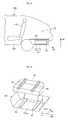
- Fig. 1 is a schematic diagram showing the structure of part of the vehicle.
- an arrow FR indicates a direction in which the vehicle moves forward
- an arrow UP indicates an upward direction of the vehicle.
- the arrow FR and the arrow UP indicate those directions in the other figures.
- a seat 110 is disposed in the vehicle interior.
- the vehicle interior refers to the space where an occupant rides.
- the seat 110 is fixed to a floor panel 120 of a vehicle 100.
- the floor panel 120 is a portion of a vehicle body.
- a luggage space LS is provided at the back of the seat 110 in the vehicle 100.
- the luggage space LS is a space mainly for putting luggage.
- the luggage space LS communicates with the vehicle interior in the vehicle 100 of the present embodiment, the present invention is not limited thereto. Specifically, the luggage space LS and the vehicle interior may be separated by a member mounted on the vehicle 100.
- the floor panel 120 has a concave portion 121 at the position associated with the luggage space LS.
- the concave portion 121 is positioned below the luggage space LS and opened upward in the vehicle 100.
- the concave portion 121 may be used for housing a spare tire.
- a battery pack 10 is housed in the concave portion 121. The battery pack 10 does not protrude from the concave portion 121 toward the luggage space LS.
- the deck board 20 is formed in a flat plate shape and used for defining the luggage space LS.
- the space of the vehicle 100 that is located above the deck board 20 serves as the luggage space LS.
- the battery pack 10 has an assembled battery 11 and a case 12 for housing the assembled battery 11.
- the assembled battery 11 has a plurality of cells connected electrically in series.
- a secondary battery such as a nickel metal hydride battery or a lithium-ion battery can be used as the cell.
- An electric double layer capacitor may be used instead of the secondary battery.
- the cell may have any shape.
- a so-called cylindrical-type or square-type cell can be used as the cell.
- the cylindrical-type cell has an outer shape conforming to a cylinder.
- the square-type cell has an outer shape conforming to a rectangular parallelepiped.
- An electric energy output from the assembled battery 11 is used for running the vehicle 100.
- the electric power output from the assembled battery 11 is supplied to a motor generator.
- the motor generator receives the electric power output from the assembled battery 11 to produce a kinetic energy for use in running of the vehicle.
- the motor generator is coupled to wheels, and the kinetic energy produced by the motor generator is transferred to the wheels.
- the motor generator converts a kinetic energy generated in braking of the vehicle 100 into an electric energy.
- the electric power produced by the motor generator can be supplied to the assembled battery 11 to charge the assembled battery 11.
- a DC/DC converter and an inverter can be placed on a current path connecting the assembled battery 11 with the motor generator.
- the DC/DC converter can be used to increase the voltage output from the assembled battery 11 to supply the increased voltage to the motor generator.
- the inverter can be used to allow an AC motor to be used as the motor generator.
- the assembled battery 11 may include a plurality of cells connected electrically in parallel.
- the number of the cells constituting the assembled battery 11 can be set as appropriate in view of the output or the like required of the assembled battery 11.
- the case 12 can be made of metal, for example.
- the assembled battery 11 is fixed to an inner wall face of the case 12.
- the assembled battery 11 can be fixed to the case 12 by fastening with bolts.
- the case 12 is fixed to a bottom face of the concave portion 121.
- the case 12 can house other devices in addition to the assembled battery 11.
- the other devices include a system main relay, a battery monitoring unit, a current sensor, and a current breaker.
- the system main relay is switched between ON and OFF to connect the assembled battery 11 with the motor generator or to disconnect the assembled battery 11 from the motor generator.
- the battery monitoring unit can monitor the voltage of the assembled battery 11 or monitors the temperature of the assembled battery 11 based on the output from a temperature sensor.
- the current sensor detects the values of current when the assembled battery 11 is charged and discharged.
- the current breaker includes a plug and can break the current passing through the assembled battery 11 when the plug is withdrawn.
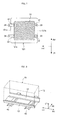
- Fig. 2 is a perspective view of a mounting structure for the battery pack 10.
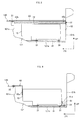
- Fig. 3 is a side view of the mounting structure for the battery pack 10.
- Fig. 4 is a top view of the mounting structure for the battery pack 10.
- an arrow RH indicates a right direction when the vehicle faces forward
- an arrow LH indicates a left direction when the vehicle faces forward.
- Two first reinforcements 41 are disposed on a bottom face 121a of the concave portion 121.
- the first reinforcement 41 is fixed to the bottom face 121a of the concave portion 121.
- the first reinforcement 41 is only required to be fixed to the bottom face 121a of the concave portion 121.
- the fixing of the first reinforcement 41 to the concave portion 121 (bottom face 121a) is performed, for example by welding or fastening with bolts.
- the first reinforcement 41 extends in a front-rear direction of the vehicle 100 (the direction of the arrow FR), and the two first reinforcements 41 are placed side by side in a left-right direction of the vehicle 100 (the directions of the arrow RH and the arrow LH).
- the first reinforcement 41 has an open section structure in a plane orthogonal to the front-rear direction of the vehicle 100.
- the length of the first reinforcement 41 in the front-rear direction of the vehicle 100 can be set as appropriate.
- the first reinforcement 41 is preferably provided from one end to the other end of the bottom face 121a in the front-rear direction of the vehicle 100.
- the first reinforcement 41 is formed of a member different from that of the concave portion 121 (bottom face 121a) in the present embodiment, the present invention is not limited thereto. Specifically, the first reinforcement 41 and the concave portion 121 can be formed integrally in one piece, and in this case, a portion of the concave portion 121 corresponds to the first reinforcement 41.
- a bottom face of the battery pack 10 (case 12) is fixed to an upper face of the first reinforcement 41.
- the bottom face of the battery pack 10 (case 12) is fastened to the first reinforcement 41 by using bolts 31 serving as fastening members.
- the positions to fasten the battery pack 10 to the first reinforcements 41 and the number of the fastening points can be set as appropriate.
- the area of the battery pack 10 located closer to the front of the vehicle 100 and the area located closer to the back of the vehicle 100 are fastened to the concave portion 121 by the bolts 31.
- the battery pack 10 is fastened at two positions for each of the first reinforcements 41.
- Such a fastening structure using the bolts 31 may be different from the structure shown in Fig. 3 . It is only required that the battery pack 100 should be fastened to the concave portion 121 with the bolts 31.
- the bolts 31 are provided for the first reinforcements 41 in the present embodiment, the bolts 31 may be provided for the battery pack 10.
- Two second reinforcements 42 are disposed over the upper face of the battery pack 10.
- the second reinforcement 42 extends in the front-rear direction of the vehicle 100 (the direction of the arrow FR).
- the two second reinforcements 42 are placed side by side in the left-right direction of the vehicle 100 (the directions of the arrow RH and the arrow LH).
- the positions to place the second reinforcements 42 can be set as appropriate.
- the second reinforcements 42 can be placed at the positions opposite to the first reinforcements 41 in an up-down direction of the vehicle 100.
- the second reinforcements 42 and the first reinforcements 41 may not be opposite to each other in the up-down direction of the vehicle 100.
- the first reinforcement 41 and the second reinforcement 42 surround the battery pack 10 together with the concave portion 121.
- the upper face of the first reinforcement 41 is in contact with the bottom face of the battery pack 10.
- the second reinforcement 42 may be in contact with the upper face of the battery pack 10 or may be separate from the upper face of the battery pack 10.
- One end 42a of the second reinforcement 42 is fixed to a side face 121b of the concave portion 121. Specifically, the end 42a of the second reinforcement 42 is fastened to the side face 121b of the concave portion 121 by using a bolt 32 serving as a fastening member.
- the side face 121b refers to the side face of the concave portion 121 that is located closer to the back of the vehicle 100 and extends upward from the bottom face 121a in the vehicle 100.
- Such a structure for fastening the second reinforcement 42 to the concave portion 121 using the bolt 32 may be different from the structure shown in Fig. 3 . It is only required that the one end 42a of the second reinforcement 42 should be fastened to the concave portion 121 with the bolt 32.
- the other end 42b of the second reinforcement 42 is fastened to a side face 121c of the concave portion 121 by another bolt 32 serving as a fastening member.
- the side face 121c refers to the side face of the concave portion 121 that is located closer to the front of the vehicle 100 and extends upward from the bottom face 121a in the vehicle 100.
- the second reinforcement 42 is disposed over the upper face of the battery pack 10 within the concave portion 121.
- the deck board 20 is disposed above the second reinforcement 42.
- the two side faces 121b and 121c are opposite to each other in the front-rear direction of the vehicle 100.
- Such a structure for fastening the second reinforcement 42 to the concave portion 121 with the bolt 32 may be different from the structure shown in Fig. 3 . It is only required that the other end 42b of the second reinforcement 42 should be fastened to the concave portion 121 with the bolt 32.
- first reinforcement 41 and the second reinforcement 42 extend in the front-rear direction of the vehicle 100 in the present embodiment
- the present invention is not limited thereto. It is only required that the first reinforcement 41 and the second reinforcement 42 should extend in the same direction.
- the first reinforcement 41 and the second reinforcement 42 may be disposed such that the first reinforcement 41 and the second reinforcement 42 extend in the left-right direction of the vehicle 100 (the directions of the arrow RH and the arrow LH).
- the first reinforcement 41 and the second reinforcement 42 may be disposed such that the first reinforcement 41 and the second reinforcement 42 extend in a direction at an angle with respect to the front-rear direction and the left-right direction of the vehicle 100.
- the present invention is not limited thereto.
- the number of the first reinforcements 41 and the number of the second reinforcements 42 can be set as appropriate.
- the number of the first reinforcements 41 and the number of the second reinforcements 42 may be the same or different from each other.
- the second reinforcement 42 is not fixed to the upper face of the battery pack 10 in the present embodiment, the second reinforcement 42 may be fixed to the upper face of the battery pack 10.
- the second reinforcement 42 can be welded to the upper face of the battery pack 10 or the second reinforcement 42 can be fastened to the upper face of the battery pack 10 by using bolts.
- the positions to fix the second reinforcements 42 to the battery pack 10 and the number of the fixing points can be set as appropriate.
- the first reinforcement 41 and the second reinforcement 42 can be used to increase the strength of the concave portion 121.
- the concave portion 121 is disposed in a rearward portion of the vehicle 100 and may be deformed when a shock is given to the vehicle 100 from the back.
- the first reinforcement 41 and the second reinforcement 42 can suppress such deformation of the concave portion 121 when a shock is given to the concave portion 121 from the back of the vehicle 100.
- first reinforcement 41 and the second reinforcement 42 are disposed within the concave portion 121 and extend in the front-rear direction of the vehicle 100, they can prevent the side faces 121b and 121c of the concave portion 121 from being deformed toward the inside of the concave portion 121.
- first reinforcement 41 and the second reinforcement 42 can suppress the deformation of the side face 121b toward the inside of the concave portion 121.
- the suppression of the deformation of the concave portion 121 can protect the battery pack 10 housed in the concave portion 121.
- the first reinforcement 41 is fixed to the bottom face of the battery pack 10, the strength of the battery pack 10 can be ensured. In other words, the first reinforcement 41 can suppress the deformation of the battery pack 10.
- the concave portion 121 is disposed in the rearward portion of the vehicle 100, and when the vehicle 100 collides at the back, an external force toward the front of the vehicle 100 is likely to act on the concave portion 121.
- the first reinforcement 41 and the second reinforcement 42 extending in the front-rear direction of the vehicle 100 can be used to cause the external force toward the front of the vehicle 100 to be received by the first reinforcement 41 and the second reinforcement 42, thereby facilitating the suppression of the deformation of the concave portion 121.
- a cross-member 51 can be disposed at the position adjacent to the end 42b of the second reinforcement 42.
- Fig. 5 is a side view showing a mounting structure which is a modification of the present embodiment, and corresponds to Fig. 3 .
- the cross-member 51 can be placed to direct an external force acting on the second reinforcement 42 to the cross-member 51.
- the cross-member 51 is part of the vehicle body and extends in the left-right direction of the vehicle 100.
- the cross-member 51 can be formed integrally with the floor panel 120 or can be provided independently of the floor panel 120.
- the shock When a shock is given to the vehicle 100 at the back, the shock can be directed to the cross-member 51 through the second reinforcement 42. This can prevent the application of an excessive load to the second reinforcement 42 to suppress the deformation of the second reinforcement 42.
- a cross-member 52 can be disposed at the position adjacent to the end 42a of the second reinforcement 42.
- the cross-member 52 can be disposed such that part of the cross-member 52 is adjacent to the end 42a of the second reinforcement 42 in the front-rear direction of the vehicle 100.
- the cross-member 52 extends in the left-right direction of the vehicle 100.
- the use of the cross-member 52 can increase the strength of the concave portion 121 and transfer the external force acting on the cross-member 52 to the second reinforcement 42.
- the orientation of the first reinforcement 41 and the second reinforcement 42 may be determined depending on the position where the concave portion 121 is disposed. For example, when an external force acting in the left-right direction of the vehicle 100 is likely to act on the concave portion 121, the first reinforcement 41 and the second reinforcement 42 extending in the left-right direction of the vehicle 100 may be used.
- Embodiment 2 Description is now made of a mounting structure for a battery pack which is Embodiment 2 of the present invention.
- a structure for positioning a battery pack 10 to a concave portion 121 is provided.
- the components identical to those described in Embodiment 1 are designated with the same reference numerals, and detailed description thereof is omitted. The following description is mainly focused on differences from Embodiment 1.
- Fig. 6 is a side view of a mounting structure for the battery pack in the present embodiment, and corresponds to Fig. 3 .
- Fig. 7 is a top view of the mounting structure for the battery pack in the present embodiment, and corresponds to Fig. 4 .
- the second reinforcements 42 described in Embodiment 1 are omitted in Fig. 6 and Fig. 7 , the second reinforcements 42 are used similarly in the present embodiment.
- First guide members 61 are fixed to first reinforcements 41 by using bolts 33 serving as fastening members.
- the two first reinforcements 41 are provided on a bottom face 121a of the concave portion 121, and the first guide member 61 is fixed to each of the first reinforcements 41.
- the first guide member 61 is disposed on the side of the battery pack 10 closer to the back of a vehicle 100.
- the first guide member 61 has a guide face 61a extending upward in the vehicle 100.
- a side face of the battery pack 10 is brought into contact with the guide face 61a to allow the positioning of the battery pack 10 in the concave portion 121.
- the battery pack 10 can be positioned in the front-rear direction of the vehicle 100.
- Two second guide members 62 are disposed in an upper portion of the concave portion 121.
- the second guide members 62 are fixed to an area of a floor panel 120 that is different from the concave portion 121 by using bolts 34 serving as fastening members.
- the second guide member 62 has a guide face 62a extending downward in the vehicle 100.
- the guide face 62a is located within the concave portion 121.
- the second guide member 62 is disposed on the side of the battery pack 10 closer to the front of the vehicle 100.
- the guide face 62a is brought into contact with a side face of the battery pack 10 to position the battery pack 10 in the concave portion 121.
- the battery pack 10 can be positioned in the front-rear direction of the vehicle 100.
- the first guide member 61 and the second guide member 62 can be used to position the battery pack 10 in the front-rear direction of the vehicle 100.
- the first guide member 61 and the second guide member 62 hold the battery pack 10 between them in the front-rear direction of the vehicle 100 to suppress the displacement of the battery pack 10 in the front-rear direction of the vehicle 100.
- the battery pack 10 is fastened to the first reinforcement 41 by using bolts 31.
- opening portions for inserting the bolts 31 are formed in the battery pack 10 (case 12) and the first reinforcement 41.
- the opening portions in the battery pack 10 need to be aligned with the opening portions in the first reinforcement 41.
- the first guide member 61 and the second guide member 62 can be used to position the battery pack 10 in the front-rear direction of the vehicle 100. This can place the battery pack 10 at the position where the bolts 31 can be tightened, so that the fastening with the bolts 31 can be easily performed.
- the battery pack 10 can be moved along the first guide members 61 (guide faces 61a) and the second guide members 62 (guide faces 62a) as in the present embodiment to move the battery pack 10 to a predetermined mounting position.
- the predetermined mounting position refers to the position where the battery pack 10 can be fastened to the first reinforcement 41 by the bolts 31.
- first guide member 61 and the second guide member 62 are used to position the battery pack 10 in the present embodiment, the present invention is not limited thereto. Only one of the first guide member 61 and the second guide member 62 may be used to position the battery pack 10.
- first guide members 61 and the two second guide members 62 are used in the present embodiment, the present invention is not limited thereto.
- the number of the first guide members 61 and the number of the second guide members 62 can be set as appropriate.
- the number of the first guide members 61 and the number of the second guide members 62 may be the same or different from each other.
- the positions to place the first guide members 61 and the second guide members 62 may be determined in view of the position where the battery pack 10 is mounted.
- the present invention is not limited thereto.
- the guide members can be disposed on both sides of the battery pack 10 in the left-right direction of the vehicle 100.
- the battery pack 10 can be positioned in the left-right direction of the vehicle 100.
- first guide member 61 is disposed on the bottom face 121a of the concave portion 121 in the present embodiment, the first guide member 61 may be disposed in an upper portion of the concave portion 121.
- second guide member 62 is disposed in the upper portion of the concave portion 121, the second guide member 62 may be disposed on the bottom face 121a of the concave portion 121.
- the positions of the first guide member 61 and the second guide member 62 in the up-down direction of the vehicle 100 can be set as appropriate.
- FIG. 8 shows the positional relationship between the structure of part of a battery pack 10 and a first reinforcement 41.
- the components identical to those described in Embodiments 1 and 2 are designated with the same reference numerals, and detailed description thereof is omitted. The following description is mainly focused on differences from Embodiments 1 and 2.
- Two reinforcements (corresponding to third reinforcements) 13 are provided for the battery pack 10 (case 12). Each of the reinforcements 13 extends in the left-right direction of a vehicle 100, and the two reinforcements 13 are placed side by side in the front-rear direction of the vehicle 100.
- an assembled battery 11 housed in the case 12 has a plurality of cells (corresponding to electric storage elements) 11a.
- the plurality of cells 11a are disposed along the direction in which the reinforcement 13 extends (in other words, the left-right direction of the vehicle 100).
- a so-called square-type cell is used as the cell 11a.
- the two reinforcements 13 are disposed along bottom faces of the cells 11a.
- a battery module (corresponding to the electric storage element) may be used.
- the battery module is formed of a plurality of cells connected electrically in series. A plurality of such battery modules can be placed in the direction in which the reinforcement 13 extends.
- the two reinforcements 13 and the two first reinforcements 41 are fastened to each other by using bolts serving as fastening members.
- Each of the reinforcements 13 intersects the two reinforcements 41, and the intersection serves as the fastening point.
- the reinforcements 13 for the battery pack 10 can be fastened to the first reinforcements 41 to increase the strength of the battery pack 10. Since the reinforcement 13 extends in the left-right direction of the vehicle 100, the strength of the battery pack 10 can be increased in the left-right direction of the vehicle 100. Since the first reinforcement 41 extends in the front-rear direction of the vehicle 100, the strength of the battery pack 10 can be increased in the front-rear direction of the vehicle 100.
- the reinforcement 13 for the battery pack 10 extends in the left-right direction of the vehicle 100 and the first reinforcement 41 extends in the front-rear direction of the vehicle 100 in the present embodiment
- the present invention is not limited thereto.
- the reinforcement 13 may extend in the front-rear direction of the vehicle 100 and the first reinforcement 41 may extend in the left-right direction of the vehicle 100. It is only required that the reinforcements 13 and 41 should intersect in a plane including the front-rear direction and the left-right direction of the vehicle 100.
- the present invention is not limited thereto.
- a reinforcement may be disposed on an upper face of the battery pack 10.
- the reinforcement disposed on the upper face of the battery pack 10 extends in the left-right direction of the vehicle 100 similarly to the reinforcement 13.
- the reinforcement disposed on the upper face of the battery pack 10 can be fastened to a second reinforcement 42 by using bolts. This can increase the strength of the battery pack 10 at the upper face.
Landscapes
- Engineering & Computer Science (AREA)
- Power Engineering (AREA)
- Transportation (AREA)
- Mechanical Engineering (AREA)
- Life Sciences & Earth Sciences (AREA)
- Sustainable Development (AREA)
- Sustainable Energy (AREA)
- Chemical & Material Sciences (AREA)
- Combustion & Propulsion (AREA)
- Aviation & Aerospace Engineering (AREA)
- Chemical Kinetics & Catalysis (AREA)
- Electrochemistry (AREA)
- General Chemical & Material Sciences (AREA)
- Arrangement Or Mounting Of Propulsion Units For Vehicles (AREA)
- Body Structure For Vehicles (AREA)
- Battery Mounting, Suspending (AREA)
Abstract
Description
- The present invention relates to a structure for mounting an electric storage apparatus on a vehicle.
- Patent Documents 1 to 3 have described vehicles in which a battery pack or an electric double layer capacitor is fixed to a vehicle body. In the vehicle described in Patent Document 1, a concave portion is formed in a floor of the vehicle body and the battery pack is housed into the concave portion.
-
- [Patent Document 1] Japanese Patent Laid-Open No.
2004-345454 - [Patent Document 2] Japanese Patent Laid-Open No.
2004-243885 - [Patent Document 3] Japanese Patent Laid-Open No.
2000-351329 - When the battery pack is housed in the concave portion formed in the floor of the vehicle body as in the structure described in Patent Document 1, it is necessary to ensure the strength of the concave portion. If the concave portion is easily deformable, the battery pack housed in the concave portion may be given a shock.
- According to an aspect, the present invention provides a mounting structure for an electric storage apparatus including the electric storage apparatus, a vehicle body, a first reinforcement, and a second reinforcement. The electric storage apparatus outputs an energy for use in running of a vehicle. The vehicle body includes a concave portion opened upward in the vehicle. The concave portion houses the electric storage apparatus. The first reinforcement is disposed along a bottom face of the concave portion and extends in a predetermined direction. The second reinforcement is disposed along an upper face of the electric storage apparatus and extends in the predetermined direction.
- According to the present invention, the first reinforcement and the second reinforcement extending in the predetermined direction can be used to increase the strength of the concave portion. Since the first reinforcement is disposed along the bottom face of the concave portion and the second reinforcement is disposed along the upper face of the electric storage apparatus, that is, along an upper portion of the concave portion, the strength of the entire concave portion can be increased. The strength of the concave portion can be ensured to protect the electric storage apparatus housed in the concave portion.
- The first reinforcement may be formed independently of the concave portion or may be formed integrally with the concave portion. When the first reinforcement and the concave portion are formed integrally, the number of parts can be reduced. An end portion of the second reinforcement in the predetermined direction can be disposed at a position adjacent to a cross-member which is a portion of the vehicle body and extends in a left-right direction of the vehicle. When an external force in the predetermined direction acts on the second reinforce, the end portion of the second reinforcement can be abutted on the cross-member to direct the external force acting on the second reinforcement to the cross-member.
- In a configuration in which a fastening member is used to fasten the electric storage apparatus to the bottom face of the concave portion, a guide member can be used to guide the electric storage apparatus to a mounting position in the concave portion. The mounting position refers to the position where the electric storage apparatus can be fastened to the concave portion by the fastening member. In fastening the electric storage apparatus to the bottom face of the concave portion, the electric storage apparatus obstructs an operator's view to cause the operator to have difficulty in mounting the electric storage apparatus at the mounting position. To address this, the guide member can be used to place the electric storage apparatus easily at the mounting position.
- The guide member can be disposed at each of positions between which the electric storage apparatus is sandwiched in the predetermined direction. This can perform the positioning of the electric storage apparatus in the predetermined direction. When such a plurality of guide members are used, a first guide member can be disposed along the bottom face of the concave portion, and a second guide member can be disposed along the upper portion of the concave portion.
- The electric storage apparatus can have a third reinforcement disposed along the upper face or a lower face of the electric storage apparatus. The third reinforcement can be used to increase the strength of the electric storage apparatus. When the electric storage apparatus includes a plurality of electric storage elements, the plurality of electric storage elements can be disposed along the direction in which the third reinforcement extends.
- The third reinforcement can be disposed to extend in the direction intersecting the first reinforcement or the second reinforcement. The third reinforcement can be fixed to the first reinforcement or the second reinforcement at the portion intersecting the first reinforcement or the second reinforcement. The third reinforcement can be fixed to the first reinforcement or the second reinforcement to ensure the strength of the electric storage apparatus also in the direction in which the first reinforcement or the second reinforcement extends.
- The concave portion can be located below a luggage space of the vehicle. The first reinforcement and the second reinforcement can be disposed to extend in a front-rear direction of the vehicle. When the concave portion is disposed below the luggage space, the concave portion is likely to be given a shock from the back of the vehicle. With the first reinforcement and the second reinforcement extending in the front-rear direction of the vehicle, the first reinforcement and the second reinforcement can receive the shock if it is given to the concave portion from the back of the vehicle, thereby suppressing the deformation of the concave portion.
-
- [
Fig. 1 ] A schematic diagram showing the structure of part of a vehicle. - [
Fig. 2 ] A perspective view of a mounting structure for a battery pack in Embodiment 1. - [
Fig. 3 ] A side view of the mounting structure for the battery pack in Embodiment 1. - [
Fig. 4 ] A top view of the mounting structure for the battery pack in Embodiment 1. - [
Fig. 5 ] A side view of a mounting structure for a battery pack in a modification of Embodiment 1. - [
Fig. 6 ] A side view of a mounting structure for a battery pack in Embodiment 2. - [
Fig. 7 ] A top view of the mounting structure for the battery pack in Embodiment 2. - [
Fig. 8 ] A diagram showing the positional relationship between a reinforcement for a battery pack and a reinforcement provided for a floor panel in Embodiment 3. - [
Fig. 9 ] An external view of an assembled battery in Embodiment 3. - Embodiments of the present invention will hereinafter be described.
- Description is now made of a mounting structure for a battery pack (electric storage apparatus) which is Embodiment 1 of the present invention. The battery pack of the present embodiment is mounted on a vehicle. Examples of the vehicle include a hybrid vehicle and an electric vehicle. The hybrid vehicle has not only the battery pack but also a fuel cell or an engine as the power source for running the vehicle. The electric vehicle has only the battery pack as the power source for running the vehicle.
-
Fig. 1 is a schematic diagram showing the structure of part of the vehicle. InFig. 1 , an arrow FR indicates a direction in which the vehicle moves forward, and an arrow UP indicates an upward direction of the vehicle. The arrow FR and the arrow UP indicate those directions in the other figures. - A
seat 110 is disposed in the vehicle interior. The vehicle interior refers to the space where an occupant rides. Theseat 110 is fixed to afloor panel 120 of avehicle 100. Thefloor panel 120 is a portion of a vehicle body. A luggage space LS is provided at the back of theseat 110 in thevehicle 100. The luggage space LS is a space mainly for putting luggage. Although the luggage space LS communicates with the vehicle interior in thevehicle 100 of the present embodiment, the present invention is not limited thereto. Specifically, the luggage space LS and the vehicle interior may be separated by a member mounted on thevehicle 100. - The
floor panel 120 has aconcave portion 121 at the position associated with the luggage space LS. Theconcave portion 121 is positioned below the luggage space LS and opened upward in thevehicle 100. In a conventional vehicle, theconcave portion 121 may be used for housing a spare tire. In thevehicle 100 of the present embodiment, abattery pack 10 is housed in theconcave portion 121. Thebattery pack 10 does not protrude from theconcave portion 121 toward the luggage space LS. - An upper face of the
battery pack 10 is covered with adeck board 20. Thedeck board 20 is formed in a flat plate shape and used for defining the luggage space LS. The space of thevehicle 100 that is located above thedeck board 20 serves as the luggage space LS. - The
battery pack 10 has an assembledbattery 11 and acase 12 for housing the assembledbattery 11. The assembledbattery 11 has a plurality of cells connected electrically in series. A secondary battery such as a nickel metal hydride battery or a lithium-ion battery can be used as the cell. An electric double layer capacitor may be used instead of the secondary battery. - The cell may have any shape. For example, a so-called cylindrical-type or square-type cell can be used as the cell. The cylindrical-type cell has an outer shape conforming to a cylinder. The square-type cell has an outer shape conforming to a rectangular parallelepiped.
- An electric energy output from the assembled
battery 11 is used for running thevehicle 100. Specifically, the electric power output from the assembledbattery 11 is supplied to a motor generator. The motor generator receives the electric power output from the assembledbattery 11 to produce a kinetic energy for use in running of the vehicle. The motor generator is coupled to wheels, and the kinetic energy produced by the motor generator is transferred to the wheels. - For decelerating or stopping the
vehicle 100, the motor generator converts a kinetic energy generated in braking of thevehicle 100 into an electric energy. The electric power produced by the motor generator can be supplied to the assembledbattery 11 to charge the assembledbattery 11. A DC/DC converter and an inverter can be placed on a current path connecting the assembledbattery 11 with the motor generator. The DC/DC converter can be used to increase the voltage output from the assembledbattery 11 to supply the increased voltage to the motor generator. The inverter can be used to allow an AC motor to be used as the motor generator. - The assembled
battery 11 may include a plurality of cells connected electrically in parallel. The number of the cells constituting the assembledbattery 11 can be set as appropriate in view of the output or the like required of the assembledbattery 11. Thecase 12 can be made of metal, for example. The assembledbattery 11 is fixed to an inner wall face of thecase 12. For example, the assembledbattery 11 can be fixed to thecase 12 by fastening with bolts. Thecase 12 is fixed to a bottom face of theconcave portion 121. - The
case 12 can house other devices in addition to the assembledbattery 11. Examples of the other devices include a system main relay, a battery monitoring unit, a current sensor, and a current breaker. The system main relay is switched between ON and OFF to connect the assembledbattery 11 with the motor generator or to disconnect the assembledbattery 11 from the motor generator. The battery monitoring unit can monitor the voltage of the assembledbattery 11 or monitors the temperature of the assembledbattery 11 based on the output from a temperature sensor. The current sensor detects the values of current when the assembledbattery 11 is charged and discharged. The current breaker includes a plug and can break the current passing through the assembledbattery 11 when the plug is withdrawn. -
Fig. 2 is a perspective view of a mounting structure for thebattery pack 10.Fig. 3 is a side view of the mounting structure for thebattery pack 10.Fig. 4 is a top view of the mounting structure for thebattery pack 10. InFig. 2 andFig. 4 , an arrow RH indicates a right direction when the vehicle faces forward, and an arrow LH indicates a left direction when the vehicle faces forward. - Two
first reinforcements 41 are disposed on abottom face 121a of theconcave portion 121. Thefirst reinforcement 41 is fixed to thebottom face 121a of theconcave portion 121. Thefirst reinforcement 41 is only required to be fixed to thebottom face 121a of theconcave portion 121. The fixing of thefirst reinforcement 41 to the concave portion 121 (bottom face 121a) is performed, for example by welding or fastening with bolts. - The
first reinforcement 41 extends in a front-rear direction of the vehicle 100 (the direction of the arrow FR), and the twofirst reinforcements 41 are placed side by side in a left-right direction of the vehicle 100 (the directions of the arrow RH and the arrow LH). Thefirst reinforcement 41 has an open section structure in a plane orthogonal to the front-rear direction of thevehicle 100. The length of thefirst reinforcement 41 in the front-rear direction of thevehicle 100 can be set as appropriate. Thefirst reinforcement 41 is preferably provided from one end to the other end of thebottom face 121a in the front-rear direction of thevehicle 100. - Although the
first reinforcement 41 is formed of a member different from that of the concave portion 121 (bottom face 121a) in the present embodiment, the present invention is not limited thereto. Specifically, thefirst reinforcement 41 and theconcave portion 121 can be formed integrally in one piece, and in this case, a portion of theconcave portion 121 corresponds to thefirst reinforcement 41. - A bottom face of the battery pack 10 (case 12) is fixed to an upper face of the
first reinforcement 41. Specifically, as shown inFig. 3 , the bottom face of the battery pack 10 (case 12) is fastened to thefirst reinforcement 41 by usingbolts 31 serving as fastening members. The positions to fasten thebattery pack 10 to thefirst reinforcements 41 and the number of the fastening points can be set as appropriate. - In the present embodiment, the area of the
battery pack 10 located closer to the front of thevehicle 100 and the area located closer to the back of thevehicle 100 are fastened to theconcave portion 121 by thebolts 31. Thebattery pack 10 is fastened at two positions for each of thefirst reinforcements 41. - Such a fastening structure using the
bolts 31 may be different from the structure shown inFig. 3 . It is only required that thebattery pack 100 should be fastened to theconcave portion 121 with thebolts 31. For example, although thebolts 31 are provided for thefirst reinforcements 41 in the present embodiment, thebolts 31 may be provided for thebattery pack 10. - Two
second reinforcements 42 are disposed over the upper face of thebattery pack 10. Thesecond reinforcement 42 extends in the front-rear direction of the vehicle 100 (the direction of the arrow FR). The twosecond reinforcements 42 are placed side by side in the left-right direction of the vehicle 100 (the directions of the arrow RH and the arrow LH). The positions to place thesecond reinforcements 42 can be set as appropriate. For example, thesecond reinforcements 42 can be placed at the positions opposite to thefirst reinforcements 41 in an up-down direction of thevehicle 100. Alternatively, thesecond reinforcements 42 and thefirst reinforcements 41 may not be opposite to each other in the up-down direction of thevehicle 100. - As shown in
Fig. 3 , thefirst reinforcement 41 and thesecond reinforcement 42 surround thebattery pack 10 together with theconcave portion 121. The upper face of thefirst reinforcement 41 is in contact with the bottom face of thebattery pack 10. Thesecond reinforcement 42 may be in contact with the upper face of thebattery pack 10 or may be separate from the upper face of thebattery pack 10. - One
end 42a of thesecond reinforcement 42 is fixed to aside face 121b of theconcave portion 121. Specifically, theend 42a of thesecond reinforcement 42 is fastened to theside face 121b of theconcave portion 121 by using abolt 32 serving as a fastening member. Theside face 121b refers to the side face of theconcave portion 121 that is located closer to the back of thevehicle 100 and extends upward from thebottom face 121a in thevehicle 100. - Such a structure for fastening the
second reinforcement 42 to theconcave portion 121 using thebolt 32 may be different from the structure shown inFig. 3 . It is only required that the oneend 42a of thesecond reinforcement 42 should be fastened to theconcave portion 121 with thebolt 32. - The
other end 42b of thesecond reinforcement 42 is fastened to aside face 121c of theconcave portion 121 by anotherbolt 32 serving as a fastening member. Theside face 121c refers to the side face of theconcave portion 121 that is located closer to the front of thevehicle 100 and extends upward from thebottom face 121a in thevehicle 100. In the present embodiment, thesecond reinforcement 42 is disposed over the upper face of thebattery pack 10 within theconcave portion 121. Thedeck board 20 is disposed above thesecond reinforcement 42. - The two side faces 121b and 121c are opposite to each other in the front-rear direction of the
vehicle 100. Such a structure for fastening thesecond reinforcement 42 to theconcave portion 121 with thebolt 32 may be different from the structure shown inFig. 3 . It is only required that theother end 42b of thesecond reinforcement 42 should be fastened to theconcave portion 121 with thebolt 32. - Although the
first reinforcement 41 and thesecond reinforcement 42 extend in the front-rear direction of thevehicle 100 in the present embodiment, the present invention is not limited thereto. It is only required that thefirst reinforcement 41 and thesecond reinforcement 42 should extend in the same direction. For example, thefirst reinforcement 41 and thesecond reinforcement 42 may be disposed such that thefirst reinforcement 41 and thesecond reinforcement 42 extend in the left-right direction of the vehicle 100 (the directions of the arrow RH and the arrow LH). Alternatively, thefirst reinforcement 41 and thesecond reinforcement 42 may be disposed such that thefirst reinforcement 41 and thesecond reinforcement 42 extend in a direction at an angle with respect to the front-rear direction and the left-right direction of thevehicle 100. - Although the two
first reinforcements 41 are disposed below the lower face of thebattery pack 10 and the twosecond reinforcements 42 are disposed over the upper face of thebattery pack 10 in the present embodiment, the present invention is not limited thereto. The number of thefirst reinforcements 41 and the number of thesecond reinforcements 42 can be set as appropriate. The number of thefirst reinforcements 41 and the number of thesecond reinforcements 42 may be the same or different from each other. - Although the
second reinforcement 42 is not fixed to the upper face of thebattery pack 10 in the present embodiment, thesecond reinforcement 42 may be fixed to the upper face of thebattery pack 10. For example, thesecond reinforcement 42 can be welded to the upper face of thebattery pack 10 or thesecond reinforcement 42 can be fastened to the upper face of thebattery pack 10 by using bolts. The positions to fix thesecond reinforcements 42 to thebattery pack 10 and the number of the fixing points can be set as appropriate. - According to the present embodiment, the
first reinforcement 41 and thesecond reinforcement 42 can be used to increase the strength of theconcave portion 121. Theconcave portion 121 is disposed in a rearward portion of thevehicle 100 and may be deformed when a shock is given to thevehicle 100 from the back. However, thefirst reinforcement 41 and thesecond reinforcement 42 can suppress such deformation of theconcave portion 121 when a shock is given to theconcave portion 121 from the back of thevehicle 100. - Since the
first reinforcement 41 and thesecond reinforcement 42 are disposed within theconcave portion 121 and extend in the front-rear direction of thevehicle 100, they can prevent the side faces 121b and 121c of theconcave portion 121 from being deformed toward the inside of theconcave portion 121. When a shock is given to theconcave portion 121 from the back of thevehicle 100, thefirst reinforcement 41 and thesecond reinforcement 42 can suppress the deformation of theside face 121b toward the inside of theconcave portion 121. - The suppression of the deformation of the
concave portion 121 can protect thebattery pack 10 housed in theconcave portion 121. In addition, since thefirst reinforcement 41 is fixed to the bottom face of thebattery pack 10, the strength of thebattery pack 10 can be ensured. In other words, thefirst reinforcement 41 can suppress the deformation of thebattery pack 10. - In the present embodiment, the
concave portion 121 is disposed in the rearward portion of thevehicle 100, and when thevehicle 100 collides at the back, an external force toward the front of thevehicle 100 is likely to act on theconcave portion 121. To address this, thefirst reinforcement 41 and thesecond reinforcement 42 extending in the front-rear direction of thevehicle 100 can be used to cause the external force toward the front of thevehicle 100 to be received by thefirst reinforcement 41 and thesecond reinforcement 42, thereby facilitating the suppression of the deformation of theconcave portion 121. - As shown in
Fig. 5 , a cross-member 51 can be disposed at the position adjacent to theend 42b of thesecond reinforcement 42.Fig. 5 is a side view showing a mounting structure which is a modification of the present embodiment, and corresponds toFig. 3 . - The cross-member 51 can be placed to direct an external force acting on the
second reinforcement 42 to the cross-member 51. The cross-member 51 is part of the vehicle body and extends in the left-right direction of thevehicle 100. The cross-member 51 can be formed integrally with thefloor panel 120 or can be provided independently of thefloor panel 120. - When a shock is given to the
vehicle 100 at the back, the shock can be directed to the cross-member 51 through thesecond reinforcement 42. This can prevent the application of an excessive load to thesecond reinforcement 42 to suppress the deformation of thesecond reinforcement 42. - As shown in
Fig. 5 , a cross-member 52 can be disposed at the position adjacent to theend 42a of thesecond reinforcement 42. Specifically, the cross-member 52 can be disposed such that part of the cross-member 52 is adjacent to theend 42a of thesecond reinforcement 42 in the front-rear direction of thevehicle 100. The cross-member 52 extends in the left-right direction of thevehicle 100. The use of the cross-member 52 can increase the strength of theconcave portion 121 and transfer the external force acting on the cross-member 52 to thesecond reinforcement 42. - The orientation of the
first reinforcement 41 and thesecond reinforcement 42, that is, the longitudinal direction of thefirst reinforcement 41 and thesecond reinforcement 42, may be determined depending on the position where theconcave portion 121 is disposed. For example, when an external force acting in the left-right direction of thevehicle 100 is likely to act on theconcave portion 121, thefirst reinforcement 41 and thesecond reinforcement 42 extending in the left-right direction of thevehicle 100 may be used. - Description is now made of a mounting structure for a battery pack which is Embodiment 2 of the present invention. In the present embodiment, in addition to the mounting structure described in Embodiment 1, a structure for positioning a
battery pack 10 to aconcave portion 121 is provided. The components identical to those described in Embodiment 1 are designated with the same reference numerals, and detailed description thereof is omitted. The following description is mainly focused on differences from Embodiment 1. -
Fig. 6 is a side view of a mounting structure for the battery pack in the present embodiment, and corresponds toFig. 3 .Fig. 7 is a top view of the mounting structure for the battery pack in the present embodiment, and corresponds toFig. 4 . Although thesecond reinforcements 42 described in Embodiment 1 are omitted inFig. 6 andFig. 7 , thesecond reinforcements 42 are used similarly in the present embodiment. -
First guide members 61 are fixed tofirst reinforcements 41 by usingbolts 33 serving as fastening members. The twofirst reinforcements 41 are provided on abottom face 121a of theconcave portion 121, and thefirst guide member 61 is fixed to each of thefirst reinforcements 41. - The
first guide member 61 is disposed on the side of thebattery pack 10 closer to the back of avehicle 100. Thefirst guide member 61 has aguide face 61a extending upward in thevehicle 100. A side face of thebattery pack 10 is brought into contact with theguide face 61a to allow the positioning of thebattery pack 10 in theconcave portion 121. Specifically, thebattery pack 10 can be positioned in the front-rear direction of thevehicle 100. - Two
second guide members 62 are disposed in an upper portion of theconcave portion 121. Thesecond guide members 62 are fixed to an area of afloor panel 120 that is different from theconcave portion 121 by usingbolts 34 serving as fastening members. Thesecond guide member 62 has aguide face 62a extending downward in thevehicle 100. Theguide face 62a is located within theconcave portion 121. Thesecond guide member 62 is disposed on the side of thebattery pack 10 closer to the front of thevehicle 100. - The
guide face 62a is brought into contact with a side face of thebattery pack 10 to position thebattery pack 10 in theconcave portion 121. Specifically, thebattery pack 10 can be positioned in the front-rear direction of thevehicle 100. In the present embodiment, thefirst guide member 61 and thesecond guide member 62 can be used to position thebattery pack 10 in the front-rear direction of thevehicle 100. Specifically, thefirst guide member 61 and thesecond guide member 62 hold thebattery pack 10 between them in the front-rear direction of thevehicle 100 to suppress the displacement of thebattery pack 10 in the front-rear direction of thevehicle 100. - The
battery pack 10 is fastened to thefirst reinforcement 41 by usingbolts 31. Thus, opening portions for inserting thebolts 31 are formed in the battery pack 10 (case 12) and thefirst reinforcement 41. For fixing thebattery pack 10 to thefirst reinforcement 41, the opening portions in thebattery pack 10 need to be aligned with the opening portions in thefirst reinforcement 41. - In the present embodiment, the
first guide member 61 and thesecond guide member 62 can be used to position thebattery pack 10 in the front-rear direction of thevehicle 100. This can place thebattery pack 10 at the position where thebolts 31 can be tightened, so that the fastening with thebolts 31 can be easily performed. - In housing the
battery pack 10 into theconcave portion 121, an operator has difficulty in seeing the position to mount thebattery pack 10 since the operator's view is obstructed by thebattery pack 10. To address this, thebattery pack 10 can be moved along the first guide members 61 (guide faces 61a) and the second guide members 62 (guide faces 62a) as in the present embodiment to move thebattery pack 10 to a predetermined mounting position. The predetermined mounting position refers to the position where thebattery pack 10 can be fastened to thefirst reinforcement 41 by thebolts 31. - Although the
first guide member 61 and thesecond guide member 62 are used to position thebattery pack 10 in the present embodiment, the present invention is not limited thereto. Only one of thefirst guide member 61 and thesecond guide member 62 may be used to position thebattery pack 10. - Although the two
first guide members 61 and the twosecond guide members 62 are used in the present embodiment, the present invention is not limited thereto. The number of thefirst guide members 61 and the number of thesecond guide members 62 can be set as appropriate. The number of thefirst guide members 61 and the number of thesecond guide members 62 may be the same or different from each other. The positions to place thefirst guide members 61 and thesecond guide members 62 may be determined in view of the position where thebattery pack 10 is mounted. - Although the
first guide member 61 and thesecond guide member 62 are disposed on both sides of thebattery pack 10 in the front-rear direction of thevehicle 100 in the present embodiment, the present invention is not limited thereto. Specifically, the guide members can be disposed on both sides of thebattery pack 10 in the left-right direction of thevehicle 100. In this case, thebattery pack 10 can be positioned in the left-right direction of thevehicle 100. - Although the
first guide member 61 is disposed on thebottom face 121a of theconcave portion 121 in the present embodiment, thefirst guide member 61 may be disposed in an upper portion of theconcave portion 121. Although thesecond guide member 62 is disposed in the upper portion of theconcave portion 121, thesecond guide member 62 may be disposed on thebottom face 121a of theconcave portion 121. The positions of thefirst guide member 61 and thesecond guide member 62 in the up-down direction of thevehicle 100 can be set as appropriate. - Description is now made of a mounting structure for a battery pack which is Embodiment 3 of the present invention.
Fig. 8 shows the positional relationship between the structure of part of abattery pack 10 and afirst reinforcement 41. In the present embodiment, the components identical to those described in Embodiments 1 and 2 are designated with the same reference numerals, and detailed description thereof is omitted. The following description is mainly focused on differences from Embodiments 1 and 2. - Two reinforcements (corresponding to third reinforcements) 13 are provided for the battery pack 10 (case 12). Each of the
reinforcements 13 extends in the left-right direction of avehicle 100, and the tworeinforcements 13 are placed side by side in the front-rear direction of thevehicle 100. - As shown in
Fig. 9 , an assembledbattery 11 housed in thecase 12 has a plurality of cells (corresponding to electric storage elements) 11a. The plurality ofcells 11a are disposed along the direction in which thereinforcement 13 extends (in other words, the left-right direction of the vehicle 100). A so-called square-type cell is used as thecell 11a. The tworeinforcements 13 are disposed along bottom faces of thecells 11a. Instead of thecell 11a, a battery module (corresponding to the electric storage element) may be used. The battery module is formed of a plurality of cells connected electrically in series. A plurality of such battery modules can be placed in the direction in which thereinforcement 13 extends. - The two
reinforcements 13 and the twofirst reinforcements 41 are fastened to each other by using bolts serving as fastening members. Each of thereinforcements 13 intersects the tworeinforcements 41, and the intersection serves as the fastening point. - According to the present embodiment, the
reinforcements 13 for thebattery pack 10 can be fastened to thefirst reinforcements 41 to increase the strength of thebattery pack 10. Since thereinforcement 13 extends in the left-right direction of thevehicle 100, the strength of thebattery pack 10 can be increased in the left-right direction of thevehicle 100. Since thefirst reinforcement 41 extends in the front-rear direction of thevehicle 100, the strength of thebattery pack 10 can be increased in the front-rear direction of thevehicle 100. - Although the
reinforcement 13 for thebattery pack 10 extends in the left-right direction of thevehicle 100 and thefirst reinforcement 41 extends in the front-rear direction of thevehicle 100 in the present embodiment, the present invention is not limited thereto. For example, thereinforcement 13 may extend in the front-rear direction of thevehicle 100 and thefirst reinforcement 41 may extend in the left-right direction of thevehicle 100. It is only required that thereinforcements vehicle 100. - Although the
reinforcement 13 is disposed on the bottom face of thebattery pack 10 in the present embodiment, the present invention is not limited thereto. Specifically, in addition to or instead of the configuration of the present embodiment, a reinforcement may be disposed on an upper face of thebattery pack 10. The reinforcement disposed on the upper face of thebattery pack 10 extends in the left-right direction of thevehicle 100 similarly to thereinforcement 13. The reinforcement disposed on the upper face of thebattery pack 10 can be fastened to asecond reinforcement 42 by using bolts. This can increase the strength of thebattery pack 10 at the upper face.
Claims (9)
- A mounting structure for an electric storage apparatus comprising:the electric storage apparatus outputting an energy for use in running of a vehicle;a vehicle body including a concave portion, the concave portion housing the electric storage apparatus and opened upward in the vehicle;a first reinforcement disposed along a bottom face of the concave portion and extending in a predetermined direction; anda second reinforcement disposed along an upper face of the electric storage apparatus and extending in the predetermined direction.
- The mounting structure for the electric storage apparatus according to claim 1, wherein the first reinforcement is formed integrally with the concave portion.
- The mounting structure for the electric storage apparatus according to claim 1 or 2, wherein an end portion of the second reinforcement in the predetermined direction is disposed at a position adjacent to a cross-member, the cross-member being a portion of the vehicle body and extending in a left-right direction of the vehicle.
- The mounting structure for the electric storage apparatus according to any one of claims 1 to 3, further comprising:a fastening member fastening the electric storage apparatus to the bottom face of the concave portion; anda guide member guiding the electric storage apparatus to a mounting position in the concave portion.
- The mounting structure for the electric storage apparatus according to claim 4, wherein the guide member is disposed at each of positions between which the electric storage apparatus is sandwiched in the predetermined direction.
- The mounting structure for the electric storage apparatus according to claim 4 or 5, wherein the guide member includes:a first guide member disposed along the bottom face of the concave portion; anda second guide member disposed along an upper portion of the concave portion.
- The mounting structure for the electric storage apparatus according to any one of claims 1 to 6, wherein the electric storage apparatus has a third reinforcement disposed along the upper face or a lower face of the electric storage apparatus, and
the third reinforcement extends in a direction intersecting the first reinforcement or the second reinforcement and is fixed to the first reinforcement or the second reinforcement at the intersection. - The mounting structure for the electric storage apparatus according to claim 7, wherein the electric storage apparatus has a plurality of electric storage elements disposed side by side in the direction in which the third reinforcement extends.
- The mounting structure for the electric storage apparatus according to any one of claims 1 to 8, wherein the concave portion is located below a luggage space of the vehicle, and
the first reinforcement and the second reinforcement extend in a front-rear direction of the vehicle.
Applications Claiming Priority (1)
| Application Number | Priority Date | Filing Date | Title |
|---|---|---|---|
| PCT/JP2011/005690 WO2013054373A1 (en) | 2011-10-11 | 2011-10-11 | Structure for mounting electric power storage device |
Publications (3)
| Publication Number | Publication Date |
|---|---|
| EP2767427A1 true EP2767427A1 (en) | 2014-08-20 |
| EP2767427A4 EP2767427A4 (en) | 2015-04-15 |
| EP2767427B1 EP2767427B1 (en) | 2017-03-29 |
Family
ID=48081458
Family Applications (1)
| Application Number | Title | Priority Date | Filing Date |
|---|---|---|---|
| EP11873790.7A Not-in-force EP2767427B1 (en) | 2011-10-11 | 2011-10-11 | Structure for mounting electric power storage device |
Country Status (5)
| Country | Link |
|---|---|
| US (1) | US9997753B2 (en) |
| EP (1) | EP2767427B1 (en) |
| JP (1) | JP5831550B2 (en) |
| CN (1) | CN103987552B (en) |
| WO (1) | WO2013054373A1 (en) |
Cited By (3)
| Publication number | Priority date | Publication date | Assignee | Title |
|---|---|---|---|---|
| EP3064389A1 (en) * | 2015-03-06 | 2016-09-07 | Toyota Jidosha Kabushiki Kaisha | Battery unit mounting structure |
| WO2018166895A1 (en) * | 2017-03-16 | 2018-09-20 | Thyssenkrupp Steel Europe Ag | Battery housing comprising a reinforcing structure and use |
| FR3088031A1 (en) * | 2018-11-07 | 2020-05-08 | Renault S.A.S | DEVICE FOR PROTECTING A POWER SUPPLY BATTERY OF A VEHICLE |
Families Citing this family (15)
| Publication number | Priority date | Publication date | Assignee | Title |
|---|---|---|---|---|
| JP3074010B2 (en) | 1990-09-29 | 2000-08-07 | 株式会社光電製作所 | Receiving strength compatible distance measuring device |
| FR3000704B1 (en) * | 2013-01-07 | 2015-02-13 | Technoboost | HYDRAULIC MODULE HAVING HIGH AND LOW PRESSURE ACCUMULATORS FOR A HYBRID VEHICLE |
| CN105437987B (en) * | 2014-09-02 | 2020-10-13 | 葛炽昌 | Electric vehicle, power supply station, and electric power maintaining method for electric vehicle |
| JP6510243B2 (en) * | 2015-01-16 | 2019-05-08 | 株式会社Subaru | Automotive battery |
| JP6135694B2 (en) * | 2015-02-20 | 2017-05-31 | トヨタ自動車株式会社 | Car battery |
| US10358169B2 (en) * | 2015-03-06 | 2019-07-23 | Ford Global Technologies, Llc | Coverless battery assembly for electrified vehicle |
| JP6528674B2 (en) * | 2015-12-24 | 2019-06-12 | トヨタ自動車株式会社 | Vehicle rear structure |
| JP6215975B2 (en) * | 2016-01-12 | 2017-10-18 | 本田技研工業株式会社 | Battery fixing structure |
| JP6421766B2 (en) * | 2016-02-02 | 2018-11-14 | トヨタ自動車株式会社 | Frame car skeleton structure |
| US9963028B1 (en) * | 2017-02-21 | 2018-05-08 | Ford Global Technologies, Llc | Battery support structure for electrified vehicle |
| JP6769903B2 (en) * | 2017-03-29 | 2020-10-14 | 株式会社Subaru | In-vehicle battery |
| JP2021115908A (en) * | 2020-01-23 | 2021-08-10 | 株式会社豊田自動織機 | Power supply unit mounting vehicle and power supply unit mounting method |
| JP7448001B2 (en) * | 2020-05-29 | 2024-03-12 | 日産自動車株式会社 | Battery cooling air exhaust structure |
| JP7533247B2 (en) * | 2021-01-28 | 2024-08-14 | トヨタ自動車株式会社 | Power storage device |
| JP7647778B2 (en) * | 2023-02-02 | 2025-03-18 | いすゞ自動車株式会社 | Placement device |
Family Cites Families (21)
| Publication number | Priority date | Publication date | Assignee | Title |
|---|---|---|---|---|
| US1173616A (en) * | 1915-09-21 | 1916-02-29 | William P Stone | Storage-battery carrier. |
| US4317497A (en) * | 1980-07-28 | 1982-03-02 | General Motors Corporation | Battery tray for electric vehicle |
| JPH05201356A (en) * | 1992-01-24 | 1993-08-10 | Honda Motor Co Ltd | Car body structure of electric automobile |
| JP3817953B2 (en) | 1999-02-22 | 2006-09-06 | マツダ株式会社 | Vehicle battery mounting structure |
| JP2000351329A (en) | 2000-01-01 | 2000-12-19 | Osaka Gas Co Ltd | Electric automobile using large capacity electric double layer capacitor as power source |
| JP4221998B2 (en) | 2002-10-28 | 2009-02-12 | スズキ株式会社 | Electric equipment fixing structure of vehicle |
| JP4178986B2 (en) | 2003-02-13 | 2008-11-12 | トヨタ自動車株式会社 | Mounting structure for electrical equipment for vehicles |
| JP4060234B2 (en) | 2003-05-21 | 2008-03-12 | 本田技研工業株式会社 | In-vehicle structure of high-voltage equipment components |
| US7051825B2 (en) | 2003-05-21 | 2006-05-30 | Honda Motor Co., Ltd. | Structure for installing high-voltage equipment component to vehicle |
| JP4222109B2 (en) * | 2003-05-28 | 2009-02-12 | 株式会社豊田自動織機 | Battery guide for industrial vehicles |
| JP2007069801A (en) | 2005-09-08 | 2007-03-22 | Toyota Motor Corp | Power supply device mounting structure |
| JP4752482B2 (en) * | 2005-12-13 | 2011-08-17 | マツダ株式会社 | Car body rear structure |
| JP2007331719A (en) | 2006-06-19 | 2007-12-27 | Toyota Motor Corp | High piezoelectric equipment installation structure |
| JP4748010B2 (en) * | 2006-09-19 | 2011-08-17 | トヨタ自動車株式会社 | Power supply |
| JP2008247371A (en) * | 2007-03-30 | 2008-10-16 | Toyota Auto Body Co Ltd | Storage structure of battery pack for electric vehicle |
| JP4302152B2 (en) * | 2007-04-20 | 2009-07-22 | 本田技研工業株式会社 | Vehicle floor structure |
| DE102007023391B4 (en) * | 2007-05-18 | 2019-05-02 | Dr. Ing. H.C. F. Porsche Aktiengesellschaft | Protective housing for a vehicle battery and motor vehicle with such a protective housing |
| JP4319239B2 (en) | 2008-02-07 | 2009-08-26 | 本田技研工業株式会社 | Hybrid vehicle |
| JP4946969B2 (en) * | 2008-05-16 | 2012-06-06 | トヨタ自動車株式会社 | Power supply protection structure |
| JP4769274B2 (en) | 2008-07-07 | 2011-09-07 | 本田技研工業株式会社 | Car body rear structure |
| JP2010047213A (en) * | 2008-08-25 | 2010-03-04 | Toyota Motor Corp | Vehicle rear part structure |
-
2011
- 2011-10-11 WO PCT/JP2011/005690 patent/WO2013054373A1/en not_active Ceased
- 2011-10-11 JP JP2013538340A patent/JP5831550B2/en active Active
- 2011-10-11 CN CN201180075425.3A patent/CN103987552B/en not_active Expired - Fee Related
- 2011-10-11 US US14/350,867 patent/US9997753B2/en active Active
- 2011-10-11 EP EP11873790.7A patent/EP2767427B1/en not_active Not-in-force
Cited By (7)
| Publication number | Priority date | Publication date | Assignee | Title |
|---|---|---|---|---|
| EP3064389A1 (en) * | 2015-03-06 | 2016-09-07 | Toyota Jidosha Kabushiki Kaisha | Battery unit mounting structure |
| WO2018166895A1 (en) * | 2017-03-16 | 2018-09-20 | Thyssenkrupp Steel Europe Ag | Battery housing comprising a reinforcing structure and use |
| FR3088031A1 (en) * | 2018-11-07 | 2020-05-08 | Renault S.A.S | DEVICE FOR PROTECTING A POWER SUPPLY BATTERY OF A VEHICLE |
| WO2020094662A1 (en) * | 2018-11-07 | 2020-05-14 | Renault S.A.S | Device for protecting a power supply battery of a motor vehicle |
| CN112969631A (en) * | 2018-11-07 | 2021-06-15 | 雷诺股份公司 | Device for protecting the battery of a motor vehicle |
| US11958532B2 (en) | 2018-11-07 | 2024-04-16 | Nissan Motor Co., Ltd. | Device for protecting power supply battery of motor vehicle |
| CN112969631B (en) * | 2018-11-07 | 2024-05-24 | 雷诺股份公司 | Device for protecting the battery power supply of a motor vehicle |
Also Published As
| Publication number | Publication date |
|---|---|
| US9997753B2 (en) | 2018-06-12 |
| CN103987552A (en) | 2014-08-13 |
| CN103987552B (en) | 2018-04-06 |
| JP5831550B2 (en) | 2015-12-09 |
| WO2013054373A1 (en) | 2013-04-18 |
| EP2767427A4 (en) | 2015-04-15 |
| EP2767427B1 (en) | 2017-03-29 |
| JPWO2013054373A1 (en) | 2015-03-30 |
| US20140242447A1 (en) | 2014-08-28 |
Similar Documents
| Publication | Publication Date | Title |
|---|---|---|
| EP2767427B1 (en) | Structure for mounting electric power storage device | |
| EP2767428B1 (en) | Structure for mounting electric power storage device | |
| JP4386131B2 (en) | Electric car | |
| US9077019B2 (en) | Electricity storage device and vehicle | |
| EP2611637B1 (en) | Electricity storage device and vehicle | |
| JP4849102B2 (en) | Vehicle battery pack mounting structure | |
| JP2007069801A (en) | Power supply device mounting structure | |
| EP1951554B1 (en) | Harness routing structure | |
| JP5786818B2 (en) | Power storage device mounting structure | |
| US20240063511A1 (en) | Traction battery pack busbar supporting assembly and supporting method | |
| EP4624214A1 (en) | Lower vehicle-body structure of vehicle | |
| JP2024032269A (en) | vehicle | |
| JP6500819B2 (en) | Power storage device |
Legal Events
| Date | Code | Title | Description |
|---|---|---|---|
| PUAI | Public reference made under article 153(3) epc to a published international application that has entered the european phase |
Free format text: ORIGINAL CODE: 0009012 |
|
| 17P | Request for examination filed |
Effective date: 20140509 |
|
| AK | Designated contracting states |
Kind code of ref document: A1 Designated state(s): AL AT BE BG CH CY CZ DE DK EE ES FI FR GB GR HR HU IE IS IT LI LT LU LV MC MK MT NL NO PL PT RO RS SE SI SK SM TR |
|
| DAX | Request for extension of the european patent (deleted) | ||
| RA4 | Supplementary search report drawn up and despatched (corrected) |
Effective date: 20150317 |
|
| RIC1 | Information provided on ipc code assigned before grant |
Ipc: B60K 1/04 20060101AFI20150311BHEP Ipc: B62D 25/20 20060101ALI20150311BHEP Ipc: B60K 6/28 20071001ALI20150311BHEP Ipc: B60L 11/18 20060101ALI20150311BHEP Ipc: B60K 6/40 20071001ALI20150311BHEP |
|
| 17Q | First examination report despatched |
Effective date: 20160413 |
|
| GRAP | Despatch of communication of intention to grant a patent |
Free format text: ORIGINAL CODE: EPIDOSNIGR1 |
|
| INTG | Intention to grant announced |
Effective date: 20161025 |
|
| STAA | Information on the status of an ep patent application or granted ep patent |
Free format text: STATUS: GRANT OF PATENT IS INTENDED |
|
| GRAS | Grant fee paid |
Free format text: ORIGINAL CODE: EPIDOSNIGR3 |
|
| GRAA | (expected) grant |
Free format text: ORIGINAL CODE: 0009210 |
|
| STAA | Information on the status of an ep patent application or granted ep patent |
Free format text: STATUS: THE PATENT HAS BEEN GRANTED |
|
| AK | Designated contracting states |
Kind code of ref document: B1 Designated state(s): AL AT BE BG CH CY CZ DE DK EE ES FI FR GB GR HR HU IE IS IT LI LT LU LV MC MK MT NL NO PL PT RO RS SE SI SK SM TR |
|
| REG | Reference to a national code |
Ref country code: GB Ref legal event code: FG4D |
|
| REG | Reference to a national code |
Ref country code: CH Ref legal event code: EP |
|
| REG | Reference to a national code |
Ref country code: AT Ref legal event code: REF Ref document number: 879394 Country of ref document: AT Kind code of ref document: T Effective date: 20170415 |
|
| REG | Reference to a national code |
Ref country code: IE Ref legal event code: FG4D |
|
| REG | Reference to a national code |
Ref country code: DE Ref legal event code: R096 Ref document number: 602011036560 Country of ref document: DE |
|
| REG | Reference to a national code |
Ref country code: DE Ref legal event code: R084 Ref document number: 602011036560 Country of ref document: DE |
|
| PG25 | Lapsed in a contracting state [announced via postgrant information from national office to epo] |
Ref country code: LT Free format text: LAPSE BECAUSE OF FAILURE TO SUBMIT A TRANSLATION OF THE DESCRIPTION OR TO PAY THE FEE WITHIN THE PRESCRIBED TIME-LIMIT Effective date: 20170329 Ref country code: NO Free format text: LAPSE BECAUSE OF FAILURE TO SUBMIT A TRANSLATION OF THE DESCRIPTION OR TO PAY THE FEE WITHIN THE PRESCRIBED TIME-LIMIT Effective date: 20170629 Ref country code: FI Free format text: LAPSE BECAUSE OF FAILURE TO SUBMIT A TRANSLATION OF THE DESCRIPTION OR TO PAY THE FEE WITHIN THE PRESCRIBED TIME-LIMIT Effective date: 20170329 Ref country code: HR Free format text: LAPSE BECAUSE OF FAILURE TO SUBMIT A TRANSLATION OF THE DESCRIPTION OR TO PAY THE FEE WITHIN THE PRESCRIBED TIME-LIMIT Effective date: 20170329 Ref country code: GR Free format text: LAPSE BECAUSE OF FAILURE TO SUBMIT A TRANSLATION OF THE DESCRIPTION OR TO PAY THE FEE WITHIN THE PRESCRIBED TIME-LIMIT Effective date: 20170630 |
|
| REG | Reference to a national code |
Ref country code: NL Ref legal event code: MP Effective date: 20170329 |
|
| REG | Reference to a national code |
Ref country code: AT Ref legal event code: MK05 Ref document number: 879394 Country of ref document: AT Kind code of ref document: T Effective date: 20170329 |
|
| PG25 | Lapsed in a contracting state [announced via postgrant information from national office to epo] |
Ref country code: LV Free format text: LAPSE BECAUSE OF FAILURE TO SUBMIT A TRANSLATION OF THE DESCRIPTION OR TO PAY THE FEE WITHIN THE PRESCRIBED TIME-LIMIT Effective date: 20170329 Ref country code: BG Free format text: LAPSE BECAUSE OF FAILURE TO SUBMIT A TRANSLATION OF THE DESCRIPTION OR TO PAY THE FEE WITHIN THE PRESCRIBED TIME-LIMIT Effective date: 20170629 Ref country code: RS Free format text: LAPSE BECAUSE OF FAILURE TO SUBMIT A TRANSLATION OF THE DESCRIPTION OR TO PAY THE FEE WITHIN THE PRESCRIBED TIME-LIMIT Effective date: 20170329 Ref country code: SE Free format text: LAPSE BECAUSE OF FAILURE TO SUBMIT A TRANSLATION OF THE DESCRIPTION OR TO PAY THE FEE WITHIN THE PRESCRIBED TIME-LIMIT Effective date: 20170329 |
|
| PG25 | Lapsed in a contracting state [announced via postgrant information from national office to epo] |
Ref country code: NL Free format text: LAPSE BECAUSE OF FAILURE TO SUBMIT A TRANSLATION OF THE DESCRIPTION OR TO PAY THE FEE WITHIN THE PRESCRIBED TIME-LIMIT Effective date: 20170329 |
|
| PG25 | Lapsed in a contracting state [announced via postgrant information from national office to epo] |
Ref country code: CZ Free format text: LAPSE BECAUSE OF FAILURE TO SUBMIT A TRANSLATION OF THE DESCRIPTION OR TO PAY THE FEE WITHIN THE PRESCRIBED TIME-LIMIT Effective date: 20170329 Ref country code: AT Free format text: LAPSE BECAUSE OF FAILURE TO SUBMIT A TRANSLATION OF THE DESCRIPTION OR TO PAY THE FEE WITHIN THE PRESCRIBED TIME-LIMIT Effective date: 20170329 Ref country code: IT Free format text: LAPSE BECAUSE OF FAILURE TO SUBMIT A TRANSLATION OF THE DESCRIPTION OR TO PAY THE FEE WITHIN THE PRESCRIBED TIME-LIMIT Effective date: 20170329 Ref country code: RO Free format text: LAPSE BECAUSE OF FAILURE TO SUBMIT A TRANSLATION OF THE DESCRIPTION OR TO PAY THE FEE WITHIN THE PRESCRIBED TIME-LIMIT Effective date: 20170329 Ref country code: SK Free format text: LAPSE BECAUSE OF FAILURE TO SUBMIT A TRANSLATION OF THE DESCRIPTION OR TO PAY THE FEE WITHIN THE PRESCRIBED TIME-LIMIT Effective date: 20170329 Ref country code: EE Free format text: LAPSE BECAUSE OF FAILURE TO SUBMIT A TRANSLATION OF THE DESCRIPTION OR TO PAY THE FEE WITHIN THE PRESCRIBED TIME-LIMIT Effective date: 20170329 Ref country code: ES Free format text: LAPSE BECAUSE OF FAILURE TO SUBMIT A TRANSLATION OF THE DESCRIPTION OR TO PAY THE FEE WITHIN THE PRESCRIBED TIME-LIMIT Effective date: 20170329 |
|
| PG25 | Lapsed in a contracting state [announced via postgrant information from national office to epo] |
Ref country code: IS Free format text: LAPSE BECAUSE OF FAILURE TO SUBMIT A TRANSLATION OF THE DESCRIPTION OR TO PAY THE FEE WITHIN THE PRESCRIBED TIME-LIMIT Effective date: 20170729 Ref country code: SM Free format text: LAPSE BECAUSE OF FAILURE TO SUBMIT A TRANSLATION OF THE DESCRIPTION OR TO PAY THE FEE WITHIN THE PRESCRIBED TIME-LIMIT Effective date: 20170329 Ref country code: PT Free format text: LAPSE BECAUSE OF FAILURE TO SUBMIT A TRANSLATION OF THE DESCRIPTION OR TO PAY THE FEE WITHIN THE PRESCRIBED TIME-LIMIT Effective date: 20170731 Ref country code: PL Free format text: LAPSE BECAUSE OF FAILURE TO SUBMIT A TRANSLATION OF THE DESCRIPTION OR TO PAY THE FEE WITHIN THE PRESCRIBED TIME-LIMIT Effective date: 20170329 |
|
| REG | Reference to a national code |
Ref country code: DE Ref legal event code: R097 Ref document number: 602011036560 Country of ref document: DE |
|
| PG25 | Lapsed in a contracting state [announced via postgrant information from national office to epo] |
Ref country code: DK Free format text: LAPSE BECAUSE OF FAILURE TO SUBMIT A TRANSLATION OF THE DESCRIPTION OR TO PAY THE FEE WITHIN THE PRESCRIBED TIME-LIMIT Effective date: 20170329 |
|
| PLBE | No opposition filed within time limit |
Free format text: ORIGINAL CODE: 0009261 |
|
| STAA | Information on the status of an ep patent application or granted ep patent |
Free format text: STATUS: NO OPPOSITION FILED WITHIN TIME LIMIT |
|
| 26N | No opposition filed |
Effective date: 20180103 |
|
| PG25 | Lapsed in a contracting state [announced via postgrant information from national office to epo] |
Ref country code: SI Free format text: LAPSE BECAUSE OF FAILURE TO SUBMIT A TRANSLATION OF THE DESCRIPTION OR TO PAY THE FEE WITHIN THE PRESCRIBED TIME-LIMIT Effective date: 20170329 Ref country code: MC Free format text: LAPSE BECAUSE OF FAILURE TO SUBMIT A TRANSLATION OF THE DESCRIPTION OR TO PAY THE FEE WITHIN THE PRESCRIBED TIME-LIMIT Effective date: 20170329 |
|
| REG | Reference to a national code |
Ref country code: CH Ref legal event code: PL |
|
| GBPC | Gb: european patent ceased through non-payment of renewal fee |
Effective date: 20171011 |
|
| REG | Reference to a national code |
Ref country code: IE Ref legal event code: MM4A |
|
| REG | Reference to a national code |
Ref country code: FR Ref legal event code: ST Effective date: 20180629 |
|
| PG25 | Lapsed in a contracting state [announced via postgrant information from national office to epo] |
Ref country code: GB Free format text: LAPSE BECAUSE OF NON-PAYMENT OF DUE FEES Effective date: 20171011 Ref country code: LI Free format text: LAPSE BECAUSE OF NON-PAYMENT OF DUE FEES Effective date: 20171031 Ref country code: LU Free format text: LAPSE BECAUSE OF NON-PAYMENT OF DUE FEES Effective date: 20171011 Ref country code: CH Free format text: LAPSE BECAUSE OF NON-PAYMENT OF DUE FEES Effective date: 20171031 |
|
| REG | Reference to a national code |
Ref country code: BE Ref legal event code: MM Effective date: 20171031 |
|
| PG25 | Lapsed in a contracting state [announced via postgrant information from national office to epo] |
Ref country code: BE Free format text: LAPSE BECAUSE OF NON-PAYMENT OF DUE FEES Effective date: 20171031 Ref country code: FR Free format text: LAPSE BECAUSE OF NON-PAYMENT OF DUE FEES Effective date: 20171031 |
|
| PG25 | Lapsed in a contracting state [announced via postgrant information from national office to epo] |
Ref country code: MT Free format text: LAPSE BECAUSE OF NON-PAYMENT OF DUE FEES Effective date: 20171011 |
|
| PG25 | Lapsed in a contracting state [announced via postgrant information from national office to epo] |
Ref country code: IE Free format text: LAPSE BECAUSE OF NON-PAYMENT OF DUE FEES Effective date: 20171011 |
|
| RIC2 | Information provided on ipc code assigned after grant |
Ipc: B60K 6/28 20071001ALI20150311BHEP Ipc: B60L 11/18 20060101ALI20150311BHEP Ipc: B60K 6/40 20071001ALI20150311BHEP Ipc: B62D 25/20 20060101ALI20150311BHEP Ipc: B60K 1/04 20190101AFI20150311BHEP |
|
| PG25 | Lapsed in a contracting state [announced via postgrant information from national office to epo] |
Ref country code: HU Free format text: LAPSE BECAUSE OF FAILURE TO SUBMIT A TRANSLATION OF THE DESCRIPTION OR TO PAY THE FEE WITHIN THE PRESCRIBED TIME-LIMIT; INVALID AB INITIO Effective date: 20111011 |
|
| PG25 | Lapsed in a contracting state [announced via postgrant information from national office to epo] |
Ref country code: CY Free format text: LAPSE BECAUSE OF NON-PAYMENT OF DUE FEES Effective date: 20170329 |
|
| PG25 | Lapsed in a contracting state [announced via postgrant information from national office to epo] |
Ref country code: MK Free format text: LAPSE BECAUSE OF FAILURE TO SUBMIT A TRANSLATION OF THE DESCRIPTION OR TO PAY THE FEE WITHIN THE PRESCRIBED TIME-LIMIT Effective date: 20170329 |
|
| PG25 | Lapsed in a contracting state [announced via postgrant information from national office to epo] |
Ref country code: TR Free format text: LAPSE BECAUSE OF FAILURE TO SUBMIT A TRANSLATION OF THE DESCRIPTION OR TO PAY THE FEE WITHIN THE PRESCRIBED TIME-LIMIT Effective date: 20170329 |
|
| PG25 | Lapsed in a contracting state [announced via postgrant information from national office to epo] |
Ref country code: AL Free format text: LAPSE BECAUSE OF FAILURE TO SUBMIT A TRANSLATION OF THE DESCRIPTION OR TO PAY THE FEE WITHIN THE PRESCRIBED TIME-LIMIT Effective date: 20170329 |
|
| PGFP | Annual fee paid to national office [announced via postgrant information from national office to epo] |
Ref country code: DE Payment date: 20210831 Year of fee payment: 11 |
|
| REG | Reference to a national code |
Ref country code: DE Ref legal event code: R119 Ref document number: 602011036560 Country of ref document: DE |
|
| PG25 | Lapsed in a contracting state [announced via postgrant information from national office to epo] |
Ref country code: DE Free format text: LAPSE BECAUSE OF NON-PAYMENT OF DUE FEES Effective date: 20230503 |