EP2764962A1 - Vorrichtung zum Einbringen von Schnitten in eine flächige Materialbahn, sowie Verfahren zum Steuern einer Schneidvorrichtung - Google Patents
Vorrichtung zum Einbringen von Schnitten in eine flächige Materialbahn, sowie Verfahren zum Steuern einer Schneidvorrichtung Download PDFInfo
- Publication number
- EP2764962A1 EP2764962A1 EP14152554.3A EP14152554A EP2764962A1 EP 2764962 A1 EP2764962 A1 EP 2764962A1 EP 14152554 A EP14152554 A EP 14152554A EP 2764962 A1 EP2764962 A1 EP 2764962A1
- Authority
- EP
- European Patent Office
- Prior art keywords
- material web
- cutting
- cuts
- cutting device
- introducing
- Prior art date
- Legal status (The legal status is an assumption and is not a legal conclusion. Google has not performed a legal analysis and makes no representation as to the accuracy of the status listed.)
- Granted
Links
Images

Classifications
-
- B—PERFORMING OPERATIONS; TRANSPORTING
- B26—HAND CUTTING TOOLS; CUTTING; SEVERING
- B26D—CUTTING; DETAILS COMMON TO MACHINES FOR PERFORATING, PUNCHING, CUTTING-OUT, STAMPING-OUT OR SEVERING
- B26D3/00—Cutting work characterised by the nature of the cut made; Apparatus therefor
- B26D3/08—Making a superficial cut in the surface of the work without removal of material, e.g. scoring, incising
- B26D3/085—On sheet material
-
- B—PERFORMING OPERATIONS; TRANSPORTING
- B26—HAND CUTTING TOOLS; CUTTING; SEVERING
- B26D—CUTTING; DETAILS COMMON TO MACHINES FOR PERFORATING, PUNCHING, CUTTING-OUT, STAMPING-OUT OR SEVERING
- B26D7/00—Details of apparatus for cutting, cutting-out, stamping-out, punching, perforating, or severing by means other than cutting
- B26D7/26—Means for mounting or adjusting the cutting member; Means for adjusting the stroke of the cutting member
- B26D7/2628—Means for adjusting the position of the cutting member
-
- B—PERFORMING OPERATIONS; TRANSPORTING
- B26—HAND CUTTING TOOLS; CUTTING; SEVERING
- B26D—CUTTING; DETAILS COMMON TO MACHINES FOR PERFORATING, PUNCHING, CUTTING-OUT, STAMPING-OUT OR SEVERING
- B26D5/00—Arrangements for operating and controlling machines or devices for cutting, cutting-out, stamping-out, punching, perforating, or severing by means other than cutting
- B26D5/02—Means for moving the cutting member into its operative position for cutting
-
- B—PERFORMING OPERATIONS; TRANSPORTING
- B60—VEHICLES IN GENERAL
- B60R—VEHICLES, VEHICLE FITTINGS, OR VEHICLE PARTS, NOT OTHERWISE PROVIDED FOR
- B60R21/00—Arrangements or fittings on vehicles for protecting or preventing injuries to occupants or pedestrians in case of accidents or other traffic risks
- B60R21/02—Occupant safety arrangements or fittings, e.g. crash pads
- B60R21/16—Inflatable occupant restraints or confinements designed to inflate upon impact or impending impact, e.g. air bags
- B60R21/20—Arrangements for storing inflatable members in their non-use or deflated condition; Arrangement or mounting of air bag modules or components
- B60R21/215—Arrangements for storing inflatable members in their non-use or deflated condition; Arrangement or mounting of air bag modules or components characterised by the covers for the inflatable member
- B60R21/2165—Arrangements for storing inflatable members in their non-use or deflated condition; Arrangement or mounting of air bag modules or components characterised by the covers for the inflatable member characterised by a tear line for defining a deployment opening
Definitions
- the present invention relates to a device for introducing cuts into a flat material web, and to a method for controlling a cutting device for introducing cuts into flat material webs.
- airbag modules are now installed in the interior of the vehicle in a variety of areas.
- the arrangement of airbag modules in the area of the instrument panel, the steering wheel, the side doors, the seats, the headliner is known.
- Such airbag modules are closed in the non-activated state by means of an airbag cover.
- the airbag covers comprise a decorative layer which spans the airbag passage opening. Formed skins, foils and, in higher-end motor vehicles, leather are also used as a decorative layer.
- the film or the leather layer spanning the airbag module or the airbag passage opening must be defined and quickly torn open in this area when the airbag bag is triggered and deployed.
- a method of manufacturing a material break point for the release of built-in airbags is known.
- a weakening or predetermined breaking line is introduced into the rear side of the decorative material.
- the distance from the sensor to the cutting tip as well as the distance from the sensor to the cutting blade plate are determined when introducing the cuts by means of a distance sensor during cutting. The difference between these two values is determined as the actual value and compared with a setpoint.
- the cutting blade is regulated in order to achieve a constant residual wall thickness in terms of height, ie depth of cut.
- the residual wall thickness is determined directly, but indirectly via a measurement of the distance between distance sensor and Schneidunggenplatte. Dirt on the bearing surface of the cutting edge plate, air pockets between the decorative material and the bearing surface, irregularities The surface of the decorative material lead to a non-constant residual wall thickness.
- the object of the present invention is therefore, in a first aspect, to develop a device for introducing cuts into a flat material web such that a material web with a predefined cut can be produced with respect to the remaining residual wall thickness and the material web has a high-quality surface on the decor side ,
- a method is provided for controlling a cutting device for introducing cuts into flat material webs, which ensures a precisely predefined residual wall thickness over the cutting path, achieves a high-quality impression of the surface and is inexpensive to carry out with regard to the process costs.
- the residual wall thickness here is the remaining, uncut wall thickness of the material web along the cutting path.
- an introduction of cuts in material webs is possible in which a precisely predefined residual wall thickness can be achieved.
- the residual wall thicknesses can be set in the specified tolerance limits, whereby a "sign" of the cutting curves on the decorative side can be avoided.
- the exact formation of nominal weakenings with defined residual wall thicknesses increases the safety when using the processed material webs as airbag covers. Furthermore, eliminates a costly, downstream material destructive test that can only be performed in samples.
- FIG. 1 shows a schematic view of an apparatus for introducing cuts in webs of material 1, wherein the material web 1 is placed on a formed as a support surface 2 cutting support and above the material web 1, a cutting device 3 is arranged.
- the cutting device 3 is made adjustable relative to the support surface 2.
- the cutting device 3 is designed both in terms of the relative distance between the cutting device 3 and material web 1 adjustable (z-direction), and designed to be adjustable in x and / or z-direction.
- the setting in the z-direction is required to obtain a predetermined residual wall thickness R as described below.
- the definition of the residual wall thickness R is based on the Fig. 2 described in more detail.
- a predetermined cutting profile can be achieved.
- the method according to the invention is used in particular for the production of airbag covers with introduced airbag section profiles / nominal weakenings. This desired weakening is introduced on the side opposite the decorative side and is often U-shaped or executed in an H-shaped or C-shaped course.
- the cutting device 3 comprises a receptacle 5 for a cutting blade 6, wherein the cutting blade 6 has at its free end portion a tapered cutting blade 7.
- the cutting blade 6 can thus be introduced into the material web 1 in cross-section triangular sections.
- it is also differently designed cutting blades 7 can be used.
- the cutting blade 6 is made of an electrically conductive material.
- the receptacle 5 of the cutting blade 6 is designed as a knife holder.
- the knife holder has an insulation, so that the cutting blade 6 is kept electrically isolated from the knife holder 5 clamped.
- the arranged below the cutting blade 6 bearing surface 2 is essentially a plate-shaped element with a flat surface.
- the support surface 2 is also made of an electrically conductive material.
- a voltage is applied between the cutting blade 6 and the support surface 2.
- a voltage source is provided whose connection points S1 / S2 are connected to the cutting device 3 and the support surface 2.
- the support surface 2 further has a ground terminal. 8
- a material web 1 is placed flat on the support surface 2.
- the material web is a dermis, which is used for example as decorative skin for further processing into a skin-foam composite for an instrument panel.
- the decor side 9 of the dermis has a graining 10, this decorated with a grain 10 surface is placed on the support surface 2.
- the underside 11 of the dermis into which the incision is to be made points upward.
- the dermis is held flat over suitable means on the support surface 2.
- the cutting blade 6 is now moved downwards by means of a drive unit connected to the cutting device in order to penetrate into the dermis.
- control / regulating device corresponding control signals are stored, which are transmitted to a drive unit of the cutting device 3, so that the desired course of the desired weakening is achieved.
- the control / regulating device is not shown in the drawing.
- the residual wall thickness R to be determined and set is now continuously measured during the cutting process, and a deviation of the measured actual residual wall thickness R compared to the desired residual wall thickness stored in the control / regulating device produces a control signal as a control signal to the drive unit of the cutting device 3 transmitted.
- the control signal then causes a process of the cutting blade 7 in the z direction and appropriate adjustment of the depth of cut.
- the residual wall thickness R is determined in the introduction of the sections on the measurement of the current flowing during the cutting electric current directly on the specific resistance of the material. This has the advantage that a change in the determined specific resistance maps an exact change in the residual wall thickness R.
- the measured during cutting over a meter electrical current is measured as the actual value to a control / regulating device directed.
- the residual wall thickness is then determined as a function of the material and its specific resistance.
- a corresponding control signal as a control signal for adjusting or adjusting the relative position between cutting blade 6 and support surface 2 is preferably applied to the cutting device 3 for adjusting the cutting blade 6 transmitted in the z direction.
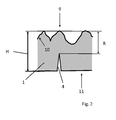
- FIG. 2 shows a schematic representation of a section of the material web 1, in which a section was introduced by means of the cutting blade 6.
- the material web here is a dermis, which has a decorative side 9 and a bottom 11.
- the cut 4 is here introduced starting from the underside 11 of the dermis.
- the introduced cuts 4 or desired weakenings should not be visible from the decorative side 9.
- the section 4 is triangular in cross-section, wherein the section 4 is made tapering starting from the bottom 11 for cutting reason.
- the decorative side 9 of the dermis has a grain 10, which represents an uneven surface profile. Due to this graining, the skin thickness H is not constant, but varies by a few tenths of a millimeter.
- the skin thickness H is 1.4 mm with a fluctuation of +/- 0.2 mm.
- the skin thickness is indicated by the dimensioning arrow H.
- the residual wall thickness R is drawn, which remains after introduction of the section 4 between cutting base and decorative surface 9.
- the residual wall thickness R in the embodiment shown is 0.8 mm and may deviate from this by +/- 0.07 mm. As described above, the residual wall thickness should be constant over the entire cutting process.
Landscapes
- Life Sciences & Earth Sciences (AREA)
- Forests & Forestry (AREA)
- Engineering & Computer Science (AREA)
- Mechanical Engineering (AREA)
- Air Bags (AREA)
- Treatment And Processing Of Natural Fur Or Leather (AREA)
Abstract
Description
- Die vorliegende Erfindung betrifft eine Vorrichtung zum Einbringen von Schnitten in eine flächige Materialbahn, sowie ein Verfahren zum Steuern einer Schneidvorrichtung zum Einbringen von Schnitten in flächige Materialbahnen.
- Zur Steigerung der Sicherheit von Fahrzeuginsassen werden Airbagmodule mittlerweile im Kraftfahrzeuginnenraum an einer Vielzahl von Bereichen eingebaut. Bekannt ist die Anordnung von Airbagmodulen im Bereich der Instrumententafel, des Lenkrades, der Seitentüren, der Sitze, des Dachhimmels. Derartige Airbagmodule sind dabei im nicht aktivierten Zustand mittels einer Airbagabdeckung verschlossen. Damit das Airbagmodul für den Fahrzeuginsassen optisch nicht erkennbar ist, umfassen die Airbagabdeckungen eine Dekorschicht, die die Airbagdurchtrittsöffnung überspannt. Als Dekorschicht kommen dabei Formhäute, Folien und in höherwertigen Kraftfahrzeugen auch Leder zum Einsatz. Um die entsprechende Sicherheit bei einer Kollision gewährleisten zu können, muss die das Airbagmodul bzw. die Airbagdurchtrittsöffnung überspannende Folie bzw. die Lederschicht in diesem Bereich bei einem Auslösen und Entfalten des Airbagsackes definiert und schnell aufreißen. Hierzu ist es bekannt in die der Sichtseite abgewandten Oberfläche der Dekorschicht Sollschwächungen einzubringen.
- Hierbei sind eine Vielzahl von Verfahren zum Einbringen derartiger Schwächungslinien bzw. Schnitte bekannt.
- Aus der
EP 1 459 943 A1 ist beispielsweise ein Verfahren zur Herstellung einer Material-Sollbruchstelle für die Freigabe von eingebauten Airbags bekannt. Hierbei wird mittels eines Schneidwerkzeugs eine Schwächungs- bzw. Sollbruchlinie in die Rückseite des Dekormateri-als eingebracht. Zur Regelung der Restwandstärke des Dekormaterials wird beim Einbringen der Schnitte mittels eines Abstandssensors beim Schneiden sowohl der Abstand vom Sensor zur Schneidspitze, als auch der Abstand vom Sensor zur Schneidgegenplatte ermittelt. Die Differenz dieser beiden Werte wird dabei als Istwert ermittelt und mit einem Sollwert verglichen. Bei einer Abweichung wird das Schneidmesser zur Erzielung einer gleichbleibenden Restwandstärke in der Höhe d.h. Schnitttiefe geregelt. Bei diesem Verfahren wird nicht die Restwandstärke direkt, sondern indirekt über eine Messung des Abstandes zwischen Abstandssensor und Schneidgegenplatte ermittelt. Verschmutzungen der Auflagefläche der Schneidgegenplatte, Lufteinschlüsse zwischen Dekormaterial und Auflagefläche, Unregelmäßigkeiten der Oberfläche des Dekormaterials führen hierbei zu einer nicht konstanten Restwandstärke. - Aufgabe der vorliegenden Erfindung ist es daher unter einem ersten Aspekt, eine Vorrichtung zum Einbringen von Schnitten in eine flächige Materialbahn derart weiterzubilden, dass eine Materialbahn mit einem vordefinierten Schnitt hinsichtlich der verbleibenden Restwandstärke hergestellt werden kann und die Materialbahn auf der Dekorseite eine hochwertig anmutende Oberfläche aufweist. In einem weiteren Aspekt der Erfindung wird ein Verfahren zum Steuern eines Schneidgerätes zum Einbringen von Schnitten in flächige Materialbahnen bereitgestellt, welches eine exakt vordefinierte Restwandstärke über den Schnittverlauf sicherstellt, eine hochwertig Anmutung der Oberfläche erzielt und hinsichtlich der Verfahrenskosten günstig ausführbar ist.
- Diese Aufgabe wird gemäß dem ersten Aspekt durch die im Anspruch 1 angegebenen Merk-male gelöst. Unter dem weiteren Aspekt wird die Aufgabe durch die im Anspruch 6 angegebenen Merkmale gelöst.
- Die Restwandstärke ist hierbei die verbleibende, ungeschnittene Wandstärke der Material-bahn längs des Schnittverlaufs.
- Durch das im Anspruch 6 angegebene Verfahren ist ein Einbringen von Schnitten in Material-bahnen möglich, bei dem eine exakt vordefinierte Restwandstärke erzielt werden kann. Dies ist dadurch möglich, da die Restwandstärke des Materials direkt ermittelt wird. Verschmutzungen der Auflagefläche, Schwankungen in der Materialdicke, Narboberfläche der Material-bahn, oder Lufteinschlüsse zwischen Auflagefläche und Dekorseite beeinflussen das Messergebnis hierbei nicht. Aufgrund der exakt einbringbaren Schnitte und vorgebbaren Restwandstärken erhält man eine hochwertig anmutende Oberfläche. Die Restwandstärken lassen sich in den vorgegebenen Toleranzgrenzen einstellen, wodurch ein "Abzeichnen" der Schnittverläufe auf der Dekorseite vermieden werden kann. Das exakte Ausbilden von Soll-schwächungen mit definierten Restwandstärken steigert die Sicherheit bei dem Einsatz der bearbeiteten Materialbahnen als Airbagabdeckungen. Weiterhin entfällt eine aufwendige, nachgeschaltete materialzerstörende Prüfung die nur in Stichproben ausführbar ist.
- Weitere vorteilhafte Ausgestaltungen und Weiterbildungen des erfindungsgemäßen Verfahrens ergeben sich aus den Unteransprüchen.
- Eine bevorzugte Ausführungsform der erfindungsgemäßen Vorrichtung sowie des erfindungsgemäßen Verfahrens wird nachfolgend beispielshalber beschrieben, wobei veranschaulichend auf die beigefügten Zeichnungen Bezug genommen wird.
- Es zeigen:
- Fig. 1
- eine Schnittdarstellung der Schneidvorrichtung beim Einbringen eines Schnitts in eine Materialbahn, sowie eine schematische Darstellung des zugehörigen Messgeräts,
- Fig. 2
- einen vergrößerten Ausschnitt eines Querschnitts einer Materialbahn mit eingebrach-tem Schnitt.
-
Figur 1 zeigt in einer schematischen Ansicht eine Vorrichtung zum Einbringen von Schnitten in Materialbahnen 1, wobei die Materialbahn 1 auf einer als Auflagefläche 2 ausgebildeten Schneidauflage aufgelegt ist und oberhalb der Materialbahn 1 eine Schneidvorrichtung 3 angeordnet ist. Zum Einbringen von Schnitten 4 in die Materialbahn 1 ist die Schneidvorrichtung 3 relativ zu der Auflagefläche 2 einstellbar ausgeführt. Hierbei ist die Schneidvorrichtung 3 sowohl hinsichtlich des relativen Abstandes zwischen Schneidvorrichtung 3 und Materialbahn 1 einstellbar ausgestaltet (z-Richtung), als auch in x und/oder z-Richtung verstellbar ausgeführt. Die Einstellung in z-Richtung ist wie nachfolgend beschrieben zur Erzielung einer vorbestimmten Restwandstärke R erforderlich. Die Definition der Restwandstärke R ist anhand derFig. 2 näher beschrieben. Durch eine Einstellung der relativen Lage zwischen Schneidvorrichtung 3 und Auflagefläche 2 kann ein vorbestimmter Schnittverlauf erzielt werden. Das erfindungsgemäße Verfahren wird dabei insbesondere zur Herstellung von Airbagabdeckungen mit eingebrachten Airbagschnittverläufe / Sollschwächungen verwendet. Diese Sollschwächung ist auf der der Dekorseite gegenüberliegenden Seite eingebracht und ist häufig u-förmig oder in einem h-förmigen oder c-förmigen Verlauf ausgeführt. - Die Schneidvorrichtung 3 umfasst eine Aufnahme 5 für ein Schneidmesser 6, wobei das Schneidmesser 6 an seinem freien Endbereich eine spitz zulaufende Schneidklinge 7 aufweist. Mittels des Schneidmessers 6 können somit im Querschnitt dreieckige Schnitte in die Materialbahn 1 eingebracht werden. Es sind allerdings auch anders ausgestaltete Schneidklingen 7 einsetzbar. Das Schneidmesser 6 besteht aus einem elektrisch leitfähigen Material. Die Aufnahme 5 des Schneidmessers 6 ist als Messerhalter ausgeführt. Der Messerhalter weist dabei eine Isolation auf, so dass das Schneidmesser 6 elektrisch isoliert gegenüber dem Messerhalter 5 eingespannt gehalten ist.
- Die unterhalb des Schneidmessers 6 angeordnete Auflagefläche 2 ist im Wesentlichen ein plattenförmiges Element mit einer ebenen Oberfläche. Die Auflagefläche 2 besteht ebenfalls aus einem elektrisch leitfähigen Material. Zur Ermittlung der Restwandstärke R wird zwischen dem Schneidmesser 6 und der Auflagefläche 2 eine Spannung angelegt. Hierzu ist eine Spannungsquelle vorgesehen, deren Anschlusspunkte S1/S2 mit der Schneidvorrichtung 3 und der Auflagefläche 2 verbunden sind. Die Auflagefläche 2 besitzt weiterhin einen Masse-anschluss 8.
- Vor dem Einbringen von Schnitten bzw. einer Sollschwächung nach einem vorgegebenen Schnittverlauf in die Materialbahn 1, wird in einem ersten Schritt eine Materialbahn 1 flächig auf die Auflagefläche 2 aufgelegt. Bei dem beschriebenen Ausführungsbeispiel ist die Materialbahn eine Lederhaut, die beispielsweise als Dekorhaut zum Weiterverarbeiten zu einem Haut-Schaum-Verbund für eine Instrumententafel verwendet wird. Die Dekorseite 9 der Lederhaut weist eine Narbung 10 auf, diese mit einer Narbung 10 ausgestaltete Oberfläche wird auf die Auflagefläche 2 aufgelegt. Die Unterseite 11 der Lederhaut, in die der Schnittverlauf eingebracht werden soll, weist nach oben. Die Lederhaut wird über geeignete Mittel auf der Auflagefläche 2 flächig festgehalten. Zum Einbringen von Schnitten wird nun das Schneidmesser 6 mittels einer mit der Schneidvorrichtung verbundenen Antriebseinheit nach unten verfahren, um in die Lederhaut einzudringen. Gleichzeitig wird das Schneidmesser 6 in x und/oder y Richtung verfahren. Hierdurch entsteht eine Sollschwächung, die nach einem vorbestimmbaren Verlauf erzeugt werden kann. In der Steuer/Regeleinrichtung sind entsprechende Steuersignale abgelegt, die an eine Antriebseinheit der Schneidvorrichtung 3 übermittelt werden, so dass der gewünschte Verlauf der Sollschwächung erzielt wird. Die Steuer/Regeleinrichtung ist in der Zeichnung nicht dargestellt.
- Die zu ermittelnde und einzustellende Restwandstärke R wird nun während des Schneidvorgangs kontinuierlich gemessen und bei einer Abweichung der gemessenen Ist-Restwandstärke R im Vergleich zu der in der Steuer / Regeleinrichtung abgelegten Soll-Restwandstärke wird ein Steuer/Regelsignal als Stellsignal an die Antriebseinheit der Schneidvorrichtung 3 übermittelt. Das Stellsignal bewirkt dann ein Verfahren des Schneidmessers 7 in z- Richtung und entsprechender Einstellung der Schnitttiefe. Die Restwandstärke R wird bei dem Einbringen der Schnitte über die Messung des während des Schneidens fließenden elektrischen Stromes direkt über den spezifischen Widerstand des Materials bestimmt. Dies hat den Vorteil, dass eine Änderung des ermittelten spezifischen Widerstandes eine exakte Veränderung der Restwandstärke R abbildet. Der beim Schneiden über ein Messgerät gemessene elektrische Strom wird als Ist-Messwert an eine Steuer/Regeleinrichtung geleitet. Dort wird dann in Abhängigkeit des Materials und dessen spezifischen Widerstandes die Restwandstärke ermittelt. Bei einer Abweichung von der in der Steuer/Regeleinrichtung vorgegebenen Soll-Restwandstärke wird, wie zuvor schon erläutert, ein entsprechendes Steuer/Regelsignal als Stellsignal zur Einstellung bzw. Verstellung der Relativlage zwischen Schneidmesser 6 und Auflagefläche 2 vorzugsweise an die Schneidvorrichtung 3 zur Verstellung des Schneidmessers 6 in z-Richtung übermittelt.
-
Figur 2 zeigt in einer schematischen Darstellung einen Ausschnitt aus der Materialbahn 1, in die ein Schnitt mittels des Schneidmessers 6 eingebracht wurde. Die Materialbahn ist hierbei eine Lederhaut, die eine Dekorseite 9 und eine Unterseite 11 aufweist. Der Schnitt 4 ist hierbei ausgehend von der Unterseite 11 der Lederhaut eingebracht. Wie bereits eingangs beschrieben, sollen die eingebrachten Schnitte 4 bzw. Sollschwächungen von der Dekorseite 9 nicht sichtbar sein. Weiterhin ist aus der Figur ersichtlich, dass der Schnitt 4 im Querschnitt dreieckig ausgeführt ist, wobei der Schnitt 4 ausgehend von der Unterseite 11 zum Schnittgrund spitz zulaufend ausgeführt ist. Die Dekorseite 9 der Lederhaut weist eine Narbung 10 auf, die ein unebenes Oberflächenprofil darstellt. Aufgrund dieser Narbung ist die Hautdicke H nicht konstant, sondern schwankt um einige Zehntel Millimeter. Bei dem dargestellten Aus-führungsbeispiel beträgt die Hautdicke H beispielsweise 1,4 mm mit einer Schwankung von +/- 0,2 mm. Die Hautdicke ist durch den Bemaßungspfeil H angezeigt. Des Weiteren ist in der Figur die Restwandstärke R eingezeichnet, die nach Einbringen des Schnitts 4 zwischen Schnittgrund und Dekoroberfläche 9 verbleibt. Die Restwandstärke R beträgt in dem gezeigten Ausführungsbeispiel 0,8 mm und darf hiervon um +/- 0.07 mm abweichen. Wie oben stehend beschrieben soll die Restwandstärke über den gesamten Schnittverlauf konstant sein.
Claims (10)
- Vorrichtung zum Einbringen von Schnitten (4) in eine flächige Materialbahn (1), umfassend eine Schneidvorrichtung (3) zum Einbringen von Schnitten in die Material-bahn (1), eine Auflagefläche (2) für die flächige Auflage der Materialbahn (1), eine Messeinrichtung zur Ermittlung einer verbleibenden Restwandstärke (R) der beim Schneidvorgang verbleibenden Materialdicke der Materialbahn (1) längs des Schnitt-verlaufs, sowie einer Steuer-/Regeleinrichtung, die anhand der ermittelten Messwerte in Abhängigkeit von vorgegebenen Sollwerten entsprechende Stellsignale liefert, die an eine Antriebseinheit übermittelt werden, die anhand der Stellsignale eine Verstellung der Relativlage der Schneidvorrichtung (3) zu der Auflagefläche (2) bewirkt, dadurch gekennzeichnet, dass die Schneidvorrichtung (3) und die Auflagefläche (2) aus einem elektrisch leitenden Material bestehen, dass weiterhin eine Spannungs-quelle vorgesehen ist, und deren Anschlusspunkte mit der Schneidvorrichtung (3) und der Auflagefläche (2) verbunden sind, und dass die Messeinrichtung eine Strommesseinrichtung ist, die den zwischen Schneidvorrichtung (3), Materialbahn (1) und Aufla-gefläche (2) beim Schneiden fließenden elektrischen Strom misst, und dass die Stell-signale anhand dieser Messwerte und dem der Materialbahn (1) zugehörigen spezifischen Widerstandes ermittelt werden.
- Vorrichtung zum Einbringen von Schnitten (4) in eine flächige Materialbahn (2), wobei die Materialbahn (2) als Airbagabdeckung in einem Kraftfahrzeug eingesetzt wird.
- Vorrichtung zum Einbringen von Schnitten (4) in eine flächige Materialbahn (2) nach Anspruch 1 oder 2, wobei die Materialbahn (2) eine Lederhaut mit einer Dekorseite (9) und einer Unterseite (11) ist, und wobei die Schnitte (4) in die Unterseite (11) eingebracht werden.
- Vorrichtung zum Einbringen von Schnitten (4) in eine flächige Materialbahn (2) nach einem der vorangehenden Ansprüche, wobei die Schneidvorrichtung (3) ein Schneidmesser (6) umfasst, dessen Schneidklinge (7) spitz zulaufend ausgebildet ist, um einen Schnitt (4) mit im Querschnitt einem spitz sich verjüngenden Querschnittsprofil zu bilden.
- Vorrichtung zum Einbringen von Schnitten (4) in eine flächige Materialbahn (2) nach einem der vorangehenden Ansprüche, wobei die Schnitte (4) als lineare Schnittlinien ausgebildet werden.
- Verfahren zum Steuern einer Schneidvorrichtung (3) zum Einbringen von Schnitten (4) in eine flächige Materialbahn (2) mittels einer Vorrichtung nach einem der vorangehenden Ansprüche, mit den Schritten:- Flächiges Auflegen der Materialbahn (1) auf eine Auflagefläche (2),- Verwenden eines Schneidmessers (6) mit einer zum vorgegebenen Schnittquerschnitt passenden Form, und- Verstellen der Relativlage zwischen Schneidmesser (6) und Auflagefläche (2) derart, dass durch die Einstellung der Lage ein Schnitt mit vorgegebener Restwandstärke (R) in die Materialbahn (1) eingebracht wird,- Erfassen der Restwandstärke (R) beim Schneidvorgang als Ist-Signal,- Ermitteln eines Steuer / Regelsignals als Stellsignal und Verändern der Relativlage zwischen Materialbahn (1) und Auflagefläche (2) falls das ermittelte Ist-Signal von einem vorgegebenen Sollsignal abweicht, dadurch gekennzeichnet, dass das Ist-Signal durch ein Messen eines fließenden elektrischen Stromes zwischen Schneidmesser (6), Materialbahn (1) und Auflagefläche (2) und einem in der Steuer-/Regeleinrichtung hinterlegtem der Materialbahn (1) zugeordneten spezifischen Widerstand ermittelt wird.
- Verfahren zum Steuern einer Schneidvorrichtung nach Anspruch 6, wobei der Schnitt (4) eine Sollschwächung in einer Materialbahn (1) für eine Airbagabdeckung eines Kraftfahrzeugs ist.
- Verfahren zum Steuern bzw. Regeln einer Schneidvorrichtung (3) zum Einbringen von Schnitten (4) in eine flächige Materialbahn (1) nach Anspruch 6 oder 7, wobei die Materialbahn (1) eine Lederhaut ist.
- Verfahren zum Steuern bzw. Regeln einer Schneidvorrichtung (3) zum Einbringen von Schnitten (4) in eine flächige Materialbahn (1) nach einem der vorangehenden Ansprüche 6 -8, wobei die Schnitte (4) Sollbruchlinien für Airbagabdeckungen sind.
- Verfahren zum Steuern bzw. Regeln einer Schneidvorrichtung (3) zum Einbringen von Schnitten (4) in eine flächige Materialbahn (1) nach einem der vorangehenden Ansprüche 6 -9, wobei die Relativlage der Schneidvorrichtung (3) zur Auflagefläche (2) derart verstellt wird, dass die Restwandstärke längs des Schnittsverlaufs konstant ist.
Applications Claiming Priority (1)
| Application Number | Priority Date | Filing Date | Title |
|---|---|---|---|
| DE201310202081 DE102013202081B3 (de) | 2013-02-08 | 2013-02-08 | Vorrichtung zum Einbringen von Schnitten in eine flächige Materialbahn, sowie Verfahren zum Steuern einer Schneidvorrichtung |
Publications (2)
| Publication Number | Publication Date |
|---|---|
| EP2764962A1 true EP2764962A1 (de) | 2014-08-13 |
| EP2764962B1 EP2764962B1 (de) | 2016-05-25 |
Family
ID=49999788
Family Applications (1)
| Application Number | Title | Priority Date | Filing Date |
|---|---|---|---|
| EP14152554.3A Active EP2764962B1 (de) | 2013-02-08 | 2014-01-24 | Vorrichtung zum Einbringen von Schnitten in eine flächige Materialbahn, sowie Verfahren zum Steuern einer Schneidvorrichtung |
Country Status (3)
| Country | Link |
|---|---|
| EP (1) | EP2764962B1 (de) |
| DE (1) | DE102013202081B3 (de) |
| ES (1) | ES2596441T3 (de) |
Cited By (1)
| Publication number | Priority date | Publication date | Assignee | Title |
|---|---|---|---|---|
| CN121573298A (zh) * | 2026-01-29 | 2026-02-27 | 赫比(上海)家用电器产品有限公司 | 切割装置及切割方法 |
Families Citing this family (2)
| Publication number | Priority date | Publication date | Assignee | Title |
|---|---|---|---|---|
| DE102020112494A1 (de) | 2020-05-08 | 2021-11-11 | Jenoptik Automatisierungstechnik Gmbh | Verfahren zur Herstellung einer Airbag-Abdeckung mit einer Sollbruchlinie mit einem definierten Aufreißwiderstand |
| DE102020112495B4 (de) | 2020-05-08 | 2026-04-16 | Jenoptik Automatisierungstechnik Gmbh | Verfahren zur Prüfung einer Airbag-Abdeckung mit einer Sollbruchlinie mit definiertem Aufreißwiderstand |
Citations (3)
| Publication number | Priority date | Publication date | Assignee | Title |
|---|---|---|---|---|
| US4624169A (en) * | 1985-04-08 | 1986-11-25 | Aerochem, Inc. | Apparatus for automated cutting of thin films |
| EP1459943A1 (de) | 2003-01-15 | 2004-09-22 | Heidel GmbH & Co. KG, Werkzeug- u. Maschinenfabrikation | Schneidwerkzeug zur in-process-Regelung der Restwandstärke bei der Airbagschwächung und Verfahren hierzu |
| EP1621415A1 (de) * | 2004-07-29 | 2006-02-01 | Takata Corporation | Herstellungsvorrichtung für eine Gassackabdeckung |
-
2013
- 2013-02-08 DE DE201310202081 patent/DE102013202081B3/de not_active Expired - Fee Related
-
2014
- 2014-01-24 ES ES14152554.3T patent/ES2596441T3/es active Active
- 2014-01-24 EP EP14152554.3A patent/EP2764962B1/de active Active
Patent Citations (4)
| Publication number | Priority date | Publication date | Assignee | Title |
|---|---|---|---|---|
| US4624169A (en) * | 1985-04-08 | 1986-11-25 | Aerochem, Inc. | Apparatus for automated cutting of thin films |
| EP1459943A1 (de) | 2003-01-15 | 2004-09-22 | Heidel GmbH & Co. KG, Werkzeug- u. Maschinenfabrikation | Schneidwerkzeug zur in-process-Regelung der Restwandstärke bei der Airbagschwächung und Verfahren hierzu |
| US20050147476A1 (en) * | 2003-01-15 | 2005-07-07 | Andreas Wieners | Cutting tool for the in-process control of the residual wall thickness for the airbag weakening and method for this |
| EP1621415A1 (de) * | 2004-07-29 | 2006-02-01 | Takata Corporation | Herstellungsvorrichtung für eine Gassackabdeckung |
Cited By (1)
| Publication number | Priority date | Publication date | Assignee | Title |
|---|---|---|---|---|
| CN121573298A (zh) * | 2026-01-29 | 2026-02-27 | 赫比(上海)家用电器产品有限公司 | 切割装置及切割方法 |
Also Published As
| Publication number | Publication date |
|---|---|
| EP2764962B1 (de) | 2016-05-25 |
| DE102013202081B3 (de) | 2014-07-03 |
| ES2596441T3 (es) | 2017-01-09 |
Similar Documents
| Publication | Publication Date | Title |
|---|---|---|
| DE19516230C2 (de) | Airbag-Abdeckung sowie Verfahren zu seiner Herstellung | |
| DE69912524T2 (de) | Verfahren zum Herstellen eines Kraftfahrzeugverkleidungsteils mit Schwächungslinien für eine Airbag-Entfaltungsöffnung | |
| EP1745989B1 (de) | Airbagabdeckung mit unsichtbare Airbagreisslinie | |
| DE102007013108B3 (de) | Verfahren zur Herstellung eines mindestens zweischichtigen Fahrzeuginnenverkleidungsteils mit integrierter Airbagabdeckung und Fahrzeuginnenverkleidungsteil | |
| EP2701861B1 (de) | Verfahren und vorrichtung zur herstellung von flanschlosen ziehteilen | |
| DE29511172U1 (de) | Kunststoffverkleidung für mit Luftsackeinrichtungen ausgestattete Fahrzeuge | |
| DE10055546C2 (de) | Airbag-Verkleidung mit Schwächungsstrukturen sowie Verfahren zur Erzeugung der Schwächungsstrukturen | |
| WO2000051851A1 (de) | Aufreisslinie in abdeckungen von airbageinheiten | |
| EP1626880A1 (de) | Kunststoffträger und verfahren zu seiner herstellung | |
| EP2764962B1 (de) | Vorrichtung zum Einbringen von Schnitten in eine flächige Materialbahn, sowie Verfahren zum Steuern einer Schneidvorrichtung | |
| DE10122312B4 (de) | Konturschneidverfahren | |
| DE102009054604B4 (de) | Verfahren und Vorrichtung zum teilweisen Durchtrennen eines Werkstücks | |
| WO2002026534A1 (de) | Airbag-abdeckung mit sollbruchlinie und verfahren zu deren herstellung | |
| DE20314281U1 (de) | Schneidwerkzeug zur in-process-Regelung der Restwandstärke bei der Airbagschwächung | |
| DE102020109206B4 (de) | Verfahren zum Herstellen einer Lederschicht für eine Airbackabdeckung mit einer partiellen Schwächung und Vorrichtung zum Herstellen einer Lederschicht für eine Airbackabdeckung mit einer partiellen Schwächung | |
| DE10122376A1 (de) | Verfahren und Vorrichtung zum Einbringen einer Schwächung für den Airbagbereich in eine Dekorschicht | |
| EP2163437B1 (de) | Abdeckungsteil | |
| EP2762245B1 (de) | Verfahren zum Umformen eines Blechmaterials mit lokaler Beeinflussung des Materialflusses durch gezielte Trennung des Blechmaterials, sowie Umformwerkzeug zum Umformen eines Blechmaterials | |
| DE102007007635A1 (de) | Verfahren zur Herstellung einer Airbagabdeckung sowie Fahrzeug mit einer Airbaganordnung und einer derartigen Airbagabdeckung | |
| DE102008036768B4 (de) | Nadelperforation der Airbagreißnaht bei Vakuumkaschierfolien | |
| EP2347870B1 (de) | Verfahren zum Herstellen einer Aufreisslinie | |
| DE102011117893B3 (de) | Verfahren zum Herstellen einer Airbagabdeckung mit einer Schwächungslinie und Airbagabdeckung mit eingebrachter Schwächungslinie | |
| EP3551401B1 (de) | Verfahren zum einbringen eines applikationsmediums in einen schwächungsspalt einer abdeckung sowie bevorzugte applikationsvorrichtung | |
| EP3501912B1 (de) | Verfahren zur positionierung von flächigen materialien auf trägerteilen | |
| DE102004058868B4 (de) | Vorrichtung und Verfahren zur Bearbeitung eines Kraftfahrzeug-Innenverkleidungsteils |
Legal Events
| Date | Code | Title | Description |
|---|---|---|---|
| PUAI | Public reference made under article 153(3) epc to a published international application that has entered the european phase |
Free format text: ORIGINAL CODE: 0009012 |
|
| 17P | Request for examination filed |
Effective date: 20140124 |
|
| AK | Designated contracting states |
Kind code of ref document: A1 Designated state(s): AL AT BE BG CH CY CZ DE DK EE ES FI FR GB GR HR HU IE IS IT LI LT LU LV MC MK MT NL NO PL PT RO RS SE SI SK SM TR |
|
| AX | Request for extension of the european patent |
Extension state: BA ME |
|
| R17P | Request for examination filed (corrected) |
Effective date: 20141212 |
|
| RBV | Designated contracting states (corrected) |
Designated state(s): AL AT BE BG CH CY CZ DE DK EE ES FI FR GB GR HR HU IE IS IT LI LT LU LV MC MK MT NL NO PL PT RO RS SE SI SK SM TR |
|
| RAP1 | Party data changed (applicant data changed or rights of an application transferred) |
Owner name: MAGNA INTERIORS GMBH |
|
| 17Q | First examination report despatched |
Effective date: 20150827 |
|
| GRAP | Despatch of communication of intention to grant a patent |
Free format text: ORIGINAL CODE: EPIDOSNIGR1 |
|
| INTG | Intention to grant announced |
Effective date: 20160303 |
|
| GRAS | Grant fee paid |
Free format text: ORIGINAL CODE: EPIDOSNIGR3 |
|
| GRAA | (expected) grant |
Free format text: ORIGINAL CODE: 0009210 |
|
| AK | Designated contracting states |
Kind code of ref document: B1 Designated state(s): AL AT BE BG CH CY CZ DE DK EE ES FI FR GB GR HR HU IE IS IT LI LT LU LV MC MK MT NL NO PL PT RO RS SE SI SK SM TR |
|
| REG | Reference to a national code |
Ref country code: GB Ref legal event code: FG4D Free format text: NOT ENGLISH |
|
| REG | Reference to a national code |
Ref country code: CH Ref legal event code: EP |
|
| REG | Reference to a national code |
Ref country code: IE Ref legal event code: FG4D Free format text: LANGUAGE OF EP DOCUMENT: GERMAN Ref country code: AT Ref legal event code: REF Ref document number: 801871 Country of ref document: AT Kind code of ref document: T Effective date: 20160615 |
|
| REG | Reference to a national code |
Ref country code: DE Ref legal event code: R096 Ref document number: 502014000812 Country of ref document: DE |
|
| REG | Reference to a national code |
Ref country code: LT Ref legal event code: MG4D |
|
| REG | Reference to a national code |
Ref country code: NL Ref legal event code: MP Effective date: 20160525 |
|
| PG25 | Lapsed in a contracting state [announced via postgrant information from national office to epo] |
Ref country code: NL Free format text: LAPSE BECAUSE OF FAILURE TO SUBMIT A TRANSLATION OF THE DESCRIPTION OR TO PAY THE FEE WITHIN THE PRESCRIBED TIME-LIMIT Effective date: 20160525 Ref country code: FI Free format text: LAPSE BECAUSE OF FAILURE TO SUBMIT A TRANSLATION OF THE DESCRIPTION OR TO PAY THE FEE WITHIN THE PRESCRIBED TIME-LIMIT Effective date: 20160525 Ref country code: NO Free format text: LAPSE BECAUSE OF FAILURE TO SUBMIT A TRANSLATION OF THE DESCRIPTION OR TO PAY THE FEE WITHIN THE PRESCRIBED TIME-LIMIT Effective date: 20160825 Ref country code: LT Free format text: LAPSE BECAUSE OF FAILURE TO SUBMIT A TRANSLATION OF THE DESCRIPTION OR TO PAY THE FEE WITHIN THE PRESCRIBED TIME-LIMIT Effective date: 20160525 |
|
| PG25 | Lapsed in a contracting state [announced via postgrant information from national office to epo] |
Ref country code: GR Free format text: LAPSE BECAUSE OF FAILURE TO SUBMIT A TRANSLATION OF THE DESCRIPTION OR TO PAY THE FEE WITHIN THE PRESCRIBED TIME-LIMIT Effective date: 20160826 Ref country code: SE Free format text: LAPSE BECAUSE OF FAILURE TO SUBMIT A TRANSLATION OF THE DESCRIPTION OR TO PAY THE FEE WITHIN THE PRESCRIBED TIME-LIMIT Effective date: 20160525 Ref country code: RS Free format text: LAPSE BECAUSE OF FAILURE TO SUBMIT A TRANSLATION OF THE DESCRIPTION OR TO PAY THE FEE WITHIN THE PRESCRIBED TIME-LIMIT Effective date: 20160525 Ref country code: LV Free format text: LAPSE BECAUSE OF FAILURE TO SUBMIT A TRANSLATION OF THE DESCRIPTION OR TO PAY THE FEE WITHIN THE PRESCRIBED TIME-LIMIT Effective date: 20160525 Ref country code: PT Free format text: LAPSE BECAUSE OF FAILURE TO SUBMIT A TRANSLATION OF THE DESCRIPTION OR TO PAY THE FEE WITHIN THE PRESCRIBED TIME-LIMIT Effective date: 20160926 |
|
| REG | Reference to a national code |
Ref country code: FR Ref legal event code: PLFP Year of fee payment: 4 |
|
| PG25 | Lapsed in a contracting state [announced via postgrant information from national office to epo] |
Ref country code: IT Free format text: LAPSE BECAUSE OF FAILURE TO SUBMIT A TRANSLATION OF THE DESCRIPTION OR TO PAY THE FEE WITHIN THE PRESCRIBED TIME-LIMIT Effective date: 20160525 |
|
| REG | Reference to a national code |
Ref country code: ES Ref legal event code: FG2A Ref document number: 2596441 Country of ref document: ES Kind code of ref document: T3 Effective date: 20170109 |
|
| PG25 | Lapsed in a contracting state [announced via postgrant information from national office to epo] |
Ref country code: CZ Free format text: LAPSE BECAUSE OF FAILURE TO SUBMIT A TRANSLATION OF THE DESCRIPTION OR TO PAY THE FEE WITHIN THE PRESCRIBED TIME-LIMIT Effective date: 20160525 Ref country code: SK Free format text: LAPSE BECAUSE OF FAILURE TO SUBMIT A TRANSLATION OF THE DESCRIPTION OR TO PAY THE FEE WITHIN THE PRESCRIBED TIME-LIMIT Effective date: 20160525 Ref country code: DK Free format text: LAPSE BECAUSE OF FAILURE TO SUBMIT A TRANSLATION OF THE DESCRIPTION OR TO PAY THE FEE WITHIN THE PRESCRIBED TIME-LIMIT Effective date: 20160525 Ref country code: EE Free format text: LAPSE BECAUSE OF FAILURE TO SUBMIT A TRANSLATION OF THE DESCRIPTION OR TO PAY THE FEE WITHIN THE PRESCRIBED TIME-LIMIT Effective date: 20160525 Ref country code: RO Free format text: LAPSE BECAUSE OF FAILURE TO SUBMIT A TRANSLATION OF THE DESCRIPTION OR TO PAY THE FEE WITHIN THE PRESCRIBED TIME-LIMIT Effective date: 20160525 |
|
| PG25 | Lapsed in a contracting state [announced via postgrant information from national office to epo] |
Ref country code: SM Free format text: LAPSE BECAUSE OF FAILURE TO SUBMIT A TRANSLATION OF THE DESCRIPTION OR TO PAY THE FEE WITHIN THE PRESCRIBED TIME-LIMIT Effective date: 20160525 Ref country code: PL Free format text: LAPSE BECAUSE OF FAILURE TO SUBMIT A TRANSLATION OF THE DESCRIPTION OR TO PAY THE FEE WITHIN THE PRESCRIBED TIME-LIMIT Effective date: 20160525 |
|
| REG | Reference to a national code |
Ref country code: DE Ref legal event code: R097 Ref document number: 502014000812 Country of ref document: DE |
|
| PLBE | No opposition filed within time limit |
Free format text: ORIGINAL CODE: 0009261 |
|
| STAA | Information on the status of an ep patent application or granted ep patent |
Free format text: STATUS: NO OPPOSITION FILED WITHIN TIME LIMIT |
|
| REG | Reference to a national code |
Ref country code: DE Ref legal event code: R081 Ref document number: 502014000812 Country of ref document: DE Owner name: ANTOLIN STRAUBING GMBH, DE Free format text: FORMER OWNER: MAGNA INTERIORS GMBH, 94315 STRAUBING, DE Ref country code: DE Ref legal event code: R082 Ref document number: 502014000812 Country of ref document: DE Representative=s name: SCHUBERT, KLEMENS, DIPL.-CHEM. DR.RER.NAT., DE Ref country code: DE Ref legal event code: R082 Ref document number: 502014000812 Country of ref document: DE Representative=s name: MUELLER & SCHUBERT PATENTANWAELTE, DE |
|
| RAP4 | Party data changed (patent owner data changed or rights of a patent transferred) |
Owner name: MAGNA INTERIORS GMBH |
|
| 26N | No opposition filed |
Effective date: 20170228 |
|
| PG25 | Lapsed in a contracting state [announced via postgrant information from national office to epo] |
Ref country code: BE Free format text: LAPSE BECAUSE OF NON-PAYMENT OF DUE FEES Effective date: 20170131 Ref country code: SI Free format text: LAPSE BECAUSE OF FAILURE TO SUBMIT A TRANSLATION OF THE DESCRIPTION OR TO PAY THE FEE WITHIN THE PRESCRIBED TIME-LIMIT Effective date: 20160525 |
|
| REG | Reference to a national code |
Ref country code: CH Ref legal event code: PL |
|
| PG25 | Lapsed in a contracting state [announced via postgrant information from national office to epo] |
Ref country code: MC Free format text: LAPSE BECAUSE OF FAILURE TO SUBMIT A TRANSLATION OF THE DESCRIPTION OR TO PAY THE FEE WITHIN THE PRESCRIBED TIME-LIMIT Effective date: 20160525 |
|
| REG | Reference to a national code |
Ref country code: ES Ref legal event code: PC2A Owner name: ANTOLIN STRAUBING GMBH Effective date: 20171018 |
|
| PG25 | Lapsed in a contracting state [announced via postgrant information from national office to epo] |
Ref country code: CH Free format text: LAPSE BECAUSE OF NON-PAYMENT OF DUE FEES Effective date: 20170131 Ref country code: LI Free format text: LAPSE BECAUSE OF NON-PAYMENT OF DUE FEES Effective date: 20170131 |
|
| REG | Reference to a national code |
Ref country code: IE Ref legal event code: MM4A |
|
| PG25 | Lapsed in a contracting state [announced via postgrant information from national office to epo] |
Ref country code: LU Free format text: LAPSE BECAUSE OF NON-PAYMENT OF DUE FEES Effective date: 20170124 |
|
| REG | Reference to a national code |
Ref country code: FR Ref legal event code: PLFP Year of fee payment: 5 |
|
| REG | Reference to a national code |
Ref country code: FR Ref legal event code: CD Owner name: ANTOLIN STRAUBING GMBH, DE Effective date: 20171201 |
|
| REG | Reference to a national code |
Ref country code: BE Ref legal event code: MM Effective date: 20170131 |
|
| PG25 | Lapsed in a contracting state [announced via postgrant information from national office to epo] |
Ref country code: IE Free format text: LAPSE BECAUSE OF NON-PAYMENT OF DUE FEES Effective date: 20170124 |
|
| PG25 | Lapsed in a contracting state [announced via postgrant information from national office to epo] |
Ref country code: MT Free format text: LAPSE BECAUSE OF FAILURE TO SUBMIT A TRANSLATION OF THE DESCRIPTION OR TO PAY THE FEE WITHIN THE PRESCRIBED TIME-LIMIT Effective date: 20160525 |
|
| PG25 | Lapsed in a contracting state [announced via postgrant information from national office to epo] |
Ref country code: AL Free format text: LAPSE BECAUSE OF FAILURE TO SUBMIT A TRANSLATION OF THE DESCRIPTION OR TO PAY THE FEE WITHIN THE PRESCRIBED TIME-LIMIT Effective date: 20160525 |
|
| PG25 | Lapsed in a contracting state [announced via postgrant information from national office to epo] |
Ref country code: HU Free format text: LAPSE BECAUSE OF FAILURE TO SUBMIT A TRANSLATION OF THE DESCRIPTION OR TO PAY THE FEE WITHIN THE PRESCRIBED TIME-LIMIT; INVALID AB INITIO Effective date: 20140124 |
|
| PG25 | Lapsed in a contracting state [announced via postgrant information from national office to epo] |
Ref country code: BG Free format text: LAPSE BECAUSE OF FAILURE TO SUBMIT A TRANSLATION OF THE DESCRIPTION OR TO PAY THE FEE WITHIN THE PRESCRIBED TIME-LIMIT Effective date: 20160525 |
|
| PG25 | Lapsed in a contracting state [announced via postgrant information from national office to epo] |
Ref country code: CY Free format text: LAPSE BECAUSE OF NON-PAYMENT OF DUE FEES Effective date: 20160525 |
|
| PG25 | Lapsed in a contracting state [announced via postgrant information from national office to epo] |
Ref country code: MK Free format text: LAPSE BECAUSE OF FAILURE TO SUBMIT A TRANSLATION OF THE DESCRIPTION OR TO PAY THE FEE WITHIN THE PRESCRIBED TIME-LIMIT Effective date: 20160525 |
|
| REG | Reference to a national code |
Ref country code: AT Ref legal event code: MM01 Ref document number: 801871 Country of ref document: AT Kind code of ref document: T Effective date: 20190124 |
|
| PG25 | Lapsed in a contracting state [announced via postgrant information from national office to epo] |
Ref country code: TR Free format text: LAPSE BECAUSE OF FAILURE TO SUBMIT A TRANSLATION OF THE DESCRIPTION OR TO PAY THE FEE WITHIN THE PRESCRIBED TIME-LIMIT Effective date: 20160525 |
|
| PG25 | Lapsed in a contracting state [announced via postgrant information from national office to epo] |
Ref country code: AT Free format text: LAPSE BECAUSE OF NON-PAYMENT OF DUE FEES Effective date: 20190124 |
|
| PG25 | Lapsed in a contracting state [announced via postgrant information from national office to epo] |
Ref country code: HR Free format text: LAPSE BECAUSE OF FAILURE TO SUBMIT A TRANSLATION OF THE DESCRIPTION OR TO PAY THE FEE WITHIN THE PRESCRIBED TIME-LIMIT Effective date: 20160525 |
|
| REG | Reference to a national code |
Ref country code: DE Ref legal event code: R082 Ref document number: 502014000812 Country of ref document: DE Representative=s name: BRAEUNING & SCHUBERT PATENTANWAELTE GBR, DE Ref country code: DE Ref legal event code: R082 Ref document number: 502014000812 Country of ref document: DE Representative=s name: BRAEUNING & SCHUBERT PATENTANWAELTE, DE Ref country code: DE Ref legal event code: R082 Ref document number: 502014000812 Country of ref document: DE Representative=s name: SCHUBERT, KLEMENS, DIPL.-CHEM. DR.RER.NAT., DE |
|
| PG25 | Lapsed in a contracting state [announced via postgrant information from national office to epo] |
Ref country code: IS Free format text: LAPSE BECAUSE OF FAILURE TO SUBMIT A TRANSLATION OF THE DESCRIPTION OR TO PAY THE FEE WITHIN THE PRESCRIBED TIME-LIMIT Effective date: 20160925 |
|
| REG | Reference to a national code |
Ref country code: DE Ref legal event code: R082 Ref document number: 502014000812 Country of ref document: DE Representative=s name: BRAEUNING & SCHUBERT PATENTANWAELTE GBR, DE Ref country code: DE Ref legal event code: R082 Ref document number: 502014000812 Country of ref document: DE Representative=s name: BRAEUNING & SCHUBERT PATENTANWAELTE, DE |
|
| P01 | Opt-out of the competence of the unified patent court (upc) registered |
Effective date: 20230529 |
|
| PGFP | Annual fee paid to national office [announced via postgrant information from national office to epo] |
Ref country code: GB Payment date: 20251211 Year of fee payment: 13 |
|
| PGFP | Annual fee paid to national office [announced via postgrant information from national office to epo] |
Ref country code: ES Payment date: 20260204 Year of fee payment: 13 |
|
| PGFP | Annual fee paid to national office [announced via postgrant information from national office to epo] |
Ref country code: DE Payment date: 20260126 Year of fee payment: 13 |
|
| PGFP | Annual fee paid to national office [announced via postgrant information from national office to epo] |
Ref country code: FR Payment date: 20260126 Year of fee payment: 13 |