EP2763418A1 - Brillen-basierte 3d intelligenten endgerät und system - Google Patents
Brillen-basierte 3d intelligenten endgerät und system Download PDFInfo
- Publication number
- EP2763418A1 EP2763418A1 EP12840860.6A EP12840860A EP2763418A1 EP 2763418 A1 EP2763418 A1 EP 2763418A1 EP 12840860 A EP12840860 A EP 12840860A EP 2763418 A1 EP2763418 A1 EP 2763418A1
- Authority
- EP
- European Patent Office
- Prior art keywords
- glasses
- intelligent terminal
- audience
- screen
- images
- Prior art date
- Legal status (The legal status is an assumption and is not a legal conclusion. Google has not performed a legal analysis and makes no representation as to the accuracy of the status listed.)
- Ceased
Links
Images

Classifications
-
- H—ELECTRICITY
- H04—ELECTRIC COMMUNICATION TECHNIQUE
- H04N—PICTORIAL COMMUNICATION, e.g. TELEVISION
- H04N13/00—Stereoscopic video systems; Multi-view video systems; Details thereof
- H04N13/30—Image reproducers
- H04N13/366—Image reproducers using viewer tracking
- H04N13/368—Image reproducers using viewer tracking for two or more viewers
-
- H—ELECTRICITY
- H04—ELECTRIC COMMUNICATION TECHNIQUE
- H04N—PICTORIAL COMMUNICATION, e.g. TELEVISION
- H04N13/00—Stereoscopic video systems; Multi-view video systems; Details thereof
- H04N13/30—Image reproducers
- H04N13/332—Displays for viewing with the aid of special glasses or head-mounted displays [HMD]
- H04N13/341—Displays for viewing with the aid of special glasses or head-mounted displays [HMD] using temporal multiplexing
-
- H—ELECTRICITY
- H04—ELECTRIC COMMUNICATION TECHNIQUE
- H04N—PICTORIAL COMMUNICATION, e.g. TELEVISION
- H04N13/00—Stereoscopic video systems; Multi-view video systems; Details thereof
- H04N13/30—Image reproducers
- H04N13/349—Multi-view displays for displaying three or more geometrical viewpoints without viewer tracking
-
- H—ELECTRICITY
- H04—ELECTRIC COMMUNICATION TECHNIQUE
- H04N—PICTORIAL COMMUNICATION, e.g. TELEVISION
- H04N13/00—Stereoscopic video systems; Multi-view video systems; Details thereof
- H04N13/30—Image reproducers
- H04N13/398—Synchronisation thereof; Control thereof
-
- H—ELECTRICITY
- H04—ELECTRIC COMMUNICATION TECHNIQUE
- H04N—PICTORIAL COMMUNICATION, e.g. TELEVISION
- H04N13/00—Stereoscopic video systems; Multi-view video systems; Details thereof
- H04N13/30—Image reproducers
- H04N13/302—Image reproducers for viewing without the aid of special glasses, i.e. using autostereoscopic displays
-
- H—ELECTRICITY
- H04—ELECTRIC COMMUNICATION TECHNIQUE
- H04N—PICTORIAL COMMUNICATION, e.g. TELEVISION
- H04N13/00—Stereoscopic video systems; Multi-view video systems; Details thereof
- H04N13/30—Image reproducers
- H04N2013/40—Privacy aspects, i.e. devices showing different images to different viewers, the images not being viewpoints of the same scene
- H04N2013/405—Privacy aspects, i.e. devices showing different images to different viewers, the images not being viewpoints of the same scene the images being stereoscopic or three dimensional
-
- H—ELECTRICITY
- H04—ELECTRIC COMMUNICATION TECHNIQUE
- H04N—PICTORIAL COMMUNICATION, e.g. TELEVISION
- H04N2213/00—Details of stereoscopic systems
- H04N2213/008—Aspects relating to glasses for viewing stereoscopic images
Definitions
- the present invention relates to intelligent terminal field, and more particularly, to a 3D intelligent terminal and a system based on glasses.
- a user may watch three-dimensional (3D) images from an intelligent terminal, such as a television, a computer and a telephone, by means of 3D glasses.
- an intelligent terminal such as a television, a computer and a telephone
- 3D intelligent terminals require users to wear 3D glasses to watch.
- 3D televisions based shutter glasses are the most common.
- Existing 3D intelligent terminals based on glasses have a shortcoming, namely, the 3D intelligent terminals only can display images of left and right viewpoints at the most, so that only the images of the left and the right viewpoints can be watched.
- the images of two viewpoints simulate different images viewed by a user's left and right eyes when the user stands at a certain angle relative to a screen of the 3D intelligent terminal.
- the embodiment of the present invention provides a television, to overcome the shortcomings of the existing television using android operating system that can't be compatible with a plurality of applications thereby causing complicated operation and inconvenience to users.
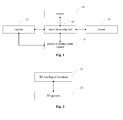
- An object of an embodiment of the present invention is to provide a 3D intelligent terminal, including a camera, a signal processing unit, a register, a glasses switching signal emitter and a screen, wherein the camera is used for taking a picture for objects in front of the screen of the 3D intelligent terminal; the signal processing unit is used for analyzing a taken image, judging if there is an audience in every pre-divided area and recording judging results in the register, the signal processing unit is also used for determining in which pre-divided area every audience is loacted, decoding the images of viewpoints corresponding to pre-divided areas with audience and sending the images of the viewpoints to the screen to display, the number of the pre-divided areas is greater than or equal to three; the glasses switching signal emitter is used for sending glasses switching signals to 3D glasses, by means of the glasses switching signals left and right lenses of the 3D glasses are turned on by the 3D glasses to receive the images of the viewpoints displayed on the screen; the screen is used for outputting the images of the viewpoints decode
- Another object of the embodiment of the present invention is to provide a 3D intelligent terminal system based on glasses, the 3D intelligent terminal system includes a 3D intelligent terminal and 3D glasses; the 3D intelligent terminal is used for taking a picture of objects in front of the screen of the 3D intelligent terminal, judging if there is an audience in every pre-divided area and recording judging results, the 3D intelligent terminal is also used for determining in which pre-divided area every audience is located, decoding the images of viewpoints corresponding to pre-divided areas with audience, sending the images of the viewpoints to the screen to display and sending glasses switching signals to the 3D glasses, wherein the number of the pre-divided areas is greater than or equal to three; the 3D glasses is used for receiving the glasses switching signals, turning on the left and right lenses of the 3D glasses alternately by means of the glasses switching signals to receive the images of the viewpoints displayed on the screen.
- the big area in front of the screen of the 3D intelligent terminal is pre-divided into three or more small areas, therefore audience in different areas can see the images of different viewpoints, and the viewing results are more real.
- the big area in front of the screen of the 3D intelligent terminal is divided into three or more small areas beforehand, after the 3D intelligent terminal is started, objects in front of the screen of the 3D intelligent terminal are shot by the camera of the 3D intelligent terminal, a taken picture is analyzed by the signal processing unit to obtain audience' location information, the images of the viewpoints corresponding to audience' location are decoded and the decoded images of the viewpoints are sent to the screen to display, at the same time, glasses switching signals are sent to 3D glasses by the glasses switching signal emitter, by means of the glasses switching signals the left and right lenses of the 3D glasses are turned on alternately by the 3D glasses to receive corresponding images of the viewpoints.
- the camera 11 is used to take a picture for objects in front of the screen of the 3D intelligent terminal.
- the camera 11 is a rotatable camera.
- the rotatable camera regularly scans objects in front of the screen of the 3D intelligent terminal.
- the regularly scan changes of audience in front of the screen of the 3D intelligent terminal may be obtained timely.
- the signal processing unit 12 is used for analyzing a taken image, judging if there is an audience in every pre-divided area and recording judging results in the register 13.
- the signal processing unit 12 is also used for determining in which pre-divided area every audience is located, decoding the images of viewpoints corresponding to pre-divided areas with audience and sending the images of the viewpoints to the screen 15 to display.
- the number of the pre-divided areas is greater than or equal to three.
- the signal processing unit 12 obtains the image taken by the camera 11 from the camera 11, analyzes the image to judge if there is an audience in every pre-divided area and records judging results in the register 13. Preferably, the signal processing unit 12 judges if there is an audience in every pre-divided area by means of face recognition.
- the signal processing unit 12 is also used for determining in which pre-divided area every audience is located, decoding the images of the viewpoints corresponding to pre-divided areas with audience and sending the images of the viewpoints to the screen 15 to display. For example, it presumes that the area in front of the screen of the 3D intelligent terminal is divided into four areas from left to right, and the leftmost area is area 1. If there is an audience in the area 1, the signal processing unit 12 will decode the images of the viewpoints corresponding to the area 1 and send the images of the viewpoints to the screen 15 to display, so that the audience may see the left side images of objects displayed.
- every area corresponds to two viewpoints of audience's left and right eyes, and each viewpoint corresponds to a viewpoint image seen by the audience's left or right eye in the area.
- the glasses switching signal emitter 14 is used for sending glasses switching signals to 3D glasses so that the left and right lenses of the 3D glasses are turned on by the 3D glasses to receive the images of the viewpoints displayed by the screen 15.
- the screen 15 is used for outputting the images of the viewpoints decoded by the signal processing unit 12.
- a refresh rate of the screen 15 is not less than 50*x Hz wherein the x is the number of the pre-divided areas.
- the method that the signal processing unit 12 determines in which pre-divided area every audience is located includes the following steps: obtaining a unique identity of the 3D glasses worn by every audience from a taken picture; determining in which pre-divided area every audience is located by means of the unique identity of the 3D glasses and the camera angle of the taken picture.
- a unique identity is preset on the 3D glasses and is used as an "Identity Code"
- the unique identity of the 3D glasses may be a pattern light source with a unique shape.
- the signal processing unit 12 analyzes the picture taken by the camera 11 and obtains the unique identity of the 3D glasses worn by every audience, such as the shape of the pattern light source on the 3D glasses.
- the signal processing unit 12 determines in which pre-divided area each audience is located by means of combining the unique identity of the 3D glasses and the camera angle of the taken picture.
- the 3D intelligent terminal can automatically identify in which area an audience is located, therefore it doesn't require the audience to operate manually and simplifies the operation.
- the method that the signal processing unit 12 determines in which pre-divided area every audience is located includes the following step: receiving location key information sent by means of pressing 3D glasses by audiences; sending the location key information to the signal processing unit 12, the location key information including the information that in which pre-divided area every audience is located, thereby determining in which pre-divided area every audience is located by the signal processing unit 12.
- location keys are preset on the 3D glasses, the number of the location keys is the same with the number of the pre-divided areas, and one location key corresponds to one pre-divided area.
- the fan-shaped area in front of the intelligent terminal may be pre-divided into four areas, so that the number of the location keys can be set to four, namely location keys 1, 2, 3 and 4.
- location key 1 may represent area 1
- location key 4 may represent area 1, as long as one location key corresponds to one pre-divided area, which is not limited.
- the big area in front of the screen of the 3D intelligent terminal is pre-divided into three or more small areas, after the 3D intelligent terminal is started, objects in front of the screen of the 3D intelligent terminal are took by the camera of the 3D intelligent terminal, a taken picture is analyzed by the signal processing unit to obtain audience' location information, the images of the viewpoints corresponding to the audience' location are decoded and the decoded images of the viewpoints are sent to the screen to display, at the same time, glasses switching signals are sent to 3D glasses by the glasses switching signal emitter, by means of the glasses switching signals the left and right lenses of the 3D glasses are turned on alternately by the 3D glasses to receive corresponding images of the viewpoints.
- the big area in front of the screen of the 3D intelligent terminal is pre-divided into three or more small areas, therefore, audience in different areas can see different images of the viewpoints, and the viewing results are more real.
- Fig. 2 illustrates a structure of a 3D intelligent terminal system based on glasses according to the second embodiment of the present invention. In order to easily describe it, parts related to the first embodiment are only illustrated.
- the 3D intelligent terminal system based on glasses includes a 3D intelligent terminal 21 and 3D glasses 22.
- the 3D intelligent terminal 21 is the same with the 3D intelligent terminal described in the first embodiment which isn't described again here.
- the 3D intelligent terminal is used for taking a picture of objects in front of the screen of the 3D intelligent terminal, judging if there is audience in every pre-divided area and recording judging results.
- the 3D intelligent terminal is also used for determining in which pre-divided area every audience is located, decoding the images of viewpoints corresponding to pre-divided areas with audience, sending the images of the viewpoints to the screen to display and sending glasses switching signals to 3D glasses, wherein the number of the pre-divided areas is greater than or equal to three.
- the glasses switching signals By means of the glasses switching signals the left and right lenses of the 3D glasses are turned on alternately by the 3D glasses to receive the images of the viewpoints displayed on the screen.
- the big area in front of the screen of the 3D intelligent terminal is pre-divided into three or more small areas, therefore audience in different areas can see the images of different viewpoints, and the viewing results are more real.
- the 3D glasses are provided with a pattern light source with a unique shape
- the pattern light source with a unique shape can be a unique identity of the 3D glasses.
- a unique identity is preset on 3D glasses and is used as an "Identity Code" of the 3D glasses, the unique identity may be a pattern light source with a unique shape.
- the 3D glasses are provided with location keys, and the number of the location keys is the same with the number of the pre-divided areas, wherein the number is greater than or equal to three.
- location keys are preset on the 3D glasses, if audience locates in a certain area, the location key corresponding to the certain area are pressed down.
- FIG. 3 is schematic view of a 3D intelligent terminal system based on glasses.
- the area in front of the screen of the 3D intelligent terminal is pre-divided into four areas 1, 2, 3 and 4.
- Area 1 corresponds to "1" in Fig. 3 , by that analogy, the area 2, area 3, and area 4 corresponds to the numbers in Fig. 3 respectively.
- Table 1 Audience's location area Images of viewpoints displayed on the screen 1 images of viewpoints 1 and 2 2, 3 images of viewpoints 2 and 3 4 images of viewpoints 3 and 4
- the images of viewpoints 1 and 2 indicating viewing angle of the left side
- the images of viewpoints 2 and 3 indicating viewing angle of the center
- the images of viewpoints 2 and 3 are displayed on the screen, so that front images of objects displayed can be seen by audience.
- the images of viewpoints 3 and 4 are displayed on the screen, so that right side images of objects displayed can be seen by audience.
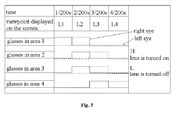
- the relationship between the on-off of the 3D glasses and displaying viewpoint on the screen is shown as Fig. 4 .
- viewpoint Ln is displayed on the screen, the left lens is turned on and the right lens is turned off (the solid line represents the left lens, the dotted line represents the right lens, the high level indicates that a lens is turned on, and the low level indicates that a lens is turned off), the images of the Ln viewpoint can be seen by left eye.
- viewpoint Ln+1 is displayed on the screen, the left lens is turned off and the right lens is turned on.
- audiences A, B and C locates in areas 1, 2 (or 3) and 4 respectively, they can see the left side images, the center images and the right side images of displayed objects respectively.
- audience A moves in turn from area 1 to area 4, he or she will see the left side images, the center images and the right side images of displayed objects in sequence.
- the big area in front of the screen of the 3D intelligent terminal is pre-divided into three or more small areas, after the 3D intelligent terminal is started, objects in front of the screen of the 3D intelligent terminal are took by the camera of the 3D intelligent terminal, a taken picture is analyzed by the signal processing unit to obtain audience' location information, the images of the viewpoints corresponding to audience' location are decoded and the decoded images of the viewpoints are sent to the screen to display, at the same time, glasses switching signals are sent to 3D glasses by the glasses switching signal emitter, by means of the glasses switching signals the left and right lenses of the 3D glasses are turned on alternately by the 3D glasses to receive corresponding the images of the viewpoints.
- the big area in front of the screen of the 3D intelligent terminal is pre-divided into three or more small areas, therefore audiences in different areas can see the images of different viewpoints, and the viewing results are more real.
Landscapes
- Engineering & Computer Science (AREA)
- Multimedia (AREA)
- Signal Processing (AREA)
- Testing, Inspecting, Measuring Of Stereoscopic Televisions And Televisions (AREA)
- Controls And Circuits For Display Device (AREA)
Applications Claiming Priority (1)
| Application Number | Priority Date | Filing Date | Title |
|---|---|---|---|
| PCT/CN2012/085885 WO2014085991A1 (zh) | 2012-12-05 | 2012-12-05 | 一种基于眼镜的3d智能终端及系统 |
Publications (2)
| Publication Number | Publication Date |
|---|---|
| EP2763418A1 true EP2763418A1 (de) | 2014-08-06 |
| EP2763418A4 EP2763418A4 (de) | 2015-07-29 |
Family
ID=50825057
Family Applications (1)
| Application Number | Title | Priority Date | Filing Date |
|---|---|---|---|
| EP12840860.6A Ceased EP2763418A4 (de) | 2012-12-05 | 2012-12-05 | Brillen-basierte 3d intelligenten endgerät und system |
Country Status (6)
| Country | Link |
|---|---|
| US (1) | US20140152785A1 (de) |
| EP (1) | EP2763418A4 (de) |
| AU (1) | AU2012327246B2 (de) |
| IN (1) | IN2013MN00921A (de) |
| RU (1) | RU2591168C2 (de) |
| WO (1) | WO2014085991A1 (de) |
Families Citing this family (1)
| Publication number | Priority date | Publication date | Assignee | Title |
|---|---|---|---|---|
| WO2022212109A1 (en) * | 2021-03-31 | 2022-10-06 | Dathomir Laboratories Llc | Techniques for viewing 3d photos and 3d videos |
Family Cites Families (18)
| Publication number | Priority date | Publication date | Assignee | Title |
|---|---|---|---|---|
| US6239830B1 (en) * | 1998-01-21 | 2001-05-29 | New York University | Displayer and method for displaying |
| JP2001296501A (ja) * | 2000-04-12 | 2001-10-26 | Nippon Hoso Kyokai <Nhk> | 立体画像表示制御方法および装置 |
| JP4291862B2 (ja) * | 2007-07-04 | 2009-07-08 | 稔 稲葉 | 立体テレビジョンシステム及び立体テレビジョン受像機 |
| KR101296900B1 (ko) * | 2009-01-07 | 2013-08-14 | 엘지디스플레이 주식회사 | 입체 영상의 뷰 제어방법과 이를 이용한 입체 영상표시장치 |
| JP5465523B2 (ja) * | 2009-01-29 | 2014-04-09 | 三洋電機株式会社 | 立体画像表示システム |
| US20100201788A1 (en) * | 2009-02-06 | 2010-08-12 | Ho David Yu-Li | Method and system for mating an infrared stereoscopic device with a viewing device |
| GB2472438A (en) * | 2009-08-06 | 2011-02-09 | Sony Corp | Multi-person 3D display system with several viewers watching different images on a single screen |
| US20110199463A1 (en) * | 2010-02-15 | 2011-08-18 | Gallagher Andrew C | Display with integrated camera |
| JP2011223187A (ja) * | 2010-04-07 | 2011-11-04 | Canon Inc | 3d眼鏡及びその制御方法 |
| US8890941B2 (en) * | 2010-04-29 | 2014-11-18 | Virginia Venture Industries, Llc | Methods and apparatuses for viewing three dimensional images |
| US9032470B2 (en) * | 2010-07-20 | 2015-05-12 | At&T Intellectual Property I, Lp | Apparatus for adapting a presentation of media content according to a position of a viewing apparatus |
| EP2601792A2 (de) * | 2010-08-03 | 2013-06-12 | BBY Solutions, Inc. | Mehrere gleichzeitige programme auf einem display |
| US8817080B2 (en) * | 2010-12-02 | 2014-08-26 | At&T Intellectual Property I, L.P. | Location based media display |
| CN201926882U (zh) * | 2010-12-04 | 2011-08-10 | 中国科学院沈阳自动化研究所 | 一种微型水下机器人矢量布置推进器推力分配装置 |
| US20120182276A1 (en) * | 2011-01-19 | 2012-07-19 | Broadcom Corporation | Automatic adjustment of display systems based on light at viewer position |
| US20130063578A1 (en) * | 2011-03-18 | 2013-03-14 | Yasushi Uesaka | Glasses, stereoscopic image processing device, system |
| CN102572484B (zh) * | 2012-01-20 | 2014-04-09 | 深圳超多维光电子有限公司 | 立体显示控制方法、立体显示控制装置和立体显示系统 |
| CN102970574A (zh) * | 2012-11-21 | 2013-03-13 | 深圳市酷开网络科技有限公司 | 一种基于眼镜的3d智能终端及系统 |
-
2012
- 2012-12-05 EP EP12840860.6A patent/EP2763418A4/de not_active Ceased
- 2012-12-05 AU AU2012327246A patent/AU2012327246B2/en active Active
- 2012-12-05 WO PCT/CN2012/085885 patent/WO2014085991A1/zh not_active Ceased
- 2012-12-05 RU RU2013143877/08A patent/RU2591168C2/ru active
- 2012-12-05 US US13/988,733 patent/US20140152785A1/en not_active Abandoned
-
2013
- 2013-05-15 IN IN921MUN2013 patent/IN2013MN00921A/en unknown
Also Published As
| Publication number | Publication date |
|---|---|
| RU2013143877A (ru) | 2015-04-20 |
| AU2012327246A1 (en) | 2014-06-19 |
| RU2591168C2 (ru) | 2016-07-10 |
| AU2012327246B2 (en) | 2014-11-27 |
| IN2013MN00921A (de) | 2015-06-05 |
| WO2014085991A1 (zh) | 2014-06-12 |
| EP2763418A4 (de) | 2015-07-29 |
| US20140152785A1 (en) | 2014-06-05 |
Similar Documents
| Publication | Publication Date | Title |
|---|---|---|
| US10880582B2 (en) | Three-dimensional telepresence system | |
| EP2664155B1 (de) | Präsentation von 3d-matrix-barcode | |
| US20120236133A1 (en) | Producing enhanced images from anaglyph images | |
| CN102802014B (zh) | 一种多人跟踪功能的裸眼立体显示器 | |
| US20110199469A1 (en) | Detection and display of stereo images | |
| CN103327349B (zh) | 三维图像处理装置和调整显示图像的最佳点的位置的方法 | |
| US20120169730A1 (en) | 3d image display device and 3d image display method | |
| US11350080B2 (en) | Methods and apparatus for displaying images | |
| US20110199463A1 (en) | Display with integrated camera | |
| CN102970574A (zh) | 一种基于眼镜的3d智能终端及系统 | |
| KR20150093014A (ko) | 디스플레이 장치 및 그 제어 방법 | |
| CN102970559A (zh) | 立体图像显示装置 | |
| US20110199468A1 (en) | 3-dimensional display with preferences | |
| CN103281545A (zh) | 多视点三维显示器系统及其控制方法 | |
| CN105263011A (zh) | 多视点图像显示设备及其多视点图像显示方法 | |
| US20200366876A1 (en) | Image processing apparatus, image processing method, program, and projection system | |
| KR20120054746A (ko) | 휴대용 단말기에서 입체 이미지를 생성하기 위한 장치 및 방법 | |
| US20240251069A1 (en) | Display device and display method therefor | |
| EP2763418A1 (de) | Brillen-basierte 3d intelligenten endgerät und system | |
| CN101917639A (zh) | 一种生成立体图像的方法及系统 | |
| CN102802012A (zh) | 一种3d信号自动识别方法 | |
| KR100751290B1 (ko) | 헤드 마운티드 디스플레이용 영상 시스템 | |
| CN119088205A (zh) | 光场显示方法及系统、存储介质 | |
| CN113473103A (zh) | 一种裸眼3d的立体显示控制方法、装置、介质及电子设备 | |
| US20240121373A1 (en) | Image display method and 3d display system |
Legal Events
| Date | Code | Title | Description |
|---|---|---|---|
| PUAI | Public reference made under article 153(3) epc to a published international application that has entered the european phase |
Free format text: ORIGINAL CODE: 0009012 |
|
| 17P | Request for examination filed |
Effective date: 20130423 |
|
| AK | Designated contracting states |
Kind code of ref document: A1 Designated state(s): AL AT BE BG CH CY CZ DE DK EE ES FI FR GB GR HR HU IE IS IT LI LT LU LV MC MK MT NL NO PL PT RO RS SE SI SK SM TR |
|
| RA4 | Supplementary search report drawn up and despatched (corrected) |
Effective date: 20150625 |
|
| RIC1 | Information provided on ipc code assigned before grant |
Ipc: H04N 13/04 20060101AFI20150619BHEP Ipc: G02B 27/22 20060101ALI20150619BHEP |
|
| DAX | Request for extension of the european patent (deleted) | ||
| 17Q | First examination report despatched |
Effective date: 20160927 |
|
| STAA | Information on the status of an ep patent application or granted ep patent |
Free format text: STATUS: EXAMINATION IS IN PROGRESS |
|
| STAA | Information on the status of an ep patent application or granted ep patent |
Free format text: STATUS: THE APPLICATION HAS BEEN REFUSED |
|
| REG | Reference to a national code |
Ref country code: DE Ref legal event code: R003 |
|
| 18R | Application refused |
Effective date: 20170402 |