EP2763112A2 - Dynamische Notfallhilfe - Google Patents
Dynamische Notfallhilfe Download PDFInfo
- Publication number
- EP2763112A2 EP2763112A2 EP14151212.9A EP14151212A EP2763112A2 EP 2763112 A2 EP2763112 A2 EP 2763112A2 EP 14151212 A EP14151212 A EP 14151212A EP 2763112 A2 EP2763112 A2 EP 2763112A2
- Authority
- EP
- European Patent Office
- Prior art keywords
- building
- evacuation
- information
- current
- portable device
- Prior art date
- Legal status (The legal status is an assumption and is not a legal conclusion. Google has not performed a legal analysis and makes no representation as to the accuracy of the status listed.)
- Granted
Links
Images

Classifications
-
- G—PHYSICS
- G01—MEASURING; TESTING
- G01C—MEASURING DISTANCES, LEVELS OR BEARINGS; SURVEYING; NAVIGATION; GYROSCOPIC INSTRUMENTS; PHOTOGRAMMETRY OR VIDEOGRAMMETRY
- G01C21/00—Navigation; Navigational instruments not provided for in groups G01C1/00 - G01C19/00
- G01C21/20—Instruments for performing navigational calculations
- G01C21/206—Instruments for performing navigational calculations specially adapted for indoor navigation
-
- G—PHYSICS
- G08—SIGNALLING
- G08B—SIGNALLING SYSTEMS, e.g. PERSONAL CALLING SYSTEMS; ORDER TELEGRAPHS; ALARM SYSTEMS
- G08B27/00—Alarm systems in which the alarm condition is signalled from a central station to a plurality of substations
- G08B27/006—Alarm systems in which the alarm condition is signalled from a central station to a plurality of substations with transmission via telephone network
-
- G—PHYSICS
- G08—SIGNALLING
- G08B—SIGNALLING SYSTEMS, e.g. PERSONAL CALLING SYSTEMS; ORDER TELEGRAPHS; ALARM SYSTEMS
- G08B7/00—Signalling systems according to two or more of groups G08B3/00 - G08B6/00
- G08B7/06—Signalling systems according to two or more of groups G08B3/00 - G08B6/00 using electric transmission, e.g. involving audible and visible signalling through the use of sound and light sources
- G08B7/066—Signalling systems according to two or more of groups G08B3/00 - G08B6/00 using electric transmission, e.g. involving audible and visible signalling through the use of sound and light sources guiding along a path, e.g. evacuation path lighting strip
-
- G—PHYSICS
- G01—MEASURING; TESTING
- G01C—MEASURING DISTANCES, LEVELS OR BEARINGS; SURVEYING; NAVIGATION; GYROSCOPIC INSTRUMENTS; PHOTOGRAMMETRY OR VIDEOGRAMMETRY
- G01C21/00—Navigation; Navigational instruments not provided for in groups G01C1/00 - G01C19/00
- G01C21/20—Instruments for performing navigational calculations
-
- G—PHYSICS
- G01—MEASURING; TESTING
- G01C—MEASURING DISTANCES, LEVELS OR BEARINGS; SURVEYING; NAVIGATION; GYROSCOPIC INSTRUMENTS; PHOTOGRAMMETRY OR VIDEOGRAMMETRY
- G01C21/00—Navigation; Navigational instruments not provided for in groups G01C1/00 - G01C19/00
- G01C21/26—Navigation; Navigational instruments not provided for in groups G01C1/00 - G01C19/00 specially adapted for navigation in a road network
- G01C21/34—Route searching; Route guidance
-
- H—ELECTRICITY
- H04—ELECTRIC COMMUNICATION TECHNIQUE
- H04W—WIRELESS COMMUNICATION NETWORKS
- H04W4/00—Services specially adapted for wireless communication networks; Facilities therefor
- H04W4/90—Services for handling of emergency or hazardous situations, e.g. earthquake and tsunami warning systems [ETWS]
Definitions
- the present invention relates to a method, a computer program product and an arrangement for the dynamic output of information for the evacuation of persons, in particular buildings, on a portable device.
- known evacuation systems are statically designed, such as e.g. the marking of emergency exits or the routing to emergency exits in the building.
- a first advantageous embodiment of the invention is that the determination of the current usability of escape routes based on their respective utilization and / or their passability. Escape routes are heavily or less heavily utilized, depending on the number of people in the various parts of the building. Furthermore, escape routes can be blocked by obstacles (such as fire or smoke) or difficult to pass. Appropriate sensors (e.g., cameras and / or smoke / gas detectors) are placed in escape routes (e.g., staircases). These sensors detect e.g. Smoke, number of people (utilization). As a result, the utilization or usability (escape route smoke) of an escape route can be determined. The evacuation of a building, however, is faster if the people are led dynamically (depending on capacity or availability) to open and passable escape routes. The current position of the device is also an indication of the current position of the device owner. Thereby dedicated evacuation information (i.e., depending on the location and the present danger situation) can be output on the portable device for a person.
- sensors e.g., cameras and
- the present invention makes it possible, inter alia, in the evacuation of persons from buildings to take into account the current utilization and current passability of escape routes, as well as the whereabouts of a person to be rescued.
- current bottlenecks as well as expected bottlenecks are identified and taken into account during the evacuation.
- panic situations can be avoided during the evacuation.
- a further advantageous embodiment of the invention is that a building plan of the building is loaded on the device and the evacuation information is output as routing information on the floor plan graphically on the device.
- the building plan may e.g. generated from a building information model (BIM) and loaded onto the portable device, e.g. via a Wi-Fi connection when entering a building.
- BIM building information model
- the portable (mobile) device is a device that is given to a person entering a building (for example, a multimedia guide in a museum), then this device is advantageously already equipped with the corresponding building plan.
- the mobile device can display the escape route data (evacuation data) in a 2D / 3D graphic (map) similar to the conventional navigation systems. But it is also possible the evacuation data, e.g.
- the representation of the evacuation information on the building plan may e.g. by information overlay (image and / or text information) by means of overlay technology (for example by direct hardware overlay or by software overlay).
- a further advantageous embodiment of the invention is that the building plan of the building is loaded onto the device via the Internet or by reading an identification located on the building by a suitable reading device of the device.
- the building plan can be downloaded to the mobile device via the Internet by a service provider.
- the user logs in to the service provider, who acts as a content provider and can, among other things, provide the floor plans.
- the download of a building or site plan can eg be done on demand (on demand) by a user. But it is also possible that that Download the building or site plan through a push service (through a push technology).
- the user logs on to an Internet service provider, via the GPS system of the mobile device recognizes the service provider that the user is in a specific building (eg city hall, stadium), the service provider then loads automatically the building or site plan on the mobile device (eg smartphone).
- a specific building eg city hall, stadium
- the service provider loads automatically the building or site plan on the mobile device (eg smartphone).
- it is also possible to load the building plan onto the mobile device by reading in a marking located on the building by means of a suitable reading device of the device. For example, by reading a QR code that is located on the building (eg as additional information on the emergency route / emergency exit signs).
- a further advantageous embodiment of the invention is that, based on the respective current position data of the people in the building and the current usability of the escape routes, performs an object flow simulation, and based on the results of the object flow simulation each updated evacuation information is output to the portable device.
- an object current simulation the expected movement of persons is simulated as realistically as possible in order to derive, for example, statements on the evacuation of persons from buildings.
- a dedicated escape route can be calculated for the respective person. For example, a person's fastest path from their current location to the nearest passable emergency exit. This can be an effective evacuation of a given area or building.
- the object current simulation can be carried out on a commercially available computer (eg server, laptop, PC) with suitable simulation software be performed.
- the object current simulation can for example be done on a computer of a building management system or in a cloud (cloud computing).
- a source of danger eg fire or flue gas
- the emission propagation of a source of danger eg fire or flue gas
- the directions of movement of the persons present in the building (on the site) can optionally also be taken into account.
- the direction of movement can be determined, for example, by cameras or other suitable sensors.
- a further advantageous embodiment of the invention resides in a computer program product which can be loaded directly into the internal memory of a portable device, in particular a smartphone or a tablet computer, and comprises software sections with which the method according to the invention for the dynamic output of information for Evacuation of persons is feasible.
- the computer program product includes executable program code executing on a portable device processor.
- the computer program product can be loaded as a software program on the portable device, for example via a USB interface or via a wireless radio link.
- the computer program product can also be implemented as firmware on the portable device (eg in a flash memory or an EPROM).
- the computer program product is located on the user's portable device (eg person in the building).
- person-specific evacuation information in particular with regard to identity and location, can easily be provided on the device for the respective person. This, for example, makes it easier for rescue teams to quickly locate the person in the building.
- the computer program product is a software program (app) which can be downloaded by the user from the Internet or an intranet.
- apps can thus if necessary (on demand) load the computer program product (eg a software program) as a so-called app (mobile app) on his portable device.
- the app may be obtained from a service provider through its Internet marketplace (such as, for example, App Store TM , Google Play TM ) upon request by the user (through a download from the Internet). But it is also possible that the user is offered to download the app on his portable device when entering a building or site.
- the geographical position of the radio cells arranged in the building can be stored, for example, in the form of a table.
- the positions of the radio cells are stored in the building plan.
- the arrangement comprises means for providing the building plan of the building on the portable device, wherein the portable device is adapted to graphically display the evacuation information as routing information on the building plan.
- the building plan can be read on the portable device by scanning a corresponding QR code or barcode, which can be located at the entrance or on an emergency exit sign of the building in question, using a suitable scan app (eg ScanLife TM) Device can display the evacuation data in a 2D / 3D graphic (map) similar to the usual navigation systems, but it is also possible to use the evacuation data eg in camera live view mode (or live preview mode)
- the evacuation information on the building plan can be displayed, for example, by information overlay (image and / or text information) using overlay technology (eg by direct hardware overlay or by software overlay) , such as smartphones or tablet computers are nowadays usually equipped for these display options od he can be retrofitted accordingly.
- a further advantageous embodiment of the invention is that the arrangement is part of a building management and / or hazard detection system.
- a building control or danger alarm system static (plans) and dynamic data (eg room occupancy in a hotel) are available or can be tapped centrally.
- suitable rescue measures can be purposefully coordinated or arranged for individual persons in case of danger (eg fire).
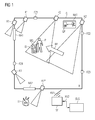
- FIG. 1 shows an exemplary schematic representation of the present invention.
- a person P is located in a room R of a building G.
- the room can be, for example, a room, a corridor, a stairwell, a balcony, but in principle also an outside area of a building G.
- an emergency eg fire, terrorist alarm
- persons P in building G should be evacuated safely and quickly.
- buildings ie, public buildings in particular
- NA1, NA2 In the known static Emergency exit systems, however, are not sure that the way behind an emergency exit door NA1, NA2 is really an escape route from the building G, because the escape route behind one of the emergency exit doors NA1, NA2 could be blocked.
- the arrangement according to the invention enables a dynamic output of information EI for evacuation of persons P from buildings G (in principle the arrangement according to the invention is not restricted to the evacuation of persons from buildings, but also for the evacuation of ships or other events, such as rock concerts, used).
- the arrangement comprises a suitable first sensor system K1, K1 ', K1 ", K1"' for determining the current usability of the respective escape routes NA1, NA2 located in the building.
- sensors may be used as suitable first sensors K1, K1 ', K1 ", K1".
- the sensors K1, K1 ', K1 ", K1”' also include fire or smoke / gas detectors, or represent a combination of different sensor types.
- a suitable sensor can be selected depending on existing requirements or conditions on site.
- FIG. 1 The cameras K1 and K1 'monitor the emergency exit NA1, the cameras K1' and K1 '' the emergency exit NA2.
- the camera K1 "'detects that there is an obstacle H in the form of a fire behind the emergency exit NA2, so that an escape route via the emergency exit NA2 would not be passable, this information that starting from the room R an escape route via the emergency exit NA2 for one in the room R P is not usable, the control unit SE by the camera K1 "'in real time via a communication link KV1 (eg, advantageously a radio link) is provided.
- a communication link KV1 eg, advantageously a radio link
- the control unit SE (eg PC, laptop, workstation) is determined based on the building plan and the data supplied by the first sensors K1, K1 ', K1 ", K1"' regarding the usability or passability of emergency exits NA1, NA2 evacuation information EI for persons P in the building G
- the control unit SE transmits the evacuation information EI via the communication link KV1 to the mobile device MG of a person P in the building G.
- the mobile device MG may be e.g. to trade a smartphone, cell phone, PDA (Personal Digital Assistant), notebook or a tablet computer.
- the evacuation information EI is displayed graphically animated on the display of the mobile device MG.
- the evacuation information EI can also be output textually and / or acoustically (for example in the form of instructions) on the mobile device MG.
- the arrangement furthermore comprises means for determining the current position data of the persons P located in the building G.
- This can be done, for example, by means of a suitable second sensor system K2, K2 '.
- the second sensor K2, K2 ' can be realized, for example, by cameras which detect the respective location and directions of movement BR of persons P.
- the position data of the persons P in the building G can also be determined by an indoor positioning system located in the building based on radio cells FZ1 to FZ4 located in the building and forwarded to the control unit SE, advantageously via a wireless communication link. It is also possible in principle to use the GPS system of the mobile device MG for determining the position of a person P.
- dedicated escape route information EI can be determined for each person P and output on the respective mobile device MG . Furthermore, an orderly and coordinated evacuation can take place, since bottlenecks or overload situations in escape routes can be avoided by issuing targeted evacuation information EI to the persons P in the evacuation case.
- the arrangement comprises means for providing the building plan of the building on the portable device MG, the portable device MG being suitable for graphically displaying the evacuation information as routing information on the building plan.
- the building plan can be read by a corresponding scan app (eg ScanLife TM on the portable device MG, for example by reading a corresponding QR code QR or barcodes, which may be attached to the entrance or on an emergency exit sign NAS of the corresponding building G.
- the mobile (portable) device MG can display the evacuation data in a 2D / 3D graphic (map) similar to conventional navigation systems, but it is also possible to use the evacuation data EI in the camera live view mode (or live view).
- the evacuation information EI can be displayed on the building plan, for example by information overlay (image and / or text information) by means of overlay technology (eg by direct hardware overlay or also by software)
- information overlay image and / or text information
- overlay technology eg by direct hardware overlay or also by software
- an object current simulation is performed by the control unit SE, based on the respective current position data of the persons P in the building G and the current usability of the escape routes NA1, NA2, and based on the results of the object current simulation respectively updated and dedicated evacuation information EI be provided to the mobile devices MG.
- the expected movement of persons P is modeled as realistically as possible on the basis of an underlying movement model. This can be an effective evacuation of the building G or a terrain done.
- emission propagation of a hazard H e.g., a fire
- the emissions include, for example, heat emissions or pollutant emissions or smoke emissions, which are caused by an emission source or a fire source.
- the emissions can influence a flow of people through direct contact, for example by persons P being injured by the emission, or indirectly influencing the flow of people considered, since they change or influence the speed of movement of the persons P. This also effectively evacuates the building G.
- the calculation of the object current simulation may be e.g. on a standard PC with appropriate software.
- the mobile device MG contains software for communication with the control unit SE, as well as for reading in, processing and displaying the building plan with the corresponding evacuation instructions EI.
- the software is a computer program product that directly into the internal memory of a portable device MG, in particular a smartphone or a tablet computer, and includes software sections with which the inventive method for the dynamic output of information for the evacuation of persons is feasible.
- the computer program product includes executable program code executing on a portable device processor.
- the computer program product can be loaded as a software program on the portable device, for example via a USB interface or wirelessly via a radio link.
- the computer program product as so-called. App (“Rescue App") from the Internet to the mobile device MG downloadable. But it is also possible that when entering a building G a person P is automatically pointed to a download of the app by a corresponding information on the mobile device MG and asked to make the download.
- control unit SE is integrated in a building management system GLS or coupled to a building management system GLS via a suitable communication link KV2.
- a building management system GLS all relevant information about a building is known or stored electronically in the corresponding building management software (GLT) (eg the information as to whether an escape route with a wheelchair is passable).
- the control unit SE can access this information (eg through database access) and use it for the calculation and provision of the evacuation information EI.
- the control unit SE is equipped with appropriate processor and storage capacity.
- the determination of the current usability of escape routes is based, in particular, on their respective utilization and / or passability.
- the inventive method is realized by communication of the corresponding software of the mobile device MG with the control unit SE. But it is also possible that the mobile device MG only acts as an output medium of the provided by the control unit SE evacuation information.
- Method and arrangement for the dynamic output of information for the evacuation of persons, in particular from buildings, to a portable device wherein the current position data of the device is determined by a positioning system; wherein the current usability of escape routes in the building is determined by a suitable first sensor system; wherein evacuation information is determined by a control unit based on the current usability of the escape routes and the current position of the device; and wherein the evacuation information is output on the person's portable device.
- dedicated evacuation information can thus be determined for a person depending on the location of the person and the respective dangerous situation and output on the mobile device (eg smartphone, PDA) of the person. This allows, among other things, a fast and efficient evacuation of the building or a site.
Landscapes
- Engineering & Computer Science (AREA)
- Radar, Positioning & Navigation (AREA)
- Remote Sensing (AREA)
- Physics & Mathematics (AREA)
- General Physics & Mathematics (AREA)
- Automation & Control Theory (AREA)
- Business, Economics & Management (AREA)
- Emergency Management (AREA)
- Alarm Systems (AREA)
Abstract
Description
- Die vorliegende Erfindung betrifft ein Verfahren, ein Computerprogramm-Produkt und eine Anordnung zur dynamischen Ausgabe von Informationen zur Evakuierung von Personen, insbesondere aus Gebäuden, auf ein portables Gerät.
- Die schnelle und sichere Notfallevakuierung von Personen aus Gebäuden aber auch bei Veranstaltungen unter freien Himmel (z.B. Rockkonzert) spielt heutzutage eine immer größere Rolle, insbesondere hinsichtlich Terrorattacken oder Umweltkatastrophen. Eine schnelle und sichere Notfallevakuierung ist deshalb bereits bei der Planung von Infrastrukturen, z.B. für Gebäude oder Konzerte ein wichtiger Aspekt.
- Bekannte Evakuierungssysteme sind allerdings statisch ausgelegt, wie z.B. die Kennzeichnung von Notausgängen bzw. die Wegführung zu im Gebäude befindlichen Notausgängen.
- Es ist Aufgabe der vorliegenden Erfindung ein Verfahren, ein Computerprogramm-Produkt und eine Anordnung zur dynamischen Ausgabe von Informationen zur Evakuierung von Personen aus Gebäuden bereitzustellen.
- Die Aufgabe wird gelöst durch ein Verfahren zur dynamischen Ausgabe von Informationen zur Evakuierung von Personen, insbesondere aus Gebäuden, auf ein portables Gerät, das Verfahren umfassend:
- Bestimmen der aktuellen Positionsdaten des Gerätes durch ein Positionsbestimmungssystem;
- Bestimmen der aktuellen Verwendbarkeit von im Gebäude befindlichen Fluchtwegen durch eine geeignete erste Sensorik;
- Ermitteln von Evakuierungsinformationen durch eine Steuereinheit, basierend auf der aktuellen Verwendbarkeit der Fluchtwege und der aktuellen Position des Gerätes; und
- Ausgeben der Evakuierungsinformation auf dem portablen Gerät. Fluchtwege sind je nach der Anzahl der Personen in den verschiedenen Gebäudeteilen stark oder weniger stark ausgelastet. Weiterhin können Fluchtwege durch Hindernisse (z.B. durch Brand oder Rauch) versperrt oder nur schwer passierbar sein. Die Räumung eines Gebäudes erfolgt allerdings schneller, wenn die Personen dynamisch (je nach Auslastung bzw. Verfügbarkeit) zu offenen und passierbaren Fluchtwegen geführt werden. Die aktuelle Verwendbarkeit von Fluchtwegen kann z.B. durch sowieso schon im Gebäude befindliche Kameras überwacht und bestimmt werden. Mit Vorteil wird die Evakuierungsinformation auf portablen Geräten ausgegeben, die sich sowieso schon im Besitz von Benutzern (wie zum Beispiel Smartphones, portable Media Player (PMP), d.h. tragbare Medienabspielgeräte oder aber auch Tablet-PC) befinden. Prinzipiell kann die Evakuierungsinformation aber auch auf portablen Geräten ausgegeben werden, die ein Benutzer (Besucher) erst im Gebäude ausgehändigt bekommt (z.B. ein elektronischer Museumsführer oder ein sogenannter Multimedia-Guide). Mit Vorteil ist das portable Gerät mit einem Positionsbestimmungssystem (z.B. GPS-System) ausgestattet ist, welches zur Positionsbestimmung des Gerätes verwendbar ist. Es ist aber auch möglich, dass das Bestimmen der aktuellen Positionsdaten des Gerätes durch ein separates Positionsbestimmungssystem, z.B. ein im Gebäude befindliches "Indoor-Positionsbestimmungs-system" (Indoor Positioning System, IPS) erfolgt. Im Prinzip kann ein IPS auch auf freiem Gelände installiert sein. Ein IPS kann z.B. durch entsprechend angeordnete lokale Funkzellen realisiert sein, wie WLAN-Knoten, Hotspots, Accesspoints etc. Die Erfindung ermöglicht insbesondere die Bereitstellung von dedizierten Evakuierungsinformationen entsprechend der aktuellen Lokalisation und Situation für die jeweiligen Personen.
- Eine erste vorteilhafte Ausgestaltung der Erfindung liegt darin, dass die Bestimmung der aktuellen Verwendbarkeit von Fluchtwegen auf deren jeweiligen Auslastung und/oder deren Passierbarkeit beruht. Fluchtwege sind je nach der Anzahl der Personen in den verschiedenen Gebäudeteilen stark oder weniger stark ausgelastet. Weiterhin können Fluchtwege durch Hindernisse (z.B. durch Brand oder Rauch) versperrt oder nur schwer passierbar sein. In den Fluchtwegen (z.B. Treppenhäusern) werden geeignete Sensoren (z.B. Kameras und/oder Rauch-/Gasmelder) platziert. Diese Sensoren erfassen z.B. Rauch, Anzahl der Personen (Auslastung). Dadurch kann die Auslastung bzw. Verwendbarkeit (Fluchtweg verraucht) eines Fluchtweges ermittelt werden. Die Räumung eines Gebäudes erfolgt allerdings schneller, wenn die Personen dynamisch (je nach Auslastung bzw. Verfügbarkeit) zu offenen und passierbaren Fluchtwegen geführt werden. Die aktuelle Position des Gerätes ist auch ein Hinweis auf die aktuelle Position des Geräteinhabers. Dadurch können für eine Person jeweils dedizierte Evakuierungsinformation (d.h. in Abhängigkeit vom Aufenthaltsort und der vorliegenden Gefahrensituation) auf dem portablen Gerät ausgegeben werden.
- Die vorliegende Erfindung ermöglicht es u.a., bei der Evakuierung von Personen aus Gebäuden die aktuelle Auslastung und aktuelle Passierbarkeit von Fluchtwegen, sowie den Aufenthaltsort einer zu rettenden Person zu berücksichtigen. Es werden somit aktuell vorliegende Engpässe aber auch zu erwartende Engpässe erkannt und bei der Evakuierung berücksichtigt. Dadurch können bei der Evakuierung u.a. Paniksituationen vermieden werden.
- Eine weitere vorteilhafte Ausgestaltung der Erfindung liegt darin, dass ein Gebäudeplan des Gebäudes auf das Gerät geladen wird und die Evakuierungsinformation als Routinginformation auf dem Gebäudeplan grafisch auf dem Gerät ausgegeben wird. Der Gebäudeplan kann z.B. aus einem Gebäudeinformationsmodell (Building Information Model, BIM) generiert und auf das portable Gerät geladen werden, z.B. über eine WLAN-Verbindung beim Betreten eines Gebäudes. Handelt es sich beim portablen (mobilen) Gerät um ein Gerät, welches einer Person beim Betreten eines Gebäudes ausgehändigt wird (z.B. Multimedia-Guide in einem Museum), dann ist mit Vorteil dieses Gerät bereits mit dem entsprechenden Gebäudeplan bestückt. Das mobile Gerat kann die Fluchtweg-Daten (Evakuierungsdaten) ähnlich wie bei handelsüblichen Navigationssystemen in einer 2D/3D-Grafik (Map) darstellen. Es ist aber auch möglich die Evakuierungsdaten z.B. im Kamera-Live-View-Modus (bzw. Live-Preview-Modus), wie es bei Digitalkameras bekannt ist, darzustellen. Die Darstellung der Evakuierungsinformation auf dem Gebäudeplan kann z.B. durch Informationseinblendung (Bild und/oder Textinformation) mittels Overlaytechnik erfolgen (z.B. durch direktes Hardware-Overlay oder auch durch Software-Overlay).
- Eine weitere vorteilhafte Ausgestaltung der Erfindung liegt darin, dass der Gebäudeplan des Gebäudes auf das Gerät über das Internet oder durch das Einlesen einer am Gebäude befindlichen Kennzeichnung durch eine geeignete Lesevorrichtung des Gerätes geladen wird. Der Gebäudeplan kann über das Internet durch einen Service-Provider auf das mobile Gerät geladen werden. Der Benutzer meldet sich bei dem Service-Provider an, der als Inhaltsanbieter fungiert und u.a. die Gebäudepläne bereitstellen kann. Das Herunterladen eines Gebäude- oder Geländeplans kann z.B. auf Aufforderung (on demand) durch einen Benutzer erfolgen. Es ist aber auch möglich, dass das Herunterladen des Gebäude- oder Geländeplans durch einen Push-Dienst (durch eine Push-Technologie) erfolgt. Der Benutzer meldet sich dazu bei einem Internet-Service-Provider an, über das GPS-Systems des mobilen Gerätes erkennt der Service-Provider, dass sich der Benutzer in einem bestimmten Gebäude (z.B. Rathaus, Stadion) befindet, der Service-Provider lädt dann automatisch den Gebäude- oder Geländeplan auf das mobile Gerät (z.B. Smartphone). Es ist aber auch möglich, durch das Einlesen einer am Gebäude befindlichen Kennzeichnung durch eine geeignete Lesevorrichtung des Gerätes den Gebäudeplan auf das mobile Gerät zu laden. Z.B. durch das Einlesen eines QR-Codes, der sich am Gebäude befindet (z.B. als zusätzliche Information auf den Notweg-/Notausganghinweisschildern).
- Eine weitere vorteilhafte Ausgestaltung der Erfindung liegt darin, dass basierend auf den jeweils aktuellen Positionsdaten der im Gebäude befindlichen Personen und der aktuellen Verwendbarkeit der Fluchtwege, eine Objektstromsimulation durchführt, und wobei basierend auf den Ergebnissen der Objektstromsimulation jeweils aktualisierte Evakuierungsinformationen auf dem portablen Gerät ausgegeben werden. Durch eine Objektstromsimulation wird die zu erwartende Bewegung von Personen möglichst realistisch nachgebildet, um daraus beispielsweise Aussagen zur Evakuierung der Personen aus Gebäuden ableiten zu können. Dadurch, dass die Positionsinformation von Personen und die Verfügbarkeit von Fluchtwegen als Eingangsparameter für eine Objektstromsimulation verwendet werden, kann dediziert für die jeweilige Person eine dedizierte Fluchtroute berechnet werden. Z.B. der schnellste Weg einer Person von ihrem aktuellen Standort zum nächsten passierbaren Notausgang. Dadurch kann eine effektive Evakuierung eines vorgegebenen Gebietes oder Gebäudes erfolgen. Die Objektstromsimulation kann auf einem handelsüblichen Computer (z.B. Server, Laptop, PC) mit geeigneter Simulationssoftware durchgeführt werden. Die Objektstromsimulation kann z.B. auf einem Computer eines Gebäudeleitsystems erfolgen oder in einer Cloud (Cloud Computing). Optional kann bei der Objektstromsimulation auch die Emissionsausbreitung einer Gefahrenquelle (z.B. Feuer oder Rauchgas) im Gebäude oder auf dem Gelände mit berücksichtigt werden. Auch dadurch ist die Generierung und Bereitstellung von genauen und zielgerichteten Evakuierungsinformationen möglich. Weiterhin kann optional bei der Objektstromsimulation auch die Bewegungsrichtungen der sich im Gebäude (auf dem Gelände) befindlichen Personen berücksichtigt werden. Die Bewegungsrichtung kann z.B. durch Kameras oder andere geeignete Sensorik bestimmt werden.
- Eine weitere vorteilhafte Ausgestaltung der Erfindung liegt in einem Computerprogramm-Produkt, das direkt in den internen Speicher eines portablen Gerätes, insbesondere eines Smartphones oder eines Tablet-Computers, geladen werden kann und Softwareabschnitte umfasst, mit denen das erfindungsgemässe Verfahren zur dynamischen Ausgabe von Informationen zur Evakuierung von Personen durchführbar ist. Das Computerprogramm-Produkt enthält ausführbaren Programmcode der auf einem Prozessor des portablen Gerätes ausgeführt wird. Das Computerprogramm-Produkt kann als Softwareprogramm auf das portable Gerät geladen werden, z.B. über eine USB-Schnittstelle oder über eine kabellose Funkverbindung. Optional kann das Computerprogramm-Produkt auch als Firmware auf dem portablen Gerät implementiert sein (z.B. in einem Flash-Speicher oder einem EPROM). Dadurch, dass sich das Computerprogramm-Produkt auf dem portablen Gerät des Benutzers (z.B. Person im Gebäude) befindet, können sehr leicht für die jeweilige Person personenspezifische Evakuierungsinformationen, insbesondere hinsichtlich Identität und Aufenthaltsort, auf dem Gerät bereitgestellt werden. Dies erleichtert z.B. Rettungsteams ein schnelles Auffinden der Person im Gebäude.
- Eine weitere vorteilhafte Ausgestaltung der Erfindung liegt darin, dass es sich beim Computerprogramm-Produkt um ein vom Benutzer vom Internet oder einem Intranet herunterladbares Softwareprogramm (App) handelt. Ein Benutzer kann somit bei Bedarf (on demand) das Computerprogramm-Produkt (z.B. ein Softwareprogramm) als sog. App (mobile App) auf sein portables Gerät laden. Die App kann z.B. von einem Service-Provider über dessen Internet-Marktplatz (wie. Z.B. App Store™, Google Play™) auf Anforderung durch den Benutzer bezogen werden (durch einen Download vom Internet). Es ist aber auch möglich, dass dem Benutzer auf seinem portablen Gerät beim Betreten eines Gebäudes oder Geländes die App zum Download angeboten wird.
- Die Aufgabe wird weiterhin gelöst durch eine Anordnung zur dynamischen Ausgabe von Informationen zur Evakuierung von Personen, insbesondere aus Gebäuden, auf ein portables Gerät einer jeweiligen Person, die Anordnung umfassend:
- eine geeignete erste Sensorik zur Bestimmung der aktuellen Verwendbarkeit der jeweiligen im Gebäude befindlichen Fluchtwege;
- ein Positionsbestimmungssystem zur Bestimmung der Positionen von im Gebäude befindlichen Personen;
- eine Steuereinheit (SE) zur Echtzeitverarbeitung der von der ersten Sensorik und der vom Positionsbestimmungssystem gelieferten Daten; wobei von der Steuereinheit basierend auf der aktuellen Verwendbarkeit der Fluchtwege und der aktuellen Position einer dedizierten Person Evakuierungsinformation auf dem portablen Gerät der dedizierten Person bereitgestellt wird. Die erfindungsgemässe Anordnung lässt sich leicht realisieren oder in einem bestehenden Gebäude bzw. Gelände nachrüsten, sind üblicherweise schon im Gebäude bzw. bei einem Benutzer vorhanden oder handelsüblich beziehbar. Als geeignete erste Sensorik zur Bestimmung der aktuellen Verwendbarkeit der jeweiligen im Gebäude befindlichen Fluchtwege können z.B. Kameras verwendet werden, die sich schon im Gebäude befinden oder leicht an den entsprechenden Orten (z.B. in Treppenhäusern oder hinter Notausgangstüren) nachrüstbar sind. Als Positionsbestimmungssystem kann z.B. ein GPS-System des portablen Gerätes (Smartphones sind heutzutage bereits mit GPS-System ausgestattet bzw. kann ein GPS-System über eine App auf einem Smartphone nachgerüstet werden). Es ist aber auch möglich ein Indoor-Positionsbestimmungssystem zu verwenden (z.B. basierend auf im Gebäude befindlichen Funkzellen, basierend auf RFID-Technologie oder durch Near Field Communication (NFC)). Die Steuereinheit (z.B. ein handelsüblicher Computer, wie Server, PC oder Laptop) zur Echtzeitverarbeitung der von der ersten Sensorik und der vom Positionsbestimmungssystem gelieferten Daten ist mit entsprechender Software (Kommunikationssoftware zur Kommunikation mit dem portablen Gerät, Simulationssoftware oder Entscheidungstabellen zur Bereitstellung der Evakuierungsinformation basierend auf der aktuellen Situation im Gebäude, etc.) ausgestattet. Die Evakuierungsinformation wird auf Ausgabemedien (Display, Lautsprecher) des portablen Gerätes optisch (grafisch und/oder textuell) und/oder akustisch (z.B. in Form von Handlungsanweisungen) ausgegeben.
- Zur Realisierung eines Indoor-Positionsbestimmungssystems kann die geografische Position der im Gebäude angeordneten Funkzellen (WLAN-Knoten, Hotspots, Accespoints etc.) z.B. in Form einer Tabelle hinterlegt sein. Mit Vorteil sind im Gebäudeplan die Positionen der Funkzellen hinterlegt. Somit kann auf Basis des Triangulationsprinzips durch das mobile Gerät die aktuelle Position im Gebäude ermittelt werden. Eine weitere vorteilhafte Ausgestaltung der Erfindung liegt darin, dass die Anordnung Mittel zur Bereitstellung des Gebäudeplans des Gebäudes auf dem portablen Gerät umfasst, wobei das portable Gerät geeignet ist, die Evakuierungsinformation als Routinginformation auf dem Gebäudeplan grafisch darzustellen. Der Gebäudeplan kann z.B. durch Einlesen eines entsprechenden QR-Codes oder Barcodes, der z.B. am Eingang oder auf einem Notausgangsschild des entsprechenden Gebäudes angebracht sein kann, durch eine entsprechende Scan-App (z.B. ScanLife™ auf dem portablen Gerät eingelesen werden. Das mobile (portable) Gerat kann die Evakuierungsdaten ähnlich wie bei handelsüblichen Navigationssystemen z.B. in einer 2D/3D-Grafik (Map) darstellen. Es ist aber auch möglich die Evakuierungsdaten z.B. im Kamera-Live-View-Modus (bzw. Live-Preview-Modus), wie es bei Digitalkameras bekannt ist, auf dem Gerät darzustellen. Die Darstellung der Evakuierungsinformation auf dem Gebäudeplan kann z.B. durch Informationseinblendung (Bild und/oder Textinformation) mittels Overlaytechnik erfolgen (z.B. durch direktes Hardware-Overlay oder auch durch Software-Overlay). Handelsübliche mobile Geräte, wie z.B. Smartphones oder Tablet-Computer sind heutzutage üblicherweise für diese Darstellungsmöglichkeiten ausgestattet oder können entsprechend nachgerüstet werden.
- Eine weitere vorteilhafte Ausgestaltung der Erfindung liegt darin, dass die Anordnung Teil eines Gebäudeleit- und/oder Gefahrenmeldesystems ist. In einem Gebäudeleit- oder Gefahrenmeldesystem sind statische (Pläne) und dynamische Daten (z.B. Zimmerbelegungen in einem Hotel) vorhanden bzw. zentral abgreifbar. Durch die Integration in eine Gebäudeleit- oder Gefahrenmeldesystems können im Gefahrenfall (z.B. Brand) geeignete Rettungsmassnahmen auf einzelne Personen zielgerichtet koordiniert bzw. veranlasst werden.
- Ein Ausführungsbeispiel der Erfindung ist in der Zeichnung dargestellt und wird im Folgenden erläutert.
- Dabei zeigen:
- FIG 1
- eine beispielhafte Prinzipdarstellung für die vorliegende Erfindung, und
- FIG 2
- ein beispielhaftes Flussdiagramm für ein Verfahren zur Durchführung der vorliegenden Erfindung.
- Derzeit erfolgt die Evakuierung eines Gebäudes, eines Schiffes oder eines Geländes nach akustischer und/oder optischer Alarmierung. Die betroffenen Personen müssen sich dann anhand einer statischen Fluchtwegkennzeichung (z.B. grüne Hinweisschilder für Notausgänge) den Weg zum nächsten Notausgang suchen. In fremden unübersichtlichen Gebäuden ist das für eine betroffene Person oft schwer. Auch kann z.B. der Fluchtweg über ein Treppenhaus durch hohe Rauchentwicklung unpassierbar werden. Statische Fluchtwegkennzeichungen berücksichtigen solche Situationen nicht.
-
Figur 1 zeigt eine beispielhafte Prinzipdarstellung für die vorliegende Erfindung. In einem Raum R eines Gebäudes G befindet sich eine Person P. Bei dem Raum kann es sich z.B. um ein Zimmer, einen Flur, ein Treppenhaus, einen Balkon, aber prinzipiell auch um einen Aussenbereich eines Gebäudes G handeln. Im Falle eines Notfalls (z.B. Feuer, Terroralarm) sollen im Gebäude G befindliche Personen P sicher und schnell evakuiert werden. Heutzutage sind Gebäude (d.h. insbesondere öffentliche Gebäude) mit Notausgängen NA1, NA2 und Wegweisern zu Notausgängen versehen, um Personen P im Notfall einen Weg aus dem Gebäude G zu zeigen. Bei den bekannten statischen Notausgang-Systemen ist aber nicht sichergestellt, dass der Weg hinter einer Notausgangstür NA1, NA2 auch wirklich einen Fluchtweg aus dem Gebäude G darstellt, denn der Fluchtweg hinter einer der Notausgangstüren NA1, NA2 könnte versperrt sein. - Die erfindungsgemäße Anordnung ermöglicht dagegen eine dynamische Ausgabe von Informationen EI zur Evakuierung von Personen P aus Gebäuden G (prinzipiell ist die erfindungsgemässe Anordnung nicht auf die Evakuierung von Personen aus Gebäuden beschränkt, sondern auch für die Evakuierung von Schiffen oder anderen Veranstaltungen, wie z.B. Rockkonzerten, einsetzbar). Gemäß der Darstellung nach
Figur 1 umfasst die Anordnung eine geeignete erste Sensorik K1,K1',K1",K1"' zur Bestimmung der aktuellen Verwendbarkeit der jeweiligen im Gebäude befindlichen Fluchtwegen NA1,NA2. Als geeignete erste Sensorik K1,K1',K1",K1"' können z.B. Kameras verwendet werden. Alternativ oder optional kann die Sensorik K1,K1',K1", K1"' auch Brand- oder Rauch-/Gasmelder umfassen, oder eine Kombination aus unterschiedlichen Sensortypen darstellen. Eine geeignete Sensorik kann je nach vorliegenden Anforderungen oder Gegebenheiten vor Ort gewählt werden. - In
Figur 1 überwachen die Kameras K1 und K1' den Notausgang NA1, die Kameras K1" und K1"' den Notausgang NA2. InFigur 1 erkennt die Kamera K1"', dass sich hinter dem Notausgang NA2 ein Hindernis H in Form eines Feuers befindet. Ein Fluchtweg über Notausgang NA2 wäre somit nicht passierbar. Diese Information, dass ausgehend vom Raum R ein Fluchtweg über den Notausgang NA2 für eine im Raum R befindliche Person P nicht verwendbar ist, wird der Steuereinheit SE von der Kamera K1"' in Echtzeit über eine Kommunikationsverbindung KV1 (z.B. mit Vorteil eine Funkverbindung) bereitgestellt. Die Steuereinheit SE (z.B. PC, Laptop, Workstation) bestimmt basierend auf dem Gebäudeplan und den von der ersten Sensorik K1,K1',K1",K1"' gelieferten Daten bezüglich über die Verwendbarkeit bzw. Passierbarkeit von Notausgängen NA1, NA2 Evakuierungsinformationen EI für im Gebäude G befindliche Personen P. - Die Steuereinheit SE übermittelt die Evakuierungsinformationen EI über die Kommunikationsverbindung KV1 auf das mobile Gerät MG einer im Gebäude G befindlichen Person P. Beim mobilen Gerät MG kann es sich z.B. um ein Smartphone, Handy, PDA (Personal Digital Assistant), Notebook oder ein Tablet-Computer handeln. Mit Vorteil wird die Evakuierungsinformation EI grafisch animiert auf dem Display des mobilen Gerätes MG ausgegeben. Optional kann die die Evakuierungsinformation EI aber auch textuell und/oder akustisch (z.B. in Form von Handlungsanweisungen) auf dem mobilen Gerät MG ausgegeben werden.
- Die Anordnung umfasst weiterhin Mittel zur Bestimmung der aktuellen Positionsdaten der sich im Gebäude G befindlichen Personen P. Dies kann z.B. durch eine geeignete zweite Sensorik K2,K2' erfolgen. Die zweite Sensorik K2, K2' kann z.B. durch Kameras realisiert sein, die den jeweiligen Aufenthaltsort und Bewegungsrichtungen BR von Personen P erfassen. Die Positionsdaten der sich im Gebäude G befindlichen Personen P können aber auch durch ein im Gebäude befindlichen Indoor-Positionsbestimmungssystem basierend auf im Gebäude befindlichen Funkzellen FZ1 bis FZ4 ermittelt und an die Steuereinheit SE weitergeleitet werden, mit Vorteil über eine drahtlose Kommunikationsverbindung. Es ist im Prinzip auch möglich das GPS-System des mobilen Gerätes MG zu Positionsbestimmung einer Person P zu verwenden.
- Durch die Berücksichtigung der aktuellen Positionsdaten der sich im Gebäude G befindlichen Personen P und der aktuellen Fluchtwegssituation (welcher Fluchtweg ist benutzbar?; welcher Fluchtweg ist nicht passierbar?) können für jede Person P dedizierte Fluchtwegsinformationen EI bestimmt und auf dem jeweiligen mobilen Gerät MG ausgegeben werden. Weiterhin kann eine geordnete und koordinierte Evakuierung erfolgen, da im Evakuierungsfall Engpässe oder Überlastsituationen in Fluchtwegen durch die Ausgabe von zielgerichteten Evakuierungsinformationen EI an die Personen P vermieden werden können.
- Mit Vorteil umfasst die Anordnung Mittel zur Bereitstellung des Gebäudeplans des Gebäudes auf dem portablen Gerät MG, wobei das portable Gerät MG geeignet ist, die Evakuierungsinformation als Routinginformation auf dem Gebäudeplan grafisch darzustellen. Der Gebäudeplan kann z.B. durch Einlesen eines entsprechenden QR-Codes QR oder Barcodes, der z.B. am Eingang oder auf einem Notausgangsschild NAS des entsprechenden Gebäudes G angebracht sein kann, durch eine entsprechende Scan-App (z.B. ScanLife™ auf dem portablen Gerät MG eingelesen werden. Das mobile (portable) Gerat MG kann die Evakuierungsdaten ähnlich wie bei handelsüblichen Navigationssystemen z.B. in einer 2D/3D-Grafik (Map) darstellen. Es ist aber auch möglich die Evakuierungsdaten EI z.B. im Kamera-Live-View-Modus (bzw. Live-Preview-Modus), wie es bei Digitalkameras bekannt ist, auf dem Gerät darzustellen. Die Darstellung der Evakuierungsinformation EI auf dem Gebäudeplan kann z.B. durch Informationseinblendung (Bild und/oder Textinformation) mittels Overlaytechnik erfolgen (z.B. durch direktes Hardware-Overlay oder auch durch Software-Overlay). Durch das Einlesen des Gebäudeplans durch eine geeigneten Kennung auf dem mobilen Gerät MG im Gebäude G kann der Gebäudeplan bei Bedarf bereit-gestellt werden (d.h. on demand).
- Mit Vorteil wird durch die Steuereinheit SE, basierend auf den jeweils aktuellen Positionsdaten der im Gebäude G befindlichen Personen P und der aktuellen Verwendbarkeit der Fluchtwege NA1,NA2, eine Objektstromsimulation durchführt, und wobei basierend auf den Ergebnissen der Objektstromsimulation jeweils aktualisierte und dedizierte Evakuierungsinformationen EI auf den mobilen Geräten MG bereitgestellt werden. Durch eine Objektstromsimulation wird die zu erwartende Bewegung von Personen P basierend auf einem zugrundeliegenden Bewegungsmodell möglichst realistisch nachgebildet. Dadurch kann eine effektive Evakuierung des Gebäudes G oder eine Geländes erfolgen.
- Mit Vorteil wird für die Objektstromsimulation auch die Emissionsausbreitung einer Gefahrenquelle H (z.B. ein Brand) im Gebäude G verwendet. Die Emissionen umfassen beispielsweise Hitzeemissionen oder Schadstoffemissionen bzw. Rauchemissionen, die durch eine Emissionsquelle bzw. einen Brandherd hervorgerufen werden. Die Emissionen können einen Personenstrom durch direkten Kontakt beeinflussen, beispielsweise indem Personen P durch die Emission verletzt werden, oder den betrachteten Personenstrom indirekt beeinflussen, da sie die Fortbewegungsgeschwindigkeit der Personen P verändern bzw. beeinflussen. Auch dadurch erfolgt eine effektive Evakuierung des Gebäudes G. Die Berechnung der Objektstromsimulation kann z.B. auf einem handelsüblichen PC mit entsprechender Software erfolgen.
- Das mobile Gerät MG enthält Software zur Kommunikation mit der Steuereinheit SE, sowie zum Einlesen, Verarbeiten und Darstellen des Gebäudeplans mit den entsprechenden Evakuierungshinweisen EI. Mit Vorteil handelt es sich bei der Software um ein Computerprogramm-Produkt, das direkt in den internen Speicher eines portablen Gerätes MG, insbesondere eines Smartphones oder eines Tablet-Computers, geladen werden kann und Softwareabschnitte umfasst, mit denen das erfindungsgemässe Verfahren zur dynamischen Ausgabe von Informationen zur Evakuierung von Personen durchführbar ist. Das Computerprogramm-Produkt enthält ausführbaren Programmcode der auf einem Prozessor des portablen Gerätes ausgeführt wird. Das Computerprogramm-Produkt kann als Softwareprogramm auf das portable Gerät geladen werden, z.B. über eine USB-Schnittstelle oder kabellos über eine Funkverbindung. Mit Vorteil ist das Computerprogramm-Produkt als sog. App ("Rescue App") vom Internet auf das mobile Gerät MG herunterladbar. Es ist aber auch möglich, dass beim Betreten eines Gebäudes G eine Person P automatisch auf einen Download der App durch eine entsprechende Information auf dem mobilen Gerät MG hingewiesen wird und aufgefordert wird den Download vorzunehmen.
- Mit Vorteil ist die Steuereinheit SE in einem Gebäudeleitsystem GLS integriert oder mit einem Gebäudeleitsystem GLS über eine geeignete Kommunikationsverbindung KV2 gekoppelt. In einem Gebäudeleitsystem GLS sind alle relevanten Informationen über ein Gebäude bekannt bzw. elektronisch in entsprechender Gebäudeleittechnik-Software (GLT) hinterlegt (z.B. die Information, ob ein Fluchtweg mit einem Rollstuhl befahrbar ist). Die Steuereinheit SE kann auf diese Informationen (z.B. durch Datenbankzugriff) zugreifen und für die Berechnung und Bereitstellung der Evakuierungsinformationen EI verwenden. So ist es z.B. möglich, dass Rollstuhlfahrer durch die Evakuierungsinformationen EI an einen sicheren Ort im Gebäude G geleitet werden können, um dort auf die Rettungsmannschaft zu warten. Die Steuereinheit SE ist mit entsprechender Prozessor- und Speicherkapazität ausgestattet.
-
Figur 2 zeigt ein beispielhaftes Flussdiagramm für ein Verfahren zur Durchführung der vorliegenden Erfindung. Die Darstellung gemäßFigur 2 zeigt ein Verfahren zur dynamischen Ausgabe von Informationen EI zur Evakuierung von Personen P, insbesondere aus Gebäuden G, auf ein portables Gerät MG mit folgenden Verfahrensschritten: - Bestimmen der aktuellen Positionsdaten des Gerätes durch ein Positionsbestimmungssystem (VS1);
- Bestimmen der aktuellen Verwendbarkeit von im Gebäude G befindlichen Fluchtwegen durch eine geeignete erste Sensorik (VS2) ;
- Ermitteln von Evakuierungsinformationen durch eine Steuereinheit SE, basierend auf der aktuellen Verwendbarkeit der Fluchtwege NA1,NA2 und der aktuellen Position des Gerätes MG (VS3); und
- Ausgeben der Evakuierungsinformation EI auf dem portablen Gerät MG (VS4).
- Die Bestimmung der aktuellen Verwendbarkeit von Fluchtwegen beruht insbesondere auf deren jeweiligen Auslastung und/oder deren Passierbarkeit.
- Optional umfasst das Verfahren weitere Schritte:
- Laden eins Gebäudeplans des Gebäudes auf das mobile Gerät.
- Ausgeben der Evakuierungsinformation als grafische Routinginformation auf dem Gebäudeplan auf dem Display des Gerätes.
- Das Laden des Gebäudeplans auf das Gerät erfolgt insbesondere über das Internet (durch einen entsprechenden Download von einem Service-Provider) oder durch das Einlesen einer am Gebäude befindlichen Kennzeichnung (z.B. in Form von QR-Code oder Barcode) durch eine geeignete Lesevorrichtung des Gerätes (z.B. durch eine Scan-App).
- Durchführen einer Objektstromsimulation durch die Steuereinheit SE, basierend auf den aktuellen Positionsdaten der im Gebäude G befindlichen Personen P und der aktuellen Verwendbarkeit der Fluchtwege, wobei basierend auf den Ergebnissen der Objektstromsimulation jeweils aktuelle Evakuierungsinformationen auf dem mobilen Gerät MG bereitgestellt werden.
- Das erfindungsgemässe Verfahren wird durch Kommunikation der entsprechenden Software des mobilen Gerätes MG mit der Steuereinheit SE realisiert. Es ist aber auch möglich, dass das mobile Gerät MG nur als Ausgabemedium der von der Steuereinheit SE bereitgestellten Evakuierungsinformation fungiert.
- Die vorliegende Erfindung bietet insbesondere folgende Vorteile:
- Besserer Orientierung innerhalb des Gebäudes, insbesondere für Personen, die ein Gebäude zum erstenmal betreten.
- Dynamische Fluchtwegberechnung, um möglichen Gefahrenstellen zu "umlaufen".
- Positionsübermittlung an Rettungskräfte, wenn Selbstrettung nicht möglich ist.
- Aktuelle Gebäudedaten können z.B. über QR-Scan auf das mobile Gerät (z.B. Smartphone) übertragen werden.
- Ausgabe von dedizierten Evakuierungsinformationen basierend auf der aktuellen Position einer Person und der aktuell vorliegenden Gefahrensituation.
- Verfahren und Anordnung zur dynamischen Ausgabe von Informationen zur Evakuierung von Personen, insbesondere aus Gebäuden, auf ein portables Gerät, wobei die aktuelle Positionsdaten des Gerätes durch ein Positionsbestimmungssystem bestimmt werden; wobei die aktuelle Verwendbarkeit von im Gebäude befindlichen Fluchtwegen durch eine geeignete erste Sensorik bestimmt wird; wobei durch eine Steuereinheit, basierend auf der aktuellen Verwendbarkeit der Fluchtwege und der aktuellen Position des Gerätes Evakuierungsinformationen ermittelt werden; und wobei die Evakuierungsinformation auf dem portablen Gerät der Person ausgegeben wird. In Notfallsituationen können somit für eine Person dedizierte Evakuierungsinformationen in Abhängigkeit des Aufenthaltsortes der Person und der jeweiligen Gefahrensituation ermittelt und auf dem mobilen Gerät (z.B. Smartphone, PDA) der Person ausgegeben werden. Dies ermöglicht u.a. eine schnelle und effiziente Evakuierung des Gebäudes oder eines Geländes.
-
- G
- Gebäude
- R
- Raum
- K1,K1',K1",K1'"
- Erste Sensorik
- K2,K2'
- Zweite Sensorik
- P
- Person
- MG
- Mobiles Gerät
- BR
- Bewegungsrichtung
- H
- Hindernis
- EI
- Evakuierungsinformation
- SE
- Steuereinheit
- KV1, KV2
- Kommunikationsverbindung
- NA1, NA2
- Fluchtweg
- NAS
- Notausgangsschild
- QR
- Kennzeichnung
- GLS
- Gebäudeleitsystem
- FZ1 - FZ4
- Funkzellen
- VS1 - VS4
- Verfahrensschritt
Claims (9)
- Verfahren zur dynamischen Ausgabe von Informationen (EI) zur Evakuierung von Personen (P) aus Gebäuden (G) auf ein portables Gerät (MG), das Verfahren umfassend:Bestimmen der aktuellen Positionsdaten des Gerätes (MG) durch ein Positionsbestimmungssystem;Bestimmen der aktuellen Verwendbarkeit von im Gebäude (G) befindlichen Fluchtwegen (NA1,NA2) durch eine geeignete erste Sensorik (K1,K1',K1",K1"');Ermitteln von Evakuierungsinformationen (EI) durch eine Steuereinheit, basierend auf der aktuellen Verwendbarkeit der Fluchtwege und der aktuellen Position des Gerätes (MG); undAusgeben der Evakuierungsinformation (EI) auf dem portablen Gerät (MG),wobei die Evakuierungsinformation (EI) als grafische Routinginformation auf einem Gebäudeplan auf dem portablen Gerät (MG) ausgegeben wird, undwobei der Gebäudeplan durch Einlesen einer am Gebäude (G) befindlichen Kennzeichnung (QR) durch eine geeignete Lesevorrichtung des Gerätes (MG) geladen wird.
- Verfahren nach Anspruch 1, wobei die Bestimmung der aktuellen Verwendbarkeit von Fluchtwegen (NA1,NA2) auf deren jeweiligen Auslastung und/oder deren Passierbarkeit beruht.
- Verfahren nach Anspruch 1 oder 2, wobei durch zielgerichtete Evakuierungsinformationen (EI) an die Personen (P) eine koordinierte Evakuierung erfolgt.
- Verfahren nach einem der vorstehenden Ansprüche, wobei basierend auf den jeweils aktuellen Positionsdaten der im Gebäude (G) befindlichen Personen (P) und der aktuellen Verwendbarkeit der Fluchtwege, eine Objektstromsimulation durchführt, und wobei basierend auf den Ergebnissen der Objektstromsimulation jeweils aktualisierte Evakuierungsinformationen (EI) auf dem portablen Gerät (MG) ausgegeben werden.
- Computerprogramm-Produkt, das direkt in den internen Speicher eines portablen Gerätes (MG), insbesondere eines Smartphones, geladen werden kann und Softwareabschnitte umfasst, mit denen ein Verfahren zur dynamischen Ausgabe von Informationen (EI) zur Evakuierung von Personen (P) nach einem der Ansprüche 1 bis 4 durchführbar ist.
- Computerprogramm-Produkt nach Anspruch 5, wobei es sich beim Computerprogramm-Produkt um ein vom Benutzer (P) vom Internet oder einem Intranet herunterladbares Softwareprogramm (App) handelt.
- Anordnung zur dynamischen Ausgabe von Informationen (EI) zur Evakuierung von Personen (P), insbesondere aus Gebäuden (G), auf ein portables Gerät (MG) einer jeweiligen Person, die Anordnung umfassend:eine geeignete erste Sensorik (K1,K1',K1",K1"') zur Bestimmung der aktuellen Verwendbarkeit der jeweiligen im Gebäude (G) befindlichen Fluchtwege (NA1,NA2);ein Positionsbestimmungssystem zur Bestimmung der Positionen von im Gebäude (G) befindlichen Personen (P);eine Steuereinheit (SE) zur Echtzeitverarbeitung der von der ersten Sensorik (K1,K1',K1",K1"') und der vom Positionsbestimmungssystem gelieferten Daten;wobei das mobile Gerät (MG) über eine geeignete Lesevorrichtung zum Einlesen einer am Gebäude (G) befindlichen Kennzeichnung (QR) verfügt, worüber ein Gebäudeplan des Gebäudes einlesbar ist;wobei von der Steuereinheit (SE) basierend auf der aktuellen Verwendbarkeit der Fluchtwege (NA1,NA2) und der aktuellen Position einer dedizierten Person (P) Evakuierungsinformation (EI) auf dem portablen Gerät (MG) der dedizierten Person (P) als Routinginformation auf dem Gebäudeplan grafischbereitgestellt wird.
- Anordnung nach Anspruch 7, wobei die Steuereinheit eingerichtet ist, basierend auf den jeweils aktuellen Positionsdaten der im Gebäude (G) befindlichen Personen (P) und der aktuellen Verwendbarkeit der Fluchtwege, eine Objektstromsimulation durchzuführen, und wobei basierend auf den Ergebnissen der Objektstromsimulation jeweils aktualisierte Evakuierungsinformationen (EI) auf dem portablen Gerät (MG) bereitstellbar sind.
- Anordnung nach Anspruch 7 oder 8, wobei die Anordnung Teil eines Gebäudeleit- und/oder Gefahrenmeldesystems (GLS) ist.
Applications Claiming Priority (1)
| Application Number | Priority Date | Filing Date | Title |
|---|---|---|---|
| DE102013201873.8A DE102013201873B4 (de) | 2013-02-05 | 2013-02-05 | Dynamische Notfallhilfe |
Publications (3)
| Publication Number | Publication Date |
|---|---|
| EP2763112A2 true EP2763112A2 (de) | 2014-08-06 |
| EP2763112A3 EP2763112A3 (de) | 2017-11-01 |
| EP2763112B1 EP2763112B1 (de) | 2019-05-08 |
Family
ID=49943233
Family Applications (1)
| Application Number | Title | Priority Date | Filing Date |
|---|---|---|---|
| EP14151212.9A Active EP2763112B1 (de) | 2013-02-05 | 2014-01-15 | Dynamische Notfallhilfe |
Country Status (5)
| Country | Link |
|---|---|
| US (1) | US9080883B2 (de) |
| EP (1) | EP2763112B1 (de) |
| DE (1) | DE102013201873B4 (de) |
| DK (1) | DK2763112T3 (de) |
| ES (1) | ES2741751T3 (de) |
Cited By (9)
| Publication number | Priority date | Publication date | Assignee | Title |
|---|---|---|---|---|
| WO2016139219A1 (de) * | 2015-03-02 | 2016-09-09 | Paul Gier | Vorrichtung, system, verfahren, computerprogramm und telekommunikationsnetz zum lenken einer von einem gefährdungsverursacher verursachten gefahrensituation und zum durchführen und/oder unterstützen eines diesbezüglichen einsatzes |
| WO2017021230A1 (de) * | 2015-07-31 | 2017-02-09 | Inventio Ag | Reihenfolge von zu evakuierenden stockwerken in gebäuden mit aufzugsystemen |
| WO2017220364A1 (de) * | 2016-06-24 | 2017-12-28 | Siemens Schweiz Ag | Verfahren und eine anordnung zum senden einer bedienerausgelösten gefahrenmeldung an eine meldezentrale |
| WO2018054659A1 (de) * | 2016-09-20 | 2018-03-29 | Siemens Schweiz Ag | Verfahren und anordnung zum erkennen von hindernissen auf fluchtwegen, insbesondere in gebäuden |
| WO2018151895A1 (en) * | 2017-02-16 | 2018-08-23 | Carrier Corporation | Real-time intelligent egress system for high rise building |
| CN109545021A (zh) * | 2018-11-02 | 2019-03-29 | 国家消防工程技术研究中心 | 避难系统检测装置 |
| US10699547B2 (en) | 2016-10-12 | 2020-06-30 | Blackline Safety Corp. | Portable personal monitor device and associated methods |
| EP2922039B1 (de) | 2014-03-21 | 2021-02-24 | Eaton Safety IP GmbH & Co. KG | Notlichtsystem und entsprechendes verfahren |
| AT17856U1 (de) * | 2021-01-21 | 2023-05-15 | Zumtobel Lighting Gmbh At | Sicherheitsleuchte |
Families Citing this family (51)
| Publication number | Priority date | Publication date | Assignee | Title |
|---|---|---|---|---|
| DE102013201873B4 (de) | 2013-02-05 | 2017-09-21 | Siemens Schweiz Ag | Dynamische Notfallhilfe |
| US9728052B2 (en) * | 2013-04-22 | 2017-08-08 | Electronics And Telecommunications Research Institute | Digital signage system and emergency alerting method using same |
| US10282787B1 (en) | 2014-04-25 | 2019-05-07 | State Farm Mutual Automobile Insurance Company | Systems and methods for determining cause of loss to a property |
| US20140253328A1 (en) * | 2014-05-23 | 2014-09-11 | Jessel Craig | Hazard warning apparatus and system and method for use thereof |
| EP2983145A1 (de) * | 2014-08-05 | 2016-02-10 | Siemens Schweiz AG | Meldersockel und Anschlussbasis zur lösbaren Anbringung eines Gefahrenmelders mit jeweils einer Funkeinrichtung zum Aussenden von Positionsdaten des Montageorts des Meldersockels bzw. der Anschlussbasis und/oder eines Verweises auf diese Positionsdaten |
| US10515372B1 (en) * | 2014-10-07 | 2019-12-24 | State Farm Mutual Automobile Insurance Company | Systems and methods for managing building code compliance for a property |
| US10296851B2 (en) | 2015-04-11 | 2019-05-21 | At&T Intellectual Property I, L.P. | Automatic allocation of physical facilities for maximum collaboration |
| US9824515B2 (en) | 2015-03-24 | 2017-11-21 | At&T Intellectual Property I, L.P. | Automatic calendric physical access |
| US9972144B2 (en) | 2015-03-24 | 2018-05-15 | At&T Intellectual Property I, L.P. | Automatic physical access |
| US9582841B2 (en) | 2015-03-24 | 2017-02-28 | At&T Intellectual Property I, L.P. | Location based emergency management plans |
| EP3276572B1 (de) * | 2015-03-27 | 2021-05-12 | Mitsubishi Shipbuilding Co., Ltd. | Evakuierungsleitsystem und verfahren für schiffe |
| CN106289225A (zh) * | 2015-05-25 | 2017-01-04 | 富泰华工业(深圳)有限公司 | 室内逃生导航系统及方法 |
| US9911315B2 (en) * | 2015-06-19 | 2018-03-06 | Honeywell International Inc. | Personalized real time outdoor guidance application for mass evacuation |
| DE202015004618U1 (de) * | 2015-06-30 | 2016-10-04 | Rudolf King | Methode zur gemeinschaftlich-sozialen Anwendung mit Nutzung technischer Komponenten, bei der nach Gebäuden getrennt ein Feuerwarnsystem unter Nutzung des mobilen Internets und/oder einfacher Telefonverbindungen aufgesetzt werden kann |
| US9792788B2 (en) * | 2015-07-27 | 2017-10-17 | Honeywell International Inc. | Individual evacuation plan generation and notification via smart/wearable devices by positioning and predicting emergencies inside a building |
| MX378716B (es) | 2015-07-31 | 2025-03-10 | Inventio Ag | Evacuacion de edificios teniendo sistemas de elevador. |
| CN105205967A (zh) * | 2015-08-07 | 2015-12-30 | 珠海格力电器股份有限公司 | 火警监控方法及火警监控系统 |
| DE102015215649A1 (de) * | 2015-08-17 | 2017-02-23 | Siemens Aktiengesellschaft | Verfahren und Vorrichtung |
| CN105180941B (zh) * | 2015-09-09 | 2019-01-08 | 百度在线网络技术(北京)有限公司 | 一种导航方法和装置 |
| AU2016345066A1 (en) * | 2015-10-30 | 2018-06-21 | Evacusmart IP Pty Ltd | A control system for optimising emergency multi-storey building stairwell evacuation |
| US9860724B2 (en) * | 2015-11-30 | 2018-01-02 | International Business Machines Corporation | Communicating location specific emergency information to a mobile device |
| DE102015015917A1 (de) * | 2015-12-09 | 2017-06-14 | TEC EPM GmbH | Methode zur automatischen Fluchtwegempfehlung bei Austritt von schädlichen Gasen |
| US9464907B1 (en) | 2016-01-08 | 2016-10-11 | International Business Machines Corporation | Dynamically establishing a temporary safe route via a network of unmanned vehicles |
| US9810537B2 (en) | 2016-03-17 | 2017-11-07 | Mitac International Corp. | Method of previewing off-road trails and viewing associated health requirements and related system |
| DE102016209754A1 (de) * | 2016-06-03 | 2017-12-07 | Siemens Schweiz Ag | Verfahren und eine Anordnung zur Ausgabe von audiokodierten Signalen |
| US20190266860A1 (en) * | 2016-07-26 | 2019-08-29 | Carrier Corporation | Building evacuation management system |
| US10026278B1 (en) | 2017-01-17 | 2018-07-17 | International Business Machines Corporation | Optimal evacuation plans in emergency situations |
| US10337870B2 (en) * | 2017-02-01 | 2019-07-02 | Wipro Limited | Evacuation system and method for evacuating trapped personnel |
| DE102018204417A1 (de) * | 2017-03-29 | 2018-10-04 | Robert Bosch Gmbh | Verfahren und System zum Management und/oder zur Überwachung eines Projekts oder eines Prozesses |
| DE102017208174A1 (de) * | 2017-05-15 | 2018-11-15 | Siemens Schweiz Ag | Verfahren und Anordnung zur Berechnung von Navigationspfaden für Objekte in Gebäuden oder auf einem Campus |
| US10540871B2 (en) * | 2017-07-05 | 2020-01-21 | Oneevent Technologies, Inc. | Evacuation system |
| WO2019069248A1 (en) * | 2017-10-03 | 2019-04-11 | Al Shimmari Faisal Mohammed Ali Mohammed | SYSTEM AND DEVICE FOR ASSISTANCE TO RESCUE AND EMERGENCY ASSISTANCE PERSONNEL |
| US11308773B2 (en) | 2017-11-16 | 2022-04-19 | Carrier Corporation | Virtual assistant based emergency evacuation guiding system |
| DE102018000459B4 (de) | 2018-01-22 | 2025-06-18 | Joachim Becker | Verfahren und Vorrichtung zur Anzeige von nutzereigenen Vektorgraphiken mit intelligenten Infopunkten aus einem cloudbasierten CAD-Archiv auf Mobilgeräten, tragbaren oder stationären Computern |
| US10825318B1 (en) | 2018-04-09 | 2020-11-03 | State Farm Mutual Automobile Insurance Company | Sensing peripheral heuristic evidence, reinforcement, and engagement system |
| US11243083B2 (en) * | 2018-06-11 | 2022-02-08 | International Business Machines Corporation | Implementing route generation with augmented reality |
| CN110895723B (zh) * | 2018-09-13 | 2024-12-10 | 开利公司 | 火灾探测系统-用于火灾设备的火灾智能信号发送 |
| CN112823289B (zh) | 2018-10-12 | 2024-07-05 | 因温特奥股份公司 | 用于建筑物中的位置确定的系统和方法 |
| CA3060849C (en) | 2018-11-02 | 2022-06-14 | Cardiai Technologies Ltd. | Portable electrochemical-sensor system for analyzing user health conditions and method thereof |
| US11323846B2 (en) * | 2018-11-29 | 2022-05-03 | Motorola Solutions, Inc. | Device, system and method for evacuation task management |
| ES2797873A1 (es) * | 2019-06-03 | 2020-12-03 | Ingecid Investig Y Desarrollo De Proyectos S L | Metodo y sistema para el entrenamiento en materia de evacuacion de los usuarios de una instalacion y la asistencia en caso real de emergencia |
| US11474186B2 (en) | 2019-08-07 | 2022-10-18 | Building Robotics, Inc. | Building management system for sensor time correction |
| US10764717B1 (en) | 2019-08-07 | 2020-09-01 | Enlighted, Inc. | Location determination of mobile devices |
| DE102019130700A1 (de) * | 2019-11-14 | 2021-05-20 | Zumtobel Lighting Gmbh | Dynamisches und/oder adaptives wegeleitsystem |
| ES3061157T3 (en) * | 2019-12-11 | 2026-03-31 | Carrier Corp | A method and a system for determining safe evacuation paths |
| CN111274635A (zh) * | 2020-01-19 | 2020-06-12 | 深圳云联万企科技有限公司 | 一种基于建筑信息模型的施工安全管理系统及方法 |
| KR102289221B1 (ko) * | 2020-09-29 | 2021-08-13 | 주식회사 로제타텍 | 화재 방호 방법 및 화재 방호 시스템 |
| US11972681B2 (en) * | 2021-11-01 | 2024-04-30 | Jpmorgan Chase Bank, N.A. | Systems and methods for wayfinding in hazardous environments |
| DE102022206372A1 (de) | 2022-06-24 | 2024-01-04 | Robert Bosch Gesellschaft mit beschränkter Haftung | Evakuierungssystem und Verfahren zur Überwachung und Steuerung von Evakuierungsprozessen |
| CN115759771A (zh) * | 2022-11-14 | 2023-03-07 | 广东烟草广州市有限公司 | 一种应急疏散系统及方法 |
| US20250294319A1 (en) * | 2024-03-15 | 2025-09-18 | Altai Technologies Limited | Rescue system and rescue device to facilitate rescue |
Family Cites Families (17)
| Publication number | Priority date | Publication date | Assignee | Title |
|---|---|---|---|---|
| US5596652A (en) * | 1995-03-23 | 1997-01-21 | Portable Data Technologies, Inc. | System and method for accounting for personnel at a site and system and method for providing personnel with information about an emergency site |
| US7468658B2 (en) * | 2003-01-15 | 2008-12-23 | Bouressa Don L | Emergency ingress/egress monitoring system |
| US20050190053A1 (en) * | 2003-01-24 | 2005-09-01 | Diegane Dione | Managing an occupant of a structure during an emergency event |
| US7242303B2 (en) * | 2005-03-04 | 2007-07-10 | Cisco Technology, Inc. | Navigation and coordination during emergencies |
| US8836580B2 (en) * | 2005-05-09 | 2014-09-16 | Ehud Mendelson | RF proximity tags providing indoor and outdoor navigation and method of use |
| JP2007060370A (ja) * | 2005-08-25 | 2007-03-08 | Sumitomo Electric Ind Ltd | 携帯型通信端末、避難路表示システムおよび危険報知装置 |
| US7683793B2 (en) * | 2006-06-06 | 2010-03-23 | Honeywell International Inc. | Time-dependent classification and signaling of evacuation route safety |
| US20080122609A1 (en) * | 2006-11-29 | 2008-05-29 | Motorola, Inc. | Solution for automatically providing emergency responders with detailed information useful for responding to an emergency |
| US20090058648A1 (en) * | 2007-08-29 | 2009-03-05 | Micron Technology, Inc. | Methods and systems of using rfid tags in emergency situations |
| CA2700037A1 (en) * | 2007-09-20 | 2009-03-26 | United Technologies Corporation | Model-based egress support system |
| US8624727B2 (en) * | 2008-01-28 | 2014-01-07 | Saigh And Son, Llc | Personal safety mobile notification system |
| US8401514B2 (en) * | 2009-12-03 | 2013-03-19 | Osocad Remote Limited Liability Company | System and method for controlling an emergency event in a region of interest |
| CN102058939A (zh) * | 2010-08-18 | 2011-05-18 | 清华大学 | 建筑火灾态势评估与人员疏散指示方法和系统 |
| DE102011078965A1 (de) * | 2010-11-23 | 2012-05-24 | Siemens Ag | Verfahren und System zur Routenberechnung |
| CN103918285A (zh) * | 2011-11-14 | 2014-07-09 | 汤姆逊许可公司 | 向移动设备传递动态疏散信息 |
| CN104040289B (zh) * | 2012-01-20 | 2017-05-10 | 西门子公司 | 利用区域或建筑物的占用率来进行人员流仿真 |
| DE102013201873B4 (de) | 2013-02-05 | 2017-09-21 | Siemens Schweiz Ag | Dynamische Notfallhilfe |
-
2013
- 2013-02-05 DE DE102013201873.8A patent/DE102013201873B4/de active Active
-
2014
- 2014-01-15 DK DK14151212.9T patent/DK2763112T3/da active
- 2014-01-15 EP EP14151212.9A patent/EP2763112B1/de active Active
- 2014-01-15 ES ES14151212T patent/ES2741751T3/es active Active
- 2014-02-05 US US14/173,505 patent/US9080883B2/en active Active
Non-Patent Citations (1)
| Title |
|---|
| None |
Cited By (12)
| Publication number | Priority date | Publication date | Assignee | Title |
|---|---|---|---|---|
| EP2922039B1 (de) | 2014-03-21 | 2021-02-24 | Eaton Safety IP GmbH & Co. KG | Notlichtsystem und entsprechendes verfahren |
| WO2016139219A1 (de) * | 2015-03-02 | 2016-09-09 | Paul Gier | Vorrichtung, system, verfahren, computerprogramm und telekommunikationsnetz zum lenken einer von einem gefährdungsverursacher verursachten gefahrensituation und zum durchführen und/oder unterstützen eines diesbezüglichen einsatzes |
| WO2017021230A1 (de) * | 2015-07-31 | 2017-02-09 | Inventio Ag | Reihenfolge von zu evakuierenden stockwerken in gebäuden mit aufzugsystemen |
| AU2016302412B2 (en) * | 2015-07-31 | 2019-05-16 | Inventio Ag | Sequence of levels in buildings to be evacuated by elevator systems |
| US10482732B2 (en) | 2015-07-31 | 2019-11-19 | Inventio Ag | Sequence of levels in buildings to be evacuated by elevator systems |
| WO2017220364A1 (de) * | 2016-06-24 | 2017-12-28 | Siemens Schweiz Ag | Verfahren und eine anordnung zum senden einer bedienerausgelösten gefahrenmeldung an eine meldezentrale |
| WO2018054659A1 (de) * | 2016-09-20 | 2018-03-29 | Siemens Schweiz Ag | Verfahren und anordnung zum erkennen von hindernissen auf fluchtwegen, insbesondere in gebäuden |
| US10699547B2 (en) | 2016-10-12 | 2020-06-30 | Blackline Safety Corp. | Portable personal monitor device and associated methods |
| US11238719B2 (en) | 2016-10-12 | 2022-02-01 | Blackline Safety Corp. | Portable personal monitor device and associated methods |
| WO2018151895A1 (en) * | 2017-02-16 | 2018-08-23 | Carrier Corporation | Real-time intelligent egress system for high rise building |
| CN109545021A (zh) * | 2018-11-02 | 2019-03-29 | 国家消防工程技术研究中心 | 避难系统检测装置 |
| AT17856U1 (de) * | 2021-01-21 | 2023-05-15 | Zumtobel Lighting Gmbh At | Sicherheitsleuchte |
Also Published As
| Publication number | Publication date |
|---|---|
| DE102013201873B4 (de) | 2017-09-21 |
| EP2763112B1 (de) | 2019-05-08 |
| US20140222329A1 (en) | 2014-08-07 |
| US9080883B2 (en) | 2015-07-14 |
| DK2763112T3 (da) | 2019-08-05 |
| DE102013201873A1 (de) | 2014-08-07 |
| ES2741751T3 (es) | 2020-02-12 |
| EP2763112A3 (de) | 2017-11-01 |
Similar Documents
| Publication | Publication Date | Title |
|---|---|---|
| DE102013201873B4 (de) | Dynamische Notfallhilfe | |
| US8862159B2 (en) | Business process oriented navigation | |
| KR102005188B1 (ko) | 실시간 위치 추적 및 gis를 이용한 인공지능 기반 산업현장 안전관리 시스템, 그리고 산업현장 안전관리 방법 | |
| DE102017208174A1 (de) | Verfahren und Anordnung zur Berechnung von Navigationspfaden für Objekte in Gebäuden oder auf einem Campus | |
| US10171646B2 (en) | Systems and methods for providing geolocation services | |
| US10715653B2 (en) | Systems and methods for providing geolocation services | |
| US9147284B2 (en) | System and method for generating a computer model to display a position of a person | |
| US10769855B2 (en) | Personnel movement simulation and control | |
| Chen et al. | Supporting urban search and rescue with digital assessments of structures and requests of response resources | |
| JP2013210870A (ja) | 動線情報計測システムおよび方法、並びに情報処理装置 | |
| Tsai | Automatically determining accidental falls in field surveying: A case study of integrating accelerometer determination and image recognition | |
| Jiang et al. | Status quo and challenges and future development of fire emergency evacuation research and application in built environment | |
| WO2015149890A1 (de) | Wegeleitsystem und verfahren zur wegfindung | |
| Yayan et al. | Development of indoor navigation software for intelligent wheelchair | |
| Rüppel et al. | Indoor navigation integration platform for firefighting purposes | |
| JP6600935B2 (ja) | 販売支援システム | |
| KR101975117B1 (ko) | 위치 기반 서비스 제공 방법 | |
| DE102019211871B4 (de) | Verfahren und Anordnung zur Darstellung von technischen Objekten | |
| Bernardini et al. | How to help elderly in indoor evacuation wayfinding: design and test of a not-invasive solution for reducing fire egress time in building heritage scenarios | |
| DE10059153A1 (de) | Vorrichtung und Verfahren zur Erfassung und Aufzeichnung der räumlichen Bewegung eines Objektes | |
| US11532065B2 (en) | Systems and methods of indoor navigation for emergency services | |
| JP7352527B2 (ja) | 情報処理装置、情報処理方法及び情報処理プログラム | |
| Nasruddin et al. | Relationship of travel distances on total evacuation time among secondary students in Malaysia | |
| JP2020167549A (ja) | 避難支援サーバ、避難支援システムおよび避難支援方法 | |
| Thomopoulos | OCULUS iCrowd: an integrated C2I and simulation environment for security management, anomaly detection, and risk assessment |
Legal Events
| Date | Code | Title | Description |
|---|---|---|---|
| PUAI | Public reference made under article 153(3) epc to a published international application that has entered the european phase |
Free format text: ORIGINAL CODE: 0009012 |
|
| 17P | Request for examination filed |
Effective date: 20140115 |
|
| AK | Designated contracting states |
Kind code of ref document: A2 Designated state(s): AL AT BE BG CH CY CZ DE DK EE ES FI FR GB GR HR HU IE IS IT LI LT LU LV MC MK MT NL NO PL PT RO RS SE SI SK SM TR |
|
| AX | Request for extension of the european patent |
Extension state: BA ME |
|
| RAP1 | Party data changed (applicant data changed or rights of an application transferred) |
Owner name: SIEMENS SCHWEIZ AG |
|
| PUAL | Search report despatched |
Free format text: ORIGINAL CODE: 0009013 |
|
| AK | Designated contracting states |
Kind code of ref document: A3 Designated state(s): AL AT BE BG CH CY CZ DE DK EE ES FI FR GB GR HR HU IE IS IT LI LT LU LV MC MK MT NL NO PL PT RO RS SE SI SK SM TR |
|
| AX | Request for extension of the european patent |
Extension state: BA ME |
|
| RIC1 | Information provided on ipc code assigned before grant |
Ipc: G08B 7/06 20060101AFI20170926BHEP Ipc: H04W 4/22 20090101ALN20170926BHEP Ipc: G08B 27/00 20060101ALI20170926BHEP |
|
| STAA | Information on the status of an ep patent application or granted ep patent |
Free format text: STATUS: REQUEST FOR EXAMINATION WAS MADE |
|
| R17P | Request for examination filed (corrected) |
Effective date: 20180419 |
|
| RBV | Designated contracting states (corrected) |
Designated state(s): AL AT BE BG CH CY CZ DE DK EE ES FI FR GB GR HR HU IE IS IT LI LT LU LV MC MK MT NL NO PL PT RO RS SE SI SK SM TR |
|
| RIC1 | Information provided on ipc code assigned before grant |
Ipc: H04W 4/90 20180101ALN20181114BHEP Ipc: G08B 27/00 20060101ALI20181114BHEP Ipc: G08B 7/06 20060101AFI20181114BHEP |
|
| GRAP | Despatch of communication of intention to grant a patent |
Free format text: ORIGINAL CODE: EPIDOSNIGR1 |
|
| STAA | Information on the status of an ep patent application or granted ep patent |
Free format text: STATUS: GRANT OF PATENT IS INTENDED |
|
| RIC1 | Information provided on ipc code assigned before grant |
Ipc: G08B 7/06 20060101AFI20190108BHEP Ipc: G08B 27/00 20060101ALI20190108BHEP Ipc: H04W 4/90 20180101ALN20190108BHEP |
|
| INTG | Intention to grant announced |
Effective date: 20190121 |
|
| GRAS | Grant fee paid |
Free format text: ORIGINAL CODE: EPIDOSNIGR3 |
|
| GRAA | (expected) grant |
Free format text: ORIGINAL CODE: 0009210 |
|
| STAA | Information on the status of an ep patent application or granted ep patent |
Free format text: STATUS: THE PATENT HAS BEEN GRANTED |
|
| AK | Designated contracting states |
Kind code of ref document: B1 Designated state(s): AL AT BE BG CH CY CZ DE DK EE ES FI FR GB GR HR HU IE IS IT LI LT LU LV MC MK MT NL NO PL PT RO RS SE SI SK SM TR |
|
| REG | Reference to a national code |
Ref country code: GB Ref legal event code: FG4D Free format text: NOT ENGLISH |
|
| REG | Reference to a national code |
Ref country code: CH Ref legal event code: EP Ref country code: CH Ref legal event code: NV Representative=s name: SIEMENS SCHWEIZ AG, CH Ref country code: AT Ref legal event code: REF Ref document number: 1131415 Country of ref document: AT Kind code of ref document: T Effective date: 20190515 |
|
| REG | Reference to a national code |
Ref country code: DE Ref legal event code: R096 Ref document number: 502014011629 Country of ref document: DE Ref country code: IE Ref legal event code: FG4D Free format text: LANGUAGE OF EP DOCUMENT: GERMAN |
|
| REG | Reference to a national code |
Ref country code: NL Ref legal event code: FP |
|
| REG | Reference to a national code |
Ref country code: DK Ref legal event code: T3 Effective date: 20190731 |
|
| REG | Reference to a national code |
Ref country code: LT Ref legal event code: MG4D |
|
| REG | Reference to a national code |
Ref country code: NO Ref legal event code: T2 Effective date: 20190508 |
|
| PG25 | Lapsed in a contracting state [announced via postgrant information from national office to epo] |
Ref country code: LT Free format text: LAPSE BECAUSE OF FAILURE TO SUBMIT A TRANSLATION OF THE DESCRIPTION OR TO PAY THE FEE WITHIN THE PRESCRIBED TIME-LIMIT Effective date: 20190508 Ref country code: HR Free format text: LAPSE BECAUSE OF FAILURE TO SUBMIT A TRANSLATION OF THE DESCRIPTION OR TO PAY THE FEE WITHIN THE PRESCRIBED TIME-LIMIT Effective date: 20190508 Ref country code: SE Free format text: LAPSE BECAUSE OF FAILURE TO SUBMIT A TRANSLATION OF THE DESCRIPTION OR TO PAY THE FEE WITHIN THE PRESCRIBED TIME-LIMIT Effective date: 20190508 Ref country code: FI Free format text: LAPSE BECAUSE OF FAILURE TO SUBMIT A TRANSLATION OF THE DESCRIPTION OR TO PAY THE FEE WITHIN THE PRESCRIBED TIME-LIMIT Effective date: 20190508 Ref country code: AL Free format text: LAPSE BECAUSE OF FAILURE TO SUBMIT A TRANSLATION OF THE DESCRIPTION OR TO PAY THE FEE WITHIN THE PRESCRIBED TIME-LIMIT Effective date: 20190508 Ref country code: PT Free format text: LAPSE BECAUSE OF FAILURE TO SUBMIT A TRANSLATION OF THE DESCRIPTION OR TO PAY THE FEE WITHIN THE PRESCRIBED TIME-LIMIT Effective date: 20190908 |
|
| PG25 | Lapsed in a contracting state [announced via postgrant information from national office to epo] |
Ref country code: BG Free format text: LAPSE BECAUSE OF FAILURE TO SUBMIT A TRANSLATION OF THE DESCRIPTION OR TO PAY THE FEE WITHIN THE PRESCRIBED TIME-LIMIT Effective date: 20190808 Ref country code: RS Free format text: LAPSE BECAUSE OF FAILURE TO SUBMIT A TRANSLATION OF THE DESCRIPTION OR TO PAY THE FEE WITHIN THE PRESCRIBED TIME-LIMIT Effective date: 20190508 Ref country code: GR Free format text: LAPSE BECAUSE OF FAILURE TO SUBMIT A TRANSLATION OF THE DESCRIPTION OR TO PAY THE FEE WITHIN THE PRESCRIBED TIME-LIMIT Effective date: 20190809 Ref country code: LV Free format text: LAPSE BECAUSE OF FAILURE TO SUBMIT A TRANSLATION OF THE DESCRIPTION OR TO PAY THE FEE WITHIN THE PRESCRIBED TIME-LIMIT Effective date: 20190508 |
|
| PG25 | Lapsed in a contracting state [announced via postgrant information from national office to epo] |
Ref country code: RO Free format text: LAPSE BECAUSE OF FAILURE TO SUBMIT A TRANSLATION OF THE DESCRIPTION OR TO PAY THE FEE WITHIN THE PRESCRIBED TIME-LIMIT Effective date: 20190508 Ref country code: EE Free format text: LAPSE BECAUSE OF FAILURE TO SUBMIT A TRANSLATION OF THE DESCRIPTION OR TO PAY THE FEE WITHIN THE PRESCRIBED TIME-LIMIT Effective date: 20190508 Ref country code: CZ Free format text: LAPSE BECAUSE OF FAILURE TO SUBMIT A TRANSLATION OF THE DESCRIPTION OR TO PAY THE FEE WITHIN THE PRESCRIBED TIME-LIMIT Effective date: 20190508 Ref country code: SK Free format text: LAPSE BECAUSE OF FAILURE TO SUBMIT A TRANSLATION OF THE DESCRIPTION OR TO PAY THE FEE WITHIN THE PRESCRIBED TIME-LIMIT Effective date: 20190508 |
|
| REG | Reference to a national code |
Ref country code: DE Ref legal event code: R097 Ref document number: 502014011629 Country of ref document: DE |
|
| REG | Reference to a national code |
Ref country code: ES Ref legal event code: FG2A Ref document number: 2741751 Country of ref document: ES Kind code of ref document: T3 Effective date: 20200212 |
|
| PG25 | Lapsed in a contracting state [announced via postgrant information from national office to epo] |
Ref country code: SM Free format text: LAPSE BECAUSE OF FAILURE TO SUBMIT A TRANSLATION OF THE DESCRIPTION OR TO PAY THE FEE WITHIN THE PRESCRIBED TIME-LIMIT Effective date: 20190508 |
|
| PLBE | No opposition filed within time limit |
Free format text: ORIGINAL CODE: 0009261 |
|
| STAA | Information on the status of an ep patent application or granted ep patent |
Free format text: STATUS: NO OPPOSITION FILED WITHIN TIME LIMIT |
|
| PG25 | Lapsed in a contracting state [announced via postgrant information from national office to epo] |
Ref country code: TR Free format text: LAPSE BECAUSE OF FAILURE TO SUBMIT A TRANSLATION OF THE DESCRIPTION OR TO PAY THE FEE WITHIN THE PRESCRIBED TIME-LIMIT Effective date: 20190508 |
|
| 26N | No opposition filed |
Effective date: 20200211 |
|
| PG25 | Lapsed in a contracting state [announced via postgrant information from national office to epo] |
Ref country code: PL Free format text: LAPSE BECAUSE OF FAILURE TO SUBMIT A TRANSLATION OF THE DESCRIPTION OR TO PAY THE FEE WITHIN THE PRESCRIBED TIME-LIMIT Effective date: 20190508 |
|
| PG25 | Lapsed in a contracting state [announced via postgrant information from national office to epo] |
Ref country code: SI Free format text: LAPSE BECAUSE OF FAILURE TO SUBMIT A TRANSLATION OF THE DESCRIPTION OR TO PAY THE FEE WITHIN THE PRESCRIBED TIME-LIMIT Effective date: 20190508 |
|
| REG | Reference to a national code |
Ref country code: DE Ref legal event code: R119 Ref document number: 502014011629 Country of ref document: DE |
|
| PG25 | Lapsed in a contracting state [announced via postgrant information from national office to epo] |
Ref country code: MC Free format text: LAPSE BECAUSE OF FAILURE TO SUBMIT A TRANSLATION OF THE DESCRIPTION OR TO PAY THE FEE WITHIN THE PRESCRIBED TIME-LIMIT Effective date: 20190508 |
|
| PG25 | Lapsed in a contracting state [announced via postgrant information from national office to epo] |
Ref country code: DE Free format text: LAPSE BECAUSE OF NON-PAYMENT OF DUE FEES Effective date: 20200801 Ref country code: LU Free format text: LAPSE BECAUSE OF NON-PAYMENT OF DUE FEES Effective date: 20200115 |
|
| PG25 | Lapsed in a contracting state [announced via postgrant information from national office to epo] |
Ref country code: MT Free format text: LAPSE BECAUSE OF FAILURE TO SUBMIT A TRANSLATION OF THE DESCRIPTION OR TO PAY THE FEE WITHIN THE PRESCRIBED TIME-LIMIT Effective date: 20190508 Ref country code: CY Free format text: LAPSE BECAUSE OF FAILURE TO SUBMIT A TRANSLATION OF THE DESCRIPTION OR TO PAY THE FEE WITHIN THE PRESCRIBED TIME-LIMIT Effective date: 20190508 |
|
| PG25 | Lapsed in a contracting state [announced via postgrant information from national office to epo] |
Ref country code: MK Free format text: LAPSE BECAUSE OF FAILURE TO SUBMIT A TRANSLATION OF THE DESCRIPTION OR TO PAY THE FEE WITHIN THE PRESCRIBED TIME-LIMIT Effective date: 20190508 Ref country code: IS Free format text: LAPSE BECAUSE OF FAILURE TO SUBMIT A TRANSLATION OF THE DESCRIPTION OR TO PAY THE FEE WITHIN THE PRESCRIBED TIME-LIMIT Effective date: 20190908 |
|
| P01 | Opt-out of the competence of the unified patent court (upc) registered |
Effective date: 20230524 |
|
| PGFP | Annual fee paid to national office [announced via postgrant information from national office to epo] |
Ref country code: ES Payment date: 20250422 Year of fee payment: 12 |
|
| PGFP | Annual fee paid to national office [announced via postgrant information from national office to epo] |
Ref country code: CH Payment date: 20250403 Year of fee payment: 12 |
|
| PGFP | Annual fee paid to national office [announced via postgrant information from national office to epo] |
Ref country code: NL Payment date: 20260114 Year of fee payment: 13 |
|
| REG | Reference to a national code |
Ref country code: CH Ref legal event code: U11 Free format text: ST27 STATUS EVENT CODE: U-0-0-U10-U11 (AS PROVIDED BY THE NATIONAL OFFICE) Effective date: 20260402 |
|
| PGFP | Annual fee paid to national office [announced via postgrant information from national office to epo] |
Ref country code: GB Payment date: 20260210 Year of fee payment: 13 |
|
| PGFP | Annual fee paid to national office [announced via postgrant information from national office to epo] |
Ref country code: NO Payment date: 20260107 Year of fee payment: 13 Ref country code: DK Payment date: 20260126 Year of fee payment: 13 Ref country code: IE Payment date: 20260122 Year of fee payment: 13 |
|
| PGFP | Annual fee paid to national office [announced via postgrant information from national office to epo] |
Ref country code: AT Payment date: 20251210 Year of fee payment: 13 |
|
| PGFP | Annual fee paid to national office [announced via postgrant information from national office to epo] |
Ref country code: BE Payment date: 20260121 Year of fee payment: 13 Ref country code: IT Payment date: 20260127 Year of fee payment: 13 |
|
| PGFP | Annual fee paid to national office [announced via postgrant information from national office to epo] |
Ref country code: FR Payment date: 20260122 Year of fee payment: 13 |