EP2762052B1 - A method of operating a household appliance, and a household appliance, in particular a dishwasher - Google Patents
A method of operating a household appliance, and a household appliance, in particular a dishwasher Download PDFInfo
- Publication number
- EP2762052B1 EP2762052B1 EP13153747.4A EP13153747A EP2762052B1 EP 2762052 B1 EP2762052 B1 EP 2762052B1 EP 13153747 A EP13153747 A EP 13153747A EP 2762052 B1 EP2762052 B1 EP 2762052B1
- Authority
- EP
- European Patent Office
- Prior art keywords
- sensor
- household appliance
- determined
- measurement signals
- responsive
- Prior art date
- Legal status (The legal status is an assumption and is not a legal conclusion. Google has not performed a legal analysis and makes no representation as to the accuracy of the status listed.)
- Not-in-force
Links
- 238000000034 method Methods 0.000 title claims description 23
- 238000005259 measurement Methods 0.000 claims description 63
- 239000000126 substance Substances 0.000 claims description 24
- 239000011368 organic material Substances 0.000 claims description 20
- CURLTUGMZLYLDI-UHFFFAOYSA-N Carbon dioxide Chemical compound O=C=O CURLTUGMZLYLDI-UHFFFAOYSA-N 0.000 claims description 17
- 238000000354 decomposition reaction Methods 0.000 claims description 17
- 238000004140 cleaning Methods 0.000 claims description 11
- 239000012855 volatile organic compound Substances 0.000 claims description 10
- 229910002092 carbon dioxide Inorganic materials 0.000 claims description 9
- 239000001569 carbon dioxide Substances 0.000 claims description 8
- 229910044991 metal oxide Inorganic materials 0.000 claims description 8
- 150000004706 metal oxides Chemical group 0.000 claims description 8
- 239000004065 semiconductor Substances 0.000 claims description 8
- 230000003213 activating effect Effects 0.000 claims description 5
- 239000007789 gas Substances 0.000 description 11
- 238000001745 non-dispersive infrared spectroscopy Methods 0.000 description 8
- 239000010794 food waste Substances 0.000 description 5
- 230000006870 function Effects 0.000 description 5
- 239000003599 detergent Substances 0.000 description 4
- 230000008901 benefit Effects 0.000 description 3
- 230000008859 change Effects 0.000 description 3
- 230000007613 environmental effect Effects 0.000 description 3
- 230000001699 photocatalysis Effects 0.000 description 3
- 230000009471 action Effects 0.000 description 2
- 230000001419 dependent effect Effects 0.000 description 2
- 238000011161 development Methods 0.000 description 2
- 238000012544 monitoring process Methods 0.000 description 2
- 210000001331 nose Anatomy 0.000 description 2
- 238000005406 washing Methods 0.000 description 2
- 238000013459 approach Methods 0.000 description 1
- 238000002485 combustion reaction Methods 0.000 description 1
- 230000006866 deterioration Effects 0.000 description 1
- 230000004907 flux Effects 0.000 description 1
- 238000010438 heat treatment Methods 0.000 description 1
- 238000003909 pattern recognition Methods 0.000 description 1
- 238000012552 review Methods 0.000 description 1
Images

Classifications
-
- A—HUMAN NECESSITIES
- A47—FURNITURE; DOMESTIC ARTICLES OR APPLIANCES; COFFEE MILLS; SPICE MILLS; SUCTION CLEANERS IN GENERAL
- A47L—DOMESTIC WASHING OR CLEANING; SUCTION CLEANERS IN GENERAL
- A47L15/00—Washing or rinsing machines for crockery or tableware
- A47L15/42—Details
- A47L15/4276—Arrangements to detect or remove bad smells or odours
-
- G—PHYSICS
- G01—MEASURING; TESTING
- G01N—INVESTIGATING OR ANALYSING MATERIALS BY DETERMINING THEIR CHEMICAL OR PHYSICAL PROPERTIES
- G01N33/00—Investigating or analysing materials by specific methods not covered by groups G01N1/00 - G01N31/00
- G01N33/0004—Gaseous mixtures, e.g. polluted air
- G01N33/0009—General constructional details of gas analysers, e.g. portable test equipment
- G01N33/0027—General constructional details of gas analysers, e.g. portable test equipment concerning the detector
- G01N33/0031—General constructional details of gas analysers, e.g. portable test equipment concerning the detector comprising two or more sensors, e.g. a sensor array
-
- G—PHYSICS
- G01—MEASURING; TESTING
- G01N—INVESTIGATING OR ANALYSING MATERIALS BY DETERMINING THEIR CHEMICAL OR PHYSICAL PROPERTIES
- G01N33/00—Investigating or analysing materials by specific methods not covered by groups G01N1/00 - G01N31/00
- G01N33/0004—Gaseous mixtures, e.g. polluted air
- G01N33/0009—General constructional details of gas analysers, e.g. portable test equipment
- G01N33/0027—General constructional details of gas analysers, e.g. portable test equipment concerning the detector
- G01N33/0036—General constructional details of gas analysers, e.g. portable test equipment concerning the detector specially adapted to detect a particular component
- G01N33/004—CO or CO2
-
- A—HUMAN NECESSITIES
- A47—FURNITURE; DOMESTIC ARTICLES OR APPLIANCES; COFFEE MILLS; SPICE MILLS; SUCTION CLEANERS IN GENERAL
- A47L—DOMESTIC WASHING OR CLEANING; SUCTION CLEANERS IN GENERAL
- A47L2401/00—Automatic detection in controlling methods of washing or rinsing machines for crockery or tableware, e.g. information provided by sensors entered into controlling devices
- A47L2401/30—Variation of electrical, magnetical or optical quantities
-
- A—HUMAN NECESSITIES
- A47—FURNITURE; DOMESTIC ARTICLES OR APPLIANCES; COFFEE MILLS; SPICE MILLS; SUCTION CLEANERS IN GENERAL
- A47L—DOMESTIC WASHING OR CLEANING; SUCTION CLEANERS IN GENERAL
- A47L2501/00—Output in controlling method of washing or rinsing machines for crockery or tableware, i.e. quantities or components controlled, or actions performed by the controlling device executing the controlling method
- A47L2501/26—Indication or alarm to the controlling device or to the user
-
- A—HUMAN NECESSITIES
- A47—FURNITURE; DOMESTIC ARTICLES OR APPLIANCES; COFFEE MILLS; SPICE MILLS; SUCTION CLEANERS IN GENERAL
- A47L—DOMESTIC WASHING OR CLEANING; SUCTION CLEANERS IN GENERAL
- A47L2501/00—Output in controlling method of washing or rinsing machines for crockery or tableware, i.e. quantities or components controlled, or actions performed by the controlling device executing the controlling method
- A47L2501/34—Change machine operation from normal operational mode into special mode, e.g. service mode, resin regeneration mode, sterilizing mode, steam mode, odour eliminating mode or special cleaning mode to clean the hydraulic circuit
Definitions
- the invention relates to a method of operating a household appliance, in particular a dishwasher, in dependence on the presence of odours due to decomposition of organic material in that household appliance.
- the invention equally relates to a household appliance according to the preamble of claim 9, which is, e.g. known from JP 2008-307164 A .
- odours depend on the food residues. Typically, such odours are unpleasant, and it is desired to avoid the occurrence of such odours.
- food residues may be present in a dishwasher, e.g. on dishes and cutlery, introduced some time ago, one foresees that the dishwasher becomes automatically active in a manner suitable to reduce odours due to the food residues.
- an additional rinsing step takes place to remove the food residues from the dishes and cutlery.
- US 2007/0131259 A1 discloses a method for eliminating odours in a dishwasher machine comprising a photocatalytic layer able to convert undesirable odours of organic origin at its surface into harmless substances.
- the photocatalytic layer needs to be exposed to UV-light, and air needs to circulate in the washing container.
- this exposure of the photocatalytic layer and/or the circulation of the air located in the washing container are either sensor-controlled or time-controlled.
- the sensor designed for this purpose could detect odours.
- a dishwasher which has two sensors. One sensor detects the smell of left-over food in the dishwasher. A second sensor detects the smell of detergent. The signals of both sensors determine whether or not an additional rinsing and addition of detergent takes place. If much left-over food is determined whilst there is not much detergent, the amount of detergent is increased.
- the object of the present invention is thus to provide a method of operating a household appliance in dependence on the presence of odours due to decomposition of organic material in the household appliance as well as to provide a corresponding household appliance, wherein unpleasant odours are reliably detected and/or removed.
- the object is solved by a method comprising the features of claim 1 and a household appliance comprising the features of claim 9.
- the inventive method of operating a household appliance, in particular a dishwasher, in dependence on the presence of odours due to decomposition of organic material in said household appliance comprises the steps of:
- the invention is based on the principle to use not only one sensor responsive to chemical substances occurring upon decomposition of organic material, but also a second sensor responsive to at least a chemical substance produced upon the decomposition of organic material.
- Both principles may be physical principles, but different ones, or chemical principles, but different ones, or physico-chemical principles, but different ones, or one principle might be of one kind such as a physical principle and the other of the other kind such as a chemical or physico-chemical principle. If different working principles are used, then causes for giving a "false alarm", i.e. for falsely measuring odours when they are not present, apply to the two different sensors such that it is improbable that such causes will be responsible for both of the sensors outputting measurement signals which would lead to indicating the presence of odours and/or a signal activating a unit acting to reduce such odours.
- the first sensor is a metal oxide semiconductor sensor, which is in particular responsive to volatile organic compounds.
- Metal oxide semi-conductor sensors are well-known in the field and able to react/to be sensitive to a plurality of different gases. An overview on such sensors is given in the review of George F. Fine, Leon M. Cavanagh, Ayo Afonja and Russel Binions with the title "Metal Oxide Semi-Conductor Gas Sensors in Environmental Monitoring", in: Sensors 2010, 10, pages 5469-5502, ISSN 1424-8220 .
- the measurement signals output by such sensors always undergo a drift. For that reason, it is an indication of volatile organic compounds (which are produced upon decomposition of organic material) when there is an increase in the measurement signals over a pre-determined time period. For that reason, preferably, the first pre-determined criterion is fulfilled when measurement values provided by the measurement signals increase over a pre-determined period of time in a pre-determined minimum amount (i.e. in at least a pre-determined amount).
- this first criterion may be fulfilled both a) if at least one of the first chemical substances (the volatile organic compounds) is present in a minimum amount and b) if none of the first chemical substances is present in a respective minimum amount, but if another condition is met (such as, e.g., increase in temperature leading to an increase of the signal height).
- the second sensor is a non dispersive infrared sensor (NDIR sensor) which is in particular responsive to carbon dioxide.
- NDIR sensor non dispersive infrared sensor
- NDIR sensors are very reliable and are such suited to precisely determine the extent of carbon dioxide (in the household appliance). Since the amount of carbon dioxide increases when there is organic material decomposing, preferably, the second pre-determined criterion is either fulfilled when the measurement value which is provided by the second measurement signals is higher than a pre-determined threshold or is fulfilled when the measurement value which is provided by the second measurement signals is lower than a pre-determined threshold. (This is dependent on the kind of measurement value. Those measurement values which become higher than the pre-determined threshold when the amount of carbon dioxide gas increases may be inverted and such inverted value will become lower than the pre-determined threshold in the same situation.)
- the second criterion is fulfilled if at least one of the second chemical substances is present in a minimum amount (the carbon dioxide), wherein these substances may be present due to decomposition of organic material or due to other reasons.
- the second pre-determined criterion is fulfilled when the value of pre-determined function calculated both on the basis of the measurement values provided by the first signals and the measurement values provided by the second signals is higher than a pre-determined threshold value (or when such value of a pre-determined function is lower than a pre-determined threshold value). If for a first pre-determined function, the first condition is met, the second will be met for the inverse function. The function may simply calculate the ratio between the first and second measurement values.
- a threshold value is used in the first and/or second pre-determined criterion
- a signal is output that activates a cleaning unit in the household appliance
- the measurement signals are obtained and stored for the determining of at least one threshold value used when applying at least one of said first and/or second pre-determined criteria.
- the inventive household appliance in particular a dishwasher, comprises two sensors from which a first sensor is responsive (sensitive) to at least one first chemical substance and a second sensor is responsive to at least one second chemical substance, and this household appliance comprises a cleaning unit acting to remove sources of (unpleasant) odours in the household appliance, and further comprises a control unit receiving measurement signals from the first and second sensors and outputting control signals to said cleaning unit.
- the household appliance is characterised in that both the first and second sensors are responsive to such chemical substances which occur when organic material is decomposing and that said control unit is adapted to use signals of both the first and second sensors when determining whether or not to output an activating control signal to said cleaning unit.
- the household appliance according to the invention is configured/adapted to perform or make use of the inventive measurement of operating.
- control unit is adapted to continuously or repeatedly receive measurement signals from the first sensor and to determine whether or not a first pre-determined criterion is fulfilled. In case the pre-determined criterion is fulfilled, the control unit receives measurement signals from the second sensor and determines whether or not a second pre-determined criterion is fulfilled.
- the need is avoided to receive by the control unit measurement signals from both of the sensors all of the time, or at least to make use of both of such signals. There is only the need to observe the measurement signals from the first sensor. Only when the first pre-determined criterion is fulfilled, those from the second sensor are observed and made use of.
- the roles of the first and second sensor may be interchanged:
- the NDIR sensor might play the role of a first sensor and the metal oxide semi-conductor sensor that of the second sensor. Then of course, the criteria applied are equally interchanged.
- a first sensor is a metal oxide semi-conductor sensor (MOS sensor) responsive to volatile organic compounds.
- a second sensor is a NDIR sensor responsive to carbon dioxide.
- the household appliance and the sensors are not shown in the figures.
- the dishwasher may be of any known kind and shape. Usually, the dishwasher comprises a housing (not shown in the figures), in which not only elements to place dishes and cutlery thereon are provided, but wherein equally said two sensors are provided.
- Fig. 1 and 2 show typical curves of the signals output by the sensors (measurement or sensor signal, in arbitrary units).
- Fig. 1 shows two curves 10 and 12 under normal conditions without occurrence of unpleasant odours due to a decomposition of organic material.
- the curve 10 represents the output of the MOS sensor and the curve 12 represents the output of the NDIR sensor.
- the MOS sensor shows a varying sensor signal, the so-called unstable base line. This means that absolute measurement signals are not an indicator of present gas or odour concentrations.
- the instability of the base line such as curve 10 is a typical and unavoidable characteristic on the measuring principle in a MOS sensor.
- An increase in the measurement signal of the MOS sensor can be caused not only by increased concentrations of volatile organic compounds, but also by changing external conditions of measurement (such as in particular a temperature or a humidity). These drifts cannot be distinguished from slow changes in the sample gas concentration, as it is typically associated with the slow onset and decay of slow development of volatile organic compounds.
- the second sensor provides information which is independent of volatile organic compounds, since the outputting of measurement signals is based on a completely different physical principle of measurement.
- a change in the external measurement conditions will not lead to the same signal changes. From fig. 1 one can in particular gather that a drift of the base line of the MOS sensor has to be detected as a mere drift without increase of the amount of volatile organic compounds in case the measurement values provided by the measurement/sensor signal according to curve 12 is remaining constant.
- Fig. 2 now shows the situation in which there is indeed a decomposition of organic material:
- curve 10' shows an increase in the value of measurement signal output by the first sensor (the MOS sensor).
- the second sensor the NDIR sensor
- step S14 the method newly starts with step S10.
- step S12 a change of the first sensor signal is determined according to a pre-determined criterion which for example includes that starting from an initial value, in a pre-determined time period, the signal height has increased by a pre-determined amount
- the method goes over to step S16:
- step S16 the sensor signal from the second sensor is received.
- step S18 a second pre-determined criterion is applied: Here, it is determined whether or not the second sensor signal has changed. If this is not the case, once again, step S14 (waiting) is performed prior to returning to step S10.
- step S20 In case that the second pre-determined criterion is fulfilled which includes for example that a threshold is exceeded, the method continues with step S20: In step S20 the sensor signals are compared, and the drift is in total calculated. Thereafter, in step S22, it is determined whether or not the sensor signals are within a pre-determined range. If so, it is continued with step S14 prior to returning to step S10.
- step S24 is the next step: It is now (according to the two pre-determined criteria) clear that an unpleasant odour has been detected, and an action is initiated such as activating a cleaning unit in the dishwasher.
- steps S20 and S22 may be omitted.
- the determination whether or not the sensor signals are within a range as in step S22 may take place as part of the first and second pre-determined criteria already in complementing steps S12 and S28, respectively.
- first sensor and second sensor might be interchanged in the flow chart; that means that the order of the steps might be a different one.
Landscapes
- Chemical & Material Sciences (AREA)
- Life Sciences & Earth Sciences (AREA)
- Engineering & Computer Science (AREA)
- Health & Medical Sciences (AREA)
- Analytical Chemistry (AREA)
- Food Science & Technology (AREA)
- Medicinal Chemistry (AREA)
- Physics & Mathematics (AREA)
- Combustion & Propulsion (AREA)
- Biochemistry (AREA)
- General Health & Medical Sciences (AREA)
- General Physics & Mathematics (AREA)
- Immunology (AREA)
- Pathology (AREA)
- Investigating Or Analysing Materials By Optical Means (AREA)
- Investigating Or Analyzing Materials By The Use Of Fluid Adsorption Or Reactions (AREA)
- Investigating Or Analyzing Materials By The Use Of Electric Means (AREA)
Description
- The invention relates to a method of operating a household appliance, in particular a dishwasher, in dependence on the presence of odours due to decomposition of organic material in that household appliance. The invention equally relates to a household appliance according to the preamble of claim 9, which is, e.g. known from
JP 2008-307164 A - In household appliances, deterioration of foodstuffs may occur and lead to arising of various odours. These odours depend on the food residues. Typically, such odours are unpleasant, and it is desired to avoid the occurrence of such odours. For example, if food residues may be present in a dishwasher, e.g. on dishes and cutlery, introduced some time ago, one foresees that the dishwasher becomes automatically active in a manner suitable to reduce odours due to the food residues. Typically in the dishwasher, an additional rinsing step takes place to remove the food residues from the dishes and cutlery.
- It is also known to remove the odour itself.
- In both cases, there must be a means triggering the action to reduce the odours.
-
US 2007/0131259 A1 discloses a method for eliminating odours in a dishwasher machine comprising a photocatalytic layer able to convert undesirable odours of organic origin at its surface into harmless substances. To that end, the photocatalytic layer needs to be exposed to UV-light, and air needs to circulate in the washing container. In one embodiment, this exposure of the photocatalytic layer and/or the circulation of the air located in the washing container are either sensor-controlled or time-controlled. In particular, it is disclosed that the sensor designed for this purpose could detect odours. - In
JP 2008/307164 A - It is extremely difficult to precisely measure all kinds of odours which can arise depending on food residues in household appliances. Usually, for precisely measuring odours, an individual sensor cannot be sufficient.
- From the technical field of so-called electronic noses, it is known to use more than three and typically six to ten different sensors each responsive to different gases. If particular conditions are met such as the application of a reference gas, of provision of sample air, if the flux of the gases is controlled, and if humidity is stabilized, all of the sensors provide signals which are subjected to a pattern recognition.
- It would be too extremely complicated to use six to ten sensors of an electronic nose and to provide for the conditions to be met in a household appliance such as a dishwasher.
- The object of the present invention is thus to provide a method of operating a household appliance in dependence on the presence of odours due to decomposition of organic material in the household appliance as well as to provide a corresponding household appliance, wherein unpleasant odours are reliably detected and/or removed.
- The object is solved by a method comprising the features of claim 1 and a household appliance comprising the features of claim 9.
- The inventive method of operating a household appliance, in particular a dishwasher, in dependence on the presence of odours due to decomposition of organic material in said household appliance comprises the steps of:
- obtaining first measurement signals by a first sensor responsive (i.e. sensitive) to a first group comprised of at least one first chemical substance which is produced upon decomposition of organic material,
- obtaining second measurement signals by a second sensor responsive (i.e. sensitive) to a second group comprised of at least one second chemical substance which is produced upon decomposition of organic material,
- determining whether or not the first measurement signals fulfill a first pre-determined criterion, and if so,
- determining whether or not the second measurement signals fulfil a second pre-determined criterion, and if so (in case that the second pre-determined criterion is fulfilled), outputting a signal indicating the presence of odours due to decomposition of organic material and/or a signal activating a unit in said household appliance acting to reduce such odours.
- The invention is based on the principle to use not only one sensor responsive to chemical substances occurring upon decomposition of organic material, but also a second sensor responsive to at least a chemical substance produced upon the decomposition of organic material.
- By this, it is avoided that due to the measurement signals of only one sensor, a cleaning step takes place even if that was not needed; for instance, some sensors (of a first kind) are very sensitive to the environmental conditions such that from the signals itself, one cannot unambiguously gather whether or not gases occur which are very odorous. Other sensors (of a second kind) can measure gases precisely, but only such gases the presence of which in a minimum concentration is not always due to decomposition of organic material. The advantage is in particular provided when in the method, the working principles of how the first and the second measurement signals are obtained by the first and second sensors are different (from each other). These principles might be physical principles, chemical principles or include both aspects ("physico-chemical principles"). Both principles may be physical principles, but different ones, or chemical principles, but different ones, or physico-chemical principles, but different ones, or one principle might be of one kind such as a physical principle and the other of the other kind such as a chemical or physico-chemical principle. If different working principles are used, then causes for giving a "false alarm", i.e. for falsely measuring odours when they are not present, apply to the two different sensors such that it is improbable that such causes will be responsible for both of the sensors outputting measurement signals which would lead to indicating the presence of odours and/or a signal activating a unit acting to reduce such odours.
- In a preferred embodiment, the first sensor is a metal oxide semiconductor sensor, which is in particular responsive to volatile organic compounds. Metal oxide semi-conductor sensors are well-known in the field and able to react/to be sensitive to a plurality of different gases. An overview on such sensors is given in the review of George F. Fine, Leon M. Cavanagh, Ayo Afonja and Russel Binions with the title "Metal Oxide Semi-Conductor Gas Sensors in Environmental Monitoring", in: .
- The measurement signals output by such sensors (abbreviated as "MOS sensors") always undergo a drift. For that reason, it is an indication of volatile organic compounds (which are produced upon decomposition of organic material) when there is an increase in the measurement signals over a pre-determined time period. For that reason, preferably, the first pre-determined criterion is fulfilled when measurement values provided by the measurement signals increase over a pre-determined period of time in a pre-determined minimum amount (i.e. in at least a pre-determined amount).
- It is to be noted that this first criterion, despite of monitoring the time development of the measurement signals, may be fulfilled both a) if at least one of the first chemical substances (the volatile organic compounds) is present in a minimum amount and b) if none of the first chemical substances is present in a respective minimum amount, but if another condition is met (such as, e.g., increase in temperature leading to an increase of the signal height).
- In a further preferred embodiment, the second sensor is a non dispersive infrared sensor (NDIR sensor) which is in particular responsive to carbon dioxide.
- NDIR sensors are very reliable and are such suited to precisely determine the extent of carbon dioxide (in the household appliance). Since the amount of carbon dioxide increases when there is organic material decomposing, preferably, the second pre-determined criterion is either fulfilled when the measurement value which is provided by the second measurement signals is higher than a pre-determined threshold or is fulfilled when the measurement value which is provided by the second measurement signals is lower than a pre-determined threshold. (This is dependent on the kind of measurement value. Those measurement values which become higher than the pre-determined threshold when the amount of carbon dioxide gas increases may be inverted and such inverted value will become lower than the pre-determined threshold in the same situation.)
- It has to be noted that the second criterion is fulfilled if at least one of the second chemical substances is present in a minimum amount (the carbon dioxide), wherein these substances may be present due to decomposition of organic material or due to other reasons.
- In combination, it is clear, that the MOS sensors and the NDIR sensor both are not perfectly reliable when detecting the respective chemical substances. This explains the advantage of making use of both sensors and their measurement signals.
- In an alternative approach, the second pre-determined criterion is fulfilled when the value of pre-determined function calculated both on the basis of the measurement values provided by the first signals and the measurement values provided by the second signals is higher than a pre-determined threshold value (or when such value of a pre-determined function is lower than a pre-determined threshold value). If for a first pre-determined function, the first condition is met, the second will be met for the inverse function. The function may simply calculate the ratio between the first and second measurement values.
- Preferably, in all of the embodiments wherein a threshold value is used in the first and/or second pre-determined criterion, and wherein in these embodiments a signal is output that activates a cleaning unit in the household appliance, it is foreseen that after the completion of a cleaning step, the measurement signals are obtained and stored for the determining of at least one threshold value used when applying at least one of said first and/or second pre-determined criteria.
- By this measure, one always obtains to the actual environmental condition the measurement signals in the situation wherein there are no odours (due to the learning step).
- The inventive household appliance, in particular a dishwasher, comprises two sensors from which a first sensor is responsive (sensitive) to at least one first chemical substance and a second sensor is responsive to at least one second chemical substance, and this household appliance comprises a cleaning unit acting to remove sources of (unpleasant) odours in the household appliance, and further comprises a control unit receiving measurement signals from the first and second sensors and outputting control signals to said cleaning unit. The household appliance is characterised in that both the first and second sensors are responsive to such chemical substances which occur when organic material is decomposing and that said control unit is adapted to use signals of both the first and second sensors when determining whether or not to output an activating control signal to said cleaning unit.
- In other words, the household appliance according to the invention is configured/adapted to perform or make use of the inventive measurement of operating.
- In a preferred embodiment, the control unit is adapted to continuously or repeatedly receive measurement signals from the first sensor and to determine whether or not a first pre-determined criterion is fulfilled. In case the pre-determined criterion is fulfilled, the control unit receives measurement signals from the second sensor and determines whether or not a second pre-determined criterion is fulfilled.
- Here, the need is avoided to receive by the control unit measurement signals from both of the sensors all of the time, or at least to make use of both of such signals. There is only the need to observe the measurement signals from the first sensor. Only when the first pre-determined criterion is fulfilled, those from the second sensor are observed and made use of.
- The further preferred embodiments of the household appliance are indicated in the further dependent claims. The advantages have been explained above.
- It is to be noted that the roles of the first and second sensor may be interchanged: In particular, the NDIR sensor might play the role of a first sensor and the metal oxide semi-conductor sensor that of the second sensor. Then of course, the criteria applied are equally interchanged.
- The invention is set out in more detail with respect to the drawings, in which
- Fig. 1
- shows curves explaining sensor signals in dependence on the time in a situation where no unpleasant odours occur, and
- Fig. 2
- shows such signals in case that such unpleasant odours occur, and
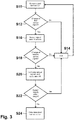
- Fig. 3
- is a flow chart for explaining a simple embodiment of the inventive method.
- In a dishwasher as an example for a household appliance, two kinds of sensors are placed: A first sensor is a metal oxide semi-conductor sensor (MOS sensor) responsive to volatile organic compounds. A second sensor is a NDIR sensor responsive to carbon dioxide.
The household appliance and the sensors are not shown in the figures. The dishwasher may be of any known kind and shape. Usually, the dishwasher comprises a housing (not shown in the figures), in which not only elements to place dishes and cutlery thereon are provided, but wherein equally said two sensors are provided. -
Fig. 1 and 2 show typical curves of the signals output by the sensors (measurement or sensor signal, in arbitrary units). -
Fig. 1 shows twocurves curve 10 represents the output of the MOS sensor and thecurve 12 represents the output of the NDIR sensor. As can be gathered from these figures, the MOS sensor shows a varying sensor signal, the so-called unstable base line. This means that absolute measurement signals are not an indicator of present gas or odour concentrations. The instability of the base line such ascurve 10 is a typical and unavoidable characteristic on the measuring principle in a MOS sensor. An increase in the measurement signal of the MOS sensor can be caused not only by increased concentrations of volatile organic compounds, but also by changing external conditions of measurement (such as in particular a temperature or a humidity). These drifts cannot be distinguished from slow changes in the sample gas concentration, as it is typically associated with the slow onset and decay of slow development of volatile organic compounds. - The second sensor, the NDIR sensor, provides information which is independent of volatile organic compounds, since the outputting of measurement signals is based on a completely different physical principle of measurement. Here, a change in the external measurement conditions will not lead to the same signal changes. From
fig. 1 one can in particular gather that a drift of the base line of the MOS sensor has to be detected as a mere drift without increase of the amount of volatile organic compounds in case the measurement values provided by the measurement/sensor signal according tocurve 12 is remaining constant. -
Fig. 2 now shows the situation in which there is indeed a decomposition of organic material: Here, curve 10' shows an increase in the value of measurement signal output by the first sensor (the MOS sensor). At the same time, an increase in the sensor signal output by the second sensor (the NDIR sensor) can be observed, see curve 12'. - Thus, when observing both of these curves at the same time, one can more reliably determine whether or not there are unpleasant odours present.
- It is to be noted that an increase in the output signal of the second sensor alone is not reliable enough since the amount of CO2 may increase due to the presence of people or to combustion processes taking place (when heating a room or in ovens).
- For that reason, a method of the kind as described hereinafter with regard to
fig. 3 is used: - In step S10, one receives a sensor signal from a first sensor.
- In step S12, a first pre-determined criterion is applied: Does a change in the first sensor signal occur? If this is not the case, the method goes over to step S14, in which it is waited.
- Following step S14, the method newly starts with step S10.
- In case that in step S12 a change of the first sensor signal is determined according to a pre-determined criterion which for example includes that starting from an initial value, in a pre-determined time period, the signal height has increased by a pre-determined amount, the method goes over to step S16:
In step S16, the sensor signal from the second sensor is received. - Following thereafter in step S18, a second pre-determined criterion is applied: Here, it is determined whether or not the second sensor signal has changed. If this is not the case, once again, step S14 (waiting) is performed prior to returning to step S10.
- In case that the second pre-determined criterion is fulfilled which includes for example that a threshold is exceeded, the method continues with step S20: In step S20 the sensor signals are compared, and the drift is in total calculated. Thereafter, in step S22, it is determined whether or not the sensor signals are within a pre-determined range. If so, it is continued with step S14 prior to returning to step S10.
- If the sensor signals are not within a pre-determined range, step S24 is the next step: It is now (according to the two pre-determined criteria) clear that an unpleasant odour has been detected, and an action is initiated such as activating a cleaning unit in the dishwasher.
- It is to be noted that steps S20 and S22 may be omitted. For example, the determination whether or not the sensor signals are within a range as in step S22 may take place as part of the first and second pre-determined criteria already in complementing steps S12 and S28, respectively.
- The roles of the first sensor and second sensor might be interchanged in the flow chart; that means that the order of the steps might be a different one.
Claims (15)
- A method of operating a household appliance, in particular a dishwasher, in dependence on the presence of odours due to decomposition of organic material in said household appliance, said method comprising the steps of:- obtaining (S10) first measurement signals (10, 10') by a first sensor responsive to a first group comprised of at least one first chemical substance which is produced upon decomposition of organic material,- obtaining (S16) second measurement signals (12, 12') by a second sensor responsive to a second group comprised of at least one second chemical substance which is produced upon decomposition of organic material,- determining (S12) whether or not the first measurement signals (10, 10') fulfil a first pre-determined criterion, and if so,- determining (S18) whether or not the second measurement signals (12, 12') fulfil a second pre-determined criterion, and in case that the second pre-determined criterion is fulfilled,- outputting (S24) a signal indicating the presence of odours due to decomposition of organic material and/or a signal activating a unit in said household appliance acting to reduce such odours.
- The method according to claim 1,
wherein the working principles of how the first and second measurement signals are obtained by the first and second sensor are different. - The method according to claim 1 or claim 2,
wherein the first sensor is a metal oxide semi-conductor sensor, which is in particular responsive to volatile organic compounds. - The method according to any of claims 1 or 2,
wherein said first pre-determined criterion is fulfilled when measurement values provided by the first measurement signals (10, 10') increase over a pre-determined period of time in a pre-determined minimum amount. - The method according to any of the preceding claims,
wherein said second sensor is a non dispersive infrared sensor, which is in particular responsive to carbon dioxide. - The method according to any of the preceding claims,
wherein said second pre-determined criterion is either fulfilled when the measurement values provided by the second measurement signals are higher than a pre-determined threshold or is fulfilled when the measurement values provided by the second measurement signals are lower than a pre-determined threshold. - The method according to any one of claims 1 to 5,
wherein said second pre-determined criterion is fulfilled when the value of a pre-determined function calculated both on the basis of the measurement values provided by the first measurement signals (10, 10') and the measurement values provided by the second measurement signals (12, 12') is higher than a pre-determined threshold value or when the value of a pre-determined function calculated both on the basis of the measurement values provided by the first measurement signals and the measurement values provided by the second measurement signals (12, 12') is lower than a pre-determined threshold value. - The method of any of claims 3 to 7,
wherein a signal is output that activates a cleaning unit in the household appliance, and wherein after the completion of a cleaning step, the measurement signals are obtained and stored for determining at least one threshold value and when applying at least one of said first and second pre-determined criteria. - A household appliance, in particular a dishwasher, comprising two sensors from which a first sensor is responsive to at least one first chemical substance and a second sensor is responsive to at least one second chemical substance and comprising a cleaning unit acting to remove sources of odours in the household appliance, and further comprising a control unit receiving measurement signals (10, 10', 12, 12') for the first and second sensors and outputting control signals to said cleaning unit,
characterised in that
both of the first and the second sensors are responsive to such chemical substances which occur when organic material is decomposing and that said control unit is adapted to use signals of both the first and second sensors to perform a method of operating according to any of claims 1-8. - The household appliance according to claim 9,
wherein the control unit is adapted to continuously or repeatedly receive measurement signals (10, 10') from the first sensor and to determine whether or not a first pre-determined criterion is fulfilled, wherein in case the first pre-determined criterion is fulfilled, the control unit receives measurement signals (12, 12') from the second sensor and determines whether or not a second pre-determined criterion is fulfilled. - Household appliance according to claim 9 or claim 10,
wherein said first sensor is a metal oxide semi-conductor sensor. - Household appliance according to claim 11,
wherein said metal oxide semi-conductor sensor is responsive to volatile organic compounds. - Household appliance according to any one of claims 9 to 12,
wherein said second sensor is a non dispersive infrared sensor. - Household appliance according to claim 13,
wherein said non dispersive infrared sensor is responsive to carbon dioxide. - Household appliance according to any of claims 9 to 14, comprising a housing in which the first and second sensors are arranged and/or a sensor housing for each of the first and second sensors.
Priority Applications (1)
| Application Number | Priority Date | Filing Date | Title |
|---|---|---|---|
| EP13153747.4A EP2762052B1 (en) | 2013-02-01 | 2013-02-01 | A method of operating a household appliance, and a household appliance, in particular a dishwasher |
Applications Claiming Priority (1)
| Application Number | Priority Date | Filing Date | Title |
|---|---|---|---|
| EP13153747.4A EP2762052B1 (en) | 2013-02-01 | 2013-02-01 | A method of operating a household appliance, and a household appliance, in particular a dishwasher |
Publications (2)
| Publication Number | Publication Date |
|---|---|
| EP2762052A1 EP2762052A1 (en) | 2014-08-06 |
| EP2762052B1 true EP2762052B1 (en) | 2018-12-26 |
Family
ID=47715874
Family Applications (1)
| Application Number | Title | Priority Date | Filing Date |
|---|---|---|---|
| EP13153747.4A Not-in-force EP2762052B1 (en) | 2013-02-01 | 2013-02-01 | A method of operating a household appliance, and a household appliance, in particular a dishwasher |
Country Status (1)
| Country | Link |
|---|---|
| EP (1) | EP2762052B1 (en) |
Families Citing this family (7)
| Publication number | Priority date | Publication date | Assignee | Title |
|---|---|---|---|---|
| DE102015222586A1 (en) | 2015-11-16 | 2017-05-18 | BSH Hausgeräte GmbH | Method for operating a dishwasher and dishwasher |
| EP3381346B1 (en) * | 2017-03-31 | 2022-07-06 | V-Zug AG | Short washing program for a dish rack |
| US11419478B2 (en) * | 2020-07-14 | 2022-08-23 | Haler US Appliance Solutions, Inc. | Method and apparatus for sensing dryness according to air quality |
| EP3967334A1 (en) * | 2020-09-10 | 2022-03-16 | emz-Hanauer GmbH & Co. KGaA | Air filtration device for a domestic appliance |
| CN114165970A (en) * | 2020-09-10 | 2022-03-11 | emz-汉拿两合有限公司 | Air treatment device for household appliances |
| CN115104985B (en) * | 2022-07-14 | 2025-06-03 | 中万恩科技有限公司 | An IoT multifunctional dishwasher operation system |
| EP4736731A1 (en) * | 2024-11-01 | 2026-05-06 | Arçelik Anonim Sirketi | A dishwasher comprising a carbon filter |
Family Cites Families (8)
| Publication number | Priority date | Publication date | Assignee | Title |
|---|---|---|---|---|
| JP3059861B2 (en) * | 1993-06-18 | 2000-07-04 | 三洋電機株式会社 | Dishwasher |
| JP2002315716A (en) * | 2001-04-19 | 2002-10-29 | Toshiba Corp | Dishwasher |
| EP1685354B1 (en) * | 2003-11-17 | 2009-03-04 | Vestel Beyaz Esya Sanayi Ve Ticaret A.S. | Cooler comprising gas sensor |
| US20080092931A1 (en) * | 2005-02-04 | 2008-04-24 | Karaaslan Kuntay M | Dishwasher and the Control Method |
| DE102005058662A1 (en) | 2005-12-08 | 2007-06-14 | BSH Bosch und Siemens Hausgeräte GmbH | Process for eliminating odors in a dishwasher |
| JP2008307164A (en) | 2007-06-13 | 2008-12-25 | Hanshin Electric Co Ltd | Dish washing/drying apparatus |
| DE102008054462A1 (en) * | 2008-12-10 | 2010-06-17 | BSH Bosch und Siemens Hausgeräte GmbH | Laundry treatment device with gas sensor and method for treating laundry |
| US8808463B2 (en) * | 2009-05-28 | 2014-08-19 | Whirlpool Corporation | Method of recycling a rinse aid to precondition soils |
-
2013
- 2013-02-01 EP EP13153747.4A patent/EP2762052B1/en not_active Not-in-force
Non-Patent Citations (1)
| Title |
|---|
| None * |
Also Published As
| Publication number | Publication date |
|---|---|
| EP2762052A1 (en) | 2014-08-06 |
Similar Documents
| Publication | Publication Date | Title |
|---|---|---|
| EP2762052A1 (en) | A method of operating a household appliance, and a household appliance, in particular a dishwasher | |
| EP2508881B1 (en) | Testing a humidity sensor | |
| KR20070091305A (en) | A cooking apparatus comprising at least one gas sensor array, a sampling system for such cooking apparatus, a cooking method using the cooking apparatus, and a cooking apparatus cleaning method | |
| CN107420953B (en) | Range hood control method and control device | |
| CN113993429B (en) | Home equipment with proximity detectors | |
| CN107339248B (en) | High-reliability oil smoke detection method | |
| WO2004081498A3 (en) | Thermal liquid level indicator | |
| RU2007127919A (en) | METHOD OF FUNCTIONAL SENSOR CONTROL AND POTENTIOMETRIC SENSOR | |
| KR102247116B1 (en) | Data processing method, data processing device, and data processing program | |
| EP2762053B1 (en) | A method of operating a household appliance, and a household appliance, in particular a dishwasher | |
| US20110057806A1 (en) | Hazardous Condition Detector with Hardware Hush | |
| WO2008077970A1 (en) | Dishwasher with temperature increase for hygienic environment | |
| JP2021107829A (en) | Biogas detection device, method and program | |
| CN110146195B (en) | Temperature deviation determination method and device, cooking appliance and readable storage medium | |
| CN114689790A (en) | Data calibration method and data calibration device of sensor and range hood | |
| CN104965615B (en) | One kind goes steam method and system | |
| JP6431098B2 (en) | Detection device and detection system | |
| JP2017136365A (en) | Detection device and detection system | |
| JP2009026110A (en) | Fire alarm | |
| JP5534669B2 (en) | Seismometer, seismic noise judgment method, program | |
| US20110156897A1 (en) | Determination of an alarm-issuing time of an alarm device | |
| JP4480759B2 (en) | Oil detector for oil fire prevention and gas detection method for oil fire prevention | |
| CN112595403A (en) | Weighing calibration method, device and equipment for cleaning range hood and oil collecting box | |
| CN111139631B (en) | An intelligent laundry basket device | |
| JP3833167B2 (en) | Oil detector for oil and fat fire prevention |
Legal Events
| Date | Code | Title | Description |
|---|---|---|---|
| PUAI | Public reference made under article 153(3) epc to a published international application that has entered the european phase |
Free format text: ORIGINAL CODE: 0009012 |
|
| 17P | Request for examination filed |
Effective date: 20130201 |
|
| AK | Designated contracting states |
Kind code of ref document: A1 Designated state(s): AL AT BE BG CH CY CZ DE DK EE ES FI FR GB GR HR HU IE IS IT LI LT LU LV MC MK MT NL NO PL PT RO RS SE SI SK SM TR |
|
| AX | Request for extension of the european patent |
Extension state: BA ME |
|
| R17P | Request for examination filed (corrected) |
Effective date: 20150204 |
|
| RBV | Designated contracting states (corrected) |
Designated state(s): AL AT BE BG CH CY CZ DE DK EE ES FI FR GB GR HR HU IE IS IT LI LT LU LV MC MK MT NL NO PL PT RO RS SE SI SK SM TR |
|
| GRAP | Despatch of communication of intention to grant a patent |
Free format text: ORIGINAL CODE: EPIDOSNIGR1 |
|
| STAA | Information on the status of an ep patent application or granted ep patent |
Free format text: STATUS: GRANT OF PATENT IS INTENDED |
|
| RIC1 | Information provided on ipc code assigned before grant |
Ipc: A47L 15/42 20060101AFI20180615BHEP Ipc: G01N 33/00 20060101ALI20180615BHEP |
|
| INTG | Intention to grant announced |
Effective date: 20180705 |
|
| GRAS | Grant fee paid |
Free format text: ORIGINAL CODE: EPIDOSNIGR3 |
|
| GRAA | (expected) grant |
Free format text: ORIGINAL CODE: 0009210 |
|
| STAA | Information on the status of an ep patent application or granted ep patent |
Free format text: STATUS: THE PATENT HAS BEEN GRANTED |
|
| AK | Designated contracting states |
Kind code of ref document: B1 Designated state(s): AL AT BE BG CH CY CZ DE DK EE ES FI FR GB GR HR HU IE IS IT LI LT LU LV MC MK MT NL NO PL PT RO RS SE SI SK SM TR |
|
| REG | Reference to a national code |
Ref country code: GB Ref legal event code: FG4D |
|
| REG | Reference to a national code |
Ref country code: CH Ref legal event code: EP |
|
| REG | Reference to a national code |
Ref country code: AT Ref legal event code: REF Ref document number: 1080272 Country of ref document: AT Kind code of ref document: T Effective date: 20190115 |
|
| REG | Reference to a national code |
Ref country code: DE Ref legal event code: R096 Ref document number: 602013048640 Country of ref document: DE |
|
| REG | Reference to a national code |
Ref country code: IE Ref legal event code: FG4D |
|
| PG25 | Lapsed in a contracting state [announced via postgrant information from national office to epo] |
Ref country code: LV Free format text: LAPSE BECAUSE OF FAILURE TO SUBMIT A TRANSLATION OF THE DESCRIPTION OR TO PAY THE FEE WITHIN THE PRESCRIBED TIME-LIMIT Effective date: 20181226 Ref country code: HR Free format text: LAPSE BECAUSE OF FAILURE TO SUBMIT A TRANSLATION OF THE DESCRIPTION OR TO PAY THE FEE WITHIN THE PRESCRIBED TIME-LIMIT Effective date: 20181226 Ref country code: BG Free format text: LAPSE BECAUSE OF FAILURE TO SUBMIT A TRANSLATION OF THE DESCRIPTION OR TO PAY THE FEE WITHIN THE PRESCRIBED TIME-LIMIT Effective date: 20190326 Ref country code: FI Free format text: LAPSE BECAUSE OF FAILURE TO SUBMIT A TRANSLATION OF THE DESCRIPTION OR TO PAY THE FEE WITHIN THE PRESCRIBED TIME-LIMIT Effective date: 20181226 Ref country code: LT Free format text: LAPSE BECAUSE OF FAILURE TO SUBMIT A TRANSLATION OF THE DESCRIPTION OR TO PAY THE FEE WITHIN THE PRESCRIBED TIME-LIMIT Effective date: 20181226 Ref country code: NO Free format text: LAPSE BECAUSE OF FAILURE TO SUBMIT A TRANSLATION OF THE DESCRIPTION OR TO PAY THE FEE WITHIN THE PRESCRIBED TIME-LIMIT Effective date: 20190326 |
|
| REG | Reference to a national code |
Ref country code: NL Ref legal event code: MP Effective date: 20181226 |
|
| REG | Reference to a national code |
Ref country code: LT Ref legal event code: MG4D |
|
| PG25 | Lapsed in a contracting state [announced via postgrant information from national office to epo] |
Ref country code: SE Free format text: LAPSE BECAUSE OF FAILURE TO SUBMIT A TRANSLATION OF THE DESCRIPTION OR TO PAY THE FEE WITHIN THE PRESCRIBED TIME-LIMIT Effective date: 20181226 Ref country code: RS Free format text: LAPSE BECAUSE OF FAILURE TO SUBMIT A TRANSLATION OF THE DESCRIPTION OR TO PAY THE FEE WITHIN THE PRESCRIBED TIME-LIMIT Effective date: 20181226 Ref country code: GR Free format text: LAPSE BECAUSE OF FAILURE TO SUBMIT A TRANSLATION OF THE DESCRIPTION OR TO PAY THE FEE WITHIN THE PRESCRIBED TIME-LIMIT Effective date: 20190327 Ref country code: AL Free format text: LAPSE BECAUSE OF FAILURE TO SUBMIT A TRANSLATION OF THE DESCRIPTION OR TO PAY THE FEE WITHIN THE PRESCRIBED TIME-LIMIT Effective date: 20181226 |
|
| REG | Reference to a national code |
Ref country code: AT Ref legal event code: MK05 Ref document number: 1080272 Country of ref document: AT Kind code of ref document: T Effective date: 20181226 |
|
| PG25 | Lapsed in a contracting state [announced via postgrant information from national office to epo] |
Ref country code: NL Free format text: LAPSE BECAUSE OF FAILURE TO SUBMIT A TRANSLATION OF THE DESCRIPTION OR TO PAY THE FEE WITHIN THE PRESCRIBED TIME-LIMIT Effective date: 20181226 |
|
| PG25 | Lapsed in a contracting state [announced via postgrant information from national office to epo] |
Ref country code: ES Free format text: LAPSE BECAUSE OF FAILURE TO SUBMIT A TRANSLATION OF THE DESCRIPTION OR TO PAY THE FEE WITHIN THE PRESCRIBED TIME-LIMIT Effective date: 20181226 Ref country code: CZ Free format text: LAPSE BECAUSE OF FAILURE TO SUBMIT A TRANSLATION OF THE DESCRIPTION OR TO PAY THE FEE WITHIN THE PRESCRIBED TIME-LIMIT Effective date: 20181226 Ref country code: IT Free format text: LAPSE BECAUSE OF FAILURE TO SUBMIT A TRANSLATION OF THE DESCRIPTION OR TO PAY THE FEE WITHIN THE PRESCRIBED TIME-LIMIT Effective date: 20181226 Ref country code: PT Free format text: LAPSE BECAUSE OF FAILURE TO SUBMIT A TRANSLATION OF THE DESCRIPTION OR TO PAY THE FEE WITHIN THE PRESCRIBED TIME-LIMIT Effective date: 20190426 Ref country code: PL Free format text: LAPSE BECAUSE OF FAILURE TO SUBMIT A TRANSLATION OF THE DESCRIPTION OR TO PAY THE FEE WITHIN THE PRESCRIBED TIME-LIMIT Effective date: 20181226 |
|
| PG25 | Lapsed in a contracting state [announced via postgrant information from national office to epo] |
Ref country code: SK Free format text: LAPSE BECAUSE OF FAILURE TO SUBMIT A TRANSLATION OF THE DESCRIPTION OR TO PAY THE FEE WITHIN THE PRESCRIBED TIME-LIMIT Effective date: 20181226 Ref country code: IS Free format text: LAPSE BECAUSE OF FAILURE TO SUBMIT A TRANSLATION OF THE DESCRIPTION OR TO PAY THE FEE WITHIN THE PRESCRIBED TIME-LIMIT Effective date: 20190426 Ref country code: RO Free format text: LAPSE BECAUSE OF FAILURE TO SUBMIT A TRANSLATION OF THE DESCRIPTION OR TO PAY THE FEE WITHIN THE PRESCRIBED TIME-LIMIT Effective date: 20181226 Ref country code: EE Free format text: LAPSE BECAUSE OF FAILURE TO SUBMIT A TRANSLATION OF THE DESCRIPTION OR TO PAY THE FEE WITHIN THE PRESCRIBED TIME-LIMIT Effective date: 20181226 Ref country code: SM Free format text: LAPSE BECAUSE OF FAILURE TO SUBMIT A TRANSLATION OF THE DESCRIPTION OR TO PAY THE FEE WITHIN THE PRESCRIBED TIME-LIMIT Effective date: 20181226 |
|
| REG | Reference to a national code |
Ref country code: DE Ref legal event code: R119 Ref document number: 602013048640 Country of ref document: DE |
|
| REG | Reference to a national code |
Ref country code: CH Ref legal event code: PL |
|
| PG25 | Lapsed in a contracting state [announced via postgrant information from national office to epo] |
Ref country code: LU Free format text: LAPSE BECAUSE OF NON-PAYMENT OF DUE FEES Effective date: 20190201 Ref country code: DK Free format text: LAPSE BECAUSE OF FAILURE TO SUBMIT A TRANSLATION OF THE DESCRIPTION OR TO PAY THE FEE WITHIN THE PRESCRIBED TIME-LIMIT Effective date: 20181226 Ref country code: AT Free format text: LAPSE BECAUSE OF FAILURE TO SUBMIT A TRANSLATION OF THE DESCRIPTION OR TO PAY THE FEE WITHIN THE PRESCRIBED TIME-LIMIT Effective date: 20181226 Ref country code: MC Free format text: LAPSE BECAUSE OF FAILURE TO SUBMIT A TRANSLATION OF THE DESCRIPTION OR TO PAY THE FEE WITHIN THE PRESCRIBED TIME-LIMIT Effective date: 20181226 |
|
| PLBE | No opposition filed within time limit |
Free format text: ORIGINAL CODE: 0009261 |
|
| STAA | Information on the status of an ep patent application or granted ep patent |
Free format text: STATUS: NO OPPOSITION FILED WITHIN TIME LIMIT |
|
| REG | Reference to a national code |
Ref country code: BE Ref legal event code: MM Effective date: 20190228 |
|
| GBPC | Gb: european patent ceased through non-payment of renewal fee |
Effective date: 20190326 |
|
| REG | Reference to a national code |
Ref country code: IE Ref legal event code: MM4A |
|
| 26N | No opposition filed |
Effective date: 20190927 |
|
| PG25 | Lapsed in a contracting state [announced via postgrant information from national office to epo] |
Ref country code: CH Free format text: LAPSE BECAUSE OF NON-PAYMENT OF DUE FEES Effective date: 20190228 Ref country code: LI Free format text: LAPSE BECAUSE OF NON-PAYMENT OF DUE FEES Effective date: 20190228 |
|
| PG25 | Lapsed in a contracting state [announced via postgrant information from national office to epo] |
Ref country code: IE Free format text: LAPSE BECAUSE OF NON-PAYMENT OF DUE FEES Effective date: 20190201 Ref country code: DE Free format text: LAPSE BECAUSE OF NON-PAYMENT OF DUE FEES Effective date: 20190903 Ref country code: GB Free format text: LAPSE BECAUSE OF NON-PAYMENT OF DUE FEES Effective date: 20190326 |
|
| PG25 | Lapsed in a contracting state [announced via postgrant information from national office to epo] |
Ref country code: SI Free format text: LAPSE BECAUSE OF FAILURE TO SUBMIT A TRANSLATION OF THE DESCRIPTION OR TO PAY THE FEE WITHIN THE PRESCRIBED TIME-LIMIT Effective date: 20181226 Ref country code: FR Free format text: LAPSE BECAUSE OF NON-PAYMENT OF DUE FEES Effective date: 20190226 Ref country code: BE Free format text: LAPSE BECAUSE OF NON-PAYMENT OF DUE FEES Effective date: 20190228 |
|
| PG25 | Lapsed in a contracting state [announced via postgrant information from national office to epo] |
Ref country code: TR Free format text: LAPSE BECAUSE OF FAILURE TO SUBMIT A TRANSLATION OF THE DESCRIPTION OR TO PAY THE FEE WITHIN THE PRESCRIBED TIME-LIMIT Effective date: 20181226 |
|
| PG25 | Lapsed in a contracting state [announced via postgrant information from national office to epo] |
Ref country code: MT Free format text: LAPSE BECAUSE OF NON-PAYMENT OF DUE FEES Effective date: 20190201 |
|
| PG25 | Lapsed in a contracting state [announced via postgrant information from national office to epo] |
Ref country code: CY Free format text: LAPSE BECAUSE OF FAILURE TO SUBMIT A TRANSLATION OF THE DESCRIPTION OR TO PAY THE FEE WITHIN THE PRESCRIBED TIME-LIMIT Effective date: 20181226 |
|
| PG25 | Lapsed in a contracting state [announced via postgrant information from national office to epo] |
Ref country code: HU Free format text: LAPSE BECAUSE OF FAILURE TO SUBMIT A TRANSLATION OF THE DESCRIPTION OR TO PAY THE FEE WITHIN THE PRESCRIBED TIME-LIMIT; INVALID AB INITIO Effective date: 20130201 |
|
| PG25 | Lapsed in a contracting state [announced via postgrant information from national office to epo] |
Ref country code: MK Free format text: LAPSE BECAUSE OF FAILURE TO SUBMIT A TRANSLATION OF THE DESCRIPTION OR TO PAY THE FEE WITHIN THE PRESCRIBED TIME-LIMIT Effective date: 20181226 |