EP2756005B1 - Intrazelluläre zellenauswahl - Google Patents
Intrazelluläre zellenauswahl Download PDFInfo
- Publication number
- EP2756005B1 EP2756005B1 EP12772367.4A EP12772367A EP2756005B1 EP 2756005 B1 EP2756005 B1 EP 2756005B1 EP 12772367 A EP12772367 A EP 12772367A EP 2756005 B1 EP2756005 B1 EP 2756005B1
- Authority
- EP
- European Patent Office
- Prior art keywords
- cell
- magnetic
- cells
- magnetic particle
- peptide
- Prior art date
- Legal status (The legal status is an assumption and is not a legal conclusion. Google has not performed a legal analysis and makes no representation as to the accuracy of the status listed.)
- Not-in-force
Links
Images

Classifications
-
- C—CHEMISTRY; METALLURGY
- C07—ORGANIC CHEMISTRY
- C07K—PEPTIDES
- C07K17/00—Carrier-bound or immobilised peptides; Preparation thereof
-
- C—CHEMISTRY; METALLURGY
- C07—ORGANIC CHEMISTRY
- C07K—PEPTIDES
- C07K17/00—Carrier-bound or immobilised peptides; Preparation thereof
- C07K17/14—Peptides being immobilised on, or in, an inorganic carrier
-
- B—PERFORMING OPERATIONS; TRANSPORTING
- B03—SEPARATION OF SOLID MATERIALS USING LIQUIDS OR USING PNEUMATIC TABLES OR JIGS; MAGNETIC OR ELECTROSTATIC SEPARATION OF SOLID MATERIALS FROM SOLID MATERIALS OR FLUIDS; SEPARATION BY HIGH-VOLTAGE ELECTRIC FIELDS
- B03C—MAGNETIC OR ELECTROSTATIC SEPARATION OF SOLID MATERIALS FROM SOLID MATERIALS OR FLUIDS; SEPARATION BY HIGH-VOLTAGE ELECTRIC FIELDS
- B03C1/00—Magnetic separation
- B03C1/005—Pretreatment specially adapted for magnetic separation
- B03C1/015—Pretreatment specially adapted for magnetic separation by chemical treatment imparting magnetic properties to the material to be separated, e.g. roasting, reduction, oxidation
-
- C—CHEMISTRY; METALLURGY
- C07—ORGANIC CHEMISTRY
- C07K—PEPTIDES
- C07K16/00—Immunoglobulins [IG], e.g. monoclonal or polyclonal antibodies
- C07K16/18—Immunoglobulins [IG], e.g. monoclonal or polyclonal antibodies against material from animals or humans
- C07K16/32—Immunoglobulins [IG], e.g. monoclonal or polyclonal antibodies against material from animals or humans against translation products of oncogenes
-
- C—CHEMISTRY; METALLURGY
- C12—BIOCHEMISTRY; BEER; SPIRITS; WINE; VINEGAR; MICROBIOLOGY; ENZYMOLOGY; MUTATION OR GENETIC ENGINEERING
- C12N—MICROORGANISMS OR ENZYMES; COMPOSITIONS THEREOF; PROPAGATING, PRESERVING, OR MAINTAINING MICROORGANISMS; MUTATION OR GENETIC ENGINEERING; CULTURE MEDIA
- C12N5/00—Undifferentiated human, animal or plant cells, e.g. cell lines; Tissues; Cultivation or maintenance thereof; Culture media therefor
-
- G—PHYSICS
- G01—MEASURING; TESTING
- G01N—INVESTIGATING OR ANALYSING MATERIALS BY DETERMINING THEIR CHEMICAL OR PHYSICAL PROPERTIES
- G01N33/00—Investigating or analysing materials by specific methods not covered by groups G01N1/00 - G01N31/00
- G01N33/48—Biological material, e.g. blood, urine; Haemocytometers
- G01N33/50—Chemical analysis of biological material, e.g. blood, urine; Testing involving biospecific ligand binding methods; Immunological testing
- G01N33/53—Immunoassay; Biospecific binding assay; Materials therefor
- G01N33/543—Immunoassay; Biospecific binding assay; Materials therefor with an insoluble carrier for immobilising immunochemicals
- G01N33/54313—Immunoassay; Biospecific binding assay; Materials therefor with an insoluble carrier for immobilising immunochemicals the carrier being characterised by its particulate form
- G01N33/54326—Magnetic particles
-
- G—PHYSICS
- G01—MEASURING; TESTING
- G01N—INVESTIGATING OR ANALYSING MATERIALS BY DETERMINING THEIR CHEMICAL OR PHYSICAL PROPERTIES
- G01N33/00—Investigating or analysing materials by specific methods not covered by groups G01N1/00 - G01N31/00
- G01N33/48—Biological material, e.g. blood, urine; Haemocytometers
- G01N33/50—Chemical analysis of biological material, e.g. blood, urine; Testing involving biospecific ligand binding methods; Immunological testing
- G01N33/53—Immunoassay; Biospecific binding assay; Materials therefor
- G01N33/569—Immunoassay; Biospecific binding assay; Materials therefor for microorganisms, e.g. protozoa, bacteria, viruses
- G01N33/56966—Animal cells
-
- G—PHYSICS
- G01—MEASURING; TESTING
- G01N—INVESTIGATING OR ANALYSING MATERIALS BY DETERMINING THEIR CHEMICAL OR PHYSICAL PROPERTIES
- G01N33/00—Investigating or analysing materials by specific methods not covered by groups G01N1/00 - G01N31/00
- G01N33/48—Biological material, e.g. blood, urine; Haemocytometers
- G01N33/50—Chemical analysis of biological material, e.g. blood, urine; Testing involving biospecific ligand binding methods; Immunological testing
- G01N33/53—Immunoassay; Biospecific binding assay; Materials therefor
- G01N33/575—Immunoassay; Biospecific binding assay; Materials therefor for cancer
-
- B—PERFORMING OPERATIONS; TRANSPORTING
- B03—SEPARATION OF SOLID MATERIALS USING LIQUIDS OR USING PNEUMATIC TABLES OR JIGS; MAGNETIC OR ELECTROSTATIC SEPARATION OF SOLID MATERIALS FROM SOLID MATERIALS OR FLUIDS; SEPARATION BY HIGH-VOLTAGE ELECTRIC FIELDS
- B03C—MAGNETIC OR ELECTROSTATIC SEPARATION OF SOLID MATERIALS FROM SOLID MATERIALS OR FLUIDS; SEPARATION BY HIGH-VOLTAGE ELECTRIC FIELDS
- B03C2201/00—Details of magnetic or electrostatic separation
- B03C2201/18—Magnetic separation whereby the particles are suspended in a liquid
-
- B—PERFORMING OPERATIONS; TRANSPORTING
- B03—SEPARATION OF SOLID MATERIALS USING LIQUIDS OR USING PNEUMATIC TABLES OR JIGS; MAGNETIC OR ELECTROSTATIC SEPARATION OF SOLID MATERIALS FROM SOLID MATERIALS OR FLUIDS; SEPARATION BY HIGH-VOLTAGE ELECTRIC FIELDS
- B03C—MAGNETIC OR ELECTROSTATIC SEPARATION OF SOLID MATERIALS FROM SOLID MATERIALS OR FLUIDS; SEPARATION BY HIGH-VOLTAGE ELECTRIC FIELDS
- B03C2201/00—Details of magnetic or electrostatic separation
- B03C2201/26—Details of magnetic or electrostatic separation for use in medical or biological applications
Definitions
- This disclosure relates to the selection and isolation of mammalian cells from a heterogeneous population of mammalian cells by affinity binding of intracellular antigens by ligands, typically antibody fragments, and the use of magnetic particles to select said cells.
- Selective cell separation is an essential method in experimental biology and medicine. It is an increasingly important process that is driven by the ever increasing demands for sensitivity, selectivity, yield, time and economy of the process.
- the most popular aim for cell separation is to achieve complete removal of the target population from a cell mixture. However, for some applications, a secondary aim may be to recover the selected cells for study for additional manipulation. Additionally, the purity of separation may be more important than the yield of the selected cells, or vice versa.
- the aims for cell separation determine the method that is chosen to achieve the separation. Other factors to take into account when selecting the separation technique are the processing time, viability of residual cells, and exposure to non-medically approved reagents.
- cell separation techniques There are a number of cell separation techniques which can be broadly classified into two categories: techniques based on size and density, and techniques based on affinity (chemical, electrical, or magnetic) (Radisic et al, 2006).
- Magnetic separation techniques are a common method in many laboratories and have been broadly used for targeted drug delivery, imaging and bioseparation such as in selective cell separations, antibody purification, protein affinity purification, immunoprecipitations, protein fractionations, organelle isolations, total nucleic acid purification and polyadenylated mRNA purification (Saiyed et al., 2003; Nord et al., 2001; Stark et al., 1988; Suzuki et al., 1996; Weissleder et al., 1997).
- WO97/08557 discloses the separation of carcinoma cells from the peripheral blood by magnetic sorting. Therefore tumor cells are magnetically labelled with antibodies directed to tissue specific antigens, preferably cytoplasmatic proteins. In order for the magnetic particle to reach the intracellular antigen, the cells should be permeable. The cells are subsequently separated on a magnetic matrix.
- WO2005/081721 discloses semiconductor nanoparticle complexes in association with cationic polymers and methods for enhancing the transport of semiconductor nanoparticles across biological membranes using cationic peptides.
- the magnetic cell separation technique consists of magnetic beads coated with antibodies specific for cell surface antigens on the desired cells.
- the antibody-magnetic beads When the antibody-magnetic beads are exposed to a mixed cell population, they attach to the surface of the desired cells via antibody-antigen interaction. The desired cell subpopulation can then be separated in the presence of a strong magnetic field.
- the antibodies used in these applications are typically monoclonal antibodies specific for cell surface antigens.
- antibody fragments such as single chain antibodies (scFv) have also been successfully coupled to magnetic beads and used in a variety of applications such as phage display libraries of scFv and in imaging of tumours (McConnell et al., 1999; Nord et al., 2001; Han et al., 2006).
- VH and VL domains are the smallest functional modules of antibodies required for antigen binding.
- ScFv are a fusion of the variable regions of the heavy (VH) and light chains (VL) of immunoglobulins, connected with a short linker peptide of 10 to 25 amino acids. Their small size conveys them with distinct advantages over whole antibodies, in particular they have rapid pharmacokinetics, greater tumour penetration and lower immunogenicity than intact IgG, F(ab') 2 , or Fab (Yokota et al., 1992).
- the scFv may be assembled from the variable regions of particular monoclonal antibodies (Huston et al., 1988; Brinkmann et al., 1991) or made de novo from phage display libraries (Winter et al., 1994; Chester et al., 1994). They retain the specificity of the original immunoglobulin, and in many applications outperform whole IgG in construction speed, production yield, and engineering flexibility, as they can be easily expressed in bacterial expression systems.
- a major caveat of magnetic cell separation is that it is only applicable to cells that can be separated by their specific surface antigens. This can be particularly limiting when the cell specific markers are mainly found intracellularly and are not readily available on the cell surface. Indeed, in most cancers, the cancer markers of interest are predominantly expressed inside the cells and therefore cannot be used for cell separations.
- the inherent difficulties surrounding cell internalisation of antibodies have made it difficult so far to use intracellularly expressed antigens in cell separations. Whole monoclonal antibodies cannot be internalised or be expressed in cells due to the reducing environment of the cell.
- scFv are routinely stably expressed in cells and have been reportedly been able to internalise into cells with the help of carrier mediated systems such as transduction peptides (Futaki et al., 2001; Avignolo et al., 2008; Niesner et al., 2002; Ma et al., 2011).
- carrier mediated systems such as transduction peptides
- recent studies using magnetic particles have shown that it is possible to internalise these particles into cells and control their location by means of an external magnet (Tseng et al., 2009).
- cancer therapeutics have been used in cancer therapeutics as a means to direct the cells containing anti-cancer agents to a desired location on the cancer cells by means of an external magnetic field, thus, promising to reduce the cytotoxic effects of drugs by increasing the bioavailability of therapeutic compounds at the site of action and improving pharmacokinetics (Cinti et al., 2011).
- Magnetic beads have also been used as a means to internalise nucleic acids (magnetofection) (Scherer et al., 2002) and small peptides into cells (Han et al., 2006) and have been previously coupled to cationic peptides (Smith et al., 2002) to enhance their uptake in vivo and allow their use for MRI scanning (Stark et al., 1988; Suzuki et al., 1996; Weissleder et al., 1997). Additionally they have been coupled to drugs for magnetic drug targeting in patients with solid tumours (Lubbe et al., 1996; Alexiou et al., 2000).
- these magnetic particles do not rely on receptors or other cell membrane bound proteins for their cellular uptake, it is possible to transfect cells that are normally non-permissive (Scherer et al., 2002). This is also true in primary cells which are known to be difficult to transfect (Krotz et al., 2003).
- the present disclosure is directed to overcoming the deficiencies in magnetic cell separation by providing a method to separate a target population from a cell mixture on the basis of the expression of their intracellular markers and to then allow the recovery of these cells for additional downstream studies and to achieve therapeutic benefits.
- This disclosure relates to a method for isolating specific cells from a mixed population of different cell types using intracellular markers rather than cell surface markers.
- This method involves the coupling of antibody fragments to a magnetic particle, where the antibody fragment is specific to the marker of interest expressed inside the cell.
- a magnetic particle comprising: a ligand that specifically binds an intracellular antigen, a cell membrane penetrating cationic peptide and an export peptide comprising an amino acid sequence that is adapted to interact with the secretory pathway in a cell.
- said intracellular antigen is substantially a nuclear antigen.
- said nuclear antigen is selected from the group consisting of: FoxO family members, TARP, p53, Rb, E2F, hK4, BRCA1, Cdk2, SATB1, TP53INP1, Myc, Fos, Jun, CREB, Ets, SRF, FAK, Pax6, Calpain, Elk1, Stats 1-3, Akt, p21
- said intracellular antigen is substantially a cytoplasmic antigen.
- said cytoplasmic antigen is selected from the group consisting of: Jak1, Jak2, Tyk2, Jak3, GATA 1-4, Stats 1-6, CBP, NFkB, IKK, PIK3CA, B-raf, EBI3, eIF2 ⁇ , Akt, PI3K, IAP, Hsp, FAK, Raf, Ras, TNF, Src, Abl, Caspases 1-12.
- said cationic cell membrane penetrating peptide is a natural cell penetrating peptide.
- said cell membrane penetrating peptide is a synthetic sequence.
- said cell membrane penetrating peptide is adapted to penetrate a mammalian cell.
- said cell membrane penetrating peptide is selected from the group consisting of: YARKKRRQRRR, YARKARRQARR, YARAAARQARA, YARAARRAARR, YARAARRAARA, YARRRRRRR, YAAARRRRRRR, PLSSIFSRIGDP, RQIKIWFQNRRMKWKK, WEIEDEDER, GRKKRRQRRRPQ, RRRRRRRRRRRR.
- said cell membrane penetrating peptide consists essentially of the amino acid sequence: GRKKRRQRRRPQ.
- said cell membrane penetrating peptide consists of the amino acid sequence: GRKKRRQRRRPQ.
- said cell membrane penetrating peptide consists essentially of the amino acid sequence: RRRRRRRRRRRR.
- said cell membrane penetrating peptide consists of the amino acid sequence: RRRRRRRRRRRR.
- the cell penetrating peptide and the secretory peptide can be engrafted into the CDR3 regions of the VL and VH domains.
- said peptide adapted to interact with the mammalian secretory pathway is selected from the group consisting of: MCPARSLLLVATLVLLDHLSLA,MDAMKRGLCCVLLLCGAVFVSPS,MATGSRTSLL LAFGLLCLPWLQEGSA, MYRMQLLSCIALSLALVTNS or MGVKVLFALICIAVAE.
- said peptide is consists essentially of the amino acid sequence MGVKVLFALICIAVAE.
- said peptide is consists of the amino acid sequence: MGVKVLFALICIAVAE.
- said peptide is consists essentially of the amino acid sequence: MYRMQLLSCIALSLALVTNS.
- said peptide is consists of the amino acid sequence: MYRMQLLSCIALSLALVTNS.
- said ligand that binds said intracellular antigen is an antibody fragment.
- a Fab fragment is a multimeric protein consisting of the immunologically active portions of an immunoglobulin heavy chain variable region and an immunoglobulin light chain variable region, covalently coupled together and capable of specifically binding to an antigen.
- Fab fragments are generated via proteolytic cleavage (with, for example, papain) of an intact immunoglobulin molecule.
- a Fab 2 fragment comprises two joined Fab fragments. When these two fragments are joined by the immunoglobulin hinge region, a F(ab') 2 fragment results.
- An Fv fragment is multimeric protein consisting of the immunologically active portions of an immunoglobulin heavy chain variable region and an immunoglobulin light chain variable region covalently coupled together and capable of specifically binding to an antigen.
- a fragment could also be a single chain polypeptide containing only one light chain variable region, or a fragment thereof that contains the three CDRs of the light chain variable region, without an associated heavy chain variable region, or a fragment thereof containing the three CDRs of the heavy chain variable region, without an associated light chain moiety; and multi specific antibodies formed from antibody fragments, this has for example been described in US patent No 6,248,516 .
- Fv fragments or single region (domain) fragments are typically generated by expression in host cell lines of the relevant identified regions.
- immunoglobulin or antibody fragments are within the scope of the invention and are described in standard immunology textbooks such as William E. Paul, Fundamental Immunology or Janeway et al. Immunobiology (cited above) .
- Molecular biology now allows direct synthesis (via expression in cells or chemically) of these fragments, as well as synthesis of combinations thereof.
- a fragment of an antibody or immunoglobulin can also have bispecific function as described above.
- said antibody fragment is an ScFv or a single VH or VL domain.
- said ligand that binds said intracellular antigen is a peptide or a peptide aptamer.
- Peptides that have binding affinity to a target antigen are within the scope of the invention.
- peptides that mimic the binding affinity of antibodies and antibody fragments see Chattophadayay, A, Tate, S., Beswick, R., Wagner, S.D. and Ko Ferrigno, P. A peptide aptamer to antagonise BCL-6 function. Oncogene, 25 2223-2233 (2006 ).
- said cell is a mammalian cell.
- said magnetic particle further comprises a nuclear export peptide.
- nuclear export peptide comprises or consists essentially of the amino acid sequence: NELALKLAGLDINKTEGEEDAQ.
- a method for the selection and isolation of a mammalian cell from a heterogeneous population of cells comprising:
- said mammalian cell is a stem cell.
- said stem cell is a cancer stem cell.
- tumour-initiating cells have also been found in 'solid' cancers such as prostate (Collins et al., 2005), breast (AlHajj et al., 2003), brain (Singh et al., 2004), lung (Kim et al., 2005), colon (O'Brien et al., 2007; Ricci Vitiani et al., 2007) and gastric cancers (Houghton et al., 2004).
- a list of intracellular cancer stem cell markers is available in Table 1.
- a kit for customized modification of magnetic particles containing a selection of cell membrane penetrating cationic peptides selected from the group of YARKKRRQRRR, YARKARRQARR, YARAAARQARA, YARAARRAARR, YARAARRAARA, YARRRRRRRRR, YAAARRRRRRR, PLSSIFSRIGDP, RQIKIWFQNRRMKWKK, WEIEDEDER, GRKKRRQRRRPQ, RRRRRRRRRRRR, a selection of secretory proteins selected from the group MCPARSLLLVATLVLLDHLSLA, MDAMKRGLCCVLLLCGAVFVSPS, MATGSRTSLLLAFGLLCLPWLQEGSA, MYRMQLLSCIALSLALVTNS or MGVKVLFALICIAVAE and activation, wash and blocking/storage buffer.
- a selection of cell membrane penetrating cationic peptides selected from the group of YARKKRRQRRR, YARKARR
- kit further comprises a magnet for the use of said magnetic particles.
- the magnetic particles may be coupled to an antibody fragment (scFv, single domain, dibody), a cell penetrating peptide and a secretory peptide, or to an antibody fragment and a secretory peptide.
- an antibody fragment scFv, single domain, dibody
- a cell penetrating peptide and a secretory peptide or to an antibody fragment and a secretory peptide.
- the cell penetrating peptide and the secretory peptide may be either directly coupled to the magnetic particle or to the antibody fragment via expression as a fusion protein or via chemical coupling between the antibody and the peptide, or they may be engrafted within the CDR3 regions of the VH or VL domains as previously described by (Jeong et al. 2011).
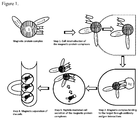
- the magnetic antibody fragments are incubated with the cells and allowed to internalize into the cells using the cationic peptide or the positive charge of the magnetic particle as the delivery vehicle. After achieving cell internalisation of the antibody magnetic particles, the cells are allowed a period of incubation in cell media to allow the magnetic antibody fragments bind to their targets. Any unbound magnetic antibody fragments will then be secreted from the cells by the secretory peptide with or without the help of an external magnet. The cells containing just the bound antibody fragments to their respective targets can be selected with the use of an external magnet where any unbound cells are washed away. The selected cells can then be further incubated for other downstream applications ( Figure 1 ).
- FIG. 1 Diagram depicting the sequence of events in the magnetic intracellular cell separation technique (MICELS).
- a magnetic particle (1) is coupled to a cell penetrating positively charged peptide (2), a cell export peptide (3) and an scFv antibody fragment (4).
- Step 1. The magnetic-protein complex is incubated with the mixed cell population for a length of time until the complex has fully internalised into the cells.
- Step 2. The scFv antibody fragments specifically bind to their antigen targets (Ag) available in the cells and are thereby anchored inside these cells.
- Any magnetic-protein complexes that are not bound to the specific target antigens are secreted to the extracellular milieu via the export peptide through the cell secretory pathway.
- Step 4 avoids the selection of cells that do not express the specific target antigens.
- An external magnetic field is applied to the cells allowing only the cells containing the magnetic complexes to bind to the magnet. The remainder of the cell population can be washed away. The selected cells can be now used for further downstream applications.
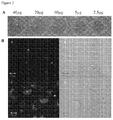
- FIG. 2 MICELS selection of CHO and A549 cells with scFv magnetic-protein complexes.
- A MICELS selection was performed on A549 cells in a 10cm dish with an excess of the scFv magnetic-protein complexes (200 ⁇ g). The cells were washed with PBS, trypsinised and selected using the magnet. The selected cells containing the excess scFv magnetic-protein complexes (white-red pellet) can be seen on top of each magnet.
- B Confocal microscopy on CHO cells (A, B) and A549 cells (C, D) incubated with an excess of scFv magnetic-protein complexes. The cells were vigorously washed with PBS before imaging. The green complexes can be seen localised in the cytoplasm of the cells.
- FIG. 3 MICELS selection of CHO and A549 cells with scFv magnetic-protein complexes.
- A MICELS selection of A549 cells in a 24 well plate with a serial dilution of the scFv magnetic-protein complexes (40 ⁇ g-2.5 ⁇ g). The blue arrows indicate the location of the selected cell pellets. Decreasing amounts of selected cells were obtained with decreasing concentrations of magnetic-protein complexes. The best results for cell selection were obtained with 40 ⁇ g of the magnetic-protein complexes.
- B Confocal images of CHO (A, B) and A549 (C, D) cells after 4.30h incubation with scFv magnetic-protein complexes. The cells were washed vigorously with PBS before imaging. The green magnetic-protein complexes localised at the cell membrane, the perinuclear membrane and in the cytoplasm consistent with the sub-cellular localisation of activated Ras in the A549 lung cancer cell line.
- FIG. 4 MICELS selection of A549 and CHO cells with 40 ⁇ g scFv magnetic-protein. Images of A549 cells (A) and CHO cells (B) selected using MICELS were imaged using a 10x objective. The images were taken after an extensive wash with PBS followed by trypsinisation and cell selection with the magnet. Minimal background of CHO cells was observed following MICELS selection. (C) Confocal image of A549 cells at 24h in culture following MICELS selection.
- scFv#6 The sequence of an scFv (scFv#6) specific for the mutant H-RasG12V ( Tanaka et al., EMBO Journal 2007 ) served as a template for the synthesis of scFv#6 by GeneArt® (Life Technologies) with flanking BamH1 and EcoR1 sites at the 5' and 3' ends, respectively.
- the gene was subcloned into BamH1 and EcoR1 sites of the pRSETa bacterial expression vector (Life Technologies) to generate in-frame fusion scFv protein with a 6x histidine tag.
- the plasmid was transformed into BL21(DE3) bacterial cells (Merck-Millipore) and expression of the scFv#6 fragment was induced in 500ml culture via the addition of 1 mM IPTG at OD 600 of 0.55 followed by incubation for 3 h at 37°C.
- the cells were harvested by centrifugation at 5000 ⁇ g at 4°C and the final cell pellets were stored at -80°C prior to scFv purification.
- scFv protein was extracted from bacterial pellets in 25ml of B-PER bacterial lysis buffer (Thermo Scientific) in the presence of a cocktail of protease inhibitors (containing 1.5 ⁇ g/ml Chymotrypsin, 0.8 ⁇ g/ml Thermolysin, 1 mg/ml Papain, 1.5 ⁇ g/ml Pronase, 1.5 ⁇ g/ml Pancreatic extract, 0.002 ⁇ g/ml Trypsin) (Roche) at RT for 30min.
- protease inhibitors containing 1.5 ⁇ g/ml Chymotrypsin, 0.8 ⁇ g/ml Thermolysin, 1 mg/ml Papain, 1.5 ⁇ g/ml Pronase, 1.5 ⁇ g/ml Pancreatic extract, 0.002 ⁇ g/ml Trypsin
- the lysate was centrifuged at 15000 ⁇ g at 4°C and the supernatant was diluted in 25ml lysis buffer (50 mM Na phosphate, pH 8.5, 300 mM NaCl, 10 mM imidazole).
- the His-tagged scFv#6 proteins were purified by gravity flow through 1ml of Ni-NTA agarose (Qiagen), followed by a wash with 20ml of wash buffer (50 mM Na phosphate, pH 8.5, 300 mM NaCl, 20 mM imidazole) and eluted in 5ml of elution buffer (50 mM Na phosphate, pH 8.5, 300 mM NaCl, 250 mM imidazole). The eluted protein was subsequently dialysed against 0.1M MES pH6.0, snap frozen and stored at -80°C at a concentration of 1.4mg/ml
- FITC labelled Tat cell penetrating peptide 5(6)-Carboxyfluorescein-GRKKRRQRRRPQ and Gaussia Luciferase secretory peptide 5(6)-Carboxyfluorescein-MGVKVLFALICIAVAEA were synthesised by JPT Peptide Technologies GmbH.
- the lyophilised peptides were resuspended in 100 ⁇ l of DMSO and subsequently diluted down to a concentration of 1mg/ml with 10mM PBS pH7.4, snap frozen and stored at -80°C in aliquots.
- the magnetic particles were activated by 2 washes with 1ml 0.1M MES buffer pH5.0 using the MagnetoPure (Chemicell, Berlin, Germany) magnetic separator. After the second wash the particles were resuspended in 0.25ml 0.1M MES buffer pH5.0.
- the carboxyl groups on the green fluorescent magnetic beads nano-screenMAG/G-ARA were activated with freshly prepared EDC (1-Ethyl-3-(3-dimethylaminopropyl)carbodiimide) (Sigma) by dissolving 10mg EDC in 0.25ml 0.1M MES buffer.
- the EDC buffer was added to the particles and gently mixed at RT for 10min. Following this incubation, the magnetic particles were washed 2 x with 1ml 0.1M MES buffer pH5.0 and resuspended in 0.25ml of 0.1M MES buffer, pH5.0.
- 200 ⁇ g of scFv#6 purified protein were mixed with 150 ⁇ g of Tat cell penetrating peptide and 200 ⁇ g of Gaussia luciferase export peptide in 0.25ml of 0.1M MES buffer, pH 5.0.
- the protein mixture was added to 10mg of activated particles and gently mixed for two hours at room temperature to generate magnetic-protein complexes.
- the particles were washed 3 x with 1 ml PBS and resuspended in 500 ⁇ l Blocking/Storage buffer (10mM PBS pH7.4, 0.1 % BSA, 0.05 % sodium azide).
- Chinese Hamster Ovary (CHO) cells and the A549 human lung carcinoma cell line (which constitutively express mutant K-RasG12V antigen) were maintained in selective Gibco® Ham's F12 Nutrient Mixture Media (Life Technologies) supplemented with 10% heat-inactivated foetal bovine serum, 100 ⁇ g/mL streptomycin, 0.29 mg of L-glutamine at 37°C in a humidified atmosphere of 5% CO 2 .
- MIELS Magnetic intracellular cell separation technique
- the CHO and A549 cell lines were seeded the day before the magnetic selection, at 2x10 5 cells/well in a 24 well glass bottom plate (In Vitro Scientific) in 1ml of growth media to allow the cells reach 90-95% confluency at the time of the magnetic cell separation. The following day the media was replaced with fresh growth media pre-warmed at 37°C. A serial dilution ranging between 40 ⁇ g and 2.4 ⁇ g of the magnetic-protein mix was gently mixed with 10 ⁇ l of serum free Ham's F12 media and added drop wise to the cells. The cells were incubated with the magnetic-protein complexes for 1.30h at 37°C in a humidified atmosphere of 5% CO 2 to allow these to transduce into the cells.
- the cells were then vigorously washed five times with PBS and incubated further for 3h. Following the 3 hour incubation, any unbound magnetic-protein complexes are secreted from the cells through the cell secretory pathway.
- the cells were then vigorously washed five times with PBS and trypsinised in the 24 well plate with 0.05% trypsin-EDTA (Invitrogen).
- 0.5ml of fresh F12 growth media was added to each well to inactivate the Trypsin and the 24 well plate was placed on top of a MagnetoPURE (Chemicell, Berlin, Germany) magnetic separator for cell selection. At this point any cells that did not contain magnetic-protein complexes were gently washed away 3 times with 500 ⁇ l PBS on the magnetic separator.
- the magnetic separator was then removed and the remaining cells containing the magnetic-scFv complexes bound to the activated form of Ras were further incubated in 500 ⁇ l of growth media at 37°C in a humidified atmosphere of 5% CO 2 for
- Laser scanning confocal microscopy was carried out using an Inverted Zeiss LSM 510 META Axiovert 200M confocal microscope using a 10x and a 40x/1.3NA oil immersion objective.
- FITC was imaged using an Argon 488-nm laser light and a 505-530-nm BP emission filter
- Ras protein belongs to a class of proteins known as small GTPases, and plays key roles in signal transduction as molecular switches. These proteins are mediated through two switch regions displaying conformational differences between active (GTP bound) and inactive (GDP bound) states (Vetter and Wittinghofer, 2001).
- Ras proteins proteins
- NRAS NRAS
- the Ras isoforms (H-Ras, N-Ras and K-Ras) are mainly localised to the inner cell membrane, however, in recent years they have been shown to associate, as well, with intracellular organelles such as the Golgi, the ER, endosomes and the mitochondria (Grewal et al., 2011).
- scFv#6 scFv#6 previously shown to bind specifically to the activated form of Ras, rather than to particular RAS mutants ( Tanaka et al., EMBO Journal 2007 ), was employed for this study.
- the gene was synthesised by GeneArt (Life Technologies) and subsequently subcloned into the bacterial expression system pRSET to generate His-Tagged scFv.
- the protein was expressed in BL21 (DE3) bacterial cells and coupled to green fluorescent magnetic beads together with FITC labeled Tat penetrating peptide to facilitate the transport of the complexes into cells.
- a FITC labeled Gaussia luciferase export peptide was coupled, as well, to generate the MICELS complexes. The export peptide would direct the magnetic complexes to the extracellular millieu by either following the classical or an unconventional cell secretory pathway (Nickel, 2005). Any complexes that had not anchored to the activated Ras proteins, would be secreted.
- a serial dilution of the magnetic-protein complexes ranging from 40 ⁇ g and 2.4 ⁇ g were incubated with the CHO and A549 cells in a 24 well plate for 1.30h to allow them to transduce into the cells.
- the cells were then extensively washed with PBS to remove any complexes that had not transduced into the cells. These were further incubated for another 3h to allow for the export peptide to re-localise the complexes in the cells thereby allowing them to exit via the cell export system. This was to ensure the removal of any complexes that had not recognised the Ras antigen.
- the cells were then vigorously washed again before trypsinisation and selection with the magnet ( Figure 3 ).
- the cells containing the magnetic-protein complexes slowly migrated towards the magnet. These were gently washed with PBS by magnetic separation to ensure the removal of cells that did not contain the magnetic-protein complexes. The supernatant was removed and whole live cells containing activated Ras were selected using the MICELS method and placed back into culture (Figure 4). 24h later the cells had divided diluting down the cells in culture that still contained the magnetic-protein complex ( Figure 4-C).
- the lipophilic fluorescent dye and the polysaccharid Glucuronic acid coating of the magnetic-protein complexes eventually degrade inside the cell leaving just the iron oxide core of the magnetic bead, which is non-toxic to the cells. It is thought that the iron oxide nanoparticles reside inside lysosomes (Becker et al., 2007) and are eventually degraded into iron ions via enzyme hydrolysis (Shuayev et al., 2009).
- the magnetic-protein complexes localise to subcellular compartments.
- the H-Ras, N-Ras and K-Ras isoforms have all been shown to localise to the cell membrane as well as to a number of other subcellular compartments such as the ER, the Golgi, endosomes and to the perinuclear membrane (Grewal et al., 2011).
- the scFv magnetic-protein complexes localised to the cell membrane, to the perinuclear membrane and to distinct subcellular vesicles in the cytoplasm consistent with the localisation pattern of activated Ras in the A549 lung cancer cell line.
- Optimal results for cell selection were obtained by using 40 ⁇ g of complexes. The number of cells selected decreased concomitantly with the decrease in the concentration of complexes ( Figure 3-A ).
- a simple method is described here for selection of cells using intracellular proteins by coupling antigen-specific antibody fragments to magnetic beads and by using cell penetrating peptides to facilitate the cellular uptake of these complexes, and cell export peptides to allow the secretion of any unbound complexes via the cell secretory pathway.
- the method is fast and simple, and requires minimal work. Furthermore, no cellular cytotoxicity was observed allowing the cells to be used for other downstream applications.
Landscapes
- Health & Medical Sciences (AREA)
- Life Sciences & Earth Sciences (AREA)
- Chemical & Material Sciences (AREA)
- Immunology (AREA)
- Engineering & Computer Science (AREA)
- Molecular Biology (AREA)
- Biomedical Technology (AREA)
- Hematology (AREA)
- Urology & Nephrology (AREA)
- Biochemistry (AREA)
- General Health & Medical Sciences (AREA)
- Organic Chemistry (AREA)
- Medicinal Chemistry (AREA)
- Cell Biology (AREA)
- Biotechnology (AREA)
- Microbiology (AREA)
- Genetics & Genomics (AREA)
- General Physics & Mathematics (AREA)
- Food Science & Technology (AREA)
- Pathology (AREA)
- Physics & Mathematics (AREA)
- Analytical Chemistry (AREA)
- Proteomics, Peptides & Aminoacids (AREA)
- Biophysics (AREA)
- Inorganic Chemistry (AREA)
- Chemical Kinetics & Catalysis (AREA)
- Tropical Medicine & Parasitology (AREA)
- Virology (AREA)
- Zoology (AREA)
- General Chemical & Material Sciences (AREA)
- Bioinformatics & Cheminformatics (AREA)
- Wood Science & Technology (AREA)
- General Engineering & Computer Science (AREA)
- Oncology (AREA)
- Peptides Or Proteins (AREA)
- Micro-Organisms Or Cultivation Processes Thereof (AREA)
- Medicines That Contain Protein Lipid Enzymes And Other Medicines (AREA)
- Apparatus Associated With Microorganisms And Enzymes (AREA)
Claims (15)
- Magnetisches Teilchen, umfassend: einen spezifisch ein intrazelluläres Antigen bindenden Liganden, ein zellmembrandurchdringendes kationisches Peptid und ein Zellexportpeptid, das eine Aminosäuresequenz umfasst, die dazu angepasst ist, mit dem Sekretionsweg in einer Zelle zu interagieren.
- Magnetisches Teilchen nach Anspruch 1, wobei das intrazelluläre Antigen im Wesentlichen ein nukleäres Antigen ist.
- Magnetisches Teilchen nach Anspruch 2, wobei das nukleäre Antigen ausgewählt ist aus der Gruppe bestehend aus: FoxO-Familienmitgliedern, TARP, p53, Rb, E2F, hK4, BRCA1, Cdk2, SATB1, TP53INP1, Myc, Fos oder Jun.
- Magnetisches Teilchen nach Anspruch 1, wobei das intrazelluläre Antigen im Wesentlichen ein zytoplasmatisches Antigen ist.
- Magnetisches Teilchen nach Anspruch 4, wobei das zytoplasmatische Antigen ausgewählt ist aus der Gruppe bestehend aus: Jak3, GATA 1-4, Stats 1-6, CBP, NFkB, IKK, PIK3CA, BRAF, PIK3CA, EML4-ALK, VEGF, EBI3, elF2α, Akt, PI3K, IAP, Hs, Hsp, FAK, Raf, Ras, TNF, Src, Wnt oder Abl.
- Magnetisches Teilchen nach einem der Ansprüche 1-5, wobei das kationische zellmembrandurchdringende Peptid ein natürliches zelldurchdringendes Peptid ist.
- Magnetisches Teilchen nach einem der Ansprüche 1-5, wobei das kationische zellmembrandurchdringende Peptid eine synthetische Sequenz ist.
- Magnetisches Teilchen nach Anspruch 6 oder 7, wobei das kationische zellmembrandurchdringende Peptid dazu angepasst ist, eine Säugerzelle zu durchdringen.
- Magnetisches Teilchen nach einem der Ansprüche 6 bis 8, wobei das kationische zellmembrandurchdringende Peptid ausgewählt ist aus der Gruppe bestehend aus: YARKKRRQRRR, YARKARRQARR, YARAAARQARA, YARAARRAARR, YARAARRAARA, YARRRRRRRRR, YAAARRRRRRR, PLSSIFSRIGDP, RQIKIWFQNRRMKWKK, WEIEDEDER, GRKKRRQRRRPQ oder RRRRRRRRRRRR.
- Magnetisches Teilchen nach einem der Ansprüche 1 bis 13, wobei das Zellexportpeptid ausgewählt ist aus der Gruppe bestehend aus: MCPARSLLLVATLVLLDHLSLA, MDAMKRGLCCVLLLCGAVFVSPS, MATGSRTSLLLAFGLLCLPWLQEGSA, MYRMQLLSCIALSLALSLALVTNS oder MGVKVLFALICIAVAE.
- Magnetisches Teilchen nach einem der Ansprüche 1 bis 10, wobei der das intrazelluläre Antigen bindende Ligand ein Antikörperfragment oder ein Aptamer ist.
- Magnetisches Teilchen nach einem der Ansprüche 1-11, wobei das magnetische Teilchen ferner ein nukleäres Exportpeptid umfasst.
- Magnetisches Teilchen nach Anspruch 12, wobei das nukleäre Exportpeptid im Wesentlichen die Aminosäuresequenz NELALKLAGLDINKTEGEEDAQ umfasst oder im Wesentlichen aus dieser besteht.
- Verfahren zur Auswahl und Isolierung einer Säugerzelle von einer heterogenen Zellpopulation, umfassend:i) Bilden einer eine heterogene Säugerzellpopulation umfassenden ersten Zubereitung;ii) Inkontaktbringen der Population mit einer ein magnetisches Teilchen nach einem der Ansprüche 1-13 umfassenden zweiten Zubereitung zum Bereitstellen einer kombinierten Zubereitung und Bereitstellen von Durchdringen und Binden des magnetischen Teilchens an ein intrazelluläres Antigen erlaubenden Bedingungen;iii) Inkubieren der kombinierten Zubereitung zum Entfernen von ungebundenen magnetischen Teilchen durch den Sekretionsweg der Säugerzelle, wahlweise durch Anlegen eines Magnetfelds; undiv) Anlegen eines Magnetfelds an die kombinierte Zubereitung zum Auswählen und Isolieren von Säugerzellen, die an ein intrazelluläres Antigen gebundene magnetische Teilchen umfassen.
- Kit zur individualisierten Modifikation von magnetischen Teilchen, enthaltend eine Auswahl von zellmembrandurchdringenden kationischen Teilchen, ausgewählt aus der Gruppe YARKKRRQRRR, YARKARRQARR, YARAAARQARA, YARAARRAARR, YARAARRAARA, YARRRRRRRRR, YAAARRRRRRR, PLSSIFSRIGDP, RQIKIWFQNRRMKWKK, WEIEDEDER, GRKKRRQRRRPQ, RRRRRRRRRRRR, eine Auswahl an Zellexportpeptiden, ausgewählt aus der Gruppe MCPARSLLLVATLVLLDHLSLA, MDAMKRGLCCVLLLCGAVFVSPS, MATGSRTSLLLAFGLLCLPWLQEGSA, MYRMQLLSCIALSLALSLALVTNS oder MGVKVLFALICIAVAE, Aktivierungs-, Wasch- und Blockierungs-/Speicherpuffer und wahlweise ein nukleäres Peptid und einen Magneten.
Applications Claiming Priority (3)
| Application Number | Priority Date | Filing Date | Title |
|---|---|---|---|
| GB201115847A GB201115847D0 (en) | 2011-09-14 | 2011-09-14 | Cell isolation |
| GBGB1207177.5A GB201207177D0 (en) | 2012-04-24 | 2012-04-24 | Intracellular cell selection |
| PCT/GB2012/052227 WO2013038158A1 (en) | 2011-09-14 | 2012-09-11 | Intracellular cell selection |
Publications (2)
| Publication Number | Publication Date |
|---|---|
| EP2756005A1 EP2756005A1 (de) | 2014-07-23 |
| EP2756005B1 true EP2756005B1 (de) | 2016-03-02 |
Family
ID=47018242
Family Applications (1)
| Application Number | Title | Priority Date | Filing Date |
|---|---|---|---|
| EP12772367.4A Not-in-force EP2756005B1 (de) | 2011-09-14 | 2012-09-11 | Intrazelluläre zellenauswahl |
Country Status (11)
| Country | Link |
|---|---|
| US (1) | US20140213775A1 (de) |
| EP (1) | EP2756005B1 (de) |
| JP (1) | JP2014527180A (de) |
| KR (1) | KR20140074919A (de) |
| AU (1) | AU2012307159A1 (de) |
| CA (1) | CA2884580A1 (de) |
| GB (1) | GB2511928B (de) |
| HK (1) | HK1199734A1 (de) |
| IL (1) | IL231177A0 (de) |
| SG (1) | SG2014010383A (de) |
| WO (1) | WO2013038158A1 (de) |
Families Citing this family (6)
| Publication number | Priority date | Publication date | Assignee | Title |
|---|---|---|---|---|
| GB201306589D0 (en) * | 2013-04-11 | 2013-05-29 | Abeterno Ltd | Live cell imaging |
| BR112017013453B1 (pt) * | 2014-12-24 | 2024-02-27 | Kither Biotech S.R.L. | Produto, composição farmacêutica e uso do peptídeo de fusão |
| CA3109871A1 (en) | 2017-08-22 | 2019-02-28 | Monash University | Screening assays, modulators and modulation of activation of receptor for advanced glycation end-products (rage) |
| US20210292409A1 (en) * | 2018-07-23 | 2021-09-23 | Chugai Seiyaku Kabushiki Kaisha | Target cell specific cytosol-penetrating antigen-binding molecules |
| JP7402491B2 (ja) * | 2019-10-24 | 2023-12-21 | 国立大学法人広島大学 | エクソソームの単離方法、エクソソームの単離キット、およびエクソソームの除去方法 |
| CN113960313B (zh) * | 2021-12-22 | 2022-04-12 | 上海思路迪医学检验所有限公司 | 一种外泌体alk融合蛋白磁免疫化学发光检测试剂盒 |
Family Cites Families (14)
| Publication number | Priority date | Publication date | Assignee | Title |
|---|---|---|---|---|
| FI903489A7 (fi) | 1988-11-11 | 1990-07-10 | Medical Res Council | Yhden osan sisältävät ligandit, näitä ligandeja sisältävät reseptorit, menetelmiä niiden valmistamiseksi sekä ligandien ja reseptorien käytt ö |
| KR20030097604A (ko) | 1992-07-13 | 2003-12-31 | 유카리언, 인코포레이티드 | 세포의 세포내 구획으로 지질화된 면역글로불린을전달하기 위한 조성물, 지질화된 단백질 및 지질화된 항체 |
| WO1996040248A1 (en) | 1995-06-07 | 1996-12-19 | Eukarion, Inc. | Transvacular and intracellular delivery of lipidized proteins |
| US6190870B1 (en) * | 1995-08-28 | 2001-02-20 | Amcell Corporation | Efficient enrichment and detection of disseminated tumor cells |
| WO2001043778A1 (en) | 1999-12-17 | 2001-06-21 | Gene Therapy Systems, Inc. | Use of cationic lipids for intracellular protein delivery |
| US20030008813A1 (en) | 1999-12-17 | 2003-01-09 | Felgner Philip L. | Intracellular protein delivery compositions and methods of use |
| US20040067527A1 (en) | 2000-07-26 | 2004-04-08 | Sara Lavi | Intracellular delivery system for protein phosphatases and other polypeptides |
| US20050059031A1 (en) * | 2000-10-06 | 2005-03-17 | Quantum Dot Corporation | Method for enhancing transport of semiconductor nanocrystals across biological membranes |
| WO2004030610A2 (en) | 2002-07-11 | 2004-04-15 | The Trustees Of Columbia University In The City Of New York | Compositions and methods for the intracellular delivery of antibodies |
| US20060147997A1 (en) | 2004-11-30 | 2006-07-06 | Virosys Pharmaceuticals, Inc. | PenetraBodies: receptor-mediated targeted delivery of functionally-active human antibody fragments into cytosol for the treatment of chronic infections and diseases |
| JP2008102012A (ja) * | 2006-10-19 | 2008-05-01 | Kanazawa Univ | 癌幹細胞の同定および単離方法 |
| EP2466294B1 (de) * | 2009-08-10 | 2014-07-23 | Japan Science And Technology Agency | Verfahren zur autophagiemessung |
| JP2011097869A (ja) * | 2009-11-05 | 2011-05-19 | Japan Science & Technology Agency | 抗ヒトアデノシンA2a受容体モノクローナル抗体 |
| WO2011106104A2 (en) * | 2010-02-26 | 2011-09-01 | Memorial Sloan-Kettering Cancer Center | Methods and compositions for the detection and treatment of cancer involving mirnas and mirna inhibitors and targets |
-
2012
- 2012-09-11 EP EP12772367.4A patent/EP2756005B1/de not_active Not-in-force
- 2012-09-11 SG SG2014010383A patent/SG2014010383A/en unknown
- 2012-09-11 HK HK15100095.7A patent/HK1199734A1/xx unknown
- 2012-09-11 US US14/241,215 patent/US20140213775A1/en not_active Abandoned
- 2012-09-11 AU AU2012307159A patent/AU2012307159A1/en not_active Abandoned
- 2012-09-11 JP JP2014530308A patent/JP2014527180A/ja active Pending
- 2012-09-11 GB GB1402068.9A patent/GB2511928B/en not_active Expired - Fee Related
- 2012-09-11 CA CA2884580A patent/CA2884580A1/en not_active Abandoned
- 2012-09-11 WO PCT/GB2012/052227 patent/WO2013038158A1/en not_active Ceased
- 2012-09-11 KR KR1020147008913A patent/KR20140074919A/ko not_active Withdrawn
-
2014
- 2014-02-26 IL IL231177A patent/IL231177A0/en unknown
Also Published As
| Publication number | Publication date |
|---|---|
| IL231177A0 (en) | 2014-04-30 |
| JP2014527180A (ja) | 2014-10-09 |
| EP2756005A1 (de) | 2014-07-23 |
| HK1199734A1 (en) | 2015-07-17 |
| SG2014010383A (en) | 2014-07-30 |
| KR20140074919A (ko) | 2014-06-18 |
| AU2012307159A1 (en) | 2014-02-27 |
| US20140213775A1 (en) | 2014-07-31 |
| GB2511928B (en) | 2015-04-08 |
| CA2884580A1 (en) | 2013-03-21 |
| WO2013038158A1 (en) | 2013-03-21 |
| GB2511928A (en) | 2014-09-17 |
| GB201402068D0 (en) | 2014-03-26 |
Similar Documents
| Publication | Publication Date | Title |
|---|---|---|
| US20140213775A1 (en) | Intracellular cell selection | |
| Agemy et al. | Proapoptotic peptide-mediated cancer therapy targeted to cell surface p32 | |
| Bourseau-Guilmain et al. | Development and characterization of immuno-nanocarriers targeting the cancer stem cell marker AC133 | |
| JP2008532523A5 (de) | ||
| Zhang et al. | A pentavalent single-domain antibody approach to tumor antigen discovery and the development of novel proteomics reagents | |
| JP2012100677A5 (de) | ||
| US10738115B2 (en) | Humanized antibodies transmigrating the blood-brain barrier and uses thereof | |
| EP2995300B1 (de) | Proteintransduktionsdomäne auf der basis eines goldnanopartikelaptamerkonjugats und verfahren zur herstellung davon | |
| WO2017214182A1 (en) | Fully human antibody targeting pdi for cancer immunotherapy | |
| RU2009132631A (ru) | Пептиды, мишенями которых являются кровеносные сосуды злокачественных новообразований легких, и их применения | |
| CN119421897A (zh) | 抗ror1抗体 | |
| Mahboobi et al. | Novel approaches for detection and targeted therapy of prostate cancer using antibodies, aptamers, and nanobodies | |
| CN118922446A (zh) | 抗b7-h3化合物及使用方法 | |
| US20160045622A1 (en) | In vivo cell imaging | |
| WO2024012395A1 (en) | Anti-mesothelin antibodies | |
| TWI904701B (zh) | 抗ceacam5/6雙結合抗體 | |
| CA2547034C (en) | Anticarcinoma antibodies and uses thereof | |
| WO2025237329A1 (en) | Ceacam6-binding protein | |
| Liu et al. | Antibody Therapy Targeting Cancer-Specific Cell Surface Antigen AGR2 | |
| Dahlberg et al. | Multivalent Tri-Functional T-cell Engagers by Chemically Induced Protein Self-Assembly | |
| Millul | Drug Conjugates Specific to Fibroblast Activation Protein and Carbonic Anhydrase IX for Applications in Oncology | |
| Banerjee et al. | Prodrug Conjugate Strategies in Targeted Anticancer Drug Delivery Systems | |
| Morishige et al. | kk iated bioactivity that was 32 times that of the wild-type LTo (wtLTc). When compared with wtLTc, the | |
| Kaul et al. | Cell Internalizing Anti-mortalin Antibody as a Nanocarrier |
Legal Events
| Date | Code | Title | Description |
|---|---|---|---|
| PUAI | Public reference made under article 153(3) epc to a published international application that has entered the european phase |
Free format text: ORIGINAL CODE: 0009012 |
|
| 17P | Request for examination filed |
Effective date: 20140212 |
|
| AK | Designated contracting states |
Kind code of ref document: A1 Designated state(s): AL AT BE BG CH CY CZ DE DK EE ES FI FR GB GR HR HU IE IS IT LI LT LU LV MC MK MT NL NO PL PT RO RS SE SI SK SM TR |
|
| 17Q | First examination report despatched |
Effective date: 20140930 |
|
| DAX | Request for extension of the european patent (deleted) | ||
| GRAP | Despatch of communication of intention to grant a patent |
Free format text: ORIGINAL CODE: EPIDOSNIGR1 |
|
| INTG | Intention to grant announced |
Effective date: 20151023 |
|
| GRAS | Grant fee paid |
Free format text: ORIGINAL CODE: EPIDOSNIGR3 |
|
| RAP1 | Party data changed (applicant data changed or rights of an application transferred) |
Owner name: ABETERNO TECHNOLOGIES LIMITED |
|
| GRAA | (expected) grant |
Free format text: ORIGINAL CODE: 0009210 |
|
| AK | Designated contracting states |
Kind code of ref document: B1 Designated state(s): AL AT BE BG CH CY CZ DE DK EE ES FI FR GB GR HR HU IE IS IT LI LT LU LV MC MK MT NL NO PL PT RO RS SE SI SK SM TR |
|
| REG | Reference to a national code |
Ref country code: GB Ref legal event code: FG4D |
|
| REG | Reference to a national code |
Ref country code: AT Ref legal event code: REF Ref document number: 777975 Country of ref document: AT Kind code of ref document: T Effective date: 20160315 Ref country code: CH Ref legal event code: EP |
|
| REG | Reference to a national code |
Ref country code: IE Ref legal event code: FG4D |
|
| REG | Reference to a national code |
Ref country code: DE Ref legal event code: R096 Ref document number: 602012015257 Country of ref document: DE |
|
| REG | Reference to a national code |
Ref country code: NL Ref legal event code: MP Effective date: 20160302 |
|
| REG | Reference to a national code |
Ref country code: LT Ref legal event code: MG4D |
|
| REG | Reference to a national code |
Ref country code: AT Ref legal event code: MK05 Ref document number: 777975 Country of ref document: AT Kind code of ref document: T Effective date: 20160302 |
|
| PG25 | Lapsed in a contracting state [announced via postgrant information from national office to epo] |
Ref country code: HR Free format text: LAPSE BECAUSE OF FAILURE TO SUBMIT A TRANSLATION OF THE DESCRIPTION OR TO PAY THE FEE WITHIN THE PRESCRIBED TIME-LIMIT Effective date: 20160302 Ref country code: FI Free format text: LAPSE BECAUSE OF FAILURE TO SUBMIT A TRANSLATION OF THE DESCRIPTION OR TO PAY THE FEE WITHIN THE PRESCRIBED TIME-LIMIT Effective date: 20160302 Ref country code: NO Free format text: LAPSE BECAUSE OF FAILURE TO SUBMIT A TRANSLATION OF THE DESCRIPTION OR TO PAY THE FEE WITHIN THE PRESCRIBED TIME-LIMIT Effective date: 20160602 Ref country code: GR Free format text: LAPSE BECAUSE OF FAILURE TO SUBMIT A TRANSLATION OF THE DESCRIPTION OR TO PAY THE FEE WITHIN THE PRESCRIBED TIME-LIMIT Effective date: 20160603 |
|
| PG25 | Lapsed in a contracting state [announced via postgrant information from national office to epo] |
Ref country code: RS Free format text: LAPSE BECAUSE OF FAILURE TO SUBMIT A TRANSLATION OF THE DESCRIPTION OR TO PAY THE FEE WITHIN THE PRESCRIBED TIME-LIMIT Effective date: 20160302 Ref country code: SE Free format text: LAPSE BECAUSE OF FAILURE TO SUBMIT A TRANSLATION OF THE DESCRIPTION OR TO PAY THE FEE WITHIN THE PRESCRIBED TIME-LIMIT Effective date: 20160302 Ref country code: PL Free format text: LAPSE BECAUSE OF FAILURE TO SUBMIT A TRANSLATION OF THE DESCRIPTION OR TO PAY THE FEE WITHIN THE PRESCRIBED TIME-LIMIT Effective date: 20160302 Ref country code: LT Free format text: LAPSE BECAUSE OF FAILURE TO SUBMIT A TRANSLATION OF THE DESCRIPTION OR TO PAY THE FEE WITHIN THE PRESCRIBED TIME-LIMIT Effective date: 20160302 Ref country code: NL Free format text: LAPSE BECAUSE OF FAILURE TO SUBMIT A TRANSLATION OF THE DESCRIPTION OR TO PAY THE FEE WITHIN THE PRESCRIBED TIME-LIMIT Effective date: 20160302 Ref country code: LV Free format text: LAPSE BECAUSE OF FAILURE TO SUBMIT A TRANSLATION OF THE DESCRIPTION OR TO PAY THE FEE WITHIN THE PRESCRIBED TIME-LIMIT Effective date: 20160302 Ref country code: AT Free format text: LAPSE BECAUSE OF FAILURE TO SUBMIT A TRANSLATION OF THE DESCRIPTION OR TO PAY THE FEE WITHIN THE PRESCRIBED TIME-LIMIT Effective date: 20160302 |
|
| REG | Reference to a national code |
Ref country code: FR Ref legal event code: PLFP Year of fee payment: 5 |
|
| PG25 | Lapsed in a contracting state [announced via postgrant information from national office to epo] |
Ref country code: EE Free format text: LAPSE BECAUSE OF FAILURE TO SUBMIT A TRANSLATION OF THE DESCRIPTION OR TO PAY THE FEE WITHIN THE PRESCRIBED TIME-LIMIT Effective date: 20160302 Ref country code: IS Free format text: LAPSE BECAUSE OF FAILURE TO SUBMIT A TRANSLATION OF THE DESCRIPTION OR TO PAY THE FEE WITHIN THE PRESCRIBED TIME-LIMIT Effective date: 20160702 |
|
| PGFP | Annual fee paid to national office [announced via postgrant information from national office to epo] |
Ref country code: GB Payment date: 20160824 Year of fee payment: 5 Ref country code: DE Payment date: 20160907 Year of fee payment: 5 |
|
| PG25 | Lapsed in a contracting state [announced via postgrant information from national office to epo] |
Ref country code: SM Free format text: LAPSE BECAUSE OF FAILURE TO SUBMIT A TRANSLATION OF THE DESCRIPTION OR TO PAY THE FEE WITHIN THE PRESCRIBED TIME-LIMIT Effective date: 20160302 Ref country code: SK Free format text: LAPSE BECAUSE OF FAILURE TO SUBMIT A TRANSLATION OF THE DESCRIPTION OR TO PAY THE FEE WITHIN THE PRESCRIBED TIME-LIMIT Effective date: 20160302 Ref country code: ES Free format text: LAPSE BECAUSE OF FAILURE TO SUBMIT A TRANSLATION OF THE DESCRIPTION OR TO PAY THE FEE WITHIN THE PRESCRIBED TIME-LIMIT Effective date: 20160302 Ref country code: PT Free format text: LAPSE BECAUSE OF FAILURE TO SUBMIT A TRANSLATION OF THE DESCRIPTION OR TO PAY THE FEE WITHIN THE PRESCRIBED TIME-LIMIT Effective date: 20160704 Ref country code: CZ Free format text: LAPSE BECAUSE OF FAILURE TO SUBMIT A TRANSLATION OF THE DESCRIPTION OR TO PAY THE FEE WITHIN THE PRESCRIBED TIME-LIMIT Effective date: 20160302 Ref country code: RO Free format text: LAPSE BECAUSE OF FAILURE TO SUBMIT A TRANSLATION OF THE DESCRIPTION OR TO PAY THE FEE WITHIN THE PRESCRIBED TIME-LIMIT Effective date: 20160302 |
|
| PGFP | Annual fee paid to national office [announced via postgrant information from national office to epo] |
Ref country code: FR Payment date: 20160919 Year of fee payment: 5 |
|
| REG | Reference to a national code |
Ref country code: DE Ref legal event code: R097 Ref document number: 602012015257 Country of ref document: DE |
|
| PG25 | Lapsed in a contracting state [announced via postgrant information from national office to epo] |
Ref country code: IT Free format text: LAPSE BECAUSE OF FAILURE TO SUBMIT A TRANSLATION OF THE DESCRIPTION OR TO PAY THE FEE WITHIN THE PRESCRIBED TIME-LIMIT Effective date: 20160302 Ref country code: BE Free format text: LAPSE BECAUSE OF FAILURE TO SUBMIT A TRANSLATION OF THE DESCRIPTION OR TO PAY THE FEE WITHIN THE PRESCRIBED TIME-LIMIT Effective date: 20160302 |
|
| PLBE | No opposition filed within time limit |
Free format text: ORIGINAL CODE: 0009261 |
|
| STAA | Information on the status of an ep patent application or granted ep patent |
Free format text: STATUS: NO OPPOSITION FILED WITHIN TIME LIMIT |
|
| PG25 | Lapsed in a contracting state [announced via postgrant information from national office to epo] |
Ref country code: DK Free format text: LAPSE BECAUSE OF FAILURE TO SUBMIT A TRANSLATION OF THE DESCRIPTION OR TO PAY THE FEE WITHIN THE PRESCRIBED TIME-LIMIT Effective date: 20160302 |
|
| 26N | No opposition filed |
Effective date: 20161205 |
|
| PG25 | Lapsed in a contracting state [announced via postgrant information from national office to epo] |
Ref country code: SI Free format text: LAPSE BECAUSE OF FAILURE TO SUBMIT A TRANSLATION OF THE DESCRIPTION OR TO PAY THE FEE WITHIN THE PRESCRIBED TIME-LIMIT Effective date: 20160302 Ref country code: BG Free format text: LAPSE BECAUSE OF FAILURE TO SUBMIT A TRANSLATION OF THE DESCRIPTION OR TO PAY THE FEE WITHIN THE PRESCRIBED TIME-LIMIT Effective date: 20160602 |
|
| PG25 | Lapsed in a contracting state [announced via postgrant information from national office to epo] |
Ref country code: MC Free format text: LAPSE BECAUSE OF FAILURE TO SUBMIT A TRANSLATION OF THE DESCRIPTION OR TO PAY THE FEE WITHIN THE PRESCRIBED TIME-LIMIT Effective date: 20160302 |
|
| REG | Reference to a national code |
Ref country code: CH Ref legal event code: PL |
|
| REG | Reference to a national code |
Ref country code: IE Ref legal event code: MM4A |
|
| PG25 | Lapsed in a contracting state [announced via postgrant information from national office to epo] |
Ref country code: LI Free format text: LAPSE BECAUSE OF NON-PAYMENT OF DUE FEES Effective date: 20160930 Ref country code: IE Free format text: LAPSE BECAUSE OF NON-PAYMENT OF DUE FEES Effective date: 20160911 Ref country code: CH Free format text: LAPSE BECAUSE OF NON-PAYMENT OF DUE FEES Effective date: 20160930 |
|
| PG25 | Lapsed in a contracting state [announced via postgrant information from national office to epo] |
Ref country code: LU Free format text: LAPSE BECAUSE OF NON-PAYMENT OF DUE FEES Effective date: 20160911 |
|
| REG | Reference to a national code |
Ref country code: DE Ref legal event code: R119 Ref document number: 602012015257 Country of ref document: DE |
|
| GBPC | Gb: european patent ceased through non-payment of renewal fee |
Effective date: 20170911 |
|
| PG25 | Lapsed in a contracting state [announced via postgrant information from national office to epo] |
Ref country code: HU Free format text: LAPSE BECAUSE OF FAILURE TO SUBMIT A TRANSLATION OF THE DESCRIPTION OR TO PAY THE FEE WITHIN THE PRESCRIBED TIME-LIMIT; INVALID AB INITIO Effective date: 20120911 |
|
| PG25 | Lapsed in a contracting state [announced via postgrant information from national office to epo] |
Ref country code: CY Free format text: LAPSE BECAUSE OF FAILURE TO SUBMIT A TRANSLATION OF THE DESCRIPTION OR TO PAY THE FEE WITHIN THE PRESCRIBED TIME-LIMIT Effective date: 20160302 Ref country code: MK Free format text: LAPSE BECAUSE OF FAILURE TO SUBMIT A TRANSLATION OF THE DESCRIPTION OR TO PAY THE FEE WITHIN THE PRESCRIBED TIME-LIMIT Effective date: 20160302 Ref country code: MT Free format text: LAPSE BECAUSE OF NON-PAYMENT OF DUE FEES Effective date: 20160930 |
|
| REG | Reference to a national code |
Ref country code: FR Ref legal event code: ST Effective date: 20180531 |
|
| PG25 | Lapsed in a contracting state [announced via postgrant information from national office to epo] |
Ref country code: GB Free format text: LAPSE BECAUSE OF NON-PAYMENT OF DUE FEES Effective date: 20170911 Ref country code: DE Free format text: LAPSE BECAUSE OF NON-PAYMENT OF DUE FEES Effective date: 20180404 |
|
| PG25 | Lapsed in a contracting state [announced via postgrant information from national office to epo] |
Ref country code: FR Free format text: LAPSE BECAUSE OF NON-PAYMENT OF DUE FEES Effective date: 20171002 |
|
| PG25 | Lapsed in a contracting state [announced via postgrant information from national office to epo] |
Ref country code: TR Free format text: LAPSE BECAUSE OF FAILURE TO SUBMIT A TRANSLATION OF THE DESCRIPTION OR TO PAY THE FEE WITHIN THE PRESCRIBED TIME-LIMIT Effective date: 20160302 Ref country code: AL Free format text: LAPSE BECAUSE OF FAILURE TO SUBMIT A TRANSLATION OF THE DESCRIPTION OR TO PAY THE FEE WITHIN THE PRESCRIBED TIME-LIMIT Effective date: 20160302 |