EP2755273A2 - Mixtures of organic solvents, particularly for galvanic cells, and electrolytes for galvanic cells comprising said mixtures - Google Patents
Mixtures of organic solvents, particularly for galvanic cells, and electrolytes for galvanic cells comprising said mixtures Download PDFInfo
- Publication number
- EP2755273A2 EP2755273A2 EP14150482.9A EP14150482A EP2755273A2 EP 2755273 A2 EP2755273 A2 EP 2755273A2 EP 14150482 A EP14150482 A EP 14150482A EP 2755273 A2 EP2755273 A2 EP 2755273A2
- Authority
- EP
- European Patent Office
- Prior art keywords
- mixtures
- lithium
- general formula
- alkyl
- electrolytes
- Prior art date
- Legal status (The legal status is an assumption and is not a legal conclusion. Google has not performed a legal analysis and makes no representation as to the accuracy of the status listed.)
- Withdrawn
Links
- 239000000203 mixture Substances 0.000 title claims abstract description 35
- 239000003792 electrolyte Substances 0.000 title claims abstract description 30
- -1 for galvanic cells Substances 0.000 title claims abstract description 21
- 239000003960 organic solvent Substances 0.000 title claims abstract description 8
- 229920001223 polyethylene glycol Polymers 0.000 claims abstract description 6
- BVKZGUZCCUSVTD-UHFFFAOYSA-L Carbonate Chemical compound [O-]C([O-])=O BVKZGUZCCUSVTD-UHFFFAOYSA-L 0.000 claims abstract description 5
- 239000002904 solvent Substances 0.000 claims description 14
- WHXSMMKQMYFTQS-UHFFFAOYSA-N Lithium Chemical compound [Li] WHXSMMKQMYFTQS-UHFFFAOYSA-N 0.000 claims description 9
- 229910052739 hydrogen Inorganic materials 0.000 claims description 9
- 229910052744 lithium Inorganic materials 0.000 claims description 9
- 125000006527 (C1-C5) alkyl group Chemical group 0.000 claims description 8
- 239000001257 hydrogen Substances 0.000 claims description 8
- 229910001290 LiPF6 Inorganic materials 0.000 claims description 6
- BTBUEUYNUDRHOZ-UHFFFAOYSA-N Borate Chemical compound [O-]B([O-])[O-] BTBUEUYNUDRHOZ-UHFFFAOYSA-N 0.000 claims description 5
- 229910003002 lithium salt Inorganic materials 0.000 claims description 5
- 159000000002 lithium salts Chemical class 0.000 claims description 5
- 125000006726 (C1-C5) alkenyl group Chemical group 0.000 claims description 4
- XTEGARKTQYYJKE-UHFFFAOYSA-M Chlorate Chemical compound [O-]Cl(=O)=O XTEGARKTQYYJKE-UHFFFAOYSA-M 0.000 claims description 4
- PXGOKWXKJXAPGV-UHFFFAOYSA-N Fluorine Chemical compound FF PXGOKWXKJXAPGV-UHFFFAOYSA-N 0.000 claims description 4
- UFHFLCQGNIYNRP-UHFFFAOYSA-N Hydrogen Chemical compound [H][H] UFHFLCQGNIYNRP-UHFFFAOYSA-N 0.000 claims description 4
- 125000000217 alkyl group Chemical group 0.000 claims description 4
- 229910052731 fluorine Inorganic materials 0.000 claims description 4
- 239000011737 fluorine Substances 0.000 claims description 4
- 125000001153 fluoro group Chemical group F* 0.000 claims description 4
- 125000003709 fluoroalkyl group Chemical group 0.000 claims description 4
- 150000002431 hydrogen Chemical class 0.000 claims description 4
- 125000005010 perfluoroalkyl group Chemical group 0.000 claims description 4
- 159000000000 sodium salts Chemical class 0.000 claims description 4
- MUBZPKHOEPUJKR-UHFFFAOYSA-N Oxalic acid Chemical compound OC(=O)C(O)=O MUBZPKHOEPUJKR-UHFFFAOYSA-N 0.000 claims description 3
- 239000007983 Tris buffer Substances 0.000 claims description 3
- 229910001496 lithium tetrafluoroborate Inorganic materials 0.000 claims description 3
- QSZMZKBZAYQGRS-UHFFFAOYSA-N lithium;bis(trifluoromethylsulfonyl)azanide Chemical compound [Li+].FC(F)(F)S(=O)(=O)[N-]S(=O)(=O)C(F)(F)F QSZMZKBZAYQGRS-UHFFFAOYSA-N 0.000 claims description 3
- 239000011877 solvent mixture Substances 0.000 claims description 3
- JFZKOODUSFUFIZ-UHFFFAOYSA-N trifluoro phosphate Chemical compound FOP(=O)(OF)OF JFZKOODUSFUFIZ-UHFFFAOYSA-N 0.000 claims description 3
- ZXMGHDIOOHOAAE-UHFFFAOYSA-N 1,1,1-trifluoro-n-(trifluoromethylsulfonyl)methanesulfonamide Chemical compound FC(F)(F)S(=O)(=O)NS(=O)(=O)C(F)(F)F ZXMGHDIOOHOAAE-UHFFFAOYSA-N 0.000 claims description 2
- FHNHNILMKQDYSZ-UHFFFAOYSA-N 2-(1,1,2,2,2-pentafluoroethyl)-1h-imidazole-4,5-dicarbonitrile Chemical compound FC(F)(F)C(F)(F)C1=NC(C#N)=C(C#N)N1 FHNHNILMKQDYSZ-UHFFFAOYSA-N 0.000 claims description 2
- MBVGJZDLUQNERS-UHFFFAOYSA-N 2-(trifluoromethyl)-1h-imidazole-4,5-dicarbonitrile Chemical compound FC(F)(F)C1=NC(C#N)=C(C#N)N1 MBVGJZDLUQNERS-UHFFFAOYSA-N 0.000 claims description 2
- DGAQECJNVWCQMB-PUAWFVPOSA-M Ilexoside XXIX Chemical compound C[C@@H]1CC[C@@]2(CC[C@@]3(C(=CC[C@H]4[C@]3(CC[C@@H]5[C@@]4(CC[C@@H](C5(C)C)OS(=O)(=O)[O-])C)C)[C@@H]2[C@]1(C)O)C)C(=O)O[C@H]6[C@@H]([C@H]([C@@H]([C@H](O6)CO)O)O)O.[Na+] DGAQECJNVWCQMB-PUAWFVPOSA-M 0.000 claims description 2
- 229910013098 LiBF2 Inorganic materials 0.000 claims description 2
- 229910000552 LiCF3SO3 Inorganic materials 0.000 claims description 2
- 229910013884 LiPF3 Inorganic materials 0.000 claims description 2
- 229910019398 NaPF6 Inorganic materials 0.000 claims description 2
- 150000003949 imides Chemical class 0.000 claims description 2
- MHCFAGZWMAWTNR-UHFFFAOYSA-M lithium perchlorate Chemical compound [Li+].[O-]Cl(=O)(=O)=O MHCFAGZWMAWTNR-UHFFFAOYSA-M 0.000 claims description 2
- 229910001486 lithium perchlorate Inorganic materials 0.000 claims description 2
- PQIOSYKVBBWRRI-UHFFFAOYSA-N methylphosphonyl difluoride Chemical group CP(F)(F)=O PQIOSYKVBBWRRI-UHFFFAOYSA-N 0.000 claims description 2
- 229910052708 sodium Inorganic materials 0.000 claims description 2
- 239000011734 sodium Substances 0.000 claims description 2
- BAZAXWOYCMUHIX-UHFFFAOYSA-M sodium perchlorate Chemical compound [Na+].[O-]Cl(=O)(=O)=O BAZAXWOYCMUHIX-UHFFFAOYSA-M 0.000 claims description 2
- 229910001488 sodium perchlorate Inorganic materials 0.000 claims description 2
- 229910001495 sodium tetrafluoroborate Inorganic materials 0.000 claims description 2
- 125000001889 triflyl group Chemical group FC(F)(F)S(*)(=O)=O 0.000 claims description 2
- 229910001416 lithium ion Inorganic materials 0.000 abstract description 13
- 210000004027 cell Anatomy 0.000 description 40
- KMTRUDSVKNLOMY-UHFFFAOYSA-N Ethylene carbonate Chemical compound O=C1OCCO1 KMTRUDSVKNLOMY-UHFFFAOYSA-N 0.000 description 12
- 239000000243 solution Substances 0.000 description 9
- 150000003839 salts Chemical class 0.000 description 8
- 230000006378 damage Effects 0.000 description 7
- 238000002844 melting Methods 0.000 description 7
- 230000008018 melting Effects 0.000 description 7
- 238000000113 differential scanning calorimetry Methods 0.000 description 6
- 238000004519 manufacturing process Methods 0.000 description 6
- RUOJZAUFBMNUDX-UHFFFAOYSA-N propylene carbonate Chemical compound CC1COC(=O)O1 RUOJZAUFBMNUDX-UHFFFAOYSA-N 0.000 description 6
- SBLRHMKNNHXPHG-UHFFFAOYSA-N 4-fluoro-1,3-dioxolan-2-one Chemical compound FC1COC(=O)O1 SBLRHMKNNHXPHG-UHFFFAOYSA-N 0.000 description 5
- 238000001938 differential scanning calorimetry curve Methods 0.000 description 5
- 230000009477 glass transition Effects 0.000 description 5
- 239000007788 liquid Substances 0.000 description 5
- HBBGRARXTFLTSG-UHFFFAOYSA-N Lithium ion Chemical compound [Li+] HBBGRARXTFLTSG-UHFFFAOYSA-N 0.000 description 4
- 238000002425 crystallisation Methods 0.000 description 4
- 229920000151 polyglycol Polymers 0.000 description 4
- 239000010695 polyglycol Substances 0.000 description 4
- OKTJSMMVPCPJKN-UHFFFAOYSA-N Carbon Chemical compound [C] OKTJSMMVPCPJKN-UHFFFAOYSA-N 0.000 description 3
- 238000009835 boiling Methods 0.000 description 3
- 210000003850 cellular structure Anatomy 0.000 description 3
- 238000001816 cooling Methods 0.000 description 3
- 239000010439 graphite Substances 0.000 description 3
- 229910002804 graphite Inorganic materials 0.000 description 3
- OIFBSDVPJOWBCH-UHFFFAOYSA-N Diethyl carbonate Chemical compound CCOC(=O)OCC OIFBSDVPJOWBCH-UHFFFAOYSA-N 0.000 description 2
- XTHFKEDIFFGKHM-UHFFFAOYSA-N Dimethoxyethane Chemical compound COCCOC XTHFKEDIFFGKHM-UHFFFAOYSA-N 0.000 description 2
- 239000004698 Polyethylene Substances 0.000 description 2
- 125000005587 carbonate group Chemical group 0.000 description 2
- 239000013078 crystal Substances 0.000 description 2
- IEJIGPNLZYLLBP-UHFFFAOYSA-N dimethyl carbonate Chemical compound COC(=O)OC IEJIGPNLZYLLBP-UHFFFAOYSA-N 0.000 description 2
- 230000007613 environmental effect Effects 0.000 description 2
- JBTWLSYIZRCDFO-UHFFFAOYSA-N ethyl methyl carbonate Chemical compound CCOC(=O)OC JBTWLSYIZRCDFO-UHFFFAOYSA-N 0.000 description 2
- 238000010438 heat treatment Methods 0.000 description 2
- NUJOXMJBOLGQSY-UHFFFAOYSA-N manganese dioxide Chemical compound O=[Mn]=O NUJOXMJBOLGQSY-UHFFFAOYSA-N 0.000 description 2
- 239000000463 material Substances 0.000 description 2
- 238000000034 method Methods 0.000 description 2
- 229920000573 polyethylene Polymers 0.000 description 2
- 239000011148 porous material Substances 0.000 description 2
- 230000008569 process Effects 0.000 description 2
- 229910000314 transition metal oxide Inorganic materials 0.000 description 2
- 206010007269 Carcinogenicity Diseases 0.000 description 1
- LYCAIKOWRPUZTN-UHFFFAOYSA-N Ethylene glycol Chemical class OCCO LYCAIKOWRPUZTN-UHFFFAOYSA-N 0.000 description 1
- 229910002986 Li4Ti5O12 Inorganic materials 0.000 description 1
- 239000004743 Polypropylene Substances 0.000 description 1
- 206010043275 Teratogenicity Diseases 0.000 description 1
- RTAQQCXQSZGOHL-UHFFFAOYSA-N Titanium Chemical compound [Ti] RTAQQCXQSZGOHL-UHFFFAOYSA-N 0.000 description 1
- 239000010405 anode material Substances 0.000 description 1
- 230000008901 benefit Effects 0.000 description 1
- 239000003575 carbonaceous material Substances 0.000 description 1
- 230000007670 carcinogenicity Effects 0.000 description 1
- 231100000260 carcinogenicity Toxicity 0.000 description 1
- 239000000969 carrier Substances 0.000 description 1
- 230000001413 cellular effect Effects 0.000 description 1
- 230000008859 change Effects 0.000 description 1
- 238000004891 communication Methods 0.000 description 1
- 230000001143 conditioned effect Effects 0.000 description 1
- 238000010276 construction Methods 0.000 description 1
- 239000002826 coolant Substances 0.000 description 1
- 238000005336 cracking Methods 0.000 description 1
- 238000000354 decomposition reaction Methods 0.000 description 1
- 230000007423 decrease Effects 0.000 description 1
- 238000011161 development Methods 0.000 description 1
- SBZXBUIDTXKZTM-UHFFFAOYSA-N diglyme Chemical compound COCCOCCOC SBZXBUIDTXKZTM-UHFFFAOYSA-N 0.000 description 1
- 238000007599 discharging Methods 0.000 description 1
- 230000005611 electricity Effects 0.000 description 1
- 230000005592 electrolytic dissociation Effects 0.000 description 1
- 150000002148 esters Chemical class 0.000 description 1
- 238000004299 exfoliation Methods 0.000 description 1
- 238000007710 freezing Methods 0.000 description 1
- 230000008014 freezing Effects 0.000 description 1
- 239000011521 glass Substances 0.000 description 1
- 230000006872 improvement Effects 0.000 description 1
- WBJZTOZJJYAKHQ-UHFFFAOYSA-K iron(3+) phosphate Chemical compound [Fe+3].[O-]P([O-])([O-])=O WBJZTOZJJYAKHQ-UHFFFAOYSA-K 0.000 description 1
- 229910000399 iron(III) phosphate Inorganic materials 0.000 description 1
- 239000011244 liquid electrolyte Substances 0.000 description 1
- XQHAGELNRSUUGU-UHFFFAOYSA-M lithium chlorate Chemical compound [Li+].[O-]Cl(=O)=O XQHAGELNRSUUGU-UHFFFAOYSA-M 0.000 description 1
- CVVIFWCYVZRQIY-UHFFFAOYSA-N lithium;2-(trifluoromethyl)imidazol-3-ide-4,5-dicarbonitrile Chemical compound [Li+].FC(F)(F)C1=NC(C#N)=C(C#N)[N-]1 CVVIFWCYVZRQIY-UHFFFAOYSA-N 0.000 description 1
- 238000005259 measurement Methods 0.000 description 1
- GRVDJDISBSALJP-UHFFFAOYSA-N methyloxidanyl Chemical compound [O]C GRVDJDISBSALJP-UHFFFAOYSA-N 0.000 description 1
- 238000002156 mixing Methods 0.000 description 1
- 150000005677 organic carbonates Chemical class 0.000 description 1
- 229920000642 polymer Polymers 0.000 description 1
- 229920001155 polypropylene Polymers 0.000 description 1
- 230000009257 reactivity Effects 0.000 description 1
- 230000009467 reduction Effects 0.000 description 1
- 238000003303 reheating Methods 0.000 description 1
- 238000011160 research Methods 0.000 description 1
- 230000002441 reversible effect Effects 0.000 description 1
- 239000000523 sample Substances 0.000 description 1
- 229910001415 sodium ion Inorganic materials 0.000 description 1
- 238000007711 solidification Methods 0.000 description 1
- 230000008023 solidification Effects 0.000 description 1
- 239000000126 substance Substances 0.000 description 1
- 231100000211 teratogenicity Toxicity 0.000 description 1
- 238000012360 testing method Methods 0.000 description 1
- ZUHZGEOKBKGPSW-UHFFFAOYSA-N tetraglyme Chemical compound COCCOCCOCCOCCOC ZUHZGEOKBKGPSW-UHFFFAOYSA-N 0.000 description 1
- RBYFNZOIUUXJQD-UHFFFAOYSA-J tetralithium oxalate Chemical compound [Li+].[Li+].[Li+].[Li+].[O-]C(=O)C([O-])=O.[O-]C(=O)C([O-])=O RBYFNZOIUUXJQD-UHFFFAOYSA-J 0.000 description 1
- 231100000419 toxicity Toxicity 0.000 description 1
- 230000001988 toxicity Effects 0.000 description 1
- 230000007704 transition Effects 0.000 description 1
- 229910000319 transition metal phosphate Inorganic materials 0.000 description 1
- YFNKIDBQEZZDLK-UHFFFAOYSA-N triglyme Chemical compound COCCOCCOCCOC YFNKIDBQEZZDLK-UHFFFAOYSA-N 0.000 description 1
Images



Classifications
-
- H—ELECTRICITY
- H01—ELECTRIC ELEMENTS
- H01M—PROCESSES OR MEANS, e.g. BATTERIES, FOR THE DIRECT CONVERSION OF CHEMICAL ENERGY INTO ELECTRICAL ENERGY
- H01M10/00—Secondary cells; Manufacture thereof
- H01M10/05—Accumulators with non-aqueous electrolyte
- H01M10/056—Accumulators with non-aqueous electrolyte characterised by the materials used as electrolytes, e.g. mixed inorganic/organic electrolytes
- H01M10/0564—Accumulators with non-aqueous electrolyte characterised by the materials used as electrolytes, e.g. mixed inorganic/organic electrolytes the electrolyte being constituted of organic materials only
- H01M10/0566—Liquid materials
- H01M10/0569—Liquid materials characterised by the solvents
-
- H—ELECTRICITY
- H01—ELECTRIC ELEMENTS
- H01M—PROCESSES OR MEANS, e.g. BATTERIES, FOR THE DIRECT CONVERSION OF CHEMICAL ENERGY INTO ELECTRICAL ENERGY
- H01M10/00—Secondary cells; Manufacture thereof
- H01M10/05—Accumulators with non-aqueous electrolyte
- H01M10/052—Li-accumulators
-
- H—ELECTRICITY
- H01—ELECTRIC ELEMENTS
- H01M—PROCESSES OR MEANS, e.g. BATTERIES, FOR THE DIRECT CONVERSION OF CHEMICAL ENERGY INTO ELECTRICAL ENERGY
- H01M10/00—Secondary cells; Manufacture thereof
- H01M10/05—Accumulators with non-aqueous electrolyte
- H01M10/056—Accumulators with non-aqueous electrolyte characterised by the materials used as electrolytes, e.g. mixed inorganic/organic electrolytes
- H01M10/0564—Accumulators with non-aqueous electrolyte characterised by the materials used as electrolytes, e.g. mixed inorganic/organic electrolytes the electrolyte being constituted of organic materials only
- H01M10/0566—Liquid materials
- H01M10/0568—Liquid materials characterised by the solutes
-
- H—ELECTRICITY
- H01—ELECTRIC ELEMENTS
- H01M—PROCESSES OR MEANS, e.g. BATTERIES, FOR THE DIRECT CONVERSION OF CHEMICAL ENERGY INTO ELECTRICAL ENERGY
- H01M2300/00—Electrolytes
- H01M2300/0017—Non-aqueous electrolytes
- H01M2300/0025—Organic electrolyte
- H01M2300/0028—Organic electrolyte characterised by the solvent
- H01M2300/0037—Mixture of solvents
-
- Y—GENERAL TAGGING OF NEW TECHNOLOGICAL DEVELOPMENTS; GENERAL TAGGING OF CROSS-SECTIONAL TECHNOLOGIES SPANNING OVER SEVERAL SECTIONS OF THE IPC; TECHNICAL SUBJECTS COVERED BY FORMER USPC CROSS-REFERENCE ART COLLECTIONS [XRACs] AND DIGESTS
- Y02—TECHNOLOGIES OR APPLICATIONS FOR MITIGATION OR ADAPTATION AGAINST CLIMATE CHANGE
- Y02E—REDUCTION OF GREENHOUSE GAS [GHG] EMISSIONS, RELATED TO ENERGY GENERATION, TRANSMISSION OR DISTRIBUTION
- Y02E60/00—Enabling technologies; Technologies with a potential or indirect contribution to GHG emissions mitigation
- Y02E60/10—Energy storage using batteries
Definitions
- the invention relates to mixtures of organic solvents, particularly for galvanic cells and electrolytes for galvanic cells, operating fully at extremely low temperatures, while maintaining correct operation at room temperature.
- devices used in the aerospace industry as they operate in space in near absolute zero temperatures (satellites, probes, orbital stations), as well as in high-altitude aviation or meteorological measurements (meteorological balloons pass through an area which may have a temperature as low as -75°C) must operate under reduced temperatures. Other devices requiring battery power may also be exposed to low temperatures.
- lithium-ion cells used up to now are very susceptible to low temperatures, causing their destruction, permanent damage or at a least temporary cease in the cell's operation.
- Commercially available lithium-ion cells do not operate below a temperature of -40°C, and their yield is significantly limited even below -20°C. The main cause of these temperature limitations is the electrolyte present in the cell.
- lithium-ion cells consist of two electrodes:
- the goal of the invention is to obtain mixtures of organic solvents, particularly for galvanic cells and electrolytes for galvanic cells, operating fully at extremely low temperatures, while maintaining correct operation at room temperature.
- Electrolytes for galvanic cells consist of 1 ⁇ 99% by wt. of at least one carbonate with general formula 1 and/or with general formula 2, where R 1 , R 2 , R 3 , and R 4 are the same or different and denote hydrogen, fluorine, C 1 -C 5 alkyl, C 1 -C 5 alkenyl or fluoroalkyl with one or more fluorine atoms, including perfluoroalkyl, where alkyl is C 1 -C 5 , 1 ⁇ 99% by wt.
- lithium and/or sodium salts preferably a lithium or sodium salt of trifluoromethanesulfonyl (LiCF 3 SO 3 , NaCF 3 SO 3 ), chlorate(VII) (LiClO 4 or NaClO 4 ), tetrafluoroborate (LiBF 4 , NaBF 4 ), bis(trifluoromethylsulfonyl)imide (NaN(CF 3 SO 2 ) 2 , LiN(CF 3 SO 2 ) 2 ), bis(pentafluoromethylsulfonyl)imide (NaN(CF 3 CF 2 SO 2 ) 2 , LiN(CF 3 CF 2 SO 2 ) 2 ), hexafluorophosphate(V) (NaPF 6 , LiPF 6 ), bis(oxalato)borate (NaB(C 2 O 4 ) 2 , LiB(C 2 O 4 ) 2 ), difluoro(oxalate)borate (NaBF
- the invention solves the problem of low temperatures for galvanic cells, lowering the limit of the permissible application of a cell, as the electrolytes described in this application are liquid at very low temperatures (even below-100°C).
- the mixtures and electrolytes constituting the subject of the application do not crystallise (they do not have a melting point) but only undergo a glass transition. Owing to this, even in the case of solidification, no crystalline domains form that may damage the cell, and the return to liquidity from the glass state is milder for the cell.
- the mixture may obtain a state in which the electrolyte cooling (or cooling of the mixture itself) does not cause any crystallisation but only a glass transition (the glass transition temperature is denoted by Tg). This phenomenon occurs for mixtures containing organic solvents according to the invention.
- the main advantage of these mixtures consists in the fact that at low temperatures, crystallisation does not occur (unheard-of earlier in the case of battery mixtures), but glass transition occurs, which is fully reversible and safe for the other cell components; also, no local salt agglomerates form (which may crystallise in the pores of the electrodes, destroying the latter), nor are there crystalline phases that might permanently damage the cell components or the entire cell (in the case of shorting of the electrodes or separator rupture, which may lead to the same consequence). Conductivity decreases gradually, without a sudden drop, as is the case for crystallisation of ordinary electrolytes.
- the mixtures are no more volatile than the electrolytes available hitherto operating at normal temperatures.
- the boiling temperature exceeds 200°C (each of the components has a boiling point significantly above 200°C); in the case of mixtures containing DMC, the boiling temperature is ca. 100°C. This means that extension of the operating range at low temperatures has not changed the functionality at high temperatures.
- the invention of this application does not introduce additional hazards for the cell (the majority of other cell components, e.g. some salts, have a decomposition temperature below 100°C).
- the invention is not limited to lithium-ion cells, because similar problems (concerning operation at low temperatures) also occur in sodium-ion cells, lithium-air cells, etc.
- the invention may also be used in other applications requiring no crystallisation at low temperatures and a liquid state down to low temperatures, e.g. a coolant.
- the solvents applied are commonly used in the battery industry (and other industries), and they are cheap (mass-produced). For production of the mixtures or electrolytes being the subject of the invention, no special manufacturing methods or equipment other than those already used are needed.
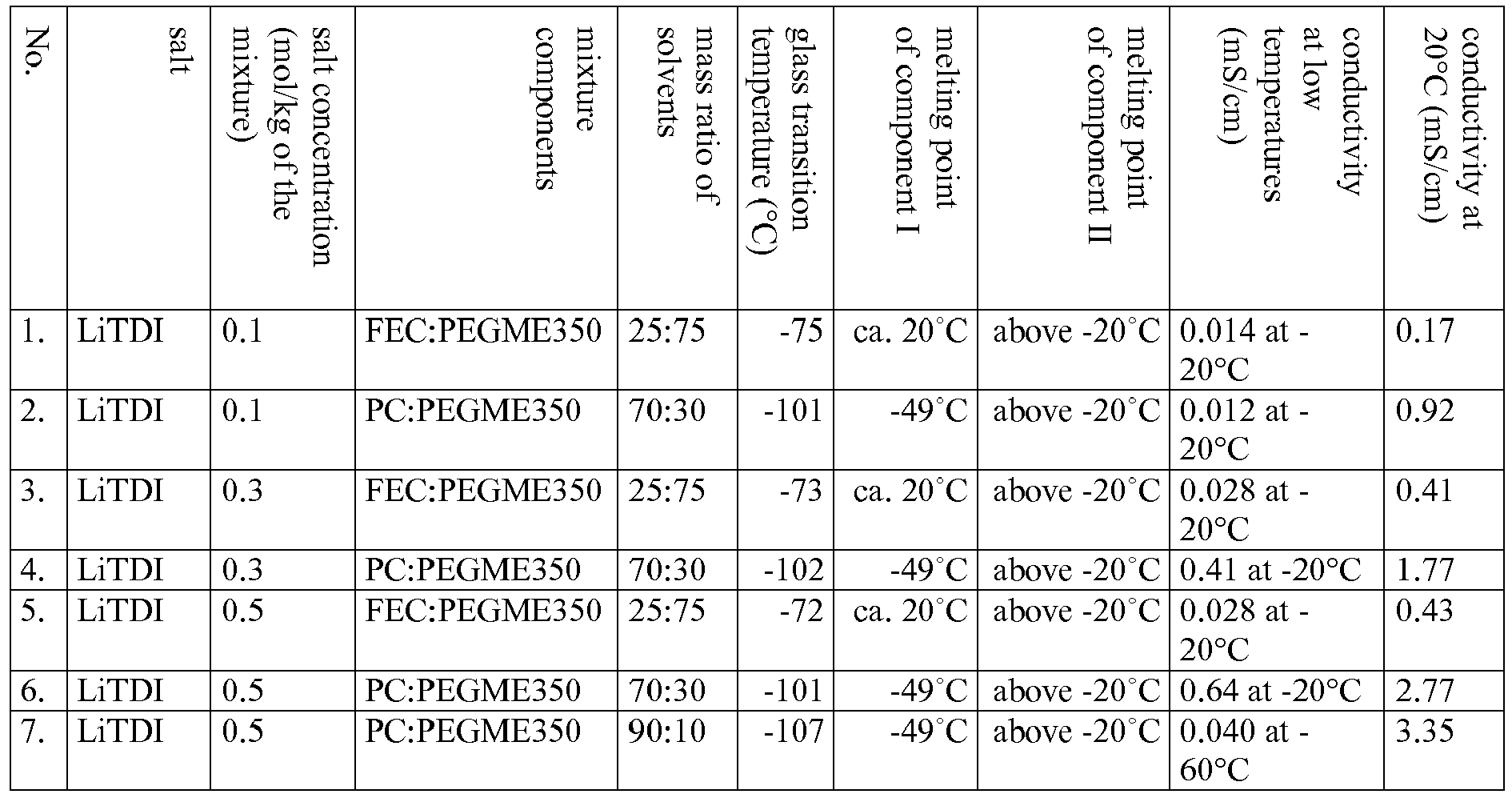
- Example 1 Mixtures with the compositions and properties shown in Table 1 were obtained.
- Example 2 Electrolytes with the compositions and properties shown in Table 2 were obtained.
Landscapes
- Chemical & Material Sciences (AREA)
- Engineering & Computer Science (AREA)
- Manufacturing & Machinery (AREA)
- Chemical Kinetics & Catalysis (AREA)
- Electrochemistry (AREA)
- General Chemical & Material Sciences (AREA)
- Physics & Mathematics (AREA)
- Condensed Matter Physics & Semiconductors (AREA)
- General Physics & Mathematics (AREA)
- Inorganic Chemistry (AREA)
- Secondary Cells (AREA)
Abstract
Description
- The invention relates to mixtures of organic solvents, particularly for galvanic cells and electrolytes for galvanic cells, operating fully at extremely low temperatures, while maintaining correct operation at room temperature.
- Devices powered by chemical sources of electricity became widespread thanks to the improvement of lithium-ion cells and reduction of their production costs. Both the manufacturers of these cells and users of devices powered by them would like to obtain energy from these power sources even under extremely unfavourable conditions. The most frequent problem for electric cars and personal electronics (cellular phones, laptops) is temperatures below 0°C. This relates not only to polar or sub-polar areas, but also mountains as well as the winter seasons in cooler climates. Battery cells serve - apart from personal electronics-telecommunication in areas devoid of a power network, emergency communication and field medical devices that must operate in winter. Also, devices used in the aerospace industry, as they operate in space in near absolute zero temperatures (satellites, probes, orbital stations), as well as in high-altitude aviation or meteorological measurements (meteorological balloons pass through an area which may have a temperature as low as -75°C) must operate under reduced temperatures. Other devices requiring battery power may also be exposed to low temperatures.
- Lithium-ion cells used up to now are very susceptible to low temperatures, causing their destruction, permanent damage or at a least temporary cease in the cell's operation. Commercially available lithium-ion cells do not operate below a temperature of -40°C, and their yield is significantly limited even below -20°C. The main cause of these temperature limitations is the electrolyte present in the cell. Currently, lithium-ion cells consist of two electrodes:
- anode, wherein the active component is a carbon material (e.g. graphite) or other material (e.g. lithium titanate - Li4Ti5O12,), which may intercalate lithium ions;
- cathode, wherein the active component is one of the following materials: a transition metal oxide, such as CoO2 or MnO2, a mixture of transition metal oxides, such as NixCoyMn1-x-yO2, or a transition metal phosphate(V), e.g. FePO4.
- The goal of the invention is to obtain mixtures of organic solvents, particularly for galvanic cells and electrolytes for galvanic cells, operating fully at extremely low temperatures, while maintaining correct operation at room temperature.
- The solvent mixtures, according to the invention, consist of 1÷99% by wt. of at least one carbonate with
general formula 1 and/or with general formula 2, where R1, R2, R3, and R4 are the same or different and denote hydrogen, fluorine, C1-C5 alkyl, C1-C5 alkenyl or fluoroalkyl with one or more fluorine atoms, including perfluoroalkyl, where alkyl is C1-C5. and 1÷99% by wt. of poly(ethylene glycol) with general formula 3, where R5 and R6 are the same or different and denote hydrogen or C1-C5 alkyl, and n = 1÷100, including non-integral values. - Electrolytes for galvanic cells consist of 1÷99% by wt. of at least one carbonate with
general formula 1 and/or with general formula 2, where R1, R2, R3, and R4 are the same or different and denote hydrogen, fluorine, C1-C5 alkyl, C1-C5 alkenyl or fluoroalkyl with one or more fluorine atoms, including perfluoroalkyl, where alkyl is C1-C5, 1÷99% by wt. of poly(ethylene glycol) with general formula 3, where R5 and R6 are the same or different and denote hydrogen or C1-C5 alkyl, and n = 1÷100, including non-integral values, and 0.01÷2 moles of sodium and/or lithium salt per 1 kg of the solvent mixture. As lithium and/or sodium salts, preferably a lithium or sodium salt of trifluoromethanesulfonyl (LiCF3SO3, NaCF3SO3), chlorate(VII) (LiClO4 or NaClO4), tetrafluoroborate (LiBF4, NaBF4), bis(trifluoromethylsulfonyl)imide (NaN(CF3SO2)2, LiN(CF3SO2)2), bis(pentafluoromethylsulfonyl)imide (NaN(CF3CF2SO2)2, LiN(CF3CF2SO2)2), hexafluorophosphate(V) (NaPF6, LiPF6), bis(oxalato)borate (NaB(C2O4)2, LiB(C2O4)2), difluoro(oxalate)borate (NaBF2(C2O4), LiBF2(C2O4)) tris(pentafluoroethyl)trifluorophosphate(V) (NaPF3(C2F5)3, LiPF3(C2F5)3), 4,5-dicyano-2-(trifluoromethyl)imidazole (NaTDI, LiTDI) or 4,5-dicyano-2-(pentafluoroethyl)imidazole (NaPDI, LiPDI) is used. - The invention solves the problem of low temperatures for galvanic cells, lowering the limit of the permissible application of a cell, as the electrolytes described in this application are liquid at very low temperatures (even below-100°C). Moreover, the mixtures and electrolytes constituting the subject of the application do not crystallise (they do not have a melting point) but only undergo a glass transition. Owing to this, even in the case of solidification, no crystalline domains form that may damage the cell, and the return to liquidity from the glass state is milder for the cell. There are no step change in conductivity, changes in density and density inhomogeneity, which take place during the melting of crystals. There are no alternative mixtures or electrolytes having only a glass transition temperature as well as no electrolytes with such a low temperature of liquidity.
- By the mixing of common solvents used in galvanic cells in proper ratios and the addition of a salt with a proper concentration, the mixture may obtain a state in which the electrolyte cooling (or cooling of the mixture itself) does not cause any crystallisation but only a glass transition (the glass transition temperature is denoted by Tg). This phenomenon occurs for mixtures containing organic solvents according to the invention.
- This phenomenon also occurs after the addition of salts to these mixtures, for instance lithium salts: lithium hexafluorophosphate(V) - LiPF6 or lithium 4.5-dicyano-2-(trifluoromethyl)imidazolate - LiTDI in a broad range of concentrations of the salts. In some cases, the electrolytes are functional even below -90°C (e.g. Tg = -110°C for PC-containing mixtures and Tg = -95°C for EC-containing mixtures). It is noteworthy that the melting temperatures of pure solvents are as follows: EC: ca. 36°C, PC: -49°C, FEC: ca. 20°C, PEGDME222: above -30°C, PEGDME250: above -25°C, PEGME350: above -20°C, PEGDME500: above - 15°C.
- Apart from the possibility to operate in extremely low temperatures (significantly lower than those for the battery mixtures known hitherto), the main advantage of these mixtures consists in the fact that at low temperatures, crystallisation does not occur (unheard-of earlier in the case of battery mixtures), but glass transition occurs, which is fully reversible and safe for the other cell components; also, no local salt agglomerates form (which may crystallise in the pores of the electrodes, destroying the latter), nor are there crystalline phases that might permanently damage the cell components or the entire cell (in the case of shorting of the electrodes or separator rupture, which may lead to the same consequence). Conductivity decreases gradually, without a sudden drop, as is the case for crystallisation of ordinary electrolytes.
- Apart from their low-temperature properties, the mixtures are no more volatile than the electrolytes available hitherto operating at normal temperatures. In the case of mixtures containing FEC, EC and PC, the boiling temperature exceeds 200°C (each of the components has a boiling point significantly above 200°C); in the case of mixtures containing DMC, the boiling temperature is ca. 100°C. This means that extension of the operating range at low temperatures has not changed the functionality at high temperatures. The invention of this application does not introduce additional hazards for the cell (the majority of other cell components, e.g. some salts, have a decomposition temperature below 100°C).
- The invention is not limited to lithium-ion cells, because similar problems (concerning operation at low temperatures) also occur in sodium-ion cells, lithium-air cells, etc. The invention may also be used in other applications requiring no crystallisation at low temperatures and a liquid state down to low temperatures, e.g. a coolant. The solvents applied are commonly used in the battery industry (and other industries), and they are cheap (mass-produced). For production of the mixtures or electrolytes being the subject of the invention, no special manufacturing methods or equipment other than those already used are needed. No changes in existing process lines for cell production, studies of stability, compatibility with other components or tests of the components as regards their toxicity, teratogenicity, carcinogenicity and other risks posed by them are needed, as they are all studied and have been used in the industry for many years.
-

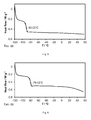
- The properties of the obtained mixtures are illustrated in the Figures:
-
Fig. 1 - DSC (differential scanning calorimetry) plot for a PC:PEGME350 mixture (with a mass ratio of 95:5), -
Fig.2 - DSC (differential scanning calorimetry) plot for a FEC:PEGME350 mixture (with a mass ratio of 70:30), -
Fig. 3 - DSC (differential scanning calorimetry) plot for a EC:PEGDME250 mixture (with a mass ratio of 30:70) -

- Figures:
-
Fig. 4 - DSC plot for a solution of 0.1 mol/kg LiTDI in EC:PEGDME250 (with a mass ratio of 30:70), -
Fig. 5 - DSC plot for a solution of 0.5 mol/kg LiTDI in EC:PEGDME250 (with a mass ratio of 30:70), -
Fig. 6 - DSC plot for a solution of 0.5 mol/kg LiTDI in EC:PEGDME500 (with a mass ratio of 30:70), -
Fig. 7 - DSC plot for a solution of 0.3 mol/kg LiPF6 in EC:PEGDME250 (with a mass ratio of 25:70), -
Fig. 8 - DSC plot for a solution of 0.5 mol/kg LiPF6 in EC:PEGDME250 (with a mass ratio of 30:70).
-
Cells based on poly(ethylene glycols) are used less often because of their lower obtainable ionic conductivity, and therefore lower current densities are obtained from the cell. Their working temperatures may not be lower than approx. -15°C (melting temperature of electrolytes based on 250-500 polyglycols; this is higher for the longer ones, and the shorter ones are used less often because of their higher volatility and reactivity). Lithium-ion cells with electrolytes based on organic carbonates occur most often, and they are able to operate down to ca. -40°C, while a safe temperature recommended by the manufacturers is -20°C.
In the case of cells specially designed for low-temperature applications (below - 20°C), two ideas are used. In the first one, the influence of external conditions (ambient temperature) on the cell is avoided by application of air conditioned/environmental chambers/casings maintaining the appropriate high temperatures. However, such a solution causes loss of cell energy, which is consumed for maintaining the temperature - for heating of the chamber, as well as powering the electronic equipment and the sensors required for this operation. Moreover, construction of such a chamber leads to high costs in relation to the cell itself (or cell battery) as well as to a significant drop in the current density of the entire battery container (the battery together with the control electronics and environmental chamber - cooling/heating). Another solution is to use special solvent compositions (non-optimal for room or higher temperatures), which freezes within the range of -50 ÷ -60°C. The compositions of such a type were disclosed in the following publications: W.K. Behl, E.J. Plichta, An Electrolyte for Low-Temperature Applications of Lithium and Lithium-Ion Batteries, Army Research Laboratory report ARL-TR-1705, September 1998; M.S. Ding, T.R. Jow, Conductivity and Viscosity of PC-DEC and PC-EC Solutions of LiPF6, J. Electrochem. Soc. 150 (2003) A620-A628 (doi: 10.1149/1.1566019); M.C. Smart, B.V. Ratnakumar, L.D. Whitcanack, K.B. Chin, S. Surampudi, H. Croft, D. Tice, R. Staniewicz, Improved low-temperature performance of lithium-ion cells with quaternary carbonate-based electrolytes, J. Power Sources 119-121 (2003) 349-358 (doi: 10.1016/S0378-7753(03)00154-X); M.S. Ding, Improved low-temperature performance of lithium-ion cells with quaternary carbonate-based electrolytes, J. Electrochem. Soc. 151 (2004) A731-A738 (doi: 10.1149/1.1690782) and M.C. Smart, B.V. Ratnakumar, K.B. Chin, L.D. Whitcanack, Lithium-Ion Electrolytes Containing Ester Co-solvents for Improved Low Temperature Performance, J. Electrochem. Soc. 157 (2010) A1361-A1374 (doi: 10.1149/1.3501236). In this case, the reversibility of this process for the cell is a problem: after reheating, the electrodes are mechanically damaged (as a result of volume changes during phase transition from liquid to crystal and vice versa) or blocked by agglomerates of the locally crystallised lithium salt present in the electrolyte. Similarly, damage or destruction of the electrodes may be caused by their cracking; as a result of the freezing of the electrolyte in pores and inter-granular spaces, there is a risk of cell casing breakup or separator rupture caused by the volume changes of the electrolyte.
Claims (3)
- Mixtures of organic solvents, particularly for galvanic cells, characterised in that they consist of 1÷99% by wt. of at least one carbonate with general formula 1


- Electrolytes for galvanic cells based on mixtures of organic solvents and 0.01-2 mole or sodium and/or lithium salt per 1 kg of the solvent mixture, characterised in that they contains as a solvent 1÷99% by wt. of at least one carbonate with general formula 1


- Electrolytes, according to claim 2, characterised in that as lithium and/or sodium salts, a lithium or sodium salt of trifluoromethanesulfonyl (LiCF3SO3, NaCF3SO3), chlorate(VII) (LiClO4 or NaClO4), tetrafluoroborate (LiBF4, NaBF4), bis(trifluoromethylsulfonyl)imide (NaN(CF3SO2)2, LiN(CF3SO2)2),
bis(pentafluoromethylsulfonyl)imide (NaN(CF3CF2SO2)2, LiN(CF3CF2SO2)2), hexafluorophosphate(V) (NaPF6, LiPF6), bis(oxalate)borate (NaB(C2O4)2, LiB(C2O4)2), difluoro(oxalate)borate (NaBF2(C2O4), LiBF2(C2O4)) tris(pentafluoroethyl)trifluorophosphate(V) (NaPF3(C2F5)3, LiPF3(C2F5)3), 4,5-dicyano-2-(trifluoromethyl)imidazole (NaTDI, LiTDI) or 4,5-dicyano-2-(pentafluoroethyl)imidazole (NaPDI, LiPDI) is used.
Applications Claiming Priority (1)
| Application Number | Priority Date | Filing Date | Title |
|---|---|---|---|
| PL402423A PL232931B1 (en) | 2013-01-11 | 2013-01-11 | Mixtures of organic solvents, in particular for primary cells and primary cells electrolytes |
Publications (2)
| Publication Number | Publication Date |
|---|---|
| EP2755273A2 true EP2755273A2 (en) | 2014-07-16 |
| EP2755273A3 EP2755273A3 (en) | 2015-12-02 |
Family
ID=49920172
Family Applications (1)
| Application Number | Title | Priority Date | Filing Date |
|---|---|---|---|
| EP14150482.9A Withdrawn EP2755273A3 (en) | 2013-01-11 | 2014-01-08 | Mixtures of organic solvents, particularly for galvanic cells, and electrolytes for galvanic cells comprising said mixtures |
Country Status (2)
| Country | Link |
|---|---|
| EP (1) | EP2755273A3 (en) |
| PL (1) | PL232931B1 (en) |
Cited By (3)
| Publication number | Priority date | Publication date | Assignee | Title |
|---|---|---|---|---|
| JP2016535917A (en) * | 2013-10-03 | 2016-11-17 | アルケマ フランス | Compositions containing pentacyclic anion salts and their use as battery electrolytes |
| CN110998950A (en) * | 2017-08-07 | 2020-04-10 | 阿科玛法国公司 | Lithium salt mixtures and their use as battery electrolytes |
| US12080850B2 (en) | 2017-12-13 | 2024-09-03 | Faradion Limited | Non-aqueous electrolyte compositions |
Family Cites Families (10)
| Publication number | Priority date | Publication date | Assignee | Title |
|---|---|---|---|---|
| US4753859A (en) * | 1987-10-13 | 1988-06-28 | American Telephone And Telegraph Company, At&T Laboratories | Nonaqueous cell |
| JP3158412B2 (en) * | 1990-03-16 | 2001-04-23 | ソニー株式会社 | Lithium secondary battery |
| JPH06338348A (en) * | 1993-05-31 | 1994-12-06 | Nippon Telegr & Teleph Corp <Ntt> | Secondary battery having nonaqueous solvent electrolyte |
| JP2003288940A (en) * | 2002-03-27 | 2003-10-10 | Mitsubishi Heavy Ind Ltd | Nonaqueous electrolyte secondary battery and nonaqueous electrolyte |
| JP4248258B2 (en) * | 2003-01-16 | 2009-04-02 | 三洋電機株式会社 | Lithium secondary battery |
| JP2005108724A (en) * | 2003-09-30 | 2005-04-21 | Sanyo Electric Co Ltd | Nonaqueous electrolyte secondary battery |
| JP4508756B2 (en) * | 2004-07-16 | 2010-07-21 | 三洋電機株式会社 | Lithium primary battery |
| JP2007035431A (en) * | 2005-07-27 | 2007-02-08 | Sii Micro Parts Ltd | Nonaqueous electrolyte secondary battery |
| JP5407469B2 (en) * | 2009-03-25 | 2014-02-05 | パナソニック株式会社 | Organic electrolyte battery |
| WO2011132717A1 (en) * | 2010-04-22 | 2011-10-27 | 日油株式会社 | Non-aqueous electrolyte for electrical device and secondary battery using same |
-
2013
- 2013-01-11 PL PL402423A patent/PL232931B1/en unknown
-
2014
- 2014-01-08 EP EP14150482.9A patent/EP2755273A3/en not_active Withdrawn
Non-Patent Citations (5)
| Title |
|---|
| M.C. SMART; B.V. RATNAKUMAR; K.B. CHIN; L.D. WHITCANACK: "Lithium-Ion Electrolytes Containing Ester Co-solvents for Improved Low Temperature Performance", J. ELECTROCHEM. SOC., vol. 157, 2010, pages A1361 - A1374 |
| M.C. SMART; B.V. RATNAKUMAR; L.D. WHITCANACK; K.B. CHIN; S. SURAMPUDI; H. CROFT; D. TICE; R. STANIEWICZ: "Improved low-temperature performance of lithium-ion cells with quaternary carbonate-based electrolytes", J. POWER SOURCES, vol. 119-121, 2003, pages 349 - 358, XP004430194, DOI: doi:10.1016/S0378-7753(03)00154-X |
| M.S. DING: "Improved low-temperature performance of lithium-ion cells with quaternary carbonate-based electrolytes", J. ELECTROCHEM. SOC., vol. 151, 2004, pages A731 - A738 |
| M.S. DING; T.R. JOW: "Conductivity and Viscosity of PC-DEC and PC-EC Solutions of LiPF6", J. ELECTROCHEM. SOC., vol. 150, 2003, pages A620 - A628 |
| W.K. BEHL; E.J. PLICHTA: "An Electrolyte for Low-Temperature Applications of Lithium and Lithium-Ion Batteries", ARMY RESEARCH LABORATORY REPORT ARL-TR-1705, September 1998 (1998-09-01) |
Cited By (4)
| Publication number | Priority date | Publication date | Assignee | Title |
|---|---|---|---|---|
| JP2016535917A (en) * | 2013-10-03 | 2016-11-17 | アルケマ フランス | Compositions containing pentacyclic anion salts and their use as battery electrolytes |
| CN110998950A (en) * | 2017-08-07 | 2020-04-10 | 阿科玛法国公司 | Lithium salt mixtures and their use as battery electrolytes |
| US11757133B2 (en) | 2017-08-07 | 2023-09-12 | Arkema France | Lithium salt mixture and uses thereof as a battery electrolyte |
| US12080850B2 (en) | 2017-12-13 | 2024-09-03 | Faradion Limited | Non-aqueous electrolyte compositions |
Also Published As
| Publication number | Publication date |
|---|---|
| PL402423A1 (en) | 2014-07-21 |
| EP2755273A3 (en) | 2015-12-02 |
| PL232931B1 (en) | 2019-08-30 |
Similar Documents
| Publication | Publication Date | Title |
|---|---|---|
| KR101954600B1 (en) | Aqueous electrolyte solution for electrical storage device, and electrical storage device including said aqueous electrolyte solution | |
| EP2833468B1 (en) | Non-aqueous electrolyte solution for secondary batteries, and lithium-ion secondary battery | |
| CN100468856C (en) | Electrochemical components used at high temperatures | |
| KR101304079B1 (en) | Nonaqueous Electrolyte Secondary Cell, Nonaqueous Electrolyte and the Method for Charging the Same | |
| KR100838932B1 (en) | Nonaqueous Electrolyte Secondary Battery | |
| CN103553886A (en) | Polyether-functionalized redox shuttle additives for lithium ion batteries | |
| JP2002158035A (en) | Non-aqueous electrolyte and secondary battery using the same | |
| JP4812067B2 (en) | Organic electrolyte and organic electrolyte battery using the same | |
| CN102544584A (en) | Energy storage battery with non-aqueous electrolyte solution of lithium perfluoro-alkoxy (-phenoxy) sulfonylimide | |
| US12080850B2 (en) | Non-aqueous electrolyte compositions | |
| CN107293793A (en) | Electrolyte and electrochemical cell | |
| EP3240094A1 (en) | Electrolyte solution for secondary batteries, and secondary battery | |
| EP2768066A1 (en) | Nonaqueous organic electrolyte additive and preparation method thereof, nonaqueous organic electrolyte, and lithium ion secondary battery | |
| CN105742701A (en) | Electrolyte and lithium secondary battery | |
| CN105206873A (en) | Phosphazene perfluoroalkanesulfonylimide lithium electrolyte and battery using electrolyte | |
| CN105428720B (en) | A kind of nonaqueous electrolytic solution and preparation method thereof and a kind of lithium secondary battery | |
| JP2002008719A (en) | Nonaqueous electrolyte and secondary battery using the same | |
| EP2937918B1 (en) | Hindered glymes for electrolyte compositions | |
| EP2755273A2 (en) | Mixtures of organic solvents, particularly for galvanic cells, and electrolytes for galvanic cells comprising said mixtures | |
| JP2017004638A (en) | Electrolyte salt, non-aqueous electrolyte containing the electrolyte salt, and electricity storage device using the same | |
| JP2000348760A (en) | Nonaqueous electrolytic solution and secondary battery using it | |
| KR20110084183A (en) | Mixed Lithium Nickel Cobalt Oxide and Lithium Nickel Manganese Cobalt Oxide Cathode | |
| JP6879799B2 (en) | Non-aqueous electrolyte for batteries and lithium secondary battery | |
| JP4811070B2 (en) | Non-aqueous electrolyte battery electrolyte, electrolyte and non-aqueous electrolyte battery | |
| US20150099165A1 (en) | Electrolyte additive for a lithium-based energy storage device |
Legal Events
| Date | Code | Title | Description |
|---|---|---|---|
| PUAI | Public reference made under article 153(3) epc to a published international application that has entered the european phase |
Free format text: ORIGINAL CODE: 0009012 |
|
| 17P | Request for examination filed |
Effective date: 20140108 |
|
| AK | Designated contracting states |
Kind code of ref document: A2 Designated state(s): AL AT BE BG CH CY CZ DE DK EE ES FI FR GB GR HR HU IE IS IT LI LT LU LV MC MK MT NL NO PL PT RO RS SE SI SK SM TR |
|
| AX | Request for extension of the european patent |
Extension state: BA ME |
|
| PUAL | Search report despatched |
Free format text: ORIGINAL CODE: 0009013 |
|
| AK | Designated contracting states |
Kind code of ref document: A3 Designated state(s): AL AT BE BG CH CY CZ DE DK EE ES FI FR GB GR HR HU IE IS IT LI LT LU LV MC MK MT NL NO PL PT RO RS SE SI SK SM TR |
|
| AX | Request for extension of the european patent |
Extension state: BA ME |
|
| RIC1 | Information provided on ipc code assigned before grant |
Ipc: H01M 10/052 20100101AFI20151029BHEP Ipc: H01M 10/0569 20100101ALI20151029BHEP Ipc: H01M 10/0568 20100101ALN20151029BHEP |
|
| STAA | Information on the status of an ep patent application or granted ep patent |
Free format text: STATUS: THE APPLICATION IS DEEMED TO BE WITHDRAWN |
|
| 18D | Application deemed to be withdrawn |
Effective date: 20160603 |