EP2753343B1 - Composition comprising n-acetylcysteine and probiotic bacteria capable of restoring the stomach's own barrier effect which is lost during treatment of gastric hyperacidity with proton pump inhibitors - Google Patents
Composition comprising n-acetylcysteine and probiotic bacteria capable of restoring the stomach's own barrier effect which is lost during treatment of gastric hyperacidity with proton pump inhibitors Download PDFInfo
- Publication number
- EP2753343B1 EP2753343B1 EP12780277.5A EP12780277A EP2753343B1 EP 2753343 B1 EP2753343 B1 EP 2753343B1 EP 12780277 A EP12780277 A EP 12780277A EP 2753343 B1 EP2753343 B1 EP 2753343B1
- Authority
- EP
- European Patent Office
- Prior art keywords
- dsm
- lactobacillus
- probiotical
- composition
- group
- Prior art date
- Legal status (The legal status is an assumption and is not a legal conclusion. Google has not performed a legal analysis and makes no representation as to the accuracy of the status listed.)
- Active
Links
Images

Classifications
-
- A—HUMAN NECESSITIES
- A61—MEDICAL OR VETERINARY SCIENCE; HYGIENE
- A61K—PREPARATIONS FOR MEDICAL, DENTAL OR TOILETRY PURPOSES
- A61K35/00—Medicinal preparations containing materials or reaction products thereof with undetermined constitution
- A61K35/66—Microorganisms or materials therefrom
- A61K35/74—Bacteria
- A61K35/741—Probiotics
- A61K35/744—Lactic acid bacteria, e.g. enterococci, pediococci, lactococci, streptococci or leuconostocs
- A61K35/747—Lactobacilli, e.g. L. acidophilus or L. brevis
-
- A—HUMAN NECESSITIES
- A23—FOODS OR FOODSTUFFS; TREATMENT THEREOF, NOT COVERED BY OTHER CLASSES
- A23L—FOODS, FOODSTUFFS OR NON-ALCOHOLIC BEVERAGES, NOT OTHERWISE PROVIDED FOR; PREPARATION OR TREATMENT THEREOF
- A23L33/00—Modifying nutritive qualities of foods; Dietetic products; Preparation or treatment thereof
- A23L33/10—Modifying nutritive qualities of foods; Dietetic products; Preparation or treatment thereof using additives
- A23L33/135—Bacteria or derivatives thereof, e.g. probiotics
-
- A—HUMAN NECESSITIES
- A23—FOODS OR FOODSTUFFS; TREATMENT THEREOF, NOT COVERED BY OTHER CLASSES
- A23L—FOODS, FOODSTUFFS OR NON-ALCOHOLIC BEVERAGES, NOT OTHERWISE PROVIDED FOR; PREPARATION OR TREATMENT THEREOF
- A23L33/00—Modifying nutritive qualities of foods; Dietetic products; Preparation or treatment thereof
- A23L33/40—Complete food formulations for specific consumer groups or specific purposes, e.g. infant formula
-
- A—HUMAN NECESSITIES
- A61—MEDICAL OR VETERINARY SCIENCE; HYGIENE
- A61K—PREPARATIONS FOR MEDICAL, DENTAL OR TOILETRY PURPOSES
- A61K31/00—Medicinal preparations containing organic active ingredients
- A61K31/185—Acids; Anhydrides, halides or salts thereof, e.g. sulfur acids, imidic, hydrazonic or hydroximic acids
- A61K31/19—Carboxylic acids, e.g. valproic acid
- A61K31/195—Carboxylic acids, e.g. valproic acid having an amino group
- A61K31/197—Carboxylic acids, e.g. valproic acid having an amino group the amino and the carboxyl groups being attached to the same acyclic carbon chain, e.g. gamma-aminobutyric acid [GABA], beta-alanine, epsilon-aminocaproic acid or pantothenic acid
- A61K31/198—Alpha-amino acids, e.g. alanine or edetic acid [EDTA]
-
- A—HUMAN NECESSITIES
- A61—MEDICAL OR VETERINARY SCIENCE; HYGIENE
- A61K—PREPARATIONS FOR MEDICAL, DENTAL OR TOILETRY PURPOSES
- A61K35/00—Medicinal preparations containing materials or reaction products thereof with undetermined constitution
- A61K35/66—Microorganisms or materials therefrom
- A61K35/74—Bacteria
-
- A—HUMAN NECESSITIES
- A61—MEDICAL OR VETERINARY SCIENCE; HYGIENE
- A61K—PREPARATIONS FOR MEDICAL, DENTAL OR TOILETRY PURPOSES
- A61K35/00—Medicinal preparations containing materials or reaction products thereof with undetermined constitution
- A61K35/66—Microorganisms or materials therefrom
- A61K35/74—Bacteria
- A61K35/741—Probiotics
-
- A—HUMAN NECESSITIES
- A61—MEDICAL OR VETERINARY SCIENCE; HYGIENE
- A61K—PREPARATIONS FOR MEDICAL, DENTAL OR TOILETRY PURPOSES
- A61K35/00—Medicinal preparations containing materials or reaction products thereof with undetermined constitution
- A61K35/66—Microorganisms or materials therefrom
- A61K35/74—Bacteria
- A61K35/741—Probiotics
- A61K35/744—Lactic acid bacteria, e.g. enterococci, pediococci, lactococci, streptococci or leuconostocs
-
- A—HUMAN NECESSITIES
- A61—MEDICAL OR VETERINARY SCIENCE; HYGIENE
- A61K—PREPARATIONS FOR MEDICAL, DENTAL OR TOILETRY PURPOSES
- A61K35/00—Medicinal preparations containing materials or reaction products thereof with undetermined constitution
- A61K35/66—Microorganisms or materials therefrom
- A61K35/74—Bacteria
- A61K35/741—Probiotics
- A61K35/744—Lactic acid bacteria, e.g. enterococci, pediococci, lactococci, streptococci or leuconostocs
- A61K35/745—Bifidobacteria
-
- A—HUMAN NECESSITIES
- A61—MEDICAL OR VETERINARY SCIENCE; HYGIENE
- A61K—PREPARATIONS FOR MEDICAL, DENTAL OR TOILETRY PURPOSES
- A61K38/00—Medicinal preparations containing peptides
- A61K38/16—Peptides having more than 20 amino acids; Gastrins; Somatostatins; Melanotropins; Derivatives thereof
- A61K38/43—Enzymes; Proenzymes; Derivatives thereof
- A61K38/46—Hydrolases (3)
- A61K38/47—Hydrolases (3) acting on glycosyl compounds (3.2), e.g. cellulases, lactases
-
- A—HUMAN NECESSITIES
- A61—MEDICAL OR VETERINARY SCIENCE; HYGIENE
- A61K—PREPARATIONS FOR MEDICAL, DENTAL OR TOILETRY PURPOSES
- A61K45/00—Medicinal preparations containing active ingredients not provided for in groups A61K31/00 - A61K41/00
- A61K45/06—Mixtures of active ingredients without chemical characterisation, e.g. antiphlogistics and cardiaca
-
- A—HUMAN NECESSITIES
- A61—MEDICAL OR VETERINARY SCIENCE; HYGIENE
- A61P—SPECIFIC THERAPEUTIC ACTIVITY OF CHEMICAL COMPOUNDS OR MEDICINAL PREPARATIONS
- A61P1/00—Drugs for disorders of the alimentary tract or the digestive system
-
- A—HUMAN NECESSITIES
- A61—MEDICAL OR VETERINARY SCIENCE; HYGIENE
- A61P—SPECIFIC THERAPEUTIC ACTIVITY OF CHEMICAL COMPOUNDS OR MEDICINAL PREPARATIONS
- A61P31/00—Antiinfectives, i.e. antibiotics, antiseptics, chemotherapeutics
- A61P31/04—Antibacterial agents
-
- Y—GENERAL TAGGING OF NEW TECHNOLOGICAL DEVELOPMENTS; GENERAL TAGGING OF CROSS-SECTIONAL TECHNOLOGIES SPANNING OVER SEVERAL SECTIONS OF THE IPC; TECHNICAL SUBJECTS COVERED BY FORMER USPC CROSS-REFERENCE ART COLLECTIONS [XRACs] AND DIGESTS
- Y02—TECHNOLOGIES OR APPLICATIONS FOR MITIGATION OR ADAPTATION AGAINST CLIMATE CHANGE
- Y02A—TECHNOLOGIES FOR ADAPTATION TO CLIMATE CHANGE
- Y02A50/00—TECHNOLOGIES FOR ADAPTATION TO CLIMATE CHANGE in human health protection, e.g. against extreme weather
- Y02A50/30—Against vector-borne diseases, e.g. mosquito-borne, fly-borne, tick-borne or waterborne diseases whose impact is exacerbated by climate change
Definitions
- drugs most widely used are those based on active principles capable of inhibiting inhibitors of the histamine receptor H 2 such as, for example, cimetidine, famotidine, nizatidine, ranitidine, or based on active principles capable of inhibiting prostaglandins such as, for example, misoprostol.
- active principles which perform the function of protectors of the gastric mucosa such as, for example, bismuth salts, sucralfate or antimuscarinic or parasympatholytic drugs based on pirenzepine and pipenzolate.
- antacids such as, for example, sodium bicarbonate, aluminium hydroxide or magnesium hydroxide and proton pump inhibitors based on Lansoprazole, Esometazole, Rabeprazole, Pantoprazole and Omeprazole.
- PPI Proton pump inhibitors
- PPIs The group containing PPIs is the successor to H 2 antihistamines, and PPI inhibitors are broadly more widespread than the latter because of their greater effectiveness.
- the medicines mentioned above are used in the symptomatic and aetiological treatment of various syndromes, such as: (i) dyspepsia; (ii) gastro-duodenal ulcer.
- PPIs are used for treating or preventing gastric and duodenal ulcers. They are also used in association with certain antibiotics in the treatment of gastritis from Helicobacter pylori ; (iii) Zollinger-Ellison syndrome and (iv) gastroesophageal reflux disease.
- PPIs are also used in patients treated long-term with acetylsalicylic acid or other NSAIDs. By inhibiting the function of the enzyme cyclooxigenase 1 (COX 1), these drugs have the side effect of reducing the synthesis of prostaglandin, a process which depends on the same enzyme. Since one of the functions of prostaglandin is the protection of the gastric mucosa from acidity, PPIs are used in order to reduce acidity and protect the gastric mucosa.
- COX 1 cyclooxigenase 1
- This type of medicine inhibits the gastric enzyme H + /K + -ATPase (the proton pump), catalyst of the H + and K + ion exchange. This creates effective inhibition of acid secretion.
- normal gastric acidity constitutes an effective barrier against potential harmful organisms or pathogens ingested with the normal diet. Many of them, in fact, are particularly sensitive to acidity and are not capable of surviving for more than five minutes, sometimes even less, at pH values below 3. It follows that many pathogens, among them those belonging to the genus Salmonella , do not reach the intestine alive and, setting aside harmful effects on the human organism mediated by any toxins secreted and already present in food, are not capable of giving rise to an intestinal infection and, therefore, to full-blown food poisoning.
- This pH value allows Enterobacteriaceae , and particular strains of E . Coli with pronounced decarboxylasic action, to pass through the degraded gastric barrier.
- Proteins ingested during eating are enzymatically degraded to amino acids which, in the presence of decarboxylasic action, are modified into a series of biogenic amines ranging from potentially dangerous to highly dangerous such as for example histamine, tyramine, putrescine and cadaverine.
- PPIs proton pump inhibitors
- N-nitrosamines When certain biogenic amines then react with nitrites, we have the formation of N-nitrosamines. These nitrosamines cause a genetic mutation through alkylation of the DNA, and their presence is associated with cancer of the stomach, the intestine, the pancreas and the bladder, and also with leukaemia.
- WO 2007/100765 A2 describes a method for enhancing macrophage activity, comprising the steps of: selecting at least one probiotic; digesting the at least one probiotic with lytic enzyme such that the at least one probiotic cell wall is broken releasing probiotic components; administering at least one of the probiotic components to a subject in need thereof.
- Huynh et al. have described a study in which N-acetylcysteine is used to treat Helicobacter pylori infection ( Digestive Diseases and Sciences, 2004, 49(11/12), pp. 1853-1861 ).
- coliforms which are a group of bacteria belonging to the family of Enterobacteriaceae and which includes, among others, Citrobacter , Enterobacter , preferably Enterobacter cloacae , Escherichia , preferably E.
- coli including serotype O157:H7, Hafnia , Klebsiella , preferably Klebsiella pneumoniae , Serratia and Yersinia, or other pathogens such as the Clostridiaceae, including Clostridium difficile, Salmonella enteriditis , Campylobacter jejunii and Helicobacter pylori.
- the applicant has responded to the above-mentioned needs with a composition which, on the one hand, is capable of restoring the functionality of the gastric barrier, having a protective effect against pathogenic or harmful micro-organisms and, on the other, is capable of having an improved and selective efficacy against the pathogens themselves.
- composition of the present invention is capable of restoring the functionality of the gastric barrier, normally exercised by the gastric juices, which is particularly reduced in patients who take drugs to reduce or treat gastric hyperacidity.
- Said composition is capable of minimising the secondary effects associated with pharmacological intake based on proton pump inhibitor drugs (PPIs for short).
- PPIs proton pump inhibitor drugs
- a selected combination (or mixture) of probiotic bacteria is capable of allowing patients in need, on the one hand, to take PPI drugs for reducing or treating gastric hyperacidity and, on the other hand, to avoid being exposed to highly dangerous pathogenic infections or to risks of recurrent pathogenic infections.
- the invention relates to a pharmaceutical or dietary composition or a supplement or a medical device, for use in the treatment of subjects who are taking a proton pump inhibitor to reduce or treat gastric hyperacidity, which comprises the following strains:
- Figure 1 refers to the total bacterial count present in the samples taken from the subjects of the clinical study ( Figure A and Figure B).
- Figure 1A shows the comparison between subjects chronically treated with PPIs (PPI group totals: PPI + "PPI plus probiotics") and the control group. The data are expressed as an average of the colony-forming units (CFU).
- Figure 1B shows the comparison between subjects chronically treated with PPIs and those treated with "PPIs plus probiotics" and the control group. The data are expressed as an average ⁇ S.E.M. of the colony-forming units (CFU).
- Figure 2 shows the quantities of bacteria found in the gastric juice and after duodenal brushing in the subjects treated.
- the Proprietor has performed intense research and selection activity, at the end of which it found that the strains of probiotic bacteria belonging to at least one species chosen from the group comprising or, alternatively, consisting of, L. acidophilus , L. crispatus , L. gasseri , L. delbrueckii , L. delbr. subsp. delbrueckii , L. salivarius , L. casei , L. paracasei , L. plantarum , L. rhamnosus , L. reuteri , L. brevis , L. buchneri , L. fermentum , L. lactis, L. pentosus , B .
- adolescentis B . angulatum , B. bifidum , B. breve , B. catenulatum , B. infantis , B. lactis , B. longum , B. pseudocatenulatum and S . thermophilus have a valid application in the treatment of subjects who are taking proton pump inhibitors (PPIs) to reduce or treat gastric hyperacidity.
- PPIs proton pump inhibitors
- the Proprietor has found that the antibacterial efficacy demonstrated by the strains of bacteria which are the subject of the present invention is increased and more selective against pathogens as a result of the presence of the presence of N-acetylcysteine (NAC) in said composition.
- N-acetylcysteine N-acetylcysteine
- the Proprietor has found that the antibacterial efficacy demonstrated by the strains of bacteria which are the subject of the present invention is increased and more selective against pathogens as a result of the presence of N-acetylcysteine and microencapsulated gastroprotected lysozyme in said composition.
- the lysozyme is microencapsulated in a lipid matrix.
- the lipid matrix is of vegetable origin and has a melting point comprised between 30 °C and 80 °C, preferably between 40 °C and 70 °C, even more preferably between 50 °C and 60 °C.
- composition of the present invention comprises N-acetylcysteine in association with the strains of bacteria of the present invention: N-acetylcysteine which is an N-acetylate derivative of the amino acid cysteine.
- the Proprietor has found that the use of N-acetylcysteine in association with one or two or three or four or five or six strains of bacteria, described in Tables 1 and 2, or in the present invention, is capable of dissolving the bacterial biofilm produced by the pathogenic bacteria themselves and which is used by said pathogens as protection.
- the pathogenic bacteria are capable of forming a protective coating (biofilm) around the cells.
- biofilm makes the cells of the pathogens more difficult to attack and better protected.
- N-acetylcysteine is capable of penetrating the biofilm of the cells and dissolving it, facilitating the attack on the pathogenic cells by means of the bacteriocins and/or the metabolites and/or the oxygenated water produced by the strains of bacteria which are the subject of the present invention.
- the Proprietor has found, furthermore, that the use of microencapsulated gastroprotected lysozyme makes it possible to pass the gastro-duodenal barrier and arrive complete in the colon where it succeeds in exercising its action of inhibiting the Clostridiaceae, including C. difficile , thanks to the lytic action of the enzyme on the spore.
- the quantity of N-acetylcysteine present in the composition which is the subject of the present invention is comprised between 10 and 1,000 mg/day, preferably between 50 and 200 mg/day, even more preferably between 60 and 150 mg/day.
- N-acetylcysteine which is available on the market in non-microencapsulated form and in a pharmaceutically acceptable form, preferably in solid form, is mixed with the probiotic bacteria, preferably in solid or lyophilised form, using techniques and equipment known to experts in the field to give a homogeneous composition.
- the quantity of microencapsulated gastroprotected lysozyme which may be present in the composition which is the subject of the present invention is comprised between 10 and 2,000 mg/day, preferably between 400 and 1,000 mg/day, even more preferably between 500 and 800 mg/day, preferably in solid form; it is mixed with the probiotic bacteria, preferably in solid or lyophilised form, using techniques and equipment known to experts in the field, to give a homogeneous composition. Lysozyme is available on the market in a pharmaceutically acceptable form.
- the strains of bacteria were selected because they are capable of colonising the stomach at a pH value comprised between 4 and 5.5; preferably between 4.5 and 5. At this pH value the selected strains act by means of the production of active substances such as bacteriocins and/or metabolites and/or oxygenated water.
- the composition of the present invention can be a dietary composition, for example a symbiotic composition, or a supplement or a pharmaceutical composition or a medical device.
- a dietary composition for example a symbiotic composition, or a supplement or a pharmaceutical composition or a medical device.
- Lactobacillus plantarum 476LL 20 bi (LP01) LMG P-21021 16.10.2001 MOFIN S.R.L. 6 Lactobacillus plantarum PR ci (LP03) LMG P-21022 16.10.2001 MOFIN S.R.L. 7 Lactobacillus plantarum 776/2 hi (LP04) LMG P-21023 16.10.2001 MOFIN S.R.L. 8 Lactobacillus casei ssp.
- HANSEN 137 Lactobacillus casei Shirota FERM BP-1366 YAKULT 138 Lactobacillus plantarum 299v DSM 9843 INSTITUT ROSELL 139 Lactobacillus paracasei ssp. paracasei CRL-431 ATCC 55544 CERELA 140 Lactobacillus crispatus P 17631 LMG P-17631 PROGE FARM S.r.L. 141 Lactobacillus acidophilus P 18806 LMG P-18806 PROGE FARM S.r.L. 142 Lactobacillus delbrueckii P 18805 LMG P-18805 PROGE FARM S.r.L.
- Strains particularly preferred for treating subjects are chosen from among those listed in Table 2. TABLE 2 Strain Filing no. Pathogen antagonised Owner of strain Lactobacillus pentosus LPS 01 DSM Escherichia coli, coliforms Probiotical S.p.A. 21980 Lactobacillus plantarum LP 01 LMG Escherichia coli, Listeria monocytogenes Probiotical S.p.A. P-21021 Lactobacillus plantarum LP 02 LMG Escherichia coli, Listeria monocytogenes Probiotical S.p.A. P-21020 Lactobacillus plantarum LP 03 LMG Escherichia coli, Listeria monocytogenes Probiotical S.p.A.
- strains of Table 2 have been individually tested for the purpose of identifying the pathogen which they are capable of antagonising (inhibiting the growth or reducing the number of one or more harmful or pathogenic microbial species/genus), as stated in column 3 of Table 2.
- Table 2 shows that the bacteria are capable of producing oxygenated water or at least one bacteriocin with an inhibiting action on one or more harmful or pathogenic microbial species/genus.
- compositions herein described have a valid application for use both in the treatment of subjects who are taking PPI drugs to reduce and/or treat gastric hyperacidity and in the treatment of an ulcer caused by a deficiency in the protective mechanisms of the mucosa (e.g. reduced secretion or responsiveness to prostaglandin E, as in the case of taking aspirin or other NSAIs) or by an infection by H. pylori.
- composition herein described has a valid application also for those subjects who are prescribed PPIs/other antacid drugs although not showing gastric hyperacidity, but with a lesion of the gastric and/or duodenal mucosa consequent on an altered ratio of gastric acidity/mechanisms protecting the mucosa.
- compositions of the present invention are capable of being validly used in the treatment of peptic ulcer or gastroesophageal reflux.
- the composition comprises Lactobacillus pentosus LPS01 DSM 21980 and/or Lactobacillus plantarum LP01 LMG P-21021 and/or Lactobacillus rhamnosus LR06 DSM 21981 and/or Lactobacillus delbrueckii subsp.
- delbrueckii (MB386) LDD01 DSMZ 20074 (DSM 22106) in a quantity comprised between 1x10 9 and 10x10 9 CFU/strain/dose, preferably between 3 and 5x10 9 CFU/strain/dose; NAC in a quantity comprised between 10 and 200 mg, preferably between 50 and 150 mg/dose, even more preferably between 60 and 100 mg/dose; potato maltodextrin in a quantity comprised between 1 and 5 grams/dose, preferably between 2 and 3 grams/dose.
- composition of the present invention further comprises the strain Lactobacillus fermentum LF 09 DSM 18298 and/or the strain Lactococcus lactis NS 01 DSM 19072.
- composition of the present invention further comprises at least one strain chosen from the group comprising or, alternatively, consisting of: (a) Lactobacillus reuteri LRE 01 DSM 23877; (b) Lactobacillus reuteri LRE 02 DSM 23878; (c) Lactobacillus reuteri LRE 03 DSM 23879; (d) Lactobacillus reuteri LRE 04 DSM 23880.
- at least one strain chosen from the group comprising or, alternatively, consisting of: (a) Lactobacillus reuteri LRE 01 DSM 23877; (b) Lactobacillus reuteri LRE 02 DSM 23878; (c) Lactobacillus reuteri LRE 03 DSM 23879; (d) Lactobacillus reuteri LRE 04 DSM 23880.
- the selected strains of the present invention are capable of producing bacteriocins and/or metabolites and/or oxygenated water, these being substances which are capable of effectively combating, inhibiting or reducing pathogenic bacteria. These strains find valid application and use in the preventive and/or curative treatment of infections and/or pathologies connected with pathogenic gram-negative bacteria.
- the pathogenic bacteria are chosen from the group comprising the coliforms.
- the coliforms are a group of bacteria belonging to the family of Enterobacteriaceae .
- the group comprises more than fifty genera, among them Citrobacter , Enterobacter , preferably Enterobacter cloacae , Escherichia , preferably E . coli , including the serotype O157:H7, Hafnia , Klebsiella , preferably Klebsiella pneumoniae , Serratia and Yersinia.
- Other pathogens always of interest in the context of the present invention belong to the species chosen from the group comprising Clostridiaceae , C.
- the pathogen E. coli is chosen from among E. coli O157:H7 and E. coli O104:H4.
- the pathogen E. coli is chosen from the group comprising E. coli ATCC 8739, E. coli ATCC 10536, E. coli ATCC 35218 and E. coli ATCC 25922.
- a further pathogen antagonised by the strains of bacteria of the present invention is Clostridium difficile.
- the strains L. rhamnosus LR06 DSM 21981, L. plantarum LP01 LMG P-21021, L. pentosus LPS01 DSM 21980 and L. delbr. subsp. delbrueckii LDD01 DSM 22106 have been tested in vitro against the serotype O157:H7 and have demonstrated strong antagonistic activity.
- composition comprising Lactobacillus pentosus LPS01 DSM 21980, Lactobacillus plantarum LP01 LMG P-21021, Lactobacillus rhamnosus LR06 DSM 21981 and Lactobacillus delbrueckii LDD 01 (MB386) DSM 20074 Lactobacillus delbrueckii subsp. delbrueckii LDD01 DSMZ 20074 DSM 22106 in a quantity in weight comprised in the ratio 1:1:1:1 to 3:3:3:1 (for example 1x10 9 CFU/strain/dose and 3x10 9 CFU/strain/dose) and a quantity of NAC comprised between 50 and 150 mg exerts strong antagonistic action.
- the mixture of strains of bacteria is present in a quantity comprised between 0.5% and 20% by weight, compared with the total weight of the composition, preferably of between 2.5% and 8%.
- the composition can furthermore comprise at least one prebiotic fibre and/or carbohydrates with bifidogenic action.
- the prebiotic fibre which has an application in the composition of the present invention is a fibre which must be used by the strains of bacteria present in the composition, but not by the pathogens which it is intended to antagonise.
- the pathogen to be antagonised belongs to the genus Candida
- the fructo-oligosaccharides (FOS) and the galacto-oligosaccharides (GOS) have a valid application because said fibres are not used by Candida; whereas the gluco-oligosaccharides (GOS ⁇ ) are capable of directly inhibiting E. coli by means of several metabolites.
- the prebiotic fibre can therefore be chosen, according to the needs of the case and the pathogen to be antagonised, between: inulin, fructo-oligosaccharides (FOS), galacto- and transgalacto-oligosaccharides (GOS and TOS), gluco-oligosaccharides (GOS ⁇ ), xylo-oligosaccharides (XOS), chitosan-oligosaccharides (COS), soya-oligosaccharides (SOS), isomalto-oligosaccharides (IMOS), resistant starch, pectin, psyllium, arabino-galactanes, gluco-mannanes, galacto-mannanes, xylanes, lactosaccharose, lactulose, lactitol and various other types of rubbers, acacia fibre, carruba fibre, oat fibre, bamboo fibre, fibres from citruses and, in general, fibres containing a soluble portion
- the composition comprises at least one prebiotic fibre chosen from among those mentioned above and/or suitable mixtures between them in any relative percentage.
- the quantity of prebiotic fibres and/or of carbohydrates with bifidogenic action, if present in the composition is comprised between 0% and 60% by weight, preferably between 5% and 45% and even more preferably between 10% and 30%, compared with the total weight of the composition.
- the composition or supplement has a symbiotic action and functional properties.
- composition can also comprise other active ingredients and/or components such as vitamins, minerals, bioactive peptides, substances with anti-oxidising action, hypocholesterolaemic agent, hypoglycaemic agent, antiinflammatory and anti-sweetening agents in a quantity generally comprised between 0.001% and 20% by weight, preferably between 0.01% and 5% by weight, in any event depending on the type of active component and its recommended daily dose if any, compared with the total weight of the composition.
- active ingredients and/or components such as vitamins, minerals, bioactive peptides, substances with anti-oxidising action, hypocholesterolaemic agent, hypoglycaemic agent, antiinflammatory and anti-sweetening agents in a quantity generally comprised between 0.001% and 20% by weight, preferably between 0.01% and 5% by weight, in any event depending on the type of active component and its recommended daily dose if any, compared with the total weight of the composition.
- the dietary composition which is the subject of the present invention (for example, a symbiotic composition, or a supplement or a pharmaceutical composition) is prepared according to the techniques and the equipment known to experts in the field.
- the composition contains bacteria in a concentration comprised between 1x10 6 and 1x10 11 CFU/g of mixture of bacteria, preferably between 1x10 8 and 1x10 10 CFU/g of mixture of bacteria.
- the composition contains bacteria in a concentration comprised between 1x10 6 and 1x10 11 CFU/dose, preferably between 1x10 8 and 1x10 10 CFU/dose.
- the dose can be comprised between 0.2 and 10 g, for example it is of 0.25 g, 1 g, 3 g, 5 g or 7 g.
- the probiotic bacteria used in the present invention can be in solid form, in particular in the form of powder, dehydrated powder or lyophilized form. All the compositions of the present invention are prepared according to techniques known to experts in the field and by the use of known equipment.
- the composition of the present invention comprises furthermore a drug for reducing or treating gastric hyperacidity.
- This composition is a pharmaceutical composition and forms a subject of the present invention.
- Said drug is chosen from the group comprising or, alternatively, consisting of: inhibitors of receptor H2, preferably cimetidine, famotidine, nizatidine or ranitidine; prostaglandins preferably misoprostol; protectors of the gastric mucosa, preferably bismuth salts or sucralfate; antimuscarinic or parasympatholytic drugs, preferably pirenzepine or pipenzolate; antacids, preferably sodium bicarbonate, aluminium hydroxide or magnesium hydroxide; proton pump inhibitors, preferably Lansoprazole, Esometazole, Rabeprazole, Pantoprazole and Omeprazole.
- said drug is chosen from the group comprising or, alternatively, consisting of: inhibitors of receptor H2, preferably cimetidine, famotidine, nizatidine or ranitidine; antimuscarinic or parasympatholytic drugs, preferably pirenzepine or pipenzolate; antacids, preferably sodium bicarbonate, aluminium hydroxide, magnesium hydroxide; proton pump inhibitors, preferably chosen from the group comprising Lansoprazole, Esometazole, Rabeprazole, Pantoprazole and Omeprazole.
- said drug is chosen from the group comprising or, alternatively, consisting of: inhibitors of receptor H2, preferably cimetidine, famotidine, nizatidine or ranitidine; proton pump inhibitors, preferably chosen from the group comprising Lansoprazole, Esometazole, Rabeprazole, Pantoprazole and Omeprazole.
- inhibitors of receptor H2 preferably cimetidine, famotidine, nizatidine or ranitidine
- proton pump inhibitors preferably chosen from the group comprising Lansoprazole, Esometazole, Rabeprazole, Pantoprazole and Omeprazole.
- Both the bacteria and the drug are intimately present in the said composition.
- the bacteria and the drug are present together in a tablet, a pastille or a granulate in a pharmaceutical form suitable for oral administration.
- PPIs proton pump inhibitors
- the composition of the present invention is in the form of a medical device.
- the bacteria are present in a composition suitable for oral administration such as for example a tablet, a pastille or a granulate and, separately, the drug indicated for reducing or treating gastric hyperacidity, as described above, is present in another composition suitable for oral administration.
- the drug is a proton pump inhibitor chosen from the group comprising Lansoprazole, Esometazole, Rabeprazole, Pantoprazole and Omeprazole.
- Two tablets are therefore administered, one containing the bacteria and the other containing the drug.
- the two tablets must be administered simultaneously, given that it is necessary for the bacteria to act simultaneously with the action of the proton pump inhibitors.
- PPIs proton pump inhibitors
- the Proprietor has found that the bacteria listed in Table 1 or Table 2 or as used in the invention and defined in claims 1-6 are capable of colonising in the stomach at a pH value of around 5 so as to restore the barrier effect reduced or eliminated by the raising of the pH following the action of the drugs indicated for reducing or treating gastric hyperacidity such as, for example, a proton pump inhibiting drug chosen from the group comprising Lansoprazole, Esometazole, Rabeprazole, Pantoprazole and Omeprazole.
- a proton pump inhibiting drug chosen from the group comprising Lansoprazole, Esometazole, Rabeprazole, Pantoprazole and Omeprazole.
- antibiotics are defined as molecular species produced by an organism and active against the growth of other organisms. In practice, however, antibiotics are generally considered as secondary metabolites active at low concentrations in blocking the growth of micro-organisms. The secondary products of the metabolism such as organic acids, ammonia and oxygenated water are not to be included in the category of antibiotics.
- Antibiotics are molecules, which may be peptide molecules (penicillin), produced by multi-enzymatic systems and whose biosynthesis is not blocked by protein synthesis inhibitors.
- Bacteriocins are products of ribosomal synthesis. Bacteriocins are peptide molecules produced by ribosomal synthesis which can also be associated with lipids or carbohydrates.
- bacteriocins produced by Gram-positive bacteria Lactobacillus , Lactococcus
- inhibition spectra limited to certain strains belonging to the same species as the producing micro-organism, the majority of them show a broad spectrum of action against various bacterial species, both Gram-positive and Gram-negative.
- the current classification of the bacteriocins is based both on their chemical nature and on their spectrum of action.
- the present pilot clinical study was conducted on 10 subjects, 9 of whom had been taking PPIs for more than a month.
- the group made up of subjects treated with PPIs was further divided into two subgroups: patients treated with PPIs plus a mixture of strains of selected lactobacilli (3 billion L. rhamnosus LR06 DSM 21981, 3 billion L. plantarum LP01 LMG P-21021, 3 billion L. pentosus LPS01 DSM 21980 and 1 billion L. delbrueckii subsp. delbrueckii LDD01) for 5-10 days before the endoscopic examination.
- the biological samples made up of gastric juice and material from duodenal brushing, were taken during the gastroscopy carried out on the patients who had been fasting for 12-24 hours.
- the biological materials conserved in Amies liquid, were subjected to microbiological analyses suitable for evaluating the bacterial load.
- Non-selective culture medium LaptG was used to obtain the total bacterial load, while, to select the heterofermenting lactobacilli, MRS broth medium was used with the addition of the antibiotic vancomicin (2 ⁇ g/ml), preparing serial dilutions of the starting sample. The last dilution which was found to be positive to bacterial growth (using optical density) made it possible to deduce the order of magnitude of the load itself.
- PCR assays were carried out with the following primer sets: RhaII/PrI for L. rhamnosus ; pREV/pentF for L. pentosus ; pREV/planF for L. plantarum and SS1/DB1 for L. delbr. subsp. delbruckii LDD01.
- Figure 1A shows the comparison between subjects chronically treated with PPIs (PPI group totals: PPI + "PPI plus probiotics") and the control group. The data are expressed as an average of the colony-forming units (CFU).
- Figure 1B refers to the comparison between subjects chronically treated with PPIs and those treated with "PPI plus probiotics”. The data are expressed as an average ⁇ S.E.M of the colony-forming units (CFU).
- heterofermenting lactobacilli by growth in MRS broth with the addition of the antibiotic vancomicin in serial dilutions, allowed us to demonstrate that the majority of the bacteria found in the subjects treated with "PPI plus probiotics", belonged to the heterofermenting group, as shown in the pie chart reproduced in Figure 2 , in which the area is proportional to the total microbial population.
- the inclusion criteria for taking part in the study comprised: age between 18 and 70 years, chronic treatment with PPIs for at least 3 to 12 consecutive months (for the first three groups), no other health problem known at the time of enrolment, no pathology requiring treatment with antibiotics; they were informed and gave their consent to taking part in the pilot study.
- the individuals were also selected on the basis of certain exclusion criteria: age below 30 years, pregnancy in progress or breastfeeding, serious chronic degenerative illnesses, serious cognitive deficits, previous abdominal surgery, diverticulitis, immunodeficiency states, concomitant organic intestinal disease, antibiotic treatment.
- informed consent was obtained, the individuals were divided into four groups (A, B, C, and D).
- Groups A and B included subjects who had undergone long-term treatment with PPIs (of at least 12 consecutive months), while Group C included subjects who had undergone a short treatment with PPIs, from 3 to 12 consecutive months.
- Group D included the control individuals who had not been treated with PPIs and with physiological gastric barrier effect.
- Group A (10 individuals) was the control group for long-term treatment with PPIs and received no treatment.
- Each subject in Group B (10 individuals) received 10 sachets containing 30 mg each of L. rhamnosus LR06 (DSM 21981), L. pentosus LPS01 (DSM 21980), and L. plantarum LP01 (LMG P-21021) corresponding to 3x10 9 CFU/strain/sachet, and 10 mg of micro-organism L. delbrueckii subsp. delbrueckii LDD01 (DSM 22106) equivalent to 1x10 9 CFU/sachet, 60 mg of N-acetylcysteine (NAC) and 2.34 grams of potato maltodextrin. The total number of vital cells per sachet was 10 billion (10x10 9 CFU).
- Group C (10 individuals) was the study group for short-term treatment with PPIs and received no probiotics.
- the object of this group was to compare the bacterial growth in Group C compared with Group A, because it was assumed that the bacterial concentration in the gastric lumen and in the duodenal mucosa should be greater in subjects who had undergone long-term treatment with PPIs than in patients who had undergone treatment with PPIs for not longer than 12 months.
- the individuals in Group B consumed one sachet/day during the main meal, preferably at supper, with the object of allowing the bacteria to remain longer in the stomach lumen and to be distributed homogeneously together with the N-acetylcysteine.
- the contents of the sachet were dissolved in half a glass of cold water before taking. Administration lasted 10 days.
- the gastric juice and the material from duodenal brushing were collected during gastroscopy on the subjects after a fast of at least 12 hours from the last time that the probiotics were taken. In this way, no less than half a day had passed since the last time that the probiotics were taken by the individuals. More specifically, the gastroscopy was conducted at time zero (d 0 ) in all the Groups (A, B, C and D) and after 10 days (d 10 ); i.e. after the end of taking the probiotics with reference to Group B only.
- the faecal samples were collected on d0 in all the groups (A, B, C and D) and on d10 for Group B only.
- the faeces were collected at the beginning of the study (d 0 ) in all the groups (A, B, C and D) and in Group B on d 10 .
- the faecal samples for the count of the specific groups of bacteria in the intestinal flora (about 10 grams) were collected from the volunteers in sterile plastic containers previously filled with 20 ml of Amies liquid transport medium (BD Italy, Milan, Italy), kept at 4 °C at the volunteer's home and delivered to the laboratory within 24 hours of collection.
- the gastric juice and duodenal brushing material were collected during a gastroscopy carried out on patients who had been fasting for 12-24 hours.
- the gastroscopies were performed at the Gastroenterology Department of the Ospedale Maggiore della Carità at Novara.
- the samples of brushing material (about 1-2 grams) were conserved in sterile plastic containers previously filled with 10 ml of Amies liquid transport medium (BD Italy, Milan, Italy). All the samples were kept at 4 °C and delivered to the laboratory within the 24 hours following their collection.
- the samples were analysed as soon as they were received by the laboratory and in any event within 24 hours of collection.
- the samples were weighed and transferred to a sterile container (Stobag), diluted 1:10 weight/volume with Amies medium, and homogenised with a Stomacher apparatus for 4 minutes at 230 rpm.
- the samples were subjected to a serial decimal dilution using 1 ml of a saline solution in each dilution (10 -2 , 10 -3 , 10 -4 , 10 -5 , 10 -6 , 10 -7 and 10 -8 for the counts of total vital cells and total cells of Lactobacillus ).
- the samples were plated on specific agar culture mediums.
- Group D the dilutions from 10 -1 to 10 -6 were plated because the bacterial counts were expected to be significantly lower than those of other groups.
- the non-selective culture medium LAPTG was used for total vital cells, while the selective count of the total Lactobacillus was performed by means of the culture Rogosa Acetate Agar (Oxoid, Milan, Italy). All the plates seeded with lactobacilli were incubated for 48 to 72 hours at 37 °C in anaerobic conditions (GasPak) with an Anaerocult kit (Merck, Darmstadt, Germany), while the plates with LAPTg were incubated in aerobic conditions for 24 to 48 hours at 37 °C.
- the species-specific PCR assay was conducted on an extract of total genomic DNA obtained from the samples of gastric juice processed and from the duodenal brushing material, with the object of verifying and quantifying the presence of the probiotic bacteria administered to the volunteers.
- the primers used were as follows: L. rhamnosus (Rha/PRI), L. pentosus (PENT f/PLAN f/pREV), L. plantarum (LFPR /PLAN II), and L. delbrueckii subsp. delbrueckii (Ldel7/Lac2).
- the quantification of the total population of bacteria and the total of lactobacilli in the gastric juice and in the duodenal brushing material, and also the species-specific PCR assay were conducted at the Biolab Research Srl Laboratory at Novara, Italy.
- the samples were examined as soon as they reached the laboratory.
- the samples were weighed (about 30 grams) and transferred to a sterile container (Stobag), diluted with Amies liquid to obtain a 1:10 weight/volume dilution and were subsequently homogenised in a Stomacher apparatus for 4 minutes at 230 rpm.
- Stobag sterile container
- the samples were then subjected to a serial decimal dilution using a sterile saline solution and 0.1 ml of the appropriate dilution (10 -4 , 10 -5 , 10 -6 , 10 -7 , and 10 -8 for total coliforms, Escherichia coli and enterococci; 10 -1 , 10 -2 , 10 -3 , 10 -4 , and 10 -5 for the yeasts and moulds).
- the samples were plated on agar culture mediums.
- the Enterococci were counted using Slanetz-Bartley (SB) agar (Oxoid, Milan, Italy); total coliforms and Escherichia coli were counted on Petrifilm CC (3M, Segrate, Milan, Italy) and on Chromo IDCPS (BioMerieux, Florence, Italy), the total yeasts and the moulds on Yeast Extract Dextrose Chloramphenicol (YGC) agar (Sigma-Aldrech, Milan, Italy).
- the Enterococci, the total coliforms and the Escherichia coli were incubated in aerobic conditions at 37 °C for 24 to 48 hours, while the yeasts and moulds were incubated in aerobic conditions at 25 °C for 24 to 48 hours.
- Table (4) Quantification of the total bacterial cells and of the total Lactobacillus (value ⁇ SEM, log 10 CFU/ml of the gastric juice or gram of duodenal brushing material) at d 0 (all groups) and at d 10 (Group B).
- L. plantarum and L. delbrueckii subsp. delbrueckii were the two most representative species since 10 and 9 individuals, respectively, out of a total of 10 individuals were positive compared with 1 and 0 at the baseline (d 0 ).
- L. plantarum and L. rhamnosus were present in 9 and 10 subjects, respectively, out of a total of 10 subjects compared with 2 and 0 at the baseline (d 0 ).
- Table 6 Quantification of the specific microbial groups in faecal samples at d 0 (all groups) and d 10 (Group B). The results are expressed as log 10 of CFU/grams of faeces (value ⁇ SEM). a) comparison between the four groups at d 0 b)percentage of total coliforms which consist of Escherichia coli at d 0 in the four groups and at d 10 in Group B Time Group A Group B Group C Group D % % % % d 0 Escherichia coli 83.87 77.43 86.51 92.63 d 10 Escherichia coli / 91.12 / / c)comparison between the baseline (d 0 ) and d 10 in Group B.
- Comparison between groups A and C (subjects treated with PPIs for a period of from 3 to 12 months) demonstrated statistical significance in 3 out of 4 parameters. In this way, the duration of the PPI treatment is a factor which can determine the degree of bacterial proliferation in the upper gastrointestinal tract.
- An interesting aspect refers to the higher percentage of total Lactobacillus in the gastric juice of subjects treated in the short term (34.91%, 5.01 log 10 CFU/ml in Group C) compared with subjects treated long-term (3.06%, 6.99 log 10 CFU/ml in Group A; 3.51%, 7.15 log 10 CFU/ml in Group B). This higher concentration, however, does not reflect the results of the duodenal brushing (1.58%, 4.00 log 10 CFU/ml in Group C).
- the results of the species-specific PCR assay confirmed the capacity of the probiotics administered together with NAC to effectively colonise the gastric lumen and the duodenal mucosa in the subjects treated with PPIs for more than 12 consecutive months (Tables 5a and 5b).
- This aspect may help to inhibit and replace the possibly harmful pathogens bacteria or indeed those which are commonly present in subjects treated long-term with PPIs.
- This datum is more significant if it is considered that the gastroscopies were all executed at least 12 hours after the last time that probiotics had been taken, thus demonstrating the capacity of these beneficial bacteria to persist significantly in the stomach and on the surface of the duodenal mucosa.
- NAC was used for its mechanical effects against bacterial biofilms, in order to prevent a possible new formation of biofilms in subjects undergoing long-term treatment with PPIs.
- the total coliforms usually represent about 1% of the total population of human faecal bacteria in concentrations of around 10 9 bacteria per gram (37). Another interesting result is the percentage of total coliforms constituted by Escherichia coli. It is known, in fact, that this bacterium represents the majority of the total population of coliforms in the human intestine, generally amounting to 93-94% (38).
- the total coliform bacteria present in the human intestine are made up of four genera of the family of the Enterobacteriaceae , in particular Escherichia, Klebsiella, Enterobacter and Citrobacter , with Klebsiella normally amounting to about 1% and Enterobacter / Citrobacter spp. representing together about 6%.
- the Enterococcus spp. are normally present in human faeces in concentrations from 10 5 to 10 7 bacteria per gram.
- the data obtained on the control population confirmed this evidence, as 6.39 log 10 CFU/ml were counted in the faecal samples.
- Long-term treatment with PPIs caused a significant increase in this microbial genus in the human intestine (7.68 log 10 CFU/ml in Group A and 7.80 log 10 CFU/ml in Group B).
- Enterococcus spp. in particular by Enterococcus faecium , is their intrinsic antibiotic resistance, specially towards penicillin and vancomicin.
- the enterococci are the third most common cause of infective endocarditis, and the effect of tolerance to penicillin on therapeutic results has been evident since the end of the 1940s.
- epidemiological studies have demonstrated that the strains of E . faecium associated with nosocomial infections, including endocarditis, are types of sequences different from the commensal strains which colonise the gastrointestinal tract of healthy human beings, even though the possibility cannot be excluded that some harmful biotypes may have colonised the human bacterial flora of the subjects treated with PPIs.
- the reduction in total coliforms, E. coli , yeasts and moulds was more than one log10 after 10 days of supplementation with the probiotics.
- the administration of an association of specific strains of L. rhamnosus LR06, L. pentosus LPS01, L . plantarum LP01, and L. delbrueckii subsp. delbrueckii LDD01, including also an efficacious quantity of N-acetylcysteine is capable of significantly reducing bacterial proliferation at the level of the stomach and duodenum, reducing Gram-negative bacteria, Enterococcus spp., yeasts and moulds in the intestinal flora after 10 days of oral supplementation, thus rapidly rebalancing its composition and restoring a protective barrier against harmful bacteria, especially at stomach level.
- N-acetylcysteine was used because of its capacity to mechanically prevent the possible formation of a bacterial biofilm, and showed itself to be effective since the concentration of the various bacteria other than lactobacilli both in the gastric juice and in the samples from brushing the duodenum was significantly reduced.
Landscapes
- Health & Medical Sciences (AREA)
- Life Sciences & Earth Sciences (AREA)
- Mycology (AREA)
- Chemical & Material Sciences (AREA)
- Public Health (AREA)
- Microbiology (AREA)
- Medicinal Chemistry (AREA)
- Pharmacology & Pharmacy (AREA)
- Veterinary Medicine (AREA)
- Animal Behavior & Ethology (AREA)
- General Health & Medical Sciences (AREA)
- Epidemiology (AREA)
- Molecular Biology (AREA)
- Engineering & Computer Science (AREA)
- Nutrition Science (AREA)
- Polymers & Plastics (AREA)
- Food Science & Technology (AREA)
- Bioinformatics & Cheminformatics (AREA)
- Immunology (AREA)
- Proteomics, Peptides & Aminoacids (AREA)
- Gastroenterology & Hepatology (AREA)
- Pediatric Medicine (AREA)
- Chemical Kinetics & Catalysis (AREA)
- General Chemical & Material Sciences (AREA)
- Nuclear Medicine, Radiotherapy & Molecular Imaging (AREA)
- Organic Chemistry (AREA)
- Oncology (AREA)
- Communicable Diseases (AREA)
- Medicines Containing Material From Animals Or Micro-Organisms (AREA)
- Medicines That Contain Protein Lipid Enzymes And Other Medicines (AREA)
- Medicinal Preparation (AREA)
- Coloring Foods And Improving Nutritive Qualities (AREA)
- Acyclic And Carbocyclic Compounds In Medicinal Compositions (AREA)
- Micro-Organisms Or Cultivation Processes Thereof (AREA)
- Pharmaceuticals Containing Other Organic And Inorganic Compounds (AREA)
Description
- In the course of the last few decades various pharmacological approaches have been developed for the pharmacological treatment of gastric hyperacidity, a condition which, if present to a marked degree and for prolonged periods, can give rise to various complications or pathologies such as peptic ulcer and gastroesophageal reflux disease.
- Among the drugs most widely used are those based on active principles capable of inhibiting inhibitors of the histamine receptor H2 such as, for example, cimetidine, famotidine, nizatidine, ranitidine, or based on active principles capable of inhibiting prostaglandins such as, for example, misoprostol. Another category of drugs is based on active principles which perform the function of protectors of the gastric mucosa such as, for example, bismuth salts, sucralfate or antimuscarinic or parasympatholytic drugs based on pirenzepine and pipenzolate. Finally there are also antacids such as, for example, sodium bicarbonate, aluminium hydroxide or magnesium hydroxide and proton pump inhibitors based on Lansoprazole, Esometazole, Rabeprazole, Pantoprazole and Omeprazole.
- Proton pump inhibitors (PPI) are a group of molecules whose principal action consists in a pronounced reduction in the acidity of the gastric juices for a fairly long period of time (18 to 24 hours).
- The group containing PPIs is the successor to H2 antihistamines, and PPI inhibitors are broadly more widespread than the latter because of their greater effectiveness.
- The medicines mentioned above are used in the symptomatic and aetiological treatment of various syndromes, such as: (i) dyspepsia; (ii) gastro-duodenal ulcer. PPIs are used for treating or preventing gastric and duodenal ulcers. They are also used in association with certain antibiotics in the treatment of gastritis from Helicobacter pylori; (iii) Zollinger-Ellison syndrome and (iv) gastroesophageal reflux disease.
- PPIs are also used in patients treated long-term with acetylsalicylic acid or other NSAIDs. By inhibiting the function of the enzyme cyclooxigenase 1 (COX 1), these drugs have the side effect of reducing the synthesis of prostaglandin, a process which depends on the same enzyme. Since one of the functions of prostaglandin is the protection of the gastric mucosa from acidity, PPIs are used in order to reduce acidity and protect the gastric mucosa.
- This type of medicine inhibits the gastric enzyme H+/K+-ATPase (the proton pump), catalyst of the H+ and K+ ion exchange. This creates effective inhibition of acid secretion.
- In the micro-channel where the pH is low, close to 2, these inhibitors are ionised and transformed into molecules capable of establishing covalent bonds with the cysteine thiol group (SH) of the pump sub-unit. The pump is thus irreversibly inhibited. Renewal of pumping activity requires the production of new pumps, an event which requires 18 to 24 hours on average. A single dose of PPI, therefore, enables inhibition of the gastric secretion of about 24 hours.
- The fact that the inhibitors are active only in an acid environment explains how they have a minimal effect on the extra-gastric H+/K+-ATPase situated at the level of the rectum and the colon.
- In any case, apart from the specific action mechanism, the final effect of almost the totality of these classes of drugs for the treatment of gastric hyperacidity, or other pathological conditions mentioned above, is the raising of the gastric pH according to kinetics and intensities dependent on the specific molecule taken and its dosage. One exception, in this sense, is the prostaglandins and protector drugs for the gastric mucosa which, instead of reducing the intraluminal hydrogen ion concentration, increase the synthesis of mucus and bicarbonate ion by the cells of the gastric wall, thus increasing the protection of the mucosa against acidity of the lumen. In any case, drugs capable of reducing gastric hyperacidity constitute the treatment of choice in cases of peptic ulcer or gastroesophageal reflux, while mucosal protectants represent a complementary therapy.
- It is known, furthermore, that normal gastric acidity constitutes an effective barrier against potential harmful organisms or pathogens ingested with the normal diet. Many of them, in fact, are particularly sensitive to acidity and are not capable of surviving for more than five minutes, sometimes even less, at pH values below 3. It follows that many pathogens, among them those belonging to the genus Salmonella, do not reach the intestine alive and, setting aside harmful effects on the human organism mediated by any toxins secreted and already present in food, are not capable of giving rise to an intestinal infection and, therefore, to full-blown food poisoning.
- It has to be said, however, that raising the gastric pH values typically found in patients who take drugs to reduce or treat gastric hyperacidity makes these patients more exposed to dietary toxic infections caused especially by consumption of raw food, particularly fish, meat and eggs.
- Patients who take drugs to reduce or treat gastric hyperacidity, such as proton pump inhibitors for example, have a stomach pH value of around 5.
- This pH value allows Enterobacteriaceae, and particular strains of E. Coli with pronounced decarboxylasic action, to pass through the degraded gastric barrier. Proteins ingested during eating are enzymatically degraded to amino acids which, in the presence of decarboxylasic action, are modified into a series of biogenic amines ranging from potentially dangerous to highly dangerous such as for example histamine, tyramine, putrescine and cadaverine. The most common symptoms which can cause these biogenic amines have a complete overlap with the secondary effects caused by the use of proton pump inhibitors (PPIs), and are as follows: diarrhoea, headache, nausea, abdominal pains and flatulence. When certain biogenic amines then react with nitrites, we have the formation of N-nitrosamines. These nitrosamines cause a genetic mutation through alkylation of the DNA, and their presence is associated with cancer of the stomach, the intestine, the pancreas and the bladder, and also with leukaemia.
- One possible solution for these patients does not, obviously consist of suspension of the pharmacological treatment because this would expose the gastric or oesophageal mucosa once again to the harmful effects mediated by the gastric juices. On the other hand it is not even thinkable to continue the pharmacological treatment and leave the patients exposed to these risks of infection.
-
WO 2007/100765 A2 describes a method for enhancing macrophage activity, comprising the steps of: selecting at least one probiotic; digesting the at least one probiotic with lytic enzyme such that the at least one probiotic cell wall is broken releasing probiotic components; administering at least one of the probiotic components to a subject in need thereof. - Lu and Graham have reviewed the mechanistic understanding of peptic ulcer diseases and possible ways to treat them (Drug Discovery Today: Disease Mechanisms, 2007, 3(4), pp. 431-437).
- Huynh et al. have described a study in which N-acetylcysteine is used to treat Helicobacter pylori infection (Digestive Diseases and Sciences, 2004, 49(11/12), pp. 1853-1861).
- Gotteland et al. provided a review on the usefulness of probiotics in controlling gastric colonization by Helicobacter pylori (Alimentary Pharmacology & Therapeutics, 2006, 23(8), pp. 1077-1086).
- Del Piano reviewed in vitro data of resistance of certain coated and uncoated probiotic bacterial strains to gastric juice, human bile, and pancreatic secretion and have correlated this with in vivo gut colonization (Gut Microbes, 2011, 2(2), pp. 120-123).
- There remains, therefore, a need to allow patients in need, on the one hand, to take drugs for reducing or treating gastric hyperacidity and, on the other hand, to avoid being exposed to highly dangerous pathogenic infections or to risks of recurrent pathogenic infections.
- In particular, it remains necessary to be able to respond to the above-mentioned needs by means of a composition of natural origin, free of side-effects, with an improved and selective antimicrobial efficacy against pathogens, such as for example coliforms which are a group of bacteria belonging to the family of Enterobacteriaceae and which includes, among others, Citrobacter, Enterobacter, preferably Enterobacter cloacae, Escherichia, preferably E. coli, including serotype O157:H7, Hafnia, Klebsiella, preferably Klebsiella pneumoniae, Serratia and Yersinia, or other pathogens such as the Clostridiaceae, including Clostridium difficile, Salmonella enteriditis, Campylobacter jejunii and Helicobacter pylori. The applicant has responded to the above-mentioned needs with a composition which, on the one hand, is capable of restoring the functionality of the gastric barrier, having a protective effect against pathogenic or harmful micro-organisms and, on the other, is capable of having an improved and selective efficacy against the pathogens themselves.
- The composition of the present invention is capable of restoring the functionality of the gastric barrier, normally exercised by the gastric juices, which is particularly reduced in patients who take drugs to reduce or treat gastric hyperacidity. Said composition is capable of minimising the secondary effects associated with pharmacological intake based on proton pump inhibitor drugs (PPIs for short). Said composition, furthermore, demonstrates improved efficacy against pathogenic or harmful micro-organisms.
- After intense research activity, the Proprietor has surprisingly found that a selected combination (or mixture) of probiotic bacteria is capable of allowing patients in need, on the one hand, to take PPI drugs for reducing or treating gastric hyperacidity and, on the other hand, to avoid being exposed to highly dangerous pathogenic infections or to risks of recurrent pathogenic infections.
- In summary, the invention relates to a pharmaceutical or dietary composition or a supplement or a medical device, for use in the treatment of subjects who are taking a proton pump inhibitor to reduce or treat gastric hyperacidity, which comprises the following strains:
- 1. Lactobacillus pentosus LPS01 DSM 21980
- 2. Lactobacillus plantarum LP01 LMG P-21021
- 3. Lactobacillus rhamnosus LR06 DSM 21981
- 4. Lactobacillus delbrueckii LDD 01 (DSMZ 20074) DSM 22106
- The antibacterial efficacy shown by each individual strain of bacteria proves to be, in said composition, increased and more selective against pathogens as a result of the presence of N-acetylcysteine
- Other preferred embodiments of the present invention are described in the continuation of the present description and will be claimed in the attached dependent claims.
- While the present disclosure relates to many micro-organisms that are suitable for treating subjects who are taking drugs to treat hyperacidity, it is nevertheless to be understood that protection is sought for the invention as defined by the appended claims.
- Table 1 and Table 2 show, by way of example, a group of micro-organisms suitable for treating subjects.
- Table 3 shows the results of the species-specific PCR assays carried out for identifying the bacterial species administered.
- Table 4 shows the quantification of the total bacterial cells and of the total Lactobacillus (value ± SEM, log10 CFU/ml of the gastric juice or gram of material from brushing the duodenum) at d0 (all groups) and at d10 (Group B).
- Table 5 shows the results of the species-specific PCR assay in Group B at d0 and at d10. The presence of correlated species is shown by a "+", while their absence is shown by a "-".
- Table 6 shows the quantification of the specific microbial groups in faecal samples at d0 (all groups) and d10 (Group B). The results are expressed as log10 of CFU/gram of faeces (value ± SEM).
-
Figure 1 refers to the total bacterial count present in the samples taken from the subjects of the clinical study (Figure A and Figure B). -
Figure 1A shows the comparison between subjects chronically treated with PPIs (PPI group totals: PPI + "PPI plus probiotics") and the control group. The data are expressed as an average of the colony-forming units (CFU).Figure 1B shows the comparison between subjects chronically treated with PPIs and those treated with "PPIs plus probiotics") and the control group. The data are expressed as an average ± S.E.M. of the colony-forming units (CFU). -
Figure 2 shows the quantities of bacteria found in the gastric juice and after duodenal brushing in the subjects treated. - The Proprietor has performed intense research and selection activity, at the end of which it found that the strains of probiotic bacteria belonging to at least one species chosen from the group comprising or, alternatively, consisting of, L. acidophilus, L. crispatus, L. gasseri, L. delbrueckii, L. delbr. subsp. delbrueckii, L. salivarius, L. casei, L. paracasei, L. plantarum, L. rhamnosus, L. reuteri, L. brevis, L. buchneri, L. fermentum, L. lactis, L. pentosus, B. adolescentis, B. angulatum, B. bifidum, B. breve, B. catenulatum, B. infantis, B. lactis, B. longum, B. pseudocatenulatum and S. thermophilus have a valid application in the treatment of subjects who are taking proton pump inhibitors (PPIs) to reduce or treat gastric hyperacidity. Furthermore, the Proprietor has found that the antibacterial efficacy demonstrated by the strains of bacteria which are the subject of the present invention is increased and more selective against pathogens as a result of the presence of N-acetylcysteine (NAC) in said composition.
- Furthermore, the Proprietor has found that the antibacterial efficacy demonstrated by the strains of bacteria which are the subject of the present invention is increased and more selective against pathogens as a result of the presence of N-acetylcysteine and microencapsulated gastroprotected lysozyme in said composition. The lysozyme is microencapsulated in a lipid matrix. Advantageously, the lipid matrix is of vegetable origin and has a melting point comprised between 30 °C and 80 °C, preferably between 40 °C and 70 °C, even more preferably between 50 °C and 60 °C.
- The composition of the present invention comprises N-acetylcysteine in association with the strains of bacteria of the present invention: N-acetylcysteine which is an N-acetylate derivative of the amino acid cysteine.
- The Proprietor has found that the use of N-acetylcysteine in association with one or two or three or four or five or six strains of bacteria, described in Tables 1 and 2, or in the present invention, is capable of dissolving the bacterial biofilm produced by the pathogenic bacteria themselves and which is used by said pathogens as protection. In practice it has been seen that the pathogenic bacteria are capable of forming a protective coating (biofilm) around the cells. The biofilm makes the cells of the pathogens more difficult to attack and better protected. N-acetylcysteine is capable of penetrating the biofilm of the cells and dissolving it, facilitating the attack on the pathogenic cells by means of the bacteriocins and/or the metabolites and/or the oxygenated water produced by the strains of bacteria which are the subject of the present invention.
- The Proprietor has found, furthermore, that the use of microencapsulated gastroprotected lysozyme makes it possible to pass the gastro-duodenal barrier and arrive complete in the colon where it succeeds in exercising its action of inhibiting the Clostridiaceae, including C. difficile, thanks to the lytic action of the enzyme on the spore.
- The quantity of N-acetylcysteine present in the composition which is the subject of the present invention is comprised between 10 and 1,000 mg/day, preferably between 50 and 200 mg/day, even more preferably between 60 and 150 mg/day. N-acetylcysteine, which is available on the market in non-microencapsulated form and in a pharmaceutically acceptable form, preferably in solid form, is mixed with the probiotic bacteria, preferably in solid or lyophilised form, using techniques and equipment known to experts in the field to give a homogeneous composition.
- The quantity of microencapsulated gastroprotected lysozyme which may be present in the composition which is the subject of the present invention is comprised between 10 and 2,000 mg/day, preferably between 400 and 1,000 mg/day, even more preferably between 500 and 800 mg/day, preferably in solid form; it is mixed with the probiotic bacteria, preferably in solid or lyophilised form, using techniques and equipment known to experts in the field, to give a homogeneous composition. Lysozyme is available on the market in a pharmaceutically acceptable form.
- The strains of bacteria were selected because they are capable of colonising the stomach at a pH value comprised between 4 and 5.5; preferably between 4.5 and 5. At this pH value the selected strains act by means of the production of active substances such as bacteriocins and/or metabolites and/or oxygenated water.
- The composition of the present invention can be a dietary composition, for example a symbiotic composition, or a supplement or a pharmaceutical composition or a medical device.
TABLE 1 No. Name Filing no. Date of filing Owner 1 Streptococcus thermophilus B39 LMG P-18383 5.05.1998 PROBIOTICAL S.p.A 2 Streptococus thermophilus T003 LMG P-18384 5.05.1998 PROBIOTICAL S.p.A 3 Lactobacillus pentosus 9/1 eiLMG P-21019 16.10.2001 MOFIN S.R.L. 4 Lactobacillus plantarum 776/1 bi (LP02) LMG P-21020 16.10.2001 MOFIN S.R.L. 5 Lactobacillus plantarum 476LL 20 bi (LP01)LMG P-21021 16.10.2001 MOFIN S.R.L. 6 Lactobacillus plantarum PR ci (LP03) LMG P-21022 16.10.2001 MOFIN S.R.L. 7 Lactobacillus plantarum 776/2 hi (LP04) LMG P-21023 16.10.2001 MOFIN S.R.L. 8 Lactobacillus casei ssp. paracasei 181A/3 aiai LMG P-21380 31.01.2002 PROBIOTICAL S.p.A 9 Lactobacillus belonging to the acidophilus group 192A/1 aiai LMG P-21381 31.01.2002 PROBIOTICAL S.p.A 10 Bifidobacterium longum 175A/1 aiai LMG P-21382 31.01.2002 PROBIOTICAL S.p.A 11 Bifidobacterium breve 195A/1 aici LMG P-21383 31.01.2002 PROBIOTICAL S.p.A 12 Bifidobacterium lactis 32A/3 aiai LMG P-21384 31.01.2002 PROBIOTICAL S.p.A 13 Lactobacillus plantarum 501/2 gi LMG P-21385 31.01.2002 MOFIN S.R.L. 14 Lactococcus lactis ssp. lactis 501/4 hi LMG P-21387 15.03.2002 MOFIN S.R.L. 15 Lactococcus lactis ssp. lactis 501/4 ci LMG P-21838 31.01.2002 MOFIN S.R.L. 16 Lactobacillus plantarum 501/4 li LMG P-21389 15.03.2002 MOFIN S.R.L. 17 Streptococcus thermophilus GB1 DSM 16506 18.06.2004 PROBIOTICAL S.p.A 18 Streptococcus thermophilus GB5 DSM 16507 18.06.2004 PROBIOTICAL S.p.A 19 Bifidobacterium longum BL 03 DSM 16603 20.07.2004 PROBIOTICAL S.p.A 20 Bifidobacterium breve BR 03 DSM 16604 20.07.2004 PROBIOTICAL S.p.A 21 Lactobacillus casei ssp. rhamnosus LR 04 DSM 16605 20.07.2004 PROBIOTICAL S.p.A 22 Lactobacillus delbrueckii ssp. bulgaricus LDB 01 DSM 16606 20.07.2004 PROBIOTICAL S.p.A 23 Lactobacillus delbrueckii ssp. bulgaricus LDB 02 DSM 16607 20.07.2004 PROBIOTICAL S.p.A 24 Streptococcus thermophilus Y02 DSM 16590 20.07.2004 PROBIOTICAL S.p.A 25 Streptococcus thermophilus Y03 DSM 16591 20.07.2004 PROBIOTICAL S.p.A 26 Streptococcus thermophilus Y04 DSM 16592 20.07.2004 PROBIOTICAL S.p.A 27 Streptococcus thermophilus Y05 DSM 16593 20.07.2004 PROBIOTICAL S.p.A 28 Bifidobacterium adolescentis BA 03 DSM 16594 21.07.2004 PROBIOTICAL S.p.A 29 Bifidobacterium adolescentis BA 04 DSM 16595 21.07.2004 PROBIOTICAL S.p.A 30 Bifidobacterium breve BR 04 DSM 16596 21.07.2004 PROBIOTICAL S.p.A 31 Bifidobacterium Pseudocatenulatum BP 01 DSM 16597 21.07.2004 PROBIOTICAL S.p.A 32 Bifidobacterium Pseudocatenulatum BP 02 DSM 16598 21.07.2004 PROBIOTICAL S.p.A 33 Staphylococcus xylosus SX 01 DSM 17102 01.02.2005 PROBIOTICAL S.p.A 34 Bifidobacterium adolescentis BA 02 DSM 17103 01.02.2005 PROBIOTICAL S.p.A 35 Lactobacillus plantarum LP 07 DSM 17104 01.02.2005 PROBIOTICAL S.p.A 36 Streptococcus thermophilus YO8 DSM 17843 21.12.2005 PROBIOTICAL S.p.A 37 Streptococcus thermophilus YO9 DSM 17844 21.12.2005 PROBIOTICAL S.p.A 38 Streptococcus thermophilus YO100 DSM 17845 21.12.2005 PROBIOTICAL S.p.A 39 Lactobacillus fermentum LF06 DSM 18295 24.05.2006 PROBIOTICAL S.p.A 40 Lactobacillus fermentum LF07 DSM 18296 24.05.2006 PROBIOTICAL S.p.A 41 Lactobacillus fermentum LF08 DSM 18297 24.05.2006 PROBIOTICAL S.p.A 42 Lactobacillus fermentum LF09 DSM 18298 24.05.2006 PROBIOTICAL S.p.A 43 Lactobacillus gasseri LGS01 DSM 18299 24.05.2006 PROBIOTICAL S.p.A 44 Lactobacillus gasseri LGS02 DSM 18300 24.05.2006 PROBIOTICAL S.p.A 45 Lactobacillus gasseri LGS03 DSM 18301 24.05.2006 PROBIOTICAL S.p.A 46 Lactobacillus gasseri LGS04 DSM 18302 24.05.2006 PROBIOTICAL S.p.A 47 Bifidobacterium adolescentis (reclassified 11.05.2009 as Bifidobacterium catenulatum sp./pseudocaten ulatum 31, ID 09-255) DSM 18350 15.06.2006 PROBIOTICAL S.p.A 48 Bifidobacterium adolescentis EI-15 DSM 18351 15.06.2006 PROBIOTICAL S.p.A 49 Bifidobacterium adolescentis EI-18 (reclassfied 11.05.2009 as Bifidobacterium animalis subsp. lactis EI-18, ID 09-256) DSM 18352 15.06.2006 PROBIOTICAL S.p.A 50 Bifidobacterium catenulatum EI-20 DSM 18353 15.06.2006 PROBIOTICAL S.p.A 51 Streptococcus thermophilus FRai DSM 18613 13.09.2006 MOFIN S.R.L. 52 Streptococcus thermophilus LB2bi DSM 18614 13.09.2006 MOFIN S.R.L. 53 Streptococcus thermophilus LRci DSM 18615 13.09.2006 MOFIN S.R.L. 54 Streptococcus thermophilus FP4 DSM 18616 13.09.2006 MOFIN S.R.L. 55 Streptococcus thermophilus ZZ5F8 DSM 18617 13.09.2006 MOFIN S.R.L. 56 Streptococcus thermophilus TEO4 DSM 18618 13.09.2006 MOFIN S.R.L. 57 Streptococcus thermophilus S1ci DSM 18619 13.09.2006 MOFIN S.R.L. 58 Streptococcus thermophilus 641bi DSM 18620 13.09.2006 MOFIN S.R.L. 59 Streptococcus thermophilus 277A/1ai DSM 18621 13.09.2006 MOFIN S.R.L. 60 Streptococcus thermophilus 277A/2ai DSM 18622 13.09.2006 MOFIN S.R.L. 61 Streptococcus thermophilus IDC11 DSM 18623 13.09.2006 MOFIN S.R.L. 62 Streptococcus thermophilus ML3di DSM 18624 13.09.2006 MOFIN S.R.L. 63 Streptococcus thermophilus TEO3 DSM 18625 13.09.2006 MOFIN S.R.L. 64 Streptococcus thermophilus G62 DSM 19057 21.02.2007 MOFIN S.R.L. 65 Streptococcus thermophilus G1192 DSM 19058 21.02.2007 MOFIN S.R.L. 66 Streptococcus thermophilus GB18 DSM 19059 21.02.2007 MOFIN S.R.L. 67 Streptococcus thermophilus CCR21 DSM 19060 21.02.2007 MOFIN S.R.L. 68 Streptococcus thermophilus G92 DSM 19061 21.02.2007 MOFIN S.R.L. 69 Streptococcus thermophilus G69 DSM 19062 21.02.2007 MOFIN S.R.L. 70 Streptococcus thermophilus YO 10 DSM 19063 21.02.2007 PROBIOTICAL S.p.A 71 Streptococcus thermophilus YO 11 DSM 19064 21.02.2007 PROBIOTICAL S.p.A 72 Streptococcus thermophilus YO 12 DSM 19065 21.02.2007 PROBIOTICAL S.p.A 73 Streptococcus thermophilus YO 13 DSM 19066 21.02.2007 PROBIOTICAL S.p.A 74 Weissella ssp. WSP 01 DSM 19067 21.02.2007 PROBIOTICAL S.p.A 75 Weissella ssp. WSP 02 DSM 19068 21.02.2007 PROBIOTICAL S.p.A 76 Weissella ssp. WSP 03 DSM 19069 21.02.2007 PROBIOTICAL S.p.A 77 Lactobacillus plantarum LP 09 DSM 19070 21.02.2007 PROBIOTICAL S.p.A 78 Lactococcus lactis NS 01 DSM 19072 21.02.2007 PROBIOTICAL S.p.A 79 Lactobacillus plantarum LP 10DSM 19071 21.02.2007 PROBIOTICAL S.p.A 80 Lactobacillus fermentum LF 10DSM 19187 20.03.2007 PROBIOTICAL S.p.A 81 Lactobacillus fermentum LF 11 DSM 19188 20.03.2007 PROBIOTICAL S.p.A 82 Lactobacillus casei ssp. rhamnosus LR 05 DSM 19739 27.09.2007 PROBIOTICAL S.p.A 83 Bifidobacterium bifidum BB01 DSM 19818 30.10.2007 PROBIOTICAL S.p.A 84 Lactobacillus delbrueckii LD 01 DSM 19948 28.11.2007 PROBIOTICAL S.p.A 85 Lactobacillus delbrueckii LD 02 DSM 19949 28.11.2007 PROBIOTICAL S.p.A 86 Lactobacillus delbrueckii LD 03 DSM 19950 28.11.2007 PROBIOTICAL S.p.A 87 Lactobacillus delbrueckii LD 04 DSM 19951 28.11.2007 PROBIOTICAL S.p.A 88 Lactobacillus delbrueckii LD 05 DSM 19952 28.11.2007 PROBIOTICAL S.p.A 89 Bifidobacterium pseudocatenulatum B660 DSM 21444 13.05.2008 PROBIOTICAL S.p.A 90 Lactobacillus acidophilus LA 02 DSM 21717 06.08.2008 PROBIOTICAL S.p.A 91 Lactobacillus paracasei LPC 08 DSM 21718 06.08.2008 PROBIOTICAL S.p.A 92 Lactobacillus pentosus LPS 01 DSM 21980 14.11.2008 PROBIOTICAL S.p.A 93 Lactobacillus rhamnosus LR 06 DSM 21981 14.11.2008 PROBIOTICAL S.p.A 94 Lactobacillus delbrueckii ssp. delbrueckii DSMZ 20074 DSM 22106 PROBIOTICAL S.p.A 95 Lactobacillus plantarum LP1 DSM 22107 10.12.2008 PROBIOTICAL S.p.A 96 Lactobacillus salivarius LS01 DSM 22775 23.07.2009 PROBIOTICAL S.p.A 97 Lactobacillus salivarius LS06 DSM 22776 23.07.2009 PROBIOTICAL S.p.A 98 Bifidobacterium bifidum BB01 DSM 22892 28.08.2009 PROBIOTICAL S.p.A 99 Bifidobacterium bifidum DSM 22893 28.08.2009 PROBIOTICAL S.p.A 100 Bifidobacterium bifidum BB03 DSM 22894 28.08.2009 PROBIOTICAL S.p.A 101 Bifidobacterium lactis BS05 DSM 23032 13.10.2009 PROBIOTICAL S.p.A 102 Lactobacillus acidophilus LA06 DSM 23033 13.10.2009 PROBIOTICAL S.p.A 103 Lactobacillus brevis LBR01 DSM 23034 13.10.2009 PROBIOTICAL S.p.A 104 Bifidobacterium animalis/lactis BS06 DSM 23224 12.01.2010 PROBIOTICAL S.p.A 105 Bifidobacterium longum BL05 DSM 23234 12.01.2010 PROBIOTICAL S.p.A 106 Bifidobacterium longum BL04 DSM 23233 12.01.2010 PROBIOTICAL S.p.A 107 Bifidobacterium bifidum MB109 DSM 23731 29.06.2010 PROBIOTICAL S.p.A 108 Bifidobacterium breve MB113 DSM 23732 29.06.2010 PROBIOTICAL S.p.A 109 Bifidobacterium lactis B2409 DSM 23733 29.06.2010 PROBIOTICAL S.p.A 110 Lactobacillus reuteri LRE01 DSM 23877 05.08.2010 PROBIOTICAL S.p.A 111 Lactobacillus reuteri LRE02 DSM 23878 05.08.2010 PROBIOTICAL S.p.A 112 Lactobacillus reuteri LRE03 DSM 23879 05.08.2010 PROBIOTICAL S.p.A 113 Lactobacillus reuteri LRE04 DSM 23880 05.08.2010 PROBIOTICAL S.p.A 114 Lactobacillus paracasei ssp. paracasei LPC09 DSM 24243 23.11.2010 PROBIOTICAL S.p.A 115 Lactobacillus acidophilus LA07 DSM 24303 23.11.2010 PROBIOTICAL S.p.A 116 Bifidobacterium bifidum BB04 DSM 24437 04.01.2011 PROBIOTICAL S.p.A 117 Lactobacillus salivarius LS04 DSM 24618 02.03.2011 PROBIOTICAL S.p.A 118 Lactobacillus crispatus LCR01 DSM 24619 02.03.2011 PROBIOTICAL S.p.A 119 Lactobacillus crispatus LCR02 DSM 24620 02.03.2011 PROBIOTICAL S.p.A 120 Lactobacillus acidophilus LA09 DSM 24621 02.03.2011 PROBIOTICAL S.p.A 121 Lactobacillus gasseri LGS05 DSM 24622 02.03.2011 PROBIOTICAL S.p.A 122 Lactobacillus paracasei LPC11 DSM 24623 02.03.2011 PROBIOTICAL S.p.A 123 Bifidobacterium infantis BI02 DSM 24687 29.03.2011 PROBIOTICAL S.p.A 124 Bifidobacterium bifidum BB06 DSM 24688 29.03.2011 PROBIOTICAL S.p.A 125 Bifidobacterium longum BL06 DSM 24689 29.03.2011 PROBIOTICAL S.p.A 126 Bifidobacterium lactis BS07 DSM 24690 29.03.2011 PROBIOTICAL S.p.A 127 Bifidobacterium longum PCB133 DSM 24691 29.03.2011 PROBIOTICAL S.p.A 128 Bifidobacterium breve B632 DSM 24706 07.04.2011 PROBIOTICAL S.p.A 129 Bifidobacterium breve B2274 DSM 24707 07.04.2011 PROBIOTICAL S.p.A 130 Bifidobacterium breve B7840 DSM 24708 07.04.2011 PROBIOTICAL S.p.A 131 Bifidobacterium longum B1975 DSM 24709 07.04.2011 PROBIOTICAL S.p.A 132 Lactobacillus reuteri DSM 17938 BIOGAIA 133 Lactobacillus reuteri ATCC 55730 BIOGAIA 134 Lactobacillus reuteri PTA ATCC 6475 BIOGAIA 135 Lactobacillus rhamnosus GG ATCC 53103 GORBACH/GOLDIN 136 Bifidobacterium animalis ssp. lactis BB-12® DSM 15954 CHR. HANSEN 137 Lactobacillus casei Shirota FERM BP-1366 YAKULT 138 Lactobacillus plantarum 299v DSM 9843 INSTITUT ROSELL 139 Lactobacillus paracasei ssp. paracasei CRL-431 ATCC 55544 CERELA 140 Lactobacillus crispatus P 17631 LMG P-17631 PROGE FARM S.r.L. 141 Lactobacillus acidophilus P 18806 LMG P-18806 PROGE FARM S.r.L. 142 Lactobacillus delbrueckii P 18805 LMG P-18805 PROGE FARM S.r.L. 143 Lactobacillus gasseri P 17632 LMG P-17632 PROGE FARM S.r.L. 144 Lactobacillus gasseri P 18137 LMG P-18137 PROGE FARM S.r.L. 145 Lactobacillus paracasei 11688 CNCM I-1688 PROGE FARM S.r.L. 146 Lactobacillus plantarum P 17630 LMG P-17630 PROGE FARM S.r.L. 147 Lactobacillus salivarius 11794 CNCM I-1794 PROGE FARM S.r.L. 148 Bifidobacterium longum BB536 BAA-999TM MORINAGA MILK INDUSTRY CO., LTD - Strains particularly preferred for treating subjects are chosen from among those listed in Table 2.
TABLE 2 Strain Filing no. Pathogen antagonised Owner of strain Lactobacillus pentosus LPS 01 DSM Escherichia coli, coliforms Probiotical S.p.A. 21980 Lactobacillus plantarum LP 01 LMG Escherichia coli, Listeria monocytogenes Probiotical S.p.A. P-21021 Lactobacillus plantarum LP 02 LMG Escherichia coli, Listeria monocytogenes Probiotical S.p.A. P-21020 Lactobacillus plantarum LP 03 LMG Escherichia coli, Listeria monocytogenes Probiotical S.p.A. P-21022 Lactobacillus plantarum LP 04 LMG Escherichia coli, Listeria monocytogenes Probiotical S.p.A. P-21023 Lactobacillus pentosus LPS 01 DSM Producer of bacteriocins and oxygenated water Probiotical S.p.A. 21980 Lactobacillus fermentum LF 5 CNCM Candida albicans, Candida krusei, Candida glabrata, Candida parapsilosis Probiotical S.p.A. I-789 Lactobacillus fermentum LF 10DSM Candida albicans, Candida krusei, Candida glabrata, Candida parapsilosis, Salmonella, Staphylococcus aureus Probiotical S.p.A. 19187 Lactobacillus fermentum LF 09 DSM Candida albicans Probiotical S.p.A. 18298 Lactobacillus fermentum LF 11 DSM Candida albicans, Candida krusei, Candida glabrata, Candida parapsilosis Probiotical S.p.A. 19188 Lactococcus lactis NS 01 DSM 19072 Bacillus brevis, Bacillus cereus, Bacillus coagulans, Enterococcus faecalis and faecium, Staphylococcus aureus, Clostridium botulinum, Clostridium butyricum, Listeria Probiotical S.p.A. Lactobacillus salivarius LS04 DSM Candida, Enterococcus faecalis and faecium, Neisseria gonorrhoeae Probiotical S.p.A. 24618 Lactobacillus crispatus LCR01 DSM Powerful producer of oxygenated water/nonspecific and broad-spectrum inhibition Probiotical S.p.A. 24619 Lactobacillus crispatus LCR02 DSM Powerful producer of oxygenated water/nonspecific and broad-spectrum inhibition Probiotical S.p.A. 24620 Lactobacillus acidophilus LA09 DSM Candida, by coaggregation Probiotical S.p.A. 24621 Lactobacillus gasseri LGS05 DSM Powerful producer of lactic acid/non-specific and broad-spectrum inhibition Probiotical S.p.A. 24622 Lactobacillus paracasei LPC11 DSM Staphylococcus aureus Powerful producer of oxygenated water/nonspecific and broad-spectrum inhibition Probiotic 24623 Lactobacillus rhamnosus LR06 DSM Candida krusei, Candida albicans, Candida glabrata, Escherichia coli, Gardnerella vaginalis Probiotical S.p.A. 21981 Lactobacillus reuteri DSM Escherichia coli, other coliforms, Helicobacter pylori, Listeria monocytogenes, Salmonella typhimurium, Pseudomonas aeruginosa, Shigella spp, Campylobacter jejuni, Bacillus subtilis, Clostridium perfringens, Candida albicans, Aspergillus flavus, Tripanosoma cruzi, Eimeria tenella BioGaia 17938 Lactobacillus reuteri PTA BioGaia ATCC 6475 Lactobacillus reuteri LRE 01 DSM 23877 Probiotical S.p.A. Lactobacillus reuteri LRE 02 DSM Probiotical S.p.A. 23878 Lactobacillus reuteri LRE 03 DSM Probiotical S.p.A. 23879 Lactobacillus reuteri LRE 04 DSM Probiotical S.p.A. 23880 Lactobacillus reuteri ATCC 5730 BIOGAIA Lactobacillus delbrueckii ssp. delbrueckii DSMZ 20074 DSM Klebsiella oxytoca, Enterobacter cloacae, Klebsiella pneumoniae, Escherichia coli Probiotical S.p.A. 22106 Bifidobacterium longum PCB 133 DSM Campylobacter jejuni Probiotical S.p.A. 24691 Bifidobacterium longum BL06 DSM Campylobacter jejuni Probiotical S.p.A. 24689 Bifidobacterium longum B1975 DSM Klebsiella oxytoca, Enterobacter cloacae, Klebsiella pneumoniae, Escherichia coli Probiotical S.p.A. 24709 Bifidobacterium breve B2274 DSM Probiotical S.p.A. 24707 Bifidobacterium breve B632 DSM Probiotical S.p.A. 24706 Bifidobacterium breve B7840 DSM Probiotical S.p.A. 24708 - The strains of Table 2 have been individually tested for the purpose of identifying the pathogen which they are capable of antagonising (inhibiting the growth or reducing the number of one or more harmful or pathogenic microbial species/genus), as stated in column 3 of Table 2.
- Table 2 shows that the bacteria are capable of producing oxygenated water or at least one bacteriocin with an inhibiting action on one or more harmful or pathogenic microbial species/genus.
- All the strains described and/or claimed in the present patent application have been deposited in accordance with the Treaty of Budapest and are made available to the public on request to the competent Depositing Authority.
- The compositions herein described have a valid application for use both in the treatment of subjects who are taking PPI drugs to reduce and/or treat gastric hyperacidity and in the treatment of an ulcer caused by a deficiency in the protective mechanisms of the mucosa (e.g. reduced secretion or responsiveness to prostaglandin E, as in the case of taking aspirin or other NSAIs) or by an infection by H. pylori. In other words, the composition herein described has a valid application also for those subjects who are prescribed PPIs/other antacid drugs although not showing gastric hyperacidity, but with a lesion of the gastric and/or duodenal mucosa consequent on an altered ratio of gastric acidity/mechanisms protecting the mucosa.
- It has been found that the compositions of the present invention are capable of being validly used in the treatment of peptic ulcer or gastroesophageal reflux.
- In one embodiment, the composition comprises Lactobacillus pentosus LPS01 DSM 21980 and/or Lactobacillus plantarum LP01 LMG P-21021 and/or Lactobacillus rhamnosus LR06 DSM 21981 and/or Lactobacillus delbrueckii subsp. delbrueckii (MB386) LDD01 DSMZ 20074 (DSM 22106) in a quantity comprised between 1x10⁹ and 10x109 CFU/strain/dose, preferably between 3 and 5x10⁹ CFU/strain/dose; NAC in a quantity comprised between 10 and 200 mg, preferably between 50 and 150 mg/dose, even more preferably between 60 and 100 mg/dose; potato maltodextrin in a quantity comprised between 1 and 5 grams/dose, preferably between 2 and 3 grams/dose.
- In another embodiment, the composition of the present invention further comprises the strain Lactobacillus fermentum LF 09 DSM 18298 and/or the strain Lactococcus lactis NS 01 DSM 19072.
- In another embodiment, the composition of the present invention further comprises at least one strain chosen from the group comprising or, alternatively, consisting of: (a) Lactobacillus reuteri LRE 01 DSM 23877; (b) Lactobacillus reuteri LRE 02 DSM 23878; (c) Lactobacillus reuteri LRE 03 DSM 23879; (d) Lactobacillus reuteri LRE 04 DSM 23880.
- The selected strains of the present invention are capable of producing bacteriocins and/or metabolites and/or oxygenated water, these being substances which are capable of effectively combating, inhibiting or reducing pathogenic bacteria. These strains find valid application and use in the preventive and/or curative treatment of infections and/or pathologies connected with pathogenic gram-negative bacteria.
- The pathogenic bacteria are chosen from the group comprising the coliforms. The coliforms are a group of bacteria belonging to the family of Enterobacteriaceae. The group comprises more than fifty genera, among them Citrobacter, Enterobacter, preferably Enterobacter cloacae, Escherichia, preferably E. coli, including the serotype O157:H7, Hafnia, Klebsiella, preferably Klebsiella pneumoniae, Serratia and Yersinia. Other pathogens always of interest in the context of the present invention belong to the species chosen from the group comprising Clostridiaceae, C. difficile included, Salmonella enteriditis, Campylobacter jejunii and Helicobacter pylori. The pathogen E. coli is chosen from among E. coli O157:H7 and E. coli O104:H4. Preferably, the pathogen E. coli is chosen from the group comprising E. coli ATCC 8739, E. coli ATCC 10536, E. coli ATCC 35218 and E. coli ATCC 25922. A further pathogen antagonised by the strains of bacteria of the present invention is Clostridium difficile. The strains L. rhamnosus LR06 DSM 21981, L. plantarum LP01 LMG P-21021, L. pentosus LPS01 DSM 21980 and L. delbr. subsp. delbrueckii LDD01 DSM 22106 have been tested in vitro against the serotype O157:H7 and have demonstrated strong antagonistic activity.
- It has been found that a composition comprising Lactobacillus pentosus LPS01 DSM 21980, Lactobacillus plantarum LP01 LMG P-21021, Lactobacillus rhamnosus LR06 DSM 21981 and Lactobacillus delbrueckii LDD 01 (MB386) DSM 20074 Lactobacillus delbrueckii subsp. delbrueckii LDD01 DSMZ 20074 DSM 22106 in a quantity in weight comprised in the ratio 1:1:1:1 to 3:3:3:1 (for example 1x10⁹ CFU/strain/dose and 3x10⁹ CFU/strain/dose) and a quantity of NAC comprised between 50 and 150 mg exerts strong antagonistic action.
- In the composition of the present invention, the mixture of strains of bacteria is present in a quantity comprised between 0.5% and 20% by weight, compared with the total weight of the composition, preferably of between 2.5% and 8%.
- In a preferred embodiment, the composition can furthermore comprise at least one prebiotic fibre and/or carbohydrates with bifidogenic action. The prebiotic fibre which has an application in the composition of the present invention is a fibre which must be used by the strains of bacteria present in the composition, but not by the pathogens which it is intended to antagonise. In the event that the pathogen to be antagonised belongs to the genus Candida, the fructo-oligosaccharides (FOS) and the galacto-oligosaccharides (GOS) have a valid application because said fibres are not used by Candida; whereas the gluco-oligosaccharides (GOSα) are capable of directly inhibiting E. coli by means of several metabolites. The prebiotic fibre can therefore be chosen, according to the needs of the case and the pathogen to be antagonised, between: inulin, fructo-oligosaccharides (FOS), galacto- and transgalacto-oligosaccharides (GOS and TOS), gluco-oligosaccharides (GOSα), xylo-oligosaccharides (XOS), chitosan-oligosaccharides (COS), soya-oligosaccharides (SOS), isomalto-oligosaccharides (IMOS), resistant starch, pectin, psyllium, arabino-galactanes, gluco-mannanes, galacto-mannanes, xylanes, lactosaccharose, lactulose, lactitol and various other types of rubbers, acacia fibre, carruba fibre, oat fibre, bamboo fibre, fibres from citruses and, in general, fibres containing a soluble portion and an insoluble portion, in variable ratios to each other. In a preferred embodiment of the invention, the composition comprises at least one prebiotic fibre chosen from among those mentioned above and/or suitable mixtures between them in any relative percentage. The quantity of prebiotic fibres and/or of carbohydrates with bifidogenic action, if present in the composition, is comprised between 0% and 60% by weight, preferably between 5% and 45% and even more preferably between 10% and 30%, compared with the total weight of the composition. In this case the composition or supplement has a symbiotic action and functional properties.
- Furthermore, the composition can also comprise other active ingredients and/or components such as vitamins, minerals, bioactive peptides, substances with anti-oxidising action, hypocholesterolaemic agent, hypoglycaemic agent, antiinflammatory and anti-sweetening agents in a quantity generally comprised between 0.001% and 20% by weight, preferably between 0.01% and 5% by weight, in any event depending on the type of active component and its recommended daily dose if any, compared with the total weight of the composition.
- The dietary composition which is the subject of the present invention (for example, a symbiotic composition, or a supplement or a pharmaceutical composition) is prepared according to the techniques and the equipment known to experts in the field.
- In a preferred embodiment, the composition contains bacteria in a concentration comprised between 1x10⁶ and 1x10¹¹ CFU/g of mixture of bacteria, preferably between 1x10⁸ and 1x10¹⁰ CFU/g of mixture of bacteria.
- In a preferred embodiment, the composition contains bacteria in a concentration comprised between 1x10⁶ and 1x10¹¹ CFU/dose, preferably between 1x10⁸ and 1x10¹⁰ CFU/dose. The dose can be comprised between 0.2 and 10 g, for example it is of 0.25 g, 1 g, 3 g, 5 g or 7 g. The probiotic bacteria used in the present invention can be in solid form, in particular in the form of powder, dehydrated powder or lyophilized form. All the compositions of the present invention are prepared according to techniques known to experts in the field and by the use of known equipment.
- In one embodiment, the composition of the present invention comprises furthermore a drug for reducing or treating gastric hyperacidity. This composition is a pharmaceutical composition and forms a subject of the present invention. Said drug is chosen from the group comprising or, alternatively, consisting of: inhibitors of receptor H2, preferably cimetidine, famotidine, nizatidine or ranitidine; prostaglandins preferably misoprostol; protectors of the gastric mucosa, preferably bismuth salts or sucralfate; antimuscarinic or parasympatholytic drugs, preferably pirenzepine or pipenzolate; antacids, preferably sodium bicarbonate, aluminium hydroxide or magnesium hydroxide; proton pump inhibitors, preferably Lansoprazole, Esometazole, Rabeprazole, Pantoprazole and Omeprazole. Preferably, said drug is chosen from the group comprising or, alternatively, consisting of: inhibitors of receptor H2, preferably cimetidine, famotidine, nizatidine or ranitidine; antimuscarinic or parasympatholytic drugs, preferably pirenzepine or pipenzolate; antacids, preferably sodium bicarbonate, aluminium hydroxide, magnesium hydroxide; proton pump inhibitors, preferably chosen from the group comprising Lansoprazole, Esometazole, Rabeprazole, Pantoprazole and Omeprazole.
- Even more preferably, said drug is chosen from the group comprising or, alternatively, consisting of: inhibitors of receptor H2, preferably cimetidine, famotidine, nizatidine or ranitidine; proton pump inhibitors, preferably chosen from the group comprising Lansoprazole, Esometazole, Rabeprazole, Pantoprazole and Omeprazole. Both the bacteria and the drug are intimately present in the said composition. For example, the bacteria and the drug are present together in a tablet, a pastille or a granulate in a pharmaceutical form suitable for oral administration.
- It is essential that the bacteria and the drug are administered simultaneously and act simultaneously because it is necessary to restore the barrier effect removed by the proton pump inhibitors (PPIs), thanks to the action of the probiotic bacteria of the present invention, which produce bacteriocins and are capable of colonising the stomach as a result of the fact that the proton pump inhibitors have raised the pH to a value of about 4 to 5.5; preferably of 4.5 to 5.
- In another preferred embodiment, the composition of the present invention is in the form of a medical device. In this case the bacteria are present in a composition suitable for oral administration such as for example a tablet, a pastille or a granulate and, separately, the drug indicated for reducing or treating gastric hyperacidity, as described above, is present in another composition suitable for oral administration. Advantageously, the drug is a proton pump inhibitor chosen from the group comprising Lansoprazole, Esometazole, Rabeprazole, Pantoprazole and Omeprazole.
- Two tablets, for example, are therefore administered, one containing the bacteria and the other containing the drug. In any event the two tablets must be administered simultaneously, given that it is necessary for the bacteria to act simultaneously with the action of the proton pump inhibitors. In the case of the medical device, too, it is essential that the bacteria and the drug are administered at a short distance in time because it is necessary to restore the barrier effect removed by the proton pump inhibitors (PPIs), thanks to the action of the bacteria which produce bacteriocins which are capable of colonising the intestine as a result of the fact that the proton pump inhibitors have raised the pH to a value of about 4 to 5.5; preferably of 4.5 to 5.
- The Proprietor has found that the bacteria listed in Table 1 or Table 2 or as used in the invention and defined in claims 1-6 are capable of colonising in the stomach at a pH value of around 5 so as to restore the barrier effect reduced or eliminated by the raising of the pH following the action of the drugs indicated for reducing or treating gastric hyperacidity such as, for example, a proton pump inhibiting drug chosen from the group comprising Lansoprazole, Esometazole, Rabeprazole, Pantoprazole and Omeprazole.
- In the broadest sense of the term, antibiotics are defined as molecular species produced by an organism and active against the growth of other organisms. In practice, however, antibiotics are generally considered as secondary metabolites active at low concentrations in blocking the growth of micro-organisms. The secondary products of the metabolism such as organic acids, ammonia and oxygenated water are not to be included in the category of antibiotics. Antibiotics are molecules, which may be peptide molecules (penicillin), produced by multi-enzymatic systems and whose biosynthesis is not blocked by protein synthesis inhibitors. Bacteriocins, on the other hand, are products of ribosomal synthesis. Bacteriocins are peptide molecules produced by ribosomal synthesis which can also be associated with lipids or carbohydrates. Although some bacteriocins produced by Gram-positive bacteria (Lactobacillus, Lactococcus) have inhibition spectra limited to certain strains belonging to the same species as the producing micro-organism, the majority of them show a broad spectrum of action against various bacterial species, both Gram-positive and Gram-negative. The current classification of the bacteriocins is based both on their chemical nature and on their spectrum of action.
- The present pilot clinical study was conducted on 10 subjects, 9 of whom had been taking PPIs for more than a month. The group made up of subjects treated with PPIs was further divided into two subgroups: patients treated with PPIs plus a mixture of strains of selected lactobacilli (3 billion L. rhamnosus LR06 DSM 21981, 3 billion L. plantarum LP01 LMG P-21021, 3 billion L. pentosus LPS01 DSM 21980 and 1 billion L. delbrueckii subsp. delbrueckii LDD01) for 5-10 days before the endoscopic examination. The biological samples, made up of gastric juice and material from duodenal brushing, were taken during the gastroscopy carried out on the patients who had been fasting for 12-24 hours. The biological materials, conserved in Amies liquid, were subjected to microbiological analyses suitable for evaluating the bacterial load. Non-selective culture medium (LaptG) was used to obtain the total bacterial load, while, to select the heterofermenting lactobacilli, MRS broth medium was used with the addition of the antibiotic vancomicin (2 µg/ml), preparing serial dilutions of the starting sample. The last dilution which was found to be positive to bacterial growth (using optical density) made it possible to deduce the order of magnitude of the load itself.
- To verify the presence of the probiotic strains administered, PCR assays were carried out with the following primer sets: RhaII/PrI for L. rhamnosus; pREV/pentF for L. pentosus; pREV/planF for L. plantarum and SS1/DB1 for L. delbr. subsp. delbruckii LDD01.
- The results for the total bacterial load demonstrated that the subjects treated with PPIs (PPI group totals: PPIs + "PPIs plus probiotics") show a large number of bacteria, both in the gastric juice and in duodenal brushing, in comparison with the control group (no PPI, no probiotics) which was found to be practically sterile (
Figure 1A ). Analysis of the bacterial load of the subjects treated with PPIs plus probiotics revealed a considerable difference between the two groups analysed (1.5 Log;Figure 1B ). -
Figure 1A shows the comparison between subjects chronically treated with PPIs (PPI group totals: PPI + "PPI plus probiotics") and the control group. The data are expressed as an average of the colony-forming units (CFU).Figure 1B refers to the comparison between subjects chronically treated with PPIs and those treated with "PPI plus probiotics". The data are expressed as an average ± S.E.M of the colony-forming units (CFU). - The selection of the heterofermenting lactobacilli, by growth in MRS broth with the addition of the antibiotic vancomicin in serial dilutions, allowed us to demonstrate that the majority of the bacteria found in the subjects treated with "PPI plus probiotics", belonged to the heterofermenting group, as shown in the pie chart reproduced in
Figure 2 , in which the area is proportional to the total microbial population. - Analysis using species-specific PCR assay showed the presence of the species L. rhamnosus, L. plantarum and L delbr. subsp. delbrueckii in all the subjects treated with "PPI plus probiotics", while the species L. pentosus was not found (Table 3). Probably this species does not possess the characteristics necessary for its survival in the gastric environment. The positive result for the species L. plantarum, shown in a subject treated with PPIs only is probably to be attributed to the subject's dietary habits.
- A total of 30 individuals (17 men and 13 women) aged between 19 and 57 years and treated with PPIs were spontaneously enrolled (February-March 2011). Another 10 individuals (4 men and 6 women) aged between 22 and 64 years who did not make use of PPIs (proton pump inhibiting drugs) were enrolled as a control group representative of people with normal gastric acidity. The inclusion criteria for taking part in the study comprised: age between 18 and 70 years, chronic treatment with PPIs for at least 3 to 12 consecutive months (for the first three groups), no other health problem known at the time of enrolment, no pathology requiring treatment with antibiotics; they were informed and gave their consent to taking part in the pilot study. The individuals were also selected on the basis of certain exclusion criteria: age below 30 years, pregnancy in progress or breastfeeding, serious chronic degenerative illnesses, serious cognitive deficits, previous abdominal surgery, diverticulitis, immunodeficiency states, concomitant organic intestinal disease, antibiotic treatment. After informed consent was obtained, the individuals were divided into four groups (A, B, C, and D). Groups A and B included subjects who had undergone long-term treatment with PPIs (of at least 12 consecutive months), while Group C included subjects who had undergone a short treatment with PPIs, from 3 to 12 consecutive months. Finally, Group D included the control individuals who had not been treated with PPIs and with physiological gastric barrier effect. Group A (10 individuals) was the control group for long-term treatment with PPIs and received no treatment. Each subject in Group B (10 individuals) received 10 sachets containing 30 mg each of L. rhamnosus LR06 (DSM 21981), L. pentosus LPS01 (DSM 21980), and L. plantarum LP01 (LMG P-21021) corresponding to 3x10⁹ CFU/strain/sachet, and 10 mg of micro-organism L. delbrueckii subsp. delbrueckii LDD01 (DSM 22106) equivalent to 1x10⁹ CFU/sachet, 60 mg of N-acetylcysteine (NAC) and 2.34 grams of potato maltodextrin. The total number of vital cells per sachet was 10 billion (10x109 CFU). Group C (10 individuals) was the study group for short-term treatment with PPIs and received no probiotics. The object of this group was to compare the bacterial growth in Group C compared with Group A, because it was assumed that the bacterial concentration in the gastric lumen and in the duodenal mucosa should be greater in subjects who had undergone long-term treatment with PPIs than in patients who had undergone treatment with PPIs for not longer than 12 months. The individuals in Group B consumed one sachet/day during the main meal, preferably at supper, with the object of allowing the bacteria to remain longer in the stomach lumen and to be distributed homogeneously together with the N-acetylcysteine. The contents of the sachet were dissolved in half a glass of cold water before taking. Administration lasted 10 days. The gastric juice and the material from duodenal brushing were collected during gastroscopy on the subjects after a fast of at least 12 hours from the last time that the probiotics were taken. In this way, no less than half a day had passed since the last time that the probiotics were taken by the individuals. More specifically, the gastroscopy was conducted at time zero (d0) in all the Groups (A, B, C and D) and after 10 days (d10); i.e. after the end of taking the probiotics with reference to Group B only. The faecal samples were collected on d0 in all the groups (A, B, C and D) and on d10 for Group B only. The subjects in Groups A, B and C continued the treatment with their specific PPI drugs at the same dose for the entire duration of the pilot study.
- The faeces were collected at the beginning of the study (d0) in all the groups (A, B, C and D) and in Group B on d10. The faecal samples for the count of the specific groups of bacteria in the intestinal flora (about 10 grams) were collected from the volunteers in sterile plastic containers previously filled with 20 ml of Amies liquid transport medium (BD Italy, Milan, Italy), kept at 4 °C at the volunteer's home and delivered to the laboratory within 24 hours of collection.
- The gastric juice and duodenal brushing material were collected during a gastroscopy carried out on patients who had been fasting for 12-24 hours. The gastroscopies were performed at the Gastroenterology Department of the Ospedale Maggiore della Carità at Novara. The samples of brushing material (about 1-2 grams) were conserved in sterile plastic containers previously filled with 10 ml of Amies liquid transport medium (BD Italy, Milan, Italy). All the samples were kept at 4 °C and delivered to the laboratory within the 24 hours following their collection.
- The samples were analysed as soon as they were received by the laboratory and in any event within 24 hours of collection. The samples were weighed and transferred to a sterile container (Stobag), diluted 1:10 weight/volume with Amies medium, and homogenised with a Stomacher apparatus for 4 minutes at 230 rpm. The samples were subjected to a serial decimal dilution using 1 ml of a saline solution in each dilution (10-2, 10-3, 10-4, 10-5, 10-6, 10-7 and 10-8 for the counts of total vital cells and total cells of Lactobacillus). The samples were plated on specific agar culture mediums. In Group D, the dilutions from 10-1 to 10-6 were plated because the bacterial counts were expected to be significantly lower than those of other groups. The non-selective culture medium LAPTG was used for total vital cells, while the selective count of the total Lactobacillus was performed by means of the culture Rogosa Acetate Agar (Oxoid, Milan, Italy). All the plates seeded with lactobacilli were incubated for 48 to 72 hours at 37 °C in anaerobic conditions (GasPak) with an Anaerocult kit (Merck, Darmstadt, Germany), while the plates with LAPTg were incubated in aerobic conditions for 24 to 48 hours at 37 °C. The species-specific PCR assay was conducted on an extract of total genomic DNA obtained from the samples of gastric juice processed and from the duodenal brushing material, with the object of verifying and quantifying the presence of the probiotic bacteria administered to the volunteers. In particular, the primers used were as follows: L. rhamnosus (Rha/PRI), L. pentosus (PENT f/PLAN f/pREV), L. plantarum (LFPR /PLAN II), and L. delbrueckii subsp. delbrueckii (Ldel7/Lac2). The quantification of the total population of bacteria and the total of lactobacilli in the gastric juice and in the duodenal brushing material, and also the species-specific PCR assay, were conducted at the Biolab Research Srl Laboratory at Novara, Italy.
- The samples were examined as soon as they reached the laboratory. The samples were weighed (about 30 grams) and transferred to a sterile container (Stobag), diluted with Amies liquid to obtain a 1:10 weight/volume dilution and were subsequently homogenised in a Stomacher apparatus for 4 minutes at 230 rpm. The samples were then subjected to a serial decimal dilution using a sterile saline solution and 0.1 ml of the appropriate dilution (10-4, 10-5, 10-6, 10-7, and 10-8 for total coliforms, Escherichia coli and enterococci; 10-1, 10-2, 10-3, 10-4, and 10-5 for the yeasts and moulds). The samples were plated on agar culture mediums. The Enterococci were counted using Slanetz-Bartley (SB) agar (Oxoid, Milan, Italy); total coliforms and Escherichia coli were counted on Petrifilm CC (3M, Segrate, Milan, Italy) and on Chromo IDCPS (BioMerieux, Florence, Italy), the total yeasts and the moulds on Yeast Extract Dextrose Chloramphenicol (YGC) agar (Sigma-Aldrech, Milan, Italy). The Enterococci, the total coliforms and the Escherichia coli were incubated in aerobic conditions at 37 °C for 24 to 48 hours, while the yeasts and moulds were incubated in aerobic conditions at 25 °C for 24 to 48 hours.
- Quantification of the microbial groups listed above in the faecal samples was executed at the Biolab Research Srl Laboratory in Novara, Italy.
- All the values obtained on the concentration of the total bacterial population and on total lactobacilli in the gastric juice and in the duodenal brushing material are expressed as the average of the number of vital cells per ml or per gram of sample ± the average standard error (m ± SEM). All the values relating to the concentration of specific faecal microbial groups are expressed as the average number of vital cells/gram of faeces ± standard error of the average (m ± SEM). The paired or independent t-tests of the statistical analyses were used to evaluate the results and compare them between d0 and d10 in group B (paired) and d0 between the various groups (independent). In particular, the results of Group A were compared with Groups B, C, and D at d0 (baseline). The differences were considered significant with p ≤ 0.05.
- All the 40 individuals were subjected to gastroscopy at time zero (d0), while Group B was also subjected to gastroscopy at the end of supplementation with probiotics (d10). No withdrawals were recorded, as the preparation had been very well tolerated and accepted by each participant in Group B, the only one which received probiotic supplements between d0 and d10.
- The results regarding the total bacterial cells and the total Lactobacillus in the gastric juices and in the duodenal brushing material are shown in Table 4.
- Table (4): Quantification of the total bacterial cells and of the total Lactobacillus (value ± SEM, log10 CFU/ml of the gastric juice or gram of duodenal brushing material) at d0 (all groups) and at d10 (Group B).
a) comparison between the four groups at d0
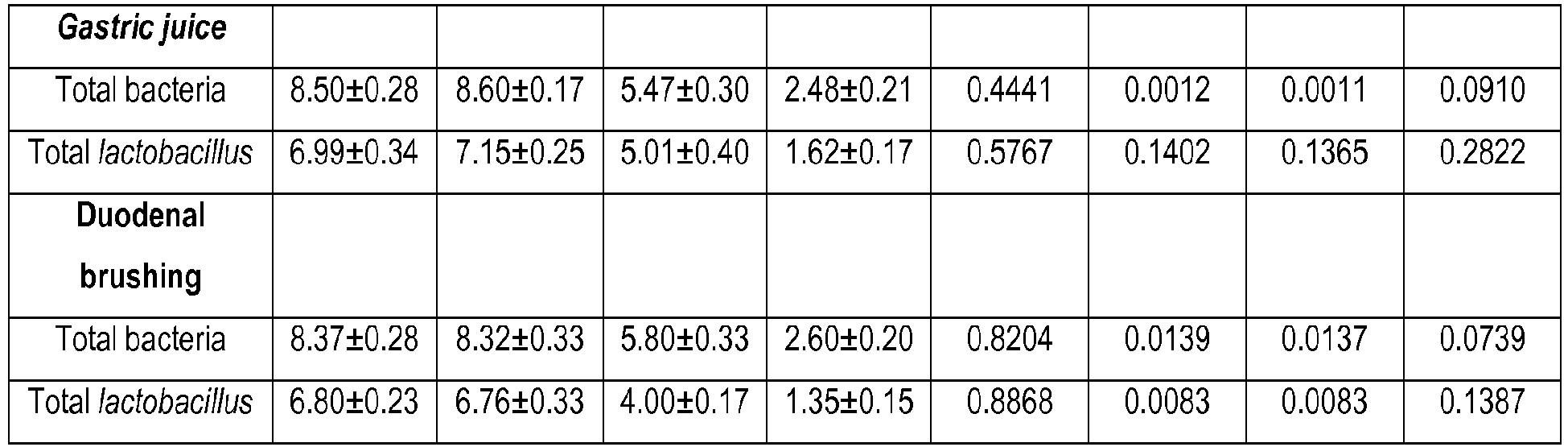
b) percentage of total lactobacillus at d0 in the four groupsBiological sample Group A Group B Group C Group D % % % % Gastric juice 3.06 3.51 34.91 13.93 Duodenal brushing 2.71 2.74 1.58 5.59
c) comparison between time zero (d0) and d10 in Group BTime Group B log CFU/ml % of total Lactobacillus p§ or log CFU/g d0 Gastric juice Total bacteria 8.60 ± 0.17 ** Total Lactobacillus 7.15 ± 0.25 3.51 ** Duodenal brushing Total bacteria 8.32 ± 0.33 ** Total Lactobacillus 6.76 ± 0.33 2.74 ** d10 Gastric juice Total bacteria 7.71 ± 0.27 0.0023 Total Lactobacillus 7.70 ± 0.27 98.03 0.0742 Duodenal brushing Total bacteria 7.47 ± 0.32 0.0256 Total Lactobacillus 7.44 ± 0.32 93.50 0.0355 ** Comparison reference time zero (d0)
§ Comparison between (d0) and (d10) - It is interesting to note that a significant reduction in the total bacterial parameters is present at d10 in Group B in comparison with the baseline (Table 1c).
- The results of the species-specific PCR assay in Group B at d10 compared with d0 further confirmed the presence of the four species of probiotics administered. A general panorama is shown in Table 5.
- Table 5. Results of the species-specific PCR assay in Group B at d0 and at d10. The presence of correlated species is shown by a "+", while their absence is shown by a "-".
a) gastric juiceGroup Individuals L.plantarum L.rhamnosus L.pentosus L.delbrueckii subsp delbrueckii d0 1 + - - - 2 - - - - 3 - - - - 4 - - - - 5 - - - - 6 - - - - 7 - - - - 8 - + - - 9 - - - - 10 - - - - d10 1 + + - + 2 + + - + 3 + + + - 4 + + - + 5 + + + + 6 + - - + 7 + + - + 8 + + + + 9 + + - + 10 + - + +
b) duodenal brushingGroup Individuals L.plantarum L.rhamnosus L.pentosus L.delbrueckii subsp delbrueckii d0 1 + - - - 2 - - - - 3 - - + - 4 - - - - 5 + - - - 6 - - - - 7 - - - - 8 - - - - 9 - - - - 10 - - - - d10 1 + + + + 2 + + - + 3 - + + - 4 + + - + 5 + + - + 6 + + - + 7 + + - + 8 + + + + 9 + + + - 10 + + + + - In the gastric juice, L. plantarum and L. delbrueckii subsp. delbrueckii were the two most representative species since 10 and 9 individuals, respectively, out of a total of 10 individuals were positive compared with 1 and 0 at the baseline (d0). In the duodenal brushing, L. plantarum and L. rhamnosus were present in 9 and 10 subjects, respectively, out of a total of 10 subjects compared with 2 and 0 at the baseline (d0).
- The results on total Enterococcus, total coliforms, Escherichia coli, yeasts and moulds in the faecal samples are shown in Table 6.
- Table 6: Quantification of the specific microbial groups in faecal samples at d0 (all groups) and d10 (Group B). The results are expressed as log10 of CFU/grams of faeces (value ± SEM).
a) comparison between the four groups at d0

b)percentage of total coliforms which consist of Escherichia coli at d0 in the four groups and at d10 in Group BTime Group A Group B Group C Group D % % % % d0 Escherichia coli 83.87 77.43 86.51 92.63 d10 Escherichia coli / 91.12 / /
c)comparison between the baseline (d0) and d10 in Group B.Time Group B Logic CFU/g p§ d0 Enterococcus spp 7.80 ± 0.25 ** Total coliforms 9.55 ± 0.16 ** Escherichia coli 9.44 ± 0.18 ** Yeasts 5.95 ± 0.14 ** Moulds 5.64 ± 0.14 ** d10 Enterococcus spp 6.99 ± 0.23 0.0155 Total coliforms 8.01 ± 0.24 0.0064 Escherichia coli 7.97 ± 0.23 0.0105 Yeasts 3.56 ± 0.18 0.0066 Moulds 4.30 ± 0.15 0.0053 ** Comparison reference at time zero d0
§ Comparison between d0 and d10 in Group B - The study confirmed a significant bacterial growth in the upper gastro-intestinal tract in subjects who had been taking PPIs for more than 12 consecutive months (p=0.0011 and p=0.0137 for total bacteria in the gastric juice and in the duodenal brushing material, respectively, in Group A versus Group D which represents the general population; similar statistical results were found from the comparison off Group B and Group D in the same way). Comparison between groups A and C (subjects treated with PPIs for a period of from 3 to 12 months) demonstrated statistical significance in 3 out of 4 parameters. In this way, the duration of the PPI treatment is a factor which can determine the degree of bacterial proliferation in the upper gastrointestinal tract. The individuals treated in the short term seem to be more similar to the general population rather than to subjects who had undertaken long-term treatment with PPIs.
- An interesting aspect refers to the higher percentage of total Lactobacillus in the gastric juice of subjects treated in the short term (34.91%, 5.01 log10 CFU/ml in Group C) compared with subjects treated long-term (3.06%, 6.99 log10 CFU/ml in Group A; 3.51%, 7.15 log10 CFU/ml in Group B). This higher concentration, however, does not reflect the results of the duodenal brushing (1.58%, 4.00 log10 CFU/ml in Group C).
- The administration of the 4 strains of bacteria listed above, i.e. L. rhamnosus LR06, L. pentosus LPS01, L. plantarum LP01 and L. delbrueckii subsp. delbrueckii LDD01, including 60 mg of NAC for 10 days was sufficient to significantly change the typical bacterial growth in the subjects treated with PPIs for more than 12 months, so as to restore a protective barrier against possible pathogens of dietary origin (p=0.0023 and p=0.0256 for the total of bacteria in the gastric juice and the duodenal brushing material, respectively, in Group B at d10 compared with d0, Table 4c.
- Another interesting result was the percentage of total bacteria represented by lactobacilli in the various groups. In control subjects who were not taking PPIs, the bacteria belonging to the genus Lactobacillus represent about 14% of the total of the gastric microflora, while in patients treated with PPIs for more than 12 months, lactobacilli represented only about 3% of the total bacteria, suggesting therefore that the great majority of the gastric micro-organisms were composed of other, potentially harmful, microbial groups. At the end of the period of supplementation by probiotics (d10) in Group B, lactobacilli constituted 98% of the total bacteria in the gastric juice, and an increase in their concentration compared with time zero was recorded, although it is not statistically significant (p = 0.074). The lack of statistical significance could be explained in the light of the significant parallel reduction in total gastric bacteria (7.71 log10 CFU/ml compared with 8.60 log10 CFU/ml, p = 0.0023). On the other hand, the percentage of Lactobacillus in the duodenal brushing material was significantly higher at d10 compared with the baseline (p = 0.0355).
- The results of the species-specific PCR assay, furthermore, confirmed the capacity of the probiotics administered together with NAC to effectively colonise the gastric lumen and the duodenal mucosa in the subjects treated with PPIs for more than 12 consecutive months (Tables 5a and 5b). This aspect may help to inhibit and replace the possibly harmful pathogens bacteria or indeed those which are commonly present in subjects treated long-term with PPIs. This datum is more significant if it is considered that the gastroscopies were all executed at least 12 hours after the last time that probiotics had been taken, thus demonstrating the capacity of these beneficial bacteria to persist significantly in the stomach and on the surface of the duodenal mucosa. NAC was used for its mechanical effects against bacterial biofilms, in order to prevent a possible new formation of biofilms in subjects undergoing long-term treatment with PPIs.
- The results of the faecal samples demonstrated, on the one hand, a significant increase in all the microbial parameters taken into consideration in the individuals treated with PPIs for a period of at least 12 months (comparison between Groups A and D): p=0.0021, p=0.0147, p=0.0227, p=0.0223 and p=0.0027 for Enterococcus spp., total coliforms, E. coli, yeasts and moulds, respectively). In any case, a short-term administration of PPIs, from 3 to 12 months, was sufficient to induce a significant faecal increase in all the five parameters, although the statistical significance was lower (see data for Group C compared with D: p=0.0479, p=0.0338, p=0.0444, p=0.0051, and p=0.0187, respectively) (Table 6). On the other hand, the statistical comparison between the subjects PPI treated long-term and short-term was significant only for the yeasts and moulds (p=0.0486 and p=0.0078, respectively), thus suggesting that for Enterococcus spp. and for Gram-negative bacteria, taking minimal quantities of PPIs for three months is sufficient to mediate the majority of the increase observed after 12 months of treatment. Yeasts and moulds very probably need more time to colonise the intestinal flora after the alteration of the gastric barrier, since a significant additional increase was recorded in long-term subjects compared with short-term subjects (Group A compared with Group C).
- The total coliforms usually represent about 1% of the total population of human faecal bacteria in concentrations of around 109 bacteria per gram (37). Another interesting result is the percentage of total coliforms constituted by Escherichia coli. It is known, in fact, that this bacterium represents the majority of the total population of coliforms in the human intestine, generally amounting to 93-94% (38). The total coliform bacteria present in the human intestine are made up of four genera of the family of the Enterobacteriaceae, in particular Escherichia, Klebsiella, Enterobacter and Citrobacter, with Klebsiella normally amounting to about 1% and Enterobacter/Citrobacter spp. representing together about 6%. The results for Group D substantially confirmed this evidence, since 92.6% of total coliforms was made up of E. coli. In the subjects who had undergone long-term treatment with PPIs, however, this percentage was reduced to 83.9% (Group A) and to 77.4% (Group B), thus suggesting an abnormal excessive growth of the genera Klebsiella and/or Enterobacter/Citrobacter in the intestine as a consequence of the destruction of the gastric barrier. This increase could be considered harmful since some species such as Klebsiella pneumoniae, Klebsiella oxytoca and Enterobacter cloacae could exert significant pathogenic action on the host, ranging from hospital infections of the blood (BSI) through to acute appendicitis and antibiotic-associated haemorrhagic colitis (AAHC).
- The Enterococcus spp. are normally present in human faeces in concentrations from 105 to 107 bacteria per gram. The data obtained on the control population confirmed this evidence, as 6.39 log10 CFU/ml were counted in the faecal samples. Long-term treatment with PPIs caused a significant increase in this microbial genus in the human intestine (7.68 log10 CFU/ml in Group A and 7.80 log10 CFU/ml in Group B).
- The most important question represented by Enterococcus spp., in particular by Enterococcus faecium, is their intrinsic antibiotic resistance, specially towards penicillin and vancomicin. The enterococci are the third most common cause of infective endocarditis, and the effect of tolerance to penicillin on therapeutic results has been evident since the end of the 1940s. In any case, epidemiological studies have demonstrated that the strains of E. faecium associated with nosocomial infections, including endocarditis, are types of sequences different from the commensal strains which colonise the gastrointestinal tract of healthy human beings, even though the possibility cannot be excluded that some harmful biotypes may have colonised the human bacterial flora of the subjects treated with PPIs.
- The complex analyses of the faeces at baseline time confirmed the weakening or indeed the complete interruption of the gastric barrier effect, since the composition of the intestinal flora showed that it is profoundly modified in persons who take PPIs for at least three months. Gram-negative bacteria, such as total coliforms and Escherichia coli, were significantly higher than in the controls, while yeasts and moulds increased by about 4 log10. Faecal Enterococci were up by more than 1 log10. It is also interesting to note the correlation between the duration of taking PPIs and the size of the faecal increases in the five microbial groups analysed, chosen as evidence of a potential dysmicrobism.
- The four probiotics studied in association with NAC were able to reduce all the faecal parameters (p=0.0155, p=0.0064, p=0.0105, p=0.0066, and p=0.0053 for Enterococcus spp., total coliforms, E. coli, yeasts and moulds, respectively, at d10 compared with the baseline value). In particular, the reduction in total coliforms, E. coli, yeasts and moulds was more than one log10 after 10 days of supplementation with the probiotics. At the end of the supplementation with the probiotics in Group B, total coliforms and concentrations of E. coli were significantly lower than values found in the general population (Group D) (p=0.0182 and p=0.0229, respectively), thus confirming the considerable antagonistic action of the probiotic bacteria against Escherichia coli.
- In conclusion, the administration of an association of specific strains of L. rhamnosus LR06, L. pentosus LPS01, L. plantarum LP01, and L. delbrueckii subsp. delbrueckii LDD01, including also an efficacious quantity of N-acetylcysteine, is capable of significantly reducing bacterial proliferation at the level of the stomach and duodenum, reducing Gram-negative bacteria, Enterococcus spp., yeasts and moulds in the intestinal flora after 10 days of oral supplementation, thus rapidly rebalancing its composition and restoring a protective barrier against harmful bacteria, especially at stomach level.
- N-acetylcysteine (NAC) was used because of its capacity to mechanically prevent the possible formation of a bacterial biofilm, and showed itself to be effective since the concentration of the various bacteria other than lactobacilli both in the gastric juice and in the samples from brushing the duodenum was significantly reduced.
- All the probiotic strains used in this study have previously demonstrated a significant antagonistic action in vitro on specific strains of Escherichia coli, among them the enterohaemorrhagic serotype O157:H7, and could therefore be used to effectively prevent infections mediated by these harmful or pathogenic microbes.
- In the light of an actually more widespread use of PPIs, concomitant oral supplementation with probiotics and NAC as used in this pilot study represents an innovative strategy capable of restoring, at least partially, a normal gastric barrier effect, thus reducing the threat of gastrointestinal infections of dietary origin in a large part of the population with reduced intragastric acidity.
TABLE 3 Volunteers L. plantarum L. rhamnosus L. pentosus L. delbr.subsp. delbrueckii PPI 2 + - - - 3 - - - - 10 - - - - PPI plus probiotics 1 + + - + 5 + + - + 6 + + - + 7 + + - + 8 + - - - 9 + + - +
Claims (6)
- A pharmaceutical or dietary composition or a supplement or a medical device, for use in the treatment of subjects who are taking a proton pump inhibitor to reduce or treat gastric hyperacidity, which comprises the following strains:1. Lactobacillus pentosus LPS01 DSM 219802. Lactobacillus plantarum LP01 LMG P-210213. Lactobacillus rhamnosus LR06 DSM 219814. Lactobacillus delbrueckii LDD 01 (DSMZ 20074) DSM 22106
in association with N-acetylcysteine; said strains being capable of colonising the stomach at a pH value comprised between 4.0 and 5.5 and of producing bacteriocins and/or metabolites and/or oxygenated water. - The pharmaceutical or dietary composition or supplement or medical device for use according to claim 1, wherein said pharmaceutical or dietary composition or supplement or medical device comprises each strain of bacteria in a quantity comprised between 1x10⁹ and 10x109 CFU/strain/dose and N-acetylcysteine in a quantity comprised between 10 and 200 mg.
- The pharmaceutical or dietary composition or supplement or medical device for use according to any of the preceding claims, wherein said pharmaceutical or dietary composition or supplement or medical device further comprises the strain Lactobacillus fermentum LF 09 DSM 18298 and/or the strain Lactococcus lactis NS 01 DSM 19072; or alternatively further comprises at least one strain chosen from the group consisting of:a. Lactobacillus reuteri LRE 01 DSM 23877b. Lactobacillus reuteri LRE 02 DSM 23878c. Lactobacillus reuteri LRE 03 DSM 23879d. Lactobacillus reuteri LRE 04 DSM 23880.
- The pharmaceutical or dietary composition or supplement or medical device for use according to any of the preceding claims, wherein the subjects are taking a proton pump inhibitor to reduce or treat gastric hyperacidity in the treatment of dyspepsia, gastroduodenal ulcer, gastric ulcer, peptic ulcer, duodenal ulcer, gastritis caused by Helicobacter pylori and gastroesophageal reflux disease.
- The pharmaceutical composition for use according to claim 4, wherein the composition comprises a proton pump inhibitor.
- The pharmaceutical composition for use according to claim 5, wherein the strains of bacteria and the proton pump inhibitor are present together in a pharmaceutical form for oral use.
Priority Applications (2)
| Application Number | Priority Date | Filing Date | Title |
|---|---|---|---|
| PL12780277T PL2753343T3 (en) | 2011-09-09 | 2012-09-10 | COMPOSITION CONTAINING N-ACETYLCYSTEIN AND PROBIOTIC BACTERIA CAPABLE OF RESTORING ITS OWN BARRIER EFFECT OF THE STOMACH, WHICH ARE DESTROYED DURING THE TREATMENT OF THE HYPERACITY OF PROBIOTIC JUICE INHIBITES |
| EP19170847.8A EP3542807B1 (en) | 2011-09-09 | 2012-09-10 | Lactobacillus pentosus lps01 dsm 21980, l. rhamnosus lr06 dsm 21981 and/or l.delbrueckii subsp. delbrueckii ldd01 (mb386) dsmz 20074 dsm 22106 for use in the treatment of a subject who is taking a proton pump inhibitor to reduce gastric hyperacidity |
Applications Claiming Priority (2)
| Application Number | Priority Date | Filing Date | Title |
|---|---|---|---|
| IT000477A ITRM20110477A1 (en) | 2011-09-09 | 2011-09-09 | COMPOSITION INCLUDING N-ACETYLCISTEIN AND / OR LYSOZYME MICROINCAPSULATE GASTROPROTECT IN ASSOCIATION WITH PROBIOTIC BACTERES ABLE TO RESTORE THE BARRIER EFFECT OF THE STOMACH THAT IS LOST DURING THE PHARMACOLOGICAL TREATMENT OF |
| PCT/IB2012/001741 WO2013034974A1 (en) | 2011-09-09 | 2012-09-10 | Composition comprising n-acetylcysteine and/or microencapsulated gastroprotected lysozyme in association with probiotic bacteria capable of restoring the stomach's own barrier effect which is lost during the pharmacological treatment of gastric hyperacidity |
Related Child Applications (1)
| Application Number | Title | Priority Date | Filing Date |
|---|---|---|---|
| EP19170847.8A Division EP3542807B1 (en) | 2011-09-09 | 2012-09-10 | Lactobacillus pentosus lps01 dsm 21980, l. rhamnosus lr06 dsm 21981 and/or l.delbrueckii subsp. delbrueckii ldd01 (mb386) dsmz 20074 dsm 22106 for use in the treatment of a subject who is taking a proton pump inhibitor to reduce gastric hyperacidity |
Publications (2)
| Publication Number | Publication Date |
|---|---|
| EP2753343A1 EP2753343A1 (en) | 2014-07-16 |
| EP2753343B1 true EP2753343B1 (en) | 2019-05-01 |
Family
ID=44899093
Family Applications (2)
| Application Number | Title | Priority Date | Filing Date |
|---|---|---|---|
| EP12780277.5A Active EP2753343B1 (en) | 2011-09-09 | 2012-09-10 | Composition comprising n-acetylcysteine and probiotic bacteria capable of restoring the stomach's own barrier effect which is lost during treatment of gastric hyperacidity with proton pump inhibitors |
| EP19170847.8A Active EP3542807B1 (en) | 2011-09-09 | 2012-09-10 | Lactobacillus pentosus lps01 dsm 21980, l. rhamnosus lr06 dsm 21981 and/or l.delbrueckii subsp. delbrueckii ldd01 (mb386) dsmz 20074 dsm 22106 for use in the treatment of a subject who is taking a proton pump inhibitor to reduce gastric hyperacidity |
Family Applications After (1)
| Application Number | Title | Priority Date | Filing Date |
|---|---|---|---|
| EP19170847.8A Active EP3542807B1 (en) | 2011-09-09 | 2012-09-10 | Lactobacillus pentosus lps01 dsm 21980, l. rhamnosus lr06 dsm 21981 and/or l.delbrueckii subsp. delbrueckii ldd01 (mb386) dsmz 20074 dsm 22106 for use in the treatment of a subject who is taking a proton pump inhibitor to reduce gastric hyperacidity |
Country Status (12)
| Country | Link |
|---|---|
| US (1) | US10028982B2 (en) |
| EP (2) | EP2753343B1 (en) |
| JP (1) | JP6130379B2 (en) |
| KR (1) | KR102141608B1 (en) |
| CN (1) | CN103987393B (en) |
| BR (1) | BR112014005440A2 (en) |
| DK (1) | DK2753343T3 (en) |
| ES (1) | ES2734979T3 (en) |
| IT (1) | ITRM20110477A1 (en) |
| PL (1) | PL2753343T3 (en) |
| RU (1) | RU2617952C2 (en) |
| WO (1) | WO2013034974A1 (en) |
Families Citing this family (29)
| Publication number | Priority date | Publication date | Assignee | Title |
|---|---|---|---|---|
| IT1403661B1 (en) | 2011-01-28 | 2013-10-31 | Probiotical Spa | EFFERVESCENT COMPOSITION IN THE SOLID FORM FOR USE IN VAGINAL APPLICATIONS FOR THE TREATMENT OF VAGINAL INFECTIONS. |
| ITMI20110791A1 (en) | 2011-05-09 | 2012-11-10 | Probiotical Spa | BACTERIA OF BACTERIA ABLE TO METABOLIZE THE OXALATES. |
| ITMI20110793A1 (en) | 2011-05-09 | 2012-11-10 | Probiotical Spa | STRAINS OF PROBIOTIC BACTERIA AND SYNBIOTIC COMPOSITION CONTAINING THEMSELVES INTENDED FOR THE BABY FOOD. |
| ITMI20110792A1 (en) | 2011-05-09 | 2012-11-10 | Probiotical Spa | STRAINS OF BACTERIA BELONGING TO THE BIFIDOBACTERIUM TYPE FOR USE IN THE TREATMENT OF HYPERCOLESTEROLEMIA. |
| ITRM20110477A1 (en) | 2011-09-09 | 2013-03-10 | Giovanni Mogna | COMPOSITION INCLUDING N-ACETYLCISTEIN AND / OR LYSOZYME MICROINCAPSULATE GASTROPROTECT IN ASSOCIATION WITH PROBIOTIC BACTERES ABLE TO RESTORE THE BARRIER EFFECT OF THE STOMACH THAT IS LOST DURING THE PHARMACOLOGICAL TREATMENT OF |
| ITMI20111718A1 (en) | 2011-09-23 | 2013-03-24 | Probiotical Spa | A WATERPROOF MOISTURE AND OXYGEN MATERIAL FOR PACKAGING DIETARY, COSMETIC AND MEDICINAL PRODUCTS. |
| ITMI20121328A1 (en) * | 2012-07-30 | 2014-01-31 | Probiotical Spa | COMPOSITION FOR MEDICAL DEVICE INCLUDING BACTERIA STRAINS PRODUCERS OF ESOPOLISACCHARIDES IN ASSOCIATION WITH GUMS AND / OR GELATINS. |
| ITMI20130794A1 (en) * | 2013-05-14 | 2014-11-15 | Probiotical Spa | COMPOSITION INCLUDING LACTIC BACTERIA FOR USE IN THE PREVENTIVE AND CURATIVE TREATMENT OF BACTERIAL VAGINOSIS. |
| ITMI20130792A1 (en) * | 2013-05-14 | 2014-11-15 | Mofin S R L | METHOD FOR THE PREVENTION AND / OR REDUCTION OF THE DEVELOPMENT OF LISTERY IN THE CHEESE INDUSTRY AND PREVENTION OF LYSTERIOSIS IN MAN. |
| ITMI20130795A1 (en) * | 2013-05-14 | 2014-11-15 | Probiotical Spa | COMPOSITION INCLUDING LACTIC BACTERIA AND / OR BIFIDOBACTERIES FOR USE IN THE PREVENTIVE AND / OR CURATIVE TREATMENT OF BACTERIAL INFECTIONS AND / OR INFLAMMATIONS OF THE URINARY AND / OR PROSTATE TRACT THAT ARE THE CAUSE OF PROSTATITIS AND PROSTAT HYPERTROPHY |
| ITMI20130793A1 (en) * | 2013-05-14 | 2014-11-15 | Probiotical Spa | COMPOSITION INCLUDING LACTIC BACTERIA FOR USE IN THE PREVENTIVE AND / OR CURATIVE TREATMENT OF THE RECURRENT CYCLES. |
| CN106573022A (en) * | 2014-05-05 | 2017-04-19 | G·莫格纳 | Compositions containing Lactobacillus reuteri LER03 and/or Lactobacillus salivarius LS06 for the prevention or treatment of viral or bacterial infections in subjects undergoing antineoplastic chemotherapy, leukemia treatment or AIDS treatment |
| CA2946463A1 (en) * | 2014-05-05 | 2015-11-12 | Giovanni Mogna | Therapy for use in the treatment of tumors, acquired immunodeficiency syndrome and leukemias by dual immune biostimulation |
| WO2016205394A1 (en) * | 2015-06-15 | 2016-12-22 | Amnat Global Llc | Multistrain probiotic blends for treatment of gastrointestinal conditions and improving or maintaining gastrointestinal health |
| RU2706069C2 (en) * | 2016-02-08 | 2019-11-13 | Валентина Васильевна Марченкова | Immunobiotic complex |
| FR3048361B1 (en) * | 2016-03-01 | 2020-12-18 | Biose | COMPOSITIONS FOR THE TREATMENT OF CANDIDOSES |
| ITUA20162013A1 (en) | 2016-03-24 | 2017-09-24 | Probiotical Spa | Composition based on lactic bacteria for the simultaneous treatment of vaginal infections of fungal and bacterial origin. |
| US9855305B2 (en) * | 2016-03-29 | 2018-01-02 | Companion Therapeutics Llc | Pharmaceutical composition containing combinations of vitamins, minerals, probiotics, and prebiotics effective in preventing adverse effects associated with the use of proton-pump inhibitors |
| IT201600084470A1 (en) * | 2016-08-10 | 2018-02-10 | Probiotical Spa | Composition for use in the treatment of major depressive disorder |
| IT201700068000A1 (en) * | 2017-06-19 | 2018-12-19 | Probiotical Spa | Composition of bacteria and / or their derivatives whose biological activity has been specifically studied for the improvement of the differentiated health status for males and females |
| CN107828703B (en) * | 2017-12-15 | 2020-03-10 | 富乐顿生物工程科技(北京)有限公司 | Lactobacillus reuteri Fullarton-9-35 and application thereof |
| KR102825170B1 (en) | 2018-05-01 | 2025-06-25 | 시에이치알. 한센 에이/에스 | Probiotic Bifidobacterium breve strain and composition comprising said strain |
| WO2019227414A1 (en) * | 2018-05-31 | 2019-12-05 | 深圳华大生命科学研究院 | Composition and uses thereof |
| CN109517765A (en) * | 2019-01-11 | 2019-03-26 | 谭瑛 | A kind of streptococcus fecalis and its application |
| EP4003300A4 (en) * | 2019-07-26 | 2023-06-28 | Infinant Health, Inc | Nutritive compositions with bioactive proteins |
| JP7240985B2 (en) * | 2019-08-07 | 2023-03-16 | 日清食品ホールディングス株式会社 | Agent for reducing stress-induced diarrhea and food composition |
| CN111548970B (en) * | 2020-05-29 | 2021-03-26 | 江南大学 | A strain of Lactobacillus crispatus capable of preventing and/or treating Helicobacter pylori infection |
| CN114561313B (en) * | 2021-08-26 | 2022-09-13 | 佛山市孛特碧欧微生物科技有限公司 | Lactobacillus gasseri and application thereof |
| CN116769676B (en) * | 2023-08-09 | 2023-12-05 | 杭州微致生物科技有限公司 | Lactobacillus crispatus and application thereof |
Family Cites Families (79)
| Publication number | Priority date | Publication date | Assignee | Title |
|---|---|---|---|---|
| US3819838A (en) | 1970-08-04 | 1974-06-25 | Bush Boake Allen Ltd | Encapsulated flavoring composition |
| JPS53121949A (en) | 1977-03-31 | 1978-10-24 | Yakult Honsha Kk | Production of drink and food containing bifidobacterium cells |
| DE2757370A1 (en) | 1977-12-22 | 1979-07-05 | Bayer Ag | GAS-TIGHT PLASTIC-ALUMINUM COMPOSITE FILMS |
| CH637297A5 (en) | 1978-12-05 | 1983-07-29 | Nestle Sa | MICROBALL COMPRISING A MICROORGANISM AND ITS MANUFACTURING METHOD. |
| JPS58152809A (en) | 1982-03-05 | 1983-09-10 | Eisai Co Ltd | Stable foaming vaginal suppository |
| US4670272A (en) | 1985-11-08 | 1987-06-02 | Frito-Lay, Inc. | Thermostable creme |
| EP0231585B1 (en) | 1986-02-06 | 1992-07-08 | Celgene Corporation | Biosynthesis of heteropolysaccharides |
| US5343672A (en) | 1992-12-01 | 1994-09-06 | Scherer Ltd R P | Method for manufacturing freeze dried dosages in a multilaminate blister pack |
| UA39965C2 (en) | 1993-12-03 | 2001-07-16 | Лайфор Леборетріз Лтд | VIRUSIC, BACTERICIDAL AND DESTRUCTIVE SPERMATOSES VAGINAL PRODUCT AND VAGINAL SUPPOSITORY (OPTIONS) |
| CN1211188A (en) | 1996-02-14 | 1999-03-17 | 普罗克特和甘保尔公司 | Urogenital and intestinal compositions |
| US8828432B2 (en) | 1996-10-28 | 2014-09-09 | General Mills, Inc. | Embedding and encapsulation of sensitive components into a matrix to obtain discrete controlled release particles |
| EP0845350A1 (en) | 1996-11-29 | 1998-06-03 | Alusuisse Technology & Management AG | Cold formable laminated film |
| JP5108174B2 (en) | 1998-04-01 | 2012-12-26 | ガネデン バイオテック, インコーポレイテッド | Methods, systems, and compositions for reducing cholesterol using Bacillus coagulans spores |
| ATE207755T1 (en) | 1998-04-30 | 2001-11-15 | Vesely Renata Maria Cavaliere | PHARMACEUTICAL COMPOSITIONS CONTAINING LACTOBACILLUS BREVIS AND LACTOBACILLUS SALIVARIUS FOR THE TREATMENT OF VAGINAL INFECTIONS |
| WO1999055326A1 (en) | 1998-04-30 | 1999-11-04 | Vit-Immune, L.C. | Method of treatment of glutathione deficient mammals |
| RU2150268C1 (en) | 1998-12-25 | 2000-06-10 | Быков Валерий Алексеевич | Lactobacterium-containing suppository for treatment of patient with vagina dysbacteriosis |
| IT1309427B1 (en) | 1999-05-28 | 2002-01-23 | Mendes S U R L | DIETARY OR PHARMACEUTICAL COMPOSITION USEFUL FOR THE PREVENTION OR TREATMENT OF HYPEROXIDE AND ITS USE |
| KR100357668B1 (en) | 2000-02-19 | 2002-10-18 | 주식회사 한국야쿠르트 | Lactobacillus acidophilus HY 2177, Lactobacillus casei HY 2743 having antibiotic activation for Helicobacter pylori and Lactobacillus product thereof |
| CA2416120A1 (en) | 2000-07-17 | 2002-01-24 | Svend Laulund | Methods and formulations with probiotic microorganisms and medicaments |
| CN1234373C (en) | 2000-09-28 | 2006-01-04 | 信谊药厂 | Medicinal preparation containing lactobacillus acidophilus and preparation process thereof |
| RU2203946C1 (en) | 2001-09-12 | 2003-05-10 | Хачатрян Ашот Папикович | Strain of bacterium lactobacillus acidophilus nv ep 317/402-x "balans-narine" used for preparing antigastritis and antiulcerous fermented-milk product |
| JP4146340B2 (en) | 2001-09-24 | 2008-09-10 | デュポン テイジン フィルムズ ユー.エス.リミテッド パートナーシップ | Multilayer polymer film for packaging food for oven heating |
| US20050074442A1 (en) | 2002-03-13 | 2005-04-07 | Natarajan Ranganathan | Compositions and methods for augmenting kidney function |
| SE0201214D0 (en) | 2002-04-23 | 2002-04-23 | Jafar Mahdavi | Multicultural fermented yogurt |
| RU2253672C2 (en) * | 2002-07-12 | 2005-06-10 | Хачатрян Ашот Папикович | Bacterial probiotic preparation |
| US20040208863A1 (en) * | 2003-01-30 | 2004-10-21 | James Versalovic | Anti-inflammatory activity from lactic acid bacteria |
| CA2559596A1 (en) | 2003-03-13 | 2004-11-25 | Universite De Moncton (Bureau De Soutien A L'innovation) | Antioxidant producing bacterium and uses thereof |
| US20040185032A1 (en) | 2003-03-18 | 2004-09-23 | David Burrell | Compositions and methods for treating colic |
| US20060233884A1 (en) | 2003-04-09 | 2006-10-19 | Balazs Dolhay | Sexual hygienic composition |
| US20050017013A1 (en) | 2003-07-24 | 2005-01-27 | Alberto Peisach | Container for hot fill food packaging applications |
| US8192733B2 (en) * | 2003-08-29 | 2012-06-05 | Cobb & Associates | Probiotic composition useful for dietary augmentation and/or combating disease states and adverse physiological conditions |
| US8871266B2 (en) * | 2003-10-01 | 2014-10-28 | Commonwealth Scientific & Industrial Research Organisation | Probiotic storage and delivery |
| JP4740866B2 (en) | 2003-10-24 | 2011-08-03 | ナムローゼ フェンノートシャップ ニュートリシア | Symbiotic composition for infants |
| DK1506781T3 (en) | 2003-11-03 | 2005-06-13 | Peter-Hansen Volkmann | Vaginal care composition |
| GB0330009D0 (en) | 2003-12-24 | 2004-01-28 | Ferrosan As | Probiotic tablet formulations |
| DE602004027120D1 (en) | 2004-05-25 | 2010-06-24 | Cognis Ip Man Gmbh | Oral and / or topical preparations |
| EP1600060A1 (en) | 2004-05-25 | 2005-11-30 | Cognis IP Management GmbH | Oral and/or topical compositions comprising prebiotics and fatty acid |
| BRPI0418986A (en) | 2004-08-05 | 2007-12-11 | Anidral Srl | folic acid producing bifidobacterium bacterial strains, formulations and their uses |
| US20060039973A1 (en) | 2004-08-19 | 2006-02-23 | Mary Aldritt | Effervescent composition including water soluble dietary fiber |
| WO2006047680A2 (en) | 2004-10-27 | 2006-05-04 | North Carolina State University | Lactobacillus acidophilus nucleic acids and uses thereof |
| ITMI20042189A1 (en) * | 2004-11-16 | 2005-02-16 | Anidral Srl | COMPOSITION BASED ON PROBIOTIC BACTERIA AND ITS USE IN THE PREVENTION OF E-OR IN THE TREATMENT OF PATHOLOGIES AND-OR RESPIRATORY INFECTIONS AND IN THE IMPROVEMENT OF INTESTINAL FUNCTIONALITY |
| RU2270248C1 (en) | 2004-12-31 | 2006-02-20 | Открытое акционерное общество "Лианозовский молочный комбинат" | Bifidobacterium lactis 668 strain for production of fermented milk products, fermented and non-fermented foodstuffs, bioactive supplements, bacterial preparations, and cosmetics |
| EP1858340B1 (en) | 2005-02-15 | 2010-07-14 | Barry R. Goldin | A food containing a probiotic and an isolated beta-glucan and methods of use thereof |
| KR100661032B1 (en) | 2005-04-19 | 2006-12-22 | 주식회사한국야쿠르트 | Compositions for improving liver function, reducing blood alcohol and antioxidants |
| JP4881304B2 (en) * | 2005-07-21 | 2012-02-22 | 株式会社ヤクルト本社 | Novel Bifidobacterium and its utilization |
| CN101257910B (en) | 2005-09-08 | 2012-05-23 | 株式会社益力多本社 | Cholesterol absorption inhibitor |
| DE102005062731A1 (en) | 2005-12-22 | 2007-06-28 | Organobalance Gmbh | New Lactobacillus strains and their use |
| WO2007100765A2 (en) * | 2006-02-28 | 2007-09-07 | Childrens Memorial Hospital | Lysozyme-modified probiotic components and uses thereof |
| PL1993576T3 (en) | 2006-03-07 | 2016-04-29 | Nestec Sa | Synbiotic mixture |
| EP2012596A1 (en) | 2006-05-03 | 2009-01-14 | Anidral S.R.L. | Symbiotic composition comprising non-digestible polysaccharides and bifidobacteria which metabolize them and its uses |
| ITMI20061841A1 (en) | 2006-09-27 | 2008-03-28 | Mofin S R L | MICROBIAL LIQUID CULTIVATIONS WITH HIGH STABILITY AND FERMENTATIVE ACTIVITY |
| JP4829349B2 (en) | 2006-11-17 | 2011-12-07 | エスセーアー・ハイジーン・プロダクツ・アーベー | Sanitary tissue containing microbial inhibitory composition |
| ITMI20062286A1 (en) | 2006-11-28 | 2008-05-29 | Anidral Srl | A COMPOSITION FOR THE ADMINISTRATION OF BIOLOGICALLY ACTIVE PRINCIPLES IN GYNECOLOGICAL AND RECTAL AREA AS WELL AS ITS USES |
| US20080175899A1 (en) | 2007-01-19 | 2008-07-24 | Ross Mairi R | Formulation for promoting sinus health in nasal cavities |
| US20080187628A1 (en) | 2007-02-02 | 2008-08-07 | Champion Melinda L | Water-Soluble, Quick-Dissolve Flavor Tablets |
| PL210465B1 (en) | 2007-06-04 | 2012-01-31 | Inst Biotechnologii Surowic I Szczepionek Biomed Społka Akcyjna | Composition of strains type Lactobacillus and application of the composition of strains type Lactobacillus |
| WO2008153377A1 (en) | 2007-06-15 | 2008-12-18 | N.V. Nutricia | Nutrition with non-viable bifidobacterium and non-digestible oligosaccharide |
| US20090175843A1 (en) | 2008-01-08 | 2009-07-09 | Medical Nutrition Usa, Inc. | Composition for prevention or treatment of urinary tract infection |
| EE05340B1 (en) | 2008-05-13 | 2010-08-16 | O� Tervisliku Piima Biotehnoloogiate Arenduskeskus | Lactobacillus plantarum Tensia DSM 21380 and its use as an antimicrobial and antihypertensive probiotic in the manufacture of a medicament and for the prolongation of food shelf-life and contamination of food |
| DE102008023952A1 (en) | 2008-05-16 | 2009-12-03 | Alcan Technology & Management Ag | Packaging cover film, container, packaging and packaging product unit |
| US9232813B2 (en) | 2008-07-07 | 2016-01-12 | The Iams Company | Probiotic supplement, process for making, and packaging |
| PL2318511T3 (en) | 2008-08-28 | 2018-01-31 | Chr Hansen As | Bacterial composition |
| CN102171329B (en) | 2008-09-30 | 2013-08-21 | 株式会社明治 | Lactic acid bacterium having high oxalic acid decomposition ability |
| KR101075557B1 (en) | 2008-12-03 | 2011-10-20 | 씨제이제일제당 (주) | Novel Lactobacillus plantarum and compositions comprising the same |
| EP2210505A1 (en) | 2009-01-27 | 2010-07-28 | Nestec S.A. | Composition comprising caftaric acid and/or derivatives thereof |
| AU2009341473B2 (en) | 2009-03-05 | 2016-04-21 | Probiotical S.P.A. | Bacteria strains having a high anti-inflammatory activity |
| IT1400821B1 (en) | 2009-03-09 | 2013-07-02 | Probiotical Spa | OIL SUSPENSION CONTAINING PROBIOTIC BACTERIA FOR PEDIATRIC USE |
| FI20095550A0 (en) | 2009-05-19 | 2009-05-19 | Bayer Schering Pharma Oy | Vaginal delivery system |
| IT1397566B1 (en) | 2009-05-27 | 2013-01-16 | Probiotical Spa | LACTOBACILLUS PENTOSUS MANUFACTURER OF BACTERIOCINES, FOOD AND PHARMACEUTICAL COMPOSITIONS CONTAINING THE SAME AND ITS USE |
| JP5873018B2 (en) | 2009-07-27 | 2016-03-01 | ネステク ソシエテ アノニム | Nutritional composition comprising fiber and probiotics |
| WO2011012932A1 (en) | 2009-07-30 | 2011-02-03 | Compagnie Gervais Danone | Use of coated sterol or stanol particles for the preparation of food compositions having a low fat content and being essentially emulsifier-free |
| IT1398553B1 (en) | 2010-03-08 | 2013-03-01 | Probiotical Spa | COMPOSITION INCLUDING PROBIOTIC BACTERIA FOR THE TREATMENT OF PATHOLOGIES ASSOCIATED WITH THE ALTERATION OF THE IMMUNE SYSTEM. |
| JP2013531506A (en) | 2010-06-28 | 2013-08-08 | プロバイオティカル・ソシエタ・ペル・アチオニ | Use of LACTOBACILLI to inhibit gas-producing coliforms isolated from infants suffering from colic |
| IT1403661B1 (en) | 2011-01-28 | 2013-10-31 | Probiotical Spa | EFFERVESCENT COMPOSITION IN THE SOLID FORM FOR USE IN VAGINAL APPLICATIONS FOR THE TREATMENT OF VAGINAL INFECTIONS. |
| ITMI20110679A1 (en) | 2011-04-20 | 2012-10-21 | Giovanni Mogna | COMPOSITION INCLUDING PROBIOTIC BACTERES ABLE TO RESTORE THE BARRIER EFFECT OF THE STOMACH THAT IS LOST DURING THE PHARMACOLOGICAL TREATMENT OF GASTRICITY. |
| ITMI20110791A1 (en) | 2011-05-09 | 2012-11-10 | Probiotical Spa | BACTERIA OF BACTERIA ABLE TO METABOLIZE THE OXALATES. |
| ITRM20110477A1 (en) | 2011-09-09 | 2013-03-10 | Giovanni Mogna | COMPOSITION INCLUDING N-ACETYLCISTEIN AND / OR LYSOZYME MICROINCAPSULATE GASTROPROTECT IN ASSOCIATION WITH PROBIOTIC BACTERES ABLE TO RESTORE THE BARRIER EFFECT OF THE STOMACH THAT IS LOST DURING THE PHARMACOLOGICAL TREATMENT OF |
| ITRM20110475A1 (en) | 2011-09-09 | 2013-03-10 | Probiotical Spa | BACTERIA OF LACTIC AND / OR BIFIED BACTERIA BACTERIA, OPTIONALLY ADDED TO N-ACETYLCISTEIN AND / OR LYSOZYME MICROINCAPSULATE GASTROPROTETTO, HAVING INHIBITION ACTIVITIES / REDUCTION OF THE GROWTH OF DIFFERENT E.COLI BIOTYPES, INCLUDING E.COLI O157: H7 E |
| JP5665141B2 (en) | 2012-09-12 | 2015-02-04 | 株式会社明治 | Method for producing tromomi yogurt |
-
2011
- 2011-09-09 IT IT000477A patent/ITRM20110477A1/en unknown
-
2012
- 2012-09-10 KR KR1020147009168A patent/KR102141608B1/en not_active Expired - Fee Related
- 2012-09-10 DK DK12780277.5T patent/DK2753343T3/en active
- 2012-09-10 RU RU2014107770A patent/RU2617952C2/en active
- 2012-09-10 EP EP12780277.5A patent/EP2753343B1/en active Active
- 2012-09-10 WO PCT/IB2012/001741 patent/WO2013034974A1/en not_active Ceased
- 2012-09-10 CN CN201280043977.0A patent/CN103987393B/en not_active Expired - Fee Related
- 2012-09-10 PL PL12780277T patent/PL2753343T3/en unknown
- 2012-09-10 US US14/344,021 patent/US10028982B2/en active Active
- 2012-09-10 BR BR112014005440A patent/BR112014005440A2/en active Search and Examination
- 2012-09-10 EP EP19170847.8A patent/EP3542807B1/en active Active
- 2012-09-10 JP JP2014529081A patent/JP6130379B2/en not_active Expired - Fee Related
- 2012-09-10 ES ES12780277T patent/ES2734979T3/en active Active
Non-Patent Citations (1)
| Title |
|---|
| None * |
Also Published As
| Publication number | Publication date |
|---|---|
| BR112014005440A2 (en) | 2017-04-04 |
| PL2753343T3 (en) | 2019-10-31 |
| CN103987393A (en) | 2014-08-13 |
| EP3542807A1 (en) | 2019-09-25 |
| WO2013034974A1 (en) | 2013-03-14 |
| CN103987393B (en) | 2018-07-31 |
| EP2753343A1 (en) | 2014-07-16 |
| ITRM20110477A1 (en) | 2013-03-10 |
| KR20140067094A (en) | 2014-06-03 |
| RU2014107770A (en) | 2015-10-20 |
| KR102141608B1 (en) | 2020-08-06 |
| EP3542807C0 (en) | 2025-07-16 |
| ES2734979T3 (en) | 2019-12-13 |
| RU2617952C2 (en) | 2017-04-28 |
| JP6130379B2 (en) | 2017-05-17 |
| US10028982B2 (en) | 2018-07-24 |
| DK2753343T3 (en) | 2019-06-03 |
| US20140328932A1 (en) | 2014-11-06 |
| JP2014531430A (en) | 2014-11-27 |
| EP3542807B1 (en) | 2025-07-16 |
Similar Documents
| Publication | Publication Date | Title |
|---|---|---|
| EP3542807B1 (en) | Lactobacillus pentosus lps01 dsm 21980, l. rhamnosus lr06 dsm 21981 and/or l.delbrueckii subsp. delbrueckii ldd01 (mb386) dsmz 20074 dsm 22106 for use in the treatment of a subject who is taking a proton pump inhibitor to reduce gastric hyperacidity | |
| CA2837479C (en) | Pharmaceutical compositions containing pediococcus and methods for reducing the symptoms of gastroenterological syndromes | |
| US20140072543A1 (en) | Composition comprising probiotic bacteria capable of restoring the barrier effect of the stomach which is lost during pharmacological treatment of gastric hyperacidity | |
| Hoesl et al. | The probiotic approach: an alternative treatment option in urology | |
| US20200121740A1 (en) | Pharmaceutical compositions containing pediococcus and methods for reducing the symptoms of gastroenterological syndromes | |
| CN102341113B (en) | Composition comprising probiotic and prebiotic components with mineral salts and lactoferrin | |
| EP4009995B1 (en) | Probiotic mixture | |
| Biswasroy et al. | Recent advances in clinical utility of probiotics in gastrointestinal tract disorders | |
| KR102845919B1 (en) | Lacticaseibacillus paracasei strain PL1536 originated from Korean mother milk which has strong inhibitory activities on various pathogens as probiotics and the functional food composition containing it as an active ingredient | |
| Gu | Human Health and Nutrition | |
| Mayo et al. | Old and new facts of probiotics: where we are and where we are going. | |
| HK40020295A (en) | Pharmaceutical compositions containing pediococcus for reducing the symptoms of gastroenterological syndromes | |
| İlktaç et al. | PROBIOTICS AND THEIR USES IN CLINICAL PRACTICE–AN OVERVIEW | |
| Reid et al. | 1 the Future: Where Science and |
Legal Events
| Date | Code | Title | Description |
|---|---|---|---|
| PUAI | Public reference made under article 153(3) epc to a published international application that has entered the european phase |
Free format text: ORIGINAL CODE: 0009012 |
|
| 17P | Request for examination filed |
Effective date: 20140311 |
|
| AK | Designated contracting states |
Kind code of ref document: A1 Designated state(s): AL AT BE BG CH CY CZ DE DK EE ES FI FR GB GR HR HU IE IS IT LI LT LU LV MC MK MT NL NO PL PT RO RS SE SI SK SM TR |
|
| DAX | Request for extension of the european patent (deleted) | ||
| 17Q | First examination report despatched |
Effective date: 20150811 |
|
| RAP1 | Party data changed (applicant data changed or rights of an application transferred) |
Owner name: PROBIOTICAL S.P.A. |
|
| REG | Reference to a national code |
Ref country code: DE Ref legal event code: R079 Ref document number: 602012059636 Country of ref document: DE Free format text: PREVIOUS MAIN CLASS: A61K0035740000 Ipc: A61P0001040000 |
|
| GRAP | Despatch of communication of intention to grant a patent |
Free format text: ORIGINAL CODE: EPIDOSNIGR1 |
|
| STAA | Information on the status of an ep patent application or granted ep patent |
Free format text: STATUS: GRANT OF PATENT IS INTENDED |
|
| RIC1 | Information provided on ipc code assigned before grant |
Ipc: A61K 35/747 20140716ALI20181106BHEP Ipc: A61P 1/04 20060101AFI20181106BHEP Ipc: A61K 35/745 20140716ALI20181106BHEP Ipc: A61K 31/198 20060101ALI20181106BHEP Ipc: A23L 33/135 20140716ALI20181106BHEP |
|
| INTG | Intention to grant announced |
Effective date: 20181123 |
|
| RIC1 | Information provided on ipc code assigned before grant |
Ipc: A61K 35/747 20150101ALI20181106BHEP Ipc: A61K 31/198 20060101ALI20181106BHEP Ipc: A23L 33/135 20160101ALI20181106BHEP Ipc: A61K 35/745 20150101ALI20181106BHEP Ipc: A61P 1/04 20060101AFI20181106BHEP |
|
| RIC1 | Information provided on ipc code assigned before grant |
Ipc: A61K 35/745 20150101ALI20181106BHEP Ipc: A61P 1/04 20060101AFI20181106BHEP Ipc: A23L 33/135 20160101ALI20181106BHEP Ipc: A61K 35/747 20150101ALI20181106BHEP Ipc: A61K 31/198 20060101ALI20181106BHEP |
|
| GRAS | Grant fee paid |
Free format text: ORIGINAL CODE: EPIDOSNIGR3 |
|
| GRAA | (expected) grant |
Free format text: ORIGINAL CODE: 0009210 |
|
| STAA | Information on the status of an ep patent application or granted ep patent |
Free format text: STATUS: THE PATENT HAS BEEN GRANTED |
|
| AK | Designated contracting states |
Kind code of ref document: B1 Designated state(s): AL AT BE BG CH CY CZ DE DK EE ES FI FR GB GR HR HU IE IS IT LI LT LU LV MC MK MT NL NO PL PT RO RS SE SI SK SM TR |
|
| REG | Reference to a national code |
Ref country code: GB Ref legal event code: FG4D |
|
| REG | Reference to a national code |
Ref country code: CH Ref legal event code: EP Ref country code: AT Ref legal event code: REF Ref document number: 1126137 Country of ref document: AT Kind code of ref document: T Effective date: 20190515 |
|
| REG | Reference to a national code |
Ref country code: DE Ref legal event code: R096 Ref document number: 602012059636 Country of ref document: DE |
|
| REG | Reference to a national code |
Ref country code: IE Ref legal event code: FG4D |
|
| REG | Reference to a national code |
Ref country code: DK Ref legal event code: T3 Effective date: 20190528 |
|
| REG | Reference to a national code |
Ref country code: NL Ref legal event code: FP |
|
| REG | Reference to a national code |
Ref country code: SE Ref legal event code: TRGR |
|
| REG | Reference to a national code |
Ref country code: CH Ref legal event code: NV Representative=s name: VALIPAT S.A. C/O BOVARD SA NEUCHATEL, CH |
|
| REG | Reference to a national code |
Ref country code: LT Ref legal event code: MG4D |
|
| PG25 | Lapsed in a contracting state [announced via postgrant information from national office to epo] |
Ref country code: AL Free format text: LAPSE BECAUSE OF FAILURE TO SUBMIT A TRANSLATION OF THE DESCRIPTION OR TO PAY THE FEE WITHIN THE PRESCRIBED TIME-LIMIT Effective date: 20190501 Ref country code: HR Free format text: LAPSE BECAUSE OF FAILURE TO SUBMIT A TRANSLATION OF THE DESCRIPTION OR TO PAY THE FEE WITHIN THE PRESCRIBED TIME-LIMIT Effective date: 20190501 Ref country code: FI Free format text: LAPSE BECAUSE OF FAILURE TO SUBMIT A TRANSLATION OF THE DESCRIPTION OR TO PAY THE FEE WITHIN THE PRESCRIBED TIME-LIMIT Effective date: 20190501 Ref country code: LT Free format text: LAPSE BECAUSE OF FAILURE TO SUBMIT A TRANSLATION OF THE DESCRIPTION OR TO PAY THE FEE WITHIN THE PRESCRIBED TIME-LIMIT Effective date: 20190501 Ref country code: NO Free format text: LAPSE BECAUSE OF FAILURE TO SUBMIT A TRANSLATION OF THE DESCRIPTION OR TO PAY THE FEE WITHIN THE PRESCRIBED TIME-LIMIT Effective date: 20190801 Ref country code: PT Free format text: LAPSE BECAUSE OF FAILURE TO SUBMIT A TRANSLATION OF THE DESCRIPTION OR TO PAY THE FEE WITHIN THE PRESCRIBED TIME-LIMIT Effective date: 20190901 |
|
| PG25 | Lapsed in a contracting state [announced via postgrant information from national office to epo] |
Ref country code: LV Free format text: LAPSE BECAUSE OF FAILURE TO SUBMIT A TRANSLATION OF THE DESCRIPTION OR TO PAY THE FEE WITHIN THE PRESCRIBED TIME-LIMIT Effective date: 20190501 Ref country code: GR Free format text: LAPSE BECAUSE OF FAILURE TO SUBMIT A TRANSLATION OF THE DESCRIPTION OR TO PAY THE FEE WITHIN THE PRESCRIBED TIME-LIMIT Effective date: 20190802 Ref country code: RS Free format text: LAPSE BECAUSE OF FAILURE TO SUBMIT A TRANSLATION OF THE DESCRIPTION OR TO PAY THE FEE WITHIN THE PRESCRIBED TIME-LIMIT Effective date: 20190501 Ref country code: BG Free format text: LAPSE BECAUSE OF FAILURE TO SUBMIT A TRANSLATION OF THE DESCRIPTION OR TO PAY THE FEE WITHIN THE PRESCRIBED TIME-LIMIT Effective date: 20190801 |
|
| REG | Reference to a national code |
Ref country code: ES Ref legal event code: FG2A Ref document number: 2734979 Country of ref document: ES Kind code of ref document: T3 Effective date: 20191213 |
|
| REG | Reference to a national code |
Ref country code: AT Ref legal event code: MK05 Ref document number: 1126137 Country of ref document: AT Kind code of ref document: T Effective date: 20190501 |
|
| PG25 | Lapsed in a contracting state [announced via postgrant information from national office to epo] |
Ref country code: IS Free format text: LAPSE BECAUSE OF FAILURE TO SUBMIT A TRANSLATION OF THE DESCRIPTION OR TO PAY THE FEE WITHIN THE PRESCRIBED TIME-LIMIT Effective date: 20190901 |
|
| PG25 | Lapsed in a contracting state [announced via postgrant information from national office to epo] |
Ref country code: RO Free format text: LAPSE BECAUSE OF FAILURE TO SUBMIT A TRANSLATION OF THE DESCRIPTION OR TO PAY THE FEE WITHIN THE PRESCRIBED TIME-LIMIT Effective date: 20190501 Ref country code: CZ Free format text: LAPSE BECAUSE OF FAILURE TO SUBMIT A TRANSLATION OF THE DESCRIPTION OR TO PAY THE FEE WITHIN THE PRESCRIBED TIME-LIMIT Effective date: 20190501 Ref country code: AT Free format text: LAPSE BECAUSE OF FAILURE TO SUBMIT A TRANSLATION OF THE DESCRIPTION OR TO PAY THE FEE WITHIN THE PRESCRIBED TIME-LIMIT Effective date: 20190501 Ref country code: EE Free format text: LAPSE BECAUSE OF FAILURE TO SUBMIT A TRANSLATION OF THE DESCRIPTION OR TO PAY THE FEE WITHIN THE PRESCRIBED TIME-LIMIT Effective date: 20190501 Ref country code: SK Free format text: LAPSE BECAUSE OF FAILURE TO SUBMIT A TRANSLATION OF THE DESCRIPTION OR TO PAY THE FEE WITHIN THE PRESCRIBED TIME-LIMIT Effective date: 20190501 |
|
| REG | Reference to a national code |
Ref country code: DE Ref legal event code: R097 Ref document number: 602012059636 Country of ref document: DE |
|
| PG25 | Lapsed in a contracting state [announced via postgrant information from national office to epo] |
Ref country code: SM Free format text: LAPSE BECAUSE OF FAILURE TO SUBMIT A TRANSLATION OF THE DESCRIPTION OR TO PAY THE FEE WITHIN THE PRESCRIBED TIME-LIMIT Effective date: 20190501 |
|
| PLBE | No opposition filed within time limit |
Free format text: ORIGINAL CODE: 0009261 |
|
| STAA | Information on the status of an ep patent application or granted ep patent |
Free format text: STATUS: NO OPPOSITION FILED WITHIN TIME LIMIT |
|
| PG25 | Lapsed in a contracting state [announced via postgrant information from national office to epo] |
Ref country code: TR Free format text: LAPSE BECAUSE OF FAILURE TO SUBMIT A TRANSLATION OF THE DESCRIPTION OR TO PAY THE FEE WITHIN THE PRESCRIBED TIME-LIMIT Effective date: 20190501 |
|
| 26N | No opposition filed |
Effective date: 20200204 |
|
| PG25 | Lapsed in a contracting state [announced via postgrant information from national office to epo] |
Ref country code: SI Free format text: LAPSE BECAUSE OF FAILURE TO SUBMIT A TRANSLATION OF THE DESCRIPTION OR TO PAY THE FEE WITHIN THE PRESCRIBED TIME-LIMIT Effective date: 20190501 Ref country code: MC Free format text: LAPSE BECAUSE OF FAILURE TO SUBMIT A TRANSLATION OF THE DESCRIPTION OR TO PAY THE FEE WITHIN THE PRESCRIBED TIME-LIMIT Effective date: 20190501 |
|
| PG25 | Lapsed in a contracting state [announced via postgrant information from national office to epo] |
Ref country code: IE Free format text: LAPSE BECAUSE OF NON-PAYMENT OF DUE FEES Effective date: 20190910 Ref country code: LU Free format text: LAPSE BECAUSE OF NON-PAYMENT OF DUE FEES Effective date: 20190910 |
|
| PGFP | Annual fee paid to national office [announced via postgrant information from national office to epo] |
Ref country code: DE Payment date: 20200914 Year of fee payment: 9 |
|
| PGFP | Annual fee paid to national office [announced via postgrant information from national office to epo] |
Ref country code: CH Payment date: 20200909 Year of fee payment: 9 |
|
| PG25 | Lapsed in a contracting state [announced via postgrant information from national office to epo] |
Ref country code: CY Free format text: LAPSE BECAUSE OF FAILURE TO SUBMIT A TRANSLATION OF THE DESCRIPTION OR TO PAY THE FEE WITHIN THE PRESCRIBED TIME-LIMIT Effective date: 20190501 |
|
| PG25 | Lapsed in a contracting state [announced via postgrant information from national office to epo] |
Ref country code: HU Free format text: LAPSE BECAUSE OF FAILURE TO SUBMIT A TRANSLATION OF THE DESCRIPTION OR TO PAY THE FEE WITHIN THE PRESCRIBED TIME-LIMIT; INVALID AB INITIO Effective date: 20120910 Ref country code: MT Free format text: LAPSE BECAUSE OF FAILURE TO SUBMIT A TRANSLATION OF THE DESCRIPTION OR TO PAY THE FEE WITHIN THE PRESCRIBED TIME-LIMIT Effective date: 20190501 |
|
| PGFP | Annual fee paid to national office [announced via postgrant information from national office to epo] |
Ref country code: GB Payment date: 20210908 Year of fee payment: 10 Ref country code: BE Payment date: 20210914 Year of fee payment: 10 |
|
| PGFP | Annual fee paid to national office [announced via postgrant information from national office to epo] |
Ref country code: ES Payment date: 20211001 Year of fee payment: 10 |
|
| REG | Reference to a national code |
Ref country code: DE Ref legal event code: R119 Ref document number: 602012059636 Country of ref document: DE |
|
| REG | Reference to a national code |
Ref country code: CH Ref legal event code: PL |
|
| PG25 | Lapsed in a contracting state [announced via postgrant information from national office to epo] |
Ref country code: MK Free format text: LAPSE BECAUSE OF FAILURE TO SUBMIT A TRANSLATION OF THE DESCRIPTION OR TO PAY THE FEE WITHIN THE PRESCRIBED TIME-LIMIT Effective date: 20190501 |
|
| PG25 | Lapsed in a contracting state [announced via postgrant information from national office to epo] |
Ref country code: DE Free format text: LAPSE BECAUSE OF NON-PAYMENT OF DUE FEES Effective date: 20220401 |
|
| PG25 | Lapsed in a contracting state [announced via postgrant information from national office to epo] |
Ref country code: LI Free format text: LAPSE BECAUSE OF NON-PAYMENT OF DUE FEES Effective date: 20210930 Ref country code: CH Free format text: LAPSE BECAUSE OF NON-PAYMENT OF DUE FEES Effective date: 20210930 |
|
| PGFP | Annual fee paid to national office [announced via postgrant information from national office to epo] |
Ref country code: PL Payment date: 20220909 Year of fee payment: 11 |
|
| GBPC | Gb: european patent ceased through non-payment of renewal fee |
Effective date: 20220910 |
|
| REG | Reference to a national code |
Ref country code: BE Ref legal event code: MM Effective date: 20220930 |
|
| PG25 | Lapsed in a contracting state [announced via postgrant information from national office to epo] |
Ref country code: BE Free format text: LAPSE BECAUSE OF NON-PAYMENT OF DUE FEES Effective date: 20220930 |
|
| REG | Reference to a national code |
Ref country code: ES Ref legal event code: FD2A Effective date: 20231027 |
|
| PG25 | Lapsed in a contracting state [announced via postgrant information from national office to epo] |
Ref country code: GB Free format text: LAPSE BECAUSE OF NON-PAYMENT OF DUE FEES Effective date: 20220910 |
|
| PG25 | Lapsed in a contracting state [announced via postgrant information from national office to epo] |
Ref country code: ES Free format text: LAPSE BECAUSE OF NON-PAYMENT OF DUE FEES Effective date: 20220911 |
|
| PG25 | Lapsed in a contracting state [announced via postgrant information from national office to epo] |
Ref country code: ES Free format text: LAPSE BECAUSE OF NON-PAYMENT OF DUE FEES Effective date: 20220911 |
|
| PG25 | Lapsed in a contracting state [announced via postgrant information from national office to epo] |
Ref country code: PL Free format text: LAPSE BECAUSE OF NON-PAYMENT OF DUE FEES Effective date: 20230910 |
|
| PG25 | Lapsed in a contracting state [announced via postgrant information from national office to epo] |
Ref country code: PL Free format text: LAPSE BECAUSE OF NON-PAYMENT OF DUE FEES Effective date: 20230910 |
|
| PGFP | Annual fee paid to national office [announced via postgrant information from national office to epo] |
Ref country code: NL Payment date: 20250827 Year of fee payment: 14 |
|
| PGFP | Annual fee paid to national office [announced via postgrant information from national office to epo] |
Ref country code: DK Payment date: 20250915 Year of fee payment: 14 |
|
| PGFP | Annual fee paid to national office [announced via postgrant information from national office to epo] |
Ref country code: IT Payment date: 20250924 Year of fee payment: 14 |
|
| PGFP | Annual fee paid to national office [announced via postgrant information from national office to epo] |
Ref country code: FR Payment date: 20250813 Year of fee payment: 14 |
|
| PGFP | Annual fee paid to national office [announced via postgrant information from national office to epo] |
Ref country code: SE Payment date: 20250812 Year of fee payment: 14 |