EP2752023B1 - Verfahren zum vergleich von ein- und ausgangszeitstempeln in einem videocodierer und einer werbungseinfügemaschine - Google Patents
Verfahren zum vergleich von ein- und ausgangszeitstempeln in einem videocodierer und einer werbungseinfügemaschine Download PDFInfo
- Publication number
- EP2752023B1 EP2752023B1 EP12766810.1A EP12766810A EP2752023B1 EP 2752023 B1 EP2752023 B1 EP 2752023B1 EP 12766810 A EP12766810 A EP 12766810A EP 2752023 B1 EP2752023 B1 EP 2752023B1
- Authority
- EP
- European Patent Office
- Prior art keywords
- video
- timestamp
- data frame
- video data
- transcoder
- Prior art date
- Legal status (The legal status is an assumption and is not a legal conclusion. Google has not performed a legal analysis and makes no representation as to the accuracy of the status listed.)
- Active
Links
Images


Classifications
-
- H—ELECTRICITY
- H04—ELECTRIC COMMUNICATION TECHNIQUE
- H04N—PICTORIAL COMMUNICATION, e.g. TELEVISION
- H04N21/00—Selective content distribution, e.g. interactive television or video on demand [VOD]
- H04N21/40—Client devices specifically adapted for the reception of or interaction with content, e.g. set-top-box [STB]; Operations thereof
- H04N21/43—Processing of content or additional data, e.g. demultiplexing additional data from a digital video stream; Elementary client operations, e.g. monitoring of home network or synchronising decoder's clock; Client middleware
- H04N21/44—Processing of video elementary streams, e.g. splicing a video clip retrieved from local storage with an incoming video stream or rendering scenes according to encoded video stream scene graphs
- H04N21/44016—Processing of video elementary streams, e.g. splicing a video clip retrieved from local storage with an incoming video stream or rendering scenes according to encoded video stream scene graphs involving splicing one content stream with another content stream, e.g. for substituting a video clip
-
- H—ELECTRICITY
- H04—ELECTRIC COMMUNICATION TECHNIQUE
- H04N—PICTORIAL COMMUNICATION, e.g. TELEVISION
- H04N21/00—Selective content distribution, e.g. interactive television or video on demand [VOD]
- H04N21/40—Client devices specifically adapted for the reception of or interaction with content, e.g. set-top-box [STB]; Operations thereof
- H04N21/43—Processing of content or additional data, e.g. demultiplexing additional data from a digital video stream; Elementary client operations, e.g. monitoring of home network or synchronising decoder's clock; Client middleware
- H04N21/4302—Content synchronisation processes, e.g. decoder synchronisation
- H04N21/4305—Synchronising client clock from received content stream, e.g. locking decoder clock with encoder clock, extraction of the PCR packets
-
- H—ELECTRICITY
- H04—ELECTRIC COMMUNICATION TECHNIQUE
- H04N—PICTORIAL COMMUNICATION, e.g. TELEVISION
- H04N21/00—Selective content distribution, e.g. interactive television or video on demand [VOD]
- H04N21/40—Client devices specifically adapted for the reception of or interaction with content, e.g. set-top-box [STB]; Operations thereof
- H04N21/43—Processing of content or additional data, e.g. demultiplexing additional data from a digital video stream; Elementary client operations, e.g. monitoring of home network or synchronising decoder's clock; Client middleware
- H04N21/4302—Content synchronisation processes, e.g. decoder synchronisation
- H04N21/4307—Synchronising the rendering of multiple content streams or additional data on devices, e.g. synchronisation of audio on a mobile phone with the video output on the TV screen
- H04N21/43072—Synchronising the rendering of multiple content streams or additional data on devices, e.g. synchronisation of audio on a mobile phone with the video output on the TV screen of multiple content streams on the same device
-
- H—ELECTRICITY
- H04—ELECTRIC COMMUNICATION TECHNIQUE
- H04N—PICTORIAL COMMUNICATION, e.g. TELEVISION
- H04N21/00—Selective content distribution, e.g. interactive television or video on demand [VOD]
- H04N21/40—Client devices specifically adapted for the reception of or interaction with content, e.g. set-top-box [STB]; Operations thereof
- H04N21/43—Processing of content or additional data, e.g. demultiplexing additional data from a digital video stream; Elementary client operations, e.g. monitoring of home network or synchronising decoder's clock; Client middleware
- H04N21/44—Processing of video elementary streams, e.g. splicing a video clip retrieved from local storage with an incoming video stream or rendering scenes according to encoded video stream scene graphs
- H04N21/4402—Processing of video elementary streams, e.g. splicing a video clip retrieved from local storage with an incoming video stream or rendering scenes according to encoded video stream scene graphs involving reformatting operations of video signals for household redistribution, storage or real-time display
- H04N21/440218—Processing of video elementary streams, e.g. splicing a video clip retrieved from local storage with an incoming video stream or rendering scenes according to encoded video stream scene graphs involving reformatting operations of video signals for household redistribution, storage or real-time display by transcoding between formats or standards, e.g. from MPEG-2 to MPEG-4
Definitions
- the present invention relates to a method and system for decoding and encoding video data frames.
- the present invention further relates to calculating a timestamp offset.
- a video transcoder may receive a compressed video data frame to be converted into a format usable by a media device.
- the video transcoder may decode the compressed video data frame into an uncompressed intermediate format.
- the video transcoder may then re-encode the uncompressed intermediate video frame into a new format usable by the media device.
- Data channels passed through the transcoder may have Presentation timestamps (PTSs) embedded in the data to trigger time critical events, for example, advertisement insertion and data display.
- PTSs Presentation timestamps
- the PTS of the stream output by the transcoder may lose synchronization with the PTS input to the decoder and with the frame. Therefore, a need exists to synchronize the PTSs of a frame input to the encoder with the PTSs of the same frame when output by the encoder, and to maintain input stream timing in the instance of audio splicing.
- PCT patent application publication no. WO 02/25952 describes a system for providing an accurate time reference for multiple input and output digital video signals of a transcoder that is particularly suited for use with MPEG data.
- the multiple streams are synchronized with a single master system time clock at the transcoder.
- Timing data from the master clock is compared to timing data from packets that are input to the transcoder to determine an offset.
- timing data such as a program clock reference (PCR) field, is recovered from packets of different channels that are input to the transcoder. For each channel, timing data is then provided for packets that are output from the transcoder based on the offset and timing data of the master clock at the respective output times.
- PCR program clock reference
- the adjusted timing data is determined as a sum of the offset and an associated hardware error, less a delay (PcrSysDla) associated with the transcoder, which includes a lookahead delay and a buffer delay.
- the associated hardware error represents an error of the master clock and/or a system time clock of an encoder that encoded the particular channel.
- PCT patent application publication no. WO2005/055230 describes a device and method for transcoding digital audio/video streams. Only the video data, from among audio/video data provided in the form of compressed digital streams such as TV broadcast streams, is transcoded, and then the transcoded video data is synchronized with the audio data. To synchronize the transcoded video data with the audio data, original Presentation Time Stamps (PTSs) of the video data before the transcoding are used for the transcoded video data, or new PTSs are used for the transcoded video data and PTSs of the audio data are updated based on the new PTSs.
- PTSs Presentation Time Stamps
- the transcoding and PTS synchronization is performed on the basis of sections having continuous PTS values. Accordingly, degradation of sound quality due to unnecessary audio data transcoding is avoided, while preventing synchronization mismatching between the audio and video data in the transcoding procedure.
- a video transcoder may decode a compressed video data frame creating a decoded video data frame.
- the video transcoder may embed a network presentation timestamp in the decoded video data frame.
- the video transcoder may re-encode the decoded video data frame creating a transcoded video data frame.
- a field programmable gate array may compare the network presentation timestamp with a transcoder presentation timestamp to determine a timestamp offset.
- the present invention comprises a variety of embodiments, such as a method, an electronic device, and a video processing system, and other embodiments that relate to the basic concepts of the invention.
- the video processing system or electronic device may be any manner of computer, mobile device, or wired or wireless communication device.
- a method, a video processing system, and an electronic device are disclosed.
- a video transcoder may decode a compressed video data frame creating a decoded video data frame.
- the video transcoder may embed a network presentation timestamp in the decoded video data frame.
- the video transcoder may re-encode the decoded video data frame creating a transcoded video data frame.
- the video transcoder may embed a network presentation timestamp in the transcoded video frame.
- a field programmable gate array may compare the network presentation timestamp with a transcoder presentation timestamp to determine a timestamp offset.
- a video processing system may mark the time using a program clock reference.
- the video processing system may receive a compressed video frame having a decode timestamp and a presentation timestamp.
- the decode timestamp indicates when a compressed video frame is to be decoded.
- the presentation timestamp indicates when a compressed video frame is to be presented. Compressed video frames may be decoded or presented in a different order than the order in which the compressed video frames are received.
- the video processing system may decode the compressed video frame when the decode timestamp matches a program clock reference.
- the video processing system may present the decoded video frame when the presentation timestamp matches the program clock reference.
- a video processing system may have an audio transport bypass for a video transcoder for pass-thru.
- the video processing system may adjust the presentation timestamp and program clock reference for audio bypass using a field programmable gate array.
- the video processing system may synchronize the video and audio data so that the output presentation timestamp matches the input presentation timestamp for each video frame.
- the transcoder decoder may embed a presentation timestamp of each decoded video frame into the vertical blanking interval output of that frame.
- a vertical blanking interval is the interval between the end of one frame of video data and the beginning of the next frame of video data. Traditionally, the interval is blanked to allow a raster to move from the bottom of a screen to the top of the screen without leaving a line.
- the transcoder encoder may put that network presentation timestamp in the encoded bitstream of that transcoded video frame.
- a new output program clock reference may be based on the program clock reference plus a timestamp offset.
- the timestamp offset may equal the transcoder presentation timestamp minus the network presentation timestamp.
- the network presentation timestamp is a presentation timestamp received from the network transport stream.
- the transcoder presentation timestamp is a presentation timestamp received with the transcoded compressed video data frame.
- the timestamp offset references difference between the transcoder presentation timestamp and the network presentation timestamp.
- the encoding program clock reference is the program clock reference in the transport output from the video encoder.
- the network presentation timestamp may be placed in adaptation stuffing in packetized elementary stream header packet. Once extracted, the transcoder will replace the network presentation timestamp with adaptation stuffing bytes (0xFF).
- the least significant bit of the 720p presentation timestamp and decode timestamp toggles since each 720p-5994 frame is 1501.5 90Khz (kilohertz) clock cycles. So sequential presentation timestamp values in display order may be 1501 and 1502.
- the presentation timestamp offset may not change unless the absolute difference between the new computed values is more than one (1) with a negligible offset error.
- the audio packets may be delayed since they have not gone through the transcoder.
- Delay may be up to 4 seconds for decoding and encoding delay.
- the output time of each audio frame may be presumed to be an input audio packet presentation timestamp minus 32ms.
- the output program clock reference may be used as reference.
- a margin that is rate dependent to keep the audio buffer as full as possible may be added in to improve accuracy.
- Each packetized elementary stream may have several audio frames. Each audio frame may be output based on the audio rate. If the frames are sent out too fast, the decoder audio buffer may overflow. If the frames are sent out too slow, the decoder audio buffer may underflow. The audio rate may be extracted from the header. If the audio presentation timestamp with respect to the program clock reference is late or greater than 5 seconds, the audio packets in the memory may be dropped or flushed out to the transport until a presentation timestamp in range is found.
- the field programmable gate array may have a local counter at a frequency of at least 1Khz, producing an error no greater than 1ms.
- the field programmable gate array may have two counters to track the input program clock reference and the output program clock reference. For each program clock reference that arrives, the counter may be loaded with that program clock reference value.
- a second counter For each program clock reference that is output after the presentation timestamp offset adjustment, a second counter may be loaded with the output program clock reference value. Both the input program clock reference counter and output program clock reference counter may then be clocked at 27Mhz (Megahertz). In a steady-state error free case, each counter may be within 1 tick of the next received program clock reference for each corresponding counter. The value may be one (1) tick off due to program clock reference jitter of the input and small differences in clock frequencies between the source program clock reference and local field programmable gate array 27Mhz clock. The difference between the input program clock reference counter and output program clock reference counter may be the delay from transport input to transport output caused by the decode and encode process time.
- the difference between the input and output program clock reference counter may be very large and may not represent the decode and encode process time. Therefore, if the difference is negative or greater than the worst case decode and encode process time, the video processing system may ignore the difference and use the previous valid difference for the delay.
- the video processing system may compute the timestamp offset each frame and use that value, based on the transcoder presentation timestamp and the network presentation timestamp.
- the program clock reference discontinuity bit may be set in the first program clock reference packet where the new timestamp offset is applied.
- the field programmable gate array may compute the program clock reference offset between the original program clock reference and new program clock reference.
- the new timestamp offset may be the current timestamp offset minus the program clock reference offset between the original program clock reference and new program clock reference.
- the difference between the transcoder presentation timestamp and encode presentation timestamp may be equal to the new timestamp offset within a 90Khz tick.
- a local data stream may be stored on an on-board drive. Five to ten seconds prior to a switch time, the video processing system may read the transport stream from the drive. The video processing system may send the data to a field programmable gate array. The field programmable gate array may send the local data stream to the local decoder. The field programmable gate array may monitor the transcoder transport buffer level to provide flow control to the video processing system and avoid local decoder buffer overflow.
- the local decoder may wait in an idle state, but output black or repeat frames from the video port.
- the clock time may be input from the network.
- the local timestamp stream may be sent to the local decoder several frames ahead of the switch time.
- the local decoder may start to decode the transport and have the first output frame ready to transmit. At that time, the local decoder may stop decoding until that first frame is transmitted.
- the local data input may signal the local decoder and related hardware at least 10ms early to begin outputting the local video.
- the local data input may send the splice timestamp value for that frame.
- the transcoder may embed the network presentation timestamp and a switching flag in the vertical blanking interval.
- the transcoder may embed the local presentation timestamp in the vertical blanking interval.
- a field programmable gate array may perform the video switch.
- the field programmable gate array may execute the switch based on a switching flag embedded in the network video vertical blanking interval.
- the field programmable gate array may embed the network presentation timestamp, the local presentation timestamp and the switching flag in the vertical blanking interval.
- the transcoder may place the network presentation timestamp and local presentation timestamp in a packetized elementary stream stuffing in the packetized elementary stream header.
- Output hardware may not detect any changes in the timestamp offset since the network presentation timestamp originated from the network feed and the transcoder presentation timestamp continues uninterrupted.
- the switch may occur on the audio frame in which the presentation timestamp switch time is greater than the network audio presentation timestamp value.
- the field programmable gate array may monitor the switching flag in the video to determine the presentation timestamp switch time.
- the local presentation timestamp values may be replaced with the network presentation timestamp value, incorporating the timestamp offset. Note that the audio presentation timestamp values may not be the same values as the video presentation timestamp since audio and video have different frame rates.
- the audio timestamp rate may occur in bursts.
- the hardware may read the audio rate in the audio header and throttle the output of the audio packets at that audio rate plus a percentage to accommodate for the timestamp, the packetized elementary stream headers, the packetized elementary stream alignment, and others.
- An audio switch may be executed as a "dirty switch.”
- the last network audio frame before the switch may be cut off and the first audio packet of the switch may contain an audio frame fragment.
- the "dirty switch” may result in an audible noise being heard.
- An audio switch may be executed as a "seamless switch.”
- the "seamless switch” may be a switch like ad-insert.
- the video processing system may complete last network audio frame.
- the video processing system may insert mute frames to keep the audio buffer from becoming empty.
- the video processing system may keep the presentation timestamp continuous.
- the first audio packet of the switch may contain a packetized elementary stream header.
- An audio switch may be executed as a "restart switch.”
- the video processing system may complete the last network audio frame before the switch.
- the video processing system may replace any fragment of the next frame with adaptation stuffing with the last packet containing that frame.
- the first audio packet of the switch may contain a packetized elementary stream header.
- the video processing system may empty, but receive intact audio frames.
- the last audio frame prior to the splice time may be when the presentation timestamp of that frame is less than 32ms before the splice presentation timestamp time.
- the last packet of that frame may be modified.
- the field programmable gate array may compute the presentation timestamp of the local audio stream.
- the first packet may contain a data fragment from the previous audio frame.
- the video processing system may replace the partial frame with adaptation stuffing.
- each audio frame may not contain a packetized elementary stream header.
- the field programmable gate array may wait until the packetized elementary stream arrives before performing the audio switch.
- the field programmable gate array may leave a gap in audio of up to 700ms, the maximum packetized elementary stream period. In practice, the maximum packetized elementary stream period may be about 200ms.
- the field programmable gate array may track the presentation timestamp for the audio sync (synchronization) frames so that the switch may occur at the correct audio frame.
- the field programmable gate array may insert a packetized elementary stream header.
- the field programmable gate array may re-packetize subsequent audio frames.
- the transcoder may signal the field programmable gate array at least 10 ms early to switch back to the primary video or audio.
- the field programmable gate array may monitor the switching flag in the network vertical blanking interval, perform the video switch, and place the network presentation timestamp in the output video vertical blanking interval.
- the network and local video output may be clock and frame synchronized.
- the output hardware may not detect any changes in the timestamp offset since the local video output embedded the network presentation timestamp in the vertical blanking interval and the network presentation timestamp continues uninterrupted.
- the video delay through the field programmable gate array may change by a frame.
- the audio delay may be changed accordingly.
- the field programmable gate array may measure this variable delay.
- the transcoder may add the variable delay value to each audio presentation timestamp as the audio data set arrives.
- the field programmable gate array may force the audio to increase the delay time by the variable delay.
- FIG. 1 a block diagram is provided illustrating an electronic device 100, capable of acting as a video processing system, in accordance with an embodiment of the present invention.
- the electronic device 100 may also support one or more applications for performing various communications with a network.
- Device software may be written in any programming language, such as C, C++, Java or Visual Basic, for example.
- Device software may run on an application framework, such as, for example, a Java® server or .NET ® framework
- the electronic device 100 may include a transceiver 102, which is capable of sending and receiving data over the network.
- the electronic device 100 may include a processor, or controller, 104 that executes stored programs.
- the controller/processor 104 may be any programmed processor known to one of skill in the art.
- the disclosed method may also be implemented on a general-purpose or a special purpose computer, a programmed microprocessor or microcontroller, peripheral integrated circuit elements, an application-specific integrated circuit or other integrated circuits, hardware/electronic logic circuits, such as a discrete element circuit, a programmable logic device, such as a programmable logic array, field programmable gate-array, or the like.
- any device or devices capable of implementing the disclosed method as described herein may be used to implement the disclosed system functions of this invention.
- the electronic device 100 may also include a volatile memory 106 and a non-volatile memory 108 to act as data storage for the processor 104.
- the volatile memory 106 or the non-volatile memory 108 may include one or more electrical, magnetic or optical memories such as a random access memory (RAM), cache, hard drive, or other memory device.
- the volatile memory 106 may have a cache to speed access to specific data.
- the non-volatile memory 108 may also be connected to a compact disc - read only memory (CD-ROM), digital video disc - read only memory (DVD-ROM), DVD read write input, tape drive, or other removable memory device that allows media content to be directly uploaded into the system.
- the electronic device 100 may include a user input interface 110 that may comprise elements such as a keypad, display, touch screen, and the like.
- the electronic device 100 may also include a user output device that may comprise a display screen and an audio interface 112 that may comprise elements such as a microphone, earphone, and speaker.
- the electronic device 100 also may include a component interface 114 to which additional elements may be attached, for example, a universal serial bus (USB) interface or a geographical positioning system (GPS).
- the electronic device 100 may include a power supply 116.
- a video transcoder 202 may receive a compressed video data frame from a network video channel input 204, optionally via an input counter 214. The video transcoder 202 may decode the compressed video data frame and re-encode the compressed video data frame into a target video data format.
- a video transcoder 202 may have an audio data bypass 206 that receives an audio data set associated with the compressed video data frame via a network audio channel input 208.
- a field programmable gate array 210 may mix the transcoded video data frame with the associated audio data set for presentation to a user.
- the video transcoder 202 may receive a network presentation timestamp from the network video channel input 204 along with the compressed video data frame.
- the video transcoder 202 may decode the compressed video data frame and determine the network presentation timestamp.
- the video transcoder 202 may embed the network presentation timestamp in the compressed video data frame.
- the video transcoder 202 may embed the network presentation timestamp in a vertical blanking interval.
- the video transcoder 202 may re-encode the compressed video data frame.
- the video transcoder 202 may embed the network presentation timestamp in the video frame header.
- the field programmable gate array 210 may receive the transcoded compressed video data frame and a transcoder timestamp.
- the field programmable gate array 210 may compare the network presentation timestamp to the transcoder presentation timestamp to determine the timestamp offset.
- the video processing system may determine a program clock reference offset.
- An input counter 216 may track an input program clock reference and an output counter 218 may track an output program clock reference.
- the audio data bypass 212 may delay the associated audio data set based on the input program clock reference and the output program clock reference.
- the field programmable gate array 210 may subtract the input program clock reference from the output program clock reference to determine a program clock reference offset.
- An audio delay 212 may use the program clock reference offset to delay the associated audio data set to match the compressed video data frame.
- a local video channel input 218 may receive a local video stream for insertion after the compressed video data frame using a local offset.
- the local video stream may be sent to the video transcoder 202.
- a local audio channel input 220 may receive an associated local audio stream for insertion after the compressed video data frame using a network presentation timestamp.
- the audio data stream may go to the audio data bypass 206.
- a local data input channel 222 may feed a splice timestamp to the video transcoder, indicating the time that the local video stream and local audio stream is to be inserted.
- the local video channel input 218 and the local audio channel input 220 may be attached to a network or a local hard drive.
- the field programmable gate array 210 may make the insertion upon determining a switch frame using the program clock reference and the splice timestamp.
- the field programmable gate array 210 may switch to a compressed audio data set using the network presentation timestamp.
- the field programmable gate array 210 may switch to a pulse code modulated audio data set using the network presentation timestamp.
- the field programmable gate array 210 may determine a local offset by subtracting a local video presentation timestamp from the network presentation timestamp. The local offset may be added to the local audio presentation timestamps to synchronize the local audio presentation timestamps to the network presentation timestamp.
- the video processing system 200 may receive a compressed video data frame (Block 302).
- the video processing system 200 may decode the compressed video data frame in a video transcoder 202 creating a decoded video data frame (Block 304).
- the video processing system 200 may re-encode the decoded video data frame in the video transcoder 202 creating a transcoded video data frame (Block 306).
- the video processing system 200 may determine a timestamp offset (Block 308).
- the video processing system 200 may apply the timestamp offset to a program clock reference, program presentation timestamp, and program decode timestamp to match the output program clock reference and the timestamps to the input program clock reference and timestamps (Block 310).
- the video processing system 200 may bypass an associated audio data set around the video transcoder 202 (Block 312).
- the video processing system 200 may delay the associated audio dataset based on a program clock reference offset, determined from an input program clock reference and an output program clock reference (Block 314).
- the video processing system 200 may delay the associated audio dataset to match the transcoded video data frame (Block 316).
- the video processing system 200 may insert a local video stream using the splice timestamp (Block 320).
- the video processing system 200 may switch to a compressed audio data set using the splice timestamp (Block 322).
- the compressed audio data set may be a pulse code modulated audio data set.
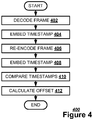
- the video processing system 200 may decode a compressed video data frame in a video transcoder 202 creating a decoded video data frame (Block 402).
- the video processing system 200 may embed a network presentation timestamp from a video frame header in the compressed video data frame in a vertical blanking interval of the decoded video data frame (Block 404).
- the video processing system 200 may re-encode the compressed video data frame in the video transcoder 202 creating a transcoded video data frame (Block 406).
- the video processing system 200 may embed the network presentation timestamp in a video frame header of the transcoded video data frame (Block 408).
- the video processing system 200 may compare the network presentation timestamp with a transcoder presentation timestamp (Block 410).
- the video processing system 200 may calculate a timestamp offset (Block 412).
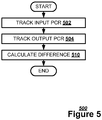
- the video processing system 200 may use an input counter 216 to track an input program clock reference (PCR) (Block 502).
- the video processing system 200 may use an output counter 218 to track an output program clock reference (Block 504).
- the video processing system 200 may calculate the difference between the output program clock reference and the input program clock reference to determine the audio pass through delay (Block 506).
- Embodiments within the scope of the present invention may also include computer-readable media for carrying or having computer-executable instructions or data structures stored thereon.
- Such computer-readable media can be any available media that can be accessed by a general purpose or special purpose computer.
- Such computer-readable media can comprise RAM, ROM, EEPROM, CD-ROM or other optical disk storage, magnetic disk storage or other magnetic storage devices, or any other medium which can be used to carry or store desired program code means in the form of computer-executable instructions or data structures.
- a network or another communications connection either hardwired, wireless, or combination thereof
- any such connection is properly termed a computer-readable medium. Combinations of the above should also be included within the scope of the computer-readable media.
- Embodiments may also be practiced in distributed computing environments where tasks are performed by local and remote processing devices that are linked (either by hardwired links, wireless links, or by a combination thereof) through a communications network.
- Computer-executable instructions include, for example, instructions and data which cause a general purpose computer, special purpose computer, or special purpose processing device to perform a certain function or group of functions.
- Computer-executable instructions also include program modules that are executed by computers in stand-alone or network environments.
- program modules include routines, programs, objects, components, and data structures, etc. that perform particular tasks or implement particular abstract data types.
- Computer-executable instructions, associated data structures, and program modules represent examples of the program code means for executing steps of the methods disclosed herein. The particular sequence of such executable instructions or associated data structures represents examples of corresponding acts for implementing the functions described in such steps.
Landscapes
- Engineering & Computer Science (AREA)
- Multimedia (AREA)
- Signal Processing (AREA)
- Compression Or Coding Systems Of Tv Signals (AREA)
- Two-Way Televisions, Distribution Of Moving Picture Or The Like (AREA)
Claims (13)
- Maschinenimplementiertes Verfahren, umfassend:Empfangen eines komprimierten Videodatenrahmens mit einem ersten Präsentationszeitstempel in einem Videotranscoder;Decodieren eines komprimierten Videodatenrahmens im Videotranscoder, wobei ein decodierter Videodatenrahmen erzeugt wird;Einbetten des ersten Präsentationszeitstempels in ein vertikales Austastintervall des decodierten Videodatenrahmens;Neucodieren des decodierten Videodatenrahmens im Videotranscoder, wobei ein transcodierter Videodatenrahmen erzeugt wird;Vergleichen des ersten Präsentationszeitstempels mit einem zweiten Präsentationszeitstempel, um einen Zeitstempelversatz zu bestimmen, worin der zweite Präsentationszeitstempel dem transcodierten Videodatenrahmen zugeordnet ist; undauf dem bestimmten Zeitstempelversatz beruhendes Präsentieren von Audiodaten, die dem komprimierten Videorahmen zugeordnet sind, in Synchronisation mit dem transcodierten Videodatenrahmen.
- Verfahren nach Anspruch 1, ferner umfassend:
Umleiten eines zugeordneten Audiodatensatzes am Videotranscoder vorbei. - Verfahren nach Anspruch 2, ferner umfassend:
Verzögern des zugeordneten Audiodatensatzes, damit er zum transcodierten Videodatenrahmen passt. - Verfahren nach Anspruch 1, ferner umfassend:Verfolgen einer Eingangsprogrammtaktreferenz mit einem Eingangszähler; undVerfolgen einer Ausgangsprogrammtaktreferenz mit einem Ausgangszähler, wobei die Differenz zwischen dem Eingangsprogrammtaktreferenzzähler und dem Ausgangsprogrammtaktreferenzzähler eine Angabe der Verzögerung aufgrund der Decodier- und Neucodierverarbeitungsdauer im Videotranscoder bereitstellt.
- Verfahren nach Anspruch 4, ferner umfassend:
Verzögern eines zugeordneten Audiodatensatzes unter Verwendung eines Programmtaktreferenzversatzes, wobei der Programmtaktreferenzversatz durch eine Differenz zwischen der Eingangsprogrammtaktreferenz und der Ausgangsprogrammtaktreferenz bestimmt wird. - Verfahren nach Anspruch 1, ferner umfassend:Empfangen eines lokalen Videostroms im Videotranscoder über einen lokalen Videokanaleingang;Einfügen des lokalen Videostroms nach dem komprimierten Videodatenrahmen unter Verwendung eines Zusammenfügungszeitstempels.
- Verfahren nach Anspruch 1, ferner umfassend:
Identifizieren eines Umschaltrahmens in einem Videostrom von Videodatenrahmen unter Verwendung eines Zusammenfügungszeitstempels. - Verfahren nach Anspruch 1, ferner umfassend:
Umschalten auf einen komprimierten Audiodatensatz unter Verwendung eines Zusammenfügungszeitstempels. - Verfahren nach Anspruch 1, ferner umfassend:
Umschalten auf einen pulscodemodulierten Audiodatensatz unter Verwendung eines Zusammenfügungszeitstempels. - Videoverarbeitungssystem, umfassend:einen Netzwerk-Videokanaleingang, der dafür konfiguriert ist, einen komprimierten Videodatenrahmen mit einem ersten Präsentationszeitstempel zu empfangen;einen Videotranscoder, der dafür konfiguriert ist, den komprimierten Videodatenrahmen zu decodieren, wobei er einen decodierten Videodatenrahmen erzeugt, den ersten Präsentationszeitstempel in ein vertikales Austastintervall des decodierten Videodatenrahmens einzubetten und den decodierten Videodatenrahmen neu zu codieren, wobei er einen transcodierten Videodatenrahmen erzeugt;wobei das Videoverarbeitungssystem dafür konfiguriert ist, den ersten Präsentationszeitstempel mit einem zweiten Präsentationszeitstempel zu vergleichen, um einen Zeitstempelversatz zu bestimmen, worin der zweite Präsentationszeitstempel dem transcodierten Videodatenrahmen zugeordnet ist; undwobei das Videoverarbeitungssystem dafür konfiguriert ist, Audiodaten, die dem komprimierten Videodatenrahmen zugeordnet sind, auf der Grundlage des bestimmten Zeitstempelversatzes in Synchronisation mit dem transcodierten Videodatenrahmen zu präsentieren.
- Videoverarbeitungssystem nach Anspruch 10, ferner umfassend:
eine Audiodatenumleitung, die einen zugeordneten Audiodatensatz empfängt, der den Videotranscoder nicht durchlaufen hat. - Videoverarbeitungssystem nach Anspruch 11, worin die Audiodatenumleitung dafür konfiguriert ist, den zugeordneten Audiodatensatz zu verzögern, damit er zum komprimierten Videodatenrahmen passt.
- Videoverarbeitungssystem nach Anspruch 10, ferner umfassend:
einen lokalen Videokanaleingang, der einen lokalen Videostrom zum Einfügen nach dem komprimierten Videodatenrahmen empfängt.
Applications Claiming Priority (2)
| Application Number | Priority Date | Filing Date | Title |
|---|---|---|---|
| US13/252,753 US20130083859A1 (en) | 2011-10-04 | 2011-10-04 | Method to match input and output timestamps in a video encoder and advertisement inserter |
| PCT/US2012/055753 WO2013052265A1 (en) | 2011-10-04 | 2012-09-17 | Method to match input and output timestamps in a video encoder and advertisement inserter |
Publications (2)
| Publication Number | Publication Date |
|---|---|
| EP2752023A1 EP2752023A1 (de) | 2014-07-09 |
| EP2752023B1 true EP2752023B1 (de) | 2019-12-25 |
Family
ID=46964075
Family Applications (1)
| Application Number | Title | Priority Date | Filing Date |
|---|---|---|---|
| EP12766810.1A Active EP2752023B1 (de) | 2011-10-04 | 2012-09-17 | Verfahren zum vergleich von ein- und ausgangszeitstempeln in einem videocodierer und einer werbungseinfügemaschine |
Country Status (5)
| Country | Link |
|---|---|
| US (1) | US20130083859A1 (de) |
| EP (1) | EP2752023B1 (de) |
| CN (1) | CN103959807B (de) |
| BR (1) | BR112014008248B1 (de) |
| WO (1) | WO2013052265A1 (de) |
Families Citing this family (21)
| Publication number | Priority date | Publication date | Assignee | Title |
|---|---|---|---|---|
| US9838450B2 (en) | 2010-06-30 | 2017-12-05 | Brightcove, Inc. | Dynamic chunking for delivery instances |
| US9762639B2 (en) * | 2010-06-30 | 2017-09-12 | Brightcove Inc. | Dynamic manifest generation based on client identity |
| US9197688B2 (en) * | 2013-09-30 | 2015-11-24 | Brightcove, Inc. | Dynamic chunk manipulation for streaming mixed live and on-demand media: application programming interface |
| US9148707B2 (en) * | 2012-07-13 | 2015-09-29 | Lodgenet Interactive Corporation | System and method to provide out-of-band broadcast trigger synchronization and communication to insertion devices |
| US9635334B2 (en) * | 2012-12-03 | 2017-04-25 | Avago Technologies General Ip (Singapore) Pte. Ltd. | Audio and video management for parallel transcoding |
| US20140198839A1 (en) * | 2013-01-17 | 2014-07-17 | Nvidia Corporation | Low latency sub-frame level video decoding |
| US8922713B1 (en) * | 2013-04-25 | 2014-12-30 | Amazon Technologies, Inc. | Audio and video synchronization |
| CN103686203A (zh) * | 2013-12-04 | 2014-03-26 | 深圳市融创天下科技股份有限公司 | 视频转码方法及装置 |
| CN104954630B (zh) * | 2014-03-28 | 2018-01-12 | 深圳市海派尔科技开发有限公司 | 视频时间戳获取方法、视频处理设备及视频系统 |
| CN105338281B (zh) * | 2014-06-27 | 2018-07-31 | 阿里巴巴集团控股有限公司 | 一种视频显示方法和装置 |
| US10148989B2 (en) * | 2016-06-15 | 2018-12-04 | Divx, Llc | Systems and methods for encoding video content |
| CN106572360A (zh) * | 2016-11-11 | 2017-04-19 | 协创数据技术股份有限公司 | 一种视频直播中的广告插播装置 |
| EP3396964B1 (de) | 2017-04-25 | 2020-07-22 | Accenture Global Solutions Ltd | Dynamische platzierung von inhalten in einem standbild oder einem video |
| EP3528196A1 (de) * | 2018-02-16 | 2019-08-21 | Accenture Global Solutions Limited | Dynamische inhaltserzeugung |
| US10742955B2 (en) * | 2018-05-21 | 2020-08-11 | Microsoft Technology Licensing, Llc | Correlation of video stream frame timestamps based on a system clock |
| US11234049B2 (en) | 2019-06-24 | 2022-01-25 | The Nielsen Company (Us), Llc | Use of steganographically-encoded time information as basis to control implementation of dynamic content modification |
| US11051057B2 (en) | 2019-06-24 | 2021-06-29 | The Nielsen Company (Us), Llc | Use of steganographically-encoded time information as basis to establish a time offset, to facilitate taking content-related action |
| CN110349564B (zh) * | 2019-07-22 | 2021-09-24 | 思必驰科技股份有限公司 | 一种跨语言语音识别方法和装置 |
| CA3176516A1 (en) * | 2020-04-28 | 2021-11-04 | Brenda Lea Van Veldhuisen | System for presentation time stamp recovery from a transcoder |
| US11496795B2 (en) | 2020-04-28 | 2022-11-08 | Arris Enterprises Llc | System for jitter recovery from a transcoder |
| CN113949898B (zh) * | 2021-10-13 | 2024-03-08 | 北京奇艺世纪科技有限公司 | 多媒体处理方法、装置、设备和存储介质 |
Citations (1)
| Publication number | Priority date | Publication date | Assignee | Title |
|---|---|---|---|---|
| WO2005055230A1 (en) * | 2003-12-01 | 2005-06-16 | Lg Electronics Inc. | Method and apparatus for transcoding digital audio/video streams |
Family Cites Families (9)
| Publication number | Priority date | Publication date | Assignee | Title |
|---|---|---|---|---|
| JP2001251616A (ja) * | 2000-03-02 | 2001-09-14 | Media Glue Corp | 多重化音響・動画圧縮符号化信号変換方法、装置および変換プログラムを記録した媒体 |
| US7548565B2 (en) * | 2000-07-24 | 2009-06-16 | Vmark, Inc. | Method and apparatus for fast metadata generation, delivery and access for live broadcast program |
| US6724825B1 (en) * | 2000-09-22 | 2004-04-20 | General Instrument Corporation | Regeneration of program clock reference data for MPEG transport streams |
| US7068719B2 (en) * | 2001-06-01 | 2006-06-27 | General Instrument Corporation | Splicing of digital video transport streams |
| JP2003230092A (ja) * | 2002-02-04 | 2003-08-15 | Sony Corp | 情報処理装置および方法、プログラム格納媒体、並びにプログラム |
| US7499469B2 (en) * | 2003-01-13 | 2009-03-03 | Broadcom Corporation | Method and system for generating digital video broadcast (DVB) transport stream from direct satellite system (DSS) transport stream |
| CN1954608A (zh) * | 2003-12-05 | 2007-04-25 | 美国电影协会 | 控制禁止复制内容显示的系统和方法 |
| US8879856B2 (en) * | 2005-09-27 | 2014-11-04 | Qualcomm Incorporated | Content driven transcoder that orchestrates multimedia transcoding using content information |
| US8111971B2 (en) * | 2007-12-05 | 2012-02-07 | Cisco Technology, Inc. | Systems and methods of reducing media stream delay through independent decoder clocks |
-
2011
- 2011-10-04 US US13/252,753 patent/US20130083859A1/en not_active Abandoned
-
2012
- 2012-09-17 CN CN201280049249.0A patent/CN103959807B/zh active Active
- 2012-09-17 WO PCT/US2012/055753 patent/WO2013052265A1/en not_active Ceased
- 2012-09-17 BR BR112014008248-0A patent/BR112014008248B1/pt active IP Right Grant
- 2012-09-17 EP EP12766810.1A patent/EP2752023B1/de active Active
Patent Citations (1)
| Publication number | Priority date | Publication date | Assignee | Title |
|---|---|---|---|---|
| WO2005055230A1 (en) * | 2003-12-01 | 2005-06-16 | Lg Electronics Inc. | Method and apparatus for transcoding digital audio/video streams |
Also Published As
| Publication number | Publication date |
|---|---|
| WO2013052265A1 (en) | 2013-04-11 |
| BR112014008248B1 (pt) | 2022-09-20 |
| CN103959807B (zh) | 2019-06-04 |
| EP2752023A1 (de) | 2014-07-09 |
| US20130083859A1 (en) | 2013-04-04 |
| CN103959807A (zh) | 2014-07-30 |
| BR112014008248A2 (pt) | 2017-04-11 |
Similar Documents
| Publication | Publication Date | Title |
|---|---|---|
| US20130083859A1 (en) | Method to match input and output timestamps in a video encoder and advertisement inserter | |
| KR101535827B1 (ko) | 무선 통신 네트워크에서 오디오 및 비디오 동기화 장치 및 방법 | |
| EP2038886B1 (de) | Taktabweichungskompensationsverfahren zur audiodekodierung | |
| US8931024B2 (en) | Receiving apparatus and subtitle processing method | |
| US9549027B2 (en) | Network-synchronized media playback | |
| US9489980B2 (en) | Video/audio synchronization apparatus and video/audio synchronization method | |
| US11503366B2 (en) | Dynamic playout of transition frames while transitioning between play out of media streams | |
| US9832507B2 (en) | System and method for synchronizing media output devices connected on a network | |
| CN100588261C (zh) | 将视频数据及音频数据同步的方法及系统 | |
| CN102057687B (zh) | 媒体流成分的同步 | |
| JP6610555B2 (ja) | 受信装置、送信装置、およびデータ処理方法 | |
| US20150101004A1 (en) | Receiver apparatus and synchronization processing method thereof | |
| CN102075803B (zh) | 一种播放音视频同步的方法 | |
| CN100502473C (zh) | 用于协调视频与字幕的同步的设备和方法 | |
| JP2010521089A (ja) | トランスコーダのメディアの時間変換 | |
| KR101600891B1 (ko) | 복수의 단말기에 출력되는 비디오 및 오디오를 동기화시키는 동기화시스템 및 방법 | |
| WO2014128360A1 (en) | Synchronization of audio and video content | |
| CN101076120B (zh) | 维持音频/视频同步的健壮系统 | |
| KR100864009B1 (ko) | 오디오/비디오 동기화 방법 | |
| CN105338426A (zh) | 一种传输流中时间标签的修正方法及装置 | |
| KR102709016B1 (ko) | 비디오 데이터 및 오디오 데이터를 처리하는 멀티미디어 디바이스 및 그 제어 방법 | |
| KR20060065436A (ko) | 디지털 멀티미디어 방송 수신 장치에서의 오디오 및 비디오동기화 방법 및 장치 | |
| TW200629918A (en) | Transcoding closed captioning data from broadcast DTV onto DVD | |
| JP2022064531A (ja) | 送信装置および受信装置 | |
| CN108702533B (zh) | 发送装置、发送方法、接收装置和接收方法 |
Legal Events
| Date | Code | Title | Description |
|---|---|---|---|
| PUAI | Public reference made under article 153(3) epc to a published international application that has entered the european phase |
Free format text: ORIGINAL CODE: 0009012 |
|
| 17P | Request for examination filed |
Effective date: 20140331 |
|
| AK | Designated contracting states |
Kind code of ref document: A1 Designated state(s): AL AT BE BG CH CY CZ DE DK EE ES FI FR GB GR HR HU IE IS IT LI LT LU LV MC MK MT NL NO PL PT RO RS SE SI SK SM TR |
|
| DAX | Request for extension of the european patent (deleted) | ||
| RAP1 | Party data changed (applicant data changed or rights of an application transferred) |
Owner name: GOOGLE TECHNOLOGY HOLDINGS LLC |
|
| STAA | Information on the status of an ep patent application or granted ep patent |
Free format text: STATUS: EXAMINATION IS IN PROGRESS |
|
| 17Q | First examination report despatched |
Effective date: 20170110 |
|
| GRAP | Despatch of communication of intention to grant a patent |
Free format text: ORIGINAL CODE: EPIDOSNIGR1 |
|
| STAA | Information on the status of an ep patent application or granted ep patent |
Free format text: STATUS: GRANT OF PATENT IS INTENDED |
|
| INTG | Intention to grant announced |
Effective date: 20190809 |
|
| GRAS | Grant fee paid |
Free format text: ORIGINAL CODE: EPIDOSNIGR3 |
|
| GRAA | (expected) grant |
Free format text: ORIGINAL CODE: 0009210 |
|
| STAA | Information on the status of an ep patent application or granted ep patent |
Free format text: STATUS: THE PATENT HAS BEEN GRANTED |
|
| AK | Designated contracting states |
Kind code of ref document: B1 Designated state(s): AL AT BE BG CH CY CZ DE DK EE ES FI FR GB GR HR HU IE IS IT LI LT LU LV MC MK MT NL NO PL PT RO RS SE SI SK SM TR |
|
| REG | Reference to a national code |
Ref country code: GB Ref legal event code: FG4D |
|
| REG | Reference to a national code |
Ref country code: CH Ref legal event code: EP |
|
| REG | Reference to a national code |
Ref country code: DE Ref legal event code: R096 Ref document number: 602012066725 Country of ref document: DE |
|
| REG | Reference to a national code |
Ref country code: AT Ref legal event code: REF Ref document number: 1218464 Country of ref document: AT Kind code of ref document: T Effective date: 20200115 |
|
| REG | Reference to a national code |
Ref country code: IE Ref legal event code: FG4D |
|
| REG | Reference to a national code |
Ref country code: NL Ref legal event code: MP Effective date: 20191225 |
|
| PG25 | Lapsed in a contracting state [announced via postgrant information from national office to epo] |
Ref country code: SE Free format text: LAPSE BECAUSE OF FAILURE TO SUBMIT A TRANSLATION OF THE DESCRIPTION OR TO PAY THE FEE WITHIN THE PRESCRIBED TIME-LIMIT Effective date: 20191225 Ref country code: LV Free format text: LAPSE BECAUSE OF FAILURE TO SUBMIT A TRANSLATION OF THE DESCRIPTION OR TO PAY THE FEE WITHIN THE PRESCRIBED TIME-LIMIT Effective date: 20191225 Ref country code: NO Free format text: LAPSE BECAUSE OF FAILURE TO SUBMIT A TRANSLATION OF THE DESCRIPTION OR TO PAY THE FEE WITHIN THE PRESCRIBED TIME-LIMIT Effective date: 20200325 Ref country code: GR Free format text: LAPSE BECAUSE OF FAILURE TO SUBMIT A TRANSLATION OF THE DESCRIPTION OR TO PAY THE FEE WITHIN THE PRESCRIBED TIME-LIMIT Effective date: 20200326 Ref country code: LT Free format text: LAPSE BECAUSE OF FAILURE TO SUBMIT A TRANSLATION OF THE DESCRIPTION OR TO PAY THE FEE WITHIN THE PRESCRIBED TIME-LIMIT Effective date: 20191225 Ref country code: BG Free format text: LAPSE BECAUSE OF FAILURE TO SUBMIT A TRANSLATION OF THE DESCRIPTION OR TO PAY THE FEE WITHIN THE PRESCRIBED TIME-LIMIT Effective date: 20200325 Ref country code: FI Free format text: LAPSE BECAUSE OF FAILURE TO SUBMIT A TRANSLATION OF THE DESCRIPTION OR TO PAY THE FEE WITHIN THE PRESCRIBED TIME-LIMIT Effective date: 20191225 |
|
| REG | Reference to a national code |
Ref country code: LT Ref legal event code: MG4D |
|
| PG25 | Lapsed in a contracting state [announced via postgrant information from national office to epo] |
Ref country code: RS Free format text: LAPSE BECAUSE OF FAILURE TO SUBMIT A TRANSLATION OF THE DESCRIPTION OR TO PAY THE FEE WITHIN THE PRESCRIBED TIME-LIMIT Effective date: 20191225 Ref country code: HR Free format text: LAPSE BECAUSE OF FAILURE TO SUBMIT A TRANSLATION OF THE DESCRIPTION OR TO PAY THE FEE WITHIN THE PRESCRIBED TIME-LIMIT Effective date: 20191225 |
|
| PG25 | Lapsed in a contracting state [announced via postgrant information from national office to epo] |
Ref country code: AL Free format text: LAPSE BECAUSE OF FAILURE TO SUBMIT A TRANSLATION OF THE DESCRIPTION OR TO PAY THE FEE WITHIN THE PRESCRIBED TIME-LIMIT Effective date: 20191225 |
|
| PG25 | Lapsed in a contracting state [announced via postgrant information from national office to epo] |
Ref country code: CZ Free format text: LAPSE BECAUSE OF FAILURE TO SUBMIT A TRANSLATION OF THE DESCRIPTION OR TO PAY THE FEE WITHIN THE PRESCRIBED TIME-LIMIT Effective date: 20191225 Ref country code: EE Free format text: LAPSE BECAUSE OF FAILURE TO SUBMIT A TRANSLATION OF THE DESCRIPTION OR TO PAY THE FEE WITHIN THE PRESCRIBED TIME-LIMIT Effective date: 20191225 Ref country code: RO Free format text: LAPSE BECAUSE OF FAILURE TO SUBMIT A TRANSLATION OF THE DESCRIPTION OR TO PAY THE FEE WITHIN THE PRESCRIBED TIME-LIMIT Effective date: 20191225 Ref country code: PT Free format text: LAPSE BECAUSE OF FAILURE TO SUBMIT A TRANSLATION OF THE DESCRIPTION OR TO PAY THE FEE WITHIN THE PRESCRIBED TIME-LIMIT Effective date: 20200520 Ref country code: NL Free format text: LAPSE BECAUSE OF FAILURE TO SUBMIT A TRANSLATION OF THE DESCRIPTION OR TO PAY THE FEE WITHIN THE PRESCRIBED TIME-LIMIT Effective date: 20191225 |
|
| PG25 | Lapsed in a contracting state [announced via postgrant information from national office to epo] |
Ref country code: SK Free format text: LAPSE BECAUSE OF FAILURE TO SUBMIT A TRANSLATION OF THE DESCRIPTION OR TO PAY THE FEE WITHIN THE PRESCRIBED TIME-LIMIT Effective date: 20191225 Ref country code: IS Free format text: LAPSE BECAUSE OF FAILURE TO SUBMIT A TRANSLATION OF THE DESCRIPTION OR TO PAY THE FEE WITHIN THE PRESCRIBED TIME-LIMIT Effective date: 20200425 Ref country code: SM Free format text: LAPSE BECAUSE OF FAILURE TO SUBMIT A TRANSLATION OF THE DESCRIPTION OR TO PAY THE FEE WITHIN THE PRESCRIBED TIME-LIMIT Effective date: 20191225 |
|
| REG | Reference to a national code |
Ref country code: DE Ref legal event code: R097 Ref document number: 602012066725 Country of ref document: DE |
|
| PG25 | Lapsed in a contracting state [announced via postgrant information from national office to epo] |
Ref country code: DK Free format text: LAPSE BECAUSE OF FAILURE TO SUBMIT A TRANSLATION OF THE DESCRIPTION OR TO PAY THE FEE WITHIN THE PRESCRIBED TIME-LIMIT Effective date: 20191225 Ref country code: ES Free format text: LAPSE BECAUSE OF FAILURE TO SUBMIT A TRANSLATION OF THE DESCRIPTION OR TO PAY THE FEE WITHIN THE PRESCRIBED TIME-LIMIT Effective date: 20191225 |
|
| PLBE | No opposition filed within time limit |
Free format text: ORIGINAL CODE: 0009261 |
|
| STAA | Information on the status of an ep patent application or granted ep patent |
Free format text: STATUS: NO OPPOSITION FILED WITHIN TIME LIMIT |
|
| REG | Reference to a national code |
Ref country code: AT Ref legal event code: MK05 Ref document number: 1218464 Country of ref document: AT Kind code of ref document: T Effective date: 20191225 |
|
| PG25 | Lapsed in a contracting state [announced via postgrant information from national office to epo] |
Ref country code: SI Free format text: LAPSE BECAUSE OF FAILURE TO SUBMIT A TRANSLATION OF THE DESCRIPTION OR TO PAY THE FEE WITHIN THE PRESCRIBED TIME-LIMIT Effective date: 20191225 |
|
| 26N | No opposition filed |
Effective date: 20200928 |
|
| PG25 | Lapsed in a contracting state [announced via postgrant information from national office to epo] |
Ref country code: IT Free format text: LAPSE BECAUSE OF FAILURE TO SUBMIT A TRANSLATION OF THE DESCRIPTION OR TO PAY THE FEE WITHIN THE PRESCRIBED TIME-LIMIT Effective date: 20191225 Ref country code: AT Free format text: LAPSE BECAUSE OF FAILURE TO SUBMIT A TRANSLATION OF THE DESCRIPTION OR TO PAY THE FEE WITHIN THE PRESCRIBED TIME-LIMIT Effective date: 20191225 |
|
| PG25 | Lapsed in a contracting state [announced via postgrant information from national office to epo] |
Ref country code: PL Free format text: LAPSE BECAUSE OF FAILURE TO SUBMIT A TRANSLATION OF THE DESCRIPTION OR TO PAY THE FEE WITHIN THE PRESCRIBED TIME-LIMIT Effective date: 20191225 |
|
| PG25 | Lapsed in a contracting state [announced via postgrant information from national office to epo] |
Ref country code: MC Free format text: LAPSE BECAUSE OF FAILURE TO SUBMIT A TRANSLATION OF THE DESCRIPTION OR TO PAY THE FEE WITHIN THE PRESCRIBED TIME-LIMIT Effective date: 20191225 |
|
| REG | Reference to a national code |
Ref country code: CH Ref legal event code: PL |
|
| GBPC | Gb: european patent ceased through non-payment of renewal fee |
Effective date: 20200917 |
|
| REG | Reference to a national code |
Ref country code: BE Ref legal event code: MM Effective date: 20200930 |
|
| PG25 | Lapsed in a contracting state [announced via postgrant information from national office to epo] |
Ref country code: LU Free format text: LAPSE BECAUSE OF NON-PAYMENT OF DUE FEES Effective date: 20200917 |
|
| PG25 | Lapsed in a contracting state [announced via postgrant information from national office to epo] |
Ref country code: FR Free format text: LAPSE BECAUSE OF NON-PAYMENT OF DUE FEES Effective date: 20200930 |
|
| PG25 | Lapsed in a contracting state [announced via postgrant information from national office to epo] |
Ref country code: BE Free format text: LAPSE BECAUSE OF NON-PAYMENT OF DUE FEES Effective date: 20200930 Ref country code: CH Free format text: LAPSE BECAUSE OF NON-PAYMENT OF DUE FEES Effective date: 20200930 Ref country code: IE Free format text: LAPSE BECAUSE OF NON-PAYMENT OF DUE FEES Effective date: 20200917 Ref country code: LI Free format text: LAPSE BECAUSE OF NON-PAYMENT OF DUE FEES Effective date: 20200930 Ref country code: GB Free format text: LAPSE BECAUSE OF NON-PAYMENT OF DUE FEES Effective date: 20200917 |
|
| PG25 | Lapsed in a contracting state [announced via postgrant information from national office to epo] |
Ref country code: TR Free format text: LAPSE BECAUSE OF FAILURE TO SUBMIT A TRANSLATION OF THE DESCRIPTION OR TO PAY THE FEE WITHIN THE PRESCRIBED TIME-LIMIT Effective date: 20191225 Ref country code: MT Free format text: LAPSE BECAUSE OF FAILURE TO SUBMIT A TRANSLATION OF THE DESCRIPTION OR TO PAY THE FEE WITHIN THE PRESCRIBED TIME-LIMIT Effective date: 20191225 Ref country code: CY Free format text: LAPSE BECAUSE OF FAILURE TO SUBMIT A TRANSLATION OF THE DESCRIPTION OR TO PAY THE FEE WITHIN THE PRESCRIBED TIME-LIMIT Effective date: 20191225 |
|
| PG25 | Lapsed in a contracting state [announced via postgrant information from national office to epo] |
Ref country code: MK Free format text: LAPSE BECAUSE OF FAILURE TO SUBMIT A TRANSLATION OF THE DESCRIPTION OR TO PAY THE FEE WITHIN THE PRESCRIBED TIME-LIMIT Effective date: 20191225 |
|
| P01 | Opt-out of the competence of the unified patent court (upc) registered |
Effective date: 20230510 |
|
| PGFP | Annual fee paid to national office [announced via postgrant information from national office to epo] |
Ref country code: DE Payment date: 20250929 Year of fee payment: 14 |