EP2750235A1 - Lithium secondary battery - Google Patents
Lithium secondary battery Download PDFInfo
- Publication number
- EP2750235A1 EP2750235A1 EP13797731.0A EP13797731A EP2750235A1 EP 2750235 A1 EP2750235 A1 EP 2750235A1 EP 13797731 A EP13797731 A EP 13797731A EP 2750235 A1 EP2750235 A1 EP 2750235A1
- Authority
- EP
- European Patent Office
- Prior art keywords
- positive electrode
- secondary battery
- lithium secondary
- active material
- electrode active
- Prior art date
- Legal status (The legal status is an assumption and is not a legal conclusion. Google has not performed a legal analysis and makes no representation as to the accuracy of the status listed.)
- Granted
Links
Images

Classifications
-
- H—ELECTRICITY
- H01—ELECTRIC ELEMENTS
- H01M—PROCESSES OR MEANS, e.g. BATTERIES, FOR THE DIRECT CONVERSION OF CHEMICAL ENERGY INTO ELECTRICAL ENERGY
- H01M4/00—Electrodes
- H01M4/02—Electrodes composed of, or comprising, active material
- H01M4/13—Electrodes for accumulators with non-aqueous electrolyte, e.g. for lithium-accumulators; Processes of manufacture thereof
- H01M4/131—Electrodes based on mixed oxides or hydroxides, or on mixtures of oxides or hydroxides, e.g. LiCoOx
-
- H—ELECTRICITY
- H01—ELECTRIC ELEMENTS
- H01M—PROCESSES OR MEANS, e.g. BATTERIES, FOR THE DIRECT CONVERSION OF CHEMICAL ENERGY INTO ELECTRICAL ENERGY
- H01M10/00—Secondary cells; Manufacture thereof
- H01M10/05—Accumulators with non-aqueous electrolyte
- H01M10/056—Accumulators with non-aqueous electrolyte characterised by the materials used as electrolytes, e.g. mixed inorganic/organic electrolytes
-
- H—ELECTRICITY
- H01—ELECTRIC ELEMENTS
- H01M—PROCESSES OR MEANS, e.g. BATTERIES, FOR THE DIRECT CONVERSION OF CHEMICAL ENERGY INTO ELECTRICAL ENERGY
- H01M10/00—Secondary cells; Manufacture thereof
- H01M10/05—Accumulators with non-aqueous electrolyte
- H01M10/052—Li-accumulators
-
- H—ELECTRICITY
- H01—ELECTRIC ELEMENTS
- H01M—PROCESSES OR MEANS, e.g. BATTERIES, FOR THE DIRECT CONVERSION OF CHEMICAL ENERGY INTO ELECTRICAL ENERGY
- H01M10/00—Secondary cells; Manufacture thereof
- H01M10/05—Accumulators with non-aqueous electrolyte
- H01M10/056—Accumulators with non-aqueous electrolyte characterised by the materials used as electrolytes, e.g. mixed inorganic/organic electrolytes
- H01M10/0564—Accumulators with non-aqueous electrolyte characterised by the materials used as electrolytes, e.g. mixed inorganic/organic electrolytes the electrolyte being constituted of organic materials only
- H01M10/0566—Liquid materials
- H01M10/0567—Liquid materials characterised by the additives
-
- H—ELECTRICITY
- H01—ELECTRIC ELEMENTS
- H01M—PROCESSES OR MEANS, e.g. BATTERIES, FOR THE DIRECT CONVERSION OF CHEMICAL ENERGY INTO ELECTRICAL ENERGY
- H01M10/00—Secondary cells; Manufacture thereof
- H01M10/05—Accumulators with non-aqueous electrolyte
- H01M10/056—Accumulators with non-aqueous electrolyte characterised by the materials used as electrolytes, e.g. mixed inorganic/organic electrolytes
- H01M10/0564—Accumulators with non-aqueous electrolyte characterised by the materials used as electrolytes, e.g. mixed inorganic/organic electrolytes the electrolyte being constituted of organic materials only
- H01M10/0566—Liquid materials
- H01M10/0568—Liquid materials characterised by the solutes
-
- H—ELECTRICITY
- H01—ELECTRIC ELEMENTS
- H01M—PROCESSES OR MEANS, e.g. BATTERIES, FOR THE DIRECT CONVERSION OF CHEMICAL ENERGY INTO ELECTRICAL ENERGY
- H01M10/00—Secondary cells; Manufacture thereof
- H01M10/05—Accumulators with non-aqueous electrolyte
- H01M10/056—Accumulators with non-aqueous electrolyte characterised by the materials used as electrolytes, e.g. mixed inorganic/organic electrolytes
- H01M10/0564—Accumulators with non-aqueous electrolyte characterised by the materials used as electrolytes, e.g. mixed inorganic/organic electrolytes the electrolyte being constituted of organic materials only
- H01M10/0566—Liquid materials
- H01M10/0569—Liquid materials characterised by the solvents
-
- H—ELECTRICITY
- H01—ELECTRIC ELEMENTS
- H01M—PROCESSES OR MEANS, e.g. BATTERIES, FOR THE DIRECT CONVERSION OF CHEMICAL ENERGY INTO ELECTRICAL ENERGY
- H01M10/00—Secondary cells; Manufacture thereof
- H01M10/42—Methods or arrangements for servicing or maintenance of secondary cells or secondary half-cells
- H01M10/4235—Safety or regulating additives or arrangements in electrodes, separators or electrolyte
-
- H—ELECTRICITY
- H01—ELECTRIC ELEMENTS
- H01M—PROCESSES OR MEANS, e.g. BATTERIES, FOR THE DIRECT CONVERSION OF CHEMICAL ENERGY INTO ELECTRICAL ENERGY
- H01M4/00—Electrodes
- H01M4/02—Electrodes composed of, or comprising, active material
- H01M4/36—Selection of substances as active materials, active masses, active liquids
- H01M4/362—Composites
- H01M4/366—Composites as layered products
-
- H—ELECTRICITY
- H01—ELECTRIC ELEMENTS
- H01M—PROCESSES OR MEANS, e.g. BATTERIES, FOR THE DIRECT CONVERSION OF CHEMICAL ENERGY INTO ELECTRICAL ENERGY
- H01M4/00—Electrodes
- H01M4/02—Electrodes composed of, or comprising, active material
- H01M4/36—Selection of substances as active materials, active masses, active liquids
- H01M4/48—Selection of substances as active materials, active masses, active liquids of inorganic oxides or hydroxides
- H01M4/485—Selection of substances as active materials, active masses, active liquids of inorganic oxides or hydroxides of mixed oxides or hydroxides for inserting or intercalating light metals, e.g. LiTi2O4 or LiTi2OxFy
-
- H—ELECTRICITY
- H01—ELECTRIC ELEMENTS
- H01M—PROCESSES OR MEANS, e.g. BATTERIES, FOR THE DIRECT CONVERSION OF CHEMICAL ENERGY INTO ELECTRICAL ENERGY
- H01M4/00—Electrodes
- H01M4/02—Electrodes composed of, or comprising, active material
- H01M4/36—Selection of substances as active materials, active masses, active liquids
- H01M4/48—Selection of substances as active materials, active masses, active liquids of inorganic oxides or hydroxides
- H01M4/50—Selection of substances as active materials, active masses, active liquids of inorganic oxides or hydroxides of manganese
- H01M4/505—Selection of substances as active materials, active masses, active liquids of inorganic oxides or hydroxides of manganese of mixed oxides or hydroxides containing manganese for inserting or intercalating light metals, e.g. LiMn2O4 or LiMn2OxFy
-
- H—ELECTRICITY
- H01—ELECTRIC ELEMENTS
- H01M—PROCESSES OR MEANS, e.g. BATTERIES, FOR THE DIRECT CONVERSION OF CHEMICAL ENERGY INTO ELECTRICAL ENERGY
- H01M4/00—Electrodes
- H01M4/02—Electrodes composed of, or comprising, active material
- H01M4/36—Selection of substances as active materials, active masses, active liquids
- H01M4/48—Selection of substances as active materials, active masses, active liquids of inorganic oxides or hydroxides
- H01M4/52—Selection of substances as active materials, active masses, active liquids of inorganic oxides or hydroxides of nickel, cobalt or iron
- H01M4/525—Selection of substances as active materials, active masses, active liquids of inorganic oxides or hydroxides of nickel, cobalt or iron of mixed oxides or hydroxides containing iron, cobalt or nickel for inserting or intercalating light metals, e.g. LiNiO2, LiCoO2 or LiCoOxFy
-
- H—ELECTRICITY
- H01—ELECTRIC ELEMENTS
- H01M—PROCESSES OR MEANS, e.g. BATTERIES, FOR THE DIRECT CONVERSION OF CHEMICAL ENERGY INTO ELECTRICAL ENERGY
- H01M4/00—Electrodes
- H01M4/02—Electrodes composed of, or comprising, active material
- H01M4/62—Selection of inactive substances as ingredients for active masses, e.g. binders, fillers
- H01M4/621—Binders
- H01M4/622—Binders being polymers
-
- H—ELECTRICITY
- H01—ELECTRIC ELEMENTS
- H01M—PROCESSES OR MEANS, e.g. BATTERIES, FOR THE DIRECT CONVERSION OF CHEMICAL ENERGY INTO ELECTRICAL ENERGY
- H01M50/00—Constructional details or processes of manufacture of the non-active parts of electrochemical cells other than fuel cells, e.g. hybrid cells
- H01M50/10—Primary casings; Jackets or wrappings
- H01M50/102—Primary casings; Jackets or wrappings characterised by their shape or physical structure
-
- H—ELECTRICITY
- H01—ELECTRIC ELEMENTS
- H01M—PROCESSES OR MEANS, e.g. BATTERIES, FOR THE DIRECT CONVERSION OF CHEMICAL ENERGY INTO ELECTRICAL ENERGY
- H01M50/00—Constructional details or processes of manufacture of the non-active parts of electrochemical cells other than fuel cells, e.g. hybrid cells
- H01M50/40—Separators; Membranes; Diaphragms; Spacing elements inside cells
- H01M50/409—Separators, membranes or diaphragms characterised by the material
-
- H—ELECTRICITY
- H01—ELECTRIC ELEMENTS
- H01M—PROCESSES OR MEANS, e.g. BATTERIES, FOR THE DIRECT CONVERSION OF CHEMICAL ENERGY INTO ELECTRICAL ENERGY
- H01M4/00—Electrodes
- H01M4/02—Electrodes composed of, or comprising, active material
- H01M2004/021—Physical characteristics, e.g. porosity, surface area
-
- H—ELECTRICITY
- H01—ELECTRIC ELEMENTS
- H01M—PROCESSES OR MEANS, e.g. BATTERIES, FOR THE DIRECT CONVERSION OF CHEMICAL ENERGY INTO ELECTRICAL ENERGY
- H01M4/00—Electrodes
- H01M4/02—Electrodes composed of, or comprising, active material
- H01M2004/026—Electrodes composed of, or comprising, active material characterised by the polarity
- H01M2004/028—Positive electrodes
-
- H—ELECTRICITY
- H01—ELECTRIC ELEMENTS
- H01M—PROCESSES OR MEANS, e.g. BATTERIES, FOR THE DIRECT CONVERSION OF CHEMICAL ENERGY INTO ELECTRICAL ENERGY
- H01M2300/00—Electrolytes
- H01M2300/0017—Non-aqueous electrolytes
-
- H—ELECTRICITY
- H01—ELECTRIC ELEMENTS
- H01M—PROCESSES OR MEANS, e.g. BATTERIES, FOR THE DIRECT CONVERSION OF CHEMICAL ENERGY INTO ELECTRICAL ENERGY
- H01M2300/00—Electrolytes
- H01M2300/0017—Non-aqueous electrolytes
- H01M2300/0025—Organic electrolyte
-
- H—ELECTRICITY
- H01—ELECTRIC ELEMENTS
- H01M—PROCESSES OR MEANS, e.g. BATTERIES, FOR THE DIRECT CONVERSION OF CHEMICAL ENERGY INTO ELECTRICAL ENERGY
- H01M2300/00—Electrolytes
- H01M2300/0017—Non-aqueous electrolytes
- H01M2300/0025—Organic electrolyte
- H01M2300/0028—Organic electrolyte characterised by the solvent
-
- Y—GENERAL TAGGING OF NEW TECHNOLOGICAL DEVELOPMENTS; GENERAL TAGGING OF CROSS-SECTIONAL TECHNOLOGIES SPANNING OVER SEVERAL SECTIONS OF THE IPC; TECHNICAL SUBJECTS COVERED BY FORMER USPC CROSS-REFERENCE ART COLLECTIONS [XRACs] AND DIGESTS
- Y02—TECHNOLOGIES OR APPLICATIONS FOR MITIGATION OR ADAPTATION AGAINST CLIMATE CHANGE
- Y02E—REDUCTION OF GREENHOUSE GAS [GHG] EMISSIONS, RELATED TO ENERGY GENERATION, TRANSMISSION OR DISTRIBUTION
- Y02E60/00—Enabling technologies; Technologies with a potential or indirect contribution to GHG emissions mitigation
- Y02E60/10—Energy storage using batteries
Definitions
- the present invention relates to a lithium secondary battery comprising a positive electrode, a negative electrode, a non-aqueous electrolyte comprising a non-aqueous organic solvent and a lithium salt, and more particularly to a lithium secondary battery comprising a positive electrode comprising a positive electrode active material of a three-component system and a non-aqueous electrolyte comprising an additive for deactivating a transition metal comprised in the positive electrode active material, thereby improving a cycle lifetime and preventing the lithium secondary battery from swelling phenomenon.
- a lithium secondary battery developed during the early 1990s comprises a negative electrode made by using a carbon material capable of absorbing and desorbing lithium ions, a positive electrode made by using a positive electrode active material and a non-aqueous electrolyte comprising a lithium salt dissolved in a mixed organic solvent.
- lithium secondary batteries maintaining good properties at a severe environment comprising a high temperature and a low temperature, and capable of stable charging at a high voltage is gradually increasing.
- the capacity of the positive electrode active materials may be increased as a charging potential increases, however, the desorbing of the transition metal oxides constituting the positive electrode active material also may be accelerated to induce a structural instability.
- organic solvents used as the non-aqueous electrolyte of the lithium secondary battery such as ethylene carbonate, propylene carbonate, dimethoxy ethane, ⁇ -butyrolactone, N,N-dimethyl formamide, tetrahydrofuran or acetonitrile may be oxidized by emitted transition metal oxides and generate a gas when stored at a high temperature for a long time. Due to the generated gas, a battery assembly (battery parts) may be deformed to induce an internal short, and the battery may be deteriorated. In severe cases, the battery may be ignited or exploded. The oxidation reaction of the electrolyte may be accelerated as the amount of the transition metal eluted under high voltage conditions increases.
- organic solvents used as the non-aqueous electrolyte of the lithium secondary battery such as ethylene carbonate, propylene carbonate, dimethoxy ethane, ⁇ -butyrolactone, N,N-dimethyl formamide, t
- Patent literature 1 Korean Registered Patent No. 10-1050333 .
- An object of the present invention is to provide a lithium secondary battery capable of preventing the swelling phenomenon of the battery due to generated gas during storing at a high temperature and having improved charge/discharge performance and cycle lifetime after storing at the high temperature for a long time.
- a lithium secondary battery comprising a positive electrode, a negative electrode, a separator inserted between the positive electrode and the negative electrode and a non-aqueous electrolyte.
- the positive electrode comprises a first positive electrode active material represented by the following Chemical Formula 1
- the non-aqueous electrolyte comprises a first lithium salt, a second lithium salt represented by the following Chemical Formula 2 and a non-aqueous organic solvent.
- a lithium secondary battery comprising a positive electrode, a negative electrode, a separator inserted between the positive electrode and the negative electrode and a non-aqueous electrolyte.
- the positive electrode comprises a first positive electrode active material represented by the following Chemical Formula 1
- the non-aqueous electrolyte comprises a first lithium salt, a second lithium salt represented by the following Chemical Formula 2 and a non-aqueous organic solvent.
- the first positive electrode active material may be an active material of a three component system represented by Li 1+x (Ni a Mn b Co 1-a-b-x )O 2 (0.1 ⁇ x ⁇ 0.1, 0 ⁇ a ⁇ 1, 0 ⁇ x+a+b ⁇ 1) or Li 1+x (Mn 2 - x-y Co y )O 4 (-0.1 ⁇ x ⁇ 0.1, 0 ⁇ y ⁇ 2).
- a cut diameter (D 50 ) of the first positive electrode active material may be less than or equal to 8 ⁇ m and particularly may be 4 to 7 ⁇ m, and the particle type of the first positive electrode active material may have an agglomerated structure of minute particles. Particularly, the first positive electrode active material may have an agglomerated structure of 90% or more of minute particles having a size of 1 to 4 ⁇ m.
- the positive electrode may further comprise a second positive electrode active material represented by the following Chemical Formula 3a or 3b.
- Chemical Formula 3a Li x M 1 y O z ,
- Examples on the second positive electrode active material may comprise Li x Co 2 O 2 (0.5 ⁇ x ⁇ 1.3), Li x NiO 2 (0.5 ⁇ x ⁇ 1.3), Li x MnO 2 (0.5 ⁇ x ⁇ 1.3), Li x Mn 2 O 4 (0.5 ⁇ x ⁇ 1.3), Li x Ni 1-r Co r O 2 (0.5 ⁇ x ⁇ 1.3, 0 ⁇ r ⁇ 1), Li x Co 1-r Mn r O 2 (0.5 ⁇ x ⁇ 1.3, 0 ⁇ r ⁇ 1), Li x Ni 1-r Mn r O 2 (0.5 ⁇ x ⁇ 1.3, 0 ⁇ r ⁇ 1), Li x Mn 2-p Ni p O 4 (0.5 ⁇ x ⁇ 1.3, 0 ⁇ p ⁇ 2) and Li x Mn 2-p Co p O 4 (0.5 ⁇ x ⁇ 1.3, 0 ⁇ p ⁇ 2).
- the cut diameter (D 50 ) of the second positive electrode active material may be greater than or equal to 15 ⁇ m and particularly may be 20 to 30 ⁇ m, and the second positive electrode active material may comprise monolithic phase particles.
- a relative weight ratio of the first positive electrode active material: the second positive electrode active material may be 10:90 to 50:50 and particularly may be 50:50 to 30:70.
- the amount ratio of the first positive electrode active material is less than 10
- the amount of the other metal component Co constituting the three component system may be increased, and cost reduction effect may be decreased.
- the amount ratio of the first positive electrode active material exceeds 50, a gas may be generated when stored at a high temperature.
- the surfaces of the first positive electrode active material and the second positive electrode active material may be coated with a metal such as aluminum (Al) or a metal oxide by known methods.
- Ni2 + and Ni 3+ coexist, and a portion of the Ni 2+ may be inserted in an absorbing and desorbing layer (reversible lithium layer). Since the Ni 2+ has a very similar size as the lithium ion (Li + ), the inserted Ni 2+ in the reversible lithium layer may not transform a crystalline structure while preventing the breaking of the crystalline structure due to the repulsive force of the transition metal oxide layer (MO layer) after the desorbing of the lithium ions during charging. Thus, an appropriate amount of the Ni 2+ is preferably comprised so as to support a gap between the MO layers stably.
- an appropriate amount of the Ni 2+ is preferably comprised so as not to inhibit the reversible absorbing and desorbing of the lithium ions at the lithium layer. That is, when the molar fraction of the inserted Ni 2+ in the reversible lithium layer is too high, the insertion of the Ni 2+ may be increased to inhibit the charging and the discharging and to decrease a discharge capacity. Thus, the molar fraction of the Ni2 + inserted in the reversible lithium layer is 0.03 to 0.07 based on the total amount of Ni. When the molar fraction of the Ni 2+ exceeds 0.07, the initial capacity of the battery may be decreased.
- the positive electrode may further comprise a third positive electrode active material represented by the following Chemical Formula 4.
- Chemical Formula 4 LiNi o M 3 P O 2
- M 3 is Co and Al, and 0.7 ⁇ o ⁇ 0.8, 0.2 ⁇ P ⁇ 0.3
- the lithium secondary battery may additionally comprise a sulfide, a selenide, a halide, and the like as the positive electrode active material of the secondary battery of the present invention besides the lithium-containing transition metal oxide such as the first to third positive electrode active materials.
- the first lithium salt comprised in the non-aqueous electrolyte may comprise lithium salts commonly used in an electrolyte of a common lithium secondary battery without limitation, for example, Li + cation and at least one anion selected from the group consisting of F - , Cl - , Br - , I - , NO 3 - , N(CN) 2 - , BF 4 - , F 2 BO 4 - , B(O 4 ) 2 - , ClO 4 - , PF 6 - , (CH 3 ) 2 PF 4 - , (CF 3 ) 3 PF 3 - , (CF 3 ) 4 PF 2 - , (CF 3 ) 5 PF - , (CF 3 ) 6 P - , CF 3 SO 3 - , CF 3 CF 2 SO 3 - , (CF 3 SO 2 ) 2 N - , (FO 2 ) 2 N - ,
- the first lithium salt may be comprised in the non-aqueous electrolyte by about 10 wt%.
- the second lithium salt may comprise lithium acetate, lithium trifluoroacetate (LiCF 3 COO), lithium octanoate or a mixture thereof.
- the amount of the second lithium salt may be 0.01 to 2.0 wt%, particularly may be 0.05 to 0.5 wt%, based on the total amount of the non-aqueous electrolyte.
- the amount of the second lithium salt is less than 0.01 wt%, the swelling restraining effect of the battery at a high temperature may be insufficient.
- the amount exceeds 2.0 wt% the conductivity of an electrolyte may be largely decreased due to the second lithium salt having a relatively small dissociation degree.
- the initial capacity of the battery may be decreased due to the formation of a thick coating layer on the positive electrode by RCOO - anion.
- the non-aqueous organic solvent comprised in the non-aqueous electrolyte may comprise any organic solvents commonly used as the electrolyte for a lithium secondary battery without limitation, and may typically comprise an ether compound, an ester compound, a linear carbonate compound, a cyclic carbonate compound, an amide compound and the like.
- the ether compound may comprise at least one compound selected from the group consisting of dimethyl ether, diethyl ether, dipropyl ether, methyl ethyl ether, methyl propyl ether, and ethyl propyl ether.
- the ester compound may comprise at least one compound selected from the group consisting of methyl acetate, ethyl acetate, propyl acetate, methyl propionate, ethyl propionate, ⁇ -butyrolactone, ⁇ -valerolactone, ⁇ -caprolactone, ⁇ -valerolactone and ⁇ -caprolactone.
- the linear carbonate compound may comprise at least one compound selected from the group consisting of diethyl carbonate, dimethyl carbonate, ethyl methyl carbonate, methyl propyl carbonate, and dipropyl carbonate.
- cyclic carbonate compound may comprise at least one compound selected from the group consisting of propylene carbonate, ethylene carbonate, 1,2-butylene carbonate, 2,3-butylene carbonate, 1,2-pentylene carbonate, 2,3-pentylene carbonate, vinylene carbonate and a halogenated compound thereof.
- the organic solvent used in the electrolyte for the lithium secondary battery of the present invention may comprise the linear carbonate and the cyclic carbonate, or a mixture thereof. More particularly, the organic solvent used in the electrolyte for the lithium secondary battery of the present invention, may comprise the cyclic carbonate such as ethylene carbonate and propylene carbonate, which has a high viscosity and a high dielectric constant and dissociates the lithium salt in the electrolyte very well, or may comprise both the cyclic carbonate and the linear carbonate such as dimethyl carbonate and diethyl carbonate, which has a low viscosity and a low dielectric constant at an appropriate mixing ratio to prepare an electrolyte having a high electric conductivity.
- the organic solvent used in the electrolyte for the lithium secondary battery of the present invention may comprise the linear carbonate and the cyclic carbonate, or a mixture thereof. More particularly, the organic solvent used in the electrolyte for the lithium secondary battery of the present invention, may comprise the cyclic carbonate such as
- the non-aqueous organic solvent may further comprise at least one compound selected from the group consisting of vinylene carbonate, dimethyl sulfoxide, acetonitrile, dimethoxyethane, diethoxyethane, sulfolane, propylene sulfite and tetrahydrofuran.
- the non-aqueous electrolyte of the present invention may further comprise an additive capable of forming a passivation layer on the surface of the negative electrode.
- the additive may comprise a carbonate compound such as fluoroethylene carbonate, vinylethylene carbonate, and the like; a sulfur (S)-based compound such as propane sultone, ethylene sulfite, and 1,3-propane sultone; or a lactam compound such as N-acetyl lactam.
- the organic solvent used in a non-aqueous electrolyte of a common lithium secondary battery may be oxidized and decomposed at the surface of a positive electrode through the repetition of charging and discharging.
- a lithium transition metal oxide is used as the positive electrode active material, the oxidation and decomposition reaction of the organic solvent by the transition metal at a high temperature may be accelerated. In this case, the transform of the battery and the ignition or explosion of the battery may be induced.
- RCOO - illustrates a bonding energy with the transition metal component of the positive electrode active material (Mn, Ni, Co) of four times or over in the non-aqueous electrolyte having a dielectricity ( ⁇ ) of about 20 to 30 when compared with the first lithium salt Li + PF 6 - (see Table 1).
- the non-aqueous electrolyte comprising the second lithium salt of the present invention may form a complex at the surface of the positive electrode comprising the lithium transition metal oxide more easily than the non-aqueous electrolyte comprising the first lithium salt alone. Accordingly, the transition metal comprised in the positive electrode active material may be deactivated, and the oxidation reaction of the electrolyte may be prevented. As the result, the generation of a gas in a battery while storing at a high temperature may be prevented, and the inner short or the explosion of the battery due to the deformation of the battery (the swelling phenomenon of the battery) may be improved.
- the negative electrode comprising the negative electrode active material and the separator constituting the lithium secondary battery of the present invention may employ commonly used ones for the manufacture of the lithium secondary battery.
- the negative electrode active material may comprise a carbon material, a lithium metal, silicon, tin or a metal oxide, which may commonly conduct the absorbing and the desorbing of lithium ions, and may also comprise a metal oxide such as TiO 2 , SnO 2 , etc. having a potential of 2V or less with respect to lithium.
- the carbon material may comprise at least one carbon having a low crystallinity selected from soft carbon and hard carbon, or at least one carbon having a high crystallinity selected from the group consisting of natural graphite, kish graphite, pyrolytic carbon, a mesophase pitch based carbon fiber, meso-carbon microbeads, mesophase pitches and petroleum or coal tar pitch derived cokes.
- the positive electrode and the negative electrode may further use a binder polymer.
- Typical examples of the binder polymer comprise at least one selected from the group consisting of a vinylidene fluoride-hexafluoropropylene copolymer (PVDF-co-HFP), polyvinylidene fluoride, polyacrylonitrile, and polymethyl methacrylate.
- the separator may be formed by a commonly used porous polymer film as the separator, for example, a porous polymer film manufactured by using a polyolefin polymer selected from the group consisting of ethylene homopolymer, propylene homopolymer, ethylene/butene copolymer, ethylene/hexene copolymer and ethylene/methacrylate copolymer, alone or a laminated type; or by using a porous non-woven fabric formed by using a high melting point glass fiber and a polyethylene terephthalate fiber, without limitation.
- a porous polymer film manufactured by using a polyolefin polymer selected from the group consisting of ethylene homopolymer, propylene homopolymer, ethylene/butene copolymer, ethylene/hexene copolymer and ethylene/methacrylate copolymer, alone or a laminated type; or by using a porous non-woven fabric formed by using a high melting point glass fiber and a
- the external shape of the lithium secondary battery according to the present invention is not limited to any shapes and may comprise a cylindrical shape using a can, a polygonal shape, a pouch shape or a coin shape.
- a lithium secondary battery comprises a positive electrode comprising a positive electrode active material of a three component system and a non-aqueous electrolyte comprising an additive capable of deactivating a transition metal, thereby providing a swelling restraining phenomenon and an improved cycle lifetime.
- a positive electrode active material slurry was prepared by mixing LiNi 0.53 Co 0.2 Mn 0.27 O 2 (D 50 is 5 to 8 ⁇ m), which is an agglomerated body of minute particles of 1 to 2 ⁇ m, as a first positive electrode active material, and LiCoO 2 (D 50 is 15 to 20 ⁇ m) having a monolithic phase structure, as a second positive electrode active material, by the weight ratio of 30:70.
- the obtained slurry was coated on an aluminum plate, dried and rolled to manufacture a positive electrode.
- a natural graphite, a styrene-butadiene rubber as a binder and carboxymethyl cellulose as a viscosity increasing agent were mixed by the weight ratio of 96:2:2 and dispersed in water to prepare a negative electrode slurry.
- the obtained slurry was coated on a copper foil having a thickness of 10 ⁇ m, dried and rolled to manufacture a negative electrode.
- a polymer battery was manufactured by using the thus manufactured positive electrode, and the negative electrode along with a porous separator by means of a common method. Then, the non-aqueous electrolyte of step (1) was injected to manufacture a battery according to the present invention.
- a positive electrode active material slurry was prepared by mixing LiNi 0.53 Co 0.2 Mn 0.27 O 2 (D 50 is 5 to 8 ⁇ m), which is an agglomerated body of minute particles of 1 to 2 ⁇ m, as a first positive electrode active material, and LiCoO 2 (D 50 is 15 to 20 ⁇ m) having a monolithic phase structure, as a second positive electrode active material, by the weight ratio of 30:70.
- the obtained slurry was coated on an aluminum plate, dried and rolled to manufacture a positive electrode.
- a natural graphite, a styrene-butadiene rubber as a binder and carboxymethyl cellulose as a viscosity increasing agent were mixed by the weight ratio of 96:2:2 and dispersed in water to prepare a negative electrode slurry.
- the obtained slurry was coated on a copper foil having a thickness of 10 ⁇ m, dried and rolled to manufacture a negative electrode.
- a polymer battery was manufactured by using the thus manufactured positive electrode, and the negative electrode along with a porous separator by means of a common method. Then, the non-aqueous electrolyte of step (1) was injected to manufacture a battery according to the present invention.
- a positive electrode active material slurry was prepared by mixing LiNi 0.53 Co 0.2 Mn 0.27 O 2 (D 50 is 5 to 8 ⁇ m), which is an agglomerated body of minute particles of 1 to 2 ⁇ m, as a first positive electrode active material, LiCoO 2 (D 50 is 15 to 20 ⁇ m) having a monolithic phase structure, as a second positive electrode active material, and LiNi 0.8 Co 0.15 Al 0.05 O 2 (D 50 is 10 to 15 ⁇ m) as a third positive electrode active material, by the weight ratio of 30:50:20.
- the obtained slurry was coated on an aluminum plate, dried and rolled to manufacture a positive electrode.
- a natural graphite, a styrene-butadiene rubber as a binder and carboxymethyl cellulose as a viscosity increasing agent were mixed by the weight ratio of 96:2:2 and dispersed in water to prepare a negative electrode slurry.
- the obtained slurry was coated on a copper foil having a thickness of 10 ⁇ m, dried and rolled to manufacture a negative electrode.
- a polymer battery was manufactured by using the thus manufactured positive electrode, and the negative electrode along with a porous separator by means of a common method. Then, the non-aqueous electrolyte of step (1) was injected to manufacture a battery according to the present invention.
- LiPF 6 first lithium salt
- VC vinylene carbonate
- VEC vinyl ethylene carbonate
- FEC fluoroethylene carbonate
- a positive electrode active material slurry was prepared by mixing LiNi 0.53 Co 0.2 Mn 0.27 O 2 (D 50 is 5 to 8 ⁇ m), which is an agglomerated body of minute particles of 1 to 2 ⁇ m, as a first positive electrode active material, and LiCoO 2 (D 50 is 15 to 20 ⁇ m) having a monolithic phase structure, as a second positive electrode active material, by the weight ratio of 30:70.
- the thus obtained slurry was coated on an aluminum plate, dried and rolled to manufacture a positive electrode.
- a natural graphite, a styrene-butadiene rubber as a binder and carboxymethyl cellulose as a viscosity increasing agent were mixed by the weight ratio of 96:2:2 and dispersed in water to prepare a negative electrode slurry.
- the obtained slurry was coated on a copper foil having a thickness of 10 ⁇ m, dried and rolled to manufacture a negative electrode.
- a polymer battery was manufactured by using the thus manufactured positive electrode, and the negative electrode along with a porous separator by means of a common method. Then, the non-aqueous electrolyte was injected to manufacture a battery.
- the anion, RCOO - of the second lithium salt has a greater bonding energy with respect to the transition metal components of the positive electrode active material, Mn, Ni, and Co, by four times when compared with the anion, PF 6 - of the first lithium salt.
- the thickness change (the swelling degree of battery) with respect to time was measured for the batteries manufactured according to Examples 1 to 3 and Comparative Example 1 under a high temperature and high voltage condition as follows.
- Example 1 0.1 0.249
- Example 2 0.5 0.239
- Example 3 0.1 0.241 Comparative Example 1 0 2.448
- the batteries comprising the electrolyte comprising the second lithium salt according to Examples 1 to 3 were confirmed to illustrate not much thickness change (that is, the swelling degree of battery) even though stored at a high temperature for a long time when compared with the battery of Comparative Example 1.
- the battery comprising the electrolyte comprising the second lithium salt according to the present invention has an improving effect of charge/discharge lifetime (capacity maintaining ratio) at a high temperature.
Landscapes
- Chemical & Material Sciences (AREA)
- General Chemical & Material Sciences (AREA)
- Chemical Kinetics & Catalysis (AREA)
- Electrochemistry (AREA)
- Inorganic Chemistry (AREA)
- Engineering & Computer Science (AREA)
- Manufacturing & Machinery (AREA)
- General Physics & Mathematics (AREA)
- Condensed Matter Physics & Semiconductors (AREA)
- Physics & Mathematics (AREA)
- Composite Materials (AREA)
- Materials Engineering (AREA)
- Secondary Cells (AREA)
- Battery Electrode And Active Subsutance (AREA)
Abstract
[Chemical Formula 1] LixMyOz
[Chemical Formula 2] Li+RCOO-
(In Chemical Formulae 1 and 2, M=NiaMnbCOc, in which 0<a<2, 0<b<2, 0<c<2, a+b+c=1 or 2, 0.5≤x≤1.3, 1<x+y≤3.3, 2≤z≤4, and R is independently a C1-C10 alkyl group, a C6-C12 aryl group, a C2-C5 alkenyl group, a halogen substituted C1-C10 alkyl group, a halogen substituted C6-C12 aryl group or a halogen substituted C2-C5 alkenyl group.)
Description
- The present invention relates to a lithium secondary battery comprising a positive electrode, a negative electrode, a non-aqueous electrolyte comprising a non-aqueous organic solvent and a lithium salt, and more particularly to a lithium secondary battery comprising a positive electrode comprising a positive electrode active material of a three-component system and a non-aqueous electrolyte comprising an additive for deactivating a transition metal comprised in the positive electrode active material, thereby improving a cycle lifetime and preventing the lithium secondary battery from swelling phenomenon.
- Recently, as the application field of an energy storage technique is enlarged to a cellular phone, a camcorder, a notebook PC along with an electric vehicle, researches on the high energy densification of a battery employed as an electric power source of electronic devices have been actively conducted.
- A lithium secondary battery developed during the early 1990s comprises a negative electrode made by using a carbon material capable of absorbing and desorbing lithium ions, a positive electrode made by using a positive electrode active material and a non-aqueous electrolyte comprising a lithium salt dissolved in a mixed organic solvent.
- Recently, as the utilizing range of the lithium secondary battery is enlarged, requirement on lithium secondary batteries maintaining good properties at a severe environment comprising a high temperature and a low temperature, and capable of stable charging at a high voltage is gradually increasing.
- Meanwhile, the capacity of the positive electrode active materials may be increased as a charging potential increases, however, the desorbing of the transition metal oxides constituting the positive electrode active material also may be accelerated to induce a structural instability.
- In addition, organic solvents used as the non-aqueous electrolyte of the lithium secondary battery such as ethylene carbonate, propylene carbonate, dimethoxy ethane, γ-butyrolactone, N,N-dimethyl formamide, tetrahydrofuran or acetonitrile may be oxidized by emitted transition metal oxides and generate a gas when stored at a high temperature for a long time. Due to the generated gas, a battery assembly (battery parts) may be deformed to induce an internal short, and the battery may be deteriorated. In severe cases, the battery may be ignited or exploded. The oxidation reaction of the electrolyte may be accelerated as the amount of the transition metal eluted under high voltage conditions increases.
- In order to solve the above-described defects, a method of adding an additive such as succinonitrile in the non-aqueous electrolyte has been suggested. In this case, the swelling phenomenon of the battery may be improved to some, however, the charge/discharge cycle lifetime of the battery may be decreased (Patent Literature 1).
- Thus, there is a need to develop a technique for improving the safety of lithium secondary battery.
- Patent literature 1: Korean Registered Patent No.
10-1050333 - An object of the present invention is to provide a lithium secondary battery capable of preventing the swelling phenomenon of the battery due to generated gas during storing at a high temperature and having improved charge/discharge performance and cycle lifetime after storing at the high temperature for a long time.
- There is provided in the present invention a lithium secondary battery comprising a positive electrode, a negative electrode, a separator inserted between the positive electrode and the negative electrode and a non-aqueous electrolyte.
- The positive electrode comprises a first positive electrode active material represented by the following Chemical Formula 1, and the non-aqueous electrolyte comprises a first lithium salt, a second lithium salt represented by the following Chemical Formula 2 and a non-aqueous organic solvent.
[Chemical Formula 1] LixMyOz
[Chemical Formula 2] Li+RCOO-
- (In
Chemical Formulae - The above objects, other features and advantages of the present invention will become more apparent by describing the preferred embodiments thereof with reference to the accompanying drawings, in which:
-
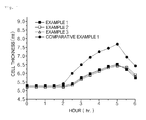
FIG. 1 is a graph illustrating a cell thickness change with respect to the storing time of batteries manufactured according to example embodiments of the present invention and a comparative example. -
FIG. 2 is a graph illustrating charge/discharge capacity with respect to charge/discharge cycle of batteries manufactured according to an example embodiment of the present and a comparative example. - There is provided in the present invention a lithium secondary battery comprising a positive electrode, a negative electrode, a separator inserted between the positive electrode and the negative electrode and a non-aqueous electrolyte.
- The positive electrode comprises a first positive electrode active material represented by the following Chemical Formula 1, and the non-aqueous electrolyte comprises a first lithium salt, a second lithium salt represented by the following Chemical Formula 2 and a non-aqueous organic solvent.
[Chemical Formula 1] LixMyOz
[Chemical Formula 2] Li+RCOO-
- (In
Chemical Formulae - In the lithium secondary battery of the present invention, The first positive electrode active material may be an active material of a three component system represented by Li1+x(NiaMnbCo1-a-b-x)O2 (0.1≤x≤0.1, 0≤a≤1, 0≤x+a+b≤1) or Li1+x(Mn2-x-yCoy)O4 (-0.1≤x≤0.1, 0≤y≤2).
- A cut diameter (D50) of the first positive electrode active material may be less than or equal to 8 µm and particularly may be 4 to 7 µm, and the particle type of the first positive electrode active material may have an agglomerated structure of minute particles. Particularly, the first positive electrode active material may have an agglomerated structure of 90% or more of minute particles having a size of 1 to 4 µm.
- In the secondary battery of the present invention, the positive electrode may further comprise a second positive electrode active material represented by the following Chemical Formula 3a or 3b.
[Chemical Formula 3a] LixM1 yOz,
- (In Chemical Formula 3a, M1 is Co, Ni or Mn, in which 0.5≤x≤1.3, 1<x+y≤3, and 2≤z≤4.)
[Chemical Formula 3b] LixM2 yOz,
- (In Chemical Formula 3b, M2=NiaMnbCoc, in which 0≤a≤2, 0≤b≤2, 0≤c≤2, a+b+c=1 or 2, 0.5≤x≤1.3, 1<x+y≤3, and 2≤z≤4.)
- Examples on the second positive electrode active material may comprise LixCo2O2 (0.5<x<1.3), LixNiO2 (0.5<x<1.3), LixMnO2 (0.5<x<1.3), LixMn2O4 (0.5<x<1.3), LixNi1-rCorO2 (0.5<x<1.3, 0<r<1), LixCo1-rMnrO2 (0.5<x<1.3, 0<r<1), LixNi1-rMnrO2 (0.5<x<1.3, 0<r<1), LixMn2-pNipO4 (0.5<x<1.3, 0<p<2) and LixMn2-pCopO4 (0.5<x<1.3, 0<p<2).
- The cut diameter (D50) of the second positive electrode active material may be greater than or equal to 15 µm and particularly may be 20 to 30 µm, and the second positive electrode active material may comprise monolithic phase particles.
- A relative weight ratio of the first positive electrode active material: the second positive electrode active material may be 10:90 to 50:50 and particularly may be 50:50 to 30:70. When the amount ratio of the first positive electrode active material is less than 10, the amount of the other metal component Co constituting the three component system may be increased, and cost reduction effect may be decreased. When the amount ratio of the first positive electrode active material exceeds 50, a gas may be generated when stored at a high temperature.
- The surfaces of the first positive electrode active material and the second positive electrode active material may be coated with a metal such as aluminum (Al) or a metal oxide by known methods.
- Meanwhile, in a mixed transition metal oxide layer (MO layer) in the first positive electrode active material, Ni2+ and Ni3+ coexist, and a portion of the Ni2+ may be inserted in an absorbing and desorbing layer (reversible lithium layer). Since the Ni2+ has a very similar size as the lithium ion (Li+), the inserted Ni2+ in the reversible lithium layer may not transform a crystalline structure while preventing the breaking of the crystalline structure due to the repulsive force of the transition metal oxide layer (MO layer) after the desorbing of the lithium ions during charging. Thus, an appropriate amount of the Ni2+ is preferably comprised so as to support a gap between the MO layers stably. In addition, in order to prevent velocity property deterioration, an appropriate amount of the Ni2+ is preferably comprised so as not to inhibit the reversible absorbing and desorbing of the lithium ions at the lithium layer. That is, when the molar fraction of the inserted Ni2+ in the reversible lithium layer is too high, the insertion of the Ni2+ may be increased to inhibit the charging and the discharging and to decrease a discharge capacity. Thus, the molar fraction of the Ni2+ inserted in the reversible lithium layer is 0.03 to 0.07 based on the total amount of Ni. When the molar fraction of the Ni2+ exceeds 0.07, the initial capacity of the battery may be decreased.
- In addition, in the secondary battery of the present invention, the positive electrode may further comprise a third positive electrode active material represented by the following Chemical Formula 4.
[Chemical Formula 4] LiNioM3 PO2
- (In
Chemical Formula 4, M3 is Co and Al, and 0.7≤o≤0.8, 0.2<P<0.3) - In addition, the lithium secondary battery may additionally comprise a sulfide, a selenide, a halide, and the like as the positive electrode active material of the secondary battery of the present invention besides the lithium-containing transition metal oxide such as the first to third positive electrode active materials.
- In addition, in the secondary battery of the present invention, the first lithium salt comprised in the non-aqueous electrolyte may comprise lithium salts commonly used in an electrolyte of a common lithium secondary battery without limitation, for example, Li+ cation and at least one anion selected from the group consisting of F-, Cl-, Br-, I-, NO3 -, N(CN)2 -, BF4 -, F2BO4 -, B(O4)2 -, ClO4 -, PF6 -, (CH3)2PF4 -, (CF3)3PF3 -, (CF3)4PF2 -, (CF3)5PF-, (CF3) 6P-, CF3SO3 -, CF3CF2SO3 -, (CF3SO2)2N-, (FO2)2N-, CF3CF2(CF3)2CO-, (CF3SO2)2CH-, (SF6)3C-, (CF3SO2)3C-, CF3(CF2)7SO3 -, SCN- and (CF3CF2SO2)2N-.
- The first lithium salt may be comprised in the non-aqueous electrolyte by about 10 wt%.
- In addition, the second lithium salt may comprise lithium acetate, lithium trifluoroacetate (LiCF3COO), lithium octanoate or a mixture thereof.
- The amount of the second lithium salt may be 0.01 to 2.0 wt%, particularly may be 0.05 to 0.5 wt%, based on the total amount of the non-aqueous electrolyte. When the amount of the second lithium salt is less than 0.01 wt%, the swelling restraining effect of the battery at a high temperature may be insufficient. When the amount exceeds 2.0 wt%, the conductivity of an electrolyte may be largely decreased due to the second lithium salt having a relatively small dissociation degree. At the same time, the initial capacity of the battery may be decreased due to the formation of a thick coating layer on the positive electrode by RCOO- anion.
- In the lithium secondary battery according to the present invention, the non-aqueous organic solvent comprised in the non-aqueous electrolyte may comprise any organic solvents commonly used as the electrolyte for a lithium secondary battery without limitation, and may typically comprise an ether compound, an ester compound, a linear carbonate compound, a cyclic carbonate compound, an amide compound and the like.
- Particularly, the ether compound may comprise at least one compound selected from the group consisting of dimethyl ether, diethyl ether, dipropyl ether, methyl ethyl ether, methyl propyl ether, and ethyl propyl ether.
- The ester compound may comprise at least one compound selected from the group consisting of methyl acetate, ethyl acetate, propyl acetate, methyl propionate, ethyl propionate, γ-butyrolactone, γ-valerolactone, γ-caprolactone, σ-valerolactone and ε-caprolactone.
- In addition, the linear carbonate compound may comprise at least one compound selected from the group consisting of diethyl carbonate, dimethyl carbonate, ethyl methyl carbonate, methyl propyl carbonate, and dipropyl carbonate.
- And the cyclic carbonate compound may comprise at least one compound selected from the group consisting of propylene carbonate, ethylene carbonate, 1,2-butylene carbonate, 2,3-butylene carbonate, 1,2-pentylene carbonate, 2,3-pentylene carbonate, vinylene carbonate and a halogenated compound thereof.
- Particularly, the organic solvent used in the electrolyte for the lithium secondary battery of the present invention may comprise the linear carbonate and the cyclic carbonate, or a mixture thereof. More particularly, the organic solvent used in the electrolyte for the lithium secondary battery of the present invention, may comprise the cyclic carbonate such as ethylene carbonate and propylene carbonate, which has a high viscosity and a high dielectric constant and dissociates the lithium salt in the electrolyte very well, or may comprise both the cyclic carbonate and the linear carbonate such as dimethyl carbonate and diethyl carbonate, which has a low viscosity and a low dielectric constant at an appropriate mixing ratio to prepare an electrolyte having a high electric conductivity.
- The non-aqueous organic solvent may further comprise at least one compound selected from the group consisting of vinylene carbonate, dimethyl sulfoxide, acetonitrile, dimethoxyethane, diethoxyethane, sulfolane, propylene sulfite and tetrahydrofuran.
- In addition, the non-aqueous electrolyte of the present invention may further comprise an additive capable of forming a passivation layer on the surface of the negative electrode. Examples of the additive may comprise a carbonate compound such as fluoroethylene carbonate, vinylethylene carbonate, and the like; a sulfur (S)-based compound such as propane sultone, ethylene sulfite, and 1,3-propane sultone; or a lactam compound such as N-acetyl lactam.
- The organic solvent used in a non-aqueous electrolyte of a common lithium secondary battery may be oxidized and decomposed at the surface of a positive electrode through the repetition of charging and discharging. Particularly, when a lithium transition metal oxide is used as the positive electrode active material, the oxidation and decomposition reaction of the organic solvent by the transition metal at a high temperature may be accelerated. In this case, the transform of the battery and the ignition or explosion of the battery may be induced.
- By additionally comprising a second lithium salt capable of easily forming a complex at the surface of the positive electrode comprising lithium-transition metal oxide in the non-aqueous electrolyte, the transform and the explosion of the battery while storing at a high temperature may be prevented. Particularly, the anion of the second lithium salt of the present invention, RCOO- illustrates a bonding energy with the transition metal component of the positive electrode active material (Mn, Ni, Co) of four times or over in the non-aqueous electrolyte having a dielectricity (ε) of about 20 to 30 when compared with the first lithium salt Li+PF6 - (see Table 1). Thus, the non-aqueous electrolyte comprising the second lithium salt of the present invention may form a complex at the surface of the positive electrode comprising the lithium transition metal oxide more easily than the non-aqueous electrolyte comprising the first lithium salt alone. Accordingly, the transition metal comprised in the positive electrode active material may be deactivated, and the oxidation reaction of the electrolyte may be prevented. As the result, the generation of a gas in a battery while storing at a high temperature may be prevented, and the inner short or the explosion of the battery due to the deformation of the battery (the swelling phenomenon of the battery) may be improved.
- Meanwhile, the negative electrode comprising the negative electrode active material and the separator constituting the lithium secondary battery of the present invention may employ commonly used ones for the manufacture of the lithium secondary battery.
- Particularly, the negative electrode active material may comprise a carbon material, a lithium metal, silicon, tin or a metal oxide, which may commonly conduct the absorbing and the desorbing of lithium ions, and may also comprise a metal oxide such as TiO2, SnO2, etc. having a potential of 2V or less with respect to lithium. In this case, the carbon material may comprise at least one carbon having a low crystallinity selected from soft carbon and hard carbon, or at least one carbon having a high crystallinity selected from the group consisting of natural graphite, kish graphite, pyrolytic carbon, a mesophase pitch based carbon fiber, meso-carbon microbeads, mesophase pitches and petroleum or coal tar pitch derived cokes.
- In addition, the positive electrode and the negative electrode may further use a binder polymer. Typical examples of the binder polymer comprise at least one selected from the group consisting of a vinylidene fluoride-hexafluoropropylene copolymer (PVDF-co-HFP), polyvinylidene fluoride, polyacrylonitrile, and polymethyl methacrylate.
- In addition, in the lithium secondary battery according to the present invention, the separator may be formed by a commonly used porous polymer film as the separator, for example, a porous polymer film manufactured by using a polyolefin polymer selected from the group consisting of ethylene homopolymer, propylene homopolymer, ethylene/butene copolymer, ethylene/hexene copolymer and ethylene/methacrylate copolymer, alone or a laminated type; or by using a porous non-woven fabric formed by using a high melting point glass fiber and a polyethylene terephthalate fiber, without limitation.
- The external shape of the lithium secondary battery according to the present invention is not limited to any shapes and may comprise a cylindrical shape using a can, a polygonal shape, a pouch shape or a coin shape.
- According to example embodiments, a lithium secondary battery comprises a positive electrode comprising a positive electrode active material of a three component system and a non-aqueous electrolyte comprising an additive capable of deactivating a transition metal, thereby providing a swelling restraining phenomenon and an improved cycle lifetime.
- Reference will now be made in detail to the preferred embodiments of the present invention. Although the preferred embodiments of the present invention have been disclosed for illustrative purpose, those skilled in the art will appreciate that various modifications, additions and substitutions can be made without departing from the scope and spirit of the invention as defined in the accompanying claims.
- Under an Ar atmosphere, into 100 g of a 0.8M first lithium salt (LiPF6) electrolyte having a composition of ethylene carbonate: propylene carbonate: diethyl carbonate (3:2:5 by weight), 1 g of vinylene carbonate (VC), 1 g of vinyl ethylene carbonate (VEC), 2.0 g of fluoroethylene carbonate (FEC) and 0.1 g of lithium trifluoroacetate as a second lithium salt, were added to prepare a non-aqueous electrolyte (1) according to the present invention.
- A positive electrode active material slurry was prepared by mixing LiNi0.53Co0.2Mn0.27O2 (D50 is 5 to 8 µm), which is an agglomerated body of minute particles of 1 to 2 µm, as a first positive electrode active material, and LiCoO2 (D50 is 15 to 20 µm) having a monolithic phase structure, as a second positive electrode active material, by the weight ratio of 30:70. The obtained slurry was coated on an aluminum plate, dried and rolled to manufacture a positive electrode.
- In addition, a natural graphite, a styrene-butadiene rubber as a binder and carboxymethyl cellulose as a viscosity increasing agent were mixed by the weight ratio of 96:2:2 and dispersed in water to prepare a negative electrode slurry. The obtained slurry was coated on a copper foil having a thickness of 10 µm, dried and rolled to manufacture a negative electrode.
- A polymer battery was manufactured by using the thus manufactured positive electrode, and the negative electrode along with a porous separator by means of a common method. Then, the non-aqueous electrolyte of step (1) was injected to manufacture a battery according to the present invention.
- Under an Ar atmosphere, into 100 g of a 0.8M first lithium salt (LiPF6) electrolyte having a composition of ethylene carbonate: propylene carbonate: diethyl carbonate (3:2:5 by weight), 1 g of vinylene carbonate (VC), 1 g of vinyl ethylene carbonate (VEC), 2 g of fluoroethylene carbonate (FEC) and 0.5 g of lithium octanoate as a second lithium salt, were added to prepare a non-aqueous electrolyte (2) according to the present invention.
- A positive electrode active material slurry was prepared by mixing LiNi0.53Co0.2Mn0.27O2 (D50 is 5 to 8 µm), which is an agglomerated body of minute particles of 1 to 2 µm, as a first positive electrode active material, and LiCoO2 (D50 is 15 to 20 µm) having a monolithic phase structure, as a second positive electrode active material, by the weight ratio of 30:70. The obtained slurry was coated on an aluminum plate, dried and rolled to manufacture a positive electrode.
- In addition, a natural graphite, a styrene-butadiene rubber as a binder and carboxymethyl cellulose as a viscosity increasing agent were mixed by the weight ratio of 96:2:2 and dispersed in water to prepare a negative electrode slurry. The obtained slurry was coated on a copper foil having a thickness of 10 µm, dried and rolled to manufacture a negative electrode.
- A polymer battery was manufactured by using the thus manufactured positive electrode, and the negative electrode along with a porous separator by means of a common method. Then, the non-aqueous electrolyte of step (1) was injected to manufacture a battery according to the present invention.
- Under an Ar atmosphere, into 100 g of a 0.8M first lithium salt (LiPF6) electrolyte having a composition of ethylene carbonate: propylene carbonate: diethyl carbonate (3:2:5 by weight), 1 g of vinylene carbonate (VC), 1 g of vinyl ethylene carbonate (VEC), 2.0 g of fluoroethylene carbonate (FEC) and 0.1 g of lithium trifluoroacetate as a second lithium salt, were added to prepare a non-aqueous electrolyte (1) according to the present invention.
- A positive electrode active material slurry was prepared by mixing LiNi0.53Co0.2Mn0.27O2 (D50 is 5 to 8 µm), which is an agglomerated body of minute particles of 1 to 2 µm, as a first positive electrode active material, LiCoO2 (D50 is 15 to 20 µm) having a monolithic phase structure, as a second positive electrode active material, and LiNi0.8Co0.15Al0.05O2 (D50 is 10 to 15 µm) as a third positive electrode active material, by the weight ratio of 30:50:20. The obtained slurry was coated on an aluminum plate, dried and rolled to manufacture a positive electrode.
- In addition, a natural graphite, a styrene-butadiene rubber as a binder and carboxymethyl cellulose as a viscosity increasing agent were mixed by the weight ratio of 96:2:2 and dispersed in water to prepare a negative electrode slurry. The obtained slurry was coated on a copper foil having a thickness of 10 µm, dried and rolled to manufacture a negative electrode.
- A polymer battery was manufactured by using the thus manufactured positive electrode, and the negative electrode along with a porous separator by means of a common method. Then, the non-aqueous electrolyte of step (1) was injected to manufacture a battery according to the present invention.
- Under an Ar atmosphere, into 100 g of a 0.8M first lithium salt (LiPF6) electrolyte having a composition of ethylene carbonate: propylene carbonate: diethyl carbonate (3:2:5 by weight), 1 g of vinylene carbonate (VC), 1 g of vinyl ethylene carbonate (VEC), and 2 g of fluoroethylene carbonate (FEC) were added to prepare a non-aqueous electrolyte.
- A positive electrode active material slurry was prepared by mixing LiNi0.53Co0.2Mn0.27O2 (D50 is 5 to 8 µm), which is an agglomerated body of minute particles of 1 to 2 µm, as a first positive electrode active material, and LiCoO2 (D50 is 15 to 20 µm) having a monolithic phase structure, as a second positive electrode active material, by the weight ratio of 30:70. The thus obtained slurry was coated on an aluminum plate, dried and rolled to manufacture a positive electrode.
- In addition, a natural graphite, a styrene-butadiene rubber as a binder and carboxymethyl cellulose as a viscosity increasing agent were mixed by the weight ratio of 96:2:2 and dispersed in water to prepare a negative electrode slurry. The obtained slurry was coated on a copper foil having a thickness of 10 µm, dried and rolled to manufacture a negative electrode.
- A polymer battery was manufactured by using the thus manufactured positive electrode, and the negative electrode along with a porous separator by means of a common method. Then, the non-aqueous electrolyte was injected to manufacture a battery.
- Bonding energy between each metal constituting a three component system with first and second lithium salts was obtained by Quantum chemical calculation at an electrolyte dielectricity of ε=30, is illustrated in the following Table 1.
Table 1 Metal Lithium salt Mn Co Ni 
- 5.82 6.20 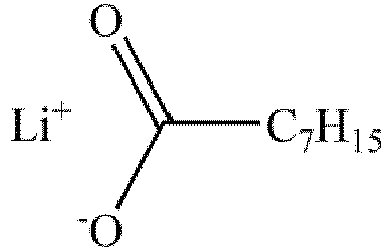
- 5.78 6.17 
3.45 4.73 5.00 Li+PF6 - 1.75 1.43 1.91 - As illustrated in Table 1, the anion, RCOO- of the second lithium salt has a greater bonding energy with respect to the transition metal components of the positive electrode active material, Mn, Ni, and Co, by four times when compared with the anion, PF6 - of the first lithium salt.
- The thickness change (the swelling degree of battery) with respect to time was measured for the batteries manufactured according to Examples 1 to 3 and Comparative Example 1 under a high temperature and high voltage condition as follows.
- Particularly, the test was conducted as follows. Each of the batteries was charged by 4.20 V, heated to 90°C at a temperature increasing rate of 1°C/min, stored at 90°C for four hours, and cooled to room temperature for 1 hour. In the test, the swelling degree of the battery was illustrated by a maximum thickness change (ΔT) with respect to an initial thickness (see the following Table 2 and
FIG. 1 ).Table 2 Amount of second lithium salt (wt%) Thickness change (Δ T/mm) Example 1 0.1 0.249 Example 2 0.5 0.239 Example 3 0.1 0.241 Comparative Example 1 0 2.448 - As illustrated in Table 2, the batteries comprising the electrolyte comprising the second lithium salt according to Examples 1 to 3 were confirmed to illustrate not much thickness change (that is, the swelling degree of battery) even though stored at a high temperature for a long time when compared with the battery of Comparative Example 1.
- The charge/discharge cycle lifetimes of the batteries manufactured according to Examples 1 to 3 and Comparative Example 1 were measured at 45°C with a voltage range of 3.0 to 4.2 V. The charge/discharge capacity maintaining ratios with respect to an initial capacity are illustrated in the following Table 3 and
FIG. 2 .Table 3 Capacity maintaining ratio (%) Cycle number Example 1 90.9 300 Example 2 89.8 300 Example 3 90.1 300 Comparative Example 1 88.7 300 - As illustrated in Table 3, the battery comprising the electrolyte comprising the second lithium salt according to the present invention has an improving effect of charge/discharge lifetime (capacity maintaining ratio) at a high temperature.
Claims (22)
- A lithium secondary battery comprising a positive electrode, a negative electrode, a separator inserted between the positive electrode and the negative electrode, and a non-aqueous electrolyte,
wherein the positive electrode comprises a first positive electrode active material represented by following Chemical Formula 1, and
the non-aqueous electrolyte comprises a first lithium salt, a second lithium salt represented by following Chemical Formula 2 and a non-aqueous organic solvent,
[Chemical Formula 1] LixMyOz
[Chemical Formula 2] Li+RCOO-
in Chemical Formulae 1 and 2, M=NiaMnbCOc, in which 0<a<2, 0<b<2, 0<c<2, a+b+c=1 or 2, 0.5≤x≤1.3, 1<x+y≤3.3, 2≤z≤4, and R is independently a C1-C10 alkyl group, a C6-C12 aryl group, a C2-C5 alkenyl group, a halogen substituted C1-C10 alkyl group, a halogen substituted C6-C12 aryl group or a halogen substituted C2-C5 alkenyl group. - The lithium secondary battery of claim 1, wherein the first positive electrode active material is represented by Li1+x(NiaMnbCo1-a-b-x)O2 (-0.1≤x≤0.1, 0≤a≤1, 0≤x+a+b≤1) or Li1+x(Mn2-x-yCoy)O4 (-0.1≤x≤0.1, 0≤y≤2).
- The lithium secondary battery of claim 1, wherein a cut diameter (D50) of the first positive electrode active material is less than or equal to 8 µm, and the first positive electrode active material has an agglomerated structure of minute particles.
- The lithium secondary battery of claim 3, wherein the cut diameter (D50) of the first positive electrode active material is 4 to 7 µm.
- The lithium secondary battery of claim 1, wherein the positive electrode further comprises a second positive electrode active material represented by following Chemical Formula 3a or 3b,
[Chemical Formula 3a] LixM1 yOz
in Chemical Formula 3a, M1 is Co, Ni or Mn, in which 0.5≤x≤1.3, 1<x+y≤3, and 2≤z≤4.)
[Chemical Formula 3b] LixM2 yOz
in Chemical Formula 3b, M2=NiaMnbCoc, in which 0≤a≤2, 0≤b≤2, 0≤c≤2, a+b+c=1 or 2, 0.5≤x≤1.3, 1<x+y≤3, and 2≤z≤4. - The lithium secondary battery of claim 5, wherein the second positive electrode active material is selected from the group consisting of LixCo2O2 (0.5<x<1.3), LixNiO2 (0.5<x<1.3), LixMnO2 (0.5<x<1.3), LixMn2O4 (0.5<x<1.3), LixNi1-rCorO2 (0.5<x<1.3, 0<r<1), LixCo1-rMnrO2 (0.5<x<1.3, 0<r<1), LixNi1-rMnrO2 (0.5<x<1.3, 0<r<1), LixMn2-pNipO4 (0.5<x<1.3, 0<p<2) and LixMn2-pCopO4 (0.5<x<1.3, 0<p<2).
- The lithium secondary battery of claim 5, wherein the cut diameter (D50) of the second positive electrode active material is greater than or equal to 15 µm, and the second positive electrode active material comprises monolithic phase particles.
- The lithium secondary battery of claim 7, wherein the cut diameter (D50) of the second positive electrode active material is 20 to 30 µm.
- The lithium secondary battery of claim 1 or 5, wherein a relative weight ratio of the first positive electrode active material: the second positive electrode active material is 10:90 to 50:50.
- The lithium secondary battery of claim 1 or 5, wherein surfaces of the first positive electrode active material and the second positive electrode active material are coated with a metal or a metal oxide.
- The lithium secondary battery of claim 1 or 5, wherein the positive electrode further comprises a third positive electrode active material represented by following Chemical Formula 4,
[Chemical Formula 4] LiNioM3 PO2
in Chemical Formula 4, M3 is Co and Al, and 0.7≤o≤0.8, 0.2<P<0.3. - The lithium secondary battery of claim 1, wherein the first lithium salt comprises Li+ cation and at least one anion selected from the group consisting of F-, Cl-, Br-, I-, NO3 -, N(CN)2 -, BF4 -, F2BO4 -, B(O4)2 -, ClO4 -, PF6 -, (CH3)2PF4 -, (CF3)3PF3 -, (CF3)4PF2 -, (CF3)5PF-, (CF3)6P-, CF3SO3 -, CF3CF2SO3 -, (CF3SO2)2N-, (FO2)2N-, CF3CF2(CF3)2CO-, (CF3SO2)2CH-, (SF6)3C-, (CF3SO2)3C-, CF3(CF2)7SO3 -, SCN- and (CF3CF2SO2)2N-.
- The lithium secondary battery of claim 1, wherein the second lithium salt comprises lithium acetate, lithium trifluoroacetate (LiCF3COO), lithium octanoate or a mixture thereof.
- The lithium secondary battery of claim 1, wherein an amount of the second lithium salt is 0.01 to 2.0 wt% based on a total amount of the non-aqueous electrolyte.
- The lithium secondary battery of claim 14, wherein the amount of the second lithium salt is 0.05 to 0.5 wt% based on the total amount of the non-aqueous electrolyte.
- The lithium secondary battery of claim 1, wherein the non-aqueous organic solvent comprises at least one organic solvent selected from the group consisting of an ether compound, an ester compound, a linear carbonate compound, a cyclic carbonate compound and an amide compound.
- The lithium secondary battery of claim 16, wherein the non-aqueous organic solvent further comprises at least one compound selected from the group consisting of dimethyl sulfoxide, acetonitrile, dimethoxyethane, diethoxyethane, sulfolane, propylene sulfite and tetrahydrofuran.
- The lithium secondary battery of claim 1, wherein the non-aqueous electrolyte further comprises at least one additive selected from the group consisting of vinylene carbonate, fluoroethylene carbonate, vinylethylene carbonate, propane sultone, ethylene sulfite, 1,3-propane sultone and N-acetyl lactam.
- The lithium secondary battery of claim 1, wherein the negative electrode comprises at least one negative electrode active material selected from the group consisting of a carbon material, a lithium metal, silicon, tin and a metal oxide.
- The lithium secondary battery of claim 1, wherein the positive electrode and the negative electrode further comprise at least one binder compound selected from the group consisting of a vinylidene fluoride-hexafluoropropylene copolymer, polyvinylidene fluoride, polyacrylonitrile, and polymethyl methacrylate.
- The lithium secondary battery of claim 1, wherein the separator is formed by using a polyolefin polymer selected from the group consisting of ethylene homopolymer, propylene homopolymer, ethylene/butene copolymer, ethylene/hexene copolymer and ethylene/methacrylate copolymer; or by using a porous non-woven fabric selected from a high melting point glass fiber and a polyethylene terephthalate fiber.
- The lithium secondary battery of claim 1, wherein the lithium secondary battery described in claim 1 has a cylindrical shape, a polygonal shape, a pouch shape or a coin shape.
Applications Claiming Priority (2)
| Application Number | Priority Date | Filing Date | Title |
|---|---|---|---|
| KR20120058783 | 2012-05-31 | ||
| PCT/KR2013/004829 WO2013180522A1 (en) | 2012-05-31 | 2013-05-31 | Lithium secondary battery |
Publications (3)
| Publication Number | Publication Date |
|---|---|
| EP2750235A1 true EP2750235A1 (en) | 2014-07-02 |
| EP2750235A4 EP2750235A4 (en) | 2014-07-30 |
| EP2750235B1 EP2750235B1 (en) | 2016-07-27 |
Family
ID=49673642
Family Applications (1)
| Application Number | Title | Priority Date | Filing Date |
|---|---|---|---|
| EP13797731.0A Active EP2750235B1 (en) | 2012-05-31 | 2013-05-31 | Lithium secondary battery |
Country Status (5)
| Country | Link |
|---|---|
| US (1) | US9287559B2 (en) |
| EP (1) | EP2750235B1 (en) |
| KR (1) | KR101557549B1 (en) |
| CN (1) | CN103907235B (en) |
| WO (1) | WO2013180522A1 (en) |
Families Citing this family (11)
| Publication number | Priority date | Publication date | Assignee | Title |
|---|---|---|---|---|
| KR102400921B1 (en) | 2017-12-22 | 2022-05-20 | 유미코아 | Positive electrode material for rechargeable lithium-ion battery and method for manufacturing same |
| KR102521605B1 (en) * | 2018-03-02 | 2023-04-12 | 유미코아 | Cathode Materials for Rechargeable Lithium Ion Batteries |
| PL3774661T3 (en) | 2018-03-29 | 2022-09-19 | Umicore | Methods for preparing positive electrode material for rechargeable lithium ion batteries |
| CN113678286B (en) * | 2019-03-07 | 2024-10-15 | 株式会社Lg新能源 | Lithium secondary battery |
| CN109921024B (en) * | 2019-03-12 | 2020-12-29 | 北京科技大学 | A kind of flexible solid-state lithium ion conductor applied to battery and preparation method thereof |
| US12255288B2 (en) * | 2019-03-29 | 2025-03-18 | Mitsui Chemicals, Inc. | Nonaqueous electrolytic solution for battery and lithium secondary battery |
| KR102752642B1 (en) * | 2019-09-11 | 2025-01-10 | 주식회사 엘지에너지솔루션 | Positive electrode material for secondary battery and lithium secondary battery comprising the same |
| KR102465197B1 (en) | 2019-09-13 | 2022-11-10 | 아사히 가세이 가부시키가이샤 | Non-aqueous electrolyte and non-aqueous secondary battery |
| US12261263B2 (en) * | 2021-07-21 | 2025-03-25 | Lg Energy Solution, Ltd. | Lithium secondary battery |
| US20260058205A1 (en) * | 2022-08-19 | 2026-02-26 | Board Of Regents, The University Of Texas System | Tuning the solvation structure through salts for stable batteries |
| US20260106147A1 (en) * | 2024-10-15 | 2026-04-16 | Samsung Sdi Co., Ltd. | Positive electrode active materials, positive electrodes, and rechargeable lithium batteries |
Family Cites Families (18)
| Publication number | Priority date | Publication date | Assignee | Title |
|---|---|---|---|---|
| JP2001332304A (en) * | 2000-05-24 | 2001-11-30 | Sony Corp | Electrolyte and cell using the same |
| JP2002313327A (en) * | 2001-04-12 | 2002-10-25 | Nisshinbo Ind Inc | Pressurizing method of electrode structure |
| JP2003187863A (en) * | 2001-12-19 | 2003-07-04 | Hitachi Maxell Ltd | Organic electrolyte secondary battery |
| JP4288402B2 (en) * | 2002-06-18 | 2009-07-01 | 日本電気株式会社 | Secondary battery electrolyte, secondary battery, and method of using secondary battery |
| JP4273422B2 (en) * | 2005-03-09 | 2009-06-03 | ソニー株式会社 | Positive electrode material and battery |
| CN113594543A (en) * | 2005-10-20 | 2021-11-02 | 三菱化学株式会社 | Lithium secondary battery and nonaqueous electrolyte used therein |
| JP5514394B2 (en) * | 2005-10-28 | 2014-06-04 | 三菱化学株式会社 | Non-aqueous electrolyte for secondary battery and non-aqueous electrolyte secondary battery using the same |
| KR100790834B1 (en) | 2006-05-10 | 2008-01-03 | 주식회사 엘지화학 | High Performance Lithium Secondary Battery Material |
| GB0615870D0 (en) | 2006-08-10 | 2006-09-20 | Oxis Energy Ltd | An electrolyte for batteries with a metal lithium electrode |
| KR100998684B1 (en) * | 2008-06-09 | 2010-12-07 | 주식회사 엘지화학 | Secondary battery with improved safety |
| KR101050333B1 (en) | 2008-07-07 | 2011-07-19 | 삼성에스디아이 주식회사 | Lithium secondary battery |
| JP4659861B2 (en) * | 2008-07-09 | 2011-03-30 | シャープ株式会社 | Flat secondary battery and manufacturing method thereof |
| WO2010101395A2 (en) * | 2009-03-03 | 2010-09-10 | 주식회사 엘지화학 | Lithium secondary battery containing high energy density positive electrode materials and an organic/inorganic composite microporous separator membrane |
| US8999576B2 (en) * | 2009-05-22 | 2015-04-07 | Sharp Kabushiki Kaisha | Cathode active material, cathode and nonaqueous secondary battery |
| JP5678539B2 (en) * | 2009-09-29 | 2015-03-04 | 三菱化学株式会社 | Non-aqueous electrolyte battery |
| JP5412298B2 (en) * | 2010-01-12 | 2014-02-12 | 株式会社日立製作所 | Positive electrode material for lithium ion secondary battery and lithium ion secondary battery using the same |
| KR101412899B1 (en) * | 2010-02-12 | 2014-06-26 | 미쓰비시 가가꾸 가부시키가이샤 | Nonaqueous electrolyte solution, and nonaqueous electrolyte secondary battery |
| WO2012021029A2 (en) | 2010-08-13 | 2012-02-16 | 주식회사 엘지화학 | Non-aqueous electrolyte solution for a lithium secondary battery, and lithium secondary battery comprising same |
-
2013
- 2013-05-31 KR KR1020130062981A patent/KR101557549B1/en active Active
- 2013-05-31 EP EP13797731.0A patent/EP2750235B1/en active Active
- 2013-05-31 CN CN201380003681.0A patent/CN103907235B/en active Active
- 2013-05-31 WO PCT/KR2013/004829 patent/WO2013180522A1/en not_active Ceased
- 2013-09-13 US US14/026,020 patent/US9287559B2/en active Active
Also Published As
| Publication number | Publication date |
|---|---|
| US20140030588A1 (en) | 2014-01-30 |
| EP2750235A4 (en) | 2014-07-30 |
| CN103907235A (en) | 2014-07-02 |
| CN103907235B (en) | 2017-03-29 |
| WO2013180522A1 (en) | 2013-12-05 |
| KR20130135172A (en) | 2013-12-10 |
| US9287559B2 (en) | 2016-03-15 |
| EP2750235B1 (en) | 2016-07-27 |
| KR101557549B1 (en) | 2015-10-07 |
Similar Documents
| Publication | Publication Date | Title |
|---|---|---|
| EP2750235B1 (en) | Lithium secondary battery | |
| EP2683015B1 (en) | Non-aqueous electrolyte for lithium secondary battery and lithium secondary battery containing same | |
| KR101511733B1 (en) | Non-aqueous electrolyte solution for lithium secondary battery and lithium secondary battery comprising the same | |
| EP2605324B1 (en) | Non-aqueous electrolyte solution for a lithium secondary battery, and lithium secondary battery comprising same | |
| KR101437073B1 (en) | Non-aqueous electrolyte solution for lithium secondary battery and lithium secondary battery comprising the same | |
| EP2424029B1 (en) | Non-aqueous electrolyte for rechargeable lithium batteries and a rechargeable lithium battery comprising the same | |
| CN112204773B (en) | Lithium secondary battery | |
| KR101249350B1 (en) | Nonaqueous electrolyte and lithium secondary battery using the same | |
| KR101538485B1 (en) | Non-aqueous electrolyte solution for lithium secondary battery and lithium secondary battery comprising the same | |
| KR101387603B1 (en) | Nonaqueous electrolyte and lithium secondary battery using the same | |
| KR102109833B1 (en) | Non-aqueous electrolyte for lithium secondary battery, and lithium secondary battery comprising the same | |
| EP2899792A1 (en) | Lithium secondary battery | |
| KR101565533B1 (en) | Non-aqueous electrolyte solution for lithium secondary battery and lithium secondary battery comprising the same | |
| KR102501252B1 (en) | Non-aqueous electrolyte for lithium secondary battery and lithium secondary battery comprising the same | |
| KR20210059232A (en) | Non-aqueous electrolyte and lithium secondary battery comprising the same | |
| KR102601700B1 (en) | Nonaqueous electrolyte for lithium secondary battery and lithium secondary battery comprising the same | |
| KR20120079390A (en) | Non-aqueous electrolyte solution for lithium secondary battery and lithium secondary battery comprising the same | |
| EP4379890B1 (en) | Lithium secondary battery | |
| CA3233092A1 (en) | Non-aqueous electrolyte solution for lithium secondary battery, and lithium secondary battery including the same | |
| KR20130137935A (en) | Non-aqueous electrolyte solution for lithium secondary battery and lithium secondary battery comprising the same | |
| KR101185535B1 (en) | Lithium secondary battery | |
| CN116941089B (en) | Nonaqueous electrolyte and lithium secondary battery comprising same | |
| EP4095971A1 (en) | Nonaqueous electrolytic solution for lithium secondary battery, and lithium secondary battery comprising same | |
| KR20260039590A (en) | Positive electrode slurry composition, positive electrode and lithium secondary battery comprising the same | |
| CN118020189A (en) | Non-aqueous electrolyte for lithium secondary battery and lithium secondary battery containing the same |
Legal Events
| Date | Code | Title | Description |
|---|---|---|---|
| PUAI | Public reference made under article 153(3) epc to a published international application that has entered the european phase |
Free format text: ORIGINAL CODE: 0009012 |
|
| 17P | Request for examination filed |
Effective date: 20140326 |
|
| AK | Designated contracting states |
Kind code of ref document: A1 Designated state(s): AL AT BE BG CH CY CZ DE DK EE ES FI FR GB GR HR HU IE IS IT LI LT LU LV MC MK MT NL NO PL PT RO RS SE SI SK SM TR |
|
| A4 | Supplementary search report drawn up and despatched |
Effective date: 20140626 |
|
| RIC1 | Information provided on ipc code assigned before grant |
Ipc: H01M 10/42 20060101ALI20140620BHEP Ipc: H01M 10/0568 20100101ALI20140620BHEP Ipc: H01M 4/525 20100101ALI20140620BHEP Ipc: H01M 10/052 20100101AFI20140620BHEP Ipc: H01M 10/0569 20100101ALI20140620BHEP Ipc: H01M 4/36 20060101ALI20140620BHEP |
|
| 17Q | First examination report despatched |
Effective date: 20150416 |
|
| DAX | Request for extension of the european patent (deleted) | ||
| GRAP | Despatch of communication of intention to grant a patent |
Free format text: ORIGINAL CODE: EPIDOSNIGR1 |
|
| RIC1 | Information provided on ipc code assigned before grant |
Ipc: H01M 4/131 20100101AFI20160113BHEP Ipc: H01M 10/0567 20100101ALI20160113BHEP Ipc: H01M 4/525 20100101ALI20160113BHEP Ipc: H01M 10/42 20060101ALI20160113BHEP Ipc: H01M 10/0568 20100101ALI20160113BHEP Ipc: H01M 4/02 20060101ALN20160113BHEP Ipc: H01M 4/505 20100101ALI20160113BHEP Ipc: H01M 4/485 20100101ALI20160113BHEP |
|
| INTG | Intention to grant announced |
Effective date: 20160129 |
|
| GRAS | Grant fee paid |
Free format text: ORIGINAL CODE: EPIDOSNIGR3 |
|
| GRAP | Despatch of communication of intention to grant a patent |
Free format text: ORIGINAL CODE: EPIDOSNIGR1 |
|
| RIC1 | Information provided on ipc code assigned before grant |
Ipc: H01M 4/505 20100101ALI20160404BHEP Ipc: H01M 4/525 20100101ALI20160404BHEP Ipc: H01M 4/485 20100101ALI20160404BHEP Ipc: H01M 10/42 20060101ALI20160404BHEP Ipc: H01M 10/0567 20100101ALI20160404BHEP Ipc: H01M 4/131 20100101AFI20160404BHEP Ipc: H01M 4/02 20060101ALN20160404BHEP Ipc: H01M 10/0568 20100101ALI20160404BHEP |
|
| GRAS | Grant fee paid |
Free format text: ORIGINAL CODE: EPIDOSNIGR3 |
|
| INTG | Intention to grant announced |
Effective date: 20160511 |
|
| GRAJ | Information related to disapproval of communication of intention to grant by the applicant or resumption of examination proceedings by the epo deleted |
Free format text: ORIGINAL CODE: EPIDOSDIGR1 |
|
| GRAP | Despatch of communication of intention to grant a patent |
Free format text: ORIGINAL CODE: EPIDOSNIGR1 |
|
| REG | Reference to a national code |
Ref country code: DE Ref legal event code: R079 Ref document number: 602013009962 Country of ref document: DE Free format text: PREVIOUS MAIN CLASS: H01M0010052000 Ipc: H01M0004131000 |
|
| GRAJ | Information related to disapproval of communication of intention to grant by the applicant or resumption of examination proceedings by the epo deleted |
Free format text: ORIGINAL CODE: EPIDOSDIGR1 |
|
| GRAL | Information related to payment of fee for publishing/printing deleted |
Free format text: ORIGINAL CODE: EPIDOSDIGR3 |
|
| GRAR | Information related to intention to grant a patent recorded |
Free format text: ORIGINAL CODE: EPIDOSNIGR71 |
|
| GRAA | (expected) grant |
Free format text: ORIGINAL CODE: 0009210 |
|
| INTG | Intention to grant announced |
Effective date: 20160616 |
|
| RIC1 | Information provided on ipc code assigned before grant |
Ipc: H01M 4/131 20100101AFI20160616BHEP Ipc: H01M 4/485 20100101ALI20160616BHEP Ipc: H01M 4/505 20100101ALI20160616BHEP Ipc: H01M 4/02 20060101ALN20160616BHEP Ipc: H01M 10/0567 20100101ALI20160616BHEP Ipc: H01M 10/0568 20100101ALI20160616BHEP Ipc: H01M 10/42 20060101ALI20160616BHEP Ipc: H01M 4/525 20100101ALI20160616BHEP |
|
| AK | Designated contracting states |
Kind code of ref document: B1 Designated state(s): AL AT BE BG CH CY CZ DE DK EE ES FI FR GB GR HR HU IE IS IT LI LT LU LV MC MK MT NL NO PL PT RO RS SE SI SK SM TR |
|
| REG | Reference to a national code |
Ref country code: GB Ref legal event code: FG4D |
|
| REG | Reference to a national code |
Ref country code: CH Ref legal event code: EP |
|
| REG | Reference to a national code |
Ref country code: AT Ref legal event code: REF Ref document number: 816434 Country of ref document: AT Kind code of ref document: T Effective date: 20160815 |
|
| REG | Reference to a national code |
Ref country code: IE Ref legal event code: FG4D |
|
| REG | Reference to a national code |
Ref country code: DE Ref legal event code: R096 Ref document number: 602013009962 Country of ref document: DE |
|
| REG | Reference to a national code |
Ref country code: LT Ref legal event code: MG4D |
|
| REG | Reference to a national code |
Ref country code: NL Ref legal event code: MP Effective date: 20160727 |
|
| REG | Reference to a national code |
Ref country code: AT Ref legal event code: MK05 Ref document number: 816434 Country of ref document: AT Kind code of ref document: T Effective date: 20160727 |
|
| PG25 | Lapsed in a contracting state [announced via postgrant information from national office to epo] |
Ref country code: NL Free format text: LAPSE BECAUSE OF FAILURE TO SUBMIT A TRANSLATION OF THE DESCRIPTION OR TO PAY THE FEE WITHIN THE PRESCRIBED TIME-LIMIT Effective date: 20160727 Ref country code: IS Free format text: LAPSE BECAUSE OF FAILURE TO SUBMIT A TRANSLATION OF THE DESCRIPTION OR TO PAY THE FEE WITHIN THE PRESCRIBED TIME-LIMIT Effective date: 20161127 Ref country code: IT Free format text: LAPSE BECAUSE OF FAILURE TO SUBMIT A TRANSLATION OF THE DESCRIPTION OR TO PAY THE FEE WITHIN THE PRESCRIBED TIME-LIMIT Effective date: 20160727 Ref country code: RS Free format text: LAPSE BECAUSE OF FAILURE TO SUBMIT A TRANSLATION OF THE DESCRIPTION OR TO PAY THE FEE WITHIN THE PRESCRIBED TIME-LIMIT Effective date: 20160727 Ref country code: NO Free format text: LAPSE BECAUSE OF FAILURE TO SUBMIT A TRANSLATION OF THE DESCRIPTION OR TO PAY THE FEE WITHIN THE PRESCRIBED TIME-LIMIT Effective date: 20161027 Ref country code: HR Free format text: LAPSE BECAUSE OF FAILURE TO SUBMIT A TRANSLATION OF THE DESCRIPTION OR TO PAY THE FEE WITHIN THE PRESCRIBED TIME-LIMIT Effective date: 20160727 Ref country code: FI Free format text: LAPSE BECAUSE OF FAILURE TO SUBMIT A TRANSLATION OF THE DESCRIPTION OR TO PAY THE FEE WITHIN THE PRESCRIBED TIME-LIMIT Effective date: 20160727 Ref country code: LT Free format text: LAPSE BECAUSE OF FAILURE TO SUBMIT A TRANSLATION OF THE DESCRIPTION OR TO PAY THE FEE WITHIN THE PRESCRIBED TIME-LIMIT Effective date: 20160727 |
|
| PG25 | Lapsed in a contracting state [announced via postgrant information from national office to epo] |
Ref country code: BE Free format text: LAPSE BECAUSE OF FAILURE TO SUBMIT A TRANSLATION OF THE DESCRIPTION OR TO PAY THE FEE WITHIN THE PRESCRIBED TIME-LIMIT Effective date: 20160727 Ref country code: ES Free format text: LAPSE BECAUSE OF FAILURE TO SUBMIT A TRANSLATION OF THE DESCRIPTION OR TO PAY THE FEE WITHIN THE PRESCRIBED TIME-LIMIT Effective date: 20160727 Ref country code: PL Free format text: LAPSE BECAUSE OF FAILURE TO SUBMIT A TRANSLATION OF THE DESCRIPTION OR TO PAY THE FEE WITHIN THE PRESCRIBED TIME-LIMIT Effective date: 20160727 Ref country code: LV Free format text: LAPSE BECAUSE OF FAILURE TO SUBMIT A TRANSLATION OF THE DESCRIPTION OR TO PAY THE FEE WITHIN THE PRESCRIBED TIME-LIMIT Effective date: 20160727 Ref country code: GR Free format text: LAPSE BECAUSE OF FAILURE TO SUBMIT A TRANSLATION OF THE DESCRIPTION OR TO PAY THE FEE WITHIN THE PRESCRIBED TIME-LIMIT Effective date: 20161028 Ref country code: AT Free format text: LAPSE BECAUSE OF FAILURE TO SUBMIT A TRANSLATION OF THE DESCRIPTION OR TO PAY THE FEE WITHIN THE PRESCRIBED TIME-LIMIT Effective date: 20160727 Ref country code: PT Free format text: LAPSE BECAUSE OF FAILURE TO SUBMIT A TRANSLATION OF THE DESCRIPTION OR TO PAY THE FEE WITHIN THE PRESCRIBED TIME-LIMIT Effective date: 20161128 Ref country code: SE Free format text: LAPSE BECAUSE OF FAILURE TO SUBMIT A TRANSLATION OF THE DESCRIPTION OR TO PAY THE FEE WITHIN THE PRESCRIBED TIME-LIMIT Effective date: 20160727 |
|
| REG | Reference to a national code |
Ref country code: FR Ref legal event code: PLFP Year of fee payment: 5 |
|
| PG25 | Lapsed in a contracting state [announced via postgrant information from national office to epo] |
Ref country code: EE Free format text: LAPSE BECAUSE OF FAILURE TO SUBMIT A TRANSLATION OF THE DESCRIPTION OR TO PAY THE FEE WITHIN THE PRESCRIBED TIME-LIMIT Effective date: 20160727 Ref country code: RO Free format text: LAPSE BECAUSE OF FAILURE TO SUBMIT A TRANSLATION OF THE DESCRIPTION OR TO PAY THE FEE WITHIN THE PRESCRIBED TIME-LIMIT Effective date: 20160727 |
|
| REG | Reference to a national code |
Ref country code: DE Ref legal event code: R097 Ref document number: 602013009962 Country of ref document: DE |
|
| PG25 | Lapsed in a contracting state [announced via postgrant information from national office to epo] |
Ref country code: CZ Free format text: LAPSE BECAUSE OF FAILURE TO SUBMIT A TRANSLATION OF THE DESCRIPTION OR TO PAY THE FEE WITHIN THE PRESCRIBED TIME-LIMIT Effective date: 20160727 Ref country code: DK Free format text: LAPSE BECAUSE OF FAILURE TO SUBMIT A TRANSLATION OF THE DESCRIPTION OR TO PAY THE FEE WITHIN THE PRESCRIBED TIME-LIMIT Effective date: 20160727 Ref country code: BG Free format text: LAPSE BECAUSE OF FAILURE TO SUBMIT A TRANSLATION OF THE DESCRIPTION OR TO PAY THE FEE WITHIN THE PRESCRIBED TIME-LIMIT Effective date: 20161027 Ref country code: SK Free format text: LAPSE BECAUSE OF FAILURE TO SUBMIT A TRANSLATION OF THE DESCRIPTION OR TO PAY THE FEE WITHIN THE PRESCRIBED TIME-LIMIT Effective date: 20160727 Ref country code: SM Free format text: LAPSE BECAUSE OF FAILURE TO SUBMIT A TRANSLATION OF THE DESCRIPTION OR TO PAY THE FEE WITHIN THE PRESCRIBED TIME-LIMIT Effective date: 20160727 |
|
| PLBE | No opposition filed within time limit |
Free format text: ORIGINAL CODE: 0009261 |
|
| STAA | Information on the status of an ep patent application or granted ep patent |
Free format text: STATUS: NO OPPOSITION FILED WITHIN TIME LIMIT |
|
| 26N | No opposition filed |
Effective date: 20170502 |
|
| PG25 | Lapsed in a contracting state [announced via postgrant information from national office to epo] |
Ref country code: LU Free format text: LAPSE BECAUSE OF NON-PAYMENT OF DUE FEES Effective date: 20170531 Ref country code: SI Free format text: LAPSE BECAUSE OF FAILURE TO SUBMIT A TRANSLATION OF THE DESCRIPTION OR TO PAY THE FEE WITHIN THE PRESCRIBED TIME-LIMIT Effective date: 20160727 |
|
| REG | Reference to a national code |
Ref country code: CH Ref legal event code: PL |
|
| PG25 | Lapsed in a contracting state [announced via postgrant information from national office to epo] |
Ref country code: MC Free format text: LAPSE BECAUSE OF FAILURE TO SUBMIT A TRANSLATION OF THE DESCRIPTION OR TO PAY THE FEE WITHIN THE PRESCRIBED TIME-LIMIT Effective date: 20160727 |
|
| REG | Reference to a national code |
Ref country code: IE Ref legal event code: MM4A |
|
| PG25 | Lapsed in a contracting state [announced via postgrant information from national office to epo] |
Ref country code: LI Free format text: LAPSE BECAUSE OF NON-PAYMENT OF DUE FEES Effective date: 20170531 Ref country code: CH Free format text: LAPSE BECAUSE OF NON-PAYMENT OF DUE FEES Effective date: 20170531 |
|
| REG | Reference to a national code |
Ref country code: FR Ref legal event code: PLFP Year of fee payment: 6 |
|
| PG25 | Lapsed in a contracting state [announced via postgrant information from national office to epo] |
Ref country code: IE Free format text: LAPSE BECAUSE OF NON-PAYMENT OF DUE FEES Effective date: 20170531 |
|
| PG25 | Lapsed in a contracting state [announced via postgrant information from national office to epo] |
Ref country code: MT Free format text: LAPSE BECAUSE OF NON-PAYMENT OF DUE FEES Effective date: 20170531 |
|
| PG25 | Lapsed in a contracting state [announced via postgrant information from national office to epo] |
Ref country code: AL Free format text: LAPSE BECAUSE OF FAILURE TO SUBMIT A TRANSLATION OF THE DESCRIPTION OR TO PAY THE FEE WITHIN THE PRESCRIBED TIME-LIMIT Effective date: 20160727 |
|
| PG25 | Lapsed in a contracting state [announced via postgrant information from national office to epo] |
Ref country code: HU Free format text: LAPSE BECAUSE OF FAILURE TO SUBMIT A TRANSLATION OF THE DESCRIPTION OR TO PAY THE FEE WITHIN THE PRESCRIBED TIME-LIMIT; INVALID AB INITIO Effective date: 20130531 |
|
| PG25 | Lapsed in a contracting state [announced via postgrant information from national office to epo] |
Ref country code: CY Free format text: LAPSE BECAUSE OF FAILURE TO SUBMIT A TRANSLATION OF THE DESCRIPTION OR TO PAY THE FEE WITHIN THE PRESCRIBED TIME-LIMIT Effective date: 20160727 |
|
| PG25 | Lapsed in a contracting state [announced via postgrant information from national office to epo] |
Ref country code: MK Free format text: LAPSE BECAUSE OF FAILURE TO SUBMIT A TRANSLATION OF THE DESCRIPTION OR TO PAY THE FEE WITHIN THE PRESCRIBED TIME-LIMIT Effective date: 20160727 |
|
| PG25 | Lapsed in a contracting state [announced via postgrant information from national office to epo] |
Ref country code: TR Free format text: LAPSE BECAUSE OF FAILURE TO SUBMIT A TRANSLATION OF THE DESCRIPTION OR TO PAY THE FEE WITHIN THE PRESCRIBED TIME-LIMIT Effective date: 20160727 |
|
| REG | Reference to a national code |
Ref country code: DE Ref legal event code: R081 Ref document number: 602013009962 Country of ref document: DE Owner name: LG ENERGY SOLUTION LTD., KR Free format text: FORMER OWNER: LG CHEM, LTD., SEOUL, KR Ref country code: DE Ref legal event code: R081 Ref document number: 602013009962 Country of ref document: DE Owner name: LG ENERGY SOLUTION, LTD., KR Free format text: FORMER OWNER: LG CHEM, LTD., SEOUL, KR |
|
| P01 | Opt-out of the competence of the unified patent court (upc) registered |
Effective date: 20230512 |
|
| REG | Reference to a national code |
Ref country code: GB Ref legal event code: 732E Free format text: REGISTERED BETWEEN 20230824 AND 20230831 |
|
| REG | Reference to a national code |
Ref country code: DE Ref legal event code: R081 Ref document number: 602013009962 Country of ref document: DE Owner name: LG ENERGY SOLUTION, LTD., KR Free format text: FORMER OWNER: LG ENERGY SOLUTION LTD., SEOUL, KR |
|
| PGFP | Annual fee paid to national office [announced via postgrant information from national office to epo] |
Ref country code: DE Payment date: 20250422 Year of fee payment: 13 |
|
| PGFP | Annual fee paid to national office [announced via postgrant information from national office to epo] |
Ref country code: FR Payment date: 20250422 Year of fee payment: 13 |
|
| PGFP | Annual fee paid to national office [announced via postgrant information from national office to epo] |
Ref country code: GB Payment date: 20260324 Year of fee payment: 14 |