EP2749298A1 - A 1,4,5-TRISUBSTITUTED1,2,3-TRIAZOLE MIMETIC OF RGD and/or OGP10-14, PROCESS TO OBTAIN IT AND USES THEREOF - Google Patents
A 1,4,5-TRISUBSTITUTED1,2,3-TRIAZOLE MIMETIC OF RGD and/or OGP10-14, PROCESS TO OBTAIN IT AND USES THEREOF Download PDFInfo
- Publication number
- EP2749298A1 EP2749298A1 EP12382535.8A EP12382535A EP2749298A1 EP 2749298 A1 EP2749298 A1 EP 2749298A1 EP 12382535 A EP12382535 A EP 12382535A EP 2749298 A1 EP2749298 A1 EP 2749298A1
- Authority
- EP
- European Patent Office
- Prior art keywords
- formula
- group
- triazole
- alkyl
- rgd
- Prior art date
- Legal status (The legal status is an assumption and is not a legal conclusion. Google has not performed a legal analysis and makes no representation as to the accuracy of the status listed.)
- Granted
Links
- 0 C*(C)(C)c(nn1)c(C)[n]1I(C)C Chemical compound C*(C)(C)c(nn1)c(C)[n]1I(C)C 0.000 description 3
- YXFVVABEGXRONW-UHFFFAOYSA-N Cc1ccccc1 Chemical compound Cc1ccccc1 YXFVVABEGXRONW-UHFFFAOYSA-N 0.000 description 1
Images


Classifications
-
- C—CHEMISTRY; METALLURGY
- C07—ORGANIC CHEMISTRY
- C07D—HETEROCYCLIC COMPOUNDS
- C07D249/00—Heterocyclic compounds containing five-membered rings having three nitrogen atoms as the only ring hetero atoms
- C07D249/02—Heterocyclic compounds containing five-membered rings having three nitrogen atoms as the only ring hetero atoms not condensed with other rings
- C07D249/04—1,2,3-Triazoles; Hydrogenated 1,2,3-triazoles
-
- A—HUMAN NECESSITIES
- A61—MEDICAL OR VETERINARY SCIENCE; HYGIENE
- A61F—FILTERS IMPLANTABLE INTO BLOOD VESSELS; PROSTHESES; DEVICES PROVIDING PATENCY TO, OR PREVENTING COLLAPSING OF, TUBULAR STRUCTURES OF THE BODY, e.g. STENTS; ORTHOPAEDIC, NURSING OR CONTRACEPTIVE DEVICES; FOMENTATION; TREATMENT OR PROTECTION OF EYES OR EARS; BANDAGES, DRESSINGS OR ABSORBENT PADS; FIRST-AID KITS
- A61F2/00—Filters implantable into blood vessels; Prostheses, i.e. artificial substitutes or replacements for parts of the body; Appliances for connecting them with the body; Devices providing patency to, or preventing collapsing of, tubular structures of the body, e.g. stents
- A61F2/02—Prostheses implantable into the body
- A61F2/28—Bones
-
- A—HUMAN NECESSITIES
- A61—MEDICAL OR VETERINARY SCIENCE; HYGIENE
- A61F—FILTERS IMPLANTABLE INTO BLOOD VESSELS; PROSTHESES; DEVICES PROVIDING PATENCY TO, OR PREVENTING COLLAPSING OF, TUBULAR STRUCTURES OF THE BODY, e.g. STENTS; ORTHOPAEDIC, NURSING OR CONTRACEPTIVE DEVICES; FOMENTATION; TREATMENT OR PROTECTION OF EYES OR EARS; BANDAGES, DRESSINGS OR ABSORBENT PADS; FIRST-AID KITS
- A61F2/00—Filters implantable into blood vessels; Prostheses, i.e. artificial substitutes or replacements for parts of the body; Appliances for connecting them with the body; Devices providing patency to, or preventing collapsing of, tubular structures of the body, e.g. stents
- A61F2/02—Prostheses implantable into the body
- A61F2/30—Joints
- A61F2/30767—Special external or bone-contacting surface, e.g. coating for improving bone ingrowth
-
- A—HUMAN NECESSITIES
- A61—MEDICAL OR VETERINARY SCIENCE; HYGIENE
- A61L—METHODS OR APPARATUS FOR STERILISING MATERIALS OR OBJECTS IN GENERAL; DISINFECTION, STERILISATION OR DEODORISATION OF AIR; CHEMICAL ASPECTS OF BANDAGES, DRESSINGS, ABSORBENT PADS OR SURGICAL ARTICLES; MATERIALS FOR BANDAGES, DRESSINGS, ABSORBENT PADS OR SURGICAL ARTICLES
- A61L27/00—Materials for grafts or prostheses or for coating grafts or prostheses
- A61L27/14—Macromolecular materials
- A61L27/22—Polypeptides or derivatives thereof, e.g. degradation products
- A61L27/227—Other specific proteins or polypeptides not covered by A61L27/222, A61L27/225 or A61L27/24
-
- A—HUMAN NECESSITIES
- A61—MEDICAL OR VETERINARY SCIENCE; HYGIENE
- A61L—METHODS OR APPARATUS FOR STERILISING MATERIALS OR OBJECTS IN GENERAL; DISINFECTION, STERILISATION OR DEODORISATION OF AIR; CHEMICAL ASPECTS OF BANDAGES, DRESSINGS, ABSORBENT PADS OR SURGICAL ARTICLES; MATERIALS FOR BANDAGES, DRESSINGS, ABSORBENT PADS OR SURGICAL ARTICLES
- A61L31/00—Materials for other surgical articles, e.g. stents, stent-grafts, shunts, surgical drapes, guide wires, materials for adhesion prevention, occluding devices, surgical gloves, tissue fixation devices
- A61L31/04—Macromolecular materials
- A61L31/043—Proteins; Polypeptides; Degradation products thereof
- A61L31/047—Other specific proteins or polypeptides not covered by A61L31/044 - A61L31/046
-
- C—CHEMISTRY; METALLURGY
- C07—ORGANIC CHEMISTRY
- C07F—ACYCLIC, CARBOCYCLIC OR HETEROCYCLIC COMPOUNDS CONTAINING ELEMENTS OTHER THAN CARBON, HYDROGEN, HALOGEN, OXYGEN, NITROGEN, SULFUR, SELENIUM OR TELLURIUM
- C07F7/00—Compounds containing elements of Groups 4 or 14 of the Periodic Table
- C07F7/02—Silicon compounds
- C07F7/08—Compounds having one or more C—Si linkages
-
- A—HUMAN NECESSITIES
- A61—MEDICAL OR VETERINARY SCIENCE; HYGIENE
- A61F—FILTERS IMPLANTABLE INTO BLOOD VESSELS; PROSTHESES; DEVICES PROVIDING PATENCY TO, OR PREVENTING COLLAPSING OF, TUBULAR STRUCTURES OF THE BODY, e.g. STENTS; ORTHOPAEDIC, NURSING OR CONTRACEPTIVE DEVICES; FOMENTATION; TREATMENT OR PROTECTION OF EYES OR EARS; BANDAGES, DRESSINGS OR ABSORBENT PADS; FIRST-AID KITS
- A61F2/00—Filters implantable into blood vessels; Prostheses, i.e. artificial substitutes or replacements for parts of the body; Appliances for connecting them with the body; Devices providing patency to, or preventing collapsing of, tubular structures of the body, e.g. stents
- A61F2/02—Prostheses implantable into the body
- A61F2/28—Bones
- A61F2002/2835—Bone graft implants for filling a bony defect or an endoprosthesis cavity, e.g. by synthetic material or biological material
-
- A—HUMAN NECESSITIES
- A61—MEDICAL OR VETERINARY SCIENCE; HYGIENE
- A61F—FILTERS IMPLANTABLE INTO BLOOD VESSELS; PROSTHESES; DEVICES PROVIDING PATENCY TO, OR PREVENTING COLLAPSING OF, TUBULAR STRUCTURES OF THE BODY, e.g. STENTS; ORTHOPAEDIC, NURSING OR CONTRACEPTIVE DEVICES; FOMENTATION; TREATMENT OR PROTECTION OF EYES OR EARS; BANDAGES, DRESSINGS OR ABSORBENT PADS; FIRST-AID KITS
- A61F2/00—Filters implantable into blood vessels; Prostheses, i.e. artificial substitutes or replacements for parts of the body; Appliances for connecting them with the body; Devices providing patency to, or preventing collapsing of, tubular structures of the body, e.g. stents
- A61F2/02—Prostheses implantable into the body
- A61F2/30—Joints
- A61F2/30767—Special external or bone-contacting surface, e.g. coating for improving bone ingrowth
- A61F2002/3093—Special external or bone-contacting surface, e.g. coating for improving bone ingrowth for promoting ingrowth of bone tissue
Definitions
- the present invention relates to nonpeptide mimetics of RGD (Arg-Gly-Asp) and/or, OGP 10 - 14 (Tyr-Gly-Phe-Gly-Gly), osteogenic compounds, containing a central 1,4,5-trisubstituted 1,2,3-triazole core and a reactive appendage appropriate to form covalent "click" bonds on the surface of materials functionalized with reactive groups including: azide, terminal alkyne, cyclooctalkyne, thiol, maleimide or thiolacid groups and to a process for the preparation of RGD and OGP 10-14 mimetics containing a 1,4,5-trisubstituted 1,2,3-triazole core.
- nonpeptide mimetics are particularly useful for medical devices, including endosseous implants, or tissue engineering scaffold or cell culture matrix, suitable for the replacement or regeneration of human and animal organs.
- ECM extra cellular matrix
- RGD occurs in several ECM proteins, including vitronectin, fibronectin and osteopontin.
- the technological interest in RGD tripeptide analogues in applications related to osteogenesis stems from their ability to regulate the out-in signaling of ECM with integrin receptors in osteoblast cells ( Kantlehner M et al. ChemBioChem 2000 1: 107-114 "Surface coating with cyclic RGD peptides stimulates osteoblast adhesion and proliferation as well as bone formation ").
- Using RGD analogues may be beneficial to regulate bone remodeling by promoting the recruitment, attachment and differentiation of osteoblasts and osteoclasts, as demonstrated for example in osteoporosis therapy ( Chen, W. et al in Biotechnol. Lett. 2005 27: 41-48 "Bone loss induced by ovariectomy in rats is prevents by gene transfer of parathyroid hormone or an Arg-Gly-Asp-containing peptide " ).
- the osteogenic growth peptide is a short naturally occurring 14-mer growth factor peptide found in serum. As a soluble peptide, OGP regulates proliferation, differentiation, and matrix mineralization in osteoblast lineage cells. Studies have demonstrated sensitivity of osteoblast lineage cells to changes in exogenous concentrations of OGP. It has also been shown in the art that only the OGP 10-14 (Tyr-Gly-Phe-Gly-Gly) pentasegment is essential for the osteogenic activity of OGP ( Chen, Y.-Ch. et al. J. Med. Chem. 2002 45: 1624-1632 "Bioactive pseudopeptidic analogues and cyclostereoisomers of osteogenic growth peptide C-terminal pentapeptide, OGP 10-14 ").
- RGD peptide analogues to the surface of bone or endosseous implants has shown to be beneficial to improve osteoblast cell adhesion (see for example Kessler H et al. Biomaterials 2003 24: 4385-4415 "RGD modified polymers: biomaterials for stimulated cell adhesion and beyond "; see also: Biltresse S. et al. Biomaterials 2005 26: 4576-4587 "Cell adhesive PET membranes by surface grafting of RGD peptidomimetics ").
- the effectiveness of immobilized OGP to increase osteoblast cell densities and fasten their proliferation rate on OGP-stained materials has been proven “in vitro” ( Moore, N. M. et al. Biomaterials 2010 31: 1604-1611 "The use of immobilized osteogenic growth peptide on gradient substrates synthesized via click chemistry to enhance MC3T3-E1 osteoblast proliferation").
- RGD and OGP peptides are prone to suffer a fast deactivation by proteolytic cleavage "in vivo", leading to lowered serum concentrations in systemic applications or inactive surfaces when grafted to biomaterials.
- RGD analogues known in the art may partially overcome this drawback, including some 1,4-disubstituted 1,2,3-triazole compounds (see Trabocchi, A. et al. J. Med. Chem.
- Inventors have developed 1,4,5-trisubstituted 1,2,3-triazole mimetics of RGD and/or OGP 10-14 that allow to conduct in a single chemical operation the "click" bonding on the surface of a material.
- the peptidomimetics bound in this way are stable and do not suffer degradation reactions under physiological conditions.
- an aspect of the invention relates to a 1,4,5-trisubstituted 1,2,3-triazole mimetic of RGD and/or OGP 10-14 of formula (I): wherein:
- Another aspect of the invention is a process for preparing the compound as defined above wherein, Y is C 6 H 4 -OH and Z is Ph, which comprises:
- the appendage group X of the peptidomimetic is useful to bind to different materials when their surface is functionalized with reactive groups such as azide, sulfonylazide, terminal alkyne, terminal iodoalkyne, cycloalkyne, N-maleimide, N-maleimide-furan cycloadduct, thiol or thio acid.
- reactive groups such as azide, sulfonylazide, terminal alkyne, terminal iodoalkyne, cycloalkyne, N-maleimide, N-maleimide-furan cycloadduct, thiol or thio acid.
- Another aspect of the invention relates to a material with the surface chemically modified wherein the X group of the 1,4,5-trisubstituted 1,2,3-triazole mimetic of RGD and/or OGP 10-14 according to the 1,4,5-trisubstituted 1,2,3-triazole mimetic of RGD and/or OGP 10-14 of formula (I) as defined above is replaced by a W the group as defined above.
- (Arg-Gly-Asp) tripeptide and OGP 10-14 (Tyr-Gly-Phe-Gly-Gly) pentapeptide have potential interest for "in vitro" tissue engineering and diagnosis technologies, or to improve the osteogenic properties of implants in human and animal therapy "in vivo”.
- a medical device made from the material described above. It can preferentially be an endosseous implant, or tissue engineering scaffold or cell culture matrices.
- an aspect of the present invention relates to 1,4,5-trisubstituted 1,2,3-triazole mimetics of RGD and/or OGP 10-14 of formula (I) as defined above.
- alkyl includes both saturated straight chain and branched hydrocarbon substituents.
- C 1-20 alkyl groups Preferably, C 1-20 alkyl groups, more preferably C 1-6 alkyl groups.
- Particularly preferred alkyl groups include, for example, methyl, ethyl, propyl, isopropyl, butyl, isobutyl, tert-butyl, pentyl and hexyl.
- alkylene includes biradical hydrocarbon saturated straight chains and branched chains attaching simultaneously two molecular fragments or functional groups.
- C 1-20 alkylene groups more preferably C 1-6 alkylene groups.
- Particularly preferred alkylene groups include, for example, methylene, ethylene, propylene and butylene.
- aryl includes substituted or unsubstituted single-ring aromatic groups in which each atom of the ring is carbon.
- the ring is a 5- to 7-membered ring, more preferably a 6-membered ring .
- Y is C 6 H 4 -OH and Z is Ph.
- Y is p-C 6 H 4 -OH and Z is Ph.
- a material with the surface chemically modified wherein the X group of the 1,4,5-trisubstituted 1,2,3-triazole mimetic of RGD and/or OGP 10-14 according to the 1,4,5-trisubstituted 1,2,3-triazole mimetic of RGD and/or OGP 10-14 of formula (I) as defined above is replaced by a W the group as defined above.
- the surface chemically modified wherein in the 1,4,5-trisubstituted 1,2,3-triazole mimetic Y is p-C 6 H 4 -OH and Z is Ph.
- the material is metals, metallic alloys, polymers, ceramics or composites.
- materials that comply with the ISO 10993 standards for evaluating the biocompatibility. Examples of materials are; Ti, Ti alloys, polyethylene, polypropylene, PET, polyamide, polyester, polyurethanes, silicones or PAEK. More preferably the material is PAEK.
- the invention refers to a medical device wherein the device is made from the material as defined above.
- medical device means any instrument, apparatus, appliance, material or other article, whether used alone or in combination, intended to be used for the purpose of:
- the term “medical device” includes stents, stent grafts, catheters, guide wires, balloons, filters (e.g., vena cava filters), vascular grafts, intraluminal paving systems, pacemakers, electrodes, leads, defibrillators, joint and bone implants, spinal implants, access ports, intra-aortic balloon pumps, heart valves, sutures, artificial hearts, neurological stimulators, cochlear implants, retinal implants, and other devices that can be used in connection with therapeutic coatings, prosthetic bone implant, endooseous implant, scaffold for bone tissue regeneration.
- filters e.g., vena cava filters
- vascular grafts e.g., intraluminal paving systems
- pacemakers e.g., vena cava filters
- vascular grafts e.g., intraluminal paving systems
- pacemakers e.g., vena cava filters
- electrodes e.g., vena cava filters
- Such medical devices are implanted or otherwise used in body structures, cavities, or lumens such as the vasculature, gastrointestinal tract, abdomen, peritoneum, airways, esophagus, trachea, colon, rectum, biliary tract, urinary tract, prostate, brain, spine, lung, liver, heart, skeletal muscle, kidney, bladder, intestines, stomach, pancreas, ovary, uterus, cartilage, eye, bone, joints, and the like.
- medical device is an implant or cell culture matrix. More preferably endooseous implant or tissue engineering scaffold or cell culture matrices.
- the invention refers a medical device wherein the medical device is an endosseous implant, or tissue engineering scaffold or cell culture matrix, suitable for the replacement of human and animal organs.
- This intermediate product (355 mg, 0.96 mmol) was dissolved in dry MeOH and ammonium formate (302.2 mg, 4.8 mmol) and 10%-Pd-C (107.8 mg, 0.096 mmol) were added. The mixture was refluxed overnight. The product was purified by filtration over celite. Yield: 330 mg (74%).
- EXAMPLE 12 Poly(etheretherketone) PEEK with the surface modified as cycloalkyne.
- Compact PEEK consisted of mechanically polished PEEK-1000 semicrystalline 20 x 20 x 5 mm size square samples from Ketron (KETRON PEEK 1000, ref. 41300000, PoliFluor S.L) and medical grade implantable PEEK CLASSIX LSG compact disk samples from Invibio (PoliFluor S.L).
- Porous PEEK consisted of disk samples (9 mm diameter/ 3 mm thin), prepared according to patent EP10382243.3 (Porous PEEK article as an implant) with VESTAKEEP ® 2000 P powder
- PEEK oxime Both compact and porous PEEK samples were cleaned by immersion in an ultrasonic bath with methanol for 30 min and subsequently dried at room temperature under reduced pressure overnight. Each set of 10 samples of porous and compact PEEK, 3.0 g of hydroxylamine hydrochloride, 10 mL of ethanol, and 2 mL water were introduced to a round-bottomed flask. Sodium hydroxide (5.5 g) was added in five portions, shaking after each addition. The balloon flask was purged with nitrogen, then heated at 40oC for 24h, and finally refluxed for 24h. After cooling the suspenssion, the samples were extracted, rinsed successively with 10% aqueous HCl (5 x 30 mL) and ethanol (3 x 30 mL), and dried at room temperature.
- EXAMPLE 13 Porous PEEK with the surface modified as RGD mimetic.
- EXAMPLE 14 Compact PEEK with the surface modified as RGD mimetic.
- EXAMPLE 15 Compact PEEK-M with the surface modified as RGD mimetic.
- EXAMPLE 16 Compact PEEK with the surface modified as OGP mimetic.
- EXAMPLE 17 Compact PEEK-M with the surface modified with OGP mimetic.
- EXAMPLE 18 Compact PEEK with the surface modified with a combination of RGD and OGP peptidomimetics.
- the suspension was stirred at 40oC for 24 h.
- EXAMPLE 19 Compact PEEK with the surface modified with a combination of RGD and OGP peptidomimetics.
- the suspension was stirred at 40oC for 24 h.
Landscapes
- Health & Medical Sciences (AREA)
- Chemical & Material Sciences (AREA)
- Organic Chemistry (AREA)
- Animal Behavior & Ethology (AREA)
- Veterinary Medicine (AREA)
- Public Health (AREA)
- General Health & Medical Sciences (AREA)
- Life Sciences & Earth Sciences (AREA)
- Vascular Medicine (AREA)
- Oral & Maxillofacial Surgery (AREA)
- Heart & Thoracic Surgery (AREA)
- Transplantation (AREA)
- Epidemiology (AREA)
- Engineering & Computer Science (AREA)
- Orthopedic Medicine & Surgery (AREA)
- Cardiology (AREA)
- Biomedical Technology (AREA)
- Medicinal Chemistry (AREA)
- Dermatology (AREA)
- Surgery (AREA)
- Pharmaceuticals Containing Other Organic And Inorganic Compounds (AREA)
- Pharmacology & Pharmacy (AREA)
Abstract
Description
- The present invention relates to nonpeptide mimetics of RGD (Arg-Gly-Asp) and/or, OGP10-14 (Tyr-Gly-Phe-Gly-Gly), osteogenic compounds, containing a central 1,4,5-trisubstituted 1,2,3-triazole core and a reactive appendage appropriate to form covalent "click" bonds on the surface of materials functionalized with reactive groups including: azide, terminal alkyne, cyclooctalkyne, thiol, maleimide or thiolacid groups and to a process for the preparation of RGD and OGP10-14 mimetics containing a 1,4,5-trisubstituted 1,2,3-triazole core.
- These nonpeptide mimetics are particularly useful for medical devices, including endosseous implants, or tissue engineering scaffold or cell culture matrix, suitable for the replacement or regeneration of human and animal organs.
- Some natural short peptides occurring in the extra cellular matrix (ECM) or in serum are useful to enhance the adhesion, viability and proliferation of osteoblast cells.
- RGD occurs in several ECM proteins, including vitronectin, fibronectin and osteopontin. The technological interest in RGD tripeptide analogues in applications related to osteogenesis stems from their ability to regulate the out-in signaling of ECM with integrin receptors in osteoblast cells (Kantlehner M et al. ChemBioChem 2000 1: 107-114 "Surface coating with cyclic RGD peptides stimulates osteoblast adhesion and proliferation as well as bone formation"). Using RGD analogues may be beneficial to regulate bone remodeling by promoting the recruitment, attachment and differentiation of osteoblasts and osteoclasts, as demonstrated for example in osteoporosis therapy (Chen, W. et al in Biotechnol. Lett. 2005 27: 41-48 "Bone loss induced by ovariectomy in rats is prevents by gene transfer of parathyroid hormone or an Arg-Gly-Asp-containing peptide" ).
- The osteogenic growth peptide (OGP) is a short naturally occurring 14-mer growth factor peptide found in serum. As a soluble peptide, OGP regulates proliferation, differentiation, and matrix mineralization in osteoblast lineage cells. Studies have demonstrated sensitivity of osteoblast lineage cells to changes in exogenous concentrations of OGP. It has also been shown in the art that only the OGP10-14 (Tyr-Gly-Phe-Gly-Gly) pentasegment is essential for the osteogenic activity of OGP (Chen, Y.-Ch. et al. J. Med. Chem. 2002 45: 1624-1632 "Bioactive pseudopeptidic analogues and cyclostereoisomers of osteogenic growth peptide C-terminal pentapeptide, OGP10-14").
- Attaching RGD peptide analogues to the surface of bone or endosseous implants has shown to be beneficial to improve osteoblast cell adhesion (see for example Kessler H et al. Biomaterials 2003 24: 4385-4415 "RGD modified polymers: biomaterials for stimulated cell adhesion and beyond"; see also: Biltresse S. et al. Biomaterials 2005 26: 4576-4587 "Cell adhesive PET membranes by surface grafting of RGD peptidomimetics"). On the other hand, the effectiveness of immobilized OGP to increase osteoblast cell densities and fasten their proliferation rate on OGP-stained materials has been proven "in vitro" (Moore, N. M. et al. Biomaterials 2010 31: 1604-1611 "The use of immobilized osteogenic growth peptide on gradient substrates synthesized via click chemistry to enhance MC3T3-E1 osteoblast proliferation").
- Natural RGD and OGP peptides, their pseudopeptide cyclic analogues or their amidic surrogates are prone to suffer a fast deactivation by proteolytic cleavage "in vivo", leading to lowered serum concentrations in systemic applications or inactive surfaces when grafted to biomaterials. Several RGD analogues known in the art may partially overcome this drawback, including some 1,4-disubstituted 1,2,3-triazole compounds (see Trabocchi, A. et al. J. Med. Chem. 2010, 53: 7119-7128 "Click-Chemistry-derived triazole ligands of Arginine-Glycine-Aspartate (RGD) integrins with a broad capacity to inhibit adhesion cells and both in vitro and in vivo angiogenesis" and Ni, M. H. et al Lett. Drug Design & Discovery 2011, 8: 401-405 "Novel RGD peptidomimetics embedding 1,2,3-triazole as central scaffold; synthesis and αvβ3 integrin affinity"). Conversely, some pseudopeptide OGP mimetics are also known in the art (see
Bab, I. et al WO9732594A1 - However, none of these RGD or OGP10-14 nonpeptide mimetics are amenable to embodiments capable to give further "click" attachment to the surface of biomaterials.
- Thus, from what is known in the art, it is derived that the development of a RGD or an OGP10-14 nonpeptide mimetic material capable to attach to the surface of biomaterials is still of great interest.
- Inventors have developed 1,4,5-trisubstituted 1,2,3-triazole mimetics of RGD and/or OGP10-14 that allow to conduct in a single chemical operation the "click" bonding on the surface of a material. The peptidomimetics bound in this way are stable and do not suffer degradation reactions under physiological conditions.
- Therefore an aspect of the invention relates to a 1,4,5-trisubstituted 1,2,3-triazole mimetic of RGD and/or OGP10-14 of formula (I):

- R1 is a biradical selected from the group consisting of C1-20 alkylene; in which 0, 1, 2, 3, 4, 5 or 6 -CH2- groups are optionally replaced by groups selected from -O-, -S-, -C(O)O-, -C(O)NH-, -C(O)N(C1-4alkyl)-, -NHC(O)NH-, - NHC(O)O-;
- R2 is a biradical independently selected from the group consisting of: C1-6 alkylene; in which 0, 1, 2 or 3 -CH2- groups are optionally replaced by groups selected from -O- and -S-; optionally substituted with one or more groups selected from C1-4 alkyl, phenyl, C6-10 aryl; and
- R3 is a biradical selected from the group consisting of: C1-6 alkylene; optionally containing one or more -C=C- bonds; optionally containing -C≡C- bonds; in which 0, 1, 2 or 3 -CH2- groups are optionally replaced by groups selected from -O- and -S-; optionally substituted with one or more groups selected from C1-4 alkyl, phenyl, -F, -Cl, -OH, -O(C1-4alkyl), -S(C1-4alkyl), -SO2Ph, - CN, -NO2, -CO(C1-4alkyl), -CO2H, -CO2(C1-4alkyl), -CONH2, -CONH(C1-4alkyl), -CON(C1-4alkyl)2; and
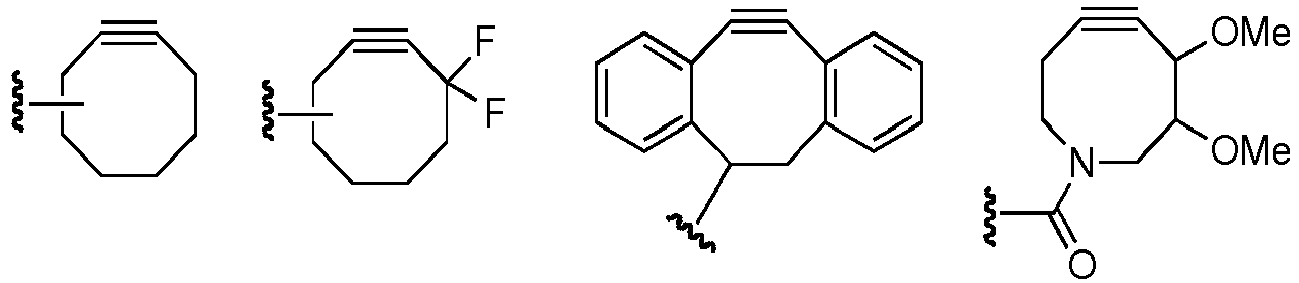
- X is a group selected from the group consisting of: azide, N-maleimide, N-maleimide-furan cycloadduct, thiol, thio acid, sulfonylazide, ethynyl, iodoethynyl and an activated cyclooctynyl group represented by the formulae:
- Y is a group selected from the group consisting of: -NHC(=NH)NH2, C6H4-OH
- Z is a group selected from the group consisting of: -CO2H, Ph
and
when Y is -NHC(=NH)NH2, Z is -CO2H and when Y is C6H4-OH, Z is Ph. - Another aspect of the invention is a process for preparing the compounds as defined above wherein Z is -CO2H and Y is -NHC(=NH)NH2, which comprises:
- a) reacting an azide of formula Q-(R1)-N3 (II) with an alkyne of formula T-C≡C-(R2)-NH-PG (protecting group) (III) to obtain a triazole of formula (IV);
- b) reacting a triazole of the formula (IV) with a compound of formula S-(R3)-CO2Ra (V) or an alkene of formula H2C=CH-CO2Ra (VI), to provide a compound of formula (VII);
- c) replacing the Q group in the compounds of formula (VII) by a group X to obtain a compound of formula VIII; and d) removing the protecting group (PG) in compounds of the formula (VIII) and e) reacting the intermediate amines with H2NC(=NH)SO2H.

- R1, R2, R3 and X are as defined above; Ra is H, methyl, ethyl, tert-butyl or benzyl; T is H or I; Q is HO, methanesulfonyloxy, p-toluenesulfonyloxy, 2-nitrobenzenesulfonyloxy, 4-nitrobenzenesulfonyloxy, trifluoromethanesufonyloxy, Cl, Br or I; PG is H, tert-butoxycarbonyl, allyloxycarbonyl or benzyloxycarbonyl; S in step b) is B(OH)2, methanesulfonyloxy, p-toluenesulfonyloxy, 2-nitrobenzenesulfonyloxy, 4-nitrobenzenesulfonyloxy, trifluoromethanesufonyloxy, Cl, Br or I.
- Another aspect of the invention is a process for preparing the compound as defined above wherein, Y is C6H4-OH and Z is Ph, which comprises:
- a) reacting an azide of formula Q-(R1)-N3 (II) with an alkyne of formula T-C≡C-(R2)-( C6H4OH)-PG (IX) to obtain a triazole of formula (X),
- b) reacting a triazole of the formula (X) with a compound of formula S-(R3)-Ph (XI), to provide a compound of formula (XII),
- c) replacing the Q group in the compounds of formula (XII) by a group X, and
- d) removing the protecting group PG.

- R1, R2, R3 and X are as defined above; T is H or I; Q is HO, methanesulfonyloxy, p-toluenesulfonyloxy, 2-nitrobenzenesulfonyloxy, 4-nitrobenzenesulfonyloxy, trifluoromethanesufonyloxy, Cl, Br or I; PG is H, tert-butoxycarbonyl, allyloxycarbonyl or benzyloxycarbonyl; S in step b) is B(OH)2; PG is Si(i-Pr)3.
- The appendage group X of the peptidomimetic is useful to bind to different materials when their surface is functionalized with reactive groups such as azide, sulfonylazide, terminal alkyne, terminal iodoalkyne, cycloalkyne, N-maleimide, N-maleimide-furan cycloadduct, thiol or thio acid. As a result of such reactions, a material-W-peptidomimetic adduct is formed, which contains at least one of such W groups:


- Therefore another aspect of the invention relates to a material with the surface chemically modified wherein the X group of the 1,4,5-trisubstituted 1,2,3-triazole mimetic of RGD and/or OGP10-14 according to the 1,4,5-trisubstituted 1,2,3-triazole mimetic of RGD and/or OGP10-14 of formula (I) as defined above is replaced by a W the group as defined above..
- Among them, (Arg-Gly-Asp) tripeptide and OGP10-14 (Tyr-Gly-Phe-Gly-Gly) pentapeptide have potential interest for "in vitro" tissue engineering and diagnosis technologies, or to improve the osteogenic properties of implants in human and animal therapy "in vivo".
- Thus another aspect of the invention relates to a medical device, made from the material described above. It can preferentially be an endosseous implant, or tissue engineering scaffold or cell culture matrices.
-
-
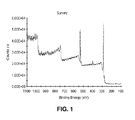
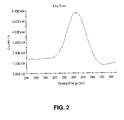
Figure 1 shows the X-ray photoelectron spectroscopy (XPS) spectrum (with three spectra magnifications of C1s, N1s and O1s peaks,Figures 2-4 ) for a compact PEEK sample modified at the surface with a mixture of RGD and OGP mimetics, as described in example 18. -
Figure 2 shows aFigure 1 spectrum magnification of C1s peak. -
Figure 3 shows aFigure 1 spectrum magnification of N1s peak. -
Figure 4 shows aFigure 1 spectrum magnification of O1s peak. - As mentioned above, an aspect of the present invention relates to 1,4,5-trisubstituted 1,2,3-triazole mimetics of RGD and/or OGP10-14 of formula (I) as defined above.
- As used herein, the term "alkyl" includes both saturated straight chain and branched hydrocarbon substituents. Preferably, C1-20 alkyl groups, more preferably C1-6 alkyl groups. Particularly preferred alkyl groups include, for example, methyl, ethyl, propyl, isopropyl, butyl, isobutyl, tert-butyl, pentyl and hexyl.
- As used herein, the term "alkylene" includes biradical hydrocarbon saturated straight chains and branched chains attaching simultaneously two molecular fragments or functional groups. Preferably, C1-20 alkylene groups, more preferably C1-6 alkylene groups. Particularly preferred alkylene groups include, for example, methylene, ethylene, propylene and butylene.
- As used herein, the term "aryl" includes substituted or unsubstituted single-ring aromatic groups in which each atom of the ring is carbon. Preferably the ring is a 5- to 7-membered ring, more preferably a 6-membered ring .
In a preferred embodiment R1 is selected from the group consisting of - (CH2CH2O)rCH2CH2-; where r is an integer between 0 and 8, R2 is selected from the group consisting of -CH2OCH2CH2- or -CH2OCH2-, and R3 is selected from the group consisting of -CH2CH2- or -CH=CH-. - Particularly in the compound of formula (I), Y is -NHC(=NH)NH2 and Z is - CO2H. In other particular embodiment, Y is C6H4-OH and Z is Ph. Preferably Y is p-C6H4-OH and Z is Ph.
- Other aspect of the invention relates to a material with the surface chemically modified wherein the X group of the 1,4,5-trisubstituted 1,2,3-triazole mimetic of RGD and/or OGP10-14 according to the 1,4,5-trisubstituted 1,2,3-triazole mimetic of RGD and/or OGP10-14 of formula (I) as defined above is replaced by a W the group as defined above. Preferably the material with the surface chemically modified wherein in the 1,4,5-trisubstituted 1,2,3-triazole mimetic Y is -NHC(=NH)NH2 and Z is -CO2H. Preferably the surface chemically modified wherein in the 1,4,5-trisubstituted 1,2,3-triazole mimetic Y is p-C6H4-OH and Z is Ph.
- In a preferred embodiment the material is metals, metallic alloys, polymers, ceramics or composites. In particular, those materials that comply with the ISO 10993 standards for evaluating the biocompatibility. Examples of materials are; Ti, Ti alloys, polyethylene, polypropylene, PET, polyamide, polyester, polyurethanes, silicones or PAEK. More preferably the material is PAEK.
- Finally the invention refers to a medical device wherein the device is made from the material as defined above.
- As used herein the term "medical device" means any instrument, apparatus, appliance, material or other article, whether used alone or in combination, intended to be used for the purpose of:
- - diagnosis, prevention, monitoring, treatment or alleviation of disease,
- - diagnosis, monitoring, treatment, alleviation of or compensation for an injury or handicap,
- - investigation, replacement or modification of the anatomy or of a physiological process.
- As used herein the term "medical device" includes stents, stent grafts, catheters, guide wires, balloons, filters (e.g., vena cava filters), vascular grafts, intraluminal paving systems, pacemakers, electrodes, leads, defibrillators, joint and bone implants, spinal implants, access ports, intra-aortic balloon pumps, heart valves, sutures, artificial hearts, neurological stimulators, cochlear implants, retinal implants, and other devices that can be used in connection with therapeutic coatings, prosthetic bone implant, endooseous implant, scaffold for bone tissue regeneration. Such medical devices are implanted or otherwise used in body structures, cavities, or lumens such as the vasculature, gastrointestinal tract, abdomen, peritoneum, airways, esophagus, trachea, colon, rectum, biliary tract, urinary tract, prostate, brain, spine, lung, liver, heart, skeletal muscle, kidney, bladder, intestines, stomach, pancreas, ovary, uterus, cartilage, eye, bone, joints, and the like. Preferably medical device is an implant or cell culture matrix. More preferably endooseous implant or tissue engineering scaffold or cell culture matrices.
- In a preferred embodiment the invention refers a medical device wherein the medical device is an endosseous implant, or tissue engineering scaffold or cell culture matrix, suitable for the replacement of human and animal organs.
- Acronyms of reagents, solvents or techniques used are defined as follows:
- Boc: tert-Butoxycarbonylamino group,
- Dansyl: 5-(Dimethylamino)naphthalene-1-sulfonyl group,
- DIPEA: Diisopropyletylamine,
- DMF: N,N-Dimethylformamide,
- NBS: N-Bromosuccinimide,
- NMR: Nuclear Magnetic Resonance,
- OGP: Osteogenic Growth Peptide. For the purpose of this invention refers to structures of formula (I), wherein Y is p-C6H4-OH and Z is Ph.
- PEEK: Poly-ether ether ketone,
- RGD: Arginine-Glycine-Aspartic acid. For the purpose of this invention refers to structures of formula (I), wherein Y is -NHC(=NH)NH2 and Z is -CO2H
- THF: Tetrahydrofuran,
- TLC: Thin Layer Chromatography.
- The following examples are provided for illustrative means, and are not meant to be limiting of the present invention.
- To a stirred solution of Cul (218 mg, 1.15 mmol) in dried CH3CN, NBS (223 mg, 1.25 mmol), 2-(tert-butoxycarbonylamino)ethyl propargyl ether (208 mg, 1.04 mmol), 2-azidoethanol (100 mg, 1.15 mmol) and DIPEA (200 µl, 1.15 mmol) were added. The mixture was stirred at room temperature for two hours. The solvent was evaporated, the residue was dissolved in CH2Cl2, washed with 10% aqueous Na2S2O3 and the organic phase was dried (MgSO4) and evaporated. The product was purified by column chromatography (silica gel; EtOAc/hexanes 1:1). Yield: 300 mg (70%). 1H NMR (500 MHz, CDCl3) δ 4.63 (s, 2H), 4.54 - 4.48 (t, J = 4.9, 2H), 4.18 (t, J = 5.0, 2H), 3.62 (t, J = 5.1, 2H), 3.34 (t, J = 5.0, 2H), 1.46 (s, 9H).
- A suspension of 4-(4-tert-butoxycarbonylamino-2-oxa-butyl)-1-(2-hydroxyethyl)-5-iodo-1,2,3-triazole (500 mg, 1.21 mmol), Pd(OAc)2 (27,2 mg, 0.121 mmol) and NaHCO3 (254,7 mg, 3,03 mmol) in anhydrous DMF (5 mL) was prepared in a flame-dried flask under nitrogen atmosphere. Methyl acrylate (273.1 µL, 3,03 mmol) was added and the mixture was stirred at 85ºC overnight. The solvent was evaporated and the product was purified by column chromatography (silica gel, EtOAc/hexanes 1:1). This intermediate product (355 mg, 0.96 mmol) was dissolved in dry MeOH and ammonium formate (302.2 mg, 4.8 mmol) and 10%-Pd-C (107.8 mg, 0.096 mmol) were added. The mixture was refluxed overnight. The product was purified by filtration over celite. Yield: 330 mg (74%). 1H NMR (500 MHz, CDCl3): δ 4.55 (s, 2H), 4.40 (t, J = 4.7, 2H), 4.06 (t, J = 4.7, 2H), 3.64 (s, 3H), 3.54 (t, J = 5.1, 2H), 3.26 (s, 2H), 3.05 (t, J = 7.3, 2H), 2.68 (t, J = 7.4, 2H), 1.41 (s, 9H).
- To a stirred solution of 4-(4-tert-butoxycarbonylamino-2-oxa-butyl)-1-(2-hydroxyethyl)-5-(2-methoxycarbonylethyl)-1 ,2,3-triazole (135 mg, 0.36 mmol) prepared in Example 2, cooled to 0ºC in dried CH2Cl2 was added triphenyl phosphine (190.2 mg, 0.73 mmol) and NBS (129.0 mg, 0.73 mmol). The mixture was stirred over one hour. The solvent was evaporated and the crude product was dissolved in dried DMF. Then, NaN3 (94.3 mg, 1.45 mmol) and Nal (54.3 mg, 0.36 mmol) were added and the mixture was stirred at room temperature over 48 hours. After evaporation of the solvent, the crude product was dissolved in THF/H2O (1:1) and LiOH·H2O (151. 9mg, 3.62 mmol) was added and the mixture was stirred for 8 hours. Then, the solvent was evaporated and the product was purified by acid and basic extraction with CH2Cl2. Yield: 143.9 mg (70%). 1H NMR (500 MHz, CD3OD) δ 4.64 (s, 2H), 4.57 (t, J = 5.5, 2H), 3.88 (t, J = 5.5, 2H), 3.54 (t, J = 5.5, 2H), 3.25 (t, J = 5.3, 2H), 3.12 (t, J = 7.3, 2H), 2.73 (t, J = 7.2, 2H), 1.45 (s, 9H).
- In a flame-dried flask, 4-(4-tert-butoxycarbonylamino-2-oxa-butyl)-1-(2-hydroxyethyl)-5-(2-methoxycarbonyl-ethyl)-1 ,2,3-triazole (0.27 mmol, 100 mg), prepared as described in Example 2, was dissolved in dry THF (2 mL) under nitrogen atmosphere and after addition of DIPEA (0.54 mmol, 96 µL), the mixture was cooled to 0ºC. Subsequently, a solution of triphosgene (0.17 mmol, 49 mg) was added dropwise and then the mixture was allowed to reach the room temperature during 30 min. The suspension was filtered through a celite pad and the solvent was evaporated under pressure to obtain the intermediate chloroformate, which was immediately dissolved in dry CH2Cl2 (2 mL). DIPEA (0.54 mmol, 93 µL) and 8-azido-3,6-dioxaoctylamine (0.27 mmol, 60 mg) were added and the mixture was kept stirring overnight. The product was purified by column chromatography using CH2Cl2/MeOH 90/10 as eluent. Yield: 85 mg (51%). IR (cm-1): 3339, 2869, 2102 (N3), 1704 (C=O), 1522 (tri). 1H NMR (500 MHz, CDCl3) δ 4.61 (s, 2H, OCH 2C=Ctri), 4.56 (t, J = 5.1, 2H, N1triCH 2CH2), 4.49 (t, J = 5.0, 2H, N1triCH2CH 2), 3.67 (s, 3H, COOCH 3), 3.67-3.51 (m, 14H, OCH 2CH2NHBoc and OCH 2CH2O), 3.40 - 3.28 (m, 6H, OCH2CH 2NHBoc, OCH2CH 2NHCOO and OCH2CH 2N3), 3.04 (t, J = 7.6, 2H, CH 2CH2CO2CH3), 2.70 (t, J = 7.2, 2H, CH2CH 2CO2CH3), 1.43 (s, 9H, tBu).
- A 6M HCl solution in dioxane (2 mL, 12 mmol) was added to 1-(2-azidoethyl)-4-(4-tert-butoxycarbonylamino-2-oxa-butyl)-5-(2-carboxyethyl)-1,2,3-triazole (80 mg, 0.21 mmol) and the mixture was stirred at room temperature over 1 h. Then, the solvent was evaporated, the crude amine hydrochloride was dissolved in methanol (5 mL) and sodium bicarbonate was added until pH=7. Amino(imino)methanesulfonic acid (31.0 mg, 0.25 mmol) was added, the mixture was stirred at room temperature over 1 h. and it was evaporated to dryness. The residue was extracted with MeOH (3 x 5 mL) and the solution was evaporated at reduced pressure. Yield (90 %). 1H NMR (500 MHz, D2O): δ 4.62 (s, 1H), 4.46 (t, J = 5.0, 1H), 3.97 (t, J = 5.0, 1H), 3.68 (t, J = 4.8, 1H), 3.38 - 3.33 (m, 1H), 3.00 (t, J = 7.6, 1H), 2.43 (t, J = 7.6, 1H).
- A 4M HCl solution in dioxane (2 mL, 8 mmol) was added to 1-(16-azido-5-aza-3,8,11,14-tetraoxa-4-oxohexadecyl)-4-(4-tert-butoxycarbonylamino-2-oxa-butyl)-5-(2-methoxycarbonylethyl)-1,2,3-triazole (75 mg, 0.14 mmol) and the mixture was stirred at room temperature over 2 h. Then, the solvent was evaporated, the crude amine hydrochloride (45 mg, 0.08 mmol) was dissolved in methanol (5 mL) and potassium carbonate was added until slightly basic pH. Amino(imino)methanesulfonic acid (11 mg, 0.09 mmol) was added, the mixture was stirred at room temperature over 1 h. Lithium hydroxide (4.0 mg, 0.09 mmol) was added and the solution was stirred for 4h. Upon completion, the solids were filtered off with MeOH (3 x 5 mL), the solution was evaporated at reduced pressure and the resulting crude product was purified by preparative reverse phase HPLC (C18 column, MeCN:H2O 80:20). Yield (75 %). 1H NMR (500 MHz, D2O) δ 4.63 (m, 4H, OCH 2C=Ctri and N1triCH 2CH2), 4.46 (m, 2H, N1triCH2CH 2), 3.70-3.60 (m, 12H), 3.50 (m, 2H, OCH 2CH2NHCOO), 3.44 (t, J = 4.2, 2H, OCH2CH 2N3), 3.36 (t, J = 4.7, 2H, OCH2CH 2NHCOO), 3.18 (m, 2H, CH2CH 2guanidine), 3.02 (t, J = 7.4, 2H, CH 2CH2CO2H), 2.45 (t, J = 7.5, 2H, CH2CH 2CO2H).
- To a stirred solution of Cul (401 mg, 2.11 mmol) in dried CH3CN, NBS (409 mg, 2.30 mmol), 4-triisopropylsilyloxy-benzyl propargyl ether (610 mg, 1.92 mmol), 2-azidoethanol (100 mg, 1.15 mmol) and DIPEA (367 µl, 2.11 mmol) were added. The mixture was stirred at room temperature for two hours. The solvent was evaporated, the residue was dissolved in CH2Cl2, washed with 10% aqueous Na2S2O3 and the organic phase was dried (MgSO4) and evaporated. The product was purified by column chromatography (silica gel; EtOAc/hexanes 1:1). Yield: 315 mg (31%). 1H NMR (500 MHz, CDCl3) δ 7.26 (d, J = 8.0, 2H), 6.88 (d, J = 8.1, 2H), 4.61 (s, 2H), 4.54 (s, 2H), 4.49 (t, J = 4.2, 2H), 4.17 (d, J = 3.3, 2H), 1.33 - 1.23 (m, 3H), 1.12 (ds, 18H).
- A suspension of 1-(2-hydroxyethyl)-5-iodo-4-[2-oxa-3-(4-triisopropylsilyloxyphenyl)-proyl]-1,2,3-triazole (270 mg, 0.52 mmol) prepared in Example 7, E-2-phenylvinylboronic acid (119.8 mg, 0.79 mmol), bis(triphenylphosphine) palladium (II) dichloride (14.7 mg, 0.02 mmol) and potassium hydroxide (58.8 mg, 1.05 mmol) were dissolved in anhydrous THF (4 mL) and kept at 75ºC during 2 h. The product was purified by column chromatography (silica gel, EtOAc/hexanes 1:1). Yield: 330 mg (92%). 1H NMR (500 MHz, CDCl3) δ 7.49 (d, J = 7.2, 2H), 7.41 (t, J = 7.3, 2H), 7.39 - 7.34 (m, 1H), 7.31 (d, J = 13.2, 1H), 7.26 (d, J = 8.4, 2H), 6.98 (d, J = 16.3, 1H), 6.86 (d, J = 8.4, 2H), 4.72 (s, 2H), 4.58 (s, 2H), 4.51 - 4.46 (m, 2H), 4.18 (dd, J = 10.2, 5.4, 2H), 1.32-1.22 (m, 3H), 1.11 (d, J = 7.4, 18H).
- In a flame-dried flask, 1-(2-hydroxyethyl)-5-[(E)-(2-phenyl)vinyl]-4-[2-oxa-3-(4-triisopropylsilyloxyphenyl)-proyl]-1,2,3-triazole (0.20 mmol, 100 mg) prepared as shown in Example 7, was dissolved in dry THF (1.5 mL) under nitrogen atmosphere and after addition of DIPEA (0.39 mmol, 69 µL), the mixture was cooled to 0ºC. Subsequently, a solution of triphosgene (0.12 mmol, 36 mg) was added dropwise and then the mixture was allowed to reach the room temperature during 30 minutes. The suspension was filtered through a celite pad and the solvent was evaporated under pressure to obtain the intermediate chloroformate [1H NMR (500 MHz, CDCl3) δ 7.50 (d, J = 7.3, 2H), 7.45 - 7.35 (m, 4H), 7.26 (d, J = 8.0, 2H), 6.92 (d, J = 16.4, 1H), 6.86 (d, J = 7.9, 2H), 4.80-4.70 (m, 6H), 4.59 (s, 2H), 1.31 - 1.21 (m, 3H), 1.11 (d, J = 7.3, 18H)]. The product was dissolved in dry CH2Cl2 (1.5 mL) and sequentially DIPEA (0.39 mmol, 69 µL) and tetraethylene glycol (0.20 mmol, 43 mg) were added and the mixture was kept stirring overnight. The product was purified by column chromatography using CH2Cl2/MeOH 90/10 as eluent. Yield: 116 mg (78%). IR (cm-1): 2944, 2866, 2102 (N3), 1720 (C=O), 1509. 1H NMR (500 MHz, CDCl3) δ 7.47 (d, J = 7.7, 2H), 7.42 - 7.21 (m, 6H), 6.92 (d, J = 16.3, 1H), 6.85 (d, J = 8.0, 2H), 4.72 (s, 2H), 4.64 (t, J = 4.8, 2H), 4.57 (s, 2H), 4.48 (s, 2H), 3.69 - 3.49 (m, 11H), 3.45 - 3.41 (m, 2H), 3.39 - 3.32 (m, 2H), 3.28 (t, J = 10.9, 2H), 1.30 - 1.19 (m, 3H), 1.09 (d, J = 7.4, 18H).
- In a dried flask cyanuric chloride (55.93 mg, 0.30 mmol) and DMF (61.06 µL) were warmed at 25 °C for 10 min. After the formation of a white solid, CH2Cl2 (0.5 mL) was added, followed by 1-(2-hydroxyethyl)-5-[(E)-(2-phenyl)vinyl]-4-[2-oxa-3-(4-triisopropylsilyloxyphenyl)-proyl]-1,2,3-triazole (70 mg, 0.14 mmol). The mixture was kept at room temperature during one hour and the solvent was evaporated. The resulting crude product was dissolved again in acetone, sodium azide (89.71 mg, 1.38 mmol) was added and the mixture was stirred for 24 hours. Then, cesium fluoride (300 mg, 2.0 mmol) was added, and the resulting crude was evaporated and purified by column chromatography (silica gel, EtOAc/hexanes 1:1). 1H NMR (500 MHz, CDCl3) δ 7.50 (d, J = 7.2, 2H), 7.47 - 7.33 (m, 4H), 7.33 - 7.25 (m, 3H), 6.95 (d, J = 16.3, 1H), 6.87 (d, J = 8.2, 2H), 4.75 (s, 2H), 4.71 (t, J = 6.4, 2H), 4.60 (s, 2H), 4.01 (t, J = 6.4, 2H).
- A suspension of 1-(16-azido-5-aza-3,8,11,14-tetraoxa-4-oxohexadecyl)-5-[(E)-(2-phenyl)vinyl]-4-[2-oxa-3-(4-triisopropylsilyloxyphenyl)-proyl]-1,2,3-triazole (0.14 mmol, 105 mg) prepared in Example 9, and cesium fluoride (0.70 mmol, 106 mg) in methanol (1.5 mL) was stirred at room temperature for one hour. Then the solvent was evaporated and the product was purified by column chromatography using CH2Cl2/MeOH 95:5 as eluent. Yield: 50 mg (60%). IR(cm-1): 3328, 2867, 2101 (N3), 1705 (C=O), 1517. 1H NMR (500 MHz, CDCl3) δ 7.47 (d, J = 7.4, 2H), 7.44 - 7.25 (m, 5H), 7.20 (dd, J = 17.2, 8.0, 2H), 6.86 (d, J = 16.6, 1H), 6.80 (d, J = 8.1, 2H), 4.75 (s, 2H), 4.64 (d, J = 4.8, 2H), 4.57 (s, 2H), 4.47 (s, 2H), 3.58 (ddd, J = 35.4, 14.6, 6.2, 10H), 3.39 - 3.35 (m, 2H), 3.35 - 3.27 (m, 2H), 3.21 (d, J = 4.8, 2H).
- Compact PEEK consisted of mechanically polished PEEK-1000 semicrystalline 20 x 20 x 5 mm size square samples from Ketron (
KETRON PEEK 1000, ref. 41300000, PoliFluor S.L) and medical grade implantable PEEK CLASSIX LSG compact disk samples from Invibio (PoliFluor S.L). Porous PEEK consisted of disk samples (9 mm diameter/ 3 mm thin), prepared according to patentEP10382243.3 - Compact PEEK and porous PEEK materials with the surface modified as oxime [PEEK]=N-OH were prepared following a procedure described in Macromolecules, 1991, 24: 3045-3049.
- PEEK oxime: Both compact and porous PEEK samples were cleaned by immersion in an ultrasonic bath with methanol for 30 min and subsequently dried at room temperature under reduced pressure overnight. Each set of 10 samples of porous and compact PEEK, 3.0 g of hydroxylamine hydrochloride, 10 mL of ethanol, and 2 mL water were introduced to a round-bottomed flask. Sodium hydroxide (5.5 g) was added in five portions, shaking after each addition. The balloon flask was purged with nitrogen, then heated at 40ºC for 24h, and finally refluxed for 24h. After cooling the suspenssion, the samples were extracted, rinsed successively with 10% aqueous HCl (5 x 30 mL) and ethanol (3 x 30 mL), and dried at room temperature.
- 3-(6-lodo-1,3-dioxahexyl)-cyclooctyne: To a solution of O-(cyclooctyn-3-yl)-diethylene glycol (100 mg, 0.47 mmol) in anhydrous DMF (10 mL) was added (PhO)3PMel (0.43 g, 0.94 mmol). The resulting solution was stirred at r. t. for 30 min. Then, MeOH (1 mL) was added the mixture was evaporated at reduced pressure. The crude obtained was used without additional purification. Yield: 103.2 mg, (65%). 1H-NMR (500 MHz, CDCl3): δ 4.24 (t, 1H, -CH-C≡C-), 3.77-3.67 (m, 5H, O-CH2), 3.53 (m, 1H, -CH-O), 1.91 (t, 2H, CH2-I), 2.25-1.45 (m, 10H, -CH2-).
- Compact and porous PEEK oxime samples (n=2), prepared as above, were introduced under nitrogen atmosphere into a test tube containing a mixture of potassium carbonate (0.41 g), 3-(6-lodo-1,3-dioxahexyl)-cyclooctyne (0.20 g) and acetone (2 mL). The suspension was stirred at 40ºC for 24 h., and the samples were washed repeatedly with water and methanol. Finally, the samples were dried at r.t. under vacuum for 5 h.
- Surface characterization data for compact PEEK modified as cycloalkyne. XPS analysis: C 83.3%, O 14.8%, N 1.9%.
- Surface characterization data for porous PEEK modified as cycloalkyne. Contact angle: 139.2º ±18.0. XPS analysis: C 81.8%, O 17.2%, N 1.0%.

- Porous PEEK oxime samples (n=2) functionalized as cycloalkyne as described in Example 12, were introduced under nitrogen atmosphere into a test tube containing a 2 mL of a THF/H2O 1:1 mixture. Then, 0.2 mg of compound of formula (I): (R1= R3= -CH2CH2-; R2= -CH2OCH2CH2-; X= N3; Y= -NHC(=NH)NH2; Z= CO2H), prepared in Example 5, were added and the suspension was stirred at 40ºC for 24 h. The sample was washed repeatedly with a solution of HCl 0.1 M, an aqueous solution of NH3 (pH=11), water and methanol and dried at room temperature under vacuum for 5 h.
- Surface XPS analysis for porous PEEK modified with RGD mimetic: C 79.4%, O 18.7% N 1.9%).
- Compact PEEK-M oxime samples (n=2) functionalized as cycloalkyne as described in Example 12, was reacted with 0.2 mg of RGD mimetic of formula (I): (R1= R3= -CH2CH2-; R2= -CH2OCH2CH2-; X= N3; Y= -NHC(=NH)NH2; Z= CO2H). Reaction conditions and purification were identical to the Example 13. Surface characterization data for polished compact PEEK modified with RGD mimetic. XPS analysis: C 84.4%, O 13.3%, N 2.3%.
- Compact PEEK oxime samples (n=2) functionalized as cycloalkyne as described in Example 12, was reacted with 0.2 mg of RGD mimetic of formula (I): (R1= -[CH2CH2O]3CH2CH2HN(CO)OCH2CH2-; R2= -CH2OCH2CH2-; R3= -CH2CH2-; X= N3; Y= -NHC(=NH)NH2; Z= CO2H prepared as described in Example 6). Reaction conditions and purification were identical to the Example 13.
- Surface characterization data for polished compact PEEK modified with RGD mimetic. XPS analysis: C 82.2%, O 14.6%, N 3.2%.

- Compact PEEK oxime samples (n=2) functionalized as cycloalkyne as described in Example 12, was reacted with 0.2 mg of OGP mimetic of formula (I): (R1= -CH2CH2-; R2= -CH2OCH2-; R3= -CH=CH-; X= N3; Y= p-C6H4OH; Z= Ph prepared as described in Example 10). Reaction conditions and purification was identical to the Example 12.
- Surface characterization data for polished compact PEEK modified with OGP mimetic. XPS analysis: C 75.6%, O 21.2%, N 3.2%.
- A compact PEEK oxime discs functionalized as cycloalkyne as described in Example 12, was introduced under nitrogen atmosphere into a test tube containing 1 mL of THF/H2O 1:1 mixture, 0.1 mg of OGP mimetic (I) (R1= - [CH2CH2O]3CH2CH2HN(CO)OCH2CH2-; R2= -CH2OCH2-; R3= -CH=CH-; X= N3; Y= p-C6H4OH; Z= Ph) prepared as described in Example 11. The suspension was stirred at 40ºC for 24 h. The discs were washed repeatedly with THF, water and methanol and dried at room temperature under vacuum for 5 h.
- Surface XPS analysis for the compact PEEK modified with OGP mimetic: C 79.8%, O 17.7% N 2.5%.

- Compact PEEK oxime discs (n=2) functionalized as cycloalkyne as described in Example 12, were introduced under nitrogen atmosphere into a test tube containing 2 mL of THF/H2O 1:1 mixture, 0.1 mg of RGD mimetic of formula (I) (R1=R3= -CH2CH2-; R2= -CH2OCH2CH2; X= N3; Y= -NHC(=NH)NH2; Z= CO2H) prepared as described in Example 5, and 0.1 mg of OGP mimetic of formula (I) (R1= -CH2CH2-; R2= -CH2OCH2-; R3= -CH=CH-; X= N3; Y= p-C6H4OH; Z= Ph) prepared as described in Example 10. The suspension was stirred at 40ºC for 24 h. The discs were washed repeatedly with a solution of HCl 0.1 M, an aqueous solution of NH3 (pH=11), water and methanol and dried at room temperature under vacuum for 5 h.
- Surface XPS analysis for compact PEEK (XV) modified with RGD and OGP: C 74.9%, O 21.6% N 3.59% (
Figure 1 ). - Compact PEEK oxime discs (n=2) functionalized as cycloalkyne prepared as described in Example 12, were introduced under nitrogen atmosphere into a test tube containing 2 mL of THF/H2O 1:1 mixture, 0.1 mg of RGD mimetic of formula (I) (R1= -[CH2CH2O]3CH2CH2HN(CO)OCH2CH2-; R2= - CH2OCH2CH2-; R3= -CH2CH2-; X= N3; Y= -NHC(=NH)NH2; Z= CO2H) prepared as described in Example 10, and 0.1 mg of OGP mimetic (I) (R1= - [CH2CH2O]3CH2CH2HN(CO)OCH2CH2-; R2= -CH2OCH2-; R3= -CH=CH-; X= N3; Y= p-C6H4OH; Z= Ph) prepared as described in Example 11. The suspension was stirred at 40ºC for 24 h. The discs were washed repeatedly with a solution of HCl 0.1 M, an aqueous solution of NH3 (pH=11), water and methanol and dried at room temperature under vacuum for 5 h
Claims (12)
- A 1,4,5-trisubstituted 1,2,3-triazole mimetic of RGD and/or OGP10-14 of formula (I):
 R1 is a biradical selected from the group consisting of C1-20 alkylene; in which 0, 1, 2, 3, 4, 5 or 6 -CH2- groups are optionally replaced by groups selected from -O-, -S-, -C(O)O-, -C(O)NH-, -C(O)N(C1-4alkyl)-, -NHC(O)NH-, - NHC(O)O-; andR2 is a biradical independently selected from the group consisting of: C1-6 alkylene; in which 0, 1, 2 or 3 -CH2- groups are optionally replaced by groups selected from -O- and -S-; optionally substituted with one or more groups selected from C1-4 alkyl, phenyl, C6-10 aryl; andR3 is a biradical selected from the group consisting of: C1-6 alkylene; optionally containing one or more -C=C- bonds; optionally containing -C≡C- bonds; in which 0, 1, 2 or 3 -CH2- groups are optionally replaced by groups selected from -O- and -S-; optionally substituted with one or more groups selected from C1-4 alkyl, phenyl, -F, -Cl, -OH, -O(C1-4alkyl), -S(C1-4alkyl), -SO2Ph, - CN, -NO2, -CO(C1-4alkyl), -CO2H, -CO2(C1-4alkyl), -CONH2, -CONH(C1-4alkyl), -CON(C1-4alkyl)2; andX is a group selected from the group consisting of: azido, N-maleimido, N-maleimido-furan cycloadduct, thiol, thio acid, azido, sulfonylazido, ethynyl, iodoethynyl and an activated cyclooctynyl group represented by the formulae:
 Y is a group selected from -NHC(=NH)NH2 and C6H4-OHZ is a group selected from -CO2H and Ph, and
when Y is -NHC(=NH)NH2, Z is -CO2H, and
when Y is C6H4-OH, Z is Ph. - The compound according to claim 1 wherein R1 is selected from the group consisting of -(CH2CH2O)rCH2CH2-; where r is an integer between 0 and 8, R2 is selected from the group consisting of -CH2OCH2CH2- or -CH2OCH2-, and R3 is selected from the group consisting of -CH2CH2- or -CH=CH-.
- The compound according to claim 1-2 wherein Y is -NHC(=NH)NH2 and Z is -CO2H.
- The compound according to claim 1-2 wherein Y is C6H4-OH and Z is Ph.
- The compound according claim 4 wherein Y is p-C6H4-OH and Z is Ph.
- A process for preparing the compounds according to the claim 3, which comprises:a) reacting an azide of formula Q-(R1)-N3 (II) with an alkyne of formula T-C≡C-(R2)-NH-PG (protecting group) (III) to obtain a triazole of formula (IV),b) reacting a triazole of the formula (IV) with a compound of formula S-(R3)-CO2Ra (V) or an alkene of formula H2C=CH-CO2Ra (VI), to provide a compound of formula (VII),c) replacing the Q group in the compounds of formula (VII) by a group X, andd) removing the protecting group PG in compounds of the formula (VIII) and e) reacting the intermediate amines with H2NC(=NH)SO3H.
 R1, R2, R3 and X are as defined in claim 1; Ra is H, methyl, ethyl, tert-butyl or benzyl; T is H or I; Q is HO, methanesulfonyloxy, p-toluenesulfonyloxy, 2-nitrobenzenesulfonyloxy, 4-nitrobenzenesulfonyloxy,trifluoromethanesufonyloxy, Cl, Br or I; PG is H, tert-butoxycarbonyl, allyloxycarbonyl or benzyloxycarbonyl; S in step b) is B(OH)2, methanesulfonyloxy, p-toluenesulfonyloxy, 2-nitrobenzenesulfonyloxy, 4-nitrobenzenesulfonyloxy, trifluoromethanesufonyloxy, Cl, Br or I.
 - A process for preparing the compounds (I), according to the claim 4-5, which comprises:a) reacting an azide of formula Q-(R1)-N3 (II) with an alkyne of formula T-C≡C-(R2)-(C6H4OH)-PG (IX) to obtain a triazole of formula (X),b) reacting a triazole of the formula (X) with a compound of formula S-(R3)-Ph (XI), to provide a compound of formula (XII),c) replacing the Q group in the compounds of formula (XII) by a group X, andd) removing the protecting group PG.
 R1, R2, R3 and X are as defined in claim 2; T is H or I; Q is HO, methanesulfonyloxy, p-toluenesulfonyloxy, 2-nitrobenzenesulfonyloxy, 4-nitrobenzenesulfonyloxy, trifluoromethanesufonyloxy, Cl, Br or I; PG is H, tert-butoxycarbonyl, allyloxycarbonyl or benzyloxycarbonyl; S in step b) is B(OH)2; PG is Si(i-Pr)3.
 - A material with the surface chemically modified wherein the X group of the 1,4,5-trisubstituted 1,2,3-triazole mimetic of RGD and/or OGP10-14 according claim 1 to 5 is replaced by a W group represented by the formulae.


- The material with the surface chemically modified according claim 8 wherein the 1,4,5-trisubstituted 1,2,3-triazole mimetic is defined according claim 3.
- The material with the surface chemically modified according claim 8 wherein the 1,4,5-trisubstituted 1,2,3-triazole mimetic is defined according claim 5.
- Medical device wherein the device is made from the material as defined in claim 8-10.
- Medical device according claim 11 wherein the medical device is an endosseous implant, or tissue engineering scaffold or cell culture matrix, suitable for the replacement or regeneration of human and animal organs.
Priority Applications (7)
| Application Number | Priority Date | Filing Date | Title |
|---|---|---|---|
| ES12382535T ES2581865T3 (en) | 2012-12-26 | 2012-12-26 | Mimetic of 1,2,3-triazole 1,4,5-trisubstituted of RGD and / or OGP10-14, procedure to obtain it and uses thereof |
| EP12382535.8A EP2749298B1 (en) | 2012-12-26 | 2012-12-26 | A 1,4,5-TRISUBSTITUTED1,2,3-TRIAZOLE MIMETIC OF RGD and/or OGP10-14, PROCESS TO OBTAIN IT AND USES THEREOF |
| CN201380071626.5A CN104955494A (en) | 2012-12-26 | 2013-12-26 | A 1,4,5-trisubstituted1,2,3-triazole mimetic of rgd and/or ogp10-14, process to obtain it and uses thereof |
| KR1020157020291A KR20150123228A (en) | 2012-12-26 | 2013-12-26 | A 1,4,5-trisubstituted1,2,3-triazole mimetic of rgd and/or ogp10-14, process to obtain it and uses thereof |
| CA2896388A CA2896388A1 (en) | 2012-12-26 | 2013-12-26 | A compound 1,4,5-trisubstituted1,2,3-triazole, process to obtain it and uses thereof |
| US14/655,676 US20150353509A1 (en) | 2012-12-26 | 2013-12-26 | A Compound 1,4,5-Trisubstituted1,2,3-Triazole, Process To Obtain And Uses Thereof |
| PCT/ES2013/070927 WO2014102434A1 (en) | 2012-12-26 | 2013-12-26 | A 1,4,5-trisubstituted1,2,3-triazole mimetic of rgd and/or ogp10-14, process to obtain it and uses thereof |
Applications Claiming Priority (1)
| Application Number | Priority Date | Filing Date | Title |
|---|---|---|---|
| EP12382535.8A EP2749298B1 (en) | 2012-12-26 | 2012-12-26 | A 1,4,5-TRISUBSTITUTED1,2,3-TRIAZOLE MIMETIC OF RGD and/or OGP10-14, PROCESS TO OBTAIN IT AND USES THEREOF |
Publications (2)
| Publication Number | Publication Date |
|---|---|
| EP2749298A1 true EP2749298A1 (en) | 2014-07-02 |
| EP2749298B1 EP2749298B1 (en) | 2016-04-06 |
Family
ID=47681561
Family Applications (1)
| Application Number | Title | Priority Date | Filing Date |
|---|---|---|---|
| EP12382535.8A Not-in-force EP2749298B1 (en) | 2012-12-26 | 2012-12-26 | A 1,4,5-TRISUBSTITUTED1,2,3-TRIAZOLE MIMETIC OF RGD and/or OGP10-14, PROCESS TO OBTAIN IT AND USES THEREOF |
Country Status (7)
| Country | Link |
|---|---|
| US (1) | US20150353509A1 (en) |
| EP (1) | EP2749298B1 (en) |
| KR (1) | KR20150123228A (en) |
| CN (1) | CN104955494A (en) |
| CA (1) | CA2896388A1 (en) |
| ES (1) | ES2581865T3 (en) |
| WO (1) | WO2014102434A1 (en) |
Citations (2)
| Publication number | Priority date | Publication date | Assignee | Title |
|---|---|---|---|---|
| WO1997032594A1 (en) | 1996-03-10 | 1997-09-12 | Yissum Research Development Company Of The Hebrew University Of Jerusalem | Synthetic peptides and pseudopeptides having osteogenic activity and pharmaceutical compositions containing the same |
| EP1038224A2 (en) | 1997-12-10 | 2000-09-27 | Telefonaktiebolaget L M Ericsson (Publ) | A method relating to processors, and processors adapted to function in accordance with the method |
-
2012
- 2012-12-26 EP EP12382535.8A patent/EP2749298B1/en not_active Not-in-force
- 2012-12-26 ES ES12382535T patent/ES2581865T3/en active Active
-
2013
- 2013-12-26 US US14/655,676 patent/US20150353509A1/en not_active Abandoned
- 2013-12-26 CA CA2896388A patent/CA2896388A1/en not_active Abandoned
- 2013-12-26 WO PCT/ES2013/070927 patent/WO2014102434A1/en not_active Ceased
- 2013-12-26 KR KR1020157020291A patent/KR20150123228A/en not_active Withdrawn
- 2013-12-26 CN CN201380071626.5A patent/CN104955494A/en active Pending
Patent Citations (2)
| Publication number | Priority date | Publication date | Assignee | Title |
|---|---|---|---|---|
| WO1997032594A1 (en) | 1996-03-10 | 1997-09-12 | Yissum Research Development Company Of The Hebrew University Of Jerusalem | Synthetic peptides and pseudopeptides having osteogenic activity and pharmaceutical compositions containing the same |
| EP1038224A2 (en) | 1997-12-10 | 2000-09-27 | Telefonaktiebolaget L M Ericsson (Publ) | A method relating to processors, and processors adapted to function in accordance with the method |
Non-Patent Citations (10)
| Title |
|---|
| BILTRESSE S. ET AL.: "Cell adhesive PET membranes by surface grafting of RGD peptidomimetics", BIOMATERIALS, vol. 26, 2005, pages 4576 - 4587, XP025280465, DOI: doi:10.1016/j.biomaterials.2004.11.042 |
| CHEN, W. ET AL.: "Bone loss induced by ovariectomy in rats is prevents by gene transfer of parathyroid hormone or an Arg-Gly-Asp-containing peptide", BIOTECHNOL. LETT., vol. 27, 2005, pages 41 - 48, XP019230832, DOI: doi:10.1007/s10529-004-6577-2 |
| CHEN, Y.-CH. ET AL.: "Bioactive pseudopeptidic analogues and cyclostereoisomers of osteogenic growth peptide C-terminal pentapeptide, OGPIO-14", J. MED. CHEM., vol. 45, 2002, pages 1624 - 1632, XP002599698, DOI: doi:10.1021/JM0104791 |
| KANTLEHNER M ET AL.: "Surface coating with cyclic RGD peptides stimulates osteoblast adhesion and proliferation as well as bone formation", CHEMBIOCHEM, vol. 1, 2000, pages 107 - 114, XP009138168, DOI: doi:10.1002/1439-7633(20000818)1:2<107::AID-CBIC107>3.0.CO;2-4 |
| KESSLER H ET AL.: "RGD modified polymers: biomaterials for stimulated cell adhesion and beyond", BIOMATERIALS, vol. 24, 2003, pages 4385 - 4415, XP002712008, DOI: doi:10.1016/S0142-9612(03)00343-0 |
| MACROMOLECULES, vol. 24, 1991, pages 3045 - 3049 |
| MOORE, N. M. ET AL.: "The use of immobilized osteogenic growth peptide on gradient substrates synthesized via click chemistry to enhance MC3T3-E osteoblast proliferation", BIOMATERIALS, vol. 31, 2010, pages 1604 - 1611, XP026827517 |
| NI, M. H. ET AL.: "Novel RGD peptidomimetics embedding 1,2,3-triazole as central scaffold; synthesis and avf33 integrin affinity", LETT. DRUG DESIGN & DISCOVERY, vol. 8, 2011, pages 401 - 405 |
| SANDER S. VAN BERKEL ET AL: "Application of Metal-Free Triazole Formation in the Synthesis of Cyclic RGD-DTPA Conjugates", CHEMBIOCHEM, vol. 9, no. 11, 21 July 2008 (2008-07-21), pages 1805 - 1815, XP055056048, ISSN: 1439-4227, DOI: 10.1002/cbic.200800074 * |
| TRABOCCHI, A. ET AL.: "Click-Chemistry-derived triazole ligands of Arginine-Glycine-Aspartate (RGD) integrins with a broad capacity to inhibit adhesion cells and both in vitro and in vivo angiogenesis", J. MED. CHEM., vol. 53, 2010, pages 7119 - 7128, XP002632145, DOI: doi:10.1021/JM100754Z |
Also Published As
| Publication number | Publication date |
|---|---|
| EP2749298B1 (en) | 2016-04-06 |
| WO2014102434A1 (en) | 2014-07-03 |
| US20150353509A1 (en) | 2015-12-10 |
| KR20150123228A (en) | 2015-11-03 |
| CN104955494A (en) | 2015-09-30 |
| ES2581865T3 (en) | 2016-09-07 |
| CA2896388A1 (en) | 2014-07-03 |
Similar Documents
| Publication | Publication Date | Title |
|---|---|---|
| EP2749300A1 (en) | Modified polyaryletherketone polymer (PAEK) and process to obtain it | |
| AU2002309461A1 (en) | Biofunctional fibers | |
| EP1406680A1 (en) | Biofunctional fibers | |
| EP1091952A1 (en) | Thiophene and furan 2,5-dicarboxamides useful in the treatment of cancer | |
| EP2749298B1 (en) | A 1,4,5-TRISUBSTITUTED1,2,3-TRIAZOLE MIMETIC OF RGD and/or OGP10-14, PROCESS TO OBTAIN IT AND USES THEREOF | |
| EP3584318A1 (en) | Polymer bead | |
| KR101260328B1 (en) | Dialkyl aminoalkyl sulfone and their mimics containing self-assembled brush polyether-based polymers for bio-applications, preparation thereof products comprising the polymer | |
| JP4570445B2 (en) | Method for producing an indwelling medical device having a hybrid complex on its surface | |
| Sung et al. | Angiogenic competency of biodegradable hydrogels fabricated from polyethylene glycol-crosslinked tyrosine-derived polycarbonates | |
| JP2743480B2 (en) | Antithrombotic polymer material | |
| JP6944687B2 (en) | Contact-type equipment with biomaterials whose surface has been modified with biocompatible polymers | |
| JP2743479B2 (en) | Antithrombotic polyurethane | |
| JP4871519B2 (en) | Surface modifying agent, cell affinity material, method for producing cell affinity material, bone-like implant, and method for producing bone-like implant | |
| EP2757098A1 (en) | Compounds for Functionalizing Biomaterials | |
| US20240301093A1 (en) | Triazole containing polymers and methods of use thereof | |
| Drago et al. | Bisphosphonate-functionalized cyclic Arg-Gly-Asp peptidomimetics. | |
| CN120617300A (en) | Application of BSP-MA/HA-NB hydrogel in preparation of medicines for treating bone defect, cartilage injury or articular cartilage degenerative diseases | |
| KR20100078325A (en) | Purine mimics containing self-assembled brush polyether-based polymers for bio-applications, preparation thereof products comprising the polymer | |
| JP2022017562A (en) | Use of peptides that specifically bind to vascular endothelial cells, and peptides | |
| Borcard et al. | Surface modification of biomaterials for conjugation with human fetal osteoblasts | |
| JP2024002333A (en) | polymer compounds | |
| CN117126386A (en) | Single molecular weight polyethylene glycol lipids and their applications | |
| da Cruz Barros | Self-assembling nanofiber hydrogels to attenuate epithelial mesenchymal transition in lens epithelial cells | |
| Xiao | Tailored organic thin films on gold and titanium: Peptide-grafting, protein resistance and physical characterization |
Legal Events
| Date | Code | Title | Description |
|---|---|---|---|
| 17P | Request for examination filed |
Effective date: 20121226 |
|
| AK | Designated contracting states |
Kind code of ref document: A1 Designated state(s): AL AT BE BG CH CY CZ DE DK EE ES FI FR GB GR HR HU IE IS IT LI LT LU LV MC MK MT NL NO PL PT RO RS SE SI SK SM TR |
|
| AX | Request for extension of the european patent |
Extension state: BA ME |
|
| PUAI | Public reference made under article 153(3) epc to a published international application that has entered the european phase |
Free format text: ORIGINAL CODE: 0009012 |
|
| R17P | Request for examination filed (corrected) |
Effective date: 20141230 |
|
| RBV | Designated contracting states (corrected) |
Designated state(s): AL AT BE BG CH CY CZ DE DK EE ES FI FR GB GR HR HU IE IS IT LI LT LU LV MC MK MT NL NO PL PT RO RS SE SI SK SM TR |
|
| GRAP | Despatch of communication of intention to grant a patent |
Free format text: ORIGINAL CODE: EPIDOSNIGR1 |
|
| INTG | Intention to grant announced |
Effective date: 20151006 |
|
| GRAS | Grant fee paid |
Free format text: ORIGINAL CODE: EPIDOSNIGR3 |
|
| GRAA | (expected) grant |
Free format text: ORIGINAL CODE: 0009210 |
|
| AK | Designated contracting states |
Kind code of ref document: B1 Designated state(s): AL AT BE BG CH CY CZ DE DK EE ES FI FR GB GR HR HU IE IS IT LI LT LU LV MC MK MT NL NO PL PT RO RS SE SI SK SM TR |
|
| REG | Reference to a national code |
Ref country code: GB Ref legal event code: FG4D |
|
| REG | Reference to a national code |
Ref country code: AT Ref legal event code: REF Ref document number: 787020 Country of ref document: AT Kind code of ref document: T Effective date: 20160415 Ref country code: CH Ref legal event code: EP |
|
| REG | Reference to a national code |
Ref country code: IE Ref legal event code: FG4D |
|
| REG | Reference to a national code |
Ref country code: DE Ref legal event code: R096 Ref document number: 602012016572 Country of ref document: DE |
|
| REG | Reference to a national code |
Ref country code: LT Ref legal event code: MG4D Ref country code: NL Ref legal event code: MP Effective date: 20160406 |
|
| REG | Reference to a national code |
Ref country code: AT Ref legal event code: MK05 Ref document number: 787020 Country of ref document: AT Kind code of ref document: T Effective date: 20160406 |
|
| REG | Reference to a national code |
Ref country code: ES Ref legal event code: FG2A Ref document number: 2581865 Country of ref document: ES Kind code of ref document: T3 Effective date: 20160907 |
|
| PG25 | Lapsed in a contracting state [announced via postgrant information from national office to epo] |
Ref country code: NL Free format text: LAPSE BECAUSE OF FAILURE TO SUBMIT A TRANSLATION OF THE DESCRIPTION OR TO PAY THE FEE WITHIN THE PRESCRIBED TIME-LIMIT Effective date: 20160406 |
|
| PG25 | Lapsed in a contracting state [announced via postgrant information from national office to epo] |
Ref country code: FI Free format text: LAPSE BECAUSE OF FAILURE TO SUBMIT A TRANSLATION OF THE DESCRIPTION OR TO PAY THE FEE WITHIN THE PRESCRIBED TIME-LIMIT Effective date: 20160406 Ref country code: IS Free format text: LAPSE BECAUSE OF FAILURE TO SUBMIT A TRANSLATION OF THE DESCRIPTION OR TO PAY THE FEE WITHIN THE PRESCRIBED TIME-LIMIT Effective date: 20160806 Ref country code: NO Free format text: LAPSE BECAUSE OF FAILURE TO SUBMIT A TRANSLATION OF THE DESCRIPTION OR TO PAY THE FEE WITHIN THE PRESCRIBED TIME-LIMIT Effective date: 20160706 Ref country code: PL Free format text: LAPSE BECAUSE OF FAILURE TO SUBMIT A TRANSLATION OF THE DESCRIPTION OR TO PAY THE FEE WITHIN THE PRESCRIBED TIME-LIMIT Effective date: 20160406 Ref country code: LT Free format text: LAPSE BECAUSE OF FAILURE TO SUBMIT A TRANSLATION OF THE DESCRIPTION OR TO PAY THE FEE WITHIN THE PRESCRIBED TIME-LIMIT Effective date: 20160406 |
|
| PG25 | Lapsed in a contracting state [announced via postgrant information from national office to epo] |
Ref country code: HR Free format text: LAPSE BECAUSE OF FAILURE TO SUBMIT A TRANSLATION OF THE DESCRIPTION OR TO PAY THE FEE WITHIN THE PRESCRIBED TIME-LIMIT Effective date: 20160406 Ref country code: PT Free format text: LAPSE BECAUSE OF FAILURE TO SUBMIT A TRANSLATION OF THE DESCRIPTION OR TO PAY THE FEE WITHIN THE PRESCRIBED TIME-LIMIT Effective date: 20160808 Ref country code: LV Free format text: LAPSE BECAUSE OF FAILURE TO SUBMIT A TRANSLATION OF THE DESCRIPTION OR TO PAY THE FEE WITHIN THE PRESCRIBED TIME-LIMIT Effective date: 20160406 Ref country code: GR Free format text: LAPSE BECAUSE OF FAILURE TO SUBMIT A TRANSLATION OF THE DESCRIPTION OR TO PAY THE FEE WITHIN THE PRESCRIBED TIME-LIMIT Effective date: 20160707 Ref country code: AT Free format text: LAPSE BECAUSE OF FAILURE TO SUBMIT A TRANSLATION OF THE DESCRIPTION OR TO PAY THE FEE WITHIN THE PRESCRIBED TIME-LIMIT Effective date: 20160406 Ref country code: RS Free format text: LAPSE BECAUSE OF FAILURE TO SUBMIT A TRANSLATION OF THE DESCRIPTION OR TO PAY THE FEE WITHIN THE PRESCRIBED TIME-LIMIT Effective date: 20160406 Ref country code: SE Free format text: LAPSE BECAUSE OF FAILURE TO SUBMIT A TRANSLATION OF THE DESCRIPTION OR TO PAY THE FEE WITHIN THE PRESCRIBED TIME-LIMIT Effective date: 20160406 |
|
| REG | Reference to a national code |
Ref country code: FR Ref legal event code: PLFP Year of fee payment: 5 |
|
| PG25 | Lapsed in a contracting state [announced via postgrant information from national office to epo] |
Ref country code: BE Free format text: LAPSE BECAUSE OF FAILURE TO SUBMIT A TRANSLATION OF THE DESCRIPTION OR TO PAY THE FEE WITHIN THE PRESCRIBED TIME-LIMIT Effective date: 20160406 |
|
| REG | Reference to a national code |
Ref country code: DE Ref legal event code: R097 Ref document number: 602012016572 Country of ref document: DE |
|
| PG25 | Lapsed in a contracting state [announced via postgrant information from national office to epo] |
Ref country code: SK Free format text: LAPSE BECAUSE OF FAILURE TO SUBMIT A TRANSLATION OF THE DESCRIPTION OR TO PAY THE FEE WITHIN THE PRESCRIBED TIME-LIMIT Effective date: 20160406 Ref country code: DK Free format text: LAPSE BECAUSE OF FAILURE TO SUBMIT A TRANSLATION OF THE DESCRIPTION OR TO PAY THE FEE WITHIN THE PRESCRIBED TIME-LIMIT Effective date: 20160406 Ref country code: CZ Free format text: LAPSE BECAUSE OF FAILURE TO SUBMIT A TRANSLATION OF THE DESCRIPTION OR TO PAY THE FEE WITHIN THE PRESCRIBED TIME-LIMIT Effective date: 20160406 Ref country code: EE Free format text: LAPSE BECAUSE OF FAILURE TO SUBMIT A TRANSLATION OF THE DESCRIPTION OR TO PAY THE FEE WITHIN THE PRESCRIBED TIME-LIMIT Effective date: 20160406 Ref country code: RO Free format text: LAPSE BECAUSE OF FAILURE TO SUBMIT A TRANSLATION OF THE DESCRIPTION OR TO PAY THE FEE WITHIN THE PRESCRIBED TIME-LIMIT Effective date: 20160406 |
|
| PGFP | Annual fee paid to national office [announced via postgrant information from national office to epo] |
Ref country code: GB Payment date: 20161228 Year of fee payment: 5 |
|
| PLBE | No opposition filed within time limit |
Free format text: ORIGINAL CODE: 0009261 |
|
| STAA | Information on the status of an ep patent application or granted ep patent |
Free format text: STATUS: NO OPPOSITION FILED WITHIN TIME LIMIT |
|
| PG25 | Lapsed in a contracting state [announced via postgrant information from national office to epo] |
Ref country code: SM Free format text: LAPSE BECAUSE OF FAILURE TO SUBMIT A TRANSLATION OF THE DESCRIPTION OR TO PAY THE FEE WITHIN THE PRESCRIBED TIME-LIMIT Effective date: 20160406 |
|
| PGFP | Annual fee paid to national office [announced via postgrant information from national office to epo] |
Ref country code: ES Payment date: 20161202 Year of fee payment: 5 Ref country code: FR Payment date: 20161227 Year of fee payment: 5 |
|
| 26N | No opposition filed |
Effective date: 20170110 |
|
| PGFP | Annual fee paid to national office [announced via postgrant information from national office to epo] |
Ref country code: DE Payment date: 20161229 Year of fee payment: 5 |
|
| PG25 | Lapsed in a contracting state [announced via postgrant information from national office to epo] |
Ref country code: SI Free format text: LAPSE BECAUSE OF FAILURE TO SUBMIT A TRANSLATION OF THE DESCRIPTION OR TO PAY THE FEE WITHIN THE PRESCRIBED TIME-LIMIT Effective date: 20160406 |
|
| PGFP | Annual fee paid to national office [announced via postgrant information from national office to epo] |
Ref country code: IT Payment date: 20161222 Year of fee payment: 5 |
|
| REG | Reference to a national code |
Ref country code: CH Ref legal event code: PL |
|
| PG25 | Lapsed in a contracting state [announced via postgrant information from national office to epo] |
Ref country code: MC Free format text: LAPSE BECAUSE OF FAILURE TO SUBMIT A TRANSLATION OF THE DESCRIPTION OR TO PAY THE FEE WITHIN THE PRESCRIBED TIME-LIMIT Effective date: 20160406 |
|
| REG | Reference to a national code |
Ref country code: IE Ref legal event code: MM4A |
|
| PG25 | Lapsed in a contracting state [announced via postgrant information from national office to epo] |
Ref country code: LI Free format text: LAPSE BECAUSE OF NON-PAYMENT OF DUE FEES Effective date: 20161231 Ref country code: LU Free format text: LAPSE BECAUSE OF NON-PAYMENT OF DUE FEES Effective date: 20161226 Ref country code: CH Free format text: LAPSE BECAUSE OF NON-PAYMENT OF DUE FEES Effective date: 20161231 |
|
| PG25 | Lapsed in a contracting state [announced via postgrant information from national office to epo] |
Ref country code: IE Free format text: LAPSE BECAUSE OF NON-PAYMENT OF DUE FEES Effective date: 20161226 |
|
| PG25 | Lapsed in a contracting state [announced via postgrant information from national office to epo] |
Ref country code: HU Free format text: LAPSE BECAUSE OF FAILURE TO SUBMIT A TRANSLATION OF THE DESCRIPTION OR TO PAY THE FEE WITHIN THE PRESCRIBED TIME-LIMIT; INVALID AB INITIO Effective date: 20121226 |
|
| PG25 | Lapsed in a contracting state [announced via postgrant information from national office to epo] |
Ref country code: CY Free format text: LAPSE BECAUSE OF FAILURE TO SUBMIT A TRANSLATION OF THE DESCRIPTION OR TO PAY THE FEE WITHIN THE PRESCRIBED TIME-LIMIT Effective date: 20160406 Ref country code: MK Free format text: LAPSE BECAUSE OF FAILURE TO SUBMIT A TRANSLATION OF THE DESCRIPTION OR TO PAY THE FEE WITHIN THE PRESCRIBED TIME-LIMIT Effective date: 20160406 |
|
| REG | Reference to a national code |
Ref country code: DE Ref legal event code: R119 Ref document number: 602012016572 Country of ref document: DE |
|
| PG25 | Lapsed in a contracting state [announced via postgrant information from national office to epo] |
Ref country code: BG Free format text: LAPSE BECAUSE OF FAILURE TO SUBMIT A TRANSLATION OF THE DESCRIPTION OR TO PAY THE FEE WITHIN THE PRESCRIBED TIME-LIMIT Effective date: 20160406 |
|
| GBPC | Gb: european patent ceased through non-payment of renewal fee |
Effective date: 20171226 |
|
| PG25 | Lapsed in a contracting state [announced via postgrant information from national office to epo] |
Ref country code: MT Free format text: LAPSE BECAUSE OF NON-PAYMENT OF DUE FEES Effective date: 20161226 |
|
| REG | Reference to a national code |
Ref country code: FR Ref legal event code: ST Effective date: 20180831 |
|
| PG25 | Lapsed in a contracting state [announced via postgrant information from national office to epo] |
Ref country code: TR Free format text: LAPSE BECAUSE OF FAILURE TO SUBMIT A TRANSLATION OF THE DESCRIPTION OR TO PAY THE FEE WITHIN THE PRESCRIBED TIME-LIMIT Effective date: 20160406 Ref country code: AL Free format text: LAPSE BECAUSE OF FAILURE TO SUBMIT A TRANSLATION OF THE DESCRIPTION OR TO PAY THE FEE WITHIN THE PRESCRIBED TIME-LIMIT Effective date: 20160406 Ref country code: IT Free format text: LAPSE BECAUSE OF NON-PAYMENT OF DUE FEES Effective date: 20171226 Ref country code: FR Free format text: LAPSE BECAUSE OF NON-PAYMENT OF DUE FEES Effective date: 20180102 Ref country code: DE Free format text: LAPSE BECAUSE OF NON-PAYMENT OF DUE FEES Effective date: 20180703 |
|
| PG25 | Lapsed in a contracting state [announced via postgrant information from national office to epo] |
Ref country code: GB Free format text: LAPSE BECAUSE OF NON-PAYMENT OF DUE FEES Effective date: 20171226 |
|
| REG | Reference to a national code |
Ref country code: ES Ref legal event code: FD2A Effective date: 20190703 |
|
| PG25 | Lapsed in a contracting state [announced via postgrant information from national office to epo] |
Ref country code: ES Free format text: LAPSE BECAUSE OF NON-PAYMENT OF DUE FEES Effective date: 20171227 |