EP2747638B1 - Mental balance or imbalance estimation system and method - Google Patents
Mental balance or imbalance estimation system and method Download PDFInfo
- Publication number
- EP2747638B1 EP2747638B1 EP12806151.2A EP12806151A EP2747638B1 EP 2747638 B1 EP2747638 B1 EP 2747638B1 EP 12806151 A EP12806151 A EP 12806151A EP 2747638 B1 EP2747638 B1 EP 2747638B1
- Authority
- EP
- European Patent Office
- Prior art keywords
- time
- level
- cortisol
- user
- skin conductance
- Prior art date
- Legal status (The legal status is an assumption and is not a legal conclusion. Google has not performed a legal analysis and makes no representation as to the accuracy of the status listed.)
- Active
Links
Images





Classifications
-
- A—HUMAN NECESSITIES
- A61—MEDICAL OR VETERINARY SCIENCE; HYGIENE
- A61B—DIAGNOSIS; SURGERY; IDENTIFICATION
- A61B5/00—Measuring for diagnostic purposes; Identification of persons
- A61B5/72—Signal processing specially adapted for physiological signals or for diagnostic purposes
- A61B5/7271—Specific aspects of physiological measurement analysis
- A61B5/7278—Artificial waveform generation or derivation, e.g. synthesizing signals from measured signals
-
- A—HUMAN NECESSITIES
- A61—MEDICAL OR VETERINARY SCIENCE; HYGIENE
- A61B—DIAGNOSIS; SURGERY; IDENTIFICATION
- A61B5/00—Measuring for diagnostic purposes; Identification of persons
- A61B5/05—Detecting, measuring or recording for diagnosis by means of electric currents or magnetic fields; Measuring using microwaves or radio waves
- A61B5/053—Measuring electrical impedance or conductance of a portion of the body
- A61B5/0531—Measuring skin impedance
- A61B5/0533—Measuring galvanic skin response
-
- A—HUMAN NECESSITIES
- A61—MEDICAL OR VETERINARY SCIENCE; HYGIENE
- A61B—DIAGNOSIS; SURGERY; IDENTIFICATION
- A61B5/00—Measuring for diagnostic purposes; Identification of persons
- A61B5/145—Measuring characteristics of blood in vivo, e.g. gas concentration or pH-value ; Measuring characteristics of body fluids or tissues, e.g. interstitial fluid or cerebral tissue
- A61B5/1468—Measuring characteristics of blood in vivo, e.g. gas concentration or pH-value ; Measuring characteristics of body fluids or tissues, e.g. interstitial fluid or cerebral tissue using chemical or electrochemical methods, e.g. by polarographic means
- A61B5/1477—Measuring characteristics of blood in vivo, e.g. gas concentration or pH-value ; Measuring characteristics of body fluids or tissues, e.g. interstitial fluid or cerebral tissue using chemical or electrochemical methods, e.g. by polarographic means non-invasive
-
- A—HUMAN NECESSITIES
- A61—MEDICAL OR VETERINARY SCIENCE; HYGIENE
- A61B—DIAGNOSIS; SURGERY; IDENTIFICATION
- A61B5/00—Measuring for diagnostic purposes; Identification of persons
- A61B5/16—Devices for psychotechnics; Testing reaction times ; Devices for evaluating the psychological state
- A61B5/165—Evaluating the state of mind, e.g. depression, anxiety
-
- A—HUMAN NECESSITIES
- A61—MEDICAL OR VETERINARY SCIENCE; HYGIENE
- A61B—DIAGNOSIS; SURGERY; IDENTIFICATION
- A61B5/00—Measuring for diagnostic purposes; Identification of persons
- A61B5/68—Arrangements of detecting, measuring or recording means, e.g. sensors, in relation to patient
- A61B5/6801—Arrangements of detecting, measuring or recording means, e.g. sensors, in relation to patient specially adapted to be attached to or worn on the body surface
- A61B5/6802—Sensor mounted on worn items
- A61B5/681—Wristwatch-type devices
-
- A—HUMAN NECESSITIES
- A61—MEDICAL OR VETERINARY SCIENCE; HYGIENE
- A61B—DIAGNOSIS; SURGERY; IDENTIFICATION
- A61B5/00—Measuring for diagnostic purposes; Identification of persons
- A61B5/72—Signal processing specially adapted for physiological signals or for diagnostic purposes
- A61B5/7225—Details of analogue processing, e.g. isolation amplifier, gain or sensitivity adjustment, filtering, baseline or drift compensation
-
- A—HUMAN NECESSITIES
- A61—MEDICAL OR VETERINARY SCIENCE; HYGIENE
- A61B—DIAGNOSIS; SURGERY; IDENTIFICATION
- A61B5/00—Measuring for diagnostic purposes; Identification of persons
- A61B5/72—Signal processing specially adapted for physiological signals or for diagnostic purposes
- A61B5/7271—Specific aspects of physiological measurement analysis
- A61B5/7275—Determining trends in physiological measurement data; Predicting development of a medical condition based on physiological measurements, e.g. determining a risk factor
-
- G—PHYSICS
- G16—INFORMATION AND COMMUNICATION TECHNOLOGY [ICT] SPECIALLY ADAPTED FOR SPECIFIC APPLICATION FIELDS
- G16H—HEALTHCARE INFORMATICS, i.e. INFORMATION AND COMMUNICATION TECHNOLOGY [ICT] SPECIALLY ADAPTED FOR THE HANDLING OR PROCESSING OF MEDICAL OR HEALTHCARE DATA
- G16H50/00—ICT specially adapted for medical diagnosis, medical simulation or medical data mining; ICT specially adapted for detecting, monitoring or modelling epidemics or pandemics
- G16H50/20—ICT specially adapted for medical diagnosis, medical simulation or medical data mining; ICT specially adapted for detecting, monitoring or modelling epidemics or pandemics for computer-aided diagnosis, e.g. based on medical expert systems
-
- G—PHYSICS
- G16—INFORMATION AND COMMUNICATION TECHNOLOGY [ICT] SPECIALLY ADAPTED FOR SPECIFIC APPLICATION FIELDS
- G16H—HEALTHCARE INFORMATICS, i.e. INFORMATION AND COMMUNICATION TECHNOLOGY [ICT] SPECIALLY ADAPTED FOR THE HANDLING OR PROCESSING OF MEDICAL OR HEALTHCARE DATA
- G16H50/00—ICT specially adapted for medical diagnosis, medical simulation or medical data mining; ICT specially adapted for detecting, monitoring or modelling epidemics or pandemics
- G16H50/30—ICT specially adapted for medical diagnosis, medical simulation or medical data mining; ICT specially adapted for detecting, monitoring or modelling epidemics or pandemics for calculating health indices; for individual health risk assessment
-
- A—HUMAN NECESSITIES
- A61—MEDICAL OR VETERINARY SCIENCE; HYGIENE
- A61B—DIAGNOSIS; SURGERY; IDENTIFICATION
- A61B5/00—Measuring for diagnostic purposes; Identification of persons
- A61B5/05—Detecting, measuring or recording for diagnosis by means of electric currents or magnetic fields; Measuring using microwaves or radio waves
- A61B5/053—Measuring electrical impedance or conductance of a portion of the body
- A61B5/0531—Measuring skin impedance
-
- A—HUMAN NECESSITIES
- A61—MEDICAL OR VETERINARY SCIENCE; HYGIENE
- A61B—DIAGNOSIS; SURGERY; IDENTIFICATION
- A61B5/00—Measuring for diagnostic purposes; Identification of persons
- A61B5/145—Measuring characteristics of blood in vivo, e.g. gas concentration or pH-value ; Measuring characteristics of body fluids or tissues, e.g. interstitial fluid or cerebral tissue
- A61B5/14546—Measuring characteristics of blood in vivo, e.g. gas concentration or pH-value ; Measuring characteristics of body fluids or tissues, e.g. interstitial fluid or cerebral tissue for measuring analytes not otherwise provided for, e.g. ions, cytochromes
-
- F—MECHANICAL ENGINEERING; LIGHTING; HEATING; WEAPONS; BLASTING
- F04—POSITIVE - DISPLACEMENT MACHINES FOR LIQUIDS; PUMPS FOR LIQUIDS OR ELASTIC FLUIDS
- F04C—ROTARY-PISTON, OR OSCILLATING-PISTON, POSITIVE-DISPLACEMENT MACHINES FOR LIQUIDS; ROTARY-PISTON, OR OSCILLATING-PISTON, POSITIVE-DISPLACEMENT PUMPS
- F04C2270/00—Control; Monitoring or safety arrangements
- F04C2270/04—Force
- F04C2270/042—Force radial
- F04C2270/0421—Controlled or regulated
Definitions
- the present invention relates to a mental balance or imbalance estimation system and a computer-implemented method for estimating a level of mental balance or imbalance of a user.
- the present invention further relates to a wearable device wearable by a user and comprising such mental balance or imbalance estimation system.
- WO 2008/099320 discloses a device for processing GSR (galvanic skin response) signals, to estimate a level of arousal, or at least a change in the level of arousal, of a user, to calculate a third or higher central moment of a recorded GSR signal and to derive an estimation of the level of arousal from said third or higher central moment.
- GSR galvanic skin response
- JP 2005 305132 discloses a stress quantity calculated from bioinformation.
- US 2008/081963 discloses an apparatus for determining individual responses to induced and actual mental stress and/or identifying individuals susceptible to detrimental effects of mental stress on the cardiovascular system.
- Allostasis has been introduced in the chapter "Allostasis: A new paradigm to explain arousal pathology, In Fisher, S., Reason, J. (Eds.) Handbook of Life Stress, Cognition and Health, John Wiley and Sons, New York, (1988), p629-649 ". Hemostatis emphasizes that the body's internal environment is held constant by the selfcorrecting (negative feedback) actions of its constituent organs. Allostasis emphasizes that internal milieu varies to meet perceived and anticipated demand. In other words, allostasis refers to the active process by which the body responds to daily events and maintains homeostasis.
- WO 2006/090371 A2 discloses a system and method for monitoring one or more physiological parameters of a user.
- the system comprises one or more wearable sensor modules sensing the one or more physiological parameters.
- One or more transmitters wirelessly transmit signals indicative of values of the one or more physiological parameters to a mobile monitor.
- the mobile monitor comprises a first processor processing the signals received from the transmitter in real time using expert knowledge.
- a device provides one or more indications of results of the processing.
- the first processor is configured to calculate from the first signals one or both of the parameter indicated of an arousal state of the user and a parameter indicative of an emotional state of the user.
- the calculation of the parameter indicative of an arousal state of the user can include calculating a score of a sympathetic or parasympathetic activity of the user using an algorithm based on anyone or more of the user's electrodermal activity, heart rate, EDA variability, and HR variability.
- US 2009/0264711 A1 discloses a method and apparatus for behavior modification. During operation an apparatus learns what context causes desired and undesired physiological parameters and then coaches a user to be aware of context causing undesired behavior and avoid future occurrences. The apparatus may then recommend behavior modification prior to the parameter reaching elevated status. Because an individual will be warned when situations exist that will cause undesired physiological parameters, the apparatus will suggest to the user a method to alleviate the situation, for example, substituting an activity or context that creates desired physiological patterns. The user will then be able to take appropriate steps to alleviate the situation.
- a mental balance or imbalance estimation system for estimating a level of mental balance or imbalance of a user according to claim 1 is presented.
- a wearable device is presented wearable by a user, the device comprising the mental balance or imbalance estimation system according to the invention.
- the basic idea of the invention is to estimate or model a (salivary) cortisol level trace (which is a cortisol level over time) based on skin conductance measurements. It is known that a stimulus (or stressor or emotional event) causes (with a short latency) a stimulus response in the skin conductance (or skin conductance response) which can be measured. The inventors have found that there is a specific relationship between a stimulus response (or skin conductance response) in the skin conductance trace and a (salivary) cortisol time response of a user. Thus, there is a specific correlation between the measured skin conductance response (or stimulus response) and a subsequent cortisol response.
- the cortisol response linked to a stimulus response has in particular a specific (time) latency.
- This latency is in particular much bigger than the latency between the stimulus and its stimulus response.
- the inventors have found that that the cortisol time responses can be cumulated or added on top of each other.
- the level of mental balance or imbalance of a user can be estimated. It shall be understood that a level of mental balance and a level of mental imbalance can be used interchangeably. Mental balance is the opposite of mental imbalance, and vice versa. A high level of mental balance corresponds to a low level of mental imbalance, and a low level of mental balance corresponds to a high level of mental imbalance.
- a quantification of the cumulative effect of subsequent stimuli (or stressors) in a specific time frame can be provided.
- a specific time frame e.g. a time frame of several hours
- Allostatic load is similar to cumulative stimulus response severity (or balance/imbalance state), but the time lag is absent.
- the system or method estimates or derives a measure for mental balance (or imbalance) derived from skin conductance measurements (for example using a wearable device).
- This measure or level of mental balance (or imbalance) can not only give an indication of the momentary state of mental balance (or imbalance) of the user (e.g. person), but it can also make an estimation of the upcoming levels of mental balance (or imbalance). For example, the user can be warned about a potential mental imbalance period during a following time period (e.g. during the next 60 minutes).
- the estimation or prediction of the level of imbalance in the case of a severe emotional event can extend a specific time period into the future (e.g. 150 minutes into the future).
- the system or method can guide a user (e.g.
- an output can be rendered to the user, for example in the form of an advice not to drive a car for such time period into the future.
- the system or method could use the forecast of upcoming mental imbalance in relation to other known upcoming events (e.g. from an agenda) in order to predict situations that are potentially harmful to the health of the user.
- the system further comprises a memory for storing the estimated cortisol level trace which is determined by cumulating multiple estimated cortisol time responses, wherein each estimated cortisol time response is based on one stimulus response.
- the cortisol time responses are added on top of each other.
- the cortisol levels of different cortisol time responses for that point of time can be added. In this way a quantification of the cumulative effect of subsequent stimuli (or stressors) in a specific time frame (e.g. a time frame of several hours) can be provided.
- the level of mental balance or imbalance
- the estimated cortisol time response depends on an input information indicating the sex of the user which is input into the system. By taking the sex of the user into account a more accurate estimation of the level of mental balance (or imbalance) can be given.
- the processing unit is configured to determine one of the at least one stimulus response at a specific start point of time, and the corresponding estimated cortisol time response has its start point at the specific start point of time and lasts to its end point at a predefined end time in the future.
- an estimation or prediction of an upcoming level of mental balance (or imbalance) in the future by calculating and/or evaluating the cortisol level trace for a future time period of the length of the predefined end time can be provided, or an estimation of the momentary state of mental balance (or imbalance) of the user can be provided by calculating and/or evaluating the cortisol level trace for a past time period of the length of the predefined end time.
- the corresponding estimated cortisol time response rises to its peak point, which is at a predefined peak point of time, with a predefined rise coefficient and falls to its end point, which is at the predefined end time, with a predefined decay coefficient.
- the rise coefficient can be between 27 and 29, in particular 28, the decay coefficient can be between 22 and 24, in particular 23, for a male, the decay coefficient can be between 14 and 16, in particular 15, for a female, the gain can be between 154 and 156, in particular 155, for a male and/or the gain can be between 269 and 271, in particular 270, for a female.
- the predefined peak point of time is about 30 minutes after the specific start point of time. This latency in time between the peak in the skin conductance trace and the peak of the corresponding cortisol time response has shown to closely resemble reality.
- the predefined end point of time is about 90 minutes after the specific start point of time if an input information indicates a female as the user, and/or wherein the predefined end point of time is about 150 minutes after the specific start point of time if the input information indicates a male as the user.
- the processing unit is configured to determine the at least one stimulus response in the skin conductance trace by determining peaks in the first order derivative of the skin conductance. This is an easy way of determining a stimulus response (or stressor) in a skin conductance signal.
- the height of the peak point of the cortisol time response is proportional to the height of the peak in the first derivative of the skin conductance trace.
- the cortisol level and thus the level of mental balance (or contribution to allostatic load), is quantified by the height of the peak in the first derivative of the skin conductance trace or signal.
- the processing unit is configured to determine, based on the estimated cortisol level trace, at least three (or more) different states that depict various levels of mental balance (or imbalance). In this way a valuable feedback or output can be provided to the user.
- the at least three states can for example be a "safe balanced” state, a "call for attention” state, and a "take action” (e.g. a "green” state, a "yellow” state, and a “red” state).
- the processing unit is configured to determine the estimated level of mental balance or imbalance for the current point of time. In this way an estimation of the momentary state of mental balance (or imbalance) of the user can be provided, in particular by evaluating the cortisol level trace of a past time period.
- the processing unit is configured to determine the estimated level of mental balance or imbalance for a future point of time or future period of time. In this way an estimation or prediction of an upcoming level of mental balance (or imbalance) in the future can be provided, in particular by evaluating the cortisol level trace considering for a future time period.
- system comprises an output unit for outputting the level of mental balance or imbalance to the user.
- level of mental balance or imbalance to the user.
- the user can be informed about his current and/or predicted level of mental balance (or imbalance). The user may then act accordingly.
- hypothalamus-pituitary-adrenal axis serves vital physiological functions in the mammalian organism both under unstimulated conditions as well as during challenges such as physical and emotional stress, such as described in " Studies on adaptation, Selye H., Endocrinology 21(1937) p169-188 '.
- HPA hypothalamus-pituitary-adrenal axis
- CRC corticotrophinreleasing hormone
- most peripheral and central effects of HPA activity are modulated by the major glucocorticoid hormone cortisol (in man) or corticosterone (in rodents), respectively.
- cortisol in man
- corticosterone corticosterone
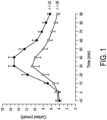
- Fig. 1 shows an exemplary cortisol time response.
- Fig. 1 shows the cortisol time response caused by a stress response for males (closed circles) and females (open circles), as disclosed in the paper by Kirschbaum et al. mentioned above.
- the cortisol time response is the trace of the cortisol level (absolute value measured in nmol/l in Fig. 1 ) over time.
- Fig. 1 is a result disclosed in the paper by Kirschbaum et al. mentioned above, it stands for a general cortisol time response. This general cortisol time response is relevant for the present invention.
- the inventors have found that there is a specific relationship between a stimulus response (or skin conductance response) in the skin conductance trace and a (salivary) cortisol time response of a user. Thus, there is a specific correlation between the measured skin conductance response (or stimulus response) and a subsequent cortisol time response.
- the cortisol response linked to a stimulus response has in particular a specific (time) latency. This latency is in particular much bigger than the latency between the stimulus and its stimulus response.
- the cortisol time responses can be cumulated or added on top of each other. Using this knowledge, the level of mental balance or imbalance of a user can be estimated.
- Fig. 2 shows an exemplary skin conductance trace measured by a skin conductance sensor.
- the sensor can for example be integrated in or measured with the wearable device disclosed herein.
- the x-axis in Fig. 2 denotes the time t over a period of several hours, here from about 16 o'clock (4 p.m.) to 22.30 o'clock (10.30 p.m.). Thus, a skin conductance trace is formed over several hours.
- the y-axis denotes the measured skin conductance values, also called galvanic skin response (GSR) or electrodermal activity (EDA), measured in ⁇ S.
- GSR galvanic skin response
- EDA electrodermal activity
- Skin conductance is a measure of the electrical conductance of the skin, which varies with its moisture level, thus the sweat gland activity. Emotional events or stimuli show as peaks with a steeper rising slope and a gentler down slope. In Fig. 2 , each peak corresponds to a response of the sympathetic nervous system to an emotionally arousing event (communicated via the vagal nerve to the sweat glands of the skin). This peak is also called skin conductance response (or stimulus response). Emotionally arousing events or stimuli can be viewed as psychological stress, in contrast to physical exercise, which can be viewed as physical stress. Thus, an emotional event or stimulus causes (with a short latency) a stimulus response in the skin conductance (or skin conductance response) which can be measured.
- Fig. 3 shows a mental balance or imbalance estimation system 100 according to an embodiment.
- the mental balance or imbalance estimation (or determination) system for estimating (or determining) a level 12 of mental balance or imbalance of a user comprises a skin conductance sensor 20 for sensing the skin conductance of the user. The skin conductance measured by the sensor 20 over time forms a skin conductance trace 22.
- the system further comprises a processing unit 10 (or mental balance/imbalance level estimation unit or mental balance/imbalance level estimator) for receiving and processing the skin conductance trace 22.
- the processing unit 10 can be any type of suitable processing unit or processor, such as for example a microprocessor/microcontroller, or embedded microcontroller, but not limited thereto. It will be understood that the skin conductance sensor 20 and the processing unit 10 can be part of the same device (e.g. wearable device or wristband) or can be in two separate devices.
- the processing unit 10 is configured to determine at least one stimulus response in the skin conductance trace 22 (e.g. by determining the first order derivative of the skin conductance), to estimate a cortisol level trace of the user based on the determined at least one stimulus response, and to determine (or compute) the estimated level 12 of mental balance/imbalance of the user based on the estimated cortisol level trace.
- the system can comprise an output unit 40 for outputting or rendering the level 12 of mental balance or imbalance to the user. It will be understood that the output unit 40 and the processing unit 10 can be part of the same device (e.g. wearable device or wristband) or can be in two separate devices.
- the system can further comprise a memory 11 for storing the estimated cortisol level trace 28.
- the processing unit 10 can store the cortisol level trace 28 into the memory 11 and/or can read the stored trace from the memory 11.
- the processing unit 28 is configured to determine (or compute) an estimated cortisol time response 26 for each determined stimulus response 24.
- the estimated cortisol time response 26 is then added to the cortisol level or cortisol level trace 28 in the memory.
- multiple estimated cortisol time responses 26 are cumulated in order to estimate the cortisol level trace 28 which is stored in the memory 11. More specifically, for each point of time, the cortisol levels of different cortisol time responses for that point of time are added or cumulated.
- the memory can be any suitable memory, such as for example a memory register or RAM (random access memory). It will be understood that the memory 11 and the processing unit 10 can be part of the same device (e.g. wearable device or wristband) or can be in two separate devices.
- RAM random access memory
- Fig. 4 shows a mental balance or imbalance estimation method according to an embodiment.
- the method for estimating a level of mental balance or imbalance of a user comprises the step S1 of receiving a skin conductance trace, the step S2 of determining at least one stimulus response in the skin conductance trace (e.g. by determining the first order derivative of the skin conductance), the step S3 of estimating a cortisol level trace of the user based on the determined at least one stimulus response, and the step S4 of determining the estimated level of mental balance or imbalance of the user based on the estimated cortisol level trace.
- These steps can also be performed by a processing unit or a computer program comprising program code means for causing a computer to carry out these steps.
- the method can further comprise a step S5 of outputting the level of mental balance or imbalance to the user.
- the estimated level of mental balance (or imbalance) is determined for the current (or momentary) point of time by calculating and/or evaluating the cortisol level trace of a past time period (e.g. 90 minutes into the past for females and 150 minutes into the past for males).
- the processing unit 10 can read the cortisol level trace 28 for the past period (e.g. past 90 minutes) from the memory 11 in order to determine the level of mental balance for the current point of time.
- the estimated level of mental balance (or imbalance) is determined or predicted for a future point of time (or future period of time) by calculating and/or evaluating the cortisol level trace for a future time period (e.g.
- the processing unit 10 can read the cortisol level trace 28 for the future period (e.g. future 90 minutes) from the memory 11 in order to determine the level of mental balance for the future point of time.
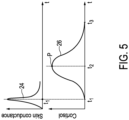
- Fig. 5 shows an exemplary stimulus response 24 (or skin conductance response) of a skin conductance trace 22 (top diagram of Fig. 5 ) and a corresponding cortisol time response 26 (bottom diagram of Fig. 5 ).
- the stimulus response 24 is determined at a specific start point of time t1
- the corresponding estimated cortisol time response 26 has its start point at the specific start point of time t1 and lasts to its end point at a predefined end time t3 in the future.
- the cortisol time response 26 rises to its peak point P, which is at a predefined peak point of time t2, with a predefined rise coefficient c r and falls to its end point, which is at the predefined end time t3, with a predefined decay coefficient c d .
- time t can be measured in minutes.
- the gain g corresponds to the height of the peak point P.
- the cortisol time response curve 26 can be modeled with a function with three key descriptors: gain g, rise coefficient c r and decay coefficient c d .
- gain g gain g
- rise coefficient c r rise coefficient c d
- decay coefficient c d decay coefficient
- the predefined end point of time t3 depends on the sex of the user.
- the predefined end point of time t3 can be about 90 minutes after the specific start point of time t1 if the input information indicates a female, and about 150 minutes if the input information indicates a male. Since the down curve is an asymptote, these values are chosen such that the cortisol response has effectively died out (but not exactly). Thus, at the end point of time t3 the cortisol level of the cortisol time response is zero or comes close to zero.
- Table I shows the modeling results for the three salivary cortisol response coefficients to a psychosocial stimulus (or stressor) for males and females according to equation (1) above.
- the rise coefficient c r is equal for both sexes, whereas the decay coefficient c d differs significantly.
- the gain g is almost twice as high for women compared to men.
- Table I Coefficient Male Female c d 23 15 c r 28 28 g 155 270
- the estimated cortisol time responses can be additional to a cortisol base level of a real cortisol trace.
- a cortisol base level In a day trace of the cortisol there always is a base level dependant on the time of day. For example, in the morning it is high to wake a person up, and it lowers down to a low value in the evening to facilitate sleep. These effects of the cortisol base level should not be taken into account by the system.
- the cortisol time response (curve) disclosed herein is a cortisol level amount additional to the cortisol base level. This additional amount is vanished after a specific time period (e.g. about 150 minutes. Thus, cortisol level of the estimated cortisol time response is not an estimated value of a real (absolute value) cortisol level.
- the estimated cortisol level trace 28 can be determined by cumulating multiple estimated cortisol time responses 26, wherein each estimated cortisol time response 26 is based on one stimulus response 24. In this way a quantification of the cumulative effect of subsequent stimuli (or stressors) in a specific time frame (e.g. a time frame of several hours) can be provided. Based on these cumulated cortisol responses the level of mental balance (or imbalance) can be estimated.
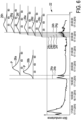
- Fig. 6 shows an exemplary skin conductance trace 22 having multiple stimuli 24a-h and the corresponding cortisol time responses 26a-h.
- Fig. 6 shows the skin conductance trace 22 of a female.
- the skin conductance trace 22 has multiple stimuli 24a-h (or stress/arousal peaks). Coupled to each stimulus response 24a-h is a corresponding or respective salivary cortisol response curve 26a-h.
- the predefined peak point of time (t2 in Fig. 5 ) of the peak point P is about 30 minutes after the start point of time.
- the estimated cortisol level trace 28 is then determined by cumulating the multiple estimated cortisol time responses which overlap in time (for example on the one hand cortisol responses 26a and 26b in Fig. 6 , and on the other hand cortisol responses 26c-h).
- the mental balance is therefore determined or estimated based on the cumulative effect of subsequent stimuli (or stressors) on the mood/stress state of a person by assuming that it is related to the cumulative salivary cortisol, which is linked to the intracellular cortisol.
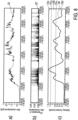
- Fig. 7 shows a first example of a skin conductance trace 22 ( Fig. 7a )), the first derivative 22' of the skin conductance trace ( Fig. 7b )), and an estimated salivary cortisol level trace 28 ( Fig. 7c )).
- Fig. 8 shows a second example of a skin conductance trace 22 ( Fig. 8a )), the first derivative 22' of the skin conductance trace ( Fig. 8b )), and an estimated salivary cortisol level trace 28 ( Fig. 8c )).
- Fig. 7a or Fig. 8a shows the smoothed skin conductance, Fig. 7b or Fig.
- each of Fig. 7 and Fig. 8 shows the signal processing performed by the processing unit 10 which leads to the determination of the estimated level of mental balance/imbalance (or cumulative stress load) based on the skin conductance trace or signal 22.
- the skin conductance sensor 20 measures the skin conductance (e.g. at a rate of 2 Hz). A skin conductance trace 22 is then formed (see Fig. 7a ) or Fig. 8 a )). The processing unit 10 then determines the first order derivative 22' of the skin conductance in order to determine the stimulus response(s) (see Fig. 7b ) or Fig. 8b )). The processing unit 10 can determine the at least one stimulus response in the skin conductance trace by determining peaks in the first order derivative of the skin conductance. Thus, each stimulus response shows as a peak in the first derivative of the skin conductance (indicated by fine vertical line in Fig. 7b or Fig. 8b ).
- the processing unit 10 estimates or determines an estimated cortisol level trace 28 by cumulating multiple estimated cortisol time responses 26, each estimated cortisol time response 26 being based on one stimulus response 24 (see Fig. 7c ) or Fig. 8c )). The processing unit 10 then determines the estimated level of mental balance based on the estimated cortisol level trace 28.
- the height of the cortisol response or cortisol contribution of an event (controlled by the gain constant g) is proportional to the height of the peak in the first derivative of the skin conductance trace 22 for that stimulus response.
- the effect of an emotionally arousing event lingers on in the salivary (and hence the intracellular) cortisol concentration for a specific period of time, in particular 90 and 150 minutes for females and males respectively.
- the past events need to be taken into account for these periods.
- a measure of mental balance is estimated as the accumulated salivary cortisol through calculating the convolution of the height-adjusted (delta) peaks for a series of events on the on hand, and the male of female salivary cortisol response as parameterized in formula I on the other hand.
- the cortisol level drops to the background level according to the cortisol time response curve in a specific period of time, in particular about 90 minutes for females and about 150 minutes for males.
- a fully balanced state is then defined as the state more than 90 or 150 minutes after the last significant stimulus or stimulus response for females and males respectively.
- a fully unbalanced state is harder to define.
- the allostatic (over)load literature at some point the stress response dies out in such a situation, when allostatic overload is reached.
- this state can be assigned the denomination "fully unbalanced". It is in this state that a person is prone to erratic behavior. For practical implementations, it is always possible to make the definition of "fully unbalanced" adaptive to the measured history of a particular user: the highest cortisol level calculated from the skin conductance measurements.
- Fig. 8 c additionally three regions in the cumulative cortisol level or cortisol level trace 28 are indicated which are translated into to three corresponding intervals or regions 12a, 12b, 12c of mental balance (or imbalance).
- a first region 12a the cumulative cortisol level is below a first threshold TH1
- a second region 12b the cumulative cortisol level is above the first threshold TH1 and below a second threshold TH2 (which is bigger than the first threshold TH1)
- a third region 12c the cumulative cortisol level is above the second threshold TH2.
- Each region 12a, 12b, 12c depicts or corresponds to one level or state of mental balance (or imbalance).
- the first region 12a can for example indicate a "safe balanced” or “green” level or state
- the second region12b can be indicate “call for attention” or “yellow” level or state
- the third region 12c can indicate a "take action” or “red” level or state. Therefore, Fig. 8 c) basically shows a translation of the salivary cortisol level into a "traffic light” color code.
- An exemplary, but not limiting, "traffic light” interpretation of the allostatic load can be as follows. In the “green” state the person is relaxed and at ease. At a certain level of cortisol (which can be determined in trials by means of mood questionnaires, such as the UMACL), a transition from the "green” state to the “yellow” state is defined. In the “yellow” level or state the person is alert for possible dangers, and somewhat stressed. The response to stressors in the "yellow” state is bound to be different from that of a person in the "green” state. In the “red” state the person is in allostatic overload, and the cumulative effect of stressful events is considered harmful to the person.
- cortisol level trace 28 peaks about a half hour (30 minutes) after the stressor. This is true for each emotional event or stressor, but the effect is more visible with the strong emotional events or stressors.
- This latency allows a predictive capability of the system (or wearable device), to warn the user (e.g. wearer of the wearable device) of an upcoming peak. During such a maximum the response to new stressors differs from the 'normal' stress response. The response is bound to be more unbalanced, possibly even leading to bouts of anger, or roadrage, when driving a car.
- insufficient recuperation was allowed after a sequence of stressors, leading to a period in the "red" state 12c. A totally stimulus free (or stimulus response free) period of about an hour restored the balance almost completely.
- Fig. 9 shows a perspective view of a wearable device 30 wearable by a user according to an embodiment.
- the wearable device 30 is in the form of a wristband.
- the wristband comprises a wristband material part 33 and a casing 34.
- the wristband material part 33 can loop around the wrist of the user. It will be understood that the wearable device 30 could also be worn around any other suitable body part, such as the ankle, foot or hand.
- the wearable device 30 can in particular comprise the mental balance or imbalance estimation system 100 described herein. In this way a mental balance or imbalance estimation system 100 in an unobtrusive and wearable format can be provided.
- the wearable device 30 can only comprise the skin conductance sensor 20 and the processing unit 10 of the system 100 can be located at a remote location or device (e.g. a remote computer).
- the wearable device 30 comprises the skin conductance sensor 20.
- the skin conductance sensor 20 comprises skin conductance electrodes 31, 32 in combination with a skin conductance measuring unit (not shown).
- a skin conductance measuring unit not shown
- two skin conductance electrodes 31, 32 are integrated into the wrist band material part 33.
- the skin conductance electrodes 31, 32 can be arranged so as to contact the volar side of the wrist, where there is normally not a lot of hair, when the wearable device 30 is put on or worn by the user. In this way, a better measurement of the skin conductance can be provided.
- the skin conductance measuring unit is adapted to measure the skin conductance of the user 1 between the skin conductance electrodes 31, 32.
- the skin conductance electrodes 31, 32 can be connected to the skin conductance measuring unit by means of wires integrated in the wristband material part 33 in the embodiment of Fig. 9 .
- the skin conductance measuring unit or sensor can comprise a voltage generator for applying a voltage between the at least two skin conductance electrodes, a sensing unit for sensing a current between the at least two electrodes, and/or a calculating unit for calculating the skin conductance based on the sensed current.
- the measured skin conductance over time forms the skin conductance trace (or data).
- the skin conductance trace (or data) can for example be stored in a memory of the wearable device 30, or can be (wirelessly) transmitted to an external unit using a (wireless) transmitter.
- the skin conductance measuring unit and/or the processing unit 10 can be integrated into the casing 34 of the wearable device 30.
- the wearable device 30 can further comprise a transmitter for wirelessly transmitting data over a wireless communication link, such as the output data or the estimated level 12.
- the processing unit 10 can also be a separate part or device and that the wearable device 10 then transmits the skin conductance data to the separate part or device via the (wireless) transmitter.
- Fig. 10 shows a user 1 and a mental balance or imbalance estimation system 100 according to an embodiment.
- the mental balance or imbalance estimation system 100 comprises a skin conductance sensor 20 for sensing the skin conductance of the user 1.
- the skin conductance sensor 20 is integrated into a wearable device 30, in form of a wristband, wearable by the user 1.
- the skin conductance sensor 20 can also sense the skin conductance at other suitable body parts, such as the finger(s), and/or at the palmar or volar side of the hand.
- the mental balance or imbalance estimation system 100 further comprises an output device 40 for outputting the level 12 of mental balance or imbalance to the user 1.
- the output device 40 can be portable, for example be clipped to a belt of the user 1 as indicated in Fig. 10 .
- the output device 40 shown in Fig. 5 comprises display means 41 for displaying the level 12 of mental balance or imbalance. Alternatively or additionally, the level 12 can also be output to the user 1 using sound, light, and/or vibration.
- the output device 40 can be a separate device (as shown in Fig. 10 ), or it can be integrated into for example the wearable device 30 comprising the sensor 20.
- the output can be through a variety of modalities such as audio (e.g. sound), visual (e.g. light), and/or haptic (e.g. vibration) feedback.
- the mental balance or imbalance estimation system 100 can further comprise additional devices, such as an electrocardiogram (ECG) sensor, like the ECG chest belt 20a shown in Fig. 10 .
- ECG electrocardiogram
- the ECG sensor can sense the electrocardiogram of the user 1. From the electrocardiogram the heart rate variability (HRV) can be determined, which is known to relate to stress.
- HRV heart rate variability
- other suitable measurements such as BVP, respiration, skin temperature, electroencephalography (EEG) / brain activity, activity measurement (e.g. through an accelerometer) and/or questionnaires can be used for additional measurements.
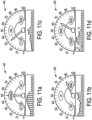
- Fig. 11a-11d each shows an output unit 40 of a mental balance or imbalance estimation system 100 according to an embodiment.
- the output unit 40 is or comprises a display, as explained with reference to Fig. 10 .
- the information about the state or level of mental balance (or imbalance) is communicated by means of a colored speedometer.
- the display of Fig. 11a can be green, indicating a "green" level or state
- the display of Fig. 11b can be yellow, indicating a "yellow” level or state
- the display of Fig. 11c can be red, indicating a "red” level or state
- the display of Fig. 11d can be blue, indicating a "blue” level or state. Therefore, in this example, four different states are identified that depict various levels of mental balance.
- this "traffic light” advisor can be used to warn the wearer of the wearable device 30 (or wristband) described herein about an "out of balance" period in the near future (e.g. the next 60 minutes).
- the wearable device 30 or wristband or wristband GSR sensor
- the wearable device 30 is used for monitoring of level of mental balance/imbalance (or stress level) and predicting or forecasting a cumulative stress response within a specific timeframe (e.g. 60 minutes) in order to warn the user of the upcoming potentially harmful or strong (emotional) imbalance, or high level of mental imbalance.
- the upcoming level of mental imbalance is displayed to the user as a color coded bar, or a dashboard (as shown in Fig.
- the system or wearable device e.g. wristband
- an external device e.g. an iPhone or an PC application
- the external device could also start displaying nature images or classical music that are known to reduce stress.
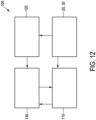
- Fig. 12 shows a diagram of a mental balance or imbalance estimation system 100 or method according to an embodiment.
- the system 100 comprises a skin conductance sensor 20, in particular a wearable device 30 (or a wristband GSR sensor), a mental imbalance level estimator 110 based on past emotional events (or stimuli), a mental imbalance level predictor (or forecaster) 120 for a future time or time period (e.g. for the upcoming 60 minutes), and a calendar application 130 (or electronic agenda).
- the skin conductance sensor 20 or wearable device 30 (or wristband GSR sensor) transmits the skin conductance trace to the mental imbalance level estimator 110 based on past emotional events (or stimuli).
- the mental imbalance level estimator 110 determines the estimated mental imbalance level for the current point of time, as explained above. This estimated mental imbalance level is then associated with or related to data from the calendar application 130 of the user.
- This calendar application 130 can for example be implemented in an external device (e.g. PC, laptop, mobile phone, iPhone, etc.).
- the skin conductance sensor 20 or wearable device 30 or wristband GSR sensor transmits the skin conductance trace to the mental imbalance level predictor (or forecaster) 120 for a future time or time period (e.g. for the upcoming 60 minutes).
- the mental imbalance level predictor 120 determines the estimated mental imbalance level for a future point of time or future period of time, as explained above.
- This estimated mental imbalance level is then associated with or related to data from the calendar application 130 of the user.
- the level of mental imbalance can be predicted or forecasted for an upcoming event in the calendar of the user. This is in particular achieved by taking into account both the current level of mental imbalance and the predicted (forecasted) level of mental imbalance for a specific future time period (e.g. next 60 min).
- the mental imbalance level estimator 110 and/or mental imbalance level predictor 120 can be implemented in the same processing unit or can be implemented in separate processing units. Further, it will be understood that the processing unit(s) of the mental imbalance level estimator 110 and/or mental imbalance level predictor 120 can be located in the wearable device 30 (in particular wristband GSR sensor) or can be located in an external device (e.g. PC, laptop, mobile phone, iPhone, etc.).
- the system 100 or wearable device 30 e.g. wristband or wrist worn GSR sensor
- an application running on an external device (e.g. PC, laptop, mobile phone, iPhone, etc.) in order to estimate or monitor the level of mental imbalance, analyze this level of mental imbalance and relate it to data from an electronic agenda of the user in order to predict or forecast the level of mental imbalance for upcoming events by taking into account the user current level of mental imbalance and his predicted level of mental imbalance within a specific time period (e.g. 60 min timeframe).
- This system facilitates planning events in the agenda to avoid too high level of mental imbalance and provides the user with behavioral guidance to cope in cases of elevated level of mental imbalance.
- a lightweight and unobtrusive wearable device is described herein that measures the occurrence and intensity of a person's emotional load (irrespective of valence, thus the emotions can be both positive and negative - both will constitute an emotional load), also called level of mental balance (or imbalance),and processes this data to deliver an output (e.g. a traffic light advisor) for the user (or wearer) of the device to signal a current status, and/or to warn for an out of balance period (e.g. during the next 60 minutes).
- an output e.g. a traffic light advisor
- a system is described herein to derive a measure for mental balance derived from skin conductance measurements, in particular done with a wearable device.
- This measure can not only give an indication of the momentary state of mental balance of a person, but it can also make an estimation of the upcoming levels of mental balance. As such it can guide a person to prevent over-stressed states that can be harmful to a person's health. Moreover, it could use the forecast of upcoming mental balance in relation to other known upcoming events (e.g. from an agenda) in order to predict situations that are potentially harmful to a person's health.
- a computer program may be stored/distributed on a suitable medium, such as an optical storage medium or a solid-state medium supplied together with or as part of other hardware, but may also be distributed in other forms, such as via the Internet or other wired or wireless telecommunication systems.
- a suitable medium such as an optical storage medium or a solid-state medium supplied together with or as part of other hardware, but may also be distributed in other forms, such as via the Internet or other wired or wireless telecommunication systems.
Landscapes
- Health & Medical Sciences (AREA)
- Life Sciences & Earth Sciences (AREA)
- Engineering & Computer Science (AREA)
- Public Health (AREA)
- Medical Informatics (AREA)
- Biomedical Technology (AREA)
- General Health & Medical Sciences (AREA)
- Pathology (AREA)
- Physics & Mathematics (AREA)
- Biophysics (AREA)
- Heart & Thoracic Surgery (AREA)
- Molecular Biology (AREA)
- Surgery (AREA)
- Animal Behavior & Ethology (AREA)
- Veterinary Medicine (AREA)
- Psychiatry (AREA)
- Signal Processing (AREA)
- Dermatology (AREA)
- Physiology (AREA)
- Computer Vision & Pattern Recognition (AREA)
- Artificial Intelligence (AREA)
- Data Mining & Analysis (AREA)
- Databases & Information Systems (AREA)
- Epidemiology (AREA)
- Primary Health Care (AREA)
- Radiology & Medical Imaging (AREA)
- Nuclear Medicine, Radiotherapy & Molecular Imaging (AREA)
- Optics & Photonics (AREA)
- Educational Technology (AREA)
- Developmental Disabilities (AREA)
- Hospice & Palliative Care (AREA)
- Psychology (AREA)
- Social Psychology (AREA)
- Child & Adolescent Psychology (AREA)
- Chemical & Material Sciences (AREA)
- Chemical Kinetics & Catalysis (AREA)
- General Chemical & Material Sciences (AREA)
- Power Engineering (AREA)
- Measurement Of The Respiration, Hearing Ability, Form, And Blood Characteristics Of Living Organisms (AREA)
- Measurement And Recording Of Electrical Phenomena And Electrical Characteristics Of The Living Body (AREA)
Applications Claiming Priority (2)
| Application Number | Priority Date | Filing Date | Title |
|---|---|---|---|
| US201161562627P | 2011-11-22 | 2011-11-22 | |
| PCT/IB2012/056354 WO2013076615A1 (en) | 2011-11-22 | 2012-11-12 | Mental balance or imbalance estimation system and method |
Publications (2)
| Publication Number | Publication Date |
|---|---|
| EP2747638A1 EP2747638A1 (en) | 2014-07-02 |
| EP2747638B1 true EP2747638B1 (en) | 2024-05-22 |
Family
ID=47429982
Family Applications (1)
| Application Number | Title | Priority Date | Filing Date |
|---|---|---|---|
| EP12806151.2A Active EP2747638B1 (en) | 2011-11-22 | 2012-11-12 | Mental balance or imbalance estimation system and method |
Country Status (9)
| Country | Link |
|---|---|
| US (1) | US10085695B2 (enExample) |
| EP (1) | EP2747638B1 (enExample) |
| JP (1) | JP6110869B2 (enExample) |
| CN (1) | CN103957783B (enExample) |
| BR (1) | BR112014012033B1 (enExample) |
| IN (1) | IN2014CN03726A (enExample) |
| MX (1) | MX2014006021A (enExample) |
| RU (1) | RU2634680C2 (enExample) |
| WO (1) | WO2013076615A1 (enExample) |
Families Citing this family (70)
| Publication number | Priority date | Publication date | Assignee | Title |
|---|---|---|---|---|
| US20070060358A1 (en) | 2005-08-10 | 2007-03-15 | Amaitis Lee M | System and method for wireless gaming with location determination |
| US7534169B2 (en) | 2005-07-08 | 2009-05-19 | Cfph, Llc | System and method for wireless gaming system with user profiles |
| US8616967B2 (en) | 2004-02-25 | 2013-12-31 | Cfph, Llc | System and method for convenience gaming |
| US8092303B2 (en) | 2004-02-25 | 2012-01-10 | Cfph, Llc | System and method for convenience gaming |
| US10510214B2 (en) | 2005-07-08 | 2019-12-17 | Cfph, Llc | System and method for peer-to-peer wireless gaming |
| US8070604B2 (en) | 2005-08-09 | 2011-12-06 | Cfph, Llc | System and method for providing wireless gaming as a service application |
| US7549576B2 (en) | 2006-05-05 | 2009-06-23 | Cfph, L.L.C. | Systems and methods for providing access to wireless gaming devices |
| US7644861B2 (en) | 2006-04-18 | 2010-01-12 | Bgc Partners, Inc. | Systems and methods for providing access to wireless gaming devices |
| US8939359B2 (en) * | 2006-05-05 | 2015-01-27 | Cfph, Llc | Game access device with time varying signal |
| US12136314B2 (en) * | 2006-05-05 | 2024-11-05 | Cfph, Llc | Game access device with time varying signal |
| US9306952B2 (en) | 2006-10-26 | 2016-04-05 | Cfph, Llc | System and method for wireless gaming with location determination |
| US8645709B2 (en) | 2006-11-14 | 2014-02-04 | Cfph, Llc | Biometric access data encryption |
| US9411944B2 (en) | 2006-11-15 | 2016-08-09 | Cfph, Llc | Biometric access sensitivity |
| US8510567B2 (en) | 2006-11-14 | 2013-08-13 | Cfph, Llc | Conditional biometric access in a gaming environment |
| US8319601B2 (en) | 2007-03-14 | 2012-11-27 | Cfph, Llc | Game account access device |
| US8581721B2 (en) | 2007-03-08 | 2013-11-12 | Cfph, Llc | Game access device with privileges |
| US9183693B2 (en) | 2007-03-08 | 2015-11-10 | Cfph, Llc | Game access device |
| US20220296999A1 (en) | 2010-08-13 | 2022-09-22 | Cfph, Llc | Multi-process communication regarding gaming information |
| US8956231B2 (en) | 2010-08-13 | 2015-02-17 | Cfph, Llc | Multi-process communication regarding gaming information |
| WO2014140960A1 (en) | 2013-03-12 | 2014-09-18 | Koninklijke Philips N.V. | Visit duration control system and method. |
| CA2932284C (en) * | 2013-12-05 | 2023-03-28 | Koninklijke Philips N.V. | Processor for processing skin conductance data and device for detecting at least one stage of burnout and/or chronic fatigue syndrome of a living being |
| KR101946130B1 (ko) * | 2014-02-24 | 2019-06-11 | 소니 주식회사 | 스마트 디바이스들로부터 감각 정보를 취득하기 위한 스마트 착용형 디바이스들 및 방법들 |
| US9830781B2 (en) * | 2014-06-13 | 2017-11-28 | Verily Life Sciences Llc | Multipurpose contacts for delivering electro-haptic feedback to a wearer |
| CN105615901B (zh) * | 2014-11-06 | 2018-08-14 | 中国移动通信集团公司 | 一种监测情绪的方法和系统 |
| JP6786164B2 (ja) * | 2014-12-26 | 2020-11-18 | フェリカネットワークス株式会社 | 情報処理装置、および、情報処理方法、プログラム、並びに情報処理システム |
| EP3072446A1 (en) | 2015-03-26 | 2016-09-28 | Digital for Mental Health | Mental suffering monitoring system |
| US10990888B2 (en) | 2015-03-30 | 2021-04-27 | International Business Machines Corporation | Cognitive monitoring |
| EP3302274A4 (en) * | 2015-06-05 | 2019-05-29 | Eccrine Systems, Inc. | WELD CAPTURE DEVICE WITH CORTISOL MEASUREMENT |
| CN104905803B (zh) * | 2015-07-01 | 2018-03-27 | 京东方科技集团股份有限公司 | 可穿戴电子设备及其情绪监控方法 |
| US20170127993A1 (en) * | 2015-11-06 | 2017-05-11 | Lifeq Global Limited | Non-Invasive Physiological Quantification of Stress Levels |
| CN108351846B (zh) | 2015-11-13 | 2022-03-01 | 索尼公司 | 通信系统和通信控制方法 |
| JP6306071B2 (ja) * | 2016-02-09 | 2018-04-04 | Pst株式会社 | 推定装置、推定プログラム、推定装置の作動方法および推定システム |
| CN106063709B (zh) * | 2016-05-24 | 2019-07-05 | 京东方科技集团股份有限公司 | 一种疲劳检测方法及装置 |
| CN109310360B (zh) * | 2016-05-25 | 2023-02-28 | 皇家飞利浦有限公司 | 皮肤电导的测量 |
| JP6775359B2 (ja) * | 2016-08-30 | 2020-10-28 | 旭化成株式会社 | 吐き気検出装置および吐き気検出装置の作動方法 |
| WO2018090304A1 (zh) | 2016-11-17 | 2018-05-24 | 华为技术有限公司 | 一种精神压力评测方法和装置 |
| EP3409205A1 (en) * | 2017-05-30 | 2018-12-05 | Koninklijke Philips N.V. | Device, system and method for determining an emotional state of a user |
| EP3420890A1 (en) | 2017-06-30 | 2019-01-02 | Nederlandse Organisatie voor toegepast- natuurwetenschappelijk onderzoek TNO | Prediction of mood and associated outcomes based on correlation of autonomous and endocrine parameters |
| WO2019008976A1 (ja) * | 2017-07-07 | 2019-01-10 | パナソニックIpマネジメント株式会社 | 情報提供方法、情報処理システム、情報端末、及び情報処理方法 |
| WO2019008978A1 (ja) * | 2017-07-07 | 2019-01-10 | パナソニックIpマネジメント株式会社 | 情報提供方法、情報処理システム、情報端末、及び情報処理方法 |
| CN109982639A (zh) | 2017-07-07 | 2019-07-05 | 松下知识产权经营株式会社 | 信息提供方法、信息处理系统、信息终端及信息处理方法 |
| EP3650855A4 (en) * | 2017-07-07 | 2020-07-01 | Panasonic Intellectual Property Management Co., Ltd. | INFORMATION PROVIDING PROCESS, INFORMATION PROCESSING SYSTEM, INFORMATION TERMINAL AND INFORMATION PROCESSING PROCESS |
| KR20200024135A (ko) | 2017-07-07 | 2020-03-06 | 파나소닉 아이피 매니지먼트 가부시키가이샤 | 정보 제공 방법, 정보 처리 시스템, 정보 단말, 및 정보 처리 방법 |
| WO2019008977A1 (ja) * | 2017-07-07 | 2019-01-10 | パナソニックIpマネジメント株式会社 | 情報提供方法、情報処理システム、情報端末、及び情報処理方法 |
| KR20200024743A (ko) * | 2017-07-07 | 2020-03-09 | 파나소닉 아이피 매니지먼트 가부시키가이샤 | 정보 제공 방법, 정보 처리 시스템, 정보 단말, 및 정보 처리 방법 |
| KR101912939B1 (ko) * | 2018-06-14 | 2018-10-29 | 이영달 | 사용자 상태에 따른 맞춤형 자기관리정보 제공시스템 |
| EP3594962A1 (en) * | 2018-07-11 | 2020-01-15 | Koninklijke Philips N.V. | Device, system and method for determining a stress level of a user |
| FR3084199B1 (fr) * | 2018-07-20 | 2021-04-16 | Thales Sa | Commande de vol depuis un dispositif non-avionique |
| EP3666182A1 (en) * | 2018-12-11 | 2020-06-17 | Koninklijke Philips N.V. | Device, system and method for providing bio-feedback to a user |
| US12077193B1 (en) | 2019-07-23 | 2024-09-03 | Quanata, Llc | Smart ring system for monitoring sleep patterns and using machine learning techniques to predict high risk driving behavior |
| US11909238B1 (en) | 2019-07-23 | 2024-02-20 | BlueOwl, LLC | Environment-integrated smart ring charger |
| US11853030B2 (en) | 2019-07-23 | 2023-12-26 | BlueOwl, LLC | Soft smart ring and method of manufacture |
| US12504784B1 (en) | 2019-07-23 | 2025-12-23 | Quanata, Llc | Smart ring clip and method of manufacture |
| US11637511B2 (en) | 2019-07-23 | 2023-04-25 | BlueOwl, LLC | Harvesting energy for a smart ring via piezoelectric charging |
| US11551644B1 (en) | 2019-07-23 | 2023-01-10 | BlueOwl, LLC | Electronic ink display for smart ring |
| US11984742B2 (en) | 2019-07-23 | 2024-05-14 | BlueOwl, LLC | Smart ring power and charging |
| US12126181B2 (en) | 2019-07-23 | 2024-10-22 | Quanata, Llc | Energy harvesting circuits for a smart ring |
| US11949673B1 (en) | 2019-07-23 | 2024-04-02 | BlueOwl, LLC | Gesture authentication using a smart ring |
| US12067093B2 (en) | 2019-07-23 | 2024-08-20 | Quanata, Llc | Biometric authentication using a smart ring |
| US11537203B2 (en) | 2019-07-23 | 2022-12-27 | BlueOwl, LLC | Projection system for smart ring visual output |
| US11594128B2 (en) | 2019-07-23 | 2023-02-28 | BlueOwl, LLC | Non-visual outputs for a smart ring |
| US11537917B1 (en) | 2019-07-23 | 2022-12-27 | BlueOwl, LLC | Smart ring system for measuring driver impairment levels and using machine learning techniques to predict high risk driving behavior |
| US11462107B1 (en) | 2019-07-23 | 2022-10-04 | BlueOwl, LLC | Light emitting diodes and diode arrays for smart ring visual output |
| US12703400B2 (en) | 2019-07-23 | 2026-08-11 | Quanata, Llc | Smart ring system for measuring stress levels and using machine learning techniques to predict high risk driving behavior |
| EP3834716A1 (en) | 2019-12-11 | 2021-06-16 | Koninklijke Philips N.V. | Wearable sensor device and a sensing method |
| US11861722B2 (en) | 2020-02-18 | 2024-01-02 | BlueOwl, LLC | Systems and methods for generating and updating an inventory of personal possessions of a user for insurance purposes |
| JP7436277B2 (ja) * | 2020-04-30 | 2024-02-21 | 株式会社Subaru | 乗員感情伝達装置 |
| US20220361789A1 (en) * | 2020-06-15 | 2022-11-17 | Georgia Tech Research Corporation | Fully Stretchable, Wireless, Skin-Conformal Bioelectronics for Continuous Stress Monitoring in Daily Life |
| EP3988956A1 (en) | 2020-10-22 | 2022-04-27 | Koninklijke Philips N.V. | Functional magnetic resonance imaging |
| JPWO2024090350A1 (enExample) * | 2022-10-24 | 2024-05-02 |
Family Cites Families (23)
| Publication number | Priority date | Publication date | Assignee | Title |
|---|---|---|---|---|
| JPH0919420A (ja) * | 1995-07-07 | 1997-01-21 | Omron Corp | 生理状態判定方法及び生理状態判定装置 |
| RU2107460C1 (ru) * | 1996-05-28 | 1998-03-27 | Акционерное общество закрытого типа "Нейроком" | Способ регистрации кожно-гальванических реакций и устройство для его осуществления |
| US6233471B1 (en) * | 1998-05-13 | 2001-05-15 | Cygnus, Inc. | Signal processing for measurement of physiological analysis |
| KR100418434B1 (ko) * | 2000-01-21 | 2004-02-11 | 김현 | 스트레스 자동인식 컴퓨터 주변장치 및 이를 이용한스트레스 측정 시스템 |
| CA2449283C (en) * | 2001-06-15 | 2014-07-22 | The Trustees Of The University Of Pennsylvania | Functional brain imaging for detecting and assessing deception and concealed recognition, and cognitive/emotional response to information |
| KR100580618B1 (ko) * | 2002-01-23 | 2006-05-16 | 삼성전자주식회사 | 생리 신호의 단시간 모니터링을 통한 사용자 정서 인식장치 및 방법 |
| GB2411478A (en) * | 2002-01-29 | 2005-08-31 | Johnson & Johnson Consumer | Method of measuring the stress or relaxation level of a mammal |
| US7020508B2 (en) * | 2002-08-22 | 2006-03-28 | Bodymedia, Inc. | Apparatus for detecting human physiological and contextual information |
| KR20040032451A (ko) | 2002-10-09 | 2004-04-17 | 삼성전자주식회사 | 생체신호 기반의 건강 관리 기능을 갖는 모바일 기기 및이를 이용한 건강 관리 방법 |
| US7052472B1 (en) * | 2002-12-18 | 2006-05-30 | Dsp Diabetes Sentry Products, Inc. | Systems and methods for detecting symptoms of hypoglycemia |
| JP2005305132A (ja) * | 2004-03-24 | 2005-11-04 | Matsushita Electric Ind Co Ltd | 機器操作器、表示器、環境制御システムおよびプログラム |
| EP1871219A4 (en) | 2005-02-22 | 2011-06-01 | Health Smart Ltd | METHOD AND SYSTEMS FOR PHYSIOLOGICAL AND PSYCHOPHYSIOLOGICAL MONITORING AND THEIR USES |
| JP4274492B2 (ja) * | 2005-03-22 | 2009-06-10 | 財団法人浜松科学技術研究振興会 | 唾液中のペルオキシダーゼ活性を指標とする健康度判別方法及び健康度判別装置 |
| JP2006266721A (ja) * | 2005-03-22 | 2006-10-05 | Hamamatsu Kagaku Gijutsu Kenkyu Shinkokai | 唾液尿酸を指標とする健康度判別方法及び健康度判別装置 |
| US7921066B2 (en) | 2005-10-12 | 2011-04-05 | Henry Van Dyke Parunak | Characterizing and predicting agents via multi-agent evolution |
| US20080081963A1 (en) * | 2006-09-29 | 2008-04-03 | Endothelix, Inc. | Methods and Apparatus for Profiling Cardiovascular Vulnerability to Mental Stress |
| EP2120701B1 (en) * | 2007-02-13 | 2018-11-07 | Koninklijke Philips N.V. | Computer program product, device and method for estimating a change in level of arousal of a user |
| US20090264711A1 (en) | 2008-04-17 | 2009-10-22 | Motorola, Inc. | Behavior modification recommender |
| DE102008061997A1 (de) * | 2008-12-12 | 2010-06-17 | Karlsruher Institut für Technologie | System und Verfahren zum Stresstraining eines Benutzers |
| EP2408358A4 (en) * | 2009-03-18 | 2014-08-20 | A M P S Llc | STRESS MONITORING SYSTEM AND METHOD |
| US20110152635A1 (en) | 2009-12-23 | 2011-06-23 | Morris Margaret E | Motivational Profiling for Behavioral Change Technologies: A State-Trait Approach |
| US20120271121A1 (en) * | 2010-12-29 | 2012-10-25 | Basis Science, Inc. | Integrated Biometric Sensing and Display Device |
| ES2513666T3 (es) * | 2011-04-14 | 2014-10-27 | Koninklijke Philips N.V. | Dispositivo y método de medición del estrés |
-
2012
- 2012-11-12 RU RU2014125233A patent/RU2634680C2/ru active
- 2012-11-12 MX MX2014006021A patent/MX2014006021A/es active IP Right Grant
- 2012-11-12 US US14/356,691 patent/US10085695B2/en active Active
- 2012-11-12 WO PCT/IB2012/056354 patent/WO2013076615A1/en not_active Ceased
- 2012-11-12 JP JP2014542961A patent/JP6110869B2/ja active Active
- 2012-11-12 BR BR112014012033-1A patent/BR112014012033B1/pt not_active IP Right Cessation
- 2012-11-12 CN CN201280057474.9A patent/CN103957783B/zh active Active
- 2012-11-12 EP EP12806151.2A patent/EP2747638B1/en active Active
-
2015
- 2015-01-22 IN IN3726CHN2014 patent/IN2014CN03726A/en unknown
Also Published As
| Publication number | Publication date |
|---|---|
| CN103957783A (zh) | 2014-07-30 |
| WO2013076615A1 (en) | 2013-05-30 |
| MX2014006021A (es) | 2014-06-04 |
| JP2015503937A (ja) | 2015-02-05 |
| JP6110869B2 (ja) | 2017-04-05 |
| BR112014012033B1 (pt) | 2022-03-29 |
| BR112014012033A2 (pt) | 2017-05-30 |
| RU2634680C2 (ru) | 2017-11-02 |
| US10085695B2 (en) | 2018-10-02 |
| IN2014CN03726A (enExample) | 2015-07-03 |
| RU2014125233A (ru) | 2015-12-27 |
| US20140288401A1 (en) | 2014-09-25 |
| CN103957783B (zh) | 2017-09-26 |
| EP2747638A1 (en) | 2014-07-02 |
Similar Documents
| Publication | Publication Date | Title |
|---|---|---|
| US10085695B2 (en) | Mental balance or imbalance estimation system and method | |
| CN104244825B (zh) | 保有活动量算出装置、保有活动量算出方法和保有活动量算出系统 | |
| EP3629930B1 (en) | Device, system and method for determining an emotional state of a user | |
| EP3313276B1 (en) | Heart rate variability with sleep detection | |
| US10750958B2 (en) | Variable brightness and gain for optimizing signal acquisition | |
| US9596997B1 (en) | Probability-based usage of multiple estimators of a physiological signal | |
| JP7329549B2 (ja) | ユーザのストレスレベルを決定するための装置、システムおよび方法 | |
| US10922996B2 (en) | Systems and methods for generating a presentation of an energy level based on sleep and daily activity | |
| CN113301843B (zh) | 用于向用户提供生物反馈的设备、系统和方法 | |
| US20220361788A1 (en) | System and method for measuring acute and chronic stress | |
| CN109069056A (zh) | 用于改善用户的睡眠效果的系统 | |
| KR20170129937A (ko) | 정신적 고통 모니터링 시스템 | |
| US12626578B2 (en) | Hybrid method and system for multi scenario drowsiness detection and method for data processing using real-time and historical data on wearable devices | |
| EP3355765A1 (en) | A user migraine analysis component |
Legal Events
| Date | Code | Title | Description |
|---|---|---|---|
| PUAI | Public reference made under article 153(3) epc to a published international application that has entered the european phase |
Free format text: ORIGINAL CODE: 0009012 |
|
| 17P | Request for examination filed |
Effective date: 20140324 |
|
| AK | Designated contracting states |
Kind code of ref document: A1 Designated state(s): AL AT BE BG CH CY CZ DE DK EE ES FI FR GB GR HR HU IE IS IT LI LT LU LV MC MK MT NL NO PL PT RO RS SE SI SK SM TR |
|
| DAX | Request for extension of the european patent (deleted) | ||
| STAA | Information on the status of an ep patent application or granted ep patent |
Free format text: STATUS: EXAMINATION IS IN PROGRESS |
|
| 17Q | First examination report despatched |
Effective date: 20200205 |
|
| RAP1 | Party data changed (applicant data changed or rights of an application transferred) |
Owner name: KONINKLIJKE PHILIPS N.V. |
|
| REG | Reference to a national code |
Ref country code: DE Ref legal event code: R079 Free format text: PREVIOUS MAIN CLASS: A61B0005053000 Ipc: A61B0005053300 Ref document number: 602012080810 Country of ref document: DE |
|
| GRAP | Despatch of communication of intention to grant a patent |
Free format text: ORIGINAL CODE: EPIDOSNIGR1 |
|
| STAA | Information on the status of an ep patent application or granted ep patent |
Free format text: STATUS: GRANT OF PATENT IS INTENDED |
|
| RIC1 | Information provided on ipc code assigned before grant |
Ipc: G16H 50/30 20180101ALI20231130BHEP Ipc: G16H 50/20 20180101ALI20231130BHEP Ipc: A61B 5/16 20060101ALI20231130BHEP Ipc: A61B 5/00 20060101ALI20231130BHEP Ipc: A61B 5/0533 20210101AFI20231130BHEP |
|
| INTG | Intention to grant announced |
Effective date: 20231221 |
|
| RIN1 | Information on inventor provided before grant (corrected) |
Inventor name: HOLENDERSKI, LESZEK Inventor name: LASHINA, TATIANA ALEKSANDROVNA Inventor name: WESTERINK, JOANNE HENRIETTE DESIREE MONIQUE Inventor name: OUWERKERK, MARTIN |
|
| GRAS | Grant fee paid |
Free format text: ORIGINAL CODE: EPIDOSNIGR3 |
|
| GRAA | (expected) grant |
Free format text: ORIGINAL CODE: 0009210 |
|
| STAA | Information on the status of an ep patent application or granted ep patent |
Free format text: STATUS: THE PATENT HAS BEEN GRANTED |
|
| AK | Designated contracting states |
Kind code of ref document: B1 Designated state(s): AL AT BE BG CH CY CZ DE DK EE ES FI FR GB GR HR HU IE IS IT LI LT LU LV MC MK MT NL NO PL PT RO RS SE SI SK SM TR |
|
| REG | Reference to a national code |
Ref country code: GB Ref legal event code: FG4D |
|
| REG | Reference to a national code |
Ref country code: CH Ref legal event code: EP |
|
| REG | Reference to a national code |
Ref country code: DE Ref legal event code: R096 Ref document number: 602012080810 Country of ref document: DE |
|
| REG | Reference to a national code |
Ref country code: IE Ref legal event code: FG4D |
|
| REG | Reference to a national code |
Ref country code: LT Ref legal event code: MG9D |
|
| REG | Reference to a national code |
Ref country code: NL Ref legal event code: MP Effective date: 20240522 |
|
| PG25 | Lapsed in a contracting state [announced via postgrant information from national office to epo] |
Ref country code: IS Free format text: LAPSE BECAUSE OF FAILURE TO SUBMIT A TRANSLATION OF THE DESCRIPTION OR TO PAY THE FEE WITHIN THE PRESCRIBED TIME-LIMIT Effective date: 20240922 |
|
| PG25 | Lapsed in a contracting state [announced via postgrant information from national office to epo] |
Ref country code: BG Free format text: LAPSE BECAUSE OF FAILURE TO SUBMIT A TRANSLATION OF THE DESCRIPTION OR TO PAY THE FEE WITHIN THE PRESCRIBED TIME-LIMIT Effective date: 20240522 |
|
| PG25 | Lapsed in a contracting state [announced via postgrant information from national office to epo] |
Ref country code: HR Free format text: LAPSE BECAUSE OF FAILURE TO SUBMIT A TRANSLATION OF THE DESCRIPTION OR TO PAY THE FEE WITHIN THE PRESCRIBED TIME-LIMIT Effective date: 20240522 Ref country code: FI Free format text: LAPSE BECAUSE OF FAILURE TO SUBMIT A TRANSLATION OF THE DESCRIPTION OR TO PAY THE FEE WITHIN THE PRESCRIBED TIME-LIMIT Effective date: 20240522 |
|
| PG25 | Lapsed in a contracting state [announced via postgrant information from national office to epo] |
Ref country code: GR Free format text: LAPSE BECAUSE OF FAILURE TO SUBMIT A TRANSLATION OF THE DESCRIPTION OR TO PAY THE FEE WITHIN THE PRESCRIBED TIME-LIMIT Effective date: 20240823 |
|
| PG25 | Lapsed in a contracting state [announced via postgrant information from national office to epo] |
Ref country code: PT Free format text: LAPSE BECAUSE OF FAILURE TO SUBMIT A TRANSLATION OF THE DESCRIPTION OR TO PAY THE FEE WITHIN THE PRESCRIBED TIME-LIMIT Effective date: 20240923 |
|
| REG | Reference to a national code |
Ref country code: AT Ref legal event code: MK05 Ref document number: 1688104 Country of ref document: AT Kind code of ref document: T Effective date: 20240522 |
|
| PG25 | Lapsed in a contracting state [announced via postgrant information from national office to epo] |
Ref country code: NL Free format text: LAPSE BECAUSE OF FAILURE TO SUBMIT A TRANSLATION OF THE DESCRIPTION OR TO PAY THE FEE WITHIN THE PRESCRIBED TIME-LIMIT Effective date: 20240522 |
|
| PG25 | Lapsed in a contracting state [announced via postgrant information from national office to epo] |
Ref country code: ES Free format text: LAPSE BECAUSE OF FAILURE TO SUBMIT A TRANSLATION OF THE DESCRIPTION OR TO PAY THE FEE WITHIN THE PRESCRIBED TIME-LIMIT Effective date: 20240522 |
|
| PG25 | Lapsed in a contracting state [announced via postgrant information from national office to epo] |
Ref country code: AT Free format text: LAPSE BECAUSE OF FAILURE TO SUBMIT A TRANSLATION OF THE DESCRIPTION OR TO PAY THE FEE WITHIN THE PRESCRIBED TIME-LIMIT Effective date: 20240522 |
|
| PG25 | Lapsed in a contracting state [announced via postgrant information from national office to epo] |
Ref country code: PL Free format text: LAPSE BECAUSE OF FAILURE TO SUBMIT A TRANSLATION OF THE DESCRIPTION OR TO PAY THE FEE WITHIN THE PRESCRIBED TIME-LIMIT Effective date: 20240522 |
|
| PG25 | Lapsed in a contracting state [announced via postgrant information from national office to epo] |
Ref country code: LV Free format text: LAPSE BECAUSE OF FAILURE TO SUBMIT A TRANSLATION OF THE DESCRIPTION OR TO PAY THE FEE WITHIN THE PRESCRIBED TIME-LIMIT Effective date: 20240522 |
|
| PG25 | Lapsed in a contracting state [announced via postgrant information from national office to epo] |
Ref country code: PT Free format text: LAPSE BECAUSE OF FAILURE TO SUBMIT A TRANSLATION OF THE DESCRIPTION OR TO PAY THE FEE WITHIN THE PRESCRIBED TIME-LIMIT Effective date: 20240923 Ref country code: PL Free format text: LAPSE BECAUSE OF FAILURE TO SUBMIT A TRANSLATION OF THE DESCRIPTION OR TO PAY THE FEE WITHIN THE PRESCRIBED TIME-LIMIT Effective date: 20240522 Ref country code: NO Free format text: LAPSE BECAUSE OF FAILURE TO SUBMIT A TRANSLATION OF THE DESCRIPTION OR TO PAY THE FEE WITHIN THE PRESCRIBED TIME-LIMIT Effective date: 20240822 Ref country code: NL Free format text: LAPSE BECAUSE OF FAILURE TO SUBMIT A TRANSLATION OF THE DESCRIPTION OR TO PAY THE FEE WITHIN THE PRESCRIBED TIME-LIMIT Effective date: 20240522 Ref country code: LV Free format text: LAPSE BECAUSE OF FAILURE TO SUBMIT A TRANSLATION OF THE DESCRIPTION OR TO PAY THE FEE WITHIN THE PRESCRIBED TIME-LIMIT Effective date: 20240522 Ref country code: IS Free format text: LAPSE BECAUSE OF FAILURE TO SUBMIT A TRANSLATION OF THE DESCRIPTION OR TO PAY THE FEE WITHIN THE PRESCRIBED TIME-LIMIT Effective date: 20240922 Ref country code: HR Free format text: LAPSE BECAUSE OF FAILURE TO SUBMIT A TRANSLATION OF THE DESCRIPTION OR TO PAY THE FEE WITHIN THE PRESCRIBED TIME-LIMIT Effective date: 20240522 Ref country code: GR Free format text: LAPSE BECAUSE OF FAILURE TO SUBMIT A TRANSLATION OF THE DESCRIPTION OR TO PAY THE FEE WITHIN THE PRESCRIBED TIME-LIMIT Effective date: 20240823 Ref country code: FI Free format text: LAPSE BECAUSE OF FAILURE TO SUBMIT A TRANSLATION OF THE DESCRIPTION OR TO PAY THE FEE WITHIN THE PRESCRIBED TIME-LIMIT Effective date: 20240522 Ref country code: ES Free format text: LAPSE BECAUSE OF FAILURE TO SUBMIT A TRANSLATION OF THE DESCRIPTION OR TO PAY THE FEE WITHIN THE PRESCRIBED TIME-LIMIT Effective date: 20240522 Ref country code: BG Free format text: LAPSE BECAUSE OF FAILURE TO SUBMIT A TRANSLATION OF THE DESCRIPTION OR TO PAY THE FEE WITHIN THE PRESCRIBED TIME-LIMIT Effective date: 20240522 Ref country code: AT Free format text: LAPSE BECAUSE OF FAILURE TO SUBMIT A TRANSLATION OF THE DESCRIPTION OR TO PAY THE FEE WITHIN THE PRESCRIBED TIME-LIMIT Effective date: 20240522 Ref country code: RS Free format text: LAPSE BECAUSE OF FAILURE TO SUBMIT A TRANSLATION OF THE DESCRIPTION OR TO PAY THE FEE WITHIN THE PRESCRIBED TIME-LIMIT Effective date: 20240822 |
|
| PG25 | Lapsed in a contracting state [announced via postgrant information from national office to epo] |
Ref country code: DK Free format text: LAPSE BECAUSE OF FAILURE TO SUBMIT A TRANSLATION OF THE DESCRIPTION OR TO PAY THE FEE WITHIN THE PRESCRIBED TIME-LIMIT Effective date: 20240522 |
|
| PG25 | Lapsed in a contracting state [announced via postgrant information from national office to epo] |
Ref country code: EE Free format text: LAPSE BECAUSE OF FAILURE TO SUBMIT A TRANSLATION OF THE DESCRIPTION OR TO PAY THE FEE WITHIN THE PRESCRIBED TIME-LIMIT Effective date: 20240522 |
|
| PG25 | Lapsed in a contracting state [announced via postgrant information from national office to epo] |
Ref country code: CZ Free format text: LAPSE BECAUSE OF FAILURE TO SUBMIT A TRANSLATION OF THE DESCRIPTION OR TO PAY THE FEE WITHIN THE PRESCRIBED TIME-LIMIT Effective date: 20240522 |
|
| PG25 | Lapsed in a contracting state [announced via postgrant information from national office to epo] |
Ref country code: RO Free format text: LAPSE BECAUSE OF FAILURE TO SUBMIT A TRANSLATION OF THE DESCRIPTION OR TO PAY THE FEE WITHIN THE PRESCRIBED TIME-LIMIT Effective date: 20240522 Ref country code: SK Free format text: LAPSE BECAUSE OF FAILURE TO SUBMIT A TRANSLATION OF THE DESCRIPTION OR TO PAY THE FEE WITHIN THE PRESCRIBED TIME-LIMIT Effective date: 20240522 |
|
| PG25 | Lapsed in a contracting state [announced via postgrant information from national office to epo] |
Ref country code: SM Free format text: LAPSE BECAUSE OF FAILURE TO SUBMIT A TRANSLATION OF THE DESCRIPTION OR TO PAY THE FEE WITHIN THE PRESCRIBED TIME-LIMIT Effective date: 20240522 |
|
| PG25 | Lapsed in a contracting state [announced via postgrant information from national office to epo] |
Ref country code: SM Free format text: LAPSE BECAUSE OF FAILURE TO SUBMIT A TRANSLATION OF THE DESCRIPTION OR TO PAY THE FEE WITHIN THE PRESCRIBED TIME-LIMIT Effective date: 20240522 Ref country code: SK Free format text: LAPSE BECAUSE OF FAILURE TO SUBMIT A TRANSLATION OF THE DESCRIPTION OR TO PAY THE FEE WITHIN THE PRESCRIBED TIME-LIMIT Effective date: 20240522 Ref country code: RO Free format text: LAPSE BECAUSE OF FAILURE TO SUBMIT A TRANSLATION OF THE DESCRIPTION OR TO PAY THE FEE WITHIN THE PRESCRIBED TIME-LIMIT Effective date: 20240522 Ref country code: EE Free format text: LAPSE BECAUSE OF FAILURE TO SUBMIT A TRANSLATION OF THE DESCRIPTION OR TO PAY THE FEE WITHIN THE PRESCRIBED TIME-LIMIT Effective date: 20240522 Ref country code: DK Free format text: LAPSE BECAUSE OF FAILURE TO SUBMIT A TRANSLATION OF THE DESCRIPTION OR TO PAY THE FEE WITHIN THE PRESCRIBED TIME-LIMIT Effective date: 20240522 Ref country code: CZ Free format text: LAPSE BECAUSE OF FAILURE TO SUBMIT A TRANSLATION OF THE DESCRIPTION OR TO PAY THE FEE WITHIN THE PRESCRIBED TIME-LIMIT Effective date: 20240522 |
|
| PG25 | Lapsed in a contracting state [announced via postgrant information from national office to epo] |
Ref country code: IT Free format text: LAPSE BECAUSE OF FAILURE TO SUBMIT A TRANSLATION OF THE DESCRIPTION OR TO PAY THE FEE WITHIN THE PRESCRIBED TIME-LIMIT Effective date: 20240522 |
|
| REG | Reference to a national code |
Ref country code: DE Ref legal event code: R097 Ref document number: 602012080810 Country of ref document: DE |
|
| PLBE | No opposition filed within time limit |
Free format text: ORIGINAL CODE: 0009261 |
|
| STAA | Information on the status of an ep patent application or granted ep patent |
Free format text: STATUS: NO OPPOSITION FILED WITHIN TIME LIMIT |
|
| PG25 | Lapsed in a contracting state [announced via postgrant information from national office to epo] |
Ref country code: SI Free format text: LAPSE BECAUSE OF FAILURE TO SUBMIT A TRANSLATION OF THE DESCRIPTION OR TO PAY THE FEE WITHIN THE PRESCRIBED TIME-LIMIT Effective date: 20240522 |
|
| 26N | No opposition filed |
Effective date: 20250225 |
|
| REG | Reference to a national code |
Ref country code: CH Ref legal event code: PL |
|
| PG25 | Lapsed in a contracting state [announced via postgrant information from national office to epo] |
Ref country code: MC Free format text: LAPSE BECAUSE OF FAILURE TO SUBMIT A TRANSLATION OF THE DESCRIPTION OR TO PAY THE FEE WITHIN THE PRESCRIBED TIME-LIMIT Effective date: 20240522 |
|
| PG25 | Lapsed in a contracting state [announced via postgrant information from national office to epo] |
Ref country code: LU Free format text: LAPSE BECAUSE OF NON-PAYMENT OF DUE FEES Effective date: 20241112 |
|
| REG | Reference to a national code |
Ref country code: CH Ref legal event code: PL |
|
| PG25 | Lapsed in a contracting state [announced via postgrant information from national office to epo] |
Ref country code: CH Free format text: LAPSE BECAUSE OF NON-PAYMENT OF DUE FEES Effective date: 20241130 |
|
| REG | Reference to a national code |
Ref country code: BE Ref legal event code: MM Effective date: 20241130 |
|
| PG25 | Lapsed in a contracting state [announced via postgrant information from national office to epo] |
Ref country code: SE Free format text: LAPSE BECAUSE OF FAILURE TO SUBMIT A TRANSLATION OF THE DESCRIPTION OR TO PAY THE FEE WITHIN THE PRESCRIBED TIME-LIMIT Effective date: 20240522 |
|
| PG25 | Lapsed in a contracting state [announced via postgrant information from national office to epo] |
Ref country code: BE Free format text: LAPSE BECAUSE OF NON-PAYMENT OF DUE FEES Effective date: 20241130 |
|
| PG25 | Lapsed in a contracting state [announced via postgrant information from national office to epo] |
Ref country code: FR Free format text: LAPSE BECAUSE OF NON-PAYMENT OF DUE FEES Effective date: 20241130 |
|
| PG25 | Lapsed in a contracting state [announced via postgrant information from national office to epo] |
Ref country code: IE Free format text: LAPSE BECAUSE OF NON-PAYMENT OF DUE FEES Effective date: 20241112 |
|
| PGFP | Annual fee paid to national office [announced via postgrant information from national office to epo] |
Ref country code: DE Payment date: 20251126 Year of fee payment: 14 |
|
| PGFP | Annual fee paid to national office [announced via postgrant information from national office to epo] |
Ref country code: GB Payment date: 20251125 Year of fee payment: 14 |
|
| PG25 | Lapsed in a contracting state [announced via postgrant information from national office to epo] |
Ref country code: HU Free format text: LAPSE BECAUSE OF FAILURE TO SUBMIT A TRANSLATION OF THE DESCRIPTION OR TO PAY THE FEE WITHIN THE PRESCRIBED TIME-LIMIT; INVALID AB INITIO Effective date: 20121112 |
|
| PG25 | Lapsed in a contracting state [announced via postgrant information from national office to epo] |
Ref country code: CY Free format text: LAPSE BECAUSE OF FAILURE TO SUBMIT A TRANSLATION OF THE DESCRIPTION OR TO PAY THE FEE WITHIN THE PRESCRIBED TIME-LIMIT; INVALID AB INITIO Effective date: 20121112 |
|
| PG25 | Lapsed in a contracting state [announced via postgrant information from national office to epo] |
Ref country code: TR Free format text: LAPSE BECAUSE OF FAILURE TO SUBMIT A TRANSLATION OF THE DESCRIPTION OR TO PAY THE FEE WITHIN THE PRESCRIBED TIME-LIMIT Effective date: 20240522 |
|
| PG25 | Lapsed in a contracting state [announced via postgrant information from national office to epo] |
Ref country code: LT Free format text: LAPSE BECAUSE OF FAILURE TO SUBMIT A TRANSLATION OF THE DESCRIPTION OR TO PAY THE FEE WITHIN THE PRESCRIBED TIME-LIMIT Effective date: 20240522 |