EP2737800A1 - Process for manufacturing dies for pasta, the dies themselves, and their use in the production of pasta - Google Patents
Process for manufacturing dies for pasta, the dies themselves, and their use in the production of pasta Download PDFInfo
- Publication number
- EP2737800A1 EP2737800A1 EP20130425152 EP13425152A EP2737800A1 EP 2737800 A1 EP2737800 A1 EP 2737800A1 EP 20130425152 EP20130425152 EP 20130425152 EP 13425152 A EP13425152 A EP 13425152A EP 2737800 A1 EP2737800 A1 EP 2737800A1
- Authority
- EP
- European Patent Office
- Prior art keywords
- section
- pasta
- extrusion
- tpl
- tal
- Prior art date
- Legal status (The legal status is an assumption and is not a legal conclusion. Google has not performed a legal analysis and makes no representation as to the accuracy of the status listed.)
- Granted
Links
Images



Classifications
-
- A—HUMAN NECESSITIES
- A21—BAKING; EDIBLE DOUGHS
- A21C—MACHINES OR EQUIPMENT FOR MAKING OR PROCESSING DOUGHS; HANDLING BAKED ARTICLES MADE FROM DOUGH
- A21C11/00—Other machines for forming the dough into its final shape before cooking or baking
- A21C11/16—Extruding machines
-
- A—HUMAN NECESSITIES
- A23—FOODS OR FOODSTUFFS; TREATMENT THEREOF, NOT COVERED BY OTHER CLASSES
- A23L—FOODS, FOODSTUFFS OR NON-ALCOHOLIC BEVERAGES, NOT OTHERWISE PROVIDED FOR; PREPARATION OR TREATMENT THEREOF
- A23L7/00—Cereal-derived products; Malt products; Preparation or treatment thereof
- A23L7/10—Cereal-derived products
- A23L7/109—Types of pasta, e.g. macaroni or noodles
-
- B—PERFORMING OPERATIONS; TRANSPORTING
- B29—WORKING OF PLASTICS; WORKING OF SUBSTANCES IN A PLASTIC STATE IN GENERAL
- B29C—SHAPING OR JOINING OF PLASTICS; SHAPING OF MATERIAL IN A PLASTIC STATE, NOT OTHERWISE PROVIDED FOR; AFTER-TREATMENT OF THE SHAPED PRODUCTS, e.g. REPAIRING
- B29C48/00—Extrusion moulding, i.e. expressing the moulding material through a die or nozzle which imparts the desired form; Apparatus therefor
- B29C48/03—Extrusion moulding, i.e. expressing the moulding material through a die or nozzle which imparts the desired form; Apparatus therefor characterised by the shape of the extruded material at extrusion
- B29C48/05—Filamentary, e.g. strands
-
- B—PERFORMING OPERATIONS; TRANSPORTING
- B29—WORKING OF PLASTICS; WORKING OF SUBSTANCES IN A PLASTIC STATE IN GENERAL
- B29C—SHAPING OR JOINING OF PLASTICS; SHAPING OF MATERIAL IN A PLASTIC STATE, NOT OTHERWISE PROVIDED FOR; AFTER-TREATMENT OF THE SHAPED PRODUCTS, e.g. REPAIRING
- B29C48/00—Extrusion moulding, i.e. expressing the moulding material through a die or nozzle which imparts the desired form; Apparatus therefor
- B29C48/03—Extrusion moulding, i.e. expressing the moulding material through a die or nozzle which imparts the desired form; Apparatus therefor characterised by the shape of the extruded material at extrusion
- B29C48/09—Articles with cross-sections having partially or fully enclosed cavities, e.g. pipes or channels
-
- B—PERFORMING OPERATIONS; TRANSPORTING
- B29—WORKING OF PLASTICS; WORKING OF SUBSTANCES IN A PLASTIC STATE IN GENERAL
- B29C—SHAPING OR JOINING OF PLASTICS; SHAPING OF MATERIAL IN A PLASTIC STATE, NOT OTHERWISE PROVIDED FOR; AFTER-TREATMENT OF THE SHAPED PRODUCTS, e.g. REPAIRING
- B29C48/00—Extrusion moulding, i.e. expressing the moulding material through a die or nozzle which imparts the desired form; Apparatus therefor
- B29C48/03—Extrusion moulding, i.e. expressing the moulding material through a die or nozzle which imparts the desired form; Apparatus therefor characterised by the shape of the extruded material at extrusion
- B29C48/12—Articles with an irregular circumference when viewed in cross-section, e.g. window profiles
-
- B—PERFORMING OPERATIONS; TRANSPORTING
- B29—WORKING OF PLASTICS; WORKING OF SUBSTANCES IN A PLASTIC STATE IN GENERAL
- B29C—SHAPING OR JOINING OF PLASTICS; SHAPING OF MATERIAL IN A PLASTIC STATE, NOT OTHERWISE PROVIDED FOR; AFTER-TREATMENT OF THE SHAPED PRODUCTS, e.g. REPAIRING
- B29C48/00—Extrusion moulding, i.e. expressing the moulding material through a die or nozzle which imparts the desired form; Apparatus therefor
- B29C48/25—Component parts, details or accessories; Auxiliary operations
- B29C48/256—Exchangeable extruder parts
- B29C48/2568—Inserts
- B29C48/25686—Inserts for dies
-
- B—PERFORMING OPERATIONS; TRANSPORTING
- B29—WORKING OF PLASTICS; WORKING OF SUBSTANCES IN A PLASTIC STATE IN GENERAL
- B29C—SHAPING OR JOINING OF PLASTICS; SHAPING OF MATERIAL IN A PLASTIC STATE, NOT OTHERWISE PROVIDED FOR; AFTER-TREATMENT OF THE SHAPED PRODUCTS, e.g. REPAIRING
- B29C48/00—Extrusion moulding, i.e. expressing the moulding material through a die or nozzle which imparts the desired form; Apparatus therefor
- B29C48/25—Component parts, details or accessories; Auxiliary operations
- B29C48/30—Extrusion nozzles or dies
- B29C48/3001—Extrusion nozzles or dies characterised by the material or their manufacturing process
-
- B—PERFORMING OPERATIONS; TRANSPORTING
- B29—WORKING OF PLASTICS; WORKING OF SUBSTANCES IN A PLASTIC STATE IN GENERAL
- B29C—SHAPING OR JOINING OF PLASTICS; SHAPING OF MATERIAL IN A PLASTIC STATE, NOT OTHERWISE PROVIDED FOR; AFTER-TREATMENT OF THE SHAPED PRODUCTS, e.g. REPAIRING
- B29C48/00—Extrusion moulding, i.e. expressing the moulding material through a die or nozzle which imparts the desired form; Apparatus therefor
- B29C48/25—Component parts, details or accessories; Auxiliary operations
- B29C48/30—Extrusion nozzles or dies
- B29C48/3001—Extrusion nozzles or dies characterised by the material or their manufacturing process
- B29C48/3003—Materials, coating or lining therefor
-
- B—PERFORMING OPERATIONS; TRANSPORTING
- B29—WORKING OF PLASTICS; WORKING OF SUBSTANCES IN A PLASTIC STATE IN GENERAL
- B29C—SHAPING OR JOINING OF PLASTICS; SHAPING OF MATERIAL IN A PLASTIC STATE, NOT OTHERWISE PROVIDED FOR; AFTER-TREATMENT OF THE SHAPED PRODUCTS, e.g. REPAIRING
- B29C48/00—Extrusion moulding, i.e. expressing the moulding material through a die or nozzle which imparts the desired form; Apparatus therefor
- B29C48/03—Extrusion moulding, i.e. expressing the moulding material through a die or nozzle which imparts the desired form; Apparatus therefor characterised by the shape of the extruded material at extrusion
- B29C48/07—Flat, e.g. panels
Definitions
- the top plate, the disk of Teflon and the bottom wall have coaxial extrusion openings, which are respectively downwards flared in the top plate, substantially constant in the disk of Teflon and diverging downwards in the bottom wall. Therefore, the shape of the extrusion passage is convergent/ constant/divergent and is the only one claimed by the patent.
- the holder which is usually of brass or bronze, may in some instances, as in the illustrated construction, be made to closely match or possibly decrease the size of the die outlet or outlets in the Teflon disk, thus to make the outlet 16 form a gage determining the size of the extruded product and creating a stronger, more compact than if it were extruded simply through the Teflon.”
- US 5,089,284 discloses a method of forming pasta through an extruder that is equipped with a die plate having a plurality of holes whose transversal cross-sections decrease in the direction of extrusion.
- a dough as a mixture of flour rich in gluten and water is extruded through the die plate so that the extruded pasta remains substantially uncooked, i.e. a major portion, greater than about 80 per cent by weight of the total starch content, is ungelatinized (i.e., less than about 20 per cent gelatinization).
- Irvin claims heating the die plate to a temperature of at least about 54 °C, the die plate having frustoconically shaped holes that are coated with plastic material with a low coefficient of friction until the cross-section of the hole with its smallest value.
- the shape of the extrusion passage of the die is then frustoconicalcylindrical. It is clear that the aim of Irvin is to leave the surface of the last section of the die orifices not covered with plastic only for allowing the dough to be extruded with direct thermal contact with the die being heated only in the last section, in order to restrict the gelatinization to the outermost "corona" region of the shape.
- Teflon acts as a partial thermal insulator (description of Irvin, column 8, lines 30-52).
- US 6,413,565 (Debbouz ) aims to provide a superficially not rough pasta with improved organoleptic qualities.
- Said pasta is obtained by a process of extrusion through a die comprising a plurality of flow passages completely coated with a material with a low coefficient of friction, which for convenience is indicated by way of example as polytetrafluoroethylene or PTFE, commercially known as Teflon by DuPont.
- PTFE polytetrafluoroethylene
- the present invention by using the above described materials, i.e. Teflon-bronze, in sequence on the extruding surface within the same die, allows the strengths of bronze extrusion to be combined with those of the Teflon extrusion.
- Teflon-bronze i.e. Teflon-bronze
- a main object of the present invention is to provide a pasta extrusion die that is easy to be manufactured and inexpensive. Another object of the invention is to create extrusion passages in the die that give the dough desired optimal features.
- an object of the present invention is to provide an extrusion process that uses the die according to the invention for obtaining an industrial Teflon extruded pasta which has the appearance of a bronze extruded pasta. More in particular, the invention achieves a mat rough outer surface on the pasta like a sort of "sandblasting". Thus the product obtained has a distinctive external appearance similar to that of bronze extruded pasta but the toughness of the typical Teflon extruded pasta.
- the pasta is given the toughness features similar to a Teflon extruded product, and the advantages in terms of great retention of the sauces resulting from the roughness, in practice the cooked pasta is al dente and has great flavour.
- a die according to the invention which are taken as an example for a short-cut and long pasta respectively, are described. It is obvious that different dies, still falling within the present invention, may be provided for different shapes of pasta.
- shapes can be pierced with circular through cross-sections (e.g. pens, rigatoni, small thimbles), or other than circular cross-section, and slotted shapes (e.g. fusilli and shells);
- long pasta die shapes can be round with circular through cross-sections (e.g. spaghetti) or other than circular cross-section (e.g. spaghetti alla chitarra), flat (e.g. little tongues and little slices), pierced (e.g. little tongues and zite) ribbed-pierced and ribboned (e.g. mafalde and tripoline).
- die generally, a matrix having at least one extrusion passage of a given length for obtaining the extrusion of a dough from an output cross-section.
- the die can be an insert, made of a metal alloy, such as bronze, titanium alloys, or other alloys, to be inserted, together with a multiplicity of other equal, in an extruder plate, so called "massello", of an extruder station for pasta.
- Figures 1 and 2 are an isometric view and an axial longitudinal cross-section, respectively, of a die according to the invention that is designed for the extrusion of a short-cut pasta such as macaroni.
- the die 1 has a body 2 of substantially cylindrical shape that in Figures 1 and 2 is disposed in an extrusion direction upwards of the page as denoted by arrows E, E indicating the input of the dough to be extruded and by an arrow U indicating the output from the die itself. It should be understood that the die is shown upside down with respect to its position of use only for the purpose of giving a more complete representation.
- a recess that serves as an abutment in the extrusion plate or "massello" (not shown).
- Indicated as 4 is a die core that will be better described with reference to Figure 2 , ending at the top with a cap 5 of a mushroom-shaped portion of the die core 4.
- the body 2 has a side wall 6 terminating, upward in the page, with a annulus being indicated as 7.
- the side wall 6 and the annulus 7 constitute a housing for an outer hollow cylindrical portion 8 of the plastic material having a low friction coefficient hereinafter generically called Teflon.
- the outer hollow cylindrical portion 8 which may also be a frustoconical, is retained in position by a retaining ring 9 that is fixed on the inner surface of the side wall 6 and having a frustoconical shape at the bottom.
- the body 2 is closed at the front, in the direction of extrusion, by the die core 4 comprising a perforated base 10 supporting the mushroom portion terminating in the rear with the cap 5.
- the perforated base 10 has longitudinal equispaced through holes; the through holes that are visible in Figure 2 are indicated as 14 and 15.
- the connection between the body 2 and the die core 4 is made with a male-female coupling 16 near the perforated base 10.
- the mushroom-shaped portion of the die core 4 has a stem 11 that is surrounded peripherally by a hollow inner cylindrical portion 12 of Teflon arranged concentrically to the outer hollow cylindrical portion 8. The latter is accommodated between the side wall 6, the annulus 7 and the retaining ring 9.
- the stem 11 which can also be frustoconical, after the insertion of the inner hollow cylindrical portion 12, is concentrically coupled with light drive fit by a central pin 17 integral with the base 10 of the die core 4.
- the central pin 17 has a frustoconical shape 18 that is useful to retain accurately the inner hollow cylindrical portion 12 of Teflon.
- an extrusion passage 13 comprising concentrically in the extrusion direction an input section having a height ta , which is then called, in the following, input section ta having a width pct, and an output section having a height tp, which is called, in the following, output section tp having a width pcb.
- the width pcb of the output section tp is always less than the width pct of the input section ta.
- the output section tp is situated between the input section ta and the output section of the die.
- the extrusion passage 13 is delimited, as mentioned above, in the input section ta by Teflon that is shaped in the outer and inner hollow cylindrical portions 8 and 12 respectively, and in the output section tp by the metal alloy of the die in the facing portions of the annulus 7 and of the cap 5 of the concentric mushroom-shaped portion of the die core 4.
- the cylindrical extrusion passage 13 has a transversal cross-section in the shape of an annulus having two different areas, as formed in the outlet section is a step that reduces the passage section.
- a transition zone including the passage section between the input section ta and the output section tp could also be slightly bevelled.
- the output section tp has e.g. a length between 10 and 40 per cent of a length lc of the extrusion passage that is the sum of the length of input section ta and output section tp as defined above.
- a conventional compression chamber 19 Situated upstream of the extrusion passage is a conventional compression chamber 19 where the dough flows that advances thanks to the operating pressure through the extrusion passage 13.
- a die is made that allows the production of pasta to be obtained by modifying only the surface of the extrusion passage.
- the intended object has been reached by providing a cylindrical extrusion passage having an annulus-shaped transversal cross-section that is delimited, both internally and externally, in a input section by Teflon and in a very limited output section by the metallic alloy.
- the pasta is given a matt surface that is typical of the bronze artisanal working, while maintaining the industrial features of strength and toughness of a product manufactured with the known current techniques of Teflon fast extrusion.
- a compromise has been reached with Teflon in the input section of the die and bronze or other alloys in the output section that improves directly form and final geometry of the pasta shape.
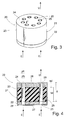
- Figures 3 and 4 are an isometric view and an axial longitudinal cross-section respectively, of a die according to the invention designed for the extrusion of a shape of long pasta such as spaghetti.
- a die having a cylindrical body 21 preferably made of metal alloy, such as bronze, with a side wall 23 terminating at an input base with a narrowing 22 and an output wall 24 in the direction of extrusion as indicated by the input arrows E, E and output arrow U.
- the output wall 24 has a plurality of holes 25 from which an insert 26 made of Teflon can be seen inside the cylindrical body 21. Further in the insert 26, a plurality of holes being denoted also as 25 are arranged concentrically to the holes 25 of the output wall 24.
- a plate 27 of metal alloy that is also perforated with holes 25 corresponding to the holes 25 of the outlet wall 24.
- each hole or extrusion cylindrical passage 25 has a circular transversal cross-section.
- the input section tal of each cylindrical passage 25 is delimited on its lateral surface by the material having a low coefficient of friction, and its output section tpl is delimited on its lateral surface by the metal alloy.
- the input section tal has holes having a diameter plt being greater than the diameter plb of the holes of the output section tpl.
- the transition zone downstream of the connection transversal cross-section between the input section tal and the output section tpl could also be slightly bevelled.
- the output section tpl has a length between 0.5 and 35 per cent of the length of the extrusion passage indicated as ll.
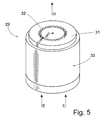
- FIG. 5 there is shown an isometric view of a die according to the invention designed for the extrusion of a shape of ribbed short-cut pasta.
- the die 29 has a body 30 of substantially cylindrical shape similar to that in Figure 1 .
- a difference consist of a knurl 32 in the output section tp on the internal surface of the annulus 31 of the body 30.
- a frustoconical outer portion being indicated as 8tc is made of Teflon so that the extrusion passage has a tapered shape on its outer side. Consequently, the outer retaining ring 9tc has been lightened as compared with the first embodiment.
- frustoconical holes 25t that are formed in the insert 26 made of Teflon inside the cylindrical body 21.
- the holes 25t are concentric with the holes 25 of the output wall 24 and with the holes 25c of the plate 27 of metal alloy, that are frustoconical like the holes 25t in the insert 26tc of Teflon.
- the die represented in Figure 7 for showing in enlarged scale a transversal cross-section connecting the input section of Teflon and the output section of metal alloy.
- the die 20 of Figure 7 is represented partially in Figure 8 : there is shown an extrusion hole 25 in the output wall 24 of metal alloy as an extension of the input hole 25t concentrically made in the insert 26tc of Teflon or other material with a low coefficient of friction: the transition around the transversal cross-section connecting the two sections is step-shaped.
- the transition in the concentric holes 25t in the insert 26tc of Teflon, and 25tc in the output wall 24tc of metal alloy around said connection transversal cross-section is tapered as an inclined plane. Said taper can be both straight and curved.
- the choice of the one or the other form of transition around said connection transversal cross-section depends on the desired shapes of pasta.
Landscapes
- Engineering & Computer Science (AREA)
- Mechanical Engineering (AREA)
- Life Sciences & Earth Sciences (AREA)
- Food Science & Technology (AREA)
- Manufacturing & Machinery (AREA)
- Health & Medical Sciences (AREA)
- Nutrition Science (AREA)
- Chemical & Material Sciences (AREA)
- Polymers & Plastics (AREA)
- Noodles (AREA)
- Manufacturing And Processing Devices For Dough (AREA)
Abstract
Description
- The present invention relates to a process for manufacturing dies for pasta, the dies themselves, and their use in the production of pasta.
-
US Patent 3,008,434 (Maldari), filed on February 3, 1960 , aims to provide a generic die for different types of finished products such as pasta, bread sticks, cookies and bakery products, chocolate, candy and other extrudable materials. According to Maldari the die must be able to stand up under long continued use and maintain its proper dimensions under such extended use. The die described by Maldari comprises a holding cup having a circular side wall and a rigid flat bottom wall, a flat disk of Teflon sited on said flat bottom wall in close fitting engagement with said circular side wall and a flat rigid top plate in flat engagement with the upper surface of said disk. The disk of Teflon is held sandwiched between the rigid bottom wall and the rigid upper plate. The top plate, the disk of Teflon and the bottom wall have coaxial extrusion openings, which are respectively downwards flared in the top plate, substantially constant in the disk of Teflon and diverging downwards in the bottom wall. Therefore, the shape of the extrusion passage is convergent/ constant/divergent and is the only one claimed by the patent. However, in the description of Maldari,column 2, lines 48-56, one can read that "the holder, which is usually of brass or bronze, may in some instances, as in the illustrated construction, be made to closely match or possibly decrease the size of the die outlet or outlets in the Teflon disk, thus to make theoutlet 16 form a gage determining the size of the extruded product and creating a stronger, more compact than if it were extruded simply through the Teflon." - Except that in this passage, Maldari refers only to the introduction of Teflon in a die and gives no indication about the advantages of the combined use of bronze and Teflon in optimising extrusion of products in general and pasta in particular. In fact, the statement quoted above, which is not reflected either in the claim or in the drawings of the patent, is not even proven by the evolution of the art after the Maldari patent until now. In fact, as well known with particular reference to the pasta, in order to obtain a compact and strong product, it is requested to extrude only through Teflon that is more capable of withstanding high pressures than bronze. On the contrary bronze, in which friction is increased, consequently increases the extrusion temperature which may damage the protein fraction contained in the semolina flour with a result of compromising finished product quality (Walsh et al, 1971; Abecassis et al, 1994) .
-
US 5,089,284 (Irvin ) discloses a method of forming pasta through an extruder that is equipped with a die plate having a plurality of holes whose transversal cross-sections decrease in the direction of extrusion. A dough as a mixture of flour rich in gluten and water is extruded through the die plate so that the extruded pasta remains substantially uncooked, i.e. a major portion, greater than about 80 per cent by weight of the total starch content, is ungelatinized (i.e., less than about 20 per cent gelatinization). Irvin claims heating the die plate to a temperature of at least about 54 °C, the die plate having frustoconically shaped holes that are coated with plastic material with a low coefficient of friction until the cross-section of the hole with its smallest value. The shape of the extrusion passage of the die is then frustoconicalcylindrical. It is clear that the aim of Irvin is to leave the surface of the last section of the die orifices not covered with plastic only for allowing the dough to be extruded with direct thermal contact with the die being heated only in the last section, in order to restrict the gelatinization to the outermost "corona" region of the shape. Then Teflon acts as a partial thermal insulator (description of Irvin,column 8, lines 30-52). -
US 6,413,565 (Debbouz ) aims to provide a superficially not rough pasta with improved organoleptic qualities. Said pasta is obtained by a process of extrusion through a die comprising a plurality of flow passages completely coated with a material with a low coefficient of friction, which for convenience is indicated by way of example as polytetrafluoroethylene or PTFE, commercially known as Teflon by DuPont. - To date, in both industrial and artisanal pasta production provision is made that two materials are used in contact with the product being extruded in the terminal step of extrusion:
- only Teflon extruding surface;
- only bronze extruding surface.
- In the following strengths and weaknesses related to the exclusive use of either material are described. Then, the present invention will be disclosed that, by combining Teflon and bronze in sequence within each singular die in the extruding surface, achieves a prefixed object.
Strengths of the use of Teflon in the extrusion with respect to bronze: - Teflon gives the pasta a smooth and shiny appearance and prevents heat stress to the product, thanks to less friction, thus enhancing also raw materials used;
- the resulting pasta has higher toughness and more chewing resistance;
- Teflon allows higher speed of work and higher resistance to pressure;
- less wear.
- industrial perception of the final colour of the product;
- greater appearance of small imperfections in the product (white and black dots etc.).
- greater appearance of any difference in colour (lighter or darker);
- less enhanced sauces;
- pasta takes on a roughness and a porosity that allow pasta to retain sauces at the best and enhance flavours;
- more artisanal appearance of the product that is appreciated by consumers. Weaknesses of the use of bronze in the extrusion with respect to Teflon:
- pasta has less toughness and lower chewing resistance;
- high friction during extrusion and greater risk of thermal damage of the raw material used, starch gelatinization, protein denaturation (Dexter et al, 1971);
- excessive release of dust in suspension, in both pasta production step and packaging step, which can gives rise to insect problems.
- The present invention, by using the above described materials, i.e. Teflon-bronze, in sequence on the extruding surface within the same die, allows the strengths of bronze extrusion to be combined with those of the Teflon extrusion. Basically, by putting a Teflon section immediately before a bronze section in the same pasta extrusion die toward the exit direction, a final product with excellent toughness and chewing resistance equal to a Teflon extruded product has achieved; at the same time a suitable roughness is given to the pasta with the bronze final section with a result of enhancing the ability to retain sauces and flavours.
- A main object of the present invention is to provide a pasta extrusion die that is easy to be manufactured and inexpensive.
Another object of the invention is to create extrusion passages in the die that give the dough desired optimal features. - In particular, an object of the present invention is to provide an extrusion process that uses the die according to the invention for obtaining an industrial Teflon extruded pasta which has the appearance of a bronze extruded pasta. More in particular, the invention achieves a mat rough outer surface on the pasta like a sort of "sandblasting". Thus the product obtained has a distinctive external appearance similar to that of bronze extruded pasta but the toughness of the typical Teflon extruded pasta.
- More generally, the purpose of the invention is to give a pasta all the positive features related to the Teflon normal extrusion, while maintaining the rough appearance given by the bronze extrusion, or to obtain the advantages of the Teflon extrusion and the advantages of the bronze extrusion, so that the pasta is tough, chewing resistant, optimal in the double cooking, thanks to Teflon, but at the same time able to retain excellently every kind of sauces with its rough surface, thanks to bronze.
- Therefore, the objects specified are substantially achieved, in a first aspect of the invention, by a process of manufacturing dies for pasta and, in a second aspect of the invention, by the dies thus obtained comprising the technical features set forth in one or more of the appended claims.
- In a third aspect of the invention, it provides the use of such a die in a process for producing pasta according to the appended claim.
- In using said dies the pasta is given the toughness features similar to a Teflon extruded product, and the advantages in terms of great retention of the sauces resulting from the roughness, in practice the cooked pasta is al dente and has great flavour.
- It should be appreciated that the described results have been reached after a considerable effort in an attempt to achieve a compromise to obtain a pasta that has simultaneously both the advantages from a material having a low coefficient of friction, and the advantages of bronze. Alternatively titanium and other metal alloys can be used.
- Further characteristics and advantages of the present invention will become more apparent from the indicative, and therefore non-limiting, description of embodiments of a die, as illustrated in the accompanying drawings in which:
-
Figure 1 is an isometric view of a die according to the invention designed for the extrusion of a short-cut pasta such as macaroni; -
Figure 2 is an axial longitudinal cross-section of the die inFigure 1 ; -
Figure 3 is an isometric view of a die according to the invention designed for the extrusion of a long pasta such as spaghetti; -
Figure 4 is an axial longitudinal cross-section of the die inFigure 3 ; -
Figure 5 is an isometric view of a die similar to that inFigure 1 designed for the extrusion of ribbed short-cut pasta; -
Figure 6 is an axial longitudinal cross-section of a variant of the die similar to that inFigure 2 ; -
Figure 7 is an axial longitudinal cross-section of a variant of the die similar to that inFigure 4 ; -
Figure 8 is an enlarged detail inFigure 7 ; and -
Figure 9 is an enlarged detail inFigure 7 in a different embodiment. - Referring to the figures, three embodiments of a die according to the invention, which are taken as an example for a short-cut and long pasta respectively, are described. It is obvious that different dies, still falling within the present invention, may be provided for different shapes of pasta. For example, for obtaining a short-cut pasta die shapes can be pierced with circular through cross-sections (e.g. pens, rigatoni, small thimbles), or other than circular cross-section, and slotted shapes (e.g. fusilli and shells); for long pasta die shapes can be round with circular through cross-sections (e.g. spaghetti) or other than circular cross-section (e.g. spaghetti alla chitarra), flat (e.g. little tongues and little slices), pierced (e.g. little tongues and zite) ribbed-pierced and ribboned (e.g. mafalde and tripoline).
- By die it is meant, generally, a matrix having at least one extrusion passage of a given length for obtaining the extrusion of a dough from an output cross-section. The die can be an insert, made of a metal alloy, such as bronze, titanium alloys, or other alloys, to be inserted, together with a multiplicity of other equal, in an extruder plate, so called "massello", of an extruder station for pasta.
- In particular shown in
Figures 1 and 2 are an isometric view and an axial longitudinal cross-section, respectively, of a die according to the invention that is designed for the extrusion of a short-cut pasta such as macaroni. Thedie 1 has abody 2 of substantially cylindrical shape that inFigures 1 and 2 is disposed in an extrusion direction upwards of the page as denoted by arrows E, E indicating the input of the dough to be extruded and by an arrow U indicating the output from the die itself. It should be understood that the die is shown upside down with respect to its position of use only for the purpose of giving a more complete representation. - First referring to
Figure 1 , indicated as 3 in thebody 2 is a recess that serves as an abutment in the extrusion plate or "massello" (not shown). Indicated as 4 is a die core that will be better described with reference toFigure 2 , ending at the top with acap 5 of a mushroom-shaped portion of thedie core 4. With reference toFigure 2 , thebody 2 has aside wall 6 terminating, upward in the page, with a annulus being indicated as 7. Theside wall 6 and theannulus 7 constitute a housing for an outer hollowcylindrical portion 8 of the plastic material having a low friction coefficient hereinafter generically called Teflon. The outer hollowcylindrical portion 8, which may also be a frustoconical, is retained in position by a retainingring 9 that is fixed on the inner surface of theside wall 6 and having a frustoconical shape at the bottom. - The
body 2 is closed at the front, in the direction of extrusion, by thedie core 4 comprising aperforated base 10 supporting the mushroom portion terminating in the rear with thecap 5. Theperforated base 10 has longitudinal equispaced through holes; the through holes that are visible inFigure 2 are indicated as 14 and 15. The connection between thebody 2 and thedie core 4 is made with a male-female coupling 16 near theperforated base 10. The mushroom-shaped portion of thedie core 4 has astem 11 that is surrounded peripherally by a hollow innercylindrical portion 12 of Teflon arranged concentrically to the outer hollowcylindrical portion 8. The latter is accommodated between theside wall 6, theannulus 7 and the retainingring 9. Thestem 11, which can also be frustoconical, after the insertion of the inner hollowcylindrical portion 12, is concentrically coupled with light drive fit by acentral pin 17 integral with thebase 10 of thedie core 4. In the coupling portion thecentral pin 17 has afrustoconical shape 18 that is useful to retain accurately the inner hollowcylindrical portion 12 of Teflon. Formed between the inner hollowcylindrical portion 12 and the outer hollowcylindrical portion 8 is anextrusion passage 13 comprising concentrically in the extrusion direction an input section having a height ta, which is then called, in the following, input section ta having a width pct, and an output section having a height tp, which is called, in the following, output section tp having a width pcb. The width pcb of the output section tp is always less than the width pct of the input section ta. The output section tp is situated between the input section ta and the output section of the die. According to the embodiment shown inFigures 1 and 2 , theextrusion passage 13 is delimited, as mentioned above, in the input section ta by Teflon that is shaped in the outer and inner hollowcylindrical portions annulus 7 and of thecap 5 of the concentric mushroom-shaped portion of thedie core 4. Therefore, in detail thecylindrical extrusion passage 13 has a transversal cross-section in the shape of an annulus having two different areas, as formed in the outlet section is a step that reduces the passage section. A transition zone including the passage section between the input section ta and the output section tp could also be slightly bevelled. In a die for short-cut pasta according to the invention, the output section tp has e.g. a length between 10 and 40 per cent of a length lc of the extrusion passage that is the sum of the length of input section ta and output section tp as defined above. Situated upstream of the extrusion passage is aconventional compression chamber 19 where the dough flows that advances thanks to the operating pressure through theextrusion passage 13. - It can be seen from the foregoing that a die is made that allows the production of pasta to be obtained by modifying only the surface of the extrusion passage. The intended object has been reached by providing a cylindrical extrusion passage having an annulus-shaped transversal cross-section that is delimited, both internally and externally, in a input section by Teflon and in a very limited output section by the metallic alloy. By using a die according to the present invention in a process of pasta production, the pasta is given a matt surface that is typical of the bronze artisanal working, while maintaining the industrial features of strength and toughness of a product manufactured with the known current techniques of Teflon fast extrusion. A compromise has been reached with Teflon in the input section of the die and bronze or other alloys in the output section that improves directly form and final geometry of the pasta shape.
- The features set forth above apply to all types of dies, and then also to dies for long pasta of which a description of an embodiment is given here below. Reference is made now to
Figures 3 and 4 which are an isometric view and an axial longitudinal cross-section respectively, of a die according to the invention designed for the extrusion of a shape of long pasta such as spaghetti. - Indicated as 20 in
Figures 3 and 4 is a die having acylindrical body 21 preferably made of metal alloy, such as bronze, with aside wall 23 terminating at an input base with a narrowing 22 and anoutput wall 24 in the direction of extrusion as indicated by the input arrows E, E and output arrow U. Theoutput wall 24 has a plurality ofholes 25 from which aninsert 26 made of Teflon can be seen inside thecylindrical body 21. Further in theinsert 26, a plurality of holes being denoted also as 25 are arranged concentrically to theholes 25 of theoutput wall 24. In the opposite side to theoutput wall 24 there is aplate 27 of metal alloy that is also perforated withholes 25 corresponding to theholes 25 of theoutlet wall 24. - The plate. 27 is retained by the narrowing 22 at the input base of the
cylindrical surface 23 also thanks to anoverlap 28 created on the same input base. It should be understood that in the insert represented by the die inFigures 3 and 4 each hole or extrusioncylindrical passage 25 has a circular transversal cross-section. The input section tal of eachcylindrical passage 25 is delimited on its lateral surface by the material having a low coefficient of friction, and its output section tpl is delimited on its lateral surface by the metal alloy. According to the invention the input section tal has holes having a diameter plt being greater than the diameter plb of the holes of the output section tpl. The transition zone downstream of the connection transversal cross-section between the input section tal and the output section tpl could also be slightly bevelled. Preferably, the output section tpl has a length between 0.5 and 35 per cent of the length of the extrusion passage indicated as ll. - The above describe die used for extruding long pasta demonstrated to be able to produce spaghetti with optimal roughness, so that in practice the product is aesthetically similar to that exclusively bronze extruded, even if said product has inside a toughness equal to traditional polished product, as verified by sensory and instrumental testing.
- Referring now to
Figure 5 , there is shown an isometric view of a die according to the invention designed for the extrusion of a shape of ribbed short-cut pasta. Thedie 29 has abody 30 of substantially cylindrical shape similar to that inFigure 1 . A difference consist of aknurl 32 in the output section tp on the internal surface of theannulus 31 of thebody 30. - In the above description embodiments of the die according to the invention have been disclosed as having substantially cylindrical extrusion passages. However, depending on the shapes of pasta provision can be made of dies for both short-cut and long pasta which have a cylindrical output section tp, tpl and a frustoconical input section ta and tal respectively. In this regard reference is made to
Figures 6 and 7 , which are axial longitudinal cross-sections of two variants of a die similar to those inFigure 2 for short-cut pasta and inFigure 4 , respectively, for long pasta. InFigures 6 and 7 the same reference numerals inFigures 2 and4 have been used, except for different parts. - In
Figure 6 a frustoconical outer portion being indicated as 8tc is made of Teflon so that the extrusion passage has a tapered shape on its outer side. Consequently, the outer retaining ring 9tc has been lightened as compared with the first embodiment. - Indicated as 25t in
Figure 7 arefrustoconical holes 25t that are formed in theinsert 26 made of Teflon inside thecylindrical body 21. Theholes 25t are concentric with theholes 25 of theoutput wall 24 and with theholes 25c of theplate 27 of metal alloy, that are frustoconical like theholes 25t in the insert 26tc of Teflon. - In
Figures 8 and 9 an enlarged detail ofFigure 7 and a variant respectively, are shown. - By way of example, reference is made to the die represented in
Figure 7 for showing in enlarged scale a transversal cross-section connecting the input section of Teflon and the output section of metal alloy. The die 20 ofFigure 7 is represented partially inFigure 8 : there is shown anextrusion hole 25 in theoutput wall 24 of metal alloy as an extension of theinput hole 25t concentrically made in the insert 26tc of Teflon or other material with a low coefficient of friction: the transition around the transversal cross-section connecting the two sections is step-shaped. In the variant ofFigure 9 the transition in theconcentric holes 25t in the insert 26tc of Teflon, and 25tc in the output wall 24tc of metal alloy around said connection transversal cross-section is tapered as an inclined plane. Said taper can be both straight and curved. The choice of the one or the other form of transition around said connection transversal cross-section depends on the desired shapes of pasta. - It should be understood that, despite having described the process for manufacturing dies according to the invention by giving only a few examples of dies, also other dies with different dimensions constructed with the same process are included in the invention as defined in the appended claims.
Claims (13)
- A process for manufacturing dies for pasta comprising, inside a body (1; 20) of metal alloy, at least one dough extrusion passage (13; 25) having an input section (ta; tal) and an output section (tp; tpl) that are concentrically and consecutively arranged in the extrusion direction and are joined in a connection transversal cross-section, characterised by making the input section with a material having a low coefficient of friction and the output section (tp; tpl), which is cylindrically shaped, with a metal alloy so that the input section (ta; tal) has transversal cross-sections with an area larger than the transversal cross-section area of the output section (tp; tpl).
- The process according to claim 1, wherein a step is formed in the output section (tp; tpl) in correspondence to a transition section downstream said transversal connection cross-section.
- The process according to claim 1, wherein a taper is formed in the output section (tp; tpl) in correspondence to a transition section downstream said transversal connection cross-section.
- A pasta die comprising a metal alloy body (1; 20) having at least one extrusion passage (13; 25) of a given length (lc; ll) for extruding a dough from an output cross-section of the die, the extrusion passage (13; 25) comprising an input section (ta; tal) and an output section (tp; tpl) that are concentrically and consecutively arranged in an extrusion direction, characterised in that said at least one extrusion passage (13; 25) is delimited in said input section (ta; tal) by a material having a low coefficient of friction and in said output section (tp; tpl), which is cylindrically shaped, by a metal alloy having a transversal cross-section area lower than each transversal cross-section area of the input section (ta; tal).
- The pasta die according to claim 4, wherein each extrusion passage (13) has a transversal cross-section in the shape of an annulus, the input section (ta) of the extrusion passage (13) is delimited over both the inner side surface and the outer side surface by the material having a low coefficient of friction, and the output section (tp) of the extrusion passage (13) is delimited over both the inner side surface and the outer side surface by the metal alloy.
- The pasta die according to claim 5, wherein the output section (tp) of the extrusion passage (13) has a knurl (32) over its outer side surface.
- The pasta die according to claim 4, wherein each extrusion passage (25) has a circular transversal cross-section, the input section (tal) of the extrusion passage (25) is delimited on its side surface by the material having a low coefficient of friction, and the output section (tpl) of the extrusion passage (25) is delimited on its side surface by the metal alloy.
- The pasta die according to claim 5, wherein said output section (tp) has a length between 10 and 40 per cent of the given length (lc) of the extrusion passage (13).
- The pasta die according to claim 7, wherein said output section (tpl) has a length between 0.5 and 35 per cent of the given length (ll) of the extrusion passage (25).
- The pasta die according to any of claims 4 and 6, wherein said input section (ta; tal) is cylindrical.
- The pasta die according to any of claims 4 and 6, wherein said input section (ta; tal) is frustoconical.
- The pasta die according to claim 1, wherein the material having a reduced coefficient of friction is polytetrafluoroethylene (PTFE).
- A use of a die for obtaining pasta shapes, characterised in that the extrusion takes place through at least one extrusion passage (13; 25) comprising concentrically in the direction of extrusion an input section (ta; tal) and an output section (tp; tpl), the latter being cylindrical, said at least one extrusion passage (13; 25) being delimited in said input section (ta; tal) by a material with a low coefficient of friction, and in said output section (tp; tpl) by a metal alloy, the output section (tp; tpl) having a transversal cross-section area lower than the each transversal cross-section area of the input section (ta; tal).
Applications Claiming Priority (1)
| Application Number | Priority Date | Filing Date | Title |
|---|---|---|---|
| IT000072A ITNA20120072A1 (en) | 2012-11-29 | 2012-11-29 | PROCEDURE FOR THE MANUFACTURE OF TRAFILE FOR FOOD PASTA, THE DRAWINGS THEMSELVES AND THEIR USE IN PASTA PRODUCTION. |
Publications (2)
| Publication Number | Publication Date |
|---|---|
| EP2737800A1 true EP2737800A1 (en) | 2014-06-04 |
| EP2737800B1 EP2737800B1 (en) | 2017-07-19 |
Family
ID=47633252
Family Applications (1)
| Application Number | Title | Priority Date | Filing Date |
|---|---|---|---|
| EP13425152.9A Active EP2737800B1 (en) | 2012-11-29 | 2013-11-28 | Dies for pasta |
Country Status (3)
| Country | Link |
|---|---|
| US (1) | US9655370B2 (en) |
| EP (1) | EP2737800B1 (en) |
| IT (1) | ITNA20120072A1 (en) |
Cited By (1)
| Publication number | Priority date | Publication date | Assignee | Title |
|---|---|---|---|---|
| WO2023285551A1 (en) * | 2021-07-13 | 2023-01-19 | Barilla G. E R. Fratelli S.P.A. | Process for the production of pasta by means of extrusion through a bronze die plate insert with grooves |
Families Citing this family (2)
| Publication number | Priority date | Publication date | Assignee | Title |
|---|---|---|---|---|
| CN111802421A (en) * | 2019-10-28 | 2020-10-23 | 浙江煜焰工业设计有限公司 | Noodle forming device of noodle forming machine |
| IT202000004549A1 (en) * | 2020-03-04 | 2021-09-04 | Proxicad S R L | DIE FOR FOOD PASTA |
Citations (5)
| Publication number | Priority date | Publication date | Assignee | Title |
|---|---|---|---|---|
| US3008434A (en) | 1960-02-03 | 1961-11-14 | Maldari And Sons Inc D | Macaroni die |
| AU531167B2 (en) * | 1978-11-01 | 1983-08-11 | S. A. R. Kilroy | Extruding dim sims through non-stick die |
| US5089284A (en) | 1990-06-18 | 1992-02-18 | Borden, Inc. | Method for making extruded pasta shapes |
| US6413565B2 (en) | 2000-02-02 | 2002-07-02 | New World Pasta Company | Low shear method for making pasta |
| US20100003360A1 (en) * | 2006-09-01 | 2010-01-07 | Buehler Ag | Device and method for the extrusion of viscoelastic materials |
Family Cites Families (1)
| Publication number | Priority date | Publication date | Assignee | Title |
|---|---|---|---|---|
| US3778520A (en) * | 1967-02-01 | 1973-12-11 | Gen Mills Inc | Process for extruding tubular,corrugated products |
-
2012
- 2012-11-29 IT IT000072A patent/ITNA20120072A1/en unknown
-
2013
- 2013-11-27 US US14/091,525 patent/US9655370B2/en active Active
- 2013-11-28 EP EP13425152.9A patent/EP2737800B1/en active Active
Patent Citations (5)
| Publication number | Priority date | Publication date | Assignee | Title |
|---|---|---|---|---|
| US3008434A (en) | 1960-02-03 | 1961-11-14 | Maldari And Sons Inc D | Macaroni die |
| AU531167B2 (en) * | 1978-11-01 | 1983-08-11 | S. A. R. Kilroy | Extruding dim sims through non-stick die |
| US5089284A (en) | 1990-06-18 | 1992-02-18 | Borden, Inc. | Method for making extruded pasta shapes |
| US6413565B2 (en) | 2000-02-02 | 2002-07-02 | New World Pasta Company | Low shear method for making pasta |
| US20100003360A1 (en) * | 2006-09-01 | 2010-01-07 | Buehler Ag | Device and method for the extrusion of viscoelastic materials |
Cited By (1)
| Publication number | Priority date | Publication date | Assignee | Title |
|---|---|---|---|---|
| WO2023285551A1 (en) * | 2021-07-13 | 2023-01-19 | Barilla G. E R. Fratelli S.P.A. | Process for the production of pasta by means of extrusion through a bronze die plate insert with grooves |
Also Published As
| Publication number | Publication date |
|---|---|
| EP2737800B1 (en) | 2017-07-19 |
| ITNA20120072A1 (en) | 2014-05-30 |
| US9655370B2 (en) | 2017-05-23 |
| US20140147567A1 (en) | 2014-05-29 |
Similar Documents
| Publication | Publication Date | Title |
|---|---|---|
| US10117448B2 (en) | Extruder die and resultant food product | |
| AU592411B2 (en) | Nozzle for extrusion | |
| CA2578236C (en) | Apparatus and method for improving the dimensional quality of extruded food products having complex shapes | |
| EP2737800B1 (en) | Dies for pasta | |
| CN102232396B (en) | Dough extruders | |
| EP1998623A1 (en) | Making pastry shells | |
| CN105639710B (en) | It extrudes face module and its manufacturing method and extrudes the manufacturing method in face | |
| US20240237657A1 (en) | Process for the production of pasta by means of extrusion through a bronze die plate insert with grooves | |
| KR20100091562A (en) | Form for confectionery and baking purpose forming topping space and confectionery and bread formed by the same | |
| US5536162A (en) | Apparatus for preparing pretzel chips | |
| US20020192339A1 (en) | Quick cooking pasta | |
| KR102116455B1 (en) | C Typed-noodle and Manufacture Method Thereof | |
| JP4174458B2 (en) | Edible container manufacturing method and edible container mold | |
| JP4514808B2 (en) | Edible container | |
| KR101666134B1 (en) | Rice Burger-forming device | |
| US20230000092A1 (en) | Bread for Hamburgers | |
| KR101575936B1 (en) | Core rice cake manufacturing method and core rice cake | |
| KR20200024202A (en) | C Typed-noodle and Manufacture Method Thereof | |
| KR102010120B1 (en) | C Typed-noodle and Manufacture Apparatus Thereof | |
| EP1529442B1 (en) | Method for producing breadsticks having a surface concavity | |
| CN205695463U (en) | A kind of sandwich cake | |
| JP2006211929A (en) | Method for forming greasy confectionery dough and greasy confectionery | |
| JP2007089564A (en) | Grooved spaghetti | |
| IT201900001863U1 (en) | Instant spaghetti | |
| TWM555652U (en) | Extrusion mold structure |
Legal Events
| Date | Code | Title | Description |
|---|---|---|---|
| PUAI | Public reference made under article 153(3) epc to a published international application that has entered the european phase |
Free format text: ORIGINAL CODE: 0009012 |
|
| 17P | Request for examination filed |
Effective date: 20131128 |
|
| AK | Designated contracting states |
Kind code of ref document: A1 Designated state(s): AL AT BE BG CH CY CZ DE DK EE ES FI FR GB GR HR HU IE IS IT LI LT LU LV MC MK MT NL NO PL PT RO RS SE SI SK SM TR |
|
| AX | Request for extension of the european patent |
Extension state: BA ME |
|
| R17P | Request for examination filed (corrected) |
Effective date: 20141124 |
|
| RBV | Designated contracting states (corrected) |
Designated state(s): AL AT BE BG CH CY CZ DE DK EE ES FI FR GB GR HR HU IE IS IT LI LT LU LV MC MK MT NL NO PL PT RO RS SE SI SK SM TR |
|
| 17Q | First examination report despatched |
Effective date: 20150423 |
|
| GRAP | Despatch of communication of intention to grant a patent |
Free format text: ORIGINAL CODE: EPIDOSNIGR1 |
|
| INTG | Intention to grant announced |
Effective date: 20170322 |
|
| RIN1 | Information on inventor provided before grant (corrected) |
Inventor name: RUMMO, COSIMO |
|
| GRAS | Grant fee paid |
Free format text: ORIGINAL CODE: EPIDOSNIGR3 |
|
| GRAJ | Information related to disapproval of communication of intention to grant by the applicant or resumption of examination proceedings by the epo deleted |
Free format text: ORIGINAL CODE: EPIDOSDIGR1 |
|
| GRAL | Information related to payment of fee for publishing/printing deleted |
Free format text: ORIGINAL CODE: EPIDOSDIGR3 |
|
| GRAP | Despatch of communication of intention to grant a patent |
Free format text: ORIGINAL CODE: EPIDOSNIGR1 |
|
| GRAA | (expected) grant |
Free format text: ORIGINAL CODE: 0009210 |
|
| INTC | Intention to grant announced (deleted) | ||
| INTG | Intention to grant announced |
Effective date: 20170530 |
|
| AK | Designated contracting states |
Kind code of ref document: B1 Designated state(s): AL AT BE BG CH CY CZ DE DK EE ES FI FR GB GR HR HU IE IS IT LI LT LU LV MC MK MT NL NO PL PT RO RS SE SI SK SM TR |
|
| AX | Request for extension of the european patent |
Extension state: BA ME |
|
| REG | Reference to a national code |
Ref country code: GB Ref legal event code: FG4D |
|
| REG | Reference to a national code |
Ref country code: CH Ref legal event code: EP |
|
| REG | Reference to a national code |
Ref country code: IE Ref legal event code: FG4D |
|
| REG | Reference to a national code |
Ref country code: AT Ref legal event code: REF Ref document number: 909474 Country of ref document: AT Kind code of ref document: T Effective date: 20170815 |
|
| REG | Reference to a national code |
Ref country code: DE Ref legal event code: R096 Ref document number: 602013023675 Country of ref document: DE |
|
| REG | Reference to a national code |
Ref country code: NL Ref legal event code: MP Effective date: 20170719 |
|
| REG | Reference to a national code |
Ref country code: LT Ref legal event code: MG4D |
|
| REG | Reference to a national code |
Ref country code: AT Ref legal event code: MK05 Ref document number: 909474 Country of ref document: AT Kind code of ref document: T Effective date: 20170719 |
|
| PG25 | Lapsed in a contracting state [announced via postgrant information from national office to epo] |
Ref country code: SE Free format text: LAPSE BECAUSE OF FAILURE TO SUBMIT A TRANSLATION OF THE DESCRIPTION OR TO PAY THE FEE WITHIN THE PRESCRIBED TIME-LIMIT Effective date: 20170719 Ref country code: NO Free format text: LAPSE BECAUSE OF FAILURE TO SUBMIT A TRANSLATION OF THE DESCRIPTION OR TO PAY THE FEE WITHIN THE PRESCRIBED TIME-LIMIT Effective date: 20171019 Ref country code: HR Free format text: LAPSE BECAUSE OF FAILURE TO SUBMIT A TRANSLATION OF THE DESCRIPTION OR TO PAY THE FEE WITHIN THE PRESCRIBED TIME-LIMIT Effective date: 20170719 Ref country code: FI Free format text: LAPSE BECAUSE OF FAILURE TO SUBMIT A TRANSLATION OF THE DESCRIPTION OR TO PAY THE FEE WITHIN THE PRESCRIBED TIME-LIMIT Effective date: 20170719 Ref country code: AT Free format text: LAPSE BECAUSE OF FAILURE TO SUBMIT A TRANSLATION OF THE DESCRIPTION OR TO PAY THE FEE WITHIN THE PRESCRIBED TIME-LIMIT Effective date: 20170719 Ref country code: LT Free format text: LAPSE BECAUSE OF FAILURE TO SUBMIT A TRANSLATION OF THE DESCRIPTION OR TO PAY THE FEE WITHIN THE PRESCRIBED TIME-LIMIT Effective date: 20170719 Ref country code: NL Free format text: LAPSE BECAUSE OF FAILURE TO SUBMIT A TRANSLATION OF THE DESCRIPTION OR TO PAY THE FEE WITHIN THE PRESCRIBED TIME-LIMIT Effective date: 20170719 |
|
| PG25 | Lapsed in a contracting state [announced via postgrant information from national office to epo] |
Ref country code: RS Free format text: LAPSE BECAUSE OF FAILURE TO SUBMIT A TRANSLATION OF THE DESCRIPTION OR TO PAY THE FEE WITHIN THE PRESCRIBED TIME-LIMIT Effective date: 20170719 Ref country code: PL Free format text: LAPSE BECAUSE OF FAILURE TO SUBMIT A TRANSLATION OF THE DESCRIPTION OR TO PAY THE FEE WITHIN THE PRESCRIBED TIME-LIMIT Effective date: 20170719 Ref country code: IS Free format text: LAPSE BECAUSE OF FAILURE TO SUBMIT A TRANSLATION OF THE DESCRIPTION OR TO PAY THE FEE WITHIN THE PRESCRIBED TIME-LIMIT Effective date: 20171119 Ref country code: LV Free format text: LAPSE BECAUSE OF FAILURE TO SUBMIT A TRANSLATION OF THE DESCRIPTION OR TO PAY THE FEE WITHIN THE PRESCRIBED TIME-LIMIT Effective date: 20170719 Ref country code: BG Free format text: LAPSE BECAUSE OF FAILURE TO SUBMIT A TRANSLATION OF THE DESCRIPTION OR TO PAY THE FEE WITHIN THE PRESCRIBED TIME-LIMIT Effective date: 20171019 Ref country code: ES Free format text: LAPSE BECAUSE OF FAILURE TO SUBMIT A TRANSLATION OF THE DESCRIPTION OR TO PAY THE FEE WITHIN THE PRESCRIBED TIME-LIMIT Effective date: 20170719 Ref country code: GR Free format text: LAPSE BECAUSE OF FAILURE TO SUBMIT A TRANSLATION OF THE DESCRIPTION OR TO PAY THE FEE WITHIN THE PRESCRIBED TIME-LIMIT Effective date: 20171020 |
|
| REG | Reference to a national code |
Ref country code: DE Ref legal event code: R097 Ref document number: 602013023675 Country of ref document: DE |
|
| PG25 | Lapsed in a contracting state [announced via postgrant information from national office to epo] |
Ref country code: RO Free format text: LAPSE BECAUSE OF FAILURE TO SUBMIT A TRANSLATION OF THE DESCRIPTION OR TO PAY THE FEE WITHIN THE PRESCRIBED TIME-LIMIT Effective date: 20170719 Ref country code: CZ Free format text: LAPSE BECAUSE OF FAILURE TO SUBMIT A TRANSLATION OF THE DESCRIPTION OR TO PAY THE FEE WITHIN THE PRESCRIBED TIME-LIMIT Effective date: 20170719 Ref country code: DK Free format text: LAPSE BECAUSE OF FAILURE TO SUBMIT A TRANSLATION OF THE DESCRIPTION OR TO PAY THE FEE WITHIN THE PRESCRIBED TIME-LIMIT Effective date: 20170719 |
|
| PLBE | No opposition filed within time limit |
Free format text: ORIGINAL CODE: 0009261 |
|
| STAA | Information on the status of an ep patent application or granted ep patent |
Free format text: STATUS: NO OPPOSITION FILED WITHIN TIME LIMIT |
|
| PG25 | Lapsed in a contracting state [announced via postgrant information from national office to epo] |
Ref country code: EE Free format text: LAPSE BECAUSE OF FAILURE TO SUBMIT A TRANSLATION OF THE DESCRIPTION OR TO PAY THE FEE WITHIN THE PRESCRIBED TIME-LIMIT Effective date: 20170719 Ref country code: SK Free format text: LAPSE BECAUSE OF FAILURE TO SUBMIT A TRANSLATION OF THE DESCRIPTION OR TO PAY THE FEE WITHIN THE PRESCRIBED TIME-LIMIT Effective date: 20170719 Ref country code: SM Free format text: LAPSE BECAUSE OF FAILURE TO SUBMIT A TRANSLATION OF THE DESCRIPTION OR TO PAY THE FEE WITHIN THE PRESCRIBED TIME-LIMIT Effective date: 20170719 |
|
| REG | Reference to a national code |
Ref country code: DE Ref legal event code: R119 Ref document number: 602013023675 Country of ref document: DE |
|
| 26N | No opposition filed |
Effective date: 20180420 |
|
| PG25 | Lapsed in a contracting state [announced via postgrant information from national office to epo] |
Ref country code: MC Free format text: LAPSE BECAUSE OF FAILURE TO SUBMIT A TRANSLATION OF THE DESCRIPTION OR TO PAY THE FEE WITHIN THE PRESCRIBED TIME-LIMIT Effective date: 20170719 |
|
| GBPC | Gb: european patent ceased through non-payment of renewal fee |
Effective date: 20171128 |
|
| PG25 | Lapsed in a contracting state [announced via postgrant information from national office to epo] |
Ref country code: CH Free format text: LAPSE BECAUSE OF NON-PAYMENT OF DUE FEES Effective date: 20171130 Ref country code: LI Free format text: LAPSE BECAUSE OF NON-PAYMENT OF DUE FEES Effective date: 20171130 |
|
| PG25 | Lapsed in a contracting state [announced via postgrant information from national office to epo] |
Ref country code: SI Free format text: LAPSE BECAUSE OF FAILURE TO SUBMIT A TRANSLATION OF THE DESCRIPTION OR TO PAY THE FEE WITHIN THE PRESCRIBED TIME-LIMIT Effective date: 20170719 Ref country code: LU Free format text: LAPSE BECAUSE OF NON-PAYMENT OF DUE FEES Effective date: 20171128 |
|
| REG | Reference to a national code |
Ref country code: FR Ref legal event code: ST Effective date: 20180731 Ref country code: BE Ref legal event code: MM Effective date: 20171130 |
|
| REG | Reference to a national code |
Ref country code: IE Ref legal event code: MM4A |
|
| PG25 | Lapsed in a contracting state [announced via postgrant information from national office to epo] |
Ref country code: MT Free format text: LAPSE BECAUSE OF NON-PAYMENT OF DUE FEES Effective date: 20171128 |
|
| PG25 | Lapsed in a contracting state [announced via postgrant information from national office to epo] |
Ref country code: IE Free format text: LAPSE BECAUSE OF NON-PAYMENT OF DUE FEES Effective date: 20171128 Ref country code: DE Free format text: LAPSE BECAUSE OF NON-PAYMENT OF DUE FEES Effective date: 20180602 Ref country code: FR Free format text: LAPSE BECAUSE OF NON-PAYMENT OF DUE FEES Effective date: 20171130 |
|
| PG25 | Lapsed in a contracting state [announced via postgrant information from national office to epo] |
Ref country code: BE Free format text: LAPSE BECAUSE OF NON-PAYMENT OF DUE FEES Effective date: 20171130 Ref country code: GB Free format text: LAPSE BECAUSE OF NON-PAYMENT OF DUE FEES Effective date: 20171128 |
|
| PG25 | Lapsed in a contracting state [announced via postgrant information from national office to epo] |
Ref country code: HU Free format text: LAPSE BECAUSE OF FAILURE TO SUBMIT A TRANSLATION OF THE DESCRIPTION OR TO PAY THE FEE WITHIN THE PRESCRIBED TIME-LIMIT; INVALID AB INITIO Effective date: 20131128 |
|
| PG25 | Lapsed in a contracting state [announced via postgrant information from national office to epo] |
Ref country code: CY Free format text: LAPSE BECAUSE OF NON-PAYMENT OF DUE FEES Effective date: 20170719 |
|
| PG25 | Lapsed in a contracting state [announced via postgrant information from national office to epo] |
Ref country code: MK Free format text: LAPSE BECAUSE OF FAILURE TO SUBMIT A TRANSLATION OF THE DESCRIPTION OR TO PAY THE FEE WITHIN THE PRESCRIBED TIME-LIMIT Effective date: 20170719 |
|
| PG25 | Lapsed in a contracting state [announced via postgrant information from national office to epo] |
Ref country code: TR Free format text: LAPSE BECAUSE OF FAILURE TO SUBMIT A TRANSLATION OF THE DESCRIPTION OR TO PAY THE FEE WITHIN THE PRESCRIBED TIME-LIMIT Effective date: 20170719 |
|
| PG25 | Lapsed in a contracting state [announced via postgrant information from national office to epo] |
Ref country code: PT Free format text: LAPSE BECAUSE OF FAILURE TO SUBMIT A TRANSLATION OF THE DESCRIPTION OR TO PAY THE FEE WITHIN THE PRESCRIBED TIME-LIMIT Effective date: 20170719 |
|
| PG25 | Lapsed in a contracting state [announced via postgrant information from national office to epo] |
Ref country code: AL Free format text: LAPSE BECAUSE OF FAILURE TO SUBMIT A TRANSLATION OF THE DESCRIPTION OR TO PAY THE FEE WITHIN THE PRESCRIBED TIME-LIMIT Effective date: 20170719 |
|
| P01 | Opt-out of the competence of the unified patent court (upc) registered |
Effective date: 20230328 |
|
| PGFP | Annual fee paid to national office [announced via postgrant information from national office to epo] |
Ref country code: IT Payment date: 20251015 Year of fee payment: 13 |