EP2737027B1 - Hydrocracking process with interstage steam stripping - Google Patents
Hydrocracking process with interstage steam stripping Download PDFInfo
- Publication number
- EP2737027B1 EP2737027B1 EP12746430.3A EP12746430A EP2737027B1 EP 2737027 B1 EP2737027 B1 EP 2737027B1 EP 12746430 A EP12746430 A EP 12746430A EP 2737027 B1 EP2737027 B1 EP 2737027B1
- Authority
- EP
- European Patent Office
- Prior art keywords
- stage
- stream
- diesel
- hydrocracking
- hydrogen
- Prior art date
- Legal status (The legal status is an assumption and is not a legal conclusion. Google has not performed a legal analysis and makes no representation as to the accuracy of the status listed.)
- Not-in-force
Links
Images


Classifications
-
- C—CHEMISTRY; METALLURGY
- C10—PETROLEUM, GAS OR COKE INDUSTRIES; TECHNICAL GASES CONTAINING CARBON MONOXIDE; FUELS; LUBRICANTS; PEAT
- C10G—CRACKING HYDROCARBON OILS; PRODUCTION OF LIQUID HYDROCARBON MIXTURES, e.g. BY DESTRUCTIVE HYDROGENATION, OLIGOMERISATION, POLYMERISATION; RECOVERY OF HYDROCARBON OILS FROM OIL-SHALE, OIL-SAND, OR GASES; REFINING MIXTURES MAINLY CONSISTING OF HYDROCARBONS; REFORMING OF NAPHTHA; MINERAL WAXES
- C10G67/00—Treatment of hydrocarbon oils by at least one hydrotreatment process and at least one process for refining in the absence of hydrogen only
- C10G67/02—Treatment of hydrocarbon oils by at least one hydrotreatment process and at least one process for refining in the absence of hydrogen only plural serial stages only
-
- C—CHEMISTRY; METALLURGY
- C10—PETROLEUM, GAS OR COKE INDUSTRIES; TECHNICAL GASES CONTAINING CARBON MONOXIDE; FUELS; LUBRICANTS; PEAT
- C10G—CRACKING HYDROCARBON OILS; PRODUCTION OF LIQUID HYDROCARBON MIXTURES, e.g. BY DESTRUCTIVE HYDROGENATION, OLIGOMERISATION, POLYMERISATION; RECOVERY OF HYDROCARBON OILS FROM OIL-SHALE, OIL-SAND, OR GASES; REFINING MIXTURES MAINLY CONSISTING OF HYDROCARBONS; REFORMING OF NAPHTHA; MINERAL WAXES
- C10G65/00—Treatment of hydrocarbon oils by two or more hydrotreatment processes only
- C10G65/02—Treatment of hydrocarbon oils by two or more hydrotreatment processes only plural serial stages only
- C10G65/12—Treatment of hydrocarbon oils by two or more hydrotreatment processes only plural serial stages only including cracking steps and other hydrotreatment steps
-
- C—CHEMISTRY; METALLURGY
- C10—PETROLEUM, GAS OR COKE INDUSTRIES; TECHNICAL GASES CONTAINING CARBON MONOXIDE; FUELS; LUBRICANTS; PEAT
- C10G—CRACKING HYDROCARBON OILS; PRODUCTION OF LIQUID HYDROCARBON MIXTURES, e.g. BY DESTRUCTIVE HYDROGENATION, OLIGOMERISATION, POLYMERISATION; RECOVERY OF HYDROCARBON OILS FROM OIL-SHALE, OIL-SAND, OR GASES; REFINING MIXTURES MAINLY CONSISTING OF HYDROCARBONS; REFORMING OF NAPHTHA; MINERAL WAXES
- C10G2300/00—Aspects relating to hydrocarbon processing covered by groups C10G1/00 - C10G99/00
- C10G2300/20—Characteristics of the feedstock or the products
- C10G2300/30—Physical properties of feedstocks or products
- C10G2300/301—Boiling range
-
- C—CHEMISTRY; METALLURGY
- C10—PETROLEUM, GAS OR COKE INDUSTRIES; TECHNICAL GASES CONTAINING CARBON MONOXIDE; FUELS; LUBRICANTS; PEAT
- C10G—CRACKING HYDROCARBON OILS; PRODUCTION OF LIQUID HYDROCARBON MIXTURES, e.g. BY DESTRUCTIVE HYDROGENATION, OLIGOMERISATION, POLYMERISATION; RECOVERY OF HYDROCARBON OILS FROM OIL-SHALE, OIL-SAND, OR GASES; REFINING MIXTURES MAINLY CONSISTING OF HYDROCARBONS; REFORMING OF NAPHTHA; MINERAL WAXES
- C10G2300/00—Aspects relating to hydrocarbon processing covered by groups C10G1/00 - C10G99/00
- C10G2300/40—Characteristics of the process deviating from typical ways of processing
- C10G2300/4093—Catalyst stripping
-
- C—CHEMISTRY; METALLURGY
- C10—PETROLEUM, GAS OR COKE INDUSTRIES; TECHNICAL GASES CONTAINING CARBON MONOXIDE; FUELS; LUBRICANTS; PEAT
- C10G—CRACKING HYDROCARBON OILS; PRODUCTION OF LIQUID HYDROCARBON MIXTURES, e.g. BY DESTRUCTIVE HYDROGENATION, OLIGOMERISATION, POLYMERISATION; RECOVERY OF HYDROCARBON OILS FROM OIL-SHALE, OIL-SAND, OR GASES; REFINING MIXTURES MAINLY CONSISTING OF HYDROCARBONS; REFORMING OF NAPHTHA; MINERAL WAXES
- C10G2300/00—Aspects relating to hydrocarbon processing covered by groups C10G1/00 - C10G99/00
- C10G2300/80—Additives
- C10G2300/805—Water
- C10G2300/807—Steam
-
- C—CHEMISTRY; METALLURGY
- C10—PETROLEUM, GAS OR COKE INDUSTRIES; TECHNICAL GASES CONTAINING CARBON MONOXIDE; FUELS; LUBRICANTS; PEAT
- C10G—CRACKING HYDROCARBON OILS; PRODUCTION OF LIQUID HYDROCARBON MIXTURES, e.g. BY DESTRUCTIVE HYDROGENATION, OLIGOMERISATION, POLYMERISATION; RECOVERY OF HYDROCARBON OILS FROM OIL-SHALE, OIL-SAND, OR GASES; REFINING MIXTURES MAINLY CONSISTING OF HYDROCARBONS; REFORMING OF NAPHTHA; MINERAL WAXES
- C10G2400/00—Products obtained by processes covered by groups C10G9/00 - C10G69/14
- C10G2400/02—Gasoline
-
- C—CHEMISTRY; METALLURGY
- C10—PETROLEUM, GAS OR COKE INDUSTRIES; TECHNICAL GASES CONTAINING CARBON MONOXIDE; FUELS; LUBRICANTS; PEAT
- C10G—CRACKING HYDROCARBON OILS; PRODUCTION OF LIQUID HYDROCARBON MIXTURES, e.g. BY DESTRUCTIVE HYDROGENATION, OLIGOMERISATION, POLYMERISATION; RECOVERY OF HYDROCARBON OILS FROM OIL-SHALE, OIL-SAND, OR GASES; REFINING MIXTURES MAINLY CONSISTING OF HYDROCARBONS; REFORMING OF NAPHTHA; MINERAL WAXES
- C10G2400/00—Products obtained by processes covered by groups C10G9/00 - C10G69/14
- C10G2400/04—Diesel oil
Definitions
- Hydrocracking processes are well known and are used in a large number of petroleum refineries. Such processes are used with a variety of feeds ranging from naphthas to very heavy crude oil residual fractions. In general, a hydrocracking process splits the molecules of the feed into smaller (lighter) molecules having higher average volatility and economic value. At the same time, a hydrocracking process normally improves the quality of the material being processed by increasing the hydrogen-to-carbon ratio of the materials, and by removing sulfur and nitrogen. The significant economic utility of the hydrocracking process has resulted in a large amount of developmental effort being devoted to the improvement of the process and to the development of better catalysts for use in the process.
- a hydrocracking unit consists of the two principal sections for reaction and separation, the configuration and types of which vary. There are a number of known process configurations, including once-through, or series flow, two-stage once-through, two-stage with recycle, single stage and mild hydrocracking. Parameters such as feedstock quality, product specification, processing objectives and catalysts determine the configuration of the reaction section.
- the feedstock is refined over hydrotreating catalysts in the first reactor and the effluents are sent to the second reactor containing amorphous or zeolite-based cracking catalyst(s).
- the feedstock is refined over hydrotreating catalysts in the first reactor and the effluents are sent to a fractionator column to separate the H 2 S, NH 3 , light gases (C 1 -C 4 ), naphtha and diesel products boiling in the range nominal 36-370 °C. Hydrocarbons boiling at a temperature above 370°C are then recycled to the first stage reactor or the second reactor.
- hydrocracking unit effluents are sent to a distillation column to fractionate the naphtha, jet/kerosene, diesel and unconverted products boiling in the nominal ranges 36-180°C, 180-240°C, 240-370°C and above 370°C, respectively.
- the hydrocracking products jet/kerosene i.e., smoke point >25 mm
- diesel products i.e., cetane number > 52
- One of the advantages of the two-stage configuration is that it maximizes the mid-distillate yields.
- the converted products from the first stage are fractionated and not subjected to further cracking in the second reactor, resulting in a high mid-distillate yield.
- a conventional two-stage hydrocracking unit of the prior art with recycle is schematically illustrated in Figure 1 .
- the feedstock 11 is hydrocracked in the first reactor 10 over hydrotreating catalysts, usually amorphous-based catalysts containing Ni, Mo or Ni, W or Co, Mo metals as the active phase.
- the first reactor effluent stream 12 is then passed to fractionator 20 and the light fractions 21 containing H 2 S, NH 3 , C 1 -C 4 gases, naphtha and diesel fractions boiling up to a nominal temperature of 370oC are separated.
- the hydrocarbon fraction 22, boiling above 370oC are sent to the second reactor 30 containing amorphous and/or zeolitic-based catalyst(s) containing Ni, Mo or Ni, W metals as the active phase.
- the second reactor effluents stream 31 is recycled to the fractionator 20 to form stream 13 for separation of the lighter cracked components.
- the configuration of the separation section depends upon the composition of the reactor effluent.
- the reactor effluents are sent either to a hot separator or a cold separator. In the latter case, the reactor effluents, after passing the feed / effluent exchangers, are sent to a high pressure cold separator. A portion of the unconverted recycle stream is withdrawn from the fractionators bottoms as bleed stream 24. The gases are then recycled back to the reactor after being compressed and the bottoms are sent to a low pressure low temperature separator for further separation.
- the reactor effluents are passed through the exchangers and are sent to a high pressure hot separator, from which the gases are recycled to the reactor.
- the bottoms are sent to a high pressure cold separator and to a low pressure low temperature separator for further separation.
- Hydrocracking units utilizing a cold separator are usually designed for processing lighter feedstocks ranging from naphtha to diesel. Hydrocracking units utilizing a hot separator are designed for heavier feedstocks, vacuum gas oil and heavier components. There are advantages and disadvantages to both schemes.
- the surface area of the feed/effluent heat exchangers is reduced significantly in the scheme utilizing a hot separator. It is not necessary to cool all the effluents to 40 °C and preheat the stripper as in the cold scheme. Because of the heat efficiency, this scheme also results in a heat gain for feed preheating, which is about 30-40 % of the cold scheme furnace requirement.
- a disadvantage of the hot scheme is that the recycle gas is generally less pure than that obtained in the cold scheme, which results in a higher reactor inlet pressure. The hydrogen consumption is also slightly higher with the hot scheme due to a higher hydrogen solubility.
- Single stage once-through hydrocracking is a milder form of conventional hydrocracking. Operating conditions for mild hydrocracking are more severe than the hydrotreating process and less severe than the conventional high pressure hydrocracking process. This process is a more cost-effective hydrocracking process, but results in reduced product yields and quality. Mild hydrocracking processes produce less mid-distillate products of relatively lower quality compared to conventional hydrocracking process.
- Single or multiple catalysts systems can be used and their selection is based upon the feedstock processed and product specifications. Both hot and cold processing schemes can be used for mild hydrocracking, depending upon the process requirements.
- Single-stage hydrocracking uses the simplest configuration and these units are designed to maximize mid-distillate yield using a single or dual catalyst system. Dual catalyst systems are used in a stacked-bed configuration or in two series reactors.
- Single-stage hydrocracking units can operate in a once-through mode or in recycle mode with recycling of the unconverted feed to the reactor. Hydrotreating reactions take place in the first reactor, which is loaded with an amorphous-based catalyst. Hydrocracking reactions take place in the second reactor over amorphous-based catalysts or zeolite-based catalysts. In the series-flow configuration, hydrotreated products are sent to the second reactor. In the recycle-to-extinction mode of operation, the reactor effluents from the first stage together with the second stage effluents are sent to the fractionators for separation, and the unconverted bottoms, free of H 2 S and NH 3 , are sent to the second stage. There are also variations of the two-stage configuration.
- USP 5,4476,21 discloses a mid-distillate upgrading process where steam is used to remove the volatile components but not the heavy fractions like diesel, which is the feedstock in this patent.
- USP 7,128,828 discloses a process which removes low boiling, non-waxy distillate hydrocarbons overhead using a vacuum steam stripper.
- steam stripping is used to separate the hydrocarbon fractions boiling in the range of 36-523°C in a process that integrates solvent deasphalting and ebullated-bed residue conversion of vacuum residue feedstock boiling at 523°C, and higher and steam stripping is used to separate the residue from the other fractions boiling at 523°C and below.
- hydrocracking zones are employed herein as hydrocracking units often contain several individual reactors.
- a hydrocracking zone may contain two or more reactors.
- USP 3,240,694 illustrates a hydrocracking process in which a feed stream is fed into a fractionation column and divided into a light fraction and a heavy fraction. The light fraction passes through a hydrotreating zone and then into a first hydrocracking zone.
- the heavy fraction is passed into a second, separate hydrocracking zone, with the effluent of this hydrocracking zone being fractionated in a separate fractionation zone to yield a light product fraction, an intermediate fraction which is passed to the first hydrocracking zone and a bottoms fraction which is recycled to the second hydrocracking zone.
- USP 4,950,384 entitled "Process for the hydrocracking of a hydrocarbonaceous feedstock” separates the first stage reactor effluent using a flash vessel.
- a hydrocarbonaceous feedstock is hydrocracked by contacting the feedstock in a first reaction stage at elevated temperature and pressure in the presence of hydrogen with a first hydrocracking catalyst to obtain a first effluent, separating from the first effluent a gaseous phase and a liquid phase at substantially the same temperature and pressure as prevailing in the first reaction stage, contacting the liquid phase of the first effluent in a second reaction stage at elevated temperature and pressure in the presence of hydrogen and a second hydrocracking catalyst to obtain a second effluent, obtaining at least one distillate fraction and a residual fraction from the combination of the gaseous phase and the second effluent by fractionation, and recycling at least a part of the residual fraction to a reaction stage.
- USP 6,270,654 describes a catalytic hydrogenation process utilizing multi-stage ebullated bed reactors with interstage separation by flashing between the series of ebullated bed reactors. This process is carried out only on residual feedstocks boiling above 520°C.
- USP 6,454,932 describes multiple-stage ebullating bed hydrocracking with interstage stripping and separating that employs a separation step, and stripping with hydrogen between the ebullated bed reactors. The process is carried out on feedstocks boiling at 650 °C and above, and is used on both vacuum distillates and residues.
- USP 6,620,311 discloses a process for converting petroleum fractions that includes an ebullated bed hydroconversion step, a separation step, a hydrodesulfurization step, and a cracking step that utilizes a steam stripper.
- USP 4,828,676 and USP 4,828,675 disclose a process in which a sulfur-containing feed is hydrogenated, stripped, and reacted with hydrogen in a second stage. Steam stripping is used to remove H 2 S (but not naphtha and diesel products) as shown in - col. 10, 1. 11; col. 11, 1. 7-10; col. 25, 1. 18-22.
- Gupta USP 6,632,350 and USP 6,632,622 disclose a two stage vessel with stripping of first stage effluents in the same vessel.
- Gupta U.S. patents 6,103,104 and 5,705,052 disclose a two stage vessel with stripping of first stage effluents in a separate stripper vessel. The processes disclosed in the Gupta patents also remove dissolved gas in liquid with steam stripping.
- USP 7,279,090 uses steam stripping to separate naphtha, diesel and VGO fractions boiling in the range 36-523°C.
- this patent claims an integrated process processing vacuum residue feedstock boiling at 523°C and higher.
- Patent application US 2003/0111386 A1 discloses hydroprocessing a hydrocarbon feedstock using a multi-stage reaction zone with inter-stage separation using a hot high-pressure separator and a hot H 2 stripper.
- the effluent from first reaction zone is passed to the high-pressure separator where diesel and lighter materials are separated from the first stage reactor effluent.
- the bottoms stream from the high-pressure separator is passed to a second stage reactor where it is subjected to hydrocracking.
- the top stream from the high-pressure separator is passed to a high-pressure hydrogen stripper, where the resulting overhead stream primarily contains hydrogen, ammonia, and hydrogen sulfide.
- the present invention is a process for hydrocracking a hydrocarbon feedstock.
- Feedstock is supplied to an input of a first stage reactor for removal of heteroatoms and cracking of high molecular weight molecules into low molecular weight hydrocarbons.
- the effluent stream from the outlet of the first stage reactor is passed through a steam stripper vessel to remove hydrogen, H 2 S, NH 3 , light gases (C 1 -C 4 ), naphtha, and diesel products.
- Stripper bottoms are removed from the stripper vessel separately from hydrogen, H 2 S, NH 3 , light gases (C 1 -C 4 ), naphtha, and diesel products and supplied to an input of a second stage reactor.
- the effluent stream from an outlet of the second stage reactor together with an effluent stream of hydrogen H 2 S, NH 3 , light gases (C 1 -C 4 ), naphtha, and diesel products which has been removed from the steam stripper vessel, are then supplied to a separation stage for separating petroleum fractions.
- the effluent stream from the first stage reactor is passed through a steam generator prior to being supplied to the steam stripper vessel.
- This invention will improve the hydrocracking process operations, particularly for existing units, by converting once-through configuration into two-stage configurations.
- the proposed configuration or improvement will improve the hydrocracking unit process performance yielding more of the desirable middle distillate products and less of the undesirable light gases C 1 -C 4 and naphtha and will extend catalyst life as compared to existing processes.
- the present invention utilizes a steam stripping between hydrocracking unit stages.
- the steam stripper separates the fraction boiling at and below 375°C between the two hydrocracking stages, where vacuum gas oil boils in the range of 375-565°C.
- the steam stripping process step is more efficient than the flash separation and can be incorporated into existing hydrocracking unit configurations, where steam generators can readily be installed.
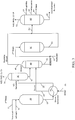
- the hydrocarbon feedstock stream 11 and a hydrogen stream 12 are fed to the first stage reactor vessel 10 for removal of heteroatoms containing sulfur, nitrogen and trace amounts of such metals as Ni, V, Fe, and also to crack high molecular weight, high boiling molecules into lower molecular weight, lower boiling hydrocarbons in the range 5-60 W%.
- the effluent stream 13 is sent to a steam generating heat exchanger 20 to cool the reaction products and to generate a steam 22 from water 21.
- the cooled products 23 from the steam generator are sent to a steam stripper vessel 30 to remove hydrogen, H 2 S, NH 3 , light gases (C 1 -C 4 ), naphtha and diesel products boiling in the nominal range of 36-370°C.
- the steam stripper is supplied with the steam 22 from the steam generator 20.
- the stripper bottoms 32, free of light gases, H 2 S, NH 3 and light fractions stream 31, are combined with a hydrogen stream 33 and sent to the second stage of the hydrocracking unit vessel 40.
- the second stage effluent stream 41 are combined with the light stripper products 31, and the combined stream 42 is sent to several separation and cleaning vessels including a fractionator vessel 50 to obtain final hydrocracking gas and liquid products.
- Hydrocracker products include stream 51 containing H 2 S, NH 3 , light gases (C 1 -C 4 ), naphtha stream 52 boiling in the range C5-180oC, kerosene stream 53 boiling in the range of 180-240oC, diesel stream 54 boiling in the range 240-370oC, and unconverted hydrocarbon fractions stream 55 boiling above 370oC.
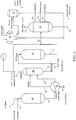
- the hydrocarbon feedstock stream 11 and hydrogen stream 12 are fed to the first stage reactor vessel 10 for removal of heteroatoms containing sulfur, nitrogen and trace amounts of such metals as Ni, V and Fe, and also for the cracking of high molecular weight, high boiling molecules into lower molecular weight, lower boiling hydrocarbons in the range of from 5-60 W%.
- the effluent stream 13 is sent to a heat exchanger steam generator 20 to cool the reaction products and generate steam 22 from feed water 21.
- the cooled products 23 from the steam generator are sent to a vapor/liquid separator stripper 30 to remove the light gases including hydrogen, H 2 S, NH 3 and C 1 -C 4 hydrocarbons which exit as the effluent stream 31
- the vapor/liquid separator bottoms stream 32 is sent to a steam stripper vessel 40 to remove naphtha and diesel products nominally boiling in the range of from 36-370°C.
- the steam stripper is fed by the steam 22 generated by the steam generator 20.
- the stripper bottoms 42, free of light gases, H 2 S, NH 3 and light fractions, are combined with hydrogen stream 43 and sent to a second stage hydrocracking unit vessel 50.
- the second stage effluent stream 51 is then combined with the light stripper products 41, and the combined stream 52 is sent to several separation and cleaning vessels including a fractionator vessel 60 to obtain final hydrocracking gas and liquid products.
- Hydrocracker products include H 2 S, NH 3 , light gases (C 1 -C 4 ) stream 61, naphtha boiling in the range 36-180oC stream 62, kerosene stream 63, diesel boiling in the range 180-370C stream 64 and unconverted hydrocarbon fractions boiling above 370oC stream 65.
- the embodiment shown in Fig. 4 includes unit operations performing processes similar to the embodiment of Fig. 2 .
- the Fig. 4 embodiment includes a diesel hydrotreater for hydrotreating a diesel stream and a water recycle stream.
- part of the stripper top stream 31 is passed through a steam generator to a separator vessel 60 to separate water, gas, and liquids. A portion of the water is extracted and sent back to the steam generator 20 and thereafter to stripper unit 30.
- a sour diesel stream from the refinery is supplied to the vessel 60, combined with the top stream, and sent to the diesel hydrotreater 70 for ultra-low sulfur diesel production.
- the remaining water from the hydrotreater unit 70 is recycled to the stripper unit 30, while ultra-low sulfur, or sweet, diesel (“ULSD”) from the hydrotreater is recovered for the market.
- ULSD ultra-low sulfur, or sweet, diesel
- DMO demetalized oil
- VGO vacuum gas oil
- the product yields are shown in Table 2.
- the steam stripping of the first stage effluent improved the mid-distillate yields by about 5 W% and lowered the naphtha and light gas produced by about 5W% and 0.5W%, respectively.
- Table 2 Once-Through Once-Through with Interstage Stripping H 2 S, W% 2.58 2.58 C 1 -C 4 , W% 3.21 2.85 Naphtha, W% 25.16 19.77 Mid-distillates, W% 42.11 47.86 Bottoms, W% 29.60 29.60 Total, W% 102.65 102.65
- the current invention utilizes a steam stripper to simulate a two- stage hydrocracking unit configuration by removing the H2S, NH3, light gases (C1-C4), naphtha and diesel products nominally boiling in the range 36-370°C from the first stage effluents.
- the steam-stripped products will be free of H2S and NH3 and NH3 and will contain unconverted hydrocarbons, resulting in higher activity for the catalysts because there is no poisonous H2S and NH3, and higher mid distillate selectivity because the light products will not be subjected to further cracking.
Landscapes
- Chemical & Material Sciences (AREA)
- Oil, Petroleum & Natural Gas (AREA)
- Engineering & Computer Science (AREA)
- Chemical Kinetics & Catalysis (AREA)
- General Chemical & Material Sciences (AREA)
- Organic Chemistry (AREA)
- Production Of Liquid Hydrocarbon Mixture For Refining Petroleum (AREA)
Applications Claiming Priority (2)
| Application Number | Priority Date | Filing Date | Title |
|---|---|---|---|
| US201161513029P | 2011-07-29 | 2011-07-29 | |
| PCT/US2012/048559 WO2013019624A1 (en) | 2011-07-29 | 2012-07-27 | Hydrocracking process with interstage steam stripping |
Publications (2)
| Publication Number | Publication Date |
|---|---|
| EP2737027A1 EP2737027A1 (en) | 2014-06-04 |
| EP2737027B1 true EP2737027B1 (en) | 2018-12-26 |
Family
ID=46651606
Family Applications (1)
| Application Number | Title | Priority Date | Filing Date |
|---|---|---|---|
| EP12746430.3A Not-in-force EP2737027B1 (en) | 2011-07-29 | 2012-07-27 | Hydrocracking process with interstage steam stripping |
Country Status (6)
| Country | Link |
|---|---|
| US (1) | US9803148B2 (enExample) |
| EP (1) | EP2737027B1 (enExample) |
| JP (1) | JP6273202B2 (enExample) |
| KR (1) | KR101956407B1 (enExample) |
| CN (1) | CN104114679B (enExample) |
| WO (1) | WO2013019624A1 (enExample) |
Families Citing this family (12)
| Publication number | Priority date | Publication date | Assignee | Title |
|---|---|---|---|---|
| US9150797B2 (en) * | 2013-03-15 | 2015-10-06 | Uop Llc | Process and apparatus for recovering hydroprocessed hydrocarbons with single product fractionation column |
| US9902912B2 (en) | 2014-01-29 | 2018-02-27 | Uop Llc | Hydrotreating coker kerosene with a separate trim reactor |
| ES2696423T3 (es) * | 2014-02-25 | 2019-01-15 | Saudi Basic Ind Corp | Método para convertir una materia prima hidrocarbonada de alto punto de ebullición en productos hidrocarbonados de menor punto de ebullición |
| US10273420B2 (en) | 2014-10-27 | 2019-04-30 | Uop Llc | Process for hydrotreating a hydrocarbons stream |
| US9695369B2 (en) * | 2014-11-21 | 2017-07-04 | Lummus Technology Inc. | Process to upgrade partially converted vacuum residua |
| US9803509B2 (en) * | 2015-08-24 | 2017-10-31 | Saudi Arabian Oil Company | Power generation from waste heat in integrated crude oil refining and aromatics facilities |
| WO2018033381A1 (en) * | 2016-08-18 | 2018-02-22 | Haldor Topsøe A/S | High conversion hydrocracking process and plant |
| US11015132B2 (en) | 2016-08-18 | 2021-05-25 | Haldor Topsøe A/S | High conversion hydrocracking process |
| IL248844B (en) * | 2016-11-08 | 2019-12-31 | Yurii Guk | One-step process of refining crude oil at low temperature |
| US11142704B2 (en) | 2019-12-03 | 2021-10-12 | Saudi Arabian Oil Company | Methods and systems of steam stripping a hydrocracking feedstock |
| KR102792304B1 (ko) | 2021-05-06 | 2025-04-04 | 주식회사 엘지화학 | 이소프로필 알코올 제조방법 |
| US20240409830A1 (en) * | 2023-06-08 | 2024-12-12 | Axens | Integrated Process for Complete Conversion of Residue Feedstock |
Family Cites Families (50)
| Publication number | Priority date | Publication date | Assignee | Title |
|---|---|---|---|---|
| US3240694A (en) | 1963-11-26 | 1966-03-15 | Chevron Res | Multi-zone hydrocaracking process |
| US3377267A (en) * | 1965-08-06 | 1968-04-09 | Chevron Res | Vapor-liquid phase separation of hydroconversion process effluent with the use of hydrogen and steam |
| BE754805A (fr) | 1969-09-05 | 1971-02-15 | Atlantic Richfield Co | Procede perfectionne de preparation d'huile minerale lubrifiante a partir de nouvelles matieres premieres |
| US3855113A (en) | 1972-12-21 | 1974-12-17 | Chevron Res | Integrated process combining hydrofining and steam cracking |
| US3928173A (en) | 1974-05-21 | 1975-12-23 | Phillips Petroleum Co | Increased production of diesel oil and fuel oil |
| US4394249A (en) | 1981-08-03 | 1983-07-19 | Mobil Oil Corporation | Catalytic dewaxing process |
| US4400265A (en) | 1982-04-01 | 1983-08-23 | Mobil Oil Corporation | Cascade catalytic dewaxing/hydrodewaxing process |
| US4521295A (en) | 1982-12-27 | 1985-06-04 | Hri, Inc. | Sustained high hydroconversion of petroleum residua feedstocks |
| US4828675A (en) | 1987-12-04 | 1989-05-09 | Exxon Research And Engineering Company | Process for the production of ultra high octane gasoline, and other fuels from aromatic distillates |
| US4828676A (en) | 1987-12-07 | 1989-05-09 | Exxon Research And Engineering Company | Process for the production of ultra high octane gasoline, and other fuels from aromatic hydrocrackates |
| GB8819122D0 (en) | 1988-08-11 | 1988-09-14 | Shell Int Research | Process for hydrocracking of hydrocarbonaceous feedstock |
| US4994168A (en) | 1988-10-21 | 1991-02-19 | Mobil Oil Corporation | Lube oil product stripping |
| US4935120A (en) | 1988-12-08 | 1990-06-19 | Coastal Eagle Point Oil Company | Multi-stage wax hydrocracking |
| US4994170A (en) | 1988-12-08 | 1991-02-19 | Coastal Eagle Point Oil Company | Multi-stage wax hydrocrackinig |
| US6632622B2 (en) | 1989-10-25 | 2003-10-14 | Russell Jaffe | Assay for evaluation of cellular response to allergens |
| US5073249A (en) | 1989-11-21 | 1991-12-17 | Mobil Oil Corporation | Heavy oil catalytic cracking process and apparatus |
| US5164070A (en) | 1991-03-06 | 1992-11-17 | Uop | Hydrocracking product recovery process |
| US5275719A (en) | 1992-06-08 | 1994-01-04 | Mobil Oil Corporation | Production of high viscosity index lubricants |
| US6270654B1 (en) | 1993-08-18 | 2001-08-07 | Ifp North America, Inc. | Catalytic hydrogenation process utilizing multi-stage ebullated bed reactors |
| US5453177A (en) | 1994-01-27 | 1995-09-26 | The M. W. Kellogg Company | Integrated distillate recovery process |
| US5447621A (en) | 1994-01-27 | 1995-09-05 | The M. W. Kellogg Company | Integrated process for upgrading middle distillate production |
| KR100339069B1 (ko) * | 1995-12-26 | 2002-08-27 | 더 엠. 더블유. 켈로그 컴파니 | 분리된재순환과정이있는통합수소화처리방법 |
| FR2757532B1 (fr) * | 1996-12-20 | 1999-02-19 | Inst Francais Du Petrole | Procede de transformation d'une coupe gazole pour produire un carburant a haute indice de cetane, desaromatise et desulfure |
| US5705052A (en) | 1996-12-31 | 1998-01-06 | Exxon Research And Engineering Company | Multi-stage hydroprocessing in a single reaction vessel |
| US6103104A (en) | 1998-05-07 | 2000-08-15 | Exxon Research And Engineering Company | Multi-stage hydroprocessing of middle distillates to avoid color bodies |
| JP2000017276A (ja) | 1998-06-29 | 2000-01-18 | Nippon Kagaku Kogyo Kyokai | 原料炭化水素の脱硫改質装置およびその方法 |
| US6217746B1 (en) | 1999-08-16 | 2001-04-17 | Uop Llc | Two stage hydrocracking process |
| FR2803596B1 (fr) | 2000-01-11 | 2003-01-17 | Inst Francais Du Petrole | Procede de conversion de fractions petrolieres comprenant une etape d'hydroconversion lit bouillonnant, une etape de separation, une etape d'hydrodesulfuration et une etape de craquage |
| US6454932B1 (en) | 2000-08-15 | 2002-09-24 | Abb Lummus Global Inc. | Multiple stage ebullating bed hydrocracking with interstage stripping and separating |
| US6623622B2 (en) | 2000-10-10 | 2003-09-23 | Exxonmobil Research And Engineering Company | Two stage diesel fuel hydrotreating and stripping in a single reaction vessel |
| US6632350B2 (en) | 2000-10-10 | 2003-10-14 | Exxonmobile Research And Engineering Company | Two stage hydroprocessing and stripping in a single reaction vessel |
| US6436279B1 (en) | 2000-11-08 | 2002-08-20 | Axens North America, Inc. | Simplified ebullated-bed process with enhanced reactor kinetics |
| US7128828B1 (en) | 2001-01-12 | 2006-10-31 | Uop Llc | Process for producing food grade wax |
| US6517705B1 (en) | 2001-03-21 | 2003-02-11 | Uop Llc | Hydrocracking process for lube base oil production |
| US6783660B2 (en) * | 2001-10-25 | 2004-08-31 | Chevron U.S.A. Inc. | Multiple hydroprocessing reactors with intermediate flash zones |
| US20090095654A1 (en) * | 2001-10-25 | 2009-04-16 | Chevron U.S.A. Inc. | Hydroprocessing in multiple beds with intermediate flash zones |
| US6797154B2 (en) * | 2001-12-17 | 2004-09-28 | Chevron U.S.A. Inc. | Hydrocracking process for the production of high quality distillates from heavy gas oils |
| US7238275B2 (en) * | 2002-04-05 | 2007-07-03 | Fluor Technologies Corporation | Combined hydrotreating process and configurations for same |
| US7279090B2 (en) | 2004-12-06 | 2007-10-09 | Institut Francais Du Pe'trole | Integrated SDA and ebullated-bed process |
| US7238277B2 (en) * | 2004-12-16 | 2007-07-03 | Chevron U.S.A. Inc. | High conversion hydroprocessing |
| FR2883005B1 (fr) | 2005-03-09 | 2007-04-20 | Inst Francais Du Petrole | Procede d'hydrocraquage avec recyclage comprenant l'adsorption de composes polyaromatiques de la fraction recyclee sur adsorbant a base de silice-alumine a teneur limitee en macropores |
| CN1912064B (zh) * | 2005-08-11 | 2010-12-29 | 环球油品公司 | 生产超低硫柴油的加氢裂化方法 |
| CN100549139C (zh) * | 2005-10-24 | 2009-10-14 | 中国石油化工股份有限公司 | 一种两段加氢裂化方法 |
| FR2904324B1 (fr) | 2006-07-27 | 2012-09-07 | Total France | Procede d'hydrotraitement d'une charge gazole, reacteur d'hydrotraitement pour la mise en oeuvre dudit procede, et unite d'hydroraffinage correspondante. |
| US20080023372A1 (en) * | 2006-07-27 | 2008-01-31 | Leonard Laura E | Hydrocracking Process |
| US7560020B2 (en) | 2006-10-30 | 2009-07-14 | Exxonmobil Chemical Patents Inc. | Deasphalting tar using stripping tower |
| CN101802135B (zh) | 2007-04-30 | 2013-08-14 | 国际壳牌研究有限公司 | 用于由烃原料生产中间馏分油产物和低级烯烃的系统和方法 |
| US20090159493A1 (en) * | 2007-12-21 | 2009-06-25 | Chevron U.S.A. Inc. | Targeted hydrogenation hydrocracking |
| US8173009B2 (en) | 2009-02-06 | 2012-05-08 | Uop Llc | Process for improving a hydrotreated stream |
| US8343334B2 (en) * | 2009-10-06 | 2013-01-01 | Saudi Arabian Oil Company | Pressure cascaded two-stage hydrocracking unit |
-
2012
- 2012-07-27 EP EP12746430.3A patent/EP2737027B1/en not_active Not-in-force
- 2012-07-27 US US13/559,846 patent/US9803148B2/en not_active Expired - Fee Related
- 2012-07-27 JP JP2014523068A patent/JP6273202B2/ja not_active Expired - Fee Related
- 2012-07-27 CN CN201280046342.6A patent/CN104114679B/zh not_active Expired - Fee Related
- 2012-07-27 KR KR1020147005339A patent/KR101956407B1/ko not_active Expired - Fee Related
- 2012-07-27 WO PCT/US2012/048559 patent/WO2013019624A1/en not_active Ceased
Non-Patent Citations (1)
| Title |
|---|
| None * |
Also Published As
| Publication number | Publication date |
|---|---|
| WO2013019624A9 (en) | 2013-09-19 |
| US20130098802A1 (en) | 2013-04-25 |
| WO2013019624A1 (en) | 2013-02-07 |
| KR20140079763A (ko) | 2014-06-27 |
| JP2014527100A (ja) | 2014-10-09 |
| CN104114679A (zh) | 2014-10-22 |
| US9803148B2 (en) | 2017-10-31 |
| CN104114679B (zh) | 2016-04-13 |
| JP6273202B2 (ja) | 2018-01-31 |
| KR101956407B1 (ko) | 2019-03-08 |
| EP2737027A1 (en) | 2014-06-04 |
Similar Documents
| Publication | Publication Date | Title |
|---|---|---|
| US9803148B2 (en) | Hydrocracking process with interstage steam stripping | |
| KR101696017B1 (ko) | 멀티스테이지 리지드 하이드로크랙킹 | |
| EP1931752B1 (en) | Hydrotreating and hydrocracking process and apparatus | |
| JP5651281B2 (ja) | 硫黄含有量が非常に少ない中間留分の製造を伴う沸騰床での重質石油フラクションの転化方法および装置 | |
| US6841062B2 (en) | Crude oil desulfurization | |
| US7507325B2 (en) | Process for converting heavy petroleum fractions for producing a catalytic cracking feedstock and middle distillates with a low sulfur content | |
| US6630066B2 (en) | Hydrocracking and hydrotreating separate refinery streams | |
| US7531082B2 (en) | High conversion hydroprocessing using multiple pressure and reaction zones | |
| KR102558074B1 (ko) | 2-단계 히드로크래킹 및 수소처리 공정의 통합 공정 | |
| US20090159493A1 (en) | Targeted hydrogenation hydrocracking | |
| JP2014527100A5 (enExample) | ||
| US10760015B2 (en) | Installation and integrated hydrotreatment and hydroconversion process with common fractionation section | |
| JP2008524386A (ja) | 高転化率水素化処理 | |
| WO2018122274A1 (en) | Process for producing middle distillates | |
| US7763218B2 (en) | Partial conversion hydrocracking process and apparatus | |
| CN101434867B (zh) | 一种悬浮床渣油加氢-催化裂化组合工艺方法 | |
| CN110776953A (zh) | 包括固定床加氢处理、两次脱沥青操作和沥青的加氢裂化的用于处理重质烃原料的方法 |
Legal Events
| Date | Code | Title | Description |
|---|---|---|---|
| PUAI | Public reference made under article 153(3) epc to a published international application that has entered the european phase |
Free format text: ORIGINAL CODE: 0009012 |
|
| 17P | Request for examination filed |
Effective date: 20140224 |
|
| AK | Designated contracting states |
Kind code of ref document: A1 Designated state(s): AL AT BE BG CH CY CZ DE DK EE ES FI FR GB GR HR HU IE IS IT LI LT LU LV MC MK MT NL NO PL PT RO RS SE SI SK SM TR |
|
| DAX | Request for extension of the european patent (deleted) | ||
| 17Q | First examination report despatched |
Effective date: 20160421 |
|
| STAA | Information on the status of an ep patent application or granted ep patent |
Free format text: STATUS: EXAMINATION IS IN PROGRESS |
|
| RAP1 | Party data changed (applicant data changed or rights of an application transferred) |
Owner name: JAPAN COOPERATION CENTER PETROLEUM Owner name: SAUDI ARABIAN OIL COMPANY Owner name: JGC CATALYSTS AND CHEMICALS LTD. |
|
| GRAP | Despatch of communication of intention to grant a patent |
Free format text: ORIGINAL CODE: EPIDOSNIGR1 |
|
| STAA | Information on the status of an ep patent application or granted ep patent |
Free format text: STATUS: GRANT OF PATENT IS INTENDED |
|
| RIC1 | Information provided on ipc code assigned before grant |
Ipc: C10G 65/12 20060101AFI20180622BHEP Ipc: C10G 67/02 20060101ALI20180622BHEP |
|
| INTG | Intention to grant announced |
Effective date: 20180720 |
|
| GRAS | Grant fee paid |
Free format text: ORIGINAL CODE: EPIDOSNIGR3 |
|
| GRAA | (expected) grant |
Free format text: ORIGINAL CODE: 0009210 |
|
| STAA | Information on the status of an ep patent application or granted ep patent |
Free format text: STATUS: THE PATENT HAS BEEN GRANTED |
|
| AK | Designated contracting states |
Kind code of ref document: B1 Designated state(s): AL AT BE BG CH CY CZ DE DK EE ES FI FR GB GR HR HU IE IS IT LI LT LU LV MC MK MT NL NO PL PT RO RS SE SI SK SM TR |
|
| REG | Reference to a national code |
Ref country code: GB Ref legal event code: FG4D |
|
| REG | Reference to a national code |
Ref country code: CH Ref legal event code: EP |
|
| REG | Reference to a national code |
Ref country code: AT Ref legal event code: REF Ref document number: 1081404 Country of ref document: AT Kind code of ref document: T Effective date: 20190115 |
|
| REG | Reference to a national code |
Ref country code: DE Ref legal event code: R096 Ref document number: 602012055125 Country of ref document: DE |
|
| REG | Reference to a national code |
Ref country code: IE Ref legal event code: FG4D |
|
| REG | Reference to a national code |
Ref country code: NO Ref legal event code: T2 Effective date: 20181226 |
|
| REG | Reference to a national code |
Ref country code: NL Ref legal event code: FP |
|
| PG25 | Lapsed in a contracting state [announced via postgrant information from national office to epo] |
Ref country code: LT Free format text: LAPSE BECAUSE OF FAILURE TO SUBMIT A TRANSLATION OF THE DESCRIPTION OR TO PAY THE FEE WITHIN THE PRESCRIBED TIME-LIMIT Effective date: 20181226 Ref country code: BG Free format text: LAPSE BECAUSE OF FAILURE TO SUBMIT A TRANSLATION OF THE DESCRIPTION OR TO PAY THE FEE WITHIN THE PRESCRIBED TIME-LIMIT Effective date: 20190326 Ref country code: HR Free format text: LAPSE BECAUSE OF FAILURE TO SUBMIT A TRANSLATION OF THE DESCRIPTION OR TO PAY THE FEE WITHIN THE PRESCRIBED TIME-LIMIT Effective date: 20181226 Ref country code: LV Free format text: LAPSE BECAUSE OF FAILURE TO SUBMIT A TRANSLATION OF THE DESCRIPTION OR TO PAY THE FEE WITHIN THE PRESCRIBED TIME-LIMIT Effective date: 20181226 Ref country code: FI Free format text: LAPSE BECAUSE OF FAILURE TO SUBMIT A TRANSLATION OF THE DESCRIPTION OR TO PAY THE FEE WITHIN THE PRESCRIBED TIME-LIMIT Effective date: 20181226 |
|
| REG | Reference to a national code |
Ref country code: LT Ref legal event code: MG4D |
|
| PG25 | Lapsed in a contracting state [announced via postgrant information from national office to epo] |
Ref country code: RS Free format text: LAPSE BECAUSE OF FAILURE TO SUBMIT A TRANSLATION OF THE DESCRIPTION OR TO PAY THE FEE WITHIN THE PRESCRIBED TIME-LIMIT Effective date: 20181226 Ref country code: AL Free format text: LAPSE BECAUSE OF FAILURE TO SUBMIT A TRANSLATION OF THE DESCRIPTION OR TO PAY THE FEE WITHIN THE PRESCRIBED TIME-LIMIT Effective date: 20181226 Ref country code: SE Free format text: LAPSE BECAUSE OF FAILURE TO SUBMIT A TRANSLATION OF THE DESCRIPTION OR TO PAY THE FEE WITHIN THE PRESCRIBED TIME-LIMIT Effective date: 20181226 Ref country code: GR Free format text: LAPSE BECAUSE OF FAILURE TO SUBMIT A TRANSLATION OF THE DESCRIPTION OR TO PAY THE FEE WITHIN THE PRESCRIBED TIME-LIMIT Effective date: 20190327 |
|
| REG | Reference to a national code |
Ref country code: AT Ref legal event code: MK05 Ref document number: 1081404 Country of ref document: AT Kind code of ref document: T Effective date: 20181226 |
|
| PG25 | Lapsed in a contracting state [announced via postgrant information from national office to epo] |
Ref country code: PL Free format text: LAPSE BECAUSE OF FAILURE TO SUBMIT A TRANSLATION OF THE DESCRIPTION OR TO PAY THE FEE WITHIN THE PRESCRIBED TIME-LIMIT Effective date: 20181226 Ref country code: PT Free format text: LAPSE BECAUSE OF FAILURE TO SUBMIT A TRANSLATION OF THE DESCRIPTION OR TO PAY THE FEE WITHIN THE PRESCRIBED TIME-LIMIT Effective date: 20190426 Ref country code: ES Free format text: LAPSE BECAUSE OF FAILURE TO SUBMIT A TRANSLATION OF THE DESCRIPTION OR TO PAY THE FEE WITHIN THE PRESCRIBED TIME-LIMIT Effective date: 20181226 Ref country code: CZ Free format text: LAPSE BECAUSE OF FAILURE TO SUBMIT A TRANSLATION OF THE DESCRIPTION OR TO PAY THE FEE WITHIN THE PRESCRIBED TIME-LIMIT Effective date: 20181226 |
|
| PG25 | Lapsed in a contracting state [announced via postgrant information from national office to epo] |
Ref country code: RO Free format text: LAPSE BECAUSE OF FAILURE TO SUBMIT A TRANSLATION OF THE DESCRIPTION OR TO PAY THE FEE WITHIN THE PRESCRIBED TIME-LIMIT Effective date: 20181226 Ref country code: SM Free format text: LAPSE BECAUSE OF FAILURE TO SUBMIT A TRANSLATION OF THE DESCRIPTION OR TO PAY THE FEE WITHIN THE PRESCRIBED TIME-LIMIT Effective date: 20181226 Ref country code: IS Free format text: LAPSE BECAUSE OF FAILURE TO SUBMIT A TRANSLATION OF THE DESCRIPTION OR TO PAY THE FEE WITHIN THE PRESCRIBED TIME-LIMIT Effective date: 20190426 Ref country code: EE Free format text: LAPSE BECAUSE OF FAILURE TO SUBMIT A TRANSLATION OF THE DESCRIPTION OR TO PAY THE FEE WITHIN THE PRESCRIBED TIME-LIMIT Effective date: 20181226 Ref country code: SK Free format text: LAPSE BECAUSE OF FAILURE TO SUBMIT A TRANSLATION OF THE DESCRIPTION OR TO PAY THE FEE WITHIN THE PRESCRIBED TIME-LIMIT Effective date: 20181226 |
|
| REG | Reference to a national code |
Ref country code: DE Ref legal event code: R097 Ref document number: 602012055125 Country of ref document: DE |
|
| PG25 | Lapsed in a contracting state [announced via postgrant information from national office to epo] |
Ref country code: DK Free format text: LAPSE BECAUSE OF FAILURE TO SUBMIT A TRANSLATION OF THE DESCRIPTION OR TO PAY THE FEE WITHIN THE PRESCRIBED TIME-LIMIT Effective date: 20181226 Ref country code: AT Free format text: LAPSE BECAUSE OF FAILURE TO SUBMIT A TRANSLATION OF THE DESCRIPTION OR TO PAY THE FEE WITHIN THE PRESCRIBED TIME-LIMIT Effective date: 20181226 |
|
| PLBE | No opposition filed within time limit |
Free format text: ORIGINAL CODE: 0009261 |
|
| STAA | Information on the status of an ep patent application or granted ep patent |
Free format text: STATUS: NO OPPOSITION FILED WITHIN TIME LIMIT |
|
| 26N | No opposition filed |
Effective date: 20190927 |
|
| PG25 | Lapsed in a contracting state [announced via postgrant information from national office to epo] |
Ref country code: SI Free format text: LAPSE BECAUSE OF FAILURE TO SUBMIT A TRANSLATION OF THE DESCRIPTION OR TO PAY THE FEE WITHIN THE PRESCRIBED TIME-LIMIT Effective date: 20181226 Ref country code: MC Free format text: LAPSE BECAUSE OF FAILURE TO SUBMIT A TRANSLATION OF THE DESCRIPTION OR TO PAY THE FEE WITHIN THE PRESCRIBED TIME-LIMIT Effective date: 20181226 |
|
| REG | Reference to a national code |
Ref country code: CH Ref legal event code: PL |
|
| PG25 | Lapsed in a contracting state [announced via postgrant information from national office to epo] |
Ref country code: TR Free format text: LAPSE BECAUSE OF FAILURE TO SUBMIT A TRANSLATION OF THE DESCRIPTION OR TO PAY THE FEE WITHIN THE PRESCRIBED TIME-LIMIT Effective date: 20181226 |
|
| REG | Reference to a national code |
Ref country code: BE Ref legal event code: MM Effective date: 20190731 |
|
| PG25 | Lapsed in a contracting state [announced via postgrant information from national office to epo] |
Ref country code: CH Free format text: LAPSE BECAUSE OF NON-PAYMENT OF DUE FEES Effective date: 20190731 Ref country code: LI Free format text: LAPSE BECAUSE OF NON-PAYMENT OF DUE FEES Effective date: 20190731 Ref country code: BE Free format text: LAPSE BECAUSE OF NON-PAYMENT OF DUE FEES Effective date: 20190731 Ref country code: LU Free format text: LAPSE BECAUSE OF NON-PAYMENT OF DUE FEES Effective date: 20190727 |
|
| PG25 | Lapsed in a contracting state [announced via postgrant information from national office to epo] |
Ref country code: IE Free format text: LAPSE BECAUSE OF NON-PAYMENT OF DUE FEES Effective date: 20190727 |
|
| PG25 | Lapsed in a contracting state [announced via postgrant information from national office to epo] |
Ref country code: CY Free format text: LAPSE BECAUSE OF FAILURE TO SUBMIT A TRANSLATION OF THE DESCRIPTION OR TO PAY THE FEE WITHIN THE PRESCRIBED TIME-LIMIT Effective date: 20181226 |
|
| PG25 | Lapsed in a contracting state [announced via postgrant information from national office to epo] |
Ref country code: HU Free format text: LAPSE BECAUSE OF FAILURE TO SUBMIT A TRANSLATION OF THE DESCRIPTION OR TO PAY THE FEE WITHIN THE PRESCRIBED TIME-LIMIT; INVALID AB INITIO Effective date: 20120727 Ref country code: MT Free format text: LAPSE BECAUSE OF FAILURE TO SUBMIT A TRANSLATION OF THE DESCRIPTION OR TO PAY THE FEE WITHIN THE PRESCRIBED TIME-LIMIT Effective date: 20181226 |
|
| PGFP | Annual fee paid to national office [announced via postgrant information from national office to epo] |
Ref country code: NO Payment date: 20211126 Year of fee payment: 10 |
|
| PG25 | Lapsed in a contracting state [announced via postgrant information from national office to epo] |
Ref country code: MK Free format text: LAPSE BECAUSE OF FAILURE TO SUBMIT A TRANSLATION OF THE DESCRIPTION OR TO PAY THE FEE WITHIN THE PRESCRIBED TIME-LIMIT Effective date: 20181226 |
|
| REG | Reference to a national code |
Ref country code: NO Ref legal event code: MMEP |
|
| PG25 | Lapsed in a contracting state [announced via postgrant information from national office to epo] |
Ref country code: NO Free format text: LAPSE BECAUSE OF NON-PAYMENT OF DUE FEES Effective date: 20220731 |
|
| P01 | Opt-out of the competence of the unified patent court (upc) registered |
Effective date: 20230529 |
|
| REG | Reference to a national code |
Ref country code: DE Ref legal event code: R081 Ref document number: 602012055125 Country of ref document: DE Owner name: SAUDI ARABIAN OIL CO., SA Free format text: FORMER OWNERS: JAPAN COOPERATION CENTER PETROLEUM, TOKYO, JP; JGC CATALYSTS AND CHEMICALS LTD., KAWASAKI-SHI, KANAGAWA, JP; SAUDI ARABIAN OIL CO., DHAHRAN, SA Ref country code: DE Ref legal event code: R081 Ref document number: 602012055125 Country of ref document: DE Owner name: JGC CATALYSTS AND CHEMICALS LTD., KAWASAKI-SHI, JP Free format text: FORMER OWNERS: JAPAN COOPERATION CENTER PETROLEUM, TOKYO, JP; JGC CATALYSTS AND CHEMICALS LTD., KAWASAKI-SHI, KANAGAWA, JP; SAUDI ARABIAN OIL CO., DHAHRAN, SA Ref country code: DE Ref legal event code: R081 Ref document number: 602012055125 Country of ref document: DE Owner name: JAPAN COOPERATION CENTER FOR PETROLEUM AND SUS, JP Free format text: FORMER OWNERS: JAPAN COOPERATION CENTER PETROLEUM, TOKYO, JP; JGC CATALYSTS AND CHEMICALS LTD., KAWASAKI-SHI, KANAGAWA, JP; SAUDI ARABIAN OIL CO., DHAHRAN, SA |
|
| REG | Reference to a national code |
Ref country code: NL Ref legal event code: HC Owner name: JGC CATALYSTS AND CHEMICALS LTD.; JP Free format text: DETAILS ASSIGNMENT: CHANGE OF OWNER(S), CHANGE OF OWNER(S) NAME; FORMER OWNER NAME: SAUDI ARABIAN OIL COMPANY Effective date: 20240213 |
|
| PGFP | Annual fee paid to national office [announced via postgrant information from national office to epo] |
Ref country code: GB Payment date: 20240628 Year of fee payment: 13 |
|
| PGFP | Annual fee paid to national office [announced via postgrant information from national office to epo] |
Ref country code: NL Payment date: 20240628 Year of fee payment: 13 |
|
| PGFP | Annual fee paid to national office [announced via postgrant information from national office to epo] |
Ref country code: FR Payment date: 20240628 Year of fee payment: 13 |
|
| PGFP | Annual fee paid to national office [announced via postgrant information from national office to epo] |
Ref country code: IT Payment date: 20240628 Year of fee payment: 13 |
|
| PGFP | Annual fee paid to national office [announced via postgrant information from national office to epo] |
Ref country code: DE Payment date: 20240628 Year of fee payment: 13 |
|
| REG | Reference to a national code |
Ref country code: DE Ref legal event code: R119 Ref document number: 602012055125 Country of ref document: DE |
|
| REG | Reference to a national code |
Ref country code: NL Ref legal event code: MM Effective date: 20250801 |
|
| GBPC | Gb: european patent ceased through non-payment of renewal fee |
Effective date: 20250727 |
|
| PG25 | Lapsed in a contracting state [announced via postgrant information from national office to epo] |
Ref country code: GB Free format text: LAPSE BECAUSE OF NON-PAYMENT OF DUE FEES Effective date: 20250727 |
|
| PG25 | Lapsed in a contracting state [announced via postgrant information from national office to epo] |
Ref country code: DE Free format text: LAPSE BECAUSE OF NON-PAYMENT OF DUE FEES Effective date: 20260203 |
|
| PG25 | Lapsed in a contracting state [announced via postgrant information from national office to epo] |
Ref country code: NL Free format text: LAPSE BECAUSE OF NON-PAYMENT OF DUE FEES Effective date: 20250801 |
|
| PG25 | Lapsed in a contracting state [announced via postgrant information from national office to epo] |
Ref country code: FR Free format text: LAPSE BECAUSE OF NON-PAYMENT OF DUE FEES Effective date: 20250731 |
|
| PG25 | Lapsed in a contracting state [announced via postgrant information from national office to epo] |
Ref country code: IT Free format text: LAPSE BECAUSE OF NON-PAYMENT OF DUE FEES Effective date: 20250727 |