EP2736293A1 - Ack/nack/sr- ressourcenzuweisungsverfahren und -vorrichtung - Google Patents
Ack/nack/sr- ressourcenzuweisungsverfahren und -vorrichtung Download PDFInfo
- Publication number
- EP2736293A1 EP2736293A1 EP12814325.2A EP12814325A EP2736293A1 EP 2736293 A1 EP2736293 A1 EP 2736293A1 EP 12814325 A EP12814325 A EP 12814325A EP 2736293 A1 EP2736293 A1 EP 2736293A1
- Authority
- EP
- European Patent Office
- Prior art keywords
- nack
- ack
- type protocol
- pucch
- terminal
- Prior art date
- Legal status (The legal status is an assumption and is not a legal conclusion. Google has not performed a legal analysis and makes no representation as to the accuracy of the status listed.)
- Granted
Links
Images


Classifications
-
- H—ELECTRICITY
- H04—ELECTRIC COMMUNICATION TECHNIQUE
- H04W—WIRELESS COMMUNICATION NETWORKS
- H04W72/00—Local resource management
- H04W72/20—Control channels or signalling for resource management
-
- H—ELECTRICITY
- H04—ELECTRIC COMMUNICATION TECHNIQUE
- H04L—TRANSMISSION OF DIGITAL INFORMATION, e.g. TELEGRAPHIC COMMUNICATION
- H04L1/00—Arrangements for detecting or preventing errors in the information received
- H04L1/12—Arrangements for detecting or preventing errors in the information received by using return channel
- H04L1/16—Arrangements for detecting or preventing errors in the information received by using return channel in which the return channel carries supervisory signals, e.g. repetition request signals
- H04L1/18—Automatic repetition systems, e.g. Van Duuren systems
-
- H—ELECTRICITY
- H04—ELECTRIC COMMUNICATION TECHNIQUE
- H04L—TRANSMISSION OF DIGITAL INFORMATION, e.g. TELEGRAPHIC COMMUNICATION
- H04L1/00—Arrangements for detecting or preventing errors in the information received
- H04L1/12—Arrangements for detecting or preventing errors in the information received by using return channel
- H04L1/16—Arrangements for detecting or preventing errors in the information received by using return channel in which the return channel carries supervisory signals, e.g. repetition request signals
- H04L1/18—Automatic repetition systems, e.g. Van Duuren systems
- H04L1/1829—Arrangements specially adapted for the receiver end
- H04L1/1861—Physical mapping arrangements
-
- H—ELECTRICITY
- H04—ELECTRIC COMMUNICATION TECHNIQUE
- H04L—TRANSMISSION OF DIGITAL INFORMATION, e.g. TELEGRAPHIC COMMUNICATION
- H04L1/00—Arrangements for detecting or preventing errors in the information received
- H04L1/12—Arrangements for detecting or preventing errors in the information received by using return channel
- H04L1/16—Arrangements for detecting or preventing errors in the information received by using return channel in which the return channel carries supervisory signals, e.g. repetition request signals
- H04L1/18—Automatic repetition systems, e.g. Van Duuren systems
- H04L1/1867—Arrangements specially adapted for the transmitter end
- H04L1/1893—Physical mapping arrangements
-
- H—ELECTRICITY
- H04—ELECTRIC COMMUNICATION TECHNIQUE
- H04L—TRANSMISSION OF DIGITAL INFORMATION, e.g. TELEGRAPHIC COMMUNICATION
- H04L1/00—Arrangements for detecting or preventing errors in the information received
- H04L1/12—Arrangements for detecting or preventing errors in the information received by using return channel
- H04L1/16—Arrangements for detecting or preventing errors in the information received by using return channel in which the return channel carries supervisory signals, e.g. repetition request signals
- H04L1/18—Automatic repetition systems, e.g. Van Duuren systems
- H04L1/1867—Arrangements specially adapted for the transmitter end
- H04L1/1896—ARQ related signaling
-
- H—ELECTRICITY
- H04—ELECTRIC COMMUNICATION TECHNIQUE
- H04L—TRANSMISSION OF DIGITAL INFORMATION, e.g. TELEGRAPHIC COMMUNICATION
- H04L5/00—Arrangements affording multiple use of the transmission path
- H04L5/003—Arrangements for allocating sub-channels of the transmission path
- H04L5/0053—Allocation of signalling, i.e. of overhead other than pilot signals
- H04L5/0055—Physical resource allocation for ACK/NACK
-
- H—ELECTRICITY
- H04—ELECTRIC COMMUNICATION TECHNIQUE
- H04L—TRANSMISSION OF DIGITAL INFORMATION, e.g. TELEGRAPHIC COMMUNICATION
- H04L5/00—Arrangements affording multiple use of the transmission path
- H04L5/003—Arrangements for allocating sub-channels of the transmission path
- H04L5/0058—Allocation criteria
- H04L5/0064—Rate requirement of the data, e.g. scalable bandwidth, data priority
Definitions
- the present disclosure relates to telecommunications techniques, and more particularly, to an ACK/NACK/SR resource mapping method and an apparatus.
- Time division duplex As one of two basic duplexing modes, attracts more and more attentions along with the increasing requirement of wideband radio communication on bandwidth.
- uplink transmission and downlink transmission use the same frequency resources and transmit uplink/downlink signals on different time slots.
- Familiar TDD systems include: time division-synchronous code division multiple access (TD-SCDMA) system in 3rd generation (3G) mobile communication technique and time division-long term evolved (TD-LTE) system in 4th generation (4G) mobile communication technique.
- TD-SCDMA time division-synchronous code division multiple access
- 3G 3rd generation
- TD-LTE time division-long term evolved
- 4G 4th generation
- Configuration of uplink slots and downlink slots is static or semi-static.
- uplink-downlink slot ratio is determined according to a cell type and an approximate service proportion during network deployment and remains unchanged.
- an existing technique provides a dynamic uplink-downlink subframe allocation solution.
- the detailed processing is as follows.
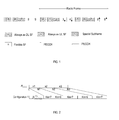
- FIG. 1 is a schematic diagram illustrating a dynamic uplink-downlink subframe allocation solution according to the existing technique.
- the adopted time period is a radio frame (which is an example, other time periods may be adopted), wherein subframes #0 and #5 are always as downlink subframes, subframes #2 and #7 are always as uplink subframes, subframes #1 and #6 are special subframes (or may be seen as always downlink subframes), subframes #3, #4, #8 and #9 are configured as uplink or downlink transmission flexibly.
- the base station may configure flexibly according to a current service requirement and channel condition, so as to be fit for the dynamic change of the service requirement.
- HARQ feedback utilizes bundling and multiplexing techniques, i.e., acknowledgement (ACK)/negative acknowledgement (NACK) of multiple downlink subframes are fed back on a physical uplink control channel (PUCCH) of one uplink subframe.
- ACK acknowledgement
- NACK negative acknowledgement
- ACK/NACK status is related to both information bit fed back on the PUCCH and an ACK/NACK/scheduling request (SR) resource index.
- SR ACK/NACK/scheduling request
- the ACK/NACK status is merely related to the information bit fed back on the PUCCH.
- a mapping method similar to that of the multiplexing technique is adopted for the ACK/NACK/SR resource index.
- one uplink-downlink configuration corresponds to one HARQ time sequence solution and one ACK/NACK/SR resource mapping solution. Therefore, there is no ACK/NACK/SR resource conflict.
- the inventor finds at least the following problem in the existing technique.
- a new HARQ solution (also includes re-using of an HARQ solution corresponding to an R8 configuration).
- an existing uplink-downlink configuration needs to be configured semi-statically and a corresponding HARQ solution has to be adopted.
- R11 and/or following version users may adopt a different HARQ solution with low version users. If the users of two different versions both adopt the existing ACK/NACK/SR resource index n PUCCH 1 allocation method, there may be ACK/NACK/SR resource conflict between the users.
- R11 does not have a definite ACK/NACK/SR resource mapping method. If the existing technique is adopted, ACK/NACK/SR resource conflict may be generated between R11 and/or following version users and low version users.
- Examples of the present disclosure provide an ACK/NACK/SR resource mapping method and an apparatus, so as to solve a problem of ACK/NACK/SR resource conflict between R11 and/or following version users and low version users.
- an ACK/NACK/SR resource mapping method includes:
- a base station applied in a system including a terminal utilizing a first type protocol and a terminal using a second type protocol.
- the base station includes:
- an ACK/NACK/SR resource mapping method includes:
- a terminal is provided.
- the terminal is applied in a system including a terminal utilizing a first type protocol and the terminal utilizing a second type protocol.
- the terminal includes:
- the base station allocates the ACK/NACK/SR resources corresponding to the second type protocol in an area outside of the ACK/NACK/SR resource area reserved for the terminal utilizing the first type protocol, and informs the terminal utilizing the second type protocol of the allocation information of the corresponding ACK/NACK/SR resources.
- the terminal utilizing the second type protocol may transmit feedback information via the corresponding ACK/NACK/SR resources.
- an ACK/NACK/SR resource conflict may be generated between users adopting protocols of different versions.
- n PUCCH 1 An ACK/NACK/SR resource is indicated by index n PUCCH 1 . Therefore, configuration and indicating method of n PUCCH 1 are discussed hereinafter.
- n PUCCH 1 may be configured by higher layers, which applies to situations that SR, semi-persistent scheduling (SPS) are not scheduled by physical downlink control channel (PDCCH).
- n PUCCH 1 may also be bundled with n CCE , applies to a situation that there is PDCCH scheduling.
- n PUCCH 1 divides the ACK/NACK/SR resources into two areas.
- the n PUCCH 1 configured by the higher layers meets n PUCCH 1 ⁇ n PUCCH 1
- calculated n PUCCH 1 meets n PUCCH 1 ⁇ N PUCCH 1 .
- n PUCCH 1 configured by the higher layers is configured by the base station by itself. Therefore, there may be cases that n PUCCH 1 ⁇ N PUCCH 1 .
- an ACK/NACK/SR resource set indicated by higher layer signaling is referred to as a higher layer configured area; an ACK/NACK/SR resource set bundled with n CCE is referred to as a predefined area or a calculated area. Boundary of the two areas is not defined in standards. However, the high layer configured area is usually ahead of the calculated area and the N PUCCH 1 is taken as the boundary. Hereinafter, for simplicity, this typical situation is taken as an example. In fact, the following examples are not restricted to the typical situation.
- n PUCCH 1 follows a rule of first in subframe then in area (the area refers to a value range of n CCE , division of the area is usually related to number of PDCCH symbols, i.e., number of areas equals to the number of PDCCH symbols).
- n PUCCH 1 mapping method uplink-downlink configuration 1
- UE user equipment
- ACK/NACK/SR resource index n PUCCH 1 to transmit HARQ-ACK
- n PUCCH 1 is configured by the higher layers and table 2.
- one uplink feedback subframe is referred to as a feedback window.
- Table 1 Downlink association set index K : ⁇ k 0 ,k 1 ,..., k M -1 ⁇ for TDD UL-DL Configuration Subframe n 0 1 2 3 4 5 6 7 8 9 0 - - 6 - 4 - - 6 - 4 1 - - 7,6 4 - - - 7,6 4 - 2 - - 8,7,4,6 - - - - 8,7,4,6 - - 3 - - 7,6,11 6,5 5,4 - - - - - 4 - - 12,8,7,11 6,5,4,7 - - - - - - - 5 - - 13,12,9,8,7,5,4,11,6 - - - - - - 6 - - 7 7 5 - - 7 7 - Table 2: PUCCH Resource Index for Downlink Semi-Persistent Sche
- HARQ-ACK( i ) is detailed information of ACK/NACK/DTX feedback corresponding to subframe n-k i , wherein k i ⁇ K (as shown in table 1), 0 ⁇ i ⁇ M-1.
- PDSCH without PDCCH indication in subframe n - k i is configured by the higher layers and table 2.
- an example of the present disclosure provides an ACK/NACK/SR resource mapping method, applied in a system including terminals adopting different types of protocols, such that ACK/NACK/SR resources of terminals utilizing different types of protocols do not overlap with each other.
- a terminal which utilizing an existing protocol may still use an existing ACK/NACK resource mapping rule.
- the present disclosure describes the ACK/NACK/SR mapping rule of a terminal utilizing an advanced protocol, wherein the advanced protocol supports dynamic TDD and/or other techniques.
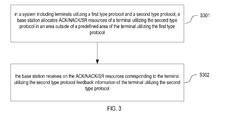
- FIG. 3 is a flowchart illustrating an ACK/NACK/SR resource mapping method according to an example of the present disclosure. As shown in FIG. 3 , the method includes the following.
- a base station allocates ACK/NACK/SR resources of the terminal utilizing the second type protocol in an area outside a predefined area of the terminal utilizing the first type protocol.
- the base station determines the ACK/NACK/SR resources corresponding to the terminal utilizing the second type protocol by itself.
- the terminal utilizing the second type protocol needs to determine allocation information corresponding to its ACK/NACK/SR resources according to higher layer signaling (which directly carries the allocation information of the ACK/NACK/SR resources or carries corresponding assistant information) transmitted by the base station.
- the base station may directly inform the terminal utilizing the second type protocol of the allocation information of the ACK/NACK/SR resources, i.e., the above mentioned n PUCCH 1 information via higher layer signaling.
- the allocation information of the corresponding ACK/NACK/SR resources is informed using n PUCCH , initial 1 information and offset information.
- the base station informs the terminal utilizing the second type protocol of the n PUCCH , initial 1 information directly via higher layer signaling.
- the terminal utilizing the second type protocol determines the ACK/NACK/SR resources corresponding to a first downlink subframe in the feedback window according to the n PUCCH , initial 1 information.
- the terminal utilizing the second type protocol performs an offset processing to the n PUCCH , initial 1 information according to an offset informed by the base station or according to predefined offset information, and determines the ACK/NACK/SR resources corresponding to following downlink subframes in the feedback window according to the n PUCCH 1 information after the offset processing.
- the base station may transmit the offset information and the n PUCCH , initial 1 information together to the terminal utilizing the second type protocol.
- An exemplary offset processing may be as follows: adding different values of the offset information to the n PUCCH , initial 1 information, so as to determine the n PUCCH 1 information of different downlink subframes in the current feedback window.
- the value of the offset information applied may be determined according to a practical requirement. Variations of the value do not affect protection scope of the present disclosure.
- the allocation information of the corresponding ACK/NACK/SR resources is informed by multiple pieces of n PUCCH 1 information.
- the base station directly informs the terminal utilizing the second type protocol of the corresponding multiple pieces of n PUCCH 1 information via higher layer signaling, wherein the number of pieces of the n PUCCH 1 information equals to the number of downlink subframes in the feedback window, or equals to a maximum number of downlink subframes in all feedback windows configured by current uplink-downlink configuration, or a maximum number of downlink subframes in all feedback windows configured by system.
- the terminal utilizing the second type protocol respectively determines the ACK/NACK/SR resources corresponding to each downlink subframe according to the n PUCCH 1 information.
- a relationship between the multiple pieces of n PUCCH 1 information and the downlink subframes in the feedback window is determined by the terminal utilizing the second type protocol according to a predefined rule or according to the PDCCH information in each downlink subframe in the feedback window.
- the base station determines the ACK/NACK/SR resources corresponding to the terminal utilizing the second type protocol according to a predefined rule.
- the terminal utilizing the second type protocol determines the allocation information corresponding to its ACK/NACK/SR resources directly according to the predefined rule with the same content, or according to the predefined rule with the same content and higher layer signaling (carries corresponding assistant information) transmitted by the base station.
- the base station allocates, according to the predefined rule, the ACK/NACK/SR resources corresponding to the terminal utilizing the second type protocol in an area outside the ACK/NACK/SR resources preserved for the terminal utilizing the first type protocol.
- the terminal utilizing the second type protocol determines the allocation information of the corresponding ACK/NACK/SR resources according to the higher layer signaling and the predefined rule.
- the base station may configure different resource start points for the ACK/NACK/SR resource area predefined for the terminal utilizing the first type protocol and the ACK/NACK/SR resource area predefined for the terminal utilizing the second type protocol, so as to differentiate the corresponding ACK/NACK/SR resources.
- the configuration of the start points of different ACK/NACK/SR resources may also have two manners in the present disclosure.
- the ACK/NACK/SR resources of the terminal utilizing one type of protocol are configured in an area after the area of the ACK/NACK/SR resources of the terminal utilizing the other type of protocol.
- the base station may allocate the ACK/NACK/SR resources corresponding to the terminal utilizing the second type protocol in an area in front of or after the ACK/NACK/SR resource area reserved for the terminal utilizing the first type protocol.
- each terminal may determine the start point of its ACK/NACK/SR resources according to the start point of the terminal utilizing the first type protocol and the size of the predefined area of the first/second type protocol.
- the base station allocates the ACK/NACK/SR resources corresponding to the terminal utilizing the second type protocol in an area outside the ACK/NACK/SR resource area persevered for the terminal utilizing the first type protocol.
- the base station transmits a different N PUCCH 1 to the terminal utilizing the second type protocol, such that the terminal utilizing the second type protocol determines the allocation information of the corresponding ACK/NACK/SR resource according to the different N PUCCH 1 .
- the difference between the two manners is the first manner allocates adjacent areas to the ACK/NACK/SR resources of the terminals utilizing two different types of protocols.
- the ACK/NACK/SR resources of the terminal utilizing the second type protocol is computed, merely the size of the area corresponding to the ACK/NACK/SR resources of the terminal utilizing the first or second type protocol needs to be considered, so as to deduce its resource start point.
- the start points of the ACK/NACK/SR resources of the two protocols are defined by the base station by itself.
- the terminals obtain their ACK/NACK/SR resource information according to different N PUCCH 1 .
- the base station allocates the ACK/NACK/SR resources corresponding to the terminal utilizing the second type protocol in an area outside the ACK/NACK/SR resource area reserved for the terminal utilizing the first type protocol according to the predefined rule, such that the terminal utilizing the second type protocol determines the allocation information of the corresponding ACK/NACK/SR information.
- the above predefined rule refers to a relationship between the PDSCH scheduled by PDCCH or the PDCCH which indicates release of SPS resource in the feedback window and the ACK/NACK/SR resources.
- the start point of the ACK/NACK/SR resources corresponding to the terminal utilizing the second type protocol includes the following situations.
- N PUCCH , D 1 , N PUCCH , D 1 is configured by the base station by itself, but should not conflict with the ACK/NACK/SR resources of the terminal utilizing the first type protocol.
- the base station transmits the N PUCCH , D 1 to the terminal utilizing the second type protocol via higher layer signaling, such that the terminal utilizing the second type protocol determines the allocation information of the corresponding ACK/NACK/SR resources according to the N PUCCH , D 1 and the predefined rule.
- Start N PUCCH 1 + delta
- delta is configured by the base station by itself.
- the base station transmits delta to the terminal utilizing the second type protocol via higher layer signaling, such that the terminal utilizing the second type protocol determines the allocation information of the corresponding ACK/NACK/SR resources according to N PUCCH 1 , delta and the predefined rule.
- the number n of the PDCCH symbols in the downlink subframe is:
- One of the above solutions may be adopted according to a requirement of a practical scenario. Whichever solution is adopted to implement the allocation of the ACK/NACK/SR resources, it is required to ensure that the ACK/NACK/SR resources corresponding to the terminals of two different types of protocols do not overlap.
- the base station receives feedback information of the terminal utilizing the second type protocol on the ACK/NACK/SR resources corresponding to the terminal utilizing the second type protocol.
- the base station finishes the allocation of the ACK/NACK/SR resources.
- the terminal utilizing the second type protocol also determines the allocation information of its ACK/NACK/SR resources.
- the terminal utilizing the second type protocol performs uplink transmission of corresponding feedback information via its ACK/NACK/SR resources.
- the base station receives the feedback information on the corresponding resources.
- the terminal determines the allocation information of the ACK/NACK/SR resources following the predefined rule and according to the information informed by the base station.
- the processing may be seen from the above description and is not repeated herein.
- the base station allocates the ACK/NACK/SR resources corresponding to the second type protocol in an area outside of the ACK/NACK/SR resource area reserved for the terminal utilizing the first type protocol, and informs the terminal utilizing the second type protocol of the allocation information of the corresponding ACK/NACK/SR resources.
- the terminal utilizing the second type protocol may transmit feedback information via the corresponding ACK/NACK/SR resources.
- the example of the present disclosure allocates resources outside a computed area of R8 users to PUCCH format 1/1a/1b resource of the R11 or following versions.
- PUCCH format 1/1a/1b resource is configured in the higher layer configured area, n PUCCH 1 is informed by higher layer signaling.
- the configuration and informing of the PUCCH format 1/1a/1b resource may be implemented by two methods.
- ACK/NACK/SR resources are configured in merely the higher layer configured area, n PUCCH 1 is informed by higher layer signaling.
- the base station transmits one piece of n PUCCH , initial 1 information to each terminal, indicating the ACK/NACK/SR resources corresponding to the first downlink subframe in the feedback window.
- the ACK/NACK/SR resources corresponding to following subframes in the feedback window may be determined according to n PUCCH , k 1 obtained by offset processing.
- ⁇ offset may be informed by higher layer signaling or be defined by standards.
- the base station obtains a detailed series of resources and physical resource block (PRB) resources according to n PUCCH , k 1 and a PUCCH format 1/1a/1b mapping method defined by standard (36.211), the procedure is as follows.
- ⁇ shift PUCCH may be informed by higher layer signaling and all users in the cell use this value. It is also possible to configure a default value 1. However, for conventional users and PUCCH in the computed area, the value informed by the higher layers is adopted.
- the parameter deltaPUCCH-Shift ⁇ shift PUCCH is provided by higher layers.
- the terminal receives relevant higher layer signaling and obtains n PUCCH 1 adopting the same computing method, so as to determine its corresponding ACK/NACK/SR resources.
- n PUCCH 1 and the downlink subframes in the feedback window may be obtained according to the predefined rule, e.g., the nth n PUCCH 1 corresponds to the nth downlink subframe in the feedback window, or is indicated by the PDCCH in the downlink subframe.
- the terminal receives the higher layer signaling and/or PDCCH and obtains the n PUCCH 1 according to the same rule.
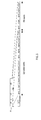
- the ACK/NACK/SR resources are allocated in an area after the ACK/NACK/SR resource area reserved for R8 users, an exemplary implementation solution is as shown in FIG. 4 .
- R8 users adopt uplink-downlink configuration 1, and dynamic users adopt uplink-downlink configuration 2.
- M R 8 denotes a number of downlink subframes of a feedback solution of the first type protocol in one feedback window
- k R 8 denotes number of special slots included in the feedback solution of the first type protocol in one feedback window
- N n denotes the number of CCEs born by n PDCCH symbols
- n denotes the number of PDCCH symbols in the downlink subframe.
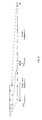
- ACK/NACK/SR resources are allocated in an area ahead of the ACK/NACK/SR resource area reserved for R8 users, n PUCCH 1 is informed implicitly.
- a detailed configuration solution is as shown in FIG. 5 .
- R8 users adopt uplink-downlink configuration 2, and dynamic users adopt uplink-downlink configuration 1.
- M D denotes number of downlink subframes included in the feedback solution of the second type protocol in one feedback window
- k D denotes number of special slots included in the feedback solution of the second type protocol in one feedback window
- N n denotes number of CCEs born by n PDCCH symbols
- n denotes number of PDCCH symbols.
- ACK/NACK bundling and multiplexing definitions of i may be different and are not repeated herein.
- ACK/NACK/SR resources are allocated in an area outside the R8 computed area and the higher layer configured area, n PUCCH 1 is informed implicitly, but the base station indicates corresponding N PUCCH 1 for two kinds of users.
- a detailed configuration solution is as shown in FIG. 6 .
- R8 users adopt uplink-downlink configuration 2, and dynamic users adopt uplink-downlink configuration 1.
- the base station informs the R8 users and the dynamic users of different N PUCCH 1 via higher layer signaling.
- the N PUCCH 1 of R8 users is N PUCCH , R ⁇ 8 1
- the N PUCCH 1 of the dynamic users is N PUCCH , dynamic 1 .
- n PUCCH 1 M - i - 1 ⁇ N p + iN p + 1 + n CCE + N PUCCH 1 , so as to respectively obtain the n PUCCH 1 of the R8 users and the dynamic users.
- the terminal receives the relevant higher layer signaling and obtains the n PUCCH 1 using the same computing method.
- the base station transmits delta to the terminal utilizing the second type protocol via higher layer signaling, such that the terminal utilizing the second type protocol determines the allocation information of the corresponding ACK/NACK/SR resources according to n PUCCH 1 , delta and the predefined rule.
- the variation does not affect the protection scope of the present disclosure.
- the method proposed in the implementation 3 does not restrict the resource mapping sequence of R8 users and the dynamic users.
- positions of the resources of the R8 users and the dynamic users may be arranged by a principle of avoiding much resource fragment.
- FIG. 6 shows an example in which resources of the dynamic users are in front
- FIG. 7 shows an example in which resources of R8 users are in front.
- the R8 users adopt the uplink-downlink configuration 1, and the dynamic users adopt the uplink-downlink configuration 2.
- the base station allocates the ACK/NACK/SR resources corresponding to the second type protocol in an area outside of the ACK/NACK/SR resource area reserved for the terminal utilizing the first type protocol, and informs the terminal utilizing the second type protocol of the allocation information of the corresponding ACK/NACK/SR resources.
- the terminal utilizing the second type protocol may transmit feedback information via the corresponding ACK/NACK/SR resource.
- an example of the present disclosure further provides a base station, the structure is as shown in FIG. 8 .
- the base station is applied in a system including a terminal utilizing a first type protocol and a terminal utilizing a second type protocol.
- the base station includes:
- the allocation module 81 is further adapted to:
- the communication module 82 is further adapted to:
- the communication module 82 is further adapted to:
- the allocation module 81 is further adapted to:
- an example of the present disclosure further provides a terminal.
- the structure is as shown in FIG. 9 .
- the terminal is applied in a system including a terminal utilizing a first type protocol and the terminal utilizing a second type protocol.
- the terminal includes:
- the obtaining module 91 is further adapted to:
- the obtaining module 91 is further adapted to:
- the technical solution provided by the example of the present disclosure has the following advantages:
- the base station allocates the ACK/NACK/SR resources corresponding to the second type protocol in an area outside of the ACK/NACK/SR resource area reserved for the terminal utilizing the first type protocol, and informs the terminal utilizing the second type protocol of the allocation information of the corresponding ACK/NACK/SR resources.
- the terminal utilizing the second type protocol may transmit feedback information via the corresponding ACK/NACK/SR resources.
- the examples of the present disclosure may be implemented by hardware or by software and a necessary hardware platform. Based on this, the technical solution provided by the examples of the present disclosure may be embedded in a software product.
- the software product may be stored on a non-transitory storage medium (such as CD-ROM, U-disk, portable disk, etc.), including a set of instructions executable by a computer device (such as a personal computer, a server or a network device, etc.) to perform the method described by the examples of the present disclosure.
- modules in the apparatus in each application scenario may be arranged in an apparatus in the application scenario according to the description of the application scenario. Some variations are also possible for the modules and the modules may be located in one or more apparatuses. The modules may be combined into one module or divided into several sub-modules.
Landscapes
- Engineering & Computer Science (AREA)
- Signal Processing (AREA)
- Computer Networks & Wireless Communication (AREA)
- Mobile Radio Communication Systems (AREA)
Applications Claiming Priority (2)
| Application Number | Priority Date | Filing Date | Title |
|---|---|---|---|
| CN201110205174.8A CN102238737B (zh) | 2011-07-21 | 2011-07-21 | Ack/nack/sr资源映射方法和设备 |
| PCT/CN2012/078173 WO2013010440A1 (zh) | 2011-07-21 | 2012-07-04 | Ack/nack/sr资源映射方法和设备 |
Publications (3)
| Publication Number | Publication Date |
|---|---|
| EP2736293A1 true EP2736293A1 (de) | 2014-05-28 |
| EP2736293A4 EP2736293A4 (de) | 2014-07-02 |
| EP2736293B1 EP2736293B1 (de) | 2017-01-04 |
Family
ID=44888786
Family Applications (1)
| Application Number | Title | Priority Date | Filing Date |
|---|---|---|---|
| EP12814325.2A Active EP2736293B1 (de) | 2011-07-21 | 2012-07-04 | Ack/nack/sr- ressourcenzuweisungsverfahren und -vorrichtung |
Country Status (4)
| Country | Link |
|---|---|
| US (1) | US9332533B2 (de) |
| EP (1) | EP2736293B1 (de) |
| CN (1) | CN102238737B (de) |
| WO (1) | WO2013010440A1 (de) |
Cited By (2)
| Publication number | Priority date | Publication date | Assignee | Title |
|---|---|---|---|---|
| EP2744139A4 (de) * | 2011-08-09 | 2014-08-20 | China Academy Of Telecomm Tech | Uplink-rückkopplungsverfahren, system und vorrichtung |
| CN112262591A (zh) * | 2018-06-12 | 2021-01-22 | 华为技术有限公司 | 传输信息的方法和装置 |
Families Citing this family (20)
| Publication number | Priority date | Publication date | Assignee | Title |
|---|---|---|---|---|
| CN102238737B (zh) | 2011-07-21 | 2015-07-15 | 电信科学技术研究院 | Ack/nack/sr资源映射方法和设备 |
| CN109921885B (zh) * | 2012-04-20 | 2021-11-26 | 北京三星通信技术研究有限公司 | 支持发送分集和信道选择的分配harq-ack信道资源的方法 |
| JP5990793B2 (ja) * | 2012-06-07 | 2016-09-14 | シャープ株式会社 | 端末装置、基地局装置、通信方法および集積回路 |
| CN103580828A (zh) * | 2012-08-06 | 2014-02-12 | 夏普株式会社 | 发送/接收harq消息的方法,基站和用户设备 |
| US9826526B2 (en) * | 2012-10-26 | 2017-11-21 | Sun Patent Trust | Terminal apparatus, base station apparatus, reception method and transmission method |
| CN104823500B (zh) * | 2012-10-30 | 2019-04-12 | 爱立信(中国)通信有限公司 | 用于去耦的下行链路-上行链路的调度请求传送方法和设备 |
| CN103945536B (zh) * | 2013-01-17 | 2017-09-19 | 上海贝尔股份有限公司 | 支持独立配置的载波结构以及资源分配方法 |
| EP3879733B1 (de) | 2014-01-31 | 2024-12-04 | Panasonic Intellectual Property Corporation of America | Basisstation und kommunikationsverfahren |
| US10880883B2 (en) | 2014-09-02 | 2020-12-29 | Qualcomm Incorporated | Low-latency, low-bandwidth and low duty cycle operation in a wireless communication system |
| CN106411475B (zh) * | 2015-07-27 | 2019-05-24 | 中兴通讯股份有限公司 | 一种反馈传输方法及装置 |
| CN115379573B (zh) * | 2016-11-04 | 2025-03-18 | 中兴通讯股份有限公司 | 一种数据传输方法、基站、用户设备及系统 |
| CN108365934A (zh) * | 2017-01-26 | 2018-08-03 | 索尼公司 | 无线通信方法和无线通信设备 |
| US10484147B2 (en) * | 2017-02-03 | 2019-11-19 | Qualcomm Incorporated | Techniques for enhanced machine type communication acknowledgment bundling |
| CN109495927B (zh) * | 2017-09-11 | 2022-01-28 | 维沃移动通信有限公司 | 一种信息传输方法、终端及网络侧设备 |
| CN116744459A (zh) * | 2017-10-02 | 2023-09-12 | 财团法人资讯工业策进会 | 用于移动通信系统的基站及用户装置 |
| CN110034850B (zh) * | 2018-01-12 | 2020-10-30 | 电信科学技术研究院有限公司 | 一种信息传输方法、终端及网络设备 |
| KR102695314B1 (ko) * | 2018-03-30 | 2024-08-13 | 광동 오포 모바일 텔레커뮤니케이션즈 코포레이션 리미티드 | 업링크 제어 정보 전송 방법 및 장치 |
| CN110944394B (zh) * | 2018-09-25 | 2023-04-21 | 华硕电脑股份有限公司 | 无线通信中导出用于侧链路传送的反馈资源的方法和设备 |
| CN111800867B (zh) * | 2019-08-16 | 2023-05-09 | 维沃移动通信有限公司 | 半持续调度物理下行共享信道的反馈方法及终端设备 |
| US11716745B1 (en) * | 2021-06-16 | 2023-08-01 | T-Mobile Innovations Llc | Scheduler systems and methods |
Family Cites Families (11)
| Publication number | Priority date | Publication date | Assignee | Title |
|---|---|---|---|---|
| KR101384078B1 (ko) | 2007-01-10 | 2014-04-09 | 삼성전자주식회사 | 무선통신 시스템에서 애크/내크 채널 자원을 할당하고시그널링하는 방법 및 장치 |
| KR101138517B1 (ko) * | 2007-10-30 | 2012-04-25 | 노키아 지멘스 네트웍스 오와이 | Ack/nack 또는 cqi를 이용한 개선된 스케줄링 요청 시그널링의 제공 |
| CN101932005B (zh) * | 2009-06-26 | 2015-06-03 | 中兴通讯股份有限公司 | 动态物理上行控制信道资源预留与索引映射的方法及装置 |
| US8583128B2 (en) * | 2009-07-13 | 2013-11-12 | Intel Mobile Communications GmbH | Apparatus and method for mapping physical control channels |
| US20110205981A1 (en) * | 2009-08-13 | 2011-08-25 | Changsoo Koo | Multiplexing uplink l1/l2 control and data |
| CN101997659B (zh) * | 2009-08-25 | 2012-12-26 | 电信科学技术研究院 | 配置上行控制资源以及上行控制信息的传输方法及装置 |
| CN101715211A (zh) * | 2009-11-02 | 2010-05-26 | 中兴通讯股份有限公司 | 传输模式的设置方法及装置 |
| CN102083211B (zh) | 2010-03-29 | 2017-04-19 | 电信科学技术研究院 | 上行控制信道资源的确定方法和设备 |
| CN101834658B (zh) * | 2010-05-05 | 2016-01-20 | 中兴通讯股份有限公司 | 一种上行控制信令的发送方法及设备 |
| US8755340B2 (en) * | 2010-11-08 | 2014-06-17 | Blackberry Limited | Releasing wireless resources |
| CN102238737B (zh) | 2011-07-21 | 2015-07-15 | 电信科学技术研究院 | Ack/nack/sr资源映射方法和设备 |
-
2011
- 2011-07-21 CN CN201110205174.8A patent/CN102238737B/zh active Active
-
2012
- 2012-07-04 US US14/234,072 patent/US9332533B2/en active Active
- 2012-07-04 WO PCT/CN2012/078173 patent/WO2013010440A1/zh not_active Ceased
- 2012-07-04 EP EP12814325.2A patent/EP2736293B1/de active Active
Cited By (4)
| Publication number | Priority date | Publication date | Assignee | Title |
|---|---|---|---|---|
| EP2744139A4 (de) * | 2011-08-09 | 2014-08-20 | China Academy Of Telecomm Tech | Uplink-rückkopplungsverfahren, system und vorrichtung |
| US9001711B2 (en) | 2011-08-09 | 2015-04-07 | China Academy Of Telecommunications Technology | Uplink feedback method, system and device |
| CN112262591A (zh) * | 2018-06-12 | 2021-01-22 | 华为技术有限公司 | 传输信息的方法和装置 |
| CN112262591B (zh) * | 2018-06-12 | 2022-06-10 | 华为技术有限公司 | 传输信息的方法和装置 |
Also Published As
| Publication number | Publication date |
|---|---|
| US9332533B2 (en) | 2016-05-03 |
| WO2013010440A1 (zh) | 2013-01-24 |
| EP2736293B1 (de) | 2017-01-04 |
| CN102238737B (zh) | 2015-07-15 |
| CN102238737A (zh) | 2011-11-09 |
| US20140219201A1 (en) | 2014-08-07 |
| EP2736293A4 (de) | 2014-07-02 |
Similar Documents
| Publication | Publication Date | Title |
|---|---|---|
| EP2736293B1 (de) | Ack/nack/sr- ressourcenzuweisungsverfahren und -vorrichtung | |
| US10892875B2 (en) | Method and apparatus for transmitting ACK/NACK in a wireless communication system based on TDD | |
| EP2826184B1 (de) | Vermeidung von uplink-steuerkanalressourcenkollision in trägeraggregationssystemen | |
| EP4133850B1 (de) | Gerät und verfahren zur übertragung eines puschs mit uci | |
| US9680622B2 (en) | Method and apparatus for transmitting reception confirmation in wireless system | |
| EP2938018B1 (de) | Verfahren und vorrichtung zur übertragung von ack/nack-informationen in einem drahtlosen kommunikationssystem | |
| EP2606594B1 (de) | Pucch-ressourcenzuweisung für mehrkomponententräger | |
| EP3731449B1 (de) | Verfahren und anordnung in einem kommunikationssystem | |
| EP3876450B1 (de) | Vorrichtung und verfahren für ack/nack-übertragung | |
| EP2744139B1 (de) | Uplink-rückkopplungsverfahren und vorrichtung | |
| EP2742757B1 (de) | Speicherung und zuweisung von steuerzeitenkonfigurationen in einem vielzelligen kommunikationsnetz | |
| EP2728957B1 (de) | Verfahren und vorrichtung zur zuweisung von steuerkanalressourcen | |
| EP3829244B1 (de) | Benutzervorrichtung und verfahren dafür | |
| EP2693823A2 (de) | Verfahren und Vorrichtung | |
| US20120207103A1 (en) | Method and System for Transmitting Downlink Control Information | |
| EP3518450A1 (de) | Mobilkommunikationssystem und kanalsende-/-empfangsverfahren dafür | |
| EP2680654A1 (de) | Verfahren und System für die Kreuz-Subrahmen-Planung während der Trägeraggregation | |
| EP2744261A1 (de) | Verfahren und vorrichtung zum senden und empfangen von downlink-steuerinformationen | |
| US20200068556A1 (en) | Communication system | |
| EP2982068A1 (de) | Verfahren, benutzervorrichtung und basisstation zum melden/empfangen von harq-ack/nack für pdsch in dynamischen tdd-konfigurationen | |
| WO2013137924A1 (en) | Explicit indication of uplink control channel resources in carrier aggregation systems | |
| EP3057259A1 (de) | Verfahren und vorrichtung zur übertragung von ack/nack über ein endgerät in einem drahtloskommunikationssystem |
Legal Events
| Date | Code | Title | Description |
|---|---|---|---|
| PUAI | Public reference made under article 153(3) epc to a published international application that has entered the european phase |
Free format text: ORIGINAL CODE: 0009012 |
|
| 17P | Request for examination filed |
Effective date: 20140219 |
|
| AK | Designated contracting states |
Kind code of ref document: A1 Designated state(s): AL AT BE BG CH CY CZ DE DK EE ES FI FR GB GR HR HU IE IS IT LI LT LU LV MC MK MT NL NO PL PT RO RS SE SI SK SM TR |
|
| A4 | Supplementary search report drawn up and despatched |
Effective date: 20140602 |
|
| RIC1 | Information provided on ipc code assigned before grant |
Ipc: H04L 1/18 20060101ALI20140526BHEP Ipc: H04W 72/04 20090101AFI20140526BHEP Ipc: H04L 5/00 20060101ALI20140526BHEP |
|
| DAX | Request for extension of the european patent (deleted) | ||
| 17Q | First examination report despatched |
Effective date: 20141119 |
|
| GRAP | Despatch of communication of intention to grant a patent |
Free format text: ORIGINAL CODE: EPIDOSNIGR1 |
|
| INTG | Intention to grant announced |
Effective date: 20160726 |
|
| GRAS | Grant fee paid |
Free format text: ORIGINAL CODE: EPIDOSNIGR3 |
|
| STAA | Information on the status of an ep patent application or granted ep patent |
Free format text: STATUS: GRANT OF PATENT IS INTENDED |
|
| GRAA | (expected) grant |
Free format text: ORIGINAL CODE: 0009210 |
|
| STAA | Information on the status of an ep patent application or granted ep patent |
Free format text: STATUS: THE PATENT HAS BEEN GRANTED |
|
| AK | Designated contracting states |
Kind code of ref document: B1 Designated state(s): AL AT BE BG CH CY CZ DE DK EE ES FI FR GB GR HR HU IE IS IT LI LT LU LV MC MK MT NL NO PL PT RO RS SE SI SK SM TR |
|
| REG | Reference to a national code |
Ref country code: GB Ref legal event code: FG4D |
|
| REG | Reference to a national code |
Ref country code: CH Ref legal event code: EP |
|
| REG | Reference to a national code |
Ref country code: AT Ref legal event code: REF Ref document number: 860342 Country of ref document: AT Kind code of ref document: T Effective date: 20170115 |
|
| REG | Reference to a national code |
Ref country code: IE Ref legal event code: FG4D |
|
| REG | Reference to a national code |
Ref country code: DE Ref legal event code: R096 Ref document number: 602012027499 Country of ref document: DE |
|
| REG | Reference to a national code |
Ref country code: LT Ref legal event code: MG4D Ref country code: NL Ref legal event code: MP Effective date: 20170104 |
|
| REG | Reference to a national code |
Ref country code: AT Ref legal event code: MK05 Ref document number: 860342 Country of ref document: AT Kind code of ref document: T Effective date: 20170104 |
|
| PG25 | Lapsed in a contracting state [announced via postgrant information from national office to epo] |
Ref country code: NL Free format text: LAPSE BECAUSE OF FAILURE TO SUBMIT A TRANSLATION OF THE DESCRIPTION OR TO PAY THE FEE WITHIN THE PRESCRIBED TIME-LIMIT Effective date: 20170104 |
|
| PG25 | Lapsed in a contracting state [announced via postgrant information from national office to epo] |
Ref country code: LT Free format text: LAPSE BECAUSE OF FAILURE TO SUBMIT A TRANSLATION OF THE DESCRIPTION OR TO PAY THE FEE WITHIN THE PRESCRIBED TIME-LIMIT Effective date: 20170104 Ref country code: FI Free format text: LAPSE BECAUSE OF FAILURE TO SUBMIT A TRANSLATION OF THE DESCRIPTION OR TO PAY THE FEE WITHIN THE PRESCRIBED TIME-LIMIT Effective date: 20170104 Ref country code: GR Free format text: LAPSE BECAUSE OF FAILURE TO SUBMIT A TRANSLATION OF THE DESCRIPTION OR TO PAY THE FEE WITHIN THE PRESCRIBED TIME-LIMIT Effective date: 20170405 Ref country code: HR Free format text: LAPSE BECAUSE OF FAILURE TO SUBMIT A TRANSLATION OF THE DESCRIPTION OR TO PAY THE FEE WITHIN THE PRESCRIBED TIME-LIMIT Effective date: 20170104 Ref country code: NO Free format text: LAPSE BECAUSE OF FAILURE TO SUBMIT A TRANSLATION OF THE DESCRIPTION OR TO PAY THE FEE WITHIN THE PRESCRIBED TIME-LIMIT Effective date: 20170404 Ref country code: IS Free format text: LAPSE BECAUSE OF FAILURE TO SUBMIT A TRANSLATION OF THE DESCRIPTION OR TO PAY THE FEE WITHIN THE PRESCRIBED TIME-LIMIT Effective date: 20170504 |
|
| REG | Reference to a national code |
Ref country code: FR Ref legal event code: PLFP Year of fee payment: 6 |
|
| PG25 | Lapsed in a contracting state [announced via postgrant information from national office to epo] |
Ref country code: BG Free format text: LAPSE BECAUSE OF FAILURE TO SUBMIT A TRANSLATION OF THE DESCRIPTION OR TO PAY THE FEE WITHIN THE PRESCRIBED TIME-LIMIT Effective date: 20170404 Ref country code: PL Free format text: LAPSE BECAUSE OF FAILURE TO SUBMIT A TRANSLATION OF THE DESCRIPTION OR TO PAY THE FEE WITHIN THE PRESCRIBED TIME-LIMIT Effective date: 20170104 Ref country code: RS Free format text: LAPSE BECAUSE OF FAILURE TO SUBMIT A TRANSLATION OF THE DESCRIPTION OR TO PAY THE FEE WITHIN THE PRESCRIBED TIME-LIMIT Effective date: 20170104 Ref country code: LV Free format text: LAPSE BECAUSE OF FAILURE TO SUBMIT A TRANSLATION OF THE DESCRIPTION OR TO PAY THE FEE WITHIN THE PRESCRIBED TIME-LIMIT Effective date: 20170104 Ref country code: AT Free format text: LAPSE BECAUSE OF FAILURE TO SUBMIT A TRANSLATION OF THE DESCRIPTION OR TO PAY THE FEE WITHIN THE PRESCRIBED TIME-LIMIT Effective date: 20170104 Ref country code: SE Free format text: LAPSE BECAUSE OF FAILURE TO SUBMIT A TRANSLATION OF THE DESCRIPTION OR TO PAY THE FEE WITHIN THE PRESCRIBED TIME-LIMIT Effective date: 20170104 Ref country code: PT Free format text: LAPSE BECAUSE OF FAILURE TO SUBMIT A TRANSLATION OF THE DESCRIPTION OR TO PAY THE FEE WITHIN THE PRESCRIBED TIME-LIMIT Effective date: 20170504 Ref country code: ES Free format text: LAPSE BECAUSE OF FAILURE TO SUBMIT A TRANSLATION OF THE DESCRIPTION OR TO PAY THE FEE WITHIN THE PRESCRIBED TIME-LIMIT Effective date: 20170104 |
|
| REG | Reference to a national code |
Ref country code: DE Ref legal event code: R097 Ref document number: 602012027499 Country of ref document: DE |
|
| PG25 | Lapsed in a contracting state [announced via postgrant information from national office to epo] |
Ref country code: RO Free format text: LAPSE BECAUSE OF FAILURE TO SUBMIT A TRANSLATION OF THE DESCRIPTION OR TO PAY THE FEE WITHIN THE PRESCRIBED TIME-LIMIT Effective date: 20170104 Ref country code: EE Free format text: LAPSE BECAUSE OF FAILURE TO SUBMIT A TRANSLATION OF THE DESCRIPTION OR TO PAY THE FEE WITHIN THE PRESCRIBED TIME-LIMIT Effective date: 20170104 Ref country code: CZ Free format text: LAPSE BECAUSE OF FAILURE TO SUBMIT A TRANSLATION OF THE DESCRIPTION OR TO PAY THE FEE WITHIN THE PRESCRIBED TIME-LIMIT Effective date: 20170104 Ref country code: IT Free format text: LAPSE BECAUSE OF FAILURE TO SUBMIT A TRANSLATION OF THE DESCRIPTION OR TO PAY THE FEE WITHIN THE PRESCRIBED TIME-LIMIT Effective date: 20170104 Ref country code: SK Free format text: LAPSE BECAUSE OF FAILURE TO SUBMIT A TRANSLATION OF THE DESCRIPTION OR TO PAY THE FEE WITHIN THE PRESCRIBED TIME-LIMIT Effective date: 20170104 |
|
| PLBE | No opposition filed within time limit |
Free format text: ORIGINAL CODE: 0009261 |
|
| STAA | Information on the status of an ep patent application or granted ep patent |
Free format text: STATUS: NO OPPOSITION FILED WITHIN TIME LIMIT |
|
| PG25 | Lapsed in a contracting state [announced via postgrant information from national office to epo] |
Ref country code: SM Free format text: LAPSE BECAUSE OF FAILURE TO SUBMIT A TRANSLATION OF THE DESCRIPTION OR TO PAY THE FEE WITHIN THE PRESCRIBED TIME-LIMIT Effective date: 20170104 Ref country code: DK Free format text: LAPSE BECAUSE OF FAILURE TO SUBMIT A TRANSLATION OF THE DESCRIPTION OR TO PAY THE FEE WITHIN THE PRESCRIBED TIME-LIMIT Effective date: 20170104 |
|
| 26N | No opposition filed |
Effective date: 20171005 |
|
| PG25 | Lapsed in a contracting state [announced via postgrant information from national office to epo] |
Ref country code: SI Free format text: LAPSE BECAUSE OF FAILURE TO SUBMIT A TRANSLATION OF THE DESCRIPTION OR TO PAY THE FEE WITHIN THE PRESCRIBED TIME-LIMIT Effective date: 20170104 |
|
| REG | Reference to a national code |
Ref country code: CH Ref legal event code: PL |
|
| REG | Reference to a national code |
Ref country code: IE Ref legal event code: MM4A |
|
| PG25 | Lapsed in a contracting state [announced via postgrant information from national office to epo] |
Ref country code: LI Free format text: LAPSE BECAUSE OF NON-PAYMENT OF DUE FEES Effective date: 20170731 Ref country code: CH Free format text: LAPSE BECAUSE OF NON-PAYMENT OF DUE FEES Effective date: 20170731 Ref country code: IE Free format text: LAPSE BECAUSE OF NON-PAYMENT OF DUE FEES Effective date: 20170704 |
|
| REG | Reference to a national code |
Ref country code: BE Ref legal event code: MM Effective date: 20170731 |
|
| PG25 | Lapsed in a contracting state [announced via postgrant information from national office to epo] |
Ref country code: LU Free format text: LAPSE BECAUSE OF NON-PAYMENT OF DUE FEES Effective date: 20170704 |
|
| REG | Reference to a national code |
Ref country code: FR Ref legal event code: PLFP Year of fee payment: 7 |
|
| PG25 | Lapsed in a contracting state [announced via postgrant information from national office to epo] |
Ref country code: BE Free format text: LAPSE BECAUSE OF NON-PAYMENT OF DUE FEES Effective date: 20170731 |
|
| PG25 | Lapsed in a contracting state [announced via postgrant information from national office to epo] |
Ref country code: MT Free format text: LAPSE BECAUSE OF NON-PAYMENT OF DUE FEES Effective date: 20170704 |
|
| PG25 | Lapsed in a contracting state [announced via postgrant information from national office to epo] |
Ref country code: HU Free format text: LAPSE BECAUSE OF FAILURE TO SUBMIT A TRANSLATION OF THE DESCRIPTION OR TO PAY THE FEE WITHIN THE PRESCRIBED TIME-LIMIT; INVALID AB INITIO Effective date: 20120704 Ref country code: MC Free format text: LAPSE BECAUSE OF FAILURE TO SUBMIT A TRANSLATION OF THE DESCRIPTION OR TO PAY THE FEE WITHIN THE PRESCRIBED TIME-LIMIT Effective date: 20170104 |
|
| PG25 | Lapsed in a contracting state [announced via postgrant information from national office to epo] |
Ref country code: CY Free format text: LAPSE BECAUSE OF NON-PAYMENT OF DUE FEES Effective date: 20170104 |
|
| PG25 | Lapsed in a contracting state [announced via postgrant information from national office to epo] |
Ref country code: MK Free format text: LAPSE BECAUSE OF FAILURE TO SUBMIT A TRANSLATION OF THE DESCRIPTION OR TO PAY THE FEE WITHIN THE PRESCRIBED TIME-LIMIT Effective date: 20170104 |
|
| PG25 | Lapsed in a contracting state [announced via postgrant information from national office to epo] |
Ref country code: TR Free format text: LAPSE BECAUSE OF FAILURE TO SUBMIT A TRANSLATION OF THE DESCRIPTION OR TO PAY THE FEE WITHIN THE PRESCRIBED TIME-LIMIT Effective date: 20170104 |
|
| PG25 | Lapsed in a contracting state [announced via postgrant information from national office to epo] |
Ref country code: AL Free format text: LAPSE BECAUSE OF FAILURE TO SUBMIT A TRANSLATION OF THE DESCRIPTION OR TO PAY THE FEE WITHIN THE PRESCRIBED TIME-LIMIT Effective date: 20170104 |
|
| REG | Reference to a national code |
Ref country code: DE Ref legal event code: R081 Ref document number: 602012027499 Country of ref document: DE Owner name: DATANG MOBILE COMMUNICATIONS EQUIPMENT CO., LT, CN Free format text: FORMER OWNER: CHINA ACADEMY OF TELECOMMUNICATIONS TECHNOLOGY, MII, HAIDIAN, BEIJING, CN |
|
| REG | Reference to a national code |
Ref country code: GB Ref legal event code: 732E Free format text: REGISTERED BETWEEN 20210729 AND 20210804 |
|
| P01 | Opt-out of the competence of the unified patent court (upc) registered |
Effective date: 20230512 |
|
| PGFP | Annual fee paid to national office [announced via postgrant information from national office to epo] |
Ref country code: DE Payment date: 20250722 Year of fee payment: 14 |
|
| PGFP | Annual fee paid to national office [announced via postgrant information from national office to epo] |
Ref country code: GB Payment date: 20250722 Year of fee payment: 14 |
|
| PGFP | Annual fee paid to national office [announced via postgrant information from national office to epo] |
Ref country code: FR Payment date: 20250725 Year of fee payment: 14 |