EP2735239B1 - Garment comprising multiple layers - Google Patents
Garment comprising multiple layers Download PDFInfo
- Publication number
- EP2735239B1 EP2735239B1 EP13194103.1A EP13194103A EP2735239B1 EP 2735239 B1 EP2735239 B1 EP 2735239B1 EP 13194103 A EP13194103 A EP 13194103A EP 2735239 B1 EP2735239 B1 EP 2735239B1
- Authority
- EP
- European Patent Office
- Prior art keywords
- garment
- outer layer
- lapel
- shoulder
- chest piece
- Prior art date
- Legal status (The legal status is an assumption and is not a legal conclusion. Google has not performed a legal analysis and makes no representation as to the accuracy of the status listed.)
- Active
Links
Images


Classifications
-
- A—HUMAN NECESSITIES
- A41—WEARING APPAREL
- A41D—OUTERWEAR; PROTECTIVE GARMENTS; ACCESSORIES
- A41D31/00—Materials specially adapted for outerwear
- A41D31/02—Layered materials
-
- A—HUMAN NECESSITIES
- A41—WEARING APPAREL
- A41D—OUTERWEAR; PROTECTIVE GARMENTS; ACCESSORIES
- A41D1/00—Garments
- A41D1/02—Jackets
-
- A—HUMAN NECESSITIES
- A41—WEARING APPAREL
- A41D—OUTERWEAR; PROTECTIVE GARMENTS; ACCESSORIES
- A41D27/00—Details of garments or of their making
- A41D27/02—Linings
- A41D27/06—Stiffening-pieces
Definitions
- the present invention relates to a garment comprising multiple layers, for example an item of outerwear or a jacket such as a suit jacket.
- suit jackets were fully canvassed, meaning they were constructed with a layer of canvas stitched between the outer layer and the lining.
- the internal structure, the canvas runs from the top of the shoulder to the bottom hem and under the lapel, the purpose of which is to provide the jacket with structure and to prevent deformation and sagging.
- This form of structuring is expensive both in terms of the materials used and the labour involved to create it.
- Fusible fabrics comprise a heat sensitive resin which allows them to be effectively "fused" to the outer layer of the front portion of the jacket without stitching.
- the fusing replaces the canvas portion of the internal structure. The fusing starts at approximately the top of the shoulder and runs down to the bottom hem and under the lapel.
- the only canvas that is kept is a chest piece that does not extend to the lapels and stops under the arm to reinforce the shape of the garment.
- fusible materials The risk of using fusible materials is that if heat, or steam, is applied to the suit, for example during dry cleaning or in a humid atmosphere, the internal structure, in this case the fusing material, can become detached from the outer layer. This effect is known as "bubbling" and is permanent.
- the direct attachment of the fusible material to the front of the jacket has a stiffening effect on the material which does not provide the same support as the fully-canvassed suit. Also since there is no canvassing in the lapels this gives them a flat and lifeless look.
- half-canvassed suit jackets have been developed.
- the internal structure comprises a chest piece that starts at approximately the top of the shoulder, extends under the lapel and ends approximately half-way down the length of the front portion of the jacket. It also contains fusing that runs from the top of the shoulder all the way down to the bottom seam without extending under the lapel. Since this form of structuring comprises of fusible material it also causes the front of the jacket to stiffen and runs the risk of bubbling.
- the lining may be stitched to the outer layer, e.g. at the border or seams of the lining and/or outer layer.
- outer refers to the external or outermost side of the garment when being worn conventionally on a body or model
- inner refers to an opposing side to the outer side, such as the side which faces the body or model with respect to the outer layer when the garment is worn conventionally on the body or model.
- the reference to the front part of the garment above is a reference to a section of the garment which may normally be worn on the front of a body, such as a human body, or model, for example extending vertically from a ridge of the shoulder part of the garment to its bottommost part during conventional wearing of the garment, and horizontally from a centreline during conventional wearing which would extend from the centre of the body to a line under the arm.
- the reference to a "line under the arm” is a reference to a line which would normally sit or be located under an arm extending down vertically towards the ground when the garment is being worn on a standing body or other standing model.
- the section of the garment reference hereinbefore may simply be one side of the front of the garment, such as one half of the front of the garment.
- extend means that one material part covers or is located on a surface of another material part or parts.
- the chest piece may be stitched or fused to the outer layer and/or lining to hold in position against the outer layer.
- the chest piece may be stitched or fused in one or more discrete locations against the outer layer and/or lining, e.g. in or at least 1, 2, 3, 4, 5, 6, 7, 8, 9, 10, 15 or 20 locations.
- the garment's internal structure is flatter, lighter and more flexible than conventional garments since the chest piece does not extend across the whole of the garment. As a result of its position in the garment, it is able to mould and adapts to both the fabric lining and outer layer and the wearer of the garment itself. This internal structure thus maintains the shape and holds the structure of the garment while allowing extension and maximum movement across the front of the garment. This is particularly so because the chest part does not extend to a lapel part of the garment which does not constrain movement and position of the chest part whilst it is being worn.
- the chest part may not extend under an arm part of the front part of the garment. This allows for maximum movement of the arm without making the garment rigid when moving the arm.
- the chest piece of the internal structure may comprise or consist of one or more of: wool, a blend of wool, cotton and animal hair, such as horse hair and/or camel hair. This layered structure allows increased flexibility.
- the arm part may be a section of the garment which would normally sit under an arm extending down vertically towards the ground when the garment is being worn on a standing body or other standing model.
- the internal structure may comprise, cover or be positioned across or underneath no more than 40%, 50%, 60%, 70% or 80% of the surface area of the outer layer of the front part of the garment. This reduced surface area reduces the weight of the garment and provides greater flexibility in its wearing.
- the chest piece may comprise, cover or be positioned across or underneath no more than 10%, 20%, 30%, 40% or 50% of the outer layer of the front part of the garment.
- the fusible material may extend over at least some, or all of a lapel part of the garment. This reinforces the lapel and prevents it from having a flat lifeless appearance, whilst not having the full conventional reinforcement of the chest part.
- the fusible material may extend to a collar part of the garment.
- the fusible material may extend from the shoulder part of the garment, across the chest part and through a lapel part of the garment without extending under an arm part of the front part of the garment.
- the fusible material may cover or be located across or underneath no more than 40%, 50%, 60%, 70% or 80% of the surface area of the outer layer. This reduces the chance that bubbling may occur.
- the lapel part of the garment may comprise a reinforcement structure between the outer layer and the lining. This also prevents the lapel from appearing flat and lifeless.
- the shoulder part of the garment may comprise a reinforcement structure between the outer layer and the lining. This shoulder reinforcement adds structure to the garment without adding extra weight.
- the collar part of the garment may comprise a reinforcement structure between the outer layer and the lining.
- the reinforcement material of the shoulder part may comprise or consist of one or more of: wool, a blend of wool, cotton and animal hair, such as horse hair and/or camel hair.
- the reinforcement structure may be of a different composition to the chest piece.
- the reinforcement structure may be fused to the lapel part.
- the garment is an item of outerwear, for example a jacket, such as suit jacket.
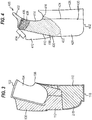
- Figs. 1 to 3 are examples of garments of the prior art described below to aid the understanding of the invention which is described in detail in exemplary embodiments in Figs. 4 to 8 .
- canvas used in this example is understood to mean a closely woven fabric which comprises or consists of one or more of: wool, a blend of wool, cotton and animal hair, such as horse hair and/or camel hair.
- Fig. 1 is an example of the inside front panel 110 of a fully canvassed suit jacket of the prior art. It can be seen here that the canvas 112 is stitched onto the exterior cloth 114 from the shoulder 102 part of the jacket to the bottom hem 116, through the lapel 106 part without extending under the arm 108 part of the jacket. It can also be seen here that the chest piece 104 extends from the shoulder 102 part of the jacket approximately halfway down the front panel 110 without extending to the lapel 106 part.
- Fig. 2 is an example of the inside front panel 110 of a fully fused suit jacket of the prior art. It can be seen here that the fusible material 218 is attached directly to the cloth exterior from the shoulder 102 part of the jacket to the bottom hem 116, through the lapel 106 part without extending under the arm 108 part of the jacket. There is also a chest piece or part 104 which extends from the shoulder 102 part of the jacket approximately halfway down the front panel 110 without extending to the lapel 106 part.
- Fig. 3 is an example of the inside front panel 110 of a garment of the prior art which is a half-canvassed suit jacket. It can be seen that here that the garment comprises both a canvas 112 and fusible material 218.
- the fusible material extends from the shoulder 102 part of the jacket to the bottom hem 116 without extending under the arm 108 part or the lapel 106 part of the jacket.
- the canvas 112 extends from the shoulder 102 part of the jacket to approximately halfway down the front panel 110.
- Fig. 4 is a section of a garment 400 according to an embodiment of the invention viewed internally where the front panel 428 and side panel 426 are visible. It can be seen here that the chest piece or part 418 (which may be a canvas chest piece) extends from the shoulder of the garment 400 down the front panel 428.
- the chest piece 418 may comprise a shoulder part 402 which extends beyond the shoulder seam 406 of the garment 400. There is also a shoulder reinforcement 408 which extends either side of the shoulder seam 406.
- the chest piece 418 does not extend into the collar 404 or the lapel 410 of the garment 400 but stops at the edge 412 of the lapel 410 with respect to the main body of the outer layer 430.
- the chest piece 418 does not reach the bottom hem 432 of the garment 400, but extends to a maximum extent at a point 422 between the end 420 of the lapel 410 and the bottom hem 432 on the front panel 428.
- the border of the chest piece 418 is shaped in a curve 423 which extends from an under arm seam point 416 to the end 420 of the lapel 410.
- the chest piece 418 does not extend over or under the arm part of the garment 400, but stops at the arm seam 414 along the front panel 428 and under the arm at a point just after the seam joining the front and side panels 424.
- the material not covered by the chest piece 418 is the outer layer 430 (which may be cloth) of the garment. Fig.
- the chest piece 418 and shoulder pad 408 are arranged such that they are located on an internal side of the garment against an internal side of the outer layer 430.
- the shoulder pad is located between the chest piece 418 and outer layer 430, but the alternative is also possible such that the chest piece 418 is located between the outer layer 430 and the shoulder pad 408.
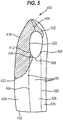
- Fig. 5 is a section of the garment 400 according to an embodiment of the invention. It is a side view where the front panel 428, side panel 426 and back panel 510 are visible. There is also a gap in the garment where the arm would be encompassed by the arm seam 502. It can be seen here that the chest piece 418 and a shoulder part 402 extends over the shoulder seam 406 of the garment 400 partly onto the back panel 510 of the garment 400. The chest piece 418 extends beyond the seam joining the front and side panel 424 onto the side panel 426 and joins the arm seam 502 at a point 416 before the bottom of the arm seam 506 and the seam joining the back and side panels 504.
- the chest piece 418 extends down the front panel 428 to a point under the bottom of the arm 506 but above the bottom hem 432.
- the material not covered by the chest piece 418 is the outer cloth layer 430 of the garment 400.
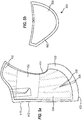
- Fig. 5a is a sectional view of the chest piece or part 418 (which may be of canvas, i.e. form the "canvassing" of the front part of the garment 400) is made up of three layers, a first (e.g. base) layer 530 (which may be camel hair canvas), an second (e.g. intermediary) layer 532 (which may be animal hair (horse hair) canvas) and a third (e.g. top) layer 534 (which may be camel hair canvas).
- a first (e.g. base) layer 530 which may be camel hair canvas
- an second (e.g. intermediary) layer 532 which may be animal hair (horse hair) canvas
- a third (e.g. top) layer 534 which may be camel hair canvas).
- the material of the first layer 530 and third layer 534 may be the same, and may be KO 250 camel hair canvas (weave: 1/1; weight: 105g/m2; total composition: 100% PES; warp: PES; weave: PES).
- the material of the second animal hair layer 523 may be 18/60 ZN D horse hair canvas (weight: 147g/m2; composition: 45% cotton, 55% horse hair; warp content: 100% cotton, NE 60/2 yarn count, 34.5 wires/cm; weft content: 100% horse hair, 18 wires /cm).
- the first layer 530 may cover or extends over 25% to 45%, 30% to 40%, 32.5% to 37.5% or 35% of the front panel 532.
- the layers of the chest piece or part 418 may be attached or connected to each other through some limited stitching or fusing through the entire part 418 at one or more discrete locations, for example at specifically, or no more than: 1, 2, 3, 4, 5, 6, 7, 8, 9, 10, 15 or 20 discrete locations.
- the second layer 532 may cover or extend over at least 5% to 15%, or 7.5% to 12.5% or 10% of the front panel 532.
- the third layer 534 may cover or extend over at least 20% to 50%, 25% to 35%, 27.5% to 32.5% or 30% of the front panel 532.
- Fig 5b is a plan view of the shoulder reinforcement 408 of the garment 400 which is placed over the shoulder seam 406 on top of the shoulder part 402 of the chest piece 418. It is composed of two layers of canvas, a base layer 562 and a layer small in cross-sectional area to the base layer 562 on top 560.
- the shoulder reinforcement 408 contains no wadding.
- Fig. 6 is a plan view of the garment 400 in an embodiment of the invention where the front panel 428 and side panel 426 are visible. It can be seen here that the fusible material 608 extends from the shoulder seam 406 of the garment 400 to the bottom hem 432 of the front panel 428. However it does not fully cover the front panel but the fusible material has an edge 610 which is cut away from the point 602 where the fusing meets the arm seam and the front and side panels and tapers beyond the end of the lapel 420 towards the bottom hem 432, narrowing along the way. The rest of the material of the side and front panels is the exterior cloth layer 430. The fusible material 608 also does not extend beyond the arm seam 502 or onto the side panel 426 of the garment 400.
- the fusible material 608 may be 8025 US3 Polyfix Multi Elastic (weight 25g/m2; composition: 100% texturised polyester; warp: polyester; weft: polyester; weave type: plain; resin type: copolyamide 25, irregular mesh distribution) and it may make up to 60 to 100% of the coverage of the front panel.
- Fig. 7 is an enlarged view of the garment 400 in an embodiment of the invention where part of the front panel 428 is visible. It can be seen here in this example that the fusible material 608 extends from the shoulder seam 406 of the garment 400 to the bottom hem 432 of the front panel 428. It also extends through the lapel 410 of the garment 400. It can further be seen that there is fusing reinforcement 702 in the lapel 410 part of the garment 400 which extends from the collar seam 606 to the end of the lapel 420 without going beyond the edge of the lapel 702.
- the fusing reinforcement 702 may be "Kufner Stretch 2000" fusible elastic weft (weight: approximately 100g/m2; total composition: 34% CV, 68% PES; warp: polyester/viscose; weft: polyester; weave type: satin weave 1/3; resin type: doublespot, 17 mesh) and it may make up approximately 5% of the coverage of the front panel.
- Fig. 8 is a plan view of the garment 400 in an embodiment of the invention where the front panel 428 and side panel 426 are visible. Here all of the internal structure is visible, the fusible material 608 with the fusing reinforcement 702 in the lapel 410 and the chest piece 418 with the shoulder reinforcement 408 over the shoulder seam 406. The rest of the front and side panels is cloth 430. While the preceding description contains many specifics, these specifics should not be construed as limitations on the scope of the invention, but merely as examples of the preferred embodiments. Those skilled in the art will envision other possible variations that are within the scope of the invention as defined by the following claims.
Landscapes
- Engineering & Computer Science (AREA)
- Textile Engineering (AREA)
- Outer Garments And Coats (AREA)
- Details Of Garments (AREA)
Description
- The present invention relates to a garment comprising multiple layers, for example an item of outerwear or a jacket such as a suit jacket.
- Traditionally, suit jackets were fully canvassed, meaning they were constructed with a layer of canvas stitched between the outer layer and the lining. In a fully canvassed jacket, the internal structure, the canvas, runs from the top of the shoulder to the bottom hem and under the lapel, the purpose of which is to provide the jacket with structure and to prevent deformation and sagging. This form of structuring is expensive both in terms of the materials used and the labour involved to create it. There is also a risk that if the canvas is poorly-inserted or shrinks after insertion the front of the suit will pucker which is almost impossible to fix on a completed garment.
- With the development of fusible materials an increasing number of fused suit jackets have appeared on the commercial market. Fusible fabrics comprise a heat sensitive resin which allows them to be effectively "fused" to the outer layer of the front portion of the jacket without stitching. In fused suit jackets, the fusing replaces the canvas portion of the internal structure. The fusing starts at approximately the top of the shoulder and runs down to the bottom hem and under the lapel. The only canvas that is kept is a chest piece that does not extend to the lapels and stops under the arm to reinforce the shape of the garment. The risk of using fusible materials is that if heat, or steam, is applied to the suit, for example during dry cleaning or in a humid atmosphere, the internal structure, in this case the fusing material, can become detached from the outer layer. This effect is known as "bubbling" and is permanent. The direct attachment of the fusible material to the front of the jacket has a stiffening effect on the material which does not provide the same support as the fully-canvassed suit. Also since there is no canvassing in the lapels this gives them a flat and lifeless look.
- More recently, half-canvassed suit jackets have been developed. In half-canvassed jackets the internal structure comprises a chest piece that starts at approximately the top of the shoulder, extends under the lapel and ends approximately half-way down the length of the front portion of the jacket. It also contains fusing that runs from the top of the shoulder all the way down to the bottom seam without extending under the lapel. Since this form of structuring comprises of fusible material it also causes the front of the jacket to stiffen and runs the risk of bubbling.
- It is desirable to improve the fit and comfort of the suit and to reduce the weight while also reducing the effects of bubbling in order to increase the longevity of the suit. In the past, research has involved developing new resin for fusible materials which can then be applied to the whole of the suit while reducing its sensitivity to bubbling.
- In the disclosed invention, there is provided a garment according to claim 1.
- The lining may be stitched to the outer layer, e.g. at the border or seams of the lining and/or outer layer.
- The terms "outer", "inner" and "internal" are intended to refer to sides of garment when worn conventionally, or in use. "Outer" refers to the external or outermost side of the garment when being worn conventionally on a body or model, and "inner" or "internal" refers to an opposing side to the outer side, such as the side which faces the body or model with respect to the outer layer when the garment is worn conventionally on the body or model. The reference to the front part of the garment above is a reference to a section of the garment which may normally be worn on the front of a body, such as a human body, or model, for example extending vertically from a ridge of the shoulder part of the garment to its bottommost part during conventional wearing of the garment, and horizontally from a centreline during conventional wearing which would extend from the centre of the body to a line under the arm. The reference to a "line under the arm" is a reference to a line which would normally sit or be located under an arm extending down vertically towards the ground when the garment is being worn on a standing body or other standing model. The section of the garment reference hereinbefore may simply be one side of the front of the garment, such as one half of the front of the garment.
- The term "extend" means that one material part covers or is located on a surface of another material part or parts. Thus, when it is said that chest piece or fusing does not "extend" over the outer layer, this means that a section of the outer layer is not covered by the chest piece or fusing, and that the chest piece or fusing is not located over or against the out layer, e.g. on its internal surface.
- The chest piece may be stitched or fused to the outer layer and/or lining to hold in position against the outer layer. The chest piece may be stitched or fused in one or more discrete locations against the outer layer and/or lining, e.g. in or at least 1, 2, 3, 4, 5, 6, 7, 8, 9, 10, 15 or 20 locations.
- The garment's internal structure is flatter, lighter and more flexible than conventional garments since the chest piece does not extend across the whole of the garment. As a result of its position in the garment, it is able to mould and adapts to both the fabric lining and outer layer and the wearer of the garment itself. This internal structure thus maintains the shape and holds the structure of the garment while allowing extension and maximum movement across the front of the garment. This is particularly so because the chest part does not extend to a lapel part of the garment which does not constrain movement and position of the chest part whilst it is being worn.
- The chest part may not extend under an arm part of the front part of the garment. This allows for maximum movement of the arm without making the garment rigid when moving the arm. Preferably, the chest piece of the internal structure may comprise or consist of one or more of: wool, a blend of wool, cotton and animal hair, such as horse hair and/or camel hair. This layered structure allows increased flexibility. The arm part may be a section of the garment which would normally sit under an arm extending down vertically towards the ground when the garment is being worn on a standing body or other standing model.
- Advantageously, the internal structure may comprise, cover or be positioned across or underneath no more than 40%, 50%, 60%, 70% or 80% of the surface area of the outer layer of the front part of the garment. This reduced surface area reduces the weight of the garment and provides greater flexibility in its wearing. The chest piece may comprise, cover or be positioned across or underneath no more than 10%, 20%, 30%, 40% or 50% of the outer layer of the front part of the garment.
- Preferably, the fusible material may extend over at least some, or all of a lapel part of the garment. This reinforces the lapel and prevents it from having a flat lifeless appearance, whilst not having the full conventional reinforcement of the chest part. The fusible material may extend to a collar part of the garment.
- In one embodiment, the fusible material may extend from the shoulder part of the garment, across the chest part and through a lapel part of the garment without extending under an arm part of the front part of the garment.
- Advantageously, the fusible material may cover or be located across or underneath no more than 40%, 50%, 60%, 70% or 80% of the surface area of the outer layer. This reduces the chance that bubbling may occur.
- Preferably, the lapel part of the garment may comprise a reinforcement structure between the outer layer and the lining. This also prevents the lapel from appearing flat and lifeless.
- Preferably, the shoulder part of the garment may comprise a reinforcement structure between the outer layer and the lining. This shoulder reinforcement adds structure to the garment without adding extra weight.
- Preferably, the collar part of the garment may comprise a reinforcement structure between the outer layer and the lining.
- In one embodiment of the invention, the reinforcement material of the shoulder part may comprise or consist of one or more of: wool, a blend of wool, cotton and animal hair, such as horse hair and/or camel hair.
- Preferably, the reinforcement structure may be of a different composition to the chest piece. The reinforcement structure may be fused to the lapel part.
- In one embodiment of the invention, the garment is an item of outerwear, for example a jacket, such as suit jacket.
- The present invention is described in greater detail below in conjunction with the accompanying drawings in which:
-
Fig. 1 is a plan view of the internal structure of a front panel of a fully canvassed suit of the prior art; -
Fig. 2 is a plan view of the internal structure of a front panel of a fully fused suit of the prior art; -
Fig. 3 is a plan view of the internal structure of a front panel of a half-canvassed suit of the prior art; -
Fig. 4 is a plan view of the internal structure of the front and side panels of a garment according to the invention; -
Fig. 5 is a side view of the internal structure of a garment according to the invention showing the canvas part; -
Fig. 5a is a sectional view of the chest piece of the internal structure of a garment according to the invention; -
Fig. 5b is a plan view of the shoulder part of the internal structure of a garment according to the invention; -
Fig. 6 is a further plan view of the internal structure of the front and side panels of a garment according to the invention showing the fusible material part; -
Fig. 7 is an enlarged plan view of the lapel part of the internal structure of the front panel ofFig. 6 ; -
Fig. 8 is a plan view of the internal structure of the front and side panels of a garment according to the invention showing the canvas and fusible material parts. -
Figs. 1 to 3 are examples of garments of the prior art described below to aid the understanding of the invention which is described in detail in exemplary embodiments inFigs. 4 to 8 . - The term "canvas" used in this example is understood to mean a closely woven fabric which comprises or consists of one or more of: wool, a blend of wool, cotton and animal hair, such as horse hair and/or camel hair.
-
Fig. 1 is an example of the insidefront panel 110 of a fully canvassed suit jacket of the prior art. It can be seen here that thecanvas 112 is stitched onto theexterior cloth 114 from theshoulder 102 part of the jacket to thebottom hem 116, through thelapel 106 part without extending under thearm 108 part of the jacket. It can also be seen here that thechest piece 104 extends from theshoulder 102 part of the jacket approximately halfway down thefront panel 110 without extending to thelapel 106 part. -
Fig. 2 is an example of the insidefront panel 110 of a fully fused suit jacket of the prior art. It can be seen here that thefusible material 218 is attached directly to the cloth exterior from theshoulder 102 part of the jacket to thebottom hem 116, through thelapel 106 part without extending under thearm 108 part of the jacket. There is also a chest piece orpart 104 which extends from theshoulder 102 part of the jacket approximately halfway down thefront panel 110 without extending to thelapel 106 part. -
Fig. 3 is an example of the insidefront panel 110 of a garment of the prior art which is a half-canvassed suit jacket. It can be seen that here that the garment comprises both acanvas 112 andfusible material 218. The fusible material extends from theshoulder 102 part of the jacket to thebottom hem 116 without extending under thearm 108 part or thelapel 106 part of the jacket. Thecanvas 112 extends from theshoulder 102 part of the jacket to approximately halfway down thefront panel 110. There is also achest piece 104 in this form of structuring. -
Fig. 4 is a section of agarment 400 according to an embodiment of the invention viewed internally where thefront panel 428 andside panel 426 are visible. It can be seen here that the chest piece or part 418 (which may be a canvas chest piece) extends from the shoulder of thegarment 400 down thefront panel 428. Thechest piece 418 may comprise ashoulder part 402 which extends beyond theshoulder seam 406 of thegarment 400. There is also ashoulder reinforcement 408 which extends either side of theshoulder seam 406. Thechest piece 418 does not extend into thecollar 404 or thelapel 410 of thegarment 400 but stops at theedge 412 of thelapel 410 with respect to the main body of theouter layer 430. Thechest piece 418 does not reach thebottom hem 432 of thegarment 400, but extends to a maximum extent at apoint 422 between theend 420 of thelapel 410 and thebottom hem 432 on thefront panel 428. In this regard, the border of thechest piece 418 is shaped in a curve 423 which extends from an underarm seam point 416 to theend 420 of thelapel 410. Thechest piece 418 does not extend over or under the arm part of thegarment 400, but stops at thearm seam 414 along thefront panel 428 and under the arm at a point just after the seam joining the front andside panels 424. The material not covered by thechest piece 418 is the outer layer 430 (which may be cloth) of the garment.Fig. 4 is shown so that the component parts of the garment can be seen for the purposes of illustration. However, it will be appreciated that thechest piece 418 andshoulder pad 408 are arranged such that they are located on an internal side of the garment against an internal side of theouter layer 430. The shoulder pad is located between thechest piece 418 andouter layer 430, but the alternative is also possible such that thechest piece 418 is located between theouter layer 430 and theshoulder pad 408. -
Fig. 5 is a section of thegarment 400 according to an embodiment of the invention. It is a side view where thefront panel 428,side panel 426 andback panel 510 are visible. There is also a gap in the garment where the arm would be encompassed by thearm seam 502. It can be seen here that thechest piece 418 and ashoulder part 402 extends over theshoulder seam 406 of thegarment 400 partly onto theback panel 510 of thegarment 400. Thechest piece 418 extends beyond the seam joining the front andside panel 424 onto theside panel 426 and joins thearm seam 502 at apoint 416 before the bottom of thearm seam 506 and the seam joining the back and side panels 504. It can be seen more clearly here also that thechest piece 418 extends down thefront panel 428 to a point under the bottom of thearm 506 but above thebottom hem 432. The material not covered by thechest piece 418 is theouter cloth layer 430 of thegarment 400. -
Fig. 5a is a sectional view of the chest piece or part 418 (which may be of canvas, i.e. form the "canvassing" of the front part of the garment 400) is made up of three layers, a first (e.g. base) layer 530 (which may be camel hair canvas), an second (e.g. intermediary) layer 532 (which may be animal hair (horse hair) canvas) and a third (e.g. top) layer 534 (which may be camel hair canvas). - The material of the
first layer 530 andthird layer 534 may be the same, and may be KO 250 camel hair canvas (weave: 1/1; weight: 105g/m2; total composition: 100% PES; warp: PES; weave: PES). The material of the second animal hair layer 523 may be 18/60 ZN D horse hair canvas (weight: 147g/m2; composition: 45% cotton, 55% horse hair; warp content: 100% cotton, NE 60/2 yarn count, 34.5 wires/cm; weft content: 100% horse hair, 18 wires /cm). Thefirst layer 530 may cover or extends over 25% to 45%, 30% to 40%, 32.5% to 37.5% or 35% of thefront panel 532. The layers of the chest piece orpart 418 may be attached or connected to each other through some limited stitching or fusing through theentire part 418 at one or more discrete locations, for example at specifically, or no more than: 1, 2, 3, 4, 5, 6, 7, 8, 9, 10, 15 or 20 discrete locations. Thesecond layer 532 may cover or extend over at least 5% to 15%, or 7.5% to 12.5% or 10% of thefront panel 532. Thethird layer 534 may cover or extend over at least 20% to 50%, 25% to 35%, 27.5% to 32.5% or 30% of thefront panel 532. -
Fig 5b is a plan view of theshoulder reinforcement 408 of thegarment 400 which is placed over theshoulder seam 406 on top of theshoulder part 402 of thechest piece 418. It is composed of two layers of canvas, abase layer 562 and a layer small in cross-sectional area to thebase layer 562 ontop 560. Theshoulder reinforcement 408 contains no wadding. -
Fig. 6 is a plan view of thegarment 400 in an embodiment of the invention where thefront panel 428 andside panel 426 are visible. It can be seen here that thefusible material 608 extends from theshoulder seam 406 of thegarment 400 to thebottom hem 432 of thefront panel 428. However it does not fully cover the front panel but the fusible material has anedge 610 which is cut away from thepoint 602 where the fusing meets the arm seam and the front and side panels and tapers beyond the end of thelapel 420 towards thebottom hem 432, narrowing along the way. The rest of the material of the side and front panels is theexterior cloth layer 430. Thefusible material 608 also does not extend beyond thearm seam 502 or onto theside panel 426 of thegarment 400. It does extend beyond the edge of thelapel 412 through to thelapel 410 and beyond thecollar seam 606 into the collar parts of thegarment 400. Thefusible material 608 may be 8025 US3 Polyfix Multi Elastic (weight 25g/m2; composition: 100% texturised polyester; warp: polyester; weft: polyester; weave type: plain; resin type: copolyamide 25, irregular mesh distribution) and it may make up to 60 to 100% of the coverage of the front panel. -
Fig. 7 is an enlarged view of thegarment 400 in an embodiment of the invention where part of thefront panel 428 is visible. It can be seen here in this example that thefusible material 608 extends from theshoulder seam 406 of thegarment 400 to thebottom hem 432 of thefront panel 428. It also extends through thelapel 410 of thegarment 400. It can further be seen that there is fusingreinforcement 702 in thelapel 410 part of thegarment 400 which extends from thecollar seam 606 to the end of thelapel 420 without going beyond the edge of thelapel 702. The fusingreinforcement 702 may be "Kufner Stretch 2000" fusible elastic weft (weight: approximately 100g/m2; total composition: 34% CV, 68% PES; warp: polyester/viscose; weft: polyester; weave type: satin weave 1/3; resin type: doublespot, 17 mesh) and it may make up approximately 5% of the coverage of the front panel. -
Fig. 8 is a plan view of thegarment 400 in an embodiment of the invention where thefront panel 428 andside panel 426 are visible. Here all of the internal structure is visible, thefusible material 608 with the fusingreinforcement 702 in thelapel 410 and thechest piece 418 with theshoulder reinforcement 408 over theshoulder seam 406. The rest of the front and side panels iscloth 430. While the preceding description contains many specifics, these specifics should not be construed as limitations on the scope of the invention, but merely as examples of the preferred embodiments. Those skilled in the art will envision other possible variations that are within the scope of the invention as defined by the following claims. - Glossary of Reference Numerals used in Figures
- 102:
- Shoulder
- 104:
- Chest Piece
- 106:
- Lapel
- 108:
- Underarm
- 110:
- Front Panel
- 112:
- Canvas
- 114:
- Cloth
- 116:
- Bottom Hem
- 218:
- Fusible Material
- 400:
- Garment
- 402:
- Shoulder
- 404:
- Collar
- 406:
- Shoulder Seam
- 408:
- Shoulder Pad
- 410:
- Lapel
- 412:
- Lapel Edge
- 414:
- Edge of front panel / arm seam
- 416:
- Meeting point of canvas and underarm seam
- 418:
- Canvas chest piece
- 420:
- End of Lapel
- 422:
- Bottom of Canvas
- 424:
- Seam joining front and side panels
- 426:
- Side Panel
- 428:
- Front Panel
- 430:
- Outer Layer
- 432:
- Bottom Hem
- 502:
- Arm Seam
- 506:
- Bottom of Arm
- 508:
- Seam joining Side and Back Panels
- 510:
- Back Panel
- 512:
- Joint of Front and Side Panel under Arm
- 530:
- Camel Hair Base Layer
- 532:
- Animal Hair Canvas Intermediary Layer
- 534:
- Camel Hair Top Layer
- 536:
- Location where Base and Top Layers Overlap to form curved shape
- 538:
- Location where Base and Top Layers Overlap to form curved shape
- 560:
- Layer2
- 562:
- Layer 1
- 602:
- Location where fusing meets arm
- 606:
- Collar Seam
- 608:
- Fusing
- 702:
- Lapel reinforcement
Claims (15)
- A garment (400) comprising:an outer layer (430) on the exterior of a front part of the garment (400);an internal structure located on an internal side of the outer layer (430),wherein the internal structure comprises:a chest piece (418) which extends from a shoulder part of the garment (400) across a chest part of the garment (400) without extending through to a lapel part (410) of the garment (400), anda fusible material (608) fused to the outer layer (430),wherein the fusible material (608) is located only partially across the outer layer (430),the garment being characterized in that it comprises a lining on the interior of the garment, wherein the internal structure is located between the outer layer (430) and the lining.
- The garment (400) of claim 1, wherein the chest part does not extend under an arm part of the front part of the garment (400).
- The garment (400) of any one of the preceding claims, wherein the chest piece (418) of the internal structure comprises or consists of one or more of: wool, a blend of wool, cotton and animal hair, such as horse hair and/or camel hair.
- The garment (400) of any one of the preceding claims, wherein the internal structure comprises no more than or at least 40%, 50%, 60%, 70%, 80%, 90%, or 100% of the surface area of the outer layer (430) of the front part of the garment (400).
- The garment (400) of any one of the preceding claims, wherein the fusible material (608) extends over at least some, or all of a lapel part (410) of the garment (400).
- The garment (400) of any one of the preceding claims, wherein the fusible material (608) extends to a collar part (404) of the garment (400).
- The garment (400) of claim 6, wherein the collar part (404) of the garment (400) comprises a reinforcement structure between the outer layer (430) and the lining.
- The garment (400) of any one of the preceding claims, wherein the fusible material (608) extends from the shoulder part (402) of the garment (400), across the chest part and through a lapel part (410) of the garment (400) without extending under an arm part of the front part of the garment (400).
- The garment (400) of any one of the preceding claims, wherein the fusible material (608) covers no more than or at least 40%, 50%, 60%, 70%, 80%, 90% or 100% of the surface area of the outer layer (430).
- The garment (400) of any one of the preceding claims, wherein the lapel part (410) of the garment (400) comprises a reinforcement structure between the outer layer (430) and the lining.
- The garment (400) of any one of the preceding claims, the shoulder part (402) of the garment (400) comprises a reinforcement structure between the outer layer (430) and the lining.
- The garment (400) of any one of claims 7, 10 or 11, wherein the reinforcement material of the shoulder part (402) comprises or consists of one or more of: wool, a blend of wool, cotton and animal hair, such as horse hair and/or camel hair.
- The garment (400) of any one of claims 7, 10, 11 or 12, wherein the reinforcement structure is of a different composition to the chest piece (418).
- The garment (400) of any one of claims 7, 10, 11 or 12, wherein the reinforcement structure is fused to the lapel part (410).
- The garment (400) of any one of the preceding claims, wherein the garment (400) is an item of outerwear, for example a jacket, such as suit jacket.
Priority Applications (1)
| Application Number | Priority Date | Filing Date | Title |
|---|---|---|---|
| PL13194103T PL2735239T3 (en) | 2012-11-22 | 2013-11-22 | Garment comprising multiple layers |
Applications Claiming Priority (1)
| Application Number | Priority Date | Filing Date | Title |
|---|---|---|---|
| GB1221041.5A GB2508183A (en) | 2012-11-22 | 2012-11-22 | Garments comprising multiple layers |
Publications (2)
| Publication Number | Publication Date |
|---|---|
| EP2735239A1 EP2735239A1 (en) | 2014-05-28 |
| EP2735239B1 true EP2735239B1 (en) | 2017-12-27 |
Family
ID=47560508
Family Applications (1)
| Application Number | Title | Priority Date | Filing Date |
|---|---|---|---|
| EP13194103.1A Active EP2735239B1 (en) | 2012-11-22 | 2013-11-22 | Garment comprising multiple layers |
Country Status (8)
| Country | Link |
|---|---|
| US (1) | US10219563B2 (en) |
| EP (1) | EP2735239B1 (en) |
| CN (1) | CN103948192B (en) |
| DK (1) | DK2735239T3 (en) |
| ES (1) | ES2660791T3 (en) |
| GB (1) | GB2508183A (en) |
| PL (1) | PL2735239T3 (en) |
| PT (1) | PT2735239T (en) |
Families Citing this family (4)
| Publication number | Priority date | Publication date | Assignee | Title |
|---|---|---|---|---|
| CN104544604A (en) * | 2014-12-27 | 2015-04-29 | 常熟市庄丹奴服饰有限公司 | Insulated double-layer jacket with anti-electromagnetic radiation capability |
| CN107846992A (en) * | 2015-06-12 | 2018-03-27 | 蓝旗亚日本株式会社 | Western-style clothes prototype and Western-style clothes prototype analyzer |
| CN106490700B (en) * | 2016-10-13 | 2018-04-13 | 山东如意科技集团有限公司 | A kind of Western-style clothes production method |
| WO2025064569A1 (en) * | 2023-09-18 | 2025-03-27 | The Haberdash Group, Inc. | Lightweight and low-maintenance clothing apparatus |
Family Cites Families (22)
| Publication number | Priority date | Publication date | Assignee | Title |
|---|---|---|---|---|
| US349274A (en) * | 1886-09-14 | Edwaed geasbe | ||
| US762359A (en) * | 1903-06-01 | 1904-06-14 | David S Steinberg | Garment. |
| US956238A (en) * | 1909-12-09 | 1910-04-26 | David Warren | Coat. |
| US1106199A (en) * | 1912-10-02 | 1914-08-04 | Abraham L Fink | Garment. |
| US2121836A (en) * | 1935-12-04 | 1938-06-28 | Celanese Corp | Wearing apparel |
| GB1058704A (en) * | 1964-04-03 | 1967-02-15 | Staflex Company Ltd | Improvements in or relating to garments |
| US3639914A (en) * | 1970-07-07 | 1972-02-08 | Harold R Ellman | Method of making machine sewn jacket and jacket construction |
| GB1518761A (en) | 1977-01-26 | 1978-07-26 | Bondina Ltd | Garment manufacture |
| CH625107A5 (en) * | 1977-10-06 | 1981-09-15 | Bollag Charles Soehne | |
| JPS63126905A (en) * | 1986-11-13 | 1988-05-30 | 伊藤 満 | Upper garment |
| JPH0987911A (en) * | 1995-09-20 | 1997-03-31 | Japan Vilene Co Ltd | Front body of upper garment |
| US5669072A (en) * | 1996-07-23 | 1997-09-23 | Hart Schaffner & Marx | Coat construction |
| JP3561466B2 (en) | 2000-10-10 | 2004-09-02 | オーク株式会社 | Breast enhancement |
| KR100412205B1 (en) * | 2001-02-01 | 2003-12-24 | 김순선 | The interlining for a suit and the producing method of a suit by using thereof |
| US7263726B2 (en) * | 2002-04-19 | 2007-09-04 | Moshe Gadot | Jacket suitable for machine washing and tumble drying |
| US20030196250A1 (en) * | 2002-04-19 | 2003-10-23 | Moshe Gadot | Item of apparel |
| CN201438857U (en) | 2009-06-09 | 2010-04-21 | 简春锦 | Structure of nursing clothes |
| JP2011052333A (en) | 2009-08-31 | 2011-03-17 | Rushian:Kk | Mother's milk pad and nursing brassiere |
| CN201509670U (en) * | 2009-10-21 | 2010-06-23 | 北京威克多制衣中心 | Full core-wrapped horsetail chest piece with fusible interlining |
| CN201894197U (en) | 2010-11-29 | 2011-07-13 | 浙江报喜鸟服饰股份有限公司 | Western-style clothes suitable for being worn in summer |
| CN202026815U (en) | 2011-05-06 | 2011-11-09 | 浙江申佰利袜业有限公司 | Sock covers |
| CN202085757U (en) | 2011-05-31 | 2011-12-28 | 荆州山叶服装有限公司 | Novel quilted outdoor sportswear for women |
-
2012
- 2012-11-22 GB GB1221041.5A patent/GB2508183A/en not_active Withdrawn
-
2013
- 2013-11-21 US US14/086,362 patent/US10219563B2/en active Active
- 2013-11-22 PL PL13194103T patent/PL2735239T3/en unknown
- 2013-11-22 ES ES13194103.1T patent/ES2660791T3/en active Active
- 2013-11-22 CN CN201310598155.5A patent/CN103948192B/en active Active
- 2013-11-22 PT PT131941031T patent/PT2735239T/en unknown
- 2013-11-22 EP EP13194103.1A patent/EP2735239B1/en active Active
- 2013-11-22 DK DK13194103.1T patent/DK2735239T3/en active
Non-Patent Citations (1)
| Title |
|---|
| None * |
Also Published As
| Publication number | Publication date |
|---|---|
| PL2735239T3 (en) | 2018-07-31 |
| GB2508183A (en) | 2014-05-28 |
| DK2735239T3 (en) | 2018-03-12 |
| EP2735239A1 (en) | 2014-05-28 |
| ES2660791T3 (en) | 2018-03-26 |
| US20140137309A1 (en) | 2014-05-22 |
| PT2735239T (en) | 2018-03-19 |
| CN103948192B (en) | 2017-09-08 |
| US10219563B2 (en) | 2019-03-05 |
| GB201221041D0 (en) | 2013-01-09 |
| CN103948192A (en) | 2014-07-30 |
Similar Documents
| Publication | Publication Date | Title |
|---|---|---|
| KR101484103B1 (en) | Dual filler-filled clothing and its manufacturing method | |
| JP6776340B2 (en) | Outerwear with hidden stretchable back layer | |
| EP2815661B1 (en) | A cycling suit with a seat pad and a method for making the same | |
| US10219554B2 (en) | Freedom of movement jacket/coat | |
| EP2878217B1 (en) | A cycling suit with a seat pad and a method for making the same | |
| US11445768B1 (en) | Women's tank top with built-in breast support | |
| EP2735239B1 (en) | Garment comprising multiple layers | |
| US20240041140A1 (en) | Clothing | |
| US6490735B2 (en) | Garment having a comfort element | |
| TWI725852B (en) | coat | |
| CN210248404U (en) | Breathable warm-keeping down shirt | |
| US2848719A (en) | Pull-free garment construction | |
| JP2015108203A (en) | Fabric and garment having ventilation structure | |
| CN210667824U (en) | Conjoined radiation-proof clothes | |
| CN218104978U (en) | Frock overcoat of ventilative winter protection | |
| EP3346860B1 (en) | Freedom of movement jacket/coat | |
| JP7370225B2 (en) | upper body clothing | |
| CN111757682A (en) | shirt | |
| JP3145344U (en) | Breathable clothing | |
| CZ2015362A3 (en) | Protective clothing or a clothing part, in particular for firefighters for heat protection | |
| JP2012077410A (en) | Sailor suit |
Legal Events
| Date | Code | Title | Description |
|---|---|---|---|
| PUAI | Public reference made under article 153(3) epc to a published international application that has entered the european phase |
Free format text: ORIGINAL CODE: 0009012 |
|
| 17P | Request for examination filed |
Effective date: 20131122 |
|
| AK | Designated contracting states |
Kind code of ref document: A1 Designated state(s): AL AT BE BG CH CY CZ DE DK EE ES FI FR GB GR HR HU IE IS IT LI LT LU LV MC MK MT NL NO PL PT RO RS SE SI SK SM TR |
|
| AX | Request for extension of the european patent |
Extension state: BA ME |
|
| R17P | Request for examination filed (corrected) |
Effective date: 20141128 |
|
| RBV | Designated contracting states (corrected) |
Designated state(s): AL AT BE BG CH CY CZ DE DK EE ES FI FR GB GR HR HU IE IS IT LI LT LU LV MC MK MT NL NO PL PT RO RS SE SI SK SM TR |
|
| GRAP | Despatch of communication of intention to grant a patent |
Free format text: ORIGINAL CODE: EPIDOSNIGR1 |
|
| GRAJ | Information related to disapproval of communication of intention to grant by the applicant or resumption of examination proceedings by the epo deleted |
Free format text: ORIGINAL CODE: EPIDOSDIGR1 |
|
| GRAP | Despatch of communication of intention to grant a patent |
Free format text: ORIGINAL CODE: EPIDOSNIGR1 |
|
| INTG | Intention to grant announced |
Effective date: 20170210 |
|
| INTG | Intention to grant announced |
Effective date: 20170222 |
|
| GRAJ | Information related to disapproval of communication of intention to grant by the applicant or resumption of examination proceedings by the epo deleted |
Free format text: ORIGINAL CODE: EPIDOSDIGR1 |
|
| GRAR | Information related to intention to grant a patent recorded |
Free format text: ORIGINAL CODE: EPIDOSNIGR71 |
|
| GRAS | Grant fee paid |
Free format text: ORIGINAL CODE: EPIDOSNIGR3 |
|
| GRAA | (expected) grant |
Free format text: ORIGINAL CODE: 0009210 |
|
| INTC | Intention to grant announced (deleted) | ||
| AK | Designated contracting states |
Kind code of ref document: B1 Designated state(s): AL AT BE BG CH CY CZ DE DK EE ES FI FR GB GR HR HU IE IS IT LI LT LU LV MC MK MT NL NO PL PT RO RS SE SI SK SM TR |
|
| INTG | Intention to grant announced |
Effective date: 20171117 |
|
| REG | Reference to a national code |
Ref country code: GB Ref legal event code: FG4D |
|
| REG | Reference to a national code |
Ref country code: CH Ref legal event code: EP |
|
| REG | Reference to a national code |
Ref country code: AT Ref legal event code: REF Ref document number: 957540 Country of ref document: AT Kind code of ref document: T Effective date: 20180115 |
|
| REG | Reference to a national code |
Ref country code: IE Ref legal event code: FG4D |
|
| REG | Reference to a national code |
Ref country code: DE Ref legal event code: R096 Ref document number: 602013031305 Country of ref document: DE |
|
| REG | Reference to a national code |
Ref country code: DK Ref legal event code: T3 Effective date: 20180308 |
|
| REG | Reference to a national code |
Ref country code: PT Ref legal event code: SC4A Ref document number: 2735239 Country of ref document: PT Date of ref document: 20180319 Kind code of ref document: T Free format text: AVAILABILITY OF NATIONAL TRANSLATION Effective date: 20180312 |
|
| REG | Reference to a national code |
Ref country code: ES Ref legal event code: FG2A Ref document number: 2660791 Country of ref document: ES Kind code of ref document: T3 Effective date: 20180326 |
|
| REG | Reference to a national code |
Ref country code: SE Ref legal event code: TRGR |
|
| REG | Reference to a national code |
Ref country code: NL Ref legal event code: FP |
|
| REG | Reference to a national code |
Ref country code: CH Ref legal event code: NV Representative=s name: E. BLUM AND CO. AG PATENT- UND MARKENANWAELTE , CH |
|
| PG25 | Lapsed in a contracting state [announced via postgrant information from national office to epo] |
Ref country code: FI Free format text: LAPSE BECAUSE OF FAILURE TO SUBMIT A TRANSLATION OF THE DESCRIPTION OR TO PAY THE FEE WITHIN THE PRESCRIBED TIME-LIMIT Effective date: 20171227 Ref country code: LT Free format text: LAPSE BECAUSE OF FAILURE TO SUBMIT A TRANSLATION OF THE DESCRIPTION OR TO PAY THE FEE WITHIN THE PRESCRIBED TIME-LIMIT Effective date: 20171227 |
|
| REG | Reference to a national code |
Ref country code: LT Ref legal event code: MG4D |
|
| PG25 | Lapsed in a contracting state [announced via postgrant information from national office to epo] |
Ref country code: HR Free format text: LAPSE BECAUSE OF FAILURE TO SUBMIT A TRANSLATION OF THE DESCRIPTION OR TO PAY THE FEE WITHIN THE PRESCRIBED TIME-LIMIT Effective date: 20171227 Ref country code: LV Free format text: LAPSE BECAUSE OF FAILURE TO SUBMIT A TRANSLATION OF THE DESCRIPTION OR TO PAY THE FEE WITHIN THE PRESCRIBED TIME-LIMIT Effective date: 20171227 Ref country code: BG Free format text: LAPSE BECAUSE OF FAILURE TO SUBMIT A TRANSLATION OF THE DESCRIPTION OR TO PAY THE FEE WITHIN THE PRESCRIBED TIME-LIMIT Effective date: 20180327 Ref country code: RS Free format text: LAPSE BECAUSE OF FAILURE TO SUBMIT A TRANSLATION OF THE DESCRIPTION OR TO PAY THE FEE WITHIN THE PRESCRIBED TIME-LIMIT Effective date: 20171227 |
|
| REG | Reference to a national code |
Ref country code: NO Ref legal event code: T2 Effective date: 20171227 |
|
| PG25 | Lapsed in a contracting state [announced via postgrant information from national office to epo] |
Ref country code: SK Free format text: LAPSE BECAUSE OF FAILURE TO SUBMIT A TRANSLATION OF THE DESCRIPTION OR TO PAY THE FEE WITHIN THE PRESCRIBED TIME-LIMIT Effective date: 20171227 Ref country code: CY Free format text: LAPSE BECAUSE OF FAILURE TO SUBMIT A TRANSLATION OF THE DESCRIPTION OR TO PAY THE FEE WITHIN THE PRESCRIBED TIME-LIMIT Effective date: 20171227 Ref country code: EE Free format text: LAPSE BECAUSE OF FAILURE TO SUBMIT A TRANSLATION OF THE DESCRIPTION OR TO PAY THE FEE WITHIN THE PRESCRIBED TIME-LIMIT Effective date: 20171227 |
|
| PG25 | Lapsed in a contracting state [announced via postgrant information from national office to epo] |
Ref country code: SM Free format text: LAPSE BECAUSE OF FAILURE TO SUBMIT A TRANSLATION OF THE DESCRIPTION OR TO PAY THE FEE WITHIN THE PRESCRIBED TIME-LIMIT Effective date: 20171227 Ref country code: IS Free format text: LAPSE BECAUSE OF FAILURE TO SUBMIT A TRANSLATION OF THE DESCRIPTION OR TO PAY THE FEE WITHIN THE PRESCRIBED TIME-LIMIT Effective date: 20180427 Ref country code: RO Free format text: LAPSE BECAUSE OF FAILURE TO SUBMIT A TRANSLATION OF THE DESCRIPTION OR TO PAY THE FEE WITHIN THE PRESCRIBED TIME-LIMIT Effective date: 20171227 |
|
| REG | Reference to a national code |
Ref country code: GR Ref legal event code: EP Ref document number: 20180400759 Country of ref document: GR Effective date: 20180829 |
|
| REG | Reference to a national code |
Ref country code: DE Ref legal event code: R097 Ref document number: 602013031305 Country of ref document: DE |
|
| PLBE | No opposition filed within time limit |
Free format text: ORIGINAL CODE: 0009261 |
|
| STAA | Information on the status of an ep patent application or granted ep patent |
Free format text: STATUS: NO OPPOSITION FILED WITHIN TIME LIMIT |
|
| 26N | No opposition filed |
Effective date: 20180928 |
|
| PG25 | Lapsed in a contracting state [announced via postgrant information from national office to epo] |
Ref country code: SI Free format text: LAPSE BECAUSE OF FAILURE TO SUBMIT A TRANSLATION OF THE DESCRIPTION OR TO PAY THE FEE WITHIN THE PRESCRIBED TIME-LIMIT Effective date: 20171227 |
|
| PG25 | Lapsed in a contracting state [announced via postgrant information from national office to epo] |
Ref country code: MT Free format text: LAPSE BECAUSE OF NON-PAYMENT OF DUE FEES Effective date: 20181122 |
|
| REG | Reference to a national code |
Ref country code: AT Ref legal event code: UEP Ref document number: 957540 Country of ref document: AT Kind code of ref document: T Effective date: 20171227 |
|
| PG25 | Lapsed in a contracting state [announced via postgrant information from national office to epo] |
Ref country code: HU Free format text: LAPSE BECAUSE OF FAILURE TO SUBMIT A TRANSLATION OF THE DESCRIPTION OR TO PAY THE FEE WITHIN THE PRESCRIBED TIME-LIMIT; INVALID AB INITIO Effective date: 20131122 Ref country code: MK Free format text: LAPSE BECAUSE OF NON-PAYMENT OF DUE FEES Effective date: 20171227 |
|
| PG25 | Lapsed in a contracting state [announced via postgrant information from national office to epo] |
Ref country code: AL Free format text: LAPSE BECAUSE OF FAILURE TO SUBMIT A TRANSLATION OF THE DESCRIPTION OR TO PAY THE FEE WITHIN THE PRESCRIBED TIME-LIMIT Effective date: 20171227 |
|
| PGFP | Annual fee paid to national office [announced via postgrant information from national office to epo] |
Ref country code: PT Payment date: 20241120 Year of fee payment: 12 |
|
| PGFP | Annual fee paid to national office [announced via postgrant information from national office to epo] |
Ref country code: LU Payment date: 20241113 Year of fee payment: 12 |
|
| PGFP | Annual fee paid to national office [announced via postgrant information from national office to epo] |
Ref country code: MC Payment date: 20241111 Year of fee payment: 12 Ref country code: NO Payment date: 20241111 Year of fee payment: 12 |
|
| PGFP | Annual fee paid to national office [announced via postgrant information from national office to epo] |
Ref country code: DK Payment date: 20241118 Year of fee payment: 12 |
|
| PGFP | Annual fee paid to national office [announced via postgrant information from national office to epo] |
Ref country code: BE Payment date: 20241120 Year of fee payment: 12 Ref country code: PL Payment date: 20241108 Year of fee payment: 12 Ref country code: GR Payment date: 20241114 Year of fee payment: 12 |
|
| PGFP | Annual fee paid to national office [announced via postgrant information from national office to epo] |
Ref country code: AT Payment date: 20241112 Year of fee payment: 12 |
|
| PGFP | Annual fee paid to national office [announced via postgrant information from national office to epo] |
Ref country code: CZ Payment date: 20241115 Year of fee payment: 12 Ref country code: IE Payment date: 20241112 Year of fee payment: 12 |
|
| PGFP | Annual fee paid to national office [announced via postgrant information from national office to epo] |
Ref country code: SE Payment date: 20241114 Year of fee payment: 12 |
|
| PGFP | Annual fee paid to national office [announced via postgrant information from national office to epo] |
Ref country code: NL Payment date: 20251015 Year of fee payment: 13 |
|
| REG | Reference to a national code |
Ref country code: CH Ref legal event code: U11 Free format text: ST27 STATUS EVENT CODE: U-0-0-U10-U11 (AS PROVIDED BY THE NATIONAL OFFICE) Effective date: 20251201 |
|
| PGFP | Annual fee paid to national office [announced via postgrant information from national office to epo] |
Ref country code: DE Payment date: 20251014 Year of fee payment: 13 |
|
| PGFP | Annual fee paid to national office [announced via postgrant information from national office to epo] |
Ref country code: GB Payment date: 20251016 Year of fee payment: 13 |
|
| PGFP | Annual fee paid to national office [announced via postgrant information from national office to epo] |
Ref country code: IT Payment date: 20251030 Year of fee payment: 13 |
|
| PGFP | Annual fee paid to national office [announced via postgrant information from national office to epo] |
Ref country code: FR Payment date: 20251023 Year of fee payment: 13 |
|
| PGFP | Annual fee paid to national office [announced via postgrant information from national office to epo] |
Ref country code: TR Payment date: 20251119 Year of fee payment: 13 |
|
| PGFP | Annual fee paid to national office [announced via postgrant information from national office to epo] |
Ref country code: CH Payment date: 20251201 Year of fee payment: 13 |
|
| PGFP | Annual fee paid to national office [announced via postgrant information from national office to epo] |
Ref country code: ES Payment date: 20251211 Year of fee payment: 13 |