EP2734026B1 - Systèmes de commande/d'affichage de tracteur - Google Patents
Systèmes de commande/d'affichage de tracteur Download PDFInfo
- Publication number
- EP2734026B1 EP2734026B1 EP12730926.8A EP12730926A EP2734026B1 EP 2734026 B1 EP2734026 B1 EP 2734026B1 EP 12730926 A EP12730926 A EP 12730926A EP 2734026 B1 EP2734026 B1 EP 2734026B1
- Authority
- EP
- European Patent Office
- Prior art keywords
- tractor
- axle
- display means
- implement
- weight
- Prior art date
- Legal status (The legal status is an assumption and is not a legal conclusion. Google has not performed a legal analysis and makes no representation as to the accuracy of the status listed.)
- Active
Links
Images






Classifications
-
- A—HUMAN NECESSITIES
- A01—AGRICULTURE; FORESTRY; ANIMAL HUSBANDRY; HUNTING; TRAPPING; FISHING
- A01B—SOIL WORKING IN AGRICULTURE OR FORESTRY; PARTS, DETAILS, OR ACCESSORIES OF AGRICULTURAL MACHINES OR IMPLEMENTS, IN GENERAL
- A01B76/00—Parts, details or accessories of agricultural machines or implements, not provided for in groups A01B51/00 - A01B75/00
-
- A—HUMAN NECESSITIES
- A01—AGRICULTURE; FORESTRY; ANIMAL HUSBANDRY; HUNTING; TRAPPING; FISHING
- A01B—SOIL WORKING IN AGRICULTURE OR FORESTRY; PARTS, DETAILS, OR ACCESSORIES OF AGRICULTURAL MACHINES OR IMPLEMENTS, IN GENERAL
- A01B63/00—Lifting or adjusting devices or arrangements for agricultural machines or implements
- A01B63/02—Lifting or adjusting devices or arrangements for agricultural machines or implements for implements mounted on tractors
- A01B63/10—Lifting or adjusting devices or arrangements for agricultural machines or implements for implements mounted on tractors operated by hydraulic or pneumatic means
- A01B63/111—Lifting or adjusting devices or arrangements for agricultural machines or implements for implements mounted on tractors operated by hydraulic or pneumatic means regulating working depth of implements
- A01B63/114—Lifting or adjusting devices or arrangements for agricultural machines or implements for implements mounted on tractors operated by hydraulic or pneumatic means regulating working depth of implements to achieve a constant working depth
- A01B63/1145—Lifting or adjusting devices or arrangements for agricultural machines or implements for implements mounted on tractors operated by hydraulic or pneumatic means regulating working depth of implements to achieve a constant working depth for controlling weight transfer between implements and tractor wheels
-
- A—HUMAN NECESSITIES
- A01—AGRICULTURE; FORESTRY; ANIMAL HUSBANDRY; HUNTING; TRAPPING; FISHING
- A01B—SOIL WORKING IN AGRICULTURE OR FORESTRY; PARTS, DETAILS, OR ACCESSORIES OF AGRICULTURAL MACHINES OR IMPLEMENTS, IN GENERAL
- A01B63/00—Lifting or adjusting devices or arrangements for agricultural machines or implements
- A01B63/14—Lifting or adjusting devices or arrangements for agricultural machines or implements for implements drawn by animals or tractors
- A01B63/145—Lifting or adjusting devices or arrangements for agricultural machines or implements for implements drawn by animals or tractors for controlling weight transfer between implements and tractor wheels
-
- A—HUMAN NECESSITIES
- A01—AGRICULTURE; FORESTRY; ANIMAL HUSBANDRY; HUNTING; TRAPPING; FISHING
- A01B—SOIL WORKING IN AGRICULTURE OR FORESTRY; PARTS, DETAILS, OR ACCESSORIES OF AGRICULTURAL MACHINES OR IMPLEMENTS, IN GENERAL
- A01B79/00—Methods for working soil
- A01B79/005—Precision agriculture
-
- B—PERFORMING OPERATIONS; TRANSPORTING
- B62—LAND VEHICLES FOR TRAVELLING OTHERWISE THAN ON RAILS
- B62D—MOTOR VEHICLES; TRAILERS
- B62D49/00—Tractors
- B62D49/06—Tractors adapted for multi-purpose use
- B62D49/0621—Tractors adapted for multi-purpose use comprising traction increasing arrangements, e.g. all-wheel traction devices, multiple-axle traction arrangements, auxiliary traction increasing devices
- B62D49/0628—Tractors adapted for multi-purpose use comprising traction increasing arrangements, e.g. all-wheel traction devices, multiple-axle traction arrangements, auxiliary traction increasing devices using detachable weights
-
- G—PHYSICS
- G07—CHECKING-DEVICES
- G07C—TIME OR ATTENDANCE REGISTERS; REGISTERING OR INDICATING THE WORKING OF MACHINES; GENERATING RANDOM NUMBERS; VOTING OR LOTTERY APPARATUS; ARRANGEMENTS, SYSTEMS OR APPARATUS FOR CHECKING NOT PROVIDED FOR ELSEWHERE
- G07C5/00—Registering or indicating the working of vehicles
- G07C5/08—Registering or indicating performance data other than driving, working, idle, or waiting time, with or without registering driving, working, idle or waiting time
- G07C5/0816—Indicating performance data, e.g. occurrence of a malfunction
Definitions
- This invention relates to tractor control/display systems which record and display tractor performance parameters and may also control certain functions of the tractor in order to improve its performance.
- the invention relates to a tractor control/display system including a display means for displaying to a tractor operator tractor performance parameters and receiving operator's inputs, sensors to determine various operating conditions of the tractor, and a processing unit for receiving the sensor signals and operator's inputs and processing these signals and inputs to provide selected performance parameters for display on the display means.
- performance should be interpreted broadly so that, for example, it is seen as equivalent to the term “power” in the sense that performance may be a parameter with the unit of, for example, Watts or Kilowatts but may also mean a performance related to a working process with units of, for example, hectare/per hour.
- a tractor control/display system as set forth in the opening paragraph, characterised in that the processing unit also provides a simulation mode in which the operator can enter proposed changes in operating conditions of the tractor and the processing means can indicate on the display means the effect of these proposed changes on selected tractor performance parameters.
- the provision of the simulation mode enables the operator to try various alternative changes to the operating conditions of the tractor to ascertain the best option before implement the change This speeds up the setting up of the tractor for efficient operation.
- the display means may advise the operator on changes which can be made to the operating conditions of the tractor to improve operating efficiency.
- the display means differentiates between measured values of displayed parameters, advised values of the displayed parameters, values of the displayed parameters changed by the operator and simulated values of the displayed parameters.
- the system may differentiate between the different types of, displayed parameters by using different display pages and/or separate pop-up menus and/or different colours for the different types of displayed values.
- the processing unit can be set up to issue output signals to automatically change certain operating conditions of the tractor to improve operating efficiency.
- the processing unit may recognise when certain facilities or functions are not available on the tractor and advises the operator accordingly via the display means.
- the display means indicates the current axle and/or wheel loading of the tractor.
- the wheel load may be measured by a strain gauge type sensor which measures the deflection of part of the rigid axle which supports a wheel.
- the wheel load can be determined by measuring the fluid pressure which is suspending the axle and the position of the axle.
- a tractor with two or more axles which carry wheels having pneumatic tyres sensors may be provided for determining the current pull force applied to an implement or trailer pulled by the tractor, the current wheel load and the current tractor ground speed, the processing unit determining and advising the tractor operator via the display means as to the optimum weight of the tractor using a predetermined relationship between pull force and tractor weight and also the required load on each axle to achieve a predetermined optimum axle load ratio.
- Such a system may also advise the operator via the display means as to the appropriate tyre pressure for the current wheel load and tractor ground speed using a look-up table.
- the look-up table may provide the lowest equal tyre pressure appropriate for the current wheel load, ground speed and tyre size fitted to the tractor to give minimum ground pressure to carry the load.
- axle load ratio applied is a 40/60 front/rear axle load ratio.
- the predetermined ratio of pull force /tractor weight is typically 0.4.
- the processing unit calculates a real time value for the current ratio of pull force/tractor weight.
- the real time value of the current ratio of pull force/tractor weight may be calculated by measuring a plurality of individual values of pull force over a sample period and calculating in the processing unit the respective rations therefrom, eliminating extreme and/or clearly incorrect or unrepresentative individual ratio values, averaging the ratio values in individual ratio zones and plotting these averaged zonal ratio values recorded in the sample period to generate a best fit curve for these plotted values, then selecting as the current real time value either the average ratio value for the ratio zone in which the tractor is operating for the longest time or the ratio on the curve with the highest value of tractive efficiency (pull force applied to implement or trailer/performance output at wheel hub).
- the pull force may be measured using sensing pins which attach the lower implement attachment links to the tractor.
- the display means may display the current pull force applied to the implement or trailer.
- the pull force can be determined by sensing the pressure in the hydraulic circuit, whereby the pressure in the hydraulic circuit is a measure of the wheel or axle torque, the wheel or axle torque divided by the dynamic wheel radius being a measure of the wheel circumference force, consisting of rolling resistance force and pull force thus giving a rough estimation of pull force.
- the display means may indicate the weight of the implement or trailer supported by the tractor to assist the operator in varying the axle load distribution towards the required figure determined by the system.
- An above system may be provided in which a rear hitch allows the attachment point of the implement or trailer to be moved in a fore, aft and/or downwards and upwards sense relative to the tractor to change the axle load distribution towards the required figure determined by the system.
- the vertical load applied by the implement or trailer to the tractor may be measured using pressure sensors in hydraulic cylinders driving lower implement attachment links or top link.
- the display means can indicate the change in axle load resulting from the movement of the weight to assist the operator in varying the axle load distribution towards the required figure determined by the system.
- the display means can display the output torque delivered to each axle.
- the processing means may proportion the engine torque between the axles so that each wheel operates at substantially the same level of slip relative to the contacting ground, independent of external operating conditions (like ground topography, steering angle).
- the display means may display the wheel slip of each axle.
- the processing means may calculate and the display means may display engine efficiency which is equal to the engine output performance at the crank shaft / output provided by the fuel consumed.
- the processing means may calculate and the display means may display driveline efficiency which is equal to performance output at the wheel hub/ performance output at the crank shaft.
- the processing means may calculate and the display means may display tractive efficiency which is equal to the pull force applied to the implement or trailer/ performance output at the wheel hub.
- the processing means may calculate and the display means may display crank to hitch efficiency which is equal to the pull force applied to the implement or trailer/ performance output at the crank shaft.
- the processing means may calculate and the display means may display tank to hitch efficiency which is equal to the pull force applied to the implement or trailer/ output provided by the fuel consumed.
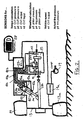
- the tractor 10 has a cab 11 and engine 12 which drives front and rear wheels 13 and 14 via a transmission diagrammatically shown at 15.
- the engine powers other components of the tractor such as an engine cooling fan 17, hydraulic pumps 18, air compressors 19 and an electrical generator 20.
- Front wheels 13 are mounted on a front axle shown diagrammatically at 21 and rear wheels 14 on a rear axle shown diagrammatically at 22.
- Rear implement attachment lower links 23 are attached to a back axle housing 24 by sensing pins 25.
- Front weights W1 are mounted on a weight support 26 attached to the front of the tractor chassis and beneath the tractor the moveable weight W2 is provided which can be moved in the fore and aft direction as indicated by arrow X in Figure 1 to adjust the weight distribution on the axles 21 and 22.
- An example of a suitable form of moveable weight W2 is disclosed in the Applicant's co-pending patent application No. 1017368.0 which is also shown in Figure 4 .
- a tractor control system mounted within the cab 11 is a tractor control system in accordance with the present invention which includes a processing unit 27 and a display terminal 28 which also acts as an input device for the control system.
- the tractor is provided with various sensors which feed their sensors signals to the processing unit 27.
- the output of the sensing pins 25 (which is indicative of the pull force being applied to any coupled implement or trailer) is fed via line 29 to processing unit 27.
- the ground speed V of the tractor is sensed by a radar unit 30 which feeds is speed signal via line 31 to processing unit 27.
- the position of the tractor is fed from GPS unit 32 via line 33 to control unit 27.
- the information received from GPS unit 32 may be alternatively used to determine ground speed V of the tractor which may be more precise than using radar unit 30.
- a fuel consumption sensor 34 is connected via line 35 to processing unit 27 and detects the amount of fuel being supplied from fuel tank 36 to engine 12.
- Engine 12 is controlled by an electronic unit 12a using performance maps indicated diagrammatically at 12b. Electronic unit 12a may alternatively deliver fuel consumption value based on engine parameters.
- Rear axle 22 is rigid and strain gauge sensors 37 are attached to each side of the back axle cast housing 24 to measure deflections of the back axle housing which are indicative of the load being supported by the rear wheels 14.
- the output of wheel load sensors 37 is fed via lines 38 to processing unit 27.
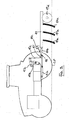
- Front axle 21 includes fluid pressure controlled suspension units 39 and 40 provided one on each side of the tractor and diagrammatically shown in Figure 2 .
- Each front wheel 13 has vertically moveable drive shaft 13b which is connected with transmission 15. This drive shaft 13b is supported by the associated suspension unit 39, 40 which is of the double acting type with chambers 41 and 42 provided on opposite sides of a moveable piston 43.
- the pressure in chambers 41 and 42 is sensed by pressure sensors 41 a and 42a and the position of piston 43 is sensed by position sensor 43a. These sensors communicate their outputs to control unit 27 via lines 41b, 42b and 43b respectively.
- the wheel loads determined from sensors 37, 41 a, 42a, and 43a may be verified by measuring the load applied on rear implement attachment lower links 23.
- the vertical implement load may be measured using the pressure in hydraulic hitch cylinders (not shown in Figure 1 ) which raise the draft links 23.
- the force applied to the tractor via the top link may be measured (either with another load pin or with pressure and angle sensors).
- the system may check, based on known values for the empty load of the tractor and the measured value for vertical load of the implement and wheel load whether a ballast weight is attached and the value of any added weight.
- Front wheels 13 are provided with a system for adjusting the pressure within front tyres 13a using compressor 19 and control valves 19a.
- a similar arrangement is provided for varying the pressure of the tyres 14a of the rear wheels 14.
- the tractor control system will advise the tractor operator as to the optimum weight of the tractor for the pull force being applied to the implement or trailer which the tractor is currently pulling and will also advise the operator as to the appropriate tyre pressure for the current wheel load and ground speed. If the tractor is fitted with a tyre pressure monitoring and inflation/deflation system then the control system can be arranged to automatically adjust the tyre pressure to the appropriate level.
- the same tyre pressure should be used in all tyres. Also for off road applications the lowest tyre pressure should be used which does not damage the tyres as this minimises rolling resistance and lowers contact pressure and increases pulling force due to the larger contact area with the ground.
- the tractor has pressure sensors 41a, 42a and position sensor 43a which enable the load supported by the wheels of the front axle 21 to be determined by the control unit and strain gauge sensors 37 associated with each side of the back axle housing 24 which enable the control unit to determine the load carried by the wheels of the rear axle 22.
- the total weight of the tractor can be determined during operation. If, for example, the load supported by the front wheels is 20kN. (2tons) and the load supported by the rear wheels is 60KN (6tons), the overall weight of the tractor is 80kN (8 tons).
- Pull force F being currently applied to the implement or trailer can be determined using the sensing pins 25 which connect the lower links 23 to the tractor chassis.
- the wheel or axle torque can be determined from the pressure in this hydraulic circuit and other parameters (e.g. intake volume of the hydraulic motor, ratio setpoint, pivot angle of the axial piston type hydraulic motor) .
- the wheel or axle torque, divided by the dynamic wheel radius is a measure for the wheel circumference force, consisting of rolling resistance force and pull thus giving a rough estimation of pull. (although problems can arise using this method of pull force determination as roll resistance must be considered).
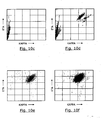
- the main target is to reach a maximum for ETA so that the performance supplied by the wheels result in a maximum pull performance.
- Mobility index BN10 which does follow this assumption, must be seen as a soil condition which is not suitable for high pull performance operation, e.g. very wet, muddy ground.
- KAPPA KAPPA ⁇ ⁇ ⁇ ⁇ ⁇ ⁇ ⁇ ⁇ ⁇ ⁇ ⁇ ⁇ ⁇ ⁇ ⁇ ⁇ ⁇ ⁇ ⁇ ⁇ ⁇ ⁇ ⁇ ⁇ ⁇ ⁇ ⁇ ⁇ ⁇ ⁇ ⁇ ⁇ ⁇ ⁇ ⁇ ⁇ ⁇ ⁇ ⁇ ⁇ ⁇ ⁇ ⁇ ⁇ ⁇ ⁇ ⁇ ⁇ ⁇ ⁇ ⁇ ⁇ ⁇ ⁇ ⁇ ⁇ ⁇ ⁇ ⁇ ⁇ ⁇ ⁇ ⁇ ⁇ ⁇ ⁇ ⁇ ⁇ ⁇ ⁇ ⁇ ⁇ ⁇ ⁇ ⁇ ⁇ ⁇ ⁇ ⁇ ⁇ ⁇ ⁇ ⁇ ⁇ ⁇ ⁇ ⁇ ⁇ ⁇ ⁇ ⁇ ⁇ ⁇ ⁇ ⁇ ⁇ ⁇ ⁇ ⁇ ⁇ ⁇ ⁇ ⁇ ⁇ ⁇ ⁇ ⁇ ⁇ ⁇ ⁇ ⁇ ⁇ ⁇ ⁇ ⁇ ⁇ ⁇ ⁇ ⁇ ⁇ ⁇ ⁇ ⁇ ⁇
- Each tractor has an initial weight distribution which is defined by the design of the tractor and the relative weight and position of the tractor components.
- a standard tractor may have say a 35% of its weight on the front axle and 65% of its weight on the rear axle when no ballast weights or implement is attached.
- Tractor tyre manufacturers publish tables of the optimum tyre pressure to be used based on the ground speed of the tractor and the wheel load.
- Figure 5 shows tables for the front and rear tyres of a particular make of tyre of a particular size which are typical of the tyres fitted to many tractors.
- the processing unit 27 has the appropriate tyre pressure tables loaded for the tyres fitted to the tractor.
- this specified axle load ratio of 40/60 remains constant for a given tyre size and design for every speed and tyre pressure if a common pressure is used in all tyres as indicated above. So the additional weight to raise the overall weight of the tractor to 100kN must be added in a manner which achieves this 40/60 weight distribution.
- the system can calculate all the different options and displays alternatives to the operator depending on the features fitted to the tractor and the available weight options.
- the operator can add 20 kN exactly on the front axle and this will give a loading of 40 kN on the front axle and 60 kN on the back axle giving a total load equal to the optimum load of 100kN.
- the system may recognize and suggest the appropriate number of 200kg weights to be used. So instead of suggesting 1190 kg, which is technically not available, the system may then suggest 1200 kg as being the closest weight which the ballast weight system can achieve.
- adjusting the weight distribution between the axles may not be easy to achieve. If the tractor is provided with a weight 45 at least part of which 45a can be moved in a fore and aft sense (see-arrow S in Figure 4 ) relative to the tractor chassis, as described in the previously referred to patent application No. 1017368.0 , then the weight distribution between the axles can be adjusted in the field either manually by the operator or automatically under the control of the tractor control system by operation of a hydraulic cylinder (not shown) or an electric motor (also not shown) which moves the weight 45a on guide rails 46.
- a hydraulic cylinder not shown
- an electric motor also not shown
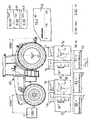
- a first hydraulic cylinder 47a is provided to move point 48 in a fore and aft sense.
- a second hydraulic cylinder 47b is provided to adjust heights level of point 48 (via rocker arm 47c and lift rod 47d).
- the implement may therefore be provided with a pivotable towing bar 49b driven by a hydraulic cylinder 49c.
- a lifting means may be assigned to the ground contact wheels 49d to adjust distance to ground.
- the hitch 47 is of a ball-type hitch. It is envisaged that other forms of hitch system, e.g. using rear implement attachment lower links 23 shown in Figure 1 , may be adapted to provide adjustability on one or both directions. Thereby, it is again possible to adjust the weight distribution either manually or automatically in the field.
- FIG. 6 shows a tractor and implement combination provided with a implement weight transfer system in which a cylinder 50 acts between the tractor and implement 51 which can press down on the implement to reduce the weight carried by the rear axle or can pull up on the implement or transfer more of the implement weight onto the rear axle. Again with such an arrangement it is possible to adjust the weight distribution either manually or automatically in the field.
- the operator may attach more weight than will ultimately be needed before going to field. Once in the field the operator can then remove some of this weight in order to achieve the optimum overall weight and adjust the position of the weight to achieve the optimum weight distribution.
- Many tractors are fitted with special front weight arrangements which allow this weight to be added or remove using a front weight lifting unit.
- the driver can save the weight recommendations from the control system and add weight when returning to the farm (for taking fuel) or reloading or for use next year if he is going on the same field with the same implement.
- the tractor has a drive transmission which can vary the proportion of engine output torque which is directed to each axle, the torque is preferably proportioned so that each wheel operates at substantially the same level of slip relative to the contacting ground.
- the system measures torque at the wheel hub so the decision whether the tractor is driving 10 km/h (with high or low torque on the wheel hub) needed for the tyre table is taken by the system and not by the driver who can only guess about torque based on experience.
- the display terminal 18 of the system displays various operating parameters of the tractor such as tractor ground speed, fuel consumption, tractor position, current front and rear tyre pressures, wheel load and pull force.
- the terminal displays recommendations to the operator regarding tractor weight and tyre pressure.
- the system also warns the driver if, for example the wheel loading is too high for the current tyre pressure (if not automatically adjusting it). Or it may warn when tractor is overloaded or may tend to overturn due to an imbalance in the transverse or longitudinal wheel load distribution..
- Diesel has a specific energy content of about 35.6 MJ/1 ⁇ 10 kWh/1. So multiplying with the consumption per time delivers performance in kW.
- the map of fuel consumption against engine speed supplied by engine manufacturer can be used.
- the performance P on the wheel hub is depending on the output torque of the transmission MT (determined as described above depending on CVT parameters) and the wheel speed nT which can be sensed by having speed sensor in the respective wheels or by measuring the output speed of the transmission which is then transferred to wheel speed by including final drive ratios and efficiencies (if appropriate).
- the overall torque is distributed according ratios between the front and rear axle.
- each axle or wheel can be considered resulting in an overall sum.
- Pull force F being currently applied to the implement or trailer can be determined using the sensing pins 25 which connect the lower links 23 to the tractor chassis.
- the pull force can be determined from the pressure in this hydraulic circuit via transmission output torque.
- Pull force multiplied with current vehicle speed provides pull performance.
- the current vehicle speed is thereby measured by a Radar sensor or by using GPS data.
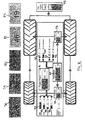
- Figures 7 and 8 show different layouts for the display of information to the tractor operator.
- FIG. 7 a depiction of the tractor is shown at 60 on which is displayed at 61 the front weight attached and at 62 the wheel weight attached.
- Display areas 63, 64 and 65 display the vehicle speed, acreage performance in hectares/hour and acreage fuel consumption in litres/ hectare.
- Display areas 66, 67, 68, 69 and 70 display the current pull force applied to the implement, front axle slip, front axle torque, rear axle slip and rear axle torque respectively.
- Display areas 71, 72 and 73 display engine efficiency, drive line efficiency and tractive efficiency.
- Display areas 74, 75, 76 and 77 display front tyre pressure, front wheel load, rear tyre pressure and rear wheel load respectively.
- an implement weight transfer system as described in Figure 6 is provided on the tractor, part of the weight of a coupled implement may be transferred to or from the associated tractor to adjust axle loading. Therefore, it may be advantageous to display the ratio of wheel load transferred by the implement.
- the display areas 75 or 77 showing front and rear wheel load may be split up in three values if the implement weight transfer system is activated representing:
- the display layout may change between different modes:
- the appearance of the display layout may be flexible. If the control system recognizes that an option shown in the maximum setting of the display is not available, e.g. the system to move the hitch point as described in Fig 3 is not being used, the display may blank or grey the respective area, so that the driver is not misguided.
- areas 78, 79, 80, 81 and 82 display the engine, driveline, traction, crank to hitch and tank to hitch efficiencies.
- Displays 83, 84, 85, 86 indicate the current power consumption in kW of the water pump, HVAC system, High Pressure pump and generator.
- displays 87, 88, 89 and 90 indicate the current power consumption in kW of the steering pump, air compressor, hydraulic pump and cooling fan.
- Display 91 shows the current power output of the engine in kW and displays 92 shows the proportion of the current engine output going to the transmission.
- Displays 93 and 94 show the power going to the rear and front wheels respectively whilst display 95 shows the current pulling power being applied to the implement or trailer.
- ETA Pull Force Performance Overall Wheel Hub Performance
- KAPP Pull Force Tractor weight
- the method includes the steps of:
- uphill and downhill driving may result in rogue values for KAPPA/ETA determination.
- An additional sensor e.g. an inclination sensor (which may be part of an Anti-Skid system) may provide respective information referring to uphill/downhill driving to eliminate these values.
- the system may contain other sensors to determine conditions where measured values represent rogue conditions not suitable for KAPPA determination. The respective values may then be sorted out according sensor information.
Landscapes
- Life Sciences & Earth Sciences (AREA)
- Engineering & Computer Science (AREA)
- Mechanical Engineering (AREA)
- Soil Sciences (AREA)
- Environmental Sciences (AREA)
- Physics & Mathematics (AREA)
- General Physics & Mathematics (AREA)
- Zoology (AREA)
- Chemical & Material Sciences (AREA)
- Combustion & Propulsion (AREA)
- Transportation (AREA)
- Lifting Devices For Agricultural Implements (AREA)
Claims (32)
- Dispositif de commande/affichage de tracteur comportant un moyen d'affichage (28) destiné à présenter à un opérateur de tracteur des paramètres de performance de tracteur et à recevoir des entrées de l'opérateur, des capteurs (30, 34, 37) destinés à déterminer différentes conditions opérationnelles du tracteur (10), et une unité de traitement (27) destinée à recevoir les signaux des capteurs et les entrées de l'opérateur et à traiter ces signaux et entrées en vue de fournir des paramètres de performances sélectionnés pour affichage sur le moyen d'affichage (28), caractérisé en ce que l'unité de traitement (27) présente aussi un mode de simulation, dans lequel l'opérateur peut entrer des propositions de modifications sur les conditions opérationnelles du tracteur, et l'unité de traitement (27) peut indiquer sur le moyen d'affichage (28) l'effet de ces propositions de modifications sur les paramètres sélectionnés de performances de tracteur.
- Dispositif selon la revendication 1, dans lequel le moyen d'affichage (28) informe l'opérateur de modifications qui peuvent être réalisées sur les conditions opérationnelles du tracteur (10) afin d'améliorer l'efficacité opérationnelle.
- Dispositif selon la revendication 2, dans lequel le moyen d'affichage (28) met en évidence la différence entre des valeurs mesurées de paramètres affichés, des valeurs annoncées de paramètres affichés, des valeurs de paramètres affichés modifiées par l'opérateur et des valeurs simulées de paramètres affichés.
- Dispositif selon la revendication 3, dans lequel le dispositif met en évidence la différence entre les différents types de paramètres affichés en utilisant différentes pages d'affichage et/ou des menus déroulants distincts et/ou des couleurs différentes pour les différents types de valeurs affichées.
- Dispositif selon l'une quelconque des revendications 1 à 4, dans lequel l'unité de traitement (27) peut être paramétrée pour produire des signaux de sortie afin de modifier automatiquement certaines conditions opérationnelles du tracteur (10) en vue d'améliorer l'efficacité de fonctionnement.
- Dispositif selon l'une quelconque des revendications 1 à 5, dans lequel l'unité de traitement (27) détecte si certaines installations ou fonctions ne sont pas disponibles sur le tracteur et en informe l'opérateur par l'intermédiaire du moyen d'affichage (28).
- Dispositif selon l'une quelconque des revendications 1 à 6, dans lequel le moyen d'affichage (28) indique le chargement courant d'essieu et/ou de roue du tracteur (10).
- Dispositif selon l'une quelconque des revendications 1 à 7, pour tracteur à essieu rigide non suspendu (22) dans lequel la charge de roue est mesurée par un capteur de type à jauge de contrainte (37) qui mesure la déformation d'une partie de l'essieu rigide qui supporte une roue (14).
- Dispositif selon l'une quelconque des revendications 1 à 7, pour tracteur comportant un essieu (21) suspendu par pression de fluide, dans lequel la charge de roue est déterminée en mesurant la pression de fluide (41a, 42a) qui suspend l'essieu et la position de l'essieu.
- Dispositif selon l'une quelconque des revendications 1 à 9, pour tracteur (10) à deux ou plusieurs essieux (21, 22) qui supportent des roues (13, 14) équipées de pneus sur lesquels des capteurs sont prévus pour déterminer l'effort de traction en cours (F) appliqué à un outillage ou remorque (49) tractée par le tracteur, la charge de roue en cours et la vitesse au sol en cours du tracteur (V), l'unité de traitement (27) déterminant et informant l'opérateur du tracteur par l'intermédiaire du moyen d'affichage (28) sur le poids optimal du tracteur en employant une relation prédéterminée entre effort de traction (F) et poids du tracteur, ainsi que sur la charge nécessaire sur chaque essieu (21, 22) en vue d'atteindre un rapport de charge d'essieu optimum prédéterminé.
- Dispositif selon la revendication 10, dans lequel le dispositif informe aussi l'opérateur par l'intermédiaire du moyen d'affichage (28) de la pression des pneus appropriée en fonction des valeurs de charge de roue et de vitesse au sol en cours du tracteur en utilisant une table de valeurs.
- Dispositif selon la revendication 11, dans lequel la table de valeurs fournit la pression de pneus équilibrée la plus faible adaptée à la charge de roue, à la vitesse au sol et à la taille des pneus montés sur le tracteur afin de fournir la pression au sol minimale pour supporter la charge.
- Dispositif selon l'une quelconque des revendications 10 à 12, dans lequel le rapport de charge d'essieu optimal appliqué est un rapport de charge d'essieu avant/arrière de 40/60.
- Dispositif selon l'une quelconque des revendications 10 à 13, dans lequel le rapport prédéterminé effort de traction / poids de tracteur est de 0,4.
- Dispositif selon l'une quelconque des revendications 10 à 13, dans lequel l'unité de traitement (27) calcule une valeur en temps réel pour le rapport courant effort de traction / poids de tracteur (KAPPA).
- Dispositif selon la revendication 15, dans lequel la valeur en temps réel du rapport courant effort de traction / poids de tracteur (KAPPA) est calculée en mesurant une pluralité de valeurs individuelles d'effort de traction sur une période d'échantillonnage et en calculant dans l'unité de traitement (27) les rapports respectifs à partir de celles-ci, en éliminant les valeurs de rapports individuelles extrêmes et/ou incorrectes ou non représentatives, en faisant la moyenne des valeurs de rapports sur des zones de rapport individuelles et en traçant ces valeurs de rapport de zone moyennes enregistrées sur la période d'échantillonnage afin de produire une courbe d'identification de ces valeurs tracées, puis en sélectionnant comme valeur en temps réel courante soit la valeur moyenne de rapport pour la zone de rapport, dans laquelle le tracteur (10) fonctionne depuis le plus longtemps, soit le rapport sur la courbe ayant la plus forte valeur d'efficacité de traction (effort de traction appliqué à l'outillage ou la remorque / performance de couple au niveau du moyeu de roue).
- Dispositif selon la revendication 15 ou 16, dans lequel la valeur en temps réel du rapport courant de l'effort de traction / poids de tracteur est affichée sur le moyen d'affichage (28).
- Dispositif selon l'une quelconque des revendications 10 à 17, dans lequel l'effort de traction est mesuré en utilisant des broches de détection (25) qui assurent la fixation des biellettes de liaison d'outillage inférieures (23) sur le tracteur (10).
- Dispositif selon la revendication 18, dans lequel le moyen d'affichage (28) affiche l'effort de traction courant appliqué à l'outillage ou la remorque.
- Dispositif selon l'une quelconque des revendications 10 à 19 pour un tracteur (10) qui comporte une transmission (15) à circuit hydraulique, dans lequel une pompe hydraulique fournit une pression à un moteur hydraulique, l'effort de traction étant déterminé par détection de la pression dans le circuit hydraulique, par laquelle la pression dans le circuit hydraulique est une mesure du couple de roue ou d'essieu, le couple de roue ou d'essieu divisé par le rayon de roue dynamique étant une mesure de la force de la circonférence de roue, consistant en la force de résistance au roulement et l'effort de traction, donnant ainsi une estimation approximative de l'effort de traction.
- Dispositif selon l'une quelconque des revendications 10 à 20, dans lequel la proportion du poids de l'outillage ou de la remorque (49) qui est supportée par le tracteur peut être modifiée, le moyen d'affichage (28) indiquant le poids de l'outillage ou de la remorque supporté par le tracteur afin de faciliter la modification par l'opérateur de la répartition de charge d'essieu vers la configuration requise déterminée par le dispositif.
- Dispositif selon la revendication 21, dans lequel un attelage arrière (47) qui permet de déplacer le point de fixation (48) de l'outillage ou de la remorque vers l'avant, l'arrière et/ou vers le bas et le haut par rapport au tracteur (10) afin de modifier la répartition de charge d'essieu vers la configuration requise déterminée par le dispositif.
- Dispositif selon la revendication 21 ou 22, dans lequel la charge verticale appliquée par l'outillage ou la remorque (49) sur le tracteur (10) est mesurée en utilisant des capteurs de pression sur des vérins hydrauliques entraînant les biellettes de liaison d'outillage inférieures ou la biellette supérieure.
- Dispositif selon l'une quelconque des revendications 10 à 23, pour un tracteur présentant un poids (45) qui est mobile vers l'avant et l'arrière par rapport au sens du tracteur (10), le moyen d'affichage (28) indiquant la modification de la charge d'essieu résultant du déplacement du poids afin de faciliter la modification par l'opérateur de la répartition de charge d'essieu vers la configuration requise déterminée par le dispositif.
- Dispositif selon l'une quelconque des revendications 1 à 24, pour un tracteur comportant des essieux moteurs avant (21) et arrière (22) et comportant un dispositif de transmission (15) qui permet de modifier la proportion du couple de sortie du moteur qui est dirigée vers chaque essieu, le moyen d'affichage (28) affichant le couple de sortie délivré à chaque essieu.
- Dispositif selon la revendication 25, dans lequel l'unité de traitement (27) répartit le couple moteur entre les essieux (21, 22) de telle sorte que chaque roue fonctionne sensiblement au même niveau de glissement par rapport au contact au sol.
- Dispositif selon la revendication 26, dans lequel le moyen d'affichage (28) affiche le glissement de roue de chaque essieu.
- Dispositif selon l'une quelconque des revendications 1 à 27, dans lequel l'unité de traitement (27) calcule et le moyen d'affichage (28) affiche le rendement du moteur qui est égal à la performance de puissance du moteur au niveau du vilebrequin / puissance fournie par le carburant consommé.
- Dispositif selon l'une quelconque des revendications 1 à 28, dans lequel l'unité de traitement (27) calcule et le moyen d'affichage (28) affiche le rendement de la transmission qui est égal à la performance de puissance au niveau du moyeu de roue / performance de puissance au niveau du vilebrequin.
- Dispositif selon l'une quelconque des revendications 1 à 29, dans lequel l'unité de traitement (27) calcule et le moyen d'affichage (28) affiche le rendement de traction qui est égal à l'effort de traction appliqué sur l'outillage ou la remorque / performance de puissance au niveau du moyeu de roue.
- Dispositif selon l'une quelconque des revendications 1 à 30, dans lequel l'unité de traitement (27) calcule et le moyen d'affichage (28) affiche le rendement de vilebrequin sur attelage qui est égal à l'effort de traction appliqué sur l'outillage ou la remorque / performance de puissance au niveau du vilebrequin.
- Dispositif selon l'une quelconque des revendications 1 à 31, dans lequel l'unité de traitement (27) calcule et le moyen d'affichage (28) affiche le rendement de réservoir sur attelage qui est égal à l'effort de traction appliqué sur l'outillage ou la remorque / puissance fournie par le carburant consommé.
Applications Claiming Priority (2)
| Application Number | Priority Date | Filing Date | Title |
|---|---|---|---|
| GBGB1112569.7A GB201112569D0 (en) | 2011-07-22 | 2011-07-22 | Tractor control/display systems |
| PCT/EP2012/062356 WO2013013915A1 (fr) | 2011-07-22 | 2012-06-26 | Systèmes de commande/d'affichage de tracteur |
Publications (2)
| Publication Number | Publication Date |
|---|---|
| EP2734026A1 EP2734026A1 (fr) | 2014-05-28 |
| EP2734026B1 true EP2734026B1 (fr) | 2015-04-01 |
Family
ID=44586966
Family Applications (1)
| Application Number | Title | Priority Date | Filing Date |
|---|---|---|---|
| EP12730926.8A Active EP2734026B1 (fr) | 2011-07-22 | 2012-06-26 | Systèmes de commande/d'affichage de tracteur |
Country Status (4)
| Country | Link |
|---|---|
| US (1) | US9095089B2 (fr) |
| EP (1) | EP2734026B1 (fr) |
| GB (1) | GB201112569D0 (fr) |
| WO (1) | WO2013013915A1 (fr) |
Cited By (1)
| Publication number | Priority date | Publication date | Assignee | Title |
|---|---|---|---|---|
| US10676141B2 (en) | 2017-04-05 | 2020-06-09 | Deere & Company | Method of providing a ballasting proposal |
Families Citing this family (29)
| Publication number | Priority date | Publication date | Assignee | Title |
|---|---|---|---|---|
| GB201112569D0 (en) * | 2011-07-22 | 2011-08-31 | Agco Int Gmbh | Tractor control/display systems |
| GB201112568D0 (en) * | 2011-07-22 | 2011-08-31 | Agco Int Gmbh | Tractor control system |
| EP3729927B1 (fr) * | 2012-01-25 | 2021-12-22 | Precision Planting LLC | Appareil, systèmes et procédés pour barre porte-outils agricole |
| US9686902B2 (en) * | 2012-12-18 | 2017-06-27 | Cnh Industrial America Llc | System and method for improving performance of an agricultural vehicle or implement |
| USD732576S1 (en) * | 2013-03-29 | 2015-06-23 | Deere & Company | Display screen or portion thereof with icon |
| USD738386S1 (en) * | 2013-03-29 | 2015-09-08 | Deere & Company | Display screen with an animated graphical user interface |
| RU2560210C2 (ru) * | 2013-10-24 | 2015-08-20 | Общество с ограниченной ответственностью "Исследования и разработки АГРО" | Способ повышения эффективности машинно-тракторного агрегата |
| ES2956358T3 (es) * | 2013-11-08 | 2023-12-20 | Prec Planting Llc | Métodos, aparatos y sistemas de control del peso en implementos |
| GB201322746D0 (en) * | 2013-12-20 | 2014-02-05 | Agco Int Gmbh | Agricultural implement connection control |
| GB201322859D0 (en) * | 2013-12-23 | 2014-02-12 | Agco Int Gmbh | Vehicle control system |
| US20160016470A1 (en) * | 2014-03-25 | 2016-01-21 | Agco International Gmbh | Tractor control/display systems |
| US20160039480A1 (en) * | 2014-08-05 | 2016-02-11 | Agco International Gmbh | Tractor control system |
| US10113929B2 (en) | 2014-08-21 | 2018-10-30 | Caterpillar Paving Products Inc. | Use of wheel slip to help identify soft spots |
| GB201416990D0 (en) * | 2014-09-26 | 2014-11-12 | Agco Int Gmbh | Determining optimal ballasting |
| GB201416989D0 (en) * | 2014-09-26 | 2014-11-12 | Agco Int Gmbh | Vehicle ballasting assistance |
| EP3100601B1 (fr) * | 2015-06-02 | 2020-02-19 | AGCO International GmbH | Détermination de la hauteur d'un récepteur de positionnement pour machines mobiles |
| GB201516035D0 (en) | 2015-09-10 | 2015-10-28 | Agco Int Gmbh | Vehicle axle wheel |
| GB201516037D0 (en) | 2015-09-10 | 2015-10-28 | Agco Int Gmbh | Vehicle axel assembly |
| US10481628B2 (en) * | 2015-09-23 | 2019-11-19 | Deere & Company | Surfacing of subsystem power consumption on an agricultural machine |
| US10392016B2 (en) | 2017-09-05 | 2019-08-27 | Cnh Industrial America Llc | System and method for updating a speed calibration of a work vehicle |
| US10737284B2 (en) | 2017-10-13 | 2020-08-11 | Cnh Industrial America Llc | Tire configuration system for an agricultural machine |
| WO2019102496A1 (fr) * | 2017-11-27 | 2019-05-31 | Mahindra & Mahindra Limited | Procédés et systèmes de surveillance et de commande d'équipement(s) agricole(s) fixé(s) à un véhicule agricole |
| DE102018107577A1 (de) | 2018-03-29 | 2019-10-02 | Claas Tractor Sas | Landwirtschaftliche Arbeitsmaschine |
| DE102018122018A1 (de) * | 2018-09-10 | 2020-03-12 | Claas Tractor Sas | Landwirtschaftliches Arbeitssystem |
| US11419254B2 (en) | 2019-10-28 | 2022-08-23 | Cnh Industrial Canada, Ltd. | System and method for detecting levelness of tools of a tillage implement based on tool loading |
| JP7398258B2 (ja) * | 2019-12-11 | 2023-12-14 | 三菱マヒンドラ農機株式会社 | 作業車両 |
| DE102022206914A1 (de) * | 2022-07-06 | 2024-01-11 | Robert Bosch Gesellschaft mit beschränkter Haftung | Verfahren zur Bestimmung einer geeigneten Kurvengeschwindigkeit von Fahrzeugen, Vorrichtung zur Durchführung desselben und dessen Verwendung |
| US12543616B2 (en) | 2022-12-07 | 2026-02-10 | Cnh Industrial America Llc | Weight transferring hitch system for agricultural implement |
| CN119590152B (zh) * | 2024-11-22 | 2025-12-05 | 深圳市道通科技股份有限公司 | Tpms工具的车辆配置方法、tpms工具及存储介质 |
Family Cites Families (19)
| Publication number | Priority date | Publication date | Assignee | Title |
|---|---|---|---|---|
| US4512433A (en) * | 1975-01-30 | 1985-04-23 | Lely Cornelis V D | Row-crop front and rear wheel drive articulated tractor for heavy-duty operations |
| US4715012A (en) * | 1980-10-15 | 1987-12-22 | Massey-Ferguson Services N.V. | Electronic tractor control |
| GB8509488D0 (en) | 1985-04-12 | 1985-05-15 | Massey Ferguson Services Nv | Vehicle performance monitoring apparatus |
| GB2318651A (en) * | 1996-10-23 | 1998-04-29 | New Holland | Integrated vehicle control system |
| US6347674B1 (en) * | 1998-12-18 | 2002-02-19 | Western Well Tool, Inc. | Electrically sequenced tractor |
| US6823249B2 (en) | 1999-03-19 | 2004-11-23 | Agco Limited | Tractor with monitoring system |
| US7216024B1 (en) * | 1999-07-27 | 2007-05-08 | Linde Aktiengesellschaft | Industrial truck with a stabilizing device |
| US7072763B2 (en) * | 2000-11-28 | 2006-07-04 | Arvinmeritor Technology, Llc | Intelligent load distribution system |
| GB0130673D0 (en) * | 2001-12-21 | 2002-02-06 | New Holland Uk Ltd | Tractor/implement combination control methods and apparatuses |
| US7337054B2 (en) * | 2004-07-29 | 2008-02-26 | Caterpillar Inc. | Systems and methods for controlling slip |
| US7706938B2 (en) | 2007-04-30 | 2010-04-27 | International Truck Intellectual Property Company, Llc | Automated synchronized service intervals for vehicles |
| RU2488663C2 (ru) * | 2007-07-13 | 2013-07-27 | Вольво Констракшн Эквипмент Аб | Способ обеспечения инструкциями по эксплуатации водителя рабочей машины |
| US8160782B2 (en) * | 2007-08-24 | 2012-04-17 | Harrison Ag Technologies, Inc. | System and method for controlling the release of material |
| US8099217B2 (en) | 2007-08-31 | 2012-01-17 | Caterpillar Inc. | Performance-based haulage management system |
| US8065061B2 (en) * | 2007-11-30 | 2011-11-22 | Caterpillar Inc. | Payload control system based on force and speed |
| EP2158799B9 (fr) | 2008-08-27 | 2012-12-26 | CLAAS Tractor S.A.S. | Machine de travail agricole autopropulsée |
| GB201112568D0 (en) * | 2011-07-22 | 2011-08-31 | Agco Int Gmbh | Tractor control system |
| GB201112569D0 (en) * | 2011-07-22 | 2011-08-31 | Agco Int Gmbh | Tractor control/display systems |
| US8965640B2 (en) * | 2012-11-30 | 2015-02-24 | Caterpillar Inc. | Conditioning a performance metric for an operator display |
-
2011
- 2011-07-22 GB GBGB1112569.7A patent/GB201112569D0/en not_active Ceased
-
2012
- 2012-06-26 WO PCT/EP2012/062356 patent/WO2013013915A1/fr not_active Ceased
- 2012-06-26 US US14/234,078 patent/US9095089B2/en active Active
- 2012-06-26 EP EP12730926.8A patent/EP2734026B1/fr active Active
Cited By (1)
| Publication number | Priority date | Publication date | Assignee | Title |
|---|---|---|---|---|
| US10676141B2 (en) | 2017-04-05 | 2020-06-09 | Deere & Company | Method of providing a ballasting proposal |
Also Published As
| Publication number | Publication date |
|---|---|
| WO2013013915A1 (fr) | 2013-01-31 |
| US9095089B2 (en) | 2015-08-04 |
| EP2734026A1 (fr) | 2014-05-28 |
| GB201112569D0 (en) | 2011-08-31 |
| US20140222302A1 (en) | 2014-08-07 |
Similar Documents
| Publication | Publication Date | Title |
|---|---|---|
| EP2734027B1 (fr) | Système de contrôle de tracteur | |
| US9095089B2 (en) | Tractor control/display systems | |
| US20160039480A1 (en) | Tractor control system | |
| US20160016470A1 (en) | Tractor control/display systems | |
| EP1053112B1 (fr) | Systeme automatique de gonflage central de pneumatique | |
| Damanauskas et al. | Differences in tractor performance parameters between single-wheel 4WD and dual-wheel 2WD driving systems | |
| US10676141B2 (en) | Method of providing a ballasting proposal | |
| EP3220732B1 (fr) | Commande de patinage des roues d'un véhicule | |
| US20240065132A1 (en) | Agricultural work system and method for operating an agricultural work system | |
| US10801935B2 (en) | System and method for determining a cone index value | |
| DE102011085041B4 (de) | Landwirtschaftliches Fahrzeug | |
| WO2020035101A1 (fr) | Installation de réglage de pression de pneumatiques et procédé de fonctionnement de celle-ci | |
| EP3202244A1 (fr) | Détection de force de traction sur un véhicule ayant une liaison | |
| EP4186716B1 (fr) | Commande adaptative de pneumatique | |
| Janulevičius et al. | How driving wheels of front-loaded tractor interact with the terrain depending on tire pressures | |
| US20160082789A1 (en) | Method and system for reducing vehicle oscillations | |
| KR101869466B1 (ko) | 트랙터의 견인력 및 슬립률을 이용한 작업기의 경심제어 시스템 및 방법 | |
| US20240065129A1 (en) | Agricultural work system and method of operating an agricultural work system | |
| Wiley et al. | Power hop instability of tractors | |
| Canli et al. | Experimental assessment of a PID control solution for braking safety of transportation by agricultural tractor trailer combinations | |
| EP4664080A1 (fr) | Mesure d'une charge sur un véhicule agricole | |
| Wieckhorst et al. | Real Time Tire Soil Parameters of a Tractor in Tillage Applications | |
| Staton et al. | Improving tractor performance and fuel efficiency | |
| Atkari et al. | Effect of different tire inflation pressures on drawbar performance of tractor in different gear setting. | |
| Tapang | DESIGN AND DEVELOPMENT OF AUTO VARIABLE HITCH HEIGHT FOR 2WD TRACTORS |
Legal Events
| Date | Code | Title | Description |
|---|---|---|---|
| PUAI | Public reference made under article 153(3) epc to a published international application that has entered the european phase |
Free format text: ORIGINAL CODE: 0009012 |
|
| 17P | Request for examination filed |
Effective date: 20140224 |
|
| AK | Designated contracting states |
Kind code of ref document: A1 Designated state(s): AL AT BE BG CH CY CZ DE DK EE ES FI FR GB GR HR HU IE IS IT LI LT LU LV MC MK MT NL NO PL PT RO RS SE SI SK SM TR |
|
| DAX | Request for extension of the european patent (deleted) | ||
| REG | Reference to a national code |
Ref country code: DE Ref legal event code: R079 Ref document number: 602012006359 Country of ref document: DE Free format text: PREVIOUS MAIN CLASS: A01B0063114000 Ipc: A01B0076000000 |
|
| GRAP | Despatch of communication of intention to grant a patent |
Free format text: ORIGINAL CODE: EPIDOSNIGR1 |
|
| RIC1 | Information provided on ipc code assigned before grant |
Ipc: G07C 5/08 20060101ALI20141203BHEP Ipc: A01B 63/114 20060101ALI20141203BHEP Ipc: A01B 79/00 20060101ALI20141203BHEP Ipc: A01B 76/00 20060101AFI20141203BHEP Ipc: A01B 63/14 20060101ALI20141203BHEP |
|
| INTG | Intention to grant announced |
Effective date: 20150105 |
|
| GRAS | Grant fee paid |
Free format text: ORIGINAL CODE: EPIDOSNIGR3 |
|
| GRAA | (expected) grant |
Free format text: ORIGINAL CODE: 0009210 |
|
| AK | Designated contracting states |
Kind code of ref document: B1 Designated state(s): AL AT BE BG CH CY CZ DE DK EE ES FI FR GB GR HR HU IE IS IT LI LT LU LV MC MK MT NL NO PL PT RO RS SE SI SK SM TR |
|
| REG | Reference to a national code |
Ref country code: GB Ref legal event code: FG4D |
|
| REG | Reference to a national code |
Ref country code: CH Ref legal event code: EP |
|
| REG | Reference to a national code |
Ref country code: IE Ref legal event code: FG4D |
|
| REG | Reference to a national code |
Ref country code: DE Ref legal event code: R096 Ref document number: 602012006359 Country of ref document: DE Effective date: 20150513 |
|
| REG | Reference to a national code |
Ref country code: AT Ref legal event code: REF Ref document number: 718530 Country of ref document: AT Kind code of ref document: T Effective date: 20150515 |
|
| REG | Reference to a national code |
Ref country code: FR Ref legal event code: PLFP Year of fee payment: 4 |
|
| REG | Reference to a national code |
Ref country code: NL Ref legal event code: VDEP Effective date: 20150401 |
|
| REG | Reference to a national code |
Ref country code: AT Ref legal event code: MK05 Ref document number: 718530 Country of ref document: AT Kind code of ref document: T Effective date: 20150401 |
|
| REG | Reference to a national code |
Ref country code: LT Ref legal event code: MG4D |
|
| PG25 | Lapsed in a contracting state [announced via postgrant information from national office to epo] |
Ref country code: NL Free format text: LAPSE BECAUSE OF FAILURE TO SUBMIT A TRANSLATION OF THE DESCRIPTION OR TO PAY THE FEE WITHIN THE PRESCRIBED TIME-LIMIT Effective date: 20150401 |
|
| PG25 | Lapsed in a contracting state [announced via postgrant information from national office to epo] |
Ref country code: ES Free format text: LAPSE BECAUSE OF FAILURE TO SUBMIT A TRANSLATION OF THE DESCRIPTION OR TO PAY THE FEE WITHIN THE PRESCRIBED TIME-LIMIT Effective date: 20150401 Ref country code: HR Free format text: LAPSE BECAUSE OF FAILURE TO SUBMIT A TRANSLATION OF THE DESCRIPTION OR TO PAY THE FEE WITHIN THE PRESCRIBED TIME-LIMIT Effective date: 20150401 Ref country code: PT Free format text: LAPSE BECAUSE OF FAILURE TO SUBMIT A TRANSLATION OF THE DESCRIPTION OR TO PAY THE FEE WITHIN THE PRESCRIBED TIME-LIMIT Effective date: 20150803 Ref country code: FI Free format text: LAPSE BECAUSE OF FAILURE TO SUBMIT A TRANSLATION OF THE DESCRIPTION OR TO PAY THE FEE WITHIN THE PRESCRIBED TIME-LIMIT Effective date: 20150401 Ref country code: CZ Free format text: LAPSE BECAUSE OF FAILURE TO SUBMIT A TRANSLATION OF THE DESCRIPTION OR TO PAY THE FEE WITHIN THE PRESCRIBED TIME-LIMIT Effective date: 20150401 Ref country code: LT Free format text: LAPSE BECAUSE OF FAILURE TO SUBMIT A TRANSLATION OF THE DESCRIPTION OR TO PAY THE FEE WITHIN THE PRESCRIBED TIME-LIMIT Effective date: 20150401 Ref country code: NO Free format text: LAPSE BECAUSE OF FAILURE TO SUBMIT A TRANSLATION OF THE DESCRIPTION OR TO PAY THE FEE WITHIN THE PRESCRIBED TIME-LIMIT Effective date: 20150701 |
|
| PG25 | Lapsed in a contracting state [announced via postgrant information from national office to epo] |
Ref country code: RS Free format text: LAPSE BECAUSE OF FAILURE TO SUBMIT A TRANSLATION OF THE DESCRIPTION OR TO PAY THE FEE WITHIN THE PRESCRIBED TIME-LIMIT Effective date: 20150401 Ref country code: IS Free format text: LAPSE BECAUSE OF FAILURE TO SUBMIT A TRANSLATION OF THE DESCRIPTION OR TO PAY THE FEE WITHIN THE PRESCRIBED TIME-LIMIT Effective date: 20150801 Ref country code: AT Free format text: LAPSE BECAUSE OF FAILURE TO SUBMIT A TRANSLATION OF THE DESCRIPTION OR TO PAY THE FEE WITHIN THE PRESCRIBED TIME-LIMIT Effective date: 20150401 Ref country code: LV Free format text: LAPSE BECAUSE OF FAILURE TO SUBMIT A TRANSLATION OF THE DESCRIPTION OR TO PAY THE FEE WITHIN THE PRESCRIBED TIME-LIMIT Effective date: 20150401 Ref country code: GR Free format text: LAPSE BECAUSE OF FAILURE TO SUBMIT A TRANSLATION OF THE DESCRIPTION OR TO PAY THE FEE WITHIN THE PRESCRIBED TIME-LIMIT Effective date: 20150702 |
|
| REG | Reference to a national code |
Ref country code: DE Ref legal event code: R097 Ref document number: 602012006359 Country of ref document: DE |
|
| PG25 | Lapsed in a contracting state [announced via postgrant information from national office to epo] |
Ref country code: DK Free format text: LAPSE BECAUSE OF FAILURE TO SUBMIT A TRANSLATION OF THE DESCRIPTION OR TO PAY THE FEE WITHIN THE PRESCRIBED TIME-LIMIT Effective date: 20150401 Ref country code: EE Free format text: LAPSE BECAUSE OF FAILURE TO SUBMIT A TRANSLATION OF THE DESCRIPTION OR TO PAY THE FEE WITHIN THE PRESCRIBED TIME-LIMIT Effective date: 20150401 Ref country code: MC Free format text: LAPSE BECAUSE OF FAILURE TO SUBMIT A TRANSLATION OF THE DESCRIPTION OR TO PAY THE FEE WITHIN THE PRESCRIBED TIME-LIMIT Effective date: 20150401 |
|
| REG | Reference to a national code |
Ref country code: CH Ref legal event code: PL |
|
| PLBE | No opposition filed within time limit |
Free format text: ORIGINAL CODE: 0009261 |
|
| STAA | Information on the status of an ep patent application or granted ep patent |
Free format text: STATUS: NO OPPOSITION FILED WITHIN TIME LIMIT |
|
| PG25 | Lapsed in a contracting state [announced via postgrant information from national office to epo] |
Ref country code: RO Free format text: LAPSE BECAUSE OF NON-PAYMENT OF DUE FEES Effective date: 20150401 Ref country code: SK Free format text: LAPSE BECAUSE OF FAILURE TO SUBMIT A TRANSLATION OF THE DESCRIPTION OR TO PAY THE FEE WITHIN THE PRESCRIBED TIME-LIMIT Effective date: 20150401 Ref country code: PL Free format text: LAPSE BECAUSE OF FAILURE TO SUBMIT A TRANSLATION OF THE DESCRIPTION OR TO PAY THE FEE WITHIN THE PRESCRIBED TIME-LIMIT Effective date: 20150401 Ref country code: LU Free format text: LAPSE BECAUSE OF FAILURE TO SUBMIT A TRANSLATION OF THE DESCRIPTION OR TO PAY THE FEE WITHIN THE PRESCRIBED TIME-LIMIT Effective date: 20150626 |
|
| 26N | No opposition filed |
Effective date: 20160105 |
|
| REG | Reference to a national code |
Ref country code: IE Ref legal event code: MM4A |
|
| PG25 | Lapsed in a contracting state [announced via postgrant information from national office to epo] |
Ref country code: CH Free format text: LAPSE BECAUSE OF NON-PAYMENT OF DUE FEES Effective date: 20150630 Ref country code: IE Free format text: LAPSE BECAUSE OF NON-PAYMENT OF DUE FEES Effective date: 20150626 Ref country code: LI Free format text: LAPSE BECAUSE OF NON-PAYMENT OF DUE FEES Effective date: 20150630 |
|
| PG25 | Lapsed in a contracting state [announced via postgrant information from national office to epo] |
Ref country code: SI Free format text: LAPSE BECAUSE OF FAILURE TO SUBMIT A TRANSLATION OF THE DESCRIPTION OR TO PAY THE FEE WITHIN THE PRESCRIBED TIME-LIMIT Effective date: 20150401 |
|
| REG | Reference to a national code |
Ref country code: FR Ref legal event code: PLFP Year of fee payment: 5 |
|
| PG25 | Lapsed in a contracting state [announced via postgrant information from national office to epo] |
Ref country code: BE Free format text: LAPSE BECAUSE OF FAILURE TO SUBMIT A TRANSLATION OF THE DESCRIPTION OR TO PAY THE FEE WITHIN THE PRESCRIBED TIME-LIMIT Effective date: 20150401 |
|
| PG25 | Lapsed in a contracting state [announced via postgrant information from national office to epo] |
Ref country code: MT Free format text: LAPSE BECAUSE OF FAILURE TO SUBMIT A TRANSLATION OF THE DESCRIPTION OR TO PAY THE FEE WITHIN THE PRESCRIBED TIME-LIMIT Effective date: 20150401 |
|
| PG25 | Lapsed in a contracting state [announced via postgrant information from national office to epo] |
Ref country code: BG Free format text: LAPSE BECAUSE OF FAILURE TO SUBMIT A TRANSLATION OF THE DESCRIPTION OR TO PAY THE FEE WITHIN THE PRESCRIBED TIME-LIMIT Effective date: 20150401 Ref country code: SM Free format text: LAPSE BECAUSE OF FAILURE TO SUBMIT A TRANSLATION OF THE DESCRIPTION OR TO PAY THE FEE WITHIN THE PRESCRIBED TIME-LIMIT Effective date: 20150401 Ref country code: HU Free format text: LAPSE BECAUSE OF FAILURE TO SUBMIT A TRANSLATION OF THE DESCRIPTION OR TO PAY THE FEE WITHIN THE PRESCRIBED TIME-LIMIT; INVALID AB INITIO Effective date: 20120626 |
|
| REG | Reference to a national code |
Ref country code: FR Ref legal event code: PLFP Year of fee payment: 6 |
|
| PG25 | Lapsed in a contracting state [announced via postgrant information from national office to epo] |
Ref country code: CY Free format text: LAPSE BECAUSE OF FAILURE TO SUBMIT A TRANSLATION OF THE DESCRIPTION OR TO PAY THE FEE WITHIN THE PRESCRIBED TIME-LIMIT Effective date: 20150401 Ref country code: SE Free format text: LAPSE BECAUSE OF FAILURE TO SUBMIT A TRANSLATION OF THE DESCRIPTION OR TO PAY THE FEE WITHIN THE PRESCRIBED TIME-LIMIT Effective date: 20150401 |
|
| PG25 | Lapsed in a contracting state [announced via postgrant information from national office to epo] |
Ref country code: TR Free format text: LAPSE BECAUSE OF FAILURE TO SUBMIT A TRANSLATION OF THE DESCRIPTION OR TO PAY THE FEE WITHIN THE PRESCRIBED TIME-LIMIT Effective date: 20150401 |
|
| REG | Reference to a national code |
Ref country code: FR Ref legal event code: PLFP Year of fee payment: 7 |
|
| PG25 | Lapsed in a contracting state [announced via postgrant information from national office to epo] |
Ref country code: MK Free format text: LAPSE BECAUSE OF FAILURE TO SUBMIT A TRANSLATION OF THE DESCRIPTION OR TO PAY THE FEE WITHIN THE PRESCRIBED TIME-LIMIT Effective date: 20150401 |
|
| PG25 | Lapsed in a contracting state [announced via postgrant information from national office to epo] |
Ref country code: AL Free format text: LAPSE BECAUSE OF FAILURE TO SUBMIT A TRANSLATION OF THE DESCRIPTION OR TO PAY THE FEE WITHIN THE PRESCRIBED TIME-LIMIT Effective date: 20150401 |
|
| P01 | Opt-out of the competence of the unified patent court (upc) registered |
Effective date: 20230518 |
|
| PGFP | Annual fee paid to national office [announced via postgrant information from national office to epo] |
Ref country code: GB Payment date: 20260625 Year of fee payment: 15 |
|
| PGFP | Annual fee paid to national office [announced via postgrant information from national office to epo] |
Ref country code: IT Payment date: 20260618 Year of fee payment: 15 |
|
| PGFP | Annual fee paid to national office [announced via postgrant information from national office to epo] |
Ref country code: DE Payment date: 20260622 Year of fee payment: 15 |
|
| PGFP | Annual fee paid to national office [announced via postgrant information from national office to epo] |
Ref country code: FR Payment date: 20260626 Year of fee payment: 15 |