EP2733159A1 - Curable resin composition and process for producing cured products using same - Google Patents
Curable resin composition and process for producing cured products using same Download PDFInfo
- Publication number
- EP2733159A1 EP2733159A1 EP12811497.2A EP12811497A EP2733159A1 EP 2733159 A1 EP2733159 A1 EP 2733159A1 EP 12811497 A EP12811497 A EP 12811497A EP 2733159 A1 EP2733159 A1 EP 2733159A1
- Authority
- EP
- European Patent Office
- Prior art keywords
- resin composition
- curable resin
- bis
- group
- cyanatophenyl
- Prior art date
- Legal status (The legal status is an assumption and is not a legal conclusion. Google has not performed a legal analysis and makes no representation as to the accuracy of the status listed.)
- Withdrawn
Links
- 0 CC(CC1)(C=CC=C1N(C(C=C1)=*)C1=O)N Chemical compound CC(CC1)(C=CC=C1N(C(C=C1)=*)C1=O)N 0.000 description 1
- CWBGMDSRUBITBX-UHFFFAOYSA-N OC(C=CC1=O)N1C1=CCC#CC=C1 Chemical compound OC(C=CC1=O)N1C1=CCC#CC=C1 CWBGMDSRUBITBX-UHFFFAOYSA-N 0.000 description 1
Images

Classifications
-
- C—CHEMISTRY; METALLURGY
- C08—ORGANIC MACROMOLECULAR COMPOUNDS; THEIR PREPARATION OR CHEMICAL WORKING-UP; COMPOSITIONS BASED THEREON
- C08L—COMPOSITIONS OF MACROMOLECULAR COMPOUNDS
- C08L79/00—Compositions of macromolecular compounds obtained by reactions forming in the main chain of the macromolecule a linkage containing nitrogen with or without oxygen or carbon only, not provided for in groups C08L61/00 - C08L77/00
- C08L79/04—Polycondensates having nitrogen-containing heterocyclic rings in the main chain; Polyhydrazides; Polyamide acids or similar polyimide precursors
- C08L79/08—Polyimides; Polyester-imides; Polyamide-imides; Polyamide acids or similar polyimide precursors
-
- C—CHEMISTRY; METALLURGY
- C08—ORGANIC MACROMOLECULAR COMPOUNDS; THEIR PREPARATION OR CHEMICAL WORKING-UP; COMPOSITIONS BASED THEREON
- C08G—MACROMOLECULAR COMPOUNDS OBTAINED OTHERWISE THAN BY REACTIONS ONLY INVOLVING UNSATURATED CARBON-TO-CARBON BONDS
- C08G73/00—Macromolecular compounds obtained by reactions forming a linkage containing nitrogen with or without oxygen or carbon in the main chain of the macromolecule, not provided for in groups C08G12/00 - C08G71/00
- C08G73/06—Polycondensates having nitrogen-containing heterocyclic rings in the main chain of the macromolecule
- C08G73/0622—Polycondensates containing six-membered rings, not condensed with other rings, with nitrogen atoms as the only ring hetero atoms
- C08G73/0638—Polycondensates containing six-membered rings, not condensed with other rings, with nitrogen atoms as the only ring hetero atoms with at least three nitrogen atoms in the ring
- C08G73/065—Preparatory processes
- C08G73/0655—Preparatory processes from polycyanurates
- C08G73/0661—Preparatory processes from polycyanurates characterised by the catalyst used
-
- B—PERFORMING OPERATIONS; TRANSPORTING
- B32—LAYERED PRODUCTS
- B32B—LAYERED PRODUCTS, i.e. PRODUCTS BUILT-UP OF STRATA OF FLAT OR NON-FLAT, e.g. CELLULAR OR HONEYCOMB, FORM
- B32B27/00—Layered products comprising a layer of synthetic resin
- B32B27/40—Layered products comprising a layer of synthetic resin comprising polyurethanes
-
- C—CHEMISTRY; METALLURGY
- C08—ORGANIC MACROMOLECULAR COMPOUNDS; THEIR PREPARATION OR CHEMICAL WORKING-UP; COMPOSITIONS BASED THEREON
- C08G—MACROMOLECULAR COMPOUNDS OBTAINED OTHERWISE THAN BY REACTIONS ONLY INVOLVING UNSATURATED CARBON-TO-CARBON BONDS
- C08G61/00—Macromolecular compounds obtained by reactions forming a carbon-to-carbon link in the main chain of the macromolecule
- C08G61/02—Macromolecular compounds containing only carbon atoms in the main chain of the macromolecule, e.g. polyxylylenes
- C08G61/10—Macromolecular compounds containing only carbon atoms in the main chain of the macromolecule, e.g. polyxylylenes only aromatic carbon atoms, e.g. polyphenylenes
-
- C—CHEMISTRY; METALLURGY
- C08—ORGANIC MACROMOLECULAR COMPOUNDS; THEIR PREPARATION OR CHEMICAL WORKING-UP; COMPOSITIONS BASED THEREON
- C08J—WORKING-UP; GENERAL PROCESSES OF COMPOUNDING; AFTER-TREATMENT NOT COVERED BY SUBCLASSES C08B, C08C, C08F, C08G or C08H
- C08J5/00—Manufacture of articles or shaped materials containing macromolecular substances
- C08J5/24—Impregnating materials with prepolymers which can be polymerised in situ, e.g. manufacture of prepregs
-
- C—CHEMISTRY; METALLURGY
- C08—ORGANIC MACROMOLECULAR COMPOUNDS; THEIR PREPARATION OR CHEMICAL WORKING-UP; COMPOSITIONS BASED THEREON
- C08L—COMPOSITIONS OF MACROMOLECULAR COMPOUNDS
- C08L63/00—Compositions of epoxy resins; Compositions of derivatives of epoxy resins
-
- C—CHEMISTRY; METALLURGY
- C08—ORGANIC MACROMOLECULAR COMPOUNDS; THEIR PREPARATION OR CHEMICAL WORKING-UP; COMPOSITIONS BASED THEREON
- C08L—COMPOSITIONS OF MACROMOLECULAR COMPOUNDS
- C08L65/00—Compositions of macromolecular compounds obtained by reactions forming a carbon-to-carbon link in the main chain; Compositions of derivatives of such polymers
- C08L65/02—Polyphenylenes
-
- C—CHEMISTRY; METALLURGY
- C08—ORGANIC MACROMOLECULAR COMPOUNDS; THEIR PREPARATION OR CHEMICAL WORKING-UP; COMPOSITIONS BASED THEREON
- C08L—COMPOSITIONS OF MACROMOLECULAR COMPOUNDS
- C08L79/00—Compositions of macromolecular compounds obtained by reactions forming in the main chain of the macromolecule a linkage containing nitrogen with or without oxygen or carbon only, not provided for in groups C08L61/00 - C08L77/00
- C08L79/04—Polycondensates having nitrogen-containing heterocyclic rings in the main chain; Polyhydrazides; Polyamide acids or similar polyimide precursors
-
- C—CHEMISTRY; METALLURGY
- C08—ORGANIC MACROMOLECULAR COMPOUNDS; THEIR PREPARATION OR CHEMICAL WORKING-UP; COMPOSITIONS BASED THEREON
- C08L—COMPOSITIONS OF MACROMOLECULAR COMPOUNDS
- C08L79/00—Compositions of macromolecular compounds obtained by reactions forming in the main chain of the macromolecule a linkage containing nitrogen with or without oxygen or carbon only, not provided for in groups C08L61/00 - C08L77/00
- C08L79/04—Polycondensates having nitrogen-containing heterocyclic rings in the main chain; Polyhydrazides; Polyamide acids or similar polyimide precursors
- C08L79/08—Polyimides; Polyester-imides; Polyamide-imides; Polyamide acids or similar polyimide precursors
- C08L79/085—Unsaturated polyimide precursors
-
- C—CHEMISTRY; METALLURGY
- C09—DYES; PAINTS; POLISHES; NATURAL RESINS; ADHESIVES; COMPOSITIONS NOT OTHERWISE PROVIDED FOR; APPLICATIONS OF MATERIALS NOT OTHERWISE PROVIDED FOR
- C09D—COATING COMPOSITIONS, e.g. PAINTS, VARNISHES OR LACQUERS; FILLING PASTES; CHEMICAL PAINT OR INK REMOVERS; INKS; CORRECTING FLUIDS; WOODSTAINS; PASTES OR SOLIDS FOR COLOURING OR PRINTING; USE OF MATERIALS THEREFOR
- C09D165/00—Coating compositions based on macromolecular compounds obtained by reactions forming a carbon-to-carbon link in the main chain; Coating compositions based on derivatives of such polymers
- C09D165/02—Polyphenylenes
-
- C—CHEMISTRY; METALLURGY
- C09—DYES; PAINTS; POLISHES; NATURAL RESINS; ADHESIVES; COMPOSITIONS NOT OTHERWISE PROVIDED FOR; APPLICATIONS OF MATERIALS NOT OTHERWISE PROVIDED FOR
- C09D—COATING COMPOSITIONS, e.g. PAINTS, VARNISHES OR LACQUERS; FILLING PASTES; CHEMICAL PAINT OR INK REMOVERS; INKS; CORRECTING FLUIDS; WOODSTAINS; PASTES OR SOLIDS FOR COLOURING OR PRINTING; USE OF MATERIALS THEREFOR
- C09D179/00—Coating compositions based on macromolecular compounds obtained by reactions forming in the main chain of the macromolecule a linkage containing nitrogen, with or without oxygen, or carbon only, not provided for in groups C09D161/00 - C09D177/00
- C09D179/04—Polycondensates having nitrogen-containing heterocyclic rings in the main chain; Polyhydrazides; Polyamide acids or similar polyimide precursors
-
- C—CHEMISTRY; METALLURGY
- C09—DYES; PAINTS; POLISHES; NATURAL RESINS; ADHESIVES; COMPOSITIONS NOT OTHERWISE PROVIDED FOR; APPLICATIONS OF MATERIALS NOT OTHERWISE PROVIDED FOR
- C09J—ADHESIVES; NON-MECHANICAL ASPECTS OF ADHESIVE PROCESSES IN GENERAL; ADHESIVE PROCESSES NOT PROVIDED FOR ELSEWHERE; USE OF MATERIALS AS ADHESIVES
- C09J179/00—Adhesives based on macromolecular compounds obtained by reactions forming in the main chain of the macromolecule a linkage containing nitrogen, with or without oxygen, or carbon only, not provided for in groups C09J161/00 - C09J177/00
- C09J179/04—Polycondensates having nitrogen-containing heterocyclic rings in the main chain; Polyhydrazides; Polyamide acids or similar polyimide precursors
-
- H—ELECTRICITY
- H01—ELECTRIC ELEMENTS
- H01B—CABLES; CONDUCTORS; INSULATORS; SELECTION OF MATERIALS FOR THEIR CONDUCTIVE, INSULATING OR DIELECTRIC PROPERTIES
- H01B3/00—Insulators or insulating bodies characterised by the insulating materials; Selection of materials for their insulating or dielectric properties
- H01B3/18—Insulators or insulating bodies characterised by the insulating materials; Selection of materials for their insulating or dielectric properties mainly consisting of organic substances
- H01B3/30—Insulators or insulating bodies characterised by the insulating materials; Selection of materials for their insulating or dielectric properties mainly consisting of organic substances plastics; resins; waxes
-
- H—ELECTRICITY
- H10—SEMICONDUCTOR DEVICES; ELECTRIC SOLID-STATE DEVICES NOT OTHERWISE PROVIDED FOR
- H10W—GENERIC PACKAGES, INTERCONNECTIONS, CONNECTORS OR OTHER CONSTRUCTIONAL DETAILS OF DEVICES COVERED BY CLASS H10
- H10W74/00—Encapsulations, e.g. protective coatings
- H10W74/10—Encapsulations, e.g. protective coatings characterised by their shape or disposition
-
- H—ELECTRICITY
- H10—SEMICONDUCTOR DEVICES; ELECTRIC SOLID-STATE DEVICES NOT OTHERWISE PROVIDED FOR
- H10W—GENERIC PACKAGES, INTERCONNECTIONS, CONNECTORS OR OTHER CONSTRUCTIONAL DETAILS OF DEVICES COVERED BY CLASS H10
- H10W74/00—Encapsulations, e.g. protective coatings
- H10W74/40—Encapsulations, e.g. protective coatings characterised by their materials
- H10W74/47—Encapsulations, e.g. protective coatings characterised by their materials comprising organic materials, e.g. plastics or resins
-
- Y—GENERAL TAGGING OF NEW TECHNOLOGICAL DEVELOPMENTS; GENERAL TAGGING OF CROSS-SECTIONAL TECHNOLOGIES SPANNING OVER SEVERAL SECTIONS OF THE IPC; TECHNICAL SUBJECTS COVERED BY FORMER USPC CROSS-REFERENCE ART COLLECTIONS [XRACs] AND DIGESTS
- Y10—TECHNICAL SUBJECTS COVERED BY FORMER USPC
- Y10T—TECHNICAL SUBJECTS COVERED BY FORMER US CLASSIFICATION
- Y10T428/00—Stock material or miscellaneous articles
- Y10T428/31504—Composite [nonstructural laminate]
- Y10T428/31551—Of polyamidoester [polyurethane, polyisocyanate, polycarbamate, etc.]
Definitions
- the present invention relates to a curable resin composition containing a cyanate ester compound, and a method for manufacturing a cured product using the same.
- the present invention relates to a curable resin composition which is in a liquid form at ordinary temperature and provides a cured product having excellent heat resistance and a low thermal expansion rate, and a method for manufacturing a cured product using the same.
- a tip package has a complicated structure, which increases the number of elements hardly sealed by sealing other than liquid sealing. For example, it is necessary to partially seal an element having a cavity-down type structure such as EBGA. Transfer molding cannot deal with the element. For such a reason, development of a highly-functional liquid curable resin material as a sealant has been required.
- the liquid sealant because of the difficulty of highly filling of a filler and raising of Tg (glass transition temperature) of a matrix resin itself unlike a powder sealant, the coefficient of thermal expansion of the sealant tends to be increased. Therefore, the liquid sealant has solder heat resistance and heat shock resistance inferior to those of the powder sealant subjected to transfer molding. As a result, a crack in a resin or a chip is more likely to be generated by a stress generated by the difference between the coefficient of thermal expansion of the liquid sealant and the coefficient of thermal expansion of a chip, which disadvantageously decreases the reliability of a semiconductor device. Therefore, a resin for a liquid sealant, which has high Tg and a low coefficient of thermal expansion, has been required.
- Epoxy resin compositions containing a bisphenol A-based epoxy resin or an alicyclic epoxy resin or the like as a main ingredient, a liquid acid anhydride or phenol novolac as a curing agent, and an additive such as an inorganic filler are proposed as liquid sealing resin compositions for sealing a semiconductor element (for example, see Patent Literatures 1, 2, and 3).
- the resin compositions containing the bisphenol A-based epoxy resin or the alicyclic epoxy resin or the like as the main ingredient have low Tg and a large coefficient of thermal expansion in a high temperature range.
- These resin compositions also have a large dielectric constant and dielectric loss in a high-frequency region, which do not necessarily satisfy the requirements of miniaturization, high density, and speeding up of the semiconductor device.
- a cyanate ester resin has been known through the ages as a thermosetting resin having excellent heat resistance, a low dielectric constant, and low dielectric loss.
- a resin composition using a bisphenol A-based cyanate ester resin and a bismaleimide compound in combination, as proposed in Patent Literature 4 is referred to as a "BT resin". Since the BT resin has an excellent electrical property, mechanical property, and chemical resistance or the like, and is suitable as a sealing material for a semiconductor element.
- the bisphenol A-based cyanate ester is a crystalline compound having a melting point of 80°C
- the bisphenol A-based cyanate ester cannot be used as it is as a liquid sealing material, and it is necessary to use the bisphenol A-based cyanate ester and the other ingredient being in liquid form at ordinary temperature in combination.
- the combination use of the other ingredient provides the influence of the added ingredient to the bisphenol A-based cyanate ester, and decreases the degree of freedom of blending of the composition, which may hinder functional improvement.
- Patent Literature 5 discloses a resin composition using a triphenylmethane-based cyanate ester compound to improve thermal expansibility.
- the triphenylmethane-based cyanate ester compound is a solid at ordinary temperature, and is insufficient as the liquid sealing material.
- Patent Literature 6 discloses that a difunctional cyanatophenyl-based cyanate ester compound in which two cyanatophenyl groups are bonded via an asymmetric alkylene group has a low viscosity and noncrystallinity, and a resin cured product using the compound has an excellent heat deformation temperature and bending strength.
- Examples thereof include bis(4-cyanatophenyl)-2,2-propane, bis(4-cyanatophenyl)-1,1-ethane, and bis(4-cyanatophenyl)-2,2-butane.
- the above compounds have a heat deformation temperature, regarded as an index of heat resistance, of about 200 to 250°C, the above compounds have insufficient heat resistance as the liquid sealant.
- a curable resin composition using a specific bifunctional cyanate ester compound and a curing accelerator in combination is in a liquid form at ordinary temperature, and a cured product thereof has excellent heat resistance and a low thermal expansion rate.
- the present invention is based on these findings.
- a curable resin composition according to the present invention comprises:
- R 1 may be an alkyl group having 2 to 5 carbon atoms.
- R 1 may be selected from the group consisting of an ethyl group, an i-propyl group, and a tert-butyl group.
- the curing accelerator (B) may be a metal complex compound.
- the metal complex compound may be a complex compound of a metal selected from the group consisting of cobalt, aluminium, copper, manganese, zirconium, and nickel.
- the curing accelerator (B) may be contained in an amount of 0.01 to 1.0 parts by mass based on 100 parts by mass of the cyanate ester compound (A).
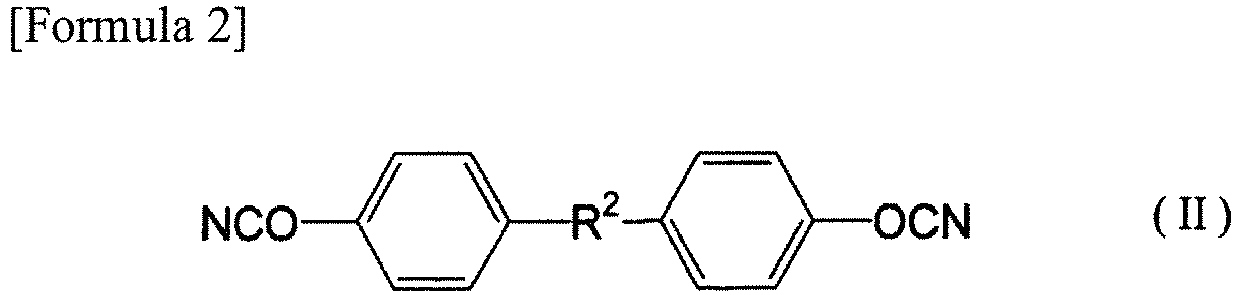
- the curable resin composition may further comprise at least one cyanate ester compound (C) selected from the group consisting of the following formula (II): wherein R 2 is any one selected from the group consisting of the following formulae (i) to (v): wherein each of R 3 and R 4 represents a hydrogen atom, or an alkyl group having 1 to 8 carbon atoms or a trifluoromethyl group; and n represents an integer of 4 to 7, the following formula (III): wherein R 5 represent hydrogen or a methyl group; n represents an integer of 1 to 50; and the cyanate ester compound (C) represented by the general formula (III) may be a mixture of compounds each having a different n, the following formula (IV): wherein R 6 to R 8 each independently represent a hydrogen atom, a hydrocarbon group having 1 to 6 carbon atoms, or a trifluoromethyl group; n represents an integer of 1 to 50; and the cyanate ester compound (C) represented by the general formula (III) represented by the
- the curable resin composition may further comprise one or more selected from the group consisting of an epoxy resin (D), a maleimide compound (E), a benzoxazine compound (F), and a compound (G) having a polymerizable unsaturated group.
- a method for manufacturing a cured product according to another aspect of the present invention is a method for manufacturing a cured product using the above curable resin composition, and comprises a step of heating the curable resin composition at a temperature of 160 to 300°C to cure the curable resin composition.
- the heating step may be performed in at least two steps.
- the second or later heating step may be conducted at a temperature higher than that in the first heating step.
- a sealing material in another aspect of the present invention, there are also provided a sealing material, an adhesive, and an insulating material which contain the above curable resin composition.
- a prepreg containing: a base material; and the above curable resin composition impregnated into or coated on the base material, and a laminated sheet obtained by stacking and laminate-molding at least one prepreg.
- a curable resin composition which is in a liquid form at ordinary temperature and provides a cured product having excellent heat resistance and a low thermal expansion rate can be provided by using the specific bifunctional cyanate ester compound and the curing accelerator in combination.
- a curable resin composition according to the present invention contains a specific cyanate ester compound (A) and a curing accelerator (B) as indispensable ingredients.
- A specific cyanate ester compound
- B curing accelerator
- the cyanate ester compound (A) contained in the curable resin composition according to the present invention is represented by the following formula (I): wherein R 1 represents a hydrocarbon group having 2 to 20 carbon atoms.
- Examples of the cyanate ester compound represented by the above formula (I) include 1,1-bis(4-cyanatophenyl)propane, 1,1-bis(4-cyanatophenyl)butane, 1,1-bis(4-cyanatophenyl)-2-methylpropane, 1,1-bis(4-cyanatophenyl)pentane, 1,1-bis(4-cyanatophenyl)-3-methylbutane, 1,1-bis(4-cyanatophenyl)-2-methylbutane, 1,1-bis(4-cyanatophenyl)isobutane, 1,1-bis(4-cyanatophenyl)hexane, 1,1-bis(4-cyanatophenyl)-4-methylpentane, 1,1-bis(4-cyanatophenyl)-3-methylpentane, 1,1-bis(4-cyanatophenyl)-2-methylpentane, 1,1-bis(4-cyanatophenyl
- R 1 in the above formula (I) is preferably an alkyl group having 2 to 5 carbon atoms.
- the cyanate ester compound represented by the above formula (I) include include 1,1-bis(4-cyanatophenyl)propane, 1,1-bis(4-cyanatophenyl)butane, 1,1-bis(4-cyanatophenyl)-2-methylpropane, 1,1-bis(4-cyanatophenyl)pentane, 1,1-bis(4-cyanatophenyl)-3-methylbutane, 1,1-bis(4-cyanatophenyl)-2-methylbutane, 1,1-bis(4-cyanatophenyl)isobutane, 1,1-bis(4-cyanatophenyl)-2,3-dimethylbutane, 1,1-bis(4-cyanatophenyl)
- R 1 is more preferably 1,1-bis(4-cyanatophenyl)propane, 1,1-bis(4-cyanatophenyl)butane, 1,1-bis(4-cyanatophenyl)-2-methylpropane, 1,1-bis(4-cyanatophenyl)pentane, 1,1-bis(4-cyanatophenyl)-3-methylbutane, 1,1-bis(4-cyanatophenyl)-2-methylbutane, 1,1-bis(4-cyanatophenyl)isobutane, 1,1-bis(4-cyanatophenyl)-2,3-dimethylbutane, 1,1-bis(4-cyanatophenyl)-3,3-dimethylbutane, and cyclopentylbis(4-cyanatophenyl)methane.
- 1,1-bis(4-cyanatophenyl)propane, 1,1-bis(4-cyanatophenyl)-2-methylpropane, and 1,1-bis(4-cyanatophenyl)isobutane in which R 1 of the above formula (I) is an ethyl group, an i-propyl group, or a tert-butyl group are clear non-crystalline liquids, and have little change in physical properties under a high temperature environment, which are particularly preferable.
- the coefficient of linear expansion of a cured product of the curable resin composition using the above three cyanate ester compounds and the curing accelerator (B) in combination is smaller under a high temperature than that of a resin composition containing a dicyanatophenyl-based difunctional cyanate ester obtained by substituting hydrogen in a methylene group (-CHR 1 -) with the other alkyl group or the like. Therefore, the curable resin composition can be suitably used for a resin for a liquid sealant having excellent heat resistance, and a resin for an insulating layer of a densified multilayer printed wiring board, or the like.
- the curable resin composition according to the present invention may further contain the other difunctional cyanate ester compound other than those described above.
- a method for producing the cyanate ester compound represented by the formula (I) is not particularly limited.
- a desired compound can be obtained by applying a method known as a cyanate synthesis method using a phenol represented by the following formula (VI). wherein R 1 is as defined in the above formula (I).
- the cyanate ester compound of the formula (I) can be obtained by cyanation of the phenol of the formula (V) according to a method described in IAN HAMERTON, "Chemistry and Technology of Cyanate Ester Resins” , BLACKIE ACADEMIC & PROFESSIONAL.
- the present invention can provide the cyanate ester compound by suitably using known methods such as a method in which a phenol compound is reacted with a cyanogen halide in a solvent in the presence of a base in such a state that the cyanogen halide is always present in excess over the base ( U.S. Pat. No.
- the curable resin composition according to the present invention contains a curing accelerator as an indispensable ingredient.
- the above specific cyanate ester compound (A) and the curing accelerator (B) are used in combination, and thereby a temperature when the curable resin composition is cured can be lowered; the deterioration in a storage elastic modulus of the cured product is further suppressed; the coefficient of linear expansion of the cured product is small under a high temperature; and curability having excellent heat resistance can be obtained.
- the curable resin composition according to the present invention can be suitably used as the resin for the insulating layer of the densified multilayer printed wiring board.
- any conventionally known curing accelerator may be used as the curing accelerator (B) without particular limitation.
- organometallic salts such as Cu, Fe, Co, Mn, Al, Ti, Zr, and Ni salts of octylic acid, stearic acid, naphthenic acid, acetylacetonate, and the like; alkoxides of metals such as Ti, Sn, Bi, Zr, and Al; phenol compounds such as octylphenol and nonylphenol; alcohols, such as 1-butanol and 2-ethylhexanol; imidazole derivatives such as 2-methylimidazole, 2-ethyl-4-methylimidazole, 2-phenylimidazole, 1-cyanoethyl-2-phenylimidazole, 1-cyanoethyl-2-ethyl-4-methylimidazole, 2-phenyl-4,5-dihydroxymethylimidazole, and 2-phenyl-4-methyl-5-
- a metal complex compound of cobalt, aluminium, copper, manganese, zirconium, or nickel can be suitably used.
- cobalt stearate copper acetylacetone (II), cobalt acetylacetone (II), cobalt acetylacetone (III), manganese acetylacetone (II), manganese acetylacetone (III), zirconium acetylacetone (IV), and nickel (II) acetylacetone.
- the above curing accelerator (B) is preferably contained in an amount of 0.01 to 1.0 parts by mass based on 100 parts by mass of the cyanate ester compound (A).
- the curing accelerator (B) is contained in this range, and thereby the deterioration in the storage elastic modulus of the cured product is further suppressed; the coefficient of linear expansion of the cured product is small under a high temperature; and the cured product having excellent heat resistance can be obtained.
- the content of the curing accelerator is more preferably 0.01 to 0.5 parts by mass.
- a cyanate ester compound (C) other than the above cyanate ester compound (A) may be contained in the curable resin composition according to the present invention.
- Examples of the cyanate ester compound (C) include cyanate ester compounds represented by the following formulae (II) to (V).
- R 2 is any one selected from the group consisting of the following formulae (i) to (v): wherein each of R 3 and R 4 represents a hydrogen atom, or an alkyl group having 1 to 8 carbon atoms or a trifluoromethyl group; and n represents an integer of 4 to 7, wherein R 5 represent hydrogen or a methyl group; n represents an integer of 1 to 50; and the cyanate ester compound (C) represented by the general formula (III) may be a mixture of compounds each having a different n, wherein R 6 to R 8 each independently represent a hydrogen atom, a hydrocarbon group having 1 to 6 carbon atoms, or a trifluoromethyl group; n represents an integer of 1 to 50, and the cyanate ester compound (C) represented by the general formula (IV) may be a mixture of compounds each having a different n, and wherein R 5 is as defined in the formula (III); n represents an integer of 1 to 50; and the cyanate ester compound (C) represented by the
- the cyanate ester compound represented by the formula (II) can be obtained by cyanation of a phenol represented by the following formula (VII) according to the same method as that of the above cyanate ester compound. wherein R 2 is the same as the above definition.
- the cyanate ester compound represented by the formula (III) can be obtained by cyanation of a phenol represented by the following formula (VIII) according to the same method as that of the above cyanate ester compound.
- R 5 and n are the same as the above definitions.
- the cyanate ester compound represented by the formula (IV) can be obtained by cyanation of a phenol represented by the general formula (IX) according to the same method as that of the above cyanate ester compound. wherein R 5 and n are as defined in the formula (III).
- the cyanate ester compound represented by the above formula (V) can be obtained by cyanation of a phenol represented by the following formula (X) according to the same method as that of the above cyanate ester compound.
- R 5 is as defined in the formula (III); n represents an integer of 1 to 50; and the cyanate ester compound may be a mixture of compounds each having a different n.
- any commonly known cyanate ester compound may be used as the cyanate ester compounds represented by the above formulae (II) to (V).
- Examples thereof include 2,2-bis(4-cyanatophenyl)propane, 2,2-bis(4-cyanatophenyl)butane, 2,2-bis(4-cyanatophenyl)pentane, 2,2-bis(4-cyanatophenyl)hexane, 2,2-bis(4-cyanatophenyl)-3-methylbutane, 2,2-bis(4-cyanatophenyl)-4-methylpentane, 2,2-bis(4-cyanatophenyl)-3-methylpentane, 2,2-bis(4-cyanatophenyl)-3,3-dimethylbutane, 3,3-bis(4-cyanatophenyl)hexane, 3,3-bis(4-cyanatophenyl)heptane, 3,3-bis(4-cyanatophenyl)octane, 3,
- Resins and compounds other than the cyanate ester compound may be contained in the curable resin composition according to the present invention.
- examples thereof include an epoxy resin (D), a maleimide compound (E), a benzoxazine compound (F), and a compound (G) having a polymerizable unsaturated group.
- any commonly known compound having two or more epoxy groups per molecule may be used as the epoxy resin (D) contained as an optional ingredient in the curable resin composition.
- examples thereof include a bisphenol A-based epoxy resin, a bisphenol F-based epoxy resin, a phenol novolac-based epoxy resin, a cresol novolac-based epoxy resin, a bisphenol A novolac-based epoxy resin, a brominated bisphenol A-based epoxy resin, a brominated phenol novolac-based epoxy resin, a trifunctional phenol-based epoxy resin, a tetrafunctional phenol-based epoxy resin, a naphthalene-based epoxy resin, a biphenyl-based epoxy resin, a phenol aralkyl-based epoxy resin, a biphenyl aralkyl-based epoxy resin, a naphthol aralkyl-based epoxy resin, an alicyclic epoxy resin, a polyol-based epoxy resin, a phosphorus-containing epoxy resin, glycidyl
- the bisphenol A-based epoxy resin there are preferred the bisphenol A-based epoxy resin, the bisphenol F-based epoxy resin, the phenol novolac-based epoxy resin, the cresol novolac-based epoxy resin, the brominated bisphenol A-based epoxy resin, the brominated phenol novolac-based epoxy resin, the naphthalene-based epoxy resin, the biphenyl-based epoxy resin, the phenol aralkyl-based epoxy resin, the biphenyl aralkyl-based epoxy resin, the naphthol aralkyl-based epoxy resin, the alicyclic epoxy resin, the polyol-based epoxy resin, the phosphorus-containing epoxy resin, the glycidyl amine, and the glycidyl ester or the like.
- the bisphenol A-based epoxy resin there are more preferred the bisphenol A-based epoxy resin, the bisphenol F-based epoxy resin, the naphthalene-based epoxy resin, the biphenyl-based epoxy resin, the phenol aralkyl-based epoxy resin, the biphenyl aralkyl-based epoxy resin, the naphthol aralkyl-based epoxy resin, and the alicyclic epoxy resin or the like.
- These epoxy resins can be used alone or in the form of a mixture of two or more.
- a compound represented by the following formula (XI) may be suitably used as the maleimide compound (E) contained as an optional ingredient in the curable resin composition.
- R 9 and R 10 each independently represent a hydrogen atom, a halogen atom, and an alkyl group having 1 to 3 carbon atoms; e and f each represent an integer of 1 to 4; and M represents a single bond, or an alkylene group having 1 to 5 carbon atoms, an alkylidene group or an arylene group having 6 to 14 carbon atoms.
- maleimide compound represented by the above formula (XI) bis(4-maleimidephenyl)methane, 2,2-bis[(4-(4-maleimidephenoxy)phenyl)]propane, bis(3,5-dimethyl-4-maleimidephenyl)methane, bis(3-ethyl-5-methyl-4-maleimidephenyl)methane, and bis(3,5-diethyl-4-maleimidephenyl)methane are preferable.
- Examples of the maleimide compound (D) include prepolymers of the above maleimide compounds, or a prepolymer of one of the maleimide compounds and an amine compound. These compounds and prepolymers can be used alone or in the form of a mixture of two or more as required.
- a commonly known benzoxazine compound having two or more dihydrobenzoxazine rings per molecule may be used as the benzoxazine compound (F) contained as an optional ingredient in the curable resin composition.
- examples thereof include a benzoxazine compound described in Japanese Patent Laid-Open No. 2009-096874 .
- These benzoxazine compounds can be used alone or in the form of a mixture of two or more.
- polymerizable unsaturated group-containing compound may be used as the polymerizable unsaturated group-containing compound (G) contained as an optional ingredient in the curable resin composition.
- examples thereof include vinyl compounds such as ethylene, propylene, styrene, divinylbenzene, and divinylbiphenyl; (meth)acrylates of mono- or polyhydric alcohols such as methyl(meth)acrylate, 2-hydroxyethyl(meth)acrylate, 2-hydroxypropyl(meth)acrylate, polypropylene glycol di(meth)acrylate, trimethylolpropane di(meth)acrylate, trimethylolpropane tri(meth)acrylate, pentaerythritol tetra(meth)acrylate, and dipentaerythritol hexa(meth)acrylate; epoxy(meth)acrylates such as bisphenol A-based epoxy(meth)acrylate and bisphenol F-based epoxy(meth)acrylate; and
- the above ingredients (C) to (G) can be properly added depending upon applications.
- 0 to 100 parts by mass of the cyanate ester compound (C), 0 to 500 parts by mass of the epoxy resin (D), 0 to 100 parts by mass of the maleimide compound (E), 0 to 100 parts by mass of the benzoxazine compound (F), and 0 to 100 parts by mass of the compound (G) having a polymerizable unsaturated group are preferably contained based on 100 parts by mass of the cyanate ester compound (A).
- the curable resin composition contains the compounds and the resins at the above ratios, and thereby the coefficient of linear expansion of the cured product is smaller under a high temperature, and the curable resin composition having excellent heat resistance can be obtained.
- the curable resin composition according to the present invention may further contain an inorganic filler in addition to the above compounds and resins.
- the inorganic filler include silicates such as talc, calcined clay, uncalcined clay, mica, and glass; oxides such as titanium oxide, alumina, silica, and fused silica; carbonates such as calcium carbonate, magnesium carbonate, and hydrotalcite; hydroxides such as aluminum hydroxide, magnesium hydroxide, and calcium hydroxide; sulfates or sulfites such as barium sulfate, calcium sulfate, and calcium sulfite; borates such as zinc borate, barium metaborate, aluminum borate, calcium borate, and sodium borate; nitrides such as aluminum nitride, boron nitride, silicon nitride, and carbon nitride; and titanates such as strontium titanate and barium titanate.
- silicates such as talc,
- the silica is particularly preferable, and the fused silica is preferable in respect of an excellent low thermal expansibility. Although crushed and spherical silicas exist, the spherical silica is preferable in respect of lowering the melt viscosity of the resin composition.
- the spherical silica may be further processed by a processing agent for previously performing a surface treatment.
- a processing agent for previously performing a surface treatment.
- At least one compound selected from the group consisting of functional group-containing silanes, cyclic oligosiloxanes, organohalosilanes, and alkylsilazanes may be suitably used as the processing agent.
- the organohalosilanes and the alkylsilazanes are suitably used for the surface treatment of the spherical silica in order to make the surface of the silica hydrophobic and make the spherical silica in the curable resin composition preferable in respect of excellent dispersibility.
- the functional group-containing silanes used as the processing agent are not particularly limited. Examples thereof include epoxysilane compounds such as 3-glycidoxypropyltrimetoxysilane, 3-glycidoxypropyltriethoxysilane, 3-glycidoxypropylmethyldiethoxysilane, and 2-(3,4-epoxycyclohexyl)ethyldimethoxysilane; (meth)acrylsilanes such as 3-methacryloxypropyltrimethoxysilane, 3-methacryloxypropylmethyldimethoxysilane, 3-methacryloxypropyltriethoxysilane, and 3-methacryloxypropylmethyldiethoxysilane; mercaptosilanes such as 3-mercaptopropyltrimethoxysilane, 3-mercaptopropyltriethoxysilane, and 3-mercaptopropylmethyldimethoxysilane; vinylsilanes such as vinyltriethoxysilane, vinyl
- a silicone resin powder may be added to the curable resin composition.
- the silicone resin powder is a cured product powder having a structure in which siloxane bonds are crosslinked in a three-dimensional network manner represented by (RSiO 3/2 ) n .
- the powder suitably has an average particle diameter of 0.1 to 10 ⁇ m.
- KMP-590 manufactured by Shin-Etsu Silicone
- KMP-701 manufactured by Shin-Etsu Silicone
- X-52-854 manufactured by Shin-Etsu Silicone
- X-52-1621 manufactured by Shin-Etsu Silicone
- XC99-B5664 manufactured by Momentive Performance Materials Inc.
- XC99-A8808 manufactured by Momentive Performance Materials Inc.
- Tospearl 120 manufactured by Momentive Performance Materials Inc.
- the powders can be used alone or in the form of a mixture of two or more as required.
- the curable resin composition according to the present invention can be obtained by mixing the above cyanate ester compound (A) and curing accelerator (B), and the cyanate ester compound (C), the epoxy resin (D), the maleimide compound (E), and the benzoxazine compound (F) and/or the polymerizable unsaturated group-containing compound (G), which are optional ingredients described above, or various additives if needed, with a solvent using known mixers such as a high-speed mixer, a Nauta mixer, a ribbon type blender, a kneader, an intensive mixer, a universal mixer, a dissolver, and a static mixer.
- a method for adding the cyanate ester compound, the various additives, and the solvent upon mixing is not particularly limited.
- a cured product according to the present invention can be obtained by curing the curable resin composition described above by heat and light or the like.
- an arbitrary-shaped cured product can be obtained by melting the curable resin composition or dissolving the curable resin composition in a solvent, thereafter filling the curable resin composition into a mold, and curing the curable resin composition under an ordinary condition.
- the curable resin composition When the curable resin composition is cured by heat, the curable resin composition is preferably cured at 160 to 300°C, more preferably at 170 to 250°C, and still more preferably at 180 to 230°C. Heat curing is performed in the above temperature range, and thereby the deterioration in the storage elastic modulus of the cured product is further suppressed; the coefficient of linear expansion of the cured product is small under a high temperature; and the cured product having excellent heat resistance can be obtained.
- a heating step may be conducted for a certain period of time in the above temperature range.
- the curable resin composition may be cured by so-called "step curing" performing a step of holding the curable resin composition at a certain heating temperature for a certain period of time twice or more.
- the second or later heating step is preferably conducted at a temperature higher than that in the first heating step.
- the first heating step can be conducted at 80 to 150°C
- the second or later heating step can be conducted at 150 to 300°C.
- Such a heating step is conducted, and thereby the deterioration in the storage elastic modulus of the cured product is further suppressed; the coefficient of linear expansion of the cured product is small under a high temperature; and the cured product having excellent heat resistance can be obtained.
- a sealing material can be manufactured using the above curable resin composition.
- a method for manufacturing the sealing material is not in particularly limited.
- the sealing material can be obtained by mixing the above ingredients using a known mixer.
- a method for adding the cyanate ester compound (A), the curing accelerator (B), the other optional ingredient, and a solvent or the like during mixing is not particularly limited.
- An inorganic and/or organic fiber base material prepregs/prepreg can be manufactured using the curable resin composition according to the present invention.
- a method for manufacturing the prepreg is not particularly limited.
- a well-known method used for a printed wiring material can be applied.
- a method for impregnating a resin composition varnish into an inorganic fiber base material and/or an organic fiber base material, drying the inorganic fiber base material and/or the organic fiber base material, and putting the inorganic fiber base material and/or the organic fiber base material into a B stage to form the prepreg can be applied.
- the curable resin composition according to the present invention may be used to produce a metal-clad laminated sheet and a multilayer sheet.
- a method for producing the laminated sheets or the like is not particularly limited.
- the laminated sheet can be obtained by subjecting the above prepreg and a metal foil to heating pressure molding with the prepreg and the metal foil superposed.
- a heating temperature is not particularly limited, the heating temperature is preferably 65 to 300°C, and particularly preferably 120 to 270°C.
- a pressurizing pressure is not particularly limited, the pressurizing pressure is preferably 2 to 5 MPa, and more preferably 2.5 to 4 MPa.
- a fiber-reinforced composite material can be produced using the curable resin composition according to the present invention.
- the form and arrangement of the reinforced fiber are not particularly limited, and may be suitably selected from a textile, a nonwoven fabric, a mat, a knit, a braid, a unidirectional strand, a roving, and a chopped strand or the like.
- a preform one obtained by laminating woven base fabrics containing reinforced fibers, one obtained by integrally stitching the woven base fabrics by stitch threads, or a fiber structure such as a three-dimensional textile or a braided product
- a method for producing the fiber-reinforced composite material include liquid composite molding methods, resin film infusion methods, filament winding methods, hand lay up methods, and pultrusion methods.
- materials other than the preform such as a metal plate, a foam core, and a honeycomb core can be previously set in a forming die.
- the resin transfer molding method can be adopted in various applications, and is preferably used when a composite material having a comparatively complicated shape is mass-produced in a short time.
- the curable resin composition according to the present invention has an excellent low thermal expansibility and high heat resistance, the curable resin composition is extremely useful as a highly-functional polymer material.
- the curable resin composition is preferably used for electrical insulating materials, sealing materials, adhesives, lamination materials, resists, and built-up laminated sheet materials as materials having excellent thermal, electrical, and mechanical properties. Additionally, the curable resin composition is preferably used for fixing materials, structural members, reinforcing agents, and mold materials or the like in the fields of civil engineering-construction, electric/electronic applications, automobiles, railways, ships, aircraft, sporting goods, and arts-crafts or the like. Among them, the curable resin composition is suitably used for semiconductor sealing materials or adhesives for electronic parts, aircraft structural members, satellite structural members, and railway vehicle structural members which require a low thermal expansibility, flame resistance, and a high mechanical strength.
- Synthesis Example 1 Synthesis of 1,1-bis(4-cyanatophenyl)isobutane (abbreviated as Bis-IB CN)
- the composition obtained as described above was reheated.
- the composition was cast into a mold formed of a glass plate (120 mm x 120 mm x 5 mm), a polyimide film ("Kapton 200H” manufactured by DU PONT-TORAY CO., LTD.), and a fluoro rubber-made O ring ("S-100" manufactured by Morisei Kako Corporation).
- the composition was heated in an oven at 150°C for 1 hour, then heated at 200°C for 3 hours, and then heated at 250°C for 4 hours to cure the composition. After cooled, the polyimide film was removed by grinding, thereby obtaining a cured product.
- a cured product was obtained in the same manner as in Example 1 except that the curing condition was changed to step curing at 130°C for 3 hours and at 250°C for 4 hours in Example 1.
- a cured product was obtained in the same manner as in Example 1 except that the amount of cobalt(III) acetylacetonate to be blended was changed from 0.01 parts by mass to 0.5 parts by mass in Example 1.
- a cured product was obtained in the same manner as in Example 1 except that 0.02 parts by mass of aluminium (III) acetylacetonate (manufactured by Tokyo Chemical Industry Co., Ltd.) was used in place of using 0.01 parts by mass of cobalt(III) acetylacetonate in Example 1.
- a cured product was obtained in the same manner as in Example 4 except that copper(II) acetylacetonate (manufactured by Tokyo Chemical Industry Co., Ltd.) was used in place of aluminium(III) acetylacetonate in Example 4.
- a cured product was obtained in the same manner as in Example 1 except that 0.06 parts by mass of manganese(II) acetylacetonate (manufactured by Tokyo Chemical Industry Co., Ltd.) was used in place of using 0.01 parts by mass of cobalt(III) acetylacetonate in Example 1.
- a cured product was obtained in the same manner as in Example 6 except that zirconium(IV) acetylacetonate (manufactured by Tokyo Chemical Industry Co., Ltd.) was used in place of manganese(II) acetylacetonate in Example 6.
- a cured product was obtained in the same manner as in Example 6 except that nickel(II) acetylacetonate (manufactured by Tokyo Chemical Industry Co., Ltd.) was used in place of manganese(II) acetylacetonate in Example 6, and the curing condition was changed to step curing at 180°C for 3 hours and at 250°C for 4 hours.
- nickel(II) acetylacetonate manufactured by Tokyo Chemical Industry Co., Ltd.
- a cured product was obtained in the same manner as in Example 1 except that cobalt(III) acetylacetonate was not used in Example 1.
- a cured product was obtained in the same manner as in Example 9 except that 100 parts by mass of Bis-E CN obtained in Synthetic Example 2 was used in place of using 100 parts by mass of Bis-IB CN in Example 9.
- a cured product was obtained in the same manner as in Example 1 except that Bis-E CN obtained in Synthetic Example 2 was used in place of Bis-IB CN in Example 1, and the amount of cobalt(III) acetylacetonate to be blended was changed from 0.01 parts by mass to 0.02 parts by mass.
- a cured product was obtained in the same manner as in Example 11 except that 0.06 parts by mass of aluminium(III) acetylacetonate (manufactured by Tokyo Chemical Industry Co., Ltd.) was used in place of using 0.02 parts by mass of cobalt(III) acetylacetonate in Example 11.
- a cured product was obtained in the same manner as in Example 12 except that manganese(II) acetylacetonate was used in place of aluminium(III) acetylacetonate in Example 12.
- a cured product was obtained in the same manner as in Example 11 except that 2,2-bis(4-cyanatophenyl)propane (manufactured by Mitsubishi Gas Chemical Co., Inc., abbreviated as Bis-A CN) was used in place of Bis-E CN in Example 11.
- Bis-A CN 2,2-bis(4-cyanatophenyl)propane
- a cured product was obtained in the same manner as in Example 12 except that 2,2-bis(4-cyanatophenyl)propane (manufactured by Mitsubishi Gas Chemical Co., Inc., abbreviated as Bis-A CN) was used in place of Bis-E CN in Example 12.
- Bis-A CN 2,2-bis(4-cyanatophenyl)propane
- a cured product was obtained in the same manner as in Example 14 except that copper(II) acetylacetonate was used in place of cobalt(III) acetylacetonate in Example 14, and the curing condition was changed to step curing at 180°C for 3 hours and at 250°C for 4 hours.
- a cured product was obtained in the same manner as in Example 14 except that manganese(II) acetylacetonate was used in place of cobalt(III) acetylacetonate in Example 14, and the curing condition was changed to step curing at 180°C for 3 hours and at 250°C for 4 hours.
- a cured product was obtained in the same manner as in Example 15 except that zirconium(IV) acetylacetonate was used in place of aluminium(III) acetylacetonate in Example 15.
- a change in a storage elastic modulus, a glass transition temperature, and a coefficient of linear expansion were measured for the cured products obtained as described above.
- the change in the storage elastic modulus and the glass transition temperature were measured in accordance with JIS-K7244-7-2007.
- Dynamic viscoelasticity measurement was conducted using a dynamic viscoelasticity measuring device (AR2000 manufactured by TA Instruments) on measurement conditions of a start temperature of 100°C, an end temperature of 350°C, a temperature increase rate of 3°C/min, and a measurement frequency of 1 Hz, to measure the change in the storage elastic modulus (G') and the glass transition temperature.
- the change in the storage elastic modulus and the glass transition temperature were defined as follows.
- the change in the storage elastic modulus was evaluated using a value obtained by dividing the storage elastic modulus at 350°C by the storage elastic modulus at 100°C.
- the obtained change in the storage elastic modulus was index-represented with the numerical value of Example 9 set to 100.
- the maximum value of loss tangent (tan ⁇ ) in the measurement temperature range was defined as the glass transition temperature.
- the coefficient of linear expansion was measured in accordance with JIS-K-7197-1991.
- a test piece (5 mm x 5 mm x 5 mm) was set in a thermomechanical analyzer (TMA/SS7100 manufactured by SII NanoTechnology Inc.). Thermomechanical analysis was conducted in an expansion/compression mode on measurement conditions of a start temperature of 100°C, an end temperature of 300°C, a temperature increase rate of 5°C/min, and a load of 0.05 N, to measure an average thermal expansion amount per °C at 200°C to 300°C.
- the results of evaluation were as shown in Tables 1 and 2 below.
- the units of numerical values in Tables are represented by part by mass, and portions described as "-" mean that the relevant materials are not blended.
Landscapes
- Chemical & Material Sciences (AREA)
- Chemical Kinetics & Catalysis (AREA)
- Organic Chemistry (AREA)
- Health & Medical Sciences (AREA)
- Medicinal Chemistry (AREA)
- Polymers & Plastics (AREA)
- Engineering & Computer Science (AREA)
- Materials Engineering (AREA)
- Life Sciences & Earth Sciences (AREA)
- Wood Science & Technology (AREA)
- Manufacturing & Machinery (AREA)
- Physics & Mathematics (AREA)
- Spectroscopy & Molecular Physics (AREA)
- Macromolecular Compounds Obtained By Forming Nitrogen-Containing Linkages In General (AREA)
- Adhesives Or Adhesive Processes (AREA)
- Structures Or Materials For Encapsulating Or Coating Semiconductor Devices Or Solid State Devices (AREA)
- Organic Insulating Materials (AREA)
- Reinforced Plastic Materials (AREA)
- Laminated Bodies (AREA)
- Heating, Cooling, Or Curing Plastics Or The Like In General (AREA)
- Sealing Material Composition (AREA)
Abstract

Description
- The present invention relates to a curable resin composition containing a cyanate ester compound, and a method for manufacturing a cured product using the same. In particular, the present invention relates to a curable resin composition which is in a liquid form at ordinary temperature and provides a cured product having excellent heat resistance and a low thermal expansion rate, and a method for manufacturing a cured product using the same.
- In recent years, there have been many electronic devices featured by keywords of light, thin, short, and compact, such as a mobile phone, an ultraslim liquid crystal TV and a plasma TV, and a lightweight laptop computer in the field of a semiconductor-related material. Therefore, very high properties have been required for a package material. Particularly, a tip package has a complicated structure, which increases the number of elements hardly sealed by sealing other than liquid sealing. For example, it is necessary to partially seal an element having a cavity-down type structure such as EBGA. Transfer molding cannot deal with the element. For such a reason, development of a highly-functional liquid curable resin material as a sealant has been required.
- In case of the liquid sealant, because of the difficulty of highly filling of a filler and raising of Tg (glass transition temperature) of a matrix resin itself unlike a powder sealant, the coefficient of thermal expansion of the sealant tends to be increased. Therefore, the liquid sealant has solder heat resistance and heat shock resistance inferior to those of the powder sealant subjected to transfer molding. As a result, a crack in a resin or a chip is more likely to be generated by a stress generated by the difference between the coefficient of thermal expansion of the liquid sealant and the coefficient of thermal expansion of a chip, which disadvantageously decreases the reliability of a semiconductor device. Therefore, a resin for a liquid sealant, which has high Tg and a low coefficient of thermal expansion, has been required.
- Epoxy resin compositions containing a bisphenol A-based epoxy resin or an alicyclic epoxy resin or the like as a main ingredient, a liquid acid anhydride or phenol novolac as a curing agent, and an additive such as an inorganic filler are proposed as liquid sealing resin compositions for sealing a semiconductor element (for example, see Patent Literatures 1, 2, and 3). However, the resin compositions containing the bisphenol A-based epoxy resin or the alicyclic epoxy resin or the like as the main ingredient have low Tg and a large coefficient of thermal expansion in a high temperature range. These resin compositions also have a large dielectric constant and dielectric loss in a high-frequency region, which do not necessarily satisfy the requirements of miniaturization, high density, and speeding up of the semiconductor device.
- On the other hand, a cyanate ester resin has been known through the ages as a thermosetting resin having excellent heat resistance, a low dielectric constant, and low dielectric loss. Particularly, a resin composition using a bisphenol A-based cyanate ester resin and a bismaleimide compound in combination, as proposed in Patent Literature 4, is referred to as a "BT resin". Since the BT resin has an excellent electrical property, mechanical property, and chemical resistance or the like, and is suitable as a sealing material for a semiconductor element. However, because the bisphenol A-based cyanate ester is a crystalline compound having a melting point of 80°C, the bisphenol A-based cyanate ester cannot be used as it is as a liquid sealing material, and it is necessary to use the bisphenol A-based cyanate ester and the other ingredient being in liquid form at ordinary temperature in combination. However, the combination use of the other ingredient provides the influence of the added ingredient to the bisphenol A-based cyanate ester, and decreases the degree of freedom of blending of the composition, which may hinder functional improvement.
- For example, Patent Literature 5 discloses a resin composition using a triphenylmethane-based cyanate ester compound to improve thermal expansibility. However, the triphenylmethane-based cyanate ester compound is a solid at ordinary temperature, and is insufficient as the liquid sealing material. Furthermore, Patent Literature 6 discloses that a difunctional cyanatophenyl-based cyanate ester compound in which two cyanatophenyl groups are bonded via an asymmetric alkylene group has a low viscosity and noncrystallinity, and a resin cured product using the compound has an excellent heat deformation temperature and bending strength. Examples thereof include bis(4-cyanatophenyl)-2,2-propane, bis(4-cyanatophenyl)-1,1-ethane, and bis(4-cyanatophenyl)-2,2-butane. However, because the above compounds have a heat deformation temperature, regarded as an index of heat resistance, of about 200 to 250°C, the above compounds have insufficient heat resistance as the liquid sealant.
-
- Patent Literature 1: Japanese Patent Laid-Open No.
2002-241469 - Patent Literature 2: Japanese Patent Laid-Open No.
2003-160639 - Patent Literature 3: Japanese Patent Laid-Open No.
2007-5750 - Patent Literature 4: Japanese Patent Laid-Open No.
H7-70315 - Patent Literature 5: Japanese Patent Laid-Open No.
2006-169317 - Patent Literature 6: Japanese Patent Laid-Open No.
S63-150257 - Recently, the present inventors found that a curable resin composition using a specific bifunctional cyanate ester compound and a curing accelerator in combination is in a liquid form at ordinary temperature, and a cured product thereof has excellent heat resistance and a low thermal expansion rate. The present invention is based on these findings.
- Therefore, it is an object of the present invention to provide a curable resin composition which is in a liquid form at ordinary temperature and provides a cured product having excellent heat resistance and a low thermal expansion rate.
- It is another object of the present invention to provide a method for manufacturing a cured product using the above curable resin composition.
- A curable resin composition according to the present invention comprises:
- a cyanate ester compound (A) represented by the following formula (I); and
- a curing accelerator (B):

- In an embodiment of the present invention, R1 may be an alkyl group having 2 to 5 carbon atoms.
- In an embodiment of the present invention, R1 may be selected from the group consisting of an ethyl group, an i-propyl group, and a tert-butyl group.
- In an embodiment of the present invention, the curing accelerator (B) may be a metal complex compound.
- In an embodiment of the present invention, the metal complex compound may be a complex compound of a metal selected from the group consisting of cobalt, aluminium, copper, manganese, zirconium, and nickel.
- In an embodiment of the present invention, the curing accelerator (B) may be contained in an amount of 0.01 to 1.0 parts by mass based on 100 parts by mass of the cyanate ester compound (A).
- In an embodiment of the present invention, the curable resin composition may further comprise at least one cyanate ester compound (C) selected from the group consisting of the following formula (II):

the following formula (III):
the following formula (IV):
the following formula (V):
- In an embodiment of the present invention, the curable resin composition may further comprise one or more selected from the group consisting of an epoxy resin (D), a maleimide compound (E), a benzoxazine compound (F), and a compound (G) having a polymerizable unsaturated group.
- A method for manufacturing a cured product according to another aspect of the present invention is a method for manufacturing a cured product using the above curable resin composition, and comprises a step of heating the curable resin composition at a temperature of 160 to 300°C to cure the curable resin composition.
- In an embodiment of the present invention, the heating step may be performed in at least two steps.
- In an embodiment of the present invention, the second or later heating step may be conducted at a temperature higher than that in the first heating step.
- In another aspect of the present invention, there is also provided a cured product obtained by the above method.
- In another aspect of the present invention, there are also provided a sealing material, an adhesive, and an insulating material which contain the above curable resin composition.
- In another aspect of the present invention, there are also provided a prepreg containing: a base material; and the above curable resin composition impregnated into or coated on the base material, and a laminated sheet obtained by stacking and laminate-molding at least one prepreg.
- According to the present invention, a curable resin composition which is in a liquid form at ordinary temperature and provides a cured product having excellent heat resistance and a low thermal expansion rate can be provided by using the specific bifunctional cyanate ester compound and the curing accelerator in combination.
-
- [
Figure 1] Figure 1 shows a 1H-NMR chart of 1,1-bis(4-cyanatophenyl) isobutane obtained in Synthesis Example 1. - [
Figure 2] Figure 2 shows a 1H-NMR chart of 1,1-bis(4-cyanatophenyl) ethane obtained in Synthesis Example 2. - A curable resin composition according to the present invention contains a specific cyanate ester compound (A) and a curing accelerator (B) as indispensable ingredients. Hereinafter, individual ingredients will be described.
- The cyanate ester compound (A) contained in the curable resin composition according to the present invention is represented by the following formula (I):

- Examples of the cyanate ester compound represented by the above formula (I) include 1,1-bis(4-cyanatophenyl)propane, 1,1-bis(4-cyanatophenyl)butane, 1,1-bis(4-cyanatophenyl)-2-methylpropane, 1,1-bis(4-cyanatophenyl)pentane, 1,1-bis(4-cyanatophenyl)-3-methylbutane, 1,1-bis(4-cyanatophenyl)-2-methylbutane, 1,1-bis(4-cyanatophenyl)isobutane, 1,1-bis(4-cyanatophenyl)hexane, 1,1-bis(4-cyanatophenyl)-4-methylpentane, 1,1-bis(4-cyanatophenyl)-3-methylpentane, 1,1-bis(4-cyanatophenyl)-2-methylpentane, 1,1-bis(4-cyanatophenyl)-2,3-dimethylbutane, 1,1-bis(4-cyanatophenyl)-3,3-dimethylbutane, bis(4-cyanatophenyl)cyclopentylmethane, bis(4-cyanatophenyl)cyclohexylmethane, bis(4-cyanatophenyl)phenylmethane, 1,1-bis(4-cyanatophenyl)heptane, 1,1-bis(4-cyanatophenyl)-2-methylhexane, 1,1-bis(4-cyanatophenyl)-3-methylhexane, 1,1-bis(4-cyanatophenyl)-4-methylhexane, 1,1-bis(4-cyanatophenyl)-5-methylhexane, 1,1-bis(4-cyanatophenyl)-3,4-dimethylpentane, 1,1-bis(4-cyanatophenyl)-2,3-dimethylpentane, 1,1-bis(4-cyanatophenyl)-3-ethylpentane, 1,1-bis(4-cyanatophenyl)-2-ethylpentane, bis(4-cyanatophenyl)-1-naphthylmethane, and 1,1-bis(4-cyanatophenyl)-2-phenylmethylhexane.
- Among the above cyanate ester compounds, from the viewpoint of the viscosity, heat resistance, and coefficient of linear expansion of the resin composition, R1 in the above formula (I) is preferably an alkyl group having 2 to 5 carbon atoms. Examples of the cyanate ester compound represented by the above formula (I) include include 1,1-bis(4-cyanatophenyl)propane, 1,1-bis(4-cyanatophenyl)butane, 1,1-bis(4-cyanatophenyl)-2-methylpropane, 1,1-bis(4-cyanatophenyl)pentane, 1,1-bis(4-cyanatophenyl)-3-methylbutane, 1,1-bis(4-cyanatophenyl)-2-methylbutane, 1,1-bis(4-cyanatophenyl)isobutane, 1,1-bis(4-cyanatophenyl)-2,3-dimethylbutane, 1,1-bis(4-cyanatophenyl)-3,3-dimethylbutane, cyclopentylbis(4-cyanatophenyl)methane, cyclohexylbis(4-cyanatophenyl)methane, and bis(4-cyanatophenyl)phenylmethane. R1 is more preferably 1,1-bis(4-cyanatophenyl)propane, 1,1-bis(4-cyanatophenyl)butane, 1,1-bis(4-cyanatophenyl)-2-methylpropane, 1,1-bis(4-cyanatophenyl)pentane, 1,1-bis(4-cyanatophenyl)-3-methylbutane, 1,1-bis(4-cyanatophenyl)-2-methylbutane, 1,1-bis(4-cyanatophenyl)isobutane, 1,1-bis(4-cyanatophenyl)-2,3-dimethylbutane, 1,1-bis(4-cyanatophenyl)-3,3-dimethylbutane, and cyclopentylbis(4-cyanatophenyl)methane.
- Above all, 1,1-bis(4-cyanatophenyl)propane, 1,1-bis(4-cyanatophenyl)-2-methylpropane, and 1,1-bis(4-cyanatophenyl)isobutane in which R1 of the above formula (I) is an ethyl group, an i-propyl group, or a tert-butyl group are clear non-crystalline liquids, and have little change in physical properties under a high temperature environment, which are particularly preferable. The coefficient of linear expansion of a cured product of the curable resin composition using the above three cyanate ester compounds and the curing accelerator (B) in combination is smaller under a high temperature than that of a resin composition containing a dicyanatophenyl-based difunctional cyanate ester obtained by substituting hydrogen in a methylene group (-CHR1-) with the other alkyl group or the like. Therefore, the curable resin composition can be suitably used for a resin for a liquid sealant having excellent heat resistance, and a resin for an insulating layer of a densified multilayer printed wiring board, or the like. Of course, needless to say, the curable resin composition according to the present invention may further contain the other difunctional cyanate ester compound other than those described above.
- A method for producing the cyanate ester compound represented by the formula (I) is not particularly limited. A desired compound can be obtained by applying a method known as a cyanate synthesis method using a phenol represented by the following formula (VI).

- For example, the cyanate ester compound of the formula (I) can be obtained by cyanation of the phenol of the formula (V) according to a method described in IAN HAMERTON, "Chemistry and Technology of Cyanate Ester Resins" , BLACKIE ACADEMIC & PROFESSIONAL. The present invention can provide the cyanate ester compound by suitably using known methods such as a method in which a phenol compound is reacted with a cyanogen halide in a solvent in the presence of a base in such a state that the cyanogen halide is always present in excess over the base (
U.S. Pat. No. 3,553,244 ); a method in which a cyanate ester compound is synthesized using a tertiary amine as a base in excess over a cyanogen halide (Japanese Patent Laid-Open No.H7-53497 2000-501138 ); a method in which a phenol is reacted with a cyanogen halide in an nonaqueous solution in the presence of a tert-amine and a tert-ammonium halide produced as a by-product in this reaction is treated with an cation/anion exchange pair (National Publication of International Patent Application No.2001-504835 2991054 2007-277102 - The curable resin composition according to the present invention contains a curing accelerator as an indispensable ingredient. The above specific cyanate ester compound (A) and the curing accelerator (B) are used in combination, and thereby a temperature when the curable resin composition is cured can be lowered; the deterioration in a storage elastic modulus of the cured product is further suppressed; the coefficient of linear expansion of the cured product is small under a high temperature; and curability having excellent heat resistance can be obtained. Above all, because the coefficient of linear expansion of the cured product under a high temperature can be reduced as compared with the case where the curing accelerator (B) is not contained, the curable resin composition according to the present invention can be suitably used as the resin for the insulating layer of the densified multilayer printed wiring board.
- Any conventionally known curing accelerator may be used as the curing accelerator (B) without particular limitation. For example, there can be used organometallic salts such as Cu, Fe, Co, Mn, Al, Ti, Zr, and Ni salts of octylic acid, stearic acid, naphthenic acid, acetylacetonate, and the like; alkoxides of metals such as Ti, Sn, Bi, Zr, and Al; phenol compounds such as octylphenol and nonylphenol; alcohols, such as 1-butanol and 2-ethylhexanol; imidazole derivatives such as 2-methylimidazole, 2-ethyl-4-methylimidazole, 2-phenylimidazole, 1-cyanoethyl-2-phenylimidazole, 1-cyanoethyl-2-ethyl-4-methylimidazole, 2-phenyl-4,5-dihydroxymethylimidazole, and 2-phenyl-4-methyl-5-hydroxymethylimidazole; amine compounds such as dicyandiamide, benzyldimethylamine, and 4-methyl-N,N-dimethylbenzylamine; and a phosphine-based or phosphonium-based phosphorus compound, or the like.
- Among the above curing accelerators, from the viewpoint of the coefficient of linear expansion, a metal complex compound of cobalt, aluminium, copper, manganese, zirconium, or nickel can be suitably used. For example, there can be suitably used copper octoate, cobalt octoate, aluminum octoate, manganese octoate, copper stearate, cobalt stearate, aluminium stearate, copper naphthenate, cobalt naphthenate, aluminum naphthenate, manganese naphthenate, copper acetylacetone (II), cobalt acetylacetone (II), cobalt acetylacetone (III), iron acetylacetone (III), manganese acetylacetone (II), manganese acetylacetone (III), aluminium acetylacetone (III), zirconium acetylacetone (IV), nickel (II) acetylacetone, tetrabutoxyzirconium, tetrakis(2-ethyl-1,3-hexanediolato)titanium, titanium tetraisopropoxide, and tetra-n-butoxytitanium or the like. Particularly, there can be more preferably used cobalt stearate, copper acetylacetone (II), cobalt acetylacetone (II), cobalt acetylacetone (III), manganese acetylacetone (II), manganese acetylacetone (III), zirconium acetylacetone (IV), and nickel (II) acetylacetone.
- The above curing accelerator (B) is preferably contained in an amount of 0.01 to 1.0 parts by mass based on 100 parts by mass of the cyanate ester compound (A). The curing accelerator (B) is contained in this range, and thereby the deterioration in the storage elastic modulus of the cured product is further suppressed; the coefficient of linear expansion of the cured product is small under a high temperature; and the cured product having excellent heat resistance can be obtained. The content of the curing accelerator is more preferably 0.01 to 0.5 parts by mass.
- A cyanate ester compound (C) other than the above cyanate ester compound (A) may be contained in the curable resin composition according to the present invention. Examples of the cyanate ester compound (C) include cyanate ester compounds represented by the following formulae (II) to (V).


- The cyanate ester compound represented by the formula (II) can be obtained by cyanation of a phenol represented by the following formula (VII) according to the same method as that of the above cyanate ester compound.

- The cyanate ester compound represented by the formula (III) can be obtained by cyanation of a phenol represented by the following formula (VIII) according to the same method as that of the above cyanate ester compound.

- The cyanate ester compound represented by the formula (IV) can be obtained by cyanation of a phenol represented by the general formula (IX) according to the same method as that of the above cyanate ester compound.

- The cyanate ester compound represented by the above formula (V) can be obtained by cyanation of a phenol represented by the following formula (X) according to the same method as that of the above cyanate ester compound.

- Any commonly known cyanate ester compound may be used as the cyanate ester compounds represented by the above formulae (II) to (V). Examples thereof include 2,2-bis(4-cyanatophenyl)propane, 2,2-bis(4-cyanatophenyl)butane, 2,2-bis(4-cyanatophenyl)pentane, 2,2-bis(4-cyanatophenyl)hexane, 2,2-bis(4-cyanatophenyl)-3-methylbutane, 2,2-bis(4-cyanatophenyl)-4-methylpentane, 2,2-bis(4-cyanatophenyl)-3-methylpentane, 2,2-bis(4-cyanatophenyl)-3,3-dimethylbutane, 3,3-bis(4-cyanatophenyl)hexane, 3,3-bis(4-cyanatophenyl)heptane, 3,3-bis(4-cyanatophenyl)octane, 3,3-bis(4-cyanatophenyl)-2-methylpentane, 3,3-bis(4-cyanatophenyl)-2-methylhexane, 3,3-bis(4-cyanatophenyl)-2,2-dimethylpentane, 4,4-bis(4-cyanatophenyl)-3-methylheptane, 3,3-bis(4-cyanatophenyl)-2-methylheptane, 3,3-bis(4-cyanatophenyl)-2,2-dimethylhexane, 3,3-bis(4-cyanatophenyl)-2,4-dimethylhexane, 3,3-bis(4-cyanatophenyl)-2,2,4-trimethylpentane, 2,2-bis(4'-cyanatophenyl)-1,1,1,3,3,3-hexafluoropropane, bis(4-cyanatophenyl)ether, bis(4-cyanatophenyl)sulfide, 1,3-bis(4-cyanato-α,α-dimethylbenzyl)benzene, 1,1-bis(4'-cyanatophenyl)cyclopentane, 1,1-bis(4'-cyanatophenyl)cyclohexane, a phenol novolac-based cyanate ester, a cresol novolac-based cyanate ester, a biphenyl aralkyl-based cyanate ester, and a naphthol aralkyl-based cyanate ester.
- Among the above cyanate ester compounds, 2,2-bis(4-cyanatophenyl)propane, 2,2-bis(4-cyanatophenyl)butane, 2,2-bis(4-cyanatophenyl)hexane, 2,2-bis(4-cyanatophenyl)-4-methylpentane, 2,2-bis(4-cyanatophenyl)-3,3-dimethylbutane, 3,3-bis(4-cyanatophenyl)hexane, 3,3-bis(4-cyanatophenyl)-2-methylpentane, 2,2-bis(4'-cyanatophenyl)-1,1,1,3,3,3-hexafluoropropane, bis(4-cyanatophenyl)ether, bis(4-cyanatophenyl)sulfide, 1,3-bis(4-cyanato-α,α-dimethylbenzyl)benzene, 1,1-bis(4'-cyanatophenyl)cyclopentane, 1,1-bis(4'-cyanatophenyl)cyclohexane, the phenol novolac-based cyanate ester, the cresol novolac-based cyanate ester, the biphenyl aralkyl-based cyanate ester, and the naphthol aralkyl-based cyanate ester are preferable. 2,2-bis(4-cyanatophenyl)propane, 2,2-bis(4-cyanatophenyl)butane, 2,2-bis(4-cyanatophenyl)-4-methylpentane, 2,2-bis(4'-cyanatophenyl)-1,1,1,3,3,3-hexafluoropropane, 1,3-bis(4-cyanato-α,α-dimethylbenzyl)benzene, bis(4-cyanatophenyl)ether, bis(4-cyanatophenyl)sulfide, 1,1-bis(4'-cyanatophenyl)cyclohexane, the phenol novolac-based cyanate ester, and the naphthol aralkyl-based cyanate ester are more preferable. These cyanate ester compounds can be used alone or in the form of a mixture of two or more.
- Resins and compounds other than the cyanate ester compound may be contained in the curable resin composition according to the present invention. Examples thereof include an epoxy resin (D), a maleimide compound (E), a benzoxazine compound (F), and a compound (G) having a polymerizable unsaturated group.
- Any commonly known compound having two or more epoxy groups per molecule may be used as the epoxy resin (D) contained as an optional ingredient in the curable resin composition. Examples thereof include a bisphenol A-based epoxy resin, a bisphenol F-based epoxy resin, a phenol novolac-based epoxy resin, a cresol novolac-based epoxy resin, a bisphenol A novolac-based epoxy resin, a brominated bisphenol A-based epoxy resin, a brominated phenol novolac-based epoxy resin, a trifunctional phenol-based epoxy resin, a tetrafunctional phenol-based epoxy resin, a naphthalene-based epoxy resin, a biphenyl-based epoxy resin, a phenol aralkyl-based epoxy resin, a biphenyl aralkyl-based epoxy resin, a naphthol aralkyl-based epoxy resin, an alicyclic epoxy resin, a polyol-based epoxy resin, a phosphorus-containing epoxy resin, glycidyl amine, glycidyl ester, a compound obtained by epoxidation of a double bond of butadiene or the like, and a compound obtained by a reaction of a hydroxyl group-containing silicone resins with epichlorohydrin. Among them, there are preferred the bisphenol A-based epoxy resin, the bisphenol F-based epoxy resin, the phenol novolac-based epoxy resin, the cresol novolac-based epoxy resin, the brominated bisphenol A-based epoxy resin, the brominated phenol novolac-based epoxy resin, the naphthalene-based epoxy resin, the biphenyl-based epoxy resin, the phenol aralkyl-based epoxy resin, the biphenyl aralkyl-based epoxy resin, the naphthol aralkyl-based epoxy resin, the alicyclic epoxy resin, the polyol-based epoxy resin, the phosphorus-containing epoxy resin, the glycidyl amine, and the glycidyl ester or the like. There are more preferred the bisphenol A-based epoxy resin, the bisphenol F-based epoxy resin, the naphthalene-based epoxy resin, the biphenyl-based epoxy resin, the phenol aralkyl-based epoxy resin, the biphenyl aralkyl-based epoxy resin, the naphthol aralkyl-based epoxy resin, and the alicyclic epoxy resin or the like. These epoxy resins can be used alone or in the form of a mixture of two or more.
- A compound represented by the following formula (XI) may be suitably used as the maleimide compound (E) contained as an optional ingredient in the curable resin composition.

- As the maleimide compound represented by the above formula (XI), bis(4-maleimidephenyl)methane, 2,2-bis[(4-(4-maleimidephenoxy)phenyl)]propane, bis(3,5-dimethyl-4-maleimidephenyl)methane, bis(3-ethyl-5-methyl-4-maleimidephenyl)methane, and bis(3,5-diethyl-4-maleimidephenyl)methane are preferable. Examples of the maleimide compound (D) include prepolymers of the above maleimide compounds, or a prepolymer of one of the maleimide compounds and an amine compound. These compounds and prepolymers can be used alone or in the form of a mixture of two or more as required.
- A commonly known benzoxazine compound having two or more dihydrobenzoxazine rings per molecule may be used as the benzoxazine compound (F) contained as an optional ingredient in the curable resin composition. Examples thereof include a benzoxazine compound described in Japanese Patent Laid-Open No.
2009-096874 - Commonly known polymerizable unsaturated group-containing compound may be used as the polymerizable unsaturated group-containing compound (G) contained as an optional ingredient in the curable resin composition. Examples thereof include vinyl compounds such as ethylene, propylene, styrene, divinylbenzene, and divinylbiphenyl; (meth)acrylates of mono- or polyhydric alcohols such as methyl(meth)acrylate, 2-hydroxyethyl(meth)acrylate, 2-hydroxypropyl(meth)acrylate, polypropylene glycol di(meth)acrylate, trimethylolpropane di(meth)acrylate, trimethylolpropane tri(meth)acrylate, pentaerythritol tetra(meth)acrylate, and dipentaerythritol hexa(meth)acrylate; epoxy(meth)acrylates such as bisphenol A-based epoxy(meth)acrylate and bisphenol F-based epoxy(meth)acrylate; and benzocyclobutene resins. These unsaturated group-containing compounds can be used alone or in the form of a mixture of two or more.
- So long as the effect of the curable resin composition according to the present invention is not impaired, the above ingredients (C) to (G) can be properly added depending upon applications. For example, 0 to 100 parts by mass of the cyanate ester compound (C), 0 to 500 parts by mass of the epoxy resin (D), 0 to 100 parts by mass of the maleimide compound (E), 0 to 100 parts by mass of the benzoxazine compound (F), and 0 to 100 parts by mass of the compound (G) having a polymerizable unsaturated group are preferably contained based on 100 parts by mass of the cyanate ester compound (A). The curable resin composition contains the compounds and the resins at the above ratios, and thereby the coefficient of linear expansion of the cured product is smaller under a high temperature, and the curable resin composition having excellent heat resistance can be obtained.
- The curable resin composition according to the present invention may further contain an inorganic filler in addition to the above compounds and resins. Examples of the inorganic filler include silicates such as talc, calcined clay, uncalcined clay, mica, and glass; oxides such as titanium oxide, alumina, silica, and fused silica; carbonates such as calcium carbonate, magnesium carbonate, and hydrotalcite; hydroxides such as aluminum hydroxide, magnesium hydroxide, and calcium hydroxide; sulfates or sulfites such as barium sulfate, calcium sulfate, and calcium sulfite; borates such as zinc borate, barium metaborate, aluminum borate, calcium borate, and sodium borate; nitrides such as aluminum nitride, boron nitride, silicon nitride, and carbon nitride; and titanates such as strontium titanate and barium titanate. One of these can be used alone or two or more thereof may be used in combination. Among them, the silica is particularly preferable, and the fused silica is preferable in respect of an excellent low thermal expansibility. Although crushed and spherical silicas exist, the spherical silica is preferable in respect of lowering the melt viscosity of the resin composition.
- The spherical silica may be further processed by a processing agent for previously performing a surface treatment. At least one compound selected from the group consisting of functional group-containing silanes, cyclic oligosiloxanes, organohalosilanes, and alkylsilazanes may be suitably used as the processing agent. Among them, the organohalosilanes and the alkylsilazanes are suitably used for the surface treatment of the spherical silica in order to make the surface of the silica hydrophobic and make the spherical silica in the curable resin composition preferable in respect of excellent dispersibility.
- The functional group-containing silanes used as the processing agent are not particularly limited. Examples thereof include epoxysilane compounds such as 3-glycidoxypropyltrimetoxysilane, 3-glycidoxypropyltriethoxysilane, 3-glycidoxypropylmethyldiethoxysilane, and 2-(3,4-epoxycyclohexyl)ethyldimethoxysilane; (meth)acrylsilanes such as 3-methacryloxypropyltrimethoxysilane, 3-methacryloxypropylmethyldimethoxysilane, 3-methacryloxypropyltriethoxysilane, and 3-methacryloxypropylmethyldiethoxysilane; mercaptosilanes such as 3-mercaptopropyltrimethoxysilane, 3-mercaptopropyltriethoxysilane, and 3-mercaptopropylmethyldimethoxysilane; vinylsilanes such as vinyltriethoxysilane, vinyltrimetoxysilane, and vinyltrichlorosilane; isocyanate silanes such as 3-isocyanatepropyltriethoxysilane; ureidosilanes such as 3-ureidopropyltrimethoxysilane and 3-ureidopropyltriethoxysilane; (5-norbornene-2-yl)alkylsilanes such as (5-norbomene-2-yl)trimethoxysilane, (5-norbornene-2-yl)triethoxysilane, and (5-norbornene-2-yl)ethyltrimethoxysilane; and phenylsilanes such as phenyltrimethoxysilane.
- A silicone resin powder may be added to the curable resin composition. The silicone resin powder is a cured product powder having a structure in which siloxane bonds are crosslinked in a three-dimensional network manner represented by (RSiO3/2)n. The powder suitably has an average particle diameter of 0.1 to 10 µm. Specific examples thereof include KMP-590 (manufactured by Shin-Etsu Silicone), KMP-701 (manufactured by Shin-Etsu Silicone), X-52-854 (manufactured by Shin-Etsu Silicone), X-52-1621 (manufactured by Shin-Etsu Silicone), XC99-B5664 (manufactured by Momentive Performance Materials Inc.), XC99-A8808 (manufactured by Momentive Performance Materials Inc.), and Tospearl 120 (manufactured by Momentive Performance Materials Inc.). The powders can be used alone or in the form of a mixture of two or more as required.
- The curable resin composition according to the present invention can be obtained by mixing the above cyanate ester compound (A) and curing accelerator (B), and the cyanate ester compound (C), the epoxy resin (D), the maleimide compound (E), and the benzoxazine compound (F) and/or the polymerizable unsaturated group-containing compound (G), which are optional ingredients described above, or various additives if needed, with a solvent using known mixers such as a high-speed mixer, a Nauta mixer, a ribbon type blender, a kneader, an intensive mixer, a universal mixer, a dissolver, and a static mixer. A method for adding the cyanate ester compound, the various additives, and the solvent upon mixing is not particularly limited.
- A cured product according to the present invention can be obtained by curing the curable resin composition described above by heat and light or the like. For example, an arbitrary-shaped cured product can be obtained by melting the curable resin composition or dissolving the curable resin composition in a solvent, thereafter filling the curable resin composition into a mold, and curing the curable resin composition under an ordinary condition.
- When the curable resin composition is cured by heat, the curable resin composition is preferably cured at 160 to 300°C, more preferably at 170 to 250°C, and still more preferably at 180 to 230°C. Heat curing is performed in the above temperature range, and thereby the deterioration in the storage elastic modulus of the cured product is further suppressed; the coefficient of linear expansion of the cured product is small under a high temperature; and the cured product having excellent heat resistance can be obtained.
- In a method for manufacturing the cured product according to the present invention, a heating step may be conducted for a certain period of time in the above temperature range. The curable resin composition may be cured by so-called "step curing" performing a step of holding the curable resin composition at a certain heating temperature for a certain period of time twice or more. When curing is performed by the step curing, the second or later heating step is preferably conducted at a temperature higher than that in the first heating step. For example, the first heating step can be conducted at 80 to 150°C, and the second or later heating step can be conducted at 150 to 300°C. Such a heating step is conducted, and thereby the deterioration in the storage elastic modulus of the cured product is further suppressed; the coefficient of linear expansion of the cured product is small under a high temperature; and the cured product having excellent heat resistance can be obtained.
- A sealing material can be manufactured using the above curable resin composition. A method for manufacturing the sealing material is not in particularly limited. The sealing material can be obtained by mixing the above ingredients using a known mixer. A method for adding the cyanate ester compound (A), the curing accelerator (B), the other optional ingredient, and a solvent or the like during mixing is not particularly limited.
- An inorganic and/or organic fiber base material prepregs/prepreg can be manufactured using the curable resin composition according to the present invention. A method for manufacturing the prepreg is not particularly limited. A well-known method used for a printed wiring material can be applied. For example, a method for impregnating a resin composition varnish into an inorganic fiber base material and/or an organic fiber base material, drying the inorganic fiber base material and/or the organic fiber base material, and putting the inorganic fiber base material and/or the organic fiber base material into a B stage to form the prepreg can be applied.
- The curable resin composition according to the present invention may be used to produce a metal-clad laminated sheet and a multilayer sheet. A method for producing the laminated sheets or the like is not particularly limited. The laminated sheet can be obtained by subjecting the above prepreg and a metal foil to heating pressure molding with the prepreg and the metal foil superposed. Although a heating temperature is not particularly limited, the heating temperature is preferably 65 to 300°C, and particularly preferably 120 to 270°C. Although a pressurizing pressure is not particularly limited, the pressurizing pressure is preferably 2 to 5 MPa, and more preferably 2.5 to 4 MPa.
- A fiber-reinforced composite material can be produced using the curable resin composition according to the present invention. The form and arrangement of the reinforced fiber are not particularly limited, and may be suitably selected from a textile, a nonwoven fabric, a mat, a knit, a braid, a unidirectional strand, a roving, and a chopped strand or the like. A preform (one obtained by laminating woven base fabrics containing reinforced fibers, one obtained by integrally stitching the woven base fabrics by stitch threads, or a fiber structure such as a three-dimensional textile or a braided product) can also be applied as the form of the reinforced fiber. Specific examples of a method for producing the fiber-reinforced composite material include liquid composite molding methods, resin film infusion methods, filament winding methods, hand lay up methods, and pultrusion methods. Among them, in a resin transfer molding method which is one of the liquid composite molding methods, materials other than the preform such as a metal plate, a foam core, and a honeycomb core can be previously set in a forming die. Thereby, the resin transfer molding method can be adopted in various applications, and is preferably used when a composite material having a comparatively complicated shape is mass-produced in a short time.
- Because the curable resin composition according to the present invention has an excellent low thermal expansibility and high heat resistance, the curable resin composition is extremely useful as a highly-functional polymer material. The curable resin composition is preferably used for electrical insulating materials, sealing materials, adhesives, lamination materials, resists, and built-up laminated sheet materials as materials having excellent thermal, electrical, and mechanical properties. Additionally, the curable resin composition is preferably used for fixing materials, structural members, reinforcing agents, and mold materials or the like in the fields of civil engineering-construction, electric/electronic applications, automobiles, railways, ships, aircraft, sporting goods, and arts-crafts or the like. Among them, the curable resin composition is suitably used for semiconductor sealing materials or adhesives for electronic parts, aircraft structural members, satellite structural members, and railway vehicle structural members which require a low thermal expansibility, flame resistance, and a high mechanical strength.
- Hereinafter, the present invention is described further specifically with reference to the following Examples, to which, however, the present invention should not be particularly limited.
- 24.2 g (100 mmol) of 1,1-bis(4-hydroxyphenyl) isobutane (manufactured by Wako Pure Chemical Industries, Ltd.) and 28.3 g (280 mmol) of triethylamine were dissolved in 100 mL of tetrahydrofuran (solution 1). At -10°C, the solution 1 was dropwise added to a mixed solution of a methylene chloride solution (46.2 g) of cyanogen chloride (18.4 g (300 mmol)) and tetrahydrofuran (100 mL), over 1.5 hours. After the completion of the reaction was confirmed, the reaction liquid was condensed. The obtained crude product was dissolved in 300 mL of methylene chloride. The obtained liquid was washed with 1 M hydrochloric acid and distilled water, and was then dried with anhydrous magnesium sulfate. The methylene chloride was distilled away to obtain 28.3 g of desired 1,1-bis(4-cyanatophenyl)isobutane. The structure of the compound obtained as described above was identified by an NMR spectrum. The NMR spectrum was as shown in
Figure 1 .
1H-NMR: (270 MHz, Chloroform-d, internal reference TMS) δ (ppm) 0.88 (d, 6H), 2.41 (m, 1H), 3.51 (d,1H), 7.20-7.35 (complex, 8H) - 23.1 g of 1,1-bis(4-cyanatophenyl)ethane was obtained in the same manner as in Synthesis Example 1 except that 1,1-bis(4-hydroxyphenyl)ethane (manufactured by Wako Pure Chemical Industries, Ltd.) was used in place of 1,1-bis(4-hydroxyphenyl)isobutane. The structure of the compound obtained as described above was identified by an NMR spectrum. The NMR spectrum was as shown in
Figure 2 .
1H-NMR: (270 MHz, Chloroform-d, internal reference TMS)
δ (ppm) 1.62 (d, 3H), 4.22 (q, 1H), 7.42 (complex, 8H) - 100 parts by mass of Bis-IB CN obtained in Synthesis Example 1, and 0.01 parts by mass of cobalt(III) acetylacetonate (manufactured by Wako Pure Chemical Industries, Ltd.) were mixed, heated, and degassed via a vacuum pump to obtain a composition. The presence of an insoluble portion at 50°C and the curing progress for the obtained composition were visually confirmed. The viscosity of the composition at 50°C was measured. Viscosity measurement was performed using a dynamic viscoelasticity measuring device (AR2000 manufactured by TA Instruments) on measurement conditions of an angular velocity of 10 rad/s and a geometry gap of 1 mm.
- The composition obtained as described above was reheated. The composition was cast into a mold formed of a glass plate (120 mm x 120 mm x 5 mm), a polyimide film ("Kapton 200H" manufactured by DU PONT-TORAY CO., LTD.), and a fluoro rubber-made O ring ("S-100" manufactured by Morisei Kako Corporation). The composition was heated in an oven at 150°C for 1 hour, then heated at 200°C for 3 hours, and then heated at 250°C for 4 hours to cure the composition. After cooled, the polyimide film was removed by grinding, thereby obtaining a cured product.
- A cured product was obtained in the same manner as in Example 1 except that the curing condition was changed to step curing at 130°C for 3 hours and at 250°C for 4 hours in Example 1.
- A cured product was obtained in the same manner as in Example 1 except that the amount of cobalt(III) acetylacetonate to be blended was changed from 0.01 parts by mass to 0.5 parts by mass in Example 1.
- A cured product was obtained in the same manner as in Example 1 except that 0.02 parts by mass of aluminium (III) acetylacetonate (manufactured by Tokyo Chemical Industry Co., Ltd.) was used in place of using 0.01 parts by mass of cobalt(III) acetylacetonate in Example 1.
- A cured product was obtained in the same manner as in Example 4 except that copper(II) acetylacetonate (manufactured by Tokyo Chemical Industry Co., Ltd.) was used in place of aluminium(III) acetylacetonate in Example 4.
- A cured product was obtained in the same manner as in Example 1 except that 0.06 parts by mass of manganese(II) acetylacetonate (manufactured by Tokyo Chemical Industry Co., Ltd.) was used in place of using 0.01 parts by mass of cobalt(III) acetylacetonate in Example 1.
- A cured product was obtained in the same manner as in Example 6 except that zirconium(IV) acetylacetonate (manufactured by Tokyo Chemical Industry Co., Ltd.) was used in place of manganese(II) acetylacetonate in Example 6.
- A cured product was obtained in the same manner as in Example 6 except that nickel(II) acetylacetonate (manufactured by Tokyo Chemical Industry Co., Ltd.) was used in place of manganese(II) acetylacetonate in Example 6, and the curing condition was changed to step curing at 180°C for 3 hours and at 250°C for 4 hours.
- A cured product was obtained in the same manner as in Example 1 except that cobalt(III) acetylacetonate was not used in Example 1.
- A cured product was obtained in the same manner as in Example 9 except that 100 parts by mass of Bis-E CN obtained in Synthetic Example 2 was used in place of using 100 parts by mass of Bis-IB CN in Example 9.
- A cured product was obtained in the same manner as in Example 1 except that Bis-E CN obtained in Synthetic Example 2 was used in place of Bis-IB CN in Example 1, and the amount of cobalt(III) acetylacetonate to be blended was changed from 0.01 parts by mass to 0.02 parts by mass.
- A cured product was obtained in the same manner as in Example 11 except that 0.06 parts by mass of aluminium(III) acetylacetonate (manufactured by Tokyo Chemical Industry Co., Ltd.) was used in place of using 0.02 parts by mass of cobalt(III) acetylacetonate in Example 11.
- A cured product was obtained in the same manner as in Example 12 except that manganese(II) acetylacetonate was used in place of aluminium(III) acetylacetonate in Example 12.
- A cured product was obtained in the same manner as in Example 11 except that 2,2-bis(4-cyanatophenyl)propane (manufactured by Mitsubishi Gas Chemical Co., Inc., abbreviated as Bis-A CN) was used in place of Bis-E CN in Example 11.
- A cured product was obtained in the same manner as in Example 12 except that 2,2-bis(4-cyanatophenyl)propane (manufactured by Mitsubishi Gas Chemical Co., Inc., abbreviated as Bis-A CN) was used in place of Bis-E CN in Example 12.
- A cured product was obtained in the same manner as in Example 14 except that copper(II) acetylacetonate was used in place of cobalt(III) acetylacetonate in Example 14, and the curing condition was changed to step curing at 180°C for 3 hours and at 250°C for 4 hours.
- A cured product was obtained in the same manner as in Example 14 except that manganese(II) acetylacetonate was used in place of cobalt(III) acetylacetonate in Example 14, and the curing condition was changed to step curing at 180°C for 3 hours and at 250°C for 4 hours.
- A cured product was obtained in the same manner as in Example 15 except that zirconium(IV) acetylacetonate was used in place of aluminium(III) acetylacetonate in Example 15.
- A change in a storage elastic modulus, a glass transition temperature, and a coefficient of linear expansion were measured for the cured products obtained as described above. The change in the storage elastic modulus and the glass transition temperature were measured in accordance with JIS-K7244-7-2007. Dynamic viscoelasticity measurement was conducted using a dynamic viscoelasticity measuring device (AR2000 manufactured by TA Instruments) on measurement conditions of a start temperature of 100°C, an end temperature of 350°C, a temperature increase rate of 3°C/min, and a measurement frequency of 1 Hz, to measure the change in the storage elastic modulus (G') and the glass transition temperature. The change in the storage elastic modulus and the glass transition temperature were defined as follows.
- The change in the storage elastic modulus was evaluated using a value obtained by dividing the storage elastic modulus at 350°C by the storage elastic modulus at 100°C. The obtained change in the storage elastic modulus was index-represented with the numerical value of Example 9 set to 100.
- The maximum value of loss tangent (tan δ) in the measurement temperature range was defined as the glass transition temperature.
- The coefficient of linear expansion was measured in accordance with JIS-K-7197-1991. A test piece (5 mm x 5 mm x 5 mm) was set in a thermomechanical analyzer (TMA/SS7100 manufactured by SII NanoTechnology Inc.). Thermomechanical analysis was conducted in an expansion/compression mode on measurement conditions of a start temperature of 100°C, an end temperature of 300°C, a temperature increase rate of 5°C/min, and a load of 0.05 N, to measure an average thermal expansion amount per °C at 200°C to 300°C. The results of evaluation were as shown in Tables 1 and 2 below. The units of numerical values in Tables are represented by part by mass, and portions described as "-" mean that the relevant materials are not blended.
[Table 1] resin compositions Example 1 Example 2 Example 3 Example 4 Example 5 Example 6 Example 7 Example 8 cyanate esters Bis-IB CN 100 100 100 100 100 100 100 100 Bis-E CN - - - - - - - - Bis-A CN - - - - - - - - curing accelerators Co (III) acetylacetonato 0.01 0.01 0.5 - - - - - Al (III) acetylacetonato - - - 0.02 - - - - Cu (II) acetylacetonato - - - - 0.02 - - - Mn (II) acetylacetonato - - - - - 0.06 - - Zr (IV) acetylacetonato - - - - - - 0.06 - Ni (II) acetylacetonato - - - - 0.06 curing conditions 150°C (1h)→200°C (3h)→250°C (4h) conduct - conduct conduct conduct conduct conduct - 180°C (3h)→250°C (4h) - - - - - - - conduct 130°C (3h)→250°C (4h) - conduct - - - - - - results of evaluation property clear solution clear solution clear solution clear solution clear solution clear solution clear solution clear solution viscosity (mPa·s) 77 77 77 77 77 76 76 76 change in storage elastic modulus 193 173 172 162 141 259 115 192 Tg (°C) 330 325 334 323 323 328 323 320 coefficient of linear expansion (ppm/°C) 78 82 87 82 81 80 82 82 [Table 2] resin compositions Example 9 Example 10 Example 11 Example 12 Example 13 Example 14 Example 15 Example 16 Example 17 Example 18 cyanate esters Bis-IB CN 100 - - - - - - - - - Bis-E CN - 100 100 100 100 - - - - - Bis-A CN - - - - - 100 100 100 100 100 curing accelerators Co (III) acetylacetonato - - 0.02 - - 0.02 - - - - Al (III) acetylacetonato - - - 0.06 - - 0.06 - - - Cu (II) acetylacetonato - - - - - - - 0.02 - - Mn (II) acetylacetonato - - - - 0.06 - - - 0.02 - Zr (IV) acetylacetonato - - - - - - - - - 0.06 Ni (II) acetylacetonato - - - - - - - - - - curing conditions 150°C (1h)→200°C (3h)→250°C (4h) conduct conduct conduct conduct conduct conduct conduct - - conduct 180°C (3h)→250°C (4h) - - - - - - - conduct conduct - 130°C (3h)→250°C (4h) - - - - - - - - - - results of evaluation property clear solution clear solution clear solution clear solution white solid white solid white solid white solid white solid white solid viscosity (mPa·s) 78 15 16 14 14 - - - - - change in storage elastic modulus 100 77 68 77 68 39 33 37 33 33 Tg(°C) 313 283 274 283 274 304 289 296 292 289 coefficient of linear expansion (ppm/°C) 93 122 125 126 121 96 101 98 99 96
Claims (17)
- A curable resin composition comprising:a cyanate ester compound (A) represented by the following formula (I); anda curing accelerator (B):wherein R1 represents a hydrocarbon group having 2 to 20 carbon atoms.

- The curable resin composition according to claim 1, wherein R1 is an alkyl group having 2 to 5 carbon atoms.
- The curable resin composition according to claim 2, wherein R1 is selected from the group consisting of an ethyl group, an i-propyl group, and a tert-butyl group.
- The curable resin composition according to any one of claims 1 to 3, wherein the curing accelerator (B) is a metal complex compound.
- The curable resin composition according to claim 4, wherein the metal complex compound is a complex compound of a metal selected from the group consisting of cobalt, aluminium, copper, manganese, zirconium, and nickel.
- The curable resin composition according to any one of claims 1 to 5, wherein the curing accelerator (B) is contained in an amount of 0.01 to 1.0 parts by mass based on 100 parts by mass of the cyanate ester compound (A).
- The curable resin composition according to any one of claims 1 to 6, further comprising at least one cyanate ester compound (C) selected from the group consisting of:the following formula (II):

 the following formula (III):
 the following formula (IV):
 the following formula (V):
- The curable resin composition according to any one of claims 1 to 7, further comprising one or more selected from the group consisting of an epoxy resin (D), a maleimide compound (E), a benzoxazine compound (F), and a compound (G) having a polymerizable unsaturated group.
- A method for manufacturing a cured product using the curable resin composition according to any one of claims 1 to 8,
the method comprising a step of heating the curable resin composition at a temperature of 160 to 300°C to cure the curable resin composition. - The method according to claim 9, wherein the heating step is performed in at least two steps.
- The method according to claim 10, wherein a second or later heating step is conducted at a temperature higher than that in the first heating step.
- A cured product obtained by the method according to any one of claims 9 to 11.
- A sealing material comprising the curable resin composition according to any one of claims 1 to 8.
- An adhesive comprising the curable resin composition according to any one of claims 1 to 8.
- An insulating material comprising the curable resin composition according to any one of claims 1 to 8.
- A prepreg comprising: a base material; and the curable resin composition according to any one of claims 1 to 8 impregnated into or coated on the base material.
- A laminated sheet obtained by stacking and laminate-molding at least one prepreg according to claim 16.
Applications Claiming Priority (2)
| Application Number | Priority Date | Filing Date | Title |
|---|---|---|---|
| JP2011152631 | 2011-07-11 | ||
| PCT/JP2012/066916 WO2013008667A1 (en) | 2011-07-11 | 2012-07-02 | Curable resin composition and process for producing cured products using same |
Publications (2)
| Publication Number | Publication Date |
|---|---|
| EP2733159A1 true EP2733159A1 (en) | 2014-05-21 |
| EP2733159A4 EP2733159A4 (en) | 2015-01-07 |
Family
ID=47505960
Family Applications (1)
| Application Number | Title | Priority Date | Filing Date |
|---|---|---|---|
| EP12811497.2A Withdrawn EP2733159A4 (en) | 2011-07-11 | 2012-07-02 | CURABLE RESIN COMPOSITION AND PROCESS FOR PRODUCING CURED PRODUCTS USING THE SAME |
Country Status (7)
| Country | Link |
|---|---|
| US (1) | US20140242394A1 (en) |
| EP (1) | EP2733159A4 (en) |
| JP (1) | JPWO2013008667A1 (en) |
| KR (1) | KR20140041718A (en) |
| CN (1) | CN103748140B (en) |
| TW (1) | TW201307437A (en) |
| WO (1) | WO2013008667A1 (en) |
Families Citing this family (14)
| Publication number | Priority date | Publication date | Assignee | Title |
|---|---|---|---|---|
| WO2012105547A1 (en) * | 2011-02-04 | 2012-08-09 | 三菱瓦斯化学株式会社 | Curable resin composition and cured product thereof |
| JP6504462B2 (en) * | 2014-01-07 | 2019-04-24 | 三菱瓦斯化学株式会社 | Insulating layer for printed wiring board and printed wiring board |
| CN104497486A (en) * | 2014-12-16 | 2015-04-08 | 浙江华正新材料股份有限公司 | Anti-yellowing modified halogen-free white resin composition, laminated board and preparation method of composition |
| JP6667126B2 (en) * | 2015-06-02 | 2020-03-18 | 三菱瓦斯化学株式会社 | Cyanate ester compound, curable resin composition containing the compound, and cured product thereof |
| GB2546347B (en) * | 2015-06-04 | 2021-07-07 | Gen Electric | Curable composition for electrical machine, and associated method |
| JP6544713B2 (en) * | 2015-06-17 | 2019-07-17 | 三菱瓦斯化学株式会社 | Cyanate ester compound, curable resin composition containing the compound and cured product thereof |
| JP6369405B2 (en) * | 2015-07-07 | 2018-08-08 | 信越化学工業株式会社 | Thermosetting resin composition for semiconductor encapsulation |
| CN107236300A (en) * | 2017-07-26 | 2017-10-10 | 魏龙飞 | A kind of composite as intelligent robot housing |
| CN107384297B (en) * | 2017-07-27 | 2020-02-21 | 中国科学院化学研究所 | A kind of preparation method of high toughness cyanate ester adhesive |
| CN107502277B (en) * | 2017-07-27 | 2020-02-21 | 中国科学院化学研究所 | A kind of high toughness cyanate ester adhesive |
| WO2020251772A1 (en) | 2019-06-11 | 2020-12-17 | Ecolab Usa Inc. | Corrosion inhibitor formulation for geothermal reinjection well |
| CN111139021B (en) * | 2020-01-09 | 2021-09-21 | 西南科技大学 | Low-temperature-curable high-adhesion heat-resistant cyanate ester adhesive and preparation method thereof |
| WO2021157507A1 (en) * | 2020-02-05 | 2021-08-12 | Agc株式会社 | Method for producing multilayer body and liquid composition |
| KR102912831B1 (en) | 2021-02-12 | 2026-01-16 | 다이킨 고교 가부시키가이샤 | Modified fluororesin material, material for circuit board, laminate for circuit board, circuit board, and method for producing modified fluororesin material |
Family Cites Families (31)
| Publication number | Priority date | Publication date | Assignee | Title |
|---|---|---|---|---|
| DE1248668B (en) | 1963-02-16 | 1967-08-31 | Farbenfabriken Bayer Aktienge Seilschaft Leverkusen | Process for the preparation of aromatic cyano acid esters |
| JPS5618615A (en) * | 1979-07-23 | 1981-02-21 | Mitsubishi Electric Corp | Heat-resistant resin composition for carbon fiber composite material |
| AU597435B2 (en) * | 1986-11-24 | 1990-05-31 | Ciba-Geigy Ag | Low viscosity noncrystalline dicyanate esters and blends with prepolymers of dicyanate esters |
| JP3290239B2 (en) * | 1993-04-26 | 2002-06-10 | 住友ベークライト株式会社 | Low dielectric constant thermosetting resin composition |
| JP3319061B2 (en) | 1993-08-20 | 2002-08-26 | 住友化学工業株式会社 | Method for producing cyanate compound |
| JPH0770315A (en) | 1993-09-03 | 1995-03-14 | Sumitomo Bakelite Co Ltd | Thermosetting resin composition for semiconductor sealing |
| JPH0839685A (en) * | 1994-07-28 | 1996-02-13 | Mitsubishi Gas Chem Co Inc | Manufacturing method of fiber reinforced film |
| JP2991054B2 (en) | 1994-09-20 | 1999-12-20 | 住友化学工業株式会社 | Method for producing cyanate compound |
| US5756592A (en) | 1995-11-27 | 1998-05-26 | Alliedsignal, Inc. | Process for the production of cyanate ester resins having unique composition |
| JP4055210B2 (en) | 1996-11-29 | 2008-03-05 | ロンザ アーゲー | Method for producing arylcyanate |
| JPH11172114A (en) * | 1997-12-08 | 1999-06-29 | Mitsubishi Gas Chem Co Inc | Thermosetting resin composition excellent in light screening property |
| JP2000119239A (en) * | 1998-10-07 | 2000-04-25 | Sumitomo Chem Co Ltd | Purification method of cyanate ester |
| JP2001081322A (en) * | 1999-09-17 | 2001-03-27 | Hitachi Chem Co Ltd | Modified cyanate ester resin composition and prepreg and laminate using the same |
| JP2001163972A (en) * | 1999-12-03 | 2001-06-19 | Sumitomo Chem Co Ltd | Method for producing cyanate prepolymer |
| JP3944765B2 (en) * | 2001-01-30 | 2007-07-18 | 大日本インキ化学工業株式会社 | Epoxy resin, epoxy resin composition and cured product thereof |
| JP2002241469A (en) | 2001-02-14 | 2002-08-28 | Nitto Denko Corp | Thermosetting resin composition and semiconductor device |
| JP3606253B2 (en) | 2001-11-27 | 2005-01-05 | 松下電工株式会社 | Epoxy resin composition and semiconductor device |
| JP4539835B2 (en) * | 2004-11-19 | 2010-09-08 | 三菱瓦斯化学株式会社 | Resin composition and cured product |
| JP4843940B2 (en) | 2004-12-14 | 2011-12-21 | 三菱瓦斯化学株式会社 | Resin composition and cured product thereof |
| JP4784198B2 (en) * | 2005-08-11 | 2011-10-05 | 三菱瓦斯化学株式会社 | Thermosetting resin composition |
| JP2006274218A (en) * | 2005-03-30 | 2006-10-12 | Sumitomo Bakelite Co Ltd | Resin composition, resin layer and carrier material and circuit board each having resin layer |
| JP4784238B2 (en) | 2005-05-23 | 2011-10-05 | 日立化成工業株式会社 | Liquid sealing material fluidity evaluation method and liquid sealing material selection method |
| US9169356B2 (en) * | 2005-10-25 | 2015-10-27 | Mitsubishi Gas Chemical Company, Inc. | Cyanate ester polymer |
| JP5026727B2 (en) | 2006-04-03 | 2012-09-19 | 三菱瓦斯化学株式会社 | Method for producing high purity cyanate ester |
| JP2009096874A (en) | 2007-10-16 | 2009-05-07 | Japan Aerospace Exploration Agency | Thermosetting resin composition, cured product thereof and fiber-reinforced composite material |
| JP5376137B2 (en) * | 2009-04-27 | 2013-12-25 | 三菱瓦斯化学株式会社 | Curable resin composition |
| JP5581640B2 (en) * | 2009-09-30 | 2014-09-03 | 住友ベークライト株式会社 | Resin composition, prepreg, laminate, multilayer printed wiring, and semiconductor device |
| JP5487953B2 (en) * | 2009-12-24 | 2014-05-14 | 三菱瓦斯化学株式会社 | Method for producing high purity cyanate ester |
| CN101914039B (en) * | 2010-09-09 | 2012-11-07 | 华东理工大学 | Method for preparing novel biphenyl bicyanate resin |
| US9453126B2 (en) * | 2010-10-29 | 2016-09-27 | Mitsubishi Gas Chemical Company, Inc. | Cyanate ester compound, curable resin composition containing cyanate ester compound, and cured product thereof |
| WO2012105547A1 (en) * | 2011-02-04 | 2012-08-09 | 三菱瓦斯化学株式会社 | Curable resin composition and cured product thereof |
-
2012
- 2012-07-02 KR KR1020147000754A patent/KR20140041718A/en not_active Withdrawn
- 2012-07-02 EP EP12811497.2A patent/EP2733159A4/en not_active Withdrawn
- 2012-07-02 US US14/131,772 patent/US20140242394A1/en not_active Abandoned
- 2012-07-02 JP JP2013523893A patent/JPWO2013008667A1/en active Pending
- 2012-07-02 WO PCT/JP2012/066916 patent/WO2013008667A1/en not_active Ceased
- 2012-07-02 CN CN201280034767.5A patent/CN103748140B/en not_active Expired - Fee Related
- 2012-07-09 TW TW101124680A patent/TW201307437A/en unknown
Also Published As
| Publication number | Publication date |
|---|---|
| EP2733159A4 (en) | 2015-01-07 |
| CN103748140B (en) | 2016-03-09 |
| TW201307437A (en) | 2013-02-16 |
| JPWO2013008667A1 (en) | 2015-02-23 |
| WO2013008667A1 (en) | 2013-01-17 |
| KR20140041718A (en) | 2014-04-04 |
| US20140242394A1 (en) | 2014-08-28 |
| CN103748140A (en) | 2014-04-23 |
Similar Documents
| Publication | Publication Date | Title |
|---|---|---|
| US9453126B2 (en) | Cyanate ester compound, curable resin composition containing cyanate ester compound, and cured product thereof | |
| US20140242394A1 (en) | Curable resin composition and method for manufacturing cured product using the same | |
| EP2671904B1 (en) | Curable resin composition and cured product thereof | |
| JP6546527B2 (en) | Composition, epoxy resin curing agent, epoxy resin composition, thermosetting composition, cured product, semiconductor device, and interlayer insulating material | |
| JP2014019815A (en) | Curable resin composition and cured product thereof | |
| JP6385884B2 (en) | Allyloxysilane oligomer, epoxy resin curing agent, and use thereof | |
| JP5630133B2 (en) | Cyanate ester compound and cured product thereof | |
| JP5527600B2 (en) | Epoxy resin composition and electronic component device using the same | |
| JPWO2006068063A1 (en) | Modified phenolic resin, epoxy resin composition containing the same, and prepreg using the same | |
| JP2017145345A (en) | Thermosetting resin composition, method for producing the same and use for the same | |
| JP2013253220A (en) | Epoxy resin curing agent, method for producing the same, and usage of the same | |
| JP7646129B1 (en) | Cyanate ester compound, resin composition, cured product, prepreg, sealing material, fiber reinforced composite material, and adhesive | |
| JP6374714B2 (en) | Epoxy resin composition, adhesive, cured product, and electronic member | |
| KR20200020002A (en) | Resin composition for printed wiring board, prepreg, resin sheet, laminated board, metal foil coating laminated board, printed wiring board, and multilayer printed wiring board | |
| TW202438552A (en) | Epoxy resin, its production method, curable resin composition and cured product | |
| TW202321338A (en) | Production method of epoxy resin, epoxy resin composition, cured product, and electric and electronic parts | |
| TW201805322A (en) | Polyacetylene compound and preparation method and use thereof |
Legal Events
| Date | Code | Title | Description |
|---|---|---|---|
| PUAI | Public reference made under article 153(3) epc to a published international application that has entered the european phase |
Free format text: ORIGINAL CODE: 0009012 |
|
| 17P | Request for examination filed |
Effective date: 20140110 |
|
| AK | Designated contracting states |
Kind code of ref document: A1 Designated state(s): AL AT BE BG CH CY CZ DE DK EE ES FI FR GB GR HR HU IE IS IT LI LT LU LV MC MK MT NL NO PL PT RO RS SE SI SK SM TR |
|
| DAX | Request for extension of the european patent (deleted) | ||
| A4 | Supplementary search report drawn up and despatched |
Effective date: 20141210 |
|
| RIC1 | Information provided on ipc code assigned before grant |
Ipc: C08L 79/08 20060101ALI20141204BHEP Ipc: C08G 73/06 20060101AFI20141204BHEP Ipc: C08J 5/24 20060101ALI20141204BHEP Ipc: H01L 23/29 20060101ALI20141204BHEP Ipc: H01B 3/30 20060101ALI20141204BHEP Ipc: H01L 23/31 20060101ALI20141204BHEP |
|
| STAA | Information on the status of an ep patent application or granted ep patent |
Free format text: STATUS: THE APPLICATION IS DEEMED TO BE WITHDRAWN |
|
| 18D | Application deemed to be withdrawn |
Effective date: 20150721 |