EP2732807A1 - Cosmetic composition - Google Patents
Cosmetic composition Download PDFInfo
- Publication number
- EP2732807A1 EP2732807A1 EP12811817.1A EP12811817A EP2732807A1 EP 2732807 A1 EP2732807 A1 EP 2732807A1 EP 12811817 A EP12811817 A EP 12811817A EP 2732807 A1 EP2732807 A1 EP 2732807A1
- Authority
- EP
- European Patent Office
- Prior art keywords
- mass
- component
- group
- cosmetic composition
- poe
- Prior art date
- Legal status (The legal status is an assumption and is not a legal conclusion. Google has not performed a legal analysis and makes no representation as to the accuracy of the status listed.)
- Granted
Links
Images

Classifications
-
- A—HUMAN NECESSITIES
- A61—MEDICAL OR VETERINARY SCIENCE; HYGIENE
- A61K—PREPARATIONS FOR MEDICAL, DENTAL OR TOILETRY PURPOSES
- A61K8/00—Cosmetics or similar toiletry preparations
- A61K8/18—Cosmetics or similar toiletry preparations characterised by the composition
- A61K8/92—Oils, fats or waxes; Derivatives thereof, e.g. hydrogenation products thereof
-
- A—HUMAN NECESSITIES
- A61—MEDICAL OR VETERINARY SCIENCE; HYGIENE
- A61K—PREPARATIONS FOR MEDICAL, DENTAL OR TOILETRY PURPOSES
- A61K8/00—Cosmetics or similar toiletry preparations
- A61K8/18—Cosmetics or similar toiletry preparations characterised by the composition
- A61K8/30—Cosmetics or similar toiletry preparations characterised by the composition containing organic compounds
- A61K8/31—Hydrocarbons
-
- A—HUMAN NECESSITIES
- A61—MEDICAL OR VETERINARY SCIENCE; HYGIENE
- A61K—PREPARATIONS FOR MEDICAL, DENTAL OR TOILETRY PURPOSES
- A61K8/00—Cosmetics or similar toiletry preparations
- A61K8/18—Cosmetics or similar toiletry preparations characterised by the composition
- A61K8/30—Cosmetics or similar toiletry preparations characterised by the composition containing organic compounds
- A61K8/33—Cosmetics or similar toiletry preparations characterised by the composition containing organic compounds containing oxygen
- A61K8/37—Esters of carboxylic acids
-
- A—HUMAN NECESSITIES
- A61—MEDICAL OR VETERINARY SCIENCE; HYGIENE
- A61K—PREPARATIONS FOR MEDICAL, DENTAL OR TOILETRY PURPOSES
- A61K8/00—Cosmetics or similar toiletry preparations
- A61K8/18—Cosmetics or similar toiletry preparations characterised by the composition
- A61K8/30—Cosmetics or similar toiletry preparations characterised by the composition containing organic compounds
- A61K8/33—Cosmetics or similar toiletry preparations characterised by the composition containing organic compounds containing oxygen
- A61K8/39—Derivatives containing from 2 to 10 oxyalkylene groups
-
- A—HUMAN NECESSITIES
- A61—MEDICAL OR VETERINARY SCIENCE; HYGIENE
- A61K—PREPARATIONS FOR MEDICAL, DENTAL OR TOILETRY PURPOSES
- A61K8/00—Cosmetics or similar toiletry preparations
- A61K8/18—Cosmetics or similar toiletry preparations characterised by the composition
- A61K8/72—Cosmetics or similar toiletry preparations characterised by the composition containing organic macromolecular compounds
- A61K8/84—Cosmetics or similar toiletry preparations characterised by the composition containing organic macromolecular compounds obtained by reactions otherwise than those involving only carbon-carbon unsaturated bonds
- A61K8/86—Polyethers
-
- A—HUMAN NECESSITIES
- A61—MEDICAL OR VETERINARY SCIENCE; HYGIENE
- A61K—PREPARATIONS FOR MEDICAL, DENTAL OR TOILETRY PURPOSES
- A61K8/00—Cosmetics or similar toiletry preparations
- A61K8/18—Cosmetics or similar toiletry preparations characterised by the composition
- A61K8/72—Cosmetics or similar toiletry preparations characterised by the composition containing organic macromolecular compounds
- A61K8/90—Block copolymers
-
- A—HUMAN NECESSITIES
- A61—MEDICAL OR VETERINARY SCIENCE; HYGIENE
- A61K—PREPARATIONS FOR MEDICAL, DENTAL OR TOILETRY PURPOSES
- A61K8/00—Cosmetics or similar toiletry preparations
- A61K8/18—Cosmetics or similar toiletry preparations characterised by the composition
- A61K8/96—Cosmetics or similar toiletry preparations characterised by the composition containing materials, or derivatives thereof of undetermined constitution
- A61K8/97—Cosmetics or similar toiletry preparations characterised by the composition containing materials, or derivatives thereof of undetermined constitution from algae, fungi, lichens or plants; from derivatives thereof
- A61K8/9783—Angiosperms [Magnoliophyta]
- A61K8/9789—Magnoliopsida [dicotyledons]
-
- A—HUMAN NECESSITIES
- A61—MEDICAL OR VETERINARY SCIENCE; HYGIENE
- A61Q—SPECIFIC USE OF COSMETICS OR SIMILAR TOILETRY PREPARATIONS
- A61Q19/00—Preparations for care of the skin
-
- A—HUMAN NECESSITIES
- A61—MEDICAL OR VETERINARY SCIENCE; HYGIENE
- A61Q—SPECIFIC USE OF COSMETICS OR SIMILAR TOILETRY PREPARATIONS
- A61Q5/00—Preparations for care of the hair
-
- A—HUMAN NECESSITIES
- A61—MEDICAL OR VETERINARY SCIENCE; HYGIENE
- A61K—PREPARATIONS FOR MEDICAL, DENTAL OR TOILETRY PURPOSES
- A61K2800/00—Properties of cosmetic compositions or active ingredients thereof or formulation aids used therein and process related aspects
- A61K2800/20—Chemical, physico-chemical or functional or structural properties of the composition as a whole
- A61K2800/26—Optical properties
- A61K2800/262—Transparent; Translucent
Definitions
- the present invention relates to a cosmetic composition containing a polyalkylene glycol derivative.
- oily agents e.g., hydrocarbon oils such as liquid paraffin and squalane, oils and fats and triglycerides represented by vegetable oils, ester oils having an ester linkage, silicone oils such as dimethylsiloxane, and the like are employed.
- hydrocarbon oils such as liquid paraffin and squalane
- oils and fats and triglycerides represented by vegetable oils, ester oils having an ester linkage
- silicone oils such as dimethylsiloxane, and the like.
- oily agents that are transparent liquids and have a low viscosity at ordinary temperature have been frequently used owing to a good feeling.
- Examples of transparent cosmetics highly blended with an oily agent may include cleansing oils, hair oils, massage oils, and the like. An excellent structure-recovering property may be mentioned as a consumer's need for these cosmetics in recent years.
- the structure-recovering property is a property that viscosity decreases by the action of an external force but returns to the original one when the external force is suppressed.
- a low-viscosity oily agent causes liquid dripping when taken in the hand, and thus it is difficult to apply it to a suitable part of the skin in a proper quantity. Therefore, it is required to have a high viscosity at the time when it is taken out of a vessel or before it is applied to the skin.
- an external force is imparted
- it is required not to impair the smoothness intrinsic to the oily agent. That is, when a feeling in use is good and the structure-recovering property is exhibited, added value of commercial products can be enhanced.
- gelling agent a gelling agent or thickening agent
- the oily agent includes various chemical substances such as hydrocarbon oils, vegetable oils and triglycerides, ester oils, and silicone oils and thus there are many kinds of media and the fact that it is difficult to form an association by the action of electric charge since electric conductivity is poor unlike the case in an aqueous system.
- oily gelling agents having a hydrogen bond part such as a hydroxyl group or an amide group have been developed.
- Patent Document 3 a gel composition containing a specific polyoxyalkylene ether that is a block-type alkylene oxide derivative and an oily agent and water has been also proposed (Patent Document 3).
- the composition has a gel-forming ability having an excellent structure-recovering property (thixotropic property) and a transparent feeling, but there is a further room for improvement in a feeling in use, for example, a feeling when applied and spreadability.
- a problem that the invention is to solve is to provide a cosmetic composition which has a structure-recovering property, is transparent, and has an extremely good feeling in use, for example, smoothness when applied to the skin or hair, fitness with the skin, and the like.
- the present invention lies on the following.
- the cosmetic composition of the invention can achieve both of a transparent appearance and a structure-recovering property although the composition has a composition containing a large amount of oily components. Also, since the composition has an excellent structure-recovering property, liquid dripping is not observed at the time when it is taken out of a vessel and a proper quantity thereof can be taken in the hand without smearing the vessel. When it is applied to the skin and an external force is imparted, for example, spreading it by a fingertip, the viscosity decreases and a smooth feeling intrinsic to an oily preparation can be obtained, so that a feeling in use, such as fitness with the skin or hair, is also extremely good.
- the component (A) is a polyalkylene glycol derivative represented by the following formula (I): Z- ⁇ O-(EO) a -(AO) k -H ⁇ m (I)
- EO is an oxyethylene group
- a represents an average addition mole number of EO
- axm is a total addition mole number of EO in the formula (I).
- a is from 1 to 50, preferably from 10 to 45.
- a is smaller than 1, a sufficient hydrophilicity is not obtained and a cosmetic composition having a structure-recovering property is hardly obtained.
- crystallinity of the EO chain becomes high, so that a transparent cosmetic composition is hardly obtained.
- (EO) a is a polyoxyethylene chain and becomes a hydrophilic group in the polyalkylene glycol derivative of the invention.
- AO is an oxyalkylene group having 4 to 8 carbon atoms, and the AO chain becomes a lipophilic group in the polyalkylene glycol derivative of the formula (I). Since the AO chain contributes an improvement in compatibility between the component (A) and the component (C) and/or the component (E), the chain is an essential part for retaining the stability of the cosmetic composition.
- AO examples include a 1,2-oxybutylene group having 4 carbon atoms, a 1,2-oxypentylene group having 5 carbon atoms, a 1,2-oxyhexylene group having 6 carbon atoms, a 1,2-oxyheptylene group having 7 carbon atoms, and a 1,2-oxyoctylene group having 8 carbon atoms, but preferred is a 1,2-oxybutylene group or a 1,2-oxyoctylene group and more preferred is a 1,2-oxybutylene group.
- AO may be one kind or two kinds or more and in the case where it is two kinds or more, the addition form may be any of a random form or a block form.
- k represents an average addition mole number of AO
- kxm represents a total average addition mole number of AO in the formula (I).
- k is from 1 to 50, preferably from 5 to 30.
- k is smaller than 1, a sufficient lipophilicity is not obtained and the compatibility between the component (A) and the component (C) and/or the component (E) is poor, so that a stable composition is hardly obtained.
- k is larger than 50, a sticky feeling is generated, so that there is a case where a feeling in use is poor and hence the case is not preferred.
- the mass ratio of EO is from 10 to 75 parts by mass. Preferred is from 20 to 75 parts by mass. More preferred is from 30 to 75 parts by mass.
- the mass ratio is smaller than 10 parts by mass, a hydrated region decreases and gelation does not take place even when water of the component (D) is added.
- the mass ratio is larger than 75 parts by mass, the ratio of the EO chain becomes large, so that crystallinity increases and hence a transparent cosmetic composition is not obtained.
- the polyoxyalkylene glycol derivative represented by the formula (I) of the invention can be produced by known methods.
- the derivative can be obtained by addition polymerization of a polyhydric alcohol having 3 to 6 hydroxyl groups with oxyethylene and an oxyalkylene having 4 to 8 carbon atoms in this order under an alkali or acid catalyst.
- the component (A) is blended in an amount of 0.01 to 30% by mass relative to the total mass of the cosmetic composition.
- the amount is preferably from 0.1 to 20% by mass, more preferably from 1 to 15% by mass.
- the amount is less than 0.01% by mass, the desired structure-recovering property is not obtained.
- the amount exceeds 30% by mass, a sticky feeling is generated when the composition is applied and thus the case is not preferred.
- the component (B) is a nonionic surfactant having a polyoxyethylene chain (EO chain) and a hydrocarbon group having 12 to 22 carbon atoms and exhibiting an HLB of 8 to 14.
- EO chain polyoxyethylene chain
- hydrocarbon group having 12 to 22 carbon atoms and exhibiting an HLB of 8 to 14.
- nonionic surfactant and polyoxyethylene are sometimes singly referred to as nonion and POE, respectively.
- HLB Hydrophile-Lipophile Balance and is a concept resulting from numeric conversion of the balance between the hydrophilic group and the lipophilic group of a surfactant. In general, it is represented in the range of 0 to 20 and a higher numerical value shows higher hydrophilicity. HLB can be calculated from the following formula (1) or (2).
- POE alkyl ether - type nonionic surfactant HLB Mass fraction of oxyethylene group / 5
- Polyhydric alcohol - fatty acid ester - type surfactant HLB 20 1 - S / A
- HLB is preferably 8.5 or more, most preferably 9.0 or more.
- hydrocarbon group having 12 to 22 carbon atoms examples include a lauryl group, a tridecyl group, a myristyl group, a palmityl group, a cetyl group, an isopalmityl group, a stearyl group, an isostearyl group, an oleyl group, an octyldodecyl group, a vehenyl group, and the like and the hydrocarbon group may be a mixed alkyl group thereof.
- branched saturated hydrocarbon groups or unsaturated hydrocarbon groups having 12 to 22 carbon atoms are preferred.
- lipophilic groups are an oleyl group, an isopalmityl group, and an isostearyl group.
- oleyl group When the carbon number is smaller than 12, a desired structure-recovering property is not obtained and thus the case is not preferred. Also, when the carbon number exceeds 22, transparency is not obtained.
- the component (B) may be any of an ester-type, an ether-type, a linear-type, and a multi-chain-type as long as HLB ranges from 8 to 14. Moreover, the degree of polymerization and the esterification ratio of the oxyethylene group are not particularly limited.
- examples thereof include POE (polyoxyethylene) oleyl ether, POE isopalmityl ether, POE isostearyl ether, POE monooleate, POE monoisostearate, POE dioleate, POE diisostearate, POE sorbitol monooleate, POE sorbitol dioleate, POE sorbitol trioleate, POE sorbitol tetraoleate, POE sorbitol pentaoleate, POE sorbitol hexaoleate, POE sorbitol monoisostearate, POE sorbitol diisostearate, POE sorbitol triisostearate, POE sorbitol tetraisostearate, POE sorbitol pentaisostearate, POE sorbitol hexaisostearate, POE glycerin monooleate, POE glycerin mono
- the oily agent is preferably liquid at 25°C.
- an ester-type is preferred. Therefore, preferred examples include POE monooleate, POE monoisostearate, POE dioleate, POE diisostearate, POE sorbitol tetraoleate, POE sorbitol tetraisostearate, POE glycerin triisostearate, POE glycerin monoisostearate, POE sorbitan monooleate, POE sorbitan monoisostearate, and the like.
- a linear type is further preferred. As such nonions, POE monooleate, POE monoisostearate, POE dioleate, and POE diisostearate may be mentioned.
- the component (B) is blended in an amount of 0.1 to 50% by mass relative to the total mass of the cosmetic composition.
- the amount is preferably from 0.1 to 30% by mass, more preferably from 1 to 20% by mass.
- the component (B) may be used with mixing two or more kinds thereof.
- the mass ratio of the component (A) to the component (B), (A)/(B) is from 1/5 to 5/1, preferably from 1/3 to 3/1.
- the ratio is smaller than 1/5, the structure-recovering property is not obtained and, when the ratio is larger than 5/1, transparency is hardly obtained and thus the cases are not preferred.
- the component (C) is one or two or more oily agents selected from ester oils and triglycerides which are liquid at 25°C.
- ester oils examples include ethyl oleate, ethyl linoleate, isopropyl myristate, isopropyl palmitate, isopropyl isostearate, cetyl 2-ethylhexanoate, isocetyl 2-ethylhexanoate, stearyl 2-ethylhexanoate, isostearyl 2-ethylhexanoate, cetyl palmitate, 2-ethylhexyl palmitate, 2-hexyldecyl isostearate, isostearyl isostearate, trimethylolpropane triisostearate, myristyl myristate, cetyl myristate, octyldodecyl myristate, isostearyl myristate, isocetyl myristate, hexyl laurate, decyl oleate, octyldode
- triglycerides examples include triglycerides of glycerin with a higher fatty acid having 6 or more carbon atoms, such as caproic acid, caprylic acid, capric acid, 2-ethylhexanoic acid, isotridecanoic acid, isopalmitic acid, isostearic acid, eicosanoic acid, or oleic acid, animal and vegetable oils and fats such as olive oil, sunflower seed oil, safflower oil, castor oil, and camellia oil, and the like.
- glycerin with a higher fatty acid having 6 or more carbon atoms such as caproic acid, caprylic acid, capric acid, 2-ethylhexanoic acid, isotridecanoic acid, isopalmitic acid, isostearic acid, eicosanoic acid, or oleic acid
- animal and vegetable oils and fats such as olive oil, sunflower seed oil, safflower oil, cast
- Preferable ester oils include cetyl 2-ethylhexanoate, isocetyl 2-ethylhexanoate, isopropyl palmitate, 2-ethylhexyl palmitate, isopropyl isostearate, 2-hexyldecyl isostearate, octyldodecyl myristate, isopropyl myristate, isostearyl myristate, isocetyl myristate, isononyl isononanoate, 2-ethylhexyl isononanoate, isodecyl isononanoate, and isotridecyl isononanoate.
- preferable triglycerides include triglycerides of glycerin with a higher fatty acid having 6 to 10 carbon atoms, such as caproic acid, caprylic acid, capric acid, or 2-ethylhexanoic acid or a mixture thereof, for example, a glyceride of tri(caprate/caprilate).
- a part of the component (C) can be replaced by the component (E).
- the component (E) is one or two or more oily agents selected from hydrocarbon oils and silicone oils which are liquid at 25°C.
- the hydrocarbon oils include liquid paraffin, hydrogenated polyisobutene, hydrogenated polydecene, squalane, squalene, pristane, light isoparaffin, light liquid isoparaffin, heavy liquid isoparaffin, liquid isoparaffin, tetradecene, isohexadecane, isododecane, ⁇ -olefin oligomers, and the like.
- Preferred are liquid paraffin, hydrogenated polyisobutene, and squalane.
- the silicone oils include dimethicone, cyclomethicone, phenyldimethicone, and the like, but preferred is cyclomethicone. Also, one kind or two or more kinds thereof may be used.
- the total amount of the component (C) and the component (E) to be blended is from 50 to 95% by mass relative to the total mass of the cosmetic composition.
- the total amount is preferably from 60 to 90% by mass.
- the amount is less than 50% by mass, a feeling in use becomes worse, such as stickiness.
- the amount exceeds 95% by mass, viscosity cannot be imparted and thus the case is not preferred.
- the amount of the component (C) is 30 parts by mass or more, preferably 40 parts by mass or more, more preferably 50 parts by mass or more. When the amount is less than 30 parts by mass, the desired structure-recovering property is not obtained and thus the case is not preferred.
- the component (D) is water.
- viscosity is imparted by hydration of the EO chain of the component (A) or the EO chain of nonion of the component (B).
- the water is not particularly limited as long as it is generally used in cosmetics, quasi drugs, and pharmaceuticals.
- purified water such as distilled water or ion-exchanged water, physiological saline, phosphate buffer aqueous solutions, and the like can be employed.
- the water is blended in an amount of 0.01 to 10% by mass relative to the total mass of the cosmetic composition.
- the amount is preferably from 0.1 to 8% by mass, more preferably from 0.1 to 5% by mass.
- the amount is less than 0.01% by mass, the desired structure-recovering property is not obtained.
- the amount exceeds 10% by mass, a decrease in viscosity with time is observed and thus the case is not preferred.
- the cosmetic composition of the invention it is possible to blend various components commonly used in cosmetics, pharmaceuticals, and the like within the range where the effects of the invention are not impaired.
- examples thereof include a moisturizer; a hydrocarbon; a higher alcohol; a higher fatty acid; a triglyceride, an ester oil, an animal or vegetable oil and fat, or a silicone other than the components (C) and (E); a vitamin; a UV absorber; a water-soluble polymer; an antioxidant; a cationic surfactant; an anionic surfactant; an amphoteric surfactant; a nonionic surfactant other than the component (B); a metal ion sequestrant; ethanol; a thicker; an antiseptic agent; a coloring matter; a pigment; a perfume; and the like.
- the form of the cosmetic composition of the invention is not particularly limited but an oily cosmetic composition such as a cleansing oil, a hair oil, or a massage oil is suitable.
- the present inventors synthesized polyalkylene glycol derivatives having compositions shown in the following Table 1 in accordance with the above Synthetic Examples 1 and 2.
- Table 1 Compounds 1 to 5 are the component (A) of the invention and Compounds 6 to 10 are comparative control component (A').
- Cosmetic compositions were prepared with the components and compositions shown in Table 2 and were evaluated for the structure-recovering property, transparency, smoothness when applied to the skin, and fitness with the skin.
- the component (D) was gradually added and the whole was cooled to 25°C with stirring.
- the structure-recovering property was judged using a recovering ratio of the shear viscosity at a shear velocity of 0.1 (s -1 ) as an index. " ⁇ " was regarded as qualified.
- Shear viscosity is recovered by 90% or more at the second time as compared with the case of the first time.
- Shear viscosity is recovered by 70% or more at the second time as compared with the case of the first time.
- Shear viscosity is recovered by 50% or less at the second time as compared with the case of the first time.
- composition is transparent.
- composition is turbid or white crystals are precipitated.
- the oily cosmetic composition immediately after preparation was applied to an inner part of the forearm of 20 specialized female panelists under an environment of 25°C and relative humidity of 50%. Evaluation was performed for the smoothness when applied based on the following criteria. An average point of 3.5 or more was regarded as a qualifying criterion.
- composition was evaluated for fitness with the skin after the passage of 1 hour under an environment of 25°C and relative humidity of 50% based on the following criteria.
- An average point of 3.5 or more was regarded as a qualifying criterion.
- a film feeling is good and a feeling of softening the skin is exhibited.
- a film feeling is slightly strong but a feeling of softening the skin is exhibited.
- Cosmetic compositions were prepared with the components and compositions shown in Table 3 and were evaluated for the structure-recovering property, transparency, smoothness when applied to the skin, and fitness with the skin.
- the component (D) was gradually added and the whole was cooled to 25°C with stirring.
- the cosmetic compositions were evaluated for the structure-recovering property, transparency, smoothness when applied to the skin, and fitness with the skin.
- the component (D) was gradually added and the whole was cooled to 25°C with stirring.
- the component (D) was gradually added and the whole was cooled to 25°C with stirring.
- the component (D) was gradually added and the whole was cooled to 25°C with stirring.
Landscapes
- Health & Medical Sciences (AREA)
- Life Sciences & Earth Sciences (AREA)
- Veterinary Medicine (AREA)
- Public Health (AREA)
- General Health & Medical Sciences (AREA)
- Animal Behavior & Ethology (AREA)
- Epidemiology (AREA)
- Birds (AREA)
- Emergency Medicine (AREA)
- Chemical & Material Sciences (AREA)
- Oil, Petroleum & Natural Gas (AREA)
- Mycology (AREA)
- Microbiology (AREA)
- Botany (AREA)
- Biotechnology (AREA)
- Engineering & Computer Science (AREA)
- Dermatology (AREA)
- Cosmetics (AREA)
Abstract
(A) a polyalkylene glycol derivative represented by Z-{O-(EO)a-(AO)k-H}m where Z is a residual group resulting from removal of hydroxyl groups from a polyhydric alcohol having 3 to 6 hydroxyl groups, EO is an oxyethylene group, AO is an oxyalkylene group having 4 to 8 carbon atoms, and EO and AO are bonded in a block form; (B) a nonionic surfactant having a polyoxyethylene group and a hydrocarbon group having 12 to 22 carbon atoms and exhibiting an HLB of 8 to 14; (C) one or two or more oily agents selected from ester oils and triglycerides which are liquid at 25°C; and (D) water.
Description
- The present invention relates to a cosmetic composition containing a polyalkylene glycol derivative.
- For cosmetics, in order to impart smoothness and a moist feeling to the skin and hair, oily agents, e.g., hydrocarbon oils such as liquid paraffin and squalane, oils and fats and triglycerides represented by vegetable oils, ester oils having an ester linkage, silicone oils such as dimethylsiloxane, and the like are employed. In particular, oily agents that are transparent liquids and have a low viscosity at ordinary temperature have been frequently used owing to a good feeling.
- Examples of transparent cosmetics highly blended with an oily agent may include cleansing oils, hair oils, massage oils, and the like. An excellent structure-recovering property may be mentioned as a consumer's need for these cosmetics in recent years.
- The structure-recovering property is a property that viscosity decreases by the action of an external force but returns to the original one when the external force is suppressed. In general, a low-viscosity oily agent causes liquid dripping when taken in the hand, and thus it is difficult to apply it to a suitable part of the skin in a proper quantity. Therefore, it is required to have a high viscosity at the time when it is taken out of a vessel or before it is applied to the skin. On the other hand, at the time when it is applied (an external force is imparted), it is required not to impair the smoothness intrinsic to the oily agent. That is, when a feeling in use is good and the structure-recovering property is exhibited, added value of commercial products can be enhanced.
- In order to impart the structure-recovering property, it is common to add a gelling agent or thickening agent (hereinafter referred to as gelling agent) to control the viscosity, but it is technically difficult to obtain a transparent gel in an oily system. As the reasons, there are mentioned the fact that the oily agent includes various chemical substances such as hydrocarbon oils, vegetable oils and triglycerides, ester oils, and silicone oils and thus there are many kinds of media and the fact that it is difficult to form an association by the action of electric charge since electric conductivity is poor unlike the case in an aqueous system. Therefore, in order to control viscosity in an oily system, it is common to utilize aggregation induced by a gelling agent or a crystal structure, so that it is difficult to obtain a transparent cosmetic composition and there has not been obtained a cosmetic composition which satisfies a feeling in use at the time when it is applied to the skin or hair.
- Namely, it has been desired to develop a cosmetic composition which has the structure-recovering property, is transparent, and exhibits a good feeling in use, with containing a large amount of an oily agent.
- In order to enhance the viscosity of the oily agent, some gelling agents have been hitherto proposed and oily gelling agents having a hydrogen bond part such as a hydroxyl group or an amide group have been developed. For example, a technology using 12-hydroxystearic acid and a dextrin fatty acid such as dextrin palmitate (Patent Document 1), an N-acylamino acid derivative such as N-2-ethylhexanoyl-L-glutamic acid dibutylamide (Patent Document 2), and the like have been proposed. They have a thickening mechanism dependent on a hydrogen bond which strongly interacts even in an oil and exhibit a gelling effect in a small amount, but they are not suitable for use in preparations which particularly require the structure-recovering property.
- Moreover, a gel composition containing a specific polyoxyalkylene ether that is a block-type alkylene oxide derivative and an oily agent and water has been also proposed (Patent Document 3). The composition has a gel-forming ability having an excellent structure-recovering property (thixotropic property) and a transparent feeling, but there is a further room for improvement in a feeling in use, for example, a feeling when applied and spreadability.
-
- Patent Document 1:
JP-A-2002-3340 - Patent Document 2:
JP-A-2002-316971 - Patent Document 3:
JP-A-2008-19239 - A problem that the invention is to solve is to provide a cosmetic composition which has a structure-recovering property, is transparent, and has an extremely good feeling in use, for example, smoothness when applied to the skin or hair, fitness with the skin, and the like.
- As a result of extensive studies, the present inventors have found that the above problem is solved by blending a specific polyalkylene glycol derivative and a specific nonion surfactant.
- Namely, the present invention lies on the following.
- (1) A cosmetic composition comprising the following components (A) to (D), wherein the component (A) is from 0.1 to 30% by mass, the component (B) is from 0.1 to 50% by mass, the component (C) is from 50 to 95% by mass, and the component (D) is from 0.01 to 10% by mass, and the mass ratio of the component (A) to the component (B), (A)/(B) is from 1/5 to 5/1:
- (A) a polyalkylene glycol derivative represented by the following formula (I):
Z-{O-(EO)a-(AO)k-H}m (I)
- wherein Z is a residual group resulting from removal of hydroxyl groups from a polyhydric alcohol having 3 to 6 hydroxyl groups, m is from 3 to 6, EO is an oxyethylene group, AO is an oxyalkylene group having 4 to 8 carbon atoms, and EO and AO are bonded in a block form;
- a represents an average addition mole number of EO and k represents an average addition mole number of AO, and a is from 1 to 50 and k is from 1 to 50; and the mass ratio of EO is from 10 to 75 parts by mass relative to 100 parts by mass of the total amount of EO and AO,
- (B) a nonionic surfactant having a polyoxyethylene group and a hydrocarbon group having 12 to 22 carbon atoms and exhibiting an HLB of 8 to 14,
- (C) one or two or more oily agents selected from ester oils and triglycerides which are liquid at 25°C, and
- (D) water.
- (A) a polyalkylene glycol derivative represented by the following formula (I):
- (2) The cosmetic composition according to (1), wherein a part of the component (C) is replaced by the following component (E) and the amount of the component (C) is 30 parts by mass or more relative to 100 parts by mass of the total amount of the component (C) and the component (E):
- (E) one or two or more oily agents selected from hydrocarbon oils and silicone oils which are liquid at 25°C.
- (3) The cosmetic composition according to (1) or (2), wherein AO is a 1,2-oxybutylene group.
- (4) The cosmetic composition according to any one of (1) to (3), wherein the component (B) is a nonionic surfactant having a branched or unsaturated hydrocarbon group having 12 to 22 carbon atoms.
- The cosmetic composition of the invention can achieve both of a transparent appearance and a structure-recovering property although the composition has a composition containing a large amount of oily components. Also, since the composition has an excellent structure-recovering property, liquid dripping is not observed at the time when it is taken out of a vessel and a proper quantity thereof can be taken in the hand without smearing the vessel. When it is applied to the skin and an external force is imparted, for example, spreading it by a fingertip, the viscosity decreases and a smooth feeling intrinsic to an oily preparation can be obtained, so that a feeling in use, such as fitness with the skin or hair, is also extremely good.
-
- [
Fig. 1] Fig. 1 is a drawing showing a relationship between shear velocity and shear viscosity of the cosmetic composition of Example 13. - [
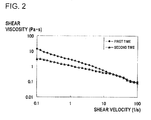
Fig. 2] Fig. 2 is a drawing showing a relationship between shear velocity and shear viscosity of the cosmetic composition of Comparative Example 11. - The component (A) is a polyalkylene glycol derivative represented by the following formula (I):
Z-{O-(EO)a-(AO)k-H}m (I)
- wherein Z is a residual group resulting from removal of hydroxyl groups from a polyhydric alcohol having 3 to 6 hydroxyl groups. Examples of the polyhydric alcohol include glycerin and trimethylolpropane having three hydroxyl groups, diglycerin, erythritol, pentaerythritol, sorbitan, and methylglycoside having four hydroxyl groups, xylitol and triglycerin having five hydroxyl groups, and sorbitol, inositol, and dipentaerythritol having six hydroxyl groups. Preferred are residual groups obtained by removing hydroxyl groups from alcohols having four or more hydroxyl groups and, owing to a high gelling ability, more preferred are diglycerin and pentaerythritol having four hydroxyl groups.
- m is from 3 to 6, preferably from 4 to 6, more preferably 4. When m is 2 or less or is 7 or more, a sticky feeling is generated at the application and also a smooth feeling in use is not obtained, so that the case is not preferred.
- EO is an oxyethylene group, a represents an average addition mole number of EO, and axm is a total addition mole number of EO in the formula (I). a is from 1 to 50, preferably from 10 to 45. When a is smaller than 1, a sufficient hydrophilicity is not obtained and a cosmetic composition having a structure-recovering property is hardly obtained. Moreover, when a is larger than 50, crystallinity of the EO chain becomes high, so that a transparent cosmetic composition is hardly obtained.
- (EO)a is a polyoxyethylene chain and becomes a hydrophilic group in the polyalkylene glycol derivative of the invention.
- AO is an oxyalkylene group having 4 to 8 carbon atoms, and the AO chain becomes a lipophilic group in the polyalkylene glycol derivative of the formula (I). Since the AO chain contributes an improvement in compatibility between the component (A) and the component (C) and/or the component (E), the chain is an essential part for retaining the stability of the cosmetic composition.
- In the case where AO has 3 carbon atoms, the compatibility with the oily agent is poor and desired thickening ability is not obtained. Furthermore, in the case where AO has 9 or more carbon atoms, the feeling in use tends to become worse, so that the case is not preferred.
- Examples of AO include a 1,2-oxybutylene group having 4 carbon atoms, a 1,2-oxypentylene group having 5 carbon atoms, a 1,2-oxyhexylene group having 6 carbon atoms, a 1,2-oxyheptylene group having 7 carbon atoms, and a 1,2-oxyoctylene group having 8 carbon atoms, but preferred is a 1,2-oxybutylene group or a 1,2-oxyoctylene group and more preferred is a 1,2-oxybutylene group. AO may be one kind or two kinds or more and in the case where it is two kinds or more, the addition form may be any of a random form or a block form.
- k represents an average addition mole number of AO, and kxm represents a total average addition mole number of AO in the formula (I). k is from 1 to 50, preferably from 5 to 30. When k is smaller than 1, a sufficient lipophilicity is not obtained and the compatibility between the component (A) and the component (C) and/or the component (E) is poor, so that a stable composition is hardly obtained. Moreover, when k is larger than 50, a sticky feeling is generated, so that there is a case where a feeling in use is poor and hence the case is not preferred.
- When the total content of EO and AO is taken as 100 parts by mass, the mass ratio of EO is from 10 to 75 parts by mass. Preferred is from 20 to 75 parts by mass. More preferred is from 30 to 75 parts by mass. When the mass ratio is smaller than 10 parts by mass, a hydrated region decreases and gelation does not take place even when water of the component (D) is added. Moreover, when the mass ratio is larger than 75 parts by mass, the ratio of the EO chain becomes large, so that crystallinity increases and hence a transparent cosmetic composition is not obtained.
- EO and AO are bonded in a block form. In a random form, an objective oily cosmetic composition cannot be obtained.
- The polyoxyalkylene glycol derivative represented by the formula (I) of the invention can be produced by known methods. For example, the derivative can be obtained by addition polymerization of a polyhydric alcohol having 3 to 6 hydroxyl groups with oxyethylene and an oxyalkylene having 4 to 8 carbon atoms in this order under an alkali or acid catalyst.
- The component (A) is blended in an amount of 0.01 to 30% by mass relative to the total mass of the cosmetic composition. The amount is preferably from 0.1 to 20% by mass, more preferably from 1 to 15% by mass. When the amount is less than 0.01% by mass, the desired structure-recovering property is not obtained. When the amount exceeds 30% by mass, a sticky feeling is generated when the composition is applied and thus the case is not preferred.
- The component (B) is a nonionic surfactant having a polyoxyethylene chain (EO chain) and a hydrocarbon group having 12 to 22 carbon atoms and exhibiting an HLB of 8 to 14. Incidentally, the nonionic surfactant and polyoxyethylene are sometimes singly referred to as nonion and POE, respectively.
- HLB is an abbreviation of Hydrophile-Lipophile Balance and is a concept resulting from numeric conversion of the balance between the hydrophilic group and the lipophilic group of a surfactant. In general, it is represented in the range of 0 to 20 and a higher numerical value shows higher hydrophilicity. HLB can be calculated from the following formula (1) or (2).


- S: saponification value of ester, A: acid value of fatty acid
- (Source: "Shin-pan Kaimen Kasseizai Handobukku (New Edition Surfactant Handbook)" Kougaku Tosho K.K.)
- When the length of the EO chain is insufficient and HLB is smaller than 8, the hydration force with water of the component (D) is poor and desired structure-recovering property and transparency are not obtained. From such a viewpoint, HLB is preferably 8.5 or more, most preferably 9.0 or more.
- When HLB exceeds 14, hydration with water is strong and the composition tends to coagulate by the influence of the EO chain, so that transparency is not obtained in some cases and hence the case is not preferred.
- Examples of the hydrocarbon group having 12 to 22 carbon atoms include a lauryl group, a tridecyl group, a myristyl group, a palmityl group, a cetyl group, an isopalmityl group, a stearyl group, an isostearyl group, an oleyl group, an octyldodecyl group, a vehenyl group, and the like and the hydrocarbon group may be a mixed alkyl group thereof. Of these, from the viewpoints of compatibility and transparency, branched saturated hydrocarbon groups or unsaturated hydrocarbon groups having 12 to 22 carbon atoms are preferred. Particularly preferred as such lipophilic groups are an oleyl group, an isopalmityl group, and an isostearyl group. When the carbon number is smaller than 12, a desired structure-recovering property is not obtained and thus the case is not preferred. Also, when the carbon number exceeds 22, transparency is not obtained.
- The component (B) may be any of an ester-type, an ether-type, a linear-type, and a multi-chain-type as long as HLB ranges from 8 to 14. Moreover, the degree of polymerization and the esterification ratio of the oxyethylene group are not particularly limited.
- For instance, examples thereof include POE (polyoxyethylene) oleyl ether, POE isopalmityl ether, POE isostearyl ether, POE monooleate, POE monoisostearate, POE dioleate, POE diisostearate, POE sorbitol monooleate, POE sorbitol dioleate, POE sorbitol trioleate, POE sorbitol tetraoleate, POE sorbitol pentaoleate, POE sorbitol hexaoleate, POE sorbitol monoisostearate, POE sorbitol diisostearate, POE sorbitol triisostearate, POE sorbitol tetraisostearate, POE sorbitol pentaisostearate, POE sorbitol hexaisostearate, POE glycerin monooleate, POE glycerin dioleate, POE glycerin trioleate, POE glycerin monoisostearate, POE glycerin diisostearate, POE glycerin triisostearate, POE sorbitan monooleate, POE sorbitan sesquioleate, POE sorbitan trioleate, POE sorbitan monoisostearate, POE sorbitan sesquiisostearate, POE sorbitan triisostearate, and the like.
- Of these, for making transparency good, the oily agent is preferably liquid at 25°C. Also, for further strengthening the hydration of the component (D) with water, an ester-type is preferred. Therefore, preferred examples include POE monooleate, POE monoisostearate, POE dioleate, POE diisostearate, POE sorbitol tetraoleate, POE sorbitol tetraisostearate, POE glycerin triisostearate, POE glycerin monoisostearate, POE sorbitan monooleate, POE sorbitan monoisostearate, and the like. For making gelling ability good, a linear type is further preferred. As such nonions, POE monooleate, POE monoisostearate, POE dioleate, and POE diisostearate may be mentioned.
- The component (B) is blended in an amount of 0.1 to 50% by mass relative to the total mass of the cosmetic composition. The amount is preferably from 0.1 to 30% by mass, more preferably from 1 to 20% by mass. When the amount is less than 0.1% by mass, the desired structure-recovering property is not obtained. When the amount exceeds 50% by mass, transparency cannot be maintained and a sticky feeling is observed when the composition is applied and thus the case is not preferred. The component (B) may be used with mixing two or more kinds thereof.
- The mass ratio of the component (A) to the component (B), (A)/(B) is from 1/5 to 5/1, preferably from 1/3 to 3/1. When the ratio is smaller than 1/5, the structure-recovering property is not obtained and, when the ratio is larger than 5/1, transparency is hardly obtained and thus the cases are not preferred.
- The component (C) is one or two or more oily agents selected from ester oils and triglycerides which are liquid at 25°C.
- Examples of the ester oils include ethyl oleate, ethyl linoleate, isopropyl myristate, isopropyl palmitate, isopropyl isostearate, cetyl 2-ethylhexanoate, isocetyl 2-ethylhexanoate, stearyl 2-ethylhexanoate, isostearyl 2-ethylhexanoate, cetyl palmitate, 2-ethylhexyl palmitate, 2-hexyldecyl isostearate, isostearyl isostearate, trimethylolpropane triisostearate, myristyl myristate, cetyl myristate, octyldodecyl myristate, isostearyl myristate, isocetyl myristate, hexyl laurate, decyl oleate, octyldodecyl oleate, isostearyl pivalate, isopropyl isostearate, isononyl isononanoate, 2-ethylhexyl isononanoate, isodecyl isononanoate, isotridecyl isononanoate, octyldodecyl erucate, neopentyl glycol didecanoate, pentaerythrityl tetraethylhexanoate, diisosteary malate, triethylhexanoate trimethylolpropane didecyl adipate, didecyl adipate, cholesteryl isostearate, batyl isostearate, hardened caster oil monohydroxystearate, lanolin fatty acid isostearyl ester, lanolin fatty acid isopropyl ester, lanolin fatty acid octyldodecyl ester, cetyl ricinoleate, dioctyl succinate, cetyl lactate, propylene glycol dicaprylate, propylene glycol dicaprate, propylene glycol dinonanoate, propylene glycol di(caprylate·caprate), propylene glycol diisostearate, propylene glycol dioleate, and the like. One kind or two or more kinds thereof may be used.
- Examples of the triglycerides include triglycerides of glycerin with a higher fatty acid having 6 or more carbon atoms, such as caproic acid, caprylic acid, capric acid, 2-ethylhexanoic acid, isotridecanoic acid, isopalmitic acid, isostearic acid, eicosanoic acid, or oleic acid, animal and vegetable oils and fats such as olive oil, sunflower seed oil, safflower oil, castor oil, and camellia oil, and the like.
- Preferable ester oils include cetyl 2-ethylhexanoate, isocetyl 2-ethylhexanoate, isopropyl palmitate, 2-ethylhexyl palmitate, isopropyl isostearate, 2-hexyldecyl isostearate, octyldodecyl myristate, isopropyl myristate, isostearyl myristate, isocetyl myristate, isononyl isononanoate, 2-ethylhexyl isononanoate, isodecyl isononanoate, and isotridecyl isononanoate.
- Moreover, preferable triglycerides include triglycerides of glycerin with a higher fatty acid having 6 to 10 carbon atoms, such as caproic acid, caprylic acid, capric acid, or 2-ethylhexanoic acid or a mixture thereof, for example, a glyceride of tri(caprate/caprilate).
- In the cosmetic composition of the invention, a part of the component (C) can be replaced by the component (E).
- The component (E) is one or two or more oily agents selected from hydrocarbon oils and silicone oils which are liquid at 25°C. The hydrocarbon oils include liquid paraffin, hydrogenated polyisobutene, hydrogenated polydecene, squalane, squalene, pristane, light isoparaffin, light liquid isoparaffin, heavy liquid isoparaffin, liquid isoparaffin, tetradecene, isohexadecane, isododecane, α-olefin oligomers, and the like. Preferred are liquid paraffin, hydrogenated polyisobutene, and squalane. The silicone oils include dimethicone, cyclomethicone, phenyldimethicone, and the like, but preferred is cyclomethicone. Also, one kind or two or more kinds thereof may be used.
- The total amount of the component (C) and the component (E) to be blended is from 50 to 95% by mass relative to the total mass of the cosmetic composition. The total amount is preferably from 60 to 90% by mass. When the amount is less than 50% by mass, a feeling in use becomes worse, such as stickiness. Moreover, when the amount exceeds 95% by mass, viscosity cannot be imparted and thus the case is not preferred. Also, when the total amount of the component (C) and the component (E) is taken as 100 parts by mass, the amount of the component (C) is 30 parts by mass or more, preferably 40 parts by mass or more, more preferably 50 parts by mass or more. When the amount is less than 30 parts by mass, the desired structure-recovering property is not obtained and thus the case is not preferred.
- The component (D) is water. In the cosmetic composition of the invention, viscosity is imparted by hydration of the EO chain of the component (A) or the EO chain of nonion of the component (B). The water is not particularly limited as long as it is generally used in cosmetics, quasi drugs, and pharmaceuticals. For example, purified water such as distilled water or ion-exchanged water, physiological saline, phosphate buffer aqueous solutions, and the like can be employed.
- The water is blended in an amount of 0.01 to 10% by mass relative to the total mass of the cosmetic composition. The amount is preferably from 0.1 to 8% by mass, more preferably from 0.1 to 5% by mass. When the amount is less than 0.01% by mass, the desired structure-recovering property is not obtained. Moreover, when the amount exceeds 10% by mass, a decrease in viscosity with time is observed and thus the case is not preferred.
- In the cosmetic composition of the invention, according to need, further, it is possible to blend various components commonly used in cosmetics, pharmaceuticals, and the like within the range where the effects of the invention are not impaired. Examples thereof include a moisturizer; a hydrocarbon; a higher alcohol; a higher fatty acid; a triglyceride, an ester oil, an animal or vegetable oil and fat, or a silicone other than the components (C) and (E); a vitamin; a UV absorber; a water-soluble polymer; an antioxidant; a cationic surfactant; an anionic surfactant; an amphoteric surfactant; a nonionic surfactant other than the component (B); a metal ion sequestrant; ethanol; a thicker; an antiseptic agent; a coloring matter; a pigment; a perfume; and the like.
- Moreover, the form of the cosmetic composition of the invention is not particularly limited but an oily cosmetic composition such as a cleansing oil, a hair oil, or a massage oil is suitable.
- The following will describe the present invention in further detail with reference to Examples but the invention should not be construed as being limited thereto.
- Synthetic Examples of the component (A) according to the invention are shown. The hydroxyl value was measured in accordance with JIS K 1557 1.
- Into an autoclave were charged 45 g of pentaerythritol, 50 g of toluene, and 8.0 g of potassium hydroxide. After the air in the autoclave was replaced by dry nitrogen, 1,292 g of ethylene oxide was added dropwise from a dropping apparatus at 110°C with stirring, followed by stirring for 2 hours. Subsequently, 1,160 g of 1,2-butylene oxide was added dropwise at 110°C, followed by stirring for 2 hours. Thereafter, a reaction product was taken out of the autoclave and neutralized with hydrochloric acid to be a pH of 6 to 7. For removing toluene and water contained, a treatment under reduced pressure was performed at 115°C for 1 hour and finally salts were removed by filtration to obtain 2,345 g of
Compound 1. The hydroxyl value was 56.0 mgKOH/g after the reaction with ethylene oxide and 30.0 mgKOH/g after the reaction with 1,2-butylene oxide. - Into an autoclave were charged 31 g of glycerin and 5.0 g of potassium hydroxide. After the air in the autoclave was replaced by dry nitrogen, 1,100 g of ethylene oxide was added dropwise from a dropping apparatus at 140°C with stirring, followed by stirring for 2 hours. Subsequently, 1,080 g of 1,2-butylene oxide was added dropwise at 140°C, followed by stirring for 2 hours. Thereafter, a reaction product was taken out of the autoclave and neutralized with hydrochloric acid to be a pH of 6 to 7. For removing water contained, a treatment under reduced pressure was performed at 100°C for 1 hour and finally salts were removed by filtration to obtain 2,180 g of polyoxybutylene (45 mol) polyoxyethylene (75 mol) glyceryl ether. The hydroxyl value was 49.6 mgKOH/g after the reaction with ethylene oxide and 25.4 mgKOH/g after the reaction with 1,2-butylene oxide.
- The present inventors synthesized polyalkylene glycol derivatives having compositions shown in the following Table 1 in accordance with the above Synthetic Examples 1 and 2. In Table 1,
Compounds 1 to 5 are the component (A) of the invention and Compounds 6 to 10 are comparative control component (A'). - [Table 1]
Table 1 Compound Z (m) AO (*1) EO (a) AO (k) EO parts by mass 1 Pentaerythritol (4) C4 22 12 52.8 2 Glycerin (3) C4 25 15 50.5 3 Pentaerythritol (4) C4 10 20 23.4 4 Sorbitol (6) C8 15 10 34.0 5 Diglycerin (4) C4 40 10 71.0 6 Diglycerin (4) C4 0 25 0 7 Glycerin (3) - 20 0 100 8 Trehalose (8) C4 40 10 71.0 9 Diethylene glycol (2) C4 45 40 40.7 10 Pentaerythritol (4) C3 22 12 58.2 (*1) C3 represents a 1,2-oxypropylene group, C4 represents a 1,2-oxybutylene group, and C8 represents a 1,2-oxyoctylene group - Cosmetic compositions were prepared with the components and compositions shown in Table 2 and were evaluated for the structure-recovering property, transparency, smoothness when applied to the skin, and fitness with the skin.
- After the component (A), the component (B) or (B'), the component (C), and the component (E) were homogeneously dissolved at 70°C, the component (D) was gradually added and the whole was cooled to 25°C with stirring.
- At 25°C, shear viscosity (Pa·s) against shear velocity (s-1) was measured twice. In this regard, a measuring interval was made 1 minute. A measuring instrument is as follows.
- Measuring instrument: PaarPhysica MCR-300
- Measuring tool: CP 50-2
- After it was confirmed that the shear viscosity decreased against the shear velocity at both of the first time and the second time, the structure-recovering property was judged using a recovering ratio of the shear viscosity at a shear velocity of 0.1 (s-1) as an index. "○" was regarded as qualified.
- ○: Structure-recovering property is observed.
- Shear viscosity is recovered by 90% or more at the second time as compared with the case of the first time.
- Δ: Poor structure-recovering property is observed.
- Shear viscosity is recovered by 70% or more at the second time as compared with the case of the first time.
- ×: No structure-recovering property is observed.
- Shear viscosity is recovered by 50% or less at the second time as compared with the case of the first time.
- Appearance was visually confirmed at 25°C.
- ○: The composition is transparent.
- Δ: Fluorescent color is observed.
- ×: The composition is turbid or white crystals are precipitated.
- The oily cosmetic composition immediately after preparation was applied to an inner part of the forearm of 20 specialized female panelists under an environment of 25°C and relative humidity of 50%. Evaluation was performed for the smoothness when applied based on the following criteria. An average point of 3.5 or more was regarded as a qualifying criterion.
- 5: Spreadability is very good and an extremely light feeling is exhibited.
- 4: Spreadability is good and a light feeling is exhibited.
- 3: Spreadability is slightly poor and a slightly scratchy feeling is exhibited.
- 2: Spreadability is bad and a heavy feeling is exhibited.
- 1: Spreadability is very bad and a sticky feeling is exhibited.
- Following the evaluation for the smoothness when applied, the composition was evaluated for fitness with the skin after the passage of 1 hour under an environment of 25°C and relative humidity of 50% based on the following criteria. An average point of 3.5 or more was regarded as a qualifying criterion.
- 5: A film feeling is good and a feeling of softening the skin is exhibited.
- 4: An appropriate film feeling is observed and a feeling of softening the skin is exhibited.
- 3: A film feeling is slightly strong but a feeling of softening the skin is exhibited.
- 2: A film feeling is slightly strong and a feeling of slightly softening the skin is exhibited.
- 1: A film feeling was strong and a feeling of stiffened skin is exhibited.
- Evaluation results thereof are also collectively shown in Table 2.
- [Table 2]


- Cosmetic compositions were prepared with the components and compositions shown in Table 3 and were evaluated for the structure-recovering property, transparency, smoothness when applied to the skin, and fitness with the skin.
- After the component (A) or (A'), the component (B), the component (C), and the component (E) were homogeneously dissolved at 70°C, the component (D) was gradually added and the whole was cooled to 25°C with stirring.
- Similarly to Examples 1 to 12, the cosmetic compositions were evaluated for the structure-recovering property, transparency, smoothness when applied to the skin, and fitness with the skin.
- Evaluation results thereof are collectively shown in Table 3.
- [Table 3]
Table 3 Component Example (% by mass) Comparative Example (% by mass) 13 14 15 16 17 6 7 8 9 10 11 12 A Compound 1 10.0 Compound 2 10.0 Compound 3 10.0 Compound 4 10.0 Compound 5 10.0 A' Compound 6 10.0 Compound 7 10.0 Compound 8 10.0 Compound 9 10.0 Compound 1010.0 Dextrin palmitate (*2) 3.0 N-Lauroyl-L-glutamic dibutylamide (*3) 0.5 B POE(30mol) sorbitol tetraoleate HLB=11.2 oleyl group 5.0 5.0 5.0 5.0 5.0 5.0 5.0 5.0 5.0 5.0 5.0 5.0 C Glyceryl tri(2-ethylhexanoate) 82.0 82.0 82.0 82.0 82.0 82.0 82.0 82.0 82.0 82.0 91.0 93.5 D Water 3.0 3.0 3.0 3.0 3.0 3.0 3.0 3.0 3.0 3.0 1.0 1.0 (A)/(B) or (A)/(B') mass ratio 2.0 2.0 2.0 2.0 2.0 2.0 2.0 2.0 2.0 2.0 2.0 2.0 Structure-recovering property ○ ○ ○ ○ ○ × × ○ ○ × × × Transparency ○ ○ ○ ○ ○ × × × ○ × × × Smoothness when applied 4.1 3.8 3.9 3.8 3. 6 2.3 1.8 3.4 3.3 2.1 3.2 3.1 Fitness with skin 4.2 4.0 4.3 4.0 3.7 3.6 1.7 3.6 3.2 2.3 2.1 2.4 Rheopearl KL2 manufactured by Chiba Flour Milling Co., Ltd.
*3 GP-1 manufactured by Ajinomoto Co., Inc. - Behavior of the shear viscosity against the shear velocity for Example 13 (structure-recovering property: ○, recovering ratio: 106%) and Comparative Example 11 (structure-recovering property: ×, recovering ratio: 20%) are shown in
Fig. 1 andFig. 2 , respectively. - The following will exemplify referential formulation of the cosmetic composition of the invention. In all Formulation Examples, "structure-recovering property", "transparency", "smoothness when applied", and "fitness with the skin" were good.
-
(A) Compound 115.0% by mass (B) POE (12 mol) dioleate (HLB 10.0) 7.0% by mass (B) POE (20 mol) glycerin triisostearate (HLB 10.4) 5.0% by mass (C) Glyceride of tri(caprylate/caprate) 20.0% by mass (C) Isononanyl isononanate 10.0% by mass (C) Olive oil 5.0% by mass (C) Camellia oil 3.0% by mass (E) Hydrogenated polyisobutene 20.0% by mass (E) Cyclomechicone 10.0% by mass (D) Water 3.5% by mass Vitamin E acetate 0.2% by mass Polyoxyethylene (10 mol) methylglucoside 0.5% by mass Glycerin 0.2% by mass Antiseptic agent proper quantity Perfume proper quantity - After the components other than the component (D) were homogeneously dissolved at 70°C, the component (D) was gradually added and the whole was cooled to 25°C with stirring.
-
(A) Compound 15.0% by mass (A) Compound 5 10.0% by mass (B) POE (8 mol) monoisostearate (HLB 11.6) 3.0% by mass (B) POE (8 mol) glycerin monoisostearate (HLB 12.0) 2.0% by mass (C) Isopropyl palmitate 15.0% by mass (C) Ethyl oleate 10.0% by mass (C) Safflower oil 15.0% by mass (C) Castor oil 3.0% by mass (E) Liquid paraffin 15.0% by mass (E) Squalane 15.0% by mass (D) Water 3.5% by mass Dipropylene glycol 1.0% by mass 1,2-Octylene glycol 0.5% by mass Vitamin E 0.5% by mass Antiseptic agent proper quantity Perfume proper quantity - After the components other than the component (D) were homogeneously dissolved at 70°C, the component (D) was gradually added and the whole was cooled to 25°C with stirring.
-
(A) Compound 110.0% by mass (B) POE (30 mol) tetraisostearate (HLB 11.1) 13.0% by mass (B) POE (6 mol) sorbitan monooleate (HLB 11.8) 3.0% by mass (C) 2-Ethylhexyl palmitate 20.0% by mass (C) Glyceride of tri(2-ethylhexanoate) 20.0% by mass (C) Safflower oil 15.0% by mass (E) Hydrogenated polyisobutene 15.0% by mass (D) Water 3.0% by mass 1,3-Butylene glycol 0.2% by mass 1,2-Hexylene glycol 0.2% by mass Vitamin E 0.3% by mass Antiseptic agent proper quantity Perfume proper quantity - After the components other than the component (D) were homogeneously dissolved at 70°C, the component (D) was gradually added and the whole was cooled to 25°C with stirring.
- While the invention has been described in detail and with reference to specific embodiments thereof, it will be apparent to one skilled in the art that various changes and modifications can be made therein without departing from the spirit and scope thereof.
- The present application is based on Japanese Patent Application No.
2011-152689 filed on July 11, 2011
Claims (4)
- A cosmetic composition comprising the following components (A) to (D), wherein the component (A) is from 0.1 to 30% by mass, the component (B) is from 0.1 to 50% by mass, the component (C) is from 50 to 95% by mass, and the component (D) is from 0.01 to 10% by mass, and a mass ratio of the component (A) to the component (B), (A)/(B) is from 1/5 to 5/1:(A) a polyalkylene glycol derivative represented by the following formula (I):
Z-{O-(EO)a-(AO)k-H}m (I)
wherein Z is a residual group resulting from removal of hydroxyl groups from a polyhydric alcohol having 3 to 6 hydroxyl groups, m is from 3 to 6, EO is an oxyethylene group, AO is an oxyalkylene group having 4 to 8 carbon atoms, and EO and AO are bonded in a block form;a represents an average addition mole number of EO and k represents an average addition mole number of AO, and a is from 1 to 50 and k is from 1 to 50; and a mass ratio of EO is from 10 to 75 parts by mass relative to 100 parts by mass of a total amount of EO and AO,(B) a nonionic surfactant having a polyoxyethylene group and a hydrocarbon group having 12 to 22 carbon atoms and exhibiting an HLB of 8 to 14,(C) one or two or more oily agents selected from ester oils and triglycerides which are liquid at 25°C, and(D) water. - The cosmetic composition as claimed in claim 1, wherein a part of the component (C) is replaced by the following component (E) and an amount of the component (C) is 30 parts by mass or more relative to 100 parts by mass of a total amount of the component (C) and the component (E):(E) one or two or more oily agents selected from hydrocarbon oils and silicone oils which are liquid at 25°C.
- The cosmetic composition as claimed in claim 1 or 2, wherein AO is a 1,2-oxybutylene group.
- The cosmetic composition as claimed in any one of claims 1 to 3, wherein the component (B) is a nonionic surfactant having a branched or unsaturated hydrocarbon group having 12 to 22 carbon atoms.
Applications Claiming Priority (2)
| Application Number | Priority Date | Filing Date | Title |
|---|---|---|---|
| JP2011152689 | 2011-07-11 | ||
| PCT/JP2012/067397 WO2013008762A1 (en) | 2011-07-11 | 2012-07-06 | Cosmetic composition |
Publications (3)
| Publication Number | Publication Date |
|---|---|
| EP2732807A1 true EP2732807A1 (en) | 2014-05-21 |
| EP2732807A4 EP2732807A4 (en) | 2015-03-25 |
| EP2732807B1 EP2732807B1 (en) | 2019-05-08 |
Family
ID=47506050
Family Applications (1)
| Application Number | Title | Priority Date | Filing Date |
|---|---|---|---|
| EP12811817.1A Active EP2732807B1 (en) | 2011-07-11 | 2012-07-06 | Cosmetic composition |
Country Status (6)
| Country | Link |
|---|---|
| US (1) | US9561172B2 (en) |
| EP (1) | EP2732807B1 (en) |
| JP (1) | JP5949233B2 (en) |
| KR (1) | KR101918331B1 (en) |
| CN (1) | CN103648477B (en) |
| WO (1) | WO2013008762A1 (en) |
Families Citing this family (14)
| Publication number | Priority date | Publication date | Assignee | Title |
|---|---|---|---|---|
| JP5807513B2 (en) * | 2011-11-04 | 2015-11-10 | 日油株式会社 | Skin cosmetics |
| JP5807514B2 (en) * | 2011-11-04 | 2015-11-10 | 日油株式会社 | Hair cosmetics |
| BR112017014455B1 (en) | 2015-02-19 | 2021-06-01 | Unilever Ip Holdings B.V. | CLEANING COMPOSITION AND PACKAGED PRODUCT |
| KR102507672B1 (en) * | 2017-03-17 | 2023-03-07 | 니치유 가부시키가이샤 | Skin cosmetics, body washing composition and oily make-up cosmetics |
| JP6798406B2 (en) * | 2017-04-19 | 2020-12-09 | 日油株式会社 | Oily cosmetics |
| PL3694918T3 (en) | 2017-10-09 | 2024-05-06 | Owens Corning Intellectual Capital, Llc | Aqueous binder compositions |
| CN113840966B (en) | 2019-04-09 | 2024-07-26 | 欧文斯科宁知识产权资产有限公司 | Insulation products formed using aqueous adhesive compositions |
| EP3953417A4 (en) | 2019-04-09 | 2022-12-21 | Owens-Corning Intellectual Capital, LLC | AQUEOUS BINDING COMPOSITIONS |
| US11813833B2 (en) | 2019-12-09 | 2023-11-14 | Owens Corning Intellectual Capital, Llc | Fiberglass insulation product |
| WO2021118960A1 (en) | 2019-12-09 | 2021-06-17 | Owens Corning Intellectual Capital, Llc | Fiberglass insulation product |
| CN116406348B (en) | 2020-09-01 | 2025-09-09 | 欧文斯科宁知识产权资产有限公司 | Aqueous binder composition for mineral wool products |
| WO2022072780A2 (en) | 2020-10-01 | 2022-04-07 | Owens Corning Intellectual Capital, Llc | B-stageable aqueous binder compositions |
| CA3222151A1 (en) | 2021-06-04 | 2022-12-08 | Owens Corning Intellectual Capital, Llc | Fine fiber insulation products with improved thermal properties |
| EP4661832A1 (en) | 2023-02-10 | 2025-12-17 | Symrise AG | Oral care compositions comprising 3-phenyl-1-propanol and an alkanediol and 4-isopropyl-3-methylphenol |
Family Cites Families (24)
| Publication number | Priority date | Publication date | Assignee | Title |
|---|---|---|---|---|
| JP2002003340A (en) | 2000-06-20 | 2002-01-09 | Pola Chem Ind Inc | Oil-gel cosmetic of good gloss |
| JP4174994B2 (en) | 2001-02-13 | 2008-11-05 | 味の素株式会社 | Oily base gelling agent |
| FR2820739B1 (en) | 2001-02-13 | 2004-01-02 | Ajinomoto Kk | AMINO ACID DERIVATIVE AND GEL, GEL COMPOSITION AND COSMETIC CONTAINING THE SAME, AND METHODS OF PREPARING THE SAME |
| JP2006082539A (en) * | 2004-08-19 | 2006-03-30 | Yoshida Industry Co Ltd | Method for decorating transfer film and synthetic resin molding |
| TWI365075B (en) | 2004-09-22 | 2012-06-01 | Kao Corp | Microemulsion |
| US9193654B2 (en) | 2004-10-06 | 2015-11-24 | Nof Corporation | Cosmetic bases and cosmetics containing the same |
| JP2006257395A (en) * | 2005-02-21 | 2006-09-28 | Adeka Corp | Emulsion composition |
| JP4736112B2 (en) | 2005-03-31 | 2011-07-27 | 日油株式会社 | Cosmetic base material and cosmetic comprising the same |
| JP4736113B2 (en) | 2005-03-31 | 2011-07-27 | 日油株式会社 | Cosmetic base and cosmetic comprising the same |
| JP4692322B2 (en) * | 2006-02-20 | 2011-06-01 | 日油株式会社 | Bath additive |
| JP4692358B2 (en) * | 2006-03-31 | 2011-06-01 | 日油株式会社 | Hot cleansing fee |
| JP5395329B2 (en) * | 2006-06-12 | 2014-01-22 | 株式会社 資生堂 | Gel composition |
| EP2082729A1 (en) | 2006-09-29 | 2009-07-29 | Shiseido Company, Ltd. | External preparation for skin and cleansing agent for skin |
| JP2008088127A (en) | 2006-10-04 | 2008-04-17 | Shiseido Co Ltd | Skin care composition for acne |
| JP5261940B2 (en) * | 2007-02-07 | 2013-08-14 | 日油株式会社 | Surfactant containing polyglycerin derivative |
| JP2008231061A (en) | 2007-03-22 | 2008-10-02 | Noevir Co Ltd | Cosmetic addition composition, cosmetic and their manufacturing methods |
| JP4985017B2 (en) * | 2007-03-23 | 2012-07-25 | 日油株式会社 | Nonionic surfactant and cosmetic comprising the same |
| JP5230975B2 (en) | 2007-07-26 | 2013-07-10 | 株式会社 資生堂 | Alkylene oxide derivatives and skin external preparations containing the same |
| JP2009108261A (en) * | 2007-10-31 | 2009-05-21 | Shiseido Co Ltd | Animal cleaning composition |
| JP5260103B2 (en) | 2008-03-25 | 2013-08-14 | 株式会社 資生堂 | Topical skin preparation |
| JP2010024159A (en) * | 2008-07-16 | 2010-02-04 | Shiseido Co Ltd | Fine emulsion composition and method for producing the same |
| JP5433829B2 (en) * | 2009-02-09 | 2014-03-05 | サンノプコ株式会社 | Antifoaming agent and resin containing the same |
| JP5652023B2 (en) * | 2010-07-09 | 2015-01-14 | 日油株式会社 | Cleansing fee |
| CN103648476B (en) | 2011-07-11 | 2016-02-10 | 日油株式会社 | Cosmetic composition |
-
2012
- 2012-07-06 WO PCT/JP2012/067397 patent/WO2013008762A1/en not_active Ceased
- 2012-07-06 JP JP2012152030A patent/JP5949233B2/en active Active
- 2012-07-06 KR KR1020147000632A patent/KR101918331B1/en active Active
- 2012-07-06 US US14/131,769 patent/US9561172B2/en active Active
- 2012-07-06 EP EP12811817.1A patent/EP2732807B1/en active Active
- 2012-07-06 CN CN201280034759.0A patent/CN103648477B/en active Active
Also Published As
| Publication number | Publication date |
|---|---|
| KR20140040799A (en) | 2014-04-03 |
| EP2732807A4 (en) | 2015-03-25 |
| JP2013035827A (en) | 2013-02-21 |
| CN103648477B (en) | 2015-11-25 |
| CN103648477A (en) | 2014-03-19 |
| US20140155353A1 (en) | 2014-06-05 |
| EP2732807B1 (en) | 2019-05-08 |
| KR101918331B1 (en) | 2018-11-13 |
| WO2013008762A1 (en) | 2013-01-17 |
| US9561172B2 (en) | 2017-02-07 |
| JP5949233B2 (en) | 2016-07-06 |
Similar Documents
| Publication | Publication Date | Title |
|---|---|---|
| EP2732807B1 (en) | Cosmetic composition | |
| JP7411709B2 (en) | Oil-in-water emulsion composition | |
| EP3886788B1 (en) | Composition comprising two polyglyceryl fatty acid esters | |
| EP2805707B1 (en) | Liquid cosmetic | |
| EP2732808B1 (en) | Cosmetic composition | |
| JP2014118400A (en) | Anhydrous cosmetic composition | |
| KR20190068590A (en) | Non-tacky stable composition | |
| EP2932957B1 (en) | Cleansing cosmetics | |
| JP2025124783A (en) | Oil-in-water emulsion cosmetics | |
| WO2012090581A1 (en) | Oil-in-water emulsion sunscreen cosmetic | |
| KR102759516B1 (en) | Cleansing composition | |
| US7829106B2 (en) | Cosmetic composition and cosmetic | |
| JP5189836B2 (en) | Oil-containing cosmetic composition | |
| WO2011093508A1 (en) | Polyalkylene glycol derivative and cosmetic comprising same | |
| JP6880978B2 (en) | Oil-based cleansing agent | |
| CN111050744A (en) | hair cosmetic | |
| JP2023105025A (en) | Cleansing cosmetic | |
| JP2005314366A (en) | Colored nonaqueous composition | |
| JP4624155B2 (en) | Cosmetics | |
| WO2025244085A1 (en) | Cosmetic base and cosmetic | |
| JP7138852B2 (en) | oily cosmetics | |
| JP2019006720A (en) | Silicone modifier, surfactant, and emulsion composition | |
| EP3582746B1 (en) | Cosmetic lotion | |
| JP2015025100A (en) | Silicone modifier, surfactant and emulsion composition | |
| WO2011074127A1 (en) | Composition with enhanced hydration ability |
Legal Events
| Date | Code | Title | Description |
|---|---|---|---|
| PUAI | Public reference made under article 153(3) epc to a published international application that has entered the european phase |
Free format text: ORIGINAL CODE: 0009012 |
|
| 17P | Request for examination filed |
Effective date: 20140103 |
|
| AK | Designated contracting states |
Kind code of ref document: A1 Designated state(s): AL AT BE BG CH CY CZ DE DK EE ES FI FR GB GR HR HU IE IS IT LI LT LU LV MC MK MT NL NO PL PT RO RS SE SI SK SM TR |
|
| DAX | Request for extension of the european patent (deleted) | ||
| A4 | Supplementary search report drawn up and despatched |
Effective date: 20150220 |
|
| RIC1 | Information provided on ipc code assigned before grant |
Ipc: A61K 8/37 20060101ALI20150216BHEP Ipc: A61K 8/39 20060101ALI20150216BHEP Ipc: A61Q 1/14 20060101ALI20150216BHEP Ipc: A61K 8/86 20060101ALI20150216BHEP Ipc: A61Q 5/06 20060101ALI20150216BHEP Ipc: A61Q 19/00 20060101ALI20150216BHEP Ipc: A61K 8/90 20060101AFI20150216BHEP |
|
| STAA | Information on the status of an ep patent application or granted ep patent |
Free format text: STATUS: EXAMINATION IS IN PROGRESS |
|
| 17Q | First examination report despatched |
Effective date: 20170223 |
|
| REG | Reference to a national code |
Ref country code: DE Ref legal event code: R079 Ref document number: 602012059965 Country of ref document: DE Free format text: PREVIOUS MAIN CLASS: A61K0008900000 Ipc: A61K0008920000 |
|
| RIC1 | Information provided on ipc code assigned before grant |
Ipc: A61K 8/92 20060101AFI20180730BHEP Ipc: A61K 8/31 20060101ALI20180730BHEP |
|
| GRAP | Despatch of communication of intention to grant a patent |
Free format text: ORIGINAL CODE: EPIDOSNIGR1 |
|
| STAA | Information on the status of an ep patent application or granted ep patent |
Free format text: STATUS: GRANT OF PATENT IS INTENDED |
|
| INTG | Intention to grant announced |
Effective date: 20181122 |
|
| GRAJ | Information related to disapproval of communication of intention to grant by the applicant or resumption of examination proceedings by the epo deleted |
Free format text: ORIGINAL CODE: EPIDOSDIGR1 |
|
| STAA | Information on the status of an ep patent application or granted ep patent |
Free format text: STATUS: EXAMINATION IS IN PROGRESS |
|
| GRAR | Information related to intention to grant a patent recorded |
Free format text: ORIGINAL CODE: EPIDOSNIGR71 |
|
| GRAS | Grant fee paid |
Free format text: ORIGINAL CODE: EPIDOSNIGR3 |
|
| STAA | Information on the status of an ep patent application or granted ep patent |
Free format text: STATUS: GRANT OF PATENT IS INTENDED |
|
| GRAJ | Information related to disapproval of communication of intention to grant by the applicant or resumption of examination proceedings by the epo deleted |
Free format text: ORIGINAL CODE: EPIDOSDIGR1 |
|
| GRAR | Information related to intention to grant a patent recorded |
Free format text: ORIGINAL CODE: EPIDOSNIGR71 |
|
| GRAS | Grant fee paid |
Free format text: ORIGINAL CODE: EPIDOSNIGR3 |
|
| INTC | Intention to grant announced (deleted) | ||
| GRAJ | Information related to disapproval of communication of intention to grant by the applicant or resumption of examination proceedings by the epo deleted |
Free format text: ORIGINAL CODE: EPIDOSDIGR1 |
|
| GRAR | Information related to intention to grant a patent recorded |
Free format text: ORIGINAL CODE: EPIDOSNIGR71 |
|
| GRAS | Grant fee paid |
Free format text: ORIGINAL CODE: EPIDOSNIGR3 |
|
| GRAA | (expected) grant |
Free format text: ORIGINAL CODE: 0009210 |
|
| STAA | Information on the status of an ep patent application or granted ep patent |
Free format text: STATUS: THE PATENT HAS BEEN GRANTED |
|
| INTG | Intention to grant announced |
Effective date: 20190314 |
|
| INTG | Intention to grant announced |
Effective date: 20190328 |
|
| AK | Designated contracting states |
Kind code of ref document: B1 Designated state(s): AL AT BE BG CH CY CZ DE DK EE ES FI FR GB GR HR HU IE IS IT LI LT LU LV MC MK MT NL NO PL PT RO RS SE SI SK SM TR |
|
| REG | Reference to a national code |
Ref country code: GB Ref legal event code: FG4D |
|
| REG | Reference to a national code |
Ref country code: CH Ref legal event code: EP Ref country code: AT Ref legal event code: REF Ref document number: 1129055 Country of ref document: AT Kind code of ref document: T Effective date: 20190515 |
|
| REG | Reference to a national code |
Ref country code: DE Ref legal event code: R096 Ref document number: 602012059965 Country of ref document: DE Ref country code: IE Ref legal event code: FG4D |
|
| REG | Reference to a national code |
Ref country code: NL Ref legal event code: MP Effective date: 20190508 |
|
| REG | Reference to a national code |
Ref country code: LT Ref legal event code: MG4D |
|
| PG25 | Lapsed in a contracting state [announced via postgrant information from national office to epo] |
Ref country code: PT Free format text: LAPSE BECAUSE OF FAILURE TO SUBMIT A TRANSLATION OF THE DESCRIPTION OR TO PAY THE FEE WITHIN THE PRESCRIBED TIME-LIMIT Effective date: 20190908 Ref country code: ES Free format text: LAPSE BECAUSE OF FAILURE TO SUBMIT A TRANSLATION OF THE DESCRIPTION OR TO PAY THE FEE WITHIN THE PRESCRIBED TIME-LIMIT Effective date: 20190508 Ref country code: AL Free format text: LAPSE BECAUSE OF FAILURE TO SUBMIT A TRANSLATION OF THE DESCRIPTION OR TO PAY THE FEE WITHIN THE PRESCRIBED TIME-LIMIT Effective date: 20190508 Ref country code: LT Free format text: LAPSE BECAUSE OF FAILURE TO SUBMIT A TRANSLATION OF THE DESCRIPTION OR TO PAY THE FEE WITHIN THE PRESCRIBED TIME-LIMIT Effective date: 20190508 Ref country code: NO Free format text: LAPSE BECAUSE OF FAILURE TO SUBMIT A TRANSLATION OF THE DESCRIPTION OR TO PAY THE FEE WITHIN THE PRESCRIBED TIME-LIMIT Effective date: 20190808 Ref country code: FI Free format text: LAPSE BECAUSE OF FAILURE TO SUBMIT A TRANSLATION OF THE DESCRIPTION OR TO PAY THE FEE WITHIN THE PRESCRIBED TIME-LIMIT Effective date: 20190508 Ref country code: NL Free format text: LAPSE BECAUSE OF FAILURE TO SUBMIT A TRANSLATION OF THE DESCRIPTION OR TO PAY THE FEE WITHIN THE PRESCRIBED TIME-LIMIT Effective date: 20190508 Ref country code: SE Free format text: LAPSE BECAUSE OF FAILURE TO SUBMIT A TRANSLATION OF THE DESCRIPTION OR TO PAY THE FEE WITHIN THE PRESCRIBED TIME-LIMIT Effective date: 20190508 Ref country code: HR Free format text: LAPSE BECAUSE OF FAILURE TO SUBMIT A TRANSLATION OF THE DESCRIPTION OR TO PAY THE FEE WITHIN THE PRESCRIBED TIME-LIMIT Effective date: 20190508 |
|
| PG25 | Lapsed in a contracting state [announced via postgrant information from national office to epo] |
Ref country code: LV Free format text: LAPSE BECAUSE OF FAILURE TO SUBMIT A TRANSLATION OF THE DESCRIPTION OR TO PAY THE FEE WITHIN THE PRESCRIBED TIME-LIMIT Effective date: 20190508 Ref country code: GR Free format text: LAPSE BECAUSE OF FAILURE TO SUBMIT A TRANSLATION OF THE DESCRIPTION OR TO PAY THE FEE WITHIN THE PRESCRIBED TIME-LIMIT Effective date: 20190809 Ref country code: BG Free format text: LAPSE BECAUSE OF FAILURE TO SUBMIT A TRANSLATION OF THE DESCRIPTION OR TO PAY THE FEE WITHIN THE PRESCRIBED TIME-LIMIT Effective date: 20190808 Ref country code: RS Free format text: LAPSE BECAUSE OF FAILURE TO SUBMIT A TRANSLATION OF THE DESCRIPTION OR TO PAY THE FEE WITHIN THE PRESCRIBED TIME-LIMIT Effective date: 20190508 |
|
| REG | Reference to a national code |
Ref country code: AT Ref legal event code: MK05 Ref document number: 1129055 Country of ref document: AT Kind code of ref document: T Effective date: 20190508 |
|
| PG25 | Lapsed in a contracting state [announced via postgrant information from national office to epo] |
Ref country code: AT Free format text: LAPSE BECAUSE OF FAILURE TO SUBMIT A TRANSLATION OF THE DESCRIPTION OR TO PAY THE FEE WITHIN THE PRESCRIBED TIME-LIMIT Effective date: 20190508 Ref country code: CZ Free format text: LAPSE BECAUSE OF FAILURE TO SUBMIT A TRANSLATION OF THE DESCRIPTION OR TO PAY THE FEE WITHIN THE PRESCRIBED TIME-LIMIT Effective date: 20190508 Ref country code: RO Free format text: LAPSE BECAUSE OF FAILURE TO SUBMIT A TRANSLATION OF THE DESCRIPTION OR TO PAY THE FEE WITHIN THE PRESCRIBED TIME-LIMIT Effective date: 20190508 Ref country code: EE Free format text: LAPSE BECAUSE OF FAILURE TO SUBMIT A TRANSLATION OF THE DESCRIPTION OR TO PAY THE FEE WITHIN THE PRESCRIBED TIME-LIMIT Effective date: 20190508 Ref country code: DK Free format text: LAPSE BECAUSE OF FAILURE TO SUBMIT A TRANSLATION OF THE DESCRIPTION OR TO PAY THE FEE WITHIN THE PRESCRIBED TIME-LIMIT Effective date: 20190508 Ref country code: SK Free format text: LAPSE BECAUSE OF FAILURE TO SUBMIT A TRANSLATION OF THE DESCRIPTION OR TO PAY THE FEE WITHIN THE PRESCRIBED TIME-LIMIT Effective date: 20190508 |
|
| REG | Reference to a national code |
Ref country code: DE Ref legal event code: R119 Ref document number: 602012059965 Country of ref document: DE |
|
| PG25 | Lapsed in a contracting state [announced via postgrant information from national office to epo] |
Ref country code: MC Free format text: LAPSE BECAUSE OF FAILURE TO SUBMIT A TRANSLATION OF THE DESCRIPTION OR TO PAY THE FEE WITHIN THE PRESCRIBED TIME-LIMIT Effective date: 20190508 Ref country code: SM Free format text: LAPSE BECAUSE OF FAILURE TO SUBMIT A TRANSLATION OF THE DESCRIPTION OR TO PAY THE FEE WITHIN THE PRESCRIBED TIME-LIMIT Effective date: 20190508 |
|
| REG | Reference to a national code |
Ref country code: CH Ref legal event code: PL |
|
| PLBE | No opposition filed within time limit |
Free format text: ORIGINAL CODE: 0009261 |
|
| STAA | Information on the status of an ep patent application or granted ep patent |
Free format text: STATUS: NO OPPOSITION FILED WITHIN TIME LIMIT |
|
| PG25 | Lapsed in a contracting state [announced via postgrant information from national office to epo] |
Ref country code: TR Free format text: LAPSE BECAUSE OF FAILURE TO SUBMIT A TRANSLATION OF THE DESCRIPTION OR TO PAY THE FEE WITHIN THE PRESCRIBED TIME-LIMIT Effective date: 20190508 |
|
| 26N | No opposition filed |
Effective date: 20200211 |
|
| REG | Reference to a national code |
Ref country code: BE Ref legal event code: MM Effective date: 20190731 |
|
| GBPC | Gb: european patent ceased through non-payment of renewal fee |
Effective date: 20190808 |
|
| PG25 | Lapsed in a contracting state [announced via postgrant information from national office to epo] |
Ref country code: PL Free format text: LAPSE BECAUSE OF FAILURE TO SUBMIT A TRANSLATION OF THE DESCRIPTION OR TO PAY THE FEE WITHIN THE PRESCRIBED TIME-LIMIT Effective date: 20190508 Ref country code: DE Free format text: LAPSE BECAUSE OF NON-PAYMENT OF DUE FEES Effective date: 20200201 |
|
| PG25 | Lapsed in a contracting state [announced via postgrant information from national office to epo] |
Ref country code: LI Free format text: LAPSE BECAUSE OF NON-PAYMENT OF DUE FEES Effective date: 20190731 Ref country code: LU Free format text: LAPSE BECAUSE OF NON-PAYMENT OF DUE FEES Effective date: 20190706 Ref country code: SI Free format text: LAPSE BECAUSE OF FAILURE TO SUBMIT A TRANSLATION OF THE DESCRIPTION OR TO PAY THE FEE WITHIN THE PRESCRIBED TIME-LIMIT Effective date: 20190508 Ref country code: CH Free format text: LAPSE BECAUSE OF NON-PAYMENT OF DUE FEES Effective date: 20190731 Ref country code: BE Free format text: LAPSE BECAUSE OF NON-PAYMENT OF DUE FEES Effective date: 20190731 |
|
| PG25 | Lapsed in a contracting state [announced via postgrant information from national office to epo] |
Ref country code: IE Free format text: LAPSE BECAUSE OF NON-PAYMENT OF DUE FEES Effective date: 20190706 |
|
| PG25 | Lapsed in a contracting state [announced via postgrant information from national office to epo] |
Ref country code: GB Free format text: LAPSE BECAUSE OF NON-PAYMENT OF DUE FEES Effective date: 20190808 |
|
| PG25 | Lapsed in a contracting state [announced via postgrant information from national office to epo] |
Ref country code: CY Free format text: LAPSE BECAUSE OF FAILURE TO SUBMIT A TRANSLATION OF THE DESCRIPTION OR TO PAY THE FEE WITHIN THE PRESCRIBED TIME-LIMIT Effective date: 20190508 |
|
| PG25 | Lapsed in a contracting state [announced via postgrant information from national office to epo] |
Ref country code: IS Free format text: LAPSE BECAUSE OF FAILURE TO SUBMIT A TRANSLATION OF THE DESCRIPTION OR TO PAY THE FEE WITHIN THE PRESCRIBED TIME-LIMIT Effective date: 20190908 |
|
| PG25 | Lapsed in a contracting state [announced via postgrant information from national office to epo] |
Ref country code: MT Free format text: LAPSE BECAUSE OF FAILURE TO SUBMIT A TRANSLATION OF THE DESCRIPTION OR TO PAY THE FEE WITHIN THE PRESCRIBED TIME-LIMIT Effective date: 20190508 Ref country code: HU Free format text: LAPSE BECAUSE OF FAILURE TO SUBMIT A TRANSLATION OF THE DESCRIPTION OR TO PAY THE FEE WITHIN THE PRESCRIBED TIME-LIMIT; INVALID AB INITIO Effective date: 20120706 |
|
| PG25 | Lapsed in a contracting state [announced via postgrant information from national office to epo] |
Ref country code: MK Free format text: LAPSE BECAUSE OF FAILURE TO SUBMIT A TRANSLATION OF THE DESCRIPTION OR TO PAY THE FEE WITHIN THE PRESCRIBED TIME-LIMIT Effective date: 20190508 |
|
| P01 | Opt-out of the competence of the unified patent court (upc) registered |
Effective date: 20230410 |
|
| PGFP | Annual fee paid to national office [announced via postgrant information from national office to epo] |
Ref country code: IT Payment date: 20250724 Year of fee payment: 14 |
|
| PGFP | Annual fee paid to national office [announced via postgrant information from national office to epo] |
Ref country code: FR Payment date: 20250725 Year of fee payment: 14 |