EP2728035A1 - Verfahren zur Änderung der Oberflächeneigenschaften von Bauteilen - Google Patents
Verfahren zur Änderung der Oberflächeneigenschaften von Bauteilen Download PDFInfo
- Publication number
- EP2728035A1 EP2728035A1 EP12190803.2A EP12190803A EP2728035A1 EP 2728035 A1 EP2728035 A1 EP 2728035A1 EP 12190803 A EP12190803 A EP 12190803A EP 2728035 A1 EP2728035 A1 EP 2728035A1
- Authority
- EP
- European Patent Office
- Prior art keywords
- component
- temperature
- layer material
- layer
- nickel
- Prior art date
- Legal status (The legal status is an assumption and is not a legal conclusion. Google has not performed a legal analysis and makes no representation as to the accuracy of the status listed.)
- Granted
Links
- 238000000034 method Methods 0.000 title claims abstract description 31
- 239000000463 material Substances 0.000 claims abstract description 54
- 238000002844 melting Methods 0.000 claims abstract description 28
- 230000008018 melting Effects 0.000 claims abstract description 28
- 239000011248 coating agent Substances 0.000 claims abstract description 27
- 238000000576 coating method Methods 0.000 claims abstract description 27
- 238000010438 heat treatment Methods 0.000 claims abstract description 16
- 238000009792 diffusion process Methods 0.000 claims abstract description 11
- 239000000155 melt Substances 0.000 claims abstract description 3
- 239000000203 mixture Substances 0.000 claims abstract description 3
- PXHVJJICTQNCMI-UHFFFAOYSA-N Nickel Chemical compound [Ni] PXHVJJICTQNCMI-UHFFFAOYSA-N 0.000 claims description 36
- 229910052759 nickel Inorganic materials 0.000 claims description 18
- 238000004519 manufacturing process Methods 0.000 claims description 14
- 229910045601 alloy Inorganic materials 0.000 claims description 10
- 239000000956 alloy Substances 0.000 claims description 10
- 239000000126 substance Substances 0.000 claims description 5
- 238000005530 etching Methods 0.000 claims description 4
- 239000007788 liquid Substances 0.000 claims description 4
- 238000007747 plating Methods 0.000 claims description 4
- 238000006243 chemical reaction Methods 0.000 claims description 3
- 229910001092 metal group alloy Inorganic materials 0.000 claims description 3
- ZOXJGFHDIHLPTG-UHFFFAOYSA-N Boron Chemical group [B] ZOXJGFHDIHLPTG-UHFFFAOYSA-N 0.000 claims description 2
- OAICVXFJPJFONN-UHFFFAOYSA-N Phosphorus Chemical compound [P] OAICVXFJPJFONN-UHFFFAOYSA-N 0.000 claims description 2
- 238000000137 annealing Methods 0.000 claims description 2
- 229910052796 boron Inorganic materials 0.000 claims description 2
- 238000009499 grossing Methods 0.000 claims description 2
- 239000002184 metal Substances 0.000 claims description 2
- 229910052751 metal Inorganic materials 0.000 claims description 2
- 229910052698 phosphorus Inorganic materials 0.000 claims description 2
- 239000011574 phosphorus Substances 0.000 claims description 2
- 230000000881 depressing effect Effects 0.000 claims 4
- 238000007598 dipping method Methods 0.000 claims 1
- 230000002093 peripheral effect Effects 0.000 claims 1
- 230000000994 depressogenic effect Effects 0.000 abstract 1
- 239000010410 layer Substances 0.000 description 22
- 239000000470 constituent Substances 0.000 description 4
- 238000004026 adhesive bonding Methods 0.000 description 1
- 238000005275 alloying Methods 0.000 description 1
- 230000015572 biosynthetic process Effects 0.000 description 1
- 238000005422 blasting Methods 0.000 description 1
- 230000000593 degrading effect Effects 0.000 description 1
- 230000001419 dependent effect Effects 0.000 description 1
- 230000001066 destructive effect Effects 0.000 description 1
- 230000001627 detrimental effect Effects 0.000 description 1
- 239000003822 epoxy resin Substances 0.000 description 1
- 238000000227 grinding Methods 0.000 description 1
- 239000012535 impurity Substances 0.000 description 1
- 229910001026 inconel Inorganic materials 0.000 description 1
- 239000004615 ingredient Substances 0.000 description 1
- 238000007689 inspection Methods 0.000 description 1
- 238000012986 modification Methods 0.000 description 1
- 230000004048 modification Effects 0.000 description 1
- 230000003287 optical effect Effects 0.000 description 1
- 238000005498 polishing Methods 0.000 description 1
- 229920000647 polyepoxide Polymers 0.000 description 1
- 238000000110 selective laser sintering Methods 0.000 description 1
- 239000002344 surface layer Substances 0.000 description 1
Images
Classifications
-
- C—CHEMISTRY; METALLURGY
- C23—COATING METALLIC MATERIAL; COATING MATERIAL WITH METALLIC MATERIAL; CHEMICAL SURFACE TREATMENT; DIFFUSION TREATMENT OF METALLIC MATERIAL; COATING BY VACUUM EVAPORATION, BY SPUTTERING, BY ION IMPLANTATION OR BY CHEMICAL VAPOUR DEPOSITION, IN GENERAL; INHIBITING CORROSION OF METALLIC MATERIAL OR INCRUSTATION IN GENERAL
- C23C—COATING METALLIC MATERIAL; COATING MATERIAL WITH METALLIC MATERIAL; SURFACE TREATMENT OF METALLIC MATERIAL BY DIFFUSION INTO THE SURFACE, BY CHEMICAL CONVERSION OR SUBSTITUTION; COATING BY VACUUM EVAPORATION, BY SPUTTERING, BY ION IMPLANTATION OR BY CHEMICAL VAPOUR DEPOSITION, IN GENERAL
- C23C10/00—Solid state diffusion of only metal elements or silicon into metallic material surfaces
- C23C10/02—Pretreatment of the material to be coated
-
- C—CHEMISTRY; METALLURGY
- C23—COATING METALLIC MATERIAL; COATING MATERIAL WITH METALLIC MATERIAL; CHEMICAL SURFACE TREATMENT; DIFFUSION TREATMENT OF METALLIC MATERIAL; COATING BY VACUUM EVAPORATION, BY SPUTTERING, BY ION IMPLANTATION OR BY CHEMICAL VAPOUR DEPOSITION, IN GENERAL; INHIBITING CORROSION OF METALLIC MATERIAL OR INCRUSTATION IN GENERAL
- C23C—COATING METALLIC MATERIAL; COATING MATERIAL WITH METALLIC MATERIAL; SURFACE TREATMENT OF METALLIC MATERIAL BY DIFFUSION INTO THE SURFACE, BY CHEMICAL CONVERSION OR SUBSTITUTION; COATING BY VACUUM EVAPORATION, BY SPUTTERING, BY ION IMPLANTATION OR BY CHEMICAL VAPOUR DEPOSITION, IN GENERAL
- C23C10/00—Solid state diffusion of only metal elements or silicon into metallic material surfaces
- C23C10/06—Solid state diffusion of only metal elements or silicon into metallic material surfaces using gases
-
- C—CHEMISTRY; METALLURGY
- C23—COATING METALLIC MATERIAL; COATING MATERIAL WITH METALLIC MATERIAL; CHEMICAL SURFACE TREATMENT; DIFFUSION TREATMENT OF METALLIC MATERIAL; COATING BY VACUUM EVAPORATION, BY SPUTTERING, BY ION IMPLANTATION OR BY CHEMICAL VAPOUR DEPOSITION, IN GENERAL; INHIBITING CORROSION OF METALLIC MATERIAL OR INCRUSTATION IN GENERAL
- C23C—COATING METALLIC MATERIAL; COATING MATERIAL WITH METALLIC MATERIAL; SURFACE TREATMENT OF METALLIC MATERIAL BY DIFFUSION INTO THE SURFACE, BY CHEMICAL CONVERSION OR SUBSTITUTION; COATING BY VACUUM EVAPORATION, BY SPUTTERING, BY ION IMPLANTATION OR BY CHEMICAL VAPOUR DEPOSITION, IN GENERAL
- C23C10/00—Solid state diffusion of only metal elements or silicon into metallic material surfaces
- C23C10/06—Solid state diffusion of only metal elements or silicon into metallic material surfaces using gases
- C23C10/08—Solid state diffusion of only metal elements or silicon into metallic material surfaces using gases only one element being diffused
-
- C—CHEMISTRY; METALLURGY
- C23—COATING METALLIC MATERIAL; COATING MATERIAL WITH METALLIC MATERIAL; CHEMICAL SURFACE TREATMENT; DIFFUSION TREATMENT OF METALLIC MATERIAL; COATING BY VACUUM EVAPORATION, BY SPUTTERING, BY ION IMPLANTATION OR BY CHEMICAL VAPOUR DEPOSITION, IN GENERAL; INHIBITING CORROSION OF METALLIC MATERIAL OR INCRUSTATION IN GENERAL
- C23C—COATING METALLIC MATERIAL; COATING MATERIAL WITH METALLIC MATERIAL; SURFACE TREATMENT OF METALLIC MATERIAL BY DIFFUSION INTO THE SURFACE, BY CHEMICAL CONVERSION OR SUBSTITUTION; COATING BY VACUUM EVAPORATION, BY SPUTTERING, BY ION IMPLANTATION OR BY CHEMICAL VAPOUR DEPOSITION, IN GENERAL
- C23C10/00—Solid state diffusion of only metal elements or silicon into metallic material surfaces
- C23C10/06—Solid state diffusion of only metal elements or silicon into metallic material surfaces using gases
- C23C10/14—Solid state diffusion of only metal elements or silicon into metallic material surfaces using gases more than one element being diffused in one step
-
- C—CHEMISTRY; METALLURGY
- C23—COATING METALLIC MATERIAL; COATING MATERIAL WITH METALLIC MATERIAL; CHEMICAL SURFACE TREATMENT; DIFFUSION TREATMENT OF METALLIC MATERIAL; COATING BY VACUUM EVAPORATION, BY SPUTTERING, BY ION IMPLANTATION OR BY CHEMICAL VAPOUR DEPOSITION, IN GENERAL; INHIBITING CORROSION OF METALLIC MATERIAL OR INCRUSTATION IN GENERAL
- C23C—COATING METALLIC MATERIAL; COATING MATERIAL WITH METALLIC MATERIAL; SURFACE TREATMENT OF METALLIC MATERIAL BY DIFFUSION INTO THE SURFACE, BY CHEMICAL CONVERSION OR SUBSTITUTION; COATING BY VACUUM EVAPORATION, BY SPUTTERING, BY ION IMPLANTATION OR BY CHEMICAL VAPOUR DEPOSITION, IN GENERAL
- C23C10/00—Solid state diffusion of only metal elements or silicon into metallic material surfaces
- C23C10/06—Solid state diffusion of only metal elements or silicon into metallic material surfaces using gases
- C23C10/16—Solid state diffusion of only metal elements or silicon into metallic material surfaces using gases more than one element being diffused in more than one step
-
- C—CHEMISTRY; METALLURGY
- C23—COATING METALLIC MATERIAL; COATING MATERIAL WITH METALLIC MATERIAL; CHEMICAL SURFACE TREATMENT; DIFFUSION TREATMENT OF METALLIC MATERIAL; COATING BY VACUUM EVAPORATION, BY SPUTTERING, BY ION IMPLANTATION OR BY CHEMICAL VAPOUR DEPOSITION, IN GENERAL; INHIBITING CORROSION OF METALLIC MATERIAL OR INCRUSTATION IN GENERAL
- C23C—COATING METALLIC MATERIAL; COATING MATERIAL WITH METALLIC MATERIAL; SURFACE TREATMENT OF METALLIC MATERIAL BY DIFFUSION INTO THE SURFACE, BY CHEMICAL CONVERSION OR SUBSTITUTION; COATING BY VACUUM EVAPORATION, BY SPUTTERING, BY ION IMPLANTATION OR BY CHEMICAL VAPOUR DEPOSITION, IN GENERAL
- C23C10/00—Solid state diffusion of only metal elements or silicon into metallic material surfaces
- C23C10/18—Solid state diffusion of only metal elements or silicon into metallic material surfaces using liquids, e.g. salt baths, liquid suspensions
-
- C—CHEMISTRY; METALLURGY
- C23—COATING METALLIC MATERIAL; COATING MATERIAL WITH METALLIC MATERIAL; CHEMICAL SURFACE TREATMENT; DIFFUSION TREATMENT OF METALLIC MATERIAL; COATING BY VACUUM EVAPORATION, BY SPUTTERING, BY ION IMPLANTATION OR BY CHEMICAL VAPOUR DEPOSITION, IN GENERAL; INHIBITING CORROSION OF METALLIC MATERIAL OR INCRUSTATION IN GENERAL
- C23C—COATING METALLIC MATERIAL; COATING MATERIAL WITH METALLIC MATERIAL; SURFACE TREATMENT OF METALLIC MATERIAL BY DIFFUSION INTO THE SURFACE, BY CHEMICAL CONVERSION OR SUBSTITUTION; COATING BY VACUUM EVAPORATION, BY SPUTTERING, BY ION IMPLANTATION OR BY CHEMICAL VAPOUR DEPOSITION, IN GENERAL
- C23C10/00—Solid state diffusion of only metal elements or silicon into metallic material surfaces
- C23C10/18—Solid state diffusion of only metal elements or silicon into metallic material surfaces using liquids, e.g. salt baths, liquid suspensions
- C23C10/20—Solid state diffusion of only metal elements or silicon into metallic material surfaces using liquids, e.g. salt baths, liquid suspensions only one element being diffused
-
- C—CHEMISTRY; METALLURGY
- C23—COATING METALLIC MATERIAL; COATING MATERIAL WITH METALLIC MATERIAL; CHEMICAL SURFACE TREATMENT; DIFFUSION TREATMENT OF METALLIC MATERIAL; COATING BY VACUUM EVAPORATION, BY SPUTTERING, BY ION IMPLANTATION OR BY CHEMICAL VAPOUR DEPOSITION, IN GENERAL; INHIBITING CORROSION OF METALLIC MATERIAL OR INCRUSTATION IN GENERAL
- C23C—COATING METALLIC MATERIAL; COATING MATERIAL WITH METALLIC MATERIAL; SURFACE TREATMENT OF METALLIC MATERIAL BY DIFFUSION INTO THE SURFACE, BY CHEMICAL CONVERSION OR SUBSTITUTION; COATING BY VACUUM EVAPORATION, BY SPUTTERING, BY ION IMPLANTATION OR BY CHEMICAL VAPOUR DEPOSITION, IN GENERAL
- C23C10/00—Solid state diffusion of only metal elements or silicon into metallic material surfaces
- C23C10/18—Solid state diffusion of only metal elements or silicon into metallic material surfaces using liquids, e.g. salt baths, liquid suspensions
- C23C10/20—Solid state diffusion of only metal elements or silicon into metallic material surfaces using liquids, e.g. salt baths, liquid suspensions only one element being diffused
- C23C10/22—Metal melt containing the element to be diffused
-
- C—CHEMISTRY; METALLURGY
- C23—COATING METALLIC MATERIAL; COATING MATERIAL WITH METALLIC MATERIAL; CHEMICAL SURFACE TREATMENT; DIFFUSION TREATMENT OF METALLIC MATERIAL; COATING BY VACUUM EVAPORATION, BY SPUTTERING, BY ION IMPLANTATION OR BY CHEMICAL VAPOUR DEPOSITION, IN GENERAL; INHIBITING CORROSION OF METALLIC MATERIAL OR INCRUSTATION IN GENERAL
- C23C—COATING METALLIC MATERIAL; COATING MATERIAL WITH METALLIC MATERIAL; SURFACE TREATMENT OF METALLIC MATERIAL BY DIFFUSION INTO THE SURFACE, BY CHEMICAL CONVERSION OR SUBSTITUTION; COATING BY VACUUM EVAPORATION, BY SPUTTERING, BY ION IMPLANTATION OR BY CHEMICAL VAPOUR DEPOSITION, IN GENERAL
- C23C10/00—Solid state diffusion of only metal elements or silicon into metallic material surfaces
- C23C10/18—Solid state diffusion of only metal elements or silicon into metallic material surfaces using liquids, e.g. salt baths, liquid suspensions
- C23C10/26—Solid state diffusion of only metal elements or silicon into metallic material surfaces using liquids, e.g. salt baths, liquid suspensions more than one element being diffused
-
- C—CHEMISTRY; METALLURGY
- C23—COATING METALLIC MATERIAL; COATING MATERIAL WITH METALLIC MATERIAL; CHEMICAL SURFACE TREATMENT; DIFFUSION TREATMENT OF METALLIC MATERIAL; COATING BY VACUUM EVAPORATION, BY SPUTTERING, BY ION IMPLANTATION OR BY CHEMICAL VAPOUR DEPOSITION, IN GENERAL; INHIBITING CORROSION OF METALLIC MATERIAL OR INCRUSTATION IN GENERAL
- C23C—COATING METALLIC MATERIAL; COATING MATERIAL WITH METALLIC MATERIAL; SURFACE TREATMENT OF METALLIC MATERIAL BY DIFFUSION INTO THE SURFACE, BY CHEMICAL CONVERSION OR SUBSTITUTION; COATING BY VACUUM EVAPORATION, BY SPUTTERING, BY ION IMPLANTATION OR BY CHEMICAL VAPOUR DEPOSITION, IN GENERAL
- C23C10/00—Solid state diffusion of only metal elements or silicon into metallic material surfaces
- C23C10/60—After-treatment
-
- C—CHEMISTRY; METALLURGY
- C23—COATING METALLIC MATERIAL; COATING MATERIAL WITH METALLIC MATERIAL; CHEMICAL SURFACE TREATMENT; DIFFUSION TREATMENT OF METALLIC MATERIAL; COATING BY VACUUM EVAPORATION, BY SPUTTERING, BY ION IMPLANTATION OR BY CHEMICAL VAPOUR DEPOSITION, IN GENERAL; INHIBITING CORROSION OF METALLIC MATERIAL OR INCRUSTATION IN GENERAL
- C23C—COATING METALLIC MATERIAL; COATING MATERIAL WITH METALLIC MATERIAL; SURFACE TREATMENT OF METALLIC MATERIAL BY DIFFUSION INTO THE SURFACE, BY CHEMICAL CONVERSION OR SUBSTITUTION; COATING BY VACUUM EVAPORATION, BY SPUTTERING, BY ION IMPLANTATION OR BY CHEMICAL VAPOUR DEPOSITION, IN GENERAL
- C23C26/00—Coating not provided for in groups C23C2/00 - C23C24/00
- C23C26/02—Coating not provided for in groups C23C2/00 - C23C24/00 applying molten material to the substrate
Definitions
- the present invention relates to a method for changing the surface properties of components which are constructed, for example, incrementally in layers of a component material, as well as a correspondingly manufactured component.
- Generative manufacturing processes in which a workpiece is constructed of increments of material in layers are increasingly used in the prior art not only for the production of prototypes, but also for the production of components in small batches.
- such generative manufacturing processes also offer for the production of components for which other manufacturing processes can not be carried out or only with considerable difficulty.
- This means that generatively produced components should also have a corresponding surface quality in the form of a low roughness.
- this is not the case due to the manufacturing process immediately after the generative production, as caused by the layered formation of the component on the surfaces according to the application of the layers levels and roughness.
- the desired smooth surface should be able to be produced in a simple and effective manner and, in particular, as far as possible all surfaces of a component, including surfaces of cavities and the like, should be machinable.
- the method should also be used in the generative production of a component for the smoothing of the surfaces.
- a coating to the component to be processed, the coating containing constituents which melt at a lower temperature than the component material or form components with the component material that have a lower melting temperature than the component material and that correspondingly coated Component is subjected to a heat treatment, so that a diffusion between the coating and the component is made possible.
- the layer material may be selected from the same material as the component material, wherein additionally at least one element should be added, which lowers the melting point.
- the layer material can also be formed by only one component of the component material, namely preferably the main component of the component material.
- the main alloy component in the form of a technically pure metal could be chosen as the layer material.
- the layer of technically pure nickel may be formed as the main constituent of the nickel-based alloy.
- a nickel-based alloy as the component material, a nickel-base alloy alloyed with a melting point may be selected, for example, boron and / or phosphorus may be selected as the melting point-lowering elements.
- Nickel-base alloy is understood to mean those alloys which comprise nickel as the constituent with the largest proportion and in particular comprise alloying elements which permit high-temperature application. For example, this can be called Inconel IN 718.
- the layer material can be applied in liquid or gaseous form, wherein, in particular, a chemical reaction in a dip bath can be selected in order, for example, to apply a nickel layer.
- a chemical reaction in a dip bath can be selected in order, for example, to apply a nickel layer.
- Such a process is commonly known as chemical nickel plating.
- the heat treatment may be carried out at a temperature in the range of the melting temperature of the layer material and below the melting temperature of the component material.
- the temperature may be selected in a range ranging from a temperature of 30% below the melting temperature to a temperature of 5% above the melting temperature of the sheet material.
- the heat treatment can be carried out, for example, in the region of the solution annealing temperature of the component material.
- the heat treatment can also be carried out at a temperature just above the melting temperature, so that the coating and / or the original surface of the component melts.
- a further method step may be provided which involves removal of the coating provides.
- a correspondingly produced component in particular a generatively produced component, thus has an edge zone which either comprises a coating or at least has formed a diffusion zone when the coating has been removed again.
- the coating of the component according to the invention has the component material provided with a melting point-lowering element or a coating of a component of the component material.
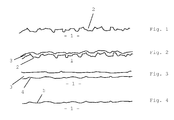
- the FIG. 1 shows as an example the surface of a generatively produced component 1, which has a rough surface 2 after the incremental, layered structure.
- the component may have been formed by selective laser sintering, by stereolithographic methods, by layer-by-layer gluing or reflowing. Due to the layered production it comes to the surfaces to form a roughness.
- the surface working method of the present invention which will be described below by way of example, may also be applied to components made by any other method.
- FIG. 2 shows the sectional view of the component 1 from FIG. 1 after application of a coating 3, for example by chemical nickel plating.
- a coating 3 for example by chemical nickel plating.
- the component 1 to be nickel-plated is transformed into a suitable liquid submerged so that nickel is deposited on the surface 2 of the component 1 by a corresponding chemical reaction of the components contained in the liquid.
- the layer thicknesses of the deposited chemical nickel can be varied in the range from 1 .mu.m to 100 .mu.m.
- the component is subjected to a heat treatment, which makes it possible that a diffusion exchange of ingredients between the layer 3 and the component 1 can take place.
- the heat treatment temperature can also be selected so that the temperature is in the range of the melting temperature of the layer material, so that a slight melting of the rough surface 2 can take place. Due to the diffusion processes and / or the melting of the surface 2, there is a change in the surface properties, as shown schematically in FIG FIG. 3 is shown.
- the interface between the layer 3 and the component 1 now represents a smooth boundary surface 4, as it comes through the diffusion processes and / or melting to a leveling of the protruding component regions.
- a heat-treated layer 3 for example, better spanbar and / or solderable and / or be chemically and / or mechanically abradable.
- the component in the manufacturing state according to FIG. 3 Find use.
- etching methods which are suitable for this purpose are property-sensitive removal methods, wherein the etchant is matched to the composition of the coating.
- the correspondingly produced components are thus distinguished either by the presence of a coating on the surface, or, in the case of the removal of the coating after the heat treatment has been carried out, by a diffusion zone in the edge zone of the component 1 which exists as a result of the diffusion with the formerly existing coating.
Landscapes
- Chemical & Material Sciences (AREA)
- Chemical Kinetics & Catalysis (AREA)
- Engineering & Computer Science (AREA)
- Materials Engineering (AREA)
- Mechanical Engineering (AREA)
- Metallurgy (AREA)
- Organic Chemistry (AREA)
- Chemically Coating (AREA)
- Other Surface Treatments For Metallic Materials (AREA)
Abstract
Description
- Die vorliegende Erfindung betrifft ein Verfahren zur Änderung der Oberflächeneigenschaften von Bauteilen, die beispielsweise inkrementell schichtweise aus einem Bauteilmaterial aufgebaut werden, sowie ein entsprechend hergestelltes Bauteil.
- Generative Fertigungsverfahren, bei denen ein Werkstück aus Inkrementen aus Material schichtweise aufgebaut wird, werden im Stand der Technik zunehmend nicht nur für die Herstellung von Prototypen eingesetzt, sondern auch zur Herstellung von Bauteilen in Kleinserien. Darüber hinaus bieten sich derartige generative Herstellungsverfahren auch für die Herstellung von Bauteilen an, für die andere Herstellungsverfahren nicht oder nur mit erheblichen Schwierigkeiten durchgeführt werden können. Dies führt dazu, dass generativ hergestellte Bauteile auch eine entsprechende Oberflächengüte in Form einer geringen Rauheit aufweisen sollen. Dies ist jedoch aufgrund des Herstellungsverfahrens unmittelbar nach der generativen Herstellung nicht gegeben, da durch die schichtweise Ausbildung des Bauteils an den Oberflächen entsprechend der Aufbringung der Schichten Stufen und Rauigkeiten entstehen.
- Es ist deshalb bereits versucht worden, durch Aufbringung von Schichten, die die Unebenheiten ausfüllen sollen, die Oberflächengüte zu verbessern. Dies ist beispielsweise in der
EP 0 420 614 A2 oder in F.E.H. Tay, E.H.A. Hae, M. Rahman, J.Y. Lee und T.E.H. Ong, Manufacture of R.P. Tools with High Quality Surface Finish Using High Temperature Epoxy Resin and Electroless Nickel Plating, in: Surface Engineering 2000, Vol. 16, No 3 beschrieben. Allerdings wird durch diese Maßnahmen die ursprünglich raue Oberfläche nicht beseitigt, sodass die Unebenheiten als Ausgangspunkte für Risswachstum und dergleichen weiterhin vorhanden sind. Außerdem kann bei bestimmten Anwendungsfällen das Vorhandensein der Beschichtung nachteilig sein. - Andere Verfahren zur Herstellung glatter Oberflächen, wie beispielsweise Schleifen, Strahlen, Polieren, Elektropolieren und dergleichen, sind aufwendig und können unter Umständen nur an bestimmten, frei zugänglichen Oberflächen durchgeführt werden.
- Es ist deshalb Aufgabe der vorliegenden Erfindung, ein Verfahren zur Änderung der Oberflächeneigenschaften von Bauteilen bereitzustellen, bei dem eine ausreichend gute Oberflächengüte erreicht wird, die ausreichend ist, um beispielsweise an derartig hergestellten Bauteilen optische Messverfahren oder eine zerstörungsfreie Bauteilprüfung, beispielsweise hinsichtlich Oberflächenrissprüfung, Wirbelstromprüfung usw., durchführen zu können. Die gewünschte glatte Oberfläche soll jedoch in einfacher und effektiver Weise herstellbar sein und insbesondere sollen möglichst alle Flächen eines Bauteils, also auch Flächen von Hohlräumen und dergleichen bearbeitbar sein. Insbesondere soll das Verfahren auch bei der generativen Herstellung eines Bauteils für die Glättung der Oberflächen einsetzbar sein.
- Diese Aufgabe wird gelöst durch ein Verfahren mit den Merkmalen des Anspruchs 1 und ein entsprechend hergestelltes Bauteil mit den Merkmalen des Anspruchs 12. Vorteilhafte Ausgestaltungen sind Gegenstand der abhängigen Ansprüche.
- Gemäß der Erfindung wird vorgeschlagen, auf dem zu bearbeitenden Bauteil eine Beschichtung aufzubringen, wobei die Beschichtung Bestandteile enthält, die bei einer niedrigeren Temperatur schmelzen als das Bauteilmaterial oder mit dem Bauteilmaterial Komponenten bilden, die eine niedrigere Schmelztemperatur als das Bauteilmaterial aufweisen und dass das entsprechend beschichtete Bauteil einer Wärmebehandlung unterzogen wird, sodass eine Diffusion zwischen der Beschichtung und dem Bauteil ermöglicht wird. Durch die Kombination der aufgebrachten Beschichtung mit niedrigerem Schmelzpunkt oder Schmelzpunkt erniedrigenden Bestandteilen einerseits sowie der Wärmebehandlung andererseits, kommt es zu Diffusionsvorgängen zwischen der Beschichtung und dem Bauteil und/oder zu einem Anschmelzen der Beschichtung und/oder der ursprünglichen Bauteiloberfäche, was zu einer Einebnung der ursprünglich rauen Oberfläche des Bauteils führt.
- Das Schichtmaterial kann aus dem gleichen Material gewählt werden, wie das Bauteilmaterial, wobei zusätzlich mindestens ein Element beigefügt sein sollte, welches den Schmelzpunkt erniedrigt. Alternativ kann das Schichtmaterial auch durch lediglich einen Bestandteil des Bauteilmaterials gebildet werden, nämlich vorzugsweise die Hauptkomponente des Bauteilmaterials. Bei einer metallischen Legierung, die für das Bauteilmaterial verwendet wird, könnte also die Hauptlegierungskomponente in Form eines technisch reinen Metalls als Schichtmaterial gewählt werden.
- Bei der Verwendung einer Nickelbasislegierung als Bauteilmaterial z.B. für die generative Herstellung von temperaturbelasteten Bauteilen von Strömungsmaschinen, wie beispielsweise Gasturbinen oder Flugtriebwerken, kann die Schicht aus technisch reinem Nickel als dem Hauptbestandteil der Nickelbasislegierung gebildet werden. Unter technisch reinem Nickel wird hierbei ein Material verstanden, welches zu nahezu 100 % aus Nickel besteht, jedoch im Umfang der technischen Gegebenheiten Verunreinigungen aufweisen kann.
- Alternativ kann bei einer Nickelbasislegierung als Bauteilmaterial auch eine mit einem Schmelzpunkt erniedrigenden Element legierte Nickelbasislegierung gewählt werden, wobei beispielsweise als Schmelzpunkt erniedrigende Elemente Bor und/oder Phosphor gewählt werden können.
- Unter Nickelbasislegierung sind diejenigen Legierungen zu verstehen, die als Bestandteil mit dem größten Anteil Nickel aufweisen und die insbesondere Legierungselemente umfassen, die eine Hochtemperaturanwendung ermöglichen. Beispielsweise kann hierfür Inconel IN 718 genannt werden.
- Das Schichtmaterial kann in flüssiger oder gasförmiger Form aufgebracht werden, wobei insbesondere eine chemische Reaktion in einem Tauchbad gewählt werden kann, um beispielsweise eine Nickelschicht aufzubringen. Ein derartiges Verfahren ist üblicherweise als chemisch Vernickeln bekannt.
- Die Wärmebehandlung kann bei einer Temperatur im Bereich der Schmelztemperatur des Schichtmaterials und unterhalb der Schmelztemperatur des Bauteilmaterials durchgeführt werden. Insbesondere kann die Temperatur in einem Bereich gewählt werden, der von einer Temperatur 30 % unterhalb der Schmelztemperatur bis zu einer Temperatur von 5 % über der Schmelztemperatur des Schichtmaterials reicht.
- Bei Bauteilen aus Nickelbasislegierungen kann die Wärmebehandlung beispielsweise im Bereich der Lösungsglühtemperatur des Bauteilmaterials erfolgen. Bei einer Schicht aus chemischem Nickel kann die Wärmebehandlung auch bei einer Temperatur knapp oberhalb der Schmelztemperatur durchgeführt werden, sodass ein Anschmelzen der Beschichtung und/oder der ursprünglichen Oberfläche des Bauteils erfolgt.
- Obwohl nach der Durchführung der Wärmebehandlung bereits eine geglättete Grenzschicht zwischen der Beschichtung und dem Bauteil, also eine geglättete ursprüngliche Oberflächenschicht vorliegt und somit das Bauteil bereits in diesem Zustand mit der Beschichtung Verwendung finden kann, kann ein weiterer Verfahrensschritt vorgesehen sein, der eine Entfernung der Beschichtung vorsieht.
- Dies kann bei dem vorliegenden Verfahren durch ein eigenschaftssensitives Abtragsverfahren, wie beispielsweise Ätzen, erfolgen, sodass die ursprüngliche Oberfläche wieder freigelegt werden kann. Damit kann die für bestimmte Anwendungen störende Beschichtung wieder entfernt werden, wobei gleichzeitig eine geglättete Oberfläche des Bauteils erreicht wird.
- Ein entsprechend hergestelltes Bauteil, insbesondere ein generativ hergestelltes Bauteil weist somit eine Randzone auf, die entweder eine Beschichtung umfasst oder zumindest eine Diffusionszone ausgebildet hat, wenn die Beschichtung wieder entfernt worden ist. Die Beschichtung des erfindungsgemäßen Bauteils weist das mit einem Schmelzpunkt erniedrigenden Element versehene Bauteilmaterial oder eine Beschichtung aus einem Bestandteil des Bauteilmaterials auf.
- Die beigefügten Zeichnungen zeigen in rein schematischer Weise in
- Fig.1
- einen Querschnitt durch ein generativ hergestelltes Bauteil mit einer rauen Oberfläche;
- Fig.2
- einen Querschnitt durch das Bauteil aus
Figur 1 , das mit einer Schicht versehen ist; - Fig.3
- einen Querschnitt durch das Bauteil aus den
Figuren 1 und 2 nach Durchführung einer Wärmebehandlung; und in - Fig.4
- einen Querschnitt durch das Bauteil aus den
Figuren 1 bis 3 nach Abziehen der Beschichtung. - Weitere Vorteile, Kennzeichen und Merkmale der vorliegenden Erfindung werden bei der nachfolgenden detaillierten Beschreibung eines Ausführungsbeispiels deutlich. Allerdings ist die Erfindung nicht auf dieses Ausführungsbeispiel beschränkt.
- Die
Figur 1 zeigt als Beispiel die Oberfläche eines generativ hergestellten Bauteils 1, welches nach dem inkrementellen, schichtweisen Aufbau eine raue Oberfläche 2 aufweist. Beispielsweise kann das Bauteil durch selektives Lasersintern, durch stereolithographischen Verfahren, durch schichtweises Kleben oder Aufschmelzen gebildet worden sein. Durch die schichtweise Herstellung kommt es an den Oberflächen zur Ausbildung einer Rauheit. Allerdings kann das zur Bearbeitung der Oberfläche eingesetzte Verfahren der vorliegenden Erfindung, das nachfolgend beispielhaft beschrieben wird, auch für Bauteile eingesetzt werden, die nach beliebig anderen Verfahren hergestellt worden sind. - Die
Figur 2 zeigt die Schnittansicht des Bauteils 1 ausFigur 1 nach Aufbringen einer Beschichtung 3, beispielsweise durch chemisches Vernickeln. Hierzu wird das zu vernickelnde Bauteil 1 in eine geeignete Flüssigkeit eingetaucht, sodass durch eine entsprechende chemische Reaktion der in der Flüssigkeit enthaltenen Komponenten Nickel an der Oberfläche 2 des Bauteils 1 abgeschieden wird. Die Schichtdicken des abgeschiedenen chemischen Nickels können hierbei im Bereich von 1 µm bis 100 µm variiert werden. - Nachdem die Schicht 3 auf dem Bauteil 1 erzeugt worden ist, wird das Bauteil einer Wärmebehandlung unterzogen, die es ermöglicht, dass ein Diffusionsaustausch von Inhaltsstoffen zwischen der Schicht 3 und dem Bauteil 1 erfolgen kann. Vorzugsweise kann die Wärmebehandlungstemperatur auch so gewählt werden, dass die Temperatur im Bereich der Schmelztemperatur des Schichtmaterials liegt, sodass ein leichtes Anschmelzen der rauen Oberfläche 2 erfolgen kann. Durch die Diffusionsvorgänge und/oder das Anschmelzen der Oberfläche 2 kommt es zu einer Änderung der Oberflächeneigenschaften, wie dies schematisch in
Figur 3 dargestellt ist. Insbesondere die Grenzfläche zwischen der Schicht 3 und dem Bauteil 1 stellt nun eine glatte Grenzfläche 4 dar, da es durch die Diffusionsvorgänge und/oder das Anschmelzen zu einem Einebnen der vorstehenden Bauteilbereiche kommt. Darüber hinaus kann eine solche wärmebehandelte Schicht 3 beispielsweise besser spanbar und/oder lötbar und/oder chemisch und/oder mechanisch abtragbar sein. - Je nach Anwendungsfall und Einsatzgebiet kann das Bauteil im Herstellungszustand gemäß
Figur 3 Verwendung finden. - Allerdings ist es auch möglich, die Schicht 3 wieder zu entfernen, sodass die eingeebnete Grenzfläche 4 als geglättete Oberfläche 5 am Bauteil 1 vorliegt.
- Als eigenschaftssensitive Abtragsverfahren kommen hierfür beispielsweise Ätzverfahren in Frage, wobei das Ätzmittel auf die Zusammensetzung der Beschichtung abgestimmt ist. Durch eine Veränderung im Ätzverhalten an der Grenzfläche 4 kann das Abtragen von Material nach Erreichen der Grenzfläche 4 gestoppt werden, sodass das Bauteil 2 mit der geglätteten Oberfläche 5 vorliegt.
- Die entsprechend hergestellten Bauteile zeichnen sich somit entweder durch das Vorliegen einer Beschichtung an der Oberfläche aus, oder, im Falle des Abtragens der Beschichtung nach Durchführung der Wärmebehandlung, durch eine durch die Diffusion mit der ehemals vorhandenen Beschichtung vorhandene Diffusionszone in der Randzone des Bauteils 1.
- Obwohl die vorliegende Erfindung anhand des Ausführungsbeispiels detaillierte beschrieben worden ist, ist die Erfindung nicht auf dieses Ausführungsbeispiel beschränkt, sondern vielmehr sind Abwandlungen in der Weise möglich, dass einzelne Merkmale weggelassen oder andersartige Kombinationen von Merkmalen realisiert werden können, ohne dass der Schutzbereich der beigefügten Ansprüche verlassen wird. Die vorliegende Offenbarung umfasst insbesondere sämtliche Kombinationen aller vorgestellten Einzelmerkmale.
Claims (13)
- Verfahren zur Änderung der Oberflächeneigenschaften, insbesondere zur Oberflächenglättung eines Bauteils,
dadurch gekennzeichnet, dass
die Oberfläche des Bauteils mit einem Schichtmaterial beschichtet wird, welches eine Zusammensetzung aufweist, die mindestens einen Bestandteil enthält, der bei einer niedrigeren Temperatur schmilzt als das Bauteilmaterial oder mit dem Bauteilmaterial mindestens eine Komponente bildet, die eine niedrigere Schmelztemperatur als das Bauteilmaterial aufweist, und dass das beschichtete Bauteil einer Wärmebehandlung unterzogen wird, so dass zwischen der Beschichtung und dem Bauteil Diffusionsvorgänge stattfinden können. - Verfahren nach Anspruch 1,
dadurch gekennzeichnet, dass
das Schichtmaterial ein mit mindestens einem den Schmelzpunkt erniedrigenden Element versehenes Bauteilmaterial ist. - Verfahren nach Anspruch 1,
dadurch gekennzeichnet, dass
das Schichtmaterial durch die Hauptkomponente des Bauteilmaterials gebildet wird. - Verfahren nach einem der vorhergehenden Ansprüche,
dadurch gekennzeichnet, dass
das Bauteilmaterial eine metallische Legierung und das Schichtmaterial eine metallische Legierung oder ein technisch reines Metall ist. - Verfahren nach einem der vorhergehenden Ansprüche,
dadurch gekennzeichnet, dass
das Bauteilmaterial eine Nickelbasislegierung und das Schichtmaterial Nickel oder das Schichtmaterial eine mit mindestens einem den Schmelzpunkt erniedrigenden Element legierte Nickelbasislegierung ist. - Verfahren nach Anspruch 4,
dadurch gekennzeichnet, dass
das den Schmelzpunkt erniedrigende Element Bor und/oder Phosphor ist. - Verfahren nach einem der vorhergehenden Ansprüche,
dadurch gekennzeichnet, dass
das Schichtmaterial in flüssiger oder gasförmiger Form aufgebracht und insbesondere durch chemische Reaktion in einem Tauchbad abgeschieden wird. - Verfahren nach einem der vorhergehenden Ansprüche,
dadurch gekennzeichnet, dass
die Wärmebehandlung in einem Bereich der Schmelztemperatur des Schichtmaterials und unterhalb der Schmelztemperatur des Bauteilmaterials durchgeführt wird, insbesondere in einem Temperaturbereich durchgeführt wird, der von einer Temperatur 30% unterhalb der Schmelztemperatur des Schichtmaterials bis zu einer Temperatur 5% über der Schmelztemperatur des Schichtmaterials reicht. - Verfahren nach einem der vorhergehenden Ansprüche,
dadurch gekennzeichnet, dass
die Wärmebehandlung im Bereich der Lösungsglühtemperatur des Bauteilmaterials erfolgt. - Verfahren nach einem der vorhergehenden Ansprüche,
dadurch gekennzeichnet, dass
bei einer durch chemisches Vernickeln abgeschiedenen Schicht die Wärmebehandlung bei einer Temperatur oberhalb der Schmelztemperatur des chemisch abgeschiedenen Nickels liegt. - Verfahren nach einem der vorhergehenden Ansprüche,
dadurch gekennzeichnet, dass
die Beschichtung nach der Wärmebehandlung wieder entfernt wird, insbesondere durch ein eigenschaftssensitives Abtragsverfahren, vorzugsweise Ätzen. - Verfahren nach einem der vorhergehenden Ansprüche,
dadurch gekennzeichnet, dass
das Verfahren zur generativen Herstellung eines Bauteils, bei welchem das Bauteil inkrementell schichtweise aus einem Bauteilmaterial aufgebaut wird, eingesetzt wird, um die Bauteiloberfläche zumindest teilweise zu glätten. - Bauteil, insbesondere generativ hergestelltes Bauteil, das insbesondere nach dem Verfahren nach einem der vorhergehenden Ansprüche hergestellt worden ist, aus einem Bauteilmaterial und mit einer Randzone, die entweder eine Beschichtung aufweist, die aus einem mit einem Schmelzpunkt erniedrigenden Element versehenen Bauteilmaterial gebildet oder aus der Hauptkomponente des Bauteilmaterials gebildet ist, oder eine Diffusionszone aufweist.
Priority Applications (1)
| Application Number | Priority Date | Filing Date | Title |
|---|---|---|---|
| EP12190803.2A EP2728035B1 (de) | 2012-10-31 | 2012-10-31 | Verfahren zur Änderung der Oberflächeneigenschaften von Bauteilen |
Applications Claiming Priority (1)
| Application Number | Priority Date | Filing Date | Title |
|---|---|---|---|
| EP12190803.2A EP2728035B1 (de) | 2012-10-31 | 2012-10-31 | Verfahren zur Änderung der Oberflächeneigenschaften von Bauteilen |
Publications (2)
| Publication Number | Publication Date |
|---|---|
| EP2728035A1 true EP2728035A1 (de) | 2014-05-07 |
| EP2728035B1 EP2728035B1 (de) | 2020-07-01 |
Family
ID=47191534
Family Applications (1)
| Application Number | Title | Priority Date | Filing Date |
|---|---|---|---|
| EP12190803.2A Active EP2728035B1 (de) | 2012-10-31 | 2012-10-31 | Verfahren zur Änderung der Oberflächeneigenschaften von Bauteilen |
Country Status (1)
| Country | Link |
|---|---|
| EP (1) | EP2728035B1 (de) |
Cited By (2)
| Publication number | Priority date | Publication date | Assignee | Title |
|---|---|---|---|---|
| CN104630695A (zh) * | 2015-01-27 | 2015-05-20 | 国家电网公司 | 一种用于高比例共渗层的锌铝合金共渗剂 |
| CN104630697A (zh) * | 2014-12-17 | 2015-05-20 | 国家电网公司 | 一种锌铝镁三元共渗层及制备方法 |
Citations (3)
| Publication number | Priority date | Publication date | Assignee | Title |
|---|---|---|---|---|
| DE102005059299A1 (de) * | 2004-12-17 | 2006-06-22 | General Electric Co. | Vorformlinge (Preform) und Verfahren zur Reparatur nickelbasiertes Superalloys und damit reparierte Komponenten |
| US20070269676A1 (en) * | 2006-05-19 | 2007-11-22 | Singer Kevin M | Diffusion barrier layer and method of making the same, and wear resistant article with the diffusion barrier layer and method of making the same |
| US20110117385A1 (en) * | 2009-11-18 | 2011-05-19 | United Technologies Corporation | Method of repair on nickel based hpt shrouds |
Family Cites Families (2)
| Publication number | Priority date | Publication date | Assignee | Title |
|---|---|---|---|---|
| US6036995A (en) * | 1997-01-31 | 2000-03-14 | Sermatech International, Inc. | Method for removal of surface layers of metallic coatings |
| US20080202552A1 (en) * | 2006-12-07 | 2008-08-28 | Lawrence Bernard Kool | Method for selectively removing coatings from metal substrates |
-
2012
- 2012-10-31 EP EP12190803.2A patent/EP2728035B1/de active Active
Patent Citations (3)
| Publication number | Priority date | Publication date | Assignee | Title |
|---|---|---|---|---|
| DE102005059299A1 (de) * | 2004-12-17 | 2006-06-22 | General Electric Co. | Vorformlinge (Preform) und Verfahren zur Reparatur nickelbasiertes Superalloys und damit reparierte Komponenten |
| US20070269676A1 (en) * | 2006-05-19 | 2007-11-22 | Singer Kevin M | Diffusion barrier layer and method of making the same, and wear resistant article with the diffusion barrier layer and method of making the same |
| US20110117385A1 (en) * | 2009-11-18 | 2011-05-19 | United Technologies Corporation | Method of repair on nickel based hpt shrouds |
Cited By (3)
| Publication number | Priority date | Publication date | Assignee | Title |
|---|---|---|---|---|
| CN104630697A (zh) * | 2014-12-17 | 2015-05-20 | 国家电网公司 | 一种锌铝镁三元共渗层及制备方法 |
| CN104630697B (zh) * | 2014-12-17 | 2017-08-25 | 国家电网公司 | 一种锌铝镁三元共渗层及制备方法 |
| CN104630695A (zh) * | 2015-01-27 | 2015-05-20 | 国家电网公司 | 一种用于高比例共渗层的锌铝合金共渗剂 |
Also Published As
| Publication number | Publication date |
|---|---|
| EP2728035B1 (de) | 2020-07-01 |
Similar Documents
| Publication | Publication Date | Title |
|---|---|---|
| DE112007003090B4 (de) | Verfahren zum Herstellen eines dreidimensional geformten Gegenstandes | |
| DE102009031313B4 (de) | Beschichtung und Verfahren zum Beschichten eines Bauteils | |
| DE102016115674A1 (de) | Additive Fertigung | |
| DE102014217858A1 (de) | Oberflächenglättung von generativ hergestellten Bauteilen und entsprechend hergestellte Bauteile einer Strömungsmaschine | |
| WO2011015187A1 (de) | Abreibbarer schaufelspitzenbelag | |
| WO2009100706A1 (de) | Vorrichtung und verfahren zur partiellen beschichtung von bauteilen | |
| EP3468740A1 (de) | Verfahren zum fügen von werkstoffen und werkstoffverbund | |
| DE102016202872A1 (de) | Bauteil aus einer Molybdän-Legierung und Verfahren zur Ausbildung einer Oxidationsschutzschicht hierfür | |
| DE102015201927A1 (de) | Verfahren zum Kaltgasspritzen mit Maske | |
| DE102018202723A1 (de) | Verfahren zur herstellung eines bauteils aus einer gradierten tial - legierung und entsprechend hergestelltes bauteil | |
| DE102006044555A1 (de) | Reparaturverfahren | |
| EP2728035B1 (de) | Verfahren zur Änderung der Oberflächeneigenschaften von Bauteilen | |
| EP2980263A1 (de) | Bauteil aus einer Molybdän-Legierung und Verfahren zu seiner Herstellung | |
| DE102015207463A1 (de) | Gedrucktes Reparaturpflaster für Turbinenbauteile | |
| EP2756912A1 (de) | Umschmelzen beim Auftragsschweißen | |
| DE102005044991A1 (de) | Verfahren zur Herstellung einer Schutzschicht, Schutzschicht und Bauteil mit einer Schutzschicht | |
| DE102007011728B4 (de) | Verfahren und Vorrichtung zum Ermitteln von Parametern beim Thermischen Spritzen | |
| DE102006054347A1 (de) | Elektrode und Verfahren zur Herstellung einer Elektrode | |
| DE102016207893A1 (de) | Bauplattform für die additive Herstellung und Verfahren | |
| DE102017200749A1 (de) | Schichtsystem mit zwei Zwischenschichten und Verfahren | |
| DE102009049811A1 (de) | Verfahren zum Herstellen einer Elektrode | |
| DE10355234A1 (de) | Verfahren zum Herstellen einer korrosionsbeständigen und oxidationsbeständigen Beschichtung sowie Bauteil mit einer solchen Beschichtung | |
| DE102017003698B3 (de) | Herstellung einer dünnen Substratschicht | |
| DE102013205915A1 (de) | Glättungsverfahren für Oberflächen von generativ hergestellten Bauteilen | |
| EP2799179A1 (de) | Generatives Verfahren zum Erzeugen eines Endgefüges sowie ein Endgefüge |
Legal Events
| Date | Code | Title | Description |
|---|---|---|---|
| PUAI | Public reference made under article 153(3) epc to a published international application that has entered the european phase |
Free format text: ORIGINAL CODE: 0009012 |
|
| 17P | Request for examination filed |
Effective date: 20121031 |
|
| AK | Designated contracting states |
Kind code of ref document: A1 Designated state(s): AL AT BE BG CH CY CZ DE DK EE ES FI FR GB GR HR HU IE IS IT LI LT LU LV MC MK MT NL NO PL PT RO RS SE SI SK SM TR |
|
| AX | Request for extension of the european patent |
Extension state: BA ME |
|
| RAP1 | Party data changed (applicant data changed or rights of an application transferred) |
Owner name: MTU AERO ENGINES GMBH |
|
| 17P | Request for examination filed |
Effective date: 20141010 |
|
| RBV | Designated contracting states (corrected) |
Designated state(s): AL AT BE BG CH CY CZ DE DK EE ES FI FR GB GR HR HU IE IS IT LI LT LU LV MC MK MT NL NO PL PT RO RS SE SI SK SM TR |
|
| RAP1 | Party data changed (applicant data changed or rights of an application transferred) |
Owner name: MTU AERO ENGINES AG |
|
| STAA | Information on the status of an ep patent application or granted ep patent |
Free format text: STATUS: EXAMINATION IS IN PROGRESS |
|
| 17Q | First examination report despatched |
Effective date: 20170704 |
|
| REG | Reference to a national code |
Ref country code: DE Ref legal event code: R079 Ref document number: 502012016185 Country of ref document: DE Free format text: PREVIOUS MAIN CLASS: C23C0010020000 Ipc: C23C0026020000 |
|
| RIC1 | Information provided on ipc code assigned before grant |
Ipc: C23C 10/08 20060101ALI20191218BHEP Ipc: C23C 10/22 20060101ALI20191218BHEP Ipc: C23C 10/16 20060101ALI20191218BHEP Ipc: C23C 10/14 20060101ALI20191218BHEP Ipc: C23C 10/60 20060101ALI20191218BHEP Ipc: C23C 26/02 20060101AFI20191218BHEP Ipc: C23C 10/26 20060101ALI20191218BHEP Ipc: C23C 10/06 20060101ALI20191218BHEP Ipc: C23C 10/20 20060101ALI20191218BHEP Ipc: C23C 10/02 20060101ALI20191218BHEP Ipc: C23C 10/18 20060101ALI20191218BHEP |
|
| GRAP | Despatch of communication of intention to grant a patent |
Free format text: ORIGINAL CODE: EPIDOSNIGR1 |
|
| STAA | Information on the status of an ep patent application or granted ep patent |
Free format text: STATUS: GRANT OF PATENT IS INTENDED |
|
| INTG | Intention to grant announced |
Effective date: 20200131 |
|
| GRAS | Grant fee paid |
Free format text: ORIGINAL CODE: EPIDOSNIGR3 |
|
| GRAA | (expected) grant |
Free format text: ORIGINAL CODE: 0009210 |
|
| STAA | Information on the status of an ep patent application or granted ep patent |
Free format text: STATUS: THE PATENT HAS BEEN GRANTED |
|
| AK | Designated contracting states |
Kind code of ref document: B1 Designated state(s): AL AT BE BG CH CY CZ DE DK EE ES FI FR GB GR HR HU IE IS IT LI LT LU LV MC MK MT NL NO PL PT RO RS SE SI SK SM TR |
|
| REG | Reference to a national code |
Ref country code: GB Ref legal event code: FG4D Free format text: NOT ENGLISH |
|
| REG | Reference to a national code |
Ref country code: CH Ref legal event code: EP Ref country code: AT Ref legal event code: REF Ref document number: 1286262 Country of ref document: AT Kind code of ref document: T Effective date: 20200715 |
|
| REG | Reference to a national code |
Ref country code: IE Ref legal event code: FG4D Free format text: LANGUAGE OF EP DOCUMENT: GERMAN |
|
| REG | Reference to a national code |
Ref country code: DE Ref legal event code: R096 Ref document number: 502012016185 Country of ref document: DE |
|
| REG | Reference to a national code |
Ref country code: LT Ref legal event code: MG4D |
|
| PG25 | Lapsed in a contracting state [announced via postgrant information from national office to epo] |
Ref country code: BG Free format text: LAPSE BECAUSE OF FAILURE TO SUBMIT A TRANSLATION OF THE DESCRIPTION OR TO PAY THE FEE WITHIN THE PRESCRIBED TIME-LIMIT Effective date: 20201001 |
|
| REG | Reference to a national code |
Ref country code: NL Ref legal event code: MP Effective date: 20200701 |
|
| PG25 | Lapsed in a contracting state [announced via postgrant information from national office to epo] |
Ref country code: LT Free format text: LAPSE BECAUSE OF FAILURE TO SUBMIT A TRANSLATION OF THE DESCRIPTION OR TO PAY THE FEE WITHIN THE PRESCRIBED TIME-LIMIT Effective date: 20200701 Ref country code: PT Free format text: LAPSE BECAUSE OF FAILURE TO SUBMIT A TRANSLATION OF THE DESCRIPTION OR TO PAY THE FEE WITHIN THE PRESCRIBED TIME-LIMIT Effective date: 20201102 Ref country code: FI Free format text: LAPSE BECAUSE OF FAILURE TO SUBMIT A TRANSLATION OF THE DESCRIPTION OR TO PAY THE FEE WITHIN THE PRESCRIBED TIME-LIMIT Effective date: 20200701 Ref country code: SE Free format text: LAPSE BECAUSE OF FAILURE TO SUBMIT A TRANSLATION OF THE DESCRIPTION OR TO PAY THE FEE WITHIN THE PRESCRIBED TIME-LIMIT Effective date: 20200701 Ref country code: HR Free format text: LAPSE BECAUSE OF FAILURE TO SUBMIT A TRANSLATION OF THE DESCRIPTION OR TO PAY THE FEE WITHIN THE PRESCRIBED TIME-LIMIT Effective date: 20200701 Ref country code: CZ Free format text: LAPSE BECAUSE OF FAILURE TO SUBMIT A TRANSLATION OF THE DESCRIPTION OR TO PAY THE FEE WITHIN THE PRESCRIBED TIME-LIMIT Effective date: 20200701 Ref country code: ES Free format text: LAPSE BECAUSE OF FAILURE TO SUBMIT A TRANSLATION OF THE DESCRIPTION OR TO PAY THE FEE WITHIN THE PRESCRIBED TIME-LIMIT Effective date: 20200701 Ref country code: NO Free format text: LAPSE BECAUSE OF FAILURE TO SUBMIT A TRANSLATION OF THE DESCRIPTION OR TO PAY THE FEE WITHIN THE PRESCRIBED TIME-LIMIT Effective date: 20201001 Ref country code: GR Free format text: LAPSE BECAUSE OF FAILURE TO SUBMIT A TRANSLATION OF THE DESCRIPTION OR TO PAY THE FEE WITHIN THE PRESCRIBED TIME-LIMIT Effective date: 20201002 |
|
| PGFP | Annual fee paid to national office [announced via postgrant information from national office to epo] |
Ref country code: DE Payment date: 20201022 Year of fee payment: 9 Ref country code: FR Payment date: 20201020 Year of fee payment: 9 Ref country code: GB Payment date: 20201020 Year of fee payment: 9 |
|
| PG25 | Lapsed in a contracting state [announced via postgrant information from national office to epo] |
Ref country code: RS Free format text: LAPSE BECAUSE OF FAILURE TO SUBMIT A TRANSLATION OF THE DESCRIPTION OR TO PAY THE FEE WITHIN THE PRESCRIBED TIME-LIMIT Effective date: 20200701 Ref country code: PL Free format text: LAPSE BECAUSE OF FAILURE TO SUBMIT A TRANSLATION OF THE DESCRIPTION OR TO PAY THE FEE WITHIN THE PRESCRIBED TIME-LIMIT Effective date: 20200701 Ref country code: LV Free format text: LAPSE BECAUSE OF FAILURE TO SUBMIT A TRANSLATION OF THE DESCRIPTION OR TO PAY THE FEE WITHIN THE PRESCRIBED TIME-LIMIT Effective date: 20200701 Ref country code: IS Free format text: LAPSE BECAUSE OF FAILURE TO SUBMIT A TRANSLATION OF THE DESCRIPTION OR TO PAY THE FEE WITHIN THE PRESCRIBED TIME-LIMIT Effective date: 20201101 |
|
| PG25 | Lapsed in a contracting state [announced via postgrant information from national office to epo] |
Ref country code: NL Free format text: LAPSE BECAUSE OF FAILURE TO SUBMIT A TRANSLATION OF THE DESCRIPTION OR TO PAY THE FEE WITHIN THE PRESCRIBED TIME-LIMIT Effective date: 20200701 |
|
| REG | Reference to a national code |
Ref country code: DE Ref legal event code: R097 Ref document number: 502012016185 Country of ref document: DE |
|
| PG25 | Lapsed in a contracting state [announced via postgrant information from national office to epo] |
Ref country code: EE Free format text: LAPSE BECAUSE OF FAILURE TO SUBMIT A TRANSLATION OF THE DESCRIPTION OR TO PAY THE FEE WITHIN THE PRESCRIBED TIME-LIMIT Effective date: 20200701 Ref country code: DK Free format text: LAPSE BECAUSE OF FAILURE TO SUBMIT A TRANSLATION OF THE DESCRIPTION OR TO PAY THE FEE WITHIN THE PRESCRIBED TIME-LIMIT Effective date: 20200701 Ref country code: IT Free format text: LAPSE BECAUSE OF FAILURE TO SUBMIT A TRANSLATION OF THE DESCRIPTION OR TO PAY THE FEE WITHIN THE PRESCRIBED TIME-LIMIT Effective date: 20200701 Ref country code: SM Free format text: LAPSE BECAUSE OF FAILURE TO SUBMIT A TRANSLATION OF THE DESCRIPTION OR TO PAY THE FEE WITHIN THE PRESCRIBED TIME-LIMIT Effective date: 20200701 Ref country code: RO Free format text: LAPSE BECAUSE OF FAILURE TO SUBMIT A TRANSLATION OF THE DESCRIPTION OR TO PAY THE FEE WITHIN THE PRESCRIBED TIME-LIMIT Effective date: 20200701 |
|
| PLBE | No opposition filed within time limit |
Free format text: ORIGINAL CODE: 0009261 |
|
| STAA | Information on the status of an ep patent application or granted ep patent |
Free format text: STATUS: NO OPPOSITION FILED WITHIN TIME LIMIT |
|
| PG25 | Lapsed in a contracting state [announced via postgrant information from national office to epo] |
Ref country code: AL Free format text: LAPSE BECAUSE OF FAILURE TO SUBMIT A TRANSLATION OF THE DESCRIPTION OR TO PAY THE FEE WITHIN THE PRESCRIBED TIME-LIMIT Effective date: 20200701 |
|
| REG | Reference to a national code |
Ref country code: CH Ref legal event code: PL |
|
| 26N | No opposition filed |
Effective date: 20210406 |
|
| PG25 | Lapsed in a contracting state [announced via postgrant information from national office to epo] |
Ref country code: LU Free format text: LAPSE BECAUSE OF NON-PAYMENT OF DUE FEES Effective date: 20201031 Ref country code: MC Free format text: LAPSE BECAUSE OF FAILURE TO SUBMIT A TRANSLATION OF THE DESCRIPTION OR TO PAY THE FEE WITHIN THE PRESCRIBED TIME-LIMIT Effective date: 20200701 Ref country code: SK Free format text: LAPSE BECAUSE OF FAILURE TO SUBMIT A TRANSLATION OF THE DESCRIPTION OR TO PAY THE FEE WITHIN THE PRESCRIBED TIME-LIMIT Effective date: 20200701 |
|
| REG | Reference to a national code |
Ref country code: BE Ref legal event code: MM Effective date: 20201031 |
|
| PG25 | Lapsed in a contracting state [announced via postgrant information from national office to epo] |
Ref country code: SI Free format text: LAPSE BECAUSE OF FAILURE TO SUBMIT A TRANSLATION OF THE DESCRIPTION OR TO PAY THE FEE WITHIN THE PRESCRIBED TIME-LIMIT Effective date: 20200701 Ref country code: LI Free format text: LAPSE BECAUSE OF NON-PAYMENT OF DUE FEES Effective date: 20201031 Ref country code: BE Free format text: LAPSE BECAUSE OF NON-PAYMENT OF DUE FEES Effective date: 20201031 Ref country code: CH Free format text: LAPSE BECAUSE OF NON-PAYMENT OF DUE FEES Effective date: 20201031 |
|
| PG25 | Lapsed in a contracting state [announced via postgrant information from national office to epo] |
Ref country code: IE Free format text: LAPSE BECAUSE OF NON-PAYMENT OF DUE FEES Effective date: 20201031 |
|
| REG | Reference to a national code |
Ref country code: AT Ref legal event code: MM01 Ref document number: 1286262 Country of ref document: AT Kind code of ref document: T Effective date: 20201031 |
|
| PG25 | Lapsed in a contracting state [announced via postgrant information from national office to epo] |
Ref country code: AT Free format text: LAPSE BECAUSE OF NON-PAYMENT OF DUE FEES Effective date: 20201031 |
|
| REG | Reference to a national code |
Ref country code: DE Ref legal event code: R119 Ref document number: 502012016185 Country of ref document: DE |
|
| PG25 | Lapsed in a contracting state [announced via postgrant information from national office to epo] |
Ref country code: TR Free format text: LAPSE BECAUSE OF FAILURE TO SUBMIT A TRANSLATION OF THE DESCRIPTION OR TO PAY THE FEE WITHIN THE PRESCRIBED TIME-LIMIT Effective date: 20200701 Ref country code: MT Free format text: LAPSE BECAUSE OF FAILURE TO SUBMIT A TRANSLATION OF THE DESCRIPTION OR TO PAY THE FEE WITHIN THE PRESCRIBED TIME-LIMIT Effective date: 20200701 Ref country code: CY Free format text: LAPSE BECAUSE OF FAILURE TO SUBMIT A TRANSLATION OF THE DESCRIPTION OR TO PAY THE FEE WITHIN THE PRESCRIBED TIME-LIMIT Effective date: 20200701 |
|
| GBPC | Gb: european patent ceased through non-payment of renewal fee |
Effective date: 20211031 |
|
| PG25 | Lapsed in a contracting state [announced via postgrant information from national office to epo] |
Ref country code: MK Free format text: LAPSE BECAUSE OF FAILURE TO SUBMIT A TRANSLATION OF THE DESCRIPTION OR TO PAY THE FEE WITHIN THE PRESCRIBED TIME-LIMIT Effective date: 20200701 |
|
| PG25 | Lapsed in a contracting state [announced via postgrant information from national office to epo] |
Ref country code: GB Free format text: LAPSE BECAUSE OF NON-PAYMENT OF DUE FEES Effective date: 20211031 Ref country code: DE Free format text: LAPSE BECAUSE OF NON-PAYMENT OF DUE FEES Effective date: 20220503 |
|
| PG25 | Lapsed in a contracting state [announced via postgrant information from national office to epo] |
Ref country code: FR Free format text: LAPSE BECAUSE OF NON-PAYMENT OF DUE FEES Effective date: 20211031 |