EP2725643A1 - Method for producing iron oxyfluoride positive electrode active substance and iron oxyfluoride positive electrode active substance - Google Patents
Method for producing iron oxyfluoride positive electrode active substance and iron oxyfluoride positive electrode active substance Download PDFInfo
- Publication number
- EP2725643A1 EP2725643A1 EP12802330.6A EP12802330A EP2725643A1 EP 2725643 A1 EP2725643 A1 EP 2725643A1 EP 12802330 A EP12802330 A EP 12802330A EP 2725643 A1 EP2725643 A1 EP 2725643A1
- Authority
- EP
- European Patent Office
- Prior art keywords
- positive electrode
- electrode active
- feof
- active substance
- mainly composed
- Prior art date
- Legal status (The legal status is an assumption and is not a legal conclusion. Google has not performed a legal analysis and makes no representation as to the accuracy of the status listed.)
- Granted
Links
- 239000013543 active substance Substances 0.000 title claims abstract description 78
- 238000004519 manufacturing process Methods 0.000 title abstract description 11
- IYOHHZVNHNCZNL-UHFFFAOYSA-N [Fe].FOF Chemical compound [Fe].FOF IYOHHZVNHNCZNL-UHFFFAOYSA-N 0.000 title 2
- 229910015182 FeOF Inorganic materials 0.000 claims abstract description 84
- SHXXPRJOPFJRHA-UHFFFAOYSA-K iron(iii) fluoride Chemical compound F[Fe](F)F SHXXPRJOPFJRHA-UHFFFAOYSA-K 0.000 claims abstract description 78
- UQSXHKLRYXJYBZ-UHFFFAOYSA-N Iron oxide Chemical compound [Fe]=O UQSXHKLRYXJYBZ-UHFFFAOYSA-N 0.000 claims abstract description 68
- 238000007578 melt-quenching technique Methods 0.000 claims abstract description 18
- 239000000203 mixture Substances 0.000 claims abstract description 15
- 239000012298 atmosphere Substances 0.000 claims abstract description 8
- 239000011261 inert gas Substances 0.000 claims abstract description 8
- 239000007787 solid Substances 0.000 claims abstract description 8
- JEIPFZHSYJVQDO-UHFFFAOYSA-N iron(III) oxide Inorganic materials O=[Fe]O[Fe]=O JEIPFZHSYJVQDO-UHFFFAOYSA-N 0.000 claims abstract 6
- 238000000034 method Methods 0.000 claims description 28
- 238000010791 quenching Methods 0.000 claims description 15
- 230000000171 quenching effect Effects 0.000 claims description 15
- 238000010438 heat treatment Methods 0.000 claims description 12
- 238000002441 X-ray diffraction Methods 0.000 claims description 11
- 230000006698 induction Effects 0.000 claims description 9
- 239000000126 substance Substances 0.000 claims description 8
- 230000005855 radiation Effects 0.000 claims description 4
- 239000007858 starting material Substances 0.000 description 33
- XKRFYHLGVUSROY-UHFFFAOYSA-N Argon Chemical compound [Ar] XKRFYHLGVUSROY-UHFFFAOYSA-N 0.000 description 12
- 239000011255 nonaqueous electrolyte Substances 0.000 description 12
- VYPSYNLAJGMNEJ-UHFFFAOYSA-N silicon dioxide Inorganic materials O=[Si]=O VYPSYNLAJGMNEJ-UHFFFAOYSA-N 0.000 description 12
- OKTJSMMVPCPJKN-UHFFFAOYSA-N Carbon Chemical compound [C] OKTJSMMVPCPJKN-UHFFFAOYSA-N 0.000 description 11
- RYGMFSIKBFXOCR-UHFFFAOYSA-N Copper Chemical compound [Cu] RYGMFSIKBFXOCR-UHFFFAOYSA-N 0.000 description 11
- KMTRUDSVKNLOMY-UHFFFAOYSA-N Ethylene carbonate Chemical compound O=C1OCCO1 KMTRUDSVKNLOMY-UHFFFAOYSA-N 0.000 description 10
- 125000001153 fluoro group Chemical group F* 0.000 description 10
- 239000010453 quartz Substances 0.000 description 9
- 229910052802 copper Inorganic materials 0.000 description 8
- 239000010949 copper Substances 0.000 description 8
- 230000008018 melting Effects 0.000 description 8
- IEJIGPNLZYLLBP-UHFFFAOYSA-N dimethyl carbonate Chemical compound COC(=O)OC IEJIGPNLZYLLBP-UHFFFAOYSA-N 0.000 description 7
- 229910052731 fluorine Inorganic materials 0.000 description 7
- 239000007789 gas Substances 0.000 description 7
- 238000002844 melting Methods 0.000 description 7
- PXHVJJICTQNCMI-UHFFFAOYSA-N Nickel Chemical compound [Ni] PXHVJJICTQNCMI-UHFFFAOYSA-N 0.000 description 6
- 229910052786 argon Inorganic materials 0.000 description 6
- 230000015572 biosynthetic process Effects 0.000 description 6
- 239000008151 electrolyte solution Substances 0.000 description 6
- 239000008188 pellet Substances 0.000 description 6
- BASFCYQUMIYNBI-UHFFFAOYSA-N platinum Chemical compound [Pt] BASFCYQUMIYNBI-UHFFFAOYSA-N 0.000 description 6
- 238000003786 synthesis reaction Methods 0.000 description 6
- 238000012360 testing method Methods 0.000 description 6
- 229910001290 LiPF6 Inorganic materials 0.000 description 5
- 238000004364 calculation method Methods 0.000 description 5
- 238000006243 chemical reaction Methods 0.000 description 5
- 239000012535 impurity Substances 0.000 description 5
- 239000006230 acetylene black Substances 0.000 description 4
- QVGXLLKOCUKJST-UHFFFAOYSA-N atomic oxygen Chemical compound [O] QVGXLLKOCUKJST-UHFFFAOYSA-N 0.000 description 4
- 229910052799 carbon Inorganic materials 0.000 description 4
- 239000013078 crystal Substances 0.000 description 4
- 239000003792 electrolyte Substances 0.000 description 4
- 239000011737 fluorine Substances 0.000 description 4
- 229910052744 lithium Inorganic materials 0.000 description 4
- 229910001416 lithium ion Inorganic materials 0.000 description 4
- 239000000463 material Substances 0.000 description 4
- 238000005259 measurement Methods 0.000 description 4
- 239000001301 oxygen Substances 0.000 description 4
- 229910052760 oxygen Inorganic materials 0.000 description 4
- 238000010298 pulverizing process Methods 0.000 description 4
- 239000002904 solvent Substances 0.000 description 4
- 125000006850 spacer group Chemical group 0.000 description 4
- WEVYAHXRMPXWCK-UHFFFAOYSA-N Acetonitrile Chemical compound CC#N WEVYAHXRMPXWCK-UHFFFAOYSA-N 0.000 description 3
- RTZKZFJDLAIYFH-UHFFFAOYSA-N Diethyl ether Chemical compound CCOCC RTZKZFJDLAIYFH-UHFFFAOYSA-N 0.000 description 3
- YCKRFDGAMUMZLT-UHFFFAOYSA-N Fluorine atom Chemical compound [F] YCKRFDGAMUMZLT-UHFFFAOYSA-N 0.000 description 3
- HBBGRARXTFLTSG-UHFFFAOYSA-N Lithium ion Chemical compound [Li+] HBBGRARXTFLTSG-UHFFFAOYSA-N 0.000 description 3
- ZMXDDKWLCZADIW-UHFFFAOYSA-N N,N-Dimethylformamide Chemical compound CN(C)C=O ZMXDDKWLCZADIW-UHFFFAOYSA-N 0.000 description 3
- YXFVVABEGXRONW-UHFFFAOYSA-N Toluene Chemical compound CC1=CC=CC=C1 YXFVVABEGXRONW-UHFFFAOYSA-N 0.000 description 3
- JFDZBHWFFUWGJE-UHFFFAOYSA-N benzonitrile Chemical compound N#CC1=CC=CC=C1 JFDZBHWFFUWGJE-UHFFFAOYSA-N 0.000 description 3
- 239000011230 binding agent Substances 0.000 description 3
- 238000001354 calcination Methods 0.000 description 3
- 239000004020 conductor Substances 0.000 description 3
- 230000001747 exhibiting effect Effects 0.000 description 3
- -1 ion compound Chemical class 0.000 description 3
- 238000010309 melting process Methods 0.000 description 3
- 239000004570 mortar (masonry) Substances 0.000 description 3
- 229910052759 nickel Inorganic materials 0.000 description 3
- 239000003960 organic solvent Substances 0.000 description 3
- 229910052697 platinum Inorganic materials 0.000 description 3
- 239000011369 resultant mixture Substances 0.000 description 3
- 239000007790 solid phase Substances 0.000 description 3
- 239000010935 stainless steel Substances 0.000 description 3
- 229910001220 stainless steel Inorganic materials 0.000 description 3
- HXJUTPCZVOIRIF-UHFFFAOYSA-N sulfolane Chemical class O=S1(=O)CCCC1 HXJUTPCZVOIRIF-UHFFFAOYSA-N 0.000 description 3
- YEJRWHAVMIAJKC-UHFFFAOYSA-N 4-Butyrolactone Chemical compound O=C1CCCO1 YEJRWHAVMIAJKC-UHFFFAOYSA-N 0.000 description 2
- IJGRMHOSHXDMSA-UHFFFAOYSA-N Atomic nitrogen Chemical compound N#N IJGRMHOSHXDMSA-UHFFFAOYSA-N 0.000 description 2
- XTHFKEDIFFGKHM-UHFFFAOYSA-N Dimethoxyethane Chemical compound COCCOC XTHFKEDIFFGKHM-UHFFFAOYSA-N 0.000 description 2
- IAZDPXIOMUYVGZ-UHFFFAOYSA-N Dimethylsulphoxide Chemical compound CS(C)=O IAZDPXIOMUYVGZ-UHFFFAOYSA-N 0.000 description 2
- 229910015189 FeOx Inorganic materials 0.000 description 2
- XEEYBQQBJWHFJM-UHFFFAOYSA-N Iron Chemical compound [Fe] XEEYBQQBJWHFJM-UHFFFAOYSA-N 0.000 description 2
- WHXSMMKQMYFTQS-UHFFFAOYSA-N Lithium Chemical compound [Li] WHXSMMKQMYFTQS-UHFFFAOYSA-N 0.000 description 2
- WYURNTSHIVDZCO-UHFFFAOYSA-N Tetrahydrofuran Chemical compound C1CCOC1 WYURNTSHIVDZCO-UHFFFAOYSA-N 0.000 description 2
- 238000000498 ball milling Methods 0.000 description 2
- 239000011248 coating agent Substances 0.000 description 2
- 238000000576 coating method Methods 0.000 description 2
- 150000001875 compounds Chemical class 0.000 description 2
- 239000000470 constituent Substances 0.000 description 2
- 238000007796 conventional method Methods 0.000 description 2
- 238000001816 cooling Methods 0.000 description 2
- 229910001873 dinitrogen Inorganic materials 0.000 description 2
- 150000002148 esters Chemical class 0.000 description 2
- 238000003780 insertion Methods 0.000 description 2
- 230000037431 insertion Effects 0.000 description 2
- 238000005342 ion exchange Methods 0.000 description 2
- AMXOYNBUYSYVKV-UHFFFAOYSA-M lithium bromide Chemical compound [Li+].[Br-] AMXOYNBUYSYVKV-UHFFFAOYSA-M 0.000 description 2
- KWGKDLIKAYFUFQ-UHFFFAOYSA-M lithium chloride Chemical compound [Li+].[Cl-] KWGKDLIKAYFUFQ-UHFFFAOYSA-M 0.000 description 2
- 239000007769 metal material Substances 0.000 description 2
- TZIHFWKZFHZASV-UHFFFAOYSA-N methyl formate Chemical compound COC=O TZIHFWKZFHZASV-UHFFFAOYSA-N 0.000 description 2
- 238000002360 preparation method Methods 0.000 description 2
- 230000002035 prolonged effect Effects 0.000 description 2
- 239000002002 slurry Substances 0.000 description 2
- 239000000758 substrate Substances 0.000 description 2
- 238000005979 thermal decomposition reaction Methods 0.000 description 2
- GWEVSGVZZGPLCZ-UHFFFAOYSA-N titanium dioxide Inorganic materials O=[Ti]=O GWEVSGVZZGPLCZ-UHFFFAOYSA-N 0.000 description 2
- WSLDOOZREJYCGB-UHFFFAOYSA-N 1,2-Dichloroethane Chemical compound ClCCCl WSLDOOZREJYCGB-UHFFFAOYSA-N 0.000 description 1
- LZDKZFUFMNSQCJ-UHFFFAOYSA-N 1,2-diethoxyethane Chemical compound CCOCCOCC LZDKZFUFMNSQCJ-UHFFFAOYSA-N 0.000 description 1
- VAYTZRYEBVHVLE-UHFFFAOYSA-N 1,3-dioxol-2-one Chemical compound O=C1OC=CO1 VAYTZRYEBVHVLE-UHFFFAOYSA-N 0.000 description 1
- WNXJIVFYUVYPPR-UHFFFAOYSA-N 1,3-dioxolane Chemical compound C1COCO1 WNXJIVFYUVYPPR-UHFFFAOYSA-N 0.000 description 1
- RYHBNJHYFVUHQT-UHFFFAOYSA-N 1,4-Dioxane Chemical compound C1COCCO1 RYHBNJHYFVUHQT-UHFFFAOYSA-N 0.000 description 1
- JWUJQDFVADABEY-UHFFFAOYSA-N 2-methyltetrahydrofuran Chemical compound CC1CCCO1 JWUJQDFVADABEY-UHFFFAOYSA-N 0.000 description 1
- PPDFQRAASCRJAH-UHFFFAOYSA-N 2-methylthiolane 1,1-dioxide Chemical compound CC1CCCS1(=O)=O PPDFQRAASCRJAH-UHFFFAOYSA-N 0.000 description 1
- SBUOHGKIOVRDKY-UHFFFAOYSA-N 4-methyl-1,3-dioxolane Chemical compound CC1COCO1 SBUOHGKIOVRDKY-UHFFFAOYSA-N 0.000 description 1
- 229910001558 CF3SO3Li Inorganic materials 0.000 description 1
- ZAMOUSCENKQFHK-UHFFFAOYSA-N Chlorine atom Chemical compound [Cl] ZAMOUSCENKQFHK-UHFFFAOYSA-N 0.000 description 1
- OIFBSDVPJOWBCH-UHFFFAOYSA-N Diethyl carbonate Chemical compound CCOC(=O)OCC OIFBSDVPJOWBCH-UHFFFAOYSA-N 0.000 description 1
- 229910000733 Li alloy Inorganic materials 0.000 description 1
- 229910015044 LiB Inorganic materials 0.000 description 1
- 229910000552 LiCF3SO3 Inorganic materials 0.000 description 1
- 229910013131 LiN Inorganic materials 0.000 description 1
- 229910013436 LiN(SO3CF3)2 Inorganic materials 0.000 description 1
- NTIZESTWPVYFNL-UHFFFAOYSA-N Methyl isobutyl ketone Chemical compound CC(C)CC(C)=O NTIZESTWPVYFNL-UHFFFAOYSA-N 0.000 description 1
- UIHCLUNTQKBZGK-UHFFFAOYSA-N Methyl isobutyl ketone Natural products CCC(C)C(C)=O UIHCLUNTQKBZGK-UHFFFAOYSA-N 0.000 description 1
- RFFFKMOABOFIDF-UHFFFAOYSA-N Pentanenitrile Chemical compound CCCCC#N RFFFKMOABOFIDF-UHFFFAOYSA-N 0.000 description 1
- 239000004698 Polyethylene Substances 0.000 description 1
- 229910006145 SO3Li Inorganic materials 0.000 description 1
- 229910052782 aluminium Inorganic materials 0.000 description 1
- XAGFODPZIPBFFR-UHFFFAOYSA-N aluminium Chemical compound [Al] XAGFODPZIPBFFR-UHFFFAOYSA-N 0.000 description 1
- 150000001408 amides Chemical class 0.000 description 1
- 150000001412 amines Chemical class 0.000 description 1
- 238000004458 analytical method Methods 0.000 description 1
- 125000004429 atom Chemical group 0.000 description 1
- 238000000889 atomisation Methods 0.000 description 1
- KVNRLNFWIYMESJ-UHFFFAOYSA-N butyronitrile Chemical compound CCCC#N KVNRLNFWIYMESJ-UHFFFAOYSA-N 0.000 description 1
- 150000004649 carbonic acid derivatives Chemical class 0.000 description 1
- 239000006231 channel black Substances 0.000 description 1
- 150000008280 chlorinated hydrocarbons Chemical class 0.000 description 1
- 239000000460 chlorine Substances 0.000 description 1
- 229910052801 chlorine Inorganic materials 0.000 description 1
- 238000000748 compression moulding Methods 0.000 description 1
- 239000002826 coolant Substances 0.000 description 1
- RKTYLMNFRDHKIL-UHFFFAOYSA-N copper;5,10,15,20-tetraphenylporphyrin-22,24-diide Chemical compound [Cu+2].C1=CC(C(=C2C=CC([N-]2)=C(C=2C=CC=CC=2)C=2C=CC(N=2)=C(C=2C=CC=CC=2)C2=CC=C3[N-]2)C=2C=CC=CC=2)=NC1=C3C1=CC=CC=C1 RKTYLMNFRDHKIL-UHFFFAOYSA-N 0.000 description 1
- 230000007423 decrease Effects 0.000 description 1
- 230000000593 degrading effect Effects 0.000 description 1
- 230000006866 deterioration Effects 0.000 description 1
- 238000011161 development Methods 0.000 description 1
- 230000018109 developmental process Effects 0.000 description 1
- 238000010891 electric arc Methods 0.000 description 1
- 230000008030 elimination Effects 0.000 description 1
- 238000003379 elimination reaction Methods 0.000 description 1
- 150000002170 ethers Chemical class 0.000 description 1
- JBTWLSYIZRCDFO-UHFFFAOYSA-N ethyl methyl carbonate Chemical compound CCOC(=O)OC JBTWLSYIZRCDFO-UHFFFAOYSA-N 0.000 description 1
- 150000002222 fluorine compounds Chemical class 0.000 description 1
- 239000006232 furnace black Substances 0.000 description 1
- 239000004615 ingredient Substances 0.000 description 1
- 229910052742 iron Inorganic materials 0.000 description 1
- 150000002506 iron compounds Chemical class 0.000 description 1
- 150000002576 ketones Chemical class 0.000 description 1
- 150000002596 lactones Chemical class 0.000 description 1
- 239000001989 lithium alloy Substances 0.000 description 1
- 150000002642 lithium compounds Chemical class 0.000 description 1
- 229910001540 lithium hexafluoroarsenate(V) Inorganic materials 0.000 description 1
- MHCFAGZWMAWTNR-UHFFFAOYSA-M lithium perchlorate Chemical compound [Li+].[O-]Cl(=O)(=O)=O MHCFAGZWMAWTNR-UHFFFAOYSA-M 0.000 description 1
- 229910001486 lithium perchlorate Inorganic materials 0.000 description 1
- 229910052751 metal Inorganic materials 0.000 description 1
- 239000002184 metal Substances 0.000 description 1
- 150000002825 nitriles Chemical class 0.000 description 1
- 238000005453 pelletization Methods 0.000 description 1
- 239000012071 phase Substances 0.000 description 1
- 229920000573 polyethylene Polymers 0.000 description 1
- 239000004810 polytetrafluoroethylene Substances 0.000 description 1
- 229920001343 polytetrafluoroethylene Polymers 0.000 description 1
- 239000000843 powder Substances 0.000 description 1
- 239000002243 precursor Substances 0.000 description 1
- 238000012545 processing Methods 0.000 description 1
- FVSKHRXBFJPNKK-UHFFFAOYSA-N propionitrile Chemical compound CCC#N FVSKHRXBFJPNKK-UHFFFAOYSA-N 0.000 description 1
- RUOJZAUFBMNUDX-UHFFFAOYSA-N propylene carbonate Chemical compound CC1COC(=O)O1 RUOJZAUFBMNUDX-UHFFFAOYSA-N 0.000 description 1
- 238000009877 rendering Methods 0.000 description 1
- 239000002210 silicon-based material Substances 0.000 description 1
- 239000011343 solid material Substances 0.000 description 1
- 238000007783 splat quenching Methods 0.000 description 1
- YLQBMQCUIZJEEH-UHFFFAOYSA-N tetrahydrofuran Natural products C=1C=COC=1 YLQBMQCUIZJEEH-UHFFFAOYSA-N 0.000 description 1
- 239000006234 thermal black Substances 0.000 description 1
- DQWPFSLDHJDLRL-UHFFFAOYSA-N triethyl phosphate Chemical compound CCOP(=O)(OCC)OCC DQWPFSLDHJDLRL-UHFFFAOYSA-N 0.000 description 1
- WVLBCYQITXONBZ-UHFFFAOYSA-N trimethyl phosphate Chemical compound COP(=O)(OC)OC WVLBCYQITXONBZ-UHFFFAOYSA-N 0.000 description 1
Images



Classifications
-
- H—ELECTRICITY
- H01—ELECTRIC ELEMENTS
- H01M—PROCESSES OR MEANS, e.g. BATTERIES, FOR THE DIRECT CONVERSION OF CHEMICAL ENERGY INTO ELECTRICAL ENERGY
- H01M4/00—Electrodes
- H01M4/02—Electrodes composed of, or comprising, active material
- H01M4/36—Selection of substances as active materials, active masses, active liquids
- H01M4/362—Composites
- H01M4/364—Composites as mixtures
-
- C—CHEMISTRY; METALLURGY
- C01—INORGANIC CHEMISTRY
- C01B—NON-METALLIC ELEMENTS; COMPOUNDS THEREOF; METALLOIDS OR COMPOUNDS THEREOF NOT COVERED BY SUBCLASS C01C
- C01B11/00—Oxides or oxyacids of halogens; Salts thereof
- C01B11/24—Oxygen compounds of fluorine
-
- C—CHEMISTRY; METALLURGY
- C01—INORGANIC CHEMISTRY
- C01G—COMPOUNDS CONTAINING METALS NOT COVERED BY SUBCLASSES C01D OR C01F
- C01G49/00—Compounds of iron
- C01G49/10—Halides
-
- C—CHEMISTRY; METALLURGY
- C01—INORGANIC CHEMISTRY
- C01G—COMPOUNDS CONTAINING METALS NOT COVERED BY SUBCLASSES C01D OR C01F
- C01G49/00—Compounds of iron
-
- C—CHEMISTRY; METALLURGY
- C01—INORGANIC CHEMISTRY
- C01G—COMPOUNDS CONTAINING METALS NOT COVERED BY SUBCLASSES C01D OR C01F
- C01G49/00—Compounds of iron
- C01G49/0018—Mixed oxides or hydroxides
-
- C—CHEMISTRY; METALLURGY
- C01—INORGANIC CHEMISTRY
- C01G—COMPOUNDS CONTAINING METALS NOT COVERED BY SUBCLASSES C01D OR C01F
- C01G49/00—Compounds of iron
- C01G49/02—Oxides; Hydroxides
- C01G49/06—Ferric oxide [Fe2O3]
-
- H—ELECTRICITY
- H01—ELECTRIC ELEMENTS
- H01M—PROCESSES OR MEANS, e.g. BATTERIES, FOR THE DIRECT CONVERSION OF CHEMICAL ENERGY INTO ELECTRICAL ENERGY
- H01M4/00—Electrodes
- H01M4/02—Electrodes composed of, or comprising, active material
- H01M4/36—Selection of substances as active materials, active masses, active liquids
- H01M4/48—Selection of substances as active materials, active masses, active liquids of inorganic oxides or hydroxides
- H01M4/52—Selection of substances as active materials, active masses, active liquids of inorganic oxides or hydroxides of nickel, cobalt or iron
- H01M4/523—Selection of substances as active materials, active masses, active liquids of inorganic oxides or hydroxides of nickel, cobalt or iron for non-aqueous cells
-
- H—ELECTRICITY
- H01—ELECTRIC ELEMENTS
- H01M—PROCESSES OR MEANS, e.g. BATTERIES, FOR THE DIRECT CONVERSION OF CHEMICAL ENERGY INTO ELECTRICAL ENERGY
- H01M4/00—Electrodes
- H01M4/02—Electrodes composed of, or comprising, active material
- H01M4/36—Selection of substances as active materials, active masses, active liquids
- H01M4/58—Selection of substances as active materials, active masses, active liquids of inorganic compounds other than oxides or hydroxides, e.g. sulfides, selenides, tellurides, halogenides or LiCoFy; of polyanionic structures, e.g. phosphates, silicates or borates
-
- C—CHEMISTRY; METALLURGY
- C01—INORGANIC CHEMISTRY
- C01P—INDEXING SCHEME RELATING TO STRUCTURAL AND PHYSICAL ASPECTS OF SOLID INORGANIC COMPOUNDS
- C01P2002/00—Crystal-structural characteristics
- C01P2002/70—Crystal-structural characteristics defined by measured X-ray, neutron or electron diffraction data
- C01P2002/72—Crystal-structural characteristics defined by measured X-ray, neutron or electron diffraction data by d-values or two theta-values, e.g. as X-ray diagram
-
- C—CHEMISTRY; METALLURGY
- C01—INORGANIC CHEMISTRY
- C01P—INDEXING SCHEME RELATING TO STRUCTURAL AND PHYSICAL ASPECTS OF SOLID INORGANIC COMPOUNDS
- C01P2002/00—Crystal-structural characteristics
- C01P2002/70—Crystal-structural characteristics defined by measured X-ray, neutron or electron diffraction data
- C01P2002/74—Crystal-structural characteristics defined by measured X-ray, neutron or electron diffraction data by peak-intensities or a ratio thereof only
-
- C—CHEMISTRY; METALLURGY
- C01—INORGANIC CHEMISTRY
- C01P—INDEXING SCHEME RELATING TO STRUCTURAL AND PHYSICAL ASPECTS OF SOLID INORGANIC COMPOUNDS
- C01P2006/00—Physical properties of inorganic compounds
- C01P2006/40—Electric properties
-
- Y—GENERAL TAGGING OF NEW TECHNOLOGICAL DEVELOPMENTS; GENERAL TAGGING OF CROSS-SECTIONAL TECHNOLOGIES SPANNING OVER SEVERAL SECTIONS OF THE IPC; TECHNICAL SUBJECTS COVERED BY FORMER USPC CROSS-REFERENCE ART COLLECTIONS [XRACs] AND DIGESTS
- Y02—TECHNOLOGIES OR APPLICATIONS FOR MITIGATION OR ADAPTATION AGAINST CLIMATE CHANGE
- Y02E—REDUCTION OF GREENHOUSE GAS [GHG] EMISSIONS, RELATED TO ENERGY GENERATION, TRANSMISSION OR DISTRIBUTION
- Y02E60/00—Enabling technologies; Technologies with a potential or indirect contribution to GHG emissions mitigation
- Y02E60/10—Energy storage using batteries
Definitions
- the present invention belongs to the technical field of nonaqueous electrolyte secondary cell (battery) and, particularly relates to a novel method for producing a positive electrode active substance in a less-costly and efficient manner and a novel positive electrode active substance.
- nonaqueous electrolyte secondary cells using a nonaqueous electrolytic solution (an electrolytic solution of an electrolyte dissolved in a nonaqueous solvent such as an organic solvent) as secondary cells, in anticipation of concurrently achieving a high voltage and energy density
- a nonaqueous electrolytic solution an electrolytic solution of an electrolyte dissolved in a nonaqueous solvent such as an organic solvent
- positive electrode active substances composed of fluorides or oxides.
- iron-based, low-cost and safe FeF 3 cf. non-patent reference No.1
- Fe 2 O 3 cf. non-patent reference No.2
- FeF 3 has a high average discharge voltage of approx. 1.7 V against lithium negative electrode and exhibits a theoretical capacity of 712 mAh/g (a theoretical energy density of 1210 mWh/g) based on three-electron reaction.
- Fe 2 O 3 has an average discharge voltage of 1 V at most, but it exhibits a theoretical capacity of as high as 1007 mAh/g (a theoretical energy density of 1006 mWh/g) based on six-electron reaction.
- FeOF has intermediate values of an average discharge voltage of approx.
- positive electrode active substances composed of oxyfluoride-based ion compound there are known some containing lithium element (e.g. Patent Reference No.1), but examples of positive electrode active substance composed of FeOF are few.
- positive electrode active substance composed of FeOF are few.
- No positive electrode active substances for nonaqueous electrolyte secondary cell are found composed of FeOF, which exhibits excellent charge and discharge characteristics.
- Non-patent reference No.3 Production of FeOF as a positive electrode active substance by the ion-exchange method (non-patent reference No.3) suffers from a drawback that a prolonged synthesis, as long as ten hours or more, is needed, resulting in a high cost of production.
- Non-patent reference No.4 Production of FeOF as a positive electrode active substance by the thermal decomposition method (non-patent reference No.4) is also disadvantageous in that it needs a prolonged time for synthesis, as long as ten hours or more, leading to a high cost of production. Furthermore, the resultant synthetic compound is not pure FeOF, but one in which the composition ratio of oxygen and fluorine atoms is inconsistent and the oxyfluoride is expressed by FeO x F 2-x (where 0 ⁇ x ⁇ 1). The starting material FeSiF 6 may contaminate the synthetic product as impurity, thus degrading the electrode performance.
- Non-patent Reference No.5 iron oxide Fe 2 O 3 and iron fluoride FeF 3 are utilized as the starting materials.
- This process requires an extremely high pressure of up to 6 GPa (60 kbar) in order to protect against the volatilization of fluorine gas derived from the fluorine atom contained in the starting material, thus making the process inappropriate for mass-production.
- this process is dedicated to the production of FeOF as single crystal. No mention is made as to whether the single crystal of FeOF may be utilized as a positive electrode active substance for nonaqueous electrolyte secondary cells, so that no supporting data are found regarding the cell characteristics as positive electrode active substance.
- the present invention is proposed to overcome the abovementioned problems and provides a process for producing a positive electrode active substance mainly composed of FeOF exhibiting a satisfactory charge/discharge capacity, in a time-saving and an easy manner as compared with the conventional methods, and further provides such positive electrode substance mainly composed of FeOF.
- the present inventors have invented a method for producing a positive electrode active substance mainly composed of FeOF, and a novel positive electrode active substance which is mainly composed of FeOF, which is suitable for use in a nonaqueous electrolyte secondary cell.
- the present inventors have also found that it is possible to construct a nonaqueous electrolyte secondary cell with high operational stability by combining the positive electrode active substance mainly composed of FeOF with an appropriate negative electrode active substance.
- a method for producing a positive electrode active substance mainly composed of FeOF which comprises admixing iron oxide Fe 2 O 3 and iron fluoride FeF 3 both in solid states and then melt-quenching the resultant mixture in an atmosphere of inert gas.
- a positive electrode active substance mainly composed of FeOF in which FeOF is not less than 50% by weight with the remaining being iron fluoride FeF 3 and/or iron oxide Fe 2 O 3 .
- a positive electrode active substance mainly composed of FeOF by admixing iron oxide and iron fluoride both in the solid states and then melt-quenching the resultant in an atmosphere of inert gas. More specifically, by means of admixing the iron oxide and the iron oxide as the starting materials followed by the melt-quenching in an inert atmosphere, the fluorine atoms will be combined with the iron oxide in the solid state as much as possible, thereby producing the desired positive electrode active substance FeOF containing oxygen and fluorine atoms.
- the melt-quenching in an atmosphere of inert gas makes iron fluoride, which includes volatile fluorine atom, bind with iron oxide under solid condition to produce the targeted positive electrode active substance FeOF containing oxygen and fluorine atoms.
- the present invention produces the desired positive electrode active substance by a melt-quenching process:
- the starting iron oxide and iron fluoride are admixed in molten states, followed by a cooling operation as quickly as possible so as to prevent the volatilization of the constituents (particularly, fluorine atom) for obtaining the desired product mainly composed of FeOF.
- Such melt-quenching process can be made up of any combination of a variety of conventionally known melting or heating process and quenching or rapid-cooling process.
- the melting process includes any known melting such as high-frequency induction heating, electric arc melting or the like.
- An example of the quenching process includes any known quenching such as roll quenching, atomization quenching, splat quenching or the like. While high-frequency induction heating/ roll quenching is most preferably employed in carrying out the present invention, any combination of known melting process and quenching process as mentioned above can be employed.
- the starting materials placed in a reaction vessel are melted by means of the induction coil, and then the melted materials are quenched by being jetted onto the surface of the single-roll, resulting in the desired product.
- the heating temperature will suffice provided that iron oxide as the starting material is melted (e.g. 1300°C).
- the quenching treatment is carried out as rapidly as possible so as to enhance the purity of product, particularly by suppressing the elimination of fluorine atoms volatilized from the starting metallic material.
- Figure 1(a) illustrates an example of high-frequency induction heating/ single-roll apparatus for use in the present invention, which comprises a quartz tube 1, a crucible 2 with a bottom hole placed within the quartz tube 1, a copper wire 3 coiled around the quartz tube, and a copper roll 4 functioning as a solid cooling medium.
- the starting metallic materials are charged into the crucible 2 with the bottom hole within the quartz tube 1.
- the starting materials are induction-heated by the copper wire coil 3 and fall out through the bottom hole of the crucible, as shown by A in the figure.
- the starting materials as induction-heated turn into a product sample in the form of vitreous ribbons B when quenched by contact with the copper roll 4, which functions as a water-cooled roll.
- the melt-quenching process according to the present invention is conducted in an atmosphere of an inert gas such as nitrogen gas or argon gas, argon gas being preferably used because of the ease of handling.
- an inert gas such as nitrogen gas or argon gas, argon gas being preferably used because of the ease of handling.
- melt-quenching including processing time, rotation speed of the water-cooled roll (the copper roll), induction-heating speed, quenching speed and other factors, may be decided through the analysis and identification of product by XRD and other appropriate measures to see if there are produced the crystals of the desired positive electrode active substance as much as possible with minimum impurities.
- FeOF a key ingredient of the positive electrode active substance for nonaqueous electrolyte secondary cell, is produced by the following reaction scheme. [Chemical Formula 1] Fe 2 O 3 + FeF 3 ⁇ 3FeOF
- FeOF can be obtained even by rendering the ratio between iron fluoride FeF 3 and iron oxide Fe 2 O 3 in the starting materials to be stoichiometric (i.e. equimolar).
- the ratio between the iron fluoride and the iron oxide is preferably set in such way that fluorine is in excess of the stoichiometric ratio. Such ratio depends upon the types of melting (heating), quenching and the experimental conditions of the operations.
- the molar ratio of the iron fluoride to the iron oxide is preferably 1 (stoichiometric ratio) or more and 10 or less.
- the present invention also provides a positive electrode active substance mainly composed of FeOF, which can be produced by the above-mentioned method.
- the present inventors have found that the product mainly composed of FeOF, i.e. the product containing not less than 50% by weight of FeOF, will serve as a positive electrode active substance for nonaqueous electrolyte secondary cell exhibiting sufficient cell characteristics, even though the remainder consists of iron fluoride (FeF 3 ) and / or iron oxide (Fe 2 O 3 ).
- FeF 3 iron fluoride
- Fe 2 O 3 iron oxide
- the FeOF content is preferably not less than 60% by weight, and even a product whose content is not 100% by weight will achieve a positive electrode active substance exhibiting an excellent cell characteristic.
- the present invention therefore provides a positive electrode active substance composed of FeOF in an amount of not less than 50% by weight, preferably not less than 60% by weight, and not more than 99% by weight, preferably not more than 96% by weight, with the remainder being FeF 3 and / or Fe 2 O 3 .
- the positive electrode active substance mainly composed of FeOF according to the present invention is further characterized in that the diffraction peak height ratio of (110) plane to (101) plane of FeOF, as measured by the X-ray diffraction method using CuK ⁇ ray, is not less than 2, preferably not less than 2 and not more than 20, and more preferably not less than 2 and not more than 10.
- the positive electrode active substance mainly composed of FeOF according to the present invention as described above has revealed an initial discharge capacity even as high as 900 mAh/g, which is substantially comparable to the theoretical discharge capacity (cf. Working Examples described later).
- the positive electrode active substance may be utilized as it is as a positive electrode for nonaqueous electrolyte secondary cell, it may be also utilized in the form of a complex with a known electric conductive material so as to improve the rate characteristic of the resultant cell.
- the positive electrode active substance mainly composed of FeOF according to the present invention may be carbon-coated by pulverizing and admixing it with carbon particulates in an atmosphere of inert gas for improving the rate characteristics.
- the carbon particulates include furnace black, channel black, acetylene black, thermal black and the like, among which acetylene black is the most suitable for use in an electrode because of its high conductivity.
- inert gas include nitrogen gas and argon gas, with argon gas being preferably employed.
- While the specific means used for the pulverization and admixing in the carbon coating is not particularly limited and a variety of conventional techniques known for pulverizing and admixing solid materials may be employed, ball milling is preferable, and planetary ball milling is particularly preferable, for sufficiently pulverizing and admixing the starting materials.
- a positive electrode active substance mainly composed of FeOF for nonaqueous electrolyte secondary cell
- a secondary cell positive electrode containing said positive electrode active substance and a secondary cell comprising said positive electrode in combination with a negative electrode
- a positive electrode according to the present invention can be prepared by any known method for preparing an electrode, provided that there is used the positive electrode active substance described above.
- the powder of said active substance may be mixed with a known binding agent such as polyethylene, or may be mixed with a known electric conductive material such as acetylene black.
- the resultant mixture is subject to compression molding onto a support made of stainless steel or the like, or charged into a metallic vessel, so as to prepare an electrode.
- An example of such electrode is a pellet electrode.
- a pellet electrode structure may be constructed of a pellet electrode 10a, spacer 11a, and a nickel mesh 13.
- the pellet electrode 10a may be 10mm in thickness. On the spacer 11a is placed the nickel mesh on which is placed the pellet electrode 10a.
- the positive electrode according to the present invention may also be prepared by coating a metallic substrate, such as one made of aluminum, nickel, stainless steel, copper or the like, with a slurry obtained from the above-mentioned powdery mixture dissolved in an organic solvent such as toluene.
- a coat-type electrode As shown by Figure 1(c) , a coat-type electrode structure may be constructed of a coat-type electrode 10b, a spacer 11b, and a coin-cell vessel (bottom cover) 12. The coat-type electrode may be 10mm in diameter. The spacer 11b is spot welded with the coat-type electrode 10b on the central upper surface.
- a negative electrode (negative electrode active substance) for use in the present invention in combination with the abovementioned positive electrode may be a lithium compound or a lithium alloy.
- the negative electrode can be prepared by a known method. For example, it can be made by a method similar to those described in the above with respect to the preparation of the positive electrode.
- a negative electrode active substance in powdery form may be admixed with a known binding agent as described and, if necessary, may be admixed with a known conductive material as described. Then, the resultant powdery mixture is formed into a sheet, followed by compressing it onto a conductive mesh (collector) of stainless steel, copper or the like.
- the powdery mixture may be admixed with an organic solvent to form a slurry, which is then coated on a metallic substrate of copper or the like.
- An electrolytic solution generally comprises an electrolyte and a solvent.
- the solvent for the electrolytic solution is not limited so long as it is nonaqueous. Examples for use include carbonates, ethers, ketones, sulfolane compounds, lactones, nitriles, chlorinated hydrocarbons, amines, esters, amides, phosphoric esters and the like.
- Concrete examples are 1,2-dimethoxyethane, 1,2-diethoxyethane, tetrahydrofuran, 2-methyltetrahydrofuran, ethylene carbonate (EC), vinylene carbonate, methyl formate, dimethyl sulfoxide, propylene carbonate, acetonitrile, ⁇ -butyrolactone, dimethylformamide, dimethyl carbonate (DMC), diethyl carbonate, sulfolane, ethylmethyl carbonate, 1,4-dioxane, 4-methyl-2-pentanone, 1,3-dioxolane, 4-methyl-1,3-dioxolane, diethyl ether.
- EC ethylene carbonate
- vinylene carbonate vinylene carbonate
- methyl formate dimethyl sulfoxide
- propylene carbonate acetonitrile
- ⁇ -butyrolactone dimethylformamide
- dimethyl carbonate (DMC) diethyl carbonate
- sulfolane methylsulfolane, propionitrile, benzonitrile, butyronitrile, valeronitrile, 1,2-dichloroethane, trimethyl phosphate, triethylphosphate and the like.
- DMC dimethyl carbonate
- EC ethylene carbonate
- the electrolyte contained in the electrolytic solution is a substance which carries lithium ions through the solvent so as to make them electrochemically react with the positive electrode active substance and/or the negative electrode active substance.
- electrolyte examples include LiClO 4 LiPF 6 , LiCF 3 SO 3 , LiAsF 6 , LiB(C 6 H 5 ) 4 , LiCl, LiBr, CH 3 SO 3 Li, CF 3 SO 3 Li, LiN(SO 2 DV 3 ) 2 , L 1 N(SO 2 C 2 F 5 ) 2 , LiC(SO 2 CF 3 ) 3 , LiN(SO 3 CF 3 ) 2 , and the like, among which LiPF 6 may be preferably used.
- the nonaqueous electrolyte secondary cell according to the present invention is not limited with respect to structural materials for the separator, cell housing or any other parts, and may be constructed using a variety of materials known in the art.
- the cell has no restriction in the shape and size, and can take any shape including cylindrical, square-shaped, coin-type or the like.
- iron oxide Fe 2 O 3 Soekawa-rikagaku Co.
- iron fluoride FeF 3 Soekawa-rikagaku Co.
- the starting materials were weighed in a glove box so that the molar ratio of Fe 2 O 3 to FeF 3 (Fe 2 O 3 : FeF 3 ) was 1:2.33 by weight and then admixed sufficiently in an agate mortar.
- the resultant mixture of the starting materials as precursor was charged into a platinum crucible provided with a bottom hole (50 mm in height, 12 mm in diameter of the hole) to the height of approx. one third from the bottom.
- the platinum crucible was placed in a quartz tube (about 100 mm in height, about 15 mm in diameter) at a distance of about 1mm from the inner wall of the tube, and then set up in a single-roll melt-quenching apparatus.
- the inside of the quartz tube was deserted for about ten minutes to a pressure of 10 -3 torr, and then sealed with argon gas.
- the induction heating was carried out so that the temperature rose to about 1300 °C in about five seconds, in which the measurement was done by shining light onto the quartz tube through the gaps of the coils wound around the quartz tube longitudinally in a length of 15 mm. This temperature was maintained for about forty seconds.
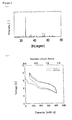
- Figure 2(a) illustrates the result of the XRD measurement.
- the sample was assigned to FeOF of space group P4 2 /mnm (tetragonal rutile structure) as previously reported. It was thus evidenced that FeOF was produced by the melt-quenching method.
- the sample of the positive electrode active substance FeOF produced by the melt-quenching was pulverized in an agate mortar.
- a 2032 type stainless coin cell (20mm x 3.2mm) was prepared by combining the positive electrode with a negative electrode of lithium metal, in which the electrolytic solution consisted of 1 mol/dm 3 of lithium hexafluorophosphate / ethylene carbonate + diemethylcarbonate [LiPF 6 / EC + DMC (EC: DMC in volume: 1:1)], followed by a charge / discharge test as shown below.
- the charge / discharge test was conducted in the CCV mode. The measurements were carried out under a current density of 0.2 mA/cm 2 and a voltage in the range of 1.3 V to 4.0 V, with 1C rate being defined as the current density when the theoretical one atom of lithium is liberated in the charge / discharge cycles for one hour.
- the results of the charge / discharge characteristic for the first cycle and the second cycle are shown in Figure 2(b) . It was found that the discharge capacity reached as high as 404 mAh/g.
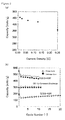
- Figure 3(a) shows the relationship between the current density and the discharge capacity with respect to FeOF versus lithium metal. The figure shows that the capacity was still as high as 350 mAh/g even when the current density was 1/4C (corresponding to a value of 0.25 at the lateral axis).
- Figure 3(b) shows the discharge / charge capacity versus cycle number (as lateral axis) with varied voltages. From the results of the discharge / charge capacity as shown in (A) with the voltage in the range 1.3 to 4.0 V, it was found that the discharge capacity of FeOF was 550 mAh/g, which corresponds to 1.8Li per FeOF, and further that the capacity was as high as 431 mAh/g even after ten cycles.
- compositions and the diffraction peak height ratios of the positive electrode active substances thus obtained were calculated based on the X-ray diffraction patterns using CuK ⁇ radiation.
- compositions (% by weight) of the positive electrode active substances with respect to FeOF and the remainder (FeF 3 and Fe 2 O 3 ) were calculated based on the ratios of the main peak intensities (peak heights) with respect to FeOF, FeF 3 and Fe 2 O 3 , observed in the X-ray diffraction patterns using CuK ⁇ ray (cf. Table 1 below).
- the peak designated by a is the main peak assigned to FeF 3
- the peak designated by b is the main peak assigned to Fe 2 O 3
- the peak designated by c is the main peak assigned to (110) plane of FeOF
- the peak designated by d is the main peak assigned to (101) plane of FeOF.
- the main peak height ratio FeOF (110) :FeOF(101) 5.9:1.
- compositions (% by weight) of the respective positive electrode active substances were calculated based on the XRD pattern as summarized below.
- FeF 3 ratio (1:1.86), (1:2.13) and (1:2.33). It is seen from the figure that there can be obtained a positive electrode active substance mainly composed of FeOF with excellent quality from any case.
- the figure shows that the initial discharge capacity reaches as high as about 800 mAh/g, demonstrating that the resultant positive electrode active substance mainly composed of FeOF exhibits excellent quality as a positive electrode for secondary cell.
- the charge/discharge profile includes plateau regions at 3.2 V, corresponding to the insertion potential of FeF 3 , and at 2.5 V, corresponding to the insertion potential of FeOF. This suggests that there is obtained a unique positive electrode active substance integrating FeF 3 characteristics and FeOF characteristics, which may not have been possible up to now.
- the positive electrode active substance mainly composed of FeOF with the remainder being iron fluoride FeF 3 and/or iron oxide Fe 2 O 3 according to the present invention exhibits extremely excellent cell properties.
Landscapes
- Chemical & Material Sciences (AREA)
- Organic Chemistry (AREA)
- Inorganic Chemistry (AREA)
- Chemical Kinetics & Catalysis (AREA)
- Electrochemistry (AREA)
- General Chemical & Material Sciences (AREA)
- Composite Materials (AREA)
- Battery Electrode And Active Subsutance (AREA)
Abstract
Description
- The present invention belongs to the technical field of nonaqueous electrolyte secondary cell (battery) and, particularly relates to a novel method for producing a positive electrode active substance in a less-costly and efficient manner and a novel positive electrode active substance.
- Recently developments in lithium ion cells with a high capacity and economic advantages have been desired for applications in power sources in electric vehicles, smart grids and so on. Under the circumstances, extensive studies have been made on nonaqueous electrolyte secondary cells using a nonaqueous electrolytic solution (an electrolytic solution of an electrolyte dissolved in a nonaqueous solvent such as an organic solvent) as secondary cells, in anticipation of concurrently achieving a high voltage and energy density
- As positive electrodes for nonaqueous secondary cells, there have been widely utilized positive electrode active substances composed of fluorides or oxides. For example, iron-based, low-cost and safe FeF3 (cf. non-patent reference No.1) and Fe2O3 (cf. non-patent reference No.2) have been proposed as positive electrode active substances for lithium ion secondary cells.
- FeF3 has a high average discharge voltage of approx. 1.7 V against lithium negative electrode and exhibits a theoretical capacity of 712 mAh/g (a theoretical energy density of 1210 mWh/g) based on three-electron reaction. On the other hand, Fe2O3 has an average discharge voltage of 1 V at most, but it exhibits a theoretical capacity of as high as 1007 mAh/g (a theoretical energy density of 1006 mWh/g) based on six-electron reaction. As compared with FeF3 and Fe2O3, while FeOF has intermediate values of an average discharge voltage of approx. 1.4V and a theoretical capacity of 885 mAh/g based on three electron reaction, it exhibits the highest value of 1239 mWh/g in the integrated value of average discharge voltage and theoretical capacity which signifies utilizable energy density. Accordingly, as an interesting positive electrode active substance making use of such characteristics, attention has focused on a positive electrode active substance composed of FeOF, an iron compound based on oxyfluoride, which contains fluorine element and oxygen element.
- As positive electrode active substances composed of oxyfluoride-based ion compound, there are known some containing lithium element (e.g. Patent Reference No.1), but examples of positive electrode active substance composed of FeOF are few. In particular, there have been no reports of FeOF being synthesized by means of solid phase calcination. This is because the synthesis of FeOF by means of solid phase calcination as conventionally conducted may lead to damage of the furnace and of FeOF itself as well. No positive electrode active substances for nonaqueous electrolyte secondary cell are found composed of FeOF, which exhibits excellent charge and discharge characteristics. As alternative methods to the solid phase calcination for producing FeOF, there have been proposed, for example, an ion exchange method in which the chlorine element in FeOCl is replaced with fluorine element (cf. Non-patent Reference No.3), and a thermal decomposition method in which a silicon-containing compound (FeSiF6·6H2O) is thermally decomposed (cf. Non-patent Reference No.4). A method is also found in which single crystal of FeOF is produced at high temperatures and pressures (cf.
- Non-patent Reference No.5).
-
- Patent Reference No.1: Japanese Patent Application Publication No.
2009-64707 -
- Non-patent Reference No.1: F. Badway, F. Cosandey, N. Pereira, and G.G. Amatucci, Journal of The Electrochemical Society, 150(10) (2003) A1318-A1327.
- Non-patent Reference No.2: H. Liu, G. Wang, J. Park, J. Wang, H. Liu, and C. Zhang, Electrochimica Acta, 54 (2009) 1733-1736.
- Non-patent Reference No.3: N. Recham, L. Laffont-Dantras, M. Armand, and J. -M. Tarascon, ECS Meeting Abstracts, 802, (2008) 594.
- Non-patent Reference No.4: N. Pereira, F.B adway, M. Wartelsky, S. Gunn, and G.G. Amatucci, Journal of The Electrochemical Society, 156(6) (2009) A407-A416.
- Non-patent Reference No.5: M. Vlasse, J. C. Massies, and G. Demazeau, Journal of Solid State Chemistry, 2(8) (1973) 109-113.
- Production of FeOF as a positive electrode active substance by the ion-exchange method (non-patent reference No.3) suffers from a drawback that a prolonged synthesis, as long as ten hours or more, is needed, resulting in a high cost of production. In addition, the resulting synthetic product may contain impurities due to the starting material LiFeOCl and is composed of a distorted rutile phase (a≒b≒4.65 Å, c=3.046 Å). Such possible impurities will degrade electrode performance, resulting in an electrochemical characteristic value of about 2.5V (against Li+ : Li0), which is 80% of the theoretical capacity at the utmost.
- Production of FeOF as a positive electrode active substance by the thermal decomposition method (non-patent reference No.4) is also disadvantageous in that it needs a prolonged time for synthesis, as long as ten hours or more, leading to a high cost of production. Furthermore, the resultant synthetic compound is not pure FeOF, but one in which the composition ratio of oxygen and fluorine atoms is inconsistent and the oxyfluoride is expressed by FeOxF2-x(where 0<x<1). The starting material FeSiF6 may contaminate the synthetic product as impurity, thus degrading the electrode performance. This can be seen, for example, from Figure 6 of non-patent reference No.4, which illustrates experimental results on discharge capacity as a function of cycle number versus Li metal between 1.5 and 4.5 V at 60 °C under a constant current of 50 mA/g. Even in the case where the product of the general formula FeOxF2-x may be the nearest to pure FeOF (annealed at 250 °C for 8 hours, with C=3.03 Å), the discharge capacity is 380mAh/g at the most in the first cycle and, what is more, the discharge capacity decreases with increasing cycle number. Such deterioration in the electrode performance may be due to the possibly remaining FeSiF6 as an impurity.
- In producing FeOF at high temperatures and pressures (Non-patent Reference No.5), iron oxide Fe2O3 and iron fluoride FeF3 are utilized as the starting materials. This process requires an extremely high pressure of up to 6 GPa (60 kbar) in order to protect against the volatilization of fluorine gas derived from the fluorine atom contained in the starting material, thus making the process inappropriate for mass-production. Furthermore, this process is dedicated to the production of FeOF as single crystal. No mention is made as to whether the single crystal of FeOF may be utilized as a positive electrode active substance for nonaqueous electrolyte secondary cells, so that no supporting data are found regarding the cell characteristics as positive electrode active substance.
- The present invention is proposed to overcome the abovementioned problems and provides a process for producing a positive electrode active substance mainly composed of FeOF exhibiting a satisfactory charge/discharge capacity, in a time-saving and an easy manner as compared with the conventional methods, and further provides such positive electrode substance mainly composed of FeOF.
- After extensive studies, the present inventors have invented a method for producing a positive electrode active substance mainly composed of FeOF, and a novel positive electrode active substance which is mainly composed of FeOF, which is suitable for use in a nonaqueous electrolyte secondary cell. The present inventors have also found that it is possible to construct a nonaqueous electrolyte secondary cell with high operational stability by combining the positive electrode active substance mainly composed of FeOF with an appropriate negative electrode active substance.
- Thus, according to the present invention, there is provided a method for producing a positive electrode active substance mainly composed of FeOF, which comprises admixing iron oxide Fe2O3 and iron fluoride FeF3 both in solid states and then melt-quenching the resultant mixture in an atmosphere of inert gas. According to the present invention there is also provided a positive electrode active substance mainly composed of FeOF, in which FeOF is not less than 50% by weight with the remaining being iron fluoride FeF3 and/or iron oxide Fe2O3.
-
-
Figure 1 illustrates the high-frequency induction heating/single-roll quenching apparatus, the pellet electrode, and the coated electrode, according to the present invention. -
Figure 2 shows the XRD pattern and the charge-discharge profile of the positive electrode active substance mainly composed of FeOF produced by the present invention in which the starting material molar ratio is Fe2O3: FeF3 = 1:2.33. -
Figure 3 shows the capacity versus the current density and the capacity versus the cycle number of the positive electrode active substance mainly composed of FeOF produced by the present invention in which the starting material molar ratio is Fe2O3: FeF3 = 1:2.33. -
Figure 4 shows the XRD pattern of the positive electrode active substance mainly composed of FeOF produced by the present invention in which the starting material molar ratio is Fe2O3: FeF3 = 1:1.86, 1:2.13, 1:5, or 1:10. -
Figure 5 shows the charge-discharge profile of the positive electrode active substance mainly composed of FeOF produced by the present invention in which the starting material molar ratio is Fe2O3: FeF3 = 1:1.86, 1:2.13, 1:2.33 or 1:10. - According to the present invention, there can be produced a positive electrode active substance mainly composed of FeOF by admixing iron oxide and iron fluoride both in the solid states and then melt-quenching the resultant in an atmosphere of inert gas. More specifically, by means of admixing the iron oxide and the iron oxide as the starting materials followed by the melt-quenching in an inert atmosphere, the fluorine atoms will be combined with the iron oxide in the solid state as much as possible, thereby producing the desired positive electrode active substance FeOF containing oxygen and fluorine atoms.
- Thus, the melt-quenching in an atmosphere of inert gas makes iron fluoride, which includes volatile fluorine atom, bind with iron oxide under solid condition to produce the targeted positive electrode active substance FeOF containing oxygen and fluorine atoms.
- The present invention produces the desired positive electrode active substance by a melt-quenching process: The starting iron oxide and iron fluoride are admixed in molten states, followed by a cooling operation as quickly as possible so as to prevent the volatilization of the constituents (particularly, fluorine atom) for obtaining the desired product mainly composed of FeOF. Such melt-quenching process can be made up of any combination of a variety of conventionally known melting or heating process and quenching or rapid-cooling process.
- For example, the melting process includes any known melting such as high-frequency induction heating, electric arc melting or the like. An example of the quenching process includes any known quenching such as roll quenching, atomization quenching, splat quenching or the like. While high-frequency induction heating/ roll quenching is most preferably employed in carrying out the present invention, any combination of known melting process and quenching process as mentioned above can be employed.
- For example, in the case where high-frequency induction heating / single-roll quenching is employed, the starting materials placed in a reaction vessel are melted by means of the induction coil, and then the melted materials are quenched by being jetted onto the surface of the single-roll, resulting in the desired product. The heating temperature will suffice provided that iron oxide as the starting material is melted (e.g. 1300°C). In the melt-quenching, according to the present invention, the quenching treatment is carried out as rapidly as possible so as to enhance the purity of product, particularly by suppressing the elimination of fluorine atoms volatilized from the starting metallic material. Thus, according to the present invention it is possible to produce the product mainly composed of FeOF in an extremely short time, generally within one minutes, for example, forty seconds.
-
Figure 1(a) illustrates an example of high-frequency induction heating/ single-roll apparatus for use in the present invention, which comprises aquartz tube 1, acrucible 2 with a bottom hole placed within thequartz tube 1, acopper wire 3 coiled around the quartz tube, and acopper roll 4 functioning as a solid cooling medium. - The starting metallic materials are charged into the
crucible 2 with the bottom hole within thequartz tube 1. The starting materials are induction-heated by thecopper wire coil 3 and fall out through the bottom hole of the crucible, as shown by A in the figure. The starting materials as induction-heated turn into a product sample in the form of vitreous ribbons B when quenched by contact with thecopper roll 4, which functions as a water-cooled roll. - The melt-quenching process according to the present invention is conducted in an atmosphere of an inert gas such as nitrogen gas or argon gas, argon gas being preferably used because of the ease of handling.
- The conditions of melt-quenching including processing time, rotation speed of the water-cooled roll (the copper roll), induction-heating speed, quenching speed and other factors, may be decided through the analysis and identification of product by XRD and other appropriate measures to see if there are produced the crystals of the desired positive electrode active substance as much as possible with minimum impurities.
- It is considered that FeOF, a key ingredient of the positive electrode active substance for nonaqueous electrolyte secondary cell, is produced by the following reaction scheme.
[Chemical Formula 1] Fe2O3 + FeF3→ 3FeOF
- Thus, according to the present invention, FeOF can be obtained even by rendering the ratio between iron fluoride FeF3 and iron oxide Fe2O3 in the starting materials to be stoichiometric (i.e. equimolar). However, in view of the fact that fluorine atoms tend to be eliminated by volatilization from the iron fluoride during the melt-quenching process, the ratio between the iron fluoride and the iron oxide is preferably set in such way that fluorine is in excess of the stoichiometric ratio. Such ratio depends upon the types of melting (heating), quenching and the experimental conditions of the operations. For example, in the Working Examples described later where the melt-quenching is carried out by means of high-frequency induction heating / single-roll quenching, the molar ratio of the iron fluoride to the iron oxide (iron fluoride / iron oxide) is preferably 1 (stoichiometric ratio) or more and 10 or less. There is observed a tendency of excessive iron fluoride introduction lowering the initial discharge capacity of the resultant positive electrode active substance.
- The present invention also provides a positive electrode active substance mainly composed of FeOF, which can be produced by the above-mentioned method. The present inventors have found that the product mainly composed of FeOF, i.e. the product containing not less than 50% by weight of FeOF, will serve as a positive electrode active substance for nonaqueous electrolyte secondary cell exhibiting sufficient cell characteristics, even though the remainder consists of iron fluoride (FeF3) and / or iron oxide (Fe2O3). As touched upon previously, the greater the FeOF content in the product is, the more excellent is the cell characteristic because of increased energy density available to the cell. Thus, the FeOF content is preferably not less than 60% by weight, and even a product whose content is not 100% by weight will achieve a positive electrode active substance exhibiting an excellent cell characteristic. The present invention therefore provides a positive electrode active substance composed of FeOF in an amount of not less than 50% by weight, preferably not less than 60% by weight, and not more than 99% by weight, preferably not more than 96% by weight, with the remainder being FeF3 and / or Fe2O3.
- The positive electrode active substance mainly composed of FeOF according to the present invention is further characterized in that the diffraction peak height ratio of (110) plane to (101) plane of FeOF, as measured by the X-ray diffraction method using CuKα ray, is not less than 2, preferably not less than 2 and not more than 20, and more preferably not less than 2 and not more than 10.
- The positive electrode active substance mainly composed of FeOF according to the present invention as described above has revealed an initial discharge capacity even as high as 900 mAh/g, which is substantially comparable to the theoretical discharge capacity (cf. Working Examples described later).
- While the positive electrode active substance may be utilized as it is as a positive electrode for nonaqueous electrolyte secondary cell, it may be also utilized in the form of a complex with a known electric conductive material so as to improve the rate characteristic of the resultant cell.
- More specifically, the positive electrode active substance mainly composed of FeOF according to the present invention may be carbon-coated by pulverizing and admixing it with carbon particulates in an atmosphere of inert gas for improving the rate characteristics. Examples of the carbon particulates include furnace black, channel black, acetylene black, thermal black and the like, among which acetylene black is the most suitable for use in an electrode because of its high conductivity. Examples of inert gas include nitrogen gas and argon gas, with argon gas being preferably employed.
- While the specific means used for the pulverization and admixing in the carbon coating is not particularly limited and a variety of conventional techniques known for pulverizing and admixing solid materials may be employed, ball milling is preferable, and planetary ball milling is particularly preferable, for sufficiently pulverizing and admixing the starting materials.
- According to the present invention, there are provided a positive electrode active substance mainly composed of FeOF for nonaqueous electrolyte secondary cell, a secondary cell positive electrode containing said positive electrode active substance, and a secondary cell comprising said positive electrode in combination with a negative electrode.
- A positive electrode according to the present invention can be prepared by any known method for preparing an electrode, provided that there is used the positive electrode active substance described above. For example, the powder of said active substance may be mixed with a known binding agent such as polyethylene, or may be mixed with a known electric conductive material such as acetylene black. The resultant mixture is subject to compression molding onto a support made of stainless steel or the like, or charged into a metallic vessel, so as to prepare an electrode. An example of such electrode is a pellet electrode. As shown by
Figure 1(b) , a pellet electrode structure may be constructed of apellet electrode 10a,spacer 11a, and anickel mesh 13. Thepellet electrode 10a may be 10mm in thickness. On thespacer 11a is placed the nickel mesh on which is placed thepellet electrode 10a. - The positive electrode according to the present invention may also be prepared by coating a metallic substrate, such as one made of aluminum, nickel, stainless steel, copper or the like, with a slurry obtained from the above-mentioned powdery mixture dissolved in an organic solvent such as toluene. An example of an electrode prepared by such method is a coat-type electrode. As shown by
Figure 1(c) , a coat-type electrode structure may be constructed of a coat-type electrode 10b, aspacer 11b, and a coin-cell vessel (bottom cover) 12. The coat-type electrode may be 10mm in diameter. Thespacer 11b is spot welded with the coat-type electrode 10b on the central upper surface. - A negative electrode (negative electrode active substance) for use in the present invention in combination with the abovementioned positive electrode may be a lithium compound or a lithium alloy.
- The negative electrode can be prepared by a known method. For example, it can be made by a method similar to those described in the above with respect to the preparation of the positive electrode. Thus, a negative electrode active substance in powdery form may be admixed with a known binding agent as described and, if necessary, may be admixed with a known conductive material as described. Then, the resultant powdery mixture is formed into a sheet, followed by compressing it onto a conductive mesh (collector) of stainless steel, copper or the like. Alternatively, the powdery mixture may be admixed with an organic solvent to form a slurry, which is then coated on a metallic substrate of copper or the like.
- There can be employed other constituent elements which are known for use in nonaqueous electrolyte secondary cells. Examples of these are given below.
- An electrolytic solution generally comprises an electrolyte and a solvent. The solvent for the electrolytic solution is not limited so long as it is nonaqueous. Examples for use include carbonates, ethers, ketones, sulfolane compounds, lactones, nitriles, chlorinated hydrocarbons, amines, esters, amides, phosphoric esters and the like. Concrete examples are 1,2-dimethoxyethane, 1,2-diethoxyethane, tetrahydrofuran, 2-methyltetrahydrofuran, ethylene carbonate (EC), vinylene carbonate, methyl formate, dimethyl sulfoxide, propylene carbonate, acetonitrile, γ-butyrolactone, dimethylformamide, dimethyl carbonate (DMC), diethyl carbonate, sulfolane, ethylmethyl carbonate, 1,4-dioxane, 4-methyl-2-pentanone, 1,3-dioxolane, 4-methyl-1,3-dioxolane, diethyl ether. sulfolane, methylsulfolane, propionitrile, benzonitrile, butyronitrile, valeronitrile, 1,2-dichloroethane, trimethyl phosphate, triethylphosphate and the like. One or two or more of these compounds can be used. For example, a combination of dimethyl carbonate (DMC) and ethylene carbonate (EC) can be used.
- The electrolyte contained in the electrolytic solution is a substance which carries lithium ions through the solvent so as to make them electrochemically react with the positive electrode active substance and/or the negative electrode active substance. Examples of such electrolyte include LiClO4 LiPF6, LiCF3SO3, LiAsF6, LiB(C6H5)4, LiCl, LiBr, CH3SO3Li, CF3SO3Li, LiN(SO2DV3)2, L1N(SO2C2F5)2, LiC(SO2CF3)3, LiN(SO3CF3)2, and the like, among which LiPF6 may be preferably used.
- The nonaqueous electrolyte secondary cell according to the present invention is not limited with respect to structural materials for the separator, cell housing or any other parts, and may be constructed using a variety of materials known in the art. The cell has no restriction in the shape and size, and can take any shape including cylindrical, square-shaped, coin-type or the like.
- The present invention will be explained in more detail with reference to Working Examples given below, but these Examples are not for restricting the present invention.
- As the starting materials were used iron oxide Fe2O3 (Soekawa-rikagaku Co.) and iron fluoride FeF3 (Soekawa-rikagaku Co.). The starting materials were weighed in a glove box so that the molar ratio of Fe2O3 to FeF3 (Fe2O3: FeF3) was 1:2.33 by weight and then admixed sufficiently in an agate mortar. The resultant mixture of the starting materials as precursor was charged into a platinum crucible provided with a bottom hole (50 mm in height, 12 mm in diameter of the hole) to the height of approx. one third from the bottom. The platinum crucible was placed in a quartz tube (about 100 mm in height, about 15 mm in diameter) at a distance of about 1mm from the inner wall of the tube, and then set up in a single-roll melt-quenching apparatus. The inside of the quartz tube was deserted for about ten minutes to a pressure of 10-3 torr, and then sealed with argon gas. The induction heating was carried out so that the temperature rose to about 1300 °C in about five seconds, in which the measurement was done by shining light onto the quartz tube through the gaps of the coils wound around the quartz tube longitudinally in a length of 15 mm. This temperature was maintained for about forty seconds. Upon observation that the starting materials were melted and had fallen through the bottom hole, additional argon gas was introduced for about one minute and the melted materials were cast through the bottom hole onto the copper roll rotating at 2000 rpm, so as to obtain samples in the form of vitreous ribbons. The samples thus obtained were pulverized in an agate mortar in a glove box without exposure to air, in order to prepare the desired positive electrode active substance. It was only at the time of setting up the platinum crucible in the single-roll quenching apparatus and recovering the sample that the system was exposed to the air, during the synthesis.
- X-ray diffraction measurement was performed on the sample of the positive electrode active substance using CuKα radiation (with Rigaku TTR III).
-
Figure 2(a) illustrates the result of the XRD measurement. The sample was assigned to FeOF of space group P42/mnm (tetragonal rutile structure) as previously reported. It was thus evidenced that FeOF was produced by the melt-quenching method. - The sample of the positive electrode active substance FeOF produced by the melt-quenching was pulverized in an agate mortar. A positive electrode was prepared by charging and pelletizing a mixture of FeOF: acetylene black: PTFE (binding agent) = 70:25:5 (about 30mg) in a 10mm thick disc.
- A 2032 type stainless coin cell (20mm x 3.2mm) was prepared by combining the positive electrode with a negative electrode of lithium metal, in which the electrolytic solution consisted of 1 mol/dm3 of lithium hexafluorophosphate / ethylene carbonate + diemethylcarbonate [LiPF6 / EC + DMC (EC: DMC in volume: 1:1)], followed by a charge / discharge test as shown below.
- The charge / discharge test was conducted in the CCV mode. The measurements were carried out under a current density of 0.2 mA/cm2 and a voltage in the range of 1.3 V to 4.0 V, with 1C rate being defined as the current density when the theoretical one atom of lithium is liberated in the charge / discharge cycles for one hour. The results of the charge / discharge characteristic for the first cycle and the second cycle are shown in
Figure 2(b) . It was found that the discharge capacity reached as high as 404 mAh/g. -
Figure 3(a) shows the relationship between the current density and the discharge capacity with respect to FeOF versus lithium metal. The figure shows that the capacity was still as high as 350 mAh/g even when the current density was 1/4C (corresponding to a value of 0.25 at the lateral axis). In addition,Figure 3(b) shows the discharge / charge capacity versus cycle number (as lateral axis) with varied voltages. From the results of the discharge / charge capacity as shown in (A) with the voltage in the range 1.3 to 4.0 V, it was found that the discharge capacity of FeOF was 550 mAh/g, which corresponds to 1.8Li per FeOF, and further that the capacity was as high as 431 mAh/g even after ten cycles. (B) and (C) inFigure 3(b) show discharge / charge capacities, measured under a constant current of 1Li (60mA/g with a current density of 0.11mA/cm2) and under a voltage in the range of 2.0 to 4.0V, respectively. The results demonstrate that the capacity was maintained substantially constant even after ten cycles. - Positive electrode active substances were prepared in the same manner as in Example 1 except that the molar ratio of the starting materials was varied. More specifically, positive electrode active substances were prepared in the same manner as in Example 1, at molar ratios of iron oxide Fe2O3: iron fluoride FeF3 = (1:2.13), (1:1.86), (1:5), and (1:10).
- In addition, the time for melting was changed to forty-five seconds, differently from Example 1.
- The compositions and the diffraction peak height ratios of the positive electrode active substances thus obtained were calculated based on the X-ray diffraction patterns using CuKα radiation.
- More specifically, the compositions (% by weight) of the positive electrode active substances with respect to FeOF and the remainder (FeF3 and Fe2O3) were calculated based on the ratios of the main peak intensities (peak heights) with respect to FeOF, FeF3 and Fe2O3, observed in the X-ray diffraction patterns using CuKα ray (cf. Table 1 below).
- Calculations were also made on the main peak height ratios of (110) plane to (101) plane of FeOF based on the X-ray diffraction patterns using CuKα radiation (cf. Table 2 below).
-
Figure 4(a) shows XRD patterns (charts) of the abovementioned substances including those of Example 1 in which the starting material ratio of iron oxide Fe2O3: iron fluoride FeF3 = 1:2.33.Figure 4(b) shows XRD patterns (charts) of the positive electrode active substances produced from starting materials with ratio of iron oxide Fe2O3: iron fluoride FeF3 = (1:2.33) and (1:86) under varied melting times, including forty-five seconds. - With respect to 2θ in the lateral axis of the figures, the peak designated by a is the main peak assigned to FeF3, the peak designated by b is the main peak assigned to Fe2O3, the peak designated by c is the main peak assigned to (110) plane of FeOF, and the peak designated by d is the main peak assigned to (101) plane of FeOF. For example, in the case of the starting material ratio Fe2O3: FeF3 = 1:10, it is seen from
Figure 4(a) that the main peak height ratio FeF3: Fe2O3: FeOF = a:b:c =4:0:6, and hence the calculated composition of the product comes to 60% of FeOF and 40% of FeF3. For the product prepared at the same starting material ratio, it is also found by calculation fromFigure 4(a) that the main peak height ratio FeOF (110) :FeOF(101) = 5.9:1. - In the manner described in the above, the compositions (% by weight) of the respective positive electrode active substances were calculated based on the XRD pattern as summarized below.
-
Table 1 Starting material composition (Fe2O3 : FeF3) Product composition (%) FeF3 Fe2O3 FeOF 1 : 10 40 - 60 1 : 5 33 - 66 1 : 2.33 9 - 91 1 : 2.13 4 - 96 1 : 1.86 11 11 78 - The results show that presence of Fe2O3 is observed in the case of the starting material molar ratio iron oxide Fe2O3: iron fluoride FeF3 = 1:1.86. In the case where iron fluoride FeF3 exceeds the abovementioned ratio (i.e. iron oxide Fe2O3 : iron fluoride FeF3 = 1:1.86), no presence of Fe2O3 is observed in the product. It is therefore considered that iron fluoride FeF3 in an amount exceeding the stoichiometric ratio will prevent iron oxide Fe2O3 from remaining in the product.
- With regard to the respective positive electrode active substances mainly composed of FeOF, the diffraction peak height ratios of (110) plane to (101) plane of FeOF are summarized below.
-
Table 2 Starting material composition (Fe2O3 : FeF3) Diffraction peak height ratio in the product (110) plane (101) plane 1 : 10 5.9 1 1 : 5 2.8 1 1 : 2.33 7.6 1 1 : 2.13 8.2 1 1 : 1.86 2.6 1 - It is seen from the results above that according to the present invention there can be produced a positive electrode active substance mainly composed of FeOF having a high diffraction peak ratio of (110) plane to (101) plane of FeOF, i.e., of 2 or higher.
- It is also seen from
Figure 4(b) that, in the case of the melting time of forty-five seconds, the products tend to include the remaining iron oxide Fe2O3 from the starting material, which is not the case in Example 1. This suggests that the melting time may more suitably be forty seconds. - Charge/discharge tests were carried out for the respective positive electrode active substances in the same manner as in Example 2.
-
Figure 5(a) shows charge/discharge profiles between 1.3 V and 4.0 V (0.2 mA/cm2, 1M LiPF6, EC: DMC = 1:1) with regard to the positive electrode active substances obtained from the starting materials of iron oxide Fe2O3 : iron fluoride - FeF3 ratio = (1:1.86), (1:2.13) and (1:2.33). It is seen from the figure that there can be obtained a positive electrode active substance mainly composed of FeOF with excellent quality from any case.
-
Figure 5(b) shows charge/discharge profile between 0.7 V and 4.0 V (10 mA/g : 0.035 mA/cm2, 1M LiPF6, EC: DMC = 1:1), with regard to the positive electrode active substance obtained from the starting materials of iron oxide F2O3: iron fluoride FeF3 ratio =1:10. The figure shows that the initial discharge capacity reaches as high as about 800 mAh/g, demonstrating that the resultant positive electrode active substance mainly composed of FeOF exhibits excellent quality as a positive electrode for secondary cell. It is particularly to be noted that the charge/discharge profile includes plateau regions at 3.2 V, corresponding to the insertion potential of FeF3, and at 2.5 V, corresponding to the insertion potential of FeOF. This suggests that there is obtained a unique positive electrode active substance integrating FeF3 characteristics and FeOF characteristics, which may not have been possible up to now. - Among the positive electrode active substances shown in
Figure 5(a) , those produced from the starting material of ratio of iron oxide Fe2O3: iron fluoride FeF3 = 1:2.33, between 0.7 V and 4.0 V (10 mA/g: 0.035 mA/cm2, 1M PF6, EC: DMC = 1:1) were subjected to a further charge/discharge test, the results of which are shown inFigure 5(c) . It is seen fromFigure 5(c) that there is obtained a surprisingly excellent charge/discharge characteristic, especially in that the initial discharge capacity is as high as 900 mAh/g (almost equivalent to the theoretical capacity), which is even superior to the substance shown byFigure 5(b) (the substance produced from the starting material of ratio of iron oxide Fe2O3: iron fluoride FeF3= 1:10). - Thus, it is appreciated that the positive electrode active substance mainly composed of FeOF with the remainder being iron fluoride FeF3 and/or iron oxide Fe2O3 according to the present invention exhibits extremely excellent cell properties.
-
- 1:
- Quartz tube
- 2:
- Crucible with a bottom hole
- 3:
- Copper wire
- 4:
- Copper roll
Claims (4)
- A method of producing a positive electrode active substance mainly composed of FeOF, which comprises the steps of admixing iron oxide Fe2O3 and iron fluoride FeF3 both in solid states, and melt-quenching the mixture in an atmosphere of inert gas.
- The method of producing the positive electrode active substance as claimed in claim 1, wherein the melt-quenching is carried out by high-frequency induction heating and roll quenching, and wherein the molar ratio of iron fluoride FeF3 to iron oxide Fe2O3 is not less than 1 and not more than 10.
- A positive electrode active substance mainly composed of FeOF, wherein the substance is composed of not less than 50% by weight of FeOF with a remainder being iron fluoride FeF3 and/or iron oxide Fe2O3.
- A positive electrode active substance mainly composed of FeOF, wherein the substance is composed of not less than 50% by weight of FeOF with a remainder being iron fluoride FeF3 and/or iron oxide Fe2O3, and wherein, when measured by X-ray diffraction method using CuKα radiation, the diffraction peak height ratio of (110) plane to (101) plane is not less than 2.
Applications Claiming Priority (2)
| Application Number | Priority Date | Filing Date | Title |
|---|---|---|---|
| JP2011138850 | 2011-06-22 | ||
| PCT/JP2012/066071 WO2012176907A1 (en) | 2011-06-22 | 2012-06-22 | Method for producing iron oxyfluoride positive electrode active substance and iron oxyfluoride positive electrode active substance |
Publications (3)
| Publication Number | Publication Date |
|---|---|
| EP2725643A1 true EP2725643A1 (en) | 2014-04-30 |
| EP2725643A4 EP2725643A4 (en) | 2015-04-01 |
| EP2725643B1 EP2725643B1 (en) | 2019-01-02 |
Family
ID=47422734
Family Applications (1)
| Application Number | Title | Priority Date | Filing Date |
|---|---|---|---|
| EP12802330.6A Not-in-force EP2725643B1 (en) | 2011-06-22 | 2012-06-22 | Method for producing iron oxyfluoride positive electrode active substance |
Country Status (6)
| Country | Link |
|---|---|
| US (1) | US9312538B2 (en) |
| EP (1) | EP2725643B1 (en) |
| JP (1) | JP5991680B2 (en) |
| KR (1) | KR20140024920A (en) |
| CN (1) | CN103718352B (en) |
| WO (1) | WO2012176907A1 (en) |
Families Citing this family (15)
| Publication number | Priority date | Publication date | Assignee | Title |
|---|---|---|---|---|
| US9692039B2 (en) | 2012-07-24 | 2017-06-27 | Quantumscape Corporation | Nanostructured materials for electrochemical conversion reactions |
| US9786905B2 (en) | 2013-03-13 | 2017-10-10 | Quantumscape Corporation | Iron, fluorine, sulfur compounds for battery cell cathodes |
| JP6120160B2 (en) * | 2013-05-10 | 2017-04-26 | 国立大学法人九州大学 | Cathode active material for sodium ion battery and method for producing the same |
| WO2016025866A1 (en) | 2014-08-15 | 2016-02-18 | Quantumscape Corporation | Doped conversion materials for secondary battery cathodes |
| CN104282882B (en) * | 2014-09-26 | 2017-01-11 | 江苏华东锂电技术研究院有限公司 | Composite positive electrode material and preparation method thereof |
| EP3648211A4 (en) * | 2017-06-30 | 2021-04-21 | Murata Manufacturing Co., Ltd. | POSITIVE ELECTRODE ACTIVE MATERIAL FOR NON-AQUEOUS SECONDARY BATTERIES, AND NON-AQUEOUS SECONDARY BATTERY USER |
| WO2019241509A1 (en) * | 2018-06-13 | 2019-12-19 | Indiana University Research And Technology Corporation | Fast charge feof cathode for lithium ion batteries |
| CN111129423B (en) * | 2018-10-30 | 2021-08-06 | 深圳市比亚迪锂电池有限公司 | Lithium ion battery cathode material and preparation method thereof, lithium ion battery cathode and lithium ion battery |
| CN110508299B (en) * | 2019-09-03 | 2022-04-19 | 北京邮电大学 | Method for preparing two-dimensional local oxidation transition metal fluoride catalyst by rapid temperature rise |
| CN112542581A (en) * | 2019-09-20 | 2021-03-23 | 华中科技大学 | Method for preparing pre-lithiation agent in electrochemical process |
| CN113871591B (en) * | 2021-09-24 | 2023-04-11 | 中国科学院过程工程研究所 | Iron-based electrode material and preparation method and application thereof |
| CN118511322B (en) * | 2022-03-30 | 2025-12-05 | 宁德新能源科技有限公司 | Positive electrode active materials, electrochemical devices and electronic equipment |
| US11764398B1 (en) * | 2022-04-29 | 2023-09-19 | Toyota Motor Engineering & Manufacturing North America, Inc. | Inorganic precursors for ionic conductors |
| WO2024038899A1 (en) * | 2022-08-19 | 2024-02-22 | 日本材料技研株式会社 | Inorganic compound, dispersion and method for producing same, and film and method for producing same, method for producing inorganic compound, methane, and hydrogen, dispersion and method for producing same, and film and method for producing same |
| CN117753935B (en) * | 2023-12-25 | 2025-07-18 | 西安工业大学 | Lithium aluminum alloy negative electrode material for lithium metal battery, and preparation method and application thereof |
Family Cites Families (5)
| Publication number | Priority date | Publication date | Assignee | Title |
|---|---|---|---|---|
| US3365269A (en) * | 1964-09-14 | 1968-01-23 | Du Pont | Ferromagnetic metal oxyfluorides |
| JPH0955200A (en) * | 1995-08-11 | 1997-02-25 | Nippon Telegr & Teleph Corp <Ntt> | Non-aqueous electrolyte battery |
| JP2009064707A (en) | 2007-09-07 | 2009-03-26 | Panasonic Corp | Non-aqueous electrolyte secondary battery active material and battery using the same |
| US8623549B2 (en) * | 2008-05-23 | 2014-01-07 | Nathalie Pereira | Iron oxyfluoride electrodes for electrochemical energy storage |
| JPWO2010114104A1 (en) * | 2009-04-03 | 2012-10-11 | 旭硝子株式会社 | Method for producing lithium iron phosphate particles and method for producing secondary battery |
-
2012
- 2012-06-22 KR KR1020137033270A patent/KR20140024920A/en not_active Ceased
- 2012-06-22 WO PCT/JP2012/066071 patent/WO2012176907A1/en not_active Ceased
- 2012-06-22 JP JP2013521648A patent/JP5991680B2/en not_active Expired - Fee Related
- 2012-06-22 CN CN201280030992.1A patent/CN103718352B/en not_active Expired - Fee Related
- 2012-06-22 US US14/128,470 patent/US9312538B2/en not_active Expired - Fee Related
- 2012-06-22 EP EP12802330.6A patent/EP2725643B1/en not_active Not-in-force
Non-Patent Citations (4)
| Title |
|---|
| FRANK J. BRINK ET AL: "An Electron Diffraction and Crystal Chemical Investigation of Oxygen/Fluorine Ordering in Rutile-Type Iron Oxyfluoride, FeOF", JOURNAL OF SOLID STATE CHEMISTRY, vol. 155, no. 2, 29 November 2000 (2000-11-29), pages 359-365, XP055169869, ISSN: 0022-4596, DOI: 10.1006/jssc.2000.8925 * |
| KITAJOU AYUKO ET AL: "Synthesis of FeOF using roll-quenching method and the cathode properties for lithium-ion battery", JOURNAL OF POWER SOURCES, vol. 243, 18 June 2013 (2013-06-18), pages 494-498, XP028693554, ISSN: 0378-7753, DOI: 10.1016/J.JPOWSOUR.2013.06.053 * |
| N. PEREIRA ET AL: "Iron Oxyfluorides as High Capacity Cathode Materials for Lithium Batteries", JOURNAL OF THE ELECTROCHEMICAL SOCIETY, vol. 156, no. 6, 3 April 2009 (2009-04-03) , page A407, XP055169875, ISSN: 0013-4651, DOI: 10.1149/1.3106132 * |
| See also references of WO2012176907A1 * |
Also Published As
| Publication number | Publication date |
|---|---|
| EP2725643B1 (en) | 2019-01-02 |
| CN103718352A (en) | 2014-04-09 |
| US20140291573A1 (en) | 2014-10-02 |
| CN103718352B (en) | 2016-12-14 |
| US9312538B2 (en) | 2016-04-12 |
| KR20140024920A (en) | 2014-03-03 |
| WO2012176907A1 (en) | 2012-12-27 |
| EP2725643A4 (en) | 2015-04-01 |
| JP5991680B2 (en) | 2016-09-14 |
| JPWO2012176907A1 (en) | 2015-02-23 |
Similar Documents
| Publication | Publication Date | Title |
|---|---|---|
| EP2725643B1 (en) | Method for producing iron oxyfluoride positive electrode active substance | |
| US6814764B2 (en) | Method for producing cathode active material and method for producing non-aqueous electrolyte cell | |
| EP2267822B1 (en) | Non-aqueous electrolyte cell | |
| KR100951328B1 (en) | Method for preparing cathode active material | |
| EP1184920B1 (en) | Cathode active material, method for preparation thereof, non-aqueous electrolyte cell and method for preparation thereof | |
| EP1193787B1 (en) | Method for the preparation of cathode active material and method for the preparation of a non-aqueous electrolyte cell | |
| US6656635B2 (en) | Non-aqueous electrolyte secondary cell | |
| EP1193784B1 (en) | Method for the preparation of cathode active material and method for the preparation of a non-aqueous electrolyte cell | |
| EP1684370B1 (en) | Electrode active material and use thereof | |
| EP1193786B1 (en) | Method for the preparation of cathode active material and method for the preparation of a non-aqueous electrolyte cell | |
| EP2006937A2 (en) | Lithium transition metal-based compound powder for positive electrode material in lithium rechargeable battery, method for manufacturing the powder, spray dried product of the powder, firing precursor of the powder, and positive electrode for lithium rechargeable battery and lithium rechargeable battery using the powder | |
| EP1193785A2 (en) | Method for the preparation of cathode active material and method for the preparation of a non-aqueous electrolyte cell | |
| CA2543721C (en) | Electroactive material and use thereof |
Legal Events
| Date | Code | Title | Description |
|---|---|---|---|
| PUAI | Public reference made under article 153(3) epc to a published international application that has entered the european phase |
Free format text: ORIGINAL CODE: 0009012 |
|
| 17P | Request for examination filed |
Effective date: 20140115 |
|
| AK | Designated contracting states |
Kind code of ref document: A1 Designated state(s): AL AT BE BG CH CY CZ DE DK EE ES FI FR GB GR HR HU IE IS IT LI LT LU LV MC MK MT NL NO PL PT RO RS SE SI SK SM TR |
|
| DAX | Request for extension of the european patent (deleted) | ||
| A4 | Supplementary search report drawn up and despatched |
Effective date: 20150226 |
|
| RIC1 | Information provided on ipc code assigned before grant |
Ipc: C01G 49/06 20060101ALI20150220BHEP Ipc: H01M 4/52 20100101ALI20150220BHEP Ipc: C01G 49/10 20060101ALI20150220BHEP Ipc: C01G 49/00 20060101ALI20150220BHEP Ipc: H01M 4/58 20100101AFI20150220BHEP Ipc: H01M 4/36 20060101ALI20150220BHEP |
|
| STAA | Information on the status of an ep patent application or granted ep patent |
Free format text: STATUS: EXAMINATION IS IN PROGRESS |
|
| 17Q | First examination report despatched |
Effective date: 20170622 |
|
| REG | Reference to a national code |
Ref country code: DE Ref legal event code: R079 Ref document number: 602012055485 Country of ref document: DE Free format text: PREVIOUS MAIN CLASS: H01M0004580000 Ipc: C01G0049000000 |
|
| GRAP | Despatch of communication of intention to grant a patent |
Free format text: ORIGINAL CODE: EPIDOSNIGR1 |
|
| STAA | Information on the status of an ep patent application or granted ep patent |
Free format text: STATUS: GRANT OF PATENT IS INTENDED |
|
| RIC1 | Information provided on ipc code assigned before grant |
Ipc: C01G 49/10 20060101ALI20180627BHEP Ipc: H01M 4/36 20060101ALI20180627BHEP Ipc: C01G 49/00 20060101AFI20180627BHEP Ipc: H01M 4/58 20100101ALI20180627BHEP Ipc: C01G 49/06 20060101ALI20180627BHEP Ipc: C01B 11/24 20060101ALI20180627BHEP Ipc: H01M 4/52 20100101ALI20180627BHEP |
|
| INTG | Intention to grant announced |
Effective date: 20180726 |
|
| GRAS | Grant fee paid |
Free format text: ORIGINAL CODE: EPIDOSNIGR3 |
|
| GRAA | (expected) grant |
Free format text: ORIGINAL CODE: 0009210 |
|
| STAA | Information on the status of an ep patent application or granted ep patent |
Free format text: STATUS: THE PATENT HAS BEEN GRANTED |
|
| AK | Designated contracting states |
Kind code of ref document: B1 Designated state(s): AL AT BE BG CH CY CZ DE DK EE ES FI FR GB GR HR HU IE IS IT LI LT LU LV MC MK MT NL NO PL PT RO RS SE SI SK SM TR |
|
| REG | Reference to a national code |
Ref country code: GB Ref legal event code: FG4D |
|
| REG | Reference to a national code |
Ref country code: CH Ref legal event code: EP Ref country code: AT Ref legal event code: REF Ref document number: 1084142 Country of ref document: AT Kind code of ref document: T Effective date: 20190115 |
|
| REG | Reference to a national code |
Ref country code: IE Ref legal event code: FG4D |
|
| REG | Reference to a national code |
Ref country code: DE Ref legal event code: R096 Ref document number: 602012055485 Country of ref document: DE |
|
| REG | Reference to a national code |
Ref country code: NL Ref legal event code: MP Effective date: 20190102 |
|
| REG | Reference to a national code |
Ref country code: LT Ref legal event code: MG4D |
|
| REG | Reference to a national code |
Ref country code: AT Ref legal event code: MK05 Ref document number: 1084142 Country of ref document: AT Kind code of ref document: T Effective date: 20190102 |
|
| PG25 | Lapsed in a contracting state [announced via postgrant information from national office to epo] |
Ref country code: NL Free format text: LAPSE BECAUSE OF FAILURE TO SUBMIT A TRANSLATION OF THE DESCRIPTION OR TO PAY THE FEE WITHIN THE PRESCRIBED TIME-LIMIT Effective date: 20190102 |
|
| PG25 | Lapsed in a contracting state [announced via postgrant information from national office to epo] |
Ref country code: FI Free format text: LAPSE BECAUSE OF FAILURE TO SUBMIT A TRANSLATION OF THE DESCRIPTION OR TO PAY THE FEE WITHIN THE PRESCRIBED TIME-LIMIT Effective date: 20190102 Ref country code: NO Free format text: LAPSE BECAUSE OF FAILURE TO SUBMIT A TRANSLATION OF THE DESCRIPTION OR TO PAY THE FEE WITHIN THE PRESCRIBED TIME-LIMIT Effective date: 20190402 Ref country code: PL Free format text: LAPSE BECAUSE OF FAILURE TO SUBMIT A TRANSLATION OF THE DESCRIPTION OR TO PAY THE FEE WITHIN THE PRESCRIBED TIME-LIMIT Effective date: 20190102 Ref country code: SE Free format text: LAPSE BECAUSE OF FAILURE TO SUBMIT A TRANSLATION OF THE DESCRIPTION OR TO PAY THE FEE WITHIN THE PRESCRIBED TIME-LIMIT Effective date: 20190102 Ref country code: ES Free format text: LAPSE BECAUSE OF FAILURE TO SUBMIT A TRANSLATION OF THE DESCRIPTION OR TO PAY THE FEE WITHIN THE PRESCRIBED TIME-LIMIT Effective date: 20190102 Ref country code: PT Free format text: LAPSE BECAUSE OF FAILURE TO SUBMIT A TRANSLATION OF THE DESCRIPTION OR TO PAY THE FEE WITHIN THE PRESCRIBED TIME-LIMIT Effective date: 20190502 Ref country code: LT Free format text: LAPSE BECAUSE OF FAILURE TO SUBMIT A TRANSLATION OF THE DESCRIPTION OR TO PAY THE FEE WITHIN THE PRESCRIBED TIME-LIMIT Effective date: 20190102 |
|
| PG25 | Lapsed in a contracting state [announced via postgrant information from national office to epo] |
Ref country code: LV Free format text: LAPSE BECAUSE OF FAILURE TO SUBMIT A TRANSLATION OF THE DESCRIPTION OR TO PAY THE FEE WITHIN THE PRESCRIBED TIME-LIMIT Effective date: 20190102 Ref country code: HR Free format text: LAPSE BECAUSE OF FAILURE TO SUBMIT A TRANSLATION OF THE DESCRIPTION OR TO PAY THE FEE WITHIN THE PRESCRIBED TIME-LIMIT Effective date: 20190102 Ref country code: IS Free format text: LAPSE BECAUSE OF FAILURE TO SUBMIT A TRANSLATION OF THE DESCRIPTION OR TO PAY THE FEE WITHIN THE PRESCRIBED TIME-LIMIT Effective date: 20190502 Ref country code: BG Free format text: LAPSE BECAUSE OF FAILURE TO SUBMIT A TRANSLATION OF THE DESCRIPTION OR TO PAY THE FEE WITHIN THE PRESCRIBED TIME-LIMIT Effective date: 20190402 Ref country code: GR Free format text: LAPSE BECAUSE OF FAILURE TO SUBMIT A TRANSLATION OF THE DESCRIPTION OR TO PAY THE FEE WITHIN THE PRESCRIBED TIME-LIMIT Effective date: 20190403 Ref country code: RS Free format text: LAPSE BECAUSE OF FAILURE TO SUBMIT A TRANSLATION OF THE DESCRIPTION OR TO PAY THE FEE WITHIN THE PRESCRIBED TIME-LIMIT Effective date: 20190102 |
|
| REG | Reference to a national code |
Ref country code: DE Ref legal event code: R097 Ref document number: 602012055485 Country of ref document: DE |
|
| PG25 | Lapsed in a contracting state [announced via postgrant information from national office to epo] |
Ref country code: AT Free format text: LAPSE BECAUSE OF FAILURE TO SUBMIT A TRANSLATION OF THE DESCRIPTION OR TO PAY THE FEE WITHIN THE PRESCRIBED TIME-LIMIT Effective date: 20190102 Ref country code: DK Free format text: LAPSE BECAUSE OF FAILURE TO SUBMIT A TRANSLATION OF THE DESCRIPTION OR TO PAY THE FEE WITHIN THE PRESCRIBED TIME-LIMIT Effective date: 20190102 Ref country code: IT Free format text: LAPSE BECAUSE OF FAILURE TO SUBMIT A TRANSLATION OF THE DESCRIPTION OR TO PAY THE FEE WITHIN THE PRESCRIBED TIME-LIMIT Effective date: 20190102 Ref country code: EE Free format text: LAPSE BECAUSE OF FAILURE TO SUBMIT A TRANSLATION OF THE DESCRIPTION OR TO PAY THE FEE WITHIN THE PRESCRIBED TIME-LIMIT Effective date: 20190102 Ref country code: SK Free format text: LAPSE BECAUSE OF FAILURE TO SUBMIT A TRANSLATION OF THE DESCRIPTION OR TO PAY THE FEE WITHIN THE PRESCRIBED TIME-LIMIT Effective date: 20190102 Ref country code: RO Free format text: LAPSE BECAUSE OF FAILURE TO SUBMIT A TRANSLATION OF THE DESCRIPTION OR TO PAY THE FEE WITHIN THE PRESCRIBED TIME-LIMIT Effective date: 20190102 Ref country code: CZ Free format text: LAPSE BECAUSE OF FAILURE TO SUBMIT A TRANSLATION OF THE DESCRIPTION OR TO PAY THE FEE WITHIN THE PRESCRIBED TIME-LIMIT Effective date: 20190102 Ref country code: AL Free format text: LAPSE BECAUSE OF FAILURE TO SUBMIT A TRANSLATION OF THE DESCRIPTION OR TO PAY THE FEE WITHIN THE PRESCRIBED TIME-LIMIT Effective date: 20190102 |
|
| PLBE | No opposition filed within time limit |
Free format text: ORIGINAL CODE: 0009261 |
|
| STAA | Information on the status of an ep patent application or granted ep patent |
Free format text: STATUS: NO OPPOSITION FILED WITHIN TIME LIMIT |
|
| PG25 | Lapsed in a contracting state [announced via postgrant information from national office to epo] |
Ref country code: SM Free format text: LAPSE BECAUSE OF FAILURE TO SUBMIT A TRANSLATION OF THE DESCRIPTION OR TO PAY THE FEE WITHIN THE PRESCRIBED TIME-LIMIT Effective date: 20190102 |
|
| 26N | No opposition filed |
Effective date: 20191003 |
|
| REG | Reference to a national code |
Ref country code: DE Ref legal event code: R119 Ref document number: 602012055485 Country of ref document: DE |
|
| PG25 | Lapsed in a contracting state [announced via postgrant information from national office to epo] |
Ref country code: MC Free format text: LAPSE BECAUSE OF FAILURE TO SUBMIT A TRANSLATION OF THE DESCRIPTION OR TO PAY THE FEE WITHIN THE PRESCRIBED TIME-LIMIT Effective date: 20190102 |
|
| REG | Reference to a national code |
Ref country code: CH Ref legal event code: PL |
|
| GBPC | Gb: european patent ceased through non-payment of renewal fee |
Effective date: 20190622 |
|
| PG25 | Lapsed in a contracting state [announced via postgrant information from national office to epo] |
Ref country code: SI Free format text: LAPSE BECAUSE OF FAILURE TO SUBMIT A TRANSLATION OF THE DESCRIPTION OR TO PAY THE FEE WITHIN THE PRESCRIBED TIME-LIMIT Effective date: 20190102 |
|
| REG | Reference to a national code |
Ref country code: BE Ref legal event code: MM Effective date: 20190630 |
|
| PG25 | Lapsed in a contracting state [announced via postgrant information from national office to epo] |
Ref country code: TR Free format text: LAPSE BECAUSE OF FAILURE TO SUBMIT A TRANSLATION OF THE DESCRIPTION OR TO PAY THE FEE WITHIN THE PRESCRIBED TIME-LIMIT Effective date: 20190102 |
|
| PG25 | Lapsed in a contracting state [announced via postgrant information from national office to epo] |
Ref country code: IE Free format text: LAPSE BECAUSE OF NON-PAYMENT OF DUE FEES Effective date: 20190622 Ref country code: DE Free format text: LAPSE BECAUSE OF NON-PAYMENT OF DUE FEES Effective date: 20200101 Ref country code: GB Free format text: LAPSE BECAUSE OF NON-PAYMENT OF DUE FEES Effective date: 20190622 |
|
| PG25 | Lapsed in a contracting state [announced via postgrant information from national office to epo] |
Ref country code: CH Free format text: LAPSE BECAUSE OF NON-PAYMENT OF DUE FEES Effective date: 20190630 Ref country code: LI Free format text: LAPSE BECAUSE OF NON-PAYMENT OF DUE FEES Effective date: 20190630 Ref country code: BE Free format text: LAPSE BECAUSE OF NON-PAYMENT OF DUE FEES Effective date: 20190630 Ref country code: LU Free format text: LAPSE BECAUSE OF NON-PAYMENT OF DUE FEES Effective date: 20190622 |
|
| PG25 | Lapsed in a contracting state [announced via postgrant information from national office to epo] |
Ref country code: FR Free format text: LAPSE BECAUSE OF NON-PAYMENT OF DUE FEES Effective date: 20190630 |
|
| PG25 | Lapsed in a contracting state [announced via postgrant information from national office to epo] |
Ref country code: CY Free format text: LAPSE BECAUSE OF FAILURE TO SUBMIT A TRANSLATION OF THE DESCRIPTION OR TO PAY THE FEE WITHIN THE PRESCRIBED TIME-LIMIT Effective date: 20190102 |
|
| PG25 | Lapsed in a contracting state [announced via postgrant information from national office to epo] |
Ref country code: MT Free format text: LAPSE BECAUSE OF FAILURE TO SUBMIT A TRANSLATION OF THE DESCRIPTION OR TO PAY THE FEE WITHIN THE PRESCRIBED TIME-LIMIT Effective date: 20190102 Ref country code: HU Free format text: LAPSE BECAUSE OF FAILURE TO SUBMIT A TRANSLATION OF THE DESCRIPTION OR TO PAY THE FEE WITHIN THE PRESCRIBED TIME-LIMIT; INVALID AB INITIO Effective date: 20120622 |
|
| PG25 | Lapsed in a contracting state [announced via postgrant information from national office to epo] |
Ref country code: MK Free format text: LAPSE BECAUSE OF FAILURE TO SUBMIT A TRANSLATION OF THE DESCRIPTION OR TO PAY THE FEE WITHIN THE PRESCRIBED TIME-LIMIT Effective date: 20190102 |