EP2724849A1 - Tire mold - Google Patents
Tire mold Download PDFInfo
- Publication number
- EP2724849A1 EP2724849A1 EP13189990.8A EP13189990A EP2724849A1 EP 2724849 A1 EP2724849 A1 EP 2724849A1 EP 13189990 A EP13189990 A EP 13189990A EP 2724849 A1 EP2724849 A1 EP 2724849A1
- Authority
- EP
- European Patent Office
- Prior art keywords
- internal cavity
- sidewall ring
- mold
- ring
- tire
- Prior art date
- Legal status (The legal status is an assumption and is not a legal conclusion. Google has not performed a legal analysis and makes no representation as to the accuracy of the status listed.)
- Withdrawn
Links
- 239000000463 material Substances 0.000 claims abstract description 57
- 238000003780 insertion Methods 0.000 claims abstract description 4
- 230000037431 insertion Effects 0.000 claims abstract description 4
- 239000011152 fibreglass Substances 0.000 claims description 12
- 229910052500 inorganic mineral Inorganic materials 0.000 claims description 6
- 239000011707 mineral Substances 0.000 claims description 6
- 239000011810 insulating material Substances 0.000 claims description 5
- 238000004519 manufacturing process Methods 0.000 description 6
- 238000000465 moulding Methods 0.000 description 6
- 238000009413 insulation Methods 0.000 description 2
- 229920000728 polyester Polymers 0.000 description 2
- 239000011347 resin Substances 0.000 description 2
- 229920005989 resin Polymers 0.000 description 2
- 229920001187 thermosetting polymer Polymers 0.000 description 2
- 238000010276 construction Methods 0.000 description 1
- 230000001419 dependent effect Effects 0.000 description 1
- 239000012774 insulation material Substances 0.000 description 1
- 238000000034 method Methods 0.000 description 1
- 238000005303 weighing Methods 0.000 description 1
Images

Classifications
-
- B—PERFORMING OPERATIONS; TRANSPORTING
- B29—WORKING OF PLASTICS; WORKING OF SUBSTANCES IN A PLASTIC STATE IN GENERAL
- B29D—PRODUCING PARTICULAR ARTICLES FROM PLASTICS OR FROM SUBSTANCES IN A PLASTIC STATE
- B29D30/00—Producing pneumatic or solid tyres or parts thereof
- B29D30/06—Pneumatic tyres or parts thereof (e.g. produced by casting, moulding, compression moulding, injection moulding, centrifugal casting)
- B29D30/0601—Vulcanising tyres; Vulcanising presses for tyres
- B29D30/0662—Accessories, details or auxiliary operations
-
- B—PERFORMING OPERATIONS; TRANSPORTING
- B29—WORKING OF PLASTICS; WORKING OF SUBSTANCES IN A PLASTIC STATE IN GENERAL
- B29C—SHAPING OR JOINING OF PLASTICS; SHAPING OF MATERIAL IN A PLASTIC STATE, NOT OTHERWISE PROVIDED FOR; AFTER-TREATMENT OF THE SHAPED PRODUCTS, e.g. REPAIRING
- B29C33/00—Moulds or cores; Details thereof or accessories therefor
- B29C33/38—Moulds or cores; Details thereof or accessories therefor characterised by the material or the manufacturing process
- B29C33/3828—Moulds made of at least two different materials having different thermal conductivities
-
- B—PERFORMING OPERATIONS; TRANSPORTING
- B29—WORKING OF PLASTICS; WORKING OF SUBSTANCES IN A PLASTIC STATE IN GENERAL
- B29D—PRODUCING PARTICULAR ARTICLES FROM PLASTICS OR FROM SUBSTANCES IN A PLASTIC STATE
- B29D30/00—Producing pneumatic or solid tyres or parts thereof
- B29D30/06—Pneumatic tyres or parts thereof (e.g. produced by casting, moulding, compression moulding, injection moulding, centrifugal casting)
- B29D30/0601—Vulcanising tyres; Vulcanising presses for tyres
- B29D30/0662—Accessories, details or auxiliary operations
- B29D2030/0675—Controlling the vulcanization processes
- B29D2030/0677—Controlling temperature differences
Definitions
- This invention relates in general to tire molds, and more particularly to tire molds for large heavy duty tires.
- the manufacturing of pneumatic tires for motor vehicles of nearly all sizes entails the steps of creating the carcass and attaching thereto the tread and sidewalls, which are made of uncured rubber.
- the combination of carcass, tread and sidewalls, prior to curing of the rubber, is called a "green tire.”
- the final step in the manufacture of a tire is the insertion of the green tire into a tire mold, wherein the tire is heated to a sufficiently high temperature to vulcanize the tire. The tire is then removed from the mold and the manufacturing process is complete.
- the invention relates to a tire mold in accordance with claim 1.
- a tire mold comprises an upper mold portion and a lower mold portion, wherein the upper mold portion and the lower mold portion are movable relative to one another for insertion of a tire into the mold, wherein the upper mold portion includes an upper sidewall ring and the lower mold portion includes a lower sidewall ring, wherein the mold further includes a plurality of tread segments which are joinable together to form an annular ring to encircle a tread of a green tire, and wherein the upper sidewall ring and the lower sidewall ring each include at least one internal cavity filled with a material.
- one, some or preferably all of the plurality of tread segments may also comprise an internal cavity filled with a material.
- the material filling the internal cavity in the upper sidewall ring may be different from the material filling the internal cavity in the lower sidewall ring; and/or the material filling the internal cavity in one or more of the tread segments may be different from the material filling the internal cavity in upper sidewall ring and/or different from the material filling the internal cavity in the lower sidewall ring. This allows it to adapt the speed of the curing of the tire at these locations in the mold to respective requirements.
- the material filling the internal cavity in the upper sidewall ring may be the same as the material filling the internal cavity in the lower sidewall ring (34a, 34b); or the material filling the internal cavity in one or more of the tread segments (32) may the same as the material filling the internal cavity in upper sidewall ring and the material filling the internal cavity in the lower sidewall ring.
- the material filling the internal cavity in one or more of the tread segments, the material filling the internal cavity in upper sidewall ring and the material filling the internal cavity in the lower sidewall ring is a thermally insulating material.
- said material has a thermal conductivity lower, preferably at least 10 times lower or at least 100 times lower, than the material of the upper sidewall ring and the material of the lower sidewall ring respectively.
- this material has a thermal conductivity in a range of from 500 to 2000 times lower than the material of the upper sidewall ring and the material of the lower sidewall ring respectively.
- the material filling the optionally provided one or more tread segment cavities has a thermal conductivity lower, preferably at least 10 times lower or at least 100 times lower, than the material of the respective tread segment.
- this material has a thermal conductivity in a range of from 500 to 2000 times lower than the material of the respective tread segment.
- the lower mold portion may comprise the plurality of tread segments.
- the tread segments have axially outer ends and one or more internal cavities in at least one tread segment filled with the material may be located at each axially outer end.
- the internal cavity of the upper and lower sidewall ring may be positioned adjacent an inner surface of the respective sidewall ring.
- the upper sidewall ring and/or the lower sidewall ring may be divided into at least two components.
- the internal cavity of the upper and the lower sidewall ring may extend substantially along the inner surface of the sidewall ring.
- the material filling the internal cavity in the one or more tread segments may be fiberglass or a fiberglass reinforced mineral filled sheet.
- the material filling the internal cavity in one or both of the upper sidewall ring and the lower sidewall ring may be fiberglass or a fiberglass reinforced, mineral filled sheet.
- Ring refers to the direction Y-Y shown in Figure 1 .
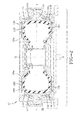
- Figure 1 illustrates a cross-sectional side view of an improved tire mold 10 of the present invention shown in the closed position
- Figure 2 illustrates a tire mounted in a mold
- the mold as shown has an upper portion 11 which includes a sidewall annular ring having a central opening 14.
- the sidewall annular ring may be further divided into two or more sidewall components 18a, 18b as shown, for ease of manufacturing.
- the sidewall components 18a, 18b each include an inner surface 17a, 17b for molding the sidewall of a tire.
- the sidewall annular ring or sidewall components 18a, 18b further include an interior cavity 100 that preferably extends along the entire width of the sidewall annular ring or sidewall components 18a, 18b.
- the cavity 100 is filled with an insulating material such as fiberglass, or a fiberglass reinforced, mineral filled sheet with heat resistant polyester thermosetting resin.
- an insulating material such as fiberglass, or a fiberglass reinforced, mineral filled sheet with heat resistant polyester thermosetting resin.
- One commercially available insulation material suitable for use is sold under the tradenames GLASSTHERM HT, GLASTHERM CH or GLASTHERM S, and is made by Jaco Products of Middlefield, Ohio.
- the R value of the insulation may be adjusted to provide the desired temperature profile of the tread segments and the sidewall components in order to ensure that the sidewall and belt edges are not over cured.
- the upper mold portion 11 further includes an optional annular shoulder ring 20.
- the optional shoulder ring 20 is located between the sidewall components 18a, 18b and an annular actuating ring 24.
- the shoulder ring has an inner molding surface 21 for molding the shoulder/tread area of the tire.
- the annular actuating ring 24 comprises an inner frustroconical surface 25 aligned for engagement with an outer frustroconical surface 31 of the tread segments, and functions to align the tread segments during closing of the mold.
- a lower portion 12 of the mold 10 includes a lower sidewall ring having a central opening 33.
- the lower sidewall ring may be further subdivided into two or more components 34a, 34b.
- the lower sidewall annular ring or sidewall components 34a, 34b further include an interior cavity 102 that preferably extends along the entire width of the sidewall annular ring or sidewall components 34a, 34b.
- the cavity 100 is filled with an insulating material such as fiberglass, or a fiberglass reinforced, mineral filled sheet with heat resistant polyester thermosetting resin.
- GLASSTHERM HT GLASTHERM CH or GLASTHERM S
- Jaco Products of Middlefield, Ohio One commercially available insulation suitable for use is sold under the tradenames GLASSTHERM HT, GLASTHERM CH or GLASTHERM S, and is made by Jaco Products of Middlefield, Ohio.
- An optional shoulder ring 36 is positioned radially outward of the sidewall ring.
- the optional shoulder ring has a tread forming surface 35 for forming the shoulder section of the tire.
- the lower portion of the mold further comprises a plurality of tread segments 32, which are arranged circumferentially about the green tire to be molded.
- Each tread segment 32 has a tread molding surface 133 having for example, lands and grooves for molding the tread of a green tire.
- the tread segments join together to form an annular ring to encircle and mold a tread of a green tire.
- each tread segment is formed of a one piece unit and is not split into two or more pieces.
- each tread segment has a tread molding surface 33 which extends substantially unbroken across the outer tread surface of the green tire, from one shoulder to the opposite shoulder.
- Each tread segment 32 preferably further includes a cavity 110, 112 that is located at the axially outer ends 114, 116 of the segment 32.
- the cavities 110, 112 are preferably positioned near the tread surface 133 to be adjacent the belt edges of the tire.
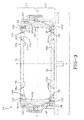
- Figure 3 shows an alternative embodiment of a mold 10 with a different arrangement and design of internal cavities 130, 130' and 130" filled a thermally insulating material.
- the tread segments 32 do not have internal cavities although these may be provided s shown in Fig. 2 for instance.
- the invention has been shown for use with a segmented type of mold, the invention is not limited to a segmented mold and may be utilized in other types of molds.
Landscapes
- Engineering & Computer Science (AREA)
- Mechanical Engineering (AREA)
- Manufacturing & Machinery (AREA)
- Moulds For Moulding Plastics Or The Like (AREA)
- Heating, Cooling, Or Curing Plastics Or The Like In General (AREA)
Abstract
Description
- This invention relates in general to tire molds, and more particularly to tire molds for large heavy duty tires.
- The manufacturing of pneumatic tires for motor vehicles of nearly all sizes entails the steps of creating the carcass and attaching thereto the tread and sidewalls, which are made of uncured rubber. The combination of carcass, tread and sidewalls, prior to curing of the rubber, is called a "green tire." The final step in the manufacture of a tire is the insertion of the green tire into a tire mold, wherein the tire is heated to a sufficiently high temperature to vulcanize the tire. The tire is then removed from the mold and the manufacturing process is complete.
- Whereas the manufacturing of tires for automobiles is a straightforward process involving relatively light-weight green tires, the manufacture of large tires for industrial or large off-road type vehicles of the sort used in earth moving and construction work entails the handling of very large green tires weighing hundreds of pounds. Because the tread of these large tires are very thick and massive, it requires a lot of heat transfer to the tread area of the tire in order to properly cure the tread. The sidewalls of the tire are much thinner and thus require less heat as compared to the thick tread. One problem that may arise is that the sidewall of the tire is cured the desired amount, while the tread is undercured. Alternatively, the tread may be cured the desired amount, while the sidewall and belt edges may be overcured. Thus, it is desired to have an improved tire mold which allows for the correct temperature of the tread and sidewall zone of a tire mold.
- The invention relates to a tire mold in accordance with claim 1.
- Dependent claims refer to preferred embodiments of the invention.
- In one aspect of the invention, a tire mold comprises an upper mold portion and a lower mold portion, wherein the upper mold portion and the lower mold portion are movable relative to one another for insertion of a tire into the mold, wherein the upper mold portion includes an upper sidewall ring and the lower mold portion includes a lower sidewall ring, wherein the mold further includes a plurality of tread segments which are joinable together to form an annular ring to encircle a tread of a green tire, and wherein the upper sidewall ring and the lower sidewall ring each include at least one internal cavity filled with a material.
- In one aspect of the invention, one, some or preferably all of the plurality of tread segments may also comprise an internal cavity filled with a material.
- In one aspect of the invention, the material filling the internal cavity in the upper sidewall ring may be different from the material filling the internal cavity in the lower sidewall ring; and/or the material filling the internal cavity in one or more of the tread segments may be different from the material filling the internal cavity in upper sidewall ring and/or different from the material filling the internal cavity in the lower sidewall ring. This allows it to adapt the speed of the curing of the tire at these locations in the mold to respective requirements.
- In one aspect of the invention, the material filling the internal cavity in the upper sidewall ring may be the same as the material filling the internal cavity in the lower sidewall ring (34a, 34b); or the material filling the internal cavity in one or more of the tread segments (32) may the same as the material filling the internal cavity in upper sidewall ring and the material filling the internal cavity in the lower sidewall ring.
- In one preferred aspect of the invention, the material filling the internal cavity in one or more of the tread segments, the material filling the internal cavity in upper sidewall ring and the material filling the internal cavity in the lower sidewall ring is a thermally insulating material.
- In one aspect of the invention, said material has a thermal conductivity lower, preferably at least 10 times lower or at least 100 times lower, than the material of the upper sidewall ring and the material of the lower sidewall ring respectively. Preferably, this material has a thermal conductivity in a range of from 500 to 2000 times lower than the material of the upper sidewall ring and the material of the lower sidewall ring respectively.
- In one preferred aspect of the invention, the material filling the optionally provided one or more tread segment cavities has a thermal conductivity lower, preferably at least 10 times lower or at least 100 times lower, than the material of the respective tread segment. Preferably, this material has a thermal conductivity in a range of from 500 to 2000 times lower than the material of the respective tread segment.
- In one aspect of the invention, the lower mold portion may comprise the plurality of tread segments.
- In one aspect of the invention, the tread segments have axially outer ends and one or more internal cavities in at least one tread segment filled with the material may be located at each axially outer end.
- In one aspect of the invention, the internal cavity of the upper and lower sidewall ring may be positioned adjacent an inner surface of the respective sidewall ring.
- In one aspect of the invention, the upper sidewall ring and/or the lower sidewall ring may be divided into at least two components.
- In one aspect of the invention, the internal cavity of the upper and the lower sidewall ring may extend substantially along the inner surface of the sidewall ring.
- In one aspect of the invention, the material filling the internal cavity in the one or more tread segments may be fiberglass or a fiberglass reinforced mineral filled sheet.
- In one aspect of the invention, the material filling the internal cavity in one or both of the upper sidewall ring and the lower sidewall ring may be fiberglass or a fiberglass reinforced, mineral filled sheet.
- The structure, operation, and advantages of the present preferred embodiment of the invention will become further apparent upon consideration of the following description taken in conjunction with the accompanying Figures, wherein:
-
Figure 1 is a cross-sectional side view of a tire mold of the present invention shown in the closed position; -
Figure 2 is a cross-sectional side view of the tire mold ofFigure 1 shown with a tire therein; and -
Figure 3 is a cross-sectional side view of another embodiment of a tire mold shown without a tire therein. - "Axial" refers to the direction X-X shown in
Figure 1 . - "Radial" refers to the direction Y-Y shown in
Figure 1 . -
Figure 1 illustrates a cross-sectional side view of an improvedtire mold 10 of the present invention shown in the closed position, whileFigure 2 illustrates a tire mounted in a mold. The mold as shown has anupper portion 11 which includes a sidewall annular ring having acentral opening 14. The sidewall annular ring may be further divided into two ormore sidewall components sidewall components inner surface sidewall components interior cavity 100 that preferably extends along the entire width of the sidewall annular ring orsidewall components cavity 100 is filled with an insulating material such as fiberglass, or a fiberglass reinforced, mineral filled sheet with heat resistant polyester thermosetting resin. One commercially available insulation material suitable for use is sold under the tradenames GLASSTHERM HT, GLASTHERM CH or GLASTHERM S, and is made by Jaco Products of Middlefield, Ohio. The R value of the insulation may be adjusted to provide the desired temperature profile of the tread segments and the sidewall components in order to ensure that the sidewall and belt edges are not over cured. - The
upper mold portion 11 further includes an optionalannular shoulder ring 20. Theoptional shoulder ring 20 is located between thesidewall components annular actuating ring 24. The shoulder ring has aninner molding surface 21 for molding the shoulder/tread area of the tire. Theannular actuating ring 24 comprises an innerfrustroconical surface 25 aligned for engagement with an outerfrustroconical surface 31 of the tread segments, and functions to align the tread segments during closing of the mold. - Referring again to
Figure 1 , alower portion 12 of themold 10 includes a lower sidewall ring having acentral opening 33. The lower sidewall ring may be further subdivided into two ormore components sidewall components interior cavity 102 that preferably extends along the entire width of the sidewall annular ring orsidewall components cavity 100 is filled with an insulating material such as fiberglass, or a fiberglass reinforced, mineral filled sheet with heat resistant polyester thermosetting resin. One commercially available insulation suitable for use is sold under the tradenames GLASSTHERM HT, GLASTHERM CH or GLASTHERM S, and is made by Jaco Products of Middlefield, Ohio. - An
optional shoulder ring 36 is positioned radially outward of the sidewall ring. The optional shoulder ring has atread forming surface 35 for forming the shoulder section of the tire. - The lower portion of the mold further comprises a plurality of
tread segments 32, which are arranged circumferentially about the green tire to be molded. Eachtread segment 32 has atread molding surface 133 having for example, lands and grooves for molding the tread of a green tire. The tread segments join together to form an annular ring to encircle and mold a tread of a green tire. Preferably, each tread segment is formed of a one piece unit and is not split into two or more pieces. Thus each tread segment has atread molding surface 33 which extends substantially unbroken across the outer tread surface of the green tire, from one shoulder to the opposite shoulder. Eachtread segment 32 preferably further includes acavity segment 32. Thecavities tread surface 133 to be adjacent the belt edges of the tire. -
Figure 3 shows an alternative embodiment of amold 10 with a different arrangement and design ofinternal cavities tread segments 32 do not have internal cavities although these may be provided s shown inFig. 2 for instance. - Although the invention has been shown for use with a segmented type of mold, the invention is not limited to a segmented mold and may be utilized in other types of molds.
Claims (15)
- A tire mold comprising an upper mold portion (11) and a lower mold portion (12), wherein the upper mold portion (11) and the lower mold portion (12) are movable relative to one another for insertion of a tire into the mold (10), wherein the upper mold portion (11) includes an upper sidewall ring (18a, 18b) and the lower mold portion (12) includes a lower sidewall ring (34a, 34b), and wherein the mold (10) further includes a plurality of tread segments (32) which are joinable together to form an annular ring to encircle a tread of a green tire, characterized in that the upper sidewall ring (18a, 18b) and the lower sidewall ring (34a, 34b) each include at least one internal cavity (100, 102, 130, 130', 130") filled with a material.
- The tire mold of claim 1, wherein at least one or all of the plurality of tread segments (32) comprise an internal cavity (110, 112) filled with a material.
- The tire mold of claim 1 or 2, wherein(i) the material filling the internal cavity in the upper sidewall ring (18a, 18b) is different from the material filling the internal cavity in the lower sidewall ring (34a, 34b); and/or(ii) the material filling the internal cavity in one or more of the tread segments (32) is different from the material filling the internal cavity in upper sidewall ring and/or different from the material filling the internal cavity in the lower sidewall ring.
- The tire mold of claim 1 or 2, wherein(i) the material filling the internal cavity in the upper sidewall ring (18a, 18b) is the same as the material filling the internal cavity in the lower sidewall ring (34a, 34b); or(ii) the material filling the internal cavity in one or more of the tread segments (32) is the same as the material filling the internal cavity in upper sidewall ring and the material filling the internal cavity in the lower sidewall ring.
- The tire mold of at least one of the previous claims, wherein the material filling the internal cavity in one or more of the tread segments (32), the material filling the internal cavity in upper sidewall ring and the material filling the internal cavity in the lower sidewall ring is a thermally insulating material.
- The tire mold of claim 1 wherein the material has a thermal conductivity lower, preferably at least 10 times lower or at least 100 times lower, than the material of the upper sidewall ring (18a, 18b) and the material of the lower sidewall ring (34a, 34b) respectively.
- The tire mold of claim 6 wherein the material has a thermal conductivity in a range of from 500 to 2000 times lower than the material of the upper sidewall ring and the material of the lower sidewall ring respectively.
- The tire mold of claim 2 wherein the material has a thermal conductivity lower, preferably at least 10 times lower or at least 100 times lower, than the material of the respective tread segment (32).
- The tire mold of claim 8 wherein the material has a thermal conductivity in a range of from 500 to 2000 times lower than the material of the respective tread segment (32).
- The tire mold in accordance with at least one of the previous claims, wherein the lower mold portion (12) comprises the plurality of tread segments (32).
- The tire mold in accordance with at least one of the previous claims, wherein the tread segments (32) have axially outer ends, and wherein the internal cavity (110, 112) in the at least one tread segment (32) filled with said material is located at each axially outer end.
- The tire mold in accordance with at least one of the previous claims, wherein the internal cavity (100, 102, 130, 130', 130") of the upper and lower sidewall ring is positioned adjacent an inner surface (21) of the respective sidewall ring.
- The tire mold in accordance with at least one of the previous claims, wherein the upper sidewall ring (18a, 18b) and/or the lower sidewall ring (34a, 34b) is divided into at least two components.
- The tire mold in accordance with at least one of the previous claims, wherein the internal cavity of the upper and the lower sidewall ring extends substantially along the inner surface (21) of the sidewall ring.
- The tire mold in accordance with at least one of the previous claims, wherein the material filling the internal cavity (110, 116) in that the one or more tread segments (32) is fiberglass or a fiberglass reinforced mineral filled sheet; and/or wherein the material filling the internal cavity (100, 102, 130, 130', 130") in one or both of the upper sidewall ring (18a, 18b) and the lower sidewall ring (34a, 34b) is fiberglass or a fiberglass reinforced, mineral filled sheet.
Applications Claiming Priority (1)
| Application Number | Priority Date | Filing Date | Title |
|---|---|---|---|
| US13/661,189 US8597008B1 (en) | 2012-10-26 | 2012-10-26 | Method and apparatus for controlling the sidewall vs. tread curing temperature in a tire mold |
Publications (1)
| Publication Number | Publication Date |
|---|---|
| EP2724849A1 true EP2724849A1 (en) | 2014-04-30 |
Family
ID=49485546
Family Applications (1)
| Application Number | Title | Priority Date | Filing Date |
|---|---|---|---|
| EP13189990.8A Withdrawn EP2724849A1 (en) | 2012-10-26 | 2013-10-24 | Tire mold |
Country Status (5)
| Country | Link |
|---|---|
| US (1) | US8597008B1 (en) |
| EP (1) | EP2724849A1 (en) |
| JP (1) | JP2014083850A (en) |
| CN (1) | CN103786280A (en) |
| BR (1) | BR102013027293A2 (en) |
Cited By (1)
| Publication number | Priority date | Publication date | Assignee | Title |
|---|---|---|---|---|
| EP3150348A4 (en) * | 2014-05-27 | 2017-04-05 | Bridgestone Corporation | Tire mold and tire mold manufacturing method |
Families Citing this family (5)
| Publication number | Priority date | Publication date | Assignee | Title |
|---|---|---|---|---|
| FR3014009B1 (en) | 2013-12-04 | 2016-11-04 | Michelin & Cie | PNEUMATIC SECTOR MOLD AND METHOD FOR MOLDING THE SAME |
| FR3014356B1 (en) * | 2013-12-10 | 2016-11-04 | Michelin & Cie | PNEUMATIC SECTOR MOLD COMPRISING INSULATING SUPPORT PLATES AND ASSOCIATED MOLDING METHOD |
| JP2018114645A (en) * | 2017-01-17 | 2018-07-26 | 株式会社ブリヂストン | Rubber article vulcanizer |
| JP2019034516A (en) * | 2017-08-21 | 2019-03-07 | 株式会社ブリヂストン | Tire vulcanization mold |
| JP7002996B2 (en) * | 2018-05-23 | 2022-02-04 | 株式会社ブリヂストン | Tire vulcanization molding equipment |
Citations (8)
| Publication number | Priority date | Publication date | Assignee | Title |
|---|---|---|---|---|
| JPS5849232A (en) * | 1981-09-17 | 1983-03-23 | Yokohama Rubber Co Ltd:The | Vulcanizer |
| US4568259A (en) * | 1985-08-02 | 1986-02-04 | The B. F. Goodrich Company | Tire mold |
| JPS6237107A (en) * | 1985-08-12 | 1987-02-18 | Bridgestone Corp | Vulcanizing mold |
| US5932153A (en) * | 1996-01-25 | 1999-08-03 | The Standard Products Company | Tire tread |
| US6413068B1 (en) * | 2000-07-10 | 2002-07-02 | The Goodyear Tire & Rubber Company | Tire mold heat transfer system |
| EP2000290A1 (en) * | 2007-06-06 | 2008-12-10 | Continental Aktiengesellschaft | Device for vulcanising a vehicle tyre with a heat mould |
| WO2011136097A1 (en) * | 2010-04-26 | 2011-11-03 | 株式会社ブリヂストン | Tire vulcanization device |
| US20120111464A1 (en) * | 2009-08-21 | 2012-05-10 | Kabushiki Kaisha Bridgestone | Method for manufacturing base tire, curing machine, and base tire |
Family Cites Families (1)
| Publication number | Priority date | Publication date | Assignee | Title |
|---|---|---|---|---|
| US6916164B2 (en) * | 2002-12-23 | 2005-07-12 | The Goodyear Tire & Rubber Company | Tire mold having improved heat transfer characteristics |
-
2012
- 2012-10-26 US US13/661,189 patent/US8597008B1/en not_active Expired - Fee Related
-
2013
- 2013-10-22 JP JP2013218886A patent/JP2014083850A/en active Pending
- 2013-10-23 BR BR102013027293-0A patent/BR102013027293A2/en not_active Application Discontinuation
- 2013-10-24 EP EP13189990.8A patent/EP2724849A1/en not_active Withdrawn
- 2013-10-28 CN CN201310514505.5A patent/CN103786280A/en active Pending
Patent Citations (8)
| Publication number | Priority date | Publication date | Assignee | Title |
|---|---|---|---|---|
| JPS5849232A (en) * | 1981-09-17 | 1983-03-23 | Yokohama Rubber Co Ltd:The | Vulcanizer |
| US4568259A (en) * | 1985-08-02 | 1986-02-04 | The B. F. Goodrich Company | Tire mold |
| JPS6237107A (en) * | 1985-08-12 | 1987-02-18 | Bridgestone Corp | Vulcanizing mold |
| US5932153A (en) * | 1996-01-25 | 1999-08-03 | The Standard Products Company | Tire tread |
| US6413068B1 (en) * | 2000-07-10 | 2002-07-02 | The Goodyear Tire & Rubber Company | Tire mold heat transfer system |
| EP2000290A1 (en) * | 2007-06-06 | 2008-12-10 | Continental Aktiengesellschaft | Device for vulcanising a vehicle tyre with a heat mould |
| US20120111464A1 (en) * | 2009-08-21 | 2012-05-10 | Kabushiki Kaisha Bridgestone | Method for manufacturing base tire, curing machine, and base tire |
| WO2011136097A1 (en) * | 2010-04-26 | 2011-11-03 | 株式会社ブリヂストン | Tire vulcanization device |
Cited By (2)
| Publication number | Priority date | Publication date | Assignee | Title |
|---|---|---|---|---|
| EP3150348A4 (en) * | 2014-05-27 | 2017-04-05 | Bridgestone Corporation | Tire mold and tire mold manufacturing method |
| US10350790B2 (en) | 2014-05-27 | 2019-07-16 | Bridgestone Corporation | Tire mold and method for manufacturing tire mold |
Also Published As
| Publication number | Publication date |
|---|---|
| US8597008B1 (en) | 2013-12-03 |
| BR102013027293A2 (en) | 2014-12-09 |
| JP2014083850A (en) | 2014-05-12 |
| CN103786280A (en) | 2014-05-14 |
Similar Documents
| Publication | Publication Date | Title |
|---|---|---|
| US8597008B1 (en) | Method and apparatus for controlling the sidewall vs. tread curing temperature in a tire mold | |
| EP2324996B1 (en) | Segmented tire mold | |
| EP2588300B1 (en) | Process and plant for producing tyres for vehicle wheels | |
| US4201744A (en) | Method of making tires | |
| CN111511576B (en) | Method of manufacturing non-pneumatic tire spokes | |
| US20140004216A1 (en) | Method and apparatus for manufacturing pneumatic tyres | |
| JP2001088143A (en) | Two-part rigid core for tire manufacturing | |
| EP2038110B1 (en) | Process and apparatus for producing pneumatic tyres | |
| WO2013140964A1 (en) | Rigid core for forming tire | |
| JP5681685B2 (en) | Rigid core and method for manufacturing pneumatic tire using the same | |
| RU2015146284A (en) | METHOD AND VOLCANIZING PRESS FORM FOR PRODUCING TIRES FOR VEHICLE WHEELS | |
| US20170246824A1 (en) | Dual mold replaceable center rib | |
| KR20070090891A (en) | Pneumatic tire manufacturing method and apparatus | |
| US10562250B2 (en) | Non-pneumatic tire tread layer mold and molding process | |
| EP1927450B1 (en) | Process for producing tire and tire vulcanization mold | |
| CA1044418A (en) | Manufacture of tubes | |
| US20060125147A1 (en) | Segmented tire mold for off-road-vehicle tires | |
| WO2008078141A1 (en) | Process and plant for producing tyres for vehicle wheels | |
| JP6122686B2 (en) | Tire manufacturing method for agricultural machinery | |
| JP7006130B2 (en) | Manufacturing method and equipment for bead members | |
| EP0235071B1 (en) | Method and apparatus for assembling a vehicle tyre | |
| JP4222825B2 (en) | Pneumatic tire manufacturing method | |
| CN108463335B (en) | Method for manufacturing solid rubber tire, solid rubber tire manufactured according to the method, and substrate for solid rubber tire | |
| CN121568839A (en) | Method and device for producing a multilayer annular component in the construction of a vehicle tire | |
| KR100830815B1 (en) | Breda vulcanization inner mold |
Legal Events
| Date | Code | Title | Description |
|---|---|---|---|
| PUAI | Public reference made under article 153(3) epc to a published international application that has entered the european phase |
Free format text: ORIGINAL CODE: 0009012 |
|
| 17P | Request for examination filed |
Effective date: 20131024 |
|
| AK | Designated contracting states |
Kind code of ref document: A1 Designated state(s): AL AT BE BG CH CY CZ DE DK EE ES FI FR GB GR HR HU IE IS IT LI LT LU LV MC MK MT NL NO PL PT RO RS SE SI SK SM TR |
|
| AX | Request for extension of the european patent |
Extension state: BA ME |
|
| 17P | Request for examination filed |
Effective date: 20141030 |
|
| RBV | Designated contracting states (corrected) |
Designated state(s): AL AT BE BG CH CY CZ DE DK EE ES FI FR GB GR HR HU IE IS IT LI LT LU LV MC MK MT NL NO PL PT RO RS SE SI SK SM TR |
|
| GRAP | Despatch of communication of intention to grant a patent |
Free format text: ORIGINAL CODE: EPIDOSNIGR1 |
|
| RIC1 | Information provided on ipc code assigned before grant |
Ipc: B29C 33/38 20060101ALI20160726BHEP Ipc: B29D 30/06 20060101AFI20160726BHEP |
|
| INTG | Intention to grant announced |
Effective date: 20160810 |
|
| STAA | Information on the status of an ep patent application or granted ep patent |
Free format text: STATUS: THE APPLICATION IS DEEMED TO BE WITHDRAWN |
|
| 18D | Application deemed to be withdrawn |
Effective date: 20161221 |