EP2722376A1 - Adhesive film - Google Patents
Adhesive film Download PDFInfo
- Publication number
- EP2722376A1 EP2722376A1 EP12801249.9A EP12801249A EP2722376A1 EP 2722376 A1 EP2722376 A1 EP 2722376A1 EP 12801249 A EP12801249 A EP 12801249A EP 2722376 A1 EP2722376 A1 EP 2722376A1
- Authority
- EP
- European Patent Office
- Prior art keywords
- laser beam
- film
- psa
- absorbing agent
- layer
- Prior art date
- Legal status (The legal status is an assumption and is not a legal conclusion. Google has not performed a legal analysis and makes no representation as to the accuracy of the status listed.)
- Withdrawn
Links
- 239000002313 adhesive film Substances 0.000 title 1
- 239000004820 Pressure-sensitive adhesive Substances 0.000 claims abstract description 160
- 239000010410 layer Substances 0.000 claims abstract description 117
- 239000006096 absorbing agent Substances 0.000 claims abstract description 97
- 229920005989 resin Polymers 0.000 claims abstract description 96
- 239000011347 resin Substances 0.000 claims abstract description 96
- 239000000758 substrate Substances 0.000 claims abstract description 79
- 239000000843 powder Substances 0.000 claims abstract description 52
- 238000002835 absorbance Methods 0.000 claims abstract description 31
- 229910052751 metal Inorganic materials 0.000 claims abstract description 26
- 239000002184 metal Substances 0.000 claims abstract description 26
- 229910000765 intermetallic Inorganic materials 0.000 claims abstract description 7
- 239000011342 resin composition Substances 0.000 claims description 26
- 239000000203 mixture Substances 0.000 claims description 22
- 238000003698 laser cutting Methods 0.000 claims description 13
- 229920001225 polyester resin Polymers 0.000 claims description 6
- 239000004645 polyester resin Substances 0.000 claims description 6
- 229920005672 polyolefin resin Polymers 0.000 claims description 6
- 238000005520 cutting process Methods 0.000 abstract description 12
- 238000000034 method Methods 0.000 description 36
- XAGFODPZIPBFFR-UHFFFAOYSA-N aluminium Chemical compound [Al] XAGFODPZIPBFFR-UHFFFAOYSA-N 0.000 description 20
- 239000008188 pellet Substances 0.000 description 20
- -1 aromatic dithiol Chemical class 0.000 description 19
- 238000005259 measurement Methods 0.000 description 13
- 238000003754 machining Methods 0.000 description 12
- 239000000463 material Substances 0.000 description 12
- 239000002245 particle Substances 0.000 description 11
- 150000001875 compounds Chemical class 0.000 description 10
- 229920001971 elastomer Polymers 0.000 description 10
- 239000005060 rubber Substances 0.000 description 9
- 238000002834 transmittance Methods 0.000 description 9
- CURLTUGMZLYLDI-UHFFFAOYSA-N Carbon dioxide Chemical compound O=C=O CURLTUGMZLYLDI-UHFFFAOYSA-N 0.000 description 8
- 229910052782 aluminium Inorganic materials 0.000 description 8
- 229920001684 low density polyethylene Polymers 0.000 description 8
- 239000004702 low-density polyethylene Substances 0.000 description 8
- 229920001707 polybutylene terephthalate Polymers 0.000 description 8
- NIXOWILDQLNWCW-UHFFFAOYSA-N acrylic acid group Chemical group C(C=C)(=O)O NIXOWILDQLNWCW-UHFFFAOYSA-N 0.000 description 7
- PPBRXRYQALVLMV-UHFFFAOYSA-N Styrene Chemical compound C=CC1=CC=CC=C1 PPBRXRYQALVLMV-UHFFFAOYSA-N 0.000 description 6
- YXFVVABEGXRONW-UHFFFAOYSA-N Toluene Chemical compound CC1=CC=CC=C1 YXFVVABEGXRONW-UHFFFAOYSA-N 0.000 description 6
- 239000000178 monomer Substances 0.000 description 6
- 229920000642 polymer Polymers 0.000 description 6
- PXHVJJICTQNCMI-UHFFFAOYSA-N Nickel Chemical compound [Ni] PXHVJJICTQNCMI-UHFFFAOYSA-N 0.000 description 5
- 239000004698 Polyethylene Substances 0.000 description 5
- 239000004743 Polypropylene Substances 0.000 description 5
- 239000000853 adhesive Substances 0.000 description 5
- 230000001070 adhesive effect Effects 0.000 description 5
- 238000003851 corona treatment Methods 0.000 description 5
- 229920001155 polypropylene Polymers 0.000 description 5
- 238000004381 surface treatment Methods 0.000 description 5
- NIXOWILDQLNWCW-UHFFFAOYSA-M Acrylate Chemical compound [O-]C(=O)C=C NIXOWILDQLNWCW-UHFFFAOYSA-M 0.000 description 4
- OKTJSMMVPCPJKN-UHFFFAOYSA-N Carbon Chemical compound [C] OKTJSMMVPCPJKN-UHFFFAOYSA-N 0.000 description 4
- GWEVSGVZZGPLCZ-UHFFFAOYSA-N Titan oxide Chemical compound O=[Ti]=O GWEVSGVZZGPLCZ-UHFFFAOYSA-N 0.000 description 4
- 239000000654 additive Substances 0.000 description 4
- 229910002092 carbon dioxide Inorganic materials 0.000 description 4
- 239000001569 carbon dioxide Substances 0.000 description 4
- 239000003795 chemical substances by application Substances 0.000 description 4
- 150000002739 metals Chemical class 0.000 description 4
- 150000002894 organic compounds Chemical class 0.000 description 4
- 241000894007 species Species 0.000 description 4
- RYGMFSIKBFXOCR-UHFFFAOYSA-N Copper Chemical compound [Cu] RYGMFSIKBFXOCR-UHFFFAOYSA-N 0.000 description 3
- XTXRWKRVRITETP-UHFFFAOYSA-N Vinyl acetate Chemical compound CC(=O)OC=C XTXRWKRVRITETP-UHFFFAOYSA-N 0.000 description 3
- 125000000217 alkyl group Chemical group 0.000 description 3
- TZCXTZWJZNENPQ-UHFFFAOYSA-L barium sulfate Chemical compound [Ba+2].[O-]S([O-])(=O)=O TZCXTZWJZNENPQ-UHFFFAOYSA-L 0.000 description 3
- 239000003431 cross linking reagent Substances 0.000 description 3
- 230000000694 effects Effects 0.000 description 3
- 229920006351 engineering plastic Polymers 0.000 description 3
- 238000005516 engineering process Methods 0.000 description 3
- 238000000465 moulding Methods 0.000 description 3
- 229920000058 polyacrylate Polymers 0.000 description 3
- 229920000573 polyethylene Polymers 0.000 description 3
- 239000002356 single layer Substances 0.000 description 3
- 244000043261 Hevea brasiliensis Species 0.000 description 2
- BQCADISMDOOEFD-UHFFFAOYSA-N Silver Chemical compound [Ag] BQCADISMDOOEFD-UHFFFAOYSA-N 0.000 description 2
- HCHKCACWOHOZIP-UHFFFAOYSA-N Zinc Chemical compound [Zn] HCHKCACWOHOZIP-UHFFFAOYSA-N 0.000 description 2
- 239000003963 antioxidant agent Substances 0.000 description 2
- 239000002216 antistatic agent Substances 0.000 description 2
- 229920005601 base polymer Polymers 0.000 description 2
- 239000003086 colorant Substances 0.000 description 2
- 238000000354 decomposition reaction Methods 0.000 description 2
- 238000001514 detection method Methods 0.000 description 2
- 208000028659 discharge Diseases 0.000 description 2
- 239000006185 dispersion Substances 0.000 description 2
- 239000000975 dye Substances 0.000 description 2
- 238000011156 evaluation Methods 0.000 description 2
- 238000001125 extrusion Methods 0.000 description 2
- 239000003063 flame retardant Substances 0.000 description 2
- PCHJSUWPFVWCPO-UHFFFAOYSA-N gold Chemical compound [Au] PCHJSUWPFVWCPO-UHFFFAOYSA-N 0.000 description 2
- 238000000691 measurement method Methods 0.000 description 2
- 229920003052 natural elastomer Polymers 0.000 description 2
- 229920001194 natural rubber Polymers 0.000 description 2
- 229910052759 nickel Inorganic materials 0.000 description 2
- 239000000049 pigment Substances 0.000 description 2
- 229920000728 polyester Polymers 0.000 description 2
- 238000006116 polymerization reaction Methods 0.000 description 2
- 229920001296 polysiloxane Polymers 0.000 description 2
- 229920002635 polyurethane Polymers 0.000 description 2
- 239000004814 polyurethane Substances 0.000 description 2
- 239000002516 radical scavenger Substances 0.000 description 2
- 238000005070 sampling Methods 0.000 description 2
- 230000035945 sensitivity Effects 0.000 description 2
- 239000002904 solvent Substances 0.000 description 2
- 239000000126 substance Substances 0.000 description 2
- 229920003051 synthetic elastomer Polymers 0.000 description 2
- 239000005061 synthetic rubber Substances 0.000 description 2
- 238000005979 thermal decomposition reaction Methods 0.000 description 2
- 238000007740 vapor deposition Methods 0.000 description 2
- QGKMIGUHVLGJBR-UHFFFAOYSA-M (4z)-1-(3-methylbutyl)-4-[[1-(3-methylbutyl)quinolin-1-ium-4-yl]methylidene]quinoline;iodide Chemical compound [I-].C12=CC=CC=C2N(CCC(C)C)C=CC1=CC1=CC=[N+](CCC(C)C)C2=CC=CC=C12 QGKMIGUHVLGJBR-UHFFFAOYSA-M 0.000 description 1
- FWVCSXWHVOOTFJ-UHFFFAOYSA-N 1-(2-chloroethylsulfanyl)-2-[2-(2-chloroethylsulfanyl)ethoxy]ethane Chemical compound ClCCSCCOCCSCCCl FWVCSXWHVOOTFJ-UHFFFAOYSA-N 0.000 description 1
- SMZOUWXMTYCWNB-UHFFFAOYSA-N 2-(2-methoxy-5-methylphenyl)ethanamine Chemical compound COC1=CC=C(C)C=C1CCN SMZOUWXMTYCWNB-UHFFFAOYSA-N 0.000 description 1
- GOXQRTZXKQZDDN-UHFFFAOYSA-N 2-Ethylhexyl acrylate Chemical compound CCCCC(CC)COC(=O)C=C GOXQRTZXKQZDDN-UHFFFAOYSA-N 0.000 description 1
- VNWOJVJCRAHBJJ-UHFFFAOYSA-N 2-pentylcyclopentan-1-one Chemical compound CCCCCC1CCCC1=O VNWOJVJCRAHBJJ-UHFFFAOYSA-N 0.000 description 1
- 239000004342 Benzoyl peroxide Substances 0.000 description 1
- OMPJBNCRMGITSC-UHFFFAOYSA-N Benzoylperoxide Chemical compound C=1C=CC=CC=1C(=O)OOC(=O)C1=CC=CC=C1 OMPJBNCRMGITSC-UHFFFAOYSA-N 0.000 description 1
- VYZAMTAEIAYCRO-UHFFFAOYSA-N Chromium Chemical compound [Cr] VYZAMTAEIAYCRO-UHFFFAOYSA-N 0.000 description 1
- 239000004593 Epoxy Substances 0.000 description 1
- 229920000181 Ethylene propylene rubber Polymers 0.000 description 1
- YCKRFDGAMUMZLT-UHFFFAOYSA-N Fluorine atom Chemical compound [F] YCKRFDGAMUMZLT-UHFFFAOYSA-N 0.000 description 1
- CERQOIWHTDAKMF-UHFFFAOYSA-N Methacrylic acid Chemical compound CC(=C)C(O)=O CERQOIWHTDAKMF-UHFFFAOYSA-N 0.000 description 1
- ZOKXTWBITQBERF-UHFFFAOYSA-N Molybdenum Chemical compound [Mo] ZOKXTWBITQBERF-UHFFFAOYSA-N 0.000 description 1
- 229930192627 Naphthoquinone Natural products 0.000 description 1
- 239000005062 Polybutadiene Substances 0.000 description 1
- 229920002367 Polyisobutene Polymers 0.000 description 1
- 239000004902 Softening Agent Substances 0.000 description 1
- RTAQQCXQSZGOHL-UHFFFAOYSA-N Titanium Chemical compound [Ti] RTAQQCXQSZGOHL-UHFFFAOYSA-N 0.000 description 1
- BZHJMEDXRYGGRV-UHFFFAOYSA-N Vinyl chloride Chemical compound ClC=C BZHJMEDXRYGGRV-UHFFFAOYSA-N 0.000 description 1
- QCWXUUIWCKQGHC-UHFFFAOYSA-N Zirconium Chemical compound [Zr] QCWXUUIWCKQGHC-UHFFFAOYSA-N 0.000 description 1
- 238000005299 abrasion Methods 0.000 description 1
- 238000010521 absorption reaction Methods 0.000 description 1
- 238000010306 acid treatment Methods 0.000 description 1
- 229910045601 alloy Inorganic materials 0.000 description 1
- 239000000956 alloy Substances 0.000 description 1
- PYKYMHQGRFAEBM-UHFFFAOYSA-N anthraquinone Natural products CCC(=O)c1c(O)c2C(=O)C3C(C=CC=C3O)C(=O)c2cc1CC(=O)OC PYKYMHQGRFAEBM-UHFFFAOYSA-N 0.000 description 1
- 150000004056 anthraquinones Chemical class 0.000 description 1
- 230000003712 anti-aging effect Effects 0.000 description 1
- 239000003125 aqueous solvent Substances 0.000 description 1
- 235000019400 benzoyl peroxide Nutrition 0.000 description 1
- 229920001400 block copolymer Polymers 0.000 description 1
- IYYGCUZHHGZXGJ-UHFFFAOYSA-N but-1-ene;ethene;prop-1-ene Chemical compound C=C.CC=C.CCC=C IYYGCUZHHGZXGJ-UHFFFAOYSA-N 0.000 description 1
- LMHUKLLZJMVJQZ-UHFFFAOYSA-N but-1-ene;prop-1-ene Chemical compound CC=C.CCC=C LMHUKLLZJMVJQZ-UHFFFAOYSA-N 0.000 description 1
- 125000000484 butyl group Chemical group [H]C([*])([H])C([H])([H])C([H])([H])C([H])([H])[H] 0.000 description 1
- 229920005549 butyl rubber Polymers 0.000 description 1
- 239000006229 carbon black Substances 0.000 description 1
- 125000003178 carboxy group Chemical group [H]OC(*)=O 0.000 description 1
- 238000005266 casting Methods 0.000 description 1
- 229910052804 chromium Inorganic materials 0.000 description 1
- 239000011651 chromium Substances 0.000 description 1
- 239000011248 coating agent Substances 0.000 description 1
- 238000000576 coating method Methods 0.000 description 1
- 229910052802 copper Inorganic materials 0.000 description 1
- 239000010949 copper Substances 0.000 description 1
- 239000011889 copper foil Substances 0.000 description 1
- 230000001186 cumulative effect Effects 0.000 description 1
- 238000005034 decoration Methods 0.000 description 1
- 230000003247 decreasing effect Effects 0.000 description 1
- 238000013461 design Methods 0.000 description 1
- 238000010586 diagram Methods 0.000 description 1
- 238000002050 diffraction method Methods 0.000 description 1
- 239000002270 dispersing agent Substances 0.000 description 1
- 238000009826 distribution Methods 0.000 description 1
- 239000000806 elastomer Substances 0.000 description 1
- 238000010556 emulsion polymerization method Methods 0.000 description 1
- BXOUVIIITJXIKB-UHFFFAOYSA-N ethene;styrene Chemical group C=C.C=CC1=CC=CC=C1 BXOUVIIITJXIKB-UHFFFAOYSA-N 0.000 description 1
- 230000001747 exhibiting effect Effects 0.000 description 1
- 239000011737 fluorine Substances 0.000 description 1
- 229910052731 fluorine Inorganic materials 0.000 description 1
- 239000011888 foil Substances 0.000 description 1
- 238000010528 free radical solution polymerization reaction Methods 0.000 description 1
- 229910052737 gold Inorganic materials 0.000 description 1
- 239000010931 gold Substances 0.000 description 1
- 238000010438 heat treatment Methods 0.000 description 1
- 125000002887 hydroxy group Chemical group [H]O* 0.000 description 1
- 239000012948 isocyanate Substances 0.000 description 1
- 150000002513 isocyanates Chemical class 0.000 description 1
- 238000002372 labelling Methods 0.000 description 1
- 239000011254 layer-forming composition Substances 0.000 description 1
- PSGAAPLEWMOORI-PEINSRQWSA-N medroxyprogesterone acetate Chemical compound C([C@@]12C)CC(=O)C=C1[C@@H](C)C[C@@H]1[C@@H]2CC[C@]2(C)[C@@](OC(C)=O)(C(C)=O)CC[C@H]21 PSGAAPLEWMOORI-PEINSRQWSA-N 0.000 description 1
- 230000008018 melting Effects 0.000 description 1
- 238000002844 melting Methods 0.000 description 1
- 150000001247 metal acetylides Chemical class 0.000 description 1
- 238000012986 modification Methods 0.000 description 1
- 230000004048 modification Effects 0.000 description 1
- 229910052750 molybdenum Inorganic materials 0.000 description 1
- 239000011733 molybdenum Substances 0.000 description 1
- LKKPNUDVOYAOBB-UHFFFAOYSA-N naphthalocyanine Chemical compound N1C(N=C2C3=CC4=CC=CC=C4C=C3C(N=C3C4=CC5=CC=CC=C5C=C4C(=N4)N3)=N2)=C(C=C2C(C=CC=C2)=C2)C2=C1N=C1C2=CC3=CC=CC=C3C=C2C4=N1 LKKPNUDVOYAOBB-UHFFFAOYSA-N 0.000 description 1
- 150000002791 naphthoquinones Chemical class 0.000 description 1
- 150000004767 nitrides Chemical class 0.000 description 1
- 239000003960 organic solvent Substances 0.000 description 1
- IEQIEDJGQAUEQZ-UHFFFAOYSA-N phthalocyanine Chemical compound N1C(N=C2C3=CC=CC=C3C(N=C3C4=CC=CC=C4C(=N4)N3)=N2)=C(C=CC=C2)C2=C1N=C1C2=CC=CC=C2C4=N1 IEQIEDJGQAUEQZ-UHFFFAOYSA-N 0.000 description 1
- 238000009832 plasma treatment Methods 0.000 description 1
- 229920002647 polyamide Polymers 0.000 description 1
- 229920002857 polybutadiene Polymers 0.000 description 1
- 229920000139 polyethylene terephthalate Polymers 0.000 description 1
- 239000005020 polyethylene terephthalate Substances 0.000 description 1
- 229920001195 polyisoprene Polymers 0.000 description 1
- 239000003505 polymerization initiator Substances 0.000 description 1
- 229920000098 polyolefin Polymers 0.000 description 1
- 229920005996 polystyrene-poly(ethylene-butylene)-polystyrene Polymers 0.000 description 1
- 239000002987 primer (paints) Substances 0.000 description 1
- 238000012545 processing Methods 0.000 description 1
- 229920005604 random copolymer Polymers 0.000 description 1
- 238000000790 scattering method Methods 0.000 description 1
- 229910052709 silver Inorganic materials 0.000 description 1
- 239000004332 silver Substances 0.000 description 1
- 229910001220 stainless steel Inorganic materials 0.000 description 1
- 239000010935 stainless steel Substances 0.000 description 1
- 229920000468 styrene butadiene styrene block copolymer Polymers 0.000 description 1
- 125000000383 tetramethylene group Chemical group [H]C([H])([*:1])C([H])([H])C([H])([H])C([H])([H])[*:2] 0.000 description 1
- 229910052719 titanium Inorganic materials 0.000 description 1
- 239000010936 titanium Substances 0.000 description 1
- WFKWXMTUELFFGS-UHFFFAOYSA-N tungsten Chemical compound [W] WFKWXMTUELFFGS-UHFFFAOYSA-N 0.000 description 1
- 229910052721 tungsten Inorganic materials 0.000 description 1
- 239000010937 tungsten Substances 0.000 description 1
- 229920001567 vinyl ester resin Polymers 0.000 description 1
- 125000000391 vinyl group Chemical group [H]C([*])=C([H])[H] 0.000 description 1
- 229910052725 zinc Inorganic materials 0.000 description 1
- 239000011701 zinc Substances 0.000 description 1
- 229910052726 zirconium Inorganic materials 0.000 description 1
Images

Classifications
-
- B—PERFORMING OPERATIONS; TRANSPORTING
- B23—MACHINE TOOLS; METAL-WORKING NOT OTHERWISE PROVIDED FOR
- B23K—SOLDERING OR UNSOLDERING; WELDING; CLADDING OR PLATING BY SOLDERING OR WELDING; CUTTING BY APPLYING HEAT LOCALLY, e.g. FLAME CUTTING; WORKING BY LASER BEAM
- B23K26/00—Working by laser beam, e.g. welding, cutting or boring
- B23K26/18—Working by laser beam, e.g. welding, cutting or boring using absorbing layers on the workpiece, e.g. for marking or protecting purposes
-
- C—CHEMISTRY; METALLURGY
- C09—DYES; PAINTS; POLISHES; NATURAL RESINS; ADHESIVES; COMPOSITIONS NOT OTHERWISE PROVIDED FOR; APPLICATIONS OF MATERIALS NOT OTHERWISE PROVIDED FOR
- C09J—ADHESIVES; NON-MECHANICAL ASPECTS OF ADHESIVE PROCESSES IN GENERAL; ADHESIVE PROCESSES NOT PROVIDED FOR ELSEWHERE; USE OF MATERIALS AS ADHESIVES
- C09J9/00—Adhesives characterised by their physical nature or the effects produced, e.g. glue sticks
-
- C—CHEMISTRY; METALLURGY
- C09—DYES; PAINTS; POLISHES; NATURAL RESINS; ADHESIVES; COMPOSITIONS NOT OTHERWISE PROVIDED FOR; APPLICATIONS OF MATERIALS NOT OTHERWISE PROVIDED FOR
- C09J—ADHESIVES; NON-MECHANICAL ASPECTS OF ADHESIVE PROCESSES IN GENERAL; ADHESIVE PROCESSES NOT PROVIDED FOR ELSEWHERE; USE OF MATERIALS AS ADHESIVES
- C09J7/00—Adhesives in the form of films or foils
- C09J7/20—Adhesives in the form of films or foils characterised by their carriers
- C09J7/22—Plastics; Metallised plastics
-
- C—CHEMISTRY; METALLURGY
- C09—DYES; PAINTS; POLISHES; NATURAL RESINS; ADHESIVES; COMPOSITIONS NOT OTHERWISE PROVIDED FOR; APPLICATIONS OF MATERIALS NOT OTHERWISE PROVIDED FOR
- C09J—ADHESIVES; NON-MECHANICAL ASPECTS OF ADHESIVE PROCESSES IN GENERAL; ADHESIVE PROCESSES NOT PROVIDED FOR ELSEWHERE; USE OF MATERIALS AS ADHESIVES
- C09J7/00—Adhesives in the form of films or foils
- C09J7/20—Adhesives in the form of films or foils characterised by their carriers
- C09J7/22—Plastics; Metallised plastics
- C09J7/24—Plastics; Metallised plastics based on macromolecular compounds obtained by reactions involving only carbon-to-carbon unsaturated bonds
- C09J7/241—Polyolefin, e.g.rubber
-
- C—CHEMISTRY; METALLURGY
- C09—DYES; PAINTS; POLISHES; NATURAL RESINS; ADHESIVES; COMPOSITIONS NOT OTHERWISE PROVIDED FOR; APPLICATIONS OF MATERIALS NOT OTHERWISE PROVIDED FOR
- C09J—ADHESIVES; NON-MECHANICAL ASPECTS OF ADHESIVE PROCESSES IN GENERAL; ADHESIVE PROCESSES NOT PROVIDED FOR ELSEWHERE; USE OF MATERIALS AS ADHESIVES
- C09J7/00—Adhesives in the form of films or foils
- C09J7/20—Adhesives in the form of films or foils characterised by their carriers
- C09J7/22—Plastics; Metallised plastics
- C09J7/25—Plastics; Metallised plastics based on macromolecular compounds obtained otherwise than by reactions involving only carbon-to-carbon unsaturated bonds
- C09J7/255—Polyesters
-
- C—CHEMISTRY; METALLURGY
- C08—ORGANIC MACROMOLECULAR COMPOUNDS; THEIR PREPARATION OR CHEMICAL WORKING-UP; COMPOSITIONS BASED THEREON
- C08K—Use of inorganic or non-macromolecular organic substances as compounding ingredients
- C08K3/00—Use of inorganic substances as compounding ingredients
- C08K3/02—Elements
- C08K3/08—Metals
-
- C—CHEMISTRY; METALLURGY
- C08—ORGANIC MACROMOLECULAR COMPOUNDS; THEIR PREPARATION OR CHEMICAL WORKING-UP; COMPOSITIONS BASED THEREON
- C08K—Use of inorganic or non-macromolecular organic substances as compounding ingredients
- C08K3/00—Use of inorganic substances as compounding ingredients
- C08K3/10—Metal compounds
-
- C—CHEMISTRY; METALLURGY
- C09—DYES; PAINTS; POLISHES; NATURAL RESINS; ADHESIVES; COMPOSITIONS NOT OTHERWISE PROVIDED FOR; APPLICATIONS OF MATERIALS NOT OTHERWISE PROVIDED FOR
- C09J—ADHESIVES; NON-MECHANICAL ASPECTS OF ADHESIVE PROCESSES IN GENERAL; ADHESIVE PROCESSES NOT PROVIDED FOR ELSEWHERE; USE OF MATERIALS AS ADHESIVES
- C09J2301/00—Additional features of adhesives in the form of films or foils
- C09J2301/30—Additional features of adhesives in the form of films or foils characterized by the chemical, physicochemical or physical properties of the adhesive or the carrier
- C09J2301/302—Additional features of adhesives in the form of films or foils characterized by the chemical, physicochemical or physical properties of the adhesive or the carrier the adhesive being pressure-sensitive, i.e. tacky at temperatures inferior to 30°C
-
- C—CHEMISTRY; METALLURGY
- C09—DYES; PAINTS; POLISHES; NATURAL RESINS; ADHESIVES; COMPOSITIONS NOT OTHERWISE PROVIDED FOR; APPLICATIONS OF MATERIALS NOT OTHERWISE PROVIDED FOR
- C09J—ADHESIVES; NON-MECHANICAL ASPECTS OF ADHESIVE PROCESSES IN GENERAL; ADHESIVE PROCESSES NOT PROVIDED FOR ELSEWHERE; USE OF MATERIALS AS ADHESIVES
- C09J2301/00—Additional features of adhesives in the form of films or foils
- C09J2301/30—Additional features of adhesives in the form of films or foils characterized by the chemical, physicochemical or physical properties of the adhesive or the carrier
- C09J2301/312—Additional features of adhesives in the form of films or foils characterized by the chemical, physicochemical or physical properties of the adhesive or the carrier parameters being the characterizing feature
-
- C—CHEMISTRY; METALLURGY
- C09—DYES; PAINTS; POLISHES; NATURAL RESINS; ADHESIVES; COMPOSITIONS NOT OTHERWISE PROVIDED FOR; APPLICATIONS OF MATERIALS NOT OTHERWISE PROVIDED FOR
- C09J—ADHESIVES; NON-MECHANICAL ASPECTS OF ADHESIVE PROCESSES IN GENERAL; ADHESIVE PROCESSES NOT PROVIDED FOR ELSEWHERE; USE OF MATERIALS AS ADHESIVES
- C09J2301/00—Additional features of adhesives in the form of films or foils
- C09J2301/40—Additional features of adhesives in the form of films or foils characterized by the presence of essential components
- C09J2301/41—Additional features of adhesives in the form of films or foils characterized by the presence of essential components additives as essential feature of the carrier layer
-
- C—CHEMISTRY; METALLURGY
- C09—DYES; PAINTS; POLISHES; NATURAL RESINS; ADHESIVES; COMPOSITIONS NOT OTHERWISE PROVIDED FOR; APPLICATIONS OF MATERIALS NOT OTHERWISE PROVIDED FOR
- C09J—ADHESIVES; NON-MECHANICAL ASPECTS OF ADHESIVE PROCESSES IN GENERAL; ADHESIVE PROCESSES NOT PROVIDED FOR ELSEWHERE; USE OF MATERIALS AS ADHESIVES
- C09J2423/00—Presence of polyolefin
- C09J2423/006—Presence of polyolefin in the substrate
-
- C—CHEMISTRY; METALLURGY
- C09—DYES; PAINTS; POLISHES; NATURAL RESINS; ADHESIVES; COMPOSITIONS NOT OTHERWISE PROVIDED FOR; APPLICATIONS OF MATERIALS NOT OTHERWISE PROVIDED FOR
- C09J—ADHESIVES; NON-MECHANICAL ASPECTS OF ADHESIVE PROCESSES IN GENERAL; ADHESIVE PROCESSES NOT PROVIDED FOR ELSEWHERE; USE OF MATERIALS AS ADHESIVES
- C09J2467/00—Presence of polyester
- C09J2467/006—Presence of polyester in the substrate
-
- Y—GENERAL TAGGING OF NEW TECHNOLOGICAL DEVELOPMENTS; GENERAL TAGGING OF CROSS-SECTIONAL TECHNOLOGIES SPANNING OVER SEVERAL SECTIONS OF THE IPC; TECHNICAL SUBJECTS COVERED BY FORMER USPC CROSS-REFERENCE ART COLLECTIONS [XRACs] AND DIGESTS
- Y10—TECHNICAL SUBJECTS COVERED BY FORMER USPC
- Y10T—TECHNICAL SUBJECTS COVERED BY FORMER US CLASSIFICATION
- Y10T428/00—Stock material or miscellaneous articles
- Y10T428/28—Web or sheet containing structurally defined element or component and having an adhesive outermost layer
-
- Y—GENERAL TAGGING OF NEW TECHNOLOGICAL DEVELOPMENTS; GENERAL TAGGING OF CROSS-SECTIONAL TECHNOLOGIES SPANNING OVER SEVERAL SECTIONS OF THE IPC; TECHNICAL SUBJECTS COVERED BY FORMER USPC CROSS-REFERENCE ART COLLECTIONS [XRACs] AND DIGESTS
- Y10—TECHNICAL SUBJECTS COVERED BY FORMER USPC
- Y10T—TECHNICAL SUBJECTS COVERED BY FORMER US CLASSIFICATION
- Y10T428/00—Stock material or miscellaneous articles
- Y10T428/28—Web or sheet containing structurally defined element or component and having an adhesive outermost layer
- Y10T428/2804—Next to metal
Definitions
- the present invention relates to a pressure-sensitive adhesive (PSA) film in which pressure-sensitive adhesive is supported on a substrate, in particular, a PSA film preferably used for applications that involve cutting with a laser beam in a specific wavelength range.
- PSA pressure-sensitive adhesive
- the present application claims priority based on Japanese Patent Application Nos. 2011-135135 filed on June 17th, 2011 and 2012-114796 filed on May 18th, 2012 , and the entire contents thereof are incorporated herein by reference.
- Patent Document 1 discloses a technique to increase hole-making reliability or workability, ete., by pressure-bonding an auxiliary PSA sheet to a copper foil surface of a copper-clad board and projecting a carbon dioxide laser onto the auxiliary PSA sheet to make holes to the copper-clad board.
- Patent Document 1 Japanese Patent Application Publication No. 2004-235194
- the present invention has been made in view of such circumstances with an objective to provide a PSA film suitable for applications where the PSA film is cut with a short-wavelength laser having a center wavelength of 1.0 ⁇ m to 1.1 ⁇ m. It is noted that unlike laser abrasion, the laser beam machining technique disclosed herein relates to an ordinary laser machining such as cutting with a YAG laser having a longer pulse duration (more particularly, having a continuous output of the order of microseconds), or the like.
- the present invention provides a PSA film comprising a resin film as a substrate, and a PSA layer provided at least on one face of the resin film.
- the substrate has a laser beam absorbance of 20 % or higher in a wavelength range of 1000 nm to 1100 nm.
- the substrate comprises a laser beam-absorbing layer comprising a laser beam-absorbing agent that increases the laser beam absorbance.
- the PSA film having such a constitution comprises a substrate exhibiting a high laser beam absorbance of at least 20 % (typically 20 % to 95 %) in the wavelength range of 1000 nm to 1100 nm (or the "prescribed wavelength range” hereinafter); and therefore, it can efficiently absorb a laser beam (or a "prescribed laser beam” hereinafter) that has a center wavelength in the prescribed wavelength range.
- the PSA film can be effectively cut (typically, the PSA film can be cut via decomposition and loss of a local part of the PSA film caused by irradiation with the prescribed laser beam).
- laser beam absorbance in a wavelength range of 1000 nm to 1100 nm refers to the minimum laser beam absorbance (or “Amin(1000,1100)” hereinafter) in the wavelength range.
- laser beam-absorbing agent refers to a material capable of producing an effect to turn the laser beam absorbance Amin(1000,1100) higher than in the corresponding resin film free of the laser beam-absorbing agent.
- the laser beam-absorbing layer preferably comprises, as the laser beam-absorbing agent, at least one species selected from metal powders and metallic compound powders.
- a laser beam-absorbing agent generally has excellent thermal stability, thus, while the PSA film is heated and cut with the prescribed laser beam (typically, through thermal decomposition and loss of the resin component constituting the PSA film), it is able to adequately maintain its ability to absorb the prescribed laser beam
- the substrate comprises a laser beam-absorbing layer that satisfies the following conditions (1) and (2):
- a substrate having such a laser beam-absorbing layer and a PSA film comprising the substrate are preferable because when cut with the prescribed laser beam, their cutting residue (typically, residue originating primarily from the laser beam-absorbing agent) is less likely to contaminate the surroundings (workpieces, devices used for laser processing, working environments, etc.).
- the laser beam-absorbing agent one, two or more species of metal powder can be preferably used. In particular, use of aluminum power is preferable.
- the laser beam-absorbing layer may be a resin composition containing the laser beam-absorbing agent.
- a resin composition include polyolefin resin compositions and polyester resin compositions.
- polyolefin resin composition refers to a composition comprising a polyolefin at 50 % by mass or greater (e.g., 70 % by mass or greater) of the polymer components constituting the composition.
- polyester resin composition refers to a composition comprising a polyester at 50 % by mass or greater (e.g., 70 % by mass or greater) ofthe polymer components constituting the composition.
- a substrate having a laser beam-absorbing layer formed from such a resin composition, and a PSA film comprising the substrate are preferable because when cut with the prescribed laser beam, the cut width can be easily controlled and a cut edge is likely to be formed with a precisely shaped surface.
- the laser beam-absorbing layer is formed from a resin composition containing as the laser beam-absorbing agent 0.01 to 5 % by mass of a metal powder (typically aluminum powder). Because metal powder has excellent thermal stability, while the PSA film is heated and cut with the prescribed laser beam, its ability to absorb the prescribed laser beam can be suitably maintained.
- a metal powder typically aluminum powder
- a PSA film disclosed herein has properties suitable for use in an application involving cutting with a laser beam having a center wavelength of 1000 nm to 1100 nm.
- the present invention provides a laser cutting PSA film consisting of a PSA film disclosed herein, which is to be cut with a laser beam having a center wavelength of 1000 nm to 1100 nm when in use.
- the PSA film disclosed herein comprises a PSA layer at least on a first face of a resin film as a substrate. It may be a single-faced PSA film (an adhesively single-faced PSA film) having a PSA layer only on the first face of the substrate, or it may be a double-faced PSA sheet (an adhesively double-faced PSA film) having a PSA layer on each of the first and second faces of the substrate.
- a main example being an embodiment where it is applied to a single-faced PSA film while the application of the art disclosed herein is not to be limited to such an embodiment.
- Fig. 1 shows a typical constitutional example of the PSA film provided by the present invention.
- PSA film 1 comprises resin film 10 as a substrate and a PSA layer 20 provided on a first face (single face) 10A thereof, and is used by adhering the PSA layer 20 to an adherend.
- the back face 10 B (opposite of the face provided with PSA layer 20) of resin film 10 comprises a releasable surface (release surface).
- PSA film 1 Prior to use (i.e., before adhered to the adherend), PSA film 1 may be wound in a roll such that the back face 10B of resin film 10 contacts and protects a surface (adhesive face) 20A of PSA layer 20.
- the surface 20A of PSA layer 20 may be protected with release liner 30 having a release surface at least on the PSA layer 20 side.
- Resin film 10 comprises a laser beam-absorbing layer 42 comprising a laser beam-absorbing agent 402.
- Laser beam-absorbing layer 42 is typically formed from a resin composition containing laser beam-absorbing agent 402.
- resin film 10 has a mono-layer structure consisting of laser beam-absorbing layer 42 while the structure of resin film 10 is not limited to a mono-layer structure.
- resin film 10 may be a laminate body containing multiple layers (here, the first layer 42 placed on the PSA layer 20 side and the second layer 44 placed on the back side thereof) of which at least one may be a laser beam-absorbing layer 42.
- the first layer 42 is a layer (a laser beam-absorbing layer) formed from a resin composition containing laser beam-absorbing agent 402 while the second layer 44 is a layer formed from a resin composition free of a laser beam-absorbing agent.
- the resin film (or the "substrate film” hereinafter) as a substrate is characterized by having an Amin(1000,1100) of 20 % or higher in a wavelength range of 1000 nm to 1100 nm.
- the Amin(1000,1100) indicates the actual proportion of the prescribed laser beam absorbed by the substrate film relative to the intensity of the prescribed laser beam projected onto the substrate film.
- An Amin(1000,1100) lower than 20 % for the substrate film will result in a low heating efficiency by projection of the prescribed laser beam, whereby adequate decomposition and loss of the substrate film and a PSA film comprising the substrate film cannot be achieved.
- the PSA film cannot be cut, or even if it could be cut to a certain extent, it will be hard to provide a high-quality cut consistently.
- the precision cannot be increased for the shapes of a cut edge surface 100E and a projection boarder 100 F (around the border between a region projected with the laser beam and a region not projected with the laser beam) or for the cut width, etc.
- PSA film I comprising resin film 10 having an Amen(1000,1100) of 20 % or higher is adhered to an adherend and the prescribed laser beam LB is projected onto its back face
- the resin film 10 efficiently absorbs the prescribed laser beam LB to be heated
- PSA film 1 is allowed to effectively decompose and disappear to result in a cut.
- the PSA film I can be cut with a cut width (the width of a gap formed by the laser beam projection) W being accurately controlled in accordance with the irradiation breadth of the prescribed laser beam.
- PSA film 1 can be cut with a cut width W equal to or larger than the projection breadth (diameter) of the prescribed laser beam.
- a high-quality cut can be obtained with a cut edge surface 1 E and projection border 1F both precisely shaped.
- the laser beam-absorbing agent can be used a single species or a suitable combination among various materials capable of producing an effect to increase the Amin(1000, 1100). From the standpoint ofthe external appearances, etc., of cut edge surfaces, it is preferable to use a laser beam-absorbing agent other than carbon powder.
- a laser beam-absorbing agent in the art disclosed herein include metals and metallic compounds. Examples of the metals include aluminum, stainless steel, titanium, nickel, zirconium, tungsten, copper, silver, gold, zinc, molybdenum, chromium as well as alloys primarily comprising these, and the like. Examples of metallic compounds include oxides, nitrides, carbides, etc., of the metals.
- These metals and metallic compounds are preferably used as laser beam-absorbing agents typically in a powder form.
- the laser beam-absorbing agent include organic compounds having a property to absorb the prescribed laser beam.
- organic compounds may be, for instance, phthalocyanine-based compounds, cyanine-based compounds, aminium-based compounds, naphthalocyanine-based compounds, naphthoquinone-based compounds, diimmonium-based compounds, anthraquinone-based compounds, aromatic dithiol-based metal complexes (e.g. nickel complexes), and the like.
- the laser beam-absorbing layer comprises, as the laser beam-absorbing agent, at least one of a metal powder and a metallic compound powder.
- a laser beam-absorbing agent is preferable because it can resist the heat generated upon absorption of the prescribed laser beam and suitably maintain its property to absorb the prescribed laser beam.
- a laser beam-absorbing agent whose thermal decomposition temperature is higher than that of the resin component constituting the laser beam-absorbing layer.
- the art disclosed herein may be preferably practiced also in an embodiment where the laser beam-absorbing layer is essentially free of the organic compounds as the laser beam-absorbing agent.
- the laser beam-absorbing layer may further comprise the organic compounds in addition to one or both of the metal powder and the metallic compound.
- the laser beam-absorbing layer comprises at least a metal powder as the laser beam-absorbing agent.
- a metal powder examples include aluminum powder, gold powder, silver powder, copper powder, nickel powder, zinc powder, and the like. Since such a metal powder is relatively soft, when a resin composition containing the metal powder is molded (formed into film), it is less likely to damage a molding machine. It is also to its advantage that it is less likely to leave cutting residue by the laser beam.
- a metal powder formed from a metal of the same type as the workpiece In a PSA film to be used in an embodiment where a metallic workpiece surface is adhered with the PSA film and the workpiece is cut along with the PSA film, it is preferable to use, as the laser beam-absorbing agent, a metal powder formed from a metal of the same type as the workpiece.
- the art disclosed herein can be preferably practiced in an embodiment where the laser beam-absorbing layer is essentially free of a carbon powder (e.g. carbon black) as a laser beam-absorbing agent (e.g. having a carbon powder content of 0.005 % by mass or less, preferably zero).
- a carbon powder e.g. carbon black
- a laser beam-absorbing layer with a carbon powder as a laser beam-absorbing agent is likely to have a blackened laser cut surface or result in visible laser cut residue.
- a black or dark-colored metallic compound powder it is preferably to avoid its use as a laser beam-absorbing agent or suppress its usage by combining it with a different laser beam-absorbing agent (e.g. a metal powder).
- a laser beam-absorbing agent in a powder form (a laser beam-absorbing agent powder)
- the shape of particles constituting the powder is not particularly limited and may be, for example, in forms of flakes, spheres, needles, polyhedrons, random shapes, etc. It is usually preferable to use a laser beam-absorbing agent powder in a flake form, in a spherical shape, or in a needle shape.
- the average particle diameter of such a laser beam-absorbing agent powder is not particularly limited.
- a laser beam-absorbing agent powder having an average particle diameter of 0.01 ⁇ m or larger, but 20 ⁇ m or smaller (preferably 0.1 ⁇ m or larger, but 10 ⁇ m or smaller, e.g., 0.5 ⁇ m or larger, but 5 ⁇ m or smaller).
- An example of the laser beam-absorbing agent preferably used in the art disclosed herein is a metal powder (flaky aluminum powder, etc.) having an average particle diameter larger than 1 ⁇ m, but equal to or smaller than 5 ⁇ m.
- average particle diameter refers to a particle diameter at 50 % cumulative volume in a size distribution measured using a particle counter based on the laser scattering/diffraction method (i.e., 50 % volume average particle diameter, which may be abbreviated to "D 50 " hereinafter).
- the substrate film may have a laser beam absorbance Admin(1000,1100) of at least 20 %, or even 30 % or higher.
- the laser beam absorbance Amin(1000,1100) of the entire PSA film is also preferable to be 20 % or higher (e.g. 30 % or higher). Too low an Amin(1000,1100) may make it difficult to cut the substrate film (further a PSA film comprising the substrate film) by irradiation of the prescribed laser beam or to achieve high-quality cutting.
- the Amin(1000,1100) of the substrate film may be 100 % while it is usually 95 % or lower.
- the Amin(1000,1100) of the substrate film is preferably 80 % or lower, more preferably 70 % or lower (e.g. 60 % or lower), or may be even 50 % or lower.
- the laser beam-absorbing layer preferably has a laser beam absorbance Amin(1000, 1100) of 20 % or higher (e.g. 30 % or higher).
- the Amin(1000, 1100) of the laser beam-absorbing layer is preferably 80 % or lower (more preferably 70 % or lower, e.g., 60 % or lower), or may be even 50 % or lower.
- the transmittance and reflectance of the substrate film are not particularly limited while being able to attain a preferable laser beam absorbance Amin(1000,1100) disclosed herein.
- a preferable substrate has a prescribed laser beam transmittance T(Amin) lower than 50 %.
- a preferable substrate film has a prescribed laser beam reflectance R(Amin) lower than 50 % (more preferably lower than 40 %). This is because a substrate film that meets at least one (preferably both) of the T(Amin) and the R(Amin) values is likely to have a preferable laser beam absorbance Amin(1000,1100) disclosed herein.
- a laser beam-absorbing agent in a powder form e.g. a metal powder
- an increasing amount of the laser beam -absorbing agent power used e.g. increasing ratio of the laser beam-absorbing agent powder used in the resin composition forming the laser beam-absorbing layer
- the transmittance tends to decrease while the reflectance tends to increase (e.g. Example 11, Example 15 described later).
- it is desirable to pay attention to these tendencies while selecting the type (material, shape, etc.) and amount of the laser beam-absorbing agent to obtain a preferable laser beam absorbance Amin(1000,1100) disclosed herein.
- a material that can be used as a resin component constituting the resin layer include polyolefin resins such as polyethylene, polypropylene, ethylene-propylene copolymers, polypropylene-polyethylene blend resins, etc.; polyester resins such as polyethylene terephthalate, polybutylene terephthalate, etc., as well as vinyl chloride resins, vinyl acetate resins, polyamide-based resins and so on.
- a resin layer containing a laser beam-absorbing agent can be formed by typically molding a material into film, with the material being a resin composition prepared by adding a laser beam-absorbing agent to such a resin material.
- the molding method is not particularly limited, and can be suitably employed a heretofore known extrusion method (e.g., an inflation extrusion method), casting method, and like methods.
- a substrate film comprising multiple resin layers including a laser absorbing agent-containing resin layer can be obtained by employing a single method or a suitable combination of methods among a method where resin compositions corresponding to the respective resin layers are molded simultaneously (e.g., by a multi-layer inflation method), a method where the respective layers are individually molded and then adhered to each other, a method where a layer is casted on top of another pre-formed layer, and other like methods.
- suitable materials can be selected from those listed as examples of resin components that can be used in the laser beam-absorbing agent-containing resin layer, and the like.
- the amount of the laser beam-absorbing agent (typically, a laser beam-absorbing agent in a powder form, e.g., a metal powder) contained in the laser beam-absorbing agent-containing resin layer can be, for instance, 0.01 % by mass or greater, or it is preferably 0.05 % by mass or greater or more preferably 0.1 % by mass or greater.
- the laser beam-absorbing agent-containing resin layer comprises a laser beam-absorbing agent at a ratio higher than 0.1 % by mass.
- the laser beam-absorbing agent content in the laser beam-absorbing agent-containing resin layer is 10 % by mass or less, preferably 5 % by mass or less, or more preferably 3 % by mass or less (typically less than 3 % by mass).
- the laser beam-absorbing agent content in the laser beam-absorbing agent-containing resin layer is 2 % by mass or less (typically less than 2 % by mass).
- the laser beam-absorbing layer in the art disclosed herein is not limited to a layer (a laser beam-absorbing agent-containing resin layer) formed from a resin composition containing a laser beam-absorbing agent as described above.
- it may be a layer (a laser beam-absorbing agent layer) essentially consisting of a laser beam-absorbing agent.
- a laser beam-absorbing agent layer can be formed by means such as vapor deposition, spattering, coating (e.g. a dispersion containing a laser beam-absorbing agent powder dispersed in a solvent is applied and the solvent is removed to form a layer of the laser beam-dispersing agent powder) and so on.
- the substrate film in the art disclosed herein may have, for instance, a constitution where a laser beam-absorbing agent-containing resin layer is placed on a surface of a resin layer free of a laser beam-absorbing agent, or a constitution where a laser beam-absorbing agent layer is further placed on a surface of a laser beam-absorbing agent-containing resin layer
- the substrate film may comprise optional additives as necessary.
- additives include fire-retardants, anti-static agents, colorants (pigments, dyes, etc.) photostabilizing agents (radical scavengers, ultraviolet ray-absorbing agents, etc.), antioxidants, and the like.
- a surface of the substrate film may be subjected as necessary to a suitable surface treatment to increase the adhesion or improve the release on an adjacently-placed material.
- a suitable surface treatment to increase the adhesion include corona discharge treatment, acid treatment, ultraviolet ray irradiation, plasma treatment, primer coating, and so on.
- Such a surface treatment can be preferably applied to either a first face (i.e. a surface on which a PSA layer is provided) or a second face of the substrate film.
- a surface treatment to increase the release can be carried out with a general silicone-based, long chain alkyl-based or fluorine-based release agent, or the like.
- Such a surface treatment is preferably applied to the other face (back face) of the substrate film.
- the substrate film has a thickness of about 10 ⁇ m to 150 ⁇ m. When it is much thinner than 10 ⁇ m or much thicker than 150 ⁇ m, the handling properties of the substrate film or a PSA film comprising the substrate film may be likely to decrease.
- the substrate film has a thickness of 20 ⁇ m to 110 ⁇ m (more preferably 40 ⁇ m to 100 ⁇ m).
- the laser beam-absorbing layer has a thickness of preferably 3 ⁇ m or larger, more preferably 5 ⁇ m or larger, or even more preferably 10 ⁇ m or larger.
- the thickness of the laser beam-absorbing layer (in other words, the part where the laser beam-absorbing agent is located) accounts for preferably 20 % or more (e.g. 50 % or more) or more preferably 70 % or more (even 90 % or more).
- the thickness of the laser beam-absorbing layer accounts for 100 % of the overall thickness of the substrate film.
- the PSA constituting the PSA layer is not particularly limited.
- a rubber-based PSA or an acrylic PSA can be preferably used a rubber-based PSA or an acrylic PSA.
- the PSA layer may have a mono-layer constitution, or a laminate constitution consisting of two or more layers of different compositions.
- a preferable acrylic PSA comprises as a base polymer (a primary component among polymer components), for instance, an acrylic polymer having a monomer composition comprising primarily an alkyl (meth)acrylate such as butyl (meth)actylate, 2-ethylhexyl (meth)acrylate, etc., and further comprising as necessary a modifying monomer copolymerizable with the alkyl (meth)acrylate.
- a base polymer a primary component among polymer components
- an acrylic polymer having a monomer composition comprising primarily an alkyl (meth)acrylate such as butyl (meth)actylate, 2-ethylhexyl (meth)acrylate, etc., and further comprising as necessary a modifying monomer copolymerizable with the alkyl (meth)acrylate.
- the modifying monomer examples include hydroxyl group-containing monomers such as 2-hydroxylethyl (meth)acrylate, etc.; carboxyl group-containing monomers such as (meth)acrylic acid, etc.; styrene-based monomers such as styrene, etc.; vinyl esters such as vinyl acetate, etc.; and the like.
- hydroxyl group-containing monomers such as 2-hydroxylethyl (meth)acrylate, etc.
- carboxyl group-containing monomers such as (meth)acrylic acid, etc.
- styrene-based monomers such as styrene, etc.
- vinyl esters such as vinyl acetate, etc.
- Such an acrylic PSA can be obtained by a commonly used polymerization method such as a solution polymerization method, an emulsion polymerization method, an ultraviolet ray (UV) polymerization method, or the like.
- UV ultraviolet ray
- Examples of a rubber-based PSA include natural rubber-based PSA, synthetic rubber-based PSA and the like.
- a rubber-based polymer as the base polymer of a synthetic rubber-based PSA include polybutadiene, polyisoprene, butyl rubber, polyisobutylene, styrene-based elastomers such as styrene-butadiene-styrene block copolymers, styrene-ethylene/butylene-styrene block copolymers, styrene-ethylene/butylene random copolymers, etc., and others such as ethylene propylene rubber, propylene butene rubber, ethylene propylene butene rubber, and the like.
- the PSA layer (in a PSA layer consisting of multiple layers, at least one layer among them) may contain a laser beam-absorbing agent.
- a laser beam-absorbing agent for the laser beam-absorbing agent to be contained in the PSA layer, can be suitably selected one, two or more species among those listed above as examples of the laser beam-absorbing agent that can be used for the laser beam-absorbing agent-containing resin layer constituting the substrate film, and the like.
- the laser beam-absorbing agent content in the PSA layer is suitably 5 % by mass or less, or preferably 3 % by mass or less (e.g., 1 % by mass or less). Too high a laser beam-absorbing agent content may result in degraded adhesive performance.
- the art disclosed herein can be practiced preferably in an embodiment where the PSA layer is essentially free of a laser beam-absorbing agent.
- the PSA layer can contain optional additives as necessary.
- additives include crosslinking agents, tackifiers, softening agents, fire retardants, anti-static agents, colorants (pigments, dyes, etc.), photostabilizing agents (radical scavengers, UV-absorbing agents, etc.), antioxidants, and so on.
- the thickness of the PSA layer can be suitably selected so that adhesive performance suitable to the application of the PSA film can be obtained.
- the PSA layer has a thickness of suitably 0.5 ⁇ m to 50 ⁇ m or preferably 1 ⁇ m to 20 ⁇ m (e.g., 2 ⁇ m to 15 ⁇ m).
- the method for providing a PSA layer on the substrate film is not particularly limited.
- a known method such as a method where a solution or a dispersion containing PSA layer-forming components dissolved in an organic solvent or dispersed in an aqueous solvent is applied to the substrate film and allowed to dry to directly form a PSA layer on the substrate film surface, a method where a PSA layer pre-formed on a release surface is transferred to the substrate film, a method where a PSA layer-forming composition and a substrate film-forming composition are co-extruded (extruded in multiple layers), or the like method.
- the PSA film disclosed herein is preferable as a PSA film (PSA film for laser cutting) that is used in an application involving cutting with a laser beam (a prescribed laser beam) having a center wavelength of 1000 nm to 1100 nm.
- the PSA film may be cut with the prescribed laser beam either before or after its adhesion to an adherend. Examples of an embodiment where the PSA film is cut with the prescribed laser beam before its adhesion to an adherend include an embodiment as shown in Fig.
- PSA film 1 is cut along with release liner 30.
- the PSA film cut into a desirable shape can be subsequently adhered to any adherend to serve a purpose such as surface protection, decoration, or labeling of the adherend, bonding to another adherend, etc.
- the PSA film is cut with the prescribed laser beam after its adhesion to an adherend
- the PSA film is adhered to a surface of a workpiece and the prescribed laser beam is projected onto the back face of the PSA film to carry out a laser machining (cutting, hole-making, shaving, etc.) of the workpiece.
- the PSA film may be able to function as a protection film to protect a surface of the workpiece before, after or during the laser machining.
- 0.18 % of the aluminum powder and 99.82 % of a low density polyethylene (available from TOSOH Corporation, trade name "PETROTHENE 186R") were processed at a resin temperature of 180 °C with the extruder to obtain pellets for a substrate.
- the resulting pellets were formed into film at a die temperature of 180 °C by an inflation method to obtain a 90 ⁇ m thick resin film F2.
- 0.25 % of the aluminum powder and 99.75 % of a low density polyethylene (available from TOSOH Corporation, trade name "PETROTHENE 186R") were processed at a resin temperature of 180 °C with the extruder to obtain pellets for a substrate.
- the resulting pellets were formed into film at a die temperature of 180 °C by an inflation method to obtain a 90 ⁇ m thick resin film F3.
- 0.50 % of the aluminum powder and 99.50 % of a low density polyethylene (available from TOSOH Corporation, trade name "PETROTHENE 186R") were processed at a resin temperature of 180 °C with the extruder to obtain pellets for a substrate.
- the resulting pellets were formed into film at a die temperature of 180 °C by an inflation method to obtain a 90 ⁇ m thick resin film F4.
- One face of resin film F4 fabricated in Example 4 was subjected to a corona discharge treatment.
- the PSA composition P1 described below was applied to obtain a thickness of 4 ⁇ m after dried and allowed to dry.
- a PSA film F6 having an acrylic PSA layer on a surface of a substrate was thus obtained.
- a mixture containing 2-ethylhexyl acrylate, vinyl acetate and acrylic acid at a ratio of 100/80/5 was polymerized in the presence of benzoyl peroxide (polymerization initiator) in toluene to obtain an acrylic polymer having a weight average molecular weight of 60 ⁇ 10 4 .
- benzoyl peroxide polymerization initiator
- One face of resin film F4 fabricated in Example 4 was subjected to a corona discharge treatment.
- the PSA composition P2 described below was applied to obtain a thickness of 10 ⁇ m after dried and allowed to dry.
- a PSA film F7 having a rubber-based PSA layer on a surface of a substrate was thus obtained.
- a low density polyethylene (available from TOSOH Corporation, trade name "PETROTHENE 186R”) was formed into film at a die temperature of 180 °C by an inflation method to obtain a 60 ⁇ m thick resin film.
- One face of the resin film was subjected to a corona discharge treatment, and the PSA composition P1 was applied to obtain a thickness of 4 ⁇ m after dried and allowed to dry.
- a PSA film F10 having an acrylic PSA layer on a surface of a substrate was thus obtained.
- 0.10 % of the aluminum powder and 99.90 % of a low density polyethylene (available from TOSOH Corporation, trade name "PETROTHENE 186R") were processed at a resin temperature of 180 °C with the extruder to obtain pellets for a substrate.
- the resulting pellets were formed into film at a die temperature of 180 °C by an inflation method to obtain a 90 ⁇ m thick resin film F12.
- a random polypropylene (available from Prime Polymer Co., Ltd., trade name "PRIME POLYPRO F-744NP”) was formed into film at a die temperature of 230 °C by a T-die method to obtain a 40 ⁇ m thick resin film F13.
- a polybutylene terephthalate (available from Mitsubishi Engineering-Plastics Corporation, trade name "NOVADURAN 5505S”) was formed into film at a die temperature of 245 °C by a T-die method to obtain a 40 ⁇ m thick resin film F14.
- Measurement system spectrophotometer under model number "U-4100" available from Hitachi High-Technologies Corporation
- Measurement conditions measurement mode-applied detection, % T data mode, 750 nm/min scan rate, 1 nm sampling interval, automated slit control, photomultiplier voltage automated at 1, intensity control mode fixed, high resolution measurement OFF, no dimming film used, PbS sensitivity at 1, 10 mm cell length.
- Measurement system spectrophotometer under model number "U-4100" available from Hitachi High-Technologies Corporation
- Measurement conditions measurement mode-applied detection, % R data mode, 750 nm/min scan rate, 1 nm sampling interval, automated slit control, photomultiplier voltage automated at 1, intensity control mode fixed, high resolution measurement OFF, no dimming film used, PbS sensitivity at 1, 10 mm cell length.
- Each sample (a PSA film adhered on a 1 mm thick SUS304 2B plate or a resin film with the edges being fastened with PSA tape) was set on the work support of a laser welder (model number "YLM-500P" available from Amada Co., Ltd.) and a laser beam was projected onto a prescribed cut line under the following conditions:
- Each sample (a PSA film adhered on a 1 mm thick SUS304 2B plate or a resin film with the edges being fastened with PSA tape) was set on the work support of a laser welder (model number "M802E” available from Omron Laserfront Inc.) and a laser beam was projected onto a prescribed cut line thereof under the following conditions:
- the state of each sample after the laser beaming was observed under an optic microscope (magnified 100 ⁇ ) and graded the laser cuttability into the following two levels.
- samples of Examples 1 to 4 and 6 to 9 each having an Amin(1000, 1100) of 60 % or lower resulted in less laser cutting residue and produced cutting with greater external appearance when compared to the sample of Example 5.
- samples of Examples 10 to 15 each having a laser beam absorbance Amin(1000, 1100) lower than 20 % all showed poor laser cuttability.
- aluminum can absorb a laser beam at a wavelength of 1000 nm to 1100 nm
- aluminum foil and aluminum film typically, continuous film such as vapor deposition film, etc.
- the reflectance can be suppressed, and the aluminum in the powder form can be preferably used as a laser beam-absorbing agent. This is supported by the results of Examples 1 to 9 described above.
- the resin film according to any one of (1) to (5) above can be preferably used as a substrate in a PSA film disclosed herein.
Landscapes
- Chemical & Material Sciences (AREA)
- Organic Chemistry (AREA)
- Engineering & Computer Science (AREA)
- Chemical Kinetics & Catalysis (AREA)
- Physics & Mathematics (AREA)
- Optics & Photonics (AREA)
- Plasma & Fusion (AREA)
- Mechanical Engineering (AREA)
- Laminated Bodies (AREA)
- Adhesive Tapes (AREA)
- Adhesives Or Adhesive Processes (AREA)
- Laser Beam Processing (AREA)
Abstract
Description
- The present invention relates to a pressure-sensitive adhesive (PSA) film in which pressure-sensitive adhesive is supported on a substrate, in particular, a PSA film preferably used for applications that involve cutting with a laser beam in a specific wavelength range. The present application claims priority based on Japanese Patent Application Nos.
2011-135135 filed on June 17th, 2011 2012-114796 filed on May 18th, 2012 - Techniques involving laser beam machining have been widely used for cutting and hole-making, etc., of various materials. Carbon dioxide laser is a typical example of a laser used for such machining processes. For instance, in an embodiment of such laser machining, a PSA film as an auxiliary material is adhered to a surface of a workpiece and a laser beam is projected onto the PSA film, whereby the workpiece along with the PSA film is processed with the laser. For example,
Patent Document 1 discloses a technique to increase hole-making reliability or workability, ete., by pressure-bonding an auxiliary PSA sheet to a copper foil surface of a copper-clad board and projecting a carbon dioxide laser onto the auxiliary PSA sheet to make holes to the copper-clad board. - [Patent Document 1] Japanese Patent Application Publication No.
2004-235194 - Recently, there is growing interest in machining techniques using a short-wavelength laser beam. For example, in place of a carbon dioxide laser (with a center wavelength of about 9.3 µm to 10.6 µm), there is a demand for laser machining using a short-wavelength laser having a center wavelength of about 1.0 µm to 1.1 µm. In laser machining using such a short-wavelength laser beam, however, use of a PSA film in the same way as it had been used for carbon dioxide laser machining sometimes failed to make a high-quality cut in the PSA film and resulted in decreased efficiency or accuracy in the laser machining. The present invention has been made in view of such circumstances with an objective to provide a PSA film suitable for applications where the PSA film is cut with a short-wavelength laser having a center wavelength of 1.0 µm to 1.1 µm. It is noted that unlike laser abrasion, the laser beam machining technique disclosed herein relates to an ordinary laser machining such as cutting with a YAG laser having a longer pulse duration (more particularly, having a continuous output of the order of microseconds), or the like.
- The present invention provides a PSA film comprising a resin film as a substrate, and a PSA layer provided at least on one face of the resin film. The substrate has a laser beam absorbance of 20 % or higher in a wavelength range of 1000 nm to 1100 nm. The substrate comprises a laser beam-absorbing layer comprising a laser beam-absorbing agent that increases the laser beam absorbance.
- The PSA film having such a constitution comprises a substrate exhibiting a high laser beam absorbance of at least 20 % (typically 20 % to 95 %) in the wavelength range of 1000 nm to 1100 nm (or the "prescribed wavelength range" hereinafter); and therefore, it can efficiently absorb a laser beam (or a "prescribed laser beam" hereinafter) that has a center wavelength in the prescribed wavelength range. Thus, using the energy of the absorbed prescribed laser beam, the PSA film can be effectively cut (typically, the PSA film can be cut via decomposition and loss of a local part of the PSA film caused by irradiation with the prescribed laser beam).
- In the present description, the term "laser beam absorbance" refers to a value determined by substituting transmittance T (%) and reflectance R (%) values measured with a spectrophotometer (e.g., spectrophotometer under model number "U-4100" available from Hitachi High-Technologies Corporation or a similar system) into the following equation (I):

- The term "laser beam absorbance in a wavelength range of 1000 nm to 1100 nm" refers to the minimum laser beam absorbance (or "Amin(1000,1100)" hereinafter) in the wavelength range. In the present description, the term "laser beam-absorbing agent" refers to a material capable of producing an effect to turn the laser beam absorbance Amin(1000,1100) higher than in the corresponding resin film free of the laser beam-absorbing agent.
- The laser beam-absorbing layer preferably comprises, as the laser beam-absorbing agent, at least one species selected from metal powders and metallic compound powders. Such a laser beam-absorbing agent generally has excellent thermal stability, thus, while the PSA film is heated and cut with the prescribed laser beam (typically, through thermal decomposition and loss of the resin component constituting the PSA film), it is able to adequately maintain its ability to absorb the prescribed laser beam
- In a preferable embodiment of the art disclosed herein, the substrate comprises a laser beam-absorbing layer that satisfies the following conditions (1) and (2):
- (1) The substrate is formed from a resin composition containing 0.01 to 5% by mass of the laser beam-absorbing agent.
- (2) The laser beam absorbance is 20 % or higher, but 80 % or lower.
- A substrate having such a laser beam-absorbing layer and a PSA film comprising the substrate are preferable because when cut with the prescribed laser beam, their cutting residue (typically, residue originating primarily from the laser beam-absorbing agent) is less likely to contaminate the surroundings (workpieces, devices used for laser processing, working environments, etc.). As the laser beam-absorbing agent, one, two or more species of metal powder can be preferably used. In particular, use of aluminum power is preferable.
- The laser beam-absorbing layer may be a resin composition containing the laser beam-absorbing agent. Preferable examples of such a resin composition include polyolefin resin compositions and polyester resin compositions. Here, the term "polyolefin resin composition" refers to a composition comprising a polyolefin at 50 % by mass or greater (e.g., 70 % by mass or greater) of the polymer components constituting the composition. Similarly, the term "polyester resin composition" refers to a composition comprising a polyester at 50 % by mass or greater (e.g., 70 % by mass or greater) ofthe polymer components constituting the composition. A substrate having a laser beam-absorbing layer formed from such a resin composition, and a PSA film comprising the substrate are preferable because when cut with the prescribed laser beam, the cut width can be easily controlled and a cut edge is likely to be formed with a precisely shaped surface.
- In a preferable embodiment, the laser beam-absorbing layer is formed from a resin composition containing as the laser beam-absorbing agent 0.01 to 5 % by mass of a metal powder (typically aluminum powder). Because metal powder has excellent thermal stability, while the PSA film is heated and cut with the prescribed laser beam, its ability to absorb the prescribed laser beam can be suitably maintained.
- A PSA film disclosed herein has properties suitable for use in an application involving cutting with a laser beam having a center wavelength of 1000 nm to 1100 nm. Thus, in another aspect, the present invention provides a laser cutting PSA film consisting of a PSA film disclosed herein, which is to be cut with a laser beam having a center wavelength of 1000 nm to 1100 nm when in use.
-
-
Fig. 1 shows a cross-sectional view schematically illustrating a constitutional example of the PSA film according to the present invention. -
Fig. 2 shows a cross-sectional view schematically illustrating another constitutional example of the PSA film according to the present invention. -
Fig. 3 shows a cross-sectional view schematically illustrating another constitutional example ofthe PSA film according to the present invention. -
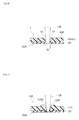
Fig. 4 shows a cross-sectional view schematically illustrating a typical example of a state of the PSA film when cut adequately with a laser beam. -
Fig. 5 shows a cross-sectional view schematically illustrating a typical example of a state of the PSA film when cut inadequately with a laser beam. - Preferred embodiments of the present invention are described below. Matters necessary to practice this invention other than those specifically referred to in this description may be understood as design matters to a person of ordinary skills in the art based on the conventional art in the pertinent field. The present invention can be practiced based on the contents disclosed in this description and common technical knowledge in the subject field. In the description below, all members and sites providing the same effect are indicated by a common reference numeral, and redundant descriptions may be omitted or simplified.
- The PSA film disclosed herein comprises a PSA layer at least on a first face of a resin film as a substrate. It may be a single-faced PSA film (an adhesively single-faced PSA film) having a PSA layer only on the first face of the substrate, or it may be a double-faced PSA sheet (an adhesively double-faced PSA film) having a PSA layer on each of the first and second faces of the substrate. Hereinafter, the present invention is described more in detail with a main example being an embodiment where it is applied to a single-faced PSA film while the application of the art disclosed herein is not to be limited to such an embodiment.
-
Fig. 1 shows a typical constitutional example of the PSA film provided by the present invention.PSA film 1 comprisesresin film 10 as a substrate and aPSA layer 20 provided on a first face (single face) 10A thereof, and is used by adhering thePSA layer 20 to an adherend. In a preferable embodiment, theback face 10 B (opposite of the face provided with PSA layer 20) ofresin film 10 comprises a releasable surface (release surface). Prior to use (i.e., before adhered to the adherend),PSA film 1 may be wound in a roll such that theback face 10B ofresin film 10 contacts and protects a surface (adhesive face) 20A ofPSA layer 20. Alternatively, asPSA film 1 shown inFig. 2 , thesurface 20A ofPSA layer 20 may be protected withrelease liner 30 having a release surface at least on thePSA layer 20 side. -
Resin film 10 comprises a laser beam-absorbinglayer 42 comprising a laser beam-absorbingagent 402. Laser beam-absorbinglayer 42 is typically formed from a resin composition containing laser beam-absorbingagent 402. In the examples shown inFigs. 1 and 2 ,resin film 10 has a mono-layer structure consisting of laser beam-absorbinglayer 42 while the structure ofresin film 10 is not limited to a mono-layer structure. LikePSA film 2 shown inFig. 3 , for example,resin film 10 may be a laminate body containing multiple layers (here, thefirst layer 42 placed on thePSA layer 20 side and thesecond layer 44 placed on the back side thereof) of which at least one may be a laser beam-absorbinglayer 42. In the example shown inFig. 3 , thefirst layer 42 is a layer (a laser beam-absorbing layer) formed from a resin composition containing laser beam-absorbingagent 402 while thesecond layer 44 is a layer formed from a resin composition free of a laser beam-absorbing agent. - In the art disclosed herein, the resin film (or the "substrate film" hereinafter) as a substrate is characterized by having an Amin(1000,1100) of 20 % or higher in a wavelength range of 1000 nm to 1100 nm. The Amin(1000,1100) indicates the actual proportion of the prescribed laser beam absorbed by the substrate film relative to the intensity of the prescribed laser beam projected onto the substrate film. An Amin(1000,1100) lower than 20 % for the substrate film will result in a low heating efficiency by projection of the prescribed laser beam, whereby adequate decomposition and loss of the substrate film and a PSA film comprising the substrate film cannot be achieved. Thus, the PSA film cannot be cut, or even if it could be cut to a certain extent, it will be hard to provide a high-quality cut consistently.
- This is described with the schematic diagrams shown in
Figs. 4 and 5 . As shown inFig. 5 , with respect toPSA film 100 formed withresin film 110 not containing a laser beam-absorbing agent and having an Amin(1000,1100) lower than 20 %, even if anadhesive face 20A of thePSA film 100 is adhered to an adherend and a prescribed laser beam LB is projected onto its back face, the area ofPSA film 100 under the projection range of the laser beam LB cannot be sufficiently heated to decompose and disappear. Because of this,PSA film 100 cannot be cut with the prescribed laser beam LB, or even if it could be cut to a certain extent, the cut is made primarily by thePSA film 100 melting down and deforming due to the heat transferred from the adherend. Thus, for example, as shown inFig. 5 , the precision cannot be increased for the shapes of acut edge surface 100E and aprojection boarder 100 F (around the border between a region projected with the laser beam and a region not projected with the laser beam) or for the cut width, etc. - To the contrary, as shown in
Fig. 4 , when PSA film I comprisingresin film 10 having an Amen(1000,1100) of 20 % or higher is adhered to an adherend and the prescribed laser beam LB is projected onto its back face, theresin film 10 efficiently absorbs the prescribed laser beam LB to be heated,PSA film 1 is allowed to effectively decompose and disappear to result in a cut. Thus, the PSA film I can be cut with a cut width (the width of a gap formed by the laser beam projection) W being accurately controlled in accordance with the irradiation breadth of the prescribed laser beam. In typical, as shown inFig. 4 ,PSA film 1 can be cut with a cut width W equal to or larger than the projection breadth (diameter) of the prescribed laser beam. A high-quality cut can be obtained with acut edge surface 1 E andprojection border 1F both precisely shaped. - As the laser beam-absorbing agent, can be used a single species or a suitable combination among various materials capable of producing an effect to increase the Amin(1000, 1100). From the standpoint ofthe external appearances, etc., of cut edge surfaces, it is preferable to use a laser beam-absorbing agent other than carbon powder. Preferable examples of the laser beam-absorbing agent in the art disclosed herein include metals and metallic compounds. Examples of the metals include aluminum, stainless steel, titanium, nickel, zirconium, tungsten, copper, silver, gold, zinc, molybdenum, chromium as well as alloys primarily comprising these, and the like. Examples of metallic compounds include oxides, nitrides, carbides, etc., of the metals. These metals and metallic compounds are preferably used as laser beam-absorbing agents typically in a powder form. Other examples of the laser beam-absorbing agent include organic compounds having a property to absorb the prescribed laser beam. Such organic compounds may be, for instance, phthalocyanine-based compounds, cyanine-based compounds, aminium-based compounds, naphthalocyanine-based compounds, naphthoquinone-based compounds, diimmonium-based compounds, anthraquinone-based compounds, aromatic dithiol-based metal complexes (e.g. nickel complexes), and the like.
- In a preferable embodiment of the art disclosed herein, the laser beam-absorbing layer comprises, as the laser beam-absorbing agent, at least one of a metal powder and a metallic compound powder. Such a laser beam-absorbing agent is preferable because it can resist the heat generated upon absorption of the prescribed laser beam and suitably maintain its property to absorb the prescribed laser beam. For example, in a laser beam-absorbing layer containing a laser beam-absorbing agent in a resin composition, it is preferable to use a laser beam-absorbing agent whose thermal decomposition temperature is higher than that of the resin component constituting the laser beam-absorbing layer. The art disclosed herein may be preferably practiced also in an embodiment where the laser beam-absorbing layer is essentially free of the organic compounds as the laser beam-absorbing agent. Alternatively, the laser beam-absorbing layer may further comprise the organic compounds in addition to one or both of the metal powder and the metallic compound.
- The art disclosed herein can be particularly preferably practiced in an embodiment where the laser beam-absorbing layer comprises at least a metal powder as the laser beam-absorbing agent. Examples of a preferable metal powder include aluminum powder, gold powder, silver powder, copper powder, nickel powder, zinc powder, and the like. Since such a metal powder is relatively soft, when a resin composition containing the metal powder is molded (formed into film), it is less likely to damage a molding machine. It is also to its advantage that it is less likely to leave cutting residue by the laser beam. In a PSA film to be used in an embodiment where a metallic workpiece surface is adhered with the PSA film and the workpiece is cut along with the PSA film, it is preferable to use, as the laser beam-absorbing agent, a metal powder formed from a metal of the same type as the workpiece.
- The art disclosed herein can be preferably practiced in an embodiment where the laser beam-absorbing layer is essentially free of a carbon powder (e.g. carbon black) as a laser beam-absorbing agent (e.g. having a carbon powder content of 0.005 % by mass or less, preferably zero). A laser beam-absorbing layer with a carbon powder as a laser beam-absorbing agent (as well as a substrate film and a PSA film having the laser beam-absorbing layer) is likely to have a blackened laser cut surface or result in visible laser cut residue. From the same reasons, with respect to a black or dark-colored metallic compound powder, it is preferably to avoid its use as a laser beam-absorbing agent or suppress its usage by combining it with a different laser beam-absorbing agent (e.g. a metal powder).
- When a laser beam-absorbing agent in a powder form (a laser beam-absorbing agent powder) is used, the shape of particles constituting the powder is not particularly limited and may be, for example, in forms of flakes, spheres, needles, polyhedrons, random shapes, etc. It is usually preferable to use a laser beam-absorbing agent powder in a flake form, in a spherical shape, or in a needle shape. The average particle diameter of such a laser beam-absorbing agent powder is not particularly limited. For example, can be used a laser beam-absorbing agent powder having an average particle diameter of 0.01 µm or larger, but 20 µm or smaller (preferably 0.1 µm or larger, but 10 µm or smaller, e.g., 0.5 µm or larger, but 5 µm or smaller). An example of the laser beam-absorbing agent preferably used in the art disclosed herein is a metal powder (flaky aluminum powder, etc.) having an average particle diameter larger than 1 µm, but equal to or smaller than 5 µm. In the present description, unless otherwise specified, the term "average particle diameter" refers to a particle diameter at 50 % cumulative volume in a size distribution measured using a particle counter based on the laser scattering/diffraction method (i.e., 50 % volume average particle diameter, which may be abbreviated to "D50" hereinafter).
- In the art disclosed herein, the substrate film may have a laser beam absorbance Admin(1000,1100) of at least 20 %, or even 30 % or higher. The laser beam absorbance Amin(1000,1100) of the entire PSA film is also preferable to be 20 % or higher (e.g. 30 % or higher). Too low an Amin(1000,1100) may make it difficult to cut the substrate film (further a PSA film comprising the substrate film) by irradiation of the prescribed laser beam or to achieve high-quality cutting. The Amin(1000,1100) of the substrate film may be 100 % while it is usually 95 % or lower. From the standpoint of reducing cutting residue from the PSA film (typically residue originating primarily from the laser beam-absorbing agent), the Amin(1000,1100) of the substrate film is preferably 80 % or lower, more preferably 70 % or lower (e.g. 60 % or lower), or may be even 50 % or lower. In a substrate film consisting of multiple layers including a laser beam-absorbing layer, the laser beam-absorbing layer preferably has a laser beam absorbance Amin(1000, 1100) of 20 % or higher (e.g. 30 % or higher). The Amin(1000, 1100) of the laser beam-absorbing layer is preferably 80 % or lower (more preferably 70 % or lower, e.g., 60 % or lower), or may be even 50 % or lower.
- The transmittance and reflectance of the substrate film are not particularly limited while being able to attain a preferable laser beam absorbance Amin(1000,1100) disclosed herein. Usually, at the wavelength with the lowest laser beam absorbance (in other words, at the wavelength corresponding to the Amin(11000,1100)), a preferable substrate has a prescribed laser beam transmittance T(Amin) lower than 50 %. At the wavelength with the lowest laser beam absorbance, a preferable substrate film has a prescribed laser beam reflectance R(Amin) lower than 50 % (more preferably lower than 40 %). This is because a substrate film that meets at least one (preferably both) of the T(Amin) and the R(Amin) values is likely to have a preferable laser beam absorbance Amin(1000,1100) disclosed herein.
- When a laser beam-absorbing agent in a powder form (e.g. a metal powder) is used, in general, with an increasing amount of the laser beam -absorbing agent power used (e.g. increasing ratio of the laser beam-absorbing agent powder used in the resin composition forming the laser beam-absorbing layer), the transmittance tends to decrease while the reflectance tends to increase (e.g. Example 11, Example 15 described later). Thus, it is desirable to pay attention to these tendencies while selecting the type (material, shape, etc.) and amount of the laser beam-absorbing agent to obtain a preferable laser beam absorbance Amin(1000,1100) disclosed herein.
- In a substrate film having a laser beam-absorbing layer (a resin layer containing a laser beam-absorbing agent) formed from a resin composition containing a laser beam-absorbing agent, examples of a material that can be used as a resin component constituting the resin layer include polyolefin resins such as polyethylene, polypropylene, ethylene-propylene copolymers, polypropylene-polyethylene blend resins, etc.; polyester resins such as polyethylene terephthalate, polybutylene terephthalate, etc., as well as vinyl chloride resins, vinyl acetate resins, polyamide-based resins and so on. A resin layer containing a laser beam-absorbing agent can be formed by typically molding a material into film, with the material being a resin composition prepared by adding a laser beam-absorbing agent to such a resin material. The molding method is not particularly limited, and can be suitably employed a heretofore known extrusion method (e.g., an inflation extrusion method), casting method, and like methods. A substrate film comprising multiple resin layers including a laser absorbing agent-containing resin layer can be obtained by employing a single method or a suitable combination of methods among a method where resin compositions corresponding to the respective resin layers are molded simultaneously (e.g., by a multi-layer inflation method), a method where the respective layers are individually molded and then adhered to each other, a method where a layer is casted on top of another pre-formed layer, and other like methods. With respect to the resin components constituting the other resin layers besides the resin layer that contains a laser beam-absorbing agent, suitable materials can be selected from those listed as examples of resin components that can be used in the laser beam-absorbing agent-containing resin layer, and the like.
- The amount of the laser beam-absorbing agent (typically, a laser beam-absorbing agent in a powder form, e.g., a metal powder) contained in the laser beam-absorbing agent-containing resin layer can be, for instance, 0.01 % by mass or greater, or it is preferably 0.05 % by mass or greater or more preferably 0.1 % by mass or greater. In a preferable embodiment, the laser beam-absorbing agent-containing resin layer comprises a laser beam-absorbing agent at a ratio higher than 0.1 % by mass. When the laser beam-absorbing agent content is too high in the laser beam-absorbing agent-containing resin layer, the reflectance may become higher, making it difficult to obtain a desirable laser beam absorbance, or resulting in visible laser cutting residue. Thus, it is usually suitable that the laser beam-absorbing agent content in the laser beam-absorbing agent-containing resin layer is 10 % by mass or less, preferably 5 % by mass or less, or more preferably 3 % by mass or less (typically less than 3 % by mass). In a preferable embodiment, the laser beam-absorbing agent content in the laser beam-absorbing agent-containing resin layer is 2 % by mass or less (typically less than 2 % by mass).
- The laser beam-absorbing layer in the art disclosed herein is not limited to a layer (a laser beam-absorbing agent-containing resin layer) formed from a resin composition containing a laser beam-absorbing agent as described above. For example, it may be a layer (a laser beam-absorbing agent layer) essentially consisting of a laser beam-absorbing agent. Such a laser beam-absorbing agent layer can be formed by means such as vapor deposition, spattering, coating (e.g. a dispersion containing a laser beam-absorbing agent powder dispersed in a solvent is applied and the solvent is removed to form a layer of the laser beam-dispersing agent powder) and so on. The substrate film in the art disclosed herein may have, for instance, a constitution where a laser beam-absorbing agent-containing resin layer is placed on a surface of a resin layer free of a laser beam-absorbing agent, or a constitution where a laser beam-absorbing agent layer is further placed on a surface of a laser beam-absorbing agent-containing resin layer
- The substrate film may comprise optional additives as necessary. Examples of such additives include fire-retardants, anti-static agents, colorants (pigments, dyes, etc.) photostabilizing agents (radical scavengers, ultraviolet ray-absorbing agents, etc.), antioxidants, and the like.
- A surface of the substrate film may be subjected as necessary to a suitable surface treatment to increase the adhesion or improve the release on an adjacently-placed material. Examples of a surface treatment to increase the adhesion include corona discharge treatment, acid treatment, ultraviolet ray irradiation, plasma treatment, primer coating, and so on. Such a surface treatment can be preferably applied to either a first face (i.e. a surface on which a PSA layer is provided) or a second face of the substrate film. A surface treatment to increase the release can be carried out with a general silicone-based, long chain alkyl-based or fluorine-based release agent, or the like. Such a surface treatment is preferably applied to the other face (back face) of the substrate film.
- It is usually suitable that the substrate film has a thickness of about 10 µm to 150 µm. When it is much thinner than 10 µm or much thicker than 150 µm, the handling properties of the substrate film or a PSA film comprising the substrate film may be likely to decrease. In a preferable embodiment, the substrate film has a thickness of 20 µm to 110 µm (more preferably 40 µm to 100 µm). In a substrate film comprising a laser beam-absorbing layer (a laser beam-absorbing agent-containing resin layer) formed from a resin composition containing a laser beam-absorbing agent, the laser beam-absorbing layer has a thickness of preferably 3 µm or larger, more preferably 5 µm or larger, or even more preferably 10 µm or larger. Of the thickness of the entire substrate film, the thickness of the laser beam-absorbing layer (in other words, the part where the laser beam-absorbing agent is located) accounts for preferably 20 % or more (e.g. 50 % or more) or more preferably 70 % or more (even 90 % or more). In a substrate film consisting of a single laser beam-absorbing agent-containing resin layer or multiple laser beam-absorbing agent-containing resin layers, the thickness of the laser beam-absorbing layer accounts for 100 % of the overall thickness of the substrate film.
- In the art disclosed herein, the PSA constituting the PSA layer is not particularly limited. For instance, can be used a known acrylic PSA, rubber-based PSA, polyester-based PSA, polyurethane-based PSA, silicone-based PSA, or the like. From the standpoint of the adhesive performance and the cost, can be preferably used a rubber-based PSA or an acrylic PSA. The PSA layer may have a mono-layer constitution, or a laminate constitution consisting of two or more layers of different compositions.
- A preferable acrylic PSA comprises as a base polymer (a primary component among polymer components), for instance, an acrylic polymer having a monomer composition comprising primarily an alkyl (meth)acrylate such as butyl (meth)actylate, 2-ethylhexyl (meth)acrylate, etc., and further comprising as necessary a modifying monomer copolymerizable with the alkyl (meth)acrylate. Examples of the modifying monomer include hydroxyl group-containing monomers such as 2-hydroxylethyl (meth)acrylate, etc.; carboxyl group-containing monomers such as (meth)acrylic acid, etc.; styrene-based monomers such as styrene, etc.; vinyl esters such as vinyl acetate, etc.; and the like. Such an acrylic PSA can be obtained by a commonly used polymerization method such as a solution polymerization method, an emulsion polymerization method, an ultraviolet ray (UV) polymerization method, or the like.
- Examples of a rubber-based PSA include natural rubber-based PSA, synthetic rubber-based PSA and the like. Examples of a rubber-based polymer as the base polymer of a synthetic rubber-based PSA include polybutadiene, polyisoprene, butyl rubber, polyisobutylene, styrene-based elastomers such as styrene-butadiene-styrene block copolymers, styrene-ethylene/butylene-styrene block copolymers, styrene-ethylene/butylene random copolymers, etc., and others such as ethylene propylene rubber, propylene butene rubber, ethylene propylene butene rubber, and the like.
- The PSA layer (in a PSA layer consisting of multiple layers, at least one layer among them) may contain a laser beam-absorbing agent. For the laser beam-absorbing agent to be contained in the PSA layer, can be suitably selected one, two or more species among those listed above as examples of the laser beam-absorbing agent that can be used for the laser beam-absorbing agent-containing resin layer constituting the substrate film, and the like. The laser beam-absorbing agent content in the PSA layer is suitably 5 % by mass or less, or preferably 3 % by mass or less (e.g., 1 % by mass or less). Too high a laser beam-absorbing agent content may result in degraded adhesive performance. The art disclosed herein can be practiced preferably in an embodiment where the PSA layer is essentially free of a laser beam-absorbing agent.
- The PSA layer can contain optional additives as necessary. Examples of such additives include crosslinking agents, tackifiers, softening agents, fire retardants, anti-static agents, colorants (pigments, dyes, etc.), photostabilizing agents (radical scavengers, UV-absorbing agents, etc.), antioxidants, and so on.
- The thickness of the PSA layer can be suitably selected so that adhesive performance suitable to the application of the PSA film can be obtained. Usually, the PSA layer has a thickness of suitably 0.5 µm to 50 µm or preferably 1 µm to 20 µm (e.g., 2 µm to 15 µm).
- The method for providing a PSA layer on the substrate film is not particularly limited. For example, can be suitably employed a known method such as a method where a solution or a dispersion containing PSA layer-forming components dissolved in an organic solvent or dispersed in an aqueous solvent is applied to the substrate film and allowed to dry to directly form a PSA layer on the substrate film surface, a method where a PSA layer pre-formed on a release surface is transferred to the substrate film, a method where a PSA layer-forming composition and a substrate film-forming composition are co-extruded (extruded in multiple layers), or the like method.
- The PSA film disclosed herein is preferable as a PSA film (PSA film for laser cutting) that is used in an application involving cutting with a laser beam (a prescribed laser beam) having a center wavelength of 1000 nm to 1100 nm. The PSA film may be cut with the prescribed laser beam either before or after its adhesion to an adherend. Examples of an embodiment where the PSA film is cut with the prescribed laser beam before its adhesion to an adherend include an embodiment as shown in
Fig. 2 , for example, in which while a surface ofPSA layer 20 is being protected withrelease liner 30, a prescribed laser beam is projected onto the back face (backface 10B of resin film 10) ofPSA film 1 to cut just thePSA film 1 while leavingrelease liner 30 as is, and an embodiment in whichPSA film 1 is cut along withrelease liner 30. The PSA film cut into a desirable shape can be subsequently adhered to any adherend to serve a purpose such as surface protection, decoration, or labeling of the adherend, bonding to another adherend, etc. As an embodiment where the PSA film is cut with the prescribed laser beam after its adhesion to an adherend, can be cited an embodiment in which the PSA film is adhered to a surface of a workpiece and the prescribed laser beam is projected onto the back face of the PSA film to carry out a laser machining (cutting, hole-making, shaving, etc.) of the workpiece. In such an embodiment, the PSA film may be able to function as a protection film to protect a surface of the workpiece before, after or during the laser machining. - Several worked examples relating to the present invention are described below, but the present invention is not intended to be limited to these examples. In the description below, "parts" and "%" are based on the mass unless otherwise specified.
- 0.13 % of flaky aluminum powder having 2 µm average particle diameter and 99.87 % of a low density polyethylene (available from TOSOH Corporation, trade name "PETROTHENE 186R") were processed at a resin temperature of 180 °C with a twin screw extruder (available from Toshiba Machine Co., Ltd.) to obtain pellets for a substrate. The resulting pellets were formed into film at a die temperature of 180 °C by an inflation method to obtain a 90 µm thick resin film F1.
- 0.18 % of the aluminum powder and 99.82 % of a low density polyethylene (available from TOSOH Corporation, trade name "PETROTHENE 186R") were processed at a resin temperature of 180 °C with the extruder to obtain pellets for a substrate. The resulting pellets were formed into film at a die temperature of 180 °C by an inflation method to obtain a 90 µm thick resin film F2.
- 0.25 % of the aluminum powder and 99.75 % of a low density polyethylene (available from TOSOH Corporation, trade name "PETROTHENE 186R") were processed at a resin temperature of 180 °C with the extruder to obtain pellets for a substrate. The resulting pellets were formed into film at a die temperature of 180 °C by an inflation method to obtain a 90 µm thick resin film F3.
- 0.50 % of the aluminum powder and 99.50 % of a low density polyethylene (available from TOSOH Corporation, trade name "PETROTHENE 186R") were processed at a resin temperature of 180 °C with the extruder to obtain pellets for a substrate. The resulting pellets were formed into film at a die temperature of 180 °C by an inflation method to obtain a 90 µm thick resin film F4.
- 1.50 % of the aluminum powder and 98.50 % of a low density polyethylene (available from TOSOH Corporation, trade name "PETROTHENE 186R") were processed at a resin temperature of 180 °C with the extruder to obtain pellets for a substrate. The resulting pellets were formed into film at a die temperature of 180 °C by an inflation method to obtain a 90 µm thick resin film F5.
- One face of resin film F4 fabricated in Example 4 was subjected to a corona discharge treatment. To the corona discharge treated surface, the PSA composition P1 described below was applied to obtain a thickness of 4 µm after dried and allowed to dry. A PSA film F6 having an acrylic PSA layer on a surface of a substrate was thus obtained.
- A mixture containing 2-ethylhexyl acrylate, vinyl acetate and acrylic acid at a ratio of 100/80/5 was polymerized in the presence of benzoyl peroxide (polymerization initiator) in toluene to obtain an acrylic polymer having a weight average molecular weight of 60 × 104. To 100 parts of the acrylic polymer, was added and mixed 2 parts of an epoxy-based crosslinking agent (trade name "TETRAD C" available from Mitsubishi Gas Chemical Company Inc.) to obtain a PSA composition P1.
- One face of resin film F4 fabricated in Example 4 was subjected to a corona discharge treatment. To the corona discharge treated surface, the PSA composition P2 described below was applied to obtain a thickness of 10 µm after dried and allowed to dry. A PSA film F7 having a rubber-based PSA layer on a surface of a substrate was thus obtained.
- To 100 parts of natural rubber, were added and mixed 70 parts of a tackifier (available from Zeon Corporation, trade name "
QUINTONE A 100"), 2 parts of an anti-aging agent (trade name "NOCRAC NS-5" available from Ouchi Shinko Chemical Industrial Co., Ltd.), 3 parts of an isocyanate-based crosslinking agent (available from Nippon Polyurethane Industry Co., Ltd., trade name "CORONATE L") and toluene to obtain a rubber-based PSA composition P2. - 0.60 % of the aluminum powder and 99.40 % of a random polypropylene (available from Prime Polymer Co., Ltd., trade name "PRIME POLYPRO F-744NP") were processed at a resin temperature of 230 °C with the extruder to obtain pellets for a substrate. The resulting pellets were formed into film at a die temperature of 230 °C by a T-die method to obtain a 40 µm thick resin film F8.
- 0.60 % of the aluminum powder and 99.40 % of a polybutylene terephthalate (available from Mitsubishi Engineering-Plastics Corporation, trade name "NOVADURAN 5505S") were processed at a resin temperature of 245 °C with the extruder to obtain pellets for a substrate. The resulting pellets were formed into film at a die temperature of 245 °C by a T-die method to obtain a 40 µm thick resin film F9.
- A low density polyethylene (available from TOSOH Corporation, trade name "PETROTHENE 186R") was formed into film at a die temperature of 180 °C by an inflation method to obtain a 60 µm thick resin film. One face of the resin film was subjected to a corona discharge treatment, and the PSA composition P1 was applied to obtain a thickness of 4 µm after dried and allowed to dry. A PSA film F10 having an acrylic PSA layer on a surface of a substrate was thus obtained.
- 3.00 % oftitanium oxide (TiO2) having 0.2 µm average particle diameter and 97.00 % of a low density polyethylene (available from TOSOH Corporation, trade name "PETROTHENE 186R") were processed at a resin temperature of 180 °C with the extruder to obtain pellets for a substrate. The resulting pellets were formed into film at a die temperature of 180 °C by an inflation method to obtain a 100 µm thick resin film. One face of the resin film was subjected to a corona discharge treatment, and the PSA composition P2 was applied to obtain a thickness of 10 µm after dried and allowed to dry. A PSA film F11 having a rubber-based PSA layer on a surface of a substrate was thus obtained.
- 0.10 % of the aluminum powder and 99.90 % of a low density polyethylene (available from TOSOH Corporation, trade name "PETROTHENE 186R") were processed at a resin temperature of 180 °C with the extruder to obtain pellets for a substrate. The resulting pellets were formed into film at a die temperature of 180 °C by an inflation method to obtain a 90 µm thick resin film F12.
- A random polypropylene (available from Prime Polymer Co., Ltd., trade name "PRIME POLYPRO F-744NP") was formed into film at a die temperature of 230 °C by a T-die method to obtain a 40 µm thick resin film F13.
- A polybutylene terephthalate (available from Mitsubishi Engineering-Plastics Corporation, trade name "NOVADURAN 5505S") was formed into film at a die temperature of 245 °C by a T-die method to obtain a 40 µm thick resin film F14.
- 20 % of barium sulfate (BaSO4) powder having 0.7 µm average particle diameter and 80 % of a polybutylene terephthalate (available from Mitsubishi Engineering-Plastics Corporation, trade name "NOVADURAN 5505S") were processed at a resin temperature of 245 °C with the extruder to obtain pellets for a substrate. The resulting pellets were formed into film at a die temperature of 245 °C by a T-die method to obtain a 40 µm thick resin film F15.
- Samples of appropriate dimensions were cut out from the resin films and PSA films F1 to F15 fabricated above and subjected to the following evaluations.
- Measurement system: spectrophotometer under model number "U-4100" available from Hitachi High-Technologies Corporation
- Measurement conditions: measurement mode-applied detection, % T data mode, 750 nm/min scan rate, 1 nm sampling interval, automated slit control, photomultiplier voltage automated at 1, intensity control mode fixed, high resolution measurement OFF, no dimming film used, PbS sensitivity at 1, 10 mm cell length.
- Measurement method:
- (i). The measurement system was turned on and kept in standby for 2 hours or longer to stabilize the system. Subsequently, without any sample set in, the baseline was measured.
- (ii). A sample was then set in the transmittance measuring region of the measurement system (for a case of a PSA film, in such a way that the light would enter the PSA film from the back face), and under the measurement conditions shown above, the transmittance in a wavelength range of 1000 nm to 1100 nm was measured.
- Measurement system: spectrophotometer under model number "U-4100" available from Hitachi High-Technologies Corporation
- Measurement conditions: measurement mode-applied detection, % R data mode, 750 nm/min scan rate, 1 nm sampling interval, automated slit control, photomultiplier voltage automated at 1, intensity control mode fixed, high resolution measurement OFF, no dimming film used, PbS sensitivity at 1, 10 mm cell length.
- Measurement method:
- (i). The measurement system was turned on and kept in standby for two hours or longer to stabilize the system. Subsequently, a standard white plate was set in the reflectance measuring region (with no sample set) and the baseline was measured.
- (ii). A sample was then set in the reflectance measuring region. Here, in order to prevent reflection of the light that had transmitted through the sample, a resin plate under trade name "CLAREX (registered trademark)" (black-colored, 1 mm thick) available from Nitto Jushi Kogyo Co., LTD. was placed opposite to the surface on which the light entered. When the sample was a PSA film, the PSA film was adhered to the resin plate (adhering condition: 2 kg roller moved back and forth once). Under the measurement conditions shown above, the reflectance in the wavelength range of 1000 nm to 1100 nm was measured.
- Substituting the transmittance T (%) and reflectance R (%) values into the next equation: 100 (%) - T (%) - R (%); the minimum absorbance in the 1000 nm to 1100 nm wavelength range, Amin(1000, 1100), was determined. The results are shown in Table 1 along with the values of transmittance T(Amin) and reflectance R(Amin) at the wavelength of the minimum absorbance.
- Each sample (a PSA film adhered on a 1 mm thick SUS304 2B plate or a resin film with the edges being fastened with PSA tape) was set on the work support of a laser welder (model number "YLM-500P" available from Amada Co., Ltd.) and a laser beam was projected onto a prescribed cut line under the following conditions:
- Laser used: YAG laser (1064 nm wavelength, 500 W output)
- Beam condition: 10 m/min moving speed
- Each sample (a PSA film adhered on a 1 mm thick SUS304 2B plate or a resin film with the edges being fastened with PSA tape) was set on the work support of a laser welder (model number "M802E" available from Omron Laserfront Inc.) and a laser beam was projected onto a prescribed cut line thereof under the following conditions:
- Laser used: YAG laser (1.06 µm wavelength, 200 W output)
- Beam condition: 5 m/min moving speed
- With respect to the laser cutting (i) and the laser cutting (ii), the state of each sample after the laser beaming was observed under an optic microscope (magnified 100 ×) and graded the laser cuttability into the following two levels.
- Good: The sample (PSA film only or resin film only) was able to be cut with a cut width equal to or larger than the laser beam diameter (good laser cuttability)
- Poor: The sample (PSA film only or resin film only) could not be cut or the cut width was smaller than the laser beam diameter (poor laser cuttability).
- [Table 1]
Table 1 Substrate Laser beam-absorbing agent T R A Laser cutting Ex. Type Content (wt%) (%) (%) (%) (i) (ii) 1 PE Al powder 0.13 45 32 23 Good Good 2 PE Al powder 0.18 34 33 33 Good Good 3 PE Al powder 0.25 21 34 45 Good Good 4 PE Al powder 0.50 9 35 56 Good Good 5 PE Al powder 1.50 0 36 64 Good Good 6 PE Al powder 0.50 9 34 57 Good Good 7 PE Al powder 0.50 8 34 58 Good Good 8 PP Al powder 0.60 10 35 55 Good Good 9 PBT Al powder 0.60 10 36 54 Good Good 10 PE none - 92 8 0 Poor Poor 11 PE TiO2 3.00 55 37 8 Poor Poor 12 PE Al powder 0.10 52 32 16 Poor Poor 13 PP none - 93 6 1 Poor Poor 14 PBT none - 89 9 2 Poor Poor 15 PBT BaSO 4 20 18 81 1 Poor Poor PE: polyethylene, PP: polypropylene, PBT: polybutylene terephthalate - As shown in Table l, samples of Examples I to 9 each having a laser beam absorbance Amin(1000, 1100) of 20 % or higher (more particularly, 20 % or higher, but 80 % or lower) all showed good laser cuttability. Among these, samples of Examples 1 to 4 and 6 to 9 each having an Amin(1000, 1100) of 60 % or lower resulted in less laser cutting residue and produced cutting with greater external appearance when compared to the sample of Example 5. On the other hand, samples of Examples 10 to 15 each having a laser beam absorbance Amin(1000, 1100) lower than 20 % all showed poor laser cuttability.
- It is noted that although aluminum can absorb a laser beam at a wavelength of 1000 nm to 1100 nm, since aluminum foil and aluminum film (typically, continuous film such as vapor deposition film, etc.) has a smooth surface with a high reflectance, aluminum is generally considered as a reflective material with respect to the prescribed laser beam. According to a preferable embodiment of the art disclosed herein, by adding aluminum in a powder form (more particularly, in a flaky powder form) to the resin, the reflectance can be suppressed, and the aluminum in the powder form can be preferably used as a laser beam-absorbing agent. This is supported by the results of Examples 1 to 9 described above.
- Although specific embodiments of the present invention have been described in detail above, these are merely examples and do not limit the scope of the claims. The art according to the claims includes various modifications and changes made to the specific embodiments illustrated above.
- In addition, matters disclosed by this description include the following:
- (1) A resin film having a laser beam absorbance of 20 % or higher in a wavelength range of 1000 nm to 1100 nm and comprising a laser beam-absorbing layer that comprises a laser beam-absorbing agent that increases the laser beam absorbance.
- (2) The resin film according to (1) above, wherein the laser beam-absorbing layer comprises, as the laser beam-absorbing agent, at least one species selected from metal powders and metallic compound powders.
- (3) The resin film according to (1) or (2) above, wherein the laser beam-absorbing layer satisfies the following conditions:
- the layer is formed from a resin composition (e.g. a polyolefin resin composition or a polyester resin composition) containing 0.01 to 5 % by mass of the laser beam-absorbing agent; and
- the laser beam absorbance is 20 % or higher, but 80 % or lower.
- (4) The resin film according to any one of (1) to (3) above, wherein the laser beam-absorbing layer is formed from a resin composition (e.g. a polyolefin resin composition or a polyester resin composition) comprising 0.01 to 5 % by mass of a metal powder (e.g. aluminum powder) as the laser beam-absorbing agent.
- (5) A laser cutting resin film consisting of the resin film according to any one of (1) to (4) above, that is to be cut with a laser beam having a center wavelength of 1000 nm to 1100 nm when in use.
- The resin film according to any one of (1) to (5) above can be preferably used as a substrate in a PSA film disclosed herein.
-
- 1, 2:
- PSA film
- 10:
- resin film (substrate, substrate film)
- 20:
- PSA layer
- 30:
- release liner
- 42:
- laser beam-absorbing layer (first layer)
- 100:
- PSA film
- 110:
- resin film (substrate, substrate film)
- 120:
- basal plate (adherend)
- 402:
- laser beam-absorbing agent
- LB:
- laser beam
- W:
- cut width
Claims (6)
- A pressure-sensitive adhesive film comprising a resin film as a substrate, and a pressure-sensitive adhesive layer provided at least on a first face of the resin film, wherein:the substrate has a laser beam absorbance of 20 % or higher in a wavelength range of 1000 nm to 1100 nm, andthe substrate comprises a laser beam-absorbing layer comprising a laser beam-absorbing agent that increases the laser beam absorbance.
- The pressure-sensitive adhesive film according to Claim 1, wherein the laser beam-absorbing layer comprises, as the laser beam-absorbing agent, at least one species selected from a metal powder and a metallic compound powder.
- The pressure-sensitive adhesive film according to Claim 1 or 2, wherein the laser beam-absorbing layer satisfies the following conditions:the layer is formed from a resin composition containing 0.01 to 5 % by mass of the laser beam-absorbing agent; andthe laser beam absorbance is 20 % or higher, but 80 % or lower.
- The pressure-sensitive adhesive film according to Claim 3, wherein the resin composition is a polyolefin resin composition or a polyester resin composition.
- The pressure-sensitive adhesive film according to any one of Claims I to 4, wherein the laser beam-absorbing layer is formed from a resin composition comprising, as the laser beam-absorbing agent, 0.01 to 5 % by mass of a metal powder.
- A laser cutting pressure-sensitive adhesive film consisting of the pressure-sensitive adhesive film according to any one of Claims 1 to 5, the laser cutting pressure-sensitive adhesive film being to be cut with a laser beam having a center wavelength of 1000 nm to 1100 nm when in use.
Applications Claiming Priority (3)
| Application Number | Priority Date | Filing Date | Title |
|---|---|---|---|
| JP2011135135 | 2011-06-17 | ||
| JP2012114796A JP6009812B2 (en) | 2011-06-17 | 2012-05-18 | Adhesive film |
| PCT/JP2012/062951 WO2012172932A1 (en) | 2011-06-17 | 2012-05-21 | Adhesive film |
Publications (2)
| Publication Number | Publication Date |
|---|---|
| EP2722376A1 true EP2722376A1 (en) | 2014-04-23 |
| EP2722376A4 EP2722376A4 (en) | 2015-03-11 |
Family
ID=47356926
Family Applications (1)
| Application Number | Title | Priority Date | Filing Date |
|---|---|---|---|
| EP12801249.9A Withdrawn EP2722376A4 (en) | 2011-06-17 | 2012-05-21 | Adhesive film |
Country Status (7)
| Country | Link |
|---|---|
| US (1) | US20140113131A1 (en) |
| EP (1) | EP2722376A4 (en) |
| JP (1) | JP6009812B2 (en) |
| CN (1) | CN103608419B (en) |
| BR (1) | BR112013030920A2 (en) |
| CA (1) | CA2839610A1 (en) |
| WO (1) | WO2012172932A1 (en) |
Cited By (6)
| Publication number | Priority date | Publication date | Assignee | Title |
|---|---|---|---|---|
| EP3012288A1 (en) * | 2014-10-21 | 2016-04-27 | Nitto Denko Corporation | Pressure-sensitive adhesive film for laser beam cutting applications |
| WO2017116941A1 (en) * | 2015-12-30 | 2017-07-06 | 3M Innovative Properties Company | Infrared absorbing adhesive films and related methods |
| EP3205751A4 (en) * | 2014-10-06 | 2018-05-23 | Nitto Denko Corporation | Masking sheet for anodizing |
| US10688625B2 (en) | 2015-12-30 | 2020-06-23 | 3M Innovative Properties Company | Abrasive article |
| US10759023B2 (en) | 2015-12-30 | 2020-09-01 | 3M Innovative Properties Company | Abrasive articles and related methods |
| US11845885B2 (en) | 2015-12-30 | 2023-12-19 | 3M Innovative Properties Company | Dual stage structural bonding adhesive |
Families Citing this family (13)
| Publication number | Priority date | Publication date | Assignee | Title |
|---|---|---|---|---|
| CN104592618B (en) * | 2015-02-12 | 2017-10-17 | 四川大学 | A kind of discoloration assistant composition and preparation method and application |
| EP3072879A1 (en) | 2015-03-26 | 2016-09-28 | Nitto Europe N.V | Method for prevention of premature polymerization |
| CN104741796B (en) * | 2015-04-20 | 2016-05-04 | 京东方科技集团股份有限公司 | A kind of display panels, its preparation method and display unit |
| JP2017087475A (en) * | 2015-11-05 | 2017-05-25 | セイコーエプソン株式会社 | Label generation device, label, and label generation method |
| JP6844180B2 (en) * | 2016-09-30 | 2021-03-17 | 日本ゼオン株式会社 | Composite panel and its manufacturing method |
| CN106799548B (en) * | 2017-02-06 | 2019-04-26 | 京东方科技集团股份有限公司 | Protective film, laser cutting method |
| JP7105222B2 (en) * | 2017-03-03 | 2022-07-22 | 日東電工株式会社 | adhesive film |
| JP7058096B2 (en) | 2017-09-27 | 2022-04-21 | 日東電工株式会社 | Adhesive film |
| JP7147156B2 (en) * | 2017-11-29 | 2022-10-05 | 三菱ケミカル株式会社 | LASER PROCESSING RELEASE FILM AND METHOD FOR MANUFACTURING LASER PROCESSED PRODUCT |
| US11171385B2 (en) * | 2018-07-12 | 2021-11-09 | GM Global Technology Operations LLC | Method of forming a separator for a lithium-ion battery |
| KR102733241B1 (en) | 2019-05-07 | 2024-11-22 | 삼성디스플레이 주식회사 | Adhesion member, Display module, and method for fabricating display device |
| CN115706197A (en) * | 2021-08-12 | 2023-02-17 | 重庆康佳光电技术研究院有限公司 | Laser protection material and manufacturing method, light emitting chip transfer method and display panel |
| CN115746736B (en) * | 2022-12-08 | 2024-10-29 | 湖北航天化学新材料科技有限公司 | Protective film for optical lens laser cutting and preparation method thereof |
Family Cites Families (7)
| Publication number | Priority date | Publication date | Assignee | Title |
|---|---|---|---|---|
| JP3766468B2 (en) * | 1996-04-18 | 2006-04-12 | 麒麟麦酒株式会社 | Laser printing media |
| JP4886937B2 (en) * | 2001-05-17 | 2012-02-29 | リンテック株式会社 | Dicing sheet and dicing method |
| JP4565804B2 (en) * | 2002-06-03 | 2010-10-20 | スリーエム イノベイティブ プロパティズ カンパニー | Laminate including ground substrate, method for producing the same, method for producing ultrathin substrate using laminate, and apparatus therefor |
| ATE353092T1 (en) * | 2002-12-04 | 2007-02-15 | Dsm Ip Assets Bv | LASER LIGHT ABSORBING ADDITIVE |
| JP4595284B2 (en) | 2003-01-28 | 2010-12-08 | 三菱瓦斯化学株式会社 | Auxiliary sheet for drilling with carbon dioxide laser |
| JP4854060B2 (en) * | 2004-12-24 | 2012-01-11 | 日東電工株式会社 | Manufacturing method of laser processed product using protective sheet for laser processing |
| JPWO2010082514A1 (en) * | 2009-01-16 | 2012-07-05 | 東レフィルム加工株式会社 | Conductive member for taking out ground electrode of electromagnetic wave shielding front filter, and structure and display using the same |
-
2012
- 2012-05-18 JP JP2012114796A patent/JP6009812B2/en active Active
- 2012-05-21 WO PCT/JP2012/062951 patent/WO2012172932A1/en not_active Ceased
- 2012-05-21 US US14/126,696 patent/US20140113131A1/en not_active Abandoned
- 2012-05-21 EP EP12801249.9A patent/EP2722376A4/en not_active Withdrawn
- 2012-05-21 BR BR112013030920A patent/BR112013030920A2/en not_active Application Discontinuation
- 2012-05-21 CA CA2839610A patent/CA2839610A1/en not_active Abandoned
- 2012-05-21 CN CN201280028259.6A patent/CN103608419B/en not_active Expired - Fee Related
Cited By (6)
| Publication number | Priority date | Publication date | Assignee | Title |
|---|---|---|---|---|
| EP3205751A4 (en) * | 2014-10-06 | 2018-05-23 | Nitto Denko Corporation | Masking sheet for anodizing |
| EP3012288A1 (en) * | 2014-10-21 | 2016-04-27 | Nitto Denko Corporation | Pressure-sensitive adhesive film for laser beam cutting applications |
| WO2017116941A1 (en) * | 2015-12-30 | 2017-07-06 | 3M Innovative Properties Company | Infrared absorbing adhesive films and related methods |
| US10688625B2 (en) | 2015-12-30 | 2020-06-23 | 3M Innovative Properties Company | Abrasive article |
| US10759023B2 (en) | 2015-12-30 | 2020-09-01 | 3M Innovative Properties Company | Abrasive articles and related methods |
| US11845885B2 (en) | 2015-12-30 | 2023-12-19 | 3M Innovative Properties Company | Dual stage structural bonding adhesive |
Also Published As
| Publication number | Publication date |
|---|---|
| CA2839610A1 (en) | 2012-12-20 |
| US20140113131A1 (en) | 2014-04-24 |
| JP2013018963A (en) | 2013-01-31 |
| CN103608419A (en) | 2014-02-26 |
| CN103608419B (en) | 2015-04-22 |
| WO2012172932A1 (en) | 2012-12-20 |
| JP6009812B2 (en) | 2016-10-19 |
| BR112013030920A2 (en) | 2016-12-06 |
| EP2722376A4 (en) | 2015-03-11 |
Similar Documents
| Publication | Publication Date | Title |
|---|---|---|
| EP2722376A1 (en) | Adhesive film | |
| EP2722375A1 (en) | Adhesive film | |
| EP2679332B1 (en) | Pressure-sensitive adhesive film | |
| EP3012288A1 (en) | Pressure-sensitive adhesive film for laser beam cutting applications | |
| EP3689993A1 (en) | Adhesive film | |
| US20180370205A1 (en) | Infrared absorbing adhesive films and related methods | |
| EP2055423A1 (en) | Optical film cutting method and optical film | |
| JPWO2005090505A1 (en) | Adhesive material, adhesive film and method of using the same | |
| WO2018159591A1 (en) | Adhesive film | |
| EP4105291A1 (en) | Adhesive sheet | |
| JP7507575B2 (en) | Adhesive Film | |
| JP2006198800A (en) | Antistatic resin sheet with protective film |
Legal Events
| Date | Code | Title | Description |
|---|---|---|---|
| PUAI | Public reference made under article 153(3) epc to a published international application that has entered the european phase |
Free format text: ORIGINAL CODE: 0009012 |
|
| 17P | Request for examination filed |
Effective date: 20140115 |
|
| AK | Designated contracting states |
Kind code of ref document: A1 Designated state(s): AL AT BE BG CH CY CZ DE DK EE ES FI FR GB GR HR HU IE IS IT LI LT LU LV MC MK MT NL NO PL PT RO RS SE SI SK SM TR |
|
| DAX | Request for extension of the european patent (deleted) | ||
| A4 | Supplementary search report drawn up and despatched |
Effective date: 20150210 |
|
| RIC1 | Information provided on ipc code assigned before grant |
Ipc: C08K 3/08 20060101ALI20150202BHEP Ipc: C09J 7/02 20060101AFI20150202BHEP Ipc: C09J 9/00 20060101ALI20150202BHEP Ipc: C08K 3/10 20060101ALI20150202BHEP Ipc: B23K 26/18 20060101ALI20150202BHEP |
|
| STAA | Information on the status of an ep patent application or granted ep patent |
Free format text: STATUS: THE APPLICATION HAS BEEN WITHDRAWN |
|
| 18W | Application withdrawn |
Effective date: 20180406 |