EP2719746A1 - Method for preparing fuel from biological oil and fat - Google Patents
Method for preparing fuel from biological oil and fat Download PDFInfo
- Publication number
- EP2719746A1 EP2719746A1 EP20120800464 EP12800464A EP2719746A1 EP 2719746 A1 EP2719746 A1 EP 2719746A1 EP 20120800464 EP20120800464 EP 20120800464 EP 12800464 A EP12800464 A EP 12800464A EP 2719746 A1 EP2719746 A1 EP 2719746A1
- Authority
- EP
- European Patent Office
- Prior art keywords
- catalyst
- cracking
- deoxygenation
- fats
- reaction
- Prior art date
- Legal status (The legal status is an assumption and is not a legal conclusion. Google has not performed a legal analysis and makes no representation as to the accuracy of the status listed.)
- Granted
Links
Images
Classifications
-
- C—CHEMISTRY; METALLURGY
- C10—PETROLEUM, GAS OR COKE INDUSTRIES; TECHNICAL GASES CONTAINING CARBON MONOXIDE; FUELS; LUBRICANTS; PEAT
- C10G—CRACKING HYDROCARBON OILS; PRODUCTION OF LIQUID HYDROCARBON MIXTURES, e.g. BY DESTRUCTIVE HYDROGENATION, OLIGOMERISATION, POLYMERISATION; RECOVERY OF HYDROCARBON OILS FROM OIL-SHALE, OIL-SAND, OR GASES; REFINING MIXTURES MAINLY CONSISTING OF HYDROCARBONS; REFORMING OF NAPHTHA; MINERAL WAXES
- C10G3/00—Production of liquid hydrocarbon mixtures from oxygen-containing organic materials, e.g. fatty oils, fatty acids
- C10G3/50—Production of liquid hydrocarbon mixtures from oxygen-containing organic materials, e.g. fatty oils, fatty acids in the presence of hydrogen, hydrogen donors or hydrogen generating compounds
-
- C—CHEMISTRY; METALLURGY
- C10—PETROLEUM, GAS OR COKE INDUSTRIES; TECHNICAL GASES CONTAINING CARBON MONOXIDE; FUELS; LUBRICANTS; PEAT
- C10G—CRACKING HYDROCARBON OILS; PRODUCTION OF LIQUID HYDROCARBON MIXTURES, e.g. BY DESTRUCTIVE HYDROGENATION, OLIGOMERISATION, POLYMERISATION; RECOVERY OF HYDROCARBON OILS FROM OIL-SHALE, OIL-SAND, OR GASES; REFINING MIXTURES MAINLY CONSISTING OF HYDROCARBONS; REFORMING OF NAPHTHA; MINERAL WAXES
- C10G11/00—Catalytic cracking, in the absence of hydrogen, of hydrocarbon oils
- C10G11/02—Catalytic cracking, in the absence of hydrogen, of hydrocarbon oils characterised by the catalyst used
- C10G11/04—Oxides
- C10G11/05—Crystalline alumino-silicates, e.g. molecular sieves
-
- C—CHEMISTRY; METALLURGY
- C10—PETROLEUM, GAS OR COKE INDUSTRIES; TECHNICAL GASES CONTAINING CARBON MONOXIDE; FUELS; LUBRICANTS; PEAT
- C10G—CRACKING HYDROCARBON OILS; PRODUCTION OF LIQUID HYDROCARBON MIXTURES, e.g. BY DESTRUCTIVE HYDROGENATION, OLIGOMERISATION, POLYMERISATION; RECOVERY OF HYDROCARBON OILS FROM OIL-SHALE, OIL-SAND, OR GASES; REFINING MIXTURES MAINLY CONSISTING OF HYDROCARBONS; REFORMING OF NAPHTHA; MINERAL WAXES
- C10G3/00—Production of liquid hydrocarbon mixtures from oxygen-containing organic materials, e.g. fatty oils, fatty acids
- C10G3/42—Catalytic treatment
-
- C—CHEMISTRY; METALLURGY
- C10—PETROLEUM, GAS OR COKE INDUSTRIES; TECHNICAL GASES CONTAINING CARBON MONOXIDE; FUELS; LUBRICANTS; PEAT
- C10G—CRACKING HYDROCARBON OILS; PRODUCTION OF LIQUID HYDROCARBON MIXTURES, e.g. BY DESTRUCTIVE HYDROGENATION, OLIGOMERISATION, POLYMERISATION; RECOVERY OF HYDROCARBON OILS FROM OIL-SHALE, OIL-SAND, OR GASES; REFINING MIXTURES MAINLY CONSISTING OF HYDROCARBONS; REFORMING OF NAPHTHA; MINERAL WAXES
- C10G3/00—Production of liquid hydrocarbon mixtures from oxygen-containing organic materials, e.g. fatty oils, fatty acids
- C10G3/42—Catalytic treatment
- C10G3/44—Catalytic treatment characterised by the catalyst used
- C10G3/48—Catalytic treatment characterised by the catalyst used further characterised by the catalyst support
- C10G3/49—Catalytic treatment characterised by the catalyst used further characterised by the catalyst support containing crystalline aluminosilicates, e.g. molecular sieves
-
- C—CHEMISTRY; METALLURGY
- C10—PETROLEUM, GAS OR COKE INDUSTRIES; TECHNICAL GASES CONTAINING CARBON MONOXIDE; FUELS; LUBRICANTS; PEAT
- C10G—CRACKING HYDROCARBON OILS; PRODUCTION OF LIQUID HYDROCARBON MIXTURES, e.g. BY DESTRUCTIVE HYDROGENATION, OLIGOMERISATION, POLYMERISATION; RECOVERY OF HYDROCARBON OILS FROM OIL-SHALE, OIL-SAND, OR GASES; REFINING MIXTURES MAINLY CONSISTING OF HYDROCARBONS; REFORMING OF NAPHTHA; MINERAL WAXES
- C10G65/00—Treatment of hydrocarbon oils by two or more hydrotreatment processes only
- C10G65/02—Treatment of hydrocarbon oils by two or more hydrotreatment processes only plural serial stages only
- C10G65/12—Treatment of hydrocarbon oils by two or more hydrotreatment processes only plural serial stages only including cracking steps and other hydrotreatment steps
-
- C—CHEMISTRY; METALLURGY
- C10—PETROLEUM, GAS OR COKE INDUSTRIES; TECHNICAL GASES CONTAINING CARBON MONOXIDE; FUELS; LUBRICANTS; PEAT
- C10G—CRACKING HYDROCARBON OILS; PRODUCTION OF LIQUID HYDROCARBON MIXTURES, e.g. BY DESTRUCTIVE HYDROGENATION, OLIGOMERISATION, POLYMERISATION; RECOVERY OF HYDROCARBON OILS FROM OIL-SHALE, OIL-SAND, OR GASES; REFINING MIXTURES MAINLY CONSISTING OF HYDROCARBONS; REFORMING OF NAPHTHA; MINERAL WAXES
- C10G69/00—Treatment of hydrocarbon oils by at least one hydrotreatment process and at least one other conversion process
- C10G69/02—Treatment of hydrocarbon oils by at least one hydrotreatment process and at least one other conversion process plural serial stages only
- C10G69/04—Treatment of hydrocarbon oils by at least one hydrotreatment process and at least one other conversion process plural serial stages only including at least one step of catalytic cracking in the absence of hydrogen
-
- C—CHEMISTRY; METALLURGY
- C11—ANIMAL OR VEGETABLE OILS, FATS, FATTY SUBSTANCES OR WAXES; FATTY ACIDS THEREFROM; DETERGENTS; CANDLES
- C11B—PRODUCING, e.g. BY PRESSING RAW MATERIALS OR BY EXTRACTION FROM WASTE MATERIALS, REFINING OR PRESERVING FATS, FATTY SUBSTANCES, e.g. LANOLIN, FATTY OILS OR WAXES; ESSENTIAL OILS; PERFUMES
- C11B3/00—Refining fats or fatty oils
- C11B3/12—Refining fats or fatty oils by distillation
-
- C—CHEMISTRY; METALLURGY
- C11—ANIMAL OR VEGETABLE OILS, FATS, FATTY SUBSTANCES OR WAXES; FATTY ACIDS THEREFROM; DETERGENTS; CANDLES
- C11C—FATTY ACIDS FROM FATS, OILS OR WAXES; CANDLES; FATS, OILS OR FATTY ACIDS BY CHEMICAL MODIFICATION OF FATS, OILS, OR FATTY ACIDS OBTAINED THEREFROM
- C11C3/00—Fats, oils, or fatty acids by chemical modification of fats, oils, or fatty acids obtained therefrom
- C11C3/12—Fats, oils, or fatty acids by chemical modification of fats, oils, or fatty acids obtained therefrom by hydrogenation
-
- C—CHEMISTRY; METALLURGY
- C10—PETROLEUM, GAS OR COKE INDUSTRIES; TECHNICAL GASES CONTAINING CARBON MONOXIDE; FUELS; LUBRICANTS; PEAT
- C10G—CRACKING HYDROCARBON OILS; PRODUCTION OF LIQUID HYDROCARBON MIXTURES, e.g. BY DESTRUCTIVE HYDROGENATION, OLIGOMERISATION, POLYMERISATION; RECOVERY OF HYDROCARBON OILS FROM OIL-SHALE, OIL-SAND, OR GASES; REFINING MIXTURES MAINLY CONSISTING OF HYDROCARBONS; REFORMING OF NAPHTHA; MINERAL WAXES
- C10G2300/00—Aspects relating to hydrocarbon processing covered by groups C10G1/00 - C10G99/00
- C10G2300/10—Feedstock materials
- C10G2300/1011—Biomass
-
- C—CHEMISTRY; METALLURGY
- C10—PETROLEUM, GAS OR COKE INDUSTRIES; TECHNICAL GASES CONTAINING CARBON MONOXIDE; FUELS; LUBRICANTS; PEAT
- C10G—CRACKING HYDROCARBON OILS; PRODUCTION OF LIQUID HYDROCARBON MIXTURES, e.g. BY DESTRUCTIVE HYDROGENATION, OLIGOMERISATION, POLYMERISATION; RECOVERY OF HYDROCARBON OILS FROM OIL-SHALE, OIL-SAND, OR GASES; REFINING MIXTURES MAINLY CONSISTING OF HYDROCARBONS; REFORMING OF NAPHTHA; MINERAL WAXES
- C10G2400/00—Products obtained by processes covered by groups C10G9/00 - C10G69/14
- C10G2400/02—Gasoline
-
- C—CHEMISTRY; METALLURGY
- C10—PETROLEUM, GAS OR COKE INDUSTRIES; TECHNICAL GASES CONTAINING CARBON MONOXIDE; FUELS; LUBRICANTS; PEAT
- C10G—CRACKING HYDROCARBON OILS; PRODUCTION OF LIQUID HYDROCARBON MIXTURES, e.g. BY DESTRUCTIVE HYDROGENATION, OLIGOMERISATION, POLYMERISATION; RECOVERY OF HYDROCARBON OILS FROM OIL-SHALE, OIL-SAND, OR GASES; REFINING MIXTURES MAINLY CONSISTING OF HYDROCARBONS; REFORMING OF NAPHTHA; MINERAL WAXES
- C10G2400/00—Products obtained by processes covered by groups C10G9/00 - C10G69/14
- C10G2400/04—Diesel oil
-
- Y—GENERAL TAGGING OF NEW TECHNOLOGICAL DEVELOPMENTS; GENERAL TAGGING OF CROSS-SECTIONAL TECHNOLOGIES SPANNING OVER SEVERAL SECTIONS OF THE IPC; TECHNICAL SUBJECTS COVERED BY FORMER USPC CROSS-REFERENCE ART COLLECTIONS [XRACs] AND DIGESTS
- Y02—TECHNOLOGIES OR APPLICATIONS FOR MITIGATION OR ADAPTATION AGAINST CLIMATE CHANGE
- Y02P—CLIMATE CHANGE MITIGATION TECHNOLOGIES IN THE PRODUCTION OR PROCESSING OF GOODS
- Y02P30/00—Technologies relating to oil refining and petrochemical industry
- Y02P30/20—Technologies relating to oil refining and petrochemical industry using bio-feedstock
Definitions
- the present invention relates to the field of energy technology, and especially to a method for preparing fuel by using biological oils and fats.
- Biological oils and fats such as vegetable oils and fats, which are fats obtained by extracting seeds, the flesh of fruit, and other parts of plants, contain a lot of triglycerides with long-chain carbons and free fatty acids. According to their usage, biological oils and fats can be divided into two categories - to be used for food and to be used in industry. Those in liquid at room temperature are called oils, while those in solid and semi-solid at room temperature are called fats.
- biological oils and fats are quite different from those of crude oil (including waste lubricating oil) mainly in that, for biological oils and fats, the content of oxygen is high and the contents of sulfur, nitrogen and aromatic hydrocarbons are low; while for crude oil, contents of sulfur, nitrogen and aromatic hydrocarbons are high and content of oxygen is low. Therefore, due to the differences of their components, methods for producing fuel from crude oil as raw material are not applicable to the processing of biological oils and fats as raw materials.
- Chinese Patent Application Publication No. CN 101328418A teaches a method for manufacturing biodiesel by using vegetable oils. However, a great amount of ethanol is consumed firstly to form fatty acid ester through reacting with the vegetable oil.
- Chinese Patent Application Publication No. CN1858161A teaches a method for preparing biodiesel from palm oil, in which, it is required that the raw material of palm oil proceed with the procedures, such as degumming, deacidifying and dehydrating, etc. before the step of esterifying with low-carbon alcohols.
- Chinese Patent Application Publication No. CN101230309A teaches a method for preparing biodiesel through reducing the high acid value of palm oil, in which, two esterification procedures are required.
- methanol required in the method is in an amount 6-9 times (molar ratio) of that of the oil in the transesterification reaction. Furthermore, methanol does not recycle in the process, which leads to the method not environmentally, friendly, and economically.
- Chinese Patent Application Publication No. CN101070483A teaches a method for producing biodiesel with Saueda Salsa seed oil, in which a lot of water is required for washing the product after transesterification.
- Chinese Patent Application Publication No. CN1412278A teaches a method for preparing biodiesel by utilizing high acid oils and fats as well as palm oil together with a strong acid as catalyst.
- a lot of waste water would produce and the reactor would corrode badly. All aforementioned processes in the prior art produce a lot of waste water, which not only increase production costs, but also go against environmental protection and economic benefit.
- WO2009/039347 teaches a process for producing diesel fractions by treating biorenewable feedstock, in which a two-step-approach, i.e., hydrodeoxygenation and hydroisomerization, is employed.
- US2006/0207166 has a process, in which hydrodeoxygenation and hydroisomerization take place simultaneously. A common defect of these processes lay in the poor stability of the catalyst and the high consumption for hydrogen, which will be more serious for vegetable oils and animal fats with high oxygen contents.
- transesterification is employed to produce biodiesel by means of transesterfication from biological oils and fats in which a lot of low-carbon alcohol is consumed and therefore, production cost is increased.
- a strong acid is employed as a catalyst which corrodes the production apparatuses badly, and at the same time, a follow-up separation procedure is required for handling a large amount of glycerol, which is a by-product generated in the process.
- glycerol which is a by-product generated in the process.
- a large volume of waste water will be resulted in.
- multiple transesterification procedures are involved in, which result in the operations very cumbersome.
- direct hydrogenation produces diesel through hydrodeoxygenation for animal and vegetable oils and fats directly, which is not only of high hydrogen consumption, but also of fast catalyst inactivation. Since the oxygen content in raw material oils is 10%-15%, a large amount of reaction heat will be produced. It is a hard-resolved problem to control the reaction temperature so as to prevent catalyst from fast inactivation. Furthermore, a large amount of hydrogen gas for replenishing and for quenching is required to maintain the hydrogen partial pressure as the consumption of hydrogen gas for processing the raw material oils is relatively high.
- Waste lubricating oil mainly consists of alkanes, which form alkanes and alkenes directly after catalytic cracking.
- the composition of biological oils and fats is quite different from that of crude oil (including waste lubricating oil), in which the main components of biological oils and fats have high oxygen content. If cracking carries out, factors, such as C-O bond cracked and water produced, should be taken into account, as there are great differences in catalytic mechanism and the hydrothermal stability of the catalyst. As a result, the process taught by Chinese Patent Application Publication No. CN101475870A is not applicable to biological oils and fats.
- biodiesel prepared by these processes is not considered by far an ideal diesel blending component as the obtained biodiesel has high density, low blending ratio with diesel components from petroleum, low heat value, and less economical as a fuel when it is blended with diesel components from petroleum.
- the present invention provides a novel process for treating biological oils and fats.
- High quality biomass fuel that is very suitable to be used as a blending component of diesel is obtained.
- the present invention provides a method for preparing biomass fuel, in which biological oils and fats are used as raw materials and the composition of the biomass fuel thus obtained is equivalent to that obtained from crude oil refining.
- the process comprises steps as follows: (a) proceeding with a catalytic cracking-deoxygenation reaction under heating in the presence of a cracking-deoxygenation catalyst for the biological oils and fats; (b) mixing the product of step (a) with hydrogen gas; and (c) proceeding with a catalytic hydrodeoxygenation reaction under heating in the presence of a hydrodeoxygenation catalyst for the mixture from step (b).
- the product of step (c) may be further fractionated.
- the process of the present invention is characterized in that a double-deoxygenation-procedure, i.e., a catalytic cracking-deoxygenation procedure and a catalytic hydrodeoxygenation procedure, is employed, and therefore, the defects of large heat release and fast inactivation of the catalyst caused by the direct hydrogenation used in the prior art can be avoided, and the consumption of hydrogen gas can be reduced greatly at the same time.
- each procedure in the process of the present application e.g., the catalytic cracking-deoxygenation procedure and the catalytic hydrodeoxygenation procedure, can be combined flexibly, i.e., can operate either continuously or separately. Waste residue and waste gas produced from the process can be utilized comprehensively for heating, which makes the whole production process more energy saving and environmentally friendly.
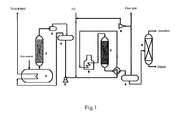
- Figture 1 illustrates one example of the process according to the invention.
- Biological oils and fats indicated in the present invention are animal sources, plant sources, microorganism sources or mixtures thereof. Biological oils and fats either for foods or for industry can be used. In general, biological oils and fats are rich in triglycerides and free fatty acids, and the chain length of the fatty acids is normally C 12 -C 24 , and mostly C 16 and C 18 .
- the examples of biological oils and fats comprise, but do not limit to, rapeseed oil, soybean oil, palm oil, sunflower seed oil, cottonseed oil, Jatropha oil, olive oil, castor oil, micro algae oil, tallow, lard, butter, poultry fats, fish oil, food waste oil and the like. Vegetable oils and fats are a preferred raw material in an example.
- the fuel prepared by the present invention is usually called biomass fuel, which means a solid, a liquid or a gas, consisting of or being extracted from biomass.
- biomass fuel is organic living organisms or metabolic products of organic living organisms.
- the composition of the produced biodiesel by this process is equivalent to that of the petroleum diesel obtained by refining petrochemical raw materials (such as crude oil), in which both of them are of high degree compatibility.
- the biodiesel and the petroleum diesel can be blended sufficiently with each other, and the diesel thus blended has properties and an application scope the same as those of petroleum diesel.
- the present invention employs a double-deoxygenation-procedure, i.e., a catalytic cracking-deoxygenation procedure and a catalytic hydrodeoxygenation procedure.
- a procedure of combining catalytic cracking with distillation is employed to treat biological oils and fats, in which a part of oxygen in the raw material is removed.
- the remained oxygen is removed through catalytic hydrogenation reaction. Since hydrogen gas is not required in the step of catalytic cracking-deoxygenation and most oxygen has been removed, the consumption of hydrogen gas can be lowered greatly in the following step of catalytic hydrodeoxygenation.
- oxygen in free fatty acids is removed partially by decarbonylation, or by decarboxylation with CO, H 2 O and alkenes generated , and at the same time, triglycerides decarbonylate through cracking.
- Long chain alkanes and alkenes, CO 2 , CO, H 2 O, as well as propylene or propane are generated accordingly by decarboxylation.
- the cracking-deoxygenation catalyst should be of strong water-resistance. Moreover, in the catalytic cracking reaction for biological oils and fats, usually not only C-C broken but also C-O breaking occurs. For this reason, the catalyst may be modified for breaking bonds selectively, i.e. only C-O is broken while C-C breaking does not occur. As element oxygen usually still exists in the fraction after the selective C-O breaking, a further step of deoxygenation proceeds.
- n-paraffin is generated by the reactions of hydrosaturation, hydrodecarboxylation, hydrodecarbonylation and hydrodeoxygenation for triglycerides.
- R is an alkyl of C 10 -C 22 .
- the oxygen-containing fractions remained after the catalytic cracking-deoxygenation are further removed through the above-mentioned hydrodeoxygenation, while the alkenes produced in the catalytic cracking are saturated, and thus a product with high stability is obtained.
- the advantages of the present invention lie in that the fraction obtained by the catalytic cracking-deoxygenation is further subjected to a hydrodeoxygenation.
- the conditions for these reactions are moderate with low hydrogen partial pressure and low reaction temperature.
- the catalyst used in the process is of acceptable stability.
- the consumption of hydrogen is low.
- the biomass fuel produced according to the present invention can be used as a fuel directly, such as gasoline, diesel, aviation kerosene and the like, or can be used as a blending component.
- the biomass fuel comprises mainly the components with carbon chains of C 8 -C 24 with a cetane number being higher than that of the traditional petroleum diesel, and a lower density.
- the biomass fuel contains almost no sulfur, nitrogen and aromatic hydrocarbons.
- the clean fuel prepared according to the present invention is an ideal and high quality diesel blending component, which can be blended with a low value oil (with a lower cetane number) produced by hydrogenating light catalytic cycle oil, so as to produce ultra low sulfur diesel which meets the requirements of the relevant standards.
- the present invention is mainly on the basis of the two-step-deoxygenation, i.e., catalytic cracking-deoxygenation and catalytic hydrodeoxygenation. These two steps can be combined very flexibly, which can be operated either continuously or separately. Specifically, a first reaction sector for catalytic cracking-deoxygenation and a second reaction sector for catalytic hydrodeoxygenation can be operated continuously or in batch according to the actual operation conditions for the application.
- the step of hydrodeoxygenation operates continuously, in which advantages of stable reaction conditions and stable products are obtained; while it is preferred that the step of catalytic cracking-deoxygenation in the first reaction sector operates in batch.
- the step of catalytic cracking-deoxygenation may employ a circulating operation with multiple distillation stills or may employ continuous catalytic distillation operation.
- the cracking-deoxygenation catalyst used in the first reaction sector is, such as, but not limited to, molecular sieve catalyst.
- suitable cracking-deoxygenation catalysts can refer to " Industrial Catalysts Handbook" (HUANG Zhongtao, Chemical Industry Press, 2004 ; which is incorporated into the Description of the present Application as reference herein).
- a mixture of aluminum oxide and molecular sieve is used as a cracking catalyst.
- Molecular sieve may be selected from HY, H ⁇ , SAPO-31, HZSM-5, HZSM-22 or mixtures of the random combinations of any above ingredients.
- the content of molecular sieve may be about 5-70 wt%.
- a binder such as Sesbania powder
- the size of the molded cracking-deoxygenation catalyst depends on the actual conditions of the first reaction sector, such as the diameter of the catalytic distillation tower. In one embodiment, a ratio of the equivalent diameter of the molded cracking-deoxygenation catalyst to the diameter of the catalytic distillation tower should be less than 0.1.
- the ratio of cracking-deoxygenation catalyst to the raw material that are fed into the first reaction sector is not required to be limited specifically but is determined according to the actual conditions of the application.
- the mass ratio of cracking-deoxygenation catalyst to biological oils and fats can be about 1:5 to 1:50 according to the process load of the reaction, i.e., it can be 1:5, 1:10, 1:15, 1:20, 1:30, 1:40, 1:50 etc..
- the mass ratio of cracking-deoxygenation catalyst to biological oils and fats is preferably 1:20.
- the mass ratio of cracking-deoxygenation catalyst to biological oils and fats is preferably 1:10.
- the catalytic cracking-deoxygenation in the first reaction sector can proceed under heating at about 100-600°C, thereby to obtain products of cracking-deoxygenation, such as alkenes, alkanes, carbon monoxide, carbon dioxide, water, etc..
- the catalytic cracking-deoxygenation proceeds at 100°C, 200°C, 250°C, 300°C, 350°C, 400°C, 450°C, 500°C, 600°C or any temperature between any two of the above values.
- the composition of raw material oils may have influence on the temperature selection.
- the temperature of cracking-deoxygenation is generally determined by the distillation range of the raw material oils. In one embodiment, about 300-600°C is preferred.
- the product from the first reaction sector is mixed with hydrogen gas sufficiently, and then, the mixture is guided into the second reaction sector containing hydrodeoxygenation catalyst to proceed with catalytic hydrodeoxygenation.
- the hydrodeoxygenation catalyst used in the second reaction sector is, such as, but not limited to, a supported metal catalyst.
- a supported metal catalyst can refer to " Industrial Catalysts Handbook" (HUANG Zhongtao, Chemical Industry Press, 2004 ) and “Hydrorefining” (FANG Xiangchen, China Petrochemical Press, 2008) (the contents of these two books are incorporated into the Description of the present Application as reference herein).
- the supported metal catalyst is composed of a support and a metal distributed on the support, while the metal may be a single metal, a mixture of metals or an alloy.
- the metal may be a transition metal in periodic table of elements, selected from a group consisting of metal elements of Group IIIB, Group IVB, Group VB, Group VIB, Group VIIB, and Group VIII.
- Group VIII is preferred, and the metal may be selected from Fe, Co, Ni, Ru, Rh, Pd, Os, Ir, Pt, etc..
- the metal may be selected from Ni, Co, Mo, W, Cu, Pd, Ru, Pt etc..
- the content of the metal is 0.1-30 wt%.
- the support may be selected from an oxide support with double mesoporous composite structure or carbon material.
- the oxide support may be selected from SiO 2 , Al 2 O 3 , TiO 2 , SiO 2 -Al 2 O 3 , Al 2 O 3 -TiO 2 or SiO 2 -Al 2 O 3 -TiO 2 .
- the ratio of hydrodeoxygenation catalyst to the reactants which are fed into the second reaction sector is not required to be limited specifically but is determined according to the actual operation conditions.
- the catalytic hydrodeoxygenation in the second reaction sector proceeds under heating at about 200-400°C, for example, at about 200°C, 250°C, 300°C, 350°C, 400°C or a temperature between any two of the above values. In one embodiment, a temperature at about 300-400°C is preferred.
- the operation system may be integrated.
- the waste gas and waste residue generated from the process can be utilized for heating, which can lower energy consumption, avoid a secondary pollution, and achieve the effects of energy saving and environmental protection.
- the gasified vegetable oils are proceeded with catalytic cracking-deoxygenation in the catalytic distillation tower.
- the temperature of the distillation still is controlled at 100-600°C.
- the aluminum oxide-molecular sieve mixture is used as a cracking-deoxygenation catalyst, and the ratio of the catalyst to the oils is controlled between 1:5-1:20.
- the steps of the above reactions may be operated in batch or may be operated continuously by means of a switching-over among the distillation stills.
- the product from cracking-deoxygenation is mixed with hydrogen gas through a feeding pump and is fed into a reaction reactor equipped with a hydrodeoxygenation catalyst for reaction, in which a supported metal catalyst or a supported metal sulfide catalyst is used as the hydrodeoxygenation catalyst.
- the feeding temperature is controlled at 200-400°C; the partial pressure of hydrogen gas is 1-6 MPa; the volume space velocity is 0.5-4.0 h -1 ; and the hydrogen/oil volume ratio is 200:1-1200:1.
- clean fuel from vegetable oils is obtained, which may be separated into gasoline and diesel according to the temperatures of fractions.
- the dry gas and waste residue generated in the conversion process of vegetable oils may be used as auxiliary heating.
- the biomass fuel produced according to the process of the present invention such as renewable diesel, may be further processed if required. Isomerization may lower the condensation point of the biomass fuel, and thus, fuel with good properties at low temperature can be obtained.
- Palm acid oil is used as a raw material for the process of the present invention.
- Palm acid oil is in solid at room temperature, and the content of free fatty acids thereof is up to 67%. As the content of fatty acids is too high, the palm acid oil can not be treated by using the direct hydrogenation process in the prior art (as foregoing mentioned, the prior art only shows hydrocarbon fuel prepared by direct hydrogenating treatments from raw materials which contain 15% free fatty acids at most). However, palm acid oil can be processed according to the present invention. Table 1.
- Palm acid oil is fed into a distillation still to gasify under heating, and then is proceeded with a catalytic cracking-deoxygenation in a catalytic distillation tower.
- the temperature of the distillation still is controlled at 100-600°C; aluminum oxide-molecular sieve mixture is used as a cracking-deoxygenation catalyst; and the ratio of catalyst to the oil is controlled in the range of 1-20.
- the fractions of gasoline and diesel ( ⁇ 360 °C) are separated according to the temperatures of fractions, and the results are shown in Table 2. Table 2. Distribution of Cracking-deoxygenation Products Yield of gasoline and diesel fractions ( ⁇ 360 °C) Water Dry gas Residue 80% 6% 10% 4%
- the oxygen content of the raw material oil can be lowered by removing oxygen in the form of water by means of the step of catalytic cracking-deoxygenation according to the present invention, and therefore, the decreased water generation in the following hydrogenation lengthens the lifetime of the hydrogenation catalyst.
- the yield of gasoline and diesel fractions is about 80%.
- the fractions obtained from the catalytic cracking-deoxygenation of palm acid oil are proceeded with hydrodeoxygenation, and the fractions thus obtained from hydrodeoxygenation have a acid value of 0.06mgKOH/g, which is much lower than the standard value of Biodiesel Standard in China (hereinafter, BD100).
- the content of sulfur is lower than the standard value of GB Diesel Standard (III) GB19147-2009 (hereinafter, GB III Diesel) and that of the Euro V Standard EN590:2004 (hereinafter, Euro V Diesel).
- the Cetane Index is much higher than the standard values of GB III Diesel and Euro V Diesel. According to the method of the present invention, the clean fuel obtained from palm acid oil is indeed an excellent blending component for diesel.
- Jatropha oil is used as raw material for the process of the present invention. Jatropha oil is in liquid at room temperature, and the basic properties, component analysis and distilling range thereof are shown in Table 5. Table 5. Basic Characteristics of Jatropha oil Appearance Yellow transparent Moisture content % (m/m) ⁇ 0.05 Density@15.6°C g/cm 3 0.9193 Sulphur content mg/kg ⁇ 50 Free fatty acid content % 1.9 Fat content % 99.6 Iodine value gI 2 /100g 103 Distilling range Initial boiling point °C 405.6 Temperature of 50% recovery °C 573.9 Temperature of 90% recovery °C 591.7 Temperature of 95% recovery °C 593.3 Final boiling point °C 603.5
- Jatropha oil is fed into a distillation still to gasify under heating, and then is proceeded with catalytic cracking-deoxygenation in a catalytic distillation tower.
- the temperature of the distillation still is controlled at 100-600°C.
- Aluminum oxide-molecular sieve mixture is used as a cracking-deoxygenation catalyst.
- the ratio of catalyst to the oil is controlled in the range of 1-20.
- the fractions of gasoline and diesel ( ⁇ 360°C) are separated according to the temperatures of fractions, and the results are shown in Table 6. Table 6. Distribution of Cracking-deoxygenation Products Yield of gasoline and diesel fractions ( ⁇ 360 °C) Water Dry gas Residue 78% 4% 13% 5%
- the acid value of the fuel obtained from Jatropha oil is much lower than the standard value of BD100; the content of sulfur is lower than the standard value of GB III Diesel and that of Euro V Diesel; and the Cetane Index reach the standards for Grade III Diesel.
- Example 1 and Example 2 provide applications of non-edible animal and vegetable oils and fats which are either the most difficult to handle or the easiest to handle. By using the process of the present application, both of the two Examples can produce clean fuel with excellent properties. It is also shown that the process of the present invention is not fastidious about the raw materials of biological oils and fats, and the process is applicable to all kinds of biological oils and fats. Even palm acid oil, which is the most difficult to handle in the art, can be used to produce clean fuel with high-quality by using the process of the present invention.
- the clean fuel prepared according to the present invention comprises C 8 -C 24 as its main carbon chain components.
- the cetane number of the clean fuel is higher than the traditional petroleum diesel.
- the clean fuel has a lower density, and does not contain sulfur, nitrogen or aromatic hydrocarbons substantially.
- the clean fuel produced according to the present invention is an ideal and high quality blending component of diesel, which can be blended with a low value oil (with a lower cetane number) produced by hydrogenating light catalytic cycle oil, so as to produce ultra low sulfur diesel which meets the requirements of relevant standards.
- An example for producing clean fuel according to the present invention is provided on a level of application in industry.
- raw materials of biological oils and fats are fed into the distillation still 1 and are heated, and then, are guided into the catalytic distillation tower 2, which is equipped with a cracking-deoxygenation catalyst. Cracking-deoxygenation for the biological oils and fats takes place under a certain temperature.
- the gasoline and diesel fractions thus obtained from the catalytic distillation tower 2 are fed into the hydrorefining reaction reactor 7, in which the gasoline and diesel fractions from the catalytic distillation tower 2 are mixed with hydrogen gas through a feeding pump 5, and then enter into the hydrorefining reaction reactor 7 after being heated by a heat exchanger and the heating furnace 6.
- the hydrodeoxygenation catalyst is equipped in the hydrorefining reaction reactor 7. Under a preset temperature, the fractions from the catalytic distillation tower 2 are fed into the hydrorefining reaction reactor 7 and are proceeded with a catalytic hydrodeoxygenation with hydrogen gas. Finally, the obtained product is fed into the atmospheric distillation tower 9 and fractionated to product clean fuel, such as gasoline, diesel and the like.
- the process of the present invention through a catalytic cracking-deoxygenation, a large amount of C-O bonds contained in biological oils and fats are broken firstly; and then, through a catalytic hydrodeoxygenation, a final clean fuel is obtained.
- the process of the present invention lowers effectively the consumption of hydrogen which is required by hydrogenation.
- a two-step process of direct hydrodeoxygenation and then hydroisomerization for biological oils and fats, or a one-step process combining hydrodeoxygenation and hydroisomerization up to 50% of hydrogen gas consumption is cut down by the present invention.
- the present invention does not require low-carbon alcohols and does not generate by-product glycerol.
- the process of the present invention is simple to operate and reduces the cost significantly.
Landscapes
- Chemical & Material Sciences (AREA)
- Oil, Petroleum & Natural Gas (AREA)
- Engineering & Computer Science (AREA)
- Chemical Kinetics & Catalysis (AREA)
- Organic Chemistry (AREA)
- General Chemical & Material Sciences (AREA)
- Life Sciences & Earth Sciences (AREA)
- Wood Science & Technology (AREA)
- Crystallography & Structural Chemistry (AREA)
- Microbiology (AREA)
- Production Of Liquid Hydrocarbon Mixture For Refining Petroleum (AREA)
- Fats And Perfumes (AREA)
Abstract
Description
- The present invention relates to the field of energy technology, and especially to a method for preparing fuel by using biological oils and fats.
- People are compelled to search for renewable clean fuel as petrochemical fuel is in shortage more than ever and pollutes the environment upon combustion. In a substitutive solution for petrochemical fuel, producing clean fuel from renewable biological oils and fats (such as soybean oil, Jatropha oil, lard, food waste oil) is considered as a green, renewable, carbon-neutral technical route.
- Biological oils and fats, such as vegetable oils and fats, which are fats obtained by extracting seeds, the flesh of fruit, and other parts of plants, contain a lot of triglycerides with long-chain carbons and free fatty acids. According to their usage, biological oils and fats can be divided into two categories - to be used for food and to be used in industry. Those in liquid at room temperature are called oils, while those in solid and semi-solid at room temperature are called fats. The components of biological oils and fats are quite different from those of crude oil (including waste lubricating oil) mainly in that, for biological oils and fats, the content of oxygen is high and the contents of sulfur, nitrogen and aromatic hydrocarbons are low; while for crude oil, contents of sulfur, nitrogen and aromatic hydrocarbons are high and content of oxygen is low. Therefore, due to the differences of their components, methods for producing fuel from crude oil as raw material are not applicable to the processing of biological oils and fats as raw materials.
- Currently, there are some technical solutions, which are used or will be used in industry, for preparing biomass fuel (such as biodiesel) from biological oils and fats. Generally, such technical solutions are classified into two categories: process of transesterification and process of direct hydrogenation. Many research results and technical reports involve in the discussion on the foregoing techniques.
- Chinese Patent Application Publication No.
CN 101328418A teaches a method for manufacturing biodiesel by using vegetable oils. However, a great amount of ethanol is consumed firstly to form fatty acid ester through reacting with the vegetable oil. Chinese Patent Application Publication No.CN1858161A teaches a method for preparing biodiesel from palm oil, in which, it is required that the raw material of palm oil proceed with the procedures, such as degumming, deacidifying and dehydrating, etc. before the step of esterifying with low-carbon alcohols. Chinese Patent Application Publication No.CN101230309A teaches a method for preparing biodiesel through reducing the high acid value of palm oil, in which, two esterification procedures are required. Moreover, methanol required in the method is in an amount 6-9 times (molar ratio) of that of the oil in the transesterification reaction. Furthermore, methanol does not recycle in the process, which leads to the method not environmentally, friendly, and economically. - The aforementioned processes in the prior art are complicated in regard to the procedures, difficult to operate and require high energy consumption. Moreover, a high amount of alcohols, such as methanol or ethanol etc., is involved in the process of transesterification, which results in the production cost increasing greatly.
- Besides, Chinese Patent Application Publication No.
CN101070483A teaches a method for producing biodiesel with Saueda Salsa seed oil, in which a lot of water is required for washing the product after transesterification. Chinese Patent Application Publication No.CN1412278A teaches a method for preparing biodiesel by utilizing high acid oils and fats as well as palm oil together with a strong acid as catalyst. However, when the method proceeds, a lot of waste water would produce and the reactor would corrode badly. All aforementioned processes in the prior art produce a lot of waste water, which not only increase production costs, but also go against environmental protection and economic benefit. - Regarding direct hydrogenating technique,
WO2009/039347 teaches a process for producing diesel fractions by treating biorenewable feedstock, in which a two-step-approach, i.e., hydrodeoxygenation and hydroisomerization, is employed.US2006/0207166 has a process, in which hydrodeoxygenation and hydroisomerization take place simultaneously. A common defect of these processes lay in the poor stability of the catalyst and the high consumption for hydrogen, which will be more serious for vegetable oils and animal fats with high oxygen contents. - Particularly, the technique of direct hydrogenation is restricted by the contents of free fatty acids in raw materials. Up to now, only raw material containing up to 15% of free fatty acids is disclosed in the prior art documents, which is used to produce hydrocarbon fuel through direct hydrogenation (Yanyong Liu et al., Chem. Lett. 2009, 38, 552).
- In general, in the processes currently used for preparing diesel fuel from biological oils and fats, transesterification is employed to produce biodiesel by means of transesterfication from biological oils and fats in which a lot of low-carbon alcohol is consumed and therefore, production cost is increased. In the transesterification process, a strong acid is employed as a catalyst which corrodes the production apparatuses badly, and at the same time, a follow-up separation procedure is required for handling a large amount of glycerol, which is a by-product generated in the process. After the transesterification process, a large volume of waste water will be resulted in. In some transesterification processes, multiple transesterification procedures are involved in, which result in the operations very cumbersome. On the other hand, direct hydrogenation produces diesel through hydrodeoxygenation for animal and vegetable oils and fats directly, which is not only of high hydrogen consumption, but also of fast catalyst inactivation. Since the oxygen content in raw material oils is 10%-15%, a large amount of reaction heat will be produced. It is a hard-resolved problem to control the reaction temperature so as to prevent catalyst from fast inactivation. Furthermore, a large amount of hydrogen gas for replenishing and for quenching is required to maintain the hydrogen partial pressure as the consumption of hydrogen gas for processing the raw material oils is relatively high.
- There are still some other processes in the art for preparing diesel fuel by using biological oils and fats. For example,
US2006/0186020 discloses a process of coprocessing vegetable oils and crude oil, in which the content of vegetable oils is between 1-75% and vegetable oils are not used alone. Chinese Patent Application Publication No.CN10101314748A - Chinese Patent Publication No.
CN101475870A teaches a process of catalytic cracking distillation for hydrocarbons of which waste lubricating oil sources mainly consist. In this process, the waste lubricating oil to be treated mainly consists of alkanes, and the catalytic cracking breaks down C-C bonds selectively. The main reaction is shown as follows:
R1-CH2-CH2-R2 → R1-CH3 + CH2=R2
- No water (H2O) is produced in this cracking reaction, thus the water-resistance of catalyst is not required to be taken into account. Waste lubricating oil mainly consists of alkanes, which form alkanes and alkenes directly after catalytic cracking. However, as above mentioned, the composition of biological oils and fats is quite different from that of crude oil (including waste lubricating oil), in which the main components of biological oils and fats have high oxygen content. If cracking carries out, factors, such as C-O bond cracked and water produced, should be taken into account, as there are great differences in catalytic mechanism and the hydrothermal stability of the catalyst. As a result, the process taught by Chinese Patent Application Publication No.
CN101475870A is not applicable to biological oils and fats. - In conclusion, as for the prior art, although there are many routes and research results disclosed for processing and manufacturing biodiesel by using biological oils and fats as raw materials, biodiesel prepared by these processes is not considered by far an ideal diesel blending component as the obtained biodiesel has high density, low blending ratio with diesel components from petroleum, low heat value, and less economical as a fuel when it is blended with diesel components from petroleum.
- In order to solve the above problems, the present invention provides a novel process for treating biological oils and fats. High quality biomass fuel that is very suitable to be used as a blending component of diesel is obtained.
- Specifically, the present invention provides a method for preparing biomass fuel, in which biological oils and fats are used as raw materials and the composition of the biomass fuel thus obtained is equivalent to that obtained from crude oil refining. The process comprises steps as follows: (a) proceeding with a catalytic cracking-deoxygenation reaction under heating in the presence of a cracking-deoxygenation catalyst for the biological oils and fats; (b) mixing the product of step (a) with hydrogen gas; and (c) proceeding with a catalytic hydrodeoxygenation reaction under heating in the presence of a hydrodeoxygenation catalyst for the mixture from step (b). According to actual demands, the product of step (c) may be further fractionated. Generally, it may be also considered to mix hydrogen gas with the product of catalytic cracking-deoxygenation reaction before the hydrogen gas being injected into the reaction reactor for the reaction of step (c), whereas the hydrogen gas may also be injected into the reaction reactor directly followed by being mixed with the product of catalytic cracking-deoxygenation reaction for the reaction of step (c).
- As for the process of the present invention, it is characterized in that a double-deoxygenation-procedure, i.e., a catalytic cracking-deoxygenation procedure and a catalytic hydrodeoxygenation procedure, is employed, and therefore, the defects of large heat release and fast inactivation of the catalyst caused by the direct hydrogenation used in the prior art can be avoided, and the consumption of hydrogen gas can be reduced greatly at the same time. Moreover, each procedure in the process of the present application, e.g., the catalytic cracking-deoxygenation procedure and the catalytic hydrodeoxygenation procedure, can be combined flexibly, i.e., can operate either continuously or separately. Waste residue and waste gas produced from the process can be utilized comprehensively for heating, which makes the whole production process more energy saving and environmentally friendly.
-
Figture 1 illustrates one example of the process according to the invention. - Reference signs for main assemblies are as follows:
- 1 Distillation still
- 2 Catalytic distillation tower
- 3 Condenser
- 4 Vapor-liquid separator
- 5 Liquid feeding pump
- 6 Heating furnace
- 7 Hydrorefining reaction reactor
- 8 Hydrogen gas positive booster
- 9 Atmospheric distillation tower
- The specific examples of the present invention will be further illustrated by referring to accompanying figures.
- Biological oils and fats indicated in the present invention are animal sources, plant sources, microorganism sources or mixtures thereof. Biological oils and fats either for foods or for industry can be used. In general, biological oils and fats are rich in triglycerides and free fatty acids, and the chain length of the fatty acids is normally C12-C24, and mostly C16 and C18. The examples of biological oils and fats comprise, but do not limit to, rapeseed oil, soybean oil, palm oil, sunflower seed oil, cottonseed oil, Jatropha oil, olive oil, castor oil, micro algae oil, tallow, lard, butter, poultry fats, fish oil, food waste oil and the like. Vegetable oils and fats are a preferred raw material in an example.
- The fuel prepared by the present invention is usually called biomass fuel, which means a solid, a liquid or a gas, consisting of or being extracted from biomass. The so-called biomass herein is organic living organisms or metabolic products of organic living organisms. In a preferred embodiment, the composition of the produced biodiesel by this process is equivalent to that of the petroleum diesel obtained by refining petrochemical raw materials (such as crude oil), in which both of them are of high degree compatibility. The biodiesel and the petroleum diesel can be blended sufficiently with each other, and the diesel thus blended has properties and an application scope the same as those of petroleum diesel.
- The present invention employs a double-deoxygenation-procedure, i.e., a catalytic cracking-deoxygenation procedure and a catalytic hydrodeoxygenation procedure. Firstly, a procedure of combining catalytic cracking with distillation is employed to treat biological oils and fats, in which a part of oxygen in the raw material is removed. Then, the remained oxygen is removed through catalytic hydrogenation reaction. Since hydrogen gas is not required in the step of catalytic cracking-deoxygenation and most oxygen has been removed, the consumption of hydrogen gas can be lowered greatly in the following step of catalytic hydrodeoxygenation.
- In the step of catalytic cracking-deoxygenation, oxygen in free fatty acids is removed partially by decarbonylation, or by decarboxylation with CO, H2O and alkenes generated , and at the same time, triglycerides decarbonylate through cracking. Long chain alkanes and alkenes, CO2, CO, H2O, as well as propylene or propane are generated accordingly by decarboxylation. The chemical reactions of which are as follows:
R-CH2-COOH → R-CH3 + CO2 or R=CH2 + CO + H2O

- In this step, some side reactions which are not relevant to cracking-deoxygenation, such as the reaction for breaking C-C bonds, also occur at the same time.
- Since water is generated in this step, the cracking-deoxygenation catalyst should be of strong water-resistance. Moreover, in the catalytic cracking reaction for biological oils and fats, usually not only C-C broken but also C-O breaking occurs. For this reason, the catalyst may be modified for breaking bonds selectively, i.e. only C-O is broken while C-C breaking does not occur. As element oxygen usually still exists in the fraction after the selective C-O breaking, a further step of deoxygenation proceeds.
- Under the condition for catalytic hydrodeoxygenation, n-paraffin is generated by the reactions of hydrosaturation, hydrodecarboxylation, hydrodecarbonylation and hydrodeoxygenation for triglycerides. The chemical reactions occurred are as follows:
R-CH=CH2 + H2 → R-CH2-CH3
R-COOH + H2 → R-CH3 + H2O or R-H + CO2

- In all of the above chemical formulas, R is an alkyl of C10-C22. Some side reactions, which are mainly hydrogenolysis for C-C bonds to generate smaller hydrocarbon molecules, occur at the same time.
- The oxygen-containing fractions remained after the catalytic cracking-deoxygenation are further removed through the above-mentioned hydrodeoxygenation, while the alkenes produced in the catalytic cracking are saturated, and thus a product with high stability is obtained.
- The advantages of the present invention lie in that the fraction obtained by the catalytic cracking-deoxygenation is further subjected to a hydrodeoxygenation. The conditions for these reactions are moderate with low hydrogen partial pressure and low reaction temperature. The catalyst used in the process is of acceptable stability. The consumption of hydrogen is low. Existing equipments in an oil refinery can be utilized to the greatest extent.
- The biomass fuel produced according to the present invention can be used as a fuel directly, such as gasoline, diesel, aviation kerosene and the like, or can be used as a blending component. The biomass fuel comprises mainly the components with carbon chains of C8-C24 with a cetane number being higher than that of the traditional petroleum diesel, and a lower density. The biomass fuel contains almost no sulfur, nitrogen and aromatic hydrocarbons. Based on the above characteristic properties, the clean fuel prepared according to the present invention is an ideal and high quality diesel blending component, which can be blended with a low value oil (with a lower cetane number) produced by hydrogenating light catalytic cycle oil, so as to produce ultra low sulfur diesel which meets the requirements of the relevant standards.
- The present invention is mainly on the basis of the two-step-deoxygenation, i.e., catalytic cracking-deoxygenation and catalytic hydrodeoxygenation. These two steps can be combined very flexibly, which can be operated either continuously or separately. Specifically, a first reaction sector for catalytic cracking-deoxygenation and a second reaction sector for catalytic hydrodeoxygenation can be operated continuously or in batch according to the actual operation conditions for the application.
- With respect to the industrial application, it is preferred that the step of hydrodeoxygenation operates continuously, in which advantages of stable reaction conditions and stable products are obtained; while it is preferred that the step of catalytic cracking-deoxygenation in the first reaction sector operates in batch. However, if a requirement for a continuous operation for hydrodeoxygenation is met, the step of catalytic cracking-deoxygenation may employ a circulating operation with multiple distillation stills or may employ continuous catalytic distillation operation.
- The cracking-deoxygenation catalyst used in the first reaction sector is, such as, but not limited to, molecular sieve catalyst. Other suitable cracking-deoxygenation catalysts can refer to "Industrial Catalysts Handbook" (HUANG Zhongtao, Chemical Industry Press, 2004; which is incorporated into the Description of the present Application as reference herein). In one embodiment, a mixture of aluminum oxide and molecular sieve is used as a cracking catalyst. Molecular sieve may be selected from HY, Hβ, SAPO-31, HZSM-5, HZSM-22 or mixtures of the random combinations of any above ingredients. The content of molecular sieve may be about 5-70 wt%. After aluminum oxide being mixed with molecular sieve, a binder (such as Sesbania powder) is added for extrusion molding. The size of the molded cracking-deoxygenation catalyst depends on the actual conditions of the first reaction sector, such as the diameter of the catalytic distillation tower. In one embodiment, a ratio of the equivalent diameter of the molded cracking-deoxygenation catalyst to the diameter of the catalytic distillation tower should be less than 0.1.
- The ratio of cracking-deoxygenation catalyst to the raw material that are fed into the first reaction sector is not required to be limited specifically but is determined according to the actual conditions of the application. In one embodiment, the mass ratio of cracking-deoxygenation catalyst to biological oils and fats can be about 1:5 to 1:50 according to the process load of the reaction, i.e., it can be 1:5, 1:10, 1:15, 1:20, 1:30, 1:40, 1:50 etc.. In one embodiment, the mass ratio of cracking-deoxygenation catalyst to biological oils and fats is preferably 1:20. In another embodiment, the mass ratio of cracking-deoxygenation catalyst to biological oils and fats is preferably 1:10.
- In some embodiments, the catalytic cracking-deoxygenation in the first reaction sector can proceed under heating at about 100-600°C, thereby to obtain products of cracking-deoxygenation, such as alkenes, alkanes, carbon monoxide, carbon dioxide, water, etc.. In one embodiment, the catalytic cracking-deoxygenation proceeds at 100°C, 200°C, 250°C, 300°C, 350°C, 400°C, 450°C, 500°C, 600°C or any temperature between any two of the above values. In this case, the composition of raw material oils may have influence on the temperature selection. The temperature of cracking-deoxygenation is generally determined by the distillation range of the raw material oils. In one embodiment, about 300-600°C is preferred.
- The product from the first reaction sector is mixed with hydrogen gas sufficiently, and then, the mixture is guided into the second reaction sector containing hydrodeoxygenation catalyst to proceed with catalytic hydrodeoxygenation.
- The hydrodeoxygenation catalyst used in the second reaction sector is, such as, but not limited to, a supported metal catalyst. Other suitable hydrodeoxygenation catalysts can refer to "Industrial Catalysts Handbook" (HUANG Zhongtao, Chemical Industry Press, 2004) and "Hydrorefining" (FANG Xiangchen, China Petrochemical Press, 2008) (the contents of these two books are incorporated into the Description of the present Application as reference herein). In one embodiment, the supported metal catalyst is composed of a support and a metal distributed on the support, while the metal may be a single metal, a mixture of metals or an alloy. The metal may be a transition metal in periodic table of elements, selected from a group consisting of metal elements of Group IIIB, Group IVB, Group VB, Group VIB, Group VIIB, and Group VIII. In one embodiment, Group VIII is preferred, and the metal may be selected from Fe, Co, Ni, Ru, Rh, Pd, Os, Ir, Pt, etc.. In another embodiment, the metal may be selected from Ni, Co, Mo, W, Cu, Pd, Ru, Pt etc.. The content of the metal is 0.1-30 wt%. The support may be selected from an oxide support with double mesoporous composite structure or carbon material. In one embodiment, the oxide support may be selected from SiO2, Al2O3, TiO2, SiO2-Al2O3, Al2O3-TiO2 or SiO2-Al2O3-TiO2.
- The ratio of hydrodeoxygenation catalyst to the reactants which are fed into the second reaction sector is not required to be limited specifically but is determined according to the actual operation conditions.
- In one embodiment, the catalytic hydrodeoxygenation in the second reaction sector proceeds under heating at about 200-400°C, for example, at about 200°C, 250°C, 300°C, 350°C, 400°C or a temperature between any two of the above values. In one embodiment, a temperature at about 300-400°C is preferred.
- Regarding the aforementioned condition for temperature, the operation system may be integrated. The waste gas and waste residue generated from the process can be utilized for heating, which can lower energy consumption, avoid a secondary pollution, and achieve the effects of energy saving and environmental protection.
- In a specific embodiment, after vegetable oils are fed into a distillation still to gasify under heating, the gasified vegetable oils are proceeded with catalytic cracking-deoxygenation in the catalytic distillation tower. The temperature of the distillation still is controlled at 100-600°C. The aluminum oxide-molecular sieve mixture is used as a cracking-deoxygenation catalyst, and the ratio of the catalyst to the oils is controlled between 1:5-1:20. The steps of the above reactions may be operated in batch or may be operated continuously by means of a switching-over among the distillation stills. Next, the product from cracking-deoxygenation is mixed with hydrogen gas through a feeding pump and is fed into a reaction reactor equipped with a hydrodeoxygenation catalyst for reaction, in which a supported metal catalyst or a supported metal sulfide catalyst is used as the hydrodeoxygenation catalyst. In the reaction reactor for hydrodeoxygenation, the feeding temperature is controlled at 200-400°C; the partial pressure of hydrogen gas is 1-6 MPa; the volume space velocity is 0.5-4.0 h-1; and the hydrogen/oil volume ratio is 200:1-1200:1. Finally, clean fuel from vegetable oils is obtained, which may be separated into gasoline and diesel according to the temperatures of fractions. In the present invention, the dry gas and waste residue generated in the conversion process of vegetable oils may be used as auxiliary heating.
- The biomass fuel produced according to the process of the present invention, such as renewable diesel, may be further processed if required. Isomerization may lower the condensation point of the biomass fuel, and thus, fuel with good properties at low temperature can be obtained.
- Following examples are provided to illustrate the present invention in detail. It should be understood that these examples have been presented by way of example only, and are not limiting the present invention.
- Palm acid oil is used as a raw material for the process of the present invention.
- The basic properties, component analysis and distilling range of palm acid oil are shown in Table 1. Palm acid oil is in solid at room temperature, and the content of free fatty acids thereof is up to 67%. As the content of fatty acids is too high, the palm acid oil can not be treated by using the direct hydrogenation process in the prior art (as foregoing mentioned, the prior art only shows hydrocarbon fuel prepared by direct hydrogenating treatments from raw materials which contain 15% free fatty acids at most). However, palm acid oil can be processed according to the present invention.
Table 1. Basic Characteristic Properties of Palm Acid Oil Appearance Brown Moisture content %(m/m) 1.18 Density@15.6 °C g/cm3 0.9285 Sulphur content mg/kg <50 Free fatty acid content % 67.1 Fat content % 98.0 Iodine value gI2/100g 51.6 Fatty acid composition Dodecanoic acid % 11.49 Hexadecanoic acid % 24.97 Octadecanoic acid % 17.99 Oleic acid % 31.02 Others % 14.53 Distilling range Initial boiling point °C 309 Temperature of 50% recovery °C 387.6 Temperature of 90% recovery °C 546.5 Temperature of 95% recovery °C 581.1 Final boiling point °C 587.4 - Palm acid oil is fed into a distillation still to gasify under heating, and then is proceeded with a catalytic cracking-deoxygenation in a catalytic distillation tower. The temperature of the distillation still is controlled at 100-600°C; aluminum oxide-molecular sieve mixture is used as a cracking-deoxygenation catalyst; and the ratio of catalyst to the oil is controlled in the range of 1-20. The fractions of gasoline and diesel (<360 °C) are separated according to the temperatures of fractions, and the results are shown in Table 2.
Table 2. Distribution of Cracking-deoxygenation Products Yield of gasoline and diesel fractions (<360 °C) Water Dry gas Residue 80% 6% 10% 4% - Based on the comparison between Table 1 and Table 2, it can be found that the oxygen content of the raw material oil can be lowered by removing oxygen in the form of water by means of the step of catalytic cracking-deoxygenation according to the present invention, and therefore, the decreased water generation in the following hydrogenation lengthens the lifetime of the hydrogenation catalyst. At the same time, the yield of gasoline and diesel fractions is about 80%.
- Next, the gasoline and diesel fractions from the catalytic cracking-deoxygenation procedure are mixed with hydrogen gas, and the mixture is fed into a reaction reactor equipped with a hydrodeoxygenation catalyst for reaction, in which a supported metal catalyst or a supported metal sulfide catalyst is used as the hydrodeoxygenation catalyst. Other reaction conditions are listed in Table 3, and the component analysis for the obtained clean fuel is shown in Table 4.
Table 3. Conditions of Hydrodeoxygenation Hydrogen partial pressure MPa 5.0 Volume space velocity h -1 1 Hydrogen/oil volume ratio 800 Reaction temperature °C 310 Liquid yield % 97 Table 4. Composition Analysis for Clean Fuel Appearance Colourless transparent Condensation point °C -3 Hydrogen sulfide mg/kg 5.74 Acidity mgKOH/g 0.06 Density (20°C) kg/m3 763.0 Cetane Index 64 Distilling range Initial boiling point °C 66.8 Temperature of 50% recovery °C 215.2 Temperature of 90% recovery °C 258.1 Temperature of 95% recovery °C 267.5 Final boiling point °C 273.7 - As shown in Table 4, the fractions obtained from the catalytic cracking-deoxygenation of palm acid oil are proceeded with hydrodeoxygenation, and the fractions thus obtained from hydrodeoxygenation have a acid value of 0.06mgKOH/g, which is much lower than the standard value of Biodiesel Standard in China (hereinafter, BD100). The content of sulfur is lower than the standard value of GB Diesel Standard (III)
GB19147-2009 - Jatropha oil is used as raw material for the process of the present invention. Jatropha oil is in liquid at room temperature, and the basic properties, component analysis and distilling range thereof are shown in Table 5.
Table 5. Basic Characteristics of Jatropha oil Appearance Yellow transparent Moisture content % (m/m) <0.05 Density@15.6°C g/cm3 0.9193 Sulphur content mg/kg <50 Free fatty acid content % 1.9 Fat content % 99.6 Iodine value gI2/100g 103 Distilling range Initial boiling point °C 405.6 Temperature of 50% recovery °C 573.9 Temperature of 90% recovery °C 591.7 Temperature of 95% recovery °C 593.3 Final boiling point °C 603.5 - Jatropha oil is fed into a distillation still to gasify under heating, and then is proceeded with catalytic cracking-deoxygenation in a catalytic distillation tower. The temperature of the distillation still is controlled at 100-600°C. Aluminum oxide-molecular sieve mixture is used as a cracking-deoxygenation catalyst. The ratio of catalyst to the oil is controlled in the range of 1-20. The fractions of gasoline and diesel (<360°C) are separated according to the temperatures of fractions, and the results are shown in Table 6.
Table 6. Distribution of Cracking-deoxygenation Products Yield of gasoline and diesel fractions (<360 °C) Water Dry gas Residue 78% 4% 13% 5% - Based on the comparison between Table 5 and Table 6, it can be found that the oxygen content of the raw material oil can be lowered by removing oxygen in the form of water by means of the step of catalytic cracking-deoxygenation according to the present invention, and therefore, the decreased water generation in the following hydrogenation lengthens the lifetime of the hydrogenation catalyst. At the same time, the yield of gasoline and diesel fractions is about 78%.
- Next, the gasoline and diesel fractions from the catalytic cracking-deoxygenation procedure are mixed with hydrogen gas, and the mixture is fed into a reaction reactor equipped with a hydrodeoxygenation catalyst for reaction, in which a supported metal catalyst or a supported metal sulfide catalyst is used as the hydrodeoxygenation catalyst. Other reaction conditions are listed in Table 7, and the component analysis for the obtained clean fuel is shown in Table 8.
Table 7. Conditions of Hydrodeoxygenation Hydrogen partial pressure MPa 5.0 Volume space velocity h -1 1 Hydrogen/oil volume ratio 800 Reaction temperature °C 310 Liquid yield % 98 Table 8. Composition Analysis for Clean Fuel Appearance Colourless transparent Condensation point °C -15 Hydrogen sulfide mg/kg 7.7 Acidity mgKOH/g 0.04 Density @20°C kg/m3 783.7 Cetane Index 43.4 Distilling range Initial boiling point °C 101.2 Temperature of 50% recovery °C 250.1 Temperature of 90% recovery °C 323.9 Temperature of 95% recovery °C 350.2 Final boiling point °C 372.6 - As shown in Table 8, the acid value of the fuel obtained from Jatropha oil is much lower than the standard value of BD100; the content of sulfur is lower than the standard value of GB III Diesel and that of Euro V Diesel; and the Cetane Index reach the standards for Grade III Diesel.
- Example 1 and Example 2 provide applications of non-edible animal and vegetable oils and fats which are either the most difficult to handle or the easiest to handle. By using the process of the present application, both of the two Examples can produce clean fuel with excellent properties. It is also shown that the process of the present invention is not fastidious about the raw materials of biological oils and fats, and the process is applicable to all kinds of biological oils and fats. Even palm acid oil, which is the most difficult to handle in the art, can be used to produce clean fuel with high-quality by using the process of the present invention.
- The clean fuel prepared according to the present invention comprises C8-C24 as its main carbon chain components. The cetane number of the clean fuel is higher than the traditional petroleum diesel. The clean fuel has a lower density, and does not contain sulfur, nitrogen or aromatic hydrocarbons substantially. Based on the above characteristic properties, the clean fuel produced according to the present invention is an ideal and high quality blending component of diesel, which can be blended with a low value oil (with a lower cetane number) produced by hydrogenating light catalytic cycle oil, so as to produce ultra low sulfur diesel which meets the requirements of relevant standards.
- An example for producing clean fuel according to the present invention is provided on a level of application in industry.
- Referring to
Fig. 1 , raw materials of biological oils and fats are fed into the distillation still 1 and are heated, and then, are guided into thecatalytic distillation tower 2, which is equipped with a cracking-deoxygenation catalyst. Cracking-deoxygenation for the biological oils and fats takes place under a certain temperature. The gasoline and diesel fractions thus obtained from thecatalytic distillation tower 2 are fed into the hydrorefining reaction reactor 7, in which the gasoline and diesel fractions from thecatalytic distillation tower 2 are mixed with hydrogen gas through a feeding pump 5, and then enter into the hydrorefining reaction reactor 7 after being heated by a heat exchanger and the heating furnace 6. - The hydrodeoxygenation catalyst is equipped in the hydrorefining reaction reactor 7. Under a preset temperature, the fractions from the
catalytic distillation tower 2 are fed into the hydrorefining reaction reactor 7 and are proceeded with a catalytic hydrodeoxygenation with hydrogen gas. Finally, the obtained product is fed into the atmospheric distillation tower 9 and fractionated to product clean fuel, such as gasoline, diesel and the like. - In the process of the present invention, through a catalytic cracking-deoxygenation, a large amount of C-O bonds contained in biological oils and fats are broken firstly; and then, through a catalytic hydrodeoxygenation, a final clean fuel is obtained. The process of the present invention lowers effectively the consumption of hydrogen which is required by hydrogenation. Based on the comparison between the present invention and the processes in the prior art, i.e., a two-step process of direct hydrodeoxygenation and then hydroisomerization for biological oils and fats, or a one-step process combining hydrodeoxygenation and hydroisomerization, up to 50% of hydrogen gas consumption is cut down by the present invention. Based on the comparison between the present invention and the process of transesterification in the prior art, the present invention does not require low-carbon alcohols and does not generate by-product glycerol. The process of the present invention is simple to operate and reduces the cost significantly.
- The above description of the preferred examples of the present invention is for the purposes of explaining, illustrating but not limiting the content of the present invention. The scope of the present invention is determined by the Claims. Those ordinary skilled in the art can make appropriate modifications or changes after reading the above description, and all such modifications or changes fall within the scope of the present invention.
Claims (22)
- A method for preparing fuel using biological oils and fats, comprising:(a) proceeding with a catalytic cracking-deoxygenation reaction for the biological oils and fats under heating in the presence of a cracking-deoxygenation catalyst;(b) mixing the product of step (a) with hydrogen gas; and(c) proceeding with a catalytic hydrodeoxygenation reaction for the mixture from step (b) under heating in the presence of a hydrodeoxygenation catalyst.
- The method according to claim 1, wherein step (a) can be operated continuously or in batch.
- The method according to claim 1, wherein step (a) employs a circulating operation with multiple distillation stills or employs a continuous catalytic distillation operation, and step (c) employs a continuous operation.
- The method according to claim 1, wherein the biological oils and fats are from animal origin, plant origin, microorganism origin or mixtures thereof.
- The method according to claim 1, wherein the cracking-deoxygenation catalyst is selected from aluminum oxide, molecular sieve or a mixture thereof.
- The method according to claim 5, wherein the molecular sieve is one or more elements selected from a group consisting of HY, Hβ, SAPO-31, HZSM-5, and HZSM-22.
- The method according to claim 5, wherein the cracking-deoxygenation catalyst is a mixture of aluminum oxide and molecular sieve, and content of the molecular sieve is 5-70 wt%.
- The method according to claim 1, wherein step (a) takes place in a catalytic distillation tower, the cracking-deoxygenation catalyst is a formed catalyst, and a ratio of equivalent diameter of the cracking-deoxygenation catalyst to the diameter of the catalytic distillation tower is less than 0.1.
- The method according to claim 1, wherein a mass ratio of the cracking-deoxygenation catalyst in step (a) to the reactants of step (a) is selected from a group comprising 1:5, 1:10, 1:15, 1:20, 1:30, 1:40, and 1:50.
- The method according to claim 1, wherein the cracking-deoxygenation catalyst is of water-resistance.
- The method according to claim 1, wherein the heating condition of step (a) is 100-600°C.
- The method according to claim 1, wherein the product of step (a) comprises alkenes, alkanes, carbon monoxide, carbon dioxide, water or combinations thereof.
- The method according to claim 1, wherein step (a) comprises following reactions:
R-CH2-COOH → R-CH3 + CO2 or R=CH2 + CO + H2O

- The method according to claim 1, wherein the hydrodeoxygenation catalyst comprises a supported metal catalyst, and the metal is one or more elements selected from a group consisting of the metal elements of Group IIIB to Group VIII, and alloys thereof.
- The method according to claim 1, wherein the heating condition of step (c) is 200-400°C.
- The method according to claim 1, wherein step (c) comprises following reactions:
R-CH=CH2 + H2 → R-CH2-CH3
R-COOH + H2 → R-CH3 + H2O or R-H + CO2

- The method according to claim 1, further comprising: (d) fractionating the product of step (c) to obtain gasoline and diesel.
- The method according to claim 1, wherein dry gas generated by the method is used for auxiliary heating in steps (a) and (c).
- The method according to claim 1, wherein the product of step (a) passes through a feeding pump before mixing with hydrogen gas in step (b), and then enters into a reaction reactor for hydrorefining through a heat exchanger and is proceeded with step (c) in the reaction reactor.
- The method according to claim 1, wherein step (a) further comprises distilling operation.
- The method according to claim 1, wherein step (a) takes place in a distillation still and a catalytic distillation tower, in which the heating condition of the distillation stills is between 100°C and 600°C, the cracking-deoxygenation catalyst is a mixture of aluminum oxide and molecular sieve, and the mass ratio of the cracking-deoxygenation catalyst to reactants of step (a) is between 1:5 and 1:20.
- The method according to claim 1, wherein step (c) takes place in a reaction reactor for hydrorefining, in which the hydrodeoxygenation catalyst is a supported metal catalyst, the heating condition in the reaction reactor is 200-400°C, partial pressure for hydrogen gas 1-6 MPa, volume space velocity 0.5-4.0 h-1 and hydrogen/oil volume ratio 200-1200:1.
Priority Applications (1)
| Application Number | Priority Date | Filing Date | Title |
|---|---|---|---|
| PL12800464T PL2719746T3 (en) | 2011-06-13 | 2012-06-12 | Method for preparing fuel from biological oil and fat |
Applications Claiming Priority (3)
| Application Number | Priority Date | Filing Date | Title |
|---|---|---|---|
| CN2011101570812A CN102250634A (en) | 2011-06-13 | 2011-06-13 | Method for producing renewable gasoline and diesel oil by utilizing vegetable oil |
| CN2011104258199A CN102492455A (en) | 2011-12-16 | 2011-12-16 | Method for preparing fuel from biological grease |
| PCT/CN2012/000790 WO2012171326A1 (en) | 2011-06-13 | 2012-06-12 | Method for preparing fuel from biological oil and fat |
Publications (3)
| Publication Number | Publication Date |
|---|---|
| EP2719746A1 true EP2719746A1 (en) | 2014-04-16 |
| EP2719746A4 EP2719746A4 (en) | 2015-06-17 |
| EP2719746B1 EP2719746B1 (en) | 2019-01-02 |
Family
ID=47027371
Family Applications (1)
| Application Number | Title | Priority Date | Filing Date |
|---|---|---|---|
| EP12800464.5A Active EP2719746B1 (en) | 2011-06-13 | 2012-06-12 | Method for preparing fuel from biological oil and fat |
Country Status (15)
| Country | Link |
|---|---|
| US (1) | US9938468B2 (en) |
| EP (1) | EP2719746B1 (en) |
| CN (1) | CN102746871B (en) |
| AU (1) | AU2012269637B2 (en) |
| BR (1) | BR112013031344A2 (en) |
| DK (1) | DK2719746T3 (en) |
| ES (1) | ES2714870T3 (en) |
| IN (1) | IN2013DN09841A (en) |
| MY (1) | MY165737A (en) |
| PH (1) | PH12013502356A1 (en) |
| PL (1) | PL2719746T3 (en) |
| SG (1) | SG10201607350VA (en) |
| TW (1) | TWI551548B (en) |
| WO (1) | WO2012171326A1 (en) |
| ZA (1) | ZA201309448B (en) |
Families Citing this family (11)
| Publication number | Priority date | Publication date | Assignee | Title |
|---|---|---|---|---|
| CN106398875A (en) * | 2016-11-11 | 2017-02-15 | 禄丰云瑞油脂科技有限公司 | Method for producing stearic acid by using illegal cooking oil |
| FI127783B (en) | 2017-11-27 | 2019-02-28 | Neste Oyj | Preparation of a fuel blend |
| FI20176177A1 (en) * | 2017-12-28 | 2019-06-29 | Neste Oyj | Preparation of an aviation fuel composition |
| CN110423631A (en) * | 2019-01-24 | 2019-11-08 | 易高环保能源研究院有限公司 | A kind of method that animal and plant fat direct hydrogenation prepares high cetane number diesel oil |
| CN109913256B (en) * | 2019-02-01 | 2021-07-02 | 易高环保能源研究院有限公司 | Method and system for preparing fuel using high acid value biological oil |
| CN110467945A (en) * | 2019-06-27 | 2019-11-19 | 江苏大学 | A kind of method that the voluminous object of microalgae liquefaction participates in the copyrolysis upgrading of kitchen abandoned oil |
| CN111135855B (en) * | 2020-03-19 | 2023-01-24 | 郑州轻工业大学 | Integral HZSM-5 molecular sieve catalyst for vegetable oil gas phase catalytic cracking and preparation method and application thereof |
| CN114250079B (en) * | 2021-11-17 | 2023-01-10 | 青岛科技大学 | Method for producing biodiesel by catalyzing selective hydrodeoxygenation of methyl oleate |
| CN119546725A (en) * | 2022-07-08 | 2025-02-28 | 雪佛龙美国公司 | Blends of waste plastics and biofeedstock and preparation methods |
| CN115161073B (en) * | 2022-07-11 | 2025-12-23 | 南京林业大学 | Method for preparing liquid fuel by two-stage hydrogenation of nigre |
| CN115595171B (en) * | 2022-10-27 | 2024-04-05 | 江西尊创新能源有限公司 | Hydrogenation device and process for producing biodiesel with high cetane number and low condensation point by one-step method |
Family Cites Families (29)
| Publication number | Priority date | Publication date | Assignee | Title |
|---|---|---|---|---|
| US4399234A (en) * | 1981-10-13 | 1983-08-16 | Gulf Research & Development Company | Process for preparing gasoline range hydrocarbons from synthesis gas and catalyst used therefor |
| US4599480A (en) * | 1985-07-12 | 1986-07-08 | Shell Oil Company | Sequential cracking of hydrocarbons |
| US5336841A (en) * | 1993-04-05 | 1994-08-09 | Chemical Research & Licensing Company | Oxygenate removal in MTBE process |
| US6100435A (en) * | 1998-11-13 | 2000-08-08 | Exxon Chemical Patents Inc. | Use of catalytic distillation to produce cyclopentane or cyclopentene |
| CN1412278A (en) | 2002-11-04 | 2003-04-23 | 宋庭礼 | Method for producing biological diesel oil by using high-acidity waste animal and vegetable oil |
| US20070102481A1 (en) * | 2003-06-09 | 2007-05-10 | Rikiya Kato | Solder paste |
| BRPI0500591A (en) | 2005-02-18 | 2006-10-03 | Petroleo Brasileiro Sa | process for hydroconversion of vegetable oils |
| AU2006226062A1 (en) * | 2005-03-21 | 2006-09-28 | Ben-Gurion University Of The Negev Research And Development Authority | Production of diesel fuel from vegetable and animal oils |
| MX2008000259A (en) * | 2005-07-04 | 2008-03-11 | Neste Oil Oyj | Process for the manufacture of diesel range hydrocarbons. |
| CN100494316C (en) | 2006-06-02 | 2009-06-03 | 中国农业科学院油料作物研究所 | Method for preparing biodiesel from palm oil |
| EP2032677B1 (en) * | 2006-06-09 | 2021-08-04 | Albemarle Netherlands B.V. | Catalytic hydrodeoxygenation of an oxygenate feedstock |
| GB2447684B (en) | 2007-03-21 | 2011-11-23 | Statoil Asa | Biogasoline |
| CN101294091B (en) * | 2007-04-27 | 2012-02-01 | 周鼎力 | Method and equipment for extracting gasoline diesel oil from oil-containing plants |
| CN101314748B (en) | 2007-05-31 | 2012-05-30 | 中国石油化工股份有限公司 | Catalytic conversion method for vegetable fat and/or animal oil and fat |
| US8084655B2 (en) | 2007-06-15 | 2011-12-27 | E. I. Du Pont De Nemours And Company | Catalytic process for converting renewable resources into paraffins for use as diesel blending stocks |
| CN101328418A (en) | 2007-06-22 | 2008-12-24 | 俞炳宇 | Method for preparing biodiesel with vegetable oil |
| CN101070483A (en) | 2007-07-13 | 2007-11-14 | 杨庆利 | Method for producing biological diesel-oil using saueda salsa oil |
| US7982075B2 (en) | 2007-09-20 | 2011-07-19 | Uop Llc | Production of diesel fuel from biorenewable feedstocks with lower hydrogen consumption |
| US7999143B2 (en) * | 2007-09-20 | 2011-08-16 | Uop Llc | Production of diesel fuel from renewable feedstocks with reduced hydrogen consumption |
| CN101423451B (en) * | 2007-10-31 | 2013-01-09 | 中国石油化工股份有限公司 | Catalytic conversion method for preparing light olefins and aromatic hydrocarbons from biological oil |
| FI20075794L (en) | 2007-11-09 | 2009-05-10 | Upm Kymmene Oyj | An integrated process for the production of diesel fuel from biological material and the products, applications and equipment related to the process |
| US8742183B2 (en) | 2007-12-21 | 2014-06-03 | Uop Llc | Production of aviation fuel from biorenewable feedstocks |
| CN101230309B (en) | 2008-01-11 | 2010-04-07 | 四川大学 | A method of reducing high acid value palm oil to produce biodiesel |
| CN101270300B (en) * | 2008-04-30 | 2012-08-08 | 中国石油天然气股份有限公司 | A hydrodeoxygenation catalyst for biodiesel production |
| CN101475870B (en) | 2009-01-17 | 2012-07-25 | 大连理工大学 | Method for producing petrol and diesel oil by recycling waste lubricant oil |
| US20110011721A1 (en) | 2009-07-16 | 2011-01-20 | Champagne Gary E | Vacuum Pyrolytic Gasification And Liquefaction To Produce Liquid And Gaseous Fuels From Biomass |
| KR101666089B1 (en) | 2009-09-09 | 2016-10-13 | 아넬로테크, 인코퍼레이티드 | Systems and processes for catalytic pyrolysis of biomass and hydrocarbonaceous materials for production of aromatics with optional olefin recycle, and catalysts having selected particle size for catalytic pyrolysis |
| CN101899326B (en) * | 2010-05-14 | 2013-06-05 | 大连理工大学 | Shale oil catalytic upgrading method |
| CN102250634A (en) | 2011-06-13 | 2011-11-23 | 大连理工大学 | Method for producing renewable gasoline and diesel oil by utilizing vegetable oil |
-
2012
- 2012-06-12 AU AU2012269637A patent/AU2012269637B2/en active Active
- 2012-06-12 MY MYPI2013702385A patent/MY165737A/en unknown
- 2012-06-12 WO PCT/CN2012/000790 patent/WO2012171326A1/en not_active Ceased
- 2012-06-12 ES ES12800464T patent/ES2714870T3/en active Active
- 2012-06-12 IN IN9841DEN2013 patent/IN2013DN09841A/en unknown
- 2012-06-12 CN CN201210193332.7A patent/CN102746871B/en active Active
- 2012-06-12 SG SG10201607350VA patent/SG10201607350VA/en unknown
- 2012-06-12 BR BR112013031344A patent/BR112013031344A2/en not_active Application Discontinuation
- 2012-06-12 PL PL12800464T patent/PL2719746T3/en unknown
- 2012-06-12 DK DK12800464.5T patent/DK2719746T3/en active
- 2012-06-12 EP EP12800464.5A patent/EP2719746B1/en active Active
- 2012-06-12 PH PH1/2013/502356A patent/PH12013502356A1/en unknown
- 2012-06-12 US US14/126,007 patent/US9938468B2/en active Active
- 2012-06-13 TW TW101121175A patent/TWI551548B/en active
-
2013
- 2013-12-13 ZA ZA2013/09448A patent/ZA201309448B/en unknown
Also Published As
| Publication number | Publication date |
|---|---|
| AU2012269637B2 (en) | 2017-05-18 |
| CN102746871A (en) | 2012-10-24 |
| BR112013031344A2 (en) | 2016-11-29 |
| PH12013502356A1 (en) | 2014-01-06 |
| EP2719746B1 (en) | 2019-01-02 |
| SG10201607350VA (en) | 2016-10-28 |
| AU2012269637A1 (en) | 2014-01-16 |
| WO2012171326A1 (en) | 2012-12-20 |
| HK1177221A1 (en) | 2013-08-16 |
| US9938468B2 (en) | 2018-04-10 |
| ZA201309448B (en) | 2015-04-29 |
| TWI551548B (en) | 2016-10-01 |
| PL2719746T3 (en) | 2019-06-28 |
| IN2013DN09841A (en) | 2015-07-03 |
| EP2719746A4 (en) | 2015-06-17 |
| CN102746871B (en) | 2016-02-17 |
| TW201249753A (en) | 2012-12-16 |
| DK2719746T3 (en) | 2019-04-01 |
| ES2714870T3 (en) | 2019-05-30 |
| US20140135542A1 (en) | 2014-05-15 |
| MY165737A (en) | 2018-04-20 |
Similar Documents
| Publication | Publication Date | Title |
|---|---|---|
| EP2719746B1 (en) | Method for preparing fuel from biological oil and fat | |
| US10059887B2 (en) | Process for the manufacture of diesel range hydrocarbons | |
| JP5506791B2 (en) | Method for producing biological hydrocarbons | |
| EP1741768B2 (en) | Process for the manufacture of diesel range hydrocarbons | |
| EP2177587B1 (en) | Deoxygenation of materials of biological origin | |
| FI128504B (en) | Process for purifying renewable feedstock comprising triglycerides | |
| EP2990462A1 (en) | Process for the manufacture of diesel range hydrocarbons | |
| Choo et al. | Recent progress in catalytic conversion of microalgae oil to green hydrocarbon: A review | |
| JP2011526640A5 (en) | ||
| US12281271B2 (en) | Production of renewable fuels and intermediates | |
| JP2012530149A (en) | Method for preparing diesel fuel using vegetable oil or fatty acid derivative | |
| FI130344B (en) | Process for the production of renewable aviation fuel | |
| EP4038165B2 (en) | Renewable hydrocarbon composition having good cetane number and good cold properties | |
| US12286599B2 (en) | Method and system for preparing fuel by using high acid value biological oil and fat | |
| CN102492455A (en) | Method for preparing fuel from biological grease | |
| Aziz et al. | Synthesis of green diesel from palm oil using nickel-based catalyst: A review | |
| HK1177221B (en) | Method for preparing fuel from bio-oil | |
| Al Amrousi et al. | Production of Pure Biofuel and Some Chemicals From Waste Soap Stock | |
| Gasanov et al. | Modern State of Investigations in the Field of Receiving of Fuel Hydrocarbons by Decarboxylation of Saturated Fatty Acids | |
| CN101558134A (en) | Production of linear alkanes by hydrotreating mixtures of triglycerides with vacuum gasoil |
Legal Events
| Date | Code | Title | Description |
|---|---|---|---|
| PUAI | Public reference made under article 153(3) epc to a published international application that has entered the european phase |
Free format text: ORIGINAL CODE: 0009012 |
|
| 17P | Request for examination filed |
Effective date: 20131129 |
|
| AK | Designated contracting states |
Kind code of ref document: A1 Designated state(s): AL AT BE BG CH CY CZ DE DK EE ES FI FR GB GR HR HU IE IS IT LI LT LU LV MC MK MT NL NO PL PT RO RS SE SI SK SM TR |
|
| DAX | Request for extension of the european patent (deleted) | ||
| RA4 | Supplementary search report drawn up and despatched (corrected) |
Effective date: 20150515 |
|
| RIC1 | Information provided on ipc code assigned before grant |
Ipc: C11B 3/12 20060101ALN20150508BHEP Ipc: C10G 65/12 20060101ALI20150508BHEP Ipc: C11C 3/12 20060101ALI20150508BHEP Ipc: C10G 3/00 20060101AFI20150508BHEP Ipc: C10G 69/04 20060101ALI20150508BHEP Ipc: C10G 11/05 20060101ALI20150508BHEP |
|
| RIC1 | Information provided on ipc code assigned before grant |
Ipc: C10G 11/05 20060101ALI20180613BHEP Ipc: C11C 3/12 20060101ALI20180613BHEP Ipc: C10G 69/04 20060101ALI20180613BHEP Ipc: C10G 3/00 20060101AFI20180613BHEP Ipc: C11B 3/12 20060101ALN20180613BHEP Ipc: C10G 65/12 20060101ALI20180613BHEP |
|
| GRAP | Despatch of communication of intention to grant a patent |
Free format text: ORIGINAL CODE: EPIDOSNIGR1 |
|
| STAA | Information on the status of an ep patent application or granted ep patent |
Free format text: STATUS: GRANT OF PATENT IS INTENDED |
|
| INTG | Intention to grant announced |
Effective date: 20180803 |
|
| GRAS | Grant fee paid |
Free format text: ORIGINAL CODE: EPIDOSNIGR3 |
|
| GRAA | (expected) grant |
Free format text: ORIGINAL CODE: 0009210 |
|
| STAA | Information on the status of an ep patent application or granted ep patent |
Free format text: STATUS: THE PATENT HAS BEEN GRANTED |
|
| AK | Designated contracting states |
Kind code of ref document: B1 Designated state(s): AL AT BE BG CH CY CZ DE DK EE ES FI FR GB GR HR HU IE IS IT LI LT LU LV MC MK MT NL NO PL PT RO RS SE SI SK SM TR |
|
| RAP1 | Party data changed (applicant data changed or rights of an application transferred) |
Owner name: ECO ENVIRONMENTAL ENERGY RESEARCH INSTITUTE LIMITE Owner name: DALIAN UNIVERSITY OF TECHNOLOGY |
|
| REG | Reference to a national code |
Ref country code: GB Ref legal event code: FG4D |
|
| REG | Reference to a national code |
Ref country code: CH Ref legal event code: EP Ref country code: AT Ref legal event code: REF Ref document number: 1084353 Country of ref document: AT Kind code of ref document: T Effective date: 20190115 |
|
| REG | Reference to a national code |
Ref country code: IE Ref legal event code: FG4D |
|
| REG | Reference to a national code |
Ref country code: DE Ref legal event code: R096 Ref document number: 602012055481 Country of ref document: DE |
|
| REG | Reference to a national code |
Ref country code: DE Ref legal event code: R081 Ref document number: 602012055481 Country of ref document: DE Owner name: ECO BIO-GREASE TECHNOLOGY COMPANY LTD., HK Free format text: FORMER OWNER: ECO ENVIRONMENTAL ENERGY RESEARCH INSTITUTE LIMITED, HONG KONG, HK Ref country code: DE Ref legal event code: R081 Ref document number: 602012055481 Country of ref document: DE Owner name: ECO ENVIRONMENTAL ENERGY RESEARCH INSTITUTE LI, HK Free format text: FORMER OWNER: ECO ENVIRONMENTAL ENERGY RESEARCH INSTITUTE LIMITED, HONG KONG, HK Ref country code: DE Ref legal event code: R081 Ref document number: 602012055481 Country of ref document: DE Owner name: DALIAN UNIVERSITY OF TECHNOLOGY, DALIAN, CN Free format text: FORMER OWNER: ECO ENVIRONMENTAL ENERGY RESEARCH INSTITUTE LIMITED, HONG KONG, HK |
|
| REG | Reference to a national code |
Ref country code: RO Ref legal event code: EPE |
|
| REG | Reference to a national code |
Ref country code: DK Ref legal event code: T3 Effective date: 20190325 |
|
| REG | Reference to a national code |
Ref country code: SE Ref legal event code: TRGR |
|
| REG | Reference to a national code |
Ref country code: NL Ref legal event code: FP |
|
| REG | Reference to a national code |
Ref country code: NO Ref legal event code: T2 Effective date: 20190102 |
|
| REG | Reference to a national code |
Ref country code: LT Ref legal event code: MG4D |
|
| REG | Reference to a national code |
Ref country code: ES Ref legal event code: FG2A Ref document number: 2714870 Country of ref document: ES Kind code of ref document: T3 Effective date: 20190530 |
|
| PG25 | Lapsed in a contracting state [announced via postgrant information from national office to epo] |
Ref country code: LT Free format text: LAPSE BECAUSE OF FAILURE TO SUBMIT A TRANSLATION OF THE DESCRIPTION OR TO PAY THE FEE WITHIN THE PRESCRIBED TIME-LIMIT Effective date: 20190102 Ref country code: PT Free format text: LAPSE BECAUSE OF FAILURE TO SUBMIT A TRANSLATION OF THE DESCRIPTION OR TO PAY THE FEE WITHIN THE PRESCRIBED TIME-LIMIT Effective date: 20190502 |
|
| PG25 | Lapsed in a contracting state [announced via postgrant information from national office to epo] |
Ref country code: LV Free format text: LAPSE BECAUSE OF FAILURE TO SUBMIT A TRANSLATION OF THE DESCRIPTION OR TO PAY THE FEE WITHIN THE PRESCRIBED TIME-LIMIT Effective date: 20190102 Ref country code: IS Free format text: LAPSE BECAUSE OF FAILURE TO SUBMIT A TRANSLATION OF THE DESCRIPTION OR TO PAY THE FEE WITHIN THE PRESCRIBED TIME-LIMIT Effective date: 20190502 Ref country code: BG Free format text: LAPSE BECAUSE OF FAILURE TO SUBMIT A TRANSLATION OF THE DESCRIPTION OR TO PAY THE FEE WITHIN THE PRESCRIBED TIME-LIMIT Effective date: 20190402 Ref country code: RS Free format text: LAPSE BECAUSE OF FAILURE TO SUBMIT A TRANSLATION OF THE DESCRIPTION OR TO PAY THE FEE WITHIN THE PRESCRIBED TIME-LIMIT Effective date: 20190102 Ref country code: HR Free format text: LAPSE BECAUSE OF FAILURE TO SUBMIT A TRANSLATION OF THE DESCRIPTION OR TO PAY THE FEE WITHIN THE PRESCRIBED TIME-LIMIT Effective date: 20190102 Ref country code: GR Free format text: LAPSE BECAUSE OF FAILURE TO SUBMIT A TRANSLATION OF THE DESCRIPTION OR TO PAY THE FEE WITHIN THE PRESCRIBED TIME-LIMIT Effective date: 20190403 |
|
| REG | Reference to a national code |
Ref country code: DE Ref legal event code: R097 Ref document number: 602012055481 Country of ref document: DE |
|
| PG25 | Lapsed in a contracting state [announced via postgrant information from national office to epo] |
Ref country code: AL Free format text: LAPSE BECAUSE OF FAILURE TO SUBMIT A TRANSLATION OF THE DESCRIPTION OR TO PAY THE FEE WITHIN THE PRESCRIBED TIME-LIMIT Effective date: 20190102 Ref country code: SK Free format text: LAPSE BECAUSE OF FAILURE TO SUBMIT A TRANSLATION OF THE DESCRIPTION OR TO PAY THE FEE WITHIN THE PRESCRIBED TIME-LIMIT Effective date: 20190102 Ref country code: CZ Free format text: LAPSE BECAUSE OF FAILURE TO SUBMIT A TRANSLATION OF THE DESCRIPTION OR TO PAY THE FEE WITHIN THE PRESCRIBED TIME-LIMIT Effective date: 20190102 Ref country code: EE Free format text: LAPSE BECAUSE OF FAILURE TO SUBMIT A TRANSLATION OF THE DESCRIPTION OR TO PAY THE FEE WITHIN THE PRESCRIBED TIME-LIMIT Effective date: 20190102 |
|
| PLBE | No opposition filed within time limit |
Free format text: ORIGINAL CODE: 0009261 |
|
| STAA | Information on the status of an ep patent application or granted ep patent |
Free format text: STATUS: NO OPPOSITION FILED WITHIN TIME LIMIT |
|
| PG25 | Lapsed in a contracting state [announced via postgrant information from national office to epo] |
Ref country code: SM Free format text: LAPSE BECAUSE OF FAILURE TO SUBMIT A TRANSLATION OF THE DESCRIPTION OR TO PAY THE FEE WITHIN THE PRESCRIBED TIME-LIMIT Effective date: 20190102 |
|
| 26N | No opposition filed |
Effective date: 20191003 |
|
| PG25 | Lapsed in a contracting state [announced via postgrant information from national office to epo] |
Ref country code: MC Free format text: LAPSE BECAUSE OF FAILURE TO SUBMIT A TRANSLATION OF THE DESCRIPTION OR TO PAY THE FEE WITHIN THE PRESCRIBED TIME-LIMIT Effective date: 20190102 |
|
| PG25 | Lapsed in a contracting state [announced via postgrant information from national office to epo] |
Ref country code: SI Free format text: LAPSE BECAUSE OF FAILURE TO SUBMIT A TRANSLATION OF THE DESCRIPTION OR TO PAY THE FEE WITHIN THE PRESCRIBED TIME-LIMIT Effective date: 20190102 |
|
| REG | Reference to a national code |
Ref country code: AT Ref legal event code: UEP Ref document number: 1084353 Country of ref document: AT Kind code of ref document: T Effective date: 20190102 |
|
| PG25 | Lapsed in a contracting state [announced via postgrant information from national office to epo] |
Ref country code: TR Free format text: LAPSE BECAUSE OF FAILURE TO SUBMIT A TRANSLATION OF THE DESCRIPTION OR TO PAY THE FEE WITHIN THE PRESCRIBED TIME-LIMIT Effective date: 20190102 |
|
| PG25 | Lapsed in a contracting state [announced via postgrant information from national office to epo] |
Ref country code: IE Free format text: LAPSE BECAUSE OF NON-PAYMENT OF DUE FEES Effective date: 20190612 |
|
| PG25 | Lapsed in a contracting state [announced via postgrant information from national office to epo] |
Ref country code: LU Free format text: LAPSE BECAUSE OF NON-PAYMENT OF DUE FEES Effective date: 20190612 |
|
| PG25 | Lapsed in a contracting state [announced via postgrant information from national office to epo] |
Ref country code: CY Free format text: LAPSE BECAUSE OF FAILURE TO SUBMIT A TRANSLATION OF THE DESCRIPTION OR TO PAY THE FEE WITHIN THE PRESCRIBED TIME-LIMIT Effective date: 20190102 |
|
| PG25 | Lapsed in a contracting state [announced via postgrant information from national office to epo] |
Ref country code: HU Free format text: LAPSE BECAUSE OF FAILURE TO SUBMIT A TRANSLATION OF THE DESCRIPTION OR TO PAY THE FEE WITHIN THE PRESCRIBED TIME-LIMIT; INVALID AB INITIO Effective date: 20120612 Ref country code: MT Free format text: LAPSE BECAUSE OF FAILURE TO SUBMIT A TRANSLATION OF THE DESCRIPTION OR TO PAY THE FEE WITHIN THE PRESCRIBED TIME-LIMIT Effective date: 20190102 |
|
| PG25 | Lapsed in a contracting state [announced via postgrant information from national office to epo] |
Ref country code: MK Free format text: LAPSE BECAUSE OF FAILURE TO SUBMIT A TRANSLATION OF THE DESCRIPTION OR TO PAY THE FEE WITHIN THE PRESCRIBED TIME-LIMIT Effective date: 20190102 |
|
| REG | Reference to a national code |
Ref country code: DE Ref legal event code: R081 Ref document number: 602012055481 Country of ref document: DE Owner name: ECO BIO-GREASE TECHNOLOGY COMPANY LTD., HK Free format text: FORMER OWNERS: DALIAN UNIVERSITY OF TECHNOLOGY, DALIAN, LIAONING, CN; ECO ENVIRONMENTAL ENERGY RESEARCH INSTITUTE LIMITED, HONG KONG, HK Ref country code: DE Ref legal event code: R081 Ref document number: 602012055481 Country of ref document: DE Owner name: DALIAN UNIVERSITY OF TECHNOLOGY, DALIAN, CN Free format text: FORMER OWNERS: DALIAN UNIVERSITY OF TECHNOLOGY, DALIAN, LIAONING, CN; ECO ENVIRONMENTAL ENERGY RESEARCH INSTITUTE LIMITED, HONG KONG, HK Ref country code: DE Ref legal event code: R082 Ref document number: 602012055481 Country of ref document: DE Representative=s name: MEWBURN ELLIS LLP, DE |
|
| REG | Reference to a national code |
Ref country code: NO Ref legal event code: CHAD Owner name: DALIAN UNIVERSITY OF TECHNOLOGY, HK |
|
| REG | Reference to a national code |
Ref country code: NL Ref legal event code: PD Owner name: ECO BIO-GREASE TECHNOLOGY COMPANY LIMITED; HK Free format text: DETAILS ASSIGNMENT: CHANGE OF OWNER(S), ASSIGNMENT; FORMER OWNER NAME: ECO ENVIRONMENTAL ENERGY RESEARCH INSTITUTE LIMITED Effective date: 20230630 |
|
| REG | Reference to a national code |
Ref country code: GB Ref legal event code: 732E Free format text: REGISTERED BETWEEN 20230629 AND 20230705 |
|
| REG | Reference to a national code |
Ref country code: BE Ref legal event code: PD Owner name: DALIAN UNIVERSITY OF TECHNOLOGY; CN Free format text: DETAILS ASSIGNMENT: CHANGE OF OWNER(S), ASSIGNMENT; FORMER OWNER NAME: ECO ENVIRONMENTAL ENERGY RESEARCH INSTITUTE LIMITED Effective date: 20230628 |
|
| REG | Reference to a national code |
Ref country code: FI Ref legal event code: PCE Owner name: DALIAN UNIVERSITY OF TECHNOLOGY; ECO BIO-GREASE TECHNOLOGY COMPANY LIMITED |
|
| REG | Reference to a national code |
Ref country code: AT Ref legal event code: PC Ref document number: 1084353 Country of ref document: AT Kind code of ref document: T Owner name: DALIAN UNIVERSITY OF TECHNOLOGY, CN Effective date: 20230831 Ref country code: AT Ref legal event code: PC Ref document number: 1084353 Country of ref document: AT Kind code of ref document: T Owner name: ECO GREASE TECHNOLOGY COMPANY LIMITED, HK Effective date: 20230831 |
|
| REG | Reference to a national code |
Ref country code: ES Ref legal event code: PC2A Owner name: ECO BIO-GREASE TECHNOLOGY COMPANY LIMITED Effective date: 20240403 |
|
| REG | Reference to a national code |
Ref country code: DE Ref legal event code: R081 Ref document number: 602012055481 Country of ref document: DE Owner name: ECO BIO-GREASE TECHNOLOGY COMPANY LTD., HK Free format text: FORMER OWNERS: DALIAN UNIVERSITY OF TECHNOLOGY, DALIAN, LIAONING, CN; ECO BIO-GREASE TECHNOLOGY COMPANY LTD., NORTH POINT, HK Ref country code: DE Ref legal event code: R081 Ref document number: 602012055481 Country of ref document: DE Owner name: DALIAN UNIVERSITY OF TECHNOLOGY, DALIAN, CN Free format text: FORMER OWNERS: DALIAN UNIVERSITY OF TECHNOLOGY, DALIAN, LIAONING, CN; ECO BIO-GREASE TECHNOLOGY COMPANY LTD., NORTH POINT, HK |
|
| PGFP | Annual fee paid to national office [announced via postgrant information from national office to epo] |
Ref country code: AT Payment date: 20250718 Year of fee payment: 14 |
|
| PGFP | Annual fee paid to national office [announced via postgrant information from national office to epo] |
Ref country code: NL Payment date: 20250724 Year of fee payment: 14 |
|
| PGFP | Annual fee paid to national office [announced via postgrant information from national office to epo] |
Ref country code: FI Payment date: 20250724 Year of fee payment: 14 Ref country code: ES Payment date: 20250710 Year of fee payment: 14 |
|
| PGFP | Annual fee paid to national office [announced via postgrant information from national office to epo] |
Ref country code: DK Payment date: 20250725 Year of fee payment: 14 Ref country code: DE Payment date: 20250728 Year of fee payment: 14 |
|
| PGFP | Annual fee paid to national office [announced via postgrant information from national office to epo] |
Ref country code: NO Payment date: 20250718 Year of fee payment: 14 |
|
| PGFP | Annual fee paid to national office [announced via postgrant information from national office to epo] |
Ref country code: PL Payment date: 20250711 Year of fee payment: 14 Ref country code: IT Payment date: 20250721 Year of fee payment: 14 |
|
| PGFP | Annual fee paid to national office [announced via postgrant information from national office to epo] |
Ref country code: BE Payment date: 20250724 Year of fee payment: 14 Ref country code: GB Payment date: 20250709 Year of fee payment: 14 |
|
| PGFP | Annual fee paid to national office [announced via postgrant information from national office to epo] |
Ref country code: FR Payment date: 20250724 Year of fee payment: 14 |
|
| PGFP | Annual fee paid to national office [announced via postgrant information from national office to epo] |
Ref country code: CH Payment date: 20250724 Year of fee payment: 14 Ref country code: SE Payment date: 20250725 Year of fee payment: 14 |
|
| PGFP | Annual fee paid to national office [announced via postgrant information from national office to epo] |
Ref country code: RO Payment date: 20250721 Year of fee payment: 14 |