EP2718293B1 - Substituted pyridopyrazines as novel syk inhibitors - Google Patents
Substituted pyridopyrazines as novel syk inhibitors Download PDFInfo
- Publication number
- EP2718293B1 EP2718293B1 EP12797167.9A EP12797167A EP2718293B1 EP 2718293 B1 EP2718293 B1 EP 2718293B1 EP 12797167 A EP12797167 A EP 12797167A EP 2718293 B1 EP2718293 B1 EP 2718293B1
- Authority
- EP
- European Patent Office
- Prior art keywords
- mmol
- compound
- methyl
- pyrazin
- solution
- Prior art date
- Legal status (The legal status is an assumption and is not a legal conclusion. Google has not performed a legal analysis and makes no representation as to the accuracy of the status listed.)
- Active
Links
- 0 NCC*1CCOCC1 Chemical compound NCC*1CCOCC1 0.000 description 46
- GNFKMZVSHQJJEK-QGZVFWFLSA-N C([C@H]1CNCCC1)Nc1nc(-c(cc2)ccc2N2CCCC2)cc2c1nccn2 Chemical compound C([C@H]1CNCCC1)Nc1nc(-c(cc2)ccc2N2CCCC2)cc2c1nccn2 GNFKMZVSHQJJEK-QGZVFWFLSA-N 0.000 description 2
- YNAVUWVOSKDBBP-UHFFFAOYSA-N C1NCCOC1 Chemical compound C1NCCOC1 YNAVUWVOSKDBBP-UHFFFAOYSA-N 0.000 description 2
- ZYGOQQASPIJUFZ-UHFFFAOYSA-N CC(C)c(cc1)ccc1-c(nc1NCC2CNCCC2)cc2c1nccn2 Chemical compound CC(C)c(cc1)ccc1-c(nc1NCC2CNCCC2)cc2c1nccn2 ZYGOQQASPIJUFZ-UHFFFAOYSA-N 0.000 description 2
- UFQALHVRSLBYOV-UHFFFAOYSA-N CCNC(c(cc1)ccc1-c(nc1NCC2CNCCC2)cc2c1nccn2)=O Chemical compound CCNC(c(cc1)ccc1-c(nc1NCC2CNCCC2)cc2c1nccn2)=O UFQALHVRSLBYOV-UHFFFAOYSA-N 0.000 description 2
- ZDFHRSSKTWDONT-UHFFFAOYSA-N CC[n]1ncc(-c(nc2NCC3=[O]CCNC3)cc3c2nccn3)c1 Chemical compound CC[n]1ncc(-c(nc2NCC3=[O]CCNC3)cc3c2nccn3)c1 ZDFHRSSKTWDONT-UHFFFAOYSA-N 0.000 description 2
- NWQASVPSQJGZMR-FQEVSTJZSA-N CN(C1CCOCC1)c(cc1)ccc1-c(nc1NC[C@H]2OCCNC2)cc2c1nccn2 Chemical compound CN(C1CCOCC1)c(cc1)ccc1-c(nc1NC[C@H]2OCCNC2)cc2c1nccn2 NWQASVPSQJGZMR-FQEVSTJZSA-N 0.000 description 2
- SRCZKRFZTSLURW-UHFFFAOYSA-N CN(CC1)CCN1c(cc1)ccc1-c(nc1NCCCN)cc2c1nccn2 Chemical compound CN(CC1)CCN1c(cc1)ccc1-c(nc1NCCCN)cc2c1nccn2 SRCZKRFZTSLURW-UHFFFAOYSA-N 0.000 description 2
- UWYFFWNQNIIHGQ-UHFFFAOYSA-N COCC[n]1ncc(-c(nc2NCC3(CNCCC3)F)cc3c2nccn3)c1 Chemical compound COCC[n]1ncc(-c(nc2NCC3(CNCCC3)F)cc3c2nccn3)c1 UWYFFWNQNIIHGQ-UHFFFAOYSA-N 0.000 description 2
- MBOLQIJMMWEORX-UHFFFAOYSA-N OCCN(CC1)CCN1c(cc1)ccc1-c(nc1NCC(CNCC2)C2(F)F)cc2c1nccn2 Chemical compound OCCN(CC1)CCN1c(cc1)ccc1-c(nc1NCC(CNCC2)C2(F)F)cc2c1nccn2 MBOLQIJMMWEORX-UHFFFAOYSA-N 0.000 description 2
- ZHXUWDPHUQHFOV-UHFFFAOYSA-N Brc(cc1)cnc1Br Chemical compound Brc(cc1)cnc1Br ZHXUWDPHUQHFOV-UHFFFAOYSA-N 0.000 description 1
- MEVCTGBLQDZPFZ-UHFFFAOYSA-N Brc1ccc(N2CCCC2)nc1 Chemical compound Brc1ccc(N2CCCC2)nc1 MEVCTGBLQDZPFZ-UHFFFAOYSA-N 0.000 description 1
- NJCVTNCYJGJFTN-UHFFFAOYSA-N Brc1ccc(N2CCOCCC2)nc1 Chemical compound Brc1ccc(N2CCOCCC2)nc1 NJCVTNCYJGJFTN-UHFFFAOYSA-N 0.000 description 1
- ROCJXJWLIHFGNG-UHFFFAOYSA-N C(C1)C1Nc1nc(-c(cc2)ccc2N2CCOCC2)cc2c1nccn2 Chemical compound C(C1)C1Nc1nc(-c(cc2)ccc2N2CCOCC2)cc2c1nccn2 ROCJXJWLIHFGNG-UHFFFAOYSA-N 0.000 description 1
- KDIMVGKLXJTISD-UHFFFAOYSA-N C(C1)CNCC1Nc1nc(-c(cc2)ccc2N2CCOCC2)cc2c1nccn2 Chemical compound C(C1)CNCC1Nc1nc(-c(cc2)ccc2N2CCOCC2)cc2c1nccn2 KDIMVGKLXJTISD-UHFFFAOYSA-N 0.000 description 1
- MOVVQUGZLXYPNH-UHFFFAOYSA-N C(C1OCCNC1)Nc1nc(-c2ccc(N3CCCC3)nc2)cc2c1nccn2 Chemical compound C(C1OCCNC1)Nc1nc(-c2ccc(N3CCCC3)nc2)cc2c1nccn2 MOVVQUGZLXYPNH-UHFFFAOYSA-N 0.000 description 1
- GIJURJWFWCGLHN-UHFFFAOYSA-N C(C1SCCNC1)Nc1nc(-c(cc2)ccc2N2CCOCC2)cc2c1nccn2 Chemical compound C(C1SCCNC1)Nc1nc(-c(cc2)ccc2N2CCOCC2)cc2c1nccn2 GIJURJWFWCGLHN-UHFFFAOYSA-N 0.000 description 1
- OZCCJABIAXIXPK-UHFFFAOYSA-N C(CNc1nc(-c(cc2)ccc2N2CCOCC2)cc2c1nccn2)c1c[nH]cn1 Chemical compound C(CNc1nc(-c(cc2)ccc2N2CCOCC2)cc2c1nccn2)c1c[nH]cn1 OZCCJABIAXIXPK-UHFFFAOYSA-N 0.000 description 1
- INJLVYFLPPNERE-SFHVURJKSA-N C([C@H]1OCCNC1)Nc1nc(-c(cn2)ccc2OCC2CCOCC2)cc2c1nccn2 Chemical compound C([C@H]1OCCNC1)Nc1nc(-c(cn2)ccc2OCC2CCOCC2)cc2c1nccn2 INJLVYFLPPNERE-SFHVURJKSA-N 0.000 description 1
- BCDFYTMXTCMQEF-AWEZNQCLSA-N C([C@H]1OCCNC1)Nc1nc(-c2ccc3OCCOc3c2)cc2c1nccn2 Chemical compound C([C@H]1OCCNC1)Nc1nc(-c2ccc3OCCOc3c2)cc2c1nccn2 BCDFYTMXTCMQEF-AWEZNQCLSA-N 0.000 description 1
- GRLOZEWYVKBYNH-UHFFFAOYSA-N C(c1ccncc1)Nc1nc(-c(cc2)ccc2N2CCOCC2)cc2c1nccn2 Chemical compound C(c1ccncc1)Nc1nc(-c(cc2)ccc2N2CCOCC2)cc2c1nccn2 GRLOZEWYVKBYNH-UHFFFAOYSA-N 0.000 description 1
- XNMOYKYDCUDVHF-UHFFFAOYSA-N C(c1n[nH]cc1)Nc1nc(-c(cc2)ccc2N2CCOCC2)cc2c1nccn2 Chemical compound C(c1n[nH]cc1)Nc1nc(-c(cc2)ccc2N2CCOCC2)cc2c1nccn2 XNMOYKYDCUDVHF-UHFFFAOYSA-N 0.000 description 1
- ZNGWEEUXTBNKFR-UHFFFAOYSA-N C1COCCNC1 Chemical compound C1COCCNC1 ZNGWEEUXTBNKFR-UHFFFAOYSA-N 0.000 description 1
- WBMKCVNDBGLQOP-IBGZPJMESA-N CC(C(N(CC1)CCN1c(cc1)ccc1-c(nc1NC[C@H]2OCCNC2)cc2c1nccn2)=O)(F)F Chemical compound CC(C(N(CC1)CCN1c(cc1)ccc1-c(nc1NC[C@H]2OCCNC2)cc2c1nccn2)=O)(F)F WBMKCVNDBGLQOP-IBGZPJMESA-N 0.000 description 1
- PNASZVIUPWJHNW-UHFFFAOYSA-N CC(C(N(CC1)CCN1c(cc1)ccc1C1=CC2N[I]=CN=C2C(NCC2OCCNC2)=N1)=O)(F)F Chemical compound CC(C(N(CC1)CCN1c(cc1)ccc1C1=CC2N[I]=CN=C2C(NCC2OCCNC2)=N1)=O)(F)F PNASZVIUPWJHNW-UHFFFAOYSA-N 0.000 description 1
- BAJKSZFLIJWADP-GOSISDBHSA-N CC(C)([C@H](CC1)CN1c1nc(-c(cc2)ccc2N2CCOCC2)cc2c1nccn2)O Chemical compound CC(C)([C@H](CC1)CN1c1nc(-c(cc2)ccc2N2CCOCC2)cc2c1nccn2)O BAJKSZFLIJWADP-GOSISDBHSA-N 0.000 description 1
- GIJJOBSWUQOEFB-UHFFFAOYSA-N CC(C)C(N(CC1)CC[N-]1c(cc1)ccc1-c(nc1NCC2OCCNC2)c(C)c2c1nccn2)=O Chemical compound CC(C)C(N(CC1)CC[N-]1c(cc1)ccc1-c(nc1NCC2OCCNC2)c(C)c2c1nccn2)=O GIJJOBSWUQOEFB-UHFFFAOYSA-N 0.000 description 1
- BDWUZFNXPGYJGU-UHFFFAOYSA-N CC(C)COc(cc1)ccc1-c(nc1NCC2CNCCC2)cc2c1nccn2 Chemical compound CC(C)COc(cc1)ccc1-c(nc1NCC2CNCCC2)cc2c1nccn2 BDWUZFNXPGYJGU-UHFFFAOYSA-N 0.000 description 1
- JMJHWOGQGDYSFT-GPANCNGMSA-N CC(C)C[C@@](C)([C@H]1/C(/C)=N/CCNC)C1N Chemical compound CC(C)C[C@@](C)([C@H]1/C(/C)=N/CCNC)C1N JMJHWOGQGDYSFT-GPANCNGMSA-N 0.000 description 1
- ZYKACJWVBFOQCX-SREVYHEPSA-N CC(C)N(CC1CNCCCC1)C1=NC(C(C)/C=C\CN2CCOCC2)=CC2=NC=CNC12 Chemical compound CC(C)N(CC1CNCCCC1)C1=NC(C(C)/C=C\CN2CCOCC2)=CC2=NC=CNC12 ZYKACJWVBFOQCX-SREVYHEPSA-N 0.000 description 1
- NHPYORQVUXVOSH-HNNXBMFYSA-N CC(C)Oc(ccc(-c(nc1NC[C@H]2OCCNC2)cc2c1nccn2)c1)c1F Chemical compound CC(C)Oc(ccc(-c(nc1NC[C@H]2OCCNC2)cc2c1nccn2)c1)c1F NHPYORQVUXVOSH-HNNXBMFYSA-N 0.000 description 1
- FMTPJCYNUKDVFU-ARLHGKGLSA-N CC(C)[C@H](NC)NC(C1CC=CC(C)(C)C1)=C Chemical compound CC(C)[C@H](NC)NC(C1CC=CC(C)(C)C1)=C FMTPJCYNUKDVFU-ARLHGKGLSA-N 0.000 description 1
- HNDHHYKAHICYOI-UHFFFAOYSA-N CC(C1=[O]CCNC1)Nc1nc(-c(cc2)ccc2N2CCOCC2)cc2c1nccn2 Chemical compound CC(C1=[O]CCNC1)Nc1nc(-c(cc2)ccc2N2CCOCC2)cc2c1nccn2 HNDHHYKAHICYOI-UHFFFAOYSA-N 0.000 description 1
- GMNHISKJDYYGFG-UHFFFAOYSA-N CC(C1=[O]CCNC1)Nc1nc(-c(cc2)cnc2N2CCOCC2)cc2c1nccn2 Chemical compound CC(C1=[O]CCNC1)Nc1nc(-c(cc2)cnc2N2CCOCC2)cc2c1nccn2 GMNHISKJDYYGFG-UHFFFAOYSA-N 0.000 description 1
- MOWWECYYCSYGMK-UHFFFAOYSA-N CC(N(CC1)CCN1c(cc1)ccc1-c(nc1NCC(C2)OCCN2C(C(F)F)=O)cc2c1nccn2)=O Chemical compound CC(N(CC1)CCN1c(cc1)ccc1-c(nc1NCC(C2)OCCN2C(C(F)F)=O)cc2c1nccn2)=O MOWWECYYCSYGMK-UHFFFAOYSA-N 0.000 description 1
- QSSIMBOFXQKHMK-FQEVSTJZSA-N CC(N(CC1)CCN1c(cc1)ccc1-c(nc1NC[C@H]2OCCNC2)cc2c1nccn2)=O Chemical compound CC(N(CC1)CCN1c(cc1)ccc1-c(nc1NC[C@H]2OCCNC2)cc2c1nccn2)=O QSSIMBOFXQKHMK-FQEVSTJZSA-N 0.000 description 1
- YSELNNBDNCKNGC-UHFFFAOYSA-N CC(N(CC1)CCN1c(cc1)ncc1-c(nc1NCC(CNCC2)C2(F)F)cc2c1nccn2)=O Chemical compound CC(N(CC1)CCN1c(cc1)ncc1-c(nc1NCC(CNCC2)C2(F)F)cc2c1nccn2)=O YSELNNBDNCKNGC-UHFFFAOYSA-N 0.000 description 1
- KHEGXNXBLFJRMM-UHFFFAOYSA-N CC(N(CC1)CCN1c(ccc(-c(nc1NCC(CNCC2)C2(F)F)cc2c1nccn2)c1)c1F)=O Chemical compound CC(N(CC1)CCN1c(ccc(-c(nc1NCC(CNCC2)C2(F)F)cc2c1nccn2)c1)c1F)=O KHEGXNXBLFJRMM-UHFFFAOYSA-N 0.000 description 1
- HRJIKCYCCSDIFO-UHFFFAOYSA-N CC(N(CC1)CCN1c1ncc(B(O)O)cc1)=O Chemical compound CC(N(CC1)CCN1c1ncc(B(O)O)cc1)=O HRJIKCYCCSDIFO-UHFFFAOYSA-N 0.000 description 1
- DMROUTMNXNDPJF-UHFFFAOYSA-N CC(O)=S(N(CC1)CCC1C(C=CC1C2C1C1=Cc3nccnc3C(NC)N1)=C2F)=O Chemical compound CC(O)=S(N(CC1)CCC1C(C=CC1C2C1C1=Cc3nccnc3C(NC)N1)=C2F)=O DMROUTMNXNDPJF-UHFFFAOYSA-N 0.000 description 1
- RFECQDXNBWGCRR-UHFFFAOYSA-N CC1(C)OB(c(cc2)cc(F)c2N2CCN(C)CC2)OC1(C)C Chemical compound CC1(C)OB(c(cc2)cc(F)c2N2CCN(C)CC2)OC1(C)C RFECQDXNBWGCRR-UHFFFAOYSA-N 0.000 description 1
- QHJTVUBPAIPQKX-UHFFFAOYSA-N CC1(C)OB(c(cc2)ccc2N(CC2)CCN2C(CO)=O)OC1(C)C Chemical compound CC1(C)OB(c(cc2)ccc2N(CC2)CCN2C(CO)=O)OC1(C)C QHJTVUBPAIPQKX-UHFFFAOYSA-N 0.000 description 1
- KSAMKARQFVLMFC-UHFFFAOYSA-N CC1(C)OB(c(cc2)cnc2N(C)C)OC1(C)C Chemical compound CC1(C)OB(c(cc2)cnc2N(C)C)OC1(C)C KSAMKARQFVLMFC-UHFFFAOYSA-N 0.000 description 1
- IEFBTHROULVUAH-UHFFFAOYSA-N CC1(C)OB(c(cn2)ccc2Cl)OC1(C)C Chemical compound CC1(C)OB(c(cn2)ccc2Cl)OC1(C)C IEFBTHROULVUAH-UHFFFAOYSA-N 0.000 description 1
- XSGFQERZKAKMTB-UHFFFAOYSA-N CC1(C=CC(N2CCOCC2)=NC1)c(nc1NCC(CNCC2)C2(F)F)cc2c1nccn2 Chemical compound CC1(C=CC(N2CCOCC2)=NC1)c(nc1NCC(CNCC2)C2(F)F)cc2c1nccn2 XSGFQERZKAKMTB-UHFFFAOYSA-N 0.000 description 1
- NZXVAHKTHWIPDX-NVHKAFQKSA-N CC1(C=CC(OCC(N(C)C)=O)=CC1)c(nc1NC[C@H]2OCCNC2)cc2c1nccn2 Chemical compound CC1(C=CC(OCC(N(C)C)=O)=CC1)c(nc1NC[C@H]2OCCNC2)cc2c1nccn2 NZXVAHKTHWIPDX-NVHKAFQKSA-N 0.000 description 1
- MLYWSNPXTJLFTR-UHFFFAOYSA-N CC1(OCCNC1)/S=C\Nc1nc(-c(cc2)ccc2OCCCOC(C)=O)cc2c1nccn2 Chemical compound CC1(OCCNC1)/S=C\Nc1nc(-c(cc2)ccc2OCCCOC(C)=O)cc2c1nccn2 MLYWSNPXTJLFTR-UHFFFAOYSA-N 0.000 description 1
- JVXKKBHGQWDWIF-FTCRNPAPSA-N CCC(/C(/C1)=N\C=C/N)C(N/[I]=C/C2SCNCCO2)=NC1(C)c(cc1)ccc1OCCCOC(C)=O Chemical compound CCC(/C(/C1)=N\C=C/N)C(N/[I]=C/C2SCNCCO2)=NC1(C)c(cc1)ccc1OCCCOC(C)=O JVXKKBHGQWDWIF-FTCRNPAPSA-N 0.000 description 1
- LPTCWVMMSTWFBL-ALCCZGGFSA-N CCC(/C=C\CC/N=C(\c1nccnc1C)/NCC1C=NC=C(C)C1)N1CCOCC1 Chemical compound CCC(/C=C\CC/N=C(\c1nccnc1C)/NCC1C=NC=C(C)C1)N1CCOCC1 LPTCWVMMSTWFBL-ALCCZGGFSA-N 0.000 description 1
- RLFZJEZVMWYEQK-UHFFFAOYSA-N CCC(CC)CCNCCF Chemical compound CCC(CC)CCNCCF RLFZJEZVMWYEQK-UHFFFAOYSA-N 0.000 description 1
- ZEOWAPVFWGBCQF-UHFFFAOYSA-N CCC(N(CC1)CCN1c(cc1)ccc1-c(nc1NCC2=[O]CCNC2)cc2c1nccn2)=O Chemical compound CCC(N(CC1)CCN1c(cc1)ccc1-c(nc1NCC2=[O]CCNC2)cc2c1nccn2)=O ZEOWAPVFWGBCQF-UHFFFAOYSA-N 0.000 description 1
- XFARHUSYMQLWOM-SFHVURJKSA-N CCC(N(CC1)CCN1c(ccc(-c(nc1NC[C@H]2OCCNC2)cc2c1nccn2)c1)c1F)=O Chemical compound CCC(N(CC1)CCN1c(ccc(-c(nc1NC[C@H]2OCCNC2)cc2c1nccn2)c1)c1F)=O XFARHUSYMQLWOM-SFHVURJKSA-N 0.000 description 1
- OKRJGUKZYSEUOY-UHFFFAOYSA-N CCCCNC(C)C Chemical compound CCCCNC(C)C OKRJGUKZYSEUOY-UHFFFAOYSA-N 0.000 description 1
- QHCCDDQKNUYGNC-UHFFFAOYSA-N CCCCNCC Chemical compound CCCCNCC QHCCDDQKNUYGNC-UHFFFAOYSA-N 0.000 description 1
- XVJLXAOFCWJOCT-UHFFFAOYSA-N CCCCNCCOCC Chemical compound CCCCNCCOCC XVJLXAOFCWJOCT-UHFFFAOYSA-N 0.000 description 1
- RJSZRUTWBOTUJV-MPGLSZATSA-N CCCN(C)CC/N=C/C=C/C(CC)N[C@H](CC[C@@H](C)N)/N=C/CC Chemical compound CCCN(C)CC/N=C/C=C/C(CC)N[C@H](CC[C@@H](C)N)/N=C/CC RJSZRUTWBOTUJV-MPGLSZATSA-N 0.000 description 1
- LJIKQGNFSMDPEF-LSLKUGRBSA-N CCC[C@H](C)CCCC(C)N1CCOCC1 Chemical compound CCC[C@H](C)CCCC(C)N1CCOCC1 LJIKQGNFSMDPEF-LSLKUGRBSA-N 0.000 description 1
- RJOFYXYLQGKKFQ-ATJFRQLMSA-N CCC[C@](C)(C(N)N)N/C=C\NC Chemical compound CCC[C@](C)(C(N)N)N/C=C\NC RJOFYXYLQGKKFQ-ATJFRQLMSA-N 0.000 description 1
- PMPYOEUSGGASTH-UHFFFAOYSA-N CCN(CC1)CCN1C(C=C1)=CCC1c(nc1NC#CC(C2)=NCCN2N)cc2c1nccn2 Chemical compound CCN(CC1)CCN1C(C=C1)=CCC1c(nc1NC#CC(C2)=NCCN2N)cc2c1nccn2 PMPYOEUSGGASTH-UHFFFAOYSA-N 0.000 description 1
- JLQQMGNTYRBZGA-UHFFFAOYSA-N CCN(CC1)CCN1c(cc1)ccc1-c(nc1NCC(C2)=[O]CCN2C(C(F)F)=O)cc2c1nccn2 Chemical compound CCN(CC1)CCN1c(cc1)ccc1-c(nc1NCC(C2)=[O]CCN2C(C(F)F)=O)cc2c1nccn2 JLQQMGNTYRBZGA-UHFFFAOYSA-N 0.000 description 1
- KQDJKLICRSCRRD-HSZRJFAPSA-N CCS(N(CC1)CCC1c(cc1)ccc1-c(nc1NC[C@H](C2)OCCN2C(C)=O)cc2c1nccn2)(=O)=O Chemical compound CCS(N(CC1)CCC1c(cc1)ccc1-c(nc1NC[C@H](C2)OCCN2C(C)=O)cc2c1nccn2)(=O)=O KQDJKLICRSCRRD-HSZRJFAPSA-N 0.000 description 1
- YLAIGXSSZNMDGQ-VPOLOUISSA-N CC[C@@H](C[C@@H]([C@H]1C)[C@@H]1O)C(C)(C)NCN Chemical compound CC[C@@H](C[C@@H]([C@H]1C)[C@@H]1O)C(C)(C)NCN YLAIGXSSZNMDGQ-VPOLOUISSA-N 0.000 description 1
- NTSNWPMOFOTIDN-UDNWOFFPSA-N CC[C@H](C(C)C(C)(C)C)C(C)N Chemical compound CC[C@H](C(C)C(C)(C)C)C(C)N NTSNWPMOFOTIDN-UDNWOFFPSA-N 0.000 description 1
- UTXNOVDZYJNJAN-JGVFFNPUSA-N CC[C@H]([C@@H](C)C(C)=C)N Chemical compound CC[C@H]([C@@H](C)C(C)=C)N UTXNOVDZYJNJAN-JGVFFNPUSA-N 0.000 description 1
- CUVKHDCJNXYNAT-UHFFFAOYSA-N CC[IH]C(C)(C)CN Chemical compound CC[IH]C(C)(C)CN CUVKHDCJNXYNAT-UHFFFAOYSA-N 0.000 description 1
- LERNUZWQNVVVCZ-ALCCZGGFSA-N CC[N+](C)(C)/C=C\C Chemical compound CC[N+](C)(C)/C=C\C LERNUZWQNVVVCZ-ALCCZGGFSA-N 0.000 description 1
- RQWBCNBGMHUFEF-CQSZACIVSA-N CN(C)c(c(F)c1)ccc1-c(nc1NC[C@H](C2)OCCN2C(C(F)F)=O)cc2c1nccn2 Chemical compound CN(C)c(c(F)c1)ccc1-c(nc1NC[C@H](C2)OCCN2C(C(F)F)=O)cc2c1nccn2 RQWBCNBGMHUFEF-CQSZACIVSA-N 0.000 description 1
- HIQZEDANHFNNPN-MRXNPFEDSA-N CN(C)c(cc1)ccc1-c(nc1NC[C@@H]2OCCNC2)cc2c1nccn2 Chemical compound CN(C)c(cc1)ccc1-c(nc1NC[C@@H]2OCCNC2)cc2c1nccn2 HIQZEDANHFNNPN-MRXNPFEDSA-N 0.000 description 1
- PEANFXKHXWOORM-UHFFFAOYSA-N CN(C)c(ccc(-c(nc1NCC(CNCC2)C2(F)F)cc2c1nccn2)c1)c1F Chemical compound CN(C)c(ccc(-c(nc1NCC(CNCC2)C2(F)F)cc2c1nccn2)c1)c1F PEANFXKHXWOORM-UHFFFAOYSA-N 0.000 description 1
- ZBPREHTZMMREHO-UHFFFAOYSA-N CN(C1)CC(C2)C1CN2c(cc1)ncc1-c(nc1NCSC2OCCNC2)cc2c1nccn2 Chemical compound CN(C1)CC(C2)C1CN2c(cc1)ncc1-c(nc1NCSC2OCCNC2)cc2c1nccn2 ZBPREHTZMMREHO-UHFFFAOYSA-N 0.000 description 1
- DGMPQUDGAGNCCF-SFHVURJKSA-N CN(C1CCOCC1)c(cc1)ncc1-c(nc1NC[C@H]2OCCNC2)cc2c1nccn2 Chemical compound CN(C1CCOCC1)c(cc1)ncc1-c(nc1NC[C@H]2OCCNC2)cc2c1nccn2 DGMPQUDGAGNCCF-SFHVURJKSA-N 0.000 description 1
- JNHXOKYCIPGTPM-UHFFFAOYSA-N CN(CC1)CCN1c(cc1)ccc1-c(nc1N2CC(CO)CC2)cc2c1nccn2 Chemical compound CN(CC1)CCN1c(cc1)ccc1-c(nc1N2CC(CO)CC2)cc2c1nccn2 JNHXOKYCIPGTPM-UHFFFAOYSA-N 0.000 description 1
- JNHXOKYCIPGTPM-QGZVFWFLSA-N CN(CC1)CCN1c(cc1)ccc1-c(nc1N2C[C@H](CO)CC2)cc2c1nccn2 Chemical compound CN(CC1)CCN1c(cc1)ccc1-c(nc1N2C[C@H](CO)CC2)cc2c1nccn2 JNHXOKYCIPGTPM-QGZVFWFLSA-N 0.000 description 1
- JVUUIPBNCUAPOE-UHFFFAOYSA-N CN(CCO)c(cc1)ccc1-c(nc1NCC(CNCC2)C2(F)F)cc2c1nccn2 Chemical compound CN(CCO)c(cc1)ccc1-c(nc1NCC(CNCC2)C2(F)F)cc2c1nccn2 JVUUIPBNCUAPOE-UHFFFAOYSA-N 0.000 description 1
- HPEBUOUEUHFHBR-HNNXBMFYSA-N CN(c(cc1)ccc1-c(nc1NC[C@H](CNCC2)C2(F)F)cc2c1nccn2)S(C)(=O)=O Chemical compound CN(c(cc1)ccc1-c(nc1NC[C@H](CNCC2)C2(F)F)cc2c1nccn2)S(C)(=O)=O HPEBUOUEUHFHBR-HNNXBMFYSA-N 0.000 description 1
- HKPRLYWZAGKVLQ-JWGURIENSA-N CN/C(/c(cc1)ccc1N(CC1)CCN1C(CC#N)=O)=C\c1nccnc1CNCSCNCCO Chemical compound CN/C(/c(cc1)ccc1N(CC1)CCN1C(CC#N)=O)=C\c1nccnc1CNCSCNCCO HKPRLYWZAGKVLQ-JWGURIENSA-N 0.000 description 1
- HUTNUACDWUKKJA-UHFFFAOYSA-N CNC(C1)OCCN1c(cc1)ccc1-c(nc1NCC(CNCC2)C2(F)F)cc2c1nccn2 Chemical compound CNC(C1)OCCN1c(cc1)ccc1-c(nc1NCC(CNCC2)C2(F)F)cc2c1nccn2 HUTNUACDWUKKJA-UHFFFAOYSA-N 0.000 description 1
- OREVVQOJTYAEQA-UHFFFAOYSA-N CNC(COc(cc1)ccc1-c(nc1NCC(CNCC2)C2(F)F)cc2c1nccn2)=O Chemical compound CNC(COc(cc1)ccc1-c(nc1NCC(CNCC2)C2(F)F)cc2c1nccn2)=O OREVVQOJTYAEQA-UHFFFAOYSA-N 0.000 description 1
- OREVVQOJTYAEQA-OAHLLOKOSA-N CNC(COc(cc1)ccc1-c(nc1NC[C@@H](CNCC2)C2(F)F)cc2c1nccn2)=O Chemical compound CNC(COc(cc1)ccc1-c(nc1NC[C@@H](CNCC2)C2(F)F)cc2c1nccn2)=O OREVVQOJTYAEQA-OAHLLOKOSA-N 0.000 description 1
- OREVVQOJTYAEQA-HNNXBMFYSA-N CNC(COc(cc1)ccc1-c(nc1NC[C@H](CNCC2)C2(F)F)cc2c1nccn2)=O Chemical compound CNC(COc(cc1)ccc1-c(nc1NC[C@H](CNCC2)C2(F)F)cc2c1nccn2)=O OREVVQOJTYAEQA-HNNXBMFYSA-N 0.000 description 1
- QKRVGWDDCYIVJT-UHFFFAOYSA-N CNC(COc1cccc(-c(nc2NCC3CNCCC3)cc3c2nccn3)c1)=O Chemical compound CNC(COc1cccc(-c(nc2NCC3CNCCC3)cc3c2nccn3)c1)=O QKRVGWDDCYIVJT-UHFFFAOYSA-N 0.000 description 1
- BWOYIEHMGSSMQZ-UHFFFAOYSA-N CNS(c(cc1)ccc1-c(nc1NCSC2OCCNC2)cc2c1nccn2)(=O)=O Chemical compound CNS(c(cc1)ccc1-c(nc1NCSC2OCCNC2)cc2c1nccn2)(=O)=O BWOYIEHMGSSMQZ-UHFFFAOYSA-N 0.000 description 1
- QLRSPHOPKYDPKJ-UHFFFAOYSA-N CNc(c(F)c1)ccc1-c(nc1NCC(C2)OCCN2C(C(F)F)=O)cc2c1nccn2 Chemical compound CNc(c(F)c1)ccc1-c(nc1NCC(C2)OCCN2C(C(F)F)=O)cc2c1nccn2 QLRSPHOPKYDPKJ-UHFFFAOYSA-N 0.000 description 1
- OEUFHUJYJIHSHQ-UHFFFAOYSA-N CNc(cc1)ccc1-c(nc1NCC(CNCC2)C2(F)F)cc2c1nccn2 Chemical compound CNc(cc1)ccc1-c(nc1NCC(CNCC2)C2(F)F)cc2c1nccn2 OEUFHUJYJIHSHQ-UHFFFAOYSA-N 0.000 description 1
- AKLBDKVPFNEVNL-UHFFFAOYSA-N CNc(cc1)ccc1-c(nc1NCC2CNCCC2)cc2c1nccn2 Chemical compound CNc(cc1)ccc1-c(nc1NCC2CNCCC2)cc2c1nccn2 AKLBDKVPFNEVNL-UHFFFAOYSA-N 0.000 description 1
- AKLBDKVPFNEVNL-AWEZNQCLSA-N CNc(cc1)ccc1-c(nc1NC[C@@H]2CNCCC2)cc2c1nccn2 Chemical compound CNc(cc1)ccc1-c(nc1NC[C@@H]2CNCCC2)cc2c1nccn2 AKLBDKVPFNEVNL-AWEZNQCLSA-N 0.000 description 1
- ZLIJGVGAEVCLEF-UHFFFAOYSA-N CNc(ccc(-c(nc1NC)cc2c1nccn2)c1C2OCCNC2)c1F Chemical compound CNc(ccc(-c(nc1NC)cc2c1nccn2)c1C2OCCNC2)c1F ZLIJGVGAEVCLEF-UHFFFAOYSA-N 0.000 description 1
- LKRHLLOMBAXMSK-FQEVSTJZSA-N COCC(N(CC1)CCN1c(cc1)ccc1-c(nc1NC[C@H]2OCCNC2)cc2c1nccn2)=O Chemical compound COCC(N(CC1)CCN1c(cc1)ccc1-c(nc1NC[C@H]2OCCNC2)cc2c1nccn2)=O LKRHLLOMBAXMSK-FQEVSTJZSA-N 0.000 description 1
- WBCNASJDDVYTCJ-UHFFFAOYSA-N COc(c(Cl)c1)ccc1-c(nc1NCC(CNCC2)C2(F)F)cc2c1nccn2 Chemical compound COc(c(Cl)c1)ccc1-c(nc1NCC(CNCC2)C2(F)F)cc2c1nccn2 WBCNASJDDVYTCJ-UHFFFAOYSA-N 0.000 description 1
- HPKQMRJVDWCWTQ-UHFFFAOYSA-N COc(c(F)c1)ccc1-c(nc1NCC2CNCCC2)cc2c1nccn2 Chemical compound COc(c(F)c1)ccc1-c(nc1NCC2CNCCC2)cc2c1nccn2 HPKQMRJVDWCWTQ-UHFFFAOYSA-N 0.000 description 1
- LMXUKXQQAOYLAG-UHFFFAOYSA-N COc(c(F)c1)ccc1-c(nc1NCC2OCCNC2)cc2c1nccn2 Chemical compound COc(c(F)c1)ccc1-c(nc1NCC2OCCNC2)cc2c1nccn2 LMXUKXQQAOYLAG-UHFFFAOYSA-N 0.000 description 1
- HPKQMRJVDWCWTQ-ZDUSSCGKSA-N COc(c(F)c1)ccc1-c(nc1NC[C@@H]2CNCCC2)cc2c1nccn2 Chemical compound COc(c(F)c1)ccc1-c(nc1NC[C@@H]2CNCCC2)cc2c1nccn2 HPKQMRJVDWCWTQ-ZDUSSCGKSA-N 0.000 description 1
- QQOGPEJPLUZDAQ-CQSZACIVSA-N COc(c(OC)c1)ccc1-c(nc1NC[C@H](C2)OCCN2C(C(F)F)=O)cc2c1nccn2 Chemical compound COc(c(OC)c1)ccc1-c(nc1NC[C@H](C2)OCCN2C(C(F)F)=O)cc2c1nccn2 QQOGPEJPLUZDAQ-CQSZACIVSA-N 0.000 description 1
- QSPQHGFFMPOVKS-ZDUSSCGKSA-N COc(ccc(-c(nc1NC[C@@H]2CNCCC2)cc2c1nccn2)c1)c1Cl Chemical compound COc(ccc(-c(nc1NC[C@@H]2CNCCC2)cc2c1nccn2)c1)c1Cl QSPQHGFFMPOVKS-ZDUSSCGKSA-N 0.000 description 1
- PLRNWVBKGRNFLQ-UHFFFAOYSA-N COc(cccc1)c1-c(nc1NCC2CNCCC2)cc2c1nccn2 Chemical compound COc(cccc1)c1-c(nc1NCC2CNCCC2)cc2c1nccn2 PLRNWVBKGRNFLQ-UHFFFAOYSA-N 0.000 description 1
- AHKBBJVYVTYXGU-UHFFFAOYSA-N COc1cc(-c(nc2NCC3CNCCC3)cc3c2nccn3)cc(OC)c1 Chemical compound COc1cc(-c(nc2NCC3CNCCC3)cc3c2nccn3)cc(OC)c1 AHKBBJVYVTYXGU-UHFFFAOYSA-N 0.000 description 1
- WDLZSSBMKHVYGH-UHFFFAOYSA-N CS(N(CC1)CCN1c(cc1)ccc1-c(nc1NCC(C2)OCCN2C(C(F)F)=O)cc2c1nccn2)(=O)=O Chemical compound CS(N(CC1)CCN1c(cc1)ccc1-c(nc1NCC(C2)OCCN2C(C(F)F)=O)cc2c1nccn2)(=O)=O WDLZSSBMKHVYGH-UHFFFAOYSA-N 0.000 description 1
- YBJIFZZKYWPRNC-UHFFFAOYSA-N CS(N1CCN(Cc(cc2)ccc2-c(nc2NCC3OCCNC3)cc3c2nccn3)CC1)O Chemical compound CS(N1CCN(Cc(cc2)ccc2-c(nc2NCC3OCCNC3)cc3c2nccn3)CC1)O YBJIFZZKYWPRNC-UHFFFAOYSA-N 0.000 description 1
- RPYFQLQAFYSDDN-KRWDZBQOSA-N CS(NC[C@H](CC1)CN1c1nc(-c(cc2)ccc2N2CCOCC2)cc2c1nccn2)(=O)=O Chemical compound CS(NC[C@H](CC1)CN1c1nc(-c(cc2)ccc2N2CCOCC2)cc2c1nccn2)(=O)=O RPYFQLQAFYSDDN-KRWDZBQOSA-N 0.000 description 1
- HBZSLIFBDMUDAD-SGDMMICCSA-N C[C@@H](/C(/C)=C/C)NCNCCN Chemical compound C[C@@H](/C(/C)=C/C)NCNCCN HBZSLIFBDMUDAD-SGDMMICCSA-N 0.000 description 1
- UWIFWWHOMZSRHA-KOSHJBKYSA-N C[C@](CCC1)(C[C@@H]1N)Nc1nc(-c(cc2)ccc2N2CCOCC2)cc2c1nccn2 Chemical compound C[C@](CCC1)(C[C@@H]1N)Nc1nc(-c(cc2)ccc2N2CCOCC2)cc2c1nccn2 UWIFWWHOMZSRHA-KOSHJBKYSA-N 0.000 description 1
- AOAMRVWCSLTATL-HNNXBMFYSA-N C[n](ccc1c2)c1ncc2-c(nc1NC[C@H]2OCCNC2)cc2c1nccn2 Chemical compound C[n](ccc1c2)c1ncc2-c(nc1NC[C@H]2OCCNC2)cc2c1nccn2 AOAMRVWCSLTATL-HNNXBMFYSA-N 0.000 description 1
- TWTVRYQNECRTDB-UHFFFAOYSA-N Cc(c(Cl)c1)ccc1-c(nc1NCC2CNCCC2)cc2c1nccn2 Chemical compound Cc(c(Cl)c1)ccc1-c(nc1NCC2CNCCC2)cc2c1nccn2 TWTVRYQNECRTDB-UHFFFAOYSA-N 0.000 description 1
- KYNRPJJNLGTBCN-UHFFFAOYSA-N Cc(cc(cc1)-c(nc2NCC(C3)OCCN3C(C(F)F)=O)cc3c2nccn3)c1N1CCOCC1 Chemical compound Cc(cc(cc1)-c(nc2NCC(C3)OCCN3C(C(F)F)=O)cc3c2nccn3)c1N1CCOCC1 KYNRPJJNLGTBCN-UHFFFAOYSA-N 0.000 description 1
- PCZSYLQKWRZFRO-UHFFFAOYSA-N Cc(cc(cc1)-c(nc2NCC3=[O]CCNC3)cc3c2nccn3)c1N1CCOCC1 Chemical compound Cc(cc(cc1)-c(nc2NCC3=[O]CCNC3)cc3c2nccn3)c1N1CCOCC1 PCZSYLQKWRZFRO-UHFFFAOYSA-N 0.000 description 1
- SINRVKHUZNQRFX-GOSISDBHSA-N Cc(cc(cc1)-c(nc2NC[C@@H](CNCC3)C3(F)F)cc3c2nccn3)c1N1CCOCC1 Chemical compound Cc(cc(cc1)-c(nc2NC[C@@H](CNCC3)C3(F)F)cc3c2nccn3)c1N1CCOCC1 SINRVKHUZNQRFX-GOSISDBHSA-N 0.000 description 1
- VUHNJTZMUNWJKN-HNNXBMFYSA-N Cc(cc1)ccc1-c(nc1NC[C@@H]2CNCCC2)cc2c1nccn2 Chemical compound Cc(cc1)ccc1-c(nc1NC[C@@H]2CNCCC2)cc2c1nccn2 VUHNJTZMUNWJKN-HNNXBMFYSA-N 0.000 description 1
- XEJOYWXISYDXMO-INIZCTEOSA-N Clc(cc(cc1)-c(nc2NC[C@H]3OCCNC3)cc3c2nccn3)c1N1CCOCC1 Chemical compound Clc(cc(cc1)-c(nc2NC[C@H]3OCCNC3)cc3c2nccn3)c1N1CCOCC1 XEJOYWXISYDXMO-INIZCTEOSA-N 0.000 description 1
- NVDSUJBTHCIMTO-UHFFFAOYSA-N Clc(cc1)ccc1-c(nc1NCC2CNCCC2)cc2c1nccn2 Chemical compound Clc(cc1)ccc1-c(nc1NCC2CNCCC2)cc2c1nccn2 NVDSUJBTHCIMTO-UHFFFAOYSA-N 0.000 description 1
- PEAOEIWYQVXZMB-UHFFFAOYSA-N Clc(nc1)ccc1Br Chemical compound Clc(nc1)ccc1Br PEAOEIWYQVXZMB-UHFFFAOYSA-N 0.000 description 1
- SNWNPXRUXXCDOM-UHFFFAOYSA-N Clc1cc2nccnc2c(Cl)n1 Chemical compound Clc1cc2nccnc2c(Cl)n1 SNWNPXRUXXCDOM-UHFFFAOYSA-N 0.000 description 1
- RIRSVDHHQLZTEA-UHFFFAOYSA-N FC(CC1)(CN1c(cc1)ccc1-c(nc1NCC2=[O]CCNC2)cc2c1nccn2)F Chemical compound FC(CC1)(CN1c(cc1)ccc1-c(nc1NCC2=[O]CCNC2)cc2c1nccn2)F RIRSVDHHQLZTEA-UHFFFAOYSA-N 0.000 description 1
- SCNHBTKHZANVJZ-KRWDZBQOSA-N FC(CC1)(CN1c(cc1)ccc1-c(nc1NC[C@H]2OC=CNC2)cc2c1nccn2)F Chemical compound FC(CC1)(CN1c(cc1)ccc1-c(nc1NC[C@H]2OC=CNC2)cc2c1nccn2)F SCNHBTKHZANVJZ-KRWDZBQOSA-N 0.000 description 1
- ILHBSXKILWQWCX-UHFFFAOYSA-N FC1(C(CNc2nc(-c(cc3)cc(F)c3N3CCOCC3)cc3c2nccn3)CNCC1)F Chemical compound FC1(C(CNc2nc(-c(cc3)cc(F)c3N3CCOCC3)cc3c2nccn3)CNCC1)F ILHBSXKILWQWCX-UHFFFAOYSA-N 0.000 description 1
- WHVKZJNMFJXSSJ-UHFFFAOYSA-N FC1(C(CNc2nc(-c(cc3)ccc3N3CCOCC3)cc3c2nccn3)CNCC1)F Chemical compound FC1(C(CNc2nc(-c(cc3)ccc3N3CCOCC3)cc3c2nccn3)CNCC1)F WHVKZJNMFJXSSJ-UHFFFAOYSA-N 0.000 description 1
- ZJHWIFJXZQBDAJ-UHFFFAOYSA-N FC1(CNCC(CNc2nc(-c(cc3)ccc3N3CCOCC3)cc3c2nccn3)C1)F Chemical compound FC1(CNCC(CNc2nc(-c(cc3)ccc3N3CCOCC3)cc3c2nccn3)C1)F ZJHWIFJXZQBDAJ-UHFFFAOYSA-N 0.000 description 1
- TWRPWSISEZFHKE-UHFFFAOYSA-N FC1(CNc2nc(-c3c[n](C4CCOCC4)nc3)cc3c2nccn3)CNCCC1 Chemical compound FC1(CNc2nc(-c3c[n](C4CCOCC4)nc3)cc3c2nccn3)CNCCC1 TWRPWSISEZFHKE-UHFFFAOYSA-N 0.000 description 1
- LPZPCAXLZHNTSN-TZHYSIJRSA-N FC1([C@@H](CNC(c2c(C3)nccn2)=NC3c(cc2)cnc2N2CCOCC2)CNCC1)F Chemical compound FC1([C@@H](CNC(c2c(C3)nccn2)=NC3c(cc2)cnc2N2CCOCC2)CNCC1)F LPZPCAXLZHNTSN-TZHYSIJRSA-N 0.000 description 1
- ZAWIBBZICUEJGW-UHFFFAOYSA-N Fc(cc(cc1)-c(nc2NCC3SCCNC3)cc3c2nccn3)c1N1CCOCC1 Chemical compound Fc(cc(cc1)-c(nc2NCC3SCCNC3)cc3c2nccn3)c1N1CCOCC1 ZAWIBBZICUEJGW-UHFFFAOYSA-N 0.000 description 1
- HOJOCUCRLQRWDR-INIZCTEOSA-N Fc(cc(cc1)-c(nc2NC[C@H]3OCCNC3)cc3c2nccn3)c1N1CCOCC1 Chemical compound Fc(cc(cc1)-c(nc2NC[C@H]3OCCNC3)cc3c2nccn3)c1N1CCOCC1 HOJOCUCRLQRWDR-INIZCTEOSA-N 0.000 description 1
- YBSKHFRZDKDHGC-KRWDZBQOSA-N Fc(cc(cc1)-c(nc2NC[C@H]3OCCNC3)cc3c2nccn3)c1N1CCOCCC1 Chemical compound Fc(cc(cc1)-c(nc2NC[C@H]3OCCNC3)cc3c2nccn3)c1N1CCOCCC1 YBSKHFRZDKDHGC-KRWDZBQOSA-N 0.000 description 1
- XDPLEQWYJGISEG-UHFFFAOYSA-N NC(CCC(N(CC1)CCN1c(cc1)ccc1-c(nc1NCC2OCCNC2)cc2c1nccn2)=O)=O Chemical compound NC(CCC(N(CC1)CCN1c(cc1)ccc1-c(nc1NCC2OCCNC2)cc2c1nccn2)=O)=O XDPLEQWYJGISEG-UHFFFAOYSA-N 0.000 description 1
- ZQOVNRDTCLNSAG-UHFFFAOYSA-N NC(CCC1)CN1c1nc(-c(cc2)ccc2N2CCOCC2)cc2c1nccn2 Chemical compound NC(CCC1)CN1c1nc(-c(cc2)ccc2N2CCOCC2)cc2c1nccn2 ZQOVNRDTCLNSAG-UHFFFAOYSA-N 0.000 description 1
- YCGALCHOTTXJJR-UHFFFAOYSA-N NC(N(CC1)CC(CNc2nc(-c3c[n](C4CCOCC4)nc3)cc3c2nccn3)C1(F)F)=O Chemical compound NC(N(CC1)CC(CNc2nc(-c3c[n](C4CCOCC4)nc3)cc3c2nccn3)C1(F)F)=O YCGALCHOTTXJJR-UHFFFAOYSA-N 0.000 description 1
- VWAOFOGAKQXMBN-UHFFFAOYSA-N NC(N(CCC1)CC1Nc1nc(-c(cc2)ccc2N2CCOCC2)cc2c1nccn2)=O Chemical compound NC(N(CCC1)CC1Nc1nc(-c(cc2)ccc2N2CCOCC2)cc2c1nccn2)=O VWAOFOGAKQXMBN-UHFFFAOYSA-N 0.000 description 1
- JNRAZSOUTJXRDN-QGZVFWFLSA-N NC(N1C[C@@H](CNc2nc(-c(cc3)ccc3N3CCOCC3)cc3c2nccn3)CCC1)=O Chemical compound NC(N1C[C@@H](CNc2nc(-c(cc3)ccc3N3CCOCC3)cc3c2nccn3)CCC1)=O JNRAZSOUTJXRDN-QGZVFWFLSA-N 0.000 description 1
- ARGUUDWEENLINZ-UHFFFAOYSA-N NC(NCC(CC1)CN1c1nc(-c(cc2)ccc2N2CCOCC2)cc2c1nccn2)=O Chemical compound NC(NCC(CC1)CN1c1nc(-c(cc2)ccc2N2CCOCC2)cc2c1nccn2)=O ARGUUDWEENLINZ-UHFFFAOYSA-N 0.000 description 1
- QPTHYZJFIFZSGQ-UHFFFAOYSA-N NCCCNc1nc(-c2ccc3[nH]ncc3c2)cc2c1nccn2 Chemical compound NCCCNc1nc(-c2ccc3[nH]ncc3c2)cc2c1nccn2 QPTHYZJFIFZSGQ-UHFFFAOYSA-N 0.000 description 1
- DNXJVCZBTFVYFU-INIZCTEOSA-N NC[C@H](CC1)CN1c1nc(-c(cc2)ccc2N2CCOCC2)cc2c1nccn2 Chemical compound NC[C@H](CC1)CN1c1nc(-c(cc2)ccc2N2CCOCC2)cc2c1nccn2 DNXJVCZBTFVYFU-INIZCTEOSA-N 0.000 description 1
- JDDFPCQGBIAOFN-GFCCVEGCSA-N Nc(c(Cl)c1)ccc1-c(nc1NC[C@H]2CNCCC2)cc2c1nccn2 Chemical compound Nc(c(Cl)c1)ccc1-c(nc1NC[C@H]2CNCCC2)cc2c1nccn2 JDDFPCQGBIAOFN-GFCCVEGCSA-N 0.000 description 1
- HDNVWGXGFBVDKV-UHFFFAOYSA-N Nc(cc(nc1Cl)Cl)c1N Chemical compound Nc(cc(nc1Cl)Cl)c1N HDNVWGXGFBVDKV-UHFFFAOYSA-N 0.000 description 1
- KJVKGYRFRFXCQQ-UHFFFAOYSA-N Nc(cc(nc1Cl)Cl)c1[N+]([O-])=O Chemical compound Nc(cc(nc1Cl)Cl)c1[N+]([O-])=O KJVKGYRFRFXCQQ-UHFFFAOYSA-N 0.000 description 1
- UGWXSRLWYCAEEH-UHFFFAOYSA-N Nc(nc1)ncc1-c(nc1NCC2CNCCC2)cc2c1nccn2 Chemical compound Nc(nc1)ncc1-c(nc1NCC2CNCCC2)cc2c1nccn2 UGWXSRLWYCAEEH-UHFFFAOYSA-N 0.000 description 1
- WAEZOSSWRXDWAX-UHFFFAOYSA-N Nc1cc(Cl)nc(Cl)c1 Chemical compound Nc1cc(Cl)nc(Cl)c1 WAEZOSSWRXDWAX-UHFFFAOYSA-N 0.000 description 1
- YZKQTAFEORKTCU-XJDOXCRVSA-N O=C(C(C1)C1(F)F)N(CC1)CCN1c(cc1)ccc1-c(nc1NC[C@H]2OCCNC2)cc2c1nccn2 Chemical compound O=C(C(C1)C1(F)F)N(CC1)CCN1c(cc1)ccc1-c(nc1NC[C@H]2OCCNC2)cc2c1nccn2 YZKQTAFEORKTCU-XJDOXCRVSA-N 0.000 description 1
- GNGQCPKULDPTLF-MRXNPFEDSA-N O=C(C(F)F)N1C[C@@H](CNc2nc(-c(cc3)cc(Cl)c3N3CCOCC3)cc3c2nccn3)OCC1 Chemical compound O=C(C(F)F)N1C[C@@H](CNc2nc(-c(cc3)cc(Cl)c3N3CCOCC3)cc3c2nccn3)OCC1 GNGQCPKULDPTLF-MRXNPFEDSA-N 0.000 description 1
- PWMPKGLXRBFMFZ-UHFFFAOYSA-N O=C(CC(F)(F)F)N1CC(CNc2nc(-c(cc3)ccc3N3CCOCC3)cc3c2nccn3)=[O]=CC1 Chemical compound O=C(CC(F)(F)F)N1CC(CNc2nc(-c(cc3)ccc3N3CCOCC3)cc3c2nccn3)=[O]=CC1 PWMPKGLXRBFMFZ-UHFFFAOYSA-N 0.000 description 1
- YJLIOIQQIBUYQZ-UHFFFAOYSA-N O=C(CC1CC1)N1CC(CNc2nc(-c(cc3)ccc3N3CCOCC3)cc3c2nccn3)=[O]CC1 Chemical compound O=C(CC1CC1)N1CC(CNc2nc(-c(cc3)ccc3N3CCOCC3)cc3c2nccn3)=[O]CC1 YJLIOIQQIBUYQZ-UHFFFAOYSA-N 0.000 description 1
- UHGAHDNFNWLEHZ-UHFFFAOYSA-N O=C(c(cc1)ccc1-c(nc1NCC2CNCCC2)cc2c1nccn2)N1CCOCC1 Chemical compound O=C(c(cc1)ccc1-c(nc1NCC2CNCCC2)cc2c1nccn2)N1CCOCC1 UHGAHDNFNWLEHZ-UHFFFAOYSA-N 0.000 description 1
- IAYPLGWFERQVRI-SFHVURJKSA-N O=S(CC1)(CCN1c(cc1)ccc1-c(nc1NC[C@H]2OCCNC2)cc2c1nccn2)=O Chemical compound O=S(CC1)(CCN1c(cc1)ccc1-c(nc1NC[C@H]2OCCNC2)cc2c1nccn2)=O IAYPLGWFERQVRI-SFHVURJKSA-N 0.000 description 1
- XRIDMVCUHIKAFT-UHFFFAOYSA-N OB(c1ccc(N2CCCC2)nc1)O Chemical compound OB(c1ccc(N2CCCC2)nc1)O XRIDMVCUHIKAFT-UHFFFAOYSA-N 0.000 description 1
- WOHTVBQNSLDRLR-UHFFFAOYSA-N OB(c1ccc(N2CCOCCC2)nc1)O Chemical compound OB(c1ccc(N2CCOCCC2)nc1)O WOHTVBQNSLDRLR-UHFFFAOYSA-N 0.000 description 1
- FXXWQBMMBJNAEO-INIZCTEOSA-N OC([C@@H](CC1)CN1c1nc(-c(cc2)ccc2N2CCOCC2)cc2c1nccn2)=O Chemical compound OC([C@@H](CC1)CN1c1nc(-c(cc2)ccc2N2CCOCC2)cc2c1nccn2)=O FXXWQBMMBJNAEO-INIZCTEOSA-N 0.000 description 1
- PYGRUTHPJVSMDG-OAQYLSRUSA-N OCCCN(CC1)CCN1c(cc1)ccc1-c(nc1NC[C@H](C2)OCCN2C(C(F)F)=O)cc2c1nccn2 Chemical compound OCCCN(CC1)CCN1c(cc1)ccc1-c(nc1NC[C@H](C2)OCCN2C(C(F)F)=O)cc2c1nccn2 PYGRUTHPJVSMDG-OAQYLSRUSA-N 0.000 description 1
- MUSNKWIGACGJEB-ZDUSSCGKSA-N OCC[n]1ncc(-c(nc2NC[C@@H]3CNCCC3)cc3c2nccn3)c1 Chemical compound OCC[n]1ncc(-c(nc2NC[C@@H]3CNCCC3)cc3c2nccn3)c1 MUSNKWIGACGJEB-ZDUSSCGKSA-N 0.000 description 1
- FPBGLEOQNUYMCH-UHFFFAOYSA-N OCNC1CCC1 Chemical compound OCNC1CCC1 FPBGLEOQNUYMCH-UHFFFAOYSA-N 0.000 description 1
- HUSNUNSTVOFJHJ-INIZCTEOSA-N OC[C@@H](CC1)CN1c1nc(-c(cc2)ccc2N2CCOCC2)cc2c1nccn2 Chemical compound OC[C@@H](CC1)CN1c1nc(-c(cc2)ccc2N2CCOCC2)cc2c1nccn2 HUSNUNSTVOFJHJ-INIZCTEOSA-N 0.000 description 1
- QFHVOEQUMGNHPU-UHFFFAOYSA-N [O-][N+](Nc1cc(Cl)nc(Cl)c1)=O Chemical compound [O-][N+](Nc1cc(Cl)nc(Cl)c1)=O QFHVOEQUMGNHPU-UHFFFAOYSA-N 0.000 description 1
Classifications
-
- A—HUMAN NECESSITIES
- A61—MEDICAL OR VETERINARY SCIENCE; HYGIENE
- A61K—PREPARATIONS FOR MEDICAL, DENTAL OR TOILETRY PURPOSES
- A61K31/00—Medicinal preparations containing organic active ingredients
- A61K31/33—Heterocyclic compounds
- A61K31/395—Heterocyclic compounds having nitrogen as a ring hetero atom, e.g. guanethidine or rifamycins
- A61K31/535—Heterocyclic compounds having nitrogen as a ring hetero atom, e.g. guanethidine or rifamycins having six-membered rings with at least one nitrogen and one oxygen as the ring hetero atoms, e.g. 1,2-oxazines
- A61K31/5375—1,4-Oxazines, e.g. morpholine
- A61K31/5377—1,4-Oxazines, e.g. morpholine not condensed and containing further heterocyclic rings, e.g. timolol
-
- A—HUMAN NECESSITIES
- A61—MEDICAL OR VETERINARY SCIENCE; HYGIENE
- A61K—PREPARATIONS FOR MEDICAL, DENTAL OR TOILETRY PURPOSES
- A61K31/00—Medicinal preparations containing organic active ingredients
- A61K31/33—Heterocyclic compounds
- A61K31/395—Heterocyclic compounds having nitrogen as a ring hetero atom, e.g. guanethidine or rifamycins
- A61K31/495—Heterocyclic compounds having nitrogen as a ring hetero atom, e.g. guanethidine or rifamycins having six-membered rings with two or more nitrogen atoms as the only ring heteroatoms, e.g. piperazine or tetrazines
- A61K31/4985—Pyrazines or piperazines ortho- or peri-condensed with heterocyclic ring systems
-
- A—HUMAN NECESSITIES
- A61—MEDICAL OR VETERINARY SCIENCE; HYGIENE
- A61K—PREPARATIONS FOR MEDICAL, DENTAL OR TOILETRY PURPOSES
- A61K31/00—Medicinal preparations containing organic active ingredients
- A61K31/33—Heterocyclic compounds
- A61K31/395—Heterocyclic compounds having nitrogen as a ring hetero atom, e.g. guanethidine or rifamycins
- A61K31/495—Heterocyclic compounds having nitrogen as a ring hetero atom, e.g. guanethidine or rifamycins having six-membered rings with two or more nitrogen atoms as the only ring heteroatoms, e.g. piperazine or tetrazines
- A61K31/505—Pyrimidines; Hydrogenated pyrimidines, e.g. trimethoprim
- A61K31/506—Pyrimidines; Hydrogenated pyrimidines, e.g. trimethoprim not condensed and containing further heterocyclic rings
-
- A—HUMAN NECESSITIES
- A61—MEDICAL OR VETERINARY SCIENCE; HYGIENE
- A61K—PREPARATIONS FOR MEDICAL, DENTAL OR TOILETRY PURPOSES
- A61K31/00—Medicinal preparations containing organic active ingredients
- A61K31/33—Heterocyclic compounds
- A61K31/395—Heterocyclic compounds having nitrogen as a ring hetero atom, e.g. guanethidine or rifamycins
- A61K31/54—Heterocyclic compounds having nitrogen as a ring hetero atom, e.g. guanethidine or rifamycins having six-membered rings with at least one nitrogen and one sulfur as the ring hetero atoms, e.g. sulthiame
- A61K31/541—Non-condensed thiazines containing further heterocyclic rings
-
- A—HUMAN NECESSITIES
- A61—MEDICAL OR VETERINARY SCIENCE; HYGIENE
- A61K—PREPARATIONS FOR MEDICAL, DENTAL OR TOILETRY PURPOSES
- A61K31/00—Medicinal preparations containing organic active ingredients
- A61K31/33—Heterocyclic compounds
- A61K31/395—Heterocyclic compounds having nitrogen as a ring hetero atom, e.g. guanethidine or rifamycins
- A61K31/55—Heterocyclic compounds having nitrogen as a ring hetero atom, e.g. guanethidine or rifamycins having seven-membered rings, e.g. azelastine, pentylenetetrazole
- A61K31/551—Heterocyclic compounds having nitrogen as a ring hetero atom, e.g. guanethidine or rifamycins having seven-membered rings, e.g. azelastine, pentylenetetrazole having two nitrogen atoms, e.g. dilazep
-
- A—HUMAN NECESSITIES
- A61—MEDICAL OR VETERINARY SCIENCE; HYGIENE
- A61K—PREPARATIONS FOR MEDICAL, DENTAL OR TOILETRY PURPOSES
- A61K31/00—Medicinal preparations containing organic active ingredients
- A61K31/33—Heterocyclic compounds
- A61K31/395—Heterocyclic compounds having nitrogen as a ring hetero atom, e.g. guanethidine or rifamycins
- A61K31/55—Heterocyclic compounds having nitrogen as a ring hetero atom, e.g. guanethidine or rifamycins having seven-membered rings, e.g. azelastine, pentylenetetrazole
- A61K31/553—Heterocyclic compounds having nitrogen as a ring hetero atom, e.g. guanethidine or rifamycins having seven-membered rings, e.g. azelastine, pentylenetetrazole having at least one nitrogen and one oxygen as ring hetero atoms, e.g. loxapine, staurosporine
-
- A—HUMAN NECESSITIES
- A61—MEDICAL OR VETERINARY SCIENCE; HYGIENE
- A61P—SPECIFIC THERAPEUTIC ACTIVITY OF CHEMICAL COMPOUNDS OR MEDICINAL PREPARATIONS
- A61P11/00—Drugs for disorders of the respiratory system
-
- A—HUMAN NECESSITIES
- A61—MEDICAL OR VETERINARY SCIENCE; HYGIENE
- A61P—SPECIFIC THERAPEUTIC ACTIVITY OF CHEMICAL COMPOUNDS OR MEDICINAL PREPARATIONS
- A61P11/00—Drugs for disorders of the respiratory system
- A61P11/02—Nasal agents, e.g. decongestants
-
- A—HUMAN NECESSITIES
- A61—MEDICAL OR VETERINARY SCIENCE; HYGIENE
- A61P—SPECIFIC THERAPEUTIC ACTIVITY OF CHEMICAL COMPOUNDS OR MEDICINAL PREPARATIONS
- A61P11/00—Drugs for disorders of the respiratory system
- A61P11/06—Antiasthmatics
-
- A—HUMAN NECESSITIES
- A61—MEDICAL OR VETERINARY SCIENCE; HYGIENE
- A61P—SPECIFIC THERAPEUTIC ACTIVITY OF CHEMICAL COMPOUNDS OR MEDICINAL PREPARATIONS
- A61P19/00—Drugs for skeletal disorders
- A61P19/02—Drugs for skeletal disorders for joint disorders, e.g. arthritis, arthrosis
-
- A—HUMAN NECESSITIES
- A61—MEDICAL OR VETERINARY SCIENCE; HYGIENE
- A61P—SPECIFIC THERAPEUTIC ACTIVITY OF CHEMICAL COMPOUNDS OR MEDICINAL PREPARATIONS
- A61P25/00—Drugs for disorders of the nervous system
-
- A—HUMAN NECESSITIES
- A61—MEDICAL OR VETERINARY SCIENCE; HYGIENE
- A61P—SPECIFIC THERAPEUTIC ACTIVITY OF CHEMICAL COMPOUNDS OR MEDICINAL PREPARATIONS
- A61P29/00—Non-central analgesic, antipyretic or antiinflammatory agents, e.g. antirheumatic agents; Non-steroidal antiinflammatory drugs [NSAID]
-
- A—HUMAN NECESSITIES
- A61—MEDICAL OR VETERINARY SCIENCE; HYGIENE
- A61P—SPECIFIC THERAPEUTIC ACTIVITY OF CHEMICAL COMPOUNDS OR MEDICINAL PREPARATIONS
- A61P35/00—Antineoplastic agents
-
- A—HUMAN NECESSITIES
- A61—MEDICAL OR VETERINARY SCIENCE; HYGIENE
- A61P—SPECIFIC THERAPEUTIC ACTIVITY OF CHEMICAL COMPOUNDS OR MEDICINAL PREPARATIONS
- A61P35/00—Antineoplastic agents
- A61P35/02—Antineoplastic agents specific for leukemia
-
- A—HUMAN NECESSITIES
- A61—MEDICAL OR VETERINARY SCIENCE; HYGIENE
- A61P—SPECIFIC THERAPEUTIC ACTIVITY OF CHEMICAL COMPOUNDS OR MEDICINAL PREPARATIONS
- A61P37/00—Drugs for immunological or allergic disorders
-
- A—HUMAN NECESSITIES
- A61—MEDICAL OR VETERINARY SCIENCE; HYGIENE
- A61P—SPECIFIC THERAPEUTIC ACTIVITY OF CHEMICAL COMPOUNDS OR MEDICINAL PREPARATIONS
- A61P37/00—Drugs for immunological or allergic disorders
- A61P37/02—Immunomodulators
-
- A—HUMAN NECESSITIES
- A61—MEDICAL OR VETERINARY SCIENCE; HYGIENE
- A61P—SPECIFIC THERAPEUTIC ACTIVITY OF CHEMICAL COMPOUNDS OR MEDICINAL PREPARATIONS
- A61P37/00—Drugs for immunological or allergic disorders
- A61P37/08—Antiallergic agents
-
- A—HUMAN NECESSITIES
- A61—MEDICAL OR VETERINARY SCIENCE; HYGIENE
- A61P—SPECIFIC THERAPEUTIC ACTIVITY OF CHEMICAL COMPOUNDS OR MEDICINAL PREPARATIONS
- A61P43/00—Drugs for specific purposes, not provided for in groups A61P1/00-A61P41/00
-
- A—HUMAN NECESSITIES
- A61—MEDICAL OR VETERINARY SCIENCE; HYGIENE
- A61P—SPECIFIC THERAPEUTIC ACTIVITY OF CHEMICAL COMPOUNDS OR MEDICINAL PREPARATIONS
- A61P7/00—Drugs for disorders of the blood or the extracellular fluid
-
- A—HUMAN NECESSITIES
- A61—MEDICAL OR VETERINARY SCIENCE; HYGIENE
- A61P—SPECIFIC THERAPEUTIC ACTIVITY OF CHEMICAL COMPOUNDS OR MEDICINAL PREPARATIONS
- A61P7/00—Drugs for disorders of the blood or the extracellular fluid
- A61P7/06—Antianaemics
-
- C—CHEMISTRY; METALLURGY
- C07—ORGANIC CHEMISTRY
- C07D—HETEROCYCLIC COMPOUNDS
- C07D413/00—Heterocyclic compounds containing two or more hetero rings, at least one ring having nitrogen and oxygen atoms as the only ring hetero atoms
- C07D413/14—Heterocyclic compounds containing two or more hetero rings, at least one ring having nitrogen and oxygen atoms as the only ring hetero atoms containing three or more hetero rings
-
- C—CHEMISTRY; METALLURGY
- C07—ORGANIC CHEMISTRY
- C07D—HETEROCYCLIC COMPOUNDS
- C07D471/00—Heterocyclic compounds containing nitrogen atoms as the only ring hetero atoms in the condensed system, at least one ring being a six-membered ring with one nitrogen atom, not provided for by groups C07D451/00 - C07D463/00
- C07D471/02—Heterocyclic compounds containing nitrogen atoms as the only ring hetero atoms in the condensed system, at least one ring being a six-membered ring with one nitrogen atom, not provided for by groups C07D451/00 - C07D463/00 in which the condensed system contains two hetero rings
- C07D471/04—Ortho-condensed systems
-
- C—CHEMISTRY; METALLURGY
- C07—ORGANIC CHEMISTRY
- C07D—HETEROCYCLIC COMPOUNDS
- C07D519/00—Heterocyclic compounds containing more than one system of two or more relevant hetero rings condensed among themselves or condensed with a common carbocyclic ring system not provided for in groups C07D453/00 or C07D455/00
Definitions
- the present invention relates to novel pyridopyrazine compounds, pharmaceutical compositions thereof and methods of use therefore.
- Spleen Tyrosine Kinase is a member of the Syk family of tyrosine kinases, and is a regulator of early B-cell development as well as mature B-cell activation, signaling, and survival.
- Syk is a non-receptor tyrosine kinase that plays critical roles in immunoreceptor- and integrin-mediated signaling in a variety of cell types, including B cells, macrophages, monocytes, mast cells, eosinophils, basophils, neutrophils, dendritic cells, T cells, natural killer cells, platelets, and osteoclasts.
- Immunoreceptors as described herein include classical immunoreceptors and immunoreceptor-like molecules.
- Classical immunoreceptors include B-cell and T-cell antigen receptors as well as various immunoglobulin receptors (Fc receptors).
- Immunoreceptor-like molecules are either structurally related to immunoreceptors or participate in similar signal transduction pathways, and are primarily involved in non-adaptive immune functions, including, for example, neutrophil activation, natural killer cell recognition, and osteoclast activity. Integrins are cell surface receptors that play key roles in the control of leukocyte adhesion and activation in both innate and adaptive immunity.
- Syk is essential for B-cell activation through B-cell receptor (BCR) signaling.
- BCR B-cell receptor
- SYK becomes activated upon binding to phosphorylated BCR and thus initiates the early signaling events following BCR activation.
- B-cell signaling through BCR can lead to a wide range of biological outputs, which in turn depend on the developmental stage of the B-cell. The magnitude and duration of BCR signals must be precisely regulated.
- Aberrant BCR-mediated signaling can cause disregulated B-cell activation and/or the formation of pathogenic auto-antibodies leading to multiple autoimmune and/or inflammatory diseases.
- Mice lacking Syk show impaired maturation of B-cells, diminished immunoglobulin production, compromised T-cell-independent immune responses, and marked attenuation of the sustained calcium sign upon BCR stimulation.
- Protein-based therapeutics such as Rituxan developed to deplete B-cells represent an approach to the treatment of a number of autoimmune and inflammatory diseases.
- Auto-antibodies and their resulting immune complexes are known to play pathogenic roles in autoimmune disease and/or inflammatory disease.
- the pathogenic response to these antibodies is dependent on signaling through Fc Receptors, which is, in turn, dependent upon Syk. Because of Syk's role in B-cell activation, as well as FcR dependent signaling, inhibitors of Syk can be useful as inhibitors of B-cell mediated pathogenic activity, including autoantibody production. Therefore, inhibition of Syk enzymatic activity in cells is proposed as a treatment for autoimmune disease through its effects on autoantibody production.
- Syk also plays a key role in FC ⁇ RI mediated mast cell degranulation and eosinophil activation.
- Syk binds to the phosphorylated gamma chain of FC ⁇ RI via its SH2 domains and is essential for downstream signaling.
- Syk deficient mast cells demonstrate defective degranulation, and arachidonic acid and cytokine secretion. This also has been shown for pharmacologic agents that inhibit Syk activity in mast cells.
- Syk antisense oligonucleotides inhibit antigen-induced infiltration of eosinophils and neutrophils in an animal model of asthma.
- Syk deficient eosinophils also show impaired activation in response to FC ⁇ RI stimulation. Therefore, small molecule inhibitors of Syk may be useful for treatment of allergy-induced inflammatory diseases including asthma.
- Syk is also expressed in mast cells and monocytes and has been shown to be important for the function of these cells. For example, Syk deficiency in mice is associated with impaired IgE-mediated mast cell activation, which causes marked diminution of TNF-alpha and other inflammatory cytokine release. Additionally, Syk inhibitors have been shown to inhibit antigen-induced passive cutaneous anaphylaxsis, bronchoconstriction and bronchial edema in rats.
- the inhibition of Syk activity can be useful for the treatment of allergic disorders, autoimmune diseases, and inflammatory diseases, such as: SLE, rheumatoid arthritis, multiple vasculitides, idiopathic thrombocytopenic purpura (ITP), myasthenia gravis, allergic rhinitis, chronic obstructive pulmonary disease (COPD), adult respiratory distress syndrome (ARDs) and asthma.
- SLE rheumatoid arthritis
- multiple vasculitides idiopathic thrombocytopenic purpura
- IPP idiopathic thrombocytopenic purpura
- COPD chronic obstructive pulmonary disease
- ARDs adult respiratory distress syndrome
- Syk has been reported to play an important role in ligand-independent tonic signaling through the B-cell receptor, known to be an important survival signal in B-cells.
- inhibition of Syk activity may be useful in treating certain types of cancer, including B-cell lymphoma and leukemia.
- WO2012/123312 relates to pyrido[3,4-b]pyrazine derivatives as inhibitors of spleen tyrosine kinase (Syk); WO/2003/057695 discloses 1,6-Naphthyridines for the same purpose.
- WO 2009/099801 and WO 2011/014795 disclose pyrido[4,3-d] pyrimidinone derivatives for treating or preventing diseases or disorders associated with abnormal or deregulated kinase activity.
- composition comprising at least one compound and/or at least one pharmaceutically acceptable salt thereof described herein and at least one pharmaceutically acceptable carrier.
- Also disclosed is a method of inhibiting the activity of Syk kinase comprising inhibiting said activity with an effective amount of at least one compound and/or at least one pharmaceutically acceptable salt thereof described herein.
- Also disclosed is a method of treating a subject with a recognized inflammatory disease responsive to inhibition of Syk comprising administering to said subject in recognized need thereof an effective amount to treat said disease of at least one compound and/or at least one pharmaceutically acceptable salt thereof described herein.
- a dash (“-") that is not between two letters or symbols is used to indicate a point of attachment for a substituent.
- -CONH 2 is attached through the carbon atom.
- alkyl herein refers to a straight or branched hydrocarbon, containing 1-18, preferably 1-12, more preferably 1-6 carbon atoms.
- alkyl groups include, but are not limited to, methyl, ethyl, n -propyl, i -propyl, n -butyl, i- butyl, and t -butyl.
- “Lower alkyl” refers to a straight or branched hydrocarbon, containing 1-6, preferably 1-4 carbon atoms.
- alkoxy is meant a straight or branched alkyl group containing 1-18, preferably 1-12, more preferably 1-6 carbon atoms attached through an oxygen bridge such as, for example, methoxy, ethoxy, propoxy, isopropoxy, n-butoxy, sec-butoxy, tert-butoxy, pentoxy, 2-pentyloxy, isopentoxy, neopentoxy, hexoxy, 2-hexoxy, 3-hexoxy, 3-methylpentoxy, and the like.
- Alkoxy groups will usually have from 1 to 6 carbon atoms attached through the oxygen bridge.
- Lower alkoxy refers to a straight or branched alkoxy, wherein the alkyl portion contains 1-6 , preferably 1-4 carbon atoms.
- alkenyl groups include, but are not limited to, vinyl, 2-propenyl, and 2-butenyl.
- alkynyl groups include, but are not limited to, ethynyl, 2-propynyl, and 2-butynyl.
- cycloalkyl refers to saturated and partially unsaturated cyclic hydrocarbon groups having 3 to 12, preferably 3 to 8 carbon atoms.
- cycloalkyl groups include, but are not limited to, cyclopropyl, cyclobutyl, cyclopentyl, cyclopentenyl, cyclohexyl, cyclohexenyl, cycloheptyl, and cyclooctyl.
- the ring may be saturated or have one or more double bonds (i.e. partially unsaturated), but not fully conjugated, and not aryl, as defined herein.
- halo includes fluoro, chloro, bromo, and iodo
- halogen includes fluorine, chlorine, bromine, and iodine
- heteroaryl refers to 5- to 8-membered aromatic, monocyclic rings containing one or more, for example, from 1 to 4, or, in some embodiments, from 1 to 3, heteroatoms selected from N, O, and S, with the remaining ring atoms being carbon; 8- to 12-membered bicyclic rings containing one or more, for example, from 1 to 4, or, in some embodiments, from 1 to 3, heteroatoms selected from N, O, and S, with the remaining ring atoms being carbon and wherein at least one heteroatom is present in an aromatic ring; and 11- to 14-membered tricyclic rings containing one or more, for example, from 1 to 4, or in some embodiments, from 1 to 3, heteroatoms selected from N, O, and S, with the remaining ring atoms being carbon and wherein at least one heteroatom is present in an aromatic ring.
- heteroaryl includes a 5- to 7-membered heterocyclic aromatic ring fused to a 5- to 7-membered cycloalkyl ring.
- bicyclic heteroaryl ring systems wherein only one of the rings contains one or more heteroatoms, the point of attachment is at the heteroaromatic ring.
- the total number of S and O atoms in the heteroaryl group exceeds 1, those heteroatoms are not adjacent to one another. In some embodiments, the total number of S and O atoms in the heteroaryl group is not more than 2. In some embodiments, the total number of S and O atoms in the aromatic heterocycle is not more than 1.
- heteroaryl groups include, but are not limited to, (as numbered from the linkage position assigned priority 1), 2-pyridyl, 3-pyridyl, 4-pyridyl, 2,3-pyrazinyl, 3,4-pyrazinyl, 2,4-pyrimidinyl, 3,5-pyrimidinyl, 1-pyrazolyl, 2,3-pyrazolyl, 2,4-imidazolinyl, isoxazolyl, oxazolyl, thiazolyl, thiadiazolyl, tetrazolyl, thienyl, benzothienyl, furyl, benzofuryl, benzoimidazolinyl, indolinyl, pyridizinyl, triazolyl, quinolinyl, pyrazolyl, and 5,6,7,8-tetrahydroisoquinoline.
- Bivalent radicals derived from univalent heteroaryl radicals whose names end in "-yl” by removal of one hydrogen atom from the atom with the free valence are named by adding "-idene" to the name of the corresponding univalent radical, e.g., a pyridyl group with two points of attachment is a pyridylidene.
- Heteroaryl does not encompass or overlap with aryl as defined above.
- Substituted heteroaryl also includes ring systems substituted with one or more oxide (-O - ) substituents, such as pyridinyl N-oxides.
- heterocycle is meant a 4- to 12-membered monocyclic, bicyclic or tricyclic saturated or partially unsaturated ring containing at least 2 carbon atoms in addition to 1-3 heteroatoms independently selected from oxygen, sulfur, and nitrogen.
- Heterocycle also refers to 5- to 7-membered heterocyclic ring containing one or more heteroatoms selected from N, O, and S fused with 5-, 6-, and/or 7-membered cycloalkyl, heterocyclic, carbocyclic aromatic or heteroaromatic ring, provided that the point of attachment is at the heterocyclic ring.
- Heterocycle also refers to an aliphatic spirocyclic ring containing one or more heteroatoms selected from N, O, and S, provided that the point of attachment is at the heterocyclic ring.
- the rings may be saturated or have one or more double bonds (i.e. partially unsaturated).
- the heterocycle can be substituted by oxo.
- the point of the attachment may be carbon or heteroatom in the heterocyclic ring.
- a heterocyle is not a heteroaryl as defined herein.
- Suitable heterocycles include, for example (as numbered from the linkage position assigned priority 1), 1-pyrrolidinyl, 2-pyrrolidinyl, 2,4-imidazolidinyl, 2,3-pyrazolidinyl, 1-piperidinyl, 2-piperidinyl, 3-piperidinyl, 4-piperidinyl, and 2,5-piperazinyl.
- Morpholinyl groups are also contemplated, including 2-morpholinyl and 3-morpholinyl (numbered wherein the oxygen is assigned priority 1).
- Substituted heterocycle also includes ring systems substituted with one or more oxo moieties, such as piperidinyl N -oxide, morpholinyl- N -oxide, 1-oxo-1-thiomorpholinyl and 1,1-dioxo-1-thiomorpholinyl.
- oxo moieties such as piperidinyl N -oxide, morpholinyl- N -oxide, 1-oxo-1-thiomorpholinyl and 1,1-dioxo-1-thiomorpholinyl.
- substituted means that any one or more hydrogens on the designated atom or group is replaced with a selection from the indicated group, provided that the designated atom's normal valence is not exceeded.
- substituents and/or variables are permissible only if such combinations result in stable compounds or useful synthetic intermediates.
- a stable compound or stable structure is meant to imply a compound that is sufficiently robust to survive isolation from a reaction mixture, and subsequent formulation as an agent having at least practical utility.
- substituents are named into the core structure. For example, it is to be understood that when (cycloalkyl)alkyl is listed as a possible substituent, the point of attachment of this substituent to the core structure is in the alkyl portion.
- substituted with one or more groups refers to two hydrogens on the designated atom or group being independently replaced with two selections from the indicated group of substituents. In some embodiments, “substituted with one or more groups” refers to three hydrogens on the designated atom or group being independently replaced with three selections from the indicated group of substituents. In some embodiments, “substituted with one or more groups” refers to four hydrogens on the designated atom or group being independently replaced with four selections from the indicated group of substituents.
- Compounds described herein include, but are not limited to, when possible, to the extent that they can be made by one of ordinary skill without undue experimentation, their regioisomers, their N-oxide derivatives, their optical isomers, such as enantiomers and diastereomers, mixtures of enantiomers, including racemates, mixtures of diastereomers, and other mixtures thereof, to the extent they can be made by one of oridinary skill in the art by routine experimentation.
- the single enantiomers or diastereomers, i.e., optically active forms can be obtained by asymmetric synthesis or by resolution of the racemates or mixtures of enantiomers or diastereomers.
- Racemates or mixtures of diastereomers can be accomplished, for example, by conventional methods such as crystallization in the presence of a resolving agent, or chromatography, using, for example a chiral high-pressure liquid chromatography (HPLC) column.
- HPLC high-pressure liquid chromatography
- such compounds include Z- and E-forms (or cis- and trans - forms) of compounds with carbon-carbon double bonds.
- Such compounds also include crystal forms including polymorphs and clathrates, to the extent they can be made by one of ordinary skill in the art without undue experimentation.
- the term "salt" is intended to include all isomers, racemates, other mixtures, Z- and E-forms, tautomeric forms and crystal forms of the salt of the compound, to the extent they can be made by one of ordinary skill in the art without undue experimentation.
- “Pharmaceutically acceptable salts” include, but are not limited to salts with inorganic acids, such as hydrochlorate, phosphate, diphosphate, hydrobromate, sulfate, sulfinate, nitrate, and like salts; as well as salts with an organic acid, such as malate, maleate, fumarate, tartrate, succinate, citrate, acetate, lactate, methanesulfonate, p-toluenesulfonate, 2-hydroxyethylsulfonate, benzoate, salicylate, stearate, and alkanoate such as acetate, salts with HOOC-(CH 2 ) n -COOH where n is 0-4, and like salts.
- pharmaceutically acceptable cations include, but are not limited to sodium, potassium, calcium, aluminum, lithium, and ammonium.
- the free base can be obtained by basifying a solution of the acid salt.
- an addition salt particularly a pharmaceutically acceptable addition salt, may be produced by dissolving the free base in a suitable organic solvent and treating the solution with an acid, in accordance with conventional procedures for preparing acid addition salts from base compounds.
- a “solvate,” such as a “hydrate,” is formed by the interaction of a solvent and a compound.
- the term “compound” is intended to include solvates, including hydrates, of compounds, to the extent they can be made by one of ordinary skill in the art by routine experimentation.
- “salts” includes solvates, such as hydrates, of salts, to the extent they can be made by one of ordinary skill in the art by routine experimentation.
- Suitable solvates are pharmaceutically acceptable solvates, such as hydrates, including monohydrates and hemi-hydrates, to the extent they can be made by one of ordinary skill in the art by routine experimentation.
- a “chelate” is formed by the coordination of a compound to a metal ion at two (or more) points.
- the term “compound” is intended to include chelates of compounds to the extent they can be made by one of ordinary skill in the art by routine experimentation.
- “salts” includes chelates of salts.
- non-covalent complex is formed by the interaction of a compound and another molecule wherein a covalent bond is not formed between the compound and the molecule.
- complexation can occur through van der Waals interactions, hydrogen bonding, and electrostatic interactions (also called ionic bonding).
- Such non-covalent complexes are included in the term "compound” to the extent they can be made by one of ordinary skill in the art by routine experimentation.
- hydrogen bond refers to a form of association between an electronegative atom (also known as a hydrogen bond acceptor) and a hydrogen atom attached to a second, relatively electronegative atom (also known as a hydrogen bond donor).
- Suitable hydrogen bond donor and acceptors are well understood in medicinal chemistry ( G. C. Pimentel and A. L. McClellan, The Hydrogen Bond, Freeman, San Francisco, 1960 ; R. Taylor and O. Kennard, "Hydrogen Bond Geometry in Organic Crystals", Accounts of Chemical Research, 17, pp. 320-326 (1984 )).
- group As used herein the terms "group”, “radical” or “fragment” are synonymous and are intended to indicate functional groups or fragments of molecules attachable to a bond or other fragments of molecules.
- active agent is used to indicate a chemical substance which has biological activity.
- an “active agent” is a chemical substance having pharmaceutical utility.
- Treating,” “treat,” or “treatment” or “alleviation” refers to administering at least one compound and/or at least one pharmaceutically acceptable salt thereof described herein to a subject that has a disease or disorder, or has a symptom of a disease or disorder, or has a predisposition toward a disease or disorder, with the purpose to cure, heal, alleviate, relieve, alter, remedy, ameliorate, improve, or affect cancer, the symptoms of the disease or disorder, or the predisposition toward the disease or disorder.
- the disease or disorder may be cancer.
- the disease or disorder may be an inflammatory disease.
- effective amount refers to an amount of at least one compound and/or at least one pharmaceutically acceptable salt thereof described herein effective to "treat", as defined above, a disease or disorder in a subject responsive to the inhibition of Syk.
- the effective amount may cause any of the changes observable or measurable in a subject as described in the definition of "treating,” “treat,” “treatment” and “alleviation” above.
- the effective amount can reduce the number of cancer or tumor cells; reduce the tumor size; inhibit or stop tumor cell infiltration into peripheral organs including, for example, the spread of tumor into soft tissue and bone; inhibit and stop tumor metastasis; inhibit and stop tumor growth; relieve to some extent one or more of the symptoms associated with the cancer, reduce morbidity and mortality; improve quality of life; or a combination of such effects.
- An effective amount may be an amount sufficient to decrease the symptoms of a disease responsive to inhibition of Syk kinase
- an effective amount may also refer to an amount of at least one compound and/or at least one pharmaceutically acceptable salt described herein effective to inhibit the activity of Syk in a subject responsive to the inhibition of Syk..
- inhibitors indicates a decrease in the baseline activity of a biological activity or process.
- Inhibition of Syk refers to a decrease in the activity of Syk kinase as a direct or indirect response to the presence of at least one compound and/or at least one pharmaceutically acceptable salt thereof described herein, relative to the activity of Syk kinase in the absence of the at least one compound and/or the at least one pharmaceutically acceptable salt thereof.
- the decrease in activity may be due to the direct interaction of the at least one compound and/or at least one pharmaceutically acceptable salt thereof described herein with the Syk kinase, or due to the interaction of the at least one compound and/or at least one pharmaceutically acceptable salt thereof described herein, with one or more other factors that in turn affect the at least one kinase activity.
- the presence of at least one compound and/or at least one pharmaceutically acceptable salt thereof described herein may decrease the at least one kinase activity by directly binding to the Syk kinase, by causing (directly or indirectly) another factor to decrease the at least one kinase activity, or by (directly or indirectly) decreasing the amount of the at least one kinase present in the cell or organism.
- the present invention relates to at least one compound chosen from compounds 1 to 17, 19-58, 60-209, 211-288 and 290-516 or its racemic mixture, enantiomers, diastereomers, tautomers, or mixtures thereof, or at least one pharmaceutically acceptable salt thereof.
- the present invention further relates to a composition comprising (i) at least one compound of claim 1, or its racemic mixture, enantiomers, diastereomers, tautomers, or mixtures thereof, or at least one pharmaceutically acceptable salt thereof and (ii) at least one pharmaceutically acceptable carrier.
- the present invention relates to a compound of the present invention or a racemic mixture, enantiomer, diastereomer, tautomer, or mixture thereof, or at least one pharmaceutically acceptable salt thereof; or a composition of the present invention for use as a medicine. Further more, the present invention relates to a compound of the present invention or a racemic mixture, enantiomer, diastereomer, tautomer, or mixture thereof, or at least one pharmaceutically acceptable salt thereof; or a composition of the present invention for use in treating a Syk-mediated disease, wherein the Syk- mediated disease is an inflammatory disease, an allergic disease, a cell- proliferative disease, an autoimmune disease or cytopenia.
- compounds of formula (1) can react with compounds of formula (2), wherein n, R 1 , R 2 and R 3 are as defined herein, X 1 and X 2 are halo chosen from Cl, Br or I, in the presence of a base, such as but not limited to K 2 CO 3 , Na 2 CO 3 , NaH, Et 3 N or diisopropylethylamine (DIPEA), to give compounds of formula (3) that can react with compounds of formula (4), wherein R 2 is as defined herein, M is chosen from boronic acid/ester or a tin substituted with C 1 -C 4 alkyl groups, under the catalysis of a palladium reagent, such as but not limited to PdCl 2 , Pd(OAc) 2 Pd 2 (dba) 3 or Pd(PPh 3 ) 4 , and a ligand, such as but not limited to Ph 3 P, t Bu 3 P, 2,2'-bis(diphenylphos
- the compounds thus obtained can be further modified at their peripheral positions to provide the desired compounds.
- Synthetic chemistry transformations are described, for example, in R. Larock, Comprehensive Organic Transformations, VCH Publishers (1989 ); T.W. Greene and P.G.M. Wuts, Protective Groups in Organic Synthesis, 3rd Ed., John Wiley and Sons (1999 ); L. Fieser and M. Fieser, Fieser and Fieser's Reagents for Organic Synthesis, John Wiley and Sons (1994 ); and L. Paquette, ed., Encyclopedia of Reagents for Organic Synthesis, John Wiley and Sons (1995 ) and subsequent editions thereof.
- the at least one compound and/or at least one pharmaceutically acceptable salt described herein can be purified by column chromatography, high performance liquid chromatography, crystallization, or other suitable methods.
- composition comprising at least one compound and/or at least one pharmaceutically acceptable salt described herein, and at least one pharmaceutically acceptable carrier.
- a composition comprising at least one compound and/or at least one pharmaceutically acceptable salt described herein can be administered in various known manners, such as orally, parenterally, by inhalation spray, or via an implanted reservoir.
- parenteral as used herein includes subcutaneous, intracutaneous, intravenous, intramuscular, intraarticular, intraarterial, intrasynovial, intrasternal, intrathecal, intralesional and intracranial injection or infusion techniques.
- An oral composition can be any orally acceptable dosage form including, but not limited to, tablets, capsules, emulsions, and aqueous suspensions, dispersions and solutions.
- Commonly used carriers for tablets include lactose and corn starch.
- Lubricating agents, such as magnesium stearate, are also typically added to tablets.
- useful diluents include lactose and dried corn starch.
- a sterile injectable composition e.g., aqueous or oleaginous suspension
- a sterile injectable composition can be formulated according to techniques known in the art using suitable dispersing or wetting agents (such as, for example, Tween 80) and suspending agents.
- the sterile injectable Intermediate can also be a sterile injectable solution or suspension in a non-toxic parenterally acceptable diluent or solvent, for example, as a solution in 1,3-butanediol.
- suitable dispersing or wetting agents such as, for example, Tween 80
- the sterile injectable Intermediate can also be a sterile injectable solution or suspension in a non-toxic parenterally acceptable diluent or solvent, for example, as a solution in 1,3-butanediol.
- the pharmaceutically acceptable vehicles and solvents that can be employed are mannitol, water, Ringer's solution and isotonic sodium chloride solution.
- sterile, fixed oils are conventionally employed as a solvent or suspending medium (e.g., synthetic mono- or di-glycerides).
- Fatty acids such as oleic acid and its glyceride derivatives are useful in the Intermediate of injectables, as are natural pharmaceutically-acceptable oils, such as olive oil or castor oil, especially in their polyoxyethylated versions.
- These oil solutions or suspensions can also contain a long-chain alcohol diluent or dispersant, or carboxymethyl cellulose or similar dispersing agents.
- An inhalation composition can be prepared according to techniques well known in the art of pharmaceutical formulation and can be prepared as solutions in saline, employing benzyl alcohol or other suitable preservatives, absorption promoters to enhance bioavailability, fluorocarbons, and/or other solubilizing or dispersing agents known in the art.
- a topical composition can be formulated in form of oil, cream, lotion, ointment, and the like.
- suitable carriers for the composition include vegetable or mineral oils, white petrolatum (white soft paraffin), branched chain fats or oils, animal fats and high molecular weight alcohols (greater than C12).
- the pharmaceutically acceptable carrier is one in which the active ingredient is soluble.
- Emulsifiers, stabilizers, humectants and antioxidants may also be included as well as agents imparting color or fragrance, if desired.
- transdermal penetration enhancers may be employed in those topical formulations. Examples of such enhancers can be found in U.S. Patents 3,989,816 and 4,444,762 .
- Creams may be formulated from a mixture of mineral oil, self-emulsifying beeswax and water in which mixture the active ingredient, dissolved in a small amount of an oil, such as almond oil, is admixed.
- An example of such a cream is one which includes about 40 parts water, about 20 parts beeswax, about 40 parts mineral oil and about 1 part almond oil.
- Ointments may be formulated by mixing a solution of the active ingredient in a vegetable oil, such as almond oil, with warm soft paraffin and allowing the mixture to cool.
- An example of such an ointment is one which includes about 30% by weight almond oil and about 70% by weight white soft paraffin.
- a pharmaceutically acceptable carrier refers to a carrier that is compatible with active ingredients of the composition (and in some disclosures , capable of stabilizing the active ingredients) and not deleterious to the subject to be treated.
- solubilizing agents such as cyclodextrins (which form specific, more soluble complexes with the at least one compound and/or at least one pharmaceutically acceptable salt described herein), can be utilized as pharmaceutical excipients for delivery of the active ingredients.
- examples of other carriers include colloidal silicon dioxide, magnesium stearate, cellulose, sodium lauryl sulfate, and pigments such as D&C Yellow # 10.
- Suitable in vitro assays can be used to preliminarily evaluate the efficacy of the at least one compound and/or at least one pharmaceutically acceptable salt described herein, in inhibiting the activity of Syk kinase.
- the at least one compound and/or at least one pharmaceutically acceptable salt described herein can further be examined for efficacy in treating inflammatory disease by in vivo assays.
- the compounds described herein, and/or the pharmaceutically acceptable salts thereof can be administered to an animal (e.g., a mouse model) having inflammatory disease and its therapeutic effects can be accessed. Based on the results, an appropriate dosage range and administration route for animals, such as humans, can also be determined.
- the method comprises contacting the at least one kinase with an amount of at least one compound and/or at least one pharmaceutically acceptable salt described herein effective to inhibit the activity of the Syk kinase.
- the at least one compound and/or at least one pharmaceutically acceptable salt described herein can be used to achieve a beneficial therapeutic or prophylactic effect, for example, in subjects with an inflammatory disease or inflammatory disorder.
- inflammatory disease or “inflammatory disorder” refers to pathological states resulting in inflammation, typically caused by neutrophil chemotaxis.
- disorders include inflammatory skin diseases including psoriasis and atopic dermatitis; systemic scleroderma and sclerosis; responses associated with inflammatory bowel disease (IBD) (such as Crohn's disease and ulcerative colitis); ischemic reperfusion disorders including surgical tissue reperfusion injury, myocardial ischemic conditions such as myocardial infarction, cardiac arrest, reperfusion after cardiac surgery and constriction after percutaneous transluminal coronary angioplasty, stroke, and abdominal aortic aneurysms; cerebral edema secondary to stroke; cranial trauma, hypovolemic shock; asphyxia; adult respiratory distress syndrome; acute-lung injury; Behcet's Disease; dermatomyositis; polymyositis; multiple sclerosis (MS); dermatitis; meningitis; encephalitis; uveitis; osteoarthritis; lupus nephritis; autoimmune diseases such as rheumatoid arthritis
- the preferred indications include, without limitation, chronic inflammation, autoimmune diabetes, rheumatoid arthritis (RA), rheumatoid spondylitis, gouty arthritis and other arthritic conditions, multiple sclerosis (MS), asthma, systhemic lupus erythrematosus, adult respiratory distress syndrome, Behcet's disease, psoriasis, chronic pulmonary inflammatory disease, graft versus host reaction, Crohn's Disease, ulcerative colitis, inflammatory bowel disease (IBD), Alzheimer's disease, and pyresis, along with any disease or disorder that relates to inflammation and related disorders.
- the at least one compound and/or at least one pharmaceutically acceptable salt described herein can be used to achieve a beneficial therapeutic or prophylactic effect, for example, in subjects with an autoimmune disease.
- autoimmune disease refers to a disease or disorder arising from and/or directed against an individual's own tissues or organs, or a co-segregate or manifestation thereof, or resulting condition therefrom.
- autoimmune diseases include, but are not limited to, lupus, myasthenia gravis, multiple sclerosis (MS), rheumatoid arthritis (RA), psoriasis, inflammatory bowel disease, asthma and idiopathic thrombocytopenic purpura, and myeloid proliferative disorder, such as myelofibrosis, PV / ET (Post-Polycythemia / Essential Thrombocythemia Myelofibrosis).
- the at least one compound and/or at least one pharmaceutically acceptable salt described herein is administered in conjunction with another therapeutic agent.
- the other therapeutic agent is one that is normally administered to patients with the disease or condition being treated.
- the other therapeutic agent may be an anti-inflammatory agent or an anti-neoplastic agent, depending on the disease or condition being treated.
- the at least one compound and/or at least one pharmaceutically acceptable salt described herein may be administered with the other therapeutic agent in a single dosage form or as a separate dosage form.
- the other therapeutic agent may be administered prior to, at the same time as, or following administration of the at least one compound and/or at least one pharmaceutically acceptable salt described herein.
- the at least one compound and/or at least one pharmaceutically acceptable salt described herein is administered in conjunction with an anti-inflammatory agent.
- anti-inflammatory agents include corticosteroids (e.g., fluticasone propionate, beclomethasone dipropionate, mometasone furoate, triamcinolone acetonide or budesonide), disease-modifying agents (e.g., antimalarials, methotrexate, sulfasalazine, mesalamine, azathioprine, 6-mercaptopurine, metronidazole, injectable and oral gold, or D-penicillamine), non-steroidal antiinflammatory drugs (e.g., acetominophen, aspirin, sodium salicylate, sodium cromoglycate, magnesium salicylate, choline magnesium salicylate, salicylsalicylic acid, ibuprofen, naproxen, diclofenac, diflunisal, e
- corticosteroids
- 2,6-dichloropyridine-4-ylamine (10.0 g, 61 mmol) was slowly added in concentrated sulfuric acid (64 mL) at the rate to keep the internal reaction temperature ⁇ 10 °C.
- the mixture was then cooled to -5 °C and nitric acid (90%, 30 mL) was added dropwise to keep the reaction temperature below 0 °C over a period of 40 minutes.
- the reaction mixture was stirred at 0 °C for 2 hours and then poured into ice-water (500 mL). The title compound was isolated by filtration and dried in vacuo for the next step.
- N -(2,6-dichloropyridin-4-yl)nitramide from the previous step was slowly added into concentrated sulfuric acid (64 mL) at a rate sufficient to keep the internal reaction temperature ⁇ 40 °C.
- the precipitates were collected by filtration and dried in vacuo to give the title compound.
- tert -butyl 3-(aminomethyl)-3-fluoropiperidine-1-carboxylate (3.86 g, 16.6 mmol) and DIPEA (3.22 g, 24.9 mmol) were added to a solution of 5,7-dichloropyrido[3,4-b]pyrazine (3.32 g, 16.6 mmol) in THF (60 mL) and the mixture was refluxed overnight. The volatile components were evaporated and the residue was extracted with ethyl acetate. Ethyl acetate was washed with brine and dried.
- Tetrabutylammonium bromide (1.06 g, 3.3 mmol) is added to a solution of 1-(4-bromophenyl)piperidin-4-ol (2.56 g, 10 mmol) in toluene (30 mL). The reaction mixture was cooled to 0 °C and aq. 35% sodium hydroxide (30 mL) was added followed by a drop-wise addition of tert -butyl bromoacetate (2.92 g, 15 mmol). The mixture was then allowed to reach room temperature and was stirred for 17 hours at this temperature.
- 1-(4-bromophenyl)piperidin-4-ol 300 mg, 1.17 mmol
- tetrakis(triphenylphosphine)palladium 270 mg, 0.23 mmol
- 1,1,1,2,2,2-hexamethyldistannane 499 mg, 1.52 mmol
- Pro-1 is ( S )-3-(4-(5-(morpholin-2-ylmethylamino)pyrido[4,3- b ]pyrazin-7-yl)phenoxy)propan-1-ol, MS (m/z):396 (M+H) + .
- Pro-2 is ( S )-3-(4-(5-(morpholin-2-ylmethylamino)pyrido[4,3- b ]pyrazin-7-yl)phenoxy)propyl acetate, MS (m/z):438 (M+H) + .
- Syk kinase assay are performed in vitro using Kit-Tyr 2 Peptide (Invitrogen, Cat.No. PV3191) and in a 384-well assay plate. All reactions (40 ⁇ L) are started by adding 0.8 ⁇ L of the testing compound in 100% DMSO solution, 10 ⁇ L of Kinase/Peptide substrate mixture or Phospho-Peptide solution (Invitrogen, Cat.No. PV3192, diluted with 1.33x Kinase Buffer), 5 ⁇ L ATP solution (100 ⁇ M) or 1.33 x kinase buffer (Invitrogen, Cat. No. PV3189, 5x diluted with distilled water), 4.2 ⁇ L distilled water.
- the 384-well assay plate (Corning, Cat.No. 3575) is mixed and incubated at room temperature for 1 hour. 10 ⁇ L of the Development Solution (prepared by diluting Development Reagent A (Cat.No.PV3297) to 1/32 with Development Buffer (Cat.No.PV3127)) is then added to each well, mixed and incubated at room temperature for another 1 hour. The reactions are then stopped by adding 10 ⁇ L of the Stop Reagent (Invitrogen, Cat.No. PV3094), and the plate is read with Wallac 1420 VICTOR 3 Multilabel Counter (PerkinElmer TM ) at 445 nm and 520 nm fluorescence. All compounds are tested at 8 concentrations (1 ⁇ M down to 0.0003 ⁇ M) using a 1:3 serial dilution scheme.
- RBL-2H3 cells (SIBS) are seeded in 96 well plates at 4 ⁇ 10 4 cells per well and incubated in MEM media with 15% FBS and Glutamine (2nM) for 4 hours and sensitized with 0.5 ug/ml of SPE-7 overnight. Cells are washed 3 times with Tyrode's buffer and incubated in the presence or absence of various concentrations of the testing compound for 20 min at 37°C, 5% CO 2 . Cells are stimulated by adding 10 uL of DNP-BSA solution (150 ng/mL) to each well and incubating for 45 minutes at 37°C, 5% CO 2 .
- DIBS DNP-BSA solution
- Bone marrow mast cells are isolated from the femur of female BALB/C mice (6-8 weeks old) and cultured in RPMI 1640 medium with 10%FBS, L-Glutamine (2 nM) and IL-3 (10 ng/ml) for 4 to 6 weeks.
- BMMCs are starved in RPMI 1640 with 10%FBS, L-Glutamine (2 nM) and without IL-3 overnight.
- Cells are sensitized with 1 ⁇ g/mL of SPE-7 (1x10 7 cell/ml) for 4 hours. Cells are washed 3 times with Tyrode's buffer and seeded in 96-well plates (3x10 5 /well).
- the cells are incubated in the presence or absence of various concentrations of testing compound for 20 min at 37°C, 5% CO 2 .
- the cells are stimulated by adding 10 uL of DNP-BSA solution (100 ng/mL) to each well and incubating for 5 minutes at 37°C, 5% CO 2 .
- the plates are centrifuged and medium removed.
- 80 ⁇ L of 1xcell lysis buffer is added to each well in the plates, which are frozen at -80°C, overnight.
- 100 ⁇ l of 1ug/ml anti-LAT polyclonal antibody (Abeam, diluted in PBS) is added to each well of new 96-well plates and incubated at RT overnight.
- the plates are blocked by adding 200 ⁇ L of PBS containing 1.0% BSA to each well and incubating at room temperature for 2 hrs.
- 50 ⁇ L of cell lysate diluted by 50 ⁇ L of sample diluents is added into the plates and incubated at room temperature for 2 hrs.
- anti-phosphotyrosine-HRP detection antibody R&D, diluted in PBS with 0.1% BSA,1:2000
- 100 ⁇ L TMB is added to each well and the plates stand for 20 min in the dark. The reaction is stopped by adding 100 ⁇ L stop buffer. Plates are read at 450 nm and 570 nM on Multiskan (MK3).
- IC 50 values of compounds 1, 3, 10, 12, 32, 35, 44, 70, 71, 77, 81, 82, 93, 94, 96, 99, 104, 105, 107, 116, 117, 134, 137, 140, 156, 159, 160, 161, 163, 181, 184, 185, 188, are from 0.1 uM to less than 1 uM.
Landscapes
- Health & Medical Sciences (AREA)
- Chemical & Material Sciences (AREA)
- Organic Chemistry (AREA)
- Animal Behavior & Ethology (AREA)
- Medicinal Chemistry (AREA)
- Pharmacology & Pharmacy (AREA)
- Life Sciences & Earth Sciences (AREA)
- General Health & Medical Sciences (AREA)
- Public Health (AREA)
- Veterinary Medicine (AREA)
- Nuclear Medicine, Radiotherapy & Molecular Imaging (AREA)
- General Chemical & Material Sciences (AREA)
- Chemical Kinetics & Catalysis (AREA)
- Epidemiology (AREA)
- Bioinformatics & Cheminformatics (AREA)
- Engineering & Computer Science (AREA)
- Immunology (AREA)
- Pulmonology (AREA)
- Hematology (AREA)
- Rheumatology (AREA)
- Diabetes (AREA)
- Physical Education & Sports Medicine (AREA)
- Orthopedic Medicine & Surgery (AREA)
- Pain & Pain Management (AREA)
- Otolaryngology (AREA)
- Biomedical Technology (AREA)
- Neurology (AREA)
- Neurosurgery (AREA)
- Oncology (AREA)
- Pharmaceuticals Containing Other Organic And Inorganic Compounds (AREA)
- Nitrogen Condensed Heterocyclic Rings (AREA)
- Nitrogen And Oxygen Or Sulfur-Condensed Heterocyclic Ring Systems (AREA)
- Conductive Materials (AREA)
Description
- The present invention relates to novel pyridopyrazine compounds, pharmaceutical compositions thereof and methods of use therefore.
- Protein kinases, the largest family of human enzymes, encompass well over 500 proteins. Spleen Tyrosine Kinase (Syk) is a member of the Syk family of tyrosine kinases, and is a regulator of early B-cell development as well as mature B-cell activation, signaling, and survival.
- Syk is a non-receptor tyrosine kinase that plays critical roles in immunoreceptor- and integrin-mediated signaling in a variety of cell types, including B cells, macrophages, monocytes, mast cells, eosinophils, basophils, neutrophils, dendritic cells, T cells, natural killer cells, platelets, and osteoclasts. Immunoreceptors as described herein include classical immunoreceptors and immunoreceptor-like molecules. Classical immunoreceptors include B-cell and T-cell antigen receptors as well as various immunoglobulin receptors (Fc receptors). Immunoreceptor-like molecules are either structurally related to immunoreceptors or participate in similar signal transduction pathways, and are primarily involved in non-adaptive immune functions, including, for example, neutrophil activation, natural killer cell recognition, and osteoclast activity. Integrins are cell surface receptors that play key roles in the control of leukocyte adhesion and activation in both innate and adaptive immunity.
- Ligand binding leads to activation of both immunoreceptors and integrins, which results in Src family kinases being activated, and phosphorylation of immunoreceptor tyrosine-based activation motifs (ITAMs) in the cytoplasmic face of receptor-associated transmembrane adaptors. Syk binds to the phosphorylated ITAM motifs of the adaptors, leading to activation of Syk and subsequent phosphorylation and activation of downstream signaling pathways.
- Syk is essential for B-cell activation through B-cell receptor (BCR) signaling. SYK becomes activated upon binding to phosphorylated BCR and thus initiates the early signaling events following BCR activation. B-cell signaling through BCR can lead to a wide range of biological outputs, which in turn depend on the developmental stage of the B-cell. The magnitude and duration of BCR signals must be precisely regulated. Aberrant BCR-mediated signaling can cause disregulated B-cell activation and/or the formation of pathogenic auto-antibodies leading to multiple autoimmune and/or inflammatory diseases. Mice lacking Syk show impaired maturation of B-cells, diminished immunoglobulin production, compromised T-cell-independent immune responses, and marked attenuation of the sustained calcium sign upon BCR stimulation.
- A large body of evidence supports the role of B-cells and the humoral immune system in the pathogenesis of autoimmune and/or inflammatory diseases. Protein-based therapeutics (such as Rituxan) developed to deplete B-cells represent an approach to the treatment of a number of autoimmune and inflammatory diseases. Auto-antibodies and their resulting immune complexes are known to play pathogenic roles in autoimmune disease and/or inflammatory disease. The pathogenic response to these antibodies is dependent on signaling through Fc Receptors, which is, in turn, dependent upon Syk. Because of Syk's role in B-cell activation, as well as FcR dependent signaling, inhibitors of Syk can be useful as inhibitors of B-cell mediated pathogenic activity, including autoantibody production. Therefore, inhibition of Syk enzymatic activity in cells is proposed as a treatment for autoimmune disease through its effects on autoantibody production.
- Syk also plays a key role in FCεRI mediated mast cell degranulation and eosinophil activation. Thus, Syk is implicated in allergic disorders including asthma. Syk binds to the phosphorylated gamma chain of FCεRI via its SH2 domains and is essential for downstream signaling. Syk deficient mast cells demonstrate defective degranulation, and arachidonic acid and cytokine secretion. This also has been shown for pharmacologic agents that inhibit Syk activity in mast cells. Syk antisense oligonucleotides inhibit antigen-induced infiltration of eosinophils and neutrophils in an animal model of asthma. Syk deficient eosinophils also show impaired activation in response to FCεRI stimulation. Therefore, small molecule inhibitors of Syk may be useful for treatment of allergy-induced inflammatory diseases including asthma.
- Syk is also expressed in mast cells and monocytes and has been shown to be important for the function of these cells. For example, Syk deficiency in mice is associated with impaired IgE-mediated mast cell activation, which causes marked diminution of TNF-alpha and other inflammatory cytokine release. Additionally, Syk inhibitors have been shown to inhibit antigen-induced passive cutaneous anaphylaxsis, bronchoconstriction and bronchial edema in rats.
- Thus, the inhibition of Syk activity can be useful for the treatment of allergic disorders, autoimmune diseases, and inflammatory diseases, such as: SLE, rheumatoid arthritis, multiple vasculitides, idiopathic thrombocytopenic purpura (ITP), myasthenia gravis, allergic rhinitis, chronic obstructive pulmonary disease (COPD), adult respiratory distress syndrome (ARDs) and asthma. In addition, Syk has been reported to play an important role in ligand-independent tonic signaling through the B-cell receptor, known to be an important survival signal in B-cells. Thus, inhibition of Syk activity may be useful in treating certain types of cancer, including B-cell lymphoma and leukemia.
-
WO2012/123312 relates to pyrido[3,4-b]pyrazine derivatives as inhibitors of spleen tyrosine kinase (Syk);WO/2003/057695 discloses 1,6-Naphthyridines for the same purpose.WO 2009/099801 andWO 2011/014795 disclose pyrido[4,3-d] pyrimidinone derivatives for treating or preventing diseases or disorders associated with abnormal or deregulated kinase activity. - Disclosed herein is at least one compound of formula (I):

- R1 is independently chosen from hydrogen, halo, -CN, hydroxyl, optionally substituted C1-C6 alkyl, optionally substituted C3-C6 cycloalkyl, optionally substituted amino, and optionally substituted C1-C6 alkoxy,
- R2 is -NR5R6, -OR7, -S(O)nR8, -C(O)R9, -C(O)OR7, -C(O)NR5R6, -NR5C(O)R9, -NR5S(O)nR8, -NR5S(O)nNR10R11, -NR5C(O)OR7, -NR5C(O)NR10R11, -S(O)nNR5R6, optionally substituted lower alkyl, optionally substituted alkenyl, and optionally substituted alkynyl;
- or is cycloalkyl, heterocycle, aryl, heteroaryl, which is optionally substituted by one or more groups selected from halo, -NR5R6, -OR7, -S(O)nR8, -C(O)R9, -C(O)OR7, -CN, -C(O)NR5R6, -NR5C(O)R9, -NR5S(O)nR8, -NR5S(O)nNR10R11, -NR5C(O)OR7,-NR5C(O)NR10R11, -NO2, -S(O)nNR5R6, optionally substituted lower alkyl, optionally substituted cycloalkyl, optionally substituted heterocycle, optionally substituted heteroaryl, optionally substituted aryl, optionally substituted alkenyl, and optionally substituted alkynyl,
- R3 and R4 are independently selected from hydrogen, alkyl, cycloalkyl, aryl, heteroaryl, and heterocycle, each of which except for hydrogen, is optionally substituted with one or more groups selected from halo, -NR5R6, -OR7, -S(O)nR8,-C(O)R9, -C(O)OR7, -CN, -C(O)NR5R6, -NR5C(O)R9, -NR5S(O)nR8, -NR5S(O)nNR10R11, -NR5C(O)OR7, -NR5C(O)NR10R11, -NO2, -S(O)nNR5R6, optionally substituted lower alkyl, optionally substituted cycloalkyl, optionally substituted heterocycle, optionally substituted heteroaryl, optionally substituted aryl, optionally substituted alkenyl, and optionally substituted alkynyl,
- or R3 and R4, together with the N atom to which they are attached, can form a 4-12 membered mono-cyclic, fused bicyclic or spirocyclic ring optionally containing an additional 1-3 hetero-atoms chosen from N, O and S, which is optionally substituted with one or more groups selected from halo, -NR5R6, -OR7, -S(O)nR8,-C(O)R9, -C(O)OR7, -CN, -C(O)NR5R6, -NR5C(O)R9, -NR5S(O)nR8, -NR5S(O)nNR10R11, -NR5C(O)OR7, -NR5C(O)NR10R11, -NO2, -S(O)nNR5R6, optionally substituted lower alkyl, optionally substituted cycloalkyl, optionally substituted heterocycle, optionally substituted heteroaryl, optionally substituted aryl, optionally substituted alkenyl, and optionally substituted alkynyl,
- m is 0, 1 or 2,
- n is 1 or 2,
- R5, R6, R7, R8, R9, R10, and R11 are independently selected from hydrogen, alkyl, cycloalkyl, aryl, heteroaryl, and heterocycle, each of which except for hydrogen, is optionally substituted with one or more groups selected from halo, hydroxyl, cyano, optionally substituted lower alkyl, optionally substituted lower alkoxyl, optionally substituted lower alkylsulfonyl, optionally substituted lower alkylacyl, optionally substituted cycloalkyl, optionally substituted heterocycle, optionally substituted amino, and optionally substituted amide, optionally substituted sulfonamide,
- or R5 and R6, R5 and R7, R5 and R8, R5 and R9, and R5 and R10 together with the atom(s) to which they are attached can form a ring, which is optionally substituted with one or more groups selected from halo, hydroxyl, cyano, optionally substituted lower alkyl, optionally substituted lower alkoxyl, optionally substituted lower alkylsulfonyl, optionally substituted lower alkylacyl, optionally substituted cycloalkyl, optionally substituted heterocycle, optionally substituted amino, and optionally substituted amide, optionally substituted sulfonamide.
- wherein each optionally substituted group above for which the substituent(s) is (are) not specifically designated, can be unsubstituted or independently substituted with, for example, one or more, such as one, two, or three, substituents independently chosen from C1-C4 alkyl, cycloalkyl, aryl, heterocycle, heteroaryl, aryl-C1-C4 alkyl-, heteroaryl-C1-C4 alkyl-, C1-C4 haloalkyl-, -OC1-C4 alkyl, -OC1-C4 alkylphenyl, -C1-C4 alkyl-OH, -C1-C4 alkyl-O-C1-C4 alkyl, -OC1-C4 haloalkyl, halo, -OH, -NH2, -C1-C4 alkyl-NH2, -N(C1-C4 alkyl)(C1-C4 alkyl), -NH(C1-C4 alkyl), -N(C1-C4 alkyl)(C1-C4 alkylphenyl), -NH(C1-C4 alkylphenyl), cyano, nitro, oxo, -CO2H, -C(O)OC1-C4 alkyl, -CON(C1-C4 alkyl)(C1-C4 alkyl), -CONH(C1-C4 alkyl), -CONH2, -NHC(O)(C1-C4 alkyl), -NHC(O)(phenyl), -N(C1-C4 alkyl)C(O)(C1-C4 alkyl), -N(C1-C4 alkyl)C(O)(phenyl), -C(O)C1-C4 alkyl, -C(O)C1-C4 phenyl, -C(O)C1-C4 haloalkyl, -OC(O)C1-C4 alkyl, -SO2(C1-C4 alkyl), -SO2(phenyl),-SO2(C1-C4 haloalkyl), -SO2NH2, -SO2NH(C1-C4 alkyl), -SO2NH(phenyl),-NHSO2(C1-C4 alkyl), -NHSO2(phenyl), and -NHSO2(C1-C4 haloalkyl), in which each of phenyl, aryl, heterocycle, and heteroaryl is optionally substituted by one or more groups chosen from halo, cycloalkyl, heterocycle, C1-C4 alkyl, C1-C4 haloalkyl-, -OC1-C4 alkyl, C1-C4 alkyl-OH, -C1-C4 alkyl-O-C1-C4 alkyl, -OC1-C4 haloalkyl, cyano, nitro,-NH2, -CO2H, -C(O)OC1-C4 alkyl, -CON(C1-C4 alkyl)(C1-C4 alkyl), -CONH(C1-C4 alkyl), -CONH2, -NHC(O)(C1-C4 alkyl), -N(C1-C4 alkyl)C(O)(C1-C4 alkyl), -SO2(C1-C4 alkyl),-SO2(phenyl), -SO2(C1-C4 haloalkyl), -SO2NH2, -SO2NH(C1-C4 alkyl), -SO2NH(phenyl), -NHSO2(C1-C4 alkyl), -NHSO2(phenyl), and -NHSO2(C1-C4 haloalkyl).
- Also disclosed is a pharmaceutical composition comprising at least one compound and/or at least one pharmaceutically acceptable salt thereof described herein and at least one pharmaceutically acceptable carrier.
- Also disclosed is a method of inhibiting the activity of Syk kinase comprising inhibiting said activity with an effective amount of at least one compound and/or at least one pharmaceutically acceptable salt thereof described herein.
- Also disclosed is a method of treating a subject with a recognized inflammatory disease responsive to inhibition of Syk comprising administering to said subject in recognized need thereof an effective amount to treat said disease of at least one compound and/or at least one pharmaceutically acceptable salt thereof described herein.
- As used in the present specification, the following words, phrases and symbols are generally intended to have the meanings as set forth below, except to the extent that the context in which they are used indicates otherwise. The following abbreviations and terms have the indicated meanings throughout:
- A dash ("-") that is not between two letters or symbols is used to indicate a point of attachment for a substituent. For example, -CONH2 is attached through the carbon atom.
- The term "alkyl" herein refers to a straight or branched hydrocarbon, containing 1-18, preferably 1-12, more preferably 1-6 carbon atoms. Examples of alkyl groups include, but are not limited to, methyl, ethyl, n-propyl, i-propyl, n-butyl, i-butyl, and t-butyl. "Lower alkyl" refers to a straight or branched hydrocarbon, containing 1-6, preferably 1-4 carbon atoms.
- By "alkoxy" is meant a straight or branched alkyl group containing 1-18, preferably 1-12, more preferably 1-6 carbon atoms attached through an oxygen bridge such as, for example, methoxy, ethoxy, propoxy, isopropoxy, n-butoxy, sec-butoxy, tert-butoxy, pentoxy, 2-pentyloxy, isopentoxy, neopentoxy, hexoxy, 2-hexoxy, 3-hexoxy, 3-methylpentoxy, and the like. Alkoxy groups will usually have from 1 to 6 carbon atoms attached through the oxygen bridge. "" Lower alkoxy" refers to a straight or branched alkoxy, wherein the alkyl portion contains 1-6 , preferably 1-4 carbon atoms.
- The term "alkenyl" herein refers to a straight or branched hydrocarbon, containing one or more C=C double bonds and 2-10, preferably 2-6 carbon atoms. Examples of alkenyl groups include, but are not limited to, vinyl, 2-propenyl, and 2-butenyl.
- The term "alkynyl" herein refers to a straight or branched hydrocarbon, containing one or more C=C triple bonds and 2-10, preferably 2-6 carbon atoms. Examples of alkynyl groups include, but are not limited to, ethynyl, 2-propynyl, and 2-butynyl.
- The term "cycloalkyl" refers to saturated and partially unsaturated cyclic hydrocarbon groups having 3 to 12, preferably 3 to 8 carbon atoms. Examples of cycloalkyl groups include, but are not limited to, cyclopropyl, cyclobutyl, cyclopentyl, cyclopentenyl, cyclohexyl, cyclohexenyl, cycloheptyl, and cyclooctyl. The ring may be saturated or have one or more double bonds (i.e. partially unsaturated), but not fully conjugated, and not aryl, as defined herein.
- "Aryl" encompasses:
- 5- and 6-membered carbocyclic aromatic rings, for example, benzene; bicyclic ring systems wherein at least one ring is carbocyclic and aromatic, for example, naphthalene, indane, and 1,2,3,4-tetrahydroquinoline; and tricyclic ring systems wherein at least one ring is carbocyclic and aromatic, for example, fluorene.
- The term "halo" includes fluoro, chloro, bromo, and iodo, and the term "halogen" includes fluorine, chlorine, bromine, and iodine.
- The term "heteroaryl" refers to
5- to 8-membered aromatic, monocyclic rings containing one or more, for example, from 1 to 4, or, in some embodiments, from 1 to 3, heteroatoms selected from N, O, and S, with the remaining ring atoms being carbon;
8- to 12-membered bicyclic rings containing one or more, for example, from 1 to 4, or, in some embodiments, from 1 to 3, heteroatoms selected from N, O, and S, with the remaining ring atoms being carbon and wherein at least one heteroatom is present in an aromatic ring; and
11- to 14-membered tricyclic rings containing one or more, for example, from 1 to 4, or in some embodiments, from 1 to 3, heteroatoms selected from N, O, and S, with the remaining ring atoms being carbon and wherein at least one heteroatom is present in an aromatic ring. - For example, heteroaryl includes a 5- to 7-membered heterocyclic aromatic ring fused to a 5- to 7-membered cycloalkyl ring. For such fused, bicyclic heteroaryl ring systems wherein only one of the rings contains one or more heteroatoms, the point of attachment is at the heteroaromatic ring.
- When the total number of S and O atoms in the heteroaryl group exceeds 1, those heteroatoms are not adjacent to one another. In some embodiments, the total number of S and O atoms in the heteroaryl group is not more than 2. In some embodiments, the total number of S and O atoms in the aromatic heterocycle is not more than 1.
- Examples of heteroaryl groups include, but are not limited to, (as numbered from the linkage position assigned priority 1), 2-pyridyl, 3-pyridyl, 4-pyridyl, 2,3-pyrazinyl, 3,4-pyrazinyl, 2,4-pyrimidinyl, 3,5-pyrimidinyl, 1-pyrazolyl, 2,3-pyrazolyl, 2,4-imidazolinyl, isoxazolyl, oxazolyl, thiazolyl, thiadiazolyl, tetrazolyl, thienyl, benzothienyl, furyl, benzofuryl, benzoimidazolinyl, indolinyl, pyridizinyl, triazolyl, quinolinyl, pyrazolyl, and 5,6,7,8-tetrahydroisoquinoline.
- Bivalent radicals derived from univalent heteroaryl radicals whose names end in "-yl" by removal of one hydrogen atom from the atom with the free valence are named by adding "-idene" to the name of the corresponding univalent radical, e.g., a pyridyl group with two points of attachment is a pyridylidene. Heteroaryl does not encompass or overlap with aryl as defined above.
- Substituted heteroaryl also includes ring systems substituted with one or more oxide (-O-) substituents, such as pyridinyl N-oxides.
- By "heterocycle" is meant a 4- to 12-membered monocyclic, bicyclic or tricyclic saturated or partially unsaturated ring containing at least 2 carbon atoms in addition to 1-3 heteroatoms independently selected from oxygen, sulfur, and nitrogen. "Heterocycle" also refers to 5- to 7-membered heterocyclic ring containing one or more heteroatoms selected from N, O, and S fused with 5-, 6-, and/or 7-membered cycloalkyl, heterocyclic, carbocyclic aromatic or heteroaromatic ring, provided that the point of attachment is at the heterocyclic ring. "Heterocycle" also refers to an aliphatic spirocyclic ring containing one or more heteroatoms selected from N, O, and S, provided that the point of attachment is at the heterocyclic ring. The rings may be saturated or have one or more double bonds (i.e. partially unsaturated). The heterocycle can be substituted by oxo. The point of the attachment may be carbon or heteroatom in the heterocyclic ring. A heterocyle is not a heteroaryl as defined herein.
- Suitable heterocycles include, for example (as numbered from the linkage position assigned priority 1), 1-pyrrolidinyl, 2-pyrrolidinyl, 2,4-imidazolidinyl, 2,3-pyrazolidinyl, 1-piperidinyl, 2-piperidinyl, 3-piperidinyl, 4-piperidinyl, and 2,5-piperazinyl. Morpholinyl groups are also contemplated, including 2-morpholinyl and 3-morpholinyl (numbered wherein the oxygen is assigned priority 1). Substituted heterocycle also includes ring systems substituted with one or more oxo moieties, such as piperidinyl N-oxide, morpholinyl-N-oxide, 1-oxo-1-thiomorpholinyl and 1,1-dioxo-1-thiomorpholinyl.
- By "optional" or "optionally" is meant that the subsequently described event or circumstance may or may not occur, and that the description includes instances where the event or circumstance occurs and instances in which it does not. For example, "optionally substituted alkyl" encompasses both "unsubstituted alkyl" and "substituted alkyl" as defined below. It will be understood by those skilled in the art, with respect to any group containing one or more substituents, that such groups are not intended to introduce any substitution or substitution patterns that are sterically impractical, synthetically non-feasible and/or inherently unstable.
- The term "substituted", as used herein, means that any one or more hydrogens on the designated atom or group is replaced with a selection from the indicated group, provided that the designated atom's normal valence is not exceeded. When a substituent is oxo (i.e., =O) then 2 hydrogens on the atom are replaced. Combinations of substituents and/or variables are permissible only if such combinations result in stable compounds or useful synthetic intermediates. A stable compound or stable structure is meant to imply a compound that is sufficiently robust to survive isolation from a reaction mixture, and subsequent formulation as an agent having at least practical utility. Unless otherwise specified, substituents are named into the core structure. For example, it is to be understood that when (cycloalkyl)alkyl is listed as a possible substituent, the point of attachment of this substituent to the core structure is in the alkyl portion.
- In some embodiments, "substituted with one or more groups" refers to two hydrogens on the designated atom or group being independently replaced with two selections from the indicated group of substituents. In some embodiments, "substituted with one or more groups" refers to three hydrogens on the designated atom or group being independently replaced with three selections from the indicated group of substituents. In some embodiments, "substituted with one or more groups" refers to four hydrogens on the designated atom or group being independently replaced with four selections from the indicated group of substituents.
- Compounds described herein include, but are not limited to, when possible, to the extent that they can be made by one of ordinary skill without undue experimentation, their regioisomers, their N-oxide derivatives, their optical isomers, such as enantiomers and diastereomers, mixtures of enantiomers, including racemates, mixtures of diastereomers, and other mixtures thereof, to the extent they can be made by one of oridinary skill in the art by routine experimentation. In those situations, the single enantiomers or diastereomers, i.e., optically active forms, can be obtained by asymmetric synthesis or by resolution of the racemates or mixtures of enantiomers or diastereomers. Resolution of the racemates or mixtures of diastereomers, if possible, can be accomplished, for example, by conventional methods such as crystallization in the presence of a resolving agent, or chromatography, using, for example a chiral high-pressure liquid chromatography (HPLC) column. In addition, when possible, such compounds include Z- and E-forms (or cis- and trans- forms) of compounds with carbon-carbon double bonds. Where compounds described herein exist in various tautomeric forms, the term "compound" is intended to include, to the extent they can be made without undue experimentation, all tautomeric forms of the compound. Such compounds also include crystal forms including polymorphs and clathrates, to the extent they can be made by one of ordinary skill in the art without undue experimentation. Similarly, the term "salt" is intended to include all isomers, racemates, other mixtures, Z- and E-forms, tautomeric forms and crystal forms of the salt of the compound, to the extent they can be made by one of ordinary skill in the art without undue experimentation.
- "Pharmaceutically acceptable salts" include, but are not limited to salts with inorganic acids, such as hydrochlorate, phosphate, diphosphate, hydrobromate, sulfate, sulfinate, nitrate, and like salts; as well as salts with an organic acid, such as malate, maleate, fumarate, tartrate, succinate, citrate, acetate, lactate, methanesulfonate, p-toluenesulfonate, 2-hydroxyethylsulfonate, benzoate, salicylate, stearate, and alkanoate such as acetate, salts with HOOC-(CH2)n-COOH where n is 0-4, and like salts. Similarly, pharmaceutically acceptable cations include, but are not limited to sodium, potassium, calcium, aluminum, lithium, and ammonium.
- In addition, if a compound described herein is obtained as an acid addition salt, the free base can be obtained by basifying a solution of the acid salt. Conversely, if the product is a free base, an addition salt, particularly a pharmaceutically acceptable addition salt, may be produced by dissolving the free base in a suitable organic solvent and treating the solution with an acid, in accordance with conventional procedures for preparing acid addition salts from base compounds. Those skilled in the art will recognize various synthetic methodologies that may be used without undue experimentation to prepare non-toxic pharmaceutically acceptable addition salts.
- A "solvate," such as a "hydrate," is formed by the interaction of a solvent and a compound. The term "compound" is intended to include solvates, including hydrates, of compounds, to the extent they can be made by one of ordinary skill in the art by routine experimentation. Similarly, "salts" includes solvates, such as hydrates, of salts, to the extent they can be made by one of ordinary skill in the art by routine experimentation. Suitable solvates are pharmaceutically acceptable solvates, such as hydrates, including monohydrates and hemi-hydrates, to the extent they can be made by one of ordinary skill in the art by routine experimentation.
- A "chelate" is formed by the coordination of a compound to a metal ion at two (or more) points. The term "compound" is intended to include chelates of compounds to the extent they can be made by one of ordinary skill in the art by routine experimentation. Similarly, "salts" includes chelates of salts.
- A "non-covalent complex" is formed by the interaction of a compound and another molecule wherein a covalent bond is not formed between the compound and the molecule. For example, complexation can occur through van der Waals interactions, hydrogen bonding, and electrostatic interactions (also called ionic bonding). Such non-covalent complexes are included in the term "compound" to the extent they can be made by one of ordinary skill in the art by routine experimentation.
- The term "hydrogen bond" refers to a form of association between an electronegative atom (also known as a hydrogen bond acceptor) and a hydrogen atom attached to a second, relatively electronegative atom (also known as a hydrogen bond donor). Suitable hydrogen bond donor and acceptors are well understood in medicinal chemistry (G. C. Pimentel and A. L. McClellan, The Hydrogen Bond, Freeman, San Francisco, 1960; R. Taylor and O. Kennard, "Hydrogen Bond Geometry in Organic Crystals", Accounts of Chemical Research, 17, pp. 320-326 (1984)).
- As used herein the terms "group", "radical" or "fragment" are synonymous and are intended to indicate functional groups or fragments of molecules attachable to a bond or other fragments of molecules.
- The term "active agent" is used to indicate a chemical substance which has biological activity. In some embodiments, an "active agent" is a chemical substance having pharmaceutical utility.
- "Treating," "treat," or "treatment" or "alleviation" refers to administering at least one compound and/or at least one pharmaceutically acceptable salt thereof described herein to a subject that has a disease or disorder, or has a symptom of a disease or disorder, or has a predisposition toward a disease or disorder, with the purpose to cure, heal, alleviate, relieve, alter, remedy, ameliorate, improve, or affect cancer, the symptoms of the disease or disorder, or the predisposition toward the disease or disorder. In some embodiments, the disease or disorder may be cancer. In some embodiments, the disease or disorder may be an inflammatory disease.
- The term "effective amount" refers to an amount of at least one compound and/or at least one pharmaceutically acceptable salt thereof described herein effective to "treat", as defined above, a disease or disorder in a subject responsive to the inhibition of Syk. The effective amount may cause any of the changes observable or measurable in a subject as described in the definition of "treating," "treat," "treatment" and "alleviation" above. For example, in the case of cancer, the effective amount can reduce the number of cancer or tumor cells; reduce the tumor size; inhibit or stop tumor cell infiltration into peripheral organs including, for example, the spread of tumor into soft tissue and bone; inhibit and stop tumor metastasis; inhibit and stop tumor growth; relieve to some extent one or more of the symptoms associated with the cancer, reduce morbidity and mortality; improve quality of life; or a combination of such effects. An effective amount may be an amount sufficient to decrease the symptoms of a disease responsive to inhibition of Syk kinase
- The term "effective amount" may also refer to an amount of at least one compound and/or at least one pharmaceutically acceptable salt described herein effective to inhibit the activity of Syk in a subject responsive to the inhibition of Syk..
- The term "inhibition" indicates a decrease in the baseline activity of a biological activity or process. "Inhibition of Syk" refers to a decrease in the activity of Syk kinase as a direct or indirect response to the presence of at least one compound and/or at least one pharmaceutically acceptable salt thereof described herein, relative to the activity of Syk kinase in the absence of the at least one compound and/or the at least one pharmaceutically acceptable salt thereof. The decrease in activity may be due to the direct interaction of the at least one compound and/or at least one pharmaceutically acceptable salt thereof described herein with the Syk kinase, or due to the interaction of the at least one compound and/or at least one pharmaceutically acceptable salt thereof described herein, with one or more other factors that in turn affect the at least one kinase activity. For example, the presence of at least one compound and/or at least one pharmaceutically acceptable salt thereof described herein, may decrease the at least one kinase activity by directly binding to the Syk kinase, by causing (directly or indirectly) another factor to decrease the at least one kinase activity, or by (directly or indirectly) decreasing the amount of the at least one kinase present in the cell or organism.
- The present invention relates to at least one compound chosen from compounds 1 to 17, 19-58, 60-209, 211-288 and 290-516 or its racemic mixture, enantiomers, diastereomers, tautomers, or mixtures thereof, or at least one pharmaceutically acceptable salt thereof. The present invention further relates to a composition comprising (i) at least one compound of claim 1, or its racemic mixture, enantiomers, diastereomers, tautomers, or mixtures thereof, or at least one pharmaceutically acceptable salt thereof and (ii) at least one pharmaceutically acceptable carrier. Also, the present invention relates to a compound of the present invention or a racemic mixture, enantiomer, diastereomer, tautomer, or mixture thereof, or at least one pharmaceutically acceptable salt thereof; or a composition of the present invention for use as a medicine. Further more, the present invention relates to a compound of the present invention or a racemic mixture, enantiomer, diastereomer, tautomer, or mixture thereof, or at least one pharmaceutically acceptable salt thereof; or a composition of the present invention for use in treating a Syk-mediated disease, wherein the Syk- mediated disease is an inflammatory disease, an allergic disease, a cell- proliferative disease, an autoimmune disease or cytopenia.
- The compounds described herein, and/or the pharmaceutically acceptable salts thereof, can be synthesized from commercially available starting materials by methods well known in the art, taken together with the disclosure in this patent application. The following schemes illustrate methods for preparation of most of the compounds disclosed herein.

- As shown in Scheme I, compounds of formula (1), can react with compounds of formula (2), wherein n, R1, R2 and R3 are as defined herein, X1 and X2 are halo chosen from Cl, Br or I, in the presence of a base, such as but not limited to K2CO3, Na2CO3, NaH, Et3N or diisopropylethylamine (DIPEA), to give compounds of formula (3) that can react with compounds of formula (4), wherein R2 is as defined herein, M is chosen from boronic acid/ester or a tin substituted with C1-C4 alkyl groups, under the catalysis of a palladium reagent, such as but not limited to PdCl2, Pd(OAc)2 Pd2(dba)3 or Pd(PPh3)4, and a ligand, such as but not limited to Ph3P, t Bu3P, 2,2'-bis(diphenylphosphino)-1,1'-binaphthalene (BINAP), 1,1'-bis(diphenylphosphino)ferrocene (dppf) or 1,3-bis(2,6-dipropylphenyl)-1H-imidazol-3-ium chloride, in the presence of a base, such as but not limited to K2CO3, Na2CO3, Cs2CO3, NaH, t-BuONa, t-BuOK, Et3N, or diisopropylethylamine (DIPEA), to give the compound of formula (I).
- The compounds thus obtained can be further modified at their peripheral positions to provide the desired compounds. Synthetic chemistry transformations are described, for example, in R. Larock, Comprehensive Organic Transformations, VCH Publishers (1989); T.W. Greene and P.G.M. Wuts, Protective Groups in Organic Synthesis, 3rd Ed., John Wiley and Sons (1999); L. Fieser and M. Fieser, Fieser and Fieser's Reagents for Organic Synthesis, John Wiley and Sons (1994); and L. Paquette, ed., Encyclopedia of Reagents for Organic Synthesis, John Wiley and Sons (1995) and subsequent editions thereof.
- Before use, the at least one compound and/or at least one pharmaceutically acceptable salt described herein, can be purified by column chromatography, high performance liquid chromatography, crystallization, or other suitable methods.
- Also provided is a composition comprising at least one compound and/or at least one pharmaceutically acceptable salt described herein, and at least one pharmaceutically acceptable carrier.
- A composition comprising at least one compound and/or at least one pharmaceutically acceptable salt described herein, can be administered in various known manners, such as orally, parenterally, by inhalation spray, or via an implanted reservoir. The term "parenteral" as used herein includes subcutaneous, intracutaneous, intravenous, intramuscular, intraarticular, intraarterial, intrasynovial, intrasternal, intrathecal, intralesional and intracranial injection or infusion techniques.
- An oral composition can be any orally acceptable dosage form including, but not limited to, tablets, capsules, emulsions, and aqueous suspensions, dispersions and solutions. Commonly used carriers for tablets include lactose and corn starch. Lubricating agents, such as magnesium stearate, are also typically added to tablets. For oral administration in a capsule form, useful diluents include lactose and dried corn starch. When aqueous suspensions or emulsions are administered orally, the active ingredient can be suspended or dissolved in an oily phase combined with emulsifying or suspending agents. If desired, certain sweetening, flavoring, or coloring agents can be added.
- A sterile injectable composition (e.g., aqueous or oleaginous suspension) can be formulated according to techniques known in the art using suitable dispersing or wetting agents (such as, for example, Tween 80) and suspending agents. The sterile injectable Intermediate can also be a sterile injectable solution or suspension in a non-toxic parenterally acceptable diluent or solvent, for example, as a solution in 1,3-butanediol. Among the pharmaceutically acceptable vehicles and solvents that can be employed are mannitol, water, Ringer's solution and isotonic sodium chloride solution. In addition, sterile, fixed oils are conventionally employed as a solvent or suspending medium (e.g., synthetic mono- or di-glycerides). Fatty acids, such as oleic acid and its glyceride derivatives are useful in the Intermediate of injectables, as are natural pharmaceutically-acceptable oils, such as olive oil or castor oil, especially in their polyoxyethylated versions. These oil solutions or suspensions can also contain a long-chain alcohol diluent or dispersant, or carboxymethyl cellulose or similar dispersing agents.
- An inhalation composition can be prepared according to techniques well known in the art of pharmaceutical formulation and can be prepared as solutions in saline, employing benzyl alcohol or other suitable preservatives, absorption promoters to enhance bioavailability, fluorocarbons, and/or other solubilizing or dispersing agents known in the art.
- A topical composition can be formulated in form of oil, cream, lotion, ointment, and the like. Suitable carriers for the composition include vegetable or mineral oils, white petrolatum (white soft paraffin), branched chain fats or oils, animal fats and high molecular weight alcohols (greater than C12). In some disclosures, the pharmaceutically acceptable carrier is one in which the active ingredient is soluble. Emulsifiers, stabilizers, humectants and antioxidants may also be included as well as agents imparting color or fragrance, if desired. Additionally, transdermal penetration enhancers may be employed in those topical formulations. Examples of such enhancers can be found in
U.S. Patents 3,989,816 and4,444,762 . - Creams may be formulated from a mixture of mineral oil, self-emulsifying beeswax and water in which mixture the active ingredient, dissolved in a small amount of an oil, such as almond oil, is admixed. An example of such a cream is one which includes about 40 parts water, about 20 parts beeswax, about 40 parts mineral oil and about 1 part almond oil. Ointments may be formulated by mixing a solution of the active ingredient in a vegetable oil, such as almond oil, with warm soft paraffin and allowing the mixture to cool. An example of such an ointment is one which includes about 30% by weight almond oil and about 70% by weight white soft paraffin.
- A pharmaceutically acceptable carrier refers to a carrier that is compatible with active ingredients of the composition (and in some disclosures , capable of stabilizing the active ingredients) and not deleterious to the subject to be treated. For example, solubilizing agents, such as cyclodextrins (which form specific, more soluble complexes with the at least one compound and/or at least one pharmaceutically acceptable salt described herein), can be utilized as pharmaceutical excipients for delivery of the active ingredients. Examples of other carriers include colloidal silicon dioxide, magnesium stearate, cellulose, sodium lauryl sulfate, and pigments such as D&C Yellow # 10.
- Suitable in vitro assays can be used to preliminarily evaluate the efficacy of the at least one compound and/or at least one pharmaceutically acceptable salt described herein, in inhibiting the activity of Syk kinase. The at least one compound and/or at least one pharmaceutically acceptable salt described herein, can further be examined for efficacy in treating inflammatory disease by in vivo assays. For example, the compounds described herein, and/or the pharmaceutically acceptable salts thereof, can be administered to an animal (e.g., a mouse model) having inflammatory disease and its therapeutic effects can be accessed. Based on the results, an appropriate dosage range and administration route for animals, such as humans, can also be determined.
- Also provided is a method of inhibiting the activity of Syk kinase. The method comprises contacting the at least one kinase with an amount of at least one compound and/or at least one pharmaceutically acceptable salt described herein effective to inhibit the activity of the Syk kinase.
- The at least one compound and/or at least one pharmaceutically acceptable salt described herein can be used to achieve a beneficial therapeutic or prophylactic effect, for example, in subjects with an inflammatory disease or inflammatory disorder. The term "inflammatory disease" or "inflammatory disorder" refers to pathological states resulting in inflammation, typically caused by neutrophil chemotaxis. Examples of such disorders include inflammatory skin diseases including psoriasis and atopic dermatitis; systemic scleroderma and sclerosis; responses associated with inflammatory bowel disease (IBD) (such as Crohn's disease and ulcerative colitis); ischemic reperfusion disorders including surgical tissue reperfusion injury, myocardial ischemic conditions such as myocardial infarction, cardiac arrest, reperfusion after cardiac surgery and constriction after percutaneous transluminal coronary angioplasty, stroke, and abdominal aortic aneurysms; cerebral edema secondary to stroke; cranial trauma, hypovolemic shock; asphyxia; adult respiratory distress syndrome; acute-lung injury; Behcet's Disease; dermatomyositis; polymyositis; multiple sclerosis (MS); dermatitis; meningitis; encephalitis; uveitis; osteoarthritis; lupus nephritis; autoimmune diseases such as rheumatoid arthritis (RA), Sjorgen's syndrome, vasculitis; diseases involving leukocyte diapedesis; central nervous system (CNS) inflammatory disorder, multiple organ injury syndrome secondary to septicaemia or trauma; alcoholic hepatitis; bacterial pneumonia; antigen-antibody complex mediated diseases including glomerulonephritis; sepsis; sarcoidosis; immunopathologic responses to tissue/organ transplantation; inflammations of the lung, including pleurisy, alveolitis, vasculitis, pneumonia, chronic bronchitis, bronchiectasis, diffuse panbronchiolitis, hypersensitivity pneumonitis, idiopathic pulmonary fibrosis (IPF), and cystic fibrosis; etc. The preferred indications include, without limitation, chronic inflammation, autoimmune diabetes, rheumatoid arthritis (RA), rheumatoid spondylitis, gouty arthritis and other arthritic conditions, multiple sclerosis (MS), asthma, systhemic lupus erythrematosus, adult respiratory distress syndrome, Behcet's disease, psoriasis, chronic pulmonary inflammatory disease, graft versus host reaction, Crohn's Disease, ulcerative colitis, inflammatory bowel disease (IBD), Alzheimer's disease, and pyresis, along with any disease or disorder that relates to inflammation and related disorders.
- The at least one compound and/or at least one pharmaceutically acceptable salt described herein can be used to achieve a beneficial therapeutic or prophylactic effect, for example, in subjects with an autoimmune disease. The term "autoimmune disease" refers to a disease or disorder arising from and/or directed against an individual's own tissues or organs, or a co-segregate or manifestation thereof, or resulting condition therefrom. Examples of autoimmune diseases include, but are not limited to, lupus, myasthenia gravis, multiple sclerosis (MS), rheumatoid arthritis (RA), psoriasis, inflammatory bowel disease, asthma and idiopathic thrombocytopenic purpura, and myeloid proliferative disorder, such as myelofibrosis, PV / ET (Post-Polycythemia / Essential Thrombocythemia Myelofibrosis).
- In some disclosures , the at least one compound and/or at least one pharmaceutically acceptable salt described herein, is administered in conjunction with another therapeutic agent. In some disclosures , the other therapeutic agent is one that is normally administered to patients with the disease or condition being treated. For example, the other therapeutic agent may be an anti-inflammatory agent or an anti-neoplastic agent, depending on the disease or condition being treated. The at least one compound and/or at least one pharmaceutically acceptable salt described herein, may be administered with the other therapeutic agent in a single dosage form or as a separate dosage form. When administered as a separate dosage form, the other therapeutic agent may be administered prior to, at the same time as, or following administration of the at least one compound and/or at least one pharmaceutically acceptable salt described herein.
- In some disclosures, the at least one compound and/or at least one pharmaceutically acceptable salt described herein, is administered in conjunction with an anti-inflammatory agent. Nonlimiting examples of anti-inflammatory agents include corticosteroids (e.g., fluticasone propionate, beclomethasone dipropionate, mometasone furoate, triamcinolone acetonide or budesonide), disease-modifying agents (e.g., antimalarials, methotrexate, sulfasalazine, mesalamine, azathioprine, 6-mercaptopurine, metronidazole, injectable and oral gold, or D-penicillamine), non-steroidal antiinflammatory drugs (e.g., acetominophen, aspirin, sodium salicylate, sodium cromoglycate, magnesium salicylate, choline magnesium salicylate, salicylsalicylic acid, ibuprofen, naproxen, diclofenac, diflunisal, etodolac, fenoprofen calcium, fluriprofen, piroxicam, indomethacin, ketoprofen, ketorolac tromethamine, meclofenamate, meclofenamate sodium, mefenamic acid, nabumetone, oxaprozin, phenyl butyl nitrone (PBN), sulindac, or tolmetin), COX-2 inhibitors, inhibitors of cytokine synthesis/release (e.g., anti-cytokine antibodies, anti-cytokine receptor antibodies, and the like).
- The examples below are intended to be purely exemplary and should not be considered to be limiting in any way. Efforts have been made to ensure accuracy with respect to numbers used (for example, amounts, temperature, etc.) but some experimental errors and deviations should be accounted for. Unless indicated otherwise, parts are parts by weight, temperature is in degrees of Centigrade, and pressure is at or near atmospheric. All MS data were checked by Agilent 6120 and/or Agilent 1100. All reagents, except intermediates, used in this invention are commercially available. All compound names except the reagents were generated by Chemdraw 8.0.
- In the following examples, the abbreviations below are used:
- Boc tert-butoxycarbonyl
- Boc2O di-t-butyl-dicarbonate
- CDI N,N'-Carbonyldiimidazole
- DAST Diethylaminosulfur trifluoride
- DCM dichloromethane
- DMF N,N-dimethylformamide
- DMAP 4-dimethylaminopyridine
- DIPEA N,N-Diisopropylethylamine
- EDCI 1-(3-Dimethylaminopropyl)-3-ethylcarbodiimide Hydrochloride
- EtOAc/EA ethyl acetate
- Et3N triethylamine
- HATU O-(7-azabenzotriazol-1-yl)-N,N,N',N'-tetra-methyluronium hexafluorophosphate
- HOAc acetic acid
- HOBt Hydroxybenzotriazole
- mL milliliter(s)
- min minute(s)
- MeOH methanol
- MsCl methanesulfonyl chloride
- NaH Sodium hydride
- PE petroleum ether
- Pd(dppf)Cl2 1,1'-Bis(diphenylphosphino)ferrocene-palladium(II)dichloride
- Pd2(dba)3 tris(dibenzylideneacetone)dipalladium(0)
- Pd(PPh3)4 tetrakis(triphenylphosphine)palladium(0)
- PPh3 triphenylphosphine
- TBDMSCI tert-Butyldimethylsilyl chloride
- TMSNCO trimethylsilyl isocyanate
- THF tetrahydrofuran
-

- 2,6-dichloropyridine-4-ylamine (10.0 g, 61 mmol) was slowly added in concentrated sulfuric acid (64 mL) at the rate to keep the internal reaction temperature <10 °C. The mixture was then cooled to -5 °C and nitric acid (90%, 30 mL) was added dropwise to keep the reaction temperature below 0 °C over a period of 40 minutes. The reaction mixture was stirred at 0 °C for 2 hours and then poured into ice-water (500 mL). The title compound was isolated by filtration and dried in vacuo for the next step.
- N-(2,6-dichloropyridin-4-yl)nitramide from the previous step was slowly added into concentrated sulfuric acid (64 mL) at a rate sufficient to keep the internal reaction temperature <40 °C. The reaction mixture was then stirred at 100 °C for 1 hour, and poured into ice-water (300 mL), and basified with 6 M of NaOH solution (about 190 mL) to reach a pH= 9.5. The precipitates were collected by filtration and dried in vacuo to give the title compound.
- To a solution of 2,6-dichloro-3-nitropyridin-4-amine in ethanol (150 mL) was added iron powder (14.3 g, 0.255 mol), water (46 mL), and then concentrated HCl (28 mL). The reaction mixture was then stirred at 95 °C for 16 hours, cooled to room temperature, and neutralized. The precipitates were collected by filtration and dried in vacuo. The crude product was then treated with water (200 mL) and extracted with EtOAc (3 x 200 mL). The combined extracts were dried over anhydrous Na2SO4, filtered, and concentrated to afford 7.85 g of the title compound (86.5% yield).
- A mixture of the solution of 2,6-dichloropyridine-3,4-diamine (7.85 g, 0.044 mol) in ethanol and 40% glyoxal solution in water (26 g, 0.178 mol) was refluxed overnight. It was then cooled to ambient temperature, and the precipitates were collected, washed with EtOH, and dried in vacuo to give the title compound (7.32 g, 83% yield).
-

- A mixture of 2-(4-(bromomethyl)phenyl)-4,4,5,5-tetramethyl-1,3,2-dioxaborolane (200 mg, 0.673 mmol) and aqueous Me2NH (4 mL) in THF (10 mL) was stirred at room temperature overnight. It was then concentrated under reduced pressure to give the title compound. MS (m/z): 262 (M+H)+.
-

- To a solution of 4-(4,4,5,5-tetramethyl-1,3,2-dioxaborolan-2-yl)benzoic acid (200 mg, 0.806 mmol) in CH2Cl2 (10 mL) was subsequently added EDCI (232 mg, 1.21 mmol), HOBt (163 mg, 1.21 mmol), morpholine (0.11 mL, 1.21 mmol), and Et3N (0.22 mL, 1.61 mmol). The mixture was stirred at room temperature overnight, treated with EtOAc/H2O, and extracted with EtOAc. The combined extracts were washed with brine, dried over anhydrous Na2SO4, filtered, and concentrated. The residue was purified by flash chromatography to give the title compound (207 mg, 81% yield). MS (m/z): 318 (M+H)+
-

- The title compound was prepared according to the procedures of Intermediate 3 using instead 4-(4,4,5,5-tetramethyl-1,3,2-dioxaborolan-2-yl)benzoic acid and ethylamine. MS (m/z): 276 (M+H)+
-

- To a solution of 4-(4,4,5,5-tetramethyl-1,3,2-dioxaborolan-2-yl)phenol (150 mg, 0.682 mmol) in DMF (5 mL) was added 60% NaH (136 mg, 3.41 mmol) and 2-bromoethyl methyl ether (0.13 mL, 1.363 mmol). The resulting solution was stirred at 50 °C overnight, cooled to ambient temperature, quenched with water, and extracted with EtOAc. The combined extracts were washed with brine, dried over anhydrous Na2SO4, filtered, and concentrated. The residue was purified by flash chromatography to give the title compound (114 mg, 60% yield).
-

- To a solution of 4-(4,4,5,5-tetramethyl-1,3,2-dioxaborolan-2-yl)phenol (258 mg, 0.509 mmol) in DMF (10 mL) was added 60% NaH (204 mg, 5.09 mmol) and 2-chloro-N,N-dimethylethylamine (220 mg, 1.527 mmol). The resulting solution was stirred at 60 °C overnight, cooled to the ambient temperature, quenched with aqueous NH4Cl, and extracted with EtOAc. The combined extracts were washed with brine, dried over anhydrous Na2SO4, filtered, and concentrated. The residue was purified by flash chromatography to give the title compound (100 mg, 29% yield).
-

- A solution of 4-aminomethylpiperidine (242 mg, 2.12 mmol) and di-tert-butyl dicarbonate (Boc2O) (463 mg, 2.12 mmol) in CH2Cl2 (5 mL) was stirred at room temperature overnight. The solution was then diluted with CH2Cl2, washed with brine, dried over anhydrous Na2SO4, filtered, and concentrated under reduced pressure to give the title compound.
-
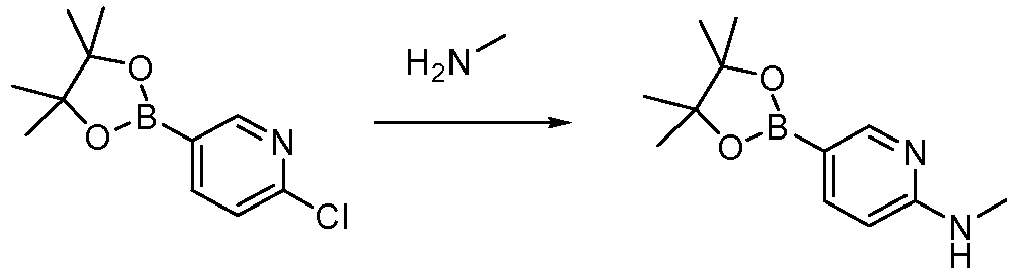
- A mixture of 2-chloro-5-(4,4,5,5-tetramethyl-1,3,2-dioxaborolan-2-yl)pyridine (200 mg, 0.84 mmol), methanamine (277 mg, 8.4 mmol), and DIPEA (0.35 mL, 2.01 mmol) in dioxane (5 mL) was stirred at room temperature for 16 hours. It was then concentrated under reduced pressure, and the residue was treated in EtOAc. The insoluble solid was removed by filtration, and the organic solution was concentrated under reduced pressure to give the title compound.
-

- The title compound was prepared according to the procedures of intermediate 8 except using 2-chloro-5-(4,4,5,5-tetramethyl-1,3,2-dioxaborolan-2-yl)pyridine and dimethyl amine.
-

- A mixture of 4-(4,4,5,5-tetramethyl-1,3,2-dioxaborolan-2-yl)benzenamine (100 mg, 0.45 mmol) and bromoethane (200 mg, 1.8 mmol), NaH (100 mg, 1.8 mmol) in THF was stirred at room temperature overnight, and concentrated in vacuo to give the crude title compound used for the next step. MS (m/z): 276 (M+H)+.
-

- A mixture of 4-(4,4,5,5-tetramethyl-1,3,2-dioxaborolan-2-yl)-1H-pyrazole (200 mg, 1.03 mmol),1-bromo-2-methoxyethane (280 mg, 2.01 mmol), and NaH (200 mg, 4 mmol) in THF (15 mL) was stirred at reflux for 24 hours, cooled to the ambient temperature, and concentrated in vacuo. The residue was treated with HCl(aq) and extracted with EtOAc. The insoluble solid was removed by filtration, and the organic solution was concentrated to give the title compound. MS (m/z): 253 (M+H)+.
-

- A solution of 2,5-dibromopyridine (10 g, 42.3 mmol) in aqueous dimethylamine (50 mL) was refluxed overnight. The volatiles were removed in vacuo, and the residue was treated with EtOAc/PE. The precipitates were collected by filtration and dried to give the title compound. MS (m/z): 201 (M+H)+, 203 (M+H)+.
- A solution of 5-bromo-N,N-dimethylpyridin-2-amine (500 mg, 2.5 mmol) in THF (10 mL) was treated with n-BuLi (1.2 mL, 3 mmol) at -72 °C for 2 hours. Triisopropyl borate (705 mg, 3.75 mmol) was then added dropwise. After the completion of the addition, the mixture was stirred at -72 °C for an additional 1 hour and slowly warmed up and stirred at the ambient temperature overnight. MeOH was carefully added, and the volatiles were removed under reduced pressure to give the title compound. MS (m/z): 167 (M+H)+.
-

- The title compound was prepared according to the procedures of intermediate 12 using the corresponding reagents under appropriate conditions that will be recognized by one skilled in the art. MS (m/z): 193 (M+H)+.
-

- A solution of 3-(4,4,5,5-tetramethyl-1,3,2-dioxaborolan-2-yl)benzenamine (164 mg, 0.75 mmol), 1-bromo-2-(2-bromoethoxy)ethane (418 mg, 1.8 mmol), and DIPEA (0.64 mL, 3.6 mmol) in THF (2 mL) was stirred at reflux overnight. The mixture was concentrated, diluted with water, and extracted with EtOAc. The combined extracts were dried over Na2SO4, filtered, and concentrated. The residue was purified by preparative thin-layer chromatography to give the title compound. MS (m/z): 290 (M+H)+.
-

- A mixture of 3-(4,4,5,5-tetramethyl-1,3,2-dioxaborolan-2-yl)phenol (220 mg, 1.0 mmol), 2-chloro-N-methylacetamide (129 mg, 1.2 mmol), and K2CO3 (207 mg, 1.5 mmol) in DMF (1.5 mL) was stirred at 80 °C overnight. The mixture was poured into water and extracted with EtOAc. The combined extracts were dried over Na2SO4, filtered, and concentrated. The residue was purified by chromatography to give the title compound in the yield of 72%. MS (m/z): 292 (M+H)+.
-

- The title compound was prepared according to the procedures of intermediate 15 using the corresponding reagents under appropriate conditions that will be recognized by one skilled in the art. MS (m/z): 292 (M+H)+.
-

- The title compound was prepared according to the procedures of Intermediate 15 using the corresponding reagents under appropriate conditions that will be recognized by one skilled in the art. MS (m/z): 364 (M+H)+.
-
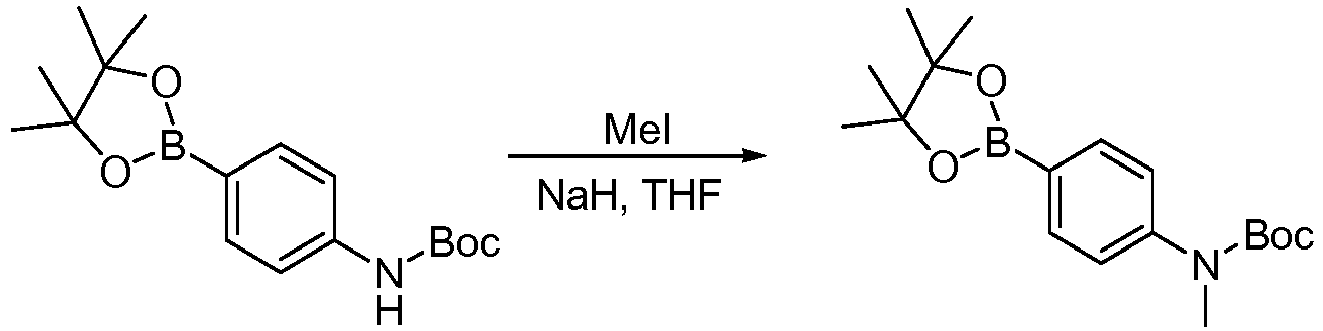
- Under N2, to a solution of tert-butyl 4-(4,4,5,5-tetramethyl-1,3,2-dioxaborolan-2-yl)phenylcarbamate (500 mg, 1.57 mmol) in anhydrous THF(4 mL), was slowly added sodium hydride (94 mg, 2.35 mmol) at 0 °C. The mixture was stirred at room temperature for 20 minutes, then cooled to 0 °C. CH3I (445 mg, 3.13 mmol) was slowly added. After the completion of the addition, the reaction mixture was stirred at room temperature overnight, quenched with H2O, and extracted with EtOAc. The combined extracts were concentrated, and the residue was purified by flash chromatography to give the title compound. MS (m/z): 278 (M-56)+.
-

- Under N2, to a solution of 1-(4-bromophenyl)pyrrolidin-2-one (300 mg, 1.25 mmol) and 4,4,5,5-tetramethyl-2-(4,4,5,5-tetramethyl-1,3,2-dioxaborolan-2-yl)-1,3,2-dioxaborolane (381 mg, 1.50 mmol) in dioxane/H2O (10:1, 5 mL), was added Pd(dppf)Cl2•CH2Cl2 complex (102 mg, 0.125 mmol) and cesium carbonate (489 mg, 1.5 mmol). The reaction mixture was stirred at reflux for 24 hours. It was then concentrated, and the residue was purified by chromatography to give the title compound in 86% yield. MS (m/z): 288 (M+H)+.
-

- The title compound was prepared according to the procedures of Intermediate 18 using tert-butyl 2-fluoro-4-(4,4,5,5-tetramethyl-1,3,2-dioxaborolan-2-yl)phenylcarbamate. MS(m/z): 296 (M-56)+.
-

- The mixture of 2-fluoro-4-(4,4,5,5-tetramethyl-1,3,2-dioxaborolan-2-yl)aniline (474 mg, 2 mmol), K2CO3 (828 mg, 6 mmol), and Mel (710 mg, 5 mmol) in DMF (10 mL), was stirred at 100 °C overnight. Then it was cooled and extracted by EA/H2O, the organic layer was combined, washed by brine, dried over anhydrous Na2SO4, and concentrated to give the crude compound in 93% yield. MS (m/z):266 (M+H)+.
-

- A mixture of 1-bromo-4-(difluoromethoxy)benzene (230 mg, 1.05 mmol), 4,4,4',4',5,5,5',5'-octamethyl-2,2'-bi(1,3,2-dioxaborolane) (402 mg, 1.58 mmol), PdCl2 (dppf) (20 mg), and Cs2CO3 (682 mg, 2.1 mmol) in dioxane was sealed in a microwave reaction cube and reacted at 180 °C for 2 hours in a microwave reactor. Then it was purified by flash column chromatography (PE/EA) to give the crude compound.
-
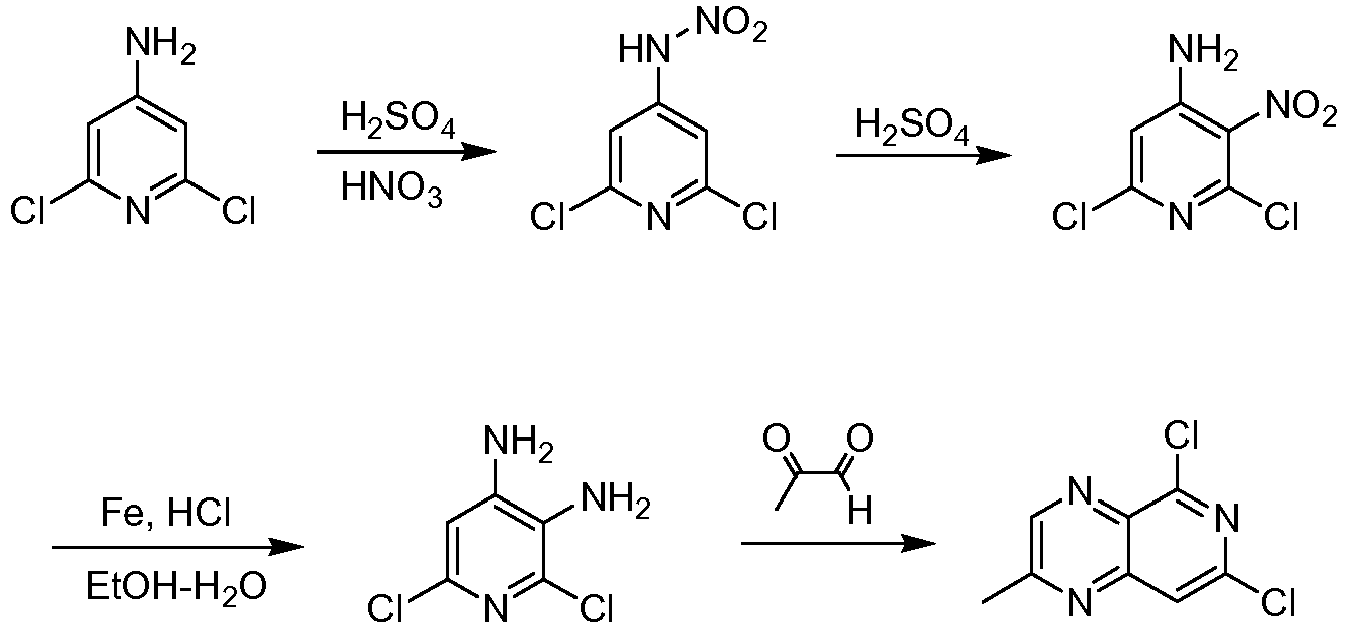
- The title compound was prepared according to the procedures of Intermediate 1.
- The title compound was prepared according to the procedure of reference (HETEROCYCLES, Vol. 60, No. 4, 2003, pp. 925 - 932) using the corresponding reagents under appropriate conditions that can be recognized by one skilled in the art. MS (m/z): 214 (M+H)+, 216 (M+H)+.
-

- To a solution of 1-tert-butyl 3-methyl 5-hydroxypiperidine-1,3-dicarboxylate (4.00 g, 15.4 mmol) in dichloromethane (40 mL) was subsequently added imidazole (1.26 g, 18.5 mmol), DMAP (0.38 g, 3.1 mmol), and TBDMS-Cl (2.79 g, 18.5 mmol). The reaction was stirred at room temperature for 40 h. The mixture was washed with HCl solution (1 N), saturated sodium bicarbonate, and brine sequentially and dried over anhydrous sodium sulfate, filtrated, and concentrated to give the title compound. MS (m/z): 274 (M-Boc+H)+.
- A solution of 1-tert-butyl 3-methyl 5-(tert-butyldimethylsilyloxy)piperidine-1,3-dicarboxylate from step A in THF (100 mL) was treated with LiBH4 (0.84 g, 38.5 mmol) at 0 °C stirring for 2 hours, warmed to room temperature, and then treated with citric acid (1 M) till pH= 4. The volatiles were removed in vacuo, and the residue was dissolved in ethyl acetate, washed with water and brine, dried over anhydrous sodium sulfate, filtered, and concentrated to give the title compound. MS (m/z): 246 (M-Boc+H)+.
- To a solution of tert-butyl 3-(tert-butyldimethylsilyloxy)-5-(hydroxymethyl)piperidine-1-carboxylate from step B in dichloromethane (50 mL) was added triethylamine (4.67 g, 46.2 mmol) and methanesulfonyl chloride (2.65 g, 23.1 mmol) at 0 °C. The reaction mixture was stirred at room temperature for 1.5 hours, then diluted with diethyl ether, washed with saturated sodium bicarbonate solution and brine, dried over anhydrous sodium sulfate, filtered, and concentrated in vacuo. The crude residue was dissolved in NMP. Sodium azide (3.00 g, 46.2 mmol) was added, and the resulting suspension was stirred at 80 °C overnight. The reaction mixture was diluted with EtOAc/hexane, washed with brine, then dried over anhydrous sodium sulfate, filtered, and concentrated to give the title compound. MS (m/z): 271 (M-Boc+H)+.
- A solution of tert-butyl 3-(tert-butyldimethylsilyloxy)-5-((methylsulfonyloxy)methyl) piperidine-1-carboxylate from step C in EtOAc was hydrogenated under hydrogen atmosphere with 10% Pd/C (500 mg) overnight. The catalyst was removed by filtration, and the filtrate was concentrated under reduced pressure to give the title compound. MS (m/z): 345 (M+H)+.
- A solution of tert-butyl 3-(aminomethyl)-5-(tert-butyldimethylsilyloxy)piperidine-1-carboxylate (4.74 g, 13.7 mmol), 5,7-dichloropyrido[4,3-b]pyrazine (2.75 g, 13.7 mmol) and DIPEA (2.12 g, 16.4 mmol) in THF (20 mL) was stirred at room temperature for 48 hours. The volatiles were removed under reduced pressure and the residue was treated with ethyl acetate, washed with brine, dried over Na2SO4, filtered, and concentrated to give the title compound.
- A solution of tert-butyl 3-(tert-butyldimethylsilyloxy)-5-((7-chloropyrido[4,3-b]pyrazin-5-ylamino)methyl)piperidine-1-carboxylate from step E in THF (16 mL) was treated with TBAF (5.17 g, 16.4 mmol) at room temperature for 2 hours, then diluted with ethyl acetate, washed with brine, dried over Na2SO4, filtered, and concentrated. The residue was purified by chromatography to give the title compound. MS (m/z): 394 (M+H)+.
-

- To a solution of tert-butyl 3-((7-chloropyrido[4,3-b]pyrazin-5-ylamino)methyl)-5-hydroxypiperidine-1-carboxylate (1.97 g, 5.0 mmol) in dichloromethane was added DAST (4.03 g, 25 mmol). The reaction mixture was stirred at room temperature for 2 hours, then diluted with ethyl acetate, washed with brine, dried over anhydrous sodium sulfate, filtered, and concentrated in vacuo. The crude residue was purified by chromatography to give the title compound. MS (m/z): 396 (M+H)+.
-

- To a solution of tert-butyl 3-((7-chloropyrido[4,3-b]pyrazin-5-ylamino)methyl)-5-hydroxypiperidine-1-carboxylate (1.97 g, 5.0 mmol) in dichloromethane was added Dess-Martin periodinane (2.54 g, 6.0 mmol) at room temperature. The reaction mixture was stirred at room temperature overnight, then diluted with ethyl acetate, washed with brine, dried over anhydrous sodium sulfate, filtered, and concentrated in vacuo to give the title compound.
- To a solution of tert-butyl 3-((7-chloropyrido[4,3-b]pyrazin-5-ylamino)methyl)-5-oxopiperidine-1-carboxylate from step A in dichloromethane was added DAST (8.06 g, 50 mmol). The reaction mixture was stirred at room temperature for 2 hours, then was diluted with ethyl acetate, washed with brine, then dried over anhydrous sodium sulfate, filtered, and concentrated in vacuo. The crude residue was purified by chromatography to give the title compound (866 mg), MS (m/z): 414 (M+H)+.
-

- The title compound was obtained by the chromatographic purification of the crude residue from the reaction of Intermediate 26 (B) (214 mg), MS (m/z): 394 (M+H)+.
-

- To a solution of (R)-tert-butyl 3-aminopyrrolidine-1-carboxylate (180 mg, 1 mmol) in dichloromethane was added TMS-NCO (1g, 8.7 mmol) and DIPEA (1.2 g, 10 mmol). The mixture was stirred at room temperature overnight, then was concentrated in vacuo. The residue was treated with EtOAc/H2O, the organic layer was combined, washed with brine, dried over anhydrous sodium sulfate, filtered, and concentrated to give the crude title compound.
- (R)-tert-butyl 3-ureidopyrrolidine-1-carboxylate from step A was treated with HCl solution (in EtOAc, 30 mL) for 2 hours. The mixture was concentrated in vacuo to give the crude title compound. MS (m/z): 130 (M+H)+.
-

- A mixture of methyl 4-hydroxypiperidine-3-carboxylate (3.18 g, 20 mmol), aqueous sodium hydrogen carbonate (30 mL, 1 M), di-tert-butyl dicarbonate (4.37 g, 20 mmol) and dichloromethane (30 mL) was stirred for 15 hours. The phases were separated and dichloromethane phase was dried over anhydrous sodium sulfate and filtrated. The filtrate was diluted to 200 mL. To the resulted solution was added imidazole (1.64 g, 24 mmol), DMAP (0.488 g, 4 mmol), and TBDMSCI (3.62 g, 24 mmol) sequentially. The reaction mixture was stirred at room temperature for 40 hours. The mixture was washed with 1 N HCl solution, NaHCO3 solution and brine sequentially and dried over anhydrous sodium sulfate. Filtration and concentration gave the crude compound which was used directly in the next step. MS (m/z): 274 (M-Boc+H)+.
- A solution of 1-tert-butyl 3-methyl 4-(tert-butyldimethylsilyloxy)piperidine-1,3-dicarboxylate from step A in THF (100 mL) was cooled at 0 °C and then LiBH4 (1.10 g, 50 mmol) was added in. After stirring for 2 hours as the solution was warmed to room temperature, the pH value was adjusted to 4 with 1 M citric acid. After removal of the volatiles in vacuo, the product was extracted in ethyl acetate, washed with water and brine, dried over anhydrous sodium sulfate. Upon filtering and removal of the volatiles in vacuo, tert-butyl 4-(tert-butyldimethylsilyloxy)-3-(hydroxymethyl)piperidine-1-carboxylate was obtained (8.82 g, 100% yield), which was used directly in the next step. MS (m/z): 246 (M-Boc+H)+.
- To a solution of tert-butyl 4-(tert-butyldimethylsilyloxy)-3-(hydroxymethyl)piperidine-1-carboxylate from step B in dichloromethane (50 mL) was added triethylamine (6.06 g, 60 mmol) and methanesulfonyl chloride (3.43 g, 30 mmol) at 0 °C. The reaction mixture was allowed to stir at room temperature for 1.5 hours. The crude mixture was diluted with diethyl ether, washed with sat. aq. sodium bicarbonate, brine, then dried over anhydrous sodium sulfate, filtered, and concentrated in vacuo. The crude residue was dissolved in NMP (30 mL). Sodium azide (3.90 g, 60 mmol) was added in and the resulting suspension was stirred at 80 °C overnight. The reaction mixture was diluted with EtOAc and hexanes, washed with water, brine, then dried over anhydrous sodium sulfate, filtered, concerntrated to give the crude compound. MS (m/z): 271 (M-Boc+H)+.
- The solution of tert-butyl 3-(azidomethyl)-4-(tert-butyldimethylsilyloxy)piperidine-1-carboxylate in ethyl acetate from step C was hydrogenated under hydrogen atmosphere with 10% Pd/C (500 mg) overnight. The catalyst was filtered and the filtrate was concentrated under reduced pressure to give the title compound (6.2 g, 90% yield). MS (m/z): 345 (M+H)+.
- 5,7-dichloropyrido[4,3-b]pyrazine (3.6 g, 18 mmol) and DIPEA (2.8 g, 21.6 mmol) was added to a solution of tert-butyl tert-butyl 3-(aminomethyl)-4-(tert-butyldimethylsilyloxy)piperidine-1-carboxylate (6.2 g, 18 mmol) in THF (20 mL) and the mixture was refluxed overnight. The volatile components were evaporated and the residue was extracted with ethyl acetate. Ethyl acetate was washed with brine and dried. The solvent was removed and the residue was re-dissolved in THF (16 mL) and TBAF was added in. The reaction mixture was stirred at room temperature for 2 hours. The mixture was diluted with ethyl acetate, washed with brine, then dried, filtered, and concentrated in vacuo. The crude residue was purified by flash chromatography to give the title compound (3.35 g, 47% yield). MS (m/z): 394 (M+H)+.
- To a solution of tert-butyl 3-((7-chloropyrido[4,3-b]pyrazin-5-ylamino)methyl)-5-hydroxypiperidine-1-carboxylate (3.35 g, 8.5 mmol) in dichloromethane (50 mL) was added Dess-Martin periodinane (4.33 g, 10.2 mmol) at room temperature. The reaction mixture was stirred at that temperature overnight. The mixture was diluted with ethyl acetate, washed with brine, then dried over anhydrous sodium sulfate, filtered, and concentrated in vacuo. The residue was used directly in the next step. MS (m/z): 392 (M+H)+.
- To a solution of tert-butyl 3-((7-chloropyrido[4,3-b]pyrazin-5-ylamino)methyl)-4-oxopiperidine-1-carboxylate from step F in dichloromethane (30 mL) was added DAST (13.7 g, 85 mmol). The reaction mixture was stirred at room temperature for 2 hours. The mixture was diluted with ethyl acetate, washed with brine, then dried over anhydrous sodium sulfate, filtered, and concentrated in vacuo. The crude residue was purified by flash chromatography (ethyl acetate/petro ether) to give the title compound (497 mg, 14% yield). MS (m/z): 414 (M+H)+.
-

- The racemic intermediate 29 was resolved by chiral HPLC to provide the optically pure enantiomers Intermediate 30 and 31 (HPLC conditions: column: CHIRALCEL AD-H 0.46 x 15 cm; mobile phase: CO2/MeOH =85/15; flow rate = 2 mL/min; detector: UV 254 nm). The first eluent (intermediate 30, Rf=6.79 min) was 98% ee, MS (m/z): 414 (M+H)+. and the second eluent (intermediate 31, Rf=7.06 min) was 98.7% ee, MS (m/z): 414 (M+H)+.
-

- tetrahydro-2H-pyran-4-ol (850 mg, 8.32 mmol) was dissolved in DMF (10 mL), cooled to 0 °C, NaH (500 mg, 10.4 mmol) was added and stirred for 45 minutes at room temperature, then 5-bromo-2-chloropyridine (2 g, 10.4 mmol) was added and the mixture was stirred overnight at 60 °C. The mixture was poured into water, extracted by EA, the organic layer was washed by brine, dried over Na2SO4, concentrated and purified by flash chromatography, gave 1.7 g white solid. MS: (m/z):258 (M-H)+, 260 (M+H)+
- 5-bromo-2-(tetrahydro-2H-pyran-4-yloxy)pyridine (500 mg, 1.93 mmol) and 4,4,4',4',5,5,5',5'-octamethyl-2,2'-bi(1,3,2-dioxaborolane) (600 mg, 2.32 mmol) were dissolved in dioxane (100 mL), Cs2CO3 (941 mg, 2.90 mmol) and dppf(PdCl2) (10 mg) were added in, then the mixture was charged with N2, stirred at 80 °C overnight. The solvent was removed in vacuum and the residue was used directly in the next step. MS (m/z): 306 (M+H)+
-

- The title compound was prepared according to the procedures of Intermediate 32 using 5-bromo-2-chloropyridine.
MS (m/z): 238 (M+H)+ -

- The title compound was prepared according to the procedures of Intermediate 32 using 5-bromo-2-chloropyridine.
-

- To a solution of 2-chloro-5-(4,4,5,5-tetramethyl-1,3,2-dioxaborolan-2-yl)pyridine (239 mg, 1 mmol) in NMP (2 mL) was added pyrrolidin-3-ol (174 mg, 2 mmol) and DIPEA (500 uL, 3 mmol) , then the mixture was sealed in a microwave tube and heated in microwave reactor at 180 °C for 1.5 hours. TLC and LC-Ms showed the reaction had completed and the desired compound was detected. The reaction mixture was poured into 30 mL of H2O, and extracted with n-BuOH, washed with water and brine, concentrated and purified on TLC (CH2Cl2:MeOH=10:1) to give a white solid. MS (m/z): 209 (M+H)+
-

- The title compound was prepared according to the procedures of Intermediate 35 using 2-chloro-5-(4,4,5,5-tetramethyl-1,3,2-dioxaborolan-2-yl)pyridine. MS (m/z): 248 (M+H)+
-

- The title compound was prepared according to the procedures of Intermediate 35 using 2-chloro-5-(4,4,5,5-tetramethyl-1,3,2-dioxaborolan-2-yl)pyridine. MS (m/z): 237 (M+H)+
-

- To a solution of N-methyltetrahydro-2H-pyran-4-amine (172.5 mg, 1.5 mmol) in CH3CN (5 mL) was added K2CO3 (207 mg, 1.5 mmol) and 2-bromo-5-nitropyridine (203 mg, 1 mmol). The reaction was stirred at 80 °C for 16 hours. TLC and LC-Ms showed the reaction had completed and the reaction was poured into water, extracted with EA, washed with water and brine, dried and concentrated to give a yellow solid. MS (m/z): 238 (M+H)+
- To a solution of N-methyl-5-nitro-N-(tetrahydro-2H-pyran-4-yl)pyridin-2-amine (217 mg, 0.92 mmol) in MeOH (30 mL) was added Pd/C (0.5 g). The mixture was stirred for 3 hours at 20 °C under 1 atm. H2. The reaction was filtered and concentrated to give dark red oil. MS (m/z): 208 (M+H)+
- To a solution of N2 -methyl-N2 -(tetrahydro-2H-pyran-4-yl)pyridine-2,5-diamine (150 mg, 0.73 mmol) in 2 mL of aq HBr was added a solution of NaNO2 (55 mg, 0.80 mmol) in 1 mL of H2O at 0 °C. Then the mixture was stirred at 0 °C for 40 minutes. After that, the mixture was poured into a solution of CuBr (220 mg, 1.53 mmol) in 2 mL aq HBr at 0 °C, the reaction was heated to 60 °C and stirred for 2 hours. After cooling, the mixture was based with 2M NaOH to pH = 8∼9 and extracted with EA, washed with H2O and brine, dried and concentrated, purified on TLC (EA:PE=1:1) to give white solid. MS (m/z): 273 (M+H)+
- To a solution of 5-bromo-N-methyl-N-(tetrahydro-2H-pyran-4-yl)pyridin-2-amine (125 mg, 0.46 mmol) in dioxane (5 mL) was added KOAc (135 mg, 1.38 mmol), Pd Cl2(dppf) (50.5 mg, 0.069 mmol) and 4,4,4',4',5,5,5',5'-octamethyl-2,2'-bi(1,3,2-dioxaborolane) (234 mg, 0.92 mmol). The mixture was stirred at 80 °C overnight. The reaction was filtered and concentrated to give crude product. The crude product was purified on TLC (EA:PE=1:1) to give white solid. MS (m/z): 319 (M+H)+
-

- To a solution of 1-chloro-2-methylpropan-2-ol (434.4 mg, 4 mmol) in DMF (10 mL) was added K2CO3 (552 mg, 4 mmol) and 4-bromophenol (346 mg, 2 mmol), the reaction was stirred at 140 °C for 48 hours. About of 10% 4-bromophenol was remained and the reaction was poured into 30 mL of water, extracted with EA (20 mL X 3), washed with 30 mL of water and brine, concentrated and purified on TLC (EA:PE=1:3) to give yellow solid. MS (m/z): 196 (M-50)+
- To a solution of 1-(4-bromophenoxy)-2-methylpropan-2-ol (437 mg, 1.78 mmol) in dioxane (15 mL) was added KOAc (526 mg, 5.35 mmol), PdCl2(dppf) (196 mg, 0.27 mmol) and 4,4,4',4',5,5,5',5'-octamethyl-2,2'-bi(1,3,2-dioxaborolane) (906 mg, 3.57 mmol). The mixture was stirred at 100 °C overnight. The reaction was filtered and concentrated to give crude product. The crude product was purified on TLC (EA:PE=1:4) to give white solid. MS (m/z): 292 (M)+
-

- To a solution of N-(piperidin-4-yl)acetamide (341 mg, 2.4 mmol) in DMF (15 mL) was added K2CO3 (331 mg, 2.4 mmol) and 1-fluoro-4-nitrobenzene (282 mg, 2 mmol) at room temperature. The reaction was stirred at 80 °C for 24 hours. After that, the reaction was poured into 50 mL of water and extracted with EA (3 X 25 mL), washed with H2O (25 mL) and brine (25 mL), dried over Na2SO4 and concentrated to give yellow solid. MS (m/z): 264 (M+H)+
- To a solution of N-(1-(4-nitrophenyl)piperidin-4-yl)acetamide (568 mg, 2 mmol) in THF (15 mL) was added NaH (60%, 200 mg, 5 mmol) at room temperature. The reaction was stirred at 20 °C for 15 minutes. After that, iodomethane (300 mg, 4 mmol) was dropped into the reaction and stirred at 60 °C for 18 hours. The reaction was treated with sat. NH4Cl solution and extracted with n-BuOH, washed with brine, dried over Na2SO4 and concentrated to give yellow solid. MS (m/z): 278 (M+H)+
- To a solution of N-methyl-N-(1-(4-nitrophenyl)piperidin-4-yl)acetamide (2 mmol) in MeOH (30 mL) was added Pd/C (0.5 g), then the mixture was stirred for 4 hours at 20 °C under 1 atm. H2. The reaction was filtered and concentrated to give gray yellow oil. MS (m/z): 248 (M+H)+
- To a solution of N-(1-(4-aminophenyl)piperidin-4-yl)-N-methylacetamide (479.7 mg, 1.94 mmol) in 6 mL of aq HBr was added a solution of NaNO2 (147 mg, 2.13 mmol) in 2 mL of H2O at 0 °C, then the mixture was stirred at 0 °C for 40 minutes. After that, the mixture was poured into a solution of CuBr (584 mg, 4.07 mmol) in 6 mL aq HBr at 0 °C, the reaction was heated to 60 °C and stirred for 2 hours. After cooling, the mixture was based with 2M NaOH to pH= 8∼9 and extracted with EA, washed with H2O and brine, dried and concentrated to give black solid. MS (m/z): 313 (M+H)+
- To a solution of N-(1-(4-bromophenyl)piperidin-4-yl)-N-methylacetamide (∼40%, 160 mg, 0.63 mmol) in dioxane (15 mL) was added KOAc (185 mg, 1.89 mmol), PdCl2(dppf) (69 mg, 0.095 mmol) and 4,4,4',4',5,5,5',5'-octamethyl -2,2'-bi(1,3,2-dioxaborolane) (320 mg, 1.26 mmol). The mixture was stirred at 110 °C overnight. The reaction was filtered and concentrated to give crude product. The crude product was purified on TLC (CH2Cl2:MeOH= 50:1) to give white solid. MS (m/z): 359 (M+H)+
-

- To a solution of tert-butyl piperazine-1-carboxylate (1120 mg, 6 mmol) in DMF (25 mL) was added K2CO3 (828 mg, 6 mmol) and 1,2-difluoro-4-nitrobenzene (795 mg, 5 mmol) at room temperature. The reaction was stirred at 80 °C for 24 hours. After that, the reaction was poured into 50 mL of water and extracted with EA (3 X 25 mL), washed with H2O (25 mL) and brine (25 mL), dried over Na2SO4 and concentrated to give yellow solid. MS (m/z): 226 (M-99)+
- To a solution of tert-butyl 4-(2-fluoro-4-nitrophenyl)piperazine-1-carboxylate (5 mmol) in MeOH (30 mL) was added Pd/C (1 g), then the mixture was stirred for 18 hours at 20 °C under 1 atm. H2. The reaction was filtered and concentrated to give gray yellow oil. MS (m/z): 296 (M+H)+
- To a solution of tert-butyl 4-(4-amino-2-fluorophenyl)piperazine-1-carboxylate (885 mg, 3 mmol) in 8 mL of aq HBr was added a solution of NaNO2 (228 mg, 3.3 mmol) in 2 mL of H2O at 0 °C, then the mixture was stirred at 0 °C for 40 minutes. After that, the mixture was poured into a solution of CuBr (905 mg, 6.3 mmol) in 8 mL aq HBr at 0 °C. The reaction was heated to 60 °C and stirred for 2 hours. After cooling, the mixture was based with 2M NaOH to pH= 8∼9 and extracted with EA, washed with H2O and brine, dried and concentrated to give black solid. MS (m/z): 261 (M+H)+
- To a solution of 1-(4-bromo-2-fluorophenyl)piperazine (309 mg, 1.2 mmol) in dioxane (15 mL) was added KOAc (353 mg, 3.6 mmol), PdCl2(dppf) (132 mg, 0.18 mmol) and 4,4,4',4',5,5,5',5'-octamethyl-2,2'-bi(1,3,2-dioxaborolane) (610 mg, 2.4 mmol). The mixture was stirred at 80 °C overnight. The reaction was filtered and concentrated to give crude product. The crude product was purified on TLC (CH2Cl2:MeOH= 20:1) to give black solid. MS (m/z): 307 (M+H)+
-

- To a mixture of 1-fluoro-4-nitrobenzene (5.64 g, 40.0 mmol) and potassium carbonate (11.1 g, 80.0 mmol) in DMSO (30 mL) was added 2-methylmorpholine (4.05 g, 40.0 mmol), then the mixture was heated at 100 °C for 4 hours. This solution was poured on to water (300 mL) and extracted with EA (3 X 100 mL). The combined organic phase was washed with brine and dried. Filtered and Pd/C (1.0 g) was added to the filtrate, charged with H2, and stirred at room temperature overnight. The catalyst was filtered and the filtrate was concentrated to give product as a light red solid. MS (m/z): 193 (M+H)+.
- To a solution of 4-(2-methylmorpholino)aniline (7.21 g, 37.5 mmol) in 100 mL HBr in water (40%), a solution of NaNO2 (2.59 g, 37.5 mmol) in 15 mL water was added slowly at -10 °C∼0 °C. The mixture was stirred for 30 minutes and was added dropwise to a solution of CuBr (2.96 g, 20.6 mmol) in 30 mL HBr in water (40%). The resulting mixtrure was stirred and heated at 60 °C for 2 hours. Then the reaction solution was adjusted by 2N NaOH solution to pH> 7. Extracted by EA, the combined organic phase was washed with brine, dried and concentrated to give crude product as black oil. MS (m/z): 256 (M+H)+; 258 (M+3)+.
- A solution of 4-(4-bromophenyl)-2-methylmorpholine (8.0 g, <31 mmol), 4,4,4',4',5,5,5',5'-octamethyl-2,2'-bi(1,3,2-dioxaborolane) (10.3 g, 40.6 mmol), [1,1'-Bis(diphenylphosphino)ferrocene]palladium(II) chloride (2.26 g, 3.1 mmol) and potassium acetate (4.6 g, 46.5 mmol) in DMSO (80 mmol) was heated at 70 °C under N2 for 4 hours. After cooling the reaction was partitioned at EA and water. The combined organic phase was dried and concentrated. Purification over silica gel chromatography, eluting with EA/PE= 5/1, to give product as a light yellow solid. MS (m/z): 304 (M+H)+.
-

- The title compound was prepared according to the procedures of Intermediate 42 using 1,2-difluoro-4-nitrobenzene. MS (m/z): 322 (M+H)+.
-

- The title compound was prepared according to the procedures of Intermediate 42 using 1,2-difluoro-4-nitrobenzene. MS (m/z): 349 (M+H)+.
-

- The title compound was prepared according to the procedures of Intermediate 42 using 1,2-difluoro-4-nitrobenzene. MS (m/z): 399 (M+H)+.
-

- The title compound was prepared according to the procedures of Intermediate 42 using 1,2-difluoro-4-nitrobenzene. MS (m/z): 336 (M+H)+.
-

- The title compound was prepared according to the procedures of Intermediate 42 using 1-fluoro-4-nitrobenzene. MS (m/z): 271 (M+H)+.
-
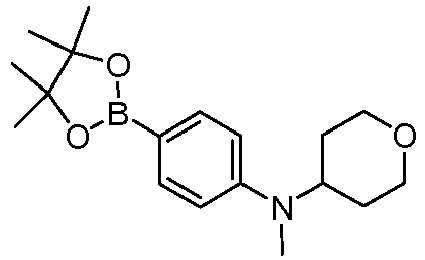
- The title compound was prepared according to the procedures of Intermediate 42 using 1-fluoro-4-nitrobenzene. MS (m/z): 318 (M+H)+.
-

- The title compound was prepared according to the procedures of Intermediate 42 using 1,2-difluoro-4-nitrobenzene.
-

- To a solution of 4-bromobenzene-1-sulfonyl chloride (2.56 g, 10.0 mmol) and triethylamine (1.82 mL, 13 mmol) in DCM (50 mL) was added morpholine (960 mg, 11.0 mmol) dropwise and the mixture was stirred for 30 minutes at room temperature. Then the mixture was concentrated and extracted with EA, washed with 0.1 M HCl water solution (2 X 100 mL), NaHCO3 solution (2 X 100 mL) and brine, dried and concentrated to give product as a white solid.
- (20 mL) was added 4,4,4',4',5,5,5',5'-octamethyl-2,2'-bi(1,3,2-dioxaborolane) (3.3 g, 13.0 mmol), [1,1'-Bis(diphenylphosphino)ferrocene]palladium(II) chloride (730 mg, 1.0 mmol) and potassium acetate (1.47 g, 15 mmol). Then the mixture was heated to 70 °C for 4 hours. After cooling the mixture was extracted with EA, wash with brine, dried and purified by silica gel chromatography, eluting with PE/EA=1/1 to give product as a yellow solid. MS (m/z): 354 (M+H)+.
-

- The title compound was prepared according to the procedures of Intermediate 50 using 4-bromobenzene-1-sulfonyl chloride. MS (m/z): 298 (M+H)+.
-

- A solution of tert-butyl 4-(4-(4,4,5,5-tetramethyl-1,3,2-dioxaborolan-2-yl)phenyl)piperazine-1-carboxylate (5.0 g, 12.9 mmol) in 5N HCl in EA (30 mL) was stirred at room temperature overnight, then concentrated to give product as a off-white solid, which was used for next step directly.
- To a solution of 1-(4-(4, 4, 5, 5-tetramethyl-1, 3, 2-dioxaborolan-2-yl)phenyl)piperazine hydrochloride (500 mg, 1.54 mmol) and potassium carbonate (430 mg, 3.1 mmol) in acetonitrile (20 mL) was added 2-bromoethanol (388 mg, 3.1 mmol), then the mixture was heated at 60 °C overnight under an atmosphere of nitrogen. Then the mixture was filtered over celite and washed with DCM, concentrated to give poduct as a light brown solid. MS (m/z): 333 (M+H)+.
-

- The title compound was prepared according to the procedures of Intermediate 52 using 4-(4,4,5,5-tetramethyl-1,3,2-dioxaborolan-2-yl)-1H-pyrazole. MS (m/z): 239 (M+H)+.
-

- A solution of tert-butyl 4-(4-(4,4,5,5-tetramethyl-1,3,2-dioxaborolan-2-yl)phenyl)piperazine-1-carboxylate (500 mg, 1.29 mmol) in 5N HCl in EA (20 mL) was stirred at room temperature for 2 hours, then concentrated to give curde product as a white solid.
- To a solution of 1-(4-(4, 4, 5, 5-tetramethyl-1, 3, 2-dioxaborolan-2-yl)phenyl) piperazine hydrochloride (419 mg, 1.29 mmol) and cesiumcarbonate (1.27g, 3.9 mmol) in THF (30 mL) was added acetyl chloride (0.5 mL, 6.5 mmol). Then the mixture was stirred at room temperature overnight, extraced with EA , washed with NaHCO3 solution and brine. The organic solution was concentrated and purified by flash column chromatography, eluting with PE/EA, to give product as a white solid. MS (m/z): 331 (M+H)+.
-

- The title compound was prepared according to the procedures of Intermediate 54 using 1-(4-(4,4,5,5-tetramethyl-1,3,2-dioxaborolan-2-yl)phenyl)piperazine. MS (m/z): 345 (M+H)+.
-

- The title compound was prepared according to the procedures of Intermediate 54 using 1-(4-(4,4,5,5-tetramethyl-1,3,2-dioxaborolan-2-yl)phenyl)piperazine. MS (m/z): 409 (M+H)+.
-

- The title compound was prepared according to the procedures of Intermediate 54 using 1-(4-(4,4,5,5-tetramethyl-1,3,2-dioxaborolan-2-yl)phenyl)piperazine. MS (m/z): 361 (M+H)+.
-

- The title compound was prepared according to the procedures of Intermediate 54 using 1-(4-(4,4,5,5-tetramethyl-1,3,2-dioxaborolan-2-yl)phenyl)piperazine. MS (m/z): 347 (M+H)+.
-
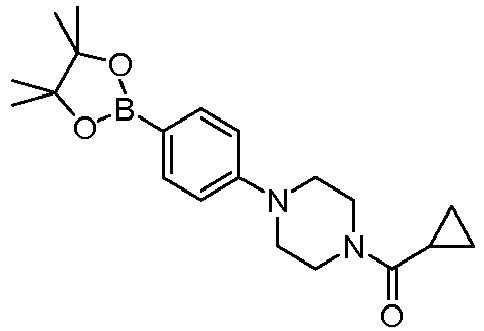
- The title compound was prepared according to the procedures of Intermediate 54 using 1-(4-(4,4,5,5-tetramethyl-1,3,2-dioxaborolan-2-yl)phenyl)piperazine. MS (m/z): 357 (M+H)+.
-

- The title compound was prepared according to the procedures of Intermediate 54 using 1-(4-(4,4,5,5-tetramethyl-1,3,2-dioxaborolan-2-yl)phenyl)piperazine. MS (m/z): 367 (M+H)+.
-

- To a solution of 4-(4-(4,4,5,5-tetramethyl-1,3,2-dioxaborolan-2-yl)-1H-pyrazol-1-yl)piperidine hydrochloride (315 mg, 1.0 mmol) and triethylamine (303 mg, 3.0 mmol) in DCM (15 mL) was added methanesulfonyl chloride (230 mg, 2.0 mmol) dropwise, the mixture was stirred at room temperature for 1 hour. Then the mixture was extracted with EA, wash with brine, dried and purified by flash column chromatography, eluting with EA/MeOH, to give product as light yellow solid. MS (m/z): 356 (M+H)+.
-

- The title compound was prepared according to the procedures of Intermediate 51 using 4-(4-(4,4,5,5-tetramethyl-1,3,2-dioxaborolan-2-yl)-1H-pyrazol-1-yl)piperidine MS (m/z): 320 (M+H)+.
-

- The title compound was prepared according to the procedures of Intermediate 35 using 2-chloro-5-(4,4,5,5-tetramethyl-1,3,2-dioxaborolan-2-yl)pyridine MS (m/z): 250 (M+H)+.
-

- The title compound was prepared according to the procedures of Intermediate 35 using 2-chloro-5-(4,4,5,5-tetramethyl-1,3,2-dioxaborolan-2-yl)pyridine
-

- The title compound was prepared according to the procedures of Intermediate 35 using 2-chloro-5-(4,4,5,5-tetramethyl-1,3,2-dioxaborolan-2-yl)pyridine
-

- To a suspension of N-(4-(4,4,5,5-tetramethyl-1,3,2-dioxaborolan-2-yl)phenyl)methanesulfonamide (0.5 g, 1.7 mmol) and potassium carbonate (0.28 g, 2.0 mmol) in acetone (10 mL) was added methyl iodide (0.12 mL, 2.0 mmol). The mixture was stirred at room temperature for 18 hours under atmosphere of nitrogen, then diluted with CH2Cl2 (20 mL), filtered through a plug of diatomaceous earth, rinsed with CH2Cl2 and evaporated to give product as a ogg-white solid. MS (m/z): 312 (M+H)+.
-

- 1-ethyl-4-(4-(4,4,5,5-tetramethyl-1,3,2-dioxaborolan-2-yl)phenyl)piperidine To a solution of 4-(4-(4,4,5,5-tetramethyl-1,3,2-dioxaborolan-2-yl)phenyl)piperidine in THF was added MeCHO (40%, 0.17 mL, 1.48 mmol) and AcOH (45 mg, 0.74 mmol), the mixture was stirred at room temperature for 20 minutes. Then the NaBH(OAc)3 (157 mg, 0.74 mmol) was added and stirred overnight. The reaction solution was poured to NaHCO3, extracted with EA, dried and concentrated to give product as white solid. MS (m/z): 316 (M+H)+.
-

- A solution of tert-butyl 4-(4-(4,4,5,5-tetramethyl-1,3,2-dioxaborolan-2-yl)-1H-pyrazol-1-yl)piperidine-1-carboxylate (8.2 g, 21.73 mmol) and 30 mL of HCl-EA (5.0 N) in 15 mL of EA was stirred at room temperature for 2 hours. The volatiles were removed in vacuo to give 7.3 g of title compound.
- A solution of 4-(4,4,5,5-tetramethyl-1,3,2-dioxaborolan-2-yl)-1H-pyrazole hydrochloride (740 mg, 2.36 mmol) and Formalin (1.0 g, 11.80 mmol) in 10 mL of DCM and 2 mL of THF, under N2, was stirred at room temperature for 1 hour. Then the NaBH(AcO)3 (1.0 g, 4.72 mmol) was added to the mixture at 0 °C. The mixture was stirred at room temperature overnight. The volatiles were removed in vacuo, and the residue was purified by chromatography with MeOH/H2O (1:20∼10:1) to give 620 mg of title compound. MS (m/z) = 292 (M+H)+.
-

- The solution of 5-bromo-2-chloropyridine (1.5 g, 7.8 mmol), 1,4-oxazepane (1.29 g, 9.36 mmol) and K2CO3 in 15 mL of NMP was stirred at 120 °C overnight. The mixture was added to 150 mL of water, washed with EA, dried over Na2SO4, and the volatiles were removed in vacuo to give 1.86 g of 4-(5-bromopyridin-2-yl)-1,4-oxazepane. MS(m/z) = 259 (M+H)+.
- A solution of 4-(5-bromopyridin-2-yl)-1,4-oxazepane (600 mg, 2.33 mmol), 4,4,5,5-tetramethyl-2-(4,4,5,5-tetramethyl-1,3,2-dioxaborolan-2-yl)-1,3,2-dioxaborolane (1.18 g, 4.67 mmol), Pd(dppf)Cl2 (286 mg, 0.35 mmol) and KOAc (687 mg, 6.99 mmol) in 30 ml of dioxane, under N2, was stirred at 110 °C for 3 hours. The volatiles were removed in vacuo, and the residue was purified by chromatography with EA/MeOH (20:1∼5:1) to give 165 mg of 6-(1,4-oxazepan-4-yl)pyridin-3-ylboronic acid. MS (m/z) = 223 (M+H)+.
-

- A solution of 1-fluoro-4-nitrobenzene (3.5 g, 24.81 mmol), methyl piperidine-4-carboxylate (4.26 g, 29.77 mmol) and K2CO3 in 40 mL of ACN, was stirred at reflux overnight. The mixture was added to 150 mL of water, extracted with EA, dried over Na2SO4. The volatiles were removed in vacuo, and the residue was purified by chromatography with PE/EA (10:1∼2:1) to give 3.84 g of methyl 1-(4-nitrophenyl)piperidine-4-carboxylate.
- A solution of methyl 1-(4-nitrophenyl)piperidine-4-carboxylate (3.84 g, 14.53 mmol) and NaOH (0.87 g, 21.79 mmol) in 15 mL of MeOH and 5 mL of water was stirred at room temperature for 3 hours. The volatiles were removed in vacuo to give 1-(4-nitrophenyl)piperidine-4-carboxylic acid.
- A solution of 1-(4-nitrophenyl)piperidine-4-carboxylic acid, (CH3)2NH (2.37 g, 29.06 mmol), HATU (11.05 g, 29.06 mmol) and DIPEA (7.51 g, 58.12 mmol) in 30 mL of THF, was stirred at room temperature overnight. The mixture was added to 20 mL of water, extracted with EA, washed with water and brine, dried over Na2SO4. The volatiles were removed in vacuo to give 4.2 g of N,N-dimethyl-1-(4-nitrophenyl)piperidine-4-carboxamide. MS (m/z) = 278 (M+H)+.
- A solution of N,N-dimethyl-1-(4-nitrophenyl)piperidine-4-carboxamide (2.5 g, 9.01 mmol) and 0.3 g of Pd/C in 20 mL of MeOH, under H2, was stirred at room temperature for 5 hours. The mixture was filtered, and the volatiles were removed in vacuo to give 1.9 g of 1-(4-aminophenyl)-N,N-dimethylpiperidine-4-carboxamide.
- A solution of 1-(4-aminophenyl)-N,N-dimethylpiperidine-4-carboxamide (4.2 g, 16.98 mmol) in 25 mL HBr in 20 mL of water was added a solution of NaNO2 (1.17 g, 16.98 mmol) in water (2 mL) slowly. The mixture was stirred at -10 °C ∼ 0 °C for 30 minutes, and added dropwise to a solution of CuBr (1.34 g, 9.34 mmol) in 12 mL HBr in water (10 mL). Then the mixture was stirred at reflux for 2 hours. The mixture was partitioned between 2N NaOH and EA, washed with EA, dried over Na2SO4. The volatiles were removed in vacuo, and the residue was purified by chromatography with PE/EA (15:1∼2:1) to give 2.5 g of 1-(4-bromophenyl)-N,N-dimethylpiperidine-4-carboxamide.
- A solution of 1-(4-bromophenyl)-N,N-dimethylpiperidine-4-carboxamide (500 mg, 1.61 mmol), 4,4,5,5-tetramethyl-2-(4,4,5,5-tetramethyl-1,3,2-dioxaborolan-2-yl)-1,3,2-dioxaborolane (916 mg, 3.21 mmol), Pd(dppf)Cl2 (177 mg, 0.24 mmol) and KOAc (475 mg, 4.83 mmol) in 20 mL of dioxane, under N2, was stirred at 110 °C overnight. The volatiles were removed in vacuo, and the residue was purified by chromatography with PE/EA (10:1∼1:4) to give 326 mg of N,N-dimethyl-1-(4-(4,4,5,5-tetramethyl-1,3,2-dioxaborolan-2-yl)phenyl)piperidine-4-carboxamide. MS (m/z) = 359 (M+H)+.
-

- A solution of 4-(tetrahydro-2H-pyran-4-yl)benzenamine (1.79 g, 10.10 mmol) in 15 mL of HBr and 5 mL of water was stirred at 0 °C for 10 minutes, then 0.77 g of NaNO2 was added to the mixture at -5 °C∼ 0 °C. The mixture was stirred at -5 °C for 30 minutes. Then the solution of CuBr in 3 mL of HBr was added to the mixture, after that the mixture was heated at 100 °C for 2 hours. The mixture was cooled to room temperature, partitioned between 2N NaOH and EA, washed with water and aqueous NaCl, dried over Na2SO4. The volatiles were removed in vacuo, and the residue was purified by chromatography with PE/EA (10:1∼4:1) to give 1.11 g of title compound.
- A solution of 4-(4-bromophenyl)-tetrahydro-2H-pyran (500 mg, 2.07 mmol), 4,4,5,5-tetramethyl-2-(4,4,5,5-tetramethyl-1,3,2-dioxaborolan-2-yl)-1,3,2-dioxaborolane (842 mg, 3.32 mmol), Pd(dppf)Cl2 (303 mg, 0.41 mmol) and KOAc (610 mg, 6.21 mmol) in 20 mL of DMSO, under N2, was stirred at 90 °C overnight. The mixture was added to 100 mL of water, extracted with EA, dried over Na2SO4, The volatiles were removed in vacuo, and the residues was purified by chromatography with PE/EA (30:1∼5:1) to give 57 mg of title compound.
-

- A solution of 4-(4-bromophenyl)piperidine (2.7 g, 11.25 mmol) and di-tert-butyl dicarbonate (2.5 g, 11.47 mmol) in 20 mL of DCM was stirred at room temperature for 2 hours. The volatiles were removed in vacuo to give 4.6 g of tert-butyl 4-(4-bromophenyl)piperidine-1-carboxylate.
- A solution of tert-butyl 4-(4-bromophenyl)piperidine-1-carboxylate (3.38 g, 11.25 mmol), 4,4,5,5-tetramethyl-2-(4,4,5,5-tetramethyl-1,3,2-dioxaborolan-2-yl)-1,3,2-dioxaborolane (4.57 g, 18 mmol), Pd(dppf)Cl2 (2.47 g, 3.38 mmol) and KOAc (3.32 g, 33.75 mmol) in 60 mL of DMSO, under N2, was stirred at 80 °C overnight. The volatiles were removed in vacuo, and the residue was purified by chromatography with PE/EA (40:1∼1:1) to give 3.81 g of title compound.
- A solution of tert-butyl 4-(4-(4,4,5,5-tetramethyl-1,3,2-dioxaborolan-2-yl)phenyl)piperidine-1-carboxylate (3.0 g, 7.75 mmol) and 10 mL of HCl-EA (5.0 N) in 20 mL of EA was stirred at room temperature for 2 hours. The volatiles were removed in vacuo to give 2.6 g of title compound. MS (m/z) = 288 (M+H)+.
-

- To tert-butyl 4-hydroxypiperidine-1-carboxylate (402 mg, 2.0 mmol) in methylene chloride (20 mL) and triethylamine (303 mg, 3.0 mmol) at 4 °C was added methanesulfonyl chloride (274 mg, 2.4 mmol) drop-wise. The reaction was brought to ambient temperature and was stirred for 1 hour. The reaction mixture was concentrated in vacuo and diluted in diethyl ether (20 mL). The solution was washed with 1 N hydrochloric acid (3 mL), water (3 mL), and saturated sodium bicarbonate (3 mL). The organics were dried (sodium sulfate) and concentrated in vacuo to afford tert-butyl4-(methylsulfonyloxy)piperidine-1-carboxylate in quantitative yield. The product was used directly in the next step without further purification. A mixture of 4-(4,4,5,5-tetramethyl-1,3,2-dioxaborolan-2-yl)-1H-pyrazole (427 mg, 2.2 mmol), tert-butyl4-(methylsulfonyloxy)piperidine-1-carboxylate (2.0 mmol), and cesium carbonate (847 mg, 2.6 mmol) in DMF (5 mL) was stirred at 100 °C overnight. The mixture was diluted with saturated aqueous NaHCO3 and extracted with EtOAc (3x). The combined organic layers were dried over Na2SO4, filtered and concentrated to provide crude pale yellow oil 884 mg. MS (m/z): 378 (M+H)+.
-

- The title compound was prepared according to the procedures of Intermediate 73 using 4-(4,4,5,5-tetramethyl-1,3,2-dioxaborolan-2-yl)-1H-pyrazole.. MS (m/z): 263 (M+H)+.
-

- The title compound was prepared according to the procedures of Intermediate 73 using 4-(4,4,5,5-tetramethyl-1,3,2-dioxaborolan-2-yl)-1H-pyrazole. MS (m/z): 279 (M+H)+.
-
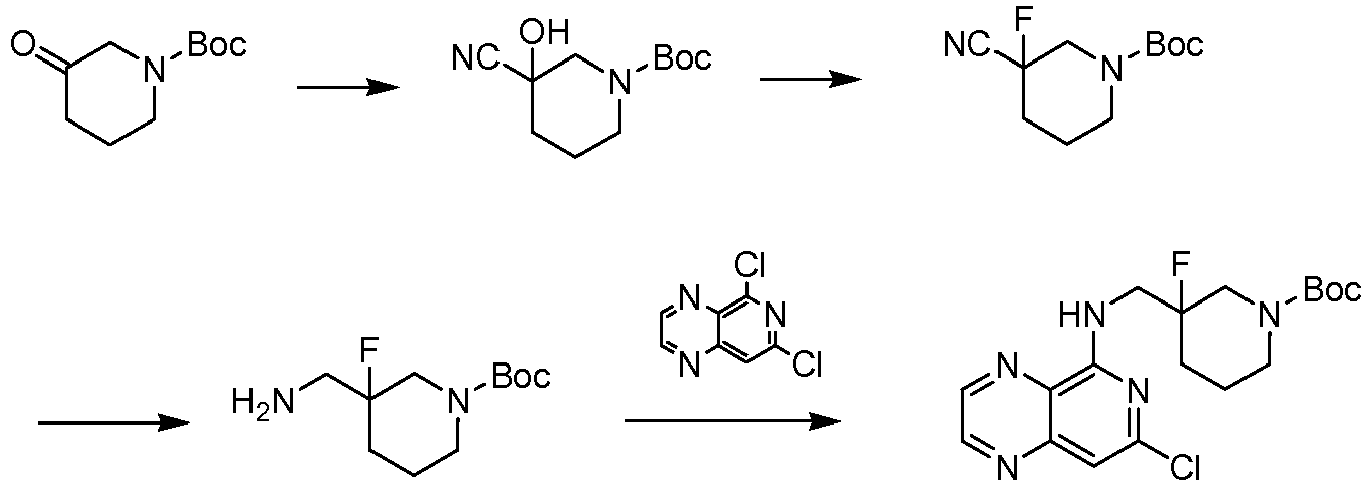
- To a solution of N-Boc-3-piperidone (5.00 g, 25.1 mmol) and THF (15 mL) was added KCN (2.34 g, 37.6 mmol) and H2O (15 mL) and the resulting solution was cooled to 0 °C. To the resulting homogeneous orange solution was added a solution of NaHSO3 (1.25 g, 37.6 mmol) and H2O (15 mL). The resulting solution was stirred at 0 °C for 1 hour. The solution was twice extracted DCM and the combined extracts were dried by Na2SO4, filtered and evaporated to afford title compound 5.7 g as white solid. MS (m/z): 127 (M+H-Boc)+
- To a solution of tert-butyl 3-cyano-3-hydroxypiperidine-1-carboxylate (5.7 g, 25.1 mmol) in DCM (50 mL) cooled to -78 °C, DAST (4.85 g, 30.1 mmol) was added drop-wise and the resulting solution stirred at -78 °C for 1 hour. The reaction was warmed to 0 °C and stirred for an additional 1 hour. The reaction mixture was diluted with DCM and quenched with sat. aq. NaHCO3. The combined extracts were dried by Na2SO4, filtered and concentrated in vacuo to afford crude title compound as a pale yellow oil 5.5 g. MS (m/z): 129 (M+H-Boc)+
- To a stirred and cooled (0 °C) suspension of lithium aluminium hydride (1.02 g, 26.8 mmol) in dry THF (50 mL) was added drop-wise a solution of tert-butyl 3-cyano-3-fluoropiperidine-1-carboxylate (5.50 g, 24.0 mmol) in dry THF (30 mL). The reaction was stirred at 0 °C for 1 hour then at room temperature for 3 hours. The mixture was quenched with water (1.0 mL) at 0 °C, and stirred at room temperature for 20 minutes. Then 15% sodium hydroxide aqueous solution (2.0 mL) was added, and stirred at room temperature for 20 minutes. Finally, water (1.0 mL) was added, and stirred at room temperature for 20 minutes. The mixture was filtered through Celite pad washing with tetrahydrofuran (25 mL). The filtrate was concentrated to afford the title product as pale yellow oil 3.86 g. MS (m/z): 233 (M+H)+
- tert-butyl 3-(aminomethyl)-3-fluoropiperidine-1-carboxylate (3.86 g, 16.6 mmol) and DIPEA (3.22 g, 24.9 mmol) were added to a solution of 5,7-dichloropyrido[3,4-b]pyrazine (3.32 g, 16.6 mmol) in THF (60 mL) and the mixture was refluxed overnight. The volatile components were evaporated and the residue was extracted with ethyl acetate. Ethyl acetate was washed with brine and dried. The solvent was removed in vacuo The crude residue was purified by silica-gel chromatography eluting with Hexane-50% EtOAc/Hexane (gradient) then C18 column to afford the subtitled compound as pale yellow solid 1.76 g. MS (m/z): 396 (M+H)+
-

- 4-(tert-butoxycarbonyl)thiomorpholine-2-carboxylic acid (2.47 g, 10 mmol) and HOBt (1.62 g, 12 mmol) were dissolved in DMF (20 mL), and EDCI (2.11 g, 11 mmol) was added. The reaction mixture was stirred for 1 hour, and 25% aqueous ammonia (5 mL) was added, and the reaction was stirred for another 2 hours. The reaction was then diluted with EtOAc (200 mL) and partitioned with water (100 mL). The organic layer was washed with saturated aq. NaHCO3 (2 x 100 mL), and then dried with Na2SO4. The solvent was removed in vacuo to afford title compound as white solid 2.46 g. MS (m/z): 147 (M+H-Boc)+
- A solution of tert-butyl 2-carbamoylthiomorpholine-4-carboxylate (2.46 g, 10 mmol) in THF (80 mL) was cooled to 0 °C. A solution of borane in THF (1.0 M, 40 mL, 40 mmol) was added over 15 minutes via addition funnel and the mixture was stirred at ambient temperature for 72 hours. The reaction was quenched by dropwise addition of methanol/acetic acid (18 mL, 9:1 v/v). The solvent was removed under reduced pressure and the residue partitioned between ethyl acetate and sat. aqueous Na2CO3. The aqueous layer was extracted with ethyl acetate and combined extracts were washed with water, brine and dried over sodium sulfate. Removal of the solvent under reduced pressure afforded the crude desired material 2.11 g, which was used directly in the next step. MS (m/z): 233 (M+H)+
-

- A mixture of (S)-4-(tert-butoxycarbonyl)morpholine-2-carboxylic acid (3.46 g, 15 mmol), DIPEA (7.75 g, 60 mmol), and N,O-dimethylhydroxylamine HCl (4.39 g, 45 mmol) in DCM (100 mL) was treated with EDCI (9.63 g, 45 mmol) at room temperature. The reaction mixture was stirred for 16 hours and then poured into saturated aqueous sodium bicarbonate solution and extracted with CH2Cl2. The combined extracts were dried over MgSO4, filtered, and concentrated to provide light yellow oil 3.5 g. MS (m/z): 175 (M+H-Boc)+
- (S)-tert-butyl 2-(methoxy(methyl)carbamoyl)morpholine-4-carboxylate obtained above was dissolved in THF (60 mL) at room temperature under nitrogen and cooled to 0 °C. Methylmagnesium bromide (3.0 M solution in diethyl ether, 15 mL, 45 mmol) was added in portions. The reaction mixture was stirred at 0 °C for 1 hour, allowed to warm to room temperature and then stirred for 16 hours. The mixture was again cooled to 0 °C and saturated aqueous ammonium chloride solution was slowly added. The mixture was extracted with EtOAc, and the extracts were washed with brine, dried over MgSO4, filtered and concentrated to provide 2.29 g of crude (S)-tert-butyl 2-acetylmorpholine-4-carboxylate as yellow oil that was used without further purification. MS (m/z): 130 (M+H-Boc)+
- A mixture of (S)-tert-butyl 2-acetylmorpholine-4-carboxylate (2.29 g, 10.0 mmol), ammonium acetate (7.70 g, 100 mmol), sodium cyanoborohydride (0.94 g, 15.0 mmol), and 5 angstrom molecular sieves (10 g) in methanol (50 mL) was stirred at room temperature under nitrogen for 16 hours. The sieves were removed by filtration and the filtrate was concentrated. A solution of 1 N NaOH was added until the pH reached 12. The mixture was extracted with CH2Cl2 and the combined extracts were dried over MgSO4, filtered and concentrated. The resulting light yellow oil (2.17 g) was dissolved in THF (40 mL) and 5,7-dichloropyrido[3,4-b]pyrazine (2.00 g, 10.0 mmol) and DIPEA (1.94 g, 15.0 mmol) were added. The mixture was heated to reflux for 48 hours. The volatile components were evaporated and the residue was extracted with ethyl acetate. Ethyl acetate was washed with brine and dried. The solvent was removed in vacuo. The crude residue was purified by silica-gel chromatography eluting with Hexane-50% EtOAc/Hexane (gradient) then C18 column to afford the subtitled compound as brown oil 450 mg. MS (m/z): 394 (M+H)+
-

- To a solution of ethyl 1-(4-aminophenyl)piperidine-4-carboxylate (2.48 g, 10 mmol) in 40 mL of HBr 40%, a solution of NaNO2 (0.69 g, 10 mmol) in 7 mL of water was slowly added at 0 °C. The mixture was stirred for 15 minutes and added to a solution of CuBr (0.79 g, 5.5 mmol) in 30 mL of HBr 40%. The resulting mixture was stirred and refluxed for 2 hours. The suspension thus obtained was partitioned between 2N NaOH and ethyl acetate. The organic layer was washed with aqueous NaCl, dried over Na2SO4 and concentrated to afford crude title compound 1.56 g. MS (m/z): 286 (M+2)+
- To a stirred solution of 1-(4-bromophenyl)piperidine-4-carboxylic acid (1.56 g, 5.5 mmol) in absolute ethanol (30 mL) was cooled to 0 °C and SOCl2 (1.18 g, 10 mmol) added drop-wise. The mixture was stirred to room temperature and heated to reflux for 3 hours. The reaction mixture was evaporated in vacuo and the residue dissolved in saturated aqueous solution of NaHCO3 (50 mL). The aqueous solution was extracted with EtOAc (3 x 30 mL). The organic extracts was dried over Na2SO4, filtered and evaporated in vacuo. The residue was purified by silica gel column chromatography (eluent; ethyl acetate: hexane = 1:1) to yield the title compound pale brown oil 1.08 g. MS (m/z): 314 (M+2)+
- Ethyl 1-(4-bromophenyl)piperidine-4-carboxylate (1.08 g, 3.5 mmol) was dissolved in THF (20 mL) under nitrogen atmosphere; methyl magnesium bromide (3.0 M solution in diethyl ether, 3.5 mL, 10.5 mmol) was added drop-wise while cooled with an ice water bath; and the reaction mixture was stirred at room temperature overnight. The reaction mixture was partitioned between ethyl acetate and the saturated aqueous solution of ammonium chloride. The organic layer was washed with brine and dried over anhydrous sodium sulfate. The solvent was removed in vacuo to yield the desired compound (1.0 g) as white solid. MS (m/z): 300 (M+2)+
- To a solution of 2-(1-(4-bromophenyl)piperidin-4-yl)propan-2-ol (1.0 g, 3.3 mmol) in DMSO (20 mL) was added bis-pinacolatodiboron (1.15 g, 4.5 mmol) and KOAc (515 mg, 5.3 mmol). The reaction was degassed under vacuum for 30 minutes. then the flask was flushed N2. Pd(dppf)Cl2 (292 mg, 0.4 mmol) was added, then the reaction was heated to 70 °C for 20 hours. After cooling, the reaction mixture was partitioned between ethyl acetate and water. The aqueous layer was extracted with additional ethyl acetate. The organic layers were combined, dried, filtered, and concentrated in vacuo. The residue was purified by silica-gel column to afford title compound as pale yellow solid 590 mg. MS (m/z): 346 (M+H)+
-

- To a mixture of 1-fluoro-4-nitrobenzene (2.82 g, 20 mmol) and K2CO3 (6.92 g, 50 mmol) in dimethyl sulfoxide (20 mL) was added piperidin-4-ol (2.22 g, 22 mmol) and the reaction was heated to 100 °C for 4 hours. This solution was poured into 200 ml of water and extracted with ethyl acetate (30 mL x 3). The organic phase was combined and washed with saturated brine and dried over anhydrous sodium sulfate. The solid was filtered and the filtrate, 10% Pd/C (100 mg) was added and the mixture was stirred under hydrogen atmosphere at ambient temperature overnight. The catalyst was filtered, and the filtrate was concentrated to afford tan solid 3.7 g. MS (m/z): 193 (M+H)+
- To a solution of 1-(4-aminophenyl)piperidin-4-ol (3.7 g, 319 mmol) in 60 mL of HBr 48%, a solution of NaNO2 (1.38 g, 20 mmol) in 15 mL of water was slowly added at 0 °C. The mixture was stirred for 30 minutes and added to a solution of CuBr (1.57 g, 11 mmol) in 50 mL of HBr 48%. The resulting mixture was stirred and refluxed for 2 hours. The suspension thus obtained was partitioned between 2N NaOH and ethyl acetate. The organic layer was washed with aqueous NaCl, dried over Na2SO4 and concentrated to afford crude compound as grey solid 4.6 g. MS (m/z): 256 (M)+
- Tetrabutylammonium bromide (1.06 g, 3.3 mmol) is added to a solution of 1-(4-bromophenyl)piperidin-4-ol (2.56 g, 10 mmol) in toluene (30 mL). The reaction mixture was cooled to 0 °C and aq. 35% sodium hydroxide (30 mL) was added followed by a drop-wise addition of tert-butyl bromoacetate (2.92 g, 15 mmol). The mixture was then allowed to reach room temperature and was stirred for 17 hours at this temperature. The layers were separated and the organic layer was washed twice with water (4 mL), dried over sodium sulfate, concentrated under vacuum and co-evaporated with petroleum ether. Purification of the crude material by flash column chromatography on silica gel (0 - 20% ethyl acetate in petroleum ether) yielded the desired pure material 3.08 g as pale yellow solid. MS (m/z): 372 (M+2)+
- To a stirred solution of tert-butyl 2-(1-(4-bromophenyl)piperidin-4-yloxy)acetate (3.08 g, 8.3 mmol) in THF (20 mL) at -10 °C under nitrogen was added lithium aluminum hydride (0.57 g, 15 mmol). After 2 hours, the reaction mixture was quenched by sequential addition of water (0.6 mL), 15 percent aqueous sodium hydroxide solution (1.8 mL) and water (0.6 mL). The resulting mixture was filtered and concentrated under vacuum to provide the crude 2-(1-(4-bromophenyl) piperidin-4-yloxy)ethanol 2.16 g. MS (m/z): 302 (M+2)+
- To a solution of 2-(1-(4-bromophenyl)piperidin-4-yloxy)ethanol (2.16 g, 7.2 mmol) in DMSO (50 mL) was added bis-pinacolatodiboron (2.54 g, 10 mmol) and KOAc (1.17 g, 12 mmol). The reaction was degassed under vacuum for 30 minutes. then the flask was flushed N2. Pd(dppf)Cl2 (732 mg, 1.0 mmol) was added, then the reaction was heated to 70 °C for 20 hours. After cooling, the reaction mixture was partitioned between ethyl acetate and water. The aqueous layer was extracted with additional ethyl acetate. The organic layers were combined, dried, filtered, and concentrated in vacuo. The residue was purified by silica-gel column (0 - 70% ethyl acetate in petroleum ether) to afford title compound as pale yellow solid 920 mg. MS (m/z): 348 (M+H)+
-

- The (R)-tert-butyl 2-((7-chloropyrido[4,3-b]pyrazin-5-ylamino)methyl)morpholine-4-carboxylate (3.00 g, 8.0 mmol) was dissolved in the solution of HCl in ethyl acetate (20 mL), and the mixture was stirred at room temperature for 2 hours until TLC indicated Boc group was removed. The volatile materials were removed in vacuo and the residues were dissolved in dichloromethane. To the solution, difluoroacetic acid (1.15 g, 12 mmol), HATU (7.60 g, 20.0 mmol) and DIPEA (6.20 g, 48.0 mmol) were added subsequently and stirred at room temperature overnight. The mixture was purified by C18 column chromatography to give the desired amide as yellow solid (2.1 g). MS (m/z): 358 (M+H)+
-

- The title compound was prepared according to the procedures of Intermediate 81 using the same starting material. . MS (m/z): 358 (M+H)+.
-

- A mixture of 2-(oxiran-2-ylmethyl)isoindoline-1,3-dione (4.06 g, 20.0 mmol) and dibenzylamine (5.0 g, 25.4 mmol) was stirred at 80 °C overnight. EtOH (50 mL) was added, and stirred at room temperature. The mixture was filtered to give white solid (4.5 g).
- A solution of 2-(3-(dibenzylamino)-2-hydroxypropyl)isoindoline-1,3-dione (4.5 g, 11.25 mmol) in conc.HCl (50 mL) was stirred at 120 °C overnight. After cooling to room temperature, the mixture was filtered. And the filtrate was extracted with CHCl3. The aqueous layer was added aq. 30% NaOH until pH was above 7, then the solution was extracted with CH2Cl2, dried over Na2SO4 and concentrated to give yellow solid (3.0 g).
- A solution of 2-chloroacetyl chloride (1.25 g, 10.96 mmol) in CHCl3 was added to the solution of 1-amino-3-(dibenzylamino)propan-2-ol (2.5 g, 9.26 mmol) in CHCl3 (50 mL) in ice-bath. The mixture was stirred for 1 hour, then stirred at room temperature for 2 hours. The organic layer concentrated, the residue was purified by column to give white solid.
- A solution of 2-chloro-N-(3-(dibenzylamino)-2-hydroxypropyl)acetamide (1.0 g, 2.49 mmol), t-BuOK (0.39 g, 3.57 mmol) in t-BuOH (30 mL) was stirred at reflux overnight. After concentration, the residue was purified by column chromatography to give product as white solid.
- A solution of 6-((dibenzylamino)methyl)morpholin-3-one (340 mg, 1.09 mmol), Pd(OH)2/C (170 mg) in EtOH (30 mL) was stirred equipped under H2 balloon overnight. The solution was filtered and concentrated to give white oil. The crude product was used directly for next step without purification. (F) 6-((7-chloropyrido[4,3-b]pyrazin-5-ylamino)methyl)morpholin-3-one A solution of 6-(aminomethyl)morpholin-3-one (130 mg, 1 mmol), 5,7-dichloropyrido[4,3-b]pyrazine (200 mg, 1 mmol) and DIEA (260 mg, 2 mmol) in THF (20 mL) was stirred at reflux overnight. After concentration, the residue was purified by column chromatography to give product as yellow solid (100 mg).
-

- A solution of (S)-tert-butyl 3-(aminomethyl)piperidine-1-carboxylate (100 mg, 0.5 mmol), 5,7-dichloropyrido[4,3-b]pyrazine (100 mg, 0.5 mmol) and DIPEA (77 mg, 0.6 mmol) in THF (5 mL) was stirred at room temperature for 4 hours. The volatiles were removed under reduced pressure, and the residue was treated with ethyl acetate, with brine, and concentrated to give the crude title compound.
- A mixture of (S)-tert-butyl 3-((7-chloropyrido[4,3-b]pyrazin-5-ylamino)methyl)piperidine-1-carboxylate (0.15 mmol), 4-morpholinophenylboronic acid (0.23 mmol), PdCl2 (dppf) (0.015 mmol) and Cs2CO3 (0.30 mmol) in dimethoxyethane/ethanol was sealed in a microwave reaction and stirred at 160 °C for 45 minutes in a microwave reactor. The mixture was cooled to room temperature, concentrated, and purified by chromatography to afford the title compound (73% yield). MS (m/z): 505 (M+H)+.
- (S)-tert-butyl 3-((7-(4-morpholinophenyl)pyrido[4,3-b]pyrazin-5-ylamino)methyl)piperidine -1-carboxylate (0.11 mmol) was treated with HCl solution (in EtOAc, 4 N, 3 mL) at room temperature until the reaction was completed. The precipitates were collected by filtration and further purified by chromatography to afford the title compound. MS (m/z): 405 (M+H)+.
- The following compounds were prepared according to the procedures of Compound 1 using the corresponding intermediates and reagents under appropriate conditions that will be recognized by one skilled in the art.
Compound Structure MS (M+H)+ 2 
391 3 
405 4 
379 5 
351 6 
403 7 
391 8 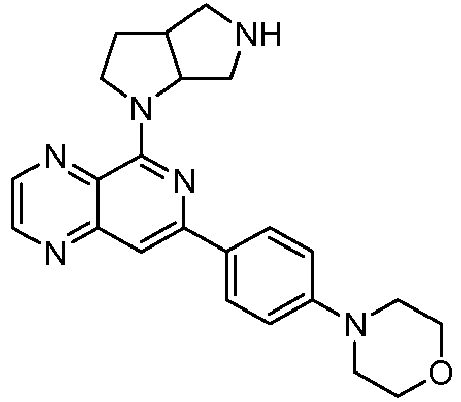
403 9 
391 10 
350 11 
410 12 
363 13 
363 14 
405 15 
380 16 
350 17 
350 18 
324 19 
368 20 
372 374 21 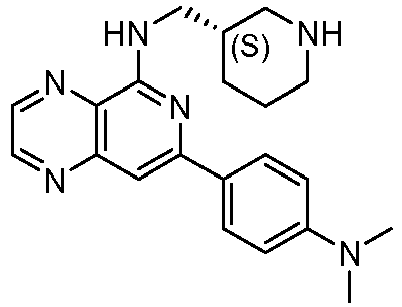
363 22 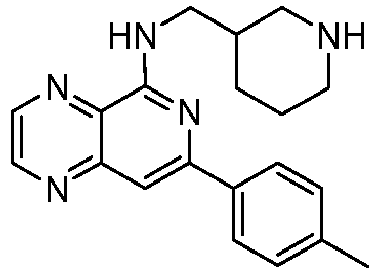
334 23 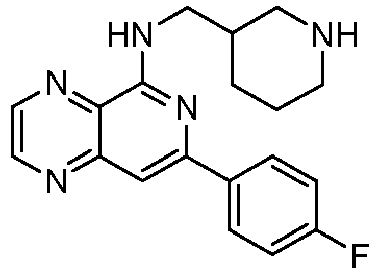
338 24 
354 356 25 
310 26 
380 27 
391 28 
377 29 
390 30 
407 31 
310 32 
405 33 
380 34 
354 35 
368 36 
405 37 
405 38 
415 39 
377 40 
334 41 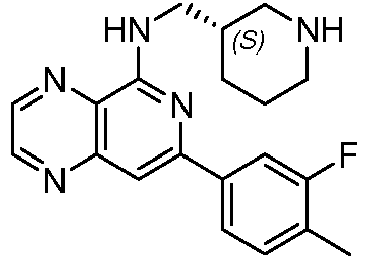
352 42 
392 43 
399 44 
349 45 
348 46 
362 47 
376 48 
407 49 
407 50 
321 51 
321 52 
396 53 
413 54 
404 55 
354 356 56 
351 57 
336 58 
337 59 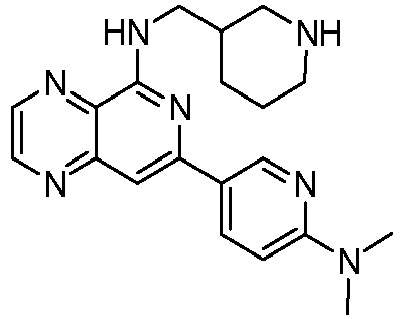
364 60 
350 61 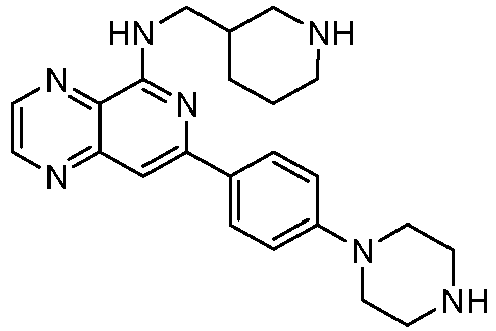
404 62 
377 63 
388 64 
377 65 
433 66 
391 67 
354 68 
368 69 
335 70 
389 71 
417 72 
368 73 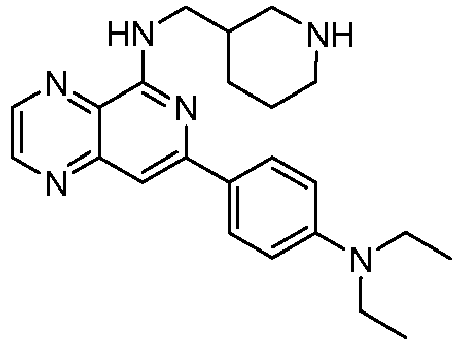
391 74 
335 75 
369 371 76 
368 370 77 
391 78 
394 79 
376 80 
368 370 81 
369 371 82 
349 83 
376 84 
349 85 
354 356 86 
396 87 
406 88 
396 89 
406 90 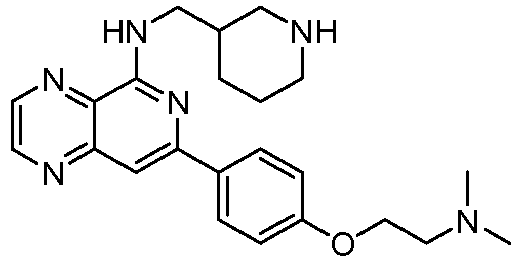
407 91 
407 92 
365 93 
384 386 94 
419 95 
370 96 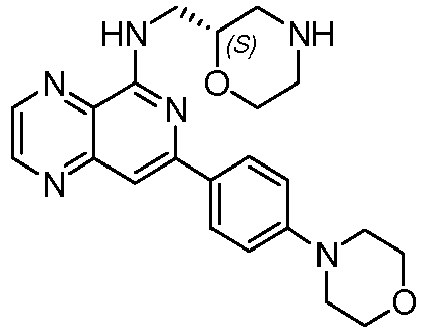
407 97 
408 98 
425 99 
408 100 
398 101 
392 102 
366 103 
392 104 
391 105 
431 106 
366 107 
365 108 
405 109 
449 110 
445 111 
389 112 
415 113 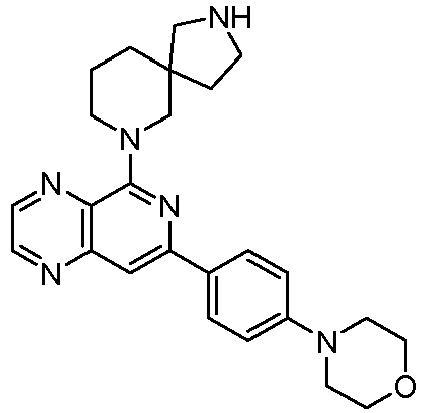
431 114 
391 115 
421 116 
421 117 
425 118 
391 119 
389 120 
419 121 
423 122 
418 123 
420 124 
405 125 
419 126 
421 127 
405 128 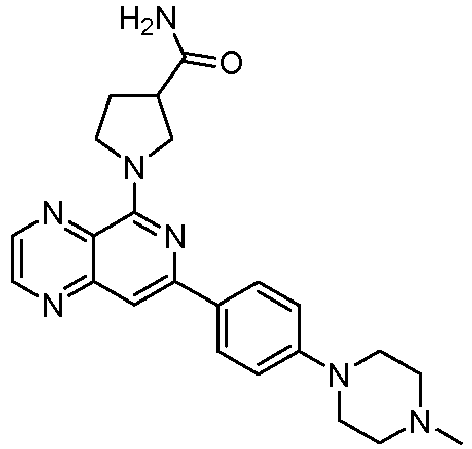
418 129 
423 130 
432 131 
391 132 
409 133 
404 134 
442 444 135 
443 136 
370 137 
369 138 
388 139 
386 140 
367 141 
383 142 
381 143 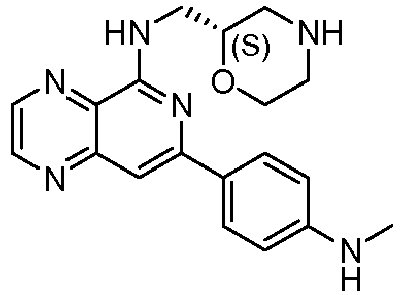
351 144 
420 208 
421 209 
340 210 
326 211 
400 212 
379 213 
432 214 
423 215 
434 216 
450 217 
478 218 
421 219 
439 220 
421 221 
435 222 
439 223 
455 224 
407 225 
455 226 
427 227 
429 228 
429 229 
441 230 
394 231 
409 234 
376 235 
375 236 
448 237 
436 238 
450 239 
423 240 
441 241 
436 242 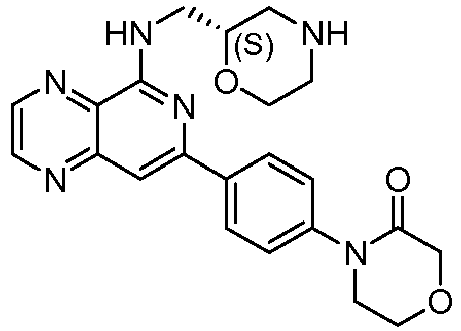
421 243 
358 244 
380 245 
340 246 
436 247 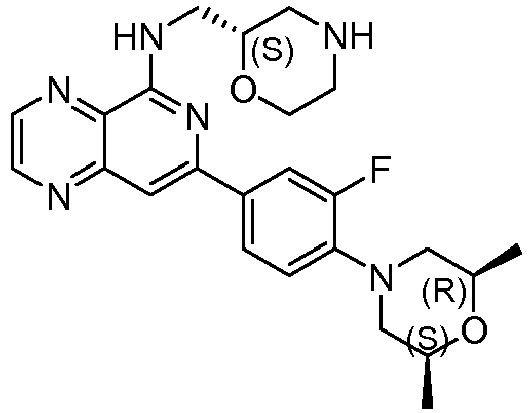
453 248 
388 249 
402 250 
439 251 
423 252 
424 253 
436 254 
441 255 
386 256 
447 257 
408 258 
437 259 
421 260 
435 261 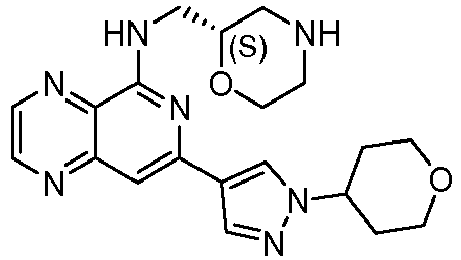
395 262 
409 263 
452 264 
436 265 
484 266 
474 267 
462 268 
410 269 
422 270 
476 271 
423 272 
464 273 
406 274 
466 275 
463 276 
421 277 
422 278 
439 279 
478 280 
526 281 
391 282 
391 283 
471 284 
415 285 
435 286 
465 287 
516 288 
386 289 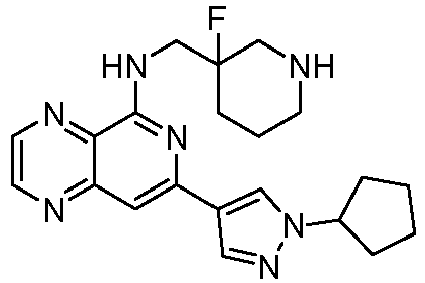
396 290 
412 500 
498 502 
498 503 
498 513 
510 515 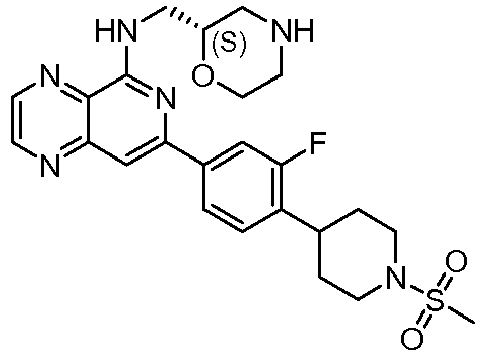
501 516 
515 -

- A solution of tert-butyl hexahydropyrrolo[3,4-b]pyrrole-5(1H)-carboxylate (424 mg, 2 mmol), N-(9-fluorenylmethoxycarbonyloxy) succinimide (600 mg, 1.8 mmol) and DIPEA (310 mg, 2.4 mmol) in dioxane (20 mL) was stirred at room temperature overnight and then concentrated in vacuo. The residue was treated with EtOAc/H2O, separated, and the aqueous layer was extracted with EtOAc. The combined extracts were washed with brine, dried over Na2SO4, filtered, and concentrated to give the title compound. MS (m/z): 355 (M-boc+H)+.
- 1-(9H-fluoren-9-yl)methyl 5-tert-butyl hexahydropyrrolo[3,4-b]pyrrole-1,5-dicarboxylate (810 mg, 1.86 mmol) was treated with HCl in MeOH (5 mL) for 2 hours and then concentrated in vacuo to afford the title compound.
- The mixture of (9H-fluoren-9-yl)methyl hexahydropyrrolo[3,4-b]pyrrole-1(2H)-carboxylate (100 mg, 0.5 mmol) and 5,7-dichloropyrido[4,3-b]pyrazine (600 mg, 1.8 mmol) in dioxane was stirred at 0 °C for 30 minutes and then at room temperature for 4 hours..The mixture was concentrated, and the residue was purified by chromatography to give the title compound. MS (m/z): 498 (M+H)+.
- A solution of (9H-fluoren-9-yl)methyl 5-(7-chloropyrido[4,3-b]pyrazin-5-yl)hexahydropyrrolo[3,4-b]pyrrole-1(2H)-carboxylate (140 mg) and piperidine (2 mL) in CH2Cl2 (8 mL) was stirred at room temperature for 3 hours. The volatiles were removed under reduced pressure. The residue was treated with EtOAc/H2O, separated,and the aqueous solution was extracted with EtOAc. The combined extracts were washed with brine, dried over Na2SO4, filtered, and concentrated. The residue was purified by chromatography to afford the title compound. MS (m/z): 276 (M+H)+.
- A mixture of 7-chloro-5-(hexahydropyrrolo[3,4-b]pyrrol-5(1H)-yl)pyrido[4,3-b]pyrazine (47 mg, 0.17 mmol), 4-morpholinophenylboronic acid (105 mg, 0.51 mmol), and PdCl2(dppf) (10 mg), Cs2CO3 (130 mg, 0.51 mmol) in dioxane (5 mL) was sealed in a microwave reaction cube, stirred at 180 °C for 60 minutes in a microwave reactor, cooled to ambient temperature, concentrated under reduced pressure, and the residue was purified by chromatography to give the title compound. MS (m/z): 403 (M+H)+.
- The following compound was prepared according to the procedures of Compound 145 using the corresponding intermediates and reagents under appropriate conditions that will be recognized by one skilled in the art.
Compound Structure MS (M+H)+ 146 
391 -

- The title compound was prepared according to the procedure of Compound 1 (A) using (R)-tert-butyl pyrrolidin-3-ylmethylcarbamate. MS (m/z): 364 (M+H)+.
- The title compound was prepared according to the procedure of Compound 1 (B) using (S)-tert-butyl (1-(7-chloropyrido[4,3-b]pyrazin-5-yl)pyrrolidin-3-yl)methylcarbamate. MS (m/z): 491 (M+H)+.
- Under N2, to a solution of (S)-tert-butyl (1-(7-(4-morpholinophenyl)pyrido[4,3-b]pyrazin-5-yl)pyrrolidin-3-yl)methylcarbamate (150 mg, 0.31 mmol) in anhydrous THF (10 mL) was slowly added sodium hydride (49 mg, 1.22 mmol) at 0 °C. The mixture was warmed up and stirred at room temperature for 0.5 h. The reaction mixture was then cooled to 0 °C, and CH3I (174 mg, 1.22 mmol) was added slowly. After the completion of the addition, the reaction mixture was stirred at reflux for 4 hours, cooled to ambient temperature, quenched with H2O, and extracted with EtOAc. The combined extracts were dried and concentrated to give the title compound. MS (m/z): 505 (M+H)+.
- The title compounds was prepared according to the procedure of Compound 1 (C) using (R)-tert-butyl methyl((1-(7-(4-morpholinophenyl)pyrido[4,3-b]pyrazin-5-yl)pyrrolidin-3-yl) methyl)carbamate. MS (m/z): 405 (M+H)+.
- The following compound 148 was were prepared according to the procedures of Compound 147 using the corresponding intermediates and reagents under appropriate conditions that will be recognized by one skilled in the art.
Compound Structure MS (M+H)+ 148 
419 -

- Under N2, to a solution of (S)-(1-(7-(4-morpholinophenyl)pyrido[4,3-b]pyrazin-5-yl)pyrrolidin-3-yl)methanamine (Compound 77, 51 mg, 0.13 mmol) and Et3N (0.04 mL, 0.26 mmol) in anhydrous THF (3 mL) was added MsCl (30 mg, 0.26 mmol) at 0 °C. The reaction mixture was stirred at ambient temperature for 0.5 hour, then quenched with H2O and extracted with EtOAc. The combined extracts were dried over Na2SO4, filtered, and concentrated under reduced pressure. The residue was purified by preparative thin-layer chromatography to afford the title compound. MS (m/z): 469 (M+H)+.
- The following compounds were prepared according to the procedures of Compound 149 using the corresponding intermediates and reagents under appropriate conditions that will be recognized by one skilled in the art.
Compound Structure MS (M+H)+ 322 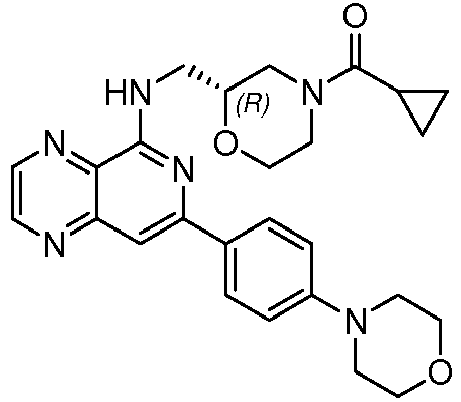
475 323 
485 324 
474 325 
508 326 
449 327 
463 328 
477 329 
479 330 
489 331 
492 332 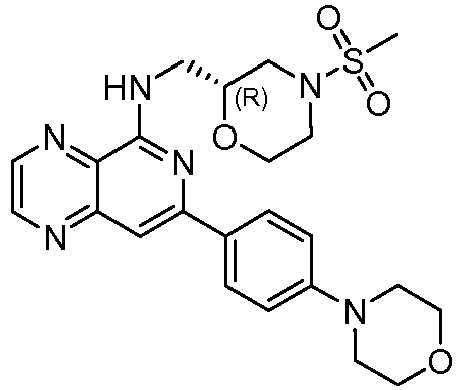
485 333 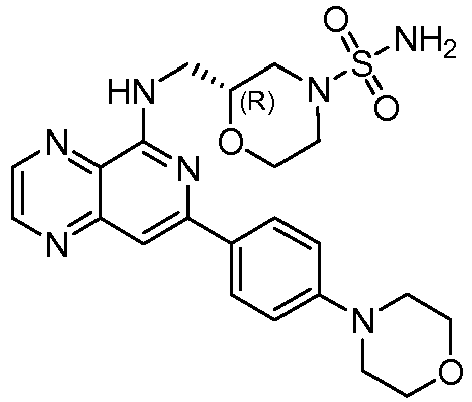
486 334 
527 335 
479 336 
479 337 
465 338 
479 339 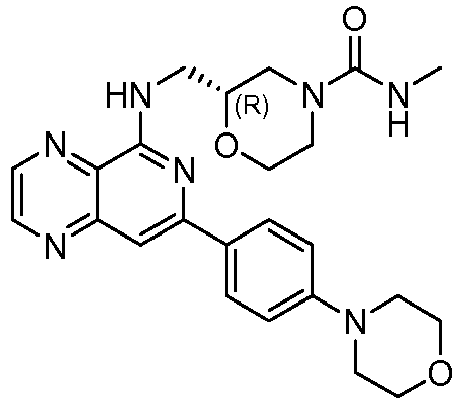
464 340 
467 341 
495 342 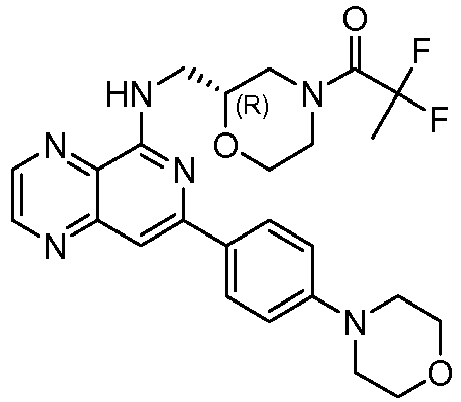
499 343 
517 344 
511 345 
539 346 
499 465 
561 510 
541 -

- A solution of (S)-(1-(7-(4-morpholinophenyl)pyrido[4,3-b]pyrazin-5-yl)pyrrolidin-3-yl)methanamine (Compound 77, 0.16 mmol), DIPEA (207 mg, 1.6 mmol) and TMSNCO (184 mg, 1.6 mmol) in anhydrous CH2Cl2 (5 mL) was stirred at room temperature for 70 hours. The reaction mixture was poured into saturated NaHCO3 aqueous and extracted with CH2Cl2. The combined extracts were dried over Na2SO4, filtered, and concentrated under reduced pressure. The residue was purified by chromatography to afford the title compound. MS (m/z): 434 (M+H)+.
- The following compounds were prepared according to the procedures of Compound 150 using the corresponding intermediates and reagents under appropriate conditions that will be recognized by one skilled in the art.
Compound Structure MS (M+H)+ 151 
434 347 
450 348 
468 349 
448 350 
448 351 
434 352 
434 353 
448 354 
448 355 
473 356 
484 -

- A solution of 7-(4-morpholinophenyl)-N-(piperidin-3-ylmethyl)pyrido[4,3-b]pyrazin-5-amine (Compound 3, 40 mg, 0.1 mmol) and formaldehyde (60 mg, 2.0 mmol), NaBH(OAc)3 (25 mg, 0.15 mmol) in THF (20 mL) was stirred at ambient temperature overnight, then concentrated under reduced pressure. The residue was purified by chromatography to afford the title compound. MS (m/z): 419 (M+H)+.
-

- The title compound was prepared according to the procedure of Compound 1 (A) using tert-butyl 3-(aminomethyl)piperidine-1-carboxylate. MS (m/z): 378 (M+H)+.
- The title compound was prepared according to the procedure of Compound 1 (B). MS (m/z): 505 (M+H)+.
- To a solution of tert-butyl 3-((7-(4-morpholinophenyl)pyrido[4,3-b]pyrazin-5-ylamino) methyl)piperidine-1-carboxylate (100 mg, 0.2 mmol) in THF (20 mL) was added NaH (30 mg, 0.6 mmol). The mixture was stirred for 2∼3 hours at 0 °C, and iodomethane (142 mg, 1 mmol) was then added dropwise. The reaction mixture was stirred at room temperature overnight, quenched with water and concentrated under reduced pressure. The residue was purified by chromatography to afford the title compound.
- The title compounds was prepared according to the procedure of Compound 1 (C) using tert-butyl 3-((methyl(7-(4-morpholinophenyl)pyrido[4,3-b]pyrazin-5-yl)amino)methyl)piperidine-1-carboxylate. MS (m/z): 419 (M+H)+.
- The following compound 154 was prepared according to the procedures of Compound 153 using the corresponding intermediates and reagents under appropriate conditions that will be recognized by one skilled in the art.
Compound Structure MS (M+H)+ 154 
433 -

- A mixture of tert-butyl 5-((7-chloropyrido[4,3-b]pyrazin-5-ylamino)methyl)-3,3-difluoropiperidine-1-carboxylate (206 mg, 0.5 mmol), 4-morpholinophenylboronic acid (207 mg, 1.0 mmol), tri(cyclohexyl)phosphine (56 mg, 0.2 mmol), Pd2(dba)3 (91 mg, 0.1 mmol) and Cs2CO3 (325 mg, 2.0 mmol) in dimethoxyethane/H2O was sealed in a microwave reaction tube and stirred at 160 °C for 80 minutes in a microwave reactor. The mixture was cooled to room temperature, concentrated under reduced pressure, and the residue was purified by chromatography to give the title compound. MS (m/z): 541 (M+H)+.
- tert-Butyl 3,3-difluoro-5-((7-(4-morpholinophenyl)pyrido[4,3-b]pyrazin-5-ylamino)methyl)piperidine-1-carboxylate from step A (227 mg, 0.42 mmol) was treated with HCl solution (in EtOAc, 5 N) at room temperature until the reaction was finished. The volatiles were removed under reduced pressure, dissolved in dichloromethane (5 mL), and neutralized with ammonium hydroxide. The dicloromethane phase was concentrated to afford N-((5,5-difluoropiperidin-3-yl)methyl)-7-(4-morpholinophenyl)pyrido[4,3-b]pyrazin-5-amine. MS (m/z): 441 (M+H)+.
- The following compounds were prepared according to the procedures of Compound 155 using the corresponding intermediates and reagents under appropriate conditions that will be recognized by one skilled in the art.
Compound Structure MS (M+H)+ 156 
423 157 
421 200 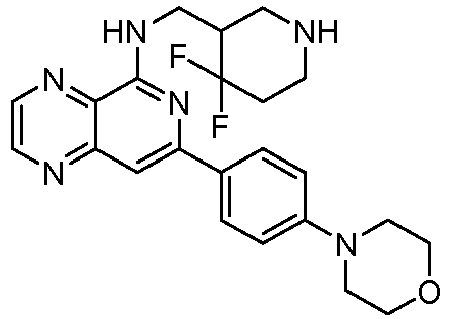
441 201 
455 202 
459 203 
475 204 
385 205 
475 206 
442 207 
403 291 
385 292 
442 293 
454 294 
459 295 
455 296 
404 297 
432 298 
420 422 299 
387 300 
403 301 
417 302 
386 303 
413 304 
427 305 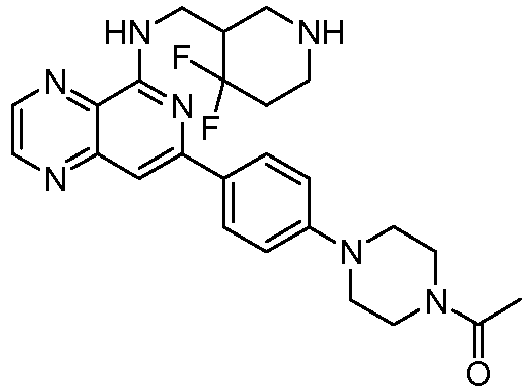
482 306 
443 307 
440 308 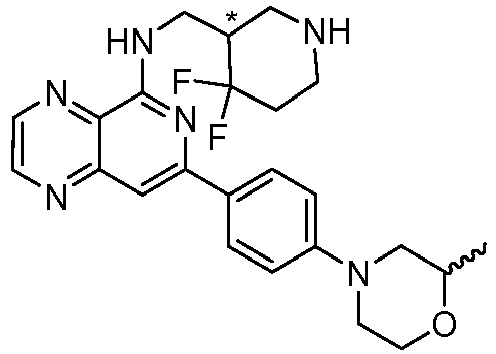
455 .309 
455 310 
434 311 
374 312 
484 313 
463 314 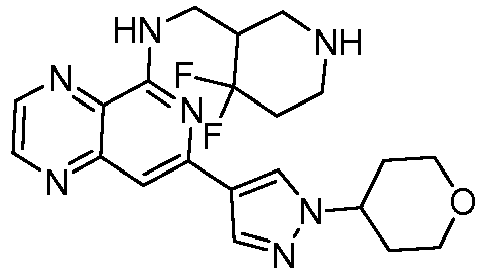
430 315 
390 316 
483 317 
483 318 
500 319 
500 320 
471 321 
507 -

- The title compound was prepared according to the procedures of Compound 1 (B) using tert-butyl 3-((7-chloropyrido[4,3-b]pyrazin-5-ylamino)methyl)-5-hydroxypiperidine-1-carboxylate and 4-morpholinophenylboronic acid. MS (m/z): 521 (M+H)+.
- The title compound was prepared according to the procedures of Compound 155 (B) using tert-butyl 3-hydroxy-5-((7-(4-morpholinophenyl)pyrido[4,3-b]pyrazin-5-ylamino)methyl)piperidine-1-carboxylate MS (m/. z): 421 (M+H)+.
-

- The title compound was prepared according to the procedure of Compound 1 (A) using (R)-pyrrolidin-3-ylmethanol and 5,7-dichloropyrido[4,3-b]pyrazine. MS (m/z): 265 (M+H)+.
- The title compound was prepared according to the procedure of Compound 145 (E) using (R)-(1-(7-chloropyrido[4,3-b]pyrazin-5-yl)pyrrolidin-3-yl)methanol. MS (m/z): 392 (M+H)+.
- The following compounds were prepared according to the procedures of Compound 159 using the corresponding intermediates and reagents under appropriate conditions that will be recognized by one skilled in the art.
Compound Structure MS (M+H)+ 160 
366 161 
366 162 
388 163 
392 164 
350 165 
350 166 
373 167 
415 168 
419 169 
403 170 
420 171 
408 172 
402 357 
322 358 
366 359 
426 360 
391 361 
428 362 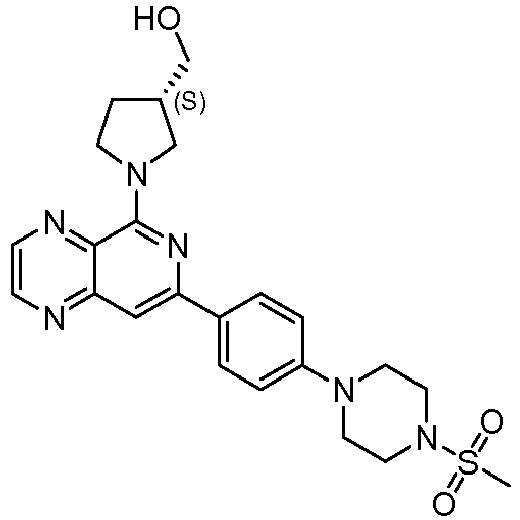
469 363 
433 364 
399 -

- To a solution of (S)-(1-(7-(4-morpholinophenyl)pyrido[4,3-b]pyrazin-5-yl)pyrrolidin-3-yl)methanol (compound 163, 500 mg, 1.27 mmol) in THF (15 mL) were added MsCl (200 mg, 1.6 mmol) and TEA (370 mg, 3.7 mmol). The mixture was stirred for 4 hours at room temperature and concentrated in vacuo. The residue was washed by H2O and EtOAc to give the title compound. MS (m/z):470 (M+H)+
- The mixture of (S)-(1-(7-(4-morpholinophenyl)pyrido[4,3-b]pyrazin-5-yl)pyrrolidin-3-yl)methyl methanesulfonate (100 mg, 0.21 mmol) and MeNH2 solution (33% in water, 5 mL) was refluxed overnight, concentrated, and purified by chromatography to give the title compound. MS (m/z):405 (M+H)+
-

- To a solution of (S)-1-(tert-butoxycarbonyl)pyrrolidine-3-carboxylic acid (430 mg, 2.0 mmol) in CH2Cl2 (20 mL) was added CDI (356 mg, 2.2 mmol). The mixture was stirred at room temperature for 20 minutes, N,O-dimethylhydroxylamine hydrochloride (234 mg, 2.4 mmol) and DIPEA (258 mg, 2.6 mmol) were then added subsequently at 0 °C. The mixture was stirred at 0 °C for 0.5 hour, then warmed up and stirred at ambient temperature overnight. The mixture was washed with HCl (1 N), saturated aqueous NaHCO3 and water, dried over Na2SO4, filtered, and concentrated under reduced pressure to give the title compound for the next step.
- To a solution of (S)-tert-butyl 3-(methoxy(methyl)carbamoyl)pyrrolidine-1-carboxylate in THF (18 mL) was added methylmagnesium bromide (in ether, 3 M, 2.7 mL) at 0 °C. The mixture was stirred at 0 °C for 2 hours, then quenched with saturated aqueous NH4Cl, and extracted with Et2O. The combined extracts were washed with saturated aqueous NaHCO3, dried over Na2SO4, filtered, and concentrated to give the tile compound for the next step.
- To a solution of (S)-tert-butyl 3-acetylpyrrolidine-1-carboxylate in methanol (10 mL) was added sodium borohydride (114 mg, 3.0 mmol) at 0 °C. The reaction mixture was stirred at ambient temperature for 2 hours then quenched with saturated ammonium chloride solution and extracted with dichloromethane. The combined extracts were dried over magnesium sulfate, filtered, and concentrated to give the title compound for the next step.
- (S)-tert-butyl 3-(1-hydroxyethyl)pyrrolidine-1-carboxylate was treated with HCl solution (in EtOAc, 5 mL) at room temperature for 2 hours. The volatiles were removed under reduced pressure, and the residue was dissolved in anhydrous THF (10 mL). To the resulted THF solution, DIPEA (570 mg, 4.4 mmol) and 5,7-dichloropyrido[4,3-b]pyrazine (400 mg, 2.0 mmol) were added, and the reaction was stirred at room temperature overnight. The volatiles were removed under reduced pressure, and the residue was dissolved in ethyl acetate, washed with brine and dried over Na2SO4, filtered, and concentrated. The residue was purified by chromatography to afford the title compound. MS (m/z): 279 (M+H)+.
- The title compound was prepared according to the procedure of Compound 1 (B) using (S)-1-(1-(7-chloropyrido[4,3-b]pyrazin-5-yl)pyrrolidin-3-yl)ethanol and 4-morpholinophenylboronic acid. MS (m/z): 406 (M+H)+.
-

- A solution of methyl 3-aminopropanoate hydrochloride (4.88 mmol), Et3N (6.50 mmol) and 5,7-dichloropyrido[4,3-b]pyrazine (3.25 mmol) in THF (10 mL) was stirred at room temperature overnight. Volatiles were removed under reduced pressure, and the residue was treated with water and extracted with EtOAc. The combined extracts were dried over Na2SO4, filtered, and concentrated. The residue was purified by chromatography to afford the title compound. MS (m/z): 267 (M+H)+.
- A solution of methyl 3-(7-chloropyrido[4,3-b]pyrazin-5-ylamino)propanoate (545 mg, 2.04 mmol) and LiOH·H2O (172 mg, 4.09 mmol) in MeOH/H2O (v. 20:1, 40 mL/2 mL) was stirred at room temperature for 20 hours. The volatiles were removed under reduced pressure, and the residue was acidified with HCl solution (1 N) till pH=2∼3.. The precipitates were collected by filtration and dried to afford the title compound. MS (m/z): 253 (M+H)+.
- A solution of 3-(7-chloropyrido[4,3-b]pyrazin-5-ylamino)propanoic acid (2.22 mmol), HATU (2.66 mmol), DIPEA (6.65 mmol) and NH4Cl (4.43 mmol) in THF (10 mL) was stirred at room temperature overnight. The volatiles were removed under reduced pressure and the residue was treated with water. The precipitates were collected by filtration and dried to give the title compound. MS (m/z): 252 (M+H)+.
- The title compound was prepared according to the procedure of Compound 1 (B) using 3-(7-chloropyrido[4,3-b]pyrazin-5-ylamino)propanamide prepared above and 4-(dimethylamino)phenylboronic acid. MS (m/z): 337 (M+H)+.
- The following compounds 176 to 178 were prepared according to the procedures of Compound 175 using the corresponding intermediates and reagents under appropriate conditions that will be recognized by one skilled in the art.
Compound Structure MS (M+H)+ 176 
342 177 
363 178 
389 179 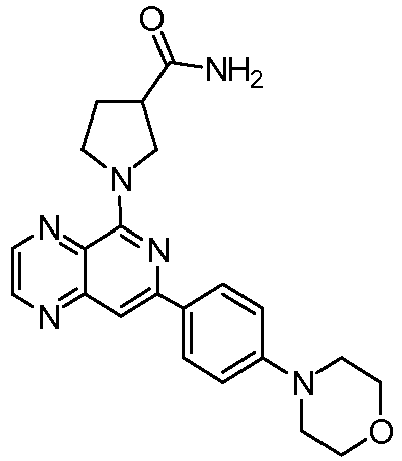
405 365 
380 366 
406 367 
406 -

- A solution of propane-1,3-diamine (890 mg, 12 mmol) and 5,7-dichloropyrido[4,3-b]pyrazine (600 mg, 3 mmol) in methanol (10 mL) was stirred at room temperature for 4 hours. The volatiles were evaporated, and the residue was purified by chromatography to afford the title compound. MS (m/z): 238 (M+H)+.
- The title compound was prepared according to the procedure of Compound 145 (E) using N-(3-aminopropyl)-7-chloropyrido[4,3-b]pyrazin-5-amine prepared above. MS (m/z): 365 (M+H)+.
- The following compounds 181-199 were prepared according to the procedures of Compound 180 using the corresponding intermediates and reagents under appropriate conditions that will be recognized by one skilled in the art.
Compound Structure MS (M+H)+ 181 
348 182 
362 183 
405 184 
399 185 
323 186 
378 187 
361 188 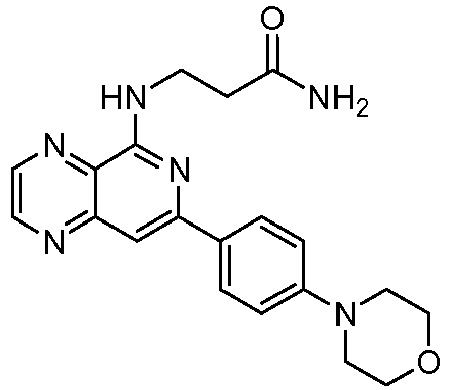
379 189 
305 190 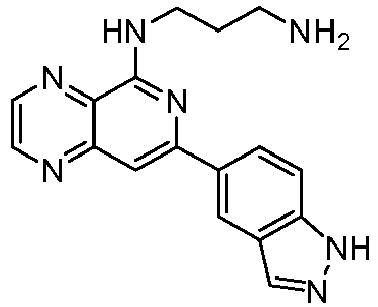
320 191 
340 192 
324 193 
358 194 
366 195 
350 196 
379 197 
372 198 
439 199 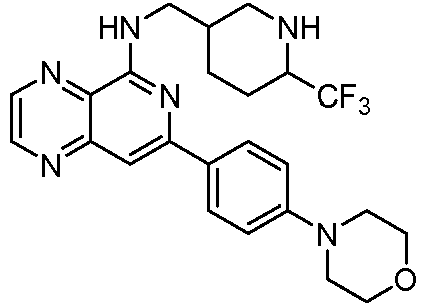
473 509 
457 -

- The racemic compound 200 was resolved by chiral HPLC to provide the optically pure enantiomers Compound 232 and 233 (HPLC conditions: column: CHIRALPAK IA 20 x 250 mm; mobile phase: CH3CN/MeOH/DEA =9/1/0.01; flow rate = 10 mL/min; detector: UV 254 nm). The first eluent (compound 232, Rf=9.62 min) was 99% ee, MS (m/z): 441 (M+H)+. and the second eluent (compound 233, Rf=13.60 min) was 95.5% ee, MS (m/z): 441 (M+H)+.
-

- The racemic compound 294 was resolved by chiral HPLC to provide the optically pure enantiomers Compound 368 and 369 (HPLC conditions: column: CHIRALPAK IA 0.46 x 15 cm; mobile phase: CH3CN/MeOH/DEA =9/1/0.01; flow rate = 1.0 mL/min; detector: UV 220 nm). The first eluent (compound 368, Rf=11.36 min) was 100% ee, MS (m/z): 459 (M+H)+. and the second eluent (compound 369, Rf=14.72 min) was 100% ee, MS (m/z): 459 (M+H)+.
-

- The racemic compound 295 was resolved by chiral HPLC to provide the optically pure enantiomers Compound 370 and 371 (HPLC conditions: column: CHIRALCEL OJH 0.46 x 15 cm; mobile phase: EtOH/DEA =100/0.001; flow rate = 1.0 mL/min; detector: UV 254 nm). The first eluent (compound 370, Rf=6.20 min) was 100% ee, MS (m/z): 455 (M+H)+. and the second eluent (compound 371, Rf=6.32 min) was 100% ee, MS (m/z): 455 (M+H)+.
-

- The racemic compound 293 was resolved by chiral HPLC to provide the optically pure enantiomers Compound 372 and 373 (HPLC conditions: column: CHIRALPAK IA 0.46 x 15 cm; mobile phase: MeOH/EtOH/DEA =50/50/0.1; flow rate = 1.0 mL/min; detector: UV 220 nm). The first eluent (compound 372, Rf=10.89 min) was 100% ee, MS (m/z): 454 (M+H)+. and the second eluent (compound 373, Rf=14.23 min) was 100% ee, MS (m/z): 454 (M+H)+.
-

- The racemic compound 292 was resolved by chiral HPLC to provide the optically pure enantiomers Compound 374 and 375 (HPLC conditions: column: CHIRALCEL OJH 0.46 x 15 cm; mobile phase: EtOH/DEA =100/0.001; flow rate = 1 mL/min; detector: UV 254 nm). The first eluent (compound 374, Rf=8.60 min) was 100% ee, MS (m/z): 442 (M+H)+. and the second eluent (compound 375, Rf=12.10 min) was 97.37% ee, MS (m/z): 442 (M+H)+.
-

- The racemic compound 251 was resolved by chiral HPLC to provide the optically pure enantiomers Compound 376 and 377 (HPLC conditions: column: CHIRALPAK IA 0.46 x 15 cm; mobile phase: CH3CN/EtOH/DEA =90/10/0.1; flow rate = 10.0 mL/min; detector: UV 254 nm). The first eluent (compound 376, Rf=7.45 min) was 100% ee, MS (m/z): 423 (M+H)+. and the second eluent (compound 377, Rf=14.97 min) was 96.07% ee, MS (m/z): 423 (M+H)+.
-

- The racemic compound 252 was resolved by chiral HPLC to provide the optically pure enantiomers Compound 378 and 379 (HPLC conditions: column: CHIRALPAK IA 0.46 x 15 cm; mobile phase: CH3CN/EtOH/DEA =90/10/0.1; flow rate = 10.0 mL/min; detector: UV 254 nm). The first eluent (compound 378, Rf=9.17 min) was 100% ee, MS (m/z): 424 (M+H)+. and the second eluent (compound 379, Rf=16.65 min) was 92.59% ee, MS (m/z): 424 (M+H)+.
-

- The racemic compound 253 was resolved by chiral HPLC to provide the optically pure enantiomers Compound 380 and 381 (HPLC conditions: column: CHIRALPAK IA 0.46 x 15 cm; mobile phase: CH3CN/EtOH/DEA =90/10/0.1; flow rate = 10.0 mL/min; detector: UV 254 nm). The first eluent (compound 380, Rf=10.46 min) was 100% ee, MS (m/z): 436 (M+H)+. and the second eluent (compound 381, Rf=20.42 min) was 94.93% ee, MS (m/z): 436 (M+H)+.
-

- The racemic compound 254 was resolved by chiral HPLC to provide the optically pure enantiomers Compound 382 and 383 (HPLC conditions: column: CHIRALPAK IA 0.46 x 15 cm; mobile phase: CH3CN/EtOH/DEA =90/10/0.1; flow rate = 10.0 mL/min; detector: UV 254 nm). The first eluent (compound 382, Rf=7.14 min) was 98.75% ee, MS (m/z): 441 (M+H)+. and the second eluent (compound 383, Rf=14.97 min) was 96.07% ee, MS (m/z): 441 (M+H)+.
-

- The racemic compound 305 was resolved by chiral HPLC to provide the optically pure enantiomers Compound 384 and 385 (HPLC conditions: column: CHIRALPAK IA 0.46 x 25 cm; mobile phase: CAN/DEA =100/0.1; flow rate = 1.0 mL/min; detector: UV 365 nm). The first eluent (compound 384, Rf=10.09 min) was 98% ee, MS (m/z): 482 (M+H)+. and the second eluent (compound 385, Rf=13.39 min) was 98% ee, MS (m/z): 482 (M+H)+.
-

- The racemic compound 250 was resolved by chiral HPLC to provide the optically pure isomers Compound 386 and 387 (HPLC conditions: column: CHIRALPAK AD-H 0.46 x 15 cm; mobile phase: EtOH/ACN/DEA =95/5/0.1; flow rate = 0.5 mL/min; detector: UV 254 nm). The first eluent (compound 386, Rf=13.40 min) was 99.83% ee, MS (m/z): 439 (M+H)+. and the second eluent (compound 387, Rf=16.30 min) was 98.9% ee, MS (m/z): 439 (M+H)+.
-

- The racemic compound 306 was resolved by chiral HPLC to provide the optically pure enantiomers Compound 388 and 389 (HPLC conditions: column: CHIRALPAK IAs 0.46 x 15 cm; mobile phase: ACN/DEA =100/0.1; flow rate = 10 mL/min; detector: UV 254 nm). The first eluent (compound 388, Rf=12.58 min) was 100% ee, MS (m/z): 443 (M+H)+. and the second eluent (compound 389, Rf=23.88 min) was 93.9% ee, MS (m/z): 443 (M+H)+.
-

- The racemic compound 310 was resolved by chiral HPLC to provide the optically pure enantiomers Compound 390 and 391 (HPLC conditions: column: CHIRALPAK IAs 0.46 x 15 cm; mobile phase: ACN/DEA =100/0.1; flow rate = 10 mL/min; detector: UV 254 nm). The first eluent (compound 390, Rf=12.05 min) was 98.17% ee, MS (m/z): 434 (M+H)+. and the second eluent (compound 391, Rf=13.11 min) was 97.51% ee, MS (m/z): 434 (M+H)+.
-

- The racemic compound 311 was resolved by chiral HPLC to provide the optically pure enantiomers Compound 392 and 393 (HPLC conditions: column: CHIRALPAK IAs 0.46 x 15 cm; mobile phase: ACN/DEA =100/0.1; flow rate = 10 mL/min; detector: UV 254 nm). The first eluent (compound 392, Rf=7.64 min) was 100% ee, MS (m/z): 374 (M+H)+. and the second eluent (compound 393, Rf=13.11 min) was 97.47% ee, MS (m/z): 374 (M+H)+.
-

- The racemic compound 313 was resolved by chiral HPLC to provide the optically pure enantiomers Compound 394 and 395 (HPLC conditions: column: CHIRALPAK IAs 0.46 x 15 cm; mobile phase: ACN/DEA =100/0.1; flow rate = 10 mL/min; detector: UV 254 nm). The first eluent (compound 394, Rf=8.03 min) was 100% ee, MS (m/z): 463 (M+H)+. and the second eluent (compound 395, Rf=11.54 min) was 95.7% ee, MS (m/z): 463 (M+H)+.
-

- The racemic compound 309 was resolved by chiral HPLC to provide the optically pure isomers Compound 396 and 397 (HPLC conditions: column: CHIRALPAK AD-H 0.46 x 15 cm; mobile phase: MeOH/DEA =100/0.1; flow rate = 1.0 mL/min; detector: UV 254 nm). The first eluent (compound 396, Rf=11.37 min) was 99.44% ee, MS (m/z): 455 (M+H)+. and the second eluent (compound 397, Rf=14.69 min) was 98.36% ee, MS (m/z): 455 (M+H)+.
-

- The racemic compound 314 was resolved by chiral HPLC to provide the optically pure enantiomers Compound 398 and 399 (HPLC conditions: column: CHIRALPAK IAs 0.46 x 15 cm; mobile phase: CAN/EtOH/DEA =100/10/0.1; flow rate = 10 mL/min; detector: UV 254 nm). The first eluent (compound 398, Rf=7.42 min) was 100% ee, MS (m/z): 430 (M+H)+. and the second eluent (compound 399, Rf=10.74 min) was 93.0% ee, MS (m/z): 430 (M+H)+.
-

- A solution of (S)-tert-butyl 2-((7-chloropyrido[4,3-b]pyrazin-5-ylamino)methyl)morpholine-4-carboxylate (3.96 g, 10.43 mmol), 1-(4-(4,4,5,5-tetramethyl-1,3,2-dioxaborolan-2-yl)phenyl)piperazine hydrochloride (4.4 g, 13.55 mmol), Pd(PPh3)4 (2.41 g, 2.09 mmol) and Cs2CO3 (10.19 g, 31.29 mmol) in 150 mL of dioxane and 3 mL of water, under N2, was stirred at 110°C overnight. The volatiles were removed in vacuo, and the residues was purified by chromatography with MeOH/H2O (1:20∼5:1) to give 4.747 g of title compound. MS (m/z) = 506 (M+H)+.
- A solution of (S)-tert-butyl 2-((7-(4-(piperazin-1-yl)phenyl)pyrido[4,3-b]pyrazin-5-ylamino)methyl)morpholine-4-carboxylate (100 mg, 0.20 mmol), cyclopropanesulfonyl chloride (33 mg, 0.24 mmol) and Et3N (41 mg, 0.40 mmol) in 5 mL of DCM at 0 °C was stirred at room temperature for 1 hour. The volatiles were removed in vacuo, and the residues was purified by chromatography with PE/EA (1:2∼1:10) to give 52 mg of title compound.
- A solution of (S)-tert-butyl 2-((7-(4-(4-(cyclopropylsulfonyl)piperazin-1-yl)phenyl)pyrido[4,3-b]pyrazin-5-ylamino)methyl)morpholine-4-carboxylate (52 mg, 0.09 mmol) and 2 mL of HCl-EA (5.0 N) in 5 mL of EA, was stirred at room temperature for 1 hour. The volatiles were removed in vacuo, and the residue was added to 5 mL of MeOH and 0.5 mL of NH3.H2O, was stirred at room temperature for 10 minutes. The volatiles were removed in vacuo, and the residue was purified by chromatography with MeOH/H2O (1:6∼5:1) to give 18 mg title compound. MS (m/z) = 510 (M+H)+.
- The following compounds were prepared according to the procedures of Compound 400 using the corresponding intermediates and reagents under appropriate conditions that will be recognized by one skilled in the art.
Compound Structure MS (M+H)+ 401 
512 402 
488 403 
488 404 
504 405 
476 406 
478 407 
484 408 
478 409 
473 410 
478 411 
516 412 
492 413 
488 414 
502 415 
504 416 
504 417 
504 418 
447 419 
483 420 
476 421 
500 422 
505 423 
499 424 
466 425 
500 426 
476 427 
502 428 
534 429 
480 430 
502 431 
473 432 
524 433 
480 434 
487 435 
498 436 
437 437 
494 438 
498 439 
510 440 
485 441 
499 442 
519 443 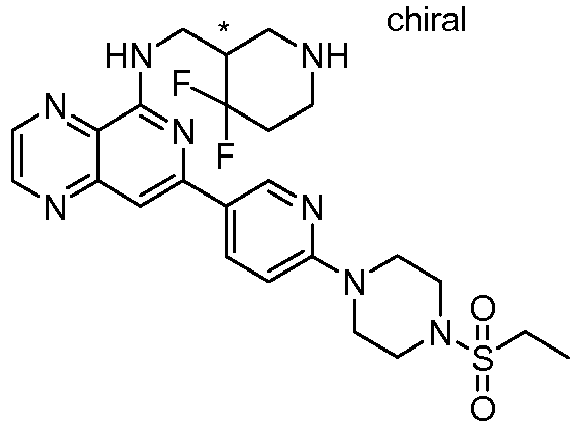
533 444 
518 445 
532 446 
497 447 
517 448 
517 495 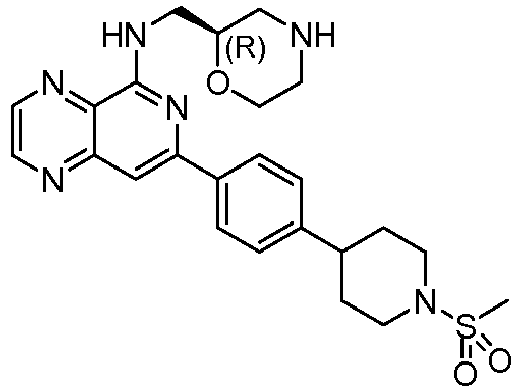
483 497 
509 498 
498 499 
512 504 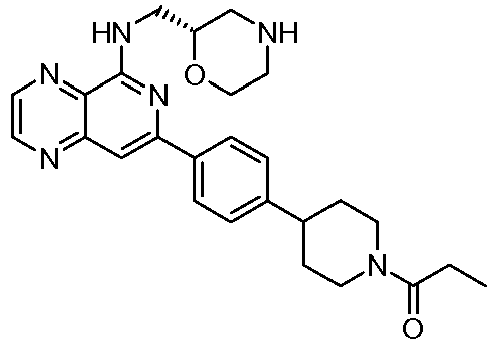
461 505 
477 506 
448 511 
463 512 
477 -

- To a solution of (R)-1-(2-((7-chloropyrido[4,3-b]pyrazin-5-ylamino)methyl)morpholino) -2,2-difluoroethanone (72 mg, 0.2 mmol) in dioxane/H2O (5 mL / 0.5 mL) was added Cs2CO3 (98 mg, 0.3 mmol), Pd (PPh3)4 (46.2 mg, 0.04 mmol) and 1-methyl-4-(4-(4,4,5,5-tetramethyl-1,3,2-dioxaborolan-2-yl)phenyl)piperazine (72.5 mg, 0.24 mmol). The mixture was stirred at 110°C for 24 hours under N2. The reaction was filtered, concentrated and purified on column (CH2Cl2:MeOH= 20:1) to give yellow solid. MS (m/z):498 (M+H)+
- The following compounds were prepared according to the procedures of Compound 449 using the corresponding intermediates and reagents under appropriate conditions that will be recognized by one skilled in the art.
Compound Structure MS (M+H)+ 450 
499 451 
503 452 
519 521 453 
429 454 
460 455 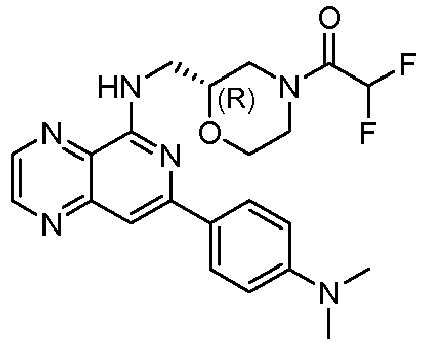
443 456 
461 457 
447 458 
483 459 
483 460 
497 461 
487 462 
484 463 
497 464 
511 471 
471 488 
512 489 
528 490 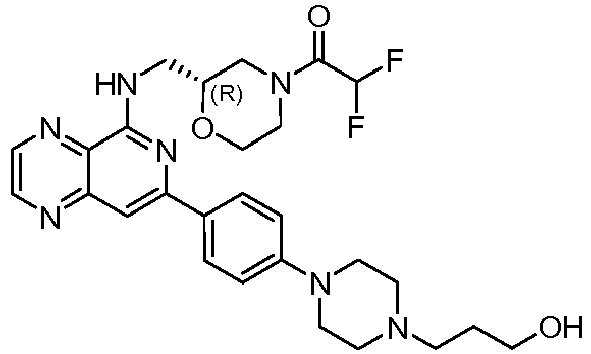
542 501 
497 514 
539 -

- A solution of (S)-1-(2-((7-chloropyrido[4,3-b]pyrazin-5-ylamino)methyl)morpholino)-2,2-difluoroethanone (70 mg, 0.19 mmol), 1-(4-(4,4,5,5-tetramethyl-1,3,2-dioxaborolan-2-yl)phenyl)piperazine hydrochloride (96 mg, 0.29 mmol), Pd(PPh3)4 (45 mg, 0.04 mmol) and Cs2CO3 (191 mg, 0.59 mmol) in 8 mL of dioxane and 0.1 mL of water, under N2, was stirred at 110°C overnight. The volatiles were removed in vacuo, and the residue was purified by chromatography with MeOH/H2O (1:10∼8:1) to give 100 mg of title compound.
- A solution of (S)-2,2-difluoro-1-(2-((7-(4-(piperazin-1-yl)phenyl)pyrido[4,3-b]pyrazin-5-ylamino)methyl)morpholino)ethanone (50 mg, 0.10 mmol), acetyl chloride (12 mg, 0.16 mmol) and Et3N (31 mg, 0.3 mmol) in 5 mL of DCM, was stirred at room temperature for 1 hour. The volatiles were removed in vacuo, and the residue was purified by chromatography with MeOH/H2O (1:10∼10:1) to give 24 mg of title compound. MS (m/z) = 526 (M+H)+.
- The following compounds were prepared according to the procedures of Compound 466 using the corresponding intermediates and reagents under appropriate conditions that will be recognized by one skilled in the art.
Compound Structure MS (M+H)+ 467 
562 468 
525 469 
561 470 
525 491 
526 492 
562 -

- 4-bromoaniline (4.0 g, 23.25 mmol) was dissolved in CH2Cl2 (100 mL), DMAP (0.284 g), Et3N (6.5 mL), BoC2O (8.0 mL) were added in, the mixture was stirred at room temperature overnight. Extracted by CH2Cl2 and water, the mixture was then washed by water, dried over Na2SO4, concentrated and purified by flash chromatography (PE: EA=10:1) to give 5.5 g white solid.
- Tert-butyl 4-bromophenylcarbamate (5.5 g, 20.21 mmol) was dissolved in THF, Lithium aluminum hydride (2.301 g, 60.63 mmol) was added and it was stirred at 60 °C overnight. Then it was quenched by EA, followed by H2O, concentrated and CH2Cl2 and 1 M NaOH was added in, washed with CH2Cl2, extracted with CH2Cl2, dried over Na2SO4, concentrated, purified by flash chromatography (PE: EA=40:3) to give 2.1 g yellow oil.
- 4-bromo-N-methylaniline (700 mg, 3.76 mmol) was dissolved in DMF (20 mL), K2CO3 (1.56 g, 11.29 mmol) and 2-bromoethanol (1.41 g, 11.29 mmol) were added in. The mixture was reacted at 100 °C for 2 days. Then it was extracted by EA and brine, washed by brine, dried over Na2SO4, concentrated and purified by flash chromatography, (PE: EA=10:1 to 3:1) to give 164 mg brown oil.
- 2-((4-bromophenyl)(methyl)amino)ethanol (164 mg, 0.713 mmol) was dissolved in toluene, Tetrakis(triphenylphosphine)palladium (164 mg, 0.143 mmol) and 1,1,1,2,2,2-hexamethyldistannane (377 mg, 1.07 mmol) was added and reacted at 100 °C for 3.5 hours. Then it was directly used in the next step.
- 2-(methyl(4-(trimethylstannyl)phenyl)amino)ethanol (223 mg, 0.713 mmol), (R)-tert-butyl 2-((7-chloropyrido[4,3-b]pyrazin-5-ylamino)methyl)morpholine-4-carboxylate (246 mg, 0.648 mmol), tetrakis(triphenylphosphine)palladium (150 mg, 0.13 mmol) was mixed in toluene, reacted at 100 °C overnight. Then it was filtrated and concentrated, purified by flash chromatography (PE: EA=2:1 to 1:1) to give crude product as a reddish-brown oil. And it was used without further purification.
- (R)-tert-butyl 2-((7-(4-((2-hydroxyethyl)(methyl)amino)phenyl)pyrido[4,3-b]pyrazin-5-ylamino)methyl)morpholine-4-carboxylate was dissolved in EA (20 mL), 5M HCl in EA (10 mL) was added, the mixture was stirred at room temperature overnight. It was concentrated, treated with NH3.H2O, concentrated, purified by preparative TLC to give 10 mg reddish-brown solid. MS (m/z):395 (M+H)+
- The following compounds were prepared according to the procedures of Compound 472 using the corresponding intermediates and reagents under appropriate conditions that will be recognized by one skilled in the art.
Compound Structure MS (M+H)+ 473 
376 474 
390 -

- 1-fluoro-4-nitrobenzene (3.0 g 21.26 mmol), piperidin-4-ol (2.26 g, 22.32 mmol), K2CO3 (4.4 g, 31.89 mmol) was mixed in 20 mL DMF, reacted at 80 °C for 2.5 hours. Then the mixture was extracted by EA and brine, washed by brine and then water, dried over Na2SO4, concentrated. The crude product was used directly in the next step without further purification.
- 1-(4-nitrophenyl)piperidin-4-ol (4.725 g, 21.26 mmol), Fe (11.87 g, 212.6 mmol), NH4Cl (11.41 g, 212.6 mmol), EtOH (100 mL) and water (50 mL) were mixed. The mixture was stirred at 100 °C overnight. Then Fe (5.9 g, 106.3 mmol) was added and reacted at 100 °C for 7 hours. Filtrated and the liquid was concentrated, purified by flash chromatography to give 1.8 g yellow solid.
- 1-(4-aminophenyl)piperidin-4-ol (600 mg, 3.12 mmol), HBr (14 mL, 48%), was mixed and cooled to 0 °C, the solution of NaNO2 (215 mg, 3.12 mmol) in 2.3 mL water was added in. the mixture was stirred for 15 minutes, the solution of CuBr (246 mg, 1.72 mmol) in HBr (4.4 mL 4.8%) was added and reacted at 100 °C for 3 hours. 2M NaOH solution was added, extracted by EA, washed by 2M NaOH, dried over Na2SO4, concentrated and purified by flash chromatography. (PE:EA = 3:1) to give 520 mg pale brown solid.
- 1-(4-bromophenyl)piperidin-4-ol (300 mg, 1.17 mmol), tetrakis(triphenylphosphine)palladium (270 mg, 0.23 mmol), 1,1,1,2,2,2-hexamethyldistannane (499 mg, 1.52 mmol) were mixed in toluene (20 mL), reacted at 100 °C for 5 hours. The mixture was used directly in the next step.
- 1-(4-(trimethylstannyl)phenyl)piperidin-4-ol (398 mg, 1.17 mmol), (R)-tert-butyl 2-((7-chloropyrido[4,3-b]pyrazin-5-ylamino)methyl)morpholine-4-carboxylate (297 mg, 0.78 mmol), tetrakis(triphenylphosphine)palladium (180 mg, 0.15 mmol) were mixed in 5 mL toluene. The mixture was reacted at 100 °C overnight. Filtrated and concentrated, purified by flash chromatography (PE:EA = 1:2) to give 112 mg reddish solid.
- (R)-tert-butyl 2-((7-(4-(4-hydroxypiperidin-1-yl)phenyl)pyrido[4,3-b]pyrazin-5-ylamino)methyl)morpholine-4-carboxylate (112 mg, 0.21 mmol) was dissolved in 20 mL EA, then 15 mL 5M HCl in EA was added in. The mixture was stirred at room temperature overnight, concentrated, treated with ammonia, purified by preparative TLC to give 40 mg reddish solid. MS: (m/z):421 (M+H)+
-

- To a solution of (R)-tert-butyl 2-((7-chloropyrido[4,3-b]pyrazin-5-ylamino)methyl) morpholine-4-carboxylate (380 mg, 1 mmol) in dioxane/H2O (20 mL / 2 mL) was added Cs2CO3 (652 mg, 2 mmol), Pd (PPh3)4 (231 mg, 0.2 mmol) and 4-hydroxyphenyl boron -ic acid (207 mg, 1.5 mmol). The mixture was sealed in a tube and heated in microwave reactor at 160 °C for 1.5 hours under N2. (R)-tert-butyl 2-((7-chloropyrido[4,3-b]pyrazin-5-ylamino)methyl) morpholine-4-carboxylate was consumed and the reaction was filtered, concentrated and purified on TLC (CH2Cl2:MeOH= 30:1) to give yellow solid. MS (m/z):438 (M+H)+
- To a solution of (R)-tert-butyl 2-((7-(4-hydroxyphenyl)pyrido[4,3-b]pyrazin-5-ylamino)methyl)morpholine-4-carboxylate (115 mg, 0.26 mmol) in DMF (5 mL) was added Cs2CO3 (128 mg, 0.39 mmol) and 3-bromopropan-1-ol (55 mg, 0.39 mmol). The reaction was stirred at 80 °C for 0.5 hours. TLC and LC-Ms showed the reaction had completed and the reaction was poured into water, extracted with EA, washed with water and brine, dried and concentrated, purified on TLC (CH2Cl2:MeOH= 30:1)to give yellow solid. MS (m/z):496 (M+H)+
- (R)-tert-butyl 2-((7-(4-(3-hydroxypropoxy)phenyl)pyrido[4,3-b]pyrazin-5-ylamino)methyl)morpholine-4-carboxylate (98 mg, 0.20 mmol) was dissolved in a solution of HCl/EA (5 N, 5 mL) and stirred for 4 hours at 20 °C. The reaction was concentrated and washed with sat. NaHCO3, water and brine, concentrated and purified on TLC (CH2Cl2:MeOH= 5:1) to give two yellow solids.Pro-1 is (S)-3-(4-(5-(morpholin-2-ylmethylamino)pyrido[4,3-b]pyrazin-7-yl)phenoxy)propan-1-ol, MS (m/z):396 (M+H)+. Pro-2 is (S)-3-(4-(5-(morpholin-2-ylmethylamino)pyrido[4,3-b]pyrazin-7-yl)phenoxy)propyl acetate, MS (m/z):438 (M+H)+.
-

- To a solution of (R)-tert-butyl 2-((7-chloropyrido[4,3-b]pyrazin-5-ylamino)methyl) morpholine-4-carboxylate (114 mg, 0.3 mmol) in dioxane/H2O (5 mL / 1 mL) was added Cs2CO3 (195 mg, 0.6 mmol), Pd (PPh3)4 (69 mg, 0.06 mmol) and 4-(2-(methylthio)ethoxy)phenylboronic acid (127 mg, 0.6 mmol). The mixture was sealed in a tube and heated in microwave reactor at 160 °C for 1.5 hours under N2. (R)-tert-butyl 2-((7-chloropyrido[4,3-b]pyrazin-5-ylamino)methyl) morpholine-4-carboxylate was consumed and the reaction was filtered, concentrated and purified on TLC (EA:PE=1:1) to give yellow solid. MS (m/z):512 (M+H)+
- To a solution of (R)-tert-butyl 2-((7-(4-(2-(methylthio)ethoxy)phenyl)pyrido[4,3-b]pyrazin-5-ylamino)methyl)morpholine-4-carboxylate (150 mg, 0.29 mmol) in CH2Cl2 (5 mL) was added m-CPBA (125 mg, 0.73 mmol) at 0 °C. After that the reaction was stirred at room temperature for 24 hours. TLC and LC-Ms showed the reaction had completed and the reaction was washed with sat. Na2S2O3, sat. NaHCO3, water and brine, concentrated and purified on TLC (CH2Cl2:MeOH= 30:1) to give yellow solid. MS (m/z):544 (M+H)+
- (R)-tert-butyl 2-((7-(4-(2-(methylsulfonyl)ethoxy)phenyl)pyrido[4,3-b]pyrazin-5-ylamino)methyl)morpholine-4-carboxylate (76 mg, 0.14 mmol) was dissolved in a solution of HCl/EA (5 N, 5 mL) and stirred for 4 hours at 20 °C. The reaction was concentrated and washed with sat. NaHCO3, water and brine, concentrated and purified on TLC (CH2Cl2:MeOH= 5:1) to give yellow solid. MS (m/z):444 (M+H)+
-

- To a solution of (R)-N-((4-(methylsulfonyl)morpholin-2-yl)methyl)-7-(4-(piperidin-4-yl)phenyl)pyrido[4,3-b]pyrazin-5-amine in (39.5mg, 0.082mmol) in DMF (5 mL) was added K2CO3 (22.6 mg, 0.164 mmol) and iodoethane (25.5mg, 0.164 mmol) at room temperature. The reaction was stirred at 100 °C for 18 hours. After that, the reaction was dissolved in 50 mL of EA, washed with H2O (25 mL) and brine (25 mL), dried over Na2SO4 and concentrated, purified on TLC (CH2Cl2:MeOH=20:1) to give yellow solid. MS (m/z):511 (M+H)+
- The following compounds were prepared according to the procedures of Compound 479 using the corresponding intermediates and reagents under appropriate conditions that will be recognized by one skilled in the art.
Compound Structure MS(M+H)+ 493 
527 494 
541 -

- A solution of (R)-2,2-difluoro-1-(2-((7-(4-(piperidin-4-yl)phenyl)pyrido[4,3-b]pyrazin-5-ylamino)methyl)morpholino)ethanone (85 mg, 0.175 mmol), iodoethane (82 mg, 0.52 mmol) and potassium carbonate (97 mg, 0.70 mmol) in DMF (15 mL) was heated in a sealed tube at 100°C for 4 hours. Then the mixture was extracted with DCM, washed brine, dried and purified by pre-TLC (DCM/MeOH=10/1) to give product as yellow solid. MS (m/z):539 (M+H - I-)+.
-

- A solution of (S)-N-(morpholin-2-ylmethyl)-7-(4-morpholinophenyl)pyrido[4,3-b]pyrazin-5-amine (100 mg, 0.246 mmol), 2-bromopyrimidine (59 mg, 0.37 mmol) and cesiumcarbonate (193 mg, 0.592 mmol) in DMF (2 mL) was heated at 100°C in a sealed tube for overnight. Then the mixture was extracted with EA, washed with brine, concentrated and purified by flash column chromatography, eluting with DCM/MeOH to give product as light yellow solid. MS (m/z):485 (M+H)+
-

- To a solution of tert-butyl 2-((7-(4-morpholinophenyl)pyrido[4,3-b]pyrazin-5-ylamino)methyl)thiomorpholine-4-carboxylate (178 mg, 0.34 mmol) in CH2Cl2 (5 mL) was added 3-chloroperoxybenzoic acid (70%, 251 mg, 1.02 mmol) at 0°C. The resulting mixture was stirred at room temperature for 3 hours, and subsequently, a saturated aqueous sodium thiosulfate solution was added and the mixture was stirred for another 30 minutes. The layers were separated and the aqueous layer was extracted twice with EtOAc. The combined EtOAc layers were washed twice with an aqueous Na2CO3 solution. The combined organic layers were dried (Na2SO4), filtered and concentrated in vacuo to afford title compound 52 mg. MS (m/z):555 (M+H)+
- The tert-butyl 2-((7-(4-morpholinophenyl)pyrido[4,3-b]pyrazin-5-ylamino)methyl)-1,1-dioxo-thiomorpholine-4-carboxylate (52 mg, 0.094 mmol) was dissolved in the solution of HCl in ethyl acetate (3 mL), and the mixture was stirred at room temperature for 2 hours until TLC indicated Boc group was removed. The volatile materials was removed, the residue was neutralized with ammonium hydroxide (25%, 1 mL) and purified by C18 column to afford yellow solid 33 mg. MS (m/z):455 (M+H)+
- The following compounds were prepared according to the procedures of Compound 482 using the corresponding intermediates and reagents under appropriate conditions that will be recognized by one skilled in the art.
Compound Structure MS (M+H)+ 483 
473 484 
468 -

- A solution of tert-butyl 3-((7-chloropyrido[4,3-b]pyrazin-5-ylamino)methyl)-4,4-difluoropiperidine-1-carboxylate (173 mg, 0.42 mmol), ethyl 2-(methyl(4-(4,4,5,5-tetramethyl-1,3,2-dioxaborolan-2-yl)phenyl)amino)acetate (200 mg, 0.63 mmol), Pd(PPh3)4 and Cs2CO3 in 4 mL of dioxane and 0.5 mL of water was stirred at 160°C for 1 hour. The volatiles were removed in vacuo, and the residue was purified by chromatography with MeOH/H2O (1:8∼5:1) to give 373 mg of title compound.
- A solution of tert-butyl 3-((7-(4-((2-ethoxy-2-oxoethyl)(methyl)amino)phenyl)pyrido [4,3-b]pyrazin-5-ylamino)methyl)-4,4-difluoropiperidine-1-carboxylate (120 mg, 0.21 mmol) and LiAlH4 (10 mg, 0.25 mmol) in 5 mL of THF at 0°C, under N2, was stirred at 0°C for 1 hour. The volatiles were removed in vacuo, and the residue was purified by chromatography with MeOH/H2O (1:8∼5:1) to give 25 mg of title compound.
- A solution of tert-butyl 4,4-difluoro-3-((7-(4-((2-hydroxyethyl)(methyl)amino)phenyl) pyrido[4,3-b]pyrazin-5-ylamino)methyl)piperidine-1-carboxylate (25 mg, 0.05 mmol) and 2 mL of HCI-EA (5.0 N) in 4 mL of EA was stirred at room temperature for 1.5 hours. The volatiles were removed in vacuo, and the residue was added to 5 mL of MeOH and 0.5 mL of NH3.H2O. The volatiles were removed in vacuo, and the residue was purified by chromatography with MeOH/H2O (1:8∼5:1) to give 14 mg of title compound. MS (m/z) = 429 (M+H)+.
-

- A solution of (S)-N-((4-(methylsulfonyl)morpholin-2-yl)methyl)-7-(4-(piperazin-1-yl)phenyl)pyrido[4,3-b]pyrazin-5-amine (60 mg, 0.12 mmol), Formalin (48 mg, 0.48 mmol) and NaBH(AcO)3 in 5 mL of DCM, was stirred at room temperature for 2 hours. The volatiles were removed in vacuo, and the residue was purified by chromatography with MeOH/H2O (1:10∼10:1) to give 46 mg of title compound. MS (m/z) = 498 (M+H)+.
- The following compound was prepared according to the procedures of Compound 486 using the corresponding intermediates and reagents under appropriate conditions that will be recognized by one skilled in the art.
Compound Structure MS (M+H)+ 487 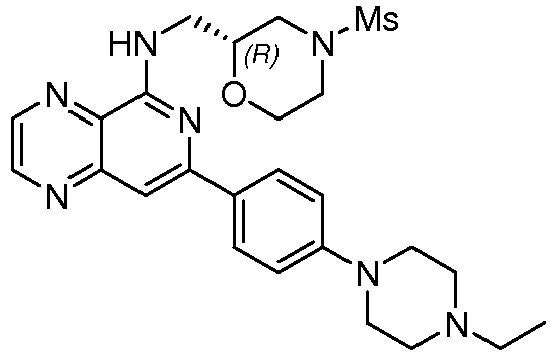
512 -

- To a solution of benzoyl peroxide (430 mg, 1.78 mmol) in DMF at -5°C was added K2HPO4 (360 mg, 2.07 mmol), then was added the solution of compound 419 (833 mg, 1.73 mmol) in DMF. The mixture was stirred at room temperature overnight. The reaction solution was poured into ice-water, filter, the filter cake was washed with water and PE, dried to afford the crude product as yellow solid. The crude product was dissolved in methanol and THF, cooled to -5°C, LiOH (15 mL) was added dropwise, the mixture was stirred for 1 hour. 100 mL water was added into the reaction solution, extracted with DCM (50 mL × 4), washed with brine, dried with anhydrous Na2SO4. The solvent was removed to get crude product. The crude product was purified by column chromatograph (DCM:MeOH=100:1∼50:1), washed by 5 mL EA and 1 mL methanol to afford the title compound as yellow solid (145 mg). MS (m/z) = 499 (M+H)+.
-

- The racemic compound 501 was resolved by chiral HPLC to provide the optically pure enantiomers Compound 507 and 508 (HPLC conditions: column: CHIRALPAK IA 0.20 x 25 cm; mobile phase: CH3CN/EtOH=90/10; flow rate = 10.0 mL/min; detector: UV 254 nm). The first eluent (compound 507, Rf=9.759 min) was 100% ee, MS (m/z): 497 (M+H)+. and the second eluent (compound 508, Rf=10.916 min) was 100% ee, MS (m/z): 497 (M+H)+.
- Syk kinase assay are performed in vitro using Kit-Tyr 2 Peptide (Invitrogen, Cat.No. PV3191) and in a 384-well assay plate. All reactions (40 µL) are started by adding 0.8 µL of the testing compound in 100% DMSO solution, 10 µL of Kinase/Peptide substrate mixture or Phospho-Peptide solution (Invitrogen, Cat.No. PV3192, diluted with 1.33x Kinase Buffer), 5 µL ATP solution (100µM) or 1.33 x kinase buffer (Invitrogen, Cat. No. PV3189, 5x diluted with distilled water), 4.2 µL distilled water. The 384-well assay plate (Corning, Cat.No. 3575) is mixed and incubated at room temperature for 1 hour. 10 µL of the Development Solution (prepared by diluting Development Reagent A (Cat.No.PV3297) to 1/32 with Development Buffer (Cat.No.PV3127)) is then added to each well, mixed and incubated at room temperature for another 1 hour. The reactions are then stopped by adding 10 µL of the Stop Reagent (Invitrogen, Cat.No. PV3094), and the plate is read with Wallac 1420 VICTOR3 Multilabel Counter (PerkinElmer™) at 445 nm and 520 nm fluorescence. All compounds are tested at 8 concentrations (1µM down to 0.0003µM) using a 1:3 serial dilution scheme.
- Below are the IC50 values of some compounds.
- IC50 values of compounds 1, 3, 9, 10, 12, 19, 21, 22, 26, 30, 32, 33, 34, 35, 40, 41, 42, 44, 46, 47, 48, 52, 53, 54, 55, 59, 60, 61, 63, 64, 67, 70, 71, 73, 74, 77, 78, 79, 80, 81, 82, 83, 85, 86, 87, 90, 93, 94, 96, 99, 102, 103, 104, 105, 107, 109, 110, 111, 112, 114, 116, 117, 119, 120, 121, 122, 123, 127, 128, 129, 130, 134, 136, 137, 139, 140, 141, 142, 143, 146, 156, 157, 158, 173, 179, 185, 186, 200, 205, 208, 213, 215, 216, 217, 218, 219, 221, 225, 226, 228, 229, 230, 231, 232, 233, 235, 236, 237, 238, 239, 240, 241, 251, 253, 254, 264, 265, 266, 267, 269, 270, 272, 273, 274, 275, 276, 278, 279, 280, 281, 285, 286, 287, 289, 290, 291, 292, 293, 294, 295, 296, 297, 298, 300, 301, 302, 305, 306, 307, 308, 309, 310, 311, 312, 313, 314, 315, 316, 317, 318, 319, 320, 321, 322, 323, 324, 332, 333, 340, 346, 347, 362, 368, 370, 371, 372, 374, 376, 377, 380, 381, 382, 383, 384, 385, 386, 387, 388, 389, 390, 392, 394, 396, 397, 398, 399, 400, 401, 402, 403, 404, 405, 406, 407, 408, 409, 410, 411, 412, 413, 414, 415, 416, 417, 418, 419, 420, 421, 422, 423, 424, 425, 426, 427, 428, 429, 430, 431, 432, 433, 434, 435, 437, 438, 439, 440, 441, 442, 443, 444, 445, 446, 447, 448, 449, 450, 451, 455, 456, 458, 459, 460, 462, 463, 464, 465, 466, 467, 468, 469, 470, 473, 474, 475, 476, 479, 480, 485, 486, 487, 488, 489, 490, 493, 494, 497, 498, 499, 500, 501, 502, 503, 504, 505, 506, 510, 511, 512 are in the range of 0.001 to less than 0.1 uM.
- IC50 values of compounds 4, 6, 7, 8, 11, 13, 14, 15, 17, 18, 20, 23, 24, 25, 27, 28, 31, 37, 39, 43, 45, 49, 57, 65, 66, 68, 69, 72, 75, 76, 84, 88, 89, 91, 92, 95, 97, 98, 100, 101, 106, 108, 115, 124, 135, 138, 144, 145, 147, 148, 149, 150, 151, 154, 155, 159, 161, 162, 163, 164, 165, 166, 167, 168, 172, 174, 175, 176, 177, 180, 188, 191, 194, 195, 196, 198, 201, 202, 203, 204, 206, 207, 209, 210, 211, 212, 214, 220, 222, 223, 224, 227, 234, 242, 244, 245, 246, 247, 248, 249, 250, 252, 255, 256, 257, 258, 259, 260, 261, 262, 263, 268, 271, 277, 283, 284, 288, 299, 303, 304, 325, 326, 327, 328, 337, 339, 341, 342, 343, 344, 348, 349, 350, 353, 354, 355, 356, 356, 357, 358, 360, 361, 363, 364, 369, 373, 375, 378, 379, 391, 393, 395, 452, 453, 454, 457, 461, 471, 472, 477, 478, 482, 483, 484, 491, 492, 495, 496, 509 are from 0.1 uM to less than 1 uM.
- For the determination of IgE-induced Beta-hexosaminidase secretion, RBL-2H3 cells (SIBS) are seeded in 96 well plates at 4×10⁴ cells per well and incubated in MEM media with 15% FBS and Glutamine (2nM) for 4 hours and sensitized with 0.5 ug/ml of SPE-7 overnight. Cells are washed 3 times with Tyrode's buffer and incubated in the presence or absence of various concentrations of the testing compound for 20 min at 37°C, 5% CO2. Cells are stimulated by adding 10 uL of DNP-BSA solution (150 ng/mL) to each well and incubating for 45 minutes at 37°C, 5% CO2. Then, 45 µL of the supernatant is taken and incubated with 100 µL of 1 mM 4-Nitrophenyl N-acetyl-β-D-glucosaminide (Sigma, Cat.No. N9376), which is diluted in 0.05 M citrate buffer (pH 4.5), for 1.5 hr at 37°C. The reactions are quenched by adding 185 µL of 0.05 M sodium carbonate buffer (pH 10.0). Plates are read at 405 nm on Multiskan (MK 3).
- IC50 values of compounds 1, 3, 12, 19, 21, 22, 30, 32, 35, 44, 70, 77, 82, 93, 96, 99, 102, 104, 105, 107, 109, 110, 111, 114, 115, 116, 117, 123, 129, 130, 134, 136, 137, 139, 140, 141, 142, 143, 146, 155, 156, 157, 159, 163, 165, 173, 177, 188, 196, 200, 205, 208, 213, 215, 216, 217, 218, 219, 221, 226, 229, 230, 231, 232, 233, 235, 236, 237, 239, 240, 247, 250, 251, 254, 255, 264, 265, 266, 267, 269, 272, 273, 274, 275, 276, 278, 279, 285, 286, 287, 289, 290, 291, 292, 294, 295, 296, 297, 298, 300, 301, 302, 304, 305, 306, 307, 308, 309, 310, 311, 312, 313, 314, 315, 316, 317, 318, 319, 320, 321, 323, 324, 332, 333, 340, 346, 347, 362, 368, 370, 371, 374, 376, 377, 380, 382, 383, 384, 385, 387, 388, 389, 390, 392, 393, 394, 395, 396, 397, 398, 399, 400, 402, 405, 407, 411, 413, 414, 415, 416, 418, 419, 421, 423, 424, 425, 426, 427, 428, 429, 430, 432, 433, 435, 437, 438, 439, 442, 443, 444, 445, 446, 447, 448, 449, 450, 451, 455, 456, 460, 465, 466, 467, 469, 470, 473, 474, 476, 477, 479, 485, 486, 488, 489, 490, 497, 498, 499, 501, 504, 505, 511 are in the range of 0.001 to less than 0.1 uM.
- IC50 values of compounds 4, 9, 10, 13, 15, 17, 18, 23, 24, 25, 26, 28, 33, 37, 39, 40, 41, 42, 45, 46, 47, 52, 54, 55, 60, 63, 67, 68, 69, 71, 73, 74, 75, 76, 78, 79, 80, 81, 83, 84, 85, 86, 87, 88, 89, 91, 92, 94, 95, 97, 98, 100, 103, 106, 108, 112, 119, 120, 121, 122, 124, 127, 128, 135, 138, 144, 147, 148, 149, 150, 151, 158, 160, 161, 162, 164, 166, 167, 168, 170, 171, 172, 174, 175, 176, 179, 180, 181, 184, 185, 186, 187, 194, 197, 199, 220, 222, 223, 225, 228, 234, 238, 241, 253 ,259, 260, 261, 270, 280, 281, 293, 303, 322, 372, 373, 381, 386, 401, 403, 404, 406, 408, 409, 410, 412, 417, 420, 434, 440, 441, 458, 462, 463, 464, 468, 475, 487, 493, 494, 500, 502, 503, 506, 510, 512 are from 0.1 uM to less than 1 uM.
- For the determination of IgE-induced LAT phosphorylation, Bone marrow mast cells (BMMCs) are isolated from the femur of female BALB/C mice (6-8 weeks old) and cultured in RPMI 1640 medium with 10%FBS, L-Glutamine (2 nM) and IL-3 (10 ng/ml) for 4 to 6 weeks. BMMCs are starved in RPMI 1640 with 10%FBS, L-Glutamine (2 nM) and without IL-3 overnight. Cells are sensitized with 1 µg/mL of SPE-7 (1x10⁷ cell/ml) for 4 hours. Cells are washed 3 times with Tyrode's buffer and seeded in 96-well plates (3x10⁵/well). Then the cells are incubated in the presence or absence of various concentrations of testing compound for 20 min at 37°C, 5% CO2. The cells are stimulated by adding 10 uL of DNP-BSA solution (100 ng/mL) to each well and incubating for 5 minutes at 37°C, 5% CO2. The plates are centrifuged and medium removed. Then 80 µL of 1xcell lysis buffer is added to each well in the plates, which are frozen at -80°C, overnight. 100 µl of 1ug/ml anti-LAT polyclonal antibody (Abeam, diluted in PBS) is added to each well of new 96-well plates and incubated at RT overnight. After washing with 200 µL/well wash solution, the plates are blocked by adding 200 µL of PBS containing 1.0% BSA to each well and incubating at room temperature for 2 hrs. 50 µL of cell lysate diluted by 50 µL of sample diluents is added into the plates and incubated at room temperature for 2 hrs. After washing, anti-phosphotyrosine-HRP detection antibody (R&D, diluted in PBS with 0.1% BSA,1:2000) is added and the plates are incubated at room temperature for 1 hr. After washing, 100 µL TMB is added to each well and the plates stand for 20 min in the dark. The reaction is stopped by adding 100 µL stop buffer. Plates are read at 450 nm and 570 nM on Multiskan (MK3).
- IC50 values of compounds 1, 3, 10, 12, 32, 35, 44, 70, 71, 77, 81, 82, 93, 94, 96, 99, 104, 105, 107, 116, 117, 134, 137, 140, 156, 159, 160, 161, 163, 181, 184, 185, 188, are from 0.1 uM to less than 1 uM.
Claims (5)
- At least one compound chosen from:
1 
2 
3 
4 
5 
6 
7 
8 
9 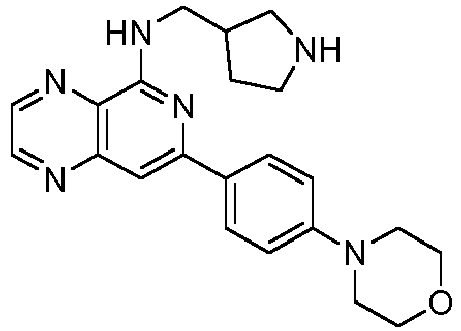
10 
11 
12 
13 
14 
15 
16 
17 
19 
20 
21 
22 
23 
24 
25 
26 
27 
28 
29 
30 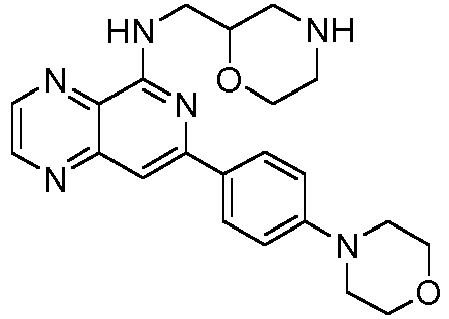
31 
32 
33 
34 
35 
36 
37 
38 
39 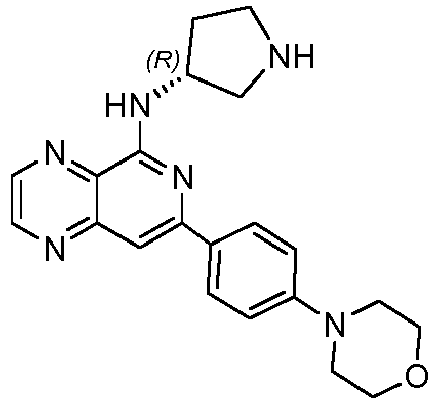
40 
41 
42 
43 
44 
45 
46 
47 
48 
49 
50 
51 
52 
53 
54 
55 
56 
57 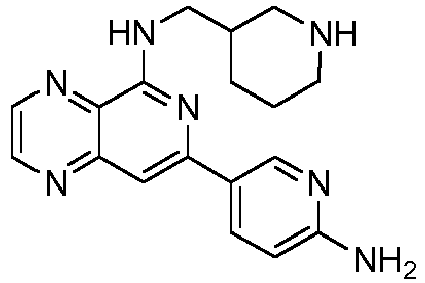
58 
60 
61 
62 
63 
64 
65 
66 
67 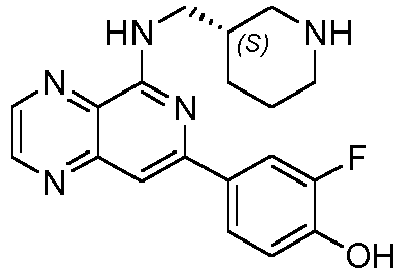
68 
69 
70 
71 
72 
73 
74 
75 
76 
77 
78 
79 
80 
81 
82 
83 
84 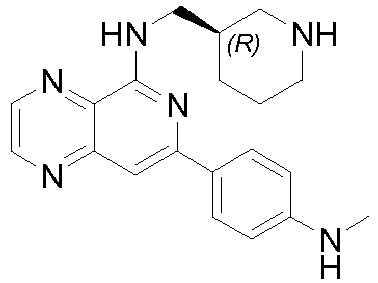
85 
86 
87 
88 
89 
90 
91 
92 
93 
94 
95 
96 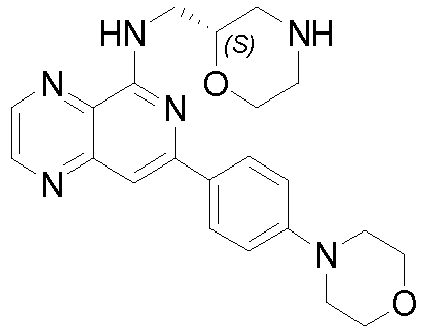
97 
98 
99 
100 
101 
102 
103 
104 
105 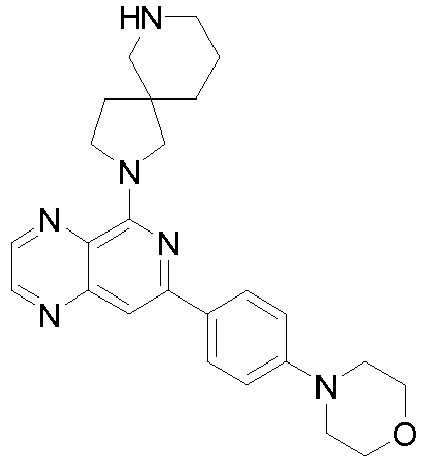
106 
107 
108 
109 
110 
111 
112 
113 
114 
115 
116 
117 
118 
119 
120 
121 
122 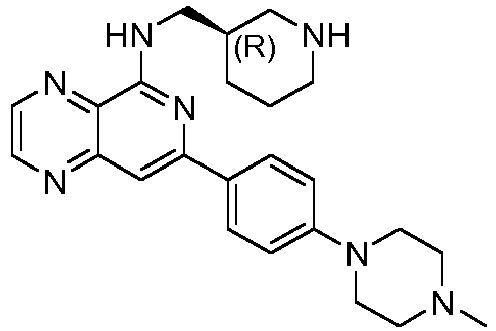
123 
124 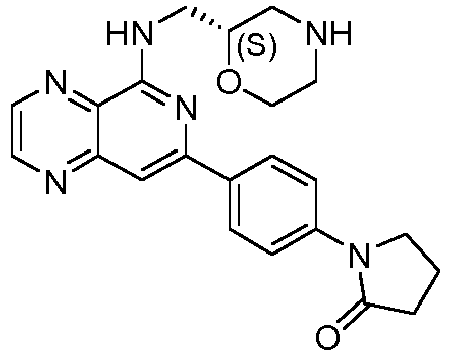
125 
126 
127 
128 
129 
130 
131 
132 
133 
134 
135 
136 
137 
138 
139 
140 
141 
142 
143 
144 
145 
146 
147 
148 
149 
150 
151 
152 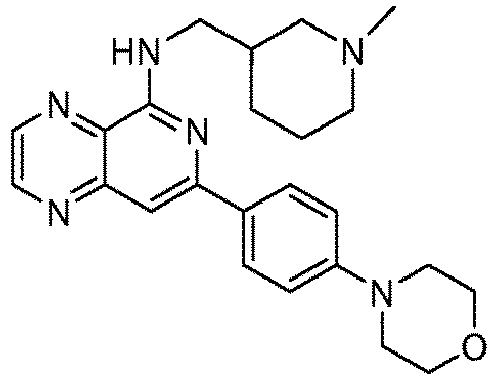
153 
154 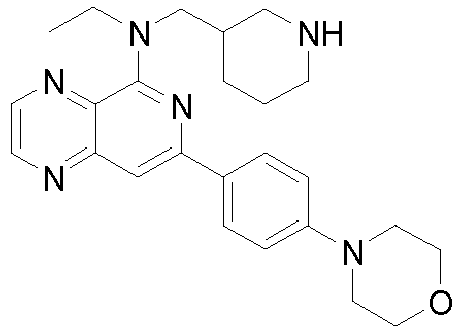
155 
156 
157 
158 
159 
160 
161 
162 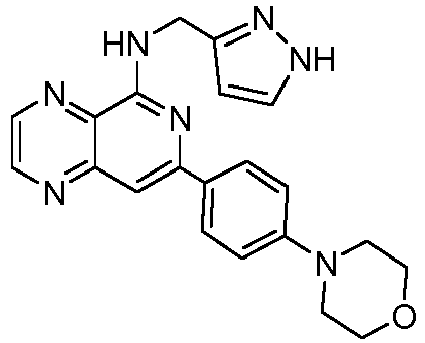
163 
164 
165 
166 
167 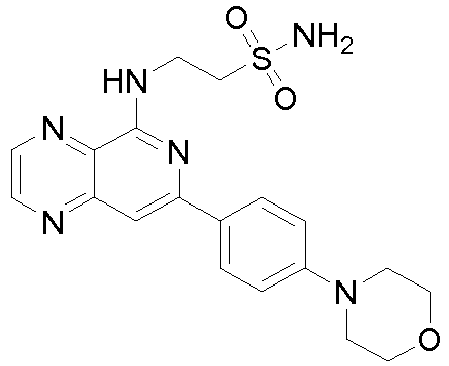
168 
169 
170 
171 
172 
173 
174 
175 
176 
177 
178 
179 
180 
181 
182 
183 
184 
185 
186 
187 
188 
189 
190 
191 
192 
193 
194 
195 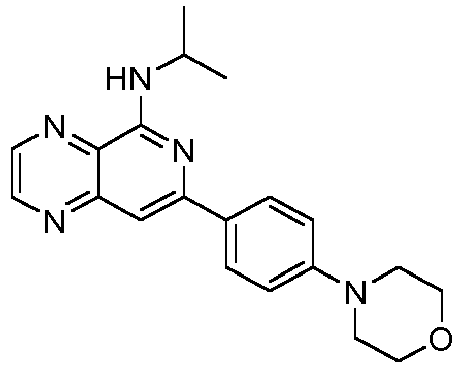
196 
197 
198 
199 
200 
202 
203 
204 
205 
206 
207 
208 
209 
211 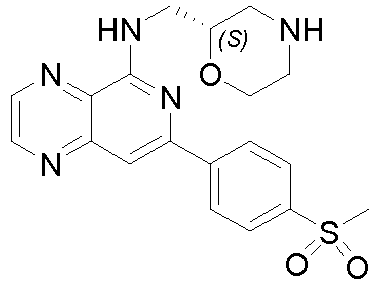
212 
213 
214 
215 
216 
217 
218 
219 
220 
221 
222 
223 
224 
225 
226 
227 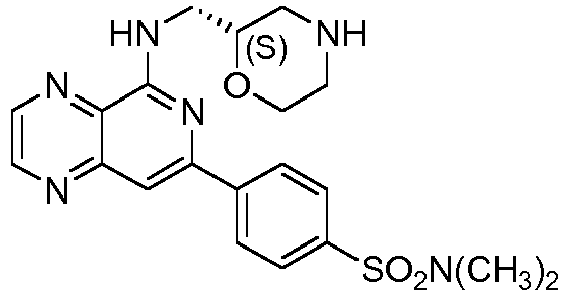
228 
229 
230 
231 
232, 233 
234 
235 
236 
237 
238 
239 
240 
241 
242 
243 
244 
245 
246 
247 
248 
249 
250 
251 
252 
253 
254 
255 
256 
257 
258 
259 
260 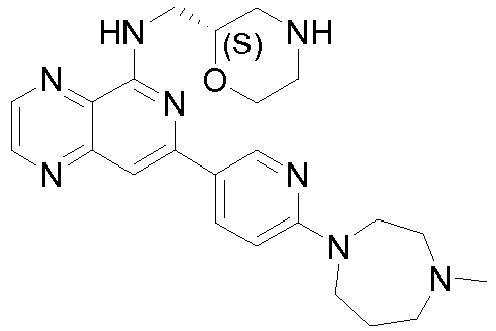
261 
262 
263 
264 
265 
266 
267 
268 
269 
270 
271 
272 
273 
274 
275 
276 
277 
278 
279 
280 
281 
282 
283 
284 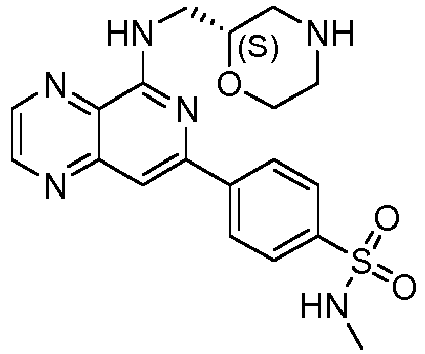
285 
286 
287 
288 
290 
291 
292 
293 
294 
295 
296 
297 
298 
299 
300 
301 
302 
303 
304 
305 
306 
307 
308 
.309 
310 
311 
312 
313 
314 
315 
316 
317 
318 
319 
320 
321 
322 
323 
324 
325 
326 
327 
328 
329 
330 
331 
332 
333 
334 
335 
336 
337 
338 
339 
340 
341 
342 
343 
344 
345 
346 
347 
348 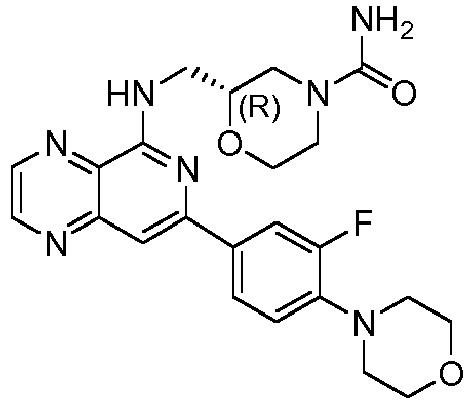
349 
350 
351 
352 
353 
354 
355 
356 
357 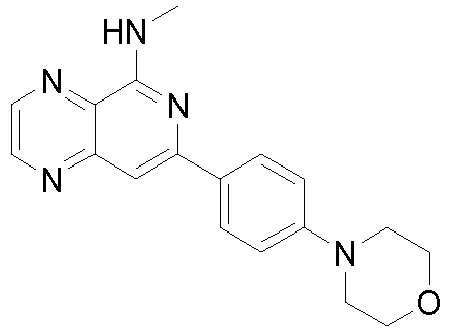
358 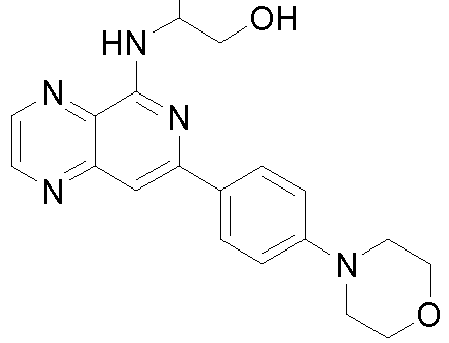
359 
360 
361 
362 
363 
364 
365 
366 
367 
368, 369 
370, 371 
372, 373 
374, 375 
376, 377 
378, 379 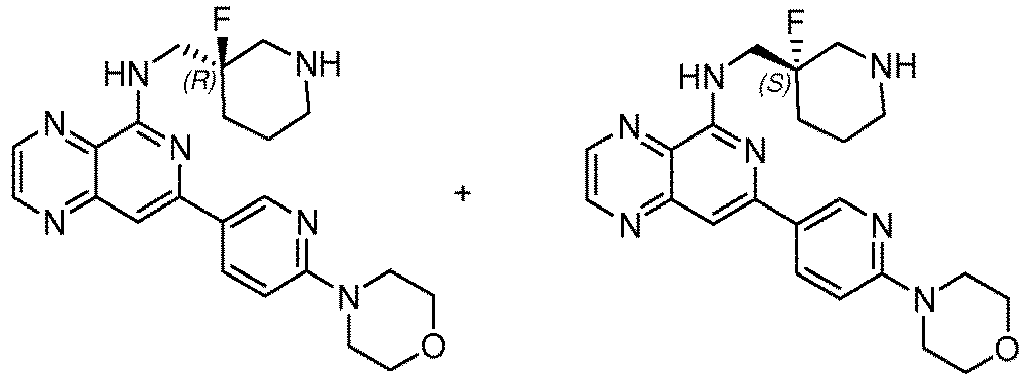
380, 381 
382, 383 
384, 385 
386, 387 
388, 389 
390, 391 
392, 393 
394, 395 
396, 397 
398, 399 
400 
401 
402 
403 
404 
405 
406 
407 
408 
409 
410 
411 
412 
413 
414 
415 
416 
417 
418 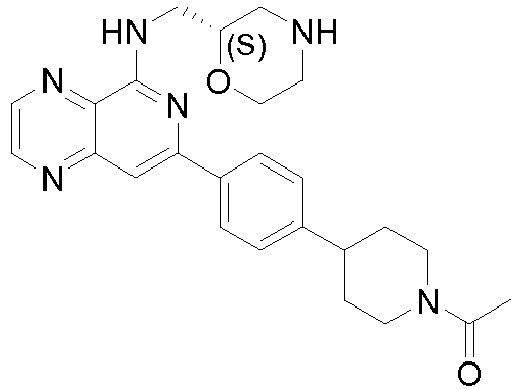
419 
420 
421 
422 
423 
424 
425 
426 
427 
428 
429 
430 
431 
432 
433 
434 
435 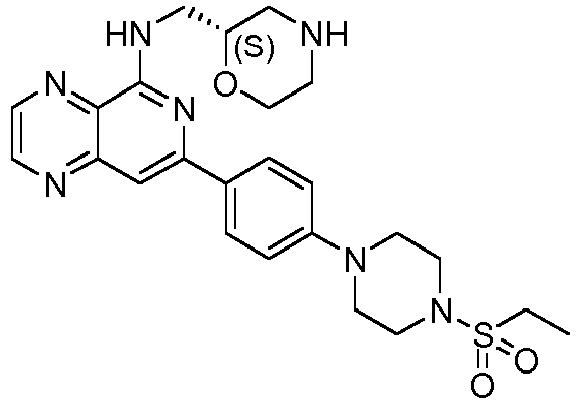
436 
437 
438 
439 
440 
441 
442 
443 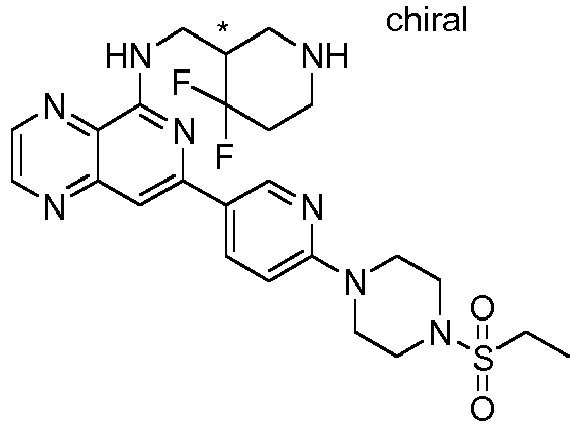
444 
445 
446 
447 
448 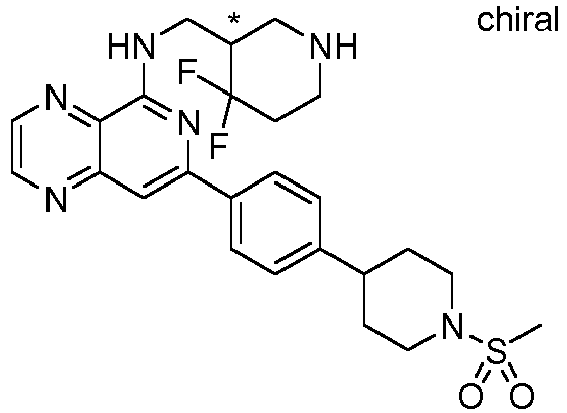
449 
450 
451 
452 
453 
454 
455 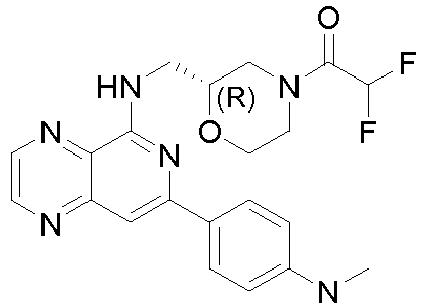
456 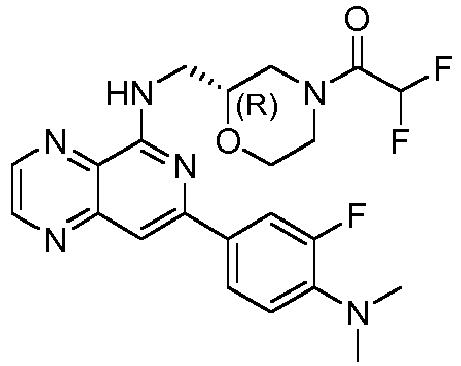
457 
458 
459 
460 
461 
462 
463 
464 
465 
466 
467 
468 
469 
470 
471 
472 
473 
474 
475 
476, 477 
478 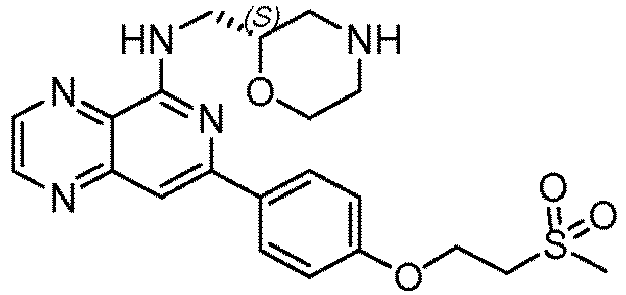
479 
480 
481 
482 
483 
484 
485 
486 
487 
488 
489 
490 
491 
492 
493 
494 
495 
496 
497 
498 
499 
500 
501 
502 
503 
504 
505 
506 
507, 508 
509 
510 
511 
512 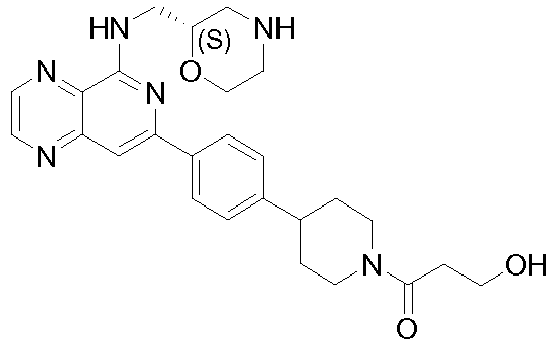
513 
514 
515 
516 
- A composition comprising (i) at least one compound of claim 1, or its racemic mixture, enantiomers, diastereomers, tautomers, or mixtures thereof, or at least one pharmaceutically acceptable salt thereof and (ii) at least one pharmaceutically acceptable carrier.
- A compound of claim 1 or a racemic mixture, enantiomer, diastereomer, tautomer, or mixture thereof, or at least one pharmaceutically acceptable salt thereof; or a composition of claim 2 for use as a medicine.
- A compound of claim 1 or a racemic mixture, enantiomer, diastereomer, tautomer, or mixture thereof, or at least one pharmaceutically acceptable salt thereof; or a composition of claim 2 for use in treating a Syk- mediated disease, wherein the Syk- mediated disease is an inflammatory disease, an allergic disease, a cell- proliferative disease, an autoimmune disease or cytopenia.
- The compound or composition for use of claim 4, wherein the Syk-mediated disease is allergic asthma, allergic rhinitis, rheumatoid arthritis, multiple sclerosis, lupus, systemic lupus erythematosus, lymphoma, B cell lymphoma, T cell lymphoma, leukemia, myelodysplasic syndrome, anemia, leucopenia, neutropenia, thrombocytopenia, granuloctopenia, pancytoia or idiopathic thrombocytopenic purpura.
Priority Applications (5)
| Application Number | Priority Date | Filing Date | Title |
|---|---|---|---|
| PL12797167T PL2718293T3 (en) | 2011-06-08 | 2012-06-07 | Substituted pyridopyrazines as novel syk inhibitors |
| RS20180086A RS56901B1 (en) | 2011-06-08 | 2012-06-07 | Substituted pyridopyrazines as novel syk inhibitors |
| HRP20180139TT HRP20180139T1 (en) | 2011-06-08 | 2012-06-07 | SUBSTITUTED PYRIDOPYRAZINE AS NEW SYK-INHIBITORS |
| SI201231176T SI2718293T1 (en) | 2011-06-08 | 2012-06-07 | Substituted pyridopyrazines as novel syk inhibitors |
| SM20180057T SMT201800057T1 (en) | 2011-06-08 | 2012-06-07 | Substituted pyridopyrazines as novel syk inhibitors |
Applications Claiming Priority (2)
| Application Number | Priority Date | Filing Date | Title |
|---|---|---|---|
| PCT/CN2011/075431 WO2012167423A1 (en) | 2011-06-08 | 2011-06-08 | Substituted pyridopyrazines as novel syk inhibitors |
| PCT/CN2012/076576 WO2012167733A1 (en) | 2011-06-08 | 2012-06-07 | Substituted pyridopyrazines as novel syk inhibitors |
Publications (3)
| Publication Number | Publication Date |
|---|---|
| EP2718293A1 EP2718293A1 (en) | 2014-04-16 |
| EP2718293A4 EP2718293A4 (en) | 2014-12-03 |
| EP2718293B1 true EP2718293B1 (en) | 2017-10-25 |
Family
ID=47295336
Family Applications (1)
| Application Number | Title | Priority Date | Filing Date |
|---|---|---|---|
| EP12797167.9A Active EP2718293B1 (en) | 2011-06-08 | 2012-06-07 | Substituted pyridopyrazines as novel syk inhibitors |
Country Status (32)
| Country | Link |
|---|---|
| US (2) | US9434726B2 (en) |
| EP (1) | EP2718293B1 (en) |
| JP (2) | JP5940148B2 (en) |
| KR (1) | KR101571720B1 (en) |
| CN (1) | CN103596952B (en) |
| AU (1) | AU2012266941B2 (en) |
| BR (1) | BR112013031405B1 (en) |
| CA (1) | CA2836227C (en) |
| CL (1) | CL2013003512A1 (en) |
| CY (1) | CY1119953T1 (en) |
| DK (1) | DK2718293T3 (en) |
| ES (1) | ES2657549T3 (en) |
| HR (1) | HRP20180139T1 (en) |
| HU (1) | HUE037934T2 (en) |
| IL (1) | IL229410A (en) |
| LT (1) | LT2718293T (en) |
| MX (1) | MX355671B (en) |
| MY (1) | MY186599A (en) |
| NO (1) | NO2718293T3 (en) |
| PE (1) | PE20141167A1 (en) |
| PH (1) | PH12013502434A1 (en) |
| PL (1) | PL2718293T3 (en) |
| PT (1) | PT2718293T (en) |
| RS (1) | RS56901B1 (en) |
| RU (1) | RU2569635C9 (en) |
| SG (1) | SG195035A1 (en) |
| SI (1) | SI2718293T1 (en) |
| SM (1) | SMT201800057T1 (en) |
| TW (1) | TWI494311B (en) |
| UA (1) | UA111744C2 (en) |
| WO (2) | WO2012167423A1 (en) |
| ZA (1) | ZA201308947B (en) |
Families Citing this family (18)
| Publication number | Priority date | Publication date | Assignee | Title |
|---|---|---|---|---|
| EP2683716A1 (en) * | 2011-03-11 | 2014-01-15 | Glaxo Group Limited | Pyrido[3,4-b]pyrazine derivatives as syk inhibitors |
| WO2012167423A1 (en) * | 2011-06-08 | 2012-12-13 | Hutchison Medipharma Limited | Substituted pyridopyrazines as novel syk inhibitors |
| JP6193374B2 (en) | 2012-08-13 | 2017-09-06 | 武田薬品工業株式会社 | Quinoxaline derivatives as GPR6 modulators |
| US20150307491A1 (en) * | 2012-12-07 | 2015-10-29 | Hutchison Medipharma Limited | Substituted pyridopyrazines as syk inhibitors |
| WO2015123505A1 (en) | 2014-02-14 | 2015-08-20 | Takeda Pharmaceutical Company Limited | Pyridopyrazines modulators of gpr6 |
| CA2942997C (en) | 2014-03-19 | 2022-09-13 | Boehringer Ingelheim International Gmbh | Heteroaryl syk inhibitors |
| WO2016205633A1 (en) | 2015-06-18 | 2016-12-22 | Cephalon, Inc. | 1, 4-substituted piperidine derivatives |
| MX379846B (en) | 2015-06-18 | 2025-03-11 | 89Bio Ltd | SUBSTITUTED 4-BENZYL AND 4-BENZOYL PIPERIDINE DERIVATIVES. |
| CN105153211B (en) * | 2015-09-22 | 2017-02-01 | 上海晋鲁医药科技有限公司 | Method for synthesis of 1-(N-Boc-4-piperidine)-4-pyrazoleboronic acid pinaol ester |
| CN110072865B (en) | 2017-02-08 | 2022-02-11 | 中国医药研究开发中心有限公司 | Pyrroloaromatic heterocyclic compound, preparation method and medical use thereof |
| WO2019018354A1 (en) * | 2017-07-18 | 2019-01-24 | Merck Patent Gmbh | Tlr7/8 antagonists and uses thereof |
| CN109422741A (en) | 2017-08-22 | 2019-03-05 | 和记黄埔医药(上海)有限公司 | The salt and its crystal form of compound |
| EP3942045A1 (en) | 2019-03-21 | 2022-01-26 | Onxeo | A dbait molecule in combination with kinase inhibitor for the treatment of cancer |
| EP4054579A1 (en) | 2019-11-08 | 2022-09-14 | Institut National de la Santé et de la Recherche Médicale (INSERM) | Methods for the treatment of cancers that have acquired resistance to kinase inhibitors |
| WO2021148581A1 (en) | 2020-01-22 | 2021-07-29 | Onxeo | Novel dbait molecule and its use |
| EP4186901A4 (en) * | 2020-07-23 | 2024-06-12 | Cytosinlab Therapeutics Co., Ltd. | ASSOCIATED WITH KINASE INHIBITORY EFFECT |
| AU2022284188A1 (en) * | 2021-06-04 | 2023-11-30 | Genentech, Inc. | 2, 8-diazaspiro [4.5] decane compounds |
| WO2025208443A1 (en) * | 2024-04-02 | 2025-10-09 | Hutchmed Limited | Methods of treatment warm autoimmune hemolytic anemia using sovleplenib |
Family Cites Families (20)
| Publication number | Priority date | Publication date | Assignee | Title |
|---|---|---|---|---|
| US4022779A (en) * | 1974-07-25 | 1977-05-10 | E. R. Squibb & Sons, Inc. | Amino derivatives of pyrido(3,4-b)pyrazine carboxylic acids and esters |
| US3989816A (en) | 1975-06-19 | 1976-11-02 | Nelson Research & Development Company | Vehicle composition containing 1-substituted azacycloheptan-2-ones |
| US4444762A (en) | 1980-04-04 | 1984-04-24 | Nelson Research & Development Company | Vehicle composition containing 1-substituted azacyclopentan-2-ones |
| JP2001302667A (en) | 2000-04-28 | 2001-10-31 | Bayer Ag | Imidazopyrimidine derivative and triazolopyrimidine derivative |
| US20030158195A1 (en) * | 2001-12-21 | 2003-08-21 | Cywin Charles L. | 1,6 naphthyridines useful as inhibitors of SYK kinase |
| TWI329105B (en) | 2002-02-01 | 2010-08-21 | Rigel Pharmaceuticals Inc | 2,4-pyrimidinediamine compounds and their uses |
| EP1538907A4 (en) | 2002-07-02 | 2008-12-24 | Southern Res Inst | FTSZ INHIBITORS AND USES THEREOF |
| DE10323345A1 (en) * | 2003-05-23 | 2004-12-16 | Zentaris Gmbh | New pyridopyrazines and their use as kinase inhibitors |
| JP4801096B2 (en) | 2005-01-19 | 2011-10-26 | ライジェル ファーマシューティカルズ, インコーポレイテッド | Prodrugs of 2,4-pyrimidinediamine compounds and their use |
| US8227455B2 (en) | 2005-04-18 | 2012-07-24 | Rigel Pharmaceuticals, Inc. | Methods of treating cell proliferative disorders |
| RU2515944C9 (en) * | 2005-11-11 | 2014-07-20 | Этерна Центарис ГмбХ | PYRIDOPYRAZINE DERIVATIVES, PHARMACEUTICAL COMPOSITION AND METHOD OF TREATING OR PREVENTING PHYSIOLOGICAL AND/OR PATHOPHYSIOLOGICAL CONDITIONS BY INHIBITION OF ENZYMES ERK, ERK1, ERK2, PI3K, PI3Kalpha, PI3Kbeta, PI3Kgamma, PI3Kdelta, PI3K-C2alpha, PI3K-C2beta, PI3K-Vps34p (VERSIONS) |
| TW200942537A (en) * | 2008-02-01 | 2009-10-16 | Irm Llc | Compounds and compositions as kinase inhibitors |
| WO2010015520A1 (en) | 2008-08-05 | 2010-02-11 | Boehringer Ingelheim International Gmbh | Substituted naphthyridines and use thereof as medicines |
| EP2459558A2 (en) * | 2009-07-30 | 2012-06-06 | Irm Llc | Compounds and compositions as syk kinase inhibitors |
| ES2661850T3 (en) * | 2009-09-14 | 2018-04-04 | Gilead Sciences, Inc. | Toll type receiver modulators |
| CN102822172A (en) | 2010-01-29 | 2012-12-12 | 贝林格尔.英格海姆国际有限公司 | Substituted naphthyridines and their use as syk kinase inhibitors |
| GB201007203D0 (en) | 2010-04-29 | 2010-06-16 | Glaxo Group Ltd | Novel compounds |
| EP2683716A1 (en) * | 2011-03-11 | 2014-01-15 | Glaxo Group Limited | Pyrido[3,4-b]pyrazine derivatives as syk inhibitors |
| WO2012167423A1 (en) * | 2011-06-08 | 2012-12-13 | Hutchison Medipharma Limited | Substituted pyridopyrazines as novel syk inhibitors |
| CA2843022C (en) | 2011-07-26 | 2019-09-24 | Boehringer Ingelheim International Gmbh | Substituted quinolines and their use as medicaments |
-
2011
- 2011-06-08 WO PCT/CN2011/075431 patent/WO2012167423A1/en not_active Ceased
-
2012
- 2012-06-07 BR BR112013031405-2A patent/BR112013031405B1/en active IP Right Grant
- 2012-06-07 LT LTEP12797167.9T patent/LT2718293T/en unknown
- 2012-06-07 HU HUE12797167A patent/HUE037934T2/en unknown
- 2012-06-07 MY MYPI2013702375A patent/MY186599A/en unknown
- 2012-06-07 CA CA2836227A patent/CA2836227C/en active Active
- 2012-06-07 PL PL12797167T patent/PL2718293T3/en unknown
- 2012-06-07 SI SI201231176T patent/SI2718293T1/en unknown
- 2012-06-07 RU RU2013158996/04A patent/RU2569635C9/en active
- 2012-06-07 WO PCT/CN2012/076576 patent/WO2012167733A1/en not_active Ceased
- 2012-06-07 NO NO12797167A patent/NO2718293T3/no unknown
- 2012-06-07 DK DK12797167.9T patent/DK2718293T3/en active
- 2012-06-07 KR KR1020137035164A patent/KR101571720B1/en active Active
- 2012-06-07 EP EP12797167.9A patent/EP2718293B1/en active Active
- 2012-06-07 MX MX2013014242A patent/MX355671B/en active IP Right Grant
- 2012-06-07 US US14/124,325 patent/US9434726B2/en active Active
- 2012-06-07 HR HRP20180139TT patent/HRP20180139T1/en unknown
- 2012-06-07 PE PE2013002777A patent/PE20141167A1/en active IP Right Grant
- 2012-06-07 SM SM20180057T patent/SMT201800057T1/en unknown
- 2012-06-07 CN CN201280027852.9A patent/CN103596952B/en active Active
- 2012-06-07 SG SG2013085337A patent/SG195035A1/en unknown
- 2012-06-07 PT PT127971679T patent/PT2718293T/en unknown
- 2012-06-07 RS RS20180086A patent/RS56901B1/en unknown
- 2012-06-07 PH PH1/2013/502434A patent/PH12013502434A1/en unknown
- 2012-06-07 JP JP2014513893A patent/JP5940148B2/en active Active
- 2012-06-07 AU AU2012266941A patent/AU2012266941B2/en active Active
- 2012-06-07 ES ES12797167T patent/ES2657549T3/en active Active
- 2012-06-08 TW TW101120631A patent/TWI494311B/en active
- 2012-07-06 UA UAA201315617A patent/UA111744C2/en unknown
-
2013
- 2013-11-12 IL IL229410A patent/IL229410A/en active IP Right Grant
- 2013-11-27 ZA ZA2013/08947A patent/ZA201308947B/en unknown
- 2013-12-06 CL CL2013003512A patent/CL2013003512A1/en unknown
-
2015
- 2015-12-28 JP JP2015255844A patent/JP6175484B2/en active Active
-
2016
- 2016-07-15 US US15/211,353 patent/US10052330B2/en active Active
-
2018
- 2018-01-22 CY CY20181100080T patent/CY1119953T1/en unknown
Non-Patent Citations (1)
| Title |
|---|
| None * |
Also Published As
Similar Documents
| Publication | Publication Date | Title |
|---|---|---|
| US10052330B2 (en) | Substituted pyrido[3,4-b]pyrazines as Syk inhibitors | |
| KR101541086B1 (en) | Pyrrolopyrimidine compounds and uses thereof | |
| AU2009244291B2 (en) | Substituted amides, method of making, and use as Btk inhibitors | |
| TWI580679B (en) | Heteroaryl-pyrimidine derivatives, preparation process and pharmaceutical use thereof | |
| WO2010068806A1 (en) | Amide derivatives as btk inhibitors in the treatment of allergic, autoimmune and inflammatory disorders as well as cancer | |
| EP3347353B1 (en) | Pyrazolyl-substituted heteroaryls and their use as medicaments | |
| WO2010068788A1 (en) | Heterocyclic amides as btk inhibitors | |
| WO2010068810A2 (en) | Certain substituted amides, method of making, and method of use thereof | |
| CN101605778A (en) | Certain substituted amides, methods for their preparation, and methods of use | |
| AU2013354552B2 (en) | Substituted pyridopyrazines as Syk inhibitors | |
| TW201127385A (en) | N-containing heteroaryl derivatives as JAK3 kinase inhibitors | |
| CA2922044A1 (en) | Pyrazolo-, imidazolo- and pyrrolo-pyridine or -pyrimidine derivatives as inhibitors o brutons kinase (btk) | |
| TW202421130A (en) | Isoquinolones as pi3k inhibitors | |
| WO2023247596A1 (en) | Pyrazolothiazole carboxamides and their uses as pdgfr inhibitors | |
| NZ617765B2 (en) | Substituted pyridopyrazines as novel syk inhibitors | |
| HK1190143B (en) | Substituted pyridopyrazines as novel syk inhibitors |
Legal Events
| Date | Code | Title | Description |
|---|---|---|---|
| PUAI | Public reference made under article 153(3) epc to a published international application that has entered the european phase |
Free format text: ORIGINAL CODE: 0009012 |
|
| 17P | Request for examination filed |
Effective date: 20140108 |
|
| AK | Designated contracting states |
Kind code of ref document: A1 Designated state(s): AL AT BE BG CH CY CZ DE DK EE ES FI FR GB GR HR HU IE IS IT LI LT LU LV MC MK MT NL NO PL PT RO RS SE SI SK SM TR |
|
| DAX | Request for extension of the european patent (deleted) | ||
| A4 | Supplementary search report drawn up and despatched |
Effective date: 20141104 |
|
| RIC1 | Information provided on ipc code assigned before grant |
Ipc: A61P 37/00 20060101ALI20141029BHEP Ipc: A61P 35/00 20060101ALI20141029BHEP Ipc: A61K 31/4985 20060101ALI20141029BHEP Ipc: A61P 37/08 20060101ALI20141029BHEP Ipc: A61K 31/553 20060101ALI20141029BHEP Ipc: A61P 7/00 20060101ALI20141029BHEP Ipc: A61P 35/02 20060101ALI20141029BHEP Ipc: A61P 29/00 20060101ALI20141029BHEP Ipc: C07D 471/04 20060101AFI20141029BHEP Ipc: A61P 43/00 20060101ALI20141029BHEP Ipc: A61K 31/5375 20060101ALI20141029BHEP |
|
| 17Q | First examination report despatched |
Effective date: 20150929 |
|
| GRAP | Despatch of communication of intention to grant a patent |
Free format text: ORIGINAL CODE: EPIDOSNIGR1 |
|
| INTG | Intention to grant announced |
Effective date: 20161012 |
|
| RAP1 | Party data changed (applicant data changed or rights of an application transferred) |
Owner name: HUTCHISON MEDIPHARMA LIMITED |
|
| GRAJ | Information related to disapproval of communication of intention to grant by the applicant or resumption of examination proceedings by the epo deleted |
Free format text: ORIGINAL CODE: EPIDOSDIGR1 |
|
| STAA | Information on the status of an ep patent application or granted ep patent |
Free format text: STATUS: EXAMINATION IS IN PROGRESS |
|
| GRAP | Despatch of communication of intention to grant a patent |
Free format text: ORIGINAL CODE: EPIDOSNIGR1 |
|
| STAA | Information on the status of an ep patent application or granted ep patent |
Free format text: STATUS: GRANT OF PATENT IS INTENDED |
|
| INTC | Intention to grant announced (deleted) | ||
| GRAJ | Information related to disapproval of communication of intention to grant by the applicant or resumption of examination proceedings by the epo deleted |
Free format text: ORIGINAL CODE: EPIDOSDIGR1 |
|
| STAA | Information on the status of an ep patent application or granted ep patent |
Free format text: STATUS: EXAMINATION IS IN PROGRESS |
|
| INTG | Intention to grant announced |
Effective date: 20170321 |
|
| GRAP | Despatch of communication of intention to grant a patent |
Free format text: ORIGINAL CODE: EPIDOSNIGR1 |
|
| STAA | Information on the status of an ep patent application or granted ep patent |
Free format text: STATUS: GRANT OF PATENT IS INTENDED |
|
| INTC | Intention to grant announced (deleted) | ||
| INTG | Intention to grant announced |
Effective date: 20170511 |
|
| GRAS | Grant fee paid |
Free format text: ORIGINAL CODE: EPIDOSNIGR3 |
|
| GRAA | (expected) grant |
Free format text: ORIGINAL CODE: 0009210 |
|
| STAA | Information on the status of an ep patent application or granted ep patent |
Free format text: STATUS: THE PATENT HAS BEEN GRANTED |
|
| AK | Designated contracting states |
Kind code of ref document: B1 Designated state(s): AL AT BE BG CH CY CZ DE DK EE ES FI FR GB GR HR HU IE IS IT LI LT LU LV MC MK MT NL NO PL PT RO RS SE SI SK SM TR |
|
| REG | Reference to a national code |
Ref country code: GB Ref legal event code: FG4D |
|
| REG | Reference to a national code |
Ref country code: CH Ref legal event code: EP |
|
| REG | Reference to a national code |
Ref country code: AT Ref legal event code: REF Ref document number: 939805 Country of ref document: AT Kind code of ref document: T Effective date: 20171115 |
|
| REG | Reference to a national code |
Ref country code: IE Ref legal event code: FG4D |
|
| REG | Reference to a national code |
Ref country code: DE Ref legal event code: R096 Ref document number: 602012038989 Country of ref document: DE |
|
| REG | Reference to a national code |
Ref country code: RO Ref legal event code: EPE |
|
| REG | Reference to a national code |
Ref country code: HR Ref legal event code: TUEP Ref document number: P20180139 Country of ref document: HR |
|
| REG | Reference to a national code |
Ref country code: DK Ref legal event code: T3 Effective date: 20180124 |
|
| REG | Reference to a national code |
Ref country code: PT Ref legal event code: SC4A Ref document number: 2718293 Country of ref document: PT Date of ref document: 20180130 Kind code of ref document: T Free format text: AVAILABILITY OF NATIONAL TRANSLATION Effective date: 20180123 |
|
| REG | Reference to a national code |
Ref country code: CH Ref legal event code: NV Representative=s name: LUCHS AND PARTNER AG PATENTANWAELTE, CH |
|
| REG | Reference to a national code |
Ref country code: NL Ref legal event code: FP |
|
| REG | Reference to a national code |
Ref country code: SE Ref legal event code: TRGR |
|
| REG | Reference to a national code |
Ref country code: ES Ref legal event code: FG2A Ref document number: 2657549 Country of ref document: ES Kind code of ref document: T3 Effective date: 20180305 |
|
| REG | Reference to a national code |
Ref country code: NO Ref legal event code: T2 Effective date: 20171025 |
|
| REG | Reference to a national code |
Ref country code: EE Ref legal event code: FG4A Ref document number: E015228 Country of ref document: EE Effective date: 20180314 |
|
| REG | Reference to a national code |
Ref country code: HR Ref legal event code: T1PR Ref document number: P20180139 Country of ref document: HR |
|
| REG | Reference to a national code |
Ref country code: GR Ref legal event code: EP Ref document number: 20180400231 Country of ref document: GR Effective date: 20180518 |
|
| REG | Reference to a national code |
Ref country code: FR Ref legal event code: PLFP Year of fee payment: 7 |
|
| REG | Reference to a national code |
Ref country code: DE Ref legal event code: R097 Ref document number: 602012038989 Country of ref document: DE |
|
| PLBE | No opposition filed within time limit |
Free format text: ORIGINAL CODE: 0009261 |
|
| STAA | Information on the status of an ep patent application or granted ep patent |
Free format text: STATUS: NO OPPOSITION FILED WITHIN TIME LIMIT |
|
| REG | Reference to a national code |
Ref country code: HU Ref legal event code: AG4A Ref document number: E037934 Country of ref document: HU |
|
| 26N | No opposition filed |
Effective date: 20180726 |
|
| REG | Reference to a national code |
Ref country code: HR Ref legal event code: ODRP Ref document number: P20180139 Country of ref document: HR Payment date: 20190521 Year of fee payment: 8 |
|
| REG | Reference to a national code |
Ref country code: HR Ref legal event code: ODRP Ref document number: P20180139 Country of ref document: HR Payment date: 20200520 Year of fee payment: 9 |
|
| REG | Reference to a national code |
Ref country code: HR Ref legal event code: ODRP Ref document number: P20180139 Country of ref document: HR Payment date: 20210519 Year of fee payment: 10 |
|
| REG | Reference to a national code |
Ref country code: AT Ref legal event code: UEP Ref document number: 939805 Country of ref document: AT Kind code of ref document: T Effective date: 20171025 |
|
| REG | Reference to a national code |
Ref country code: HR Ref legal event code: ODRP Ref document number: P20180139 Country of ref document: HR Payment date: 20220525 Year of fee payment: 11 |
|
| REG | Reference to a national code |
Ref country code: HR Ref legal event code: ODRP Ref document number: P20180139 Country of ref document: HR Payment date: 20230519 Year of fee payment: 12 |
|
| P01 | Opt-out of the competence of the unified patent court (upc) registered |
Effective date: 20230518 |
|
| PGFP | Annual fee paid to national office [announced via postgrant information from national office to epo] |
Ref country code: SM Payment date: 20230522 Year of fee payment: 12 Ref country code: MC Payment date: 20230522 Year of fee payment: 12 |
|
| REG | Reference to a national code |
Ref country code: HR Ref legal event code: ODRP Ref document number: P20180139 Country of ref document: HR Payment date: 20240522 Year of fee payment: 13 |
|
| PG25 | Lapsed in a contracting state [announced via postgrant information from national office to epo] |
Ref country code: MC Free format text: LAPSE BECAUSE OF NON-PAYMENT OF DUE FEES Effective date: 20240701 |
|
| REG | Reference to a national code |
Ref country code: EE Ref legal event code: MM4A Ref document number: E015228 Country of ref document: EE Effective date: 20240630 |
|
| PG25 | Lapsed in a contracting state [announced via postgrant information from national office to epo] |
Ref country code: SM Free format text: LAPSE BECAUSE OF NON-PAYMENT OF DUE FEES Effective date: 20250110 |
|
| PG25 | Lapsed in a contracting state [announced via postgrant information from national office to epo] |
Ref country code: EE Free format text: LAPSE BECAUSE OF NON-PAYMENT OF DUE FEES Effective date: 20240630 |
|
| REG | Reference to a national code |
Ref country code: EE Ref legal event code: TH4A Ref document number: E015228 Country of ref document: EE |
|
| REG | Reference to a national code |
Ref country code: HR Ref legal event code: ODRP Ref document number: P20180139 Country of ref document: HR Payment date: 20250521 Year of fee payment: 14 |
|
| PGFP | Annual fee paid to national office [announced via postgrant information from national office to epo] |
Ref country code: FI Payment date: 20250625 Year of fee payment: 14 |
|
| PGFP | Annual fee paid to national office [announced via postgrant information from national office to epo] |
Ref country code: DE Payment date: 20250627 Year of fee payment: 14 Ref country code: PL Payment date: 20250521 Year of fee payment: 14 |
|
| PGFP | Annual fee paid to national office [announced via postgrant information from national office to epo] |
Ref country code: GB Payment date: 20250627 Year of fee payment: 14 Ref country code: DK Payment date: 20250625 Year of fee payment: 14 |
|
| PGFP | Annual fee paid to national office [announced via postgrant information from national office to epo] |
Ref country code: LT Payment date: 20250520 Year of fee payment: 14 |
|
| PGFP | Annual fee paid to national office [announced via postgrant information from national office to epo] |
Ref country code: RS Payment date: 20250521 Year of fee payment: 14 Ref country code: IS Payment date: 20250602 Year of fee payment: 14 Ref country code: NO Payment date: 20250627 Year of fee payment: 14 |
|
| PGFP | Annual fee paid to national office [announced via postgrant information from national office to epo] |
Ref country code: AL Payment date: 20250610 Year of fee payment: 14 Ref country code: LU Payment date: 20250627 Year of fee payment: 14 Ref country code: NL Payment date: 20250626 Year of fee payment: 14 Ref country code: BE Payment date: 20250627 Year of fee payment: 14 |
|
| PGFP | Annual fee paid to national office [announced via postgrant information from national office to epo] |
Ref country code: HR Payment date: 20250521 Year of fee payment: 14 |
|
| PGFP | Annual fee paid to national office [announced via postgrant information from national office to epo] |
Ref country code: PT Payment date: 20250521 Year of fee payment: 14 Ref country code: LV Payment date: 20250520 Year of fee payment: 14 |
|
| PG2D | Information on lapse in contracting state deleted |
Ref country code: EE |
|
| PGFP | Annual fee paid to national office [announced via postgrant information from national office to epo] |
Ref country code: FR Payment date: 20250625 Year of fee payment: 14 Ref country code: EE Payment date: 20250603 Year of fee payment: 14 Ref country code: HU Payment date: 20250530 Year of fee payment: 14 |
|
| PGFP | Annual fee paid to national office [announced via postgrant information from national office to epo] |
Ref country code: MT Payment date: 20250520 Year of fee payment: 14 Ref country code: BG Payment date: 20250610 Year of fee payment: 14 Ref country code: GR Payment date: 20250626 Year of fee payment: 14 |
|
| PGFP | Annual fee paid to national office [announced via postgrant information from national office to epo] |
Ref country code: RO Payment date: 20250529 Year of fee payment: 14 Ref country code: AT Payment date: 20250521 Year of fee payment: 14 |
|
| PGFP | Annual fee paid to national office [announced via postgrant information from national office to epo] |
Ref country code: TR Payment date: 20250526 Year of fee payment: 14 Ref country code: SK Payment date: 20250521 Year of fee payment: 14 |
|
| PGFP | Annual fee paid to national office [announced via postgrant information from national office to epo] |
Ref country code: CZ Payment date: 20250523 Year of fee payment: 14 |
|
| PGFP | Annual fee paid to national office [announced via postgrant information from national office to epo] |
Ref country code: IE Payment date: 20250627 Year of fee payment: 14 |
|
| PGFP | Annual fee paid to national office [announced via postgrant information from national office to epo] |
Ref country code: SI Payment date: 20250519 Year of fee payment: 14 Ref country code: SE Payment date: 20250627 Year of fee payment: 14 |
|
| PGFP | Annual fee paid to national office [announced via postgrant information from national office to epo] |
Ref country code: ES Payment date: 20250701 Year of fee payment: 14 |
|
| PGFP | Annual fee paid to national office [announced via postgrant information from national office to epo] |
Ref country code: IT Payment date: 20250619 Year of fee payment: 14 |
|
| PGFP | Annual fee paid to national office [announced via postgrant information from national office to epo] |
Ref country code: CH Payment date: 20250701 Year of fee payment: 14 |
|
| PGFP | Annual fee paid to national office [announced via postgrant information from national office to epo] |
Ref country code: MK Payment date: 20250521 Year of fee payment: 14 |
|
| PGFP | Annual fee paid to national office [announced via postgrant information from national office to epo] |
Ref country code: CY Payment date: 20250522 Year of fee payment: 14 |