EP2713786B1 - Sports garment - Google Patents
Sports garment Download PDFInfo
- Publication number
- EP2713786B1 EP2713786B1 EP12726839.9A EP12726839A EP2713786B1 EP 2713786 B1 EP2713786 B1 EP 2713786B1 EP 12726839 A EP12726839 A EP 12726839A EP 2713786 B1 EP2713786 B1 EP 2713786B1
- Authority
- EP
- European Patent Office
- Prior art keywords
- garment
- wearer
- midline
- resistance elements
- thigh
- Prior art date
- Legal status (The legal status is an assumption and is not a legal conclusion. Google has not performed a legal analysis and makes no representation as to the accuracy of the status listed.)
- Active
Links
Images


Classifications
-
- A—HUMAN NECESSITIES
- A41—WEARING APPAREL
- A41D—OUTERWEAR; PROTECTIVE GARMENTS; ACCESSORIES
- A41D13/00—Professional, industrial or sporting protective garments, e.g. surgeons' gowns or garments protecting against blows or punches
-
- A—HUMAN NECESSITIES
- A41—WEARING APPAREL
- A41D—OUTERWEAR; PROTECTIVE GARMENTS; ACCESSORIES
- A41D1/00—Garments
- A41D1/06—Trousers
- A41D1/08—Trousers specially adapted for sporting purposes
-
- A—HUMAN NECESSITIES
- A41—WEARING APPAREL
- A41D—OUTERWEAR; PROTECTIVE GARMENTS; ACCESSORIES
- A41D13/00—Professional, industrial or sporting protective garments, e.g. surgeons' gowns or garments protecting against blows or punches
- A41D13/0015—Sports garments other than provided for in groups A41D13/0007 - A41D13/088
-
- A—HUMAN NECESSITIES
- A41—WEARING APPAREL
- A41D—OUTERWEAR; PROTECTIVE GARMENTS; ACCESSORIES
- A41D7/00—Bathing gowns; Swim-suits, drawers, or trunks; Beach suits
-
- A—HUMAN NECESSITIES
- A63—SPORTS; GAMES; AMUSEMENTS
- A63B—APPARATUS FOR PHYSICAL TRAINING, GYMNASTICS, SWIMMING, CLIMBING, OR FENCING; BALL GAMES; TRAINING EQUIPMENT
- A63B21/00—Exercising apparatus for developing or strengthening the muscles or joints of the body by working against a counterforce, with or without measuring devices
- A63B21/02—Exercising apparatus for developing or strengthening the muscles or joints of the body by working against a counterforce, with or without measuring devices using resilient force-resisters
- A63B21/055—Exercising apparatus for developing or strengthening the muscles or joints of the body by working against a counterforce, with or without measuring devices using resilient force-resisters extension element type
- A63B21/0552—Elastic ropes or bands
-
- A—HUMAN NECESSITIES
- A63—SPORTS; GAMES; AMUSEMENTS
- A63B—APPARATUS FOR PHYSICAL TRAINING, GYMNASTICS, SWIMMING, CLIMBING, OR FENCING; BALL GAMES; TRAINING EQUIPMENT
- A63B21/00—Exercising apparatus for developing or strengthening the muscles or joints of the body by working against a counterforce, with or without measuring devices
- A63B21/40—Interfaces with the user related to strength training; Details thereof
- A63B21/4001—Arrangements for attaching the exercising apparatus to the user's body, e.g. belts, shoes or gloves specially adapted therefor
- A63B21/4009—Arrangements for attaching the exercising apparatus to the user's body, e.g. belts, shoes or gloves specially adapted therefor to the waist
-
- A—HUMAN NECESSITIES
- A63—SPORTS; GAMES; AMUSEMENTS
- A63B—APPARATUS FOR PHYSICAL TRAINING, GYMNASTICS, SWIMMING, CLIMBING, OR FENCING; BALL GAMES; TRAINING EQUIPMENT
- A63B21/00—Exercising apparatus for developing or strengthening the muscles or joints of the body by working against a counterforce, with or without measuring devices
- A63B21/40—Interfaces with the user related to strength training; Details thereof
- A63B21/4023—Interfaces with the user related to strength training; Details thereof the user operating the resistance directly, without additional interface
- A63B21/4025—Resistance devices worn on the user's body
-
- A—HUMAN NECESSITIES
- A63—SPORTS; GAMES; AMUSEMENTS
- A63B—APPARATUS FOR PHYSICAL TRAINING, GYMNASTICS, SWIMMING, CLIMBING, OR FENCING; BALL GAMES; TRAINING EQUIPMENT
- A63B23/00—Exercising apparatus specially adapted for particular parts of the body
- A63B23/035—Exercising apparatus specially adapted for particular parts of the body for limbs, i.e. upper or lower limbs, e.g. simultaneously
- A63B23/04—Exercising apparatus specially adapted for particular parts of the body for limbs, i.e. upper or lower limbs, e.g. simultaneously for lower limbs
- A63B23/0482—Exercising apparatus specially adapted for particular parts of the body for limbs, i.e. upper or lower limbs, e.g. simultaneously for lower limbs primarily by articulating the hip joints
-
- A—HUMAN NECESSITIES
- A41—WEARING APPAREL
- A41D—OUTERWEAR; PROTECTIVE GARMENTS; ACCESSORIES
- A41D13/00—Professional, industrial or sporting protective garments, e.g. surgeons' gowns or garments protecting against blows or punches
- A41D13/05—Professional, industrial or sporting protective garments, e.g. surgeons' gowns or garments protecting against blows or punches protecting only a particular body part
- A41D13/0506—Hip
-
- A—HUMAN NECESSITIES
- A41—WEARING APPAREL
- A41D—OUTERWEAR; PROTECTIVE GARMENTS; ACCESSORIES
- A41D2400/00—Functions or special features of garments
- A41D2400/38—Shaping the contour of the body or adjusting the figure
-
- A—HUMAN NECESSITIES
- A63—SPORTS; GAMES; AMUSEMENTS
- A63B—APPARATUS FOR PHYSICAL TRAINING, GYMNASTICS, SWIMMING, CLIMBING, OR FENCING; BALL GAMES; TRAINING EQUIPMENT
- A63B21/00—Exercising apparatus for developing or strengthening the muscles or joints of the body by working against a counterforce, with or without measuring devices
- A63B21/00181—Exercising apparatus for developing or strengthening the muscles or joints of the body by working against a counterforce, with or without measuring devices comprising additional means assisting the user to overcome part of the resisting force, i.e. assisted-active exercising
-
- A—HUMAN NECESSITIES
- A63—SPORTS; GAMES; AMUSEMENTS
- A63B—APPARATUS FOR PHYSICAL TRAINING, GYMNASTICS, SWIMMING, CLIMBING, OR FENCING; BALL GAMES; TRAINING EQUIPMENT
- A63B2208/00—Characteristics or parameters related to the user or player
- A63B2208/03—Characteristics or parameters related to the user or player the user being in water
-
- A—HUMAN NECESSITIES
- A63—SPORTS; GAMES; AMUSEMENTS
- A63B—APPARATUS FOR PHYSICAL TRAINING, GYMNASTICS, SWIMMING, CLIMBING, OR FENCING; BALL GAMES; TRAINING EQUIPMENT
- A63B2209/00—Characteristics of used materials
-
- A—HUMAN NECESSITIES
- A63—SPORTS; GAMES; AMUSEMENTS
- A63B—APPARATUS FOR PHYSICAL TRAINING, GYMNASTICS, SWIMMING, CLIMBING, OR FENCING; BALL GAMES; TRAINING EQUIPMENT
- A63B2225/00—Miscellaneous features of sport apparatus, devices or equipment
- A63B2225/60—Apparatus used in water
-
- A—HUMAN NECESSITIES
- A63—SPORTS; GAMES; AMUSEMENTS
- A63B—APPARATUS FOR PHYSICAL TRAINING, GYMNASTICS, SWIMMING, CLIMBING, OR FENCING; BALL GAMES; TRAINING EQUIPMENT
- A63B2244/00—Sports without balls
- A63B2244/20—Swimming
Definitions
- This invention relates to a garment, in particular a sports garment i.e. a garment for wearing during sporting activity. Particular examples are described in relation to swimsuits, which is a preferred use. However, the concepts can be applied to other sports and athletic garments including, for example, water polo and triathlon wear.
- Athletes and swimmers typically wear tight fitting garments which help decrease air/water resistance which is especially important in competitive events.
- US 2004/0255358 A1 describes a pants garment having a pair of thigh leg members for covering the thigh area of the wearer.
- EP 1 596 781 A1 describes a device for elastic restraint which allows an adduction movement of the thighs of a user.
- US 6 231488 by describes an aerobic resistance garment which is particularly designed for warm weather or indoor or high temperature use by including elastic resistance bands and base fabric material.
- the present invention provides a garment as set forth in claim 1.
- the elements By providing a garment which has resistance elements on both the front and the rear of the garment for extending over the front and rear of the wearer's thighs, the elements angled away from the midline of the garment, a stabilising effect on the wearer's hip joint can be obtained.
- the resistance elements By extending from an upper position which is proximal to the garment midline (and, in use, proximal to the midline of the wearer's body) to a lower position which is distal from the garment midline, the resistance elements assist in keeping legs adducted i.e. held in line with the body. When swimming, this is advantageous because it assists with a linear body shape in the water which reduces drag resistance.
- the resistance elements help to support the wearer's leg muscles and anchor them to the core muscles in the wearer's torso which helps to improve stability of the leg at the hip joint.
- Each respective upper position is substantially horizontally level with the wearer's respective greater trochanter when the garment is worn. This helps further stabilize the wearer's leg as the resistance elements act to support the hip joint.
- Each respective upper position is located spaced from but proximal to the midline of the garment.
- each respective upper front position is located, in use, on the centre of the front of the wearer's respective thigh.
- each respective lower front position is located, in use, on the wearer's respective outer thigh, preferably adjacent the knee.
- the front resistance elements span the entire front length of the wearer's thigh muscles which maximises the support of the muscles and stability of the hip joint.
- each respective upper rear position is located, in use, on the centre of the rear of the wearer's respective thigh (below the gluteal crease).
- each respective lower rear position is located, in use on the wearer's respective outer thigh, preferably adjacent the knee. Again, this arrangement ensures that the rear resistance element spans the entire length of the wearer's thigh thus maximising muscle support and hip joint stability.
- the garment comprises a lower torso-covering portion which extends above the thigh-covering portion.
- the garment may be a swimming garment of the type known as jammers or it may be athletic shorts.
- the lower torso-covering portion may terminate at a waist band.
- each front resistance element extends from its respective upper front position over the lower torso-covering portion either side of the garment midline, preferably up to the waist band. This helps anchor the leg muscles to the core muscles in the wearer's lower torso thus further improving hip joint stability.
- each rear resistance element extends from its respective upper rear position over said lower torso-covering portion either side of the midline of the garment such that, in use, each of the pair of the rear resistance elements extends across a respective one of the wearer's buttocks.
- the rear resistance bands can act as an energy store when the wearer's leg is bent in a first direction (in which the resistance band is stretched), the stored energy acting to assist in the movement of the wearer's leg in a second, opposite direction (in which the resistance band is returned to its rest state).
- This stored energy and movement assistance can be beneficial in improving the speed and precision of movement by providing a snap action to the movement.
- the rear resistance elements extend over the lower torso-covering portion substantially parallel to the midline of said garment. This helps to maximise the stretch of the rear resistance elements as the wearer's legs are bent thus maximising the snap action provided by the rear resistance elements to the movement in the second direction. Most preferably the length of the rear resistance elements is maximised (thus maximising the amount of energy that can be stored by the rear resistance elements) by extending the rear resistance elements over the lower torso-covering portion to the waist band.
- a further advantage of the rear resistance elements extending over the wearer's buttocks is that they provide a compressive effect which compresses the wearer's buttocks thus reducing any form drag caused by the protrusion of the wearer's buttocks.
- each front resistance element abuts the corresponding rear resistance element at a position which, in use, is located on the wearer's outer thigh, preferably adjacent the knee.
- the front and rear resistance bands By abutting or joining the front and rear resistance bands, they effectively form a "cradle" which helps keep the hip joints stabilised and legs adducted i.e. supported in towards the body.
- the garment further comprises an upper torso-covering portion.
- the garment may be a knee-skin swimsuit.
- the garment further comprises a rear midline resistance element which extends at least partly along the rear midline of the garment.
- the rear midline resistance element extends at least partly along the wearer's spine.
- the rear midline resistance element extends from a rear neckline of the garment to the crotch of the garment. This rear midline resistance element helps the wearer to maintain a good posture with a straight spine. This assists performance in various activities. For example, in swimming activities, the rear midline resistance element helps the wearer to maintain a linear position in the water which helps decrease water resistance and improves the effectiveness of swimming strokes.
- each front resistance element extends from its respective upper front position (e.g. at the front centre of the upper thigh) over the front of said upper torso-covering portion either side of and towards the midline of the garment such that, in use, each of the pair of the front resistance elements extends from the wearer's respective thigh towards the wearer's sternum.
- the oblique extension of the front resistance elements over the front of the wearer's thighs is continued up over the torso towards the garment midline at roughly the same oblique angle. This helps improve the anchoring of the leg muscles to the core muscles since the resistance elements extend over the core muscles in the torso. This arrangement also helps promote connectivity and power transfer between the upper and lower body.
- each of the front resistance elements on the upper torso-covering portion extends obliquely away from the midline of the garment above a point which, in use, in positioned on the wearer's sternum. They may extend away towards and terminate at the respective armhole just below the shoulder strap.
- the front and rear resistance elements are symmetrical about the midline of the garment with one of each pair extending either side of the midline. This ensures that a balanced support is provided leading to a balanced performance from both sides of the body.
- the midline of the garment is a line which, when the garment is worn, extends vertically through the middle of the garment (typically dividing the garment into two symmetrical halves). For example, in a pair of jammers, the midline will run down the lower torso-covering portion to the centre of the crotch with the thigh-covering portions disposed either side of the midline.
- the elastic seam comprises a seam (e.g. an ultrasonically welded seam or a stitched seam) heat bonded with an elastic (high stretch) tape backing.
- the backing tape is formed of a woven fabric, preferably including both inelastic threads (e.g. polyamide, polyurethane and/or polyester) and elastic threads (such as Lycra (RTM)).
- the seam backing tape is bonded to seam using an elastic adhesive e.g. a temperature melt adhesive.
- At least one of said resistance elements comprises a splice of material having elastic properties.
- the material may be a textile material containing elastic threads (e.g. Lycra (RTM)).
- the splice fabric is a woven fabric including both inelastic threads (such as nylon) and elastic threads (such as Lycra (RTM)).
- the percentage of elastic threads e.g. Lycra (RTM) is around 40wt%.
- At least one of the resistance elements comprises a combination of at least one elastic seam and a splice of material having elastic properties, the at least one elastic seam securing the splice to the remainder of the garment.
- the splice of material is secured to the remainder of the garment by a plurality (e.g. two) elastic seams.
- the splice of material is bound to edges of the garment rather than overlaying (other than in an amount sufficient to form a seam) the material of the garment.
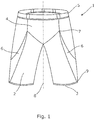
- Figure 1 shows a front view of a pair of jammers 1 typically used by male swimmers, especially in competitive swimming.
- the jammers comprise: thigh-covering portions 2 terminating at their lower ends in leg bands 3; lower torso-covering portion 4; and a waistband 5.
- the jammers include a pair of front resistance elements 6, each of which is positioned so that, when the garment is being worn, they extend obliquely across the front of the respective thigh-covering portion 2.
- Each front resistance element 6 extends from a respective upper front position 7 which, when the garment is worn, is located on the centre of the front of the wearer's respective thigh (spaced from but proximal to the midline 8 of the garment) substantially horizontally level with the wearer's greater trochanter to a respective lower front position 9 on the wearer's respective outer thigh adjacent the knee (distal from the midline 8 of the garment).
- the front resistance elements span the entire length of the front of the thigh and are angled to support the hip joint by keeping the legs adducted.
- Each front resistance element 6 extends from its respective upper front position 7 over the lower torso-covering portion 4 either side of the garment midline 8 up to the waist band 5. This helps to anchor the thigh muscles to the core muscles in the wearer's lower torso thus further stabilising the muscles and hip joint.
- Figure 2 shows a rear side view of the jammers shown in Figure 1 .
- the jammers include a pair of rear resistance elements 10 each of which is positioned so that, when the garment is being worn, they extend obliquely across the rear of the respective thigh-covering portion 2.
- Each rear resistance element 10 extends from a respective upper rear position 11 which, when the garment is worn, is located on the centre of the rear of the wearer's respective thigh under the gluteal crease (proximal the midline 8 of the garment) to a respective lower rear position 12 on the wearer's respective outer thigh adjacent the knee (distal from the midline 8 of the garment).
- the rear resistance elements span the entire length of the rear of the thigh and are angled to support the hip joint by keeping the legs adducted.
- Each rear resistance element 10 extends from its respective upper rear position 11 over said lower torso-covering portion 4 either side of and substantially parallel to the midline 8 of the garment so that, when the jammers 1 are worn, each of the pair of the rear resistance elements 10 extends across a respective one of the wearer's buttocks. This helps to anchor the thigh muscles to the core muscles in the wearer's lower torso thus further stabilising the muscles and hip joint. It also allows the rear resistance elements to store energy when the leg is flexed, the release of the stored energy acting to assist movement of the leg to its unflexed position.
- Each front resistance element 6 abuts the corresponding rear resistance element 10 at a position 13 which is located on the wearer's outer thigh (just above the knee). This abutment creates a cradle of resistance elements which helps further support the thigh muscles and keeps the leg adducted.
- Figure 3 shows a front side view of an open-backed knee skin suit 14 typically used by female swimmers, especially in competitive swimming.
- the suit comprises: thigh-covering portions 2 terminating at their lower ends in leg bands 3; a lower torso-covering portion 4; and an upper torso-covering portion 15.
- the suit includes a pair of front resistance elements 6, each of which is positioned so that, when the garment is being worn, they extend obliquely across the front of the respective thigh-covering portion 2.
- Each front resistance element 6 extends from a respective upper front position 7 which, when the garment is worn, is located on the centre of the front of the wearer's respective thigh (spaced from but proximal to the midline 8 of the garment) substantially horizontally level with the wearer's greater trochanter to a respective lower front position 9 on the wearer's respective outer thigh adjacent the knee (distal from the midline 8 of the garment).
- the front resistance elements span the entire length of the front of the thigh and are angled to support the hip joint by keeping the legs adducted.
- Each front resistance element 6 extends from its respective upper front position 7 over the lower torso-covering portion 4 either side of the garment midline 8 up over the upper torso-covering portion 15. This helps to anchor the thigh muscles to the core muscles in the wearer's torso thus further stabilising the muscles and hip joint.
- the front resistance elements 6 extend symmetrically either side of the midline 8 of the garment and the oblique angle created on the thigh-covering portion 2 is continued on the lower and upper torso-covering portions 4, 15 until the front resistance elements 6 reach a position 16 proximal the wearer's sternum when the garment is being worn. At this position 16, the front resistance elements 6 divert away from the midline 8 of the garment and extend obliquely towards the armholes 17 of the suit. By extending the front resistance elements over the upper torso, an improved connectivity and power transfer between the upper and lower body is achieved.
- Figure 4 shows a rear side view of the suit shown in Figure 3 .
- the suit includes a pair of rear resistance elements 10 each of which is positioned so that, when the garment is being worn, they extend obliquely across the rear of the respective thigh-covering portion 2.
- Each rear resistance element 10 extends from a respective upper rear position 11 which, when the garment is worn, is located on the centre of the rear of the wearer's respective thigh under the gluteal crease (proximal the midline 8 of the garment) to a respective lower rear position 12 on the wearer's respective outer thigh adjacent the knee (distal from the midline 8 of the garment).
- the rear resistance elements span the entire length of the rear of the thigh and are angled to support the hip joint by keeping the legs adducted.
- Each rear resistance element 10 extends from its respective upper rear position 11 over said lower torso-covering portion 4 either side of and substantially parallel to the midline 8 of the garment so that, when the suit is worn, each of the pair of the rear resistance elements 10 extends across a respective one of the wearer's buttocks. This helps to anchor the thigh muscles to the core muscles in the wearer's lower torso thus further stabilising the muscles and hip joint. It also allows the rear resistance elements 10 to store energy when the leg is flexed, the release of the stored energy acting to assist movement of the leg to its unflexed position.
- Each front resistance element 6 abuts the corresponding rear resistance element 10 at a position 13 which is located on the wearer's outer thigh (just above the knee). This abutment creates a cradle of resistance elements which helps further support the thigh muscles and keep the leg adducted.
- Figure 5 shows a front side view of a closed-back knee skin suit 14' typically used by female swimmers, especially in competitive swimming.
- the suit comprises: thigh-covering portions 2 terminating at their lower ends in leg bands 3; a lower torso-covering portion 4; and an upper torso-covering portion 15.
- the suit includes a pair of front resistance elements 6, each of which is positioned so that, when the garment is being worn, they extend obliquely across the front of the respective thigh-covering portion 2.
- Each front resistance element 6 extends from a respective upper front position 7 which, when the garment is worn, is located on the centre of the front of the wearer's respective thigh (spaced from but proximal to the midline 8 of the garment) substantially horizontally level with the wearer's greater trochanter to a respective lower front position 9 on the wearer's respective outer thigh adjacent the knee (distal from the midline 8 of the garment).
- the front resistance elements span the entire length of the front of the thigh and are angled to support the hip joint by keeping the legs adducted.
- Each front resistance element 6 extends from its respective upper front position 7 over the lower torso-covering portion 4 either side of the garment midline 8 up over the upper torso-covering portion 15. This helps to anchor the thigh muscles to the core muscles in the wearer's torso thus further stabilising the muscles and hip joint.
- the front resistance elements 6 extend symmetrically either side of the midline 8 of the garment and the oblique angle created on the thigh-covering portion 2 is continued on the lower and upper torso-covering portions 4, 15 until the front resistance elements 6 reach a position 16 proximal the wearer's sternum when the garment is being worn. At this position 16, the front resistance elements 6 divert away from the midline 8 of the garment and extend obliquely towards the armholes 17 of the suit. By extending the front resistance elements over the upper torso, an improved connectivity and power transfer between the upper and lower body is achieved.
- Figure 6 shows a rear side view of the suit shown in Figure 5 .
- the suit includes a pair of rear resistance elements 10 each of which is positioned so that, when the garment is being worn, they extend obliquely across the rear of the respective thigh-covering portion 2.
- Each rear resistance element 10 extends from a respective upper rear position 11 which, when the garment is worn, is located on the centre of the rear of the wearer's respective thigh under the gluteal crease (proximal the midline 8 of the garment) to a respective lower front position 12 on the wearer's respective outer thigh adjacent the knee (distal from the midline 8 of the garment).
- the rear resistance elements span the entire length of the rear of the thigh and are angled to support the hip joint by keeping the legs adducted.
- Each rear resistance element 10 extends from its respective upper rear position 11 over said lower torso-covering portion 4 either side of and substantially parallel to the midline 8 of the garment so that, when the suit is worn, each of the pair of the rear resistance elements 10 extends across a respective one of the wearer's buttocks. This helps to anchor the thigh muscles to the core muscles in the wearer's lower torso thus further stabilising the muscles and hip joint. It also allows the rear resistance elements 10 to store energy when the leg is flexed, the release of the stored energy acting to assist movement of the leg to its unflexed position.
- Each front resistance element 6 abuts the corresponding rear resistance element 10 at a position 13 which is located on the wearer's outer thigh (just above the knee). This abutment creates a cradle of resistance elements which helps further support the thigh muscles and keep the leg adducted.
- the suit further comprises a rear midline resistance element 18 which extends from the neckline 19 of the suit to the crotch 20. When worn, this resistance element follows the path of the wearer's spine and helps them maintain an advantageous posture in the water.
- the rear resistance elements 10 as they extend over thigh-covering and lower torso-covering portions comprise splices of elastic material joined to the base fabric of the suit/jammers by elastic ultrasonically welded seams, heat bonded with a high stretch tape backing.
- the suit/jammer may be formed from a base fabric such as a warp knit fabric including both inelastic threads (such as nylon) and elastic threads (such as Lycra (RTM)).
- the percentage of elastic threads e.g. Lycra (RTM)
- the resistance elements are formed of a high stretch woven fabric including both inelastic threads (such as nylon) and elastic threads (such as Lycra (RTM)).
- the rear resistance elements extend over the upper-torso covering portion in the third embodiment, they are formed solely of the elastic ultrasonically welded seams, heat bonded with a high stretch tape backing.
- the seam tape is a woven fabric. More preferably, it is a woven fabric tape measuring 18mm in width including both inelastic threads (such as polyamide and polyurethane) and elastic threads (such as Lycra (RTM)). Preferably, the tape has stretch of 150%.
- inelastic threads such as polyamide and polyurethane
- elastic threads such as Lycra (RTM)
- the tape has stretch of 150%.
- the front resistance elements 10 as they extend over thigh-covering portions comprise splices of elastic material joined to the base fabric of the suit/jammers by elastic ultrasonically welded seams, heat bonded with a high stretch tape backing as described above in relation to the rear resistance elements.
- the rear midline resistance element comprises a splice of elastic material joined to the base fabric of the suit/jammers by elastic ultrasonically welded seams, heat bonded with a high stretch tape backing.
- This splice of material extends from just below the neckline to the middle of the lower torso-covering portion. From the neckline to the splice of material and from the splice of material to the crotch of the suit, the resistance element takes the form of an elastic seam alone.
Landscapes
- Health & Medical Sciences (AREA)
- General Health & Medical Sciences (AREA)
- Physical Education & Sports Medicine (AREA)
- Orthopedic Medicine & Surgery (AREA)
- Engineering & Computer Science (AREA)
- Textile Engineering (AREA)
- Life Sciences & Earth Sciences (AREA)
- Biophysics (AREA)
- Professional, Industrial, Or Sporting Protective Garments (AREA)
Description
- This invention relates to a garment, in particular a sports garment i.e. a garment for wearing during sporting activity. Particular examples are described in relation to swimsuits, which is a preferred use. However, the concepts can be applied to other sports and athletic garments including, for example, water polo and triathlon wear.
- Athletes and swimmers typically wear tight fitting garments which help decrease air/water resistance which is especially important in competitive events.
- During sporting activity, it is desirable to provide support to active muscles to reduce fatigue, and the compressive effect of these known tight-fitting garments provides some limited support. To provide increased support, it is known to provide elastic elements which provide support to muscles in the same manner as selectively bandaging or "taping" the muscle. It is also known to provide elasticity elements on the rear of the thigh which can be elongated (by a bending/flexing motion of the leg) to store energy which is subsequently released to assist movement of the wearer's leg back to its unflexed position.
- As well as providing support and assisting the movement of muscles, it is also desirable to support the wearer's hip joint so that pivoting and rotating motions of the leg can be stabilised by keeping the leg adducted (i.e. held in towards the body.)
- It is a preferred aim of the present invention to provide a garment which provides increased stability to the wearer's hip joint.
-
US 2004/0255358 A1 describes a pants garment having a pair of thigh leg members for covering the thigh area of the wearer. -
EP 1 596 781 A1 describes a device for elastic restraint which allows an adduction movement of the thighs of a user. -
US 6 231488 by describes an aerobic resistance garment which is particularly designed for warm weather or indoor or high temperature use by including elastic resistance bands and base fabric material. -
US 5 819 322 describes energy conservation or expenditure garments designed for use by cyclists. - In a first aspect, the present invention provides a garment as set forth in claim 1.
- By providing a garment which has resistance elements on both the front and the rear of the garment for extending over the front and rear of the wearer's thighs, the elements angled away from the midline of the garment, a stabilising effect on the wearer's hip joint can be obtained. By extending from an upper position which is proximal to the garment midline (and, in use, proximal to the midline of the wearer's body) to a lower position which is distal from the garment midline, the resistance elements assist in keeping legs adducted i.e. held in line with the body. When swimming, this is advantageous because it assists with a linear body shape in the water which reduces drag resistance. The resistance elements help to support the wearer's leg muscles and anchor them to the core muscles in the wearer's torso which helps to improve stability of the leg at the hip joint.
- Each respective upper position is substantially horizontally level with the wearer's respective greater trochanter when the garment is worn. This helps further stabilize the wearer's leg as the resistance elements act to support the hip joint.
- Each respective upper position is located spaced from but proximal to the midline of the garment.
- Preferably, each respective upper front position is located, in use, on the centre of the front of the wearer's respective thigh. Preferably, each respective lower front position is located, in use, on the wearer's respective outer thigh, preferably adjacent the knee. In this manner, the front resistance elements span the entire front length of the wearer's thigh muscles which maximises the support of the muscles and stability of the hip joint.
- Similarly, it is preferred that each respective upper rear position is located, in use, on the centre of the rear of the wearer's respective thigh (below the gluteal crease). Preferably each respective lower rear position is located, in use on the wearer's respective outer thigh, preferably adjacent the knee. Again, this arrangement ensures that the rear resistance element spans the entire length of the wearer's thigh thus maximising muscle support and hip joint stability.
- Preferably the garment comprises a lower torso-covering portion which extends above the thigh-covering portion. For example, the garment may be a swimming garment of the type known as jammers or it may be athletic shorts. The lower torso-covering portion may terminate at a waist band.
- Preferably each front resistance element extends from its respective upper front position over the lower torso-covering portion either side of the garment midline, preferably up to the waist band. This helps anchor the leg muscles to the core muscles in the wearer's lower torso thus further improving hip joint stability.
- Preferably, each rear resistance element extends from its respective upper rear position over said lower torso-covering portion either side of the midline of the garment such that, in use, each of the pair of the rear resistance elements extends across a respective one of the wearer's buttocks.
- By extending the rear resistance elements over the rear of the lower torso-covering portion, the rear resistance bands can act as an energy store when the wearer's leg is bent in a first direction (in which the resistance band is stretched), the stored energy acting to assist in the movement of the wearer's leg in a second, opposite direction (in which the resistance band is returned to its rest state). This stored energy and movement assistance can be beneficial in improving the speed and precision of movement by providing a snap action to the movement.
- Preferably, the rear resistance elements extend over the lower torso-covering portion substantially parallel to the midline of said garment. This helps to maximise the stretch of the rear resistance elements as the wearer's legs are bent thus maximising the snap action provided by the rear resistance elements to the movement in the second direction. Most preferably the length of the rear resistance elements is maximised (thus maximising the amount of energy that can be stored by the rear resistance elements) by extending the rear resistance elements over the lower torso-covering portion to the waist band.
- A further advantage of the rear resistance elements extending over the wearer's buttocks is that they provide a compressive effect which compresses the wearer's buttocks thus reducing any form drag caused by the protrusion of the wearer's buttocks.
- In preferred embodiments, each front resistance element abuts the corresponding rear resistance element at a position which, in use, is located on the wearer's outer thigh, preferably adjacent the knee. By abutting or joining the front and rear resistance bands, they effectively form a "cradle" which helps keep the hip joints stabilised and legs adducted i.e. supported in towards the body.
- Preferably, the garment further comprises an upper torso-covering portion. For example, the garment may be a knee-skin swimsuit.
- In preferred embodiments, the garment further comprises a rear midline resistance element which extends at least partly along the rear midline of the garment. In use, the rear midline resistance element extends at least partly along the wearer's spine. Most preferably, the rear midline resistance element extends from a rear neckline of the garment to the crotch of the garment. This rear midline resistance element helps the wearer to maintain a good posture with a straight spine. This assists performance in various activities. For example, in swimming activities, the rear midline resistance element helps the wearer to maintain a linear position in the water which helps decrease water resistance and improves the effectiveness of swimming strokes.
- Preferably, each front resistance element extends from its respective upper front position (e.g. at the front centre of the upper thigh) over the front of said upper torso-covering portion either side of and towards the midline of the garment such that, in use, each of the pair of the front resistance elements extends from the wearer's respective thigh towards the wearer's sternum. In this manner, the oblique extension of the front resistance elements over the front of the wearer's thighs is continued up over the torso towards the garment midline at roughly the same oblique angle. This helps improve the anchoring of the leg muscles to the core muscles since the resistance elements extend over the core muscles in the torso. This arrangement also helps promote connectivity and power transfer between the upper and lower body.
- In preferred embodiments, each of the front resistance elements on the upper torso-covering portion extends obliquely away from the midline of the garment above a point which, in use, in positioned on the wearer's sternum. They may extend away towards and terminate at the respective armhole just below the shoulder strap.
- It is preferable that the front and rear resistance elements are symmetrical about the midline of the garment with one of each pair extending either side of the midline. This ensures that a balanced support is provided leading to a balanced performance from both sides of the body.
- The midline of the garment is a line which, when the garment is worn, extends vertically through the middle of the garment (typically dividing the garment into two symmetrical halves). For example, in a pair of jammers, the midline will run down the lower torso-covering portion to the centre of the crotch with the thigh-covering portions disposed either side of the midline.
- Preferably, at least one of said resistance elements comprises an elastic seam. Preferably, the elastic seam comprises a seam (e.g. an ultrasonically welded seam or a stitched seam) heat bonded with an elastic (high stretch) tape backing. Preferably the backing tape is formed of a woven fabric, preferably including both inelastic threads (e.g. polyamide, polyurethane and/or polyester) and elastic threads (such as Lycra (RTM)). Preferably, the seam backing tape is bonded to seam using an elastic adhesive e.g. a temperature melt adhesive.
- Preferably, at least one of said resistance elements comprises a splice of material having elastic properties. The material may be a textile material containing elastic threads (e.g. Lycra (RTM)). Preferably the splice fabric is a woven fabric including both inelastic threads (such as nylon) and elastic threads (such as Lycra (RTM)). Preferably, the percentage of elastic threads (e.g. Lycra (RTM)) is around 40wt%.
- Preferably, at least one of the resistance elements comprises a combination of at least one elastic seam and a splice of material having elastic properties, the at least one elastic seam securing the splice to the remainder of the garment. Preferably, the splice of material is secured to the remainder of the garment by a plurality (e.g. two) elastic seams.
- Preferably, the splice of material is bound to edges of the garment rather than overlaying (other than in an amount sufficient to form a seam) the material of the garment.
- Preferred embodiments of the present invention will now be described with reference to the accompanying figures in which:
-
-
Figure 1 is a front view of a first embodiment of the present invention; -
Figure 2 is a rear side view of a first embodiment of the present invention; -
Figure 3 is a front side view of a second embodiment of the present invention; -
Figure 4 is a rear side view of a second embodiment of the present invention; -
Figure 5 is a front side view of a third embodiment of the present invention; and -
Figure 6 is a rear side view of a third embodiment of the present invention. -
Figure 1 shows a front view of a pair of jammers 1 typically used by male swimmers, especially in competitive swimming. - The jammers comprise: thigh-covering
portions 2 terminating at their lower ends inleg bands 3; lower torso-covering portion 4; and awaistband 5. - The jammers include a pair of
front resistance elements 6, each of which is positioned so that, when the garment is being worn, they extend obliquely across the front of the respective thigh-coveringportion 2. - Each
front resistance element 6 extends from a respective upperfront position 7 which, when the garment is worn, is located on the centre of the front of the wearer's respective thigh (spaced from but proximal to the midline 8 of the garment) substantially horizontally level with the wearer's greater trochanter to a respective lower front position 9 on the wearer's respective outer thigh adjacent the knee (distal from the midline 8 of the garment). Thus the front resistance elements span the entire length of the front of the thigh and are angled to support the hip joint by keeping the legs adducted. - Each
front resistance element 6 extends from its respective upperfront position 7 over the lower torso-covering portion 4 either side of the garment midline 8 up to thewaist band 5. This helps to anchor the thigh muscles to the core muscles in the wearer's lower torso thus further stabilising the muscles and hip joint. -
Figure 2 shows a rear side view of the jammers shown inFigure 1 . - The jammers include a pair of
rear resistance elements 10 each of which is positioned so that, when the garment is being worn, they extend obliquely across the rear of the respective thigh-coveringportion 2. - Each
rear resistance element 10 extends from a respective upperrear position 11 which, when the garment is worn, is located on the centre of the rear of the wearer's respective thigh under the gluteal crease (proximal the midline 8 of the garment) to a respective lowerrear position 12 on the wearer's respective outer thigh adjacent the knee (distal from the midline 8 of the garment). Thus the rear resistance elements span the entire length of the rear of the thigh and are angled to support the hip joint by keeping the legs adducted. - Each
rear resistance element 10 extends from its respective upperrear position 11 over said lower torso-covering portion 4 either side of and substantially parallel to the midline 8 of the garment so that, when the jammers 1 are worn, each of the pair of therear resistance elements 10 extends across a respective one of the wearer's buttocks. This helps to anchor the thigh muscles to the core muscles in the wearer's lower torso thus further stabilising the muscles and hip joint. It also allows the rear resistance elements to store energy when the leg is flexed, the release of the stored energy acting to assist movement of the leg to its unflexed position. - Each
front resistance element 6 abuts the correspondingrear resistance element 10 at aposition 13 which is located on the wearer's outer thigh (just above the knee). This abutment creates a cradle of resistance elements which helps further support the thigh muscles and keeps the leg adducted. -
Figure 3 shows a front side view of an open-backedknee skin suit 14 typically used by female swimmers, especially in competitive swimming. - The suit comprises: thigh-covering
portions 2 terminating at their lower ends inleg bands 3; a lower torso-covering portion 4; and an upper torso-coveringportion 15. - The suit includes a pair of
front resistance elements 6, each of which is positioned so that, when the garment is being worn, they extend obliquely across the front of the respective thigh-coveringportion 2. - Each
front resistance element 6 extends from a respective upperfront position 7 which, when the garment is worn, is located on the centre of the front of the wearer's respective thigh (spaced from but proximal to the midline 8 of the garment) substantially horizontally level with the wearer's greater trochanter to a respective lower front position 9 on the wearer's respective outer thigh adjacent the knee (distal from the midline 8 of the garment). Thus the front resistance elements span the entire length of the front of the thigh and are angled to support the hip joint by keeping the legs adducted. - Each
front resistance element 6 extends from its respective upperfront position 7 over the lower torso-covering portion 4 either side of the garment midline 8 up over the upper torso-coveringportion 15. This helps to anchor the thigh muscles to the core muscles in the wearer's torso thus further stabilising the muscles and hip joint. - The
front resistance elements 6 extend symmetrically either side of the midline 8 of the garment and the oblique angle created on the thigh-coveringportion 2 is continued on the lower and upper torso-coveringportions 4, 15 until thefront resistance elements 6 reach aposition 16 proximal the wearer's sternum when the garment is being worn. At thisposition 16, thefront resistance elements 6 divert away from the midline 8 of the garment and extend obliquely towards thearmholes 17 of the suit. By extending the front resistance elements over the upper torso, an improved connectivity and power transfer between the upper and lower body is achieved. -
Figure 4 shows a rear side view of the suit shown inFigure 3 . - The suit includes a pair of
rear resistance elements 10 each of which is positioned so that, when the garment is being worn, they extend obliquely across the rear of the respective thigh-coveringportion 2. - Each
rear resistance element 10 extends from a respective upperrear position 11 which, when the garment is worn, is located on the centre of the rear of the wearer's respective thigh under the gluteal crease (proximal the midline 8 of the garment) to a respective lowerrear position 12 on the wearer's respective outer thigh adjacent the knee (distal from the midline 8 of the garment). Thus the rear resistance elements span the entire length of the rear of the thigh and are angled to support the hip joint by keeping the legs adducted. - Each
rear resistance element 10 extends from its respective upperrear position 11 over said lower torso-covering portion 4 either side of and substantially parallel to the midline 8 of the garment so that, when the suit is worn, each of the pair of therear resistance elements 10 extends across a respective one of the wearer's buttocks. This helps to anchor the thigh muscles to the core muscles in the wearer's lower torso thus further stabilising the muscles and hip joint. It also allows therear resistance elements 10 to store energy when the leg is flexed, the release of the stored energy acting to assist movement of the leg to its unflexed position. - Each
front resistance element 6 abuts the correspondingrear resistance element 10 at aposition 13 which is located on the wearer's outer thigh (just above the knee). This abutment creates a cradle of resistance elements which helps further support the thigh muscles and keep the leg adducted. -
Figure 5 shows a front side view of a closed-back knee skin suit 14' typically used by female swimmers, especially in competitive swimming. - The suit comprises: thigh-covering
portions 2 terminating at their lower ends inleg bands 3; a lower torso-covering portion 4; and an upper torso-coveringportion 15. - The suit includes a pair of
front resistance elements 6, each of which is positioned so that, when the garment is being worn, they extend obliquely across the front of the respective thigh-coveringportion 2. - Each
front resistance element 6 extends from a respective upperfront position 7 which, when the garment is worn, is located on the centre of the front of the wearer's respective thigh (spaced from but proximal to the midline 8 of the garment) substantially horizontally level with the wearer's greater trochanter to a respective lower front position 9 on the wearer's respective outer thigh adjacent the knee (distal from the midline 8 of the garment). Thus the front resistance elements span the entire length of the front of the thigh and are angled to support the hip joint by keeping the legs adducted. - Each
front resistance element 6 extends from its respective upperfront position 7 over the lower torso-covering portion 4 either side of the garment midline 8 up over the upper torso-coveringportion 15. This helps to anchor the thigh muscles to the core muscles in the wearer's torso thus further stabilising the muscles and hip joint. - The
front resistance elements 6 extend symmetrically either side of the midline 8 of the garment and the oblique angle created on the thigh-coveringportion 2 is continued on the lower and upper torso-coveringportions 4, 15 until thefront resistance elements 6 reach aposition 16 proximal the wearer's sternum when the garment is being worn. At thisposition 16, thefront resistance elements 6 divert away from the midline 8 of the garment and extend obliquely towards thearmholes 17 of the suit. By extending the front resistance elements over the upper torso, an improved connectivity and power transfer between the upper and lower body is achieved. -
Figure 6 shows a rear side view of the suit shown inFigure 5 . - The suit includes a pair of
rear resistance elements 10 each of which is positioned so that, when the garment is being worn, they extend obliquely across the rear of the respective thigh-coveringportion 2. - Each
rear resistance element 10 extends from a respective upperrear position 11 which, when the garment is worn, is located on the centre of the rear of the wearer's respective thigh under the gluteal crease (proximal the midline 8 of the garment) to a respective lowerfront position 12 on the wearer's respective outer thigh adjacent the knee (distal from the midline 8 of the garment). Thus the rear resistance elements span the entire length of the rear of the thigh and are angled to support the hip joint by keeping the legs adducted. - Each
rear resistance element 10 extends from its respective upperrear position 11 over said lower torso-covering portion 4 either side of and substantially parallel to the midline 8 of the garment so that, when the suit is worn, each of the pair of therear resistance elements 10 extends across a respective one of the wearer's buttocks. This helps to anchor the thigh muscles to the core muscles in the wearer's lower torso thus further stabilising the muscles and hip joint. It also allows therear resistance elements 10 to store energy when the leg is flexed, the release of the stored energy acting to assist movement of the leg to its unflexed position. - Each
front resistance element 6 abuts the correspondingrear resistance element 10 at aposition 13 which is located on the wearer's outer thigh (just above the knee). This abutment creates a cradle of resistance elements which helps further support the thigh muscles and keep the leg adducted. - The suit further comprises a rear
midline resistance element 18 which extends from theneckline 19 of the suit to thecrotch 20. When worn, this resistance element follows the path of the wearer's spine and helps them maintain an advantageous posture in the water. - In all three embodiments described, the
rear resistance elements 10 as they extend over thigh-covering and lower torso-covering portions comprise splices of elastic material joined to the base fabric of the suit/jammers by elastic ultrasonically welded seams, heat bonded with a high stretch tape backing. For example, the suit/jammer may be formed from a base fabric such as a warp knit fabric including both inelastic threads (such as nylon) and elastic threads (such as Lycra (RTM)). The percentage of elastic threads (e.g. Lycra (RTM)) may be around 40wt%. The resistance elements are formed of a high stretch woven fabric including both inelastic threads (such as nylon) and elastic threads (such as Lycra (RTM)). - As the rear resistance elements extend over the upper-torso covering portion in the third embodiment, they are formed solely of the elastic ultrasonically welded seams, heat bonded with a high stretch tape backing.
- Preferably the seam tape (high stretch tape backing) is a woven fabric. More preferably, it is a woven fabric tape measuring 18mm in width including both inelastic threads (such as polyamide and polyurethane) and elastic threads (such as Lycra (RTM)). Preferably, the tape has stretch of 150%. In order for the seam tape to be bonded to create the completed seam, one side is applied with a temperature melt adhesive.
In all three embodiments described, thefront resistance elements 10 as they extend over thigh-covering portions comprise splices of elastic material joined to the base fabric of the suit/jammers by elastic ultrasonically welded seams, heat bonded with a high stretch tape backing as described above in relation to the rear resistance elements.
As the front resistance elements extend over the lower and upper-torso covering portions in the second and third embodiments, they are formed solely of elastic seams as described above.
In the third embodiment, the rear midline resistance element comprises a splice of elastic material joined to the base fabric of the suit/jammers by elastic ultrasonically welded seams, heat bonded with a high stretch tape backing. This splice of material extends from just below the neckline to the middle of the lower torso-covering portion. From the neckline to the splice of material and from the splice of material to the crotch of the suit, the resistance element takes the form of an elastic seam alone.
The skilled person will appreciate that the suit/jammers illustrated in the Figures and described above are examples embodying inventive concepts described herein and that many and various modifications can be made without departing from the invention, as defined by the claims.
Claims (14)
- A garment (14) for covering a wearer's thighs wherein the garment comprises a pair of front resistance elements (6) each of which, in use, extends obliquely across the front of a respective one of the wearer's thighs and a pair of rear resistance elements (10) each of which, in use, extends obliquely across the rear of a respective one of the wearer's thighs, wherein each of said front and rear resistance elements extends from a respective upper position (7,11) to a respective lower position (9,12), in use, each respective upper position (7,11) being substantially horizontally level with the wearer's respective greater trochanter;
characterised in that each respective upper position (7,11) is located spaced from but proximal to the midline (8) of the garment and each respective lower position is located distal from the midline of the garment. - A garment according to any one of the preceding claims wherein at least one of said resistance elements comprises an elastic seam.
- A garment according to any one of the preceding claims wherein at least one of said resistance elements comprises a splice of elastic material.
- A garment according to any one of the preceding claims wherein each respective upper front position is located, in use, on the centre front of the wearer's respective thigh and each respective lower front position is located, in use, on the wearer's respective outer thigh.
- A garment according to any one of the preceding claims wherein each respective upper rear position is located, in use, on the centre rear of the wearer's respective thigh and each respective lower rear position is located, in use, on the wearer's respective outer thigh.
- A garment according to any one of the preceding claims wherein the garment comprises a lower torso-covering portion (4) and wherein the front and/or rear resistance elements extend over the lower torso-covering portion to a waist band.
- A garment according to claim 6 wherein each rear resistance element extends from its respective upper rear position over said lower torso-covering portion either side of the midline of the garment such that, in use, each of the pair of the rear resistance elements extends across a respective one of the wearer's buttocks.
- A garment according to claim 6 or 7 wherein said rear resistance elements extend over said lower torso-covering portion substantially parallel to the midline of said garment.
- A garment according to any one of the preceding claims where each front resistance element abuts the corresponding rear resistance element at a position (13) which, in use, is located on the wearer's outer thigh adjacent the knee.
- A garment according to any one of the preceding claims wherein the garment further comprises an upper torso-covering portion.
- A garment according to claim 10 further comprising a rear midline resistance element (18) which extends at least partly along the rear midline of the garment such that, in use, the rear midline resistance element extends at least partly along the wearer's spine.
- A garment according to claim 11 wherein the rear midline resistance element extends from a rear neckline (19) of the garment to the crotch (20) of the garment.
- A garment according to any one of claims 10 to 12 wherein each front resistance element extends from its respective upper front position over the front of said upper torso-covering portion either side of and towards the midline of the garment such that, in use, each of the pair of the front resistance elements extends from the wearer's respective thigh towards the wearer's sternum.
- A garment according to claim 13 wherein each of the front resistance elements on the upper torso-covering portion extends obliquely away from the midline of the garment above a point (16) which, in use, in positioned on the wearer's sternum.
Applications Claiming Priority (2)
| Application Number | Priority Date | Filing Date | Title |
|---|---|---|---|
| GB1109405.9A GB2480924B (en) | 2011-06-03 | 2011-06-03 | Sports garment |
| PCT/GB2012/051243 WO2012164301A1 (en) | 2011-06-03 | 2012-06-01 | Sports garment |
Publications (2)
| Publication Number | Publication Date |
|---|---|
| EP2713786A1 EP2713786A1 (en) | 2014-04-09 |
| EP2713786B1 true EP2713786B1 (en) | 2018-02-07 |
Family
ID=44343428
Family Applications (1)
| Application Number | Title | Priority Date | Filing Date |
|---|---|---|---|
| EP12726839.9A Active EP2713786B1 (en) | 2011-06-03 | 2012-06-01 | Sports garment |
Country Status (11)
| Country | Link |
|---|---|
| US (1) | US9763483B2 (en) |
| EP (1) | EP2713786B1 (en) |
| JP (1) | JP6297975B2 (en) |
| KR (1) | KR101929076B1 (en) |
| CN (1) | CN103732092B (en) |
| AR (1) | AR086669A1 (en) |
| AU (1) | AU2012264447B2 (en) |
| BR (1) | BR112013031140B1 (en) |
| GB (1) | GB2480924B (en) |
| RU (1) | RU2633207C2 (en) |
| WO (1) | WO2012164301A1 (en) |
Cited By (4)
| Publication number | Priority date | Publication date | Assignee | Title |
|---|---|---|---|---|
| USD887674S1 (en) | 2018-07-10 | 2020-06-23 | Tyr Sport, Inc. | Women's swimsuit with seamless back panel |
| USD908316S1 (en) | 2018-07-10 | 2021-01-26 | Tyr Sport, Inc. | Men's swimsuit with seamless back panel |
| US10897936B2 (en) | 2018-10-09 | 2021-01-26 | Tyr Sport, Inc. | Swimsuit with seamless back and tension bands |
| US10905175B1 (en) | 2020-05-21 | 2021-02-02 | Tyr Sport, Inc. | Swimsuit with tension bands and reinforcement liners |
Families Citing this family (33)
| Publication number | Priority date | Publication date | Assignee | Title |
|---|---|---|---|---|
| GB2480924B (en) * | 2011-06-03 | 2012-07-25 | Speedo Int Ltd | Sports garment |
| PT2589307E (en) * | 2011-11-02 | 2015-11-12 | Quiksilver Inc | Technical wetsuit |
| ITMI20120907A1 (en) * | 2012-05-24 | 2013-11-25 | Freddy Spa | CLOTH TO MODEL THE BABIES AND THE FEMALE SIDES, A PARTICULAR SPORTS DANCE OR GYMNASTICS |
| ITMI20120904A1 (en) | 2012-05-24 | 2013-11-25 | Freddy Spa | TROUSERS, IN PARTICULAR A PANTS FOR MODELING THE BABY AND FEMALE SIDES |
| US20140068830A1 (en) * | 2012-06-04 | 2014-03-13 | Jeremy Johnson | Low friction garment |
| US9872526B2 (en) * | 2012-12-13 | 2018-01-23 | Marc Safran | Brace for preventing symptoms of femoral acetabular impingement |
| JP6246699B2 (en) * | 2013-11-08 | 2017-12-13 | 美津濃株式会社 | Swimsuit |
| PL3102059T3 (en) * | 2014-02-05 | 2018-06-29 | Arena Distribution S.A. | Swim suit, particularly for competition swimming |
| US9895569B2 (en) * | 2014-04-24 | 2018-02-20 | New York University | Exercise garment with ergonomic and modifiable resistance bands |
| USD722742S1 (en) * | 2014-05-23 | 2015-02-24 | Short Bark Industries, Inc. | Protective undergarment |
| GB2529472B (en) | 2014-08-22 | 2018-04-04 | Speedo Int Ltd | Swimming garments |
| GB2533077B (en) * | 2014-08-22 | 2017-12-06 | Speedo Int Ltd | Swimming garments |
| WO2016115597A1 (en) * | 2015-01-19 | 2016-07-28 | Jim Li | An orthotic for muscle imbalance and posture correction and lumbopelvic support |
| USD806358S1 (en) * | 2015-02-18 | 2018-01-02 | Speedo International Limited | Swimsuit |
| DE102015206254B4 (en) * | 2015-04-08 | 2024-09-05 | Adidas Ag | Bag for sportswear items |
| US10482864B1 (en) * | 2015-10-30 | 2019-11-19 | L.J. Avalon Llc | Portable acoustical blocking system |
| WO2017144940A1 (en) | 2016-02-22 | 2017-08-31 | Arena Distribution S.A. | Swim suit, particularly for competition swimming |
| GB201604577D0 (en) * | 2016-03-17 | 2016-05-04 | Huub Ltd | Swimwear |
| US20170290380A1 (en) * | 2016-04-10 | 2017-10-12 | Ebony BLACKMON-HUMPHREY | Slip-on Slip-over Hip Protector |
| USD809247S1 (en) * | 2016-07-14 | 2018-02-06 | Nike, Inc. | Garment |
| US20190059465A1 (en) * | 2017-08-28 | 2019-02-28 | Elite Sportswear L.P. | Technical swimwear with compression taping |
| US10448683B2 (en) * | 2017-09-12 | 2019-10-22 | Dashamerica, Inc. | Athletic garment for cycling |
| US12421635B2 (en) | 2018-05-23 | 2025-09-23 | Essity Hygiene And Health Aktiebolag | Compression article |
| USD951593S1 (en) * | 2018-11-06 | 2022-05-17 | Arena S.P.A. | Swimsuit |
| US11388935B2 (en) * | 2019-02-07 | 2022-07-19 | Stephanie Harrisson | Body shapewear undergarment |
| KR102245252B1 (en) * | 2019-09-16 | 2021-04-28 | 주식회사 비 에스 지 | Muscle assisting garment |
| USD914329S1 (en) * | 2019-10-25 | 2021-03-30 | Dashamerica, Inc. | Shorts |
| JP1682662S (en) * | 2020-08-07 | 2021-04-05 | ||
| USD922732S1 (en) * | 2020-08-18 | 2021-06-22 | Runlin Zhou | Pants decoration |
| KR102245253B1 (en) * | 2021-03-15 | 2021-04-27 | 주식회사 비 에스 지 | Muscle assisting garment |
| KR102245254B1 (en) * | 2021-03-15 | 2021-04-27 | 주식회사 비 에스 지 | Muscle assisting garment |
| MX2023014397A (en) | 2021-06-03 | 2023-12-15 | Essity Hygiene & Health Ab | Compression garment. |
| USD994269S1 (en) * | 2021-12-17 | 2023-08-08 | Nike, Inc. | Shorts |
Family Cites Families (26)
| Publication number | Priority date | Publication date | Assignee | Title |
|---|---|---|---|---|
| US5109546A (en) * | 1991-06-10 | 1992-05-05 | Dicker Timothy P | Exercise suit with resilient reinforcing |
| US5201074A (en) * | 1991-06-10 | 1993-04-13 | Dicker Timothy P | Exercise suit with resilient reinforcing |
| US5839122A (en) | 1997-04-07 | 1998-11-24 | Dicker; Timothy P. | Swimwear garment incorporating resistance band |
| US5819322A (en) * | 1997-06-23 | 1998-10-13 | Dicker; Timothy P. | Energy conservative/expenditure garment |
| US6231488B1 (en) * | 1997-09-15 | 2001-05-15 | Timothy P. Dicker | Aerobic exercise garment |
| JP3809031B2 (en) * | 1999-05-11 | 2006-08-16 | 株式会社ゴールドウインテクニカルセンター | Exercise clothing and method for manufacturing the same |
| TW475887B (en) * | 2000-04-20 | 2002-02-11 | Wacoal Corp | Leg portions supporting wear |
| JP2002212814A (en) * | 2000-11-09 | 2002-07-31 | Combi Corp | Leg strengthening clothing |
| US6430752B1 (en) * | 2001-10-25 | 2002-08-13 | Gregory Steven Bay | Compression short |
| JP2004057808A (en) * | 2002-06-05 | 2004-02-26 | Mizuno Corp | Under pants |
| AU2003279836A1 (en) * | 2002-10-03 | 2004-04-23 | Timothy P. Dicker | Exercise garment |
| JP3983223B2 (en) * | 2003-01-17 | 2007-09-26 | フットマーク株式会社 | Exercise support tights |
| FR2851459B1 (en) * | 2003-02-21 | 2005-04-22 | Philippe Nicolas | ELASTIC CONTAINMENT ARRANGEMENT FOR PROVIDING A MOVEMENT OF ADDUCTION OF THE THIGHS OF A HUMAN BEING |
| JP3978404B2 (en) * | 2003-03-31 | 2007-09-19 | 株式会社ワコール | Clothing with crotch |
| CN100377673C (en) * | 2003-04-15 | 2008-04-02 | 华哥尔株式会社 | Garment with crotch part |
| US7730552B2 (en) * | 2003-04-15 | 2010-06-08 | Wacoal Corp. | Pants garment |
| WO2004091328A1 (en) * | 2003-04-15 | 2004-10-28 | Wacoal Corp. | Wearing article with crotch |
| DE102004006485A1 (en) | 2004-02-10 | 2005-08-25 | Adidas International Marketing B.V. | garment |
| JP4941968B2 (en) * | 2006-12-28 | 2012-05-30 | 株式会社 アドヴァンシング | Innerwear |
| FR2915851B1 (en) * | 2007-05-11 | 2009-08-21 | Promiles Snc | HETEROGENEOUS CONTENT CONTENT CLOTHING ARTICLE FOR THE PRACTICE OF A SPORT |
| CN101611932A (en) * | 2008-06-25 | 2009-12-30 | 上海工商信息学校 | A kind of sport pants |
| RU2379394C1 (en) * | 2008-07-14 | 2010-01-20 | Государственное образовательное учреждение высшего профессионального образования "Ивановская государственная текстильная академия" (ИГТА) | Threadless seam for tight connection of materials |
| ES2381736T3 (en) * | 2009-05-11 | 2012-05-31 | Colibri1, S.L. | Protective sportswear |
| US8214926B2 (en) * | 2009-07-06 | 2012-07-10 | Intelliskin Usa, Llc | Posture improving garment |
| CN201541733U (en) * | 2009-10-21 | 2010-08-11 | 林飞鹏 | Weight bearing sport suit |
| GB2480924B (en) * | 2011-06-03 | 2012-07-25 | Speedo Int Ltd | Sports garment |
-
2011
- 2011-06-03 GB GB1109405.9A patent/GB2480924B/en not_active Expired - Fee Related
-
2012
- 2012-06-01 RU RU2013157913A patent/RU2633207C2/en active
- 2012-06-01 BR BR112013031140-1A patent/BR112013031140B1/en active IP Right Grant
- 2012-06-01 US US14/123,706 patent/US9763483B2/en active Active
- 2012-06-01 WO PCT/GB2012/051243 patent/WO2012164301A1/en not_active Ceased
- 2012-06-01 KR KR1020137035171A patent/KR101929076B1/en active Active
- 2012-06-01 JP JP2014513250A patent/JP6297975B2/en active Active
- 2012-06-01 EP EP12726839.9A patent/EP2713786B1/en active Active
- 2012-06-01 AU AU2012264447A patent/AU2012264447B2/en active Active
- 2012-06-01 CN CN201280032098.8A patent/CN103732092B/en active Active
- 2012-06-04 AR ARP120101972A patent/AR086669A1/en active IP Right Grant
Cited By (5)
| Publication number | Priority date | Publication date | Assignee | Title |
|---|---|---|---|---|
| USD887674S1 (en) | 2018-07-10 | 2020-06-23 | Tyr Sport, Inc. | Women's swimsuit with seamless back panel |
| USD908317S1 (en) | 2018-07-10 | 2021-01-26 | Tyr Sport, Inc. | Women's swimsuit with seamless back panel |
| USD908316S1 (en) | 2018-07-10 | 2021-01-26 | Tyr Sport, Inc. | Men's swimsuit with seamless back panel |
| US10897936B2 (en) | 2018-10-09 | 2021-01-26 | Tyr Sport, Inc. | Swimsuit with seamless back and tension bands |
| US10905175B1 (en) | 2020-05-21 | 2021-02-02 | Tyr Sport, Inc. | Swimsuit with tension bands and reinforcement liners |
Also Published As
| Publication number | Publication date |
|---|---|
| GB2480924B (en) | 2012-07-25 |
| BR112013031140A2 (en) | 2016-12-06 |
| KR20140047629A (en) | 2014-04-22 |
| US20140096301A1 (en) | 2014-04-10 |
| GB201109405D0 (en) | 2011-07-20 |
| CN103732092A (en) | 2014-04-16 |
| JP6297975B2 (en) | 2018-03-20 |
| RU2633207C2 (en) | 2017-10-11 |
| CN103732092B (en) | 2016-01-27 |
| EP2713786A1 (en) | 2014-04-09 |
| WO2012164301A1 (en) | 2012-12-06 |
| KR101929076B1 (en) | 2018-12-13 |
| GB2480924A8 (en) | 2012-01-04 |
| RU2013157913A (en) | 2015-07-20 |
| US9763483B2 (en) | 2017-09-19 |
| AU2012264447B2 (en) | 2015-01-22 |
| AU2012264447A1 (en) | 2013-04-18 |
| JP2014515440A (en) | 2014-06-30 |
| AR086669A1 (en) | 2014-01-15 |
| GB2480924A (en) | 2011-12-07 |
| BR112013031140B1 (en) | 2021-04-20 |
Similar Documents
| Publication | Publication Date | Title |
|---|---|---|
| AU2012264447B2 (en) | Sports garment | |
| EP3419451B1 (en) | Swim suit, particularly for competition swimming | |
| US8548622B2 (en) | Uniform compression garment and method of manufacturing garment | |
| EP3419452B1 (en) | Swim suit, particularly for competition swimming | |
| US8966667B2 (en) | Outer garment with suspension system for attaching an inner garment | |
| JP6662851B2 (en) | Swimsuit | |
| US10842204B2 (en) | Resistance garments | |
| US20040107479A1 (en) | Exercise garment | |
| JP6849820B2 (en) | Swimsuit | |
| CN110113960A (en) | Sportswear | |
| TWI746040B (en) | swimsuit | |
| WO2005051110A1 (en) | Corrective clothes with crotch | |
| JP4295188B2 (en) | Sports wear | |
| JP4683568B2 (en) | Sport shirt | |
| JP2005036353A (en) | Adductor and abductor support or reinforcing garments |
Legal Events
| Date | Code | Title | Description |
|---|---|---|---|
| PUAI | Public reference made under article 153(3) epc to a published international application that has entered the european phase |
Free format text: ORIGINAL CODE: 0009012 |
|
| 17P | Request for examination filed |
Effective date: 20131213 |
|
| AK | Designated contracting states |
Kind code of ref document: A1 Designated state(s): AL AT BE BG CH CY CZ DE DK EE ES FI FR GB GR HR HU IE IS IT LI LT LU LV MC MK MT NL NO PL PT RO RS SE SI SK SM TR |
|
| DAX | Request for extension of the european patent (deleted) | ||
| 17Q | First examination report despatched |
Effective date: 20141027 |
|
| GRAP | Despatch of communication of intention to grant a patent |
Free format text: ORIGINAL CODE: EPIDOSNIGR1 |
|
| RIC1 | Information provided on ipc code assigned before grant |
Ipc: A41D 7/00 20060101AFI20170310BHEP Ipc: A63B 23/04 20060101ALI20170310BHEP Ipc: A63B 21/05 20060101ALI20170310BHEP |
|
| INTG | Intention to grant announced |
Effective date: 20170405 |
|
| GRAJ | Information related to disapproval of communication of intention to grant by the applicant or resumption of examination proceedings by the epo deleted |
Free format text: ORIGINAL CODE: EPIDOSDIGR1 |
|
| INTC | Intention to grant announced (deleted) | ||
| GRAP | Despatch of communication of intention to grant a patent |
Free format text: ORIGINAL CODE: EPIDOSNIGR1 |
|
| INTG | Intention to grant announced |
Effective date: 20171005 |
|
| GRAS | Grant fee paid |
Free format text: ORIGINAL CODE: EPIDOSNIGR3 |
|
| GRAA | (expected) grant |
Free format text: ORIGINAL CODE: 0009210 |
|
| AK | Designated contracting states |
Kind code of ref document: B1 Designated state(s): AL AT BE BG CH CY CZ DE DK EE ES FI FR GB GR HR HU IE IS IT LI LT LU LV MC MK MT NL NO PL PT RO RS SE SI SK SM TR |
|
| REG | Reference to a national code |
Ref country code: GB Ref legal event code: FG4D |
|
| REG | Reference to a national code |
Ref country code: AT Ref legal event code: REF Ref document number: 968456 Country of ref document: AT Kind code of ref document: T Effective date: 20180215 Ref country code: CH Ref legal event code: EP |
|
| REG | Reference to a national code |
Ref country code: IE Ref legal event code: FG4D |
|
| REG | Reference to a national code |
Ref country code: DE Ref legal event code: R096 Ref document number: 602012042649 Country of ref document: DE |
|
| REG | Reference to a national code |
Ref country code: NL Ref legal event code: MP Effective date: 20180207 |
|
| REG | Reference to a national code |
Ref country code: FR Ref legal event code: PLFP Year of fee payment: 7 |
|
| REG | Reference to a national code |
Ref country code: AT Ref legal event code: MK05 Ref document number: 968456 Country of ref document: AT Kind code of ref document: T Effective date: 20180207 |
|
| PG25 | Lapsed in a contracting state [announced via postgrant information from national office to epo] |
Ref country code: NO Free format text: LAPSE BECAUSE OF FAILURE TO SUBMIT A TRANSLATION OF THE DESCRIPTION OR TO PAY THE FEE WITHIN THE PRESCRIBED TIME-LIMIT Effective date: 20180507 Ref country code: FI Free format text: LAPSE BECAUSE OF FAILURE TO SUBMIT A TRANSLATION OF THE DESCRIPTION OR TO PAY THE FEE WITHIN THE PRESCRIBED TIME-LIMIT Effective date: 20180207 Ref country code: LT Free format text: LAPSE BECAUSE OF FAILURE TO SUBMIT A TRANSLATION OF THE DESCRIPTION OR TO PAY THE FEE WITHIN THE PRESCRIBED TIME-LIMIT Effective date: 20180207 Ref country code: HR Free format text: LAPSE BECAUSE OF FAILURE TO SUBMIT A TRANSLATION OF THE DESCRIPTION OR TO PAY THE FEE WITHIN THE PRESCRIBED TIME-LIMIT Effective date: 20180207 Ref country code: ES Free format text: LAPSE BECAUSE OF FAILURE TO SUBMIT A TRANSLATION OF THE DESCRIPTION OR TO PAY THE FEE WITHIN THE PRESCRIBED TIME-LIMIT Effective date: 20180207 Ref country code: NL Free format text: LAPSE BECAUSE OF FAILURE TO SUBMIT A TRANSLATION OF THE DESCRIPTION OR TO PAY THE FEE WITHIN THE PRESCRIBED TIME-LIMIT Effective date: 20180207 Ref country code: CY Free format text: LAPSE BECAUSE OF FAILURE TO SUBMIT A TRANSLATION OF THE DESCRIPTION OR TO PAY THE FEE WITHIN THE PRESCRIBED TIME-LIMIT Effective date: 20180207 |
|
| PG25 | Lapsed in a contracting state [announced via postgrant information from national office to epo] |
Ref country code: PL Free format text: LAPSE BECAUSE OF FAILURE TO SUBMIT A TRANSLATION OF THE DESCRIPTION OR TO PAY THE FEE WITHIN THE PRESCRIBED TIME-LIMIT Effective date: 20180207 Ref country code: RS Free format text: LAPSE BECAUSE OF FAILURE TO SUBMIT A TRANSLATION OF THE DESCRIPTION OR TO PAY THE FEE WITHIN THE PRESCRIBED TIME-LIMIT Effective date: 20180207 Ref country code: BG Free format text: LAPSE BECAUSE OF FAILURE TO SUBMIT A TRANSLATION OF THE DESCRIPTION OR TO PAY THE FEE WITHIN THE PRESCRIBED TIME-LIMIT Effective date: 20180507 Ref country code: SE Free format text: LAPSE BECAUSE OF FAILURE TO SUBMIT A TRANSLATION OF THE DESCRIPTION OR TO PAY THE FEE WITHIN THE PRESCRIBED TIME-LIMIT Effective date: 20180207 Ref country code: IS Free format text: LAPSE BECAUSE OF FAILURE TO SUBMIT A TRANSLATION OF THE DESCRIPTION OR TO PAY THE FEE WITHIN THE PRESCRIBED TIME-LIMIT Effective date: 20180607 Ref country code: LV Free format text: LAPSE BECAUSE OF FAILURE TO SUBMIT A TRANSLATION OF THE DESCRIPTION OR TO PAY THE FEE WITHIN THE PRESCRIBED TIME-LIMIT Effective date: 20180207 Ref country code: GR Free format text: LAPSE BECAUSE OF FAILURE TO SUBMIT A TRANSLATION OF THE DESCRIPTION OR TO PAY THE FEE WITHIN THE PRESCRIBED TIME-LIMIT Effective date: 20180508 Ref country code: AT Free format text: LAPSE BECAUSE OF FAILURE TO SUBMIT A TRANSLATION OF THE DESCRIPTION OR TO PAY THE FEE WITHIN THE PRESCRIBED TIME-LIMIT Effective date: 20180207 |
|
| PG25 | Lapsed in a contracting state [announced via postgrant information from national office to epo] |
Ref country code: EE Free format text: LAPSE BECAUSE OF FAILURE TO SUBMIT A TRANSLATION OF THE DESCRIPTION OR TO PAY THE FEE WITHIN THE PRESCRIBED TIME-LIMIT Effective date: 20180207 Ref country code: AL Free format text: LAPSE BECAUSE OF FAILURE TO SUBMIT A TRANSLATION OF THE DESCRIPTION OR TO PAY THE FEE WITHIN THE PRESCRIBED TIME-LIMIT Effective date: 20180207 Ref country code: RO Free format text: LAPSE BECAUSE OF FAILURE TO SUBMIT A TRANSLATION OF THE DESCRIPTION OR TO PAY THE FEE WITHIN THE PRESCRIBED TIME-LIMIT Effective date: 20180207 Ref country code: IT Free format text: LAPSE BECAUSE OF FAILURE TO SUBMIT A TRANSLATION OF THE DESCRIPTION OR TO PAY THE FEE WITHIN THE PRESCRIBED TIME-LIMIT Effective date: 20180207 |
|
| REG | Reference to a national code |
Ref country code: DE Ref legal event code: R097 Ref document number: 602012042649 Country of ref document: DE |
|
| PG25 | Lapsed in a contracting state [announced via postgrant information from national office to epo] |
Ref country code: CZ Free format text: LAPSE BECAUSE OF FAILURE TO SUBMIT A TRANSLATION OF THE DESCRIPTION OR TO PAY THE FEE WITHIN THE PRESCRIBED TIME-LIMIT Effective date: 20180207 Ref country code: SK Free format text: LAPSE BECAUSE OF FAILURE TO SUBMIT A TRANSLATION OF THE DESCRIPTION OR TO PAY THE FEE WITHIN THE PRESCRIBED TIME-LIMIT Effective date: 20180207 Ref country code: SM Free format text: LAPSE BECAUSE OF FAILURE TO SUBMIT A TRANSLATION OF THE DESCRIPTION OR TO PAY THE FEE WITHIN THE PRESCRIBED TIME-LIMIT Effective date: 20180207 Ref country code: DK Free format text: LAPSE BECAUSE OF FAILURE TO SUBMIT A TRANSLATION OF THE DESCRIPTION OR TO PAY THE FEE WITHIN THE PRESCRIBED TIME-LIMIT Effective date: 20180207 |
|
| PLBE | No opposition filed within time limit |
Free format text: ORIGINAL CODE: 0009261 |
|
| STAA | Information on the status of an ep patent application or granted ep patent |
Free format text: STATUS: NO OPPOSITION FILED WITHIN TIME LIMIT |
|
| 26N | No opposition filed |
Effective date: 20181108 |
|
| REG | Reference to a national code |
Ref country code: CH Ref legal event code: PL |
|
| PG25 | Lapsed in a contracting state [announced via postgrant information from national office to epo] |
Ref country code: SI Free format text: LAPSE BECAUSE OF FAILURE TO SUBMIT A TRANSLATION OF THE DESCRIPTION OR TO PAY THE FEE WITHIN THE PRESCRIBED TIME-LIMIT Effective date: 20180207 |
|
| REG | Reference to a national code |
Ref country code: BE Ref legal event code: MM Effective date: 20180630 |
|
| REG | Reference to a national code |
Ref country code: IE Ref legal event code: MM4A |
|
| PG25 | Lapsed in a contracting state [announced via postgrant information from national office to epo] |
Ref country code: MC Free format text: LAPSE BECAUSE OF FAILURE TO SUBMIT A TRANSLATION OF THE DESCRIPTION OR TO PAY THE FEE WITHIN THE PRESCRIBED TIME-LIMIT Effective date: 20180207 Ref country code: LU Free format text: LAPSE BECAUSE OF NON-PAYMENT OF DUE FEES Effective date: 20180601 |
|
| PG25 | Lapsed in a contracting state [announced via postgrant information from national office to epo] |
Ref country code: IE Free format text: LAPSE BECAUSE OF NON-PAYMENT OF DUE FEES Effective date: 20180601 Ref country code: CH Free format text: LAPSE BECAUSE OF NON-PAYMENT OF DUE FEES Effective date: 20180630 Ref country code: LI Free format text: LAPSE BECAUSE OF NON-PAYMENT OF DUE FEES Effective date: 20180630 |
|
| PG25 | Lapsed in a contracting state [announced via postgrant information from national office to epo] |
Ref country code: BE Free format text: LAPSE BECAUSE OF NON-PAYMENT OF DUE FEES Effective date: 20180630 |
|
| PG25 | Lapsed in a contracting state [announced via postgrant information from national office to epo] |
Ref country code: MT Free format text: LAPSE BECAUSE OF NON-PAYMENT OF DUE FEES Effective date: 20180601 |
|
| PG25 | Lapsed in a contracting state [announced via postgrant information from national office to epo] |
Ref country code: TR Free format text: LAPSE BECAUSE OF FAILURE TO SUBMIT A TRANSLATION OF THE DESCRIPTION OR TO PAY THE FEE WITHIN THE PRESCRIBED TIME-LIMIT Effective date: 20180207 |
|
| PG25 | Lapsed in a contracting state [announced via postgrant information from national office to epo] |
Ref country code: HU Free format text: LAPSE BECAUSE OF FAILURE TO SUBMIT A TRANSLATION OF THE DESCRIPTION OR TO PAY THE FEE WITHIN THE PRESCRIBED TIME-LIMIT; INVALID AB INITIO Effective date: 20120601 Ref country code: PT Free format text: LAPSE BECAUSE OF FAILURE TO SUBMIT A TRANSLATION OF THE DESCRIPTION OR TO PAY THE FEE WITHIN THE PRESCRIBED TIME-LIMIT Effective date: 20180207 |
|
| PG25 | Lapsed in a contracting state [announced via postgrant information from national office to epo] |
Ref country code: MK Free format text: LAPSE BECAUSE OF NON-PAYMENT OF DUE FEES Effective date: 20180207 |
|
| P01 | Opt-out of the competence of the unified patent court (upc) registered |
Effective date: 20230517 |
|
| PGFP | Annual fee paid to national office [announced via postgrant information from national office to epo] |
Ref country code: GB Payment date: 20260619 Year of fee payment: 15 |
|
| PGFP | Annual fee paid to national office [announced via postgrant information from national office to epo] |
Ref country code: DE Payment date: 20260619 Year of fee payment: 15 |
|
| PGFP | Annual fee paid to national office [announced via postgrant information from national office to epo] |
Ref country code: FR Payment date: 20260622 Year of fee payment: 15 |