EP2712866A1 - 1,2,4-triazine derivatives for the treatment of viral infections - Google Patents
1,2,4-triazine derivatives for the treatment of viral infections Download PDFInfo
- Publication number
- EP2712866A1 EP2712866A1 EP12306196.2A EP12306196A EP2712866A1 EP 2712866 A1 EP2712866 A1 EP 2712866A1 EP 12306196 A EP12306196 A EP 12306196A EP 2712866 A1 EP2712866 A1 EP 2712866A1
- Authority
- EP
- European Patent Office
- Prior art keywords
- alkyl
- alkylamino
- compound
- heteroarylalkyl
- carboxylic
- Prior art date
- Legal status (The legal status is an assumption and is not a legal conclusion. Google has not performed a legal analysis and makes no representation as to the accuracy of the status listed.)
- Withdrawn
Links
- 150000003920 1,2,4-triazines Chemical class 0.000 title abstract description 4
- 208000036142 Viral infection Diseases 0.000 title abstract description 4
- 230000009385 viral infection Effects 0.000 title abstract description 4
- 150000003839 salts Chemical class 0.000 claims abstract description 19
- 239000012453 solvate Substances 0.000 claims abstract description 13
- 239000008194 pharmaceutical composition Substances 0.000 claims abstract description 11
- 150000001875 compounds Chemical class 0.000 claims description 55
- 125000003118 aryl group Chemical group 0.000 claims description 20
- 125000004446 heteroarylalkyl group Chemical group 0.000 claims description 13
- 125000003710 aryl alkyl group Chemical group 0.000 claims description 11
- 125000001072 heteroaryl group Chemical group 0.000 claims description 11
- 125000002887 hydroxy group Chemical group [H]O* 0.000 claims description 11
- 125000004890 (C1-C6) alkylamino group Chemical group 0.000 claims description 8
- 125000004209 (C1-C8) alkyl group Chemical group 0.000 claims description 8
- 229910052736 halogen Inorganic materials 0.000 claims description 8
- 150000002367 halogens Chemical class 0.000 claims description 8
- 125000005913 (C3-C6) cycloalkyl group Chemical group 0.000 claims description 7
- 101000800483 Homo sapiens Toll-like receptor 8 Proteins 0.000 claims description 7
- 150000001408 amides Chemical class 0.000 claims description 7
- 150000001732 carboxylic acid derivatives Chemical class 0.000 claims description 7
- 150000001733 carboxylic acid esters Chemical class 0.000 claims description 7
- 125000000623 heterocyclic group Chemical group 0.000 claims description 7
- 150000002825 nitriles Chemical class 0.000 claims description 7
- 125000002924 primary amino group Chemical group [H]N([H])* 0.000 claims description 7
- 125000001424 substituent group Chemical group 0.000 claims description 7
- 125000004169 (C1-C6) alkyl group Chemical group 0.000 claims description 6
- 101000669402 Homo sapiens Toll-like receptor 7 Proteins 0.000 claims description 6
- 102100033110 Toll-like receptor 8 Human genes 0.000 claims description 6
- 239000003814 drug Substances 0.000 claims description 6
- 239000000546 pharmaceutical excipient Substances 0.000 claims description 6
- 102100039390 Toll-like receptor 7 Human genes 0.000 claims description 5
- 125000006274 (C1-C3)alkoxy group Chemical group 0.000 claims description 4
- 125000003342 alkenyl group Chemical group 0.000 claims description 4
- 125000000304 alkynyl group Chemical group 0.000 claims description 4
- 125000004191 (C1-C6) alkoxy group Chemical group 0.000 claims description 3
- 239000000969 carrier Substances 0.000 claims description 3
- 239000003085 diluting agent Substances 0.000 claims description 3
- 125000000484 butyl group Chemical group [H]C([*])([H])C([H])([H])C([H])([H])C([H])([H])[H] 0.000 claims description 2
- 125000001147 pentyl group Chemical group C(CCCC)* 0.000 claims description 2
- 125000006273 (C1-C3) alkyl group Chemical group 0.000 claims 3
- 238000002360 preparation method Methods 0.000 abstract description 25
- 238000000034 method Methods 0.000 abstract description 15
- XEKOWRVHYACXOJ-UHFFFAOYSA-N Ethyl acetate Chemical compound CCOC(C)=O XEKOWRVHYACXOJ-UHFFFAOYSA-N 0.000 description 33
- 238000005160 1H NMR spectroscopy Methods 0.000 description 22
- 239000000203 mixture Substances 0.000 description 20
- RTZKZFJDLAIYFH-UHFFFAOYSA-N Diethyl ether Chemical compound CCOCC RTZKZFJDLAIYFH-UHFFFAOYSA-N 0.000 description 16
- WYURNTSHIVDZCO-UHFFFAOYSA-N Tetrahydrofuran Chemical compound C1CCOC1 WYURNTSHIVDZCO-UHFFFAOYSA-N 0.000 description 16
- 102000002689 Toll-like receptor Human genes 0.000 description 16
- 108020000411 Toll-like receptor Proteins 0.000 description 16
- 210000004027 cell Anatomy 0.000 description 16
- 239000002904 solvent Substances 0.000 description 16
- WEVYAHXRMPXWCK-UHFFFAOYSA-N Acetonitrile Chemical compound CC#N WEVYAHXRMPXWCK-UHFFFAOYSA-N 0.000 description 15
- YMWUJEATGCHHMB-UHFFFAOYSA-N Dichloromethane Chemical compound ClCCl YMWUJEATGCHHMB-UHFFFAOYSA-N 0.000 description 15
- HEDRZPFGACZZDS-MICDWDOJSA-N Trichloro(2H)methane Chemical compound [2H]C(Cl)(Cl)Cl HEDRZPFGACZZDS-MICDWDOJSA-N 0.000 description 15
- CSNNHWWHGAXBCP-UHFFFAOYSA-L Magnesium sulfate Chemical compound [Mg+2].[O-][S+2]([O-])([O-])[O-] CSNNHWWHGAXBCP-UHFFFAOYSA-L 0.000 description 14
- 239000007787 solid Substances 0.000 description 14
- XLYOFNOQVPJJNP-UHFFFAOYSA-N water Substances O XLYOFNOQVPJJNP-UHFFFAOYSA-N 0.000 description 14
- 239000000243 solution Substances 0.000 description 13
- 230000000694 effects Effects 0.000 description 11
- 239000000706 filtrate Substances 0.000 description 11
- 238000001914 filtration Methods 0.000 description 10
- OKKJLVBELUTLKV-UHFFFAOYSA-N Methanol Chemical compound OC OKKJLVBELUTLKV-UHFFFAOYSA-N 0.000 description 8
- 239000012267 brine Substances 0.000 description 8
- HPALAKNZSZLMCH-UHFFFAOYSA-M sodium;chloride;hydrate Chemical compound O.[Na+].[Cl-] HPALAKNZSZLMCH-UHFFFAOYSA-M 0.000 description 8
- OKKJLVBELUTLKV-MZCSYVLQSA-N Deuterated methanol Chemical compound [2H]OC([2H])([2H])[2H] OKKJLVBELUTLKV-MZCSYVLQSA-N 0.000 description 7
- 125000000217 alkyl group Chemical group 0.000 description 7
- 239000002552 dosage form Substances 0.000 description 7
- 229910052943 magnesium sulfate Inorganic materials 0.000 description 7
- 239000003208 petroleum Substances 0.000 description 7
- 239000012071 phase Substances 0.000 description 7
- IAZDPXIOMUYVGZ-UHFFFAOYSA-N Dimethylsulphoxide Chemical compound CS(C)=O IAZDPXIOMUYVGZ-UHFFFAOYSA-N 0.000 description 6
- 238000006243 chemical reaction Methods 0.000 description 6
- 238000004895 liquid chromatography mass spectrometry Methods 0.000 description 6
- 239000012044 organic layer Substances 0.000 description 6
- 210000003819 peripheral blood mononuclear cell Anatomy 0.000 description 6
- 241000282412 Homo Species 0.000 description 5
- VYPSYNLAJGMNEJ-UHFFFAOYSA-N Silicium dioxide Chemical compound O=[Si]=O VYPSYNLAJGMNEJ-UHFFFAOYSA-N 0.000 description 5
- 238000011534 incubation Methods 0.000 description 5
- 229910052760 oxygen Inorganic materials 0.000 description 5
- 108060001084 Luciferase Proteins 0.000 description 4
- 239000005089 Luciferase Substances 0.000 description 4
- ZMANZCXQSJIPKH-UHFFFAOYSA-N Triethylamine Chemical compound CCN(CC)CC ZMANZCXQSJIPKH-UHFFFAOYSA-N 0.000 description 4
- 230000004913 activation Effects 0.000 description 4
- 238000003556 assay Methods 0.000 description 4
- 125000004432 carbon atom Chemical group C* 0.000 description 4
- 125000005842 heteroatom Chemical group 0.000 description 4
- 239000000843 powder Substances 0.000 description 4
- 238000010898 silica gel chromatography Methods 0.000 description 4
- 229910052717 sulfur Inorganic materials 0.000 description 4
- 239000003826 tablet Substances 0.000 description 4
- VHUUQVKOLVNVRT-UHFFFAOYSA-N Ammonium hydroxide Chemical compound [NH4+].[OH-] VHUUQVKOLVNVRT-UHFFFAOYSA-N 0.000 description 3
- WVDDGKGOMKODPV-UHFFFAOYSA-N Benzyl alcohol Chemical compound OCC1=CC=CC=C1 WVDDGKGOMKODPV-UHFFFAOYSA-N 0.000 description 3
- LFQSCWFLJHTTHZ-UHFFFAOYSA-N Ethanol Chemical compound CCO LFQSCWFLJHTTHZ-UHFFFAOYSA-N 0.000 description 3
- 241000124008 Mammalia Species 0.000 description 3
- 241000699670 Mus sp. Species 0.000 description 3
- RWRDLPDLKQPQOW-UHFFFAOYSA-N Pyrrolidine Chemical compound C1CCNC1 RWRDLPDLKQPQOW-UHFFFAOYSA-N 0.000 description 3
- 239000002253 acid Substances 0.000 description 3
- 239000004480 active ingredient Substances 0.000 description 3
- 239000000654 additive Substances 0.000 description 3
- 239000002775 capsule Substances 0.000 description 3
- -1 dioxolinyl Chemical group 0.000 description 3
- 229940079593 drug Drugs 0.000 description 3
- 239000003937 drug carrier Substances 0.000 description 3
- 239000013612 plasmid Substances 0.000 description 3
- 239000000047 product Substances 0.000 description 3
- 239000011541 reaction mixture Substances 0.000 description 3
- 229920006395 saturated elastomer Polymers 0.000 description 3
- 241000894007 species Species 0.000 description 3
- 239000000758 substrate Substances 0.000 description 3
- 239000000725 suspension Substances 0.000 description 3
- HGBOYTHUEUWSSQ-UHFFFAOYSA-N valeric aldehyde Natural products CCCCC=O HGBOYTHUEUWSSQ-UHFFFAOYSA-N 0.000 description 3
- RYHBNJHYFVUHQT-UHFFFAOYSA-N 1,4-Dioxane Chemical compound C1COCCO1 RYHBNJHYFVUHQT-UHFFFAOYSA-N 0.000 description 2
- NLXLAEXVIDQMFP-UHFFFAOYSA-N Ammonia chloride Chemical compound [NH4+].[Cl-] NLXLAEXVIDQMFP-UHFFFAOYSA-N 0.000 description 2
- IJGRMHOSHXDMSA-UHFFFAOYSA-N Atomic nitrogen Chemical compound N#N IJGRMHOSHXDMSA-UHFFFAOYSA-N 0.000 description 2
- ZTQSAGDEMFDKMZ-UHFFFAOYSA-N Butyraldehyde Chemical compound CCCC=O ZTQSAGDEMFDKMZ-UHFFFAOYSA-N 0.000 description 2
- UFHFLCQGNIYNRP-UHFFFAOYSA-N Hydrogen Chemical group [H][H] UFHFLCQGNIYNRP-UHFFFAOYSA-N 0.000 description 2
- 108010078049 Interferon alpha-2 Proteins 0.000 description 2
- YNAVUWVOSKDBBP-UHFFFAOYSA-N Morpholine Chemical compound C1COCCN1 YNAVUWVOSKDBBP-UHFFFAOYSA-N 0.000 description 2
- MZRVEZGGRBJDDB-UHFFFAOYSA-N N-Butyllithium Chemical compound [Li]CCCC MZRVEZGGRBJDDB-UHFFFAOYSA-N 0.000 description 2
- GLUUGHFHXGJENI-UHFFFAOYSA-N Piperazine Chemical compound C1CNCCN1 GLUUGHFHXGJENI-UHFFFAOYSA-N 0.000 description 2
- NQRYJNQNLNOLGT-UHFFFAOYSA-N Piperidine Chemical compound C1CCNCC1 NQRYJNQNLNOLGT-UHFFFAOYSA-N 0.000 description 2
- WQDUMFSSJAZKTM-UHFFFAOYSA-N Sodium methoxide Chemical compound [Na+].[O-]C WQDUMFSSJAZKTM-UHFFFAOYSA-N 0.000 description 2
- 230000004071 biological effect Effects 0.000 description 2
- 230000037396 body weight Effects 0.000 description 2
- GDTBXPJZTBHREO-UHFFFAOYSA-N bromine Substances BrBr GDTBXPJZTBHREO-UHFFFAOYSA-N 0.000 description 2
- 239000011203 carbon fibre reinforced carbon Substances 0.000 description 2
- 239000012230 colorless oil Substances 0.000 description 2
- 238000004440 column chromatography Methods 0.000 description 2
- 238000001816 cooling Methods 0.000 description 2
- GGSUCNLOZRCGPQ-UHFFFAOYSA-N diethylaniline Chemical compound CCN(CC)C1=CC=CC=C1 GGSUCNLOZRCGPQ-UHFFFAOYSA-N 0.000 description 2
- 238000010790 dilution Methods 0.000 description 2
- 239000012895 dilution Substances 0.000 description 2
- 238000009472 formulation Methods 0.000 description 2
- 239000001963 growth medium Substances 0.000 description 2
- 229910052739 hydrogen Chemical group 0.000 description 2
- 239000001257 hydrogen Chemical group 0.000 description 2
- 239000007788 liquid Substances 0.000 description 2
- 235000019341 magnesium sulphate Nutrition 0.000 description 2
- 231100000252 nontoxic Toxicity 0.000 description 2
- 230000003000 nontoxic effect Effects 0.000 description 2
- 239000003921 oil Substances 0.000 description 2
- 239000012074 organic phase Substances 0.000 description 2
- 244000052769 pathogen Species 0.000 description 2
- XHXFXVLFKHQFAL-UHFFFAOYSA-N phosphoryl trichloride Chemical compound ClP(Cl)(Cl)=O XHXFXVLFKHQFAL-UHFFFAOYSA-N 0.000 description 2
- 239000006187 pill Substances 0.000 description 2
- 238000002953 preparative HPLC Methods 0.000 description 2
- 108090000623 proteins and genes Proteins 0.000 description 2
- 238000000746 purification Methods 0.000 description 2
- 238000012552 review Methods 0.000 description 2
- 125000006413 ring segment Chemical group 0.000 description 2
- 239000000377 silicon dioxide Substances 0.000 description 2
- ZYZHMSJNPCYUTB-ZDUSSCGKSA-N (1s)-n-benzyl-1-phenylethanamine Chemical compound N([C@@H](C)C=1C=CC=CC=1)CC1=CC=CC=C1 ZYZHMSJNPCYUTB-ZDUSSCGKSA-N 0.000 description 1
- ZCYVEMRRCGMTRW-UHFFFAOYSA-N 7553-56-2 Chemical compound [I] ZCYVEMRRCGMTRW-UHFFFAOYSA-N 0.000 description 1
- GFFGJBXGBJISGV-UHFFFAOYSA-N Adenine Chemical class NC1=NC=NC2=C1N=CN2 GFFGJBXGBJISGV-UHFFFAOYSA-N 0.000 description 1
- 239000005995 Aluminium silicate Substances 0.000 description 1
- USFZMSVCRYTOJT-UHFFFAOYSA-N Ammonium acetate Chemical compound N.CC(O)=O USFZMSVCRYTOJT-UHFFFAOYSA-N 0.000 description 1
- 239000005695 Ammonium acetate Substances 0.000 description 1
- WKBOTKDWSSQWDR-UHFFFAOYSA-N Bromine atom Chemical compound [Br] WKBOTKDWSSQWDR-UHFFFAOYSA-N 0.000 description 1
- QUMCIHKVKQYNPA-RUZDIDTESA-N C1(CCCCC1)CN1[C@@H](C=2N(C=3C=NC(=NC1=3)NC1=C(C=C(C(=O)NC3CCN(CC3)C)C=C1)OC)C(=NN=2)C)CC Chemical compound C1(CCCCC1)CN1[C@@H](C=2N(C=3C=NC(=NC1=3)NC1=C(C=C(C(=O)NC3CCN(CC3)C)C=C1)OC)C(=NN=2)C)CC QUMCIHKVKQYNPA-RUZDIDTESA-N 0.000 description 1
- IOTPTFGFVXPNIX-UHFFFAOYSA-N CCCCNc(nc(N)nn1)c1OCc1ccccc1 Chemical compound CCCCNc(nc(N)nn1)c1OCc1ccccc1 IOTPTFGFVXPNIX-UHFFFAOYSA-N 0.000 description 1
- OKTJSMMVPCPJKN-UHFFFAOYSA-N Carbon Chemical group [C] OKTJSMMVPCPJKN-UHFFFAOYSA-N 0.000 description 1
- ZAMOUSCENKQFHK-UHFFFAOYSA-N Chlorine atom Chemical compound [Cl] ZAMOUSCENKQFHK-UHFFFAOYSA-N 0.000 description 1
- 208000035473 Communicable disease Diseases 0.000 description 1
- 108090000695 Cytokines Proteins 0.000 description 1
- 102000004127 Cytokines Human genes 0.000 description 1
- 239000006144 Dulbecco’s modified Eagle's medium Substances 0.000 description 1
- 229920001917 Ficoll Polymers 0.000 description 1
- 108090000331 Firefly luciferases Proteins 0.000 description 1
- PXGOKWXKJXAPGV-UHFFFAOYSA-N Fluorine Chemical compound FF PXGOKWXKJXAPGV-UHFFFAOYSA-N 0.000 description 1
- 101000852870 Homo sapiens Interferon alpha/beta receptor 1 Proteins 0.000 description 1
- 101000763579 Homo sapiens Toll-like receptor 1 Proteins 0.000 description 1
- 101000763537 Homo sapiens Toll-like receptor 10 Proteins 0.000 description 1
- 102100036714 Interferon alpha/beta receptor 1 Human genes 0.000 description 1
- 108010050904 Interferons Proteins 0.000 description 1
- 102000014150 Interferons Human genes 0.000 description 1
- ROHFNLRQFUQHCH-YFKPBYRVSA-N L-leucine Chemical compound CC(C)C[C@H](N)C(O)=O ROHFNLRQFUQHCH-YFKPBYRVSA-N 0.000 description 1
- ROHFNLRQFUQHCH-UHFFFAOYSA-N Leucine Natural products CC(C)CC(N)C(O)=O ROHFNLRQFUQHCH-UHFFFAOYSA-N 0.000 description 1
- 101100481581 Mus musculus Tlr13 gene Proteins 0.000 description 1
- 102000003945 NF-kappa B Human genes 0.000 description 1
- 108010057466 NF-kappa B Proteins 0.000 description 1
- 238000005481 NMR spectroscopy Methods 0.000 description 1
- 229910019213 POCl3 Inorganic materials 0.000 description 1
- KDLHZDBZIXYQEI-UHFFFAOYSA-N Palladium on carbon Substances [Pd] KDLHZDBZIXYQEI-UHFFFAOYSA-N 0.000 description 1
- 239000012979 RPMI medium Substances 0.000 description 1
- PMZURENOXWZQFD-UHFFFAOYSA-L Sodium Sulfate Chemical compound [Na+].[Na+].[O-]S([O-])(=O)=O PMZURENOXWZQFD-UHFFFAOYSA-L 0.000 description 1
- 229920002472 Starch Polymers 0.000 description 1
- 210000001744 T-lymphocyte Anatomy 0.000 description 1
- 241001441723 Takifugu Species 0.000 description 1
- ZWZUFQPXYVYAFO-UHFFFAOYSA-N Tert-butyl (triphenylphosphoranylidene)acetate Chemical compound C=1C=CC=CC=1P(C=1C=CC=CC=1)(=CC(=O)OC(C)(C)C)C1=CC=CC=C1 ZWZUFQPXYVYAFO-UHFFFAOYSA-N 0.000 description 1
- 102100027010 Toll-like receptor 1 Human genes 0.000 description 1
- 102100027009 Toll-like receptor 10 Human genes 0.000 description 1
- 102000040945 Transcription factor Human genes 0.000 description 1
- 108091023040 Transcription factor Proteins 0.000 description 1
- 150000007513 acids Chemical class 0.000 description 1
- 230000008484 agonism Effects 0.000 description 1
- 150000001298 alcohols Chemical class 0.000 description 1
- 150000001338 aliphatic hydrocarbons Chemical class 0.000 description 1
- 125000003545 alkoxy group Chemical group 0.000 description 1
- 235000012211 aluminium silicate Nutrition 0.000 description 1
- 229940043376 ammonium acetate Drugs 0.000 description 1
- 235000019257 ammonium acetate Nutrition 0.000 description 1
- 235000012538 ammonium bicarbonate Nutrition 0.000 description 1
- 239000000908 ammonium hydroxide Substances 0.000 description 1
- 238000004458 analytical method Methods 0.000 description 1
- 238000010171 animal model Methods 0.000 description 1
- 239000012298 atmosphere Substances 0.000 description 1
- QVGXLLKOCUKJST-UHFFFAOYSA-N atomic oxygen Chemical group [O] QVGXLLKOCUKJST-UHFFFAOYSA-N 0.000 description 1
- HONIICLYMWZJFZ-UHFFFAOYSA-N azetidine Chemical compound C1CNC1 HONIICLYMWZJFZ-UHFFFAOYSA-N 0.000 description 1
- 230000006399 behavior Effects 0.000 description 1
- 235000019445 benzyl alcohol Nutrition 0.000 description 1
- 229960004217 benzyl alcohol Drugs 0.000 description 1
- 125000002619 bicyclic group Chemical group 0.000 description 1
- 125000002618 bicyclic heterocycle group Chemical group 0.000 description 1
- 239000011230 binding agent Substances 0.000 description 1
- 238000004166 bioassay Methods 0.000 description 1
- 229910052794 bromium Inorganic materials 0.000 description 1
- FJDQFPXHSGXQBY-UHFFFAOYSA-L caesium carbonate Chemical compound [Cs+].[Cs+].[O-]C([O-])=O FJDQFPXHSGXQBY-UHFFFAOYSA-L 0.000 description 1
- 229910000024 caesium carbonate Inorganic materials 0.000 description 1
- 125000002837 carbocyclic group Chemical group 0.000 description 1
- 229910052799 carbon Inorganic materials 0.000 description 1
- 239000006143 cell culture medium Substances 0.000 description 1
- 230000003833 cell viability Effects 0.000 description 1
- 230000001413 cellular effect Effects 0.000 description 1
- 238000005119 centrifugation Methods 0.000 description 1
- 239000003795 chemical substances by application Substances 0.000 description 1
- 239000000460 chlorine Substances 0.000 description 1
- 229910052801 chlorine Inorganic materials 0.000 description 1
- 238000004587 chromatography analysis Methods 0.000 description 1
- 239000003636 conditioned culture medium Substances 0.000 description 1
- 230000001143 conditioned effect Effects 0.000 description 1
- 239000013078 crystal Substances 0.000 description 1
- 238000002425 crystallisation Methods 0.000 description 1
- 230000008025 crystallization Effects 0.000 description 1
- 150000004292 cyclic ethers Chemical class 0.000 description 1
- 125000000753 cycloalkyl group Chemical group 0.000 description 1
- 230000001086 cytosolic effect Effects 0.000 description 1
- 230000002939 deleterious effect Effects 0.000 description 1
- 208000037265 diseases, disorders, signs and symptoms Diseases 0.000 description 1
- 231100000673 dose–response relationship Toxicity 0.000 description 1
- 238000001035 drying Methods 0.000 description 1
- 239000000839 emulsion Substances 0.000 description 1
- 125000001301 ethoxy group Chemical group [H]C([H])([H])C([H])([H])O* 0.000 description 1
- XWRLQRLQUKZEEU-UHFFFAOYSA-N ethyl(hydroxy)silicon Chemical class CC[Si]O XWRLQRLQUKZEEU-UHFFFAOYSA-N 0.000 description 1
- 238000011156 evaluation Methods 0.000 description 1
- 239000013604 expression vector Substances 0.000 description 1
- 239000000284 extract Substances 0.000 description 1
- 239000011737 fluorine Substances 0.000 description 1
- 229910052731 fluorine Inorganic materials 0.000 description 1
- 238000004108 freeze drying Methods 0.000 description 1
- 125000002541 furyl group Chemical group 0.000 description 1
- ZDXPYRJPNDTMRX-UHFFFAOYSA-N glutamine Natural products OC(=O)C(N)CCC(N)=O ZDXPYRJPNDTMRX-UHFFFAOYSA-N 0.000 description 1
- 150000002334 glycols Chemical class 0.000 description 1
- 102000045715 human TLR7 Human genes 0.000 description 1
- 102000045720 human TLR8 Human genes 0.000 description 1
- 125000002883 imidazolyl group Chemical group 0.000 description 1
- 210000002865 immune cell Anatomy 0.000 description 1
- 208000026278 immune system disease Diseases 0.000 description 1
- 208000027866 inflammatory disease Diseases 0.000 description 1
- 239000004615 ingredient Substances 0.000 description 1
- 238000002347 injection Methods 0.000 description 1
- 239000007924 injection Substances 0.000 description 1
- 230000015788 innate immune response Effects 0.000 description 1
- 210000005007 innate immune system Anatomy 0.000 description 1
- 229940079322 interferon Drugs 0.000 description 1
- 239000011630 iodine Substances 0.000 description 1
- 229910052740 iodine Inorganic materials 0.000 description 1
- 125000000842 isoxazolyl group Chemical group 0.000 description 1
- NLYAJNPCOHFWQQ-UHFFFAOYSA-N kaolin Chemical compound O.O.O=[Al]O[Si](=O)O[Si](=O)O[Al]=O NLYAJNPCOHFWQQ-UHFFFAOYSA-N 0.000 description 1
- 239000010410 layer Substances 0.000 description 1
- 239000000314 lubricant Substances 0.000 description 1
- 210000004072 lung Anatomy 0.000 description 1
- 230000014759 maintenance of location Effects 0.000 description 1
- 238000004519 manufacturing process Methods 0.000 description 1
- 238000001819 mass spectrum Methods 0.000 description 1
- 238000005259 measurement Methods 0.000 description 1
- 239000002609 medium Substances 0.000 description 1
- 230000002503 metabolic effect Effects 0.000 description 1
- 125000000956 methoxy group Chemical group [H]C([H])([H])O* 0.000 description 1
- 239000003607 modifier Substances 0.000 description 1
- 125000002950 monocyclic group Chemical group 0.000 description 1
- DAZSWUUAFHBCGE-KRWDZBQOSA-N n-[(2s)-3-methyl-1-oxo-1-pyrrolidin-1-ylbutan-2-yl]-3-phenylpropanamide Chemical compound N([C@@H](C(C)C)C(=O)N1CCCC1)C(=O)CCC1=CC=CC=C1 DAZSWUUAFHBCGE-KRWDZBQOSA-N 0.000 description 1
- 229910052757 nitrogen Inorganic materials 0.000 description 1
- 231100000956 nontoxicity Toxicity 0.000 description 1
- 239000002674 ointment Substances 0.000 description 1
- 239000006186 oral dosage form Substances 0.000 description 1
- 125000002971 oxazolyl group Chemical group 0.000 description 1
- 239000001301 oxygen Substances 0.000 description 1
- 230000001717 pathogenic effect Effects 0.000 description 1
- 239000003961 penetration enhancing agent Substances 0.000 description 1
- 229940083251 peripheral vasodilators purine derivative Drugs 0.000 description 1
- 210000001539 phagocyte Anatomy 0.000 description 1
- UHZYTMXLRWXGPK-UHFFFAOYSA-N phosphorus pentachloride Chemical compound ClP(Cl)(Cl)(Cl)Cl UHZYTMXLRWXGPK-UHFFFAOYSA-N 0.000 description 1
- 125000003367 polycyclic group Chemical group 0.000 description 1
- LPNYRYFBWFDTMA-UHFFFAOYSA-N potassium tert-butoxide Chemical compound [K+].CC(C)(C)[O-] LPNYRYFBWFDTMA-UHFFFAOYSA-N 0.000 description 1
- 238000001556 precipitation Methods 0.000 description 1
- 102000004169 proteins and genes Human genes 0.000 description 1
- 125000000561 purinyl group Chemical class N1=C(N=C2N=CNC2=C1)* 0.000 description 1
- 125000003373 pyrazinyl group Chemical group 0.000 description 1
- 125000002098 pyridazinyl group Chemical group 0.000 description 1
- 125000005494 pyridonyl group Chemical group 0.000 description 1
- 125000004076 pyridyl group Chemical group 0.000 description 1
- 150000003230 pyrimidines Chemical class 0.000 description 1
- 125000000168 pyrrolyl group Chemical group 0.000 description 1
- 230000004044 response Effects 0.000 description 1
- 210000002966 serum Anatomy 0.000 description 1
- 239000000741 silica gel Substances 0.000 description 1
- 229910002027 silica gel Inorganic materials 0.000 description 1
- 229910052938 sodium sulfate Inorganic materials 0.000 description 1
- 235000011152 sodium sulphate Nutrition 0.000 description 1
- 239000004544 spot-on Substances 0.000 description 1
- 238000001694 spray drying Methods 0.000 description 1
- 235000019698 starch Nutrition 0.000 description 1
- 230000004936 stimulating effect Effects 0.000 description 1
- 238000003756 stirring Methods 0.000 description 1
- 235000000346 sugar Nutrition 0.000 description 1
- 150000008163 sugars Chemical class 0.000 description 1
- 239000006228 supernatant Substances 0.000 description 1
- 239000000829 suppository Substances 0.000 description 1
- 239000006188 syrup Substances 0.000 description 1
- 235000020357 syrup Nutrition 0.000 description 1
- 238000012360 testing method Methods 0.000 description 1
- YLQBMQCUIZJEEH-UHFFFAOYSA-N tetrahydrofuran Natural products C=1C=COC=1 YLQBMQCUIZJEEH-UHFFFAOYSA-N 0.000 description 1
- 230000001225 therapeutic effect Effects 0.000 description 1
- BRNULMACUQOKMR-UHFFFAOYSA-N thiomorpholine Chemical compound C1CSCCN1 BRNULMACUQOKMR-UHFFFAOYSA-N 0.000 description 1
- 231100000419 toxicity Toxicity 0.000 description 1
- 230000001988 toxicity Effects 0.000 description 1
- 238000001890 transfection Methods 0.000 description 1
- 239000012096 transfection reagent Substances 0.000 description 1
- 238000012546 transfer Methods 0.000 description 1
- 102000035160 transmembrane proteins Human genes 0.000 description 1
- 108091005703 transmembrane proteins Proteins 0.000 description 1
- 238000004704 ultra performance liquid chromatography Methods 0.000 description 1
- 241001430294 unidentified retrovirus Species 0.000 description 1
- 230000003827 upregulation Effects 0.000 description 1
- 235000012431 wafers Nutrition 0.000 description 1
- 239000003643 water by type Substances 0.000 description 1
- 239000000080 wetting agent Substances 0.000 description 1
Classifications
-
- C—CHEMISTRY; METALLURGY
- C07—ORGANIC CHEMISTRY
- C07D—HETEROCYCLIC COMPOUNDS
- C07D253/00—Heterocyclic compounds containing six-membered rings having three nitrogen atoms as the only ring hetero atoms, not provided for by group C07D251/00
- C07D253/02—Heterocyclic compounds containing six-membered rings having three nitrogen atoms as the only ring hetero atoms, not provided for by group C07D251/00 not condensed with other rings
- C07D253/06—1,2,4-Triazines
- C07D253/065—1,2,4-Triazines having three double bonds between ring members or between ring members and non-ring members
- C07D253/07—1,2,4-Triazines having three double bonds between ring members or between ring members and non-ring members with hetero atoms, or with carbon atoms having three bonds to hetero atoms with at the most one bond to halogen, e.g. ester or nitrile radicals, directly attached to ring carbon atoms
- C07D253/075—Two hetero atoms, in positions 3 and 5
-
- A—HUMAN NECESSITIES
- A61—MEDICAL OR VETERINARY SCIENCE; HYGIENE
- A61P—SPECIFIC THERAPEUTIC ACTIVITY OF CHEMICAL COMPOUNDS OR MEDICINAL PREPARATIONS
- A61P29/00—Non-central analgesic, antipyretic or antiinflammatory agents, e.g. antirheumatic agents; Non-steroidal antiinflammatory drugs [NSAID]
-
- A—HUMAN NECESSITIES
- A61—MEDICAL OR VETERINARY SCIENCE; HYGIENE
- A61P—SPECIFIC THERAPEUTIC ACTIVITY OF CHEMICAL COMPOUNDS OR MEDICINAL PREPARATIONS
- A61P31/00—Antiinfectives, i.e. antibiotics, antiseptics, chemotherapeutics
- A61P31/12—Antivirals
-
- A—HUMAN NECESSITIES
- A61—MEDICAL OR VETERINARY SCIENCE; HYGIENE
- A61P—SPECIFIC THERAPEUTIC ACTIVITY OF CHEMICAL COMPOUNDS OR MEDICINAL PREPARATIONS
- A61P37/00—Drugs for immunological or allergic disorders
-
- C—CHEMISTRY; METALLURGY
- C07—ORGANIC CHEMISTRY
- C07D—HETEROCYCLIC COMPOUNDS
- C07D253/00—Heterocyclic compounds containing six-membered rings having three nitrogen atoms as the only ring hetero atoms, not provided for by group C07D251/00
- C07D253/02—Heterocyclic compounds containing six-membered rings having three nitrogen atoms as the only ring hetero atoms, not provided for by group C07D251/00 not condensed with other rings
- C07D253/06—1,2,4-Triazines
- C07D253/065—1,2,4-Triazines having three double bonds between ring members or between ring members and non-ring members
- C07D253/07—1,2,4-Triazines having three double bonds between ring members or between ring members and non-ring members with hetero atoms, or with carbon atoms having three bonds to hetero atoms with at the most one bond to halogen, e.g. ester or nitrile radicals, directly attached to ring carbon atoms
-
- C—CHEMISTRY; METALLURGY
- C07—ORGANIC CHEMISTRY
- C07D—HETEROCYCLIC COMPOUNDS
- C07D401/00—Heterocyclic compounds containing two or more hetero rings, having nitrogen atoms as the only ring hetero atoms, at least one ring being a six-membered ring with only one nitrogen atom
- C07D401/02—Heterocyclic compounds containing two or more hetero rings, having nitrogen atoms as the only ring hetero atoms, at least one ring being a six-membered ring with only one nitrogen atom containing two hetero rings
- C07D401/12—Heterocyclic compounds containing two or more hetero rings, having nitrogen atoms as the only ring hetero atoms, at least one ring being a six-membered ring with only one nitrogen atom containing two hetero rings linked by a chain containing hetero atoms as chain links
Definitions
- This invention relates to 1,2,4-triazine derivatives, processes for their preparation, pharmaceutical compositions, and their use in treating viral infections.
- the present invention relates to the use of 1,2,4-triazine derivatives in the treatment of viral infections, immune or inflammatory disorders, whereby the modulation, or agonism, of toll-like-receptors (TLRs) is involved.
- TLRs toll-like-receptors
- Toll-Like Receptors are primary transmembrane proteins characterized by an extracellular leucine rich domain and a cytoplasmic extension that contains a conserved region.
- the innate immune system can recognize pathogen-associated molecular patterns via these TLRs expressed on the cell surface of certain types of immune cells. Recognition of foreign pathogens activates the production of cytokines and upregulation of co-stimulatory molecules on phagocytes. This leads to the modulation of T cell behaviour.
- TLR1 to TLR13 TLRs
- TLR1 to TLR13 TLRs
- equivalent forms of many of these have been found in other mammalian species.
- equivalents of certain TLR found in humans are not present in all mammals.
- a gene coding for a protein analogous to TLR10 in humans is present in mice, but appears to have been damaged at some point in the past by a retrovirus.
- mice express TLRs 11, 12, and 13, none of which are represented in humans.
- Other mammals may express TLRs which are not found in humans.
- Other non-mammalian species may have TLRs distinct from mammals, as demonstrated by TLR14, which is found in the Takifugu pufferfish. This may complicate the process of using experimental animals as models of human innate immunity.
- a compound of formula (I) is provided or a pharmaceutically acceptable salt, tautomer(s), solvate or polymorph thereof, wherein :
- the present invention provides compounds of formula (I) wherein R 2 is butyl or pentyl and wherein R 1 is as specified above.
- the invention concerns compounds of formula (I) wherein R 2 is C 1-8 alkyl substituted with hydroxyl, and wherein R 1 is a substituted or unsubstituted arylalkyl group.
- the current invention relates to compounds of formula (I) wherein R 1 is an arylalkyl and R 2 is C 1-8 alkyl substituted with a hydroxyl, or one of the following examples in any stereochemical configuration:
- the present invention provides compounds of formula (I) wherein R 1 is a heteroarylalkyl, and wherein R 2 is as specified above.
- the compounds of formula (I) and their pharmaceutically acceptable salt, tautomer(s), solvate or polymorph thereof have activity as pharmaceuticals, in particular as modulators of Toll-Like Receptors (especially TLR7 and/or TLR8) activity.
- the present invention provides a pharmaceutical composition
- a pharmaceutical composition comprising a compound of formula (I) or a pharmaceutically acceptable salt, solvate or polymorph thereof together with one or more pharmaceutically acceptable excipients, diluents or carriers.
- a compound of formula (I) or a pharmaceutically acceptable salt, solvate or polymorph thereof according to the current invention, or a pharmaceutical composition comprising said compound of formula (I) or a pharmaceutically acceptable salt, solvate or polymorph thereof can be used as a medicament.
- Another aspect of the invention is that a compound of formula (I) or a pharmaceutically acceptable salt, solvate or polymorph thereof, or said pharmaceutical composition comprising said compound of formula (I) or a pharmaceutically acceptable salt, solvate or polymorph thereof can be used accordingly in the treatment of a disorder in which the modulation of TLR7 and /or TLR8 is involved.
- alkyl refers to a straight-chain or branched-chain saturated aliphatic hydrocarbon containing the specified number of carbon atoms.
- halogen refers to fluorine, chlorine, bromine or iodine.
- alkenyl refers to an alkyl as defined above consisting of at least two carbon atoms and at least one carbon-carbon double bond.
- alkynyl refers to an alkyl as defined above consisting of at least two carbon atoms and at least one carbon-carbon triple bond.
- cycloalkyl refers to a carbocyclic ring containing the specified number of carbon atoms.
- aryl means an aromatic ring structure optionally comprising one or two heteroatoms selected from N, O and S, in particular from N and O.
- Said aromatic ring structure may have 4, 5, 6 or 7 ring atoms.
- said aromatic ring structure may have 5 or 6 ring atoms.
- heteroaryl means an aromatic ring structure as defined for the term “aryl” comprising at least 1 heteroatom selected from N, O and S, in particular from N and O.
- bicyclic heterocycle means an aromatic ring structure, as defined for the term “aryl” comprised of two fused aromatic rings. Each ring is optionally comprised of heteroatoms selected from N, O and S, in particular from N and O
- arylalkyl means an aromatic ring structure as defined for the term “aryl” optionally substituted with an alkyl group.
- heteroarylalkyl means an aromatic ring structure as defined for the term “heteroaryl” optionally substituted by an alkyl group.
- alkoxy refers to an alkyl (carbon and hydrogen chain) group singular bonded to oxygen like for instance a methoxy group or ethoxy group.
- Heterocycle refers to molecules that are saturated or partially saturated and include ethyloxide, tetrahydrofuran, dioxane or other cyclic ethers. Heterocycles containing nitrogen include, for example azetidine, morpholine, piperidine, piperazine, pyrrolidine, and the like. Other heterocycles include, for example, thiomorpholine, dioxolinyl, and cyclic sulfones.
- Heteroaryl groups are heterocyclic groups which are aromatic in nature. These are monocyclic, bicyclic, or polycyclic containing one or more heteroatoms selected from N, O or S. Heteroaryl groups can be, for example, imidazolyl, isoxazolyl, furyl, oxazolyl, pyrrolyl, pyridonyl, pyridyl, pyridazinyl, or pyrazinyl.
- Pharmaceutically acceptable salts of the compounds of formula (I) include the acid addition and base salts thereof. Suitable acid addition salts are formed from acids which form non-toxic salts. Suitable base salts are formed from bases which form non-toxic salts.
- the compounds of the invention may also exist in unsolvated and solvated forms.
- solvate is used herein to describe a molecular complex comprising the compound of the invention and one or more pharmaceutically acceptable solvent molecules, for example, ethanol.
- polymorph refers to the ability of the compound of the invention to exist in more than one form or crystal structure.
- the compounds of the present invention may be administered as crystalline or amorphous products. They may be obtained for example as solid plugs, powders, or films by methods such as precipitation, crystallization, freeze drying, spray drying, or evaporative drying. They may be administered alone or in combination with one or more other compounds of the invention or in combination with one or more other drugs. Generally, they will be administered as a formulation in association with one or more pharmaceutically acceptable excipients.
- excipient is used herein to describe any ingredient other than the compound(s) of the invention. The choice of excipient depends largely on factors such as the particular mode of administration, the effect of the excipient on solubility and stability, and the nature of the dosage form.
- compositions of the present invention may be formulated into various pharmaceutical forms for administration purposes.
- compositions there may be cited all compositions usually employed for systemically administering drugs.
- an effective amount of the particular compound, optionally in addition salt form, as the active ingredient is combined in intimate admixture with a pharmaceutically acceptable carrier, which carrier may take a wide variety of forms depending on the form of preparation desired for administration.
- a pharmaceutically acceptable carrier which carrier may take a wide variety of forms depending on the form of preparation desired for administration.
- These pharmaceutical compositions are desirably in unitary dosage form suitable, for example, for oral, rectal, or percutaneous administration.
- any of the usual pharmaceutical media may be employed such as, for example, water, glycols, oils, alcohols and the like in the case of oral liquid preparations such as suspensions, syrups, elixirs, emulsions, and solutions; or solid carriers such as starches, sugars, kaolin, diluents, lubricants, binders, disintegrating agents and the like in the case of powders, pills, capsules, and tablets. Because of their ease in administration, tablets and capsules represent the most advantageous oral dosage unit forms, in which case solid pharmaceutical carriers are obviously employed. Also included are solid form preparations that can be converted, shortly before use, to liquid forms.
- the carrier optionally comprises a penetration enhancing agent and/or a suitable wetting agent, optionally combined with suitable additives of any nature in minor proportions, which additives do not introduce a significant deleterious effect on the skin. Said additives may facilitate the administration to the skin and/or may be helpful for preparing the desired compositions.
- These compositions may be administered in various ways, e.g., as a transdermal patch, as a spot-on, as an ointment.
- the compounds of the present invention may also be administered via inhalation or insufflation by means of methods and formulations employed in the art for administration via this way.
- the compounds of the present invention may be administered to the lungs in the form of a solution, a suspension or a dry powder.
- Unit dosage form refers to physically discrete units suitable as unitary dosages, each unit containing a predetermined quantity of active ingredient calculated to produce the desired therapeutic effect in association with the required pharmaceutical carrier.
- unit dosage forms are tablets (including scored or coated tablets), capsules, pills, powder packets, wafers, suppositories, injectable solutions or suspensions and the like, and segregated multiples thereof.
- an effective daily amount would be from 0.01 mg/kg to 50 mg/kg body weight, more preferably from 0.1 mg/kg to 10 mg/kg body weight. It may be appropriate to administer the required dose as two, three, four or more sub-doses at appropriate intervals throughout the day. Said sub-doses may be formulated as unit dosage forms, for example, containing 1 to 1000 mg, and in particular 5 to 200 mg of active ingredient per unit dosage form.
- the exact dosage and frequency of administration depends on the particular compound of formula (I) used, the particular condition being treated, the severity of the condition being treated, the age, weight and general physical condition of the particular patient as well as other medication the individual may be taking, as is well known to those skilled in the art. Furthermore, it is evident that the effective amount may be lowered or increased depending on the response of the treated subject and/or depending on the evaluation of the physician prescribing the compounds of the instant invention. The effective amount ranges mentioned above are therefore only guidelines and are not intended to limit the scope or use of the invention to any extent.
- n-butyl lithium (290mL, 725mmol) was added to a stirred solution of (S)-(-)-N-benzyl-1-phenylethylamine (165 g, 781 mmol) in THF (800 mL) at -78°C.
- the reaction mixture was stirred for 30 minutes then 9a (90 g, 488.4 mmol) in THF (400 mL) was added and the reaction was stirred for 2 hours at -78°C.
- the mixture was quenched with sat., aq. NH 4 Cl solution and warmed to room temperature.
- the product was partitioned between ethyl acetate and water.
- Two mobile phases (mobile phase A: 95 % 7 mM ammonium acetate / 5 % acetonitrile; mobile phase B: 100 % acetonitrile) were employed to run a gradient condition from 84.2 % A and 15.8 % B (hold for 0.49 minutes) to 10.5 % A and 89.5 % B in 2.18 minutes, hold for 1.94 min and back to the initial conditions in 0.73 min, hold for 0.73 minutes. An injection volume of 2 ⁇ L was used. Cone voltage was 20V for positive and negative ionization mode. Mass spectra were acquired by scanning from 100 to 1000 in 0.2 seconds using an interscan delay of 0.1 seconds.
- TLR7 and/or TLR8 The ability of compounds to activate human TLR7 and/or TLR8 was assessed in a cellular reporter assay using HEK293 cells transiently transfected with a TLR7 or TLR8 expression vector and NF ⁇ B-luc reporter construct.
- HEK293 cells were grown in culture medium (DMEM supplemented with 10% FCS and 2 mM Glutamine).
- culture medium DMEM supplemented with 10% FCS and 2 mM Glutamine.
- cells were detached with Trypsin-EDTA, transfected with a mix of CMV-TLR7 or TLR8 plasmid (750 ng), NF ⁇ B-luc plasmid (375 ng) and a transfection reagent and incubated overnight at 37°C in a humidified 5% CO 2 atmosphere.
- Transfected cells were then detached with Trypsin-EDTA, washed in PBS and resuspended in medium to a density of 1.67 x 10 5 cells/mL.
- Compound toxicity was determined in parallel using a similar dilution series of compound with 30 ⁇ L per well of cells transfected with the CMV-TLR7 construct alone (1.67 x 10 5 cells/mL), in 384-well plates. Cell viability was measured after 6 hours incubation at 37°C, 5% CO 2 by adding 15 ⁇ L of ATP lite (Perkin Elmer) per well and reading on a ViewLux ultraHTS microplate imager (Perkin Elmer). Data was reported as CC 50 .
- the potential of compounds to induce IFN-I was also evaluated by measuring the activation of interferon-stimulated responsive elements (ISRE) by conditioned media from PBMC.
- ISRE interferon-stimulated responsive elements
- the ISRE element of sequence GAAACTGAAACT is highly responsive to the STAT1-STAT2-IRF9 transcription factor, activated upon binding of IFN-I to their receptor IFNAR (Clontech, PT3372-5W).
- the plasmid pISRE-Luc from Clontech contains 5 copies of this ISRE element, followed by the firefly luciferase ORF.
- a HEK293 cell line stably transfected with pISRE-Luc (HEK-ISREluc) was established to profile of the conditioned PBMC cell culture media.
- PBMCs were prepared from buffy coats of at least two donors using a standard Ficoll centrifugation protocol. Isolated PBMCs were resuspended in RPMI medium supplemented with 10% human AB serum and 2 x 10 5 cells/well were dispensed into 384-well plates containing compounds (70 ⁇ L total volume). After overnight incubation, 10 ⁇ L of supernatant was transferred to 384-well plates containing 5 x 10 3 HEK-ISREluc cells/well in 30 ⁇ L (plated the day before).
Landscapes
- Chemical & Material Sciences (AREA)
- Organic Chemistry (AREA)
- Health & Medical Sciences (AREA)
- Life Sciences & Earth Sciences (AREA)
- Veterinary Medicine (AREA)
- Public Health (AREA)
- General Health & Medical Sciences (AREA)
- Medicinal Chemistry (AREA)
- Pharmacology & Pharmacy (AREA)
- Animal Behavior & Ethology (AREA)
- Chemical Kinetics & Catalysis (AREA)
- General Chemical & Material Sciences (AREA)
- Nuclear Medicine, Radiotherapy & Molecular Imaging (AREA)
- Oncology (AREA)
- Communicable Diseases (AREA)
- Virology (AREA)
- Engineering & Computer Science (AREA)
- Bioinformatics & Cheminformatics (AREA)
- Immunology (AREA)
- Pain & Pain Management (AREA)
- Rheumatology (AREA)
- Pharmaceuticals Containing Other Organic And Inorganic Compounds (AREA)
- Plural Heterocyclic Compounds (AREA)
- Epidemiology (AREA)
Abstract
Description
- This invention relates to 1,2,4-triazine derivatives, processes for their preparation, pharmaceutical compositions, and their use in treating viral infections.
- The present invention relates to the use of 1,2,4-triazine derivatives in the treatment of viral infections, immune or inflammatory disorders, whereby the modulation, or agonism, of toll-like-receptors (TLRs) is involved. Toll-Like Receptors are primary transmembrane proteins characterized by an extracellular leucine rich domain and a cytoplasmic extension that contains a conserved region. The innate immune system can recognize pathogen-associated molecular patterns via these TLRs expressed on the cell surface of certain types of immune cells. Recognition of foreign pathogens activates the production of cytokines and upregulation of co-stimulatory molecules on phagocytes. This leads to the modulation of T cell behaviour.
- It has been estimated that most mammalian species have between ten and fifteen types of Toll-like receptors. Thirteen TLRs (named TLR1 to TLR13) have been identified in humans and mice together, and equivalent forms of many of these have been found in other mammalian species. However, equivalents of certain TLR found in humans are not present in all mammals. For example, a gene coding for a protein analogous to TLR10 in humans is present in mice, but appears to have been damaged at some point in the past by a retrovirus. On the other hand, mice express TLRs 11, 12, and 13, none of which are represented in humans. Other mammals may express TLRs which are not found in humans. Other non-mammalian species may have TLRs distinct from mammals, as demonstrated by TLR14, which is found in the Takifugu pufferfish. This may complicate the process of using experimental animals as models of human innate immunity.
- For reviews on TLRs see the following journal articles. Hoffmann, J.A., Nature, 426, p33-38, 2003; Akira, S., Takeda, K., and Kaisho, T., Annual Rev. Immunology, 21, p335-376, 2003; Ulevitch, R. J., Nature Reviews: Immunology, 4, p512-520, 2004.
- Compounds indicating activity on Toll-Like receptors have been previously described such as purine derivatives in
WO 2006/117670 , adenine derivatives inWO 98/01448 WO 99/28321 WO 2009/067081 . - However, there exists a strong need for novel Toll-Like receptor modulators having preferred selectivity, higher potency, higher metabolic stability, and an improved safety profile compared to the compounds of the prior art.
- In accordance with the present invention a compound of formula (I) is provided

- R1 is C1-6 alkyl, arylalkyl, or heteroarylalkyl each of which is optionally substituted by one or more substituents independently selected from halogen, hydroxyl, amino, C1-6 alkyl, di-(C1-6)alkylamino, C1-6 alkylamino, C1-6 alkoxy, C3-6cycloalkyl, carboxylic acid, carboxylic ester, carboxylic amide, heterocycle, aryl, alkenyl, alkynyl, arylalkyl, heteroaryl, heteroarylalkyl, or nitrile,
- R2 is C1-8 alkyl, optionally substituted by one or more substituents independently selected from halogen, hydroxyl, amino, d1-3 alkyl, C1-3 alkoxy, C3-6 cycloalkyl, carboxylic acid, carboxylic ester, carboxylic amide, di-(C1-6)alkylamino, C1-6 alkylamino, aryl, heteroaryl, heteroarylalkyl or nitrile.
- In a first embodiment the present invention provides compounds of formula (I) wherein R2 is butyl or pentyl and wherein R1 is as specified above.
- In a further embodiment the invention concerns compounds of formula (I) wherein R2 is C1-8 alkyl substituted with hydroxyl, and wherein R1 is a substituted or unsubstituted arylalkyl group.
- In a further embodiment the current invention relates to compounds of formula (I) wherein R1 is an arylalkyl and R2 is C1-8 alkyl substituted with a hydroxyl, or one of the following examples in any stereochemical configuration:

- Furthermore the present invention also provides compounds of formula (I) wherein R1 is CH3 and wherein R2 is as specified above.
- In another embodiment the present invention provides compounds of formula (I) wherein R1 is a heteroarylalkyl, and wherein R2 is as specified above.
- The compounds of formula (I) and their pharmaceutically acceptable salt, tautomer(s), solvate or polymorph thereof have activity as pharmaceuticals, in particular as modulators of Toll-Like Receptors (especially TLR7 and/or TLR8) activity.
- In a further aspect the present invention provides a pharmaceutical composition comprising a compound of formula (I) or a pharmaceutically acceptable salt, solvate or polymorph thereof together with one or more pharmaceutically acceptable excipients, diluents or carriers.
- Furthermore a compound of formula (I) or a pharmaceutically acceptable salt, solvate or polymorph thereof according to the current invention, or a pharmaceutical composition comprising said compound of formula (I) or a pharmaceutically acceptable salt, solvate or polymorph thereof can be used as a medicament.
- Another aspect of the invention is that a compound of formula (I) or a pharmaceutically acceptable salt, solvate or polymorph thereof, or said pharmaceutical composition comprising said compound of formula (I) or a pharmaceutically acceptable salt, solvate or polymorph thereof can be used accordingly in the treatment of a disorder in which the modulation of TLR7 and /or TLR8 is involved.
- The term "alkyl" refers to a straight-chain or branched-chain saturated aliphatic hydrocarbon containing the specified number of carbon atoms.
- The term "halogen" refers to fluorine, chlorine, bromine or iodine.
- The term "alkenyl" refers to an alkyl as defined above consisting of at least two carbon atoms and at least one carbon-carbon double bond.
- The term "alkynyl" refers to an alkyl as defined above consisting of at least two carbon atoms and at least one carbon-carbon triple bond.
- The term "cycloalkyl" refers to a carbocyclic ring containing the specified number of carbon atoms.
- The term "aryl" means an aromatic ring structure optionally comprising one or two heteroatoms selected from N, O and S, in particular from N and O. Said aromatic ring structure may have 4, 5, 6 or 7 ring atoms. In particular, said aromatic ring structure may have 5 or 6 ring atoms.
- The term "heteroaryl" means an aromatic ring structure as defined for the term "aryl" comprising at least 1 heteroatom selected from N, O and S, in particular from N and O.
- The term "bicyclic heterocycle" means an aromatic ring structure, as defined for the term "aryl" comprised of two fused aromatic rings. Each ring is optionally comprised of heteroatoms selected from N, O and S, in particular from N and O
- The term "arylalkyl" means an aromatic ring structure as defined for the term "aryl" optionally substituted with an alkyl group.
- The term "heteroarylalkyl" means an aromatic ring structure as defined for the term "heteroaryl" optionally substituted by an alkyl group.
- The term "alkoxy" refers to an alkyl (carbon and hydrogen chain) group singular bonded to oxygen like for instance a methoxy group or ethoxy group. "Heterocycle" refers to molecules that are saturated or partially saturated and include ethyloxide, tetrahydrofuran, dioxane or other cyclic ethers. Heterocycles containing nitrogen include, for example azetidine, morpholine, piperidine, piperazine, pyrrolidine, and the like. Other heterocycles include, for example, thiomorpholine, dioxolinyl, and cyclic sulfones.
- "Heteroaryl" groups are heterocyclic groups which are aromatic in nature. These are monocyclic, bicyclic, or polycyclic containing one or more heteroatoms selected from N, O or S. Heteroaryl groups can be, for example, imidazolyl, isoxazolyl, furyl, oxazolyl, pyrrolyl, pyridonyl, pyridyl, pyridazinyl, or pyrazinyl.
- Pharmaceutically acceptable salts of the compounds of formula (I) include the acid addition and base salts thereof. Suitable acid addition salts are formed from acids which form non-toxic salts. Suitable base salts are formed from bases which form non-toxic salts.
- The compounds of the invention may also exist in unsolvated and solvated forms. The term "solvate" is used herein to describe a molecular complex comprising the compound of the invention and one or more pharmaceutically acceptable solvent molecules, for example, ethanol.
- The term "polymorph" refers to the ability of the compound of the invention to exist in more than one form or crystal structure.
- The compounds of the present invention may be administered as crystalline or amorphous products. They may be obtained for example as solid plugs, powders, or films by methods such as precipitation, crystallization, freeze drying, spray drying, or evaporative drying. They may be administered alone or in combination with one or more other compounds of the invention or in combination with one or more other drugs. Generally, they will be administered as a formulation in association with one or more pharmaceutically acceptable excipients. The term "excipient" is used herein to describe any ingredient other than the compound(s) of the invention. The choice of excipient depends largely on factors such as the particular mode of administration, the effect of the excipient on solubility and stability, and the nature of the dosage form.
- The compounds of the present invention or any subgroup thereof may be formulated into various pharmaceutical forms for administration purposes. As appropriate compositions there may be cited all compositions usually employed for systemically administering drugs. To prepare the pharmaceutical compositions of this invention, an effective amount of the particular compound, optionally in addition salt form, as the active ingredient is combined in intimate admixture with a pharmaceutically acceptable carrier, which carrier may take a wide variety of forms depending on the form of preparation desired for administration. These pharmaceutical compositions are desirably in unitary dosage form suitable, for example, for oral, rectal, or percutaneous administration. For example, in preparing the compositions in oral dosage form, any of the usual pharmaceutical media may be employed such as, for example, water, glycols, oils, alcohols and the like in the case of oral liquid preparations such as suspensions, syrups, elixirs, emulsions, and solutions; or solid carriers such as starches, sugars, kaolin, diluents, lubricants, binders, disintegrating agents and the like in the case of powders, pills, capsules, and tablets. Because of their ease in administration, tablets and capsules represent the most advantageous oral dosage unit forms, in which case solid pharmaceutical carriers are obviously employed. Also included are solid form preparations that can be converted, shortly before use, to liquid forms. In the compositions suitable for percutaneous administration, the carrier optionally comprises a penetration enhancing agent and/or a suitable wetting agent, optionally combined with suitable additives of any nature in minor proportions, which additives do not introduce a significant deleterious effect on the skin. Said additives may facilitate the administration to the skin and/or may be helpful for preparing the desired compositions. These compositions may be administered in various ways, e.g., as a transdermal patch, as a spot-on, as an ointment. The compounds of the present invention may also be administered via inhalation or insufflation by means of methods and formulations employed in the art for administration via this way. Thus, in general the compounds of the present invention may be administered to the lungs in the form of a solution, a suspension or a dry powder.
- It is especially advantageous to formulate the aforementioned pharmaceutical compositions in unit dosage form for ease of administration and uniformity of dosage. Unit dosage form as used herein refers to physically discrete units suitable as unitary dosages, each unit containing a predetermined quantity of active ingredient calculated to produce the desired therapeutic effect in association with the required pharmaceutical carrier. Examples of such unit dosage forms are tablets (including scored or coated tablets), capsules, pills, powder packets, wafers, suppositories, injectable solutions or suspensions and the like, and segregated multiples thereof.
- Those of skill in the treatment of infectious diseases will be able to determine the effective amount from the test results presented hereinafter. In general it is contemplated that an effective daily amount would be from 0.01 mg/kg to 50 mg/kg body weight, more preferably from 0.1 mg/kg to 10 mg/kg body weight. It may be appropriate to administer the required dose as two, three, four or more sub-doses at appropriate intervals throughout the day. Said sub-doses may be formulated as unit dosage forms, for example, containing 1 to 1000 mg, and in particular 5 to 200 mg of active ingredient per unit dosage form.
- The exact dosage and frequency of administration depends on the particular compound of formula (I) used, the particular condition being treated, the severity of the condition being treated, the age, weight and general physical condition of the particular patient as well as other medication the individual may be taking, as is well known to those skilled in the art. Furthermore, it is evident that the effective amount may be lowered or increased depending on the response of the treated subject and/or depending on the evaluation of the physician prescribing the compounds of the instant invention. The effective amount ranges mentioned above are therefore only guidelines and are not intended to limit the scope or use of the invention to any extent.
- Experimental Section.
-

- To a solution of 1 (20 g, 176.9 mmol, 1eq.) in H2O (320 mL) was added Br2 (24 mL, 466.8 mmol, 2.6 eq.) at room temperature. The mixture was stirred at 60°C for 15 hours followed by addition of NH4OH (50 mL) at room temperature. HCl (6N aq.) was then added slowly until pH=5 and the mixture was extracted with ethyl acetate (3 x 800 mL). The combined organic layers were washed with water and brine, dried (MgSO4), the solids were removed by filtration, and the solvents of the filtrate were concentrated under reduced pressure to obtain 2 (16 g).
1H NMR (400 MHz, DMSO-d 6) δ ppm 12.56 (m, 1 H), 12.31 (m, 1 H) -

-

- Intermediate 4 was synthesized according to the preparation of 9, employing butyraldehyde in place of valeraldehyde.
1H NMR (400 MHz, DMSO-d 6):δ ppm 8.07 (s, 3H), 4.85 (br, 1 H), 3.57-3.45 (m, 2H), 3.14-3.12 (m, 1 H), 1.70-1.64 (m, 2H), 1.56-1.49 (m, 2H), 1.38-1.30 (m, 2H), 0.90-0.80 (t, J=6.8Hz, 3H). -

- To a stirred solution of 3 (80 g crude, 82.8 mmol) in CH2Cl2 (300 mL) was added 4 (12.8 g, 82.8 mmol) and Et3N (34.7 mL, 250 mmol) at room temperature. The mixture was stirred 15 hours at room temperature. The reaction was diluted with water (400 mL) and extracted with CH2Cl2 (3 x 500 mL). The combined organic layers were washed with water and brine, then dried (MgSO4), the solids were removed by filtration, and the solvents of the filtrate were removed under reduced pressure. The residue was purified by column chromatography over silica gel using a petroleum ether to ethyl acetate gradient. The best fractions were pooled and the solvents were removed under reduced pressure to afford 5 (3g).
1H NMR (400 MHz, CDCl3): δ ppm 6.85 (d, 1 H), 4.35 (m, 1 H), 3.83 (m, 2 H), 2.0 (m, 1 H), 1.71 (m, 3 H), 1.38 (m, 2 H), 0.98 (t, 3H). -

- (3 g, 11.32 mmol, 1 eq.) and NH4OH (20 mL) in THF (20 mL) were placed in a sealed tube and heated to 100°C for 18 hours. After cooling to room temperature, the reaction was diluted with water and extracted with ethyl acetate (3 x 50 mL). The combined organic layers were washed with brine, dried (MgSO4), the solids were removed by filtration and the solvents of the filtrate were concentrated under reduced pressure. The residue was purified by silica gel column chromatography using a CH2Cl2 to CH2Cl2/CH3OH gradient. The best fractions were pooled and the solvents of the filtrate were removed under reduced pressure to afford 6 (1.57g).
1H NMR (400 MHz, CDCl3): δ ppm 5.65 (d, 1 H), 5.20 (brs, 2 H), 4.35 (m, 1 H), 3.65 (m, 2 H), 2.0 (m, 1 H), 1.60 (m, 3 H), 1.45 (m, 2 H), 0.93 (t, 3H). -

- A mixture of 6 (1.2 g, 4.9 mmol), 7 (4.13 g, 24.4 mmol) and t-BuOK (1.6 g, 14.7 mmol) in dioxane (48 mL) was stirred at 120°C in the microwave for 1 hour. The solution solids were removed by filtration and the filtrate was concentrated under reduced pressure. The residue was purified by preparative high-performance liquid chromatography (C18 column, using a water (containing 0.05% aq. NH3 as a modifier) to acetonitrile gradient. The desired fractions were pooled and the solvents were removed under reduced pressure to afford 8 (100 mg).
1H NMR (400 MHz, methanol-d 4): δ ppm 8.56 (d, 1 H), 7.73 (d, 1 H), 5.69 (s, 2 H), 4.54 (m, 1 H), 4.25 (s, 3 H), 4.06 (s, 3 H), 3.65 (m, 2 H), 1.75 (m, 4 H), 1.35 (m, 2 H), 0.94 (t, 3H). -

-
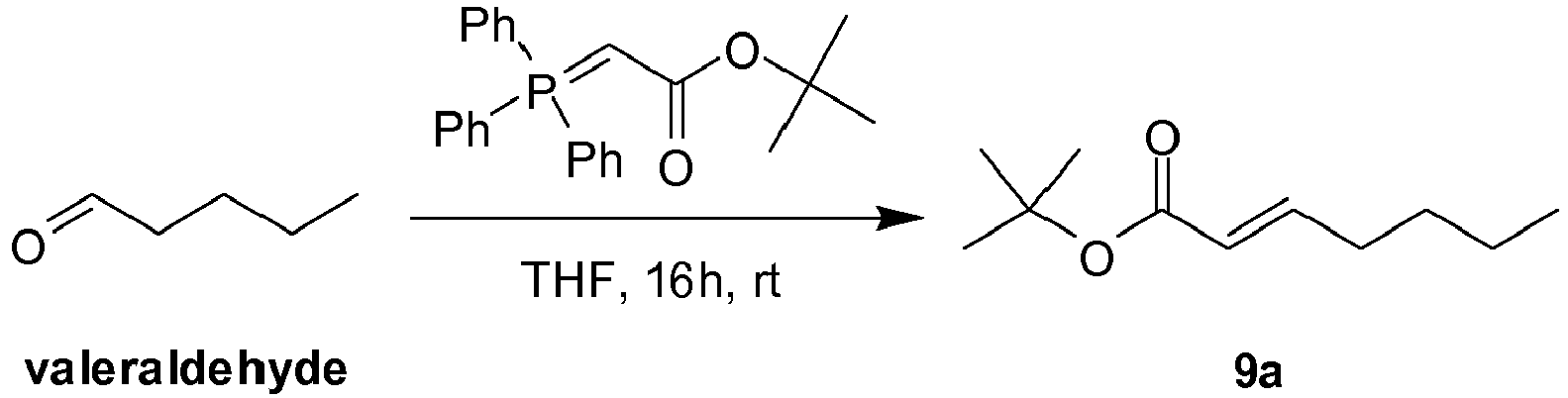
- To a solution of valeraldehyde (43 g, 500 mmol) in THF (1 L) was added (tert-butoxycarbonylmethylene)triphenylphosphorane (200 g, 532 mmol) and the reaction mixture was stirred for 16 hours at room temperature. The solvent was removed under reduced pressure and the residue was diluted in petroleum ether and filtered. The solvents of the filtrate were removed under reduced pressure and the residue was purified by silica chromatography using a petroleum ether to 3% ethyl acetate in petroleum ether gradient to give 9a (90 g) as a colorless oil.
1H NMR (400 MHz, CDCl3): δ ppm 6.81-6.77 (m, 1 H), 5.68-5.64 (td, J=1.2Hz, 15.6 Hz, 1 H), 2.11-2.09 (m, 2H), 1.406 (s, 9H), 1.38-1.26(m, 4H), 0.85-0.81 (t, J=7.2Hz, 3H). -

- n-butyl lithium (290mL, 725mmol) was added to a stirred solution of (S)-(-)-N-benzyl-1-phenylethylamine (165 g, 781 mmol) in THF (800 mL) at -78°C. The reaction mixture was stirred for 30 minutes then 9a (90 g, 488.4 mmol) in THF (400 mL) was added and the reaction was stirred for 2 hours at -78°C. The mixture was quenched with sat., aq. NH4Cl solution and warmed to room temperature. The product was partitioned between ethyl acetate and water. The organic phase was washed with brine, dried over magnesium sulfate, the solids were removed by filtration, and the solvents of the filtrate were removed under reduced pressure. The residue was purified by column chromatography eluting with 5% ethyl acetate in petroleum ether to afford a colorless oil, 9b (132 g).
1H NMR (400 MHz, CDCl3): δ ppm 7.36-7.16 (m, 10H), 3.75-3.70 (m, 2H), 3.43-3.39 (d, J=15.2Hz, 1 H), 3.33-3.15 (m, 1 H), 1.86-1.80 (m, 2H), 1.47-1.37 (m, 2H), 1.32 (s, 9H), 1.26-1.17 (m, 7H), 0.83-0.79 (t, J=7.2Hz, 3H). -

- 9b (130 g, 328 mmol) was dissolved in THF (1.5 L) and LAH (20 g, 526 mmol) was added at 0°C in small portions. The resulting mixture was stirred at the same temperature for 2 hours and then allowed to warm to room temperature. The mixture was quenched with a sat. aq. NH4Cl solution. The product was partitioned between ethyl acetate and water. The organic phase was washed with brine, dried and evaporated. The combined organic layers were dried over sodium sulfate, the solids were removed via filtration and concentrated to afford crude 9c (100 g), which was used in the next step without further purification.
1H NMR (400 MHz, CDCl3): δ ppm 7.33-7.14 (m, 10H), 3.91-3.86 (m, 1H), 3.80-3.77 (d, J=13.6Hz, 1 H), 3.63-3.60 (d, J=13.6Hz, 1 H), 3.43-3.42 (m, 1 H), 3.15-3.10 (m, 1 H), 2.70-2.63 (m, 2H), 1.65-1.28 (m, 10H), 0.89-0.81 (m, 3H). -

- A solution of 9c (38 g, 116.75 mmol) and 10% Pd/C in methanol (200 mL) was hydrogenated under 50 psi hydrogen at 50°C for 24 hours. The reaction mixture was filtered and the solvent was evaporated to give 9.
1H NMR (400 MHz, DMSO-d 6): δ ppm 8.04 (s, 3H), 3.60-3.49 (m, 2H), 3.16-3.15 (m, 1 H), 1.71-1.67 (m, 2H), 1.60-1.55(m, 2H), 1.33-1.26 (m, 4H), 0.90-0.87 (t, J=6.8Hz, 3H). -

- To a stirred solution of 3 (21.6 g crude, 22.1 mmol) in CH2Cl2 (54 mL) was added 9 (2.9 g, 22.1 mmol) and Et3N (9.2 ml, 66.3 mmol) at room temperature. The mixture was then stirred during the night at the same temperature. The reaction was diluted with water (200 mL) and extracted with CH2Cl2 (3 x 150 mL). The combined organic layers were washed with water and brine, dried (MgSO4), the solids were removed via filtration, and the solvents of the filtrate were concentrated under reduced pressure. The crude was purified by silica gel column chromatography using a petroleum ether to ethyl acetate gradient. The best fractions were pooled, and the solvents were removed under reduced pressure to afford 10 (0.91 g).
1H NMR (400 MHz, CDCl3) δ ppm 6.71 (d, 1 H), 4.36 (m, 1 H), 3.83 (m, 2 H), 2.04 (m, 2 H), 1.70 (m, 2 H), 1.35 (m, 4 H), 0.92 (t, 3H) -

- 10 (0.91 g, 3.3 mmol, 1 eq.) and ammonium hydroxide (7 mL) in THF (7 mL) were placed in a sealed tube and heated to 110°C for 12 hours. After cooling to room temperature the reaction was diluted with water and extracted with ethyl acetate (3 x 150 mL). The combined organic layers were washed with brine, dried (MgSO4), the solids were removed by filtration and the solvents of the filtrate were removed under reduced pressure. The residue was purified by preparative thin layer silica gel chromatography using 10% methanol in dichloromethane to obtain 170 mg of 11.
1H NMR (400 MHz, CDCl3) δ ppm 5.67 (d, 1 H), 5.29 (d, 2 H), 4.17 (m, 1 H), 3.66 (m, 2 H), 2.51 (brs, 1 H), 1.88 (m, 1 H), 1.55 (m, 3 H), 1.25 (m, 4 H), 0.83 (t, 3H). -

- A mixture of 11 (170 mg, 0.64 mmol) and sodium methoxide (69 mg, 1.28 mmol) in CH3OH (10 mL) was heated to 100°C in the microwave with stirring for 1 hour. The solids were removed by filtration and the filtrate was concentrated under reduced pressure. The residue was purified by preparative high-performance liquid chromatography (column C18, using a water to acetonitrile gradient containing 0.05% HCl). The best fractions were pooled and concentrated under vacuum to afford 12.
LC-MS m/z = 256 (M+H)
1H NMR (400 MHz, MeOH-d 4) δ ppm 4.49 (m, 1 H), 4.02 (s, 3 H), 3.63 (m, 2 H), 1.84 (m, 2 H), 1.68 (m, 2 H), 1.33 (m, 4 H), 0.93 (t, 3H). -

- Intermediate 13 was prepared according to the method to prepare 5.
-

- Intermediate 14 was prepared according to the method to prepare 6.
-

- In a sealed tube, a mixture of 14 (100 mg, 0.5 mmol), benzylalcohol (0.52 mL, 5 mmol) and cesium carbonate (814.5 mg, 2.5 mmol) in anhydrous THF (1 mL) was stirred at 100°C for 24 hours. The reaction was diluted with water (1 mL) and extracted with ethyl acetate (3 x 10 mL). The combined organic extracts were washed with water and brine, dried (MgSO4), the solids were removed by filtration, and the solvents of the filtrate were removed under reduced pressure. The crude was purified by silica gel chromatography using a petroleum ether to ethyl acetate gradient affording a yellow oil, 15 (67.7 mg, 0.25 mmol).
-

- 16 was prepared according to the method to prepare 15.
Table I: Compounds of formula (I). The following compounds were synthesized according to one of the methods described above. # STRUCTURE H NMR LC Method, Retention Time (min) Mass Found (M+H) 8 
1H NMR (400 MHz, methanol-d 4) δ ppm 8.56 (d, 1 H), 7.73 (d, 1 H), 5.69 (s, 2 H), 4.54 (m, 1 H), 4.25 (s, 3 H), 4.06 (s, 3 H), 3.65 (m, 2 H), 1.75 (m, 4 H), 1.35 (m, 2 H), 0.94 (t, 3H) exchangeable protons not seen. A, 3.30 379 12 
1H NMR (400 MHz, MeOH-d 4) δ ppm 4.49 (m, 1 H), 4.02 (s, 3 H), 3.63 (m, 2 H), 1.84 (m, 2 H), 1.68 (m, 2 H), 1.33 (m, 4 H), 0.93 (t, 3H) exchangeable protons not seen. A, 3.55 256 15 
1H NMR (500 MHz, DMSO-d 6) δ 7.48 (d, J = 7.25 Hz, 2H), 7.35 - 7.42 (m, 3H), 7.27 - 7.34 (m, 1 H), 5.71 (s, 2H), 5.32 (s, 2H), 3.23 - 3.35 (m, 2H), 1.51 (quin, J = 7.25 Hz, 2H), 1.20 - 1.33 (m, 2H), 0.88 (t, J = 7.25 Hz, 3H) B ,2.61 274 16 
1H NMR (500 MHz, DMSO-d 6) δ 7.25 (t, J = 5.67 Hz, 1H), 7.14 (d, J = 8.51 Hz, 2H), 6.84 (d, J = 8.51 Hz, 2H), 5.66 (s, 2H), 4.16 (t, J = 6.46 Hz, 2H), 3.71 (s, 3H), 3.26 - 3.35 (m, 2H), 2.69 (t, J = 7.57 Hz, 2H), 1.95 - 2.03 (m, 2H), 1.48 - 1.56 (m, 2H), 1.25 - 1.33 (m, 2H), 0.89 (t, J = 7.41 Hz, 3H) B ,2.79 332 17 
1H NMR (400 MHz, METHANOL-d 4) δ ppm 0.96 (t, J=7.4 Hz, 3 H), 1.33-1.45(m,2H),1.57 - 1.71 (m, 2 H), 3.53 (t, J=7.3 Hz, 2 H), 3.99 (s, 3 H), exchangeable protons not seen. A, 3.26 198 18 
1H NMR (400 MHz, METHANOL-d 4) δ ppm 0.99 (t, J=7.4 Hz, 3 H), 1.35- 1.44 (m, 2 H), 1.44 (d, J=1.0 Hz, 6 H), 1.59 -1.75 (m, 2 H), 3.55 (t, J=7.4 Hz, 2 H), 5.07 -5.22 (m, 1 H), exchangeable protons not seen. A, 3.94 226 19 
1H NMR (400 MHz, CHLOROFORM-d) δ ppm 0.86 (t, J=7.3 Hz, 3 H), 1.23 - 1.36 (m, 2 H), 1.44 - 1.56 (m, 2 H), 3.27 - 3.37 (m, 2 H), 3.77 (s, 3 H), 4.44 (br. s., 2 H), 5.36 (s, 2 H), 5.47 (br. s., 1 H), 6.81 - 6.93 (m, 2 H), 7.27 (td, J=7.9, 1.8 Hz, 1 H), 7.32 (dd, J=7.3, 1.5 Hz, 1 H) C, 3.38 304 20 
1H NMR (400 MHz, METHANOL-d 4) δ ppm 0.97 (t, J=7.4 Hz, 3 H), 1.32-1.45(m,2H), 1.58 -1.69(m,2H),3.53(t, J=7.3 Hz, 2 H), 5.45 (s, 2 H), 7.13 - 7.21 (m, 1 H), 7.25 (td, J=7.5, 1.0 Hz, 1 H), 7.41 - 7.49 (m, 1 H), 7.61 (td, J=7.5, 1.8 Hz, 1 H) exchangeable protons not seen. C, 3.36 292 21 
1H NMR (400 MHz, METHANOL-d 4) δ ppm 0.96 (t, J=7.4 Hz, 3 H), 1.33 - 1.47 (m, 2 H), 1.60 - 1.73 (m, 2 H), 3.57 (t, J=7.3 Hz, 2 H), 5.65 (s, 2 H), 8.20 (dd, J=7.9, 5.9 Hz, 1 H), 8.86 (d, J=7.8 Hz, 1 H), 8.92 (d, J=5.5 Hz, 1 H), 9.17 (s, 1 H) exchangeable protons not seen. D, 4.34 275 22 
1H NMR (400 MHz, METHANOL-d 4) δ ppm 0.97 (t, J=7.4 Hz, 3 H), 1.34 - 1.45 (m, 2 H), 1.65 (t, J=7.4 Hz, 2 H), 3.54 (t, J=7.3 Hz, 2 H), 3.79 (dd, J=5.3, 3.5 Hz, 2 H), 4.40 -4.47(m, 2 H) exchangeable protons not seen. D, 3.99 242 - All compounds were characterized by LC-MS according to the following LC-MS methods.
-
Column YMC-PACK ODS-AQ, 50 x 2.0mm 5µm A :H2O (0.1%TFA) B:CH3CN (0.05%TFA) TIME(min) A% B% Mobile Phase 0 100 0 1 100 0 5 40 60 7.5 40 60 8 100 0 Flow Rate 0.8 mL/min Wavelength UV 220 nm Column Temperture 50°C MS polarity positive LC-MS Agilent 1100 - Reversed phase UPLC on Waters Acquity BEH (bridged ethylsiloxane/silica hybrid) C18 column (1.7 µm, 2.1 x 100 mm) with a flow rate of 0.343 mL/min. Two mobile phases (mobile phase A: 95 % 7 mM ammonium acetate / 5 % acetonitrile; mobile phase B: 100 % acetonitrile) were employed to run a gradient condition from 84.2 % A and 15.8 % B (hold for 0.49 minutes) to 10.5 % A and 89.5 % B in 2.18 minutes, hold for 1.94 min and back to the initial conditions in 0.73 min, hold for 0.73 minutes. An injection volume of 2 µL was used. Cone voltage was 20V for positive and negative ionization mode. Mass spectra were acquired by scanning from 100 to 1000 in 0.2 seconds using an interscan delay of 0.1 seconds.
-
Column YMC-PACK ODS-AQ, 50 x 2.0mm 5µm A :H2O (0.1%TFA) B:CH3CN (0.05%TFA) TIME(min) A% B% Mobile Phase 0 90 10 0.8 90 10 4.5 20 80 7.5 20 80 8 90 10 Flow Rate 0.8 mL/min Wavelength UV 220 nm Oven Temperature 50°C MS polarity positive LC-MS Agilent 1100 -
Column Ultimate XB-C18, 50 x 2.1 mm 5µm C:H2O (10 mmol/L NH4HCO3) D:CH3CN TIME(min) C% D% Mobile Phase 0 100 0 1 100 0 5 40 60 7.5 40 60 8 100 0 Flow Rate 0.8 mL/min Wavelength UV 220 nm Oven Tem. 50°C MS polarity positive LC-MS Agilent 1100 - The ability of compounds to activate human TLR7 and/or TLR8 was assessed in a cellular reporter assay using HEK293 cells transiently transfected with a TLR7 or TLR8 expression vector and NFκB-luc reporter construct.
- Briefly, HEK293 cells were grown in culture medium (DMEM supplemented with 10% FCS and 2 mM Glutamine). For transfection of cells in 10 cm dishes, cells were detached with Trypsin-EDTA, transfected with a mix of CMV-TLR7 or TLR8 plasmid (750 ng), NFκB-luc plasmid (375 ng) and a transfection reagent and incubated overnight at 37°C in a humidified 5% CO2 atmosphere. Transfected cells were then detached with Trypsin-EDTA, washed in PBS and resuspended in medium to a density of 1.67 x 10⁵ cells/mL. Thirty microliters of cells were then dispensed into each well in 384-well plates, where 10 µL of compound in 4% DMSO was already present. Following 6 hours incubation at 37°C, 5% CO2, the luciferase activity was determined by adding 15 µL of Steady Lite Plus substrate (Perkin Elmer) to each well and readout performed on a ViewLux ultraHTS microplate imager (Perkin Elmer). Dose response curves were generated from measurements performed in quadruplicates. Lowest effective concentrations (LEC) values, defined as the concentration that induces an effect which is at least two fold above the standard deviation of the assay, were determined for each compound.
- Compound toxicity was determined in parallel using a similar dilution series of compound with 30 µL per well of cells transfected with the CMV-TLR7 construct alone (1.67 x 10⁵ cells/mL), in 384-well plates. Cell viability was measured after 6 hours incubation at 37°C, 5% CO2 by adding 15 µL of ATP lite (Perkin Elmer) per well and reading on a ViewLux ultraHTS microplate imager (Perkin Elmer). Data was reported as CC50.
- In parallel, a similar dilution series of compound was used (10 µL of compound in 4% DMSO) with 30 µL per well of cells transfected with NFκB-luc reporter construct alone (1.67 x 10⁵ cells/mL). Six hours after incubation at 37°C, 5% CO2, the luciferase activity was determined by adding 15 µl of Steady Lite Plus substrate (Perkin Elmer) to each well and readout performed on a ViewLux ultraHTS microplate imager (Perkin Elmer). Counterscreen data is reported as LEC.
- The potential of compounds to induce IFN-I was also evaluated by measuring the activation of interferon-stimulated responsive elements (ISRE) by conditioned media from PBMC. The ISRE element of sequence GAAACTGAAACT is highly responsive to the STAT1-STAT2-IRF9 transcription factor, activated upon binding of IFN-I to their receptor IFNAR (Clontech, PT3372-5W). The plasmid pISRE-Luc from Clontech (ref. 631913) contains 5 copies of this ISRE element, followed by the firefly luciferase ORF. A HEK293 cell line stably transfected with pISRE-Luc (HEK-ISREluc) was established to profile of the conditioned PBMC cell culture media.
- Briefly, PBMCs were prepared from buffy coats of at least two donors using a standard Ficoll centrifugation protocol. Isolated PBMCs were resuspended in RPMI medium supplemented with 10% human AB serum and 2 x 10⁵ cells/well were dispensed into 384-well plates containing compounds (70 µL total volume). After overnight incubation, 10 µL of supernatant was transferred to 384-well plates containing 5 x 10³ HEK-ISREluc cells/well in 30 µL (plated the day before). Following 24 hours of incubation, activation of the ISRE elements was measured by assaying luciferase activity using 40 µL/well Steady Lite Plus substrate (Perkin Elmer) and measured with ViewLux ultraHTS microplate imager (Perkin Elmer). The stimulating activity of each compound on the HEK-ISREluc cells was reported as LEC value, defined as the compound concentration applied to the PBMCs resulting in a luciferase activity at least two fold above the standard deviation of the assay. The LEC in turn indicates the degree of ISRE activation on transfer of a defined amount of PBMC culture medium. Recombinant interferon α-2a (Roferon-A) was used as a standard control compound.
TABLE II. BIOLOGICAL ACTIVITY. # STRUCTURE Human TLR 7 (LEC) µM Human TLR 8 (LEC) µM HEKISRE luc (LEC) µM 8 
0.26 0.42 0.04 12 
7.8 5.9 2.8 15 
2.9 1.9 1.9 16 
0.4 0.8 0.14 17 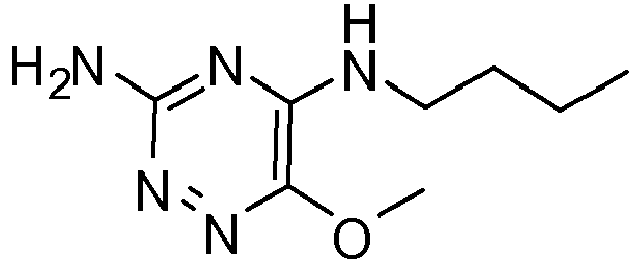
17.5 2.0 NA 18 
8.3 0.5 NA 19 
0.66 0.64 NA 20 
0.75 0.56 NA 21 
1.7 0.6 NA 22 
4.8 1.0 NA NA = not available. All compounds showed no toxicity up to the highest tested concentration. All compounds showed no activity (LEC >25 µM) in the HEK 293 NF-kB counterscreen assay described above. 
Claims (9)
- A compound of formula (I)

R1 is C1-6alkyl, arylalkyl, or heteroarylalkyl each of which is optionally substituted by one or more substituents independently selected from halogen, hydroxyl, amino, C1-6 alkyl, di-(C1-6)alkylamino, C1-6 alkylamino, C1-6 alkoxy, C3-6cycloalkyl, carboxylic acid, carboxylic ester, carboxylic amide, heterocycle, aryl, alkenyl, alkynyl, arylalkyl, heteroaryl, heteroarylalkyl, or nitrile,
R2 is C1-8 alkyl, optionally substituted by one or more substituents independently selected from halogen, hydroxyl, amino, C1-3 alkyl, C1-3 alkoxy, C3-6 cycloalkyl, carboxylic acid, carboxylic ester, carboxylic amide, di-(C1-6)alkylamino, C1-6 alkylamino, aryl, heteroaryl, heteroarylalkyl or nitrile. - A compound according to claim 1 wherein R2 is butyl or pentyl and wherein R1 is C1-6alkyl, arylalkyl or heteroarylalkyl each of which is optionally substituted by one or more substituents independently selected from halogen, hydroxyl, amino, C1-6 alkyl, di-(C1-6)alkylamino, C1-6 alkylamino, C1-6 alkoxy, C3-6 cycloalkyl, carboxylic acid, carboxylic ester, carboxylic amide, heterocycle, di-(C1-6)alkylamino, C1-6 alkylamino, aryl, alkenyl, alkynyl, arylalkyl, heteroaryl, heteroarylalkyl, or nitrile.
- A compound according to claim 1 wherein R2 is C1-8 alkyl substituted with hydroxyl, and wherein R1 is a substituted or unsubstituted arylalkyl group.
- A compound according to claim 1 wherein R1 is an arylalkyl and R2 is C1-8 alkyl substituted with a hydroxyl, or one of the following examples in any stereochemical configuration:

- A compound according to claim 1 wherein R1 is CH3 and wherein R2 is C1-8 alkyl, , optionally substituted by one or more substituents independently selected from halogen, hydroxyl, amino, C1-3 alkyl, C1-3 alkoxy, C3-6 cycloalkyl, carboxylic acid, carboxylic ester, carboxylic amide, di-(C1-6)alkylamino, C1-6 alkylamino, aryl, heteroaryl, heteroarylalkyl or nitrile.
- A compound according to claim 1 wherein R1 is a heteroarylalkyl, and wherein R2 is C1-8 alkyl, optionally substituted by one or more substituents independently selected from halogen, hydroxyl, amino, C1-3 alkyl, C1-3alkoxy, C3-6 cycloalkyl, carboxylic acid, carboxylic ester, carboxylic amide, di-(C1-6)alkylamino, C1-6 alkylamino, aryl, heteroaryl, heteroarylalkyl or nitrile.
- A pharmaceutical composition comprising a compound of formula (I) or a pharmaceutically acceptable salt, tautomer(s), solvate or polymorph thereof according to claim 1-6 together with one or more pharmaceutically acceptable excipients, diluents or carriers.
- A compound of formula (I) or a pharmaceutically acceptable salt, tautomer(s), solvate or polymorph thereof according to claim 1-6, or a pharmaceutical composition according to claim 7 for use as a medicament.
- A compound of formula (I) or a pharmaceutically acceptable salt, tautomer(s), solvate or polymorph thereof according to claim 1-6, or a pharmaceutical composition according to claim 7 for use in the treatment of a disorder in which the modulation of TLR7 and/or TLR8 is involved.
Priority Applications (23)
| Application Number | Priority Date | Filing Date | Title |
|---|---|---|---|
| EP12306196.2A EP2712866A1 (en) | 2012-10-01 | 2012-10-01 | 1,2,4-triazine derivatives for the treatment of viral infections |
| CN201380050972.5A CN104812747B (en) | 2012-10-01 | 2013-10-01 | 1,2,4‑Triazine derivatives for the treatment of viral infections |
| ES13773690.6T ES2616496T3 (en) | 2012-10-01 | 2013-10-01 | 1,2,4-Triazine derivatives for the treatment of viral infections |
| PCT/EP2013/070488 WO2014053516A1 (en) | 2012-10-01 | 2013-10-01 | 1,2,4-triazine derivatives for the treatment of viral infections. |
| BR112015007310-7A BR112015007310B1 (en) | 2012-10-01 | 2013-10-01 | COMPOUND, PHARMACEUTICAL COMPOSITION, USE OF A COMPOUND OF FORMULA (I) AND USE OF A PHARMACEUTICAL COMPOSITION |
| SG11201502522WA SG11201502522WA (en) | 2012-10-01 | 2013-10-01 | 1,2,4-triazine derivatives for the treatment of viral infections. |
| EP13773690.6A EP2903976B1 (en) | 2012-10-01 | 2013-10-01 | 1,2,4-triazine derivatives for the treatment of viral infections. |
| US14/432,269 US9416114B2 (en) | 2012-10-01 | 2013-10-01 | 1,2,4-triazine derivatives for the treatment of viral infections |
| CA2886630A CA2886630C (en) | 2012-10-01 | 2013-10-01 | 1,2,4-triazine derivatives for the treatment of viral infections |
| MX2015004160A MX348229B (en) | 2012-10-01 | 2013-10-01 | 1,2,4-triazine derivatives for the treatment of viral infections. |
| MYPI2015000804A MY182558A (en) | 2012-10-01 | 2013-10-01 | 1,2,4-triazine derivatives for the treatment of viral infections |
| EA201500383A EA026236B1 (en) | 2012-10-01 | 2013-10-01 | 1,2,4-triazine derivatives for the treatment of viral infections |
| IN3327DEN2015 IN2015DN03327A (en) | 2012-10-01 | 2013-10-01 | |
| HK15108914.9A HK1208223B (en) | 2012-10-01 | 2013-10-01 | 1,2,4-triazine derivatives for the treatment of viral infections |
| JP2015533635A JP6298998B2 (en) | 2012-10-01 | 2013-10-01 | 1,2,4-Triazine derivatives for treating viral infections |
| KR1020157009515A KR102138393B1 (en) | 2012-10-01 | 2013-10-01 | 1,2,4-triazine derivatives for the treatment of viral infections. |
| UAA201504222A UA114644C2 (en) | 2012-10-01 | 2013-10-01 | 1,2,4-triazine derivatives for the treatment of viral infections |
| AU2013326579A AU2013326579B2 (en) | 2012-10-01 | 2013-10-01 | 1,2,4-triazine derivatives for the treatment of viral infections. |
| NZ706354A NZ706354A (en) | 2012-10-01 | 2013-10-01 | 1,2,4-triazine derivatives for the treatment of viral infections. |
| IL237871A IL237871A (en) | 2012-10-01 | 2015-03-22 | 1,2,4-triazine derivatives for the treatment of viral infections |
| CL2015000787A CL2015000787A1 (en) | 2012-10-01 | 2015-03-30 | 1,2,4-Triazine derivatives for the treatment of viral infections. |
| ZA2015/02240A ZA201502240B (en) | 2012-10-01 | 2015-03-31 | 1,2,4-triazine derivatives for the treament of viral infections |
| PH12015500724A PH12015500724A1 (en) | 2012-10-01 | 2015-03-31 | 1, 2, 4-triazine derivatives for the treatment of viral infections |
Applications Claiming Priority (1)
| Application Number | Priority Date | Filing Date | Title |
|---|---|---|---|
| EP12306196.2A EP2712866A1 (en) | 2012-10-01 | 2012-10-01 | 1,2,4-triazine derivatives for the treatment of viral infections |
Publications (1)
| Publication Number | Publication Date |
|---|---|
| EP2712866A1 true EP2712866A1 (en) | 2014-04-02 |
Family
ID=46982496
Family Applications (2)
| Application Number | Title | Priority Date | Filing Date |
|---|---|---|---|
| EP12306196.2A Withdrawn EP2712866A1 (en) | 2012-10-01 | 2012-10-01 | 1,2,4-triazine derivatives for the treatment of viral infections |
| EP13773690.6A Active EP2903976B1 (en) | 2012-10-01 | 2013-10-01 | 1,2,4-triazine derivatives for the treatment of viral infections. |
Family Applications After (1)
| Application Number | Title | Priority Date | Filing Date |
|---|---|---|---|
| EP13773690.6A Active EP2903976B1 (en) | 2012-10-01 | 2013-10-01 | 1,2,4-triazine derivatives for the treatment of viral infections. |
Country Status (21)
| Country | Link |
|---|---|
| US (1) | US9416114B2 (en) |
| EP (2) | EP2712866A1 (en) |
| JP (1) | JP6298998B2 (en) |
| KR (1) | KR102138393B1 (en) |
| CN (1) | CN104812747B (en) |
| AU (1) | AU2013326579B2 (en) |
| BR (1) | BR112015007310B1 (en) |
| CA (1) | CA2886630C (en) |
| CL (1) | CL2015000787A1 (en) |
| EA (1) | EA026236B1 (en) |
| ES (1) | ES2616496T3 (en) |
| IL (1) | IL237871A (en) |
| IN (1) | IN2015DN03327A (en) |
| MX (1) | MX348229B (en) |
| MY (1) | MY182558A (en) |
| NZ (1) | NZ706354A (en) |
| PH (1) | PH12015500724A1 (en) |
| SG (1) | SG11201502522WA (en) |
| UA (1) | UA114644C2 (en) |
| WO (1) | WO2014053516A1 (en) |
| ZA (1) | ZA201502240B (en) |
Families Citing this family (19)
| Publication number | Priority date | Publication date | Assignee | Title |
|---|---|---|---|---|
| PT3590928T (en) | 2011-04-08 | 2021-08-19 | Janssen Sciences Ireland Unlimited Co | Pyrimidine derivatives for the treatment of viral infections |
| JP6349256B2 (en) | 2011-11-09 | 2018-06-27 | ヤンセン・サイエンシズ・アイルランド・ユーシー | Purine derivatives for the treatment of viral infections |
| EA035790B1 (en) | 2012-07-13 | 2020-08-11 | Янссен Сайенсиз Айрлэнд Юси | Macrocyclic purines for the treatment of viral infections |
| DK2906563T3 (en) | 2012-10-10 | 2018-06-06 | Janssen Sciences Ireland Uc | PYRROLO [3,2-D] PYRIMIDINE DERIVATIVES FOR TREATING VIRUS INFECTIONS AND OTHER DISEASES |
| EA035431B1 (en) | 2012-11-16 | 2020-06-15 | Янссен Сайенсиз Айрлэнд Юси | Heterocyclic substituted 2-amino-quinazoline derivatives as tlr7 and/or tlr8 modulators for the treatment of viral infections |
| SG11201506639XA (en) | 2013-02-21 | 2015-09-29 | Janssen Sciences Ireland Uc | 2-aminopyrimidine derivatives for the treatment of viral infections |
| CN110590809B (en) | 2013-03-29 | 2022-04-19 | 爱尔兰詹森科学公司 | Macrocyclic deaza-purinones for the treatment of viral infections |
| SG11201509520QA (en) | 2013-05-24 | 2015-12-30 | Janssen Sciences Ireland Uc | Pyridone derivatives for the treatment of viral infections and further diseases |
| PT3030563T (en) | 2013-06-27 | 2017-11-15 | Janssen Sciences Ireland Uc | Pyrrolo [3,2-d] pyrimidine derivatives for the treatment of viral infections and other diseases |
| DK3027624T3 (en) | 2013-07-30 | 2019-01-07 | Janssen Sciences Ireland Uc | THIENO [3,2-D] PYRIMIDINE DERIVATIVES FOR TREATING VIRUS INFECTIONS |
| MA45539A (en) | 2016-07-01 | 2019-05-08 | Janssen Sciences Ireland Unlimited Co | DIHYDROPYRANOPYRIMIDINES FOR THE TREATMENT OF VIRAL INFECTIONS |
| ES2912945T3 (en) * | 2016-09-29 | 2022-05-30 | Janssen Sciences Ireland Unlimited Co | Pyrimidine prodrugs for the treatment of viral infections and other diseases |
| TW201945003A (en) | 2018-03-01 | 2019-12-01 | 愛爾蘭商健生科學愛爾蘭無限公司 | 2,4-diaminoquinazoline derivatives and medical uses thereof |
| WO2020162705A1 (en) | 2019-02-08 | 2020-08-13 | 성균관대학교산학협력단 | Toll-like receptor 7 or 8 agonist-cholesterol complex, and use of same |
| CA3170551A1 (en) | 2020-03-02 | 2021-09-10 | Yong Taik Lim | Live-pathogen-mimetic nanoparticles based on pathogen cell wall skeleton, and production method thereof |
| US20230277525A1 (en) | 2020-08-04 | 2023-09-07 | Progeneer Inc | Conjugate of functional drug and toll-like receptor 7 or 8 agonist of which active site is temporarily inactivated and use thereof |
| JP7690221B2 (en) | 2020-08-04 | 2025-06-10 | プロジェニア インコーポレイテッド | Dynamically Acting Adjuvant Ensembles |
| US20230346924A1 (en) | 2020-08-04 | 2023-11-02 | Progeneer Inc. | Mrna vaccine comprising adjuvant capable of kinetic control |
| US20260076973A1 (en) * | 2023-01-15 | 2026-03-19 | Viradem, Inc. | Compounds and methods for treating diseases caused by SARS-CoV-2 and other coronaviruses |
Citations (6)
| Publication number | Priority date | Publication date | Assignee | Title |
|---|---|---|---|---|
| WO1998001448A1 (en) | 1996-07-03 | 1998-01-15 | Japan Energy Corporation | Novel purine derivatives |
| WO1999028321A1 (en) | 1997-11-28 | 1999-06-10 | Sumitomo Pharmaceuticals Company, Limited | Novel heterocyclic compounds |
| WO2006015985A1 (en) * | 2004-08-10 | 2006-02-16 | Janssen Pharmaceutica N.V. | Hiv inhibiting 1,2,4-triazin-6-one derivatives |
| WO2006117670A1 (en) | 2005-05-04 | 2006-11-09 | Pfizer Limited | 2-amido-6-amino-8-oxopurine derivatives as toll-like receptor modulators for the treatment of cancer and viral infections, such as hepatitis c |
| WO2009067081A1 (en) | 2007-11-22 | 2009-05-28 | Astrazeneca Ab | Pyrimidine derivatives for the treatment of asthma, copd, allergic rhinitis, allergic conjunctivitis, atopic dermatitis, cancer, hepatitis b, hepatitis c, hiv, hpv, bacterial infections and dermatosis |
| WO2012067269A1 (en) * | 2010-11-19 | 2012-05-24 | Dainippon Sumitomo Pharma Co., Ltd. | Aminoalkoxyphenyl compounds and their use in the treatment of disease |
Family Cites Families (3)
| Publication number | Priority date | Publication date | Assignee | Title |
|---|---|---|---|---|
| FR2485531A1 (en) * | 1980-06-25 | 1981-12-31 | Fabre Sa Pierre | NOVEL DIARYL-5,6 AS TRIAZINES 1-2-4 N-OXIDES, THEIR USE AS DRUGS AND THE PHARMACEUTICAL COMPOSITIONS CONTAINING THEM |
| EP1924564B1 (en) * | 2005-09-01 | 2016-11-09 | F.Hoffmann-La Roche Ag | Diaminopyrimidines as p2x3 and p2x2/3 modulators |
| RU2352565C1 (en) * | 2007-10-08 | 2009-04-20 | Государственное образовательное учреждение высшего профессионального образования "Пермский государственный университет" | 3-amino-6-aroylmethyl-5-hydroxy-1,2,4-triazines and methods of obtaining them |
-
2012
- 2012-10-01 EP EP12306196.2A patent/EP2712866A1/en not_active Withdrawn
-
2013
- 2013-10-01 EA EA201500383A patent/EA026236B1/en not_active IP Right Cessation
- 2013-10-01 CN CN201380050972.5A patent/CN104812747B/en not_active Expired - Fee Related
- 2013-10-01 ES ES13773690.6T patent/ES2616496T3/en active Active
- 2013-10-01 MY MYPI2015000804A patent/MY182558A/en unknown
- 2013-10-01 EP EP13773690.6A patent/EP2903976B1/en active Active
- 2013-10-01 AU AU2013326579A patent/AU2013326579B2/en not_active Ceased
- 2013-10-01 KR KR1020157009515A patent/KR102138393B1/en not_active Expired - Fee Related
- 2013-10-01 JP JP2015533635A patent/JP6298998B2/en not_active Expired - Fee Related
- 2013-10-01 BR BR112015007310-7A patent/BR112015007310B1/en not_active IP Right Cessation
- 2013-10-01 US US14/432,269 patent/US9416114B2/en active Active
- 2013-10-01 IN IN3327DEN2015 patent/IN2015DN03327A/en unknown
- 2013-10-01 NZ NZ706354A patent/NZ706354A/en not_active IP Right Cessation
- 2013-10-01 SG SG11201502522WA patent/SG11201502522WA/en unknown
- 2013-10-01 WO PCT/EP2013/070488 patent/WO2014053516A1/en not_active Ceased
- 2013-10-01 CA CA2886630A patent/CA2886630C/en active Active
- 2013-10-01 MX MX2015004160A patent/MX348229B/en active IP Right Grant
- 2013-10-01 UA UAA201504222A patent/UA114644C2/en unknown
-
2015
- 2015-03-22 IL IL237871A patent/IL237871A/en active IP Right Grant
- 2015-03-30 CL CL2015000787A patent/CL2015000787A1/en unknown
- 2015-03-31 PH PH12015500724A patent/PH12015500724A1/en unknown
- 2015-03-31 ZA ZA2015/02240A patent/ZA201502240B/en unknown
Patent Citations (6)
| Publication number | Priority date | Publication date | Assignee | Title |
|---|---|---|---|---|
| WO1998001448A1 (en) | 1996-07-03 | 1998-01-15 | Japan Energy Corporation | Novel purine derivatives |
| WO1999028321A1 (en) | 1997-11-28 | 1999-06-10 | Sumitomo Pharmaceuticals Company, Limited | Novel heterocyclic compounds |
| WO2006015985A1 (en) * | 2004-08-10 | 2006-02-16 | Janssen Pharmaceutica N.V. | Hiv inhibiting 1,2,4-triazin-6-one derivatives |
| WO2006117670A1 (en) | 2005-05-04 | 2006-11-09 | Pfizer Limited | 2-amido-6-amino-8-oxopurine derivatives as toll-like receptor modulators for the treatment of cancer and viral infections, such as hepatitis c |
| WO2009067081A1 (en) | 2007-11-22 | 2009-05-28 | Astrazeneca Ab | Pyrimidine derivatives for the treatment of asthma, copd, allergic rhinitis, allergic conjunctivitis, atopic dermatitis, cancer, hepatitis b, hepatitis c, hiv, hpv, bacterial infections and dermatosis |
| WO2012067269A1 (en) * | 2010-11-19 | 2012-05-24 | Dainippon Sumitomo Pharma Co., Ltd. | Aminoalkoxyphenyl compounds and their use in the treatment of disease |
Non-Patent Citations (3)
| Title |
|---|
| AKIRA, S.; TAKEDA, K.; KAISHO, T., ANNUAL REV. IMMUNOLOGY, vol. 21, 2003, pages 335 - 376 |
| HOFFMANN, J.A., NATURE, vol. 426, 2003, pages 33 - 38 |
| ULEVITCH, R. J., NATURE REVIEWS: IMMUNOLOGY, vol. 4, 2004, pages 512 - 520 |
Also Published As
Similar Documents
| Publication | Publication Date | Title |
|---|---|---|
| EP2903976B1 (en) | 1,2,4-triazine derivatives for the treatment of viral infections. | |
| EP3027624B1 (en) | Thieno[3,2-d]pyrimidines derivatives for the treatment of viral infections | |
| DK2812331T3 (en) | PIPERIDINOPYRIMIDINE DERIVATIVES FOR TREATING VIRUS INFECTIONS | |
| US9284304B2 (en) | Substituted pyrimidines as toll-like receptor modulators | |
| EP3030563B1 (en) | Pyrrolo [3,2-d] pyrimidine derivatives for the treatment of viral infections and other diseases | |
| EP2958900B1 (en) | 2-aminopyrimidine derivatives for the treatment of viral infections | |
| EP3004074B1 (en) | Pyridone derivatives for the treatment of viral infections and further diseases | |
| HK40000770B (en) | Thieno[3,2-d]pyrimidines derivatives for the treatment of viral infections | |
| HK40000770A (en) | Thieno[3,2-d]pyrimidines derivatives for the treatment of viral infections | |
| HK40003405A (en) | Alkylpyrimidine derivatives for the treatment of viral infections and further diseases | |
| HK1208223B (en) | 1,2,4-triazine derivatives for the treatment of viral infections |
Legal Events
| Date | Code | Title | Description |
|---|---|---|---|
| PUAI | Public reference made under article 153(3) epc to a published international application that has entered the european phase |
Free format text: ORIGINAL CODE: 0009012 |
|
| AK | Designated contracting states |
Kind code of ref document: A1 Designated state(s): AL AT BE BG CH CY CZ DE DK EE ES FI FR GB GR HR HU IE IS IT LI LT LU LV MC MK MT NL NO PL PT RO RS SE SI SK SM TR |
|
| AX | Request for extension of the european patent |
Extension state: BA ME |
|
| RIN1 | Information on inventor provided before grant (corrected) |
Inventor name: LEVACHER, VINCENT Inventor name: GUILLEMONT, JEROME, EMILE, GEORGES Inventor name: GEMBUS VINCENT Inventor name: MC GOWAN, DAVID CRAIG Inventor name: HOARAU, CHRISTOPHE Inventor name: JUBAULT, PHILIPPE Inventor name: BONFANTI, JEAN-FRANCOIS |
|
| STAA | Information on the status of an ep patent application or granted ep patent |
Free format text: STATUS: THE APPLICATION IS DEEMED TO BE WITHDRAWN |
|
| 18D | Application deemed to be withdrawn |
Effective date: 20141003 |