EP2712781A2 - Vehicle speed control apparatus - Google Patents
Vehicle speed control apparatus Download PDFInfo
- Publication number
- EP2712781A2 EP2712781A2 EP12195923.3A EP12195923A EP2712781A2 EP 2712781 A2 EP2712781 A2 EP 2712781A2 EP 12195923 A EP12195923 A EP 12195923A EP 2712781 A2 EP2712781 A2 EP 2712781A2
- Authority
- EP
- European Patent Office
- Prior art keywords
- deceleration
- vehicle speed
- speed control
- speed limit
- distance
- Prior art date
- Legal status (The legal status is an assumption and is not a legal conclusion. Google has not performed a legal analysis and makes no representation as to the accuracy of the status listed.)
- Granted
Links
Images




Classifications
-
- B—PERFORMING OPERATIONS; TRANSPORTING
- B60—VEHICLES IN GENERAL
- B60K—ARRANGEMENT OR MOUNTING OF PROPULSION UNITS OR OF TRANSMISSIONS IN VEHICLES; ARRANGEMENT OR MOUNTING OF PLURAL DIVERSE PRIME-MOVERS IN VEHICLES; AUXILIARY DRIVES FOR VEHICLES; INSTRUMENTATION OR DASHBOARDS FOR VEHICLES; ARRANGEMENTS IN CONNECTION WITH COOLING, AIR INTAKE, GAS EXHAUST OR FUEL SUPPLY OF PROPULSION UNITS IN VEHICLES
- B60K31/00—Vehicle fittings, acting on a single sub-unit only, for automatically controlling vehicle speed, i.e. preventing speed from exceeding an arbitrarily established velocity or maintaining speed at a particular velocity, as selected by the vehicle operator
-
- G—PHYSICS
- G06—COMPUTING OR CALCULATING; COUNTING
- G06F—ELECTRIC DIGITAL DATA PROCESSING
- G06F17/00—Digital computing or data processing equipment or methods, specially adapted for specific functions
-
- B—PERFORMING OPERATIONS; TRANSPORTING
- B60—VEHICLES IN GENERAL
- B60W—CONJOINT CONTROL OF VEHICLE SUB-UNITS OF DIFFERENT TYPE OR DIFFERENT FUNCTION; CONTROL SYSTEMS SPECIALLY ADAPTED FOR HYBRID VEHICLES; ROAD VEHICLE DRIVE CONTROL SYSTEMS FOR PURPOSES NOT RELATED TO THE CONTROL OF A PARTICULAR SUB-UNIT
- B60W30/00—Purposes of road vehicle drive control systems not related to the control of a particular sub-unit, e.g. of systems using conjoint control of vehicle sub-units
- B60W30/14—Adaptive cruise control
-
- B—PERFORMING OPERATIONS; TRANSPORTING
- B60—VEHICLES IN GENERAL
- B60W—CONJOINT CONTROL OF VEHICLE SUB-UNITS OF DIFFERENT TYPE OR DIFFERENT FUNCTION; CONTROL SYSTEMS SPECIALLY ADAPTED FOR HYBRID VEHICLES; ROAD VEHICLE DRIVE CONTROL SYSTEMS FOR PURPOSES NOT RELATED TO THE CONTROL OF A PARTICULAR SUB-UNIT
- B60W30/00—Purposes of road vehicle drive control systems not related to the control of a particular sub-unit, e.g. of systems using conjoint control of vehicle sub-units
- B60W30/14—Adaptive cruise control
- B60W30/143—Speed control
-
- B—PERFORMING OPERATIONS; TRANSPORTING
- B60—VEHICLES IN GENERAL
- B60W—CONJOINT CONTROL OF VEHICLE SUB-UNITS OF DIFFERENT TYPE OR DIFFERENT FUNCTION; CONTROL SYSTEMS SPECIALLY ADAPTED FOR HYBRID VEHICLES; ROAD VEHICLE DRIVE CONTROL SYSTEMS FOR PURPOSES NOT RELATED TO THE CONTROL OF A PARTICULAR SUB-UNIT
- B60W30/00—Purposes of road vehicle drive control systems not related to the control of a particular sub-unit, e.g. of systems using conjoint control of vehicle sub-units
- B60W30/14—Adaptive cruise control
- B60W30/143—Speed control
- B60W30/146—Speed limiting
-
- B—PERFORMING OPERATIONS; TRANSPORTING
- B60—VEHICLES IN GENERAL
- B60W—CONJOINT CONTROL OF VEHICLE SUB-UNITS OF DIFFERENT TYPE OR DIFFERENT FUNCTION; CONTROL SYSTEMS SPECIALLY ADAPTED FOR HYBRID VEHICLES; ROAD VEHICLE DRIVE CONTROL SYSTEMS FOR PURPOSES NOT RELATED TO THE CONTROL OF A PARTICULAR SUB-UNIT
- B60W10/00—Conjoint control of vehicle sub-units of different type or different function
- B60W10/04—Conjoint control of vehicle sub-units of different type or different function including control of propulsion units
- B60W10/06—Conjoint control of vehicle sub-units of different type or different function including control of propulsion units including control of combustion engines
-
- B—PERFORMING OPERATIONS; TRANSPORTING
- B60—VEHICLES IN GENERAL
- B60W—CONJOINT CONTROL OF VEHICLE SUB-UNITS OF DIFFERENT TYPE OR DIFFERENT FUNCTION; CONTROL SYSTEMS SPECIALLY ADAPTED FOR HYBRID VEHICLES; ROAD VEHICLE DRIVE CONTROL SYSTEMS FOR PURPOSES NOT RELATED TO THE CONTROL OF A PARTICULAR SUB-UNIT
- B60W10/00—Conjoint control of vehicle sub-units of different type or different function
- B60W10/18—Conjoint control of vehicle sub-units of different type or different function including control of braking systems
-
- B—PERFORMING OPERATIONS; TRANSPORTING
- B60—VEHICLES IN GENERAL
- B60W—CONJOINT CONTROL OF VEHICLE SUB-UNITS OF DIFFERENT TYPE OR DIFFERENT FUNCTION; CONTROL SYSTEMS SPECIALLY ADAPTED FOR HYBRID VEHICLES; ROAD VEHICLE DRIVE CONTROL SYSTEMS FOR PURPOSES NOT RELATED TO THE CONTROL OF A PARTICULAR SUB-UNIT
- B60W2520/00—Input parameters relating to overall vehicle dynamics
- B60W2520/10—Longitudinal speed
-
- B—PERFORMING OPERATIONS; TRANSPORTING
- B60—VEHICLES IN GENERAL
- B60W—CONJOINT CONTROL OF VEHICLE SUB-UNITS OF DIFFERENT TYPE OR DIFFERENT FUNCTION; CONTROL SYSTEMS SPECIALLY ADAPTED FOR HYBRID VEHICLES; ROAD VEHICLE DRIVE CONTROL SYSTEMS FOR PURPOSES NOT RELATED TO THE CONTROL OF A PARTICULAR SUB-UNIT
- B60W2555/00—Input parameters relating to exterior conditions, not covered by groups B60W2552/00, B60W2554/00
- B60W2555/60—Traffic rules, e.g. speed limits or right of way
-
- B—PERFORMING OPERATIONS; TRANSPORTING
- B60—VEHICLES IN GENERAL
- B60W—CONJOINT CONTROL OF VEHICLE SUB-UNITS OF DIFFERENT TYPE OR DIFFERENT FUNCTION; CONTROL SYSTEMS SPECIALLY ADAPTED FOR HYBRID VEHICLES; ROAD VEHICLE DRIVE CONTROL SYSTEMS FOR PURPOSES NOT RELATED TO THE CONTROL OF A PARTICULAR SUB-UNIT
- B60W2556/00—Input parameters relating to data
- B60W2556/45—External transmission of data to or from the vehicle
- B60W2556/50—External transmission of data to or from the vehicle of positioning data, e.g. GPS [Global Positioning System] data
-
- B—PERFORMING OPERATIONS; TRANSPORTING
- B60—VEHICLES IN GENERAL
- B60W—CONJOINT CONTROL OF VEHICLE SUB-UNITS OF DIFFERENT TYPE OR DIFFERENT FUNCTION; CONTROL SYSTEMS SPECIALLY ADAPTED FOR HYBRID VEHICLES; ROAD VEHICLE DRIVE CONTROL SYSTEMS FOR PURPOSES NOT RELATED TO THE CONTROL OF A PARTICULAR SUB-UNIT
- B60W2720/00—Output or target parameters relating to overall vehicle dynamics
- B60W2720/10—Longitudinal speed
-
- B—PERFORMING OPERATIONS; TRANSPORTING
- B60—VEHICLES IN GENERAL
- B60W—CONJOINT CONTROL OF VEHICLE SUB-UNITS OF DIFFERENT TYPE OR DIFFERENT FUNCTION; CONTROL SYSTEMS SPECIALLY ADAPTED FOR HYBRID VEHICLES; ROAD VEHICLE DRIVE CONTROL SYSTEMS FOR PURPOSES NOT RELATED TO THE CONTROL OF A PARTICULAR SUB-UNIT
- B60W2720/00—Output or target parameters relating to overall vehicle dynamics
- B60W2720/10—Longitudinal speed
- B60W2720/106—Longitudinal acceleration
Definitions
- the present disclosure relates to a vehicle speed control apparatus, a vehicle speed control system comprising the same, and a vehicle speed control method, and more particularly, to a vehicle speed control apparatus controlling a vehicle speed in response to speed limit information, a vehicle speed control system comprising the same, and a vehicle speed control method.
- a smart cruise control (hereinafter, referred to as SCC) is an apparatus for automatically controlling a vehicle speed without directly operating an acceleration pedal or a brake pedal by a driver by sensing a distance and a relative speed of a front vehicle, front road information, and the like.
- the present invention has been made in an effort to provide a vehicle speed control apparatus for precisely performing a vehicle speed control corresponding to driving situations and driving characteristics, a vehicle speed control system, and a control method thereof, in an SCC system of a vehicle.
- the present invention has also been made in an effort to provide a vehicle speed control apparatus minimizing degradation of a comfortable ride for a driver during a deceleration process, a vehicle speed control system, and a control method thereof.
- the present invention has also been made in an effort to provide a vehicle speed control apparatus for determining and warning when a proper speed cannot be observed within a remaining distance due to a limit of set operation conditions, a vehicle speed control system, and a control method thereof.
- An exemplary embodiment of the present invention provides a vehicle speed control apparatus, including: a speed limit information recognition unit recognizing a location and a speed limit of a speed limit point located in front of a vehicle; a storage unit stored with deceleration characteristic values including at least one driving characteristic; a deceleration characteristic select unit selecting the deceleration characteristic values corresponding to the location and the speed limit of the recognized speed limit point among the deceleration characteristic values stored in the storage unit; and a targeted acceleration calculation unit calculating a targeted acceleration necessary for a vehicle speed control up to the speed limit point based on the selected deceleration characteristic values.
- the speed limit information recognition unit may receive information on the vehicle from a global positioning system (GPS) and include a navigation unit in which road information including the speed limit point is stored.
- GPS global positioning system
- the deceleration characteristic select unit may sequentially reflect the deceleration characteristic values to calculate a deceleration distance necessary for deceleration from a current vehicle speed to the speed limit and compare a residual distance up to the speed limit point with the calculated deceleration distance to select the corresponding deceleration characteristic values if it is determined that the deceleration distance is longer than the residual distance.
- the deceleration characteristic select unit may calculate a first deceleration distance that is included in the deceleration distance and is in a section in which deceleration is increased, based on the current acceleration of a vehicle.
- the deceleration characteristic select unit may calculate a second deceleration distance that is included in the deceleration distance and is in a section in which deceleration is constant.
- the deceleration characteristic select unit may calculate a third deceleration distance that is included in the deceleration distance and is in a section in which deceleration is reduced.
- the driving characteristics may be at least any one of a maximum allowable acceleration of the targeted acceleration, a maximum jerk of the targeted acceleration, a speed control gain, and an extra speed that is a difference between the speed limit and a targeted control speed.
- Another exemplary embodiment of the present invention provides a vehicle speed control method, including: a) recognizing a location and a speed limit of a speed limit point located in front of a vehicle; b) selecting deceleration characteristic values corresponding to the location and the speed limit of the speed limit point among deceleration characteristic values including at least one driving characteristic; and c) calculating a targeted acceleration necessary for a vehicle speed control up to the speed limit point based on the selected deceleration characteristic values.
- Step (b) of the vehicle speed control method may include: b-1) calculating a deceleration distance necessary for deceleration from a current vehicle speed to the speed limit by reflecting the deceleration characteristic values; b-2) comparing a residual distance up to the speed limit point with the calculated deceleration distance; and b-3) if it is determined that the deceleration distance is longer than the residual distance, selecting the corresponding deceleration characteristic values.
- the driving characteristics of the vehicle speed control method may be at least any one of a maximum allowable acceleration of the targeted acceleration, a maximum jerk of the targeted acceleration, a speed control gain, and an extra speed that is a difference between the speed limit and a targeted control speed.
- Yet another exemplary embodiment of the present invention provides a vehicle speed control system, including: a first vehicle speed control apparatus recognizing a speed limit of a speed limit point located in front of a vehicle, selecting deceleration characteristic values corresponding to a location and a speed limit of the speed limit point among deceleration characteristic values including at least one driving characteristic, and calculating a first targeted acceleration necessary for a vehicle speed control up to the speed limit point based on the selected deceleration characteristic values; a second vehicle speed control apparatus calculating a second targeted acceleration necessary for a vehicle speed control set by a user or a vehicle speed control so as to maintain an inter-vehicular distance for a preceding vehicle; and a targeted acceleration determining unit determining a final targeted acceleration based on the calculated first targeted acceleration and second targeted acceleration.
- the first speed limit recognition unit of the vehicle speed control system may receive information on the vehicle from a global positioning system (GPS) and include a navigation unit in which road information including the speed limit point is stored.
- GPS global positioning system
- the vehicle speed control system may further include: an activation determining unit controlling whether the first vehicle speed control unit is activated, based on activation information received by the first vehicle speed control apparatus and the second vehicle speed control apparatus.
- the activation information of the vehicle speed control system may be at least any one of the number of global positioning system (GPS) satellites received by the navigation unit, validity of information of the navigation unit, whether the first vehicle speed control apparatus set by a driver is activated, and whether the current second vehicle speed control apparatus is activated.
- GPS global positioning system
- the deceleration characteristic select unit of the vehicle speed system may sequentially reflect the deceleration characteristic values to calculate a deceleration distance necessary for deceleration from a current vehicle speed to the speed limit and compare a residual distance up to the speed limit point with the calculated deceleration distance to select the corresponding deceleration characteristic values if it is determined that the deceleration distance is longer than the residual distance.
- the driving characteristics of the vehicle speed control system may be at least any one of a maximum allowable acceleration of the targeted acceleration, a maximum jerk of the targeted acceleration, a speed control gain, and an extra speed that is a difference between the speed limit and a targeted control speed.
- the targeted acceleration select unit may determine one having a smaller value of the calculated first targeted acceleration and second targeted acceleration as a final targeted acceleration.
- the vehicle speed control apparatus the vehicle speed control system, the control method thereof, and the vehicle speed control method of the exemplary embodiment of the present invention, it is possible to precisely control the vehicle speed at an optimal speed up to the speed limit point by reflecting deceleration characteristics according to the driving situations or the driving characteristics.
- the vehicle speed control apparatus the vehicle speed control system, the control method thereof of the exemplary embodiment of the present invention, it is possible to minimize degradation of a comfortable ride for a driver according to the deceleration by reflecting the driving characteristics, such as the maximum allowable acceleration, the maximum jerk, and the like, to the vehicle speed control.
- an exemplary embodiment of the present invention is based on a technology of controlling a vehicle speed up to a speed limit point by reflecting a speed limit obtained from a navigation unit while driving a vehicle using an SCC system.
- FIG. 1 is a diagram illustrating a vehicle speed control apparatus 100 according to an exemplary embodiment of the present invention.
- the vehicle speed control apparatus 100 includes a speed limit information recognition unit 110, a storage unit 120 in which deceleration characteristic values are stored, a deceleration characteristic select unit 130, and a targeted acceleration calculation unit 140.
- the speed limit information recognition unit 110 serves to recognize a speed limit point located in front of a vehicle and recognize a location and a speed limit of a sensed speed limit point.
- the speed limit information recognition unit 110 may include a navigation unit 111.
- the navigation unit 111 receives location information of a current vehicle from a global positioning system (GPS).
- GPS global positioning system
- the navigation unit 111 is stored with road information including the speed limit point.
- the storage unit 120 is stored with the deceleration characteristic values including at least one driving characteristic.
- FIG. 2 is a table illustrating driving characteristics corresponding to each deceleration characteristic value.
- the driving characteristics may mean a maximum allowable acceleration of targeted acceleration, a maximum jerk of the targeted acceleration, a speed control gain, an extra speed that is a difference between a speed limit and a targeted control speed, and the like.
- the targeted acceleration means acceleration required to observe the speed limit at the speed limit point of the corresponding vehicle in consideration of a distance from a current driving point to the speed limit point.
- Four driving characteristics are described in FIG. 2 and the foregoing description, but the driving characteristics of the exemplary embodiment of the present invention are not limited thereto and may be changed to various factors determining the driving characteristics.
- the driving characteristics having predetermined values are grouped to form sets.
- the sets of the driving characteristics each correspond to deceleration characteristic values (1, 2, 3, ..., 12 of FIG. 2 ). Therefore, aspects of the deceleration control may be changed according to each deceleration characteristic value.
- the driving characteristic values are used as input values when a deceleration distance is calculated by applying the corresponding deceleration characteristics. For example, referring to FIG.
- the deceleration characteristic value when the deceleration characteristic value is selected to be "2", the maximum allowable acceleration of the targeted acceleration is limited to 0.75 m/s, the maximum jerk of the targeted acceleration is limited to 0.40/s, the speed control gain is set to be 0.4s ⁇ I, and the extra speed is input as 0.4 m/s, upon calculating the targeted acceleration of a vehicle up to a speed limit point.
- the deceleration distance means a distance required for deceleration up to the speed limit from the current vehicle speed.
- the extra speed Vm means a difference between a speed limit Vt and a targeted control speed Vmap.
- the deceleration characteristic select unit 130 selects any one of the deceleration characteristic values stored in the storage unit 120, corresponding to the location and the speed limit of the speed limit point recognized by the foregoing speed limit information recognition unit 110.
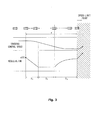
- FIG. 3 is a diagram illustrating a deceleration distance and deceleration state for each section of the deceleration distance.
- the deceleration characteristic select unit 130 first reflects the predetermined deceleration characteristic value (for example, "2") to calculate the deceleration distance x.
- the deceleration distance may be represented by a distance with three types of deceleration sections.
- the deceleration distance x may include a first deceleration distance x1 in a section in which the deceleration is increased.
- the deceleration characteristic select unit 130 receives the current acceleration of a vehicle from a vehicle speed sensor and calculates the first deceleration distance x1 based on the received acceleration. First, when the targeted acceleration is limited, it is determined based on the following Equation 1 whether a proportional control deceleration section is present.
- Equation 1 v map - v 0 - a 0 K m n ⁇ 0
- vmap is the targeted control speed
- v(0) is the current vehicle speed
- n is a deceleration characteristic value
- a(0) is the current acceleration of a vehicle
- km(n) is a speed control gain of the corresponding deceleration characteristic value.
- Jmax(n) is the maximum jerk of the corresponding deceleration characteristic value
- a(0) is the current acceleration of a vehicle
- n is the deceleration characteristic value
- km(n) is the speed control gain of the corresponding deceleration characteristic value
- vmap is the targeted control speed
- v(0) is the current vehicle speed.
- a(0) is the current acceleration of a vehicle
- n is the deceleration characteristic value
- amax(n) is the maximum allowable acceleration of the corresponding deceleration characteristic value
- Jmax(n) is the maximum jerk of the corresponding deceleration characteristic value.
- One having a smaller value of the first virtual arrival time t1 and the second virtual arrival time t1 obtained based on the above Equations 1 and 2 is determined as the first arrival time t1 for obtaining the first deceleration distance x1.
- the acceleration at the ending point of the section in which deceleration is increased may be obtained using the first arrival time t1 and may be integrated to obtain the first deceleration distance x1.
- the first deceleration distance x1 is calculated based on the following Equation 4.
- x 1 n v 0 ⁇ t 1 n + a 0 2 ⁇ t 1 ⁇ n 2 - J max n 6 ⁇ t 1 ⁇ n 3
- v(0) is the current vehicle speed
- n is the deceleration characteristic value
- t1(n) is the first arrival time up to an ending point of the section in which the deceleration is increased at the corresponding deceleration characteristic value
- a(0) is the current acceleration of a vehicle
- Jmax(n) is the maximum jerk of the corresponding deceleration characteristic value.
- the deceleration distance x may include a second deceleration distance x2 in the section in which the deceleration is constant.
- the deceleration characteristic select unit 130 receives the current acceleration of a vehicle from the vehicle speed sensor and calculates the second deceleration distance x2 based on the received acceleration. First, it is determined whether the section in which the deceleration is constant is present. To this end, an expected speed v of the ending time of the section in which the deceleration is constant is calculated based on the following Equation 5.
- v * n v map + a max n K m n
- vmap is the targeted control speed
- amax(n) is the maximum allowable acceleration of the corresponding deceleration characteristic value
- Km(n) is the speed control gain of the corresponding deceleration characteristic value.
- v(t1, n) is the vehicle speed of the ending time of the proportional control deceleration section at the corresponding deceleration characteristic value
- v is the expected speed of the ending time of the section in which the deceleration is constant
- amax(n) is the maximum allowable acceleration of the corresponding deceleration characteristic value.
- the speed at the ending point of the section in which deceleration may be obtained using the second arrival time t2 is constant and may be integrated to obtain the second deceleration distance x2.
- the second deceleration distance x2 is calculated based on the following Equation 7. When no equivalent deceleration section is present, the second deceleration distance x2 becomes 0.
- x 2 n v t 1 ⁇ n ⁇ t 2 n - a max n 2 ⁇ t 2 ⁇ n 2
- v(t1, n) is the vehicle speed of the ending time of the proportional control deceleration section at the corresponding deceleration characteristic value
- t2 is the second arrival time
- amax(n) is the maximum allowable acceleration of the corresponding deceleration characteristic value.
- the deceleration distance x may include a third deceleration distance x3 in the proportional control section in which the deceleration is reduced.
- the deceleration characteristic select unit 130 first determines the section in which the deceleration is increased. To this end, it is determined based on the following Equation 8 that the control error between the vehicle speed v(t2) of the ending time in the section in which the deceleration is constant and the targeted control speed vamp is less than the extra speed Vm. As the determination result, when the control error is less than the extra speed Vm, it is considered that the control target is completed and a third arrival time t3 up to the ending time of the section in which the deceleration is reduced is considered to be 0.
- the third arrival time t3 up to the ending point of the section in which the deceleration is reduced is calculated based on the following Equation 8.
- t 3 * n - 1 K m n ⁇ ln ⁇ v m n v t 2 ⁇ n - v map
- Km(n) is the speed control gain of the corresponding deceleration characteristic value
- Vm is the extra speed
- v(t2, n) is the vehicle speed of the ending point of the equivalent deceleration section at the corresponding deceleration characteristic value
- vmap is the targeted control speed
- the third deceleration distance x3 is calculated based on the following Equation 9.
- x 3 n v map ⁇ t 3 n + v t 2 ⁇ n - v map ⁇ 1 - e - K m n ⁇ t 3 n
- vmap is the targeted control speed
- n is the deceleration characteristic value
- t3(n) is the third arrival time at the corresponding deceleration characteristic value
- v(t2, n) is the vehicle speed of the ending time of the section in which the deceleration is constant at the corresponding deceleration characteristic value
- Km(n) is the speed control gain of the corresponding deceleration characteristic value.
- the deceleration distance x corresponds to a distance obtained by summing the foregoing first deceleration distance x1, second deceleration distance x2, and third deceleration distance x3.
- the deceleration distance x calculated as described above is compared with the residual distance up to the speed limit point.
- the residual distance means the current location of the vehicle and the distance up to the speed limit point and is obtained from the navigation unit 111.
- the vehicle speed control period of the vehicle speed control apparatus 100 may be faster than the information update period of the navigation unit 111. Therefore, the residual distance obtained from the navigation unit 111 may be corrected by the predetermined algorithm.
- the deceleration characteristic select unit 130 calculates the deceleration distance x by sequentially reflecting the next deceleration characteristic value (for example, "3") when the deceleration distance x is shorter than the residual distance, as described above.
- a process of calculating the deceleration distance x by sequentially reflecting the next deceleration characteristic values ("4", "5", 7) until it is determined that the deceleration distance x is longer than the residual distance is repeatedly performed.
- the deceleration characteristic select unit 130 selects the deceleration characteristic value when it is determined that the deceleration distance x is longer than the residual distance.
- the deceleration characteristic select unit 130 may be configured to issue a warning to a driver when the selected deceleration characteristic value is a predetermined reference value (for example, "10") or more.
- Km is the speed control gain
- vamp is the targeted control speed
- v(0) is the current vehicle speed.
- the targeted acceleration ai limits a value by applying the selected acceleration limit and the jerk limit.
- FIG. 4 is a flow chart illustrating a vehicle speed control method according to an exemplary embodiment of the present invention
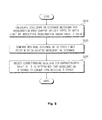
- FIG. 5 is a flow chart illustrating a method for selecting deceleration characteristic values.
- the speed limit information recognition unit 110 recognizes the location and the speed limit of the speed limit point located in front of a vehicle (S100).
- the residual distance from the current location of a vehicle to the speed limit point may be calculated by the location of the recognized speed limit point.
- the deceleration characteristic select unit 130 selects the deceleration characteristic values from the storage unit 120.
- the deceleration characteristic value performing the optimal deceleration is selected while repeatedly performing a process of sequentially inputting the deceleration characteristic value, starting from the predetermined deceleration characteristic value.
- the targeted acceleration calculation unit 140 calculates the targeted acceleration necessary for the vehicle speed control up to the speed limit point based on the selected deceleration characteristic value (S300).
- FIG. 6 is a diagram illustrating the vehicle speed control apparatus 10 according to an exemplary embodiment of the present invention.
- the vehicle speed control system 10 includes a first vehicle speed control apparatus 100, a second vehicle speed control apparatus 200, a targeted acceleration determining unit 300, and an activation determining unit 400.
- the vehicle speed control system 10 may perform the vehicle speed control reflecting the deceleration characteristic values by the first vehicle speed control apparatus 100 in the SCC state performed by the second vehicle speed control apparatus 200.
- the first vehicle speed control apparatus 100 illustrates the foregoing vehicle speed control apparatus 100 and the configuration and control process thereof are described above, but the detailed description thereof will be omitted.
- the first vehicle speed control apparatus 100 obtains the location and the speed limit of the speed limit point from the navigation and reflects the deceleration characteristic values based on the obtained location and speed limit to calculate a first targeted acceleration.
- the second vehicle speed control apparatus 200 uses the vehicle sensor including a radar, and the like, to sense the speed limit of the front road and calculate a second targeted acceleration based on the speed limit.
- the targeted acceleration determining unit 300 determines a final targeted acceleration based on the calculated first targeted acceleration and second targeted acceleration.
- the targeted acceleration determining unit 300 may select any one of the first targeted acceleration and the second targeted acceleration to determine the final targeted acceleration. In particular, one having a smaller value of the first targeted acceleration and the second targeted acceleration may be determined as the final targeted acceleration.
- the activation determining unit 400 serves to activate the first vehicle speed control apparatus 100 in the state in which the SCC is performed by the second vehicle speed control apparatus 120 to determine whether the additional vehicle speed control is performed.
- the activation determining unit 400 determines the vehicle speed control based on the activation information received from the first vehicle speed control apparatus 100 or the second vehicle speed control apparatus 120.
- the activation information may be the number of global positioning system (GPS) satellites received by the navigation unit 111, validity of information of the navigation unit 111, whether the first vehicle speed control apparatus 100 set by a driver is activated, and whether the current second vehicle speed control apparatus is activated, and the like.
- GPS global positioning system
- the activation determining unit 400 may perform the additional vehicle speed control process using the first vehicle speed control apparatus 100.
Landscapes
- Engineering & Computer Science (AREA)
- Transportation (AREA)
- Mechanical Engineering (AREA)
- Automation & Control Theory (AREA)
- Physics & Mathematics (AREA)
- Theoretical Computer Science (AREA)
- Software Systems (AREA)
- Mathematical Physics (AREA)
- Databases & Information Systems (AREA)
- General Engineering & Computer Science (AREA)
- General Physics & Mathematics (AREA)
- Data Mining & Analysis (AREA)
- Chemical & Material Sciences (AREA)
- Combustion & Propulsion (AREA)
- Control Of Driving Devices And Active Controlling Of Vehicle (AREA)
- Control Of Vehicle Engines Or Engines For Specific Uses (AREA)
- Controls For Constant Speed Travelling (AREA)
Abstract
Description
- This application claims priority to and the benefit of Korean Patent Application No.
10-2012-0107248 - The present disclosure relates to a vehicle speed control apparatus, a vehicle speed control system comprising the same, and a vehicle speed control method, and more particularly, to a vehicle speed control apparatus controlling a vehicle speed in response to speed limit information, a vehicle speed control system comprising the same, and a vehicle speed control method.
- A smart cruise control (hereinafter, referred to as SCC) is an apparatus for automatically controlling a vehicle speed without directly operating an acceleration pedal or a brake pedal by a driver by sensing a distance and a relative speed of a front vehicle, front road information, and the like.
- In order to implement the SCC, it is essential to effectively perform an acceleration and deceleration control of a vehicle. Therefore, a technology of performing an acceleration and deceleration control of a vehicle corresponding to external information has been variously proposed. In particular, in Korean Patent Application No.
10-2010-0085932 - The general acceleration and deceleration control of a vehicle that has been proposed in technologies other than the present technology does not consider the current acceleration of the corresponding vehicle other than the front road information. Therefore, it is difficult to ensure a comfortable ride and precisely control an optimal vehicle speed at an appropriate speed within a required distance.
- The present invention has been made in an effort to provide a vehicle speed control apparatus for precisely performing a vehicle speed control corresponding to driving situations and driving characteristics, a vehicle speed control system, and a control method thereof, in an SCC system of a vehicle.
- The present invention has also been made in an effort to provide a vehicle speed control apparatus minimizing degradation of a comfortable ride for a driver during a deceleration process, a vehicle speed control system, and a control method thereof.
- The present invention has also been made in an effort to provide a vehicle speed control apparatus for determining and warning when a proper speed cannot be observed within a remaining distance due to a limit of set operation conditions, a vehicle speed control system, and a control method thereof.
- An exemplary embodiment of the present invention provides a vehicle speed control apparatus, including: a speed limit information recognition unit recognizing a location and a speed limit of a speed limit point located in front of a vehicle; a storage unit stored with deceleration characteristic values including at least one driving characteristic; a deceleration characteristic select unit selecting the deceleration characteristic values corresponding to the location and the speed limit of the recognized speed limit point among the deceleration characteristic values stored in the storage unit; and a targeted acceleration calculation unit calculating a targeted acceleration necessary for a vehicle speed control up to the speed limit point based on the selected deceleration characteristic values.
- The speed limit information recognition unit may receive information on the vehicle from a global positioning system (GPS) and include a navigation unit in which road information including the speed limit point is stored.
- The deceleration characteristic select unit may sequentially reflect the deceleration characteristic values to calculate a deceleration distance necessary for deceleration from a current vehicle speed to the speed limit and compare a residual distance up to the speed limit point with the calculated deceleration distance to select the corresponding deceleration characteristic values if it is determined that the deceleration distance is longer than the residual distance.
- The deceleration characteristic select unit may calculate a first deceleration distance that is included in the deceleration distance and is in a section in which deceleration is increased, based on the current acceleration of a vehicle.
- The deceleration characteristic select unit may calculate a second deceleration distance that is included in the deceleration distance and is in a section in which deceleration is constant.
- The deceleration characteristic select unit may calculate a third deceleration distance that is included in the deceleration distance and is in a section in which deceleration is reduced.
- The driving characteristics may be at least any one of a maximum allowable acceleration of the targeted acceleration, a maximum jerk of the targeted acceleration, a speed control gain, and an extra speed that is a difference between the speed limit and a targeted control speed.
- Another exemplary embodiment of the present invention provides a vehicle speed control method, including: a) recognizing a location and a speed limit of a speed limit point located in front of a vehicle; b) selecting deceleration characteristic values corresponding to the location and the speed limit of the speed limit point among deceleration characteristic values including at least one driving characteristic; and c) calculating a targeted acceleration necessary for a vehicle speed control up to the speed limit point based on the selected deceleration characteristic values.
- Step (b) of the vehicle speed control method may include: b-1) calculating a deceleration distance necessary for deceleration from a current vehicle speed to the speed limit by reflecting the deceleration characteristic values; b-2) comparing a residual distance up to the speed limit point with the calculated deceleration distance; and b-3) if it is determined that the deceleration distance is longer than the residual distance, selecting the corresponding deceleration characteristic values.
- The driving characteristics of the vehicle speed control method may be at least any one of a maximum allowable acceleration of the targeted acceleration, a maximum jerk of the targeted acceleration, a speed control gain, and an extra speed that is a difference between the speed limit and a targeted control speed.
- Yet another exemplary embodiment of the present invention provides a vehicle speed control system, including: a first vehicle speed control apparatus recognizing a speed limit of a speed limit point located in front of a vehicle, selecting deceleration characteristic values corresponding to a location and a speed limit of the speed limit point among deceleration characteristic values including at least one driving characteristic, and calculating a first targeted acceleration necessary for a vehicle speed control up to the speed limit point based on the selected deceleration characteristic values; a second vehicle speed control apparatus calculating a second targeted acceleration necessary for a vehicle speed control set by a user or a vehicle speed control so as to maintain an inter-vehicular distance for a preceding vehicle; and a targeted acceleration determining unit determining a final targeted acceleration based on the calculated first targeted acceleration and second targeted acceleration. The first speed limit recognition unit of the vehicle speed control system may receive information on the vehicle from a global positioning system (GPS) and include a navigation unit in which road information including the speed limit point is stored.
- The vehicle speed control system may further include: an activation determining unit controlling whether the first vehicle speed control unit is activated, based on activation information received by the first vehicle speed control apparatus and the second vehicle speed control apparatus.
- The activation information of the vehicle speed control system may be at least any one of the number of global positioning system (GPS) satellites received by the navigation unit, validity of information of the navigation unit, whether the first vehicle speed control apparatus set by a driver is activated, and whether the current second vehicle speed control apparatus is activated.
- The deceleration characteristic select unit of the vehicle speed system may sequentially reflect the deceleration characteristic values to calculate a deceleration distance necessary for deceleration from a current vehicle speed to the speed limit and compare a residual distance up to the speed limit point with the calculated deceleration distance to select the corresponding deceleration characteristic values if it is determined that the deceleration distance is longer than the residual distance.
- The driving characteristics of the vehicle speed control system may be at least any one of a maximum allowable acceleration of the targeted acceleration, a maximum jerk of the targeted acceleration, a speed control gain, and an extra speed that is a difference between the speed limit and a targeted control speed.
- The targeted acceleration select unit may determine one having a smaller value of the calculated first targeted acceleration and second targeted acceleration as a final targeted acceleration.
- According to the vehicle speed control apparatus, the vehicle speed control system, the control method thereof, and the vehicle speed control method of the exemplary embodiment of the present invention, it is possible to precisely control the vehicle speed at an optimal speed up to the speed limit point by reflecting deceleration characteristics according to the driving situations or the driving characteristics.
- According to the vehicle speed control apparatus, the vehicle speed control system, the control method thereof of the exemplary embodiment of the present invention, it is possible to minimize degradation of a comfortable ride for a driver according to the deceleration by reflecting the driving characteristics, such as the maximum allowable acceleration, the maximum jerk, and the like, to the vehicle speed control.
- The foregoing summary is illustrative only and is not intended to be in any way limiting. In addition to the illustrative aspects, embodiments, and features described above, further aspects, embodiments, and features will become apparent by reference to the drawings and the following detailed description.
-
-
FIG. 1 is a diagram illustrating a vehicle speed control apparatus according to an exemplary embodiment of the present invention. -
FIG. 2 is a table illustrating driving characteristics corresponding to each deceleration characteristic value. -
FIG. 3 is a diagram illustrating a deceleration distance and deceleration state for each section of the deceleration distance. -
FIG. 4 is a flow chart illustrating a vehicle speed control method according to an exemplary embodiment of the present invention. -
FIG. 5 is a flow chart illustrating a method for selecting deceleration characteristic values. -
FIG. 6 is a diagram illustrating a vehicle speed control system according to the exemplary embodiment of the present invention. - It should be understood that the appended drawings are not necessarily to scale, presenting a somewhat simplified representation of various features illustrative of the basic principles of the invention. The specific design features of the present invention as disclosed herein, including, for example, specific dimensions, orientations, locations, and shapes will be determined in part by the particular intended application and use environment.
- In the figures, reference numbers refer to the same or equivalent parts of the present invention throughout the several figures of the drawing.
- Hereinafter, exemplary embodiments of the present invention will be described in detail with reference to the accompanying drawings. It is to be noted that in adding reference numerals to elements of each drawing, like reference numerals refer to like elements even though like elements are shown in different drawings. The exemplary embodiment of the present invention will be described below, but the technical idea of the present invention is not limited thereto and is modified and can be variously practiced by those skilled in the art.
- Hereinafter, an exemplary embodiment of the present invention is based on a technology of controlling a vehicle speed up to a speed limit point by reflecting a speed limit obtained from a navigation unit while driving a vehicle using an SCC system.
-
FIG. 1 is a diagram illustrating a vehiclespeed control apparatus 100 according to an exemplary embodiment of the present invention. - Referring to
FIG. 1 , the vehiclespeed control apparatus 100 according to the exemplary embodiment of the present invention includes a speed limitinformation recognition unit 110, astorage unit 120 in which deceleration characteristic values are stored, a deceleration characteristicselect unit 130, and a targetedacceleration calculation unit 140. - First, the speed limit
information recognition unit 110 serves to recognize a speed limit point located in front of a vehicle and recognize a location and a speed limit of a sensed speed limit point. In one exemplary embodiment, the speed limitinformation recognition unit 110 may include anavigation unit 111. Thenavigation unit 111 receives location information of a current vehicle from a global positioning system (GPS). Thenavigation unit 111 is stored with road information including the speed limit point. - The
storage unit 120 is stored with the deceleration characteristic values including at least one driving characteristic.FIG. 2 is a table illustrating driving characteristics corresponding to each deceleration characteristic value. Referring toFIG. 2 , in one exemplary embodiment, the driving characteristics may mean a maximum allowable acceleration of targeted acceleration, a maximum jerk of the targeted acceleration, a speed control gain, an extra speed that is a difference between a speed limit and a targeted control speed, and the like. Here, the targeted acceleration means acceleration required to observe the speed limit at the speed limit point of the corresponding vehicle in consideration of a distance from a current driving point to the speed limit point. Four driving characteristics are described inFIG. 2 and the foregoing description, but the driving characteristics of the exemplary embodiment of the present invention are not limited thereto and may be changed to various factors determining the driving characteristics. - The driving characteristics having predetermined values are grouped to form sets. The sets of the driving characteristics each correspond to deceleration characteristic values (1, 2, 3, ..., 12 of
FIG. 2 ). Therefore, aspects of the deceleration control may be changed according to each deceleration characteristic value. The driving characteristic values are used as input values when a deceleration distance is calculated by applying the corresponding deceleration characteristics. For example, referring toFIG. 2 , when the deceleration characteristic value is selected to be "2", the maximum allowable acceleration of the targeted acceleration is limited to 0.75 m/s, the maximum jerk of the targeted acceleration is limited to 0.40/s, the speed control gain is set to be 0.4s∼I, and the extra speed is input as 0.4 m/s, upon calculating the targeted acceleration of a vehicle up to a speed limit point. Here, the deceleration distance means a distance required for deceleration up to the speed limit from the current vehicle speed. The extra speed Vm means a difference between a speed limit Vt and a targeted control speed Vmap. - The deceleration characteristic
select unit 130 selects any one of the deceleration characteristic values stored in thestorage unit 120, corresponding to the location and the speed limit of the speed limit point recognized by the foregoing speed limitinformation recognition unit 110.FIG. 3 is a diagram illustrating a deceleration distance and deceleration state for each section of the deceleration distance. In the exemplary embodiment of the present invention, the deceleration characteristicselect unit 130 first reflects the predetermined deceleration characteristic value (for example, "2") to calculate the deceleration distance x. The deceleration distance may be represented by a distance with three types of deceleration sections. - First, the deceleration distance x may include a first deceleration distance x1 in a section in which the deceleration is increased. The deceleration characteristic
select unit 130 receives the current acceleration of a vehicle from a vehicle speed sensor and calculates the first deceleration distance x1 based on the received acceleration. First, when the targeted acceleration is limited, it is determined based on the followingEquation 1 whether a proportional control deceleration section is present.
- In the
above Equation 1, vmap is the targeted control speed, v(0) is the current vehicle speed, n is a deceleration characteristic value, a(0) is the current acceleration of a vehicle, and km(n) is a speed control gain of the corresponding deceleration characteristic value. - When satisfying the
Equation 1, it is determined that the proportional control deceleration section is present by inputting the driving characteristics of the corresponding deceleration characteristic value and when not satisfying theabove Equation 1, it is determined that no proportional control deceleration section is present. If it is determined that the proportional control deceleration section is present, a first virtual arrival time t1 is calculated based on the followingEquation 2.
- In the
above Equation 2, Jmax(n) is the maximum jerk of the corresponding deceleration characteristic value, a(0) is the current acceleration of a vehicle, n is the deceleration characteristic value, km(n) is the speed control gain of the corresponding deceleration characteristic value, vmap is the targeted control speed, and v(0) is the current vehicle speed. - Meanwhile, since the section in which no proportional control deceleration section is present and the deceleration is constant can immediately appear, there is a need to determine the section. A second virtual arrival time t1 is calculated based on the following
Equation 3.
- In the
above Equation 3, a(0) is the current acceleration of a vehicle, n is the deceleration characteristic value, amax(n) is the maximum allowable acceleration of the corresponding deceleration characteristic value, and Jmax(n) is the maximum jerk of the corresponding deceleration characteristic value. - One having a smaller value of the first virtual arrival time t1 and the second virtual arrival time t1 obtained based on the
above Equations Equation 4.
- In the
above Equation 4, v(0) is the current vehicle speed, n is the deceleration characteristic value, t1(n) is the first arrival time up to an ending point of the section in which the deceleration is increased at the corresponding deceleration characteristic value, a(0) is the current acceleration of a vehicle, and Jmax(n) is the maximum jerk of the corresponding deceleration characteristic value. - Second, the deceleration distance x may include a second deceleration distance x2 in the section in which the deceleration is constant. The deceleration characteristic
select unit 130 receives the current acceleration of a vehicle from the vehicle speed sensor and calculates the second deceleration distance x2 based on the received acceleration. First, it is determined whether the section in which the deceleration is constant is present. To this end, an expected speed v of the ending time of the section in which the deceleration is constant is calculated based on the following Equation 5.
- In the above Equation 5, vmap is the targeted control speed, amax(n) is the maximum allowable acceleration of the corresponding deceleration characteristic value, and Km(n) is the speed control gain of the corresponding deceleration characteristic value.
- When the calculated expected speed v is equal to or larger than a vehicle speed v(t1) of the ending time of the proportional control deceleration section, it is determined that no equivalent deceleration section is present. When the calculated expected speed V is smaller than the vehicle speed v(t1) of the ending point in the section in which the deceleration is increased, a second arrival time t2 up to the ending point of the section in which the deceleration is constant is calculated based on the following Equation 6.
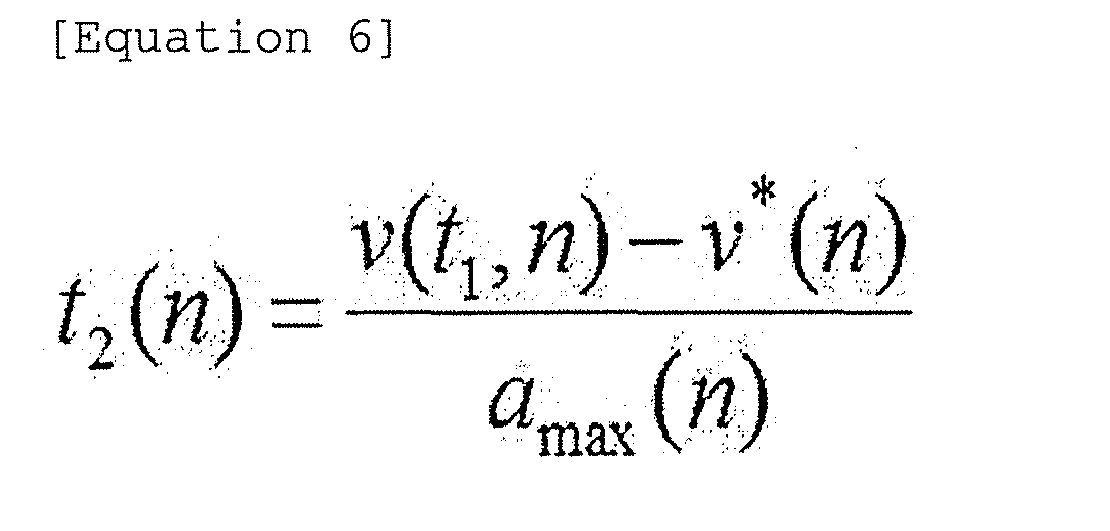
- In the above Equation 6, v(t1, n) is the vehicle speed of the ending time of the proportional control deceleration section at the corresponding deceleration characteristic value, v is the expected speed of the ending time of the section in which the deceleration is constant, and amax(n) is the maximum allowable acceleration of the corresponding deceleration characteristic value.
- The speed at the ending point of the section in which deceleration may be obtained using the second arrival time t2 is constant and may be integrated to obtain the second deceleration distance x2. In detail, the second deceleration distance x2 is calculated based on the following Equation 7. When no equivalent deceleration section is present, the second deceleration distance x2 becomes 0.

- In the above Equation 7, v(t1, n) is the vehicle speed of the ending time of the proportional control deceleration section at the corresponding deceleration characteristic value, t2 is the second arrival time, and the amax(n) is the maximum allowable acceleration of the corresponding deceleration characteristic value.
- Third, the deceleration distance x may include a third deceleration distance x3 in the proportional control section in which the deceleration is reduced. The deceleration characteristic
select unit 130 first determines the section in which the deceleration is increased. To this end, it is determined based on the following Equation 8 that the control error between the vehicle speed v(t2) of the ending time in the section in which the deceleration is constant and the targeted control speed vamp is less than the extra speed Vm. As the determination result, when the control error is less than the extra speed Vm, it is considered that the control target is completed and a third arrival time t3 up to the ending time of the section in which the deceleration is reduced is considered to be 0. In other words, it is determined that the section in which the deceleration is reduced is not present. When the control error exceeds the extra speed Vm, the third arrival time t3 up to the ending point of the section in which the deceleration is reduced is calculated based on the following Equation 8.
- In the above Equation 8, Km(n) is the speed control gain of the corresponding deceleration characteristic value, Vm is the extra speed, v(t2, n) is the vehicle speed of the ending point of the equivalent deceleration section at the corresponding deceleration characteristic value, and vmap is the targeted control speed.
- The third deceleration distance x3 is calculated based on the following Equation 9.

- In the above Equation 9, vmap is the targeted control speed, n is the deceleration characteristic value, t3(n) is the third arrival time at the corresponding deceleration characteristic value, v(t2, n) is the vehicle speed of the ending time of the section in which the deceleration is constant at the corresponding deceleration characteristic value, and Km(n) is the speed control gain of the corresponding deceleration characteristic value.
- Meanwhile, the deceleration distance x corresponds to a distance obtained by summing the foregoing first deceleration distance x1, second deceleration distance x2, and third deceleration distance x3.
- The deceleration distance x calculated as described above is compared with the residual distance up to the speed limit point. Here, the residual distance means the current location of the vehicle and the distance up to the speed limit point and is obtained from the
navigation unit 111. In this case, the vehicle speed control period of the vehiclespeed control apparatus 100 may be faster than the information update period of thenavigation unit 111. Therefore, the residual distance obtained from thenavigation unit 111 may be corrected by the predetermined algorithm. - The deceleration characteristic
select unit 130 calculates the deceleration distance x by sequentially reflecting the next deceleration characteristic value (for example, "3") when the deceleration distance x is shorter than the residual distance, as described above. A process of calculating the deceleration distance x by sequentially reflecting the next deceleration characteristic values ("4", "5", ...) until it is determined that the deceleration distance x is longer than the residual distance is repeatedly performed. - The deceleration characteristic
select unit 130 selects the deceleration characteristic value when it is determined that the deceleration distance x is longer than the residual distance. - Meanwhile, the deceleration characteristic
select unit 130 may be configured to issue a warning to a driver when the selected deceleration characteristic value is a predetermined reference value (for example, "10") or more. - The targeted
acceleration calculation unit 140 calculates the targeted acceleration based on the deceleration characteristic value selected by the foregoing deceleration characteristicselect unit 130. In the exemplary embodiment of the present invention, the targetedacceleration calculation unit 140 calculates a targeted acceleration ai based on the following Equation 9.
- In the
above Equation 10, Km is the speed control gain, vamp is the targeted control speed, and v(0) is the current vehicle speed. In this case, the targeted acceleration ai limits a value by applying the selected acceleration limit and the jerk limit. - Hereinafter, the vehicle speed control method using the foregoing vehicle
speed control apparatus 100 will be described with reference toFIGS. 4 and5 . -
FIG. 4 is a flow chart illustrating a vehicle speed control method according to an exemplary embodiment of the present invention andFIG. 5 is a flow chart illustrating a method for selecting deceleration characteristic values. - Referring to
FIGS. 4 and5 together, the speed limitinformation recognition unit 110 recognizes the location and the speed limit of the speed limit point located in front of a vehicle (S100). In particular, the residual distance from the current location of a vehicle to the speed limit point may be calculated by the location of the recognized speed limit point. - Next, the deceleration characteristic
select unit 130 selects the deceleration characteristic values from thestorage unit 120. The deceleration characteristic value performing the optimal deceleration is selected while repeatedly performing a process of sequentially inputting the deceleration characteristic value, starting from the predetermined deceleration characteristic value. To this end, first, the deceleration distance x = x1 + x2 + x3 that is required to decelerate from the current vehicle speed to the speed limit is calculated by reflecting the predetermined deceleration characteristic value (S210). When the deceleration distance x = x1 + x2 + x3 is shorter than the residual distance by comparing the calculated deceleration distance x1 + x2 + x3 with the residual distance (S220), a process of sequentially reflecting next deceleration characteristic values until the calculated deceleration distance x = x1 + x2 + x3 is longer than the residual distance is repeated. If it is determined that the calculated deceleration distance x = x1 + x2 + x3 is longer than the residual distance, the corresponding deceleration characteristic values are selected (S230). - Next, the targeted
acceleration calculation unit 140 calculates the targeted acceleration necessary for the vehicle speed control up to the speed limit point based on the selected deceleration characteristic value (S300). - Hereinafter, a
vehicle control system 10 including the foregoing vehiclespeed control apparatus 100 and using the vehiclespeed control apparatus 100 associated with the existing SCC system will be described. -
FIG. 6 is a diagram illustrating the vehiclespeed control apparatus 10 according to an exemplary embodiment of the present invention. - Referring to
FIG. 6 , the vehiclespeed control system 10 according to the exemplary embodiment of the present invention includes a first vehiclespeed control apparatus 100, a second vehiclespeed control apparatus 200, a targetedacceleration determining unit 300, and anactivation determining unit 400. In the exemplary embodiment of the present invention, the vehiclespeed control system 10 may perform the vehicle speed control reflecting the deceleration characteristic values by the first vehiclespeed control apparatus 100 in the SCC state performed by the second vehiclespeed control apparatus 200. - First, the first vehicle
speed control apparatus 100 illustrates the foregoing vehiclespeed control apparatus 100 and the configuration and control process thereof are described above, but the detailed description thereof will be omitted. The first vehiclespeed control apparatus 100 obtains the location and the speed limit of the speed limit point from the navigation and reflects the deceleration characteristic values based on the obtained location and speed limit to calculate a first targeted acceleration. - Meanwhile, the second vehicle
speed control apparatus 200 uses the vehicle sensor including a radar, and the like, to sense the speed limit of the front road and calculate a second targeted acceleration based on the speed limit. - The targeted
acceleration determining unit 300 determines a final targeted acceleration based on the calculated first targeted acceleration and second targeted acceleration. In the exemplary embodiment of the present invention, the targetedacceleration determining unit 300 may select any one of the first targeted acceleration and the second targeted acceleration to determine the final targeted acceleration. In particular, one having a smaller value of the first targeted acceleration and the second targeted acceleration may be determined as the final targeted acceleration. - The
activation determining unit 400 serves to activate the first vehiclespeed control apparatus 100 in the state in which the SCC is performed by the second vehiclespeed control apparatus 120 to determine whether the additional vehicle speed control is performed. Theactivation determining unit 400 determines the vehicle speed control based on the activation information received from the first vehiclespeed control apparatus 100 or the second vehiclespeed control apparatus 120. The activation information may be the number of global positioning system (GPS) satellites received by thenavigation unit 111, validity of information of thenavigation unit 111, whether the first vehiclespeed control apparatus 100 set by a driver is activated, and whether the current second vehicle speed control apparatus is activated, and the like. As described above, when all the activation information is satisfied, theactivation determining unit 400 may perform the additional vehicle speed control process using the first vehiclespeed control apparatus 100. - As described above, the exemplary embodiments have been described and illustrated in the drawings and the specification. The exemplary embodiments were chosen and described in order to explain certain principles of the invention and their practical application, to thereby enable others skilled in the art to make and utilize various exemplary embodiments of the present invention, as well as various alternatives and modifications thereof. As is evident from the foregoing description, certain aspects of the present invention are not limited by the particular details of the examples illustrated herein, and it is therefore contemplated that other modifications and applications, or equivalents thereof, will occur to those skilled in the art. Many changes, modifications, variations and other uses and applications of the present construction will, however, become apparent to those skilled in the art after considering the specification and the accompanying drawings. All such changes, modifications, variations and other uses and applications which do not depart from the spirit and scope of the invention are deemed to be covered by the invention which is limited only by the claims which follow.
Claims (15)
- A vehicle speed control apparatus, comprising:a speed limit information recognition unit recognizing a location and a speed limit of a speed limit point located in front of a vehicle;a storage unit stored with deceleration characteristic values including at least one driving characteristic;a deceleration characteristic select unit selecting the deceleration characteristic values corresponding to the location and the speed limit of the recognized speed limit point among the deceleration characteristic values stored in the storage unit; anda targeted acceleration calculation unit calculating a targeted acceleration necessary for a vehicle speed control up to the speed limit point based on the selected deceleration characteristic values.
- The vehicle speed control apparatus of claim 1, wherein the speed limit information recognition unit receives information on the vehicle from a global positioning system (GPS) and includes a navigation unit in which road information including the speed limit point is stored.
- The vehicle speed control apparatus of claim 1, wherein the deceleration characteristic select unit sequentially reflects the deceleration characteristic values to calculate a deceleration distance necessary for deceleration from a current vehicle speed to the speed limit and compares a residual distance up to the speed limit point with the calculated deceleration distance to select the corresponding deceleration characteristic values if it is determined that the deceleration distance is longer than the residual distance.
- The vehicle speed control apparatus of claim 3, wherein the deceleration characteristic select unit calculates a first deceleration distance that is included in the deceleration distance and is in a section in which deceleration is increased, based on the current acceleration of a vehicle.
- The vehicle speed control apparatus of claim 4, wherein the deceleration characteristic select unit calculates a second deceleration distance that is included in the deceleration distance and is in a section in which deceleration is constant.
- The vehicle speed control apparatus of claim 5, wherein the deceleration characteristic select unit calculates a third deceleration distance that is included in the deceleration distance and is in a section in which deceleration is reduced.
- A vehicle speed control method, comprising:a) recognizing a location and a speed limit of a speed limit point located in front of a vehicle;b) selecting deceleration characteristic values corresponding to the location and the speed limit of the speed limit point among deceleration characteristic values including at least one driving characteristic; andc) calculating a targeted acceleration necessary for a vehicle speed control up to the speed limit point based on the selected deceleration characteristic values.
- The vehicle speed control method of claim 7, wherein the step (b) includes:b-1) calculating a deceleration distance necessary for deceleration from a current vehicle speed to the speed limit by reflecting the deceleration characteristic values;b-2) comparing a residual distance up to the speed limit point with the calculated deceleration distance; andb-3) if it is determined that the deceleration distance is longer than the residual distance, selecting the corresponding deceleration characteristic values.
- A vehicle speed control system, comprising:a first vehicle speed control apparatus recognizing a speed limit of a speed limit point located in front of a vehicle, selecting deceleration characteristic values corresponding to a location and a speed limit of the speed limit point among deceleration characteristic values including at least one driving characteristic and calculating a first targeted acceleration necessary for a vehicle speed control up to the speed limit point based on the selected deceleration characteristic values;a second vehicle speed control apparatus calculating a second targeted acceleration necessary for a vehicle speed control set by a user or a vehicle speed control so as to maintain an inter-vehicular distance for a preceding vehicle; anda targeted acceleration determining unit determining a final targeted acceleration based on the calculated first targeted acceleration and second targeted acceleration.
- The vehicle speed control system of claim 9, wherein the first speed limit recognition unit receives information on the vehicle from a global positioning system (GPS) and includes a navigation unit in which road information including the speed limit point is stored.
- The vehicle speed control system of claim 9, further comprising:an activation determining unit controlling whether the first vehicle speed control apparatus is activated, based on activation information received by the first vehicle speed control apparatus and the second vehicle speed control apparatus.
- The vehicle speed control system of claim 11, wherein the activation information is at least any one of the number of global positioning system (GPS) satellites received by the navigation unit, validity of information of the navigation unit, whether the first vehicle speed control apparatus set by a driver is activated, and whether the current second vehicle speed control apparatus is activated.
- The vehicle speed control system of claim 9, wherein the sequentially reflecting the deceleration characteristic values to calculate a deceleration distance necessary for deceleration from a current vehicle speed to the speed limit and compares a residual distance up to the speed limit point with the calculated deceleration distance to select the corresponding deceleration characteristic values if it is determined that the deceleration distance is longer than the residual distance.
- The vehicle speed control apparatus of claim 1 or the vehicle speed control method of claim 7 or the vehicle speed control system of claim 9, wherein the driving characteristics are at least any one of a maximum allowable acceleration of the targeted acceleration, a maximum jerk of the targeted acceleration, a speed control gain, and an extra speed that is a difference between the speed limit and a targeted control speed.
- The vehicle speed control system of claim 9, wherein determining one having a smaller value of the calculated first targeted acceleration and second targeted acceleration as a final targeted acceleration.
Applications Claiming Priority (1)
| Application Number | Priority Date | Filing Date | Title |
|---|---|---|---|
| KR1020120107248A KR101358330B1 (en) | 2012-09-26 | 2012-09-26 | Vehicle control speed apparatus, vehicle control speed system comprising the same and method thereof |
Publications (3)
| Publication Number | Publication Date |
|---|---|
| EP2712781A2 true EP2712781A2 (en) | 2014-04-02 |
| EP2712781A3 EP2712781A3 (en) | 2014-04-23 |
| EP2712781B1 EP2712781B1 (en) | 2018-05-30 |
Family
ID=47559097
Family Applications (1)
| Application Number | Title | Priority Date | Filing Date |
|---|---|---|---|
| EP12195923.3A Active EP2712781B1 (en) | 2012-09-26 | 2012-12-06 | Vehicle speed control apparatus |
Country Status (4)
| Country | Link |
|---|---|
| US (1) | US8996269B2 (en) |
| EP (1) | EP2712781B1 (en) |
| KR (1) | KR101358330B1 (en) |
| CN (1) | CN103661376B (en) |
Cited By (7)
| Publication number | Priority date | Publication date | Assignee | Title |
|---|---|---|---|---|
| GB2511867A (en) * | 2013-03-15 | 2014-09-17 | Jaguar Land Rover Ltd | Vehicle speed control system and method |
| CN105346541A (en) * | 2015-11-23 | 2016-02-24 | 山东科技大学 | Car driving speed-limiting system based on GIS and running method of car driving speed-limiting system based on GIS |
| WO2016151213A1 (en) * | 2015-03-26 | 2016-09-29 | Peugeot Citroen Automobiles Sa | Device for controlling the speed of a vehicle by applying a deceleration profile that is matched to an upcoming speed limit |
| WO2018029056A1 (en) * | 2016-08-12 | 2018-02-15 | Bayerische Motoren Werke Aktiengesellschaft | Driver assistance system in a motor vehicle |
| EP3650294A4 (en) * | 2017-07-03 | 2020-08-26 | Nissan Motor Co., Ltd. | METHOD FOR GENERATING A VEHICLE TARGET SPEED AND DEVICE FOR GENERATING A VEHICLE TARGET SPEED OF A DRIVING ASSISTANT VEHICLE |
| US20230219581A1 (en) * | 2019-03-19 | 2023-07-13 | Nanjing University Of Posts And Telecommunications | Method for selecting content forwarding node in vehicle ad-hoc network on the basis of service type |
| FR3132484A1 (en) * | 2022-02-08 | 2023-08-11 | Psa Automobiles Sa | Method for determining the instant of activation of the longitudinal speed regulation of a motor vehicle |
Families Citing this family (29)
| Publication number | Priority date | Publication date | Assignee | Title |
|---|---|---|---|---|
| US9696167B2 (en) * | 2012-06-27 | 2017-07-04 | Mitsubishi Electric Corporation | Recommended-drive-pattern generation device and recommended-drive-pattern generation method |
| JP6145508B2 (en) * | 2012-08-16 | 2017-06-14 | ジャガー ランド ローバー リミテッドJaguar Land Rover Limited | System and method for controlling vehicle speed to improve occupant comfort |
| DE102014215671A1 (en) * | 2014-08-07 | 2016-02-11 | Bayerische Motoren Werke Aktiengesellschaft | Driver assistance system in a motor vehicle |
| US10109184B2 (en) * | 2014-10-08 | 2018-10-23 | Here Global B.V. | Probe based variable speed sign value |
| CN104742903B (en) * | 2015-03-13 | 2019-03-08 | 小米科技有限责任公司 | Realize the method and device of cruise |
| JP6191644B2 (en) * | 2015-03-26 | 2017-09-06 | トヨタ自動車株式会社 | Vehicle speed limiter |
| BR112017022471B1 (en) * | 2015-05-20 | 2022-12-06 | Scania Cv Ab | METHOD AND SYSTEM FOR ADJUSTING THE ACCELERATION OF A VEHICLE TRAVELING ALONG A ROUTE AND VEHICLE EQUIPPED WITH SUCH SYSTEM |
| KR101664723B1 (en) * | 2015-07-02 | 2016-10-12 | 현대자동차주식회사 | Method for controlling speed of vehicle |
| JP6330791B2 (en) * | 2015-11-19 | 2018-05-30 | トヨタ自動車株式会社 | Vehicle control device |
| CN109789873B (en) * | 2016-10-03 | 2022-04-26 | 本田技研工业株式会社 | Vehicle control device |
| FR3060482B1 (en) * | 2016-12-16 | 2019-10-04 | Peugeot Citroen Automobiles Sa. | SPEED CONTROL OF A VEHICLE |
| US10435023B2 (en) * | 2016-12-19 | 2019-10-08 | Continental Automotive Systems, Inc. | Predictive powertrain limits strategy for autonomous/automated driving vehicle |
| CN107215334B (en) * | 2017-06-26 | 2019-12-03 | 地壳机器人科技有限公司 | Method for controlling driving speed, device and pilotless automobile |
| DE102017212899B4 (en) * | 2017-07-27 | 2019-04-18 | Audi Ag | Method for trajectory calculation and regulation for a driver assistance system and a control unit and motor vehicle |
| US11341845B2 (en) | 2018-12-12 | 2022-05-24 | Here Global B.V. | Methods and systems for roadwork zone identification |
| US11244177B2 (en) | 2018-12-12 | 2022-02-08 | Here Global B.V. | Methods and systems for roadwork zone identification |
| CN111483316B (en) * | 2019-01-29 | 2022-07-19 | 宇通客车股份有限公司 | Vehicle and speed limit control method and device thereof |
| KR102682843B1 (en) * | 2019-06-05 | 2024-07-10 | 현대자동차주식회사 | A method for controlling the coasting guide function |
| CN110356398A (en) * | 2019-07-24 | 2019-10-22 | 重庆长安汽车股份有限公司 | A kind of speed method of adjustment, device, controller and automobile |
| CN110614996A (en) * | 2019-08-14 | 2019-12-27 | 深圳市奋达科技股份有限公司 | Voice-assisted driving method, system, storage medium and vehicle |
| FR3100515B1 (en) * | 2019-09-05 | 2021-09-17 | Renault Sas | Method for controlling an inter-vehicle distance regulation system |
| CN112824125A (en) * | 2019-11-20 | 2021-05-21 | 长城汽车股份有限公司 | Method and device for guiding opening degree of accelerator pedal of vehicle and vehicle |
| CN111002995B (en) * | 2019-12-30 | 2020-11-20 | 山东国惠安创智能物联发展有限公司 | A method and system for controlling the speed of an electric vehicle |
| CN111583637A (en) * | 2020-04-29 | 2020-08-25 | 汉腾新能源汽车科技有限公司 | Method for preventing unexpected overspeed |
| CN114312746B (en) * | 2020-09-29 | 2024-08-06 | 奥迪股份公司 | Driving assistance device, and corresponding vehicle, method, computer device and medium |
| US11794779B2 (en) * | 2021-03-19 | 2023-10-24 | Waymo Llc | Pullover maneuvers for autonomous vehicles |
| CN113077644B (en) * | 2021-03-24 | 2022-05-27 | 中车青岛四方机车车辆股份有限公司 | Intersection vehicle passing control method and system |
| CN113741478B (en) * | 2021-09-14 | 2024-02-27 | 北京超星未来科技有限公司 | A speed planning method and system |
| CN114559938B (en) * | 2022-03-17 | 2025-10-03 | 江苏大学 | A collaborative control module, adaptive cruise system and control method thereof, and vehicle |
Citations (1)
| Publication number | Priority date | Publication date | Assignee | Title |
|---|---|---|---|---|
| KR20100085932A (en) | 2007-10-26 | 2010-07-29 | 아이비씨 파마슈티컬스, 인코퍼레이티드 | Pegylation by the dock and lock (dnl) technique |
Family Cites Families (25)
| Publication number | Priority date | Publication date | Assignee | Title |
|---|---|---|---|---|
| JP3536535B2 (en) | 1996-06-14 | 2004-06-14 | 松下電器産業株式会社 | Navigation device |
| JP3432812B2 (en) | 2001-07-26 | 2003-08-04 | 三菱電機株式会社 | Pre-presentation device for road-related information for vehicles |
| JP4075585B2 (en) | 2002-11-25 | 2008-04-16 | 株式会社デンソー | Vehicle speed control device and program |
| JP2004217175A (en) | 2003-01-17 | 2004-08-05 | Toyota Motor Corp | Inter-vehicle distance control device |
| DE10358968B4 (en) * | 2003-12-16 | 2012-04-26 | Bayerische Motoren Werke Aktiengesellschaft | Vehicle speed control device for a motor vehicle, which is connected to a navigation system |
| KR100717443B1 (en) * | 2004-09-14 | 2007-05-14 | 엘지전자 주식회사 | Vehicle speed limiter and control method |
| JP4760008B2 (en) | 2004-12-21 | 2011-08-31 | 日産自動車株式会社 | Vehicle deceleration control and warning device |
| KR100814285B1 (en) | 2006-08-14 | 2008-03-18 | 채경석 | Liquid laundry detergent packaged with a water-soluble polymer film |
| KR100814434B1 (en) | 2006-12-01 | 2008-03-17 | 안살도 퓨얼 셀즈 에스.피.에이. | Differential Pressure Control Method of Molten Carbonate Fuel Cell Power Plant |
| JP2008186265A (en) | 2007-01-30 | 2008-08-14 | Toshiba Corp | Vehicle driving support system |
| KR20080073831A (en) | 2007-02-07 | 2008-08-12 | 주식회사 현대오토넷 | Automatic speed limit method when passing through school zone using navigation |
| JP4847892B2 (en) | 2007-02-22 | 2011-12-28 | 住友重機械工業株式会社 | Oscillating intermeshing planetary gear device and manufacturing method of eccentric shaft thereof |
| JP2008265706A (en) | 2007-04-25 | 2008-11-06 | Nissan Motor Co Ltd | Vehicle travel control device and vehicle travel control method |
| DE102007036794B4 (en) * | 2007-08-03 | 2014-05-28 | Dr. Ing. H.C. F. Porsche Aktiengesellschaft | Method for determining the driving strategy of a vehicle |
| SE531922C2 (en) * | 2008-01-28 | 2009-09-08 | Scania Cv Abp | Method, system and computer program for automatic has the speed control of a motor vehicle |
| JP4875006B2 (en) * | 2008-01-30 | 2012-02-15 | アイシン・エィ・ダブリュ株式会社 | Driving support device, driving support method, and driving support program |
| GB0803862D0 (en) | 2008-02-29 | 2008-04-09 | Ricardo Uk Ltd | A method of controlling vehicle speed change |
| JP5262292B2 (en) | 2008-05-22 | 2013-08-14 | 日産自動車株式会社 | Vehicle deceleration control apparatus and method |
| DE102008040982A1 (en) * | 2008-08-05 | 2010-02-11 | Robert Bosch Gmbh | Driver information device for predictive warning of the driver of a vehicle at excessive speed |
| US8055427B2 (en) | 2008-12-18 | 2011-11-08 | GM Global Technology Operations LLC | Method and apparatus for speed-limit following cruise control |
| US8315775B2 (en) * | 2009-02-06 | 2012-11-20 | GM Global Technology Operations LLC | Cruise control systems and methods with adaptive speed adjustment rates |
| KR20120022377A (en) | 2010-09-02 | 2012-03-12 | 현대모비스 주식회사 | Automatic reducing method of vehicle speed |
| KR20120053899A (en) * | 2010-11-18 | 2012-05-29 | 현대자동차주식회사 | Automatic setting method for scc velocity based on road traffic data and scc system for vehicle |
| DE102010054241A1 (en) * | 2010-12-11 | 2012-06-14 | Volkswagen Ag | Method for automatic longitudinal control of vehicle i.e. motor car, by driver assistance system, involves displaying graphical representation of automatic longitudinal control for ahead-lying traffic section based on acquired attributes |
| EP2476597A1 (en) * | 2011-01-12 | 2012-07-18 | Harman Becker Automotive Systems GmbH | Energy efficient driving |
-
2012
- 2012-09-26 KR KR1020120107248A patent/KR101358330B1/en active Active
- 2012-11-14 CN CN201210456387.2A patent/CN103661376B/en active Active
- 2012-12-06 EP EP12195923.3A patent/EP2712781B1/en active Active
- 2012-12-06 US US13/706,484 patent/US8996269B2/en active Active
Patent Citations (1)
| Publication number | Priority date | Publication date | Assignee | Title |
|---|---|---|---|---|
| KR20100085932A (en) | 2007-10-26 | 2010-07-29 | 아이비씨 파마슈티컬스, 인코퍼레이티드 | Pegylation by the dock and lock (dnl) technique |
Cited By (13)
| Publication number | Priority date | Publication date | Assignee | Title |
|---|---|---|---|---|
| GB2511867A (en) * | 2013-03-15 | 2014-09-17 | Jaguar Land Rover Ltd | Vehicle speed control system and method |
| US10486695B2 (en) | 2013-03-15 | 2019-11-26 | Jaguar Land Rover Limited | Vehicle speed control system and method |
| GB2511867B (en) * | 2013-03-15 | 2016-07-13 | Jaguar Land Rover Ltd | Vehicle speed control system and method |
| WO2016151213A1 (en) * | 2015-03-26 | 2016-09-29 | Peugeot Citroen Automobiles Sa | Device for controlling the speed of a vehicle by applying a deceleration profile that is matched to an upcoming speed limit |
| FR3034066A1 (en) * | 2015-03-26 | 2016-09-30 | Peugeot Citroen Automobiles Sa | DEVICE FOR REGULATING THE SPEED OF A VEHICLE BY INSTALLING A DECELERATION PROFILE ADAPTED TO A NEXT LIMITATION OF SPEED |
| CN105346541A (en) * | 2015-11-23 | 2016-02-24 | 山东科技大学 | Car driving speed-limiting system based on GIS and running method of car driving speed-limiting system based on GIS |
| WO2018029056A1 (en) * | 2016-08-12 | 2018-02-15 | Bayerische Motoren Werke Aktiengesellschaft | Driver assistance system in a motor vehicle |
| US11110921B2 (en) | 2016-08-12 | 2021-09-07 | Bayerische Motoren Werke Aktiengesellschaft | Driver assistance system in a motor vehicle |
| EP3650294A4 (en) * | 2017-07-03 | 2020-08-26 | Nissan Motor Co., Ltd. | METHOD FOR GENERATING A VEHICLE TARGET SPEED AND DEVICE FOR GENERATING A VEHICLE TARGET SPEED OF A DRIVING ASSISTANT VEHICLE |
| US20230219581A1 (en) * | 2019-03-19 | 2023-07-13 | Nanjing University Of Posts And Telecommunications | Method for selecting content forwarding node in vehicle ad-hoc network on the basis of service type |
| US11834055B2 (en) * | 2019-03-19 | 2023-12-05 | Nanjing University Of Posts And Telecommunications | Method for selecting content forwarding node in vehicle ad-hoc network on the basis of service type |
| FR3132484A1 (en) * | 2022-02-08 | 2023-08-11 | Psa Automobiles Sa | Method for determining the instant of activation of the longitudinal speed regulation of a motor vehicle |
| WO2023152431A1 (en) | 2022-02-08 | 2023-08-17 | Psa Automobiles Sa | Method for determining when to activate the regulation of the longitudinal speed of a motor vehicle |
Also Published As
| Publication number | Publication date |
|---|---|
| US8996269B2 (en) | 2015-03-31 |
| US20140088849A1 (en) | 2014-03-27 |
| CN103661376A (en) | 2014-03-26 |
| EP2712781B1 (en) | 2018-05-30 |
| KR101358330B1 (en) | 2014-02-12 |
| EP2712781A3 (en) | 2014-04-23 |
| CN103661376B (en) | 2017-04-26 |
Similar Documents
| Publication | Publication Date | Title |
|---|---|---|
| EP2712781B1 (en) | Vehicle speed control apparatus | |
| KR102007247B1 (en) | Smart cruise control system and control method therefor | |
| US20140309837A1 (en) | Automatic driving control system | |
| US20190071101A1 (en) | Driving assistance method, driving assistance device which utilizes same, autonomous driving control device, vehicle, driving assistance system, and program | |
| US20150106007A1 (en) | Driving support apparatus | |
| EP3260344A1 (en) | Method and system for adjusting a safety margin threshold of a driver support function | |
| US20150149052A1 (en) | System for controlling shift of vehicle | |
| JP5593800B2 (en) | Travel control device | |
| KR102463709B1 (en) | Apparatus for providing a map information for deciding driving situation of vehicle, system having the same and method thereof | |
| US10583841B2 (en) | Driving support method, data processor using the same, and driving support system using the same | |
| US20160121891A1 (en) | System and method for controllng acceleration torque of vehicle | |
| EP4121315B1 (en) | Assistance to a driver of a mobility vehicle for learning features of the mobility vehicle | |
| US20200041657A1 (en) | Information processing system, storage medium storing information processing program, and control method | |
| US20160137203A1 (en) | Method and device for operating a vehicle | |
| JP7342828B2 (en) | automatic driving device | |
| EP3725609B1 (en) | Calibrating method for vehicle anti-collision parameters, vehicle controller and storage medium | |
| JP5660139B2 (en) | Information processing apparatus for vehicle and database | |
| US12024168B2 (en) | Vehicle for tracking speed profile and control method thereof | |
| JP5821532B2 (en) | Vehicle travel control device | |
| CN111532265A (en) | Adaptive cruise control | |
| KR101659852B1 (en) | Preceding vehicle selection apparatus | |
| US10948075B2 (en) | Apparatus and method for controlling transmission of vehicle | |
| US11046181B2 (en) | Apparatus and method for controlling transmission of vehicle | |
| JP2016038717A (en) | Preceding vehicle pass support device | |
| KR101683917B1 (en) | Apparatus and method for generating velocity profile based on driving pattern |
Legal Events
| Date | Code | Title | Description |
|---|---|---|---|
| PUAL | Search report despatched |
Free format text: ORIGINAL CODE: 0009013 |
|
| PUAI | Public reference made under article 153(3) epc to a published international application that has entered the european phase |
Free format text: ORIGINAL CODE: 0009012 |
|
| 17P | Request for examination filed |
Effective date: 20121206 |
|
| AK | Designated contracting states |
Kind code of ref document: A2 Designated state(s): AL AT BE BG CH CY CZ DE DK EE ES FI FR GB GR HR HU IE IS IT LI LT LU LV MC MK MT NL NO PL PT RO RS SE SI SK SM TR |
|
| AX | Request for extension of the european patent |
Extension state: BA ME |
|
| AK | Designated contracting states |
Kind code of ref document: A3 Designated state(s): AL AT BE BG CH CY CZ DE DK EE ES FI FR GB GR HR HU IE IS IT LI LT LU LV MC MK MT NL NO PL PT RO RS SE SI SK SM TR |
|
| AX | Request for extension of the european patent |
Extension state: BA ME |
|
| RIC1 | Information provided on ipc code assigned before grant |
Ipc: B60W 10/08 20060101ALI20140319BHEP Ipc: B60W 10/06 20060101ALI20140319BHEP Ipc: B60W 10/18 20120101ALI20140319BHEP Ipc: B60W 30/14 20060101AFI20140319BHEP |
|
| RBV | Designated contracting states (corrected) |
Designated state(s): AL AT BE BG CH CY CZ DE DK EE ES FI FR GB GR HR HU IE IS IT LI LT LU LV MC MK MT NL NO PL PT RO RS SE SI SK SM TR |
|
| GRAP | Despatch of communication of intention to grant a patent |
Free format text: ORIGINAL CODE: EPIDOSNIGR1 |
|
| STAA | Information on the status of an ep patent application or granted ep patent |
Free format text: STATUS: GRANT OF PATENT IS INTENDED |
|
| RIC1 | Information provided on ipc code assigned before grant |
Ipc: B60W 10/06 20060101ALI20171117BHEP Ipc: B60W 10/18 20120101ALI20171117BHEP Ipc: B60W 10/08 20060101ALI20171117BHEP Ipc: G06F 17/00 20060101ALI20171117BHEP Ipc: B60W 30/14 20060101AFI20171117BHEP |
|
| INTG | Intention to grant announced |
Effective date: 20171218 |
|
| GRAS | Grant fee paid |
Free format text: ORIGINAL CODE: EPIDOSNIGR3 |
|
| GRAA | (expected) grant |
Free format text: ORIGINAL CODE: 0009210 |
|
| STAA | Information on the status of an ep patent application or granted ep patent |
Free format text: STATUS: THE PATENT HAS BEEN GRANTED |
|
| AK | Designated contracting states |
Kind code of ref document: B1 Designated state(s): AL AT BE BG CH CY CZ DE DK EE ES FI FR GB GR HR HU IE IS IT LI LT LU LV MC MK MT NL NO PL PT RO RS SE SI SK SM TR |
|
| REG | Reference to a national code |
Ref country code: GB Ref legal event code: FG4D |
|
| REG | Reference to a national code |
Ref country code: CH Ref legal event code: EP |
|
| REG | Reference to a national code |
Ref country code: AT Ref legal event code: REF Ref document number: 1003304 Country of ref document: AT Kind code of ref document: T Effective date: 20180615 |
|
| REG | Reference to a national code |
Ref country code: DE Ref legal event code: R096 Ref document number: 602012046831 Country of ref document: DE |
|
| REG | Reference to a national code |
Ref country code: IE Ref legal event code: FG4D |
|
| REG | Reference to a national code |
Ref country code: NL Ref legal event code: MP Effective date: 20180530 |
|
| REG | Reference to a national code |
Ref country code: LT Ref legal event code: MG4D |
|
| PG25 | Lapsed in a contracting state [announced via postgrant information from national office to epo] |
Ref country code: BG Free format text: LAPSE BECAUSE OF FAILURE TO SUBMIT A TRANSLATION OF THE DESCRIPTION OR TO PAY THE FEE WITHIN THE PRESCRIBED TIME-LIMIT Effective date: 20180830 Ref country code: NO Free format text: LAPSE BECAUSE OF FAILURE TO SUBMIT A TRANSLATION OF THE DESCRIPTION OR TO PAY THE FEE WITHIN THE PRESCRIBED TIME-LIMIT Effective date: 20180830 Ref country code: FI Free format text: LAPSE BECAUSE OF FAILURE TO SUBMIT A TRANSLATION OF THE DESCRIPTION OR TO PAY THE FEE WITHIN THE PRESCRIBED TIME-LIMIT Effective date: 20180530 Ref country code: CY Free format text: LAPSE BECAUSE OF FAILURE TO SUBMIT A TRANSLATION OF THE DESCRIPTION OR TO PAY THE FEE WITHIN THE PRESCRIBED TIME-LIMIT Effective date: 20180530 Ref country code: ES Free format text: LAPSE BECAUSE OF FAILURE TO SUBMIT A TRANSLATION OF THE DESCRIPTION OR TO PAY THE FEE WITHIN THE PRESCRIBED TIME-LIMIT Effective date: 20180530 Ref country code: SE Free format text: LAPSE BECAUSE OF FAILURE TO SUBMIT A TRANSLATION OF THE DESCRIPTION OR TO PAY THE FEE WITHIN THE PRESCRIBED TIME-LIMIT Effective date: 20180530 Ref country code: LT Free format text: LAPSE BECAUSE OF FAILURE TO SUBMIT A TRANSLATION OF THE DESCRIPTION OR TO PAY THE FEE WITHIN THE PRESCRIBED TIME-LIMIT Effective date: 20180530 |
|
| PG25 | Lapsed in a contracting state [announced via postgrant information from national office to epo] |
Ref country code: LV Free format text: LAPSE BECAUSE OF FAILURE TO SUBMIT A TRANSLATION OF THE DESCRIPTION OR TO PAY THE FEE WITHIN THE PRESCRIBED TIME-LIMIT Effective date: 20180530 Ref country code: HR Free format text: LAPSE BECAUSE OF FAILURE TO SUBMIT A TRANSLATION OF THE DESCRIPTION OR TO PAY THE FEE WITHIN THE PRESCRIBED TIME-LIMIT Effective date: 20180530 Ref country code: GR Free format text: LAPSE BECAUSE OF FAILURE TO SUBMIT A TRANSLATION OF THE DESCRIPTION OR TO PAY THE FEE WITHIN THE PRESCRIBED TIME-LIMIT Effective date: 20180831 Ref country code: RS Free format text: LAPSE BECAUSE OF FAILURE TO SUBMIT A TRANSLATION OF THE DESCRIPTION OR TO PAY THE FEE WITHIN THE PRESCRIBED TIME-LIMIT Effective date: 20180530 |
|
| REG | Reference to a national code |
Ref country code: AT Ref legal event code: MK05 Ref document number: 1003304 Country of ref document: AT Kind code of ref document: T Effective date: 20180530 |
|
| PG25 | Lapsed in a contracting state [announced via postgrant information from national office to epo] |
Ref country code: NL Free format text: LAPSE BECAUSE OF FAILURE TO SUBMIT A TRANSLATION OF THE DESCRIPTION OR TO PAY THE FEE WITHIN THE PRESCRIBED TIME-LIMIT Effective date: 20180530 |
|
| PG25 | Lapsed in a contracting state [announced via postgrant information from national office to epo] |
Ref country code: PL Free format text: LAPSE BECAUSE OF FAILURE TO SUBMIT A TRANSLATION OF THE DESCRIPTION OR TO PAY THE FEE WITHIN THE PRESCRIBED TIME-LIMIT Effective date: 20180530 Ref country code: AT Free format text: LAPSE BECAUSE OF FAILURE TO SUBMIT A TRANSLATION OF THE DESCRIPTION OR TO PAY THE FEE WITHIN THE PRESCRIBED TIME-LIMIT Effective date: 20180530 Ref country code: EE Free format text: LAPSE BECAUSE OF FAILURE TO SUBMIT A TRANSLATION OF THE DESCRIPTION OR TO PAY THE FEE WITHIN THE PRESCRIBED TIME-LIMIT Effective date: 20180530 Ref country code: RO Free format text: LAPSE BECAUSE OF FAILURE TO SUBMIT A TRANSLATION OF THE DESCRIPTION OR TO PAY THE FEE WITHIN THE PRESCRIBED TIME-LIMIT Effective date: 20180530 Ref country code: CZ Free format text: LAPSE BECAUSE OF FAILURE TO SUBMIT A TRANSLATION OF THE DESCRIPTION OR TO PAY THE FEE WITHIN THE PRESCRIBED TIME-LIMIT Effective date: 20180530 Ref country code: SK Free format text: LAPSE BECAUSE OF FAILURE TO SUBMIT A TRANSLATION OF THE DESCRIPTION OR TO PAY THE FEE WITHIN THE PRESCRIBED TIME-LIMIT Effective date: 20180530 Ref country code: DK Free format text: LAPSE BECAUSE OF FAILURE TO SUBMIT A TRANSLATION OF THE DESCRIPTION OR TO PAY THE FEE WITHIN THE PRESCRIBED TIME-LIMIT Effective date: 20180530 |
|
| PG25 | Lapsed in a contracting state [announced via postgrant information from national office to epo] |
Ref country code: SM Free format text: LAPSE BECAUSE OF FAILURE TO SUBMIT A TRANSLATION OF THE DESCRIPTION OR TO PAY THE FEE WITHIN THE PRESCRIBED TIME-LIMIT Effective date: 20180530 Ref country code: IT Free format text: LAPSE BECAUSE OF FAILURE TO SUBMIT A TRANSLATION OF THE DESCRIPTION OR TO PAY THE FEE WITHIN THE PRESCRIBED TIME-LIMIT Effective date: 20180530 |
|
| REG | Reference to a national code |
Ref country code: DE Ref legal event code: R097 Ref document number: 602012046831 Country of ref document: DE |
|
| PLBE | No opposition filed within time limit |
Free format text: ORIGINAL CODE: 0009261 |
|
| STAA | Information on the status of an ep patent application or granted ep patent |
Free format text: STATUS: NO OPPOSITION FILED WITHIN TIME LIMIT |
|
| 26N | No opposition filed |
Effective date: 20190301 |
|
| PG25 | Lapsed in a contracting state [announced via postgrant information from national office to epo] |
Ref country code: SI Free format text: LAPSE BECAUSE OF FAILURE TO SUBMIT A TRANSLATION OF THE DESCRIPTION OR TO PAY THE FEE WITHIN THE PRESCRIBED TIME-LIMIT Effective date: 20180530 |
|
| REG | Reference to a national code |
Ref country code: CH Ref legal event code: PL |
|
| PG25 | Lapsed in a contracting state [announced via postgrant information from national office to epo] |
Ref country code: LU Free format text: LAPSE BECAUSE OF NON-PAYMENT OF DUE FEES Effective date: 20181206 Ref country code: MC Free format text: LAPSE BECAUSE OF FAILURE TO SUBMIT A TRANSLATION OF THE DESCRIPTION OR TO PAY THE FEE WITHIN THE PRESCRIBED TIME-LIMIT Effective date: 20180530 |
|
| REG | Reference to a national code |
Ref country code: IE Ref legal event code: MM4A |
|
| REG | Reference to a national code |
Ref country code: BE Ref legal event code: MM Effective date: 20181231 |
|
| PG25 | Lapsed in a contracting state [announced via postgrant information from national office to epo] |
Ref country code: IE Free format text: LAPSE BECAUSE OF NON-PAYMENT OF DUE FEES Effective date: 20181206 |
|
| PG25 | Lapsed in a contracting state [announced via postgrant information from national office to epo] |
Ref country code: AL Free format text: LAPSE BECAUSE OF FAILURE TO SUBMIT A TRANSLATION OF THE DESCRIPTION OR TO PAY THE FEE WITHIN THE PRESCRIBED TIME-LIMIT Effective date: 20180530 Ref country code: BE Free format text: LAPSE BECAUSE OF NON-PAYMENT OF DUE FEES Effective date: 20181231 |
|
| PG25 | Lapsed in a contracting state [announced via postgrant information from national office to epo] |
Ref country code: CH Free format text: LAPSE BECAUSE OF NON-PAYMENT OF DUE FEES Effective date: 20181231 Ref country code: LI Free format text: LAPSE BECAUSE OF NON-PAYMENT OF DUE FEES Effective date: 20181231 |
|
| PG25 | Lapsed in a contracting state [announced via postgrant information from national office to epo] |
Ref country code: MT Free format text: LAPSE BECAUSE OF NON-PAYMENT OF DUE FEES Effective date: 20181206 |
|
| PG25 | Lapsed in a contracting state [announced via postgrant information from national office to epo] |
Ref country code: TR Free format text: LAPSE BECAUSE OF FAILURE TO SUBMIT A TRANSLATION OF THE DESCRIPTION OR TO PAY THE FEE WITHIN THE PRESCRIBED TIME-LIMIT Effective date: 20180530 |
|
| PG25 | Lapsed in a contracting state [announced via postgrant information from national office to epo] |
Ref country code: PT Free format text: LAPSE BECAUSE OF FAILURE TO SUBMIT A TRANSLATION OF THE DESCRIPTION OR TO PAY THE FEE WITHIN THE PRESCRIBED TIME-LIMIT Effective date: 20180530 |
|
| PG25 | Lapsed in a contracting state [announced via postgrant information from national office to epo] |
Ref country code: MK Free format text: LAPSE BECAUSE OF NON-PAYMENT OF DUE FEES Effective date: 20180530 Ref country code: HU Free format text: LAPSE BECAUSE OF FAILURE TO SUBMIT A TRANSLATION OF THE DESCRIPTION OR TO PAY THE FEE WITHIN THE PRESCRIBED TIME-LIMIT; INVALID AB INITIO Effective date: 20121206 |
|
| PG25 | Lapsed in a contracting state [announced via postgrant information from national office to epo] |
Ref country code: IS Free format text: LAPSE BECAUSE OF FAILURE TO SUBMIT A TRANSLATION OF THE DESCRIPTION OR TO PAY THE FEE WITHIN THE PRESCRIBED TIME-LIMIT Effective date: 20180930 |
|
| P01 | Opt-out of the competence of the unified patent court (upc) registered |
Effective date: 20230524 |
|
| PGFP | Annual fee paid to national office [announced via postgrant information from national office to epo] |
Ref country code: DE Payment date: 20251020 Year of fee payment: 14 |
|
| PGFP | Annual fee paid to national office [announced via postgrant information from national office to epo] |
Ref country code: GB Payment date: 20251023 Year of fee payment: 14 |
|
| PGFP | Annual fee paid to national office [announced via postgrant information from national office to epo] |
Ref country code: FR Payment date: 20251021 Year of fee payment: 14 |