EP2710994A1 - Dental material, dental material composition, dental repair material, and cured product - Google Patents
Dental material, dental material composition, dental repair material, and cured product Download PDFInfo
- Publication number
- EP2710994A1 EP2710994A1 EP12785296.0A EP12785296A EP2710994A1 EP 2710994 A1 EP2710994 A1 EP 2710994A1 EP 12785296 A EP12785296 A EP 12785296A EP 2710994 A1 EP2710994 A1 EP 2710994A1
- Authority
- EP
- European Patent Office
- Prior art keywords
- meth
- dental
- dental material
- group
- formula
- Prior art date
- Legal status (The legal status is an assumption and is not a legal conclusion. Google has not performed a legal analysis and makes no representation as to the accuracy of the status listed.)
- Granted
Links
- 0 C*c1cc(CC(OC(CC2)CCC2OC(C(C)=C)=O)=O)ccc1 Chemical compound C*c1cc(CC(OC(CC2)CCC2OC(C(C)=C)=O)=O)ccc1 0.000 description 13
- ZYSHBYJZAWSITA-UHFFFAOYSA-N C=CC(OC(CCCC1)C1[O-][N+](NC(CC1)CCC1NC(OC(CCCC1)C1OC(C=C)=O)=O)=O)=O Chemical compound C=CC(OC(CCCC1)C1[O-][N+](NC(CC1)CCC1NC(OC(CCCC1)C1OC(C=C)=O)=O)=O)=O ZYSHBYJZAWSITA-UHFFFAOYSA-N 0.000 description 1
- RTFZCDSKABLHKD-UHFFFAOYSA-N C=CC(OCC(COc1ccccc1)OC(NCC(C1)C2C(CNC(OC(COC(C=C)=O)COc3ccccc3)=O)CC1C2)=O)=O Chemical compound C=CC(OCC(COc1ccccc1)OC(NCC(C1)C2C(CNC(OC(COC(C=C)=O)COc3ccccc3)=O)CC1C2)=O)=O RTFZCDSKABLHKD-UHFFFAOYSA-N 0.000 description 1
- NUPSOSGHFVQXBA-UHFFFAOYSA-N C=CC(OCC1CCC(COC(NC2=CC=C(CC(CC3)=CC=C3NC(OCC3CCC(COC(C=C)=O)CC3)=O)CC2)=O)CC1)=O Chemical compound C=CC(OCC1CCC(COC(NC2=CC=C(CC(CC3)=CC=C3NC(OCC3CCC(COC(C=C)=O)CC3)=O)CC2)=O)CC1)=O NUPSOSGHFVQXBA-UHFFFAOYSA-N 0.000 description 1
- PWIFTVCYJFKGDQ-UHFFFAOYSA-N C=CC(OCC1CCC(COC(NCC2CCC(CNC(CCC3CCC(C[NH+](C=C)[O-])CC3)=O)CC2)=O)CC1)=O Chemical compound C=CC(OCC1CCC(COC(NCC2CCC(CNC(CCC3CCC(C[NH+](C=C)[O-])CC3)=O)CC2)=O)CC1)=O PWIFTVCYJFKGDQ-UHFFFAOYSA-N 0.000 description 1
- GFMBQBHGMMWZGH-UHFFFAOYSA-N CC(C)(C1)CC(C)(CNC(OC(CCCC2)C2OC(C=C)=O)=O)CC1NC(OC(CCCC1)C1OC(C=C)=O)=O Chemical compound CC(C)(C1)CC(C)(CNC(OC(CCCC2)C2OC(C=C)=O)=O)CC1NC(OC(CCCC1)C1OC(C=C)=O)=O GFMBQBHGMMWZGH-UHFFFAOYSA-N 0.000 description 1
- DKBDADCWNZRTHN-UHFFFAOYSA-N CC(CC1(C)C2)(CN1C(OC(COC(C=C)=O)COc1ccccc1)=O)CC2NC(OC(COC(C=C)=O)COc1ccccc1)=O Chemical compound CC(CC1(C)C2)(CN1C(OC(COC(C=C)=O)COc1ccccc1)=O)CC2NC(OC(COC(C=C)=O)COc1ccccc1)=O DKBDADCWNZRTHN-UHFFFAOYSA-N 0.000 description 1
- RNBKPXRQKSNZBY-UHFFFAOYSA-N CC(CC1(C)C2)(CN1C(OCC1CCC(COC(C=C)=O)CC1)=O)CC2NC(OCC1CCC(COC(C=C)=O)CC1)=O Chemical compound CC(CC1(C)C2)(CN1C(OCC1CCC(COC(C=C)=O)CC1)=O)CC2NC(OCC1CCC(COC(C=C)=O)CC1)=O RNBKPXRQKSNZBY-UHFFFAOYSA-N 0.000 description 1
- SLZKQQGZCXJPEE-UHFFFAOYSA-N CCC(C)OC(C/C=[O]/C(C=C)=O)COc1ccccc1 Chemical compound CCC(C)OC(C/C=[O]/C(C=C)=O)COc1ccccc1 SLZKQQGZCXJPEE-UHFFFAOYSA-N 0.000 description 1
Images








Classifications
-
- A—HUMAN NECESSITIES
- A61—MEDICAL OR VETERINARY SCIENCE; HYGIENE
- A61K—PREPARATIONS FOR MEDICAL, DENTAL OR TOILETRY PURPOSES
- A61K6/00—Preparations for dentistry
- A61K6/80—Preparations for artificial teeth, for filling teeth or for capping teeth
- A61K6/884—Preparations for artificial teeth, for filling teeth or for capping teeth comprising natural or synthetic resins
- A61K6/887—Compounds obtained by reactions only involving carbon-to-carbon unsaturated bonds
-
- A—HUMAN NECESSITIES
- A61—MEDICAL OR VETERINARY SCIENCE; HYGIENE
- A61K—PREPARATIONS FOR MEDICAL, DENTAL OR TOILETRY PURPOSES
- A61K6/00—Preparations for dentistry
- A61K6/80—Preparations for artificial teeth, for filling teeth or for capping teeth
- A61K6/884—Preparations for artificial teeth, for filling teeth or for capping teeth comprising natural or synthetic resins
- A61K6/891—Compounds obtained otherwise than by reactions only involving carbon-to-carbon unsaturated bonds
- A61K6/893—Polyurethanes
-
- C—CHEMISTRY; METALLURGY
- C07—ORGANIC CHEMISTRY
- C07C—ACYCLIC OR CARBOCYCLIC COMPOUNDS
- C07C271/00—Derivatives of carbamic acids, i.e. compounds containing any of the groups, the nitrogen atom not being part of nitro or nitroso groups
- C07C271/06—Esters of carbamic acids
- C07C271/08—Esters of carbamic acids having oxygen atoms of carbamate groups bound to acyclic carbon atoms
- C07C271/24—Esters of carbamic acids having oxygen atoms of carbamate groups bound to acyclic carbon atoms with the nitrogen atom of at least one of the carbamate groups bound to a carbon atom of a ring other than a six-membered aromatic ring
-
- C—CHEMISTRY; METALLURGY
- C07—ORGANIC CHEMISTRY
- C07C—ACYCLIC OR CARBOCYCLIC COMPOUNDS
- C07C271/00—Derivatives of carbamic acids, i.e. compounds containing any of the groups, the nitrogen atom not being part of nitro or nitroso groups
- C07C271/06—Esters of carbamic acids
- C07C271/08—Esters of carbamic acids having oxygen atoms of carbamate groups bound to acyclic carbon atoms
- C07C271/26—Esters of carbamic acids having oxygen atoms of carbamate groups bound to acyclic carbon atoms with the nitrogen atom of at least one of the carbamate groups bound to a carbon atom of a six-membered aromatic ring
- C07C271/28—Esters of carbamic acids having oxygen atoms of carbamate groups bound to acyclic carbon atoms with the nitrogen atom of at least one of the carbamate groups bound to a carbon atom of a six-membered aromatic ring to a carbon atom of a non-condensed six-membered aromatic ring
-
- C—CHEMISTRY; METALLURGY
- C07—ORGANIC CHEMISTRY
- C07C—ACYCLIC OR CARBOCYCLIC COMPOUNDS
- C07C271/00—Derivatives of carbamic acids, i.e. compounds containing any of the groups, the nitrogen atom not being part of nitro or nitroso groups
- C07C271/06—Esters of carbamic acids
- C07C271/32—Esters of carbamic acids having oxygen atoms of carbamate groups bound to carbon atoms of rings other than six-membered aromatic rings
-
- C—CHEMISTRY; METALLURGY
- C07—ORGANIC CHEMISTRY
- C07C—ACYCLIC OR CARBOCYCLIC COMPOUNDS
- C07C2601/00—Systems containing only non-condensed rings
- C07C2601/12—Systems containing only non-condensed rings with a six-membered ring
- C07C2601/14—The ring being saturated
-
- C—CHEMISTRY; METALLURGY
- C07—ORGANIC CHEMISTRY
- C07C—ACYCLIC OR CARBOCYCLIC COMPOUNDS
- C07C2603/00—Systems containing at least three condensed rings
- C07C2603/56—Ring systems containing bridged rings
- C07C2603/58—Ring systems containing bridged rings containing three rings
- C07C2603/60—Ring systems containing bridged rings containing three rings containing at least one ring with less than six members
- C07C2603/66—Ring systems containing bridged rings containing three rings containing at least one ring with less than six members containing five-membered rings
Definitions
- the present invention relates to a novel dental material, a novel dental material composition, a novel dental restorative material, and a cured product obtained by curing the dental material.
- the invention relates to a dental material containing a novel urethane (meth)acrylic compound, and to a dental material composition containing the dental material.
- Radically polymerizable monomers represented by (meth)acrylates exhibit good properties such as high curing properties and transparency and are thus used widely in various fields including coating materials, plate making materials, optical materials and dental materials.
- these monomers are widely used as dental restorative materials such as dental composite resins in order to restore natural teeth which have been damaged by caries or been fractured, as well as dental adhesives in order to bond a dental composite resin to a tooth, and artificial teeth and denture base materials.
- a dental composite resin is composed of a polymerizable monomer, a polymerization initiator and a filler.
- a frequently used polymerizable monomer is a radically polymerizable polyfunctional (meth)acrylate.
- polyfunctional (meth)acrylates include 2,2-bis[4-(3-methacryloyloxy-2-hydroxypropoxy)phenyl] propane (generally referred to as Bis-GMA) and 2,2,4-trimethylhexamethylene bis(2-carbamoyloxyethyl) dimethacrylate (generally referred to as UDMA) .
- Bis-GMA 2,2-bis[4-(3-methacryloyloxy-2-hydroxypropoxy)phenyl] propane
- UDMA 2,2,4-trimethylhexamethylene bis(2-carbamoyloxyethyl) dimethacrylate
- dental composite resins should be improved in terms of properties of cured products such as flexural strength, elastic modulus and abrasion resistance as well as reduced in terms of water absorption and discoloration. Further, there have been demands that the dental composite resins be reduced in terms of polymerization shrinkage during curing and be improved in transparency and aesthetic properties so as to be comparable to natural teeth.
- polymerization shrinkage results in the occurrence of contraction gap caused by the separation of a dental composite resin from the bonding surface, thereby causing secondary caries, tooth pulp stimulation, coloration and detachment of restorations. Therefore, it is strongly demanded that the occurrence of polymerization shrinkage be reduced as much as possible.
- dental composite resins frequently contain a high refractive index filler in order to satisfy high aesthetic requirements as well as to exhibit X-ray contrast ability. That is, dental restorations need to have transparency that is comparable to that of natural teeth. Thus, it is necessary to use a polymerizable monomer having a high refractive index. Further, high flexural strength is needed from the viewpoint of durability (impact resistance and fracture resistance) in the mouth.
- Patent Literature 1 and Patent Literature 2 In order to reduce polymerization shrinkage, it has been proposed to use a ring-opening polymerizable epoxy or oxetane compound which generally has smaller polymerization shrinkage than acrylic compounds (Patent Literature 1 and Patent Literature 2) . Although polymerization shrinkage tends to be reduced by the use of such compounds, problems remain such as the need of special primers due to different types of curing systems. Further, these compounds are unsatisfactory in terms of aesthetic properties and operation properties.
- Patent Literature 3 and Patent Literature 4 It is also proposed to reduce polymerization shrinkage by increasing the amount of filler.
- effects obtained by this approach are limited because the monomers that are used have such a high volumetric polymerization shrinkage.
- Patent Literature 5 low-shrinkage materials that use a silicon-containing (meth)acrylate are proposed (Patent Literature 5).
- Patent Literature 5 Low-shrinkage materials that use a silicon-containing (meth)acrylate are proposed (Patent Literature 5).
- the synthesis of these materials is complicated and is to be improved in order to realize industrial production. Further, these materials are unsatisfactory in terms of mechanical strength of cured products.
- the present inventor carried out studies in order to achieve the above object and has found that the object is achieved with a novel urethane (meth)acrylic compound having at least one alicyclic structure or aromatic ring structure in the molecule.
- the present invention has been completed based on this finding.
- a dental material according to the present invention includes a compound represented by Formula (1) described later.
- a dental material composition according to the present invention includes the inventive dental material, a polymerization initiator (B) and a filler (C).
- a dental restorative material according to the present invention includes the inventive dental material, a photopolymerization initiator (B) and a filler (C).
- a cured product according to the present invention is obtained by curing the inventive dental material.
- the dental material containing the urethane (meth) acrylic compound of the invention can give a cured product showing excellent mechanical strength, abrasion resistance, aesthetic properties, operation properties and safety, has a low polymerization shrinkage particularly at the time of polymerization curing, and exhibits a favorable and appropriate viscosity at the time of preparation of dental restorative materials.
- the dental material is suited for use in dental restorative materials and the like, in particular in dental restorative composite resins used to fill cavities.
- the dental restorative materials for example composite resins, which include the inventive dental material exhibit small polymerization shrinkage during curing and are unlikely to cause a contraction gap between the restoration and the bonding surface of a tooth, thereby reducing the probability of secondary caries, tooth pulp stimulation and the detachment of restorations.
- the dental material of the invention is relatively high in refractive index and exhibits a refractive index that is substantially the same as that of X-ray contrast dental fillers.
- the cured product containing the inventive dental material ensures transparency and excellent aesthetic properties.
- a novel urethane (meth) acrylic compound according to the present invention has at least one alicyclic or aromatic ring structure in the molecule and is represented by Formula (1).
- This specific urethane (meth)acrylic compound has a small polymerization shrinkage.
- the compound When this compound is used in a dental restorative material such as a composite resin, the compound exhibits a favorable and appropriate viscosity at the time of preparation of the dental restorative material.
- a dental material of the invention contains one, or two or more kinds of the urethane (meth)acrylic compounds.
- R 1 and R 2 each independently indicate a hydrogen atom or a methyl group
- A is a divalent organic group selected from the group consisting of structures (a) to (h) described below
- X 1 and X 2 each indicate a divalent organic group
- at least one of X 1 and X 2 is a divalent organic group selected from the group consisting of structures (i) to (m) described below
- the bonding sites in the structures (a) to (m) are indicated by the symbol "*":
- R 3 is an aryl group or a cycloalkyl group which may have a substituent
- R 4 , R 5 , R 6 and R 7 each independently indicate a hydrogen atom or a methyl group
- R 8 is an alkyl group having 4 to 20 carbon atoms.
- the compounds represented by Formula (1) exclude a compound in which A is the structure (c) or (d) and X 1 and X 2 are both the structures (i) in which R 3 is a phenyl group, and a compound in which A is the structure (a), R 1 and R 2 are both methyl groups and X 1 and X 2 are both the structures (i) in which R 3 is a phenyl group.
- the groups A, X 1 and X 2 in Formula (1) have two or more ring structures, and more preferably three or more ring structures.
- the group A in Formula (1) be a divalent organic group selected from the group consisting of the structures (a), (b), (c), (d), (e) and (h).
- the group A in Formula (1) be a divalent organic group selected from the group consisting of the structures (a), (c), (e), (f), (g) and (h). There is a tendency for such a compound to be unlikely to be colored when being formed into a cured product.
- the group A in Formula (1) be a divalent organic group selected from the group consisting of the structures (a), (d), (e), (f), (g) and (h).
- Such a compound exhibits a favorable and appropriate viscosity at the time of preparation of the dental restorative material.
- the group A in Formula (1) be a divalent organic group selected from the group consisting of the structures (a), (d), (e) and (h) .
- Such a compound shows a smaller polymerization shrinkage and exhibits a favorable and appropriate viscosity at the time of preparation of the dental restorative material.
- the group A in Formula (1) be a divalent organic group selected from the group consisting of the structures (a), (c), (e) and (h). There is a tendency for such a compound to show a smaller polymerization shrinkage and to be unlikely to be colored when being formed into a cured product. It is also preferable that the group A be a divalent organic group selected from the group consisting of the structures (a), (e) and (h). In addition to the advantages described above, such a compound exhibits a favorable and appropriate viscosity at the time of preparation of the dental restorative material.
- the group A in Formula (1) be the structure (a) .
- such a compound allows a dental material to exhibit excellent aesthetic properties.
- At least one of X 1 and X 2 in Formula (1) be a divalent organic group selected from the group consisting of the structures (i) , (j), (l) and (m) .
- a compound exhibits a favorable and appropriate viscosity at the time of preparation of the dental restorative material.
- one of X 1 and X 2 in Formula (1) be a divalent organic group selected from the group consisting of the structures (i), (j), (k) and (m).
- a dental material containing such a compound is relatively high in refractive index. Further, such a compound tends to ensure that a dental material composition containing the dental material and a filler component is cured to give a transparent cured product having excellent aesthetic properties.
- one of X 1 and X 2 be a divalent organic group selected from the group consisting of the structures (i), (j) and (m). In addition to the advantageous effects described above, such a compound exhibits a favorable and appropriate viscosity at the time of preparation of the dental restorative material.
- R 1 and R 2 in Formula (1) be both hydrogen atoms. There is a tendency for such a compound to show a smaller polymerization shrinkage.
- the group A be any of the structures (a), (b), (c) and (e), X 1 and X 2 be both the structures (i), and R 1 and R 2 be both hydrogen atoms.
- Such a compound shows a still smaller polymerization shrinkage.
- the group A be the structure (d), X 1 and X 2 be both the structures (i), and R 1 and R 2 be both methyl groups.
- Such a compound shows a still smaller polymerization shrinkage.
- one of X 1 and X 2 in Formula (1) is an alkylene group of 1 to 4 carbon atoms such as methylene group or ethylene group
- the polymerization shrinkage at the time of curing tends to be relatively large.
- the use of such a compound is not preferable.
- the urethane (meth) acrylic compounds represented by Formula (1) are not particularly limited as long as the compounds are represented by Formula (1). Examples of such compounds include compounds Nos. 1-1 to 9-6 illustrated in Tables 1 to 9. Any isomers of the illustrated compounds are within the scope of the invention. In the illustrations, C 9 indicates a nonyl group selected from all kinds of nonyl isomers.
- the dental material contain at least one urethane (meth)acrylic compound selected from compounds represented by Formulae (2) to (5) below.
- a dental material has a smaller polymerization shrinkage and excellent aesthetic properties, exhibits a favorable and appropriate viscosity at the time of preparation of the dental restorative material, and tends to be unlikely to be colored when being formed into a cured product. Further, such a dental material is relatively high in refractive index and ensures that a cured product thereof exhibits transparency.
- the urethane (meth)acrylic compound according to the invention may be produced by any process without limitation.
- the compound may be generally produced by an addition reaction of a diisocyanate compound and a hydroxyl group-containing (meth) acrylic compound illustrated in Scheme 1 below.
- A, R and X correspond to A, R 1 or R 2 , and X 1 or X 2 , respectively, in Formula (1).
- hydroxyl group-containing (meth) acrylic compounds having different structures may be used in order to produce a compound of Formula (1) in which X 1 and X 2 are different from each other.
- the product is a mixture of a compound of Formula (1) in which the organic groups are both X 1 , a compound in which the organic groups are both X 2 , and a compound in which the organic groups are X 1 and X 2 .
- the mixture includes isomers.
- Table 10 illustrates a diisocyanate compound and hydroxyl group-containing acrylic compounds that are used as raw materials for the production of a compound of Formula (1) in which R 1 and R 2 are hydrogen atoms, A is represented by: X 1 is represented by: and X 2 is represented by:
- hydroxyl group-containing (meth)acrylic compounds that are available from the industry may be used in the invention.
- a hydroxyl group-containing (meth)acrylic compound may be obtained by ring-opening esterification of an epoxy compound and (meth)acrylic acid.
- the ring-opening esterification may be carried out with or without a solvent.
- solvents that are inert in the reaction may be used. Examples of such solvents include hydrocarbon solvents such as n-hexane, benzene, toluene and xylene; ketone solvents such as acetone, methyl ethyl ketone and methyl isobutyl ketone; ester solvents such as ethyl acetate and butyl acetate; ether solvents such as diethyl ether, tetrahydrofuran and dioxane; halogen solvents such as dichloromethane, chloroform, carbon tetrachloride, 1,2-dichloroethane and perchlene; and polar solvents such as N,N-dimethylformamide, N,N-dimethylacetamide, N,N-dimethylimidazolidinone, dimethylsulfoxide and sulfolane. These solvents
- the reaction may involve a catalyst as required.
- catalysts may be used.
- the catalysts include organophosphine compounds such as triphenylphosphine; tertiary amines such as triethylamine and triethanolamine; quaternary ammonium salts such as trimethylammonium chloride and triethylbenzylammonium chloride; organophosphonium salts such as tetrabutylphosphonium bromide and tetraphenylphosphonium bromide; imidazoles such as 2-methylimidazole; and organometallic compounds such as cobalt octenoate.
- organophosphine compounds such as triphenylphosphine
- tertiary amines such as triethylamine and triethanolamine
- quaternary ammonium salts such as trimethylammonium chloride and triethylbenzylammonium chloride
- organophosphonium salts such as tetra
- the catalyst is generally added in an amount of 0.01 to 10.0% by weight, and preferably 0.01 to 5.0% by weight with respect to 100% by weight of the total weight of the reactants. This addition amount of catalyst is preferable because the reaction takes place at a sufficiently high reaction rate.
- the reaction temperature is not particularly limited. However, it is generally in the range of 0 to 200°C, and preferably 0 to 150°C.
- the reaction time is variable in accordance with conditions such as reaction temperature, and is not particularly limited. However, the reaction time is usually from several minutes to several tens of hours.
- the reaction may be carried out while checking the reaction ratio by known analytical means (for example, liquid chromatography, thin layer chromatography or infrared spectroscopy) and may be terminated when a desired reaction ratio is obtained.
- diisocyanate compounds are available from the industry, and such compounds may be directly used in the invention.
- a diisocyanate compound for use in the invention may be synthesized by a reaction of a corresponding diamine compound and phosgene.
- the urethane (meth)acrylic compound may be produced by a process including the following step (B), and preferably by a process including the following steps (A), (B) and (C) .
- the obtained urethane (meth)acrylic compound often contains a trace amount of contaminants.
- the process include a step of removing such contaminants by filtration.
- the steps performed in the invention include:
- a hydroxyl group-containing (meth) acrylic compound is dehydrated in the presence of oxygen at a temperature of 20 to 90°C.
- a polymerization inhibitor and a urethane-forming catalyst may be mixed to the hydroxyl group-containing (meth) acrylic compound as required.
- Performing the step (A) is preferable because if the hydroxyl group-containing (meth)acrylic compound contains water, such water can decompose the diisocyanate compound during the urethane-forming reaction in the subsequent step (B).
- a polymerization inhibitor is preferably added.
- a known polymerization inhibitor may be used without limitation. Examples thereof include hydroquinone (HQ), hydroquinone monomethyl ether (MQ), 2,6-di-tert-butylhydroxytoluene (BHT) and phenothiazine (PTZ) .
- BHT is preferable in that it is more unlikely for BHT to be consumed by being reacted with isocyanate groups compared to other phenolic polymerization inhibitors, as well as in that a coloration is reduced compared to amine polymerization inhibitors.
- the usage amount of polymerization inhibitor is preferably 0.001 to 0.5% by weight with respect to 100% by weight of the total weight of the hydroxyl group-containing (meth)acrylic compound and the diisocyanate compound.
- the polymerization inhibitor may be added at any time before the diisocyanate compound is added dropwise.
- the polymerization inhibitor may be mixed to the hydroxyl group-containing (meth) acrylic compound beforehand.
- a urethane-forming catalyst is preferably added.
- a known urethane-forming catalyst may be used without limitation. Examples thereof include:
- dibutyl tin dilaurate and tin octanoate are suitably used because they can catalyze the reaction in a small amount and have high selectivity with respect to diisocyanate compounds.
- the catalyst is preferably added at 0.001 to 0.1% by weight with respect to 100% by weight of the total weight of the hydroxyl group-containing (meth)acrylic compound and the diisocyanate compound. If the amount is less than 0.001% by weight, catalytic effects are small and the reaction takes a long time. If the amount is in excess of 0.1% by weight, catalytic effects are so increased that a large amount of reaction heat is generated, possibly resulting in difficult temperature control.
- the urethane-forming catalyst may be added at any time before the diisocyanate compound is added dropwise. For example, the catalyst may be mixed to the hydroxyl group-containing (meth)acrylic compound beforehand.
- Oxygen is an effective polymerization inhibitor for hydroxyl group-containing (meth)acrylic compounds and the inventive urethane (meth) acrylic compounds.
- Dry air or oxygen gas preferably dry air, may be used as oxygen by being supplied in the form of bubbles from the bottom of the reaction container.
- the dry air used herein is preferably air that has been dried with a condensing air dryer or the like. Insufficient drying allows water to find its way into the reaction system so as to induce a reaction of water with the diisocyanate compound, possibly resulting in an increase in the viscosity of the obtained urethane (meth)acrylic compound.
- the supply amount of dry air is variable in accordance with the size of the reaction container, and is thus not particularly limited.
- the supply amount is 1 to 500 ml/min, and preferably 1 to 300 ml/min. At less than 1 ml/min, oxygen cannot be supplied in a sufficient amount and can fail to serve effectively as a polymerization inhibitor. Adding oxygen in excess of 500 ml/min increases the volatilization of the diisocyanate compound during the reaction, possibly resulting in a decrease in properties of a cured product of the urethane (meth)acrylic compound.
- the dehydration is performed at a temperature which does not induce thermal polymerization of polymerizable groups.
- the temperature is generally in the range of 20 to 90°C, and preferably 30 to 80°C. If the temperature is less than 20°C, the dehydration results are insufficient so as to induce a reaction of water with the diisocyanate compound, possibly resulting in an increase in the viscosity of the urethane (meth)acrylic compound. If the temperature is in excess of 90°C, a polymerization reaction can be induced and the urethane (meth)acrylic compound may be colored.
- the pressure during the dehydration is not particularly limited. However, the pressure is usually in the range of 0.133 to 13.3 kPa (1 to 100 mmHg), and preferably 0.133 to 6.67 kPa (1 to 50 mmHg). Any pressure that is lower than 0.133 kPa is not preferable because energy consumption is raised and environmental loads are increased. If the pressure is higher than 13.3 kPa, the dehydration results are insufficient so as to induce a reaction of water with the diisocyanate compound, possibly resulting in an increase in the viscosity of the urethane (meth)acrylic compound.
- the dehydration time is not particularly limited.
- the water content in the system may be measured at appropriate times, and the dehydration may be terminated when the water content is decreased to not more than 0.15% by weight, and preferably not more than 0.10% by weight with respect to 100% by weight of the total weight of the hydroxyl group-containing (meth)acrylic compound, the polymerization inhibitor and the urethane-forming catalyst.
- the water content may be measured with a water content measuring apparatus in accordance with JIS K 0068. For example, a volumetric drop method may be performed using a Karl Fischer's reagent and an automatic titrator.
- the pressure may be returned to atmospheric pressure and the mixture of the hydroxyl group-containing (meth) acrylic compound, the polymerization inhibitor and the urethane-forming catalyst may be collected and analyzed to determine the water content.
- a urethane-forming reaction is performed by adding dropwise a diisocyanate compound to the hydroxyl group-containing (meth)acrylic compound which has been subjected to the dehydration step, or to a hydroxyl group-containing (meth)acrylic compound which has not been dehydrated.
- the hydroxyl group-containing (meth) acrylic compound and the diisocyanate compound are used at such a ratio that the equivalent weight of the hydroxyl groups in the hydroxyl group-containing (meth)acrylic compound is preferably 1.0 to 1.3, and more preferably 1.0 to 1.1 with respect to 1.0 equivalent weight of the isocyanate groups in the diisocyanate compound. If the equivalent weight of the hydroxyl groups in the hydroxyl group-containing (meth) acrylic compound is less than 1.0, some of the isocyanate groups remain unreacted so as to possibly cause precipitation of solids or an increase in viscosity after the production. If the equivalent weight is in excess of 1.3, the amount of unreacted hydroxyl group-containing (meth) acrylic compound is increased so as to possibly cause deteriorations in properties after curing.
- an appropriate diisocyanate compound is placed into a drop container connected to the reaction container and is added to the reaction container in a constant amount in a certain time while controlling the flow rate.
- a batch addition method in which a predetermined diisocyanate compound is added at one time in a short time. According to such a batch addition method, the temperature can be greatly increased and the temperature control can become difficult depending on the structures and the molecular weights of the hydroxyl group-containing (meth)acrylic compound and the diisocyanate compound, the structure of the reaction container, the shape of the stirring blade, and the stirring speed.
- the crosslinking reaction of the diisocyanate compound is accelerated so as to cause an increase in the viscosity of the obtained urethane (meth) acrylic compound.
- a drastic increase in temperature induces polymerization of polymerizable groups resulting in gelation.
- hydroxyl group-containing (meth)acrylic compound it is also possible to drop the hydroxyl group-containing (meth)acrylic compound to the diisocyanate compound. Because a larger amount of the hydroxyl group-containing (meth) acrylic compound than the diisocyanate compound is necessary, such a manner of drop takes a longer time than required when the diisocyanate compound is dropped. Further, such a manner of drop causes the urethane (meth) acrylic compound to have an undesired thermal history and can induce polymerization of polymerizable groups, possibly resulting in a decrease in production efficiency.
- the temperature in the reaction system is variable depending on the configuration, for example the size and the structure, of the reaction container and is thus not particularly limited. However, the temperature is usually 20 to 120°C, and preferably 30 to 100°C. If the temperature exceeds 120°C, a polymerization reaction can take place and the obtained urethane (meth)acrylic compound may not exhibit desired functions. The reaction at a temperature of less than 20°C requires a longer reaction time, and the production efficiency may be deteriorated.
- the drop may be initiated at any temperature without limitation.
- the drop initiation temperature is usually 20 to 90°C, and preferably 30 to 80°C. If the temperature is less than 20°C, the reaction requires a longer time and the production efficiency may be deteriorated. Temperatures in excess of 90°C increase the probability that a polymerization reaction will take place or the reaction (drop) temperature will be so increased that the reaction cannot be controlled.
- the drop rate is not limited as long as the above temperature of the reaction system is maintained.
- the drop time is not limited as long as the above temperature is satisfied. However, the drop time is usually 0.1 to 30 hours, and preferably 0.1 to 5 hours. If the drop time is less than 0.1 hour, the temperature can be drastically increased and become out of control. Drop for more than 5 hours tends to deteriorate the production efficiency of the urethane (meth)acrylic compound.
- the reaction may be continuously carried out after the completion of the drop as required.
- This reaction time is variable depending on the reaction temperature, the size and the structure of the reaction container, the drop time and other factors, and is not particularly limited.
- the total of the drop time and this reaction time is usually 1 to 30 hours, and preferably 1 to 20 hours. There is a probability that the reaction will not complete in less than 1 hour. Any total time that is in excess of 30 hours causes the urethane (meth) acrylic compound to have an undesired thermal history and can induce polymerization of polymerizable groups, possibly resulting in a decrease in production efficiency and an increase in product cost.
- the reaction temperature after the completion of the drop is not particularly limited as long as thermal polymerization of polymerizable groups is not induced.
- the reaction temperature is usually in the range of 20 to 120°C, and preferably 30 to 100°C. If the temperature is less than 20°C, the reaction may take a long time so as to possibly deteriorate the production efficiency. If the temperature is in excess of 120°C, a polymerization reaction can be induced and the urethane (meth) acrylic compound may be colored.
- the end point of the reaction may be confirmed by a measurement method in accordance with JIS K 1556 5.5, for example by measuring the content of the diisocyanate compound in the reaction product or by analyzing the reaction system by HPLC (high performance liquid chromatography) .
- a portion of the reaction product is withdrawn from the reaction container and is reacted with di-n-butylamine, and unreacted amine is titrated with hydrochloric acid so as to determine the content of the diisocyanate compound in the reaction product.
- the end point is reached when the content of the diisocyanate compound determined by the above method becomes not more than 0.5% by weight, and preferably not more than 0.1% by weight with respect to 100% by weight of the weight of the reaction product.
- the deodorizing step (C) may be preferably performed as required. Deodorization increases the quality of the urethane (meth)acrylic compound.
- the temperature in the step (C) is preferably a temperature which does not cause thermal polymerization of polymerizable groups.
- the temperature is usually in the range of 20 to 120°C, and preferably 30 to 100°C. If the temperature is less than 20°C, the deodorization results are insufficient and the urethane (meth)acrylic compound may exhibit a strong odor and poor storage stability. If the temperature is in excess of 120°C, a polymerization reaction can be induced and the urethane (meth)acrylic compound may be colored.
- the pressure in the step (C) is not particularly limited. However, the pressure is usually in the range of 0.133 to 13.3 kPa (1 to 100 mmHg), and preferably 0.133 to 6.67 kPa (1 to 50 mmHg). Any pressure that is lower than 0.133 kPa is not preferable because industrial production at such a pressure is difficult and costs will be increased. If the pressure is higher than 13.3 kPa, the deodorization results are insufficient and the urethane (meth)acrylic compound may exhibit a strong odor and poor storage stability.
- the deodorization time is variable depending on the size and the structure of the reaction container, and is not particularly limited. However, the deodorization time is usually 1 to 10 hours, and preferably 1 to 5 hours. Sufficient deodorization results cannot be obtained in less than 1 hour, and the obtained urethane (meth)acrylic compound may exhibit a strong odor and poor storage stability. Any deodorization time that is in excess of 10 hours causes the urethane (meth)acrylic compound to have an undesired thermal history and can induce polymerization of polymerizable groups and cause a decrease in production efficiency and an increase in product cost.
- the dental material according to the invention may optionally contain various kinds of additives as required while still achieving the object of the invention.
- additives include heat stabilizers, anti-slip agents, crystallization auxiliaries, nucleating agents, pigments, dyes, plasticizers, anti-aging agents, antioxidants, impact resistance improvers, crosslinking agents, co-crosslinking agents, crosslinking auxiliaries, tackifiers, softeners and processing aids.
- a cured product according to the present invention is obtained by curing the dental material containing the urethane (meth)acrylic compound.
- the cured product is excellent in terms of mechanical strength, abrasion resistance, aesthetic properties, operation properties and safety, and has a small polymerization shrinkage in particular at the time of polymerization curing. Accordingly, the cured product is suitably used in dental treatment.
- the curing methods are not particularly limited. Exemplary methods include self curing, thermal curing, and light curing by the irradiation with visible light or UV ray.
- the inventive dental material may be suitably used as a component in a dental material composition.
- dental material compositions include dental restorative materials, dental composite resins (composite resins for core build-up, polymer-based crown and bridge materials, dental restorative composite resins), denture base resins, denture base liners, dental impression materials, dental luting materials (dental resin cements, resin modified glass-ionomer cements), dental adhesives, dental adhesives for orthodontic treatment, pit and fissure sealants, CAD/CAM resin blocks, temporary crowns and artificial tooth materials.
- dental composite resins composite resins for core build-up, polymer-based crown and bridge materials, dental restorative composite resins
- denture base resins denture base liners
- dental impression materials dental impression materials
- dental luting materials dental resin cements, resin modified glass-ionomer cements
- dental adhesives dental adhesives for orthodontic treatment
- pit and fissure sealants CAD/CAM resin blocks
- temporary crowns and artificial tooth materials temporary crowns and artificial tooth materials.
- a dental material composition contains the inventive dental material as well as a polymerization initiator (B) and a filler (C) described later.
- a dental material composition is suited as, for example, a dental composite resin.
- a dental material composition containing the inventive dental material as well as a photopolymerization initiator (B) and a filler (C) is suited as a dental restorative material.
- a dental restorative material has photocuring properties and is suitably used as a dental composite resin, in particular a dental restorative composite resin.
- the dental material compositions such as dental restorative materials may contain a known polymerizable monomer (D) other than the inventive urethane (meth)acrylic compounds as required.
- a known polymerizable monomer (D) other than the inventive urethane (meth)acrylic compounds as required.
- Such a combined use of polymerizable monomer (D) allows for controlling of the viscosity or the refractive index of the composition in accordance with a purpose.
- the dental restorative material is usually in the form of a paste including the filler (C).
- a paste is usually obtained by mixing at least the inventive urethane (meth) acrylic compound, the polymerizable monomer (D), the photopolymerization initiator (B) and the filler (C). If the viscosity of a composition (I) containing the urethane(meth)acrylic compound and the polymerizable monomer (D) is too high, it is difficult to mix the composition (I) with the filler (C), leading to the difficulty in incorporating an increased amount of the filler (C) .
- the composition (I) usually has a viscosity of 50 to 50000 (mPa ⁇ s, 30°C), preferably 100 to 20000 (mPa ⁇ s, 30 °C), more preferably 100 to 10000 (mPa ⁇ s, 30°C).
- the dental material composition of the invention exhibits a favorable viscosity at the time of preparation of the dental restorative material while having extremely low polymerization shrinkage at the time of polymerization curing of the composition; the dental material composition of the present invention simultaneously achieves these two conflicting effects.
- the (photo)polymerization initiator may be a known (photo)polymerization initiator that has been used in the dental field.
- the initiator may be generally selected in consideration of the polymerizability of the polymerizable monomer(s) and the polymerization conditions.
- a suitable polymerization initiator is a redox system containing an oxidant and a reductant in combination.
- a redox polymerization initiator has a form in which an oxidant and a reductant are separately packed. It is therefore necessary to mix them immediately before use.
- the oxidants are not particularly limited. Examples thereof include organic peroxides such as diacyl peroxides, peroxyesters, dialkyl peroxides, peroxyketals, ketone peroxides and hydroperoxides. Specific examples include diacyl peroxides such as benzoyl peroxide, 2, 4-dichlorobenzoyl peroxide and m-toluoyl peroxide; peroxyesters such as t-butyl peroxybenzoate, bis-t-butyl peroxyisophthalate, 2,5-dimethyl-2,5-bis(benzoylperoxy)hexane, t-butyl peroxy-2-ethylhexanoate and t-butyl peroxyisopropylcarbonate; dialkyl peroxides such as dicumyl peroxide, di-t-butyl peroxide and lauroyl peroxide; peroxyketals such as 1,1-bis(t-butylperoxy)-3
- the reductants are not particularly limited.
- Tertiary amines are generally used, with examples including N,N-dimethylaniline, N,N-dimethyl-p-toluidine, N,N-dimethyl-m-toluidine, N,N-diethyl-p-toluidine, N,N-dimethyl-3,5-dimethylaniline, N,N-dimethyl-3,4-dimethylaniline, N,N-dimethyl-4-ethylaniline, N,N-dimethyl-4-i-propylaniline, N,N-dimethyl-4-t-butylaniline, N,N-dimethyl-3,5-di-t-butylaniline, N,N-bis(2-hydroxyethyl)-p-toluidine, N,N-bis(2-hydroxyethyl)-3,5-dimethylaniline, N,N-bis(2-hydroxyethyl)-3,4-dimethylaniline,
- organic peroxide/amine systems examples include such redox polymerization initiators as cumene hydroperoxide/thiourea systems, ascorbic acid/Cu 2+ salt systems and organic peroxide/amine/sulfinic acid (or sulfinate salt) systems.
- tributylborane and organic sulfinic acids may be also suitably used as polymerization initiators.
- preferred initiators are redox initiators such as ⁇ -diketone/tertiary amine systems, ⁇ -diketone/aldehyde systems and ⁇ -diketone/mercaptan systems.
- the photopolymerization initiators are not particularly limited. Examples thereof include ⁇ -diketone/reductant systems, ketal/reductant systems and thioxanthone/reductant systems. Examples of the ⁇ -diketones include camphorquinone, benzyl and 2,3-pentanedione. Examples of the ketals include benzyl dimethyl ketal and benzyl diethyl ketal. Examples of the thioxanthones include 2-chlorothioxanthone and 2,4-diethylthioxanthone.
- reductants examples include Michler's ketone; tertiary amines such as 2-(dimethylamino)ethyl methacrylate, N,N-bis[(meth)acryloyloxyethyl]-N-methylamine, ethyl N,N-dimethylaminobenzoate, butyl 4-dimethylaminobenzoate, butoxyethyl 4-dimethylaminobenzoate, N-methyldiethanolamine, 4-dimethylaminobenzophenone, N,N-bis(2-hydroxyethyl)-p-toluidine and dimethylaminophenanthol; aldehydes such as citronellal, lauryl aldehyde, phthaldialdehyde, dimethylaminobenzaldehyde and terephthalaldehyde; and compounds having a thiol group such as 2-mercaptobenzoxazol, decanethiol, 3-mercaptoprop
- organic peroxides may be used in combination with these redox initiators. That is, ⁇ -diketone/organic peroxide/reductant systems may be also suitably used.
- photopolymerization initiators are benzoin alkyl ethers and benzyl dimethyl ketals.
- (Bis)acylphosphine oxides are also suitable as photopolymerization initiators.
- examples of the acylphosphine oxides include 2,4,6-trimethylbenzoyldiphenylphosphine oxide, 2,6-dimethoxybenzoyldiphenylphosphine oxide, 2,6-dichlorobenzoyldiphenylphosphine oxide, 2,4,6-trimethylbenzoylmethoxyphenylphosphine oxide, 2,4,6-trimethylbenzoylethoxyphenylphosphine oxide, 2,3,5,6-tetramethylbenzoyldiphenylphosphine oxide and benzoyl-di-(2,6-dimethylphenyl) phosphonate.
- bis-acylphosphine oxides include bis-(2,6-dichlorobenzoyl)phenylphosphine oxide, bis-(2,6-dichlorobenzoyl)-2,5-dimethylphenylphosphine oxide, bis-(2,6-dichlorobenzoyl)-4-propylphenylphosphine oxide, bis-(2,6-dichlorobenzoyl)-1-naphthylphosphine oxide, bis-(2,6-dimethoxybenzoyl)phenylphosphine oxide, bis-(2,6-dimethoxybenzoyl)-2,4,4-trimethylpentylphosphine oxide, bis-(2,6-dimethoxybenzoyl)-2,5-dimethylphenylphosphine oxide, bis-(2,4,6-trimethylbenzoyl)phenylphosphine oxide and (2,5,6-trimethylbenzoyl)-2,4,4-
- (bis)acylphosphine oxide photopolymerization initiators may be used singly or in combination with various reductants such as amines, aldehydes, mercaptans and sulfinate salts.
- photopolymerization initiators may be suitably used in combination with the aforementioned visible light photopolymerization initiators.
- the aforementioned polymerization initiators and photopolymerization initiators may be used singly, or two or more kinds may be used in combination appropriately.
- the amount of initiator is usually in the range of 0.01 to 20% by weight, and preferably 0.1 to 5% by weight with respect to 100% by weight of the dental material composition.
- Fillers which have been used in the dental field may be used. Fillers are largely categorized into organic fillers and inorganic fillers.
- organic fillers examples include polymethyl methacrylate, polyethyl methacrylate, methyl methacrylate-ethyl methacrylate copolymer, crosslinked polymethyl methacrylate, crosslinked polyethyl methacrylate, ethylene-vinyl acetate copolymer and styrene-butadiene copolymer.
- the inorganic fillers include various kinds of glass (the main component is silicon dioxide, and oxides of, for example, heavy metals, boron and aluminum are contained as required), ceramics, diatomaceous earths, kaolins, clay minerals (such as montmorillonite), activated white earths, synthetic zeolites, micas, calcium fluoride, ytterbium fluoride, calcium phosphate, barium sulfate, zirconium dioxide, titanium dioxide and hydroxyapatite.
- glass the main component is silicon dioxide, and oxides of, for example, heavy metals, boron and aluminum are contained as required
- ceramics diatomaceous earths, kaolins, clay minerals (such as montmorillonite), activated white earths, synthetic zeolites, micas, calcium fluoride, ytterbium fluoride, calcium phosphate, barium sulfate, zirconium dioxide, titanium dioxide and hydroxyapatite.
- a polymerizable monomer may be added beforehand to the inorganic filler to give a paste, and the paste may be cured by polymerization and thereafter crushed.
- Such an organic inorganic composite filler may be used in the invention.
- the fillers may be used singly, or two or more kinds may be used in combination appropriately.
- the amount of filler may be determined appropriately in accordance with operation properties (viscosity) of the paste and mechanical strength.
- the amount is usually 10 to 2000 parts by weight, preferably 50 to 1000 parts by weight, and more preferably 100 to 600 parts by weight with respect to 100 parts by weight of all the components contained in the dental material composition except the filler.
- inorganic fillers adding an X-ray contrast inorganic filler with a refractive index of 1.5 to 1.6 results in a dental composite resin that is useful as a dental restorative material. Transparency and X-ray contrast ability comparable to those of natural teeth are important properties required for dental composite resins. Transparency is achieved by controlling the refractive indexes of the inorganic filler and the polymerizable monomer after curing so as to be as close as possible to each other. To obtain X-ray contrast, inorganic oxides of heavy metals such as zirconium, barium, titanium and lanthanum have been increasingly used as inorganic fillers.
- the refractive index of these inorganic fillers containing heavy metals is usually high in the range of 1.5 to 1.6. Because the urethane (meth)acrylic compound of the invention has one or more ring structures in the molecule, the refractive index after it is cured in relatively high, in many cases 1.50 or more. Accordingly, the use of such high-refractive index inorganic fillers reduces the difference in refractive index so as to facilitate the production of cured products exhibiting high transparency.
- inorganic fillers examples include barium borosilicate glass (Kimble Raysorb T3000, Schott 8235, Schott GM27884 and Schott GM39923), strontium boroaluminosilicate glass (Raysorb T4000, Schott G018-093 and Schott GM32087), lanthanum glass (Schott GM31684), fluoroaluminosilicate glass (Schott G018-091 and Schott G018-117), and boroaluminosilicate glass containing zirconium and/or cesium (Schott G018-307, G018-308 and G018-310).
- barium borosilicate glass Kimble Raysorb T3000, Schott 8235, Schott GM27884 and Schott GM39923
- strontium boroaluminosilicate glass Raysorb T4000, Schott G018-093 and Schott GM320
- a dental material composition according to a preferred embodiment of the invention contains a micro filler having a particle diameter of not more than 0.1 ⁇ m. Such a composition is suitable as a dental composite resin.
- micron size fillers are silica (for example, product name: AEROSIL), alumina, zirconia and titania.
- Adding such a micron size inorganic filler is advantageous in order for a cured product of the composite resin to exhibit a high polish when being polished.
- These fillers may have been surface treated with agents such as silane coupling agents in accordance with a purpose.
- agents such as silane coupling agents
- such surface treating agents include known silane coupling agents, for example organosilicon compounds such as ⁇ -methacryloxyalkyltrimethoxysilanes (the number of carbon atoms between the methacryloxy group and the silicon atom: 3 to 12), ⁇ -methacryloxyalkyltriethoxysilanes (the number of carbon atoms between the methacryloxy group and the silicon atom: 3 to 12), vinyltrimethoxysilane, vinylethoxysilane and vinyltriacetoxysilane.
- the surface treating agent is usually used at a concentration of 0.1 to 20% by weight, and preferably 1 to 5% by weight with respect to 100% by weight of the filler.
- the polymerizable monomers are not particularly limited as long as they are other than the inventive urethane (meth)acrylic compounds and are generally used in the dental field.
- examples thereof include esters of acids such as ⁇ -cyanoacrylic acid, (meth)acrylic acid, ⁇ -halogenated acrylic acid, crotonic acid, cinnamic acid, sorbic acid, maleic acid and itaconic acid, (meth)acrylamides, (meth)acrylamide derivatives, vinyl esters, vinyl ethers, mono-N-vinyl derivatives and styrene derivatives. Of these, (meth)acrylates are favorably used. Examples of these polymerizable monomers are described below.
- monomers having one olefinic double bond are referred to as monofunctional monomers.
- monomers having two olefinic double bonds or three olefinic double bonds are referred to as bifunctional monomers or trifunctional monomers, respectively.
- the polymerizable monomers may be used singly, or two or more kinds may be used in combination.
- Examples of the monofunctional monomers include methyl (meth)acrylate, iso-butyl (meth)acrylate, benzyl (meth)acrylate, lauryl (meth)acrylate, 2-(N,N-dimethylamino)ethyl (meth)acrylate, 2,3-dibromopropyl (meth)acrylate, 3-methacryloyloxypropyl trimethoxysilane, 2-hydroxyethyl (meth)acrylate, 6-hydroxyhexyl (meth)acrylate, 10-hydroxydecyl (meth) acrylate, propylene glycol mono(meth)acrylate, glycerol mono(meth)acrylate, erythritol mono(meth)acrylate, N-methylol (meth)acrylamide, N-hydroxyethyl (meth)acrylamide, N,N-(dihydroxyethyl) (meth)acrylamide, (meth)acryloyloxydodec
- bifunctional monomers examples include ethylene glycol di(meth)acrylate, triethylene glycol di(meth)acrylate, propylene glycol di(meth)acrylate, neopentyl glycol di(meth)acrylate, 1,6-hexanediol di(meth)acrylate, 1,10-decanediol di(meth)acrylate, bisphenol A diglycidyl methacrylate
- Bis-GMA 2,2-bis[4-(meth)acryloyloxyethoxyphenyl]propane
- R each independently indicate a hydrogen atom or a methyl group
- m and n each indicate an integer of 0 to 10
- m + n 0 to 10.
- JP-A-56-26809 may be referred to, and a production method thereof is not particularly limited.
- the compound represented by Formula (6) may be produced by performing an addition reaction of a diol compound and an ethylene oxide and allowing the reaction product to react with (meth)acrylic acid.
- trifunctional and polyfunctional monomers examples include trimethylolpropane tri(meth)acrylate, trimethylolethane tri(meth)acrylate, tetramethylolmethane tri(meth)acrylate, pentaerythritol tetra(meth)acrylate, N,N'-(2,2,4-trimethylhexamethylene)bis[2-(aminocarboxy) propane-1,3-diol] tetramethacrylate and 1,7-diacryloyloxy-2,2,6,6-tetraacryloyloxymethyl-4-oxyheptane.
- an adhesive comonomer in particular a monomer having an acidic group in the molecule be further blended in the composition.
- the monomer having an acidic group is a compound which has an acidic group and a polymerizable group in the molecule.
- the acidic groups include phosphoric acid residue, pyrophosphoric acid residue, thiophosphoric acid residue, carboxylic acid residue and sulfonic acid residue.
- the polymerizable groups include acryloyl group, methacryloyl group, vinyl group and styrene group.
- Examples of polymerizable monomers having a phosphoric acid residue include 2-(meth)acryloyloxyethyldihydrogen phosphate, 9-(meth)acryloyloxynonyldihydrogen phosphate, 10-(meth)acryloyloxydecyldihydrogen phosphate, 11-(meth)acryloyloxyundecyldihydrogen phosphate, 20-(meth)acryloyloxyeicosyldihydrogen phosphate, 1,3-di(meth)acryloyloxypropyl-2-dihydrogen phosphate, 2-(meth)acryloyloxyethylphenylphosphoric acid, 2-(meth)acryloyloxyethyl 2'-bromoethylphosphoric acid, (meth)acryloyloxyethylphenyl phosphonate and acid chlorides of these compounds.
- Examples of polymerizable monomers having a pyrophosphoric acid residue include di(2-(meth)acryloyloxyethyl) pyrophosphate and acid chloride thereof.
- polymerizable monomers having a thiophosphoric acid residue examples include 2-(meth)acryloyloxyethyldihydrogen dithiophosphate, 10-(meth)acryloyloxydecyldihydrogen thiophosphate and acid chlorides of these compounds.
- polymerizable monomers having a carboxylic acid residue examples include 4-(meth)acryloyloxyethoxycarbonylphthalic acid, 5-(meth)acryloylaminopentylcarboxylic acid, 11-(meth)acryloyloxy-1,1-undecanedicarboxylic acid, and acid chlorides and acid anhydrides of these compounds.
- polymerizable monomers having a sulfonic acid residue examples include 2-(meth)acrylamido-2-methylpropanesulfonic acid, styrenesulfonic acid and 2-sulfoethyl (meth)acrylate.
- These polymerizable monomers having an acidic group may be used singly, or two or more kinds may be used in combination.
- the amount of these polymerizable monomers is not particularly limited. However, they are usually used in an amount of not more than 100 parts by weight with respect to 100 parts by weight of the total amount of the urethane (meth)acrylic compound of the invention.
- the dental material compositions according to the invention may contain additives as required while still achieving the object of the invention.
- additives are polymerization inhibitors, UV absorbers, fluorescent agents and pigments.
- polymerization inhibitors examples include 2,6-dibutylhydroxytoluene, hydroquinone, dibutylhydroquinone, dibutylhydroquinone monomethyl ether, hydroquinone monomethyl ether and 2,6-di-t-butylphenol. These compounds may be used singly, or two or more kinds may be used in combination.
- Dental materials containing various urethane (meth)acrylic compounds were obtained by the same synthetic procedures as those in Production Example 1, except that the 3-phenoxy-2-hydroxy acrylate and the hydrogenated MDI described in Production Example 1 were replaced by a hydroxyl group-containing (meth)acrylic compound and a diisocyanate illustrated in Table 11.
- Table 11 Table 11 Prod. Ex. OH-containing (meth)acryl compound Diisocyanate Structural formula 2 3 4 5 6 7 8 9 10 11 12 13 14
- a 300 ml-volume, four-necked flask equipped with a stirring blade, a thermometer and a reflux condenser was charged with 14.4 g (0.2 mol) of acrylic acid and 0.5 g (1.7 mmol) of tetrabutylammonium bromide serving as a catalyst. The temperature was then raised to 60°C. Subsequently, 55.3 g (0.2 mol) of 4-nonylphenyl glycidyl ether was added dropwise over a period of 0.7 hour, resulting in an increase in reaction temperature to 65°C. After the completion of the dropwise addition, the reaction was carried out for 12 hours while controlling the reaction temperature in the range of 90 to 100°C.
- Dental materials containing various urethane (meth)acrylic compounds were obtained by the same synthetic procedures as those in Production Example 15, except that a hydroxyl group-containing (meth) acrylic compound was produced by using an epoxy compound and an acrylic acid or a methacrylic acid illustrated in Table 12 instead of the 4-nonylphenyl glycidyl ether and the acrylic acid described in Production Example 15, and that the HMDI was replaced by a diisocyanate illustrated in Table 12. [Table 12] Table 12 Prod. Ex. Epoxy compound OH-containing (meth)acryl compound Diisocyanate Structural Formula 16 17 18 19 20 21 22 23 24 25
- a 300 ml-volume, four-necked flask equipped with a stirring blade, a thermometer and a reflux condenser was charged with 14.4 g (0.2 mol) of acrylic acid and 0.5 g (1.7 mmol) of tetrabutylammonium bromide serving as a catalyst. The temperature was then raised to 60°C. Subsequently, 55.3 g (0.2 mol) of 4-nonylphenyl glycidyl ether was added dropwise over a period of 0.7 hour, resulting in an increase in reaction temperature to 65°C. After the completion of the dropwise addition, the reaction was carried out for 12 hours while controlling the reaction temperature in the range of 90 to 100°C.
- IPDI isophorone diisocyanate
- Dental materials containing various urethane (meth)acrylic compounds were obtained by the same synthetic procedures as those in Production Example 26, except that the 2-hydroxy-4-(4-nonylphenoxy)propyl acrylate, the 1, 4-cyclohexanedimethanol monoacrylate and the IPDI described in Production Example 26 were replaced by two kinds of hydroxyl group-containing (meth)acrylic compounds and a diisocyanate illustrated in Table 13.
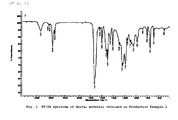
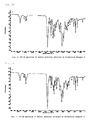
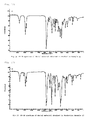
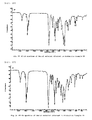
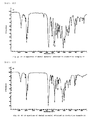
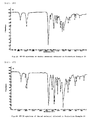
- the dental materials containing the urethane (meth)acrylic compounds that were obtained in Production Examples 1 to 31 were analyzed by FT-IR using an infrared spectrophotometer (FTS-6000 manufactured by Bio-Rad).
- the photopolymerizable monomer composition was applied so as to fill an aluminum mold 10 mm in diameter and 2 mm in depth.
- the composition was sandwiched between cover glass sheets and light was applied to each surface for 3 minutes, i.e., a total time of 6 minutes using a dental visible light irradiator (a twin polymerizer manufactured by SHOFU INC.), thereby curing the photocurable monomer composition.
- a dental visible light irradiator a twin polymerizer manufactured by SHOFU INC.
- the density of the photocurable monomer composition was measured before and after curing with a dry density meter (Accupyc 1330 manufactured by Shimadzu Corporation).
- the polymerization shrinkage was determined using the following equation (1).
- Polymerization shrinkage % density after polymerization - density before polymerization / density after polymerization ⁇ 100
- the polymerization shrinkage of triethylene glycol dimethacrylate alone was measured in the same manner as described above. As a result, the polymerization shrinkage was determined to be 13.0%.
- the polymerization shrinkage (S3) of the dental material containing the urethane (meth)acrylic compound was determined from the following equation (2) using the polymerization shrinkage (S1) of the monomer composition that was a mixture of the dental material containing the urethane
- Bis-GMA (D-GMA manufactured by Shin-Nakamura Chemical Co., Ltd.) or UDMA (SH500S manufactured by Negami Chemical Industrial Co., Ltd.), which was a methacrylate monomer widely used in a dental composite resin, was used in place of the dental materials containing the urethane (meth) acrylic compounds from the above Examples. 60 parts by weight of Bis-GMA or UDMA was mixed together with 40 parts by weight of triethylene glycol dimethacrylate (NK Ester 3G), thereby preparing a monomer composition.
- UDMA methacrylate monomer widely used in a dental composite resin
- polymerization shrinkage (S5) of Bis-GMA or UDMA alone was determined from the following equation (3) using the polymerization shrinkage (S4) of the monomer composition and the polymerization shrinkage (S2, 13.0%) of triethylene glycol dimethacrylate alone.
- S ⁇ 5 S ⁇ 4 - S ⁇ 2 ⁇ 0.4 / 0.6
- a photocurable monomer composition (a dental material composition) was prepared. Then, in the same manner as described above, using the equation (1), from the density of the photocurable monomer composition measured before and after curing, the polymerization shrinkage of the photocurable monomer composition was determined.
- DCP-4EO-A had a polymerization shrinkage of 8.0% and a viscosity of 130 (mPa ⁇ s, 30°C)
- DCP-A had a polymerization shrinkage of 8.3% and a viscosity of 110 (mPa ⁇ s, 30°C).
- the viscosity and the polymerization shrinkage were determined by the same procedures as those in Examples 32 to 37, except for using a monomer composition obtained by mixing 40 parts by weight of Bis-GMA (D-GMA) together with 60 parts by weight of DCP-4EO-A.
- the polymerization shrinkage was measured in the same manner as described for the photocurable monomer composition in Example 1.
- Photocurable pastes were prepared in the same manner as described in Example 100, except that the dental material containing the urethane (meth)acrylic compound from the above Examples was replaced by Bis-GMA (D-GMA manufactured by Shin-Nakamura Chemical Co., Ltd.) or UDMA (SH500S manufactured by Negami Chemical Industrial Co., Ltd.), which was a methacrylate monomer.
- Bis-GMA D-GMA manufactured by Shin-Nakamura Chemical Co., Ltd.
- UDMA SH500S manufactured by Negami Chemical Industrial Co., Ltd.
- the polymerization shrinkage was measured in the same manner as described for the photocurable monomer composition in Example 1.
Landscapes
- Chemical & Material Sciences (AREA)
- Organic Chemistry (AREA)
- Health & Medical Sciences (AREA)
- Oral & Maxillofacial Surgery (AREA)
- General Health & Medical Sciences (AREA)
- Life Sciences & Earth Sciences (AREA)
- Animal Behavior & Ethology (AREA)
- Plastic & Reconstructive Surgery (AREA)
- Public Health (AREA)
- Veterinary Medicine (AREA)
- Epidemiology (AREA)
- Addition Polymer Or Copolymer, Post-Treatments, Or Chemical Modifications (AREA)
- Dental Preparations (AREA)
- Organic Low-Molecular-Weight Compounds And Preparation Thereof (AREA)
- Chemical Kinetics & Catalysis (AREA)
- Medicinal Chemistry (AREA)
- Polymers & Plastics (AREA)
- Macromonomer-Based Addition Polymer (AREA)
Abstract

Description
- The present invention relates to a novel dental material, a novel dental material composition, a novel dental restorative material, and a cured product obtained by curing the dental material. In particular, the invention relates to a dental material containing a novel urethane (meth)acrylic compound, and to a dental material composition containing the dental material.
- Radically polymerizable monomers represented by (meth)acrylates exhibit good properties such as high curing properties and transparency and are thus used widely in various fields including coating materials, plate making materials, optical materials and dental materials.
- In the field of dental materials in particular, these monomers are widely used as dental restorative materials such as dental composite resins in order to restore natural teeth which have been damaged by caries or been fractured, as well as dental adhesives in order to bond a dental composite resin to a tooth, and artificial teeth and denture base materials.
- In general, a dental composite resin is composed of a polymerizable monomer, a polymerization initiator and a filler. From the viewpoints of in-vivo safety as well as properties of cured products such as mechanical strength, abrasion resistance and aesthetic properties, a frequently used polymerizable monomer is a radically polymerizable polyfunctional (meth)acrylate. Examples of such polyfunctional (meth)acrylates include 2,2-bis[4-(3-methacryloyloxy-2-hydroxypropoxy)phenyl] propane (generally referred to as Bis-GMA) and 2,2,4-trimethylhexamethylene bis(2-carbamoyloxyethyl) dimethacrylate (generally referred to as UDMA) . In particular, since Bowen proposed the application of Bis-GMA to a dental material in 1962, this polymerizable monomer has been used in most of the dental composite resins until today.
- However, clinical professionals have pointed out that dental composite resins should be improved in terms of properties of cured products such as flexural strength, elastic modulus and abrasion resistance as well as reduced in terms of water absorption and discoloration. Further, there have been demands that the dental composite resins be reduced in terms of polymerization shrinkage during curing and be improved in transparency and aesthetic properties so as to be comparable to natural teeth. In particular, polymerization shrinkage results in the occurrence of contraction gap caused by the separation of a dental composite resin from the bonding surface, thereby causing secondary caries, tooth pulp stimulation, coloration and detachment of restorations. Therefore, it is strongly demanded that the occurrence of polymerization shrinkage be reduced as much as possible. Further, dental composite resins frequently contain a high refractive index filler in order to satisfy high aesthetic requirements as well as to exhibit X-ray contrast ability. That is, dental restorations need to have transparency that is comparable to that of natural teeth. Thus, it is necessary to use a polymerizable monomer having a high refractive index. Further, high flexural strength is needed from the viewpoint of durability (impact resistance and fracture resistance) in the mouth.
- In order to reduce polymerization shrinkage, it has been proposed to use a ring-opening polymerizable epoxy or oxetane compound which generally has smaller polymerization shrinkage than acrylic compounds (
Patent Literature 1 and Patent Literature 2) . Although polymerization shrinkage tends to be reduced by the use of such compounds, problems remain such as the need of special primers due to different types of curing systems. Further, these compounds are unsatisfactory in terms of aesthetic properties and operation properties. - It is also proposed to reduce polymerization shrinkage by increasing the amount of filler (
Patent Literature 3 and Patent Literature 4) . However, effects obtained by this approach are limited because the monomers that are used have such a high volumetric polymerization shrinkage. - Further, low-shrinkage materials that use a silicon-containing (meth)acrylate are proposed (Patent Literature 5). However, the synthesis of these materials is complicated and is to be improved in order to realize industrial production. Further, these materials are unsatisfactory in terms of mechanical strength of cured products.
- Thus, there has been a need for polymerizable monomers that are useful in dental restorative materials, have small polymerization shrinkage during curing, and are producible at low cost on the industrial scale.
-
- Patent Literature 1:
JP-A-2007-15946 - Patent Literature 2:
JP-A-2005-187385 - Patent Literature 3:
JP-A-2007-526270 - Patent Literature 4:
JP-A-2005-89312 - Patent Literature 5:
JP-A-2009-179596 - It is an object of the present invention to provide a dental material, a dental material composition and a dental restorative material that exhibit small polymerization shrinkage particularly during curing and an appropriate viscosity and are producible at low cost on the industrial scale, as well as to provide a cured product obtained by curing the dental material.
- The present inventor carried out studies in order to achieve the above object and has found that the object is achieved with a novel urethane (meth)acrylic compound having at least one alicyclic structure or aromatic ring structure in the molecule. The present invention has been completed based on this finding.
- A dental material according to the present invention includes a compound represented by Formula (1) described later.
- A dental material composition according to the present invention includes the inventive dental material, a polymerization initiator (B) and a filler (C).
- A dental restorative material according to the present invention includes the inventive dental material, a photopolymerization initiator (B) and a filler (C).
- A cured product according to the present invention is obtained by curing the inventive dental material.
- The dental material containing the urethane (meth) acrylic compound of the invention can give a cured product showing excellent mechanical strength, abrasion resistance, aesthetic properties, operation properties and safety, has a low polymerization shrinkage particularly at the time of polymerization curing, and exhibits a favorable and appropriate viscosity at the time of preparation of dental restorative materials. Thus, the dental material is suited for use in dental restorative materials and the like, in particular in dental restorative composite resins used to fill cavities. The dental restorative materials, for example composite resins, which include the inventive dental material exhibit small polymerization shrinkage during curing and are unlikely to cause a contraction gap between the restoration and the bonding surface of a tooth, thereby reducing the probability of secondary caries, tooth pulp stimulation and the detachment of restorations.
- The dental material of the invention is relatively high in refractive index and exhibits a refractive index that is substantially the same as that of X-ray contrast dental fillers. Thus, the cured product containing the inventive dental material ensures transparency and excellent aesthetic properties.
-
-
Fig. 1 is a FT-IR spectrum of a dental material that contains a urethane (meth)acrylic compound produced in Production Example 1; -
Fig. 2 is a FT-IR spectrum of a dental material that contains a urethane (meth)acrylic compound produced in Production Example 2; -
Fig. 3 is a FT-IR spectrum of a dental material that contains a urethane (meth)acrylic compound produced in Production Example 3; -
Fig. 4 is a FT-IR spectrum of a dental material that contains a urethane (meth)acrylic compound produced in Production Example 4; -
Fig. 5 is a FT-IR spectrum of a dental material that contains a urethane (meth)acrylic compound produced in Production Example 5; -
Fig. 6 is a FT-IR spectrum of a dental material that contains a urethane (meth)acrylic compound produced in Production Example 6; -
Fig. 7 is a FT-IR spectrum of a dental material that contains a urethane (meth)acrylic compound produced in Production Example 7; -
Fig. 8 is a FT-IR spectrum of a dental material that contains a urethane (meth)acrylic compound produced in Production Example 8; -
Fig. 9 is a FT-IR spectrum of a dental material that contains a urethane (meth)acrylic compound produced in Production Example 9; -
Fig. 10 is a FT-IR spectrum of a dental material that contains a urethane (meth)acrylic compound produced in Production Example 10; -
Fig. 11 is a FT-IR spectrum of a dental material that contains a urethane (meth)acrylic compound produced in Production Example 11; -
Fig. 12 is a FT-IR spectrum of a dental material that contains a urethane (meth)acrylic compound produced in Production Example 12; -
Fig. 13 is a FT-IR spectrum of a dental material that contains a urethane (meth)acrylic compound produced in Production Example 13; -
Fig. 14 is a FT-IR spectrum of a dental material that contains a urethane (meth)acrylic compound produced in Production Example 14; -
Fig. 15 is a FT-IR spectrum of a dental material that contains a urethane (meth)acrylic compound produced in Production Example 15; -
Fig. 16 is a FT-IR spectrum of a dental material that contains a urethane (meth)acrylic compound produced in Production Example 16; -
Fig. 17 is a FT-IR spectrum of a dental material that contains a urethane (meth)acrylic compound produced in Production Example 17; -
Fig. 18 is a FT-IR spectrum of a dental material that contains a urethane (meth)acrylic compound produced in Production Example 18; -
Fig. 19 is a FT-IR spectrum of a dental material that contains a urethane (meth)acrylic compound produced in Production Example 19; -
Fig. 20 is a FT-IR spectrum of a dental material that contains a urethane (meth)acrylic compound produced in Production Example 20; -
Fig. 21 is a FT-IR spectrum of a dental material that contains a urethane (meth)acrylic compound produced in Production Example 21; -
Fig. 22 is a FT-IR spectrum of a dental material that contains a urethane (meth)acrylic compound produced in Production Example 22; -
Fig. 23 is a FT-IR spectrum of a dental material that contains a urethane (meth)acrylic compound produced in Production Example 23; -
Fig. 24 is a FT-IR spectrum of a dental material that contains a urethane (meth)acrylic compound produced in Production Example 24; -
Fig. 25 is a FT-IR spectrum of a dental material that contains a urethane (meth)acrylic compound produced in Production Example 25; -
Fig. 26 is a FT-IR spectrum of a dental material that contains a urethane (meth)acrylic compound produced in Production Example 26; -
Fig. 27 is a FT-IR spectrum of a dental material that contains a urethane (meth)acrylic compound produced in Production Example 27; -
Fig. 28 is a FT-IR spectrum of a dental material that contains a urethane (meth)acrylic compound produced in Production Example 28; -
Fig. 29 is a FT-IR spectrum of a dental material that contains a urethane (meth)acrylic compound produced in Production Example 29; -
Fig. 30 is a FT-IR spectrum of a dental material that contains a urethane (meth)acrylic compound produced in Production Example 30; and -
Fig. 31 is a FT-IR spectrum of a dental material that contains a urethane (meth)acrylic compound produced in Production Example 31. - A novel urethane (meth) acrylic compound according to the present invention has at least one alicyclic or aromatic ring structure in the molecule and is represented by Formula (1). This specific urethane (meth)acrylic compound has a small polymerization shrinkage. When this compound is used in a dental restorative material such as a composite resin, the compound exhibits a favorable and appropriate viscosity at the time of preparation of the dental restorative material. A dental material of the invention contains one, or two or more kinds of the urethane (meth)acrylic compounds.

- In Formula (1) , R1 and R2 each independently indicate a hydrogen atom or a methyl group, A is a divalent organic group selected from the group consisting of structures (a) to (h) described below, X1 and X2 each indicate a divalent organic group, at least one of X1 and X2 is a divalent organic group selected from the group consisting of structures (i) to (m) described below, and the bonding sites in the structures (a) to (m) are indicated by the symbol "*":

- With respect to the organic groups (a) to (m), R3 is an aryl group or a cycloalkyl group which may have a substituent, R4, R5, R6 and R7 each independently indicate a hydrogen atom or a methyl group, and R8 is an alkyl group having 4 to 20 carbon atoms.
- The compounds represented by Formula (1) exclude a compound in which A is the structure (c) or (d) and X1 and X2 are both the structures (i) in which R3 is a phenyl group, and a compound in which A is the structure (a), R1 and R2 are both methyl groups and X1 and X2 are both the structures (i) in which R3 is a phenyl group.
- From the viewpoint of the reduction of polymerization shrinkage, it is preferable that the groups A, X1 and X2 in Formula (1) have two or more ring structures, and more preferably three or more ring structures.
- In order to achieve a smaller polymerization shrinkage, it is preferable that the group A in Formula (1) be a divalent organic group selected from the group consisting of the structures (a), (b), (c), (d), (e) and (h).
- It is preferable that the group A in Formula (1) be a divalent organic group selected from the group consisting of the structures (a), (c), (e), (f), (g) and (h). There is a tendency for such a compound to be unlikely to be colored when being formed into a cured product.
- It is preferable that the group A in Formula (1) be a divalent organic group selected from the group consisting of the structures (a), (d), (e), (f), (g) and (h). Such a compound exhibits a favorable and appropriate viscosity at the time of preparation of the dental restorative material.
- It is more preferable that the group A in Formula (1) be a divalent organic group selected from the group consisting of the structures (a), (d), (e) and (h) . Such a compound shows a smaller polymerization shrinkage and exhibits a favorable and appropriate viscosity at the time of preparation of the dental restorative material.
- It is more preferable that the group A in Formula (1) be a divalent organic group selected from the group consisting of the structures (a), (c), (e) and (h). There is a tendency for such a compound to show a smaller polymerization shrinkage and to be unlikely to be colored when being formed into a cured product. It is also preferable that the group A be a divalent organic group selected from the group consisting of the structures (a), (e) and (h). In addition to the advantages described above, such a compound exhibits a favorable and appropriate viscosity at the time of preparation of the dental restorative material.
- It is most preferable that the group A in Formula (1) be the structure (a) . In addition to the advantageous effects described above, such a compound allows a dental material to exhibit excellent aesthetic properties.
- It is also preferable that at least one of X1 and X2 in Formula (1) be a divalent organic group selected from the group consisting of the structures (i) , (j), (l) and (m) . Such a compound exhibits a favorable and appropriate viscosity at the time of preparation of the dental restorative material.
- It is preferable that one of X1 and X2 in Formula (1) be a divalent organic group selected from the group consisting of the structures (i), (j), (k) and (m). A dental material containing such a compound is relatively high in refractive index. Further, such a compound tends to ensure that a dental material composition containing the dental material and a filler component is cured to give a transparent cured product having excellent aesthetic properties. It is preferable that one of X1 and X2 be a divalent organic group selected from the group consisting of the structures (i), (j) and (m). In addition to the advantageous effects described above, such a compound exhibits a favorable and appropriate viscosity at the time of preparation of the dental restorative material.
- Further, it is preferable that R1 and R2 in Formula (1) be both hydrogen atoms. There is a tendency for such a compound to show a smaller polymerization shrinkage.
- It is preferable that in Formula (1) , the group A be any of the structures (a), (b), (c) and (e), X1 and X2 be both the structures (i), and R1 and R2 be both hydrogen atoms. Such a compound shows a still smaller polymerization shrinkage.
- It is preferable that in Formula (1), the group A be the structure (d), X1 and X2 be both the structures (i), and R1 and R2 be both methyl groups. Such a compound shows a still smaller polymerization shrinkage.
- In the case where one of X1 and X2 in Formula (1) is an alkylene group of 1 to 4 carbon atoms such as methylene group or ethylene group, the polymerization shrinkage at the time of curing tends to be relatively large. Thus, the use of such a compound is not preferable.
- The urethane (meth) acrylic compounds represented by Formula (1) are not particularly limited as long as the compounds are represented by Formula (1). Examples of such compounds include compounds Nos. 1-1 to 9-6 illustrated in Tables 1 to 9. Any isomers of the illustrated compounds are within the scope of the invention. In the illustrations, C9 indicates a nonyl group selected from all kinds of nonyl isomers.
- [Table 1]
Table 1 Compound No. Structural formula 1-1 
1-2 
1-3 
1-4 
1-5 
1-6 
1-7 
1-8 
1-9 
- [Table 2]
Table 2 Compound No. Structural formula 2-1 
2-2 
2-3 
2-4 
2-5 
2-6 
2-7 
2-8 
2-9 
2-10 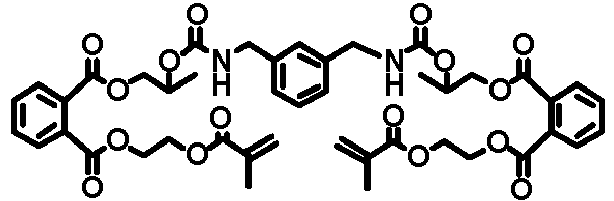
- [Table 3]
Table 3 Compound No. Structural formula 3-1 
3-2 
3-3 
3-4 
3-5 
3-6 
3-7 
3-8 
3-9 
3-10 
- [Table 4]
Table 4 Compound No. Structural formula 4-1 
4-2 
4-3 
4-4 
4-5 
4-6 
4-7 
4-8 
4-9 
4-10 
- [Table 5]
Table 5 Compound No. Structural formula 5-1 
5-2 
5-3 
5-4 
5-5 
5-6 
5-7 
5-8 
5-9 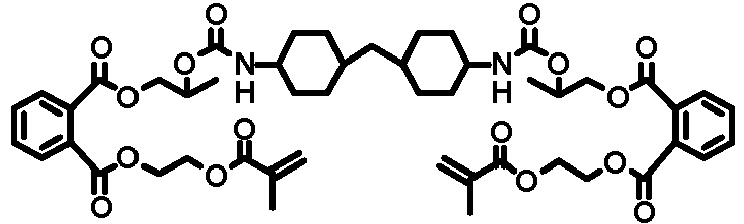
- [Table 6]
Table 6 Compound No. Structural formula 6-1 
6-2 
6-3 
6-4 
6-5 
6-6 
6-7 
6-8 
6-9 
- [Table 7]
Table 7 Compound No. Structural formula 7-1 
7-2 
7-3 
7-4 
7-5 
7-6 
7-7 
7-8 
7-9 
7-10 
- [Table 8]
Table 8 Compound No. Structural formula 8-1 
8-2 
8-3 
8-4 
8-5 
8-6 
8-7 
8-8 
8-9 
8-10 
- [Table 9]
Table 9 Compound No. Structural formula 9-1 
9-2 
9-3 
9-4 
9-5 
9-6 
- It is most preferable that the dental material contain at least one urethane (meth)acrylic compound selected from compounds represented by Formulae (2) to (5) below. Such a dental material has a smaller polymerization shrinkage and excellent aesthetic properties, exhibits a favorable and appropriate viscosity at the time of preparation of the dental restorative material, and tends to be unlikely to be colored when being formed into a cured product. Further, such a dental material is relatively high in refractive index and ensures that a cured product thereof exhibits transparency.


- The urethane (meth)acrylic compound according to the invention may be produced by any process without limitation. However, the compound may be generally produced by an addition reaction of a diisocyanate compound and a hydroxyl group-containing (meth) acrylic compound illustrated in
Scheme 1 below.
- In
Scheme 1, A, R and X correspond to A, R1 or R2, and X1 or X2, respectively, in Formula (1). - In
Scheme 1, hydroxyl group-containing (meth) acrylic compounds having different structures may be used in order to produce a compound of Formula (1) in which X1 and X2 are different from each other. However, it is generally difficult to produce a compound with differing X1 and X2 alone. That is, the product is a mixture of a compound of Formula (1) in which the organic groups are both X1, a compound in which the organic groups are both X2, and a compound in which the organic groups are X1 and X2. The mixture includes isomers. - For example, Table 10 illustrates a diisocyanate compound and hydroxyl group-containing acrylic compounds that are used as raw materials for the production of a compound of Formula (1) in which R1 and R2 are hydrogen atoms, A is represented by:


- (Some) of the compounds that are obtained as a mixture are also illustrated.
[Table 10] Table 10 Diisocyanate compound Hydroxy group-containing acryl compounds 

Product 
- Many kinds of hydroxyl group-containing (meth)acrylic compounds that are available from the industry may be used in the invention. Alternatively, a hydroxyl group-containing (meth)acrylic compound may be obtained by ring-opening esterification of an epoxy compound and (meth)acrylic acid.
- The ring-opening esterification may be carried out with or without a solvent. Known solvents that are inert in the reaction may be used. Examples of such solvents include hydrocarbon solvents such as n-hexane, benzene, toluene and xylene;
ketone solvents such as acetone, methyl ethyl ketone and methyl isobutyl ketone;
ester solvents such as ethyl acetate and butyl acetate;
ether solvents such as diethyl ether, tetrahydrofuran and dioxane;
halogen solvents such as dichloromethane, chloroform, carbon tetrachloride, 1,2-dichloroethane and perchlene; and
polar solvents such as N,N-dimethylformamide, N,N-dimethylacetamide, N,N-dimethylimidazolidinone, dimethylsulfoxide and sulfolane. These solvents may be used singly, or two or more kinds may be used in combination. - The reaction may involve a catalyst as required. Known catalysts may be used. Examples of the catalysts include organophosphine compounds such as triphenylphosphine;
tertiary amines such as triethylamine and triethanolamine;
quaternary ammonium salts such as trimethylammonium chloride and triethylbenzylammonium chloride;
organophosphonium salts such as tetrabutylphosphonium bromide and tetraphenylphosphonium bromide; imidazoles such as 2-methylimidazole; and
organometallic compounds such as cobalt octenoate. - The catalyst is generally added in an amount of 0.01 to 10.0% by weight, and preferably 0.01 to 5.0% by weight with respect to 100% by weight of the total weight of the reactants. This addition amount of catalyst is preferable because the reaction takes place at a sufficiently high reaction rate.
- The reaction temperature is not particularly limited. However, it is generally in the range of 0 to 200°C, and preferably 0 to 150°C.
- The reaction time is variable in accordance with conditions such as reaction temperature, and is not particularly limited. However, the reaction time is usually from several minutes to several tens of hours. The reaction may be carried out while checking the reaction ratio by known analytical means (for example, liquid chromatography, thin layer chromatography or infrared spectroscopy) and may be terminated when a desired reaction ratio is obtained.
- Many kinds of diisocyanate compounds are available from the industry, and such compounds may be directly used in the invention. Alternatively, a diisocyanate compound for use in the invention may be synthesized by a reaction of a corresponding diamine compound and phosgene.
- The urethane (meth)acrylic compound may be produced by a process including the following step (B), and preferably by a process including the following steps (A), (B) and (C) . The obtained urethane (meth)acrylic compound often contains a trace amount of contaminants. Thus, it is preferable that the process include a step of removing such contaminants by filtration.
- The steps performed in the invention include:
- (A) a step of dehydrating a hydroxyl group-containing (meth)acrylic compound at 20 to 90°C;
- (B) a step of performing a urethane-forming reaction by adding dropwise a diisocyanate compound to the hydroxyl group-containing (meth)acrylic compound which has been subjected to the dehydration step, or to a hydroxyl group-containing (meth)acrylic compound which has not been dehydrated; and
- (C) a step of deodorizing the product at 20 to 90°C.
- In the step (A), a hydroxyl group-containing (meth) acrylic compound is dehydrated in the presence of oxygen at a temperature of 20 to 90°C. In this step, a polymerization inhibitor and a urethane-forming catalyst may be mixed to the hydroxyl group-containing (meth) acrylic compound as required. Performing the step (A) is preferable because if the hydroxyl group-containing (meth)acrylic compound contains water, such water can decompose the diisocyanate compound during the urethane-forming reaction in the subsequent step (B).
- In the step (A), a polymerization inhibitor is preferably added. In the invention, a known polymerization inhibitor may be used without limitation. Examples thereof include hydroquinone (HQ), hydroquinone monomethyl ether (MQ), 2,6-di-tert-butylhydroxytoluene (BHT) and phenothiazine (PTZ) . BHT is preferable in that it is more unlikely for BHT to be consumed by being reacted with isocyanate groups compared to other phenolic polymerization inhibitors, as well as in that a coloration is reduced compared to amine polymerization inhibitors. The usage amount of polymerization inhibitor is preferably 0.001 to 0.5% by weight with respect to 100% by weight of the total weight of the hydroxyl group-containing (meth)acrylic compound and the diisocyanate compound. The polymerization inhibitor may be added at any time before the diisocyanate compound is added dropwise. For example, the polymerization inhibitor may be mixed to the hydroxyl group-containing (meth) acrylic compound beforehand. However, it is preferable to add the polymerization inhibitor prior to the dehydration because the loss of polymerizable groups due to thermal history is reduced.
- In the step (A), a urethane-forming catalyst is preferably added. In the invention, a known urethane-forming catalyst may be used without limitation. Examples thereof include:
- organotin compounds such as dibutyl tin dilaurate, dibutyl tin dioctoate and tin octanoate;
- organometallic compounds of metals other than tin, such as copper naphthenate, cobalt naphthenate, zinc naphthenate, zirconium acetylacetonate, iron acetylacetonate and germanium acetylacetonate;
- amine compounds such as triethylamine, 1,4-diazabicyclo[2.2.2]octane, 2,6,7-trimethyl-1-diazabicyclo[2.2.2]octane, 1,8-diazabicyclo[5.4.0]undecene, N,N-dimethylcyclohexylamine, pyridine, N-methylmorpholine, N,N,N',N'-tetramethylethylenediamine, N,N,N',N'-tetramethyl-1,3-butanediamine, N,N,N',N'-pentamethyldiethylenetriamine, N,N,N',N'-tetra(3-dimethylaminopropyl)-methanediamine, N,N'-dimethylpiperadine, 1,2-dimethylimidazole, and salts of these compounds; and
- trialkylphosphine compounds such as tri-n-butylphosphine, tri-n-hexylphosphine, tricyclohexylphosphine and tri-n-octylphosphine.
- Of these, dibutyl tin dilaurate and tin octanoate are suitably used because they can catalyze the reaction in a small amount and have high selectivity with respect to diisocyanate compounds. When the urethane-forming catalyst is used, the catalyst is preferably added at 0.001 to 0.1% by weight with respect to 100% by weight of the total weight of the hydroxyl group-containing (meth)acrylic compound and the diisocyanate compound. If the amount is less than 0.001% by weight, catalytic effects are small and the reaction takes a long time. If the amount is in excess of 0.1% by weight, catalytic effects are so increased that a large amount of reaction heat is generated, possibly resulting in difficult temperature control. The urethane-forming catalyst may be added at any time before the diisocyanate compound is added dropwise. For example, the catalyst may be mixed to the hydroxyl group-containing (meth)acrylic compound beforehand.
- Oxygen is an effective polymerization inhibitor for hydroxyl group-containing (meth)acrylic compounds and the inventive urethane (meth) acrylic compounds. Dry air or oxygen gas, preferably dry air, may be used as oxygen by being supplied in the form of bubbles from the bottom of the reaction container. The dry air used herein is preferably air that has been dried with a condensing air dryer or the like. Insufficient drying allows water to find its way into the reaction system so as to induce a reaction of water with the diisocyanate compound, possibly resulting in an increase in the viscosity of the obtained urethane (meth)acrylic compound. The supply amount of dry air is variable in accordance with the size of the reaction container, and is thus not particularly limited. In the case of a 1-L volume reaction container as an example, the supply amount is 1 to 500 ml/min, and preferably 1 to 300 ml/min. At less than 1 ml/min, oxygen cannot be supplied in a sufficient amount and can fail to serve effectively as a polymerization inhibitor. Adding oxygen in excess of 500 ml/min increases the volatilization of the diisocyanate compound during the reaction, possibly resulting in a decrease in properties of a cured product of the urethane (meth)acrylic compound.
- The dehydration is performed at a temperature which does not induce thermal polymerization of polymerizable groups. The temperature is generally in the range of 20 to 90°C, and preferably 30 to 80°C. If the temperature is less than 20°C, the dehydration results are insufficient so as to induce a reaction of water with the diisocyanate compound, possibly resulting in an increase in the viscosity of the urethane (meth)acrylic compound. If the temperature is in excess of 90°C, a polymerization reaction can be induced and the urethane (meth)acrylic compound may be colored.
- The pressure during the dehydration is not particularly limited. However, the pressure is usually in the range of 0.133 to 13.3 kPa (1 to 100 mmHg), and preferably 0.133 to 6.67 kPa (1 to 50 mmHg). Any pressure that is lower than 0.133 kPa is not preferable because energy consumption is raised and environmental loads are increased. If the pressure is higher than 13.3 kPa, the dehydration results are insufficient so as to induce a reaction of water with the diisocyanate compound, possibly resulting in an increase in the viscosity of the urethane (meth)acrylic compound.
- The dehydration time is not particularly limited. The water content in the system may be measured at appropriate times, and the dehydration may be terminated when the water content is decreased to not more than 0.15% by weight, and preferably not more than 0.10% by weight with respect to 100% by weight of the total weight of the hydroxyl group-containing (meth)acrylic compound, the polymerization inhibitor and the urethane-forming catalyst. The water content may be measured with a water content measuring apparatus in accordance with JIS K 0068. For example, a volumetric drop method may be performed using a Karl Fischer's reagent and an automatic titrator. In detail, after dehydration is carried out under vacuum, the pressure may be returned to atmospheric pressure and the mixture of the hydroxyl group-containing (meth) acrylic compound, the polymerization inhibitor and the urethane-forming catalyst may be collected and analyzed to determine the water content.
- In the step (B), a urethane-forming reaction is performed by adding dropwise a diisocyanate compound to the hydroxyl group-containing (meth)acrylic compound which has been subjected to the dehydration step, or to a hydroxyl group-containing (meth)acrylic compound which has not been dehydrated.
- In the invention, the hydroxyl group-containing (meth) acrylic compound and the diisocyanate compound are used at such a ratio that the equivalent weight of the hydroxyl groups in the hydroxyl group-containing (meth)acrylic compound is preferably 1.0 to 1.3, and more preferably 1.0 to 1.1 with respect to 1.0 equivalent weight of the isocyanate groups in the diisocyanate compound. If the equivalent weight of the hydroxyl groups in the hydroxyl group-containing (meth) acrylic compound is less than 1.0, some of the isocyanate groups remain unreacted so as to possibly cause precipitation of solids or an increase in viscosity after the production. If the equivalent weight is in excess of 1.3, the amount of unreacted hydroxyl group-containing (meth) acrylic compound is increased so as to possibly cause deteriorations in properties after curing.
- In the drop method, an appropriate diisocyanate compound is placed into a drop container connected to the reaction container and is added to the reaction container in a constant amount in a certain time while controlling the flow rate. In contrast, there is a batch addition method in which a predetermined diisocyanate compound is added at one time in a short time. According to such a batch addition method, the temperature can be greatly increased and the temperature control can become difficult depending on the structures and the molecular weights of the hydroxyl group-containing (meth)acrylic compound and the diisocyanate compound, the structure of the reaction container, the shape of the stirring blade, and the stirring speed. As a result, the crosslinking reaction of the diisocyanate compound is accelerated so as to cause an increase in the viscosity of the obtained urethane (meth) acrylic compound. In some cases, such a drastic increase in temperature induces polymerization of polymerizable groups resulting in gelation.
- It is also possible to drop the hydroxyl group-containing (meth)acrylic compound to the diisocyanate compound. Because a larger amount of the hydroxyl group-containing (meth) acrylic compound than the diisocyanate compound is necessary, such a manner of drop takes a longer time than required when the diisocyanate compound is dropped. Further, such a manner of drop causes the urethane (meth) acrylic compound to have an undesired thermal history and can induce polymerization of polymerizable groups, possibly resulting in a decrease in production efficiency.
- The temperature in the reaction system is variable depending on the configuration, for example the size and the structure, of the reaction container and is thus not particularly limited. However, the temperature is usually 20 to 120°C, and preferably 30 to 100°C. If the temperature exceeds 120°C, a polymerization reaction can take place and the obtained urethane (meth)acrylic compound may not exhibit desired functions. The reaction at a temperature of less than 20°C requires a longer reaction time, and the production efficiency may be deteriorated.
- The drop may be initiated at any temperature without limitation. However, the drop initiation temperature is usually 20 to 90°C, and preferably 30 to 80°C. If the temperature is less than 20°C, the reaction requires a longer time and the production efficiency may be deteriorated. Temperatures in excess of 90°C increase the probability that a polymerization reaction will take place or the reaction (drop) temperature will be so increased that the reaction cannot be controlled.
- The drop rate is not limited as long as the above temperature of the reaction system is maintained.
- The drop time is not limited as long as the above temperature is satisfied. However, the drop time is usually 0.1 to 30 hours, and preferably 0.1 to 5 hours. If the drop time is less than 0.1 hour, the temperature can be drastically increased and become out of control. Drop for more than 5 hours tends to deteriorate the production efficiency of the urethane (meth)acrylic compound.
- In the case where the reaction does not complete in the above drop time in the step (B), the reaction may be continuously carried out after the completion of the drop as required. This reaction time is variable depending on the reaction temperature, the size and the structure of the reaction container, the drop time and other factors, and is not particularly limited. However, the total of the drop time and this reaction time is usually 1 to 30 hours, and preferably 1 to 20 hours. There is a probability that the reaction will not complete in less than 1 hour. Any total time that is in excess of 30 hours causes the urethane (meth) acrylic compound to have an undesired thermal history and can induce polymerization of polymerizable groups, possibly resulting in a decrease in production efficiency and an increase in product cost.
- The reaction temperature after the completion of the drop is not particularly limited as long as thermal polymerization of polymerizable groups is not induced. However, the reaction temperature is usually in the range of 20 to 120°C, and preferably 30 to 100°C. If the temperature is less than 20°C, the reaction may take a long time so as to possibly deteriorate the production efficiency. If the temperature is in excess of 120°C, a polymerization reaction can be induced and the urethane (meth) acrylic compound may be colored.
- The end point of the reaction may be confirmed by a measurement method in accordance with JIS K 1556 5.5, for example by measuring the content of the diisocyanate compound in the reaction product or by analyzing the reaction system by HPLC (high performance liquid chromatography) . In detail, a portion of the reaction product is withdrawn from the reaction container and is reacted with di-n-butylamine, and unreacted amine is titrated with hydrochloric acid so as to determine the content of the diisocyanate compound in the reaction product. The end point is reached when the content of the diisocyanate compound determined by the above method becomes not more than 0.5% by weight, and preferably not more than 0.1% by weight with respect to 100% by weight of the weight of the reaction product.
- After the completion of the step (B), the deodorizing step (C) may be preferably performed as required. Deodorization increases the quality of the urethane (meth)acrylic compound.
- The temperature in the step (C) is preferably a temperature which does not cause thermal polymerization of polymerizable groups. The temperature is usually in the range of 20 to 120°C, and preferably 30 to 100°C. If the temperature is less than 20°C, the deodorization results are insufficient and the urethane (meth)acrylic compound may exhibit a strong odor and poor storage stability. If the temperature is in excess of 120°C, a polymerization reaction can be induced and the urethane (meth)acrylic compound may be colored.
- The pressure in the step (C) is not particularly limited. However, the pressure is usually in the range of 0.133 to 13.3 kPa (1 to 100 mmHg), and preferably 0.133 to 6.67 kPa (1 to 50 mmHg). Any pressure that is lower than 0.133 kPa is not preferable because industrial production at such a pressure is difficult and costs will be increased. If the pressure is higher than 13.3 kPa, the deodorization results are insufficient and the urethane (meth)acrylic compound may exhibit a strong odor and poor storage stability.
- The deodorization time is variable depending on the size and the structure of the reaction container, and is not particularly limited. However, the deodorization time is usually 1 to 10 hours, and preferably 1 to 5 hours. Sufficient deodorization results cannot be obtained in less than 1 hour, and the obtained urethane (meth)acrylic compound may exhibit a strong odor and poor storage stability. Any deodorization time that is in excess of 10 hours causes the urethane (meth)acrylic compound to have an undesired thermal history and can induce polymerization of polymerizable groups and cause a decrease in production efficiency and an increase in product cost.
- The dental material according to the invention may optionally contain various kinds of additives as required while still achieving the object of the invention. Examples of such additives include heat stabilizers, anti-slip agents, crystallization auxiliaries, nucleating agents, pigments, dyes, plasticizers, anti-aging agents, antioxidants, impact resistance improvers, crosslinking agents, co-crosslinking agents, crosslinking auxiliaries, tackifiers, softeners and processing aids.
- A cured product according to the present invention is obtained by curing the dental material containing the urethane (meth)acrylic compound. The cured product is excellent in terms of mechanical strength, abrasion resistance, aesthetic properties, operation properties and safety, and has a small polymerization shrinkage in particular at the time of polymerization curing. Accordingly, the cured product is suitably used in dental treatment.
- The curing methods are not particularly limited. Exemplary methods include self curing, thermal curing, and light curing by the irradiation with visible light or UV ray.
- The inventive dental material may be suitably used as a component in a dental material composition.
- Examples of such dental material compositions include dental restorative materials, dental composite resins (composite resins for core build-up, polymer-based crown and bridge materials, dental restorative composite resins), denture base resins, denture base liners, dental impression materials, dental luting materials (dental resin cements, resin modified glass-ionomer cements), dental adhesives, dental adhesives for orthodontic treatment, pit and fissure sealants, CAD/CAM resin blocks, temporary crowns and artificial tooth materials.
- In particular, a dental material composition according to a preferred embodiment of the invention contains the inventive dental material as well as a polymerization initiator (B) and a filler (C) described later. Such a dental material composition is suited as, for example, a dental composite resin.
- Further, a dental material composition containing the inventive dental material as well as a photopolymerization initiator (B) and a filler (C) is suited as a dental restorative material. Such a dental restorative material has photocuring properties and is suitably used as a dental composite resin, in particular a dental restorative composite resin.
- The dental material compositions such as dental restorative materials may contain a known polymerizable monomer (D) other than the inventive urethane (meth)acrylic compounds as required. Such a combined use of polymerizable monomer (D) allows for controlling of the viscosity or the refractive index of the composition in accordance with a purpose.
- The dental restorative material is usually in the form of a paste including the filler (C). Such a paste is usually obtained by mixing at least the inventive urethane (meth) acrylic compound, the polymerizable monomer (D), the photopolymerization initiator (B) and the filler (C). If the viscosity of a composition (I) containing the urethane(meth)acrylic compound and the polymerizable monomer (D) is too high, it is difficult to mix the composition (I) with the filler (C), leading to the difficulty in incorporating an increased amount of the filler (C) . If the viscosity is too low, in mixing the composition (I) with the filler (C), it is difficult for the dental restorative material to be in the form of a paste. The composition (I) usually has a viscosity of 50 to 50000 (mPa · s, 30°C), preferably 100 to 20000 (mPa · s, 30 °C), more preferably 100 to 10000 (mPa · s, 30°C). The dental material composition of the invention exhibits a favorable viscosity at the time of preparation of the dental restorative material while having extremely low polymerization shrinkage at the time of polymerization curing of the composition; the dental material composition of the present invention simultaneously achieves these two conflicting effects.
- The (photo)polymerization initiator may be a known (photo)polymerization initiator that has been used in the dental field. The initiator may be generally selected in consideration of the polymerizability of the polymerizable monomer(s) and the polymerization conditions.
- When the polymerization is carried out at normal temperature, a suitable polymerization initiator is a redox system containing an oxidant and a reductant in combination. A redox polymerization initiator has a form in which an oxidant and a reductant are separately packed. It is therefore necessary to mix them immediately before use.
- The oxidants are not particularly limited. Examples thereof include organic peroxides such as diacyl peroxides, peroxyesters, dialkyl peroxides, peroxyketals, ketone peroxides and hydroperoxides. Specific examples include diacyl peroxides such as benzoyl peroxide, 2, 4-dichlorobenzoyl peroxide and m-toluoyl peroxide;
peroxyesters such as t-butyl peroxybenzoate, bis-t-butyl peroxyisophthalate, 2,5-dimethyl-2,5-bis(benzoylperoxy)hexane, t-butyl peroxy-2-ethylhexanoate and t-butyl peroxyisopropylcarbonate;
dialkyl peroxides such as dicumyl peroxide, di-t-butyl peroxide and lauroyl peroxide;
peroxyketals such as 1,1-bis(t-butylperoxy)-3,3,5-trimethylcyclohexane;
ketone peroxides such as methyl ethyl ketone peroxide; and
hydroperoxides such as t-butyl hydroperoxide. - The reductants are not particularly limited. Tertiary amines are generally used, with examples including N,N-dimethylaniline, N,N-dimethyl-p-toluidine, N,N-dimethyl-m-toluidine, N,N-diethyl-p-toluidine, N,N-dimethyl-3,5-dimethylaniline, N,N-dimethyl-3,4-dimethylaniline, N,N-dimethyl-4-ethylaniline, N,N-dimethyl-4-i-propylaniline, N,N-dimethyl-4-t-butylaniline, N,N-dimethyl-3,5-di-t-butylaniline, N,N-bis(2-hydroxyethyl)-p-toluidine, N,N-bis(2-hydroxyethyl)-3,5-dimethylaniline, N,N-bis(2-hydroxyethyl)-3,4-dimethylaniline, N,N-bis(2-hydroxyethyl)-4-ethylaniline, N,N-bis(2-hydroxyethyl)-4-i-propylaniline, N,N-bis(2-hydroxyethyl)-4-t-butylaniline, N,N-di(2-hydroxyethyl)-3,5-di-i-propylaniline, N,N-bis(2-hydroxyethyl)-3,5-di-t-butylaniline, ethyl 4-dimethylaminobenzoate, n-butoxyethyl 4-dimethylaminobenzoate, (2-methacryloyloxy)ethyl 4-dimethylaminobenzoate, trimethylamine, triethylamine, N-methyldiethanolamine, N-ethyldiethanolamine, N-n-butyldiethanolamine, N-lauryldiethanolamine, triethanolamine, (2-dimethylamino)ethyl methacrylate, N,N-bis(methacryloyloxyethyl)-N-methylamine, N,N-bis(methacryloyloxyethyl)-N-ethylamine, N,N-bis(2-hydroxyethyl)-N-methacryloyloxyethylamine, N,N-bis(methacryloyloxyethyl)-N-(2-hydroxyethyl)amine and tris(methacryloyloxyethyl)amine.
- Examples other than the above organic peroxide/amine systems include such redox polymerization initiators as cumene hydroperoxide/thiourea systems, ascorbic acid/Cu2+ salt systems and organic peroxide/amine/sulfinic acid (or sulfinate salt) systems.
- Further, tributylborane and organic sulfinic acids may be also suitably used as polymerization initiators.
- When photopolymerization is carried out by the irradiation with visible light, preferred initiators are redox initiators such as α-diketone/tertiary amine systems, α-diketone/aldehyde systems and α-diketone/mercaptan systems.
- The photopolymerization initiators are not particularly limited. Examples thereof include α-diketone/reductant systems, ketal/reductant systems and thioxanthone/reductant systems. Examples of the α-diketones include camphorquinone, benzyl and 2,3-pentanedione. Examples of the ketals include benzyl dimethyl ketal and benzyl diethyl ketal. Examples of the thioxanthones include 2-chlorothioxanthone and 2,4-diethylthioxanthone. Examples of the reductants include Michler's ketone;
tertiary amines such as 2-(dimethylamino)ethyl methacrylate, N,N-bis[(meth)acryloyloxyethyl]-N-methylamine, ethyl N,N-dimethylaminobenzoate, butyl 4-dimethylaminobenzoate, butoxyethyl 4-dimethylaminobenzoate, N-methyldiethanolamine, 4-dimethylaminobenzophenone, N,N-bis(2-hydroxyethyl)-p-toluidine and dimethylaminophenanthol;
aldehydes such as citronellal, lauryl aldehyde, phthaldialdehyde, dimethylaminobenzaldehyde and terephthalaldehyde; and
compounds having a thiol group such as 2-mercaptobenzoxazol, decanethiol, 3-mercaptopropyltrimethoxysilane, 4-mercaptoacetophenone, thiosalicylic acid and thiobenzoic acid. - Further, organic peroxides may be used in combination with these redox initiators. That is, α-diketone/organic peroxide/reductant systems may be also suitably used.
- When photopolymerization is performed by the irradiation with UV ray, preferred photopolymerization initiators are benzoin alkyl ethers and benzyl dimethyl ketals. (Bis)acylphosphine oxides are also suitable as photopolymerization initiators.
- Of the (bis)acylphosphine oxides, examples of the acylphosphine oxides include 2,4,6-trimethylbenzoyldiphenylphosphine oxide, 2,6-dimethoxybenzoyldiphenylphosphine oxide, 2,6-dichlorobenzoyldiphenylphosphine oxide, 2,4,6-trimethylbenzoylmethoxyphenylphosphine oxide, 2,4,6-trimethylbenzoylethoxyphenylphosphine oxide, 2,3,5,6-tetramethylbenzoyldiphenylphosphine oxide and benzoyl-di-(2,6-dimethylphenyl) phosphonate.
- Examples of the bis-acylphosphine oxides include bis-(2,6-dichlorobenzoyl)phenylphosphine oxide, bis-(2,6-dichlorobenzoyl)-2,5-dimethylphenylphosphine oxide, bis-(2,6-dichlorobenzoyl)-4-propylphenylphosphine oxide, bis-(2,6-dichlorobenzoyl)-1-naphthylphosphine oxide, bis-(2,6-dimethoxybenzoyl)phenylphosphine oxide, bis-(2,6-dimethoxybenzoyl)-2,4,4-trimethylpentylphosphine oxide, bis-(2,6-dimethoxybenzoyl)-2,5-dimethylphenylphosphine oxide, bis-(2,4,6-trimethylbenzoyl)phenylphosphine oxide and (2,5,6-trimethylbenzoyl)-2,4,4-trimethylpentylphosphine oxide.
- These (bis)acylphosphine oxide photopolymerization initiators may be used singly or in combination with various reductants such as amines, aldehydes, mercaptans and sulfinate salts.
- Further, these photopolymerization initiators may be suitably used in combination with the aforementioned visible light photopolymerization initiators.
- The aforementioned polymerization initiators and photopolymerization initiators may be used singly, or two or more kinds may be used in combination appropriately. The amount of initiator is usually in the range of 0.01 to 20% by weight, and preferably 0.1 to 5% by weight with respect to 100% by weight of the dental material composition.
- Known fillers which have been used in the dental field may be used. Fillers are largely categorized into organic fillers and inorganic fillers.
- Examples of the organic fillers include polymethyl methacrylate, polyethyl methacrylate, methyl methacrylate-ethyl methacrylate copolymer, crosslinked polymethyl methacrylate, crosslinked polyethyl methacrylate, ethylene-vinyl acetate copolymer and styrene-butadiene copolymer.
- Examples of the inorganic fillers include various kinds of glass (the main component is silicon dioxide, and oxides of, for example, heavy metals, boron and aluminum are contained as required), ceramics, diatomaceous earths, kaolins, clay minerals (such as montmorillonite), activated white earths, synthetic zeolites, micas, calcium fluoride, ytterbium fluoride, calcium phosphate, barium sulfate, zirconium dioxide, titanium dioxide and hydroxyapatite.
- A polymerizable monomer may be added beforehand to the inorganic filler to give a paste, and the paste may be cured by polymerization and thereafter crushed. Such an organic inorganic composite filler may be used in the invention.
- The fillers may be used singly, or two or more kinds may be used in combination appropriately.
- The amount of filler may be determined appropriately in accordance with operation properties (viscosity) of the paste and mechanical strength. The amount is usually 10 to 2000 parts by weight, preferably 50 to 1000 parts by weight, and more preferably 100 to 600 parts by weight with respect to 100 parts by weight of all the components contained in the dental material composition except the filler.
- Of the inorganic fillers, adding an X-ray contrast inorganic filler with a refractive index of 1.5 to 1.6 results in a dental composite resin that is useful as a dental restorative material. Transparency and X-ray contrast ability comparable to those of natural teeth are important properties required for dental composite resins. Transparency is achieved by controlling the refractive indexes of the inorganic filler and the polymerizable monomer after curing so as to be as close as possible to each other. To obtain X-ray contrast, inorganic oxides of heavy metals such as zirconium, barium, titanium and lanthanum have been increasingly used as inorganic fillers. The refractive index of these inorganic fillers containing heavy metals is usually high in the range of 1.5 to 1.6. Because the urethane (meth)acrylic compound of the invention has one or more ring structures in the molecule, the refractive index after it is cured in relatively high, in many cases 1.50 or more. Accordingly, the use of such high-refractive index inorganic fillers reduces the difference in refractive index so as to facilitate the production of cured products exhibiting high transparency.
- Examples of such inorganic fillers include barium borosilicate glass (Kimble Raysorb T3000, Schott 8235, Schott GM27884 and Schott GM39923), strontium boroaluminosilicate glass (Raysorb T4000, Schott G018-093 and Schott GM32087), lanthanum glass (Schott GM31684), fluoroaluminosilicate glass (Schott G018-091 and Schott G018-117), and boroaluminosilicate glass containing zirconium and/or cesium (Schott G018-307, G018-308 and G018-310).
- A dental material composition according to a preferred embodiment of the invention contains a micro filler having a particle diameter of not more than 0.1 µm. Such a composition is suitable as a dental composite resin.
- Preferred materials for such micron size fillers are silica (for example, product name: AEROSIL), alumina, zirconia and titania.
- Adding such a micron size inorganic filler is advantageous in order for a cured product of the composite resin to exhibit a high polish when being polished.
- These fillers may have been surface treated with agents such as silane coupling agents in accordance with a purpose. Examples of such surface treating agents include known silane coupling agents, for example organosilicon compounds such as γ-methacryloxyalkyltrimethoxysilanes (the number of carbon atoms between the methacryloxy group and the silicon atom: 3 to 12), γ-methacryloxyalkyltriethoxysilanes (the number of carbon atoms between the methacryloxy group and the silicon atom: 3 to 12), vinyltrimethoxysilane, vinylethoxysilane and vinyltriacetoxysilane. The surface treating agent is usually used at a concentration of 0.1 to 20% by weight, and preferably 1 to 5% by weight with respect to 100% by weight of the filler.
- The polymerizable monomers are not particularly limited as long as they are other than the inventive urethane (meth)acrylic compounds and are generally used in the dental field. Examples thereof include esters of acids such as α-cyanoacrylic acid, (meth)acrylic acid, α-halogenated acrylic acid, crotonic acid, cinnamic acid, sorbic acid, maleic acid and itaconic acid, (meth)acrylamides, (meth)acrylamide derivatives, vinyl esters, vinyl ethers, mono-N-vinyl derivatives and styrene derivatives. Of these, (meth)acrylates are favorably used. Examples of these polymerizable monomers are described below. In the invention, monomers having one olefinic double bond are referred to as monofunctional monomers. Similarly, monomers having two olefinic double bonds or three olefinic double bonds are referred to as bifunctional monomers or trifunctional monomers, respectively.
- The polymerizable monomers may be used singly, or two or more kinds may be used in combination.
- (i) Examples of the monofunctional monomers include methyl (meth)acrylate, iso-butyl (meth)acrylate, benzyl (meth)acrylate, lauryl (meth)acrylate, 2-(N,N-dimethylamino)ethyl (meth)acrylate, 2,3-dibromopropyl (meth)acrylate, 3-methacryloyloxypropyl trimethoxysilane, 2-hydroxyethyl (meth)acrylate, 6-hydroxyhexyl (meth)acrylate, 10-hydroxydecyl (meth) acrylate, propylene glycol mono(meth)acrylate, glycerol mono(meth)acrylate, erythritol mono(meth)acrylate, N-methylol (meth)acrylamide, N-hydroxyethyl (meth)acrylamide, N,N-(dihydroxyethyl) (meth)acrylamide, (meth)acryloyloxydodecylpyridinium bromide, (meth)acryloyloxydodecylpyridinium chloride and (meth)acryloyloxyhexadecylpyridinium chloride.
- (ii) Examples of the bifunctional monomers include ethylene glycol di(meth)acrylate, triethylene glycol di(meth)acrylate, propylene glycol di(meth)acrylate, neopentyl glycol di(meth)acrylate, 1,6-hexanediol di(meth)acrylate, 1,10-decanediol di(meth)acrylate, bisphenol A diglycidyl methacrylate
- (2,2-bis[4-(3-methacryloyloxy-2-hydroxypropoxy)phenyl] propane; generally referred to as Bis-GMA), 2,2-bis[4-(meth)acryloyloxyethoxyphenyl]propane, 2,2-bis[4-(meth)acryloyloxypolyethoxyphenyl]propane, 2,2-bis[4-(3-acryloyloxy-2-hydroxypropoxy)phenyl]propane, 1,2-bis[3-(meth)acryloyloxy-2-hydroxypropoxy]ethane, pentaerythritol di(meth)acrylate, 2,2,4-trimethylhexamethylene bis(2-carbamoyloxyethyl) dimethacrylate (generally referred to as UDMA) and a compound represented by Formula (6) described below.

- In Formula (6), R each independently indicate a hydrogen atom or a methyl group, m and n each indicate an integer of 0 to 10, and m + n = 0 to 10.
- With regard to the compound represented by Formula (6),
JP-A-56-26809 
- (iii) Examples of the trifunctional and polyfunctional monomers include trimethylolpropane tri(meth)acrylate, trimethylolethane tri(meth)acrylate, tetramethylolmethane tri(meth)acrylate, pentaerythritol tetra(meth)acrylate,
N,N'-(2,2,4-trimethylhexamethylene)bis[2-(aminocarboxy) propane-1,3-diol] tetramethacrylate and 1,7-diacryloyloxy-2,2,6,6-tetraacryloyloxymethyl-4-oxyheptane. - In the invention, because of relatively low shrinkage and viscosity, the polymerizable monomer (D) is preferably the compound represented by Formula (6). More preferred is a compound represented by Formula (6) wherein R is a hydrogen atom, m and n each indicate an integer from 0 to 6, and m + n = 2 to 6.
- When the dental composition is used as a dental adhesive, it is preferable that an adhesive comonomer, in particular a monomer having an acidic group in the molecule be further blended in the composition. The monomer having an acidic group is a compound which has an acidic group and a polymerizable group in the molecule. Examples of the acidic groups include phosphoric acid residue, pyrophosphoric acid residue, thiophosphoric acid residue, carboxylic acid residue and sulfonic acid residue. Examples of the polymerizable groups include acryloyl group, methacryloyl group, vinyl group and styrene group.
- Examples of polymerizable monomers having a phosphoric acid residue include 2-(meth)acryloyloxyethyldihydrogen phosphate, 9-(meth)acryloyloxynonyldihydrogen phosphate, 10-(meth)acryloyloxydecyldihydrogen phosphate, 11-(meth)acryloyloxyundecyldihydrogen phosphate, 20-(meth)acryloyloxyeicosyldihydrogen phosphate, 1,3-di(meth)acryloyloxypropyl-2-dihydrogen phosphate, 2-(meth)acryloyloxyethylphenylphosphoric acid, 2-(meth)acryloyloxyethyl 2'-bromoethylphosphoric acid, (meth)acryloyloxyethylphenyl phosphonate and acid chlorides of these compounds.
- Examples of polymerizable monomers having a pyrophosphoric acid residue include di(2-(meth)acryloyloxyethyl) pyrophosphate and acid chloride thereof.
- Examples of polymerizable monomers having a thiophosphoric acid residue include 2-(meth)acryloyloxyethyldihydrogen dithiophosphate, 10-(meth)acryloyloxydecyldihydrogen thiophosphate and acid chlorides of these compounds.
- Examples of polymerizable monomers having a carboxylic acid residue include 4-(meth)acryloyloxyethoxycarbonylphthalic acid, 5-(meth)acryloylaminopentylcarboxylic acid, 11-(meth)acryloyloxy-1,1-undecanedicarboxylic acid, and acid chlorides and acid anhydrides of these compounds.
- Examples of polymerizable monomers having a sulfonic acid residue include 2-(meth)acrylamido-2-methylpropanesulfonic acid, styrenesulfonic acid and 2-sulfoethyl (meth)acrylate.
- These polymerizable monomers having an acidic group may be used singly, or two or more kinds may be used in combination.
- The amount of these polymerizable monomers is not particularly limited. However, they are usually used in an amount of not more than 100 parts by weight with respect to 100 parts by weight of the total amount of the urethane (meth)acrylic compound of the invention.
- The dental material compositions according to the invention may contain additives as required while still achieving the object of the invention. Exemplary additives are polymerization inhibitors, UV absorbers, fluorescent agents and pigments.
- Examples of the polymerization inhibitors include 2,6-dibutylhydroxytoluene, hydroquinone, dibutylhydroquinone, dibutylhydroquinone monomethyl ether, hydroquinone monomethyl ether and 2,6-di-t-butylphenol. These compounds may be used singly, or two or more kinds may be used in combination.
- The present invention will be described in greater detail based on examples without limiting the scope of the invention.
- A 300 ml-volume, four-necked flask equipped with a stirring blade, a thermometer and a reflux condenser was charged with 111.1 g (0.5 mol) of 3-phenoxy-2-hydroxy acrylate and 0.11 g of dibutyl tin dilaurate (1000 ppm with respect to the weight of the hydroxyl group-containing (meth) acrylic compound). The temperature was raised to 60°C. Subsequently, 65.6 g (0.25 mol) of bis-isocyanatocyclohexyl methane (hydrogenated MDI) was added dropwise over a period of 0.5 hour, resulting in an increase in reaction temperature to 80°C. After the completion of the dropwise addition, the reaction was carried out for 10 hours while controlling the reaction temperature in the range of 80 to 90°C. The percent by weight of the hydrogenated MDI in the reaction product was determined to be 0.00% by weight.
- The product was discharged from the reactor. Thus, 170 g of a dental material which contained a urethane (meth)acrylic compound represented by the following formula was obtained.

- Dental materials containing various urethane (meth)acrylic compounds were obtained by the same synthetic procedures as those in Production Example 1, except that the 3-phenoxy-2-hydroxy acrylate and the hydrogenated MDI described in Production Example 1 were replaced by a hydroxyl group-containing (meth)acrylic compound and a diisocyanate illustrated in Table 11.
[Table 11] Table 11 Prod. Ex. OH-containing (meth)acryl compound Diisocyanate Structural formula 2 


3 


4 


5 


6 


7 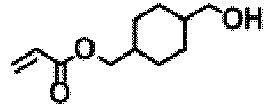

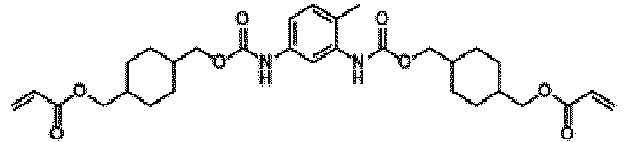
8 


9 


10 


11 


12 


13 


14 


- A 300 ml-volume, four-necked flask equipped with a stirring blade, a thermometer and a reflux condenser was charged with 14.4 g (0.2 mol) of acrylic acid and 0.5 g (1.7 mmol) of tetrabutylammonium bromide serving as a catalyst. The temperature was then raised to 60°C. Subsequently, 55.3 g (0.2 mol) of 4-nonylphenyl glycidyl ether was added dropwise over a period of 0.7 hour, resulting in an increase in reaction temperature to 65°C. After the completion of the dropwise addition, the reaction was carried out for 12 hours while controlling the reaction temperature in the range of 90 to 100°C. After the completion of the reaction, the reaction liquid was cooled to room temperature, and 200 ml of toluene was added thereto. The resultant toluene solution was poured into a 500 ml-volume separatory funnel and was washed with distilled water until the pH of the aqueous layer became neutral. After the washing with water, the toluene phase was distilled using an evaporator in order to remove toluene. Thus, 60.6 g of 2-hydroxy-4-(4-nonylphenoxy)propyl acrylate was obtained (yield: 87%).
- A 300 ml-volume, four-necked flask equipped with a stirring blade, a thermometer and a reflux condenser was charged with 52.3 g (0.15 mol) of the 2-hydroxy-4-(4-nonylphenoxy)propyl acrylate obtained above and 0.05 g of dibutyl tin dilaurate (1000 ppm with respect to the weight of the hydroxyl group-containing (meth)acrylic compound). The temperature was raised to 60°C. Subsequently, 32.8 g (0.125 mol) of bis-isocyanatocyclohexyl methane (hydrogenated MDI) was added dropwise over a period of 0.5 hour, resulting in an increase in reaction temperature to 80°C. After the completion of the dropwise addition, the reaction was carried out for 12 hours while controlling the reaction temperature in the range of 80 to 85°C. The percent by weight of the hydrogenated MDI in the reaction product was determined to be 0.00% by weight.
- The product was discharged from the reactor. Thus, 81 g of a dental material which contained a urethane (meth)acrylic compound represented by the following formula was obtained.

- Dental materials containing various urethane (meth)acrylic compounds were obtained by the same synthetic procedures as those in Production Example 15, except that a hydroxyl group-containing (meth) acrylic compound was produced by using an epoxy compound and an acrylic acid or a methacrylic acid illustrated in Table 12 instead of the 4-nonylphenyl glycidyl ether and the acrylic acid described in Production Example 15, and that the HMDI was replaced by a diisocyanate illustrated in Table 12.
[Table 12] Table 12 Prod. Ex. Epoxy compound OH-containing (meth)acryl compound Diisocyanate Structural Formula 16 


17 
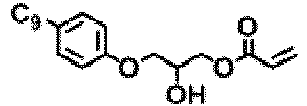


18 


19 


20 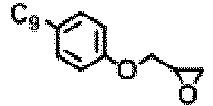


21 


22 


23 


24 


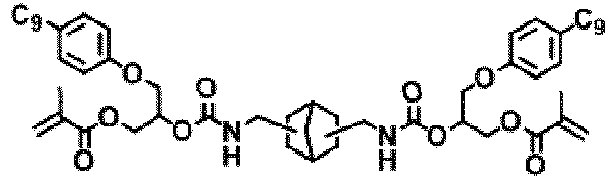
25 


- A 300 ml-volume, four-necked flask equipped with a stirring blade, a thermometer and a reflux condenser was charged with 14.4 g (0.2 mol) of acrylic acid and 0.5 g (1.7 mmol) of tetrabutylammonium bromide serving as a catalyst. The temperature was then raised to 60°C. Subsequently, 55.3 g (0.2 mol) of 4-nonylphenyl glycidyl ether was added dropwise over a period of 0.7 hour, resulting in an increase in reaction temperature to 65°C. After the completion of the dropwise addition, the reaction was carried out for 12 hours while controlling the reaction temperature in the range of 90 to 100°C. After the completion of the reaction, the reaction liquid was cooled to room temperature, and 200 ml of toluene was added thereto. The resultant toluene solution was poured into a 500 ml-volume separatory funnel and was washed with distilled water until the pH of the aqueous layer became neutral. After the washing with water, the toluene phase was distilled using an evaporator in order to remove toluene. Thus, 60.6 g of 2-hydroxy-4-(4-nonylphenoxy)propyl acrylate was obtained (yield: 87%).
- A 300 ml-volume, four-necked flask equipped with a stirring blade, a thermometer and a reflux condenser was charged with 34.8 g (0.1 mol) of the 2-hydroxy-4-(4-nonylphenoxy)propyl acrylate obtained above, 19.8 g (0.1 mol) of 1,4-cyclohexanedimethanol monoacrylate and 0.05 g of dibutyl tin dilaurate (1000 ppm with respect to the weight of the hydroxyl group-containing (meth)acrylic compounds). The temperature was raised to 60°C. Subsequently, 22.2 g (0.1 mol) of isophorone diisocyanate (IPDI) was added dropwise over a period of 0.5 hour, resulting in an increase in reaction temperature to 75°C. After the completion of the dropwise addition, the reaction was carried out for 12 hours while controlling the reaction temperature in the range of 80 to 90°C. The percent by weight of the IPDI in the reaction product was determined to be 0.00% by weight.
- The product was discharged from the reactor. Thus, 72 g of a dental material which contained urethane (meth) acrylic compounds represented by the following formulae was obtained.


- Dental materials containing various urethane (meth)acrylic compounds were obtained by the same synthetic procedures as those in Production Example 26, except that the 2-hydroxy-4-(4-nonylphenoxy)propyl acrylate, the 1, 4-cyclohexanedimethanol monoacrylate and the IPDI described in Production Example 26 were replaced by two kinds of hydroxyl group-containing (meth)acrylic compounds and a diisocyanate illustrated in Table 13.
- [Table 13]
Table 13 Prod. Ex. OH-containing (meth)acryl compound Diisocyanate Structural formula 27 


28 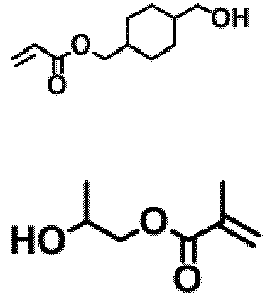


29 


30 


31 


- The dental materials containing the urethane (meth)acrylic compounds that were obtained in Production Examples 1 to 31 were analyzed by FT-IR using an infrared spectrophotometer (FTS-6000 manufactured by Bio-Rad).
- The results are described in
Figs. 1 to 31 . - 70 Parts by weight of the dental material containing the urethane (meth)acrylic compound that was obtained in any of Production Examples 1 to 31 was mixed together with 30 parts by weight of triethylene glycol dimethacrylate (NK Ester 3G manufactured by Shin-Nakamura Chemical Co., Ltd.) serving as a diluent monomer for adjusting the viscosity, thereby preparing a monomer composition. Further, 0.3 part by weight of camphorquinone (manufactured by Wako Pure Chemical Industries, Ltd.) and 0.3 part by weight of ethyl N, N-dimethylaminobenzoate (manufactured by Wako Pure Chemical Industries, Ltd.) were dissolved in 100 parts by weight of the monomer composition. Thus, a photocurable monomer composition (a dental material composition) was prepared.
- The photopolymerizable monomer composition was applied so as to fill an
aluminum mold 10 mm in diameter and 2 mm in depth. The composition was sandwiched between cover glass sheets and light was applied to each surface for 3 minutes, i.e., a total time of 6 minutes using a dental visible light irradiator (a twin polymerizer manufactured by SHOFU INC.), thereby curing the photocurable monomer composition. - The density of the photocurable monomer composition was measured before and after curing with a dry density meter (Accupyc 1330 manufactured by Shimadzu Corporation). The polymerization shrinkage was determined using the following equation (1).

- Next, the polymerization shrinkage of triethylene glycol dimethacrylate alone was measured in the same manner as described above. As a result, the polymerization shrinkage was determined to be 13.0%.
- Then, the polymerization shrinkage (S3) of the dental material containing the urethane (meth)acrylic compound was determined from the following equation (2) using the polymerization shrinkage (S1) of the monomer composition that was a mixture of the dental material containing the urethane
- (meth) acrylic compound and triethylene glycol dimethacrylate, and the polymerization shrinkage (S2, 13.0%) of triethylene glycol dimethacrylate alone.

- The results are described in Tables 14 to 16.
- 60 Parts by weight of the dental material containing the urethane (meth)acrylic compound that was obtained in any of Production Examples 1 to 23, 28 and 29 was mixed together with 40 parts by weight of triethylene glycol dimethacrylate (NK Ester 3G) serving as a diluent monomer for adjusting the viscosity, thereby preparing a monomer composition.
- Further, 40 parts by weight of the dental material containing the urethane (meth)acrylic compound that was obtained in any of Production Examples 24, 26, 27, 30 and 31 was mixed together with 60 parts by weight of triethylene glycol dimethacrylate, thereby preparing a monomer composition.
- Then, the viscosity at 30°C of these monomer compositions was measured with an E-type viscometer (TV-22 manufactured by TOKI SANGYO CO., LTD.). As a cone rotor,
No 4 was used. Triethylene glycol dimethacrylate had a viscosity of 10 (mPa·s, 30°C). - The results are described in Tables 14 to 16.
- Bis-GMA (D-GMA manufactured by Shin-Nakamura Chemical Co., Ltd.) or UDMA (SH500S manufactured by Negami Chemical Industrial Co., Ltd.), which was a methacrylate monomer widely used in a dental composite resin, was used in place of the dental materials containing the urethane (meth) acrylic compounds from the above Examples. 60 parts by weight of Bis-GMA or UDMA was mixed together with 40 parts by weight of triethylene glycol dimethacrylate (NK Ester 3G), thereby preparing a monomer composition.
- Then, in Comparative Example 1, similarly to the above Examples, the viscosity at 30°C of the composition was measured with an E-type viscometer (TV-22).
- Then, similarly to the above Examples, 0.3 part by weight of camphorquinone (manufactured by Wako Pure Chemical Industries, Ltd.) and 0.3 part by weight of ethyl N, N-dimethylaminobenzoate (manufactured by Wako Pure Chemical Industries, Ltd.) were dissolved in 100 parts by weight of the monomer composition. Thus, a photocurable monomer composition was prepared. Then, by the same method as described above, the polymerization shrinkage (S4) of the monomer composition was determined.
- Further, the polymerization shrinkage (S5) of Bis-GMA or UDMA alone was determined from the following equation (3) using the polymerization shrinkage (S4) of the monomer composition and the polymerization shrinkage (S2, 13.0%) of triethylene glycol dimethacrylate alone.

- The results are described in Table 16.
[Table 14] Table 14 Ex. Corr. Prod. Ex. Structural formula Polymerization shrinkage (%) Viscosity (mPa·s 30°C) 1 1 
3.0 888 2 2 
3.6 714 3 3 
2.5 684 4 15 
1.6 1864 5 16 
1.9 1121 6 17 
1.3 2147 7 18 
1.8 1915 8 19 
2.5 707 9 20 
1.5 1067 10 4 
3.6 837 11 5 
4.0 696 12 23 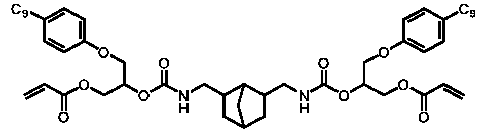
2.4 1060 13 24 
2.9 881 14 6 
3.3 835 15 7 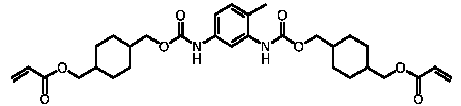
2.7 1272 16 25 
2.9 1393 - [Table 15]
Table 15 Ex. Corr. Prod. Ex. Structural formula Polymerization shrinkage (%) Viscosity (mPa·s 30°C) 17 26 
2.5 988 18 27 
2.6 1228 19 28 
3.4 624 20 29 
1.5 3763 21 30 
2.8 1472 22 31 
3.2 921 23 21 
2.8 1653 - [Table 16]
Table 16 Ex. Corr. Prod. Ex. Structural formula Polymerization shrinkage (%) Viscosity (mPa·s 30°C) 24 8 
0.8 445 ( 3G 60%)25 9 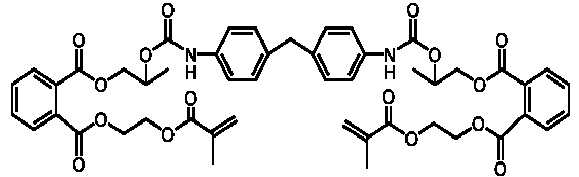
1.9 no data 26 10 
3.9 108 ( 3G 60%)27 11 
2.2 133 ( 3G 60%)28 22 
1.5 2918 29 12 
2.9 806 30 13 
2.2 209 ( 3G 60%)31 14 
3.1 315 ( 3G 60%)Comp. Ex.1 Bis-GMA 
5.2 527 Comp. Ex.2 UDMA 
7.2 no data - 40 Parts by weight of the dental material containing the urethane (meth)acrylic compound that was obtained in any of Production Examples 3, 12 and 16 was mixed together with 60 parts by weight of DCP-4EO-A (compound represented by Formula (6) wherein R is a hydrogen atom and m + n = 4) or DCP-A (compound represented by Formula (6) wherein R is a hydrogen atom and m + n = 0), serving as a diluent monomer for adjusting the viscosity, thereby preparing a monomer composition. Similarly to the above Examples, the viscosity at 30 °C of the monomer composition was measured with an E-type viscometer (TV-22).
- Then, similarly to the above Examples, 0.3 part by weight of camphorquinone (manufactured by Wako Pure Chemical Industries, Ltd.) and 0.3 part by weight of ethyl N, N-dimethylaminobenzoate (manufactured by Wako Pure Chemical Industries, Ltd.) were dissolved in 100 parts by weight of the monomer composition. Thus, a photocurable monomer composition (a dental material composition) was prepared. Then, in the same manner as described above, using the equation (1), from the density of the photocurable monomer composition measured before and after curing, the polymerization shrinkage of the photocurable monomer composition was determined.
- Further, in the same manner as described above, the polymerization shrinkage and the viscosity of DCP-4EO-A and DCP-A alone were measured. It was found that DCP-4EO-A had a polymerization shrinkage of 8.0% and a viscosity of 130 (mPa·s, 30°C), and DCP-A had a polymerization shrinkage of 8.3% and a viscosity of 110 (mPa·s, 30°C).
- The results are described in Table 17.
- The viscosity and the polymerization shrinkage were determined by the same procedures as those in Examples 32 to 37, except for using a monomer composition obtained by mixing 40 parts by weight of Bis-GMA (D-GMA) together with 60 parts by weight of DCP-4EO-A.
- The results are described in Table 17.
- [Table 17]
Table 17 Ex. Corr. Prod. Ex. Diluent monomer Structural formula Polymerization shrinkage (%) Viscosity (mPa·s 30°C) 32 3 DCP-4EO-A 
5.4 1850 33 16 DCP-4EO-A 
5.2 2143 34 12 DCP-4EO-A 
5.6 1673 35 3 DCP-A 
5.7 2281 36 16 DCP-A 
5.4 3039 37 12 DCP-A 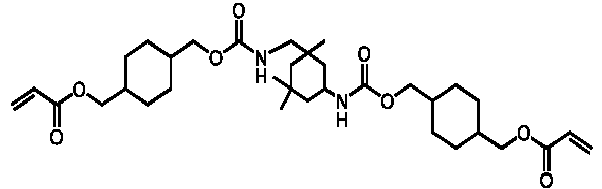
5.8 2433 Comp. Ex.3 Bis-GMA DCP-4EO-A 
6.6 1250 - 40 Parts by weight of the photocurable monomer composition obtained in any of Examples 1 to 31 was mixed together with 60 parts by weight of barium glass (GM8235 manufactured by NEC SCHOTT Components Corporation) which had been surface treated with 10 parts by weight of γ-methacryloxypropyl trimethoxysilane (KBM503 manufactured by Shin-Etsu Chemical Co., Ltd.) and had an average particle diameter of 1 µm. Thus, a uniform photocurable paste (a dental material composition) was prepared.
- With respect to the photocurable pastes, the polymerization shrinkage was measured in the same manner as described for the photocurable monomer composition in Example 1.
- The results are described in Tables 18 to 20.
- Photocurable pastes were prepared in the same manner as described in Example 100, except that the dental material containing the urethane (meth)acrylic compound from the above Examples was replaced by Bis-GMA (D-GMA manufactured by Shin-Nakamura Chemical Co., Ltd.) or UDMA (SH500S manufactured by Negami Chemical Industrial Co., Ltd.), which was a methacrylate monomer.
- With respect to the photocurable pastes, the polymerization shrinkage was measured in the same manner as described for the photocurable monomer composition in Example 1.
- The results are described in Table 20.
- [Table 18]
Table 18 Ex. Corr. Prod. Ex. Structural formula Polymerization shrinkage (%) 100 3 
2.3 101 15 
2.0 102 16 
2.1 103 17 
1.9 104 4 
2.6 105 24 
2.4 106 7 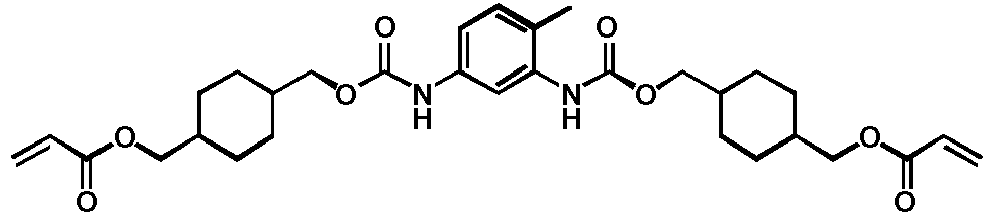
2.3 - [Table 19]
Table 19 Ex. Corr. Prod. Ex. Structural formula Polymerization shrinkage (%) 107 26 
2.3 108 27 
2.3 109 28 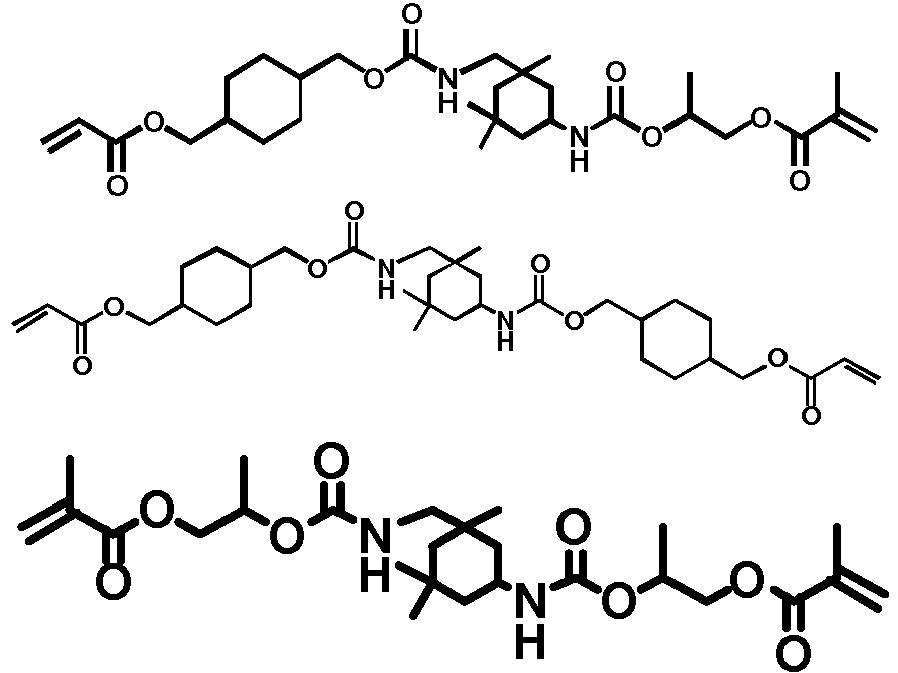
2.5 - [Table 20]
Table 20 Ex. Corr. Prod. Ex. Structural formula Polymerization shrinkage (%) 110 21 
2.3 111 9 
2.1 112 13 
2.2 Comp. 10 B is-GMA 
3.0 Comp. 11 UDMA 
3.6
Claims (19)
- A dental material which comprises a compound represented by Formula (1) :


- The dental material according to Claim 1, which includes a compound represented by Formula (1) in which the group A is a divalent organic group selected from the group consisting of the structures (a), (b), (c), (d), (e) and (h).
- The dental material according to Claim 1, which includes a compound represented by Formula (1) in which the group A is a divalent organic group selected from the group consisting of the structures (a), (c), (e) and (h).
- The dental material according to Claim 1, which includes a compound represented by Formula (1) in which the group A is a divalent organic group selected from the group consisting of the structures (a), (e) and (h).
- The dental material according to Claim 1, which includes a compound represented by Formula (1) in which the divalent organic group A is the structure (a).
- The dental material according to any one of Claims 1 to 5, which includes a compound represented by Formula (1) in which at least one of X1 and X2 is a divalent organic group selected from the group consisting of the structures (i), (j), (1) and (m).
- The dental material according to any one of Claims 1 to 5, which includes a compound represented by Formula (1) in which one of X1 and X2 is a divalent organic group selected from the group consisting of the structures (i), (j) and (m).
- The dental material according to Claim 1, which includes a compound represented by Formula (1) in which the group A is any of the structures (a), (b), (c) and (e), X1 and X2 are both the structures (i), and R1 and R2 are both hydrogen atoms.
- The dental material according to Claim 1, which includes a compound represented by Formula (1) in which the group A is the structure (d), X1 and X2 are both the structures (i), and R1 and R2 are both methyl groups.
- The dental material according to Claim 1, which includes at least one compound selected from compounds represented by Formulae (2) to (5) below:


- A dental material composition which comprises the dental material according to any one of Claims 1 to 10, a polymerization initiator (B) and a filler (C).
- The dental material composition according to Claim 11, further comprising a polymerizable monomer (D).
- The dental material composition according to Claim 12, wherein the polymerizable monomer (D) is represented by Formula 6.

- The dental material composition according to Claim 13, wherein in Formula (6), R each indicate a hydrogen atom, m and n each indicate an integer of 0 to 6, and m + n = 2 to 6.
- A dental restorative material which comprises the dental material according to any one of Claims 1 to 10, a photopolymerization initiator (B) and a filler (C).
- The dental restorative material according to Claim 15, further comprising a polymerizable monomer (D).
- The dental restorative material according to Claim 16, wherein the polymerizable monomer (D) is represented by Formula (6).

- The dental material composition according to Claim 17, wherein in Formula (6), R each indicate a hydrogen atom, m and n each indicate an integer of 0 to 6, and m + n = 2 to 6.
- A cured product obtained by curing the dental material according to any one of Claims 1 to 10.
Applications Claiming Priority (2)
| Application Number | Priority Date | Filing Date | Title |
|---|---|---|---|
| JP2011109606 | 2011-05-16 | ||
| PCT/JP2012/062159 WO2012157566A1 (en) | 2011-05-16 | 2012-05-11 | Dental material, dental material composition, dental repair material, and cured product |
Publications (3)
| Publication Number | Publication Date |
|---|---|
| EP2710994A1 true EP2710994A1 (en) | 2014-03-26 |
| EP2710994A4 EP2710994A4 (en) | 2015-04-08 |
| EP2710994B1 EP2710994B1 (en) | 2018-08-01 |
Family
ID=47175396
Family Applications (1)
| Application Number | Title | Priority Date | Filing Date |
|---|---|---|---|
| EP12785296.0A Active EP2710994B1 (en) | 2011-05-16 | 2012-05-11 | Dental material, dental material composition, dental repair material, and cured product |
Country Status (4)
| Country | Link |
|---|---|
| US (1) | US9511004B2 (en) |
| EP (1) | EP2710994B1 (en) |
| JP (2) | JP5931057B2 (en) |
| WO (1) | WO2012157566A1 (en) |
Cited By (1)
| Publication number | Priority date | Publication date | Assignee | Title |
|---|---|---|---|---|
| EP3135271A4 (en) * | 2014-03-31 | 2017-12-27 | Mitsui Chemicals, Inc. | Polymerizable monomer composition for dental material |
Families Citing this family (22)
| Publication number | Priority date | Publication date | Assignee | Title |
|---|---|---|---|---|
| CN103492446B (en) | 2011-05-16 | 2016-07-27 | 三井化学株式会社 | Compound, composition comprising same and cured product |
| WO2012157566A1 (en) | 2011-05-16 | 2012-11-22 | 三井化学株式会社 | Dental material, dental material composition, dental repair material, and cured product |
| US10206762B2 (en) * | 2014-02-05 | 2019-02-19 | Mitsui Chemicals, Inc. | Material for denture base, denture base, method of manufacturing the denture base, plate denture, and method of manufacturing the plate denture |
| DE102015104440A1 (en) * | 2015-03-24 | 2016-09-29 | Heraeus Kulzer Gmbh | Process for producing dental prostheses and ready-to-use dental material and kit containing the dental material |
| JP6634071B2 (en) | 2015-03-31 | 2020-01-22 | 三井化学株式会社 | Polymerizable monomers for dental materials, compositions, adhesive dental materials, and kits |
| US11680039B2 (en) | 2016-08-10 | 2023-06-20 | Arkema France | Compounds containing cyclic structural elements, urethane/ureido linkages and a free radical-polymerizable functional group |
| EP3666247B1 (en) | 2017-08-07 | 2024-12-18 | Mitsui Chemicals, Inc. | Divided curable composition |
| JP7046971B2 (en) | 2017-10-26 | 2022-04-04 | 三井化学株式会社 | Curable composition |
| US11407846B2 (en) | 2017-11-28 | 2022-08-09 | Mitsui Chemicals, Inc. | (Meth)acrylate, monomer composition, dental material obtained from composition, and production method thereof |
| JP6941186B2 (en) | 2017-11-28 | 2021-09-29 | 三井化学株式会社 | (Meta) Acrylate and Its Applications |
| WO2020031897A1 (en) | 2018-08-09 | 2020-02-13 | 三井化学株式会社 | Polymerization initiator, curable composition, dental material, and preparation kit for curable composition |
| CN112533963B (en) | 2018-08-21 | 2023-07-25 | 三井化学株式会社 | (meth) acrylate, monomer composition for dental material, molded article, composition for dental material, and method for producing (meth) acrylate |
| JP7286674B2 (en) * | 2018-12-11 | 2023-06-05 | 三井化学株式会社 | (Meth)acrylate, monomer composition, molding, dental material composition, and dental material |
| JP7195228B2 (en) * | 2019-07-08 | 2022-12-23 | 日本化薬株式会社 | display sealant |
| JP7429559B2 (en) * | 2020-02-17 | 2024-02-08 | 三井化学株式会社 | (Meth)acrylate compound, monomer composition, molded article, composition for dental materials, dental material, and method for producing (meth)acrylate compound |
| JP7490213B2 (en) * | 2020-03-10 | 2024-05-27 | 株式会社トクヤマデンタル | Method for manufacturing dental composite |
| EP4166578A4 (en) | 2020-07-15 | 2024-07-24 | Mitsui Chemicals, Inc. | POLYMERIZATION INITIATOR, KIT FOR PREPARING A CURABLE COMPOSITION, CURABLE COMPOSITION, CURRED PRODUCT AND DENTAL MATERIAL |
| US20250223282A1 (en) | 2022-03-25 | 2025-07-10 | Mitsui Chemicals, Inc. | Ascorbic acid derivative or salt thereof, additive for polymerization initiation, polymerization initiator, curable composition preparation kit, curable composition, cured product, and dental material |
| WO2023182518A1 (en) | 2022-03-25 | 2023-09-28 | 三井化学株式会社 | Polymerization accelerator, polymerization initiator, kit for preparing curable composition, curable composition, cured product and dental material |
| EP4548902A1 (en) | 2022-08-03 | 2025-05-07 | Mitsui Chemicals, Inc. | Kit for preparing curable composition for dental material, curable composition for dental material, and dental material |
| EP4548901A1 (en) | 2022-08-03 | 2025-05-07 | Mitsui Chemicals, Inc. | Curable composition preparation kit, curable composition, cured article, and dental material |
| EP4736833A1 (en) * | 2024-11-04 | 2026-05-06 | DENTSPLY SIRONA Inc. | Polymerizable dental composition |
Family Cites Families (21)
| Publication number | Priority date | Publication date | Assignee | Title |
|---|---|---|---|---|
| DE2931926A1 (en) * | 1979-08-07 | 1981-02-26 | Bayer Ag | DENTAL MEASURES |
| JPS60171648A (en) | 1984-02-17 | 1985-09-05 | Ricoh Co Ltd | Light information recording medium |
| US4614705A (en) | 1984-02-17 | 1986-09-30 | Ricoh Co., Ltd. | Optical information recording medium |
| JPH0644354B2 (en) * | 1985-07-12 | 1994-06-08 | 株式会社日立製作所 | Plastic information recording medium |
| JPS633757A (en) | 1986-06-25 | 1988-01-08 | Ando Seika Kk | Preparation of candy containing plum pulp |
| DE19544671A1 (en) * | 1995-11-30 | 1997-06-05 | Bayer Ag | Urethane (meth) acrylates with cyclic carbonate groups |
| DE19603577C2 (en) | 1996-02-01 | 2003-11-13 | Heraeus Kulzer Gmbh & Co Kg | adhesive |
| JP4860884B2 (en) * | 2002-03-11 | 2012-01-25 | Tdk株式会社 | Optical information medium |
| JP4456838B2 (en) | 2003-09-12 | 2010-04-28 | 株式会社トクヤマ | Dental photopolymerizable composition |
| JP4456859B2 (en) | 2003-12-25 | 2010-04-28 | 株式会社トクヤマ | Dental cationic curable composition |
| EP1570831A1 (en) | 2004-03-02 | 2005-09-07 | Ernst Mühlbauer GmbH & Co.KG | Polymerisable dental material containing a filler |
| JP2008024724A (en) | 2004-11-15 | 2008-02-07 | Nippon Kayaku Co Ltd | Ultraviolet-curable resin composition and its cured product |
| JP4749779B2 (en) | 2005-07-05 | 2011-08-17 | 株式会社トクヤマ | Dental cationic curable composition |
| JP5122078B2 (en) | 2006-04-03 | 2013-01-16 | アイカ工業株式会社 | Decorative plate and manufacturing method thereof |
| JP5132946B2 (en) * | 2007-02-08 | 2013-01-30 | 三菱レイヨン株式会社 | Active energy ray-curable resin composition for mold printing and molded article |
| JP5216343B2 (en) | 2008-01-30 | 2013-06-19 | クラレノリタケデンタル株式会社 | Polymerizable monomer suitable for dental materials |
| TW201035060A (en) * | 2008-10-09 | 2010-10-01 | Septodont Confi Dental Division | Carbamate-methacrylate monomers and their use in dental applications |
| FR2954356B1 (en) * | 2009-12-22 | 2012-01-13 | Hexcel Reinforcements | NEW INTERMEDIATE MATERIALS PRODUCED BY INTERCONNECTION WITH INTERLAYING OF SAILED YARNS |
| EP2642967B1 (en) * | 2010-11-23 | 2023-08-02 | DENTSPLY SIRONA Inc. | High strength dental material |
| WO2012157566A1 (en) | 2011-05-16 | 2012-11-22 | 三井化学株式会社 | Dental material, dental material composition, dental repair material, and cured product |
| CN103492446B (en) | 2011-05-16 | 2016-07-27 | 三井化学株式会社 | Compound, composition comprising same and cured product |
-
2012
- 2012-05-11 WO PCT/JP2012/062159 patent/WO2012157566A1/en not_active Ceased
- 2012-05-11 JP JP2013515124A patent/JP5931057B2/en active Active
- 2012-05-11 EP EP12785296.0A patent/EP2710994B1/en active Active
- 2012-05-15 US US13/471,725 patent/US9511004B2/en active Active
-
2016
- 2016-02-17 JP JP2016027945A patent/JP2016094482A/en active Pending
Cited By (1)
| Publication number | Priority date | Publication date | Assignee | Title |
|---|---|---|---|---|
| EP3135271A4 (en) * | 2014-03-31 | 2017-12-27 | Mitsui Chemicals, Inc. | Polymerizable monomer composition for dental material |
Also Published As
| Publication number | Publication date |
|---|---|
| JP2016094482A (en) | 2016-05-26 |
| JPWO2012157566A1 (en) | 2014-07-31 |
| EP2710994B1 (en) | 2018-08-01 |
| US20120296003A1 (en) | 2012-11-22 |
| CN103491928A (en) | 2014-01-01 |
| US9511004B2 (en) | 2016-12-06 |
| EP2710994A4 (en) | 2015-04-08 |
| WO2012157566A1 (en) | 2012-11-22 |
| JP5931057B2 (en) | 2016-06-08 |
Similar Documents
| Publication | Publication Date | Title |
|---|---|---|
| EP2710994B1 (en) | Dental material, dental material composition, dental repair material, and cured product | |
| EP2711381B1 (en) | Novel compound, composition containing said compound, and cured product | |
| EP3278787B1 (en) | Polymerizable monomer for dental materials, composition, adhesive dental material, and kit | |
| EP3135270B1 (en) | Polymerizable monomer for dental material | |
| EP3733152A1 (en) | Powder-liquid type resin-reinforced dental glass ionomer cement composition | |
| JP2019099608A (en) | Curable composition containing alicyclic (meth)acrylic compound | |
| JP5216343B2 (en) | Polymerizable monomer suitable for dental materials | |
| JP2018193342A (en) | Curable compositions comprising alicyclic (meth)acryl compounds | |
| EP3603607B1 (en) | Multifunctional monomer for dental material, and hydroxyl group-containing monomer for dental material | |
| JP7286674B2 (en) | (Meth)acrylate, monomer composition, molding, dental material composition, and dental material | |
| JP7429559B2 (en) | (Meth)acrylate compound, monomer composition, molded article, composition for dental materials, dental material, and method for producing (meth)acrylate compound | |
| EP3777816A1 (en) | Polymerizable composition for dental material, and dental material obtained from said composition | |
| CN103491928B (en) | Dental materials, dental materials compositions, dental prosthetic material and solidfied material | |
| CN121987502A (en) | Polymerizable dental composition |
Legal Events
| Date | Code | Title | Description |
|---|---|---|---|
| PUAI | Public reference made under article 153(3) epc to a published international application that has entered the european phase |
Free format text: ORIGINAL CODE: 0009012 |
|
| 17P | Request for examination filed |
Effective date: 20131204 |
|
| AK | Designated contracting states |
Kind code of ref document: A1 Designated state(s): AL AT BE BG CH CY CZ DE DK EE ES FI FR GB GR HR HU IE IS IT LI LT LU LV MC MK MT NL NO PL PT RO RS SE SI SK SM TR |
|
| DAX | Request for extension of the european patent (deleted) | ||
| RIC1 | Information provided on ipc code assigned before grant |
Ipc: C07C 271/36 20060101ALI20141113BHEP Ipc: A61K 6/083 20060101ALI20141113BHEP Ipc: C07C 271/28 20060101ALI20141113BHEP Ipc: C08F 20/36 20060101ALI20141113BHEP Ipc: C07C 271/34 20060101ALI20141113BHEP Ipc: C08F 220/36 20060101ALI20141113BHEP Ipc: C07C 271/08 20060101ALI20141113BHEP Ipc: C07C 271/24 20060101ALI20141113BHEP Ipc: A61K 6/00 20060101AFI20141113BHEP Ipc: C07C 271/38 20060101ALI20141113BHEP |
|
| RA4 | Supplementary search report drawn up and despatched (corrected) |
Effective date: 20150309 |
|
| RIC1 | Information provided on ipc code assigned before grant |
Ipc: C08F 20/36 20060101ALI20150303BHEP Ipc: C07C 271/24 20060101ALI20150303BHEP Ipc: A61K 6/00 20060101AFI20150303BHEP Ipc: C07C 271/08 20060101ALI20150303BHEP Ipc: A61K 6/083 20060101ALI20150303BHEP Ipc: C07C 271/38 20060101ALI20150303BHEP Ipc: C07C 271/28 20060101ALI20150303BHEP Ipc: C08F 220/36 20060101ALI20150303BHEP Ipc: C07C 271/36 20060101ALI20150303BHEP Ipc: C07C 271/34 20060101ALI20150303BHEP |
|
| STAA | Information on the status of an ep patent application or granted ep patent |
Free format text: STATUS: EXAMINATION IS IN PROGRESS |
|
| 17Q | First examination report despatched |
Effective date: 20170830 |
|
| REG | Reference to a national code |
Ref country code: DE Ref legal event code: R079 Ref document number: 602012049195 Country of ref document: DE Free format text: PREVIOUS MAIN CLASS: A61K0006000000 Ipc: A61K0006083000 |
|
| GRAP | Despatch of communication of intention to grant a patent |
Free format text: ORIGINAL CODE: EPIDOSNIGR1 |
|
| STAA | Information on the status of an ep patent application or granted ep patent |
Free format text: STATUS: GRANT OF PATENT IS INTENDED |
|
| RIC1 | Information provided on ipc code assigned before grant |
Ipc: A61K 6/09 20060101ALI20180214BHEP Ipc: A61K 6/00 20060101ALI20180214BHEP Ipc: A61K 6/083 20060101AFI20180214BHEP Ipc: C07C 271/32 20060101ALI20180214BHEP |
|
| INTG | Intention to grant announced |
Effective date: 20180227 |
|
| GRAS | Grant fee paid |
Free format text: ORIGINAL CODE: EPIDOSNIGR3 |
|
| GRAA | (expected) grant |
Free format text: ORIGINAL CODE: 0009210 |
|
| STAA | Information on the status of an ep patent application or granted ep patent |
Free format text: STATUS: THE PATENT HAS BEEN GRANTED |
|
| AK | Designated contracting states |
Kind code of ref document: B1 Designated state(s): AL AT BE BG CH CY CZ DE DK EE ES FI FR GB GR HR HU IE IS IT LI LT LU LV MC MK MT NL NO PL PT RO RS SE SI SK SM TR |
|
| REG | Reference to a national code |
Ref country code: GB Ref legal event code: FG4D |
|
| RIN1 | Information on inventor provided before grant (corrected) |
Inventor name: TANABE, YOSHIMITSU Inventor name: NARUSE, HIROSHI Inventor name: MIYASATO, MASATAKA Inventor name: UEKI, HIDEYUKI Inventor name: INAMI, CHIDZURU Inventor name: KOHGO, OSAMU Inventor name: MIYATA, SHUNSUKE |
|
| REG | Reference to a national code |
Ref country code: CH Ref legal event code: EP Ref country code: AT Ref legal event code: REF Ref document number: 1023456 Country of ref document: AT Kind code of ref document: T Effective date: 20180815 |
|
| REG | Reference to a national code |
Ref country code: IE Ref legal event code: FG4D |
|
| REG | Reference to a national code |
Ref country code: DE Ref legal event code: R096 Ref document number: 602012049195 Country of ref document: DE |
|
| REG | Reference to a national code |
Ref country code: NL Ref legal event code: MP Effective date: 20180801 |
|
| REG | Reference to a national code |
Ref country code: LT Ref legal event code: MG4D |
|
| REG | Reference to a national code |
Ref country code: AT Ref legal event code: MK05 Ref document number: 1023456 Country of ref document: AT Kind code of ref document: T Effective date: 20180801 |
|
| PG25 | Lapsed in a contracting state [announced via postgrant information from national office to epo] |
Ref country code: BG Free format text: LAPSE BECAUSE OF FAILURE TO SUBMIT A TRANSLATION OF THE DESCRIPTION OR TO PAY THE FEE WITHIN THE PRESCRIBED TIME-LIMIT Effective date: 20181101 Ref country code: SE Free format text: LAPSE BECAUSE OF FAILURE TO SUBMIT A TRANSLATION OF THE DESCRIPTION OR TO PAY THE FEE WITHIN THE PRESCRIBED TIME-LIMIT Effective date: 20180801 Ref country code: AT Free format text: LAPSE BECAUSE OF FAILURE TO SUBMIT A TRANSLATION OF THE DESCRIPTION OR TO PAY THE FEE WITHIN THE PRESCRIBED TIME-LIMIT Effective date: 20180801 Ref country code: RS Free format text: LAPSE BECAUSE OF FAILURE TO SUBMIT A TRANSLATION OF THE DESCRIPTION OR TO PAY THE FEE WITHIN THE PRESCRIBED TIME-LIMIT Effective date: 20180801 Ref country code: NO Free format text: LAPSE BECAUSE OF FAILURE TO SUBMIT A TRANSLATION OF THE DESCRIPTION OR TO PAY THE FEE WITHIN THE PRESCRIBED TIME-LIMIT Effective date: 20181101 Ref country code: GR Free format text: LAPSE BECAUSE OF FAILURE TO SUBMIT A TRANSLATION OF THE DESCRIPTION OR TO PAY THE FEE WITHIN THE PRESCRIBED TIME-LIMIT Effective date: 20181102 Ref country code: IS Free format text: LAPSE BECAUSE OF FAILURE TO SUBMIT A TRANSLATION OF THE DESCRIPTION OR TO PAY THE FEE WITHIN THE PRESCRIBED TIME-LIMIT Effective date: 20181201 Ref country code: FI Free format text: LAPSE BECAUSE OF FAILURE TO SUBMIT A TRANSLATION OF THE DESCRIPTION OR TO PAY THE FEE WITHIN THE PRESCRIBED TIME-LIMIT Effective date: 20180801 Ref country code: LT Free format text: LAPSE BECAUSE OF FAILURE TO SUBMIT A TRANSLATION OF THE DESCRIPTION OR TO PAY THE FEE WITHIN THE PRESCRIBED TIME-LIMIT Effective date: 20180801 Ref country code: NL Free format text: LAPSE BECAUSE OF FAILURE TO SUBMIT A TRANSLATION OF THE DESCRIPTION OR TO PAY THE FEE WITHIN THE PRESCRIBED TIME-LIMIT Effective date: 20180801 Ref country code: PL Free format text: LAPSE BECAUSE OF FAILURE TO SUBMIT A TRANSLATION OF THE DESCRIPTION OR TO PAY THE FEE WITHIN THE PRESCRIBED TIME-LIMIT Effective date: 20180801 |
|
| PG25 | Lapsed in a contracting state [announced via postgrant information from national office to epo] |
Ref country code: AL Free format text: LAPSE BECAUSE OF FAILURE TO SUBMIT A TRANSLATION OF THE DESCRIPTION OR TO PAY THE FEE WITHIN THE PRESCRIBED TIME-LIMIT Effective date: 20180801 Ref country code: LV Free format text: LAPSE BECAUSE OF FAILURE TO SUBMIT A TRANSLATION OF THE DESCRIPTION OR TO PAY THE FEE WITHIN THE PRESCRIBED TIME-LIMIT Effective date: 20180801 Ref country code: HR Free format text: LAPSE BECAUSE OF FAILURE TO SUBMIT A TRANSLATION OF THE DESCRIPTION OR TO PAY THE FEE WITHIN THE PRESCRIBED TIME-LIMIT Effective date: 20180801 |
|
| PG25 | Lapsed in a contracting state [announced via postgrant information from national office to epo] |
Ref country code: EE Free format text: LAPSE BECAUSE OF FAILURE TO SUBMIT A TRANSLATION OF THE DESCRIPTION OR TO PAY THE FEE WITHIN THE PRESCRIBED TIME-LIMIT Effective date: 20180801 Ref country code: CZ Free format text: LAPSE BECAUSE OF FAILURE TO SUBMIT A TRANSLATION OF THE DESCRIPTION OR TO PAY THE FEE WITHIN THE PRESCRIBED TIME-LIMIT Effective date: 20180801 Ref country code: ES Free format text: LAPSE BECAUSE OF FAILURE TO SUBMIT A TRANSLATION OF THE DESCRIPTION OR TO PAY THE FEE WITHIN THE PRESCRIBED TIME-LIMIT Effective date: 20180801 Ref country code: RO Free format text: LAPSE BECAUSE OF FAILURE TO SUBMIT A TRANSLATION OF THE DESCRIPTION OR TO PAY THE FEE WITHIN THE PRESCRIBED TIME-LIMIT Effective date: 20180801 Ref country code: IT Free format text: LAPSE BECAUSE OF FAILURE TO SUBMIT A TRANSLATION OF THE DESCRIPTION OR TO PAY THE FEE WITHIN THE PRESCRIBED TIME-LIMIT Effective date: 20180801 |
|
| REG | Reference to a national code |
Ref country code: DE Ref legal event code: R097 Ref document number: 602012049195 Country of ref document: DE |
|
| PG25 | Lapsed in a contracting state [announced via postgrant information from national office to epo] |
Ref country code: SK Free format text: LAPSE BECAUSE OF FAILURE TO SUBMIT A TRANSLATION OF THE DESCRIPTION OR TO PAY THE FEE WITHIN THE PRESCRIBED TIME-LIMIT Effective date: 20180801 Ref country code: DK Free format text: LAPSE BECAUSE OF FAILURE TO SUBMIT A TRANSLATION OF THE DESCRIPTION OR TO PAY THE FEE WITHIN THE PRESCRIBED TIME-LIMIT Effective date: 20180801 Ref country code: SM Free format text: LAPSE BECAUSE OF FAILURE TO SUBMIT A TRANSLATION OF THE DESCRIPTION OR TO PAY THE FEE WITHIN THE PRESCRIBED TIME-LIMIT Effective date: 20180801 |
|
| PLBE | No opposition filed within time limit |
Free format text: ORIGINAL CODE: 0009261 |
|
| STAA | Information on the status of an ep patent application or granted ep patent |
Free format text: STATUS: NO OPPOSITION FILED WITHIN TIME LIMIT |
|
| 26N | No opposition filed |
Effective date: 20190503 |
|
| PG25 | Lapsed in a contracting state [announced via postgrant information from national office to epo] |
Ref country code: SI Free format text: LAPSE BECAUSE OF FAILURE TO SUBMIT A TRANSLATION OF THE DESCRIPTION OR TO PAY THE FEE WITHIN THE PRESCRIBED TIME-LIMIT Effective date: 20180801 |
|
| GBPC | Gb: european patent ceased through non-payment of renewal fee |
Effective date: 20190511 |
|
| PG25 | Lapsed in a contracting state [announced via postgrant information from national office to epo] |
Ref country code: MC Free format text: LAPSE BECAUSE OF FAILURE TO SUBMIT A TRANSLATION OF THE DESCRIPTION OR TO PAY THE FEE WITHIN THE PRESCRIBED TIME-LIMIT Effective date: 20180801 |
|
| REG | Reference to a national code |
Ref country code: BE Ref legal event code: MM Effective date: 20190531 |
|
| PG25 | Lapsed in a contracting state [announced via postgrant information from national office to epo] |
Ref country code: LU Free format text: LAPSE BECAUSE OF NON-PAYMENT OF DUE FEES Effective date: 20190511 |
|
| PG25 | Lapsed in a contracting state [announced via postgrant information from national office to epo] |
Ref country code: TR Free format text: LAPSE BECAUSE OF FAILURE TO SUBMIT A TRANSLATION OF THE DESCRIPTION OR TO PAY THE FEE WITHIN THE PRESCRIBED TIME-LIMIT Effective date: 20180801 |
|
| REG | Reference to a national code |
Ref country code: DE Ref legal event code: R079 Ref document number: 602012049195 Country of ref document: DE Free format text: PREVIOUS MAIN CLASS: A61K0006083000 Ipc: A61K0006887000 |
|
| PG25 | Lapsed in a contracting state [announced via postgrant information from national office to epo] |
Ref country code: IE Free format text: LAPSE BECAUSE OF NON-PAYMENT OF DUE FEES Effective date: 20190511 Ref country code: GB Free format text: LAPSE BECAUSE OF NON-PAYMENT OF DUE FEES Effective date: 20190511 |
|
| PG25 | Lapsed in a contracting state [announced via postgrant information from national office to epo] |
Ref country code: BE Free format text: LAPSE BECAUSE OF NON-PAYMENT OF DUE FEES Effective date: 20190531 |
|
| PG25 | Lapsed in a contracting state [announced via postgrant information from national office to epo] |
Ref country code: PT Free format text: LAPSE BECAUSE OF FAILURE TO SUBMIT A TRANSLATION OF THE DESCRIPTION OR TO PAY THE FEE WITHIN THE PRESCRIBED TIME-LIMIT Effective date: 20181201 |
|
| PG25 | Lapsed in a contracting state [announced via postgrant information from national office to epo] |
Ref country code: CY Free format text: LAPSE BECAUSE OF FAILURE TO SUBMIT A TRANSLATION OF THE DESCRIPTION OR TO PAY THE FEE WITHIN THE PRESCRIBED TIME-LIMIT Effective date: 20180801 |
|
| PG25 | Lapsed in a contracting state [announced via postgrant information from national office to epo] |
Ref country code: HU Free format text: LAPSE BECAUSE OF FAILURE TO SUBMIT A TRANSLATION OF THE DESCRIPTION OR TO PAY THE FEE WITHIN THE PRESCRIBED TIME-LIMIT; INVALID AB INITIO Effective date: 20120511 Ref country code: MT Free format text: LAPSE BECAUSE OF FAILURE TO SUBMIT A TRANSLATION OF THE DESCRIPTION OR TO PAY THE FEE WITHIN THE PRESCRIBED TIME-LIMIT Effective date: 20180801 |
|
| PG25 | Lapsed in a contracting state [announced via postgrant information from national office to epo] |
Ref country code: MK Free format text: LAPSE BECAUSE OF FAILURE TO SUBMIT A TRANSLATION OF THE DESCRIPTION OR TO PAY THE FEE WITHIN THE PRESCRIBED TIME-LIMIT Effective date: 20180801 |
|
| PGFP | Annual fee paid to national office [announced via postgrant information from national office to epo] |
Ref country code: DE Payment date: 20250521 Year of fee payment: 14 |
|
| PGFP | Annual fee paid to national office [announced via postgrant information from national office to epo] |
Ref country code: FR Payment date: 20250528 Year of fee payment: 14 |
|
| PGFP | Annual fee paid to national office [announced via postgrant information from national office to epo] |
Ref country code: CH Payment date: 20250601 Year of fee payment: 14 |