EP1570831A1 - Polymerisable dental material containing a filler - Google Patents
Polymerisable dental material containing a filler Download PDFInfo
- Publication number
- EP1570831A1 EP1570831A1 EP04004852A EP04004852A EP1570831A1 EP 1570831 A1 EP1570831 A1 EP 1570831A1 EP 04004852 A EP04004852 A EP 04004852A EP 04004852 A EP04004852 A EP 04004852A EP 1570831 A1 EP1570831 A1 EP 1570831A1
- Authority
- EP
- European Patent Office
- Prior art keywords
- filler
- organic
- dental material
- organic binder
- nanoscale
- Prior art date
- Legal status (The legal status is an assumption and is not a legal conclusion. Google has not performed a legal analysis and makes no representation as to the accuracy of the status listed.)
- Withdrawn
Links
- 239000000945 filler Substances 0.000 title claims abstract description 88
- 239000005548 dental material Substances 0.000 title claims abstract description 55
- 239000002245 particle Substances 0.000 claims abstract description 64
- 239000011230 binding agent Substances 0.000 claims abstract description 53
- 239000002105 nanoparticle Substances 0.000 claims abstract description 16
- 239000003795 chemical substances by application Substances 0.000 claims abstract description 11
- VYPSYNLAJGMNEJ-UHFFFAOYSA-N Silicium dioxide Chemical compound O=[Si]=O VYPSYNLAJGMNEJ-UHFFFAOYSA-N 0.000 claims description 42
- 239000000203 mixture Substances 0.000 claims description 41
- -1 silazane Chemical compound 0.000 claims description 38
- 238000000034 method Methods 0.000 claims description 33
- 150000001875 compounds Chemical class 0.000 claims description 30
- 238000012986 modification Methods 0.000 claims description 29
- 230000004048 modification Effects 0.000 claims description 29
- 239000000463 material Substances 0.000 claims description 22
- 239000003999 initiator Substances 0.000 claims description 18
- 239000011256 inorganic filler Substances 0.000 claims description 17
- 239000012766 organic filler Substances 0.000 claims description 17
- 239000000843 powder Substances 0.000 claims description 17
- 239000000377 silicon dioxide Substances 0.000 claims description 14
- 125000000524 functional group Chemical group 0.000 claims description 13
- 239000002184 metal Substances 0.000 claims description 11
- 229910052751 metal Inorganic materials 0.000 claims description 10
- 229920000642 polymer Polymers 0.000 claims description 9
- 235000012239 silicon dioxide Nutrition 0.000 claims description 9
- 239000011324 bead Substances 0.000 claims description 8
- 238000010669 acid-base reaction Methods 0.000 claims description 7
- 206010041662 Splinter Diseases 0.000 claims description 6
- 238000011049 filling Methods 0.000 claims description 6
- 239000011521 glass Substances 0.000 claims description 6
- 230000008569 process Effects 0.000 claims description 6
- PBYZMCDFOULPGH-UHFFFAOYSA-N tungstate Chemical compound [O-][W]([O-])(=O)=O PBYZMCDFOULPGH-UHFFFAOYSA-N 0.000 claims description 6
- RTAQQCXQSZGOHL-UHFFFAOYSA-N Titanium Chemical compound [Ti] RTAQQCXQSZGOHL-UHFFFAOYSA-N 0.000 claims description 5
- 238000007259 addition reaction Methods 0.000 claims description 5
- 230000005494 condensation Effects 0.000 claims description 5
- 238000006482 condensation reaction Methods 0.000 claims description 5
- 150000004767 nitrides Chemical class 0.000 claims description 5
- 230000001698 pyrogenic effect Effects 0.000 claims description 5
- 239000005046 Chlorosilane Substances 0.000 claims description 4
- KOPOQZFJUQMUML-UHFFFAOYSA-N chlorosilane Chemical compound Cl[SiH3] KOPOQZFJUQMUML-UHFFFAOYSA-N 0.000 claims description 4
- 239000002241 glass-ceramic Substances 0.000 claims description 4
- 239000010453 quartz Substances 0.000 claims description 4
- 230000003449 preventive effect Effects 0.000 claims description 3
- 125000005402 stannate group Chemical group 0.000 claims description 3
- 238000007792 addition Methods 0.000 claims description 2
- 239000000853 adhesive Substances 0.000 claims description 2
- 230000001070 adhesive effect Effects 0.000 claims description 2
- 239000003479 dental cement Substances 0.000 claims description 2
- 239000003566 sealing material Substances 0.000 claims description 2
- 239000002966 varnish Substances 0.000 claims description 2
- BPQQTUXANYXVAA-UHFFFAOYSA-N Orthosilicate Chemical compound [O-][Si]([O-])([O-])[O-] BPQQTUXANYXVAA-UHFFFAOYSA-N 0.000 claims 2
- QAOWNCQODCNURD-UHFFFAOYSA-L Sulfate Chemical compound [O-]S([O-])(=O)=O QAOWNCQODCNURD-UHFFFAOYSA-L 0.000 claims 2
- 229940071182 stannate Drugs 0.000 claims 2
- BLRPTPMANUNPDV-UHFFFAOYSA-N Silane Chemical compound [SiH4] BLRPTPMANUNPDV-UHFFFAOYSA-N 0.000 claims 1
- 238000009833 condensation Methods 0.000 claims 1
- 229910000077 silane Inorganic materials 0.000 claims 1
- 239000012798 spherical particle Substances 0.000 abstract 1
- NIXOWILDQLNWCW-UHFFFAOYSA-M Acrylate Chemical compound [O-]C(=O)C=C NIXOWILDQLNWCW-UHFFFAOYSA-M 0.000 description 35
- 229920005989 resin Polymers 0.000 description 27
- 239000011347 resin Substances 0.000 description 27
- PEDCQBHIVMGVHV-UHFFFAOYSA-N Glycerine Chemical compound OCC(O)CO PEDCQBHIVMGVHV-UHFFFAOYSA-N 0.000 description 24
- XLYOFNOQVPJJNP-UHFFFAOYSA-N water Substances O XLYOFNOQVPJJNP-UHFFFAOYSA-N 0.000 description 23
- 150000001252 acrylic acid derivatives Chemical class 0.000 description 20
- 239000011164 primary particle Substances 0.000 description 18
- 239000002253 acid Substances 0.000 description 17
- 238000001723 curing Methods 0.000 description 17
- 239000002904 solvent Substances 0.000 description 14
- QYKIQEUNHZKYBP-UHFFFAOYSA-N Vinyl ether Chemical compound C=COC=C QYKIQEUNHZKYBP-UHFFFAOYSA-N 0.000 description 13
- 238000005299 abrasion Methods 0.000 description 12
- 238000006116 polymerization reaction Methods 0.000 description 12
- IISBACLAFKSPIT-UHFFFAOYSA-N bisphenol A Chemical compound C=1C=C(O)C=CC=1C(C)(C)C1=CC=C(O)C=C1 IISBACLAFKSPIT-UHFFFAOYSA-N 0.000 description 9
- 239000005368 silicate glass Substances 0.000 description 9
- 239000007787 solid Substances 0.000 description 9
- 238000012360 testing method Methods 0.000 description 9
- 229910052916 barium silicate Inorganic materials 0.000 description 8
- HMOQPOVBDRFNIU-UHFFFAOYSA-N barium(2+);dioxido(oxo)silane Chemical compound [Ba+2].[O-][Si]([O-])=O HMOQPOVBDRFNIU-UHFFFAOYSA-N 0.000 description 8
- 239000006185 dispersion Substances 0.000 description 8
- 238000004519 manufacturing process Methods 0.000 description 8
- 229920000647 polyepoxide Polymers 0.000 description 8
- ZWEHNKRNPOVVGH-UHFFFAOYSA-N 2-Butanone Chemical compound CCC(C)=O ZWEHNKRNPOVVGH-UHFFFAOYSA-N 0.000 description 7
- 229910002012 Aerosil® Inorganic materials 0.000 description 7
- 239000004593 Epoxy Substances 0.000 description 7
- 239000002131 composite material Substances 0.000 description 7
- 239000000126 substance Substances 0.000 description 7
- 229960000834 vinyl ether Drugs 0.000 description 7
- OKTJSMMVPCPJKN-UHFFFAOYSA-N Carbon Chemical compound [C] OKTJSMMVPCPJKN-UHFFFAOYSA-N 0.000 description 6
- YMWUJEATGCHHMB-UHFFFAOYSA-N Dichloromethane Chemical compound ClCCl YMWUJEATGCHHMB-UHFFFAOYSA-N 0.000 description 6
- XEKOWRVHYACXOJ-UHFFFAOYSA-N Ethyl acetate Chemical compound CCOC(C)=O XEKOWRVHYACXOJ-UHFFFAOYSA-N 0.000 description 6
- 238000006243 chemical reaction Methods 0.000 description 6
- 239000012153 distilled water Substances 0.000 description 6
- 238000009826 distribution Methods 0.000 description 6
- 150000002148 esters Chemical class 0.000 description 6
- 229940052303 ethers for general anesthesia Drugs 0.000 description 6
- CSCPPACGZOOCGX-UHFFFAOYSA-N Acetone Chemical compound CC(C)=O CSCPPACGZOOCGX-UHFFFAOYSA-N 0.000 description 5
- LFQSCWFLJHTTHZ-UHFFFAOYSA-N Ethanol Chemical compound CCO LFQSCWFLJHTTHZ-UHFFFAOYSA-N 0.000 description 5
- ABLZXFCXXLZCGV-UHFFFAOYSA-N Phosphorous acid Chemical compound OP(O)=O ABLZXFCXXLZCGV-UHFFFAOYSA-N 0.000 description 5
- 239000000975 dye Substances 0.000 description 5
- 150000002118 epoxides Chemical class 0.000 description 5
- 125000003700 epoxy group Chemical group 0.000 description 5
- 229910052736 halogen Inorganic materials 0.000 description 5
- 150000002367 halogens Chemical class 0.000 description 5
- 238000010348 incorporation Methods 0.000 description 5
- 150000002739 metals Chemical class 0.000 description 5
- 229920000728 polyester Polymers 0.000 description 5
- 229920001223 polyethylene glycol Polymers 0.000 description 5
- NGNBDVOYPDDBFK-UHFFFAOYSA-N 2-[2,4-di(pentan-2-yl)phenoxy]acetyl chloride Chemical compound CCCC(C)C1=CC=C(OCC(Cl)=O)C(C(C)CCC)=C1 NGNBDVOYPDDBFK-UHFFFAOYSA-N 0.000 description 4
- 125000003903 2-propenyl group Chemical group [H]C([*])([H])C([H])=C([H])[H] 0.000 description 4
- LBJBPGRQRGLKPL-UHFFFAOYSA-N 7-(4-chlorophenyl)-5-naphthalen-2-yl-6-sulfanylidene-2,3-dihydro-1h-pyrrolo[3,4-e][1,4]diazepin-8-one Chemical compound C1=CC(Cl)=CC=C1N1C(=S)C(C(=NCCN2)C=3C=C4C=CC=CC4=CC=3)=C2C1=O LBJBPGRQRGLKPL-UHFFFAOYSA-N 0.000 description 4
- 229910019142 PO4 Inorganic materials 0.000 description 4
- 238000010521 absorption reaction Methods 0.000 description 4
- 150000007513 acids Chemical class 0.000 description 4
- 125000000217 alkyl group Chemical group 0.000 description 4
- 238000013459 approach Methods 0.000 description 4
- 125000003118 aryl group Chemical group 0.000 description 4
- ISAOCJYIOMOJEB-UHFFFAOYSA-N desyl alcohol Natural products C=1C=CC=CC=1C(O)C(=O)C1=CC=CC=C1 ISAOCJYIOMOJEB-UHFFFAOYSA-N 0.000 description 4
- 238000002296 dynamic light scattering Methods 0.000 description 4
- 150000002170 ethers Chemical class 0.000 description 4
- FQPSGWSUVKBHSU-UHFFFAOYSA-N methacrylamide Chemical compound CC(=C)C(N)=O FQPSGWSUVKBHSU-UHFFFAOYSA-N 0.000 description 4
- 150000007524 organic acids Chemical class 0.000 description 4
- 235000021317 phosphate Nutrition 0.000 description 4
- 229920000515 polycarbonate Polymers 0.000 description 4
- 239000004417 polycarbonate Substances 0.000 description 4
- 229910001220 stainless steel Inorganic materials 0.000 description 4
- 239000010935 stainless steel Substances 0.000 description 4
- XOLBLPGZBRYERU-UHFFFAOYSA-N tin dioxide Chemical compound O=[Sn]=O XOLBLPGZBRYERU-UHFFFAOYSA-N 0.000 description 4
- VNQXSTWCDUXYEZ-UHFFFAOYSA-N 1,7,7-trimethylbicyclo[2.2.1]heptane-2,3-dione Chemical compound C1CC2(C)C(=O)C(=O)C1C2(C)C VNQXSTWCDUXYEZ-UHFFFAOYSA-N 0.000 description 3
- HRPVXLWXLXDGHG-UHFFFAOYSA-N Acrylamide Chemical compound NC(=O)C=C HRPVXLWXLXDGHG-UHFFFAOYSA-N 0.000 description 3
- UHOVQNZJYSORNB-UHFFFAOYSA-N Benzene Chemical compound C1=CC=CC=C1 UHOVQNZJYSORNB-UHFFFAOYSA-N 0.000 description 3
- 229920001651 Cyanoacrylate Polymers 0.000 description 3
- LYCAIKOWRPUZTN-UHFFFAOYSA-N Ethylene glycol Chemical compound OCCO LYCAIKOWRPUZTN-UHFFFAOYSA-N 0.000 description 3
- OFOBLEOULBTSOW-UHFFFAOYSA-N Malonic acid Chemical compound OC(=O)CC(O)=O OFOBLEOULBTSOW-UHFFFAOYSA-N 0.000 description 3
- CERQOIWHTDAKMF-UHFFFAOYSA-M Methacrylate Chemical compound CC(=C)C([O-])=O CERQOIWHTDAKMF-UHFFFAOYSA-M 0.000 description 3
- CERQOIWHTDAKMF-UHFFFAOYSA-N Methacrylic acid Chemical compound CC(=C)C(O)=O CERQOIWHTDAKMF-UHFFFAOYSA-N 0.000 description 3
- MWCLLHOVUTZFKS-UHFFFAOYSA-N Methyl cyanoacrylate Chemical compound COC(=O)C(=C)C#N MWCLLHOVUTZFKS-UHFFFAOYSA-N 0.000 description 3
- WYWZRNAHINYAEF-UHFFFAOYSA-N Padimate O Chemical compound CCCCC(CC)COC(=O)C1=CC=C(N(C)C)C=C1 WYWZRNAHINYAEF-UHFFFAOYSA-N 0.000 description 3
- 239000004952 Polyamide Substances 0.000 description 3
- 239000004642 Polyimide Substances 0.000 description 3
- 241000183024 Populus tremula Species 0.000 description 3
- XUIMIQQOPSSXEZ-UHFFFAOYSA-N Silicon Chemical compound [Si] XUIMIQQOPSSXEZ-UHFFFAOYSA-N 0.000 description 3
- 244000028419 Styrax benzoin Species 0.000 description 3
- 235000000126 Styrax benzoin Nutrition 0.000 description 3
- 235000008411 Sumatra benzointree Nutrition 0.000 description 3
- YXFVVABEGXRONW-UHFFFAOYSA-N Toluene Chemical compound CC1=CC=CC=C1 YXFVVABEGXRONW-UHFFFAOYSA-N 0.000 description 3
- ZJCCRDAZUWHFQH-UHFFFAOYSA-N Trimethylolpropane Chemical compound CCC(CO)(CO)CO ZJCCRDAZUWHFQH-UHFFFAOYSA-N 0.000 description 3
- 125000001931 aliphatic group Chemical group 0.000 description 3
- 229910052782 aluminium Inorganic materials 0.000 description 3
- 229960002130 benzoin Drugs 0.000 description 3
- 125000002619 bicyclic group Chemical group 0.000 description 3
- 229930006711 bornane-2,3-dione Natural products 0.000 description 3
- 125000002091 cationic group Chemical group 0.000 description 3
- MTHSVFCYNBDYFN-UHFFFAOYSA-N diethylene glycol Chemical compound OCCOCCO MTHSVFCYNBDYFN-UHFFFAOYSA-N 0.000 description 3
- 125000001495 ethyl group Chemical group [H]C([H])([H])C([H])([H])* 0.000 description 3
- 235000019382 gum benzoic Nutrition 0.000 description 3
- 125000001072 heteroaryl group Chemical group 0.000 description 3
- 125000000623 heterocyclic group Chemical group 0.000 description 3
- IQPQWNKOIGAROB-UHFFFAOYSA-N isocyanate group Chemical group [N-]=C=O IQPQWNKOIGAROB-UHFFFAOYSA-N 0.000 description 3
- 125000001449 isopropyl group Chemical group [H]C([H])([H])C([H])(*)C([H])([H])[H] 0.000 description 3
- 239000002655 kraft paper Substances 0.000 description 3
- 239000007788 liquid Substances 0.000 description 3
- 238000005259 measurement Methods 0.000 description 3
- 239000003960 organic solvent Substances 0.000 description 3
- AHHWIHXENZJRFG-UHFFFAOYSA-N oxetane Chemical compound C1COC1 AHHWIHXENZJRFG-UHFFFAOYSA-N 0.000 description 3
- NBIIXXVUZAFLBC-UHFFFAOYSA-K phosphate Chemical compound [O-]P([O-])([O-])=O NBIIXXVUZAFLBC-UHFFFAOYSA-K 0.000 description 3
- 239000010452 phosphate Substances 0.000 description 3
- UEZVMMHDMIWARA-UHFFFAOYSA-M phosphonate Chemical compound [O-]P(=O)=O UEZVMMHDMIWARA-UHFFFAOYSA-M 0.000 description 3
- 229920002647 polyamide Polymers 0.000 description 3
- 229920001721 polyimide Polymers 0.000 description 3
- 239000004814 polyurethane Substances 0.000 description 3
- 229920002635 polyurethane Polymers 0.000 description 3
- 239000002243 precursor Substances 0.000 description 3
- 238000002360 preparation method Methods 0.000 description 3
- 125000002924 primary amino group Chemical group [H]N([H])* 0.000 description 3
- 150000003254 radicals Chemical class 0.000 description 3
- 229910052710 silicon Inorganic materials 0.000 description 3
- 239000010703 silicon Substances 0.000 description 3
- 150000003573 thiols Chemical class 0.000 description 3
- 125000000391 vinyl group Chemical group [H]C([*])=C([H])[H] 0.000 description 3
- 229920002554 vinyl polymer Polymers 0.000 description 3
- YBYIRNPNPLQARY-UHFFFAOYSA-N 1H-indene Chemical compound C1=CC=C2CC=CC2=C1 YBYIRNPNPLQARY-UHFFFAOYSA-N 0.000 description 2
- HWSSEYVMGDIFMH-UHFFFAOYSA-N 2-[2-[2-(2-methylprop-2-enoyloxy)ethoxy]ethoxy]ethyl 2-methylprop-2-enoate Chemical compound CC(=C)C(=O)OCCOCCOCCOC(=O)C(C)=C HWSSEYVMGDIFMH-UHFFFAOYSA-N 0.000 description 2
- YLZOPXRUQYQQID-UHFFFAOYSA-N 3-(2,4,6,7-tetrahydrotriazolo[4,5-c]pyridin-5-yl)-1-[4-[2-[[3-(trifluoromethoxy)phenyl]methylamino]pyrimidin-5-yl]piperazin-1-yl]propan-1-one Chemical compound N1N=NC=2CN(CCC=21)CCC(=O)N1CCN(CC1)C=1C=NC(=NC=1)NCC1=CC(=CC=C1)OC(F)(F)F YLZOPXRUQYQQID-UHFFFAOYSA-N 0.000 description 2
- XDLMVUHYZWKMMD-UHFFFAOYSA-N 3-trimethoxysilylpropyl 2-methylprop-2-enoate Chemical compound CO[Si](OC)(OC)CCCOC(=O)C(C)=C XDLMVUHYZWKMMD-UHFFFAOYSA-N 0.000 description 2
- 229910002020 Aerosil® OX 50 Inorganic materials 0.000 description 2
- QGZKDVFQNNGYKY-UHFFFAOYSA-N Ammonia Chemical compound N QGZKDVFQNNGYKY-UHFFFAOYSA-N 0.000 description 2
- PAYRUJLWNCNPSJ-UHFFFAOYSA-N Aniline Chemical compound NC1=CC=CC=C1 PAYRUJLWNCNPSJ-UHFFFAOYSA-N 0.000 description 2
- 229930185605 Bisphenol Natural products 0.000 description 2
- ZOXJGFHDIHLPTG-UHFFFAOYSA-N Boron Chemical compound [B] ZOXJGFHDIHLPTG-UHFFFAOYSA-N 0.000 description 2
- NLZUEZXRPGMBCV-UHFFFAOYSA-N Butylhydroxytoluene Chemical compound CC1=CC(C(C)(C)C)=C(O)C(C(C)(C)C)=C1 NLZUEZXRPGMBCV-UHFFFAOYSA-N 0.000 description 2
- GAWIXWVDTYZWAW-UHFFFAOYSA-N C[CH]O Chemical group C[CH]O GAWIXWVDTYZWAW-UHFFFAOYSA-N 0.000 description 2
- JOYRKODLDBILNP-UHFFFAOYSA-N Ethyl urethane Chemical compound CCOC(N)=O JOYRKODLDBILNP-UHFFFAOYSA-N 0.000 description 2
- KRHYYFGTRYWZRS-UHFFFAOYSA-M Fluoride anion Chemical compound [F-] KRHYYFGTRYWZRS-UHFFFAOYSA-M 0.000 description 2
- VEXZGXHMUGYJMC-UHFFFAOYSA-N Hydrochloric acid Chemical compound Cl VEXZGXHMUGYJMC-UHFFFAOYSA-N 0.000 description 2
- XEEYBQQBJWHFJM-UHFFFAOYSA-N Iron Chemical group [Fe] XEEYBQQBJWHFJM-UHFFFAOYSA-N 0.000 description 2
- UFWIBTONFRDIAS-UHFFFAOYSA-N Naphthalene Chemical compound C1=CC=CC2=CC=CC=C21 UFWIBTONFRDIAS-UHFFFAOYSA-N 0.000 description 2
- AMFGWXWBFGVCKG-UHFFFAOYSA-N Panavia opaque Chemical compound C1=CC(OCC(O)COC(=O)C(=C)C)=CC=C1C(C)(C)C1=CC=C(OCC(O)COC(=O)C(C)=C)C=C1 AMFGWXWBFGVCKG-UHFFFAOYSA-N 0.000 description 2
- ISWSIDIOOBJBQZ-UHFFFAOYSA-N Phenol Chemical compound OC1=CC=CC=C1 ISWSIDIOOBJBQZ-UHFFFAOYSA-N 0.000 description 2
- NBIIXXVUZAFLBC-UHFFFAOYSA-N Phosphoric acid Chemical compound OP(O)(O)=O NBIIXXVUZAFLBC-UHFFFAOYSA-N 0.000 description 2
- 239000002202 Polyethylene glycol Substances 0.000 description 2
- WYURNTSHIVDZCO-UHFFFAOYSA-N Tetrahydrofuran Chemical compound C1CCOC1 WYURNTSHIVDZCO-UHFFFAOYSA-N 0.000 description 2
- GWEVSGVZZGPLCZ-UHFFFAOYSA-N Titan oxide Chemical compound O=[Ti]=O GWEVSGVZZGPLCZ-UHFFFAOYSA-N 0.000 description 2
- XLOMVQKBTHCTTD-UHFFFAOYSA-N Zinc monoxide Chemical compound [Zn]=O XLOMVQKBTHCTTD-UHFFFAOYSA-N 0.000 description 2
- MCMNRKCIXSYSNV-UHFFFAOYSA-N Zirconium dioxide Chemical compound O=[Zr]=O MCMNRKCIXSYSNV-UHFFFAOYSA-N 0.000 description 2
- ORILYTVJVMAKLC-UHFFFAOYSA-N adamantane Chemical compound C1C(C2)CC3CC1CC2C3 ORILYTVJVMAKLC-UHFFFAOYSA-N 0.000 description 2
- 150000001298 alcohols Chemical class 0.000 description 2
- 229910052784 alkaline earth metal Inorganic materials 0.000 description 2
- 150000008064 anhydrides Chemical class 0.000 description 2
- 125000000129 anionic group Chemical group 0.000 description 2
- MWPLVEDNUUSJAV-UHFFFAOYSA-N anthracene Chemical compound C1=CC=CC2=CC3=CC=CC=C3C=C21 MWPLVEDNUUSJAV-UHFFFAOYSA-N 0.000 description 2
- 230000000844 anti-bacterial effect Effects 0.000 description 2
- 150000005840 aryl radicals Chemical class 0.000 description 2
- TZCXTZWJZNENPQ-UHFFFAOYSA-L barium sulfate Chemical compound [Ba+2].[O-]S([O-])(=O)=O TZCXTZWJZNENPQ-UHFFFAOYSA-L 0.000 description 2
- 238000005452 bending Methods 0.000 description 2
- WURBFLDFSFBTLW-UHFFFAOYSA-N benzil Chemical compound C=1C=CC=CC=1C(=O)C(=O)C1=CC=CC=C1 WURBFLDFSFBTLW-UHFFFAOYSA-N 0.000 description 2
- PXKLMJQFEQBVLD-UHFFFAOYSA-N bisphenol F Chemical compound C1=CC(O)=CC=C1CC1=CC=C(O)C=C1 PXKLMJQFEQBVLD-UHFFFAOYSA-N 0.000 description 2
- 229910052796 boron Inorganic materials 0.000 description 2
- 229910052799 carbon Inorganic materials 0.000 description 2
- KRKNYBCHXYNGOX-UHFFFAOYSA-N citric acid Natural products OC(=O)CC(O)(C(O)=O)CC(O)=O KRKNYBCHXYNGOX-UHFFFAOYSA-N 0.000 description 2
- 230000000052 comparative effect Effects 0.000 description 2
- 229920001577 copolymer Polymers 0.000 description 2
- NNBZCPXTIHJBJL-UHFFFAOYSA-N decalin Chemical compound C1CCCC2CCCCC21 NNBZCPXTIHJBJL-UHFFFAOYSA-N 0.000 description 2
- INSRQEMEVAMETL-UHFFFAOYSA-N decane-1,1-diol Chemical compound CCCCCCCCCC(O)O INSRQEMEVAMETL-UHFFFAOYSA-N 0.000 description 2
- 125000005520 diaryliodonium group Chemical group 0.000 description 2
- GYZLOYUZLJXAJU-UHFFFAOYSA-N diglycidyl ether Chemical compound C1OC1COCC1CO1 GYZLOYUZLJXAJU-UHFFFAOYSA-N 0.000 description 2
- ZUOUZKKEUPVFJK-UHFFFAOYSA-N diphenyl Chemical compound C1=CC=CC=C1C1=CC=CC=C1 ZUOUZKKEUPVFJK-UHFFFAOYSA-N 0.000 description 2
- KPUWHANPEXNPJT-UHFFFAOYSA-N disiloxane Chemical class [SiH3]O[SiH3] KPUWHANPEXNPJT-UHFFFAOYSA-N 0.000 description 2
- FJKIXWOMBXYWOQ-UHFFFAOYSA-N ethenoxyethane Chemical compound CCOC=C FJKIXWOMBXYWOQ-UHFFFAOYSA-N 0.000 description 2
- NIHNNTQXNPWCJQ-UHFFFAOYSA-N fluorene Chemical compound C1=CC=C2CC3=CC=CC=C3C2=C1 NIHNNTQXNPWCJQ-UHFFFAOYSA-N 0.000 description 2
- 150000008377 fluorones Chemical class 0.000 description 2
- 229910001385 heavy metal Inorganic materials 0.000 description 2
- 150000002432 hydroperoxides Chemical class 0.000 description 2
- 230000003993 interaction Effects 0.000 description 2
- 150000002500 ions Chemical class 0.000 description 2
- 125000000959 isobutyl group Chemical group [H]C([H])([H])C([H])(C([H])([H])[H])C([H])([H])* 0.000 description 2
- 239000011159 matrix material Substances 0.000 description 2
- 229910044991 metal oxide Inorganic materials 0.000 description 2
- 125000002496 methyl group Chemical group [H]C([H])([H])* 0.000 description 2
- 229910003455 mixed metal oxide Inorganic materials 0.000 description 2
- 238000002156 mixing Methods 0.000 description 2
- GKTNLYAAZKKMTQ-UHFFFAOYSA-N n-[bis(dimethylamino)phosphinimyl]-n-methylmethanamine Chemical compound CN(C)P(=N)(N(C)C)N(C)C GKTNLYAAZKKMTQ-UHFFFAOYSA-N 0.000 description 2
- 125000004108 n-butyl group Chemical group [H]C([H])([H])C([H])([H])C([H])([H])C([H])([H])* 0.000 description 2
- 125000004123 n-propyl group Chemical group [H]C([H])([H])C([H])([H])C([H])([H])* 0.000 description 2
- 239000011858 nanopowder Substances 0.000 description 2
- 229910052755 nonmetal Inorganic materials 0.000 description 2
- 235000005985 organic acids Nutrition 0.000 description 2
- 150000001451 organic peroxides Chemical class 0.000 description 2
- 230000000737 periodic effect Effects 0.000 description 2
- YNPNZTXNASCQKK-UHFFFAOYSA-N phenanthrene Chemical compound C1=CC=C2C3=CC=CC=C3C=CC2=C1 YNPNZTXNASCQKK-UHFFFAOYSA-N 0.000 description 2
- AQSJGOWTSHOLKH-UHFFFAOYSA-N phosphite(3-) Chemical class [O-]P([O-])[O-] AQSJGOWTSHOLKH-UHFFFAOYSA-N 0.000 description 2
- 235000011007 phosphoric acid Nutrition 0.000 description 2
- 238000000016 photochemical curing Methods 0.000 description 2
- 229920000058 polyacrylate Polymers 0.000 description 2
- 229920001451 polypropylene glycol Polymers 0.000 description 2
- NROKBHXJSPEDAR-UHFFFAOYSA-M potassium fluoride Chemical compound [F-].[K+] NROKBHXJSPEDAR-UHFFFAOYSA-M 0.000 description 2
- 238000012545 processing Methods 0.000 description 2
- ODLMAHJVESYWTB-UHFFFAOYSA-N propylbenzene Chemical compound CCCC1=CC=CC=C1 ODLMAHJVESYWTB-UHFFFAOYSA-N 0.000 description 2
- BBEAQIROQSPTKN-UHFFFAOYSA-N pyrene Chemical compound C1=CC=C2C=CC3=CC=CC4=CC=C1C2=C43 BBEAQIROQSPTKN-UHFFFAOYSA-N 0.000 description 2
- 230000001953 sensory effect Effects 0.000 description 2
- PUZPDOWCWNUUKD-UHFFFAOYSA-M sodium fluoride Chemical compound [F-].[Na+] PUZPDOWCWNUUKD-UHFFFAOYSA-M 0.000 description 2
- 238000003980 solgel method Methods 0.000 description 2
- 239000000243 solution Substances 0.000 description 2
- 239000007858 starting material Substances 0.000 description 2
- 238000003860 storage Methods 0.000 description 2
- UBXAKNTVXQMEAG-UHFFFAOYSA-L strontium sulfate Chemical compound [Sr+2].[O-]S([O-])(=O)=O UBXAKNTVXQMEAG-UHFFFAOYSA-L 0.000 description 2
- 150000003512 tertiary amines Chemical class 0.000 description 2
- 238000010998 test method Methods 0.000 description 2
- 229910052721 tungsten Inorganic materials 0.000 description 2
- RSJKGSCJYJTIGS-UHFFFAOYSA-N undecane Chemical compound CCCCCCCCCCC RSJKGSCJYJTIGS-UHFFFAOYSA-N 0.000 description 2
- 230000004580 weight loss Effects 0.000 description 2
- 229910052726 zirconium Inorganic materials 0.000 description 2
- DTGKSKDOIYIVQL-WEDXCCLWSA-N (+)-borneol Chemical group C1C[C@@]2(C)[C@@H](O)C[C@@H]1C2(C)C DTGKSKDOIYIVQL-WEDXCCLWSA-N 0.000 description 1
- MFEWNFVBWPABCX-UHFFFAOYSA-N 1,1,2,2-tetraphenylethane-1,2-diol Chemical compound C=1C=CC=CC=1C(C(O)(C=1C=CC=CC=1)C=1C=CC=CC=1)(O)C1=CC=CC=C1 MFEWNFVBWPABCX-UHFFFAOYSA-N 0.000 description 1
- OWEYKIWAZBBXJK-UHFFFAOYSA-N 1,1-Dichloro-2,2-bis(4-hydroxyphenyl)ethylene Chemical compound C1=CC(O)=CC=C1C(=C(Cl)Cl)C1=CC=C(O)C=C1 OWEYKIWAZBBXJK-UHFFFAOYSA-N 0.000 description 1
- OHKVRIVNMUXAOQ-UHFFFAOYSA-N 1,1-bis(2-methylphenyl)-2,2-diphenylethane-1,2-diol Chemical compound CC1=CC=CC=C1C(O)(C(O)(C=1C=CC=CC=1)C=1C=CC=CC=1)C1=CC=CC=C1C OHKVRIVNMUXAOQ-UHFFFAOYSA-N 0.000 description 1
- GPHWXFINOWXMDN-UHFFFAOYSA-N 1,1-bis(ethenoxy)hexane Chemical compound CCCCCC(OC=C)OC=C GPHWXFINOWXMDN-UHFFFAOYSA-N 0.000 description 1
- UVRXMSUCHUCCFU-UHFFFAOYSA-N 1,1-bis(ethenoxy)propane Chemical compound C=COC(CC)OC=C UVRXMSUCHUCCFU-UHFFFAOYSA-N 0.000 description 1
- CGXVUIBINWTLNT-UHFFFAOYSA-N 1,2,3-tris(ethenoxy)propane Chemical compound C=COCC(OC=C)COC=C CGXVUIBINWTLNT-UHFFFAOYSA-N 0.000 description 1
- SKYXLDSRLNRAPS-UHFFFAOYSA-N 1,2,4-trifluoro-5-methoxybenzene Chemical compound COC1=CC(F)=C(F)C=C1F SKYXLDSRLNRAPS-UHFFFAOYSA-N 0.000 description 1
- DSZTYVZOIUIIGA-UHFFFAOYSA-N 1,2-Epoxyhexadecane Chemical compound CCCCCCCCCCCCCCC1CO1 DSZTYVZOIUIIGA-UHFFFAOYSA-N 0.000 description 1
- CYIGRWUIQAVBFG-UHFFFAOYSA-N 1,2-bis(2-ethenoxyethoxy)ethane Chemical compound C=COCCOCCOCCOC=C CYIGRWUIQAVBFG-UHFFFAOYSA-N 0.000 description 1
- ZXHDVRATSGZISC-UHFFFAOYSA-N 1,2-bis(ethenoxy)ethane Chemical compound C=COCCOC=C ZXHDVRATSGZISC-UHFFFAOYSA-N 0.000 description 1
- XDWRKTULOHXYGN-UHFFFAOYSA-N 1,3-bis(ethenoxy)-2,2-bis(ethenoxymethyl)propane Chemical compound C=COCC(COC=C)(COC=C)COC=C XDWRKTULOHXYGN-UHFFFAOYSA-N 0.000 description 1
- 125000006091 1,3-dioxolane group Chemical class 0.000 description 1
- MWZJGRDWJVHRDV-UHFFFAOYSA-N 1,4-bis(ethenoxy)butane Chemical compound C=COCCCCOC=C MWZJGRDWJVHRDV-UHFFFAOYSA-N 0.000 description 1
- KQMPMWGWJLNKPC-UHFFFAOYSA-N 1-(2-methylprop-2-enoyloxy)dodecyl 2-methylprop-2-enoate Chemical compound CCCCCCCCCCCC(OC(=O)C(C)=C)OC(=O)C(C)=C KQMPMWGWJLNKPC-UHFFFAOYSA-N 0.000 description 1
- FCEHBMOGCRZNNI-UHFFFAOYSA-N 1-benzothiophene Chemical class C1=CC=C2SC=CC2=C1 FCEHBMOGCRZNNI-UHFFFAOYSA-N 0.000 description 1
- SAMJGBVVQUEMGC-UHFFFAOYSA-N 1-ethenoxy-2-(2-ethenoxyethoxy)ethane Chemical compound C=COCCOCCOC=C SAMJGBVVQUEMGC-UHFFFAOYSA-N 0.000 description 1
- FOWNZLLMQHBVQT-UHFFFAOYSA-N 1-ethenoxy-2-[2-(2-ethenoxypropoxy)propoxy]propane Chemical compound C=COCC(C)OCC(C)OCC(C)OC=C FOWNZLLMQHBVQT-UHFFFAOYSA-N 0.000 description 1
- DLYDGDHLODCOQF-UHFFFAOYSA-N 1-ethenoxyethenylcyclohexane Chemical compound C=COC(=C)C1CCCCC1 DLYDGDHLODCOQF-UHFFFAOYSA-N 0.000 description 1
- YAOJJEJGPZRYJF-UHFFFAOYSA-N 1-ethenoxyhexane Chemical compound CCCCCCOC=C YAOJJEJGPZRYJF-UHFFFAOYSA-N 0.000 description 1
- XXCVIFJHBFNFBO-UHFFFAOYSA-N 1-ethenoxyoctane Chemical compound CCCCCCCCOC=C XXCVIFJHBFNFBO-UHFFFAOYSA-N 0.000 description 1
- SDRZFSPCVYEJTP-UHFFFAOYSA-N 1-ethenylcyclohexene Chemical compound C=CC1=CCCCC1 SDRZFSPCVYEJTP-UHFFFAOYSA-N 0.000 description 1
- BVQVLAIMHVDZEL-UHFFFAOYSA-N 1-phenyl-1,2-propanedione Chemical compound CC(=O)C(=O)C1=CC=CC=C1 BVQVLAIMHVDZEL-UHFFFAOYSA-N 0.000 description 1
- WJFKNYWRSNBZNX-UHFFFAOYSA-N 10H-phenothiazine Chemical compound C1=CC=C2NC3=CC=CC=C3SC2=C1 WJFKNYWRSNBZNX-UHFFFAOYSA-N 0.000 description 1
- FFQALBCXGPYQGT-UHFFFAOYSA-N 2,4-difluoro-5-(trifluoromethyl)aniline Chemical compound NC1=CC(C(F)(F)F)=C(F)C=C1F FFQALBCXGPYQGT-UHFFFAOYSA-N 0.000 description 1
- OZAIFHULBGXAKX-UHFFFAOYSA-N 2-(2-cyanopropan-2-yldiazenyl)-2-methylpropanenitrile Chemical compound N#CC(C)(C)N=NC(C)(C)C#N OZAIFHULBGXAKX-UHFFFAOYSA-N 0.000 description 1
- NQIGSEBFOJIXSE-UHFFFAOYSA-N 2-(3-ethyloxetan-3-yl)ethanol Chemical compound OCCC1(CC)COC1 NQIGSEBFOJIXSE-UHFFFAOYSA-N 0.000 description 1
- BXGYYDRIMBPOMN-UHFFFAOYSA-N 2-(hydroxymethoxy)ethoxymethanol Chemical compound OCOCCOCO BXGYYDRIMBPOMN-UHFFFAOYSA-N 0.000 description 1
- DJOYTAUERRJRAT-UHFFFAOYSA-N 2-(n-methyl-4-nitroanilino)acetonitrile Chemical compound N#CCN(C)C1=CC=C([N+]([O-])=O)C=C1 DJOYTAUERRJRAT-UHFFFAOYSA-N 0.000 description 1
- HPILSDOMLLYBQF-UHFFFAOYSA-N 2-[1-(oxiran-2-ylmethoxy)butoxymethyl]oxirane Chemical compound C1OC1COC(CCC)OCC1CO1 HPILSDOMLLYBQF-UHFFFAOYSA-N 0.000 description 1
- KBSJLFVMXQDROI-UHFFFAOYSA-N 2-[1-(oxiran-2-ylmethoxy)dodecoxymethyl]oxirane Chemical compound C1OC1COC(CCCCCCCCCCC)OCC1CO1 KBSJLFVMXQDROI-UHFFFAOYSA-N 0.000 description 1
- HSDVRWZKEDRBAG-UHFFFAOYSA-N 2-[1-(oxiran-2-ylmethoxy)hexoxymethyl]oxirane Chemical compound C1OC1COC(CCCCC)OCC1CO1 HSDVRWZKEDRBAG-UHFFFAOYSA-N 0.000 description 1
- XRBWKWGATZNBFW-UHFFFAOYSA-N 2-[2-(2-ethenoxyethoxy)ethoxy]ethanol Chemical compound OCCOCCOCCOC=C XRBWKWGATZNBFW-UHFFFAOYSA-N 0.000 description 1
- TXBCBTDQIULDIA-UHFFFAOYSA-N 2-[[3-hydroxy-2,2-bis(hydroxymethyl)propoxy]methyl]-2-(hydroxymethyl)propane-1,3-diol Chemical compound OCC(CO)(CO)COCC(CO)(CO)CO TXBCBTDQIULDIA-UHFFFAOYSA-N 0.000 description 1
- JUVSRZCUMWZBFK-UHFFFAOYSA-N 2-[n-(2-hydroxyethyl)-4-methylanilino]ethanol Chemical compound CC1=CC=C(N(CCO)CCO)C=C1 JUVSRZCUMWZBFK-UHFFFAOYSA-N 0.000 description 1
- HEQOJEGTZCTHCF-UHFFFAOYSA-N 2-amino-1-phenylethanone Chemical class NCC(=O)C1=CC=CC=C1 HEQOJEGTZCTHCF-UHFFFAOYSA-N 0.000 description 1
- MWXSLTXNDRODEU-UHFFFAOYSA-N 2-butanoyloxyethyl(trimethyl)azanium;dioxido(4,4,4-triphenylbutoxy)borane Chemical compound CCCC(=O)OCC[N+](C)(C)C.CCCC(=O)OCC[N+](C)(C)C.C=1C=CC=CC=1C(C=1C=CC=CC=1)(CCCOB([O-])[O-])C1=CC=CC=C1 MWXSLTXNDRODEU-UHFFFAOYSA-N 0.000 description 1
- PGYJSURPYAAOMM-UHFFFAOYSA-N 2-ethenoxy-2-methylpropane Chemical compound CC(C)(C)OC=C PGYJSURPYAAOMM-UHFFFAOYSA-N 0.000 description 1
- ZWVHTXAYIKBMEE-UHFFFAOYSA-N 2-hydroxyacetophenone Chemical compound OCC(=O)C1=CC=CC=C1 ZWVHTXAYIKBMEE-UHFFFAOYSA-N 0.000 description 1
- 125000000954 2-hydroxyethyl group Chemical group [H]C([*])([H])C([H])([H])O[H] 0.000 description 1
- FRIBMENBGGCKPD-UHFFFAOYSA-N 3-(2,3-dimethoxyphenyl)prop-2-enal Chemical compound COC1=CC=CC(C=CC=O)=C1OC FRIBMENBGGCKPD-UHFFFAOYSA-N 0.000 description 1
- YXTRBIFAXXDANU-UHFFFAOYSA-N 3-[2-[[6-[2-(2-carboxyprop-1-enoxy)ethoxycarbonylamino]-3,5,5-trimethylhexyl]carbamoyloxy]ethoxy]-2-methylprop-2-enoic acid Chemical compound OC(=O)C(C)=COCCOC(=O)NCCC(C)CC(C)(C)CNC(=O)OCCOC=C(C)C(O)=O YXTRBIFAXXDANU-UHFFFAOYSA-N 0.000 description 1
- VPWNQTHUCYMVMZ-UHFFFAOYSA-N 4,4'-sulfonyldiphenol Chemical class C1=CC(O)=CC=C1S(=O)(=O)C1=CC=C(O)C=C1 VPWNQTHUCYMVMZ-UHFFFAOYSA-N 0.000 description 1
- DKJGMYUTRFLGBJ-UHFFFAOYSA-N 4-methylidene-2-phenyl-1,3-dioxolane Chemical compound O1C(=C)COC1C1=CC=CC=C1 DKJGMYUTRFLGBJ-UHFFFAOYSA-N 0.000 description 1
- XAYDWGMOPRHLEP-UHFFFAOYSA-N 6-ethenyl-7-oxabicyclo[4.1.0]heptane Chemical class C1CCCC2OC21C=C XAYDWGMOPRHLEP-UHFFFAOYSA-N 0.000 description 1
- PJMDLNIAGSYXLA-UHFFFAOYSA-N 6-iminooxadiazine-4,5-dione Chemical class N=C1ON=NC(=O)C1=O PJMDLNIAGSYXLA-UHFFFAOYSA-N 0.000 description 1
- RBHIUNHSNSQJNG-UHFFFAOYSA-N 6-methyl-3-(2-methyloxiran-2-yl)-7-oxabicyclo[4.1.0]heptane Chemical compound C1CC2(C)OC2CC1C1(C)CO1 RBHIUNHSNSQJNG-UHFFFAOYSA-N 0.000 description 1
- CEHDFGSOKUKTNJ-UHFFFAOYSA-N 6-methylidene-1,4-dithiepane Chemical compound C=C1CSCCSC1 CEHDFGSOKUKTNJ-UHFFFAOYSA-N 0.000 description 1
- 229910002016 Aerosil® 200 Inorganic materials 0.000 description 1
- 229910052582 BN Inorganic materials 0.000 description 1
- 239000004342 Benzoyl peroxide Substances 0.000 description 1
- OMPJBNCRMGITSC-UHFFFAOYSA-N Benzoylperoxide Chemical compound C=1C=CC=CC=1C(=O)OOC(=O)C1=CC=CC=C1 OMPJBNCRMGITSC-UHFFFAOYSA-N 0.000 description 1
- PZNSFCLAULLKQX-UHFFFAOYSA-N Boron nitride Chemical compound N#B PZNSFCLAULLKQX-UHFFFAOYSA-N 0.000 description 1
- OYPRJOBELJOOCE-UHFFFAOYSA-N Calcium Chemical compound [Ca] OYPRJOBELJOOCE-UHFFFAOYSA-N 0.000 description 1
- GHXZTYHSJHQHIJ-UHFFFAOYSA-N Chlorhexidine Chemical compound C=1C=C(Cl)C=CC=1NC(N)=NC(N)=NCCCCCCN=C(N)N=C(N)NC1=CC=C(Cl)C=C1 GHXZTYHSJHQHIJ-UHFFFAOYSA-N 0.000 description 1
- RYGMFSIKBFXOCR-UHFFFAOYSA-N Copper Chemical group [Cu] RYGMFSIKBFXOCR-UHFFFAOYSA-N 0.000 description 1
- 229920000858 Cyclodextrin Polymers 0.000 description 1
- XDTMQSROBMDMFD-UHFFFAOYSA-N Cyclohexane Chemical compound C1CCCCC1 XDTMQSROBMDMFD-UHFFFAOYSA-N 0.000 description 1
- WPYCRFCQABTEKC-UHFFFAOYSA-N Diglycidyl resorcinol ether Chemical class C1OC1COC(C=1)=CC=CC=1OCC1CO1 WPYCRFCQABTEKC-UHFFFAOYSA-N 0.000 description 1
- ZAFNJMIOTHYJRJ-UHFFFAOYSA-N Diisopropyl ether Chemical compound CC(C)OC(C)C ZAFNJMIOTHYJRJ-UHFFFAOYSA-N 0.000 description 1
- BVTJGGGYKAMDBN-UHFFFAOYSA-N Dioxetane Chemical class C1COO1 BVTJGGGYKAMDBN-UHFFFAOYSA-N 0.000 description 1
- KCXVZYZYPLLWCC-UHFFFAOYSA-N EDTA Chemical compound OC(=O)CN(CC(O)=O)CCN(CC(O)=O)CC(O)=O KCXVZYZYPLLWCC-UHFFFAOYSA-N 0.000 description 1
- CTKINSOISVBQLD-UHFFFAOYSA-N Glycidol Chemical compound OCC1CO1 CTKINSOISVBQLD-UHFFFAOYSA-N 0.000 description 1
- 101000801643 Homo sapiens Retinal-specific phospholipid-transporting ATPase ABCA4 Proteins 0.000 description 1
- DGAQECJNVWCQMB-PUAWFVPOSA-M Ilexoside XXIX Chemical compound C[C@@H]1CC[C@@]2(CC[C@@]3(C(=CC[C@H]4[C@]3(CC[C@@H]5[C@@]4(CC[C@@H](C5(C)C)OS(=O)(=O)[O-])C)C)[C@@H]2[C@]1(C)O)C)C(=O)O[C@H]6[C@@H]([C@H]([C@@H]([C@H](O6)CO)O)O)O.[Na+] DGAQECJNVWCQMB-PUAWFVPOSA-M 0.000 description 1
- KFZMGEQAYNKOFK-UHFFFAOYSA-N Isopropanol Chemical compound CC(C)O KFZMGEQAYNKOFK-UHFFFAOYSA-N 0.000 description 1
- YIVJZNGAASQVEM-UHFFFAOYSA-N Lauroyl peroxide Chemical compound CCCCCCCCCCCC(=O)OOC(=O)CCCCCCCCCCC YIVJZNGAASQVEM-UHFFFAOYSA-N 0.000 description 1
- FYYHWMGAXLPEAU-UHFFFAOYSA-N Magnesium Chemical compound [Mg] FYYHWMGAXLPEAU-UHFFFAOYSA-N 0.000 description 1
- NTIZESTWPVYFNL-UHFFFAOYSA-N Methyl isobutyl ketone Chemical compound CC(C)CC(C)=O NTIZESTWPVYFNL-UHFFFAOYSA-N 0.000 description 1
- UIHCLUNTQKBZGK-UHFFFAOYSA-N Methyl isobutyl ketone Natural products CCC(C)C(C)=O UIHCLUNTQKBZGK-UHFFFAOYSA-N 0.000 description 1
- 229930182555 Penicillin Natural products 0.000 description 1
- 239000005062 Polybutadiene Substances 0.000 description 1
- ZLMJMSJWJFRBEC-UHFFFAOYSA-N Potassium Chemical compound [K] ZLMJMSJWJFRBEC-UHFFFAOYSA-N 0.000 description 1
- JUJWROOIHBZHMG-UHFFFAOYSA-N Pyridine Chemical class C1=CC=NC=C1 JUJWROOIHBZHMG-UHFFFAOYSA-N 0.000 description 1
- 102100033617 Retinal-specific phospholipid-transporting ATPase ABCA4 Human genes 0.000 description 1
- BUGBHKTXTAQXES-UHFFFAOYSA-N Selenium Chemical compound [Se] BUGBHKTXTAQXES-UHFFFAOYSA-N 0.000 description 1
- 239000004098 Tetracycline Substances 0.000 description 1
- OKKRPWIIYQTPQF-UHFFFAOYSA-N Trimethylolpropane trimethacrylate Chemical compound CC(=C)C(=O)OCC(CC)(COC(=O)C(C)=C)COC(=O)C(C)=C OKKRPWIIYQTPQF-UHFFFAOYSA-N 0.000 description 1
- QCWXUUIWCKQGHC-UHFFFAOYSA-N Zirconium Chemical compound [Zr] QCWXUUIWCKQGHC-UHFFFAOYSA-N 0.000 description 1
- FAUIDPFKEVQLLR-UHFFFAOYSA-N [O-2].[Zr+4].[Si+4].[O-2].[O-2].[O-2] Chemical class [O-2].[Zr+4].[Si+4].[O-2].[O-2].[O-2] FAUIDPFKEVQLLR-UHFFFAOYSA-N 0.000 description 1
- 239000003082 abrasive agent Substances 0.000 description 1
- CWRYPZZKDGJXCA-UHFFFAOYSA-N acenaphthene Chemical compound C1=CC(CC2)=C3C2=CC=CC3=C1 CWRYPZZKDGJXCA-UHFFFAOYSA-N 0.000 description 1
- 150000008062 acetophenones Chemical class 0.000 description 1
- 150000008065 acid anhydrides Chemical class 0.000 description 1
- 150000003926 acrylamides Chemical class 0.000 description 1
- 229910052768 actinide Inorganic materials 0.000 description 1
- 150000001255 actinides Chemical class 0.000 description 1
- 239000012190 activator Substances 0.000 description 1
- 239000000654 additive Substances 0.000 description 1
- WNLRTRBMVRJNCN-UHFFFAOYSA-N adipic acid Chemical class OC(=O)CCCCC(O)=O WNLRTRBMVRJNCN-UHFFFAOYSA-N 0.000 description 1
- 239000002156 adsorbate Substances 0.000 description 1
- 239000003463 adsorbent Substances 0.000 description 1
- 238000005054 agglomeration Methods 0.000 description 1
- 238000004220 aggregation Methods 0.000 description 1
- 230000002776 aggregation Effects 0.000 description 1
- 239000003513 alkali Substances 0.000 description 1
- 150000001342 alkaline earth metals Chemical class 0.000 description 1
- 125000003342 alkenyl group Chemical group 0.000 description 1
- 125000003282 alkyl amino group Chemical group 0.000 description 1
- 150000008126 allyl sulfides Chemical class 0.000 description 1
- XAGFODPZIPBFFR-UHFFFAOYSA-N aluminium Chemical compound [Al] XAGFODPZIPBFFR-UHFFFAOYSA-N 0.000 description 1
- PNEYBMLMFCGWSK-UHFFFAOYSA-N aluminium oxide Inorganic materials [O-2].[O-2].[O-2].[Al+3].[Al+3] PNEYBMLMFCGWSK-UHFFFAOYSA-N 0.000 description 1
- 229910000147 aluminium phosphate Inorganic materials 0.000 description 1
- 239000005354 aluminosilicate glass Substances 0.000 description 1
- 150000001412 amines Chemical class 0.000 description 1
- 229910021529 ammonia Inorganic materials 0.000 description 1
- 238000010539 anionic addition polymerization reaction Methods 0.000 description 1
- 229910052787 antimony Inorganic materials 0.000 description 1
- WATWJIUSRGPENY-UHFFFAOYSA-N antimony atom Chemical compound [Sb] WATWJIUSRGPENY-UHFFFAOYSA-N 0.000 description 1
- 229940111121 antirheumatic drug quinolines Drugs 0.000 description 1
- 229910052586 apatite Inorganic materials 0.000 description 1
- 229910052785 arsenic Inorganic materials 0.000 description 1
- RQNWIZPPADIBDY-UHFFFAOYSA-N arsenic atom Chemical compound [As] RQNWIZPPADIBDY-UHFFFAOYSA-N 0.000 description 1
- 125000005410 aryl sulfonium group Chemical group 0.000 description 1
- QVGXLLKOCUKJST-UHFFFAOYSA-N atomic oxygen Chemical compound [O] QVGXLLKOCUKJST-UHFFFAOYSA-N 0.000 description 1
- 150000007656 barbituric acids Chemical class 0.000 description 1
- JRPBQTZRNDNNOP-UHFFFAOYSA-N barium titanate Chemical compound [Ba+2].[Ba+2].[O-][Ti]([O-])([O-])[O-] JRPBQTZRNDNNOP-UHFFFAOYSA-N 0.000 description 1
- 229910002113 barium titanate Inorganic materials 0.000 description 1
- 229910021523 barium zirconate Inorganic materials 0.000 description 1
- SJPVUFMOBDBTHQ-UHFFFAOYSA-N barium(2+);dioxido(dioxo)tungsten Chemical compound [Ba+2].[O-][W]([O-])(=O)=O SJPVUFMOBDBTHQ-UHFFFAOYSA-N 0.000 description 1
- DQBAOWPVHRWLJC-UHFFFAOYSA-N barium(2+);dioxido(oxo)zirconium Chemical compound [Ba+2].[O-][Zr]([O-])=O DQBAOWPVHRWLJC-UHFFFAOYSA-N 0.000 description 1
- 230000009286 beneficial effect Effects 0.000 description 1
- 235000012216 bentonite Nutrition 0.000 description 1
- 150000001555 benzenes Chemical class 0.000 description 1
- 239000012965 benzophenone Substances 0.000 description 1
- 150000008366 benzophenones Chemical class 0.000 description 1
- 235000019400 benzoyl peroxide Nutrition 0.000 description 1
- 230000003115 biocidal effect Effects 0.000 description 1
- 239000012620 biological material Substances 0.000 description 1
- 235000010290 biphenyl Nutrition 0.000 description 1
- 239000004305 biphenyl Substances 0.000 description 1
- IDSLNGDJQFVDPQ-UHFFFAOYSA-N bis(7-oxabicyclo[4.1.0]heptan-4-yl) hexanedioate Chemical compound C1CC2OC2CC1OC(=O)CCCCC(=O)OC1CC2OC2CC1 IDSLNGDJQFVDPQ-UHFFFAOYSA-N 0.000 description 1
- 229910052797 bismuth Inorganic materials 0.000 description 1
- JCXGWMGPZLAOME-UHFFFAOYSA-N bismuth atom Chemical compound [Bi] JCXGWMGPZLAOME-UHFFFAOYSA-N 0.000 description 1
- 150000001642 boronic acid derivatives Chemical class 0.000 description 1
- DWPHWVJZBHLVPI-UHFFFAOYSA-N bromophosphonic acid Chemical class OP(O)(Br)=O DWPHWVJZBHLVPI-UHFFFAOYSA-N 0.000 description 1
- CDQSJQSWAWPGKG-UHFFFAOYSA-N butane-1,1-diol Chemical compound CCCC(O)O CDQSJQSWAWPGKG-UHFFFAOYSA-N 0.000 description 1
- DCLSOJHJHBNTCH-UHFFFAOYSA-N butanedioic acid;prop-2-enoic acid Chemical compound OC(=O)C=C.OC(=O)CCC(O)=O DCLSOJHJHBNTCH-UHFFFAOYSA-N 0.000 description 1
- 239000006227 byproduct Substances 0.000 description 1
- 239000011575 calcium Substances 0.000 description 1
- 229910052791 calcium Inorganic materials 0.000 description 1
- 235000012241 calcium silicate Nutrition 0.000 description 1
- 150000001721 carbon Chemical group 0.000 description 1
- 150000004649 carbonic acid derivatives Chemical class 0.000 description 1
- 125000002915 carbonyl group Chemical group [*:2]C([*:1])=O 0.000 description 1
- 150000001735 carboxylic acids Chemical class 0.000 description 1
- 239000003054 catalyst Substances 0.000 description 1
- 230000003197 catalytic effect Effects 0.000 description 1
- 238000010538 cationic polymerization reaction Methods 0.000 description 1
- 229910000420 cerium oxide Inorganic materials 0.000 description 1
- 239000007795 chemical reaction product Substances 0.000 description 1
- WIIZWVCIJKGZOK-RKDXNWHRSA-N chloramphenicol Chemical compound ClC(Cl)C(=O)N[C@H](CO)[C@H](O)C1=CC=C([N+]([O-])=O)C=C1 WIIZWVCIJKGZOK-RKDXNWHRSA-N 0.000 description 1
- 229960005091 chloramphenicol Drugs 0.000 description 1
- 229960003260 chlorhexidine Drugs 0.000 description 1
- 150000001805 chlorine compounds Chemical class 0.000 description 1
- WDECIBYCCFPHNR-UHFFFAOYSA-N chrysene Chemical compound C1=CC=CC2=CC=C3C4=CC=CC=C4C=CC3=C21 WDECIBYCCFPHNR-UHFFFAOYSA-N 0.000 description 1
- 239000002521 compomer Substances 0.000 description 1
- 229910052802 copper Chemical group 0.000 description 1
- 239000010949 copper Chemical group 0.000 description 1
- 150000001907 coumarones Chemical class 0.000 description 1
- 150000005676 cyclic carbonates Chemical class 0.000 description 1
- 125000004122 cyclic group Chemical group 0.000 description 1
- 150000001924 cycloalkanes Chemical class 0.000 description 1
- 229940097362 cyclodextrins Drugs 0.000 description 1
- 125000000113 cyclohexyl group Chemical group [H]C1([H])C([H])([H])C([H])([H])C([H])(*)C([H])([H])C1([H])[H] 0.000 description 1
- BOXSCYUXSBYGRD-UHFFFAOYSA-N cyclopenta-1,3-diene;iron(3+) Chemical class [Fe+3].C=1C=C[CH-]C=1.C=1C=C[CH-]C=1 BOXSCYUXSBYGRD-UHFFFAOYSA-N 0.000 description 1
- 239000012933 diacyl peroxide Substances 0.000 description 1
- 239000012954 diazonium Substances 0.000 description 1
- 150000004826 dibenzofurans Chemical class 0.000 description 1
- IYYZUPMFVPLQIF-UHFFFAOYSA-N dibenzothiophene Chemical class C1=CC=C2C3=CC=CC=C3SC2=C1 IYYZUPMFVPLQIF-UHFFFAOYSA-N 0.000 description 1
- 238000002050 diffraction method Methods 0.000 description 1
- 238000010790 dilution Methods 0.000 description 1
- 239000012895 dilution Substances 0.000 description 1
- VFHVQBAGLAREND-UHFFFAOYSA-N diphenylphosphoryl-(2,4,6-trimethylphenyl)methanone Chemical compound CC1=CC(C)=CC(C)=C1C(=O)P(=O)(C=1C=CC=CC=1)C1=CC=CC=C1 VFHVQBAGLAREND-UHFFFAOYSA-N 0.000 description 1
- AAQNGTNRWPXMPB-UHFFFAOYSA-N dipotassium;dioxido(dioxo)tungsten Chemical compound [K+].[K+].[O-][W]([O-])(=O)=O AAQNGTNRWPXMPB-UHFFFAOYSA-N 0.000 description 1
- GTZOYNFRVVHLDZ-UHFFFAOYSA-N dodecane-1,1-diol Chemical compound CCCCCCCCCCCC(O)O GTZOYNFRVVHLDZ-UHFFFAOYSA-N 0.000 description 1
- ZSWFCLXCOIISFI-UHFFFAOYSA-N endo-cyclopentadiene Natural products C1C=CC=C1 ZSWFCLXCOIISFI-UHFFFAOYSA-N 0.000 description 1
- VGIYPVFBQRUBDD-UHFFFAOYSA-N ethenoxycyclohexane Chemical compound C=COC1CCCCC1 VGIYPVFBQRUBDD-UHFFFAOYSA-N 0.000 description 1
- YIWFBNMYFYINAD-UHFFFAOYSA-N ethenylcyclopropane Chemical class C=CC1CC1 YIWFBNMYFYINAD-UHFFFAOYSA-N 0.000 description 1
- 238000011156 evaluation Methods 0.000 description 1
- 230000009969 flowable effect Effects 0.000 description 1
- GVEPBJHOBDJJJI-UHFFFAOYSA-N fluoranthrene Natural products C1=CC(C2=CC=CC=C22)=C3C2=CC=CC3=C1 GVEPBJHOBDJJJI-UHFFFAOYSA-N 0.000 description 1
- 150000002220 fluorenes Chemical class 0.000 description 1
- 150000002240 furans Chemical class 0.000 description 1
- 229910052732 germanium Inorganic materials 0.000 description 1
- GNPVGFCGXDBREM-UHFFFAOYSA-N germanium atom Chemical compound [Ge] GNPVGFCGXDBREM-UHFFFAOYSA-N 0.000 description 1
- 239000003178 glass ionomer cement Substances 0.000 description 1
- 125000003055 glycidyl group Chemical group C(C1CO1)* 0.000 description 1
- 238000000227 grinding Methods 0.000 description 1
- ACCCMOQWYVYDOT-UHFFFAOYSA-N hexane-1,1-diol Chemical compound CCCCCC(O)O ACCCMOQWYVYDOT-UHFFFAOYSA-N 0.000 description 1
- 125000004051 hexyl group Chemical group [H]C([H])([H])C([H])([H])C([H])([H])C([H])([H])C([H])([H])C([H])([H])* 0.000 description 1
- 239000008240 homogeneous mixture Substances 0.000 description 1
- 229920001519 homopolymer Polymers 0.000 description 1
- 229930195733 hydrocarbon Natural products 0.000 description 1
- 229910052739 hydrogen Inorganic materials 0.000 description 1
- 239000001257 hydrogen Substances 0.000 description 1
- 230000002706 hydrostatic effect Effects 0.000 description 1
- 150000004679 hydroxides Chemical class 0.000 description 1
- 150000002460 imidazoles Chemical class 0.000 description 1
- 238000007654 immersion Methods 0.000 description 1
- 230000001771 impaired effect Effects 0.000 description 1
- 230000006872 improvement Effects 0.000 description 1
- 239000012535 impurity Substances 0.000 description 1
- 229910003437 indium oxide Inorganic materials 0.000 description 1
- PJXISJQVUVHSOJ-UHFFFAOYSA-N indium(iii) oxide Chemical class [O-2].[O-2].[O-2].[In+3].[In+3] PJXISJQVUVHSOJ-UHFFFAOYSA-N 0.000 description 1
- 150000002475 indoles Chemical class 0.000 description 1
- 229910003475 inorganic filler Inorganic materials 0.000 description 1
- 229910052742 iron Inorganic materials 0.000 description 1
- UQSXHKLRYXJYBZ-UHFFFAOYSA-N iron oxide Inorganic materials [Fe]=O UQSXHKLRYXJYBZ-UHFFFAOYSA-N 0.000 description 1
- 235000013980 iron oxide Nutrition 0.000 description 1
- VBMVTYDPPZVILR-UHFFFAOYSA-N iron(2+);oxygen(2-) Chemical class [O-2].[Fe+2] VBMVTYDPPZVILR-UHFFFAOYSA-N 0.000 description 1
- 229910052747 lanthanoid Inorganic materials 0.000 description 1
- 150000002602 lanthanoids Chemical class 0.000 description 1
- 230000031700 light absorption Effects 0.000 description 1
- 239000004611 light stabiliser Substances 0.000 description 1
- 239000004973 liquid crystal related substance Substances 0.000 description 1
- 239000006194 liquid suspension Substances 0.000 description 1
- 239000003120 macrolide antibiotic agent Substances 0.000 description 1
- 229940041033 macrolides Drugs 0.000 description 1
- 229910052749 magnesium Inorganic materials 0.000 description 1
- 239000011777 magnesium Substances 0.000 description 1
- DJZHPOJZOWHJPP-UHFFFAOYSA-N magnesium;dioxido(dioxo)tungsten Chemical compound [Mg+2].[O-][W]([O-])(=O)=O DJZHPOJZOWHJPP-UHFFFAOYSA-N 0.000 description 1
- VZCYOOQTPOCHFL-UPHRSURJSA-N maleic acid Chemical compound OC(=O)\C=C/C(O)=O VZCYOOQTPOCHFL-UPHRSURJSA-N 0.000 description 1
- 239000011976 maleic acid Substances 0.000 description 1
- 238000013208 measuring procedure Methods 0.000 description 1
- 150000002734 metacrylic acid derivatives Chemical class 0.000 description 1
- 150000002736 metal compounds Chemical class 0.000 description 1
- 229910000000 metal hydroxide Inorganic materials 0.000 description 1
- 150000004692 metal hydroxides Chemical class 0.000 description 1
- 150000004706 metal oxides Chemical class 0.000 description 1
- OIRDBPQYVWXNSJ-UHFFFAOYSA-N methyl trifluoromethansulfonate Chemical compound COS(=O)(=O)C(F)(F)F OIRDBPQYVWXNSJ-UHFFFAOYSA-N 0.000 description 1
- WPHGSKGZRAQSGP-UHFFFAOYSA-N methylenecyclohexane Natural products C1CCCC2CC21 WPHGSKGZRAQSGP-UHFFFAOYSA-N 0.000 description 1
- 239000003607 modifier Substances 0.000 description 1
- 239000002808 molecular sieve Substances 0.000 description 1
- 150000002780 morpholines Chemical class 0.000 description 1
- GYVGXEWAOAAJEU-UHFFFAOYSA-N n,n,4-trimethylaniline Chemical compound CN(C)C1=CC=C(C)C=C1 GYVGXEWAOAAJEU-UHFFFAOYSA-N 0.000 description 1
- 229910052757 nitrogen Inorganic materials 0.000 description 1
- 150000002843 nonmetals Chemical class 0.000 description 1
- UMRZSTCPUPJPOJ-KNVOCYPGSA-N norbornane Chemical compound C1C[C@H]2CC[C@@H]1C2 UMRZSTCPUPJPOJ-KNVOCYPGSA-N 0.000 description 1
- 230000000269 nucleophilic effect Effects 0.000 description 1
- OEIJHBUUFURJLI-UHFFFAOYSA-N octane-1,8-diol Chemical compound OCCCCCCCCO OEIJHBUUFURJLI-UHFFFAOYSA-N 0.000 description 1
- 125000000962 organic group Chemical group 0.000 description 1
- 150000002921 oxetanes Chemical class 0.000 description 1
- MPQXHAGKBWFSNV-UHFFFAOYSA-N oxidophosphanium Chemical class [PH3]=O MPQXHAGKBWFSNV-UHFFFAOYSA-N 0.000 description 1
- BMMGVYCKOGBVEV-UHFFFAOYSA-N oxo(oxoceriooxy)cerium Chemical compound [Ce]=O.O=[Ce]=O BMMGVYCKOGBVEV-UHFFFAOYSA-N 0.000 description 1
- 229910052760 oxygen Inorganic materials 0.000 description 1
- 239000001301 oxygen Substances 0.000 description 1
- 239000003973 paint Substances 0.000 description 1
- 150000002960 penicillins Chemical class 0.000 description 1
- VSIIXMUUUJUKCM-UHFFFAOYSA-D pentacalcium;fluoride;triphosphate Chemical compound [F-].[Ca+2].[Ca+2].[Ca+2].[Ca+2].[Ca+2].[O-]P([O-])([O-])=O.[O-]P([O-])([O-])=O.[O-]P([O-])([O-])=O VSIIXMUUUJUKCM-UHFFFAOYSA-D 0.000 description 1
- WXZMFSXDPGVJKK-UHFFFAOYSA-N pentaerythritol Chemical compound OCC(CO)(CO)CO WXZMFSXDPGVJKK-UHFFFAOYSA-N 0.000 description 1
- VLTRZXGMWDSKGL-UHFFFAOYSA-M perchlorate Inorganic materials [O-]Cl(=O)(=O)=O VLTRZXGMWDSKGL-UHFFFAOYSA-M 0.000 description 1
- VLTRZXGMWDSKGL-UHFFFAOYSA-N perchloric acid Chemical compound OCl(=O)(=O)=O VLTRZXGMWDSKGL-UHFFFAOYSA-N 0.000 description 1
- 229950000688 phenothiazine Drugs 0.000 description 1
- ACVYVLVWPXVTIT-UHFFFAOYSA-N phosphinic acid Chemical class O[PH2]=O ACVYVLVWPXVTIT-UHFFFAOYSA-N 0.000 description 1
- RLOWWWKZYUNIDI-UHFFFAOYSA-N phosphinic chloride Chemical compound ClP=O RLOWWWKZYUNIDI-UHFFFAOYSA-N 0.000 description 1
- 150000003008 phosphonic acid esters Chemical class 0.000 description 1
- 150000003009 phosphonic acids Chemical class 0.000 description 1
- 150000003013 phosphoric acid derivatives Chemical class 0.000 description 1
- 150000003014 phosphoric acid esters Chemical class 0.000 description 1
- 150000003016 phosphoric acids Chemical class 0.000 description 1
- 125000005498 phthalate group Chemical class 0.000 description 1
- 229910052615 phyllosilicate Inorganic materials 0.000 description 1
- 239000000049 pigment Substances 0.000 description 1
- 239000004014 plasticizer Substances 0.000 description 1
- 239000003880 polar aprotic solvent Substances 0.000 description 1
- 229910052699 polonium Inorganic materials 0.000 description 1
- HZEBHPIOVYHPMT-UHFFFAOYSA-N polonium atom Chemical compound [Po] HZEBHPIOVYHPMT-UHFFFAOYSA-N 0.000 description 1
- 229920002857 polybutadiene Polymers 0.000 description 1
- 229920000570 polyether Polymers 0.000 description 1
- 239000003910 polypeptide antibiotic agent Substances 0.000 description 1
- 239000011591 potassium Substances 0.000 description 1
- 229910052700 potassium Inorganic materials 0.000 description 1
- 239000011698 potassium fluoride Substances 0.000 description 1
- 235000003270 potassium fluoride Nutrition 0.000 description 1
- 125000001436 propyl group Chemical group [H]C([*])([H])C([H])([H])C([H])([H])[H] 0.000 description 1
- 125000002577 pseudohalo group Chemical group 0.000 description 1
- 150000003217 pyrazoles Chemical class 0.000 description 1
- 150000003222 pyridines Chemical class 0.000 description 1
- 238000000197 pyrolysis Methods 0.000 description 1
- 150000003233 pyrroles Chemical class 0.000 description 1
- 125000001453 quaternary ammonium group Chemical group 0.000 description 1
- 150000003248 quinolines Chemical class 0.000 description 1
- 239000012966 redox initiator Substances 0.000 description 1
- 230000009467 reduction Effects 0.000 description 1
- 238000000518 rheometry Methods 0.000 description 1
- 150000003839 salts Chemical class 0.000 description 1
- CXMXRPHRNRROMY-UHFFFAOYSA-N sebacic acid Chemical class OC(=O)CCCCCCCCC(O)=O CXMXRPHRNRROMY-UHFFFAOYSA-N 0.000 description 1
- 239000013049 sediment Substances 0.000 description 1
- 229910052711 selenium Inorganic materials 0.000 description 1
- 239000011669 selenium Substances 0.000 description 1
- 238000000926 separation method Methods 0.000 description 1
- 150000004756 silanes Chemical class 0.000 description 1
- 238000002444 silanisation Methods 0.000 description 1
- 150000004819 silanols Chemical class 0.000 description 1
- 150000004760 silicates Chemical class 0.000 description 1
- 239000011734 sodium Substances 0.000 description 1
- 229910052708 sodium Inorganic materials 0.000 description 1
- URGAHOPLAPQHLN-UHFFFAOYSA-N sodium aluminosilicate Chemical compound [Na+].[Al+3].[O-][Si]([O-])=O.[O-][Si]([O-])=O URGAHOPLAPQHLN-UHFFFAOYSA-N 0.000 description 1
- 239000011775 sodium fluoride Substances 0.000 description 1
- 235000013024 sodium fluoride Nutrition 0.000 description 1
- XMVONEAAOPAGAO-UHFFFAOYSA-N sodium tungstate Chemical compound [Na+].[Na+].[O-][W]([O-])(=O)=O XMVONEAAOPAGAO-UHFFFAOYSA-N 0.000 description 1
- 239000011877 solvent mixture Substances 0.000 description 1
- LBJQKYPPYSCCBH-UHFFFAOYSA-N spiro[3.3]heptane Chemical compound C1CCC21CCC2 LBJQKYPPYSCCBH-UHFFFAOYSA-N 0.000 description 1
- 239000003381 stabilizer Substances 0.000 description 1
- 238000003756 stirring Methods 0.000 description 1
- 229910052712 strontium Inorganic materials 0.000 description 1
- CIOAGBVUUVVLOB-UHFFFAOYSA-N strontium atom Chemical compound [Sr] CIOAGBVUUVVLOB-UHFFFAOYSA-N 0.000 description 1
- 229910052917 strontium silicate Inorganic materials 0.000 description 1
- VEALVRVVWBQVSL-UHFFFAOYSA-N strontium titanate Chemical compound [Sr+2].[O-][Ti]([O-])=O VEALVRVVWBQVSL-UHFFFAOYSA-N 0.000 description 1
- QSQXISIULMTHLV-UHFFFAOYSA-N strontium;dioxido(oxo)silane Chemical compound [Sr+2].[O-][Si]([O-])=O QSQXISIULMTHLV-UHFFFAOYSA-N 0.000 description 1
- 150000003460 sulfonic acids Chemical class 0.000 description 1
- 150000003467 sulfuric acid derivatives Chemical class 0.000 description 1
- 239000000725 suspension Substances 0.000 description 1
- 229910052714 tellurium Inorganic materials 0.000 description 1
- PORWMNRCUJJQNO-UHFFFAOYSA-N tellurium atom Chemical compound [Te] PORWMNRCUJJQNO-UHFFFAOYSA-N 0.000 description 1
- 229930006978 terpinene Natural products 0.000 description 1
- 150000003507 terpinene derivatives Chemical class 0.000 description 1
- 125000000999 tert-butyl group Chemical group [H]C([H])([H])C(*)(C([H])([H])[H])C([H])([H])[H] 0.000 description 1
- IFLREYGFSNHWGE-UHFFFAOYSA-N tetracene Chemical compound C1=CC=CC2=CC3=CC4=CC=CC=C4C=C3C=C21 IFLREYGFSNHWGE-UHFFFAOYSA-N 0.000 description 1
- 229960002180 tetracycline Drugs 0.000 description 1
- 229930101283 tetracycline Natural products 0.000 description 1
- 235000019364 tetracycline Nutrition 0.000 description 1
- 150000003522 tetracyclines Chemical class 0.000 description 1
- UWHCKJMYHZGTIT-UHFFFAOYSA-N tetraethylene glycol Chemical compound OCCOCCOCCOCCO UWHCKJMYHZGTIT-UHFFFAOYSA-N 0.000 description 1
- YLQBMQCUIZJEEH-UHFFFAOYSA-N tetrahydrofuran Natural products C=1C=COC=1 YLQBMQCUIZJEEH-UHFFFAOYSA-N 0.000 description 1
- 125000000383 tetramethylene group Chemical group [H]C([H])([*:1])C([H])([H])C([H])([H])C([H])([H])[*:2] 0.000 description 1
- 229930192474 thiophene Natural products 0.000 description 1
- 150000003577 thiophenes Chemical class 0.000 description 1
- 150000004882 thiopyrans Chemical class 0.000 description 1
- 230000009974 thixotropic effect Effects 0.000 description 1
- 239000010936 titanium Substances 0.000 description 1
- 229910052719 titanium Inorganic materials 0.000 description 1
- 238000012549 training Methods 0.000 description 1
- VZCYOOQTPOCHFL-UHFFFAOYSA-N trans-butenedioic acid Natural products OC(=O)C=CC(O)=O VZCYOOQTPOCHFL-UHFFFAOYSA-N 0.000 description 1
- 125000005409 triarylsulfonium group Chemical group 0.000 description 1
- ZIBGPFATKBEMQZ-UHFFFAOYSA-N triethylene glycol Chemical compound OCCOCCOCCO ZIBGPFATKBEMQZ-UHFFFAOYSA-N 0.000 description 1
- QXJQHYBHAIHNGG-UHFFFAOYSA-N trimethylolethane Chemical compound OCC(C)(CO)CO QXJQHYBHAIHNGG-UHFFFAOYSA-N 0.000 description 1
- WFKWXMTUELFFGS-UHFFFAOYSA-N tungsten Chemical compound [W] WFKWXMTUELFFGS-UHFFFAOYSA-N 0.000 description 1
- 239000010937 tungsten Substances 0.000 description 1
- 229920006305 unsaturated polyester Polymers 0.000 description 1
- 150000003673 urethanes Chemical class 0.000 description 1
- PXXNTAGJWPJAGM-UHFFFAOYSA-N vertaline Natural products C1C2C=3C=C(OC)C(OC)=CC=3OC(C=C3)=CC=C3CCC(=O)OC1CC1N2CCCC1 PXXNTAGJWPJAGM-UHFFFAOYSA-N 0.000 description 1
- 238000005303 weighing Methods 0.000 description 1
- 238000001238 wet grinding Methods 0.000 description 1
- 150000003732 xanthenes Chemical class 0.000 description 1
- XASAPYQVQBKMIN-UHFFFAOYSA-K ytterbium(iii) fluoride Chemical compound F[Yb](F)F XASAPYQVQBKMIN-UHFFFAOYSA-K 0.000 description 1
- 229940105963 yttrium fluoride Drugs 0.000 description 1
- RBORBHYCVONNJH-UHFFFAOYSA-K yttrium(iii) fluoride Chemical compound F[Y](F)F RBORBHYCVONNJH-UHFFFAOYSA-K 0.000 description 1
- 239000010457 zeolite Substances 0.000 description 1
- 239000011787 zinc oxide Substances 0.000 description 1
- AKVPCIASSWRYTN-UHFFFAOYSA-N zinc oxygen(2-) silicon(4+) Chemical class [Si+4].[O-2].[Zn+2].[O-2].[O-2] AKVPCIASSWRYTN-UHFFFAOYSA-N 0.000 description 1
Classifications
-
- A—HUMAN NECESSITIES
- A61—MEDICAL OR VETERINARY SCIENCE; HYGIENE
- A61K—PREPARATIONS FOR MEDICAL, DENTAL OR TOILETRY PURPOSES
- A61K8/00—Cosmetics or similar toiletry preparations
- A61K8/18—Cosmetics or similar toiletry preparations characterised by the composition
- A61K8/30—Cosmetics or similar toiletry preparations characterised by the composition containing organic compounds
- A61K8/33—Cosmetics or similar toiletry preparations characterised by the composition containing organic compounds containing oxygen
- A61K8/34—Alcohols
-
- A—HUMAN NECESSITIES
- A61—MEDICAL OR VETERINARY SCIENCE; HYGIENE
- A61K—PREPARATIONS FOR MEDICAL, DENTAL OR TOILETRY PURPOSES
- A61K6/00—Preparations for dentistry
- A61K6/70—Preparations for dentistry comprising inorganic additives
- A61K6/71—Fillers
- A61K6/76—Fillers comprising silicon-containing compounds
-
- A—HUMAN NECESSITIES
- A61—MEDICAL OR VETERINARY SCIENCE; HYGIENE
- A61K—PREPARATIONS FOR MEDICAL, DENTAL OR TOILETRY PURPOSES
- A61K6/00—Preparations for dentistry
- A61K6/20—Protective coatings for natural or artificial teeth, e.g. sealings, dye coatings or varnish
-
- A—HUMAN NECESSITIES
- A61—MEDICAL OR VETERINARY SCIENCE; HYGIENE
- A61K—PREPARATIONS FOR MEDICAL, DENTAL OR TOILETRY PURPOSES
- A61K6/00—Preparations for dentistry
- A61K6/30—Compositions for temporarily or permanently fixing teeth or palates, e.g. primers for dental adhesives
-
- A—HUMAN NECESSITIES
- A61—MEDICAL OR VETERINARY SCIENCE; HYGIENE
- A61K—PREPARATIONS FOR MEDICAL, DENTAL OR TOILETRY PURPOSES
- A61K6/00—Preparations for dentistry
- A61K6/80—Preparations for artificial teeth, for filling teeth or for capping teeth
- A61K6/884—Preparations for artificial teeth, for filling teeth or for capping teeth comprising natural or synthetic resins
- A61K6/887—Compounds obtained by reactions only involving carbon-to-carbon unsaturated bonds
Definitions
- the invention relates to a filled and polymerizable Dental material and a method for its production.
- Different dental materials are used. These include so-called composites, one or more Have filling materials in a resin matrix.
- the fillers give the dental materials the desired mechanical properties Properties that include rheology in the Processing phase and mechanical properties such as hardness or abrasion resistance in the cured state. It is already has been proposed (WO-A-020 92 022), the mechanical Properties of dental materials by addition of improve nanoscale fillers. The mentioned in the Scripture disclosed nanofillers are going through a very elaborate plasma torch process (PVS) produced.
- PVS plasma torch process
- the present invention is based on the object filled and polymerizable dental materials and a To provide a process for their preparation, wherein the dental materials can be produced inexpensively and good mechanical properties such as compressive strength and abrasion resistance.
- the essence of the invention is a combination of a feature b) of Claim 1 defined in detail cost-recoverable nanoscale Filler with another, in feature c) of the Claim 1 defined in more detail (micro) filler.
- nanoparticles can be made by the sol-gel process. In this method, alkoxysilanes are hydrolyzed and the silanols formed condense relatively slowly to nanoparticles. It essentially only arises so-called primary particles with a very uniform size distribution. The process is very expensive because the particles must be made entirely of silanes.
- the flame pyrolytic production of silica is also known. It can also primary particles in the Nanoscale arise. Under the reaction conditions of However, flame pyrolysis arises from the primary particles too a large part so-called agglomerates or aggregates.
- aggregates refers to particles in which two or more primary particles via strong bonds such as. Sinter bridges are associated with each other. Agglomerates are Particles in which two or more primary particles and / or Aggregates on relatively weak bonds such.
- B. Hydrogen bonding or dipole-dipole interactions with each other are associated. Usually are in aggregates the primary particles are connected to each other, in agglomerates are usually more punctiform connections, d. H. the contact surfaces are comparatively small.
- the aggregates formed from the primary particles and / or Agglomerates are significantly larger than the primary particles, so that the flow behavior of an organic matrix with such Substances significantly affected or deteriorated becomes.
- the invention has now recognized that starting from fillers, in which nanoscale primary particles agglomerate and / or aggregated yet to a dental material can come with good mechanical properties.
- these aggregated or agglomerated fillers Preferably become these aggregated or agglomerated fillers first organically surface-modified and then incorporated into the organic binder, wherein destroyed by incorporating agglomerates and aggregates be that at least 50 wt .-% of the nanoparticles a particle diameter of less than 100 nm (determined according to the method explained in more detail below).
- the Invention thus allows the use of inexpensive starting materials for the nanoscale filler and achieved nevertheless, that the dental materials according to the invention, the conferred by nanoscale fillers advantageous Properties (in particular mechanical properties) exhibit.
- nanoscale filler According to the nanoscale filler according to feature b) still partially aggregated, d. H. one defined in the claim in more detail
- Minimum amount of nanoparticles are aggregated particles, where two or more primary particles and / or agglomerates are connected by strong forces. At very small primary particles can also aggregates one more Particle diameter of less than 100 nm, often however, such aggregates will be the specified limit of the particle diameter of 100 nm.
- the invention has thus recognized that a partial aggregation the primary particle of nanofiller the beneficial ones Properties of a nanoscale filler not or only insignificantly impaired and that on the elaborate Production of only primary particles Nanofillers (eg. By the sol-gel method) omitted can be.
- the method according to the invention is based on the knowledge that by mechanical incorporation of such fillers in an organic binder, the agglomerate bonds largely and partially solve the aggregate bonds, so that after incorporation the filler has the properties described in feature b) of the claim has defined parameters.
- the organic Surface modification according to feature b) of the claim 16 causes a re-agglomeration of primary particles or aggregates / agglomerates after incorporation into the organic binder is omitted.
- this organic Surface modification may be in particular a silanization explained in more detail below.
- the dental material according to the invention contains at least one further filler according to feature c) of claim 1. It may be a milled filler or one spherical filler (for example, a spherical Filler as described in DE-PS 32 47 800), respectively act closer defined grain sizes. Both spherical as also ground fillers have characteristic particle shapes, which differ from the partially aggregated nanoparticles clearly distinguish according to feature b). Nanoscale primary particles can be a similar particle shape as spherical ones Have fillers according to feature c) differ but clearly in the particle size.
- the invention provides a dental material which Despite cost-effective production good mechanical properties having.
- the average primary particle size of the nanoscale filler according to the invention is between 1 nm and 80 nm, preferably between 4 nm and 60 nm and particularly preferably between 6 nm and 50 nm.
- the nanoscale filler according to the invention has a BET surface area (according to DIN 66131 or DIN ISO 9277 ) between 15 m 2 / g and 600 m 2 / g, preferably between 30 m 2 / g and 500 m 2 / g and more preferably between 50 m 2 / g and 400 m 2 / g.
- the nanoscale fillers used according to the invention is preferably metal, semi-metal or Mixed metal oxides, silicates, nitrides, sulphates, titanates, Zirconates, stannates, tungstates or a mixture from these compounds.
- semi-metals whose Properties (especially appearance and electrical conductivity) between those of metals and non-metals include boron, silicon, germanium, arsenic, antimony, Bismuth, selenium, tellurium and polonium (see Römpp Chemie Lexikon, Georg Thieme Verlag, 1990, p. 1711).
- the group of Metals is in the periodic table to the left of the group of To find semimetals, i.
- mixed metal oxide, nitride, etc. is here to understand a chemical compound in which at least two metals and / or semi-metals together with the corresponding one Non-metal anion (oxide, nitride, etc.) chemically with each other are connected.
- the nanoscale fillers used according to the invention it is particularly preferably silica, Alumina, zirconia, titania, zinc oxide, tin dioxide, Cerium oxide, aluminum-silicon oxides, silicon-zinc oxides, Silicon zirconium oxides, iron oxides and mixtures thereof with silicon dioxide, indium oxides and mixtures thereof with silicon dioxide and / or tin dioxide, boron nitride, strontium sulfate, Barium sulfate, strontium titanate, barium titanate, Sodium zirconate, potassium zirconate, magnesium zirconate, calcium zirconate, Strontium zirconate, barium zirconate, sodium tungstate, Potassium tungstate, magnesium tungstate, calcium tungstate, Strontium tungstate and / or barium tungstate.
- these nanoscale Fillers obtained by commercially available, aggregated-agglomerated nanofillers (such as pyrogenic Silicas) in an organic solvent dispersed and organically modified on the surface become.
- organic modification are functional Groups applied to the surface of the nanoparticles, on the one hand either covalent or adsorbent the nanoparticles are bound and the one to the other organic binder can react chemically or a have high affinity to the organic binder.
- the Further steps will be directly the dispersion of the modified Nanofillers used in the solvent or preferably the solvent is stripped off and then the dry one Nanopowder incorporated into the organic binder.
- the Organic surface modification can also be directly in the organic Binder done.
- the organic modification of the surface of the aggregated-agglomerated nanofillers is preferably carried out by treatment with a siloxane, chlorosilane, silazane, titanate, zirconate, tungstate or with an organic acid (as described, for example, in US 6,387,981), an organic acid chloride or -anhydride.
- the group R 'bonded via the oxygen is, just like R ", any organic functional group, preferably an alkyl group and more preferably a methyl, ethyl, propyl or isopropyl group ,
- the functional group R is any organic group and bonded directly to the silicon, titanium, zirconium or tungsten via a carbon atom.
- the groups R may be the same or different.
- R is preferably selected to have one or more functional groups which can chemically react with the organic binder or have a high affinity for the organic binder. These functional groups are also contained in the organic acids, acid chlorides and anhydrides listed above which can also be used for organic surface modification.
- the by-products formed in the organic surface modification of nanofillers such.
- alcohols, hydrochloric acid or ammonia are removed in the following steps except for possible residues (impurities), ie they are no longer or only in small amounts of ⁇ 0.1 wt .-%, preferably ⁇ 0.05 in the dental material produced later Wt .-% included.
- the group R includes the to Surface modification compound used a dye or a functional group containing a dye can react.
- the attachment of the dye to the Surface of the nanofillers can be both covalent Binding as well as via an ionic bond.
- the solvent in which the organic surface modification the nanofillers is performed is preferably a polar aprotic solvent and particularly preferably acetone, butanone, ethyl acetate, Methyl isobutyl ketone, tetrahydrofuran or diisopropyl ether.
- the direct organic surface modification of the nanofillers in which to manufacture the dental materials to be used organic binder a particularly preferred procedure.
- the organic binder is the one to use Solvent.
- the nanofillers can be an acid as a catalyst be added. In any case, must be catalytic Quantities of water, preferably between 0.01% and 5%, present be to perform the modification. This water is used on the surfaces of the starting material Aggregated-agglomerated nanofillers often already as adsorbate present. To support the reaction can more water, z. B. also in the form of a diluted Acid are added.
- organic binder is a compound or a Mixture of several compounds used that radically and / or cationically and / or anionically polymerizable Groups and / or groups that have a cure over one Condensation and / or addition reaction and / or via a Allow acid-base reaction.
- the connections consist of a Phosphazene-based, silicon-based or organic (carbon-based) backbone and at least one functional group attached to this backbone is bound and the one about a radical and / or cationic and / or anionic polymerization reaction and / or via a condensation and / or addition reaction and / or via an acid-base reaction occurring Curing allowed.
- these functional groups are preferably acrylate, methacrylate, cyanoacrylate, Acrylamide, methacrylamide, vinyl, allyl, epoxide, Oxetane, vinyl ether, amino, acid, acid ester, Acid chloride, phosphate, phosphonate, phosphite, thiol, Alcohol and / or isocyanate groups.
- the acid, acid ester and acid chloride groups may e.g. For example, carboxylic acids, Derived phosphoric acids, phosphonic acids or sulfonic acids be.
- the backbone can be linear, branched, cyclic, dendritic and / or hyperbranched.
- the backbone may be a monomeric, oligomeric or polymeric structure.
- the chemical structure of the backbone is composed of aliphatic, cycloaliphatic, heterocyclic, aromatic and / or heteroaromatic segments. Within the aliphatic, cycloaliphatic, heterocyclic, aromatic and / or heteroaromatic segments, one or more functional groups may be included, e.g. B.
- aliphatic segments contained in the skeleton are preferably of substituted (eg halogenated) and unsubstituted alkyl and alkenyl compounds, Ethers, esters, carbonates, urethanes, polyethers, polyesters, Derived polycarbonates and polyurethanes.
- cycloaliphatic segments contained in the backbone are preferably of substituted (eg halogenated) and unsubstituted cycloalkanes (such as cyclohexane and its derivatives), spiranes (such as spiro [3.3] heptane) and bicyclic and polycyclic hydrocarbons (such as decalin, norbornane, norcaran, pinan, adamantane, Twistan and Diamantan).
- heterocyclic segments contained in the backbone are preferably of substituted (eg halogenated) and unsubstituted cyclodextrins, morpholines and Derived iminooxadiazinediones.
- aromatic segments contained in the skeleton are these are preferably of substituted (eg halogenated) and unsubstituted benzenes (such as benzene, toluene, Phenol, aniline and biphenyl) and fused aromatic Ring systems (such as indene, fluorene, naphthalene, acenaphthene, Anthracene, phenanthrene, naphthacene, pyrene and Chrysen) derived.
- substituted (eg halogenated) and unsubstituted benzenes such as benzene, toluene, Phenol, aniline and biphenyl
- fused aromatic Ring systems such as indene, fluorene, naphthalene, acenaphthene, Anthracene, phenanthrene, naphthacene, pyrene and Chrysen
- heteroaromatic segments contained in the backbone are preferably of substituted (eg halogenated) and unsubstituted pyrroles, furans, thiophenes, Indoles, benzofurans, benzothiophenes, dibenzofurans, Dibenzothiophenes, pyrazoles, imidazoles, pyridines, Pyranene, thiopyrans and quinolines derived.
- organic binder may also be a liquid crystalline Compound or a mixture of several compounds, of which at least one liquid crystal is used which are free-radical and / or cationic and / or anionic polymerizable groups and / or groups containing a Curing via a condensation and / or addition reaction and / or via an acid-base reaction.
- fluoride ion-releasing compound or a mixture several compounds, of which at least one fluoride ion can release as an organic binder, in addition free-radical and / or cationic and / or anionic polymerizable groups and / or groups that undergo curing via a condensation and / or addition reaction and / or via an acid-base reaction.
- organic binders are acrylates, methacrylates, acrylamides, methacrylamides, vinyl ethers, epoxides, oxetanes, spiroorthocarbonates, spiroorthoesters, bicyclic orthoesters, bicyclic monolactones, bicyclic bislactones, cyclic carbonates, cyclic acetals, allyl sulfides, vinylcyclopropanes, organic phosphates, organic phosphonates, organic Phosphites or a combination of these compounds used.
- polyester urethane (meth) acrylates polyesters r (meth) acrylates, polycarbonate (meth) acrylates, polyamide (meth) acrylates, polyimide (meth) acrylates, phosphazene (meth) acrylates and siloxane (meth) acrylates; Ethyl vinyl ether, n- or i-propyl vinyl ether, n-, i- or tert-butyl vinyl ether, hexyl vinyl ether, octyl vinyl ether, cyclohexyl vinyl ether, cyclohexyl-3,4-epoxy-1-methyl vinyl ether, dimethanol cyclohexyl monovinyl ether, 1,4-dimethanol cyclohexy
- the resulting mixtures of organic binder and organically modified nanofiller are characterized by high transparency and low viscosity. at However, they are not used as dental material suitable for all applications, as they have a high polymerization shrinkage and a relatively low mechanical strength exhibit. Therefore, according to the invention at least an inorganic and / or organic filler selected from the group consisting of ground fillers with a average grain size between 0.2 microns and 50 microns and spherical Fillers with a mean grain size between 0.1 microns and 50 microns in the mixtures described above homogeneous incorporated. This will get a material that by a higher pressure resistance, a lower pressure resistance Polymerization shrinkage and improved abrasion resistance distinguished.
- dental materials according to the invention can be used in very different ways Have consistencies; they can z. B. flowable as well as stable, d. H. be modelable. moreover they can have a variety of rheological properties exhibit; they can z. B. thixotropic, dilatant or structure-viscous be. High translucency, d. H. a small one Opacity in the dental materials of the invention is also possible.
- the inorganic and / or organic described above Filler is under mechanical energy input into the mixture from organic binder and organically modified Incorporated nanofiller.
- the training can z. Example by a high-speed stirrer, a dissolver, a bead mill, a roller mill, a kneader or a mixer done.
- the surface modification takes place of the nanoscale filler either or at the same time as incorporation into the organic binder.
- the other (spherical and / or ground) filler may before, simultaneously with or after the nanoscale Filler be incorporated into the organic binder.
- the inorganic and / or organic filler may include non-reactive filler, a reactive filler or a Be mixture of these two filler types.
- a reactive filler is understood here as a filler, which liberates ions upon entry of water and thus to a curing of the material via an acid-base reaction can lead.
- These reactive fillers are e.g. for the preparation of compomers and glass ionomer cements used and are z. In D.C. Smith, Biomaterials 19, Pp. 467-478 (1998).
- the splitter and bead polymers are homo- or copolymers of those already described (as organic binder usable) polymerizable Compounds, these homopolymers or copolymers with the described Nanofillers and / or inorganic fillers such as Quartz powder, glass powder, glass ceramic powder, filled with pyrogenic or wet precipitated silica could be.
- Splinters are prepared by grinding the obtained corresponding polymerization.
- the inorganic and / or organic filler are particularly preferably barium silicate glasses, strontium silicate glasses, Boron aluminosilicate glasses, phosphataluminosilicate glasses, Fluoroaluminosilicate glasses, calcium silicates, zirconium silicates, Sodium aluminum silicates, phyllosilicates, bentonites, Zeolites including molecular sieves, the oxides and the hydroxides of the alkali and alkaline earth metals, Apatite, filled splinters, spherical fillers such as As described in DE-PS 3247800 or a mixture used from these fillers.
- a preferred variant is the use of an inorganic and / or organic filler in which by organic Modification of functional groups on the surface be applied to the filler, with the organic Binders can react chemically or have a high affinity to the organic binder.
- these functional groups are preferably acrylate, Methacrylate, cyanoacrylate, acrylamide, methacrylamide, vinyl, Allyl, epoxide, oxetane, vinyl ether, amino, acid, Acid ester, acid chloride, phosphate, phosphonate, Phosphite, thiol, alcohol and / or isocyanate groups.
- Prefers These groups are already beyond the surface modification of the nanofillers described compounds (Siloxanes, chlorosilanes, silazanes, titanates, zirconates, Tungstates, organic acids, organic acid chlorides or anhydrides).
- a particularly preferred variant is the use of a inorganic and / or organic filler, the radiopaque is and in such amounts in the dental material according to the invention is incorporated, that the inventive Dental material has a radiopacity (according to ISO 4049-2000) preferably ⁇ 100% Al and more preferably ⁇ 200% Al.
- the viscosity of the dental material according to the invention can also be pyrogenic or wet Precipitated silica in the dental material according to the invention be incorporated.
- the dental material according to the invention may be both a one-component material as well as a multi-component material in the latter case, at least one of the components, preferably all components correspond to the composition of the invention.
- object The invention is therefore also a kit for the production a dental material according to the invention, the kit can or more components.
- the production of an inventive Dental material by mixing the components in the prescribed mixing ratio and then Harden.
- the dental material for curing the dental material according to the invention preferably one initiator or a plurality of initiators and optionally a coinitiator or more coinitiators in the inventive Dental material incorporated. It can Initiator or initiator and coinitiator or coinitiators together in one component and / or separated in two or more components.
- the invention Dental material can thus be thermally, chemically, photochemically, d. H. by irradiation with UV and / or visible Light, and / or by reaction with the mouth and / or Humidity are cured.
- the initiators which can be used here can, for. B. photoinitiators be. These are characterized by being by absorption of light in the wavelength range of 300 nm to 700 nm, preferably from 350 nm to 600 nm and especially preferably from 380 nm to 500 nm and optionally by the additional reaction with one or more coinitiators can cause the curing of the material.
- P refers phosphine oxides, benzoin ethers, benzil ketals, acetophenones, Benzophenones, thioxanthones, bisimidazoles, metallocenes, Fluorones, ⁇ -dicarbonyl compounds, aryl diazonium salts, Arylsulfonium salts, aryliodonium salts, ferrocenium salts, Phenylphosphoniumsalze or a mixture of these Connections used.
- diphenyl-2,4,6-trimethylbenzoyl-phosphine oxide benzoin, benzoin alkyl ethers, benzil dialkyl ketals, ⁇ -hydroxyacetophenone, dialkoxyacetophenones, ⁇ -aminoacetophenones, i-propylthioxanthone, camphorquinone, phenylpropanedione, 5,7-diiodo-3-butoxy 6-fluorone, (eta-6-cumene) (eta-5-cyclopentadienyl) iron hexafluorophosphate, (eta-6-cumene) (eta-5-cyclopentadienyl) iron tetrafluoroborate, (eta-6-cumene) (eta-5- cyclopentadienyl) iron hexafluoroantimonate, substituted diaryliodonium salts, triarylsulf
- co-initiators for a photochemical curing preferably tertiary amines, borates, organic phosphites, Diaryliodonium compounds, thioxanthones, xanthenes, fluorenes, Fluorones, ⁇ -dicarbonyl compounds, fused polyaromatics or a mixture of these compounds used.
- thermal initiators which can cause the material to cure by absorbing thermal energy at elevated temperature.
- inorganic and / or organic peroxides inorganic and / or organic hydroperoxides, ⁇ , ⁇ '-azo bis (isobutyroethylester), ⁇ , ⁇ '-azo-bis (isobutyronitrile), Benzpinakole or a mixture of these compounds used.
- diacyl peroxides such as. B. benzoyl peroxide or lauroyl peroxide, cumene hydroperoxide, benzopinacol, 2,2'-dimethylbenzopinacol or a mixture of these compounds used.
- i. a. uses a redox initiator system consisting of one or more Initiators and serving as an activator coinitiator or coinitiators.
- initiator or initiator for reasons of storage stability become initiator or initiator and coinitiator or coinitiators in spatially separated Incorporated parts of the dental material according to the invention, d. H. it is a multicomponent, preferably a two-component Material in front.
- initiator or initiator are preferably inorganic and / or organic peroxides, inorganic and / or organic hydroperoxides, barbituric acid derivatives, Malonylsulfamides, protic acids, Lewis or Broensted acids or compounds which are such acids release, carbenium ion donors such.
- dental material according to the invention can also each conceivable combination of the initiators described above and Co-initiators may be included.
- An example of this are so-called dual-cure dental materials containing both photoinitiators and optionally the corresponding coinitiators for a photochemical curing as well as initiators and corresponding coinitiators for a chemical curing at room temperature.
- the dental material according to the invention can be used for adjustment certain properties in addition to so-called additives or modifiers.
- additives or modifiers Not restricting the general public
- inorganic and / or organic color pigments or dyes Stabilizers (such as substituted and unsubstituted Hydroxyaromatics, Tinuvine, Terpinene, Phenothiazine, HALS - Hindered Amine Light Stabilizers - and / or heavy metal scavengers such as EDTA), plasticizers (such as z.
- polyethylene glycols polypropylene glycols, unsaturated Polyesters, phthalates, adipates, sebacates, phosphoric esters, Phosphonic acid ester and / or citric acid ester), ion donating Substances, especially those the fluoride ions (such as sodium fluoride, potassium fluoride, yttrium fluoride, Ytterbium fluoride and / or quaternary ammonium fluorides), bactericidal or antibiotic substances (such as chlorhexidine, pyridinium salts, penicillins, Tetracycline, chloramphenicol, antibacterial macrolides and / or polypeptide antibiotics) and / or solvents (Such as, for example, water, acetone, ethanol, i-propanol, butanone and / or ethyl acetate).
- fluoride ions such as sodium fluoride, potassium fluoride, yttrium fluoride, Ytterbium flu
- the dental material according to the invention can be used for prosthetic, conservative and preventive dentistry. Without claiming to be exhaustive, a few examples are given as examples: Dental filling materials, core buildup materials, provisional crown and bridge materials, dental cements, adhesives, artificial teeth materials, veneering materials, sealing materials and dental varnishes.
- the particle size determinations were made by means of dynamic Light scattering (3D-PCS) performed.
- the method allows the determination of the weight proportions of particle sizes in Range from 1 nm to a few microns.
- the upper The limit of the method is given by the fact that larger particles sediment in the measuring solution and thus not detected can be.
- the particle size distribution is determined by means of laser diffractometry (type: Coulter LS 130). In this method, the proportion by weight of particles having a certain size is determined. A characteristic is the d 50 value, which indicates that half (50%) of the total mass of the particles exceeds or falls below this size. The measurement of the particles takes place in dilute, mostly aqueous dispersions.
- the dispersion of filler and organic binder is examined by means of an electron microscope. In the Evaluation, those particles are counted in which Primary particles bound together (aggregated) are.
- the polymerization shrinkage was carried out by the so-called buoyancy method certainly.
- This method works after the Principle of the hydrostatic balance based on the Archimedean Principle: The buoyancy a body experiences is equal to the weight of the amount of liquid displaced by it. So the buoyancy is equal to the weight loss, he experiences after immersion in a liquid.
- the sample to be measured was fastened to a very thin thread and firmly connected to the weighing pan of an electronic analytical balance (Sartorius A200 S). The dry weight in air was measured. Then a water-filled beaker was additionally introduced into the balance, in which the sample completely immersed. The mass of the sample m 1 and the water temperature and thus the density of the water ⁇ 1 were determined. The sample was then cured (three times 40 seconds) with an Espe Elipar II halogen lamp and stored dry at 23 ° C for 24 hours. The mass of the sample m 2 (again completely submerged in water) and the water temperature and thus the density of the water ⁇ 2 were determined.
- ⁇ V [%] 100 [ ⁇ m 1 - ( ⁇ 1 / ⁇ 2 ) ⁇ m 2 ] / ⁇ m 1
- ⁇ m 1 m air - m 1
- ⁇ m 2 m air - m 2
- the polymerization depth was determined according to ISO 4049-1988. It was as a test specimen a hollow cylinder with a height of 10 mm and a diameter of 5 mm. The respective sample was for 20 seconds with a Kulzer Translux EC halogen lamp exposed.
- the water absorption was determined according to ISO 4049-2000. there was used as a test specimen a hollow cylinder made of aluminum with a height of 1.0 ⁇ 0.1 mm and an inner diameter chosen from 15 ⁇ 0.1 mm. The respective sample became 180 seconds each side exposed in a Dentacolor XS light oven.
- the abrasion was determined by the method of 3-media abrasion developed by DeGee in 1986 (see AJ DeGee et al., J. Dent. Res. 65 (5), 1986, pp. 654-658).
- One of the wells was used to prepare the test specimens the sample wheel adapted form used.
- the material was layered (about 2 mm per layer) introduced into the mold and for 40 seconds each with an aspen Tri-Light Hardened halogen lamp. Immediately afterwards were the samples still for 90 seconds in a Kuraray CS 110 Afterglow hardened.
- the different material samples were randomly placed on the sample wheel of the 3-media abrasion machine glued. To guarantee a uniform rounding and surface was the sample wheel ground in the wet grinding process (1000 grid). Storage took place immediately after production for at least two weeks at 37 ° C in distilled water.
- Aerosil OX 50 (Degussa AG) were placed in a reactor vessel and under vacuum and stirring were 220 g Dichloromethane sucked into the reactor vessel. After that was a solution of 7.6 g of 3-methacryloxypropyltrimethoxysilane (ABCR GmbH & Co. KG), 3.3 g of distilled water and 12 mg Methacrylic acid in 580 g of dichloromethane also in the vessel sucked. Upon completion of this process, the Distilled solvent mixture under vacuum and to obtain a white powder.
- Aerosil 200 (Degussa AG) were placed in a 2L two-necked flask weighed and mixed with about 1000 g of 2-butanone. The initially pulpy mass was so long with a KPG stirrer stirred until a homogeneous liquid suspension formed. Then, 95.55 g of 3-methacryloxypropyltrimethoxysilane added dropwise with a dropping funnel. The low-viscosity suspension was stirred for a total of 48 hours. Subsequently, the 2-butanone was slowly added to a rotary evaporator deducted. After removal of the solvent remained a white, loose, coarse-particled porous powder back, which fell apart easily.
- Nano-filled Resin B-1 (Precursor of Reference Example 2-1):
- Nano-filled Resin B-2 (Precursor of Reference Example 2-2):
- Nanofilled Resin C (precursor of invention examples):
- composition s In 50.1 g of the nanofilled resin C were incorporated 105.5 g of silanized barium silicate glass having an average particle size of 1.0 microns. Then it was degassed for about 60 minutes at about 300 mbar. In this way, a solid, mouldable, light-curing paste was obtained.
- composition s Table 1 properties s. Table 2
- composition s In 54.1 g of the filled resin C, 6.0 g of Aerosil R 974 (Degussa AG) and 95.6 g of silanized barium silicate glass having an average particle size of 1.0 ⁇ m were incorporated. It was then degassed for about 60 minutes at about 200 mbar. In this way, a solid, mouldable, light-curing paste was obtained.
- composition s Table 1 properties s. Table 2 Percentage composition of hybrid composites (Examples 1 - 4) Example 1 (reference) Example 2-1 (reference) Ex.
- Example 3 (Invention)
- Example 1 (reference)
- Example 2-1 (reference) Ex.
- Example 3 (Invention)
- Example 1 (reference)
- Example 2-1 (reference)
- Example 3 (Invention)
- Example 4 (Invention) Compressive strength [MPa] 409 431 459 513 493 Volume- 3.8 4.0 4.4 3.3 3.4 shrinking after 24h [%] Abrasion [ ⁇ m] 41 nb nb nb 20 Bending strength [MPa] 126 131 121 129 125 Diametric tensile strength [MPa] 53 59 58 57 57 Barcol 82 82 80 85 79 Polymerization depth [mm] ⁇ 10 ⁇ 10 ⁇ 10 ⁇ 10 ⁇ 10 Water absorption [ ⁇ g / mm 3 ] 29 22 22 20 22 22 22 22 22 22 22 22 22 22 22 22 22 22 22 22 22 22 22 22 22 22 22 22 22 22 22 22 22 22 22 22 22 22 22 22 22 22 22 22 22 22 22 22 22 22 22 22 22 22 22 22 22 22 22 22 22 22 22 22 22 22 22 22 22 22 22 22 22 22 22 22 22 22 22 22 22 22 22 22 22 22 22 22 22 22 22 22 22 22 22 22 22 22 22 22 22 22 22
- Example 5 (reference)
- Example 6 (Invention) Resin A 28.6% 21.0% Nanofiller B - 18.7% Aerosil R 974 10.0% - Org. Filler (ground prepolymer) 61.4% 60.3% Physical and Mechanical Properties of Microfiller Composites (Ex. 5 - 6)
- Example 5 (reference)
- Example 6 (Invention) Compressive strength [MPa] 249 345 Volume shrinkage after 24 hours [%] 3.6 3.0 Abrasion [ ⁇ m] 64 42 Diametric tensile strength [MPa] 36 36 Barcol 59 62 Polymerization depth [mm] ⁇ 10 ⁇ 10 Water absorption [ ⁇ g / mm 3 ] 23 20
Landscapes
- Health & Medical Sciences (AREA)
- Life Sciences & Earth Sciences (AREA)
- Oral & Maxillofacial Surgery (AREA)
- General Health & Medical Sciences (AREA)
- Epidemiology (AREA)
- Animal Behavior & Ethology (AREA)
- Public Health (AREA)
- Veterinary Medicine (AREA)
- Plastic & Reconstructive Surgery (AREA)
- Chemical & Material Sciences (AREA)
- Inorganic Chemistry (AREA)
- Emergency Medicine (AREA)
- Birds (AREA)
- Dental Preparations (AREA)
Abstract
Description
Die Erfindung betrifft ein gefülltes und polymerisierbares Dentalmaterial sowie ein Verfahren zu dessen Herstellung.The invention relates to a filled and polymerizable Dental material and a method for its production.
Für die prothetische, konservierende und präventive Zahnheilkunde werden verschiedene Dentalmaterialien verwendet. Dazu gehören auch sogenannte Komposite, die ein oder mehrere Füllmaterialien in einer Harzmatrix aufweisen. Die Füllstoffe verleihen den Dentalmaterialien die gewünschten mechanischen Eigenschaften, dazu gehören die Rheologie in der Verarbeitungsphase und mechanische Eigenschaften wie Härte oder Abriebfestigkeit im ausgehärteten Zustand. Es ist bereits vorgeschlagen worden (WO-A-020 92 022), die mechanischen Eigenschaften von Dentalmaterialien durch Zusatz von nanoskaligen Füllstoffen zu verbessern. Die in der genannten Schrift offenbarten Nanofüllstoffe werden durch ein sehr aufwendiges Plasmafackelverfahren (PVS) hergestellt.For prosthetic, conservative and preventive dentistry Different dental materials are used. These include so-called composites, one or more Have filling materials in a resin matrix. The fillers give the dental materials the desired mechanical properties Properties that include rheology in the Processing phase and mechanical properties such as hardness or abrasion resistance in the cured state. It is already has been proposed (WO-A-020 92 022), the mechanical Properties of dental materials by addition of improve nanoscale fillers. The mentioned in the Scripture disclosed nanofillers are going through a very elaborate plasma torch process (PVS) produced.
Der vorliegenden Erfindung liegt die Aufgabe zu Grunde, gefüllte und polymerisierbare Dentalmaterialien sowie ein Verfahren zu deren Herstellung zu schaffen, wobei die Dentalmaterialien kostengünstig hergestellt werden können und gute mechanische Eigenschaften wie beispielsweise Druckfestigkeit und Abriebfestigkeit aufweisen.The present invention is based on the object filled and polymerizable dental materials and a To provide a process for their preparation, wherein the dental materials can be produced inexpensively and good mechanical properties such as compressive strength and abrasion resistance.
Die Erfindung löst diese Aufgabe durch ein gefülltes und
polymerisierbares Dentalmaterial, das enthält:
- mindestens 50 Gew.-%, bevorzugt mindestens 60 Gew.-% und besonders bevorzugt mindestens 80 Gew.-% der Nanopartikel weisen einen Teilchendurchmesser von kleiner 100 nm auf,
- mindestens 20 Partikelzahl-%, bevorzugt mindestens 30 Partikelzahl-%, bevorzugt mindestens 40 Partikelzahl-% und besonders bevorzugt mindestens 50 Partikelzahl-% der Nanopartikel sind aggregierte Teilchen,
- at least 50% by weight, preferably at least 60% by weight and particularly preferably at least 80% by weight of the nanoparticles have a particle diameter of less than 100 nm,
- at least 20 particle number%, preferably at least 30 particle number%, preferably at least 40 particle number% and particularly preferably at least 50 particle number% of the nanoparticles are aggregated particles,
Das erfindungsgemäße Verfahren zur Herstellung eines solchen
Dentalmaterials weist folgende Schritte auf:
wobei die Schritte c) und d) in beliebiger Reihenfolge oder gleichzeitig durchgeführt werden können und wobei Schritt b) vor oder gleichzeitig mit den Schritten c) und/oder d) durchgeführt wird.
wherein steps c) and d) may be performed in any order or simultaneously and wherein step b) is performed before or simultaneously with steps c) and / or d).
Kern der Erfindung ist Kombination eines in Merkmal b) des Anspruchs 1 näher definierten kostengünstig gewinnbaren nanoskaligen Füllstoffs mit einem weiteren, in Merkmal c) des Anspruchs 1 näher definierten (Mikro)Füllstoff. Nanopartikel können durch den Sol-Gel-Prozess hergestellt werden. Bei diesem Verfahren werden Alkoxysilane hydrolisiert und die gebildeten Silanole kondensieren verhältnismäßig langsam zu Nanopartikeln. Es entstehen im Wesentlichen lediglich sogenannte Primärpartikel mit sehr einheitlicher Größenverteilung. Das Verfahren ist sehr teuer, da die Partikel vollständig aus Silanen hergestellt werden müssen.The essence of the invention is a combination of a feature b) of Claim 1 defined in detail cost-recoverable nanoscale Filler with another, in feature c) of the Claim 1 defined in more detail (micro) filler. nanoparticles can be made by the sol-gel process. In this method, alkoxysilanes are hydrolyzed and the silanols formed condense relatively slowly to nanoparticles. It essentially only arises so-called primary particles with a very uniform size distribution. The process is very expensive because the particles must be made entirely of silanes.
Die flammpyrolytische Herstellung von Kieselsäure ist ebenfalls bekannt. Es können dabei ebenfalls Primärpartikel im Nanobereich entstehen. Unter den Reaktionsbedingungen der Flammenpyrolyse entstehen aus den Primärpartikeln jedoch zu einem großen Teil sogenannte Agglomerate oder Aggregate. Der Begriff Aggregate bezeichnet Teilchen, bei denen zwei oder mehr Primärteilchen über starke Bindungen wie bspw. Sinterbrücken miteinander assoziiert sind. Agglomerate sind Teilchen, bei denen zwei oder mehr Primärteilchen und/oder Aggregate über verhältnismäßig schwache Bindungen wie z. B. Wasserstoffbrücken oder Dipol-Dipol-Wechselwirkungen miteinander assoziiert sind. In der Regel sind in Aggregaten die Primärteilchen flächig miteinander verbunden, in Agglomeraten bestehen in der Regel eher punktförmige Verbindungen, d. h. die Berührungsflächen sind vergleichsweise klein.The flame pyrolytic production of silica is also known. It can also primary particles in the Nanoscale arise. Under the reaction conditions of However, flame pyrolysis arises from the primary particles too a large part so-called agglomerates or aggregates. The term aggregates refers to particles in which two or more primary particles via strong bonds such as. Sinter bridges are associated with each other. Agglomerates are Particles in which two or more primary particles and / or Aggregates on relatively weak bonds such. B. Hydrogen bonding or dipole-dipole interactions with each other are associated. Usually are in aggregates the primary particles are connected to each other, in agglomerates are usually more punctiform connections, d. H. the contact surfaces are comparatively small.
Die aus den Primärteilchen gebildeten Aggregate und/oder Agglomerate sind deutlich größer als die Primärteilchen, so dass das Fließverhalten einer organischen Matrix mit solchen Füllstoffen erheblich beeinflusst bzw. verschlechtert wird.The aggregates formed from the primary particles and / or Agglomerates are significantly larger than the primary particles, so that the flow behavior of an organic matrix with such Substances significantly affected or deteriorated becomes.
Die Erfindung hat nun erkannt, dass man ausgehend von Füllstoffen, bei denen nanoskalige Primärpartikel agglomeriert und/oder aggregiert sind, dennoch zu einem Dentalmaterial mit guten mechanischen Eigenschaften kommen kann. Vorzugsweise werden diese aggregierten bzw. agglomerierten Füllstoffe zunächst organisch oberflächenmodifiziert und anschließend in das organische Bindemittel einarbeitet, wobei durch das Einarbeiten Agglomerate und Aggregate soweit zerstört werden, dass mindestens 50 Gew.-% der Nanopartikel einen Teilchendurchmesser von kleiner als 100 nm (bestimmt nach dem unten näher erläuterten Verfahren) aufweisen. Die Erfindung erlaubt somit die Verwendung kostengünstiger Ausgangsmaterialien für den nanoskaligen Füllstoff und erreicht dennoch, dass die erfindungsgemäßen Dentalmaterialien, die durch nanoskalige Füllstoffe verliehenen vorteilhaften Eigenschaften (insbesondere mechanischen Eigenschaften) aufweisen. The invention has now recognized that starting from fillers, in which nanoscale primary particles agglomerate and / or aggregated yet to a dental material can come with good mechanical properties. Preferably become these aggregated or agglomerated fillers first organically surface-modified and then incorporated into the organic binder, wherein destroyed by incorporating agglomerates and aggregates be that at least 50 wt .-% of the nanoparticles a particle diameter of less than 100 nm (determined according to the method explained in more detail below). The Invention thus allows the use of inexpensive starting materials for the nanoscale filler and achieved nevertheless, that the dental materials according to the invention, the conferred by nanoscale fillers advantageous Properties (in particular mechanical properties) exhibit.
Erfindungsgemäß ist der nanoskalige Füllstoff gemäß Merkmal b) noch teilaggregiert, d. h. eine im Anspruch näher definierte Mindestmenge der Nanopartikel sind aggregierte Teilchen, bei denen zwei oder mehr Primärteilchen und/oder Agglomerate durch starke Kräfte verbunden sind. Bei sehr kleinen Primärteilchen können auch die Aggregate noch einen Teilchendurchmesser von kleiner als 100 nm aufweisen, häufig werden jedoch solche Aggregate die angegebene Grenze des Teilchendurchmessers von 100 nm überschreiten.According to the nanoscale filler according to feature b) still partially aggregated, d. H. one defined in the claim in more detail Minimum amount of nanoparticles are aggregated particles, where two or more primary particles and / or agglomerates are connected by strong forces. At very small primary particles can also aggregates one more Particle diameter of less than 100 nm, often however, such aggregates will be the specified limit of the particle diameter of 100 nm.
Die Erfindung hat somit erkannt, dass eine Teilaggregierung der Primärpartikel des Nanofüllstoffes die vorteilhaften Eigenschaften eines nanoskaligen Füllstoffes nicht oder nur unwesentlich beeinträchtigt und dass auf die aufwendige Herstellung von lediglich aus Primärteilchen bestehenden Nanofüllstoffen (bspw. durch das Sol-Gel-Verfahren) verzichtet werden kann.The invention has thus recognized that a partial aggregation the primary particle of nanofiller the beneficial ones Properties of a nanoscale filler not or only insignificantly impaired and that on the elaborate Production of only primary particles Nanofillers (eg. By the sol-gel method) omitted can be.
Füllstoffe wie beispielseweise flammenpyrolytisch gewonnenes Siliziumdioxid besitzen nanoskalige Primärpartikel, die sowohl durch starke Aggregatkräfte (insbesondere Sinterbindungen) als auch schwache Agglomeratkräfte in größeren Aggregaten und/oder Agglomeraten zusammengehalten werden. Dem erfindungsgemäßen Verfahren liegt die Erkenntnis zu Grunde, dass sich durch mechanisches Einarbeiten solcher Füllstoffe in ein organisches Bindemittel die Agglomeratbindungen weitgehend und die Aggregatbindungen teilweise lösen, so dass nach dem Einarbeiten der Füllstoff die in Merkmal b) des Anspruchs definierten Parameter aufweist. Die organische Oberflächenmodifikation gemäß Merkmal b) des Anspruchs 16 bewirkt, dass eine erneute Agglomeration von Primärpartikeln bzw. Aggregaten/Agglomeraten nach dem Einarbeiten in das organische Bindemittel unterbleibt. Bei dieser organischen Oberflächenmodifikation kann es sich insbesondere um eine unten näher erläuterte Silanisierung handeln. Vorzugsweise führt die organische Oberflächenmodifizierung Gruppen auf die Oberfläche der nanoskaligen Füllstoffe ein, die mit dem organischen Bindemittel chemisch reagieren können oder eine hohe Affinität zu diesem organischen Bindemittel haben.Fillers such as Flammenpyrolyttisch won Silicon dioxide have nanoscale primary particles, the both by strong aggregate forces (in particular sintered bonds) as well as weak agglomerate forces in larger aggregates and / or agglomerates are held together. the The method according to the invention is based on the knowledge that by mechanical incorporation of such fillers in an organic binder, the agglomerate bonds largely and partially solve the aggregate bonds, so that after incorporation the filler has the properties described in feature b) of the claim has defined parameters. The organic Surface modification according to feature b) of the claim 16 causes a re-agglomeration of primary particles or aggregates / agglomerates after incorporation into the organic binder is omitted. In this organic Surface modification may be in particular a silanization explained in more detail below. Preferably performs organic surface modification groups on the surface of the nanoscale fillers, which with can chemically react with the organic binder or have a high affinity for this organic binder.
Das erfindungsgemäße Dentalmaterial enthält wenigstens einen weiteren Füllstoff gemäß Merkmal c) des Anspruchs 1. Es kann sich dabei um einen gemahlenen Füllstoff oder um einen sphärischen Füllstoff (beispielsweise einen sphärischen Füllstoff wie in DE-PS-32 47 800 beschrieben) mit jeweils näher definierten Korngrößen handeln. Sowohl sphärische als auch gemahlene Füllstoffe besitzen charakteristische Partikelformen, die sich von den teilaggregierten Nanopartikeln gemäß Merkmal b) deutlich unterscheiden. Nanoskalige Primärteilchen können eine ähnliche Partikelform wie sphärische Füllstoffe gemäß Merkmal c) aufweisen, unterscheiden sich jedoch deutlich in der Partikelgröße.The dental material according to the invention contains at least one further filler according to feature c) of claim 1. It may be a milled filler or one spherical filler (for example, a spherical Filler as described in DE-PS 32 47 800), respectively act closer defined grain sizes. Both spherical as also ground fillers have characteristic particle shapes, which differ from the partially aggregated nanoparticles clearly distinguish according to feature b). Nanoscale primary particles can be a similar particle shape as spherical ones Have fillers according to feature c) differ but clearly in the particle size.
Die Erfindung stellt ein Dentalmaterial zur Verfügung, das trotz kostengünstiger Herstellung gute mechanische Eigenschaften aufweist.The invention provides a dental material which Despite cost-effective production good mechanical properties having.
Vorteilhafte Ausführungsformen der Erfindung sind in den Unteransprüchen angegeben. Die Ansprüche 2 bis 4 nennen bevorzugte Gewichtsanteile des organischen Bindemittels, nanoskaligen Füllstoffs bzw. des zusätzlichen Füllstoffs gemäß Merkmal c) des Anspruchs 1.Advantageous embodiments of the invention are in the Subclaims specified. The claims 2 to 4 call preferred Parts by weight of the organic binder, nanoscale Filler or the additional filler according to Feature c) of claim 1.
Die mittlere Primärteilchengröße des erfindungsgemäßen nanoskaligen Füllstoffs liegt zwischen 1 nm und 80 nm, bevorzugt zwischen 4 nm und 60 nm und besonders bevorzugt zwischen 6 nm und 50 nm. Der erfindungsgemäße nanoskalige Füllstoff weist eine BET-Oberfläche (gemäß DIN 66131 bzw. DIN ISO 9277) zwischen 15 m2/g und 600 m2/g, bevorzugt zwischen 30 m2/g und 500 m2/g und besonders bevorzugt zwischen 50 m2/g und 400 m2/g auf.The average primary particle size of the nanoscale filler according to the invention is between 1 nm and 80 nm, preferably between 4 nm and 60 nm and particularly preferably between 6 nm and 50 nm. The nanoscale filler according to the invention has a BET surface area (according to DIN 66131 or DIN ISO 9277 ) between 15 m 2 / g and 600 m 2 / g, preferably between 30 m 2 / g and 500 m 2 / g and more preferably between 50 m 2 / g and 400 m 2 / g.
Bei den erfindungsgemäß eingesetzten nanoskaligen Füllstoffen handelt es sich bevorzugt um Metall-, Halbmetall- oder Mischmetalloxide, -Silikate, -Nitride, -Sulfate, -Titanate, -Zirkonate, -Stannate, -Wolframate oder um eine Mischung aus diesen Verbindungen. Zur Gruppe der Halbmetalle, deren Eigenschaften (vor allem Aussehen und elektrische Leitfähigkeit) zwischen denen der Metalle und der Nichtmetalle liegen, gehören Bor, Silizium, Germanium, Arsen, Antimon, Bismut, Selen, Tellur und Polonium (vgl. Römpp Chemie Lexikon, Georg Thieme Verlag, 1990, S. 1711). Die Gruppe der Metalle ist im Periodensystem links von der Gruppe der Halbmetalle zu finden, d.h. dazu gehören die Hauptgruppenmetalle, Nebengruppenmetalle, Lanthanide und Actinide. Und unter dem Begriff Mischmetalloxid, -nitrid, usw. ist hier eine chemische Verbindung zu verstehen, in der mindestens zwei Metalle und/oder Halbmetalle zusammen mit dem entsprechenden Nichtmetallanion (Oxid, Nitrid, usw.) chemisch miteinander verbunden sind.In the case of the nanoscale fillers used according to the invention it is preferably metal, semi-metal or Mixed metal oxides, silicates, nitrides, sulphates, titanates, Zirconates, stannates, tungstates or a mixture from these compounds. To group of semi-metals, whose Properties (especially appearance and electrical conductivity) between those of metals and non-metals include boron, silicon, germanium, arsenic, antimony, Bismuth, selenium, tellurium and polonium (see Römpp Chemie Lexikon, Georg Thieme Verlag, 1990, p. 1711). The group of Metals is in the periodic table to the left of the group of To find semimetals, i. these include the main group metals, Subgroup metals, lanthanides and actinides. And by the term mixed metal oxide, nitride, etc. is here to understand a chemical compound in which at least two metals and / or semi-metals together with the corresponding one Non-metal anion (oxide, nitride, etc.) chemically with each other are connected.
Bei den erfindungsgemäß eingesetzten nanoskaligen Füllstoffen handelt es sich besonders bevorzugt um Siliziumdioxid, Aluminiumoxid, Zirkondioxid, Titandioxid, Zinkoxid, Zinndioxid, Ceroxid, Aluminium-Silizium-Oxide, Silizium-Zink-Oxide, Silizium-Zirkon-Oxide, Eisenoxide und deren Mischungen mit Siliziumdioxid, Indiumoxide und deren Mischungen mit Siliziumdioxid und/oder Zinndioxid, Bornitrid, Strontiumsulfat, Bariumsulfat, Strontiumtitanat, Bariumtitanat, Natriumzirkonat, Kaliumzirkonat, Magnesiumzirkonat, Calciumzirkonat, Strontiumzirkonat, Bariumzirkonat, Natriumwolframat, Kaliumwolframat, Magnesiumwolframat, Calciumwolframat, Strontiumwolframat und/oder Bariumwolframat.In the case of the nanoscale fillers used according to the invention it is particularly preferably silica, Alumina, zirconia, titania, zinc oxide, tin dioxide, Cerium oxide, aluminum-silicon oxides, silicon-zinc oxides, Silicon zirconium oxides, iron oxides and mixtures thereof with silicon dioxide, indium oxides and mixtures thereof with silicon dioxide and / or tin dioxide, boron nitride, strontium sulfate, Barium sulfate, strontium titanate, barium titanate, Sodium zirconate, potassium zirconate, magnesium zirconate, calcium zirconate, Strontium zirconate, barium zirconate, sodium tungstate, Potassium tungstate, magnesium tungstate, calcium tungstate, Strontium tungstate and / or barium tungstate.
Bei dem erfindungsgemäßen Verfahren werden diese nanoskaligen Füllstoffe dadurch erhalten, dass kommerziell erhältliche, aggregiert-agglomerierte Nanofüllstoffe (wie z. B. pyrogene Kieselsäuren) in einem organischen Lösungsmittel dispergiert und an der Oberfläche organisch modifiziert werden. Bei dieser organischen Modifikation werden funktionelle Gruppen auf die Oberfläche der Nanopartikel aufgebracht, die zum einen entweder kovalent oder adsorbativ an die Nanopartikel gebunden sind und die zum anderen mit dem organischen Bindemittel chemisch reagieren können oder eine hohe Affinität zu dem organischen Bindemittel haben. In den weiteren Schritten wird direkt die Dispersion der modifizierten Nanofüllstoffe in dem Lösungsmittel verwendet oder bevorzugt das Lösungsmittel abgezogen und dann das trockene Nanopulver in das organische Bindemittel eingearbeitet. Die organische Oberflächenmodifizierung kann auch direkt im organischen Bindemittel erfolgen.In the method according to the invention these nanoscale Fillers obtained by commercially available, aggregated-agglomerated nanofillers (such as pyrogenic Silicas) in an organic solvent dispersed and organically modified on the surface become. In this organic modification are functional Groups applied to the surface of the nanoparticles, on the one hand either covalent or adsorbent the nanoparticles are bound and the one to the other organic binder can react chemically or a have high affinity to the organic binder. In the Further steps will be directly the dispersion of the modified Nanofillers used in the solvent or preferably the solvent is stripped off and then the dry one Nanopowder incorporated into the organic binder. The Organic surface modification can also be directly in the organic Binder done.
Durch diese Verfahrensweise werden überraschenderweise die Agglomerate und teilweise Aggregate dauerhaft soweit zerkleinert, dass mindestens 50 %, bevorzugt mindestens 60 % und besonders bevorzugt mindestens 80 % der Nanopartikel einen Teilchendurchmesser von kleiner 100 nm aufweisen. Es wird jedoch keine vollständige Deaggregation erreicht, d. h. mindestens 20 %, bevorzugt mindestens 30 %, bevorzugt mindestens 40 % und besonders bevorzugt mindestens 50 % der Nanopartikel sind aggregierte Teilchen.By this procedure, the surprising Agglomerates and partly aggregates permanently comminuted that at least 50%, preferably at least 60% and more preferably at least 80% of the nanoparticles have a particle diameter of less than 100 nm. It however, complete deaggregation is not achieved, i. H. at least 20%, preferably at least 30%, preferred at least 40%, and more preferably at least 50% of the Nanoparticles are aggregated particles.
Die organische Modifikation der Oberfläche der aggregiert-agglomerierten Nanofüllstoffe erfolgt bevorzugt durch Behandeln mit einem Siloxan, Chlorsilan, Silazan, Titanat, Zirkonat, Wolframat oder mit einer organischen Säure (wie sie z. B. in US 6,387,981 beschrieben sind), einem organischen Säurechlorid oder -anhydrid. Die Siloxane, Chlorsilane, Silazane, Titanate, Zirkonate und Wolframate haben besonders bevorzugt die allgemeinen Formeln Si(OR')nR4-n, Si ClnR4-n, (RmR''3-mSi)2NH, Ti(OR')nR4-n, Zr(OR')nR4-n und W(OR')nR6-n, wobei m und n 1, 2 oder 3 ist; bevorzugt ist n = 3. Bei der über den Sauerstoff gebundenen Gruppe R' handelt es sich ebenso wie bei R'' um eine beliebige organische funktionelle Gruppe, bevorzugt um eine Alkylgruppe und besonders bevorzugt um eine Methyl-, Ethyl-, Propyl- oder Isopropylgruppe. Die funktionelle Gruppe R ist eine beliebige organische Gruppe und direkt über ein Kohlenstoffatom an das Silizium, Titan, Zirkon oder Wolfram gebunden. Wenn m oder n 1 oder 2 ist, können die Gruppen R gleich oder verschieden sein. R wird bevorzugt so ausgewählt, dass es eine oder mehrere funktionelle Gruppen besitzt, die mit dem organischen Bindemittel chemisch reagieren können oder eine hohe Affinität zu dem organischen Bindemittel haben. Diese funktionellen Gruppen sind auch bei den ebenfalls zur organischen Oberflächenmodifikation einsetzbaren, oben aufgeführten organischen Säuren, Säurechloriden und -anhydriden enthalten. Es handelt sich bevorzugt um Acrylat-, Methacrylat-, Cyanacrylat-, Acrylamid-, Methacrylamid-, Vinyl-, Allyl-, Epoxid-, Oxetan-, Vinylether-, Amino-, Säure-, Säureester-, Säurechlorid-, Phosphat-, Phosphonat-, Phosphit-, Thiol-, Alkohol- und/oder Isocyanatgruppen. Die bei der organischen Oberflächenmodifikation der Nanofüllstoffe gebildeten Nebenprodukte wie z. B. Alkohole, Salzsäure oder Ammoniak werden in den Folgeschritten bis auf mögliche Reste (Verunreinigungen) entfernt, d. h. sie sind in dem später hergestellten Dentalmaterial nicht mehr oder nur in geringen Mengen von ≤ 0,1 Gew.-%, vorzugsweise ≤ 0,05 Gew.-% enthalten.The organic modification of the surface of the aggregated-agglomerated nanofillers is preferably carried out by treatment with a siloxane, chlorosilane, silazane, titanate, zirconate, tungstate or with an organic acid (as described, for example, in US 6,387,981), an organic acid chloride or -anhydride. The siloxanes, chlorosilanes, silazanes, titanates, zirconates and tungstates particularly preferably have the general formulas Si (OR ') n R 4-n , Si Cl n R 4-n , (R m R " 3-m Si) 2 NH Ti (OR ') n R 4 -n , Zr (OR') n R 4-n and W (OR ') n R 6-n , where m and n are 1, 2 or 3; n = 3 is preferred. The group R 'bonded via the oxygen is, just like R ", any organic functional group, preferably an alkyl group and more preferably a methyl, ethyl, propyl or isopropyl group , The functional group R is any organic group and bonded directly to the silicon, titanium, zirconium or tungsten via a carbon atom. When m or n is 1 or 2, the groups R may be the same or different. R is preferably selected to have one or more functional groups which can chemically react with the organic binder or have a high affinity for the organic binder. These functional groups are also contained in the organic acids, acid chlorides and anhydrides listed above which can also be used for organic surface modification. These are preferably acrylate, methacrylate, cyanoacrylate, acrylamide, methacrylamide, vinyl, allyl, epoxide, oxetane, vinyl ether, amino, acid, acid ester, acid chloride, phosphate, Phosphonate, phosphite, thiol, alcohol and / or isocyanate groups. The by-products formed in the organic surface modification of nanofillers such. As alcohols, hydrochloric acid or ammonia are removed in the following steps except for possible residues (impurities), ie they are no longer or only in small amounts of ≤ 0.1 wt .-%, preferably ≤ 0.05 in the dental material produced later Wt .-% included.
Eine weitere vorteilhafte Option der Erfindung ist die organische Modifikation der Oberfläche der Nanofüllstoffe mit Farbstoffen. In diesem Fall beinhaltet die Gruppe R der zur Oberflächenmodifikation verwendeten Verbindung einen Farbstoff oder eine funktionelle Gruppe, die mit einem Farbstoff reagieren kann. Die Anbindung des Farbstoffs an die Oberfläche der Nanofüllstoffe kann sowohl über eine kovalente Bindung als auch über eine ionische Bindung erfolgen.Another advantageous option of the invention is the organic Modification of the surface of the nanofillers with Dyes. In this case, the group R includes the to Surface modification compound used a dye or a functional group containing a dye can react. The attachment of the dye to the Surface of the nanofillers can be both covalent Binding as well as via an ionic bond.
Bei dem Lösungsmittel, in dem die organische Oberflächenmodifikation der Nanofüllstoffe durchgeführt wird, handelt es sich bevorzugt um ein polar aprotisches Lösungsmittel und besonders bevorzugt um Aceton, Butanon, Essigsäureethylester, Methylisobutylketon, Tetrahydrofuran oder Diisopropylether. Weiterhin ist die direkte organische Oberflächenmodifikation der Nanofüllstoffe in dem zur Herstellung der Dentalmaterialien zu verwendendem organischen Bindemittel eine besonders bevorzugte Verfahrensweise. In diesem Fall ist das organische Bindemittel das zu verwendende Lösungsmittel. Zur Beschleunigung der organischen Oberflächenmodifikation der Nanofüllstoffe kann eine Säure als Katalysator zugegeben werden. In jedem Fall müssen katalytische Mengen Wasser, bevorzugt zwischen 0,01 % und 5 %, anwesend sein, um die Modifikation durchzuführen. Dieses Wasser ist an den Oberflächen der als Ausgangssubstanz verwendeten aggregiert-agglomerierten Nanofüllstoffe oftmals bereits als Adsorbat vorhanden. Zur Unterstützung der Reaktion kann weiteres Wasser, z. B. auch in Form einer verdünnten Säure zugegeben werden.For the solvent in which the organic surface modification the nanofillers is performed, it is preferably a polar aprotic solvent and particularly preferably acetone, butanone, ethyl acetate, Methyl isobutyl ketone, tetrahydrofuran or diisopropyl ether. Furthermore, the direct organic surface modification of the nanofillers in which to manufacture the dental materials to be used organic binder a particularly preferred procedure. In this Case, the organic binder is the one to use Solvent. To accelerate the organic surface modification The nanofillers can be an acid as a catalyst be added. In any case, must be catalytic Quantities of water, preferably between 0.01% and 5%, present be to perform the modification. This water is used on the surfaces of the starting material Aggregated-agglomerated nanofillers often already as adsorbate present. To support the reaction can more water, z. B. also in the form of a diluted Acid are added.
Um den Zerfall der Agglomerate und Aggregate bei der organischen Oberflächenmodifikation in dem organischen Lösungsmittel zu beschleunigen, kann vor oder während der Modifizierung ein zusätzlicher Energieeintrag mit den üblichen Methoden erfolgen. Dies kann z. B. durch einen Hochgeschwindigkeitsrührer, einen Dissolver, eine Perlmühle oder einen Mischer erfolgen. Bei der Verwendung höherviskoser Lösungsmittel ist dies die bevorzugte Vorgehensweise, also besonders dann, wenn das organische Bindemittel direkt als Lösungsmittel verwendet wird. Wenn das organische Bindemittel nicht als Lösungsmittel verwendet wird, kann das zu verwendende organische Bindemittel direkt mit der Dispersion des organisch modifizierten Nanofüllstoffs in dem organischen Lösungsmittel gefüllt werden. In diesem Fall wird das Lösungsmittel nach der Herstellung der Mischung aus organischem Bindemittel und organisch modifiziertem Nanofüllstoff abgezogen oder erst bei der späteren Anwendung des nanogefüllten Dentalmaterials. Letzteres ist besonders bei lösemittelhaltigen Lacken auf der Basis der erfindungsgemäßen Dentalmaterialien eine praktikable Vorgehensweise. Bevorzugt wird der organisch modifizierte Nanofüllstoff von dem Lösungsmittel befreit und als trockenes Pulver weiter verarbeitet. In diesem Fall wird dann das trockene organisch modifizierte Nanopulver zu dem organischen Bindemittel gegeben und unter mechanischem Energieeintrag eingearbeitet. Die Einarbeitung kann z. B. durch einen Hochgeschwindigkeitsrührer, einen Dissolver, eine Perlmühle, einen Walzenstuhl, einen Kneter oder einen Mischer erfolgen.To the disintegration of agglomerates and aggregates in the organic Surface modification in the organic solvent to accelerate, before or during the modification an additional energy input with the usual Methods are done. This can be z. By a high speed stirrer, a dissolver, a bead mill or a mixer done. When using higher viscosity Solvent, this is the preferred approach So especially if the organic binder is direct is used as solvent. If the organic binder is not used as a solvent, the organic binders to be used directly with the dispersion of the organically modified nanofiller in the be filled organic solvent. In this case becomes the solvent after the preparation of the mixture from organic binder and organically modified nanofiller deducted or only at later use of the nanofilled dental material. The latter is special in solvent-based paints based on the invention Dental materials a viable approach. Preference is given to the organically modified nanofiller of the solvent is released and as a dry powder on processed. In this case, then the dry organically modified nanopowder to the organic binder given and incorporated under mechanical energy input. The incorporation may, for. By a high speed stirrer, a dissolver, a bead mill, a roll mill, a kneader or a mixer done.
Bei der Verwendung höherviskoser Lösungsmittel und insbesondere bei der direkten Verwendung des organischen Bindemittels als Lösungsmittel kann es passieren, dass eventuelle Überschüsse und/oder nicht umgesetzte Teile der zur organischen Oberflächenmodifikation der Nanofüllstoffe verwendeten Verbindung nicht aus der Dispersion entfernt werden können. In diesem Fall ist es die bevorzugte Vorgehensweise, dass diese eventuellen Überschüsse und/oder nicht umgesetzten Teile der zur organischen Oberflächenmodifikation der Nanofüllstoffe verwendeten Verbindung durch Reaktion mit einem geeigneten Agens in Stoffe umgesetzt werden, die dann entweder aus der Dispersion entfernt werden oder aber in der Dispersion verbleiben können, wenn sie für den Menschen unbedenklich, d.h. nicht schädigend sind. Eine besonders bevorzugte Vorgehensweise ist die Verwendung von Wasser als Agens, das mit eventuellen Überschüssen und/oder nicht umgesetzten Teilen der zur organischen Oberflächenmodifikation der Nanofüllstoffe verwendeten Verbindung umgesetzt wird.When using higher-viscosity solvents and in particular in the direct use of the organic binder as a solvent it can happen that eventual Surpluses and / or unreacted parts of the organic Surface modification of the nanofillers used Compound should not be removed from the dispersion can. In this case, it is the preferred approach that these are possible surpluses and / or not converted parts of the organic surface modification of the nanofillers used compound by reaction be converted into substances with a suitable agent, which are then either removed from the dispersion or but can remain in the dispersion when used for the People harmless, i. are not harmful. A special preferred approach is the use of Water as an agent, with any surpluses and / or unreacted parts of the organic surface modification implemented the nanofiller used compound becomes.
Als organisches Bindemittel wird eine Verbindung oder eine Mischung mehrerer Verbindungen eingesetzt, die radikalisch und/oder kationisch und/oder anionisch polymerisierbare Gruppen und/oder Gruppen, die eine Aushärtung über eine Kondensations- und/oder Additionsreaktion und/oder über eine Säure-Base-Reaktion erlauben, enthält. Die Verbindungen bestehen aus einem Phospazen-basierten, Silizium-basierten oder organischen (Kohlenstoff-basierten) Grundgerüst und mindestens einer funktionellen Gruppe, die an dieses Grundgerüst gebunden ist und die eine über eine radikalische und/oder kationische und/oder anionische Polymerisationsreaktion und/oder über eine Kondensations- und/oder Additionsreaktion und/oder über eine Säure-Base-Reaktion ablaufende Aushärtung erlaubt. Bei diesen funktionellen Gruppen handelt es sich bevorzugt um Acrylat-, Methacrylat-, Cyanacrylat-, Acrylamid-, Methacrylamid-, Vinyl-, Allyl-, Epoxid-, Oxetan-, Vinylether-, Amino-, Säure-, Säureester-, Säurechlorid-, Phosphat-, Phosphonat-, Phosphit-, Thiol-, Alkohol- und/oder Isocyanatgruppen. Die Säure-, Säureester- und Säurechloridgruppen können z. B. von Carbonsäuren, Phosphorsäuren, Phosphonsäuren oder Sulfonsäuren abgeleitet sein.As organic binder is a compound or a Mixture of several compounds used that radically and / or cationically and / or anionically polymerizable Groups and / or groups that have a cure over one Condensation and / or addition reaction and / or via a Allow acid-base reaction. The connections consist of a Phosphazene-based, silicon-based or organic (carbon-based) backbone and at least one functional group attached to this backbone is bound and the one about a radical and / or cationic and / or anionic polymerization reaction and / or via a condensation and / or addition reaction and / or via an acid-base reaction occurring Curing allowed. In these functional groups are preferably acrylate, methacrylate, cyanoacrylate, Acrylamide, methacrylamide, vinyl, allyl, epoxide, Oxetane, vinyl ether, amino, acid, acid ester, Acid chloride, phosphate, phosphonate, phosphite, thiol, Alcohol and / or isocyanate groups. The acid, acid ester and acid chloride groups may e.g. For example, carboxylic acids, Derived phosphoric acids, phosphonic acids or sulfonic acids be.
Das Grundgerüst kann linear, verzweigt, zyklisch, dendritisch
und/oder hyperverzweigt ("hyperbranched") aufgebaut
sein. Beim Grundgerüst kann es sich um eine monomere, oligomere
oder polymere Struktur handeln. Die chemische Struktur
des Grundgerüsts ist aus aliphatischen, zykloaliphatischen,
heterozyklischen, aromatischen und/oder heteroaromatischen
Segmenten aufgebaut. Innerhalb der aliphatischen,
zykloaliphatischen, heterozyklischen, aromatischen und/oder
heteroaromatischen Segmente können eine oder mehrere funktionelle
Gruppen enthalten sein, z. B.
-O-, -S-, -SO-, -SO2-, -NR1-, -PR1-, -P(OR1)-, -POR1-,
-PO(OR1)-, -O-PO(OR1)-O-, -CO-, -CO2-, O-CO-O-, -COS-, -CS2-,
-C=N-, -N=C=N-, -CO(NR1)-, O-CO-NR1-, -NR1-CO-NR2-, -SiR1R2-
und/oder -SiR1R2-O-, wobei
R1 = H oder jedbeliebiger organische Rest, bevorzugt ein unsubstituierter
oder substituierter
Alkyl- bzw. Aryl-Rest
R2 = H oder jedbeliebiger organische Rest, bevorzugt ein unsubstituierter
oder substituierter
Alkyl- bzw. Aryl-Rest; gleich oder verschieden von R1.The backbone can be linear, branched, cyclic, dendritic and / or hyperbranched. The backbone may be a monomeric, oligomeric or polymeric structure. The chemical structure of the backbone is composed of aliphatic, cycloaliphatic, heterocyclic, aromatic and / or heteroaromatic segments. Within the aliphatic, cycloaliphatic, heterocyclic, aromatic and / or heteroaromatic segments, one or more functional groups may be included, e.g. B.
-O-, -S-, -SO-, -SO 2 -, -NR 1 -, -PR 1 -, -P (OR 1 ) -, -POR 1 -,
-PO (OR 1 ) -, -O-PO (OR 1 ) -O-, -CO-, -CO 2 -, O-CO-O-, -COS-, -CS 2 -, -C = N- , -N = C = N-, -CO (NR 1 ) -, O-CO-NR 1 -, -NR 1 -CO-NR 2 -, -SiR 1 R 2 - and / or -SiR 1 R 2 - O-, where
R 1 = H or any organic radical, preferably an unsubstituted or substituted one
Alkyl or aryl radical
R 2 = H or any organic radical, preferably an unsubstituted or substituted one
Alkyl or aryl radical; identical or different from R 1 .
Sind aliphatische Segmente im Grundgerüst enthalten, so sind diese bevorzugt von substituierten (z. B. halogenierten) und unsubstituierten Alkyl- und Alkenyl-Verbindungen, Ethern, Estern, Carbonaten, Urethanen, Polyethern, Polyestern, Polycarbonaten und Polyurethanen abgeleitet.Are aliphatic segments contained in the skeleton, so these are preferably of substituted (eg halogenated) and unsubstituted alkyl and alkenyl compounds, Ethers, esters, carbonates, urethanes, polyethers, polyesters, Derived polycarbonates and polyurethanes.
Sind zykloaliphatische Segmente im Grundgerüst enthalten, so sind diese bevorzugt von substituierten (z. B. halogenierten) und unsubstituierten Cycloalkanen (wie z. B. Cyclohexan und seine Derivate), Spiranen (wie z. B. Spiro[3.3]heptan) und bi- und polyzyklischen Kohlenwasserstoffen (wie z.B. Decalin, Norbornan, Norcaran, Pinan, Adamantan, Twistan und Diamantan) abgeleitet.Are cycloaliphatic segments contained in the backbone, so these are preferably of substituted (eg halogenated) and unsubstituted cycloalkanes (such as cyclohexane and its derivatives), spiranes (such as spiro [3.3] heptane) and bicyclic and polycyclic hydrocarbons (such as decalin, norbornane, norcaran, pinan, adamantane, Twistan and Diamantan).
Sind heterozyklische Segmente im Grundgerüst enthalten, so sind diese bevorzugt von substituierten (z. B. halogenierten) und unsubstituierten Cyclodextrinen, Morpholinen und Iminooxadiazindionen abgeleitet.Are heterocyclic segments contained in the backbone, so these are preferably of substituted (eg halogenated) and unsubstituted cyclodextrins, morpholines and Derived iminooxadiazinediones.
Sind aromatische Segmente im Grundgerüst enthalten, so sind diese bevorzugt von substituierten (z. B. halogenierten) und unsubstituierten Benzenen (wie z.B. Benzol, Toluol, Phenol, Anilin und Biphenyl) und kondensierten aromatischen Ringsystemen (wie z. B. Inden, Fluoren, Naphthalin, Acenaphthen, Anthracen, Phenanthren, Naphthacen, Pyren und Chrysen) abgeleitet.Are aromatic segments contained in the skeleton, so are these are preferably of substituted (eg halogenated) and unsubstituted benzenes (such as benzene, toluene, Phenol, aniline and biphenyl) and fused aromatic Ring systems (such as indene, fluorene, naphthalene, acenaphthene, Anthracene, phenanthrene, naphthacene, pyrene and Chrysen) derived.
Sind heteroaromatische Segmente im Grundgerüst enthalten, so sind diese bevorzugt von substituierten (z. B. halogenierten) und unsubstituierten Pyrrolen, Furanen, Thiophenen, Indolen, Benzofuranen, Benzothiophenen, Dibenzofuranen, Dibenzothiophenen, Pyrazolen, Imidazolen, Pyridinen, Pyranen, Thiopyranen und Chinolinen abgeleitet.Are heteroaromatic segments contained in the backbone, so these are preferably of substituted (eg halogenated) and unsubstituted pyrroles, furans, thiophenes, Indoles, benzofurans, benzothiophenes, dibenzofurans, Dibenzothiophenes, pyrazoles, imidazoles, pyridines, Pyranene, thiopyrans and quinolines derived.
Als organisches Bindemittel kann auch eine flüssigkristalline Verbindung oder eine Mischung mehrerer Verbindungen, von denen mindestens eine flüssigkristallin ist, eingesetzt werden, die radikalisch und/oder kationisch und/oder anionisch polymerisierbare Gruppen und/oder Gruppen, die eine Aushärtung über eine Kondensations- und/oder Additionsreaktion und/oder über eine Säure-Base-Reaktion erlauben, enthält.As organic binder may also be a liquid crystalline Compound or a mixture of several compounds, of which at least one liquid crystal is used which are free-radical and / or cationic and / or anionic polymerizable groups and / or groups containing a Curing via a condensation and / or addition reaction and / or via an acid-base reaction.
Eine weitere bevorzugte Option ist die Verwendung einer fluoridionenfreisetzenden Verbindung oder einer Mischung mehrerer Verbindungen, von denen mindestens eine Fluoridionen freisetzen kann, als organisches Bindemittel, das zusätzlich radikalisch und/oder kationisch und/oder anionisch polymerisierbare Gruppen und/oder Gruppen, die eine Aushärtung über eine Kondensations- und/oder Additionsreaktion und/oder über eine Säure-Base-Reaktion erlauben, enthält.Another preferred option is to use a fluoride ion-releasing compound or a mixture several compounds, of which at least one fluoride ion can release, as an organic binder, in addition free-radical and / or cationic and / or anionic polymerizable groups and / or groups that undergo curing via a condensation and / or addition reaction and / or via an acid-base reaction.
Als organische Bindemittel werden besonders bevorzugt Acrylate,
Methacrylate, Acrylamide, Methacrylamide, Vinylether,
Epoxide, Oxetane, Spiroorthocarbonate, Spiroorthoester, bizyklische
Orthoester, bizyklische Monolactone, bizyklische
Bislactone, zyklische Carbonate, zyklische Acetale, Allylsulfide,
Vinylzyklopropane, organische Phosphate, organische
Phosponate, organische Phosphite oder eine Kombination
aus diesen Verbindungen eingesetzt. Die Allgemeinheit nicht
einschränkend sind nachfolgend einige Beispiele genannt:
Methyl(meth)acrylat, Ethyl(meth)acrylat, n- oder
i-Propyl(meth)acrylat, n-, i- oder tert.-Butyl(meth)acrylat,
Hexyl(meth)acrylat, 2-Ethylhexyl(meth)acrylat,
Cyclohexyl(meth)acrylat, Isobornyl(meth)acrylat,
Hydroxyethyl(meth)acrylat, Hydroxypropyl(meth)acrylat,
Phosphorsäureester von Hydroxyethyl(meth)acrylat
bzw. Hydroxypropyl(meth)acrylat,
(Meth)acrylsäure, Malonsäure-mono-(meth)acrylatester,
Bersteinsäure-mono-(meth)acrylatester, Maleinsäure-mono-(meth)acrylatester,
Glycerin(meth)acrylat, Glycerin(meth)acrylatester,
Glycerindi(meth)acrylat, Glycerindi(meth)acrylatester
(wie z. B. Glycerindi(meth)acrylatsuccinat),
4-(Meth)acryloyloxyethyltrimellithsäure, Bis-4,6- bzw. Bis-2,5-(Meth)acryloyloxyethyltrimellithsäure,
2-
(((Alkylamino)-carbonyl)oxy)ethyl-(meth)acrylate,
Allyl(meth)acrylat, Butandioldi(meth)acrylat, Hexandiol-di(meth)acrylat,
Decandioldi(meth)acrylat, Dodecandiol-di(meth)acrylat,
Ethylenglykoldi(meth)acrylat, Diethylenglykoldi(meth)acrylat,
Triethylenglykoldi(meth)acrylat, Tetraethylenglykoldi(meth)acrylat,
Polyethylenglykoldi(meth)acrylate,
Glycerindi(meth)acrylat, Glycerolpropoxytri(meth)acrylat,
Trimethylolpropantri(meth)acrylat,
ethoxylierte und/oder propoxylierte Trimethylolpropantri(meth)acrylate,
Pentaerythrittetra(meth)acrylat, Dipentaerythritolhexa(meth)acrylat,
Bisphenol-A-di(meth)acrylat,
ethoxylierte und/oder propoxylierte Bisphenol-A-di(meth)acrylate,
2,2-Bis-4-(3-(meth)acryloxy-2-hydroxypropoxy)-phenylpropan
und davon abgeleitete Verbindungen,
Chlor- und Bromphosphorsäureester des Bisphenol-A-glycidyl(meth)acrylats,
Urethan(meth)acrylate (wie z. B.
7,7,9-Trimethyl-4,13-dioxo-3,14-dioxa-5,12-diazahexadecan-1,16-dioxy-dimethacrylat),
Polyesterurethan(meth)acrylate,
Polyester(meth)acrylate, Polycarbonat(meth)acrylate, Polyamid(meth)acrylate,
Polyimid(meth)acrylate, Phosphazen(meth)acrylate
und Siloxan(meth)acrylate; Ethylvinylether,
n- oder i-Propylvinylether, n-, i- oder tert.-Butylvinylether,
Hexylvinylether, Octylvinylether, Cyclohexylvinylether,
Cyclohexyl-3,4-epoxy-1-methylvinylether, Dimethanol-cyclohexyl-monovinylether,
1,4-Dimethanolcyclohexyl-divinylether,
Propandioldivinylether, Butandioldivinylether,
Hexandioldivinylether, Octandioldivinylether,
Decandiolvinylether, Ethylenglykoldivinylether, Diethylenglykoldivinylether,
Triethylenglykoldivinylether, Triethylenglykol-monovinylether-mono(meth)acrylsäureester,
Polyethylenglykoldivinylether,
Tripropylenglykoldivinylether,
Glycerintrivinylether, Pentaerythrittetravinylether,
7,7,9-Trimethyl-4,13-dioxo-3,14-dioxa-5,12-diazahexadecan-1,16-dioxydivinylether,
Bisphenol-A-divinylether, ethoxylierte
und/oder propoxylierte Bisphenol-A-divinylether ,
Polyestervinylether, Polycarbonatvinylether, Polyacrylatvinylether,
Polyamidvinylether, Polyimidvinylether, Polyurethanvinylether,
Phosphazenvinylether und Siloxanvinylether;
Alkylglycidylether, Glycidol, Glycidyl(meth)acrylat,
Dipentendioxid, 1,2-Epoxyhexadecan, Bis-(3,4-epoxycyclohexyl)-adipat,
Vinylcyclohexenoxide, Vinylcyclohexendioxide,
Epoxycyclohexancarboxylate (wie z. B. 3,4-Epoxycyclohexylmethyl-3,4-epoxycyclohexen-carboxylat),
Butandioldiglycidylether,
Hexandioldiglycidylether, Dodecandioldiglycidylether,
Diglycidylether der Polyethylenglykole
und der Polypropylenglykole, Diglycidylether von substituierten
(z. B. halogenierten) und unsubstituierten Bisphenolen
(wie z. B. Bisphenol-A, Bisphenol-C und Bisphenol-F),
Resorcindiglycidylether, Trimetylolethantriglycidylether,
Trimetylolpropantriglycidylether, Polybutadienpolyepoxide,
Polyesterepoxide, Polycarbonatepoxide, Polyacrylatepoxide,
Polyamidepoxide, Polyimidepoxide, Polyurethanepoxide, Phosphazenepoxide
und Siloxanepoxide; 3,3-disubstituierte Oxetane
und Dioxetane (wie z.B. 3-Ethyl-3-(2-hydroxyethyl)-oxetan);
(trans/trans)-2,3,8,9-Di(tetramethylen)-1,5,7,11-tetraoxaspira-[5.5]-undecan;
substituierte 1,3-Dioxolane
(wie z. B. 2-Phenyl-4-methylen-1,3-dioxolan); difunktionelle
6-Methylen-1,4-dithiepane sowie die Umsetzungsprodukte
von nukleophilen (Meth)acrylaten wie z. B. 2-Hydroxyethyl(meth)acrylat
oder Glycerin(meth)acrylatestern
mit reaktiven Phosphorsäure-, Phosphonsäure- oder Phosphinsäurederivaten
wie z. B. P2O5, POCl3 oder PCl3.Particularly preferred organic binders are acrylates, methacrylates, acrylamides, methacrylamides, vinyl ethers, epoxides, oxetanes, spiroorthocarbonates, spiroorthoesters, bicyclic orthoesters, bicyclic monolactones, bicyclic bislactones, cyclic carbonates, cyclic acetals, allyl sulfides, vinylcyclopropanes, organic phosphates, organic phosphonates, organic Phosphites or a combination of these compounds used. The following are non-limiting examples: methyl (meth) acrylate, ethyl (meth) acrylate, n- or
i-propyl (meth) acrylate, n-, i- or tert-butyl (meth) acrylate, hexyl (meth) acrylate, 2-ethylhexyl (meth) acrylate, cyclohexyl (meth) acrylate, isobornyl (meth) acrylate, hydroxyethyl (meth) acrylate, hydroxypropyl (meth) acrylate, phosphoric acid esters of hydroxyethyl (meth) acrylate or hydroxypropyl (meth) acrylate, (meth) acrylic acid, malonic acid mono- (meth) acrylate esters, succinic mono- (meth) acrylate esters, maleic acid mono (meth) acrylate esters, glycerol (meth) acrylate, glycerol (meth) acrylate esters, glycerol di (meth) acrylate, glycerol di (meth) acrylate esters (such as glycerol di (meth) acrylate succinate),
4- (meth) acryloyloxyethyltrimellitic acid, bis-4,6- or bis-2,5- (meth) acryloyloxyethyltrimellitic acid, 2-
(((Alkylamino) carbonyl) oxy) ethyl (meth) acrylates, allyl (meth) acrylate, butanediol di (meth) acrylate, hexanediol di (meth) acrylate, decanediol di (meth) acrylate, dodecanediol di (meth) acrylate , Ethylene glycol di (meth) acrylate, diethylene glycol di (meth) acrylate, triethylene glycol di (meth) acrylate, tetraethylene glycol di (meth) acrylate, polyethylene glycol di (meth) acrylates, glycerol di (meth) acrylate, glycerol propoxytri (meth) acrylate, trimethylolpropane tri (meth) acrylate, ethoxylated and / or propoxylated trimethylolpropane tri (meth) acrylates, pentaerythritol tetra (meth) acrylate, dipentaerythritol hexa (meth) acrylate, bisphenol A di (meth) acrylate, ethoxylated and / or propoxylated bisphenol A di (meth) acrylates, 2,2 Bis-4- (3- (meth) acryloxy-2-hydroxypropoxy) phenylpropane and compounds derived therefrom, chloro- and bromophosphoric acid esters of bisphenol A-glycidyl (meth) acrylate, urethane (meth) acrylates (e.g. 7,7,9-trimethyl-4,13-dioxo-3,14-dioxa-5,12-diazahexadecane-1,16-dioxy-dimethacrylate), polyester urethane (meth) acrylates, polyesters r (meth) acrylates, polycarbonate (meth) acrylates, polyamide (meth) acrylates, polyimide (meth) acrylates, phosphazene (meth) acrylates and siloxane (meth) acrylates; Ethyl vinyl ether, n- or i-propyl vinyl ether, n-, i- or tert-butyl vinyl ether, hexyl vinyl ether, octyl vinyl ether, cyclohexyl vinyl ether, cyclohexyl-3,4-epoxy-1-methyl vinyl ether, dimethanol cyclohexyl monovinyl ether, 1,4-dimethanol cyclohexyl divinyl ether, propanediol divinyl ether, butanediol divinyl ether, hexanediol divinyl ether, octanediol divinyl ether, decanediol vinyl ether, ethylene glycol divinyl ether, diethylene glycol divinyl ether, triethylene glycol divinyl ether, triethylene glycol monovinyl ether mono (meth) acrylic acid ester, polyethylene glycol divinyl ether, tripropylene glycol divinyl ether, glycerol trivinyl ether, pentaerythritol tetravinyl ether, 7,7,9-trimethyl-4,13-dioxo 3,14-dioxa-5,12-diazahexadecane-1,16-dioxydivinyl ethers, bisphenol A divinyl ethers, ethoxylated and / or propoxylated bisphenol A divinyl ethers, polyester vinyl ethers, polycarbonate vinyl ethers, polyacrylate vinyl ethers, polyamide vinyl ethers, polyimide vinyl ethers, polyurethane vinyl ethers, phosphazenovinyl ethers and siloxane vinyl ethers ; Alkyl glycidyl ethers, glycidol, glycidyl (meth) acrylate, dipentene dioxide, 1,2-epoxyhexadecane, bis (3,4-epoxycyclohexyl) adipate, vinylcyclohexene oxides, vinylcyclohexene dioxides, epoxycyclohexanecarboxylates (such as 3,4-epoxycyclohexylmethyl-3,4 epoxycyclohexene carboxylate), butanediol diglycidyl ether, hexanediol diglycidyl ether, dodecanediol diglycidyl ether, diglycidyl ether of polyethylene glycols and polypropylene glycols, diglycidyl ethers of substituted (eg halogenated) and unsubstituted bisphenols (such as bisphenol A, bisphenol C and bisphenol F) , Resorcinol diglycidyl ethers, trimethylolethane triglycidyl ethers, trimethylolpropane triglycidyl ethers, polybutadiene polyepoxides, polyester epoxides, polycarbonate epoxies, polyacrylate epoxies, polyamide epoxies, polyimide epoxies, polyurethane epoxies, phosphazene epoxies, and siloxane epoxies; 3,3-disubstituted oxetanes and dioxetanes (such as 3-ethyl-3- (2-hydroxyethyl) oxetane); (Trans / trans) -2,3,8,9-di (tetramethylene) -1,5,7,11-tetraoxaspira- [5.5] undecane; substituted 1,3-dioxolanes (such as 2-phenyl-4-methylene-1,3-dioxolane); difunctional 6-methylene-1,4-dithiepane and the reaction products of nucleophilic (meth) acrylates such. B. 2-hydroxyethyl (meth) acrylate or glycerol (meth) acrylate esters with reactive phosphoric acid, phosphonic acid or phosphinic acid derivatives such. B. P 2 O 5 , POCl 3 or PCl 3 .
Die erhaltenen Mischungen aus organischem Bindemittel und organisch modifiziertem Nanofüllstoff zeichnen sich durch eine hohe Transparenz und eine geringe Viskosität aus. Bei der Verwendung als Dentalmaterial sind sie allerdings nicht für alle Anwendungen geeignet, da sie einen hohen Polymerisationsschrumpf und eine relativ geringe mechanische Festigkeit aufweisen. Daher wird erfindungsgemäß wenigstens ein anorganischer und/oder organischer Füllstoff ausgewählt aus der Gruppe bestehend aus gemahlenen Füllstoffen mit einer mittleren Korngröße zwischen 0,2 µm und 50 µm und sphärischen Füllstoffen mit einer mittleren Korngröße zwischen 0,1 µm und 50 µm in die oben beschriebenen Mischungen homogen eingearbeitet. Dadurch wird ein Material erhalten, dass sich durch eine höhere Druckfestigkeit, einen geringeren Polymerisationsschrumpf und eine verbesserte Abriebfestigkeit auszeichnet.The resulting mixtures of organic binder and organically modified nanofiller are characterized by high transparency and low viscosity. at However, they are not used as dental material suitable for all applications, as they have a high polymerization shrinkage and a relatively low mechanical strength exhibit. Therefore, according to the invention at least an inorganic and / or organic filler selected from the group consisting of ground fillers with a average grain size between 0.2 microns and 50 microns and spherical Fillers with a mean grain size between 0.1 microns and 50 microns in the mixtures described above homogeneous incorporated. This will get a material that by a higher pressure resistance, a lower pressure resistance Polymerization shrinkage and improved abrasion resistance distinguished.
Diese erfindungsgemäßen Dentalmaterialien können unterschiedlichste Konsistenzen aufweisen; sie können z. B. fließfähig als auch standfest, d. h. modellierbar sein. Zudem können sie verschiedenste rheologische Eigenschaften aufweisen; sie können z. B. thixotrop, dilatant oder struktur-viskos sein. Eine hohe Transluzenz, d. h. eine geringe Opazität bei den erfindungsgemäßen Dentalmaterialien ist ebenfalls möglich.These dental materials according to the invention can be used in very different ways Have consistencies; they can z. B. flowable as well as stable, d. H. be modelable. moreover they can have a variety of rheological properties exhibit; they can z. B. thixotropic, dilatant or structure-viscous be. High translucency, d. H. a small one Opacity in the dental materials of the invention is also possible.
Der oben beschriebene anorganische und/oder organische Füllstoff wird unter mechanischem Energieeintrag in die Mischung aus organischem Bindemittel und organisch modifiziertem Nanofüllstoff eingearbeitet. Die Einarbeitung kann z. B. durch einen Hochgeschwindigkeitsrührer, einen Dissolver, eine Perlmühle, einen Walzenstuhl, einen Kneter oder einen Mischer erfolgen.The inorganic and / or organic described above Filler is under mechanical energy input into the mixture from organic binder and organically modified Incorporated nanofiller. The training can z. Example by a high-speed stirrer, a dissolver, a bead mill, a roller mill, a kneader or a mixer done.
Bei dem erfindungsgemäßen Verfahren erfolgt die Oberflächenmodifikation des nanoskaligen Füllstoffs entweder vor oder zeitgleich mit dem Einarbeiten in das organische Bindemittel. Der weitere (sphärische und/oder gemahlene) Füllstoff kann vor, gleichzeitig mit oder nach dem nanoskaligen Füllstoff in das organische Bindemittel eingearbeitet werden.In the method according to the invention, the surface modification takes place of the nanoscale filler either or at the same time as incorporation into the organic binder. The other (spherical and / or ground) filler may before, simultaneously with or after the nanoscale Filler be incorporated into the organic binder.
Der anorganische und/oder organische Füllstoff kann ein nichtreaktiver Füllstoff, ein reaktiver Füllstoff oder eine Mischung aus diesen beiden Füllstoff-Typen sein. Unter einem reaktiven Füllstoff wird hier ein Füllstoff verstanden, der unter Zutritt von Wasser Ionen freisetzt und somit zu einer Aushärtung des Materials über eine Säure-Base-Reaktion führen kann. Diese reaktiven Füllstoffe werden z.B. zur Herstellung von Compomeren und Glasionomerzementen verwendet und sind z. B. in D.C. Smith, Biomaterials 19, S. 467-478 (1998) beschrieben.The inorganic and / or organic filler may include non-reactive filler, a reactive filler or a Be mixture of these two filler types. Under a reactive filler is understood here as a filler, which liberates ions upon entry of water and thus to a curing of the material via an acid-base reaction can lead. These reactive fillers are e.g. for the preparation of compomers and glass ionomer cements used and are z. In D.C. Smith, Biomaterials 19, Pp. 467-478 (1998).
Als anorganischer und/oder organischer Füllstoff werden bevorzugt Quarzpulver, Glaspulver, Glaskeramikpulver, Metalloxide, Metallhydroxide, gefüllte und/oder ungefüllte Splitterpolymerisate, gefüllte und/oder ungefüllte Perlpolymerisate, sphärische Füllstoffe wie z. B. in der DE-PS 3247800 beschrieben oder eine Mischung aus diesen Füllstoffen eingesetzt. Bei den Splitter- und Perlpolymerisaten handelt es sich um Homo- oder Copolymere der schon beschriebenen (als organisches Bindemittel verwendbaren) polymerisierbaren Verbindungen, wobei diese Homo- oder Copolymere mit den beschriebenen Nanofüllstoffen und/oder anorganischen Füllstoffen wie z. B. Quarzpulver, Glaspulver, Glaskeramikpulver, pyrogenen oder nass gefällten Kieselsäuren gefüllt sein können. Splitterpolymerisate werden durch Mahlung der entsprechenden Polymerisationsprodukte erhalten.As the inorganic and / or organic filler are preferred Quartz powder, glass powder, glass ceramic powder, metal oxides, Metal hydroxides, filled and / or unfilled splinter polymers, filled and / or unfilled bead polymers, spherical fillers such. B. in DE-PS 3247800 described or a mixture of these fillers used. The splitter and bead polymers are homo- or copolymers of those already described (as organic binder usable) polymerizable Compounds, these homopolymers or copolymers with the described Nanofillers and / or inorganic fillers such as Quartz powder, glass powder, glass ceramic powder, filled with pyrogenic or wet precipitated silica could be. Splinters are prepared by grinding the obtained corresponding polymerization.
Als anorganischer und/oder organischer Füllstoff werden besonders bevorzugt Bariumsilikatgläser, Strontiumsilikatgläser, Borataluminosilikatgläser, Phosphataluminosilikatgläser, Fluoroaluminosilikatgläser, Calciumsilikate, Zirkonsilikate, Natriumaluminiumsilikate, Schichtsilikate, Bentonite, Zeolithe einschließlich der Molekularsiebe, die Oxide sowie die Hydroxide der Alkali- und der Erdalkalimetalle, Apatit, gefüllte Splitterpolymerisate, sphärische Füllstoffe wie z. B. in der DE-PS 3247800 beschrieben oder eine Mischung aus diesen Füllstoffen eingesetzt.As the inorganic and / or organic filler are particularly preferably barium silicate glasses, strontium silicate glasses, Boron aluminosilicate glasses, phosphataluminosilicate glasses, Fluoroaluminosilicate glasses, calcium silicates, zirconium silicates, Sodium aluminum silicates, phyllosilicates, bentonites, Zeolites including molecular sieves, the oxides and the hydroxides of the alkali and alkaline earth metals, Apatite, filled splinters, spherical fillers such as As described in DE-PS 3247800 or a mixture used from these fillers.
Eine bevorzugte Variante ist die Verwendung eines anorganischen und/oder organischen Füllstoffs, bei dem durch organische Modifikation funktionelle Gruppen auf die Oberfläche des Füllstoffs aufgebracht werden, die mit dem organischen Bindemittel chemisch reagieren können oder eine hohe Affinität zu dem organischen Bindemittel haben. Bei diesen funktionellen Gruppen handelt sich bevorzugt um Acrylat-, Methacrylat-, Cyanacrylat-, Acrylamid-, Methacrylamid-, Vinyl-, Allyl-, Epoxid-, Oxetan-, Vinylether-, Amino-, Säure-, Säureester-, Säurechlorid-, Phosphat-, Phosphonat-, Phosphit-, Thiol-, Alkohol- und/oder Isocyanatgruppen. Bevorzugt werden diese Gruppen über die schon bei der Oberflächenmodifikation der Nanofüllstoffe beschriebenen Verbindungen (Siloxane, Chlorsilane, Silazane, Titanate, Zirkonate, Wolframate, organische Säuren, organische Säurechloride oder -anhydride) eingeführt. A preferred variant is the use of an inorganic and / or organic filler in which by organic Modification of functional groups on the surface be applied to the filler, with the organic Binders can react chemically or have a high affinity to the organic binder. In these functional groups are preferably acrylate, Methacrylate, cyanoacrylate, acrylamide, methacrylamide, vinyl, Allyl, epoxide, oxetane, vinyl ether, amino, acid, Acid ester, acid chloride, phosphate, phosphonate, Phosphite, thiol, alcohol and / or isocyanate groups. Prefers These groups are already beyond the surface modification of the nanofillers described compounds (Siloxanes, chlorosilanes, silazanes, titanates, zirconates, Tungstates, organic acids, organic acid chlorides or anhydrides).
Eine besonders bevorzugte Variante ist die Verwendung eines anorganischen und/oder organischen Füllstoffs, der röntgenopak ist und in solchen Mengen in das erfindungsgemäße Dentalmaterial eingearbeitet wird, dass das erfindungsgemäße Dentalmaterial eine Röntgenopazität (gemäß ISO 4049-2000) bevorzugt ≥ 100 % Al und besonders bevorzugt ≥ 200 % Al aufweist.A particularly preferred variant is the use of a inorganic and / or organic filler, the radiopaque is and in such amounts in the dental material according to the invention is incorporated, that the inventive Dental material has a radiopacity (according to ISO 4049-2000) preferably ≥ 100% Al and more preferably ≥ 200% Al.
Zur Einstellung der Viskosität des erfindungsgemäßen Dentalmaterials kann optional zusätzlich pyrogene oder nass gefällte Kieselsäure in das erfindungsgemäße Dentalmaterial eingearbeitet werden.For adjusting the viscosity of the dental material according to the invention Optionally, it can also be pyrogenic or wet Precipitated silica in the dental material according to the invention be incorporated.
Bei dem erfindungsgemäßen Dentalmaterial kann es sich sowohl um ein Ein-Komponenten-Material als auch um ein MehrKomponenten-Material handeln, wobei im letzteren Fall mindestens eine der Komponenten, bevorzugt alle Komponenten der erfindungsgemäßen Zusammensetzung entsprechen. Gegenstand der Erfindung ist somit auch ein Kit zur Herstellung eines erfindungsgemäßen Dentalmaterials, das Kit kann ein oder mehrere Komponenten enthalten. Bei dem Mehrkomponentenkit oder -system erfolgt die Herstellung eines erfindungsgemäßen Dentalmaterials durch Anmischen der Komponenten im vorgegebenen Mischungsverhältnis und anschließendem Aushärten.The dental material according to the invention may be both a one-component material as well as a multi-component material in the latter case, at least one of the components, preferably all components correspond to the composition of the invention. object The invention is therefore also a kit for the production a dental material according to the invention, the kit can or more components. In the multi-component kit or system, the production of an inventive Dental material by mixing the components in the prescribed mixing ratio and then Harden.
Zur Aushärtung des erfindungsgemäßen Dentalmaterials wird bevorzugt ein Initiator bzw. mehrere Initiatoren und optional ein Coinitiator bzw. mehrere Coinitiatoren in das erfindungsgemäße Dentalmaterial eingearbeitet. Dabei können Initiator bzw. Initiatoren und Coinitiator bzw. Coinitiatoren zusammen in einer Komponente und/oder getrennt in zwei oder mehreren Komponenten enthalten sein. Das erfindungsgemäße Dentalmaterial kann somit thermisch, chemisch, photochemisch, d. h. durch Bestrahlung mit UV- und/oder sichtbarem Licht, und/oder durch Reaktion mit der Mund- und/oder Luftfeuchte ausgehärtet werden. For curing the dental material according to the invention preferably one initiator or a plurality of initiators and optionally a coinitiator or more coinitiators in the inventive Dental material incorporated. It can Initiator or initiator and coinitiator or coinitiators together in one component and / or separated in two or more components. The invention Dental material can thus be thermally, chemically, photochemically, d. H. by irradiation with UV and / or visible Light, and / or by reaction with the mouth and / or Humidity are cured.
Die hier verwendbaren Initiatoren können z. B. Photoinitiatoren sein. Diese sind dadurch charakterisiert, dass sie durch Absorption von Licht im Wellenlängenbereich von 300 nm bis 700 nm, bevorzugt von 350 nm bis 600 nm und besonders bevorzugt von 380 nm bis 500 nm und optional durch die zusätzliche Reaktion mit einem oder mehreren Coinitiatoren die Aushärtung des Materials bewirken können. Bevorzugt werden hier Phosphinoxide, Bezoinether, Benzilketale, Acetophenone, Benzophenone, Thioxanthone, Bisimidazole, Metallocene, Fluorone, α-Dicarbonylverbindungen, Aryldiazoniumsalze, Arylsulfoniumsalze, Aryliodoniumsalze, Ferroceniumsalze, Phenylphosphoniumsalze oder eine Mischung aus diesen Verbindungen eingesetzt.The initiators which can be used here can, for. B. photoinitiators be. These are characterized by being by absorption of light in the wavelength range of 300 nm to 700 nm, preferably from 350 nm to 600 nm and especially preferably from 380 nm to 500 nm and optionally by the additional reaction with one or more coinitiators can cause the curing of the material. Prefers phosphine oxides, benzoin ethers, benzil ketals, acetophenones, Benzophenones, thioxanthones, bisimidazoles, metallocenes, Fluorones, α-dicarbonyl compounds, aryl diazonium salts, Arylsulfonium salts, aryliodonium salts, ferrocenium salts, Phenylphosphoniumsalze or a mixture of these Connections used.
Besonders bevorzugt werden Diphenyl-2,4,6-trimethylbenzoyl-phosphinoxid,
Benzoin, Benzoinalkylether, Benzildialkylketale,
α-Hydroxy-acetophenon, Dialkoxyacetophenone,
α-Aminoacetophenone, i-Propylthioxanthon, Campherchinon,
Phenylpropandion, 5,7-Diiodo-3-butoxy-6-fluoron, (eta-6-Cumol)(eta-5-cyclopentadienyl)eisen-hexafluorophosphat,
(eta-6-Cumol)(eta-5-cyclopentadienyl)eisen-
tetrafluoroborat, (eta-6-Cumol)(eta-5-
cyclopentadienyl)eisen-hexafluoroantimonat, substituierte
Diaryliodoniumsalze, Triarylsulfoniumsalze oder eine Mischung
aus diesen Verbindungen eingesetzt.Particular preference is given to diphenyl-2,4,6-trimethylbenzoyl-phosphine oxide, benzoin, benzoin alkyl ethers, benzil dialkyl ketals, α-hydroxyacetophenone, dialkoxyacetophenones, α-aminoacetophenones, i-propylthioxanthone, camphorquinone, phenylpropanedione, 5,7-diiodo-3-butoxy 6-fluorone, (eta-6-cumene) (eta-5-cyclopentadienyl) iron hexafluorophosphate, (eta-6-cumene) (eta-5-cyclopentadienyl) iron
tetrafluoroborate, (eta-6-cumene) (eta-5-
cyclopentadienyl) iron hexafluoroantimonate, substituted diaryliodonium salts, triarylsulfonium salts or a mixture of these compounds.
Als Coinitiatoren für eine photochemische Aushärtung werden bevorzugt tertiäre Amine, Borate, organische Phosphite, Diaryliodoniumverbindungen, Thioxanthone, Xanthene, Fluorene, Fluorone, α-Dicarbonylverbindungen, kondensierte Polyaromaten oder eine Mischung aus diesen Verbindungen eingesetzt. Besonders bevorzugt werden N,N-Dimethyl-p-toluolidin, N,N-Dialkyl-alkyl-aniline, N,N-Dihydroxyethyl-p-toluidin, 2-Ethylhexyl-p-(dimethyl-amino)-benzoat, Butyrylcholin-triphenylbutyl-borat oder eine Mischung aus diesen Verbindungen eingesetzt. As co-initiators for a photochemical curing preferably tertiary amines, borates, organic phosphites, Diaryliodonium compounds, thioxanthones, xanthenes, fluorenes, Fluorones, α-dicarbonyl compounds, fused polyaromatics or a mixture of these compounds used. Particular preference is given to N, N-dimethyl-p-toluidine, N, N-dialkyl-alkyl-anilines, N, N-dihydroxyethyl-p-toluidine, 2-ethylhexyl p- (dimethylamino) benzoate, butyrylcholine triphenylbutyl borate or a mixture of these Connections used.
Als Initiatoren können auch sogenannte thermische Initiatoren
eingesetzt werden, die durch die Aufnahme von thermischer
Energie bei erhöhter Temperatur die Aushärtung des
Materials bewirken können. Hierbei werden bevorzugt anorganische
und/oder organische Peroxide, anorganische und/oder
organische Hydroperoxide, α,α'-Azo-
bis(isobutyroethylester), α,α'-Azo-bis(isobutyronitril),
Benzpinakole oder eine Mischung aus diesen Verbindungen
eingesetzt. Besonders bevorzugt werden Diacylperoxide wie
z. B. Benzoylperoxid oder Lauroylperoxid, Cumolhydroperoxid,
Benzpinakol, 2,2'-Dimethylbenzpinakol oder eine Mischung
aus diesen Verbindungen eingesetzt.As initiators, it is also possible to use so-called thermal initiators, which can cause the material to cure by absorbing thermal energy at elevated temperature. In this case, preferably inorganic and / or organic peroxides, inorganic and / or organic hydroperoxides, α, α'-azo
bis (isobutyroethylester), α, α'-azo-bis (isobutyronitrile), Benzpinakole or a mixture of these compounds used. Particular preference is given to diacyl peroxides such as. B. benzoyl peroxide or lauroyl peroxide, cumene hydroperoxide, benzopinacol, 2,2'-dimethylbenzopinacol or a mixture of these compounds used.
Für eine chemische Aushärtung bei Raumtemperatur wird i. a. ein Redoxinitiatorsystem verwendet, das aus einem bzw. mehreren Initiatoren und einem als Aktivator dienenden Coinitiator bzw. Coinitiatoren besteht. Aus Gründen der Lagerstabilität werden Initiator bzw. Initiatoren und Coinitiator bzw. Coinitiatoren in räumlich voneinander getrennten Teilen des erfindungsgemäßen Dentalmaterials eingearbeitet, d. h. es liegt ein mehrkomponentiges, bevorzugt ein zweikomponentiges Material vor. Als Initiator bzw. Initiatoren werden bevorzugt anorganische und/oder organische Peroxide, anorganische und/oder organische Hydroperoxide, Barbitursäurederivate, Malonylsulfamide, Protonensäuren, Lewis- oder Broensted-Säuren bzw. Verbindungen, die solche Säuren freisetzen, Carbeniumionen-Donatoren wie z. B. Methyltriflat oder Triethylperchlorat oder eine Mischung aus diesen Verbindungen und als Coinitiator bzw. als Coinitiatoren bevorzugt tertiäre Amine, Schwermetallverbindungen, insbesondere Verbindungen der 8. und der 9. Gruppe des Periodensystems ("Eisen- und Kupfergruppe"), Verbindungen mit ionogen gebundenen Halogenen oder Pseudohalogenen wie z. B. quartäre Ammoniumhalogenide, schwache Broenstedt-Säuren wie z. B. Alkohole und Wasser oder eine Mischung aus diesen Verbindungen eingesetzt. For chemical curing at room temperature i. a. uses a redox initiator system consisting of one or more Initiators and serving as an activator coinitiator or coinitiators. For reasons of storage stability become initiator or initiator and coinitiator or coinitiators in spatially separated Incorporated parts of the dental material according to the invention, d. H. it is a multicomponent, preferably a two-component Material in front. As initiator or initiator are preferably inorganic and / or organic peroxides, inorganic and / or organic hydroperoxides, barbituric acid derivatives, Malonylsulfamides, protic acids, Lewis or Broensted acids or compounds which are such acids release, carbenium ion donors such. For example, methyl triflate or triethyl perchlorate or a mixture of these compounds and as a coinitiator or as coinitiators preferably tertiary amines, heavy metal compounds, in particular compounds of the 8th and 9th group of the periodic table ("Iron and copper group"), compounds with ionically bound halogens or pseudohalogens such. B. quaternary ammonium halides, weak Broenstedt acids such as z. As alcohols and water or a mixture of these Connections used.
In dem erfindungsgemäßen Dentalmaterial kann auch jede denkbare Kombination der oben beschriebenen Initiatoren und Coinitiatoren enthalten sein. Ein Beispiel hierfür sind sogenannte dualhärtende Dentalmaterialien, die sowohl Photoinitiatoren und optional die entsprechenden Coinitiatoren für eine photochemische Aushärtung als auch Initiatoren und entsprechende Coinitiatoren für eine chemische Aushärtung bei Raumtemperatur enthalten.In the dental material according to the invention can also each conceivable combination of the initiators described above and Co-initiators may be included. An example of this are so-called dual-cure dental materials containing both photoinitiators and optionally the corresponding coinitiators for a photochemical curing as well as initiators and corresponding coinitiators for a chemical curing at room temperature.
Das erfindungsgemäße Dentalmaterial kann zur Einstellung bestimmter Eigenschaften zusätzlich sogenannte Additive bzw. Modifikatoren enthalten. Die Allgemeinheit nicht einschränkend sind nachfolgend einige Beispiele genannt: anorganische und/oder organische Farbpigmente bzw. Farbstoffe, Stabilisatoren (wie z. B. substituierte und unsubstituierte Hydroxyaromaten, Tinuvine, Terpinene, Phenothiazin, sogenannte HALS - Hindered Amine Light Stabilizers - und/oder Schwermetallfänger wie EDTA), Weichmacher (wie z. B. Polethylenglykole, Polypropylenglykole, ungesättigte Polyester, Phthalate, Adipate, Sebacate, Phosphorsäureester, Phosphonsäureester und/oder Zitronensäureester), ionenabgebende Substanzen, insbesondere solche die Fluoridionen freisetzen (wie z. B. Natriumfluorid, Kaliumfluorid, Yttriumfluorid, Ytterbiumfluorid und/oder quartäre Ammoniumfluoride), bakterizide oder antibiotisch wirksame Substanzen (wie z. B. Chlorhexidin, Pyridiniumsalze, Penicilline, Tetracycline, Chloramphenicol, antibakterielle Makrolide und/oder Polypeptid-Antibiotika) und/oder Lösungsmittel (wie z. B. Wasser, Aceton, Ethanol, i-Propanol, Butanon und/oder Essigsäureethylester).The dental material according to the invention can be used for adjustment certain properties in addition to so-called additives or modifiers. Not restricting the general public Here are some examples: inorganic and / or organic color pigments or dyes, Stabilizers (such as substituted and unsubstituted Hydroxyaromatics, Tinuvine, Terpinene, Phenothiazine, HALS - Hindered Amine Light Stabilizers - and / or heavy metal scavengers such as EDTA), plasticizers (such as z. As polyethylene glycols, polypropylene glycols, unsaturated Polyesters, phthalates, adipates, sebacates, phosphoric esters, Phosphonic acid ester and / or citric acid ester), ion donating Substances, especially those the fluoride ions (such as sodium fluoride, potassium fluoride, yttrium fluoride, Ytterbium fluoride and / or quaternary ammonium fluorides), bactericidal or antibiotic substances (such as chlorhexidine, pyridinium salts, penicillins, Tetracycline, chloramphenicol, antibacterial macrolides and / or polypeptide antibiotics) and / or solvents (Such as, for example, water, acetone, ethanol, i-propanol, butanone and / or ethyl acetate).
Das erfindungsgemäße Dentalmaterial kann für die prothetische,
konservierende und präventive Zahnheilkunde verwendet
wenden. Ohne Anspruch auf Vollständigkeit seien stellvertretend
einige Anwendungsbeispiele genannt:
Zahnfüllungsmaterialien, Stumpfaufbaumaterialien, Materialien
für provisorische Kronen und Brücken, Zahnzemente, Adhäsive,
Materialien für künstliche Zähne, Verblendmaterialien,
Versiegelungsmaterialien und Dentallacke.The dental material according to the invention can be used for prosthetic, conservative and preventive dentistry. Without claiming to be exhaustive, a few examples are given as examples:
Dental filling materials, core buildup materials, provisional crown and bridge materials, dental cements, adhesives, artificial teeth materials, veneering materials, sealing materials and dental varnishes.
Die Erfindung wird nachfolgend anhand von Ausführungsbeispielen erläutert. Zunächst werden verschiedene verwendete Mess- und Prüfverfahren erläutert, anschließend folgen die Beispiele und Vergleichsbeispiele.The invention will be described below with reference to exemplary embodiments explained. First, different are used Measuring and test procedures explained, then follow the Examples and Comparative Examples.
Die Teilchengrößenbestimmungen wurden mittels dynamischer Lichtstreuung (3D-PCS) durchgeführt. Die Methode erlaubt die Bestimmung der Gewichtsanteile von Teilchengrößen im Bereich von 1 nm bis zu einigen Mikrometern. Die obere Grenze der Methode ist dadurch gegeben, dass größere Teilchen in der Messlösung sedimentieren und somit nicht erfasst werden können.The particle size determinations were made by means of dynamic Light scattering (3D-PCS) performed. The method allows the determination of the weight proportions of particle sizes in Range from 1 nm to a few microns. The upper The limit of the method is given by the fact that larger particles sediment in the measuring solution and thus not detected can be.
Alle Proben wurden als verdünnte Dispersionen in 2-Butanon untersucht, wobei ein Feststoffanteil von etwa 0,5 Gew-% eingestellt wurde. Diese Verdünnung wurde in erster Linie gewählt, um Teilchen-Teilchen-Wechselwirkungen sicher auszuschließen.All samples were prepared as dilute dispersions in 2-butanone investigated, with a solids content of about 0.5% by weight was set. This dilution was primarily chosen to safely exclude particle-particle interactions.
Die Partikelgrößenverteilung wird mittels der Laserdiffraktometrie (Typ: Coulter LS 130) erfasst. Es wird bei diesem Verfahren der Gewichtsanteil von Partikeln, die eine bestimmte Größe haben, bestimmt. Ein Charakteristikum ist der d50-Wert, der angibt, dass die Hälfte (50 %) der Gesamtmasse der Teilchen diese Größe über- bzw. unterschreiten. Die Vermessung der Teilchen erfolgt in verdünnten, zumeist wässrigen Dispersionen. The particle size distribution is determined by means of laser diffractometry (type: Coulter LS 130). In this method, the proportion by weight of particles having a certain size is determined. A characteristic is the d 50 value, which indicates that half (50%) of the total mass of the particles exceeds or falls below this size. The measurement of the particles takes place in dilute, mostly aqueous dispersions.
Die Dispersion aus Füllstoff und organischen Bindemittel wird mittels eines Elektronenmikroskops untersucht. Bei der Auswertung werden diejenigen Teilchen ausgezählt, bei denen Primärteilchen flächig aneinander gebunden (aggregiert) sind.The dispersion of filler and organic binder is examined by means of an electron microscope. In the Evaluation, those particles are counted in which Primary particles bound together (aggregated) are.
Der Polymerisationsschrumpf wurde mit der sogenannten Auftriebsmethode bestimmt. Diese Methode arbeitet nach dem Prinzip der hydrostatischen Waage auf der Grundlage des Archimedischen Prinzips: Der Auftrieb, den ein Körper erfährt, ist gleich dem Gewicht der von ihm verdrängten Flüssigkeitsmenge. Damit ist der Auftrieb gleich dem Gewichtsverlust, den er nach Eintauchen in eine Flüssigkeit erfährt.The polymerization shrinkage was carried out by the so-called buoyancy method certainly. This method works after the Principle of the hydrostatic balance based on the Archimedean Principle: The buoyancy a body experiences is equal to the weight of the amount of liquid displaced by it. So the buoyancy is equal to the weight loss, he experiences after immersion in a liquid.
In destilliertem Wasser bei 4°C ist der Auftrieb und damit der Gewichtsverlust direkt gleich dem Volumen des untersuchten Körpers.In distilled water at 4 ° C is the buoyancy and thus the weight loss directly equal to the volume of the examined Body.
Zur Messung des Polymerisationsschrumpfes, d. h. der Volumenabnahme,
wurde in den vorliegenden Fällen die jeweils zu
vermessende Probe an einem sehr dünnen Faden befestigt und
fest mit der Waageschale einer elektronischen Analysewaage
(Sartorius A200 S) verbunden. Es wurde das Trockengewicht
mLuft gemessen. Dann wurde zusätzlich ein wassergefülltes Becherglas
in die Waage eingebracht, in welches die Probe
vollständig eintauchte. Es wurden die Masse der Probe m1
sowie die Wassertemperatur und damit die Dichte des Wassers
ρ1 bestimmt. Die Probe wurde anschließend mit einer Espe
Elipar II Halogenlampe ausgehärtet (dreimal 40 Sekunden)
und für 24 Stunden bei 23°C trocken gelagert. Die Masse der
Probe m2 (wiederum vollständig eingetaucht in Wasser) sowie
die Wassertemperatur und damit die Dichte des Wassers ρ2
wurden bestimmt.
Der Polymerisationsschrumpf ΔV wurde nach der folgenden
Formel berechnet:
Mit Hilfe einer Form aus nicht rostendem Stahl wurden Probekörper mit den Abmessungen (40 ± 2) mm x (2 ± 0,1) mm x (2 ± 0,1) mm hergestellt (Aushärtung in einem Dentacolor XS-Lichtofen: 90 Sekunden je Seite). Die Probekörper wurden in destilliertem Wasser für 23 Stunden bei 40°C gelagert und dann für 1 Stunde bei 23°C gelagert. Anschließend wurde mit Hilfe einer Universaltestmaschine von Zwick (Typ Z 010 / TN2A) die Biegefestigkeit gemäß ISO 4049-2000 gemessen:
- konstante Vorschubgeschwindigkeit: 0,8 mm / min
- Berechnung der Biegefestigkeit (BF) nach der folgenden
Formel:
- F
- die maximale auf den Probekörper ausgeübte Kraft, in Newton;
- 1
- der Abstand zwischen den Auflagen mit einer Genauigkeit von ± 0,01 mm, in Millimeter;
- b
- die Breite des Probekörpers unmittelbar vor der Prüfung gemessen; in Millimeter;
- h
- die Höhe des Probekörpers unmittelbar vor der Prüfung gemessen; in Millimeter; ist.
- constant feed rate: 0.8 mm / min
- Calculation of flexural strength (BF) according to the following formula:
- F
- the maximum force exerted on the specimen, in Newtons;
- 1
- the distance between the supports with an accuracy of ± 0.01 mm, in millimeters;
- b
- the width of the specimen measured immediately before the test; in millimeters;
- H
- the height of the specimen measured immediately before the test; in millimeters; is.
Mit Hilfe einer Form aus nicht rostendem Stahl wurden zylindrische Probekörper mit einer Höhe von 4 ± 0,02 mm und einem Durchmesser von 2 ± 0,01 mm hergestellt (Aushärtung mit einer Espe Elipar II Halogenlampe: 40 Sekunden je Seite). Die Probekörper wurden in destilliertem Wasser für 23 Stunden bei 40°C gelagert und dann für 1 Stunde bei 23°C gelagert. Anschließend wurde mit Hilfe einer Universaltestmaschine von Zwick (Typ Z 010 / TN2A) die Druckfestigkeit gemessen:
- konstante Vorschubgeschwindigkeit: 1,0 mm / min
- Berechnung der Druckfestigkeit (DF) nach der folgenden
Formel:
- F
- die maximale auf den Probekörper ausgeübte Kraft, in Newton;
- r
- der Radius des Probekörpers; in Millimeter; ist.
- constant feed rate: 1.0 mm / min
- Calculation of compressive strength (DF) according to the following formula:
- F
- the maximum force exerted on the specimen, in Newtons;
- r
- the radius of the specimen; in millimeters; is.
Mit Hilfe einer Form aus nicht rostendem Stahl wurden zylindrische Probekörper mit einer Höhe von 3 ± 0,01 mm und einem Durchmesser von 6 ± 0,01 mm hergestellt (Aushärtung in einem Dentacolor XS-Lichtofen: 90 Sekunden je Seite). Die Probekörper wurden in destilliertem Wasser für 23 Stunden bei 40°C gelagert und dann für 1 Stunde bei 23°C gelagert. Anschließend wurde mit Hilfe einer Universaltestmaschine von Zwick (Typ Z 010 / TN2A) die Diametrale Zugfestigkeit gemäß ADA-Spezifikation No. 27 von 1977 gemessen:
- konstante Vorschubgeschwindigkeit: 1,0 mm / min
- Berechnung der Diametralen Zugfestigkeit (DZ) nach der
folgenden Formel:
- F
- die maximale auf den Probekörper ausgeübte Kraft, in Newton;
- d
- der Durchmesser des Probekörpers; in Millimeter;
- h
- die Höhe des Probekörpers; in Millimeter; ist.
- constant feed rate: 1.0 mm / min
- Calculation of the diametric tensile strength (DZ) according to the following formula:
- F
- the maximum force exerted on the specimen, in Newtons;
- d
- the diameter of the specimen; in millimeters;
- H
- the height of the specimen; in millimeters; is.
Mit Hilfe einer Form aus nicht rostendem Stahl wurden zylindrische Probekörper mit einer Höhe von 2,5 ± 0,1 mm und einem Durchmesser von 25 ± 0,1 mm hergestellt (Aushärtung in einem Dentacolor XS-Lichtofen: 180 Sekunden je Seite). Anschließend wurde die Barcolhärte mit Hilfe eines Barber-Colman Impressors bestimmt. Dabei wurden jeweils mindestens 5 Werte verteilt auf dem Probekörper gemessen und der Mittelwert gebildet.With the help of a stainless steel mold were cylindrical Test specimens with a height of 2.5 ± 0.1 mm and a diameter of 25 ± 0.1 mm produced (curing in a Dentacolor XS oven: 180 seconds per side). Subsequently, the Barcol hardness was measured with the help of a Barber Colman Determined. In each case at least 5 values distributed on the specimen measured and the mean educated.
Die Polymerisationstiefe wurde gemäß ISO 4049-1988 bestimmt. Dabei wurde als Prüfkörperform ein Hohlzylinder mit einer Höhe von 10 mm und einem Durchmesser von 5 mm gewählt. Die jeweilige Probe wurde für 20 Sekunden mit einer Kulzer Translux EC Halogenlampe belichtet.The polymerization depth was determined according to ISO 4049-1988. It was as a test specimen a hollow cylinder with a height of 10 mm and a diameter of 5 mm. The respective sample was for 20 seconds with a Kulzer Translux EC halogen lamp exposed.
Die Wasseraufnahme wurde gemäß ISO 4049-2000 bestimmt. Dabei wurde als Prüfkörperform ein Hohlzylinder aus Aluminium mit einer Höhe von 1,0 ± 0,1 mm und einem Innendurchmesser von 15 ± 0,1 mm gewählt. Die jeweilige Probe wurde 180 Sekunden je Seite in einem Dentacolor XS Lichtofen belichtet.The water absorption was determined according to ISO 4049-2000. there was used as a test specimen a hollow cylinder made of aluminum with a height of 1.0 ± 0.1 mm and an inner diameter chosen from 15 ± 0.1 mm. The respective sample became 180 seconds each side exposed in a Dentacolor XS light oven.
Die Abrasion wurde mit der 1986 von DeGee entwickelten Methode der 3-Medien-Abrasion (vgl. A.J. DeGee et al., J. Dent. Res. 65(5), 1986, S. 654-658) bestimmt.The abrasion was determined by the method of 3-media abrasion developed by DeGee in 1986 (see AJ DeGee et al., J. Dent. Res. 65 (5), 1986, pp. 654-658).
Zur Herstellung der Probekörper wurde eine den Vertiefungen des Probenrades angepasste Form verwendet. Das Material wurde schichtweise (ca. 2 mm pro Schicht) in die Form eingebracht und für jeweils 40 Sekunden mit einer Espe Tri-Light Halogenlampe ausgehärtet. Unmittelbar danach wurden die Proben noch für 90 Sekunden in einem Kuraray CS 110 Lichtofen nachgehärtet. Die verschiedenen Werkstoffproben wurden in zufälliger Anordnung auf das Probenrad der 3-Medien-Abrasions-Maschine aufgeklebt. Zur Gewährleistung einer gleichmäßigen Rundung und Oberfläche wurde das Probenrad im Nassschleifverfahren (1000 Grid) plangeschliffen. Die Lagerung erfolgte unmittelbar nach der Herstellung für mindestens zwei Wochen bei 37°C in destilliertem Wasser.One of the wells was used to prepare the test specimens the sample wheel adapted form used. The material was layered (about 2 mm per layer) introduced into the mold and for 40 seconds each with an aspen Tri-Light Hardened halogen lamp. Immediately afterwards were the samples still for 90 seconds in a Kuraray CS 110 Afterglow hardened. The different material samples were randomly placed on the sample wheel of the 3-media abrasion machine glued. To guarantee a uniform rounding and surface was the sample wheel ground in the wet grinding process (1000 grid). Storage took place immediately after production for at least two weeks at 37 ° C in distilled water.
Alle Materialien wurden vier mal 50.000 Zyklen in der 3-Medien-Abrasions-Maschine entsprechend der beschriebenen Vorgehensweise belastet (Krämer 1997). Die profilometrische Vermessung der Abrasionskörper erfolgte mittels eines computer-gesteuerten Perthometers C5D (Fa. Perthen, Göttingen). Die somit erhaltenen 3-D-Daten wurden dann mit Hilfe der Bildverarbeitungsoberfläche XPERT für Windows ausgewertet. Dazu wurde der Abrasionsbereich genau definiert und aus dem abradierten Volumen der mittlere Höhenverlust unterhalb der eingezeichneten Ebene ausgegeben.All materials were loaded four times 50,000 cycles in the 3-media abrasion machine according to the procedure described ( Krämer 1997). The profilometric measurement of the abrasives was carried out by means of a computer-controlled Perthometer C5D (Perthen, Göttingen). The 3-D data thus obtained were then evaluated using the XPERT for Windows image processing interface. For this purpose, the abrasion region was precisely defined and the mean height loss below the plotted plane output from the abraded volume.
Ohne Einschränkung der Allgemeinheit wird die Erfindung nachfolgend anhand von mehreren Beispielen näher erläutert.Without limitation of generality, the invention explained in more detail below with reference to several examples.
Zunächst wurden 150 g Aerosil OX 50 (Degussa AG) in ein Reaktorgefäß gegeben und unter Vakuum und Rühren wurden 220 g Dichlormethan in das Reaktorgefäß eingesaugt. Danach wurde eine Lösung von 7,6 g 3-Methacryloxypropyltrimethoxysilan (ABCR GmbH & Co. KG), 3,3 g destilliertes Wasser und 12 mg Methacrylsäure in 580 g Dichlormethan ebenfalls in das Gefäß eingesaugt. Nach Beendigung dieses Vorgangs wurde das Lösungsmittelgemisch unter Vakuum abdestilliert und man erhielt ein weißes Pulver.First, 150 g of Aerosil OX 50 (Degussa AG) were placed in a reactor vessel and under vacuum and stirring were 220 g Dichloromethane sucked into the reactor vessel. After that was a solution of 7.6 g of 3-methacryloxypropyltrimethoxysilane (ABCR GmbH & Co. KG), 3.3 g of distilled water and 12 mg Methacrylic acid in 580 g of dichloromethane also in the vessel sucked. Upon completion of this process, the Distilled solvent mixture under vacuum and to obtain a white powder.
150 g Aerosil 200 (Degussa AG) wurden in einen 2L-Zweihalskolben eingewogen und mit ca. 1000 g 2-Butanon versetzt. Die zunächst breiige Masse wurde solange mit einem KPG-Rührer gerührt, bis sich eine homogene flüssige Suspension bildete. Dann wurden 95,55 g 3-Methacryloxypropyltrimethoxysilan mit einem Tropftrichter zugetropft. Die dünnflüssige Suspension wurde insgesamt 48 Stunden gerührt. Anschließend wurde das 2-Butanon langsam an einem Rotationsverdampfer abgezogen. Nach dem Entfernen des Lösungsmittels blieb ein weißes, lockeres, grobteiliges poröses Pulver zurück, das leicht zerfiel.150 g of Aerosil 200 (Degussa AG) were placed in a 2L two-necked flask weighed and mixed with about 1000 g of 2-butanone. The initially pulpy mass was so long with a KPG stirrer stirred until a homogeneous liquid suspension formed. Then, 95.55 g of 3-methacryloxypropyltrimethoxysilane added dropwise with a dropping funnel. The low-viscosity suspension was stirred for a total of 48 hours. Subsequently, the 2-butanone was slowly added to a rotary evaporator deducted. After removal of the solvent remained a white, loose, coarse-particled porous powder back, which fell apart easily.
In 649,7 g einer 1:1-Mischung aus Bisphenol-A-diglycidylmethacrylat und Triethylenglykol-dimethacrylat wurden 1,97 g Campherchinon, 3,21 g 2-Ethylhexyl-4-(dimethylamino)-benzoat und 65,8 mg 2,6-Bis-tert.-butyl-4-methyl-phenol gelöst.In 649.7 g of a 1: 1 mixture of bisphenol A diglycidyl methacrylate and triethylene glycol dimethacrylate were 1.97 g camphorquinone, 3.21 g 2-ethylhexyl-4- (dimethylamino) benzoate and 65.8 mg of 2,6-bis-tert-butyl-4-methyl-phenol solved.
In 100 g des Harzes A wurden innerhalb von 2 Stunden mit
Hilfe eines Dispermaten insgesamt 96,7 g des Nanofüllstoffs
A portionsweise eingearbeitet. Auf diese Weise erhielt man
ein leicht opakes, mittelviskoses, gefülltes Harz mit einem
Füllgrad von 49,2 % an nanoskaligem Siliziumdioxid. Mit
Hilfe der dynamischen Lichtstreuung sollte vom nanogefüllten
Harz B-1 die Korngrößen-verteilung gemessen werden. Dabei
trat jedoch das Problem auf, dass in dem Harz sehr große
Aggregate und/oder Agglomerate vorlagen (mit einer mittleren
Korngröße d50 > 1µm), die vor bzw. während der Messung
separierten und so nicht mitvermessen werden konnten. Daher
ist in Abbildung 1 die Korngrößenverteilung nur der Teilchen
vom nanogefüllten Harz B-1 abgebildet, die noch vermessen
werden konnten.

Unter Berücksichtigung des relativ hohen Anteils an nicht messbaren aggregierten und/oder agglomerierten Teilchen mit einer Korngröße d > 1 µm lässt sich aus der obigen Abbildung folgern, dass nur ein sehr geringer Anteil der Teilchen des nanogefüllten Harzes B-1 eine Korngröße d < 100 nm aufweist.Taking into account the relatively high proportion of not measurable aggregated and / or agglomerated particles with a grain size d> 1 μm can be seen from the above figure conclude that only a very small proportion of the particles of the nanofilled resin B-1 has a grain size d <100 nm.
In 100 g des Harzes A wurden innerhalb einer Stunde mit
Hilfe eines Labormischers insgesamt 96,7 g des Nanofüllstoffs
A portionsweise eingearbeitet. Auf diese Weise
erhielt man ein leicht opakes, mittelviskoses, gefülltes
Harz mit einem Füllgrad von 49,2 % an nanoskaligem Siliziumdioxid.
Bei diesem Harz konnte die Korngrößenverteilung mit Hilfe
der dynamischen Lichtstreuung nicht gemessen werden, da
mindestens 80 % des Füllstoffs so stark aggregiert und/oder
agglomeriert war, dass die entsprechenden Teilchen so groß
waren, dass sie separierten und somit nicht vermessen werden
konnten.
With this resin, the particle size distribution could not be measured by dynamic light scattering, because at least 80% of the filler was so aggregated and / or agglomerated that the corresponding particles were so large that they could be separated and thus could not be measured.
In 250 g einer 1:1-Mischung aus Bisphenol-A-diglycidylmethacrylat
und Triethylenglykoldimethacrylat
wurden etwa 50 g des Nanofüllstoffs B gegeben und mit Hilfe
eines Dispermaten in 90 Minuten bei 1200 U/min eingearbeitet.
Dann wurden weitere 40 g des Nanofüllstoffs B hinzugegeben,
und die Mischung 1 Stunde bei 1000 U/min und anschließend
über Nacht bei 500 U/min dispergiert. Es wurden
insgesamt 225 g des Nanofüllstoffs in Portionen von
30 - 40 g eindispergiert. Anschließend wurden 0,16 Gew.-%
Campherchinon, 0,26 Gew.-% 2-Ethylhexyl-4-(dimethylamino)-benzoat
und 0,005 Gew.-% 2,6-Bis-tert.-butyl-4-methylphenol
in diesem homogenen Gemisch gelöst. Auf diese Weise
wurde ein sehr transparentes, mittelviskoses, gefülltes
Harz mit einem Füllgrad von 47,2 % an nanoskaligem Siliziumdioxid
erhalten.
Im Gegensatz zu den nanogefüllten Harzen B-1 und B-2 trat
bei diesem Harz keine Separation auf, so dass in diesem
Fall die Korngrößenverteilung aller Teilchen mittels dynamischer
Lichtstreuung bestimmt werden konnte (s. Abbildung
2).
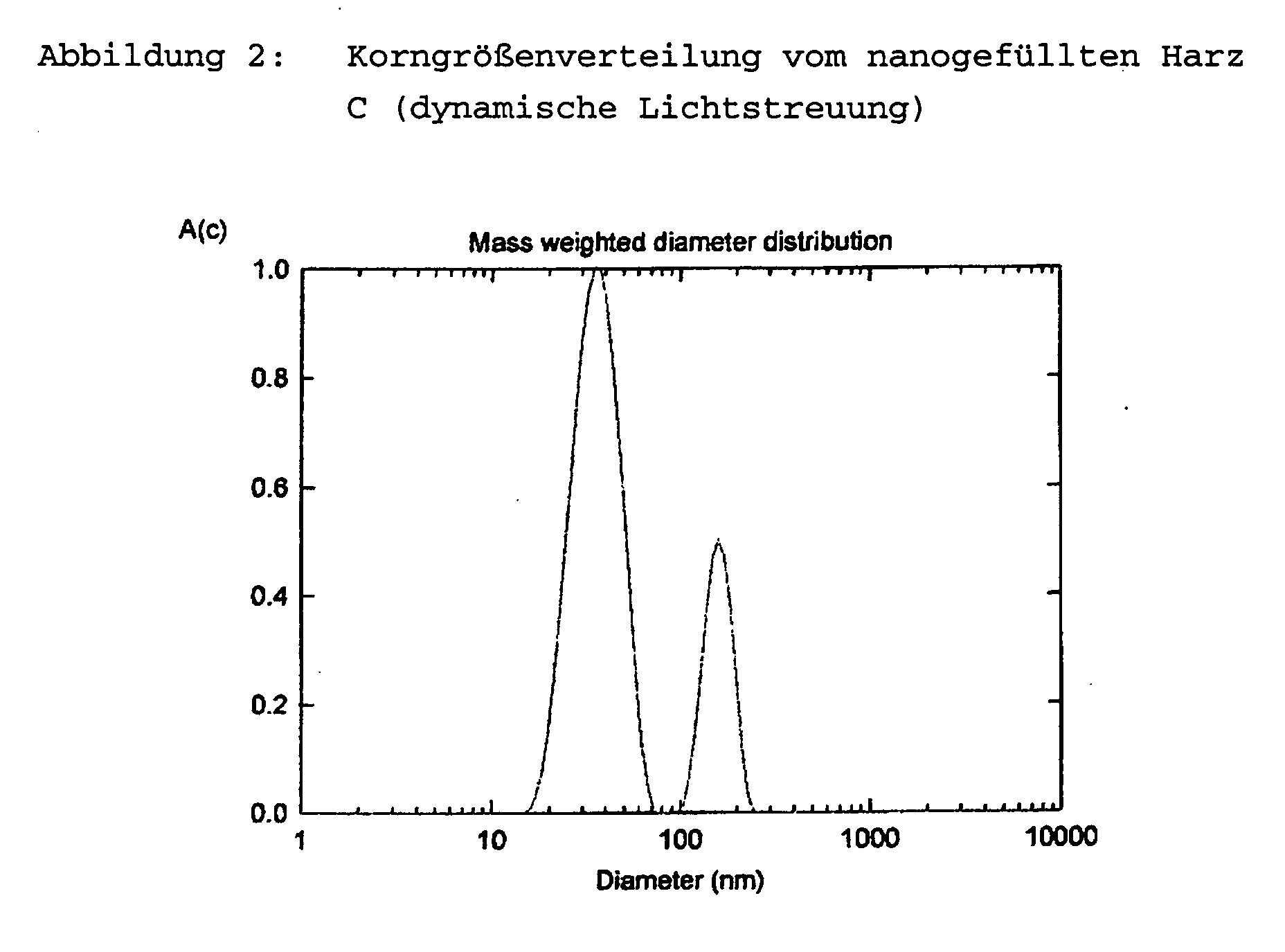
In contrast to the nanofilled resins B-1 and B-2, no separation occurred in this resin, so that in this case the particle size distribution of all particles could be determined by dynamic light scattering (see Figure 2).
Die obige Abbildung belegt eindeutig, dass mehr als 50 % der Teilchen des nanogefüllten Harzes C eine Korngröße d< 100 nm aufweisen. The above figure clearly shows that more than 50% the particle of the nanofilled resin C has a grain size d <100 nm.
In den folgenden Beispielen 1 - 4 werden Hybrid-Composite vorgestellt, die nach dem Stand der Technik (Referenzbeispiele) bzw. gemäß der vorliegenden Erfindung hergestellt wurden. Anzumerken ist, dass alle 5 Pasten sensorisch auf die selbe Konsistenz eingestellt wurden.In the following examples 1 - 4 will be hybrid composite presented in accordance with the prior art (reference examples) or produced according to the present invention were. It should be noted that all 5 pastes are sensory the same consistency were set.
In 34,1 g des Harzes A wurden 6,0 g Aerosil R 974 (Degussa
AG) und 130,7 g silanisiertes Barium-Silikatglas mit einer
mittleren Korngröße von 1,0 µm eingearbeitet. Anschließend
wurde für ca. 60 Minuten bei ca. 200 mbar entgast. Auf diese
Weise wurde eine feste, modellierbare, lichthärtende
Paste erhalten.
In 50,0 g des nanogefüllten Harzes B-1 wurden zunächst
70,6 g silanisiertes Barium-Silikatglas mit einer mittleren
Korngröße von 1,0 µm eingearbeitet. Die entstandene Paste
war jedoch so fest und bröselig, dass noch mit 10,0 g des
Harzes A verdünnt wurde. Anschließend wurde für ca. 60 Minuten
bei ca. 200 mbar entgast. Auf diese Weise wurde eine
feste, modellierbare, lichthärtende Paste erhalten.
In 50,0 g des nanogefüllten Harzes B-2 wurden zunächst
60,8 g silanisiertes Barium-Silikatglas mit einer mittleren
Korngröße von 1,0 µm eingearbeitet. Die entstandene Paste
war jedoch etwas zu fest und wurde daher noch mit 1,0 g des
Harzes A verdünnt. Anschließend wurde für ca. 60 Minuten
bei ca. 200 mbar entgast. Auf diese Weise wurde eine feste,
modellierbare, lichthärtende Paste erhalten.
In 50,1 g des nanogefüllten Harzes C wurden 105,5 g silanisiertes
Barium-Silikatglas mit einer mittleren Korngröße
von 1,0 µm eingearbeitet. Anschließend wurde für ca. 60 Minuten
bei ca. 300 mbar entgast. Auf diese Weise wurde eine
feste, modellierbare, lichthärtende Paste erhalten.
In 54,1 g des gefüllten Harzes C wurden 6,0 g Aerosil R 974
(Degussa AG) und 95,6 g silanisiertes Barium-Silikatglas
mit einer mittleren Korngröße von 1,0 µm eingearbeitet. Anschließend
wurde für ca. 60 Minuten bei ca. 200 mbar entgast.
Auf diese Weise wurde eine feste, modellierbare,
lichthärtende Paste erhalten.
In den folgenden Beispielen 5 und 6 werden Mikrofüller-Composite vorgestellt, die nach dem Stand der Technik (Referenzbeispiel) bzw. gemäß der vorliegenden Erfindung hergestellt wurden. Anzumerken ist, dass die beiden Pasten sensorisch auf die selbe Konsistenz eingestellt wurden.In the following examples 5 and 6 are microfiller composite presented according to the state of the art (reference example) or produced according to the present invention were. It should be noted that the two pastes sensory adjusted to the same consistency.
In 40,0 g des Harzes A wurden 14,0 g Aerosil R 974 (Degussa
AG) und 86,1 g eines gemahlenen Splitterpolymerisats, das
Dodekandioldimethacrylat, Trimethylolpropantrimethacrylat
und silanisiertes Aerosil OX 50 enthielt, eingearbeitet.
Anschließend wurde für ca. 45 Minuten bei ca. 300 mbar entgast.
Auf diese Weise wurde eine feste, modellierbare,
lichthärtende Paste erhalten.
In 54,0 g des nanogefüllten Harzes C wurden 100,7 g des in
Bsp. 5 beschriebenen, gemahlenen Splitterpolymerisats eingearbeitet.
Da die entstandene Peste zu fest war, wurde mit
12,4 g des nanogefüllten Harzes C verdünnt. Anschließend
wurde für ca. 60 Minuten bei ca. 200 mbar entgast. Auf diese
Weise wurde eine feste, modellierbare, lichthärtende
Paste erhalten.
Diese Ergebnisse zeigen, dass die Verwendung der erfindungsgemäß eingesetzten Zusammensetzung in Dentalmaterialien zu einer Erhöhung der Druckfestigkeit, zu einer Verringerung des Polymerisationsschrumpfes und zu einer Verbesserung der Abriebfestigkeit führt.These results show that the use of the invention used composition in dental materials to an increase in compressive strength, to a reduction the polymerization shrinkage and to an improvement the abrasion resistance leads.
Claims (27)
Priority Applications (11)
| Application Number | Priority Date | Filing Date | Title |
|---|---|---|---|
| EP04004852A EP1570831A1 (en) | 2004-03-02 | 2004-03-02 | Polymerisable dental material containing a filler |
| CNA2005800140843A CN1950054A (en) | 2004-03-02 | 2005-03-02 | Filling polymerizable dental material and method for its production |
| AU2005218920A AU2005218920B2 (en) | 2004-03-02 | 2005-03-02 | Filled, polymerisable dental material and process for the production thereof |
| PCT/EP2005/002196 WO2005084611A1 (en) | 2004-03-02 | 2005-03-02 | Filled polymerisable dental material and method for the production thereof |
| KR1020067020372A KR20070001209A (en) | 2004-03-02 | 2005-03-02 | Filled Polymeric Dental Materials and Methods of Making the Same |
| AT05715666T ATE415141T1 (en) | 2004-03-02 | 2005-03-02 | FILLED, POLYMERIZABLE DENTAL MATERIAL AND METHOD FOR THE PRODUCTION THEREOF |
| EP05715666A EP1720506B1 (en) | 2004-03-02 | 2005-03-02 | Filled polymerisable dental material and method for the production thereof |
| JP2007501209A JP2007526270A (en) | 2004-03-02 | 2005-03-02 | Filled polymerizable dental material and method for producing the same |
| DE502005006062T DE502005006062D1 (en) | 2004-03-02 | 2005-03-02 | FILLED, POLYMERIZABLE DENTAL MATERIAL AND METHOD FOR THE PRODUCTION THEREOF |
| US10/591,744 US20070142495A1 (en) | 2004-03-02 | 2005-03-02 | Filled polymerisable dental material and method for the production thereof |
| RU2006133997/15A RU2375038C2 (en) | 2004-03-02 | 2005-03-02 | Polymerised filler-containing dental material, and method of its manufacturing |
Applications Claiming Priority (1)
| Application Number | Priority Date | Filing Date | Title |
|---|---|---|---|
| EP04004852A EP1570831A1 (en) | 2004-03-02 | 2004-03-02 | Polymerisable dental material containing a filler |
Publications (1)
| Publication Number | Publication Date |
|---|---|
| EP1570831A1 true EP1570831A1 (en) | 2005-09-07 |
Family
ID=34745981
Family Applications (2)
| Application Number | Title | Priority Date | Filing Date |
|---|---|---|---|
| EP04004852A Withdrawn EP1570831A1 (en) | 2004-03-02 | 2004-03-02 | Polymerisable dental material containing a filler |
| EP05715666A Revoked EP1720506B1 (en) | 2004-03-02 | 2005-03-02 | Filled polymerisable dental material and method for the production thereof |
Family Applications After (1)
| Application Number | Title | Priority Date | Filing Date |
|---|---|---|---|
| EP05715666A Revoked EP1720506B1 (en) | 2004-03-02 | 2005-03-02 | Filled polymerisable dental material and method for the production thereof |
Country Status (10)
| Country | Link |
|---|---|
| US (1) | US20070142495A1 (en) |
| EP (2) | EP1570831A1 (en) |
| JP (1) | JP2007526270A (en) |
| KR (1) | KR20070001209A (en) |
| CN (1) | CN1950054A (en) |
| AT (1) | ATE415141T1 (en) |
| AU (1) | AU2005218920B2 (en) |
| DE (1) | DE502005006062D1 (en) |
| RU (1) | RU2375038C2 (en) |
| WO (1) | WO2005084611A1 (en) |
Cited By (6)
| Publication number | Priority date | Publication date | Assignee | Title |
|---|---|---|---|---|
| DE102005039435A1 (en) * | 2005-08-18 | 2007-03-01 | Clariant International Limited | Process for the preparation of silane-surface-modified nanocorundum |
| WO2008054434A3 (en) * | 2006-01-06 | 2008-07-31 | Eastman Kodak Co | Polymer composite with silane coated nanoparticles |
| EP2072028A1 (en) * | 2007-12-21 | 2009-06-24 | Ernst Mühlbauer GmbH & Co.KG | Stump construction |
| EP2153812A1 (en) * | 2008-08-13 | 2010-02-17 | Ernst Mühlbauer GmbH & Co.KG | X-ray opaque infiltrant |
| DE202010003032U1 (en) * | 2010-02-17 | 2011-08-12 | Ernst Mühlbauer Gmbh & Co. Kg | Infiltration solution for the treatment of an enamel lesion |
| CN105458257A (en) * | 2015-12-08 | 2016-04-06 | 南通金源智能技术有限公司 | 3D printing titanium-based composite false tooth |
Families Citing this family (56)
| Publication number | Priority date | Publication date | Assignee | Title |
|---|---|---|---|---|
| KR20060115398A (en) * | 2003-10-29 | 2006-11-08 | 독사 악티에볼락 | Two-stage system for early and final properties of improved biomaterials |
| EP2145613A1 (en) * | 2008-07-02 | 2010-01-20 | Ernst Mühlbauer GmbH & Co.KG | Infiltrant for dental application |
| EP2198824B1 (en) | 2008-12-22 | 2013-02-13 | Ernst Mühlbauer GmbH & Co.KG | Polymerizable dental material with initiator system |
| KR101117801B1 (en) * | 2009-05-12 | 2012-03-09 | (주)석경에이티 | Crown composition |
| RU2428165C1 (en) * | 2010-02-17 | 2011-09-10 | Государственное образовательное учреждение высшего профессионального образования "Воронежская государственная медицинская академия им. Н.Н. Бурденко Федерального агентства по здравоохранению и социальному развитию" | Zinc-phosphate cement for fixation of undetachable constructions of dental prostheses with addition of silicon nanoparticles |
| DE102010003884A1 (en) * | 2010-04-12 | 2011-10-13 | Voco Gmbh | Dual-curing, multi-component dental composition |
| DE102010003883A1 (en) | 2010-04-12 | 2011-10-13 | Voco Gmbh | Photopolymerizable dental composition, useful e.g. as dental filling material and crown material, comprises photopolymerizable monomer, photoinitiator, molecular weight regulator, inorganic filler and optionally additional additive |
| DE102010003881A1 (en) | 2010-04-12 | 2011-10-13 | Voco Gmbh | Dental masking compound |
| US20110290316A1 (en) * | 2010-05-28 | 2011-12-01 | Daniel Warren Hawtof | Light scattering inorganic substrates by soot deposition |
| AT12407U1 (en) | 2010-07-02 | 2012-05-15 | Stephan Lampl | DENTAL FRONT FACING BODY |
| US8557893B2 (en) * | 2010-09-15 | 2013-10-15 | 3M Innovative Properties Company | Substituted saccharide compounds and dental compositions |
| US8915736B2 (en) | 2010-09-30 | 2014-12-23 | Voco Gmbh | Composition comprising a monomer with a polyalicyclic structure element for filling and/or sealing a root canal |
| US8697769B2 (en) | 2010-09-30 | 2014-04-15 | Voco Gmbh | Lacquer composition comprising a monomer with a polyalicyclic structure element |
| EP2436668B1 (en) | 2010-09-30 | 2012-09-12 | VOCO GmbH | Polymerisable compounds comprising a polyalicyclic structure element |
| US8669302B2 (en) | 2010-09-30 | 2014-03-11 | Voco Gmbh | Composite material comprising a monomer with a polyalicyclic structure element as a sealing material |
| EP2436365B1 (en) | 2010-09-30 | 2017-03-08 | VOCO GmbH | Composite material comprising a monomer with a polyalicyclic structure element |
| EP2450025B1 (en) | 2010-11-08 | 2012-11-28 | VOCO GmbH | Polymerisable phosphoric acid derivatives comprising a polyalicyclic structure element |
| DE102011003289A1 (en) | 2011-01-27 | 2012-08-02 | Voco Gmbh | Dental provisional superstructures as well as materials for their production and corresponding methods |
| JP5819415B2 (en) | 2011-05-16 | 2015-11-24 | 三井化学株式会社 | NOVEL COMPOUND, COMPOSITION CONTAINING THE COMPOUND, AND CURED PRODUCT |
| EP2710994B1 (en) | 2011-05-16 | 2018-08-01 | Mitsui Chemicals, Inc. | Dental material, dental material composition, dental repair material, and cured product |
| EP2578200B1 (en) | 2011-10-04 | 2018-03-28 | VOCO GmbH | Compounds for infiltrating and/or sealing of dental hard substance and method |
| DE102012001978A1 (en) | 2012-02-02 | 2013-08-08 | Voco Gmbh | Dental composite materials containing tricyclic plasticizers |
| DE102012001979A1 (en) | 2012-02-02 | 2013-08-08 | Voco Gmbh | A curable composition comprising plasticizer having a polyalicyclic structural element for use in the manufacture of dental materials |
| DE102012006152A1 (en) * | 2012-03-28 | 2013-10-02 | Heraeus Kulzer Gmbh | Polymerized dental composites with improved performance properties, methods for adjusting the performance of polymerisable dental composites, and dental composites optimized by these methods |
| CN102688106A (en) * | 2012-05-08 | 2012-09-26 | 上海上远齿科技术有限公司 | Three-dimensionally printed and rapidly formed resin tooth and preparation method thereof |
| DE102012214540A1 (en) | 2012-08-15 | 2014-02-20 | Helmholtz-Zentrum für Infektionsforschung GmbH | Tooth filling materials and coatings for inhibiting the biofilm formation of Streptococcus mutans and their production |
| DE102013008176A1 (en) | 2012-10-05 | 2014-04-10 | Voco Gmbh | Kit and method for the indirect chairside production of composite inlays |
| RU2508132C1 (en) * | 2013-01-10 | 2014-02-27 | Федеральное государственное бюджетное учреждение науки Институт химии Дальневосточного отделения Российской академии наук (ИХ ДВО РАН) | Method of making calcium-phosphate glass fibre materials |
| AT513857B1 (en) | 2013-02-27 | 2014-08-15 | Lampl Stephan | Dental partial denture |
| JP6099443B2 (en) * | 2013-03-18 | 2017-03-22 | 株式会社トクヤマデンタル | Dental composition and method for producing the same |
| CN103319832B (en) * | 2013-06-13 | 2015-08-19 | 北京化工大学 | Photo-curing compound resin used for dental repair and preparation method thereof |
| US9782329B2 (en) * | 2013-07-08 | 2017-10-10 | 3M Innovative Properties Company | Hardenable dental composition containing a mixture of agglomerated and aggregated nano-particles, kit of parts and use thereof |
| DE102013216855B4 (en) | 2013-08-23 | 2022-10-20 | Mühlbauer Technology Gmbh | Device and method for the production of shaped bodies |
| AU2015211768B2 (en) * | 2014-01-31 | 2017-06-08 | Gc Corporation | Filler for dental glass ionomer cement, and method for manufacturing same |
| DE102014203166A1 (en) | 2014-02-21 | 2015-08-27 | Mühlbauer Technology Gmbh | Polymerizable dental material |
| DE102014210432A1 (en) | 2014-06-03 | 2015-12-03 | Voco Gmbh | Polysiloxane compound and dental materials producible therefrom |
| DE102014109233B4 (en) * | 2014-07-01 | 2025-10-23 | Kulzer Gmbh | Milling blanks based on polymerized prosthetic material, in particular a polymerized, fracture-tough prosthetic material, in the form of milling blanks |
| JP5736082B1 (en) * | 2014-09-24 | 2015-06-17 | 株式会社松風 | Dental curable composition containing chain transfer agent |
| EP2962677A3 (en) | 2014-07-03 | 2016-01-20 | Shofu Inc. | Dental curable composition including chain transfer agent |
| EP3011949B1 (en) | 2014-10-23 | 2021-05-05 | VOCO GmbH | Curable dental material |
| DE102014116402A1 (en) * | 2014-11-11 | 2016-05-12 | Voco Gmbh | Use of radically curable compositions in additive manufacturing processes |
| DE102014116389A1 (en) | 2014-11-11 | 2016-05-12 | Voco Gmbh | Free-radically curable dental compositions |
| RU2599024C1 (en) * | 2015-06-25 | 2016-10-10 | Закрытое акционерное общество "Опытно-экспериментальный завод "ВладМиВа" | Composition of light-curing nanostructural composite material for orthopedic dentistry |
| US20160374905A1 (en) * | 2015-06-26 | 2016-12-29 | City University Of Hong Kong | Medium for a dental structure and a method of producing a medium for a dental structure |
| WO2017132350A1 (en) * | 2016-01-29 | 2017-08-03 | Tolmar Inc. | Purification and decolorization of polymers |
| CN109890344B (en) * | 2016-10-21 | 2022-02-22 | 可乐丽则武齿科株式会社 | Subcontracted dental cement |
| WO2018077973A1 (en) * | 2016-10-27 | 2018-05-03 | Michael Malkoch | A composition comprising thiol, alkene and phosphonic acid containing compounds for use as a primer for adhesion improvement |
| DE102017103084A1 (en) | 2017-02-15 | 2018-08-16 | Voco Gmbh | Dental composite block for the production of permanent indirect restorations using the CAD / CAM method |
| DE102017105841A1 (en) | 2017-03-17 | 2018-09-20 | Voco Gmbh | Milling blank for the production of an indirect dental restoration, corresponding uses and methods |
| JP7398364B2 (en) * | 2017-09-11 | 2023-12-14 | スリーエム イノベイティブ プロパティズ カンパニー | Composite articles made using radiation-curable compositions and additive manufacturing processes |
| DE102018103415A1 (en) | 2018-02-15 | 2019-08-22 | Voco Gmbh | Dental moldings with continuous gradient |
| WO2020122124A1 (en) | 2018-12-11 | 2020-06-18 | 三井化学株式会社 | (meth)acrylate, monomer composition, molded article, dental material composition, and dental material |
| DE102019105816A1 (en) | 2019-03-07 | 2020-09-10 | Mühlbauer Technology Gmbh | Dental moldings produced by stereolithography and processes for the production from photopolymerizable composite resin compositions |
| DE102019122174A1 (en) | 2019-08-19 | 2021-02-25 | Voco Gmbh | Dental polymerizable composition based on condensed silanes |
| CN116178590B (en) * | 2022-12-09 | 2024-03-29 | 杭州楠大环保科技有限公司 | A microbial nutrient synergist suitable for wastewater treatment |
| KR102910225B1 (en) | 2023-03-06 | 2026-01-08 | 부산대학교 산학협력단 | Root canal filler composition and manufacturing method thereof |
Citations (7)
| Publication number | Priority date | Publication date | Assignee | Title |
|---|---|---|---|---|
| EP0530926A1 (en) * | 1991-09-06 | 1993-03-10 | Kanebo Ltd. | Dental filling composition |
| EP0648484A1 (en) * | 1993-10-07 | 1995-04-19 | Heraeus Kulzer GmbH | Inorganic filter having retentions, process for its preparation and use |
| DE19617931A1 (en) * | 1996-04-26 | 1997-11-06 | Ivoclar Ag | Filled and polymerizable dental material |
| US6121344A (en) * | 1998-06-19 | 2000-09-19 | Kerr Corporation | Optimum particle sized hybrid composite |
| EP1149573A2 (en) * | 2000-04-28 | 2001-10-31 | Kabushiki Kaisha Shofu | A dental composite material comprising aggregate |
| DE10042050A1 (en) * | 2000-08-26 | 2002-03-14 | Degussa | Dental composites comprising hybrid fillers and process for their production |
| WO2002092022A2 (en) * | 2001-05-16 | 2002-11-21 | Kerr Corporation | Dental composite containing discrete nanoparticles |
Family Cites Families (13)
| Publication number | Priority date | Publication date | Assignee | Title |
|---|---|---|---|---|
| RU2098077C1 (en) * | 1994-09-09 | 1997-12-10 | Институт химии поверхности НАН Украины | Composition for teeth filling |
| JPH08143747A (en) * | 1994-11-24 | 1996-06-04 | San Medical Kk | Composite filler, its production, and dental resin composition produced by using the same |
| JP3524233B2 (en) * | 1995-08-23 | 2004-05-10 | 株式会社ジーシー | Dental inorganic-organic composite filler |
| JP3495171B2 (en) * | 1996-01-25 | 2004-02-09 | サンメディカル株式会社 | Dental filling composition |
| US6730156B1 (en) * | 1999-10-28 | 2004-05-04 | 3M Innovative Properties Company | Clustered particle dental fillers |
| DE19961341C2 (en) * | 1999-12-17 | 2003-09-11 | 3M Espe Ag | Improved dental materials |
| US6353037B1 (en) * | 2000-07-12 | 2002-03-05 | 3M Innovative Properties Company | Foams containing functionalized metal oxide nanoparticles and methods of making same |
| DE10063939B4 (en) * | 2000-12-20 | 2005-01-27 | 3M Espe Ag | Dental cement containing a reaction-resistant dental glass and method for its production |
| US6890968B2 (en) * | 2001-05-16 | 2005-05-10 | Kerr Corporation | Prepolymerized filler in dental restorative composite |
| US6688494B2 (en) * | 2001-12-20 | 2004-02-10 | Cima Nanotech, Inc. | Process for the manufacture of metal nanoparticle |
| WO2003097652A1 (en) * | 2002-05-15 | 2003-11-27 | Creavis Gesellschaft Für Technologie Und Innovation Mbh | Nanofiller, production, and use |
| US7285583B2 (en) * | 2002-07-30 | 2007-10-23 | Liquamelt Licensing Llc | Hybrid plastisol/hot melt compositions |
| DE10236146A1 (en) * | 2002-07-31 | 2004-02-19 | Basf Coatings Ag | Coating material, useful for scratch-resistant, transparent coatings, films, shaped parts, and multilayer effect coatings in automobile finishing, contains hydrophobic and hydrophilic nano particles based on silicon dioxide |
-
2004
- 2004-03-02 EP EP04004852A patent/EP1570831A1/en not_active Withdrawn
-
2005
- 2005-03-02 AT AT05715666T patent/ATE415141T1/en not_active IP Right Cessation
- 2005-03-02 DE DE502005006062T patent/DE502005006062D1/en not_active Expired - Lifetime
- 2005-03-02 WO PCT/EP2005/002196 patent/WO2005084611A1/en not_active Ceased
- 2005-03-02 CN CNA2005800140843A patent/CN1950054A/en active Pending
- 2005-03-02 AU AU2005218920A patent/AU2005218920B2/en not_active Ceased
- 2005-03-02 KR KR1020067020372A patent/KR20070001209A/en not_active Ceased
- 2005-03-02 EP EP05715666A patent/EP1720506B1/en not_active Revoked
- 2005-03-02 US US10/591,744 patent/US20070142495A1/en not_active Abandoned
- 2005-03-02 RU RU2006133997/15A patent/RU2375038C2/en not_active IP Right Cessation
- 2005-03-02 JP JP2007501209A patent/JP2007526270A/en not_active Abandoned
Patent Citations (7)
| Publication number | Priority date | Publication date | Assignee | Title |
|---|---|---|---|---|
| EP0530926A1 (en) * | 1991-09-06 | 1993-03-10 | Kanebo Ltd. | Dental filling composition |
| EP0648484A1 (en) * | 1993-10-07 | 1995-04-19 | Heraeus Kulzer GmbH | Inorganic filter having retentions, process for its preparation and use |
| DE19617931A1 (en) * | 1996-04-26 | 1997-11-06 | Ivoclar Ag | Filled and polymerizable dental material |
| US6121344A (en) * | 1998-06-19 | 2000-09-19 | Kerr Corporation | Optimum particle sized hybrid composite |
| EP1149573A2 (en) * | 2000-04-28 | 2001-10-31 | Kabushiki Kaisha Shofu | A dental composite material comprising aggregate |
| DE10042050A1 (en) * | 2000-08-26 | 2002-03-14 | Degussa | Dental composites comprising hybrid fillers and process for their production |
| WO2002092022A2 (en) * | 2001-05-16 | 2002-11-21 | Kerr Corporation | Dental composite containing discrete nanoparticles |
Non-Patent Citations (2)
| Title |
|---|
| PATENT ABSTRACTS OF JAPAN vol. 1996, no. 10 31 October 1996 (1996-10-31) * |
| PATENT ABSTRACTS OF JAPAN vol. 1997, no. 11 28 November 1997 (1997-11-28) * |
Cited By (10)
| Publication number | Priority date | Publication date | Assignee | Title |
|---|---|---|---|---|
| DE102005039435A1 (en) * | 2005-08-18 | 2007-03-01 | Clariant International Limited | Process for the preparation of silane-surface-modified nanocorundum |
| US8070079B2 (en) | 2005-08-18 | 2011-12-06 | Clariant Finance (Bvi) Limited | Method for producing a silane modified surface nano-corundum |
| WO2008054434A3 (en) * | 2006-01-06 | 2008-07-31 | Eastman Kodak Co | Polymer composite with silane coated nanoparticles |
| EP2072028A1 (en) * | 2007-12-21 | 2009-06-24 | Ernst Mühlbauer GmbH & Co.KG | Stump construction |
| WO2009083168A1 (en) | 2007-12-21 | 2009-07-09 | Ernst Mühlbauer Gmbh & Co. Kg | Material for building up stumps |
| EP2153812A1 (en) * | 2008-08-13 | 2010-02-17 | Ernst Mühlbauer GmbH & Co.KG | X-ray opaque infiltrant |
| US8183305B2 (en) | 2008-08-13 | 2012-05-22 | Ernst Muhlbauer Gmbh & Co. Kg | Radiopaque infiltrant |
| EP2548546A1 (en) * | 2008-08-13 | 2013-01-23 | Ernst Mühlbauer GmbH & Co.KG | X-ray opaque infiltrant |
| DE202010003032U1 (en) * | 2010-02-17 | 2011-08-12 | Ernst Mühlbauer Gmbh & Co. Kg | Infiltration solution for the treatment of an enamel lesion |
| CN105458257A (en) * | 2015-12-08 | 2016-04-06 | 南通金源智能技术有限公司 | 3D printing titanium-based composite false tooth |
Also Published As
| Publication number | Publication date |
|---|---|
| KR20070001209A (en) | 2007-01-03 |
| JP2007526270A (en) | 2007-09-13 |
| AU2005218920B2 (en) | 2010-11-18 |
| EP1720506A1 (en) | 2006-11-15 |
| RU2375038C2 (en) | 2009-12-10 |
| EP1720506B1 (en) | 2008-11-26 |
| US20070142495A1 (en) | 2007-06-21 |
| CN1950054A (en) | 2007-04-18 |
| AU2005218920A1 (en) | 2005-09-15 |
| ATE415141T1 (en) | 2008-12-15 |
| DE502005006062D1 (en) | 2009-01-08 |
| RU2006133997A (en) | 2008-04-10 |
| WO2005084611A1 (en) | 2005-09-15 |
Similar Documents
| Publication | Publication Date | Title |
|---|---|---|
| EP1720506B1 (en) | Filled polymerisable dental material and method for the production thereof | |
| DE60116142T2 (en) | DENTAL MASSES | |
| DE60030753T2 (en) | DENTAL FILLING MATERIALS FROM AGGREGATED PARTICLES | |
| EP1234567B1 (en) | Filling material based on particulate composite | |
| EP3166569B1 (en) | Composites with controlled network structure | |
| DE112013002309B4 (en) | Radically polymerizable dental material, cured product and use | |
| EP2237763B1 (en) | Material for building up stumps | |
| EP3659575A1 (en) | Photopolymerisable dental composites with fast curing and low shrinkage stress | |
| EP1716836B1 (en) | Surface-modified fillers | |
| EP3020360B1 (en) | Radically curable dental compositions | |
| EP2233123B1 (en) | Self-adhesive multi-component dental material | |
| EP3782599B1 (en) | Dental polymerizable composition based on condensed silanes | |
| EP1502570A1 (en) | Radiopaque dental material with surface treated nanoparticles | |
| DE102006045628A1 (en) | Radiopaque dental adhesive for fixing composite materials to enamel or dentine, contains acrylic monomers, acid monomers and mixed oxide nano-particles, preferably based on silicon dioxide and tantalum oxide | |
| EP1560557A1 (en) | Composite material and use of a composite material | |
| EP1913927A1 (en) | Polymerisable dental material with nano-diamond | |
| EP1951183B1 (en) | Restoring materials containing nanocrystalline earth alkaline fillers | |
| WO2015139811A1 (en) | Monomer mixtures for producing dental materials | |
| EP4356893A1 (en) | Storage stable self-adhesive composite cements with good transparency and good radiopacity | |
| EP4488243A1 (en) | Acid-stable glass fillers and self-adhesive dental composite cements containing same having good transparency | |
| DE69835507T2 (en) | Dental materials with a nanoscale filler | |
| EP4124331A1 (en) | Aesthetic dental filling material with high curing depth |
Legal Events
| Date | Code | Title | Description |
|---|---|---|---|
| PUAI | Public reference made under article 153(3) epc to a published international application that has entered the european phase |
Free format text: ORIGINAL CODE: 0009012 |
|
| AK | Designated contracting states |
Kind code of ref document: A1 Designated state(s): AT BE BG CH CY CZ DE DK EE ES FI FR GB GR HU IE IT LI LU MC NL PL PT RO SE SI SK TR |
|
| AX | Request for extension of the european patent |
Extension state: AL LT LV MK |
|
| AKX | Designation fees paid | ||
| STAA | Information on the status of an ep patent application or granted ep patent |
Free format text: STATUS: THE APPLICATION IS DEEMED TO BE WITHDRAWN |
|
| 18D | Application deemed to be withdrawn |
Effective date: 20060308 |
|
| REG | Reference to a national code |
Ref country code: DE Ref legal event code: 8566 |