EP2710552B1 - Verfahren zur bestimmung von markierungen in einem relief auf der aussenseite der seitenwand eines reifens - Google Patents
Verfahren zur bestimmung von markierungen in einem relief auf der aussenseite der seitenwand eines reifens Download PDFInfo
- Publication number
- EP2710552B1 EP2710552B1 EP12722108.3A EP12722108A EP2710552B1 EP 2710552 B1 EP2710552 B1 EP 2710552B1 EP 12722108 A EP12722108 A EP 12722108A EP 2710552 B1 EP2710552 B1 EP 2710552B1
- Authority
- EP
- European Patent Office
- Prior art keywords
- image
- structuring element
- extraction according
- seg
- aid
- Prior art date
- Legal status (The legal status is an assumption and is not a legal conclusion. Google has not performed a legal analysis and makes no representation as to the accuracy of the status listed.)
- Not-in-force
Links
Images


Classifications
-
- G—PHYSICS
- G06—COMPUTING OR CALCULATING; COUNTING
- G06T—IMAGE DATA PROCESSING OR GENERATION, IN GENERAL
- G06T7/00—Image analysis
- G06T7/0002—Inspection of images, e.g. flaw detection
- G06T7/0004—Industrial image inspection
-
- G—PHYSICS
- G06—COMPUTING OR CALCULATING; COUNTING
- G06T—IMAGE DATA PROCESSING OR GENERATION, IN GENERAL
- G06T7/00—Image analysis
- G06T7/10—Segmentation; Edge detection
- G06T7/11—Region-based segmentation
-
- G—PHYSICS
- G06—COMPUTING OR CALCULATING; COUNTING
- G06T—IMAGE DATA PROCESSING OR GENERATION, IN GENERAL
- G06T5/00—Image enhancement or restoration
- G06T5/20—Image enhancement or restoration using local operators
- G06T5/30—Erosion or dilatation, e.g. thinning
-
- G—PHYSICS
- G06—COMPUTING OR CALCULATING; COUNTING
- G06T—IMAGE DATA PROCESSING OR GENERATION, IN GENERAL
- G06T5/00—Image enhancement or restoration
- G06T5/40—Image enhancement or restoration using histogram techniques
-
- G—PHYSICS
- G06—COMPUTING OR CALCULATING; COUNTING
- G06T—IMAGE DATA PROCESSING OR GENERATION, IN GENERAL
- G06T5/00—Image enhancement or restoration
- G06T5/50—Image enhancement or restoration using two or more images, e.g. averaging or subtraction
-
- G—PHYSICS
- G06—COMPUTING OR CALCULATING; COUNTING
- G06T—IMAGE DATA PROCESSING OR GENERATION, IN GENERAL
- G06T7/00—Image analysis
- G06T7/10—Segmentation; Edge detection
- G06T7/155—Segmentation; Edge detection involving morphological operators
-
- G—PHYSICS
- G06—COMPUTING OR CALCULATING; COUNTING
- G06T—IMAGE DATA PROCESSING OR GENERATION, IN GENERAL
- G06T7/00—Image analysis
- G06T7/10—Segmentation; Edge detection
- G06T7/168—Segmentation; Edge detection involving transform domain methods
-
- G—PHYSICS
- G06—COMPUTING OR CALCULATING; COUNTING
- G06T—IMAGE DATA PROCESSING OR GENERATION, IN GENERAL
- G06T7/00—Image analysis
- G06T7/10—Segmentation; Edge detection
- G06T7/174—Segmentation; Edge detection involving the use of two or more images
-
- G—PHYSICS
- G06—COMPUTING OR CALCULATING; COUNTING
- G06T—IMAGE DATA PROCESSING OR GENERATION, IN GENERAL
- G06T2207/00—Indexing scheme for image analysis or image enhancement
- G06T2207/20—Special algorithmic details
- G06T2207/20036—Morphological image processing
-
- G—PHYSICS
- G06—COMPUTING OR CALCULATING; COUNTING
- G06T—IMAGE DATA PROCESSING OR GENERATION, IN GENERAL
- G06T2207/00—Indexing scheme for image analysis or image enhancement
- G06T2207/20—Special algorithmic details
- G06T2207/20212—Image combination
- G06T2207/20224—Image subtraction
-
- G—PHYSICS
- G06—COMPUTING OR CALCULATING; COUNTING
- G06T—IMAGE DATA PROCESSING OR GENERATION, IN GENERAL
- G06T2207/00—Indexing scheme for image analysis or image enhancement
- G06T2207/30—Subject of image; Context of image processing
- G06T2207/30108—Industrial image inspection
Definitions
- the invention relates to the field of the manufacture of tires, and fits more generally in the context of control operations of the external or internal appearance of tires in progress or at the end of the manufacturing process, with the aim of determine their conformity with established control references.
- the automatic industrial control means developed by the tire manufacturers, and intended in particular to assist the operators responsible for visual inspection, make extensive use of image processing techniques.
- the methods used to perform these treatments consist, as a rule, in comparing an image in two or preferably in three dimensions of the surface of the tire to be inspected, with a reference image in two and preferably in three dimensions of the surface of said tire.
- one of the steps of this process consists, in known manner, in acquiring the three-dimensional image of the surface of the tire, using, for example, means based on the principle of optical triangulation, putting for example in a 2D sensor coupled to a laser light source.
- the topographic image of the surface of the tire is generally a two-dimensional, so-called gray-level image, in which, at any point, ie at every pixel (x, y) of the image, is associated a value f ( x, y), called the gray level, and representing the altitude of this point relative to the surface.
- This value of gray level can usefully be coded on 8, or 16 bits even 32 bits for a better dynamics. For 8-bit encoding, the value 255 (white) corresponds to the highest altitude, and the value 0 (black) corresponds to the lowest altitude.
- the further process of analyzing the image obtained consists, among other things, in identifying the reliefs of the surface to be inspected. This step is particularly important in the analysis of the external part of the tire in that the markings carried by the sidewall must be precisely located and identified, so as not to be considered as surface anomalies.
- markings are formed by relief patterns exceeding a few tenths of a millimeter the average surface of the sidewall.
- a first, known method for extracting these patterns in relief consists in determining the average value of the bulge of the sidewall, and to assimilate to etching patterns the difference between the real bulge of the sidewall and the middle bulge.
- the real bulge of the sidewall may have circumferential variations whose amplitude exceeds the elevation of the patterns carried by the sidewall, thereby causing poor pattern detection in the areas considered.
- the method according to the invention aims to provide a solution to the problem.
- This method of extracting the relief marking patterns on the surface of the sidewall of a tire is based on the assimilation of the grayscale image of the reliefs of the marking patterns to a black and white image, on which it becomes possible, in order to extract the information sought, to widely use the properties of morphological operators, after having adapted to the specificities of the tire.
- Morphological operators commonly used are morphological openings and closures, dilations or morphological erosions, using suitable structuring elements.
- a structuring element is a set used to probe the studied image. It can be seen as a tool that would erode (ie remove material) or dilate (ie add matter) to an image.
- the pixels of the sidewall images in the circumferential direction have approximately the same altitude.
- the bump objects having a size larger than the size of the structuring element are removed, which makes it possible, by difference, to successively reveal the patterns of increasing circumferential length while avoiding the curved circumferential flank, here assimilated to the geometry of the flank in a radial plane.
- the size of the structuring elements will be chosen so that the first linear structuring element is formed of a number of pixels corresponding to a length of between 4 and 10 mm, that the second structuring element linear is formed of a number of pixels corresponding to a length of between 15 and 30 mm, and that the third linear structuring element is formed of a number of pixels corresponding to a length of between 200 and 400 mm.
- step C it is advantageous to transform at least one flattened image by performing a morphological opening with the aid of a linear structuring element oriented in the radial direction, and to subtract this image resultant of said flat image.
- the structuring element may advantageously, depending on the definition of the image, be formed of a number of pixels corresponding to a length of between 15 and 30 mm.
- step D On the basis of the variation in height induced by a variation of shade of gray, it is particularly interesting, during step D, to perform a thresholding of the gray level corresponding to a variation in height greater than or equal to 0.15mm. In the case of the tire, this height is less than the average height of the patterns that one seeks to locate.
- a series of morphological openings of the initial image is alternately carried out using linear structuring elements of increasing size and oriented in the circumferential direction, so as to obtain an image the bulge of the surface in which the protruding patterns and the hollow and humped objects are removed.
- the interval of the average of the gray levels may advantageously correspond to a variation in height of between 0.2 mm and 0.3 mm, and the value of the threshold of the standard deviation of the gray levels corresponds to at a variation of height less than or equal to 0,2mm.
- EP 2 077 442 A1 discloses a system for separating tire characteristics using non-morphological filters.
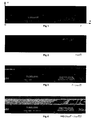
- the image of the figure 1 represents a partial view of the image of the sidewall of a tire. This image is obtained using a means using known technologies in themselves such as laser triangulation.
- T consists of integer values between 0 and 255.
- the gray level value represents the altitude of this point relative to the surface topographic of the tire.
- the image is calibrated so that the variation of a gray level unit corresponds to a height of approximately 0.01 mm.
- the number of pixels of the image naturally depends on the choice of the camera used and the input mode, but it is common to make images comprising 40,000 x 5000 pixels to represent the entire sidewall.
- the polar coordinates of the circular image of the sidewall of the tire are converted into orthogonal coordinates.
- the image of the figure 1 is represented in said orthogonal coordinate system in which the abscissa axis OX represents the circumferential values and the ordinate axis OY represents the radial values.
- the next step of the method according to the invention consists in performing series of morphological openings of the image of the surface with the aid of a structuring element having the shape of a segment oriented in the circumferential direction. ie along the axis OX, to overcome the bulge of the surface of the sidewall, considering that this bulge is substantially the same for a given radial value.
- the structuring element is small in relation to the circumferential variations of said crown, which also makes it possible to overcome the disadvantages mentioned in the introduction concerning the circumferential variation of the crown.
- the size of the structuring elements finally makes it possible to select the raised patterns that are to be detached from the surface of the sidewall.
- a first structuring element comprising a number of pixels corresponding to a length of between 4 mm and 10 mm is successively used; which corresponds to approximately 150 pixels. This size makes it possible to select, as will be seen later, the entries comprising small characters.
- the second structuring element comprises a number of pixels corresponding to a length of between 15 mm and 30 mm, which in the context of the example serving as a support for the present description represents approximately 500 pixels. This size is used to select the larger area patterns corresponding to the letters and ornaments on the sidewall.
- the third structuring element comprises a number of pixels corresponding to a length of between 200 mm and 400 mm, which correspond to approximately 7000 pixels, and which makes it possible to select the decorative elements spreading on the circumference such as strips or series of contiguous character.
- the morphological opening series of the surface f, ⁇ 150 ( f ), ⁇ 500 ( f ), and ⁇ 7000 ( f) are respectively performed.
- the images obtained are reproduced respectively on the figures 2 , 5 and 8 .
- the figure 8 no longer includes any characters or decorative motifs.
- the difference between two images consists, for each of the pixels i, j of the image, to make the difference in gray level. It will be observed that during this operation, the resulting image is a relief image in which the patterns appear on a plane and no longer on a curved surface.
- the calculation is initialized by differentiating between the image obtained by morphological opening of the starting image f with the smaller structuring element ⁇ 150 ( f ), and the initial image f .
- a thresholding of each of these images is performed so as to obtain binary images in which the patterns appear in white and the background in black.
- this threshold In order to avoid false detections, this threshold must correspond to a height just below the minimum height of the patterns, without being too weak, so as to avoid considering relief variations of insignificant heights as relief patterns. For a passenger tire of current size, this threshold is about 0.15 mm, which corresponds to about fifteen units of gray levels.
- the figures 7 and 10 illustrate the binary images seg 2 ( ⁇ 150 ( f ) - ⁇ 500 ( f )) and seg 3 ( ⁇ 500 ( f ) - ⁇ 7000 ( f )), obtained after segmentation of the images laid out flat and illustrated by the figures 6 and 9 .
- These operations consist of making a top-hat of the image laid flat using a linear structuring element oriented in the radial direction.
- the size of this structuring element in the case of a passenger tire of current size, can usefully be between 15 and 30 mm which corresponds in the case of the example serving as a support for the present description to about 500 pixels.
- ⁇ 500 ( f - ⁇ 150 ( f )) ( f - ⁇ 150 ( f )) - ⁇ 500 ( f - ⁇ 150 ( f )) , and appears in its binary form, seg 1 ( ⁇ 500 ( f- ⁇ 150 ( f )), at figure 4 .
- the number of morphological openings, flattened images and binary images is not limited to 3, and that it can be increased or reduced to the choice of the user of the method according to the invention.
- the conduct of the calculation steps remains the same, and the results obtained are of the same nature. It turns out, however, that this limitation to three morphological openings is particularly well suited to the case of tourist tires of current size.
- the increase in the number of steps, which will necessarily be to the detriment of the calculation time, may make it possible to solve the case of larger tires presenting particular graphic ornaments or in which the sizes or the heights of the raised markings vary. strongly.
- the first step of this optional process consists in identifying the patterns appearing in relief on the binary image seg i , which appear in white on the black background of said image. An identification number is assigned to each of these patterns and to each pixel constituting this pattern. It will be ensured that two disjoint motives are not identified by the same number. Disjoints here are understood to mean patterns separated from each other by pixels belonging to the background of the black-colored relief and whose value of gis level is equal to zero, so that it is not possible to move in a continuous manner. from any motive to any other motive without crossing a space of black color.
- the bulge of the flank surface is then determined from the starting surface f.
- a series of morphological openings and closures of the starting surface f are alternately carried out using linear structuring elements oriented in the circumferential direction and whose size is increasing, so as to obtain a surface in which the raised patterns, as well as the hollows abnormalities are eliminated.
- This operation is noted ⁇ es 1 ⁇ ⁇ es 2 ⁇ ⁇ es 3 ⁇ ...... ⁇ esn ( f ), where es 1 ⁇ es 2 ⁇ es 3 ⁇ .... esi ... ⁇ esn .
- the number of opening and closing is not limiting, but it is observed that the result obtained no longer changes significantly beyond a limited number of operations.
- the length of the structuring elements is adapted, as before, to the size of the relief patterns present on the surface of the sidewall.
- the structuring elements are adapted accordingly, and have a size whose number of pixels corresponds to lengths ranging from a few millimeters to a few hundred millimeters.
- This operation amounts to making a flattening of the considered pattern.
- each bounding box contains only one reason.
- said bounding box contains a pattern of a given label and all or part of other different label reasons.
- the following operation consists of calculating the average value and the standard deviation of the values of the gray levels of the pixels of the pattern laid flat or of the FIG. 4 shows a planar layout, and compares these values with ranges of values or with predetermined thresholds representative of the average heights of the patterns that are to be identified on the surface of the sidewall of the tire.
- Patterns whose average values and standard deviations are within the agreed limits are kept in the binary image, and patterns whose average values are not within these limits are extracted from the binary image by returning pixels that form these patterns to the value zero, so that they are confused with the black value of the bottom.
- a corrected binary image is thus obtained, as shown in FIG. figure 15 , where the image seg 2 horn corresponds to the image seg 2 corrected by applying the calculation steps detailed above. It is observed that the bridge between the two platelets has disappeared.
- the example of implementation of the method according to the invention is not limiting and may be adapted according to the indications given to meet the analysis of tires of various sizes and uses taking into account the specific features of the patterns. on the flank.
Landscapes
- Engineering & Computer Science (AREA)
- Physics & Mathematics (AREA)
- General Physics & Mathematics (AREA)
- Theoretical Computer Science (AREA)
- Computer Vision & Pattern Recognition (AREA)
- Quality & Reliability (AREA)
- Image Processing (AREA)
- Image Analysis (AREA)
- Length Measuring Devices By Optical Means (AREA)
Claims (15)
- Verfahren zum Extrahieren der Reliefmarkierungsmuster auf der Oberfläche der Flanke eines Reifens, das die Schritte umfasst, im Laufe derer:A- man das dreidimensionale Bild der Oberfläche der Flanke erfasst, indem man jedem Pixel (i, j) des Bilds einen Graustufenwert anteilsmäßig zu der Höhenlage dieses Punkts in Bezug auf die Oberfläche zuweist, um ein Ausgangsbild (f) zu erzielen, gekennzeichnet durch die folgenden Schritte:B- mit Hilfe linearer strukturierender Elemente mit nacheinander steigender Größe und die in die Umfangsrichtung ausgerichtet sind, Ausführen einer Reihe morphologischer Öffnungen des Bilds (f) der Ausgangsoberfläche (γ 150(f), γ 500(f), γ 7000(f)),C- Subtrahieren von dem Wert eines Bilds, das nach dem morphologischen Öffnen mit einem strukturierenden Element erzielt wurde, des Werts des erzielten Bilds nach morphologischem Öffnen mit Hilfe des strukturierenden Elements mit einer unmittelbar kleineren Größe (f-γ 150(f), γ 150(f)-γ 500(f), γ 500(f)-γ 7000(f)) derart, dass eine Abfolge von Bildern erzielt wird, die durch Differenz abgeflacht sind, indem die Subtraktionsvorgehensweise des mit Hilfe des strukturierenden Elements erzielten Bilds mit kleinster Größe von dem Ausgangsbild (f) initiiert wird,D- Ausführen einer Schwellenwertbestimmung der durch Differenz abgeflachten Bilder, um binäre Bilder (seg 1(f-γ 150(f)), seg 2(γ 150(f))-γ 500(f)), seg 3(γ 500(f)-γ 7000(f))), zu erzielen,E- Ausführen der Mengenunion der Werte jedes der binären Bilder, um ein abschließendes binäres Bild zu erzielen, in dem nur die Markierungsmuster im Relief erscheinen (seg = seg 1 ∪ seg 2 ∪ seg3).
- Extraktionsverfahren nach Anspruch 1, bei dem man vor dem Schritt B das Bild der Oberfläche der Flanke in einem orthogonalen Bezugspunkt (OXY), in dem die Achse der Abszissen (OX) die Umfangswerte darstellt und die Achse der Ordinaten (OY) die radialen Werte darstellt, abrollt.
- Extraktionsverfahren nach einem der Ansprüche 1 oder 2, bei dem man drei aufeinanderfolgende Iterationen morphologischer Öffnungen des Bilds der Oberfläche mit Hilfe eines ersten, eines zweiten und eines dritten strukturierenden Elements γ 150(f), γ 500(f)und γ 7000(f)) ausführt.
- Extraktionsverfahren nach Anspruch 3, bei dem das erste strukturierende Element aus einer Anzahl von Pixeln gebildet ist, die einer Länge zwischen 4 und 10 mm entspricht.
- Extraktionsverfahren nach Anspruch 3, bei dem das zweite strukturierende Element aus einer Anzahl von Pixeln gebildet ist, die einer Länge zwischen 15 und 30 mm entspricht.
- Extraktionsverfahren nach Anspruch 3, bei dem das dritte strukturierende Element aus einer Anzahl von Pixeln gebildet ist, die einer Länge zwischen 200 und 400 mm entspricht.
- Extraktionsverfahren nach einem der Ansprüche 1 bis 6, bei dem man nach dem Schritt C mindestens ein abgeflachtes Bild umformt, indem man eine morphologische Öffnung mit Hilfe eines linearen strukturierenden Elements ausführt, das in die radiale Richtung ausgerichtet ist, und man dieses resultierende Bild von dem abgeflachten Bild subtrahiert (ρ 500(f-γ 150(f)).
- Extraktionsverfahren nach Anspruch 7, bei dem das strukturierende Element aus einer Anzahl von Pixeln, die einer Länge zwischen 15 und 30 mm entspricht, gebildet ist.
- Extraktionsverfahren nach einem der Ansprüche 1 bis 8, bei dem man im Laufe des Schritts D eine Schwellenwertbestimmung der Graustufe, die einer Höhenvariation größer oder gleich 0,15 mm entspricht, ausführt.
- Extraktionsverfahren nach einem der Ansprüche 1 bis 9, bei dem man nach dem Schritt D- die getrennten Muster (A) in dem binären Bild der Oberfläche identifiziert,- das Bild der Wölbung der Ausgangsoberfläche (bombé(f)) bestimmt,- für ein betreffendes Muster von dem Graustufenwert der Pixel, die dieses Muster in dem Ausgangsbild bilden, den Graustufenwert der Pixel, die diesem Muster in dem Bild der Wölbung entsprechen (diffA (f))=γ A,150(f)-bombéA (f), subtrahiert, so dass man ein Abflachen des Musters erzielt,- den Mittelwert und den Typunterschied der Graustufenniveaus des abgeflachten Musters berechnet,- in dem binären Bild (segi ) dieses Muster weglässt, wenn• der Mittelwert der Graustufenniveaus nicht in einem gegebenen Bereich liegt, und• der Typunterschied der Graustufenniveaus größer ist als ein vorbestimmter Schwellenwert, so dass man ein korrigiertes binäres Bild

- Extraktionsverfahren nach Anspruch 10, bei dem man zum Bestimmen der Wölbung der Oberfläche der Flanke (bombé(f)) eine Reihe morphologischer Öffnungen des Ausgangsbilds (f) mit Hilfe strukturierender linearer Elemente mit zunehmender Größe und die in die Umfangsrichtung ausgerichtet sind (bombé(f) = φ 17000(γ 7000(φ 500(γ 500(f))))), derart ausführt, dass man ein Bild der Wölbung der Oberfläche erzielt, in dem die vorstehenden Muster und vertieften Objekte und Höckerobjekte weggelassen sind.
- Extraktionsverfahren nach Anspruch 11, bei dem man nacheinander eine morphologische Öffnung des Ausgangsbilds mit Hilfe eines strukturierenden linearen Elements, das aus einer Anzahl von Pixeln gebildet ist, die einer Länge zwischen 4 und 10 mm (γ 500(f)) entspricht, ein morphologisches Schließen des vorhergehenden Bilds mit Hilfe eines strukturierenden Elements, das aus einer Anzahl von Pixeln gebildet ist, die einer Länge zwischen 4 und 10 mm (φ 500(γ 500(f))) entspricht, eine morphologische Öffnung des vorhergehenden Bilds mit Hilfe eines strukturierenden Elements, das aus einer Anzahl von Pixeln gebildet ist, die einer Länge zwischen 200 und 400 mm entspricht (γ7000(φ 500(γ 500(f)))), und ein morphologisches Schließen des vorhergehenden Bilds φ 17000(γ 7000(φ 500(γ 500(f))))) mit Hilfe eines strukturierenden Elements, das aus einer Anzahl von Pixeln gebildet ist, die einer Länge zwischen 500 und 800 mm entspricht, ausführt.
- Extraktionsverfahren nach einem der Ansprüche 10 bis 12, bei dem man vor dem Subtrahieren des Bilds der Wölbung des Ausgangsbilds jedes dieser Muster durch eine umschließende Box umrahmt, die ein Miniaturbild bildet, das nur das betreffende identifizierte Muster enthält, und man das Abflachen des Miniaturbilds, das das Muster enthält, ausführt.
- Extraktionsverfahren nach einem der Ansprüche 10 bis 13, bei dem der Durchschnittsbereich der Graustufen einer Höhenvariation, die zwischen 0,2 mm und 0,3 mm liegt, entspricht.
- Extraktionsverfahren nach einem der Ansprüche 10 bis 13, bei dem der Schwellenwert des Typunterschieds der Graustufen einer Höhenvariation kleiner oder gleich 0,2 mm entspricht.
Applications Claiming Priority (2)
| Application Number | Priority Date | Filing Date | Title |
|---|---|---|---|
| FR1154348A FR2975524B1 (fr) | 2011-05-19 | 2011-05-19 | Methode de determination des marquages en relief presents sur la surface exterieure du flanc d'un pneumatique |
| PCT/EP2012/058607 WO2012156262A1 (fr) | 2011-05-19 | 2012-05-10 | Methode de determination des marquages en relief presents sur la surface exterieure du flanc d'un pneumatique |
Publications (2)
| Publication Number | Publication Date |
|---|---|
| EP2710552A1 EP2710552A1 (de) | 2014-03-26 |
| EP2710552B1 true EP2710552B1 (de) | 2015-09-16 |
Family
ID=46125422
Family Applications (1)
| Application Number | Title | Priority Date | Filing Date |
|---|---|---|---|
| EP12722108.3A Not-in-force EP2710552B1 (de) | 2011-05-19 | 2012-05-10 | Verfahren zur bestimmung von markierungen in einem relief auf der aussenseite der seitenwand eines reifens |
Country Status (5)
| Country | Link |
|---|---|
| US (1) | US9025853B2 (de) |
| EP (1) | EP2710552B1 (de) |
| CN (1) | CN103649991B (de) |
| FR (1) | FR2975524B1 (de) |
| WO (1) | WO2012156262A1 (de) |
Families Citing this family (12)
| Publication number | Priority date | Publication date | Assignee | Title |
|---|---|---|---|---|
| FR2976386B1 (fr) * | 2011-06-09 | 2018-11-09 | Mbda France | Procede et dispositif pour determiner automatiquement les contours de hauteurs du relief d'une zone geographique. |
| JP5969906B2 (ja) * | 2012-11-29 | 2016-08-17 | 株式会社神戸製鋼所 | 計測方法及び計測装置 |
| FR3007174B1 (fr) | 2013-06-13 | 2016-09-09 | Michelin & Cie | Methode de traitement de l'image numerique de la surface d'un pneumatique en vue de la detection d'une anomalie |
| JP5964788B2 (ja) * | 2013-08-07 | 2016-08-03 | 株式会社神戸製鋼所 | データ生成方法及びデータ生成装置 |
| FR3022380A1 (fr) * | 2014-06-13 | 2015-12-18 | Michelin & Cie | Procede de redressement d'image de pneumatiques |
| FR3038110B1 (fr) * | 2015-06-29 | 2017-08-11 | Michelin & Cie | Procede de segmentation d'image |
| CN105067638B (zh) * | 2015-07-22 | 2018-01-09 | 广东工业大学 | 基于机器视觉的轮胎胎膜表面字符缺陷检测方法 |
| FR3039684B1 (fr) | 2015-07-27 | 2018-08-10 | Compagnie Generale Des Etablissements Michelin | Procede optimise d'analyse de la conformite de la surface d'un pneumatique |
| US11614380B2 (en) | 2019-07-02 | 2023-03-28 | Hunter Engineering Company | System and method for acquisition of tire sidewall data from a moving vehicle |
| CN111598851B (zh) * | 2020-04-29 | 2023-09-19 | 苏州晟成光伏设备有限公司 | 一种基于形态学图像处理的太阳能电池破片检测方法 |
| DE102020006772A1 (de) | 2020-08-31 | 2022-03-03 | Siemens Aktiengesellschaft | Herstellungsverfahren für fälschungssichere Maschinenkomponenten |
| US12188845B1 (en) | 2020-12-17 | 2025-01-07 | Hunter Engineering Company | System and method for capturing tire sidewall data from a moving vehicle |
Family Cites Families (9)
| Publication number | Priority date | Publication date | Assignee | Title |
|---|---|---|---|---|
| US6591669B1 (en) * | 1999-06-26 | 2003-07-15 | Pirelli Pneumatici S.P.A. | Apparatus for experimentally measuring the interaction between surfaces and rubber specimens |
| US6463175B1 (en) * | 2000-12-15 | 2002-10-08 | Shih-Jong J. Lee | Structure-guided image processing and image feature enhancement |
| CN1275203C (zh) * | 2004-03-03 | 2006-09-13 | 北京北大方正电子有限公司 | 一种应用三维浮雕进行安全底纹防伪设计的方法 |
| JP4512578B2 (ja) * | 2006-10-27 | 2010-07-28 | 株式会社ブリヂストン | 分離フィルタ決定装置及びタイヤ検査装置 |
| ATE545917T1 (de) * | 2007-12-19 | 2012-03-15 | Michelin Soc Tech | Verfahren zur verarbeitung eines dreidimensionalen bildes einer reifenfläche für seine verwendung zur überprüfung dieser fläche |
| FR2966245B1 (fr) | 2010-10-19 | 2012-10-19 | Michelin Soc Tech | Methode d'identification et de limitation des motifs de base formant la sculpture de la bande de roulement d'un pneumatique |
| FR2966246B1 (fr) | 2010-10-19 | 2012-12-14 | Michelin Soc Tech | Methode d'identification et de limitation des motifs de base formant la sculpture de la bande de roulement d'un pneumatique |
| CN103180874A (zh) | 2010-10-27 | 2013-06-26 | 米其林企业总公司 | 用于检查轮胎表面的预处理轮胎表面的三维图像的方法 |
| FR2966956B1 (fr) | 2010-10-27 | 2012-12-14 | Michelin Soc Tech | Methode de pre-traitement d'une image tri dimensionnelle de la surface d'un pneumatique a l'aide de deformations b-spline successives |
-
2011
- 2011-05-19 FR FR1154348A patent/FR2975524B1/fr not_active Expired - Fee Related
-
2012
- 2012-05-10 EP EP12722108.3A patent/EP2710552B1/de not_active Not-in-force
- 2012-05-10 US US14/118,612 patent/US9025853B2/en not_active Expired - Fee Related
- 2012-05-10 WO PCT/EP2012/058607 patent/WO2012156262A1/fr not_active Ceased
- 2012-05-10 CN CN201280033424.7A patent/CN103649991B/zh not_active Expired - Fee Related
Also Published As
| Publication number | Publication date |
|---|---|
| US20140219541A1 (en) | 2014-08-07 |
| FR2975524A1 (fr) | 2012-11-23 |
| FR2975524B1 (fr) | 2013-05-17 |
| WO2012156262A1 (fr) | 2012-11-22 |
| EP2710552A1 (de) | 2014-03-26 |
| CN103649991B (zh) | 2016-05-25 |
| CN103649991A (zh) | 2014-03-19 |
| US9025853B2 (en) | 2015-05-05 |
Similar Documents
| Publication | Publication Date | Title |
|---|---|---|
| WO2012156262A1 (fr) | Methode de determination des marquages en relief presents sur la surface exterieure du flanc d'un pneumatique | |
| EP2710555B1 (de) | Verfahren zur bestimmung von reliefelementen auf der fläche eines reifens | |
| EP2235679B1 (de) | Verfahren zur verarbeitung eines dreidimensionalen bildes einer reifenfläche für seine verwendung zur überprüfung dieser fläche | |
| CN103649989B (zh) | 轮胎外表面的数字图像的分析和伪测量点的处理 | |
| FR3039684A1 (fr) | Procede optimise d'analyse de la conformite de la surface d'un pneumatique | |
| CN105931232A (zh) | 结构光光条中心高精度亚像素提取方法 | |
| CN105092597B (zh) | 一种硬塑材料表面的裂纹检测方法 | |
| WO2012055752A1 (fr) | Methode de pre-traitement d'une image tridimensionnelle de la surface d'un pneumatique a l'aide de deformations b-spline successives | |
| EP3008445B1 (de) | Verfahren zum verarbeiten eines digitalen bildes der oberfläche eines reifens zur erkennung einer anomalie | |
| CN110276279B (zh) | 一种基于图像分割的任意形状场景文本探测方法 | |
| CN112561896A (zh) | 一种玻璃瓶口缺陷的检测方法、系统、装置及存储介质 | |
| EP2700051A1 (de) | Analyse des digitalbildes einer reifenfläche und verarbeitung von nicht-messpunkten | |
| WO2013045593A1 (fr) | Methode amelioree de controle de l'aspect de la surface d'un pneumatique | |
| CN114018946A (zh) | 一种基于OpenCV的高反光瓶盖缺陷检测方法 | |
| FR3109831A1 (fr) | Procédé pour la vérification d’un code-barre. | |
| CN109472765B (zh) | 一种喷码质量的检测方法及装置 | |
| EP0769760A1 (de) | Verfahren zur automatischen Erkennung von Zonen in Bildern von mechanischen Teilen | |
| EP2700052A1 (de) | Analyse eines digitalen bildes der innenfläche eines reifens und verarbeitung von falschen messpunkten | |
| CN106372645A (zh) | 一种应用于手机外壳复杂纹理背景的缺陷检测方法 | |
| CN104228049A (zh) | 一种基于机器视觉吹塑产品的在线测量方法 | |
| CN111047574B (zh) | 一种圆柱形工件的视觉检测缺陷识别方法 | |
| JP7671038B2 (ja) | 物品検査装置 | |
| Ajith et al. | Height map construction for ancient palm leaf | |
| FR3084651A1 (fr) | Procede de securisation d’une bouteille et verification de la bouteille. | |
| Liang et al. | Design and Recognition of Cigarette Anti-counterfeiting Code Based on OpenCV |
Legal Events
| Date | Code | Title | Description |
|---|---|---|---|
| PUAI | Public reference made under article 153(3) epc to a published international application that has entered the european phase |
Free format text: ORIGINAL CODE: 0009012 |
|
| 17P | Request for examination filed |
Effective date: 20131219 |
|
| AK | Designated contracting states |
Kind code of ref document: A1 Designated state(s): AL AT BE BG CH CY CZ DE DK EE ES FI FR GB GR HR HU IE IS IT LI LT LU LV MC MK MT NL NO PL PT RO RS SE SI SK SM TR |
|
| DAX | Request for extension of the european patent (deleted) | ||
| REG | Reference to a national code |
Ref country code: DE Ref legal event code: R079 Ref document number: 602012010642 Country of ref document: DE Free format text: PREVIOUS MAIN CLASS: G06T0005300000 Ipc: G06T0007000000 |
|
| GRAP | Despatch of communication of intention to grant a patent |
Free format text: ORIGINAL CODE: EPIDOSNIGR1 |
|
| RIC1 | Information provided on ipc code assigned before grant |
Ipc: G06T 7/00 20060101AFI20150409BHEP Ipc: G06T 5/40 20060101ALI20150409BHEP Ipc: G06T 5/30 20060101ALI20150409BHEP Ipc: G06T 5/50 20060101ALI20150409BHEP |
|
| INTG | Intention to grant announced |
Effective date: 20150430 |
|
| GRAS | Grant fee paid |
Free format text: ORIGINAL CODE: EPIDOSNIGR3 |
|
| GRAA | (expected) grant |
Free format text: ORIGINAL CODE: 0009210 |
|
| AK | Designated contracting states |
Kind code of ref document: B1 Designated state(s): AL AT BE BG CH CY CZ DE DK EE ES FI FR GB GR HR HU IE IS IT LI LT LU LV MC MK MT NL NO PL PT RO RS SE SI SK SM TR |
|
| REG | Reference to a national code |
Ref country code: GB Ref legal event code: FG4D Free format text: NOT ENGLISH |
|
| REG | Reference to a national code |
Ref country code: CH Ref legal event code: EP |
|
| REG | Reference to a national code |
Ref country code: IE Ref legal event code: FG4D Free format text: LANGUAGE OF EP DOCUMENT: FRENCH |
|
| REG | Reference to a national code |
Ref country code: AT Ref legal event code: REF Ref document number: 750317 Country of ref document: AT Kind code of ref document: T Effective date: 20151015 |
|
| REG | Reference to a national code |
Ref country code: DE Ref legal event code: R096 Ref document number: 602012010642 Country of ref document: DE |
|
| REG | Reference to a national code |
Ref country code: NL Ref legal event code: MP Effective date: 20150916 |
|
| PG25 | Lapsed in a contracting state [announced via postgrant information from national office to epo] |
Ref country code: LV Free format text: LAPSE BECAUSE OF FAILURE TO SUBMIT A TRANSLATION OF THE DESCRIPTION OR TO PAY THE FEE WITHIN THE PRESCRIBED TIME-LIMIT Effective date: 20150916 Ref country code: LT Free format text: LAPSE BECAUSE OF FAILURE TO SUBMIT A TRANSLATION OF THE DESCRIPTION OR TO PAY THE FEE WITHIN THE PRESCRIBED TIME-LIMIT Effective date: 20150916 Ref country code: NO Free format text: LAPSE BECAUSE OF FAILURE TO SUBMIT A TRANSLATION OF THE DESCRIPTION OR TO PAY THE FEE WITHIN THE PRESCRIBED TIME-LIMIT Effective date: 20151216 Ref country code: GR Free format text: LAPSE BECAUSE OF FAILURE TO SUBMIT A TRANSLATION OF THE DESCRIPTION OR TO PAY THE FEE WITHIN THE PRESCRIBED TIME-LIMIT Effective date: 20151217 Ref country code: FI Free format text: LAPSE BECAUSE OF FAILURE TO SUBMIT A TRANSLATION OF THE DESCRIPTION OR TO PAY THE FEE WITHIN THE PRESCRIBED TIME-LIMIT Effective date: 20150916 |
|
| REG | Reference to a national code |
Ref country code: LT Ref legal event code: MG4D |
|
| REG | Reference to a national code |
Ref country code: AT Ref legal event code: MK05 Ref document number: 750317 Country of ref document: AT Kind code of ref document: T Effective date: 20150916 |
|
| PG25 | Lapsed in a contracting state [announced via postgrant information from national office to epo] |
Ref country code: HR Free format text: LAPSE BECAUSE OF FAILURE TO SUBMIT A TRANSLATION OF THE DESCRIPTION OR TO PAY THE FEE WITHIN THE PRESCRIBED TIME-LIMIT Effective date: 20150916 Ref country code: RS Free format text: LAPSE BECAUSE OF FAILURE TO SUBMIT A TRANSLATION OF THE DESCRIPTION OR TO PAY THE FEE WITHIN THE PRESCRIBED TIME-LIMIT Effective date: 20150916 Ref country code: SE Free format text: LAPSE BECAUSE OF FAILURE TO SUBMIT A TRANSLATION OF THE DESCRIPTION OR TO PAY THE FEE WITHIN THE PRESCRIBED TIME-LIMIT Effective date: 20150916 |
|
| PG25 | Lapsed in a contracting state [announced via postgrant information from national office to epo] |
Ref country code: NL Free format text: LAPSE BECAUSE OF FAILURE TO SUBMIT A TRANSLATION OF THE DESCRIPTION OR TO PAY THE FEE WITHIN THE PRESCRIBED TIME-LIMIT Effective date: 20150916 |
|
| PG25 | Lapsed in a contracting state [announced via postgrant information from national office to epo] |
Ref country code: EE Free format text: LAPSE BECAUSE OF FAILURE TO SUBMIT A TRANSLATION OF THE DESCRIPTION OR TO PAY THE FEE WITHIN THE PRESCRIBED TIME-LIMIT Effective date: 20150916 Ref country code: ES Free format text: LAPSE BECAUSE OF FAILURE TO SUBMIT A TRANSLATION OF THE DESCRIPTION OR TO PAY THE FEE WITHIN THE PRESCRIBED TIME-LIMIT Effective date: 20150916 Ref country code: CZ Free format text: LAPSE BECAUSE OF FAILURE TO SUBMIT A TRANSLATION OF THE DESCRIPTION OR TO PAY THE FEE WITHIN THE PRESCRIBED TIME-LIMIT Effective date: 20150916 Ref country code: IS Free format text: LAPSE BECAUSE OF FAILURE TO SUBMIT A TRANSLATION OF THE DESCRIPTION OR TO PAY THE FEE WITHIN THE PRESCRIBED TIME-LIMIT Effective date: 20160116 Ref country code: SK Free format text: LAPSE BECAUSE OF FAILURE TO SUBMIT A TRANSLATION OF THE DESCRIPTION OR TO PAY THE FEE WITHIN THE PRESCRIBED TIME-LIMIT Effective date: 20150916 |
|
| REG | Reference to a national code |
Ref country code: FR Ref legal event code: PLFP Year of fee payment: 5 |
|
| PG25 | Lapsed in a contracting state [announced via postgrant information from national office to epo] |
Ref country code: RO Free format text: LAPSE BECAUSE OF FAILURE TO SUBMIT A TRANSLATION OF THE DESCRIPTION OR TO PAY THE FEE WITHIN THE PRESCRIBED TIME-LIMIT Effective date: 20150916 Ref country code: PL Free format text: LAPSE BECAUSE OF FAILURE TO SUBMIT A TRANSLATION OF THE DESCRIPTION OR TO PAY THE FEE WITHIN THE PRESCRIBED TIME-LIMIT Effective date: 20150916 Ref country code: AT Free format text: LAPSE BECAUSE OF FAILURE TO SUBMIT A TRANSLATION OF THE DESCRIPTION OR TO PAY THE FEE WITHIN THE PRESCRIBED TIME-LIMIT Effective date: 20150916 Ref country code: PT Free format text: LAPSE BECAUSE OF FAILURE TO SUBMIT A TRANSLATION OF THE DESCRIPTION OR TO PAY THE FEE WITHIN THE PRESCRIBED TIME-LIMIT Effective date: 20160118 |
|
| REG | Reference to a national code |
Ref country code: DE Ref legal event code: R097 Ref document number: 602012010642 Country of ref document: DE |
|
| PLBE | No opposition filed within time limit |
Free format text: ORIGINAL CODE: 0009261 |
|
| STAA | Information on the status of an ep patent application or granted ep patent |
Free format text: STATUS: NO OPPOSITION FILED WITHIN TIME LIMIT |
|
| PGFP | Annual fee paid to national office [announced via postgrant information from national office to epo] |
Ref country code: DE Payment date: 20160520 Year of fee payment: 5 |
|
| 26N | No opposition filed |
Effective date: 20160617 |
|
| PG25 | Lapsed in a contracting state [announced via postgrant information from national office to epo] |
Ref country code: DK Free format text: LAPSE BECAUSE OF FAILURE TO SUBMIT A TRANSLATION OF THE DESCRIPTION OR TO PAY THE FEE WITHIN THE PRESCRIBED TIME-LIMIT Effective date: 20150916 Ref country code: BE Free format text: LAPSE BECAUSE OF NON-PAYMENT OF DUE FEES Effective date: 20160531 |
|
| PGFP | Annual fee paid to national office [announced via postgrant information from national office to epo] |
Ref country code: IT Payment date: 20160524 Year of fee payment: 5 Ref country code: FR Payment date: 20160520 Year of fee payment: 5 |
|
| PG25 | Lapsed in a contracting state [announced via postgrant information from national office to epo] |
Ref country code: SI Free format text: LAPSE BECAUSE OF FAILURE TO SUBMIT A TRANSLATION OF THE DESCRIPTION OR TO PAY THE FEE WITHIN THE PRESCRIBED TIME-LIMIT Effective date: 20150916 |
|
| PG25 | Lapsed in a contracting state [announced via postgrant information from national office to epo] |
Ref country code: LU Free format text: LAPSE BECAUSE OF FAILURE TO SUBMIT A TRANSLATION OF THE DESCRIPTION OR TO PAY THE FEE WITHIN THE PRESCRIBED TIME-LIMIT Effective date: 20160510 |
|
| REG | Reference to a national code |
Ref country code: CH Ref legal event code: PL |
|
| GBPC | Gb: european patent ceased through non-payment of renewal fee |
Effective date: 20160510 |
|
| PG25 | Lapsed in a contracting state [announced via postgrant information from national office to epo] |
Ref country code: CH Free format text: LAPSE BECAUSE OF NON-PAYMENT OF DUE FEES Effective date: 20160531 Ref country code: LI Free format text: LAPSE BECAUSE OF NON-PAYMENT OF DUE FEES Effective date: 20160531 |
|
| REG | Reference to a national code |
Ref country code: IE Ref legal event code: MM4A |
|
| PG25 | Lapsed in a contracting state [announced via postgrant information from national office to epo] |
Ref country code: IE Free format text: LAPSE BECAUSE OF NON-PAYMENT OF DUE FEES Effective date: 20160510 Ref country code: GB Free format text: LAPSE BECAUSE OF NON-PAYMENT OF DUE FEES Effective date: 20160510 |
|
| REG | Reference to a national code |
Ref country code: DE Ref legal event code: R119 Ref document number: 602012010642 Country of ref document: DE |
|
| REG | Reference to a national code |
Ref country code: FR Ref legal event code: ST Effective date: 20180131 |
|
| PG25 | Lapsed in a contracting state [announced via postgrant information from national office to epo] |
Ref country code: DE Free format text: LAPSE BECAUSE OF NON-PAYMENT OF DUE FEES Effective date: 20171201 |
|
| PG25 | Lapsed in a contracting state [announced via postgrant information from national office to epo] |
Ref country code: CY Free format text: LAPSE BECAUSE OF FAILURE TO SUBMIT A TRANSLATION OF THE DESCRIPTION OR TO PAY THE FEE WITHIN THE PRESCRIBED TIME-LIMIT Effective date: 20150916 Ref country code: IT Free format text: LAPSE BECAUSE OF NON-PAYMENT OF DUE FEES Effective date: 20170510 Ref country code: HU Free format text: LAPSE BECAUSE OF FAILURE TO SUBMIT A TRANSLATION OF THE DESCRIPTION OR TO PAY THE FEE WITHIN THE PRESCRIBED TIME-LIMIT; INVALID AB INITIO Effective date: 20120510 Ref country code: FR Free format text: LAPSE BECAUSE OF NON-PAYMENT OF DUE FEES Effective date: 20170531 Ref country code: SM Free format text: LAPSE BECAUSE OF FAILURE TO SUBMIT A TRANSLATION OF THE DESCRIPTION OR TO PAY THE FEE WITHIN THE PRESCRIBED TIME-LIMIT Effective date: 20150916 |
|
| PG25 | Lapsed in a contracting state [announced via postgrant information from national office to epo] |
Ref country code: MK Free format text: LAPSE BECAUSE OF FAILURE TO SUBMIT A TRANSLATION OF THE DESCRIPTION OR TO PAY THE FEE WITHIN THE PRESCRIBED TIME-LIMIT Effective date: 20150916 Ref country code: TR Free format text: LAPSE BECAUSE OF FAILURE TO SUBMIT A TRANSLATION OF THE DESCRIPTION OR TO PAY THE FEE WITHIN THE PRESCRIBED TIME-LIMIT Effective date: 20150916 Ref country code: MT Free format text: LAPSE BECAUSE OF FAILURE TO SUBMIT A TRANSLATION OF THE DESCRIPTION OR TO PAY THE FEE WITHIN THE PRESCRIBED TIME-LIMIT Effective date: 20150916 Ref country code: MC Free format text: LAPSE BECAUSE OF FAILURE TO SUBMIT A TRANSLATION OF THE DESCRIPTION OR TO PAY THE FEE WITHIN THE PRESCRIBED TIME-LIMIT Effective date: 20150916 |
|
| PG25 | Lapsed in a contracting state [announced via postgrant information from national office to epo] |
Ref country code: BG Free format text: LAPSE BECAUSE OF FAILURE TO SUBMIT A TRANSLATION OF THE DESCRIPTION OR TO PAY THE FEE WITHIN THE PRESCRIBED TIME-LIMIT Effective date: 20150916 |
|
| PG25 | Lapsed in a contracting state [announced via postgrant information from national office to epo] |
Ref country code: AL Free format text: LAPSE BECAUSE OF FAILURE TO SUBMIT A TRANSLATION OF THE DESCRIPTION OR TO PAY THE FEE WITHIN THE PRESCRIBED TIME-LIMIT Effective date: 20150916 |