EP2705946A1 - Verfahren zum dauerhaften Einbinden eines in eine Aussparung eines Laufstreifens eines Fahrzeugluftreifens eingesetzten Profileinsatzes - Google Patents
Verfahren zum dauerhaften Einbinden eines in eine Aussparung eines Laufstreifens eines Fahrzeugluftreifens eingesetzten Profileinsatzes Download PDFInfo
- Publication number
- EP2705946A1 EP2705946A1 EP13179197.2A EP13179197A EP2705946A1 EP 2705946 A1 EP2705946 A1 EP 2705946A1 EP 13179197 A EP13179197 A EP 13179197A EP 2705946 A1 EP2705946 A1 EP 2705946A1
- Authority
- EP
- European Patent Office
- Prior art keywords
- tread
- profile
- rubber material
- insert
- rubber
- Prior art date
- Legal status (The legal status is an assumption and is not a legal conclusion. Google has not performed a legal analysis and makes no representation as to the accuracy of the status listed.)
- Granted
Links
Images
Classifications
-
- B—PERFORMING OPERATIONS; TRANSPORTING
- B60—VEHICLES IN GENERAL
- B60C—VEHICLE TYRES; TYRE INFLATION; TYRE CHANGING; CONNECTING VALVES TO INFLATABLE ELASTIC BODIES IN GENERAL; DEVICES OR ARRANGEMENTS RELATED TO TYRES
- B60C11/00—Tyre tread bands; Tread patterns; Anti-skid inserts
- B60C11/14—Anti-skid inserts, e.g. vulcanised into the tread band
- B60C11/16—Anti-skid inserts, e.g. vulcanised into the tread band of plug form, e.g. made from metal, textile
- B60C11/1693—Attachment of the plug-tip within the plug-body
-
- B—PERFORMING OPERATIONS; TRANSPORTING
- B60—VEHICLES IN GENERAL
- B60C—VEHICLE TYRES; TYRE INFLATION; TYRE CHANGING; CONNECTING VALVES TO INFLATABLE ELASTIC BODIES IN GENERAL; DEVICES OR ARRANGEMENTS RELATED TO TYRES
- B60C11/00—Tyre tread bands; Tread patterns; Anti-skid inserts
- B60C11/14—Anti-skid inserts, e.g. vulcanised into the tread band
- B60C11/16—Anti-skid inserts, e.g. vulcanised into the tread band of plug form, e.g. made from metal, textile
-
- B—PERFORMING OPERATIONS; TRANSPORTING
- B29—WORKING OF PLASTICS; WORKING OF SUBSTANCES IN A PLASTIC STATE IN GENERAL
- B29D—PRODUCING PARTICULAR ARTICLES FROM PLASTICS OR FROM SUBSTANCES IN A PLASTIC STATE
- B29D30/00—Producing pneumatic or solid tyres or parts thereof
- B29D30/06—Pneumatic tyres or parts thereof (e.g. produced by casting, moulding, compression moulding, injection moulding, centrifugal casting)
- B29D30/52—Unvulcanised treads, e.g. on used tyres; Retreading
- B29D30/66—Moulding treads on to tyre casings, e.g. non-skid treads with spikes
- B29D2030/662—Treads with antiskid properties, i.e. with spikes
-
- B—PERFORMING OPERATIONS; TRANSPORTING
- B29—WORKING OF PLASTICS; WORKING OF SUBSTANCES IN A PLASTIC STATE IN GENERAL
- B29D—PRODUCING PARTICULAR ARTICLES FROM PLASTICS OR FROM SUBSTANCES IN A PLASTIC STATE
- B29D30/00—Producing pneumatic or solid tyres or parts thereof
- B29D30/06—Pneumatic tyres or parts thereof (e.g. produced by casting, moulding, compression moulding, injection moulding, centrifugal casting)
- B29D30/52—Unvulcanised treads, e.g. on used tyres; Retreading
- B29D30/66—Moulding treads on to tyre casings, e.g. non-skid treads with spikes
- B29D2030/667—Treads with antiskid properties, e.g. having special patterns or special rubber compositions
Definitions
- the invention relates to a method for the permanent incorporation of a profile insert used in a recess formed in the tire tread of a pneumatic vehicle tire, the tread insert being made of a rubber material which differs from the surrounding rubber material of the tread with respect to at least one property, for example stiffness ,
- the invention has the object of providing a way to make available with which profile inserts durable - over the entire life of the tire and in all weather conditions - introduced into recesses of the finished vulcanized tire and can be connected to this.
- the tread rubber is connected to the rubber material of the tread insert by means of a reactive adhesive system having at least one component which sublimates under external heat, penetrates into the boundary layers of the rubber materials and crosslinked there.
- reactive adhesive systems are used for rubber-metal adhesion.
- reactive adhesive systems are also very well suited for producing a durable connection between the different rubber materials of a tread insert and the tread.
- the reactive adhesive system is therefore applied in a layer thickness of 2 microns to 60 microns either on the inner wall of the recess and / or on the outside of the profile insert. Subsequently, the profile insert is pressed into the recess and the tread is heated at least in the region or around the region of the profile insert in order to effect the sublimation and migration of the crosslinking aid of the reactive adhesive system.
- the profile inserts can have different shape and different sizes, depending on the purpose or purpose. It can therefore be involved in a profile element of the tread, in particular in a tread block, more than one profile insert.
- the profile inserts themselves can be made of different rubber materials, in particular of several layers of different rubber materials, in any, in particular axial stratification exist. There are therefore a variety of ways to adapt the profile insert or the profile inserts to the respective application accordingly.
- tread inserts are used to anchor spikes in the tread.
- a spike in particular also by means of a reactive adhesive system, integrated or anchored.
- the profile insert provided for anchoring a spike may have two or more layers of different rubber materials, so that the spike is inserted at least with its outer portion in a rubber material or a layer of a rubber material whose stiffness changes with the ambient or outside temperature , It is particularly advantageous if this rubber material is stiffer at low temperature than at a higher temperature, where "higher temperature” means a temperature above 0 ° Celsius. Thus, a good ice grip can be ensured at temperatures below 0 ° Celsius and damage to the road surface can be kept low at higher temperatures.
- the invention is concerned with the incorporation of tread inserts in treads of pneumatic vehicle tires of any type.
- the tread inserts like the tread itself, are made of vulcanized rubber, but differ from the rubber material of the tread in the rubber composition and therefore at least one property.
- the tread inserts have a different stiffness and / or damping properties than the rubber material of the tread.
- Tread inserts can serve a variety of purposes, for example, they may be designed to better match the tread of the tire to certain weather conditions such as extreme cold or heat.
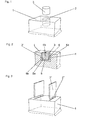
- Fig. 1 shows a basic embodiment of the invention with reference to a profile block 1, which has been provided in the manufacture of the tire with a cylindrical recess 2, for example, here for receiving a correspondingly cylindrical profile insert 3.
- the recesses 2 are formed over the tread-forming parts of the vulcanization mold provided with the "negatives" of the recesses 2, corresponding protruding elements, during the heating process.
- the recess 2 can extend deep into the tread block 1, in particular to the maximum tread depth, which corresponds to the greatest depth of extending between the individual profile elements or tread blocks grooves.
- the connection is effected by means of a reactive adhesive system, which is applied before the insertion of the profile insert 3 at its coming into contact with the walls of the recess 2 outer sides or on the inner walls of the recess 2.
- the thickness of the applied adhesive system layer is between 2 ⁇ m and 60 ⁇ m.
- Reactive adhesive systems are those which contain at least one component, a crosslinking aid, which sublimates when heated, at the contact surfaces both in the rubber material of the profile insert 3 and in the rubber material of the profile block 1 in the micron range penetrates or immigrated and networked here with the rubber materials. In this way, a very strong bonding of the profile inserts 3 is achieved with the tread blocks 1.
- Such reactive adhesive systems are available on the market as rubber-to-metal adhesion systems, for example under the names Parlock®, Chemlock® or Chemosil®. They contain per se known crosslinking aids, such as p-dinitroso-benzene.
- Fig. 2 shows a profile block 1 in section with a frusto-conical recess 2 ', wherein the larger diameter of the truncated cone is inside the block.
- a correspondingly frustoconical executed profile insert 3' is introduced in the recess 2 '.
- the profile insert 3 ' consists in this embodiment of a rubber base body 6, which is provided centrally with an exemplary cylindrical recess 4 for inserting a spike 5.
- a spike 5 with a cylindrical metallic spike body 5a and a metallic spike pin 5b anchored in it are shown here.
- the spike body 5a may have a different shape, in particular one of the usual spike shapes, wherein the recess 4 is performed in the profile insert 3 'of the shape of the spike body 5a adapted.
- the spike 5 is integrated in the recess 4 of the main body 6 with a heat-activatable reactive adhesive system, as described above.
- the profile insert 3 'connected to the spike 5 is connected to the profile block 1 by means of a reactive adhesive system in the manner described above.
- the base body 6 may consist of two rubber layers 6a and 6b, an inner layer 6a and an outer layer 6b, made of different rubber mixtures.
- Each layer 6a, 6b extends approximately over half of the radial extent of the main body 6, but one of the layers 6a, 6b can also be made thinner than the other.
- the rubber materials of the layers 6a, 6b may have different stiffnesses.
- the spike 5 can be embedded in a layer 5 a whose rigidity of the Outside temperature - by the selection of the glass transition temperature of the polymer or the polymers in the mixture - depends, in particular, in order to embed the spike 5 at low temperatures stiff and at higher temperatures above 0 ° C softer.
- a good ice grip can be guaranteed and it can be kept lower at higher temperatures damage the road surface.
- the tread inserts can have almost any outer shape, as long as the corresponding recesses form in the tread and the tread inserts can be used in vulcanized tires.
- Fig. 3 shows a further embodiment in which two profile inserts 3 "are used in a profile block 1. These are exemplified platelet-shaped and parallel to each other and at a mutual distance in the profile block 1, in which corresponding slots have been formed as recesses 2 'on the Schuform are used and incorporated by means of a reactive adhesive system as described.
- the tread inserts are made of a rubber material which has different properties than the surrounding rubber material of the tread.
- the tread inserts may in particular have a different stiffness, preferably a higher rigidity, than the tread, for example to stiffen the tread in certain areas.
- the profile inserts can also have particularly structured outer surfaces, in particular markings, or even a special color.
Landscapes
- Engineering & Computer Science (AREA)
- Mechanical Engineering (AREA)
- Tires In General (AREA)
Abstract
Description
- Die Erfindung betrifft ein Verfahren zum dauerhaften Einbinden eines in eine bei der Vulkanisation des Reifens eingeformte Aussparung im Laufstreifen eines Fahrzeugluftreifens eingesetzten Profileinsatzes, wobei der Profileinsatz aus einem Gummimaterial besteht, welches sich hinsichtlich zumindest einer Eigenschaft, beispielsweise der Steifigkeit, vom umgebenden Gummimaterial des Laufstreifens unterscheidet.
- Aus der
JP 58-051134 A WO 2010/106114 ist es bekannt, im Laufstreifen eines Reifens flache Aussparungen vorzusehen, in welche bei fertigem Reifen dünne Einsätze eingeklebt werden. Die Einsätze können aus unterschiedlichen Materialien bestehen, beispielsweise Silikon, Gummi, textilen Materialien, Metallen, Leder und dergleichen. Als Kleber sind unter anderem Cyanacrylat, Silikonkleber, Polyurethankleber, Urethankleber und dergleichen erwähnt. Aus derWO 2010/106112 A1 ist es bekannt, dekorativ ausgeführte Einsätze in Aussparungen im Laufstreifen mittels derartiger Kleber einzufügen. Die bekannten Kleber gaben sich als wenig haltbar herausgestellt, insbesondere unter den unterschiedlichen Witterungsbedingten, denen ein Reifen beim Betrieb ausgesetzt ist. - Der Erfindung liegt die Aufgabe zugrunde eine Möglichkeit zur Verfügung zu stellen, mit welcher Profileinsätze dauerhaltbar - über die gesamte Lebensdauer des Reifens und bei allen Witterungseinflüssen - in Aussparungen des fertig vulkanisierten Reifens eingebracht und mit diesem verbunden werden können.
- Gelöst wird die gestellte Aufgabe erfindungsgemäß dadurch, dass der Laufstreifengummi mit dem Gummimaterial des Profileinsatzes mittels eines reaktiven Haftsystems verbunden wird, welches zumindest einen Bestandteil aufweist, der unter äußerer Wärmeeinwirkung sublimiert, in die Grenzschichten der Gummimaterialien eindringt und dort vernetzt.
- Üblicherweise werden reaktive Haftsysteme zur Gummi-Metall-Haftung eingesetzt. Im Rahmen der Erfindung wurde nun erkannt, dass sich reaktive Haftsysteme auch sehr gut dafür eignen, eine dauerhaltbare Verbindung zwischen den unterschiedlichen Gummimaterialien eines Profileinsatzes und des Laufstreifens herzustellen.
- Es ist eine sehr dünne Schicht an reaktivem Haftsystem ausreichend, um eine dauerhafte Einbindung des Profileinsatzes im Laufstreifengummi zu erzielen. Das reaktive Haftsystem wird demnach in einer Schichtdicke von 2 µm bis 60 µm entweder an der Innenwand der Aussparung und/oder an der Außenseite des Profileinsatzes aufgebracht. Anschließend wir der Profileinsatz in die Aussparung eingedrückt und der Laufstreifen zumindest im Bereich bzw. um den Bereich des Profileinsatzes erwärmt, um die Sublimation und Wanderung des Vernetzungshilfsmittels des reaktiven Haftsystems zu bewirken.
- Als reaktives Haftsystem kann eines der am Markt erhältlichen einschlägigen Produkte verwendet werden, insbesondere Parlock®, Chemlock® oder Chemosil®.
- Die Profileinsätze können unterschiedliche Gestalt und unterschiedliche Größen aufweisen, je nach Einsatzzweck bzw. Verwendungszweck. Es kann daher in einem Profilelement des Laufstreifens, insbesondere in einem Profilblock, mehr als ein Profileinsatz eingebunden werden. Die Profileinsätze selbst können aus unterschiedlichen Gummimaterialien, insbesondere aus mehreren Schichten unterschiedlicher Gummimaterialen, in beliebiger, insbesondere axialer Schichtung, bestehen. Es gibt daher eine Vielzahl von Möglichkeiten, den Profileinsatz bzw. die Profileinsätze an den jeweiligen Einsatzzweck entsprechend anzupassen.
- Gemäß einer bevorzugten Ausführungsform der Erfindung werden Profileinsätze dafür verwendet, Spikes im Laufstreifen zu verankert. In diesem Fall ist im betreffenden Profileinsatz ein Spike, insbesondere ebenfalls mittels eines reaktiven Haftsystems, eingebunden bzw. verankert.
- Bei in Profileinsätzen eingebundenen Spikes ist die oben erwähnte Maßnahme, den jeweiligen Profileinsatz aus Schichten aus unterschiedlichen Gummimaterialien herzustellen, besonders vorteilhaft. So kann der zur Verankerung eines Spikes vorgesehene Profileinsatz zwei oder auch mehr Schichten aus unterschiedlichen Gummimaterialien aufweisen, sodass der Spike zumindest mit seinem äußeren Abschnitt in eienm Gummimaterial oder einer Schicht aus einem Gummimaterial eingesetzt wird, dessen Steifigkeit sich mit der Umgebungs- bzw. Außentemperatur ändert. Besonders vorteilhaft ist es, wenn dieses Gummimaterial bei niedriger Temperatur steifer ist als bei höherer Temperatur, wobei unter "höherer Temperatur" eine Temperatur über 0° Celsius zu verstehen ist. Damit kann bei Temperaturen unter 0° Celsius ein guter Eisgriff gewährleistet werden und bei höherer Temperatur können Beschädigungen der Straßenoberfläche gering gehalten werden.
- Weitere Merkmale, Vorteile und Einzelheiten der Erfindung werden nun anhand der Zeichnung, die schematisch mehrere Ausführungsbeispiele darstellt, näher beschrieben. Dabei zeigen
-
Fig. 1 eine Ansicht eines erfindungsgemäß ausgeführten Profilblockes, -
Fig. 2 einen Schnitt durch einen Profilblock mit einer Ausführungsform der Erfindung und -
Fig. 3 eine Ansicht eines Profilblockes eines Laufstreifens mit einer weiteren Ausführungsvariante der Erfindung. - Die Erfindung befasst sich mit dem Einbinden von Profileinsätzen in Laufstreifen von Fahrzeugluftreifen beliebiger Bauart. Die Profileinsätze bestehen wie der Laufstreifen selbst aus vulkanisiertem Gummi, unterscheiden sich jedoch vom Gummimaterial des Laufstreifens in der Gummizusammensetzung und daher zumindest einer Eigenschaft. Beispielsweise weisen die Profileinsätze eine andere Steifigkeit und/oder andere Dämpfungseigenschaften auf als das Gummimaterial des Laufstreifens. Profileinsätze können verschiedenen Zwecken dienen, beispielsweise können sie derart ausgeführt sein, dass der Laufstreifen des Reifens an bestimmte Fahr- bzw. Witterungsbedingungen, beispielsweise extreme Kälte oder Hitze, besser angepasst wird.
-
Fig. 1 zeigt eine grundsätzliche Ausführungsform der Erfindung anhand eines Profilblockes 1, welcher bei der Herstellung des Reifens mit einer hier beispielsweise zylindrischen Aussparung 2 zur Aufnahme eines entsprechend zylindrischen Profileinsatzes 3 versehen worden. Die Aussparungen 2 werden über die den Laufstreifen formenden Teile der Vulkanisationsform, die mit den "Negativen" der Aussparungen 2, entsprechenden vorspringenden Elementen, versehen sind, während des Heizvorganges eingeformt. WieFig. 1 zeigt, kann die Aussparung 2 tief in den Profilblock 1 hineinreichen, insbesondere bis auf die maximale Profiltiefe, welche der größten Tiefe der zwischen den einzelnen Profilelementen bzw. Profilblöcken verlaufenden Nuten entspricht. Ist der Reifen fertig vulkanisiert, werden die Profileinsätze 3 in die Aussparungen 2 eingesetzt und mit den Profilblöcken 1 fest verbunden. Gemäß der Erfindung erfolgt die Verbindung mittels eines reaktiven Haftsystems, welches vor dem Einsetzen des Profileinsatzes 3 an dessen mit den Wänden der Aussparung 2 in Kontakt kommenden Außenseiten oder an den Innenwänden der Aussparung 2 aufgebracht wird. Die Dicke der aufgebrachten Haftsystemschicht beträgt zwischen 2 µm und 60 µm. Reaktive Haftsysteme sind solche, die zumindest einen Bestandteil, ein Vernetzungshilfsmittel, beinhalten, welches bei Erwärmung sublimiert, an den Kontaktflächen sowohl in das Gummimaterial des Profileinsatzes 3 als auch in das Gummimaterial des Profilblockes 1 im µm-Bereich eindringt bzw. einwandert und sich hier mit den Gummimaterialien vernetzt. Auf diese Weise wird eine sehr feste Haftverbindung der Profileinsätze 3 mit den Profilblöcken 1 erzielt. - Derartige reaktive Haftsysteme sind als Gummi-Metall-Haftsysteme am Markt erhältlich, beispielsweise unter den Bezeichnungen Parlock®, Chemlock® oder Chemosil®. Sie enthalten an sich bekannte Vernetzungshilfsmittel, wie beispielweise p-Dinitroso-Benzol.
-
Fig. 2 zeigt einen Profilblock 1 im Schnitt mit einer kegelstumpfförmigen Aussparung 2', wobei sich der größere Durchmesser des Kegelstumpfes im Blockinneren befindet. In die Aussparung 2' wird ein entsprechend kegelstumpfförmig ausgeführter Profileinsatz 3' eingebracht. Der Profileinsatz 3' besteht bei dieser Ausführungsform aus einem Gummi-Grundkörper 6, welcher mittig mit einer beispielhaft zylindrischen Aussparung 4 zum Einsetzen eines Spikes 5 versehen ist. Der Einfachheit halber ist hier ein Spike 5 mit einem zylindrischen metallischen Spikekörper 5a und einem in diesem verankerten metallischen Spikepin 5b dargestellt. Der Spikekörper 5a kann eine abweichende Form, insbesondere eine der für Spikekörper üblichen Formen, aufweisen, wobei die Aussparung 4 im Profileinsatz 3' der Form des Spikekörpers 5a entsprechend angepasst ausgeführt wird. Der Spike 5 wird mit einem durch Wärmebehandlung aktivierbaren reaktiven Haftsystem, wie oben beschrieben, in der Aussparung 4 des Grundkörpers 6 eingebunden. Der mit dem Spike 5 verbundene Profileinsatz 3' wird mittels eines reaktiven Haftsystems auf die oben beschriebene Weise mit dem Profilblock 1 verbunden. - Wie
Fig. 2 zeigt kann der Grundkörper 6 aus zwei Gummi-Schichten 6a und 6b, einer inneren Schicht 6a und einer äußeren Schicht 6b, aus unterschiedlichen Gummimischungen bestehen. Jede Schicht 6a, 6b verläuft etwa über die Hälfte der radialen Erstreckung des Grundkörpers 6, es kann jedoch eine der Schichten 6a, 6b auch dünner als die andere ausgeführt sein. Die Gummimaterialien der Schichten 6a, 6b können unterschiedliche Steifigkeiten aufweisen. Bevorzugt ist eine Ausführung, bei der die äußere Schicht 6a aus einem Gummimaterial besteht, welches bei Kälte steifer ist als bei Wärme. Auf diese Weise kann der Spike 5 in eine Schicht 5a eingebettet sein deren Steifigkeit von der Außentemperatur - durch die Auswahl der Glastemperatur des Polymers bzw. der Polymere in der Mischung - abhängt, insbesondere, um den Spike 5 bei niedrigen Temperaturen steif und bei höheren Temperaturen über 0° C weicher einzubetten. Damit kann einerseits bei niedrigen Temperaturen ein guter Eisgriff gewährleistet werden und es können bei höheren Temperaturen Beschädigungen der Straßenoberfläche geringer gehalten werden. - Die Profileinsätze können nahezu jede beliebige äußere Form aufweisen, sofern sich die entsprechenden Aussparungen im Laufstreifen einformen und sich die Profileinsätze bei vulkanisiertem Reifen einsetzen lassen.
-
Fig. 3 zeigt eine weitere Ausführungsvariante, bei der in einen Profilblock 1 zwei Profileinsätze 3" eingesetzt werden. Diese sind beispielhaft plättchenförmig ausgeführt und werden parallel zueinander und unter einem gegenseitigen Abstand in den Profilblock 1, in welchem entsprechende Schlitze als Aussparungen 2' über die Heizform eingeformt worden sind, eingesetzt und mittels eines reaktiven Haftsystems, wie beschrieben, eingebunden. - Grundsätzlich bestehen die Profileinsätze aus einem Gummimaterial, welches andere Eigenschaften als das umgebende Gummimaterial des Laufstreifens aufweist. Die Profileinsätze können insbesondere eine andere Steifigkeit, vorzugsweise eine höhere Steifigkeit, aufweisen als der Laufstreifen, etwa um den Laufstreifen in bestimmten Bereichen zu versteifen. Die Profileinsätze können ferner besonders strukturierte äußere Oberflächen, insbesondere Kennzeichnungen, oder auch eine besondere Farbe, aufweisen.
-
- 1
- Profilblock
- 2
- Aussparung
- 2'
- Aussparung
- 2"
- Aussparung
- 3
- Profileinsatz
- 3'
- Profileinsatz
- 3"
- Profileinsatz
- 4
- Aussparung
- 5
- Spike
- 5a
- Spikekörper
- 5b
- Spikepin
- 6
- Grundkörper
- 6a
- Schicht
- 6b
- Schicht
Claims (9)
- Verfahren zum dauerhaften Einbinden eines in eine bei der Vulkanisation des Reifens eingeformten Aussparung (2, 2', 2") im Laufstreifen eines Fahrzeugluftreifens eingesetzten Profileinsatzes (3, 3', 3"), wobei der Profileinsatz (3, 3', 3 ") aus einem Gummimaterial besteht, welches sich hinsichtlich zumindest einer Eigenschaft, beispielsweise der Steifigkeit, vom umgebenden Gummimaterial des Laufstreifens unterscheidet,
dadurch gekennzeichnet,
dass der Laufstreifengummi mit dem Gummimaterial des Profileinsatzes (3, 3', 3") mittels eines reaktiven Haftsystems verbunden wird, welches zumindest einen Bestandteil aufweist, der unter äußerer Wärmeeinwirkung sublimiert, in die Grenzschichten der Gummimaterialien eindringt und dort vernetzt. - Verfahren nach Anspruch 1, dadurch gekennzeichnet, dass das reaktive Haftsystem in einer Schichtdicke von 2 µm bis 60 µm an der Innenwand der Aussparung (2, 2', 2") und/oder der Außenseite des Profileinsatzes (3, 3', 3 ") aufgebracht wird.
- Verfahren nach Anspruch 1 oder 2, dadurch gekennzeichnet, dass als reaktives Haftsystem Parlock®, Chemlock® oder Chemosil® verwendet wird.
- Verfahren nach einem der Ansprüche 1 bis 3, dadurch gekennzeichnet, dass in einem Profilelement, insbesondere einem Profilblock (1), mehr als ein Profileinsatz (3") eingebunden sind.
- Verfahren nach einem der Ansprüche 1 bis 4, dadurch gekennzeichnet, dass der Profileinsatz (3') aus zumindest zwei unterschiedlichen Gummimaterialien, insbesondere axial geschichtet, besteht.
- Verfahren nach einem der Ansprüche 1 bis 5, dadurch gekennzeichnet, dass im Profileinsatz (3') ein Spike (5), insbesondere ebenfalls mittels eines reaktiven Haftsystems, eingebunden wird.
- Verfahren nach einem der Ansprüche 1 bis 6, dadurch gekennzeichnet, dass der Spike (5) zumindest mit seinem äußeren Abschnitt in ein Gummimaterial oder eine Schicht (5a) aus einem Gummimaterial eingesetzt wird, dessen Steifigkeit sich mit der Umgebungs- bzw. Außentemperatur ändert.
- Verfahren nach Anspruch 7, dadurch gekennzeichnet, dass das Gummimaterial bei niedriger Temperatur steifer ist als bei höherer Temperatur.
- Fahrzeugluftreifen mit einem Laufstreifen aus Gummi, welcher zumindest einen in eine bei der Vulkanisation des Reifens eingeformten Aussparung (2, 2', 2") eingebundenen Profileinsatz (3, 3', 3 ") aus einem Gummimaterial aufweist, welches sich hinsichtlich zumindest einer Eigenschaft, beispielsweise der Steifigkeit, vom umgebenden Gummimaterial des Laufstreifens unterscheidet,
dadurch gekennzeichnet,
dass der Laufstreifengummi mit dem Gummimaterial des Profileinsatzes (3, 3', 3") mittels eines reaktiven Haftsystems verbunden worden ist.
Applications Claiming Priority (1)
| Application Number | Priority Date | Filing Date | Title |
|---|---|---|---|
| DE201210108270 DE102012108270A1 (de) | 2012-09-06 | 2012-09-06 | Verfahren zum dauerhaften Einbinden eines in eine Aussparung eines Laufstreifens eines Fahrzeugluftreifens eingesetzten Profileinsatzes |
Publications (2)
| Publication Number | Publication Date |
|---|---|
| EP2705946A1 true EP2705946A1 (de) | 2014-03-12 |
| EP2705946B1 EP2705946B1 (de) | 2017-11-29 |
Family
ID=48985560
Family Applications (1)
| Application Number | Title | Priority Date | Filing Date |
|---|---|---|---|
| EP13179197.2A Not-in-force EP2705946B1 (de) | 2012-09-06 | 2013-08-05 | Verfahren zum dauerhaften Einbinden eines in eine Aussparung eines Laufstreifens eines Fahrzeugluftreifens eingesetzten Profileinsatzes |
Country Status (3)
| Country | Link |
|---|---|
| EP (1) | EP2705946B1 (de) |
| DE (1) | DE102012108270A1 (de) |
| NO (1) | NO2850278T3 (de) |
Citations (5)
| Publication number | Priority date | Publication date | Assignee | Title |
|---|---|---|---|---|
| JPS5851134A (ja) | 1981-09-21 | 1983-03-25 | Sumitomo Rubber Ind Ltd | スパイクタイヤの製造方法 |
| DE4307221A1 (de) * | 1993-03-09 | 1994-09-15 | Henkel Kgaa | p-Dinitroso-Benzol |
| WO2010106114A1 (en) | 2009-03-18 | 2010-09-23 | Societe De Technologie Michelin | Tyre with protective appliqués |
| WO2010106112A1 (en) | 2009-03-18 | 2010-09-23 | Societe De Technologie Michelin | Tyre provided with coloured appliqués |
| DE102009044845A1 (de) * | 2009-12-09 | 2011-06-16 | Continental Reifen Deutschland Gmbh | Verfahren und Vorrichtung zum Aktivieren eines Haftsystems von Spikes |
-
2012
- 2012-09-06 DE DE201210108270 patent/DE102012108270A1/de not_active Withdrawn
-
2013
- 2013-05-15 NO NO13791116A patent/NO2850278T3/no unknown
- 2013-08-05 EP EP13179197.2A patent/EP2705946B1/de not_active Not-in-force
Patent Citations (5)
| Publication number | Priority date | Publication date | Assignee | Title |
|---|---|---|---|---|
| JPS5851134A (ja) | 1981-09-21 | 1983-03-25 | Sumitomo Rubber Ind Ltd | スパイクタイヤの製造方法 |
| DE4307221A1 (de) * | 1993-03-09 | 1994-09-15 | Henkel Kgaa | p-Dinitroso-Benzol |
| WO2010106114A1 (en) | 2009-03-18 | 2010-09-23 | Societe De Technologie Michelin | Tyre with protective appliqués |
| WO2010106112A1 (en) | 2009-03-18 | 2010-09-23 | Societe De Technologie Michelin | Tyre provided with coloured appliqués |
| DE102009044845A1 (de) * | 2009-12-09 | 2011-06-16 | Continental Reifen Deutschland Gmbh | Verfahren und Vorrichtung zum Aktivieren eines Haftsystems von Spikes |
Also Published As
| Publication number | Publication date |
|---|---|
| EP2705946B1 (de) | 2017-11-29 |
| DE102012108270A1 (de) | 2014-03-06 |
| NO2850278T3 (de) | 2018-07-28 |
Similar Documents
| Publication | Publication Date | Title |
|---|---|---|
| DE60008625T2 (de) | Verfahren zur Herstellung eines Spike-Reifens und Formwerkzeug dafür | |
| EP1985435B1 (de) | Verfahren und Vorrichtung zur Herstellung einer Felge | |
| EP2490905B1 (de) | Befestigungssystem zur anbringung von halterungen an elastomeren bauteilen | |
| EP3261830B1 (de) | Verfahren zur herstellung eines profilsegmentes einer segmentierten giess-vulkanisierform für fahrzeugreifen | |
| DE102015223091A1 (de) | Fahrzeugluftreifen | |
| DE69205496T2 (de) | Gleitschutzkörper und System zu seiner Montage. | |
| WO2017198352A1 (de) | Spike für einen fahrzeugluftreifen und verfahren zur herstellung eines spikes | |
| EP3554856B1 (de) | Verfahren zur herstellung eines spikes | |
| DE102016201063B4 (de) | Verfahren und Vulkanisierform zur Herstellung eines Fahrzeug-Luftreifens | |
| EP2705946B1 (de) | Verfahren zum dauerhaften Einbinden eines in eine Aussparung eines Laufstreifens eines Fahrzeugluftreifens eingesetzten Profileinsatzes | |
| DE102015102640A1 (de) | Herstellung eines mit einem Gewebeschlauch verstärkten Kunststoffschlauchs | |
| DE102013113043A1 (de) | Gleitschutzstift und Verfahren zur Herstellung eines Gleitschutzstiftes | |
| DE102016215732A1 (de) | Vulkanisierform für Fahrzeugreifen und Fahrzeugreifen als Solcher | |
| DE60206663T2 (de) | Verfahren und vorrichtung zur herstellung eines spike-reifens | |
| DE2422929A1 (de) | Luftreifen | |
| WO2014183890A1 (de) | Fahrzeugluftreifen mit hohlraumsystem im inneren des laufstreifens und sein herstellunsverfahren | |
| EP3642053B1 (de) | Fahrzeugluftreifen mit einem laufstreifen mit spikes | |
| DE1579111A1 (de) | Verfahren zur Herstellung von Fahrzeugluftreifen mit Gleitschutzkoerpern | |
| EP3303010B1 (de) | Spike und fahrzeugluftreifen mit solchen spikes | |
| EP3815890A1 (de) | Formelement, vulkanisationsform und fahrzeugluftreifen | |
| DE102019205371A1 (de) | Entlüftungseinheit für eine Vulkanisationsform eines Fahrzeugreifens, Vulkanisierform und Fahrzeugreifen | |
| DE102013113042A1 (de) | Verfahren zur kraft- und/oder formschlüssigen Verbindung von Werkstücken | |
| AT506672A1 (de) | Verfahren zur herstellung eines belagmaterials für wintersportgeräte, sowie wintersportgerät | |
| DE102007025116A1 (de) | Fahrzeugluftreifen | |
| EP3402660B1 (de) | Verfahren zur herstellung eines vollgummireifens, nach dem verfahren hergestellter vollgummireifen und grundkörper für einen vollgummireifen |
Legal Events
| Date | Code | Title | Description |
|---|---|---|---|
| PUAI | Public reference made under article 153(3) epc to a published international application that has entered the european phase |
Free format text: ORIGINAL CODE: 0009012 |
|
| AK | Designated contracting states |
Kind code of ref document: A1 Designated state(s): AL AT BE BG CH CY CZ DE DK EE ES FI FR GB GR HR HU IE IS IT LI LT LU LV MC MK MT NL NO PL PT RO RS SE SI SK SM TR |
|
| AX | Request for extension of the european patent |
Extension state: BA ME |
|
| 17P | Request for examination filed |
Effective date: 20140912 |
|
| RBV | Designated contracting states (corrected) |
Designated state(s): AL AT BE BG CH CY CZ DE DK EE ES FI FR GB GR HR HU IE IS IT LI LT LU LV MC MK MT NL NO PL PT RO RS SE SI SK SM TR |
|
| 17Q | First examination report despatched |
Effective date: 20170309 |
|
| GRAP | Despatch of communication of intention to grant a patent |
Free format text: ORIGINAL CODE: EPIDOSNIGR1 |
|
| INTG | Intention to grant announced |
Effective date: 20170816 |
|
| GRAS | Grant fee paid |
Free format text: ORIGINAL CODE: EPIDOSNIGR3 |
|
| GRAA | (expected) grant |
Free format text: ORIGINAL CODE: 0009210 |
|
| AK | Designated contracting states |
Kind code of ref document: B1 Designated state(s): AL AT BE BG CH CY CZ DE DK EE ES FI FR GB GR HR HU IE IS IT LI LT LU LV MC MK MT NL NO PL PT RO RS SE SI SK SM TR |
|
| REG | Reference to a national code |
Ref country code: CH Ref legal event code: EP |
|
| REG | Reference to a national code |
Ref country code: AT Ref legal event code: REF Ref document number: 950003 Country of ref document: AT Kind code of ref document: T Effective date: 20171215 |
|
| REG | Reference to a national code |
Ref country code: IE Ref legal event code: FG4D Free format text: LANGUAGE OF EP DOCUMENT: GERMAN |
|
| REG | Reference to a national code |
Ref country code: DE Ref legal event code: R096 Ref document number: 502013008912 Country of ref document: DE |
|
| REG | Reference to a national code |
Ref country code: SE Ref legal event code: TRGR |
|
| REG | Reference to a national code |
Ref country code: NL Ref legal event code: MP Effective date: 20171129 |
|
| REG | Reference to a national code |
Ref country code: LT Ref legal event code: MG4D |
|
| PG25 | Lapsed in a contracting state [announced via postgrant information from national office to epo] |
Ref country code: ES Free format text: LAPSE BECAUSE OF FAILURE TO SUBMIT A TRANSLATION OF THE DESCRIPTION OR TO PAY THE FEE WITHIN THE PRESCRIBED TIME-LIMIT Effective date: 20171129 Ref country code: LT Free format text: LAPSE BECAUSE OF FAILURE TO SUBMIT A TRANSLATION OF THE DESCRIPTION OR TO PAY THE FEE WITHIN THE PRESCRIBED TIME-LIMIT Effective date: 20171129 |
|
| REG | Reference to a national code |
Ref country code: NO Ref legal event code: T2 Effective date: 20171129 |
|
| PG25 | Lapsed in a contracting state [announced via postgrant information from national office to epo] |
Ref country code: GR Free format text: LAPSE BECAUSE OF FAILURE TO SUBMIT A TRANSLATION OF THE DESCRIPTION OR TO PAY THE FEE WITHIN THE PRESCRIBED TIME-LIMIT Effective date: 20180301 Ref country code: RS Free format text: LAPSE BECAUSE OF FAILURE TO SUBMIT A TRANSLATION OF THE DESCRIPTION OR TO PAY THE FEE WITHIN THE PRESCRIBED TIME-LIMIT Effective date: 20171129 Ref country code: BG Free format text: LAPSE BECAUSE OF FAILURE TO SUBMIT A TRANSLATION OF THE DESCRIPTION OR TO PAY THE FEE WITHIN THE PRESCRIBED TIME-LIMIT Effective date: 20180228 Ref country code: HR Free format text: LAPSE BECAUSE OF FAILURE TO SUBMIT A TRANSLATION OF THE DESCRIPTION OR TO PAY THE FEE WITHIN THE PRESCRIBED TIME-LIMIT Effective date: 20171129 Ref country code: LV Free format text: LAPSE BECAUSE OF FAILURE TO SUBMIT A TRANSLATION OF THE DESCRIPTION OR TO PAY THE FEE WITHIN THE PRESCRIBED TIME-LIMIT Effective date: 20171129 |
|
| PG25 | Lapsed in a contracting state [announced via postgrant information from national office to epo] |
Ref country code: NL Free format text: LAPSE BECAUSE OF FAILURE TO SUBMIT A TRANSLATION OF THE DESCRIPTION OR TO PAY THE FEE WITHIN THE PRESCRIBED TIME-LIMIT Effective date: 20171129 |
|
| PG25 | Lapsed in a contracting state [announced via postgrant information from national office to epo] |
Ref country code: DK Free format text: LAPSE BECAUSE OF FAILURE TO SUBMIT A TRANSLATION OF THE DESCRIPTION OR TO PAY THE FEE WITHIN THE PRESCRIBED TIME-LIMIT Effective date: 20171129 Ref country code: SK Free format text: LAPSE BECAUSE OF FAILURE TO SUBMIT A TRANSLATION OF THE DESCRIPTION OR TO PAY THE FEE WITHIN THE PRESCRIBED TIME-LIMIT Effective date: 20171129 Ref country code: CZ Free format text: LAPSE BECAUSE OF FAILURE TO SUBMIT A TRANSLATION OF THE DESCRIPTION OR TO PAY THE FEE WITHIN THE PRESCRIBED TIME-LIMIT Effective date: 20171129 Ref country code: EE Free format text: LAPSE BECAUSE OF FAILURE TO SUBMIT A TRANSLATION OF THE DESCRIPTION OR TO PAY THE FEE WITHIN THE PRESCRIBED TIME-LIMIT Effective date: 20171129 Ref country code: CY Free format text: LAPSE BECAUSE OF FAILURE TO SUBMIT A TRANSLATION OF THE DESCRIPTION OR TO PAY THE FEE WITHIN THE PRESCRIBED TIME-LIMIT Effective date: 20171129 |
|
| REG | Reference to a national code |
Ref country code: FR Ref legal event code: PLFP Year of fee payment: 6 |
|
| REG | Reference to a national code |
Ref country code: DE Ref legal event code: R097 Ref document number: 502013008912 Country of ref document: DE |
|
| PG25 | Lapsed in a contracting state [announced via postgrant information from national office to epo] |
Ref country code: PL Free format text: LAPSE BECAUSE OF FAILURE TO SUBMIT A TRANSLATION OF THE DESCRIPTION OR TO PAY THE FEE WITHIN THE PRESCRIBED TIME-LIMIT Effective date: 20171129 Ref country code: IT Free format text: LAPSE BECAUSE OF FAILURE TO SUBMIT A TRANSLATION OF THE DESCRIPTION OR TO PAY THE FEE WITHIN THE PRESCRIBED TIME-LIMIT Effective date: 20171129 Ref country code: RO Free format text: LAPSE BECAUSE OF FAILURE TO SUBMIT A TRANSLATION OF THE DESCRIPTION OR TO PAY THE FEE WITHIN THE PRESCRIBED TIME-LIMIT Effective date: 20171129 Ref country code: SM Free format text: LAPSE BECAUSE OF FAILURE TO SUBMIT A TRANSLATION OF THE DESCRIPTION OR TO PAY THE FEE WITHIN THE PRESCRIBED TIME-LIMIT Effective date: 20171129 |
|
| PG25 | Lapsed in a contracting state [announced via postgrant information from national office to epo] |
Ref country code: MT Free format text: LAPSE BECAUSE OF FAILURE TO SUBMIT A TRANSLATION OF THE DESCRIPTION OR TO PAY THE FEE WITHIN THE PRESCRIBED TIME-LIMIT Effective date: 20171129 |
|
| PLBE | No opposition filed within time limit |
Free format text: ORIGINAL CODE: 0009261 |
|
| STAA | Information on the status of an ep patent application or granted ep patent |
Free format text: STATUS: NO OPPOSITION FILED WITHIN TIME LIMIT |
|
| 26N | No opposition filed |
Effective date: 20180830 |
|
| PG25 | Lapsed in a contracting state [announced via postgrant information from national office to epo] |
Ref country code: SI Free format text: LAPSE BECAUSE OF FAILURE TO SUBMIT A TRANSLATION OF THE DESCRIPTION OR TO PAY THE FEE WITHIN THE PRESCRIBED TIME-LIMIT Effective date: 20171129 |
|
| PG25 | Lapsed in a contracting state [announced via postgrant information from national office to epo] |
Ref country code: MC Free format text: LAPSE BECAUSE OF FAILURE TO SUBMIT A TRANSLATION OF THE DESCRIPTION OR TO PAY THE FEE WITHIN THE PRESCRIBED TIME-LIMIT Effective date: 20171129 |
|
| REG | Reference to a national code |
Ref country code: CH Ref legal event code: PL |
|
| GBPC | Gb: european patent ceased through non-payment of renewal fee |
Effective date: 20180805 |
|
| PG25 | Lapsed in a contracting state [announced via postgrant information from national office to epo] |
Ref country code: CH Free format text: LAPSE BECAUSE OF NON-PAYMENT OF DUE FEES Effective date: 20180831 Ref country code: LI Free format text: LAPSE BECAUSE OF NON-PAYMENT OF DUE FEES Effective date: 20180831 Ref country code: LU Free format text: LAPSE BECAUSE OF NON-PAYMENT OF DUE FEES Effective date: 20180805 |
|
| REG | Reference to a national code |
Ref country code: BE Ref legal event code: MM Effective date: 20180831 |
|
| REG | Reference to a national code |
Ref country code: IE Ref legal event code: MM4A |
|
| PG25 | Lapsed in a contracting state [announced via postgrant information from national office to epo] |
Ref country code: IE Free format text: LAPSE BECAUSE OF NON-PAYMENT OF DUE FEES Effective date: 20180805 |
|
| PG25 | Lapsed in a contracting state [announced via postgrant information from national office to epo] |
Ref country code: BE Free format text: LAPSE BECAUSE OF NON-PAYMENT OF DUE FEES Effective date: 20180831 |
|
| REG | Reference to a national code |
Ref country code: AT Ref legal event code: MM01 Ref document number: 950003 Country of ref document: AT Kind code of ref document: T Effective date: 20180805 |
|
| PG25 | Lapsed in a contracting state [announced via postgrant information from national office to epo] |
Ref country code: GB Free format text: LAPSE BECAUSE OF NON-PAYMENT OF DUE FEES Effective date: 20180805 |
|
| PG25 | Lapsed in a contracting state [announced via postgrant information from national office to epo] |
Ref country code: AT Free format text: LAPSE BECAUSE OF NON-PAYMENT OF DUE FEES Effective date: 20180805 |
|
| PG25 | Lapsed in a contracting state [announced via postgrant information from national office to epo] |
Ref country code: TR Free format text: LAPSE BECAUSE OF FAILURE TO SUBMIT A TRANSLATION OF THE DESCRIPTION OR TO PAY THE FEE WITHIN THE PRESCRIBED TIME-LIMIT Effective date: 20171129 |
|
| PG25 | Lapsed in a contracting state [announced via postgrant information from national office to epo] |
Ref country code: PT Free format text: LAPSE BECAUSE OF FAILURE TO SUBMIT A TRANSLATION OF THE DESCRIPTION OR TO PAY THE FEE WITHIN THE PRESCRIBED TIME-LIMIT Effective date: 20171129 Ref country code: HU Free format text: LAPSE BECAUSE OF FAILURE TO SUBMIT A TRANSLATION OF THE DESCRIPTION OR TO PAY THE FEE WITHIN THE PRESCRIBED TIME-LIMIT; INVALID AB INITIO Effective date: 20130805 |
|
| PG25 | Lapsed in a contracting state [announced via postgrant information from national office to epo] |
Ref country code: MK Free format text: LAPSE BECAUSE OF NON-PAYMENT OF DUE FEES Effective date: 20171129 |
|
| PG25 | Lapsed in a contracting state [announced via postgrant information from national office to epo] |
Ref country code: AL Free format text: LAPSE BECAUSE OF FAILURE TO SUBMIT A TRANSLATION OF THE DESCRIPTION OR TO PAY THE FEE WITHIN THE PRESCRIBED TIME-LIMIT Effective date: 20171129 Ref country code: IS Free format text: LAPSE BECAUSE OF FAILURE TO SUBMIT A TRANSLATION OF THE DESCRIPTION OR TO PAY THE FEE WITHIN THE PRESCRIBED TIME-LIMIT Effective date: 20180329 |
|
| PGFP | Annual fee paid to national office [announced via postgrant information from national office to epo] |
Ref country code: SE Payment date: 20220819 Year of fee payment: 10 Ref country code: NO Payment date: 20220824 Year of fee payment: 10 |
|
| PGFP | Annual fee paid to national office [announced via postgrant information from national office to epo] |
Ref country code: FR Payment date: 20220823 Year of fee payment: 10 |
|
| P01 | Opt-out of the competence of the unified patent court (upc) registered |
Effective date: 20230602 |
|
| REG | Reference to a national code |
Ref country code: DE Ref legal event code: R081 Ref document number: 502013008912 Country of ref document: DE Owner name: CONTINENTAL REIFEN DEUTSCHLAND GMBH, DE Free format text: FORMER OWNER: CONTINENTAL REIFEN DEUTSCHLAND GMBH, 30165 HANNOVER, DE |
|
| PG25 | Lapsed in a contracting state [announced via postgrant information from national office to epo] |
Ref country code: SE Free format text: LAPSE BECAUSE OF NON-PAYMENT OF DUE FEES Effective date: 20230806 Ref country code: NO Free format text: LAPSE BECAUSE OF NON-PAYMENT OF DUE FEES Effective date: 20230831 |
|
| PG25 | Lapsed in a contracting state [announced via postgrant information from national office to epo] |
Ref country code: FR Free format text: LAPSE BECAUSE OF NON-PAYMENT OF DUE FEES Effective date: 20230831 |
|
| PGFP | Annual fee paid to national office [announced via postgrant information from national office to epo] |
Ref country code: DE Payment date: 20240831 Year of fee payment: 12 Ref country code: FI Payment date: 20240821 Year of fee payment: 12 |
|
| REG | Reference to a national code |
Ref country code: DE Ref legal event code: R119 Ref document number: 502013008912 Country of ref document: DE |
|
| PG25 | Lapsed in a contracting state [announced via postgrant information from national office to epo] |
Ref country code: FI Free format text: LAPSE BECAUSE OF NON-PAYMENT OF DUE FEES Effective date: 20250805 |