EP2705011B1 - Novel precursors of glutamate derivatives - Google Patents
Novel precursors of glutamate derivatives Download PDFInfo
- Publication number
- EP2705011B1 EP2705011B1 EP12717738.4A EP12717738A EP2705011B1 EP 2705011 B1 EP2705011 B1 EP 2705011B1 EP 12717738 A EP12717738 A EP 12717738A EP 2705011 B1 EP2705011 B1 EP 2705011B1
- Authority
- EP
- European Patent Office
- Prior art keywords
- formula
- compound
- trityl
- tert
- butyl
- Prior art date
- Legal status (The legal status is an assumption and is not a legal conclusion. Google has not performed a legal analysis and makes no representation as to the accuracy of the status listed.)
- Not-in-force
Links
- 239000002243 precursor Substances 0.000 title description 41
- 150000002306 glutamic acid derivatives Chemical class 0.000 title description 10
- 150000001875 compounds Chemical class 0.000 claims description 205
- 238000000034 method Methods 0.000 claims description 60
- 239000000203 mixture Substances 0.000 claims description 53
- 125000000999 tert-butyl group Chemical group [H]C([H])([H])C(*)(C([H])([H])[H])C([H])([H])[H] 0.000 claims description 47
- 125000002221 trityl group Chemical group [H]C1=C([H])C([H])=C([H])C([H])=C1C([*])(C1=C(C(=C(C(=C1[H])[H])[H])[H])[H])C1=C([H])C([H])=C([H])C([H])=C1[H] 0.000 claims description 37
- -1 biphenyl-4-ylsulfonyl Chemical group 0.000 claims description 32
- 238000003682 fluorination reaction Methods 0.000 claims description 29
- 125000001436 propyl group Chemical group [H]C([*])([H])C([H])([H])C([H])([H])[H] 0.000 claims description 25
- 239000007787 solid Substances 0.000 claims description 25
- 125000001424 substituent group Chemical group 0.000 claims description 19
- ZUOUZKKEUPVFJK-UHFFFAOYSA-N diphenyl Chemical compound C1=CC=CC=C1C1=CC=CC=C1 ZUOUZKKEUPVFJK-UHFFFAOYSA-N 0.000 claims description 18
- IOHNZJOWNNLTRI-HQLCXMBOSA-N ditert-butyl (2s,4s)-2-(3-naphthalen-2-ylsulfonyloxypropyl)-4-(tritylamino)pentanedioate Chemical compound N([C@@H](C[C@H](CCCOS(=O)(=O)C=1C=C2C=CC=CC2=CC=1)C(=O)OC(C)(C)C)C(=O)OC(C)(C)C)C(C=1C=CC=CC=1)(C=1C=CC=CC=1)C1=CC=CC=C1 IOHNZJOWNNLTRI-HQLCXMBOSA-N 0.000 claims description 18
- HGAOWANMKIULIK-YZNIXAGQSA-N ditert-butyl (2s,4s)-2-(3-hydroxypropyl)-4-(tritylamino)pentanedioate Chemical compound C=1C=CC=CC=1C(C=1C=CC=CC=1)(N[C@@H](C[C@H](CCCO)C(=O)OC(C)(C)C)C(=O)OC(C)(C)C)C1=CC=CC=C1 HGAOWANMKIULIK-YZNIXAGQSA-N 0.000 claims description 14
- 239000003795 chemical substances by application Substances 0.000 claims description 13
- 125000000217 alkyl group Chemical group 0.000 claims description 11
- 229910052736 halogen Inorganic materials 0.000 claims description 11
- 150000002367 halogens Chemical class 0.000 claims description 11
- 125000000449 nitro group Chemical class [O-][N+](*)=O 0.000 claims description 11
- 125000002023 trifluoromethyl group Chemical group FC(F)(F)* 0.000 claims description 11
- 125000002943 quinolinyl group Chemical group N1=C(C=CC2=CC=CC=C12)* 0.000 claims description 10
- ZYUZLEUJKZZXNN-UHFFFAOYSA-N C1=CC(CC(N)C(O)=O)=CC=C1OS(=O)(=O)C1=CC=C(C=CC=C2)C2=C1 Chemical group C1=CC(CC(N)C(O)=O)=CC=C1OS(=O)(=O)C1=CC=C(C=CC=C2)C2=C1 ZYUZLEUJKZZXNN-UHFFFAOYSA-N 0.000 claims description 9
- 235000010290 biphenyl Nutrition 0.000 claims description 9
- 239000004305 biphenyl Substances 0.000 claims description 9
- 125000001624 naphthyl group Chemical group 0.000 claims description 9
- 125000001997 phenyl group Chemical group [H]C1=C([H])C([H])=C(*)C([H])=C1[H] 0.000 claims description 9
- HBAQYPYDRFILMT-UHFFFAOYSA-N 8-[3-(1-cyclopropylpyrazol-4-yl)-1H-pyrazolo[4,3-d]pyrimidin-5-yl]-3-methyl-3,8-diazabicyclo[3.2.1]octan-2-one Chemical class C1(CC1)N1N=CC(=C1)C1=NNC2=C1N=C(N=C2)N1C2C(N(CC1CC2)C)=O HBAQYPYDRFILMT-UHFFFAOYSA-N 0.000 claims description 7
- 229910052731 fluorine Inorganic materials 0.000 claims description 7
- 150000003839 salts Chemical class 0.000 claims description 7
- 230000006103 sulfonylation Effects 0.000 claims description 7
- 238000005694 sulfonylation reaction Methods 0.000 claims description 7
- 150000005347 biaryls Chemical group 0.000 claims description 6
- 125000001153 fluoro group Chemical group F* 0.000 claims description 6
- 150000003461 sulfonyl halides Chemical class 0.000 claims description 5
- YBBRCQOCSYXUOC-UHFFFAOYSA-N sulfuryl dichloride Chemical compound ClS(Cl)(=O)=O YBBRCQOCSYXUOC-UHFFFAOYSA-N 0.000 claims description 5
- LMBFAGIMSUYTBN-MPZNNTNKSA-N teixobactin Chemical compound C([C@H](C(=O)N[C@@H]([C@@H](C)CC)C(=O)N[C@@H](CO)C(=O)N[C@H](CCC(N)=O)C(=O)N[C@H]([C@@H](C)CC)C(=O)N[C@@H]([C@@H](C)CC)C(=O)N[C@@H](CO)C(=O)N[C@H]1C(N[C@@H](C)C(=O)N[C@@H](C[C@@H]2NC(=N)NC2)C(=O)N[C@H](C(=O)O[C@H]1C)[C@@H](C)CC)=O)NC)C1=CC=CC=C1 LMBFAGIMSUYTBN-MPZNNTNKSA-N 0.000 claims description 5
- XDNSPYNJQBCWNC-YTWZBVJHSA-N ditert-butyl (2s,4s)-2-[3-[4-nitro-3-(trifluoromethyl)phenyl]sulfonyloxypropyl]-4-(tritylamino)pentanedioate Chemical compound C([C@H](C(=O)OC(C)(C)C)C[C@H](NC(C=1C=CC=CC=1)(C=1C=CC=CC=1)C=1C=CC=CC=1)C(=O)OC(C)(C)C)CCOS(=O)(=O)C1=CC=C([N+]([O-])=O)C(C(F)(F)F)=C1 XDNSPYNJQBCWNC-YTWZBVJHSA-N 0.000 claims description 4
- KBJYREJVSUBJLJ-WNOXWKSXSA-N ditert-butyl (2s,4s)-2-(3-quinolin-8-ylsulfonyloxypropyl)-4-(tritylamino)pentanedioate Chemical compound N([C@@H](C[C@H](CCCOS(=O)(=O)C=1C2=NC=CC=C2C=CC=1)C(=O)OC(C)(C)C)C(=O)OC(C)(C)C)C(C=1C=CC=CC=1)(C=1C=CC=CC=1)C1=CC=CC=C1 KBJYREJVSUBJLJ-WNOXWKSXSA-N 0.000 claims description 3
- DIZKIUFMIBMRBU-WJVKJDHCSA-N ditert-butyl (2s,4s)-2-[3-(2,4,6-trichlorophenyl)sulfonyloxypropyl]-4-(tritylamino)pentanedioate Chemical compound C([C@H](C(=O)OC(C)(C)C)C[C@H](NC(C=1C=CC=CC=1)(C=1C=CC=CC=1)C=1C=CC=CC=1)C(=O)OC(C)(C)C)CCOS(=O)(=O)C1=C(Cl)C=C(Cl)C=C1Cl DIZKIUFMIBMRBU-WJVKJDHCSA-N 0.000 claims description 3
- 125000006273 (C1-C3) alkyl group Chemical group 0.000 claims description 2
- YMWUJEATGCHHMB-UHFFFAOYSA-N Dichloromethane Chemical compound ClCCl YMWUJEATGCHHMB-UHFFFAOYSA-N 0.000 description 92
- WEVYAHXRMPXWCK-UHFFFAOYSA-N Acetonitrile Chemical compound CC#N WEVYAHXRMPXWCK-UHFFFAOYSA-N 0.000 description 81
- XEKOWRVHYACXOJ-UHFFFAOYSA-N Ethyl acetate Chemical compound CCOC(C)=O XEKOWRVHYACXOJ-UHFFFAOYSA-N 0.000 description 66
- 239000000243 solution Substances 0.000 description 65
- HEDRZPFGACZZDS-MICDWDOJSA-N Trichloro(2H)methane Chemical compound [2H]C(Cl)(Cl)Cl HEDRZPFGACZZDS-MICDWDOJSA-N 0.000 description 64
- VLKZOEOYAKHREP-UHFFFAOYSA-N n-Hexane Chemical compound CCCCCC VLKZOEOYAKHREP-UHFFFAOYSA-N 0.000 description 47
- ZMANZCXQSJIPKH-UHFFFAOYSA-N Triethylamine Chemical compound CCN(CC)CC ZMANZCXQSJIPKH-UHFFFAOYSA-N 0.000 description 45
- XLYOFNOQVPJJNP-UHFFFAOYSA-N water Substances O XLYOFNOQVPJJNP-UHFFFAOYSA-N 0.000 description 38
- 238000006243 chemical reaction Methods 0.000 description 25
- 239000000047 product Substances 0.000 description 25
- WYURNTSHIVDZCO-UHFFFAOYSA-N Tetrahydrofuran Chemical compound C1CCOC1 WYURNTSHIVDZCO-UHFFFAOYSA-N 0.000 description 24
- 235000019439 ethyl acetate Nutrition 0.000 description 22
- 229940093499 ethyl acetate Drugs 0.000 description 22
- 238000005160 1H NMR spectroscopy Methods 0.000 description 21
- 238000000163 radioactive labelling Methods 0.000 description 20
- 238000003786 synthesis reaction Methods 0.000 description 20
- 238000003818 flash chromatography Methods 0.000 description 19
- 239000002904 solvent Substances 0.000 description 19
- 239000011541 reaction mixture Substances 0.000 description 18
- PMZURENOXWZQFD-UHFFFAOYSA-L Sodium Sulfate Chemical compound [Na+].[Na+].[O-]S([O-])(=O)=O PMZURENOXWZQFD-UHFFFAOYSA-L 0.000 description 17
- 230000015572 biosynthetic process Effects 0.000 description 17
- 238000004128 high performance liquid chromatography Methods 0.000 description 17
- 238000000746 purification Methods 0.000 description 17
- KRHYYFGTRYWZRS-BJUDXGSMSA-M fluorine-18(1-) Chemical compound [18F-] KRHYYFGTRYWZRS-BJUDXGSMSA-M 0.000 description 16
- 229910052938 sodium sulfate Inorganic materials 0.000 description 16
- 235000011152 sodium sulphate Nutrition 0.000 description 16
- OKKJLVBELUTLKV-UHFFFAOYSA-N Methanol Chemical compound OC OKKJLVBELUTLKV-UHFFFAOYSA-N 0.000 description 15
- 229960002989 glutamic acid Drugs 0.000 description 15
- 239000011734 sodium Substances 0.000 description 15
- 239000003153 chemical reaction reagent Substances 0.000 description 14
- 238000001644 13C nuclear magnetic resonance spectroscopy Methods 0.000 description 12
- VYPSYNLAJGMNEJ-UHFFFAOYSA-N Silicium dioxide Chemical compound O=[Si]=O VYPSYNLAJGMNEJ-UHFFFAOYSA-N 0.000 description 12
- HEMHJVSKTPXQMS-UHFFFAOYSA-M Sodium hydroxide Chemical compound [OH-].[Na+] HEMHJVSKTPXQMS-UHFFFAOYSA-M 0.000 description 12
- 239000012043 crude product Substances 0.000 description 12
- 206010028980 Neoplasm Diseases 0.000 description 11
- 150000002500 ions Chemical class 0.000 description 11
- 238000004519 manufacturing process Methods 0.000 description 11
- 125000006239 protecting group Chemical group 0.000 description 11
- IJGRMHOSHXDMSA-UHFFFAOYSA-N Atomic nitrogen Chemical compound N#N IJGRMHOSHXDMSA-UHFFFAOYSA-N 0.000 description 10
- 239000010410 layer Substances 0.000 description 10
- 239000012044 organic layer Substances 0.000 description 10
- 239000000700 radioactive tracer Substances 0.000 description 10
- 238000002425 crystallisation Methods 0.000 description 9
- 238000010438 heat treatment Methods 0.000 description 9
- 238000002372 labelling Methods 0.000 description 9
- 125000002088 tosyl group Chemical group [H]C1=C([H])C(=C([H])C([H])=C1C([H])([H])[H])S(*)(=O)=O 0.000 description 9
- 0 *c1cc(cccc2)c2cc1 Chemical compound *c1cc(cccc2)c2cc1 0.000 description 8
- JGFZNNIVVJXRND-UHFFFAOYSA-N N,N-Diisopropylethylamine (DIPEA) Chemical compound CCN(C(C)C)C(C)C JGFZNNIVVJXRND-UHFFFAOYSA-N 0.000 description 8
- FAPWRFPIFSIZLT-UHFFFAOYSA-M Sodium chloride Chemical compound [Na+].[Cl-] FAPWRFPIFSIZLT-UHFFFAOYSA-M 0.000 description 8
- 229940024606 amino acid Drugs 0.000 description 8
- 235000001014 amino acid Nutrition 0.000 description 8
- 125000001309 chloro group Chemical group Cl* 0.000 description 8
- 230000008025 crystallization Effects 0.000 description 8
- BNIILDVGGAEEIG-UHFFFAOYSA-L disodium hydrogen phosphate Chemical compound [Na+].[Na+].OP([O-])([O-])=O BNIILDVGGAEEIG-UHFFFAOYSA-L 0.000 description 8
- 229910000397 disodium phosphate Inorganic materials 0.000 description 8
- 125000002887 hydroxy group Chemical group [H]O* 0.000 description 8
- 238000002414 normal-phase solid-phase extraction Methods 0.000 description 8
- BWHMMNNQKKPAPP-UHFFFAOYSA-L potassium carbonate Chemical compound [K+].[K+].[O-]C([O-])=O BWHMMNNQKKPAPP-UHFFFAOYSA-L 0.000 description 8
- 239000003643 water by type Substances 0.000 description 8
- VEXZGXHMUGYJMC-UHFFFAOYSA-N Hydrochloric acid Chemical compound Cl VEXZGXHMUGYJMC-UHFFFAOYSA-N 0.000 description 7
- ZMXDDKWLCZADIW-UHFFFAOYSA-N N,N-Dimethylformamide Chemical compound CN(C)C=O ZMXDDKWLCZADIW-UHFFFAOYSA-N 0.000 description 7
- 239000002671 adjuvant Substances 0.000 description 7
- 238000002600 positron emission tomography Methods 0.000 description 7
- IAZDPXIOMUYVGZ-UHFFFAOYSA-N Dimethylsulphoxide Chemical compound CS(C)=O IAZDPXIOMUYVGZ-UHFFFAOYSA-N 0.000 description 6
- 230000029936 alkylation Effects 0.000 description 6
- 238000005804 alkylation reaction Methods 0.000 description 6
- 125000003118 aryl group Chemical group 0.000 description 6
- 238000004587 chromatography analysis Methods 0.000 description 6
- 230000000694 effects Effects 0.000 description 6
- 229910052757 nitrogen Inorganic materials 0.000 description 6
- 239000008194 pharmaceutical composition Substances 0.000 description 6
- ZWLUXSQADUDCSB-UHFFFAOYSA-N phthalaldehyde Chemical compound O=CC1=CC=CC=C1C=O ZWLUXSQADUDCSB-UHFFFAOYSA-N 0.000 description 6
- 239000000126 substance Substances 0.000 description 6
- AOYNUTHNTBLRMT-SLPGGIOYSA-N 2-deoxy-2-fluoro-aldehydo-D-glucose Chemical compound OC[C@@H](O)[C@@H](O)[C@H](O)[C@@H](F)C=O AOYNUTHNTBLRMT-SLPGGIOYSA-N 0.000 description 5
- 238000005903 acid hydrolysis reaction Methods 0.000 description 5
- 125000001584 benzyloxycarbonyl group Chemical group C(=O)(OCC1=CC=CC=C1)* 0.000 description 5
- 238000005828 desilylation reaction Methods 0.000 description 5
- HGAOWANMKIULIK-WSXWNZDHSA-N ditert-butyl (4s)-2-(3-hydroxypropyl)-4-(tritylamino)pentanedioate Chemical compound C=1C=CC=CC=1C(C=1C=CC=CC=1)(N[C@@H](CC(CCCO)C(=O)OC(C)(C)C)C(=O)OC(C)(C)C)C1=CC=CC=C1 HGAOWANMKIULIK-WSXWNZDHSA-N 0.000 description 5
- 238000005516 engineering process Methods 0.000 description 5
- 238000001914 filtration Methods 0.000 description 5
- 239000000543 intermediate Substances 0.000 description 5
- 239000012071 phase Substances 0.000 description 5
- 238000002360 preparation method Methods 0.000 description 5
- AUFVJZSDSXXFOI-UHFFFAOYSA-N 2.2.2-cryptand Chemical compound C1COCCOCCN2CCOCCOCCN1CCOCCOCC2 AUFVJZSDSXXFOI-UHFFFAOYSA-N 0.000 description 4
- 238000005481 NMR spectroscopy Methods 0.000 description 4
- JUJWROOIHBZHMG-UHFFFAOYSA-N Pyridine Chemical compound C1=CC=NC=C1 JUJWROOIHBZHMG-UHFFFAOYSA-N 0.000 description 4
- 125000006242 amine protecting group Chemical group 0.000 description 4
- 150000001413 amino acids Chemical class 0.000 description 4
- 125000003277 amino group Chemical group 0.000 description 4
- 239000007864 aqueous solution Substances 0.000 description 4
- 239000002585 base Substances 0.000 description 4
- 201000011510 cancer Diseases 0.000 description 4
- 238000001212 derivatisation Methods 0.000 description 4
- 208000037265 diseases, disorders, signs and symptoms Diseases 0.000 description 4
- 238000001035 drying Methods 0.000 description 4
- 238000003384 imaging method Methods 0.000 description 4
- YNESATAKKCNGOF-UHFFFAOYSA-N lithium bis(trimethylsilyl)amide Chemical compound [Li+].C[Si](C)(C)[N-][Si](C)(C)C YNESATAKKCNGOF-UHFFFAOYSA-N 0.000 description 4
- 239000008363 phosphate buffer Substances 0.000 description 4
- 238000000524 positive electrospray ionisation mass spectrometry Methods 0.000 description 4
- 229910000027 potassium carbonate Inorganic materials 0.000 description 4
- 235000011181 potassium carbonates Nutrition 0.000 description 4
- 239000000377 silicon dioxide Substances 0.000 description 4
- 239000011780 sodium chloride Substances 0.000 description 4
- DZLFLBLQUQXARW-UHFFFAOYSA-N tetrabutylammonium Chemical compound CCCC[N+](CCCC)(CCCC)CCCC DZLFLBLQUQXARW-UHFFFAOYSA-N 0.000 description 4
- 125000004169 (C1-C6) alkyl group Chemical group 0.000 description 3
- GQHTUMJGOHRCHB-UHFFFAOYSA-N 2,3,4,6,7,8,9,10-octahydropyrimido[1,2-a]azepine Chemical compound C1CCCCN2CCCN=C21 GQHTUMJGOHRCHB-UHFFFAOYSA-N 0.000 description 3
- LFQSCWFLJHTTHZ-UHFFFAOYSA-N Ethanol Chemical compound CCO LFQSCWFLJHTTHZ-UHFFFAOYSA-N 0.000 description 3
- YCKRFDGAMUMZLT-UHFFFAOYSA-N Fluorine atom Chemical compound [F] YCKRFDGAMUMZLT-UHFFFAOYSA-N 0.000 description 3
- KFZMGEQAYNKOFK-UHFFFAOYSA-N Isopropanol Chemical compound CC(C)O KFZMGEQAYNKOFK-UHFFFAOYSA-N 0.000 description 3
- FXHOOIRPVKKKFG-UHFFFAOYSA-N N,N-Dimethylacetamide Chemical compound CN(C)C(C)=O FXHOOIRPVKKKFG-UHFFFAOYSA-N 0.000 description 3
- IMNFDUFMRHMDMM-UHFFFAOYSA-N N-Heptane Chemical compound CCCCCCC IMNFDUFMRHMDMM-UHFFFAOYSA-N 0.000 description 3
- SJRJJKPEHAURKC-UHFFFAOYSA-N N-Methylmorpholine Chemical compound CN1CCOCC1 SJRJJKPEHAURKC-UHFFFAOYSA-N 0.000 description 3
- 238000005349 anion exchange Methods 0.000 description 3
- 239000012267 brine Substances 0.000 description 3
- 125000004432 carbon atom Chemical group C* 0.000 description 3
- 239000000969 carrier Substances 0.000 description 3
- 210000004027 cell Anatomy 0.000 description 3
- 238000004296 chiral HPLC Methods 0.000 description 3
- 239000012230 colorless oil Substances 0.000 description 3
- 238000010511 deprotection reaction Methods 0.000 description 3
- 238000003745 diagnosis Methods 0.000 description 3
- BZTLJEMMOVLHMU-MHZLTWQESA-N ditert-butyl (2s)-2-(tritylamino)pentanedioate Chemical compound C=1C=CC=CC=1C(C=1C=CC=CC=1)(N[C@@H](CCC(=O)OC(C)(C)C)C(=O)OC(C)(C)C)C1=CC=CC=C1 BZTLJEMMOVLHMU-MHZLTWQESA-N 0.000 description 3
- WGNWFHVHWBVOSK-WSXWNZDHSA-N ditert-butyl (4s)-2-prop-2-enyl-4-(tritylamino)pentanedioate Chemical compound C=1C=CC=CC=1C(C=1C=CC=CC=1)(N[C@@H](CC(CC=C)C(=O)OC(C)(C)C)C(=O)OC(C)(C)C)C1=CC=CC=C1 WGNWFHVHWBVOSK-WSXWNZDHSA-N 0.000 description 3
- 239000011737 fluorine Substances 0.000 description 3
- 125000000524 functional group Chemical group 0.000 description 3
- 238000011194 good manufacturing practice Methods 0.000 description 3
- 125000001072 heteroaryl group Chemical group 0.000 description 3
- 239000012535 impurity Substances 0.000 description 3
- 239000012442 inert solvent Substances 0.000 description 3
- 229910052740 iodine Inorganic materials 0.000 description 3
- 229940054441 o-phthalaldehyde Drugs 0.000 description 3
- 239000012074 organic phase Substances 0.000 description 3
- 230000002285 radioactive effect Effects 0.000 description 3
- 239000000741 silica gel Substances 0.000 description 3
- 229910002027 silica gel Inorganic materials 0.000 description 3
- HPALAKNZSZLMCH-UHFFFAOYSA-M sodium;chloride;hydrate Chemical compound O.[Na+].[Cl-] HPALAKNZSZLMCH-UHFFFAOYSA-M 0.000 description 3
- 150000003871 sulfonates Chemical class 0.000 description 3
- 125000001981 tert-butyldimethylsilyl group Chemical group [H]C([H])([H])[Si]([H])(C([H])([H])[H])[*]C(C([H])([H])[H])(C([H])([H])[H])C([H])([H])[H] 0.000 description 3
- FPGGTKZVZWFYPV-UHFFFAOYSA-M tetrabutylammonium fluoride Chemical compound [F-].CCCC[N+](CCCC)(CCCC)CCCC FPGGTKZVZWFYPV-UHFFFAOYSA-M 0.000 description 3
- 238000004809 thin layer chromatography Methods 0.000 description 3
- JBWKIWSBJXDJDT-UHFFFAOYSA-N triphenylmethyl chloride Chemical compound C=1C=CC=CC=1C(C=1C=CC=CC=1)(Cl)C1=CC=CC=C1 JBWKIWSBJXDJDT-UHFFFAOYSA-N 0.000 description 3
- 125000004191 (C1-C6) alkoxy group Chemical group 0.000 description 2
- NLMDJJTUQPXZFG-UHFFFAOYSA-N 1,4,10,13-tetraoxa-7,16-diazacyclooctadecane Chemical compound C1COCCOCCNCCOCCOCCN1 NLMDJJTUQPXZFG-UHFFFAOYSA-N 0.000 description 2
- PAMIQIKDUOTOBW-UHFFFAOYSA-N 1-methylpiperidine Chemical compound CN1CCCCC1 PAMIQIKDUOTOBW-UHFFFAOYSA-N 0.000 description 2
- XEZNGIUYQVAUSS-UHFFFAOYSA-N 18-crown-6 Chemical compound C1COCCOCCOCCOCCOCCO1 XEZNGIUYQVAUSS-UHFFFAOYSA-N 0.000 description 2
- NLXLAEXVIDQMFP-UHFFFAOYSA-N Ammonia chloride Chemical compound [NH4+].[Cl-] NLXLAEXVIDQMFP-UHFFFAOYSA-N 0.000 description 2
- XKRFYHLGVUSROY-UHFFFAOYSA-N Argon Chemical compound [Ar] XKRFYHLGVUSROY-UHFFFAOYSA-N 0.000 description 2
- HEDRZPFGACZZDS-UHFFFAOYSA-N Chloroform Chemical compound ClC(Cl)Cl HEDRZPFGACZZDS-UHFFFAOYSA-N 0.000 description 2
- GSNUFIFRDBKVIE-UHFFFAOYSA-N DMF Natural products CC1=CC=C(C)O1 GSNUFIFRDBKVIE-UHFFFAOYSA-N 0.000 description 2
- RTZKZFJDLAIYFH-UHFFFAOYSA-N Diethyl ether Chemical compound CCOCC RTZKZFJDLAIYFH-UHFFFAOYSA-N 0.000 description 2
- XTHFKEDIFFGKHM-UHFFFAOYSA-N Dimethoxyethane Chemical compound COCCOC XTHFKEDIFFGKHM-UHFFFAOYSA-N 0.000 description 2
- 230000005526 G1 to G0 transition Effects 0.000 description 2
- BZLVMXJERCGZMT-UHFFFAOYSA-N Methyl tert-butyl ether Chemical compound COC(C)(C)C BZLVMXJERCGZMT-UHFFFAOYSA-N 0.000 description 2
- SECXISVLQFMRJM-UHFFFAOYSA-N N-Methylpyrrolidone Chemical compound CN1CCCC1=O SECXISVLQFMRJM-UHFFFAOYSA-N 0.000 description 2
- CDBYLPFSWZWCQE-UHFFFAOYSA-L Sodium Carbonate Chemical compound [Na+].[Na+].[O-]C([O-])=O CDBYLPFSWZWCQE-UHFFFAOYSA-L 0.000 description 2
- UIIMBOGNXHQVGW-UHFFFAOYSA-M Sodium bicarbonate Chemical compound [Na+].OC([O-])=O UIIMBOGNXHQVGW-UHFFFAOYSA-M 0.000 description 2
- DHXVGJBLRPWPCS-UHFFFAOYSA-N Tetrahydropyran Chemical compound C1CCOCC1 DHXVGJBLRPWPCS-UHFFFAOYSA-N 0.000 description 2
- LFEYMWCCUAOUKZ-FVGYRXGTSA-N [(2s)-1,5-bis[(2-methylpropan-2-yl)oxy]-1,5-dioxopentan-2-yl]azanium;chloride Chemical compound Cl.CC(C)(C)OC(=O)CC[C@H](N)C(=O)OC(C)(C)C LFEYMWCCUAOUKZ-FVGYRXGTSA-N 0.000 description 2
- SPEUIVXLLWOEMJ-UHFFFAOYSA-N acetaldehyde dimethyl acetal Natural products COC(C)OC SPEUIVXLLWOEMJ-UHFFFAOYSA-N 0.000 description 2
- 239000003513 alkali Substances 0.000 description 2
- BHELZAPQIKSEDF-UHFFFAOYSA-N allyl bromide Chemical compound BrCC=C BHELZAPQIKSEDF-UHFFFAOYSA-N 0.000 description 2
- 238000004458 analytical method Methods 0.000 description 2
- 125000004429 atom Chemical group 0.000 description 2
- 125000001246 bromo group Chemical group Br* 0.000 description 2
- 239000002738 chelating agent Substances 0.000 description 2
- 150000005829 chemical entities Chemical class 0.000 description 2
- 238000001311 chemical methods and process Methods 0.000 description 2
- 238000003776 cleavage reaction Methods 0.000 description 2
- 238000004440 column chromatography Methods 0.000 description 2
- 150000003983 crown ethers Chemical class 0.000 description 2
- 239000002739 cryptand Substances 0.000 description 2
- 238000002059 diagnostic imaging Methods 0.000 description 2
- 239000003085 diluting agent Substances 0.000 description 2
- 208000035475 disorder Diseases 0.000 description 2
- 125000001495 ethyl group Chemical group [H]C([H])([H])C([H])([H])* 0.000 description 2
- 238000001704 evaporation Methods 0.000 description 2
- 230000008020 evaporation Effects 0.000 description 2
- 238000000105 evaporative light scattering detection Methods 0.000 description 2
- YCKRFDGAMUMZLT-BJUDXGSMSA-N fluorine-18 atom Chemical compound [18F] YCKRFDGAMUMZLT-BJUDXGSMSA-N 0.000 description 2
- 239000007789 gas Substances 0.000 description 2
- WHUUTDBJXJRKMK-VKHMYHEASA-L glutamate group Chemical group N[C@@H](CCC(=O)[O-])C(=O)[O-] WHUUTDBJXJRKMK-VKHMYHEASA-L 0.000 description 2
- 238000006197 hydroboration reaction Methods 0.000 description 2
- 230000014759 maintenance of location Effects 0.000 description 2
- 239000000463 material Substances 0.000 description 2
- 125000002496 methyl group Chemical group [H]C([H])([H])* 0.000 description 2
- 125000002950 monocyclic group Chemical group 0.000 description 2
- OPECTNGATDYLSS-UHFFFAOYSA-N naphthalene-2-sulfonyl chloride Chemical compound C1=CC=CC2=CC(S(=O)(=O)Cl)=CC=C21 OPECTNGATDYLSS-UHFFFAOYSA-N 0.000 description 2
- 230000000269 nucleophilic effect Effects 0.000 description 2
- 150000002894 organic compounds Chemical class 0.000 description 2
- 239000000825 pharmaceutical preparation Substances 0.000 description 2
- TYJJADVDDVDEDZ-UHFFFAOYSA-M potassium hydrogencarbonate Chemical compound [K+].OC([O-])=O TYJJADVDDVDEDZ-UHFFFAOYSA-M 0.000 description 2
- 125000002924 primary amino group Chemical group [H]N([H])* 0.000 description 2
- UMJSCPRVCHMLSP-UHFFFAOYSA-N pyridine Natural products COC1=CC=CN=C1 UMJSCPRVCHMLSP-UHFFFAOYSA-N 0.000 description 2
- 125000004076 pyridyl group Chemical group 0.000 description 2
- 150000003254 radicals Chemical class 0.000 description 2
- 238000012552 review Methods 0.000 description 2
- 230000007017 scission Effects 0.000 description 2
- 239000003381 stabilizer Substances 0.000 description 2
- 238000003756 stirring Methods 0.000 description 2
- 238000003860 storage Methods 0.000 description 2
- 238000006467 substitution reaction Methods 0.000 description 2
- 239000013589 supplement Substances 0.000 description 2
- 150000005621 tetraalkylammonium salts Chemical class 0.000 description 2
- 125000005497 tetraalkylphosphonium group Chemical group 0.000 description 2
- BJQWBACJIAKDTJ-UHFFFAOYSA-N tetrabutylphosphanium Chemical compound CCCC[P+](CCCC)(CCCC)CCCC BJQWBACJIAKDTJ-UHFFFAOYSA-N 0.000 description 2
- YLQBMQCUIZJEEH-UHFFFAOYSA-N tetrahydrofuran Natural products C=1C=COC=1 YLQBMQCUIZJEEH-UHFFFAOYSA-N 0.000 description 2
- JPSHPWJJSVEEAX-OWPBQMJCSA-N (2s)-2-amino-4-fluoranylpentanedioic acid Chemical compound OC(=O)[C@@H](N)CC([18F])C(O)=O JPSHPWJJSVEEAX-OWPBQMJCSA-N 0.000 description 1
- 125000004916 (C1-C6) alkylcarbonyl group Chemical group 0.000 description 1
- 125000004739 (C1-C6) alkylsulfonyl group Chemical group 0.000 description 1
- 125000003088 (fluoren-9-ylmethoxy)carbonyl group Chemical group 0.000 description 1
- RYHBNJHYFVUHQT-UHFFFAOYSA-N 1,4-Dioxane Chemical compound C1COCCO1 RYHBNJHYFVUHQT-UHFFFAOYSA-N 0.000 description 1
- 238000010176 18-FDG-positron emission tomography Methods 0.000 description 1
- WHJAQKAAIOHCGN-UHFFFAOYSA-N 2,4,6-trichlorobenzenesulfonyl chloride Chemical compound ClC1=CC(Cl)=C(S(Cl)(=O)=O)C(Cl)=C1 WHJAQKAAIOHCGN-UHFFFAOYSA-N 0.000 description 1
- AOYNUTHNTBLRMT-MXWOLSILSA-N 2-Deoxy-2(F-18)fluoro-2-D-glucose Chemical compound OC[C@@H](O)[C@@H](O)[C@H](O)[C@@H]([18F])C=O AOYNUTHNTBLRMT-MXWOLSILSA-N 0.000 description 1
- ZCXUVYAZINUVJD-AHXZWLDOSA-N 2-deoxy-2-((18)F)fluoro-alpha-D-glucose Chemical compound OC[C@H]1O[C@H](O)[C@H]([18F])[C@@H](O)[C@@H]1O ZCXUVYAZINUVJD-AHXZWLDOSA-N 0.000 description 1
- IRPMEOQWNYJWBA-UHFFFAOYSA-N 3-[tert-butyl(dimethyl)silyl]oxypropyl trifluoromethanesulfonate Chemical compound CC(C)(C)[Si](C)(C)OCCCOS(=O)(=O)C(F)(F)F IRPMEOQWNYJWBA-UHFFFAOYSA-N 0.000 description 1
- MWWNNNAOGWPTQY-UHFFFAOYSA-N 3-nitrobenzenesulfonyl chloride Chemical compound [O-][N+](=O)C1=CC=CC(S(Cl)(=O)=O)=C1 MWWNNNAOGWPTQY-UHFFFAOYSA-N 0.000 description 1
- LJQUNSRHHHYXEW-UHFFFAOYSA-N 4-nitro-3-(trifluoromethyl)benzenesulfonyl chloride Chemical compound [O-][N+](=O)C1=CC=C(S(Cl)(=O)=O)C=C1C(F)(F)F LJQUNSRHHHYXEW-UHFFFAOYSA-N 0.000 description 1
- JXRGUPLJCCDGKG-UHFFFAOYSA-N 4-nitrobenzenesulfonyl chloride Chemical compound [O-][N+](=O)C1=CC=C(S(Cl)(=O)=O)C=C1 JXRGUPLJCCDGKG-UHFFFAOYSA-N 0.000 description 1
- ALBQXDHCMLLQMB-UHFFFAOYSA-N 4-phenylbenzenesulfonyl chloride Chemical compound C1=CC(S(=O)(=O)Cl)=CC=C1C1=CC=CC=C1 ALBQXDHCMLLQMB-UHFFFAOYSA-N 0.000 description 1
- YYROPELSRYBVMQ-UHFFFAOYSA-N 4-toluenesulfonyl chloride Chemical compound CC1=CC=C(S(Cl)(=O)=O)C=C1 YYROPELSRYBVMQ-UHFFFAOYSA-N 0.000 description 1
- DBRNMMTUEGQIFD-UHFFFAOYSA-N 5-nitronaphthalene-2-sulfonyl chloride Chemical compound ClS(=O)(=O)C1=CC=C2C([N+](=O)[O-])=CC=CC2=C1 DBRNMMTUEGQIFD-UHFFFAOYSA-N 0.000 description 1
- DCXYFEDJOCDNAF-UHFFFAOYSA-N Asparagine Natural products OC(=O)C(N)CC(N)=O DCXYFEDJOCDNAF-UHFFFAOYSA-N 0.000 description 1
- BVKZGUZCCUSVTD-UHFFFAOYSA-M Bicarbonate Chemical class OC([O-])=O BVKZGUZCCUSVTD-UHFFFAOYSA-M 0.000 description 1
- 201000009030 Carcinoma Diseases 0.000 description 1
- VEXZGXHMUGYJMC-UHFFFAOYSA-M Chloride anion Chemical compound [Cl-] VEXZGXHMUGYJMC-UHFFFAOYSA-M 0.000 description 1
- KRHYYFGTRYWZRS-UHFFFAOYSA-M Fluoride anion Chemical compound [F-] KRHYYFGTRYWZRS-UHFFFAOYSA-M 0.000 description 1
- WQZGKKKJIJFFOK-GASJEMHNSA-N Glucose Natural products OC[C@H]1OC(O)[C@H](O)[C@@H](O)[C@@H]1O WQZGKKKJIJFFOK-GASJEMHNSA-N 0.000 description 1
- UFHFLCQGNIYNRP-UHFFFAOYSA-N Hydrogen Chemical compound [H][H] UFHFLCQGNIYNRP-UHFFFAOYSA-N 0.000 description 1
- 241000283891 Kobus Species 0.000 description 1
- 206010058467 Lung neoplasm malignant Diseases 0.000 description 1
- 241000124008 Mammalia Species 0.000 description 1
- AFVFQIVMOAPDHO-UHFFFAOYSA-N Methanesulfonic acid Chemical compound CS(O)(=O)=O AFVFQIVMOAPDHO-UHFFFAOYSA-N 0.000 description 1
- MKDNDKMECWBLOF-UHFFFAOYSA-N NC(CC(CCCF)C(O)=O)C(O)=O Chemical compound NC(CC(CCCF)C(O)=O)C(O)=O MKDNDKMECWBLOF-UHFFFAOYSA-N 0.000 description 1
- 238000012879 PET imaging Methods 0.000 description 1
- 229910019142 PO4 Inorganic materials 0.000 description 1
- KDLHZDBZIXYQEI-UHFFFAOYSA-N Palladium on carbon Substances [Pd] KDLHZDBZIXYQEI-UHFFFAOYSA-N 0.000 description 1
- NBIIXXVUZAFLBC-UHFFFAOYSA-N Phosphoric acid Chemical compound OP(O)(O)=O NBIIXXVUZAFLBC-UHFFFAOYSA-N 0.000 description 1
- ZLMJMSJWJFRBEC-UHFFFAOYSA-N Potassium Chemical group [K] ZLMJMSJWJFRBEC-UHFFFAOYSA-N 0.000 description 1
- ONIBWKKTOPOVIA-UHFFFAOYSA-N Proline Natural products OC(=O)C1CCCN1 ONIBWKKTOPOVIA-UHFFFAOYSA-N 0.000 description 1
- QAOWNCQODCNURD-UHFFFAOYSA-N Sulfuric acid Chemical compound OS(O)(=O)=O QAOWNCQODCNURD-UHFFFAOYSA-N 0.000 description 1
- 230000006682 Warburg effect Effects 0.000 description 1
- 238000005937 allylation reaction Methods 0.000 description 1
- XAGFODPZIPBFFR-UHFFFAOYSA-N aluminium Chemical compound [Al] XAGFODPZIPBFFR-UHFFFAOYSA-N 0.000 description 1
- 229910052782 aluminium Inorganic materials 0.000 description 1
- 239000004411 aluminium Substances 0.000 description 1
- 150000001408 amides Chemical class 0.000 description 1
- 150000008064 anhydrides Chemical class 0.000 description 1
- 229910052786 argon Inorganic materials 0.000 description 1
- 239000012300 argon atmosphere Substances 0.000 description 1
- 125000005228 aryl sulfonate group Chemical group 0.000 description 1
- 125000004391 aryl sulfonyl group Chemical group 0.000 description 1
- 229960001230 asparagine Drugs 0.000 description 1
- 235000009582 asparagine Nutrition 0.000 description 1
- 239000012298 atmosphere Substances 0.000 description 1
- 125000000499 benzofuranyl group Chemical group O1C(=CC2=C1C=CC=C2)* 0.000 description 1
- 125000004196 benzothienyl group Chemical group S1C(=CC2=C1C=CC=C2)* 0.000 description 1
- HSDAJNMJOMSNEV-UHFFFAOYSA-N benzyl chloroformate Chemical compound ClC(=O)OCC1=CC=CC=C1 HSDAJNMJOMSNEV-UHFFFAOYSA-N 0.000 description 1
- 125000002619 bicyclic group Chemical group 0.000 description 1
- UWTDFICHZKXYAC-UHFFFAOYSA-N boron;oxolane Chemical compound [B].C1CCOC1 UWTDFICHZKXYAC-UHFFFAOYSA-N 0.000 description 1
- 229910052794 bromium Inorganic materials 0.000 description 1
- 125000000484 butyl group Chemical group [H]C([*])([H])C([H])([H])C([H])([H])C([H])([H])[H] 0.000 description 1
- 238000004364 calculation method Methods 0.000 description 1
- 125000002837 carbocyclic group Chemical group 0.000 description 1
- 229910052799 carbon Inorganic materials 0.000 description 1
- 239000003575 carbonaceous material Substances 0.000 description 1
- 150000004649 carbonic acid derivatives Chemical class 0.000 description 1
- 125000003178 carboxy group Chemical group [H]OC(*)=O 0.000 description 1
- 238000005341 cation exchange Methods 0.000 description 1
- 230000004700 cellular uptake Effects 0.000 description 1
- 125000003636 chemical group Chemical group 0.000 description 1
- 238000000451 chemical ionisation Methods 0.000 description 1
- 239000013078 crystal Substances 0.000 description 1
- 125000004093 cyano group Chemical group *C#N 0.000 description 1
- 238000006115 defluorination reaction Methods 0.000 description 1
- 238000001514 detection method Methods 0.000 description 1
- IJKVHSBPTUYDLN-UHFFFAOYSA-N dihydroxy(oxo)silane Chemical compound O[Si](O)=O IJKVHSBPTUYDLN-UHFFFAOYSA-N 0.000 description 1
- UXGNZZKBCMGWAZ-UHFFFAOYSA-N dimethylformamide dmf Chemical compound CN(C)C=O.CN(C)C=O UXGNZZKBCMGWAZ-UHFFFAOYSA-N 0.000 description 1
- 201000010099 disease Diseases 0.000 description 1
- 238000004090 dissolution Methods 0.000 description 1
- 238000009826 distribution Methods 0.000 description 1
- CETRZFQIITUQQL-UHFFFAOYSA-N dmso dimethylsulfoxide Chemical compound CS(C)=O.CS(C)=O CETRZFQIITUQQL-UHFFFAOYSA-N 0.000 description 1
- 238000009509 drug development Methods 0.000 description 1
- 238000013399 early diagnosis Methods 0.000 description 1
- 238000000132 electrospray ionisation Methods 0.000 description 1
- 239000003480 eluent Substances 0.000 description 1
- 238000010828 elution Methods 0.000 description 1
- 238000006345 epimerization reaction Methods 0.000 description 1
- 125000001033 ether group Chemical group 0.000 description 1
- 150000002170 ethers Chemical class 0.000 description 1
- OJCSPXHYDFONPU-UHFFFAOYSA-N etoac etoac Chemical compound CCOC(C)=O.CCOC(C)=O OJCSPXHYDFONPU-UHFFFAOYSA-N 0.000 description 1
- 238000000605 extraction Methods 0.000 description 1
- 238000011049 filling Methods 0.000 description 1
- 239000012467 final product Substances 0.000 description 1
- 125000005519 fluorenylmethyloxycarbonyl group Chemical group 0.000 description 1
- 125000005816 fluoropropyl group Chemical group [H]C([H])(F)C([H])([H])C([H])([H])* 0.000 description 1
- 238000011010 flushing procedure Methods 0.000 description 1
- 239000006260 foam Substances 0.000 description 1
- 238000009472 formulation Methods 0.000 description 1
- 125000002541 furyl group Chemical group 0.000 description 1
- 239000011521 glass Substances 0.000 description 1
- 239000008103 glucose Substances 0.000 description 1
- 150000002303 glucose derivatives Chemical class 0.000 description 1
- 230000004153 glucose metabolism Effects 0.000 description 1
- 150000002308 glutamine derivatives Chemical class 0.000 description 1
- 150000004820 halides Chemical class 0.000 description 1
- 150000008282 halocarbons Chemical class 0.000 description 1
- 125000005843 halogen group Chemical group 0.000 description 1
- XLYOFNOQVPJJNP-ZSJDYOACSA-N heavy water Substances [2H]O[2H] XLYOFNOQVPJJNP-ZSJDYOACSA-N 0.000 description 1
- CLUPOLFGIGLMIQ-UHFFFAOYSA-N heptane;propan-2-ol Chemical compound CC(C)O.CCCCCCC CLUPOLFGIGLMIQ-UHFFFAOYSA-N 0.000 description 1
- 125000005842 heteroatom Chemical group 0.000 description 1
- 125000004435 hydrogen atom Chemical group [H]* 0.000 description 1
- 125000002883 imidazolyl group Chemical group 0.000 description 1
- 125000003453 indazolyl group Chemical group N1N=C(C2=C1C=CC=C2)* 0.000 description 1
- 125000001041 indolyl group Chemical group 0.000 description 1
- 229940102223 injectable solution Drugs 0.000 description 1
- 238000001990 intravenous administration Methods 0.000 description 1
- 125000002346 iodo group Chemical group I* 0.000 description 1
- 125000000959 isobutyl group Chemical group [H]C([H])([H])C([H])(C([H])([H])[H])C([H])([H])* 0.000 description 1
- 238000002955 isolation Methods 0.000 description 1
- 125000001972 isopentyl group Chemical group [H]C([H])([H])C([H])(C([H])([H])[H])C([H])([H])C([H])([H])* 0.000 description 1
- 125000001449 isopropyl group Chemical group [H]C([H])([H])C([H])(*)C([H])([H])[H] 0.000 description 1
- 125000002183 isoquinolinyl group Chemical group C1(=NC=CC2=CC=CC=C12)* 0.000 description 1
- 239000007788 liquid Substances 0.000 description 1
- 201000005202 lung cancer Diseases 0.000 description 1
- 208000020816 lung neoplasm Diseases 0.000 description 1
- 238000007726 management method Methods 0.000 description 1
- 238000004949 mass spectrometry Methods 0.000 description 1
- BCVXHSPFUWZLGQ-UHFFFAOYSA-N mecn acetonitrile Chemical compound CC#N.CC#N BCVXHSPFUWZLGQ-UHFFFAOYSA-N 0.000 description 1
- 238000002844 melting Methods 0.000 description 1
- 230000008018 melting Effects 0.000 description 1
- 230000004060 metabolic process Effects 0.000 description 1
- 238000012544 monitoring process Methods 0.000 description 1
- WOOWBQQQJXZGIE-UHFFFAOYSA-N n-ethyl-n-propan-2-ylpropan-2-amine Chemical compound CCN(C(C)C)C(C)C.CCN(C(C)C)C(C)C WOOWBQQQJXZGIE-UHFFFAOYSA-N 0.000 description 1
- DASJFYAPNPUBGG-UHFFFAOYSA-N naphthalene-1-sulfonyl chloride Chemical compound C1=CC=C2C(S(=O)(=O)Cl)=CC=CC2=C1 DASJFYAPNPUBGG-UHFFFAOYSA-N 0.000 description 1
- 125000001971 neopentyl group Chemical group [H]C([*])([H])C(C([H])([H])[H])(C([H])([H])[H])C([H])([H])[H] 0.000 description 1
- 125000006501 nitrophenyl group Chemical group 0.000 description 1
- 235000015097 nutrients Nutrition 0.000 description 1
- 230000000771 oncological effect Effects 0.000 description 1
- 230000003287 optical effect Effects 0.000 description 1
- 150000007530 organic bases Chemical class 0.000 description 1
- 125000002971 oxazolyl group Chemical group 0.000 description 1
- 229910052760 oxygen Inorganic materials 0.000 description 1
- 125000001147 pentyl group Chemical group C(CCCC)* 0.000 description 1
- 239000000546 pharmaceutical excipient Substances 0.000 description 1
- 239000003444 phase transfer catalyst Substances 0.000 description 1
- COLNVLDHVKWLRT-UHFFFAOYSA-N phenylalanine Natural products OC(=O)C(N)CC1=CC=CC=C1 COLNVLDHVKWLRT-UHFFFAOYSA-N 0.000 description 1
- 239000010452 phosphate Substances 0.000 description 1
- 230000026731 phosphorylation Effects 0.000 description 1
- 238000006366 phosphorylation reaction Methods 0.000 description 1
- 238000012636 positron electron tomography Methods 0.000 description 1
- 229910052700 potassium Inorganic materials 0.000 description 1
- 239000011591 potassium Substances 0.000 description 1
- 235000015497 potassium bicarbonate Nutrition 0.000 description 1
- 229910000028 potassium bicarbonate Inorganic materials 0.000 description 1
- 239000011736 potassium bicarbonate Substances 0.000 description 1
- 230000001376 precipitating effect Effects 0.000 description 1
- 238000004262 preparative liquid chromatography Methods 0.000 description 1
- 239000003755 preservative agent Substances 0.000 description 1
- 238000004393 prognosis Methods 0.000 description 1
- 230000002062 proliferating effect Effects 0.000 description 1
- 238000001243 protein synthesis Methods 0.000 description 1
- 125000002098 pyridazinyl group Chemical group 0.000 description 1
- 125000000714 pyrimidinyl group Chemical group 0.000 description 1
- 125000000168 pyrrolyl group Chemical group 0.000 description 1
- JUYUYCIJACTHMK-UHFFFAOYSA-N quinoline-8-sulfonyl chloride Chemical compound C1=CN=C2C(S(=O)(=O)Cl)=CC=CC2=C1 JUYUYCIJACTHMK-UHFFFAOYSA-N 0.000 description 1
- 239000000376 reactant Substances 0.000 description 1
- 239000012713 reactive precursor Substances 0.000 description 1
- 125000006413 ring segment Chemical group 0.000 description 1
- 238000010955 robust manufacturing process Methods 0.000 description 1
- 238000005070 sampling Methods 0.000 description 1
- 229920006395 saturated elastomer Polymers 0.000 description 1
- 230000035945 sensitivity Effects 0.000 description 1
- 125000003808 silyl group Chemical group [H][Si]([H])([H])[*] 0.000 description 1
- 229910000030 sodium bicarbonate Inorganic materials 0.000 description 1
- 235000017557 sodium bicarbonate Nutrition 0.000 description 1
- 229910000029 sodium carbonate Inorganic materials 0.000 description 1
- 238000001228 spectrum Methods 0.000 description 1
- 239000007858 starting material Substances 0.000 description 1
- BDHFUVZGWQCTTF-UHFFFAOYSA-M sulfonate Chemical compound [O-]S(=O)=O BDHFUVZGWQCTTF-UHFFFAOYSA-M 0.000 description 1
- 125000000472 sulfonyl group Chemical group *S(*)(=O)=O 0.000 description 1
- 229910052717 sulfur Inorganic materials 0.000 description 1
- FVIRGMIYFJWRGC-UHFFFAOYSA-N sulfurobromidic acid Chemical class OS(Br)(=O)=O FVIRGMIYFJWRGC-UHFFFAOYSA-N 0.000 description 1
- 230000004083 survival effect Effects 0.000 description 1
- 125000005931 tert-butyloxycarbonyl group Chemical group [H]C([H])([H])C(OC(*)=O)(C([H])([H])[H])C([H])([H])[H] 0.000 description 1
- WHRNULOCNSKMGB-UHFFFAOYSA-N tetrahydrofuran thf Chemical compound C1CCOC1.C1CCOC1 WHRNULOCNSKMGB-UHFFFAOYSA-N 0.000 description 1
- 125000000335 thiazolyl group Chemical group 0.000 description 1
- 125000001544 thienyl group Chemical group 0.000 description 1
- JOXIMZWYDAKGHI-UHFFFAOYSA-M toluene-4-sulfonate Chemical compound CC1=CC=C(S([O-])(=O)=O)C=C1 JOXIMZWYDAKGHI-UHFFFAOYSA-M 0.000 description 1
- 125000005424 tosyloxy group Chemical group S(=O)(=O)(C1=CC=C(C)C=C1)O* 0.000 description 1
- 230000014616 translation Effects 0.000 description 1
- 238000012384 transportation and delivery Methods 0.000 description 1
- 125000001425 triazolyl group Chemical group 0.000 description 1
- ITMCEJHCFYSIIV-UHFFFAOYSA-M triflate Chemical compound [O-]S(=O)(=O)C(F)(F)F ITMCEJHCFYSIIV-UHFFFAOYSA-M 0.000 description 1
- 238000001665 trituration Methods 0.000 description 1
- 210000004881 tumor cell Anatomy 0.000 description 1
- OUYCCCASQSFEME-UHFFFAOYSA-N tyrosine Natural products OC(=O)C(N)CC1=CC=C(O)C=C1 OUYCCCASQSFEME-UHFFFAOYSA-N 0.000 description 1
- 238000000825 ultraviolet detection Methods 0.000 description 1
- 230000003442 weekly effect Effects 0.000 description 1
- 238000005303 weighing Methods 0.000 description 1
Classifications
-
- C—CHEMISTRY; METALLURGY
- C07—ORGANIC CHEMISTRY
- C07B—GENERAL METHODS OF ORGANIC CHEMISTRY; APPARATUS THEREFOR
- C07B59/00—Introduction of isotopes of elements into organic compounds ; Labelled organic compounds per se
-
- C—CHEMISTRY; METALLURGY
- C07—ORGANIC CHEMISTRY
- C07B—GENERAL METHODS OF ORGANIC CHEMISTRY; APPARATUS THEREFOR
- C07B59/00—Introduction of isotopes of elements into organic compounds ; Labelled organic compounds per se
- C07B59/001—Acyclic or carbocyclic compounds
-
- C—CHEMISTRY; METALLURGY
- C07—ORGANIC CHEMISTRY
- C07C—ACYCLIC OR CARBOCYCLIC COMPOUNDS
- C07C227/00—Preparation of compounds containing amino and carboxyl groups bound to the same carbon skeleton
- C07C227/14—Preparation of compounds containing amino and carboxyl groups bound to the same carbon skeleton from compounds containing already amino and carboxyl groups or derivatives thereof
- C07C227/16—Preparation of compounds containing amino and carboxyl groups bound to the same carbon skeleton from compounds containing already amino and carboxyl groups or derivatives thereof by reactions not involving the amino or carboxyl groups
-
- C—CHEMISTRY; METALLURGY
- C07—ORGANIC CHEMISTRY
- C07C—ACYCLIC OR CARBOCYCLIC COMPOUNDS
- C07C227/00—Preparation of compounds containing amino and carboxyl groups bound to the same carbon skeleton
- C07C227/14—Preparation of compounds containing amino and carboxyl groups bound to the same carbon skeleton from compounds containing already amino and carboxyl groups or derivatives thereof
- C07C227/18—Preparation of compounds containing amino and carboxyl groups bound to the same carbon skeleton from compounds containing already amino and carboxyl groups or derivatives thereof by reactions involving amino or carboxyl groups, e.g. hydrolysis of esters or amides, by formation of halides, salts or esters
-
- C—CHEMISTRY; METALLURGY
- C07—ORGANIC CHEMISTRY
- C07C—ACYCLIC OR CARBOCYCLIC COMPOUNDS
- C07C229/00—Compounds containing amino and carboxyl groups bound to the same carbon skeleton
- C07C229/02—Compounds containing amino and carboxyl groups bound to the same carbon skeleton having amino and carboxyl groups bound to acyclic carbon atoms of the same carbon skeleton
- C07C229/04—Compounds containing amino and carboxyl groups bound to the same carbon skeleton having amino and carboxyl groups bound to acyclic carbon atoms of the same carbon skeleton the carbon skeleton being acyclic and saturated
- C07C229/24—Compounds containing amino and carboxyl groups bound to the same carbon skeleton having amino and carboxyl groups bound to acyclic carbon atoms of the same carbon skeleton the carbon skeleton being acyclic and saturated having more than one carboxyl group bound to the carbon skeleton, e.g. aspartic acid
-
- C—CHEMISTRY; METALLURGY
- C07—ORGANIC CHEMISTRY
- C07C—ACYCLIC OR CARBOCYCLIC COMPOUNDS
- C07C229/00—Compounds containing amino and carboxyl groups bound to the same carbon skeleton
- C07C229/02—Compounds containing amino and carboxyl groups bound to the same carbon skeleton having amino and carboxyl groups bound to acyclic carbon atoms of the same carbon skeleton
- C07C229/34—Compounds containing amino and carboxyl groups bound to the same carbon skeleton having amino and carboxyl groups bound to acyclic carbon atoms of the same carbon skeleton the carbon skeleton containing six-membered aromatic rings
- C07C229/36—Compounds containing amino and carboxyl groups bound to the same carbon skeleton having amino and carboxyl groups bound to acyclic carbon atoms of the same carbon skeleton the carbon skeleton containing six-membered aromatic rings with at least one amino group and one carboxyl group bound to the same carbon atom of the carbon skeleton
-
- C—CHEMISTRY; METALLURGY
- C07—ORGANIC CHEMISTRY
- C07C—ACYCLIC OR CARBOCYCLIC COMPOUNDS
- C07C303/00—Preparation of esters or amides of sulfuric acids; Preparation of sulfonic acids or of their esters, halides, anhydrides or amides
- C07C303/26—Preparation of esters or amides of sulfuric acids; Preparation of sulfonic acids or of their esters, halides, anhydrides or amides of esters of sulfonic acids
- C07C303/28—Preparation of esters or amides of sulfuric acids; Preparation of sulfonic acids or of their esters, halides, anhydrides or amides of esters of sulfonic acids by reaction of hydroxy compounds with sulfonic acids or derivatives thereof
-
- C—CHEMISTRY; METALLURGY
- C07—ORGANIC CHEMISTRY
- C07C—ACYCLIC OR CARBOCYCLIC COMPOUNDS
- C07C309/00—Sulfonic acids; Halides, esters, or anhydrides thereof
- C07C309/63—Esters of sulfonic acids
- C07C309/72—Esters of sulfonic acids having sulfur atoms of esterified sulfo groups bound to carbon atoms of six-membered aromatic rings of a carbon skeleton
- C07C309/73—Esters of sulfonic acids having sulfur atoms of esterified sulfo groups bound to carbon atoms of six-membered aromatic rings of a carbon skeleton to carbon atoms of non-condensed six-membered aromatic rings
-
- C—CHEMISTRY; METALLURGY
- C07—ORGANIC CHEMISTRY
- C07C—ACYCLIC OR CARBOCYCLIC COMPOUNDS
- C07C309/00—Sulfonic acids; Halides, esters, or anhydrides thereof
- C07C309/63—Esters of sulfonic acids
- C07C309/72—Esters of sulfonic acids having sulfur atoms of esterified sulfo groups bound to carbon atoms of six-membered aromatic rings of a carbon skeleton
- C07C309/74—Esters of sulfonic acids having sulfur atoms of esterified sulfo groups bound to carbon atoms of six-membered aromatic rings of a carbon skeleton to carbon atoms of six-membered aromatic rings being part of condensed ring systems
-
- C—CHEMISTRY; METALLURGY
- C07—ORGANIC CHEMISTRY
- C07C—ACYCLIC OR CARBOCYCLIC COMPOUNDS
- C07C309/00—Sulfonic acids; Halides, esters, or anhydrides thereof
- C07C309/63—Esters of sulfonic acids
- C07C309/72—Esters of sulfonic acids having sulfur atoms of esterified sulfo groups bound to carbon atoms of six-membered aromatic rings of a carbon skeleton
- C07C309/77—Esters of sulfonic acids having sulfur atoms of esterified sulfo groups bound to carbon atoms of six-membered aromatic rings of a carbon skeleton containing carboxyl groups bound to the carbon skeleton
-
- C—CHEMISTRY; METALLURGY
- C07—ORGANIC CHEMISTRY
- C07D—HETEROCYCLIC COMPOUNDS
- C07D215/00—Heterocyclic compounds containing quinoline or hydrogenated quinoline ring systems
- C07D215/02—Heterocyclic compounds containing quinoline or hydrogenated quinoline ring systems having no bond between the ring nitrogen atom and a non-ring member or having only hydrogen atoms or carbon atoms directly attached to the ring nitrogen atom
- C07D215/16—Heterocyclic compounds containing quinoline or hydrogenated quinoline ring systems having no bond between the ring nitrogen atom and a non-ring member or having only hydrogen atoms or carbon atoms directly attached to the ring nitrogen atom with hetero atoms or with carbon atoms having three bonds to hetero atoms with at the most one bond to halogen, e.g. ester or nitrile radicals, directly attached to ring carbon atoms
- C07D215/36—Sulfur atoms
-
- C—CHEMISTRY; METALLURGY
- C07—ORGANIC CHEMISTRY
- C07B—GENERAL METHODS OF ORGANIC CHEMISTRY; APPARATUS THEREFOR
- C07B2200/00—Indexing scheme relating to specific properties of organic compounds
- C07B2200/05—Isotopically modified compounds, e.g. labelled
Definitions
- This invention relates to novel precursors suitable for 18 F radiolabeling of glutamate derivatives, methods for preparing such compounds and their intermediates, compositions comprising such compounds, kits comprising such compounds or compositions and methods for 18 F radiolabeling of glutamate derivatives wherein the obtained 18 F radiolabeled glutamate derivatives are suitable for diagnostic imaging by Positron Emission Tomography (PET) of proliferative diseases e.g. tumor in mammals.
- PET Positron Emission Tomography
- PET Positron Emission Tomography
- the sensitivity and specificity of the PET technology depends essentially on the signal-giving substance (tracer) used and on its distribution in the body. In the hunt for suitable traces, one tries to make use of certain properties of tumors which differentiate tumor tissue from healthy surrounding tissue.
- the preferred commercial isotope used for PET applications is 18 F. Owing to the short half-life of less than 2 hours, 18 F is particularly demanding when it comes to the preparation of suitable tracers.
- This isotope does not allow complicated long synthesis routes and purification procedures, since otherwise a considerable amount of the radioactivity of the isotope will already have decayed before the tracer can be used for diagnosis. Therefore, often it is not possible to apply established synthesis routes for non-radioactive fluorinations to the synthesis of 18 F tracers. Furthermore, the high specific activity of 18 F (about 80 GBq/nmol) leads to very low substance amounts of [ 18 F]fluoride for the tracer synthesis, which in turn requires an extreme excess of precursor, making the result of a radio synthesis strategy based on a non-radioactive fluorination reaction unpredictable.
- FDG [ 18 F]-2- F luoro d eoxy g lucose
- PDT is a widely accepted and frequently used auxiliary in the diagnosis and further clinical monitoring of tumor disorders.
- Malignant tumors compete with the host organism for glucose as nutrient supply ( Warburg O., Sprint den Stoff Pop der Carcinomzelle [The metabolism of the carcinoma cell], Biochem.Zeitschrift 1924; 152: 309-339 ; Kellof G., Progress and Promise of FDG-PET Imaging for Cancer Patient Management and Oncologic Drug Development, Clin. Cancer Res. 2005; 11 (8): 2785-2807 ).
- tumor cells usually have an increased glucose metabolism.
- FDG fluorodeoxyglucose
- 18 F-labeled FDG is an effective tracer for detecting tumor disorders in patients using the PET technology.
- amino acids have been employed increasingly for 18 F PET imaging (for example (review): Eur. J. Nucl. Med. Mol. Imaging May 2002; 29(5): 681-90 ).
- some of the 18 F-labeled amino acids are suitable for measuring the rate of protein synthesis, but most other derivatives are suitable for measuring the direct cellular uptake in the tumor.
- Known 18 F-labeled amino acids are derived, for example, from tyrosine amino acids, phenylalanine amino acids, proline amino acids, asparagine amino acids and unnatural amino acids (for example J. Nucl. Med. 1991; 32: 1338-1346 , J. Nucl. Med. 1996; 37: 320-325 , J. Nucl. Med. 2001; 42: 752-754 and J. Nucl. Med. 1999; 40: 331-338 ).
- the precursor is a combination of known amino and carboxyl protecting groups and leaving groups such as of Chloro, Bromo, sulfonate derivatives such as Tosyloxy resulting into a suitable 18 F radiolabeling precursor in oily form.
- WO2010000409 refers to the use of novel perfluorinated precursors, its 18 F-radiolabeling and the purification of the resulting compound. These methods were also applied for the manufacture of 4-(3-[ 18 F]Fluoropropyl)-L-glutamic acid.
- the synthesis of the compound remains challenging.
- One important factor in the production of the radiotracer is a precursor suitable for 18 F radiolabeling. Due to the presence of different functional groups (carboxylic group, amino group) the introduction of protecting groups is necessary for conducting the radiolabeling without loss of functional groups. In addition, the presence of a leaving group is required to enable the nucleophilic introduction of the 18 F-label.
- functional groups carboxylic group, amino group
- the reagents used for the manufacture of the radiolabeled tracer - including the precursor - need sufficient stability for shipment and storage. Furthermore, the physicochemical nature of the precursor is also very important: oily or resinous precursors cause technical problems during filling (e.g. into Kits). Either the weighing of an accurate precursor amount is tedious and expensive or the weighed amount is not exact. The latter can cause synthetic problems or result in higher impurity content. It is therefore preferable to have solid precursors.
- the glutamic acid derivatives of the present invention of formula la and IIa, as well as Ib and IIb have two stereo centers in the 2 and 4 positions.
- a method for manufacturing these compounds has to ensure high optical purity.
- the present invention solves the above mentioned problems by providing stable (e.g. storage at ⁇ -20°C), optically pure, solid and sufficiently reactive precursors for the manufacturing of fluorine labeled glutamate derivatives.
- Remotely controlled synthesizers for 18 F labeling are adaptable to these precursors to allow a GMP compliant manufacturing of the radio tracer.
- the present invention provides furthermore methods for manufacturing of radiolabeled compounds of Formula IV-F18, IVa-F18 and IVb-F18 using herein disclosed compounds of Formula I, Ia and Ib.
- the invention is directed to compounds of the formula I (precursors), wherein
- A is selected from the group:
- A is selected from the group:
- A is selected from the group:
- A is selected from the group:
- A is phenyl, optionally substituted as described above.
- A is biphenyl, optionally substituted as described above.
- A is naphthyl, optionally substituted as described above.
- A is quinolinyl, optionally substituted as described above.
- A is nitrophenyl
- A is biphenyl
- A is quinolinyl
- A is biphenyl- Z .
- A is nitro-(trifluoromethy)phenyl.
- A is naphthyl
- A is trichlorophenyl.
- A is nitronaphthyl
- a is # indicates the position of the bond to A in formula I .
- Halogen is Chloro, Fluoro, lodo or Bromo.
- halogen is Chloro.
- Alkyl is a branched or unbranched C 1 -C 6 Alkyl.
- alkyl is methyl, ethyl or propyl.
- formula I relates to compounds with (2 S ,4 S )-configuration (compound of formula Ia ) with diastereomeric and enantiomeric purity of >80%, preferably >90%, more preferably 95% and even more preferably >98%.
- a and R 1 are defined as for formula I above.
- formula I relates to compounds with (2 S ,4 R )-configuration (compound of formula Ib) with diastereomeric and enantiomeric purity of >80%, preferably >90%, more preferably 95% and even more preferably >98%.
- a and R 1 are defined as for formula I above.
- a preferred compound of Formula I is di-tert-butyl (4S)-4-(3- ⁇ [(4-nitrophenyl)sulfonyl]oxy ⁇ propyl)-N-trityl-L-glutamate
- a preferred compound of Formula I is di-tert-butyl (4S)-4-(3- ⁇ [(3-nitrophenyl)sulfonyl]oxy ⁇ propyl)-N-trityl-L-glutamate
- a preferred compound of Formula I is di-tert-butyl (4S)-4- ⁇ 3-[(biphenyl-4-ylsulfonyl)oxy]propyl ⁇ -N-trityl-L-glutamate
- a preferred compound of Formula I is di-tert-butyl (4S)-4- ⁇ 3-[(2-naphthylsulfonyl)oxy]propyl ⁇ -N-trityl-L-glutamate
- a preferred compound of Formula I is di-tert-butyl (4S)-4- ⁇ 3-[(1-naphthylsulfonyl)oxy]propyl ⁇ -N-trityl-L-glutamate
- a preferred compound of Formula I is di-tert-butyl (4S)-4- ⁇ 3-[(quinolin-8-ylsulfonyl)oxy]propyl ⁇ -N-trityl-L-glutamate
- a preferred compound of Formula I is di-tert-butyl (4S)-4-(3- ⁇ [(2,4,6-trichlorophenyl)sulfonyl]oxy ⁇ propyl)-N-trityl-L-glutamate
- a preferred compound of Formula I is tetra-tert-butyl (2S,4S,2'S,4'S)-2,2'-[biphenyl-4,4'-diylbis(sulfonyloxypropane-3,1-diyl)]bis[4-(tritylamino)pentanedioate]
- a preferred compound of Formula I is di-tert-butyl (4S)-4-(3- ⁇ [(7-nitro-1-naphthyl)sulfonyl]oxy ⁇ propyl)-N-trityl-L-glutamate
- a preferred compound of Formula I is di-tert-butyl (4S)-4-[3-( ⁇ [4-nitro-3-(trifluoromethyl)phenyl]sulfonyl ⁇ oxy)propyl]-N-trityl-L-glutamate
- a preferred compound of Formula I is di-tert-butyl (4S)-4-(3- ⁇ [(4-methylphenyl)sulfonyl]oxy ⁇ propyl)-N-trityl-L-glutamate.
- a preferred compound of Formula I is di-tert-butyl (4R)-4-(3- ⁇ [(4-methylphenyl)sulfonyl]oxy ⁇ propyl)-N-trityl-L-glutamate.
- a preferred compound of Formula I is di-tert-butyl (4 R )-4- ⁇ 3-[(2-naphthylsulfonyl)oxy]propyl ⁇ -N-trityl-L-glutamate
- the second aspect of the present invention is directed to compounds of Formula I, Ia or Ib in the solid form.
- the present invention is directed to the solid compounds of Formula I, Ia or Ib as listed above.
- the invention is directed to methods for obtaining a crystalline form of compounds of formula I, Ia or Ib. Crystallization methods are well known to the person skilled in is the art.
- the present invention is directed to crystalline compounds of Formula I, Ia or Ib.
- the following compound is in a crystalline form Di-tert-butyl (4S)-4- ⁇ 3-[(2-naphthylsulfonyl)oxy]propyl ⁇ -N-trityl-L-glutamate.
- the following compound is in a crystalline form Di-tert-butyl (4 R )-4- ⁇ 3-[(2-naphthylsulfonyl)oxy]propyl ⁇ -N-trityl-L-glutamate.
- the invention is directed to methods for obtaining compounds of formula I.
- the method for obtaining compounds of formula I is performed by sulfonylation of the hydroxy group in Formula II with a suitable sulfonylhalide (preferably, sulfonylchloride) or anhydride with a suitable substituent A to form a compound of formula I as defined above.
- a suitable sulfonylhalide preferably, sulfonylchloride
- anhydride with a suitable substituent A to form a compound of formula I as defined above.
- the method for obtaining compounds of formula I comprises the step:
- a bis-sulfonylhalide X-SO 2 - A -SO 2 -X is reacted with two molecules of compound of formula II to obtain a compound of formula I, wherein A is substituted with Z as describe above.
- X is halogen, preferably X is Chloro.
- the method is conducted by reacting compounds of formula IIa for obtaining compounds of formula Ia with (2 S ,4 S )-configuration
- the method is conducted by reacting compounds of formula IIb for obtaining compounds of formula Ib with (2 S ,4 R )-configuration
- the method is conducted by reacting a mixture of compounds of formula IIa and IIb for obtaining a mixture of compounds of formula Ia with (2 S ,4 S )-configuration and compounds of formula Ib with (2 S ,4 R )-configuration that can be separated by methods known to the person skilled in the art (e.g. chromatography, crystallization) to obtain isolated compounds of formula Ia and isolated compounds of formula Ib wherein A and R 1 are defined above.
- the sulfonylation of compounds of formula II to compounds of formula I is performed in a suitable inert solvent, in the presence of a suitable base, optionally in a microwave reactor in case the reaction is performed at an elevated temperature, a temperature between -10°C and 150 °C and at a pressure up to 5 bar.
- Suitable inert solvents are amides such as N,N-dimethylformamide, N,N-dimethylacetamide, or N-methylpyrrolidinone, ethers such as tetrahydrofuran, 1,2-dimethoxyethane, or dioxane, halogenated hydrocarbons such as dichloromethane or chloroform, or others such as or acetonitrile.
- Suitable bases are alkali carbonates, such as sodium carbonate or potassium carbonate, alkali bicarbonates such as potassium bicarbonate, or organic bases such as triethylamine, N,N-diisopropylethylamine, pyridine, N-methylmorpholine, N-methylpiperidine, or DBU (1,8-Diazabicyclo(5.4.0)-undec-7-ene).
- Preferred inert solvents are dichloromethane or tetrahydrofuran.
- Preferred bases are triethylamine, N,N-diisopropylethylamine or pyridine.
- the invention is directed to methods for obtaining compounds of formula IV-F18.
- the direct method for obtaining compounds of formula IV-F18 comprises the steps
- the method is followed by the purification of compound of Formula IV-F18 by solid-phase-extraction.
- solid-phase-extraction cartridges or columns are used.
- the direct method for obtaining compounds of formula IVa-F18 comprises the steps
- the method is followed by the purification of compound of Formula IVa-F18 by solid-phase-extraction.
- solid-phase-extraction cartridges or columns are used.
- the 18 F-Fluorination agent are exemplified by but not limited to K 18 F, H 18 F, Rb 18 F, Cs 18 F, Na 18 F.
- the 18 F-Fluorination agent comprises a chelating agent such as a cryptand (e.g.: 4,7,13,16,21,24-Hexaoxa-1,10-diazabicyclo[8.8.8]-hexacosane - Kryptofix®) or a crown ether (e.g.: 18-crown-6).
- a cryptand e.g.: 4,7,13,16,21,24-Hexaoxa-1,10-diazabicyclo[8.8.8]-hexacosane - Kryptofix®
- a crown ether e.g.: 18-crown-6
- the 18 F-Fluorination agent can also be a tetraalkylammonium salt of 18 F- or a tetraalkylphosphonium salt of 18 F-, known to those skilled in the art, e.g.: tetrabutylammonium [ 18 F]fluoride, tetrabutylphosphonium [ 18 F]fluoride.
- the 18 F-Fluorination agent is Cs 18 F, K 18 F, tetrabutylammonium [ 18 F]fluoride.
- the reagents, solvents and conditions which can be used for this fluorination are common and well-known to the skilled person in the field. See, e.g., J. Fluorine Chem., 27 (1985):177-191 ; Coenen, Fluorine-18 Labeling Methods: Features and Possibilities of Basic Reactions, (2006), in: Schubiger P.A., Friebe M., Lehmann L., (eds), PET-Chemistry - The Driving Force in Molecular Imaging. Springer, Berlin Heidelberg, pp.15-50 ).
- the solvents used in the present method are DMF, DMSO, acetonitrile, DMA, THF, or mixtures thereof, preferably the solvent is acetonitrile.
- Heating can be done by conventional heating or micro wave heating.
- the direct method for obtaining compounds of formula IVb-F18 comprises the steps
- the method is followed by the purification of compound of Formula IVb-F18 by solid-phase-extraction.
- solid-phase-extraction cartridges or columns are used.
- the 18 F-Fluorination agent are exemplified by but not limited to K 18 F, H 18 F, Rb 18 F, Cs 18 F, Na 18 F.
- the 18 F-Fluorination agent comprises a chelating agent such as a cryptand (e.g.: 4,7,13,16,21,24-Hexaoxa-1,10-diazabicyclo[8.8.8]-hexacosane - Kryptofix®) or a crown ether (e.g.: 18-crown-6).
- a cryptand e.g.: 4,7,13,16,21,24-Hexaoxa-1,10-diazabicyclo[8.8.8]-hexacosane - Kryptofix®
- a crown ether e.g.: 18-crown-6
- the 18 F-Fluorination agent can also be a tetraalkylammonium salt of 18 F- or a tetraalkylphosphonium salt of 18 F-, known to those skilled in the art, e.g.: tetrabutylammonium [ 18 F]fluoride, tetrabutylphosphonium [ 18 F]fluoride.
- the 18 F-Fluorination agent is Cs 18 F, K 18 F, tetrabutylammonium [ 18 F]fluoride.
- the reagents, solvents and conditions which can be used for this fluorination are common and well-known to the skilled person in the field. See, e.g., J. Fluorine Chem., 27 (1985):177-191 ; Coenen, Fluorine-18 Labeling Methods: Features and Possibilities of Basic Reactions, (2006), in: Schubiger P.A., Friebe M., Lehmann L., (eds), PET-Chemistry - The Driving Force in Molecular Imaging. Springer, Berlin Heidelberg, pp.15-50 ).
- the solvents used in the present method are DMF, DMSO, acetonitrile, DMA, THF, or mixtures thereof, preferably the solvent is acetonitrile.
- Heating can be done by conventional heating or micro wave heating.
- a compound of formula IV is manufactured by reacting a compound of formula I with a [ 18 F]fluoride reagent. Subsequently, protecting groups are cleaved by acidic hydrolysis and compound of formula is purified by solid phase extraction. More preferably, the [ 18 F]fluoride reagent is potassium/[[8F]fluoride/kryptofix complex.
- reaction a compound of formula I with the [ 18 F]fluoride reagent is performed in acetonitrile as solvent.
- the compound of formula I is reacted with the [ 18 F]fluoride reagent at 60-160 °C, more preferably at 80-140 °C, even more preferably at 100-140 °C.
- HCl, H 2 SO 4 or H 3 PO 4 is used for acidic hydrolysis. Even more preferably 1 M-4M HCl is used for acidic hydrolysis.
- cation exchange material is used for the purification of compound of formula IV.
- MCX cartridge(s) are used for purification of compound of formula IV.
- porous carbon material is used for purification of compound of formula IV .
- Hypercarb cartridge(s) are used for purification of compound of formula IV.
- a base is added after acidic hydrolysis. More preferably, NaOH is added after acidic hydrolysis. Even more preferably, 1 M-6M NaOH is added and the mixture is heated at 60°C-100 °C.
- the invention is directed to compounds of formula II wherein R 1 is triphenylmethyl (Trityl) and single isomers, tautomers, diastereomers, enantiomers, stereoisomers, stereoisomeric mixtures or mixtures thereof and suitable salts thereof.
- R 1 is triphenylmethyl (Trityl) and single isomers, tautomers, diastereomers, enantiomers, stereoisomers, stereoisomeric mixtures or mixtures thereof and suitable salts thereof.
- compounds of formula II relates to compounds with (2 S ,4 S )-configuration (compound of formula IIa) wherein R 1 is triphenylmethyl (Trityl) corresponding to di-tert-butyl (4S)-4-(3-hydroxypropyl)-N-trityl-L-glutamate.
- R 1 is triphenylmethyl (Trityl) corresponding to di-tert-butyl (4S)-4-(3-hydroxypropyl)-N-trityl-L-glutamate.
- compounds of formula II relates to compounds with (2 S ,4 R )-configuration (compound of formula IIb) wherein R 1 is triphenylmethyl (Trityl) corresponding to di- tert -butyl (4 R )-4-(3-hydroxypropyl)-N-trityl-L-glutamate.
- compounds of formula II relates to compounds with (2 S )-configuration (compound of formula IIa/b) wherein R 1 is triphenylmethyl (Trityl) corresponding to di- tert -butyl 4-(3-hydroxypropyl)-N-trityl-L-glutamate.
- the invention is directed to protected compounds of formula III-F
- F is 18 F or 19 F.
- F is 18 F (compound of formula III-F18).
- compounds of formula III relates to compounds with (2 S ,4 S )-configuration (compound of formula IIIa - F ) wherein
- F is 18 F in compound of formula IIIa-F.
- a preferred compound of Formula IIIa-F18 is di-tert-butyl (4S)-4-(3-[8F]Fluoropropyl)-N-trityl-L-glutamate.
- compounds of formula III relates to compounds with (2 S ,4 R )-configuration (compound of formula IIIb-F) wherein
- F is 18 F in compound of formula IIIb-F.
- a preferred compound of Formula IIIb-F18 is di-tert-butyl (4 R )-4-(3-[ 18 F]Fluoropropyl)-N-trityl-L-glutamate.
- the invention is directed to a composition comprising compound of formula I, Ia, II, IIa, III-F, IIIa-F, or IIIa-F18 as defined in above aspects and included embodiments.
- the composition comprises compound of formula I, Ia, Ib, II, IIa, IIb, III-F, IIIa-F, IIIb-F, IIIa-F18, IIIb-F18, as defined in above aspects and included embodiments.
- the invention is directed to a composition
- a composition comprising compound of formula I or Ia or IIb and suitable reactants for a fluoro-labeling reaction and/or adjuvants, inter alia, carriers, solvents or stabilizers.
- the composition comprises exemplified compounds, stereoisomers and mixtures thereof, and suitable salts thereof, and acceptable carriers or diluents as described above.
- the invention is directed to a composition
- a composition comprising compound of formula II or IIa or IIb as described above and optionally suitable adjuvants.
- adjuvants include, inter alia, carriers, solvents, or stabilizers.
- the administration of the compounds, pharmaceutical compositions or combinations according to the invention is performed in any of the generally accepted modes of administration available in the art. Intravenous deliveries are preferred.
- the invention is directed to a kit comprising one vial or more than one vial comprising a predetermined quantity of compounds of Formula I, preferably compounds of Formula Ia or Ib. More preferably, the kit comprises compounds of Formula Ia.
- the kit comprises an acceptable carrier, diluent, excipient or adjuvant.
- the kit comprises predefined quantity of compound of Formula I and one or more solid-phase extraction cartridges/columns for the purification of compound of Formula IV-F18.
- the Kit comprises physiologically acceptable vehicle or carrier and optional adjuvants and preservatives, reagents suitable to perform the herein disclosed reactions and/or to generate the 18 F labeling reagents.
- the kit may contain instructions for its use.
- the term "precursor” refers to a compound, which can be used as a starting material for a radiolabeling reaction, where an appropriate leaving group of the precursor is replaced by the radioisotope [ 18 F].
- amine protecting group refers to a chemical entity (such as, for example triphenylmethyl) chemically bound to an amine group, which inhibits participation of this amine group in chemical reactions (see Greene's Protective Groups in Organic Synthesis, P. Wuts, T. Greene (Wiley )).
- hydroxyl protecting group refers to a chemical entity (such as, for example tert -butyl) chemically bound to a hydroxyl group, which inhibits participation of this hydroxyl group in chemical reactions (see Greene's Protective Groups in Organic Synthesis, P. Wuts, T. Greene (Wiley )).
- alkyl refers to a C 1 -C 6 straight chain or branched chain alkyl group such as, for example methyl, ethyl, propyl, isopropyl, butyl, isobutyl, tert -butyl, pentyl, isopentyl, neopentyl.
- alkyl is C 1 -C 3 straight chain or branched chain alkyl.
- Aryl represents a mono- or bicyclic aromatic, carbocyclic bivalent radical having, as a rule, 6 to 10 carbon atoms, optionally substituted, unless otherwise indicated, by one to four “Substituents”; by way of example and by preference phenyl or naphthyl.
- Biaryl represents an aromatic radical substituted by an identical aromatic radical.
- Biaryl is biphenyl.
- Heteroaryl represents an aromatic, mono- or bicyclic bivalent radical having, as a rule, 5 to 10, preferably 5 to 6, ring atoms and up to 3, preferably 1, hetero atoms from the series consisting of S, O and N; by way of example and including but not limited to thienyl, furyl, pyrrolyl, thiazolyl, oxazolyl, imidazolyl, pyridyl, pyrimidyl, pyridazinyl, indolyl, indazolyl, benzofuranyl, benzothiophenyl, quinolinyl, isoquinolinyl, triazolyl, wherein said "Heteroaryl” is optionally substituted, unless otherwise indicated, by one to four "Substituents”.
- "Heteroaryl” is pyrid
- halo refers to fluoro, chloro, bromo, and iodo.
- substituted it is meant to indicate that one or more hydrogens at the atom indicated in the expression using “substituted” is / are replaced by one or multiple moieties from the group comprising halogen, hydroxyl, nitro, C 1 -C 6 -alkylcarbonyl, cyano, trifluoromethyl, C 1 -C 6 -alkylsulfonyl, C 1 -C 6 -alkyl, C 1 -C 6 -alkoxy and C 1 -C 6 -alkylsulfanyl, provided that the regular valency of the respective atom is not exceeded, and that the substitution results in a chemically stable compound, i.e. a compound that is sufficiently robust to survive isolation to a useful degree of purity from a reaction mixture, and formulation into a pharmaceutical composition.
- C n -C m indicates the range of number of carbon atoms the respective moiety may feature, illustrated by but not limited to e.g. C 1 -C 6 -alkyl or C 1 -C 6 alkoxy, which may feature 1, 2, 3, 4, 5, or 6 carbon atoms not covering optional additional substitution.
- chiral centres or other forms of isomeric centres are not otherwise defined in a compound according to the present invention, all forms of such stereoisomers, including enantiomers and diastereoisomers, are intended to be covered herein.
- Compounds containing chiral centres may be used as racemic mixture or as an enantiomerically enriched mixture or as a diastereomeric mixture or as a diastereomerically enriched mixture, or these isomeric mixtures may be separated using well-known techniques, and an individual stereoisomer maybe used alone.
- each tautomeric form is contemplated as being included within this invention whether existing in equilibrium or predominantly in one form.
- solvents refers to inorganic such as water, as well as organic compounds such as acetonitrile and their mixtures used for dissolution of other solid, liquid or gaseous compound(s).
- kit refers to a set of the materials (such as filters) and chemicals (such as a precursor or solvents) required for the performing of the single radiolabeling process
- radioactive isotope such as 18 F
- selected molecule such as a precursor
- the term "deprotection” refers to one or more chemical reaction(s), where a protecting chemical group such as trityl is eliminated from the molecule and the functional group of the molecule such as amino-group is re-established
- silation refers to one or more chemical reaction(s), where a silyl group R 3 - Si such as tert -butyldimethylsilyl is eliminated from the molecule and replaced by a proton.
- crystallization refers to a physico-chemical process, where a solid crystals are precipitating from a solution, melt or gas.
- bearing means or is equivalent to substituted.
- K rel Correspond to the relative reaction rate, precursor used as reference and defined with the value "1".
- LiHMDS Lithium bis(trimethylsilyl)amide MBq Mega Bequerel MS mass spectrometry MeCN acetonitrile MTB methyl tert -butyl ether m Multiplet mc centred multiplet m.p. Melting point n.d.c. Not decay corrected NMR nuclear magnetic resonance spectroscopy : chemical shifts ( ⁇ ) are given in ppm.
- Reactions were monitored by methods known to the person skilled in the art, such as thin-layer chromatography on suitable stationary phases, such as silica gel coated plates of aluminium or glass, or HPLC/UV analyses.
- the compounds and intermediates produced according to the methods of the invention may require purification. Purification of organic compounds is well known to the person skilled in the art and there may be several ways of purifying the same compound. In some cases, no purification may be necessary. In certain cases, the compounds may be purified by crystallization. In some cases, impurities may be removed by trituration using a suitable solvent. In some cases, the compounds may be purified by column chromatography, Column chromatography, as used hereinafter, typically refers to preparative liquid chromatography on a suitable stationary phase, such as commercial silica gel or prepacked silica gel cartridges, e.g. Merck silica gel 60 (230-400 mesh) and eluents such as gradients of ethyl acetate/n-hexane.
- suitable stationary phase such as commercial silica gel or prepacked silica gel cartridges, e.g. Merck silica gel 60 (230-400 mesh) and eluents such as gradients of eth
- Radiochemical synthesis were performed using a GE MX tracerlab module.
- Analytical HPLC was performed on an Agilent 1200 system. HPLC solvents were purchased from Aldrich.
- R A2 acts as a leaving group (for example Br, I, sulfonate) and R A1 is a protecting group.
- the alkylation of glutamate derivatives is described in the literature, e.g.: M. A. Brimble et al., Bioorg. Med. Chem. 2005, 13, 519-523 ; S. Hanessian et al., J. Org. Chem. 2005, 70, 5070-5085 ; S. Hanessian et al., Org. Lett. 2004, 6, 4683-4686 ; J. Zhang et al., Tetrahedron Lett. 2003, 44, 1413-1415 .
- Precursors for 18 F-alkyl compounds of general Formula I and Ia can be synthesized from the respective hydroxyl compounds of general Formula II and IIa according to methods known in the art ( J. March, Advanced Organic Chemistry, 4th ed. 1992, John Wiley & Sons, pp 352ff ).
- the radiosynthesis of the 18 F labeled compounds of the invention can be accomplished in multiple ways using known methods described in the literature and databases in reach of the person skilled in the art.
- Method A1 (analytics of di- tert -butyl (4S)-4-(3-hydroxypropyl)-N-trityl-L-glutamate Column: ChiralPak IA, 4.6x250 mm Mobile phase: 5% IPA/n-heptane Flow rate: 1 mL/min Wavelength: 214/254 nm Method A2 (for Id) Column: X-Bridge Mobile phase: Acetonitrile/water 20:80 to 100% water Flow rate: 1 mL/min Wavelength: 214 nm Method A3 (for Ia to Ic and Ie to Ij ) Column: X-Bridge Mobile phase: Acetonitrile/water 15:80 to 100% water Flow rate: 1 mL/min Wavelength: 214 nm Method A4 ( 19 F-fluorination) Column: Phenomenex Lux 5U Amylose-2 Mobile phase: 10% IPA/Hex Flow rate: 1 mL/min Wavelength: 214 nm
- Precursor (0.01 mmol) was dissolved in acetonitrile (0.5 mL), and 1.0 M TBAF/acetonitrile solution (20 ⁇ L, 0.02 mmol) was added. The reaction mixture was stirred at 80 °C for 2 h. 40 ⁇ L of solution was taken at 5, 10, 20, 40, 60, 90, and 120 min for HPLC analysis (method A4).
- [ 18 F]Fluoride (380-1400 MBq) was trapped on a QMA cartridge (Waters, SepPak light). The activity was eluted with 0.6 mL kryptofix2.2.2/potassium carbonate solution (3 mg / 0.6 mg) in acetonitrile/water into the reaction vessel. The mixture was dried (95°C, nitrogen stream, vacuum). 6 mg of precursor in 1.5 mL acetonitrile were added to the dried residue and the resulting solution was stirred at 120°C (displayed reactor temperature) for 5 min. Subsequently, approx. 1.5 mL 2 M HCl was added. The mixture was heated at 120°C for 4.2 min.
- the reaction mixture was diluted with 10 ml water and was transferred to 2 MCX cartridges (Waters, Oasis MCX plus extraction cartridge). The cartridges were washed with 10 ml of water and subsequently eluted with 15 ml phosphate buffer (containing 10.5 mg Na 2 HPO 4 x 2H 2 O, 9 mg NaCl).
- the product solution is transferred via a Hypercarb cartridge (Thermo Scientific, Hypersep Hypercarb 500 mg/ 6 ml) to the final product vial.
- HPLC analytics of the resulting product is performed using method A5. Identity of IV-F18 was confirmed by co-elution with reference compound IV-F19 and UV detection at 340 nm (retention time: 12-13 min).
- the radiochemical yield was calculated by the ratio of product radioactivity and starting radioactivity. Both are measured using a dose calibrator (MED Nuklear Kunststofftechnik GmbH). The radiochemical purity is determined by analytical HPLC (method A5). Table 2 Radiolabeling of precursors Precursor Epimeric Ratio (4S:4R) Radiochemical yield % (d.c) Ia 97/3 40 Ib 95/5 50 Ic 94/6 52 Id 99/1 46 Ie 95/5 56 If 97/3 38 Ig 94/6 45 Ii 93/7 51 Ij 99/1 39
- Table 2 indicates that for all compounds high radiochemical yields (38-56% n.d.c.) have been obtained.
- table 2 shows that the radiolabeling resulted in high stereochemical purities for the compounds Ia - Ij (93/7 - 99/1).
- the stability of the compounds of formula I were examined in solid form at two different temperatures: 0°C, and -20°C.
- the precursors were tested weekly for 4 weeks. Before the study, purities of the precursors were determined individually by HPLC analysis.
- Solid state 3-5 mg of the respective precursor Ia to Ij were put into 8 amber vials, which were flushed with Ar gas and capped. Each four vials containing precursor were stored at 0°C, and -20°C. Every week for 4 weeks, 1 mg of precursor was dissolved in acetonitrile (1.0 mL). 10 ⁇ L of solution was injected into HPLC (method A2 or A3, respectively).
- Tritylchloride (2.05 g. 7.36 mmol) was added to a solution of di- tert -butyl L-glutamate hydrochloride (2.15 g, 7.27 mmol) and triethylamine (5 mL, 36 mmol) in dichloromethane (20 mL). The solution was stirred for overnight (16 h) at room temperature. The solution was washed with sodium bicarbonate solution (3 x 10 mL) and water (2 x 5 mL). After drying over sodium sulphate, the solvent was evaporated.
- di- tert -butyl N -trityl-L-glutamate (3.2 g, 88%) as a white foam.
- Radiolabeling was performed on a GE Tracerlab MX synthesizer.
- [ 18 F]Fluoride (968 MBq) was trapped an anion exchange cartridge (QMA light, Waters).
- the activity was eluted with a solution of 5 mg kryptofix and 1 mg potassium carbonate in 600 ⁇ L acetonitrile/water (1:1).
- the mixture was dried by heating under gentle nitrogen stream and vacuum. Drying was repeated after addition of acetonitrile.
- the cartridges were washed with water (30 mL) and the radiolabeled product was eluted from the MCX cartridges through a Hypercarb cartridge (Hypercarb 500 mg, Thermo Scientific) with 15 mL phosphate buffer (7 g Na 2 HPO 4 2 H 2 O; 6 g NaCl in 1 l H 2 O) into the product vial to obtain 381 MBq (34% d.c.) (4 R )-4-(3-fluoropropyl)-L-glutamic acid.
- phosphate buffer 7 g Na 2 HPO 4 2 H 2 O; 6 g NaCl in 1 l H 2 O
- radiochemical purity was determined to be > 96% by radio-HPLC (Luna 5 ⁇ C18(2); 250*4,6mm; 5 ⁇ ; Phenomenex; 12-100% acetonitrile in 0.01 M Na 2 HPO 4 ; pre-column derivatization with Fluoraldehyde, o-Phthalaldehyde Reagent Solution; Thermo Scientific).
- the radiolabeling was performed on a GE Tracerlab MX synthesizer.
- [ 18 F]Fluoride (2915 MBq) was trapped an anion exchange cartridge (QMA light, Waters).
- the activity was eluted with a solution of 3 mg kryptofix and 0.6 mg potassium carbonate in 800 ⁇ L acetonitrile/water (1:1).
- the mixture was dried by heating under gentle nitrogen stream and vacuum. Drying was repeated after addition of acetonitrile.
- the cartridges were washed with water (30 mL) and the radiolabeled product was eluted from the MCX cartridges through a Hypercarb cartridge (Hypercarb 500 mg, Thermo Scientific) with 10 mL phosphate buffer (7 g Na 2 HPO 4 2 H 2 O; 6 g NaCl in 1 l H 2 O) into the product vial to obtain 1168 MBq (40% n.d.c.) (4S)-4-(3-fluoropropyl)-L-glutamic acid.
- phosphate buffer 7 g Na 2 HPO 4 2 H 2 O; 6 g NaCl in 1 l H 2 O
- radiochemical purity was determined to be > 96% by radio-HPLC > 95% by radio-HPLC (Advanced Chromatography Technologies ACE 5 C18 250x4.6mm; 2-100% B in 0.04M Na 2 HPO 4 ; B: 45% acetonitrile, 45% methanol, 10% water; pre-column derivatization with o-Phthalaldehyde Reagent Solution; Agilent).
- the radiolabeling was performed on a GE Tracerlab MX synthesizer.
- [ 18 F]Fluoride (9400 MBq) was trapped an anion exchange cartridge (QMA light, Waters).
- the activity was eluted with a solution of 3 mg kryptofix and 0.6 mg potassium carbonate in 800 ⁇ L acetonitrile/water (1:1).
- the mixture was dried by heating under gentle nitrogen stream and vacuum. Drying was repeated after addition of acetonitrile.
- the cartridges were washed with water (30 mL) and the radiolabeled product was eluted from the MCX cartridges through a Hypercarb cartridge (Hypercarb 500 mg, Thermo Scientific) with 10 mL phosphate buffer (7 g Na 2 HPO 4 2 H 2 O; 6 g NaCl in 1 l H 2 O) into the product vial to obtain 5100 MBq (54% n.d.c.) (4R)-4-(3-fluoropropyl)-L-glutamic acid.
- phosphate buffer 7 g Na 2 HPO 4 2 H 2 O; 6 g NaCl in 1 l H 2 O
- radiochemical purity was determined to be > 96% by radio-HPLC > 95% by radio-HPLC (Advanced Chromatography Technologies ACE 5 C18 250x4.6mm; 2-100% B in 0.04M Na 2 HPO 4 ; B: 45% acetonitrile, 45% methanol, 10% water; pre-column derivatization with o-Phthalaldehyde Reagent Solution; Agilent).
Landscapes
- Chemical & Material Sciences (AREA)
- Organic Chemistry (AREA)
- Chemical Kinetics & Catalysis (AREA)
- Organic Low-Molecular-Weight Compounds And Preparation Thereof (AREA)
- Medicines Containing Antibodies Or Antigens For Use As Internal Diagnostic Agents (AREA)
- Quinoline Compounds (AREA)
- Plural Heterocyclic Compounds (AREA)
Description
- This invention relates to novel precursors suitable for 18F radiolabeling of glutamate derivatives, methods for preparing such compounds and their intermediates, compositions comprising such compounds, kits comprising such compounds or compositions and methods for 18F radiolabeling of glutamate derivatives wherein the obtained 18F radiolabeled glutamate derivatives are suitable for diagnostic imaging by Positron Emission Tomography (PET) of proliferative diseases e.g. tumor in mammals.
- The early diagnosis of malignant tumor diseases plays an important role in the survival prognosis of a tumor patient. For this diagnosis, non-invasive diagnostic imaging methods are an important aid. In the last years, in particular the PET (Positron Emission Tomography) technology has been found to be particularly useful. The sensitivity and specificity of the PET technology depends essentially on the signal-giving substance (tracer) used and on its distribution in the body. In the hunt for suitable traces, one tries to make use of certain properties of tumors which differentiate tumor tissue from healthy surrounding tissue. The preferred commercial isotope used for PET applications is 18F. Owing to the short half-life of less than 2 hours, 18F is particularly demanding when it comes to the preparation of suitable tracers. This isotope does not allow complicated long synthesis routes and purification procedures, since otherwise a considerable amount of the radioactivity of the isotope will already have decayed before the tracer can be used for diagnosis. Therefore, often it is not possible to apply established synthesis routes for non-radioactive fluorinations to the synthesis of 18F tracers. Furthermore, the high specific activity of 18F (about 80 GBq/nmol) leads to very low substance amounts of [18F]fluoride for the tracer synthesis, which in turn requires an extreme excess of precursor, making the result of a radio synthesis strategy based on a non-radioactive fluorination reaction unpredictable.
- FDG ([18F]-2-Fluorodeoxyglucose)-PET is a widely accepted and frequently used auxiliary in the diagnosis and further clinical monitoring of tumor disorders. Malignant tumors compete with the host organism for glucose as nutrient supply (Warburg O., Über den Stoffwechsel der Carcinomzelle [The metabolism of the carcinoma cell], Biochem.Zeitschrift 1924; 152: 309-339; Kellof G., Progress and Promise of FDG-PET Imaging for Cancer Patient Management and Oncologic Drug Development, Clin. Cancer Res. 2005; 11 (8): 2785-2807). Compared to the surrounding cells of the normal tissue, tumor cells usually have an increased glucose metabolism. This is exploited when using fluorodeoxyglucose (FDG), a glucose derivative which is increasingly transported into the cells, where, however, it is metabolically captured as FDG 6-phosphate after phosphorylation ("Warburg effect"). Accordingly, 18F-labeled FDG is an effective tracer for detecting tumor disorders in patients using the PET technology. In the hunt for novel PET tracers, recently, amino acids have been employed increasingly for 18F PET imaging (for example (review): Eur. J. Nucl. Med. Mol. Imaging May 2002; 29(5): 681-90). Here, some of the 18F-labeled amino acids are suitable for measuring the rate of protein synthesis, but most other derivatives are suitable for measuring the direct cellular uptake in the tumor. Known 18F-labeled amino acids are derived, for example, from tyrosine amino acids, phenylalanine amino acids, proline amino acids, asparagine amino acids and unnatural amino acids (for example J. Nucl. Med. 1991; 32: 1338-1346, J. Nucl. Med. 1996; 37: 320-325, J. Nucl. Med. 2001; 42: 752-754 and J. Nucl. Med. 1999; 40: 331-338).
- Recently, the use and the synthesis of 18F/19F-labeled glutamic acid derivatives and glutamine derivatives has been published (
WO2008052788 ,WO2009141090 ,WO2009141091 ). Compounds with very promising preclinical results (WO2008052788 , J. Med. Chem. 2011; (54):406-410, J Nucl Med. 2010; 51 (Supplement 2):1535) were tested in first clinical studies. For [18F]-4-fluoro-glutamic acid good tumor uptake was found. However, some defluorination was detected which negatively influenced the tumor-background-ratio. (J Nucl Med. 2010; 51 (Supplement 2):118). Superior results were obtained applying (S)-4-(3-[18F]Fluoropropyl)-L-glutamic acid in first clinical studies. Very good results were found in the detection of lung cancer (Koglin et al., Abstract Nr. 412, SNM 2011, San Antonio; Baek et al., Abstract Nr. 195, SNM 2011, San Antonio).
Common leaving groups for labeling in alkyl positions described in the literature are sulfonates such as mesylate, tosylate, and triflate or halides (Ernst Schering Res Found Workshop. 2007; (62):15-50 and Eur. J. Org. Chem. 2008, 2853-2873).
Novel leaving groups with different scopes have been published. Lu et al. describe the use of leaving groups which already contain the phase transfer catalyst for the introduction of the [18F]fluoride (Lu et al. J. Org. Chem. 2009; (74):5290-5296). These leaving groups contain an arylsulfonate and a chelating unit which is attached to the aryl ring via an ether ring. Furthermore, the use of special leaving groups which support the removal of the precursor in a purification step after the radiolabeling was reported (WO2011006610 ). The leaving groups described are sulfonates containing a lipophilic part to allow a simple purification.
For the synthesis of 4-(3-[18F]Fluoropropyl)-L-glutamic acid different precursors have been described. - In
WO2008052788 andWO2009141091 , the precursor is a combination of known amino and carboxyl protecting groups and leaving groups such as of Chloro, Bromo, sulfonate derivatives such as Tosyloxy resulting into a suitable 18F radiolabeling precursor in oily form.WO2010000409 refers to the use of novel perfluorinated precursors, its 18F-radiolabeling and the purification of the resulting compound. These methods were also applied for the manufacture of 4-(3-[18F]Fluoropropyl)-L-glutamic acid. - However, the synthesis of the compound remains challenging. One important factor in the production of the radiotracer is a precursor suitable for 18F radiolabeling. Due to the presence of different functional groups (carboxylic group, amino group) the introduction of protecting groups is necessary for conducting the radiolabeling without loss of functional groups. In addition, the presence of a leaving group is required to enable the nucleophilic introduction of the 18F-label.
Until now, no solid precursor for the synthesis of 4-(3-[18F]Fluoropropyl)-L-glutamic acid has been described. - For a routine clinical use of a 4-(3-[18F]Fluoropropyl)-L-glutamic acid, a reliable and robust manufacturing process is needed, that is compliant with Good Manufacturing Practice requirements (GMP) and provides a stable injectable solution (isotonic, appropriate pH) of the radiotracer with a low content of impurities.
In face of the short half-live of 18F (110 min), the process has to provide the radiolabeled tracer in high radiochemical yield within short synthesis time (preferably less than 60 min).
Manufacturing of the radiolabeled tracer is usually performed on automated systems. For routine applications pre-manufactured Kits containing (inter alia) the required amount of precursor are frequently used. In general, the reagents used for the manufacture of the radiolabeled tracer - including the precursor - need sufficient stability for shipment and storage.
Furthermore, the physicochemical nature of the precursor is also very important: oily or resinous precursors cause technical problems during filling (e.g. into Kits). Either the weighing of an accurate precursor amount is tedious and expensive or the weighed amount is not exact. The latter can cause synthetic problems or result in higher impurity content. It is therefore preferable to have solid precursors. - The glutamic acid derivatives of the present invention of formula la and IIa, as well as Ib and IIb have two stereo centers in the 2 and 4 positions. A method for manufacturing these compounds has to ensure high optical purity.
- 18F labeled glutamic acid derivatives of formula IIIa-F18 and IVa-F18, as well as IIIb-F18 and IVb-F18 have also two stereo centers in the 2 and 4 positions. A method for manufacturing these compounds has to assure, that the labeling reaction conditions do not lead to a significant degree of epimerization at one or both stereo centers.
- For the manufacture of (S)-4-(3-[18F]Fluoropropyl)-L-glutamic acid or for (R)-4-(3-[18F]Fluoropropyl)-L-glutamic acid it is therefore desirable to have a precursor that is:
- 1.
- stable
- 2.
- solid and
- 3.
- labeled under sufficiently mild conditions, preventing the loss of stereochemical integrity.
- The present invention solves the above mentioned problems by providing stable (e.g. storage at ≥ -20°C), optically pure, solid and sufficiently reactive precursors for the manufacturing of fluorine labeled glutamate derivatives.
Remotely controlled synthesizers for 18F labeling are adaptable to these precursors to allow a GMP compliant manufacturing of the radio tracer. - For the synthesis of (S)-4-(3-[18F]Fluoropropyl)-L-glutamic acid new stable and solid labeling precursors of Formula Ia have been invented. The problems mentioned above have been solved by the introduction of a special combination of the protecting groups and the leaving groups. Especially, the use of a trityl protecting group at the amino function in combination with an aromatic ring containing leaving group resulted in solid compounds. The resulting precursors can be easily 18F-radiolabeled and deprotected to obtain (S)-4-(3-[18F]Fluoropropyl)-L-glutamic acid (scheme 1 a). The new precursors of Formula Ib bearing the substituent at C-4 in "R" orientation can be used for the manufacturing of (R)-4-(3-[18F]Fluoropropyl)-L-glutamic acid (scheme 1 b).


- The present invention provides furthermore methods for manufacturing of radiolabeled compounds of Formula IV-F18, IVa-F18 and IVb-F18 using herein disclosed compounds of Formula I, Ia and Ib.
- In a first aspect, the invention is directed to compounds of the formula I (precursors),

- R1 is triphenylmethyl (Trityl),
- A is selected from the group:
- a) Monocyclic aryl,
- b) Bicyclic aryl,
- c) Biaryl,
- d) Monocyclic heteroaryl, and
- e) Bicyclic heteroaryl
- a) Halogen,
- b) Nitro,
- c) Alkyl,
- d) Trifluoromethyl, and
- e) Z,

- R1 is triphenylmethyl (Trityl),
- # indicates the position of the bond to A, and single isomers, tautomers, diastereomers, enantiomers, stereoisomers, stereoisomeric mixtures thereof, and suitable salts thereof.
- Preferred features:
- Preferably, A is selected from the group:
- a) phenyl,
- b) biphenyl,
- c) naphthyl, and
- d) quinolinyl,
- optionally, A is bearing 1 to 4 substituents selected from the group comprising:
- a) Halogen,
- b) Nitro,
- c) C1-C3 alkyl,
- d) Trifluoromethyl, and
- e) Z.
- More preferably, A is selected from the group:
- a) phenyl,
- b) biphenyl,
- c) naphthyl, and
- d) quinolinyl,
- a) Halogen,
- b) Nitro,
- c) Trifluoromethyl, and
- d) Z.
- Even more preferably, A is selected from the group:
- a) phenyl,
- b) biphenyl,
- c) naphthyl, and
- d) quinolinyl,
- a) Chloro,
- b) Nitro,
- c) Trifluoromethyl, and
- d) Z.
- Even more preferably, A is selected from the group:
- a) phenyl,
- b) biphenyl,
- c) naphthyl, and
- d) quinolinyl,
- a) Chloro,
- b) Nitro, and
- c) Trifluoromethyl.
- Even more preferably, A is selected from the group:
- a) phenyl,
- b) biphenyl,
- c) naphthyl, and
- d) quinolinyl,
- a) Nitro, and
- b) Trifluoromethyl.
- In a preferred embodiment A is phenyl, optionally substituted as described above.
- In another preferred embodiment A is biphenyl, optionally substituted as described above.
- In another preferred embodiment A is naphthyl, optionally substituted as described above.
- In another preferred embodiment A is quinolinyl, optionally substituted as described above.
- In a more preferred embodiment A is nitrophenyl.
- In another more preferred embodiment A is biphenyl.
- In another more preferred embodiment A is quinolinyl.
- In another more preferred embodiment A is biphenyl-Z.
- In a more preferred embodiment A is nitro-(trifluoromethy)phenyl.
- In a more preferred embodiment A is naphthyl.
- In a more preferred embodiment A is trichlorophenyl.
- In a more preferred embodiment A is nitronaphthyl.
- In an even more preferred embodiment A is

- In another even more preferred embodiment A is

- In another even more preferred embodiment A is

- In another even more preferred embodiment A is

- In another even more preferred embodiment A is

- In another even more preferred embodiment A is

- In another even more preferred embodiment A is

- In another even more preferred embodiment A is

- In another even more preferred embodiment A is

- In another even more preferred embodiment A is

- In another even more preferred embodiment A is

- Halogen is Chloro, Fluoro, lodo or Bromo. Preferably, halogen is Chloro.
- Alkyl is a branched or unbranched C1-C6 Alkyl. Preferably, alkyl is methyl, ethyl or propyl.
- In a preferred embodiment formula I relates to compounds with (2S,4S)-configuration (compound of formula Ia) with diastereomeric and enantiomeric purity of >80%, preferably >90%, more preferably 95% and even more preferably >98%.

- In another preferred embodiment formula I relates to compounds with (2S,4R)-configuration (compound of formula Ib) with diastereomeric and enantiomeric purity of >80%, preferably >90%, more preferably 95% and even more preferably >98%.

- A preferred compound of Formula I is di-tert-butyl (4S)-4-(3-{[(4-nitrophenyl)sulfonyl]oxy}propyl)-N-trityl-L-glutamate

- A preferred compound of Formula I is di-tert-butyl (4S)-4-(3-{[(3-nitrophenyl)sulfonyl]oxy}propyl)-N-trityl-L-glutamate

- A preferred compound of Formula I is di-tert-butyl (4S)-4-{3-[(biphenyl-4-ylsulfonyl)oxy]propyl}-N-trityl-L-glutamate

- A preferred compound of Formula I is di-tert-butyl (4S)-4-{3-[(2-naphthylsulfonyl)oxy]propyl}-N-trityl-L-glutamate

- A preferred compound of Formula I is di-tert-butyl (4S)-4-{3-[(1-naphthylsulfonyl)oxy]propyl}-N-trityl-L-glutamate
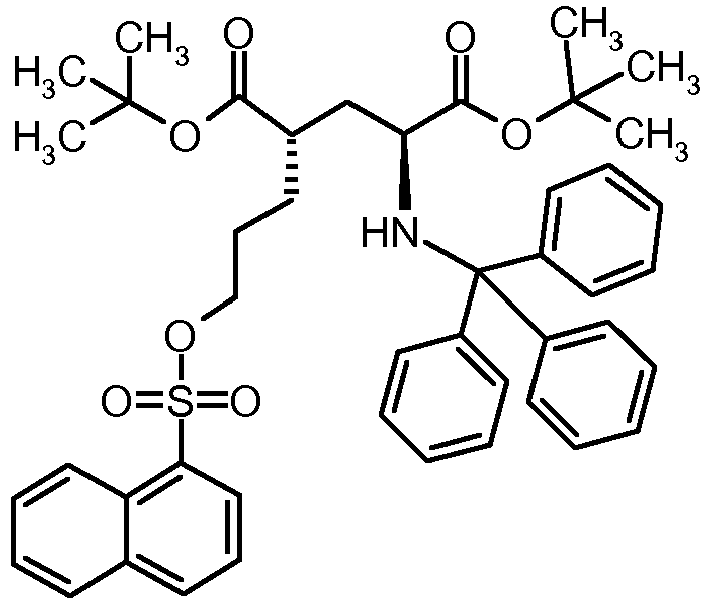
- A preferred compound of Formula I is di-tert-butyl (4S)-4-{3-[(quinolin-8-ylsulfonyl)oxy]propyl}-N-trityl-L-glutamate

- A preferred compound of Formula I is di-tert-butyl (4S)-4-(3-{[(2,4,6-trichlorophenyl)sulfonyl]oxy}propyl)-N-trityl-L-glutamate

- A preferred compound of Formula I is tetra-tert-butyl (2S,4S,2'S,4'S)-2,2'-[biphenyl-4,4'-diylbis(sulfonyloxypropane-3,1-diyl)]bis[4-(tritylamino)pentanedioate]

- A preferred compound of Formula I is di-tert-butyl (4S)-4-(3-{[(7-nitro-1-naphthyl)sulfonyl]oxy}propyl)-N-trityl-L-glutamate

- A preferred compound of Formula I is di-tert-butyl (4S)-4-[3-({[4-nitro-3-(trifluoromethyl)phenyl]sulfonyl}oxy)propyl]-N-trityl-L-glutamate

- A preferred compound of Formula I is di-tert-butyl (4S)-4-(3-{[(4-methylphenyl)sulfonyl]oxy}propyl)-N-trityl-L-glutamate.

- A preferred compound of Formula I is di-tert-butyl (4R)-4-(3-{[(4-methylphenyl)sulfonyl]oxy}propyl)-N-trityl-L-glutamate.

- A preferred compound of Formula I is di-tert-butyl (4R)-4-{3-[(2-naphthylsulfonyl)oxy]propyl}-N-trityl-L-glutamate

- The second aspect of the present invention is directed to compounds of Formula I, Ia or Ib in the solid form. Preferably, the present invention is directed to the solid compounds of Formula I, Ia or Ib as listed above.
- Additionally the invention is directed to methods for obtaining a crystalline form of compounds of formula I, Ia or Ib. Crystallization methods are well known to the person skilled in is the art.
- In a preferred embodiment, the present invention is directed to crystalline compounds of Formula I, Ia or Ib.
- Preferably, the following compound is in a crystalline form Di-tert-butyl (4S)-4-{3-[(2-naphthylsulfonyl)oxy]propyl}-N-trityl-L-glutamate.
- Preferably, the following compound is in a crystalline form Di-tert-butyl (4R)-4-{3-[(2-naphthylsulfonyl)oxy]propyl}-N-trityl-L-glutamate.
- In a third aspect, the invention is directed to methods for obtaining compounds of formula I.
- The method for obtaining compounds of formula I is performed by sulfonylation of the hydroxy group in Formula II with a suitable sulfonylhalide (preferably, sulfonylchloride) or anhydride with a suitable substituent A to form a compound of formula I as defined above. The method for obtaining compounds of formula I comprises the step:
- Sulfonylation of compound of Formula II with a sulfonylhalide (preferably, sulfonylchloride) or sulfonyl anhydride having both a suitable substituent A.

- wherein R1 is triphenylmethyl (Trityl),
- A is selected from the group:
- a) Monocyclic aryl,
- b) Bicyclic aryl,
- c) Biaryl,
- d) Monocyclic heteroaryl, and
- e) Bicyclic heteroaryl
- a) Halogen,
- b) Nitro,
- c) Alkyl,
- d) Trifluoromethyl, and
- e) Z,
- In another embodiment, a bis-sulfonylhalide X-SO2-A-SO2-X is reacted with two molecules of compound of formula II to obtain a compound of formula I, wherein A is substituted with Z as describe above. X is halogen, preferably X is Chloro.
- Preferably, the method is conducted by reacting compounds of formula IIa for obtaining compounds of formula Ia with (2S,4S)-configuration
- Sulfonylation of compound of Formula IIa with a sulfonylhalide (preferably, sulfonylchloride) or sulfonyl anhydride having both a suitable substituent A.
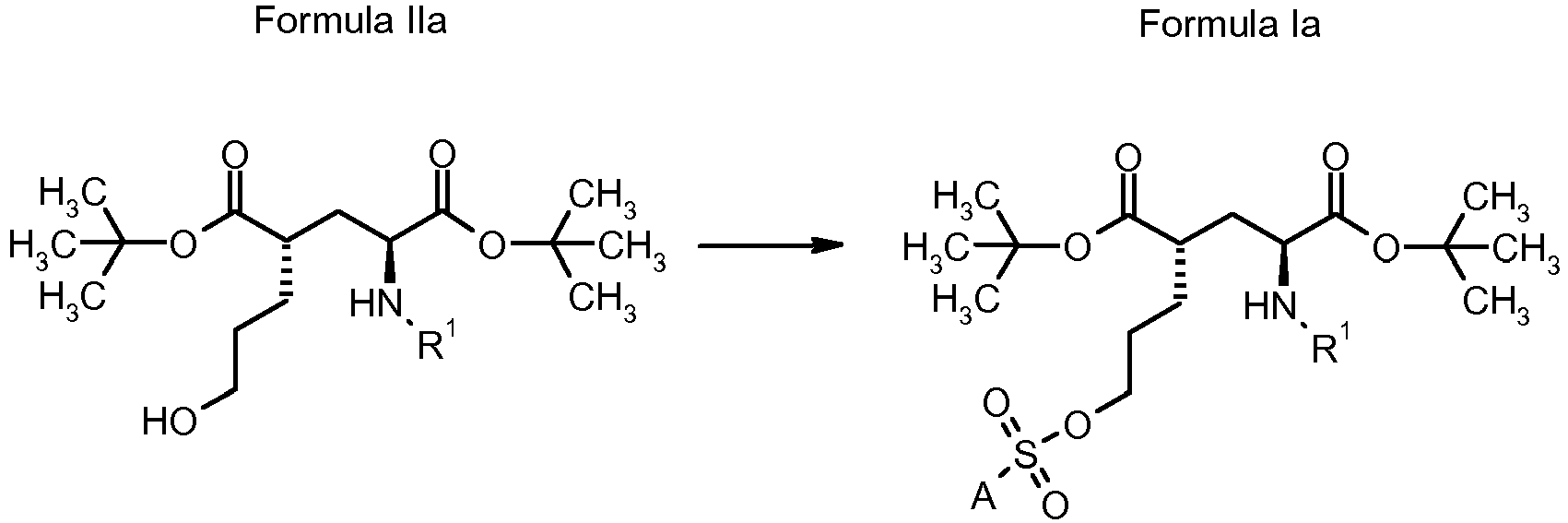
- Preferably, the method is conducted by reacting compounds of formula IIb for obtaining compounds of formula Ib with (2S,4R)-configuration
- Sulfonylation of compound of Formula IIb with a sulfonylhalide (preferably, sulfonylchloride) or sulfonyl anhydride having both a suitable substituent A.

- In another preferred embodiment, the method is conducted by reacting a mixture of compounds of formula IIa and IIb for obtaining a mixture of compounds of formula Ia with (2S,4S)-configuration and compounds of formula Ib with (2S,4R)-configuration that can be separated by methods known to the person skilled in the art (e.g. chromatography, crystallization) to obtain isolated compounds of formula Ia and isolated compounds of formula Ib

- The reagents, solvents and conditions which can be used for this sulfonylation are common and well-known to the skilled person in the field. (J. March, Advanced Organic Chemistry, 4th ed. 1992, John Wiley & Sons, pp 352ff).
- The sulfonylation of compounds of formula II to compounds of formula I is performed in a suitable inert solvent, in the presence of a suitable base, optionally in a microwave reactor in case the reaction is performed at an elevated temperature, a temperature between -10°C and 150 °C and at a pressure up to 5 bar.
- Suitable inert solvents are amides such as N,N-dimethylformamide, N,N-dimethylacetamide, or N-methylpyrrolidinone, ethers such as tetrahydrofuran, 1,2-dimethoxyethane, or dioxane, halogenated hydrocarbons such as dichloromethane or chloroform, or others such as or acetonitrile.
- Suitable bases are alkali carbonates, such as sodium carbonate or potassium carbonate, alkali bicarbonates such as potassium bicarbonate, or organic bases such as triethylamine, N,N-diisopropylethylamine, pyridine, N-methylmorpholine, N-methylpiperidine, or DBU (1,8-Diazabicyclo(5.4.0)-undec-7-ene).
- Preferred inert solvents are dichloromethane or tetrahydrofuran.
- Preferred bases are triethylamine, N,N-diisopropylethylamine or pyridine.
- The preferred features and embodiments disclosed for compounds of general formula I, la, Ib, II, IIa and IIb are herein incorporated.
- In a fourth aspect, the invention is directed to methods for obtaining compounds of formula IV-F18.
- The direct method for obtaining compounds of formula IV-F18 comprises the steps
- Reacting compound of Formula I with a 18F-Fluorination agent to obtain compound of formula III-F18, and
- Deprotecting the obtained compound of formula III-F18 for obtaining compound of formula IV-F18,
- Optionally the method is followed by the purification of compound of Formula IV-F18 by solid-phase-extraction. Preferably solid-phase-extraction cartridges or columns are used.
- Preferably, the direct method for obtaining compounds of formula IVa-F18 comprises the steps
- Reacting compound of Formula Ia with a 18F-Fluorination agent to obtain compound of formula IIIa-F18, and
- Deprotecting the obtained compound of formula IIIa-F18 for obtaining compound of formula IVa-F18,
- Optionally the method is followed by the purification of compound of Formula IVa-F18 by solid-phase-extraction. Preferably solid-phase-extraction cartridges or columns are used.
- The 18F-Fluorination agent are exemplified by but not limited to K18F, H18F, Rb18F, Cs18F, Na18F.
- Optionally, the 18F-Fluorination agent comprises a chelating agent such as a cryptand (e.g.: 4,7,13,16,21,24-Hexaoxa-1,10-diazabicyclo[8.8.8]-hexacosane - Kryptofix®) or a crown ether (e.g.: 18-crown-6).
- The 18F-Fluorination agent can also be a tetraalkylammonium salt of 18F- or a tetraalkylphosphonium salt of 18F-, known to those skilled in the art, e.g.: tetrabutylammonium [18F]fluoride, tetrabutylphosphonium [18F]fluoride.
- Preferably, the 18F-Fluorination agent is Cs18F, K18F, tetrabutylammonium [18F]fluoride.
- The reagents, solvents and conditions which can be used for this fluorination are common and well-known to the skilled person in the field. See, e.g., J. Fluorine Chem., 27 (1985):177-191; Coenen, Fluorine-18 Labeling Methods: Features and Possibilities of Basic Reactions, (2006), in: Schubiger P.A., Friebe M., Lehmann L., (eds), PET-Chemistry - The Driving Force in Molecular Imaging. Springer, Berlin Heidelberg, pp.15-50). Preferably, the solvents used in the present method are DMF, DMSO, acetonitrile, DMA, THF, or mixtures thereof, preferably the solvent is acetonitrile.
- Heating can be done by conventional heating or micro wave heating.
- In another preferred embodiment, the direct method for obtaining compounds of formula IVb-F18 comprises the steps
- Reacting compound of Formula Ib with a 18F-Fluorination agent to obtain compound of formula IIIb-F18, and
- Deprotecting the obtained compound of formula IIIb-F18 for obtaining compound of formula IVb-F18,
- Optionally the method is followed by the purification of compound of Formula IVb-F18 by solid-phase-extraction. Preferably solid-phase-extraction cartridges or columns are used.
- The 18F-Fluorination agent are exemplified by but not limited to K18F, H18F, Rb18F, Cs18F, Na18F.
- Optionally, the 18F-Fluorination agent comprises a chelating agent such as a cryptand (e.g.: 4,7,13,16,21,24-Hexaoxa-1,10-diazabicyclo[8.8.8]-hexacosane - Kryptofix®) or a crown ether (e.g.: 18-crown-6).
- The 18F-Fluorination agent can also be a tetraalkylammonium salt of 18F- or a tetraalkylphosphonium salt of 18F-, known to those skilled in the art, e.g.: tetrabutylammonium [18F]fluoride, tetrabutylphosphonium [18F]fluoride.
- Preferably, the 18F-Fluorination agent is Cs18F, K18F, tetrabutylammonium [18F]fluoride.
- The reagents, solvents and conditions which can be used for this fluorination are common and well-known to the skilled person in the field. See, e.g., J. Fluorine Chem., 27 (1985):177-191; Coenen, Fluorine-18 Labeling Methods: Features and Possibilities of Basic Reactions, (2006), in: Schubiger P.A., Friebe M., Lehmann L., (eds), PET-Chemistry - The Driving Force in Molecular Imaging. Springer, Berlin Heidelberg, pp.15-50). Preferably, the solvents used in the present method are DMF, DMSO, acetonitrile, DMA, THF, or mixtures thereof, preferably the solvent is acetonitrile.
- Heating can be done by conventional heating or micro wave heating.
- In a preferred embodiment, a compound of formula IV is manufactured by reacting a compound of formula I with a [18F]fluoride reagent. Subsequently, protecting groups are cleaved by acidic hydrolysis and compound of formula is purified by solid phase extraction. More preferably, the [18F]fluoride reagent is potassium/[[8F]fluoride/kryptofix complex.
- More preferably, the reaction a compound of formula I with the [18F]fluoride reagent is performed in acetonitrile as solvent.
- More preferably, 1-25 µmol, even more preferably 1-20 µmol, and even more preferably 5-10 µmol of compound of formula I are used.
- More preferably, the compound of formula I is reacted with the [18F]fluoride reagent at 60-160 °C, more preferably at 80-140 °C, even more preferably at 100-140 °C.
- More preferably, HCl, H2SO4 or H3PO4 is used for acidic hydrolysis. Even more preferably 1 M-4M HCl is used for acidic hydrolysis.
- More preferably, cation exchange material is used for the purification of compound of formula IV. Even more preferably, MCX cartridge(s) are used for purification of compound of formula IV.
- More preferably porous carbon material is used for purification of compound of formula IV. Even more preferably Hypercarb cartridge(s) are used for purification of compound of formula IV.
- In one preferred embodiment the compound of formula I is a compound of formula Ia and the compound of formula IV is a compound of formula IVa
- In one preferred embodiment the compound of formula I is a compound of formula Ib and the compound of formula IV is a compound of formula IVb
- In one preferred embodiment, a base is added after acidic hydrolysis. More preferably, NaOH is added after acidic hydrolysis. Even more preferably, 1 M-6M NaOH is added and the mixture is heated at 60°C-100 °C.
- The preferred features and embodiments disclosed for compounds of general formula I, la, Ib, III-F18, IIIa-F18, IIIb-F18, IV-F18, IVa-F18 and IVb-F18 are herein incorporated.
- In a fifth aspect, the invention is directed to compounds of formula II

- Preferably, compounds of formula II relates to compounds with (2S,4S)-configuration (compound of formula IIa)

- In another preferred embodiment, compounds of formula II relates to compounds with (2S,4R)-configuration (compound of formula IIb)

- In another preferred embodiment, compounds of formula II relates to compounds with (2S)-configuration (compound of formula IIa/b)

- In a sixth aspect, the invention is directed to protected compounds of formula III-F

- wherein R1 is triphenylmethyl (Trityl),
- F means fluorine atom and
- single isomers, tautomers, diastereomers, enantiomers, stereoisomers, stereoisomeric mixtures or mixtures thereof and suitable salts thereof.
- Preferably, F is 18F or 19F.
- More preferably, F is 18F (compound of formula III-F18).
- Preferably, compounds of formula III relates to compounds with (2S,4S)-configuration (compound of formula IIIa-F)

- R1 is triphenylmethyl (Trityl), and
- F means fluorine atom.
- Preferably, F is 18F in compound of formula IIIa-F.
- A preferred compound of Formula IIIa-F18 is di-tert-butyl (4S)-4-(3-[8F]Fluoropropyl)-N-trityl-L-glutamate.
- In another preferred, compounds of formula III relates to compounds with (2S,4R)-configuration (compound of formula IIIb-F)

- R1 is triphenylmethyl (Trityl), and
- F means fluorine atom.
- Preferably, F is 18F in compound of formula IIIb-F.
- A preferred compound of Formula IIIb-F18 is di-tert-butyl (4R)-4-(3-[18F]Fluoropropyl)-N-trityl-L-glutamate.
- In a seventh aspect, the invention is directed to a composition comprising compound of formula I, Ia, II, IIa, III-F, IIIa-F, or IIIa-F18 as defined in above aspects and included embodiments. Preferably, the composition comprises compound of formula I, Ia, Ib, II, IIa, IIb, III-F, IIIa-F, IIIb-F, IIIa-F18, IIIb-F18, as defined in above aspects and included embodiments.
- In a first embodiment, the invention is directed to a composition comprising compound of formula I or Ia or IIb and suitable reactants for a fluoro-labeling reaction and/or adjuvants, inter alia, carriers, solvents or stabilizers.
- The person skilled in the art is familiar with adjuvants which are suitable for the desired pharmaceutical formulations, preparations or compositions on account of his/her expert knowledge.
- Preferably, the composition comprises exemplified compounds, stereoisomers and mixtures thereof, and suitable salts thereof, and acceptable carriers or diluents as described above.
- In a second embodiment, the invention is directed to a composition comprising compound of formula II or IIa or IIb as described above and optionally suitable adjuvants. These adjuvants include, inter alia, carriers, solvents, or stabilizers.
- The person skilled in the art is familiar with adjuvants which are suitable for the desired pharmaceutical formulations, preparations or compositions on account of his/her expert knowledge.
- The administration of the compounds, pharmaceutical compositions or combinations according to the invention is performed in any of the generally accepted modes of administration available in the art. Intravenous deliveries are preferred.
- In an eighth aspect, the invention is directed to a kit comprising one vial or more than one vial comprising a predetermined quantity of compounds of Formula I, preferably compounds of Formula Ia or Ib. More preferably, the kit comprises compounds of Formula Ia.
- Optionally the kit comprises an acceptable carrier, diluent, excipient or adjuvant.
- Preferably, the kit comprises predefined quantity of compound of Formula I and one or more solid-phase extraction cartridges/columns for the purification of compound of Formula IV-F18.
- Preferably, the Kit comprises physiologically acceptable vehicle or carrier and optional adjuvants and preservatives, reagents suitable to perform the herein disclosed reactions and/or to generate the 18F labeling reagents. Furthermore, the kit may contain instructions for its use.
- The terms used in the present invention are defined below but are not limiting the invention scope.
- As used herein, the term "precursor" refers to a compound, which can be used as a starting material for a radiolabeling reaction, where an appropriate leaving group of the precursor is replaced by the radioisotope [18F].
- As used herein, the term "amine protecting group" refers to a chemical entity (such as, for example triphenylmethyl) chemically bound to an amine group, which inhibits participation of this amine group in chemical reactions (see Greene's Protective Groups in Organic Synthesis, P. Wuts, T. Greene (Wiley)).
- As used herein, the term "hydroxyl protecting group" refers to a chemical entity (such as, for example tert-butyl) chemically bound to a hydroxyl group, which inhibits participation of this hydroxyl group in chemical reactions (see Greene's Protective Groups in Organic Synthesis, P. Wuts, T. Greene (Wiley)).
- As used herein, the term "alkyl" refers to a C1-C6 straight chain or branched chain alkyl group such as, for example methyl, ethyl, propyl, isopropyl, butyl, isobutyl, tert-butyl, pentyl, isopentyl, neopentyl. Preferably, alkyl is C1-C3 straight chain or branched chain alkyl. "Aryl" represents a mono- or bicyclic aromatic, carbocyclic bivalent radical having, as a rule, 6 to 10 carbon atoms, optionally substituted, unless otherwise indicated, by one to four "Substituents"; by way of example and by preference phenyl or naphthyl.
- "Biaryl" represents an aromatic radical substituted by an identical aromatic radical. Preferably, Biaryl is biphenyl. "Heteroaryl" represents an aromatic, mono- or bicyclic bivalent radical having, as a rule, 5 to 10, preferably 5 to 6, ring atoms and up to 3, preferably 1, hetero atoms from the series consisting of S, O and N; by way of example and including but not limited to thienyl, furyl, pyrrolyl, thiazolyl, oxazolyl, imidazolyl, pyridyl, pyrimidyl, pyridazinyl, indolyl, indazolyl, benzofuranyl, benzothiophenyl, quinolinyl, isoquinolinyl, triazolyl, wherein said "Heteroaryl" is optionally substituted, unless otherwise indicated, by one to four "Substituents". Preferably, "Heteroaryl" is pyridyl or quinolinyl.
- As used herein, the term "Arylsulfonyl" refers to aryl groups respectively linked to the respective scaffold by a sulfonyl group, i.e. -S(=O)2-O, with the aryl moiety being as defined above, such as for example p-toluenesulfonyl.
- The term "halo" refers to fluoro, chloro, bromo, and iodo.
- Whenever the term "substituted" is used, it is meant to indicate that one or more hydrogens at the atom indicated in the expression using "substituted" is / are replaced by one or multiple moieties from the group comprising halogen, hydroxyl, nitro, C1-C6-alkylcarbonyl, cyano, trifluoromethyl, C1-C6-alkylsulfonyl, C1-C6-alkyl, C1-C6-alkoxy and C1-C6-alkylsulfanyl, provided that the regular valency of the respective atom is not exceeded, and that the substitution results in a chemically stable compound, i.e. a compound that is sufficiently robust to survive isolation to a useful degree of purity from a reaction mixture, and formulation into a pharmaceutical composition.
- As used herein, Cn-Cm indicates the range of number of carbon atoms the respective moiety may feature, illustrated by but not limited to e.g. C1-C6-alkyl or C1-C6 alkoxy, which may feature 1, 2, 3, 4, 5, or 6 carbon atoms not covering optional additional substitution.
- If chiral centres or other forms of isomeric centres are not otherwise defined in a compound according to the present invention, all forms of such stereoisomers, including enantiomers and diastereoisomers, are intended to be covered herein. Compounds containing chiral centres may be used as racemic mixture or as an enantiomerically enriched mixture or as a diastereomeric mixture or as a diastereomerically enriched mixture, or these isomeric mixtures may be separated using well-known techniques, and an individual stereoisomer maybe used alone. In cases wherein compounds may exist in tautomeric forms, each tautomeric form is contemplated as being included within this invention whether existing in equilibrium or predominantly in one form.
- As used herein, the term "solvents" refers to inorganic such as water, as well as organic compounds such as acetonitrile and their mixtures used for dissolution of other solid, liquid or gaseous compound(s).
- As used herein, the term "kit" refers to a set of the materials (such as filters) and chemicals (such as a precursor or solvents) required for the performing of the single radiolabeling process
- As used herein, the term "radiolabeling" refers to a chemical process, where a radioactive isotope (such as 18F) is attached to a selected molecule (such as a precursor).
- As used herein, the term "deprotection" refers to one or more chemical reaction(s), where a protecting chemical group such as trityl is eliminated from the molecule and the functional group of the molecule such as amino-group is re-established
- As used herein, the term " desilylation" refers to one or more chemical reaction(s), where a silyl group R3 - Si such as tert-butyldimethylsilyl is eliminated from the molecule and replaced by a proton.
- As used herein, the term "crystallization" refers to a physico-chemical process, where a solid crystals are precipitating from a solution, melt or gas.
- As used herein, the term "bearing" means or is equivalent to substituted.
-
Abbreviations Boc tert-Butyloxycarbonyl br broad signal (in NMR data) d.c. Corrected for decay Cbz Carboxybenzoyl Cl chemical ionisation d Doublet DAD diode array detector dd doublet of doublet ddd doublet of doublet of doublet DIPEA N,N-Diisopropylethylamine dt doublet of triplet DMF N,N-dimethylformamide DMSO Dimethylsulfoxide EI electron ionisation ELSD evaporative light scattering detector ESI electrospray ionisation EtOAc ethyl acetate Fmoc fluorenylmethyloxycarbonyl HPLC high performance liquid chromatography GBq Giga Bequerel K2.2.2 4, 7, 13, 16, 21, 24-hexaoxa-1,10-diazabicyclo[8.8.8]-hexacosane (Kryptofix 222) Kobs Correspond to the observed reaction rate based on the amount of product measured in the reaction mixture at different time points. Krel Correspond to the relative reaction rate, precursor used as reference and defined with the value "1". LiHMDS Lithium bis(trimethylsilyl)amide MBq Mega Bequerel MS mass spectrometry MeCN acetonitrile MTB methyl tert-butyl ether m Multiplet mc centred multiplet m.p. Melting point n.d.c. Not decay corrected NMR nuclear magnetic resonance spectroscopy : chemical shifts (δ) are given in ppm. OPA Ortho-phthaldialdehyde q quadruplett (quartet) PMB para-methoxybenzyl RT room temperature s Singlet t Triplet TBDMS tert-butyldimethylsilyl trt Trityl (=triphenylmethyl) tBu, t-Bu, tert-Bu tert-Butyl THF Tetrahydrofuran THP Tetrahydropyran TLC Thin layer chromatography - All solvents and chemicals were obtained from commercial sources and used without further purification. Anhydrous solvents and inert atmosphere (nitrogen or argon) were used if not stated otherwise. The preceding table lists the abbreviations used in this paragraph and in the Intermediates and Examples sections as far as they are not explained within the text body. NMR peak forms are stated as they appear in the spectra, possible higher order effects have not been considered.
- Reactions were monitored by methods known to the person skilled in the art, such as thin-layer chromatography on suitable stationary phases, such as silica gel coated plates of aluminium or glass, or HPLC/UV analyses.
- The compounds and intermediates produced according to the methods of the invention may require purification. Purification of organic compounds is well known to the person skilled in the art and there may be several ways of purifying the same compound. In some cases, no purification may be necessary. In certain cases, the compounds may be purified by crystallization. In some cases, impurities may be removed by trituration using a suitable solvent. In some cases, the compounds may be purified by column chromatography, Column chromatography, as used hereinafter, typically refers to preparative liquid chromatography on a suitable stationary phase, such as commercial silica gel or prepacked silica gel cartridges, e.g. Merck silica gel 60 (230-400 mesh) and eluents such as gradients of ethyl acetate/n-hexane.
- All chemicals were purchased from commercial sources, Aldrich and Merck, and used without further purification.
- Radiochemical synthesis were performed using a GE MX tracerlab module. Analytical HPLC was performed on an Agilent 1200 system. HPLC solvents were purchased from Aldrich.
- Compounds of the invention can be approached by alkylation of glutamate derivatives A-1 as shown in Scheme 2.

- RA2 acts as a leaving group (for example Br, I, sulfonate) and RA1 is a protecting group. The alkylation of glutamate derivatives is described in the literature, e.g.: M. A. Brimble et al., Bioorg. Med. Chem. 2005, 13, 519-523; S. Hanessian et al., J. Org. Chem. 2005, 70, 5070-5085; S. Hanessian et al., Org. Lett. 2004, 6, 4683-4686; J. Zhang et al., Tetrahedron Lett. 2003, 44, 1413-1415. It is well know, that the alkylation affords selectively compounds A-3 if R1 is a carbamate-type protecting group (e.g. Boc, CBz). Mixtures of A-3 and A-4 can be obtained and separated by chromatography methods if other protecting groups are used (e.g. RA3 = Trityl).
- Methods are well known to the person skilled in the art to convert compounds of formulae A-3 to compounds of formula IIa, including e.g.: :
- Cleavage of amine protecting group RA3 and introduction of amine protecting group R1 (e.g. introduction of Trityl group via triphenylmethyl chloride)
- Cleavage of hydroxyl protecting group RA1 (e.g. desilylation desilylation using TBAF)
- Further methods for the synthesis of IIa are well known to the person skilled in the art, e.g. Allylation of A-1 using allyl bromide and subsequent hydroboration.
- Precursors for 18F-alkyl compounds of general Formula I and Ia can be synthesized from the respective hydroxyl compounds of general Formula II and IIa according to methods known in the art (J. March, Advanced Organic Chemistry, 4th ed. 1992, John Wiley & Sons, pp 352ff).
- The radiosynthesis of the 18F labeled compounds of the invention can be accomplished in multiple ways using known methods described in the literature and databases in reach of the person skilled in the art.
- More specifically, compounds according to the general Formulae III-F18 and IV-F18 can be synthesized starting from I as outlined in Scheme 4. Such nucleophilic fluorinations are known to the person skilled in the art and also described in the literature, for reviews and cited references within see e.g. Cai et al., Eur. J. Org. Chem., 2008, 2853; Ametamey et al., Chem. Rev., 2008, 108, 1501, Miller et al., Angew. Chem. Int. Ed. 2008, 47,8998.

-
Method A1 (analytics of di-tert-butyl (4S)-4-(3-hydroxypropyl)-N-trityl-L-glutamate Column: ChiralPak IA, 4.6x250 mm Mobile phase: 5% IPA/n-heptane Flow rate: 1 mL/min Wavelength: 214/254 nm Method A2 (for Id) Column: X-Bridge Mobile phase: Acetonitrile/water 20:80 to 100% water Flow rate: 1 mL/min Wavelength: 214 nm Method A3 (for Ia to Ic and Ie to Ij) Column: X-Bridge Mobile phase: Acetonitrile/water 15:80 to 100% water Flow rate: 1 mL/min Wavelength: 214 nm Method A4 ( 19 F-fluorination) Column: Phenomenex Lux 5U Amylose-2 Mobile phase: 10% IPA/Hex Flow rate: 1 mL/min Wavelength: 214 nm Method A5 ( 18 F-radiolabelinq) Column: Phenomenex Luna 5µ C18(2); 250*4.6mm Mobile phase: A: Na2HPO4 10 mM pH 7.4, B: acetonitrile Gradient: 0 min 12% B, 15 min 12% B, 16 min 100% B, 18 min 100% B, 20 min 12% B, 23 min 12% B Flow rate: 1.2 mL/min Wavelength: 340 nm Derivatization: 10 ml of the product solution are mixed with 30 ml OPA reagent (Thermo Scientific, No.:26015). After 1 min reaction at room temperature the solution is applied to the HPLC -

- To a solution of di-tert-butyl L-glutamate hydrochloride (3.0 g, 10.14 mmol) and DIPEA (5.3 mL, 30.4 mmol) in dichloromethane (60 mL) was added a solution of benzyl chloroformate (1.74 mL, 12.2 mmol) in dichloromethane (30 mL). The solution was stirred for 30 min at room temperature. After evaporation of the solvents, the residue was taken up with ethyl acetate and water. The organic phase was separated, washed with water and brine, and was dried over sodium sulfate. After filtration, the solution was evaporated and the crude product was purified by flash chromatography (ethyl acetate/n-hexane: 10/90 to 20/80) to give the desired product (3.65 g, 91%) as a colorless oil.
1H NMR (400 MHz, CDCl3) δ ppm 1.43 (s, 9H), 1.46 (s, 9H), 1.84-1.96 (m, 1 H), 2.06-2.18 (m, 1 H), 2.20-2.40 (m, 2H), 4.20-4.30 (q, J = 8.0 Hz, 1 H), 5.10 (s, 2H), 5.34 (d, J = 8.0 Hz, 1 H), 7.27-7.40 (m, 5H). - A solution of di-tert-butyl N-[(benzyloxy)carbonyl]-L-glutamate (4.77 g, 12.12 mmol) in THF (76 mL) was cooled to -78°C and a 1.0 M solution of lithium bis(trimethylsilyl)amide (25.45 mL, 25.45 mmol) in THF was added slowly. The solution was stirred for 45 min at -78°C, and a solution of 3-(tert-butyldimethylsilyloxy)propyl trifluoromethanesulfonate (5.08 g, 15.76 mmol) in THF (25 mL) was added drop wise at -78°C. After stirring for 2 h, the reaction mixture was quenched with 2.0 N aqueous solution of NH4Cl, and warmed up to room temperature, and concentrated under vacuum. The resulting aqueous solution was extracted with ethyl acetate, the combined organic phase was washed with water and brine, and dried over sodium sulfate. After filtration, the solution was evaporated and the crude product was purified by flash chromatography (ethyl acetate/n-hexane 10/90) to give the desired product (4.62 g, 67%) as a colorless oil.
1H NMR (400 MHz, CDCl3) δ ppm 0.04 (s, 6H), 0.88 (s, 9H), 1.42 (s, 9H), 1.45 (s, 9H), 1.48-1.62 (m, 4H), 1.75-1.86 (m, 1 H), 1.90-2.00 (m, 1 H), 2.30-2.40 (m, 1 H), 3.50-3.62 (m, 2H), 4.16-4.25 (q, J = 8.8 Hz, 1H), 5.10 (s, 2H), 5.14 (d, J = 8.8 Hz, 1H), 7.28-7.38 (m, 5H); 13C NMR (100 MHz, CDCl3) δ -5.30, 18.31, 25.93, 27.95, 28.03, 29.12, 30.01, 34.32, 43.14, 53.75, 62.71, 66.89, 80.68, 82.12, 110.00, 128.09, 128.12, 128.46, 136.27, 156.02, 171.53, 174.93; MS (ESI, positive ion mode) C30H51NO7S1: m/z 588.5 [(M+Na]+]. - To a solution of di-tert-butyl (4S)-N-[(benzyloxy)carbonyl]-4-(3-{[tert-butyl(dimethyl)silyl]oxy} propyl)-L-glutamate (4.158 g, 7.349 mmol) in MeOH (140 mL) was added 10% Pd/C (2.346 g, 2.2046 mmol) under argon atmosphere. After flushing with hydrogen gas, the solution was suspended for 18 h at room temperature. After filtration with celite, the solution was evaporated. The residue was dissolved in dichloromethane (130 mL). DIPEA (3.5 mL, 20.337 mmol) and triphenylmethyl chloride (2.268 g, 8.135 mmol) were added. The reaction mixture was stirred for 2 h at room temperature, and then water was added. The reaction mixture was extracted with dichloromethane. The combined organic solution was washed with water, and dried over sodium sulfate. After filtration, the solution was evaporated and the crude product was purified by flash chromatography (ethylacetate/n-hexane: 5/95) to give the desired product (3.64 g, 79% overall yield) as a colorless oil.
1H NMR (400 MHz, CDCl3) δ 0.05 (s, 6H), 0.90 (s, 9H), 1.16 (s, 9H), 1.33 (s, 9H), 1.46-1.72 (m, 5H), 2.12-2.22 (m, 1 H), 2.28-2.40 (m, 1 H), 2.70-2.82 (m, 1 H), 3.20-3.30 (m, 1 H), 3.59 (t, J = 5.6 Hz, 2H), 7.15-7.20 (m, 3H), 7.20-7.28 (m, 6H), 7.42-7.52 (m, 6H); 13C NMR (100 MHz, CDCl3) δ -5.26, 18.35, 25.98, 27.87, 28.06, 29.93, 30.41, 39.04, 42.67, 55.27, 62.84, 71.14, 80.04, 80.84, 126.31, 127.79, 128.89, 146.35, 174.58, 174.67; MS (ESI) C41H59NO5Si: m/z 696.9 [(M+Na)+] - To a solution of di-tert-butyl (4S)-4-(3-{[tert-butyl(dimethyl)silyl]oxy}propyl)-N-trityl-L-glutamate (3.64 g, 5.40 mmol) in THF (40 mL) was added TBAF (1.0 M in THF, 10.8 mL, 10.8 mmol). The solution was stirred for 1.5 h at room temperature. After evaporation of the solvent, the crude product was purified by flash chromatography (ethyl acetate/n-hexane 40/60) to give the desired product (2.55 g, 84%) as a white solid.
1H NMR (400 MHz, CDCl3) δ ppm 1.15 (s, 9H), 1.32 (s, 9H), 1.50-1.76 (m, 5H), 2.10-220 (m, 1 H), 2.30-2.40 (m, 1 H), 2.70-2.82 (m, 1 H), 3.20-3.30 (m, 1 H), 3.61 (t, J = 5.6 Hz, 2H), 7.12-7.18 (m, 3H), 7.20-7.28 (m, 6H), 7.42-7.50 (m, 6H); 13C NMR (100 MHz, CDCl3) δ 27.86, 28.04, 29.59, 30.26, 39.10, 42.63, 55.27, 62.49, 71.16, 80.33, 80.96, 126.34, 127.80, 128.87, 146.29, 174.63, 174.68; MS (ESI) C35H45NO5: m/z 582.6 [(M+Na)+]
Chiral HPLC analysis of di-tert-butyl (4S)-4-(3-hydroxypropyl)-N-trityl-L-glutamate was done according the method A1 (retention time: 7-8 min). - Precursor (0.01 mmol) was dissolved in acetonitrile (0.5 mL), and 1.0 M TBAF/acetonitrile solution (20 µL, 0.02 mmol) was added. The reaction mixture was stirred at 80 °C for 2 h. 40 µL of solution was taken at 5, 10, 20, 40, 60, 90, and 120 min for HPLC analysis (method A4).
- [18F]Fluoride (380-1400 MBq) was trapped on a QMA cartridge (Waters, SepPak light). The activity was eluted with 0.6 mL kryptofix2.2.2/potassium carbonate solution (3 mg / 0.6 mg) in acetonitrile/water into the reaction vessel. The mixture was dried (95°C, nitrogen stream, vacuum). 6 mg of precursor in 1.5 mL acetonitrile were added to the dried residue and the resulting solution was stirred at 120°C (displayed reactor temperature) for 5 min. Subsequently, approx. 1.5 mL 2 M HCl was added. The mixture was heated at 120°C for 4.2 min.
- The reaction mixture was diluted with 10 ml water and was transferred to 2 MCX cartridges (Waters, Oasis MCX plus extraction cartridge). The cartridges were washed with 10 ml of water and subsequently eluted with 15 ml phosphate buffer (containing 10.5 mg Na2HPO4 x 2H2O, 9 mg NaCl). The product solution is transferred via a Hypercarb cartridge (Thermo Scientific, Hypersep Hypercarb 500 mg/ 6 ml) to the final product vial.
HPLC analytics of the resulting product is performed using method A5.
Identity of IV-F18 was confirmed by co-elution with reference compound IV-F19 and UV detection at 340 nm (retention time: 12-13 min). -

-
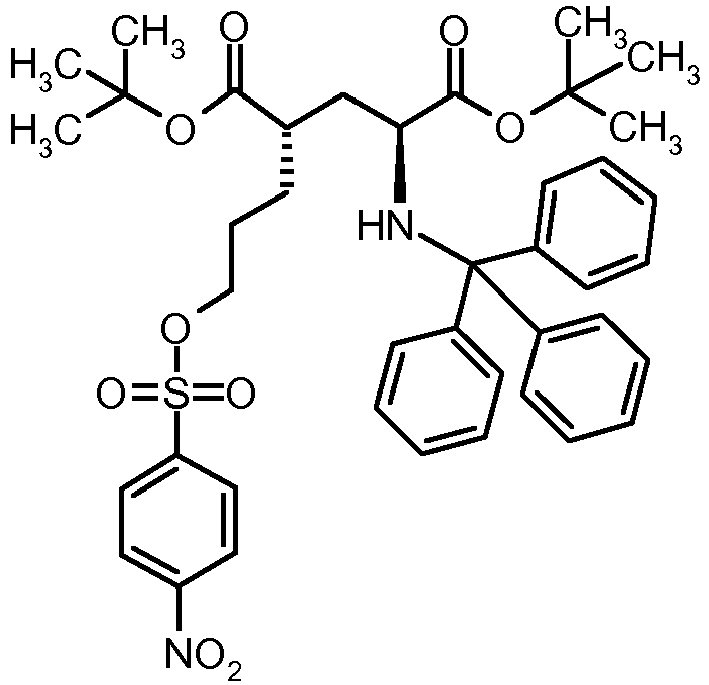
- To a solution of di-tert-butyl (4S)-4-(3-hydroxypropyl)-N-trityl-L-glutamate (212.6 mg, 0.38 mmol) and triethylamine (159 µL, 1.14 mmol) in dichloromethane (5 mL) was added 4-nitrobenzenesulfonyl chloride (126 mg, 0.57 mmol) at 0°C. The reaction mixture was stirred at 0°C for 2 h and then water was added. The organic layer was separated, and aqueous layer was extracted with dichloromethane. The combined organic solution was dried over sodium sulfate, and concentrated in vacuo. The residue was purified by flash column chromatography (ethyl acetate/n-hexane = 15/85) to give the desired product (231 mg, 82%) as a white solid.
1H NMR (400 MHz, CDCl3) δ ppm 1.14 (s, 9H), 1.30 (s, 9H), 1.50-1.73 (m, 5H), 2.00-2.12 (m, 1 H), 2.22-2.32 (m, 1 H), 2.75 (d, J = 9.2 Hz, 1 H), 3.20-3.27 (m, 1 H), 4.12 (t, J = 6.4 Hz, 2H), 7.14-7.19 (m, 3H), 7.20-7.27 (m, 6H), 7.42-7.47 (m, 6H), 8.09 (d, J = 8.8 Hz, 2H), 8.38 (d, J = 8.8 Hz, 2H); 13C NMR (100 MHz, CDCl3) 26.63, 27.83, 28.00, 29.03, 38.57, 42.20, 55.16, 71.18, 71.34, 80.64, 81.05, 124.48, 126.41, 127.83, 128.81, 129.20, 141.86, 146.17, 173.87, 174.33; MS (ESI, positive ion mode) C41H48N2O9S : m/z 767.6 [M+Na]+. -

- To a solution of di-tert-butyl (4S)-4-(3-hydroxypropyl)-N-trityl-L-glutamate (206.2 mg, 0.37 mmol) and triethylamine (154 µL, 1.10 mmol) in dichloromethane (5 mL) was added 3-nitrobenzenesulfonyl chloride (122 mg, 0.55 mmol) at 0°C. The reaction mixture was stirred at 0°C for 2 h and then water was added. The organic layer was separated, and aqueous layer was extracted with dichloromethane. Combined organic solution was dried over sodium sulfate, and concentrated in vacuo. The residue was purified by flash column chromatography (ethyl acetate/n-hexane = 20/80) to give the desired product (215 mg, 78%) as a white solid.
1H NMR (400 MHz, CDCl3) δ ppm 1.14 (s, 9H), 1.30 (s, 9H), 1.50-1.73 (m, 5H), 2.03-2.12 (m, 1 H), 2.23-2.32 (m, 1 H), 2.75 (d, J = 8.4 Hz, 1 H), 3.20-3.27 (m, 1 H), 4.13 (t, J = 6.4 Hz, 2H), 7.14-7.19 (m, 3H), 7.20-7.27 (m, 6H), 7.42-7.47 (m, 6H), 7.77 (t, J = 8.2 Hz, 1 H), 8.22 (dq, J = 0.8, 8.0 Hz, 1 H), 8.50 (dq, J = 0.8, 8.0 Hz, 1 H), 8.75 (t, J = 1.8 Hz, 1 H); 13C NMR (100 MHz, CDCl3) δ 26.63, 27.82, 27.97, 29.03, 38.65, 42.24, 55.12, 71.14, 71.32, 80.62, 81.03, 123.13, 126.38, 127.80, 128.18, 128.81, 130.74, 133.24, 138.31, 146.17, 173.84, 174.34; MS (ESI, positive ion mode) C41H48N2O9S : m/z 767.8 [M+Na]+. -

- To a solution of di-tert-butyl (4S)-4-(3-hydroxypropyl)-N-trityl-L-glutamate (202.8 mg, 0.36 mmol) and triethylamine (151 µL, 1.09 mmol) in dichloromethane (5 mL) was added biphenyl-4-sulfonyl chloride (137 mg, 0.54 mmol) at 0°C. The reaction mixture was stirred at 0°C for 5 h and then water was added. The organic layer was separated, and aqueous layer was extracted with dichloromethane. Combined organic solution was dried over sodium sulfate, and concentrated in vacuo. The residue was purified by flash column chromatography (ethyl acetate/n-hexane = 10/90) to give the desired product (236 mg, 84%) as a white solid.
1H NMR (400 MHz, CDCl3) ppm 1.14 (s, 9H), 1.30 (s, 9H), 1.50-1.73 (m, 5H), 2.03-2.12 (m, 1 H), 2.23-2.32 (m, 1 H), 2.70-2.80 (m, 1 H), 3.18-3.27 (m, 1 H), 4.06 (t, J = 6.4 Hz, 2H), 7.12-7.17 (m, 3H), 7.20-7.27 (m, 6H), 7.40-7.52 (m, 9H), 7.58-7.62 (m, 2H), 7.72-7.76 (m, 2H), 7.94-7.98 (m, 2H); 13C NMR (100 MHz, CDCl3) 26.66, 27.85, 28.00, 29.26, 38.74, 42.35, 55.14, 70.38, 71.16, 80.51, 80.99, 126.37, 127.38, 127.81, 127.86, 128.39, 128.70, 128.84, 129.10, 134.50, 139.04, 146.21, 146.72, 173.98, 174.41; MS (ESI, positive ion mode) C47H53NO7S : m/z 798.5 [M+Na]+. -

- To a solution of di-tert-butyl (4S)-4-(3-hydroxypropyl)-N-trityl-L-glutamate (217.5 mg, 0.39 mmol) and triethylamine (160 µL, 1.17 mmol) in dichloromethane (5.0 mL) was added naphthalene-2-sulfonyl chloride (155.4 mg, 0.58 mmol) at 0°C. The reaction mixture was stirred at 0°C for 3 h and then water was added. The organic layer was separated, and aqueous layer was extracted with dichloromethane. Combined organic solution was dried over sodium sulfate, and concentrated in vacuo. The residue was purified by flash column chromatography (ethyl acetate/n-hexane = 12/88) to give the desired product (289 mg, 82%) as a white solid (m.p. = 119.3°C).
1H NMR (400 MHz, CDCl3) δ 1.12 (s, 9H), 1.27 (s, 9H), 1.50-1.70 (m, 5H), 2.00-2.10 (m, 1H), 2.22-2.32 (m, 1H), 2.74 (d, J = 8.8 Hz, 1 H), 3.14-3.24 (m, 1 H), 4.04 (t, J = 6.4 Hz, 2H), 7.10-7.16 (m, 3H), 7.18-7.24 (m, 6H), 7.40-7.46 (m, 6H), 7.60-7.72 (m, 2H), 7.85 (dd, J = 1.6, 8.0 Hz, 1 H), 7.93 (d, J = 8.0 Hz, 1 H), 7.96-8.02 (m, 2H), 8.48 (d, J = 1.2 Hz, 1 H); 13C NMR (100 MHz, CDCl3) δ 26.6, 27.8, 27.9, 29.2, 38.7, 42.3, 55.1, 70.4, 71.1, 80.5, 80.9, 122.5, 126.3, 127.8, 128.0, 128.8, 129.3, 129.7, 131.9, 132.8, 135.2, 146.2, 173.9, 174.4; MS (ESI, positive ion mode) C45H5iNO7S: m/z 772.9 [M+Na]+. -

- To a solution of di-tert-butyl (4S)-4-(3-hydroxypropyl)-N-trityl-L-glutamate (216.8 mg, 0.39 mmol) and triethylamine (160 µL, 1.16 mmol) in dichloromethane (5.0 mL) was added naphthalene-1-sulfonyl chloride (131.7 mg, 0.58 mmol) at 0°C. The reaction mixture was stirred at 0°C for 3 h and then water was added. The organic layer was separated, and aqueous layer was extracted with dichloromethane. Combined organic solution was dried over sodium sulfate, and concentrated in vacuo. The residue was purified by flash column chromatography (ethyl acetate/n-hexane = 12/88) to give the desired product (248 mg, 85%) as a white solid.
1H NMR (400 MHz, CDCl3) 1.12 (s, 9H), 1.25 (s, 9H), 1.48-1.64 (m, 5H), 1.96-2.18 (m, 1H), 2.16-2.26 (m, 1H), 2.73 (d, J = 9.2 Hz, 1H), 3.10-3.20 (m, 1H), 3.90-4.00 (m, 2H), 7.10-7.16 (m, 3H), 7.18-7.24 (m, 6H), 7.40-7.46 (m, 6H), 7.56 (t, J = 7.6 Hz, 1 H), 7.62 (t, J = 8.0 Hz, 1 H), 7.69 (t, J = 7.6 Hz, 1 H), 7.96 (d, J = 8.0 Hz, 1 H), 8.13 (d, J = 8.4 Hz, 1 H), 8.28 (d, J = 7.2 Hz, 1 H), 8.60 (d, J = 8.4 Hz, 1 H); 13C NMR (100 MHz, CDCl3) δ 26.5, 27.8, 27.9, 29.2, 38.7, 42.3, 55.0, 70.5, 71.1, 80.4, 80.9, 124.0, 124.9, 126.3, 127.2, 127.8, 128.4, 128.7, 128.80, 128.83, 130.4, 131.2, 134.1, 135.2, 146.2, 173.9, 174.4; MS (ESI, positive ion mode) C45H51NO7S: m/z 772.8 [M+Na]+. -

- To a solution of di-tert-butyl (4S)-4-(3-hydroxypropyl)-N-trityl-L-glutamate (203.4 mg, 0.36 mmol) and triethylamine (150 µL, 1.09 mmol) in dichloromethane (5.0 mL) was added quinoline-8-sulfonyl chloride (124.1 mg, 0.55 mmol) at 0°C. The reaction mixture was stirred at 0°C for 3 h and at room temperature for overnight and then water was added. The organic layer was separated, and aqueous layer was extracted with dichloromethane. Combined organic solution was dried over sodium sulfate, and concentrated in vacuo. The residue was purified by flash column chromatography (MeOH/CH2Cl2 = 1/99) to give the desired product (140 mg, 51%) as a white solid.
1H NMR (400 MHz, CDCl3) δ 1.11 (s, 9H), 1.26 (s, 9H), 1.46-1.74 (m, 5H), 2.00-2.30 (m, 1 H), 2.20-2.28 (m, 1 H), 2.72 (d, J = 9.2 Hz, 1 H), 3.12-3.22 (m, 1 H), 4.31 (t, J = 6.4 Hz, 2H), 7.12-7.16 (m, 3H), 7.20-7.26 (m, 6H), 7.40-7.46 (m, 6H), 7.56 (dd, J = 8.4, 4.2 Hz, 1 H), 7.53-7.68 (m, 1 H), 8.12 (dd, J = 8.2, 1.6 Hz, 1 H), 8.26 (dd, J = 2.0, 8.2 Hz, 1 H), 8.50 (dd, J = 7.2, 1.6 Hz, 1H), 9.16 (dd, J= 1.6, 4.2 Hz, 1H); 13C NMR (100 MHz, CDCl3) δ 26.9, 27.8, 27.9, 29.4, 38.8, 42.4, 55.1, 71.1, 71.5, 80.4, 80.9, 122.4, 125.2, 126.3, 127.8, 128.8, 129.0, 133.1, 134.6, 136.4, 146.2, 151.9, 173.9, 174.4; MS (ESI, positive ion mode) C44H50N2O7S: m/z 773.9 [M+Na]+. -

- To a solution of di-tert-butyl (4S)-4-(3-hydroxypropyl)-N-trityl-L-glutamate (209.6 mg, 0.37 mmol, 2.2 eq) and triethylamine (140 µL, 1.02 mmol) in dichloromethane (5.0 mL) was added biphenyl-4-4'-disulfonyl chloride (60 mg, 0.17 mmol) at 0°C. The reaction mixture was stirred at 0°C for 3 h and at room temperature for overnight and then water was added. The organic layer was separated, and aqueous layer was extracted with dichloromethane. Combined organic solution was dried over sodium sulfate, and concentrated in vacuo. The residue was purified by flash column chromatography (ethyl acetate/n-hexane = 25/75) to give the desired product (98.7 mg, 41%) as a white solid.
1H NMR (400 MHz, CDCl3) δ 1.16 (s, 9H), 1.30 (s, 9H), 1.50-1.76 (m, 5H), 2.04-2.14 (m, 1H), 2.24-2.34 (m, 1 H), 2.75 (d, J = 9.2 Hz, 1 H), 3.18-3.28 (m, 1 H), 4.08 (t, J = 6.4 Hz, 2H), 7.12-7.18 (m, 3H), 7.20-7.26 (m, 6H), 7.40-7.46 (m, 6H), 7.72 (d, J = 8.4 Hz, 2H), 8.00 (d, J = 8.4 Hz, 1 H); 13C NMR (100 MHz, CDCl3) 26.6, 27.8, 28.0, 29.2, 38.6, 42.3, 55.1, 70.6, 71.2, 80.5, 81.0, 126.4, 127.8, 128.2, 128.6, 128.8, 136.1, 144.4, 146.2, 174.0, 174.4; MS (ESI, positive ion mode) C82H96N2O14S2: m/z 1420.6 [M+Na]+. -

- To a solution of di-tert-butyl (4S)-4-(3-hydroxypropyl)-N-trityl-L-glutamate (439 mg, 0.78 mmol) and triethylamine (330 µL, 2.35 mmol) in dichloromethane (7.0 mL) was added 4-nitro-3-(trifluoromethyl)benzenesulfonyl chloride (340.7 mg, 1.18 mmol) at 0°C. The reaction mixture was stirred at 0°C for 45 min and then water was added. Organic layer was separated, and aqueous layer was extracted with dichloromethane. Combined organic solution was dried over sodium sulfate, and concentrated in vacuo. The residue was purified by flash column chromatography (ethyl acetate/n-hexane = 15/85) to give the desired product (4h, 470 mg, 74%) as a light yellow solid.
1H NMR (400 MHz, CDCl3) δ 1.14 (s, 9H), 1.30 (s, 9H), 1.52-1.80 (m, 5H), 2.04-2.14 (m, 1 H), 2.24-2.34 (m, 1H), 2.76 (d, J = 8.8 Hz, 1 H), 3.20-3.28 (m, 1 H), 4.17 (t, J = 6.0 Hz, 2H), 7.16-7.20 (m, 3H), 7.20-7.28 (m, 6H), 7.42-7.48 (m, 6H), 7.97(d, J = 8.4 Hz, 1 H), 8.23 (dd, J = 2.0, 8.4 Hz, 1 H), 8.34 (d, J = 1.6 Hz, 1 H); MS (ESI, positive ion mode) C42H47F3N2O9S: m/z 835.4 [M+Na]+. -

- To a solution of di-tert-butyl (4S)-4-(3-hydroxypropyl)-N-trityl-L-glutamate (438 mg, 0.78 mmol) and triethylamine (327 µL, 2.35 mmol) in dichloromethane (7.0 mL) was added 2,4,6-trichlorobenzenesulfonyl chloride (328.6 mg, 1.17 mmol) at 0°C. The reaction mixture was stirred at 0°C for 1 h and then water was added. The organic layer was separated, and aqueous layer was extracted with dichloromethane. Combined organic solution was dried over sodium sulfate, and concentrated in vacuo. The residue was purified by flash column chromatography (ethyl acetate/n-hexane = 10/90) to give the desired product (415 mg, 66%) as a white solid.
1H NMR (400 MHz, CDCl3) 1.15 (s, 9H), 1.31 (s, 9H), 1.52-1.80 (m, 5H), 2.04-2.16 (m, 1H), 2.26-2.36 (m, 1H), 2.77 (d, J = 9.6 Hz, 1 H), 3.18-3.24 (m, 1 H), 4.15 (t, J = 6.4 Hz, 2H), 7.12-7.18 (m, 3H), 7.20-7.28 (m, 6H), 7.42-7.48 (m, 6H), 7.50 (s, 2H); 13C NMR (100 MHz, CDCl3) δ 26.5, 27.8, 28.0, 29.2, 38.7, 42.2, 55.1, 71.1, 71.4, 80.5, 81.0, 126.3, 127.8, 128.8, 130.9, 131.2, 136.7, 139.3, 146.1, 173.8, 174.3; MS (ESI, positive ion mode) C41H46Cl3NO7S: m/z 826.3 [M+Na]+. -

- To a solution of di-tert-butyl (4S)-4-(3-hydroxypropyl)-N-trityl-L-glutamate (486 mg, 0.84 mmol) and triethylamine (350 µL, 2.58 mmol) in dichloromethane (7.0 mL) was added 5-nitro-naphthalene-2-sulfonyl chloride (340.8 mg, 1.25 mmol) at 0°C. The reaction mixture was stirred at 0°C for 2 h and water was added. The organic layer was separated, and aqueous layer was extracted with dichloromethane. Combined organic solution was dried over sodium sulfate, and concentrated in vacuo. The residue was purified by flash column chromatography (ethyl acetate/n-hexane = 20/80) to give the desired product (616 mg, 93%) as a white solid.
1H NMR (400 MHz, CDCl3) δ 1.12 (s, 9H), 1.28 (s, 9H), 1.48-1.74 (m, 5H), 2.00-2.12 (m, 1H), 2.20-2.30 (m, 1H), 2.74 (d, J = 8.0 Hz, 1 H), 3.12-3.24 (m, 1 H), 4.11 (t, J = 6.4 Hz, 2H), 7.10-7.18 (m, 3H), 7.18-7.26 (m, 6H), 7.38-7.46 (m, 6H), 7.73 (t, J = 7.6 Hz, 1H), 8.04-8.10 (m, 1 H), 8.25 (d, J = 8.4 Hz, 1 H), 8.43 (d, J = 7.6 Hz, 1 H), 8.58 (s, 1 H), 8.77 (d, J = 9.2 Hz, 1 H); 13C NMR (100 MHz, CDCl3) δ 26.6, 27.8, 28.0, 29.1, 38.6, 42.2, 55.1, 70.9, 71.1, 80.5, 81.0, 125.4, 125.9, 126.3, 127.01, 127.04, 127.8, 128.8, 129.8, 133.0, 134.8, 135.8, 146.2, 146.4, 173.9, 174.3; MS (ESI, positive ion mode) C45H50N2O9S: m/z 817.5 [M+Na]+. - Crystallization was done for compound Id. 2% ether/hexane was used for this crystallization. Crystallization was obtained for compound Id.
- 19F-Fluorination was performed as described in "General procedures". The progress of the reaction was examined after 5, 10, 20, 40, 60, 90, and 120 min. Plotting the percentage of the conversation versus the time, the reaction rates were calculated. For calculation of the relative reaction rates, the slowest reaction (19F-fluorination of If) was defined as 1. Fastest conversion was found for the compounds Ia, Ib and especially for Ig. The compounds Ic, Id, Ie; Ii and Ij exhibited similar reaction rates compared to If.
Table 1 Reaction rates of precursors Ia Ib Ic Id Ie If Ig Ii Ij Kobs 0.466 0.663 0.196 0.159 0.165 0.067 0.796 0.126 0.0894 krel 6.93 9.86 2.93 2.38 2.45 1.0 11.8 1.88 1.33 - 18F-Fluorination was performed as described in "General procedures". Radiochemical yields and purities as shown in table 2 were determined.
- The radiochemical yield was calculated by the ratio of product radioactivity and starting radioactivity. Both are measured using a dose calibrator (MED Nuklearmedizin Technik Dresden). The radiochemical purity is determined by analytical HPLC (method A5).
Table 2 Radiolabeling of precursors Precursor Epimeric Ratio (4S:4R) Radiochemical yield % (d.c) Ia 97/3 40 Ib 95/5 50 Ic 94/6 52 Id 99/1 46 Ie 95/5 56 If 97/3 38 Ig 94/6 45 Ii 93/7 51 Ij 99/1 39 - Table 2 indicates that for all compounds high radiochemical yields (38-56% n.d.c.) have been obtained.
- Furthermore, table 2 shows that the radiolabeling resulted in high stereochemical purities for the compounds Ia - Ij (93/7 - 99/1).
- The stability of the compounds of formula I were examined in solid form at two different temperatures: 0°C, and -20°C. The precursors were tested weekly for 4 weeks. Before the study, purities of the precursors were determined individually by HPLC analysis.
-
1. Solid state: 3-5 mg of the respective precursor Ia to Ij were put into 8 amber vials, which were flushed with Ar gas and capped. Each four vials containing precursor were stored at 0°C, and -20°C. Every week for 4 weeks, 1 mg of precursor was dissolved in acetonitrile (1.0 mL). 10 µL of solution was injected into HPLC (method A2 or A3, respectively).Table 3 Summary of stability study Compounds Start Solid (%) 1 week 2 week 3 week 4 week 0°C -20°C 0°C -20°C 0°C -20°C 0°C -20°C Ia 99.4 99.5 99.4 99.3 99.2 99.1 99.0 98.7 98.4 Ib 96.7 96.5 96.6 94.6 94.8 95.0 93.7 91.3 94.3 Ic 98.8 98.6 98.6 98.6 98.7 98.6 96.9 98.4 98.0 Id 99.8 99.8 99.8 ND ND 99.8 99.8 99.8 99.8 Ie 99.1 99.0 98.9 99.0 99.0 99.0 98.6 98.6 97.9 If 90.5 89.5 89.6 89.0 88.5 89.0 88.3 89.0 87.0 Ig 97.9 97.9 98.0 98.0 98.1 97.9 97.9 97.8 97.5 Ih 97.6 94.4 94.6 95.0 94.8 93.1 93.1 93.4 92.8 Ii 97.2 89.5 89.6 97.0 97.0 96.7 95.6 95.9 93.2 Ij 94.8 97.0 97.2 97.1 97.0 96.8 96.0 96.3 96.6 ND: not determined -

- Tritylchloride (2.05 g. 7.36 mmol) was added to a solution of di-tert-butyl L-glutamate hydrochloride (2.15 g, 7.27 mmol) and triethylamine (5 mL, 36 mmol) in dichloromethane (20 mL). The solution was stirred for overnight (16 h) at room temperature. The solution was washed with sodium bicarbonate solution (3 x 10 mL) and water (2 x 5 mL). After drying over sodium sulphate, the solvent was evaporated. The crude product was purified by flash chromatography (ethyl acetate/n-hexane: 2/98 to 3/97) to give di-tert-butyl N-trityl-L-glutamate (3.2 g, 88%) as a white foam.

1H NMR (400 MHz, CDCl3) δ ppm 1.17 (s, 9H), 1.47 (s, 9H), 1.90-1.20 (m, 3H), 2.51 (ddd, 1H), 2.76 (br. d, 1H), 3.37 (br. s, 1H), 7.16-7.21 (m, 3H), 7.24-7.29 (m, 6H), 7.51 (br. d, 6H). - A solution of di-tert-butyl N-trityl-L-glutamate (1.99 g, 1.85 mmol) in THF (50 mL) was cooled to -70°C and a 1.0 M solution of lithium bis(trimethylsilyl)amide 47 mL, 47 mmol) in THF was added slowly (over a period of 20 min). The solution was stirred for 2 h at -70°C, and allyl bromide (1.44 g g, 11.9 mmol) was added drop wise at -70°C. After stirring for 1.5 h, the reaction mixture was quenched with saturated aqueous solution of NH4Cl, and warmed up to room temperature, and concentrated under vacuum. The resulting aqueous solution was extracted with dichloromethane, the combined organic phase was washed with water and was dried over sodium sulfate. After filtration, the solution was evaporated and the crude product was purified by flash chromatography (silica, ethyl acetate/n-hexane) to give the di-tert-butyl 4-allyl-N-trityl-L-glutamate (1.01 g, 46%) as a mixture of (4S,4S)/(2S,4R) diastereoisomers.

1H NMR (400 MHz, CDCl8) δ ppm 1.16 (s, 9H), 1.45 (s, 9H), 1.69-1.77 (m, 1H), 2.10-2.37 (m, 3H), 2.43-2.51 (m, 1 H), 2.74 (br. d, 1 H), 3.26-3.33 (m, 1 H), 4.96-5.06 (m, 2H), 5.63-5.76 (m, 1H), 7.14-7.18 (m, 3H), 7.21-7.27 (m, 6H), 7.45-7.51 (m, 6H).
MS (ES+) C35H43NO4: m/z 541 [M]+. - Methods to separate diastereoisomers are known to person skilled in the art (e.g. chromatography methods) allowing an access to pure the isomers (2S/2R) and (2S/4S) that can be further converted to isomerical pure compounds similar as described in the subsequent steps below.
- Borane tetrahydrofuran complex (1 M, 2.8 mL, 2.8 mmol) was added drop wise to a solution of di-tert-butyl 4-allyl-N-trityl-L-glutamate (1.00 g, 1.85 mmol) in THF (10 mL) at 0 °C. The resulting mixture was stirred for 2 h at 0 °C and for 16 h at room temperature. The solution was cooled to 0 °C. NaOH (1 M, 3 mL) and H2O2 (30% in water, 3 mL) were added drop wise. The mixture was stirred at 0 °C for 1 h. Water (5 mL) was added and the mixture was concentrated under reduced pressure. The aqueous residue was extracted with ethyl acetate. The combined organic fraction was washed with brine, dried over sodium sulfate, filtrated and concentrated. The crude product was purified by flash chromatography (silica, ethyl acetate/hexane) to afford di-tert-butyl 4-(3-hydroxypropyl)-N-trityl-L-glutamate (0.46 g, 44%) as a mixture of (4S,4S)/(2S,4R) diastereoisomers.

1H NMR (400 MHz, CDCl3) δ ppm 1.16 (s, 9H), 1.47 (s, 9H), 1.48-1.78 (m, 5H), 2.06-2.20 (m, 1H), 2.35-2.45 (m, 1H), 2.70-2.82 (m, 1H), 3.23-3.34 (m, 1H), 3.55-3.67 (m, 2H), 7.12-7.20 (m, 3H), 7.21-7.30 (m, 6H), 7.45-7.53 (m, 6H).
MS (ES+) C35H45NO5: m/z 560 [M]+. - Methods to separate diastereoisomers are known to person skilled in the art (e.g. chromatography methods) allowing an access to pure the isomers (2S/2R) and (2S/4S) that can be further converted to isomerical pure compounds similar as described in the subsequent steps below.
- At 0 °C triethylamine (0.68 mL, 4.90 mmol) and naphthalene-2-sulfonyl chloride (0.370 g, 1.63 mmol) were added to a solution of di-tert-butyl 4-(3-hydroxypropyl)-N-trityl-L-glutamate (0.457 g, 0.816 mmol) in dichloromethane (10 mL). The resulting mixture was stirred at 0 °C for 2 h and for 16 h at room temperature. The solution was concentrated and the crude product was purified by flash chromatography (silica, ethyl acetate/hexane) to afford di-tert-butyl 4-{3-[(2-naphthylsulfonyl)oxy]propyl}-N-trityl-L-glutamate (0.479 mg, 78%) as a mixture of (4S,4S)/(2S,4R) diastereoisomers. The isomers were separated by chiral HPLC (Chiralpak IC 5µm 250x30 mm, ethanol/methanol 1:1, 30 mL/min):
- di-tert-butyl (4S)-4-{3-[(2-naphthylsulfonyl)oxy]propyl}-N-trityl-L-glutamate (Id): 80 mg, 13%,
- di-tert-butyl (4R)-4-{3-[(2-naphthylsulfonyl)oxy]propyl}-N-trityl-L-glutamate (Ik): 323 mg, 53%.


- At 0 °C triethylamine (0.31 mL, 2.2 mmol) and 4-methylbenzenesulfonyl chloride (0.141 g, 0.74 mmol) were added to a solution of di-tert-butyl 4-(3-hydroxypropyl)-N-trityl-L-glutamate (0.239 g, 0.427 mmol) in dichloromethane (10 mL). The resulting mixture was stirred at 0 °C for 2 h and for 16 h at room temperature. The solution was concentrated and the crude product was purified by flash chromatography (silica, ethyl acetate/hexane) to afford di-tert-butyl 4-{3-{[(4-methylphenyl)sulfonyl)oxy]propyl}-N-trityl-L-glutamate (0.255 mg, 67%) as a mixture of (4S,4S)/(2S,4R) diastereoisomers. The isomers were separated by chiral HPLC (Chiralpak AD-H 5µm 250x20 mm, hexane/2-propanol 9:1, 25 mL/min):
- di-tert-butyl (4S)-4-{3-{[(4-methylphenyl)sulfonyl]propyl}-N-trityl-L-glutamate (Im): 34 mg (11%)
- di-tert-butyl (4R)-4-{3-{[(4-methylphenyl)sulfonyl)oxy]propyl}-N-trityl-L-glutamate (In): 127 mg (42%).


-

- The radiolabeling was performed on a GE Tracerlab MX synthesizer. [18F]Fluoride (968 MBq) was trapped an anion exchange cartridge (QMA light, Waters). The activity was eluted with a solution of 5 mg kryptofix and 1 mg potassium carbonate in 600 µL acetonitrile/water (1:1). The mixture was dried by heating under gentle nitrogen stream and vacuum. Drying was repeated after addition of acetonitrile. 5.9 mg di-tert-butyl (4R)-4-{3-{[(4-methylphenyl)sulfonyl)oxy]propyl}-N-trityl-L-glutamate (In) in 1.5 mL acetonitrile were added and the mixture was heated at 120 °C for 5 min. After addition of 2 mL HCl (2M), the mixture was heated for 5 min at 130 °C. 1.5 mL NaOH (4M) were added and the mixture was heated for 5 min at 70 °C. The crude product was diluted with 2 mL HCl (2M) and water (up to 30 mL) and passed through two MCX cartridges (MCX plus, Waters). The cartridges were washed with water (30 mL) and the radiolabeled product was eluted from the MCX cartridges through a Hypercarb cartridge (Hypercarb 500 mg, Thermo Scientific) with 15 mL phosphate buffer (7 g Na2HPO4 2 H2O; 6 g NaCl in 1 l H2O) into the product vial to obtain 381 MBq (34% d.c.) (4R)-4-(3-fluoropropyl)-L-glutamic acid. The radiochemical purity was determined to be > 96% by radio-HPLC (Luna 5µ C18(2); 250*4,6mm; 5µ; Phenomenex; 12-100% acetonitrile in 0.01 M Na2HPO4; pre-column derivatization with Fluoraldehyde, o-Phthalaldehyde Reagent Solution; Thermo Scientific).
-
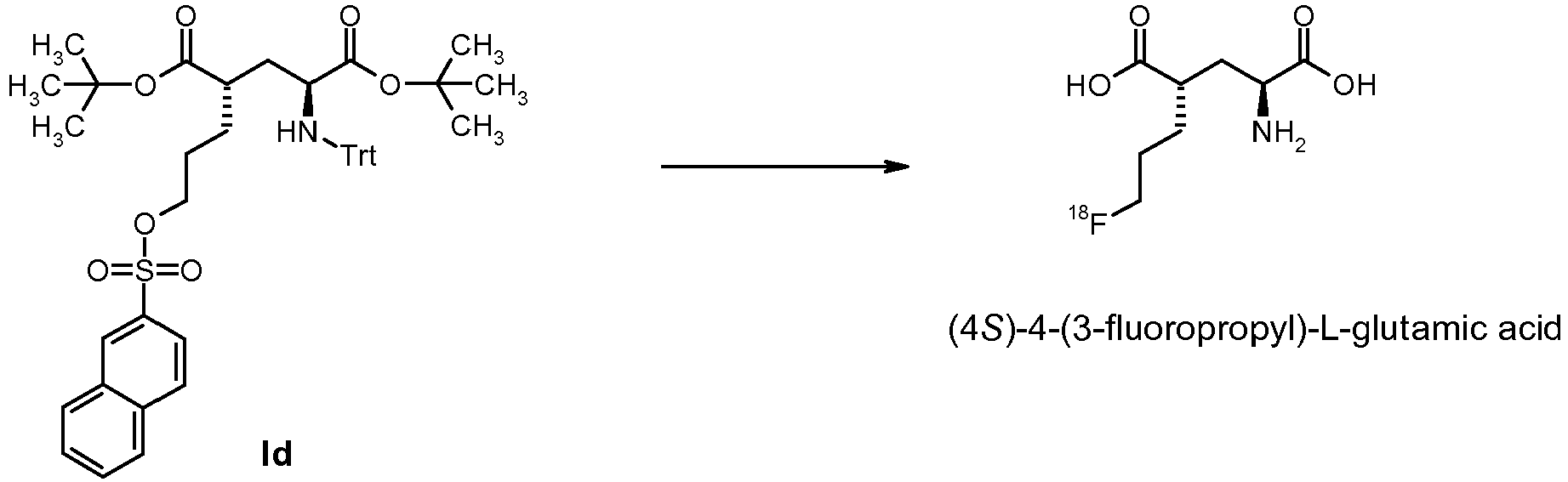
- The radiolabeling was performed on a GE Tracerlab MX synthesizer. [18F]Fluoride (2915 MBq) was trapped an anion exchange cartridge (QMA light, Waters). The activity was eluted with a solution of 3 mg kryptofix and 0.6 mg potassium carbonate in 800 µL acetonitrile/water (1:1). The mixture was dried by heating under gentle nitrogen stream and vacuum. Drying was repeated after addition of acetonitrile. 6 mg di-tert-butyl (4S)-4-{3-[(2-naphthylsulfonyl)oxy]propyl}-N-trityl-L-glutamate (Id) in 1.5 mL acetonitrile were added and the mixture was heated at 130 °C for 5 min. After addition of 2 mL HCl (2M), the mixture was heated for 10 min at 120 °C. The crude product was diluted with water (up to 30 mL) and passed through two MCX cartridges (MCX plus, Waters). The cartridges were washed with water (30 mL) and the radiolabeled product was eluted from the MCX cartridges through a Hypercarb cartridge (Hypercarb 500 mg, Thermo Scientific) with 10 mL phosphate buffer (7 g Na2HPO4 2 H2O; 6 g NaCl in 1 l H2O) into the product vial to obtain 1168 MBq (40% n.d.c.) (4S)-4-(3-fluoropropyl)-L-glutamic acid. The radiochemical purity was determined to be > 96% by radio-HPLC > 95% by radio-HPLC (Advanced Chromatography Technologies ACE 5 C18 250x4.6mm; 2-100% B in 0.04M Na2HPO4; B: 45% acetonitrile, 45% methanol, 10% water; pre-column derivatization with o-Phthalaldehyde Reagent Solution; Agilent).
-

- The radiolabeling was performed on a GE Tracerlab MX synthesizer. [18F]Fluoride (9400 MBq) was trapped an anion exchange cartridge (QMA light, Waters). The activity was eluted with a solution of 3 mg kryptofix and 0.6 mg potassium carbonate in 800 µL acetonitrile/water (1:1). The mixture was dried by heating under gentle nitrogen stream and vacuum. Drying was repeated after addition of acetonitrile. 6 mg di-tert-butyl (4R)-4-{3-[(2-naphthylsulfonyl)oxy]propyl}-N-trityl-L-glutamate (Ik) in 1.5 mL acetonitrile were added and the mixture was heated at 130 °C for 5 min. After addition of 2 mL HCl (2M), the mixture was heated for 10 min at 120 °C. The crude product was diluted with water (up to 30 mL) and passed through two MCX cartridges (MCX plus, Waters). The cartridges were washed with water (30 mL) and the radiolabeled product was eluted from the MCX cartridges through a Hypercarb cartridge (Hypercarb 500 mg, Thermo Scientific) with 10 mL phosphate buffer (7 g Na2HPO4 2 H2O; 6 g NaCl in 1 l H2O) into the product vial to obtain 5100 MBq (54% n.d.c.) (4R)-4-(3-fluoropropyl)-L-glutamic acid. The radiochemical purity was determined to be > 96% by radio-HPLC > 95% by radio-HPLC (Advanced Chromatography Technologies ACE 5 C18 250x4.6mm; 2-100% B in 0.04M Na2HPO4; B: 45% acetonitrile, 45% methanol, 10% water; pre-column derivatization with o-Phthalaldehyde Reagent Solution; Agilent).
optionally, A is bearing 1 substituent selected from the group consisting of:

# indicates the position of the bond to A.
compound of formula III-F18 is


compound of formula IIIa-F18 is


compound of formula IIIb-F18 is


1H NMR (400 MHz, CDCl3) δ 1.12 (s, 9H), 1.27 (s, 9H), 1.50-1.70 (m, 5H), 2.00-2.10 (m, 1H), 2.22-2.32 (m, 1H), 2.74 (d, J = 8.8 Hz, 1 H), 3.14-3.24 (m, 1 H), 4.04 (t, J = 6.4 Hz, 2H), 7.10-7.16 (m, 3H), 7.18-7.24 (m, 6H), 7.40-7.46 (m, 6H), 7.60-7.72 (m, 2H), 7.85 (dd, J = 1.6, 8.0 Hz, 1 H), 7.93 (d, J = 8.0 Hz, 1 H), 7.96-8.02 (m, 2H), 8.48 (d, J = 1.2 Hz, 1 H).
MS (ES+) C45H51NO7S: m/z 750 [M]+.
Ik:
1H NMR (400 MHz, CDCl3) δ 1.14 (s, 9H), 1.41 (s, 9H), 1.43-1.52 (m, 3H), 1.55-1.64 (m, 2H), 2.10 (ddd, 1H), 2.31-2.37 (m, 1H), 2.71 (br. d, 1H), 3.22 (td, 1H), 4.03 (t, 2H), 7.16 (d, 3H), 7.20-7.25 (m, 6H), 7.45-7.49 (m, 6H), 7.65 (ddd, 1 H), 7.69 (ddd, 1 H), 7.84 (dd, 1 H), 7.93 (d, 1 H), 7.76 (d, 2H), 7.99 (dd, 1 H), 8.49 (d, 1 H).
MS (ES+) C45H51NO7S: m/z 750 [M]+.
1H NMR (400 MHz, CDCl3) δ 1.14 (s, 9H), 1.30 (s, 9H), 1.45-1.68 (m, 5H), 2.03-2.15 (m, 1H), 2.22-2.31 (m, 1H), 2.44 (s, 3H), 2.75 (mc, 1H), 3.21 (dd, 1H), 4.00 (t, 2H), 7.12-7.18 (m, 3H), 7.21-7.28 (m, 6H), 7.33 (d, 2H), 7.41-7.47 (m, 6H), 7.78 (d, 2H).
In
1H NMR (400 MHz, CDCl3) δ 1.15 (s, 9H), 1.42 (s, 9H), 1.48-1.65 (m, 5H), 2.10 (ddd, 1H), 2.34 (dt, 1 H), 2.44 (s, 3H), 2.71 (br. s, 1 H), 3.23 (br. s, 1 H), 3.95 (t, 2H), 7.13-7.18 (m, 3H), 7.21-7.29 (m, 6H), 7.32 (d, 2H), 7.43-7.48 (m, 6H), 7.76 (d, 2H).
Claims (15)
- A compound of the formula I
 R1 is triphenylmethyl (Trityl),A is selected from the group:a) Monocyclic aryl,b) Bicyclic aryl,c) Biaryl,d) Monocyclic heteroaryl, ande) Bicyclic heteroaryloptionally, A is bearing one or more substituents selected from the group comprising:a) Halogen,b) Nitro,c) Alkyl,d) Trifluoromethyl, ande) Z,wherein Z is
 R1 is triphenylmethyl (Trityl),# indicates the position of the bond to A, and single isomers, tautomers, diastereomers, enantiomers, stereoisomers, stereoisomeric mixtures thereof, and suitable salts thereof.
 - The compound according to claim 1 wherein A is selected from the group:a) phenyl,b) biphenyl,c) naphthyl, andd) quinolinyl,optionally, A is bearing one or more substituents selected from the group comprising:a) Halogen,b) Nitro,c) C1-C3 alkyl,d) Trifluoromethyl, ande) Z.
- The compound according to claims 1 or 2 with (2S,4S)-configuration (compound of formula Ia)
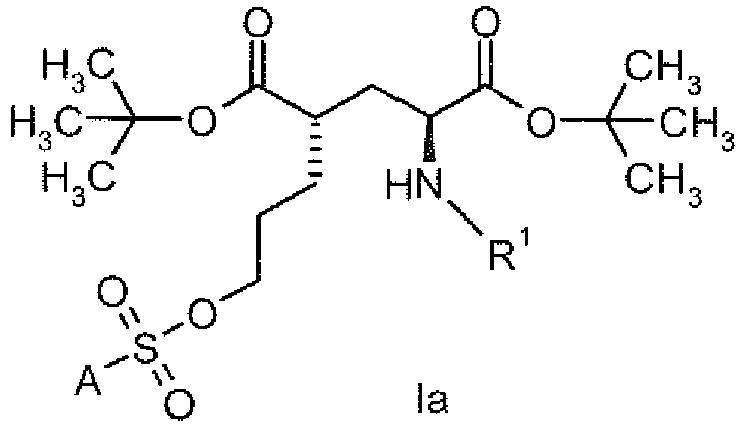
- Compound according to claims 1 to 3 selected from the fist below Di-tert-butyl (4S)-4-(3-{[(4-nitrophenyl)sulfonyl]oxy}propyl)-N-trityl-L-glutamate


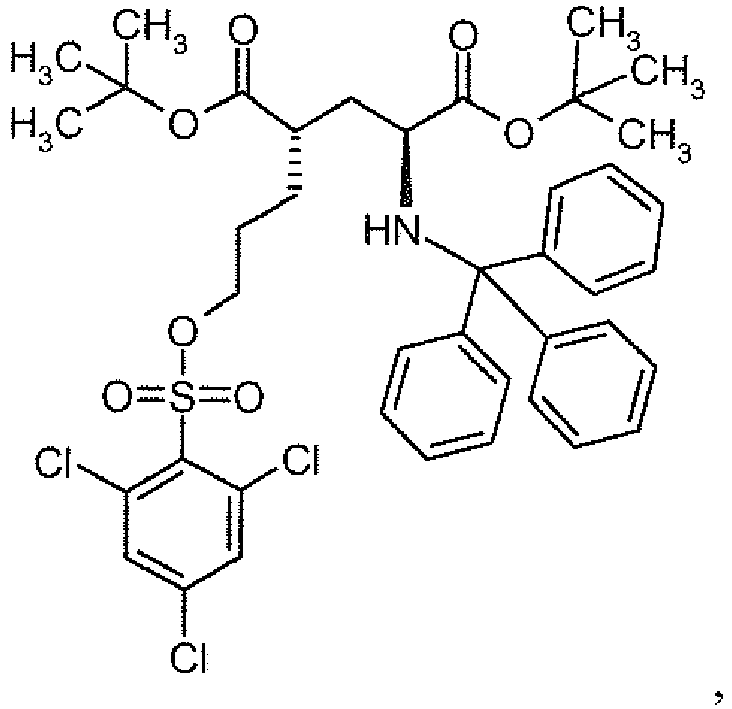


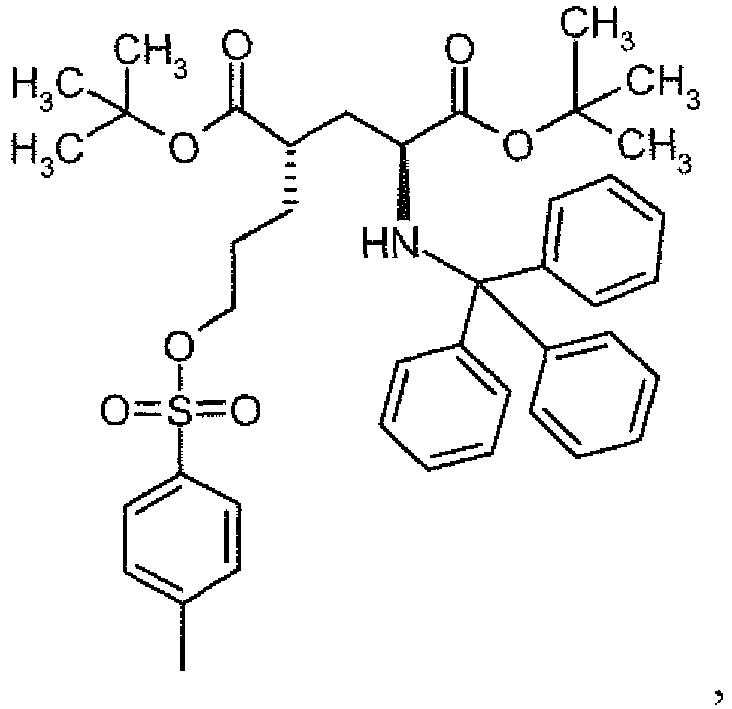

- A compound of Formula I or Ia according to claims 1 to 4 in the solid form.
- A method for obtaining compounds of formula I comprising the step:- Sulfonylation of compound of Formula II with a sulfonylhalide (preferably, sulfonylchloride) or sulfonyl anhydride having both a suitable substituent A,
 wherein R1 is triphenylmethyl (Trityl),A is selected from the group:a) Monocyclic aryl,b) Bicyclic aryl,c) Biaryl,d) Monocyclic heteroaryl, ande) Bicyclic heteroaryloptionally, A is bearing one or more substituents selected from the group comprising:a) Halogen,b) Nitro,c) Alkyl,d) Trifluoromethyl, ande) Z,wherein Z is
 R1 is triphenylmethyl (Trityl), and# indicates the position of the bond to A.
 - The method according to claim 6 for obtaining compound with (2S,4S)-configuration (compound of formula Ia)

- A method for obtaining compounds of formula IV-F18 comprising the steps- Reacting compound of Formula I according to claim 1 with a 18F-Fluorination agent to obtain compound of formula III-F18, and- Deprotecting the obtained compound of formula III-F18 for obtaining compound of formula IV-F18, wherein
compound of formula III-F18 is
compound of formula IV-F18 is
- The method according to claim 8 wherein the obtained compound is a compound with (2S,4S)-configuration (formula IVa-F18) and comprising the steps- Reacting compound of Formula Ia according to claim 3 with a 18F-Fluorination agent to obtain compound of formula IIIa-F18, and- Deprotecting the obtained compound of formula IIIa-F18 for obtaining compound of formula IVa-F18,wherein
compound of formula IIIa-F18 is
compound of formula IVa-F18 is
- A compound of formula II

single isomers, tautomers, diastereomers, enantiomers, stereoisomers, stereoisomeric mixtures or mixtures thereof, and suitable salts thereof. - The compound according to claim 10 with (2S,4S)-configuration (compound of formula IIa)

- A compound of formula III-F

F means fluorine atom, preferably, F is 18F or 19F, and
single isomers, tautomers, diastereomers, enantiomers, stereoisomers, stereoisomeric mixtures or mixtures thereof and suitable salts thereof. - The compound according to claim 12 with (2S,4S)-configuration (compound of formula IIIa-F)
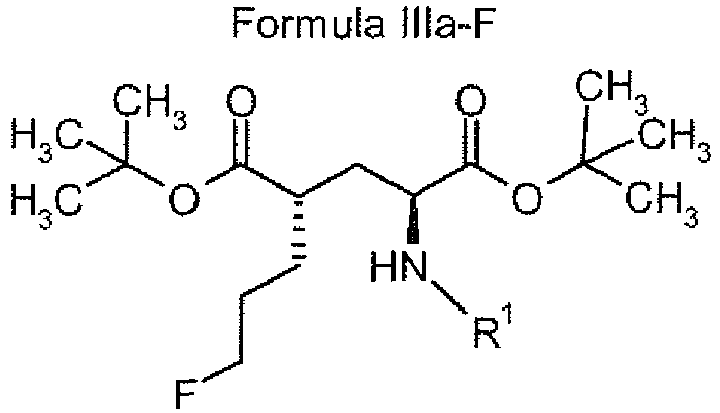
- A composition comprising compound of formula I, Ia, II, IIa, III-F, IIIa-F, or IIIa-F18.
- A kit comprising one vial or more than one vial comprising a predetermined quantity of compounds of Formula I.
Priority Applications (1)
| Application Number | Priority Date | Filing Date | Title |
|---|---|---|---|
| EP12717738.4A EP2705011B1 (en) | 2011-05-03 | 2012-04-30 | Novel precursors of glutamate derivatives |
Applications Claiming Priority (3)
| Application Number | Priority Date | Filing Date | Title |
|---|---|---|---|
| EP11075077A EP2520557A1 (en) | 2011-05-03 | 2011-05-03 | Novel precursors of glutamate derivatives |
| EP12717738.4A EP2705011B1 (en) | 2011-05-03 | 2012-04-30 | Novel precursors of glutamate derivatives |
| PCT/EP2012/057884 WO2012150204A1 (en) | 2011-05-03 | 2012-04-30 | Novel precursors of glutamate derivatives |
Publications (2)
| Publication Number | Publication Date |
|---|---|
| EP2705011A1 EP2705011A1 (en) | 2014-03-12 |
| EP2705011B1 true EP2705011B1 (en) | 2016-08-17 |
Family
ID=46022261
Family Applications (2)
| Application Number | Title | Priority Date | Filing Date |
|---|---|---|---|
| EP11075077A Withdrawn EP2520557A1 (en) | 2011-05-03 | 2011-05-03 | Novel precursors of glutamate derivatives |
| EP12717738.4A Not-in-force EP2705011B1 (en) | 2011-05-03 | 2012-04-30 | Novel precursors of glutamate derivatives |
Family Applications Before (1)
| Application Number | Title | Priority Date | Filing Date |
|---|---|---|---|
| EP11075077A Withdrawn EP2520557A1 (en) | 2011-05-03 | 2011-05-03 | Novel precursors of glutamate derivatives |
Country Status (15)
| Country | Link |
|---|---|
| US (1) | US9000037B2 (en) |
| EP (2) | EP2520557A1 (en) |
| JP (2) | JP6219815B2 (en) |
| KR (1) | KR101996683B1 (en) |
| CN (1) | CN103930388B (en) |
| AU (1) | AU2012251721A1 (en) |
| BR (1) | BR112013028266A2 (en) |
| CA (1) | CA2834881C (en) |
| ES (1) | ES2603183T3 (en) |
| IL (1) | IL229175A (en) |
| MX (1) | MX2013012795A (en) |
| RU (1) | RU2600981C2 (en) |
| SG (1) | SG194759A1 (en) |
| WO (1) | WO2012150204A1 (en) |
| ZA (1) | ZA201308185B (en) |
Families Citing this family (4)
| Publication number | Priority date | Publication date | Assignee | Title |
|---|---|---|---|---|
| EP2520557A1 (en) * | 2011-05-03 | 2012-11-07 | Bayer Pharma Aktiengesellschaft | Novel precursors of glutamate derivatives |
| CN115557861A (en) * | 2021-07-01 | 2023-01-03 | 海南大学 | Sulfonate compound and synthesis method thereof |
| WO2023229997A1 (en) * | 2022-05-23 | 2023-11-30 | Board Of Regents, The University Of Texas System | Cgmp-compliant automated [18f]fspg production for clinical examination |
| CN115340472B (en) * | 2022-09-19 | 2024-05-07 | 合肥工业大学 | Glutamic acid derivative and synthesis method and application thereof |
Family Cites Families (9)
| Publication number | Priority date | Publication date | Assignee | Title |
|---|---|---|---|---|
| US6824760B2 (en) * | 2001-06-04 | 2004-11-30 | The University Of Texas System | Imaging agents, precursors thereof and methods of manufacture |
| RU2395489C2 (en) * | 2006-11-01 | 2010-07-27 | Институт элементоорганических соединений имени А.Н.Несмеянова Российской академии наук (ИНЭОС РАН) | [f-18] labelled l-glutamic acid, [f-18] labelled l-glutamine, derivatives thereof and use thereof, as well as synthesis method thereof |
| KR101495924B1 (en) | 2006-11-01 | 2015-02-25 | 바이엘 파마 악티엔게젤샤프트 | [f-18]-labeled l-glutamic acid, [f-18]-labeled l-glutamine, derivatives thereof and use thereof and processes for their preparation |
| EP2123621A1 (en) | 2008-05-20 | 2009-11-25 | Bayer Schering Pharma Aktiengesellschaft | New [F-18]-marked L-glutamic acids and L-glutamic acid derivatives (1), application thereof and method for their manufacture |
| EP2123620A1 (en) * | 2008-05-20 | 2009-11-25 | Bayer Schering Pharma Aktiengesellschaft | {F-19}-labeled L-Glutamic acid and L-Glutamine derivative (III), use thereof and method for obtaining them |
| CA2729635A1 (en) | 2008-07-03 | 2010-01-07 | Ananth Srinivasan | Compounds and processes for production of radiopharmaceuticals |
| CN102471176A (en) | 2009-07-11 | 2012-05-23 | 拜耳医药股份有限公司 | Non-polar and polar leaving groups |
| MX2012005733A (en) * | 2009-11-17 | 2013-01-22 | Bayer Ip Gmbh | METHOD OF PRODUCTION OF GLUTAMIC ACID DERIVATIVES MARKED WITH F-18. |
| EP2520557A1 (en) * | 2011-05-03 | 2012-11-07 | Bayer Pharma Aktiengesellschaft | Novel precursors of glutamate derivatives |
-
2011
- 2011-05-03 EP EP11075077A patent/EP2520557A1/en not_active Withdrawn
-
2012
- 2012-04-30 KR KR1020137031631A patent/KR101996683B1/en not_active Expired - Fee Related
- 2012-04-30 CA CA2834881A patent/CA2834881C/en not_active Expired - Fee Related
- 2012-04-30 US US14/115,127 patent/US9000037B2/en not_active Expired - Fee Related
- 2012-04-30 JP JP2014508759A patent/JP6219815B2/en not_active Expired - Fee Related
- 2012-04-30 RU RU2013153328/04A patent/RU2600981C2/en active
- 2012-04-30 BR BR112013028266A patent/BR112013028266A2/en not_active IP Right Cessation
- 2012-04-30 AU AU2012251721A patent/AU2012251721A1/en not_active Abandoned
- 2012-04-30 WO PCT/EP2012/057884 patent/WO2012150204A1/en not_active Ceased
- 2012-04-30 SG SG2013081385A patent/SG194759A1/en unknown
- 2012-04-30 ES ES12717738.4T patent/ES2603183T3/en active Active
- 2012-04-30 CN CN201280032669.8A patent/CN103930388B/en not_active Expired - Fee Related
- 2012-04-30 MX MX2013012795A patent/MX2013012795A/en active IP Right Grant
- 2012-04-30 EP EP12717738.4A patent/EP2705011B1/en not_active Not-in-force
-
2013
- 2013-10-31 IL IL229175A patent/IL229175A/en active IP Right Grant
- 2013-11-01 ZA ZA2013/08185A patent/ZA201308185B/en unknown
-
2016
- 2016-10-28 JP JP2016211820A patent/JP2017078066A/en active Pending
Also Published As
| Publication number | Publication date |
|---|---|
| IL229175A (en) | 2017-02-28 |
| EP2520557A1 (en) | 2012-11-07 |
| CN103930388B (en) | 2016-05-25 |
| KR20140062432A (en) | 2014-05-23 |
| RU2013153328A (en) | 2015-06-10 |
| HK1197053A1 (en) | 2015-01-02 |
| SG194759A1 (en) | 2013-12-30 |
| AU2012251721A1 (en) | 2013-11-21 |
| JP6219815B2 (en) | 2017-10-25 |
| CA2834881A1 (en) | 2012-11-08 |
| BR112013028266A2 (en) | 2019-09-24 |
| US20140243532A1 (en) | 2014-08-28 |
| EP2705011A1 (en) | 2014-03-12 |
| KR101996683B1 (en) | 2019-07-05 |
| NZ617331A (en) | 2015-07-31 |
| IL229175A0 (en) | 2013-12-31 |
| RU2600981C2 (en) | 2016-10-27 |
| JP2014523861A (en) | 2014-09-18 |
| US9000037B2 (en) | 2015-04-07 |
| ZA201308185B (en) | 2014-08-27 |
| CN103930388A (en) | 2014-07-16 |
| ES2603183T3 (en) | 2017-02-24 |
| WO2012150204A1 (en) | 2012-11-08 |
| CA2834881C (en) | 2020-03-10 |
| MX2013012795A (en) | 2014-06-23 |
| JP2017078066A (en) | 2017-04-27 |
Similar Documents
| Publication | Publication Date | Title |
|---|---|---|
| JP5684333B2 (en) | Method for producing radioactive halogen-labeled organic compound | |
| Gao et al. | An improved synthesis of dopamine D2/D3 receptor radioligands [11C] fallypride and [18F] fallypride | |
| IL206332A (en) | Process for production of radioactive-fluorine-labeled organic compound | |
| US9000037B2 (en) | Precursors of glutamate derivatives | |
| KR20190070945A (en) | Precursor for radioactive fluorination | |
| JP2013514317A (en) | Prostate-specific membrane antigen inhibitor | |
| AU2010321278B2 (en) | Method for production of F-18 labeled glutamic acid derivatives | |
| EP1889834B1 (en) | Novel organic compound and method for producing radioactive halogen-labeled organic compound using the same | |
| JP2014523890A (en) | Novel precursors for the direct synthesis of 18F-fluoromethoxy compounds for PET imaging and the direct radioactive synthesis of protected derivatives of O-([18F] fluoromethyl) tyrosine | |
| US6824760B2 (en) | Imaging agents, precursors thereof and methods of manufacture | |
| KR20110098724A (en) | Radioisotope-labeled lysine and ornithine derivatives, uses thereof and methods for their preparation | |
| NZ617331B2 (en) | Novel precursors of glutamate derivatives | |
| HK1197053B (en) | Novel precursors of glutamate derivatives | |
| AU2011347636B2 (en) | Process simplification for precursor compound | |
| JP6018578B2 (en) | Production of PET precursor | |
| Malik et al. | Synthesis of O-[2-[18 F] fluoro-3-(2-nitro-1 H-imidazole-1-yl) propyl] tyrosine ([18 F] FNT]) as a new class of tracer for imaging hypoxia | |
| KR101619564B1 (en) | Novel precursor molecules for f-18 labelled pet tracers | |
| EP2322171A2 (en) | Fluorine labeled L-glutamic acid derivatives | |
| EP2392568A1 (en) | Heterocyclic amino acids for prostate cancer imaging | |
| JP2014501702A (en) | Stabilization of radiopharmaceutical precursors | |
| HK1177928B (en) | Method for production of f-18 labeled glutamic acid derivatives |
Legal Events
| Date | Code | Title | Description |
|---|---|---|---|
| PUAI | Public reference made under article 153(3) epc to a published international application that has entered the european phase |
Free format text: ORIGINAL CODE: 0009012 |
|
| 17P | Request for examination filed |
Effective date: 20131202 |
|
| AK | Designated contracting states |
Kind code of ref document: A1 Designated state(s): AL AT BE BG CH CY CZ DE DK EE ES FI FR GB GR HR HU IE IS IT LI LT LU LV MC MK MT NL NO PL PT RO RS SE SI SK SM TR |
|
| DAX | Request for extension of the european patent (deleted) | ||
| GRAP | Despatch of communication of intention to grant a patent |
Free format text: ORIGINAL CODE: EPIDOSNIGR1 |
|
| INTG | Intention to grant announced |
Effective date: 20160304 |
|
| GRAS | Grant fee paid |
Free format text: ORIGINAL CODE: EPIDOSNIGR3 |
|
| GRAA | (expected) grant |
Free format text: ORIGINAL CODE: 0009210 |
|
| AK | Designated contracting states |
Kind code of ref document: B1 Designated state(s): AL AT BE BG CH CY CZ DE DK EE ES FI FR GB GR HR HU IE IS IT LI LT LU LV MC MK MT NL NO PL PT RO RS SE SI SK SM TR |
|
| REG | Reference to a national code |
Ref country code: GB Ref legal event code: FG4D |
|
| REG | Reference to a national code |
Ref country code: CH Ref legal event code: EP |
|
| REG | Reference to a national code |
Ref country code: IE Ref legal event code: FG4D |
|
| REG | Reference to a national code |
Ref country code: AT Ref legal event code: REF Ref document number: 820893 Country of ref document: AT Kind code of ref document: T Effective date: 20160915 |
|
| REG | Reference to a national code |
Ref country code: DE Ref legal event code: R096 Ref document number: 602012021844 Country of ref document: DE |
|
| REG | Reference to a national code |
Ref country code: NL Ref legal event code: FP |
|
| REG | Reference to a national code |
Ref country code: CH Ref legal event code: NV Representative=s name: ISLER AND PEDRAZZINI AG, CH |
|
| REG | Reference to a national code |
Ref country code: LT Ref legal event code: MG4D |
|
| REG | Reference to a national code |
Ref country code: AT Ref legal event code: MK05 Ref document number: 820893 Country of ref document: AT Kind code of ref document: T Effective date: 20160817 |
|
| PG25 | Lapsed in a contracting state [announced via postgrant information from national office to epo] |
Ref country code: RS Free format text: LAPSE BECAUSE OF FAILURE TO SUBMIT A TRANSLATION OF THE DESCRIPTION OR TO PAY THE FEE WITHIN THE PRESCRIBED TIME-LIMIT Effective date: 20160817 Ref country code: HR Free format text: LAPSE BECAUSE OF FAILURE TO SUBMIT A TRANSLATION OF THE DESCRIPTION OR TO PAY THE FEE WITHIN THE PRESCRIBED TIME-LIMIT Effective date: 20160817 Ref country code: FI Free format text: LAPSE BECAUSE OF FAILURE TO SUBMIT A TRANSLATION OF THE DESCRIPTION OR TO PAY THE FEE WITHIN THE PRESCRIBED TIME-LIMIT Effective date: 20160817 Ref country code: LT Free format text: LAPSE BECAUSE OF FAILURE TO SUBMIT A TRANSLATION OF THE DESCRIPTION OR TO PAY THE FEE WITHIN THE PRESCRIBED TIME-LIMIT Effective date: 20160817 Ref country code: NO Free format text: LAPSE BECAUSE OF FAILURE TO SUBMIT A TRANSLATION OF THE DESCRIPTION OR TO PAY THE FEE WITHIN THE PRESCRIBED TIME-LIMIT Effective date: 20161117 |
|
| REG | Reference to a national code |
Ref country code: ES Ref legal event code: FG2A Ref document number: 2603183 Country of ref document: ES Kind code of ref document: T3 Effective date: 20170224 |
|
| PG25 | Lapsed in a contracting state [announced via postgrant information from national office to epo] |
Ref country code: SE Free format text: LAPSE BECAUSE OF FAILURE TO SUBMIT A TRANSLATION OF THE DESCRIPTION OR TO PAY THE FEE WITHIN THE PRESCRIBED TIME-LIMIT Effective date: 20160817 Ref country code: PL Free format text: LAPSE BECAUSE OF FAILURE TO SUBMIT A TRANSLATION OF THE DESCRIPTION OR TO PAY THE FEE WITHIN THE PRESCRIBED TIME-LIMIT Effective date: 20160817 Ref country code: PT Free format text: LAPSE BECAUSE OF FAILURE TO SUBMIT A TRANSLATION OF THE DESCRIPTION OR TO PAY THE FEE WITHIN THE PRESCRIBED TIME-LIMIT Effective date: 20161219 Ref country code: GR Free format text: LAPSE BECAUSE OF FAILURE TO SUBMIT A TRANSLATION OF THE DESCRIPTION OR TO PAY THE FEE WITHIN THE PRESCRIBED TIME-LIMIT Effective date: 20161118 Ref country code: LV Free format text: LAPSE BECAUSE OF FAILURE TO SUBMIT A TRANSLATION OF THE DESCRIPTION OR TO PAY THE FEE WITHIN THE PRESCRIBED TIME-LIMIT Effective date: 20160817 Ref country code: AT Free format text: LAPSE BECAUSE OF FAILURE TO SUBMIT A TRANSLATION OF THE DESCRIPTION OR TO PAY THE FEE WITHIN THE PRESCRIBED TIME-LIMIT Effective date: 20160817 |
|
| REG | Reference to a national code |
Ref country code: FR Ref legal event code: PLFP Year of fee payment: 6 |
|
| PG25 | Lapsed in a contracting state [announced via postgrant information from national office to epo] |
Ref country code: EE Free format text: LAPSE BECAUSE OF FAILURE TO SUBMIT A TRANSLATION OF THE DESCRIPTION OR TO PAY THE FEE WITHIN THE PRESCRIBED TIME-LIMIT Effective date: 20160817 Ref country code: RO Free format text: LAPSE BECAUSE OF FAILURE TO SUBMIT A TRANSLATION OF THE DESCRIPTION OR TO PAY THE FEE WITHIN THE PRESCRIBED TIME-LIMIT Effective date: 20160817 |
|
| REG | Reference to a national code |
Ref country code: DE Ref legal event code: R097 Ref document number: 602012021844 Country of ref document: DE |
|
| PG25 | Lapsed in a contracting state [announced via postgrant information from national office to epo] |
Ref country code: BE Free format text: LAPSE BECAUSE OF FAILURE TO SUBMIT A TRANSLATION OF THE DESCRIPTION OR TO PAY THE FEE WITHIN THE PRESCRIBED TIME-LIMIT Effective date: 20160817 Ref country code: SK Free format text: LAPSE BECAUSE OF FAILURE TO SUBMIT A TRANSLATION OF THE DESCRIPTION OR TO PAY THE FEE WITHIN THE PRESCRIBED TIME-LIMIT Effective date: 20160817 Ref country code: DK Free format text: LAPSE BECAUSE OF FAILURE TO SUBMIT A TRANSLATION OF THE DESCRIPTION OR TO PAY THE FEE WITHIN THE PRESCRIBED TIME-LIMIT Effective date: 20160817 Ref country code: SM Free format text: LAPSE BECAUSE OF FAILURE TO SUBMIT A TRANSLATION OF THE DESCRIPTION OR TO PAY THE FEE WITHIN THE PRESCRIBED TIME-LIMIT Effective date: 20160817 Ref country code: CZ Free format text: LAPSE BECAUSE OF FAILURE TO SUBMIT A TRANSLATION OF THE DESCRIPTION OR TO PAY THE FEE WITHIN THE PRESCRIBED TIME-LIMIT Effective date: 20160817 Ref country code: BG Free format text: LAPSE BECAUSE OF FAILURE TO SUBMIT A TRANSLATION OF THE DESCRIPTION OR TO PAY THE FEE WITHIN THE PRESCRIBED TIME-LIMIT Effective date: 20161117 |
|
| PLBE | No opposition filed within time limit |
Free format text: ORIGINAL CODE: 0009261 |
|
| STAA | Information on the status of an ep patent application or granted ep patent |
Free format text: STATUS: NO OPPOSITION FILED WITHIN TIME LIMIT |
|
| 26N | No opposition filed |
Effective date: 20170518 |
|
| PG25 | Lapsed in a contracting state [announced via postgrant information from national office to epo] |
Ref country code: SI Free format text: LAPSE BECAUSE OF FAILURE TO SUBMIT A TRANSLATION OF THE DESCRIPTION OR TO PAY THE FEE WITHIN THE PRESCRIBED TIME-LIMIT Effective date: 20160817 |
|
| REG | Reference to a national code |
Ref country code: IE Ref legal event code: MM4A |
|
| PG25 | Lapsed in a contracting state [announced via postgrant information from national office to epo] |
Ref country code: MC Free format text: LAPSE BECAUSE OF FAILURE TO SUBMIT A TRANSLATION OF THE DESCRIPTION OR TO PAY THE FEE WITHIN THE PRESCRIBED TIME-LIMIT Effective date: 20160817 |
|
| PG25 | Lapsed in a contracting state [announced via postgrant information from national office to epo] |
Ref country code: LU Free format text: LAPSE BECAUSE OF NON-PAYMENT OF DUE FEES Effective date: 20170430 |
|
| REG | Reference to a national code |
Ref country code: FR Ref legal event code: PLFP Year of fee payment: 7 |
|
| PG25 | Lapsed in a contracting state [announced via postgrant information from national office to epo] |
Ref country code: IE Free format text: LAPSE BECAUSE OF NON-PAYMENT OF DUE FEES Effective date: 20170430 |
|
| PG25 | Lapsed in a contracting state [announced via postgrant information from national office to epo] |
Ref country code: MT Free format text: LAPSE BECAUSE OF NON-PAYMENT OF DUE FEES Effective date: 20170430 |
|
| PG25 | Lapsed in a contracting state [announced via postgrant information from national office to epo] |
Ref country code: AL Free format text: LAPSE BECAUSE OF FAILURE TO SUBMIT A TRANSLATION OF THE DESCRIPTION OR TO PAY THE FEE WITHIN THE PRESCRIBED TIME-LIMIT Effective date: 20160817 |
|
| REG | Reference to a national code |
Ref country code: DE Ref legal event code: R082 Ref document number: 602012021844 Country of ref document: DE Representative=s name: BOEHMERT & BOEHMERT ANWALTSPARTNERSCHAFT MBB -, DE Ref country code: DE Ref legal event code: R081 Ref document number: 602012021844 Country of ref document: DE Owner name: LIFE MOLECULAR IMAGING SA, CH Free format text: FORMER OWNER: PIRAMAL IMAGING SA, MATRAN, CH |
|
| REG | Reference to a national code |
Ref country code: CH Ref legal event code: PFA Owner name: LIFE MOLECULAR IMAGING SA, CH Free format text: FORMER OWNER: PIRAMAL IMAGING SA, CH |
|
| REG | Reference to a national code |
Ref country code: NL Ref legal event code: HC Owner name: LIFE MOLECULAR IMAGING SA; CH Free format text: DETAILS ASSIGNMENT: CHANGE OF OWNER(S), CHANGE OF OWNER(S) NAME; FORMER OWNER NAME: PIRAMAL IMAGING SA Effective date: 20190507 |
|
| PG25 | Lapsed in a contracting state [announced via postgrant information from national office to epo] |
Ref country code: HU Free format text: LAPSE BECAUSE OF FAILURE TO SUBMIT A TRANSLATION OF THE DESCRIPTION OR TO PAY THE FEE WITHIN THE PRESCRIBED TIME-LIMIT; INVALID AB INITIO Effective date: 20120430 |
|
| REG | Reference to a national code |
Ref country code: ES Ref legal event code: PC2A Owner name: LIFE MOLECULAR IMAGING SA Effective date: 20190730 |
|
| PG25 | Lapsed in a contracting state [announced via postgrant information from national office to epo] |
Ref country code: CY Free format text: LAPSE BECAUSE OF NON-PAYMENT OF DUE FEES Effective date: 20160817 |
|
| PG25 | Lapsed in a contracting state [announced via postgrant information from national office to epo] |
Ref country code: MK Free format text: LAPSE BECAUSE OF FAILURE TO SUBMIT A TRANSLATION OF THE DESCRIPTION OR TO PAY THE FEE WITHIN THE PRESCRIBED TIME-LIMIT Effective date: 20160817 |
|
| PG25 | Lapsed in a contracting state [announced via postgrant information from national office to epo] |
Ref country code: TR Free format text: LAPSE BECAUSE OF FAILURE TO SUBMIT A TRANSLATION OF THE DESCRIPTION OR TO PAY THE FEE WITHIN THE PRESCRIBED TIME-LIMIT Effective date: 20160817 |
|
| PG25 | Lapsed in a contracting state [announced via postgrant information from national office to epo] |
Ref country code: IS Free format text: LAPSE BECAUSE OF FAILURE TO SUBMIT A TRANSLATION OF THE DESCRIPTION OR TO PAY THE FEE WITHIN THE PRESCRIBED TIME-LIMIT Effective date: 20161217 |
|
| PGFP | Annual fee paid to national office [announced via postgrant information from national office to epo] |
Ref country code: FR Payment date: 20210422 Year of fee payment: 10 Ref country code: IT Payment date: 20210430 Year of fee payment: 10 Ref country code: DE Payment date: 20210430 Year of fee payment: 10 |
|
| PGFP | Annual fee paid to national office [announced via postgrant information from national office to epo] |
Ref country code: GB Payment date: 20210422 Year of fee payment: 10 Ref country code: ES Payment date: 20210519 Year of fee payment: 10 Ref country code: CH Payment date: 20210422 Year of fee payment: 10 |
|
| PGFP | Annual fee paid to national office [announced via postgrant information from national office to epo] |
Ref country code: NL Payment date: 20210421 Year of fee payment: 10 |
|
| REG | Reference to a national code |
Ref country code: DE Ref legal event code: R119 Ref document number: 602012021844 Country of ref document: DE |
|
| REG | Reference to a national code |
Ref country code: CH Ref legal event code: PL |
|
| REG | Reference to a national code |
Ref country code: NL Ref legal event code: MM Effective date: 20220501 |
|
| GBPC | Gb: european patent ceased through non-payment of renewal fee |
Effective date: 20220430 |
|
| PG25 | Lapsed in a contracting state [announced via postgrant information from national office to epo] |
Ref country code: NL Free format text: LAPSE BECAUSE OF NON-PAYMENT OF DUE FEES Effective date: 20220501 Ref country code: LI Free format text: LAPSE BECAUSE OF NON-PAYMENT OF DUE FEES Effective date: 20220430 Ref country code: GB Free format text: LAPSE BECAUSE OF NON-PAYMENT OF DUE FEES Effective date: 20220430 Ref country code: FR Free format text: LAPSE BECAUSE OF NON-PAYMENT OF DUE FEES Effective date: 20220430 Ref country code: DE Free format text: LAPSE BECAUSE OF NON-PAYMENT OF DUE FEES Effective date: 20221103 Ref country code: CH Free format text: LAPSE BECAUSE OF NON-PAYMENT OF DUE FEES Effective date: 20220430 |
|
| PG25 | Lapsed in a contracting state [announced via postgrant information from national office to epo] |
Ref country code: IT Free format text: LAPSE BECAUSE OF NON-PAYMENT OF DUE FEES Effective date: 20220430 |
|
| REG | Reference to a national code |
Ref country code: ES Ref legal event code: FD2A Effective date: 20230703 |
|
| PG25 | Lapsed in a contracting state [announced via postgrant information from national office to epo] |
Ref country code: ES Free format text: LAPSE BECAUSE OF NON-PAYMENT OF DUE FEES Effective date: 20220501 |