EP2700685A1 - Surface-protecting film - Google Patents
Surface-protecting film Download PDFInfo
- Publication number
- EP2700685A1 EP2700685A1 EP12773523.1A EP12773523A EP2700685A1 EP 2700685 A1 EP2700685 A1 EP 2700685A1 EP 12773523 A EP12773523 A EP 12773523A EP 2700685 A1 EP2700685 A1 EP 2700685A1
- Authority
- EP
- European Patent Office
- Prior art keywords
- sensitive adhesive
- pressure
- protective film
- adhesive layer
- surface protective
- Prior art date
- Legal status (The legal status is an assumption and is not a legal conclusion. Google has not performed a legal analysis and makes no representation as to the accuracy of the status listed.)
- Withdrawn
Links
- 239000004820 Pressure-sensitive adhesive Substances 0.000 claims abstract description 117
- 239000010410 layer Substances 0.000 claims abstract description 111
- 230000001681 protective effect Effects 0.000 claims abstract description 79
- 239000000463 material Substances 0.000 claims abstract description 49
- NIXOWILDQLNWCW-UHFFFAOYSA-N acrylic acid group Chemical group C(C=C)(=O)O NIXOWILDQLNWCW-UHFFFAOYSA-N 0.000 claims abstract description 45
- 238000009736 wetting Methods 0.000 claims abstract description 29
- 239000002216 antistatic agent Substances 0.000 abstract description 17
- 239000004014 plasticizer Substances 0.000 abstract description 13
- 229920001296 polysiloxane Polymers 0.000 description 24
- 238000005259 measurement Methods 0.000 description 19
- 238000000034 method Methods 0.000 description 19
- 239000000203 mixture Substances 0.000 description 19
- 238000001035 drying Methods 0.000 description 17
- YXFVVABEGXRONW-UHFFFAOYSA-N Toluene Chemical compound CC1=CC=CC=C1 YXFVVABEGXRONW-UHFFFAOYSA-N 0.000 description 15
- 238000012360 testing method Methods 0.000 description 14
- 239000006096 absorbing agent Substances 0.000 description 10
- 239000000654 additive Substances 0.000 description 10
- 229920001225 polyester resin Polymers 0.000 description 10
- XEKOWRVHYACXOJ-UHFFFAOYSA-N Ethyl acetate Chemical compound CCOC(C)=O XEKOWRVHYACXOJ-UHFFFAOYSA-N 0.000 description 9
- 230000000996 additive effect Effects 0.000 description 9
- 239000003963 antioxidant agent Substances 0.000 description 9
- 230000003078 antioxidant effect Effects 0.000 description 9
- 238000011156 evaluation Methods 0.000 description 9
- 239000004611 light stabiliser Substances 0.000 description 9
- 229920005989 resin Polymers 0.000 description 9
- 239000011347 resin Substances 0.000 description 9
- BASFCYQUMIYNBI-UHFFFAOYSA-N platinum Chemical compound [Pt] BASFCYQUMIYNBI-UHFFFAOYSA-N 0.000 description 8
- 239000004645 polyester resin Substances 0.000 description 8
- 239000000945 filler Substances 0.000 description 6
- 229920000642 polymer Polymers 0.000 description 6
- 239000002904 solvent Substances 0.000 description 6
- JOYRKODLDBILNP-UHFFFAOYSA-N Ethyl urethane Chemical compound CCOC(N)=O JOYRKODLDBILNP-UHFFFAOYSA-N 0.000 description 5
- 239000003054 catalyst Substances 0.000 description 5
- 229920001577 copolymer Polymers 0.000 description 5
- 229920003023 plastic Polymers 0.000 description 5
- 239000004033 plastic Substances 0.000 description 5
- 229920005862 polyol Polymers 0.000 description 5
- 150000003077 polyols Chemical class 0.000 description 5
- 229920006353 Acrylite® Polymers 0.000 description 4
- 229920000297 Rayon Polymers 0.000 description 4
- 230000000052 comparative effect Effects 0.000 description 4
- 239000012760 heat stabilizer Substances 0.000 description 4
- 229910052697 platinum Inorganic materials 0.000 description 4
- 239000004926 polymethyl methacrylate Substances 0.000 description 4
- 239000007787 solid Substances 0.000 description 4
- VGGSQFUCUMXWEO-UHFFFAOYSA-N Ethene Chemical compound C=C VGGSQFUCUMXWEO-UHFFFAOYSA-N 0.000 description 3
- 239000005977 Ethylene Substances 0.000 description 3
- WPYMKLBDIGXBTP-UHFFFAOYSA-N benzoic acid Chemical compound OC(=O)C1=CC=CC=C1 WPYMKLBDIGXBTP-UHFFFAOYSA-N 0.000 description 3
- 238000006243 chemical reaction Methods 0.000 description 3
- 239000003795 chemical substances by application Substances 0.000 description 3
- 238000011109 contamination Methods 0.000 description 3
- 230000000694 effects Effects 0.000 description 3
- 239000011256 inorganic filler Substances 0.000 description 3
- 238000010030 laminating Methods 0.000 description 3
- -1 polyethylene terephthalate Polymers 0.000 description 3
- 238000006116 polymerization reaction Methods 0.000 description 3
- 229920005672 polyolefin resin Polymers 0.000 description 3
- OZAIFHULBGXAKX-UHFFFAOYSA-N 2-(2-cyanopropan-2-yldiazenyl)-2-methylpropanenitrile Chemical compound N#CC(C)(C)N=NC(C)(C)C#N OZAIFHULBGXAKX-UHFFFAOYSA-N 0.000 description 2
- IJGRMHOSHXDMSA-UHFFFAOYSA-N Atomic nitrogen Chemical compound N#N IJGRMHOSHXDMSA-UHFFFAOYSA-N 0.000 description 2
- OKTJSMMVPCPJKN-UHFFFAOYSA-N Carbon Chemical compound [C] OKTJSMMVPCPJKN-UHFFFAOYSA-N 0.000 description 2
- 239000005057 Hexamethylene diisocyanate Substances 0.000 description 2
- XLOMVQKBTHCTTD-UHFFFAOYSA-N Zinc monoxide Chemical compound [Zn]=O XLOMVQKBTHCTTD-UHFFFAOYSA-N 0.000 description 2
- 150000001336 alkenes Chemical class 0.000 description 2
- 125000000217 alkyl group Chemical group 0.000 description 2
- 239000012298 atmosphere Substances 0.000 description 2
- 238000004364 calculation method Methods 0.000 description 2
- 229910052799 carbon Inorganic materials 0.000 description 2
- 150000001875 compounds Chemical class 0.000 description 2
- 238000004132 cross linking Methods 0.000 description 2
- 238000005516 engineering process Methods 0.000 description 2
- RRAMGCGOFNQTLD-UHFFFAOYSA-N hexamethylene diisocyanate Chemical compound O=C=NCCCCCCN=C=O RRAMGCGOFNQTLD-UHFFFAOYSA-N 0.000 description 2
- 239000012943 hotmelt Substances 0.000 description 2
- 239000003112 inhibitor Substances 0.000 description 2
- 229910003475 inorganic filler Inorganic materials 0.000 description 2
- 239000007788 liquid Substances 0.000 description 2
- 239000004973 liquid crystal related substance Substances 0.000 description 2
- 239000000314 lubricant Substances 0.000 description 2
- 238000004519 manufacturing process Methods 0.000 description 2
- 229910052751 metal Inorganic materials 0.000 description 2
- 239000002184 metal Substances 0.000 description 2
- 239000000178 monomer Substances 0.000 description 2
- JRZJOMJEPLMPRA-UHFFFAOYSA-N olefin Natural products CCCCCCCC=C JRZJOMJEPLMPRA-UHFFFAOYSA-N 0.000 description 2
- 230000003287 optical effect Effects 0.000 description 2
- 229910052698 phosphorus Inorganic materials 0.000 description 2
- 239000011574 phosphorus Substances 0.000 description 2
- 239000000049 pigment Substances 0.000 description 2
- 229920000058 polyacrylate Polymers 0.000 description 2
- 239000005056 polyisocyanate Substances 0.000 description 2
- 229920001228 polyisocyanate Polymers 0.000 description 2
- 238000012545 processing Methods 0.000 description 2
- 239000002356 single layer Substances 0.000 description 2
- JYEUMXHLPRZUAT-UHFFFAOYSA-N 1,2,3-triazine Chemical compound C1=CN=NN=C1 JYEUMXHLPRZUAT-UHFFFAOYSA-N 0.000 description 1
- GOXQRTZXKQZDDN-UHFFFAOYSA-N 2-Ethylhexyl acrylate Chemical compound CCCCC(CC)COC(=O)C=C GOXQRTZXKQZDDN-UHFFFAOYSA-N 0.000 description 1
- OMIGHNLMNHATMP-UHFFFAOYSA-N 2-hydroxyethyl prop-2-enoate Chemical compound OCCOC(=O)C=C OMIGHNLMNHATMP-UHFFFAOYSA-N 0.000 description 1
- UPMLOUAZCHDJJD-UHFFFAOYSA-N 4,4'-Diphenylmethane Diisocyanate Chemical compound C1=CC(N=C=O)=CC=C1CC1=CC=C(N=C=O)C=C1 UPMLOUAZCHDJJD-UHFFFAOYSA-N 0.000 description 1
- 239000004342 Benzoyl peroxide Substances 0.000 description 1
- OMPJBNCRMGITSC-UHFFFAOYSA-N Benzoylperoxide Chemical compound C=1C=CC=CC=1C(=O)OOC(=O)C1=CC=CC=C1 OMPJBNCRMGITSC-UHFFFAOYSA-N 0.000 description 1
- YCKRFDGAMUMZLT-UHFFFAOYSA-N Fluorine atom Chemical compound [F] YCKRFDGAMUMZLT-UHFFFAOYSA-N 0.000 description 1
- ISWSIDIOOBJBQZ-UHFFFAOYSA-N Phenol Chemical compound OC1=CC=CC=C1 ISWSIDIOOBJBQZ-UHFFFAOYSA-N 0.000 description 1
- OAICVXFJPJFONN-UHFFFAOYSA-N Phosphorus Chemical compound [P] OAICVXFJPJFONN-UHFFFAOYSA-N 0.000 description 1
- 229920002873 Polyethylenimine Polymers 0.000 description 1
- 239000004721 Polyphenylene oxide Substances 0.000 description 1
- 239000006087 Silane Coupling Agent Substances 0.000 description 1
- NINIDFKCEFEMDL-UHFFFAOYSA-N Sulfur Chemical compound [S] NINIDFKCEFEMDL-UHFFFAOYSA-N 0.000 description 1
- GWEVSGVZZGPLCZ-UHFFFAOYSA-N Titan oxide Chemical compound O=[Ti]=O GWEVSGVZZGPLCZ-UHFFFAOYSA-N 0.000 description 1
- UKLDJPRMSDWDSL-UHFFFAOYSA-L [dibutyl(dodecanoyloxy)stannyl] dodecanoate Chemical compound CCCCCCCCCCCC(=O)O[Sn](CCCC)(CCCC)OC(=O)CCCCCCCCCCC UKLDJPRMSDWDSL-UHFFFAOYSA-L 0.000 description 1
- 150000001412 amines Chemical class 0.000 description 1
- 238000013459 approach Methods 0.000 description 1
- RWCCWEUUXYIKHB-UHFFFAOYSA-N benzophenone Chemical compound C=1C=CC=CC=1C(=O)C1=CC=CC=C1 RWCCWEUUXYIKHB-UHFFFAOYSA-N 0.000 description 1
- 239000012965 benzophenone Substances 0.000 description 1
- QRUDEWIWKLJBPS-UHFFFAOYSA-N benzotriazole Chemical compound C1=CC=C2N[N][N]C2=C1 QRUDEWIWKLJBPS-UHFFFAOYSA-N 0.000 description 1
- 239000012964 benzotriazole Substances 0.000 description 1
- 235000019400 benzoyl peroxide Nutrition 0.000 description 1
- 229920001400 block copolymer Polymers 0.000 description 1
- 238000012662 bulk polymerization Methods 0.000 description 1
- QYMGIIIPAFAFRX-UHFFFAOYSA-N butyl prop-2-enoate;ethene Chemical compound C=C.CCCCOC(=O)C=C QYMGIIIPAFAFRX-UHFFFAOYSA-N 0.000 description 1
- 239000006229 carbon black Substances 0.000 description 1
- 230000007797 corrosion Effects 0.000 description 1
- 238000005260 corrosion Methods 0.000 description 1
- 229920006037 cross link polymer Polymers 0.000 description 1
- 238000000354 decomposition reaction Methods 0.000 description 1
- 230000007547 defect Effects 0.000 description 1
- 230000006866 deterioration Effects 0.000 description 1
- 239000012975 dibutyltin dilaurate Substances 0.000 description 1
- 235000014113 dietary fatty acids Nutrition 0.000 description 1
- 230000005611 electricity Effects 0.000 description 1
- 238000007720 emulsion polymerization reaction Methods 0.000 description 1
- 229920005648 ethylene methacrylic acid copolymer Polymers 0.000 description 1
- 239000005038 ethylene vinyl acetate Substances 0.000 description 1
- 229920006245 ethylene-butyl acrylate Polymers 0.000 description 1
- 229920006244 ethylene-ethyl acrylate Polymers 0.000 description 1
- 229920006225 ethylene-methyl acrylate Polymers 0.000 description 1
- 229920005680 ethylene-methyl methacrylate copolymer Polymers 0.000 description 1
- 229930195729 fatty acid Natural products 0.000 description 1
- 239000000194 fatty acid Substances 0.000 description 1
- 150000004665 fatty acids Chemical class 0.000 description 1
- 229910052731 fluorine Inorganic materials 0.000 description 1
- 239000011737 fluorine Substances 0.000 description 1
- 238000010528 free radical solution polymerization reaction Methods 0.000 description 1
- 229920000578 graft copolymer Polymers 0.000 description 1
- 229920001519 homopolymer Polymers 0.000 description 1
- 229910017053 inorganic salt Inorganic materials 0.000 description 1
- ZFSLODLOARCGLH-UHFFFAOYSA-N isocyanuric acid Chemical compound OC1=NC(O)=NC(O)=N1 ZFSLODLOARCGLH-UHFFFAOYSA-N 0.000 description 1
- 150000002596 lactones Chemical class 0.000 description 1
- 238000012423 maintenance Methods 0.000 description 1
- 150000002736 metal compounds Chemical class 0.000 description 1
- 238000002156 mixing Methods 0.000 description 1
- 229910052757 nitrogen Inorganic materials 0.000 description 1
- 239000004745 nonwoven fabric Substances 0.000 description 1
- 239000012766 organic filler Substances 0.000 description 1
- 150000002978 peroxides Chemical class 0.000 description 1
- 229920003207 poly(ethylene-2,6-naphthalate) Polymers 0.000 description 1
- 229920001200 poly(ethylene-vinyl acetate) Polymers 0.000 description 1
- 229920002647 polyamide Polymers 0.000 description 1
- 229920001707 polybutylene terephthalate Polymers 0.000 description 1
- 229920001610 polycaprolactone Polymers 0.000 description 1
- 239000004632 polycaprolactone Substances 0.000 description 1
- 229920000515 polycarbonate Polymers 0.000 description 1
- 239000004417 polycarbonate Substances 0.000 description 1
- 229920005906 polyester polyol Polymers 0.000 description 1
- 229920000570 polyether Polymers 0.000 description 1
- 239000011112 polyethylene naphthalate Substances 0.000 description 1
- 229920000139 polyethylene terephthalate Polymers 0.000 description 1
- 239000005020 polyethylene terephthalate Substances 0.000 description 1
- 229920005629 polypropylene homopolymer Polymers 0.000 description 1
- 239000004814 polyurethane Substances 0.000 description 1
- 229920002635 polyurethane Polymers 0.000 description 1
- 239000000843 powder Substances 0.000 description 1
- QQONPFPTGQHPMA-UHFFFAOYSA-N propylene Natural products CC=C QQONPFPTGQHPMA-UHFFFAOYSA-N 0.000 description 1
- 125000004805 propylene group Chemical group [H]C([H])([H])C([H])([*:1])C([H])([H])[*:2] 0.000 description 1
- 229920005604 random copolymer Polymers 0.000 description 1
- 229920002050 silicone resin Polymers 0.000 description 1
- 230000003068 static effect Effects 0.000 description 1
- 150000005846 sugar alcohols Polymers 0.000 description 1
- 229910052717 sulfur Inorganic materials 0.000 description 1
- 239000011593 sulfur Substances 0.000 description 1
- 239000004094 surface-active agent Substances 0.000 description 1
- 238000010557 suspension polymerization reaction Methods 0.000 description 1
- 230000002194 synthesizing effect Effects 0.000 description 1
- 238000010998 test method Methods 0.000 description 1
- 229920002803 thermoplastic polyurethane Polymers 0.000 description 1
- OGIDPMRJRNCKJF-UHFFFAOYSA-N titanium oxide Inorganic materials [Ti]=O OGIDPMRJRNCKJF-UHFFFAOYSA-N 0.000 description 1
- DVKJHBMWWAPEIU-UHFFFAOYSA-N toluene 2,4-diisocyanate Chemical compound CC1=CC=C(N=C=O)C=C1N=C=O DVKJHBMWWAPEIU-UHFFFAOYSA-N 0.000 description 1
- 238000004804 winding Methods 0.000 description 1
- 239000011787 zinc oxide Substances 0.000 description 1
Images
Classifications
-
- C—CHEMISTRY; METALLURGY
- C09—DYES; PAINTS; POLISHES; NATURAL RESINS; ADHESIVES; COMPOSITIONS NOT OTHERWISE PROVIDED FOR; APPLICATIONS OF MATERIALS NOT OTHERWISE PROVIDED FOR
- C09J—ADHESIVES; NON-MECHANICAL ASPECTS OF ADHESIVE PROCESSES IN GENERAL; ADHESIVE PROCESSES NOT PROVIDED FOR ELSEWHERE; USE OF MATERIALS AS ADHESIVES
- C09J7/00—Adhesives in the form of films or foils
- C09J7/30—Adhesives in the form of films or foils characterised by the adhesive composition
- C09J7/38—Pressure-sensitive adhesives [PSA]
-
- C—CHEMISTRY; METALLURGY
- C09—DYES; PAINTS; POLISHES; NATURAL RESINS; ADHESIVES; COMPOSITIONS NOT OTHERWISE PROVIDED FOR; APPLICATIONS OF MATERIALS NOT OTHERWISE PROVIDED FOR
- C09J—ADHESIVES; NON-MECHANICAL ASPECTS OF ADHESIVE PROCESSES IN GENERAL; ADHESIVE PROCESSES NOT PROVIDED FOR ELSEWHERE; USE OF MATERIALS AS ADHESIVES
- C09J183/00—Adhesives based on macromolecular compounds obtained by reactions forming in the main chain of the macromolecule a linkage containing silicon, with or without sulfur, nitrogen, oxygen, or carbon only; Adhesives based on derivatives of such polymers
-
- C—CHEMISTRY; METALLURGY
- C09—DYES; PAINTS; POLISHES; NATURAL RESINS; ADHESIVES; COMPOSITIONS NOT OTHERWISE PROVIDED FOR; APPLICATIONS OF MATERIALS NOT OTHERWISE PROVIDED FOR
- C09J—ADHESIVES; NON-MECHANICAL ASPECTS OF ADHESIVE PROCESSES IN GENERAL; ADHESIVE PROCESSES NOT PROVIDED FOR ELSEWHERE; USE OF MATERIALS AS ADHESIVES
- C09J183/00—Adhesives based on macromolecular compounds obtained by reactions forming in the main chain of the macromolecule a linkage containing silicon, with or without sulfur, nitrogen, oxygen, or carbon only; Adhesives based on derivatives of such polymers
- C09J183/04—Polysiloxanes
- C09J183/06—Polysiloxanes containing silicon bound to oxygen-containing groups
-
- C—CHEMISTRY; METALLURGY
- C09—DYES; PAINTS; POLISHES; NATURAL RESINS; ADHESIVES; COMPOSITIONS NOT OTHERWISE PROVIDED FOR; APPLICATIONS OF MATERIALS NOT OTHERWISE PROVIDED FOR
- C09J—ADHESIVES; NON-MECHANICAL ASPECTS OF ADHESIVE PROCESSES IN GENERAL; ADHESIVE PROCESSES NOT PROVIDED FOR ELSEWHERE; USE OF MATERIALS AS ADHESIVES
- C09J201/00—Adhesives based on unspecified macromolecular compounds
-
- C—CHEMISTRY; METALLURGY
- C09—DYES; PAINTS; POLISHES; NATURAL RESINS; ADHESIVES; COMPOSITIONS NOT OTHERWISE PROVIDED FOR; APPLICATIONS OF MATERIALS NOT OTHERWISE PROVIDED FOR
- C09J—ADHESIVES; NON-MECHANICAL ASPECTS OF ADHESIVE PROCESSES IN GENERAL; ADHESIVE PROCESSES NOT PROVIDED FOR ELSEWHERE; USE OF MATERIALS AS ADHESIVES
- C09J7/00—Adhesives in the form of films or foils
- C09J7/20—Adhesives in the form of films or foils characterised by their carriers
- C09J7/22—Plastics; Metallised plastics
-
- C—CHEMISTRY; METALLURGY
- C09—DYES; PAINTS; POLISHES; NATURAL RESINS; ADHESIVES; COMPOSITIONS NOT OTHERWISE PROVIDED FOR; APPLICATIONS OF MATERIALS NOT OTHERWISE PROVIDED FOR
- C09J—ADHESIVES; NON-MECHANICAL ASPECTS OF ADHESIVE PROCESSES IN GENERAL; ADHESIVE PROCESSES NOT PROVIDED FOR ELSEWHERE; USE OF MATERIALS AS ADHESIVES
- C09J7/00—Adhesives in the form of films or foils
- C09J7/30—Adhesives in the form of films or foils characterised by the adhesive composition
-
- C—CHEMISTRY; METALLURGY
- C09—DYES; PAINTS; POLISHES; NATURAL RESINS; ADHESIVES; COMPOSITIONS NOT OTHERWISE PROVIDED FOR; APPLICATIONS OF MATERIALS NOT OTHERWISE PROVIDED FOR
- C09J—ADHESIVES; NON-MECHANICAL ASPECTS OF ADHESIVE PROCESSES IN GENERAL; ADHESIVE PROCESSES NOT PROVIDED FOR ELSEWHERE; USE OF MATERIALS AS ADHESIVES
- C09J7/00—Adhesives in the form of films or foils
- C09J7/30—Adhesives in the form of films or foils characterised by the adhesive composition
- C09J7/38—Pressure-sensitive adhesives [PSA]
- C09J7/381—Pressure-sensitive adhesives [PSA] based on macromolecular compounds obtained by reactions involving only carbon-to-carbon unsaturated bonds
- C09J7/385—Acrylic polymers
-
- C—CHEMISTRY; METALLURGY
- C09—DYES; PAINTS; POLISHES; NATURAL RESINS; ADHESIVES; COMPOSITIONS NOT OTHERWISE PROVIDED FOR; APPLICATIONS OF MATERIALS NOT OTHERWISE PROVIDED FOR
- C09J—ADHESIVES; NON-MECHANICAL ASPECTS OF ADHESIVE PROCESSES IN GENERAL; ADHESIVE PROCESSES NOT PROVIDED FOR ELSEWHERE; USE OF MATERIALS AS ADHESIVES
- C09J7/00—Adhesives in the form of films or foils
- C09J7/40—Adhesives in the form of films or foils characterised by release liners
- C09J7/403—Adhesives in the form of films or foils characterised by release liners characterised by the structure of the release feature
-
- C—CHEMISTRY; METALLURGY
- C09—DYES; PAINTS; POLISHES; NATURAL RESINS; ADHESIVES; COMPOSITIONS NOT OTHERWISE PROVIDED FOR; APPLICATIONS OF MATERIALS NOT OTHERWISE PROVIDED FOR
- C09J—ADHESIVES; NON-MECHANICAL ASPECTS OF ADHESIVE PROCESSES IN GENERAL; ADHESIVE PROCESSES NOT PROVIDED FOR ELSEWHERE; USE OF MATERIALS AS ADHESIVES
- C09J2203/00—Applications of adhesives in processes or use of adhesives in the form of films or foils
- C09J2203/318—Applications of adhesives in processes or use of adhesives in the form of films or foils for the production of liquid crystal displays
-
- C—CHEMISTRY; METALLURGY
- C09—DYES; PAINTS; POLISHES; NATURAL RESINS; ADHESIVES; COMPOSITIONS NOT OTHERWISE PROVIDED FOR; APPLICATIONS OF MATERIALS NOT OTHERWISE PROVIDED FOR
- C09J—ADHESIVES; NON-MECHANICAL ASPECTS OF ADHESIVE PROCESSES IN GENERAL; ADHESIVE PROCESSES NOT PROVIDED FOR ELSEWHERE; USE OF MATERIALS AS ADHESIVES
- C09J2301/00—Additional features of adhesives in the form of films or foils
- C09J2301/30—Additional features of adhesives in the form of films or foils characterized by the chemical, physicochemical or physical properties of the adhesive or the carrier
- C09J2301/312—Additional features of adhesives in the form of films or foils characterized by the chemical, physicochemical or physical properties of the adhesive or the carrier parameters being the characterizing feature
-
- C—CHEMISTRY; METALLURGY
- C09—DYES; PAINTS; POLISHES; NATURAL RESINS; ADHESIVES; COMPOSITIONS NOT OTHERWISE PROVIDED FOR; APPLICATIONS OF MATERIALS NOT OTHERWISE PROVIDED FOR
- C09J—ADHESIVES; NON-MECHANICAL ASPECTS OF ADHESIVE PROCESSES IN GENERAL; ADHESIVE PROCESSES NOT PROVIDED FOR ELSEWHERE; USE OF MATERIALS AS ADHESIVES
- C09J2483/00—Presence of polysiloxane
-
- G—PHYSICS
- G02—OPTICS
- G02F—OPTICAL DEVICES OR ARRANGEMENTS FOR THE CONTROL OF LIGHT BY MODIFICATION OF THE OPTICAL PROPERTIES OF THE MEDIA OF THE ELEMENTS INVOLVED THEREIN; NON-LINEAR OPTICS; FREQUENCY-CHANGING OF LIGHT; OPTICAL LOGIC ELEMENTS; OPTICAL ANALOGUE/DIGITAL CONVERTERS
- G02F1/00—Devices or arrangements for the control of the intensity, colour, phase, polarisation or direction of light arriving from an independent light source, e.g. switching, gating or modulating; Non-linear optics
- G02F1/01—Devices or arrangements for the control of the intensity, colour, phase, polarisation or direction of light arriving from an independent light source, e.g. switching, gating or modulating; Non-linear optics for the control of the intensity, phase, polarisation or colour
- G02F1/13—Devices or arrangements for the control of the intensity, colour, phase, polarisation or direction of light arriving from an independent light source, e.g. switching, gating or modulating; Non-linear optics for the control of the intensity, phase, polarisation or colour based on liquid crystals, e.g. single liquid crystal display cells
- G02F1/133—Constructional arrangements; Operation of liquid crystal cells; Circuit arrangements
- G02F1/1333—Constructional arrangements; Manufacturing methods
- G02F1/133308—Support structures for LCD panels, e.g. frames or bezels
- G02F1/133311—Environmental protection, e.g. against dust or humidity
-
- Y—GENERAL TAGGING OF NEW TECHNOLOGICAL DEVELOPMENTS; GENERAL TAGGING OF CROSS-SECTIONAL TECHNOLOGIES SPANNING OVER SEVERAL SECTIONS OF THE IPC; TECHNICAL SUBJECTS COVERED BY FORMER USPC CROSS-REFERENCE ART COLLECTIONS [XRACs] AND DIGESTS
- Y10—TECHNICAL SUBJECTS COVERED BY FORMER USPC
- Y10T—TECHNICAL SUBJECTS COVERED BY FORMER US CLASSIFICATION
- Y10T428/00—Stock material or miscellaneous articles
- Y10T428/28—Web or sheet containing structurally defined element or component and having an adhesive outermost layer
- Y10T428/2852—Adhesive compositions
-
- Y—GENERAL TAGGING OF NEW TECHNOLOGICAL DEVELOPMENTS; GENERAL TAGGING OF CROSS-SECTIONAL TECHNOLOGIES SPANNING OVER SEVERAL SECTIONS OF THE IPC; TECHNICAL SUBJECTS COVERED BY FORMER USPC CROSS-REFERENCE ART COLLECTIONS [XRACs] AND DIGESTS
- Y10—TECHNICAL SUBJECTS COVERED BY FORMER USPC
- Y10T—TECHNICAL SUBJECTS COVERED BY FORMER US CLASSIFICATION
- Y10T428/00—Stock material or miscellaneous articles
- Y10T428/28—Web or sheet containing structurally defined element or component and having an adhesive outermost layer
- Y10T428/2852—Adhesive compositions
- Y10T428/2878—Adhesive compositions including addition polymer from unsaturated monomer
- Y10T428/2891—Adhesive compositions including addition polymer from unsaturated monomer including addition polymer from alpha-beta unsaturated carboxylic acid [e.g., acrylic acid, methacrylic acid, etc.] Or derivative thereof
-
- Y—GENERAL TAGGING OF NEW TECHNOLOGICAL DEVELOPMENTS; GENERAL TAGGING OF CROSS-SECTIONAL TECHNOLOGIES SPANNING OVER SEVERAL SECTIONS OF THE IPC; TECHNICAL SUBJECTS COVERED BY FORMER USPC CROSS-REFERENCE ART COLLECTIONS [XRACs] AND DIGESTS
- Y10—TECHNICAL SUBJECTS COVERED BY FORMER USPC
- Y10T—TECHNICAL SUBJECTS COVERED BY FORMER US CLASSIFICATION
- Y10T428/00—Stock material or miscellaneous articles
- Y10T428/31504—Composite [nonstructural laminate]
- Y10T428/31652—Of asbestos
- Y10T428/31663—As siloxane, silicone or silane
-
- Y—GENERAL TAGGING OF NEW TECHNOLOGICAL DEVELOPMENTS; GENERAL TAGGING OF CROSS-SECTIONAL TECHNOLOGIES SPANNING OVER SEVERAL SECTIONS OF THE IPC; TECHNICAL SUBJECTS COVERED BY FORMER USPC CROSS-REFERENCE ART COLLECTIONS [XRACs] AND DIGESTS
- Y10—TECHNICAL SUBJECTS COVERED BY FORMER USPC
- Y10T—TECHNICAL SUBJECTS COVERED BY FORMER US CLASSIFICATION
- Y10T428/00—Stock material or miscellaneous articles
- Y10T428/31504—Composite [nonstructural laminate]
- Y10T428/31786—Of polyester [e.g., alkyd, etc.]
- Y10T428/31797—Next to addition polymer from unsaturated monomers
Definitions
- the present invention relates to a surface protective film.
- the surface protective film of the present invention has a base material layer and a pressure-sensitive adhesive layer, and is used in, for example, an application where a surface of a display member or an image recognition member is protected by attaching the film to the surface.
- a surface protective film may be attached to a surface of a display member or an image recognition member for preventing the flaw, dirt, and the like of the surface.
- Such surface protective film is manually attached in many cases.
- the surface protective film is manually attached as described above, there is a problem in that air bubbles are involved between an adherend and the surface protective film in many cases.
- Patent Literature 1 A technology involving adding a plasticizer to a pressure-sensitive adhesive layer of the surface protective film to improve its wettability has been reported as a technology for preventing the air bubbles from being involved between the adherend and the surface protective film when the surface protective film is manually attached to the adherend.
- the present invention has been made to solve the conventional problems, and an object of the present invention is to provide a novel surface protective film that can express sufficiently high antistatic property even without the use of any antistatic agent, can express sufficiently high wettability even without the use of any plasticizer, and is excellent in reworkability (light peelability).
- a surface protective film of the present invention is a surface protective film, including: a base material layer; and a pressure-sensitive adhesive layer, in which: the pressure-sensitive adhesive layer has a peeling electrification voltage of 0.7 kV or less; and a first wetting rate with respect to an acrylic plate in a surface of the pressure-sensitive adhesive layer, which is brought into contact with an adherend, is 5.0 cm 2 /sec or more.
- an adhesion A with respect to the acrylic plate at a tension rate of 0.3 m/min in the surface of the pressure-sensitive adhesive layer, which is brought into contact with the adherend is 0.02 to 0.20 N/25 mm.
- an adhesion B with respect to the acrylic plate at a tension rate of 10 m/min in the surface of the pressure-sensitive adhesive layer, which is brought into contact with the adherend is 0.02 to 0.30 N/25 mm.
- a difference B-A between the adhesion B with respect to the acrylic plate at a tension rate of 10 m/min in the surface of the pressure-sensitive adhesive layer, which is brought into contact with the adherend, and the adhesion A with respect to the acrylic plate at a tension rate of 0.3 m/min in the surface of the pressure-sensitive adhesive layer, which is brought into contact with the adherend is 0.1 N/25 mm or less.
- the pressure-sensitive adhesive layer has a gel fraction of 80% or more.
- the surface protective film of the present invention is used for a surface of a display member or an image recognition member.
- the present invention also provides a display member.
- the display member of the present invention is covered with the surface protective film of the present invention.
- the present invention also provides an image recognition member.
- the image recognition member of the present invention is covered with the surface protective film of the present invention.
- the novel surface protective film that can express sufficiently high antistatic property even without the use of any antistatic agent, can express sufficiently high wettability even without the use of any plasticizer, and is excellent in reworkability (light peelability).
- a surface protective film of the present invention includes a base material layer and a pressure-sensitive adhesive layer.
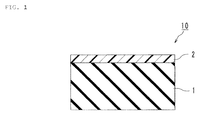
- FIG. 1 is a schematic sectional view of a surface protective film according to a preferred embodiment of the present invention.
- a surface protective film 10 includes a base material layer 1 and a pressure-sensitive adhesive layer 2.
- the surface protective film of the present invention may further have any appropriate other layer as required (not shown).
- the surface of the base material layer 1 on which the pressure-sensitive adhesive layer 2 is not provided can be subjected to a release treatment by adding, for example, a fatty acid amide, a polyethyleneimine, or a long-chain alkyl-based additive to the base material layer, or can be provided with a coat layer formed of any appropriate releasing agent such as a silicone-, long-chain alkyl-, or fluorine-based releasing agent for the purpose of, for example, forming a winding body that can be easily rewound.
- a release treatment by adding, for example, a fatty acid amide, a polyethyleneimine, or a long-chain alkyl-based additive to the base material layer, or can be provided with a coat layer formed of any appropriate releasing agent such as a silicone-, long-chain alkyl-, or fluorine-based releasing agent for the purpose of, for example, forming a winding body that can be easily rewound.
- a release liner having releasability may be attached to the surface protective film of the present invention.
- the thickness of the surface protective film of the present invention can be set to any appropriate thickness depending on applications.
- the thickness is preferably 10 to 300 ⁇ m, more preferably 15 to 250 ⁇ m, still more preferably 20 to 200 ⁇ m, particularly preferably 25 to 150 ⁇ m from the viewpoint of sufficiently expressing the effect of the present invention.
- the pressure-sensitive adhesive layer has a peeling electrification voltage of 0.7 kV or less, preferably 0. 5 kV or less, more preferably 0.3 kV or less.
- the peeling electrification voltage of the pressure-sensitive adhesive layer falls within the range, the surface protective film of the present invention can express sufficiently high antistatic property even without the use of any antistatic agent, can express sufficiently high wettability even without the use of any plasticizer, and is excellent in reworkability (light peelability). It should be noted that the measurement of the peeling electrification voltage is described later.
- a first wetting rate with respect to an acrylic plate in the surface of the pressure-sensitive adhesive layer, which is brought into contact with an adherend is 5. 0 cm 2 /sec or more, preferably 10 cm 2 /sec or more, more preferably 15 cm 2 /sec or more, still more preferably 20 cm 2 /sec or more, particularly preferably 30 cm 2 /sec or more.
- an upper limit for the first wetting rate is not particularly limited, the first wetting rate is preferably 1, 000 cm 2 /sec or less, more preferably 100 cm 2 /sec or less in actuality.
- the surface protective film of the present invention can express sufficiently high antistatic property even without the use of any antistatic agent and can express sufficiently high wettability even without the use of any plasticizer. It should be noted that the measurement of the first wetting rate is described later.
- a third wetting rate with respect to an acrylic plate in the surface of the pressure-sensitive adhesive layer, which is brought into contact with an adherend is preferably 5.0 cm 2 /sec or more, more preferably 10 cm 2 /sec or more, still more preferably 15 cm 2 /sec or more, particularly preferably 20 cm 2 /sec or more, most preferably 30 cm 2 /sec or more.
- the third wetting rate is preferably 1, 000 cm 2 /sec or less, more preferably 100 cm 2 /sec or less in actuality.
- the surface protective film of the present invention can express sufficiently high antistatic property even without the use of any antistatic agent and can express sufficiently high wettability even without the use of any plasticizer. It should be noted that the measurement of the third wetting rate is described later.
- an adhesion A with respect to an acrylic plate at a tension rate of 0.3m/min in the surface of the pressure-sensitive adhesive layer, which is brought into contact with an adherend is preferably 0.02 to 0.20 N/25 mm, more preferably 0.02 to 0.10 N/25 mm, still more preferably 0.02 to 0.05 N/25 mm.
- the surface protective film of the present invention can express sufficiently high antistatic property even without the use of any antistatic agent and is excellent in reworkability (light peelability). It should be noted that the measurement of the adhesion A is described later.
- an adhesion B with respect to an acrylic plate at a tension rate of 10 m/min in the surface of the pressure-sensitive adhesive layer, which is brought into contact with an adherend is preferably 0.02 to 0.30 N/25 mm, more preferably 0.02 to 0.20 N/25 mm, still more preferably 0.02 to 0.15 N/25 mm.
- the surface protective film of the present invention can express sufficiently high antistatic property even without the use of any antistatic agent and is excellent in reworkability (light peelability). It should be noted that the measurement of the adhesion B is described later.
- a difference between the adhesion B with respect to the acrylic plate at a tension rate of 10 m/min and the adhesion A with respect to the acrylic plate at a tension rate of 0.3 m/min in the surface of the pressure-sensitive adhesive layer, which is brought into contact with the adherend (B-A: "adhesion with respect to acrylic plate at tension rate of 10 m/min"-"adhesion with respect to acrylic plate at tension rate of 0.3 m/min") is preferably 0.1 N/25 mm or less, more preferably 0.09 N/25 mm or less, still more preferably 0.08 N/25 mm or less.
- the surface protective film of the present invention can additionally express sufficiently high antistatic property even without the use of any antistatic agent and is additionally excellent in reworkability (light peelability).
- the pressure-sensitive adhesive layer has a gel fraction of 80% or more, preferably 82% or more, more preferably 84% or more, still more preferably 86% or more, particularly preferably 88% or more.
- the surface protective film of the present invention can additionally express sufficiently high antistatic property even without the use of any antistatic agent, can express sufficiently high wettability even without the use of any plasticizer, and is excellent in reworkability (light peelability). It should be noted that the measurement of the gel fraction is described later.
- the thickness of the base material layer is preferably 5 to 300 ⁇ m, more preferably 10 to 250 ⁇ m, still more preferably 15 to 200 ⁇ m, particularly preferably 20 to 150 ⁇ m.
- the base material layer may be a single layer, or may be a laminate of two or more layers.
- the base material layer may be stretched.
- any appropriate material can be adopted as a material for the base material layer depending on applications.
- the material include a plastic, paper, a metal film, and a nonwoven fabric. Of those, a plastic is preferred.
- the materials may be used alone or in combination to construct the base material layer.
- the layer may be constructed of two or more kinds of plastics
- Examples of the plastic include a polyester-based resin, a polyamide-based resin, and a polyolefin-based resin.
- Examples of the polyester-based resin include polyethylene terephthalate, polybutylene terephthalate, and polyethylene naphthalate.
- Examples of the polyolefin-based resin include a homopolymer of an olefin monomer and a copolymer of olefin monomers.
- polystyrene-based resin examples include: homopolypropylene; propylene-based copolymers such as block, random, and graft copolymers each including an ethylene component as a copolymer component; reactor TPO; ethylene-based polymers such as low density, high density, linear low density, and ultra low density polymers; and ethylene-based copolymers such as an ethylene-propylene copolymer, an ethylene-vinyl acetate copolymer an ethylene-methyl acrylate copolymer, an ethylene-ethyl acrylate copolymer, an ethylene-butyl acrylate copolymer, an ethylene-methacrylic acid copolymer, and an ethylene-methyl methacrylate copolymer.
- the base material layer may contain any appropriate additive as required.
- the additive that can be contained in the base material layer include an antioxidant, a UV absorbing agent, a light stabilizer, an antistatic agent, a filler, and a pigment.
- the kind, number, and amount of the additive that can be contained in the base material layer can be appropriately set depending on purposes.
- the material for the base material layer is a plastic, it is preferred to contain some of the above-mentioned additives for the purpose of, for example, preventing deterioration.
- particularly preferred examples of the additive include an antioxidant, a UV absorbing agent, a light stabilizer, and a filler.
- any appropriate antioxidant can be adopted as the antioxidant.
- examples of such antioxidant include a phenol-based antioxidant, a phosphorus-based processing heat stabilizer, a lactone-based processing heat stabilizer, a sulfur-based heat stabilizer, and a phenol-phosphorus-based antioxidant.
- Thecontent of the antioxidant is preferably 1 part by weight or less, more preferably 0.5 part by weight or less, still more preferably 0.01 to 0.2 part by weight with respect to 100 parts by weight of the base resin of the base material layer (when the base material layer is a blend, the blend is the base resin).
- any appropriate UV absorbing agent can be adopted as the UV absorbing agent.
- examples of such UV absorbing agent include a benzotriazole-based UV absorbing agent, a triazine-based UV absorbing agent, and a benzophenone-based UV absorbing agent.
- the content of the UV absorbing agent is preferably 2 parts by weight or less, more preferably 1 part by weight or less, still more preferably 0.01 to 0.5 part by weight with respect to 100 parts by weight of the base resin that forms the base material layer (when the base material layer is a blend, the blend is the base resin).
- any appropriate light stabilizer can be adopted as the light stabilizer.
- Examples of such light stabilizer include a hindered amine-based light stabilizer and a benzoate-based light stabilizer.
- the content of the light stabilizer is preferably 2 parts by weight or less, more preferably 1 part by weight or less, still more preferably 0.01 to 0.5 part by weight with respect to 100 parts by weight of the base resin that forms the base material layer (when the base material layer is a blend, the blend is the base resin).
- any appropriate filler can be adopted as the filler.
- examples of such filler include an inorganic filler.
- Specific examples of the inorganic filler include carbon black, titanium oxide, and zinc oxide.
- the content of the filler is preferably 20 parts by weight or less, more preferably 10 parts by weight or less, still more preferably 0.01 to 10 parts by weight with respect to 100 parts by weight of the base resin that forms the base material layer (when the base material layer is a blend, the blend is the base resin).
- a surfactant an inorganic salt, a polyhydric alcohol, a metal compound, an inorganic antistatic agent such as carbon, and low molecular-weight and high molecular-weight antistatic agents each intended to impart antistatic property are also preferably given as examples of the additive.
- a high-molecular weight antistatic agent or carbon is particularly preferred from the viewpoints of contamination and the maintenance of pressure-sensitive adhesiveness.
- the thickness of the pressure-sensitive adhesive layer is preferably 1 to 100 ⁇ m, more preferably 3 to 50 ⁇ m, still more preferably 5 to 30 ⁇ m.
- the pressure-sensitive adhesive layer is constructed of a pressure-sensitive adhesive.
- the pressure-sensitive adhesives may be used alone or in combination.
- the pressure-sensitive adhesive preferably contains a polymer P as a main component.
- the content of the polymer P in the pressure-sensitive adhesive is preferably 50 wt% or more, more preferably 80 wt% or more, still more preferably 90 wt% or more, particularly preferably 95 wt% or more.
- the polymer P may be a cross-linked polymer.
- any appropriate pressure-sensitive adhesive can be adopted as the pressure-sensitive adhesive for constructing the pressure-sensitive adhesive layer.
- Examples of such pressure-sensitive adhesive include a silicone-based pressure-sensitive adhesive, a urethane-based pressure-sensitive adhesive, an acrylic pressure-sensitive adhesive, andarubber-based pressure-sensitive adhesive. Of those, a silicone-based pressure-sensitive adhesive and a urethane-based pressure-sensitive adhesive are preferred as the pressure-sensitive adhesive because the effect of the present invention can be additionally expressed.
- silicone-based pressure-sensitive adhesive Any appropriate silicone-based pressure-sensitive adhesive can be adopted as the silicone-based pressure-sensitive adhesive.
- a product obtained by blending or agglomerating a silicone resin can be preferably adopted as such silicone-based pressure-sensitive adhesive.
- silicone-based pressure-sensitive adhesive examples include an addition reaction-curable silicone-based pressure-sensitive adhesive and a peroxide-curable silicone-based pressure-sensitive adhesive. Of those silicone-based pressure-sensitive adhesives, an addition reaction-curable silicone-based pressure-sensitive adhesive is preferred because a peroxide (such as benzoyl peroxide) is not used and no decomposition product is produced.
- a peroxide such as benzoyl peroxide
- a method involving curing a polyalkylhydrogensiloxane composition with a platinum catalyst is generally given as a curing reaction for the addition reaction-curable silicone-based pressure-sensitive adhesive.
- any appropriate urethane-based pressure-sensitive adhesive may be adopted as the urethane-based pressure-sensitive adhesive.
- urethane-based pressure-sensitive adhesive there are preferably given one formed of a urethane resin obtained by a reaction of a polyol and a polyisocyanate compound.
- the polyol include a polyether polyol, a polyester polyol, a polycarbonate polyol, and a polycaprolactone polyol.
- the polyisocyanate compound include diphenylmethane diisocyanate, tolylene diisocyanate, and hexamethylene diisocyanate.
- any appropriate additive can be contained in the pressure-sensitive adhesive for constructing the pressure-sensitive adhesive layer.
- additives include a softener, a tackifier, a surface lubricating agent, a leveling agent, an antioxidant, a corrosion inhibitor, a light stabilizer, a UV absorbing agent, a heat stabili zer, a polymerization inhibitor, a silane coupling agent, a lubricant, an inorganic or organic filler, a metal powder, a pigment, and a solvent.
- the pressure-sensitive adhesive for constituting the pressure-sensitive adhesive layer is preferably free of any antistatic agent.
- the pressure-sensitive adhesive layer to which the antistatic agent has been added improves the antistatic property but may cause the contamination of the adherend by the antistatic agent.
- the pressure-sensitive adhesive for constituting the pressure-sensitive adhesive layer is preferably free of any plasticizer. This is because the use of the pressure-sensitive adhesive layer to which the plasticizer has been added improves the wettability but may cause the contamination of the adherend by the plasticizer.
- the pressure-sensitive adhesive for constructing the pressure-sensitive adhesive layer can be produced by any appropriate method.
- the pressure-sensitive adhesive for constructing the pressure-sensitive adhesive layer can be produced, for example, as described below. While a polymerization method to be generally employed as an approach to synthesizing a polymer, such as solution polymerization, emulsion polymerization, bulk polymerization, suspension polymerization, or polymerization with ultraviolet light (UV) is employed, any appropriate cross-linking method is adopted, and any appropriate additive is used as required.
- a polymerization method to be generally employed as an approach to synthesizing a polymer such as solution polymerization, emulsion polymerization, bulk polymerization, suspension polymerization, or polymerization with ultraviolet light (UV)
- UV ultraviolet light
- the surface protective film of the present invention can be used in any appropriate application.
- the surface protective film of the present invention is preferably used for the surface of a display member or an image recognition member.
- a display member covered with the surface protective film of the present invention can be subjected to manual attachment and manual peeling any number of times.
- An image recognition member covered with the surface protective film of the present invention can be subjected to manual attachment and manual peeling any number of times.
- the surface protective film of the present invention can be produced by any appropriate method.
- the production can be performed in conformity with, as such production method, any appropriate method of producing a pressure-sensitive adhesive film, such as:
- Examples of the application method include methods each involving the use of a bar coater, a gravure coater, a spin coater, a roll coater, a knife coater, or an applicator.
- the method involving applying a solution of the pressure-sensitive adhesive in a solvent or a hot-melt liquid thereof to the base material is particularly preferred as the method of producing the surface protective film of the present invention in terms of productivity and a cost.
- the protective film was cut into a size of a width of 70 mm and a depth of 130 mm, and the separator was peeled off. After that, the resultant film was pressure-bonded to a surface of an acrylic plate (manufactured by MITSUBISHI RAYON CO., LTD., ACRYLITE L) having a thickness of 1 mm, a width of 70 mm, and a length of 100 mm that had been subjected to an antistatic treatment in advance with a hand roller in such a manner that one end portion thereof protruded by 30 mm. After having been left to stand under an environment of 23°C ⁇ 25%RH for 1 hour, the sample was set to a predetermined position.
- an acrylic plate manufactured by MITSUBISHI RAYON CO., LTD., ACRYLITE L
- the one end portion protruding by 30 mm was fixed to an automatic winder, and then peeling was performed so that the peel angel was 150° and the peel rate was 10 m/min.
- the peeled protective film was mounted on a sample fixing stand, and the potential of the acrylic plate was measured with a potential meter (manufactured by KASUGA DENKI, Inc., KSD-0103) fixed on a predetermined position. The measurement was carried out under an environment of 23°C ⁇ 25%RH.
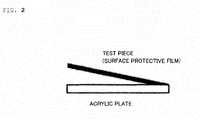
- the sample after the measurement of the first wetting rate was used. An end portion of the sample was lifted with fingers to form an angle of 20 to 30° in a state where part of the pressure-sensitive adhesive layer surface of the test piece (surface protective film) was brought into contact with the acrylic plate as illustrated in FIG. 2 . Next, a hand was freed from the test piece so that the test piece was attached to the acrylic plate with its own weight alone. Simultaneously with the freeing of the hand, the manner in which the pressure-sensitive adhesive layer of the test piece was wet and spread over the acrylic plate was recorded with a digital camera at an interval of 0.2 second, and then a second wetting rate was measured in the same manner as in the first wetting rate. A third wetting rate was similarly measured by using the sample after the measurement of the second wetting rate.
- test piece was manually attached to the acrylic plate at a rate of 10 m/min, and the presence or absence of air bubbles between the test piece and the acrylic plate was confirmed.
- a surface protective film was cut into a piece measuring 25 mm wide by 150 mm long and the piece was defined as a sample for an evaluation.
- the pressure-sensitive adhesive layer surface of the sample for an evaluation was attached to an acrylic plate (manufactured by MITSUBISHI RAYON CO., LTD., trade name: ACRYLITE L) under an atmosphere having a temperature of 23°C and a humidity of 50%RH by reciprocating a 2-kg roller once. After having been guarded at 23°C for 30 minutes, the sample was measured for its adhesion A with a universal tensile tester (manufactured by Minebea Co. , Ltd., product name: TCM-1kNB) at a peel angle of 180° and a tension rate of 0.3 m/min.
- a universal tensile tester manufactured by Minebea Co. , Ltd., product name: TCM-1kNB
- a surface protective film was cut into a piece measuring 25 mm wide by 150 mm long and the piece was defined as a sample for an evaluation.
- the pressure-sensitive adhesive layer surface of the sample for an evaluation was attached to an acrylic plate (manufactured by MITSUBISHI RAYON CO., LTD., trade name: ACRYLITE L) under an atmosphere having a temperature of 23°C and a humidity of 50%RH by reciprocating a 2-kg roller once. After having been guarded at 23°C for 30 minutes, the sample was measured for its adhesion B with a universal tensile tester (manufactured by Minebea Co. , Ltd., product name: TCM-1kNB) at a peel angle of 180° and a tension rate of 10 m/min.
- a universal tensile tester manufactured by Minebea Co. , Ltd., product name: TCM-1kNB
- a sample having a dry weight W1 (g) was collected from the pressure-sensitive adhesive layer.
- the sample was immersed in toluene.
- the insoluble content of the sample was taken out from the toluene and measured for its weight W2 (g) after drying.
- the gel fraction was determined from the calculation expression (W2/W1) ⁇ 100.
- the resultant silicone-based pressure-sensitive adhesive composition was applied to a base material "Lumirror S10" (thickness: 38 ⁇ m, manufactured by Toray Industries, Inc.) formed of a polyester resin with a fountain roll so that its thickness after drying became 21 ⁇ m, followed by curing and drying under the conditions of a drying temperature of 150°C and a drying time of 1 minute.
- a base material "Lumirror S10" (thickness: 38 ⁇ m, manufactured by Toray Industries, Inc.) formed of a polyester resin with a fountain roll so that its thickness after drying became 21 ⁇ m, followed by curing and drying under the conditions of a drying temperature of 150°C and a drying time of 1 minute.
- the silicone-treated surface of a base material formed of a polyester resin having a thickness of 25 ⁇ m one surface of which had been subjected to a fluorosilicone treatment was attached to the surface of the pressure-sensitive adhesive layer to produce a surface protective film (1).
- the resultant silicone-based pressure-sensitive adhesive composition was applied to a base material "Lumirror S10" (thickness: 38 ⁇ m, manufactured by Toray industries, Inc.) formed of a polyester resin with a fountain roll so that its thickness after drying became 21 ⁇ m, followed by curing and drying under the conditions of a drying temperature of 150°C and a drying time of 1 minute.
- a base material "Lumirror S10" (thickness: 38 ⁇ m, manufactured by Toray industries, Inc.) formed of a polyester resin with a fountain roll so that its thickness after drying became 21 ⁇ m, followed by curing and drying under the conditions of a drying temperature of 150°C and a drying time of 1 minute.
- the silicone-treated surface of a base material formed of a polyester resin having a thickness of 25 ⁇ m one surface of which had been subjected to a fluorosilicone treatment was attached to the surface of the pressure-sensitive adhesive layer to produce a surface protective film (2).
- the resultant silicone-based pressure-sensitive adhesive composition was applied to a base material "Lumirror S10" (thickness: 38 ⁇ m, manufactured by Toray Industries, Inc.) formed of a polyester resin with a fountain roll so that its thickness after drying became 21 ⁇ m, followed by curing and drying under the conditions of a drying temperature of 150°C and a drying time of 1 minute.
- a base material "Lumirror S10" (thickness: 38 ⁇ m, manufactured by Toray Industries, Inc.) formed of a polyester resin with a fountain roll so that its thickness after drying became 21 ⁇ m, followed by curing and drying under the conditions of a drying temperature of 150°C and a drying time of 1 minute.
- the silicone-treated surface of a base material formed of a polyester resin having a thickness of 25 ⁇ m one surface of which had been subjected to a fluorosilicone treatment was attached to the surface of the pressure-sensitive adhesive layer to produce a surface protective film (C1).
- a mixture of 200 g of 2-ethylhexyl acrylate, 8 g of 2-hydroxyethyl acrylate, 0.4 g of 2,2'-azobisisobutyronitrile, and 312 g of ethyl acetate was subjected to a reaction in a stream of nitrogen at 65°C for 6 hours to provide a solution (40 wt%) of an acrylic polymer A having a Tg of -68 °C and a weight-average molecular weight of 500,000.
- the resultant solution (40 wet%) of the acrylic polymer A was diluted to 20 wt% with ethyl acetate, and then 0.8 g of an isocyanurate body of hexamethylene diisocyanate (manufactured by Nippon Polyurethane Industry Co., Ltd., trade name: Coronate HX) and 0.4 g of dibutyltin dilaurate (1-wt% ethyl acetate solution) as a cross-linking catalyst were added to 100 g of the solution to prepare an acrylic pressure-sensitive adhesive solution.
- the resultant acrylic pressure-sensitive adhesive solution was applied to a base material "Lumirror S10" (thickness: 38 ⁇ m, manufactured by Toray Industries, Inc.) formed of a polyester resin with a fountain roll so that its thickness after drying became 21 ⁇ m, followed by curing and drying under the conditions of a drying temperature of 110°C and a drying time of 3 minutes.
- a base material "Lumirror S10" (thickness: 38 ⁇ m, manufactured by Toray Industries, Inc.) formed of a polyester resin with a fountain roll so that its thickness after drying became 21 ⁇ m, followed by curing and drying under the conditions of a drying temperature of 110°C and a drying time of 3 minutes.
- the silicone-treated surface of a base material formed of a polyester resin having a thickness of 25 ⁇ m one surface of which had been subjected to a fluorosilicone treatment was attached to the surface of the pressure-sensitive adhesive layer to produce a surface protective film (C2).
- Table 1 shows the results.
- Example 1 Example 2 Comparative Example 1 Comparative Example 2 Peeling electrification voltage [kV] 0.23 0.30 1.2 0.77 First wetting rate [cm2/sec] 30.4 37.0 4.9 0.6 Third wetting rate [cm2/sec] 32.6 42.0 3.8 0.5 Adhesion A [N/25 mm] 0.03 0.04 0.28 0.23 Adhesion B[N/25 mm] 0.08 0.11 1.50 1.32 Wettability ⁇ ⁇ ⁇ ⁇ Reworkability ⁇ ⁇ ⁇ ⁇ Gel fraction [%] 95.6 88.7 57.4 96.1
- the surface protective film of the present invention is suitable used in, for example, an application where a surface of a display member or an image recognition member is protected by attaching the film to the surface.
Landscapes
- Chemical & Material Sciences (AREA)
- Organic Chemistry (AREA)
- Chemical Kinetics & Catalysis (AREA)
- Adhesive Tapes (AREA)
- Adhesives Or Adhesive Processes (AREA)
Abstract
Description
- The present invention relates to a surface protective film. The surface protective film of the present invention has a base material layer and a pressure-sensitive adhesive layer, and is used in, for example, an application where a surface of a display member or an image recognition member is protected by attaching the film to the surface.
- A surface protective film may be attached to a surface of a display member or an image recognition member for preventing the flaw, dirt, and the like of the surface.
- Such surface protective film is manually attached in many cases. When the surface protective film is manually attached as described above, there is a problem in that air bubbles are involved between an adherend and the surface protective film in many cases.
- A technology involving adding a plasticizer to a pressure-sensitive adhesive layer of the surface protective film to improve its wettability has been reported as a technology for preventing the air bubbles from being involved between the adherend and the surface protective film when the surface protective film is manually attached to the adherend (Patent Literature 1).
- However, when the pressure-sensitive adhesive layer to which the plasticizer has been added is used, there is a problem in that the adherend is contaminated by the plasticizer.
- In addition, when the surface protective film is manually attached to the adherend, light peelability as well as wettability is required. This is because the surface protective film attached to the adherend is attached to the adherend again after having been peeled and then used as a protective film again. When its peelability is heavy, the surface protective film deforms upon peeling of the surface protective film even in the case where its wettability is good, with the result that the surface protective film can no longer be used as a protective film again. Accordingly, such reworkability that the protective film can be attached any number of times without air bubbles and can be peeled without its deformation has been required.
- Further, when the surface protective film is manually attached to the adherend, antistatic property as well as wettability is required in many cases. The same surface protective film is subjected to manual attachment and manual peeling any number of times in many cases. Hence, when the adherend is not subjected to an antistatic treatment, a peeling electrification voltage of the adherend to be generated upon peeling of the protective film becomes larger, resulting in a failure. For example, foreign matter is collected in the adherend to contaminate an optical member. In addition, in the optical member such as a polarizing plate, when a voltage is applied to liquid crystal in a large amount of static electricity, alignment of liquid crystal molecules may be lost or defects may occur in a panel.
- [PTL 1]
JP 2010-209324 A - The present invention has been made to solve the conventional problems, and an object of the present invention is to provide a novel surface protective film that can express sufficiently high antistatic property even without the use of any antistatic agent, can express sufficiently high wettability even without the use of any plasticizer, and is excellent in reworkability (light peelability).
- A surface protective film of the present invention is a surface protective film, including: a base material layer; and a pressure-sensitive adhesive layer, in which: the pressure-sensitive adhesive layer has a peeling electrification voltage of 0.7 kV or less; and a first wetting rate with respect to an acrylic plate in a surface of the pressure-sensitive adhesive layer, which is brought into contact with an adherend, is 5.0 cm2/sec or more.
- In a preferred embodiment, an adhesion A with respect to the acrylic plate at a tension rate of 0.3 m/min in the surface of the pressure-sensitive adhesive layer, which is brought into contact with the adherend, is 0.02 to 0.20 N/25 mm.
- In a preferred embodiment, an adhesion B with respect to the acrylic plate at a tension rate of 10 m/min in the surface of the pressure-sensitive adhesive layer, which is brought into contact with the adherend, is 0.02 to 0.30 N/25 mm.
- In a preferred embodiment, a difference B-A between the adhesion B with respect to the acrylic plate at a tension rate of 10 m/min in the surface of the pressure-sensitive adhesive layer, which is brought into contact with the adherend, and the adhesion A with respect to the acrylic plate at a tension rate of 0.3 m/min in the surface of the pressure-sensitive adhesive layer, which is brought into contact with the adherend, is 0.1 N/25 mm or less.
- In a preferred embodiment, the pressure-sensitive adhesive layer has a gel fraction of 80% or more.
- In a preferred embodiment, the surface protective film of the present invention is used for a surface of a display member or an image recognition member.
- The present invention also provides a display member. The display member of the present invention is covered with the surface protective film of the present invention.
- The present invention also provides an image recognition member. The image recognition member of the present invention is covered with the surface protective film of the present invention.
- According to one embodiment of the present invention, it is possible to provide the novel surface protective film that can express sufficiently high antistatic property even without the use of any antistatic agent, can express sufficiently high wettability even without the use of any plasticizer, and is excellent in reworkability (light peelability).
-
-
FIG. 1 is a schematic sectional view of a surface protective film according to a preferred embodiment of the present invention. -
FIG. 2 is a schematic sectional view illustrating a state before the attachment of an acrylic plate and a test piece in the measurement of a wetting rate. - A surface protective film of the present invention includes a base material layer and a pressure-sensitive adhesive layer.
FIG. 1 is a schematic sectional view of a surface protective film according to a preferred embodiment of the present invention. A surfaceprotective film 10 includes abase material layer 1 and a pressure-sensitiveadhesive layer 2. The surface protective film of the present invention may further have any appropriate other layer as required (not shown). - The surface of the
base material layer 1 on which the pressure-sensitiveadhesive layer 2 is not provided can be subjected to a release treatment by adding, for example, a fatty acid amide, a polyethyleneimine, or a long-chain alkyl-based additive to the base material layer, or can be provided with a coat layer formed of any appropriate releasing agent such as a silicone-, long-chain alkyl-, or fluorine-based releasing agent for the purpose of, for example, forming a winding body that can be easily rewound. - A release liner having releasability may be attached to the surface protective film of the present invention.
- The thickness of the surface protective film of the present invention can be set to any appropriate thickness depending on applications. The thickness is preferably 10 to 300 µm, more preferably 15 to 250 µm, still more preferably 20 to 200 µm, particularly preferably 25 to 150 µm from the viewpoint of sufficiently expressing the effect of the present invention.
- In the surface protective film of the present invention, the pressure-sensitive adhesive layer has a peeling electrification voltage of 0.7 kV or less, preferably 0. 5 kV or less, more preferably 0.3 kV or less. When the peeling electrification voltage of the pressure-sensitive adhesive layer falls within the range, the surface protective film of the present invention can express sufficiently high antistatic property even without the use of any antistatic agent, can express sufficiently high wettability even without the use of any plasticizer, and is excellent in reworkability (light peelability). It should be noted that the measurement of the peeling electrification voltage is described later.
- In the surface protective film of the present invention, a first wetting rate with respect to an acrylic plate in the surface of the pressure-sensitive adhesive layer, which is brought into contact with an adherend, is 5. 0 cm2/sec or more, preferably 10 cm2/sec or more, more preferably 15 cm2/sec or more, still more preferably 20 cm2/sec or more, particularly preferably 30 cm2/sec or more. Although an upper limit for the first wetting rate is not particularly limited, the first wetting rate is preferably 1, 000 cm2/sec or less, more preferably 100 cm2/sec or less in actuality. As long as the first wetting rate with respect to the acrylic plate in the surface of the pressure-sensitive adhesive layer, which is brought into contact with the adherend, falls within the range, the surface protective film of the present invention can express sufficiently high antistatic property even without the use of any antistatic agent and can express sufficiently high wettability even without the use of any plasticizer. It should be noted that the measurement of the first wetting rate is described later.
- In the surface protective film of the present invention, a third wetting rate with respect to an acrylic plate in the surface of the pressure-sensitive adhesive layer, which is brought into contact with an adherend, is preferably 5.0 cm2/sec or more, more preferably 10 cm2/sec or more, still more preferably 15 cm2/sec or more, particularly preferably 20 cm2/sec or more, most preferably 30 cm2/sec or more. Although an upper limit for the third wetting rate is not particularly limited, the third wetting rate is preferably 1, 000 cm2/sec or less, more preferably 100 cm2/sec or less in actuality. As long as the third wetting rate with respect to the acrylic plate in the surface of the pressure-sensitive adhesive layer, which is brought into contact with the adherend, falls within the range, the surface protective film of the present invention can express sufficiently high antistatic property even without the use of any antistatic agent and can express sufficiently high wettability even without the use of any plasticizer. It should be noted that the measurement of the third wetting rate is described later.
- In the surface protective film of the present invention, an adhesion A with respect to an acrylic plate at a tension rate of 0.3m/min in the surface of the pressure-sensitive adhesive layer, which is brought into contact with an adherend, is preferably 0.02 to 0.20 N/25 mm, more preferably 0.02 to 0.10 N/25 mm, still more preferably 0.02 to 0.05 N/25 mm. As long as the adhesion A with respect to the acrylic plate at a tension rate of 0.3 m/min in the surface of the pressure-sensitive adhesive layer, which is brought into contact with the adherend, falls within the range, the surface protective film of the present invention can express sufficiently high antistatic property even without the use of any antistatic agent and is excellent in reworkability (light peelability). It should be noted that the measurement of the adhesion A is described later.
- In the surface protective film of the present invention, an adhesion B with respect to an acrylic plate at a tension rate of 10 m/min in the surface of the pressure-sensitive adhesive layer, which is brought into contact with an adherend, is preferably 0.02 to 0.30 N/25 mm, more preferably 0.02 to 0.20 N/25 mm, still more preferably 0.02 to 0.15 N/25 mm. As long as the adhesion B with respect to the acrylic plate at a tension rate of 10 m/min in the surface of the pressure-sensitive adhesive layer, which is brought into contact with the adherend, falls within the range, the surface protective film of the present invention can express sufficiently high antistatic property even without the use of any antistatic agent and is excellent in reworkability (light peelability). It should be noted that the measurement of the adhesion B is described later.
- In the surface protective film of the present invention, a difference between the adhesion B with respect to the acrylic plate at a tension rate of 10 m/min and the adhesion A with respect to the acrylic plate at a tension rate of 0.3 m/min in the surface of the pressure-sensitive adhesive layer, which is brought into contact with the adherend (B-A: "adhesion with respect to acrylic plate at tension rate of 10 m/min"-"adhesion with respect to acrylic plate at tension rate of 0.3 m/min") is preferably 0.1 N/25 mm or less, more preferably 0.09 N/25 mm or less, still more preferably 0.08 N/25 mm or less. When the difference between the adhesions falls within the range, the surface protective film of the present invention can additionally express sufficiently high antistatic property even without the use of any antistatic agent and is additionally excellent in reworkability (light peelability).
- In the surface protective film of the present invention, the pressure-sensitive adhesive layer has a gel fraction of 80% or more, preferably 82% or more, more preferably 84% or more, still more preferably 86% or more, particularly preferably 88% or more. When the gel fraction of the pressure-sensitive adhesive layer falls within the range, the surface protective film of the present invention can additionally express sufficiently high antistatic property even without the use of any antistatic agent, can express sufficiently high wettability even without the use of any plasticizer, and is excellent in reworkability (light peelability). It should be noted that the measurement of the gel fraction is described later.
- Any appropriate thickness can be adopted as the thickness of the base material layer depending on applications. The thickness of the base material layer is preferably 5 to 300 µm, more preferably 10 to 250 µm, still more preferably 15 to 200 µm, particularly preferably 20 to 150 µm.
- The base material layer may be a single layer, or may be a laminate of two or more layers. The base material layer may be stretched.
- Any appropriate material can be adopted as a material for the base material layer depending on applications. Examples of the material include a plastic, paper, a metal film, and a nonwoven fabric. Of those, a plastic is preferred. The materials may be used alone or in combination to construct the base material layer. For example, the layer may be constructed of two or more kinds of plastics
- Examples of the plastic include a polyester-based resin, a polyamide-based resin, and a polyolefin-based resin. Examples of the polyester-based resin include polyethylene terephthalate, polybutylene terephthalate, and polyethylene naphthalate. Examples of the polyolefin-based resin include a homopolymer of an olefin monomer and a copolymer of olefin monomers. Specific examples of the polyolefin-based resin include: homopolypropylene; propylene-based copolymers such as block, random, and graft copolymers each including an ethylene component as a copolymer component; reactor TPO; ethylene-based polymers such as low density, high density, linear low density, and ultra low density polymers; and ethylene-based copolymers such as an ethylene-propylene copolymer, an ethylene-vinyl acetate copolymer an ethylene-methyl acrylate copolymer, an ethylene-ethyl acrylate copolymer, an ethylene-butyl acrylate copolymer, an ethylene-methacrylic acid copolymer, and an ethylene-methyl methacrylate copolymer.
- The base material layer may contain any appropriate additive as required. Examples of the additive that can be contained in the base material layer include an antioxidant, a UV absorbing agent, a light stabilizer, an antistatic agent, a filler, and a pigment. The kind, number, and amount of the additive that can be contained in the base material layer can be appropriately set depending on purposes. In particular, when the material for the base material layer is a plastic, it is preferred to contain some of the above-mentioned additives for the purpose of, for example, preventing deterioration. From the viewpoint of, for example, the improvement of weather resistance, particularly preferred examples of the additive include an antioxidant, a UV absorbing agent, a light stabilizer, and a filler.
- Any appropriate antioxidant can be adopted as the antioxidant. Examples of such antioxidant include a phenol-based antioxidant, a phosphorus-based processing heat stabilizer, a lactone-based processing heat stabilizer, a sulfur-based heat stabilizer, and a phenol-phosphorus-based antioxidant. Thecontent of the antioxidant is preferably 1 part by weight or less, more preferably 0.5 part by weight or less, still more preferably 0.01 to 0.2 part by weight with respect to 100 parts by weight of the base resin of the base material layer (when the base material layer is a blend, the blend is the base resin).
- Any appropriate UV absorbing agent can be adopted as the UV absorbing agent. Examples of such UV absorbing agent include a benzotriazole-based UV absorbing agent, a triazine-based UV absorbing agent, and a benzophenone-based UV absorbing agent. The content of the UV absorbing agent is preferably 2 parts by weight or less, more preferably 1 part by weight or less, still more preferably 0.01 to 0.5 part by weight with respect to 100 parts by weight of the base resin that forms the base material layer (when the base material layer is a blend, the blend is the base resin).
- Any appropriate light stabilizer can be adopted as the light stabilizer. Examples of such light stabilizer include a hindered amine-based light stabilizer and a benzoate-based light stabilizer. The content of the light stabilizer is preferably 2 parts by weight or less, more preferably 1 part by weight or less, still more preferably 0.01 to 0.5 part by weight with respect to 100 parts by weight of the base resin that forms the base material layer (when the base material layer is a blend, the blend is the base resin).
- Any appropriate filler can be adopted as the filler. Examples of such filler include an inorganic filler. Specific examples of the inorganic filler include carbon black, titanium oxide, and zinc oxide. The content of the filler is preferably 20 parts by weight or less, more preferably 10 parts by weight or less, still more preferably 0.01 to 10 parts by weight with respect to 100 parts by weight of the base resin that forms the base material layer (when the base material layer is a blend, the blend is the base resin).
- Further, a surfactant, an inorganic salt, a polyhydric alcohol, a metal compound, an inorganic antistatic agent such as carbon, and low molecular-weight and high molecular-weight antistatic agents each intended to impart antistatic property are also preferably given as examples of the additive. Of those, a high-molecular weight antistatic agent or carbon is particularly preferred from the viewpoints of contamination and the maintenance of pressure-sensitive adhesiveness.
- The thickness of the pressure-sensitive adhesive layer is preferably 1 to 100 µm, more preferably 3 to 50 µm, still more preferably 5 to 30 µm.
- The pressure-sensitive adhesive layer is constructed of a pressure-sensitive adhesive. The pressure-sensitive adhesives may be used alone or in combination.
- The pressure-sensitive adhesive preferably contains a polymer P as a main component. The content of the polymer P in the pressure-sensitive adhesive is preferably 50 wt% or more, more preferably 80 wt% or more, still more preferably 90 wt% or more, particularly preferably 95 wt% or more.
- The polymer P may be a cross-linked polymer.
- Any appropriate pressure-sensitive adhesive can be adopted as the pressure-sensitive adhesive for constructing the pressure-sensitive adhesive layer. Examples of such pressure-sensitive adhesive include a silicone-based pressure-sensitive adhesive, a urethane-based pressure-sensitive adhesive, an acrylic pressure-sensitive adhesive, andarubber-based pressure-sensitive adhesive. Of those, a silicone-based pressure-sensitive adhesive and a urethane-based pressure-sensitive adhesive are preferred as the pressure-sensitive adhesive because the effect of the present invention can be additionally expressed.
- Any appropriate silicone-based pressure-sensitive adhesive can be adopted as the silicone-based pressure-sensitive adhesive. A product obtained by blending or agglomerating a silicone resin can be preferably adopted as such silicone-based pressure-sensitive adhesive.
- Examples of the silicone-based pressure-sensitive adhesive include an addition reaction-curable silicone-based pressure-sensitive adhesive and a peroxide-curable silicone-based pressure-sensitive adhesive. Of those silicone-based pressure-sensitive adhesives, an addition reaction-curable silicone-based pressure-sensitive adhesive is preferred because a peroxide (such as benzoyl peroxide) is not used and no decomposition product is produced.
- For example, when a polyalkylsilicone-based pressure-sensitive adhesive is obtained, a method involving curing a polyalkylhydrogensiloxane composition with a platinum catalyst is generally given as a curing reaction for the addition reaction-curable silicone-based pressure-sensitive adhesive.
- Any appropriate urethane-based pressure-sensitive adhesive may be adopted as the urethane-based pressure-sensitive adhesive. As such urethane-based pressure-sensitive adhesive, there are preferably given one formed of a urethane resin obtained by a reaction of a polyol and a polyisocyanate compound. Examples of the polyol include a polyether polyol, a polyester polyol, a polycarbonate polyol, and a polycaprolactone polyol. Examples of the polyisocyanate compound include diphenylmethane diisocyanate, tolylene diisocyanate, and hexamethylene diisocyanate.
- Any appropriate additive can be contained in the pressure-sensitive adhesive for constructing the pressure-sensitive adhesive layer. Examples of such additive include a softener, a tackifier, a surface lubricating agent, a leveling agent, an antioxidant, a corrosion inhibitor, a light stabilizer, a UV absorbing agent, a heat stabili zer, a polymerization inhibitor, a silane coupling agent, a lubricant, an inorganic or organic filler, a metal powder, a pigment, and a solvent. However, in the present invention, the pressure-sensitive adhesive for constituting the pressure-sensitive adhesive layer is preferably free of any antistatic agent. This is because the use of the pressure-sensitive adhesive layer to which the antistatic agent has been added improves the antistatic property but may cause the contamination of the adherend by the antistatic agent. In addition, in the present invention, the pressure-sensitive adhesive for constituting the pressure-sensitive adhesive layer is preferably free of any plasticizer. This is because the use of the pressure-sensitive adhesive layer to which the plasticizer has been added improves the wettability but may cause the contamination of the adherend by the plasticizer.
- The pressure-sensitive adhesive for constructing the pressure-sensitive adhesive layer can be produced by any appropriate method. The pressure-sensitive adhesive for constructing the pressure-sensitive adhesive layer can be produced, for example, as described below. While a polymerization method to be generally employed as an approach to synthesizing a polymer, such as solution polymerization, emulsion polymerization, bulk polymerization, suspension polymerization, or polymerization with ultraviolet light (UV) is employed, any appropriate cross-linking method is adopted, and any appropriate additive is used as required.
- The surface protective film of the present invention can be used in any appropriate application. The surface protective film of the present invention is preferably used for the surface of a display member or an image recognition member.
- A display member covered with the surface protective film of the present invention can be subjected to manual attachment and manual peeling any number of times.
- An image recognition member covered with the surface protective film of the present invention can be subjected to manual attachment and manual peeling any number of times.
- The surface protective film of the present invention can be produced by any appropriate method. The production can be performed in conformity with, as such production method, any appropriate method of producing a pressure-sensitive adhesive film, such as:
- (1) a method involving applying a solution of the pressure-sensitive adhesive in a solvent or a hot-melt liquid thereof to the base material;
- (2) a method involving transferring the pressure-sensitive adhesive layer applied and formed in a separator fashion in conformity with the foregoing;
- (3) a method involving extruding a material for forming the pressure-sensitive adhesive layer onto the base material to form and apply the layer;
- (4) a method involving extruding the base material and the pressure-sensitive adhesive layer in two layers or a plurality of layers;
- (5) a method involving laminating a single layer of the pressure-sensitive adhesive layer onto the base material or a method involving laminating two layers of a laminate layer and the pressure-sensitive adhesive layer; or
- (6) a method involving laminating two layers, or a plurality of layers, of the pressure-sensitive adhesive layer and a material for forming the base material such as a film or a laminate layer.
- Examples of the application method include methods each involving the use of a bar coater, a gravure coater, a spin coater, a roll coater, a knife coater, or an applicator.
- The method involving applying a solution of the pressure-sensitive adhesive in a solvent or a hot-melt liquid thereof to the base material is particularly preferred as the method of producing the surface protective film of the present invention in terms of productivity and a cost.
- Hereinafter, the present invention is described specifically by way of examples. However, the present invention is by no means limited to these examples. It should be noted that test and evaluation methods in the examples and the like are as described below. In addition, the term "part(s)" means "part(s) by weight."
- The protective film was cut into a size of a width of 70 mm and a depth of 130 mm, and the separator was peeled off. After that, the resultant film was pressure-bonded to a surface of an acrylic plate (manufactured by MITSUBISHI RAYON CO., LTD., ACRYLITE L) having a thickness of 1 mm, a width of 70 mm, and a length of 100 mm that had been subjected to an antistatic treatment in advance with a hand roller in such a manner that one end portion thereof protruded by 30 mm. After having been left to stand under an environment of 23°C×25%RH for 1 hour, the sample was set to a predetermined position. The one end portion protruding by 30 mm was fixed to an automatic winder, and then peeling was performed so that the peel angel was 150° and the peel rate was 10 m/min. The peeled protective film was mounted on a sample fixing stand, and the potential of the acrylic plate was measured with a potential meter (manufactured by KASUGA DENKI, Inc., KSD-0103) fixed on a predetermined position. The measurement was carried out under an environment of 23°C×25%RH.
-
- Test piece: 2.5 cm×8.0 cm
- Adherend: An acrylic plate (manufactured by MITSUBISHI RAYON CO., LTD., trade name: ACRYLITE L)
- Number of times of measurement:
3 (The average of 3 independently measured values was adopted.) - Measurement environment:
A class-10, 000 clean room (having a temperature of 23°C and a humidity of 50%RH) - (1)
FIG. 2 illustrates a state before the attachment of the acrylic plate and the test piece in the measurement of a first wetting rate. As illustrated inFIG. 2 , an angle of 20 to 30° was formed in a state where part of the pressure-sensitive adhesive layer surface of the test piece (surface protective film) was brought into contact with the acrylic plate. - (2) Next, a hand was freed from the test piece so that the test piece was attached to the acrylic plate with its own weight alone. Simultaneously with the freeing of the hand, the manner in which the pressure-sensitive adhesive layer of the test piece was wet and spread over the acrylic plate was recorded with a digital camera at an interval of 0.2 second.
- (3) The time point at which the pressure-sensitive adhesive layer surface except the site brought into contact with the acrylic plate in the section (1) started to be brought into contact with the acrylic plate was defined as an initial point. The manner in which the pressure-sensitive adhesive layer was wet and spread was analyzed with an image analysis software "image J" every 0.2 second from the initial point.
- (4) A wetting rate was calculated by using the following calculation equation.

- The sample after the measurement of the first wetting rate was used. An end portion of the sample was lifted with fingers to form an angle of 20 to 30° in a state where part of the pressure-sensitive adhesive layer surface of the test piece (surface protective film) was brought into contact with the acrylic plate as illustrated in
FIG. 2 . Next, a hand was freed from the test piece so that the test piece was attached to the acrylic plate with its own weight alone. Simultaneously with the freeing of the hand, the manner in which the pressure-sensitive adhesive layer of the test piece was wet and spread over the acrylic plate was recorded with a digital camera at an interval of 0.2 second, and then a second wetting rate was measured in the same manner as in the first wetting rate. A third wetting rate was similarly measured by using the sample after the measurement of the second wetting rate. - The same test piece as that in the method of measuring the first wetting rate was produced, the test piece was manually attached to the acrylic plate at a rate of 10 m/min, and the presence or absence of air bubbles between the test piece and the acrylic plate was confirmed.
- ○: No air bubbles are present.
- Δ: Air bubbles are slightly involved but the air bubbles can be easily removed with fingers and the like, and no problems arise in practical use.
- ×: A large number of air bubbles are involved and the air bubbles cannot be easily removed.
- A surface protective film was cut into a piece measuring 25 mm wide by 150 mm long and the piece was defined as a sample for an evaluation.
- The pressure-sensitive adhesive layer surface of the sample for an evaluation was attached to an acrylic plate (manufactured by MITSUBISHI RAYON CO., LTD., trade name: ACRYLITE L) under an atmosphere having a temperature of 23°C and a humidity of 50%RH by reciprocating a 2-kg roller once. After having been guarded at 23°C for 30 minutes, the sample was measured for its adhesion A with a universal tensile tester (manufactured by Minebea Co. , Ltd., product name: TCM-1kNB) at a peel angle of 180° and a tension rate of 0.3 m/min.
- A surface protective film was cut into a piece measuring 25 mm wide by 150 mm long and the piece was defined as a sample for an evaluation.
- The pressure-sensitive adhesive layer surface of the sample for an evaluation was attached to an acrylic plate (manufactured by MITSUBISHI RAYON CO., LTD., trade name: ACRYLITE L) under an atmosphere having a temperature of 23°C and a humidity of 50%RH by reciprocating a 2-kg roller once. After having been guarded at 23°C for 30 minutes, the sample was measured for its adhesion B with a universal tensile tester (manufactured by Minebea Co. , Ltd., product name: TCM-1kNB) at a peel angle of 180° and a tension rate of 10 m/min.
- An evaluation for reworkability was performed on the basis of the following criteria.
- ○: The third wetting rate is 5.0 cm2/sec or more, and the deformation of the film and the deformation of the pressure-sensitive adhesive layer surface are absent.
- ×: The third wetting rate is less than 5.0 cm2/sec, the result of the evaluation for wettability is ×, and the deformation of the film and the deformation of the pressure-sensitive adhesive layer surface are present.
- A sample having a dry weight W1 (g) was collected from the pressure-sensitive adhesive layer. The sample was immersed in toluene. The insoluble content of the sample was taken out from the toluene and measured for its weight W2 (g) after drying. Then, the gel fraction was determined from the calculation expression (W2/W1)×100.
- 100 Parts by weight of an "X-40-3295" (solid content: 30%, manufactured by Shin-Etsu Chemical Co., Ltd.) as a silicone-based pressure-sensitive adhesive, 0.3 part by weight of a "CAT-PL-50T" (manufactured by Shin-Etsu Chemical Co. , Ltd.) as a platinum catalyst, and 150 parts by weight of toluene as a solvent were compounded, and then the mixture was stirred with a disper to produce a silicone-based pressure-sensitive adhesive composition.
- The resultant silicone-based pressure-sensitive adhesive composition was applied to a base material "Lumirror S10" (thickness: 38 µm, manufactured by Toray Industries, Inc.) formed of a polyester resin with a fountain roll so that its thickness after drying became 21 µm, followed by curing and drying under the conditions of a drying temperature of 150°C and a drying time of 1 minute.
- Next, the silicone-treated surface of a base material formed of a polyester resin having a thickness of 25 µm one surface of which had been subjected to a fluorosilicone treatment was attached to the surface of the pressure-sensitive adhesive layer to produce a surface protective film (1).
- Table 1 shows the results.
- 100 Parts by weight of an "X-40-3229" (solid content: 60%, manufactured by Shin-Etsu Chemical Co., Ltd.) as a silicone-based pressure-sensitive adhesive, 0.5 part by weight of a "CAT-PL-50T" (manufactured by Shin-Etsu Chemical Co., Ltd.) as a platinum catalyst, and 300 parts by weight of toluene as a solvent were compounded, and then the mixture was stirred with a disper to produce a silicone-based pressure-sensitive adhesive composition.
- The resultant silicone-based pressure-sensitive adhesive composition was applied to a base material "Lumirror S10" (thickness: 38 µm, manufactured by Toray industries, Inc.) formed of a polyester resin with a fountain roll so that its thickness after drying became 21 µm, followed by curing and drying under the conditions of a drying temperature of 150°C and a drying time of 1 minute.
- Next, the silicone-treated surface of a base material formed of a polyester resin having a thickness of 25 µm one surface of which had been subjected to a fluorosilicone treatment was attached to the surface of the pressure-sensitive adhesive layer to produce a surface protective film (2).
- Table 1 shows the results.
- 60 Parts by weight of an "X-40-3229" (solid content: 60%, manufactured by Shin-Etsu Chemical Co., Ltd.) and 40 parts by weight of a "KR-3700" (solid content: 60%, manufactured by Shin-Etsu Chemical Co., Ltd.) as a silicone-based pressure-sensitive adhesive, 0.5 part by weight of a "CAT-PL-50T" (manufactured by Shin-Etsu Chemical Co., Ltd.) as a platinum catalyst, and 300 parts by weight of toluene as a solvent were compounded, and then the mixture was stirred with a disper to produce a silicone-based pressure-sensitive adhesive composition.
- The resultant silicone-based pressure-sensitive adhesive composition was applied to a base material "Lumirror S10" (thickness: 38 µm, manufactured by Toray Industries, Inc.) formed of a polyester resin with a fountain roll so that its thickness after drying became 21 µm, followed by curing and drying under the conditions of a drying temperature of 150°C and a drying time of 1 minute.
- Next, the silicone-treated surface of a base material formed of a polyester resin having a thickness of 25 µm one surface of which had been subjected to a fluorosilicone treatment was attached to the surface of the pressure-sensitive adhesive layer to produce a surface protective film (C1).
- Table 1 shows the results.
- A mixture of 200 g of 2-ethylhexyl acrylate, 8 g of 2-hydroxyethyl acrylate, 0.4 g of 2,2'-azobisisobutyronitrile, and 312 g of ethyl acetate was subjected to a reaction in a stream of nitrogen at 65°C for 6 hours to provide a solution (40 wt%) of an acrylic polymer A having a Tg of -68 °C and a weight-average molecular weight of 500,000. The resultant solution (40 wet%) of the acrylic polymer A was diluted to 20 wt% with ethyl acetate, and then 0.8 g of an isocyanurate body of hexamethylene diisocyanate (manufactured by Nippon Polyurethane Industry Co., Ltd., trade name: Coronate HX) and 0.4 g of dibutyltin dilaurate (1-wt% ethyl acetate solution) as a cross-linking catalyst were added to 100 g of the solution to prepare an acrylic pressure-sensitive adhesive solution.
- The resultant acrylic pressure-sensitive adhesive solution was applied to a base material "Lumirror S10" (thickness: 38 µm, manufactured by Toray Industries, Inc.) formed of a polyester resin with a fountain roll so that its thickness after drying became 21 µm, followed by curing and drying under the conditions of a drying temperature of 110°C and a drying time of 3 minutes.
- Next, the silicone-treated surface of a base material formed of a polyester resin having a thickness of 25 µm one surface of which had been subjected to a fluorosilicone treatment was attached to the surface of the pressure-sensitive adhesive layer to produce a surface protective film (C2).
- Table 1 shows the results.
[Table 1] Example 1 Example 2 Comparative Example 1 Comparative Example 2 Peeling electrification voltage [kV] 0.23 0.30 1.2 0.77 First wetting rate [cm2/sec] 30.4 37.0 4.9 0.6 Third wetting rate [cm2/sec] 32.6 42.0 3.8 0.5 Adhesion A [N/25 mm] 0.03 0.04 0.28 0.23 Adhesion B[N/25 mm] 0.08 0.11 1.50 1.32 Wettability ○ ○ × × Reworkability ○ ○ × × Gel fraction [%] 95.6 88.7 57.4 96.1 - The surface protective film of the present invention is suitable used in, for example, an application where a surface of a display member or an image recognition member is protected by attaching the film to the surface.
-
- 1
- base material layer
- 2
- pressure-sensitive adhesive layer
- 10
- surface protective film
Claims (8)
- A surface protective film, comprising:a base material layer; anda pressure-sensitive adhesive layer,wherein:the pressure-sensitive adhesive layer has a peeling electrification voltage of 0.7 kV or less; anda first wetting rate with respect to an acrylic plate in a surface of the pressure-sensitive adhesive layer, which is brought into contact with an adherend, is 5.0 cm2/sec or more.
- A surface protective film according to claim 1, wherein an adhesion A with respect to the acrylic plate at a tension rate of 0.3m/min in the surface of the pressure-sensitive adhesive layer, which is brought into contact with the adherend, is 0.02 to 0.20 N/25 mm.
- A surface protective film according to claim 1 or 2, wherein an adhesion B with respect to the acrylic plate at a tension rate of 10 m/min in the surface of the pressure-sensitive adhesive layer, which is brought into contact with the adherend, is 0.02 to 0.30 N/25 mm.
- A surface protective film according to any one of claims 1 to 3, wherein a difference B-A between the adhesion B with respect to the acrylic plate at a tension rate of 10 m/min in the surface of the pressure-sensitive adhesive layer, which is brought into contact with the adherend, and the adhesion A with respect to the acrylic plate at a tension rate of 0.3 m/min in the surface of the pressure-sensitive adhesive layer, which is brought into contact with the adherend, is 0.1 N/25 mm or less.
- A surface protective film according to any one of claims 1 to 4, wherein the pressure-sensitive adhesive layer has a gel fraction of 80% or more.
- A surface protective film according to any one of claims 1 to 5, wherein the surface protective film is used for a surface of a display member or an image recognition member.
- A display member, which is covered with the surface protective film according to any one of claims 1 to 6.
- An image recognition member, which is covered with the surface protective film according to any one of claims 1 to 6.
Applications Claiming Priority (2)
| Application Number | Priority Date | Filing Date | Title |
|---|---|---|---|
| JP2011095697A JP2012224805A (en) | 2011-04-22 | 2011-04-22 | Surface-protecting film |
| PCT/JP2012/059532 WO2012144352A1 (en) | 2011-04-22 | 2012-04-06 | Surface-protecting film |
Publications (2)
| Publication Number | Publication Date |
|---|---|
| EP2700685A1 true EP2700685A1 (en) | 2014-02-26 |
| EP2700685A4 EP2700685A4 (en) | 2014-10-22 |
Family
ID=47041464
Family Applications (1)
| Application Number | Title | Priority Date | Filing Date |
|---|---|---|---|
| EP12773523.1A Withdrawn EP2700685A4 (en) | 2011-04-22 | 2012-04-06 | Surface-protecting film |
Country Status (7)
| Country | Link |
|---|---|
| US (1) | US20140030518A1 (en) |
| EP (1) | EP2700685A4 (en) |
| JP (1) | JP2012224805A (en) |
| KR (1) | KR20140048864A (en) |
| CN (1) | CN103492510A (en) |
| TW (1) | TW201247836A (en) |
| WO (1) | WO2012144352A1 (en) |
Families Citing this family (9)
| Publication number | Priority date | Publication date | Assignee | Title |
|---|---|---|---|---|
| JP6126436B2 (en) * | 2013-03-29 | 2017-05-10 | リンテック株式会社 | Baseless silicone double-sided tape |
| EP3127983B1 (en) * | 2014-03-31 | 2020-11-25 | Lintec Corporation | Adhesive composition and adhesive sheet |
| JP6472044B2 (en) * | 2015-02-27 | 2019-02-20 | フジコピアン株式会社 | Double-sided adhesive film and protective member for information display screen using the same |
| JP2016199619A (en) * | 2015-04-07 | 2016-12-01 | 旭化学工業株式会社 | Double-sided tape |
| US10282583B2 (en) * | 2015-12-22 | 2019-05-07 | Gemalto Sa | Fingerprint imaging systems comprising self-wetting adhesive, films and methods |
| KR102231628B1 (en) * | 2016-05-16 | 2021-03-23 | 가부시키가이샤 데라오카 세이사쿠쇼 | Adhesive composition and adhesive tape |
| KR20190078510A (en) | 2017-12-26 | 2019-07-04 | 닛토덴코 가부시키가이샤 | Surface protective sheet for optical member |
| JP2019116609A (en) | 2017-12-26 | 2019-07-18 | 日東電工株式会社 | Surface protection sheet for optical member |
| TWI699424B (en) * | 2019-01-30 | 2020-07-21 | 南亞塑膠工業股份有限公司 | Release film of OCA optical glue and manufacturing method thereof |
Family Cites Families (8)
| Publication number | Priority date | Publication date | Assignee | Title |
|---|---|---|---|---|
| JP2006182795A (en) * | 2004-12-24 | 2006-07-13 | Mitsubishi Chemicals Corp | Polyurethane adhesive composition, and adhesive sheet or surface protective film |
| JP4958451B2 (en) * | 2006-03-01 | 2012-06-20 | アキレス株式会社 | Heat shielding sheet |
| JP4505649B2 (en) * | 2006-03-23 | 2010-07-21 | フジコピアン株式会社 | Fixed sheet |
| WO2009038183A1 (en) * | 2007-09-20 | 2009-03-26 | Toyo Boseki Kabushiki Kaisha | Adhesive sheet, upper electrode for touch panel, and image display device |
| JP2009126929A (en) * | 2007-11-22 | 2009-06-11 | Cheil Industries Inc | Adhesive composition, optical member and surface protective sheet |
| JP5292835B2 (en) * | 2008-02-01 | 2013-09-18 | 大日本印刷株式会社 | Sign film |
| JP4842358B2 (en) * | 2008-12-04 | 2011-12-21 | 日東電工株式会社 | Double-sided adhesive tape |
| JP5725323B2 (en) | 2009-02-13 | 2015-05-27 | Dic株式会社 | Protective adhesive film |
-
2011
- 2011-04-22 JP JP2011095697A patent/JP2012224805A/en active Pending
-
2012
- 2012-04-06 CN CN201280019804.5A patent/CN103492510A/en active Pending
- 2012-04-06 WO PCT/JP2012/059532 patent/WO2012144352A1/en not_active Ceased
- 2012-04-06 US US14/110,559 patent/US20140030518A1/en not_active Abandoned
- 2012-04-06 KR KR20137027366A patent/KR20140048864A/en not_active Withdrawn
- 2012-04-06 EP EP12773523.1A patent/EP2700685A4/en not_active Withdrawn
- 2012-04-20 TW TW101114292A patent/TW201247836A/en unknown
Non-Patent Citations (2)
| Title |
|---|
| Anonymous: "Silicone Pressure Sensitive Adhesives", Shin-Etsu , July 2010 (2010-07), XP002728941, Retrieved from the Internet: URL:http://www.silicone.jp/e/catalog/pdf/PSA_E.pdf [retrieved on 2014-08-27] * |
| See also references of WO2012144352A1 * |
Also Published As
| Publication number | Publication date |
|---|---|
| WO2012144352A1 (en) | 2012-10-26 |
| US20140030518A1 (en) | 2014-01-30 |
| EP2700685A4 (en) | 2014-10-22 |
| TW201247836A (en) | 2012-12-01 |
| CN103492510A (en) | 2014-01-01 |
| JP2012224805A (en) | 2012-11-15 |
| KR20140048864A (en) | 2014-04-24 |
Similar Documents
| Publication | Publication Date | Title |
|---|---|---|
| EP2700685A1 (en) | Surface-protecting film | |
| EP2700684A1 (en) | Surface-protecting film | |
| JP5882266B2 (en) | Surface protective film and optical component on which it is bonded | |
| JP2015024630A (en) | Surface protective film and optical component on which it is bonded | |
| KR101756737B1 (en) | Surface-protective film for transparent conductive film, and transparent conductive film using the same | |
| KR20140101332A (en) | Surface protective film | |
| EP2700687A1 (en) | Surface-protecting film | |
| KR101927085B1 (en) | Release film for antistatic surface-protective film | |
| EP2700686A1 (en) | Surface-protecting film | |
| KR101841967B1 (en) | Surface-protective film for transparent conductive film, and transparent conductive film using the same | |
| JP2013107997A (en) | Surface protective film | |
| JP7351955B2 (en) | Antistatic surface protection film for optical film | |
| JP6076517B2 (en) | Release film for antistatic surface protection film | |
| JP6655681B2 (en) | Release film for antistatic surface protection film | |
| JP2013035977A (en) | Surface protection film | |
| JP6233993B2 (en) | Release film for antistatic surface protective film, and antistatic surface protective film |
Legal Events
| Date | Code | Title | Description |
|---|---|---|---|
| PUAI | Public reference made under article 153(3) epc to a published international application that has entered the european phase |
Free format text: ORIGINAL CODE: 0009012 |
|
| 17P | Request for examination filed |
Effective date: 20131018 |
|
| AK | Designated contracting states |
Kind code of ref document: A1 Designated state(s): AL AT BE BG CH CY CZ DE DK EE ES FI FR GB GR HR HU IE IS IT LI LT LU LV MC MK MT NL NO PL PT RO RS SE SI SK SM TR |
|
| DAX | Request for extension of the european patent (deleted) | ||
| RIC1 | Information provided on ipc code assigned before grant |
Ipc: C09J 183/00 20060101ALI20140828BHEP Ipc: C09J 201/00 20060101ALI20140828BHEP Ipc: C09J 7/02 20060101AFI20140828BHEP |
|
| RIC1 | Information provided on ipc code assigned before grant |
Ipc: C09J 201/00 20060101ALI20140911BHEP Ipc: C09J 7/02 20060101AFI20140911BHEP Ipc: C09J 183/00 20060101ALI20140911BHEP |
|
| A4 | Supplementary search report drawn up and despatched |
Effective date: 20140922 |
|
| STAA | Information on the status of an ep patent application or granted ep patent |
Free format text: STATUS: THE APPLICATION IS DEEMED TO BE WITHDRAWN |
|
| 18D | Application deemed to be withdrawn |
Effective date: 20141031 |