EP2698908A2 - AC-DC power supply device and switching mode power supply device - Google Patents
AC-DC power supply device and switching mode power supply device Download PDFInfo
- Publication number
- EP2698908A2 EP2698908A2 EP20130160207 EP13160207A EP2698908A2 EP 2698908 A2 EP2698908 A2 EP 2698908A2 EP 20130160207 EP20130160207 EP 20130160207 EP 13160207 A EP13160207 A EP 13160207A EP 2698908 A2 EP2698908 A2 EP 2698908A2
- Authority
- EP
- European Patent Office
- Prior art keywords
- power
- circuit
- smps
- supplied
- terminal
- Prior art date
- Legal status (The legal status is an assumption and is not a legal conclusion. Google has not performed a legal analysis and makes no representation as to the accuracy of the status listed.)
- Granted
Links
Images







Classifications
-
- H—ELECTRICITY
- H02—GENERATION; CONVERSION OR DISTRIBUTION OF ELECTRIC POWER
- H02J—ELECTRIC POWER NETWORKS; CIRCUIT ARRANGEMENTS OR SYSTEMS FOR SUPPLYING OR DISTRIBUTING ELECTRIC POWER; SYSTEMS FOR STORING ELECTRIC ENERGY
- H02J3/00—Circuit arrangements for AC mains or AC distribution networks
- H02J3/02—Circuit arrangements for AC mains or AC distribution networks using a single network for simultaneous distribution of AC power at different frequencies
-
- H—ELECTRICITY
- H02—GENERATION; CONVERSION OR DISTRIBUTION OF ELECTRIC POWER
- H02J—ELECTRIC POWER NETWORKS; CIRCUIT ARRANGEMENTS OR SYSTEMS FOR SUPPLYING OR DISTRIBUTING ELECTRIC POWER; SYSTEMS FOR STORING ELECTRIC ENERGY
- H02J4/00—Circuit arrangements for mains or distribution networks not specified as AC or DC; Circuit arrangements for mains or distribution networks combining AC and DC sections or sub-networks
- H02J4/10—Circuit arrangements for mains or distribution networks not specified as AC or DC; Circuit arrangements for mains or distribution networks combining AC and DC sections or sub-networks using a single network for simultaneous distribution of AC and DC power
-
- H—ELECTRICITY
- H02—GENERATION; CONVERSION OR DISTRIBUTION OF ELECTRIC POWER
- H02J—ELECTRIC POWER NETWORKS; CIRCUIT ARRANGEMENTS OR SYSTEMS FOR SUPPLYING OR DISTRIBUTING ELECTRIC POWER; SYSTEMS FOR STORING ELECTRIC ENERGY
- H02J7/00—Circuit arrangements for charging or discharging batteries or for supplying loads from batteries
- H02J7/34—Parallel operation in networks using both storage and other DC sources, e.g. providing buffering
- H02J7/35—Parallel operation in networks using both storage and other DC sources, e.g. providing buffering with light sensitive cells
-
- H—ELECTRICITY
- H02—GENERATION; CONVERSION OR DISTRIBUTION OF ELECTRIC POWER
- H02J—ELECTRIC POWER NETWORKS; CIRCUIT ARRANGEMENTS OR SYSTEMS FOR SUPPLYING OR DISTRIBUTING ELECTRIC POWER; SYSTEMS FOR STORING ELECTRIC ENERGY
- H02J9/00—Circuit arrangements for emergency or stand-by power supply, e.g. for emergency lighting
-
- H—ELECTRICITY
- H02—GENERATION; CONVERSION OR DISTRIBUTION OF ELECTRIC POWER
- H02M—APPARATUS FOR CONVERSION BETWEEN AC AND AC, BETWEEN AC AND DC, OR BETWEEN DC AND DC, AND FOR USE WITH MAINS OR SIMILAR POWER SUPPLY SYSTEMS; CONVERSION OF DC OR AC INPUT POWER INTO SURGE OUTPUT POWER; CONTROL OR REGULATION THEREOF
- H02M7/00—Conversion of AC power input into DC power output; Conversion of DC power input into AC power output
- H02M7/02—Conversion of AC power input into DC power output without possibility of reversal
- H02M7/04—Conversion of AC power input into DC power output without possibility of reversal by static converters
-
- H—ELECTRICITY
- H02—GENERATION; CONVERSION OR DISTRIBUTION OF ELECTRIC POWER
- H02J—ELECTRIC POWER NETWORKS; CIRCUIT ARRANGEMENTS OR SYSTEMS FOR SUPPLYING OR DISTRIBUTING ELECTRIC POWER; SYSTEMS FOR STORING ELECTRIC ENERGY
- H02J9/00—Circuit arrangements for emergency or stand-by power supply, e.g. for emergency lighting
- H02J9/04—Circuit arrangements for emergency or stand-by power supply, e.g. for emergency lighting in which the distribution system is disconnected from the normal source and connected to a standby source
- H02J9/06—Circuit arrangements for emergency or stand-by power supply, e.g. for emergency lighting in which the distribution system is disconnected from the normal source and connected to a standby source with automatic change-over, e.g. UPS systems
- H02J9/062—Circuit arrangements for emergency or stand-by power supply, e.g. for emergency lighting in which the distribution system is disconnected from the normal source and connected to a standby source with automatic change-over, e.g. UPS systems for AC powered loads
-
- Y—GENERAL TAGGING OF NEW TECHNOLOGICAL DEVELOPMENTS; GENERAL TAGGING OF CROSS-SECTIONAL TECHNOLOGIES SPANNING OVER SEVERAL SECTIONS OF THE IPC; TECHNICAL SUBJECTS COVERED BY FORMER USPC CROSS-REFERENCE ART COLLECTIONS [XRACs] AND DIGESTS
- Y02—TECHNOLOGIES OR APPLICATIONS FOR MITIGATION OR ADAPTATION AGAINST CLIMATE CHANGE
- Y02B—CLIMATE CHANGE MITIGATION TECHNOLOGIES RELATED TO BUILDINGS, e.g. HOUSING, HOUSE APPLIANCES OR RELATED END-USER APPLICATIONS
- Y02B10/00—Integration of renewable energy sources in buildings
- Y02B10/70—Hybrid systems, e.g. uninterruptible or back-up power supplies integrating renewable energies
-
- Y—GENERAL TAGGING OF NEW TECHNOLOGICAL DEVELOPMENTS; GENERAL TAGGING OF CROSS-SECTIONAL TECHNOLOGIES SPANNING OVER SEVERAL SECTIONS OF THE IPC; TECHNICAL SUBJECTS COVERED BY FORMER USPC CROSS-REFERENCE ART COLLECTIONS [XRACs] AND DIGESTS
- Y02—TECHNOLOGIES OR APPLICATIONS FOR MITIGATION OR ADAPTATION AGAINST CLIMATE CHANGE
- Y02E—REDUCTION OF GREENHOUSE GAS [GHG] EMISSIONS, RELATED TO ENERGY GENERATION, TRANSMISSION OR DISTRIBUTION
- Y02E10/00—Energy generation through renewable energy sources
- Y02E10/50—Photovoltaic [PV] energy
- Y02E10/56—Power conversion systems, e.g. maximum power point trackers
Definitions
- the present invention relates to an alternating current (AC) and direct current (DC) power supply device, and more particularly, to an AC-DC switching mode power supply (SMPS) device, in which a normal power source applied from the outside is converted to an AC voltage or a DC voltage having a predetermined voltage level and is transmitted to a load without an additional wiring, and in which not only AC but also DC is supplied to the load by using normal power and power of a solar cell; particularly, the power of the solar cell is first supplied as DC power or residual power remaining after charging a battery is converted to AC via an inverter to replace the AC power of the normal power source or to allow the power to be transmitted to the outside. Accordingly, AC and DC power may be supplied simultaneously, and moreover, power of the solar cell may be efficiently used.
- AC and DC power may be supplied simultaneously, and moreover, power of the solar cell may be efficiently used.
- a normal power supply consists of a HOT wire (+) via which a high voltage-level AC power is supplied, a neutral wire (-) via which a relatively low voltage-level power is supplied compared to the HOT wire (+), and a ground wire GND provided to prevent harm to humans due to an electric shock or an electric leakage.
- a neutral wire via which a relatively low voltage-level power is supplied compared to the HOT wire (+)
- a ground wire GND provided to prevent harm to humans due to an electric shock or an electric leakage.
- Some electric appliances such as an air conditioner, a washing machine, or a refrigerator, require AC power, but there are also products which use DC power by converting AC power. Most DC power produced by solar cells is converted to AC power for use.
- an AC-DC power supply device may be useful as follows.
- homes may conclude a certain contract with a power supply company to transmit a predetermined amount of power that is generated by using solar cells during the daytime to the power supply company via, for example, a grid line connection, and the power may be supplied to industrial or commercial facilities during the time range when a high power consumption is required, and at night when a large amount of power is used temporarily, a portion of the power produced by the solar cells at homes and charged thereby may be used. Consequently, the AC-DC power supply device according to an embodiment of the present invention may function like a huge battery.
- KR 2012-0089039 filed by the inventors prior to the present application, discloses an AC-DC power supply device in which a normal power source and a battery are used to simultaneously supply AC and DC power.
- a system allowing efficient use of an alternative power source generated by a solar cell is additionally required.
- the present invention provides an alternating current (AC) and direct current (DC) power supply device in which a power supplied to a hot wire, a neutral wire, and a ground wire is converted to an AC voltage or a DC voltage having a predetermined voltage level so as to transmit the converted power to a conversion neutral wire and a ground wire.
- AC alternating current
- DC direct current
- the present invention also provides an AC-DC power supply device which receives DC power from a solar cell, which is alternative energy, and charges the same in a battery while supplying AC power based on normal power, and supplies power to various electronic appliances that use DC power, and simply converts AC power to DC power when electricity runs out.
- the present invention also provides an AC-DC switching mode power supply (SMPS) device in which power produced by solar cells is converted to AC after battery charging is completed by alternative energy produced by the solar cells and when power consumption is low, so that a predetermined voltage level is set for a wire of a normal power supply to transmit the AC power to an electric power company via a grid line.
- SMPS AC-DC switching mode power supply
- an AC-DC power supply device for converting normal power input through a hot wire, a neutral wire, and a ground wire to supply AC power between the hot wire and the neutral wire and between the hot wire and the ground wire and to supply DC power between a conversion neutral wire and the ground wire.
- the AC-DC power supply device may include a capacitor, a first switch, a second switch, a battery, and an SMPS device.
- the capacitor may include a first terminal connected to the neutral wire and a second terminal connected to the conversion neutral wire.
- the first switch may be connected to two ends of the capacitor.
- the second switch may include a first terminal connected to the conversion neutral wire.
- the battery may include a positive terminal connected to a second terminal of the second switch and a negative terminal connected to the ground wire.
- the SMPS device may convert power applied to the hot wire to a DC voltage having a predetermined voltage level, and supply the DC voltage to a common terminal of the second switch and the rechargeable battery, a battery negative terminal of DC power applied to the conversion neutral wire, and the ground wire.
- an AC-DC switching mode power supply (SMPS) device including: an SMPS device for receiving normal AC power from a hot wire, a neutral wire, and a ground wire to connect the normal AC power to an AC output terminal of a battery via a terminal GND; an electromagnetic interference (EMI) circuit for converting AC power applied to the AC output terminal of the battery to DC power; a power factor correction (PFC) circuit for applying the applied DC power to drains of switching devices via a low pass filter; an SMPS circuit for applying DC power to a drain of the switching device and oscillating an integrated circuit to trigger gates of the switching devices, wherein the switching devices are serially connected to switch DC power applied to the drains of the switching devices to a primary side of a transformer; a maximum power point tracking (MPPT) circuit in which the DC voltage supplied to the SMPS circuit passes through a sensing resistor, and input DC power from the outside to an CN401 PV input terminal is connected to drains of switching devices; a programming circuit including an SMPS device for receiving normal AC power from
- the SMPS device may generate not only AC power having a necessary voltage level but also DC power by using normal AC power and power of a solar cell.
- the SMPS device may further include a battery that is charged by receiving power from a solar cell.
- the refrigerator module may include: a PFC circuit for receiving DC power through an AC-DC power line, wherein the DC power supplied to a drain via a transformer flows to a source to rectify and convert AC power to DC power, and smoothes and outputs the DC power to a stage circuit; and the stage circuit including an AC-DC power input unit, wherein ICs oscillate phases thereof to sequentially trigger gates of switching devices to convert DC power supplied to drains of the switching devices to AC power and output the AC power, and when power is normally supplied, AC power input to a power plug is output to a socket to operate an electronic appliance, and when a power failure occurs, the electronic appliance automatically converts DC power to AC power and outputs the AC power to the socket so that power is supplied even in the event of a power failure.
- a PFC circuit for receiving DC power through an AC-DC power line, wherein the DC power supplied to a drain via a transformer flows to a source to rectify and convert AC power to DC power, and smoothes and outputs the DC power to a stage circuit
- the PFC circuit may include a boost diode for supplying sufficient power.
- the programming circuit may first supply solar cell power via programming, and supply insufficient power from normal AC power to the SMPS circuit, and when solar cell power is input after charging is completed, power may be supplied to the inverter to convert the power to AC power and transmit the AC power to the outside, and to stop the SMPS circuit.
- the MPPT circuit may include a sensor resistor for sensing a current of DC power flowing through a load circuit, and the AC power supplied to the EMI circuit may be supplied to rectification diodes after passing through a fuse, an inductor, an inductor, and a low pass filter.
- the AC-DC power input unit may output normal AC power that is input to a the relay switch when power is normally supplied, to the socket so as to operate the refrigerator module, and a refrigerator module relay switch may be automatically converted in the event of a power failure so as to convert DC power input to the relay switch to AC power and output the AC power to the socket.
- the MPPT circuit may charge a battery in accordance with data, together with the SMPS circuit, and outputs required DC power to an AC-DC power line together with the battery.
- a power supply is typically classified into a linear type power supply and a switching type power supply.
- a switching type power supply device which is also referred to as a switching mode power supply (SMPS) device, first converts alternating current (AC) into direct current (DC), and then converts the DC into high-frequency AC of several tens of KHz, and drops a voltage of the AC by using a high-frequency transformer such as a Ferrite transformer, and then rectifies and smoothes the AC whose voltage is dropped to thereby obtain a required power.
- SMPS switching mode power supply
- the efficiency of the switching type power supply device is generally better than that of the linear type power supply device.
- the switching type power supply device includes complex peripheral components and noise is generated when switching is conducted, since the efficiency of the switching type power supply device is higher than a linear type, the SMPS device is selected for not only large charging batteries used in TVs, PCs, or laptops but also in small rechargeable batteries.
- a power supply device capable of generating not only normal power in the form of AC power having a required voltage level but also DC power by using the SMPS device and a battery is provided.
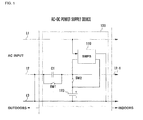
- FIG. 1 is a circuit diagram of a power supply device 100 according to an embodiment of the present invention.
- the power supply device 100 includes a capacitor C1, a first switch SW1, a second switch SW2, a rechargeable battery 120, and an SMPS device 110.
- the power supply device 100 converts normal power that is applied through a hot wire L1, a neutral wire L2, and a ground wire L3 to supply AC power between the hot wire L1 and the neutral wire L2 and between the hot wire L1 and the ground wire L3 and DC power between a conversion neutral wire L2-1 and the ground wire L3.
- the capacitor C1 includes a first terminal connected to the neutral wire L2 and a second terminal connected to the conversion neutral wire L2-1.
- the first switch SW1 is connected parallel to the capacitor C1.
- a first terminal of the second switch SW2 is connected to the conversion neutral wire L2-1.
- the rechargeable battery 120 includes a positive (+) terminal that is connected to a second terminal of the second switch SW2 and a negative (-) terminal that is connected to the ground wire L3.
- the SMPS device 110 converts power applied to the hot wire L1 to DC power having a predetermined voltage level and supplies the same to a common terminal of the second switch SW2 and the rechargeable battery 120, a DC power negative terminal connected to the conversion neutral wire L2-1, and the ground wire L3.
- the capacitor C1 allows the AC power applied to the neutral wire L2 to pass through the conversion neutral wire L2-1 but blocks the DC power applied to the conversion neutral wire L2-1 from flowing to the neutral wire L2.
- a voltage level of the rechargeable battery 120 may be determined depending on where power is used.
- the voltage level of the rechargeable battery 120 may be preferably, for example, 12 V or 24 V.
- a desired number of rechargeable batteries may be connected in parallel.
- the rechargeable battery 120 While normal power is being applied, the rechargeable battery 120 stores electrical energy, and when a power failure occurs, the electrical energy stored in the rechargeable battery 120 is supplied to connected electric appliances.
- a left side of the power supply device 100 of FIG. 1 indicates outdoors to which normal power AC input is supplied, and a right side of the power supply device 100 indicates indoors where normal power AC INPUT is converted to supply AC power between the hot wire L1 and the neutral wire L2 via the ground wire L3 that is connected to the neutral wire L2 and to supply DC power between the conversion neutral wire L2-1 and the ground wire L3.
- the first switch SW1 is used to protect a light-emitting diode (LED) lamp which receives power from the conversion neutral wire L2-1 in the case when the rechargeable battery 120 is changed or inspected. In this case, the first switch SW1 is turned on so as to connect the conversion neutral wire L2-1 to the ground wire L3.
- LED light-emitting diode
- the present invention provides an AC-DC SMPS device, in which power is supplied from a power supply that supplies AC and DC power at the same time, in a similar manner as an AC-DC power supply device disclosed in KR 10-2012-0089039 that is filed by the inventors prior to the present application.
- an SMPS circuit 110-3 illustrated in FIG. 5C according to the present invention generates not only AC power having a required voltage level but also DC power by using normal AC power and power from solar cells, which are alternative energy sources, and minimizes power loss.
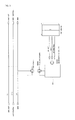
- an AC-DC SMPS device receives normal AC power through the hot wire L1, the neutral wire L2, and the ground wire L3, and is connected to an AC input hot ground terminal CN101 AC INPUT via an AC-DC power switch S10, an AC neutral terminal NEUTRAL, and a ground terminal GND of FIG. 2 .
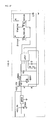
- the rechargeable battery 120 is connected to a terminal IN of a battery CN301 of FIG. 4 , and AC-DC power is applied to an internal wire through a terminal #2 of the AC input hot ground terminal CN101 after passing through the ground terminal GND and a terminal HOT GND TERMINAL.
- a terminal #5 of the AC input hot ground terminal CN101 denotes a terminal for countries where a three-wire system is used, and is optionally included.
- the AC-DC SMPS device may be connected such that an alternative energy source such as solar cell power is input through a terminal CN401 PV INPUT of FIG. 4 , or connected to a power source of a vehicle or other DC power sources in an emergency.
- CN501 of FIG. 4 denotes a terminal for program updates and a network connection of the AC-DC SMPS device.
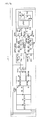
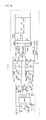
- FIGS. 5A through 5H are detailed circuit diagrams of an AC-DC power supply device according to an embodiment of the present invention.
- AC power is supplied through terminals #3 and #4 of an AC input hot ground terminal CN101 in an electromagnetic interference (EMI) circuit 110-1.
- a terminal #1 of the AC input hot ground terminal CN101 allows AC power to pass through to be supplied to an AC-DC power line.
- the AC power applied to the EMI circuit 110-1 is applied to a rectification diode BD 101 after flowing through a fuse F101, an inductor L101, an inductor L102, and a low-pass filter LF101.
- power that has passed through the inductor L102 passes through a circuit consisting of a relay RLY101/B and a thermistor TH101; this circuit blocks power if an overload is generated.
- the rectification diode BD101 converts the AC power to DC power and outputs the same to a power factor correction (PFC) circuit 110-2.
- the PFC circuit 110-2 applies the DC power to drains of switching device Q203 and Q204 through a low-pass filter LF201.
- R201, R202, R203, and R204 denote resistors for a voltage drop, which supply a comparison voltage to an integrated circuit (IC) U201 together with a resistor R205.
- D201 denotes a boost diode for supplying a sufficient current
- the IC U201 receives the comparison voltage through an output teminal thereof to output an oscillation voltage in accordance with a predetermined time constant so as to trigger gates of the switching devices Q203 and Q204 through switching device Q201 and Q202.
- DC power of about 380 V is boosted up and output through two terminals of a capacitor C207.
- R218, R219, R220, and R221 denote resistors for a voltage drop, which are designed to supply a comparison voltage of an output terminal of the IC U201 together with a resistor R222.
- DC power applied to the SMPS circuit 110-3 is applied to a drain of a switching device Q302 and oscillates in an IC U301 to trigger gates of switching device Q302 and Q303, wherein the switching devices Q302 and Q303 are serially configured to switch DC power applied to drains of the switching devices Q302 and Q303 to a primary side of a transformer T301.
- AC power that is output through terminals #4, #5, and #6 of a secondary side of the transformer T301 is rectified by full-wave rectification by using diodes D305 and D306, and is separately smoothed to capacitors C320, C321, C322, C323, and C324 to thereby output the same as DC power for charging.
- R332, R333, and R334 denote protection resistors.
- the AC power that is output through terminals #7, #8, and #9 of the transformer T301 is rectified by full-wave rectification by using diodes D307 and D308, and is smoothed to capacitors C325 and C326, and a circuit OP301/B is turned on or off in accordance with time constants of an IC U302, capacitors C327 and C328, and resistors R335, R336, and R337, and resistors R338, R339, and R340 so as to switch the circuit OP301/A and to adjust an oscillation voltage of the IC U301, thereby outputting stable DC power for charging.
- a Zener diode ZD301 rectifies the AC power applied to the EMI circuit 110-1 by using a diode a rectification diode D101 by half-wave rectification, and supplies the voltage that is dropped by the resistors R102, R103, and R104 through a section from Q304 to R320, as a U301 start voltage, and supplies DC power of VCC_15V supplied from the secondary side of the transformer T301 to a switching device Q307 via a resistor R331, and supplies power of VCC_5.5V to the ICs U201 and U301 through switching devices Q306 and Q307.
- Q309 and OP304 each denote an AC power supply adjustment circuit.
- a charging DC voltage applied to the SMPS circuit 110-3 is passed through a sensing resistor SR401, and external input DC power applied through a terminal PV INPUT of a battery CN401, such as solar cell power or power from a power source of a vehicle, passes through a section from the sensing resistor SR402 to diodes D401 and D402 to be applied to drains of switching devices Q401 and Q402.
- the switching device Q401 is connected serially between a switching device Q403 and the ground terminal GND, and the switching device Q402 is connected to a switching device Q404.
- An IC U401 charges the power applied to the SMPS circuit 110-3 and external input DC power in a battery connected to a load circuit, in accordance with programmed data, and outputs required DC power to an AC-DC power line at the same time together with the battery.
- R401 and R404 denote MPPSET time constant division resistors
- R402 and R403 denote resistors that supply power to the IC U401
- the IC U401 oscillates in accordance with predetermined time constants so as to trigger gates of the switching devices Q401, Q402, Q403, and Q404 via resistors R408, R409, R410, and R411 and output the DC power applied to the drains of the switching devices Q401, Q402, Q403, and Q404 through a low-pass filter LF 401 and through a section from a resistor R414 to a resistor sensor resistor SR403 as described above.
- R414 denotes a sensing resistor that senses a current flowing through the load circuit
- R415, R416, and R417 denote time constant division resistors
- R412 and R413 denote time constant resistors.
- D403 and D404 denote LED diodes that indicate a charging state
- SR403 denotes a resistor sensor resistor for sensing a current of DC power flowing through the load circuit.
- an IC U501 controls an operation of a circuit by setting a current flowing in current sensing resistors according to programmed data so as to enable monitoring of an operating condition of the circuit through a network.
- U502 denotes a regulator voltage drop integrated circuit (IC) for power supply, and a switching device Q501 supplies power for power switching to circuits OP302/A and OP303/B.
- IC regulator voltage drop integrated circuit
- switching devices Q503 and Q502 are driven to turn on a circuit OP303/B so as to operate a circuit OP302/A, thereby supplying power to the SMPS circuit 110-3 and operating the relay RLY101/B, as has been described above.
- External input power that is, solar cell power
- insufficient power is supplied from normal AC power through the SMPS circuit 110-3, and when solar cell power is input after charging is completed, power is supplied from an inverter and converted to AC power, thereby transmitting the same to the outside.
- the SMPS circuit 110-3 which uses normal AC power, is stopped through the AC power supply adjustment circuits Q309 and OP304 as described above.
- FIG. 5F illustrates a constant voltage circuit 110-6, which is a power supply circuit for supplying stable IC power to an inverter.
- RLY601 denotes an electronic relay for switching to control the inverter.
- U601 denotes an oscillation IC for boosting up power, which triggers a gate of a switching device Q601 to supply VCC_15V to a rear terminal of a diode D602, and an IC U602 drops VCC_15V to VCC_5C and supplies the same.
- FIG. 5G illustrates an inverter PFC circuit 110-7, which is a voltage enhancing circuit for converting DC 24V to AC 120V or AC 220V.
- An IC U701 oscillates in accordance with predetermined time constants so as to trigger gates of switching devices Q705, Q706, Q707, Q708, Q709, and Q710 through switching devices Q701, Q702, Q703, and Q704.
- DC power applied to drains of the switching devices Q705, Q706, Q707, Q708, Q709, and Q710 is switched between sources thereof to be applied to a primary side of a transformer T701, and a high AC voltage is obtained at a secondary side thereof, and the AC voltage is rectified by using diodes D703, D704, D705, and D706 to be converted to DC.
- the DC is smoothed through a low pass filter LF701 for capacitors C711, C712, and C713 to be output.
- FIG. 5H illustrates an inverter stage circuit 110-8, which is a circuit converting input DC power to AC power.
- a uniform frequency has to be used, and here, an AC frequency of conventional normal AC power is used.
- the voltage is dropped by using a transformer T801, and is separated between a primary side and a secondary side of the transformer T801.
- Power is divided into a (+) component and a (-) component by using a diode D801, and a waveform of the power is corrected using a resistor to supply the same as a synchronization signal to an IC U801, and the IC U801 outputs an oscillation voltage of 60 Hz using a crystal oscillator XT801 so as to oscillate ICs U802 and U803.
- oscillation voltages of the ICs U802 and U803 are supplied after respectively converting phases of the oscillation voltages to output oscillation, and the IC U802 triggers gates of the ICs Q801 and Q802, and the IC U803 triggers gates of switching devices Q803 and Q804 to sequentially switch DC power applied to drains of the switching devices Q803 and Q804 so as to convert the same to AC power, and the AC power is output through a low pass filter LF801.
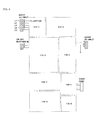
- a refrigerator module 210 illustrated in FIG. 6 which is an example of an AC-DC SMPS device according to the present invention, is a circuit for driving a refrigerator in the event of a power failure. If normal AC power is input, a refrigerator is driven by using AC power, and in an emergency such as a power failure, the refrigerator is automatically converted to receive AC-DC power to operate.
- the refrigerator module 210 of FIG. 6 will be described further in detail below.
- FIGS. 7A through 7C are detailed circuit diagrams of the AC-DC SMPS device according to the present invention.
- DC power is supplied through an AC-DC power line, and an IC U902 oscillates to trigger gates of switching devices Q912, Q909, Q915, and Q916 via switching devices Q913, Q914, Q910, and Q911, and DC power supplied to drains of the switching devices Q912, Q909, 0915, and Q916 flows to sources of the switching devices Q912, Q909, Q915, and Q916 via a transformer T902.
- AC power that is diverged to a secondary side of the transformer T902 is rectified by using diodes D907, D908, D905, and D906 to be converted to DC, and is smoothed using capacitors C918, C919, and C921 and output to a stage circuit 210-2.
- an IC U905 oscillates an AC frequency with a crystal oscillator XT901, and outputs the same to ICs U906 and U907 through resistors R918 and R919.
- the ICs U906 and U907 oscillate according to different phases to sequentially trigger gates of switching devices Q909, Q910, Q911, and Q912 to thereby convert DC power supplied to the drains of the switching devices Q909, Q910, Q911, and Q912 to AC power and output the same.
- An adjustment circuit OP903 of FIG. 7A does not supply power for a circuit when normal AC power is normally supplied but supplies power only in the event of a power failure to operate the circuit.
- a refrigerator module relay switch RLY901 denotes a relay switch for power conversion
- an IC U903 denotes a driving IC
- OP901 in FIG. 7B denotes a sensor switch
- DB901 and U902 denote circuits for supplying power to the IC U905.
- a refrigerator module AC-DC power input unit 210-3 as illustrated in FIG. 7C outputs normal AC power between terminals #1 and #2 of a power plug PL901 when power is supplied normally, to a socket SO901 so as to operate a refrigerator, and in the event of a power failure, the refrigerator module relay switch RLY901 is automatically converted to convert DC power input between terminals #2 and #3 of the power plug PL901 to AC power so as to output the same to the socket SO901, thereby preventing food from rotting in the refrigerator, which may occur in the event of a power failure.
- AC-DC power supply device of the present invention conventional electrical wiring may be used, and AC and DC power may be stably supplied at the same time. Moreover, not only illumination but Internet connection and use of computers are still possible even if a power failure occurs.
- DC power of solar cells which is an alternative energy source is charged in a battery so that the DC power charged in the battery may be used or the DC power may be converted to AC power so as to enable transmission of electricity to an electric power company by grid line connection.
- AC power and DC power may be supplied at the same time, and loss due to conversion of electricity between AC and DC may be minimized, and use of environment-friendly alternative energy may be facilitated.
- power may be charged in a battery for use or residual power may be transmitted to an electric power company to thereby efficiently use the power, and power may be supplied even in an emergency.
Landscapes
- Engineering & Computer Science (AREA)
- Power Engineering (AREA)
- Business, Economics & Management (AREA)
- Emergency Management (AREA)
- Inverter Devices (AREA)
- Charge And Discharge Circuits For Batteries Or The Like (AREA)
- Dc-Dc Converters (AREA)
- Supply And Distribution Of Alternating Current (AREA)
- Control Of Electrical Variables (AREA)
Abstract
Description
- This application claims the benefit of Korean Patent Application No.
10-2012-0089039, filed on Aug. 14, 2012 10-2012-0141809 , Dec. 7, 2012 - The present invention relates to an alternating current (AC) and direct current (DC) power supply device, and more particularly, to an AC-DC switching mode power supply (SMPS) device, in which a normal power source applied from the outside is converted to an AC voltage or a DC voltage having a predetermined voltage level and is transmitted to a load without an additional wiring, and in which not only AC but also DC is supplied to the load by using normal power and power of a solar cell; particularly, the power of the solar cell is first supplied as DC power or residual power remaining after charging a battery is converted to AC via an inverter to replace the AC power of the normal power source or to allow the power to be transmitted to the outside. Accordingly, AC and DC power may be supplied simultaneously, and moreover, power of the solar cell may be efficiently used.
- As the energy and environment crisis has recently increased, power production by using alternative energy sources such as power produced by solar cells and the efficient use of power are emphasized, and the use of solar cells in homes is a trend on the increase. Moreover, techniques for manufacturing power supply devices that are capable of using energy effectively and efficiently by total power management are also increasingly being developed.
- In general, a normal power supply consists of a HOT wire (+) via which a high voltage-level AC power is supplied, a neutral wire (-) via which a relatively low voltage-level power is supplied compared to the HOT wire (+), and a ground wire GND provided to prevent harm to humans due to an electric shock or an electric leakage. However, it is difficult to use DC power directly from the normal power supply without a power converter that is suitable for various loading capacities.
- Some electric appliances, such as an air conditioner, a washing machine, or a refrigerator, require AC power, but there are also products which use DC power by converting AC power. Most DC power produced by solar cells is converted to AC power for use.
- Due to switching loss in converters or inverters for converting AC power to DC power or DC power to AC power, however, loss in power conversion is caused.
- However, an AC-DC power supply device according to an embodiment of the present invention may be useful as follows.
- For example, since the time range of power consumption is highly concentrated depending on the types of use, homes may conclude a certain contract with a power supply company to transmit a predetermined amount of power that is generated by using solar cells during the daytime to the power supply company via, for example, a grid line connection, and the power may be supplied to industrial or commercial facilities during the time range when a high power consumption is required, and at night when a large amount of power is used temporarily, a portion of the power produced by the solar cells at homes and charged thereby may be used. Consequently, the AC-DC power supply device according to an embodiment of the present invention may function like a huge battery.
-
KR 2012-0089039 - The present invention provides an alternating current (AC) and direct current (DC) power supply device in which a power supplied to a hot wire, a neutral wire, and a ground wire is converted to an AC voltage or a DC voltage having a predetermined voltage level so as to transmit the converted power to a conversion neutral wire and a ground wire.
- The present invention also provides an AC-DC power supply device which receives DC power from a solar cell, which is alternative energy, and charges the same in a battery while supplying AC power based on normal power, and supplies power to various electronic appliances that use DC power, and simply converts AC power to DC power when electricity runs out.
- The present invention also provides an AC-DC switching mode power supply (SMPS) device in which power produced by solar cells is converted to AC after battery charging is completed by alternative energy produced by the solar cells and when power consumption is low, so that a predetermined voltage level is set for a wire of a normal power supply to transmit the AC power to an electric power company via a grid line.
- According to an aspect of the present invention, there is provided an AC-DC power supply device for converting normal power input through a hot wire, a neutral wire, and a ground wire to supply AC power between the hot wire and the neutral wire and between the hot wire and the ground wire and to supply DC power between a conversion neutral wire and the ground wire. In addition to the applied power, the AC-DC power supply device may include a capacitor, a first switch, a second switch, a battery, and an SMPS device. The capacitor may include a first terminal connected to the neutral wire and a second terminal connected to the conversion neutral wire. The first switch may be connected to two ends of the capacitor. The second switch may include a first terminal connected to the conversion neutral wire.
- The battery may include a positive terminal connected to a second terminal of the second switch and a negative terminal connected to the ground wire. The SMPS device may convert power applied to the hot wire to a DC voltage having a predetermined voltage level, and supply the DC voltage to a common terminal of the second switch and the rechargeable battery, a battery negative terminal of DC power applied to the conversion neutral wire, and the ground wire.
- According to another aspect of the present invention, there is provided an AC-DC switching mode power supply (SMPS) device including: an SMPS device for receiving normal AC power from a hot wire, a neutral wire, and a ground wire to connect the normal AC power to an AC output terminal of a battery via a terminal GND; an electromagnetic interference (EMI) circuit for converting AC power applied to the AC output terminal of the battery to DC power; a power factor correction (PFC) circuit for applying the applied DC power to drains of switching devices via a low pass filter; an SMPS circuit for applying DC power to a drain of the switching device and oscillating an integrated circuit to trigger gates of the switching devices, wherein the switching devices are serially connected to switch DC power applied to the drains of the switching devices to a primary side of a transformer; a maximum power point tracking (MPPT) circuit in which the DC voltage supplied to the SMPS circuit passes through a sensing resistor, and input DC power from the outside to an CN401 PV input terminal is connected to drains of switching devices; a programming circuit including an IC that controls a circuit operation by setting a current flowing through sensor resistors in accordance with programmed data and allows to monitor an operating state of the circuit through a network; a constant voltage circuit for supplying stable IC power to an inverter; an inverter PFC circuit for converting DC voltage to AC voltage so as to increase a voltage; an inverter stage circuit for converting input DC power to AC power; and a refrigerator module that uses AC power in a normal condition when normal AC power is input, and receives AC-DC power in the event of a power failure to operate a refrigerator.
- Also, the SMPS device may generate not only AC power having a necessary voltage level but also DC power by using normal AC power and power of a solar cell.
- The SMPS device may further include a battery that is charged by receiving power from a solar cell.
- The refrigerator module may include: a PFC circuit for receiving DC power through an AC-DC power line, wherein the DC power supplied to a drain via a transformer flows to a source to rectify and convert AC power to DC power, and smoothes and outputs the DC power to a stage circuit; and the stage circuit including an AC-DC power input unit, wherein ICs oscillate phases thereof to sequentially trigger gates of switching devices to convert DC power supplied to drains of the switching devices to AC power and output the AC power, and when power is normally supplied, AC power input to a power plug is output to a socket to operate an electronic appliance, and when a power failure occurs, the electronic appliance automatically converts DC power to AC power and outputs the AC power to the socket so that power is supplied even in the event of a power failure.
- The PFC circuit may include a boost diode for supplying sufficient power.
- The programming circuit may first supply solar cell power via programming, and supply insufficient power from normal AC power to the SMPS circuit, and when solar cell power is input after charging is completed, power may be supplied to the inverter to convert the power to AC power and transmit the AC power to the outside, and to stop the SMPS circuit.
- The MPPT circuit may include a sensor resistor for sensing a current of DC power flowing through a load circuit, and the AC power supplied to the EMI circuit may be supplied to rectification diodes after passing through a fuse, an inductor, an inductor, and a low pass filter.
- The AC-DC power input unit may output normal AC power that is input to a the relay switch when power is normally supplied, to the socket so as to operate the refrigerator module, and a refrigerator module relay switch may be automatically converted in the event of a power failure so as to convert DC power input to the relay switch to AC power and output the AC power to the socket.
- The MPPT circuit may charge a battery in accordance with data, together with the SMPS circuit, and outputs required DC power to an AC-DC power line together with the battery.
- The above and other features and advantages of the present invention will become more apparent by describing in detail exemplary embodiments thereof with reference to the attached drawings in which:
-
FIG. 1 is a circuit diagram illustrating an alternating current (AC) and direct current (DC) power supply device according to an embodiment of the present invention; -
FIG. 2 is a circuit diagram of a peripheral circuit of an AC-DC switching mode power supply (SMPS) device according to an embodiment of the present invention; -
FIG. 3 is a module diagram of a refrigerator as a peripheral circuit of an AC-DC SMPS device according to an embodiment of the present invention; -
FIG. 4 is a block diagram illustrating an AC-DC SMPS device according to an embodiment of the present invention; -
FIGS. 5A through 5H are detailed circuit diagrams of a AC-DC power supply device according to an embodiment of the present invention; -
FIG. 6 illustrates an AC-DC SMPS device according to another embodiment of the present invention; and -
FIGS. 7A through 7C are detailed circuit diagrams of the AC-DC SMPS device according to the present invention. - As the invention allows for various changes and numerous embodiments, particular embodiments will be illustrated in the drawings and described in detail in the written description. However, this is not intended to limit the present invention to particular modes of practice, and it is to be appreciated that all changes, equivalents, and substitutes that do not depart from the spirit and technical scope of the present invention are encompassed in the present invention. Like reference numerals in the drawings denote like elements.
- While particulars such as details elements are described below, these are provided for overall understanding of the present invention, and it should be noted that the invention may also be implemented without these particulars.
- In the description of the present invention, certain detailed explanations of the related art or structures are omitted when it is deemed that they may unnecessarily obscure the essence of the invention.
- A power supply is typically classified into a linear type power supply and a switching type power supply.
- A switching type power supply device, which is also referred to as a switching mode power supply (SMPS) device, first converts alternating current (AC) into direct current (DC), and then converts the DC into high-frequency AC of several tens of KHz, and drops a voltage of the AC by using a high-frequency transformer such as a Ferrite transformer, and then rectifies and smoothes the AC whose voltage is dropped to thereby obtain a required power.
- Since a small capacity of a transformer or a capacitor is allowed in the switching type power supply device, the efficiency of the switching type power supply device is generally better than that of the linear type power supply device. Although the switching type power supply device includes complex peripheral components and noise is generated when switching is conducted, since the efficiency of the switching type power supply device is higher than a linear type, the SMPS device is selected for not only large charging batteries used in TVs, PCs, or laptops but also in small rechargeable batteries.
- According to the present invention, a power supply device capable of generating not only normal power in the form of AC power having a required voltage level but also DC power by using the SMPS device and a battery is provided.
-
FIG. 1 is a circuit diagram of apower supply device 100 according to an embodiment of the present invention. - Referring to
FIG. 1 , thepower supply device 100 includes a capacitor C1, a first switch SW1, a second switch SW2, arechargeable battery 120, and anSMPS device 110. Thepower supply device 100 converts normal power that is applied through a hot wire L1, a neutral wire L2, and a ground wire L3 to supply AC power between the hot wire L1 and the neutral wire L2 and between the hot wire L1 and the ground wire L3 and DC power between a conversion neutral wire L2-1 and the ground wire L3. - The capacitor C1 includes a first terminal connected to the neutral wire L2 and a second terminal connected to the conversion neutral wire L2-1. The first switch SW1 is connected parallel to the capacitor C1. A first terminal of the second switch SW2 is connected to the conversion neutral wire L2-1.
- The
rechargeable battery 120 includes a positive (+) terminal that is connected to a second terminal of the second switch SW2 and a negative (-) terminal that is connected to the ground wire L3. - The
SMPS device 110 converts power applied to the hot wire L1 to DC power having a predetermined voltage level and supplies the same to a common terminal of the second switch SW2 and therechargeable battery 120, a DC power negative terminal connected to the conversion neutral wire L2-1, and the ground wire L3. - The capacitor C1 allows the AC power applied to the neutral wire L2 to pass through the conversion neutral wire L2-1 but blocks the DC power applied to the conversion neutral wire L2-1 from flowing to the neutral wire L2.
- A voltage level of the
rechargeable battery 120 may be determined depending on where power is used. The voltage level of therechargeable battery 120 may be preferably, for example, 12 V or 24 V. In order to increase a use capacity of therechargeable battery 120, a desired number of rechargeable batteries may be connected in parallel. - While normal power is being applied, the
rechargeable battery 120 stores electrical energy, and when a power failure occurs, the electrical energy stored in therechargeable battery 120 is supplied to connected electric appliances. - A left side of the
power supply device 100 ofFIG. 1 indicates outdoors to which normal power AC input is supplied, and a right side of thepower supply device 100 indicates indoors where normal power AC INPUT is converted to supply AC power between the hot wire L1 and the neutral wire L2 via the ground wire L3 that is connected to the neutral wire L2 and to supply DC power between the conversion neutral wire L2-1 and the ground wire L3. - The first switch SW1 is used to protect a light-emitting diode (LED) lamp which receives power from the conversion neutral wire L2-1 in the case when the
rechargeable battery 120 is changed or inspected. In this case, the first switch SW1 is turned on so as to connect the conversion neutral wire L2-1 to the ground wire L3. - Hereinafter, the AC-DC SMPS device as a
power supply device 100 of the current embodiment of the present invention will be described. - The present invention provides an AC-DC SMPS device, in which power is supplied from a power supply that supplies AC and DC power at the same time, in a similar manner as an AC-DC power supply device disclosed in
KR 10-2012-0089039 FIG. 5C according to the present invention generates not only AC power having a required voltage level but also DC power by using normal AC power and power from solar cells, which are alternative energy sources, and minimizes power loss. - Referring to
FIGS. 2 ,3 , and4 , an AC-DC SMPS device receives normal AC power through the hot wire L1, the neutral wire L2, and the ground wire L3, and is connected to an AC input hot ground terminal CN101 AC INPUT via an AC-DC power switch S10, an AC neutral terminal NEUTRAL, and a ground terminal GND ofFIG. 2 . - Also, the
rechargeable battery 120 is connected to a terminal IN of a battery CN301 ofFIG. 4 , and AC-DC power is applied to an internal wire through aterminal # 2 of the AC input hot ground terminal CN101 after passing through the ground terminal GND and a terminal HOT GND TERMINAL. Aterminal # 5 of the AC input hot ground terminal CN101 denotes a terminal for countries where a three-wire system is used, and is optionally included. - The AC-DC SMPS device may be connected such that an alternative energy source such as solar cell power is input through a terminal CN401 PV INPUT of
FIG. 4 , or connected to a power source of a vehicle or other DC power sources in an emergency. CN501 ofFIG. 4 denotes a terminal for program updates and a network connection of the AC-DC SMPS device. -
FIGS. 5A through 5H are detailed circuit diagrams of an AC-DC power supply device according to an embodiment of the present invention. - Referring to
FIG. 5A , AC power is supplied throughterminals # 3 and #4 of an AC input hot ground terminal CN101 in an electromagnetic interference (EMI) circuit 110-1. Aterminal # 1 of the AC input hot ground terminal CN101 allows AC power to pass through to be supplied to an AC-DC power line. The AC power applied to the EMI circuit 110-1 is applied to a rectification diode BD 101 after flowing through a fuse F101, an inductor L101, an inductor L102, and a low-pass filter LF101. - Here, power that has passed through the inductor L102 passes through a circuit consisting of a relay RLY101/B and a thermistor TH101; this circuit blocks power if an overload is generated. The rectification diode BD101 converts the AC power to DC power and outputs the same to a power factor correction (PFC) circuit 110-2.
- Referring to
FIG. 5B , the PFC circuit 110-2 applies the DC power to drains of switching device Q203 and Q204 through a low-pass filter LF201. R201, R202, R203, and R204 denote resistors for a voltage drop, which supply a comparison voltage to an integrated circuit (IC) U201 together with a resistor R205. - D201 denotes a boost diode for supplying a sufficient current, and the IC U201 receives the comparison voltage through an output teminal thereof to output an oscillation voltage in accordance with a predetermined time constant so as to trigger gates of the switching devices Q203 and Q204 through switching device Q201 and Q202. Then, DC power of about 380 V is boosted up and output through two terminals of a capacitor C207. R218, R219, R220, and R221 denote resistors for a voltage drop, which are designed to supply a comparison voltage of an output terminal of the IC U201 together with a resistor R222.
- Referring to
FIG. 5C , DC power applied to the SMPS circuit 110-3 is applied to a drain of a switching device Q302 and oscillates in an IC U301 to trigger gates of switching device Q302 and Q303, wherein the switching devices Q302 and Q303 are serially configured to switch DC power applied to drains of the switching devices Q302 and Q303 to a primary side of a transformer T301. - AC power that is output through
terminals # 4, #5, and #6 of a secondary side of the transformer T301 is rectified by full-wave rectification by using diodes D305 and D306, and is separately smoothed to capacitors C320, C321, C322, C323, and C324 to thereby output the same as DC power for charging. R332, R333, and R334 denote protection resistors. - The AC power that is output through terminals #7, #8, and #9 of the transformer T301 is rectified by full-wave rectification by using diodes D307 and D308, and is smoothed to capacitors C325 and C326, and a circuit OP301/B is turned on or off in accordance with time constants of an IC U302, capacitors C327 and C328, and resistors R335, R336, and R337, and resistors R338, R339, and R340 so as to switch the circuit OP301/A and to adjust an oscillation voltage of the IC U301, thereby outputting stable DC power for charging.
- A Zener diode ZD301 rectifies the AC power applied to the EMI circuit 110-1 by using a diode a rectification diode D101 by half-wave rectification, and supplies the voltage that is dropped by the resistors R102, R103, and R104 through a section from Q304 to R320, as a U301 start voltage, and supplies DC power of VCC_15V supplied from the secondary side of the transformer T301 to a switching device Q307 via a resistor R331, and supplies power of VCC_5.5V to the ICs U201 and U301 through switching devices Q306 and Q307. Q309 and OP304 each denote an AC power supply adjustment circuit.
- Referring to
FIG. 5D , in a maximum power point tracking (MPPT) circuit 110-4, a charging DC voltage applied to the SMPS circuit 110-3 is passed through a sensing resistor SR401, and external input DC power applied through a terminal PV INPUT of a battery CN401, such as solar cell power or power from a power source of a vehicle, passes through a section from the sensing resistor SR402 to diodes D401 and D402 to be applied to drains of switching devices Q401 and Q402. The switching device Q401 is connected serially between a switching device Q403 and the ground terminal GND, and the switching device Q402 is connected to a switching device Q404. - An IC U401 charges the power applied to the SMPS circuit 110-3 and external input DC power in a battery connected to a load circuit, in accordance with programmed data, and outputs required DC power to an AC-DC power line at the same time together with the battery.
- R401 and R404 denote MPPSET time constant division resistors, and R402 and R403 denote resistors that supply power to the IC U401, and the IC U401 oscillates in accordance with predetermined time constants so as to trigger gates of the switching devices Q401, Q402, Q403, and Q404 via resistors R408, R409, R410, and R411 and output the DC power applied to the drains of the switching devices Q401, Q402, Q403, and Q404 through a low-pass filter LF 401 and through a section from a resistor R414 to a resistor sensor resistor SR403 as described above.
- R414 denotes a sensing resistor that senses a current flowing through the load circuit, and R415, R416, and R417 denote time constant division resistors, and R412 and R413 denote time constant resistors.
- D403 and D404 denote LED diodes that indicate a charging state, and SR403 denotes a resistor sensor resistor for sensing a current of DC power flowing through the load circuit.
- Referring to
FIG. 5E , in a programming circuit 110-5, an IC U501 controls an operation of a circuit by setting a current flowing in current sensing resistors according to programmed data so as to enable monitoring of an operating condition of the circuit through a network. - U502 denotes a regulator voltage drop integrated circuit (IC) for power supply, and a switching device Q501 supplies power for power switching to circuits OP302/A and OP303/B. When a switch SW501 is turned on, switching devices Q503 and Q502 are driven to turn on a circuit OP303/B so as to operate a circuit OP302/A, thereby supplying power to the SMPS circuit 110-3 and operating the relay RLY101/B, as has been described above.
- External input power, that is, solar cell power, is first supplied via programming, and insufficient power is supplied from normal AC power through the SMPS circuit 110-3, and when solar cell power is input after charging is completed, power is supplied from an inverter and converted to AC power, thereby transmitting the same to the outside. Here, the SMPS circuit 110-3, which uses normal AC power, is stopped through the AC power supply adjustment circuits Q309 and OP304 as described above.
- In addition, if solar cell power is not input, power is not supplied to the inverter INVERTER so as to prevent consumption of battery power.
-
FIG. 5F illustrates a constant voltage circuit 110-6, which is a power supply circuit for supplying stable IC power to an inverter. As described above, RLY601 denotes an electronic relay for switching to control the inverter. U601 denotes an oscillation IC for boosting up power, which triggers a gate of a switching device Q601 to supply VCC_15V to a rear terminal of a diode D602, and an IC U602 drops VCC_15V to VCC_5C and supplies the same. -
FIG. 5G illustrates an inverter PFC circuit 110-7, which is a voltage enhancing circuit for converting DC 24V toAC 120V orAC 220V. An IC U701 oscillates in accordance with predetermined time constants so as to trigger gates of switching devices Q705, Q706, Q707, Q708, Q709, and Q710 through switching devices Q701, Q702, Q703, and Q704. - Here, DC power applied to drains of the switching devices Q705, Q706, Q707, Q708, Q709, and Q710 is switched between sources thereof to be applied to a primary side of a transformer T701, and a high AC voltage is obtained at a secondary side thereof, and the AC voltage is rectified by using diodes D703, D704, D705, and D706 to be converted to DC. The DC is smoothed through a low pass filter LF701 for capacitors C711, C712, and C713 to be output.
-
FIG. 5H illustrates an inverter stage circuit 110-8, which is a circuit converting input DC power to AC power. In order to obtain an effect of putting small powers generated in various spots together, a uniform frequency has to be used, and here, an AC frequency of conventional normal AC power is used. - The voltage is dropped by using a transformer T801, and is separated between a primary side and a secondary side of the transformer T801. Power is divided into a (+) component and a (-) component by using a diode D801, and a waveform of the power is corrected using a resistor to supply the same as a synchronization signal to an IC U801, and the IC U801 outputs an oscillation voltage of 60 Hz using a crystal oscillator XT801 so as to oscillate ICs U802 and U803.
- Here, oscillation voltages of the ICs U802 and U803 are supplied after respectively converting phases of the oscillation voltages to output oscillation, and the IC U802 triggers gates of the ICs Q801 and Q802, and the IC U803 triggers gates of switching devices Q803 and Q804 to sequentially switch DC power applied to drains of the switching devices Q803 and Q804 so as to convert the same to AC power, and the AC power is output through a low pass filter LF801.
- A
refrigerator module 210 illustrated inFIG. 6 , which is an example of an AC-DC SMPS device according to the present invention, is a circuit for driving a refrigerator in the event of a power failure. If normal AC power is input, a refrigerator is driven by using AC power, and in an emergency such as a power failure, the refrigerator is automatically converted to receive AC-DC power to operate. - The
refrigerator module 210 ofFIG. 6 will be described further in detail below. -
FIGS. 7A through 7C are detailed circuit diagrams of the AC-DC SMPS device according to the present invention. - Referring to a detailed view of a refrigerator module PFC circuit 210-1 of
FIG. 7A , DC power is supplied through an AC-DC power line, and an IC U902 oscillates to trigger gates of switching devices Q912, Q909, Q915, and Q916 via switching devices Q913, Q914, Q910, and Q911, and DC power supplied to drains of the switching devices Q912, Q909, 0915, and Q916 flows to sources of the switching devices Q912, Q909, Q915, and Q916 via a transformer T902. - Also, AC power that is diverged to a secondary side of the transformer T902 is rectified by using diodes D907, D908, D905, and D906 to be converted to DC, and is smoothed using capacitors C918, C919, and C921 and output to a stage circuit 210-2.
- Referring to
FIG. 7B , in the stage circuit 210-2, an IC U905 oscillates an AC frequency with a crystal oscillator XT901, and outputs the same to ICs U906 and U907 through resistors R918 and R919. - The ICs U906 and U907 oscillate according to different phases to sequentially trigger gates of switching devices Q909, Q910, Q911, and Q912 to thereby convert DC power supplied to the drains of the switching devices Q909, Q910, Q911, and Q912 to AC power and output the same.
- An adjustment circuit OP903 of
FIG. 7A does not supply power for a circuit when normal AC power is normally supplied but supplies power only in the event of a power failure to operate the circuit. - Referring to
FIG. 7C , a refrigerator module relay switch RLY901 denotes a relay switch for power conversion, an IC U903 denotes a driving IC, OP901 inFIG. 7B denotes a sensor switch, and DB901 and U902 denote circuits for supplying power to the IC U905. - A refrigerator module AC-DC power input unit 210-3 as illustrated in
FIG. 7C outputs normal AC power betweenterminals # 1 and #2 of a power plug PL901 when power is supplied normally, to a socket SO901 so as to operate a refrigerator, and in the event of a power failure, the refrigerator module relay switch RLY901 is automatically converted to convert DC power input betweenterminals # 2 and #3 of the power plug PL901 to AC power so as to output the same to the socket SO901, thereby preventing food from rotting in the refrigerator, which may occur in the event of a power failure. - According to the AC-DC power supply device of the present invention, conventional electrical wiring may be used, and AC and DC power may be stably supplied at the same time. Moreover, not only illumination but Internet connection and use of computers are still possible even if a power failure occurs.
- Also, according to the AC-DC SMPS device, while supplying AC power and DC power by using a normal power supply, DC power of solar cells which is an alternative energy source is charged in a battery so that the DC power charged in the battery may be used or the DC power may be converted to AC power so as to enable transmission of electricity to an electric power company by grid line connection.
- In particular, AC power and DC power may be supplied at the same time, and loss due to conversion of electricity between AC and DC may be minimized, and use of environment-friendly alternative energy may be facilitated. Furthermore, power may be charged in a battery for use or residual power may be transmitted to an electric power company to thereby efficiently use the power, and power may be supplied even in an emergency.
- While the present invention has been particularly shown and described with reference to exemplary embodiments thereof, it will be understood by those of ordinary skill in the art that various changes in form and details may be made therein without departing from the spirit and scope of the present invention as defined by the following claims.
Claims (13)
- An alternating-current (AC)-direct current (DC) power supply device for converting normal power input through a hot wire, a neutral wire, and a ground wire to supply AC power between the hot wire and the neutral wire and between the hot wire and the ground wire and to supply DC power between a conversion neutral wire and the ground wire, the device comprising:a capacitor including a first terminal that is connected to the neutral wire and a second terminal that is connected to the conversion neutral wire;a second switch including a first terminal connected to the conversion neutral wire;a rechargeable battery including a positive terminal connected to a second terminal of the second switch and a negative terminal connected to the ground wire; anda switching mode power supply (SMPS) device converting power applied to the hot wire to a DC voltage having a predetermined voltage level, and supplying the DC voltage to a common terminal of the second switch and the rechargeable battery, a battery negative terminal of DC power applied to the conversion neutral wire, and the ground wire.
- The AC-DC power supply device of claim 1, wherein the rechargeable battery comprises at least two rechargeable batteries that are connected serially or parallel.
- The AC-DC power supply device of claim 1, further comprising a first switch that is connected to the capacitor in parallel.
- An alternating current (AC)-direct current (DC) switching mode power supply (SMPS) device comprising:an SMPS device for receiving normal AC power from a hot wire, a neutral wire, and a ground wire to connect the normal AC power to an AC output terminal of a battery via a terminal GND;an electromagnetic interference (EMI) circuit for converting AC power applied to the AC output terminal of the battery to DC power;a power factor correction (PFC) circuit for applying the applied DC power to drains of switching devices via a low pass filter;an SMPS circuit for applying DC power to a drain of the switching device and oscillating an integrated circuit to trigger gates of the switching devices, wherein the switching devices are serially connected to switch DC power applied to the drains of the switching devices to a primary side of a transformer;a maximum power point tracking (MPPT) circuit in which the DC voltage supplied to the SMPS circuit passes through a sensing resistor, and input DC power from the outside to an input terminal is connected to drains of switching devices;a programming circuit comprising an IC that controls a circuit operation by setting a current flowing through sensor resistors in accordance with programmed data and allows to monitor an operating state of the circuit through a network;a constant voltage circuit for supplying stable IC power to an inverter;an inverter PFC circuit for converting DC voltage to AC voltage so as to increase a voltage;an inverter stage circuit for converting input DC power to AC power; anda refrigerator module that uses AC power in a normal condition when normal AC power is input, and receives AC-DC power in the event of a power failure to operate a refrigerator.
- The AC-DC SMPS device of claim 4, wherein the SMPS device generates not only AC power having a necessary voltage level but also DC power by using normal AC power and power of a solar cell.
- The AC-DC SMPS device of claim 4, further comprising a battery that is charged by receiving power from a solar cell.
- The AC-DC SMPS device of claim 4, wherein the refrigerator module comprises:a PFC circuit for receiving DC power through an AC-DC power line, wherein the DC power supplied to a drain via a transformer flows to a source to rectify and convert AC power to DC power, and smoothes and outputs the DC power to a stage circuit;an AC-DC power input unit included in the stage circuit, wherein ICs oscillate phases to sequentially trigger gates of switching devices to convert DC power supplied to drains of the switching devices to AC power and output the AC power, and when power is normally supplied, AC power input to a power plug is output to a socket to operate an electronic appliance, and when a power failure occurs, the electronic appliance automatically converts DC power to AC power and outputs the AC power to the socket so that power is supplied even in the event of a power failure.
- The AC-DC SMPS device of claim 4, wherein the PFC circuit comprises a boost diode for supplying sufficient power.
- The AC-DC SMPS device of claim 4, wherein the programming circuit first supplies solar cell power via programming, and supplies insufficient power from normal AC power to the SMPS circuit, and when solar cell power is input after charging is completed, power is supplied to the inverter to convert the power to AC power and transmit the AC power to the outside, and to stop the SMPS circuit.
- The AC-DC SMPS device of claim 4, wherein the MPPT circuit comprises a sensor resistor for sensing a current of DC power flowing through a load circuit.
- The AC-DC power supply device of claim 4, wherein the AC power supplied to the EMI circuit is supplied to rectification diodes after passing through a fuse, an inductor, an inductor, and a low pass filter.
- The AC-DC SMPS device of claim 4, wherein the AC-DC power input unit outputs normal AC power that is input to a relay switch when power is normally supplied, to a socket so as to operate the refrigerator module, and a refrigerator module relay switch is automatically converted in the event of a power failure so as to convert DC power input to the relay switch to AC power and output the AC power to the socket.
- The AC-DC SMPS device of claim 4, wherein the MPPT circuit charges a battery in accordance with data, together with the SMPS circuit, and outputs required DC power to an AC-DC power line together with the battery.
Priority Applications (1)
| Application Number | Priority Date | Filing Date | Title |
|---|---|---|---|
| EP20199333.4A EP3780372A1 (en) | 2012-08-14 | 2013-03-20 | Ac-dc switching mode power supply device |
Applications Claiming Priority (2)
| Application Number | Priority Date | Filing Date | Title |
|---|---|---|---|
| KR1020120089039A KR101233785B1 (en) | 2012-08-14 | 2012-08-14 | Adc power supply system |
| KR1020120141809A KR101295817B1 (en) | 2012-12-07 | 2012-12-07 | Adc switching mode power supply unit |
Related Child Applications (1)
| Application Number | Title | Priority Date | Filing Date |
|---|---|---|---|
| EP20199333.4A Division EP3780372A1 (en) | 2012-08-14 | 2013-03-20 | Ac-dc switching mode power supply device |
Publications (3)
| Publication Number | Publication Date |
|---|---|
| EP2698908A2 true EP2698908A2 (en) | 2014-02-19 |
| EP2698908A3 EP2698908A3 (en) | 2017-12-20 |
| EP2698908B1 EP2698908B1 (en) | 2020-10-07 |
Family
ID=47900940
Family Applications (2)
| Application Number | Title | Priority Date | Filing Date |
|---|---|---|---|
| EP13160207.0A Active EP2698908B1 (en) | 2012-08-14 | 2013-03-20 | AC-DC power supply device |
| EP20199333.4A Ceased EP3780372A1 (en) | 2012-08-14 | 2013-03-20 | Ac-dc switching mode power supply device |
Family Applications After (1)
| Application Number | Title | Priority Date | Filing Date |
|---|---|---|---|
| EP20199333.4A Ceased EP3780372A1 (en) | 2012-08-14 | 2013-03-20 | Ac-dc switching mode power supply device |
Country Status (4)
| Country | Link |
|---|---|
| US (2) | US9231437B2 (en) |
| EP (2) | EP2698908B1 (en) |
| JP (1) | JP5598562B2 (en) |
| CN (1) | CN103595230B (en) |
Cited By (4)
| Publication number | Priority date | Publication date | Assignee | Title |
|---|---|---|---|---|
| CN104752928A (en) * | 2015-03-16 | 2015-07-01 | 西安理工大学 | Household AC/ DC hybrid power supply system |
| CN105024437A (en) * | 2014-04-29 | 2015-11-04 | 昆山双桥传感器测控技术有限公司 | Rechargeable power supply for node type pressure sensors of internet of things |
| CN106019053A (en) * | 2016-06-22 | 2016-10-12 | 东文高压电源(天津)股份有限公司 | AC power supply protection earth reliable earthing judgment detection circuit and detection method |
| US11567551B2 (en) | 2020-07-28 | 2023-01-31 | Rohde & Schwarz Gmbh & Co. Kg | Adaptive power supply |
Families Citing this family (4)
| Publication number | Priority date | Publication date | Assignee | Title |
|---|---|---|---|---|
| DE102011003543A1 (en) * | 2011-02-02 | 2012-08-02 | Bayerische Motoren Werke Aktiengesellschaft | Charging device for an electrical energy store in a motor vehicle |
| US10749430B2 (en) | 2015-03-13 | 2020-08-18 | Positec Power Tools (Suzhou) Co., Ltd. | Power transmission apparatus and control method therefor, and power supply system |
| KR102534244B1 (en) | 2018-04-18 | 2023-05-19 | 삼성전자주식회사 | Display Device including the Plurality of Small Power Modules |
| US20240383421A1 (en) * | 2023-05-19 | 2024-11-21 | Bauer Energy Solution, Llc | Integrated energy storage device |
Citations (1)
| Publication number | Priority date | Publication date | Assignee | Title |
|---|---|---|---|---|
| KR20120089039A (en) | 2011-02-01 | 2012-08-09 | 에스티팜 주식회사 | A bicarbonate salt and a method of preparing imatinib and salt using the same |
Family Cites Families (16)
| Publication number | Priority date | Publication date | Assignee | Title |
|---|---|---|---|---|
| US5631814A (en) * | 1995-06-16 | 1997-05-20 | Abraham Lavsky | Uninterruptible power supply based on non-invasive connection of backup circuit to switch power supply |
| US5721661A (en) * | 1996-04-10 | 1998-02-24 | Ieps Electronic, Inc. | Power filter |
| JP2000014043A (en) * | 1998-06-05 | 2000-01-14 | Internatl Business Mach Corp <Ibm> | Uninterruptive power supply |
| US6040969A (en) * | 1998-08-04 | 2000-03-21 | Electronic Systems Protection, Inc. | Power filter circuit responsive to supply system fault conditions |
| US6100605A (en) * | 1998-10-27 | 2000-08-08 | Liebert Corporation | Neutral bonding system for uninteruptible power supply |
| CN1153331C (en) * | 2002-02-01 | 2004-06-09 | 艾默生网络能源有限公司 | Power factor corrector for UPS |
| JP3825020B2 (en) * | 2002-08-01 | 2006-09-20 | 株式会社アイ・ヒッツ研究所 | Distributed power supply system |
| WO2006047715A2 (en) * | 2004-10-27 | 2006-05-04 | Nextek Power Systems, Inc. | Portable hybrid applications for ac/dc load sharing |
| CN101063440A (en) * | 2006-04-28 | 2007-10-31 | 上海森昌电气科技有限公司 | Solar,wind energy and commercial power combined power supply without transformer device |
| WO2008100237A2 (en) * | 2007-02-15 | 2008-08-21 | Sergin Ozenc | A smps circuit with multiple ac/dc inputs and application of such circuit to computer power supplies or laptop adapters |
| US7755869B2 (en) * | 2007-08-22 | 2010-07-13 | Northlake Engineering, Inc. | Ground protection device for electronic stability and personal safety |
| CN101471584A (en) * | 2007-12-24 | 2009-07-01 | 乐金电子(天津)电器有限公司 | DC/AC power supply source for air conditioner |
| CN201450654U (en) * | 2009-04-10 | 2010-05-05 | 刘乃政 | Medical shadowless lamp electronic ballast |
| WO2012062375A1 (en) * | 2010-11-12 | 2012-05-18 | Sma Solar Technology Ag | Power inverter for feeding electric energy from a dc power generator into an ac grid with two power lines |
| JP2012120364A (en) * | 2010-12-02 | 2012-06-21 | Sharp Corp | Power supply system |
| TWI451644B (en) * | 2012-01-06 | 2014-09-01 | Nat Univ Tsing Hua | Extension cord with ac and dc outputs for coupling ac and dc sources |
-
2013
- 2013-03-13 JP JP2013050765A patent/JP5598562B2/en active Active
- 2013-03-18 US US13/846,537 patent/US9231437B2/en active Active
- 2013-03-20 EP EP13160207.0A patent/EP2698908B1/en active Active
- 2013-03-20 EP EP20199333.4A patent/EP3780372A1/en not_active Ceased
- 2013-04-24 CN CN201310145293.8A patent/CN103595230B/en active Active
-
2015
- 2015-09-10 US US14/850,507 patent/US9893560B2/en active Active
Patent Citations (1)
| Publication number | Priority date | Publication date | Assignee | Title |
|---|---|---|---|---|
| KR20120089039A (en) | 2011-02-01 | 2012-08-09 | 에스티팜 주식회사 | A bicarbonate salt and a method of preparing imatinib and salt using the same |
Cited By (6)
| Publication number | Priority date | Publication date | Assignee | Title |
|---|---|---|---|---|
| CN105024437A (en) * | 2014-04-29 | 2015-11-04 | 昆山双桥传感器测控技术有限公司 | Rechargeable power supply for node type pressure sensors of internet of things |
| CN105024437B (en) * | 2014-04-29 | 2017-05-17 | 昆山双桥传感器测控技术有限公司 | Rechargeable power supply for node type pressure sensors of internet of things |
| CN104752928A (en) * | 2015-03-16 | 2015-07-01 | 西安理工大学 | Household AC/ DC hybrid power supply system |
| CN106019053A (en) * | 2016-06-22 | 2016-10-12 | 东文高压电源(天津)股份有限公司 | AC power supply protection earth reliable earthing judgment detection circuit and detection method |
| CN106019053B (en) * | 2016-06-22 | 2018-08-28 | 东文高压电源(天津)股份有限公司 | A kind of detection circuit and detection method of the judgement of Alternating Current Power Supply protecting field reliable ground |
| US11567551B2 (en) | 2020-07-28 | 2023-01-31 | Rohde & Schwarz Gmbh & Co. Kg | Adaptive power supply |
Also Published As
| Publication number | Publication date |
|---|---|
| EP2698908B1 (en) | 2020-10-07 |
| US9893560B2 (en) | 2018-02-13 |
| US20140049113A1 (en) | 2014-02-20 |
| JP5598562B2 (en) | 2014-10-01 |
| EP3780372A1 (en) | 2021-02-17 |
| CN103595230B (en) | 2017-05-10 |
| EP2698908A3 (en) | 2017-12-20 |
| JP2014039458A (en) | 2014-02-27 |
| CN103595230A (en) | 2014-02-19 |
| US20150380982A1 (en) | 2015-12-31 |
| US9231437B2 (en) | 2016-01-05 |
Similar Documents
| Publication | Publication Date | Title |
|---|---|---|
| EP2698908B1 (en) | AC-DC power supply device | |
| US10097003B2 (en) | System and method for managing the delivery of electric power | |
| EP2393153A1 (en) | Energy storage system | |
| JP6247352B2 (en) | Energy management system | |
| CN103688437B (en) | Power conditioner, control method and power generation system | |
| US9136730B2 (en) | Energy storage system | |
| JP5542578B2 (en) | DC power supply system | |
| US9635720B2 (en) | Alternating current (AC)-direct current (DC) power booster and AC-DC power control module for AC and DC illuminations | |
| Jayananda et al. | Design approach for Supercapacitor Assisted LED lighting (SCALED) technique for DC-microgrids | |
| Lebrón et al. | An intelligent Battery management system for home Microgrids | |
| EP4465472A1 (en) | Photovoltaic inverter and control method thereof, and photovoltaic system | |
| Sachin et al. | Design and development of PWM based solar hybrid charge controller | |
| Luna et al. | Generation-side power scheduling in a grid-connected DC microgrid | |
| KR101295817B1 (en) | Adc switching mode power supply unit | |
| KR101598452B1 (en) | Uninterruptible power supply with energy storage system - power conditioning system | |
| Moon et al. | Autonomous active power management in isolated microgrid based on proportional and droop control | |
| Joseph et al. | Smart power management for DC nanogrid based building | |
| CN114512976B (en) | DC power distribution system | |
| JP6315821B2 (en) | Power supply device and power storage system | |
| JP6752467B1 (en) | DC power supply device | |
| Priyadharshini et al. | Design and simulation of smart sockets for domestic DC distribution | |
| Jiang et al. | Integration of multiple small gensets in a mobile microgrid system | |
| KR101286979B1 (en) | Alternate, direct current power booster | |
| JP2020014324A (en) | Power storage system | |
| Aung | Fixed Output DC to DC Converter for Photovoltaic System |
Legal Events
| Date | Code | Title | Description |
|---|---|---|---|
| 17P | Request for examination filed |
Effective date: 20130320 |
|
| AK | Designated contracting states |
Kind code of ref document: A2 Designated state(s): AL AT BE BG CH CY CZ DE DK EE ES FI FR GB GR HR HU IE IS IT LI LT LU LV MC MK MT NL NO PL PT RO RS SE SI SK SM TR |
|
| AX | Request for extension of the european patent |
Extension state: BA ME |
|
| PUAI | Public reference made under article 153(3) epc to a published international application that has entered the european phase |
Free format text: ORIGINAL CODE: 0009012 |
|
| PUAL | Search report despatched |
Free format text: ORIGINAL CODE: 0009013 |
|
| AK | Designated contracting states |
Kind code of ref document: A3 Designated state(s): AL AT BE BG CH CY CZ DE DK EE ES FI FR GB GR HR HU IE IS IT LI LT LU LV MC MK MT NL NO PL PT RO RS SE SI SK SM TR |
|
| AX | Request for extension of the european patent |
Extension state: BA ME |
|
| RIC1 | Information provided on ipc code assigned before grant |
Ipc: H02M 7/04 20060101AFI20171110BHEP Ipc: H02J 3/02 20060101ALI20171110BHEP Ipc: H02J 7/35 20060101ALI20171110BHEP Ipc: H02J 9/06 20060101ALI20171110BHEP |
|
| RBV | Designated contracting states (corrected) |
Designated state(s): AL AT BE BG CH CY CZ DE DK EE ES FI FR GB GR HR HU IE IS IT LI LT LU LV MC MK MT NL NO PL PT RO RS SE SI SK SM TR |
|
| GRAP | Despatch of communication of intention to grant a patent |
Free format text: ORIGINAL CODE: EPIDOSNIGR1 |
|
| STAA | Information on the status of an ep patent application or granted ep patent |
Free format text: STATUS: GRANT OF PATENT IS INTENDED |
|
| INTG | Intention to grant announced |
Effective date: 20200417 |
|
| RIN1 | Information on inventor provided before grant (corrected) |
Inventor name: CHOE, HUN YONG |
|
| GRAS | Grant fee paid |
Free format text: ORIGINAL CODE: EPIDOSNIGR3 |
|
| GRAA | (expected) grant |
Free format text: ORIGINAL CODE: 0009210 |
|
| STAA | Information on the status of an ep patent application or granted ep patent |
Free format text: STATUS: THE PATENT HAS BEEN GRANTED |
|
| AK | Designated contracting states |
Kind code of ref document: B1 Designated state(s): AL AT BE BG CH CY CZ DE DK EE ES FI FR GB GR HR HU IE IS IT LI LT LU LV MC MK MT NL NO PL PT RO RS SE SI SK SM TR |
|
| REG | Reference to a national code |
Ref country code: GB Ref legal event code: FG4D |
|
| REG | Reference to a national code |
Ref country code: CH Ref legal event code: EP Ref country code: AT Ref legal event code: REF Ref document number: 1322230 Country of ref document: AT Kind code of ref document: T Effective date: 20201015 |
|
| REG | Reference to a national code |
Ref country code: DE Ref legal event code: R096 Ref document number: 602013073043 Country of ref document: DE |
|
| REG | Reference to a national code |
Ref country code: IE Ref legal event code: FG4D |
|
| REG | Reference to a national code |
Ref country code: NL Ref legal event code: MP Effective date: 20201007 |
|
| REG | Reference to a national code |
Ref country code: AT Ref legal event code: MK05 Ref document number: 1322230 Country of ref document: AT Kind code of ref document: T Effective date: 20201007 |
|
| PG25 | Lapsed in a contracting state [announced via postgrant information from national office to epo] |
Ref country code: GR Free format text: LAPSE BECAUSE OF FAILURE TO SUBMIT A TRANSLATION OF THE DESCRIPTION OR TO PAY THE FEE WITHIN THE PRESCRIBED TIME-LIMIT Effective date: 20210108 Ref country code: NO Free format text: LAPSE BECAUSE OF FAILURE TO SUBMIT A TRANSLATION OF THE DESCRIPTION OR TO PAY THE FEE WITHIN THE PRESCRIBED TIME-LIMIT Effective date: 20210107 Ref country code: PT Free format text: LAPSE BECAUSE OF FAILURE TO SUBMIT A TRANSLATION OF THE DESCRIPTION OR TO PAY THE FEE WITHIN THE PRESCRIBED TIME-LIMIT Effective date: 20210208 Ref country code: NL Free format text: LAPSE BECAUSE OF FAILURE TO SUBMIT A TRANSLATION OF THE DESCRIPTION OR TO PAY THE FEE WITHIN THE PRESCRIBED TIME-LIMIT Effective date: 20201007 Ref country code: FI Free format text: LAPSE BECAUSE OF FAILURE TO SUBMIT A TRANSLATION OF THE DESCRIPTION OR TO PAY THE FEE WITHIN THE PRESCRIBED TIME-LIMIT Effective date: 20201007 Ref country code: RS Free format text: LAPSE BECAUSE OF FAILURE TO SUBMIT A TRANSLATION OF THE DESCRIPTION OR TO PAY THE FEE WITHIN THE PRESCRIBED TIME-LIMIT Effective date: 20201007 |
|
| REG | Reference to a national code |
Ref country code: LT Ref legal event code: MG4D |
|
| PG25 | Lapsed in a contracting state [announced via postgrant information from national office to epo] |
Ref country code: BG Free format text: LAPSE BECAUSE OF FAILURE TO SUBMIT A TRANSLATION OF THE DESCRIPTION OR TO PAY THE FEE WITHIN THE PRESCRIBED TIME-LIMIT Effective date: 20210107 Ref country code: AT Free format text: LAPSE BECAUSE OF FAILURE TO SUBMIT A TRANSLATION OF THE DESCRIPTION OR TO PAY THE FEE WITHIN THE PRESCRIBED TIME-LIMIT Effective date: 20201007 Ref country code: ES Free format text: LAPSE BECAUSE OF FAILURE TO SUBMIT A TRANSLATION OF THE DESCRIPTION OR TO PAY THE FEE WITHIN THE PRESCRIBED TIME-LIMIT Effective date: 20201007 Ref country code: LV Free format text: LAPSE BECAUSE OF FAILURE TO SUBMIT A TRANSLATION OF THE DESCRIPTION OR TO PAY THE FEE WITHIN THE PRESCRIBED TIME-LIMIT Effective date: 20201007 Ref country code: IS Free format text: LAPSE BECAUSE OF FAILURE TO SUBMIT A TRANSLATION OF THE DESCRIPTION OR TO PAY THE FEE WITHIN THE PRESCRIBED TIME-LIMIT Effective date: 20210207 Ref country code: SE Free format text: LAPSE BECAUSE OF FAILURE TO SUBMIT A TRANSLATION OF THE DESCRIPTION OR TO PAY THE FEE WITHIN THE PRESCRIBED TIME-LIMIT Effective date: 20201007 Ref country code: PL Free format text: LAPSE BECAUSE OF FAILURE TO SUBMIT A TRANSLATION OF THE DESCRIPTION OR TO PAY THE FEE WITHIN THE PRESCRIBED TIME-LIMIT Effective date: 20201007 |
|
| PG25 | Lapsed in a contracting state [announced via postgrant information from national office to epo] |
Ref country code: HR Free format text: LAPSE BECAUSE OF FAILURE TO SUBMIT A TRANSLATION OF THE DESCRIPTION OR TO PAY THE FEE WITHIN THE PRESCRIBED TIME-LIMIT Effective date: 20201007 |
|
| REG | Reference to a national code |
Ref country code: DE Ref legal event code: R097 Ref document number: 602013073043 Country of ref document: DE |
|
| PG25 | Lapsed in a contracting state [announced via postgrant information from national office to epo] |
Ref country code: SM Free format text: LAPSE BECAUSE OF FAILURE TO SUBMIT A TRANSLATION OF THE DESCRIPTION OR TO PAY THE FEE WITHIN THE PRESCRIBED TIME-LIMIT Effective date: 20201007 Ref country code: EE Free format text: LAPSE BECAUSE OF FAILURE TO SUBMIT A TRANSLATION OF THE DESCRIPTION OR TO PAY THE FEE WITHIN THE PRESCRIBED TIME-LIMIT Effective date: 20201007 Ref country code: CZ Free format text: LAPSE BECAUSE OF FAILURE TO SUBMIT A TRANSLATION OF THE DESCRIPTION OR TO PAY THE FEE WITHIN THE PRESCRIBED TIME-LIMIT Effective date: 20201007 Ref country code: LT Free format text: LAPSE BECAUSE OF FAILURE TO SUBMIT A TRANSLATION OF THE DESCRIPTION OR TO PAY THE FEE WITHIN THE PRESCRIBED TIME-LIMIT Effective date: 20201007 Ref country code: RO Free format text: LAPSE BECAUSE OF FAILURE TO SUBMIT A TRANSLATION OF THE DESCRIPTION OR TO PAY THE FEE WITHIN THE PRESCRIBED TIME-LIMIT Effective date: 20201007 Ref country code: SK Free format text: LAPSE BECAUSE OF FAILURE TO SUBMIT A TRANSLATION OF THE DESCRIPTION OR TO PAY THE FEE WITHIN THE PRESCRIBED TIME-LIMIT Effective date: 20201007 |
|
| PLBE | No opposition filed within time limit |
Free format text: ORIGINAL CODE: 0009261 |
|
| STAA | Information on the status of an ep patent application or granted ep patent |
Free format text: STATUS: NO OPPOSITION FILED WITHIN TIME LIMIT |
|
| PG25 | Lapsed in a contracting state [announced via postgrant information from national office to epo] |
Ref country code: DK Free format text: LAPSE BECAUSE OF FAILURE TO SUBMIT A TRANSLATION OF THE DESCRIPTION OR TO PAY THE FEE WITHIN THE PRESCRIBED TIME-LIMIT Effective date: 20201007 |
|
| 26N | No opposition filed |
Effective date: 20210708 |
|
| PG25 | Lapsed in a contracting state [announced via postgrant information from national office to epo] |
Ref country code: IT Free format text: LAPSE BECAUSE OF FAILURE TO SUBMIT A TRANSLATION OF THE DESCRIPTION OR TO PAY THE FEE WITHIN THE PRESCRIBED TIME-LIMIT Effective date: 20201007 Ref country code: AL Free format text: LAPSE BECAUSE OF FAILURE TO SUBMIT A TRANSLATION OF THE DESCRIPTION OR TO PAY THE FEE WITHIN THE PRESCRIBED TIME-LIMIT Effective date: 20201007 Ref country code: MC Free format text: LAPSE BECAUSE OF FAILURE TO SUBMIT A TRANSLATION OF THE DESCRIPTION OR TO PAY THE FEE WITHIN THE PRESCRIBED TIME-LIMIT Effective date: 20201007 |
|
| REG | Reference to a national code |
Ref country code: CH Ref legal event code: PL |
|
| PG25 | Lapsed in a contracting state [announced via postgrant information from national office to epo] |
Ref country code: SI Free format text: LAPSE BECAUSE OF FAILURE TO SUBMIT A TRANSLATION OF THE DESCRIPTION OR TO PAY THE FEE WITHIN THE PRESCRIBED TIME-LIMIT Effective date: 20201007 |
|
| REG | Reference to a national code |
Ref country code: BE Ref legal event code: MM Effective date: 20210331 |
|
| PG25 | Lapsed in a contracting state [announced via postgrant information from national office to epo] |
Ref country code: CH Free format text: LAPSE BECAUSE OF NON-PAYMENT OF DUE FEES Effective date: 20210331 Ref country code: LU Free format text: LAPSE BECAUSE OF NON-PAYMENT OF DUE FEES Effective date: 20210320 Ref country code: LI Free format text: LAPSE BECAUSE OF NON-PAYMENT OF DUE FEES Effective date: 20210331 Ref country code: IE Free format text: LAPSE BECAUSE OF NON-PAYMENT OF DUE FEES Effective date: 20210320 |
|
| PG25 | Lapsed in a contracting state [announced via postgrant information from national office to epo] |
Ref country code: IS Free format text: LAPSE BECAUSE OF FAILURE TO SUBMIT A TRANSLATION OF THE DESCRIPTION OR TO PAY THE FEE WITHIN THE PRESCRIBED TIME-LIMIT Effective date: 20210207 |
|
| PG25 | Lapsed in a contracting state [announced via postgrant information from national office to epo] |
Ref country code: BE Free format text: LAPSE BECAUSE OF NON-PAYMENT OF DUE FEES Effective date: 20210331 |
|
| PG25 | Lapsed in a contracting state [announced via postgrant information from national office to epo] |
Ref country code: HU Free format text: LAPSE BECAUSE OF FAILURE TO SUBMIT A TRANSLATION OF THE DESCRIPTION OR TO PAY THE FEE WITHIN THE PRESCRIBED TIME-LIMIT; INVALID AB INITIO Effective date: 20130320 |
|
| PG25 | Lapsed in a contracting state [announced via postgrant information from national office to epo] |
Ref country code: CY Free format text: LAPSE BECAUSE OF FAILURE TO SUBMIT A TRANSLATION OF THE DESCRIPTION OR TO PAY THE FEE WITHIN THE PRESCRIBED TIME-LIMIT Effective date: 20201007 |
|
| PG25 | Lapsed in a contracting state [announced via postgrant information from national office to epo] |
Ref country code: MK Free format text: LAPSE BECAUSE OF FAILURE TO SUBMIT A TRANSLATION OF THE DESCRIPTION OR TO PAY THE FEE WITHIN THE PRESCRIBED TIME-LIMIT Effective date: 20201007 |
|
| PG25 | Lapsed in a contracting state [announced via postgrant information from national office to epo] |
Ref country code: MT Free format text: LAPSE BECAUSE OF FAILURE TO SUBMIT A TRANSLATION OF THE DESCRIPTION OR TO PAY THE FEE WITHIN THE PRESCRIBED TIME-LIMIT Effective date: 20201007 |
|
| PGFP | Annual fee paid to national office [announced via postgrant information from national office to epo] |
Ref country code: DE Payment date: 20250327 Year of fee payment: 13 |
|
| PGFP | Annual fee paid to national office [announced via postgrant information from national office to epo] |
Ref country code: FR Payment date: 20250327 Year of fee payment: 13 |
|
| PGFP | Annual fee paid to national office [announced via postgrant information from national office to epo] |
Ref country code: GB Payment date: 20250423 Year of fee payment: 13 |
|
| PG25 | Lapsed in a contracting state [announced via postgrant information from national office to epo] |
Ref country code: TR Free format text: LAPSE BECAUSE OF FAILURE TO SUBMIT A TRANSLATION OF THE DESCRIPTION OR TO PAY THE FEE WITHIN THE PRESCRIBED TIME-LIMIT Effective date: 20201007 |