EP2695103B1 - Funktion zur beurteilung einer bindungsaffinität mit einem bestrafungszeitraum - Google Patents
Funktion zur beurteilung einer bindungsaffinität mit einem bestrafungszeitraum Download PDFInfo
- Publication number
- EP2695103B1 EP2695103B1 EP12768363.9A EP12768363A EP2695103B1 EP 2695103 B1 EP2695103 B1 EP 2695103B1 EP 12768363 A EP12768363 A EP 12768363A EP 2695103 B1 EP2695103 B1 EP 2695103B1
- Authority
- EP
- European Patent Office
- Prior art keywords
- ligand
- water
- receptor
- site
- localized
- Prior art date
- Legal status (The legal status is an assumption and is not a legal conclusion. Google has not performed a legal analysis and makes no representation as to the accuracy of the status listed.)
- Active
Links
Images


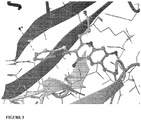
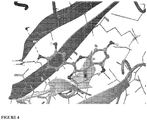
Classifications
-
- G—PHYSICS
- G16—INFORMATION AND COMMUNICATION TECHNOLOGY [ICT] SPECIALLY ADAPTED FOR SPECIFIC APPLICATION FIELDS
- G16C—COMPUTATIONAL CHEMISTRY; CHEMOINFORMATICS; COMPUTATIONAL MATERIALS SCIENCE
- G16C20/00—Chemoinformatics, i.e. ICT specially adapted for the handling of physicochemical or structural data of chemical particles, elements, compounds or mixtures
- G16C20/50—Molecular design, e.g. of drugs
-
- G—PHYSICS
- G16—INFORMATION AND COMMUNICATION TECHNOLOGY [ICT] SPECIALLY ADAPTED FOR SPECIFIC APPLICATION FIELDS
- G16B—BIOINFORMATICS, i.e. INFORMATION AND COMMUNICATION TECHNOLOGY [ICT] SPECIALLY ADAPTED FOR GENETIC OR PROTEIN-RELATED DATA PROCESSING IN COMPUTATIONAL MOLECULAR BIOLOGY
- G16B15/00—ICT specially adapted for analysing two-dimensional [2D] or three-dimensional [3D] molecular structures, e.g. structural or functional relations or structure alignment
- G16B15/30—Drug targeting using structural data; Docking or binding prediction
-
- G—PHYSICS
- G16—INFORMATION AND COMMUNICATION TECHNOLOGY [ICT] SPECIALLY ADAPTED FOR SPECIFIC APPLICATION FIELDS
- G16B—BIOINFORMATICS, i.e. INFORMATION AND COMMUNICATION TECHNOLOGY [ICT] SPECIALLY ADAPTED FOR GENETIC OR PROTEIN-RELATED DATA PROCESSING IN COMPUTATIONAL MOLECULAR BIOLOGY
- G16B15/00—ICT specially adapted for analysing two-dimensional [2D] or three-dimensional [3D] molecular structures, e.g. structural or functional relations or structure alignment
Definitions
- the invention is in the general field of computer-based methods for estimating binding affinity between a ligand and a receptor molecule, which is a protein.
- Molecular receptors typically are specific proteins (a term that includes glycoproteins and lipoproteins) in an animal such as a human being, and drug design and selection can be facilitated by accurately estimating the binding affinity of a drug to a protein, or, more generally, estimating the binding affinity of a ligand to a receptor, the term receptor being used to mean any moiety that specifically binds the ligand.
- the ligand-receptor complex uses the molecular structure that results when the ligand binds to the receptor ("the ligand-receptor complex"). Such structures may be studied by x-ray crystallography.
- the publicly accessible protein data bank (PDB) now contains more than 70,000 x-ray crystal structures, and pharmaceutical and biotechnology companies have an order of magnitude more proprietary structures. Many of these structures have been co-crystallized with small molecules bound to them.
- the examination of such structures, and deployment of the knowledge thereby gained to design new, more potent, and more specific inhibitors, is referred to as structure-based drug design.
- Computational modeling facilitates structure-based drug design.
- One aspect of modeling detailed below involves scoring functions that use simulation techniques, such as molecular dynamics, Monte Carlo, or continuum electrostatics calculations. Scoring functions can be problematic when one is required to calculate a very small difference (the binding affinity) between two very large numbers (the free energies of the complex and of the separated protein and ligand).
- An alternative approach is to develop an empirical scoring function, based on the geometry of the complex, which directly evaluates the desired quantity. Such an approach has the advantage of being extremely fast as well as being amenable to fitting to experimental data, large amounts of which are now publicly available.
- Commonly owned US 2007/0061118 A1 discloses such scoring functions.
- a second major problem with scoring functions is that they may assign better (more negative) binding affinity scores to inactive compounds (i.e. compounds that would not be determined to bind to the receptor in a typical experimental screening protocol) than to active compounds. If a large number of inactive compounds are ranked ahead of active compounds, a principal function of docking, which is to discover new active compounds against a specified receptor from a very large compound library (often millions of compounds), becomes difficult to carry out effectively. Therefore, substantially reducing the number of "false positives" (ranking of inactive compounds as active) would greatly improve scoring function performance.
- the method uses computer-stored data representing a predicted ligand-receptor structure (preferably one that is validated).
- the computerized scoring analysis includes determining whether the receptor includes one or more hydration sites occupied by localized water, and, if so, assessing a penalty if docking the ligand into the receptor results in unfavorable interaction of the ligand with a localized water molecule remaining at the receptor hydration site (i.e. after docking).
- Penalty assessment for a given case is performed via an empirical analysis, where the specific penalties assigned to particular set of interactions of the ligand with localized water molecules remaining at the receptor hydration sites are effectively precomputed and reapplied. Further, such a penalty assessment requires only a single configuration of the receptor-ligand complex, and is significantly faster ( ⁇ 1 ⁇ 2 hour) than alternative pure physics-based approaches attempt to fully describe the whole range of physics manifest by the ligand-receptor complex ensemble.
- localized water waters that are localized or quasi-localized, i.e., any water occupying a hydration site where the local water occupancy density at the hydration site is substantially higher than the number density of bulk fluid.
- the presence of such localized water at hydration sites can be determined by running and analyzing a molecular dynamics trajectory, or from experimental data such as water densities obtained from x-ray crystallographic experiments. In contrast to such localized water-based penalties, interactions with water molecules residing in regions of bulk density are not assigned a significant penalty.
- a penalty is applied to the binding affinity score of the ligand only if the free energy of displacement of a water molecule from the receptor site into bulk waters is determined to be more favorable than a specified cutoff value (e.g., 0 kcal/mole) of the energy gained by displacing the water from the receptor site into the bulk water.
- a specified cutoff value e.g., 0 kcal/mole
- other reference states for determining the free energy (and thus also the particular value of the cutoff) of the water in the hydration sites might be used to classify the water in the hydration sites. For example, transfer of the water from the hydration site to the gas phase might be used, where the specific cutoff employed would then be varied to implicitly include the transfer of the water from the gas phase to the liquid phase.
- the cutoff value would be adjusted to reflect this variation.
- Other such possible reference states might include use of displacement of the water from the hydration site to the crystalline phase, or displacement water from the hydration site to any other thermodynamically well-defined environment.
- the energetic favorability of the water molecule in the localized site is estimated from features of the site such as the hydrophobicity of the site, specific interactions with receptor groups, using various types of calculations, including but not limited to molecular dynamics simulations, Monte Carlo simulations, exhaustive enumeration of geometries of the water molecule within the site, and optimization (via for example energy minimization) of the position of the water molecule within the site.
- Localized water sites may be identified by active-site solvation analysis such as the WaterMap analysis for assigning displacement free energies described below.
- the receptor hydration sites are determined by computerized sampling of sites for hydration followed by computerized assignment of water occupancies for the various sampled sites. This includes the special case where the occupancies were discretely assigned to be 0 or 1.
- a penalty is assessed for compounds when the localized water within a hydration site interacts with a hydrophobic ligand atom or when the localized water within a hydration site interacts with a hydrophobic ligand atom, e.g., at a distance of 5 ⁇ or less.
- No penalty is assessed for interaction with a hydrophobic ligand atom having a positive ligand atom 4 atoms or closer to it (based on bond connectivity of the atoms in the ligand).
- receptor sites with a localized water are determined to be waters that are predicted to have an occupancy in the reference frame of the protein significantly (e.g., 1.5X) above the bulk water occupancy.
- No penalty is assessed if the localized water within a hydration site has hydrogen bonds to the ligand, regardless of any other interactions.
- Hydrogen bond here is taken to include C-H----O interactions when the C-H is an aromatic C-H group, with suitable geometries, as discussed in this application below, as well as more traditional hydrogen bonds. Scoring can include estimating the energetic favorability of the water molecule in the hydration site from the hydrophobicity of the site or from specific interactions with receptor groups.
- Estimating energetic favorability can include calculation such as molecular dynamics simulations, Monte Carlo simulations, exhaustive enumeration of geometries of the water molecule within the site, and optimization (via for example energy minimization) of the position of the water molecule within the site.
- Free energies of displacement of a water molecule from the receptor site into bulk water may be determined by molecular dynamics simulation followed by the application of modified inhomogeneous solvation to assign displacement free energies.
- Practicing the invention begins with a receptor (or "target”, typically a protein) structure that has sufficient resolution to permit the use of computational software to "dock” a small molecule ligand into the correct position and orient it in the receptor active site cavity and to calculate a binding affinity of the ligand given this structure.
- Computer software programs that perform this task are referred to as "docking" programs.
- a docking program typically carries out two distinct tasks to model receptor-ligand binding.
- this protocol fails to produce an accurate structure of the protein-ligand complex, use of a different structure of the receptor as a starting point is required.
- the problem of constructing alternative receptor structures that are modified to accept ligands requiring a substantial change in receptor conformation ("induced fit") is a very important one.
- the estimates of receptor-ligand binding affinities described below are applicable when a structure of the receptor-ligand complex is represented by a suitable structural model.
- a structure of the receptor-ligand complex is represented by a suitable structural model.
- Measures of structural agreement such as RMSD, DME, or SIFt score among others might be used.
- Accurate scores are typically but not exclusively obtained using: i) a small root mean square deviation (RMSD) from the experimental structure (typically less than 2 Angstroms, although the required value will vary depending upon details of the complex), ii) recognition of the formation of substantially all hydrogen bonds seen in the experimental complex, iii) appropriate placement of substantially all hydrophobic groups in the correct receptor cavities, and iv) the absence of incorrect structural or electrostatic clashes that could lead to the assignment of substantially incorrect penalty terms. Since relative binding affinity of ligands to a given receptor is under consideration, a constant offset, as is in many cases engendered by reorganization energy of the receptor active site to accommodate the ligand, has no effect on practical applications.
- RMSD root mean square deviation
- the receptor can adopt more than one fundamentally different conformation in response to a class of ligands (e.g., DFG-in and DFG-out binders to p38 map kinase); to compare the binding free energies in such cases, different core reorganization parameters may be required for the different receptor conformations.
- ligands e.g., DFG-in and DFG-out binders to p38 map kinase
- different core reorganization parameters may be required for the different receptor conformations.
- these parameters are not practical from first principles they are treated as adjustable, receptor specific parameters.
- Other parameters are however contained in a global model which is not receptor-specific or even specific to a particular class of receptors.
- the present invention is focused on improving the ability of the scoring function to discriminate inactive and active compounds against a given receptor. While active compounds for a wide range of receptors are readily found in the Protein Data Bank (PDB), our data below validating the invention required also assessed known inactive compounds or an approximate, but sufficiently accurate, model for a library of such compounds. Accessing known inactive compounds from publicly available data is challenging. Therefore, we have devised an alternative protocol, to represent an approximate but sufficiently accurate model of a library of inactive compounds, which is based on the use of a random library of 1000 drug-like compounds. These compounds are docked into a conformation of the receptor, and predicted binding affinities are obtained for each compound using various proposed improvements to the scoring function.
- PDB Protein Data Bank
- Our scoring function is calibrated so that active compounds achieve scores that are typically close to experimental binding affinities, with a standard deviation of approximately 1 log unit of binding affinity ( ⁇ 1.5 kcal/mole).
- An experimental "hit" in a random screen in the pharmaceutical industry is generally taken to have a binding affinity of ⁇ 7.0 kcal/mole or more ( ⁇ 10 ⁇ m concentration).
- Given the intrinsic fluctuations in the scoring function of 1.5 - 2.0 kcal/mole we set the computational threshold for estimating hits at a score of -9.0 kcal/mole; thus any compound in the random 1000 compound library which scores -9.0 or less is predicted to be a hit.
- the hit rate for experimental screens will vary depending upon the receptor, but an illustrative "average" hit rate is 0.5%, or 5 compounds out of 1000. Thus, if substantially more than 5 compounds achieve a score of -9.0 kcal/mole, the assumption is made that inactive compounds are receiving scores that are too favorable. In general, reduction of the number of random library compounds scoring more negatively than -9.0 is taken as improvement of the scoring function, as in the absence of fluctuations, one would expect even fewer (0-2) compounds in this range.
- the scoring function may be improved by adding positive "penalty” terms which reduce the magnitude of the predicted binding affinity.
- Such terms represent physical processes which make binding less favorable.
- An example of a process of this type would be a desolvation in which a polar group of the protein or ligand is blocked by nonpolar groups of the ligand and loses access to water. This results in a large loss in free energy, making the compound inactive. If the loss of free energy is sufficiently large, then such penalties will only rarely (if at all) be observed in complexes with active compounds. This means that the new terms must be derived by examining the structures produced when the random library is docked into the receptor.
- WaterMap uses molecular dynamics simulations to place waters at various locations in the active site, and assigns estimated enthalpies and entropies that would be obtained if the water were displaced to bulk solvent by the ligand.
- the enthalpies and entropies are estimated via a modified version of inhomogeneous solvation theory.
- Other techniques could be used to place localized waters and estimate their entropies and enthalpies.
- the invention can be applied as long as the locations of localized waters are specified.
- the displacement free energies may lead to better accuracy, but significant benefit of the invention can be obtained as long as localized water positions can be enumerated.
- Such positions can be derived not only from computational methods but also from experimental data, such as x-ray crystallography. Crystallography determines some localized water positions, but not others (typically depending upon the degree of localization). This invention is intended to apply regardless of how the localized water distribution is determined.
- Other ways to establish the existence of localized water include: appropriate analysis of explicitly solvated Monte Carlo simulations, applications of RISM-type theories, or NMR experiments among other techniques.
- the novel component of the invention is the development of a specific mathematical algorithm which detects under what conditions a penalty term should be applied.
- This algorithm based on a combination of the basic physical chemistry principles, outlined above, and empirical optimization in which we have designed the algorithm to avoid inappropriately penalizing (i.e. applying a penalty that would make the score of the compound agree less well with experimental binding affinity data than if the penalty were not applied) known complexes of active compounds, taken from the protein data bank (PDB), while at the same time maximizing the number of favorably scoring random data base compounds that are penalized.
- PDB protein data bank
- the amount of the penalty for any given water molecule will depend upon a number of factors; the specific distance of the hydrophobic ligand atom (beyond some distance, there is no effective contact, and no penalty is applied), the number of contacts, whether the ligand makes a hydrogen bond to the water as well as a hydrophobic contact (in which case the water has compensated effectively for the hydrophobic contact and no penalty needs to be applied), and other factors detailed below.
- Another important question is what counts as a hydrogen bond. An empirical survey of ligand-water structure in active complexes conclusively indicates that a C-H----O hydrogen bond, should not receive a penalty, however, such an interaction is not sufficient to turn off the penalty if there are other unfavorable hydrophobic contacts.
- the PDB structures can be viewed as a large and diverse training set for the scoring function. Testing of the scoring function under similar conditions can be performed by pharmaceutical the docking to correct small geometrical errors in the crystal structures (e.g. in hydrogen bond distances) which can be crucial to properly assigning scores to these terms.
- the invention does not require the use of ligands for which crystal structures are known, nor does it require the use of Glide XP.
- the PDB structures can be viewed as a large and diverse training set for the scoring function. Testing of the scoring function under similar conditions can be performed by pharmaceutical and biotechnology companies, using proprietary data sets where crystal structures are available. In carrying out these tests, there is no need to release the structures or even to divulge the name of the receptor; one can simply perform the calculations, and report the ability to rank order the compounds as a correlation coefficient.
- the second criterion for efficacy of the invention is penalizing random database ligands which are assigned highly favorable scores by the current scoring function.
- a penalty term is improving discriminatory power when it eliminates compounds with binding affinities as good as or better than -9 kcal/mole without inappropriately penalizing any active compounds.
- Table 2 displays the number of ligands from our standard 1000 compound random library of drug like molecules whose scores are less than -9 kcal/mole for several different scoring functions and for 24 test receptors. This specific comparison is meaningful only if the scores for active compounds are close to the experimental scores for these compounds, so in the first column of Table 1 we present results obtained with a version of Glide XP which has been optimized to reproduce the scores of PDB complexes with an average error of ⁇ 1 kcal/mole. Penalty terms, such as the ones used in the current invention, must then be added to this scoring function to improve performance in discriminating active from inactive compounds.
- Pdb_system XP_ newXP XP_wcon newXP _ nowcon Abl 24 15 20 18 Alr2 18 4 8 4 Jnk 7 2 3 4 Aur 2 2 2 2 Cdk2 10 3 8 4 Chk1 7 4 5 5 Dpp4 7 1 7 1 Er 4 0 2 0 Erk2 0 0 0 0 Err 3 2 3 2 Fviia 2 0 0 0 Fxa 0 0 0 0 Hivrt 11 2 7 8 Hsp90 2 0 1 0 Lck 10 3 7 4 Oppa 1 1 1 1 Pim1 46 3 46 3 Pka 0 0 0 0 Ppar 1 0 0 0 Ptp1b 1 1 1 1 Rho 5 2 5 2 Throm 2 1 2 1 Upa 0 0 0 0 0 P38 0 0 0 0 0
- the ptype assignment code is order dependent, i.e. a group could match multiple patterns but gets the ptype to the pattern in the list that is first caught.
- Matt # First index is the "ptype" 1 : hydrophobic heavy # 2 : donor hydrogen # 3 : acceptor heteroatom # 4 : general polar (non-hydrogen bonding) # 5 : metal cation # 0 : none of the above # Second index is the hybridization 0 : free atom # 1 : sp # 2 : sp2 # 3 : sp3 # Third index is the SMARTS pattern for matching # Fourth index is a descriptive label # # # The order of patterns is IMPORTANT - patterns higher in the list for a # particular element will be preferentially matched over a lower pattern.
Landscapes
- Chemical & Material Sciences (AREA)
- Engineering & Computer Science (AREA)
- Bioinformatics & Cheminformatics (AREA)
- Spectroscopy & Molecular Physics (AREA)
- Health & Medical Sciences (AREA)
- Physics & Mathematics (AREA)
- Life Sciences & Earth Sciences (AREA)
- General Health & Medical Sciences (AREA)
- Pharmacology & Pharmacy (AREA)
- Crystallography & Structural Chemistry (AREA)
- Medicinal Chemistry (AREA)
- Bioinformatics & Computational Biology (AREA)
- Theoretical Computer Science (AREA)
- Computing Systems (AREA)
- Biophysics (AREA)
- Biotechnology (AREA)
- Evolutionary Biology (AREA)
- Medical Informatics (AREA)
- Peptides Or Proteins (AREA)
- Medicines That Contain Protein Lipid Enzymes And Other Medicines (AREA)
Claims (13)
- Verfahren zum Beurteilen der Bindungsaffinität eines vorgeschlagenen Ligandenmoleküls für ein Rezeptormolekül, welches ein Protein ist, unter Verwendung eines Computers und von Computerdatenbanken, wobei das Verfahren umfasst:a. Erhalten von computergespeicherten Daten, die eine vorhergesagte Liganden-Rezeptor-Struktur repräsentieren,b. Beurteilen der Liganden-Bindungsaffinität durch computergestützte Operationen, welche einschließen:- Ermitteln, ob der Rezeptor eine oder mehrere Hydratisierungsstellen einschließt, die durch lokalisiertes Wasser besetzt sind, und, falls dies so ist,- Ermitteln,
ob nach dem Andocken ein lokalisiertes Wasser mit einem hydrophoben Ligandenatom in Wechselwirkung tritt, und
ob das Andocken des Liganden in den Rezeptor zu einer ungünstigen Wechselwirkung des Liganden mit einem lokalisierten Wassermolekül, welches eine Rezeptorhydratisierungsstelle besetzt, nach dem Andocken führt, wobei die ungünstige Wechselwirkung einen größeren Anstieg der freien Energie einschließt, verglichen mit Wechselwirkung des Liganden mit einem Wassermolekül in ungebundenem Fluid,- Ermitteln, ob eine oder mehrere der Ausnahmebedingungen i. bis iv. vorliegt bzw. vorliegen:i. das hydrophobe Ligandenatom hat ein nettopositiv geladenes Ligandenatom im Abstand von 4 Atomen oder näher, bezogen auf die Bindungskonnektivität der Atome in dem Liganden;ii. das hydrophobe Ligandenatom ist nicht Teil einer Gruppe -CH3 des Liganden oder eines Ligandenatoms innerhalb von 3 Atomen zu einer Gruppe -CH3, wobei das lokalisierte Wasser den Rand einer hydrophoben Tasche begrenzt, wodurch diese Zugang zu umgebendem Wasser erhält;iii. das lokalisierte Wasser innerhalb einer Hydratisierungsstelle liegt innerhalb von 5 Å zu einem positiv geladenen Ligandenatom;iv. das lokalisierte Wasser innerhalb einer Hydratisierungsstelle weist Wasserstoffbrückenbindungen zu dem Liganden auf;- Anwenden eines Abzugs auf eine Beurteilungsfunktion der Bindungsaffinität, falls 1) das lokalisierte Wasser mit einem hydrophoben Ligandenatom wie in Schritt b ermittelt in Wechselwirkung tritt und 2) keine der Ausnahmebedingungen i. bis iv. vorliegt. - Verfahren nach Anspruch 1, wobei die Rezeptorhydratisierungsstellen durch computergestütztes Abtasten von Stellen für die Hydratisierung, gefolgt von computergestützter Zuweisung von Wasserbesetzung für die verschiedenen abgetasteten Stellen ermittelt werden.
- Verfahren nach Anspruch 1, wobei für Verbindungen ein Abzug in die Beurteilung eingeht, bei denen das lokalisierte Wasser innerhalb einer Hydratisierungsstelle mit einem hydrophoben Ligandenatom in Wechselwirkung tritt.
- Verfahren nach Anspruch 3, wobei das lokalisierte Wasser innerhalb einer Hydratisierungsstelle mit einem hydrophoben Ligandenatom in einem Abstand von 5 Å oder weniger in Wechselwirkung tritt.
- Verfahren nach Anspruch 4, wobei das hydrophobe Ligandenatom nicht Cl oder Br ist.
- Verfahren nach Anspruch 1, wobei bei den Rezeptorstellen mit einem lokalisierten Wasser ermittelt wird, dass sie Wässer sind, von denen vorhergesagt wird, dass sie eine Besetzung in dem Referenzrahmen des Proteins von > 1,5 x der Besetzung mit ungebundenem Wasser aufweisen.
- Verfahren nach Anspruch 2, wobei molekulardynamische Simulationen zum Ermitteln der Wasserbesetzung verwendet werden.
- Verfahren nach Anspruch 7, wobei eine Aktivstellen-Solvatisierungsanalyse verwendet wird, um lokalisierte Wasserstellen zu identifizieren.
- Verfahren nach Anspruch 1, wobei auf die Bindungsaffinitätsbeurteilung des Liganden ein Abzug angewendet wird, wenn ermittelt wird, dass die freie Energie der Verdrängung eines Wassermoleküls aus der Rezeptorstelle in ungebundene Wässer hinein günstiger als ein spezifizierter Cutoff-Wert ist.
- Verfahren nach Anspruch 1, wobei auf die Bindungsaffinitätsbeurteilung des Liganden ein Abzug gemäß einem Verfahren angewendet wird, welches Schätzen der energetischen Günstigkeit des Wassermoleküls in der Hydratisierungsstelle aus der Hydrophobizität der Stelle oder aus spezifischen Wechselwirkungen mit Rezeptorgruppen umfasst.
- Verfahren nach Anspruch 10, wobei Schätzen der energetischen Günstigkeit der Hydratisierungsstelle Berechnung ausgewählt aus der Gruppe bestehend aus molekulardynamischen Simulationen, Monte-Carlo-Simulationen, erschöpfender Aufzählung von Geometrien des Wassermoleküls innerhalb der Stelle sowie Optimierung (über beispielsweise Energieminimierung) der Position des Wassermoleküls innerhalb der Stelle einschließt.
- Verfahren nach Anspruch 9, wobei der Cutoff-Wert mindestens 0 kcal/Mol beträgt.
- Verfahren nach Anspruch 9, wobei freie Energien der Verdrängung eines Wassermoleküls von der Rezeptorstelle in ungebundenes Wasser durch molekulardynamische Simulation, gefolgt von der Anwendung von modifizierter inhomogener Solvatisierungstheorie, ermittelt wird, um freie Energien der Verdrängung zuzuweisen.
Applications Claiming Priority (2)
| Application Number | Priority Date | Filing Date | Title |
|---|---|---|---|
| US13/079,725 US8510058B2 (en) | 2011-04-04 | 2011-04-04 | Binding affinity scoring function penalizing compounds which make unfavorable hydrophobic contacts with localized water molecules in the receptor active site |
| PCT/US2012/031976 WO2012138640A1 (en) | 2011-04-04 | 2012-04-03 | Binding affinity scoring function including a penalty term |
Publications (3)
| Publication Number | Publication Date |
|---|---|
| EP2695103A1 EP2695103A1 (de) | 2014-02-12 |
| EP2695103A4 EP2695103A4 (de) | 2014-09-10 |
| EP2695103B1 true EP2695103B1 (de) | 2020-02-26 |
Family
ID=46928005
Family Applications (1)
| Application Number | Title | Priority Date | Filing Date |
|---|---|---|---|
| EP12768363.9A Active EP2695103B1 (de) | 2011-04-04 | 2012-04-03 | Funktion zur beurteilung einer bindungsaffinität mit einem bestrafungszeitraum |
Country Status (5)
| Country | Link |
|---|---|
| US (1) | US8510058B2 (de) |
| EP (1) | EP2695103B1 (de) |
| DK (1) | DK2695103T3 (de) |
| ES (1) | ES2788504T3 (de) |
| WO (1) | WO2012138640A1 (de) |
Families Citing this family (1)
| Publication number | Priority date | Publication date | Assignee | Title |
|---|---|---|---|---|
| CN114864018B (zh) * | 2022-04-14 | 2024-10-11 | 中南大学 | 一种表面织构疏水性能评估方法、系统及存储介质 |
Family Cites Families (7)
| Publication number | Priority date | Publication date | Assignee | Title |
|---|---|---|---|---|
| US6665856B1 (en) | 2000-12-01 | 2003-12-16 | Numerical Technologies, Inc. | Displacing edge segments on a fabrication layout based on proximity effects model amplitudes for correcting proximity effects |
| US7801685B2 (en) | 2004-08-19 | 2010-09-21 | Drug Design Methodologies, Llc | System and method for improved computer drug design |
| US7904283B2 (en) | 2003-05-13 | 2011-03-08 | The Penn State Research Foundation | Quantum mechanics based method for scoring protein-ligand interactions |
| JP4719223B2 (ja) | 2005-03-11 | 2011-07-06 | シュレディンガー エルエルシー | 結合親和性を推定するための予測的スコア関数 |
| US7739091B2 (en) | 2006-03-23 | 2010-06-15 | The Research Foundation Of State University Of New York | Method for estimating protein-protein binding affinities |
| DK3182312T3 (en) | 2007-05-14 | 2019-01-21 | Schroedinger Llc | BINDING EFFICIENCY SCORING FUNCTION INCLUDING FACTOR FOR CIRCUIT ENVIRONMENT FACTOR |
| US7756674B2 (en) | 2007-08-03 | 2010-07-13 | The Trustees Of Columbia University In The City Of New York | Methods of calculating differences of binding affinities between congeneric pairs of ligands by way of a displaced solvent functional |
-
2011
- 2011-04-04 US US13/079,725 patent/US8510058B2/en active Active
-
2012
- 2012-04-03 ES ES12768363T patent/ES2788504T3/es active Active
- 2012-04-03 WO PCT/US2012/031976 patent/WO2012138640A1/en not_active Ceased
- 2012-04-03 DK DK12768363.9T patent/DK2695103T3/da active
- 2012-04-03 EP EP12768363.9A patent/EP2695103B1/de active Active
Non-Patent Citations (1)
| Title |
|---|
| None * |
Also Published As
| Publication number | Publication date |
|---|---|
| WO2012138640A1 (en) | 2012-10-11 |
| EP2695103A4 (de) | 2014-09-10 |
| US20120252683A1 (en) | 2012-10-04 |
| DK2695103T3 (da) | 2020-05-18 |
| ES2788504T3 (es) | 2020-10-21 |
| US8510058B2 (en) | 2013-08-13 |
| EP2695103A1 (de) | 2014-02-12 |
Similar Documents
| Publication | Publication Date | Title |
|---|---|---|
| Tian et al. | Assessing an ensemble docking-based virtual screening strategy for kinase targets by considering protein flexibility | |
| Li et al. | The VSGB 2.0 model: a next generation energy model for high resolution protein structure modeling | |
| US8145430B2 (en) | Predictive scoring function for estimating binding affinity | |
| US20150324546A1 (en) | Method for predicting drug-target interactions and uses for drug repositioning | |
| Bodun et al. | In-silico-based lead optimization of hit compounds targeting mitotic kinesin Eg5 for cancer management | |
| Durojaye et al. | Csc01 shows promise as a potential inhibitor of the oncogenic G13D mutant of KRAS: an in silico approach | |
| Wang et al. | AI‐Assisted Protein–Peptide Complex Prediction in a Practical Setting | |
| Szél et al. | Enthalpic classification of water molecules in target–ligand binding | |
| Joel et al. | Insights into features and lead optimization of novel type 1½ inhibitors of p38α mitogen-activated protein kinase using QSAR, quantum mechanics, bioisostere replacement and ADMET studies | |
| EP2695103B1 (de) | Funktion zur beurteilung einer bindungsaffinität mit einem bestrafungszeitraum | |
| EP2715602B1 (de) | Bindungsaffinitätsbewertung mit strafe für das brechen von verbindungen zwischen gruppen von aromatischen liganden | |
| Yadav et al. | In silico identification of novel and potent inhibitors against mutant BRAF (V600E), MD simulations, free energy calculations, and experimental determination of binding affinity | |
| US20120252687A1 (en) | Scoring Function Penalizing Compounds Which Desolvate Charged Protein Side Chains Structure | |
| Haque et al. | Identification of Novel Scaffolds Against GSK-3 β for Targeting Alzheimer’s Disease Through Molecular Modeling Techniques | |
| Pandi et al. | Targeting h ORAI1-Mediated Calcium Influx in Triple-Negative Breast Cancer: A Computational Drug Discovery Approach | |
| Kolpe et al. | Identification of Aurora A kinase allosteric inhibitors: a comprehensive virtual screening through fingerprint-based similarity search, molecular docking, machine learning and molecular dynamics simulation | |
| Kuzu et al. | Expanding the conformational selection paradigm in protein-ligand docking | |
| EP2162842B1 (de) | Bindungsaffinitäts-bewertungsfunktion mit einem faktor für umgebungen einer ring-gruppe | |
| Thirunavukkarasu et al. | Computational biophysics approach towards the discovery of multi-kinase blockers for the management of MAPK pathway dysregulation | |
| Henriques | Targeting proteins with halogenated drugs: new strategies to probe halogen-bonding hotspots | |
| Halgren et al. | Glide-related material | |
| Mukherjee et al. | Exploring the Structural Dynamics of SRPK1 to Identify Competitive Inhibitors via Molecular Modeling Techniques | |
| Natesan et al. | Discovery of PDK1 protein-protein interaction site modulators by deep learning and MD Simulations | |
| Hantz | Development of Potential Treatments for Congestive Heart Failure: a Multi-pronged Computational Approach | |
| Razzaq et al. | Deciphering the inhibitory mechanisms of Interleukin-17A through dynamic molecular insights: a path toward novel anti-inflammatory therapies |
Legal Events
| Date | Code | Title | Description |
|---|---|---|---|
| PUAI | Public reference made under article 153(3) epc to a published international application that has entered the european phase |
Free format text: ORIGINAL CODE: 0009012 |
|
| 17P | Request for examination filed |
Effective date: 20131104 |
|
| AK | Designated contracting states |
Kind code of ref document: A1 Designated state(s): AL AT BE BG CH CY CZ DE DK EE ES FI FR GB GR HR HU IE IS IT LI LT LU LV MC MK MT NL NO PL PT RO RS SE SI SK SM TR |
|
| DAX | Request for extension of the european patent (deleted) | ||
| A4 | Supplementary search report drawn up and despatched |
Effective date: 20140812 |
|
| RIC1 | Information provided on ipc code assigned before grant |
Ipc: G06F 19/00 20110101AFI20140806BHEP Ipc: G06F 19/16 20110101ALN20140806BHEP |
|
| 17Q | First examination report despatched |
Effective date: 20141008 |
|
| STAA | Information on the status of an ep patent application or granted ep patent |
Free format text: STATUS: EXAMINATION IS IN PROGRESS |
|
| REG | Reference to a national code |
Ref country code: DE Ref legal event code: R079 Ref document number: 602012068070 Country of ref document: DE Free format text: PREVIOUS MAIN CLASS: G06G0007480000 Ipc: G16C0020500000 |
|
| RIC1 | Information provided on ipc code assigned before grant |
Ipc: G16C 20/50 20190101AFI20190701BHEP |
|
| GRAP | Despatch of communication of intention to grant a patent |
Free format text: ORIGINAL CODE: EPIDOSNIGR1 |
|
| STAA | Information on the status of an ep patent application or granted ep patent |
Free format text: STATUS: GRANT OF PATENT IS INTENDED |
|
| INTG | Intention to grant announced |
Effective date: 20190917 |
|
| GRAS | Grant fee paid |
Free format text: ORIGINAL CODE: EPIDOSNIGR3 |
|
| GRAA | (expected) grant |
Free format text: ORIGINAL CODE: 0009210 |
|
| STAA | Information on the status of an ep patent application or granted ep patent |
Free format text: STATUS: THE PATENT HAS BEEN GRANTED |
|
| AK | Designated contracting states |
Kind code of ref document: B1 Designated state(s): AL AT BE BG CH CY CZ DE DK EE ES FI FR GB GR HR HU IE IS IT LI LT LU LV MC MK MT NL NO PL PT RO RS SE SI SK SM TR |
|
| REG | Reference to a national code |
Ref country code: GB Ref legal event code: FG4D |
|
| REG | Reference to a national code |
Ref country code: CH Ref legal event code: EP |
|
| REG | Reference to a national code |
Ref country code: DE Ref legal event code: R096 Ref document number: 602012068070 Country of ref document: DE |
|
| REG | Reference to a national code |
Ref country code: AT Ref legal event code: REF Ref document number: 1238615 Country of ref document: AT Kind code of ref document: T Effective date: 20200315 |
|
| REG | Reference to a national code |
Ref country code: IE Ref legal event code: FG4D |
|
| REG | Reference to a national code |
Ref country code: DK Ref legal event code: T3 Effective date: 20200511 |
|
| PG25 | Lapsed in a contracting state [announced via postgrant information from national office to epo] |
Ref country code: RS Free format text: LAPSE BECAUSE OF FAILURE TO SUBMIT A TRANSLATION OF THE DESCRIPTION OR TO PAY THE FEE WITHIN THE PRESCRIBED TIME-LIMIT Effective date: 20200226 Ref country code: FI Free format text: LAPSE BECAUSE OF FAILURE TO SUBMIT A TRANSLATION OF THE DESCRIPTION OR TO PAY THE FEE WITHIN THE PRESCRIBED TIME-LIMIT Effective date: 20200226 Ref country code: NO Free format text: LAPSE BECAUSE OF FAILURE TO SUBMIT A TRANSLATION OF THE DESCRIPTION OR TO PAY THE FEE WITHIN THE PRESCRIBED TIME-LIMIT Effective date: 20200526 |
|
| REG | Reference to a national code |
Ref country code: NL Ref legal event code: MP Effective date: 20200226 |
|
| REG | Reference to a national code |
Ref country code: LT Ref legal event code: MG4D |
|
| PG25 | Lapsed in a contracting state [announced via postgrant information from national office to epo] |
Ref country code: LV Free format text: LAPSE BECAUSE OF FAILURE TO SUBMIT A TRANSLATION OF THE DESCRIPTION OR TO PAY THE FEE WITHIN THE PRESCRIBED TIME-LIMIT Effective date: 20200226 Ref country code: SE Free format text: LAPSE BECAUSE OF FAILURE TO SUBMIT A TRANSLATION OF THE DESCRIPTION OR TO PAY THE FEE WITHIN THE PRESCRIBED TIME-LIMIT Effective date: 20200226 Ref country code: HR Free format text: LAPSE BECAUSE OF FAILURE TO SUBMIT A TRANSLATION OF THE DESCRIPTION OR TO PAY THE FEE WITHIN THE PRESCRIBED TIME-LIMIT Effective date: 20200226 Ref country code: IS Free format text: LAPSE BECAUSE OF FAILURE TO SUBMIT A TRANSLATION OF THE DESCRIPTION OR TO PAY THE FEE WITHIN THE PRESCRIBED TIME-LIMIT Effective date: 20200626 Ref country code: BG Free format text: LAPSE BECAUSE OF FAILURE TO SUBMIT A TRANSLATION OF THE DESCRIPTION OR TO PAY THE FEE WITHIN THE PRESCRIBED TIME-LIMIT Effective date: 20200526 Ref country code: GR Free format text: LAPSE BECAUSE OF FAILURE TO SUBMIT A TRANSLATION OF THE DESCRIPTION OR TO PAY THE FEE WITHIN THE PRESCRIBED TIME-LIMIT Effective date: 20200527 |
|
| PG25 | Lapsed in a contracting state [announced via postgrant information from national office to epo] |
Ref country code: NL Free format text: LAPSE BECAUSE OF FAILURE TO SUBMIT A TRANSLATION OF THE DESCRIPTION OR TO PAY THE FEE WITHIN THE PRESCRIBED TIME-LIMIT Effective date: 20200226 |
|
| REG | Reference to a national code |
Ref country code: ES Ref legal event code: FG2A Ref document number: 2788504 Country of ref document: ES Kind code of ref document: T3 Effective date: 20201021 |
|
| PG25 | Lapsed in a contracting state [announced via postgrant information from national office to epo] |
Ref country code: SK Free format text: LAPSE BECAUSE OF FAILURE TO SUBMIT A TRANSLATION OF THE DESCRIPTION OR TO PAY THE FEE WITHIN THE PRESCRIBED TIME-LIMIT Effective date: 20200226 Ref country code: RO Free format text: LAPSE BECAUSE OF FAILURE TO SUBMIT A TRANSLATION OF THE DESCRIPTION OR TO PAY THE FEE WITHIN THE PRESCRIBED TIME-LIMIT Effective date: 20200226 Ref country code: CZ Free format text: LAPSE BECAUSE OF FAILURE TO SUBMIT A TRANSLATION OF THE DESCRIPTION OR TO PAY THE FEE WITHIN THE PRESCRIBED TIME-LIMIT Effective date: 20200226 Ref country code: LT Free format text: LAPSE BECAUSE OF FAILURE TO SUBMIT A TRANSLATION OF THE DESCRIPTION OR TO PAY THE FEE WITHIN THE PRESCRIBED TIME-LIMIT Effective date: 20200226 Ref country code: PT Free format text: LAPSE BECAUSE OF FAILURE TO SUBMIT A TRANSLATION OF THE DESCRIPTION OR TO PAY THE FEE WITHIN THE PRESCRIBED TIME-LIMIT Effective date: 20200719 Ref country code: SM Free format text: LAPSE BECAUSE OF FAILURE TO SUBMIT A TRANSLATION OF THE DESCRIPTION OR TO PAY THE FEE WITHIN THE PRESCRIBED TIME-LIMIT Effective date: 20200226 Ref country code: EE Free format text: LAPSE BECAUSE OF FAILURE TO SUBMIT A TRANSLATION OF THE DESCRIPTION OR TO PAY THE FEE WITHIN THE PRESCRIBED TIME-LIMIT Effective date: 20200226 |
|
| REG | Reference to a national code |
Ref country code: AT Ref legal event code: MK05 Ref document number: 1238615 Country of ref document: AT Kind code of ref document: T Effective date: 20200226 |
|
| REG | Reference to a national code |
Ref country code: DE Ref legal event code: R097 Ref document number: 602012068070 Country of ref document: DE |
|
| PG25 | Lapsed in a contracting state [announced via postgrant information from national office to epo] |
Ref country code: MC Free format text: LAPSE BECAUSE OF FAILURE TO SUBMIT A TRANSLATION OF THE DESCRIPTION OR TO PAY THE FEE WITHIN THE PRESCRIBED TIME-LIMIT Effective date: 20200226 |
|
| PLBE | No opposition filed within time limit |
Free format text: ORIGINAL CODE: 0009261 |
|
| STAA | Information on the status of an ep patent application or granted ep patent |
Free format text: STATUS: NO OPPOSITION FILED WITHIN TIME LIMIT |
|
| PG25 | Lapsed in a contracting state [announced via postgrant information from national office to epo] |
Ref country code: LU Free format text: LAPSE BECAUSE OF NON-PAYMENT OF DUE FEES Effective date: 20200403 Ref country code: AT Free format text: LAPSE BECAUSE OF FAILURE TO SUBMIT A TRANSLATION OF THE DESCRIPTION OR TO PAY THE FEE WITHIN THE PRESCRIBED TIME-LIMIT Effective date: 20200226 |
|
| 26N | No opposition filed |
Effective date: 20201127 |
|
| REG | Reference to a national code |
Ref country code: BE Ref legal event code: MM Effective date: 20200430 |
|
| PG25 | Lapsed in a contracting state [announced via postgrant information from national office to epo] |
Ref country code: SI Free format text: LAPSE BECAUSE OF FAILURE TO SUBMIT A TRANSLATION OF THE DESCRIPTION OR TO PAY THE FEE WITHIN THE PRESCRIBED TIME-LIMIT Effective date: 20200226 Ref country code: BE Free format text: LAPSE BECAUSE OF NON-PAYMENT OF DUE FEES Effective date: 20200430 Ref country code: PL Free format text: LAPSE BECAUSE OF FAILURE TO SUBMIT A TRANSLATION OF THE DESCRIPTION OR TO PAY THE FEE WITHIN THE PRESCRIBED TIME-LIMIT Effective date: 20200226 |
|
| PG25 | Lapsed in a contracting state [announced via postgrant information from national office to epo] |
Ref country code: IE Free format text: LAPSE BECAUSE OF NON-PAYMENT OF DUE FEES Effective date: 20200403 |
|
| PG25 | Lapsed in a contracting state [announced via postgrant information from national office to epo] |
Ref country code: TR Free format text: LAPSE BECAUSE OF FAILURE TO SUBMIT A TRANSLATION OF THE DESCRIPTION OR TO PAY THE FEE WITHIN THE PRESCRIBED TIME-LIMIT Effective date: 20200226 Ref country code: MT Free format text: LAPSE BECAUSE OF FAILURE TO SUBMIT A TRANSLATION OF THE DESCRIPTION OR TO PAY THE FEE WITHIN THE PRESCRIBED TIME-LIMIT Effective date: 20200226 Ref country code: CY Free format text: LAPSE BECAUSE OF FAILURE TO SUBMIT A TRANSLATION OF THE DESCRIPTION OR TO PAY THE FEE WITHIN THE PRESCRIBED TIME-LIMIT Effective date: 20200226 |
|
| PG25 | Lapsed in a contracting state [announced via postgrant information from national office to epo] |
Ref country code: MK Free format text: LAPSE BECAUSE OF FAILURE TO SUBMIT A TRANSLATION OF THE DESCRIPTION OR TO PAY THE FEE WITHIN THE PRESCRIBED TIME-LIMIT Effective date: 20200226 Ref country code: AL Free format text: LAPSE BECAUSE OF FAILURE TO SUBMIT A TRANSLATION OF THE DESCRIPTION OR TO PAY THE FEE WITHIN THE PRESCRIBED TIME-LIMIT Effective date: 20200226 |
|
| P01 | Opt-out of the competence of the unified patent court (upc) registered |
Effective date: 20230426 |
|
| PGFP | Annual fee paid to national office [announced via postgrant information from national office to epo] |
Ref country code: FR Payment date: 20250210 Year of fee payment: 14 |
|
| PGFP | Annual fee paid to national office [announced via postgrant information from national office to epo] |
Ref country code: IT Payment date: 20250320 Year of fee payment: 14 Ref country code: GB Payment date: 20250213 Year of fee payment: 14 |
|
| PGFP | Annual fee paid to national office [announced via postgrant information from national office to epo] |
Ref country code: DE Payment date: 20250204 Year of fee payment: 14 |
|
| PGFP | Annual fee paid to national office [announced via postgrant information from national office to epo] |
Ref country code: ES Payment date: 20250509 Year of fee payment: 14 Ref country code: DK Payment date: 20250411 Year of fee payment: 14 |
|
| PGFP | Annual fee paid to national office [announced via postgrant information from national office to epo] |
Ref country code: CH Payment date: 20250501 Year of fee payment: 14 |