EP2687701A2 - Variable nozzle control device and variable geometry turbocharger - Google Patents
Variable nozzle control device and variable geometry turbocharger Download PDFInfo
- Publication number
- EP2687701A2 EP2687701A2 EP13176998.6A EP13176998A EP2687701A2 EP 2687701 A2 EP2687701 A2 EP 2687701A2 EP 13176998 A EP13176998 A EP 13176998A EP 2687701 A2 EP2687701 A2 EP 2687701A2
- Authority
- EP
- European Patent Office
- Prior art keywords
- learning
- variable
- nozzle
- stopper
- engine
- Prior art date
- Legal status (The legal status is an assumption and is not a legal conclusion. Google has not performed a legal analysis and makes no representation as to the accuracy of the status listed.)
- Ceased
Links
- 238000000034 method Methods 0.000 description 24
- 238000002485 combustion reaction Methods 0.000 description 7
- 230000001276 controlling effect Effects 0.000 description 7
- 230000006870 function Effects 0.000 description 7
- 230000005540 biological transmission Effects 0.000 description 6
- 238000012986 modification Methods 0.000 description 6
- 230000004048 modification Effects 0.000 description 6
- 230000007423 decrease Effects 0.000 description 5
- 238000005516 engineering process Methods 0.000 description 5
- 238000001514 detection method Methods 0.000 description 4
- 230000006866 deterioration Effects 0.000 description 3
- 238000010586 diagram Methods 0.000 description 3
- 239000004519 grease Substances 0.000 description 3
- 230000001105 regulatory effect Effects 0.000 description 3
- 238000005299 abrasion Methods 0.000 description 2
- 238000004891 communication Methods 0.000 description 2
- 239000006185 dispersion Substances 0.000 description 2
- 239000000446 fuel Substances 0.000 description 2
- 239000004071 soot Substances 0.000 description 2
- 239000003054 catalyst Substances 0.000 description 1
- 238000007796 conventional method Methods 0.000 description 1
- 230000008021 deposition Effects 0.000 description 1
- 238000013461 design Methods 0.000 description 1
- 238000007599 discharging Methods 0.000 description 1
- 238000011144 upstream manufacturing Methods 0.000 description 1
Images



Classifications
-
- F—MECHANICAL ENGINEERING; LIGHTING; HEATING; WEAPONS; BLASTING
- F02—COMBUSTION ENGINES; HOT-GAS OR COMBUSTION-PRODUCT ENGINE PLANTS
- F02B—INTERNAL-COMBUSTION PISTON ENGINES; COMBUSTION ENGINES IN GENERAL
- F02B37/00—Engines characterised by provision of pumps driven at least for part of the time by exhaust
- F02B37/12—Control of the pumps
- F02B37/24—Control of the pumps by using pumps or turbines with adjustable guide vanes
-
- F—MECHANICAL ENGINEERING; LIGHTING; HEATING; WEAPONS; BLASTING
- F01—MACHINES OR ENGINES IN GENERAL; ENGINE PLANTS IN GENERAL; STEAM ENGINES
- F01D—NON-POSITIVE DISPLACEMENT MACHINES OR ENGINES, e.g. STEAM TURBINES
- F01D17/00—Regulating or controlling by varying flow
- F01D17/10—Final actuators
- F01D17/12—Final actuators arranged in stator parts
- F01D17/14—Final actuators arranged in stator parts varying effective cross-sectional area of nozzles or guide conduits
- F01D17/16—Final actuators arranged in stator parts varying effective cross-sectional area of nozzles or guide conduits by means of nozzle vanes
- F01D17/165—Final actuators arranged in stator parts varying effective cross-sectional area of nozzles or guide conduits by means of nozzle vanes for radial flow, i.e. the vanes turning around axes which are essentially parallel to the rotor centre line
-
- F—MECHANICAL ENGINEERING; LIGHTING; HEATING; WEAPONS; BLASTING
- F01—MACHINES OR ENGINES IN GENERAL; ENGINE PLANTS IN GENERAL; STEAM ENGINES
- F01D—NON-POSITIVE DISPLACEMENT MACHINES OR ENGINES, e.g. STEAM TURBINES
- F01D17/00—Regulating or controlling by varying flow
- F01D17/10—Final actuators
- F01D17/12—Final actuators arranged in stator parts
- F01D17/14—Final actuators arranged in stator parts varying effective cross-sectional area of nozzles or guide conduits
- F01D17/16—Final actuators arranged in stator parts varying effective cross-sectional area of nozzles or guide conduits by means of nozzle vanes
- F01D17/167—Final actuators arranged in stator parts varying effective cross-sectional area of nozzles or guide conduits by means of nozzle vanes of vanes moving in translation
-
- F—MECHANICAL ENGINEERING; LIGHTING; HEATING; WEAPONS; BLASTING
- F05—INDEXING SCHEMES RELATING TO ENGINES OR PUMPS IN VARIOUS SUBCLASSES OF CLASSES F01-F04
- F05D—INDEXING SCHEME FOR ASPECTS RELATING TO NON-POSITIVE-DISPLACEMENT MACHINES OR ENGINES, GAS-TURBINES OR JET-PROPULSION PLANTS
- F05D2220/00—Application
- F05D2220/40—Application in turbochargers
-
- F—MECHANICAL ENGINEERING; LIGHTING; HEATING; WEAPONS; BLASTING
- F05—INDEXING SCHEMES RELATING TO ENGINES OR PUMPS IN VARIOUS SUBCLASSES OF CLASSES F01-F04
- F05D—INDEXING SCHEME FOR ASPECTS RELATING TO NON-POSITIVE-DISPLACEMENT MACHINES OR ENGINES, GAS-TURBINES OR JET-PROPULSION PLANTS
- F05D2250/00—Geometry
- F05D2250/90—Variable geometry
-
- Y—GENERAL TAGGING OF NEW TECHNOLOGICAL DEVELOPMENTS; GENERAL TAGGING OF CROSS-SECTIONAL TECHNOLOGIES SPANNING OVER SEVERAL SECTIONS OF THE IPC; TECHNICAL SUBJECTS COVERED BY FORMER USPC CROSS-REFERENCE ART COLLECTIONS [XRACs] AND DIGESTS
- Y02—TECHNOLOGIES OR APPLICATIONS FOR MITIGATION OR ADAPTATION AGAINST CLIMATE CHANGE
- Y02T—CLIMATE CHANGE MITIGATION TECHNOLOGIES RELATED TO TRANSPORTATION
- Y02T10/00—Road transport of goods or passengers
- Y02T10/10—Internal combustion engine [ICE] based vehicles
- Y02T10/12—Improving ICE efficiencies
Definitions
- the present invention relates to a variable nozzle control device and a variable geometry turbocharger with the variable nozzle control device.
- variable geometry turbocharger is commonly adopted in diesel engines.
- the variable geometry turbocharger has variable nozzles to adjust a flow rate of exhaust gas.
- An opening of the variable nozzles is controlled by an actuator (e.g., a stepping motor or a DC motor).
- an actuator e.g., a stepping motor or a DC motor.
- a reference value for the opening of the variable nozzles is a reference value for the opening of the variable nozzles.
- variable nozzle full close learning One of such technologies is variable nozzle full close learning. In the variable nozzle full close learning, the reference value is determined to be an opening detection value in a full close state of the variable nozzles with the engine at a stop.
- a conventional technique of execution of the variable nozzle full close learning is, for example, the technology described in Japanese Patent Application Laid-open No. 2002-4869 .
- an arm is connected through a unison ring to a plurality of movable vanes (variable nozzles), this arm is moved by a stepping motor, and a position regulating member is provided so as to engage with the arm.
- the arm is moved by the stepping motor to be brought into contact with the position regulating member and the opening of the movable vanes (in the full close state) at that time is defined as a reference position.
- variable nozzle full close learning a drive force of the motor needs to increase in view of deterioration of the variable nozzles themselves or dullness of the variable nozzles, e.g., due to deposition of soot in the exhaust gas on the variable nozzles.
- a significant load is imposed on a variable nozzle drive system including the motor, gears, and so on. For this reason, the components of the variable nozzle drive system become easier to damage, with increase in the number of times of execution of the variable nozzle full close learning.
- An object of the present invention is to provide a variable nozzle control device and a variable geometry turbocharger capable of suppressing the damage of the components of the variable nozzle drive system.
- An aspect of the present invention is a variable nozzle control device for controlling an opening of a variable nozzle in a variable geometry turbocharger to be mounted on an engine, the variable nozzle control device comprising: nozzle drive means for driving the variable nozzle; a learning stopper for learning of a reference position of the variable nozzle, the learning stopper being configured to be in contact with the nozzle drive means with the variable nozzle being in a full close state; and control means for controlling the nozzle drive means so as to bring the nozzle drive means into contact with the learning stopper, wherein the control means has: first means for counting a learning execution determination time including an operating time of the engine after preceding contact of the nozzle drive means with the learning stopper; second means for determining whether the learning execution determination time has reached a predetermined time; and third means for controlling the nozzle drive means so as to bring the nozzle drive means into contact with the learning stopper when the second means determines that the learning execution determination time has reached the predetermined time, with the engine at a stop.
- the nozzle drive means when the engine is at a stop and when it is determined that the learning execution determination time has reached the predetermined time, the nozzle drive means is controlled to be brought into contact with the learning stopper.
- the learning execution determination time includes the operating time of the engine after the preceding contact of the nozzle drive means with the learning stopper. Namely, when the engine is at a stop and when it is determined that the learning execution determination time has reached the predetermined time, the present operation of full close learning of the variable nozzle is carried out. Therefore, there is no need for executing the full close learning of the variable nozzle every stop of the engine, which decreases a frequency of execution of the full close learning of the variable nozzle. As a consequence of this, it is feasible to suppress damage of components of the nozzle drive means being the variable nozzle drive system.
- the first means may count only the operating time of the engine after the preceding contact of the nozzle drive means with the learning stopper, as the learning execution determination time. In this case, since only the operating time of the engine after the preceding execution of the full close learning of the variable nozzle is counted as the learning execution determination time, the frequency of execution of the full close learning of the variable nozzle further deceases. As a consequence of this, it is feasible to further suppress the damage of the components of the nozzle drive means.
- the first means may count a total of the operating time and a stop time of the engine after the preceding contact of the nozzle drive means with the learning stopper, as the learning execution determination time.
- a mere elapsed time after the preceding execution of the full close learning of the variable nozzle is counted as the learning execution determination time, it is feasible to avoid repetitions of counting-up and stop operations with starts and stops of the engine. As a result, it is feasible to simplify the determination process on execution of the full close learning of the variable nozzle.
- variable geometry turbocharger which comprises the foregoing variable nozzle control device.
- This variable geometry turbocharger may be mounted on an engine of an industrial vehicle.
- Fig. 1 is a schematic configuration diagram showing a diesel engine with a variable geometry turbocharger according to an embodiment of the present invention.
- the diesel engine 1 is a four-cylinder in-line diesel engine of a common rail system, which is mounted on a forklift being one of the industrial vehicles.
- the diesel engine (which will be referred to hereinafter simply as "engine") 1 is provided with an engine body 2 and four cylinders 3 are arranged in the engine body 2. Each cylinder 3 is equipped with an injector 5 to inject fuel into a combustion chamber 4. Each injector 5 is connected to a common rail 6 and high-pressure fuel accumulated in the common rail 6 is supplied to each injector 5.
- An intake passage 7 to take air into the combustion chambers 4 is connected through an intake manifold 8 to the engine body 2.
- An exhaust passage 12 to discharge exhaust gas after combustion is connected through an exhaust manifold 13 to the engine body 2.
- a DPF-incorporated catalyst 14 is arranged on the exhaust passage 12.
- the engine 1 is equipped with an EGR (exhaust gas recirculation) unit 15 to return part of the exhaust gas after combustion, as EGR gas into the combustion chambers 4.
- the EGR unit 15 has an EGR passage 16, an EGR valve 17, an EGR cooler 18, a bypass line 19, and a changeover valve 20.
- the EGR passage 16 is arranged so as to connect the intake passage 7 and the exhaust manifold 13 and return the EGR gas.
- the EGR valve 17 controls a recirculation amount of EGR gas from the exhaust manifold 13 to the intake passage 7.
- the EGR cooler 18 cools the EGR gas passing through the EGR passage 16.
- the bypass line 19 is connected to the EGR passage 16 so as to bypass the EGR cooler 18.
- the changeover valve 20 changes over the flow path of the EGR gas to the EGR cooler 18 side or to the bypass line 19 side.
- the engine 1 is provided with the variable geometry turbocharger (which will be referred to hereinafter simply as "turbocharger") 21.
- the turbocharger 21 is mounted on the engine 1.
- the turbocharger 21 has a turbine 22 disposed on the exhaust passage 12 side and a compressor 23 disposed on the intake passage 7 side.
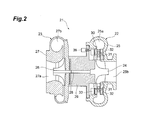
- the turbine 22, as shown in Fig. 2 has a turbine wheel 24, and a turbine housing 25 housing the turbine wheel 24.
- a scroll passage 25a and an outlet passage 25b in communication with the exhaust passage 12 are formed in the turbine housing 25.
- the scroll passage 25a is provided for circulating the exhaust gas from the exhaust manifold 13.
- the outlet passage 25b is located downstream of the scroll passage 25a and is provided for discharging the exhaust gas in the scroll passage 25a through the turbine wheel 24.
- the compressor 23 has a compressor impeller 26, and a compressor housing 27 housing the compressor impeller 26.
- An inlet passage 27a and a delivery passage 27b in communication with the intake passage 7 are formed in the compressor housing 27.
- the inlet passage 27a is provided for taking in air from the air cleaner 9.
- the delivery passage 27b is located downstream of the inlet passage 27a and is provided for delivering the intake air compressed by the compressor impeller 26.
- the turbine wheel 24 and the compressor impeller 26 are coupled to each other by a turbine shaft 28.
- the turbine shaft 28 is rotatably supported through bearings (not shown) in an intermediate housing 29.
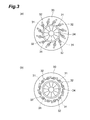
- the turbine 22, as shown in Figs. 2 and 3 has an annular nozzle plate 30 and a plurality of variable nozzles 32.
- the plurality of variable nozzles 32 are rotatably attached through respective nozzle shaft portions 31 to the nozzle plate 30.
- Each variable nozzle 32 adjusts a direction and a flow rate of exhaust gas flowing from the scroll passage 25a to the outlet passage 25b of the turbine housing 25.
- the variable nozzles 32 are arranged at equal intervals in the circumferential direction of the nozzle plate 30.
- Each nozzle shaft portion 31 is coupled through an unillustrated arm to a unison ring 33 and rotates in synchronism with rotation of the unison ring 33.
- the structure around the unison ring 33 including the nozzle shaft portions 31 is not detailed in particular herein, but it is the well-known structure, for example, as disclosed in Japanese Patent Application Laid-open No. 2009-180110 .
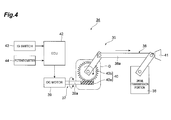
- the turbocharger 21 is further provided with a variable nozzle control device 34 (cf. Fig. 4 ) for controlling an opening of each variable nozzle 32.
- the variable nozzle control device 34 has a nozzle drive unit (nozzle drive means) 35 for driving each variable nozzle 32 through the associated nozzle shaft portion 31.
- the nozzle drive unit 35 has the unison ring 33 and a drive transmission portion 36 coupled to the unison ring 33, as shown in Fig. 2 .
- the nozzle drive unit 35 as shown in Fig. 4 , has a drive source 37, and a four-bar parallel linkage 38 coupled to the drive transmission portion 36 and the drive source 37.
- the drive source 37 has a DC motor 39, and a worm gear 40 consisting of a worm 40a and a worm wheel 40b.
- the worm 40a is attached to an output shaft 39a of the DC motor 39.
- the worm wheel 40b is in mesh with the worm 40a.
- the worm gear 40 is lubricated with grease G.
- One end portion of the linkage 38 is coupled to the worm wheel 40b, and the other end portion of the linkage 38 to the drive transmission portion 36.
- the drive transmission portion 36 converts a drive force transmitted via the linkage 38, into a force to rotate the unison ring 33.
- the variable nozzle control device 34 has a learning stopper 41 for learning of a reference position of the variable nozzles 32, as shown in Fig. 4 .
- the learning stopper 41 is adjusted so as to be in contact with one end portion (the end portion on the drive transmission portion 36 side) of an intermediate link 38a of the linkage 38 when the variable nozzles 32 are in a full close state.
- a full close position of the variable nozzles 32 in learning is set at a position closed more than a full close position in an operating range of the variable nozzles 32 in operation.
- the variable nozzle control device 34 has an electronic control unit (ECU) (controller) 42, as shown in Fig. 4 .
- the ECU 42 functions as control means for controlling the nozzle drive unit 35.
- Connected to the ECU 42 are an ignition (IG) switch 43 for indications to start and stop the engine 1, and a potentiometer 44 for detection of the opening of the variable nozzles 32.
- the ECU 42 executes a normal control process to control the variable nozzles 32 in operation, and a variable nozzle full close learning process. In the variable nozzle full close learning process, learning using the full close state of the variable nozzles 32 as a reference position is carried out with the engine 1 at a stop.
- Fig. 5 is a flowchart showing a procedure of the variable nozzle full close learning process executed by the ECU 42. In this process, a count value of a timer built in the ECU 42 is preliminarily set to zero.
- the ECU 42 determines whether the IG switch 43 is in an OFF state, i.e., whether the engine 1 is at a stop (S101). When the ECU 42 determines that the IG switch 43 is in an ON state, it counts the built-in timer up (S102).
- the ECU 42 determines whether the count value of the timer is not less than a predetermined threshold (S103).
- the ECU 42 determines that the count value of the timer is less than the threshold, it returns to the process in S101.
- the ECU 42 determines that the count value of the timer is not less than the threshold, it performs the variable nozzle full close learning (S104). Specifically, the ECU 42 controls the DC motor 39 so as to bring the one end portion of the intermediate link 38a of the linkage 38 into contact with the learning stopper 41. Then the ECU 42 clears the count value of the timer to zero (S105) and returns to the process in S101.
- variable nozzle full close learning is carried out when an ON time of the IG switch 43 after preceding execution of the variable nozzle full close learning, i.e., a substantial operating time of the engine 1 becomes not less than the threshold, with the IG switch 43 being in the OFF state.
- This variable nozzle full close learning brings each variable nozzle 32 into the full close state and the position of each variable nozzle 32 in this state is defined as a reference position.
- An opening detection value of the potentiometer 44 with the position of each variable nozzle 32 defined as the reference position is set as a reference value (e.g., 0), which can avoid dispersion of the opening detection value of the potentiometer 44.
- the ECU 42 functions as means for counting a learning execution determination time including the operating time of the engine 1 after preceding contact of the nozzle drive unit 35 with the learning stopper 41.
- the ECU 42 (particularly, the process in S103) functions as means for determining whether the leaning execution determination time has reached the predetermined time.
- the ECU 42 (particularly, the process in S104) functions as means for controlling the nozzle drive unit 35 so as to bring the nozzle drive unit 35 into contact with the learning stopper 41 when the learning execution determination time has reached the predetermined time.
- the present embodiment is arranged not to perform the variable nozzle full close learning until the ON time of the IG switch 43 after the preceding execution of the variable nozzle full close learning becomes not less than the preset threshold, even with the engine 1 at a stop.
- This arrangement adequately decreases the frequency of contact of the linkage 38 with the learning stopper 41, whereby a significant load is unlikely to be applied to the worm gear 40, linkage 38, and DC motor 39 on occasions of contact of the linkage 38 with the learning stopper 41. For this reason, it becomes feasible to suppress the damage of the worm gear 40, the abrasion of the contact portion of the linkage 38 and the bearings, the curvature and distortion of the linkage 38 itself, and the generation of heat of the DC motor 39. As a consequence of this, it becomes feasible to improve the reliability of the turbocharger 21.
- Fig. 6 is a flowchart showing a modification example of the procedure of the variable nozzle full close learning process.
- the ECU 42 counts the timer up (S201), as shown in Fig. 6 . Subsequently, the ECU 42 determines whether the count value of the timer is not less than the aforementioned threshold (S202). When the ECU 42 determines that the count value of the timer is less than the threshold, it returns to the process in S201. When the ECU 42 determines that the count value of the timer is not less than the threshold, it determines whether the IG switch 43 is in the OFF state (S203). When the ECU 42 determines that the IG switch is in the ON state, it returns to the process in S201.
- the ECU 42 determines that the IG switch 43 is in the OFF state, it performs the variable nozzle full close learning (S204). Specifically, the ECU 42 controls the DC motor 39 so as to bring the one end portion of the intermediate link 38a of the linkage 38 into contact with the learning stopper 41. Then the ECU 42 clears the count value of the timer to zero (S205) and returns to the process in S201.
- variable nozzle full close learning is carried out when the elapsed time after the preceding execution of the variable nozzle full close learning becomes not less than the threshold, with the IG switch 43 being in the OFF state.
- the elapsed time after the preceding execution of the variable nozzle full close learning is a total time of the ON time of the IG switch 43 corresponding to a substantial operating time of the engine 1 and the OFF time of the IG switch 43 corresponding to a stop time of the engine 1.
- the ECU 42 functions as means for counting the learning execution determination time including the operating time of the engine 1 after preceding contact of the nozzle drive unit 35 with the learning stopper 41.
- the ECU 42 (particularly, the process in S202) functions as means for determining whether the leaning execution determination time has reached the predetermined time.
- the ECU 42 (particularly, the process in S204) functions as means for controlling the nozzle drive unit 35 so as to bring the nozzle drive unit 35 into contact with the learning stopper 41 when the learning execution determination time has reached the predetermined time.
- the present modification example is arranged not to carry out the variable nozzle full close learning until the elapsed time after the preceding execution of the variable nozzle full close learning becomes not less than the preset threshold, even with the engine 1 at a stop. Therefore, this arrangement decreases the frequency of contact of the linkage 38 with the learning stopper 41. As a consequence of this, it becomes feasible to suppress the damage of the worm gear and the other troubles due to the contact of the linkage 38 with the learning stopper 41.
- the present invention is by no means intended to be limited to the above embodiment.
- the embodiment of the present invention employs the configuration wherein the linkage 38 is brought into contact with the learning stopper 41, but the present invention does not have to be limited to this configuration. It is sufficient to bring only a part of the nozzle drive unit 35 into contact with the learning stopper 41.
- the unison ring 33 is provided with a projection portion extending in a direction of its rotational axis and the learning stopper is arranged on the intermediate housing 29. In this case, the projection portion comes into contact with the learning stopper with rotation of the unison ring 33.
- the present embodiment relates to the variable geometry turbocharger mounted on the diesel engine of the forklift, but the variable nozzle control device of the present invention is also applicable to the variable geometry turbochargers mounted on engines of the industrial vehicles other than the forklift (e.g., a tractor shovel) or the automobiles such as passenger cars.
- the industrial vehicles such as the forklift have the number of starts and stops of the engine much greater than the passenger cars. For this reason, if the variable nozzle full close learning is carried out every stop of the engine, the number of times of the variable nozzle full close learning may soon exceed a limit value (guarantee count for variable nozzle full close learning). Accordingly, the present invention is preferably applied to the industrial vehicles.
- a variable nozzle control device is provided with a drive unit, a stopper, and a controller.
- the drive unit drives variable nozzles.
- the stopper is configured to be in contact with the drive unit with the variable nozzles being in a full close state.
- the controller counts a time including an operating time of an engine after preceding contact of the drive unit with the stopper, determines whether the counted time has reached a predetermined time, and controls the drive unit so as to bring the drive unit into contact with the stopper when determining that the counted time has reached the predetermined time, with the engine at a stop.
Landscapes
- Engineering & Computer Science (AREA)
- Mechanical Engineering (AREA)
- General Engineering & Computer Science (AREA)
- Chemical & Material Sciences (AREA)
- Combustion & Propulsion (AREA)
- Supercharger (AREA)
- Control Of Turbines (AREA)
Abstract
Description
- The present invention relates to a variable nozzle control device and a variable geometry turbocharger with the variable nozzle control device.
- For example, the variable geometry turbocharger is commonly adopted in diesel engines. The variable geometry turbocharger has variable nozzles to adjust a flow rate of exhaust gas. An opening of the variable nozzles is controlled by an actuator (e.g., a stepping motor or a DC motor). For accurate control of the opening of the variable nozzles, an important factor is a reference value for the opening of the variable nozzles. In order to eliminate dispersion of the opening of the variable nozzles, there are proposed technologies of learning the reference value for the opening of the variable nozzles. One of such technologies is variable nozzle full close learning. In the variable nozzle full close learning, the reference value is determined to be an opening detection value in a full close state of the variable nozzles with the engine at a stop.
- A conventional technique of execution of the variable nozzle full close learning is, for example, the technology described in Japanese Patent Application Laid-open No.
2002-4869 - The technology described in the aforementioned Application has the problem as discussed below. During execution of the variable nozzle full close learning, a drive force of the motor needs to increase in view of deterioration of the variable nozzles themselves or dullness of the variable nozzles, e.g., due to deposition of soot in the exhaust gas on the variable nozzles. When the arm is brought into contact with the position regulating member by a large motor drive force, a significant load is imposed on a variable nozzle drive system including the motor, gears, and so on. For this reason, the components of the variable nozzle drive system become easier to damage, with increase in the number of times of execution of the variable nozzle full close learning.
- An object of the present invention is to provide a variable nozzle control device and a variable geometry turbocharger capable of suppressing the damage of the components of the variable nozzle drive system.
- An aspect of the present invention is a variable nozzle control device for controlling an opening of a variable nozzle in a variable geometry turbocharger to be mounted on an engine, the variable nozzle control device comprising: nozzle drive means for driving the variable nozzle; a learning stopper for learning of a reference position of the variable nozzle, the learning stopper being configured to be in contact with the nozzle drive means with the variable nozzle being in a full close state; and control means for controlling the nozzle drive means so as to bring the nozzle drive means into contact with the learning stopper, wherein the control means has: first means for counting a learning execution determination time including an operating time of the engine after preceding contact of the nozzle drive means with the learning stopper; second means for determining whether the learning execution determination time has reached a predetermined time; and third means for controlling the nozzle drive means so as to bring the nozzle drive means into contact with the learning stopper when the second means determines that the learning execution determination time has reached the predetermined time, with the engine at a stop.
- In the present invention, when the engine is at a stop and when it is determined that the learning execution determination time has reached the predetermined time, the nozzle drive means is controlled to be brought into contact with the learning stopper. The learning execution determination time includes the operating time of the engine after the preceding contact of the nozzle drive means with the learning stopper. Namely, when the engine is at a stop and when it is determined that the learning execution determination time has reached the predetermined time, the present operation of full close learning of the variable nozzle is carried out. Therefore, there is no need for executing the full close learning of the variable nozzle every stop of the engine, which decreases a frequency of execution of the full close learning of the variable nozzle. As a consequence of this, it is feasible to suppress damage of components of the nozzle drive means being the variable nozzle drive system.
- The first means may count only the operating time of the engine after the preceding contact of the nozzle drive means with the learning stopper, as the learning execution determination time. In this case, since only the operating time of the engine after the preceding execution of the full close learning of the variable nozzle is counted as the learning execution determination time, the frequency of execution of the full close learning of the variable nozzle further deceases. As a consequence of this, it is feasible to further suppress the damage of the components of the nozzle drive means.
- The first means may count a total of the operating time and a stop time of the engine after the preceding contact of the nozzle drive means with the learning stopper, as the learning execution determination time. In this case, since a mere elapsed time after the preceding execution of the full close learning of the variable nozzle is counted as the learning execution determination time, it is feasible to avoid repetitions of counting-up and stop operations with starts and stops of the engine. As a result, it is feasible to simplify the determination process on execution of the full close learning of the variable nozzle.
- Another aspect of the present invention is a variable geometry turbocharger which comprises the foregoing variable nozzle control device. This variable geometry turbocharger may be mounted on an engine of an industrial vehicle.
- The present invention will become more fully understood from the detailed description given hereinbelow and the accompanying drawings which are given by way of illustration only, and thus are not to be considered as limiting the present invention.
- Further scope of applicability of the present invention will become apparent from the detailed description given hereinafter. However, it should be understood that the detailed description and specific examples, while indicating preferred embodiments of the invention, are given by way of illustration only, since various changes and modifications within the spirit and scope of the invention will become apparent to those skilled in the art from this detailed description.
-
-
Fig. 1 is a schematic configuration diagram showing a diesel engine with a variable geometry turbocharger according to an embodiment of the present invention. -
Fig. 2 is a drawing for explaining a sectional configuration of the variable geometry turbocharger shown inFig. 1 . -
Fig. 3 is a drawing for explaining open and close states of variable nozzles in the variable geometry turbocharger shown inFig. 2 . -
Fig. 4 is a configuration diagram showing a variable nozzle control device according to an embodiment of the present invention. -
Fig. 5 is a flowchart showing a procedure of a variable nozzle full close learning process executed by an ECU shown inFig. 4 . -
Fig. 6 is a flowchart showing a modification example of the procedure of the variable nozzle full close learning process. - The preferred embodiments of the present invention will be described below in detail with reference to the accompanying drawings. In the description, the same elements or elements with the same functionality will be denoted by the same reference signs, without redundant description.
-
Fig. 1 is a schematic configuration diagram showing a diesel engine with a variable geometry turbocharger according to an embodiment of the present invention. InFig. 1 , thediesel engine 1 is a four-cylinder in-line diesel engine of a common rail system, which is mounted on a forklift being one of the industrial vehicles. - The diesel engine (which will be referred to hereinafter simply as "engine") 1 is provided with an
engine body 2 and fourcylinders 3 are arranged in theengine body 2. Eachcylinder 3 is equipped with aninjector 5 to inject fuel into acombustion chamber 4. Eachinjector 5 is connected to acommon rail 6 and high-pressure fuel accumulated in thecommon rail 6 is supplied to eachinjector 5. - An
intake passage 7 to take air into thecombustion chambers 4 is connected through anintake manifold 8 to theengine body 2. On theintake passage 7 there are anair cleaner 9, anintercooler 10, and athrottle valve 11 arranged from upstream to downstream. Anexhaust passage 12 to discharge exhaust gas after combustion is connected through anexhaust manifold 13 to theengine body 2. A DPF-incorporatedcatalyst 14 is arranged on theexhaust passage 12. - The
engine 1 is equipped with an EGR (exhaust gas recirculation)unit 15 to return part of the exhaust gas after combustion, as EGR gas into thecombustion chambers 4. The EGRunit 15 has anEGR passage 16, anEGR valve 17, anEGR cooler 18, abypass line 19, and achangeover valve 20. The EGRpassage 16 is arranged so as to connect theintake passage 7 and theexhaust manifold 13 and return the EGR gas. TheEGR valve 17 controls a recirculation amount of EGR gas from theexhaust manifold 13 to theintake passage 7. The EGRcooler 18 cools the EGR gas passing through the EGRpassage 16. Thebypass line 19 is connected to the EGRpassage 16 so as to bypass the EGRcooler 18. Thechangeover valve 20 changes over the flow path of the EGR gas to theEGR cooler 18 side or to thebypass line 19 side. - The
engine 1 is provided with the variable geometry turbocharger (which will be referred to hereinafter simply as "turbocharger") 21. Namely, theturbocharger 21 is mounted on theengine 1. Theturbocharger 21 has aturbine 22 disposed on theexhaust passage 12 side and acompressor 23 disposed on theintake passage 7 side. - The
turbine 22, as shown inFig. 2 , has aturbine wheel 24, and aturbine housing 25 housing theturbine wheel 24. Ascroll passage 25a and anoutlet passage 25b in communication with theexhaust passage 12 are formed in theturbine housing 25. Thescroll passage 25a is provided for circulating the exhaust gas from theexhaust manifold 13. Theoutlet passage 25b is located downstream of thescroll passage 25a and is provided for discharging the exhaust gas in thescroll passage 25a through theturbine wheel 24. - The
compressor 23 has acompressor impeller 26, and acompressor housing 27 housing thecompressor impeller 26. Aninlet passage 27a and adelivery passage 27b in communication with theintake passage 7 are formed in thecompressor housing 27. Theinlet passage 27a is provided for taking in air from theair cleaner 9. Thedelivery passage 27b is located downstream of theinlet passage 27a and is provided for delivering the intake air compressed by thecompressor impeller 26. - The
turbine wheel 24 and thecompressor impeller 26 are coupled to each other by aturbine shaft 28. Theturbine shaft 28 is rotatably supported through bearings (not shown) in anintermediate housing 29. - When the exhaust gas discharged from the
combustion chambers 4 is introduced into theturbine 22, theturbine wheel 24 comes to be rotated by energy of the exhaust gas. Then thecompressor impeller 26 integrated with theturbine wheel 24 through theturbine shaft 28 comes to rotate. The intake air compressed by the rotation of thecompressor impeller 26 is supplied from thecompressor 23 to thecombustion chambers 4. - The
turbine 22, as shown inFigs. 2 and3 , has anannular nozzle plate 30 and a plurality ofvariable nozzles 32. The plurality ofvariable nozzles 32 are rotatably attached through respectivenozzle shaft portions 31 to thenozzle plate 30. Eachvariable nozzle 32 adjusts a direction and a flow rate of exhaust gas flowing from thescroll passage 25a to theoutlet passage 25b of theturbine housing 25. Thevariable nozzles 32 are arranged at equal intervals in the circumferential direction of thenozzle plate 30. Eachnozzle shaft portion 31 is coupled through an unillustrated arm to aunison ring 33 and rotates in synchronism with rotation of theunison ring 33. The structure around theunison ring 33 including thenozzle shaft portions 31 is not detailed in particular herein, but it is the well-known structure, for example, as disclosed in Japanese Patent Application Laid-open No.2009-180110 - The
turbocharger 21 is further provided with a variable nozzle control device 34 (cf.Fig. 4 ) for controlling an opening of eachvariable nozzle 32. The variablenozzle control device 34 has a nozzle drive unit (nozzle drive means) 35 for driving eachvariable nozzle 32 through the associatednozzle shaft portion 31. - The
nozzle drive unit 35 has theunison ring 33 and adrive transmission portion 36 coupled to theunison ring 33, as shown inFig. 2 . Thenozzle drive unit 35, as shown inFig. 4 , has adrive source 37, and a four-bar parallel linkage 38 coupled to thedrive transmission portion 36 and thedrive source 37. Thedrive source 37 has aDC motor 39, and aworm gear 40 consisting of aworm 40a and aworm wheel 40b. Theworm 40a is attached to anoutput shaft 39a of theDC motor 39. Theworm wheel 40b is in mesh with theworm 40a. Theworm gear 40 is lubricated with grease G. One end portion of thelinkage 38 is coupled to theworm wheel 40b, and the other end portion of thelinkage 38 to thedrive transmission portion 36. Thedrive transmission portion 36 converts a drive force transmitted via thelinkage 38, into a force to rotate theunison ring 33. - In the
nozzle drive unit 35, rotation of theDC motor 39 results in rotation (tilt) of eachvariable nozzle 32 via theworm gear 40,linkage 38,drive transmission portion 36,unison ring 33, and eachnozzle shaft portion 31. As theDC motor 39 is rotated in one direction at this time, the opening of eachvariable nozzle 32 becomes larger, as shown inFig. 3(a) , so as to increase the flow passage area between thevariable nozzles 32 and decrease the flow rate of exhaust gas. On the other hand, as theDC motor 39 is rotated in the other direction, the opening of eachvariable nozzle 32 becomes smaller, as shown inFig. 3(b) , so as to decrease the flow passage area between thevariable nozzles 32 and increase the flow rate of exhaust gas. - The variable
nozzle control device 34 has a learningstopper 41 for learning of a reference position of thevariable nozzles 32, as shown inFig. 4 . The learningstopper 41 is adjusted so as to be in contact with one end portion (the end portion on thedrive transmission portion 36 side) of anintermediate link 38a of thelinkage 38 when thevariable nozzles 32 are in a full close state. A full close position of thevariable nozzles 32 in learning is set at a position closed more than a full close position in an operating range of thevariable nozzles 32 in operation. - The variable
nozzle control device 34 has an electronic control unit (ECU) (controller) 42, as shown inFig. 4 . In the present embodiment, theECU 42 functions as control means for controlling thenozzle drive unit 35. Connected to theECU 42 are an ignition (IG) switch 43 for indications to start and stop theengine 1, and apotentiometer 44 for detection of the opening of thevariable nozzles 32. TheECU 42 executes a normal control process to control thevariable nozzles 32 in operation, and a variable nozzle full close learning process. In the variable nozzle full close learning process, learning using the full close state of thevariable nozzles 32 as a reference position is carried out with theengine 1 at a stop. -
Fig. 5 is a flowchart showing a procedure of the variable nozzle full close learning process executed by theECU 42. In this process, a count value of a timer built in theECU 42 is preliminarily set to zero. - First, as shown in
Fig. 5 , theECU 42 determines whether theIG switch 43 is in an OFF state, i.e., whether theengine 1 is at a stop (S101). When theECU 42 determines that theIG switch 43 is in an ON state, it counts the built-in timer up (S102). - When the
ECU 42 determines that theIG switch 43 is in the OFF state, it then determines whether the count value of the timer is not less than a predetermined threshold (S103). The threshold is calculated, for example, from the formula below. The parameters in the below formula are determined depending upon design conditions and others of theengine body 2 and theturbocharger 21.
- When the
ECU 42 determines that the count value of the timer is less than the threshold, it returns to the process in S101. When theECU 42 determines that the count value of the timer is not less than the threshold, it performs the variable nozzle full close learning (S104). Specifically, theECU 42 controls theDC motor 39 so as to bring the one end portion of theintermediate link 38a of thelinkage 38 into contact with the learningstopper 41. Then theECU 42 clears the count value of the timer to zero (S105) and returns to the process in S101. - In the present embodiment, the variable nozzle full close learning is carried out when an ON time of the
IG switch 43 after preceding execution of the variable nozzle full close learning, i.e., a substantial operating time of theengine 1 becomes not less than the threshold, with theIG switch 43 being in the OFF state. This variable nozzle full close learning brings eachvariable nozzle 32 into the full close state and the position of eachvariable nozzle 32 in this state is defined as a reference position. An opening detection value of thepotentiometer 44 with the position of eachvariable nozzle 32 defined as the reference position is set as a reference value (e.g., 0), which can avoid dispersion of the opening detection value of thepotentiometer 44. - In the above operation, the ECU 42 (particularly, the processes in S102 and S105) functions as means for counting a learning execution determination time including the operating time of the
engine 1 after preceding contact of thenozzle drive unit 35 with the learningstopper 41. The ECU 42 (particularly, the process in S103) functions as means for determining whether the leaning execution determination time has reached the predetermined time. The ECU 42 (particularly, the process in S104) functions as means for controlling thenozzle drive unit 35 so as to bring thenozzle drive unit 35 into contact with the learningstopper 41 when the learning execution determination time has reached the predetermined time. - While driving an industrial vehicle (e.g., a forklift), a driver must always stop the
engine 1 to leave its driver's seat and the driver frequently works off the driver's seat. For this reason, the industrial vehicles have the number of starts and stops of theengine 1 much larger than automobiles such as passenger cars. In loading and unloading works notable particularly for the forklift, theengine 1 is repeatedly started and stopped many times at intervals of less than five minutes. Therefore, if the variable nozzle full close learning is executed every stop of theengine 1, the number of times of contact of thelinkage 38 with the learningstopper 41 must become large. If thevariable nozzles 32 themselves deteriorate or if soot in the exhaust gas is deposited on thevariable nozzles 32, thevariable nozzles 32 will become less likely to move. This requires a larger drive force of theDC motor 39 in order to execute the variable nozzle full close learning. - Repetitions of contact of the
linkage 38 with the learningstopper 41 will result in imposing a gradually increasing load on theworm gear 40 upon contact of thelinkage 38. This will lead to deterioration of the grease G and the deterioration of the grease G may damage theworm gear 40. Furthermore, a large load will also be imposed on thelinkage 38, which may cause abrasion of the contact portion of thelinkage 38 and bearings, or, curvature and distortion of thelinkage 38 itself. In addition, the increase of the load on theDC motor 39 can lead to generation of heat of theDC motor 39. - In contrast to it, the present embodiment is arranged not to perform the variable nozzle full close learning until the ON time of the
IG switch 43 after the preceding execution of the variable nozzle full close learning becomes not less than the preset threshold, even with theengine 1 at a stop. This arrangement adequately decreases the frequency of contact of thelinkage 38 with the learningstopper 41, whereby a significant load is unlikely to be applied to theworm gear 40,linkage 38, andDC motor 39 on occasions of contact of thelinkage 38 with the learningstopper 41. For this reason, it becomes feasible to suppress the damage of theworm gear 40, the abrasion of the contact portion of thelinkage 38 and the bearings, the curvature and distortion of thelinkage 38 itself, and the generation of heat of theDC motor 39. As a consequence of this, it becomes feasible to improve the reliability of theturbocharger 21. -
Fig. 6 is a flowchart showing a modification example of the procedure of the variable nozzle full close learning process. - First, the
ECU 42 counts the timer up (S201), as shown inFig. 6 . Subsequently, theECU 42 determines whether the count value of the timer is not less than the aforementioned threshold (S202). When theECU 42 determines that the count value of the timer is less than the threshold, it returns to the process in S201. When theECU 42 determines that the count value of the timer is not less than the threshold, it determines whether theIG switch 43 is in the OFF state (S203). When theECU 42 determines that the IG switch is in the ON state, it returns to the process in S201. - When the
ECU 42 determines that theIG switch 43 is in the OFF state, it performs the variable nozzle full close learning (S204). Specifically, theECU 42 controls theDC motor 39 so as to bring the one end portion of theintermediate link 38a of thelinkage 38 into contact with the learningstopper 41. Then theECU 42 clears the count value of the timer to zero (S205) and returns to the process in S201. - In the present modification example, the variable nozzle full close learning is carried out when the elapsed time after the preceding execution of the variable nozzle full close learning becomes not less than the threshold, with the
IG switch 43 being in the OFF state. The elapsed time after the preceding execution of the variable nozzle full close learning is a total time of the ON time of theIG switch 43 corresponding to a substantial operating time of theengine 1 and the OFF time of theIG switch 43 corresponding to a stop time of theengine 1. - In the above operation, the ECU 42 (particularly, the processes in S201 and S205) functions as means for counting the learning execution determination time including the operating time of the
engine 1 after preceding contact of thenozzle drive unit 35 with the learningstopper 41. The ECU 42 (particularly, the process in S202) functions as means for determining whether the leaning execution determination time has reached the predetermined time. The ECU 42 (particularly, the process in S204) functions as means for controlling thenozzle drive unit 35 so as to bring thenozzle drive unit 35 into contact with the learningstopper 41 when the learning execution determination time has reached the predetermined time. - The present modification example is arranged not to carry out the variable nozzle full close learning until the elapsed time after the preceding execution of the variable nozzle full close learning becomes not less than the preset threshold, even with the
engine 1 at a stop. Therefore, this arrangement decreases the frequency of contact of thelinkage 38 with the learningstopper 41. As a consequence of this, it becomes feasible to suppress the damage of the worm gear and the other troubles due to the contact of thelinkage 38 with the learningstopper 41. - The present invention is by no means intended to be limited to the above embodiment. The embodiment of the present invention employs the configuration wherein the
linkage 38 is brought into contact with the learningstopper 41, but the present invention does not have to be limited to this configuration. It is sufficient to bring only a part of thenozzle drive unit 35 into contact with the learningstopper 41. For example, it is possible to adopt a configuration wherein theunison ring 33 is brought into contact with the learning stopper. Specifically, theunison ring 33 is provided with a projection portion extending in a direction of its rotational axis and the learning stopper is arranged on theintermediate housing 29. In this case, the projection portion comes into contact with the learning stopper with rotation of theunison ring 33. - The present embodiment relates to the variable geometry turbocharger mounted on the diesel engine of the forklift, but the variable nozzle control device of the present invention is also applicable to the variable geometry turbochargers mounted on engines of the industrial vehicles other than the forklift (e.g., a tractor shovel) or the automobiles such as passenger cars. The industrial vehicles such as the forklift have the number of starts and stops of the engine much greater than the passenger cars. For this reason, if the variable nozzle full close learning is carried out every stop of the engine, the number of times of the variable nozzle full close learning may soon exceed a limit value (guarantee count for variable nozzle full close learning). Accordingly, the present invention is preferably applied to the industrial vehicles.
- From the invention thus described, it will be obvious that the invention may be varied in many ways. Such variations are not to be regarded as a departure from the spirit and scope of the invention, and all such modifications as would be obvious to one skilled in the art are intended for inclusion within the scope of the following claims.
A variable nozzle control device is provided with a drive unit, a stopper, and a controller. The drive unit drives variable nozzles. The stopper is configured to be in contact with the drive unit with the variable nozzles being in a full close state. The controller counts a time including an operating time of an engine after preceding contact of the drive unit with the stopper, determines whether the counted time has reached a predetermined time, and controls the drive unit so as to bring the drive unit into contact with the stopper when determining that the counted time has reached the predetermined time, with the engine at a stop.
Claims (5)
- A variable nozzle control device for controlling an opening of a variable nozzle in a variable geometry turbocharger to be mounted on an engine, said variable nozzle control device comprising:nozzle drive means for driving the variable nozzle;a learning stopper for learning of a reference position of the variable nozzle, said learning stopper being configured to be in contact with the nozzle drive means with the variable nozzle being in a full close state; andcontrol means for controlling the nozzle drive means so as to bring the nozzle drive means into contact with the learning stopper,wherein the control means has:first means for counting a learning execution determination time including an operating time of the engine after preceding contact of the nozzle drive means with the learning stopper;second means for determining whether the learning execution determination time has reached a predetermined time; andthird means for controlling the nozzle drive means so as to bring the nozzle drive means into contact with the learning stopper when the second means determines that the learning execution determination time has reached the predetermined time, with the engine at a stop.
- The variable nozzle control device according to claim 1,
wherein the first means counts only the operating time of the engine after the preceding contact of the nozzle drive means with the learning stopper, as the learning execution determination time. - The variable nozzle control device according to claim 1,
wherein the first means counts a total of the operating time and a stop time of the engine after the preceding contact of the nozzle drive means with the learning stopper, as the learning execution determination time. - A variable geometry turbocharger comprising:the variable nozzle control device as defined in any one of claims 1 to 3.
- The variable geometry turbocharger according to claim 4,
said variable geometry turbocharger being mounted on an engine of an industrial vehicle.
Applications Claiming Priority (1)
| Application Number | Priority Date | Filing Date | Title |
|---|---|---|---|
| JP2012161706A JP2014020318A (en) | 2012-07-20 | 2012-07-20 | Variable nozzle control device and variable geometry turbocharger |
Publications (2)
| Publication Number | Publication Date |
|---|---|
| EP2687701A2 true EP2687701A2 (en) | 2014-01-22 |
| EP2687701A3 EP2687701A3 (en) | 2014-06-25 |
Family
ID=48874124
Family Applications (1)
| Application Number | Title | Priority Date | Filing Date |
|---|---|---|---|
| EP13176998.6A Ceased EP2687701A3 (en) | 2012-07-20 | 2013-07-18 | Variable nozzle control device and variable geometry turbocharger |
Country Status (3)
| Country | Link |
|---|---|
| US (1) | US9322325B2 (en) |
| EP (1) | EP2687701A3 (en) |
| JP (1) | JP2014020318A (en) |
Families Citing this family (2)
| Publication number | Priority date | Publication date | Assignee | Title |
|---|---|---|---|---|
| FR3030649B1 (en) * | 2014-12-18 | 2017-01-27 | Snecma | ORGAN DRIVE MECHANISM FOR ADJUSTING THE ORIENTATION OF THE BLADES |
| CN114562342B (en) * | 2021-03-30 | 2023-06-30 | 长城汽车股份有限公司 | Method and system for determining opening degree of nozzle ring of variable-section turbocharger |
Citations (2)
| Publication number | Priority date | Publication date | Assignee | Title |
|---|---|---|---|---|
| JP2002004869A (en) | 2000-06-27 | 2002-01-09 | Toyota Motor Corp | Variable capacity turbocharger |
| JP2009180110A (en) | 2008-01-29 | 2009-08-13 | Toyota Industries Corp | Turbocharger with variable nozzle mechanism |
Family Cites Families (9)
| Publication number | Priority date | Publication date | Assignee | Title |
|---|---|---|---|---|
| JP3809361B2 (en) * | 2001-10-22 | 2006-08-16 | トヨタ自動車株式会社 | Actuator control device |
| JP3952741B2 (en) | 2001-11-05 | 2007-08-01 | 株式会社デンソー | Throttle control device for internal combustion engine |
| JP3995944B2 (en) | 2002-02-01 | 2007-10-24 | トヨタ自動車株式会社 | Control device for variable nozzle turbocharger |
| JP2003227362A (en) | 2002-02-07 | 2003-08-15 | Toyota Motor Corp | Operation control device for internal combustion engine |
| JP4023306B2 (en) * | 2002-12-05 | 2007-12-19 | 株式会社日立製作所 | Method and apparatus for position control by motor drive |
| GB0713951D0 (en) * | 2007-07-18 | 2007-08-29 | Cummins Turbo Tech Ltd | Calibration of an actuator for a variable geometry turbine |
| US8523511B2 (en) * | 2007-11-13 | 2013-09-03 | Honeywell International Inc. | Adaptive variable geometry turbocharger strategy |
| JP2009243449A (en) * | 2008-04-01 | 2009-10-22 | Toyota Industries Corp | Supercharger control device |
| WO2012063359A1 (en) * | 2010-11-12 | 2012-05-18 | トヨタ自動車株式会社 | Control device of turbocharger |
-
2012
- 2012-07-20 JP JP2012161706A patent/JP2014020318A/en active Pending
-
2013
- 2013-07-18 EP EP13176998.6A patent/EP2687701A3/en not_active Ceased
- 2013-07-19 US US13/946,127 patent/US9322325B2/en not_active Expired - Fee Related
Patent Citations (2)
| Publication number | Priority date | Publication date | Assignee | Title |
|---|---|---|---|---|
| JP2002004869A (en) | 2000-06-27 | 2002-01-09 | Toyota Motor Corp | Variable capacity turbocharger |
| JP2009180110A (en) | 2008-01-29 | 2009-08-13 | Toyota Industries Corp | Turbocharger with variable nozzle mechanism |
Also Published As
| Publication number | Publication date |
|---|---|
| JP2014020318A (en) | 2014-02-03 |
| US9322325B2 (en) | 2016-04-26 |
| EP2687701A3 (en) | 2014-06-25 |
| US20140023488A1 (en) | 2014-01-23 |
Similar Documents
| Publication | Publication Date | Title |
|---|---|---|
| JP5293897B2 (en) | Control device for internal combustion engine | |
| JP4935866B2 (en) | Low pressure EGR device | |
| US8905009B2 (en) | Low pressure exhaust gas recirculation apparatus | |
| US8336291B2 (en) | Exhaust throttle valve diagnosing device and method | |
| EP2500556B1 (en) | Internal combustion engine control device | |
| JP6100488B2 (en) | Three-way valve with return drive end stopper in air passage | |
| EP2634402A1 (en) | Turbocharge system | |
| KR101794365B1 (en) | Fresh gas supply device for an internal combustion engine and method for operating said type of fresh gas supply device | |
| US8793997B2 (en) | Internal combustion engine | |
| EP2674597A1 (en) | Control device for internal combustion engine | |
| CN108463619B (en) | Control method and control device of wastegate valve | |
| JP6163914B2 (en) | Diesel engine and control method thereof | |
| KR100909737B1 (en) | Engine with internal EV system | |
| JP2013060914A (en) | Control device of internal combustion engine | |
| US9322325B2 (en) | Variable nozzle control device and variable geometry turbocharger | |
| JP4862681B2 (en) | Control device for internal combustion engine | |
| CN113006978A (en) | Engine device | |
| JP2014227844A (en) | Controller of internal combustion engine | |
| KR20120015386A (en) | Wastegate Operation Control System of Turbocharger | |
| JP4748396B2 (en) | Exhaust throttle valve failure diagnosis device for internal combustion engine | |
| CN111207000A (en) | Method for diagnosing an internal combustion engine for leaks in a section of a fresh gas line | |
| EP2639432A1 (en) | Low-pressure loop egr devices | |
| JP2013199886A (en) | Exhaust gas recirculation device of engine | |
| CN112789402A (en) | Diagnostic device for internal combustion engine | |
| JP7512905B2 (en) | Engine equipment |
Legal Events
| Date | Code | Title | Description |
|---|---|---|---|
| PUAI | Public reference made under article 153(3) epc to a published international application that has entered the european phase |
Free format text: ORIGINAL CODE: 0009012 |
|
| 17P | Request for examination filed |
Effective date: 20130718 |
|
| AK | Designated contracting states |
Kind code of ref document: A2 Designated state(s): AL AT BE BG CH CY CZ DE DK EE ES FI FR GB GR HR HU IE IS IT LI LT LU LV MC MK MT NL NO PL PT RO RS SE SI SK SM TR |
|
| AX | Request for extension of the european patent |
Extension state: BA ME |
|
| PUAL | Search report despatched |
Free format text: ORIGINAL CODE: 0009013 |
|
| AK | Designated contracting states |
Kind code of ref document: A3 Designated state(s): AL AT BE BG CH CY CZ DE DK EE ES FI FR GB GR HR HU IE IS IT LI LT LU LV MC MK MT NL NO PL PT RO RS SE SI SK SM TR |
|
| AX | Request for extension of the european patent |
Extension state: BA ME |
|
| RIC1 | Information provided on ipc code assigned before grant |
Ipc: F02B 37/24 20060101AFI20140520BHEP |
|
| 17Q | First examination report despatched |
Effective date: 20150923 |
|
| STAA | Information on the status of an ep patent application or granted ep patent |
Free format text: STATUS: THE APPLICATION HAS BEEN REFUSED |
|
| 18R | Application refused |
Effective date: 20170403 |