EP2683839B1 - Process for producing high strength formable steel and high strength formable steel produced therewith - Google Patents
Process for producing high strength formable steel and high strength formable steel produced therewith Download PDFInfo
- Publication number
- EP2683839B1 EP2683839B1 EP12708008.3A EP12708008A EP2683839B1 EP 2683839 B1 EP2683839 B1 EP 2683839B1 EP 12708008 A EP12708008 A EP 12708008A EP 2683839 B1 EP2683839 B1 EP 2683839B1
- Authority
- EP
- European Patent Office
- Prior art keywords
- strip
- martensite
- temperature
- austenite
- carbon
- Prior art date
- Legal status (The legal status is an assumption and is not a legal conclusion. Google has not performed a legal analysis and makes no representation as to the accuracy of the status listed.)
- Revoked
Links
Images

Classifications
-
- C—CHEMISTRY; METALLURGY
- C21—METALLURGY OF IRON
- C21D—MODIFYING THE PHYSICAL STRUCTURE OF FERROUS METALS; GENERAL DEVICES FOR HEAT TREATMENT OF FERROUS OR NON-FERROUS METALS OR ALLOYS; MAKING METAL MALLEABLE, e.g. BY DECARBURISATION OR TEMPERING
- C21D9/00—Heat treatment, e.g. annealing, hardening, quenching or tempering, adapted for particular articles; Furnaces therefor
- C21D9/46—Heat treatment, e.g. annealing, hardening, quenching or tempering, adapted for particular articles; Furnaces therefor for sheet metals
-
- C—CHEMISTRY; METALLURGY
- C21—METALLURGY OF IRON
- C21D—MODIFYING THE PHYSICAL STRUCTURE OF FERROUS METALS; GENERAL DEVICES FOR HEAT TREATMENT OF FERROUS OR NON-FERROUS METALS OR ALLOYS; MAKING METAL MALLEABLE, e.g. BY DECARBURISATION OR TEMPERING
- C21D8/00—Modifying the physical properties of ferrous metals or ferrous alloys by deformation combined with, or followed by, heat treatment
- C21D8/02—Modifying the physical properties of ferrous metals or ferrous alloys by deformation combined with, or followed by, heat treatment during manufacturing of plates or strips
-
- C—CHEMISTRY; METALLURGY
- C22—METALLURGY; FERROUS OR NON-FERROUS ALLOYS; TREATMENT OF ALLOYS OR NON-FERROUS METALS
- C22C—ALLOYS
- C22C38/00—Ferrous alloys, e.g. steel alloys
- C22C38/04—Ferrous alloys, e.g. steel alloys containing manganese
-
- C—CHEMISTRY; METALLURGY
- C23—COATING METALLIC MATERIAL; COATING MATERIAL WITH METALLIC MATERIAL; CHEMICAL SURFACE TREATMENT; DIFFUSION TREATMENT OF METALLIC MATERIAL; COATING BY VACUUM EVAPORATION, BY SPUTTERING, BY ION IMPLANTATION OR BY CHEMICAL VAPOUR DEPOSITION, IN GENERAL; INHIBITING CORROSION OF METALLIC MATERIAL OR INCRUSTATION IN GENERAL
- C23C—COATING METALLIC MATERIAL; COATING MATERIAL WITH METALLIC MATERIAL; SURFACE TREATMENT OF METALLIC MATERIAL BY DIFFUSION INTO THE SURFACE, BY CHEMICAL CONVERSION OR SUBSTITUTION; COATING BY VACUUM EVAPORATION, BY SPUTTERING, BY ION IMPLANTATION OR BY CHEMICAL VAPOUR DEPOSITION, IN GENERAL
- C23C2/00—Hot-dipping or immersion processes for applying the coating material in the molten state without affecting the shape; Apparatus therefor
- C23C2/02—Pretreatment of the material to be coated, e.g. for coating on selected surface areas
-
- C—CHEMISTRY; METALLURGY
- C23—COATING METALLIC MATERIAL; COATING MATERIAL WITH METALLIC MATERIAL; CHEMICAL SURFACE TREATMENT; DIFFUSION TREATMENT OF METALLIC MATERIAL; COATING BY VACUUM EVAPORATION, BY SPUTTERING, BY ION IMPLANTATION OR BY CHEMICAL VAPOUR DEPOSITION, IN GENERAL; INHIBITING CORROSION OF METALLIC MATERIAL OR INCRUSTATION IN GENERAL
- C23C—COATING METALLIC MATERIAL; COATING MATERIAL WITH METALLIC MATERIAL; SURFACE TREATMENT OF METALLIC MATERIAL BY DIFFUSION INTO THE SURFACE, BY CHEMICAL CONVERSION OR SUBSTITUTION; COATING BY VACUUM EVAPORATION, BY SPUTTERING, BY ION IMPLANTATION OR BY CHEMICAL VAPOUR DEPOSITION, IN GENERAL
- C23C2/00—Hot-dipping or immersion processes for applying the coating material in the molten state without affecting the shape; Apparatus therefor
- C23C2/02—Pretreatment of the material to be coated, e.g. for coating on selected surface areas
- C23C2/022—Pretreatment of the material to be coated, e.g. for coating on selected surface areas by heating
- C23C2/0224—Two or more thermal pretreatments
-
- C—CHEMISTRY; METALLURGY
- C23—COATING METALLIC MATERIAL; COATING MATERIAL WITH METALLIC MATERIAL; CHEMICAL SURFACE TREATMENT; DIFFUSION TREATMENT OF METALLIC MATERIAL; COATING BY VACUUM EVAPORATION, BY SPUTTERING, BY ION IMPLANTATION OR BY CHEMICAL VAPOUR DEPOSITION, IN GENERAL; INHIBITING CORROSION OF METALLIC MATERIAL OR INCRUSTATION IN GENERAL
- C23C—COATING METALLIC MATERIAL; COATING MATERIAL WITH METALLIC MATERIAL; SURFACE TREATMENT OF METALLIC MATERIAL BY DIFFUSION INTO THE SURFACE, BY CHEMICAL CONVERSION OR SUBSTITUTION; COATING BY VACUUM EVAPORATION, BY SPUTTERING, BY ION IMPLANTATION OR BY CHEMICAL VAPOUR DEPOSITION, IN GENERAL
- C23C2/00—Hot-dipping or immersion processes for applying the coating material in the molten state without affecting the shape; Apparatus therefor
- C23C2/04—Hot-dipping or immersion processes for applying the coating material in the molten state without affecting the shape; Apparatus therefor characterised by the coating material
- C23C2/06—Zinc or cadmium or alloys based thereon
-
- C—CHEMISTRY; METALLURGY
- C21—METALLURGY OF IRON
- C21D—MODIFYING THE PHYSICAL STRUCTURE OF FERROUS METALS; GENERAL DEVICES FOR HEAT TREATMENT OF FERROUS OR NON-FERROUS METALS OR ALLOYS; MAKING METAL MALLEABLE, e.g. BY DECARBURISATION OR TEMPERING
- C21D2211/00—Microstructure comprising significant phases
- C21D2211/008—Martensite
-
- C—CHEMISTRY; METALLURGY
- C21—METALLURGY OF IRON
- C21D—MODIFYING THE PHYSICAL STRUCTURE OF FERROUS METALS; GENERAL DEVICES FOR HEAT TREATMENT OF FERROUS OR NON-FERROUS METALS OR ALLOYS; MAKING METAL MALLEABLE, e.g. BY DECARBURISATION OR TEMPERING
- C21D8/00—Modifying the physical properties of ferrous metals or ferrous alloys by deformation combined with, or followed by, heat treatment
- C21D8/02—Modifying the physical properties of ferrous metals or ferrous alloys by deformation combined with, or followed by, heat treatment during manufacturing of plates or strips
- C21D8/0278—Modifying the physical properties of ferrous metals or ferrous alloys by deformation combined with, or followed by, heat treatment during manufacturing of plates or strips involving a particular surface treatment
Definitions
- WO2010/029983 discloses a method for manufacturing a high-strength steel sheet, comprising hot-rolling and then cold-rolling a billet to be formed into a steel sheet having the composition on a mass percent basis: 0.17%-0.73% C; 3.0% or less Si; 0.5%-3.0% Mn; 0.1% or less P; 0.07% or less S; 3.0% or less Al; 0.010% or less N, balance Fe and incidental impurities to form a cold-rolled steel sheet, annealing the cold-rolled steel sheet in an austenite single-phase region for 15 seconds to 600 seconds, cooling the cold-rolled steel sheet to a first temperature range of 50 °C to 300 °C at an average cooling rate of 8 °C/s or more, heating the cold-rolled steel sheet to a second temperature range of 350 °C to 490 °C, and maintaining the cold-rolled steel sheet at the second temperature range for 5 seconds to 1000 seconds.
- austenite is simply chemically stabilised by large additions of Mn. Although clearly differentiated strength-ductility combinations can be achieved in this way, processing has proven to be difficult since hard, brittle martensitic phases are developed in intermediate product. This renders further processing, such as cold rolling, difficult at dimensions relevant to commercial processing. Furthermore, alloy costs are high due to the high manganese content.
- the steel is then subjected to a thermal treatment to partition carbon from the martensite into the austenite.
- the carbon enrichment of the austenite fraction is achieved by partitioning from martensite or low temperature bainitic transformation or preferably a combination of both. By this partitioning, the formation of carbides is suppressed and the austenite is stabilised rather than decomposed.
- Combined stabilisation with partitioning and bainitic transformation enables the amount of austenite and the microstructure in which it is embedded to be optimised.
- the bainitic transformation also leads to carbon enrichment of the remaining austenite because the formation of carbides is suppressed. All compositions are given in weight percentages, unless otherwise indicated.
- the final microstructure of the steel comprises martensite, bainite and carbon-enriched austenite and, if T 1 ⁇ Ac 3 , equiaxed ferrite.
- the stabilisation of austenite results in the steel exhibiting improved ductility relative to traditional high strength steels.
- V Vanadium
- C Vanadium
- N Vanadium
- V addition up to 0.4wt% is effective. Higher additions are undesirable for reasons of cost and because excessive levels of precipitation tie up high amounts of C. Since free C is required for austenite stabilisation too high V requires increased C addition.
- V is below 0.1%.
- the equilibrium transformation temperature Ae 3 is only determined by the composition, the value of the corresponding Ac 3 temperature is not a constant value as its value depends among others on the heating rate during which Ac 3 is measured and the starting microstructure of the steel. Usually Ac 3 is determined using dilatometry. When the heating rate used during dilatometry and the microstructure of the test specimen are those used in the process according to the invention, the value of Ac 3 is easy to determine.
- the correct balance of isothermal holding temperature and isothermal holding time must be chosen for each composition. These can be determined by means of dilatometry as described hereinbelow.
- the partitioning temperature and time are chosen such as to optimise the enrichment of carbon in the austenite but without creation of deleterious microstructures during the isothermal hold.
- the strip is cooled to ambient temperature.
- the strip may also be coated with zinc or other such metallic layers using a suitable method of deposition either in-line or in a following process step.
- Si is preferred to that of Al such that a minimum silicon content of 1wt% and a max maximum aluminium content of 0.5 wt% is defined.
- Si provides substantial strengthening allowing the achievement of ultra high strength, more effectively suppresses carbide formation enabling longer isothermal holds without formation of large volumes of coarse iron carbides, and because it does not accelerate bainite formation to the same extent as Al thus preventing excessive formation of bainite and enabling higher strengths to be achieved.
- the metal or metal alloy coating is zinc, aluminium, magnesium or alloys thereof.
- the steel is afforded sacrificial corrosion protection since the zinc and aluminium will oxidise in preference to iron in the steel.
- the metallic coating is provided by hot-dip galvanising or by electro-galvanising.
- the partitioning step for 20s at 330°C shows no dilation of the sample, which means that no bainite is formed, carbon is partitioned and the martensite is only marginally tempered.
- the transformation to martensite re-starts at temperatures lower than the quench temperature of 280°C, namely at 250°C, which indicates that the austenite has been stabilized due to carbon partitioning.
- Increased partition times at 330°C show that the transformation to martensite re-starts at lower temperatures than 250°C.
- the dilation observed during annealing of the sample for 20s at 440°C means that bainite is formed.
- carbon is partitioned and the martensite is tempered. The consequence of this high partitioning temperature is that the martensite is severely tempered.
Landscapes
- Chemical & Material Sciences (AREA)
- Engineering & Computer Science (AREA)
- Mechanical Engineering (AREA)
- Materials Engineering (AREA)
- Metallurgy (AREA)
- Organic Chemistry (AREA)
- Chemical Kinetics & Catalysis (AREA)
- Physics & Mathematics (AREA)
- Thermal Sciences (AREA)
- Crystallography & Structural Chemistry (AREA)
- Heat Treatment Of Sheet Steel (AREA)
Description
- The invention relates to a method for producing a steel strip composite and to a steel strip composite produced by said method.
- Enhancement of ductility at elevated strength is desirable for widespread markets.
- In the automotive industry in particular, where legislation is driving improvements in fuel economy and safety, there is a move towards stronger, formable high strength steels. High strength and ultrahigh strength strip steel provides automotive manufacturers potential for down weighting of the body in white and the opportunity for countering weight increases arising from the move to electric and hybrid vehicles. In addition high and ultrahigh strength steels play a critical role in determining the crash worthiness of modern passenger vehicles.
- Extensive application of high strength and ultrahigh strength steel requires, in many cases, levels of formability that are higher than can be expected for conventional carbon-manganese steels. Enhancement of residual ductility in formed parts is beneficial for integrity in crash. As a first approximation tensile elongation may be considered a simple measure of both formability and impact integrity. Consequently, such effort has been given to developing advanced high strength steels (AHSS) with optimised tensile ductility.
- In the case of current commercial AHSS, enhancement of ductility is realised either by using composite effects (Dual Phase or DP steels) or by using deformation induced transformation of retained austenite (TRIP steels). Both composite hardening and transformation induced plasticity mechanisms can measurably enhance the ductility of predominantly ferritic steels. However, the enhancement of ductility which may be achieved in this way is limited to around 1.5 (for DP) to 2 (for TRIP) times that of conventional C-Mn steels at equivalent strength. Furthermore, the strength level that may be achieved in commercial, ferritic-matrix DP and TRIP steels is also limited (TRIP to around 800MPa and DP to around 1000MPa).
- Extreme enhancement of tensile ductility may also be achieved by utilising high alloy (predominantly manganese) additions to stabilise austenite (Twinning Induced Plasticity or TWIP steels). Austenite is inherently more ductile than ferrite and twinning provides a very effective work hardening mechanism. Such steels may achieve very high elongations (typically 50%) at very high strengths (typically 1000MPa). The improvement in elongation may be typically 5x that of a conventional C-Mn steel. However, the yield strength is comparatively low and large strains need to be uniformly imposed to achieve high strength in the formed component. Furthermore, the extremely high levels of alloy make large scale production over conventional process problematic.
- Practical experience gained during the implementation of these first and second generations of AHSS have revealed that forming and performance parameters beyond those measured in the tensile test can represent significant barriers to implementation. In particular, although exhibiting high uniform and total elongations, and consequently high resistance to necking during stretch forming, mixed microstructures comprising a distribution of hard phase in a matrix of soft ferrite may be highly susceptible to cracking at stretched edges. Low stretched edge formability is known to impose a practical limit to the formability of otherwise highly ductile AHSS.
-
WO2010/029983 discloses a method for manufacturing a high-strength steel sheet, comprising hot-rolling and then cold-rolling a billet to be formed into a steel sheet having the composition on a mass percent basis: 0.17%-0.73% C; 3.0% or less Si; 0.5%-3.0% Mn; 0.1% or less P; 0.07% or less S; 3.0% or less Al; 0.010% or less N, balance Fe and incidental impurities to form a cold-rolled steel sheet, annealing the cold-rolled steel sheet in an austenite single-phase region for 15 seconds to 600 seconds, cooling the cold-rolled steel sheet to a first temperature range of 50 °C to 300 °C at an average cooling rate of 8 °C/s or more, heating the cold-rolled steel sheet to a second temperature range of 350 °C to 490 °C, and maintaining the cold-rolled steel sheet at the second temperature range for 5 seconds to 1000 seconds. - A new generation of AHSS that exhibits an advantage in strength ductility-balance with respect to carbon manganese steels but at lower levels of alloy, and consequently lower cost and greater processability, is emerging. For this generation of steels more attention is also being paid to other formability parameters such as stretched edge ductility (hole expansitivity) and bendability. In most cases, mixed microstructures comprising hard majority phases such as martensite or bainite are used to develop high to ultrahigh strengths. Such hard, uniformly fine, microstructures tend to exhibit good hole expansitivity. Alloy compositions fall into two basic categories: Medium Manganese compositions (Mn typically 7wt%) and Medium Carbon, carbon-manganese steels with additions of Si and or Al.
- In the case of the high Mn TRIP steels austenite is simply chemically stabilised by large additions of Mn. Although clearly differentiated strength-ductility combinations can be achieved in this way, processing has proven to be difficult since hard, brittle martensitic phases are developed in intermediate product. This renders further processing, such as cold rolling, difficult at dimensions relevant to commercial processing. Furthermore, alloy costs are high due to the high manganese content.
- Therefore the problem arises that it is difficult to provide a steel strip having improved strength and edge ductility.
- It is an object of this invention to provide a method for improving the strength and edge ductility of steels.
- It is a further object of this invention to provide a steel having improved strength and ductility in combination with an low allow content.
- According to a first aspect of the invention there is provided a method for producing a quenched and partitioned steel by providing a cold rolled and annealed steel strip containing (in weight %):
- 0.18 - 0.4% C
- 1.5 - 4.0% Mn
- 0.5 - 2.0% Si
- 0 - 1.5% Al
- 0 - 0.5% Mo
- 0 - 0.5% tri
- 0 - 0.4% V
- 0 - 0.010% Nb
- 0 - 0.005% B
- 0 - 0.015% N
- 0 - 0.08% P
- 0 - 0.01% S
- 0 - 0.06% Sb
- 0 - 0.05% Ca.
- 0 - 1.0%Cr
- 0 - 1.0% Ni
- the remainder being iron and unavoidable impurities.
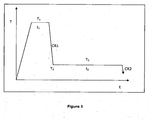
- (i) reheating the cold rolled strip to an annealing temperature T1 of between Ac3-40 and Ac3+80;
- (ii) holding the strip at T1 for an annealing time t1 of between 10 and 200 seconds;
- (iii) cooling the annealed strip at a cooling rate CR1 to a quench temperature T2 for producing a microstructure in the strip comprising a martensite fraction and a retained austenite fraction;
- (iv) partitioning annealing the cooled strip at a temperature T3 for enriching the austenite in carbon by repartitioning the carbon from the martensite to the austenite fraction for a repartitioning time t2 of between 20 and 500 seconds;
- (v) cooling the strip at a cooling rate CR2 to ambient temperature.
- According to the invention a cold-rolled strip is provided by the conventional and known processes of casting, hot-rolling and cold-rolling. The casting process may involve thick slab casting (slab thickness between 150 and 350 mm), thin slab-casting (slab thickness below 150 mm, usually between 50 and 100 mm) or even strip casting. Cold rolling is also a conventional and known process.
- The composition of the steel according to the invention is a balanced composition comprising medium carbon and moderate manganese additions. The cold rolled steel is heated to form austenite, either partially or fully, followed by quenching to a temperature between the martensite start temperature (Ms) and the martensite finish temperature (Mf), thereby creating a controlled amount of martensite and retained austenite. The manganese additions result in stabilisation of an austenite fraction during cooling from the annealing temperature and the subsequent carbon enrichment further stabilises the austenite fraction. Combined stabilisation via C and Mn additions enables alloying with either element to be restricted to reasonable limits leading to cost and processability advantages. The steel is then subjected to a thermal treatment to partition carbon from the martensite into the austenite. The carbon enrichment of the austenite fraction is achieved by partitioning from martensite or low temperature bainitic transformation or preferably a combination of both. By this partitioning, the formation of carbides is suppressed and the austenite is stabilised rather than decomposed. Combined stabilisation with partitioning and bainitic transformation enables the amount of austenite and the microstructure in which it is embedded to be optimised. The bainitic transformation also leads to carbon enrichment of the remaining austenite because the formation of carbides is suppressed. All compositions are given in weight percentages, unless otherwise indicated. The final microstructure of the steel comprises martensite, bainite and carbon-enriched austenite and, if T1 < Ac3, equiaxed ferrite. The stabilisation of austenite results in the steel exhibiting improved ductility relative to traditional high strength steels.
- Carbon (C) provides solid solution strengthening, enhances hardenability (thus enabling avoidance of high temperature transformations at cooling rates achievable in conventional annealing lines) and, when dissolved in austenite, promotes the retention of austenite at room temperature. Above 0.4wt% C the propensity for formation of brittle high carbon martensite increases.
- Manganese (Mn) delivers substantial solid solution strengthening, stabilises austenite, thus promoting its retention at room temperature, and enhances hardenability promoting the formation of hard transformation products at cooling rates achievable in conventional annealing lines. A preferable upper limit for the manganese content is 3.5%.
- Silicon (Si) addition provides solid solution strengthening thus enabling the attainment of high strength and promotes the stabilisation of austenite. Si very effectively retards the formation of carbides during overaging thus keeping carbon in solution for stabilisation of austenite. Ferrite and hard phases such as bainite and martensite exhibit improved ductility in the absence of carbides. Free carbon, not trapped in carbides, may be partitioned to austenite. For acceptable coatability the imposed addition of Si should be below a certain level: Si may be added in the range of between 0.5 to 1wt% when combined with Al addition. In the absence of Al additions beyond the level needed for deoxidation Si should be maintained in the range of between 1 to 2wt%.
- Aluminium (Al) is usually already added in small quantities of at most 0.1% and preferably at most 0.05% to liquid steel for the purpose of deoxidation by forming alumina. Ideally, the total aluminium content in the steel is between 0.01 and 0.08% if aluminium is only added for desoxidation. In the right quantity it also provides an acceleration of the bainite transformation. Al also retards the formation of carbides thus keeping carbon in solution for partitioning to austenite and promoting the stabilisation of austenite. A maximum value of 1.5wt% is imposed for castability purposes because higher Al-contents lead to poisoning of casting mould slag and consequently an increase in mould slag viscosity leading to incorrect heat transfer and lubrication during casting. Aluminium alone delivers low strength. Therefore, if Al is used above levels required for deoxidation it should always be in combination with Si.
- Niobium (Nb), if added, is added in small amounts of up to 0.1% or more preferably of up to 0.05wt%. It is added for austenitic grain refinement during hot rolling. If combined with a suitable rolling schedule, it promotes transformation on the run-out-table, and thus finer and a more homogeneous grain size in the hot-rolled intermediate product which is then subsequently cold-rolled.
- Titanium (Ti) can be used to form fine precipitates in the ferritic component of mixed microstructures thus increasing strength and promoting uniformity of strength at the microstructural scale and in turn good stretched edge ductility. Preferably Ti is below 0.1%.
- Molybdenum (Mo) is used to increase hardenability thus retarding the formation of high temperature transformation products on cooling to the quench temperature. Additions of Mo may therefore allow the utilisation of lower cooling rates more readily achieved in full-scale production lines or to achieve the desired structure and properties in heavier gauge strip. The use of Mo is to be preferred over the use of Cr when UHS is required since in addition to enhancing hardenability Mo provides additional solid solution strengthening. Mo is also known to retard coarsening of fine strengthening precipitates thus promoting thermal stability precipitation strengthening variants. For reasons of cost less than 0.5wt% is preferable.
- Vanadium (V) is used to increase hardenability thus retarding the formation of high temperature transformation products on cooling to the quench temperature. Furthermore V may combine with C or N or both to form fine strengthening precipitates thus increasing strength and promoting uniformity in strength at the microstructural scale in mixed microstructures and in turn improved stretched edge ductility. V addition up to 0.4wt% is effective. Higher additions are undesirable for reasons of cost and because excessive levels of precipitation tie up high amounts of C. Since free C is required for austenite stabilisation too high V requires increased C addition. Preferably V is below 0.1%.
- Phosphorus (P) is used to suppress the formation of pearlite during cooling, to suppress carbide formation and thereby promote the partitioning of carbon to austenite resulting in austenite stabilisation. However, too high a P addition is known to cause embrittlement at hot-rolling temperatures and to lead to reduced toughness in martensitic UHSS. P may also lead to problems in spot welding of the final product. For these reasons P is limited to a maximum of 0.08wt% and more preferably to a maximum of 0.02wt%.
- Sulphur (S) is an impurity which may embrittle the intermediate or final product. S should be limited to a maximum level of 0.01wt% and more preferably to at most 0.005wt%.
- Chromium (Cr) and nickel (Ni) may be used to increase hardenability thus retarding the formation of high temperature transformation products on cooling to the quench temperature. Additions of Cr and/or Ni may therefore allow the utilisation of lower cooling rates more readily achieved in full-scale production lines or to achieve the desired structure and properties in heavier gauge strip. Cr and/or Ni should be limited to a level of less than 1wt% for reasons of cost and preferably to levels of 0.5wt% or less and more preferably below 0.1%.
- Boron (B) may be used to improve hardenability and, in particular, to prevent the formation of ferrite on cooling from a fully austenitic soaking temperature. B should be limited to 50ppm because above these levels further addition is ineffective.
- Antimony (Sb) may be used to enhance the wettability of zinc during hot dip galvanising. Addition should be limited to 0.06wt% or less.
- Calcium (Ca) may be required to avoid clogging during casting and may be beneficial for modifying the morphology of MnS inclusion. Globular inclusions are known to be less detrimental to stretched edge ductility than highly elongated inclusions If used, then addition should preferably be made to the level of 30ppm or less. Additions above 0.05% lead to the formation of coarse inclusions detrimental to ductility and toughness.
- Nitrogen (N) may be used, in combination with V, to form fine strengthening precipitates imparting strength and promoting uniformity in strength at the microstructural scale and in turn good stretched edge ductility. Additions should be limited to 150ppm or less.
- The annealing step starts with reheating to an annealing temperature (T1). T1 may be above or below Ac3. If T1 is below Ac3 the resulting ferrite fraction leads to a lower strength and may introduce heterogeneity in strength at a microstructural scale. Local differences in strength lower the ratio of yield to tensile strength and lead to poor stretched edge ductility and bendability. It is therefore preferable that T1 is above Ac3. In the context of this invention the phrase "above Ac3" means that the microstructure is austenitic at T1. Although the equilibrium transformation temperature Ae3 is only determined by the composition, the value of the corresponding Ac3 temperature is not a constant value as its value depends among others on the heating rate during which Ac3 is measured and the starting microstructure of the steel. Usually Ac3 is determined using dilatometry. When the heating rate used during dilatometry and the microstructure of the test specimen are those used in the process according to the invention, the value of Ac3 is easy to determine. In determining T1 and the allowable variation around T1 the narrowing of the transformation temperature range with increasing C content should preferably be taken into account as follows:


- The rapid cooling to T2 (CR1) is required to avoid the formation of high temperature transformation phases. The specific rate required depends upon the steel chemistry and corresponds to the critical cooling rate for avoidance of ferrite and pearlite noses in the relevant CCT diagram. In addition, the critical rate decreases with increasing T1 above Ac3. Preferably CR1, i.e. the cooling rate over the temperature interval 800-500°C from T1 to T2 is between 30 to 80 °C/s. T2 should be chosen low enough to deliver partial transformation to martensite, but not so low as to cause complete transformation to martensite. T2 is chosen to deliver a volume fraction of martensite of between 50 to 90% (in volume) and preferably an austenite fraction of at least vol.5%. The dependency of the martensitic transformation start temperature (MS) on composition means that T2 will also depend upon chemistry. Preferably a martensite fraction of 60 - 85 vol.% is chosen.
- Holding at T3 is needed to enrich the remaining austenite in carbon via a bainitic transformation or carbon partitioning or both. This temperature may be the same as the quench stop temperature (T2=T3) or may be higher (T3>T2). Higher isothermal holding temperatures may be advantageous since increased rates of carbon diffusion may make feasible shorter isothermal holds. Several processes occur during isothermal holding including tempering of martensite, diffusion of carbon from the martensite fraction to the remaining austenite, the precipitation of carbides and the formation of bainite. The presence of a small fraction of martensite is known to accelerate subsequent transformation to bainite so, for some combinations of alloy composition and processing capability, quench stop temperatures under Ms are desirable. T3 is chosen so as to give a suitable rate of transformation to bainite or rate of partitioning or both. The specific temperature will be dependent upon alloy composition and will preferably fall in a range expressed by:

- The correct balance of isothermal holding temperature and isothermal holding time must be chosen for each composition. These can be determined by means of dilatometry as described hereinbelow.
- The formation of carbides may lock up carbon which would otherwise be available for stabilisation of austenite and should therefore preferably be avoided. Furthermore, coarse Fe3C carbides may lead to a deterioration in tensile ductility and/or stretched edge ductility. The levels of Si or Si/Al must be suitably tuned to retard carbide formation for the duration of the isothermal hold.
- Since both the carbon partitioning accompanying the martensite tempering and bainitic transformation, in the presence of sufficient Si or Si/Al, each deliver an enrichment of carbon in austenite, exploitation of both mechanisms in tandem is highly beneficial leading to a greater total degree of austenite stabilisation.
- It should also be noted that the optimum properties are not delivered by simply tuning process to deliver the maximum stabilisation of austenite. Levels of carbon enrichment too low to completely stabilise all austenite but sufficient to deliver high carbon austenite prior to the final cool can lead to the formation of brittle martensite. Excessive tempering of martensite can lead to significant loss in strength and, in combination with insufficient stabilisation of austenite and the formation of new hard martensite on final cooling, to low ratios of the yield to tensile strength.
- Therefore, it is preferred that the partitioning temperature and time are chosen such as to optimise the enrichment of carbon in the austenite but without creation of deleterious microstructures during the isothermal hold.
- Subsequent to the hold at T3 the strip is cooled to ambient temperature. The strip may also be coated with zinc or other such metallic layers using a suitable method of deposition either in-line or in a following process step.
- In a preferable embodiment the cold rolled strip contains at least 0.25% C and at least 0.03% Al. A lower limit of 0.25wt% is placed on C because below this level the desired combinations of strength and ductility may not be achieved.
- In an embodiment the use of Si is preferred to that of Al such that a minimum silicon content of 1wt% and a max maximum aluminium content of 0.5 wt% is defined. Si provides substantial strengthening allowing the achievement of ultra high strength, more effectively suppresses carbide formation enabling longer isothermal holds without formation of large volumes of coarse iron carbides, and because it does not accelerate bainite formation to the same extent as Al thus preventing excessive formation of bainite and enabling higher strengths to be achieved.
- Strength-Ductility data for a range of production C-Mn steels including ferritic forming steels and quenched martensitic steels have been used to generate a base-line strength-ductility decay for conventional strip steels. The data conform to the expression:

where ecalculated is the total elongation (expressed as % engineering strain), UTS is the ultimate tensile strength and k is a constant which for tensile test pieces with 80 mm gauge and thickness 1 mm is 250000. - If elongations are measured at different gauge or thickness then they must be converted to an equivalent elongation at 80mm gauge and 1mm thick or the above expression must be fit to base-line data measured at that alternative gauge/thickness combination using appropriate values of the constants. Conversion of tensile ductility can be performed using accepted procedures (ISO Norm 2566/1-2) when the geometries corresponding to the measured and to be calculated elongations are know:

Where e2 is the required elongation for a gauge length of L2 with a cross section of A2, e1 is the known elongation measured for a gauge length of L1 with a cross section of A1 and the exponent m is a material constant here assumed to be equal to 0.4. - In an embodiment the quenched and partitioned steel has an e-ratio of at least 1.8 wherein the e-ratio is defined as emeasured/ecalculated and wherein emulated is calculated according to equation (1) and wherein emeasured is the elongation measured from an 80mm gauge length sample at 1mm thick (or measured at some other geometry and converted to an equivalent elongation on an 80mm gauge at 1mm thick using expression (2)).
- In an embodiment the tensile strength of the steel according to the invention is at least 900 MPa. This strength regime is of interest since it provides significant opportunity for down-gauging and is a strength regime for which formability is most limited. Ductility levels are at least 1.8x or more than that of conventional C-Mn steels at equivalent strength.
- Preferably the yield to tensile strength ratio is 0.6 or higher. More preferably the ratio is at least 0.65 or even higher. Low yield to tensile strength ratios are associated with poor bendability and edge cracking sensitivity. Performance is often dependent on yield strength, anti-intrusion components for instance require high yield strength. High yield to tensile strength ratios ensure strength uniformity in the formed part, especially in forming operations which apply localised strain such as bending, or hole expansion.
- In a preferred embodiment of the invention the metal or metal alloy coating is zinc, aluminium, magnesium or alloys thereof. Hereby the steel is afforded sacrificial corrosion protection since the zinc and aluminium will oxidise in preference to iron in the steel.
- It was stated above that it is preferred that the partitioning temperature and time are chosen such as to optimise the enrichment of carbon in the austenite but without creation of deleterious microstructures during the isothermal hold. The temperature and time can be determined using dilatometry as follows:
- First, fully austenitise a sample and apply a fast cool to room temperature to determine the fraction of martensite as a function of temperature below Ms. This allows to select an appropriate fraction of martensite as a function of the quench temperature. For this selected quench temperature the range of time-temperature partitioning combinations that deliver the correct stabilisation of austenite can be determined as follows. Cool a fully austenitized specimen to the selected quench temperature T2 to produce the desired fraction of austenite and martensite and subsequently reheat the sample to a selected partitioning temperature T3 and hold the sample at this temperature for a certain partitioning time t2. The value of t2 may be between 10 and 500 seconds, but for practical purposes in commercial annealing lines t2 is preferably in the range of 20 to 180 s or even 20 to 100 s. After the partitioning step the specimen can be cooled naturally or acceleratedly to room temperature; no fast quench is needed. If during this cooling the dilatation curve shows that the martensite formation re-starts at a temperature in the range from (Ms - 20) to 120°C, then a correct degree of stabilisation has been achieved. In the case that the martensite formation recommences at a temperature <120°C, it means that the stabilisation is too strong and the martensite has a very high carbon content compared to the bulk concentration. In the other case that the martensite formation recommences at a temperature less than 20°C below Ms the stabilisation is not sufficient. This experiments needs to be repeated for different partitioning times to find the times corresponding the two limiting boundary conditions for the chosen partitioning temperature.
- By varying the partitioning temperature T3 and repeat above the required partitioning time will also vary. Increasing the partitioning temperature results in a decrease in partitioning time t2 and to a higher degree of tempering of the martensite formed during the quench.
- In a preferred embodiment of the invention the metallic coating is provided by hot-dip galvanising or by electro-galvanising.
- The invention will now be elucidated by way of example making reference to the accompanying figures and examples.
-
Figure 1 shows the schematic annealing schedule indicating the meaning of T1, T2 and T3, t1 and t2, and of CR1 and CR2. -
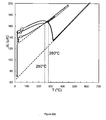
Figure 2a and2b show a set of result of the dilatometric experiments to determine the quench temperature and the partitioning time.Figure 2a shows the temperature as a function of time for a steel having 3.5% Mn which was quenched to a quench temperature of 280°C and reheated to a partitioning temperature of 330°C (triangle) and 440°C (circle). The sample was held at the partitioning temperature for 20 seconds. The quenching temperature resulting in the required amount of martensite is determined on the basis of the base curve (NC-III, square).Figure 2b shows the dilatation of the samples for these conditions. The base curve, with a full quench to room temperature allows to determine Ms (about 315°C). The partitioning step for 20s at 330°C shows no dilation of the sample, which means that no bainite is formed, carbon is partitioned and the martensite is only marginally tempered. The transformation to martensite re-starts at temperatures lower than the quench temperature of 280°C, namely at 250°C, which indicates that the austenite has been stabilized due to carbon partitioning. Increased partition times at 330°C show that the transformation to martensite re-starts at lower temperatures than 250°C. The dilation observed during annealing of the sample for 20s at 440°C means that bainite is formed. Concurrently, carbon is partitioned and the martensite is tempered. The consequence of this high partitioning temperature is that the martensite is severely tempered. Due to the bainitic transformation and the carbon partitioning the austenite is strongly enriched in carbon, which is reflected in the relatively low start temperature of the martensite of approximately 150°C during the second quench after the partitioning at 440°C. The latter martensite is very hard and brittle and therefore undesirable. By varying the partitioning time and the partitioning temperature the optimum combination can be determined. - Table 2 shows the results of various thermal cycles with the steels of Table 1. These results show that (I-VI):
- I. The desired property balance is not achieved for processing with C and Mn additions at the level of current commercial TRIP Steels (composition G). G delivers a very large extension of ductility (typically 2.2 times that of a conventional C-Mn steel) at strengths ranging from 850 to 1050MPa. However, this is only true when the annealing temperature T1 is chosen below the preferred range, (Ac3-40 to Ac3+40 such that a high fraction of ferrite is retained in the final structure. From table 2 it is apparent that, in these cases (cycles 31-32, although ductility is at the desired level, the ratio of YS to UTS drops below the desired level to approximately 0.4.
When annealing is performed with T1 within the claimed range, both direct quenching to room temperature and direct quenching to room temperature followed by an isothermal hold at a higher temperature (i.e. conventional quenching and tempering as in cycle 25) deliver strengths in the desired range but do not deliver ductility above the desired minimum level.
When annealing is performed with T1 within the claimed range (cycles 26-30 and 33) strengths in the range 1000-1300 MPa may be achieved but the desired level of ductility is not achieved.
Processing variants annealed at T1 within the claimed range, subsequently quenched to a low T2 to give high fractions of martensite (in examples 85-93%) after the quench and followed by an isotherm at some higher temperature (table 3 cycles 28-30) to not deliver the desired level of ductility.
Processing variants annealed at T1 within the claimed range, subsequently quenched to a low T2 to give high fractions of martensite after the quench followed by an isotherm at the same temperature (cycle 26) do not deliver the desired level of ductility.
Processing variants annealed at T1 within the claimed range, subsequently quenched to a high T2 to give low fractions of martensite (in example 50%) after the quench followed by an isotherm at the same temperature (cycle 27) to not deliver the desired level of ductility. - II. Complete replacement of Si with Al delivers strength and ductility below the desired minima: Composition A when directly quenched to room temperature delivers strength in the desired range but ductility below the desired minimum (cycle 4). Composition A when quenched to a T2 above the Ms temperature and subjected to isothermal holding at the same temperature delivers strength greatly below the desired range and ductility below the desired minimum (cycle 3). Composition A when quenched to a T2 below the Ms temperature and subjected to isothermal holding at some higher temperature delivers strengths in the approximate range 950 to 1000MPa and ductilities below the desired minimum (thermal cycles 1-2).
- III. Addition of C and/or Mn to levels beyond that found in current commercial trip steels does not enable the desired strength ductility balance to be achieved with conventional quench and temper process. For compositions B, C, D, E , F, and H utilising a direct quench or a direct quench followed by isothermal holding at some higher temperature (i.e. conventional quench and temper) delivers strengths in the desired range but ductility lower than the required minimum (cycles 9, 14, 25, 19, 24, 38).
- IV. Addition of C and/or Mn enables the desired strength ductility balance to be achieved when T2 is above the preferred range but only when the duration of the isothermal hold is unacceptably long for conventional process. Compositions B, C, D, F and H each enable the desired property range to be achieved even if T2 is set such that no martensite is formed during the initial quench (cycles 8, 12, 13, 16, 17, 36 and 37) but in all cases the isothermal holding time at T3 is unacceptably long to be practical or economical in a continuous annealing process.
- V. Addition of C and/or Mn enables the desired strength ductility balance to be achieved when processing is carried out in the preferred manner using a quench temperature (T2) below Ms and a suitable combination of isothermal holding temperature (T3) and time. Compositions B, D and F each enable the desired property range to be achieved if T2 is set such that the desired fraction of martensite is formed during the initial quench (cycles 6, 15, 22) and if an isothermal holding temperature (T3) and the holding time at this temperature are set at suitable levels.
- VI. C addition of higher than 0.4wt% leads to embrittlement when processing is carried out according to the preferred route. Compositions C and H each return effectively zero ductility results when subjected to processing involving a deep quench (low T2) and isothermal hold times at T3 sufficiently short for conventional CA process (cycles 10-11 and 34-35) due to the formation of brittle, high carbon martensite in the final structure.


Claims (14)
- A method for producing a quenched and partitioned steel by providing a cold rolled and annealed steel strip containing (in weight %):• 0.18 - 0.4% C• 1.5 - 4.0% Mn• 0.5 - 2.0% Si• 0-1.5% Al• 0-0.5% Mo• 0-0.5% Ti• 0 - 0.1% V• 0 - 0.010% Nb• 0 - 0.005% B• 0 - 0.015% N• 0 - 0.08% P• 0 - 0.01% S• 0-0.06% Sb• 0-0.05% Ca• 0 - 0.5%Cr• 0-1.0% Ni• the remainder being iron and unavoidable impurities.wherein the annealing process comprises the following steps:(i) reheating the cold rolled strip to an annealing temperature T1 of between Ac3-40 and Ac3+80;(ii) holding the strip at T1 for an annealing time t1 of between 10 and 200 seconds;(iii) cooling the annealed strip at the critical cooling rate CR1 for avoidance of ferrite and pearlite formation to a quench temperature T2 for producing a microstructure in the strip comprising a martensite fraction and a retained austenite fraction;(iv) repartitioning annealing the cooled strip at a temperature T3 for enriching the austenite in carbon by repartitioning the carbon from the martensite to the austenite fraction for a repartitioning time t2 of between 20 and 500 seconds wherein the martensite fraction is between 60 and 90% of the microstructure at the start of the repartitioning annealing wherein (Ms-70) < T3 ≤ (Ms+50)(v) cooling the strip at a cooling rate CR2 to ambient temperature.
- A method according to claim 1 wherein CR1 is at least 30°C/s.
- A method according to claim 1 or 2 wherein the martensite fraction is at most 85% of the microstructure at the start of the repartitioning annealing.
- A method according to any one of the preceding claims wherein
(Ac3-40) < T1 ≤ (Ac3+50) for carbon between 0.18 - 0.3% C or
(Ac3-20) < T1 ≤ (Ac3+30) for carbon between 0.3 to 0.4% C - A method according to any one of the preceding claims wherein T1 is above Ac3.
- A method according to any one of the preceding claims wherein the cold rolled strip contains at most 0.5% Al.
- A method according to any one of the preceding claims wherein the cold rolled strip contains at least 0.25% C and at least 0.01% Al.
- A method according to any one of the preceding claims wherein T2 equals T3.
- A method according to any one of claims 1 to 7 wherein T2 is lower than T3.
- A method according to any one of the preceding claims wherein the cold-rolled and annealed strip is coated with one or more metallic layer(s), preferably wherein the step of providing the metallic coating is by hot-dip galvanising or electro-galvanising.
- Steel strip produced by any one of the claims 1 to 10 wherein the steel has a microstructure containing at least 5% austenite, wherein the microstructure contains 60 to 90 % (in volume) of thermally treated martensite and wherein an e-ratio of at least 1.8 and a tensile strength (UTS) of at least 900 MPa, wherein the e-ratio is defined as emeasured/ecalculated and wherein ecalculated is calculated according to:


- Steel strip according to claim 11 wherein the microstructure further contains one or more of bainite, martensite, tempered martensite, ferrite, fine carbides.
- Steel strip according to claim 11 or 12 wherein the microstructure does not contain ferrite and/or coarse cementite.
- Steel strip according to any one of claims 11 to 13 wherein the yield strength to tensile strength ratio is at least 0.6.
Priority Applications (1)
| Application Number | Priority Date | Filing Date | Title |
|---|---|---|---|
| EP12708008.3A EP2683839B1 (en) | 2011-03-07 | 2012-03-07 | Process for producing high strength formable steel and high strength formable steel produced therewith |
Applications Claiming Priority (3)
| Application Number | Priority Date | Filing Date | Title |
|---|---|---|---|
| EP11157239 | 2011-03-07 | ||
| EP12708008.3A EP2683839B1 (en) | 2011-03-07 | 2012-03-07 | Process for producing high strength formable steel and high strength formable steel produced therewith |
| PCT/EP2012/053856 WO2012120020A1 (en) | 2011-03-07 | 2012-03-07 | Process for producing high strength formable steel and high strength formable steel produced therewith |
Publications (2)
| Publication Number | Publication Date |
|---|---|
| EP2683839A1 EP2683839A1 (en) | 2014-01-15 |
| EP2683839B1 true EP2683839B1 (en) | 2015-04-01 |
Family
ID=44279692
Family Applications (1)
| Application Number | Title | Priority Date | Filing Date |
|---|---|---|---|
| EP12708008.3A Revoked EP2683839B1 (en) | 2011-03-07 | 2012-03-07 | Process for producing high strength formable steel and high strength formable steel produced therewith |
Country Status (3)
| Country | Link |
|---|---|
| EP (1) | EP2683839B1 (en) |
| ES (1) | ES2535420T3 (en) |
| WO (1) | WO2012120020A1 (en) |
Cited By (6)
| Publication number | Priority date | Publication date | Assignee | Title |
|---|---|---|---|---|
| CN106244924A (en) * | 2016-08-31 | 2016-12-21 | 东北大学 | A kind of cold rolling quenching ductile steel and preparation method |
| EP3663415A1 (en) * | 2014-07-03 | 2020-06-10 | ArcelorMittal | Method for producing a high strength steel sheet having improved strength, ductility and formability |
| US11136656B2 (en) | 2015-05-21 | 2021-10-05 | Cleveland-Cliffs Steel Properties Inc. | High manganese 3rd generation advanced high strength steels |
| EP3899067B1 (en) * | 2018-12-18 | 2023-09-13 | ArcelorMittal | Cold rolled and heat-treated steel sheet and method of manufacturing the same |
| WO2023170245A1 (en) * | 2022-03-10 | 2023-09-14 | Tata Steel Nederland Technology B.V. | High strength steel sheet with excellent hole expandability and method of producing the same |
| EP3175005B1 (en) * | 2014-07-30 | 2024-03-20 | ArcelorMittal | A method for producing a high strength steel piece |
Families Citing this family (40)
| Publication number | Priority date | Publication date | Assignee | Title |
|---|---|---|---|---|
| CN103160680A (en) * | 2013-04-03 | 2013-06-19 | 北京科技大学 | Q-and-PB (quenching and partitioning in bainite zone) heat treatment process for preparing 30 GPa%-grade complex-phase steel |
| CN103276164B (en) * | 2013-05-15 | 2014-12-31 | 哈尔滨工业大学 | High-strength and high-toughness heat treatment method of medium-carbon silicon-manganese-chromium-nickel series low alloy steel |
| CN105247090A (en) * | 2013-05-17 | 2016-01-13 | Ak钢铁资产公司 | High-strength steel exhibiting good ductility and method for its preparation by quenching and partitioning treatment by means of a galvanizing bath |
| WO2015011511A1 (en) | 2013-07-24 | 2015-01-29 | Arcelormittal Investigación Y Desarrollo Sl | Steel sheet having very high mechanical properties of strength and ductility, manufacturing method and use of such sheets |
| WO2016001706A1 (en) | 2014-07-03 | 2016-01-07 | Arcelormittal | Method for producing a high strength steel sheet having improved strength and formability and obtained sheet |
| WO2016001702A1 (en) | 2014-07-03 | 2016-01-07 | Arcelormittal | Method for producing a high strength coated steel sheet having improved strength, ductility and formability |
| WO2016001710A1 (en) | 2014-07-03 | 2016-01-07 | Arcelormittal | Method for producing a high strength coated steel having improved strength and ductility and obtained sheet |
| WO2016001704A1 (en) * | 2014-07-03 | 2016-01-07 | Arcelormittal | Method for manufacturing a high strength steel sheet and sheet obtained |
| WO2016020714A1 (en) * | 2014-08-07 | 2016-02-11 | Arcelormittal | Method for producing a coated steel sheet having improved strength, ductility and formability |
| EP3029162B1 (en) * | 2014-12-01 | 2018-04-25 | Voestalpine Stahl GmbH | Method for the heat treatment of a manganese steel product |
| CN104532126B (en) * | 2014-12-19 | 2017-06-06 | 宝山钢铁股份有限公司 | A kind of super high strength hot rolled Q&P steel of low yield strength ratio and its manufacture method |
| WO2017109541A1 (en) * | 2015-12-21 | 2017-06-29 | Arcelormittal | Method for producing a high strength coated steel sheet having improved ductility and formability, and obtained coated steel sheet |
| UA119946C2 (en) * | 2015-12-29 | 2019-08-27 | Арселорміттал | Method for producing a ultra high strength galvannealed steel sheet and obtained galvannealed steel sheet |
| JP6967628B2 (en) * | 2015-12-29 | 2021-11-17 | アルセロールミタル | A method for manufacturing an ultra-high-strength alloyed hot-dip galvanized steel sheet, and the obtained alloyed hot-dip galvanized steel sheet. |
| US10619223B2 (en) | 2016-04-28 | 2020-04-14 | GM Global Technology Operations LLC | Zinc-coated hot formed steel component with tailored property |
| EP3476962B1 (en) * | 2016-08-10 | 2020-09-16 | JFE Steel Corporation | Thin steel sheet, and production method therefor |
| CN109563582B (en) * | 2016-08-10 | 2021-08-24 | 杰富意钢铁株式会社 | Sheet steel and method for producing the same |
| WO2018055425A1 (en) * | 2016-09-22 | 2018-03-29 | Arcelormittal | High strength and high formability steel sheet and manufacturing method |
| CN107480328B (en) * | 2017-07-04 | 2022-09-20 | 山东建筑大学 | Carbon distribution theory calculation method based on Q & P process |
| RU2747056C1 (en) * | 2017-08-22 | 2021-04-23 | Тиссенкрупп Стил Юроп Аг | Use of hardened and redistributed steel for production of moulded wear component |
| DE102017216572A1 (en) | 2017-09-19 | 2019-03-21 | Thyssenkrupp Ag | Hot dip coated steel strip with improved surface appearance and method of making the same |
| WO2019090113A1 (en) * | 2017-11-02 | 2019-05-09 | Ak Steel Properties, Inc. | Press hardened steel with tailored properties after novel thermal treatment |
| EP3704281A1 (en) | 2017-11-02 | 2020-09-09 | AK Steel Properties, Inc. | Press hardened steel with tailored properties |
| WO2019122961A1 (en) * | 2017-12-19 | 2019-06-27 | Arcelormittal | High strength and high formability steel sheet and manufacturing method |
| CN111542635B (en) * | 2017-12-28 | 2022-07-01 | 通用汽车环球科技运作有限责任公司 | Steel for hot stamping with enhanced oxidation resistance |
| WO2019180492A1 (en) * | 2018-03-23 | 2019-09-26 | Arcelormittal | Forged part of bainitic steel and a method of manufacturing thereof |
| WO2019208556A1 (en) * | 2018-04-23 | 2019-10-31 | 日本製鉄株式会社 | Steel member and method for producing same |
| US11613789B2 (en) | 2018-05-24 | 2023-03-28 | GM Global Technology Operations LLC | Method for improving both strength and ductility of a press-hardening steel |
| CN112534078A (en) | 2018-06-19 | 2021-03-19 | 通用汽车环球科技运作有限责任公司 | Low density press hardened steel with enhanced mechanical properties |
| CN110878401B (en) * | 2018-09-05 | 2021-06-22 | 山东建筑大学 | Preparation method of 1300 MPa-grade rare earth reverse transformation Q & P steel |
| CN109338241B (en) * | 2018-10-18 | 2019-12-06 | 钢铁研究总院 | 2000 MPa-grade M3 type high-toughness and high-plasticity nickel-free steel and preparation method thereof |
| CN109365785A (en) * | 2018-11-29 | 2019-02-22 | 山东建筑大学 | A kind of two-way hammer crusher hammer head and its manufacturing method |
| ES2911662T5 (en) * | 2019-06-17 | 2025-06-05 | Tata Steel Ijmuiden Bv | Method of heat treating a high strength cold rolled steel strip |
| US11530469B2 (en) | 2019-07-02 | 2022-12-20 | GM Global Technology Operations LLC | Press hardened steel with surface layered homogenous oxide after hot forming |
| WO2021026437A1 (en) * | 2019-08-07 | 2021-02-11 | United States Steel Corporation | High ductility zinc-coated steel sheet products |
| CN111593258A (en) * | 2019-12-16 | 2020-08-28 | 北京特冶工贸有限责任公司 | High-wear-resistance high-strength-toughness bainite-martensite multiphase structure steel rail for curve and manufacturing method thereof |
| CN116287965B (en) * | 2021-12-20 | 2024-07-23 | 四川大学 | A V-Ti-N microalloyed high-strength steel and its P-Q&P process |
| KR102747793B1 (en) * | 2022-05-31 | 2024-12-31 | 현대제철 주식회사 | Ultra high strength cold rolled steel sheet treated by softening heat process and method of manufacturing the same |
| CN115478225A (en) * | 2022-10-13 | 2022-12-16 | 武汉科技大学 | A 1180MPa grade short-time hot-rolled quenching partition steel and its preparation method and application |
| CN120330437B (en) * | 2025-06-20 | 2025-08-22 | 太原科技大学 | Wear-resistant martensitic stainless steel and preparation method thereof |
Citations (3)
| Publication number | Priority date | Publication date | Assignee | Title |
|---|---|---|---|---|
| EP2258886A1 (en) | 2008-01-31 | 2010-12-08 | JFE Steel Corporation | High-strength hot-dip galvanized steel sheet with excellent processability and process for producing the same |
| EP2267176A1 (en) | 2008-02-08 | 2010-12-29 | JFE Steel Corporation | High-strength hot-dip galvanized steel sheet with excellent processability and process for producing the same |
| EP2325346A1 (en) | 2008-09-10 | 2011-05-25 | JFE Steel Corporation | High-strength steel plate and manufacturing method thereof |
Family Cites Families (4)
| Publication number | Priority date | Publication date | Assignee | Title |
|---|---|---|---|---|
| JP4608822B2 (en) * | 2001-07-03 | 2011-01-12 | Jfeスチール株式会社 | Highly ductile hot-dip galvanized steel sheet excellent in press formability and strain age hardening characteristics and method for producing the same |
| KR100884104B1 (en) * | 2004-01-14 | 2009-02-19 | 신닛뽄세이테쯔 카부시키카이샤 | Hot-dip galvanized high strength steel with excellent plating adhesion and hole expandability and its manufacturing method |
| JP4510488B2 (en) * | 2004-03-11 | 2010-07-21 | 新日本製鐵株式会社 | Hot-dip galvanized composite high-strength steel sheet excellent in formability and hole expansibility and method for producing the same |
| KR101399741B1 (en) * | 2007-10-25 | 2014-05-27 | 제이에프이 스틸 가부시키가이샤 | High-strength hot-dip galvanized steel sheet excellent in workability and manufacturing method thereof |
-
2012
- 2012-03-07 EP EP12708008.3A patent/EP2683839B1/en not_active Revoked
- 2012-03-07 WO PCT/EP2012/053856 patent/WO2012120020A1/en not_active Ceased
- 2012-03-07 ES ES12708008.3T patent/ES2535420T3/en active Active
Patent Citations (3)
| Publication number | Priority date | Publication date | Assignee | Title |
|---|---|---|---|---|
| EP2258886A1 (en) | 2008-01-31 | 2010-12-08 | JFE Steel Corporation | High-strength hot-dip galvanized steel sheet with excellent processability and process for producing the same |
| EP2267176A1 (en) | 2008-02-08 | 2010-12-29 | JFE Steel Corporation | High-strength hot-dip galvanized steel sheet with excellent processability and process for producing the same |
| EP2325346A1 (en) | 2008-09-10 | 2011-05-25 | JFE Steel Corporation | High-strength steel plate and manufacturing method thereof |
Non-Patent Citations (1)
| Title |
|---|
| J.G. SPEER ET AL.: "Progress in the Global Development of the Quenching and Partitioning Process", PROCEEDINGS OF THE 17TH INTERNATIONAL FEDERATION FOR HEAT TREATMENT AND SURFACE ENGINEERING CONGRESS, vol. 2, 27 October 2008 (2008-10-27), Kobe, Japan, pages 415 - 422, XP055258795 |
Cited By (7)
| Publication number | Priority date | Publication date | Assignee | Title |
|---|---|---|---|---|
| EP3663415A1 (en) * | 2014-07-03 | 2020-06-10 | ArcelorMittal | Method for producing a high strength steel sheet having improved strength, ductility and formability |
| EP3175005B1 (en) * | 2014-07-30 | 2024-03-20 | ArcelorMittal | A method for producing a high strength steel piece |
| US11136656B2 (en) | 2015-05-21 | 2021-10-05 | Cleveland-Cliffs Steel Properties Inc. | High manganese 3rd generation advanced high strength steels |
| CN106244924A (en) * | 2016-08-31 | 2016-12-21 | 东北大学 | A kind of cold rolling quenching ductile steel and preparation method |
| CN106244924B (en) * | 2016-08-31 | 2017-12-29 | 东北大学 | A kind of cold rolling quenching ductile steel and preparation method |
| EP3899067B1 (en) * | 2018-12-18 | 2023-09-13 | ArcelorMittal | Cold rolled and heat-treated steel sheet and method of manufacturing the same |
| WO2023170245A1 (en) * | 2022-03-10 | 2023-09-14 | Tata Steel Nederland Technology B.V. | High strength steel sheet with excellent hole expandability and method of producing the same |
Also Published As
| Publication number | Publication date |
|---|---|
| WO2012120020A1 (en) | 2012-09-13 |
| ES2535420T3 (en) | 2015-05-11 |
| EP2683839A1 (en) | 2014-01-15 |
Similar Documents
| Publication | Publication Date | Title |
|---|---|---|
| EP2683839A1 (en) | Process for producing high strength formable steel and high strength formable steel produced therewith | |
| US12286682B2 (en) | High strength steel product and a process to produce a high strength steel product | |
| CN103154279B (en) | The method of thermoforming steel billet and hot formed parts | |
| CA2805834C (en) | High-strength cold rolled sheet having excellent formability and crashworthiness and method for manufacturing the same | |
| CN101649415B (en) | High-strength steel sheet superior in formability | |
| CN111148853B (en) | Flat steel product and method for the production thereof | |
| US9732404B2 (en) | Method of producing high-strength steel plates with excellent ductility and plates thus produced | |
| WO2021089851A1 (en) | Medium manganese steel product and method of manufacturing the same | |
| EP3707288A1 (en) | Cold rolled steel sheet and a method of manufacturing thereof | |
| WO2019092576A1 (en) | Cold rolled heat treated steel sheet and a method of manufacturing thereof | |
| WO2013144373A1 (en) | High strength cold rolled steel sheet and method of producing such steel sheet | |
| EP3221476A1 (en) | Method for manufacturing a high strength steel product and steel product thereby obtained | |
| CN101960038A (en) | Cold-rolled steel sheets | |
| CN110621794B (en) | High-strength steel sheet having excellent ductility and stretch flangeability | |
| Krizan et al. | Development of third generation advanced high strength steels for automotive applications | |
| UA125769C2 (en) | Cold rolled and coated steel sheet and a method of manufacturing thereof | |
| CN114787396A (en) | Heat-treated cold-rolled steel sheet and method for producing same | |
| EP3927858A1 (en) | High strength steel with improved mechanical properties | |
| CN117957339A (en) | High strength cold rolled steel strip for automotive applications with good resistance to decomposition of retained austenite | |
| JPH1060593A (en) | High strength cold rolled steel sheet excellent in balance between strength and elongation-flanging formability, and its production | |
| JP5365758B2 (en) | Steel sheet and manufacturing method thereof | |
| WO2020245668A1 (en) | Cold rolled and coated steel sheet and a method of manufacturing thereof | |
| US12553099B2 (en) | Cold rolled and coated steel sheet and a method of manufacturing thereof | |
| KR20240019756A (en) | High-strength cold-rolled steel sheet for automobiles with excellent overall formability and bending properties | |
| KR20230129244A (en) | Zinc or zinc-alloy coated strip or steel with improved zinc adhesion |
Legal Events
| Date | Code | Title | Description |
|---|---|---|---|
| PUAI | Public reference made under article 153(3) epc to a published international application that has entered the european phase |
Free format text: ORIGINAL CODE: 0009012 |
|
| 17P | Request for examination filed |
Effective date: 20131007 |
|
| AK | Designated contracting states |
Kind code of ref document: A1 Designated state(s): AL AT BE BG CH CY CZ DE DK EE ES FI FR GB GR HR HU IE IS IT LI LT LU LV MC MK MT NL NO PL PT RO RS SE SI SK SM TR |
|
| DAX | Request for extension of the european patent (deleted) | ||
| RIC1 | Information provided on ipc code assigned before grant |
Ipc: C21D 9/46 20060101ALI20140730BHEP Ipc: C21D 8/02 20060101AFI20140730BHEP Ipc: C23C 2/06 20060101ALI20140730BHEP Ipc: C23C 2/28 20060101ALI20140730BHEP Ipc: C23C 2/02 20060101ALI20140730BHEP Ipc: C22C 38/04 20060101ALI20140730BHEP |
|
| GRAP | Despatch of communication of intention to grant a patent |
Free format text: ORIGINAL CODE: EPIDOSNIGR1 |
|
| INTG | Intention to grant announced |
Effective date: 20141006 |
|
| GRAP | Despatch of communication of intention to grant a patent |
Free format text: ORIGINAL CODE: EPIDOSNIGR1 |
|
| GRAS | Grant fee paid |
Free format text: ORIGINAL CODE: EPIDOSNIGR3 |
|
| RAP1 | Party data changed (applicant data changed or rights of an application transferred) |
Owner name: TATA STEEL NEDERLAND TECHNOLOGY B.V. |
|
| INTG | Intention to grant announced |
Effective date: 20150202 |
|
| GRAA | (expected) grant |
Free format text: ORIGINAL CODE: 0009210 |
|
| AK | Designated contracting states |
Kind code of ref document: B1 Designated state(s): AL AT BE BG CH CY CZ DE DK EE ES FI FR GB GR HR HU IE IS IT LI LT LU LV MC MK MT NL NO PL PT RO RS SE SI SK SM TR |
|
| REG | Reference to a national code |
Ref country code: GB Ref legal event code: FG4D |
|
| REG | Reference to a national code |
Ref country code: CH Ref legal event code: EP |
|
| REG | Reference to a national code |
Ref country code: IE Ref legal event code: FG4D |
|
| REG | Reference to a national code |
Ref country code: SE Ref legal event code: TRGR |
|
| REG | Reference to a national code |
Ref country code: ES Ref legal event code: FG2A Ref document number: 2535420 Country of ref document: ES Kind code of ref document: T3 Effective date: 20150511 |
|
| REG | Reference to a national code |
Ref country code: DE Ref legal event code: R096 Ref document number: 602012006331 Country of ref document: DE Effective date: 20150513 |
|
| REG | Reference to a national code |
Ref country code: AT Ref legal event code: REF Ref document number: 719129 Country of ref document: AT Kind code of ref document: T Effective date: 20150515 |
|
| REG | Reference to a national code |
Ref country code: NL Ref legal event code: VDEP Effective date: 20150401 |
|
| REG | Reference to a national code |
Ref country code: LT Ref legal event code: MG4D |
|
| PG25 | Lapsed in a contracting state [announced via postgrant information from national office to epo] |
Ref country code: NL Free format text: LAPSE BECAUSE OF FAILURE TO SUBMIT A TRANSLATION OF THE DESCRIPTION OR TO PAY THE FEE WITHIN THE PRESCRIBED TIME-LIMIT Effective date: 20150401 |
|
| PG25 | Lapsed in a contracting state [announced via postgrant information from national office to epo] |
Ref country code: CZ Free format text: LAPSE BECAUSE OF FAILURE TO SUBMIT A TRANSLATION OF THE DESCRIPTION OR TO PAY THE FEE WITHIN THE PRESCRIBED TIME-LIMIT Effective date: 20150401 Ref country code: LT Free format text: LAPSE BECAUSE OF FAILURE TO SUBMIT A TRANSLATION OF THE DESCRIPTION OR TO PAY THE FEE WITHIN THE PRESCRIBED TIME-LIMIT Effective date: 20150401 Ref country code: HR Free format text: LAPSE BECAUSE OF FAILURE TO SUBMIT A TRANSLATION OF THE DESCRIPTION OR TO PAY THE FEE WITHIN THE PRESCRIBED TIME-LIMIT Effective date: 20150401 Ref country code: PT Free format text: LAPSE BECAUSE OF FAILURE TO SUBMIT A TRANSLATION OF THE DESCRIPTION OR TO PAY THE FEE WITHIN THE PRESCRIBED TIME-LIMIT Effective date: 20150803 Ref country code: FI Free format text: LAPSE BECAUSE OF FAILURE TO SUBMIT A TRANSLATION OF THE DESCRIPTION OR TO PAY THE FEE WITHIN THE PRESCRIBED TIME-LIMIT Effective date: 20150401 Ref country code: NO Free format text: LAPSE BECAUSE OF FAILURE TO SUBMIT A TRANSLATION OF THE DESCRIPTION OR TO PAY THE FEE WITHIN THE PRESCRIBED TIME-LIMIT Effective date: 20150701 |
|
| PG25 | Lapsed in a contracting state [announced via postgrant information from national office to epo] |
Ref country code: GR Free format text: LAPSE BECAUSE OF FAILURE TO SUBMIT A TRANSLATION OF THE DESCRIPTION OR TO PAY THE FEE WITHIN THE PRESCRIBED TIME-LIMIT Effective date: 20150702 Ref country code: LV Free format text: LAPSE BECAUSE OF FAILURE TO SUBMIT A TRANSLATION OF THE DESCRIPTION OR TO PAY THE FEE WITHIN THE PRESCRIBED TIME-LIMIT Effective date: 20150401 Ref country code: RS Free format text: LAPSE BECAUSE OF FAILURE TO SUBMIT A TRANSLATION OF THE DESCRIPTION OR TO PAY THE FEE WITHIN THE PRESCRIBED TIME-LIMIT Effective date: 20150401 Ref country code: IS Free format text: LAPSE BECAUSE OF FAILURE TO SUBMIT A TRANSLATION OF THE DESCRIPTION OR TO PAY THE FEE WITHIN THE PRESCRIBED TIME-LIMIT Effective date: 20150801 |
|
| REG | Reference to a national code |
Ref country code: DE Ref legal event code: R026 Ref document number: 602012006331 Country of ref document: DE |
|
| PLBI | Opposition filed |
Free format text: ORIGINAL CODE: 0009260 |
|
| PG25 | Lapsed in a contracting state [announced via postgrant information from national office to epo] |
Ref country code: EE Free format text: LAPSE BECAUSE OF FAILURE TO SUBMIT A TRANSLATION OF THE DESCRIPTION OR TO PAY THE FEE WITHIN THE PRESCRIBED TIME-LIMIT Effective date: 20150401 Ref country code: DK Free format text: LAPSE BECAUSE OF FAILURE TO SUBMIT A TRANSLATION OF THE DESCRIPTION OR TO PAY THE FEE WITHIN THE PRESCRIBED TIME-LIMIT Effective date: 20150401 |
|
| 26 | Opposition filed |
Opponent name: ARCELORMITTAL Effective date: 20151223 Opponent name: THYSSENKRUPP STEEL EUROPE AG Effective date: 20151229 |
|
| PLAX | Notice of opposition and request to file observation + time limit sent |
Free format text: ORIGINAL CODE: EPIDOSNOBS2 |
|
| REG | Reference to a national code |
Ref country code: AT Ref legal event code: UEP Ref document number: 719129 Country of ref document: AT Kind code of ref document: T Effective date: 20150401 |
|
| PG25 | Lapsed in a contracting state [announced via postgrant information from national office to epo] |
Ref country code: SK Free format text: LAPSE BECAUSE OF FAILURE TO SUBMIT A TRANSLATION OF THE DESCRIPTION OR TO PAY THE FEE WITHIN THE PRESCRIBED TIME-LIMIT Effective date: 20150401 Ref country code: RO Free format text: LAPSE BECAUSE OF NON-PAYMENT OF DUE FEES Effective date: 20150401 Ref country code: PL Free format text: LAPSE BECAUSE OF FAILURE TO SUBMIT A TRANSLATION OF THE DESCRIPTION OR TO PAY THE FEE WITHIN THE PRESCRIBED TIME-LIMIT Effective date: 20150401 |
|
| REG | Reference to a national code |
Ref country code: FR Ref legal event code: PLFP Year of fee payment: 5 |
|
| PG25 | Lapsed in a contracting state [announced via postgrant information from national office to epo] |
Ref country code: IT Free format text: LAPSE BECAUSE OF FAILURE TO SUBMIT A TRANSLATION OF THE DESCRIPTION OR TO PAY THE FEE WITHIN THE PRESCRIBED TIME-LIMIT Effective date: 20150401 |
|
| PG25 | Lapsed in a contracting state [announced via postgrant information from national office to epo] |
Ref country code: SI Free format text: LAPSE BECAUSE OF FAILURE TO SUBMIT A TRANSLATION OF THE DESCRIPTION OR TO PAY THE FEE WITHIN THE PRESCRIBED TIME-LIMIT Effective date: 20150401 |
|
| PLAF | Information modified related to communication of a notice of opposition and request to file observations + time limit |
Free format text: ORIGINAL CODE: EPIDOSCOBS2 |
|
| PLAB | Opposition data, opponent's data or that of the opponent's representative modified |
Free format text: ORIGINAL CODE: 0009299OPPO |
|
| R26 | Opposition filed (corrected) |
Opponent name: ARCELORMITTAL Effective date: 20151223 |
|
| PG25 | Lapsed in a contracting state [announced via postgrant information from national office to epo] |
Ref country code: LU Free format text: LAPSE BECAUSE OF FAILURE TO SUBMIT A TRANSLATION OF THE DESCRIPTION OR TO PAY THE FEE WITHIN THE PRESCRIBED TIME-LIMIT Effective date: 20160307 Ref country code: MC Free format text: LAPSE BECAUSE OF FAILURE TO SUBMIT A TRANSLATION OF THE DESCRIPTION OR TO PAY THE FEE WITHIN THE PRESCRIBED TIME-LIMIT Effective date: 20150401 |
|
| REG | Reference to a national code |
Ref country code: CH Ref legal event code: PL |
|
| PLAB | Opposition data, opponent's data or that of the opponent's representative modified |
Free format text: ORIGINAL CODE: 0009299OPPO |
|
| REG | Reference to a national code |
Ref country code: IE Ref legal event code: MM4A |
|
| R26 | Opposition filed (corrected) |
Opponent name: ARCELORMITTAL Effective date: 20151223 |
|
| PG25 | Lapsed in a contracting state [announced via postgrant information from national office to epo] |
Ref country code: LI Free format text: LAPSE BECAUSE OF NON-PAYMENT OF DUE FEES Effective date: 20160331 Ref country code: CH Free format text: LAPSE BECAUSE OF NON-PAYMENT OF DUE FEES Effective date: 20160331 Ref country code: IE Free format text: LAPSE BECAUSE OF NON-PAYMENT OF DUE FEES Effective date: 20160307 |
|
| REG | Reference to a national code |
Ref country code: FR Ref legal event code: PLFP Year of fee payment: 6 |
|
| PGFP | Annual fee paid to national office [announced via postgrant information from national office to epo] |
Ref country code: SE Payment date: 20170329 Year of fee payment: 6 Ref country code: FR Payment date: 20170327 Year of fee payment: 6 |
|
| PGFP | Annual fee paid to national office [announced via postgrant information from national office to epo] |
Ref country code: AT Payment date: 20170221 Year of fee payment: 6 Ref country code: GB Payment date: 20170327 Year of fee payment: 6 Ref country code: BE Payment date: 20170327 Year of fee payment: 6 |
|
| PGFP | Annual fee paid to national office [announced via postgrant information from national office to epo] |
Ref country code: DE Payment date: 20170329 Year of fee payment: 6 |
|
| PG25 | Lapsed in a contracting state [announced via postgrant information from national office to epo] |
Ref country code: MT Free format text: LAPSE BECAUSE OF FAILURE TO SUBMIT A TRANSLATION OF THE DESCRIPTION OR TO PAY THE FEE WITHIN THE PRESCRIBED TIME-LIMIT Effective date: 20150401 |
|
| PGFP | Annual fee paid to national office [announced via postgrant information from national office to epo] |
Ref country code: ES Payment date: 20170328 Year of fee payment: 6 |
|
| REG | Reference to a national code |
Ref country code: DE Ref legal event code: R064 Ref document number: 602012006331 Country of ref document: DE Ref country code: DE Ref legal event code: R103 Ref document number: 602012006331 Country of ref document: DE |
|
| RDAF | Communication despatched that patent is revoked |
Free format text: ORIGINAL CODE: EPIDOSNREV1 |
|
| STAA | Information on the status of an ep patent application or granted ep patent |
Free format text: STATUS: THE PATENT HAS BEEN GRANTED |
|
| RDAG | Patent revoked |
Free format text: ORIGINAL CODE: 0009271 |
|
| STAA | Information on the status of an ep patent application or granted ep patent |
Free format text: STATUS: PATENT REVOKED |
|
| 27W | Patent revoked |
Effective date: 20171107 |
|
| GBPR | Gb: patent revoked under art. 102 of the ep convention designating the uk as contracting state |
Effective date: 20171107 |
|
| REG | Reference to a national code |
Ref country code: BE Ref legal event code: FP Effective date: 20150423 |
|
| PG25 | Lapsed in a contracting state [announced via postgrant information from national office to epo] |
Ref country code: MK Free format text: LAPSE BECAUSE OF FAILURE TO SUBMIT A TRANSLATION OF THE DESCRIPTION OR TO PAY THE FEE WITHIN THE PRESCRIBED TIME-LIMIT Effective date: 20150401 Ref country code: MT Free format text: LAPSE BECAUSE OF FAILURE TO SUBMIT A TRANSLATION OF THE DESCRIPTION OR TO PAY THE FEE WITHIN THE PRESCRIBED TIME-LIMIT Effective date: 20160331 |
|
| REG | Reference to a national code |
Ref country code: AT Ref legal event code: MA03 Ref document number: 719129 Country of ref document: AT Kind code of ref document: T Effective date: 20171107 |
|
| REG | Reference to a national code |
Ref country code: SE Ref legal event code: ECNC |
|
| PG25 | Lapsed in a contracting state [announced via postgrant information from national office to epo] |
Ref country code: AL Free format text: LAPSE BECAUSE OF FAILURE TO SUBMIT A TRANSLATION OF THE DESCRIPTION OR TO PAY THE FEE WITHIN THE PRESCRIBED TIME-LIMIT Effective date: 20150401 |
|
| PG25 | Lapsed in a contracting state [announced via postgrant information from national office to epo] |
Ref country code: BG Free format text: LAPSE BECAUSE OF FAILURE TO SUBMIT A TRANSLATION OF THE DESCRIPTION OR TO PAY THE FEE WITHIN THE PRESCRIBED TIME-LIMIT Effective date: 20150401 |
|
| PG25 | Lapsed in a contracting state [announced via postgrant information from national office to epo] |
Ref country code: CY Free format text: LAPSE BECAUSE OF FAILURE TO SUBMIT A TRANSLATION OF THE DESCRIPTION OR TO PAY THE FEE WITHIN THE PRESCRIBED TIME-LIMIT Effective date: 20150401 |
|
| PG25 | Lapsed in a contracting state [announced via postgrant information from national office to epo] |
Ref country code: TR Free format text: LAPSE BECAUSE OF FAILURE TO SUBMIT A TRANSLATION OF THE DESCRIPTION OR TO PAY THE FEE WITHIN THE PRESCRIBED TIME-LIMIT Effective date: 20150401 |