EP2683091B1 - Communication mode selection method and device - Google Patents
Communication mode selection method and device Download PDFInfo
- Publication number
- EP2683091B1 EP2683091B1 EP12186940.8A EP12186940A EP2683091B1 EP 2683091 B1 EP2683091 B1 EP 2683091B1 EP 12186940 A EP12186940 A EP 12186940A EP 2683091 B1 EP2683091 B1 EP 2683091B1
- Authority
- EP
- European Patent Office
- Prior art keywords
- terminal
- mode
- antennas
- communication
- base station
- Prior art date
- Legal status (The legal status is an assumption and is not a legal conclusion. Google has not performed a legal analysis and makes no representation as to the accuracy of the status listed.)
- Not-in-force
Links
- 238000004891 communication Methods 0.000 title claims description 52
- 238000010187 selection method Methods 0.000 title claims description 11
- 238000000034 method Methods 0.000 claims description 56
- 238000010295 mobile communication Methods 0.000 claims description 3
- 230000003595 spectral effect Effects 0.000 description 3
- 238000010586 diagram Methods 0.000 description 1
- 230000000694 effects Effects 0.000 description 1
- 238000012986 modification Methods 0.000 description 1
- 230000004048 modification Effects 0.000 description 1
- 230000000750 progressive effect Effects 0.000 description 1
Images

Classifications
-
- H—ELECTRICITY
- H04—ELECTRIC COMMUNICATION TECHNIQUE
- H04W—WIRELESS COMMUNICATION NETWORKS
- H04W8/00—Network data management
- H04W8/22—Processing or transfer of terminal data, e.g. status or physical capabilities
-
- H—ELECTRICITY
- H04—ELECTRIC COMMUNICATION TECHNIQUE
- H04B—TRANSMISSION
- H04B7/00—Radio transmission systems, i.e. using radiation field
- H04B7/02—Diversity systems; Multi-antenna system, i.e. transmission or reception using multiple antennas
- H04B7/04—Diversity systems; Multi-antenna system, i.e. transmission or reception using multiple antennas using two or more spaced independent antennas
- H04B7/0413—MIMO systems
- H04B7/0417—Feedback systems
-
- H—ELECTRICITY
- H04—ELECTRIC COMMUNICATION TECHNIQUE
- H04B—TRANSMISSION
- H04B7/00—Radio transmission systems, i.e. using radiation field
- H04B7/02—Diversity systems; Multi-antenna system, i.e. transmission or reception using multiple antennas
- H04B7/04—Diversity systems; Multi-antenna system, i.e. transmission or reception using multiple antennas using two or more spaced independent antennas
- H04B7/06—Diversity systems; Multi-antenna system, i.e. transmission or reception using multiple antennas using two or more spaced independent antennas at the transmitting station
- H04B7/0613—Diversity systems; Multi-antenna system, i.e. transmission or reception using multiple antennas using two or more spaced independent antennas at the transmitting station using simultaneous transmission
- H04B7/0615—Diversity systems; Multi-antenna system, i.e. transmission or reception using multiple antennas using two or more spaced independent antennas at the transmitting station using simultaneous transmission of weighted versions of same signal
- H04B7/0619—Diversity systems; Multi-antenna system, i.e. transmission or reception using multiple antennas using two or more spaced independent antennas at the transmitting station using simultaneous transmission of weighted versions of same signal using feedback from receiving side
- H04B7/0621—Feedback content
- H04B7/0626—Channel coefficients, e.g. channel state information [CSI]
-
- H—ELECTRICITY
- H04—ELECTRIC COMMUNICATION TECHNIQUE
- H04B—TRANSMISSION
- H04B7/00—Radio transmission systems, i.e. using radiation field
- H04B7/02—Diversity systems; Multi-antenna system, i.e. transmission or reception using multiple antennas
- H04B7/04—Diversity systems; Multi-antenna system, i.e. transmission or reception using multiple antennas using two or more spaced independent antennas
- H04B7/06—Diversity systems; Multi-antenna system, i.e. transmission or reception using multiple antennas using two or more spaced independent antennas at the transmitting station
- H04B7/0686—Hybrid systems, i.e. switching and simultaneous transmission
- H04B7/0691—Hybrid systems, i.e. switching and simultaneous transmission using subgroups of transmit antennas
-
- H—ELECTRICITY
- H04—ELECTRIC COMMUNICATION TECHNIQUE
- H04B—TRANSMISSION
- H04B7/00—Radio transmission systems, i.e. using radiation field
- H04B7/02—Diversity systems; Multi-antenna system, i.e. transmission or reception using multiple antennas
- H04B7/04—Diversity systems; Multi-antenna system, i.e. transmission or reception using multiple antennas using two or more spaced independent antennas
- H04B7/06—Diversity systems; Multi-antenna system, i.e. transmission or reception using multiple antennas using two or more spaced independent antennas at the transmitting station
- H04B7/0697—Diversity systems; Multi-antenna system, i.e. transmission or reception using multiple antennas using two or more spaced independent antennas at the transmitting station using spatial multiplexing
-
- H—ELECTRICITY
- H04—ELECTRIC COMMUNICATION TECHNIQUE
- H04B—TRANSMISSION
- H04B7/00—Radio transmission systems, i.e. using radiation field
- H04B7/02—Diversity systems; Multi-antenna system, i.e. transmission or reception using multiple antennas
- H04B7/04—Diversity systems; Multi-antenna system, i.e. transmission or reception using multiple antennas using two or more spaced independent antennas
- H04B7/08—Diversity systems; Multi-antenna system, i.e. transmission or reception using multiple antennas using two or more spaced independent antennas at the receiving station
- H04B7/0868—Hybrid systems, i.e. switching and combining
- H04B7/0874—Hybrid systems, i.e. switching and combining using subgroups of receive antennas
Definitions
- the present invention relates to the field of communications, and in particular, to a communication mode selection method and device.
- the MIMO technique includes a spatial diversity technique and a spatial multiplexing technique
- a communication mode using the spatial diversity technique is named as a MIMO A mode
- a communication mode using the spatial multiplexing technique is named as a MIMO B mode, in which the MIMO B mode truly embodies an essential advantage that the data capacity of the MIMO technique is high.
- a modulation and demodulation method of a terminal in a current working mode is 64QAM-CTC-5/6, that is, a highest uplink or downlink order method, and a bit error rate is within a range (less than 5%) or no bit error occurs under the highest order.
- the terminal When it is detected by a base station that a terminal meets the conditions of using the MIMO B mode, the terminal is switched to the MIMO B mode, and according to the working principle of the MIMO B mode, signals transmitted by different antennas of the base station include different information.
- a receiving antenna can only receive part of the information and lose part of the information, resulting in that bit errors occur to all received data packets eventually.
- the base station switches the terminal back to the MIMO A mode according to a high bit error rate, and when it is detected by the terminal or the base station again that the terminal meets the conditions of switching to the MIMO B mode, the terminal is switched to the MIMO B working mode again, resulting in that bit errors occur to all data packets received by the terminal and the terminal is switched back to the MIMO A mode again.
- Such repeated switching may cause jittering of a communication service.
- US2008/0159203 discloses providing for wireless communications mode switching based on spectral efficiency in a MIMO communications system. According to this document, if the spectral efficiency of the spatial multiplexing is greater than the spectral efficiency of the space time bloc coding, spatial multiplexing is selected.
- the present invention provides a communication mode selection method and device, so as to solve the problem of jittering of a communication service caused by repeated switching of working modes while a multiple-input multiple-output technique is used.
- a communication mode selection method includes:
- a communication mode selection device includes:
- the communication mode selection method and device provided by the embodiments consider the number of receiving or transmitting antennas currently used by the terminal as a necessary condition for determining whether the MIMO B mode is used for communication between the terminal and the base station; and entering the MIMO B mode is rejected if the number of the receiving antennas is 1, which prevents the terminal from entering the MIMO B mode in the case of using a single antenna, so that repeated switching between the MIMO A mode and the MIMO B mode may not occur, and therefore, the problem of service jittering caused by repeated switching is avoided.
- the present invention provides a communication mode selection method and device, which consider the number of antennas currently used by a terminal as one of conditions for selecting a communication mode between the terminal and a base station, and when the number of the antennas is greater than 1, it is possible for the terminal to select a mode corresponding to a spatial multiplexing technique for communication.
- a communication mode selection method is provided by the present invention, and as shown in FIG. 1 , the method includes the following steps: S101: Obtain a current state parameter of a terminal, the state parameter at least including the number of antennas currently used by the terminal.
- the antennas currently used by the terminal may be receiving antennas, and may also be transmitting antennas.
- S102 Select a mode corresponding to a spatial multiplexing technique as a mode for communication between the terminal and a corresponding base station, when the state parameter meets a predetermined condition, the predetermined condition at least including that the number of the antennas is greater than 1.
- the receiving antennas and the transmitting antennas may be different, and the modes for uplink communication and downlink communication may also be different.
- the receiving antennas When the receiving antennas are currently used by the terminal, it means that downlink communication is implemented between the terminal and the base station, and a mode corresponding to the spatial multiplexing technique is selected as a mode for communication between the terminal and the base station when the number of the receiving antennas is greater than 1.
- the transmitting antennas when the transmitting antennas are currently used, it means that uplink communication is implemented between the terminal and the base station, and a mode corresponding to the spatial multiplexing technique is selected as a mode for communication between the terminal and the base station when the number of the transmitting antennas is greater than 1.
- the communication mode selection method provided by the embodiment considers the number of the antennas currently used by the terminal as a necessary condition for selecting the communication mode between the terminal and the base station, and only when the number of the antennas is greater than 1, that is, not only one antenna is currently used, a MIMO B mode may be selected for communication. In other words, entering the MIMO B mode is rejected when the terminal currently uses a single antenna, which avoids service jittering caused by using a single antenna in the MIMO B mode, and enhances user experience of the MIMO technique.
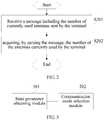
- the obtaining the current state parameter of the terminal in the embodiment includes the following steps: S201: Receive a message including the number of currently used antennas sent by the terminal.
- the message may be in the following format: Name Type (1 byte) Length Value (variable-length) PHY Scope
- Type is a newly added field, used for defining the number of antennas used by the terminal.
- the length of Type may be one byte, lower four bits represent the number of receiving antennas, and higher four bits represent the number of transmitting antennas.
- S202 acquiring, by parsing the message, the number of the antennas currently used by the terminal.
- the terminal may actively report the number of used antennas in a method of reporting according to a predetermined cycle or in a method of reporting when the number of the used antennas changes.
- the embodiment is not limited thereto, and no matter which method is adopted, the number of the antennas can be acquired accurately.
- the method of the embodiment is further divided into the following two implementation ways:
- the preceding three judging conditions that is, the number of the antennas being greater than 1, the modulation and demodulation method being 64QAM-CTC-5/6, and the bit error rate being less than the predetermined value, are not limited to any precedence order, and if any one of the three conditions is not met, the MIMO B mode is not selected as the mode for communication between the terminal and the base station.
- the method of the present invention may be implemented after or before the determination that the terminal may select the MIMO B mode.
- the number of the antennas is less than 1, it is not necessary to judge whether the other conditions are met.
- the method of the present invention is applicable to both the terminal and the base station.
- the terminal After the determination of selecting the MIMO B mode, the terminal further reports a result to the base station.
- the present invention further provides a communication mode selection device, and as shown in FIG. 3 , the device includes:
- the state parameter obtaining module includes:
- the communication mode selection device described by the embodiment is applicable to both a mobile communication terminal and a base station, and considers the number of the antennas currently used by the terminal as a necessary condition for selecting the MIMO B mode, which avoids service jittering caused by the terminal entering the MIMO B mode in the case of using a single antenna.
- the device is used for the mobile communication terminal, the result of the selection is reported to the corresponding base station.
- a reporting process is the same as the existing process of reporting information to the base station by the terminal, so the details are not repeated here.
- Each embodiment describes the present invention by using a progressive method. Each embodiment focuses on the difference from the other embodiments. For the same or similar parts among all the embodiments, reference may be made to the relevant parts.
Landscapes
- Engineering & Computer Science (AREA)
- Computer Networks & Wireless Communication (AREA)
- Signal Processing (AREA)
- Databases & Information Systems (AREA)
- Mobile Radio Communication Systems (AREA)
- Radio Transmission System (AREA)
Description
- The present invention relates to the field of communications, and in particular, to a communication mode selection method and device.
- In recent years, a multiple-input multiple-output (Multiple-Input Multiple-Out-put, MIMO) technique has emerged as a new technique in the field of wireless communications. The MIMO technique includes a spatial diversity technique and a spatial multiplexing technique, a communication mode using the spatial diversity technique is named as a MIMO A mode, and a communication mode using the spatial multiplexing technique is named as a MIMO B mode, in which the MIMO B mode truly embodies an essential advantage that the data capacity of the MIMO technique is high. General conditions of using the MIMO B mode are that a modulation and demodulation method of a terminal in a current working mode is 64QAM-CTC-5/6, that is, a highest uplink or downlink order method, and a bit error rate is within a range (less than 5%) or no bit error occurs under the highest order.
- When it is detected by a base station that a terminal meets the conditions of using the MIMO B mode, the terminal is switched to the MIMO B mode, and according to the working principle of the MIMO B mode, signals transmitted by different antennas of the base station include different information. However, if a single antenna is currently adopted to receive data, in this working mode, a receiving antenna can only receive part of the information and lose part of the information, resulting in that bit errors occur to all received data packets eventually. In this case, the base station switches the terminal back to the MIMO A mode according to a high bit error rate, and when it is detected by the terminal or the base station again that the terminal meets the conditions of switching to the MIMO B mode, the terminal is switched to the MIMO B working mode again, resulting in that bit errors occur to all data packets received by the terminal and the terminal is switched back to the MIMO A mode again. Such repeated switching may cause jittering of a communication service.
US2008/0159203 discloses providing for wireless communications mode switching based on spectral efficiency in a MIMO communications system. According to this document, if the spectral efficiency of the spatial multiplexing is greater than the spectral efficiency of the space time bloc coding, spatial multiplexing is selected. - Accordingly, the present invention provides a communication mode selection method and device, so as to solve the problem of jittering of a communication service caused by repeated switching of working modes while a multiple-input multiple-output technique is used.
- A communication mode selection method includes:
- obtaining a current state parameter of a terminal, the state parameter at least including the number of antennas currently used by the terminal; and
- selecting a mode corresponding to a spatial multiplexing technique as a mode for communication between the terminal and a corresponding base station when the state parameter meets a predetermined condition, the predetermined condition at least including that the number of the antennas is greater than 1.
- A communication mode selection device includes:
- a state parameter obtaining module, configured to obtain a current state parameter of a terminal; and
- a communication mode selection module, configured to select a mode corresponding to a spatial multiplexing technique as a mode for communication between the terminal and a corresponding base station when the state parameter meets a predetermined condition, the predetermined condition at least including that the number of antennas is greater than 1.
- The communication mode selection method and device provided by the embodiments consider the number of receiving or transmitting antennas currently used by the terminal as a necessary condition for determining whether the MIMO B mode is used for communication between the terminal and the base station; and entering the MIMO B mode is rejected if the number of the receiving antennas is 1, which prevents the terminal from entering the MIMO B mode in the case of using a single antenna, so that repeated switching between the MIMO A mode and the MIMO B mode may not occur, and therefore, the problem of service jittering caused by repeated switching is avoided.
- To illustrate the technical solutions in the embodiments of the present invention or in the prior art more clearly, the accompanying drawings needed for describing the embodiments or the prior art are introduced below briefly. Apparently, the accompanying drawings in the following descriptions merely show some of the embodiments of the present invention, and persons skilled in the art may obtain other drawings according to the accompanying drawings without creative efforts.
-
FIG. 1 is a flow chart of a communication mode selection method provided by an embodiment of the present invention; -
FIG. 2 is a flow chart of a method for obtaining a state parameter of a terminal in a communication mode selection method provided by an embodiment of the present invention; and -
FIG. 3 is a schematic structural diagram of a communication mode selection device provided by an embodiment of the present invention. - The present invention provides a communication mode selection method and device, which consider the number of antennas currently used by a terminal as one of conditions for selecting a communication mode between the terminal and a base station, and when the number of the antennas is greater than 1, it is possible for the terminal to select a mode corresponding to a spatial multiplexing technique for communication.
- The technical solutions of the embodiments of the present invention are hereinafter described clearly and completely with reference to the accompanying drawings in the embodiments of the present invention. Evidently, the described embodiments are some exemplary embodiments of the present invention, rather than all embodiments of the present invention. All other embodiments obtained by persons skilled in the art based on the embodiments of the present invention without creative effects shall fall within the protection scope of the present invention.
- A communication mode selection method is provided by the present invention, and as shown in
FIG. 1 , the method includes the following steps:
S101: Obtain a current state parameter of a terminal, the state parameter at least including the number of antennas currently used by the terminal. - The antennas currently used by the terminal may be receiving antennas, and may also be transmitting antennas.
- S102: Select a mode corresponding to a spatial multiplexing technique as a mode for communication between the terminal and a corresponding base station, when the state parameter meets a predetermined condition, the predetermined condition at least including that the number of the antennas is greater than 1.
- It should be noted that, for the base station, the receiving antennas and the transmitting antennas may be different, and the modes for uplink communication and downlink communication may also be different. When the receiving antennas are currently used by the terminal, it means that downlink communication is implemented between the terminal and the base station, and a mode corresponding to the spatial multiplexing technique is selected as a mode for communication between the terminal and the base station when the number of the receiving antennas is greater than 1. On the contrary, when the transmitting antennas are currently used, it means that uplink communication is implemented between the terminal and the base station, and a mode corresponding to the spatial multiplexing technique is selected as a mode for communication between the terminal and the base station when the number of the transmitting antennas is greater than 1.
- The communication mode selection method provided by the embodiment considers the number of the antennas currently used by the terminal as a necessary condition for selecting the communication mode between the terminal and the base station, and only when the number of the antennas is greater than 1, that is, not only one antenna is currently used, a MIMO B mode may be selected for communication. In other words, entering the MIMO B mode is rejected when the terminal currently uses a single antenna, which avoids service jittering caused by using a single antenna in the MIMO B mode, and enhances user experience of the MIMO technique.
- Further, as shown in
FIG. 2 , the obtaining the current state parameter of the terminal in the embodiment includes the following steps:
S201: Receive a message including the number of currently used antennas sent by the terminal. - The message may be in the following format:
Name Type (1 byte) Length Value (variable-length) PHY Scope - Type is a newly added field, used for defining the number of antennas used by the terminal. The length of Type may be one byte, lower four bits represent the number of receiving antennas, and higher four bits represent the number of transmitting antennas.
- S202: acquiring, by parsing the message, the number of the antennas currently used by the terminal.
- The terminal may actively report the number of used antennas in a method of reporting according to a predetermined cycle or in a method of reporting when the number of the used antennas changes. The embodiment is not limited thereto, and no matter which method is adopted, the number of the antennas can be acquired accurately.
- Further, according to different application scenarios, the method of the embodiment is further divided into the following two implementation ways:
- 1. On the basis of having determined that the MIMO B mode may be used by the terminal for communication, the method includes:
- obtaining the number of the antennas currently used by the terminal; and
- selecting a mode corresponding to the spatial multiplexing technique as a mode for communication between the terminal and the corresponding base station when the number of the antennas is greater than 1.
- 2. Consider the number of the antennas as one of judging conditions for selecting the MIMO B mode, and the method includes:
- obtaining the number of the antennas currently used by the terminal, a currently used modulation and demodulation method and a current bit error rate; and
- when the number of the antennas is greater than 1, the currently used modulation and demodulation method is a highest uplink or downlink order, i.e., 64QAM-CTC-5/6, and the bit error rate of the highest order is less than a predetermined value, selecting a mode corresponding to the spatial multiplexing technique as a mode for communication between the terminal and the corresponding base station.
- It should be noted that, the preceding three judging conditions, that is, the number of the antennas being greater than 1, the modulation and demodulation method being 64QAM-CTC-5/6, and the bit error rate being less than the predetermined value, are not limited to any precedence order, and if any one of the three conditions is not met, the MIMO B mode is not selected as the mode for communication between the terminal and the base station.
- It may be seen from the above two implementation ways that the method of the present invention may be implemented after or before the determination that the terminal may select the MIMO B mode. When it is determined that the number of the antennas is less than 1, it is not necessary to judge whether the other conditions are met.
- It should be noted that, the method of the present invention is applicable to both the terminal and the base station. When the method is used for the terminal, after the determination of selecting the MIMO B mode, the terminal further reports a result to the base station.
- In accordance to the preceding method, the present invention further provides a communication mode selection device, and as shown in
FIG. 3 , the device includes: - a state
parameter obtaining module 301, configured to obtain a current state parameter of a terminal; and - a communication
mode selection module 302, configured to select a mode corresponding to a spatial multiplexing technique as a mode for communication between the terminal and a corresponding base station when the state parameter meets a predetermined condition, the predetermined condition at least including that the number of the antennas is greater than 1. - Further, the state parameter obtaining module includes:
- a receiving unit, configured to receive a message including the number of the currently used antennas sent by the terminal; and
- a parsing unit, configured to parse the number of the antennas used by the terminal from the message.
- The communication mode selection device described by the embodiment is applicable to both a mobile communication terminal and a base station, and considers the number of the antennas currently used by the terminal as a necessary condition for selecting the MIMO B mode, which avoids service jittering caused by the terminal entering the MIMO B mode in the case of using a single antenna. When the device is used for the mobile communication terminal, the result of the selection is reported to the corresponding base station. A reporting process is the same as the existing process of reporting information to the base station by the terminal, so the details are not repeated here.
- Each embodiment describes the present invention by using a progressive method. Each embodiment focuses on the difference from the other embodiments. For the same or similar parts among all the embodiments, reference may be made to the relevant parts.
- The preceding description disclosed in the embodiments allows a person skilled in the art to implement or use the present invention. Multiple modifications to these embodiments are apparent for a person skilled in the art. The invention is defined by the claims.
Claims (10)
- A communication mode selection method, comprising:obtaining a current state parameter of a terminal, the state parameter at least comprising the number of antennas currently used by the terminal; andfrom a first mode corresponding to a spatial diversity technique and a second mode corresponding to a spatial multiplexing technique, switching to the second mode as a mode for communication between the terminal and a corresponding base station when the state parameter meets a predetermined condition, the predetermined condition at least comprising that the number of the antennas currently used by the terminal is greater than 1, so that entering the second mode is rejected if the number of receiving antennas is 1.
- The method according to claim 1, wherein the obtaining the current state parameter of the terminal comprises:receiving a message comprising the number of currently used antennas sent by the terminal; andacquiring, by parsing the message, the number of the antennas currently used by the terminal.
- The method according to claim 1, wherein the number of the antennas comprises:
the number of receiving antennas or the number of transmitting antennas. - The method according to claim 3, wherein when the number of the antennas is the number of the receiving antennas, the selecting a mode corresponding to a spatial multiplexing technique as a mode for communication between the terminal and a corresponding base station comprises:
selecting a mode corresponding to the spatial multiplexing technique as a mode for downlink communication between the terminal and the corresponding base station. - The method according to claim 3, wherein when the number of the antennas is the number of the transmitting antennas, the selecting a mode corresponding to a spatial multiplexing technique as a mode for communication between the terminal and a corresponding base station comprises:
selecting the spatial multiplexing technique as a mode for uplink communication between the terminal and the corresponding base station. - The method according to claim 1, wherein the state parameter further comprises:
a current modulation and demodulation method and a bit error rate of the terminal. - The method according to claim 6, wherein the predetermined condition further comprises that:
the current modulation and demodulation method of the terminal is a highest order method, and the bit error rate is less than a predetermined value. - A communication mode selection device, comprising:a state parameter obtaining module, configured to obtain a current state parameter of a terminal; anda communication mode selection module, configured to from a first mode corresponding to a spatial diversity technique and a second mode corresponding to a spatial multiplexing technique, switching to the second mode as a mode for communication between the terminal and a corresponding base station when the state parameter meets a predetermined condition, the predetermined condition at least comprising that the number of antennas currently used by the terminal is greater than 1, so that entering the second mode is rejected if the number of the antennas is 1.
- The device according to claim 8, wherein the state parameter obtaining module comprises:a receiving unit, configured to receive a message containing the number of currently used antennas sent by the terminal; anda parsing unit, configured to acquiring, by parsing the message, the number of the antennas currently used by the terminal.
- The device according to claim 8 or 9, wherein the device is applicable to a base station or a mobile communication terminal.
Applications Claiming Priority (1)
| Application Number | Priority Date | Filing Date | Title |
|---|---|---|---|
| CN2011104557186A CN103188768A (en) | 2011-12-30 | 2011-12-30 | Method and device of selection of communication mode |
Publications (3)
| Publication Number | Publication Date |
|---|---|
| EP2683091A1 EP2683091A1 (en) | 2014-01-08 |
| EP2683091B1 true EP2683091B1 (en) | 2018-08-22 |
| EP2683091B8 EP2683091B8 (en) | 2019-06-26 |
Family
ID=47257433
Family Applications (1)
| Application Number | Title | Priority Date | Filing Date |
|---|---|---|---|
| EP12186940.8A Not-in-force EP2683091B8 (en) | 2011-12-30 | 2012-10-02 | Communication mode selection method and device |
Country Status (5)
| Country | Link |
|---|---|
| US (1) | US20130170434A1 (en) |
| EP (1) | EP2683091B8 (en) |
| JP (1) | JP2013141208A (en) |
| CN (1) | CN103188768A (en) |
| WO (1) | WO2013097462A1 (en) |
Families Citing this family (1)
| Publication number | Priority date | Publication date | Assignee | Title |
|---|---|---|---|---|
| JP6755317B2 (en) * | 2015-09-29 | 2020-09-16 | 華為技術有限公司Huawei Technologies Co.,Ltd. | Methods and equipment for determining data transmission methods |
Family Cites Families (21)
| Publication number | Priority date | Publication date | Assignee | Title |
|---|---|---|---|---|
| US6937592B1 (en) * | 2000-09-01 | 2005-08-30 | Intel Corporation | Wireless communications system that supports multiple modes of operation |
| JP4166026B2 (en) * | 2002-03-22 | 2008-10-15 | 三洋電機株式会社 | Wireless device, space path control method, and space path control program |
| US8208364B2 (en) * | 2002-10-25 | 2012-06-26 | Qualcomm Incorporated | MIMO system with multiple spatial multiplexing modes |
| JP4536435B2 (en) * | 2003-06-30 | 2010-09-01 | パナソニック株式会社 | Transmission method and transmission apparatus |
| US8542763B2 (en) * | 2004-04-02 | 2013-09-24 | Rearden, Llc | Systems and methods to coordinate transmissions in distributed wireless systems via user clustering |
| US20050265225A1 (en) * | 2004-05-11 | 2005-12-01 | Orion Microelectronics Corporation | MIMO system and mode table |
| CN100461650C (en) * | 2004-06-01 | 2009-02-11 | 美国博通公司 | Asymmetric MIMO Wireless Communication |
| JP4884722B2 (en) * | 2005-03-31 | 2012-02-29 | 株式会社エヌ・ティ・ティ・ドコモ | Wireless communication apparatus and wireless communication method |
| US20090080547A1 (en) * | 2005-08-22 | 2009-03-26 | Matsushita Electric Industrial Co., Ltd. | Base station apparatus and mobile station apparatus |
| WO2007041845A1 (en) * | 2005-10-12 | 2007-04-19 | Nortel Networks Limited | Multi-user mimo systems and methods |
| US20080080635A1 (en) * | 2006-10-02 | 2008-04-03 | Nokia Corporation | Advanced feedback signaling for multi-antenna transmission systems |
| JP4734210B2 (en) * | 2006-10-04 | 2011-07-27 | 富士通株式会社 | Wireless communication method |
| CN101174924A (en) * | 2006-11-01 | 2008-05-07 | 大唐移动通信设备有限公司 | Method and system for measuring space channel order |
| US7894382B2 (en) * | 2006-12-29 | 2011-02-22 | Intel Corporation | Wireless communications mode switching apparatus and methods |
| KR101352042B1 (en) * | 2007-10-15 | 2014-01-15 | 삼성전자주식회사 | Apparatus and method for calculation channel information for multiple user mode in multiple inpute multiple output wireless communication system |
| CN101577610B (en) * | 2008-05-09 | 2012-06-27 | 上海贝尔阿尔卡特股份有限公司 | Method and device for selecting antenna polarization and coding mode in wireless communication systems |
| KR101001015B1 (en) * | 2008-09-25 | 2010-12-14 | 한국전자통신연구원 | Multi-antenna wireless communication system adaptively determines downlink transmission mode |
| EP2338240B1 (en) * | 2008-11-04 | 2017-01-11 | Huawei Technologies Co., Ltd. | Method in a wireless communication system |
| US8396157B2 (en) * | 2009-05-14 | 2013-03-12 | Futurewei Technologies, Inc. | Probability based MIMO mode selection and switching system and method for wireless systems |
| CN101931505B (en) * | 2009-06-18 | 2013-08-07 | 中兴通讯股份有限公司 | Switching method for downlink multi-input multi-output modes and base station equipment |
| CN102237911B (en) * | 2010-04-28 | 2015-09-16 | 中兴通讯股份有限公司 | The system of selection of antenna data sending mode and device |
-
2011
- 2011-12-30 CN CN2011104557186A patent/CN103188768A/en active Pending
-
2012
- 2012-08-07 WO PCT/CN2012/079771 patent/WO2013097462A1/en not_active Ceased
- 2012-10-02 EP EP12186940.8A patent/EP2683091B8/en not_active Not-in-force
- 2012-10-24 JP JP2012234853A patent/JP2013141208A/en active Pending
- 2012-10-29 US US13/663,199 patent/US20130170434A1/en not_active Abandoned
Non-Patent Citations (1)
| Title |
|---|
| None * |
Also Published As
| Publication number | Publication date |
|---|---|
| WO2013097462A1 (en) | 2013-07-04 |
| EP2683091A1 (en) | 2014-01-08 |
| EP2683091B8 (en) | 2019-06-26 |
| JP2013141208A (en) | 2013-07-18 |
| US20130170434A1 (en) | 2013-07-04 |
| CN103188768A (en) | 2013-07-03 |
Similar Documents
| Publication | Publication Date | Title |
|---|---|---|
| EP3606242B1 (en) | Data transmission method and apparatus | |
| US11711133B2 (en) | Electronic device, wireless communication method and computer readable storage medium related to transmission configuration indication (TCI) state | |
| US20220200668A1 (en) | Communications method and device | |
| EP3042520B1 (en) | A method for the measurement and reporting of channel quality, modulation and channel coding information, and corresponding apparatus | |
| EP2847884B1 (en) | Scheduling a user equipment in a communication system | |
| EP2817907B1 (en) | Controlling a modulation and coding scheme for a transmission between a base station and a user equipment | |
| EP2858443A1 (en) | Data transmission method, base station, and user equipment | |
| EP2830345A1 (en) | Data transmission method, base station, and user equipment | |
| CA2436646C (en) | A method of controlling a communications link | |
| EP2810508B1 (en) | Time multiplexed channel state information reporting in a multi antenna wireless communication system | |
| EP2947935A1 (en) | Method for transmitting channel state information reference signal, base station, terminal, system, machine-readable program, and storage medium for storing machine-readable program | |
| RU2621002C2 (en) | Coding the receiving approves of hybrid automatic repeat request in wireless communication with multiple antennas | |
| AU2018214495B2 (en) | Communication method, network device and terminal | |
| US9515805B2 (en) | Channel quality reporting in a communications system | |
| KR20150009538A (en) | Csi definitions and feedback modes for coordinated multi-point transmission | |
| CN113726492A (en) | Terminal, network device and communication method | |
| US20140307660A1 (en) | Method for device-to-device communication, terminal for device-to-device communication and base station | |
| JP2011503937A (en) | Information communication method | |
| EP3041284A1 (en) | Data transmission method, base station and user equipment | |
| US20120177092A1 (en) | Apparatuses and Methods for Coordinated Multipoint Transmission Using Compressed Feedback Information | |
| US9929819B2 (en) | Opportunistic comp with low rate low latency feedback | |
| WO2021063393A1 (en) | Transmission configuration indication (tci) list update and tci switch for channel state information (csi) reporting | |
| US20140233513A1 (en) | Precoding Control Indication Feedback Method, User Equipment, and Base Station | |
| CN116349370B (en) | Method for channel state information, user equipment and base station | |
| CN102170328A (en) | CoMP terminal capable of supporting double system and feedback method |
Legal Events
| Date | Code | Title | Description |
|---|---|---|---|
| PUAI | Public reference made under article 153(3) epc to a published international application that has entered the european phase |
Free format text: ORIGINAL CODE: 0009012 |
|
| AK | Designated contracting states |
Kind code of ref document: A1 Designated state(s): AL AT BE BG CH CY CZ DE DK EE ES FI FR GB GR HR HU IE IS IT LI LT LU LV MC MK MT NL NO PL PT RO RS SE SI SK SM TR |
|
| AX | Request for extension of the european patent |
Extension state: BA ME |
|
| 17P | Request for examination filed |
Effective date: 20140324 |
|
| RBV | Designated contracting states (corrected) |
Designated state(s): AL AT BE BG CH CY CZ DE DK EE ES FI FR GB GR HR HU IE IS IT LI LT LU LV MC MK MT NL NO PL PT RO RS SE SI SK SM TR |
|
| RIC1 | Information provided on ipc code assigned before grant |
Ipc: H04B 7/04 20170101AFI20180125BHEP Ipc: H04W 8/22 20090101ALI20180125BHEP Ipc: H04B 7/06 20060101ALI20180125BHEP Ipc: H04B 7/0417 20170101ALI20180125BHEP Ipc: H04B 7/08 20060101ALI20180125BHEP |
|
| GRAP | Despatch of communication of intention to grant a patent |
Free format text: ORIGINAL CODE: EPIDOSNIGR1 |
|
| STAA | Information on the status of an ep patent application or granted ep patent |
Free format text: STATUS: GRANT OF PATENT IS INTENDED |
|
| INTG | Intention to grant announced |
Effective date: 20180302 |
|
| GRAS | Grant fee paid |
Free format text: ORIGINAL CODE: EPIDOSNIGR3 |
|
| GRAA | (expected) grant |
Free format text: ORIGINAL CODE: 0009210 |
|
| STAA | Information on the status of an ep patent application or granted ep patent |
Free format text: STATUS: THE PATENT HAS BEEN GRANTED |
|
| AK | Designated contracting states |
Kind code of ref document: B1 Designated state(s): AL AT BE BG CH CY CZ DE DK EE ES FI FR GB GR HR HU IE IS IT LI LT LU LV MC MK MT NL NO PL PT RO RS SE SI SK SM TR |
|
| REG | Reference to a national code |
Ref country code: GB Ref legal event code: FG4D |
|
| REG | Reference to a national code |
Ref country code: CH Ref legal event code: EP |
|
| REG | Reference to a national code |
Ref country code: FR Ref legal event code: PLFP Year of fee payment: 7 |
|
| REG | Reference to a national code |
Ref country code: AT Ref legal event code: REF Ref document number: 1033676 Country of ref document: AT Kind code of ref document: T Effective date: 20180915 |
|
| REG | Reference to a national code |
Ref country code: IE Ref legal event code: FG4D |
|
| REG | Reference to a national code |
Ref country code: DE Ref legal event code: R096 Ref document number: 602012050017 Country of ref document: DE |
|
| REG | Reference to a national code |
Ref country code: NL Ref legal event code: MP Effective date: 20180822 |
|
| REG | Reference to a national code |
Ref country code: LT Ref legal event code: MG4D |
|
| PG25 | Lapsed in a contracting state [announced via postgrant information from national office to epo] |
Ref country code: NO Free format text: LAPSE BECAUSE OF FAILURE TO SUBMIT A TRANSLATION OF THE DESCRIPTION OR TO PAY THE FEE WITHIN THE PRESCRIBED TIME-LIMIT Effective date: 20181122 Ref country code: GR Free format text: LAPSE BECAUSE OF FAILURE TO SUBMIT A TRANSLATION OF THE DESCRIPTION OR TO PAY THE FEE WITHIN THE PRESCRIBED TIME-LIMIT Effective date: 20181123 Ref country code: IS Free format text: LAPSE BECAUSE OF FAILURE TO SUBMIT A TRANSLATION OF THE DESCRIPTION OR TO PAY THE FEE WITHIN THE PRESCRIBED TIME-LIMIT Effective date: 20181222 Ref country code: LT Free format text: LAPSE BECAUSE OF FAILURE TO SUBMIT A TRANSLATION OF THE DESCRIPTION OR TO PAY THE FEE WITHIN THE PRESCRIBED TIME-LIMIT Effective date: 20180822 Ref country code: RS Free format text: LAPSE BECAUSE OF FAILURE TO SUBMIT A TRANSLATION OF THE DESCRIPTION OR TO PAY THE FEE WITHIN THE PRESCRIBED TIME-LIMIT Effective date: 20180822 Ref country code: FI Free format text: LAPSE BECAUSE OF FAILURE TO SUBMIT A TRANSLATION OF THE DESCRIPTION OR TO PAY THE FEE WITHIN THE PRESCRIBED TIME-LIMIT Effective date: 20180822 Ref country code: SE Free format text: LAPSE BECAUSE OF FAILURE TO SUBMIT A TRANSLATION OF THE DESCRIPTION OR TO PAY THE FEE WITHIN THE PRESCRIBED TIME-LIMIT Effective date: 20180822 Ref country code: NL Free format text: LAPSE BECAUSE OF FAILURE TO SUBMIT A TRANSLATION OF THE DESCRIPTION OR TO PAY THE FEE WITHIN THE PRESCRIBED TIME-LIMIT Effective date: 20180822 Ref country code: BG Free format text: LAPSE BECAUSE OF FAILURE TO SUBMIT A TRANSLATION OF THE DESCRIPTION OR TO PAY THE FEE WITHIN THE PRESCRIBED TIME-LIMIT Effective date: 20181122 |
|
| REG | Reference to a national code |
Ref country code: CH Ref legal event code: PK Free format text: BERICHTIGUNGEN |
|
| REG | Reference to a national code |
Ref country code: DE Ref legal event code: R081 Ref document number: 602012050017 Country of ref document: DE Owner name: HUAWEI DEVICE CO., LTD., DONGGUAN, CN Free format text: FORMER OWNER: HUAWEI DEVICE CO., LTD., SHENZHEN, GUANGDONG, CN Ref country code: DE Ref legal event code: R081 Ref document number: 602012050017 Country of ref document: DE Owner name: HUAWEI DEVICE (SHENZHEN) CO., LTD., SHENZHEN, CN Free format text: FORMER OWNER: HUAWEI DEVICE CO., LTD., SHENZHEN, GUANGDONG, CN |
|
| RIC2 | Information provided on ipc code assigned after grant |
Ipc: H04B 7/08 20060101ALI20180125BHEP Ipc: H04B 7/04 20170101AFI20180125BHEP Ipc: H04W 8/22 20090101ALI20180125BHEP Ipc: H04B 7/0417 20170101ALI20180125BHEP Ipc: H04B 7/06 20060101ALI20180125BHEP |
|
| REG | Reference to a national code |
Ref country code: AT Ref legal event code: MK05 Ref document number: 1033676 Country of ref document: AT Kind code of ref document: T Effective date: 20180822 |
|
| REG | Reference to a national code |
Ref country code: GB Ref legal event code: 732E Free format text: REGISTERED BETWEEN 20190124 AND 20190130 |
|
| PG25 | Lapsed in a contracting state [announced via postgrant information from national office to epo] |
Ref country code: LV Free format text: LAPSE BECAUSE OF FAILURE TO SUBMIT A TRANSLATION OF THE DESCRIPTION OR TO PAY THE FEE WITHIN THE PRESCRIBED TIME-LIMIT Effective date: 20180822 Ref country code: AL Free format text: LAPSE BECAUSE OF FAILURE TO SUBMIT A TRANSLATION OF THE DESCRIPTION OR TO PAY THE FEE WITHIN THE PRESCRIBED TIME-LIMIT Effective date: 20180822 Ref country code: HR Free format text: LAPSE BECAUSE OF FAILURE TO SUBMIT A TRANSLATION OF THE DESCRIPTION OR TO PAY THE FEE WITHIN THE PRESCRIBED TIME-LIMIT Effective date: 20180822 |
|
| PG25 | Lapsed in a contracting state [announced via postgrant information from national office to epo] |
Ref country code: ES Free format text: LAPSE BECAUSE OF FAILURE TO SUBMIT A TRANSLATION OF THE DESCRIPTION OR TO PAY THE FEE WITHIN THE PRESCRIBED TIME-LIMIT Effective date: 20180822 Ref country code: PL Free format text: LAPSE BECAUSE OF FAILURE TO SUBMIT A TRANSLATION OF THE DESCRIPTION OR TO PAY THE FEE WITHIN THE PRESCRIBED TIME-LIMIT Effective date: 20180822 Ref country code: CZ Free format text: LAPSE BECAUSE OF FAILURE TO SUBMIT A TRANSLATION OF THE DESCRIPTION OR TO PAY THE FEE WITHIN THE PRESCRIBED TIME-LIMIT Effective date: 20180822 Ref country code: RO Free format text: LAPSE BECAUSE OF FAILURE TO SUBMIT A TRANSLATION OF THE DESCRIPTION OR TO PAY THE FEE WITHIN THE PRESCRIBED TIME-LIMIT Effective date: 20180822 Ref country code: EE Free format text: LAPSE BECAUSE OF FAILURE TO SUBMIT A TRANSLATION OF THE DESCRIPTION OR TO PAY THE FEE WITHIN THE PRESCRIBED TIME-LIMIT Effective date: 20180822 Ref country code: IT Free format text: LAPSE BECAUSE OF FAILURE TO SUBMIT A TRANSLATION OF THE DESCRIPTION OR TO PAY THE FEE WITHIN THE PRESCRIBED TIME-LIMIT Effective date: 20180822 Ref country code: AT Free format text: LAPSE BECAUSE OF FAILURE TO SUBMIT A TRANSLATION OF THE DESCRIPTION OR TO PAY THE FEE WITHIN THE PRESCRIBED TIME-LIMIT Effective date: 20180822 |
|
| REG | Reference to a national code |
Ref country code: DE Ref legal event code: R097 Ref document number: 602012050017 Country of ref document: DE |
|
| PG25 | Lapsed in a contracting state [announced via postgrant information from national office to epo] |
Ref country code: SK Free format text: LAPSE BECAUSE OF FAILURE TO SUBMIT A TRANSLATION OF THE DESCRIPTION OR TO PAY THE FEE WITHIN THE PRESCRIBED TIME-LIMIT Effective date: 20180822 Ref country code: DK Free format text: LAPSE BECAUSE OF FAILURE TO SUBMIT A TRANSLATION OF THE DESCRIPTION OR TO PAY THE FEE WITHIN THE PRESCRIBED TIME-LIMIT Effective date: 20180822 Ref country code: SM Free format text: LAPSE BECAUSE OF FAILURE TO SUBMIT A TRANSLATION OF THE DESCRIPTION OR TO PAY THE FEE WITHIN THE PRESCRIBED TIME-LIMIT Effective date: 20180822 |
|
| REG | Reference to a national code |
Ref country code: CH Ref legal event code: PL |
|
| RAP2 | Party data changed (patent owner data changed or rights of a patent transferred) |
Owner name: HUAWEI DEVICE (SHENZHEN) CO., LTD. |
|
| REG | Reference to a national code |
Ref country code: BE Ref legal event code: MM Effective date: 20181031 |
|
| PG25 | Lapsed in a contracting state [announced via postgrant information from national office to epo] |
Ref country code: MC Free format text: LAPSE BECAUSE OF FAILURE TO SUBMIT A TRANSLATION OF THE DESCRIPTION OR TO PAY THE FEE WITHIN THE PRESCRIBED TIME-LIMIT Effective date: 20180822 Ref country code: LU Free format text: LAPSE BECAUSE OF NON-PAYMENT OF DUE FEES Effective date: 20181002 |
|
| PLBE | No opposition filed within time limit |
Free format text: ORIGINAL CODE: 0009261 |
|
| STAA | Information on the status of an ep patent application or granted ep patent |
Free format text: STATUS: NO OPPOSITION FILED WITHIN TIME LIMIT |
|
| REG | Reference to a national code |
Ref country code: IE Ref legal event code: MM4A |
|
| 26N | No opposition filed |
Effective date: 20190523 |
|
| PG25 | Lapsed in a contracting state [announced via postgrant information from national office to epo] |
Ref country code: LI Free format text: LAPSE BECAUSE OF NON-PAYMENT OF DUE FEES Effective date: 20181031 Ref country code: SI Free format text: LAPSE BECAUSE OF FAILURE TO SUBMIT A TRANSLATION OF THE DESCRIPTION OR TO PAY THE FEE WITHIN THE PRESCRIBED TIME-LIMIT Effective date: 20180822 Ref country code: CH Free format text: LAPSE BECAUSE OF NON-PAYMENT OF DUE FEES Effective date: 20181031 Ref country code: BE Free format text: LAPSE BECAUSE OF NON-PAYMENT OF DUE FEES Effective date: 20181031 |
|
| PG25 | Lapsed in a contracting state [announced via postgrant information from national office to epo] |
Ref country code: IE Free format text: LAPSE BECAUSE OF NON-PAYMENT OF DUE FEES Effective date: 20181002 |
|
| PG25 | Lapsed in a contracting state [announced via postgrant information from national office to epo] |
Ref country code: MT Free format text: LAPSE BECAUSE OF NON-PAYMENT OF DUE FEES Effective date: 20181002 |
|
| PG25 | Lapsed in a contracting state [announced via postgrant information from national office to epo] |
Ref country code: TR Free format text: LAPSE BECAUSE OF FAILURE TO SUBMIT A TRANSLATION OF THE DESCRIPTION OR TO PAY THE FEE WITHIN THE PRESCRIBED TIME-LIMIT Effective date: 20180822 |
|
| PG25 | Lapsed in a contracting state [announced via postgrant information from national office to epo] |
Ref country code: PT Free format text: LAPSE BECAUSE OF FAILURE TO SUBMIT A TRANSLATION OF THE DESCRIPTION OR TO PAY THE FEE WITHIN THE PRESCRIBED TIME-LIMIT Effective date: 20180822 |
|
| PG25 | Lapsed in a contracting state [announced via postgrant information from national office to epo] |
Ref country code: MK Free format text: LAPSE BECAUSE OF NON-PAYMENT OF DUE FEES Effective date: 20180822 Ref country code: CY Free format text: LAPSE BECAUSE OF FAILURE TO SUBMIT A TRANSLATION OF THE DESCRIPTION OR TO PAY THE FEE WITHIN THE PRESCRIBED TIME-LIMIT Effective date: 20180822 Ref country code: HU Free format text: LAPSE BECAUSE OF FAILURE TO SUBMIT A TRANSLATION OF THE DESCRIPTION OR TO PAY THE FEE WITHIN THE PRESCRIBED TIME-LIMIT; INVALID AB INITIO Effective date: 20121002 |
|
| PGFP | Annual fee paid to national office [announced via postgrant information from national office to epo] |
Ref country code: GB Payment date: 20220901 Year of fee payment: 11 |
|
| PGFP | Annual fee paid to national office [announced via postgrant information from national office to epo] |
Ref country code: FR Payment date: 20220908 Year of fee payment: 11 |
|
| PGFP | Annual fee paid to national office [announced via postgrant information from national office to epo] |
Ref country code: DE Payment date: 20220621 Year of fee payment: 11 |
|
| REG | Reference to a national code |
Ref country code: DE Ref legal event code: R119 Ref document number: 602012050017 Country of ref document: DE |
|
| GBPC | Gb: european patent ceased through non-payment of renewal fee |
Effective date: 20231002 |
|
| PG25 | Lapsed in a contracting state [announced via postgrant information from national office to epo] |
Ref country code: GB Free format text: LAPSE BECAUSE OF NON-PAYMENT OF DUE FEES Effective date: 20231002 |
|
| PG25 | Lapsed in a contracting state [announced via postgrant information from national office to epo] |
Ref country code: GB Free format text: LAPSE BECAUSE OF NON-PAYMENT OF DUE FEES Effective date: 20231002 Ref country code: FR Free format text: LAPSE BECAUSE OF NON-PAYMENT OF DUE FEES Effective date: 20231031 Ref country code: DE Free format text: LAPSE BECAUSE OF NON-PAYMENT OF DUE FEES Effective date: 20240501 |