EP2682396A1 - High stability diionic liquid salts - Google Patents
High stability diionic liquid salts Download PDFInfo
- Publication number
- EP2682396A1 EP2682396A1 EP13180460.1A EP13180460A EP2682396A1 EP 2682396 A1 EP2682396 A1 EP 2682396A1 EP 13180460 A EP13180460 A EP 13180460A EP 2682396 A1 EP2682396 A1 EP 2682396A1
- Authority
- EP
- European Patent Office
- Prior art keywords
- dicationic
- group
- liquid
- diionic
- salt
- Prior art date
- Legal status (The legal status is an assumption and is not a legal conclusion. Google has not performed a legal analysis and makes no representation as to the accuracy of the status listed.)
- Withdrawn
Links
- 239000007788 liquid Substances 0.000 title claims abstract description 306
- 150000003839 salts Chemical class 0.000 title claims abstract description 248
- 239000000203 mixture Substances 0.000 claims abstract description 63
- 150000001450 anions Chemical class 0.000 claims abstract description 62
- 239000000126 substance Substances 0.000 claims abstract description 29
- XYFCBTPGUUZFHI-UHFFFAOYSA-O phosphonium Chemical group [PH4+] XYFCBTPGUUZFHI-UHFFFAOYSA-O 0.000 claims abstract description 23
- 239000002904 solvent Substances 0.000 claims abstract description 20
- 238000004458 analytical method Methods 0.000 claims abstract description 14
- RAXXELZNTBOGNW-UHFFFAOYSA-O Imidazolium Chemical compound C1=C[NH+]=CN1 RAXXELZNTBOGNW-UHFFFAOYSA-O 0.000 claims abstract description 12
- 238000002330 electrospray ionisation mass spectrometry Methods 0.000 claims abstract description 9
- 125000000217 alkyl group Chemical group 0.000 claims description 93
- 239000007787 solid Substances 0.000 claims description 82
- 238000000034 method Methods 0.000 claims description 62
- 125000003545 alkoxy group Chemical group 0.000 claims description 45
- 125000003118 aryl group Chemical group 0.000 claims description 45
- 229910052739 hydrogen Inorganic materials 0.000 claims description 44
- 239000001257 hydrogen Substances 0.000 claims description 44
- 238000000926 separation method Methods 0.000 claims description 43
- 125000001424 substituent group Chemical group 0.000 claims description 36
- ZXMGHDIOOHOAAE-UHFFFAOYSA-N 1,1,1-trifluoro-n-(trifluoromethylsulfonyl)methanesulfonamide Chemical compound FC(F)(F)S(=O)(=O)NS(=O)(=O)C(F)(F)F ZXMGHDIOOHOAAE-UHFFFAOYSA-N 0.000 claims description 28
- 125000004452 carbocyclyl group Chemical group 0.000 claims description 26
- 125000002947 alkylene group Chemical group 0.000 claims description 24
- 238000004132 cross linking Methods 0.000 claims description 24
- 125000002768 hydroxyalkyl group Chemical group 0.000 claims description 24
- 229910052757 nitrogen Inorganic materials 0.000 claims description 20
- 229910052760 oxygen Inorganic materials 0.000 claims description 20
- 125000003710 aryl alkyl group Chemical group 0.000 claims description 19
- 125000000753 cycloalkyl group Chemical group 0.000 claims description 19
- 125000005842 heteroatom Chemical group 0.000 claims description 19
- 125000004450 alkenylene group Chemical group 0.000 claims description 18
- 125000004419 alkynylene group Chemical group 0.000 claims description 18
- 125000001316 cycloalkyl alkyl group Chemical group 0.000 claims description 18
- 125000000623 heterocyclic group Chemical group 0.000 claims description 18
- 125000002887 hydroxy group Chemical group [H]O* 0.000 claims description 18
- 229910052710 silicon Inorganic materials 0.000 claims description 18
- 229910052717 sulfur Inorganic materials 0.000 claims description 17
- 125000003342 alkenyl group Chemical group 0.000 claims description 16
- 125000000304 alkynyl group Chemical group 0.000 claims description 16
- 125000001931 aliphatic group Chemical group 0.000 claims description 12
- 125000006832 (C1-C10) alkylene group Chemical group 0.000 claims description 10
- 229920006395 saturated elastomer Polymers 0.000 claims description 10
- 125000004435 hydrogen atom Chemical class [H]* 0.000 claims description 8
- 239000012634 fragment Substances 0.000 claims description 7
- 125000005843 halogen group Chemical group 0.000 claims description 6
- 125000005496 phosphonium group Chemical class 0.000 claims description 6
- 125000004448 alkyl carbonyl group Chemical group 0.000 claims description 5
- ORTFAQDWJHRMNX-UHFFFAOYSA-N hydroxidooxidocarbon(.) Chemical group O[C]=O ORTFAQDWJHRMNX-UHFFFAOYSA-N 0.000 claims description 5
- 125000002924 primary amino group Chemical group [H]N([H])* 0.000 claims description 5
- RAXXELZNTBOGNW-UHFFFAOYSA-N 1H-imidazole Chemical class C1=CNC=N1 RAXXELZNTBOGNW-UHFFFAOYSA-N 0.000 claims description 4
- 150000004673 fluoride salts Chemical group 0.000 claims description 3
- 230000003111 delayed effect Effects 0.000 claims description 2
- 238000010828 elution Methods 0.000 claims description 2
- 230000005526 G1 to G0 transition Effects 0.000 abstract description 100
- 238000001514 detection method Methods 0.000 abstract description 10
- 239000002608 ionic liquid Substances 0.000 description 240
- 241000894007 species Species 0.000 description 132
- -1 hexafluorophosphate Chemical compound 0.000 description 81
- BKIMMITUMNQMOS-UHFFFAOYSA-N nonane Chemical compound CCCCCCCCC BKIMMITUMNQMOS-UHFFFAOYSA-N 0.000 description 55
- XLYOFNOQVPJJNP-UHFFFAOYSA-N water Substances O XLYOFNOQVPJJNP-UHFFFAOYSA-N 0.000 description 52
- XEKOWRVHYACXOJ-UHFFFAOYSA-N Ethyl acetate Chemical compound CCOC(C)=O XEKOWRVHYACXOJ-UHFFFAOYSA-N 0.000 description 48
- KFZMGEQAYNKOFK-UHFFFAOYSA-N Isopropanol Chemical compound CC(C)O KFZMGEQAYNKOFK-UHFFFAOYSA-N 0.000 description 45
- 150000001875 compounds Chemical class 0.000 description 44
- 238000002844 melting Methods 0.000 description 43
- 230000008018 melting Effects 0.000 description 43
- OZAIFHULBGXAKX-UHFFFAOYSA-N 2-(2-cyanopropan-2-yldiazenyl)-2-methylpropanenitrile Chemical compound N#CC(C)(C)N=NC(C)(C)C#N OZAIFHULBGXAKX-UHFFFAOYSA-N 0.000 description 37
- 239000000463 material Substances 0.000 description 35
- DLYUQMMRRRQYAE-UHFFFAOYSA-N tetraphosphorus decaoxide Chemical compound O1P(O2)(=O)OP3(=O)OP1(=O)OP2(=O)O3 DLYUQMMRRRQYAE-UHFFFAOYSA-N 0.000 description 35
- MCTWTZJPVLRJOU-UHFFFAOYSA-O 1-methylimidazole Chemical compound CN1C=C[NH+]=C1 MCTWTZJPVLRJOU-UHFFFAOYSA-O 0.000 description 33
- OZAIFHULBGXAKX-VAWYXSNFSA-N AIBN Substances N#CC(C)(C)\N=N\C(C)(C)C#N OZAIFHULBGXAKX-VAWYXSNFSA-N 0.000 description 33
- 150000002500 ions Chemical class 0.000 description 32
- 239000000523 sample Substances 0.000 description 32
- 230000003993 interaction Effects 0.000 description 31
- CEIPQQODRKXDSB-UHFFFAOYSA-N ethyl 3-(6-hydroxynaphthalen-2-yl)-1H-indazole-5-carboximidate dihydrochloride Chemical compound Cl.Cl.C1=C(O)C=CC2=CC(C3=NNC4=CC=C(C=C43)C(=N)OCC)=CC=C21 CEIPQQODRKXDSB-UHFFFAOYSA-N 0.000 description 29
- 125000001997 phenyl group Chemical group [H]C1=C([H])C([H])=C(*)C([H])=C1[H] 0.000 description 29
- 230000009466 transformation Effects 0.000 description 29
- QGZKDVFQNNGYKY-UHFFFAOYSA-O Ammonium Chemical compound [NH4+] QGZKDVFQNNGYKY-UHFFFAOYSA-O 0.000 description 28
- SNRUBQQJIBEYMU-UHFFFAOYSA-N dodecane Chemical compound CCCCCCCCCCCC SNRUBQQJIBEYMU-UHFFFAOYSA-N 0.000 description 28
- 150000004693 imidazolium salts Chemical group 0.000 description 28
- 239000000178 monomer Substances 0.000 description 28
- ATUOYWHBWRKTHZ-UHFFFAOYSA-N Propane Chemical compound CCC ATUOYWHBWRKTHZ-UHFFFAOYSA-N 0.000 description 26
- 150000001768 cations Chemical class 0.000 description 26
- UFWIBTONFRDIAS-UHFFFAOYSA-N Naphthalene Chemical compound C1=CC=CC2=CC=CC=C21 UFWIBTONFRDIAS-UHFFFAOYSA-N 0.000 description 22
- 230000015572 biosynthetic process Effects 0.000 description 22
- 238000000576 coating method Methods 0.000 description 22
- 125000002496 methyl group Chemical group [H]C([H])([H])* 0.000 description 22
- 238000003786 synthesis reaction Methods 0.000 description 22
- 230000007423 decrease Effects 0.000 description 21
- VLKZOEOYAKHREP-UHFFFAOYSA-N n-Hexane Chemical compound CCCCCC VLKZOEOYAKHREP-UHFFFAOYSA-N 0.000 description 21
- 239000000243 solution Substances 0.000 description 21
- 125000000484 butyl group Chemical group [H]C([*])([H])C([H])([H])C([H])([H])C([H])([H])[H] 0.000 description 20
- 238000002470 solid-phase micro-extraction Methods 0.000 description 20
- 238000007614 solvation Methods 0.000 description 20
- 239000004971 Cross linker Substances 0.000 description 19
- 150000003842 bromide salts Chemical class 0.000 description 19
- 150000002431 hydrogen Chemical class 0.000 description 19
- YMWUJEATGCHHMB-UHFFFAOYSA-N Dichloromethane Chemical compound ClCCl YMWUJEATGCHHMB-UHFFFAOYSA-N 0.000 description 18
- 238000006243 chemical reaction Methods 0.000 description 18
- 239000011248 coating agent Substances 0.000 description 18
- 230000000694 effects Effects 0.000 description 18
- 239000000835 fiber Substances 0.000 description 18
- 239000012071 phase Substances 0.000 description 18
- VYPSYNLAJGMNEJ-UHFFFAOYSA-N Silicium dioxide Chemical compound O=[Si]=O VYPSYNLAJGMNEJ-UHFFFAOYSA-N 0.000 description 17
- 230000003750 conditioning effect Effects 0.000 description 17
- 125000001436 propyl group Chemical group [H]C([*])([H])C([H])([H])C([H])([H])[H] 0.000 description 17
- 125000000472 sulfonyl group Chemical group *S(*)(=O)=O 0.000 description 17
- SQGYOTSLMSWVJD-UHFFFAOYSA-N silver(1+) nitrate Chemical compound [Ag+].[O-]N(=O)=O SQGYOTSLMSWVJD-UHFFFAOYSA-N 0.000 description 16
- 230000014759 maintenance of location Effects 0.000 description 15
- 229920001223 polyethylene glycol Polymers 0.000 description 15
- VUEDNLCYHKSELL-UHFFFAOYSA-N arsonium Chemical compound [AsH4+] VUEDNLCYHKSELL-UHFFFAOYSA-N 0.000 description 14
- 125000002091 cationic group Chemical group 0.000 description 14
- 239000003999 initiator Substances 0.000 description 14
- 102100032467 Transmembrane protease serine 13 Human genes 0.000 description 13
- 125000000129 anionic group Chemical group 0.000 description 13
- 125000004122 cyclic group Chemical group 0.000 description 13
- 238000004949 mass spectrometry Methods 0.000 description 13
- 239000011159 matrix material Substances 0.000 description 13
- 239000001294 propane Substances 0.000 description 13
- CSCPPACGZOOCGX-UHFFFAOYSA-N Acetone Chemical compound CC(C)=O CSCPPACGZOOCGX-UHFFFAOYSA-N 0.000 description 12
- XPDWGBQVDMORPB-UHFFFAOYSA-N Fluoroform Chemical compound FC(F)F XPDWGBQVDMORPB-UHFFFAOYSA-N 0.000 description 12
- 125000004429 atom Chemical group 0.000 description 12
- 125000001246 bromo group Chemical group Br* 0.000 description 12
- 229920001577 copolymer Polymers 0.000 description 12
- 125000003010 ionic group Chemical group 0.000 description 12
- 125000005647 linker group Chemical group 0.000 description 12
- 238000003756 stirring Methods 0.000 description 12
- 239000010408 film Substances 0.000 description 11
- 125000001453 quaternary ammonium group Chemical group 0.000 description 11
- GIWQSPITLQVMSG-UHFFFAOYSA-N 1,2-dimethylimidazole Chemical compound CC1=NC=CN1C GIWQSPITLQVMSG-UHFFFAOYSA-N 0.000 description 10
- WGAXVZXBFBHLMC-UHFFFAOYSA-N 1,9-dibromononane Chemical compound BrCCCCCCCCCBr WGAXVZXBFBHLMC-UHFFFAOYSA-N 0.000 description 10
- KKKDZZRICRFGSD-UHFFFAOYSA-N 1-benzylimidazole Chemical compound C1=CN=CN1CC1=CC=CC=C1 KKKDZZRICRFGSD-UHFFFAOYSA-N 0.000 description 10
- AVFZOVWCLRSYKC-UHFFFAOYSA-N 1-methylpyrrolidine Chemical compound CN1CCCC1 AVFZOVWCLRSYKC-UHFFFAOYSA-N 0.000 description 10
- 0 CC1C(CC2)C2C*1 Chemical compound CC1C(CC2)C2C*1 0.000 description 10
- RWRDLPDLKQPQOW-UHFFFAOYSA-O Pyrrolidinium ion Chemical class C1CC[NH2+]C1 RWRDLPDLKQPQOW-UHFFFAOYSA-O 0.000 description 10
- 229910052799 carbon Inorganic materials 0.000 description 10
- 238000000354 decomposition reaction Methods 0.000 description 10
- 238000010992 reflux Methods 0.000 description 10
- 125000006413 ring segment Chemical group 0.000 description 10
- 150000003512 tertiary amines Chemical class 0.000 description 10
- OKTJSMMVPCPJKN-UHFFFAOYSA-N Carbon Chemical group [C] OKTJSMMVPCPJKN-UHFFFAOYSA-N 0.000 description 9
- UFHFLCQGNIYNRP-UHFFFAOYSA-N Hydrogen Chemical compound [H][H] UFHFLCQGNIYNRP-UHFFFAOYSA-N 0.000 description 9
- 239000007789 gas Substances 0.000 description 9
- 239000001307 helium Substances 0.000 description 9
- 229910052734 helium Inorganic materials 0.000 description 9
- SWQJXJOGLNCZEY-UHFFFAOYSA-N helium atom Chemical compound [He] SWQJXJOGLNCZEY-UHFFFAOYSA-N 0.000 description 9
- 150000003254 radicals Chemical group 0.000 description 9
- 125000002023 trifluoromethyl group Chemical group FC(F)(F)* 0.000 description 9
- MCMFEZDRQOJKMN-UHFFFAOYSA-N 1-butylimidazole Chemical compound CCCCN1C=CN=C1 MCMFEZDRQOJKMN-UHFFFAOYSA-N 0.000 description 8
- IMNFDUFMRHMDMM-UHFFFAOYSA-N N-Heptane Chemical compound CCCCCCC IMNFDUFMRHMDMM-UHFFFAOYSA-N 0.000 description 8
- 238000004587 chromatography analysis Methods 0.000 description 8
- 230000001143 conditioned effect Effects 0.000 description 8
- 238000000605 extraction Methods 0.000 description 8
- 239000005350 fused silica glass Substances 0.000 description 8
- 238000010438 heat treatment Methods 0.000 description 8
- 239000012535 impurity Substances 0.000 description 8
- 238000006116 polymerization reaction Methods 0.000 description 8
- 229910001961 silver nitrate Inorganic materials 0.000 description 8
- 238000012360 testing method Methods 0.000 description 8
- 125000001495 ethyl group Chemical group [H]C([H])([H])C([H])([H])* 0.000 description 7
- 125000000524 functional group Chemical group 0.000 description 7
- 229920000831 ionic polymer Polymers 0.000 description 7
- VLTRZXGMWDSKGL-UHFFFAOYSA-M perchlorate Inorganic materials [O-]Cl(=O)(=O)=O VLTRZXGMWDSKGL-UHFFFAOYSA-M 0.000 description 7
- VEFLKXRACNJHOV-UHFFFAOYSA-N 1,3-dibromopropane Chemical compound BrCCCBr VEFLKXRACNJHOV-UHFFFAOYSA-N 0.000 description 6
- JSHASCFKOSDFHY-UHFFFAOYSA-N 1-butylpyrrolidine Chemical compound CCCCN1CCCC1 JSHASCFKOSDFHY-UHFFFAOYSA-N 0.000 description 6
- UHOVQNZJYSORNB-UHFFFAOYSA-N Benzene Chemical group C1=CC=CC=C1 UHOVQNZJYSORNB-UHFFFAOYSA-N 0.000 description 6
- CPELXLSAUQHCOX-UHFFFAOYSA-M Bromide Chemical compound [Br-] CPELXLSAUQHCOX-UHFFFAOYSA-M 0.000 description 6
- OKKJLVBELUTLKV-UHFFFAOYSA-N Methanol Chemical compound OC OKKJLVBELUTLKV-UHFFFAOYSA-N 0.000 description 6
- YXFVVABEGXRONW-UHFFFAOYSA-N Toluene Chemical group CC1=CC=CC=C1 YXFVVABEGXRONW-UHFFFAOYSA-N 0.000 description 6
- 238000013459 approach Methods 0.000 description 6
- 150000007942 carboxylates Chemical class 0.000 description 6
- DIOQZVSQGTUSAI-UHFFFAOYSA-N decane Chemical compound CCCCCCCCCC DIOQZVSQGTUSAI-UHFFFAOYSA-N 0.000 description 6
- 238000012417 linear regression Methods 0.000 description 6
- FHDQNOXQSTVAIC-UHFFFAOYSA-M 1-butyl-3-methylimidazol-3-ium;chloride Chemical compound [Cl-].CCCCN1C=C[N+](C)=C1 FHDQNOXQSTVAIC-UHFFFAOYSA-M 0.000 description 5
- OSSNTDFYBPYIEC-UHFFFAOYSA-N 1-ethenylimidazole Chemical compound C=CN1C=CN=C1 OSSNTDFYBPYIEC-UHFFFAOYSA-N 0.000 description 5
- XDTMQSROBMDMFD-UHFFFAOYSA-N Cyclohexane Chemical compound C1CCCCC1 XDTMQSROBMDMFD-UHFFFAOYSA-N 0.000 description 5
- JUJWROOIHBZHMG-UHFFFAOYSA-N Pyridine Chemical group C1=CC=NC=C1 JUJWROOIHBZHMG-UHFFFAOYSA-N 0.000 description 5
- 239000012491 analyte Substances 0.000 description 5
- 239000011324 bead Substances 0.000 description 5
- 125000004432 carbon atom Chemical group C* 0.000 description 5
- 235000019387 fatty acid methyl ester Nutrition 0.000 description 5
- 238000000765 microspectrophotometry Methods 0.000 description 5
- 235000019799 monosodium phosphate Nutrition 0.000 description 5
- 230000003287 optical effect Effects 0.000 description 5
- 229920000642 polymer Polymers 0.000 description 5
- 239000000047 product Substances 0.000 description 5
- KDYFGRWQOYBRFD-UHFFFAOYSA-N succinic acid Chemical compound OC(=O)CCC(O)=O KDYFGRWQOYBRFD-UHFFFAOYSA-N 0.000 description 5
- ZJJATABWMGVVRZ-UHFFFAOYSA-N 1,12-dibromododecane Chemical compound BrCCCCCCCCCCCCBr ZJJATABWMGVVRZ-UHFFFAOYSA-N 0.000 description 4
- OSSNTDFYBPYIEC-UHFFFAOYSA-O 1-ethenylimidazole;hydron Chemical compound C=CN1C=C[NH+]=C1 OSSNTDFYBPYIEC-UHFFFAOYSA-O 0.000 description 4
- HBAQYPYDRFILMT-UHFFFAOYSA-N 8-[3-(1-cyclopropylpyrazol-4-yl)-1H-pyrazolo[4,3-d]pyrimidin-5-yl]-3-methyl-3,8-diazabicyclo[3.2.1]octan-2-one Chemical class C1(CC1)N1N=CC(=C1)C1=NNC2=C1N=C(N=C2)N1C2C(N(CC1CC2)C)=O HBAQYPYDRFILMT-UHFFFAOYSA-N 0.000 description 4
- IJGRMHOSHXDMSA-UHFFFAOYSA-N Atomic nitrogen Chemical group N#N IJGRMHOSHXDMSA-UHFFFAOYSA-N 0.000 description 4
- HEDRZPFGACZZDS-UHFFFAOYSA-N Chloroform Chemical compound ClC(Cl)Cl HEDRZPFGACZZDS-UHFFFAOYSA-N 0.000 description 4
- AHVYPIQETPWLSZ-UHFFFAOYSA-N N-methyl-pyrrolidine Natural products CN1CC=CC1 AHVYPIQETPWLSZ-UHFFFAOYSA-N 0.000 description 4
- 150000001412 amines Chemical class 0.000 description 4
- 229910052785 arsenic Inorganic materials 0.000 description 4
- QVGXLLKOCUKJST-UHFFFAOYSA-N atomic oxygen Chemical group [O] QVGXLLKOCUKJST-UHFFFAOYSA-N 0.000 description 4
- 230000008901 benefit Effects 0.000 description 4
- 230000008859 change Effects 0.000 description 4
- 238000012512 characterization method Methods 0.000 description 4
- 239000006185 dispersion Substances 0.000 description 4
- 238000002474 experimental method Methods 0.000 description 4
- 229910052736 halogen Inorganic materials 0.000 description 4
- 238000002347 injection Methods 0.000 description 4
- 239000007924 injection Substances 0.000 description 4
- 238000004519 manufacturing process Methods 0.000 description 4
- 238000005649 metathesis reaction Methods 0.000 description 4
- BDJRBEYXGGNYIS-UHFFFAOYSA-N nonanedioic acid Chemical compound OC(=O)CCCCCCCC(O)=O BDJRBEYXGGNYIS-UHFFFAOYSA-N 0.000 description 4
- 239000003960 organic solvent Substances 0.000 description 4
- 239000001301 oxygen Chemical group 0.000 description 4
- 239000002245 particle Substances 0.000 description 4
- VLTRZXGMWDSKGL-UHFFFAOYSA-N perchloric acid Chemical compound OCl(=O)(=O)=O VLTRZXGMWDSKGL-UHFFFAOYSA-N 0.000 description 4
- 125000003367 polycyclic group Chemical group 0.000 description 4
- 238000002390 rotary evaporation Methods 0.000 description 4
- 239000000377 silicon dioxide Substances 0.000 description 4
- 239000010935 stainless steel Substances 0.000 description 4
- 229910001220 stainless steel Inorganic materials 0.000 description 4
- 230000003068 static effect Effects 0.000 description 4
- 238000006467 substitution reaction Methods 0.000 description 4
- 239000010409 thin film Substances 0.000 description 4
- MWDNZMWVENFVHT-UHFFFAOYSA-L (2-decoxy-2-oxoethyl)-[2-[2-[(2-decoxy-2-oxoethyl)-dimethylazaniumyl]ethylsulfanyl]ethyl]-dimethylazanium;dichloride Chemical compound [Cl-].[Cl-].CCCCCCCCCCOC(=O)C[N+](C)(C)CCSCC[N+](C)(C)CC(=O)OCCCCCCCCCC MWDNZMWVENFVHT-UHFFFAOYSA-L 0.000 description 3
- MYRTYDVEIRVNKP-UHFFFAOYSA-N 1,2-Divinylbenzene Chemical compound C=CC1=CC=CC=C1C=C MYRTYDVEIRVNKP-UHFFFAOYSA-N 0.000 description 3
- SGRHVVLXEBNBDV-UHFFFAOYSA-N 1,6-dibromohexane Chemical compound BrCCCCCCBr SGRHVVLXEBNBDV-UHFFFAOYSA-N 0.000 description 3
- AYMUQTNXKPEMLM-UHFFFAOYSA-N 1-bromononane Chemical compound CCCCCCCCCBr AYMUQTNXKPEMLM-UHFFFAOYSA-N 0.000 description 3
- KBTXHQBLNPPLNX-UHFFFAOYSA-N 1-ethenyl-3-hexylimidazol-3-ium Chemical compound CCCCCC[N+]=1C=CN(C=C)C=1 KBTXHQBLNPPLNX-UHFFFAOYSA-N 0.000 description 3
- YBYIRNPNPLQARY-UHFFFAOYSA-N 1H-indene Chemical compound C1=CC=C2CC=CC2=C1 YBYIRNPNPLQARY-UHFFFAOYSA-N 0.000 description 3
- 125000004204 2-methoxyphenyl group Chemical group [H]C1=C([H])C(*)=C(OC([H])([H])[H])C([H])=C1[H] 0.000 description 3
- XUIMIQQOPSSXEZ-UHFFFAOYSA-N Silicon Chemical compound [Si] XUIMIQQOPSSXEZ-UHFFFAOYSA-N 0.000 description 3
- QAOWNCQODCNURD-UHFFFAOYSA-L Sulfate Chemical compound [O-]S([O-])(=O)=O QAOWNCQODCNURD-UHFFFAOYSA-L 0.000 description 3
- 238000003965 capillary gas chromatography Methods 0.000 description 3
- 230000015556 catabolic process Effects 0.000 description 3
- 229910001914 chlorine tetroxide Inorganic materials 0.000 description 3
- 239000013078 crystal Substances 0.000 description 3
- 230000003247 decreasing effect Effects 0.000 description 3
- 238000006731 degradation reaction Methods 0.000 description 3
- VFNGKCDDZUSWLR-UHFFFAOYSA-L disulfate(2-) Chemical compound [O-]S(=O)(=O)OS([O-])(=O)=O VFNGKCDDZUSWLR-UHFFFAOYSA-L 0.000 description 3
- 238000000132 electrospray ionisation Methods 0.000 description 3
- GVEPBJHOBDJJJI-UHFFFAOYSA-N fluoranthene Chemical compound C1=CC(C2=CC=CC=C22)=C3C2=CC=CC3=C1 GVEPBJHOBDJJJI-UHFFFAOYSA-N 0.000 description 3
- 238000004817 gas chromatography Methods 0.000 description 3
- 238000001030 gas--liquid chromatography Methods 0.000 description 3
- 150000002367 halogens Chemical class 0.000 description 3
- 125000002883 imidazolyl group Chemical group 0.000 description 3
- 150000003949 imides Chemical class 0.000 description 3
- 239000004615 ingredient Substances 0.000 description 3
- 238000004811 liquid chromatography Methods 0.000 description 3
- 238000000816 matrix-assisted laser desorption--ionisation Methods 0.000 description 3
- 238000005259 measurement Methods 0.000 description 3
- 238000002414 normal-phase solid-phase extraction Methods 0.000 description 3
- 239000000575 pesticide Substances 0.000 description 3
- 229910052698 phosphorus Inorganic materials 0.000 description 3
- 125000005575 polycyclic aromatic hydrocarbon group Chemical group 0.000 description 3
- 230000008569 process Effects 0.000 description 3
- 238000010926 purge Methods 0.000 description 3
- 230000000717 retained effect Effects 0.000 description 3
- 239000010703 silicon Substances 0.000 description 3
- 229910001495 sodium tetrafluoroborate Inorganic materials 0.000 description 3
- PNGLEYLFMHGIQO-UHFFFAOYSA-M sodium;3-(n-ethyl-3-methoxyanilino)-2-hydroxypropane-1-sulfonate;dihydrate Chemical compound O.O.[Na+].[O-]S(=O)(=O)CC(O)CN(CC)C1=CC=CC(OC)=C1 PNGLEYLFMHGIQO-UHFFFAOYSA-M 0.000 description 3
- 238000000638 solvent extraction Methods 0.000 description 3
- 150000003871 sulfonates Chemical class 0.000 description 3
- 150000003467 sulfuric acid derivatives Chemical class 0.000 description 3
- 238000002411 thermogravimetry Methods 0.000 description 3
- 238000012546 transfer Methods 0.000 description 3
- JTYUIAOHIYZBPB-UHFFFAOYSA-N 1-bromo-6-chlorohexane Chemical compound ClCCCCCCBr JTYUIAOHIYZBPB-UHFFFAOYSA-N 0.000 description 2
- PBLNBZIONSLZBU-UHFFFAOYSA-N 1-bromododecane Chemical compound CCCCCCCCCCCCBr PBLNBZIONSLZBU-UHFFFAOYSA-N 0.000 description 2
- MNDIARAMWBIKFW-UHFFFAOYSA-N 1-bromohexane Chemical compound CCCCCCBr MNDIARAMWBIKFW-UHFFFAOYSA-N 0.000 description 2
- PXELHGDYRQLRQO-UHFFFAOYSA-N 1-butyl-1-methylpyrrolidin-1-ium Chemical compound CCCC[N+]1(C)CCCC1 PXELHGDYRQLRQO-UHFFFAOYSA-N 0.000 description 2
- IQQRAVYLUAZUGX-UHFFFAOYSA-N 1-butyl-3-methylimidazolium Chemical compound CCCCN1C=C[N+](C)=C1 IQQRAVYLUAZUGX-UHFFFAOYSA-N 0.000 description 2
- SBPIDKODQVLBGV-UHFFFAOYSA-N 1h-imidazole;pyridine Chemical compound C1=CNC=N1.C1=CC=NC=C1 SBPIDKODQVLBGV-UHFFFAOYSA-N 0.000 description 2
- ONNXFXIGLQKJDU-UHFFFAOYSA-N 1h-imidazole;pyrrolidine Chemical compound C1CCNC1.C1=CNC=N1 ONNXFXIGLQKJDU-UHFFFAOYSA-N 0.000 description 2
- AKCRQHGQIJBRMN-UHFFFAOYSA-N 2-chloroaniline Chemical compound NC1=CC=CC=C1Cl AKCRQHGQIJBRMN-UHFFFAOYSA-N 0.000 description 2
- RKZDZWJDQTZDLD-UHFFFAOYSA-N 4h-cyclopenta[def]phenanthrene Chemical compound C1=CC=C2CC3=CC=CC4=CC=C1C2=C34 RKZDZWJDQTZDLD-UHFFFAOYSA-N 0.000 description 2
- UJOBWOGCFQCDNV-UHFFFAOYSA-N 9H-carbazole Chemical compound C1=CC=C2C3=CC=CC=C3NC2=C1 UJOBWOGCFQCDNV-UHFFFAOYSA-N 0.000 description 2
- RTZKZFJDLAIYFH-UHFFFAOYSA-N Diethyl ether Chemical compound CCOCC RTZKZFJDLAIYFH-UHFFFAOYSA-N 0.000 description 2
- IAZDPXIOMUYVGZ-WFGJKAKNSA-N Dimethyl sulfoxide Chemical compound [2H]C([2H])([2H])S(=O)C([2H])([2H])[2H] IAZDPXIOMUYVGZ-WFGJKAKNSA-N 0.000 description 2
- YNQLUTRBYVCPMQ-UHFFFAOYSA-N Ethylbenzene Chemical compound CCC1=CC=CC=C1 YNQLUTRBYVCPMQ-UHFFFAOYSA-N 0.000 description 2
- OFOBLEOULBTSOW-UHFFFAOYSA-N Malonic acid Chemical compound OC(=O)CC(O)=O OFOBLEOULBTSOW-UHFFFAOYSA-N 0.000 description 2
- PXHVJJICTQNCMI-UHFFFAOYSA-N Nickel Chemical compound [Ni] PXHVJJICTQNCMI-UHFFFAOYSA-N 0.000 description 2
- OFBQJSOFQDEBGM-UHFFFAOYSA-N Pentane Chemical compound CCCCC OFBQJSOFQDEBGM-UHFFFAOYSA-N 0.000 description 2
- RWRDLPDLKQPQOW-UHFFFAOYSA-N Pyrrolidine Chemical group C1CCNC1 RWRDLPDLKQPQOW-UHFFFAOYSA-N 0.000 description 2
- NINIDFKCEFEMDL-UHFFFAOYSA-N Sulfur Chemical group [S] NINIDFKCEFEMDL-UHFFFAOYSA-N 0.000 description 2
- GWEVSGVZZGPLCZ-UHFFFAOYSA-N Titan oxide Chemical compound O=[Ti]=O GWEVSGVZZGPLCZ-UHFFFAOYSA-N 0.000 description 2
- MCMNRKCIXSYSNV-UHFFFAOYSA-N Zirconium dioxide Chemical compound O=[Zr]=O MCMNRKCIXSYSNV-UHFFFAOYSA-N 0.000 description 2
- CWRYPZZKDGJXCA-UHFFFAOYSA-N acenaphthene Chemical compound C1=CC(CC2)=C3C2=CC=CC3=C1 CWRYPZZKDGJXCA-UHFFFAOYSA-N 0.000 description 2
- HXGDTGSAIMULJN-UHFFFAOYSA-N acetnaphthylene Natural products C1=CC(C=C2)=C3C2=CC=CC3=C1 HXGDTGSAIMULJN-UHFFFAOYSA-N 0.000 description 2
- 239000008186 active pharmaceutical agent Substances 0.000 description 2
- 150000001298 alcohols Chemical group 0.000 description 2
- 150000001335 aliphatic alkanes Chemical class 0.000 description 2
- XKMRRTOUMJRJIA-UHFFFAOYSA-N ammonia nh3 Chemical compound N.N XKMRRTOUMJRJIA-UHFFFAOYSA-N 0.000 description 2
- MWPLVEDNUUSJAV-UHFFFAOYSA-N anthracene Chemical compound C1=CC=CC2=CC3=CC=CC=C3C=C21 MWPLVEDNUUSJAV-UHFFFAOYSA-N 0.000 description 2
- DLGYNVMUCSTYDQ-UHFFFAOYSA-N azane;pyridine Chemical compound N.C1=CC=NC=C1 DLGYNVMUCSTYDQ-UHFFFAOYSA-N 0.000 description 2
- 229960002255 azelaic acid Drugs 0.000 description 2
- CUFNKYGDVFVPHO-UHFFFAOYSA-N azulene Chemical compound C1=CC=CC2=CC=CC2=C1 CUFNKYGDVFVPHO-UHFFFAOYSA-N 0.000 description 2
- 125000001797 benzyl group Chemical group [H]C1=C([H])C([H])=C(C([H])=C1[H])C([H])([H])* 0.000 description 2
- INDFXCHYORWHLQ-UHFFFAOYSA-N bis(trifluoromethylsulfonyl)azanide;1-butyl-3-methylimidazol-3-ium Chemical compound CCCCN1C=C[N+](C)=C1.FC(F)(F)S(=O)(=O)[N-]S(=O)(=O)C(F)(F)F INDFXCHYORWHLQ-UHFFFAOYSA-N 0.000 description 2
- 239000006227 byproduct Substances 0.000 description 2
- 229910052793 cadmium Inorganic materials 0.000 description 2
- BDOSMKKIYDKNTQ-UHFFFAOYSA-N cadmium atom Chemical compound [Cd] BDOSMKKIYDKNTQ-UHFFFAOYSA-N 0.000 description 2
- 238000004364 calculation method Methods 0.000 description 2
- 238000005251 capillar electrophoresis Methods 0.000 description 2
- 239000012159 carrier gas Substances 0.000 description 2
- HVYWMOMLDIMFJA-DPAQBDIFSA-N cholesterol Chemical compound C1C=C2C[C@@H](O)CC[C@]2(C)[C@@H]2[C@@H]1[C@@H]1CC[C@H]([C@H](C)CCCC(C)C)[C@@]1(C)CC2 HVYWMOMLDIMFJA-DPAQBDIFSA-N 0.000 description 2
- 239000012501 chromatography medium Substances 0.000 description 2
- 150000001934 cyclohexanes Chemical class 0.000 description 2
- 125000000113 cyclohexyl group Chemical group [H]C1([H])C([H])([H])C([H])([H])C([H])(*)C([H])([H])C1([H])[H] 0.000 description 2
- 230000000994 depressogenic effect Effects 0.000 description 2
- 238000010586 diagram Methods 0.000 description 2
- IYYZUPMFVPLQIF-UHFFFAOYSA-N dibenzothiophene Chemical compound C1=CC=C2C3=CC=CC=C3SC2=C1 IYYZUPMFVPLQIF-UHFFFAOYSA-N 0.000 description 2
- 239000004205 dimethyl polysiloxane Substances 0.000 description 2
- 235000013870 dimethyl polysiloxane Nutrition 0.000 description 2
- ZUOUZKKEUPVFJK-UHFFFAOYSA-N diphenyl Chemical compound C1=CC=CC=C1C1=CC=CC=C1 ZUOUZKKEUPVFJK-UHFFFAOYSA-N 0.000 description 2
- TVIDDXQYHWJXFK-UHFFFAOYSA-N dodecanedioic acid Chemical compound OC(=O)CCCCCCCCCCC(O)=O TVIDDXQYHWJXFK-UHFFFAOYSA-N 0.000 description 2
- 230000009977 dual effect Effects 0.000 description 2
- 238000005516 engineering process Methods 0.000 description 2
- 238000001704 evaporation Methods 0.000 description 2
- 230000001747 exhibiting effect Effects 0.000 description 2
- 150000004820 halides Chemical class 0.000 description 2
- 125000004051 hexyl group Chemical group [H]C([H])([H])C([H])([H])C([H])([H])C([H])([H])C([H])([H])C([H])([H])* 0.000 description 2
- 238000004128 high performance liquid chromatography Methods 0.000 description 2
- 150000008040 ionic compounds Chemical class 0.000 description 2
- 230000000670 limiting effect Effects 0.000 description 2
- 238000001819 mass spectrum Methods 0.000 description 2
- QSHDDOUJBYECFT-UHFFFAOYSA-N mercury Chemical compound [Hg] QSHDDOUJBYECFT-UHFFFAOYSA-N 0.000 description 2
- 229910052753 mercury Inorganic materials 0.000 description 2
- 229910052751 metal Inorganic materials 0.000 description 2
- 239000002184 metal Substances 0.000 description 2
- VNWKTOKETHGBQD-UHFFFAOYSA-N methane Chemical compound C VNWKTOKETHGBQD-UHFFFAOYSA-N 0.000 description 2
- 125000002950 monocyclic group Chemical group 0.000 description 2
- 230000036961 partial effect Effects 0.000 description 2
- YSWYYGKGAYSAOJ-UHFFFAOYSA-N phosphane Chemical compound P.P YSWYYGKGAYSAOJ-UHFFFAOYSA-N 0.000 description 2
- 229920000435 poly(dimethylsiloxane) Polymers 0.000 description 2
- 150000003071 polychlorinated biphenyls Chemical class 0.000 description 2
- 229920001296 polysiloxane Polymers 0.000 description 2
- 239000002244 precipitate Substances 0.000 description 2
- 238000002360 preparation method Methods 0.000 description 2
- BBEAQIROQSPTKN-UHFFFAOYSA-N pyrene Chemical compound C1=CC=C2C=CC3=CC=CC4=CC=C1C2=C43 BBEAQIROQSPTKN-UHFFFAOYSA-N 0.000 description 2
- BXEMXLDMNMKWPV-UHFFFAOYSA-N pyridine Chemical compound C1=CC=NC=C1.C1=CC=NC=C1 BXEMXLDMNMKWPV-UHFFFAOYSA-N 0.000 description 2
- JUJWROOIHBZHMG-UHFFFAOYSA-O pyridinium Chemical compound C1=CC=[NH+]C=C1 JUJWROOIHBZHMG-UHFFFAOYSA-O 0.000 description 2
- 238000011160 research Methods 0.000 description 2
- 230000035945 sensitivity Effects 0.000 description 2
- ADZWSOLPGZMUMY-UHFFFAOYSA-M silver bromide Chemical compound [Ag]Br ADZWSOLPGZMUMY-UHFFFAOYSA-M 0.000 description 2
- JHJLBTNAGRQEKS-UHFFFAOYSA-M sodium bromide Chemical compound [Na+].[Br-] JHJLBTNAGRQEKS-UHFFFAOYSA-M 0.000 description 2
- 239000001384 succinic acid Substances 0.000 description 2
- BDHFUVZGWQCTTF-UHFFFAOYSA-M sulfonate Chemical compound [O-]S(=O)=O BDHFUVZGWQCTTF-UHFFFAOYSA-M 0.000 description 2
- 125000001425 triazolyl group Chemical group 0.000 description 2
- ITMCEJHCFYSIIV-UHFFFAOYSA-M triflate Chemical compound [O-]S(=O)(=O)C(F)(F)F ITMCEJHCFYSIIV-UHFFFAOYSA-M 0.000 description 2
- 125000001889 triflyl group Chemical group FC(F)(F)S(*)(=O)=O 0.000 description 2
- RSJKGSCJYJTIGS-UHFFFAOYSA-N undecane Chemical compound CCCCCCCCCCC RSJKGSCJYJTIGS-UHFFFAOYSA-N 0.000 description 2
- 239000008096 xylene Chemical group 0.000 description 2
- JLYXXMFPNIAWKQ-UHFFFAOYSA-N γ Benzene hexachloride Chemical compound ClC1C(Cl)C(Cl)C(Cl)C(Cl)C1Cl JLYXXMFPNIAWKQ-UHFFFAOYSA-N 0.000 description 2
- UAOUIVVJBYDFKD-XKCDOFEDSA-N (1R,9R,10S,11R,12R,15S,18S,21R)-10,11,21-trihydroxy-8,8-dimethyl-14-methylidene-4-(prop-2-enylamino)-20-oxa-5-thia-3-azahexacyclo[9.7.2.112,15.01,9.02,6.012,18]henicosa-2(6),3-dien-13-one Chemical compound C([C@@H]1[C@@H](O)[C@@]23C(C1=C)=O)C[C@H]2[C@]12C(N=C(NCC=C)S4)=C4CC(C)(C)[C@H]1[C@H](O)[C@]3(O)OC2 UAOUIVVJBYDFKD-XKCDOFEDSA-N 0.000 description 1
- AOSZTAHDEDLTLQ-AZKQZHLXSA-N (1S,2S,4R,8S,9S,11S,12R,13S,19S)-6-[(3-chlorophenyl)methyl]-12,19-difluoro-11-hydroxy-8-(2-hydroxyacetyl)-9,13-dimethyl-6-azapentacyclo[10.8.0.02,9.04,8.013,18]icosa-14,17-dien-16-one Chemical compound C([C@@H]1C[C@H]2[C@H]3[C@]([C@]4(C=CC(=O)C=C4[C@@H](F)C3)C)(F)[C@@H](O)C[C@@]2([C@@]1(C1)C(=O)CO)C)N1CC1=CC=CC(Cl)=C1 AOSZTAHDEDLTLQ-AZKQZHLXSA-N 0.000 description 1
- IUSARDYWEPUTPN-OZBXUNDUSA-N (2r)-n-[(2s,3r)-4-[[(4s)-6-(2,2-dimethylpropyl)spiro[3,4-dihydropyrano[2,3-b]pyridine-2,1'-cyclobutane]-4-yl]amino]-3-hydroxy-1-[3-(1,3-thiazol-2-yl)phenyl]butan-2-yl]-2-methoxypropanamide Chemical compound C([C@H](NC(=O)[C@@H](C)OC)[C@H](O)CN[C@@H]1C2=CC(CC(C)(C)C)=CN=C2OC2(CCC2)C1)C(C=1)=CC=CC=1C1=NC=CS1 IUSARDYWEPUTPN-OZBXUNDUSA-N 0.000 description 1
- GTQHJCOHNAFHRE-UHFFFAOYSA-N 1,10-dibromodecane Chemical compound BrCCCCCCCCCCBr GTQHJCOHNAFHRE-UHFFFAOYSA-N 0.000 description 1
- 125000004502 1,2,3-oxadiazolyl group Chemical group 0.000 description 1
- 125000004529 1,2,3-triazinyl group Chemical group N1=NN=C(C=C1)* 0.000 description 1
- 125000004504 1,2,4-oxadiazolyl group Chemical group 0.000 description 1
- 125000004530 1,2,4-triazinyl group Chemical group N1=NC(=NC=C1)* 0.000 description 1
- 125000004506 1,2,5-oxadiazolyl group Chemical group 0.000 description 1
- CHRJZRDFSQHIFI-UHFFFAOYSA-N 1,2-bis(ethenyl)benzene;styrene Chemical compound C=CC1=CC=CC=C1.C=CC1=CC=CC=C1C=C CHRJZRDFSQHIFI-UHFFFAOYSA-N 0.000 description 1
- 125000001781 1,3,4-oxadiazolyl group Chemical group 0.000 description 1
- 125000003363 1,3,5-triazinyl group Chemical group N1=C(N=CN=C1)* 0.000 description 1
- JSHASCFKOSDFHY-UHFFFAOYSA-O 1-butylpyrrolidin-1-ium Chemical compound CCCC[NH+]1CCCC1 JSHASCFKOSDFHY-UHFFFAOYSA-O 0.000 description 1
- XCFODJAHKSSLDF-UHFFFAOYSA-N 1-dodecyl-3-ethenylimidazol-1-ium Chemical compound CCCCCCCCCCCCN1C=C[N+](C=C)=C1 XCFODJAHKSSLDF-UHFFFAOYSA-N 0.000 description 1
- GITMVCYKHULLDM-UHFFFAOYSA-M 1-ethyl-2,3-dimethylimidazol-3-ium;bromide Chemical compound [Br-].CCN1C=C[N+](C)=C1C GITMVCYKHULLDM-UHFFFAOYSA-M 0.000 description 1
- GWQYPLXGJIXMMV-UHFFFAOYSA-M 1-ethyl-3-methylimidazol-3-ium;bromide Chemical compound [Br-].CCN1C=C[N+](C)=C1 GWQYPLXGJIXMMV-UHFFFAOYSA-M 0.000 description 1
- AVFZOVWCLRSYKC-UHFFFAOYSA-O 1-methylpyrrolidin-1-ium Chemical compound C[NH+]1CCCC1 AVFZOVWCLRSYKC-UHFFFAOYSA-O 0.000 description 1
- QFGCFKJIPBRJGM-UHFFFAOYSA-N 12-[(2-methylpropan-2-yl)oxy]-12-oxododecanoic acid Chemical compound CC(C)(C)OC(=O)CCCCCCCCCCC(O)=O QFGCFKJIPBRJGM-UHFFFAOYSA-N 0.000 description 1
- 238000005160 1H NMR spectroscopy Methods 0.000 description 1
- UMXHKSZXFNVTQV-UHFFFAOYSA-N 1h-imidazole;phosphane Chemical compound P.C1=CNC=N1 UMXHKSZXFNVTQV-UHFFFAOYSA-N 0.000 description 1
- RFSQQYNXESPSTN-UHFFFAOYSA-O 2,3-dibutyl-1h-imidazol-3-ium Chemical compound CCCC[NH+]1C=CN=C1CCCC RFSQQYNXESPSTN-UHFFFAOYSA-O 0.000 description 1
- XKZQKPRCPNGNFR-UHFFFAOYSA-N 2-(3-hydroxyphenyl)phenol Chemical group OC1=CC=CC(C=2C(=CC=CC=2)O)=C1 XKZQKPRCPNGNFR-UHFFFAOYSA-N 0.000 description 1
- 125000002471 4H-quinolizinyl group Chemical group C=1(C=CCN2C=CC=CC12)* 0.000 description 1
- QGZKDVFQNNGYKY-UHFFFAOYSA-N Ammonia Chemical compound N QGZKDVFQNNGYKY-UHFFFAOYSA-N 0.000 description 1
- 241001589086 Bellapiscis medius Species 0.000 description 1
- 229930185605 Bisphenol Natural products 0.000 description 1
- FOVHUXDFIHQXJA-UHFFFAOYSA-N CCCCCCCCCN1C=C[N+](C=C)=C1 Chemical compound CCCCCCCCCN1C=C[N+](C=C)=C1 FOVHUXDFIHQXJA-UHFFFAOYSA-N 0.000 description 1
- GAWIXWVDTYZWAW-UHFFFAOYSA-N C[CH]O Chemical group C[CH]O GAWIXWVDTYZWAW-UHFFFAOYSA-N 0.000 description 1
- FGUFEPJSTYZTML-UHFFFAOYSA-N C[N]1(C)CCC1 Chemical compound C[N]1(C)CCC1 FGUFEPJSTYZTML-UHFFFAOYSA-N 0.000 description 1
- 239000004215 Carbon black (E152) Substances 0.000 description 1
- 229940126657 Compound 17 Drugs 0.000 description 1
- VGGSQFUCUMXWEO-UHFFFAOYSA-N Ethene Chemical compound C=C VGGSQFUCUMXWEO-UHFFFAOYSA-N 0.000 description 1
- 239000005977 Ethylene Substances 0.000 description 1
- 206010063601 Exposure to extreme temperature Diseases 0.000 description 1
- MFESCIUQSIBMSM-UHFFFAOYSA-N I-BCP Chemical compound ClCCCBr MFESCIUQSIBMSM-UHFFFAOYSA-N 0.000 description 1
- 239000005909 Kieselgur Substances 0.000 description 1
- 238000005481 NMR spectroscopy Methods 0.000 description 1
- 229910000990 Ni alloy Inorganic materials 0.000 description 1
- CTQNGGLPUBDAKN-UHFFFAOYSA-N O-Xylene Chemical group CC1=CC=CC=C1C CTQNGGLPUBDAKN-UHFFFAOYSA-N 0.000 description 1
- 239000002202 Polyethylene glycol Substances 0.000 description 1
- 239000004642 Polyimide Substances 0.000 description 1
- KYQCOXFCLRTKLS-UHFFFAOYSA-N Pyrazine Chemical compound C1=CN=CC=N1 KYQCOXFCLRTKLS-UHFFFAOYSA-N 0.000 description 1
- WTKZEGDFNFYCGP-UHFFFAOYSA-O Pyrazolium Chemical compound C1=CN[NH+]=C1 WTKZEGDFNFYCGP-UHFFFAOYSA-O 0.000 description 1
- 239000005864 Sulphur Substances 0.000 description 1
- 229910001069 Ti alloy Inorganic materials 0.000 description 1
- 238000010521 absorption reaction Methods 0.000 description 1
- 238000009825 accumulation Methods 0.000 description 1
- 125000004054 acenaphthylenyl group Chemical group C1(=CC2=CC=CC3=CC=CC1=C23)* 0.000 description 1
- 238000012644 addition polymerization Methods 0.000 description 1
- 239000000654 additive Substances 0.000 description 1
- 239000000853 adhesive Substances 0.000 description 1
- 230000001070 adhesive effect Effects 0.000 description 1
- 239000003463 adsorbent Substances 0.000 description 1
- 230000002411 adverse Effects 0.000 description 1
- 238000013019 agitation Methods 0.000 description 1
- 150000001336 alkenes Chemical class 0.000 description 1
- 229910045601 alloy Inorganic materials 0.000 description 1
- 239000000956 alloy Substances 0.000 description 1
- 229910052782 aluminium Inorganic materials 0.000 description 1
- XAGFODPZIPBFFR-UHFFFAOYSA-N aluminium Chemical compound [Al] XAGFODPZIPBFFR-UHFFFAOYSA-N 0.000 description 1
- 238000005349 anion exchange Methods 0.000 description 1
- 125000002178 anthracenyl group Chemical group C1(=CC=CC2=CC3=CC=CC=C3C=C12)* 0.000 description 1
- RQNWIZPPADIBDY-UHFFFAOYSA-N arsenic atom Chemical group [As] RQNWIZPPADIBDY-UHFFFAOYSA-N 0.000 description 1
- QLULGSLAHXLKSR-UHFFFAOYSA-N azane;phosphane Chemical compound N.P QLULGSLAHXLKSR-UHFFFAOYSA-N 0.000 description 1
- PCFAAFDUVZFFCH-UHFFFAOYSA-N azane;pyrrolidine Chemical compound N.C1CCNC1 PCFAAFDUVZFFCH-UHFFFAOYSA-N 0.000 description 1
- 125000002785 azepinyl group Chemical group 0.000 description 1
- 230000004888 barrier function Effects 0.000 description 1
- HFACYLZERDEVSX-UHFFFAOYSA-N benzidine Chemical group C1=CC(N)=CC=C1C1=CC=C(N)C=C1 HFACYLZERDEVSX-UHFFFAOYSA-N 0.000 description 1
- 125000004602 benzodiazinyl group Chemical group N1=NC(=CC2=C1C=CC=C2)* 0.000 description 1
- 125000004619 benzopyranyl group Chemical group O1C(C=CC2=C1C=CC=C2)* 0.000 description 1
- 125000004622 benzoxazinyl group Chemical group O1NC(=CC2=C1C=CC=C2)* 0.000 description 1
- 125000004599 benzpyrazolyl group Chemical group N1N=C(C2=C1C=CC=C2)* 0.000 description 1
- BVCRERJDOOBZOH-UHFFFAOYSA-N bicyclo[2.2.1]heptanyl Chemical group C1C[C+]2CC[C-]1C2 BVCRERJDOOBZOH-UHFFFAOYSA-N 0.000 description 1
- 235000010290 biphenyl Nutrition 0.000 description 1
- 239000004305 biphenyl Substances 0.000 description 1
- HSLXOARVFIWOQF-UHFFFAOYSA-N bis(trifluoromethylsulfonyl)azanide;1-butyl-1-methylpyrrolidin-1-ium Chemical compound CCCC[N+]1(C)CCCC1.FC(F)(F)S(=O)(=O)[N-]S(=O)(=O)C(F)(F)F HSLXOARVFIWOQF-UHFFFAOYSA-N 0.000 description 1
- IISBACLAFKSPIT-UHFFFAOYSA-N bisphenol A Chemical group C=1C=C(O)C=CC=1C(C)(C)C1=CC=C(O)C=C1 IISBACLAFKSPIT-UHFFFAOYSA-N 0.000 description 1
- 238000012661 block copolymerization Methods 0.000 description 1
- KDYFGRWQOYBRFD-NUQCWPJISA-N butanedioic acid Chemical compound O[14C](=O)CC[14C](O)=O KDYFGRWQOYBRFD-NUQCWPJISA-N 0.000 description 1
- 150000001721 carbon Chemical group 0.000 description 1
- 239000000969 carrier Substances 0.000 description 1
- 230000003197 catalytic effect Effects 0.000 description 1
- 238000007156 chain growth polymerization reaction Methods 0.000 description 1
- 150000001793 charged compounds Polymers 0.000 description 1
- 239000007810 chemical reaction solvent Substances 0.000 description 1
- 235000012000 cholesterol Nutrition 0.000 description 1
- 125000003016 chromanyl group Chemical group O1C(CCC2=CC=CC=C12)* 0.000 description 1
- 238000013375 chromatographic separation Methods 0.000 description 1
- 125000000259 cinnolinyl group Chemical group N1=NC(=CC2=CC=CC=C12)* 0.000 description 1
- 239000000084 colloidal system Substances 0.000 description 1
- 229940125807 compound 37 Drugs 0.000 description 1
- 229940125898 compound 5 Drugs 0.000 description 1
- 239000000470 constituent Substances 0.000 description 1
- 239000000356 contaminant Substances 0.000 description 1
- 238000001816 cooling Methods 0.000 description 1
- 239000011243 crosslinked material Substances 0.000 description 1
- 125000000392 cycloalkenyl group Chemical group 0.000 description 1
- 125000001995 cyclobutyl group Chemical group [H]C1([H])C([H])([H])C([H])(*)C1([H])[H] 0.000 description 1
- 125000003678 cyclohexadienyl group Chemical group C1(=CC=CCC1)* 0.000 description 1
- 125000000596 cyclohexenyl group Chemical group C1(=CCCCC1)* 0.000 description 1
- 125000000058 cyclopentadienyl group Chemical group C1(=CC=CC1)* 0.000 description 1
- 125000002433 cyclopentenyl group Chemical group C1(=CCCC1)* 0.000 description 1
- 125000001511 cyclopentyl group Chemical group [H]C1([H])C([H])([H])C([H])([H])C([H])(*)C1([H])[H] 0.000 description 1
- 125000001559 cyclopropyl group Chemical group [H]C1([H])C([H])([H])C1([H])* 0.000 description 1
- 125000004855 decalinyl group Chemical group C1(CCCC2CCCCC12)* 0.000 description 1
- 239000007857 degradation product Substances 0.000 description 1
- 230000001419 dependent effect Effects 0.000 description 1
- 230000000881 depressing effect Effects 0.000 description 1
- 238000003795 desorption Methods 0.000 description 1
- 125000002576 diazepinyl group Chemical group N1N=C(C=CC=C1)* 0.000 description 1
- 125000005331 diazinyl group Chemical group N1=NC(=CC=C1)* 0.000 description 1
- DFBKLUNHFCTMDC-PICURKEMSA-N dieldrin Chemical compound C([C@H]1[C@H]2[C@@]3(Cl)C(Cl)=C([C@]([C@H]22)(Cl)C3(Cl)Cl)Cl)[C@H]2[C@@H]2[C@H]1O2 DFBKLUNHFCTMDC-PICURKEMSA-N 0.000 description 1
- 229950006824 dieldrin Drugs 0.000 description 1
- NGPMUTDCEIKKFM-UHFFFAOYSA-N dieldrin Natural products CC1=C(Cl)C2(Cl)C3C4CC(C5OC45)C3C1(Cl)C2(Cl)Cl NGPMUTDCEIKKFM-UHFFFAOYSA-N 0.000 description 1
- 238000001938 differential scanning calorimetry curve Methods 0.000 description 1
- 125000004852 dihydrofuranyl group Chemical group O1C(CC=C1)* 0.000 description 1
- 125000004639 dihydroindenyl group Chemical group C1(CCC2=CC=CC=C12)* 0.000 description 1
- 125000005043 dihydropyranyl group Chemical group O1C(CCC=C1)* 0.000 description 1
- 125000005057 dihydrothienyl group Chemical group S1C(CC=C1)* 0.000 description 1
- 238000006471 dimerization reaction Methods 0.000 description 1
- 238000007323 disproportionation reaction Methods 0.000 description 1
- GKCPCPKXFGQXGS-UHFFFAOYSA-N ditert-butyldiazene Chemical compound CC(C)(C)N=NC(C)(C)C GKCPCPKXFGQXGS-UHFFFAOYSA-N 0.000 description 1
- 238000001035 drying Methods 0.000 description 1
- 239000000839 emulsion Substances 0.000 description 1
- ZSWFCLXCOIISFI-UHFFFAOYSA-N endo-cyclopentadiene Natural products C1C=CC=C1 ZSWFCLXCOIISFI-UHFFFAOYSA-N 0.000 description 1
- RDYMFSUJUZBWLH-SVWSLYAFSA-N endosulfan Chemical compound C([C@@H]12)OS(=O)OC[C@@H]1[C@]1(Cl)C(Cl)=C(Cl)[C@@]2(Cl)C1(Cl)Cl RDYMFSUJUZBWLH-SVWSLYAFSA-N 0.000 description 1
- 229920006335 epoxy glue Polymers 0.000 description 1
- 238000011156 evaluation Methods 0.000 description 1
- RMBPEFMHABBEKP-UHFFFAOYSA-N fluorene Chemical compound C1=CC=C2C3=C[CH]C=CC3=CC2=C1 RMBPEFMHABBEKP-UHFFFAOYSA-N 0.000 description 1
- 238000011010 flushing procedure Methods 0.000 description 1
- 239000011888 foil Substances 0.000 description 1
- 125000003838 furazanyl group Chemical group 0.000 description 1
- 125000002541 furyl group Chemical group 0.000 description 1
- JLYXXMFPNIAWKQ-GNIYUCBRSA-N gamma-hexachlorocyclohexane Chemical compound Cl[C@H]1[C@H](Cl)[C@@H](Cl)[C@@H](Cl)[C@H](Cl)[C@H]1Cl JLYXXMFPNIAWKQ-GNIYUCBRSA-N 0.000 description 1
- 238000000769 gas chromatography-flame ionisation detection Methods 0.000 description 1
- 239000000499 gel Substances 0.000 description 1
- 238000007429 general method Methods 0.000 description 1
- 239000003365 glass fiber Substances 0.000 description 1
- 125000005456 glyceride group Chemical group 0.000 description 1
- 235000011187 glycerol Nutrition 0.000 description 1
- 150000002314 glycerols Chemical class 0.000 description 1
- 150000002334 glycols Chemical class 0.000 description 1
- 238000001319 headspace solid-phase micro-extraction Methods 0.000 description 1
- FRCCEHPWNOQAEU-UHFFFAOYSA-N heptachlor Chemical compound ClC1=C(Cl)C2(Cl)C3C=CC(Cl)C3C1(Cl)C2(Cl)Cl FRCCEHPWNOQAEU-UHFFFAOYSA-N 0.000 description 1
- 125000001072 heteroaryl group Chemical group 0.000 description 1
- 125000004366 heterocycloalkenyl group Chemical group 0.000 description 1
- 125000000592 heterocycloalkyl group Chemical group 0.000 description 1
- 229930195733 hydrocarbon Natural products 0.000 description 1
- 150000002430 hydrocarbons Chemical class 0.000 description 1
- ZCQWOFVYLHDMMC-UHFFFAOYSA-O hydron;1,3-oxazole Chemical compound C1=COC=[NH+]1 ZCQWOFVYLHDMMC-UHFFFAOYSA-O 0.000 description 1
- CZPWVGJYEJSRLH-UHFFFAOYSA-O hydron;pyrimidine Chemical compound C1=CN=C[NH+]=C1 CZPWVGJYEJSRLH-UHFFFAOYSA-O 0.000 description 1
- 230000002209 hydrophobic effect Effects 0.000 description 1
- 125000002632 imidazolidinyl group Chemical group 0.000 description 1
- 125000002636 imidazolinyl group Chemical group 0.000 description 1
- 230000003100 immobilizing effect Effects 0.000 description 1
- 238000010348 incorporation Methods 0.000 description 1
- 125000003392 indanyl group Chemical group C1(CCC2=CC=CC=C12)* 0.000 description 1
- 125000003454 indenyl group Chemical group C1(C=CC2=CC=CC=C12)* 0.000 description 1
- 125000003406 indolizinyl group Chemical group C=1(C=CN2C=CC=CC12)* 0.000 description 1
- 125000001041 indolyl group Chemical group 0.000 description 1
- 239000011261 inert gas Substances 0.000 description 1
- 229910001867 inorganic solvent Inorganic materials 0.000 description 1
- 239000003049 inorganic solvent Substances 0.000 description 1
- 238000003990 inverse gas chromatography Methods 0.000 description 1
- 238000011835 investigation Methods 0.000 description 1
- XMBWDFGMSWQBCA-UHFFFAOYSA-M iodide Chemical compound [I-] XMBWDFGMSWQBCA-UHFFFAOYSA-M 0.000 description 1
- 238000004255 ion exchange chromatography Methods 0.000 description 1
- 125000003384 isochromanyl group Chemical group C1(OCCC2=CC=CC=C12)* 0.000 description 1
- 125000005438 isoindazolyl group Chemical group 0.000 description 1
- 125000000904 isoindolyl group Chemical group C=1(NC=C2C=CC=CC12)* 0.000 description 1
- 125000002183 isoquinolinyl group Chemical group C1(=NC=CC2=CC=CC=C12)* 0.000 description 1
- 125000004628 isothiazolidinyl group Chemical group S1N(CCC1)* 0.000 description 1
- 125000005969 isothiazolinyl group Chemical group 0.000 description 1
- 125000001786 isothiazolyl group Chemical group 0.000 description 1
- 125000003965 isoxazolidinyl group Chemical group 0.000 description 1
- 125000000842 isoxazolyl group Chemical group 0.000 description 1
- 229960002809 lindane Drugs 0.000 description 1
- 238000000622 liquid--liquid extraction Methods 0.000 description 1
- 239000000314 lubricant Substances 0.000 description 1
- 230000007246 mechanism Effects 0.000 description 1
- 239000002923 metal particle Substances 0.000 description 1
- 150000002739 metals Chemical class 0.000 description 1
- GBMDVOWEEQVZKZ-UHFFFAOYSA-N methanol;hydrate Chemical compound O.OC GBMDVOWEEQVZKZ-UHFFFAOYSA-N 0.000 description 1
- 230000011987 methylation Effects 0.000 description 1
- 238000007069 methylation reaction Methods 0.000 description 1
- 238000002156 mixing Methods 0.000 description 1
- 125000002757 morpholinyl group Chemical group 0.000 description 1
- FVLVBVSILSHUAF-UHFFFAOYSA-N n-benzyl-3,5-dimethyl-n-propan-2-ylbenzamide Chemical compound C=1C(C)=CC(C)=CC=1C(=O)N(C(C)C)CC1=CC=CC=C1 FVLVBVSILSHUAF-UHFFFAOYSA-N 0.000 description 1
- 125000001624 naphthyl group Chemical group 0.000 description 1
- 125000004593 naphthyridinyl group Chemical group N1=C(C=CC2=CC=CN=C12)* 0.000 description 1
- 229910001000 nickel titanium Inorganic materials 0.000 description 1
- HLXZNVUGXRDIFK-UHFFFAOYSA-N nickel titanium Chemical compound [Ti].[Ti].[Ti].[Ti].[Ti].[Ti].[Ti].[Ti].[Ti].[Ti].[Ti].[Ni].[Ni].[Ni].[Ni].[Ni].[Ni].[Ni].[Ni].[Ni].[Ni].[Ni].[Ni].[Ni].[Ni] HLXZNVUGXRDIFK-UHFFFAOYSA-N 0.000 description 1
- 125000004433 nitrogen atom Chemical group N* 0.000 description 1
- QJGQUHMNIGDVPM-UHFFFAOYSA-N nitrogen group Chemical group [N] QJGQUHMNIGDVPM-UHFFFAOYSA-N 0.000 description 1
- 125000001400 nonyl group Chemical group [H]C([*])([H])C([H])([H])C([H])([H])C([H])([H])C([H])([H])C([H])([H])C([H])([H])C([H])([H])C([H])([H])[H] 0.000 description 1
- NIHNNTQXNPWCJQ-UHFFFAOYSA-N o-biphenylenemethane Natural products C1=CC=C2CC3=CC=CC=C3C2=C1 NIHNNTQXNPWCJQ-UHFFFAOYSA-N 0.000 description 1
- CXQXSVUQTKDNFP-UHFFFAOYSA-N octamethyltrisiloxane Chemical compound C[Si](C)(C)O[Si](C)(C)O[Si](C)(C)C CXQXSVUQTKDNFP-UHFFFAOYSA-N 0.000 description 1
- 239000003921 oil Substances 0.000 description 1
- 125000001715 oxadiazolyl group Chemical group 0.000 description 1
- 125000005880 oxathiolanyl group Chemical group 0.000 description 1
- 125000000160 oxazolidinyl group Chemical group 0.000 description 1
- 125000002971 oxazolyl group Chemical group 0.000 description 1
- 125000003585 oxepinyl group Chemical group 0.000 description 1
- 230000035515 penetration Effects 0.000 description 1
- 125000001792 phenanthrenyl group Chemical group C1(=CC=CC=2C3=CC=CC=C3C=CC12)* 0.000 description 1
- DLRJIFUOBPOJNS-UHFFFAOYSA-N phenetole Chemical compound CCOC1=CC=CC=C1 DLRJIFUOBPOJNS-UHFFFAOYSA-N 0.000 description 1
- GZXWNDQFVCUPBV-UHFFFAOYSA-N phosphane;pyridine Chemical compound P.C1=CC=NC=C1 GZXWNDQFVCUPBV-UHFFFAOYSA-N 0.000 description 1
- UEZVMMHDMIWARA-UHFFFAOYSA-M phosphonate Chemical compound [O-]P(=O)=O UEZVMMHDMIWARA-UHFFFAOYSA-M 0.000 description 1
- 125000004437 phosphorous atom Chemical group 0.000 description 1
- 125000004592 phthalazinyl group Chemical group C1(=NN=CC2=CC=CC=C12)* 0.000 description 1
- 230000000704 physical effect Effects 0.000 description 1
- 125000004193 piperazinyl group Chemical group 0.000 description 1
- 125000003386 piperidinyl group Chemical group 0.000 description 1
- 238000004987 plasma desorption mass spectroscopy Methods 0.000 description 1
- 239000004033 plastic Substances 0.000 description 1
- 229920003023 plastic Polymers 0.000 description 1
- HWLDNSXPUQTBOD-UHFFFAOYSA-N platinum-iridium alloy Chemical group [Ir].[Pt] HWLDNSXPUQTBOD-UHFFFAOYSA-N 0.000 description 1
- 238000012643 polycondensation polymerization Methods 0.000 description 1
- 229920001721 polyimide Polymers 0.000 description 1
- 230000000379 polymerizing effect Effects 0.000 description 1
- 230000002035 prolonged effect Effects 0.000 description 1
- 125000002572 propoxy group Chemical group [*]OC([H])([H])C(C([H])([H])[H])([H])[H] 0.000 description 1
- 238000000425 proton nuclear magnetic resonance spectrum Methods 0.000 description 1
- 125000001042 pteridinyl group Chemical group N1=C(N=CC2=NC=CN=C12)* 0.000 description 1
- 238000000746 purification Methods 0.000 description 1
- 125000000561 purinyl group Chemical group N1=C(N=C2N=CNC2=C1)* 0.000 description 1
- 125000004309 pyranyl group Chemical group O1C(C=CC=C1)* 0.000 description 1
- 125000003072 pyrazolidinyl group Chemical group 0.000 description 1
- 125000002755 pyrazolinyl group Chemical group 0.000 description 1
- 125000003226 pyrazolyl group Chemical group 0.000 description 1
- PBMFSQRYOILNGV-UHFFFAOYSA-N pyridazine Chemical compound C1=CC=NN=C1 PBMFSQRYOILNGV-UHFFFAOYSA-N 0.000 description 1
- 125000004076 pyridyl group Chemical group 0.000 description 1
- 125000000719 pyrrolidinyl group Chemical group 0.000 description 1
- 125000001422 pyrrolinyl group Chemical group 0.000 description 1
- 125000000168 pyrrolyl group Chemical group 0.000 description 1
- 238000011002 quantification Methods 0.000 description 1
- 125000002294 quinazolinyl group Chemical group N1=C(N=CC2=CC=CC=C12)* 0.000 description 1
- 125000002943 quinolinyl group Chemical group N1=C(C=CC2=CC=CC=C12)* 0.000 description 1
- 125000001567 quinoxalinyl group Chemical group N1=C(C=NC2=CC=CC=C12)* 0.000 description 1
- 238000010526 radical polymerization reaction Methods 0.000 description 1
- 238000007348 radical reaction Methods 0.000 description 1
- 230000004044 response Effects 0.000 description 1
- 230000002441 reversible effect Effects 0.000 description 1
- 239000011833 salt mixture Substances 0.000 description 1
- 238000011896 sensitive detection Methods 0.000 description 1
- 238000001179 sorption measurement Methods 0.000 description 1
- 125000006850 spacer group Chemical group 0.000 description 1
- 239000010421 standard material Substances 0.000 description 1
- 238000010561 standard procedure Methods 0.000 description 1
- 239000007858 starting material Substances 0.000 description 1
- 238000003860 storage Methods 0.000 description 1
- 125000001273 sulfonato group Chemical group [O-]S(*)(=O)=O 0.000 description 1
- 125000001174 sulfone group Chemical group 0.000 description 1
- 239000011593 sulfur Chemical group 0.000 description 1
- 230000000153 supplemental effect Effects 0.000 description 1
- 239000000725 suspension Substances 0.000 description 1
- 230000002194 synthesizing effect Effects 0.000 description 1
- 125000003718 tetrahydrofuranyl group Chemical group 0.000 description 1
- 125000003507 tetrahydrothiofenyl group Chemical group 0.000 description 1
- 125000004632 tetrahydrothiopyranyl group Chemical group S1C(CCCC1)* 0.000 description 1
- 125000005329 tetralinyl group Chemical group C1(CCCC2=CC=CC=C12)* 0.000 description 1
- 125000003831 tetrazolyl group Chemical group 0.000 description 1
- 238000005979 thermal decomposition reaction Methods 0.000 description 1
- 230000010512 thermal transition Effects 0.000 description 1
- 125000001984 thiazolidinyl group Chemical group 0.000 description 1
- 125000002769 thiazolinyl group Chemical group 0.000 description 1
- 125000000335 thiazolyl group Chemical group 0.000 description 1
- 125000001544 thienyl group Chemical group 0.000 description 1
- 125000003777 thiepinyl group Chemical group 0.000 description 1
- 125000005032 thiofuranyl group Chemical group S1C(=CC=C1)* 0.000 description 1
- 231100000331 toxic Toxicity 0.000 description 1
- 230000002588 toxic effect Effects 0.000 description 1
- 238000000844 transformation Methods 0.000 description 1
- 230000007704 transition Effects 0.000 description 1
- 125000004306 triazinyl group Chemical group 0.000 description 1
- KCTAHLRCZMOTKM-UHFFFAOYSA-N tripropylphosphane Chemical compound CCCP(CCC)CCC KCTAHLRCZMOTKM-UHFFFAOYSA-N 0.000 description 1
- 239000000341 volatile oil Substances 0.000 description 1
- 238000005303 weighing Methods 0.000 description 1
- 150000003738 xylenes Chemical class 0.000 description 1
Images


Classifications
-
- B—PERFORMING OPERATIONS; TRANSPORTING
- B01—PHYSICAL OR CHEMICAL PROCESSES OR APPARATUS IN GENERAL
- B01J—CHEMICAL OR PHYSICAL PROCESSES, e.g. CATALYSIS OR COLLOID CHEMISTRY; THEIR RELEVANT APPARATUS
- B01J20/00—Solid sorbent compositions or filter aid compositions; Sorbents for chromatography; Processes for preparing, regenerating or reactivating thereof
- B01J20/281—Sorbents specially adapted for preparative, analytical or investigative chromatography
- B01J20/292—Liquid sorbents
-
- B—PERFORMING OPERATIONS; TRANSPORTING
- B01—PHYSICAL OR CHEMICAL PROCESSES OR APPARATUS IN GENERAL
- B01J—CHEMICAL OR PHYSICAL PROCESSES, e.g. CATALYSIS OR COLLOID CHEMISTRY; THEIR RELEVANT APPARATUS
- B01J20/00—Solid sorbent compositions or filter aid compositions; Sorbents for chromatography; Processes for preparing, regenerating or reactivating thereof
- B01J20/22—Solid sorbent compositions or filter aid compositions; Sorbents for chromatography; Processes for preparing, regenerating or reactivating thereof comprising organic material
-
- B—PERFORMING OPERATIONS; TRANSPORTING
- B01—PHYSICAL OR CHEMICAL PROCESSES OR APPARATUS IN GENERAL
- B01J—CHEMICAL OR PHYSICAL PROCESSES, e.g. CATALYSIS OR COLLOID CHEMISTRY; THEIR RELEVANT APPARATUS
- B01J20/00—Solid sorbent compositions or filter aid compositions; Sorbents for chromatography; Processes for preparing, regenerating or reactivating thereof
- B01J20/281—Sorbents specially adapted for preparative, analytical or investigative chromatography
- B01J20/286—Phases chemically bonded to a substrate, e.g. to silica or to polymers
-
- B—PERFORMING OPERATIONS; TRANSPORTING
- B01—PHYSICAL OR CHEMICAL PROCESSES OR APPARATUS IN GENERAL
- B01J—CHEMICAL OR PHYSICAL PROCESSES, e.g. CATALYSIS OR COLLOID CHEMISTRY; THEIR RELEVANT APPARATUS
- B01J20/00—Solid sorbent compositions or filter aid compositions; Sorbents for chromatography; Processes for preparing, regenerating or reactivating thereof
- B01J20/281—Sorbents specially adapted for preparative, analytical or investigative chromatography
- B01J20/29—Chiral phases
-
- B—PERFORMING OPERATIONS; TRANSPORTING
- B01—PHYSICAL OR CHEMICAL PROCESSES OR APPARATUS IN GENERAL
- B01J—CHEMICAL OR PHYSICAL PROCESSES, e.g. CATALYSIS OR COLLOID CHEMISTRY; THEIR RELEVANT APPARATUS
- B01J20/00—Solid sorbent compositions or filter aid compositions; Sorbents for chromatography; Processes for preparing, regenerating or reactivating thereof
- B01J20/30—Processes for preparing, regenerating, or reactivating
- B01J20/3092—Packing of a container, e.g. packing a cartridge or column
-
- B—PERFORMING OPERATIONS; TRANSPORTING
- B01—PHYSICAL OR CHEMICAL PROCESSES OR APPARATUS IN GENERAL
- B01J—CHEMICAL OR PHYSICAL PROCESSES, e.g. CATALYSIS OR COLLOID CHEMISTRY; THEIR RELEVANT APPARATUS
- B01J20/00—Solid sorbent compositions or filter aid compositions; Sorbents for chromatography; Processes for preparing, regenerating or reactivating thereof
- B01J20/30—Processes for preparing, regenerating, or reactivating
- B01J20/32—Impregnating or coating ; Solid sorbent compositions obtained from processes involving impregnating or coating
- B01J20/3202—Impregnating or coating ; Solid sorbent compositions obtained from processes involving impregnating or coating characterised by the carrier, support or substrate used for impregnation or coating
- B01J20/3204—Inorganic carriers, supports or substrates
-
- B—PERFORMING OPERATIONS; TRANSPORTING
- B01—PHYSICAL OR CHEMICAL PROCESSES OR APPARATUS IN GENERAL
- B01J—CHEMICAL OR PHYSICAL PROCESSES, e.g. CATALYSIS OR COLLOID CHEMISTRY; THEIR RELEVANT APPARATUS
- B01J20/00—Solid sorbent compositions or filter aid compositions; Sorbents for chromatography; Processes for preparing, regenerating or reactivating thereof
- B01J20/30—Processes for preparing, regenerating, or reactivating
- B01J20/32—Impregnating or coating ; Solid sorbent compositions obtained from processes involving impregnating or coating
- B01J20/3231—Impregnating or coating ; Solid sorbent compositions obtained from processes involving impregnating or coating characterised by the coating or impregnating layer
- B01J20/3242—Layers with a functional group, e.g. an affinity material, a ligand, a reactant or a complexing group
- B01J20/3244—Non-macromolecular compounds
- B01J20/3246—Non-macromolecular compounds having a well defined chemical structure
-
- B—PERFORMING OPERATIONS; TRANSPORTING
- B01—PHYSICAL OR CHEMICAL PROCESSES OR APPARATUS IN GENERAL
- B01J—CHEMICAL OR PHYSICAL PROCESSES, e.g. CATALYSIS OR COLLOID CHEMISTRY; THEIR RELEVANT APPARATUS
- B01J20/00—Solid sorbent compositions or filter aid compositions; Sorbents for chromatography; Processes for preparing, regenerating or reactivating thereof
- B01J20/30—Processes for preparing, regenerating, or reactivating
- B01J20/32—Impregnating or coating ; Solid sorbent compositions obtained from processes involving impregnating or coating
- B01J20/3231—Impregnating or coating ; Solid sorbent compositions obtained from processes involving impregnating or coating characterised by the coating or impregnating layer
- B01J20/3242—Layers with a functional group, e.g. an affinity material, a ligand, a reactant or a complexing group
- B01J20/3244—Non-macromolecular compounds
- B01J20/3246—Non-macromolecular compounds having a well defined chemical structure
- B01J20/3248—Non-macromolecular compounds having a well defined chemical structure the functional group or the linking, spacer or anchoring group as a whole comprising at least one type of heteroatom selected from a nitrogen, oxygen or sulfur, these atoms not being part of the carrier as such
-
- B—PERFORMING OPERATIONS; TRANSPORTING
- B01—PHYSICAL OR CHEMICAL PROCESSES OR APPARATUS IN GENERAL
- B01J—CHEMICAL OR PHYSICAL PROCESSES, e.g. CATALYSIS OR COLLOID CHEMISTRY; THEIR RELEVANT APPARATUS
- B01J20/00—Solid sorbent compositions or filter aid compositions; Sorbents for chromatography; Processes for preparing, regenerating or reactivating thereof
- B01J20/30—Processes for preparing, regenerating, or reactivating
- B01J20/32—Impregnating or coating ; Solid sorbent compositions obtained from processes involving impregnating or coating
- B01J20/3231—Impregnating or coating ; Solid sorbent compositions obtained from processes involving impregnating or coating characterised by the coating or impregnating layer
- B01J20/3242—Layers with a functional group, e.g. an affinity material, a ligand, a reactant or a complexing group
- B01J20/3244—Non-macromolecular compounds
- B01J20/3246—Non-macromolecular compounds having a well defined chemical structure
- B01J20/3248—Non-macromolecular compounds having a well defined chemical structure the functional group or the linking, spacer or anchoring group as a whole comprising at least one type of heteroatom selected from a nitrogen, oxygen or sulfur, these atoms not being part of the carrier as such
- B01J20/3251—Non-macromolecular compounds having a well defined chemical structure the functional group or the linking, spacer or anchoring group as a whole comprising at least one type of heteroatom selected from a nitrogen, oxygen or sulfur, these atoms not being part of the carrier as such comprising at least two different types of heteroatoms selected from nitrogen, oxygen or sulphur
-
- B—PERFORMING OPERATIONS; TRANSPORTING
- B01—PHYSICAL OR CHEMICAL PROCESSES OR APPARATUS IN GENERAL
- B01J—CHEMICAL OR PHYSICAL PROCESSES, e.g. CATALYSIS OR COLLOID CHEMISTRY; THEIR RELEVANT APPARATUS
- B01J20/00—Solid sorbent compositions or filter aid compositions; Sorbents for chromatography; Processes for preparing, regenerating or reactivating thereof
- B01J20/30—Processes for preparing, regenerating, or reactivating
- B01J20/32—Impregnating or coating ; Solid sorbent compositions obtained from processes involving impregnating or coating
- B01J20/3231—Impregnating or coating ; Solid sorbent compositions obtained from processes involving impregnating or coating characterised by the coating or impregnating layer
- B01J20/3242—Layers with a functional group, e.g. an affinity material, a ligand, a reactant or a complexing group
- B01J20/3244—Non-macromolecular compounds
- B01J20/3246—Non-macromolecular compounds having a well defined chemical structure
- B01J20/3248—Non-macromolecular compounds having a well defined chemical structure the functional group or the linking, spacer or anchoring group as a whole comprising at least one type of heteroatom selected from a nitrogen, oxygen or sulfur, these atoms not being part of the carrier as such
- B01J20/3253—Non-macromolecular compounds having a well defined chemical structure the functional group or the linking, spacer or anchoring group as a whole comprising at least one type of heteroatom selected from a nitrogen, oxygen or sulfur, these atoms not being part of the carrier as such comprising a cyclic structure not containing any of the heteroatoms nitrogen, oxygen or sulfur, e.g. aromatic structures
-
- B—PERFORMING OPERATIONS; TRANSPORTING
- B01—PHYSICAL OR CHEMICAL PROCESSES OR APPARATUS IN GENERAL
- B01J—CHEMICAL OR PHYSICAL PROCESSES, e.g. CATALYSIS OR COLLOID CHEMISTRY; THEIR RELEVANT APPARATUS
- B01J20/00—Solid sorbent compositions or filter aid compositions; Sorbents for chromatography; Processes for preparing, regenerating or reactivating thereof
- B01J20/30—Processes for preparing, regenerating, or reactivating
- B01J20/32—Impregnating or coating ; Solid sorbent compositions obtained from processes involving impregnating or coating
- B01J20/3231—Impregnating or coating ; Solid sorbent compositions obtained from processes involving impregnating or coating characterised by the coating or impregnating layer
- B01J20/3242—Layers with a functional group, e.g. an affinity material, a ligand, a reactant or a complexing group
- B01J20/3244—Non-macromolecular compounds
- B01J20/3246—Non-macromolecular compounds having a well defined chemical structure
- B01J20/3248—Non-macromolecular compounds having a well defined chemical structure the functional group or the linking, spacer or anchoring group as a whole comprising at least one type of heteroatom selected from a nitrogen, oxygen or sulfur, these atoms not being part of the carrier as such
- B01J20/3255—Non-macromolecular compounds having a well defined chemical structure the functional group or the linking, spacer or anchoring group as a whole comprising at least one type of heteroatom selected from a nitrogen, oxygen or sulfur, these atoms not being part of the carrier as such comprising a cyclic structure containing at least one of the heteroatoms nitrogen, oxygen or sulfur, e.g. heterocyclic or heteroaromatic structures
-
- B—PERFORMING OPERATIONS; TRANSPORTING
- B01—PHYSICAL OR CHEMICAL PROCESSES OR APPARATUS IN GENERAL
- B01J—CHEMICAL OR PHYSICAL PROCESSES, e.g. CATALYSIS OR COLLOID CHEMISTRY; THEIR RELEVANT APPARATUS
- B01J20/00—Solid sorbent compositions or filter aid compositions; Sorbents for chromatography; Processes for preparing, regenerating or reactivating thereof
- B01J20/30—Processes for preparing, regenerating, or reactivating
- B01J20/32—Impregnating or coating ; Solid sorbent compositions obtained from processes involving impregnating or coating
- B01J20/3231—Impregnating or coating ; Solid sorbent compositions obtained from processes involving impregnating or coating characterised by the coating or impregnating layer
- B01J20/3242—Layers with a functional group, e.g. an affinity material, a ligand, a reactant or a complexing group
- B01J20/3268—Macromolecular compounds
- B01J20/3276—Copolymers
-
- B—PERFORMING OPERATIONS; TRANSPORTING
- B01—PHYSICAL OR CHEMICAL PROCESSES OR APPARATUS IN GENERAL
- B01J—CHEMICAL OR PHYSICAL PROCESSES, e.g. CATALYSIS OR COLLOID CHEMISTRY; THEIR RELEVANT APPARATUS
- B01J20/00—Solid sorbent compositions or filter aid compositions; Sorbents for chromatography; Processes for preparing, regenerating or reactivating thereof
- B01J20/30—Processes for preparing, regenerating, or reactivating
- B01J20/32—Impregnating or coating ; Solid sorbent compositions obtained from processes involving impregnating or coating
- B01J20/3231—Impregnating or coating ; Solid sorbent compositions obtained from processes involving impregnating or coating characterised by the coating or impregnating layer
- B01J20/3242—Layers with a functional group, e.g. an affinity material, a ligand, a reactant or a complexing group
- B01J20/3268—Macromolecular compounds
- B01J20/328—Polymers on the carrier being further modified
- B01J20/3282—Crosslinked polymers
-
- B—PERFORMING OPERATIONS; TRANSPORTING
- B01—PHYSICAL OR CHEMICAL PROCESSES OR APPARATUS IN GENERAL
- B01J—CHEMICAL OR PHYSICAL PROCESSES, e.g. CATALYSIS OR COLLOID CHEMISTRY; THEIR RELEVANT APPARATUS
- B01J20/00—Solid sorbent compositions or filter aid compositions; Sorbents for chromatography; Processes for preparing, regenerating or reactivating thereof
- B01J20/30—Processes for preparing, regenerating, or reactivating
- B01J20/32—Impregnating or coating ; Solid sorbent compositions obtained from processes involving impregnating or coating
- B01J20/3231—Impregnating or coating ; Solid sorbent compositions obtained from processes involving impregnating or coating characterised by the coating or impregnating layer
- B01J20/3242—Layers with a functional group, e.g. an affinity material, a ligand, a reactant or a complexing group
- B01J20/3285—Coating or impregnation layers comprising different type of functional groups or interactions, e.g. different ligands in various parts of the sorbent, mixed mode, dual zone, bimodal, multimodal, ionic or hydrophobic, cationic or anionic, hydrophilic or hydrophobic
-
- B—PERFORMING OPERATIONS; TRANSPORTING
- B01—PHYSICAL OR CHEMICAL PROCESSES OR APPARATUS IN GENERAL
- B01J—CHEMICAL OR PHYSICAL PROCESSES, e.g. CATALYSIS OR COLLOID CHEMISTRY; THEIR RELEVANT APPARATUS
- B01J20/00—Solid sorbent compositions or filter aid compositions; Sorbents for chromatography; Processes for preparing, regenerating or reactivating thereof
- B01J20/30—Processes for preparing, regenerating, or reactivating
- B01J20/32—Impregnating or coating ; Solid sorbent compositions obtained from processes involving impregnating or coating
- B01J20/3231—Impregnating or coating ; Solid sorbent compositions obtained from processes involving impregnating or coating characterised by the coating or impregnating layer
- B01J20/3287—Layers in the form of a liquid
-
- C—CHEMISTRY; METALLURGY
- C07—ORGANIC CHEMISTRY
- C07D—HETEROCYCLIC COMPOUNDS
- C07D233/00—Heterocyclic compounds containing 1,3-diazole or hydrogenated 1,3-diazole rings, not condensed with other rings
- C07D233/54—Heterocyclic compounds containing 1,3-diazole or hydrogenated 1,3-diazole rings, not condensed with other rings having two double bonds between ring members or between ring members and non-ring members
-
- C—CHEMISTRY; METALLURGY
- C07—ORGANIC CHEMISTRY
- C07F—ACYCLIC, CARBOCYCLIC OR HETEROCYCLIC COMPOUNDS CONTAINING ELEMENTS OTHER THAN CARBON, HYDROGEN, HALOGEN, OXYGEN, NITROGEN, SULFUR, SELENIUM OR TELLURIUM
- C07F9/00—Compounds containing elements of Groups 5 or 15 of the Periodic Table
- C07F9/02—Phosphorus compounds
- C07F9/28—Phosphorus compounds with one or more P—C bonds
- C07F9/54—Quaternary phosphonium compounds
- C07F9/5407—Acyclic saturated phosphonium compounds
-
- C—CHEMISTRY; METALLURGY
- C07—ORGANIC CHEMISTRY
- C07F—ACYCLIC, CARBOCYCLIC OR HETEROCYCLIC COMPOUNDS CONTAINING ELEMENTS OTHER THAN CARBON, HYDROGEN, HALOGEN, OXYGEN, NITROGEN, SULFUR, SELENIUM OR TELLURIUM
- C07F9/00—Compounds containing elements of Groups 5 or 15 of the Periodic Table
- C07F9/02—Phosphorus compounds
- C07F9/28—Phosphorus compounds with one or more P—C bonds
- C07F9/54—Quaternary phosphonium compounds
- C07F9/5449—Polyphosphonium compounds
-
- C—CHEMISTRY; METALLURGY
- C07—ORGANIC CHEMISTRY
- C07F—ACYCLIC, CARBOCYCLIC OR HETEROCYCLIC COMPOUNDS CONTAINING ELEMENTS OTHER THAN CARBON, HYDROGEN, HALOGEN, OXYGEN, NITROGEN, SULFUR, SELENIUM OR TELLURIUM
- C07F9/00—Compounds containing elements of Groups 5 or 15 of the Periodic Table
- C07F9/02—Phosphorus compounds
- C07F9/547—Heterocyclic compounds, e.g. containing phosphorus as a ring hetero atom
- C07F9/553—Heterocyclic compounds, e.g. containing phosphorus as a ring hetero atom having one nitrogen atom as the only ring hetero atom
- C07F9/576—Six-membered rings
- C07F9/58—Pyridine rings
-
- C—CHEMISTRY; METALLURGY
- C07—ORGANIC CHEMISTRY
- C07F—ACYCLIC, CARBOCYCLIC OR HETEROCYCLIC COMPOUNDS CONTAINING ELEMENTS OTHER THAN CARBON, HYDROGEN, HALOGEN, OXYGEN, NITROGEN, SULFUR, SELENIUM OR TELLURIUM
- C07F9/00—Compounds containing elements of Groups 5 or 15 of the Periodic Table
- C07F9/02—Phosphorus compounds
- C07F9/547—Heterocyclic compounds, e.g. containing phosphorus as a ring hetero atom
- C07F9/645—Heterocyclic compounds, e.g. containing phosphorus as a ring hetero atom having two nitrogen atoms as the only ring hetero atoms
- C07F9/6509—Six-membered rings
- C07F9/6512—Six-membered rings having the nitrogen atoms in positions 1 and 3
-
- B—PERFORMING OPERATIONS; TRANSPORTING
- B01—PHYSICAL OR CHEMICAL PROCESSES OR APPARATUS IN GENERAL
- B01J—CHEMICAL OR PHYSICAL PROCESSES, e.g. CATALYSIS OR COLLOID CHEMISTRY; THEIR RELEVANT APPARATUS
- B01J2220/00—Aspects relating to sorbent materials
- B01J2220/50—Aspects relating to the use of sorbent or filter aid materials
- B01J2220/54—Sorbents specially adapted for analytical or investigative chromatography
-
- B—PERFORMING OPERATIONS; TRANSPORTING
- B01—PHYSICAL OR CHEMICAL PROCESSES OR APPARATUS IN GENERAL
- B01J—CHEMICAL OR PHYSICAL PROCESSES, e.g. CATALYSIS OR COLLOID CHEMISTRY; THEIR RELEVANT APPARATUS
- B01J2220/00—Aspects relating to sorbent materials
- B01J2220/50—Aspects relating to the use of sorbent or filter aid materials
- B01J2220/58—Use in a single column
-
- B—PERFORMING OPERATIONS; TRANSPORTING
- B01—PHYSICAL OR CHEMICAL PROCESSES OR APPARATUS IN GENERAL
- B01J—CHEMICAL OR PHYSICAL PROCESSES, e.g. CATALYSIS OR COLLOID CHEMISTRY; THEIR RELEVANT APPARATUS
- B01J2220/00—Aspects relating to sorbent materials
- B01J2220/50—Aspects relating to the use of sorbent or filter aid materials
- B01J2220/64—In a syringe, pipette, e.g. tip or in a tube, e.g. test-tube or u-shape tube
-
- B—PERFORMING OPERATIONS; TRANSPORTING
- B01—PHYSICAL OR CHEMICAL PROCESSES OR APPARATUS IN GENERAL
- B01J—CHEMICAL OR PHYSICAL PROCESSES, e.g. CATALYSIS OR COLLOID CHEMISTRY; THEIR RELEVANT APPARATUS
- B01J2220/00—Aspects relating to sorbent materials
- B01J2220/80—Aspects related to sorbents specially adapted for preparative, analytical or investigative chromatography
- B01J2220/84—Capillaries
-
- Y—GENERAL TAGGING OF NEW TECHNOLOGICAL DEVELOPMENTS; GENERAL TAGGING OF CROSS-SECTIONAL TECHNOLOGIES SPANNING OVER SEVERAL SECTIONS OF THE IPC; TECHNICAL SUBJECTS COVERED BY FORMER USPC CROSS-REFERENCE ART COLLECTIONS [XRACs] AND DIGESTS
- Y02—TECHNOLOGIES OR APPLICATIONS FOR MITIGATION OR ADAPTATION AGAINST CLIMATE CHANGE
- Y02P—CLIMATE CHANGE MITIGATION TECHNOLOGIES IN THE PRODUCTION OR PROCESSING OF GOODS
- Y02P20/00—Technologies relating to chemical industry
- Y02P20/50—Improvements relating to the production of bulk chemicals
- Y02P20/54—Improvements relating to the production of bulk chemicals using solvents, e.g. supercritical solvents or ionic liquids
Definitions
- ionic liquids ILs
- RTILs room temperature ionic liquids
- ILs ionic liquids
- RTILs room temperature ionic liquids
- the wide range of possible cation and anion combinations allows for a large variety of tunable interactions and applications.
- the uses and applications of RTILs have traversed many areas of chemistry and even areas of biochemistry.
- Reported thermal stability ranges of 300°C in some cases, their ability to solubilize a variety of disparate molecules, and the fact that ionic liquids can be synthesized that are immiscible with both water and nonpolar organic solvents further add to their usefulness.
- MacFarlane and co-workers reached similar conclusions via use of the 'step tangent method' for thermogravimetric analysis (TGA) to more accurately determine degradation temperatures of imidazolium-based cations. They point out that significant evolution of volatile degradation products takes place well below previously reported degradation temperatures. A maximum operating temperature parameter was proposed to provide a more appropriate estimate of thermal stability using TGA.
- TGA thermogravimetric analysis
- a dicationic liquid salt comprising a dicationic species corresponding in structure to Formula (III): and at least one counter anion, wherein:
- a dicationic liquid salt corresponds in structure to Formula (IV): A + -B-A' + Formula (IV) and at least one counter anion, wherein:
- a solvent comprises one or more dicationic liquid salts according to Formula (III) and/or Formula (IV).
- a device for chemical separation or analysis comprises a solid support and one or more dicationic liquid salts according to Formula (III) and/or Formula (IV), wherein the one or more dicationic liquid salts is adsorbed, absorbed or immobilized on the solid support.
- a method for separating one chemical from a mixture of chemicals comprises the steps of:
- a method of detecting an anion by ESI-MS comprises using one or more dicationic liquid salts according to Formula (III)and/or Formula (IV).
- Figure 1 illustrates the effect of the cation and anion on the surface tension for dicationic ionic liquids.
- Figure 2 illustrates the effect of the cation and anion on the density for dicationic ionic liquids.
- Figure 3 is a thermal stability diagram showing the decomposition/volatilization of thin films coated on the walls of fused silica capillaries, heated under a constant flow of helium, using an ultra-sensitive flame ionization detector.
- the plot illustrates the fact that the geminal dicationic ionic liquids (D-G) have much higher thermal stabilities, and/or lower volatilities, than conventional ionic liquids (A-C).
- A 1-butyl-3-methylimidazolium chloride (BMIM-Cl); B, BMIM-PF 6 ; C, BMIM-NTf 2 ; D, C 9 (bpy) 2 -NTf 2 (Diionic liquid 38); E, C 9 (mim) 2 -NTf 2 , (Diionic liquid 10); F, C 12 (benzim) 2 -NTf 2 (Diionic liquid 29); G, C 9 (mpy) 2 -NTf 2 (Diionic liquid 35).
- Figure 4 is a positive ion electrospray mass spectrum of mixture 4 indicating the relative abundance of the three substituted dications as well as the loss of a proton on the imidazolium ring thereby allowing the formation of the +1 ion.
- Figure 5 is a plot illustrating the effect of 1-hexyl-3-vinylimidazolium bis[(trifluoromethane)sulfonyl]imidate film thickness on the peak efficiency (theoretical plates/meter) of naphthalene at 100°C.
- Figure 6 is a chromatogram showing the separation of fatty acid methyl esters (C 6 -C 24 ) on a 15 meter partially cross-linked ionic liquid stationary phase (0.10% nvim-NTf 2 (2)/10% C 9 (vim)2-NTf 2 (5) with 7.5% AIBN). Conditions: 100°C hold 2 minutes, 15°C/min to 260°C.
- Figure 7 is a chromatogram showing the Separation of PAH and chlorinated pesticide mixture on a 13 meter C 9 (vim) 2 -NTf 2 (7.5% AIBN) more likely cross-linked ionic liquid stationary phase.
- Figure 8 is an embodiment of a syringe useful for SPME and SPME/MALDI mass spectrometry.
- Figure 9 is another embodiment of a syringe useful for SPME and SPME/MALDI mass spectrometry.
- carbocyclyl (alone or in combination with another term(s)) means a saturated cyclic (i.e ., “cycloalkyl"), partially saturated cyclic ( i.e., “cycloalkenyl”), or completely unsaturated ( i.e., "aryl”) hydrocarbyl substituent containing from 3 to 14 carbon ring atoms ("ring atoms” are the atoms bound together to form the ring or rings of a cyclic substituent).
- a carbocyclyl may be a single-ring (monocyclic) or polycyclic ring structure.
- a carbocyclyl may be a single ring structure, which typically contains from 3 to 7 ring atoms, more typically from 3 to 6 ring atoms, and even more typically 5 to 6 ring atoms.
- Examples of such single-ring carbocyclyls include cyclopropyl (cyclopropanyl), cyclobutyl (cyclobutanyl), cyclopentyl (cyclopentanyl), cyclopentenyl, cyclopentadienyl, cyclohexyl (cyclohexanyl), cyclohexenyl, cyclohexadienyl, and phenyl.
- a carbocyclyl may alternatively be polycyclic or contain more than one ring.
- polycyclic carbocyclyls include bridged, fused, spirocyclic, and isolated carbocyclyls.
- a spirocyclic carbocyclyl one atom is common to two different rings.
- An example of a spirocyclic carbocyclyl is spiropentanyl.
- a bridged carbocyclyl the rings share at least two common non-adjacent atoms.
- bridged carbocyclyls include bicyclo[2.2.1]heptanyl, bicycle[2.2.1]hept-2-enyl, and adamantanyl.
- a fused-ring carbocyclyl system multiple rings may be fused together, such that two rings share one common bond.
- two- or three-fused ring carbocyclyls include naphthalenyl, tetrahydronaphthalenyl (tetralinyl), indenyl, indanyl (dihydroindenyl), anthracenyl, phenanthrenyl, and decalinyl.
- the rings are separate and independent, as they do not share any common atoms, but a linker exists between the rings.
- carbocyclyl encompasses protonated carbocyclyls, such as
- heterocyclyl (alone or in combination with another term(s)) means a saturated (i.e., “heterocycloalkyl"), partially saturated (i.e., “heterocycloalkenyl”), or completely unsaturated ( i.e ., "heteroaryl”) ring structure containing a total of 3 to 14 ring atoms. At least one of the ring atoms is a heteroatom ( i.e., N, P, As, O, S and Si), with the remaining ring atoms being independently selected from the group consisting of carbon, oxygen, nitrogen, and sulfur.
- a heterocyclyl may be a single-ring (monocyclic) or polycyclic ring structure.
- heterocyclyl encompasses protonated heterocyclyls such as pyridinium, pyridazinium, pyrimidinium, pyrazinium, imidazolium, pyrazolium, thazolium, oxazolium and triazolium.
- a heterocyclyl may be a single ring, which typically contains from 3 to 7 ring atoms, more typically from 3 to 6 ring atoms, and even more typically 5 to 6 ring atoms.
- single-ring heterocyclyls include furanyl, dihydrofuranyl, tetrahydrofuranyl, thiophenyl (thiofuranyl), dihydrothiophenyl, tetrahydrothiophenyl, pyrrolyl, pyrrolinyl, pyrrolidinyl, imidazolyl, imidazolinyl, imidazolidinyl, pyrazolyl, pyrazolinyl, pyrazolidinyl, triazolyl, tetrazolyl, oxazolyl, oxazolidinyl, isoxazolidinyl, isoxazolidinyl, isoxazolidinyl, isoxazolyl, thiazolyl, isothi
- a heterocyclyl may alternatively be polycyclic or contain more than one ring.
- polycyclic heterocyclyls include bridged, fused, and spirocyclic heterocyclyls.
- a spirocyclic heterocyclyl one atom is common to two different rings.
- a bridged heterocyclyl the rings share at least two common non-adjacent atoms.
- a fused-ring heterocyclyl multiple rings may be fused together, such that two rings share one common bond.
- fused ring heterocyclyls containing two or three rings include indolizinyl, pyranopyrrolyl, 4H-quinolizinyl, purinyl, naphthyridinyl, pyridopyridinyl (including pyrido[3,4-b]-pyridinyl, pyrido[3,2-b]-pyridinyl, or pyrido[4,3-b]-pyridinyl), and pteridinyl.
- fused-ring heterocyclyls include benzo-fused heterocyclyls, such as indolyl, isoindolyl (isobenzazolyl, pseudoisoindolyl), indoleninyl (pseudoindolyl), isoindazolyl (benzpyrazolyl), benzazinyl (including quinolinyl (1-benzazinyl) or isoquinolinyl (2-benzazinyl)), phthalazinyl, quinoxalinyl, quinazolinyl, benzodiazinyl (including cinnolinyl (1,2-benzodiazinyl) or quinazolinyl (1,3-benzodiazinyl)), benzopyranyl (including chromanyl or isochromanyl), benzoxazinyl (including 1,3,2-benzoxazinyl, 1,4,2-benzoxazinyl, 2,3,1-benzoxazinyl, or
- ammonium refers to a positively charged polyatomic cation of the chemical formula NH 4 + .
- Ammonium also embraces positively charged or protonated substituted amines (such as protonated tertiary amine) and quaternary ammonium cations, N + R 4 , where one or more hydrogen atoms are replaced by organic radical groups (which is symbolized as R above).
- phosphonium refers to a positively charged polyatomic ion with the chemical formula PH 4 + .
- Phosphonium may also be substituted where one or more hydrogen atoms are replaced by organic radical groups.
- alkylene refers to a divalent alkane-derived radical containing 1-20, preferably 1-15, carbon atoms, from which two hydrogen atoms are taken from the same carbon atom or from different carbon atoms.
- alkylene include, but are not limited to ethylene --CH. 2 CH. 2 --, and the like.
- An alkylene radical can be substituted as described herein.
- polysiloxyl refers to a divalent radical composed of oxygen and silicon containing 1-20 atoms. Examples include (--Si-O-Si--) n ; wherein n is from 1-20.
- compositions may include ingredients in addition to those recited in the claim, but only if the additional ingredients do not materially alter the basic and novel characteristics of the claimed invention. Preferably, such additives will not be present at all or only in trace amounts. However, it may be possible to include up to about 10% by weight of materials that could materially alter the basic and novel characteristics of the invention as long as the utility of the compounds (as opposed to the degree of utility) is maintained. All ranges recited herein include the endpoints, including those that recite a range "between" two values.
- a “diionic salt” or “DIS” or “diionic liquid salt” is a salt formed between a dication as described herein and a dianion or two anions or between a dianion as described herein and a dication or two cations. This term is not meant to embrace a single species that has a +2 or -2 charge such as Mg +2 or SO 4 -2 . Rather it contemplates a single molecule with two discreet mono-ionic groups, usually separated by a bridging group. The two ionic species should be of the same charge. In general, they may be different types of groups or the diionic liquid salts may be "geminal" which means both ionic groups are not only the same charge, but also the same structure.
- the ionic groups may be chiral or may have one or more chiral substituents.
- the counterions need not be identical either.
- either the "diion" or the salt forming species is chiral, having at least one stereogenic center.
- the diionic liquid salts may be racemic (or in the case of diastereomers, each pair of enantiomers is present in equal amounts) or they may be optically enhanced. "Optically enhanced" in the case of enantiomers means that one enantiomer is present in an amount which is greater than the other. In the case of diastereomers, at least one pair of enantiomers is present in a ratio of other than 1:1.
- the diionic liquid salts may be "substantially optically pure" in which one enantiomer or, if more than one stereogenic center is present, at least one of the pairs of enantiomers, is present in an amount of at least about 90% relative to the other enantiomer.
- the diionic liquid salts of the invention may also be optically pure, i.e., at least about 98% of one enantiomer relative to the other.
- diionic salt is used to describe a salt molecule, although, as the context suggests, it may be used synonymously with “diionic liquid” (“DIL”) and “diionic liquid salt” (DILS”).
- DIL diionic liquid
- DILS diiionic liquid salt
- a “diionic liquid” or “DIL” in accordance with the present invention is a liquid comprised of diionic salts.
- DIL diionic liquid
- DIL diiionic liquid
- DIL diionic liquid salt
- a “diionic liquid” or “DIL” in accordance with the present invention is a liquid comprised of diionic salts.
- a DL is either a dicationic ionic liquid or a dianionic ionic liquid (a liquid comprising either dicationic salts or dianionic salts as described herein).
- a “dicationic ionic liquid” (used synonymously with “liquid salts of a dication") in accordance with the present invention is a liquid comprised of molecules which are salts of dicationic species.
- the salt forming counter-anions may be mono-ionic such as, for example only, Br - , or dianionic, such as, again for example only, succinic acid.
- Any dicationic ionic liquid which is stable and has a solid/liquid transformation temperature of 400°C or lower is contemplated.
- dianionic ionic liquids also known as “liquid salts of a dianion,” except the charges are reversed.
- Dicationic liquids and dianionic liquids can also be referred to herein as diionic liquid salts ("DILS” or “DCLS” and “DALS" depending upon charge).
- a dicationic ionic liquid or dianionic ionic liquid does not substantially decompose or volatilize (or remain substantially non-volatile) as measured by being immobilized as a thin film in a fused silica capillary or on a silica solid support as described herein, at a temperature of 200°C or lower.
- solid supports such as diatomaceous earth (commonly used in packed GC), carbons (e.g. Carbopack and Carboxen), metal particles (e.g. zirconia, titania, etc.) and polymeric particles (e.g. styrene-divinylbenzene - SDVB), can be used in place of silica.
- the dicationic ionic liquid in accordance with this embodiment has either a solid/liquid transformation temperature of about 100°C or lower or a liquid range (the range of temperatures over which it is in a liquid form without burning or decomposing) of at least about 200°C.
- the present invention comprises a stable liquid salt of a dication or dianion having a solid/liquid transformation temperature at about 500°C, more preferably at about 400°C or lower. In another embodiment, the present invention comprises a stable liquid salt of a dication or dianion having a solid/liquid transformation temperature at about 100°C or lower. In another embodiment, the present invention comprises a stable liquid salt of a dication or dianion having a solid/liquid transformation temperature at about 60°C or lower. In another embodiment, the present invention comprises a stable liquid salt of a dication or dianion having a solid/liquid transformation temperature at about 25°C or lower.
- these dicationic ionic liquids have both a solid/liquid transformation temperature of about 100°C or lower and a liquid range of at least about 200°C.
- a dicationic ionic liquid does not substantially volatilize or decompose, as discussed herein, at a temperature of less than about 300°C. "Substantially” in this context means that less than about 10% by weight will decompose or volatilize at about 300°C inside a capillary over the course of about one hour.
- the dicationic ionic liquids in accordance with this embodiment preferably have either a solid/liquid transformation temperature of about 25°C or lower.
- the dicationic ionic liquids also have a liquid range of at least about 200°C. In an even more preferred aspect of the invention, the liquid range is about 300°C or above.
- a dianionic ionic liquid does not substantially decompose or volatilize as measured by being immobilized as a thin film in a fused silica capillary as described herein, at a temperature of about 200°C or lower.
- the dianionic ionic liquid in accordance with this embodiment preferably has either a solid/liquid transformation temperature of about 100°C or lower or a liquid range of at least 200°C.
- these dianionic ionic liquids have both a solid/liquid transformation temperature of about 100°C or lower and a liquid range (diionic molecule is stable over the entire temperature range) of at least 200°C.
- a dianionic ionic liquid does not substantially volatilize or decompose, as discussed herein, at a temperature of lower than about 300°C.
- the dianionic ionic liquids in accordance with this embodiment preferably have either a solid/liquid transformation temperature of about 25°C or lower.
- the dianionic ionic liquids also have a liquid range of at least about 200°C. In a particular aspect of the invention, the liquid range is about 300°C or above.
- a diionic liquid in accordance with the present invention is either a dicationic ionic liquid salt or a dianionic ionic liquid salt which neither substantially decompose nor substantially volatilize, as measured as described herein, at a temperature of about 200°C or lower and have a solid/liquid transformation temperature of about 100°C or a liquid range of at least about 200°C.
- these diionic liquids have both solid/liquid transformation temperature of about 100°C or higher and a liquid range of at least about 200°C.
- the diionic liquids either dicationic ionic liquids or dianionic ionic liquids will be stable, that is not substantially volatilized or decomposed, as discussed herein, at a temperature of less than about 300°C and have a solid/liquid transformation temperature of about 25°C or lower.
- the diionic liquids have a liquid range of at least about 200°C and more preferably at least about 300°C. Any diionic compound which can form a stable liquid salt that meets the broadest parameters is contemplated.
- the present invention provides a stable diionic liquid comprising at least one liquid salt of dianionic molecule or dicationic molecule of the structure of Formula (I) or (II): C-A-B-A' Formula (I), or C'-A-B-A'-C" Formula (II) wherein A and A' are ether both anions or both cations, or are both groups which overall have an anionic or cationic charge and which may be the same or different, so long as they both have the same charge (positive or negative); B is a bridging group (also referred to as a chain or bridging moiety) that may be substituted or unsubstituted, saturated or unsaturated, straight or branched aliphatic, cyclic or aromatic, and which optionally contains N, O, S and Si atoms; and C, C' and C" are counter ions having a charge which is opposite to that of A and A'.
- a and A' are ether both anions or both cations, or are both
- C' and C" are either both mono-anionic or mono-cationic or groups which have a single anionic or cationic charge and may be the same or different so long as they both have the same charge (positive or negative), and C is either dianionic or dicationic or contains two groups, each of which has a single anionic or cationic charge.
- unsymmetric diionic liquid salts in which either A and A' are structurally different or there is an unsymmetric bridging group.
- "symmetric" diionic liquid salts are geminal and have identical ions, identical groups and a symmetric bridging group.
- the counter ions in a symmetric diionic liquid salt can be the same or different.
- Symmetric diionic liquid salts having different counter ions generally have a lower melting temperature as compared to symmetric liquid salts having the same diionic species and the same counter ions.
- Those ionic liquid salts which are not "symmetric” may also be called “unsymmetric”.
- "Unsymmetric" molecules herein may also be asymmetrical (chiral) as the term is generally understood in chemistry, but they need not be such.
- a and A' are cationic groups which are, without limitation, substituted or unsubstituted, saturated or unsaturated, straight or branched aliphatic, cyclic or aromatic, ammonium such as quaternary ammonium and protonated tertiary amine, phosphonium or arsonium groups.
- C' and C" are anionic counter ions which, without limitation, include a halogen, mono-carboxylate, mono-sulfonate, monosulfate, NTf 2 - , BF 4 - , triflate or PF 6 - and C is a dianionic molecule having two anionic groups, each of which is selected from, without limitation, carboxylate, sulfate or sulfonate groups.
- a and A' are anionic groups which are, without limitation, substituted or unsubstituted, saturated or unsaturated, straight or branched aliphatic, cyclic or aromatic, carboxylates, sulfonates or sulfates.
- C' and C" are cationic counter ions which, without limitation, include ammonium groups such as quaternary ammonium and protonated tertiary amine, phosphonium or arsonium groups.
- C is a dicationic molecule which can be, without limitation, a compound having two cationic groups, each of which is selected from ammonium such as quaternary ammonium and protonated tertiary amine, phosphonium and arsonium.
- these dianionic ionic liquids will have both a solid/liquid transformation temperature of about 100°C or lower and a liquid range of at least about 200°C.
- a diionic liquid salt of Formula (I) or (II) has a solid/liquid transition temperature of about 100°C or lower and/or a liquid range of about 200°C or higher and/or are substantially non-volatile and non-decomposable at a temperature below 200°C.
- the structural considerations for diionic liquids are the same whether they are dianionic ionic liquids or dicationic ionic liquids.
- the diionic liquids will include a diionic species, either a dianionic or dicationic molecule.
- the ionic species are normally separated by a chain or bridging moiety or group as discussed herein. Any anion or cation which can provide a dianionic ionic liquid or dicationic ionic liquid is contemplated. These include those that are identified above as A and A'.
- Possible cations include, without limitation, quaternary ammonium (-N(R) 3 ) + , protonated tertiary amines (-N(R) 2 H) + , phosphonium and arsonium groups. These groups can be aliphatic, cyclic or aromatic. Examples of aliphatic ammonium dications are found in Table 2 and examples of aromatic ammonium dications are found in Table 1.
- Anions may include, for example, carboxylates, sulfonates or sulfates. Examples of a dicarboxylic acid dianion include, without limitation, succinic acid. nonanedioic acid and dodecanedioic acid. Other non-limiting examples of diionic species (dianions and dications including a generic bridging group) include:
- Examples of counter anions which can be used with the species of the invention include, but are not limited to, Br - , BF 4 - , PF 6 - , NTf 2 - , TfO - , wherein R is selected from the group consisting of hydrogen, alkyl, hydroxyalkyl, carbocyclyl, heterocylyl, halo, alkoxy, hydroxyl, alkylcarbonyl, alkylcarbonylalkylene, hydroxycarbonyl, wherein X 1 is C 1 -C 10 -alkylene; X 2 is selected from the group consisting of hydrogen, alkyl, alkoxy, amino and hydroxy; Y 1 is selected from the group consisting of hydrogen and alkyl; and Y 2 is C 1 -C 10 -alkylene.
- branched sulfate groups above are examples of unsymmetric diionic molecules in accordance with a particular embodiment of the invention.
- the value of n is discussed in connection with the length of the bridging group.
- hybrid dianions and dications are contemplated.
- a dication can be composed of a quaternary ammonium group and an arsonium group and a dianion can be composed of a carboxylate group and a sulfonate.
- the counter ions may also be different from each other.
- the bridging group or chain interposed between the two ionic species can be any length or any composition which affords a diionic liquid of suitable properties. These include the groups identified as B herein. There are certain factors that should be considered in selecting such a chain or bridging moiety. First, the larger the diionic molecule in general, the greater the chance that the melting point or temperature of solid/liquid transformation will be elevated. This may be less of a concern where the liquid range need not be extensive and the temperature of solid/liquid transformation need not be very low. If, however, one desires a liquid range of about 200°C or higher and/or a solid/liquid transformation temperature of about 100°C or lower, the size of the overall molecule can become a larger factor. Second, the chain should have some flexibility.
- the chain or bridging group may be aliphatic, cyclic, or aromatic, or a mixture thereof. It may contain saturated or unsaturated carbon atoms or a mixture of same with, for example, alkoxy groups such as ethoxy, propoxy, isopropoxy, butoxy and the like. It may also include or be made completely from alkoxy groups, glycerides, glycerols and glycols.
- the chain may contain one or more heteroatom such as O, N, S and/or Si and derivatives such as siloxanes, non-protonated tertiary amines and the like.
- the chain may be made from one or more cyclic or aromatic groups such as cyclohexane, imidazole, benzene, diphenol, toluene or xylene group or from more complex ring-containing groups such as bisphenol or benzidine. These are merely representative and are not meant to be limiting. Generally, however, the bridging group will not contain an ionically charged species, other than the dianions or dications.
- a and A' can be a quaternary ammonium, protonated tertiary amine, phosphonium or arsonium group of the general formula -X + RR'R" where X is N, P or As, wherein R, R' and R" can be, but are not limited to, a proton, substituted or unsubstituted, saturated or unsaturated, straight or branched aliphatic (such as propyl and butyl or substituted propyl and butyl), cyclic (such as cyclohexane or substituted cyclohexane) or aromatic (such as phenyl or substituted phenyl) group.
- the invention provides a diionic liquid in which the dicationic species is described by the following formula: RR'R"X + -B-X + RR'R", wherein R, R' and R" can be the same or different.
- R, R' and R" are the same.
- R, R' and R" are different from each other.
- two of R, R' and R" are the same while the third is different.
- the diionic species can be chiral.
- R and R' are identical and thus the group is not chiral.
- R" might itself be a chiral group.
- the cationic group X + RR'R" is (-P(R) 3 ) + and the dicationic species has the following formula: wherein each of B, R, R' and R" is as described above.
- a dicationic species has an alkyl bridging group and an example of such species is, without limitation: wherein, each of R, R' and R" groups may be the same or different and may be substituted or unsubstituted, saturated or unsaturated, chiral, straight or branched aliphatic chain, cyclic or aromatic group as described herein or consistent herewith. In one embodiment, each of R, R' and R" may be the same or different and may be propyl, butyl, cyclohexane or phenyl. In one embodiment, n ranges from 1 to 36, inclusive; more preferably, n is 3, 6, 9, 10 or 12.
- the invention provides a diionic liquid having the following formula: wherein each R, R' and R" are as described above.
- each of R, R' and R" independently is hydrogen, propyl, butyl, cyclohexane or phenyl, and n is from 1 to 36, inclusive. In one embodiment, n is 3, 4, 5, 6 or 7.
- the invention provides a diionic liquid salt in which the dicationic species is described by one of the above two formula with the exception that P is replaced by another charged species such as N or As , in which case, the number of "R" groups would be adjusted as appropriate.
- the invention provides a diionic liquid salt comprising a dicationic species containing one or more chiral center.
- a monoionic group may contain a chiral charged atom or at least one functional group containing at least one chiral center.
- a dicationic liquid salt contains chiral charged atoms having the Formula (III): and at least one counter anion, wherein:
- R, R' and R" are different; and each R, R' and R" on both sides of the bridging group, B, are the same as described by the following formula:
- the dicationic species has an alkylene bridging group and an example of such species is, without limitation: wherein R, R', and R" are different from each other but R, R' and R" on each side of the bridging ethyl group are the same.
- R is propyl, butyl, cyclohexane or phenyl; R' is phenyl; and R" is 2-methoxyphenyl.
- R is a propyl and R' is phenyl, here they are bound to each other by a bond.
- one of more of R, R' and R" are themselves chiral.
- the dicationic species can be chiral even though neither of the phosphorus atoms is a stereogenic center.
- R and R' are the same and each contains at least one stereogenic center.
- Other charged molecules such as a nitrogen atom or arsenic atom could be used in place of a phorphorus atom in either of the two immediately preceding structures.
- the dicationic species contains a stereogenic center in the bridging group B.
- the bridging group include one or more chiral centers, each of the cations is chiral, and one or more of R, R' and/or R" is or contains a chiral center as well.
- the counter ions may be chiral as well.
- a dicationic liquid salt of Formula (III) wherein each R, R' and R" is independently selected from the group consisting of hydrogen, propyl, butyl, cyclohexanyl and phenyl; X and Y are independently selected from the group consisting of ammonium and phosphonium; B is selected from the group consisting of alkylene, alkenylene and alkynylene, wherein each such substituent optionally contains one or more heteroatoms selected from the group consisting of O, N, S or Si.
- a dicationic liquid salt of Formula (III) wherein each R is independently selected from the group consisting of hydrogen, propyl, butyl, cyclohexanyl and phenyl; each R' is hydrogen or phenyl; each R" is hydrogen or 2-methoxyphenyl; and X and Y are both phosphonium.
- the dicationic liquid salt of Formula (III) is unsymmetric because the bridging group, B, is substituted with one or more substituents selected from the group consisting of alkyl, alkenyl, alkynyl and alkoxy; and contains at least one stereogenic center.
- the dicationic liquid salt is unsymmetric because the bridging group, B, is alkylene, alkenylene, and alkynylene containing one or more heteroatoms selected from the group consisting of O, N, S and Si so as to be unsymmetric.
- the dicationic liquid salt of Formula (III) contains at least one unsaturated group so as facilitating cross-linking or immobilization as discussed below.
- a diionic liquid salt in which the diionic species is unsymmetric.
- unsymmetric it is meant that the diionic species include an A and A' (ionic groups, either cationic or anionic) group that are not structurally the same or a bridging group that is unsymmetric.
- the diionic species may possess symmetries or asymmetries ( i.e ., the diionic species may also be asymmetrical).
- the invention encompasses unsymmetric diionic species due to any compositional and/or structural arrangement.
- a dicationic liquid salt comprising a dicationic species corresponding in structure to Formula (IV): A + -B-A' + Formula (IV) and at least one counter anion, wherein:
- the dicationic species corresponding to Formula (IV) contains A and A', each of which is independently selected from the group consisting of: wherein each of R 1 , R 2 , R 3 and R n is independently selected from the group consisting of a proton (hydrogen), substituted or unsubstituted, saturated or unsaturated, straight or branched aliphatic moiety (such as propyl and butyl or substituted propyl and butyl), cycloalkyl (such as cyclohexane or substituted cyclohexane), aromatic moiety (i.e. an aryl such as phenyl or substituted phenyl), cycloalkylalkyl, aralkyl, alkoxy and hydroxyalkyl
- a diionic species may be considered different because of the substituents.
- an unsymmetric diionic species of the present invention may have a quaternary ammonium with 3 methyl substitutes on one side of the bridge and a quaternary ammonium with 2 methyl substitutes and one ethyl substitute on the other side of the bridge.
- a diionic species with two identical ionic groups can be considered unsymmetic if such species contains an unsymmetric bridge.
- a dicationic liquid salt of the present invention comprises a dicationic species having different A and A'. Therefore, A is selected from the group consisting of ammonium such as quaternary ammonium and protonated tertiary amine, phosphonium and arsonium; and A' can be any member of the group so long as it is different from A.
- the present invention provides a diionic liquid salt comprising a diionic species having the following formula: wherein B and each R 1 , each R 2 and each R 3 is as defined previously.
- B is selected from alkyl linkage such as (-CH 2 -)n, PEG linkage such as (-CH 2 -O-CH 2 -)n and an aryl linkage such as phenyl-containing linker, i.e., (-CH 2 -Phenyl-CH 2 -)n wherein n is from 1 to 20, inclusive; each of R 1 , R 2 and R 3 , is independently selected from hydrogen, alkyl, alkoxy, cycloalkyl, aryl, hydroxyalkyl, cycloalkylalkyl and aralkyl.
- a diionic species comprises an alkyl linkage and an ammonium group and a phosphonium group, each of which is substituted with one or more alkyl.
- An example of a dicationic liquid salt containing such an unsymmetric ammonium-phosphonium-based dicationic species includes, but is not limited to:
- the present invention provides an "unsymmetric" dicationic liquid comprising an imidazolium group and an ammonium group having the following formula: wherein B, and each R 1 , R 2 , R 3 , R n and the anions can be any of those described above.
- B is selected from alkyl linkage such as (-CH 2 -)n, PEG linkage such as (-CH 2 -O-CH 2 -)n and an aryl linkage such as phenyl-containing linker, i.e., (-CH 2 -Phenyl-CH 2 -)n wherein n is from 1 to 20, inclusive; and each of R 1 , R 2 , R 3 , R and R n is independently selected from H, alkyl, alkoxy, cycloalkyl, aryl, hydroxyalkyl, cycloalkylalkyl and aralkyl.
- a dicationic species comprises an alkyl linkage, an alkyl-substituted imidazolium group and an alkyl-substituted phosphonium group.
- An example of a dicationic liquid salt containing such an unsymmetric imidazolium-phosphonium-based dicationic species includes, but is not limited to:
- the present invention provides an "unsymmetric" dcationic liquid salt comprising a phosphonium group and a pyridinium group having the following formula: wherein B, R 1 , R 2 , R 3 and R n and the anions can be any of those described above.
- B is selected from alkyl linkage such as (-CH 2 -)n, PEG linkage such as (-CH 2 -O-CH 2 -)n and an aryl linkage such as phenyl-containing linker, i.e., (-CH 2 -Phenyl-CH 2 -)n wherein n is from 1 to 20, inclusive; each of R 1 , R 2 , R 3 and R n is selected from H, alkyl, alkoxy, cycloalkyl, aryl, hydroxyalkyl, cycloalkylalkyl and aralkyl.
- a diionic species comprises an alkyl linkage, a pyridinium group and an alkyl-substituted phosphonium group.
- dicationic liquid salts containing such an unsymmetric phosphonium-pyridinium based dicationic species includes, but is not limited to:
- a and A' are the same in Formula (IV), for example, both A and A' can be ammonium or phosphonium, but each is a different ionic group by way of different functional groups or other structural features such as, for example, a position isomer. Therefore, in one embodiment, the present invention provides a dicationic liquid salt comprising an unsymmetric dicationic species in which A and A' contain the same charged atom but the ionic groups are structurally different as a whole.
- A is a straight or branched chain structure such as quaternary ammonium or protonated tertiary amine, while A' is a ring structure such as an imidazolium or a substituted imidazolium.
- an unsymmetric dicationic salt of the present invention contains an ammonium group and an imidazolium group, each of which is optionally substituted with alkyl, hydroxyalkyl or aralkyl.
- an ammonium-imidazolium based unsymmetric dicationic species comprises an ammonium group and an imidazolium group, each of which is substituted with methyl.
- Examples of dicationic liquid salts comprising such dicationic species include, but are not limited to: and
- an ammonium-imidazolium based unsymmetric dicationic species comprises an ammonium group substituted with one or more methyl group and an imidazolium group substituted with butyl.
- diionic liquid salts comprising such dicationic species includes, but are not limited to:
- an ammonium-imidazolium based unsymmetric dicationic species comprises an ammonium group substituted with one or more methyl group and an imidazolium group disubstituted with methyl.
- diionic liquid salts comprising such dicationic species includes, but are not limited to:
- an ammonium-imidazolium based unsymmetric dicationic species comprises an ammonium group substituted with one or more methyl group and an imidazolium group substituted with hydroxyethyl.
- diionic liquid salts comprising such dicationic species includes, but are not limited to:
- an ammonium-imidazolium based unsymmetric dicationic species comprises an ammonium group substituted with one or more methyl group and an imidazolium group substituted with benzyl.
- Example of such dication species includes, but are not limited to: and
- the invention provides a dicationic liquid salt comprising an "unsymmetric" ammonium-pyrrolidinium based dicationic species having the following formula: wherein B, R n and each R 1 , R 2 , R 3 and the anions is as defined above.
- B is selected from alkyl linkage such as (-CH 2 -)n, PEG linkage such as (-CH 2 -O-CH 2 -)n and an aryl linkage such as phenyl-containing linker, i.e., (-CH 2 -Phenyl-CH 2 -)n wherein n is from 1 to 20, inclusive; R n and each R 1 , R 2 , R 3 is independently selected from H, alkyl, alkoxy, cycloalkyl, aryl, hydroxyalkyl, cycloalkylalkyl and aralkyl.
- an unsymmetric ammonium-imidazolium based dicationic species comprises an alkyl likage, an ammonium group substituted with one or more methyl group and an imidazolium group substituted with alkyl such as methyl, ethyl, propyl and butyl.
- An example of a diionic liquid salt comprising such dication species includes, but is not limited to:
- the invention provides a dicationic liquid salt comprising an "unsymmetric" ammonium-pyridinium based dicationic species having the following formula: wherein B and R 1 , R 2 and R 3 is as defined above.
- B is selected from alkyl linkage such as (-CH 2 -)n, PEG linkage such as (-CH 2 -O-CH 2 -)n and an aryl linkage such as phenyl-containing linker, i.e., (-CH 2 -Phenyl-CH 2 -)n wherein n is from 1 to 20, inclusive; each of R 1 , R 2 , R 3 and R n is independently selected from H, alkyl, alkoxy, cycloalkyl, aryl, hydroxyalkyl, cycloalkylalkyl and aralkyl.
- an unsymmetric ammonium-pyridinium based dicationic species comprises an alkyl linkage, an ammonium group substituted with one or more methyl group and an unsubstituted pyridinium group.
- An example of a diionic liquid salt comprising such dicationic species includes, but is not limited to:
- the invention provides a dicationic liquid salt comprising an "unsymmetric" imidazolium-pyridinium based dicationic species having the following formula: wherein B, R 1 and each R n is as defined above.
- B is selected from alkyl linkage such as (-CH 2 -)n, PEG linkage such as (-CH 2 -O-CH 2 -)n and an aryl linkage such as phenyl-containing linker, i.e., (-CH 2 -Phenyl-CH 2 -)n wherein n is from 1 to 20, inclusive; each R n and R 1 is independently selected from H, alkyl, alkoxy, cycloalkyl, aryl, hydroxyalkyl, cycloalkylalkyl and aralkyl.
- an unsymmetric imidazolium-pyridinium based dicationic species comprises an alkyl linkage, an unsubstituted pyridinium and an imidazolium group substituted with alkyl such as methyl, ethyl, propyl and butyl.
- alkyl such as methyl, ethyl, propyl and butyl.
- An example of a diionic liquid salt comprising such dicationic species includes, but is not limited to:
- the invention provides a dicationic liquid salt comprising an "unsymmetric" ammonium-ammonium based dicationic species having the following formula:
- B is selected from alkyl linkage such as (-CH 2 -)n, PEG linkage such as (-CH 2 -O-CH 2 -)n and an aryl linkage such as phenyl-containing linker, i.e., (-CH 2 -Phenyl-CH 2 -)n wherein n is from 1 to 20, inclusive; each of R 1 , R 2 and R 3 , is independently selected from H, alkyl, alkoxy, cycloalkyl, aryl, hydroxyalkyl, cycloalkylalkyl and aralkyl.
- an unsymmetric ammonium-ammonium based dicationic species comprises an alkyl linkage, a pyrrolidinium group substituted with alkyl such as methyl, ethyl, propyl and butyl.
- the invention provides a dicationic liquid salt comprising an "unsymmetric" pyridinium-pyridinium based dicationic species having the following formula: wherein B and each R n is as defined above, except that each R n are different.
- B is selected from alkyl linkage such as (-CH 2 -)n, PEG linkage such as (-CH 2 -O-CH 2 -)n and an aryl linkage such as phenyl-containing linker, i.e., (-CH 2 -Phenyl-CH 2 -)n wherein n is from 1 to 20, inclusive; each R n is independently selected from H, alkyl, alkoxy, cycloalkyl, aryl, hydroxyalkyl, cycloalkylalkyl and aralkyl.
- an unsymmetric pyridinium-pyridinium based dicationic species comprises an alkyl linkage, an unsubstituted pyridinium group and a pyridinium group substituted with alkoxy such as methoxy, ethoxy and propoxy.
- a diionic liquid salt comprising such dicationic species includes, but is not limited to:
- the invention provides a dicationic liquid salt comprising an "unsymmetric" imidazolium-imidazolium based dicationic species having the following formula: wherein B and each R n and each R 1 is as defined above except that at least one substitution on an imidazolium ring is different than the other imidazolium ring.
- B is selected from alkyl linkage such as (-CH 2 -)n, PEG linkage such as (-CH 2 -O-CH 2 -)n and an aryl linkage such as phenyl-containing linker, i.e., (-CH 2 -Phenyl-CH 2 -)n wherein n is from 1 to 20, inclusive; each of R n and R 1 is independently selected from H, alkyl, alkoxy, cycloalkyl, aryl, hydroxyalkyl, cycloalkylalkyl and aralkyl.
- an unsymmetric imidazolium-imidazolium based dicationic species comprises an alkyl linkage, a benzyl-substituted imidazolium and an alkyl-substituted imidazolium.
- An example of such dicationic species includes, but is not limited to:
- the invention provides a dicationic liquid salt comprising an "unsymmetric" imidazolium-pyrrolidinium based dicationic species having the following formula: wherein B, R 1 and each R n are as defined above.
- B is selected from alkyl linkage such as (-CH 2 -)n, PEG linkage such as (-CH 2 -O-CH 2 -)n and an aryl linkage such as phenyl-containing linker, i.e., (-CH 2 -Phenyl-CH 2 -)n wherein n is from 1 to 20, inclusive;
- R 1 and each R n is independently selected from H, alkyl, alkoxy, cycloalkyl, aryl, hydroxyalkyl, cycloalkylalkyl and aralkyl.
- an unsymmetric imidazolium-pyrrolidinium based dicationic species comprises an alkyl or PEG linkage, an alkyl-substituted imidazolium and an alkyl-substituted pyrrolidinium.
- diionic liquid salts comprising such dicationic species include, but are not limited to: and
- the invention provides a dicationic liquid salt comprising an "unsymmetric" phosphonium-phosphonium based dicationic species having the following formula: wherein B and each R 1 , each R 2 and each R 3 is as defined above, except that at least one of R 1 , R 2 or R 3 is different.
- B is selected from alkyl linkage such as (-CH 2 -)n, PEG linkage such as (-CH 2 -O-CH 2 -)n and an aryl linkage such as phenyl-containing linker, i.e., (-CH 2 -Phenyl-CH 2 -)n wherein n is from 1 to 20, inclusive; each R 1 , R 2 and R 3 is selected from H, alkyl, alkoxy, cycloalkyl, aryl, hydroxyalkyl, cycloalkylalkyl and aralkyl.
- an unsymmetric phosphonium-phosphonium based dicationic species comprises an alkyl linkage and alkyl-substituted phosphoniums.
- An example of a diionic liquid salt comprising such dicationic species includes, but is not limited to:
- Unsymmetric dicationic species of the formula RR 1 R 2 X + -B-X + R'R' 1 R' 2 may possess one or more stereogenic centers. For example, if R, R 1 and R 2 are the same, but R', R 1 ' and R 2 ' are different from each other, the unsymmetric dicationic species has a stereogenic center located on the charge element of X of -X + R'R 1 'R 2 '. In another example, if both R, R 1 and R 2 are different from each other, and R', R 1 ' and R 2 ' are different from each other, the unsymmetric dicationic species has two stereogenic centers located on each charged element X. As described above, the dicationic species may also contain one or more stereogenic center within the R groups or the bridging group B.
- a diionic liquid salt according to Formula IV wherein the bridging group B is unsymmetric such that the dicationic species does not possess symmetry between the two ionic groups
- B is an unsymmetric bridging group containing one or more heteroatoms, wherein each of the heteroatoms can be selected from O, N, P, S and Si; and if the heteroatoms are more than two, the heteroatoms can be the same or different.
- the position of each heteroatom should be selected such that the diionic species does not possess symmetry between the two ionic groups.
- An example of a dicationic species containing such an unsymmetric bridge includes, but is not limited to:
- B is an unsymmetric bridging group containing one or more side chain group, wherein the one or more side chain groups can be the same or different.
- the location of such side chain should be selected such that the diionic species does not possess symmetry between the two ionic groups.
- An example of a dicationic species containing such an unsymmetric bridge includes, but is not limited to:
- the "unsymmetric" diionic salts of the invention can be used in a substantially pure form in any of the applications, e.g., the applications disclosed in this application.
- diionic liquid salts which are not structurally identical on both sides of the bridge or which include an unsymmetric bridging group generally have lower melting temperatures, and advantage for "liquid" salts.
- the trend can be thought of as a continuum from a symmetric molecule on the one end and a group with two different counter ions, two different ions, different substituents, and an unsymmetric bridging group on the other.
- the former would be expected to have the highest melting point and the latter the relatively lowest.
- there can be variations to this trend For example, a specific counter ion might have a greater effect on decreasing melting point than the use of two different ions.
- the "unsymmetric" diionic salts of the invention may also be advantageous for uses as solvents.
- a dicationic species having different A and A' groups offers two sets of possible interactions with other molecules in the solution as compared to only one set in the case of a symmetric diionic species.
- the more unsymmetric the more the variety of interactions that can result.
- the invention provides a use of a diionic liquid of a substantially pure "unsymmetric" diionic salt as described above as a solvent.
- the "unsymmetric" diionic liquid salts of the invention can also be used in combination with any symmetric diionic species as a mixture.
- Such mixtures can comprise an "unsymmetric" diionic salt of the invention and a symmetric diionic salt of the invention at a ratio such that the mixture has the desired melting temperature and/or desired interactions with other molecules.
- the invention provides a diionic liquid salt comprising at least one of the "unsymmetric" diionic salts as described above and at least one of the symmetric diionic salts of the invention at a suitable proportion.
- a person skilled in the art would be able to determine the proportion of the symmetric and unsymmetric diionic salts when used as a mixture according to the particular application.
- in the above described mixture diionic salts are dicationic salts.
- in the above described mixture diionic salts contains both at least one dicationic salt and at least one dianionic salt.
- Diionic liquids of the present invention are generally salts, although they may exist as ions (+1, -1, +2, -2) in certain circumstances. Thus, in most instances, each ion should have at least one counter ion, one for each anion or cation. Charge should be preserved. In the case of a dianionic liquid, two cations (including those identified as C' or C") (or one dication) (including those identified as C) are required and in the case of a dicationic liquid, two anions (including those identified as C' or C") (or one dianion) (including those identified as C) are required. The choice of anion can have an effect of the properties of the resulting compound and its utility as a solvent.
- the diionic liquid of the present invention can also be a mixture of a dicationic salt and a dianionic salt.
- Cationic counterions can include any of the dicationic compounds previously identified for use in the production of dicationic ionic liquids. In addition, monoionic counterparts of these may be used. Thus, for example, quaternary ammonium, protonated tertiary amine, phosphonium and arsonium are useful as cationic counter ions for dianionic molecules to form dianionic ionic liquids in accordance with the present invention.
- anionic counterions can be selected from any of the dianionic molecules discussed herein useful in the creation of dianionic ionic liquids. These would include dicarboxylate, disulfonate, and disulfate. The corresponding monoionic compounds may also be used including carboxylate, sulfonate, sulfate and phosphonate. Halogens and halogen-containing compounds may be used such as triflate, NTf 2 - , PF 6 - , BF 4 - and the like. The counterions should be selected such that the diionic liquids have good thermal and/or chemical stability and have a solid/liquid transformation temperature and/or a liquid range as described herein.
- the ionic groups of the present invention can be substituted or unsubstituted. They may be substituted with halogens, with alkoxy groups, with aliphatic, aromatic, or cyclic groups, with nitrogen-containing species, with silicon-containing species, with oxygen-containing species, and with sulphur-containing species.
- the degree of substitution and the selection of substituents can influence the properties of the resulting material as previously described in discussing the nature of the bridge or chain. Thus, care should be taken to ensure that excessive steric hindrance and excessive molecular weight are avoided, that resulting materials does not lose its overall flexibility and that nothing will interfere with the ionic nature of the two ionic species.
- the diionic liquids of the present invention can be used in pure or in substantially pure form as carriers or as solvents.
- substantially in this context means no more than about 10% of undesirable impurities.
- impurities can be either other undesired diionic salts, reaction by-products, contaminants or the like as the context suggests.
- DILS In an intended mixture of two or more DILS, neither would be considered an impurity.
- they are non-volatile and stable, they can be recovered and recycled and pose few of the disadvantages of volatile organic solvents. Because of their stability over a wide liquid range, in some instances over 400°C, they can be used in chemical synthesis that require both heating and cooling. Indeed, these solvents may accommodate all of the multiple reaction steps of certain chemical syntheses.
- these diionic liquids may be used in solvent systems with co-solvents and gradient solvents and these solvents can include, without limitation, chiral ionic liquids, chiral non-ionic liquids, volatile organic solvents, non-volatile organic solvents, inorganic solvents, water, oils, etc. It is also possible to prepare solutions, suspensions, emulsions, colloids, gels and dispersions using the diionic liquids.
- Polymers may include the diionic salts within the backbone or as pendant groups and they may be cross-linked or non-cross-linked.
- Dicationic ionic liquid salts which may be used for exemplification include: (1) two vinyl imidazolium or pyrrolidinium dications separated by an alkyl linkage chain (of various length) or (2) one vinyl imidazolium or pyrrolidinium cation separated an alkyl linkage chain (of various length) and connected to a methyl, ethyl, propyl, or butylimidazolium cation or a methyl, ethyl, propyl, or butylpyrrolidinium cation. See below. Any anionic counter ion discussed may be used. Note that the presence of unsaturated groups facilitates cross-linking and/or immobilization.
- Dianionic anions can also be used with either monocations or dications to form a variety of different ionic liquid combinations. When a dication is used, anyone is used as charge balance must be preserved.
- the dianionic anions can be of the dicarboxylic acid type (i.e ., succinic acid, nonanedioic acid, dodecanedioic acid, etc), as shown below:
- Diionic liquid salts can be coated on a capillary (or solid support) and optionally, subsequently polymerized and/or cross-linked by, for example, two general methods.
- the ionic liquid is coated via the static coating method at 40°C using coating solution concentrations ranging from 0.15-0.45% (w/w) using solutions of methylene chloride, acetone, ethyl acetate, pentane, chloroform, methanol, or mixtures thereof.
- the column is purged with helium and baked up to 100°C.
- naphthalene other molecules such as n-hydrocarbons or Grob Test Mixture can also be used for this purpose
- the efficiency of naphthalene is then evaluated to examine the coating efficiency of the monomer ionic liquid stationary phase. If efficiency is deemed sufficient, the column is then flushed with vapors of azo-tert-butane, a free radical initiator, at room temperature. After flushing with the vapors, the column is then fused at both ends and heated in an oven using a temperature gradient up to 200°C for 5 hours. The column gradually cooled and then re-opened at both ends, and purged with helium gas. After purging with helium gas overnight, the column is then heated and conditioned up to 200°C.
- azo-tert-butane a free radical initiator
- Immobilized in the context of the invention means covalently or ionically bound to a support or to another ionic liquid (including diionic liquid salts) or both. This is to be compared with ionic liquids which may be absorbed or adsorbed on a solid support. Solid support in these particular instances were intended to include columns (e.g., the walls of the columns).
- Another method involves adding up to 2% of the monomer weight of 2,2'-azobisisobutyronitrile ("AIBN") free radical initiator to the coating solution of the monomer.
- AIBN 2,2'-azobisisobutyronitrile
- the capillary column is then filled with this solution and coated via the static coating method. After coating, the capillary column is then sealed at both ends and placed in an oven and conditioned up to 200°C for 5 hours.
- the column is gradually cooled and then re-opened at both ends, and purged with helium gas. After purging with helium gas overnight, the column is then heated and conditioned up to 200°C. After conditioning, the column efficiency is then examined using naphthalene at 100°C and the stationary phase coated layer examined under a microscope.
- Hexafluorophosphoric acid is toxic and corrosive and must be handled with care.
- Acetone, ethyl acetate and 2-propanol were purchased from Fisher Scientific (Fair Lawn, N.J.).
- Untreated fused silica capillary tubing (0.25-mm i.d.) was purchased from Supelco (Bellefonte, Pa.).
- the following diionic salts may be produced. (See Tables 1, 2 and 3.)
- Compounds 31 and 34 were produced by refluxing one molar equivalent amount of 1,3-dibromopropane and 1,9-dibromononane with two equivalents of 1-methylpyrrolidine in 100 mL of 2-propanol for 24 hours.
- Compound 37 was synthesized by refluxing two molar equivalents of 1-butylpyrrolidine with one equivalent of 1,9-dibromononane in 100 mL of 2-propanol for 24 hours. These salts were also extracted with ethyl acetate and dried under vacuum. All metathesis reactions involving N-lithiotrifluoromethylsulfonimide, hexafluorophosphoric acid, and sodium tetrafluoroborate were performed using previously published procedures. Ionic liquids formed via metathesis reactions were tested with silver nitrate to ensure no halide impurities remained.
- Tables 1, 2, and 3 give the structures of the two classes (39 compounds) of geminal dicationic ionic liquids synthesized and characterized.
- Ionic liquids containing imidazolium-based dication with different alkyl linkage chain lengths connecting the cations and/or different alkyl substituents on the imidazolium moiety comprise one group of ionic liquids.
- each geminal dicationic entity was paired with four different anions (Br - , NTf 2 - , BF 4 - and PF 6 - , Table 3).
- Pyrrolidinium-based geminal dication with different alkyl linkage chain lengths connecting the cationic and/or different alkyl substituents on the pyrrolidinium group are also shown in Table 3.
- Tables 1 and 2 give the physicochemical properties for these thirty-nine geminal ionic liquids. Surface tension, density, melting point, and refractive index values were recorded for those samples that were liquids at room temperature. For samples that were solids at room temperature, only the melting point was determined. The miscibility/solubility of all ionic liquids in both heptane and water are indicated as well.
- Diionic liquids 17-20 contain nonpolar butyl groups in the three position of the imidazolium rings.
- the surface tension values are significantly smaller (11%-17%) than those of diionic liquids 9-12 and 13-16 which contain the 3-methylimidazolium dications separated by a nonane and dodecane linkage chain, respectively. This data seems to indicate that the alkyl substituent located on the three position of the imidazolium ring plays a more important role in lowering the surface tension than the alkyl linkage chain that separates the geminal dications.
- Density As shown in Figure 2 , the densities of the 3-methylimidazolium geminal dicationic ionic liquids were found to be anion dependent and to decrease with increasing length of the hydrocarbon linkage chain. While increases in the linkage chain decreases the density of these ionic liquids, the nature of the anion has a greater influence, with densities in the order of NTf 2 - > PF 6 - >Br - > BF 4 - (Tables 1, 2, and Figure 2 ). The decrease in density with increasing alkyl chain length has been reported previously for a large series of 1-alkyl-3-methylimidazolium ionic liquids.
- the chain length between the ionic species should be longer than the length of a 2 carbon chain, and no longer than a 40 carbon chain.
- chain lengths are equivalent to the length of a 3 to 30 carbon chain.
- the degree and types of substituents, if any, may have an effect on length as well, the larger the molecule, generally, the higher its temperature of solid/liquid transformation.
- any chain length, any chain content and any chain substitution pattern may be used, as long as the melting point of the resulting diionic liquid salt is less than about 400°C, preferably about 100°C or lower, preferably about 60°C, more preferably about room temperature or lower (25°C).
- the anion played a role in determining the melting point.
- the melting points increased in the following order: NTf 2 - ⁇ BF 4 - ⁇ PF 6 - ⁇ Br - (Tables 1 and 2).
- dicationic ionic liquids include, without limitation, trifilates, carboxylates, sulfonates and sulfates (both mono- and poly-anionic species).
- Dianionic ionic liquids can be produced from any dianion which can form a stable salt, preferably which has a melting point below about 400°C, more preferably at or below about 100°C, most preferably at or below room temperature (about 25°C). These include dicarboxylate, disulfonate and disulfate.
- Mixed dianions one made from, for example, a dicarboxylate and a disulfate, are also desirable.
- Cations or counterions for these include, again without limitation, the dications listed in Tables 1 and 2, as well as their monocationic counterparts. This is as long as they can form a stable diionic salt and have a melting point as described above.
- Diionic liquids 17-20 which contain the 3-butylimidazolium dications connected by a nonane linkage chain, the melting points were lowered significantly by replacing the methyl group (see Diionic liquids 9-12) with a butyl group.
- Diionic liquid 12 which consist of the 3-methylimidazolium dications connected by a nonane linkage chain with the PF 6 - anion, the melting point is decreased by nearly 60°C by replacing the methyl groups with butyl groups to form Diionic liquid 20.
- Diionic liquids 21-27 Table 1
- the melting point is nearly 135°C higher than the corresponding 3-methylimidazolium dication also connected by a propane linkage chain (1).
- the melting points of the pyrrolidinium-based geminal dicationic compounds are significantly higher than their corresponding imidazolium analogues. Indeed, only two of their NTf 2 - salts can be considered ionic liquids. However, as will be discussed ( vide infra ) , these particular RTILs may have the greatest thermal stability and other highly useful and interesting properties.
- the melting points for the pyrrolidinium-based dications show similar trends to the imidazolium-based salts. In the two cases involving the propane and nonane linkage chains, the melting point decreases as the linkage chain becomes longer. However, in contrast to the imidazolium-based dications, the pyrrolidinium-based dications are still relatively high melting solids when separated by a nonane alkyl chain.
- Solubility The solubility behavior of all thirty-nine geminal dicationic ionic liquids in water and heptane also was explored. None of the dicationic ionic liquids were soluble in heptane. However, most of the ionic liquids containing bromide and tetrafluoroborate anions were soluble in water. Nevertheless, for the tetrafluoroborate ionic liquids, it was found that by using a long linkage chain and a more hydrophobic alkyl substituent on the three positions of the imidazole ring (see Diionic liquids 15 and 19), the solubility of the salt in water decreases.
- the solubility behavior of the geminal dicationic ionic liquids in both water and heptane was quite similar to the monocationic ionic liquids with NTf 2 - and PF 6 - salts being immiscible with water and Br - and BF 4 - salts being miscible with water.
- the monoionic counterparts of the diionic liquid salts of the present invention are a good predicator of the solubility of a diionic liquid salt.
- the hydrophobicity of the dication evidently overrides the coordinating nature of the bromide anion to make this particular ionic liquid insoluble in water.
- the properties of the individual cations and anions can be balanced and changed in order to produce ionic liquids (or solids) with the desired properties and characteristics.
- Thermal Stability The thermal stabilities of the geminal dicationic ionic liquids were found to be significantly higher than what has been observed for many traditional imidazolium-based ionic liquids. Thermal stabilities were measured by immobilizing an approximate 0.15-0.20 microns film of the ionic liquid on the inner wall of a fused silica capillary. The capillary was then heated slowly in an oven and a very sensitive flame ionization detector (or mass spectrometer) used to detect any volatilization or decomposition of the ionic liquid. There are several advantages of using this set-up to measure the thermal stabilities of ionic liquids.
- the thermal stability is measured in the absence of oxygen by purging the capillary with a continuous flow of an inert gas such as helium, hydrogen, or nitrogen.
- an inert gas such as helium, hydrogen, or nitrogen.
- the detection limit of the detector is very low ( ⁇ 10 ppm to 10 ppb, depending on the compound) allowing for very sensitive detection of any thermally induced decomposition/volatilization products from the ionic liquid.
- this approach can use mass spectrometry detection to determine the likely volatilization/decomposition products.
- Figure 3 shows a thermal stability diagram containing three traditional ionic liquids and four dicationic ionic liquids.
- the traditional ionic liquids have thermal stabilities ranging from about 145°C (1-butyl-3-methylimidazolium chloride) to about 185°C (1-butyl-3-methylimidazolium bis(trifluoromethylsulfonyl)imide).
- the thermal stabilities of the geminal dicationic ionic liquids are observed to range from about 330°C to about 400°C, depending on the cation used.
- Diionic liquid 35 has a stable liquid range of ⁇ -4°C to >400°C. This property will undoubtedly ensure their use for a wide variety of applications in which this large liquid range and high thermal stability can be exploited.
- the ionic liquids of the present invention which are salts of a dianion or dication, are stable.
- Stability in the context of the present invention means that they will neither substantially decompose nor volatilize at a temperature of under about 200°C when measured by inverse gas chromatography as described herein. More preferably, the stable ionic liquids of the present invention which are dianionic or dicationic salts, are stable in that they will not substantially decompose or volatilize at a temperature of under about 300°C.
- dianionic or dicationic ionic liquid salts are provided, which are stable in that they will neither substantially decompose nor substantially volatilize at a temperature of under about 200°C and will have a temperature of solid/liquid transformation of about 400°C or lower. More will have a temperature of solid/liquid transformation of about 100°C or lower, most preferably will have a temperature of solid/liquid transformation of about 25°C or lower.
- the diionic liquids (salts of dianions and dications as described herein) have an important use because of their stability at wide ranges of temperature and unique liquid properties. Many of these liquids have unexpectedly low temperatures of solid-liquid transformation, which from a fundamental standpoint depends upon the energy of their crystal lattice. There are well-known and rather crucial barriers to precisely calculating these energies, i.e., the true determination of atom-atom potentials. On the other hand, the accurate measurement (required for comparison) of solid-liquid transformation temperatures for this family of ionic compounds also have difficulties. The transformation is not sharp in time and the peaks on DSC curves become very broad. Formally speaking, the temperature of this transformation can be very different from the true melting point which is the temperature of thermodynamic equilibrium between solid and liquid states.
- the interaction parameters for the 3-benzylimidazolium geminal dication separated by a dodecane linkage chain with the NTf 2 - anion (Diionic liquid 29) appear similar to those observed previously for 1-benzyl-3-alkyl-imidazolium ionic liquids.
- the hydrogen bond acidity term, b is larger for the geminal dicationic ionic liquid. This may be due to the increased acidity of the proton at the 2-position of the imidazolium ring induced by the electron withdrawing benzyl group.
- a process which includes the free radical reaction of ionic liquid monomers to provide a more durable and robust stationary phase, as well as the crosslinked and/or immobilized stationary phases and the columns that include same.
- ionic liquid stationary phase By partially crosslinking the ionic liquid stationary phase using a small percentage of free radical initiator, high efficiency capillary columns are produced that are able to endure high temperatures with little column bleed. It was found that low to moderate temperature separations (about 30°C to about 280°C) can be carried out with high selectivity and efficiency using special partially crosslinked ionic liquid stationary phase mixtures. These stationary phases retain their "gelatinous,” “semi liquid,” amorphous state.
- Untreated fused silica capillary tubing (0.25-mm inner diameter) and a fatty acid methyl ester (FAME) kit containing 19 standards was purchased from Supelco (Bellafonte, Pa.). Structures and physico-chemical properties of the monocation monomers and the dication crosslinkers used are shown in Table A. Monomers 1, 2, and 3 were synthesized by reacting one molar equivalent of 1-vinylimidazole with a slight molar excess of 1-bromohexane, 1-bromononane and 1-bromododecane, respectively. These reactions were performed at room temperature in round bottom flasks lined with aluminum foil to prevent thermal/photo-induced polymerization.
- the dication crosslinkers were synthesized using a modified procedure recently reported for a series of geminal dicationic ionic liqids.
- the most dominant ions for these three structurally similar compounds appear to be the +1 ion minus a proton.
- crosslinkers 5, 6, 7 and 8 were prepared by reacting one molar equivalent of the dibromoalkane with two molar equivalents of 1-vinylimidazole.
- Compound 9 was prepared by reacting one molar equivalent of 1-methylimidazole with molar equivalent of 1-bromononane at 100°C for 5 hours. Clean-up and metathesis exchange for the NTf 2 - anion was performed as described above for the synthesis of the monomer ionic liquids.
- Capillaries were coated using the static coating method at 40°C. Coating solutions of the monomer and/or crosslinker ionic liquids were prepared at concentrations of 0.20% (w/v) in dichloromethane. Prior to adding the dichloromethane to the monomer and/or crosslinker mixture, 0.7 mg of AIBN ( ⁇ 3.5% by weight) was added. AIBN is known to undergo decomposition to form cyanoisopropyl radicals which subsequently produce several products by dimerization, disproportionation reactions, or chain reactions. The thermal decomposition kinetics of AIBN have been well studied using a variety of spectroscopic and polarographic techniques.
- the ends of the capillary were flame sealed and the capillary placed in a GC oven and heated from 40°C-80°C at 1°C/min.
- the capillary was then held at 80°C for 5 hours to ensure complete polymerization.
- Helium carrier gas was then flushed through the capillary at a rate of 1 mL/min and the capillary conditioned from 30°C to 120°C at 3°C/min and held at 120°C for two hours.
- a van't Hoff plot of ln k versus 1/T provides the entropy (intercept) and enthalpy (slope) and describes a solute's transfer from the gas phase to the ionic liquid stationary phase.
- the solvation thermodynamics were determined for seven different probe molecules, listed in Table D, on two cross-linked ionic liquid phases and one ionic liquid stationary phase.
- probe molecules evaluated in this study differ in terms of size and the types of functional groups that they possess.
- three separate van't Hoff plots were constructed so that changes in the probe molecule retention factor could be used to provide an error for each thermodynamic parameter.
- the probe molecule retention factors were determined at six different temperatures to obtain the highest possible correlation coefficient (>0.989).
- the retention factor is determined chromatographically.
- the solute descriptors and retention factors are subjected to multiple linear regression analysis to obtain the interaction parameter coefficients ( r, s, a, b, l ), which ultimately characterize the stationary phase: r is the ability of the diionic liquid containing-stationary phase to interact with ⁇ and n electrons of the solute, s is a measure of the dipolarity/polarizability of the diionic liquid containing-stationary phase, a defines the diionic liquid containing-stationary phase hydrogen bond basicity, b is a measure of the hydrogen bond acidity, and l refers to the ability of the diionic liquid containing-stationary phase to separate adjacent members of a homologous series.
- Test solutes used to determine interaction parameters and solvation thermodynamics were dissolved in dichloromethane.
- a Hewlett-Packard model 5890 gas chromatograph and a Hewlett-Packard 6890 series integrator were used for all separations. Split injection and flame ionization detection were utilized with injection and detection temperatures of 250°C.
- Helium was used as the carrier gas with a column inlet pressure of 3.1 psi and flow rate of 1.0 mL/min. Methane was used to determine the dead volume of the column. Multiple linear regression analysis and statistical calculations were performed using the program Analyze-it (Microsoft).
- Figure 5 shows the effect of 1-hexyl-3-vinylimidazolium bis[(trifluoromethane)sulfonyl] imidate film thickness on the peak efficiency of naphthalene at 100°C.
- copolymers i.e., formed from monomers 1 and 5
- crosslinker resemble gum-like polysiloxane phases.
- other highly cross-linked copolymers formed hard plastics and are therefore undesirable for gas-liquid chromatographic separations.
- Monocationic monomer ionic liquids 1, 2, and 3 contain the 1-vinylimidazolium cation with hexyl, nonyl, and dodecyl alkyl chains, respectively. When polymerized, these ionic liquids form linear polymer chains, as demonstrated previously by Marcilla and co-workers. As illustrated in Table B, these stationary phases exhibited a range of initial separation efficiencies, ranging from 2813 plates/meter for ionic liquid 1 and ⁇ 1900 plates/meter for ionic liquid 3 when conditioned to 120°C. While it appears that the hexyl substituted vinylimidazolium cation produces a more efficient stationary phase coating, subsequent evaluation of the stationary phases using higher conditioning temperatures revealed that the efficiencies of these capillaries decrease rapidly.
- the efficiency of Compound 4 after conditioning at 350°C was 1365 plates/meter whereas the efficiencies of the monocationic ionic liquids without crosslinker ranged from 120 to 197 plates/meter after the same conditioning step.
- the efficiency and thermal stability of the stationary phase is preserved at higher temperatures.
- the effect of the alkyl side chain of the monocationic monomer was investigated by preparing equal molar ratios of the crosslinking mixture 4 with two other monocationic monomers, 1-vinyl-3-nonylimidazolium bis[(trifluoromethane)sulfonyl]imidate (2) and 1-vinyl-3-dodecylimidazolium bis[(trifluoromethane)sulfonyl]imidate (3).
- Table B illustrates, there is very little difference between these different composition crosslinked matrices in terms of separation efficiency and loss of efficiency at high temperatures.
- Ionic liquid stationary phases based only on crosslinking monomers were also evaluated. As shown in Table B, one mixture was based on the crosslinking of vinylimidazolium dications separated by a nonane linkage chain (0.20%, 5) while the second mixture consisted of ionic liquids 5, 6, 7 and 8, namely dicationic ionic liquid monomers separated by a nonane, decane, undecane, and dodecane linkage chain, respectively.
- This mixture of four crosslinkers abbreviated as C 9-12 (vim) 2 -NTf 2 in Table 4, was made due to the fact that compounds 6 and 8 are supercooled solids at room temperature and, therefore, are not ideal monomers for creating "gummy" or "waxy” stationary phases.
- This mixture consists of 10.88% by weight of Compound 5, 9.29% of Compound 6, 19.59% of Compound 7, and 60.24% of Compound 8.
- the two optimized crosslinked stationary phases chosen for the moderate (0.10% 2 and 0.10% 5) and high temperature (0.20% C 9-12 (vim) 2 -NTf 2 ) separations were further studied to determine the effect of AIBN initiator concentration on their separation efficiency and thermal stability.
- each copolymer was formed using a different concentration of AIBN in the coating solution. These concentrations ranged from 10.0% (w/w of AIBN to ionic liquid) to 0.5%.
- a higher weight percentage of initiator results in a slightly more efficient stationary phase (i.e., 3296 plates/meter for 0.5% AIBN to 3817 plates/meter for 10.0% AIBN).
- the efficiencies of the 7.0% and 10.0% by weight initiator copolymers decrease less rapidly at higher temperatures (>250°C) compared to those ionic liquid matrices produced with lower initiator concentrations.
- the stationary phase is subjected to a temperature ramp up to 385°C, only the two copolymers formed with 7.0% and 10.0% initiator provide retention of naphthalene, however with very low efficiency.
- the other two crosslinked stationary phases were no longer observed in the capillary after high temperature conditioning (385°C) and therefore provided no retention.
- the magnitude of this increase does not appear to be directly related to the initiator concentration.
- the efficiency increase exhibited by the copolymer formed with 3.5% AIBN is ⁇ 171% higher after the 350°C program compared to the 300°C program whereas that for the 10% AIBN is ⁇ 250% higher.
- the overall decrease in efficiency is lowest for copolymers formed with higher AIBN concentrations.
- thermodynamics (Table D) and solvation interactions (Table E) for the two optimized crosslinked and a neat ionic liquid were determined as previously described in the Experimental Section.
- both the free energy of transfer of solute and particularly their interaction parameters are similar for both the crosslinked and neat monomeric ionic liquid stationary phases.
- enthalpies of solvation for all probe molecules differed only slightly between the three ionic liquids, a larger difference was observed for the entropies of solvation on the highly crosslinked stationary phase for certain solutes, i.e., 2-chloroaniline, ethyl phenyl ether, and decane.
- the solvation interaction parameters given in Table E indicate that the neat and two crosslinked ionic liquids are very similar in terms of selectivity. All three stationary phases interact weakly via nonbonding and ⁇ -electrons ( r -term). The hydrogen bond basicity (a) and dispersion forces ( l ) were the same within experimental error for all three stationary phases. The partially crosslinked and neat ionic liquids possessed the same magnitude of dipolar interactions which were somewhat lower than those exhibited by the highly crosslinked ionic liquid (see Table E). Within experimental error, all three ionic liquids possessed the same ability to undergo hydrogen bond acidity (b) interactions.
- the 9 minute, high temperature GC separation is carried out using a temperature program up to 335°C with little observed column bleed. While the selectivity of these ionic liquids is little different from that observed previously with the neat ionic liquids, the fact that separations can now be accomplished at higher temperatures with little column bleed, high efficiency, and little shifting of the retention time after exposure to extreme temperatures further demonstrates the effectiveness of the immobilized ionic liquid.
- ionic liquids and in particular the diionic liquid salts of the present invention can be used in other separation and analytical techniques. Their range of applicability is in no way limited to chromatography.
- One technique in which these materials can be used in Solid Phase Extraction ("SPE").
- SPE Solid Phase Extraction
- a sample contains an impurity or some other compound or analyte to be separated, identified and/or quantified. This sample can be placed into a container in which diionic liquid salts of the present invention can be present in, and more broadly, ionic liquids in an immobilized form.
- Ionic liquid materials can be bound (immobilized) to the walls of the container, adsorbed, absorbed onto a bead or other structure so as to form a bead or other structure which may rest at the bottom of the container or be packed throughout the container much as a liquid chromatography column can be packed with stationary phase.
- the ionic liquids and in particular diionic liquid salts of the present invention can be immobilized by cross-linking or an analogous immobilization reaction as described herein on some sort of other solid support such as a bead, particles, and/or other chromatographic media used in chromatography. These beads can also be placed at the bottom of, or can fill a container, much as a packed column used for liquid chromatography.
- the solid support can be any structure placed any where within the container.
- the container is actually a syringe where the ionic liquid and/or diionic liquid salts are affixed or disposed in one fashion or another at the base of the syringe, much as a filter.
- vacuum is formed drawing sample up into the barrel of the syringe.
- This material would pass through at least one layer of ionic liquid and, in particular, diionic liquid salts in accordance with the present invention, which would bind at least one of the components of the liquid.
- the sample liquid could then be spilled out or the plunger depressed to eject it, the latter forcing the sample back through the ionic liquid or diionic liquid salts positioned at the bottom of the barrel.
- the liquid can be analyzed either for the presence of certain materials or the absence of the material retained by the ionic liquid or diionic liquid salts of the present invention.
- the retained materials can be removed (such as by placing the materials in a different solvent) or not and analyzed analytically by other means.
- the same technique may be used in a preparative fashion and/or as a means of bulk purification as well.
- a separation material in this case an ionic liquid or in particular a diionic liquid salt in accordance with the present invention or ionic liquids mixed with adsorbents, particles and other chromatographic media
- a separation material is absorbed, adsorbed or immobilized in one way or another on a fiber (e.g., polydimethylsiloxane/divinylbenzene (PDMS/DVB) fiber) or some other solid support which is applied to the plunger as a coating or as a sheet generally attached to a plunger in a microsyringe such as usually used in gas chromatography.
- a fiber e.g., polydimethylsiloxane/divinylbenzene (PDMS/DVB) fiber
- PDMS/DVB polydimethylsiloxane/divinylbenzene
- the diionic liquid salts of the invention can also be immobilized and attached directly without any separate solid support other than the plunger. This can be done using, for example, a film directly. In the case of the invention, immobilized ionic liquids and absorbed, adsorbed and immobilized diionic liquid salts are contemplated.
- the plunger is depressed, exposing the fiber and the fiber is then dipped into the sample of interest. The plunger can then be withdrawn to pull the fiber back into the barrel of the syringe, or at least the barrel of the needle for protection and transport.
- the syringe can then be injected through the septum of a gas chromatograph or some other device and the fiber thereby inserted into the column by redepressing the plunger of the microsyringe.
- the heat used in GC then volatilizes or otherwise drives the bound sample off where it is carried by the mobile phase through the GC column, allowing for separation and/or identification. It can also be eluted by a liquid mobile phase in an HPLC injector or unbuffer capillary electrophoresis.
- Immobilized ionic liquids and diionic liquid salts of the present invention may also be used in conjunction with the coated stir bar technology, which is a higher capacity version of SPME. Some embodiments of this coated stir bar technology are sold under the trademark TWISTER.
- solid phase microextraction is a technique in which a small amount of extracting phase (in this case an ionic liquid and preferably a diionic liquid salt in accordance with the present invention) is disposed on a solid support, which was then exposed to a sample for a period of time.
- a partitioning equilibrium between a sample matrix and the extraction phase is reached.
- convection is constant, a short time pre-equilibrium extraction is realized and the amount of analyte extracted is related to time. Quantification can then be performed based on the timed accumulation of analysis in the coating.
- Figure 8 shows an example of an SPME device 1.
- a stainless steel microtube 40 having an inside diameter slightly larger than the outside diameter of, for example, a fuse silica rod 60 is used.
- Other inert metals, such as Nitinol (nickel/titanium alloy) can be also employed in SPME instead of stainless steel.
- the first 5 mm is removed from a 1.5 cm long fiber, which is then inserted into the microtubing.
- High temperature epoxy glue is used to permanently mount the fiber. Fibers can also be crimped to the syringe plunger without using adhesives. Sample injection is then very much like standard syringe injection. Movement of the plunger 30 allows exposure of the fiber 60 during extraction and desorption and its protection in the needle 20 during storage and penetration of the septum.
- 10 shows the barrel of the microsyringe
- 50 shows the extreme end of the stainless steel microtube in which the silicon fiber is mounted.
- Syringe 2 can be built from a short piece of stainless steel microtubing 130 to hold the fiber. Another piece of larger tubing 120 works as the needle. A septum 110 is used to seal the connection between the microtubing 130 and the needle 120. The silica fiber 140 is exposed through one end of the microtubing 130 and the other end is blocked by a plunger 100. Withdrawing plunger 100 retracts microtubing 130 and the fiber 140 into the barrel of the device, the needle 120. Depressing plunger 100 reverses this process.
- Any monoionic liquid or diionic liquid salt may be used in accordance with the present invention.
- Diionic liquids such as those shown immediately below can be absorbed or adsorbed onto a solid support as previously described.
- ionic liquids both monoionic and diionic liquid salts in accordance with the present invention can be immobilized by being bound or cross-linked to themselves and/or to a solid support as previously discussed in connection with manufacturing capillary GC columns.
- the species used should have at least one unsaturated group disposed to allow reaction resulting in immobilization. See, for example, the monocationic and dicationic species immediately below.
- cationic species such as those including -P + RR'R", as well as those employing anions are also contemplated.
- Another type of SPME technique is known as task specific SPME or TSSPME.
- Task specific SPME allows for the separation or removal, and therefore the detection of particular species. These can include, for example, mercury and cadmium, although the technique is equally applicable to other materials.
- the concept is exactly the same as previously described with regard to SPME.
- the ionic liquids or diionic liquids used are further modified such that they will specifically interact with a particular species. Those shown below, for example, may be used in the detection of cadmium and mercury (Cd 2+ or Hg 2+ ).
- the first monocationic material can be coated, absorbed or adsorbed onto a fiber as previously discussed.
- a diionic liquid salt can also be absorbed or adsorbed in known fashion.
- the second and third ionic liquid materials illustrated below, the first monoionic and the second dicationic, by virtue of the presence of unsaturated groups, can be more easily immobilized on a solid support using techniques analogous to those described previously with regard to cross-linking in connection with manufacturing capillary GC columns.
- a particular sample can be suspended in a matrix that includes ionic liquids and preferably diionic liquid salts in accordance with the present invention.
- This matrix can be loaded or immobilized on the fiber of an SPME syringe as described above and then injected into a mass spectrometer to practice a technique known as SPME/MALDI mass spectrometry.
- the matrix is exposed to a UV laser. This causes the volatilization or release of the sample much as heat does in a GC. This allows the sample to enter mass spectrometer where it can be analyzed.
- Ionic materials which can be used as a matrix include, without limitation: Table A: Structure and physico-chemical properties of the monomers/crosslinkers used in this study.
- the percentage of AIBN initiator indicated is based on the weight percent of the ionic liquid.
- Partially Crosslinked Ionic Liquid Matrix Crosslinked Ionic Liquid Matrix 0.10% 2 0.10% 2 0.10% 2 0.10% 2 020% C 5-12 (vim) 2 -NTf 2 0,5%AIBN 0.20% C 9-12 (vim) 2 -NTf 2 3,5%AIBN 0.20% C 9-12 (vim) 2 -NTF 2 7.05%AIBN 0.20% C 9-12 (vim) 2 -NTf 2 10.0%AIBN 0.10% 5 0.10% 5 0.10% 5 0.10% 5 0.5% AIBN 3.5%AIBN 7.0%AIBN 10.0%AIBN 30°C-120°C 3°C/min Hold 2 hours 3296 3566 3831 3817 3426 3155 2792 2905 100°C-200°C 3°C/min Hold 5 hours 3215 3277 3703 3529 2697 2379 2275 2309 150°C-250°C 3°C/min Hold 3 hours 3090
- This mixture consists of a combination of a homologous series of ionic liquids that are 10.88% by weight of 5, 9.29% of 6, 19.59% of 7, and 60.24% of 8.
- Table F Names of Compounds Found in Tables 1 and 2 C 3 (mim) 2 -Br 1,3-di(3-methylimidazolium)propane di-bromide C 3 (mim) 2 -NTf 2 1,3-di(3-Methylimidazolium)propane di-bis[(trifluoromethyl)sulfonyl]imidate C 3 (mim) 2 -BF 4 1,3-di(3-methylimidazolium)propane di-tetrafluoroborate C 3 (mim) 2 -PF 6 1,3-(3-methylimidazolium)propane di-hexafluorophosphate C 6 (mim) 2 -Br 1,6-di(3-methylimidazolium)hexan
- the invention provides a method of detecting a charged molecule having a single charge (+1 or -1) using electrospray ionization-mass spectrometry (ESI-MS).
- ESI-MS electrospray ionization-mass spectrometry
- a suitable amount of the diionic species of the invention having the opposite charges of the molecule of interest is added to the sample.
- the diionic species and the charged molecule form a salt complex.
- the salt complex is generally a solid. Because the diionic species has two charges, when complexed with the charged molecule, the complex has a net charge.
- the complex is then detected using ESI-MS.
- the formation of the complex converts the charged molecule into an ion having a higher mass to charge ratio m/z, which can be transferred by ESI more efficiently due to mass discrimination.
- the present invention thus provides an ESI-MS method with substantially improved selectivity and sensitivity. Preferred is the use of dicationic species.
- the method of the invention includes selecting a diionic species that has a desired composition and structure, e.g., desired charged group or a desired mass or a combination thereof.
- the charged group can be selected based on the composition and structure of the charged molecule to be detected.
- the diionic species is specific for the charged molecule to be detected.
- the diionic species is such that it binds strongly with the charged molecule to be detected.
- the charged group of the diionic species is such that it does not bind strongly with other charged molecules different from the molecule of interest in the sample.
- Employing a diionic species that is specific for a charged molecule of interest allows high selectivity in detecting the charged molecule.
- Use of the diionic species having two different ionic groups may offer particular advantage in tailoring the affinities for different molecules for detection.
- the mass of the diionic species is preferably selected to achieve optimal detection by the mass spectrometer.
- a diionic species having a large mass is used.
- the diionic species is preferably such that the complex has a m/z higher than 50.
- Most commercial single quadruple mass spectrometers are designed to have their optimum performance at m/z values significantly higher than 100.
- the diionic species is selected such that the complex has a m/z significantly higher than 100, e.g., at least about 200, at least about 300, or at least about 400.
- the mass of the diionic species depends on the sizes of the charged groups as well as the bridging group. One or more of these can be varied to obtain a diionic species of desired mass.
- the method of the invention includes selecting a diionic salt that dissociates with high yield. This can be achieved by selecting a diionic salt containing suitable counter ions. In cases where a diionic salt having desired ionic groups but less desirable counter ions, it can be converted to a diionic salt containing the desired counter ions by anion exchange. In a specific embodiment, a fluoride salt is used, which if not yet available, can be converted from a dihalide, a bromide or a iodide salt by anion exhange.
- the method further includes a step of performing ion chromatography prior to the addition of the diionic species.
- the invention provides a method of detecting a charged molecule of -1 charge other than perchlorate (ClO 4 - ) by mass spectrometry using a dicationic species of the invention.
- the invention provides a method of detecting perchlorate (ClO 4 - ) by mass spectrometry using a dicationic species of the invention which is not one of the dicationic species I-X disclosed in reference 58.
- the invention provides a method of detecting a charged molecule of -1 charge by mass spectrometry using a "unsymmetric" dicationic species of the invention.
- the invention provides a method of detecting a charged molecule of -1 charge by mass spectrometry using a chiral dicationic species of the invention.
- the invention provides a method of detecting a charged molecule of +1 charge by mass spectrometry using a dianionic species of the invention. Any one of the dianionic species described above can be used.
- the invention provides a method of detecting a plurality of different charged molecules of +1 or -1 charge by mass spectrometry using a plurality of different diionic species of the invention.
- Each of the diionic species is selected to specifically bind one of the different charged molecules.
- the different diionic species have different masses such that the complexes formed with their respective charged molecules can be detected separately.
- Mass spectrometry can be carried out using standard procedures know in the art.
- a mixture comprising both the diionic liquid salts of the invention and traditional stationary phase material such as but not limited to polysiloxanes, PEGS, methylpolysiloxanes, phenyl substituted methylpolysiloxance, nirile substituted methylpolysiloxance, carbowax.
- Such mixture can be used as a stationary phases in chromatography such as gas chromatography, liquid chromatography and high performance liquid chromatography as well as in SPE and SPME. Both dicationic salt and dianionic salt can be used for this purpose.
- the MSPs can be non-cross-linked (e.g.
- absorbed or adsorbed on a solid support or column can be "partially” cross-linked or “more highly” cross-linked (i.e., immobilized on a solid support or column).
- the diionic liquid salts may also be cross-linked or otherwise reacted with the traditional stationary phase material or merely mixed therewith.
- the invention provides MSPs comprising at least one of the diionic liquid salts of the invention and at least one traditional stationary phase material at a suitable proportion.
- Appropriate combinations of the diionic liquid salt(s) and the traditional stationary phase material(s) for producing the MSP is based on the particular application as are the proportions of the diionic liquid salt(s) and the traditional stationary phase materials(s) in the MSP.
- the ration of the diionic liquid salt and the traditional stationary phase material in the MSP is from about 1:9 (i.e., about 10% of diionic liquid salt and about 90% of traditional stationary phase material) to about 9:1 (i.e., about 90% of diionic liquid salt and about 10% of traditional stationary phase material), about 1:3 (i.e., about 25% of diionic liquid salt and about 75% of traditional stationary phase material) to about 3:1 (i.e., about 75% of diionic liquid salt and about 25% of traditional stationary phase material), about 1:2 (i.e., about 33% of diionic liquid salt and about 67% of traditional stationary phase material) to about 2:1 (i.e., about 67% of diionic liquid salt and about 33% of traditional stationary phase material), or about 1:1 (i.e., about 50% of diionic liquid salt and about 50% of traditional stationary phase material) (w/w).
- MSP may perform better, e.g., having higher selectivity, than chromatography employing diionic liquid salts or the traditional stationary phase alone.
- an MSP comprising a simple mixture of about 67% (dibutyl imidazolium) 2 (CH 2 ) 9 and about 33% of methylpolysiloxance with about 5% phenyl substitution was prepared and used to coat a column. This MSP was shown to exhibit better separation of an essential oil. Cross-linked version of the MSP can also be used.
- the invention also provides methods of preparing MSPs, solid supports and/or columns containing same, the MSPs, solid supports, syringes, tubes, pipettes tips, needles, vials, and columns themselves, and the use of columns and solid supports containing such MSPs in chromatography and other analytical or separation techniques such as those described elsewhere.
- Synthesis of 2 involved adding 15.0 mL (0.148 mol) of 1,3-dibromopropane dropwise to 23.5 mL (0.295 mol) of 1-methylimidazole in a round bottom flask under constant stirring at room temperature. The reaction was complete within 2 hours.
- the bromide salt was dissolved in 100 mL water and extracted with three 25 mL aliquots of ethyl acetate. Water was removed under vacuum heating and the remaining salt was dried under a P 2 O 5 vacuum.
- Synthesis of the NTf 2 - salt consisted of dissolving 10 grams (0.03 mol) of the bromide salt in 100-150 mL water.
- N-lithiotrifluoromethylsulfonimide Two molar equivalents (0.06 mol, 3.92 grams) of N-lithiotrifluoromethylsulfonimide were dissolved in 50 mL of water in a separate beaker and added directly to the bromide salt. The solution was allowed to stir for 12 hours. The top water layer was removed to leave the ionic liquid. Three additional 30 mL aliquots of water were added and extracted with the ionic liquid until the ionic liquid passed the silver nitrate test. The ionic liquid was then dried using rotary evaporation and then further dried under a P 2 O 5 vacuum.
- Synthesis of 7 involved adding 15.0 mL (0.098 mol) of 1,6-dibromohexane dropwise to 15.6 mL (0.196 mol) of 1-methylimidazole in a round bottom flask under constant stirring at room temperature. The reaction was complete within 2 hours.
- the bromide salt was dissolved in 100 mL water and extracted with three 25 mL aliquots of ethyl acetate. Water was removed under vacuum heating and the remaining salt was dried under a P 2 O 5 vacuum. Anions were exchanged by dissolving 10 grams (0.024 mol) of the bromide salt in ⁇ 150 mL acetone.
- Synthesis of 17 involved adding 15.0 mL (0.074 mol) of 1,9-dibromononae dropwise to 19.4 mL (0.148 mol) of 1-butylimidazole in a round bottom flask under constant stirring at room temperature. The reaction was complete after 5 hours. The resulting viscous liquid was dissolved in 100 mL water and extracted with three 35 mL aliquots of ethyl acetate. Water was removed under vacuum heating and the remaining salt was dried under a P 2 O 5 vacuum.
- Synthesis of 25 involved dissolving 13.1 mL (0.148 mol) of 1,2-dimethylimidazole in 125 mL 2-propanol and adding 15.0 mL (0.074 mol) of 1,9-dibromononane dropwise in a round bottom flask equipped with a condenser and refluxing at 95°C for 24 hours. After removal of 2-propanol under vacuum, the bromide salt was dissolved in 100 mL water and extracted with three 35 mL aliquots of ethyl acetate. Water was removed under vacuum heating and the remaining salt was dried under a P 2 O 5 vacuum.
- Synthesis of the NTf 2 - salt consisted of dissolving 10 grams (0.02 mol) of the bromide salt in 100-150 mL water. Two molar equivalents (0.04 mol, 11.48 grams) of N-lithiotrifluoromethylsulfonimide were dissolved in 50 mL of water in a separate beaker and added directly to the bromide salt. The solution was allowed to stir for 12 hours. The top water layer was removed to leave the ionic liquid. Three additional 30 mL aliquots of water were added and extracted with the ionic liquid until the ionic liquid passed the silver nitrate test. The ionic liquid was then dried using rotary evaporation and then further dried under a P 2 O 5 vacuum.
- Synthesis of 29 involved dissolving 25.0 g (0.158 mol) of 1-benzylimidazole in 100 mL 2-propanol and adding 25.9 grams (0.079 mol) of 1,12-dibromododecane in a round bottom flask equipped with a condenser and refluxing at 95°C for 24 hours. Due to the hydrophobicity of the salt, it was found to be quite insoluble in water. Therefore, it was washed with ethyl acetate ( ⁇ 75 mL) and then dried under P 2 O 5 . Because the bromide salt as not soluble in water, 10.0 grams (0.016 mol) was dissolved in methanol with stirring.
- Synthesis of 31 involved dissolving 13.0 mL (0.128 mol) of 1,3-dibromopropane in 100 mL 2-propanol and adding 26.6 mL (0.256 mol) of 1-methylpyrrolidine in a round bottom flask equipped with a condenser and refluxing at 95°C for 24 hours. After removal of 2-propanol under vacuum, the bromide salt was dissolved in 100 mL water and extracted with three 35 mL aliquots of ethyl acetate. Water was removed under vacuum heating and the remaining salt was dried under a P 2 O 5 vacuum.
- Synthesis of 35 involved dissolving 12.0 mL (0.059 mol) of 1,9-dibromononane in 100 mL 2-propanol and adding 12.3 mL (0.118 mol) of 1-methylpyrrolidine in a round bottom flask equipped with a condenser and refluxing at 95°C for 24 hours. After removal of 2-propanol under vacuum, the bromide salt was dissolved in 100 mL water and extracted with three 35 mL aliquots of ethyl acetate. Water was removed under vacuum heating and the remaining salt was dried under a P 2 O 5 vacuum.
- Synthesis of the NTf 2 - salt consisted of dissolving 10 grams (0.02 mol) of the bromide salt in 100-150 mL water. Two molar equivalents (0.04 mol, 11.48 grams) of N-lithiotrifluoromethylsulfonimide were dissolved in 50 mL of water in a separate beaker and added directly to the bromide salt. The solution was allowed to stir for 12 hours. The top water layer was removed to leave the ionic liquid. Three additional 30 mL aliquots of water were added and extracted with the ionic liquid until the ionic liquid passed the silver nitrate test. The ionic liquid was then dried using rotary evaporation and then further dried under a P 2 O 5 vacuum.
- Synthesis of 38 involved dissolving 13.0 mL (0.064 mol) of 1,9-dibromononane in 100 mL 2-propanol and adding 20.0 mL (0.128 mol) of 1-butylpyrrolidine in a round bottom flask equipped with a condenser and refluxing at 95°C for 24 hours. After removal of 2-propanol under vacuum, the bromide salt was dissolved in 100 mL water and extracted with three 35 mL aliquots of ethyl acetate. Water was removed under vacuum heating and the remaining salt was dried under a P 2 O 5 vacuum.
- Synthesis of the NTf 2 - salt consisted of dissolving 10 grams (0.019 mol) of the bromide salt in 100-150 mL water. Two molar equivalents (0.037 mol, 10.62 grams) of N-lithiotrifluoromethylsulfonimide were dissolved in 50 mL of water in a separate beaker and added directly to the bromide salt. The solution was allowed to stir for 12 hours. The top water layer was removed to leave the ionic liquid. Three additional 30 mL aliquots of water were added and extracted with the ionic liquid until the ionic liquid passed the silver nitrate test. The ionic liquid was then dried using rotary evaporation and then further dried under a P 2 O 5 vacuum.
- 1,10-decane-tripropyl phosphonium bromide was synthesized according to the following procedure.
- the preceding ionic liquid was synthesized according to the following procedure: In a round bottom flask (100 mL), 1,10-dibromodecane (3.7 g) was dissolved in isopropyl alcohol (50-75 mL). At room temperature, tripropylphosphine (6.5 mL) was added to the solution. The resulting solution was stirred and heated under reflux for 48 hrs. After this time, the solution was cooled to room temperature. Rotoevaporation of the solvent followed by drying in vacuum over phosphorous pentoxide, yielded a white crystalline product with a melting point of approximately 50°C.
- the following compounds are used for the synthesis: the alkyl linkage compounds: The aryl linkage compounds: The PEG linkage compounds:
- the "unsymmetric" dicationic ILs are synthesized from dibromo-linkers according to the following steps:
- the monocation intermediate is synthesized by reacting with the linkage compound that is in excess during the reaction to decrease the symmetric dicationic byproduct.
- the synthesis of ammonium-based monocation is shown in Scheme 1.
- the unsymmetrical dicationic ionic compound with the desired anion is synthesized by the metathesis reaction from the dibromide compound that is obtained as an example of ammonium-imidazolium based diionic liquid salt in Scheme 2.
- the unsymmetrical dicationic liquid salts are synthesized from the linkage compound having both bromo- and hydroxyl-groups, shown as an example of pyrrolidinium-imidazolium-based dicationic liquid salt in Scheme 3.
Landscapes
- Chemical & Material Sciences (AREA)
- Organic Chemistry (AREA)
- Analytical Chemistry (AREA)
- Chemical Kinetics & Catalysis (AREA)
- Molecular Biology (AREA)
- Health & Medical Sciences (AREA)
- Life Sciences & Earth Sciences (AREA)
- Biochemistry (AREA)
- General Health & Medical Sciences (AREA)
- Inorganic Chemistry (AREA)
- Treatment Of Liquids With Adsorbents In General (AREA)
- Solid-Sorbent Or Filter-Aiding Compositions (AREA)
- Organic Low-Molecular-Weight Compounds And Preparation Thereof (AREA)
- Other Investigation Or Analysis Of Materials By Electrical Means (AREA)
- Pyridine Compounds (AREA)
- Plural Heterocyclic Compounds (AREA)
Abstract
Description
- This application claims priority to
U.S. Patent Application Serial No. 11/701,537, filed 31 January 2007 - One of the more rapidly growing areas of chemistry research involves ionic liquids (ILs) and room temperature ionic liquids (RTILs). The wide range of possible cation and anion combinations allows for a large variety of tunable interactions and applications. The uses and applications of RTILs have traversed many areas of chemistry and even areas of biochemistry. Reported thermal stability ranges of 300°C in some cases, their ability to solubilize a variety of disparate molecules, and the fact that ionic liquids can be synthesized that are immiscible with both water and nonpolar organic solvents further add to their usefulness. While much work involving RTILs deals with their use as "green" solvents in organic synthesis, their characterization and the understanding of their unique physico-chemical and solvation properties are important areas of ongoing investigation. Some research in the field of ionic liquids has explored their fundamental properties in hopes that it would become apparent which cation-anion combinations give rise to specific and/or desired qualities. Thus far, this approach has met with only limited success.
- Early work seemed to indicate that the anionic constituents of ionic liquids may have a greater influence on their physical and chemical properties. However, this notion may be due, in part, to the fact that the ionic liquids studied contained not only a variety of different anions, but closely related, structurally similar cations. Indeed, anions such as halides possess higher hydrogen bond basicity character (Cl>Br>I) and readily hydrogen bond to generally form viscous liquids. This is not to say that only coordinating anions produce viscous liquids; it is well known the viscosity of 1-alkyl-3-methylimiazolium ionic liquids are found to increase with increasing alkyl chain length even when paired with non-coordinating anions such as hexafluorophosphate (PF6 -) and bis(trifluoromethylsulfonyl)imide (NTf2 -). While the cation and its structure can certainly influence the surface tension, melting point, viscosity, density, and thermal stability as well as interact via dipolar, π-π, and eta-π interactions with dissolved molecules, its range of effects has not been studied as extensively as it has for anions.
- Despite their touted stability, many of the more common ionic liquids are susceptible to chemical and thermal degradation. Recently, it was reported that when 1-butyl-3-methylimidazolium chloride (BMIM-Cl) is exposed to the atmosphere and heated, it begins to turn from a pale yellow to amber color at 120°C. When heated further, the ionic liquid begins to show obvious signs of decomposition at and above 150°C. Most recently, a new class of "high stability ionic liquids" based on bulky cations and triflate anions was introduced and it was reported that the robustness of some of the more traditional ionic liquids appear to be less than previously thought (in terms of both lower thermal stability and higher volatility). MacFarlane and co-workers reached similar conclusions via use of the 'step tangent method' for thermogravimetric analysis (TGA) to more accurately determine degradation temperatures of imidazolium-based cations. They point out that significant evolution of volatile degradation products takes place well below previously reported degradation temperatures. A maximum operating temperature parameter was proposed to provide a more appropriate estimate of thermal stability using TGA.
- The techniques of solid phase extraction and solid phase microextraction are known. However, the use of diionic liquid salts and immobilized ionic liquids have not been disclosed in connection with these techniques. Ionic liquids have been used in task-specific liquid-liquid extraction for use in extraction of Hg2+ and Cd2+ from water. However, diionic liquid salts have not been used in task-specific solid phase extraction/microextraction, nor have absorbed, adsorbed or immobilized ionic liquids been used in these techniques.
-
U.S. Patent 6,531,241 reports cyclic delocalized cations joined together by spacer groups. - In one embodiment, a dicationic liquid salt comprising a dicationic species corresponding in structure to Formula (III):

wherein: - X and Y are independently selected from the group consisting of ammonium,
- phosphonium and arsonium;
- each R, R', and R" is independently selected from the group consisting of hydrogen, alkyl, alkenyl, alkynyl, and carbocyclyl;
wherein each R, R', and R" optionally is substituted with one or more substituents selected from the group consisting of alkyl, alkenyl, alkynyl, hydroxyl, alkoxy, and carbocyclyl; - B is a divalent fragment composed of one or more moieties selected from the group consisting of alkylene, alkenylene, alkynylene, (-CH2-carbocyclyl-CH2-)n, and polysiloxyl;
wherein alkylene, alkenylene, and alkynylene optionally contain one or more heteroatoms selected from the group consisting of O, N, S or Si;
wherein B is optionally substituted with one or more substituents selected from the group consisting of alkyl, alkenyl, alkynyl, and alkoxy; - n is selected from the group consisting of 1 to 20, inclusive.
- In another embodiment, a dicationic liquid salt is provided. The dicationic liquid salt corresponds in structure to Formula (IV):
A+-B-A'+ Formula (IV)
and at least one counter anion,
wherein: - A and A' are each a monoionic group independently selected from the group consisting of ammonium, thionium, phosphonium, arsonium, carbocylyl and heterocyclyl;
wherein each such substituent is optionally substituted with one or more substituents selected from the group consisting of alkyl, hydroxyl, alkoxy, cycloalkyl, aryl, hydroxyalkyl, cycloalkylalkyl and aralkyl;
wherein A and A' are different or A and A' have at least one different substituent; - B is a divalent fragment composed of one or more moieties selected from the group consisting of alkylene, alkenylene, alkynylene, (-CH2-carbocyclyl-CH2-)n, and polysiloxyl;
wherein alkylene, alkenylene, and alkynylene optionally contain one or more heteroatoms selected from the group consisting of O, N, S or Si;
wherein B is optionally substituted with one or more substituents selected from the group consisting of alkyl, alkenyl, alkynyl, and alkoxy; - n is selected from the group consisting of 1 to 20, inclusive.
- In another embodiment, a solvent is provided. The solvent comprises one or more dicationic liquid salts according to Formula (III) and/or Formula (IV).
- In another embodiment, a device for chemical separation or analysis is provided. The device comprises a solid support and one or more dicationic liquid salts according to Formula (III) and/or Formula (IV), wherein the one or more dicationic liquid salts is adsorbed, absorbed or immobilized on the solid support.
- In another embodiment, a method is provided for separating one chemical from a mixture of chemicals. The method comprises the steps of:
- providing a mixture of at least one first and at least one second chemical;
- exposing the mixture to a solid support containing one or more dicationic liquid salts according to Formula (III) and/or Formula (IV), wherein the one or more dicationic liquid salts is adsorbed, absorbed or immobilized on the support, and retaining at least a portion of the first chemical on the solid support.
- In another embodiment, a method of detecting an anion by ESI-MS is provided. The method comprises using one or more dicationic liquid salts according to Formula (III)and/or Formula (IV).
-
Figure 1 illustrates the effect of the cation and anion on the surface tension for dicationic ionic liquids. -
Figure 2 illustrates the effect of the cation and anion on the density for dicationic ionic liquids. -
Figure 3 is a thermal stability diagram showing the decomposition/volatilization of thin films coated on the walls of fused silica capillaries, heated under a constant flow of helium, using an ultra-sensitive flame ionization detector. The plot illustrates the fact that the geminal dicationic ionic liquids (D-G) have much higher thermal stabilities, and/or lower volatilities, than conventional ionic liquids (A-C). A, 1-butyl-3-methylimidazolium chloride (BMIM-Cl); B, BMIM-PF6; C, BMIM-NTf2; D, C9(bpy)2-NTf2 (Diionic liquid 38); E, C9(mim)2-NTf2, (Diionic liquid 10); F, C12(benzim)2-NTf2 (Diionic liquid 29); G, C9(mpy)2-NTf2 (Diionic liquid 35). -
Figure 4 is a positive ion electrospray mass spectrum of mixture 4 indicating the relative abundance of the three substituted dications as well as the loss of a proton on the imidazolium ring thereby allowing the formation of the +1 ion. -
Figure 5 is a plot illustrating the effect of 1-hexyl-3-vinylimidazolium bis[(trifluoromethane)sulfonyl]imidate film thickness on the peak efficiency (theoretical plates/meter) of naphthalene at 100°C. -
Figure 6 is a chromatogram showing the separation of fatty acid methyl esters (C6-C24) on a 15 meter partially cross-linked ionic liquid stationary phase (0.10% nvim-NTf2 (2)/10% C9(vim)2-NTf2 (5) with 7.5% AIBN). Conditions: 100°C hold 2 minutes, 15°C/min to 260°C. -
Figure 7 is a chromatogram showing the Separation of PAH and chlorinated pesticide mixture on a 13 meter C9(vim)2-NTf2(7.5% AIBN) more likely cross-linked ionic liquid stationary phase. 1, indene; 2, naphthalene; 3, biphenyl; 4, azulene; 5, acenaphthene; 6, acenaphthylene; 7, heptachlor; 8, fluorene; 9, BHC; 10, dibenzothiophene; 11, DDE; 12; endosulfan; 13, anthracene; 14, dieldrin; 15, 4H-cyclopenta[def]phenanthrene; 16, fluoranthene; 17, DDT; 18, lindane; 19, pyrene; 20, carbazole. Conditions: 175°C. for 1 min; 20°C/min to 335°C. The smaller, unnumbered peaks in this chromatogram are impurities contained in numbered standard materials. -
Figure 8 is an embodiment of a syringe useful for SPME and SPME/MALDI mass spectrometry. -
Figure 9 is another embodiment of a syringe useful for SPME and SPME/MALDI mass spectrometry. - While the specification concludes with the claims particularly pointing and distinctly claiming the invention, it is believed that the present invention will be better understood from the following description.
- The term "carbocyclyl" (alone or in combination with another term(s)) means a saturated cyclic (i.e., "cycloalkyl"), partially saturated cyclic (i.e., "cycloalkenyl"), or completely unsaturated (i.e., "aryl") hydrocarbyl substituent containing from 3 to 14 carbon ring atoms ("ring atoms" are the atoms bound together to form the ring or rings of a cyclic substituent). A carbocyclyl may be a single-ring (monocyclic) or polycyclic ring structure.
- A carbocyclyl may be a single ring structure, which typically contains from 3 to 7 ring atoms, more typically from 3 to 6 ring atoms, and even more typically 5 to 6 ring atoms. Examples of such single-ring carbocyclyls include cyclopropyl (cyclopropanyl), cyclobutyl (cyclobutanyl), cyclopentyl (cyclopentanyl), cyclopentenyl, cyclopentadienyl, cyclohexyl (cyclohexanyl), cyclohexenyl, cyclohexadienyl, and phenyl.
- A carbocyclyl may alternatively be polycyclic or contain more than one ring. Examples of polycyclic carbocyclyls include bridged, fused, spirocyclic, and isolated carbocyclyls. In a spirocyclic carbocyclyl, one atom is common to two different rings. An example of a spirocyclic carbocyclyl is spiropentanyl. In a bridged carbocyclyl, the rings share at least two common non-adjacent atoms. Examples of bridged carbocyclyls include bicyclo[2.2.1]heptanyl, bicycle[2.2.1]hept-2-enyl, and adamantanyl. In a fused-ring carbocyclyl system, multiple rings may be fused together, such that two rings share one common bond. Examples of two- or three-fused ring carbocyclyls include naphthalenyl, tetrahydronaphthalenyl (tetralinyl), indenyl, indanyl (dihydroindenyl), anthracenyl, phenanthrenyl, and decalinyl. In an isolated carbocyclyl, the rings are separate and independent, as they do not share any common atoms, but a linker exists between the rings.
- The term "carbocyclyl" encompasses protonated carbocyclyls, such as

- The term "heterocyclyl" (alone or in combination with another term(s)) means a saturated (i.e., "heterocycloalkyl"), partially saturated (i.e., "heterocycloalkenyl"), or completely unsaturated (i.e., "heteroaryl") ring structure containing a total of 3 to 14 ring atoms. At least one of the ring atoms is a heteroatom (i.e., N, P, As, O, S and Si), with the remaining ring atoms being independently selected from the group consisting of carbon, oxygen, nitrogen, and sulfur. A heterocyclyl may be a single-ring (monocyclic) or polycyclic ring structure.
- The term heterocyclyl encompasses protonated heterocyclyls such as pyridinium, pyridazinium, pyrimidinium, pyrazinium, imidazolium, pyrazolium, thazolium, oxazolium and triazolium.
- A heterocyclyl may be a single ring, which typically contains from 3 to 7 ring atoms, more typically from 3 to 6 ring atoms, and even more typically 5 to 6 ring atoms. Examples of single-ring heterocyclyls include furanyl, dihydrofuranyl, tetrahydrofuranyl, thiophenyl (thiofuranyl), dihydrothiophenyl, tetrahydrothiophenyl, pyrrolyl, pyrrolinyl, pyrrolidinyl, imidazolyl, imidazolinyl, imidazolidinyl, pyrazolyl, pyrazolinyl, pyrazolidinyl, triazolyl, tetrazolyl, oxazolyl, oxazolidinyl, isoxazolidinyl, isoxazolyl, thiazolyl, isothiazolyl, thiazolinyl, isothiazolinyl, thiazolidinyl, isothiazolidinyl, thiodiazolyl, oxadiazolyl (including 1,2,3-oxadiazolyl, 1,2,4-oxadiazolyl, 1,2,5-oxadiazolyl (furazanyl), or 1,3,4-oxadiazolyl), oxatriazolyl (including 1,2,3,4-oxatriazolyl or 1,2,3,5-oxatriazolyl), dioxazolyl (including 1,2,3-dioxazolyl, 1,2,4-dioxazolyl, 1,3,2-dioxazolyl, or 1,3,4-dioxazolyl), oxathiazolyl, oxathiolyl, oxathiolanyl, pyranyl, dihydropyranyl, thiopyranyl, tetrahydrothiopyranyl, pyridinyl (azinyl), piperidinyl, diazinyl (including pyridazinyl (1,2-diazinyl), pyrimidinyl (1,3-diazinyl), or pyrazinyl (1,4-diazinyl)), piperazinyl, triazinyl (including 1,3,5-triazinyl, 1,2,4-triazinyl, and 1,2,3-triazinyl)), oxazinyl (including 1,2-oxazinyl, 1,3-oxazinyl, or 1,4-oxazinyl)), oxathiazinyl (including 1,2,3-oxathiazinyl, 1,2,4-oxathiazinyl, 1,2,5-oxathiazinyl, or 1,2,6-oxathiazinyl)), oxadiazinyl (including 1,2,3-oxadiazinyl, 1,2,4-oxadiazinyl, 1,4,2-oxadiazinyl, or 1,3,5-oxadiazinyl)), morpholinyl, azepinyl, oxepinyl, thiepinyl, and diazepinyl.
- A heterocyclyl may alternatively be polycyclic or contain more than one ring. Examples of polycyclic heterocyclyls include bridged, fused, and spirocyclic heterocyclyls. In a spirocyclic heterocyclyl, one atom is common to two different rings. In a bridged heterocyclyl, the rings share at least two common non-adjacent atoms. In a fused-ring heterocyclyl, multiple rings may be fused together, such that two rings share one common bond. Examples of fused ring heterocyclyls containing two or three rings include indolizinyl, pyranopyrrolyl, 4H-quinolizinyl, purinyl, naphthyridinyl, pyridopyridinyl (including pyrido[3,4-b]-pyridinyl, pyrido[3,2-b]-pyridinyl, or pyrido[4,3-b]-pyridinyl), and pteridinyl. Other examples of fused-ring heterocyclyls include benzo-fused heterocyclyls, such as indolyl, isoindolyl (isobenzazolyl, pseudoisoindolyl), indoleninyl (pseudoindolyl), isoindazolyl (benzpyrazolyl), benzazinyl (including quinolinyl (1-benzazinyl) or isoquinolinyl (2-benzazinyl)), phthalazinyl, quinoxalinyl, quinazolinyl, benzodiazinyl (including cinnolinyl (1,2-benzodiazinyl) or quinazolinyl (1,3-benzodiazinyl)), benzopyranyl (including chromanyl or isochromanyl), benzoxazinyl (including 1,3,2-benzoxazinyl, 1,4,2-benzoxazinyl, 2,3,1-benzoxazinyl, or 3,1,4-benzoxazinyl), and benzisoxazinyl (including 1,2-benzisoxazinyl or 1,4-benzisoxazinyl).
- The term "ammonium" refers to a positively charged polyatomic cation of the chemical formula NH4 +. Ammonium also embraces positively charged or protonated substituted amines (such as protonated tertiary amine) and quaternary ammonium cations, N+R4, where one or more hydrogen atoms are replaced by organic radical groups (which is symbolized as R above).
- Similarly, the term "phosphonium" refers to a positively charged polyatomic ion with the chemical formula PH4 +. Phosphonium may also be substituted where one or more hydrogen atoms are replaced by organic radical groups.
- The term "alkylene" (alone or in combination with another term(s)) refers to a divalent alkane-derived radical containing 1-20, preferably 1-15, carbon atoms, from which two hydrogen atoms are taken from the same carbon atom or from different carbon atoms. Examples of alkylene include, but are not limited to ethylene --CH.2CH.2--, and the like. An alkylene radical can be substituted as described herein.
- The term "polysiloxyl" (alone or in combination with another term(s)) refers to a divalent radical composed of oxygen and silicon containing 1-20 atoms. Examples include (--Si-O-Si--)n; wherein n is from 1-20.
- All percentages and ratios used herein are by weight of the total composition and all measurements made are at about 25°C and normal pressure unless otherwise designated. All temperatures are in Degrees Celsius unless specified otherwise. The present invention can comprise (open ended) or consist essentially of the components of the present invention as well as other ingredients or elements described herein. As used herein, "comprising" means the elements recited, or their equivalent in structure or function, plus any other element or elements which are not recited. The terms "having" and "including" are also to be construed as open ended unless the context suggests otherwise. As used herein, "consisting essentially of" means that the invention may include ingredients in addition to those recited in the claim, but only if the additional ingredients do not materially alter the basic and novel characteristics of the claimed invention. Preferably, such additives will not be present at all or only in trace amounts. However, it may be possible to include up to about 10% by weight of materials that could materially alter the basic and novel characteristics of the invention as long as the utility of the compounds (as opposed to the degree of utility) is maintained. All ranges recited herein include the endpoints, including those that recite a range "between" two values. Terms such as "about," "generally," "substantially," and the like are to be construed as modifying a term or value such that it is not an absolute, but does not read on the prior art. Such terms will be defined by the circumstances and the terms that they modify as those terms are understood by those of skill in the art. This includes, at very least, the degree of expected experimental error, technique error and instrument error for a given technique used to measure a value.
- A "diionic salt" or "DIS" or "diionic liquid salt" is a salt formed between a dication as described herein and a dianion or two anions or between a dianion as described herein and a dication or two cations. This term is not meant to embrace a single species that has a +2 or -2 charge such as Mg+2 or SO4 -2. Rather it contemplates a single molecule with two discreet mono-ionic groups, usually separated by a bridging group. The two ionic species should be of the same charge. In general, they may be different types of groups or the diionic liquid salts may be "geminal" which means both ionic groups are not only the same charge, but also the same structure.
- The ionic groups may be chiral or may have one or more chiral substituents. The counterions need not be identical either. In one embodiment, either the "diion" or the salt forming species is chiral, having at least one stereogenic center. In such instances, the diionic liquid salts may be racemic (or in the case of diastereomers, each pair of enantiomers is present in equal amounts) or they may be optically enhanced. "Optically enhanced" in the case of enantiomers means that one enantiomer is present in an amount which is greater than the other. In the case of diastereomers, at least one pair of enantiomers is present in a ratio of other than 1:1. Indeed, the diionic liquid salts may be "substantially optically pure" in which one enantiomer or, if more than one stereogenic center is present, at least one of the pairs of enantiomers, is present in an amount of at least about 90% relative to the other enantiomer. The diionic liquid salts of the invention may also be optically pure, i.e., at least about 98% of one enantiomer relative to the other.
- Usually, the term diionic salt is used to describe a salt molecule, although, as the context suggests, it may be used synonymously with "diionic liquid" ("DIL") and "diionic liquid salt" (DILS"). A "diionic liquid" or "DIL" in accordance with the present invention is a liquid comprised of diionic salts. Thus, sufficient DS molecules are present such that they exist in liquid form at the temperatures indicated herein. This presumes that a single DS molecule is not a liquid. A DL is either a dicationic ionic liquid or a dianionic ionic liquid (a liquid comprising either dicationic salts or dianionic salts as described herein). A "dicationic ionic liquid" (used synonymously with "liquid salts of a dication") in accordance with the present invention is a liquid comprised of molecules which are salts of dicationic species. The salt forming counter-anions may be mono-ionic such as, for example only, Br-, or dianionic, such as, again for example only, succinic acid. Any dicationic ionic liquid which is stable and has a solid/liquid transformation temperature of 400°C or lower is contemplated. The same is true for "dianionic ionic liquids" also known as "liquid salts of a dianion," except the charges are reversed. Dicationic liquids and dianionic liquids can also be referred to herein as diionic liquid salts ("DILS" or "DCLS" and "DALS" depending upon charge).
- In one embodiment, a dicationic ionic liquid or dianionic ionic liquid does not substantially decompose or volatilize (or remain substantially non-volatile) as measured by being immobilized as a thin film in a fused silica capillary or on a silica solid support as described herein, at a temperature of 200°C or lower. Other types of solid supports, such as diatomaceous earth (commonly used in packed GC), carbons (e.g. Carbopack and Carboxen), metal particles (e.g. zirconia, titania, etc.) and polymeric particles (e.g. styrene-divinylbenzene - SDVB), can be used in place of silica. This in addition to particles as described previously. Indeed, any media useful in chromatography can be used. "Substantially" in this context means less than about 10% by weight will decompose or volatilize at about 200°C inside a capillary over the course of about one hour. Moreover, the dicationic ionic liquid in accordance with this embodiment has either a solid/liquid transformation temperature of about 100°C or lower or a liquid range (the range of temperatures over which it is in a liquid form without burning or decomposing) of at least about 200°C.
- In one embodiment, the present invention comprises a stable liquid salt of a dication or dianion having a solid/liquid transformation temperature at about 500°C, more preferably at about 400°C or lower. In another embodiment, the present invention comprises a stable liquid salt of a dication or dianion having a solid/liquid transformation temperature at about 100°C or lower. In another embodiment, the present invention comprises a stable liquid salt of a dication or dianion having a solid/liquid transformation temperature at about 60°C or lower. In another embodiment, the present invention comprises a stable liquid salt of a dication or dianion having a solid/liquid transformation temperature at about 25°C or lower.
- In another embodiment, these dicationic ionic liquids have both a solid/liquid transformation temperature of about 100°C or lower and a liquid range of at least about 200°C.
- In another aspect of the invention, a dicationic ionic liquid does not substantially volatilize or decompose, as discussed herein, at a temperature of less than about 300°C. "Substantially" in this context means that less than about 10% by weight will decompose or volatilize at about 300°C inside a capillary over the course of about one hour. Moreover, the dicationic ionic liquids in accordance with this embodiment preferably have either a solid/liquid transformation temperature of about 25°C or lower. In another embodiment, the dicationic ionic liquids also have a liquid range of at least about 200°C. In an even more preferred aspect of the invention, the liquid range is about 300°C or above.
- In a particular embodiment, a dianionic ionic liquid does not substantially decompose or volatilize as measured by being immobilized as a thin film in a fused silica capillary as described herein, at a temperature of about 200°C or lower. Moreover, the dianionic ionic liquid in accordance with this embodiment preferably has either a solid/liquid transformation temperature of about 100°C or lower or a liquid range of at least 200°C.
- In another embodiment, these dianionic ionic liquids have both a solid/liquid transformation temperature of about 100°C or lower and a liquid range (diionic molecule is stable over the entire temperature range) of at least 200°C.
- In another aspect of the invention, a dianionic ionic liquid does not substantially volatilize or decompose, as discussed herein, at a temperature of lower than about 300°C. Moreover, the dianionic ionic liquids in accordance with this embodiment preferably have either a solid/liquid transformation temperature of about 25°C or lower. In another embodiment, the dianionic ionic liquids also have a liquid range of at least about 200°C. In a particular aspect of the invention, the liquid range is about 300°C or above.
- Thus a diionic liquid in accordance with the present invention is either a dicationic ionic liquid salt or a dianionic ionic liquid salt which neither substantially decompose nor substantially volatilize, as measured as described herein, at a temperature of about 200°C or lower and have a solid/liquid transformation temperature of about 100°C or a liquid range of at least about 200°C.
- In other aspects of the invention, these diionic liquids have both solid/liquid transformation temperature of about 100°C or higher and a liquid range of at least about 200°C.
- In other embodiments in accordance with the present invention, the diionic liquids, either dicationic ionic liquids or dianionic ionic liquids will be stable, that is not substantially volatilized or decomposed, as discussed herein, at a temperature of less than about 300°C and have a solid/liquid transformation temperature of about 25°C or lower. A particular embodiment of the present invention, the diionic liquids have a liquid range of at least about 200°C and more preferably at least about 300°C. Any diionic compound which can form a stable liquid salt that meets the broadest parameters is contemplated.
- In another embodiment, the present invention provides a stable diionic liquid comprising at least one liquid salt of dianionic molecule or dicationic molecule of the structure of Formula (I) or (II):
C-A-B-A' Formula (I),
or
C'-A-B-A'-C" Formula (II)
wherein A and A' are ether both anions or both cations, or are both groups which overall have an anionic or cationic charge and which may be the same or different, so long as they both have the same charge (positive or negative); B is a bridging group (also referred to as a chain or bridging moiety) that may be substituted or unsubstituted, saturated or unsaturated, straight or branched aliphatic, cyclic or aromatic, and which optionally contains N, O, S and Si atoms; and C, C' and C" are counter ions having a charge which is opposite to that of A and A'. C' and C" are either both mono-anionic or mono-cationic or groups which have a single anionic or cationic charge and may be the same or different so long as they both have the same charge (positive or negative), and C is either dianionic or dicationic or contains two groups, each of which has a single anionic or cationic charge. - Of particular interest herein are unsymmetric diionic liquid salts in which either A and A' are structurally different or there is an unsymmetric bridging group. As a general matter, "symmetric" diionic liquid salts are geminal and have identical ions, identical groups and a symmetric bridging group. The counter ions in a symmetric diionic liquid salt can be the same or different. Symmetric diionic liquid salts having different counter ions generally have a lower melting temperature as compared to symmetric liquid salts having the same diionic species and the same counter ions. Those ionic liquid salts which are not "symmetric" may also be called "unsymmetric". "Unsymmetric" molecules herein may also be asymmetrical (chiral) as the term is generally understood in chemistry, but they need not be such.
- In another embodiment, A and A' are cationic groups which are, without limitation, substituted or unsubstituted, saturated or unsaturated, straight or branched aliphatic, cyclic or aromatic, ammonium such as quaternary ammonium and protonated tertiary amine, phosphonium or arsonium groups. When A and A' are cationic, C' and C" are anionic counter ions which, without limitation, include a halogen, mono-carboxylate, mono-sulfonate, monosulfate, NTf2 -, BF4 -, triflate or PF6 - and C is a dianionic molecule having two anionic groups, each of which is selected from, without limitation, carboxylate, sulfate or sulfonate groups. In another embodiment, A and A' are anionic groups which are, without limitation, substituted or unsubstituted, saturated or unsaturated, straight or branched aliphatic, cyclic or aromatic, carboxylates, sulfonates or sulfates. When A and A' anionic, C' and C" are cationic counter ions which, without limitation, include ammonium groups such as quaternary ammonium and protonated tertiary amine, phosphonium or arsonium groups. C is a dicationic molecule which can be, without limitation, a compound having two cationic groups, each of which is selected from ammonium such as quaternary ammonium and protonated tertiary amine, phosphonium and arsonium.
- In another embodiment, these dianionic ionic liquids will have both a solid/liquid transformation temperature of about 100°C or lower and a liquid range of at least about 200°C. In a particular embodiment, a diionic liquid salt of Formula (I) or (II) has a solid/liquid transition temperature of about 100°C or lower and/or a liquid range of about 200°C or higher and/or are substantially non-volatile and non-decomposable at a temperature below 200°C.
- Typically, the structural considerations for diionic liquids are the same whether they are dianionic ionic liquids or dicationic ionic liquids. First, the diionic liquids will include a diionic species, either a dianionic or dicationic molecule. The ionic species are normally separated by a chain or bridging moiety or group as discussed herein. Any anion or cation which can provide a dianionic ionic liquid or dicationic ionic liquid is contemplated. These include those that are identified above as A and A'. Possible cations include, without limitation, quaternary ammonium (-N(R)3)+, protonated tertiary amines (-N(R)2H)+, phosphonium and arsonium groups. These groups can be aliphatic, cyclic or aromatic. Examples of aliphatic ammonium dications are found in Table 2 and examples of aromatic ammonium dications are found in Table 1. Anions may include, for example, carboxylates, sulfonates or sulfates. Examples of a dicarboxylic acid dianion include, without limitation, succinic acid. nonanedioic acid and dodecanedioic acid. Other non-limiting examples of diionic species (dianions and dications including a generic bridging group) include:


- Examples of counter anions which can be used with the species of the invention include, but are not limited to, Br-, BF4 -, PF6 -, NTf2 -, TfO-,


X1 is C1-C10-alkylene;
X2 is selected from the group consisting of hydrogen, alkyl, alkoxy, amino and hydroxy;
Y1 is selected from the group consisting of hydrogen and alkyl; and
Y2 is C1-C10-alkylene. - Note that the branched sulfate groups above are examples of unsymmetric diionic molecules in accordance with a particular embodiment of the invention. The value of n is discussed in connection with the length of the bridging group. In addition, hybrid dianions and dications are contemplated. Thus, for illustration only, a dication can be composed of a quaternary ammonium group and an arsonium group and a dianion can be composed of a carboxylate group and a sulfonate. The counter ions may also be different from each other.
- The bridging group or chain interposed between the two ionic species can be any length or any composition which affords a diionic liquid of suitable properties. These include the groups identified as B herein. There are certain factors that should be considered in selecting such a chain or bridging moiety. First, the larger the diionic molecule in general, the greater the chance that the melting point or temperature of solid/liquid transformation will be elevated. This may be less of a concern where the liquid range need not be extensive and the temperature of solid/liquid transformation need not be very low. If, however, one desires a liquid range of about 200°C or higher and/or a solid/liquid transformation temperature of about 100°C or lower, the size of the overall molecule can become a larger factor. Second, the chain should have some flexibility. An excessive degree of unsaturated groups, the use of very rigid and/or stericly bulky groups can adversely impact the ability of the resulting materials to act as solvents and reduce their overall utility. Thus, multiple fused ring structures, such as those found in, for example, cholesterol, and polyunsaturated aliphatic groups with extensive unsaturation should generally be avoided.
- In general, the length of the bridging group can range from a length equivalent to that of a saturated aliphatic carbon chain of between about 2 and about 40 carbon atoms (e.g., n=C2-C40 when bridging group is composed of carbon). More particularly, the length should be approximately that resulting from a saturated aliphatic carbon chain of about 3 to about 30 carbon atoms in length.
- The chain or bridging group may be aliphatic, cyclic, or aromatic, or a mixture thereof. It may contain saturated or unsaturated carbon atoms or a mixture of same with, for example, alkoxy groups such as ethoxy, propoxy, isopropoxy, butoxy and the like. It may also include or be made completely from alkoxy groups, glycerides, glycerols and glycols. The chain may contain one or more heteroatom such as O, N, S and/or Si and derivatives such as siloxanes, non-protonated tertiary amines and the like. The chain may be made from one or more cyclic or aromatic groups such as cyclohexane, imidazole, benzene, diphenol, toluene or xylene group or from more complex ring-containing groups such as bisphenol or benzidine. These are merely representative and are not meant to be limiting. Generally, however, the bridging group will not contain an ionically charged species, other than the dianions or dications.
- In some embodiments, A and A' can be a quaternary ammonium, protonated tertiary amine, phosphonium or arsonium group of the general formula -X+RR'R" where X is N, P or As, wherein R, R' and R" can be, but are not limited to, a proton, substituted or unsubstituted, saturated or unsaturated, straight or branched aliphatic (such as propyl and butyl or substituted propyl and butyl), cyclic (such as cyclohexane or substituted cyclohexane) or aromatic (such as phenyl or substituted phenyl) group. Thus, the invention provides a diionic liquid in which the dicationic species is described by the following formula:
RR'R"X+-B-X+RR'R",
wherein R, R' and R" can be the same or different. In a particular embodiment, R, R' and R" are the same. In another embodiment, R, R' and R" are different from each other. In still another embodiment, two of R, R' and R" are the same while the third is different. In embodiments in which R, R' and R" are different, the diionic species can be chiral. In addition, or instead, R and R' are identical and thus the group is not chiral. However, R" might itself be a chiral group. - In a particular embodiment, the cationic group X+RR'R" is (-P(R)3)+ and the dicationic species has the following formula:

- In another embodiment, a dicationic species has an alkyl bridging group and an example of such species is, without limitation:
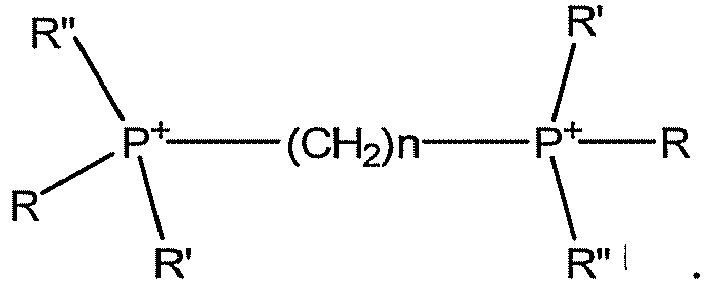
- In another particular embodiment, the invention provides a diionic liquid having the following formula:

- In another embodiment, the invention provides a diionic liquid salt in which the dicationic species is described by one of the above two formula with the exception that P is replaced by another charged species such as N or As , in which case, the number of "R" groups would be adjusted as appropriate.
- In still another embodiment, the invention provides a diionic liquid salt comprising a dicationic species containing one or more chiral center. A monoionic group may contain a chiral charged atom or at least one functional group containing at least one chiral center.
- In a particular embodiment, a dicationic liquid salt contains chiral charged atoms having the Formula (III):
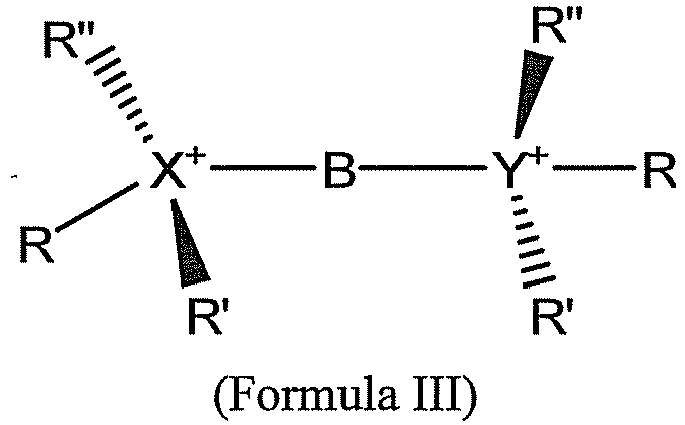
wherein: - X and Y are independently selected from the group consisting of ammonium,
- phosphonium and arsonium;
- each R, R', and R" is independently selected from the group consisting of hydrogen, alkyl, alkenyl, alkynyl, and carbocyclyl;
wherein each R, R', and R" optionally is substituted with one or more substituents selected from the group consisting of alkyl, alkenyl, alkynyl, hydroxyl, alkoxy, and carbocyclyl; - B is a divalent fragment composed of one or more moieties selected from the group consisting of alkylene, alkenylene, alkynylene, (-CH2-carbocyclyl-CH2-)n, and polysiloxyl;
wherein alkylene, alkenylene, and alkynylene optionally contain one or more heteroatoms selected from the group consisting of O, N, S or Si;
wherein B is optionally substituted with one or more substituents selected from the group consisting of alkyl, alkenyl, alkynyl, and alkoxy; - n is selected from the group consisting of 1 to 20, inclusive.
- In a further particular embodiment, R, R' and R" are different; and each R, R' and R" on both sides of the bridging group, B, are the same as described by the following formula:

- In a particular embodiment, the dicationic species has an alkylene bridging group and an example of such species is, without limitation:

- In a particular embodiment, R is propyl, butyl, cyclohexane or phenyl; R' is phenyl; and R" is 2-methoxyphenyl.
- In another particular embodiment, at least two of R, R' and R" are covalently bound to each other. For example, R is a propyl and R' is phenyl, here they are bound to each other by a bond.
- In another particular embodiment, one of more of R, R' and R" are themselves chiral. In such an embodiment, the dicationic species can be chiral even though neither of the phosphorus atoms is a stereogenic center. For example, in one embodiment, R and R' are the same and each contains at least one stereogenic center. Other charged molecules, such as a nitrogen atom or arsenic atom could be used in place of a phorphorus atom in either of the two immediately preceding structures.
- In still another embodiment, the dicationic species contains a stereogenic center in the bridging group B. Indeed, it is possible that the bridging group include one or more chiral centers, each of the cations is chiral, and one or more of R, R' and/or R" is or contains a chiral center as well. And the counter ions may be chiral as well.
- In one embodiment, a dicationic liquid salt of Formula (III) is provided, wherein
each R, R' and R" is independently selected from the group consisting of hydrogen, propyl, butyl, cyclohexanyl and phenyl;
X and Y are independently selected from the group consisting of ammonium and phosphonium;
B is selected from the group consisting of alkylene, alkenylene and alkynylene, wherein each such substituent optionally contains one or more heteroatoms selected from the group consisting of O, N, S or Si. - In another embodiment, a dicationic liquid salt of Formula (III) is provided, wherein
each R is independently selected from the group consisting of hydrogen, propyl, butyl, cyclohexanyl and phenyl;
each R' is hydrogen or phenyl;
each R" is hydrogen or 2-methoxyphenyl; and
X and Y are both phosphonium. - It is possible for the dicationic liquid salt of Formula (III) to "unsymmetric" as defined below. For example, in one embodiment, the dicationic liquid salt is unsymmetric because the bridging group, B, is substituted with one or more substituents selected from the group consisting of alkyl, alkenyl, alkynyl and alkoxy; and contains at least one stereogenic center. In another embodiment the dicationic liquid salt is unsymmetric because the bridging group, B, is alkylene, alkenylene, and alkynylene containing one or more heteroatoms selected from the group consisting of O, N, S and Si so as to be unsymmetric.
- In another embodiment, the dicationic liquid salt of Formula (III) contains at least one unsaturated group so as facilitating cross-linking or immobilization as discussed below.
- As previously noted, in another embodiment of the invention a diionic liquid salt is provided in which the diionic species is unsymmetric. By "unsymmetric", it is meant that the diionic species include an A and A' (ionic groups, either cationic or anionic) group that are not structurally the same or a bridging group that is unsymmetric. However, the diionic species may possess symmetries or asymmetries (i.e., the diionic species may also be asymmetrical). The invention encompasses unsymmetric diionic species due to any compositional and/or structural arrangement.
- Therefore, in one embodiment a dicationic liquid salt is provided wherein the dicationic liquid salt comprises a dicationic species corresponding in structure to Formula (IV):
A+-B-A'+ Formula (IV)
and at least one counter anion,
wherein: - A and A' are each a monoionic group independently selected from the group consisting of ammonium, thionium, phosphonium, arsonium, carbocylyl and heterocyclyl;
wherein each such substituent is optionally substituted with one or more substituents selected from the group consisting of alkyl, hydroxyl, alkoxy, cycloalkyl, aryl, hydroxyalkyl, cycloalkylalkyl and aralkyl;
wherein A and A' are different or A and A' have at least one different substituent; - B is a divalent fragment composed of one or more moieties selected from the group consisting of alkylene, alkenylene, alkynylene, (-CH2-carbocyclyl-CH2-)n, and polysiloxyl;
wherein alkylene, alkenylene, and alkynylene optionally contain one or more heteroatoms selected from the group consisting of O, N, S or Si;
wherein B is optionally substituted with one or more substituents selected from the group consisting of alkyl, alkenyl, alkynyl, and alkoxy; - n is selected from the group consisting of 1 to 20, inclusive.
- In one embodiment, the dicationic species corresponding to Formula (IV) contains A and A', each of which is independently selected from the group consisting of:

- A diionic species may be considered different because of the substituents. For example, an unsymmetric diionic species of the present invention may have a quaternary ammonium with 3 methyl substitutes on one side of the bridge and a quaternary ammonium with 2 methyl substitutes and one ethyl substitute on the other side of the bridge. Alternatively, a diionic species with two identical ionic groups can be considered unsymmetic if such species contains an unsymmetric bridge.
- In another embodiment, a dicationic liquid salt of the present invention comprises a dicationic species having different A and A'. Therefore, A is selected from the group consisting of ammonium such as quaternary ammonium and protonated tertiary amine, phosphonium and arsonium; and A' can be any member of the group so long as it is different from A. In a particular embodiment, the present invention provides a diionic liquid salt comprising a diionic species having the following formula:

- In a particular embodiment, a diionic species comprises an alkyl linkage and an ammonium group and a phosphonium group, each of which is substituted with one or more alkyl. An example of a dicationic liquid salt containing such an unsymmetric ammonium-phosphonium-based dicationic species includes, but is not limited to:

- In another embodiment, the present invention provides an "unsymmetric" dicationic liquid comprising an imidazolium group and an ammonium group having the following formula:

- In a particular embodiment, a dicationic species comprises an alkyl linkage, an alkyl-substituted imidazolium group and an alkyl-substituted phosphonium group. An example of a dicationic liquid salt containing such an unsymmetric imidazolium-phosphonium-based dicationic species includes, but is not limited to:

- In still another embodiment, the present invention provides an "unsymmetric" dcationic liquid salt comprising a phosphonium group and a pyridinium group having the following formula:

- In a particular embodiment, a diionic species comprises an alkyl linkage, a pyridinium group and an alkyl-substituted phosphonium group. An example of dicationic liquid salts containing such an unsymmetric phosphonium-pyridinium based dicationic species includes, but is not limited to:

- In other embodiments, A and A' are the same in Formula (IV), for example, both A and A' can be ammonium or phosphonium, but each is a different ionic group by way of different functional groups or other structural features such as, for example, a position isomer. Therefore, in one embodiment, the present invention provides a dicationic liquid salt comprising an unsymmetric dicationic species in which A and A' contain the same charged atom but the ionic groups are structurally different as a whole. For example, A is a straight or branched chain structure such as quaternary ammonium or protonated tertiary amine, while A' is a ring structure such as an imidazolium or a substituted imidazolium.
- Thus, in one embodiment an unsymmetric dicationic salt of the present invention contains an ammonium group and an imidazolium group, each of which is optionally substituted with alkyl, hydroxyalkyl or aralkyl. In a particular embodiment, an ammonium-imidazolium based unsymmetric dicationic species comprises an ammonium group and an imidazolium group, each of which is substituted with methyl. Examples of dicationic liquid salts comprising such dicationic species include, but are not limited to:


- In another particular embodiment, an ammonium-imidazolium based unsymmetric dicationic species comprises an ammonium group substituted with one or more methyl group and an imidazolium group substituted with butyl. Examples of diionic liquid salts comprising such dicationic species includes, but are not limited to:


- In still another particular embodiment, an ammonium-imidazolium based unsymmetric dicationic species comprises an ammonium group substituted with one or more methyl group and an imidazolium group disubstituted with methyl. Examples of diionic liquid salts comprising such dicationic species includes, but are not limited to:


- In still another particular embodiment, an ammonium-imidazolium based unsymmetric dicationic species comprises an ammonium group substituted with one or more methyl group and an imidazolium group substituted with hydroxyethyl. Examples of diionic liquid salts comprising such dicationic species includes, but are not limited to:


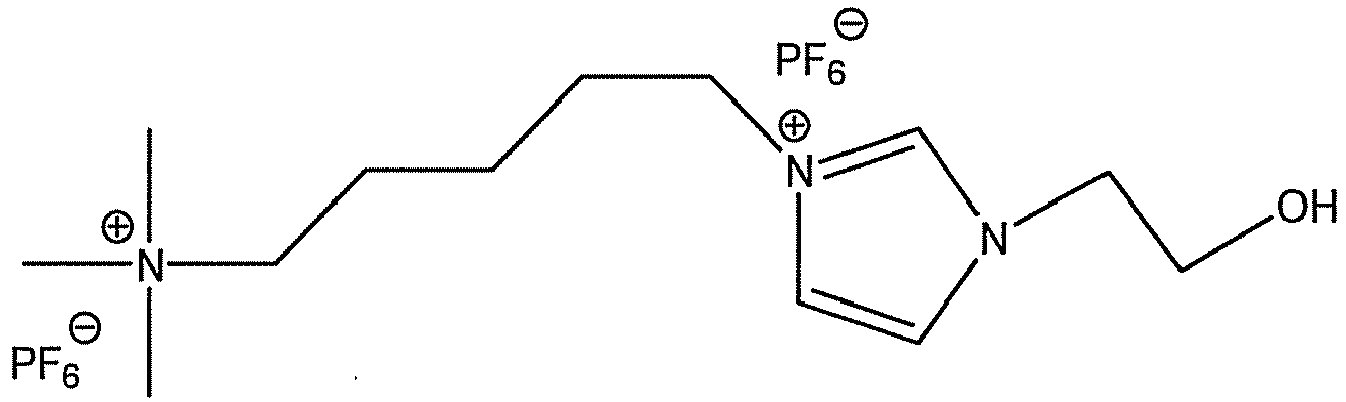

- In still another particular embodiment, an ammonium-imidazolium based unsymmetric dicationic species comprises an ammonium group substituted with one or more methyl group and an imidazolium group substituted with benzyl. Example of such dication species includes, but are not limited to:


- In one embodiment, the invention provides a dicationic liquid salt comprising an "unsymmetric" ammonium-pyrrolidinium based dicationic species having the following formula:

- In a particular embodiment, an unsymmetric ammonium-imidazolium based dicationic species comprises an alkyl likage, an ammonium group substituted with one or more methyl group and an imidazolium group substituted with alkyl such as methyl, ethyl, propyl and butyl. An example of a diionic liquid salt comprising such dication species includes, but is not limited to:

- In other embodiment, the invention provides a dicationic liquid salt comprising an "unsymmetric" ammonium-pyridinium based dicationic species having the following formula:

- In a particular embodiment, an unsymmetric ammonium-pyridinium based dicationic species comprises an alkyl linkage, an ammonium group substituted with one or more methyl group and an unsubstituted pyridinium group. An example of a diionic liquid salt comprising such dicationic species includes, but is not limited to:

- In one embodiment, the invention provides a dicationic liquid salt comprising an "unsymmetric" imidazolium-pyridinium based dicationic species having the following formula:

- In a particular embodiment, an unsymmetric imidazolium-pyridinium based dicationic species comprises an alkyl linkage, an unsubstituted pyridinium and an imidazolium group substituted with alkyl such as methyl, ethyl, propyl and butyl. An example of a diionic liquid salt comprising such dicationic species includes, but is not limited to:

- In one embodiment, the invention provides a dicationic liquid salt comprising an "unsymmetric" ammonium-ammonium based dicationic species having the following formula:
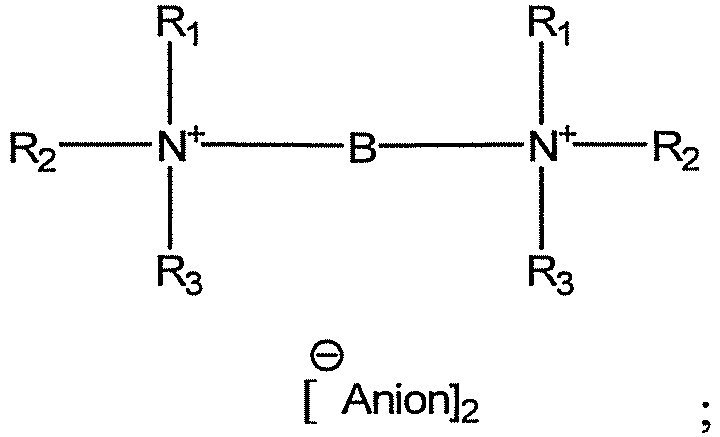
- wherein B and each R1, each R2 and each R3 is as defined above. In a particular embodiment, B is selected from alkyl linkage such as (-CH2-)n, PEG linkage such as (-CH2-O-CH2-)n and an aryl linkage such as phenyl-containing linker, i.e., (-CH2-Phenyl-CH2-)n wherein n is from 1 to 20, inclusive; each of R1, R2 and R3, is independently selected from H, alkyl, alkoxy, cycloalkyl, aryl, hydroxyalkyl, cycloalkylalkyl and aralkyl. In a particular embodiment, an unsymmetric ammonium-ammonium based dicationic species comprises an alkyl linkage, a pyrrolidinium group substituted with alkyl such as methyl, ethyl, propyl and butyl.
- In one embodiment, the invention provides a dicationic liquid salt comprising an "unsymmetric" pyridinium-pyridinium based dicationic species having the following formula:

- In a particular embodiment, an unsymmetric pyridinium-pyridinium based dicationic species comprises an alkyl linkage, an unsubstituted pyridinium group and a pyridinium group substituted with alkoxy such as methoxy, ethoxy and propoxy. An example of a diionic liquid salt comprising such dicationic species includes, but is not limited to:

- In one embodiment, the invention provides a dicationic liquid salt comprising an "unsymmetric" imidazolium-imidazolium based dicationic species having the following formula:

- In a particular embodiment, an unsymmetric imidazolium-imidazolium based dicationic species comprises an alkyl linkage, a benzyl-substituted imidazolium and an alkyl-substituted imidazolium. An example of such dicationic species includes, but is not limited to:

- In one embodiment, the invention provides a dicationic liquid salt comprising an "unsymmetric" imidazolium-pyrrolidinium based dicationic species having the following formula:

- In a particular embodiment, an unsymmetric imidazolium-pyrrolidinium based dicationic species comprises an alkyl or PEG linkage, an alkyl-substituted imidazolium and an alkyl-substituted pyrrolidinium. Examples of diionic liquid salts comprising such dicationic species include, but are not limited to:


- In one embodiment, the invention provides a dicationic liquid salt comprising an "unsymmetric" phosphonium-phosphonium based dicationic species having the following formula:

- In a particular embodiment, an unsymmetric phosphonium-phosphonium based dicationic species comprises an alkyl linkage and alkyl-substituted phosphoniums. An example of a diionic liquid salt comprising such dicationic species includes, but is not limited to:

- Unsymmetric dicationic species of the formula RR1R2X+-B-X+R'R'1R'2 may possess one or more stereogenic centers. For example, if R, R1 and R2 are the same, but R', R1' and R2' are different from each other, the unsymmetric dicationic species has a stereogenic center located on the charge element of X of -X+R'R1'R2'. In another example, if both R, R1 and R2 are different from each other, and R', R1' and R2' are different from each other, the unsymmetric dicationic species has two stereogenic centers located on each charged element X. As described above, the dicationic species may also contain one or more stereogenic center within the R groups or the bridging group B.
- In another embodiment, a diionic liquid salt according to Formula IV is provided wherein the bridging group B is unsymmetric such that the dicationic species does not possess symmetry between the two ionic groups In one embodiment, B is an unsymmetric bridging group containing one or more heteroatoms, wherein each of the heteroatoms can be selected from O, N, P, S and Si; and if the heteroatoms are more than two, the heteroatoms can be the same or different. The position of each heteroatom should be selected such that the diionic species does not possess symmetry between the two ionic groups. An example of a dicationic species containing such an unsymmetric bridge includes, but is not limited to:

- In another embodiment, B is an unsymmetric bridging group containing one or more side chain group, wherein the one or more side chain groups can be the same or different. The location of such side chain should be selected such that the diionic species does not possess symmetry between the two ionic groups. An example of a dicationic species containing such an unsymmetric bridge includes, but is not limited to:

- The "unsymmetric" diionic salts of the invention, e.g., "unsymmetric" dicationic salts, can be used in a substantially pure form in any of the applications, e.g., the applications disclosed in this application. As compared to corresponding symmetric diionic liquid salts, i.e., diionic liquid salts having the same A or A' groups and B, diionic liquid salts which are not structurally identical on both sides of the bridge or which include an unsymmetric bridging group generally have lower melting temperatures, and advantage for "liquid" salts. In addition, the higher the degree of internal structural dissimilarity as compared to corresponding symmetric diionic salts, generally the lower the melting temperatures will result as compared to those of the corresponding symmetric diionic salts. The trend can be thought of as a continuum from a symmetric molecule on the one end and a group with two different counter ions, two different ions, different substituents, and an unsymmetric bridging group on the other. The former would be expected to have the highest melting point and the latter the relatively lowest. Of course, there can be variations to this trend. For example, a specific counter ion might have a greater effect on decreasing melting point than the use of two different ions.
- The "unsymmetric" diionic salts of the invention may also be advantageous for uses as solvents. For example, a dicationic species having different A and A' groups offers two sets of possible interactions with other molecules in the solution as compared to only one set in the case of a symmetric diionic species. Indeed, the more unsymmetric, the more the variety of interactions that can result. Thus, the invention provides a use of a diionic liquid of a substantially pure "unsymmetric" diionic salt as described above as a solvent.
- The "unsymmetric" diionic liquid salts of the invention can also be used in combination with any symmetric diionic species as a mixture. Such mixtures can comprise an "unsymmetric" diionic salt of the invention and a symmetric diionic salt of the invention at a ratio such that the mixture has the desired melting temperature and/or desired interactions with other molecules. Thus, in one embodiment, the invention provides a diionic liquid salt comprising at least one of the "unsymmetric" diionic salts as described above and at least one of the symmetric diionic salts of the invention at a suitable proportion. A person skilled in the art would be able to determine the proportion of the symmetric and unsymmetric diionic salts when used as a mixture according to the particular application. In a particular embodiment, in the above described mixture diionic salts are dicationic salts. In still another particular embodiment, in the above described mixture diionic salts contains both at least one dicationic salt and at least one dianionic salt.
- Diionic liquids of the present invention are generally salts, although they may exist as ions (+1, -1, +2, -2) in certain circumstances. Thus, in most instances, each ion should have at least one counter ion, one for each anion or cation. Charge should be preserved. In the case of a dianionic liquid, two cations (including those identified as C' or C") (or one dication) (including those identified as C) are required and in the case of a dicationic liquid, two anions (including those identified as C' or C") (or one dianion) (including those identified as C) are required. The choice of anion can have an effect of the properties of the resulting compound and its utility as a solvent. And, while anions and cations will be described in the context of a single species used, it is possible to use a mixture of cations to form salts with a dianionic species to form a dianionic ionic liquid. The reverse is true for dications. For clarity sake, the salt-forming ions will be referred to as counter ions herein. The diionic liquid of the present invention can also be a mixture of a dicationic salt and a dianionic salt.
- Cationic counterions can include any of the dicationic compounds previously identified for use in the production of dicationic ionic liquids. In addition, monoionic counterparts of these may be used. Thus, for example, quaternary ammonium, protonated tertiary amine, phosphonium and arsonium are useful as cationic counter ions for dianionic molecules to form dianionic ionic liquids in accordance with the present invention.
- Similarly, anionic counterions can be selected from any of the dianionic molecules discussed herein useful in the creation of dianionic ionic liquids. These would include dicarboxylate, disulfonate, and disulfate. The corresponding monoionic compounds may also be used including carboxylate, sulfonate, sulfate and phosphonate. Halogens and halogen-containing compounds may be used such as triflate, NTf2 -, PF6 -, BF4 - and the like. The counterions should be selected such that the diionic liquids have good thermal and/or chemical stability and have a solid/liquid transformation temperature and/or a liquid range as described herein. Finally, the ionic groups of the present invention can be substituted or unsubstituted. They may be substituted with halogens, with alkoxy groups, with aliphatic, aromatic, or cyclic groups, with nitrogen-containing species, with silicon-containing species, with oxygen-containing species, and with sulphur-containing species. The degree of substitution and the selection of substituents can influence the properties of the resulting material as previously described in discussing the nature of the bridge or chain. Thus, care should be taken to ensure that excessive steric hindrance and excessive molecular weight are avoided, that resulting materials does not lose its overall flexibility and that nothing will interfere with the ionic nature of the two ionic species.
- The diionic liquids of the present invention can be used in pure or in substantially pure form as carriers or as solvents. "Substantially" in this context means no more than about 10% of undesirable impurities. Such impurities can be either other undesired diionic salts, reaction by-products, contaminants or the like as the context suggests. In an intended mixture of two or more DILS, neither would be considered an impurity. Because they are non-volatile and stable, they can be recovered and recycled and pose few of the disadvantages of volatile organic solvents. Because of their stability over a wide liquid range, in some instances over 400°C, they can be used in chemical synthesis that require both heating and cooling. Indeed, these solvents may accommodate all of the multiple reaction steps of certain chemical syntheses. Of course, these diionic liquids may be used in solvent systems with co-solvents and gradient solvents and these solvents can include, without limitation, chiral ionic liquids, chiral non-ionic liquids, volatile organic solvents, non-volatile organic solvents, inorganic solvents, water, oils, etc. It is also possible to prepare solutions, suspensions, emulsions, colloids, gels and dispersions using the diionic liquids.
- In addition to discrete diionic liquid salts, it is also possible to produce polymers of these materials. Polymers may include the diionic salts within the backbone or as pendant groups and they may be cross-linked or non-cross-linked.
- In addition to being useful as solvents and reaction solvents, the dianionic liquids of the present invention can be used to perform separations as, for example, the stationary phase for gas-liquid chromatography. Dicationic ionic liquid salts, which may be used for exemplification include: (1) two vinyl imidazolium or pyrrolidinium dications separated by an alkyl linkage chain (of various length) or (2) one vinyl imidazolium or pyrrolidinium cation separated an alkyl linkage chain (of various length) and connected to a methyl, ethyl, propyl, or butylimidazolium cation or a methyl, ethyl, propyl, or butylpyrrolidinium cation. See below. Any anionic counter ion discussed may be used. Note that the presence of unsaturated groups facilitates cross-linking and/or immobilization.


- Dianionic anions can also be used with either monocations or dications to form a variety of different ionic liquid combinations. When a dication is used, anyone is used as charge balance must be preserved. The dianionic anions can be of the dicarboxylic acid type (i.e., succinic acid, nonanedioic acid, dodecanedioic acid, etc), as shown below:


- Diionic liquid salts can be coated on a capillary (or solid support) and optionally, subsequently polymerized and/or cross-linked by, for example, two general methods. In the first method, the ionic liquid is coated via the static coating method at 40°C using coating solution concentrations ranging from 0.15-0.45% (w/w) using solutions of methylene chloride, acetone, ethyl acetate, pentane, chloroform, methanol, or mixtures thereof. After coating of the ionic liquid is complete, the column is purged with helium and baked up to 100°C. The efficiency of naphthalene (other molecules such as n-hydrocarbons or Grob Test Mixture can also be used for this purpose) is then evaluated to examine the coating efficiency of the monomer ionic liquid stationary phase. If efficiency is deemed sufficient, the column is then flushed with vapors of azo-tert-butane, a free radical initiator, at room temperature. After flushing with the vapors, the column is then fused at both ends and heated in an oven using a temperature gradient up to 200°C for 5 hours. The column gradually cooled and then re-opened at both ends, and purged with helium gas. After purging with helium gas overnight, the column is then heated and conditioned up to 200°C. After conditioning, the column efficiency is then examined using naphthalene at 100°C and the stationary phase coated layer examined under a microscope. Note that the cross-linking process can, and often does, also cause immobilization. "Immobilized" in the context of the invention means covalently or ionically bound to a support or to another ionic liquid (including diionic liquid salts) or both. This is to be compared with ionic liquids which may be absorbed or adsorbed on a solid support. Solid support in these particular instances were intended to include columns (e.g., the walls of the columns).
- It is not necessary, however, to cross-link these materials prior to their use in GC. They may be adsorbed or absorbed in a column, or indeed on any solid support. However, at higher temperatures, their viscosity may decrease and they can, in some instances, flow and collect as droplets which can change the characteristics of the column. Immobilization or partial cross-linking also reduces the vapor pressure of the stationary phase film which translates into lower column bleed thereby increasing the useful upper temperature limit of the phase and column.
- Another method involves adding up to 2% of the monomer weight of 2,2'-azobisisobutyronitrile ("AIBN") free radical initiator to the coating solution of the monomer. The capillary column is then filled with this solution and coated via the static coating method. After coating, the capillary column is then sealed at both ends and placed in an oven and conditioned up to 200°C for 5 hours. The column is gradually cooled and then re-opened at both ends, and purged with helium gas. After purging with helium gas overnight, the column is then heated and conditioned up to 200°C. After conditioning, the column efficiency is then examined using naphthalene at 100°C and the stationary phase coated layer examined under a microscope.
- In addition to the free radical polymerization of an alkene, other polymerization reactions involving other functional groups either attached to the aromatic ring of the cation, the linkage chain connecting two cations (to form a dication), or the anion can be achieved. Examples of such reactions may include cationic and anionic chain growth polymerization reactions, Ziegler-Natta catalytic polymerization, and step-reaction polymerization. The use of two different monomers to form copolymers through addition and block copolymerization can also be achieved. Additionally, condensation polymerization can be used to connect through functional groups such as amines and alcohols. All polymerization and cross-linking reactions discussed in the following 2 references can be used: "Comprehensive Polymer Science - The Synthesis, Characterization, Reactions and Applications of Polymers" by Sir Geoffrey Allen, FRS; and "Comprehensive Organic Transformations: a guide to functional group preparations" by Richard C. Larock. 2nd Edition. Wiley-VCH, New York. Copyright, 1999. ISBN: 0471190314.
- The production of these 39 dicationic liquid salts are described. The following materials were used: 1-methylimidazole; 1-methylpyrrolidine; 1-butylpyrrolidine; 1,2-dimethylimidazole; 1-butylimidazole; 1-benzylimidazole; 1,3-dibromopropane; 1,6-dibromohexane; 1,9-dibromononane; 1,12-dibromododecane; 1-bromo-3-chloropropane; hexafluorophosphoric acid, sodium tetrafluoroborate, N-lithiotrifluoromethylsulfonimide, silver nitrate, and phosphorus pentoxide which were all purchased from Aldrich (Milwaukee, Wis.). Hexafluorophosphoric acid is toxic and corrosive and must be handled with care. Acetone, ethyl acetate and 2-propanol were purchased from Fisher Scientific (Fair Lawn, N.J.). Untreated fused silica capillary tubing (0.25-mm i.d.) was purchased from Supelco (Bellefonte, Pa.).
- The following diionic salts may be produced. (See Tables 1, 2 and 3.)


- Note that some of the salts reflected in Tables 1 and 2 may not reflect the correct number of anions; usually 2 (see Table 3). Note that the names of the compounds found in Tables 1 and 2 are found in Table F. Compounds 1, 5, 9 and 13 were synthesized by reacting one molar equivalent of 1,3-dibromopropane; 1,6-dibromohexane; 1,9-dibromononane; and 1,12-dibromododecane, respectively, with two molar equivalents of 1-methylimidazole at room temperature. Compound 17 was synthesized by reacting one molar equivalent of 1,9-dibromononane with two molar equivalents of 1-butylimidazole at room temperature.
Compounds 21 and 24 were synthesized by refluxing one molar equivalent of 1,3-dibromopropane and 1,9-dibromononane, respectively, with 1,2-dimethylimidazole dissolved in 125mL 2-propanol for 24 hours. Compound 28 was synthesized by refluxing one molar equivalent of 1,12-dibromododecane with two molar equivalents of 1-benzylimidazole in 100 mL of 2-propanol for 24 hours. Following complete reaction (as monitored by NMR), the products were all purified by extraction with ethyl acetate and dried under a P2O5 vacuum. - Compounds 31 and 34 were produced by refluxing one molar equivalent amount of 1,3-dibromopropane and 1,9-dibromononane with two equivalents of 1-methylpyrrolidine in 100 mL of 2-propanol for 24 hours. Compound 37 was synthesized by refluxing two molar equivalents of 1-butylpyrrolidine with one equivalent of 1,9-dibromononane in 100 mL of 2-propanol for 24 hours. These salts were also extracted with ethyl acetate and dried under vacuum. All metathesis reactions involving N-lithiotrifluoromethylsulfonimide, hexafluorophosphoric acid, and sodium tetrafluoroborate were performed using previously published procedures. Ionic liquids formed via metathesis reactions were tested with silver nitrate to ensure no halide impurities remained.
- All thirty-nine ionic liquid samples were characterized using 1H NMR and electrospray ionization (ESI) mass spectrometry. 1H NMR spectra (400 MHz) were recorded in deuterated DMSO.
- Surface tension values were measured at room temperature (23°C) using a
Model 20 DuNuoy Tensiometer (Fisher Scientific, Fair Lawn, N.J.) equipped with a platinum-iridium ring with a mean circumference of 5.940 cm and a ring/wire radius of 53.21. The densities of the ionic liquids or, more correctly, the temperature of solid/liquid transformation (used synonymously except as indicated otherwise explicitly or by context) were determined at 23°C by placing 2.0 mL of the ionic liquid in a 2.0 mL volumetric tube and weighing by difference. The melting points of the ionic liquids were determined using aPerkin Elmer Pyris 1 Differential Scanning Calorimeter (Boston, Mass.). Typical methods involved using a 10°C/min temperature ramp to determine and identify the first and second order thermal transitions. Melting points could not be easily determined for all compounds. For solid compounds, the melting points were verified using a capillary melting point apparatus. Refractive index measurements were conducted at 23°C using a Bausch & Lomb Abbe-3L refractometer. - The preparation of the capillary columns for inverse gas-liquid chromatographic analysis was performed using a previously described procedure. All capillary columns had efficiencies between 2100 to 2500 plates/meter. Characterization of the capillary columns and probe molecule descriptions are listed in supplemental information. Multiple linear regression analysis (MLRA) and statistical calculations were performed using the program Analyse-it (Microsoft, USA).
- Tables 1, 2, and 3 give the structures of the two classes (39 compounds) of geminal dicationic ionic liquids synthesized and characterized. Ionic liquids containing imidazolium-based dication with different alkyl linkage chain lengths connecting the cations and/or different alkyl substituents on the imidazolium moiety comprise one group of ionic liquids. In most cases, each geminal dicationic entity was paired with four different anions (Br-, NTf2 -, BF4 - and PF6 -, Table 3). Pyrrolidinium-based geminal dication with different alkyl linkage chain lengths connecting the cationic and/or different alkyl substituents on the pyrrolidinium group are also shown in Table 3. For each dication in this class, separate ionic liquids containing three anions (Br-, NTf2 - and PF6 -) were synthesized. Tables 1 and 2 give the physicochemical properties for these thirty-nine geminal ionic liquids. Surface tension, density, melting point, and refractive index values were recorded for those samples that were liquids at room temperature. For samples that were solids at room temperature, only the melting point was determined. The miscibility/solubility of all ionic liquids in both heptane and water are indicated as well.
- Surface Tension. Plots of surface tension data are shown in
Figure 1 for several geminal room temperature ionic liquids. The length of the alkyl linkage chain separating the dications is observed to have only small effects on the surface tension. ConsideringILs - Diionic liquids 17-20 contain nonpolar butyl groups in the three position of the imidazolium rings. The surface tension values are significantly smaller (11%-17%) than those of diionic liquids 9-12 and 13-16 which contain the 3-methylimidazolium dications separated by a nonane and dodecane linkage chain, respectively. This data seems to indicate that the alkyl substituent located on the three position of the imidazolium ring plays a more important role in lowering the surface tension than the alkyl linkage chain that separates the geminal dications.
- Replacing hydrogen with a methyl group on the two position of the imidazolium ring (refer to Tables 1, 2, and 3) has little effect on the surface tension. In the case of diionic liquids 25 and 26 containing the 2,3-dimethylimidazolium geminal dications separated by a nonane linkage chain with NTf2 - and BF4 - anions, respectively, the surface tension values are similar to the corresponding 3-methylimidazolium dications (
Diionic liquids 10 and 11) also containing the nonane connecting chain. Overall, this data indicates that as the alkyl chain in the 3-position of the imidazolium ring increases in length, the surface tension decreases much more drastically than corresponding increases in the length of the connecting linkage chain. - Density. As shown in
Figure 2 , the densities of the 3-methylimidazolium geminal dicationic ionic liquids were found to be anion dependent and to decrease with increasing length of the hydrocarbon linkage chain. While increases in the linkage chain decreases the density of these ionic liquids, the nature of the anion has a greater influence, with densities in the order of NTf2 -> PF6 ->Br-> BF4 - (Tables 1, 2, andFigure 2 ). The decrease in density with increasing alkyl chain length has been reported previously for a large series of 1-alkyl-3-methylimidazolium ionic liquids. - When the methyl group on the three position of the imidazolium ring is replaced with a butyl group, the density decreases for all ionic liquids in the series, regardless of the anion (compare Diionic liquids 9-12 to 17-20, Table 1). However, by replacing the hydrogen at the two position of the ring with a methyl group, the density does not appear to change (see Diionic liquids 10-11 and 25-26, Table 1).
- Melting Points. From this study, four main factors were found to affect the melting points of these geminal-dicationic ionic liquids. These factors which apply to dianions as well are: (1) the length and type of the linkage chain or bridge separating the geminal diions, (2) the nature of the diions (e.g., imidazolium versus pyrrolidinium), (3) the substituents and their placement on the dianions and (4) the nature of the counter ion.
- Considering first the 3-methylimidazolium-based dicationic ionic liquids, longer bridging groups generally result in a lowering of the melting points. This observation applies to diionic liquids generally. In all of the above-noted cases except for the geminal dications with NTf2 - anions, which were all liquids regardless of the linkage chain used, compounds containing three and six carbon linkage chains were salts with relatively high melting points. By connecting the 3-methylimidazolium dications with a nonane linkage chain, all samples were room temperature ionic liquids except for the hexafluorophosphate salt, which had a melting point of 88°C. When the dications were connected by a dodecane linkage chain, however, all compounds were room temperature ionic liquids. Looking more generally at the dianions and dications that can be used to make diionic liquids in accordance with the present invention, the chain length between the ionic species should be longer than the length of a 2 carbon chain, and no longer than a 40 carbon chain. Preferably, chain lengths are equivalent to the length of a 3 to 30 carbon chain. The degree and types of substituents, if any, may have an effect on length as well, the larger the molecule, generally, the higher its temperature of solid/liquid transformation. Therefore, any chain length, any chain content and any chain substitution pattern may be used, as long as the melting point of the resulting diionic liquid salt is less than about 400°C, preferably about 100°C or lower, preferably about 60°C, more preferably about room temperature or lower (25°C).
- In addition to the effect of the different length and types of bridges connecting the dications, the anion also played a role in determining the melting point. In nearly very case of the imidazolium dications, the melting points increased in the following order: NTf2 -<BF4 -<PF6 -<Br- (Tables 1 and 2).
- Other anions which can be used to form dicationic ionic liquids include, without limitation, trifilates, carboxylates, sulfonates and sulfates (both mono- and poly-anionic species). Dianionic ionic liquids can be produced from any dianion which can form a stable salt, preferably which has a melting point below about 400°C, more preferably at or below about 100°C, most preferably at or below room temperature (about 25°C). These include dicarboxylate, disulfonate and disulfate. Mixed dianions, one made from, for example, a dicarboxylate and a disulfate, are also desirable. Cations or counterions for these include, again without limitation, the dications listed in Tables 1 and 2, as well as their monocationic counterparts. This is as long as they can form a stable diionic salt and have a melting point as described above.
- The substituents and their position on the imidazolium ring also affected the melting points of these compounds. These same considerations apply to substituted anions as well. Considering Diionic liquids 17-20 which contain the 3-butylimidazolium dications connected by a nonane linkage chain, the melting points were lowered significantly by replacing the methyl group (see Diionic liquids 9-12) with a butyl group. In the case of Diionic liquid 12, which consist of the 3-methylimidazolium dications connected by a nonane linkage chain with the PF6 - anion, the melting point is decreased by nearly 60°C by replacing the methyl groups with butyl groups to form
Diionic liquid 20. In addition, methylation of the 2-positions of the imidazolium dications significantly increases the melting point of these compounds (see Diionic liquids 21-27, Table 1). In the case of Diionic liquid 21 which contains the 2,3-dimethyimidazolium dication connected by a propane linkage chain, the melting point is nearly 135°C higher than the corresponding 3-methylimidazolium dication also connected by a propane linkage chain (1). Ngo et al. have previously reported the melting points for 1-ethyl-3-methylimidazolium bromide to be 79°C whereas the melting point for 1-ethyl-2,3-dimethylimidazolium bromide was found to be 141 °C, a difference of nearly 62°C. While the methyl group on the two position of the imidazolium ring has little effect on the surface tension and density of the geminal dicationic ionic liquids, it is seen to have a profound effect on their melting points, more so for the dicationic ionic liquids than for the traditional 1-alkyl-3-methylimidazolium ionic liquids. - Finally, by replacing the 3-methylimidazolium dication with the 3-benzylimidazolium dication (Diionic liquids 28-30) and connecting them by a dodecane bridge, the melting points appear higher compared to the 3-methylimidazolium series, especially in the case of the bromide salt.
- In general, the melting points of the pyrrolidinium-based geminal dicationic compounds are significantly higher than their corresponding imidazolium analogues. Indeed, only two of their NTf2 - salts can be considered ionic liquids. However, as will be discussed (vide infra), these particular RTILs may have the greatest thermal stability and other highly useful and interesting properties.
- The melting points for the pyrrolidinium-based dications show similar trends to the imidazolium-based salts. In the two cases involving the propane and nonane linkage chains, the melting point decreases as the linkage chain becomes longer. However, in contrast to the imidazolium-based dications, the pyrrolidinium-based dications are still relatively high melting solids when separated by a nonane alkyl chain. Additionally, substituting a butyl group instead of a methyl group on the quaternary amine of the pyrrolidinium cation causes a decrease in the melting point for the bromide dication but an increase in the melting point for the dications containing bis(trifluoromethylsulfonyl)imide and hexafluorophosphate anions.
- From the data in Tables 1 and 2, it appears that longer alkyl linkage chains and long aliphatic substituents on the quaternary amine produce either low melting salts or room temperature ionic liquids. Further, the NTf2 - salts have lower melting points than corresponding salts with other anions. The contributions of the linkage chain (bridge) and other substituents on the geminal dicationic salts, to the number of possible conformational states (and possibly crystal polymorphs) will be considered in the crystal structure section of this paper.
- Solubility . The solubility behavior of all thirty-nine geminal dicationic ionic liquids in water and heptane also was explored. None of the dicationic ionic liquids were soluble in heptane. However, most of the ionic liquids containing bromide and tetrafluoroborate anions were soluble in water. Nevertheless, for the tetrafluoroborate ionic liquids, it was found that by using a long linkage chain and a more hydrophobic alkyl substituent on the three positions of the imidazole ring (see Diionic liquids 15 and 19), the solubility of the salt in water decreases. In general, the solubility behavior of the geminal dicationic ionic liquids in both water and heptane was quite similar to the monocationic ionic liquids with NTf2 - and PF6 - salts being immiscible with water and Br- and BF4 - salts being miscible with water. Indeed, the monoionic counterparts of the diionic liquid salts of the present invention are a good predicator of the solubility of a diionic liquid salt.
- In the case of the dicationic ionic liquid 28 which consists of the 3-benzylimidazolium dication separated by a dodecane linkage chain and bromide anion, the hydrophobicity of the dication evidently overrides the coordinating nature of the bromide anion to make this particular ionic liquid insoluble in water. This is a good example that the properties of the individual cations and anions can be balanced and changed in order to produce ionic liquids (or solids) with the desired properties and characteristics.
- Thermal Stability. The thermal stabilities of the geminal dicationic ionic liquids were found to be significantly higher than what has been observed for many traditional imidazolium-based ionic liquids. Thermal stabilities were measured by immobilizing an approximate 0.15-0.20 microns film of the ionic liquid on the inner wall of a fused silica capillary. The capillary was then heated slowly in an oven and a very sensitive flame ionization detector (or mass spectrometer) used to detect any volatilization or decomposition of the ionic liquid. There are several advantages of using this set-up to measure the thermal stabilities of ionic liquids. The thermal stability is measured in the absence of oxygen by purging the capillary with a continuous flow of an inert gas such as helium, hydrogen, or nitrogen. In addition, the detection limit of the detector is very low (∼10 ppm to 10 ppb, depending on the compound) allowing for very sensitive detection of any thermally induced decomposition/volatilization products from the ionic liquid. Finally, this approach can use mass spectrometry detection to determine the likely volatilization/decomposition products.
-
Figure 3 shows a thermal stability diagram containing three traditional ionic liquids and four dicationic ionic liquids. The traditional ionic liquids have thermal stabilities ranging from about 145°C (1-butyl-3-methylimidazolium chloride) to about 185°C (1-butyl-3-methylimidazolium bis(trifluoromethylsulfonyl)imide). However, the thermal stabilities of the geminal dicationic ionic liquids are observed to range from about 330°C to about 400°C, depending on the cation used. The highest thermal stability (>400°C) was obtained with the C9(mpy)2-NTf2 (Diionic liquid 35) ionic liquid (1-methylpyrrolidinium dication separated by a nonane linkage chain) while the lowest volatilization/decomposition temperature (330°C) was observed for the C9(bpy)2-NTf2 (Diionic liquid 38, 1-butylpyrrolidinium dication separated by a nonane linkage chain) ionic liquid. The maximum thermal stabilities of C9(mim)2-NTf2 (Diionic liquid 10, 1-methylimidazolium dication) and C12(benzim)2-NTf2 (Diionic liquid 29, 3-benzylimidazolium dication separated by a dodecane linkage chain) were observed to be nearly identical (350-360°C). In most cases, slight to moderate decomposition/volatilization of the dicationic ionic liquids were observed at these high temperatures. However, due to charring of the polyimide coating on the outside of the fused silica capillary tubing at these high temperatures, the ionic liquids were only tested up to about 400°C. - While the physical and thermal properties of the dicationic ionic liquids are quite impressive, another interesting fact is that some of these compounds possess useful liquid ranges in excess of about 400°C and one of these (C9(mpy)2-NTf2) Diionic liquid 35 has a stable liquid range of ∼ -4°C to >400°C. This property will undoubtedly ensure their use for a wide variety of applications in which this large liquid range and high thermal stability can be exploited. In accordance with one aspect of the present invention, the ionic liquids of the present invention, which are salts of a dianion or dication, are stable. Stability in the context of the present invention means that they will neither substantially decompose nor volatilize at a temperature of under about 200°C when measured by inverse gas chromatography as described herein. More preferably, the stable ionic liquids of the present invention which are dianionic or dicationic salts, are stable in that they will not substantially decompose or volatilize at a temperature of under about 300°C.
- In
Figure 3 , it is believed that the detector response shown for compounds D, E and F, between approximately 200°C and approximately 300°C are from impurities and not from the compounds tested. Still, less than 10% of the weight of the material tested decomposes or volatilizes when exposed to about 200°C or in particular embodiments, about 300°C, for an hour, they can be said to be stable in accordance with the present invention. - In particular embodiments in accordance with the present invention, dianionic or dicationic ionic liquid salts are provided, which are stable in that they will neither substantially decompose nor substantially volatilize at a temperature of under about 200°C and will have a temperature of solid/liquid transformation of about 400°C or lower. More will have a temperature of solid/liquid transformation of about 100°C or lower, most preferably will have a temperature of solid/liquid transformation of about 25°C or lower.
- As mentioned previously, the diionic liquids (salts of dianions and dications as described herein) have an important use because of their stability at wide ranges of temperature and unique liquid properties. Many of these liquids have unexpectedly low temperatures of solid-liquid transformation, which from a fundamental standpoint depends upon the energy of their crystal lattice. There are well-known and rather crucial barriers to precisely calculating these energies, i.e., the true determination of atom-atom potentials. On the other hand, the accurate measurement (required for comparison) of solid-liquid transformation temperatures for this family of ionic compounds also have difficulties. The transformation is not sharp in time and the peaks on DSC curves become very broad. Formally speaking, the temperature of this transformation can be very different from the true melting point which is the temperature of thermodynamic equilibrium between solid and liquid states.
- Solvation Characteristics. We have previously reported that the Abraham solvation model, a linear free energy approach that utilizes inverse gas-liquid chromatography to describe the solvation properties of a liquid, can be used to characterize room temperature ionic liquids. Described by
equation 1, the model provides the so-called "interaction parameters" (r, s, a, b, /) by using multiple linear regression analysis to fit the retention factor (k, determined chromatographically) to the solute descriptors (R2, π2 H α2 H, β2 H, log L16) for a wide variety of probe solute molecules.
The solvation properties of four dicationic ionic liquids (see Table 4) were evaluated and the interaction parameters compared to those obtained for their traditional monocationic analogues 1-butyl-3-methylimidazolium and 1-butyl-1-methylpyrrolidinium ionic liquids.Table 4: Comparison of interaction parameters between monocationic and dicationic ionic liquids. Temp (°C) Interaction Parametersa C4(mim)2-NTf2 c r s a b l n R2 F 40 -2.94 (0.13) 0.25 (0.09) 2.01 (0.12) 2.11 (0.11) 0.50 (0.13) 0.56 (0.03) 33 0.99 (0.11) 356.70 70 -2.91 (0.11) 0.22 (0.10) 1.78 (0.11) 1.77 (0.09) 0.45 (0.14) 0.44 (0.03) 32 0.99 (0.09) 370.42 100 -3.06 (0.13) 0.20 (0.09) 1.69 (0.10) 1.57 (0.08) 0.33 (0.13) 0.37 (0.03) 31 0.98 (0.09) 253.79 C9(mim)2-NTf2(10) 40 -2.86 (0.14) 0.16 (0.11) 1.81 (0.14) 1.83 (0.10) 0.47 (0.17) 0.62 (0.04) 32 0.98 (0.12) 257.15 70 -2.95 (0.09) 0.11 (0.07) 1.76 (0.08) 1.75 (0.07) 0.20 (0.10) 0.51 (0.02) 33 0.99 (0.07) 644.20 100 -3.06 (0.08) 0.11 (0.06) 1.64 (0.07) 1.50 (0.06) 0.15 (0.09) 0.43 (0.02) 32 0.99 (0.07) 545.32 BMIM-NTf2 a (1-butyl-3-methylimidazolium bis[(trifluoromethylsulfonyl)imide] 40 -2.87 (0.10) 0 (0.08) 1.89 (0.10) 2.02 (0.10) 0.36 (0.12) 0.63 (0.03) 33 0.99 (0.09) 459.64 70 -3.03 (0.09) 0 (0.08) 1.67 (0.09) 1.75 (0.09) 0.38 (0.11) 0.56 (0.02) 35 0.99 (0.09) 413.65 100 -3.13 (0.12) 0 (0.09) 1.60 (0.10) 1.55 (0.10) 0.24 (0.12) 0.49 (0.03) 32 0.98 (0.09) 240.13 C9(mpy)2-NTf2(35) 40 -2.83 (0.12) 0.27 (0.10) 1.71 (0.12) 1.98 (0.10) 0.32 (0.15) 0.62 (0.03) 30 0.99 (0.10) 377.84 70 -2.85 (0.11) 0.34 (0.09) 1.52 (0.11) 1.65 (0.08) 0.35 (0.13) 0.48 (0.03) 32 0.99 (0.09) 419.32 100 -2.99 (0.10) 0.23 (0.09) 1.49 (0.10) 1.48 (0.08) 0.15 (0.14) 0.42 (0.03) 30 0.99 (0.08) 339.79 BMPY-NTf2 b(1-butyl-1-methylpyrrolidinium bis[(trifluoromethylsulfonyl)imide] 40 -2.78 (0.11) 0 (0.09) 1.69 (0.11) 2.08 (0.12) 0.16 (0.14) 0.68 (0.03) 34 0.98 (0.11) 321.99 70 -2.80 (0.10) 0 (0.08) 1.53 (0.09) 1.78 (0.08) 0 (0.11) 0.56 (0.02) 34 0.99 (0.09) 393.23 100 -2.92 (0.09) 0 (0.07) 1.44 (0.08) 1.55 (0.07) 0 (0.09) 0.48 (0.02) 32 0.99 (0.08) 358.08 C12(benzim)2-NTf2(29) 40 -2.94 (0.11) 0.11 (0.08) 1.65 (0.11) 1.96 (0.08) 0.84 (0.13) 0.66 (0.03) 33 0.99 (0.08) 522.89 70 -3.07 (0.08) 0.07 (0.05) 1.62 (0.08) 1.75 (0.06) 0.57 (0.09) 0.56 (0.02) 30 0.99 (0.06) 888.94 100 -3.12 (0.09) 0 1.47 (0.09) 1.44 (0.06) 0.52 (0.10) 0.46 (0.02) 30 0.99 (0.07) 478.94 a r = interaction via nonbonding and π-electrons, s = dipolarity/polarizability, a = hydrogen bond basicity,
b = hydrogen bond acidity, l = dispersion forces, n = number of probe molecules subjected to multiple linear regression analysis, R2 = statistical correlation coefficient, F = Fisher coefficient. Values in parenthesis are the standard deviations for each interaction parameter.
b Values taken from reference 31 - Nearly all interaction parameters of the dicationic ionic liquids C4(mim)2-NTf2 and C9(mim)2-NTf2 (Diionic liquid 10) are similar to the corresponding monomer-type ionic liquids, 1-butyl-3-methylimidazolium bis(trifluoromethylsulfonyl)imide. This is also observed for the pyrrolidinium dication, C9(mpy)2-NTf2 (Diionic liquid 35), as it differs from the monomer-type analogue (1-butyl-1-methylpyrrolidinium bis(trifluoromethylsulfonyl)imide). This indicates that the well-known and highly useful solvation properties of traditional RTILs are very similar to those of the geminal dicationic RTILs. The only interaction parameter that is statistically different between the three ionic liquids is the "r" interaction parameter, namely the ability of the ionic liquid to undergo π-π. and n-π interactions with probe solute molecules. Because the pyrrolidinium cation is not aromatic, the higher r values may be due to the anion as each anion contains two sulfone groups that are capable of undergoing such interactions. However, this was not observed for the traditional ionic liquids evaluated previously in our study.
- Finally, the interaction parameters for the 3-benzylimidazolium geminal dication separated by a dodecane linkage chain with the NTf2 - anion (Diionic liquid 29) appear similar to those observed previously for 1-benzyl-3-alkyl-imidazolium ionic liquids. However, the hydrogen bond acidity term, b, is larger for the geminal dicationic ionic liquid. This may be due to the increased acidity of the proton at the 2-position of the imidazolium ring induced by the electron withdrawing benzyl group.
- As noted earlier, the viscosity of some diionic salts decreases sharply with increasing temperature. Consequently at high temperatures, previously uniform coated capillaries, particularly ones that are prepared by adsorption or absorption, rather than immobilization, can experience film disruption (due to flow, etc.). When a uniformly coated GC capillary, for example, slowly changes to a nonuniformly coated entity, the analyte retention times and efficiency tend to decrease.
- To overcome these issues, where necessary, and in accordance with another aspect of the present invention, there is provided a process which includes the free radical reaction of ionic liquid monomers to provide a more durable and robust stationary phase, as well as the crosslinked and/or immobilized stationary phases and the columns that include same. By partially crosslinking the ionic liquid stationary phase using a small percentage of free radical initiator, high efficiency capillary columns are produced that are able to endure high temperatures with little column bleed. It was found that low to moderate temperature separations (about 30°C to about 280°C) can be carried out with high selectivity and efficiency using special partially crosslinked ionic liquid stationary phase mixtures. These stationary phases retain their "gelatinous," "semi liquid," amorphous state. For separations conducted at higher temperatures (about 300°C to about 400°C), more highly cross-linked/immobilized stationary phases are well-suited to provide high selectivity and efficient separations with low column bleed. The effect of different functionalized ionic liquid salt mixtures and initiator concentrations is studied for these two types of stationary phases. The accomplished goal is to maximize their separation efficiency, thermal stability, and column lifetime, without sacrificing the unique selectivity of the stationary phase.
- The following materials were used to illustrate the unique advantages of cross-linked stationary phases comprising diionic liquid salts in accordance with the present invention: 1-vinylimidazole, 1-bromohexane, 1-bromononane, 1-bromododecane, 1,9-dibromononane, 1,12-dibromododeeane, 1-bromo-6-chlorohexane, 1-methylimidazole, N-lithiotrifluoromethanesulfonimide, 2,2'-Azobisisobutyronitrile (AIBN), dichloromethane, ethyl acetate, and all test solutes were purchased from Aldrich (Milwaukee, Wis.). Untreated fused silica capillary tubing (0.25-mm inner diameter) and a fatty acid methyl ester (FAME) kit containing 19 standards was purchased from Supelco (Bellafonte, Pa.). Structures and physico-chemical properties of the monocation monomers and the dication crosslinkers used are shown in
Table A. Monomers - The dication crosslinkers were synthesized using a modified procedure recently reported for a series of geminal dicationic ionic liqids. Compound 4 in Table A is a mixture of C6(vim)2 2+ (m/z=272.1), C6vm(im)2 2+ (m/z=260.1), and C6(mim)2 2+ (m/z =248.1) in a 1:2:1 molar mixture, respectively, as indicated in the electrospray mass spectrum in
Figure 4 . When acquired in positive ion mode, the most dominant ions for these three structurally similar compounds appear to be the +1 ion minus a proton. Further experiments conducted in our group in which the C-2 proton on the imidazolium ring (seeFigure 4 for numbering of ring system) is deuterated indicates that this proton is lost and causes one of the positive charged aromatic rings to neutralize charge and give rise to the +1 ion (data not shown). This mixture was synthesized by reacting one molar equivalent of 1-bromo-6-chlorohexane with one molar equivalent of 1-methylimidazole in an ice bath overnight. Subsequently, one molar equivalent of 1-vinylimidazole was added dropwise over a period of 30 minutes and the temperature of the mixture increased to 55°C for 3 hours. Three 15 mL aliquots of ethyl acetate were used to extract any excess starting material and the bromide anion was exchanged for the bis[(trifluoromethane)sulfonyl]imide (NTf2 -) anion by reaction of two equivalents of N-lithiotrifluoromethanesulfonimide dissolved in water for every one equivalent of the crosslinker salt. - In an analogous manner, the remaining
crosslinkers - Capillaries were coated using the static coating method at 40°C. Coating solutions of the monomer and/or crosslinker ionic liquids were prepared at concentrations of 0.20% (w/v) in dichloromethane. Prior to adding the dichloromethane to the monomer and/or crosslinker mixture, 0.7 mg of AIBN (∼3.5% by weight) was added. AIBN is known to undergo decomposition to form cyanoisopropyl radicals which subsequently produce several products by dimerization, disproportionation reactions, or chain reactions. The thermal decomposition kinetics of AIBN have been well studied using a variety of spectroscopic and polarographic techniques. Based on an Arrhenius plot, Van Hook and co-workers have proposed a rate expression for the decomposition of AIBN in solution to be: kd=1.58 x.1015 exp(-30.8 kcal./RT). For a temperature of 40°C in which the capillaries are coated with the initiator present in the coating solution, this yields a decomposition rate constant of ∼5.07 x 10⁻⁷ sec-1. Due to the fact that this rate constant is so small and that the coating rate is relatively fast, there should be very little polymerization of the monomer/crosslinker mixture during the coating of the capillary.
- After coating, the ends of the capillary were flame sealed and the capillary placed in a GC oven and heated from 40°C-80°C at 1°C/min. The capillary was then held at 80°C for 5 hours to ensure complete polymerization. Helium carrier gas was then flushed through the capillary at a rate of 1 mL/min and the capillary conditioned from 30°C to 120°C at 3°C/min and held at 120°C for two hours.
- Solvation thermodynamics can be determined chromatographically by recognizing that the Gibbs free energy change, ΔG° of a solute between the mobile phase and the stationary phase can be described by equation 1:

where k is the solute retention factor and Φ is the column phase ratio. An expression shown inequation 2 can then be derived and illustrates the dependence of enthalpy, ΔH°, and entropy, ΔS°, on the change of the retention factor with temperature:
A van't Hoff plot of ln k versus 1/T provides the entropy (intercept) and enthalpy (slope) and describes a solute's transfer from the gas phase to the ionic liquid stationary phase. In this work, the solvation thermodynamics were determined for seven different probe molecules, listed in Table D, on two cross-linked ionic liquid phases and one ionic liquid stationary phase. As Table D illustrates, the probe molecules evaluated in this study differ in terms of size and the types of functional groups that they possess. For each probe molecule on each stationary phase, three separate van't Hoff plots were constructed so that changes in the probe molecule retention factor could be used to provide an error for each thermodynamic parameter. The probe molecule retention factors were determined at six different temperatures to obtain the highest possible correlation coefficient (>0.989). - Previously we characterized a large number of room temperature ionic liquids in terms of multiple solvation interactions using the solvation parameter model, shown in equation [3]

This approach utilizes inverse gas-liquid chromatography and allows the use of a large number of probe molecules to deconvolute solute retention in terms of the type and magnitude of individual solvation interactions. The solute descriptors (R2, π2 H, α2 H, β2 H, log L16) from Equation [3] are obtained from the literature for many probe molecules containing a variety of functional groups. The retention factor is determined chromatographically. The solute descriptors and retention factors are subjected to multiple linear regression analysis to obtain the interaction parameter coefficients (r, s, a, b, l), which ultimately characterize the stationary phase: r is the ability of the diionic liquid containing-stationary phase to interact with π and n electrons of the solute, s is a measure of the dipolarity/polarizability of the diionic liquid containing-stationary phase, a defines the diionic liquid containing-stationary phase hydrogen bond basicity, b is a measure of the hydrogen bond acidity, and l refers to the ability of the diionic liquid containing-stationary phase to separate adjacent members of a homologous series. - Test solutes used to determine interaction parameters and solvation thermodynamics were dissolved in dichloromethane. A Hewlett-Packard model 5890 gas chromatograph and a Hewlett-Packard 6890 series integrator were used for all separations. Split injection and flame ionization detection were utilized with injection and detection temperatures of 250°C. Helium was used as the carrier gas with a column inlet pressure of 3.1 psi and flow rate of 1.0 mL/min. Methane was used to determine the dead volume of the column. Multiple linear regression analysis and statistical calculations were performed using the program Analyze-it (Microsoft).
- Equation 4 can be used to approximate the stationary phase film thickness for gas chromatographic capillaries coated by the static coating method,

Figure 5 shows the effect of 1-hexyl-3-vinylimidazolium bis[(trifluoromethane)sulfonyl] imidate film thickness on the peak efficiency of naphthalene at 100°C. As the plot clearly demonstrates, the highest efficiency separations were carried out with a film thickness of ∼0.07 µm (0.10% w/v of ionic liquid in dichloromethane) while the worst efficiency separations were obtained on columns with a film thickness of ∼0.21 µm (0.33% w/v). In this work, all capillaries were coated with a 0.20% (w/v) coating solution yielding a film thickness of approximately 0.125 µm. - Using the ionic liquids that contain one or more unsaturated groups (except in compound #10) in Table A, a variety of free radical cross-linking experiments were carried out in chloroform following the method of Muldoon and co-workers to determine which ratios of monocationic/crosslinker monomers result in copolymers that possess the ideal properties for a GC stationary phase. Note further that many of these experiments used combinations of molecules in Table A which have single and molecules in Table A which have multiple, e.g., double, bonds to modify the physical properties, such as viscosity, following cross-linking. For example, some copolymers (i.e., formed from
monomers 1 and 5) containing only a few percent by weight crosslinker resemble gum-like polysiloxane phases. However, other highly cross-linked copolymers formed hard plastics and are therefore undesirable for gas-liquid chromatographic separations. - Monocationic monomer
ionic liquids ionic liquid 1 and ∼1900 plates/meter for ionic liquid 3 when conditioned to 120°C. While it appears that the hexyl substituted vinylimidazolium cation produces a more efficient stationary phase coating, subsequent evaluation of the stationary phases using higher conditioning temperatures revealed that the efficiencies of these capillaries decrease rapidly. After conditioning up to 350°C, volatilization of the ionic liquids resulted in efficiencies that dropped to several hundred plates/meter. No retention of naphthalene was observed after conditioning the capillaries to 380°C, indicating an insufficient amount of ionic liquid remained on the capillary wall. - To produce a more thermally robust ionic liquid matrix, geminal dicationic vinylimidazolium crosslinkers with different length alkyl chains separating the dications were mixed with the monocationic monomers. These mixtures are shown in Table B under the heading "partially/fully crosslinked matrices." From our previous solution-based polymerization experiments, it was found that the concentration of crosslinker is crucial for the formation of a matrix exhibiting ideal stationary phase properties (data not shown). Compound 4 (see Table A), is a mixture of three dicationic ionic liquids separated by a six carbon linkage chain. Electrospray mass spectrometry indicated that for every one of the 1,6-di(3-methylimidazolium)hexane[C6(mim)2 2+] dications and 1,6-di(3-vinylimidazolium)hexane [C6(vim)2 2+] dications, there are two of the 1-(3-vinylimidazolium)-6-(3'-methylimidazolium)hexane [C6vm(im)2 2+] dications. When a column was prepared by polymerizing/immobilization only this mixture, the initial efficiency after conditioning to 120°C was nearly 3000 plates/meter (Table B). Moreover, the efficiency dropped much less after conditioning the capillary at higher temperatures. For example, the efficiency of Compound 4 after conditioning at 350°C was 1365 plates/meter whereas the efficiencies of the monocationic ionic liquids without crosslinker ranged from 120 to 197 plates/meter after the same conditioning step. Clearly, by crosslinking the ionic liquids, the efficiency and thermal stability of the stationary phase is preserved at higher temperatures.
- A series of different crosslinked ILs were also synthesized using various ratios of 1-vinyl-3-hexylimidazolium bis[(trifluoromethane)sulfonyl]imidate (1) and the dication mixture 4, described above. The highest efficiencies were obtained with crosslinking mixtures formed with equal percentages of the monocationic and crosslinking monomers whereas copolymers formed with a higher concentration of crosslinker exhibited lower efficiencies (see Table B). The effect of the alkyl side chain of the monocationic monomer was investigated by preparing equal molar ratios of the crosslinking mixture 4 with two other monocationic monomers, 1-vinyl-3-nonylimidazolium bis[(trifluoromethane)sulfonyl]imidate (2) and 1-vinyl-3-dodecylimidazolium bis[(trifluoromethane)sulfonyl]imidate (3). As Table B illustrates, there is very little difference between these different composition crosslinked matrices in terms of separation efficiency and loss of efficiency at high temperatures. Recall that previously it was noted that when the monocationic monomers were polymerized without crosslinker, the length of the alkyl group appeared to have an effect on the separation efficiency/thermal stability of the stationary phase at higher temperatures. This demonstrates that the length of the alkyl group on the monocationic monomer plays less of a role in the loss of separation efficiency at high temperatures when it is part of a crosslinked stationary phase.
- Ionic liquid stationary phases based only on crosslinking monomers were also evaluated. As shown in Table B, one mixture was based on the crosslinking of vinylimidazolium dications separated by a nonane linkage chain (0.20%, 5) while the second mixture consisted of
ionic liquids compounds 6 and 8 are supercooled solids at room temperature and, therefore, are not ideal monomers for creating "gummy" or "waxy" stationary phases. This mixture consists of 10.88% by weight of Compound 5, 9.29% of Compound 6, 19.59% ofCompound 7, and 60.24% ofCompound 8. - A couple of interesting trends were observed for the highly crosslinked ionic liquid stationary phases that were not observed for the monocationic linear or partially crosslinked materials. First, although the separation efficiency of the completely crosslinked stationary phases was low after conditioning to 380°C, the ionic liquid stationary phase was still present as a thin film in the capillary when viewed under microscope after prolonged exposure to this temperature. In contrast, only a few partially crosslinked stationary phases (see Table B) provided retention of naphthalene after high temperature conditioning. All stationary phases formed using monocationic monomers alone appeared to have decomposed and/or volatilized completely from the capillary wall after conditioning to 380°C.
- The most impressive and interesting characteristic of the completely crosslinked ionic liquid stationary phases is their apparent ability to exhibit a substantial increase in efficiency after conditioning at high temperatures. Examples of this arc found in Table B under the heading "Crosslinked Ionic Liquid Matrix." In one such example, a crosslinked matrix previously described containing a mixture of four dicationic crosslinkers, C9-12(vim)2-NTf2 was formed and the efficiency of this stationary phase was observed to undergo a 200%-250% increase in efficiency when the column was conditioned from 300°C to 350°C (see Table B). This trend was observed on all highly crosslinked stationary phases examined and appears to be independent of the initial AIBN concentration in the coating solution (see Table C).
- The fact that the efficiencies of the highly crosslinked stationary phases increase in this narrow temperature range is not well understood, but certainly makes them very useful for high temperature separations. Clearly, by exhibiting this behavior, these stationary phases appear to exhibit the smallest decrease in efficiency up to temperatures around 350°C. For low to moderate temperature separations (25°C to 285°C), the partially crosslinked stationary phases, particularly those containing equal weight percentages of
ionic liquids 2 and 5, provide the highest efficiency separations up to 285°C with little column bleed at temperatures at and above 250°C. Meanwhile, the completely crosslinked stationary phases provides the highest efficiency separations with little column bleed up to temperatures around 300°C-380°C. Therefore, these two optimized types of immobilized ionic liquid stationary phases are specifically proposed for normal GC temperature ranges and higher GC temperatures, respectively. Low to moderate temperature separations are optimal with partial crosslinking of the stationary phase whereas high temperature separations require more extensive crosslinking to maintain acceptable efficiency and low column bleed. - The two optimized crosslinked stationary phases chosen for the moderate (0.10% 2 and 0.10% 5) and high temperature (0.20% C9-12(vim)2-NTf2) separations, were further studied to determine the effect of AIBN initiator concentration on their separation efficiency and thermal stability. As shown in Table B, each copolymer was formed using a different concentration of AIBN in the coating solution. These concentrations ranged from 10.0% (w/w of AIBN to ionic liquid) to 0.5%. For the partially crosslinked stationary phase, a higher weight percentage of initiator results in a slightly more efficient stationary phase (i.e., 3296 plates/meter for 0.5% AIBN to 3817 plates/meter for 10.0% AIBN). In addition, the efficiencies of the 7.0% and 10.0% by weight initiator copolymers decrease less rapidly at higher temperatures (>250°C) compared to those ionic liquid matrices produced with lower initiator concentrations. After the stationary phase is subjected to a temperature ramp up to 385°C, only the two copolymers formed with 7.0% and 10.0% initiator provide retention of naphthalene, however with very low efficiency. The other two crosslinked stationary phases were no longer observed in the capillary after high temperature conditioning (385°C) and therefore provided no retention.
- In the case of the highly crosslinked stationary phase (0.20% C9-12(vim)2-NTf2), a nearly opposite trend to that observed for the partially crosslinked ionic liquids was observed (Table B). The efficiencies of the columns after the first conditioning step are higher for the copolymers formed with lower AIBN concentration. However, it was still found that a higher weight percentage of AIBN results in a smaller decrease of efficiency at higher temperatures compared to the copolymers formed with lower percentages of AIBN. All of the highly crosslinked stationary phases were found to retain naphthalene after conditioning at 385°C. As discussed previously, the highly crosslinked stationary phases exhibit an increase in the separation efficiency for naphthalene after being conditioned to 350°C as compared to being conditioned at only 300°C. The magnitude of this increase does not appear to be directly related to the initiator concentration. For example, the efficiency increase exhibited by the copolymer formed with 3.5% AIBN is ∼171% higher after the 350°C program compared to the 300°C program whereas that for the 10% AIBN is ∼250% higher. As previously observed for the partially crosslinked ionic liquids, the overall decrease in efficiency is lowest for copolymers formed with higher AIBN concentrations.
- This indicates that at high temperatures the most efficient stationary phases appear to be those that are crosslinked with a weight percentage of AIBN greater than 7.0%. In contrast, for lower/normal temperature separations, the choice of the monocationic monomer and crosslinker plays a more important role in the stationary phase efficiency and higher initiator concentration tends to prevent large decreases in efficiency with increasing temperature (see Table B).
- It has been demonstrated previously that room temperature ionic liquids act as broadly applicable, superb gas chromatographic stationary phases in that they exhibit a dual nature retention behavior. Consequently, ionic liquid stationary phases have been shown to separate, with high efficiency, both polar and nonpolar molecules on a single column. By producing stationary phases that are either partially or highly crosslinked, it is of interest to ensure that the solvation thermodynamics and solvation interactions inherent to ionic liquids are still retained by their immobilized analogues.
- The thermodynamics (Table D) and solvation interactions (Table E) for the two optimized crosslinked and a neat ionic liquid were determined as previously described in the Experimental Section. As can be seen from the data in these tables, both the free energy of transfer of solute and particularly their interaction parameters are similar for both the crosslinked and neat monomeric ionic liquid stationary phases. While the enthalpies of solvation for all probe molecules differed only slightly between the three ionic liquids, a larger difference was observed for the entropies of solvation on the highly crosslinked stationary phase for certain solutes, i.e., 2-chloroaniline, ethyl phenyl ether, and decane. The entropies of solvation were somewhat more negative for these molecules indicating that they are part of a more ordered environment with the highly crosslinked stationary phase. These results also indicate that solvation by these three ionic liquid-based stationary phases has a substantial entropic component that contributes to large differences in solute free energy of transfer (see values for 2-chloroaniline and decane in Table D).
- The solvation interaction parameters given in Table E indicate that the neat and two crosslinked ionic liquids are very similar in terms of selectivity. All three stationary phases interact weakly via nonbonding and π-electrons (r-term). The hydrogen bond basicity (a) and dispersion forces (l) were the same within experimental error for all three stationary phases. The partially crosslinked and neat ionic liquids possessed the same magnitude of dipolar interactions which were somewhat lower than those exhibited by the highly crosslinked ionic liquid (see Table E). Within experimental error, all three ionic liquids possessed the same ability to undergo hydrogen bond acidity (b) interactions.
- The unique selectivity of ionic liquid stationary phases in the separation of a wide variety of analyte molecules including alcohols, alkanes, polycyclic aromatic hydrocarbons (PAHs), polychlorinated biphenyls (PCBs), and chlorinated pesticides have been demonstrated. The fact that the selectivity of the ionic liquid stationary phases is preserved after crosslinking the matrix is demonstrated in
Figures 6 and7 .Figure 6 shows a separation of 19 fatty acid methyl esters (FAMEs) on a 15 meter column coated with a partially crosslinked IL stationary phase. This separation is performed in 12 minutes using the temperature ramp described.Figure 7 illustrates the separation of a mixture of PAHs and chlorinated pesticides on a 12 meter highly crosslinked stationary phase. The 9 minute, high temperature GC separation is carried out using a temperature program up to 335°C with little observed column bleed. While the selectivity of these ionic liquids is little different from that observed previously with the neat ionic liquids, the fact that separations can now be accomplished at higher temperatures with little column bleed, high efficiency, and little shifting of the retention time after exposure to extreme temperatures further demonstrates the effectiveness of the immobilized ionic liquid. - This work addresses the fundamental issues relating to the use of ionic liquid stationary phases at high temperatures and column ruggedness. Specifically, it was demonstrated that by employing ionic liquid monocationic monomers and dicationic crosslinkers, an immobilized GC stationary phase can be developed. The cross-linked stationary phases retain the dual nature selectivity behavior inherent to all ionic liquid stationary phases. In addition, the columns can be used at high temperatures with low column bleed while simultaneously providing high efficiency separations. Two types of stationary phases were identified in this work and differ in terms of their maximum/minimum operating temperatures. Partially crosslinked stationary phases are best for separations conducted at temperatures from ambient to 280°C while a mostly crosslinked stationary phase is best suited for temperatures over 300°C. While the moderate to high temperature range of the mostly crosslinked stationary phase may overlap with the partially crosslinked matrix, lower efficiency separations were observed with the mostly crosslinked stationary phase at low temperatures. Moreover, a dramatic increase in efficiency of the mostly crosslinked stationary phase at high temperatures further adds to its effectiveness and usefulness for a variety of applications in high temperature gas chromatography studies.
- Of course, ionic liquids and in particular the diionic liquid salts of the present invention can be used in other separation and analytical techniques. Their range of applicability is in no way limited to chromatography. One technique in which these materials can be used in Solid Phase Extraction ("SPE"). In SPE, a sample contains an impurity or some other compound or analyte to be separated, identified and/or quantified. This sample can be placed into a container in which diionic liquid salts of the present invention can be present in, and more broadly, ionic liquids in an immobilized form. Ionic liquid materials can be bound (immobilized) to the walls of the container, adsorbed, absorbed onto a bead or other structure so as to form a bead or other structure which may rest at the bottom of the container or be packed throughout the container much as a liquid chromatography column can be packed with stationary phase. Alternatively, the ionic liquids and in particular diionic liquid salts of the present invention can be immobilized by cross-linking or an analogous immobilization reaction as described herein on some sort of other solid support such as a bead, particles, and/or other chromatographic media used in chromatography. These beads can also be placed at the bottom of, or can fill a container, much as a packed column used for liquid chromatography. Of course, the solid support can be any structure placed any where within the container.
- In a particularly preferred embodiment, the container is actually a syringe where the ionic liquid and/or diionic liquid salts are affixed or disposed in one fashion or another at the base of the syringe, much as a filter. When the needle of the syringe is placed in a sample and the plunger is withdrawn, vacuum is formed drawing sample up into the barrel of the syringe. This material would pass through at least one layer of ionic liquid and, in particular, diionic liquid salts in accordance with the present invention, which would bind at least one of the components of the liquid. The sample liquid could then be spilled out or the plunger depressed to eject it, the latter forcing the sample back through the ionic liquid or diionic liquid salts positioned at the bottom of the barrel.
- The liquid can be analyzed either for the presence of certain materials or the absence of the material retained by the ionic liquid or diionic liquid salts of the present invention. Alternatively, the retained materials can be removed (such as by placing the materials in a different solvent) or not and analyzed analytically by other means. The same technique may be used in a preparative fashion and/or as a means of bulk purification as well.
- Another technique in which immobilized ionic liquids and diionic liquid salts of the present invention may be used is solid phase microextraction or SPME. Broadly speaking, in these techniques, a separation material (in this case an ionic liquid or in particular a diionic liquid salt in accordance with the present invention or ionic liquids mixed with adsorbents, particles and other chromatographic media) is absorbed, adsorbed or immobilized in one way or another on a fiber (e.g., polydimethylsiloxane/divinylbenzene (PDMS/DVB) fiber) or some other solid support which is applied to the plunger as a coating or as a sheet generally attached to a plunger in a microsyringe such as usually used in gas chromatography. The diionic liquid salts of the invention can also be immobilized and attached directly without any separate solid support other than the plunger. This can be done using, for example, a film directly. In the case of the invention, immobilized ionic liquids and absorbed, adsorbed and immobilized diionic liquid salts are contemplated. The plunger is depressed, exposing the fiber and the fiber is then dipped into the sample of interest. The plunger can then be withdrawn to pull the fiber back into the barrel of the syringe, or at least the barrel of the needle for protection and transport. The syringe can then be injected through the septum of a gas chromatograph or some other device and the fiber thereby inserted into the column by redepressing the plunger of the microsyringe. The heat used in GC then volatilizes or otherwise drives the bound sample off where it is carried by the mobile phase through the GC column, allowing for separation and/or identification. It can also be eluted by a liquid mobile phase in an HPLC injector or unbuffer capillary electrophoresis. Immobilized ionic liquids and diionic liquid salts of the present invention may also be used in conjunction with the coated stir bar technology, which is a higher capacity version of SPME. Some embodiments of this coated stir bar technology are sold under the trademark TWISTER.
- More specifically, solid phase microextraction is a technique in which a small amount of extracting phase (in this case an ionic liquid and preferably a diionic liquid salt in accordance with the present invention) is disposed on a solid support, which was then exposed to a sample for a period of time. In situations where the sample is not stirred, a partitioning equilibrium between a sample matrix and the extraction phase is reached. In cases where convection is constant, a short time pre-equilibrium extraction is realized and the amount of analyte extracted is related to time. Quantification can then be performed based on the timed accumulation of analysis in the coating. These techniques are usually performed using open bed extraction concepts such as by using coated fibers (e.g., fused silica similar to that used in capillary GC or capillary electrophoresis, glass fibers, wires, metal or alloy fibers, beads, etc.), vessels, agitation mechanism discs and the like. However, in-tube approaches have also been demonstrated. In-tube approaches require the extracting phase to be coated on the inner wall of the capillary and the sample containing the analyte of interest is subject to the capillary and the analytes undergo partitioning to the extracting phase. Thus, material can be coated on the inner wall of a needle, for example, and the needle injected without the need for a separate solid support.
-
Figure 8 shows an example of anSPME device 1. Astainless steel microtube 40 having an inside diameter slightly larger than the outside diameter of, for example, afuse silica rod 60 is used. Other inert metals, such as Nitinol (nickel/titanium alloy) can be also employed in SPME instead of stainless steel. Typically, the first 5 mm is removed from a 1.5 cm long fiber, which is then inserted into the microtubing. High temperature epoxy glue is used to permanently mount the fiber. Fibers can also be crimped to the syringe plunger without using adhesives. Sample injection is then very much like standard syringe injection. Movement of theplunger 30 allows exposure of thefiber 60 during extraction and desorption and its protection in theneedle 20 during storage and penetration of the septum. 10 shows the barrel of the microsyringe, 50 shows the extreme end of the stainless steel microtube in which the silicon fiber is mounted. - Another embodiment of a syringe useful for SPME in accordance with the present invention is illustrated in
Figure 9 .Syringe 2 can be built from a short piece ofstainless steel microtubing 130 to hold the fiber. Another piece oflarger tubing 120 works as the needle. Aseptum 110 is used to seal the connection between themicrotubing 130 and theneedle 120. Thesilica fiber 140 is exposed through one end of themicrotubing 130 and the other end is blocked by aplunger 100. Withdrawingplunger 100 retractsmicrotubing 130 and thefiber 140 into the barrel of the device, theneedle 120.Depressing plunger 100 reverses this process. These are but exemplary structures and any syringe device, including those containing a needle or tube with the ionic liquid immobilized on the inner surface thereof are also contemplated. - Any monoionic liquid or diionic liquid salt may be used in accordance with the present invention. Diionic liquids such as those shown immediately below can be absorbed or adsorbed onto a solid support as previously described.


- In addition, ionic liquids, both monoionic and diionic liquid salts in accordance with the present invention can be immobilized by being bound or cross-linked to themselves and/or to a solid support as previously discussed in connection with manufacturing capillary GC columns. To do so, however, the species used should have at least one unsaturated group disposed to allow reaction resulting in immobilization. See, for example, the monocationic and dicationic species immediately below.


- Other cationic species, such as those including -P+RR'R", as well as those employing anions are also contemplated. Another type of SPME technique is known as task specific SPME or TSSPME. Task specific SPME allows for the separation or removal, and therefore the detection of particular species. These can include, for example, mercury and cadmium, although the technique is equally applicable to other materials. The concept is exactly the same as previously described with regard to SPME. However, in this instance, the ionic liquids or diionic liquids used are further modified such that they will specifically interact with a particular species. Those shown below, for example, may be used in the detection of cadmium and mercury (Cd2+ or Hg2+). The first monocationic material can be coated, absorbed or adsorbed onto a fiber as previously discussed. A diionic liquid salt can also be absorbed or adsorbed in known fashion. The second and third ionic liquid materials illustrated below, the first monoionic and the second dicationic, by virtue of the presence of unsaturated groups, can be more easily immobilized on a solid support using techniques analogous to those described previously with regard to cross-linking in connection with manufacturing capillary GC columns.


- Finally, a particular sample can be suspended in a matrix that includes ionic liquids and preferably diionic liquid salts in accordance with the present invention. This matrix can be loaded or immobilized on the fiber of an SPME syringe as described above and then injected into a mass spectrometer to practice a technique known as SPME/MALDI mass spectrometry. The matrix is exposed to a UV laser. This causes the volatilization or release of the sample much as heat does in a GC. This allows the sample to enter mass spectrometer where it can be analyzed. Ionic materials which can be used as a matrix include, without limitation:


Table A: Structure and physico-chemical properties of the monomers/crosslinkers used in this study. # Ionic Liquid Molecular Weight (g/mol) Density (g/cm3) Refractive Index 1 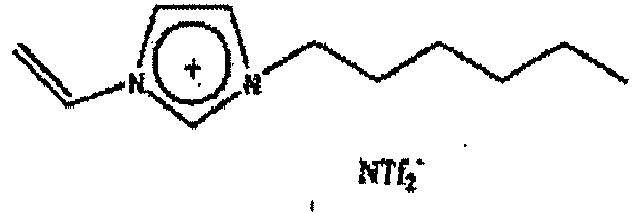
459.1 1.36 1.443 hvim- NTf 2 a2 
501.2 1.28 1.445 nvim-NTf2 b 3 
543.3 1.23 1.448 dvim-NTf2 c 4 
832.1 1.53 1.449 C6(vim)2-NTf2 d 
820.1 C6vm(im)2-NTf2 e 
808.1 C6(mim)2-NTf2 f C6(vim)2-NTf2 : C6vm(im)2-NTf2 : C6(mim)2-NTf2 1 : 2 : 1 5 
874.3 1.47 1.457 C9(vim)2-NTf2 g 6 
888.3 -- -- C10(vim)2- NTf 2 h,*7 
902.3 1.44 1.457 C11(vim)2- NTf 2 i8 
916.3 1.42 1.458 C12(vim)2-NTf2 j,* 9 
489.3 1.30 1.434 nmim- NTf 2 k10 

Table C: Effect of AIBN initiator concentration on efficiency (theoretical plates/meter) as a function of conditioning of the crosslinked stationary phase. The percentage of AIBN initiator indicated is based on the weight percent of the ionic liquid. Partially Crosslinked Ionic Liquid Matrix Crosslinked Ionic Liquid Matrix 0.10% 2 0.10% 2 0.10% 2 0.10% 2 020% C5-12(vim)2-NTf2 0,5%AIBN 0.20% C9-12(vim)2-NTf2 3,5%AIBN 0.20% C9-12(vim)2-NTF2 7.05%AIBN 0.20% C9-12(vim)2-NTf2 10.0%AIBN 0.10% 5 0.10% 5 0.10% 5 0.10% 5 0.5% AIBN 3.5%AIBN 7.0%AIBN 10.0%AIBN 30°C-120°C 3°C/min Hold 2 hours 3296 3566 3831 3817 3426 3155 2792 2905 100°C-200°C 3°C/min Hold 5 hours 3215 3277 3703 3529 2697 2379 2275 2309 150°C-250°C 3°C/min Hold 3 hours 3090 3016 3069 3027 1723 1598 1682 1398 200°C-285°C 3°C/min Hold 2 hours 2210 2536 2375 2559 950 711 865 649 200°C - 300°C 3°C/min Hold 1 hour 1317 2024 2298 2009 676 554 768 603 200°C-350°C 3°C/min Hold 1 hour 112 146 598 1214 1593 950 1664 1506 285°C - 385°C 3°C/min Hold 20 min -- -- 140 68 178 239 490 453 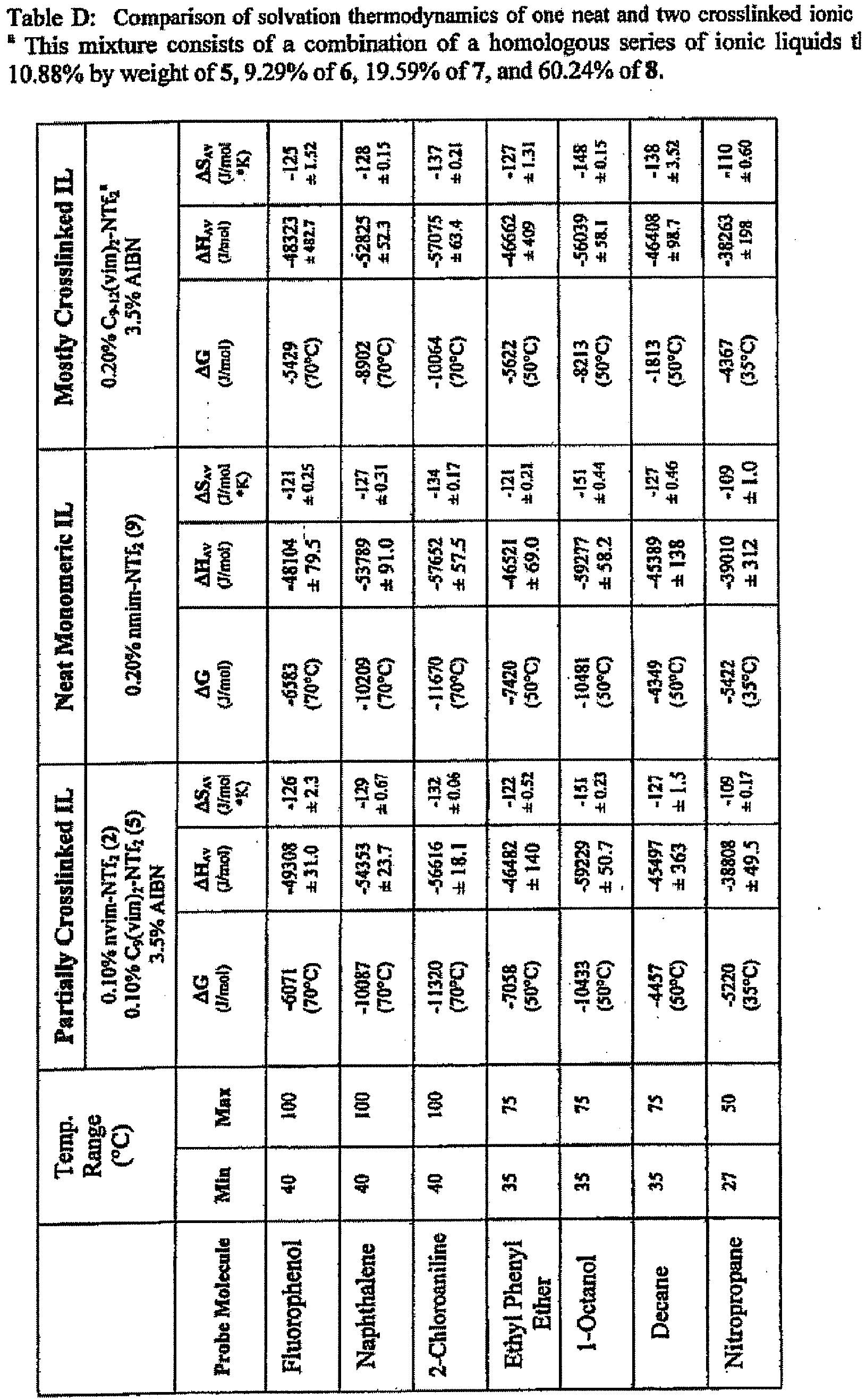
Table E: Comparison of interaction parameters of one neat and two crosslinked ionic liquids. Temp (°C) Interaction Parametersa 0.20% nmim-NTf2 (9) c r s a b l n R2 F 40 -2.98 (0.11) 0 (0.09) 1.62 (0.10) 1.91 (0.10) 0.36 (0.13) 0.75 (0.03) 32 0.99 (0.10) 477.86 70 -3.05 (0.08) 0 (0.07) 1.54 (0.07) 1.57 (0.07) 0.18 (0.10) 0.63 (0.02) 32 0.99 (0.07) 660.78 100 -3.47 (0.11) 0 (0.09) 1.52 (0.10) 1.43 (0.09) 0.12 (0.13) 0.60 (0.03) 30 0.99 (0.09) 304.17 0.10% C9(vim)-NTf2 (2); 0.10% C9(vim)2-NTf2 (5): 3.5% AIBN 40 -2.95 (0.11) 0 (0.10) 1.60 (0.11) 1.84 (0.10) 0.45 (0.15) 0.71 (0.03) 32 0.99 (0.10) 404.82 70 -3.05 (0.08) 0 (0.07) 1.57 (0.08) 1.53 (0.07) 0.37 (0.10) 0.60 (0.02) 32 0.99 (0.07) 639.52 100 -3.49 (0.12) 0 (0.09) 1.54 (0.11) 1.41 (0.09) 0.31 (0.14) 0.54 (0.03) 30 0.98 (0.09) 299.60 0.20% C9-12(vim)2-NTf2 b ; 3.5% AIBN 40 -3.31 (0.10) 0 (0.09) 1.92 (0.10) 1.94 (0.09) 0.59 (0.13) 0.68 (0.03) 32 0.99. (0.09) 573.26 70 -3.55 (0.12) 0 (0.10) 1.88 (0.11) 1.71 (0.09) 0.46 (0.15) 0.59 (0.03) 32 0.99 (0.10) 305.25 100 -3.65 (0.13) 0 (0.11) 1.73 (0.13) 1.46 (0.12) 0.32 (0.18) 0.48 (0.04) 30 0.98 (0.11) 254.83 a r= interaction via nonbonding and π-electrons, 5 = dipolarity/polarizability,
a = hydrogen bond basicity, b = hydrogen bond acidity, l = dispersion forces, n = number of probe molecules subjected to multiple linear regression analysis, R2 = statistical correlation coefficient, F = Fisher coefficient. Values in parenthesis are the standard deviations for each interaction parameter.
b This mixture consists of a combination of a homologous series of ionic liquids that are 10.88% by weight of 5, 9.29% of 6, 19.59% of 7, and 60.24% of 8.Table F: Names of Compounds Found in Tables 1 and 2 C3(mim)2-Br 1,3-di(3-methylimidazolium)propane di-bromide C3(mim)2-NTf2 1,3-di(3-Methylimidazolium)propane di-bis[(trifluoromethyl)sulfonyl]imidate C3(mim)2-BF4 1,3-di(3-methylimidazolium)propane di-tetrafluoroborate C3(mim)2-PF6 1,3-(3-methylimidazolium)propane di-hexafluorophosphate C6(mim)2-Br 1,6-di(3-methylimidazolium)hexane di-bromide C6(mim)2-NTf2 1,6-di(3-methylimidazolium)hexane di-bis[(tritluoromethyl)sulfonyl]imida C6(mim)2-BF4 1.6-di(3-methylimidazolium)hexane di-tetrafluoroborate C6(mim)2-PF6 1,6-di(3-methylimidazolium)hexane di-hexafluorophosphate C9(mim)2-Br 1,9-di(3-methylimidazolium)nonane di-bromide C9(mim)2-NTf2 1,9-di(3-methylimidazolium)nonane di-bis[(trifluoromethyl)sulfonyl]imidate C9(mim)2-BF4 1,9-di(3-methylimidazolium)nonane di-tetrafluoroborate C9(mim)2-PF6 1,9-di(3-methylimidazolium)nonane di-hexafluorophosphate C12(mim)2-Br 1,12-di(3-methylimidazolium)dodecane di-bromide C12(mim)2-NTf2 1,12-di(3-methylimidazolium)dodecane di-bis[(trifluoromethyl)sulfonyl]imidate C12(mim)2-BF4 1.12-di(3-methylimidazolium)dodecane di-tetrafluoroborate C12(mim)2-PF6 1,12-di(3-methylimidazolium)dodecane di-hexafluorophosphate C9(bim)2-Br 1,9-di(3-butylimidazolium)monane di-bromide C9(bim)2-NTf2 1,9-di(3-butylimidazolium)monane di-bis[(trifluoromethyl)sulfonyl]imidate C9(bim)2-BF4 1,9-di(3-butylimidazolium)nonane di-tetrafluoroborate C9(bim)2-PF6 1,9-di(3-butylimidazolium)nonane di-hexafluorophosphate C3(m2im)2-Br 1,3-di(2,3-dimethylimidaolium)propane di-bromide C3(m2im)2-NTf2 1,3-di(2,3-dimethylimidazolium)propane di-bis[(trifluoromethyl)sulfonyl]imidate C3(m2im)2-PF6 1,3-di(2,3-dimethylimidazolium)propane di-hexafluorophosphate C9(m2im)2-Br 1,9-di(2,3-dimethylimidazolium)nonane di-bromide C9(m2im)2-NTf2 1,9-di(2,3-dimethylimidazolium)nonane di-bis[(trifluoromethyl)sulfonyl]imidate C9(m2im)2-BF4 1,9-di(2,3-dimethylimidazolium)nonane di-tetrafluoroborate C9(m2im)2-PF6 1,9-di(2,3-dimethylimidazolium)nonane di-hexafluorophosphate C12(benzam)2-Br 1,12-di(3-benzylimidazolium)dodecane di-bromide C12(benzim)2-NTf2 1,12-di(3-benzylimidazolium)dodecane di-bis[(trifluoromothyl)sulfonyl]imidate C12(benzim)2-PF6 1,12-di(3-benzylimidazolium)dodecane di-hexafluorophosphate C3(mpy)2-Br 1,3-di(methylpyrrolidinium)propane di-bromide C3(mpy)2-NTf2 1,3-di(methylpyrrolidinium)propane di-bis[(trifluoromethyl)sulfonyl]imidate C3(mpy)2-PF6 1,3-di(methylpyrrolidinium)propane di-hexafluorophosphate C9(mpy)2-Br 1,9-di(methylpyrrolidinium)nonane di-bromide C9(mpy)2-NTf2 1,9-di(methylpyrrolidinium)nonane di-bis[(trifluoromethyl)sulfonyl]imidate C9(mpy)2-PF6 1,9-di(methylpyrrolidinium)nonane di-hexafluorophosphate C9(bpy)2-Br 1,9-di(butylpyrrolidinium)nonane di-bromide C9(bpy)2-NTf2 1,9-di(butylpyrrolidinium)nonane di-bis[(trifluoromethyl)sulfonyl]imida C9(bpy)2-PF6 1,9-di(butylpyrrolidinium)nonane di-hexafluorophosphate - The invention provides a method of detecting a charged molecule having a single charge (+1 or -1) using electrospray ionization-mass spectrometry (ESI-MS). In the method a suitable amount of the diionic species of the invention having the opposite charges of the molecule of interest is added to the sample. The diionic species and the charged molecule form a salt complex. The salt complex is generally a solid. Because the diionic species has two charges, when complexed with the charged molecule, the complex has a net charge. The complex is then detected using ESI-MS. The formation of the complex converts the charged molecule into an ion having a higher mass to charge ratio m/z, which can be transferred by ESI more efficiently due to mass discrimination. The present invention thus provides an ESI-MS method with substantially improved selectivity and sensitivity. Preferred is the use of dicationic species.
- In one embodiment, the method of the invention includes selecting a diionic species that has a desired composition and structure, e.g., desired charged group or a desired mass or a combination thereof. The charged group can be selected based on the composition and structure of the charged molecule to be detected. Preferably, the diionic species is specific for the charged molecule to be detected. Thus, it is preferable that the diionic species is such that it binds strongly with the charged molecule to be detected. More preferably, the charged group of the diionic species is such that it does not bind strongly with other charged molecules different from the molecule of interest in the sample. Employing a diionic species that is specific for a charged molecule of interest allows high selectivity in detecting the charged molecule. Use of the diionic species having two different ionic groups may offer particular advantage in tailoring the affinities for different molecules for detection.
- The mass of the diionic species is preferably selected to achieve optimal detection by the mass spectrometer. In general, a diionic species having a large mass is used. The diionic species is preferably such that the complex has a m/z higher than 50. Most commercial single quadruple mass spectrometers are designed to have their optimum performance at m/z values significantly higher than 100. In another preferred embodiment, the diionic species is selected such that the complex has a m/z significantly higher than 100, e.g., at least about 200, at least about 300, or at least about 400. A person skilled in the art will understand that the mass of the diionic species depends on the sizes of the charged groups as well as the bridging group. One or more of these can be varied to obtain a diionic species of desired mass.
- In another embodiment, the method of the invention includes selecting a diionic salt that dissociates with high yield. This can be achieved by selecting a diionic salt containing suitable counter ions. In cases where a diionic salt having desired ionic groups but less desirable counter ions, it can be converted to a diionic salt containing the desired counter ions by anion exchange. In a specific embodiment, a fluoride salt is used, which if not yet available, can be converted from a dihalide, a bromide or a iodide salt by anion exhange.
- In another embodiment, the method further includes a step of performing ion chromatography prior to the addition of the diionic species.
- Several dicationic species were used in detecting perchlorate (ClO4 -). In a preferred embodiment, the invention provides a method of detecting a charged molecule of -1 charge other than perchlorate (ClO4 -) by mass spectrometry using a dicationic species of the invention. In another embodiment, the invention provides a method of detecting perchlorate (ClO4 -) by mass spectrometry using a dicationic species of the invention which is not one of the dicationic species I-X disclosed in reference 58. In still another embodiment, the invention provides a method of detecting a charged molecule of -1 charge by mass spectrometry using a "unsymmetric" dicationic species of the invention. In still another embodiment, the invention provides a method of detecting a charged molecule of -1 charge by mass spectrometry using a chiral dicationic species of the invention.
- In another preferred embodiment, the invention provides a method of detecting a charged molecule of +1 charge by mass spectrometry using a dianionic species of the invention. Any one of the dianionic species described above can be used.
- In still another preferred embodiment, the invention provides a method of detecting a plurality of different charged molecules of +1 or -1 charge by mass spectrometry using a plurality of different diionic species of the invention. Each of the diionic species is selected to specifically bind one of the different charged molecules. Preferably, the different diionic species have different masses such that the complexes formed with their respective charged molecules can be detected separately.
- Mass spectrometry can be carried out using standard procedures know in the art.
- In another aspect of the present invention, there are provided a mixture comprising both the diionic liquid salts of the invention and traditional stationary phase material such as but not limited to polysiloxanes, PEGS, methylpolysiloxanes, phenyl substituted methylpolysiloxance, nirile substituted methylpolysiloxance, carbowax. Such mixture (mixed stationary phase or "MSP") can be used as a stationary phases in chromatography such as gas chromatography, liquid chromatography and high performance liquid chromatography as well as in SPE and SPME. Both dicationic salt and dianionic salt can be used for this purpose. The MSPs can be non-cross-linked (e.g. absorbed or adsorbed on a solid support or column), can be "partially" cross-linked or "more highly" cross-linked (i.e., immobilized on a solid support or column). The diionic liquid salts may also be cross-linked or otherwise reacted with the traditional stationary phase material or merely mixed therewith.
- Thus, in one embodiment, the invention provides MSPs comprising at least one of the diionic liquid salts of the invention and at least one traditional stationary phase material at a suitable proportion. Appropriate combinations of the diionic liquid salt(s) and the traditional stationary phase material(s) for producing the MSP is based on the particular application as are the proportions of the diionic liquid salt(s) and the traditional stationary phase materials(s) in the MSP. In a preferred embodiment, the ration of the diionic liquid salt and the traditional stationary phase material in the MSP is from about 1:9 (i.e., about 10% of diionic liquid salt and about 90% of traditional stationary phase material) to about 9:1 (i.e., about 90% of diionic liquid salt and about 10% of traditional stationary phase material), about 1:3 (i.e., about 25% of diionic liquid salt and about 75% of traditional stationary phase material) to about 3:1 (i.e., about 75% of diionic liquid salt and about 25% of traditional stationary phase material), about 1:2 (i.e., about 33% of diionic liquid salt and about 67% of traditional stationary phase material) to about 2:1 (i.e., about 67% of diionic liquid salt and about 33% of traditional stationary phase material), or about 1:1 (i.e., about 50% of diionic liquid salt and about 50% of traditional stationary phase material) (w/w). Chromatography employing MSP may perform better, e.g., having higher selectivity, than chromatography employing diionic liquid salts or the traditional stationary phase alone. As an example, an MSP comprising a simple mixture of about 67% (dibutyl imidazolium)2(CH2)9 and about 33% of methylpolysiloxance with about 5% phenyl substitution was prepared and used to coat a column. This MSP was shown to exhibit better separation of an essential oil. Cross-linked version of the MSP can also be used.
- In addition, the invention also provides methods of preparing MSPs, solid supports and/or columns containing same, the MSPs, solid supports, syringes, tubes, pipettes tips, needles, vials, and columns themselves, and the use of columns and solid supports containing such MSPs in chromatography and other analytical or separation techniques such as those described elsewhere.
- Synthesis of 2 involved adding 15.0 mL (0.148 mol) of 1,3-dibromopropane dropwise to 23.5 mL (0.295 mol) of 1-methylimidazole in a round bottom flask under constant stirring at room temperature. The reaction was complete within 2 hours. The bromide salt was dissolved in 100 mL water and extracted with three 25 mL aliquots of ethyl acetate. Water was removed under vacuum heating and the remaining salt was dried under a P2O5 vacuum. Synthesis of the NTf2 - salt consisted of dissolving 10 grams (0.03 mol) of the bromide salt in 100-150 mL water. Two molar equivalents (0.06 mol, 3.92 grams) of N-lithiotrifluoromethylsulfonimide were dissolved in 50 mL of water in a separate beaker and added directly to the bromide salt. The solution was allowed to stir for 12 hours. The top water layer was removed to leave the ionic liquid. Three additional 30 mL aliquots of water were added and extracted with the ionic liquid until the ionic liquid passed the silver nitrate test. The ionic liquid was then dried using rotary evaporation and then further dried under a P2O5 vacuum.
- Synthesis of 7 involved adding 15.0 mL (0.098 mol) of 1,6-dibromohexane dropwise to 15.6 mL (0.196 mol) of 1-methylimidazole in a round bottom flask under constant stirring at room temperature. The reaction was complete within 2 hours. The bromide salt was dissolved in 100 mL water and extracted with three 25 mL aliquots of ethyl acetate. Water was removed under vacuum heating and the remaining salt was dried under a P2O5 vacuum. Anions were exchanged by dissolving 10 grams (0.024 mol) of the bromide salt in ∼150 mL acetone. Two molar equivalents of sodium tetrafluoroborate (0.049 mol, 5.38 grams) were then directly added to the acetone mixture. After allowing 24 hours for complete mixing, sodium bromide was filtered off to leave the pure ionic liquid. The sample was then subjected to silver nitrate to ensure no silver bromide precipitate was present. Acetone was removed under vacuum and the remaining ionic liquid dried under a P2O5 vacuum.
- Synthesis of 17 involved adding 15.0 mL (0.074 mol) of 1,9-dibromononae dropwise to 19.4 mL (0.148 mol) of 1-butylimidazole in a round bottom flask under constant stirring at room temperature. The reaction was complete after 5 hours. The resulting viscous liquid was dissolved in 100 mL water and extracted with three 35 mL aliquots of ethyl acetate. Water was removed under vacuum heating and the remaining salt was dried under a P2O5 vacuum.
- Synthesis of 25 involved dissolving 13.1 mL (0.148 mol) of 1,2-dimethylimidazole in 125 mL 2-propanol and adding 15.0 mL (0.074 mol) of 1,9-dibromononane dropwise in a round bottom flask equipped with a condenser and refluxing at 95°C for 24 hours. After removal of 2-propanol under vacuum, the bromide salt was dissolved in 100 mL water and extracted with three 35 mL aliquots of ethyl acetate. Water was removed under vacuum heating and the remaining salt was dried under a P2O5 vacuum. Synthesis of the NTf2 - salt consisted of dissolving 10 grams (0.02 mol) of the bromide salt in 100-150 mL water. Two molar equivalents (0.04 mol, 11.48 grams) of N-lithiotrifluoromethylsulfonimide were dissolved in 50 mL of water in a separate beaker and added directly to the bromide salt. The solution was allowed to stir for 12 hours. The top water layer was removed to leave the ionic liquid. Three additional 30 mL aliquots of water were added and extracted with the ionic liquid until the ionic liquid passed the silver nitrate test. The ionic liquid was then dried using rotary evaporation and then further dried under a P2O5 vacuum.
- Synthesis of 29 involved dissolving 25.0 g (0.158 mol) of 1-benzylimidazole in 100 mL 2-propanol and adding 25.9 grams (0.079 mol) of 1,12-dibromododecane in a round bottom flask equipped with a condenser and refluxing at 95°C for 24 hours. Due to the hydrophobicity of the salt, it was found to be quite insoluble in water. Therefore, it was washed with ethyl acetate (∼75 mL) and then dried under P2O5. Because the bromide salt as not soluble in water, 10.0 grams (0.016 mol) was dissolved in methanol with stirring. To another beaker was added 8.9 grams (0.031 mol) of N-lithiotrifluoromethylsulfonimide with approximately 50 mL of water. The two contents were mixed the mixture allowed to stir for nearly 5 hours. The methanol-water solution was then removed and the liquid washed with water and then further dried under vacuum and under P2O5.
- Synthesis of 31 involved dissolving 13.0 mL (0.128 mol) of 1,3-dibromopropane in 100 mL 2-propanol and adding 26.6 mL (0.256 mol) of 1-methylpyrrolidine in a round bottom flask equipped with a condenser and refluxing at 95°C for 24 hours. After removal of 2-propanol under vacuum, the bromide salt was dissolved in 100 mL water and extracted with three 35 mL aliquots of ethyl acetate. Water was removed under vacuum heating and the remaining salt was dried under a P2O5 vacuum.
- Synthesis of 35 involved dissolving 12.0 mL (0.059 mol) of 1,9-dibromononane in 100 mL 2-propanol and adding 12.3 mL (0.118 mol) of 1-methylpyrrolidine in a round bottom flask equipped with a condenser and refluxing at 95°C for 24 hours. After removal of 2-propanol under vacuum, the bromide salt was dissolved in 100 mL water and extracted with three 35 mL aliquots of ethyl acetate. Water was removed under vacuum heating and the remaining salt was dried under a P2O5 vacuum. Synthesis of the NTf2 - salt consisted of dissolving 10 grams (0.02 mol) of the bromide salt in 100-150 mL water. Two molar equivalents (0.04 mol, 11.48 grams) of N-lithiotrifluoromethylsulfonimide were dissolved in 50 mL of water in a separate beaker and added directly to the bromide salt. The solution was allowed to stir for 12 hours. The top water layer was removed to leave the ionic liquid. Three additional 30 mL aliquots of water were added and extracted with the ionic liquid until the ionic liquid passed the silver nitrate test. The ionic liquid was then dried using rotary evaporation and then further dried under a P2O5 vacuum.
- Synthesis of 38 involved dissolving 13.0 mL (0.064 mol) of 1,9-dibromononane in 100 mL 2-propanol and adding 20.0 mL (0.128 mol) of 1-butylpyrrolidine in a round bottom flask equipped with a condenser and refluxing at 95°C for 24 hours. After removal of 2-propanol under vacuum, the bromide salt was dissolved in 100 mL water and extracted with three 35 mL aliquots of ethyl acetate. Water was removed under vacuum heating and the remaining salt was dried under a P2O5 vacuum. Synthesis of the NTf2 - salt consisted of dissolving 10 grams (0.019 mol) of the bromide salt in 100-150 mL water. Two molar equivalents (0.037 mol, 10.62 grams) of N-lithiotrifluoromethylsulfonimide were dissolved in 50 mL of water in a separate beaker and added directly to the bromide salt. The solution was allowed to stir for 12 hours. The top water layer was removed to leave the ionic liquid. Three additional 30 mL aliquots of water were added and extracted with the ionic liquid until the ionic liquid passed the silver nitrate test. The ionic liquid was then dried using rotary evaporation and then further dried under a P2O5 vacuum.
- 1,10-decane-tripropyl phosphonium bromide
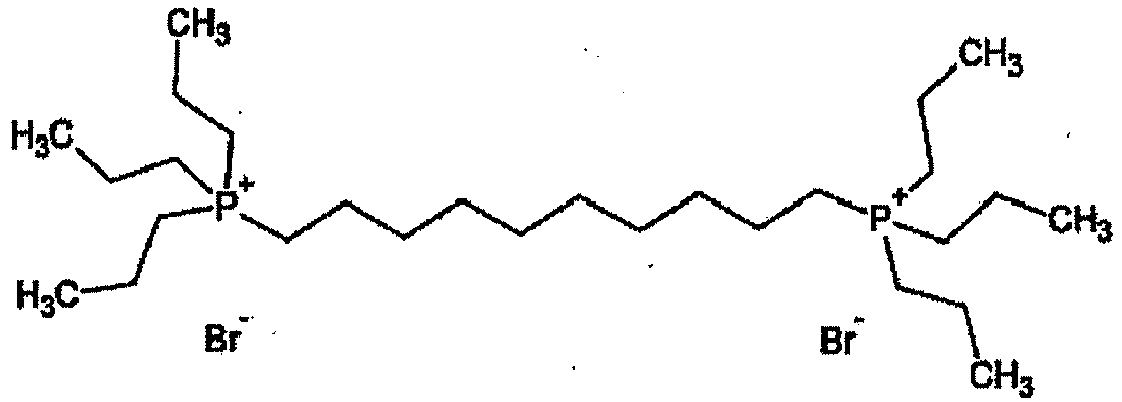
- The following compounds are used for the synthesis: the alkyl linkage compounds:


- The "unsymmetric" dicationic ILs are synthesized from dibromo-linkers according to the following steps:
- First, the monocation intermediate is synthesized by reacting with the linkage compound that is in excess during the reaction to decrease the symmetric dicationic byproduct. For an example, the synthesis of ammonium-based monocation is shown in
Scheme 1.
- Then, the unsymmetrical dicationic ionic compound with the desired anion is synthesized by the metathesis reaction from the dibromide compound that is obtained as an example of ammonium-imidazolium based diionic liquid salt in
Scheme 2.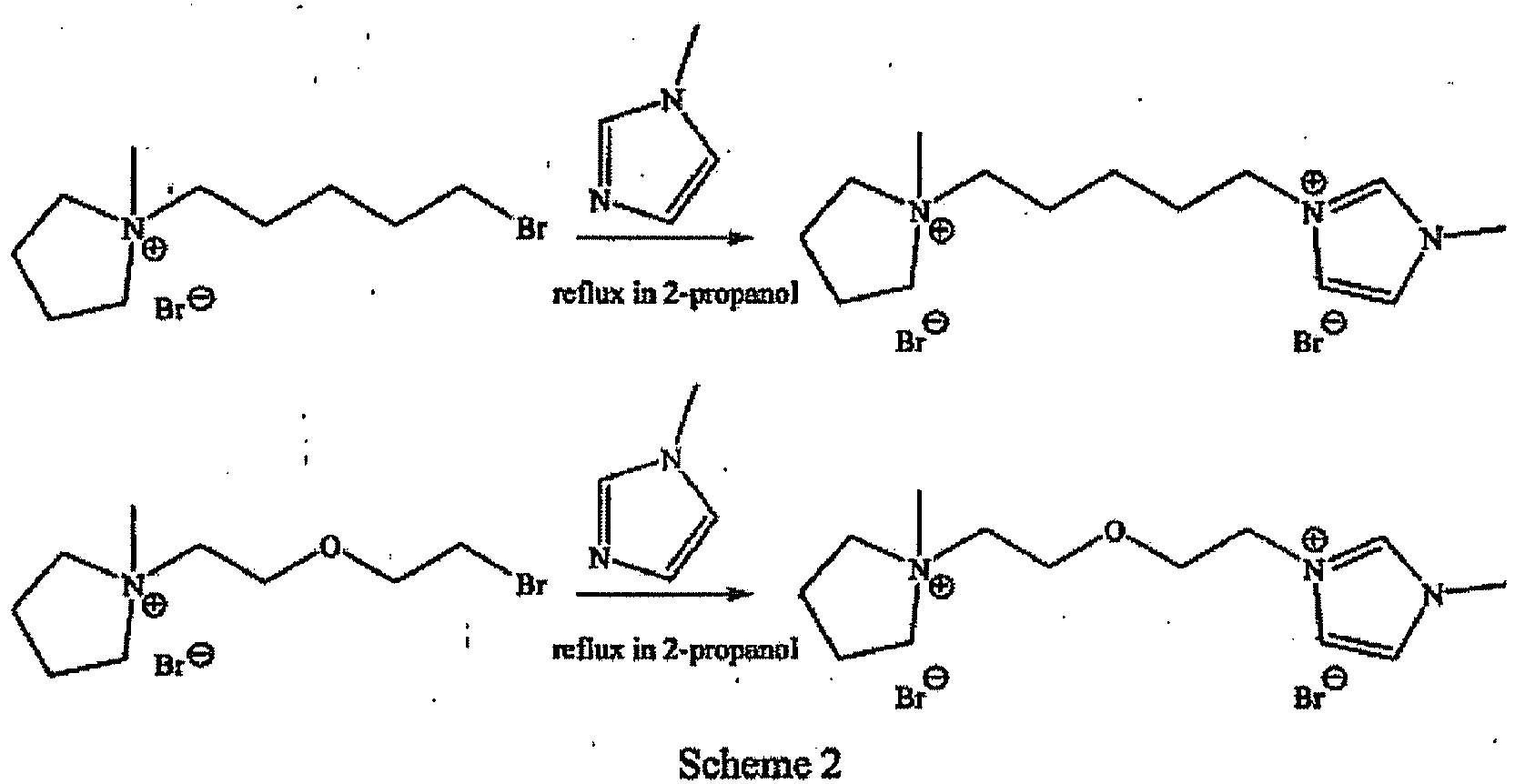
- Next, the unsymmetrical dicationic liquid salts are synthesized from the linkage compound having both bromo- and hydroxyl-groups, shown as an example of pyrrolidinium-imidazolium-based dicationic liquid salt in Scheme 3.

- REFERENCES
- 1. Welton, T. Chem. Rev. 1999, 99, 2071-2083.
- 2. Cadena, C.; Anthony, J. L.; Shah, J. K.; Morrow, T. I.; Brennecke, J. F.; Maginn, E. J. J. Am. Chem. Soc. 2004, 126, 5300-5308.
- 3. Visser, A. E.; Swatloski, R. P.; Reichert, W. M.; Mayton, R.; Sheff, S.; Wierzbicki, A.; Davis, J. H.; Rogers, R. D. Environ. Sci. Technol. 2002, 36, 2523-2529.
- 4. Anderson, J. L.; Armstrong, D. W., Anal. Chem. 2003, 75, 4851-4858.
- 5. Anderson, J. L.; Pino, V.; Hagberg, E. C.; Sheares, V. V.; Armstrong, D. W., Chem. Commun. 2003, 2444-2445.
- 6. Fletcher, K. A.; Pandey, .
- 7. Zhou, Y.; Antonietti, M., J. Am. Chem. Soc. 2003, 125, 14960-14961.
- 8. Luo, H.; Dai, S.; Bonnesen, P. V.; Buchanan, A. C.; Holbrey, J. D.; Bridges, N. J.; Rogers, R. D. Anal. Chem. In press
- 9. Wu, J.; Zhang, J.; Zhang, H.; He, J.; Ren, Q.; Guo, M., Biomacromolecules 2004, 5, 266-268.
- 10. Vijayaraghavan, R.; MacFarlane, D. R., Chem. Commun. 2004, 700-701.
- 11. Boxall, D. L.; Osteryoung, R. A., J. Electrochem. Soc. 2004, 151, E41-E45
- 12. Earle, M. J.; Katdare, S. P.; Seddon, K. R., Org. Lett. 2004, 6, 707-710.
- 13. Carter, E. B.; Culver, S. L.; Fox, P. A.; Goode, R. D.; Ntai, I.; Tickell, M. D.; Traylor, R. K.; Hoffman, N. W.; Davis, J. H. Chem. Commun. 2004, 630-631.
- 14. Wasserscheid, P.; Hilgers, C.; Keim, W., Journal of Molecular Catalysis A 2004, 214, 83-90.
- 15. Gao, H.; Jiang, T.; Han, B.; Wang, Y.; Du, J.; Liu, Z.; Zhang, J., .
- 16. Kaar, J. L.; Jesionowski, A. M.; Berberich, J. A.; Moulton, R.; Russell, A. J., J. Am. Chem. Soc. 2003, 125, 4125-4131.
- 17. Zhao, H.; Malhotra, S. V. .
- 18. Lee, J. K.; Kim, M-J., J Org. Chem. 2002, 67, 6845-6847.
- 19. Wilkes, J. S., Journal of Molecular Catalysis A: Chemical 2004, 214, 11-17.
- 20. Bonhote, P.; Dias, A.-P.; Papageorgiou, N.; Kalyanasundaram, K.; Gratzel, M. Inorg Chem. 1996,35,1168.
- 21. Wei, G-T.; Yang, Z.; Lee, C-Y.; Yang, H-Y.; Wang, C. R., J. Am. Chem. Soc. 2004, 126, 5036-5037.
- 22. Itoh, H.; Naka, K.; Chujo, Y., J Am. Chem. Soc. 2004, 126, 3026-3027.
- 23. Katritzky, A. R.; Jain, R.; Lomaka, A.; Petrukhin, R.; Karelson, M.; Visser, A. E.; Rogers, R. D, J. Chem. Inf. Comput. Sci. 2002, 42, 225-231.
- 24. Eike, D.; Brennecke, J. F.; Maginn, E. J., Green Chem. 2003, 5, 323.
- 25. Forsyth, S. A.; Pringle, J. M.; MacFarlane, D. R., Aust. J. Chem. 2004, 57, 113-119.
- 26. Dzyuba, S. V.; Bartsch, R. A., Chem. Phys. Phys. Chem. 2002, 3, 161-166.
- 27. Seddon, K. R.; Stark, A.; Torres, M-J., ACS Symposium Series 2002, 819 (Clean Solvents: Alternative Media for Chemical Reactions and Processing), 34-49.
- 28. Carda-Broch, S.; Berthod, A.; Armstrong, D. W., Anal. Bioanal. Chem. 2003, 375, 191.
- 29. Baranyai, K. J.; Deacon, G. B.; MacFarlane, D. R.; Pringle, J. M.; Scott, J. L., Aust. J. Chem. 2004, 57, 145-147.
- 30. Van Valkenburg, M. E.; Vaughn, R. L.; Williams, M.; Wilkes, J. S. Proceedings-Electrochemical Society 2002, 2002-19 (Molten Salts XIII), 112-123.
- 31. Anderson, J. L.; Ding, J.; Welton, T.; Armstrong, D. W., J. Am. Chem. Soc. 2002, 124, 14247-14254.
- 32. Blessing, R. H., Acta Cryst. 1995, A51, 33-38.
- 33. All software and sources of the scattering factors are contained in the SHELXTL (version 5.1) program library (G. Sheldrick, Bruker Analytical X-Ray Systems, Madison, Wis.).
- 34. Law, G.; Watson, P. R., Langmuir 2001, 17, 6138-6141.
- 35. Ngo, H. L.; LeCompte, K.; Hargens, L.; McEwen, A. B.,
- 36. Hu, X.; Tang, Y.; Gantzel, P.; Meyer, K., Organometallics 2003, 22, 612-614.
- 37. Bryce, M. R., Chem. Soc. Rev. 1991, 20, 355-390.
- 38. Holbrey, J. D.; Reichert, W. M.; Nieuwenhuyzen, M.; Johnston, S.; Seddon, K. R.; Rogers, R. D., Chem. Commun. 2003, 1636-1637.
- 39. Dearden, J. C., Sci. Total Environ. 1991, 59, 109-110.
- 40. Bondi, A.-J., J. Phys. Chem. 1964, 68, 441-453.
- 41. Anderson, J. L.; Ding, R.; Ellern, A,; Armstrong, D. W. J. Am. Chem. Sac. 2005, 127, 593-604.
- 42. Terazima, M.; Nogami, Y.; Tominaga, T. .
- 43. Van Hook, J. P.; Tobolsky, A. V. J. Chem. Soc. 1958, 80, 779-782.
- 44. Anderson, J. L.; Ding, J.; Welton, T.; Armstrong, D. W. J. Am. Chem. Soc. 2002, 124, 14247-14254.
- 45. Abraham, M. H. Chem. Soc. Rev. 1993, 22, 73.
- 46. Abraham, M. H.; Whiting, G. S.; Doherty, R. M.; Shuely, W. J. J Chromatogr. 1991, 587, 229-236.
- 47. Bouche, J.; Verzele, M. J Gas Chromatogr. 1968, 6, 501.
- 48. Muldoon, M. J.; Gordon, C. M. J Polym. Sci. Part A. Polym. Chem. 2004, 42, 3865-3869.
- 49. Marcilla, R.; Blazquez, J. A.; Rodriguez, J.; Pomposo, J. A.; Mecerreyes, D. J Polym. Sci. Part A: Polym. Chem. 2004, 42, 208-212.
- 50. Armstrong, D. W.; He, L.; Liu, L.-S. Anal. Chem. 1999, 71, 3873-3876
- 51. Anderson, J. L.; Armstrong, D. W. Anal. Chem. 2003, 75, 4851-4858.
- 52. Lord & Pawliszym, J. Chromatogr. A 885 (2000) 153-193.
- 53. Visser et al. "Task-Specific Ionic Liquids Incorporation Novel Cations for the Coordination and Extraction of Hg2+ and Cd2+: Synthesis, Characterization, and Extraction Studies," Environ. Sci. Technol. (2002) 36, 2523-29.
- 54. Liu et al. "Disposable ionic liquid coating for headspace solid-phase microextraction of benzene, toluene, ethyl benzene, and xylenes in plants followed by gas chromatographyflame ionization detection, "J. Chromatogr. A (2005), 1066 (1-2), 27-32.
- 55. Vas, G.; Vekey, K., J. Mass Spectrometery (2004) 39, 233-254.
- 56. Han et al., 2005 "Using Geminal Dicationic Ionic Liquids as Solvents for High-Temperature Organic Reactions," Org. Lett. 7:4205-4208.
- 57. Jin et al., 2006, "Polyethylene glycol functionalized dicatinoic ionic liquids with alkyl or polyfluoroalkyl substituents as high temperature lubricants" J. Mater. Chem. 16:1529-1535.
- 58. Martinelango et al., 2005, "Gas-Phase Ion Association Provides Increased Selectivity and Sensitivity for Measuring Perchlorate by Mass Spectrometry" Anal. Chem. 2005, 77: 4829-4835
- 59. K. Grob, G. Grob and K. Grob, I Chromatogr. 156: 1 (1978).
- 60. K. Grob, G. Grob and K. Grob, J Chromatogr. 219: 13 (1981).
- 1. A dicationic liquid salt comprising a dicationic species corresponding in structure to Formula (III):

wherein:- X and Y are independently selected from the group consisting of ammonium,
- phosphonium and arsonium;
- each R, R', and R" is independently selected from the group consisting of hydrogen, alkyl, alkenyl, alkynyl, and carbocyclyl;
- wherein each R, R', and R" optionally is substituted with one or more substituents selected from the group consisting of alkyl, alkenyl, alkynyl, hydroxyl, alkoxy, and carbocyclyl;
- B is a divalent fragment composed of one or more moieties selected from the group consisting of alkylene, alkenylene, alkynylene, (-CH2-carbocyclyl- CH2-)n, and
- polysiloxyl;
- wherein alkylene, alkenylene, and alkynylene optionally contain one or more heteroatoms selected from the group consisting of O, N, S or Si;
- wherein B is optionally substituted with one or more substituents selected from the group consisting of alkyl, alkenyl, alkynyl, and alkoxy;
- n is selected from the group consisting of 1 to 20, inclusive.
- 2. The dicationic liquid salt of
paragraph 1, wherein R, R' and R" each represent a different substituent. - 3. The dicationic liquid salt of
paragraph 1, wherein one or more of R, R', and R" contain at least one stereogenic center. - 4. The dicationic liquid salt of
paragraph 1, wherein B is substituted with one or more substituents selected from the group consisting of alkyl, alkenyl, alkynyl and alkoxy; and contains at least one stereogenic center. - 5. The dicationic liquid salt of
paragraph 1, wherein the salt is capable of facilitating cross- linking. - 6. The dicationic.liquid salt of
paragraph 1, wherein:- each R, R' and R" is independently selected from the group consisting of hydrogen, propyl, butyl, cyclohexanyl and phenyl;
- X and Y are independently selected from the group consisting of ammonium and phosphonium;
- B is selected from the group consisting of alkylene, alkenylene and alkynylene, wherein each such substituent optionally contains one or more heteroatoms selected from the group consisting of O, N, S or Si.
- 7. The dicationic liquid salt of
paragraph 1, wherein
each R is independently selected from the group consisting of hydrogen, propyl, butyl, cyclohexanyl and phenyl;
each R' is hydrogen or phenyl;
each R" is hydrogen or 2-methoxyphenyl; and
X and Y are both phosphonium. - 8. The dicationic liquid salt of
paragraph 1 , wherein B is unsymmetric. - 9. The dicationic liquid salt of
paragraph 8, wherein B is alkylene, alkenylene, and alkynylene containing one or more heteroatoms selected from the group consisting of O, N, S and Si so as to be unsymmetric. - 10. The dicationic liquid salt of
paragraph 8, wherein B is substituted with one or more substituents selected from the group consisting of alkyl, alkenyl, alkynyl and alkoxy, so as to be unsymmetric. - 11. A dicationic liquid salt comprising a dicationic species corresponding in structure to Formula (IV):
A+-B-A'+ Formula (IV)
and at least one counter anion,
wherein:- A and A' are each a monoionic group independently selected from the group consisting of ammonium, thionium, phosphonium, arsonium, carbocylyl and
- heterocyclyl;
- wherein each such substituent is optionally substituted with one or more substituents selected from the group consisting of alkyl, hydroxyl, alkoxy, cycloalkyl, aryl, hydroxyalkyl, cycloalkylalkyl and aralkyl;
- wherein A and A' are different or A and A' have at least one different substituent;
- B is a divalent fragment composed of one or more moieties selected from the group consisting of alkylene, alkenylene, alkynylene, (-CH2-carbocyclyl-CH2-)n, and
- polysiloxyl;
- wherein alkylene, alkenylene, and alkynylene optionally contain one or
- more heteroatoms selected from the group consisting of O, N, S or Si;
- wherein B is optionally substituted with one or more substituents selected from the group consisting of alkyl, alkenyl, alkynyl, and alkoxy;
- n is selected from the group consisting of 1 to 20, inclusive.
- 12. The dicationic liquid salt of
paragraph 11, wherein the salt is capable of cross-linking. - 13. The dicationic liquid salt of
paragraph 11, wherein at least one of A, B and A' contain at least one stereogenic center, thereby having at least a pair of optical isomers. - 14. The dicationic liquid salt of paragraph 13, wherein at least one of the optical isomers is present in an amount that is greater than the other optical isomer.
- 15. The dicationic liquid salt of paragraph 13, wherein at least one of the optical isomers is present in an amount of about 90% or more compared to the other optical isomer.
- 16. The dicationic liquid salt of
paragraph 11, wherein A and A' are independently selected from the group consisting of:
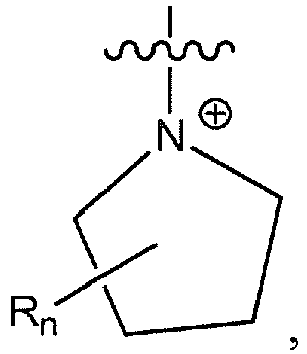
- 17. The dicationic liquid salt of paragraph 16, wherein the dicationic species corresponds to a formula selected from the group consisting of


n is selected from the group consisting of 1 to 20, inclusive. - 18. The dicationic liquid salt of paragraph 17, wherein the dicationic species is selected from the group consisting of:


- 19. The dicationic liquid salt of paragraph 18, wherein the at least one counter anion is selected from the group consisting of Br-, BF4 -, PF6 -, NTf2 -, TfO-,


X1 is C1-C10-alkylene;
X2 is selected from the group consisting of hydrogen, alkyl, alkoxy, amino and hydroxy;
Y1 is selected from the group consisting of hydrogen and alkyl; and
Y2 is C1-C10-alkylene. - 20. The dicationic liquid salt of paragraph 19, where there are at least two counter anions.
- 21. The dicationic liquid salt of paragraph 16, wherein the dicationic species corresponds to a formula selected from the group consisting of:

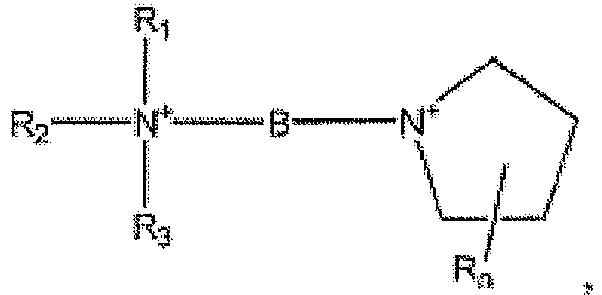


- B is alkylene, (-CH2-O-CH2-)n or (-CH2-carbocyclyl-CH2-)n; and B is optionally substituted; and
- wherein alkylene optionally contains at least one heteroatom selected from the group consisting of O, S, N and Si.
- n is selected from the group consisting of 1 to 20, inclusive.
- 22. The dicationic liquid salt of paragraph 21, wherein the dicationic species is selected from the group consisting of:


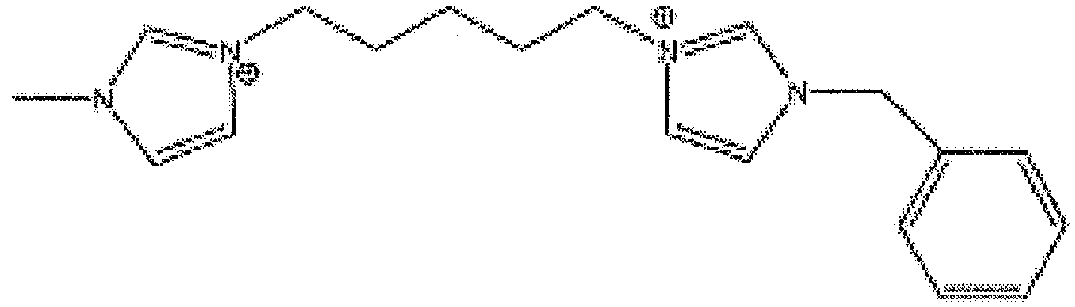


- 23. The dicationic liquid salt of paragraph 22, wherein the at least one counter anion is selected from the group consisting of Br-, BF4 -, PF6 -, NTf2 -, TfO-,


X1 is C1-C10-alkylene;
X2 is selected from the group consisting of hydrogen, alkyl, alkoxy, amino and hydroxy;
Y1 is selected from the group consisting of hydrogen and alkyl; and
Y2 is C1-C10-alkylene. - 24. The dicationic liquid salt of paragraph 23, where there are at least two counter anions.
- 25. The dicationic liquid salt of paragraph 16, wherein the dicationic species corresponds to the following formula:

- 26. The dicationic liquid salt of paragraph 25, wherein the dicationic species is:

- 27. The dicationic liquid salt of paragraph 26, wherein the at least one counter anion is selected the group consisting of Br-, BF4 -, PF6 -, NTf2 -, TfO-,


X1 is C1-C10-alkylene;
X2 is selected from the group consisting of hydrogen, alkyl, alkoxy, amino and hydroxy;
Y1 is selected from the group consisting of hydrogen and alkyl; and
Y2 is C1-C10-alkylene. - 28. The dicationic liquid salt of paragraph 27, where there are at least two counter anions.
- 29. A solvent comprising one or more polyionic liquid salts of
paragraph - 30. A device for chemical separation or analysis comprising a solid support and one or more polyionic liquid salts of
paragraph - 31. The device of
paragraph 30, wherein the solid support is packed in a chromatographic column. - 32. The device of
paragraph 30, wherein the solid support is a capillary column. - 33. The device of
paragraph 30, further comprising a syringe having a hollow needle defining an inner space, the needle being disposed at an end of a barrel and a plunger disposed within the barrel, the solid support being attached to the syringe such that it is retracted into the inner space of the needle when the plunger is retracted from the barrel and exposed from within the needle when the plunger is inserted into the barrel. - 34. The device of paragraph 33, wherein said syringe is a microsyringe.
- 35. The device of
paragraph 30, wherein the one or more polyionic liquid salts is immobilized on the solid support and wherein the one or more polyionic liquid salts includes at least one unsaturated group which can facilitate cross-linking or immobilization. - 36. A method for separating one chemical from a mixture of chemicals comprising:
- providing a mixture of at least one first and at least one second chemical;
- exposing the mixture to a solid support containing one or more polyionic liquid salts of
paragraph 1 orparagraph 11, wherein the one or more polyionic liquid salts is adsorbed, - absorbed or immobilized on the support, and retaining at least a portion of the first chemical on the solid support.
- 37. The method of paragraph 36, wherein the solid support is a column and the mixture is passed through the column such that elution of the first chemical is prevented or delayed.
- 38. The method of paragraph 37, wherein the column is a capillary column.
- 39. The method of paragraph 36, wherein the mixture is carried in a gaseous mobile phase.
- 40. The method of paragraph 36, wherein the solid support is attached to a microsyringe having a hollow needle defining an inner space, the needle being disposed at an end of a barrel and a plunger disposed within the barrel, the solid support being attached to the microsyringe such that it may be retracted into the inner space of the needle when the plunger is retracted from the barrel and exposed from within the needle when the plunger is inserted into the barrel, exposing the solid support from within the needle into the mixture, and retracting the solid support from the mixture, wherein it includes at lease some amount of the first chemical.
- 41. A method of detecting an anion by ESI-MS, the method comprising using one or more dicationic liquid salts of
paragraph 1 orparagraph 11. - 42. The method of paragraph 41, wherein the one or more dicationic liquid salt is a fluoride salt.
Claims (19)
- A dicationic liquid salt comprising a dicationic species corresponding in structure to Formula (IV):
A+-B-A'+ Formula (IV)
and at least one counter anion, wherein:B is a divalent fragment composed of one or more moieties selected from the group consisting of alkylene, alkenylene, alkynylene, (-CH2-carbocyclyl-CH2-)n, and polysiloxyl, wherein alkylene, alkenylene, and alkynylene optionally contain one or more heteroatoms selected from the group consisting of O, N, S or Si, and wherein B is optionally substituted with one or more substituents selected from the group consisting of alkyl, alkenyl, alkynyl and alkoxy;n is selected from the group consisting of 1 to 20, inclusive; and either1) A and A' are each a monoionic group, one being phosphonium and the other imidazolium, wherein each such substituent is optionally substituted with one or more substituents selected from the group consisting of alkyl, hydroxyl, alkoxy, cycloalkyl, aryl, hydroxyalkyl, cycloalkylalkyl and aralkyl; or2) A is one and A' is the other of:
- The dicationic liquid salt of Claim 1, wherein the dicationic species comprises an alkyl linkage, an alkyl-substituted imidazolium group and an alkyl-substituted phosphonium group.
- The dicationic liquid salt of Claim 1, wherein the salt is capable of cross-linking.
- The dicationic liquid salt of Claim 1, wherein the dicationic species is

- The dicationic liquid salt of Claim 4, wherein the at least one counter anion is selected from the group consisting of Br-, BF4 -, PF6 -, NTf2 -, TfO-,

 R is selected from the group consisting of hydrogen, alkyl, hydroxyalkyl, carbocyclyl, heterocyclyl, halo, alkoxy, hydroxyl, alkylcarbonyl, alkylcarbonylalkylene, hydroxycarbonyl,
 X1 is C1-C10-alkylene;X2 is selected from the group consisting of hydrogen, alkyl, alkoxy, amino and hydroxy;Y1 is H or and alkyl; andY2 is C1-C10-alkylene.
 - The dicationic liquid salt of Claim 5, which comprises at least two counter anions.
- A solvent comprising one or more dicationic liquid salts of Claim 1.
- A device for chemical separation or analysis comprising a solid support and one or more dicationic liquid salts of Claim 1, wherein the one or more dicationic liquid salts is adsorbed, absorbed or immobilized on the solid support.
- The device of Claim 8, wherein the solid support is packed in a chromatographic column.
- The device of Claim 8, wherein the solid support is a capillary column.
- The device of Claim 8, further comprising
a syringe having a hollow needle defining an inner space, wherein the needle is disposed at an end of a barrel and
a plunger disposed within the barrel,
wherein the solid support is attached to the syringe such that it is retracted into the inner space of the needle when the plunger is retracted from the barrel and exposed from within the needle when the plunger is inserted into the barrel. - The device of Claim 11, wherein said syringe is a microsyringe.
- The device of Claim 8, wherein the one or more dicationic liquid salts is immobilized on the solid support, and wherein the one or more dicationic liquid salts include at least one unsaturated group which can facilitate cross-linking or immobilization.
- A method for separating one chemical from a mixture of chemicals comprising:providing a mixture of at least one first chemical and at least one second chemical; andexposing the mixture to a solid support containing one or more dicationic liquid salts of Claim 1,wherein the one or more dicationic liquid salts is adsorbed, absorbed or immobilized on the support, and retaining at least a portion of the first chemical on the solid support.
- The method of Claim 14, wherein the solid support is a column, for example a capillary column, and the mixture is passed through the column such that elution of the first chemical is prevented or delayed.
- The method of Claim 14, wherein the mixture is carried in a gaseous mobile phase.
- The method of Claim 14, wherein the solid support is attached to a microsyringe having a hollow needle defining an inner space, the needle being disposed at an end of a barrel and a plunger disposed within the barrel, the solid support being attached to the microsyringe such that it may be retracted into the inner space of the needle when the plunger is retracted from the barrel and exposed from within the needle when the plunger is inserted into the barrel, exposing the solid support from within the needle into the mixture, and retracting the solid support from the mixture, wherein it includes at lease some amount of the first chemical.
- A method of detecting an anion by ESI-MS, the method comprising using one or more dicationic liquid salts of Claim 1.
- The method of Claim 18, wherein the one or more dicationic liquid salt is a fluoride salt.
Applications Claiming Priority (2)
| Application Number | Priority Date | Filing Date | Title |
|---|---|---|---|
| US11/701,537 US8168830B2 (en) | 2004-07-23 | 2007-01-31 | High stability diionic liquid salts |
| EP08728652A EP2114968A2 (en) | 2007-01-31 | 2008-01-31 | High stability diionic liquid salts |
Related Parent Applications (1)
| Application Number | Title | Priority Date | Filing Date |
|---|---|---|---|
| EP08728652.2 Division | 2008-01-31 |
Publications (1)
| Publication Number | Publication Date |
|---|---|
| EP2682396A1 true EP2682396A1 (en) | 2014-01-08 |
Family
ID=39494666
Family Applications (2)
| Application Number | Title | Priority Date | Filing Date |
|---|---|---|---|
| EP13180460.1A Withdrawn EP2682396A1 (en) | 2007-01-31 | 2008-01-31 | High stability diionic liquid salts |
| EP08728652A Withdrawn EP2114968A2 (en) | 2007-01-31 | 2008-01-31 | High stability diionic liquid salts |
Family Applications After (1)
| Application Number | Title | Priority Date | Filing Date |
|---|---|---|---|
| EP08728652A Withdrawn EP2114968A2 (en) | 2007-01-31 | 2008-01-31 | High stability diionic liquid salts |
Country Status (4)
| Country | Link |
|---|---|
| US (2) | US8168830B2 (en) |
| EP (2) | EP2682396A1 (en) |
| JP (2) | JP2010518018A (en) |
| WO (1) | WO2008095064A2 (en) |
Families Citing this family (27)
| Publication number | Priority date | Publication date | Assignee | Title |
|---|---|---|---|---|
| EP1765781A2 (en) * | 2004-07-09 | 2007-03-28 | Sigma-Aldrich Co. | Optically enhanced chiral ionic liquids |
| CN101061099B (en) * | 2004-07-23 | 2013-10-30 | 西格马-奥利奇有限公司 | High Stability Diionic Liquid Salt |
| US8168830B2 (en) | 2004-07-23 | 2012-05-01 | Sigma-Aldrich Co. Llc | High stability diionic liquid salts |
| JP5528815B2 (en) | 2007-01-31 | 2014-06-25 | シグマ−アルドリッチ・カンパニー、エルエルシー | Highly stable polyionic liquid salt |
| US8742331B2 (en) * | 2008-02-15 | 2014-06-03 | Sigma-Aldrich, Co. | Imidazolium-based liquid salts and methods of use thereof |
| EP2245653A1 (en) * | 2008-02-15 | 2010-11-03 | Sigma-Aldrich Co. | Anion detection by esi-ms using dicationic liquid salts |
| WO2010017564A1 (en) * | 2008-08-08 | 2010-02-11 | University Of Toledo | Boron selective ionic liquids and polymeric ionic liquids, methods of making and methods of use thereof |
| TW201024267A (en) * | 2008-12-19 | 2010-07-01 | Ind Tech Res Inst | Electrolyte composition and dye-sensitized solar cell using the same |
| WO2011046661A1 (en) * | 2009-07-24 | 2011-04-21 | The Regents Of The University Of Colorado, A Body Corporate | Imidazolium-based room-temperature ionic liquids, polymers monomers and membranes incorporating same |
| WO2011031442A2 (en) | 2009-08-28 | 2011-03-17 | 3M Innovative Properties Company | Polymerizable ionic liquid comprising multifunctional cation and antistatic coatings |
| EP2470509A2 (en) | 2009-08-28 | 2012-07-04 | 3M Innovative Properties Company | Compositions and articles comprising polymerizable ionic liquid mixture, and methods of curing |
| WO2011068944A1 (en) | 2009-12-04 | 2011-06-09 | Sigma-Aldrich Co. | Tetraionic liquid salts and methods of use thereof |
| WO2011087621A2 (en) | 2009-12-22 | 2011-07-21 | 3M Innovative Properties Company | Curable dental compositions and articles comprising polymerizable ionic liquids |
| US9566985B2 (en) * | 2011-02-08 | 2017-02-14 | GM Global Technology Operations LLC | Method and apparatus for monitoring a resolver in a torque machine |
| WO2013169779A1 (en) * | 2012-05-07 | 2013-11-14 | Board Of Regents, The University Of Texas System | Synergistic mixtures of ionic liquids with other ionic liquids and/or with ashless thiophosphates for antiwear and/or friction reduction applications |
| WO2014175449A1 (en) * | 2013-04-26 | 2014-10-30 | 国立大学法人 東京大学 | Novel graphene nano dispersion and method for preparing same |
| JP6198144B2 (en) * | 2014-06-13 | 2017-09-20 | トヨタ紡織株式会社 | Novel ionic liquid, gas absorption method, and gas absorption device |
| WO2016020678A1 (en) * | 2014-08-05 | 2016-02-11 | Micromass Uk Limited | Method of introducing ions into a vacuum region of a mass spectrometer |
| WO2016022965A1 (en) | 2014-08-08 | 2016-02-11 | Massachusetts Institute Of Technology | Persistent carbene adducts and related methods |
| EP3275869A1 (en) * | 2015-03-27 | 2018-01-31 | Kaneka Corporation | Heat-resistant aliphatic-chain saturated hydrocarbon having ion pairs at both ends, and composition using same |
| EP3720920B1 (en) | 2017-12-08 | 2024-01-24 | Baker Hughes Holdings LLC | Ionic liquid based well asphaltene inhibitors and methods of using the same |
| EA202091413A1 (en) | 2018-07-11 | 2020-09-24 | Бейкер Хьюз Холдингз Ллк | WELL ASPHALTEN INHIBITORS BASED ON IONIC LIQUID AND METHODS OF THEIR APPLICATION |
| KR102122544B1 (en) * | 2019-09-20 | 2020-06-16 | 에스케이이노베이션 주식회사 | Ionic liquid containing divalent cation and monovalent anion and lubricant composition comprising the same |
| CN111875504B (en) * | 2020-07-27 | 2021-05-18 | 中国科学院过程工程研究所 | A kind of cyclohexylbisamine ionic liquid and its application in sulfur dioxide absorption |
| DE102022102453A1 (en) | 2022-02-02 | 2023-08-03 | Rheinische Friedrich-Wilhelms-Universität Bonn, Körperschaft des öffentlichen Rechts | pyridinium compound |
| CN116162312B (en) * | 2022-12-26 | 2024-05-03 | 湖南工业职业技术学院 | High polymer material wear-resistant concrete conveying pipeline |
| CN116621877B (en) * | 2023-04-17 | 2025-06-17 | 天津大学 | Sulfide-containing diphosphine-based cationic ionic liquid, preparation method thereof, and method for extracting heavy metals in aqueous solution |
Citations (3)
| Publication number | Priority date | Publication date | Assignee | Title |
|---|---|---|---|---|
| JPH10213871A (en) * | 1997-01-29 | 1998-08-11 | Mitsubishi Paper Mills Ltd | Silver halide photographic material |
| US6531241B1 (en) | 1999-07-08 | 2003-03-11 | Covalent Associates, Inc. | Cyclic delocalized cations connected by spacer groups |
| WO2006012513A2 (en) * | 2004-07-23 | 2006-02-02 | Sigma-Aldrich Co. | High stability diionic liquid salts |
Family Cites Families (55)
| Publication number | Priority date | Publication date | Assignee | Title |
|---|---|---|---|---|
| DD39618A (en) | ||||
| DE39618C (en) | HEILMANN-DUCOMMUN & STEINLEN in Mülhausen i. Eis | Milling head with double-inclined steels | ||
| GB633158A (en) * | 1946-07-06 | 1949-12-12 | Du Pont | Improvements in or relating to photographic sensitising dyes and intermediates |
| US2500110A (en) | 1948-06-12 | 1950-03-07 | Eastman Kodak Co | Bispyridyl compounds containing a silicon atom and process of preparation |
| GB711654A (en) | 1951-04-16 | 1954-07-07 | Ciba Ltd | Manufacture of new trialkylamines |
| GB821242A (en) | 1955-05-23 | 1959-10-07 | Rohm & Haas | Quaternary ammonium compounds |
| US2865964A (en) | 1955-09-23 | 1958-12-23 | Searle & Co | Poly (triphenylphosphonium) compounds |
| DE1204226B (en) | 1963-12-10 | 1965-11-04 | Boehringer Sohn Ingelheim | Process for the preparation of bisquaterner tin complex salts |
| CH497398A (en) | 1968-10-15 | 1970-10-15 | Geigy Ag J R | Process for the preparation of sulfonium salts |
| DE2031213C3 (en) | 1970-06-20 | 1978-09-14 | Schering Ag, 1000 Berlin Und 4619 Bergkamen | Process for the preparation of dimethylsulfonium butadiene halides |
| BE790089A (en) * | 1971-10-14 | 1973-04-13 | Ici Ltd | DERIVATIVES OF IMIDAZOLE |
| FR2372826A1 (en) * | 1976-12-01 | 1978-06-30 | France Etat | Imidazolium pyridinium carbaldoxime double salts - for treatment of poisoning by phosphorus pesticides |
| JPS543841A (en) | 1977-06-13 | 1979-01-12 | Shin Etsu Chem Co Ltd | Flame-retardant coating composition |
| US4557919A (en) | 1983-04-12 | 1985-12-10 | Teijin Petrochemical Industries Ltd. | Production of crystalline zeolites |
| JPS59190213A (en) | 1983-04-12 | 1984-10-29 | Teijin Yuka Kk | Preparation of crystalline zeolite |
| DE3331008A1 (en) | 1983-08-27 | 1985-03-14 | Basf Ag, 6700 Ludwigshafen | METHOD FOR PRODUCING HYDROXYBENZYLPHOSPHONIUM SALTS |
| DE3333124A1 (en) | 1983-09-14 | 1985-05-02 | Hoechst Ag, 6230 Frankfurt | Process for the production of zeolites |
| US4483835A (en) * | 1983-11-14 | 1984-11-20 | Chevron Research Company | Process for preparing molecular sieves using imidazole template |
| US4987052A (en) | 1986-04-08 | 1991-01-22 | Fuji Photo Film Co., Ltd. | Silver halide photographic material and method for forming superhigh contrast negative images using the same |
| JPH0619508B2 (en) * | 1986-05-30 | 1994-03-16 | 富士写真フイルム株式会社 | Silver halide photographic light-sensitive material |
| JPH02185009A (en) | 1989-01-12 | 1990-07-19 | Nippon Chemicon Corp | Electrolyte for electrolytic capacitor |
| US4948395A (en) | 1989-09-12 | 1990-08-14 | Advanced Separations Technologies Inc. | Chiral separation media |
| US5064944A (en) | 1989-09-12 | 1991-11-12 | Advanced Separation Technologies Inc. | Chiral separation media |
| BE1003510A5 (en) | 1989-10-09 | 1992-04-07 | Fabricom Air Conditioning Sa | DISINFECTANT COMPOSITION AND DISINFECTION METHOD. |
| SU1727789A1 (en) | 1989-11-21 | 1992-04-23 | Кемеровский государственный медицинский институт | Mean for sampling biological material of eye and its appendage for microbiological examination |
| GB9221997D0 (en) * | 1992-10-20 | 1992-12-02 | Ici Plc | Inhibition of microbial growth in swimming pools and spas |
| US5451347A (en) * | 1993-06-24 | 1995-09-19 | Lumigen, Inc. | Methods and compositions providing enhanced chemiluminescence from chemiluminescent compounds using dicationic surfactants |
| US5470986A (en) | 1994-06-27 | 1995-11-28 | E. I. Du Pont De Nemours And Company | Imidazolium hardeners for hydrophilic colloid |
| JPH08301703A (en) * | 1995-05-10 | 1996-11-19 | Otsuka Chem Co Ltd | Quaternary ammonium compound having antimicrobial activity |
| US5827602A (en) | 1995-06-30 | 1998-10-27 | Covalent Associates Incorporated | Hydrophobic ionic liquids |
| GB9515720D0 (en) | 1995-08-01 | 1995-10-04 | Zeneca Ltd | Bacterial coating compositions |
| FR2786484B1 (en) | 1998-11-30 | 2001-01-05 | Oreal | CATIONIC AMINOANTHRAQUINONES, THEIR USE FOR DYEING KERATINIC FIBERS, TINCTORIAL COMPOSITIONS CONTAINING THEM AND DYEING METHODS |
| US20020010291A1 (en) | 1998-12-04 | 2002-01-24 | Vince Murphy | Ionic liquids and processes for production of high molecular weight polyisoolefins |
| FR2788220B1 (en) * | 1999-01-08 | 2001-02-16 | Oreal | USE OF CATIONIC DI-BENZENIC NITERS IN DYING KERATINIC FIBERS, TINCTORIAL COMPOSITIONS AND DYING METHODS |
| JP4360575B2 (en) | 1999-03-01 | 2009-11-11 | 富士フイルム株式会社 | Liquid crystal compound, liquid crystal mixture, liquid crystal composition, electrolyte, electrochemical cell and photoelectrochemical cell |
| DE60029151T2 (en) | 1999-03-01 | 2007-05-31 | Fuji Photo Film Co., Ltd., Minami-Ashigara | Photoelectrochemical cell with an electrolyte of liquid crystal compounds |
| WO2001085093A2 (en) | 1999-12-23 | 2001-11-15 | Neurochem, Inc. | Compounds and methods for modulating cerebral amyloid angiopathy |
| DE10003708A1 (en) * | 2000-01-28 | 2001-08-02 | Solvent Innovation Gmbh | Novel chiral ionic liquids and methods for their preparation in enantiomerically pure or enantiomerically enriched form |
| JP2001247487A (en) | 2000-03-06 | 2001-09-11 | Central Glass Co Ltd | Optically active ionic liquid |
| CA2308896A1 (en) | 2000-05-18 | 2001-11-18 | Allan James Robertson | Phosphonium salts |
| JP2003017148A (en) | 2001-07-04 | 2003-01-17 | Fuji Photo Film Co Ltd | Electrolyte component, photoelectric conversion element, and photoelectric chemical cell |
| CN1151887C (en) | 2002-05-16 | 2004-06-02 | 华东师范大学 | L-hydrosulformidate type chiral ionic liquid and its prepn |
| CN1150994C (en) | 2002-05-16 | 2004-05-26 | 华东师范大学 | L-sulforamidate type chiral ionic liquid and its prepn |
| JP4261223B2 (en) | 2003-03-07 | 2009-04-30 | 弘幸 大野 | Organic ionic liquids containing amino acids as constituent ions |
| JP2004277351A (en) | 2003-03-17 | 2004-10-07 | Kaoru Nobuoka | Ionic liquid for chiral separation |
| TWI278315B (en) | 2003-06-13 | 2007-04-11 | Ind Tech Res Inst | A compound having anti-virus activity |
| GB0327524D0 (en) | 2003-11-26 | 2003-12-31 | Univ Glasgow | Heterocyclic aromatic compounds |
| EP1765781A2 (en) | 2004-07-09 | 2007-03-28 | Sigma-Aldrich Co. | Optically enhanced chiral ionic liquids |
| US8168830B2 (en) | 2004-07-23 | 2012-05-01 | Sigma-Aldrich Co. Llc | High stability diionic liquid salts |
| WO2006026064A2 (en) | 2004-08-05 | 2006-03-09 | University Of Wyoming | Poly(ionic liquid)s as materials for co2 separation |
| EP2016056A4 (en) | 2006-04-21 | 2010-11-10 | Univ Boston | IONIC VISCOELASTIC SUBSTANCES AND VISCOELASTIC SALTS |
| JP5528815B2 (en) | 2007-01-31 | 2014-06-25 | シグマ−アルドリッチ・カンパニー、エルエルシー | Highly stable polyionic liquid salt |
| US8168801B2 (en) | 2007-03-12 | 2012-05-01 | The Royal Institution For The Advancement Of Learning/Mcgill University | Imidazolium-type ionic oligomers |
| EP2245653A1 (en) | 2008-02-15 | 2010-11-03 | Sigma-Aldrich Co. | Anion detection by esi-ms using dicationic liquid salts |
| US8742331B2 (en) | 2008-02-15 | 2014-06-03 | Sigma-Aldrich, Co. | Imidazolium-based liquid salts and methods of use thereof |
-
2007
- 2007-01-31 US US11/701,537 patent/US8168830B2/en not_active Expired - Lifetime
-
2008
- 2008-01-31 EP EP13180460.1A patent/EP2682396A1/en not_active Withdrawn
- 2008-01-31 WO PCT/US2008/052583 patent/WO2008095064A2/en not_active Ceased
- 2008-01-31 JP JP2009548442A patent/JP2010518018A/en active Pending
- 2008-01-31 EP EP08728652A patent/EP2114968A2/en not_active Withdrawn
-
2012
- 2012-03-30 US US13/435,163 patent/US8956445B2/en not_active Expired - Lifetime
-
2013
- 2013-09-12 JP JP2013189677A patent/JP5947765B2/en active Active
Patent Citations (3)
| Publication number | Priority date | Publication date | Assignee | Title |
|---|---|---|---|---|
| JPH10213871A (en) * | 1997-01-29 | 1998-08-11 | Mitsubishi Paper Mills Ltd | Silver halide photographic material |
| US6531241B1 (en) | 1999-07-08 | 2003-03-11 | Covalent Associates, Inc. | Cyclic delocalized cations connected by spacer groups |
| WO2006012513A2 (en) * | 2004-07-23 | 2006-02-02 | Sigma-Aldrich Co. | High stability diionic liquid salts |
Non-Patent Citations (60)
| Title |
|---|
| ABRAHAM, M. H., CHEM. SOC. REV., vol. 22, 1993, pages 73 |
| ABRAHAM, M. H.; WHITING, G. S.; DOHERTY, R. M.; SHUELY, W. J., J CHROMATOGR., vol. 587, 1991, pages 229 - 236 |
| ANDERSON, J. L.; ARMSTRONG, D. W., ANAL. CHEM., vol. 75, 2003, pages 4851 - 4858 |
| ANDERSON, J. L.; DING, J.; WELTON, T.; ARMSTRONG, D. W., J. AM. CHEM. SOC., vol. 124, 2002, pages 14247 - 14254 |
| ANDERSON, J. L.; DING, R.; ELLERN, A; ARMSTRONG, D. W., J. AM. CHEM. SAC., vol. 127, 2005, pages 593 - 604 |
| ANDERSON, J. L.; PINO, V.; HAGBERG, E. C.; SHEARES, V. V.; ARMSTRONG, D. W., CHEM. COMMUN., 2003, pages 2444 - 2445 |
| ARMSTRONG, D. W.; HE, L.; LIU, L.-S., ANAL. CHEM., vol. 71, 1999, pages 3873 - 3876 |
| BARANYAI, K. J.; DEACON, G. B.; MACFARLANE, D. R.; PRINGLE, J. M.; SCOTT, J. L., AUST. J. CHEM., vol. 57, 2004, pages 145 - 147 |
| BLESSING, R. H., ACTA CRYST., vol. A51, 1995, pages 33 - 38 |
| BONDI, A.-J., J. PHYS. CHEM., vol. 68, 1964, pages 441 - 453 |
| BONHOTE, P.; DIAS, A.-P.; PAPAGEORGIOU, N.; KALYANASUNDARAM, K.; GRATZEL, M., INORG CHEM., vol. 35, 1996, pages 1168 |
| BOUCHE, J.; VERZELE, M., J GAS CHROMATOGR., vol. 6, 1968, pages 501 |
| BOXALL, D. L.; OSTERYOUNG, R. A., J. ELECTROCHEM. SOC., vol. 151, 2004, pages E41 - E45 |
| BRYCE, M. R., CHEM. SOC. REV., vol. 20, 1991, pages 355 - 390 |
| CADENA, C.; ANTHONY, J. L.; SHAH, J. K.; MORROW, T. I.; BRENNECKE, J. F.; MAGINN, E. J., J. AM. CHEM. SOC., vol. 126, 2004, pages 5300 - 5308 |
| CARDA-BROCH, S.; BERTHOD, A.; ARMSTRONG, D. W., ANAL. BIOANAL. CHEM., vol. 375, 2003, pages 191 |
| CARTER, E. B.; CULVER, S. L.; FOX, P. A.; GOODE, R. D.; NTAI, I.; TICKELL, M. D.; TRAYLOR, R. K.; HOFFMAN, N. W.; DAVIS, J. H., CHEM. COMMUN., 2004, pages 630 - 631 |
| DEARDEN, J. C., SCI. TOTAL ENVIRON., vol. 59, 1991, pages 109 - 110 |
| DZYUBA, S. V.; BARTSCH, R. A., CHEM. PHYS. PHYS. CHEM., vol. 3, 2002, pages 161 - 166 |
| EARLE, M. J.; KATDARE, S. P.; SEDDON, K. R., ORG. LETT., vol. 6, 2004, pages 707 - 710 |
| EIKE, D.; BRENNECKE, J. F.; MAGINN, E. J., GREEN CHEM., vol. 5, 2003, pages 323 |
| FLETCHER, K. A.; PANDEY, S., LANGMUIR, vol. 20, 2004, pages 33 - 36 |
| FORSYTH, S. A.; PRINGLE, J. M.; MACFARLANE, D. R., AUST. J. CHEM., vol. 57, 2004, pages 113 - 119 |
| GAO, H.; JIANG, T.; HAN, B.; WANG, Y.; DU, J.; LIU, Z.; ZHANG, J., POLYMER, vol. 45, 2004, pages 3017 - 3019 |
| HAN ET AL.: "Using Geminal Dicationic Ionic Liquids as Solvents for High-Temperature Organic Reactions", ORG. LETT., vol. 7, 2005, pages 4205 - 4208 |
| HOLBREY, J. D.; REICHERT, W. M.; NIEUWENHUYZEN, M.; JOHNSTON, S.; SEDDON, K. R.; ROGERS, R. D., CHEM. COMMUN., 2003, pages 1636 - 1637 |
| HU, X.; TANG, Y.; GANTZEL, P.; MEYER, K., ORGANOMETALLICS, vol. 22, 2003, pages 612 - 614 |
| ITOH, H.; NAKA, K.; CHUJO, Y., J AM. CHEM. SOC., vol. 126, 2004, pages 3026 - 3027 |
| JIN ET AL.: "Polyethylene glycol functionalized dicatinoic ionic liquids with alkyl or polyfluoroalkyl substituents as high temperature lubricants", J. MATER. CHEM., vol. 16, 2006, pages 1529 - 1535, XP002601955, DOI: doi:10.1039/b517888f |
| K. GROB; G. GROB; K. GROB, I CHROMATOGR., vol. 156, 1978, pages 1 |
| K. GROB; G. GROB; K. GROB, J CHROMATOGR., vol. 219, 1981, pages 13 |
| KAAR, J. L.; JESIONOWSKI, A. M.; BERBERICH, J. A.; MOULTON, R.; RUSSELL, A. J., J. AM. CHEM. SOC., vol. 125, 2003, pages 4125 - 4131 |
| KATRITZKY, A. R.; JAIN, R.; LOMAKA, A.; PETRUKHIN, R.; KARELSON, M.; VISSER, A. E.; ROGERS, R. D, J. CHEM. INF. COMPUT. SCI., vol. 42, 2002, pages 225 - 231 |
| LAW, G.; WATSON, P. R., LANGMUIR, vol. 17, 2001, pages 6138 - 6141 |
| LEE, J. K.; KIM, M-J., J ORG. CHEM., vol. 67, 2002, pages 6845 - 6847 |
| LIU ET AL.: "Disposable ionic liquid coating for headspace solid-phase microextraction of benzene, toluene, ethyl benzene, and xylenes in plants followed by gas chromatography-- flame ionization detection", J CHROMATOGR. A, vol. 1066, no. 1-2, 2005, pages 27 - 32 |
| LORD; PAWLISZYM, J. CHROMATOGR. A, vol. 885, 2000, pages 153 - 193 |
| LUO, H.; DAI, S.; BONNESEN, P. V.; BUCHANAN, A. C.; HOLBREY, J. D.; BRIDGES, N. J.; ROGERS, R. D., ANAL. CHEM. |
| MARCILLA, R.; BLAZQUEZ, J. A.; RODRIGUEZ, J.; POMPOSO, J. A.; MECERREYES, D., J POLYM. SCI. PART A: POLYM. CHEM., vol. 42, 2004, pages 208 - 212 |
| MARTINELANGO ET AL.: "Gas-Phase Ion Association Provides Increased Selectivity and Sensitivity for Measuring Perchlorate by Mass Spectrometry", ANAL. CHEM., vol. 77, 2005, pages 4829 - 4835, XP055047629, DOI: doi:10.1021/ac050479j |
| MEVEL MATHIEU ET AL: "Dicationic Lipophosphoramidates as DNA Carriers", BIOCONJUGATE CHEMISTRY, ACS, WASHINGTON, DC, US, vol. 18, no. 5, 19 September 2007 (2007-09-19), pages 1604 - 1611, XP002473043, ISSN: 1043-1802, DOI: 10.1021/BC070089Z * |
| MULDOON, M. J.; GORDON, C. M., JPOLYM. SCI. PART A. POLYM. CHEM., vol. 42, 2004, pages 3865 - 3869 |
| NGO, H. L.; LECOMPTE, K.; HARGENS, L.; MCEWEN, A. B., THERMOCHIMICA ACTA, vol. 357, no. 358, 2000, pages 97 - 102 |
| RICHARD C. LAROCK: "Comprehensive Organic Transformations: a guide to functional group preparations. 2nd Edition.", 1999, WILEY-VCH |
| SEDDON, K. R.; STARK, A.; TORRES, M-J., ACS SYMPOSIUM SERIES, vol. 819, 2002, pages 34 - 49 |
| SIR GEOFFREY ALLEN, COMPREHENSIVE POLYMER SCIENCE - THE SYNTHESIS, CHARACTERIZATION, REACTIONS AND APPLICATIONS OF POLYMERS |
| TERAZIMA, M.; NOGAMI, Y.; TOMINAGA, T., CHEMICAL PHYSICAL LETTERS, vol. 332, 2000, pages 503 - 507 |
| VAN HOOK, J. P.; TOBOLSKY, A. V., J. AM. CHEM. SOC., vol. 80, 1958, pages 779 - 782 |
| VAN VALKENBURG, M. E.; VAUGHN, R. L.; WILLIAMS, M.; WILKES, J. S., PROCEEDINGS-- ELECTROCHEMICAL SOCIETY 2002, vol. 19, 2002, pages 112 - 123 |
| VAS, G.; VEKEY, K., J. MASS SPECTROMETERY, vol. 39, 2004, pages 233 - 254 |
| VIJAYARAGHAVAN, R.; MACFARLANE, D. R., CHEM. COMMUN., 2004, pages 700 - 701 |
| VISSER ET AL.: "Task-Specific Ionic Liquids Incorporation Novel Cations for the Coordination and Extraction of Hg2+ and Cd2+: Synthesis, Characterization, and Extraction Studies", ENVIRON. SCI. TECHNOL., vol. 36, 2002, pages 2523 - 29, XP002510141, DOI: doi:10.1021/ES0158004 |
| VISSER, A. E.; SWATLOSKI, R. P; REICHERT, W. M.; MAYTON, R.; SHEFF, S.; WIERZBICKI, A.; DAVIS, J. H.; ROGERS, R. D., ENVIRON. SCI. TECHNOL., vol. 36, 2002, pages 2523 - 2529 |
| WASSERSCHEID, P.; HILGERS, C.; KEIM, W., JOURNAL OF MOLECULAR CATALYSIS A, vol. 214, 2004, pages 83 - 90 |
| WEI, G-T.; YANG, Z.; LEE, C-Y.; YANG, H-Y.; WANG, C. R., J AM. CHEM. SOC., vol. 126, 2004, pages 5036 - 5037 |
| WELTON, T., CHEM. REV., vol. 99, 1999, pages 2071 - 2083 |
| WILKES, J. S., JOURNAL OF MOLECULAR CATALYSIS A: CHEMICAL, vol. 214, 2004, pages 11 - 17 |
| WU, J.; ZHANG, J.; ZHANG, H.; HE, J.; REN, Q.; GUO, M., BIOMACROMOLECULES, vol. 5, 2004, pages 266 - 268 |
| ZHAO, H.; MALHOTRA, S. V., BIOTECHNOLOGY LETTERS, vol. 24, 2002, pages 1257 - 1260 |
| ZHOU, Y.; ANTONIETTI, M., J. AM. CHEM. SOC., vol. 125, 2003, pages 14960 - 14961 |
Also Published As
| Publication number | Publication date |
|---|---|
| JP2014051495A (en) | 2014-03-20 |
| WO2008095064A2 (en) | 2008-08-07 |
| US8956445B2 (en) | 2015-02-17 |
| JP2010518018A (en) | 2010-05-27 |
| EP2114968A2 (en) | 2009-11-11 |
| US8168830B2 (en) | 2012-05-01 |
| JP5947765B2 (en) | 2016-07-06 |
| US20080027231A1 (en) | 2008-01-31 |
| WO2008095064A3 (en) | 2009-11-05 |
| US20120211696A1 (en) | 2012-08-23 |
Similar Documents
| Publication | Publication Date | Title |
|---|---|---|
| US8956445B2 (en) | High stability diionic liquid salts | |
| US8182581B2 (en) | High stability diionic liquid salts | |
| EP3124490A1 (en) | High stability polyionic liquid salts | |
| US9782746B2 (en) | Polymeric ionic liquids, methods of making and methods of use thereof | |
| Erdmenger et al. | Influence of different branched alkyl side chains on the properties of imidazolium-based ionic liquids | |
| JP2011512535A (en) | Imidazolium-based dicationic liquid salt and method of use thereof | |
| Rouch et al. | Tartrate-based ionic liquids: unified synthesis and characterisation | |
| JP6198144B2 (en) | Novel ionic liquid, gas absorption method, and gas absorption device | |
| Sharma | Ionic liquids: Syntheses, characterization and applications in analytical chemistry |
Legal Events
| Date | Code | Title | Description |
|---|---|---|---|
| PUAI | Public reference made under article 153(3) epc to a published international application that has entered the european phase |
Free format text: ORIGINAL CODE: 0009012 |
|
| AC | Divisional application: reference to earlier application |
Ref document number: 2114968 Country of ref document: EP Kind code of ref document: P |
|
| AK | Designated contracting states |
Kind code of ref document: A1 Designated state(s): AT BE BG CH CY CZ DE DK EE ES FI FR GB GR HR HU IE IS IT LI LT LU LV MC MT NL NO PL PT RO SE SI SK TR |
|
| RIN1 | Information on inventor provided before grant (corrected) |
Inventor name: ARMSTRONG, DANIEL W. Inventor name: ANDERSON, JARED |
|
| 17P | Request for examination filed |
Effective date: 20140704 |
|
| RBV | Designated contracting states (corrected) |
Designated state(s): AT BE BG CH CY CZ DE DK EE ES FI FR GB GR HR HU IE IS IT LI LT LU LV MC MT NL NO PL PT RO SE SI SK TR |
|
| RIN1 | Information on inventor provided before grant (corrected) |
Inventor name: ANDERSON, JARED Inventor name: ARMSTRONG, DANIEL W. |
|
| RIN1 | Information on inventor provided before grant (corrected) |
Inventor name: ARMSTRONG, DANIEL W. Inventor name: ANDERSON, JARED |
|
| RAP1 | Party data changed (applicant data changed or rights of an application transferred) |
Owner name: SIGMA-ALDRICH CO. LLC |
|
| STAA | Information on the status of an ep patent application or granted ep patent |
Free format text: STATUS: EXAMINATION IS IN PROGRESS |
|
| 17Q | First examination report despatched |
Effective date: 20170926 |
|
| STAA | Information on the status of an ep patent application or granted ep patent |
Free format text: STATUS: THE APPLICATION IS DEEMED TO BE WITHDRAWN |
|
| 18D | Application deemed to be withdrawn |
Effective date: 20191203 |