EP2674448A1 - Composite sheet, method for preparing the same and display substrate including the same - Google Patents
Composite sheet, method for preparing the same and display substrate including the same Download PDFInfo
- Publication number
- EP2674448A1 EP2674448A1 EP20130171396 EP13171396A EP2674448A1 EP 2674448 A1 EP2674448 A1 EP 2674448A1 EP 20130171396 EP20130171396 EP 20130171396 EP 13171396 A EP13171396 A EP 13171396A EP 2674448 A1 EP2674448 A1 EP 2674448A1
- Authority
- EP
- European Patent Office
- Prior art keywords
- composite sheet
- substituted
- unsubstituted
- integer
- sheet according
- Prior art date
- Legal status (The legal status is an assumption and is not a legal conclusion. Google has not performed a legal analysis and makes no representation as to the accuracy of the status listed.)
- Withdrawn
Links
- 239000002131 composite material Substances 0.000 title claims abstract description 61
- 239000000758 substrate Substances 0.000 title claims abstract description 32
- 238000000034 method Methods 0.000 title claims description 14
- 239000011159 matrix material Substances 0.000 claims abstract description 38
- 239000012779 reinforcing material Substances 0.000 claims abstract description 24
- -1 cyclic siloxane Chemical class 0.000 claims description 47
- 125000000391 vinyl group Chemical group [H]C([*])=C([H])[H] 0.000 claims description 29
- 229920001296 polysiloxane Polymers 0.000 claims description 26
- 239000011521 glass Substances 0.000 claims description 21
- 239000000203 mixture Substances 0.000 claims description 18
- 239000003365 glass fiber Substances 0.000 claims description 12
- 238000005452 bending Methods 0.000 claims description 10
- 239000001257 hydrogen Substances 0.000 claims description 10
- 229910052739 hydrogen Inorganic materials 0.000 claims description 10
- 238000002834 transmittance Methods 0.000 claims description 9
- 125000006527 (C1-C5) alkyl group Chemical group 0.000 claims description 8
- 238000010438 heat treatment Methods 0.000 claims description 7
- 229920002050 silicone resin Polymers 0.000 claims description 7
- 102100021202 Desmocollin-1 Human genes 0.000 claims description 6
- 101000968043 Homo sapiens Desmocollin-1 Proteins 0.000 claims description 6
- 101000880960 Homo sapiens Desmocollin-3 Proteins 0.000 claims description 6
- 239000004744 fabric Substances 0.000 claims description 6
- 239000012299 nitrogen atmosphere Substances 0.000 claims description 6
- 125000004435 hydrogen atom Chemical group [H]* 0.000 claims description 5
- 238000002411 thermogravimetry Methods 0.000 claims description 5
- 239000007795 chemical reaction product Substances 0.000 claims description 3
- 150000001875 compounds Chemical class 0.000 claims 4
- 239000000463 material Substances 0.000 abstract description 9
- 230000015572 biosynthetic process Effects 0.000 abstract description 2
- 238000004519 manufacturing process Methods 0.000 abstract description 2
- 238000005979 thermal decomposition reaction Methods 0.000 abstract 1
- 238000001723 curing Methods 0.000 description 9
- 230000000052 comparative effect Effects 0.000 description 8
- 229920005989 resin Polymers 0.000 description 8
- 239000011347 resin Substances 0.000 description 8
- XUIMIQQOPSSXEZ-UHFFFAOYSA-N Silicon Chemical compound [Si] XUIMIQQOPSSXEZ-UHFFFAOYSA-N 0.000 description 4
- 150000002431 hydrogen Chemical group 0.000 description 4
- 239000010410 layer Substances 0.000 description 4
- 229910052710 silicon Inorganic materials 0.000 description 4
- 239000010703 silicon Substances 0.000 description 4
- VMAWODUEPLAHOE-UHFFFAOYSA-N 2,4,6,8-tetrakis(ethenyl)-2,4,6,8-tetramethyl-1,3,5,7,2,4,6,8-tetraoxatetrasilocane Chemical compound C=C[Si]1(C)O[Si](C)(C=C)O[Si](C)(C=C)O[Si](C)(C=C)O1 VMAWODUEPLAHOE-UHFFFAOYSA-N 0.000 description 3
- WZJUBBHODHNQPW-UHFFFAOYSA-N 2,4,6,8-tetramethyl-1,3,5,7,2$l^{3},4$l^{3},6$l^{3},8$l^{3}-tetraoxatetrasilocane Chemical compound C[Si]1O[Si](C)O[Si](C)O[Si](C)O1 WZJUBBHODHNQPW-UHFFFAOYSA-N 0.000 description 3
- 239000004973 liquid crystal related substance Substances 0.000 description 3
- 230000003287 optical effect Effects 0.000 description 3
- 150000003839 salts Chemical class 0.000 description 3
- UFHFLCQGNIYNRP-UHFFFAOYSA-N Hydrogen Chemical compound [H][H] UFHFLCQGNIYNRP-UHFFFAOYSA-N 0.000 description 2
- 230000008901 benefit Effects 0.000 description 2
- 230000008859 change Effects 0.000 description 2
- 125000000392 cycloalkenyl group Chemical group 0.000 description 2
- JJRDHFIVAPVZJN-UHFFFAOYSA-N cyclotrisiloxane Chemical compound O1[SiH2]O[SiH2]O[SiH2]1 JJRDHFIVAPVZJN-UHFFFAOYSA-N 0.000 description 2
- 238000010586 diagram Methods 0.000 description 2
- 238000005227 gel permeation chromatography Methods 0.000 description 2
- 238000013007 heat curing Methods 0.000 description 2
- 239000012788 optical film Substances 0.000 description 2
- 229920003023 plastic Polymers 0.000 description 2
- 239000004033 plastic Substances 0.000 description 2
- 239000000047 product Substances 0.000 description 2
- 239000002356 single layer Substances 0.000 description 2
- UHXCHUWSQRLZJS-UHFFFAOYSA-N (4-dimethylsilylidenecyclohexa-2,5-dien-1-ylidene)-dimethylsilane Chemical compound C[Si](C)C1=CC=C([Si](C)C)C=C1 UHXCHUWSQRLZJS-UHFFFAOYSA-N 0.000 description 1
- 125000003837 (C1-C20) alkyl group Chemical group 0.000 description 1
- 125000006649 (C2-C20) alkynyl group Chemical group 0.000 description 1
- UGKULRZSGOCTNI-UHFFFAOYSA-N 2,4,6,8,10-pentaethyl-1,3,5,7,9,2$l^{3},4$l^{3},6$l^{3},8$l^{3},10$l^{3}-pentaoxapentasilecane Chemical compound CC[Si]1O[Si](CC)O[Si](CC)O[Si](CC)O[Si](CC)O1 UGKULRZSGOCTNI-UHFFFAOYSA-N 0.000 description 1
- PUNGSQUVTIDKNU-UHFFFAOYSA-N 2,4,6,8,10-pentamethyl-1,3,5,7,9,2$l^{3},4$l^{3},6$l^{3},8$l^{3},10$l^{3}-pentaoxapentasilecane Chemical compound C[Si]1O[Si](C)O[Si](C)O[Si](C)O[Si](C)O1 PUNGSQUVTIDKNU-UHFFFAOYSA-N 0.000 description 1
- AUYVMKWXKAIGEK-UHFFFAOYSA-N 2,4,6,8-tetrabutyl-1,3,5,7,2,4,6,8-tetraoxatetrasilocane Chemical compound C(CCC)[SiH]1O[SiH](O[SiH](O[SiH](O1)CCCC)CCCC)CCCC AUYVMKWXKAIGEK-UHFFFAOYSA-N 0.000 description 1
- KOJCPAMHGPVAEW-UHFFFAOYSA-N 2,4,6,8-tetraethyl-1,3,5,7,2,4,6,8-tetraoxatetrasilocane Chemical compound CC[SiH]1O[SiH](CC)O[SiH](CC)O[SiH](CC)O1 KOJCPAMHGPVAEW-UHFFFAOYSA-N 0.000 description 1
- VRHGUVTZXOWKGH-UHFFFAOYSA-N 2,4,6,8-tetrapropyl-1,3,5,7,2,4,6,8-tetraoxatetrasilocane Chemical compound C(CC)[SiH]1O[SiH](O[SiH](O[SiH](O1)CCC)CCC)CCC VRHGUVTZXOWKGH-UHFFFAOYSA-N 0.000 description 1
- 125000003860 C1-C20 alkoxy group Chemical group 0.000 description 1
- 125000003358 C2-C20 alkenyl group Chemical group 0.000 description 1
- 239000000654 additive Substances 0.000 description 1
- 230000004075 alteration Effects 0.000 description 1
- 125000003277 amino group Chemical group 0.000 description 1
- 125000003118 aryl group Chemical group 0.000 description 1
- 125000004104 aryloxy group Chemical group 0.000 description 1
- 230000004888 barrier function Effects 0.000 description 1
- 125000002915 carbonyl group Chemical group [*:2]C([*:1])=O 0.000 description 1
- 125000003178 carboxy group Chemical group [H]OC(*)=O 0.000 description 1
- 239000003054 catalyst Substances 0.000 description 1
- 238000004132 cross linking Methods 0.000 description 1
- 125000000753 cycloalkyl group Chemical group 0.000 description 1
- 238000000354 decomposition reaction Methods 0.000 description 1
- KPUWHANPEXNPJT-UHFFFAOYSA-N disiloxane Chemical class [SiH3]O[SiH3] KPUWHANPEXNPJT-UHFFFAOYSA-N 0.000 description 1
- 125000004185 ester group Chemical group 0.000 description 1
- 125000001033 ether group Chemical group 0.000 description 1
- 238000011156 evaluation Methods 0.000 description 1
- 239000010408 film Substances 0.000 description 1
- 239000007789 gas Substances 0.000 description 1
- 230000009477 glass transition Effects 0.000 description 1
- 238000009499 grossing Methods 0.000 description 1
- 125000005843 halogen group Chemical group 0.000 description 1
- HTDJPCNNEPUOOQ-UHFFFAOYSA-N hexamethylcyclotrisiloxane Chemical compound C[Si]1(C)O[Si](C)(C)O[Si](C)(C)O1 HTDJPCNNEPUOOQ-UHFFFAOYSA-N 0.000 description 1
- 125000002887 hydroxy group Chemical group [H]O* 0.000 description 1
- 239000003112 inhibitor Substances 0.000 description 1
- 238000010030 laminating Methods 0.000 description 1
- 238000002156 mixing Methods 0.000 description 1
- 230000004048 modification Effects 0.000 description 1
- 238000012986 modification Methods 0.000 description 1
- 125000002467 phosphate group Chemical group [H]OP(=O)(O[H])O[*] 0.000 description 1
- 230000008569 process Effects 0.000 description 1
- 239000000126 substance Substances 0.000 description 1
- 125000001273 sulfonato group Chemical group [O-]S(*)(=O)=O 0.000 description 1
- 230000000930 thermomechanical effect Effects 0.000 description 1
- 125000003396 thiol group Chemical group [H]S* 0.000 description 1
- 230000004580 weight loss Effects 0.000 description 1
- 238000004804 winding Methods 0.000 description 1
Images
Classifications
-
- C—CHEMISTRY; METALLURGY
- C08—ORGANIC MACROMOLECULAR COMPOUNDS; THEIR PREPARATION OR CHEMICAL WORKING-UP; COMPOSITIONS BASED THEREON
- C08J—WORKING-UP; GENERAL PROCESSES OF COMPOUNDING; AFTER-TREATMENT NOT COVERED BY SUBCLASSES C08B, C08C, C08F, C08G or C08H
- C08J5/00—Manufacture of articles or shaped materials containing macromolecular substances
- C08J5/04—Reinforcing macromolecular compounds with loose or coherent fibrous material
- C08J5/06—Reinforcing macromolecular compounds with loose or coherent fibrous material using pretreated fibrous materials
- C08J5/08—Reinforcing macromolecular compounds with loose or coherent fibrous material using pretreated fibrous materials glass fibres
-
- C—CHEMISTRY; METALLURGY
- C08—ORGANIC MACROMOLECULAR COMPOUNDS; THEIR PREPARATION OR CHEMICAL WORKING-UP; COMPOSITIONS BASED THEREON
- C08K—Use of inorganic or non-macromolecular organic substances as compounding ingredients
- C08K3/00—Use of inorganic substances as compounding ingredients
- C08K3/40—Glass
-
- C—CHEMISTRY; METALLURGY
- C08—ORGANIC MACROMOLECULAR COMPOUNDS; THEIR PREPARATION OR CHEMICAL WORKING-UP; COMPOSITIONS BASED THEREON
- C08L—COMPOSITIONS OF MACROMOLECULAR COMPOUNDS
- C08L83/00—Compositions of macromolecular compounds obtained by reactions forming in the main chain of the macromolecule a linkage containing silicon with or without sulfur, nitrogen, oxygen or carbon only; Compositions of derivatives of such polymers
- C08L83/14—Compositions of macromolecular compounds obtained by reactions forming in the main chain of the macromolecule a linkage containing silicon with or without sulfur, nitrogen, oxygen or carbon only; Compositions of derivatives of such polymers in which at least two but not all the silicon atoms are connected by linkages other than oxygen atoms
-
- C—CHEMISTRY; METALLURGY
- C08—ORGANIC MACROMOLECULAR COMPOUNDS; THEIR PREPARATION OR CHEMICAL WORKING-UP; COMPOSITIONS BASED THEREON
- C08G—MACROMOLECULAR COMPOUNDS OBTAINED OTHERWISE THAN BY REACTIONS ONLY INVOLVING UNSATURATED CARBON-TO-CARBON BONDS
- C08G77/00—Macromolecular compounds obtained by reactions forming a linkage containing silicon with or without sulfur, nitrogen, oxygen or carbon in the main chain of the macromolecule
- C08G77/04—Polysiloxanes
-
- C—CHEMISTRY; METALLURGY
- C08—ORGANIC MACROMOLECULAR COMPOUNDS; THEIR PREPARATION OR CHEMICAL WORKING-UP; COMPOSITIONS BASED THEREON
- C08J—WORKING-UP; GENERAL PROCESSES OF COMPOUNDING; AFTER-TREATMENT NOT COVERED BY SUBCLASSES C08B, C08C, C08F, C08G or C08H
- C08J5/00—Manufacture of articles or shaped materials containing macromolecular substances
- C08J5/24—Impregnating materials with prepolymers which can be polymerised in situ, e.g. manufacture of prepregs
- C08J5/241—Impregnating materials with prepolymers which can be polymerised in situ, e.g. manufacture of prepregs using inorganic fibres
- C08J5/244—Impregnating materials with prepolymers which can be polymerised in situ, e.g. manufacture of prepregs using inorganic fibres using glass fibres
-
- C—CHEMISTRY; METALLURGY
- C08—ORGANIC MACROMOLECULAR COMPOUNDS; THEIR PREPARATION OR CHEMICAL WORKING-UP; COMPOSITIONS BASED THEREON
- C08K—Use of inorganic or non-macromolecular organic substances as compounding ingredients
- C08K7/00—Use of ingredients characterised by shape
- C08K7/02—Fibres or whiskers
- C08K7/04—Fibres or whiskers inorganic
- C08K7/14—Glass
-
- C—CHEMISTRY; METALLURGY
- C08—ORGANIC MACROMOLECULAR COMPOUNDS; THEIR PREPARATION OR CHEMICAL WORKING-UP; COMPOSITIONS BASED THEREON
- C08L—COMPOSITIONS OF MACROMOLECULAR COMPOUNDS
- C08L83/00—Compositions of macromolecular compounds obtained by reactions forming in the main chain of the macromolecule a linkage containing silicon with or without sulfur, nitrogen, oxygen or carbon only; Compositions of derivatives of such polymers
- C08L83/04—Polysiloxanes
-
- C—CHEMISTRY; METALLURGY
- C08—ORGANIC MACROMOLECULAR COMPOUNDS; THEIR PREPARATION OR CHEMICAL WORKING-UP; COMPOSITIONS BASED THEREON
- C08G—MACROMOLECULAR COMPOUNDS OBTAINED OTHERWISE THAN BY REACTIONS ONLY INVOLVING UNSATURATED CARBON-TO-CARBON BONDS
- C08G77/00—Macromolecular compounds obtained by reactions forming a linkage containing silicon with or without sulfur, nitrogen, oxygen or carbon in the main chain of the macromolecule
- C08G77/04—Polysiloxanes
- C08G77/045—Polysiloxanes containing less than 25 silicon atoms
-
- C—CHEMISTRY; METALLURGY
- C08—ORGANIC MACROMOLECULAR COMPOUNDS; THEIR PREPARATION OR CHEMICAL WORKING-UP; COMPOSITIONS BASED THEREON
- C08G—MACROMOLECULAR COMPOUNDS OBTAINED OTHERWISE THAN BY REACTIONS ONLY INVOLVING UNSATURATED CARBON-TO-CARBON BONDS
- C08G77/00—Macromolecular compounds obtained by reactions forming a linkage containing silicon with or without sulfur, nitrogen, oxygen or carbon in the main chain of the macromolecule
- C08G77/04—Polysiloxanes
- C08G77/12—Polysiloxanes containing silicon bound to hydrogen
-
- C—CHEMISTRY; METALLURGY
- C08—ORGANIC MACROMOLECULAR COMPOUNDS; THEIR PREPARATION OR CHEMICAL WORKING-UP; COMPOSITIONS BASED THEREON
- C08G—MACROMOLECULAR COMPOUNDS OBTAINED OTHERWISE THAN BY REACTIONS ONLY INVOLVING UNSATURATED CARBON-TO-CARBON BONDS
- C08G77/00—Macromolecular compounds obtained by reactions forming a linkage containing silicon with or without sulfur, nitrogen, oxygen or carbon in the main chain of the macromolecule
- C08G77/04—Polysiloxanes
- C08G77/20—Polysiloxanes containing silicon bound to unsaturated aliphatic groups
-
- C—CHEMISTRY; METALLURGY
- C08—ORGANIC MACROMOLECULAR COMPOUNDS; THEIR PREPARATION OR CHEMICAL WORKING-UP; COMPOSITIONS BASED THEREON
- C08G—MACROMOLECULAR COMPOUNDS OBTAINED OTHERWISE THAN BY REACTIONS ONLY INVOLVING UNSATURATED CARBON-TO-CARBON BONDS
- C08G77/00—Macromolecular compounds obtained by reactions forming a linkage containing silicon with or without sulfur, nitrogen, oxygen or carbon in the main chain of the macromolecule
- C08G77/48—Macromolecular compounds obtained by reactions forming a linkage containing silicon with or without sulfur, nitrogen, oxygen or carbon in the main chain of the macromolecule in which at least two but not all the silicon atoms are connected by linkages other than oxygen atoms
- C08G77/50—Macromolecular compounds obtained by reactions forming a linkage containing silicon with or without sulfur, nitrogen, oxygen or carbon in the main chain of the macromolecule in which at least two but not all the silicon atoms are connected by linkages other than oxygen atoms by carbon linkages
-
- C—CHEMISTRY; METALLURGY
- C08—ORGANIC MACROMOLECULAR COMPOUNDS; THEIR PREPARATION OR CHEMICAL WORKING-UP; COMPOSITIONS BASED THEREON
- C08J—WORKING-UP; GENERAL PROCESSES OF COMPOUNDING; AFTER-TREATMENT NOT COVERED BY SUBCLASSES C08B, C08C, C08F, C08G or C08H
- C08J2383/00—Characterised by the use of macromolecular compounds obtained by reactions forming in the main chain of the macromolecule a linkage containing silicon with or without sulfur, nitrogen, oxygen, or carbon only; Derivatives of such polymers
- C08J2383/04—Polysiloxanes
- C08J2383/05—Polysiloxanes containing silicon bound to hydrogen
-
- C—CHEMISTRY; METALLURGY
- C08—ORGANIC MACROMOLECULAR COMPOUNDS; THEIR PREPARATION OR CHEMICAL WORKING-UP; COMPOSITIONS BASED THEREON
- C08J—WORKING-UP; GENERAL PROCESSES OF COMPOUNDING; AFTER-TREATMENT NOT COVERED BY SUBCLASSES C08B, C08C, C08F, C08G or C08H
- C08J2383/00—Characterised by the use of macromolecular compounds obtained by reactions forming in the main chain of the macromolecule a linkage containing silicon with or without sulfur, nitrogen, oxygen, or carbon only; Derivatives of such polymers
- C08J2383/04—Polysiloxanes
- C08J2383/07—Polysiloxanes containing silicon bound to unsaturated aliphatic groups
-
- C—CHEMISTRY; METALLURGY
- C08—ORGANIC MACROMOLECULAR COMPOUNDS; THEIR PREPARATION OR CHEMICAL WORKING-UP; COMPOSITIONS BASED THEREON
- C08J—WORKING-UP; GENERAL PROCESSES OF COMPOUNDING; AFTER-TREATMENT NOT COVERED BY SUBCLASSES C08B, C08C, C08F, C08G or C08H
- C08J2383/00—Characterised by the use of macromolecular compounds obtained by reactions forming in the main chain of the macromolecule a linkage containing silicon with or without sulfur, nitrogen, oxygen, or carbon only; Derivatives of such polymers
- C08J2383/14—Characterised by the use of macromolecular compounds obtained by reactions forming in the main chain of the macromolecule a linkage containing silicon with or without sulfur, nitrogen, oxygen, or carbon only; Derivatives of such polymers in which at least two but not all the silicon atoms are connected by linkages other than oxygen atoms
-
- Y—GENERAL TAGGING OF NEW TECHNOLOGICAL DEVELOPMENTS; GENERAL TAGGING OF CROSS-SECTIONAL TECHNOLOGIES SPANNING OVER SEVERAL SECTIONS OF THE IPC; TECHNICAL SUBJECTS COVERED BY FORMER USPC CROSS-REFERENCE ART COLLECTIONS [XRACs] AND DIGESTS
- Y10—TECHNICAL SUBJECTS COVERED BY FORMER USPC
- Y10T—TECHNICAL SUBJECTS COVERED BY FORMER US CLASSIFICATION
- Y10T442/00—Fabric [woven, knitted, or nonwoven textile or cloth, etc.]
- Y10T442/10—Scrim [e.g., open net or mesh, gauze, loose or open weave or knit, etc.]
-
- Y—GENERAL TAGGING OF NEW TECHNOLOGICAL DEVELOPMENTS; GENERAL TAGGING OF CROSS-SECTIONAL TECHNOLOGIES SPANNING OVER SEVERAL SECTIONS OF THE IPC; TECHNICAL SUBJECTS COVERED BY FORMER USPC CROSS-REFERENCE ART COLLECTIONS [XRACs] AND DIGESTS
- Y10—TECHNICAL SUBJECTS COVERED BY FORMER USPC
- Y10T—TECHNICAL SUBJECTS COVERED BY FORMER US CLASSIFICATION
- Y10T442/00—Fabric [woven, knitted, or nonwoven textile or cloth, etc.]
- Y10T442/20—Coated or impregnated woven, knit, or nonwoven fabric which is not [a] associated with another preformed layer or fiber layer or, [b] with respect to woven and knit, characterized, respectively, by a particular or differential weave or knit, wherein the coating or impregnation is neither a foamed material nor a free metal or alloy layer
- Y10T442/2926—Coated or impregnated inorganic fiber fabric
- Y10T442/2992—Coated or impregnated glass fiber fabric
Definitions
- the present invention relates to a composite sheet, a method for preparing the same, and a display substrate including the same.
- a glass substrate has excellent thermal resistance, transparency and a low coefficient of linear expansion. Therefore, a glass substrate has been widely used as a substrate for liquid crystal display devices, organic EL display devices, color filters, solar cells, etc.
- glass substrates are limited in applicability to thinner and lighter liquid crystal displays due to thickness, weight and vulnerability to impact. Moreover, due to brittleness of glass materials, a glass substrate is not suitable for a display substrate.
- a display substrate made of a plastic optical film material is attracting attention as an alternative to glass substrates in the art.
- the plastic optical film material has a high coefficient of thermal expansion and is disadvantageous in terms of stiffness.
- a method for preparing a transparent substrate having improved stiffness by impregnating a reinforcing material including glass fibers or glass cloths into a polymeric matrix resin is used.
- a transparent substrate made of the linear polyorganosiloxane resin has excellent properties in terms of transparency, flexibility and the like, and is lightweight.
- linear polyorganosiloxane resin is applied to various industrial fields due to various advantages such as excellent curing, chemical stability, etc.
- the linear polyorganosiloxane resin is known to be decomposed in the course of forming a volatile ring-shaped cyclotrisiloxane at temperatures of ⁇ 250°C or more, and thus limiting applicability as a substrate material.
- JP2005-298606 discloses a silicone resin having improved heat resistance prepared by reacting 1,3,5,7-tetramethylcyclotetrasiloxane with 1,3,5,7-tetravinyl-1,3,5,7-tetramethylcyclotetrasiloxane.
- US 2009/0069525 discloses a silicone resin having improved heat resistance prepared by reacting 1,3,5,7-tetravinyl-1,3,5,7-tetramethylcyclotetrasiloxane with 1,4-bis(dimethylsilyl)benzene.
- the present invention provides a composite sheet, which has outstanding properties in term of heat resistance, thermal stability, flexibility, mechanical properties and optical properties to be suited for display substrates, and may be applied to smaller, thinner, lighter and cheaper display substrates.
- the present invention provides a method for preparing the composite sheet, and a display substrate using the same.
- the composite sheet of the present invention may suppress deformation of a ring structure and decomposition even at a high temperature of ⁇ 350°C or more, thereby preventing failure of materials at high temperature in manufacture of a substrate.
- the composite sheet includes a matrix, and a reinforcing material impregnated in the matrix.
- the composite sheet has a relaxation modulus of ⁇ 1000 MPa or less under a load of 100 ⁇ N and a weight variation ( ⁇ W) of ⁇ 98% or more at ⁇ 350°C according to Equation 1: wherein Wa is a sample weight as measured after heating 50 mg of a sample from 25°C to 350°C at a temperature increasing rate of 5°C/min in a nitrogen atmosphere by thermogravimetric analysis (TGA/DSC1), and Wb is an initial weight of the sample at 25°C.
- TGA/DSC1 thermogravimetric analysis
- the matrix may include a silicone resin containing a cyclic siloxane.
- the matrix may include a reaction product of a cyclic siloxane and a linear terminal vinyl group-containing polysiloxane.
- the cyclic siloxane may be represented by Formula 1: wherein R 1 , R 2 and R 3 are each independently hydrogen, a substituted or unsubstituted C1-C5 alkyl group, or a substituted or unsubstituted C6-C12 aryl group; n and m are each an integer from 0 to 6; and n + m is an integer from 3 to 6.
- the linear terminal vinyl group-containing polysiloxane may be represented by Formula 2: wherein R 1 and R 2 are each independently hydrogen, a substituted or unsubstituted C1-C5 alkyl group, or a substituted or unsubstituted C6-C12 aryl group; p is an integer from 1 to 20; and q is an integer from 0 to 20.
- the cyclic siloxane and the linear terminal vinyl group-containing polysiloxane may be present in a mole-equivalent ratio of 0.5:1 to 2.5:1.
- TGA/DSC1 thermogravimetric analysis
- the composite sheet may have a transmittance of ⁇ 90% or more at a wavelength of 550 nm.
- the composite sheet may have a bending resistance of ⁇ 5 mm according to ASTM D522, and a coefficient of thermal expansion (CTE) of ⁇ 10 ppm/K.
- the reinforcing material may include at least one of glass fiber cloths, glass fabrics, non-woven glass fabrics, and glass meshes.
- Another aspect of the invention relates to a method for preparing a composite sheet.
- the method includes: preparing a matrix composition including a cyclic siloxane and a linear terminal vinyl group-containing polysiloxane; and impregnating the matrix composition with a reinforcing material and then curing the same.
- a further aspect of the present invention relates to a display substrate including the composite sheet.
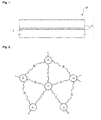
- Fig. 1 is a schematic sectional view of a composite sheet according to one embodiment of the invention.
- a composite sheet 10 according to one embodiment includes a matrix 1 which includes a reinforcing material 2.
- the reinforcing material 2 may have a laminated structure, but is not limited thereto.
- the reinforcing material may be impregnated in a matrix as a support.
- the reinforcing material may be dispersed in the matrix.
- the reinforcing material may have a woven structure and may be impregnated in a matrix.
- the reinforcing material may be arranged with a unidirection and may be impregnated in a matrix.
- the reinforcing material may be in the form of a single-layer or a multi-layer.
- the matrix includes a silicone resin containing a cyclic siloxane.
- the matrix may include a reaction product of a cyclic siloxane and a linear terminal vinyl group-containing polysiloxane.
- a method for preparing the composite sheet may include: preparing a matrix composition including a cyclic siloxane and a linear terminal vinyl group-containing polysiloxane; and impregnating the matrix composition with a reinforcing material and then curing the same.
- Fig. 2 is a schematic diagram of a bond form of a cyclic siloxane and a linear terminal vinyl group-containing polysiloxane. Hydrogen of the cyclic siloxane reacts with a vinyl group of the linear terminal vinyl group-containing polysiloxane, so that the linear terminal vinyl group-containing polysiloxane (B) is bonded between the cyclic siloxane moieties (A).
- the cyclic siloxane may be represented by Formula 1: wherein R 1 , R 2 , and R 3 are each independently hydrogen, a substituted or unsubstituted C1-C5 alkyl group, or a substituted or unsubstituted C6-C12 aryl group; n and m are each an integer from 0 to 6; and n + m is an integer from 3 to 6.
- any one of R 1 and R 2 may be hydrogen.
- substituted means that at least one hydrogen atom is substituted with a halogen atom, a hydroxyl group, an amino group, a carbonyl group, a thiol group, an ester group, an ether group, a carboxyl group or a salt thereof, a sulfonate group or a salt thereof, a phosphate group or a salt thereof, a C1-C20 alkyl group, a C2-C20 alkenyl group, a C2-C20 alkynyl group, a C1-C20 alkoxy group, a C6-C30 aryl group, a C6-C30 aryloxy group, a C3-C30 cycloalkyl group, a C3-C30 cycloalkenyl group, a C3-C30 cycloalkenyl group, or a combination thereof.
- cyclic siloxane may include tetramethylcyclotetrasiloxane, tetraethylcyclotetrasiloxane, tetrapropylcyclotetrasiloxane, tetrabutylcyclotetrasiloxane, pentamethylcyclopentasiloxane, pentaethylcyclopentasiloxane, hexamethylcyclohexasiloxane and the like.
- the linear terminal vinyl group-containing polysiloxane is a linear siloxane having vinyl groups at terminals thereof, and may contain the vinyl groups within a range that satisfies an equivalent ratio.
- the vinyl groups may be present in an amount of ⁇ 25 mol% to ⁇ 50 mol% in the matrix. Within this range, high curing efficiency and rubbery properties after curing can be obtained.
- the linear terminal vinyl group-containing polysiloxane may be represented by Formula 2: wherein R 1 and R 2 are each independently hydrogen, a substituted or unsubstituted C1-C5 alkyl group, or a substituted or unsubstituted C6-C12 aryl group; p is an integer from 1 to 20; and q is an integer from 0 to 20.
- DMS-V03, V05, V21 (vinyl-terminated polydimethylsiloxysilane, manufactured by Gelest, Inc.), and the like may be used as the linear terminal vinyl group-containing polysiloxane.
- the linear terminal vinyl group-containing polysiloxane may have a weight average molecular weight of ⁇ 100 g/mol to ⁇ 10,000 g/mol. Within this range, the matrix composition can exhibit outstanding properties in terms of thermal stability, transparency, and bending resistance.
- the linear terminal vinyl group-containing polysiloxane has a weight average molecular weight from ⁇ 200 g/mol to ⁇ 5,000 g/mol, more preferably from ⁇ 300 g/mol to ⁇ 1,000 g/mol, and still more preferably from ⁇ 350 g/mol to ⁇ 700 g/mol.
- the weight average molecular weight can be measured by GPC (gel permeation chromatography).
- the mechanical properties of the composite sheet may be controlled by controlling the weight average molecular weight of the linear terminal vinyl group-containing polysiloxane.
- the cyclic siloxane and the linear terminal vinyl group-containing polysiloxane may be present in a mole-equivalent ratio of , 0.5:1 to ,2.5:1. Within this range of the mole-equivalent ratio, the matrix composition has high curing efficiency.
- the cyclic siloxane and the linear terminal vinyl group-containing polysiloxane are present in a mole-equivalent ratio of ,1.0:1 to ,2.0:1.
- the mole-equivalent ratio is a mole ratio of the Si-H group in the cyclic siloxane to the vinyl groups.
- the matrix composition may further include typical additives such as catalysts, inhibitors, etc..
- the reinforcing material may include at least one of glass fiber cloths, glass fabrics, non-woven glass fabrics, and glass meshes.
- the reinforcing material includes glass fiber cloths.
- a difference in index of refraction between the reinforcing material and the matrix may be ⁇ 0.01 or less. Within this range, the matrix composition can exhibit excellent transparency. Preferably, the difference in index of refraction there between is ⁇ 0.0001 to ⁇ 0.007.
- a method for preparing a composite sheet may include: impregnating the matrix composition with the reinforcing material; placing the matrix composition between release films, and laminating the same, and curing the matrix composition.
- a composite sheet according to embodiments may include the matrix composition and the reinforcing material in a weight ratio of ,70:30 to ,95:5, preferably from ,80:20 to ,90:10. Within this range, the composite sheet may have properties suited for a display substrate.
- the term "impregnate” and derivatives thereof may include forming a single layer or multilayer structure of the reinforcing material in the matrix.
- Curing may be performed at a temperature from ⁇ 40°C to ⁇ 120°C, preferably, from ⁇ 50°C to ⁇ 100°C, for ⁇ 0.1 minutes to ⁇ 10 hours, preferably, for ⁇ 30 minutes to ⁇ 5 hours. Within this range, sufficient curing of the matrix and the reinforcing material can be secured while providing high mechanical strength.
- a composite sheet according to embodiments may have a thickness of ⁇ 15 ⁇ m to ⁇ 200 ⁇ m. Within this range, the composite sheet can be used for display substrates.
- the matrix composition may have a glass transition temperature from ⁇ -40°C to ⁇ -20°C.
- the composite sheet within a temperature range from room temperature to 80°C, that is, within the operation temperature range when used for a display substrate, the composite sheet has excellent flexibility and stiffness, as well as a low coefficient of thermal expansion.
- TGA/DSC1 thermogravimetric analysis
- the composite sheet may have a relaxation modulus of ⁇ 1000 MPa or less, for example, ⁇ 10 MPa to ⁇ 200 MPa, in an embodiment, ⁇ 20 Mpa to ⁇ 150 MPa, under a load of 100 ⁇ N. In one embodiment, the composite sheet may have relaxation modulus of ⁇ 20 Mpa to ⁇ 100 MPa.
- the composite sheet may have a transmittance of ⁇ 90% or more, preferably > 90% to ⁇ 99%, at a wavelength of 550 nm.
- the composite may have a bending resistance of ⁇ 5 mm, for example, from ⁇ 0.1 mm to ⁇ 3.5 mm, according to ASTM D522, and a coefficient of thermal expansion (CTE) of ⁇ 10 ppm/K, for example, from ⁇ 0.1 to ⁇ 5 ppm/K.
- CTE coefficient of thermal expansion
- the composite sheet may further include a smoothing layer, a gas barrier layer and the like on at least one side thereof.
- a process of forming these layers can be readily performed by those skilled in the art.
- the display substrate may be used as a substrate for display and optical devices, such as liquid crystal display devices (LCDs), color filters, organic EL display devices, solar cells, touch screen panels, etc.
- LCDs liquid crystal display devices
- OLEDs organic EL display devices
- solar cells solar cells
- touch screen panels etc.
- Tetramethylcyclotetrasiloxane and a linear vinyl-terminal polyorganosiloxane DMS-V03 (MW 500, DP 5, Gelest Inc.) were blended in an equivalent ratio of 2:1 and sufficiently mixed using a vortex mixer. After impregnating the mixture with D-glass based glass fibers (Product 3313, Nittobo Co. Ltd.), the impregnated glass fibers were placed on a release glass substrate and left at room temperature for 24 hours until the viscosity was increased.
- the remaining resin was removed from the glass fibers using a laminator, followed by heat curing in an oven at 100°C for 4 hours, thereby producing a transparent silicone composite sheet.
- a silicon composite sheet was prepared in the same manner as in Example 1 except that DMS-05 (MW 800, DP 9, Gelest Inc.) was used as the vinyl-terminal polyorganosiloxane instead of DMS-V03.
- a silicon composite sheet was prepared in the same manner as in Example 1 except that DMS-V21 (MW 6000, DP 65, Gelest Inc.) was used as the vinyl-terminal polyorganosiloxane instead of DMS-V03.
- part A and part B of Sylgard 184 which is a polyorganosiloxane manufactured by Dow Coming Co.
- the mixture was sufficiently mixed using a vortex mixer.
- E-glass based glass fibers Product name 3313, Nittobo Co. Ltd.
- the impregnated glass fibers were placed between two release glass substrates. Then, remaining resin was removed from the glass fibers using a laminator, followed by heat curing in an oven at 100°C for 4 hours, thereby producing a transparent silicone composite sheet.
- a silicon composite sheet was prepared in the same manner as in Example 1 except that tetravinyltetramethylcyclotetrasiloxane was used as the vinyl-terminal polyorganosiloxane.
- Thermal stability After loading 50 mg of a sample in a thermogravimetric analysis tester TGA/DSC1 (Mettler Toledo Inc.), weight loss of the sample was measured by heating the sample from 25°C to 350°C at a temperature increasing rate of 5°C /min in a nitrogen atmosphere.
- ⁇ W Wa Wb x 100 , wherein Wa is a sample weight, as measured after heating 50 mg of a sample from 25°C to 350°C at a temperature increasing rate of 5°C/min in a nitrogen atmosphere using a thermogravimetric analyzer TGA/DSC1, and Wb is an initial weight of the sample at 25 ⁇ .
- the composite sheets prepared in Examples 1 to 3 exhibited outstanding properties in terms of thermal stability, transmittance, bending resistance and coefficient of thermal expansion.
- the composite sheet of Comparative Example 1 had insufficient properties in terms of thermal stability, transmittance and bending resistance as compared with the composite sheets of Examples 1 to 3.
- the composite sheet prepared in Comparative Example 2 had good thermal stability, but exhibited insufficient properties in terms of transmittance, bending resistance and coefficient of thermal expansion as compared with the composite sheets of Examples 1 to 3.
- the composite sheet prepared in Comparative example 2 had a high coefficient of thermal expansion and thus was not suitable for a display substrate.
Landscapes
- Chemical & Material Sciences (AREA)
- Organic Chemistry (AREA)
- Health & Medical Sciences (AREA)
- Chemical Kinetics & Catalysis (AREA)
- Medicinal Chemistry (AREA)
- Polymers & Plastics (AREA)
- Engineering & Computer Science (AREA)
- Materials Engineering (AREA)
- Manufacturing & Machinery (AREA)
- Inorganic Chemistry (AREA)
- Reinforced Plastic Materials (AREA)
- Laminated Bodies (AREA)
- Compositions Of Macromolecular Compounds (AREA)
- Silicon Polymers (AREA)
Abstract
Description
- The present invention relates to a composite sheet, a method for preparing the same, and a display substrate including the same.
- A glass substrate has excellent thermal resistance, transparency and a low coefficient of linear expansion. Therefore, a glass substrate has been widely used as a substrate for liquid crystal display devices, organic EL display devices, color filters, solar cells, etc. However, glass substrates are limited in applicability to thinner and lighter liquid crystal displays due to thickness, weight and vulnerability to impact. Moreover, due to brittleness of glass materials, a glass substrate is not suitable for a display substrate.
- Therefore, a display substrate made of a plastic optical film material is attracting attention as an alternative to glass substrates in the art. However, the plastic optical film material has a high coefficient of thermal expansion and is disadvantageous in terms of stiffness. Thus, a method for preparing a transparent substrate having improved stiffness by impregnating a reinforcing material including glass fibers or glass cloths into a polymeric matrix resin is used.
- Recently, a method for preparing a transparent substrate having a low coefficient of thermal expansion by impregnating a reinforcing material into a rubbery material has been proposed. Among these materials, linear polyorganosiloxane resins are spotlighted major focus of attention. A transparent substrate made of the linear polyorganosiloxane resin has excellent properties in terms of transparency, flexibility and the like, and is lightweight. In addition, although the linear polyorganosiloxane resin is applied to various industrial fields due to various advantages such as excellent curing, chemical stability, etc., the linear polyorganosiloxane resin is known to be decomposed in the course of forming a volatile ring-shaped cyclotrisiloxane at temperatures of ≥ 250°C or more, and thus limiting applicability as a substrate material.
- To solve these problems, various attempts have been made to increase thermal stability of silicone resins. For example,
JP2005-298606 US 2009/0069525 discloses a silicone resin having improved heat resistance prepared by reacting 1,3,5,7-tetravinyl-1,3,5,7-tetramethylcyclotetrasiloxane with 1,4-bis(dimethylsilyl)benzene. - However, despite the advantage of increased heat resistance, these resins have disadvantages of reduced flexibility and brittleness. As the degree of cross-linking of a silicon matrix increases, the formation of cyclotrisiloxane can be inhibited. However, the silicone resins are changed from a rubbery phase to a glassy phase, thereby causing the aforementioned disadvantages.
- Therefore, there is a need for novel materials which have outstanding properties in terms of heat resistance, flexibility, mechanical properties, and optical properties to be suited for display substrates.
- The present invention provides a composite sheet, which has outstanding properties in term of heat resistance, thermal stability, flexibility, mechanical properties and optical properties to be suited for display substrates, and may be applied to smaller, thinner, lighter and cheaper display substrates.
- In addition, the present invention provides a method for preparing the composite sheet, and a display substrate using the same.
- The composite sheet of the present invention may suppress deformation of a ring structure and decomposition even at a high temperature of ≥ 350°C or more, thereby preventing failure of materials at high temperature in manufacture of a substrate.
- One aspect of the invention relates to a composite sheet. The composite sheet includes a matrix, and a reinforcing material impregnated in the matrix. The composite sheet has a relaxation modulus of ≥ 1000 MPa or less under a load of 100 µN and a weight variation (ΔW) of ≥ 98% or more at ≥ 350°C according to Equation 1:

- In one embodiment, the matrix may include a silicone resin containing a cyclic siloxane.
- In another embodiment, the matrix may include a reaction product of a cyclic siloxane and a linear terminal vinyl group-containing polysiloxane.
- The cyclic siloxane may be represented by Formula 1:

- The linear terminal vinyl group-containing polysiloxane may be represented by Formula 2:

- The cyclic siloxane and the linear terminal vinyl group-containing polysiloxane may be present in a mole-equivalent ratio of 0.5:1 to 2.5:1.
- The composite sheet may have a weight variation (ΔW) of ≥ 98% or more at 350°C according to Equation 1:

wherein Wa is a sample weight as measured after heating 50 mg of a sample from 25°C to 350°C at a temperature increasing rate of 5°C /min in a nitrogen atmosphere by thermogravimetric analysis (TGA/DSC1), and Wb is an initial weight of the sample at 25°C. - The composite sheet may have a transmittance of ≥ 90% or more at a wavelength of 550 nm.
- The composite sheet may have a bending resistance of ≤ 5 mm according to ASTM D522, and a coefficient of thermal expansion (CTE) of ≤ 10 ppm/K.
- The reinforcing material may include at least one of glass fiber cloths, glass fabrics, non-woven glass fabrics, and glass meshes.
- Another aspect of the invention relates to a method for preparing a composite sheet. The method includes: preparing a matrix composition including a cyclic siloxane and a linear terminal vinyl group-containing polysiloxane; and impregnating the matrix composition with a reinforcing material and then curing the same.
- A further aspect of the present invention relates to a display substrate including the composite sheet.
-
-
Fig. 1 is a schematic sectional view of a composite sheet according to one embodiment of the invention. -
Fig. 2 is a schematic diagram of a bond form of a cyclic siloxane and a linear terminal vinyl group-containing polysiloxane. -
Fig. 1 is a schematic sectional view of a composite sheet according to one embodiment of the invention. Referring toFig. 1 , acomposite sheet 10 according to one embodiment includes a matrix 1 which includes a reinforcingmaterial 2. According to one embodiment, the reinforcingmaterial 2 may have a laminated structure, but is not limited thereto. The reinforcing material may be impregnated in a matrix as a support. In another embodiment, the reinforcing material may be dispersed in the matrix. In another embodiment, the reinforcing material may have a woven structure and may be impregnated in a matrix. In another embodiment, the reinforcing material may be arranged with a unidirection and may be impregnated in a matrix. The reinforcing material may be in the form of a single-layer or a multi-layer. - In one embodiment, the matrix includes a silicone resin containing a cyclic siloxane.
- In one embodiment, the matrix may include a reaction product of a cyclic siloxane and a linear terminal vinyl group-containing polysiloxane.
- In one embodiment, a method for preparing the composite sheet may include: preparing a matrix composition including a cyclic siloxane and a linear terminal vinyl group-containing polysiloxane; and impregnating the matrix composition with a reinforcing material and then curing the same.
-
Fig. 2 is a schematic diagram of a bond form of a cyclic siloxane and a linear terminal vinyl group-containing polysiloxane. Hydrogen of the cyclic siloxane reacts with a vinyl group of the linear terminal vinyl group-containing polysiloxane, so that the linear terminal vinyl group-containing polysiloxane (B) is bonded between the cyclic siloxane moieties (A). - The cyclic siloxane may be represented by Formula 1:


- In one embodiment, when m is 0, any one of R1 and R2 may be hydrogen.
- As used herein, the term "substituted" means that at least one hydrogen atom is substituted with a halogen atom, a hydroxyl group, an amino group, a carbonyl group, a thiol group, an ester group, an ether group, a carboxyl group or a salt thereof, a sulfonate group or a salt thereof, a phosphate group or a salt thereof, a C1-C20 alkyl group, a C2-C20 alkenyl group, a C2-C20 alkynyl group, a C1-C20 alkoxy group, a C6-C30 aryl group, a C6-C30 aryloxy group, a C3-C30 cycloalkyl group, a C3-C30 cycloalkenyl group, a C3-C30 cycloalkenyl group, or a combination thereof.
- Examples of the cyclic siloxane may include tetramethylcyclotetrasiloxane, tetraethylcyclotetrasiloxane, tetrapropylcyclotetrasiloxane, tetrabutylcyclotetrasiloxane, pentamethylcyclopentasiloxane, pentaethylcyclopentasiloxane, hexamethylcyclohexasiloxane and the like.
- The linear terminal vinyl group-containing polysiloxane is a linear siloxane having vinyl groups at terminals thereof, and may contain the vinyl groups within a range that satisfies an equivalent ratio. For example, the vinyl groups may be present in an amount of ≥ 25 mol% to ≤ 50 mol% in the matrix. Within this range, high curing efficiency and rubbery properties after curing can be obtained.
- In one embodiment, the linear terminal vinyl group-containing polysiloxane may be represented by Formula 2:


- For example, DMS-V03, V05, V21 (vinyl-terminated polydimethylsiloxysilane, manufactured by Gelest, Inc.), and the like may be used as the linear terminal vinyl group-containing polysiloxane.
- In one embodiment, the linear terminal vinyl group-containing polysiloxane may have a weight average molecular weight of ≥ 100 g/mol to ≤ 10,000 g/mol. Within this range, the matrix composition can exhibit outstanding properties in terms of thermal stability, transparency, and bending resistance. Preferably, the linear terminal vinyl group-containing polysiloxane has a weight average molecular weight from ≥ 200 g/mol to < 5,000 g/mol, more preferably from ≥ 300 g/mol to ≤ 1,000 g/mol, and still more preferably from ≥ 350 g/mol to ≤ 700 g/mol. The weight average molecular weight can be measured by GPC (gel permeation chromatography).
- According to embodiments, the mechanical properties of the composite sheet may be controlled by controlling the weight average molecular weight of the linear terminal vinyl group-containing polysiloxane.
- In one embodiment, the cyclic siloxane and the linear terminal vinyl group-containing polysiloxane may be present in a mole-equivalent ratio of , 0.5:1 to ,2.5:1. Within this range of the mole-equivalent ratio, the matrix composition has high curing efficiency. Preferably, the cyclic siloxane and the linear terminal vinyl group-containing polysiloxane are present in a mole-equivalent ratio of ,1.0:1 to ,2.0:1. The mole-equivalent ratio is a mole ratio of the Si-H group in the cyclic siloxane to the vinyl groups.
- The matrix composition may further include typical additives such as catalysts, inhibitors, etc..
- The reinforcing material may include at least one of glass fiber cloths, glass fabrics, non-woven glass fabrics, and glass meshes. Preferably, the reinforcing material includes glass fiber cloths.
- A difference in index of refraction between the reinforcing material and the matrix may be ≤ 0.01 or less. Within this range, the matrix composition can exhibit excellent transparency. Preferably, the difference in index of refraction there between is ≥ 0.0001 to ≤ 0.007.
- A method for preparing a composite sheet may include: impregnating the matrix composition with the reinforcing material; placing the matrix composition between release films, and laminating the same, and curing the matrix composition.
- A composite sheet according to embodiments may include the matrix composition and the reinforcing material in a weight ratio of ,70:30 to ,95:5, preferably from ,80:20 to ,90:10. Within this range, the composite sheet may have properties suited for a display substrate.
- As used herein, the term "impregnate" and derivatives thereof may include forming a single layer or multilayer structure of the reinforcing material in the matrix.
- Curing may be performed at a temperature from ≥ 40°C to ≤ 120°C, preferably, from ≥ 50°C to ≤ 100°C, for ≥ 0.1 minutes to ≤ 10 hours, preferably, for ≥ 30 minutes to < 5 hours. Within this range, sufficient curing of the matrix and the reinforcing material can be secured while providing high mechanical strength.
- A composite sheet according to embodiments may have a thickness of ≥ 15 µm to ≤ 200 µm. Within this range, the composite sheet can be used for display substrates.
- In one embodiment, the matrix composition may have a glass transition temperature from ≥ -40°C to ≤ -20°C. In this case, within a temperature range from room temperature to 80°C, that is, within the operation temperature range when used for a display substrate, the composite sheet has excellent flexibility and stiffness, as well as a low coefficient of thermal expansion.
- The composite sheet may have a weight change (ΔW) of ≥ 98% or more at 350°C, for example, from ≥ 98.5% to ≤ 99.9% according to Equation 1:

wherein Wa is a sample weight, as measured after heating 50 mg of a sample from 25°C to 350°C at a temperature increasing rate of 5°C/min in a nitrogen atmosphere by thermogravimetric analysis (TGA/DSC1), and Wb is an initial weight of the sample at 25°C. - The composite sheet may have a relaxation modulus of ≤ 1000 MPa or less, for example, ≥ 10 MPa to ≤ 200 MPa, in an embodiment, ≥ 20 Mpa to ≤ 150 MPa, under a load of 100 µN. In one embodiment, the composite sheet may have relaxation modulus of ≥ 20 Mpa to ≤ 100 MPa.
- The composite sheet may have a transmittance of ≥ 90% or more, preferably > 90% to ≤ 99%, at a wavelength of 550 nm.
- The composite may have a bending resistance of ≤ 5 mm, for example, from ≥ 0.1 mm to ≤ 3.5 mm, according to ASTM D522, and a coefficient of thermal expansion (CTE) of ≤ 10 ppm/K, for example, from ≥ 0.1 to ≤ 5 ppm/K.
- In another embodiment, the composite sheet may further include a smoothing layer, a gas barrier layer and the like on at least one side thereof. A process of forming these layers can be readily performed by those skilled in the art.
- Another aspect of the invention relates to a display substrate including the composite sheet. The display substrate may be used as a substrate for display and optical devices, such as liquid crystal display devices (LCDs), color filters, organic EL display devices, solar cells, touch screen panels, etc.
- Now, the present invention will be described in more detail with reference to some examples. However, it should be noted that these examples are provided for illustration only and are not to be construed in any way as limiting the present invention.
- Descriptions of details apparent to those skilled in the art will be omitted for clarity.
- Tetramethylcyclotetrasiloxane and a linear vinyl-terminal polyorganosiloxane DMS-V03 (MW 500, DP 5, Gelest Inc.) were blended in an equivalent ratio of 2:1 and sufficiently mixed using a vortex mixer. After impregnating the mixture with D-glass based glass fibers (Product 3313, Nittobo Co. Ltd.), the impregnated glass fibers were placed on a release glass substrate and left at room temperature for 24 hours until the viscosity was increased. Then, with an upper surface of the impregnated glass fibers covered with a glass substrate, the remaining resin was removed from the glass fibers using a laminator, followed by heat curing in an oven at 100°C for 4 hours, thereby producing a transparent silicone composite sheet.
- A silicon composite sheet was prepared in the same manner as in Example 1 except that DMS-05 (MW 800, DP 9, Gelest Inc.) was used as the vinyl-terminal polyorganosiloxane instead of DMS-V03.
- A silicon composite sheet was prepared in the same manner as in Example 1 except that DMS-V21 (MW 6000, DP 65, Gelest Inc.) was used as the vinyl-terminal polyorganosiloxane instead of DMS-V03.
- After blending part A and part B of Sylgard 184, which is a polyorganosiloxane manufactured by Dow Coming Co., in a weight ratio of 1:10, the mixture was sufficiently mixed using a vortex mixer. After impregnating the mixture with E-glass based glass fibers (Product name 3313, Nittobo Co. Ltd.), the impregnated glass fibers were placed between two release glass substrates. Then, remaining resin was removed from the glass fibers using a laminator, followed by heat curing in an oven at 100°C for 4 hours, thereby producing a transparent silicone composite sheet.
- A silicon composite sheet was prepared in the same manner as in Example 1 except that tetravinyltetramethylcyclotetrasiloxane was used as the vinyl-terminal polyorganosiloxane.
- The composite sheets prepared in Examples and the Comparative Examples were evaluated as to the following properties, and results are shown in Table 1.
- Thermal stability: After loading 50 mg of a sample in a thermogravimetric analysis tester TGA/DSC1 (Mettler Toledo Inc.), weight loss of the sample was measured by heating the sample from 25°C to 350°C at a temperature increasing rate of 5°C /min in a nitrogen atmosphere. An initial weight and each weight of the sample at 250°C, 300°C and 350°C were measured, and a weight change (ΔW) of the sample was calculated according to Equation 1:

- (2) Relaxation modulus: Relaxation modulus was measured using a Triboindentor (Hysitron Co.) in a 100 µN force-control mode at room temperature (unit: MPa).
- (3) Transmittance (%): Transmittance was measured using a UV-Vis spectrometer V-550 (JASCO Instrument) at a wavelength of 550 nm.
- (4) Bending resistance (mm): After winding the composite sheet cut into a width of 1 cm around an SUSS cylinder having a diameter of 0.5 mm to 10 mm and applying a force of 1 kg for 1 minute to the composite sheet according to ASTM D522, bending resistance was measured by observing damage to the composite sheet using a microscope.
- (5) CTE (ppm/K): CTE was measured using a thermomechanical analyzer model Q400 (TA Instruments Inc.) in a tensile mode while heating the sample from -10°C to 300°C at a temperature increasing rate of 5°C/min..
- As shown in Table 1, it can be seen that the composite sheets prepared in Examples 1 to 3 exhibited outstanding properties in terms of thermal stability, transmittance, bending resistance and coefficient of thermal expansion. On the contrary, it can be seen that the composite sheet of Comparative Example 1 had insufficient properties in terms of thermal stability, transmittance and bending resistance as compared with the composite sheets of Examples 1 to 3. Further, it can be seen that the composite sheet prepared in Comparative Example 2 had good thermal stability, but exhibited insufficient properties in terms of transmittance, bending resistance and coefficient of thermal expansion as compared with the composite sheets of Examples 1 to 3. Particularly, it can be seen that the composite sheet prepared in Comparative example 2 had a high coefficient of thermal expansion and thus was not suitable for a display substrate.
- Although some embodiments have been described, it will be apparent to those skilled in the art that these embodiments are given by way of illustration only, and that various modifications, changes, alterations, and equivalent embodiments can be made without departing from the spirit and scope of the invention. The scope of the invention should be limited only by the accompanying claims and equivalents thereof.
| TGA result | Modulus [MPa] | Transmittance | Bending resistance | CTE | |||
| ΔW% | ΔW% | ΔW% | |||||
| at 250°C | at 300°C | at 350°C | |||||
| Example 1 | 99.70 | 99.70 | 99.67 | 86 | 90% | 3.0 mm | 5 |
| Example 2 | 99.53 | 99.20 | ,98.69 | 68 | 90% | 3.0 mm | 5 |
| Example 3 | 99.29 | 99.01 | ,98.68 | 23 | 90% | 3.0 mm | 5 |
| Comparative Example 1 | 99.49 | ,98.93 | 97.92 | 803 | 44% | 10.0 mm | 5 |
| Comparative Example 2 | 99.82 | 99.80 | 99.75 | 7300 | 85% | 15.0 mm | 13 |
Claims (14)
- A composite sheet comprising: a matrix and a reinforcing material impregnated in the matrix, the composite sheet having a relaxation modulus of 1000 MPa or less under a load of 100 µN and a weight variation (ΔW) of ≥ 98% or more at 350°C according to Equation 1:

wherein Wa is sample weight as measured after heating 50 mg a sample from 25°C to 350°C at a temperature increasing rate of 5°C/min in a nitrogen atmosphere by thermogravimetric analysis (TGA/DSC1), and Wb is an initial weight of the sample at 25°C. - The composite sheet according to claim 1, wherein the matrix comprises a silicone resin comprising a cyclic siloxane.
- The composite sheet according to claim 1 or 2, wherein the matrix comprises a reaction product of a cyclic siloxane and a linear terminal vinyl group-containing polysiloxane.
- The composite sheet according to claims 1 to 3, wherein the cyclic siloxane comprises a compound represented by Formula 1:

- The composite sheet according to claims 1 to 4, wherein the linear terminal vinyl group-containing polysiloxane comprises a compound represented by Formula 2:

- The composite sheet according to claims 1 to 5, wherein the cyclic siloxane and the linear terminal vinyl group-containing polysiloxane are present in a mole-equivalent ratio of 0.5:1 1 to 2.5:1.
- The composite sheet according to claims 1 to 6, having a transmittance of 90% or more at a wavelength of 550 nm.
- The composite sheet according to claims 1 to 7, having a bending resistance of less than 5 mm according to ASTM D522, and a coefficient of thermal expansion (CTE) of less than 10 ppm/K.
- The composite sheet according to claims 1 to 8, wherein the reinforcing material comprises at least one of glass fiber cloths, glass fabrics, non-woven glass fabrics, and glass meshes.
- A method for preparing a composite sheet according to claims 1 to 9, comprising:preparing a matrix composition comprising a cyclic siloxane and a linear terminal vinyl group-containing polysiloxane; andimpregnating the matrix composition with a reinforcing material, followed by curing.
- The method according to claim 10, wherein the cyclic siloxane comprises a compound represented by Formula 1:

- The method according to claim 10 or 11, wherein the linear terminal vinyl group-containing polysiloxane comprises a compound represented by Formula 2:

- The method according to claims 10 to 12, wherein the cyclic siloxane and the linear terminal vinyl group-containing polysiloxane are present in a mole-equivalent ratio of 0.5:1 to 2.5:1.
- A display substrate comprising the composite sheet according to claims 1 to 9.
Applications Claiming Priority (1)
| Application Number | Priority Date | Filing Date | Title |
|---|---|---|---|
| KR1020120062916A KR101518497B1 (en) | 2012-06-12 | 2012-06-12 | Composite sheet, method for preparing thereof and display substrate comprising the same |
Publications (1)
| Publication Number | Publication Date |
|---|---|
| EP2674448A1 true EP2674448A1 (en) | 2013-12-18 |
Family
ID=48578874
Family Applications (1)
| Application Number | Title | Priority Date | Filing Date |
|---|---|---|---|
| EP20130171396 Withdrawn EP2674448A1 (en) | 2012-06-12 | 2013-06-11 | Composite sheet, method for preparing the same and display substrate including the same |
Country Status (5)
| Country | Link |
|---|---|
| US (1) | US20130330989A1 (en) |
| EP (1) | EP2674448A1 (en) |
| JP (1) | JP6321331B2 (en) |
| KR (1) | KR101518497B1 (en) |
| CN (1) | CN103481608B (en) |
Families Citing this family (5)
| Publication number | Priority date | Publication date | Assignee | Title |
|---|---|---|---|---|
| KR101575440B1 (en) * | 2013-12-30 | 2015-12-07 | 코오롱인더스트리 주식회사 | Composition for forming resin layer and flexible display substrate using the same |
| KR20150078583A (en) * | 2013-12-31 | 2015-07-08 | 코오롱인더스트리 주식회사 | Resin composition and flexible display substrate using the same |
| US10669197B2 (en) * | 2014-01-14 | 2020-06-02 | Shin-Etsu Chemical Co., Ltd. | Surface-modified glass fiber film |
| DE102016115907A1 (en) | 2016-08-26 | 2018-03-01 | Osram Opto Semiconductors Gmbh | Optoelectronic component and method for producing an optoelectronic component |
| CN114063389B (en) | 2020-07-31 | 2026-04-07 | 华为技术有限公司 | Patterned materials and patterned thin films |
Citations (3)
| Publication number | Priority date | Publication date | Assignee | Title |
|---|---|---|---|---|
| JP2005298606A (en) | 2004-04-08 | 2005-10-27 | Shin Etsu Chem Co Ltd | Curable siloxane-based composition |
| US20080051548A1 (en) * | 2005-02-16 | 2008-02-28 | Debbie Bailey | Reinforced Silicone Resin Film and Method of Preparing Same |
| US20090069525A1 (en) | 2006-04-28 | 2009-03-12 | Kenneth Gene Moloy | Organosilicon polymers |
Family Cites Families (10)
| Publication number | Priority date | Publication date | Assignee | Title |
|---|---|---|---|---|
| JPS496160B1 (en) * | 1970-12-14 | 1974-02-12 | ||
| JPS5263495A (en) * | 1975-11-19 | 1977-05-25 | Toshiba Silicone | Treatment of fire retarding glass fiber fabric |
| JPH0248179B2 (en) * | 1985-07-12 | 1990-10-24 | Shinetsu Chem Ind Co | KOKASEIORUGANOHORISHIROKISANSOSEIBUTSU |
| JP2698491B2 (en) * | 1991-08-19 | 1998-01-19 | 信越化学工業株式会社 | Glass fiber fabric treatment agent |
| KR101272208B1 (en) * | 2005-02-16 | 2013-06-07 | 다우 코닝 도레이 캄파니 리미티드 | Reinforced silicone resin film and method of preparing same |
| US8334022B2 (en) * | 2005-08-04 | 2012-12-18 | Dow Corning Corporation | Reinforced silicone resin film and method of preparing same |
| JP2008201971A (en) * | 2007-02-22 | 2008-09-04 | Shin Etsu Chem Co Ltd | Liquid addition curable silicone composition for fiber reinforced composite material, fiber reinforced silicone composite material and production method thereof |
| JP2011068787A (en) * | 2009-09-25 | 2011-04-07 | Sekisui Chem Co Ltd | Transparent composite material and transparent sheet |
| JP2011246652A (en) * | 2010-05-28 | 2011-12-08 | Kaneka Corp | Polysiloxane-based composition |
| EP2412746B1 (en) * | 2010-07-29 | 2013-07-03 | Cheil Industries Inc. | Modified siloxane polymer composition, encapsulant obtained from the modified siloxane polymer composition and electronic device including the encapsulant |
-
2012
- 2012-06-12 KR KR1020120062916A patent/KR101518497B1/en not_active Expired - Fee Related
-
2013
- 2013-06-11 JP JP2013122603A patent/JP6321331B2/en active Active
- 2013-06-11 EP EP20130171396 patent/EP2674448A1/en not_active Withdrawn
- 2013-06-12 US US13/915,975 patent/US20130330989A1/en not_active Abandoned
- 2013-06-13 CN CN201310232685.8A patent/CN103481608B/en not_active Expired - Fee Related
Patent Citations (3)
| Publication number | Priority date | Publication date | Assignee | Title |
|---|---|---|---|---|
| JP2005298606A (en) | 2004-04-08 | 2005-10-27 | Shin Etsu Chem Co Ltd | Curable siloxane-based composition |
| US20080051548A1 (en) * | 2005-02-16 | 2008-02-28 | Debbie Bailey | Reinforced Silicone Resin Film and Method of Preparing Same |
| US20090069525A1 (en) | 2006-04-28 | 2009-03-12 | Kenneth Gene Moloy | Organosilicon polymers |
Also Published As
| Publication number | Publication date |
|---|---|
| JP2013256661A (en) | 2013-12-26 |
| CN103481608A (en) | 2014-01-01 |
| JP6321331B2 (en) | 2018-05-09 |
| KR20130139133A (en) | 2013-12-20 |
| KR101518497B1 (en) | 2015-05-11 |
| US20130330989A1 (en) | 2013-12-12 |
| CN103481608B (en) | 2017-04-26 |
Similar Documents
| Publication | Publication Date | Title |
|---|---|---|
| EP1745923B1 (en) | Hybrid composite of silicone and organic resins | |
| US11117355B2 (en) | Hard coating film having multilayer-structure, and polyimide film comprising same | |
| EP1543064B1 (en) | High fracture toughness hydrosilyation cured silicone resin | |
| US20130330989A1 (en) | Composite sheet, method for preparing the same, and display substrate including the same | |
| KR102136686B1 (en) | Silicone Composition | |
| JP2006263929A (en) | Transparent barrier sheet | |
| US10669197B2 (en) | Surface-modified glass fiber film | |
| KR20230125251A (en) | Curable silicone composition, release coating agent for silicone pressure-sensitive adhesive made of the composition, release film, and laminate | |
| KR20140095499A (en) | Transparent composite substrate and display element substrate | |
| EP3287275A1 (en) | Silicone resin transparent substrate and method for manufacturing the same | |
| KR20230125249A (en) | Curable silicone composition, release coating agent for silicone pressure-sensitive adhesive made of the composition, release film, and laminate | |
| WO2022209922A1 (en) | Curable composition, hardcoat film, and product, image display device, and flexible display including hardcoat film | |
| WO2011149018A1 (en) | Transparent film | |
| KR101593749B1 (en) | Composite sheet, method for manufacturing the same and displaying apparatus comprising the same | |
| KR101625267B1 (en) | Composition for composite sheet, composite sheet prepared from the same and display apparatus comprising the same | |
| JP5642498B2 (en) | Four-layer laminate and manufacturing method thereof | |
| KR101542616B1 (en) | Novel cyclic siloxane compound, method for preparing thereof, composite sheet comprising the same, and display substrate using the composite sheet | |
| JP2011122075A (en) | Resin composition and optical member using cured product thereof | |
| KR101625266B1 (en) | Composite sheet and displaying apparatus comprising the same | |
| KR102896800B1 (en) | Glass laminate and cover window including the same | |
| JP2012136580A (en) | Transparent film | |
| US11571881B2 (en) | Hard coating film having multilayer-structure, and polyimide film comprising same | |
| KR20140009639A (en) | Composite sheet, method for preparing thereof and flexible substrate comprising the same | |
| KR101584403B1 (en) | Composite sheet and display apparatus comprising the same | |
| JP2024164612A (en) | CURABLE RESIN, CURED PRODUCT THEREOF, RESIN COMPOSITION, AND METHOD FOR PRODUCING CURABLE RESIN |
Legal Events
| Date | Code | Title | Description |
|---|---|---|---|
| PUAI | Public reference made under article 153(3) epc to a published international application that has entered the european phase |
Free format text: ORIGINAL CODE: 0009012 |
|
| AK | Designated contracting states |
Kind code of ref document: A1 Designated state(s): AL AT BE BG CH CY CZ DE DK EE ES FI FR GB GR HR HU IE IS IT LI LT LU LV MC MK MT NL NO PL PT RO RS SE SI SK SM TR |
|
| AX | Request for extension of the european patent |
Extension state: BA ME |
|
| RIN1 | Information on inventor provided before grant (corrected) |
Inventor name: JEONG, EUN HWAN Inventor name: KIM, YOUNG KWON Inventor name: LEE, SANG KEOL Inventor name: IM, SUNG HAN Inventor name: CHOI, SEOK WON Inventor name: LEE, WOO JIN |
|
| STAA | Information on the status of an ep patent application or granted ep patent |
Free format text: STATUS: THE APPLICATION HAS BEEN WITHDRAWN |
|
| 17P | Request for examination filed |
Effective date: 20140326 |
|
| RBV | Designated contracting states (corrected) |
Designated state(s): AL AT BE BG CH CY CZ DE DK EE ES FI FR GB GR HR HU IE IS IT LI LT LU LV MC MK MT NL NO PL PT RO RS SE SI SK SM TR |
|
| 18W | Application withdrawn |
Effective date: 20140429 |