EP2673166B1 - Vorrichtung zur befestigung eines objekts in einem fahrzeug - Google Patents
Vorrichtung zur befestigung eines objekts in einem fahrzeug Download PDFInfo
- Publication number
- EP2673166B1 EP2673166B1 EP12745036.9A EP12745036A EP2673166B1 EP 2673166 B1 EP2673166 B1 EP 2673166B1 EP 12745036 A EP12745036 A EP 12745036A EP 2673166 B1 EP2673166 B1 EP 2673166B1
- Authority
- EP
- European Patent Office
- Prior art keywords
- frame
- elongated
- elongated base
- clamp member
- base member
- Prior art date
- Legal status (The legal status is an assumption and is not a legal conclusion. Google has not performed a legal analysis and makes no representation as to the accuracy of the status listed.)
- Active
Links
Images














Classifications
-
- B—PERFORMING OPERATIONS; TRANSPORTING
- B60—VEHICLES IN GENERAL
- B60R—VEHICLES, VEHICLE FITTINGS, OR VEHICLE PARTS, NOT OTHERWISE PROVIDED FOR
- B60R11/00—Arrangements for holding or mounting articles, not otherwise provided for
-
- B—PERFORMING OPERATIONS; TRANSPORTING
- B60—VEHICLES IN GENERAL
- B60N—SEATS SPECIALLY ADAPTED FOR VEHICLES; VEHICLE PASSENGER ACCOMMODATION NOT OTHERWISE PROVIDED FOR
- B60N2/00—Seats specially adapted for vehicles; Arrangement or mounting of seats in vehicles
- B60N2/24—Seats specially adapted for vehicles; Arrangement or mounting of seats in vehicles for particular purposes or particular vehicles
-
- B—PERFORMING OPERATIONS; TRANSPORTING
- B60—VEHICLES IN GENERAL
- B60N—SEATS SPECIALLY ADAPTED FOR VEHICLES; VEHICLE PASSENGER ACCOMMODATION NOT OTHERWISE PROVIDED FOR
- B60N2/00—Seats specially adapted for vehicles; Arrangement or mounting of seats in vehicles
- B60N2/64—Back-rests or cushions
- B60N2/643—Back-rests or cushions shape of the back-rests
-
- F—MECHANICAL ENGINEERING; LIGHTING; HEATING; WEAPONS; BLASTING
- F17—STORING OR DISTRIBUTING GASES OR LIQUIDS
- F17C—VESSELS FOR CONTAINING OR STORING COMPRESSED, LIQUEFIED OR SOLIDIFIED GASES; FIXED-CAPACITY GAS-HOLDERS; FILLING VESSELS WITH, OR DISCHARGING FROM VESSELS, COMPRESSED, LIQUEFIED, OR SOLIDIFIED GASES
- F17C13/00—Details of vessels or of the filling or discharging of vessels
- F17C13/08—Mounting arrangements for vessels
- F17C13/084—Mounting arrangements for vessels for small-sized storage vessels, e.g. compressed gas cylinders or bottles, disposable gas vessels, vessels adapted for automotive use
-
- A—HUMAN NECESSITIES
- A62—LIFE-SAVING; FIRE-FIGHTING
- A62B—DEVICES, APPARATUS OR METHODS FOR LIFE-SAVING
- A62B25/00—Devices for storing or holding or carrying respiratory or breathing apparatus
-
- A—HUMAN NECESSITIES
- A62—LIFE-SAVING; FIRE-FIGHTING
- A62C—FIRE-FIGHTING
- A62C13/00—Portable extinguishers which are permanently pressurised or pressurised immediately before use
- A62C13/76—Details or accessories
- A62C13/78—Suspending or supporting devices
-
- B—PERFORMING OPERATIONS; TRANSPORTING
- B60—VEHICLES IN GENERAL
- B60N—SEATS SPECIALLY ADAPTED FOR VEHICLES; VEHICLE PASSENGER ACCOMMODATION NOT OTHERWISE PROVIDED FOR
- B60N2/00—Seats specially adapted for vehicles; Arrangement or mounting of seats in vehicles
- B60N2/90—Details or parts not otherwise provided for
- B60N2002/905—Details or parts not otherwise provided for the head-rest or seat used as an anchorage point, for an object not covered by groups in B60N, e.g. for a canvas
-
- B—PERFORMING OPERATIONS; TRANSPORTING
- B60—VEHICLES IN GENERAL
- B60R—VEHICLES, VEHICLE FITTINGS, OR VEHICLE PARTS, NOT OTHERWISE PROVIDED FOR
- B60R11/00—Arrangements for holding or mounting articles, not otherwise provided for
- B60R2011/0001—Arrangements for holding or mounting articles, not otherwise provided for characterised by position
- B60R2011/0003—Arrangements for holding or mounting articles, not otherwise provided for characterised by position inside the vehicle
- B60R2011/0012—Seats or parts thereof
- B60R2011/0015—Back-rests
-
- B—PERFORMING OPERATIONS; TRANSPORTING
- B60—VEHICLES IN GENERAL
- B60R—VEHICLES, VEHICLE FITTINGS, OR VEHICLE PARTS, NOT OTHERWISE PROVIDED FOR
- B60R11/00—Arrangements for holding or mounting articles, not otherwise provided for
- B60R2011/0042—Arrangements for holding or mounting articles, not otherwise provided for characterised by mounting means
- B60R2011/0049—Arrangements for holding or mounting articles, not otherwise provided for characterised by mounting means for non integrated articles
- B60R2011/0064—Connection with the article
- B60R2011/0071—Connection with the article using latches, clips, clamps, straps or the like
-
- F—MECHANICAL ENGINEERING; LIGHTING; HEATING; WEAPONS; BLASTING
- F17—STORING OR DISTRIBUTING GASES OR LIQUIDS
- F17C—VESSELS FOR CONTAINING OR STORING COMPRESSED, LIQUEFIED OR SOLIDIFIED GASES; FIXED-CAPACITY GAS-HOLDERS; FILLING VESSELS WITH, OR DISCHARGING FROM VESSELS, COMPRESSED, LIQUEFIED, OR SOLIDIFIED GASES
- F17C2201/00—Vessel construction, in particular geometry, arrangement or size
- F17C2201/01—Shape
- F17C2201/0104—Shape cylindrical
- F17C2201/0109—Shape cylindrical with exteriorly curved end-piece
-
- F—MECHANICAL ENGINEERING; LIGHTING; HEATING; WEAPONS; BLASTING
- F17—STORING OR DISTRIBUTING GASES OR LIQUIDS
- F17C—VESSELS FOR CONTAINING OR STORING COMPRESSED, LIQUEFIED OR SOLIDIFIED GASES; FIXED-CAPACITY GAS-HOLDERS; FILLING VESSELS WITH, OR DISCHARGING FROM VESSELS, COMPRESSED, LIQUEFIED, OR SOLIDIFIED GASES
- F17C2201/00—Vessel construction, in particular geometry, arrangement or size
- F17C2201/05—Size
- F17C2201/056—Small (<1 m3)
-
- F—MECHANICAL ENGINEERING; LIGHTING; HEATING; WEAPONS; BLASTING
- F17—STORING OR DISTRIBUTING GASES OR LIQUIDS
- F17C—VESSELS FOR CONTAINING OR STORING COMPRESSED, LIQUEFIED OR SOLIDIFIED GASES; FIXED-CAPACITY GAS-HOLDERS; FILLING VESSELS WITH, OR DISCHARGING FROM VESSELS, COMPRESSED, LIQUEFIED, OR SOLIDIFIED GASES
- F17C2201/00—Vessel construction, in particular geometry, arrangement or size
- F17C2201/05—Size
- F17C2201/058—Size portable (<30 l)
-
- F—MECHANICAL ENGINEERING; LIGHTING; HEATING; WEAPONS; BLASTING
- F17—STORING OR DISTRIBUTING GASES OR LIQUIDS
- F17C—VESSELS FOR CONTAINING OR STORING COMPRESSED, LIQUEFIED OR SOLIDIFIED GASES; FIXED-CAPACITY GAS-HOLDERS; FILLING VESSELS WITH, OR DISCHARGING FROM VESSELS, COMPRESSED, LIQUEFIED, OR SOLIDIFIED GASES
- F17C2205/00—Vessel construction, in particular mounting arrangements, attachments or identifications means
- F17C2205/01—Mounting arrangements
- F17C2205/0123—Mounting arrangements characterised by number of vessels
- F17C2205/0126—One vessel
-
- F—MECHANICAL ENGINEERING; LIGHTING; HEATING; WEAPONS; BLASTING
- F17—STORING OR DISTRIBUTING GASES OR LIQUIDS
- F17C—VESSELS FOR CONTAINING OR STORING COMPRESSED, LIQUEFIED OR SOLIDIFIED GASES; FIXED-CAPACITY GAS-HOLDERS; FILLING VESSELS WITH, OR DISCHARGING FROM VESSELS, COMPRESSED, LIQUEFIED, OR SOLIDIFIED GASES
- F17C2221/00—Handled fluid, in particular type of fluid
- F17C2221/03—Mixtures
- F17C2221/031—Air
Definitions
- the present invention relates generally to restraint systems for transportation vehicles, and more specifically to apparatuses for restraining objects in transportation vehicles.
- the present invention may comprise one or more of the following features and combinations thereof.
- the clamp member may be movably mounted to the elongated frame.
- the clamp member may be movable relative to the elongated frame between an open position in which the object may be received between, and removed from between, the clamp member and the support surface of the elongated base member when the elongated base member is in its object transition position, and a closed position in which the object is retained by the apparatus between the clamp member and the support surface of the elongated base member when the elongated base member is in its object retaining position.
- the apparatus may further comprise a blocking member movably mounted to the frame and configured to move relative to the frame under dynamic loading conditions to a position that blocks movement of the clamp member sufficiently to retain the object between the clamp member and the elongated base member under the dynamic loading conditions when the object retained by the apparatus between the clamp member and the support surface of the elongated base member.
- the dynamic loading conditions are illustratively defined as conditions under which inertial forces are directed outwardly away from the frame in a direction toward the object positioned within the apparatus.
- the clamp member may be movable between its open and closed positions and the elongated base member may be movable between its object transition and object retaining positions under quasi-static conditions.
- the quasi-static conditions are illustratively defined as conditions under which any movement of the blocking member does not block movement of the clamp member.
- the frame may define at least one channel therein.
- the clamp member may have at least one protrusion that extends into the at least one channel defined by the frame such that the at least one protrusion travels along the at least one channel when the clamp member moves relative to the frame.
- the blocking member may blocks movement of the clamp member relative to the frame by extending at least partially across the at least one channel under the dynamic loading conditions to provide a barrier to travel of the at least one protrusion in at least one direction of travel of the at least one protrusion along the at least one channel.
- the vehicle may include a vehicle seat having a seat bottom and a seat back both mounted to a vehicle seat frame that is mounted within the vehicle, and the frame may be mounted to the seat back.
- the frame may be mounted to the vehicle seat frame.
- the object may comprise a cylinder.
- the cylinder may illustratively comprise an air tank for a self contained breathing apparatus.
- the elongated base member may comprise a first elongated base member and a second elongated base member.
- the first and second elongated base members may be movably mounted side-by-side to opposite sides of the elongated frame to define a space between the first and second elongated base members.
- the first and second elongated base members may each include a support surface defining the curvature and may have a free end and an opposite end coupled to one end of a linear portion between the curved portion and the clamp member.
- the linear portions of each of the first and second elongated base members may have free ends opposite the one ends thereof.
- the apparatus may further comprise a first mounting plate rigidly secured to one side of the elongated frame between the clamp member and the second end of the elongated frame, and a second mounting plate rigidly secured to an opposite side of the elongated frame between the clamp member and the second end of the elongated frame in side-by-side relationship with the first mounting plate.
- the first elongated base member may be movably mounted to the first mounting plate and the second elongated base member may be movably mounted to the second mounting plate.
- the first elongated base member may define a first curved slot therethrough and a first fixation member may extend through the first curved slot and into the first mounting plate to movably mount the first elongated base member to the first mounting plate.
- the second elongated base member may define a second curved slot therethrough and a second fixation member may extend through the second curved slot and into the second mounting plate to movably mount the second elongated base member to the second mounting plate.
- the first and second curved slots may define the same curvature as that defined by the support surfaces of each of the first and second elongated base members such that the curved portions of each of the first and second elongated base members retract upwardly toward the clamp member along the path defined by the curvature as the first and second fixation members move along the first and second curved slots respectively.
- the first mounting plate may define a first linear slot therethrough and the second mounting plate may define a second linear slot therethrough.
- a third fixation member may extend through the first and second elongated base members and through each of the first and second linear slots to movably mount the first elongated base member to the first mounting plate and movably mount the second elongated base member to the second mounting plate.
- the first and second linear slots may define an angle relative to a plane parallel to the elongated frame such that the free ends of the linear portions of each of the first and second elongated base members extend outwardly away from the elongated frame along a path defined by the angle as the third fixation member moves along the first and second linear slots.
- the object may be a cylindrical object having a domed surface at one end with a gas outlet of the cylindrical object extending outwardly from a center of the domed surface.
- the space defined between the first and second elongated base members may be sized to receive the gas outlet therein with portions of the domed surface on either side of the gas outlet supported by the support surfaces of each of the first and second elongated base members when the object is received by the elongated base member.
- the apparatus may further comprise a biasing member connected at one end to the elongated frame and at an opposite end to the elongated base member.
- the biasing member may normally bias the elongated base member toward the object transition position.
- the object may be a cylindrical object having a domed surface that is supported by the support surface of the elongated base member.
- the apparatus may further comprise a spacer attached to, and adjustably positionable relative to, the elongated base member.
- the spacer may be configured to contact the object when the object is received within the apparatus and force the domed surface of the object to a desired position relative to the support surface of the curved portion of the elongated base member.
- the apparatus may further comprise a first mounting plate rigidly secured to one side of the elongated frame between the clamp member and the second end of the elongated frame, and a second mounting plate rigidly secured to an opposite side of the elongated frame between the clamp member and the second end of the elongated frame in side-by-side relationship with the first mounting plate.
- the first mounting plate may define a first linear slot therethrough and the second mounting plate defines a second linear slot therethrough.
- a fixation member may extend through each of the first and second linear slots and through the elongated base member to movably mount the elongated base member to the first and second mounting plates.
- the first and second linear slots may define an angle relative to a plane parallel to the elongated frame such that the free end of the linear portion of the elongated base members extends outwardly away from the elongated frame along a path defined by the angle as the fixation member moves along the first and second linear slots.
- the apparatus may further comprise a first mounting plate rigidly secured to one side of the elongated frame between the clamp member and the second end of the elongated frame, and a second mounting plate rigidly secured to an opposite side of the elongated frame between the clamp member and the second end of the elongated frame in side-by-side relationship with the first mounting plate.
- the elongated base member may define first and second curved slots therethrough, and a first fixation member may extend through the first curved slot and into the first mounting plate and a second fixation member may extend through the second curved slot and into the second mounting plate to movably mount the elongated base member to the first and second mounting plates.
- the first and second curved slots may define the same curvature as that defined by the support surface of the elongated base member such that the curved portion of the elongated base member retracts upwardly toward the clamp member along the path defined by the curvature as the first and second fixation members move along the first and second curved slots respectively.
- the clamp member may be movably mounted to the frame.
- the apparatus may further comprise a blocking member movably mounted to the frame and configured to move relative to the frame under dynamic loading conditions to a position that blocks movement of the clamp member sufficiently to retain the object between the clamp member and the elongated base member under the dynamic loading conditions when the object retained by the apparatus between the clamp member and the support surface of the elongated base member.
- the dynamic loading conditions are illustratively defined as conditions under which inertial forces are directed outwardly away from the frame in a direction toward the object positioned within the apparatus.
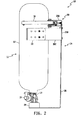
- the apparatus 10 includes a frame 14 that is configured to be mounted within a vehicle.
- the frame 14 includes an upper frame member 20 that is configured to be mounted to the vehicle and to which a pair of gripping arms 16 and 18 are movably mounted, and a lower frame member 26.
- One end of the object 11 is supported by the lower frame member 26, and an opposite end of the object extends through and between the gripping arms 16 and 18 as shown.
- the upper frame member 20 has a top plate 20A and a back plate 20B that form substantially a right angle between the two.
- the top plate 20A and the back plate 20B may be integral and of unitary construction, although the top plate 20A and the back plate 20B may alternatively be provided as separate components that are attached together in a conventional manner.
- the gripping arms 16 and 18 are movably mounted to the top plate 20A, and each define a free end that extends at least partially about the object 11 when the object 11 is positioned within the gripping arms 16 and 18 as shown.
- the upper frame member 20 further includes a pair of side flanges 20C and 20D extending away from opposite sides of the back plate 20B at an acute angle relative to a plane defined by the back place 20B.
- the back plate 20B and the side flanges 20C and 20D may be integral and of unitary construction, although the side flanges 20C and 20D may alternatively be provided as separate components that are attached to the back plate 20B in a conventional manner.
- a frame mounting ear 22 is attached in a conventional manner to a free end of the side flange 20C and another frame mounted ear 24 is attached in a conventional manner to a free end of the side flange 20D.
- the frame mounting ears 22 and 24 are configured to be attached to a support structure within the vehicle.
- the lower frame member 26 is attached in a conventional manner to the back plate 20B of the upper frame member 20.
- the lower frame member 26 may illustratively be provided in the form of an elongated plate that forms substantially a right angle near its free end so that the free end of the lower frame member 26 forms a platform that is substantially parallel with a plane defined by the top plate 20A of the upper frame member 20 and the gripping arms 16, 18.
- a support member 28 may be attached to the free end of the lower frame member 26 to support and/or engage one end of the object 11, although the support member 28 may be omitted in other embodiments.
- the free end of the lower frame member 26 may be configured to be attached to a support surface of the vehicle.
- the various components 20, 22, 24 and 26 of the frame 14 may be formed of any conventional frame/bracket material such as steel or other conventional metal combination, a conventional high-strength plastic material or the like.
- the support member 28, in embodiments including a support member 28, may be formed of any conventional rigid or semi-rigid material.
- the object 11 is a self-contained breathing apparatus (SCBA).
- SCBA 11 includes a conventional air cylinder 12 having an air outlet 13 that is fluidly coupled to a conventional air outlet valve 15.
- the SCBA is received by the apparatus 10 in a vertical position, i.e., parallel with a longitudinal axis defined through the cylinder 12, with the air outlet valve 15 supported by the support member 28 and with the bottom of the cylinder 12 extending through the gripping arms 16, 18.
- the support member 28 is configured to support, but to not engage, the air outlet valve 15.
- the support member 28 is configured to engage the air outlet valve 15 to restrict horizontal movement of the outlet valve end of the SCBA 11 relative to the frame 14.
- the apparatus 10 of FIGS. 1-3 is shown mounted to a vehicle seat 80 that is secured to a vehicle 85.
- the vehicle seat 80 has a seat bottom 82 and a seat back 86 that are both mounted to a vehicle seat frame 84.
- the vehicle seat frame 84 is secured to the vehicle floor 88 in a conventional manner.
- the seat back 86 defines a passageway 90 therethrough from a front surface 87 to a rear surface 89 thereof.
- the passageway 90 is sized to allow the frame 14 of the apparatus 10 to be mounted to the rear surface 89 of the seat back 86 with the SCBA 11 accessible from the front surface 87 via the passageway 90.
- the frame mounting ears 22 and 24 are each secured in a conventional manner to the rear surface 87 of the seat back 86. While only the frame mounting ear 22 shown in FIG. 4 , it will be understood that the frame mounting ear 24 is secured to the rear surface 89 of the seat back 86 in an identical manner.
- the lower frame member 26, in the embodiment illustrated in FIGS. 4 and 5 defines another frame mounting ear 27 at its free end. The frame mounting ear 27 is configured to be secured to the vehicle seat frame 84 as shown. It will be understood that while the frame 14 is illustrated in FIGS.
- the SCBA 11 may be received through the passageway 90 in the seat back 86 and into engagement with the apparatus 10 as described hereinabove prior to transport by the vehicle 85. While the SCBA 11 is positioned within the apparatus 10 as illustrated in FIGS.
- the apparatus 10 is configured to retain the cylinder 12 within the gripping arms 16 and 18 in the event of rapid deceleration of the vehicle 85 resulting from impact with another structure and in the event that the cylinder 12 is subject to gravitational forces such as when the vehicle 85 is traversing, or parked on, an inclined or declined surface, as will be described in greater detail hereinafter.
- the self-contained breathing apparatus 11 is of the type conventionally used by emergency personnel, and as such the vehicle 85 may be an emergency vehicle such as a fire truck or other emergency vehicle. It will be understood, however, that the subject disclosure contemplates configuring the apparatus 10 to restrain other objects and/or portions of other objects. Examples include, but are not limited to, other cylindrical objects such as air tanks for self-contained underwater breathing apparatuses (SCUBA), tanks containing other gases or gas combinations, tanks or bottles containing liquids, conventional fire extinguishers, or the like, objects having cylindrical portions, such as power or non-power tools, various sports equipment, or the like, and other elongated, but not necessarily cylindrical, objects.
- SCUBA self-contained underwater breathing apparatuses
- Vehicles that may carry such one or more other objects may accordingly include, but are not limited to, conventional motor vehicles, including military, commercial or privately-owned cars, trucks, buses, industrial machinery, utility vehicles, recreational vehicles (RV's), campers, and the like, military, commercial or privately owned aircraft or watercraft, single or multiple-track rail vehicles including trains, trams, trolleys, monorail transport systems, and the like.
- conventional motor vehicles including military, commercial or privately-owned cars, trucks, buses, industrial machinery, utility vehicles, recreational vehicles (RV's), campers, and the like
- RV's recreational vehicles
- campers and the like
- military, commercial or privately owned aircraft or watercraft single or multiple-track rail vehicles including trains, trams, trolleys, monorail transport systems, and the like.
- the subject disclosure contemplates embodiments of the apparatus 10 that have two or more sets of clamping arms 16, 18, and/or that may be mounted to the vehicle in any orientation.
- Examples include, but are not limited to, vertical applications including two or more sets of clamping arms 16, 18 and that may or may not include movable or fixed position top and/or bottom plates/support members to restrict vertical movement of the object, horizontal applications that include one or more sets of clamping arms 16, 18 and that may or may not include one or more movable or fixed position side plates to restrict horizontal movement of the object, and the like.
- the gripping arms 16 and 18 are each movably mounted to the top plate 20A of the upper frame member 20.
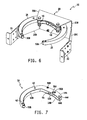
- the gripping arm 16 is generally arcuate in shape, and is pivotably mounted to the top plate 20A adjacent one end thereof via a conventional retaining pin 46.
- a conventional roller 50A is coupled to the free end of the gripping arm 16, and is configured to be freely rotatable relative to the gripping arm 16.
- the gripping arm 18 is likewise generally arcuate in shape, and is pivotably mounted to the top plate 20A adjacent one end thereof via another conventional retaining pin 48.
- Another conventional roller 50B is coupled to the free end of the gripping arm 18, and is configured to be freely rotatable relative to the gripping arm 18.
- the gripping arm 18 includes a pair of generally arcuate plates 18A and 18B and an arcuate-shaped mass 40B that is sized and configured to be sandwiched between the plates 18A and 18B.
- the conventional roller 50B is mounted between the plates 18A and 18B at the free end of the gripping arm 18, and the mass 40B extends away from the roller 50B and along an arcuate portion of the gripping arm 18 between the plates 18A and 18B.
- a number of conventional fastening elements 42 secure the two plates 18A and 18B together with the mass 40B sandwiched between the two.
- Juxtaposed bores 44A and 44B are defined through the plates 18A and 18B respectively, near the opposite ends of the plates 18A and 18B.
- the retaining pin 48 extends through the top plate 20A of the upper frame member 20 and through the bores 44A and 44B, to movably mount the gripping arm 18 to the upper frame member 20.
- the gripping arm 18 pivots about the retaining pin 48 relative to the upper frame member 20, and the retaining pin 48 thereby defines a pivot point of the gripping arm 18 relative to the upper frame member 20.
- the gripping arm 18 further includes a guide member 52 that is mounted to the top plate 18A via conventional fastening elements 56A and 56B.
- the guide member 52 defines a number of teeth 54 on one surface thereof that are configured to engage like teeth of a guide member attached to the gripping arm 16 as will be described in greater detail hereinafter.
- the gripping arm 18 further includes another conventional fastening element 58B that not only secures the two plates 18A and 18B together, but that also forms a stop between the plates 18A and 18B for a biasing member that may be used to bias the gripping arm 18 to a default position relative to the upper frame member 20, as will be described in greater detail hereinafter.
- the gripping arm 16 is configured identically as described with respect to the gripping arm 18 of FIG. 7 , except that the gripping arm 16 is movably attached to the top plate 20A of the upper frame member 20 via the retaining pin 46.
- top plan views of the apparatus 10 of FIG. 6 are shown in partial cutaway and partially in phantom. More specifically, the top plate 20A of the upper frame member 20 is shown in phantom in FIGS. 8 and 9 to allow for the viewing of components that are otherwise hidden by the top plate 20A. Also, the top plates 16A and 18A of the gripping arms 16 and 18 respectively are shown in partial cutaway to illustrate placement of the masses 40A and 40B of the gripping arms 16 and 18 respectively.
- biasing members 60A and 60B are illustrated. More specifically, a biasing member 60A is disposed between the back plate 20B of the upper frame member 20 and the gripping arm 16, and a biasing member 60B is disposed between the back plate 20B of the upper frame member 20 and the gripping arm 18.
- the biasing members 60A and 60B are configured to apply biasing forces to the gripping arms 16 and 18 respectively that normally bias the free ends of the gripping arms 16 and 18 toward each other to form a mouth 70 between the two free ends.
- the biasing members 60A and 60B are provided in the form of conventional torsional or coil springs having one leg 62A, 64A respectively in contact with the back plate 20B and another leg 62B, 64B respectively in contact with the fastening element 58A, 58B respectively between the plates 16A, 18A and 18B, 16B respectively. It will be appreciated, however, that the biasing members 60A and 60B may alternatively be provided in the form of linear springs, flat springs or other conventional biasing members.
- the gripping arms 16 and 18 may be spread apart to receive the object 11 therein by forcing the object 11 into the mouth 70 of the gripping arms 16 and 18 in the direction indicated by the arrows 72. This action compresses the biasing members 60A and 60B as the free ends of the gripping arms 16 and 18 travel along the exterior of the object 11, which is facilitated by the rolling action of the rollers 50A and 50B. As the object advances into the mouth 70, the mouth 70 widens to accommodate the increasing diameter of the object 11.
- the object 11 will pass by the rollers 50A and 50B, and the free ends of the gripping arms 16 and 18 will begin to close around the object 11 as the object 11 is advanced further toward the top plate 20A of the upper frame member 20.
- the object 11 When fully received within the gripping arms 16 and 18, the object 11 the object 11 will reside between the top plate 20A and the free ends of the gripping arms 16 and 18 as illustrated by example in FIGS. 1-4 .
- the object 11 may be withdrawn from the apparatus 10 by reversing the above process under quasi-static conditions.
- the front face 20A F of the top plate 20A has a concave contour that acts to urge a cylindrical object 11 disposed between the free ends of the gripping arms 16, 18 and the top plate 20A to be positioned centrally with respect to the top plate 20A and thus centrally with respect to the gripping arms 16, 18.
- the guide members 52A and 52B facilitate this by symmetrically guiding movement of the gripping arms 16, 18 as illustrated in FIGS. 8 and 9 .
- the masses 40A and 40B extend from the free ends of the gripping arms 16 and 18 respectively, along the arcuate portions of the gripping arms 16, and 18, and terminate approximately at where the gripping arms 16 and 18 cross under the top plate 20A of the upper frame member 20.
- Such distribution of the masses 40A and 40B define, at least in part, centers of gravity of the gripping arms 16 and 18, and the centers of gravity of the gripping arms 16 and 18 relate directly to the gripping force of the gripping arms 16 and 18 as will be described in greater detail hereinafter.
- a method of restraining an object 11 in a vehicle 85 may comprise providing first and second gripping arms 16, 18 each defining a free end as described hereinabove.
- the first and second gripping arms are then movably mounted to the frame 20 with the free ends of the gripping arms 16, 18 extending toward each other.
- the frame 20 may then be secured to the vehicle 85 as described hereinabove with respect to FIGS. 4-5 .
- At least a portion of the object 11 may then be placed between the first and second gripping arms 16, 18 with the free ends thereof extending at least partially about the object 11.
- the first and second gripping arms 16, 18 are configured, as will be described hereinafter with respect to FIG.
- a restraining force exerted by the first and second gripping arms 16, 18 on the object 11 is greater than or equal to an inertial force exerted by the object 11 on the first and second gripping arms 16, 18 so that the object 11 is retained between the first and second gripping arms 16, 18 under dynamic loading conditions.
- the apparatus 10 is illustrated similarly to that of FIGS. 8 and 9 .
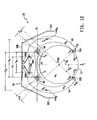
- the guide members 52A and 52B are omitted and a cylinder 12 portion of the object 11 is shown disposed between the free ends of the gripping arms 16 and 18 and the top plate 20A of the upper frame member 20.
- the biasing members 60A and 60B bias the gripping arms 16, 18 forwardly relative to the upper frame member 20 so that the free ends of the gripping arms 16 and 18 extend at least partially about the cylinder 12 and toward each other.
- the gripping arms 16 and 18 configured to exert a gripping force on the cylinder 12 that is directly proportional to any inertial force that may be exerted by the cylinder 12 on the gripping arms resulting from rapid deceleration of the vehicle 85 or from gravitational forces, so that the cylinder 12 is retained between the gripping arms 16, 18 and the top plate 20A of the upper frame member 20 during dynamic loading conditions.
- the gripping arms 16 and 18 will thus retain and maintain the cylinder 12 of the object 11 between the free ends of the gripping arms 16, 18 and the top plate 20A of the upper frame member 20 during full-frontal and oblique decelerations, such as may occur during vehicle impact events, and also when gravitational forces apply themselves to the apparatus 10, such as when parking on or traversing an incline or decline.
- the gripping arms 16 and 18 provide significant torque about their rotational center and, if certain design criteria are met, counter the inertial loading of the heaviest of objects 11 for which the apparatus 10 is designed.
- a first axis, A1 is defined as one that passed through the pivot points P A and P B , which are defined as the centers of the retaining pins 46 and 48 respectively.
- a second axis, A2 is defined as one that is perpendicular to the first axis A1, and that bisects a point on the axis A1 that equidistant from the pivot points P A and P B .
- the second axis, A2 also passes through the center of gravity, cog O , of the cylinder 12 when the cylinder 12 is positioned between the gripping arms 16 and 18 under normal, static conditions.
- An inertial force vector, F I applied in a direction away from the top plate 20A of the upper frame member 20 along the axis A2, such as would occur under a frontal vehicle impact event, may be represented as a force vector F IA that passes through the center of gravity, cog O , of the object 11 and that is applied to the contact point, CP A , between the cylinder 12 and the free end of the gripping arm 16.
- the biasing member 60A exerts a biasing force on the gripping arm 16, which can be represented by a force vector, F C , applied to the contact point 58A of the biasing member 60A with the gripping arm 16.
- the force vector F TA may be expressed in terms of a sum of mass moments acting upon the contact point, CP A , by the gripping arm 16 relative to the pivot point, P A , which is given by the equation (F A * S A ) + (F C + S C ), where S A is the length of the moment arm that extends perpendicularly between the force vector, F A , and the pivot point, P A , and S C is the length of the moment arm that extends perpendicularly between the force vector, F C , and the pivot point, P A .
- the force vector, F IA may be expressed in terms of a mass moment acting upon contact point, CP A , by the cylinder 12 relative to the pivot point, P A , which is given by the equation F IA * S IA , where S IA is the length of the moment arm that extends perpendicularly between the force vector F IA and the pivot point, P A .
- the second term in equations (5) and (6) represent the forces applied to the gripping arms 16 and 18 respectively by the biasing members 60A and 60B respectively, and are typically small relative to the remaining terms. In some embodiments, the biasing members 60A and 60B may not be needed and may therefore be omitted. In any case, the inequalities (5) and (6) indicate that if the masses m A and m B are appropriately selected relative to the mass m O , and the lengths of the moment arms S A and S B are appropriately selected relative to the moment arms S IA and S IB , the gripping arms 16 and 18 will retain the cylinder 12 between the free ends of the gripping arms 16, 18 and the top plate 20A of the upper frame member 20 under dynamic loading conditions.
- the design criteria need not be applied identically to the gripping arms 16 and 18.
- a and B each become 1 ⁇ 2 and the inequalities (5) and (6) both reduce to the expression: m arm * S 1 + L * K * S 3 ⁇ 1 / 2 * m O * S 2 * sin ⁇
- m arm is the mass of either gripping arm 16, 18, m O is the mass of the object 11 of which the cylinder 12 forms a part
- S 1 is the perpendicular distance between the pivot point P A and the force vector F A and/or the perpendicular distance between the pivot point P B and the force vector F B
- S 2 is the perpendicular distance between the pivot point P A and the force vector F IA and/or the perpendicular distance between the pivot point P B and the force vector F IB
- S 3 is the perpendicular distance between the pivot point P A and the force vector F C and/or the perpendicular distance between the pivot point P
- the inequality (7) will hold true if the ratio of moment arms (S 1 /S 2 *sin e) is greater than or equal to the ratio of the masses m O /m arm .
- the biasing members 60A and 60B may be omitted so that the inequality (7) reduces to: m arm * S 1 ⁇ 1 / 2 * m O * S 2 * sin ⁇
- the object 11 is an elongated object such as a Self Contained Breathing Apparatus (SCBA) as illustrated and described above, although it will be understood that the object 11 may alternatively be or include other objects.
- SCBA Self Contained Breathing Apparatus
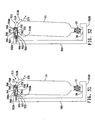
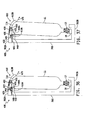
- the apparatus 100 includes an elongated frame 102 having a first end 102A and a second end 102B opposite the first end 102A.
- the frame 102 like the frame 14 illustrated and described hereinabove, is configured to be mounted within a vehicle generally, and more specifically to at least a portion of a vehicle seat that is mounted within the vehicle.
- an example vehicle seat 80 has a seat bottom 82 and a seat back 86, both of which are mounted to a vehicle seat frame 84 that is mounted within the vehicle.
- the frame 102 of the apparatus 100 is configured to be mounted to at least the seat back 86, and may be further configured to be also mounted to the vehicle seat frame 84 as illustrated in FIGS. 4 and 5 .
- the apparatus 100 further includes a clamp member 104 that is movably mounted to the frame 102 at or near the end 102A of the frame 102.
- the clamp member 104 is pivotably mounted to the frame 102 at or near the end 102A of the frame such that the clamp member 104 pivots about a pivot point 106 relative to the frame 102.
- the apparatus 100 further includes at least one biasing member 105 that is coupled between the frame 102 and the clamp member 104 and is configured to normally bias the clamp member 104 in the direction 110 (see FIG. 12 ) toward the end 102B of the frame 102.
- the apparatus includes two such biasing members 105 (only one shown in FIGS.
- the at least one biasing member 105 may alternatively provided in the form of more or fewer such torsion springs or may alternatively be provided in the form of one or more other conventional biasing members.
- the biasing force of the at least one biasing member 105 is sufficient to retain the object 11 between the clamp member 104 and the end 102B of the frame 102 under static conditions as shown.
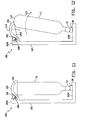
- the clamp member 104 and the at least one biasing member 105 are further configured such that the clamp member 104 is responsive to a force applied thereto by one end 11A of the object 11 under quasi-static conditions to move upwardly against the bias of the at least one biasing member 105 to allow the object 11 to be received within, and to be removed from between, the clamp member 104 and the end 102B of the frame 102 as illustrated in FIG. 12 .
- the frame 102, the clamp member 104 and the at least one biasing member 105 thus cooperate to allow the object 11 to be received between, and to be removed from between, the clamp member 104 and the end 102B of the frame 102 simply by placing the support member 28 of the object 11 in contact with the end 102B of the frame 102, and then manually forcing the end 11A of the object 11 toward or away from the clamp member 104 in the direction of 112 as illustrated in FIG. 12 .
- the end 11A may then forced in the direction 112 away from frame 102 under quasi-static conditions, in which case the downward force 110 of the one or more biasing members 105 may again be overcome so that the clamp member 104 pivots upwardly to allow the end 11A of the object 11 to be drawn away from, and out of, the apparatus 100, as illustrated in FIG. 12 .
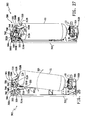
- FIGS. 13A, 13B and 14 side elevational views of another embodiment 120 of the apparatus 100 of FIGS. 11 and 12 are shown that include one illustrative embodiment of an additional object retaining structure that ensures retention of the object 12 within the apparatus 120 under dynamic loading conditions.
- the apparatus 120 includes all of the structure and functionality of the apparatus 100 illustrated and described with respect to FIGS. 11 and 12 , and like numbers are therefore used to identify like components.
- the at least one biasing member 105 is not shown so that other components of the apparatus 120 can be seen more clearly.
- the apparatus further includes an inertial member 125 that is movably mounted to the frame 102.
- the inertial member 125 includes an elongated lever 122 that defines a mass 126 at one end thereof.
- the apparatus 120 includes a bracket 124 that is integral with or rigidly secured to the frame 102, and that is movably mounted at an opposite end to the elongated lever 122.
- the lever 122 is movably mounted to the bracket 124 at a pivot point 127 such that the lever 122 pivots about the pivot point 127 relative to the bracket 124 and therefore relative to the frame 102.
- the mass 126 may be attached to, or integral with, the one end of the lever 122.
- An opposite end 122A of the lever 122 is movably mounted to one end of a linkage member 128, and the opposite end of the linkage member 128 is movably mounted to the clamp member 104.
- the linkage member 128 is movably mounted to the clamp member 104 at a pivot point 130 and is movably mounted to the lever 122 at another pivot point 132.
- the inertial member 125 is generally configured to move relative to the frame 102 and the clamp member 104 under quasi-static conditions and also under dynamic loading conditions, such as may occur during vehicle crash events, vehicle roll-over events, and the like.
- the clamp member 104 Under quasi-static conditions, as illustrated in FIG. 13A , for example, the clamp member 104 is responsive to a force applied thereto by one end 11A of the object 11 to move upwardly against the bias of the at least one biasing member as described hereinabove to allow the object 11 to be received within, and to be removed from between, the clamp member 104 and the end 102B of the frame 102 in the direction 134.
- the object 11 is forced against the clamp member 104 in the direction toward the frame 102, as illustrated in FIG.
- the mass 126 moves toward the frame 102 so that the end 122A of the lever 122 advances upwardly toward the clamp member 104. This allows the clamp member 104 to move upwardly to receive the end 11A of the object 11 as described above.
- the clamp member 104 is thereafter forced against the end 11A of the object 11 under the biasing force of the at least one biasing member 105, the lever 122 moves forward to an equilibrium position as illustrated in FIG. 13B .
- the object 11 may be removed from the apparatus 120 by reversing the process just described.
- FIGS. 15A, 15B and 16 side elevational views of another embodiment 150 of the apparatus 100 of FIGS. 11 and 12 are shown that include another illustrative embodiment of an additional object retaining structure that ensures retention of the object 11 within the apparatus 150 under dynamic loading conditions.
- the apparatus 150 includes all of the structure and functionality of the apparatus 100 illustrated and described with respect to FIGS. 11 and 12 , and like numbers are therefore used to identify like components.
- the at least one biasing member 105 is not shown so that other components of the apparatus 150 can be seen more clearly.
- the end 102A of the frame 102 defines a channel 152 therein that is sized to receive therein an inertial member 155 in the form of a lever 156 that is movably attached or mounted to the frame 102.
- the apparatus 150 includes a bracket 154 that is rigidly secured to, or integral with, the frame 102, and that is movably mounted at an opposite end to the elongated lever 156.
- the lever 156 is movably mounted to the bracket 154 at a pivot point 158 such that the lever 156 pivots about the pivot point 158 relative to the bracket 154 and therefore relative to the frame 102.
- a mass 160 is formed at one end of the lever 156, and may be attached to, or integral with, the lever 156.
- the opposite end 156A of the lever 156 is sized to be received within the channel 152 under dynamic loading conditions as will be described in greater detail hereinafter.
- the clamp member 104 is responsive to a force applied thereto by one end 11A of the object 11 to move upwardly against the bias of the at least one biasing member as described hereinabove to allow the object 11 to be received within, and to be removed from between, the clamp member 104 and the end 102B of the frame 102 in the direction 162.
- the end 156A of the lever 156 is positioned sufficiently away from, or outside of, the channel 152 such that the clamp member 104 may move upwardly about the pivot point 106 without being restricted in its movement by the end 156A of the lever 156.
- the clamp member 104 When the object 11 is forced against the clamp member 104 in the direction toward the frame 102 under quasi-static conditions, as illustrated in FIG. 15A , the clamp member 104 to moves upwardly to receive the end 11A of the object 11 as described above. The clamp member 104 is then forced against the end 11A of the object 11 under the biasing force of the at least one biasing member 105 such that the end 11A of the object is received within the recess 104A of the clamp member 104, as illustrated in FIG. 15B . The object 11 may be removed from the apparatus 150 by reversing the process just described.
- the inertial member 155 is generally configured to move relative to the frame 102 and the clamp member 104 under dynamic loading conditions, such as may occur during vehicle crash events, vehicle roll-over events, and the like.
- the lever 156 and mass 160 are configured to move, e.g., pivot, relative to the frame 102 about the pivot point 158 in the direction 164 as illustrated in FIG. 15B .
- dynamic loading conditions in which inertial forces are directed outwardly away from the frame 102 in the direction 166 toward the object 11, as illustrated in FIG.
- the lever 156 and mass 160 move about the pivot point 158 in the direction 166 such that the end 156A of the lever 156 extends into the channel 152 and exerts a retention force on the clamp member 104 by inhibiting upward movement of the clamp member 104 relative to the end 102A of the frame 102.
- This retention force applied by the lever 156 to the clamp member 104 is sufficient to retain the object 11 between the clamp member 104 and the end 102B of the frame 102 under the dynamic loading conditions.
- FIGS. 17A and 17B side elevational views of another embodiment 170 of the apparatus illustrated in FIGS. 11 and 12 is shown that includes yet another illustrative embodiment of additional object restraining structure that ensures retention of the object 11 within the apparatus 170 under dynamic loading conditions.
- the apparatus 170 includes all of the structure and functionality of the apparatus 100 illustrated and described with respect to FIGS. 11 and 12 , and like numbers are therefore used to identify like components.
- the at least one biasing member 105 is not shown so that other components of the apparatus 170 can be seen more clearly.
- an inertial member 175 is provided in the form of an elongated lever 176 having one end 176A and an opposite end at which a mass 180 is formed.
- the mass 180 may be attached to, or integral with, the lever 176.
- a bracket 124 is rigidly secured to, or integral with, the frame 102, and the lever 176 is movably mounted to the bracket 124, and therefore movably mounted to the frame 102, between the end 176A of the lever 176 and the mass 180.
- the lever 176 pivots relative to the bracket 124 and relative to the frame 102 in the direction 184 as illustrated in FIG. 17A .
- the end 176A of the lever 176 is movably mounted to one end of a linkage member 174 having an opposite end that is movably mounted to a restraining member 178.
- the linkage member 174 is pivotably mounted to the end 176A of the lever 176 at a pivot point 177, and is also pivotably mounted to one leg 178A of the restraining member 178 at a pivot point 182.
- One end of the leg 178A is movably mounted to the frame 102 and/or clamp member 104, and another leg 178B of the restraining member 178 extends away from an opposite end of the leg 178A.
- the leg 178A of the restraining member 178 is pivotably mounted to the frame 102 and to the clamp member 102 at the pivot point 106, and the leg 178B of the restraining member 178 extends away from the leg 178A at a substantially right angle. It will be understood, however, that the end of the leg 178A may alternatively be movably mounted only to the frame 102 or only to the clamp member 104, and/or that the leg 178B may extend away from the leg 178A at an angle other than a substantially right angle.
- the clamp member 104 is responsive to a force applied thereto by one end 11A of the object 11 to move upwardly against the bias of the at least one biasing member as described hereinabove to allow the object 11 to be received within, and to be removed from between, the clamp member 104 and the end 102B of the frame 102 in the direction 184.
- the former of which is illustrated in FIG. 17A the restraining member 178 is positioned by the lever 176 to be sufficiently away from the top 11A of the object 11 such that it does not contact the object 11 and such that the clamp member 104 may move upwardly about the pivot point 106 without being restricted in its movement by the restraining member 178.
- the clamp member 104 When the object 11 is forced against the clamp member 104 in the direction toward the frame 102 under quasi-static conditions, the clamp member 104 to moves upwardly to receive the end 11A of the object 11 as described above. The clamp member 104 is then forced against the end 11A of the object 11 under the biasing force of the at least one biasing member 105 such that the end 11A of the object is received within the recess 104A of the clamp member 104. The object 11 may be removed from the apparatus 150 by reversing the process just described.
- the inertial member 175 is generally configured to move relative to the frame 102 and the clamp member 104 under dynamic loading conditions, such as may occur during vehicle crash events, vehicle roll-over events, and the like.
- dynamic loading conditions in which inertial forces are directed outwardly away from the frame 102 in the direction toward the object 12, the lever 176 and mass 180 move relative to the bracket 124, and therefore relative to the frame 102, along the direction of 186 as shown in FIG. 17B .
- This causes the end 176A of the lever 176 to be drawn downwardly away from the clamp member 104, which, in turn, draws the restraining member 178, via the linkage member 174, into engagement with the end 11A of the object 11.
- the restraining member 178 exerts a retention force on the object 11 that is sufficient to retain the object 11 between the clamp member 104 and the end 102B of the frame 102 under the dynamic loading conditions.
- FIGS. 18A and 18B side elevational views of another embodiment 185 of the apparatus 100 of FIGS. 11 and 12 are shown that includes another illustrative embodiment of an additional object retaining structure that ensures retention of the object 11 within the apparatus 185 under dynamic loading conditions.
- the apparatus 185 includes all of the structure and functionality of the apparatus 100 illustrated and described with respect to FIGS. 11 and 12 , and like numbers are therefore used to identify like components.
- the at least one biasing member 105 is not shown so that other components of the apparatus 185 can be seen more clearly.
- the apparatus 185 includes a movable bracket 186 having one end that is rigidly secured to the pivot point 106 and/or to the top clamp 104 so that the one end of the bracket 106 moves in response to movement of the top clamp 104 relative to the frame 102.
- the one end of the bracket 186 is rigidly secured to the pivot point 106 so that the bracket 186 rotates with the pivot point 106 as the top clamp is pivoted about the pivot point 106.
- the opposite end of the bracket 186 is configured to engage a conventional locking retractor 194 that is mounted to the frame 102.
- the opposite end of the bracket 186 defines a number of teeth 188 configured to engage similar teeth 190 defined on a rotating gear or wheel 192 forming part of the locking retractor 194.
- the bracket 186 and the locking retractor 194 define an inertial member that is configured to move relative to the frame 102 and/or clamp member 104 under dynamic loading conditions to exert a retention force on the clamp member 104 that is sufficient to retain the object 11 between the clamp member 104 and the end 102B of the frame 102 under the dynamic loading conditions.
- the locking retractor 194 is responsive to at least one of acceleration thereof that is greater than an acceleration threshold and rotational speed of movement of the locking retractor 194 that is greater than a threshold speed to exert the retention force on the clamp member 104 via the bracket 186.
- the locking retractor 194 may be a conventional retractor that is configured to prevent the gear or wheel 190 from further rotational movement when the retractor 194 experiences a deceleration (i.e., negative acceleration) that is greater than a predefined deceleration threshold (i.e., that is greater in magnitude than a negative acceleration threshold).
- the locking retractor 194 may be a conventional retractor that is configured to prevent further rotation of the gear or wheel 192 when the gear or wheel 192 rotates faster than a predefined threshold rotational speed.
- the locking retractor 194 may be a conventional retractor that is configured to prevent further rotation of the gear or wheel 192 when either the retractor 194 experiences a deceleration that is greater than a predefined deceleration threshold or the gear or wheel 192 is rotating faster than a predefined threshold rotational speed.
- the inertial member 194 and the bracket 186 are generally configured to move relative to the frame 102 and the clamp member 104 under quasi-static conditions and also under dynamic loading conditions, such as may occur during vehicle crash events, vehicle roll-over events, and the like.
- the clamp member 104 is responsive to a force applied thereto by one end 11A of the object 11 to move upwardly against the bias of the at least one biasing member as described hereinabove to allow the object 11 to be received within, and to be removed from between, the clamp member 104 and the end 102B of the frame 102 in the direction 196.
- the clamp member 104 when the object 11 is forced against the clamp member 104 in the direction toward the frame 102 under quasi-static conditions, as illustrated in FIG. 18A , the clamp member 104 to moves upwardly to receive the end 11A of the object 11 as described above. The clamp member 104 is then forced against the end 11A of the object 11 under the biasing force of the at least one biasing member 105 such that the end 11A of the object is received within the recess 104A of the clamp member 104, as illustrated in FIG. 18B .
- the object 11 may be removed from the apparatus 150 by reversing the process just described.
- the gear or wheel 192 locks when the deceleration experienced by the inertial member 194 becomes greater than a predefined deceleration threshold (e.g., when the acceleration experienced by the inertial member 194 falls below a predefined negative acceleration threshold) and/or when the rotational speed of the gear or wheel 192 becomes greater than a predefined rotational speed threshold. Because the teeth 190 of the gear or wheel 192 are engaged with the teeth 188 of the bracket 186, locking of the gear or wheel 192 likewise locks the bracket 186 from further movement relative to the inertial member 194.
- a predefined deceleration threshold e.g., when the acceleration experienced by the inertial member 194 falls below a predefined negative acceleration threshold
- bracket 186 is rigidly secured to the pivot point 106, locking of the bracket 186 relative to the inertial member 194 thus applies a retention force to the clamp member 104 via the pivot point 106, which causes the bracket 186 to lock the position of the clamp member 104 relative to the frame 102.
- locking of the bracket 186 relative to the inertial member 194 locks the pivot point 106 from further movement relative to the frame 102, and thus locks the clamp member 104 to the frame 102. This, then, prevents movement of the clamp member 104 relative to the frame 102.
- the retention force applied by the inertial member 194 to the clamp member 104 is sufficient to retain the object 11 between the clamp member 104 and the end 102B of the frame 102 under the dynamic loading conditions.
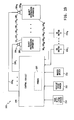
- the system 200 includes a number, N, of object restraining apparatuses 10 1 -10 N , 100 1 -100 N , 120 1 -120 N , 150 1 -150 N , or 170 1 -170 N , wherein N may be any positive integer.
- the number, N, of object restraining apparatuses may be provided in the form of any one or a combination of the apparatuses 10 1 -10 N , 100 1 -100 N , 120 1 -120 N , 150 1 -150 N , and/or 170 1 -170 N illustrated and described herein, or may alternatively be provided in the form of one or more other conventional apparatuses configured to restrain objects, such the objects 12 illustrated herein.
- each of the object restraining apparatuses includes a lock, 202 1 -202 N , associated therewith, and an actuator, 204 1 -204 N .
- Each of the actuators 204 1 -204 N is responsive to one control signal to activate an associated one of the locks 202 1 -202 N of a corresponding one of the object restraining apparatuses, and is responsive to another control signal to deactivate a corresponding one of the locks 202 1 -202 N of the associated object restraining apparatus.
- the locks 202 1 - 202 N and the actuators 204 1 -204 N may each be conventional, and may or may not be combined into single lock/actuators.
- An example of one such combination lock/actuator includes, but is not limited to, a conventional electrically actuated solenoid wherein the solenoid plunger acts as the lock.
- each of the locks 202 1 - 202 N may be activated by a corresponding one of the actuators 204 1 - 204 N to lock an object restraining structure of a corresponding one of the one or more object restraining apparatuses.
- a corresponding one of the one or more of the locks 202 1 - 202 N may be configured to lock one or both of the gripping arms 16, 18 to the upper frame member 20 or to otherwise inhibit movement, e.g., opening or spreading, of the gripping arms 16 and 18 under specified conditions.
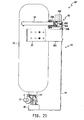
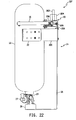
- FIGS. 20-22 another illustrative embodiment of an object restraining apparatus 10' is shown that is identical in structure and function to the apparatus 10 illustrated and described with respect to FIGS. 1-10 with the exception that the apparatus 10' includes an electrically actuated solenoid 204 having a plunger 202 that acts as the object restraining apparatus lock.
- the solenoid 204 is mounted to the top plate 20A of the upper frame member 20 and positioned relative to the gripping arms 16 and 18 such that the solenoid plunger 202 may extend, when activated, downwardly such that it resides generally between the gripping arms 16/18 and the back plate 20B of the upper frame member 20, and more specifically resides adjacent to the gripping arms 16/18.
- the solenoid 204 is responsive to one control signal to activate the lock by extending the plunger 202 downwardly, as illustrated in FIG. 21 , to block or otherwise inhibit rearward movement of the gripping arms 16/18 so that the gripping arms 16/18 cannot open as illustrated in FIG. 9 .
- the plunger 202 of the activated solenoid 204 thus blocks movement of the gripping arms 16/18 so that the object 11 is maintained between the gripping arms 16/18.
- the solenoid is responsive to another control signal to deactivate the lock by drawing the plunger 202 upwardly, as illustrated in FIG. 22 , so that rearward movement of the gripping arms 16/18, as illustrated in FIG. 9 , is not blocked or otherwise impeded by the solenoid plunger 202.
- a corresponding one of the one or more of the locks 202 1 - 202 N may be configured to lock the clamp member 104 to the frame 102 and/or bracket 124/154.
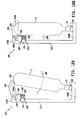
- FIGS. 23-24 another illustrative embodiment of an object restraining apparatus 100' is shown that is identical in structure and function to the apparatus 100 illustrated and described with respect to FIGS. 11-12 with the exception that the apparatus 100' includes an electrically actuated solenoid 204' having a plunger 202' that acts as the object restraining apparatus lock.
- the solenoid 204 is mounted to the frame 102 of the apparatus 100' and positioned relative to the clamp member 104 such that the solenoid plunger 202' may extend, when activated, laterally under the clamp member 104 such that it blocks or otherwise impedes upward movement of the clamp member 104.
- the solenoid 204' is responsive to one control signal to activate the lock by extending the plunger 202' laterally, as illustrated in FIG. 23 , to block or otherwise inhibit upward movement of the clamp member 104 so that the object 11 cannot be withdrawn from the apparatus 100' as illustrated in FIG. 12 .
- the plunger 202' of the activated solenoid 204' thus blocks movement of the clamp member 104 so that the object 11 is maintained between the clamp member 104 and the end 102B of the frame 102.
- the solenoid 204' is responsive to another control signal to deactivate the lock by drawing the plunger 202' back toward the solenoid 204', as illustrated in FIG. 24 , so that upward movement of the clamp member 104 is not blocked or otherwise impeded by the solenoid plunger 202' as shown.
- one or more conventional locks may be used to lock one or more of the actual object retaining or restraining structures to a suitable support member such as a support frame, the vehicle seat and/or vehicle seat frame.
- the one or more locks 202 1 - 202 N when activated, serve to ensure that an object, e.g., the object 12 illustrated and described herein, is retained within, or otherwise secured by the object restraining apparatus under dynamic loading conditions such as those associated with vehicle crashes, vehicle roll-over events, and the like.
- the object e.g., the object 12
- the object may be positioned within and removed from an associated one of the object retention assemblies.
- the system 200 further includes a control circuit 206 that is electrically connected to each of the electronic actuators 204 1 -204 N via a corresponding one of a number of signal lines 208 1 -208 N .
- the control circuit 206 is conventional, and may be or include a microprocessor having, or having access to, a memory unit 205.
- the control circuit 206 is operable to execute instructions stored within the memory unit 205 to control activation and deactivation of the number of locks 202 1 -202 N via electronic control of corresponding ones of the actuators 204 1 -204 N .
- the control circuit 206 may be or include one or more signal processing circuits operable as will be described hereinafter to control the operation of the one or more object restraining locks 202 1 - 202 N .
- the control circuit 206 is operable to control the operational states of each of the one or more locks 202 1 - 202 N by controlling the one or more corresponding actuators 204 1 -204 N based on electrical signals produced by one or more sensors and/or switches.
- the system 200 may include a gear shift lever sensor or switch 210 that is electrically connected to the control circuit, and that is configured to produce a signal indicative of a position of the gear shift lever associated with the vehicle.
- the control circuit 206 may be configured to produce a control signal that activates one or more of the actuators 204 1 -204 N when the gear shift lever sensor or switch 210 indicates that the gear shift lever is in a position other than the "park” position, e.g., when the gear shift lever sensor or switch 210 indicates that the gear shift lever is in the "reverse,” “neutral” or “drive” position, and to produce a control signal that deactivates one or more of the actuators 204 1 -204 N when the gear shift lever sensor or switch 210 indicates that the gear shift lever is in the park position.
- the system 200 may further include a vehicle speed sensor 212 that is electrically connected to the control circuit 206, and that is configured to produce a sensor signal corresponding to the road speed of the vehicle carrying the system 200.
- the control circuit 206 may be configured to produce a control signal that activates one or more of the actuators 204 1 -204 N when the sensor signal produced by the vehicle speed sensor 212 indicates that the road speed of the vehicle is above a first road speed value, and to produce a control signal that deactivates one or more of the actuators 204 1 -204 N when the sensor signal produced by the vehicle speed sensor 212 indicates that the road speed is below a second road speed value.
- the first road speed value is greater than the second road speed value to provide for hysterisis in the switching of the actuators 204 1 -204 N , although this disclosure contemplates other embodiments in which the first road speed value is not greater than the second road speed value.
- the system 200 may further include a master switch 214 that is electrically connected to the control circuit 206, and that is configured to produce a switch signal that corresponds to a position of the master switch 214.
- the master switch may be a manually activated switch that is accessible only by an operator of the vehicle or by an occupant of the vehicle that is seated next to the operator of the vehicle.
- the control circuit 206 may be configured to produce a control signal that activates one or more of the actuators 204 1 -204 N when the master switch 214 is manually activated, and to produce a control signal that deactivates one or more of the actuators 204 1 -204 N when the master switch 214 is deactivated.
- the system 200 may further include a number, N, of over-ride switches 216 1 -216 N , each of which is electrically connected to the control circuit 206.
- each of the number of over-ride switches 216 1 -216 N may be positioned within reach of an occupant of a vehicle seat to which one of the corresponding number of object restraining apparatuses is mounted so that the occupant may manually activate and deactivate a corresponding one of the over-ride switches 216 1 -216 N under specified conditions.
- control circuit 206 may be configured to produce a control signal that activates one the actuators 204 1 -204 N when a corresponding one of the over-ride switches 216 1 - 216 N is manually activated, and to produce a control signal that deactivates the actuator 204 1 -204 N when the over-ride switch 216 1 - 216 N is deactivated.
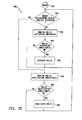
- FIG. 20 a flow chart is shown of one illustrative embodiment of a process 250 that is executable by the control circuit 206 to control activation and deactivation of the number of actuators 204 1 -204 N based on the sensor and/or switch signals produced by one or more of the sensors and/or switches 210, 212, 214 and/or 216 1 -216 N .
- the process 250 may be provided in the form of one or more sets of instructions that are executable by the control circuit 206 to control operation of the actuators 204 1 -204 N .
- the process 250 begins at step 252, and thereafter at step 254 the control circuit 206 is operable to determine whether one or more of the object restraining locks 202 1 -202 N is activated. Because the control circuit 206 controls operation of the one or more actuators 204 1 -204 N , the control circuit 206 has knowledge of the operational state of each of the number of locks 202 1 -202 N . In alternative embodiments, the one or more actuators 204 1 -204 N may each include a corresponding actuator position sensor, or may be otherwise configured to produce a signal corresponding to actuator position, which is then supplied back to the control circuit 206 via a corresponding one of the signal lines 208 1 -208 N , or via one of a number of additional signal lines.
- the process 250 advances from the no branch of step 254 to step 256 where the control circuit 256 is operable to monitor one or more of the object restraining lock activation indicators, i.e., one or more of the sensors and/or switches 210, 212, 214 and/or 216 1 -216 N . From step 256, the process 250 advances to step 258 where the control circuit 206 is operable to determine whether any of the object restraining lock activation conditions have been met.
- the control circuit 206 is operable to determine whether any of the object restraining lock activation conditions have been met.
- control circuit 206 is operable at step 256 and 258 to monitor the gear shift lever sensor or switch 210 and to determine that an object restraining lock activation condition is met if the signal produced by the gear shift lever sensor or switch indicates that the gear shift lever is in a position other than the "park" position.
- control circuit 206 is operable at step 256 and 258 to monitor the vehicle speed sensor 212 and to determine that an object restraining lock activation condition is met if the signal produced by the vehicle speed sensor 212 indicates that the road speed of the vehicle carrying the system 200 is greater than a first road speed value.
- the first road speed value may correspond to a minimum discernable road speed that is indicative of a moving vehicle, e.g., 2-5 miles per hour, although this disclosure contemplates other first road speed values.
- the control circuit 206 is operable at step 256 and 258 to monitor the master switch 214 and to determine that an object restraining lock activation condition is met if the signal produced by the master switch 214 indicates that the master switch has been manually activated.
- control circuit 206 is operable at step 256 and 258 to monitor the one or more switches 216 1 - 216 N and to determine that an object restraining lock activation condition is met if the signal(s) produced by any of the one or more switches 216 1 - 216 N indicate(s) that one or more of the switches 216 1 - 216 N has/have been manually activated.
- control circuit 206 may be operable to monitor one or more combinations of the sensors and/or switches 210, 212, 214 and/or 216 1 -216 N , and to determine that an object restraining lock activation condition is met if the combination of signals produced by the one or more combinations of the sensors and/or switches 210, 212, 214 and/or 216 1 -216 N meet specified conditions.
- control circuit 206 may be configured to be operable at step 256 and 258 to monitor the gear shift lever sensor or switch 210 and the vehicle speed sensor 212, and to determine that an object restraining lock activation condition is met if the signal produced by the gear shift lever sensor or switch indicates that the gear shift lever is in a position other than the "park" position and the signal produced by the vehicle speed sensor indicates that the road speed of the vehicle carrying the system 200 is greater than a specified road speed value.
- control circuit 206 may be configured to be operable at steps 256 and 258 to monitor the signals produced by the master switch 214 and the signals produced by the one or more over-ride switches 216 1 - 216 N , and to determine that an object restraining lock activation condition is met if the signal produced by the master switch 214 indicates that the master switch has been manually activated and the signal produced by any of the one or more over-ride switches 216 1 -216 N then indicates that one or more of the over-ride switches 216 1 -216 N has/have been manually activated.
- the master switch 214 acts as an enabling switch that allows, only when manually activated, any of the one or more over-ride switches 216 1 - 216 N to then control the state of a corresponding one of the actuators 204 1 - 204 N .
- the sensors and/or switches 210, 212, 214 and/or 216 1 -216 N may be monitored and processed to determine that an object restraining lock activation condition is met, and any such other combinations are contemplated by this disclosure.
- control circuit 206 determines that one or more of the object restraining lock activation conditions have been met, the control circuit 206 is operable at step 260 to produce control signals on the signal paths 208 1 -208 N that activate corresponding ones of the number of actuators 204 1 -204 N so that corresponding ones of the object restraining apparatus locks 202 1 -202 N are activated. It will be understood that activation of corresponding ones of the number of actuators 204 1 - 204 N may mean activating all of the number of actuators 204 1 - 204 N in some embodiments, and may alternatively mean activating only specified one of the number of actuators 204 1 - 204 N in other embodiments.
- each of the one or more object restraining apparatus locks 202 1 -202 N cause corresponding ones of the object restraining apparatuses to restrain and retain therein a corresponding object, e.g., object 12, under all static, quasi-static and dynamic loading conditions.
- the process 250 loops back to step 254.
- step 254 the control circuit 206 determines that one or more of the object restraining locks 202 1 -202 N is/are activated
- the process 250 advances to step 262 where the control circuit 206 is operable to monitor the one or more object restraining lock deactivation indicators. Thereafter at step 264, the control circuit 206 is operable to determine whether one or more of the object restraining lock deactivation conditions have been met.
- control circuit 206 is operable at step 262 and 264 to monitor the gear shift lever sensor or switch 210 and to determine that an object restraining lock deactivation condition is met if the signal produced by the gear shift lever sensor or switch indicates that the gear shift lever is in the "park" position.
- control circuit 206 is operable at step 262 and 264 to monitor the vehicle speed sensor 212 and to determine that an object restraining lock deactivation condition is met if the signal produced by the vehicle speed sensor 212 indicates that the road speed of the vehicle carrying the system 200 is less than a first road speed value.
- the second road speed value may be zero, i.e., corresponding to a stopped vehicle, although this disclosure contemplates other second road speed values.
- the control circuit 206 is operable at step 262 and 264 to monitor the master switch 214 and to determine that an object restraining lock deactivation condition is met if the signal produced by the master switch 214 indicates that the master switch has been manually deactivated.
- control circuit 206 is operable at step 256 and 258 to monitor the one or more switches 216 1 -216 N and to determine that an object restraining lock deactivation condition is met if the signal(s) produced by any of the one or more switches 216 1 - 216 N indicate(s) that one or more of the switches 216 1 - 216 N has/have been manually deactivated.
- control circuit 206 may be operable to monitor one or more combinations of the sensors and/or switches 210, 212, 214 and/or 216 1 -216 N , and to determine that an object restraining lock deactivation condition is met if the combination of signals produced by the one or more combinations of the sensors and/or switches 210, 212, 214 and/or 216 1 -216 N meet specified conditions.
- control circuit 206 may be configured to be operable at steps 262 and 264 to monitor the signals produced by the master switch 214 and the signals produced by the one or more over-ride switches 216 1 - 216 N , and to determine that an object restraining lock deactivation condition is met if the signal produced by the master switch 214 indicates that the master switch has been manually activated and the signal produced by any of the one or more over-ride switches 216 1 - 216 N then indicates that one or more of the over-ride switches 216 1 - 216 N has/have been manually deactivated.
- the master switch 214 acts as an enabling switch that allows, only when manually activated, any of the one or more over-ride switches 216 1 - 216 N to then control the state of a corresponding one of the actuators 204 1 - 204 N .
- the sensors and/or switches 210, 212, 214 and/or 216 1 -216 N may be monitored and processed to determine that an object restraining lock deactivation condition is met, and any such other combinations are contemplated by this disclosure.
- the control circuit 206 determines that one or more of the object restraining lock deactivation conditions have been met, the control circuit 206 is operable at step 266 to produce control signals on the signal paths 208 1 -208 N that deactivate corresponding ones of the number of actuators 204 1 -204 N so that corresponding ones of the object restraining apparatus locks 202 1 -202 N are deactivated. It will be understood that deactivation of corresponding ones of the number of actuators 204 1 - 204 N may mean deactivating all of the number of actuators 204 1 - 204 N in some embodiments, and may alternatively mean deactivating only specified ones of the number of actuators 204 1 - 204 N in other embodiments.
- each of the one or more object restraining apparatus locks 202 1 -202 N cause corresponding ones of the object restraining apparatuses to retain therein a corresponding object, e.g., object 12, under static conditions, and to allow the corresponding ones of the objects to be positioned within and removed from the corresponding ones of the object restraining apparatuses under quasi-static conditions. From step 266, and from the "NO" branch of step 264, the process 250 loops back to step 254.
- the object 11 is an elongated object such as a Self Contained Breathing Apparatus (SCBA) as illustrated and described above, although it will be understood that the object 11 may alternatively be or include other objects.
- the apparatus 300 includes an elongated frame 302 having a first end 302A and a second end 302B opposite the first end 302A.
- the frame 302 like the frames 14 and 102 illustrated and described hereinabove, is configured to be mounted within a vehicle generally, and more specifically to at least a portion of a vehicle seat that is mounted within the vehicle. Referring to FIGS.
- an example vehicle seat 80 has a seat bottom 82 and a seat back 86, both of which are mounted to a vehicle seat frame 84 that is mounted within the vehicle.
- the frame 302 of the apparatus 300 is configured to be mounted to at least the seat back 86, and may be further configured to be also mounted to the vehicle seat frame 84 as illustrated in FIGS. 4 and 5 .
- the apparatus 300 further includes a clamp member 310 that is movably mounted to the frame 302.
- the clamp member 310 is movably mounted to the frame 302 at or near the end 302A of the frame 302, although this disclosure contemplates embodiments in which the clamp member 310 is movably mounted to the frame 302 between the ends 302A and 302B.
- the apparatus 300 includes a pair of support members 308A and 308 extending outwardly from the frame 302, and to which the clamp member 310 is movably mounted, although this disclosure contemplates embodiments having more or fewer such support members.
- the support members 308A and 308B are mounted to the frame 302 at or near the end 302A thereof via conventional attachment members, e.g., attachment members 305A and 305B, although this disclosure contemplates that the support members 308A and 308B may alternatively be integral with the frame 302 such that the frame 302 and the support members 308A and 308B together form a unitary structure.
- the clamp member 310 defines a rear clamping portion 310A and a front clamping portion 310B with the clamp member 310 movably mounted to the support members 308A and 208B between the rear and front clamping portions 310A and 310B.
- the rear and front clamping portions 310A and 310B form a unitary structure, although this disclosure contemplates embodiments in which the rear and front clamping portions 310A and 310B are separate components.
- the rear and front clamping portions 310A and 310B together define a generally arcuate object engaging surface 316.
- any number of gripping arms may extend from the clamp member 310 and engage the object 11 when the object 11 is retained by the apparatus 300, although this disclosure contemplates embodiments that do not include any such gripping arms.
- four such gripping arms 312A, 312B, 314A and 314B extend laterally from the clamp member 310.
- Two of the gripping arms 312A and 312B extend laterally from either side of the front clamping portion 310B, and the remaining two gripping arms 314A and 314B extend laterally from either side of the rear clamping portion 310A.
- the one or more support members e.g., 308A and 308B
- the support member 308A defines two channels 322 and 332 therethrough, and two corresponding protrusions 320 and 330 extend from the clamp member 310 and into and through the channels 322 and 332.
- the support member 308B likewise defines two channels therethrough that are identical to the channels 322 and 332, and two corresponding protrusions that are identical to the protrusions 320 and 330 extend from the clamp member 310 and into these channels.
- the channel 322 is generally an elongated channel that extends perpendicularly away from a longitudinal axis of the frame 302 and generally parallel with a longitudinal axis of the support member 308A.
- the protrusion 320 extends generally perpendicularly away from a longitudinal axis of the clamp member 310, and into and through the channel 322.
- the channel 332 has a first portion or section that is adjacent to one end of the channel 322 and that extends generally parallel with and away from the channel 322.
- a second portion or section of the channel 332 extends from the first section of the channel 332 in a direction that is generally parallel with the longitudinal axis of the frame 302 and generally perpendicular to the longitudinal axis of the support member 308A.
- the intersection of the first and second sections of the channel 332 illustratively forms a substantially right angle, although this disclosure contemplates other embodiments in which the angle between the first and second sections of the channel 332 is not a substantially right angle.
- the protrusion 330 extends generally perpendicularly away from a longitudinal axis of the clamp member 310, and into and through the channel 332.
- the support member 308B defines channels therethrough that are identical to the channels 322 and 332, and two protrusions that are identical to the protrusions 320 and 330 extend away from the clamp member 310 and into these channels.
- the clamp member 310 is configured to move relative to the support members 308A and 308B via travel of the protrusions 320 and 330 along the corresponding channels 322 and 332 respectively.
- the clamp member 310 is generally movable relative to the support members 308A and 308B between two extreme positions.
- One extreme position of the clamp member 310 relative to the support members 308A and 308B is defined by the protrusion 320 reaching the end or near the end of the channel 322 that is furthest from the elongated frame 302 and by the protrusion 330 reaching the end or near the end of the channel 332 that is furthest from the channel 322.
- This extreme position of the clamp member 310 relative to the support members 308A and 308B is illustrated in FIG. 26 , and is the open or unloaded position of the clamp member 310, i.e., when the object 11 has not been loaded into or positioned within the apparatus 300.
- the other extreme position of the clamp member 310 relative to the support members 308A and 308B is defined by the protrusion 320 reaching the end or near the end of the channel 322 that is closest to the elongated frame 302 and by the protrusion 330 reaching the end or near the end of the channel 332 that is closest to the channel 322.
- This extreme position of the clamp member 310 relative to the support members 308A and 308B is illustrated in FIG. 27 , and is the closed or loaded position of the clamp member 310, i.e., when the object 11 has been loaded into or positioned within the apparatus 300.
- one end of the object 11 is in contact with the lower end 302B of the frame 302, and the clamp member 310 engages the opposite end 11A of the object 11 such that the object 11 is trapped or positioned between the clamp member 310 and the end 302B of the frame 302.
- the apparatus 300 further includes a blocking member 340 that is movably mounted to the support member 308A.
- the blocking member 340 defines one or more slots or channels therethrough, and one or more corresponding protrusions extend from the support member 308A into the one or more channels to movably mount the blocking member 340 to the support member 308A.
- the blocking member 340 defines two channels 344 and 348 therethrough, and two corresponding protrusions 342 and 346 extend from the support member 308A and into and through the channels 344 and 348.
- the channels 344 and 348 are generally elongated channels that extend generally parallel with a longitudinal axis of the blocking member 340.
- the protrusions 342 and 346 are positioned generally parallel with the longitudinal axis of the support member 308A, and extend into and through the channels 344 and 348 respectively.
- the blocking member 340 is thus movable relative to the support member 308A in directions that are generally perpendicular to the longitudinal axis of the elongated frame 302 and parallel with the longitudinal axis of the support member 308A.
- the support members 308A and 308B, as well as the blocking member 340 are provided in the form of generally flat, rigid sheet or plate material.
- rigid sheet or plate material include, but are not limited to, steel or other metal or metal composite, ceramic, rigid plastic material, or the like.
- the one or more support members, e.g., 308A and 308B will be generally understood to form part of the overall frame 302. Accordingly, the clamp member 310 and the blocking member 340 may be referred to herein and/or in the appended claims as being movably mounted to the frame.
- the one or more channels defined through the support member 308A e.g., the channels 322 and 332
- the one or more protrusions extending from the support member 308A e.g., the protrusions 342 and 348
- the frame may be referred to herein and/or in the appended claims as extending from the frame.
- FIGS. 28-30 side elevational views of the apparatus 300 are shown illustrating a process for loading the object 11 into the apparatus 300 so that the object 11 is ultimately positioned between the clamp member 310 and the end 302B of the frame 302.
- FIGS. 28-30 are not intended to represent the detailed physical structure of the apparatus 300 illustrated in FIGS. 26 and 27 , and the apparatus 300 illustrated in FIGS. 28-30 is instead simplified to illustrate operation thereof.
- the apparatus 300 is generally configured such that the object 11 may be received between, and may be removed from between, the clamp member 310 and the end 302 of the frame 302 under quasi-static conditions.
- quasi-static conditions are intended to describe conditions under which the blocking member 340 remains stationary relative to the support member 308A and/or under which any movement of the blocking member 340 relative to the support member 308A does not block or otherwise impede movement of the clamp member 310 between its two extreme positions relative to the support member 308A, as the two extreme positions of the clamp member 310 are described hereinabove.
- FIGS. 28-30 illustrate two additional structural components that were not illustrated or described with respect to FIGS. 26 and 27 .
- One of the additional structural components is a biasing member 350 that is connected at one end 352 to the frame 302 or alternatively to the support member 308A, and at an opposite end 354 to the clamp member 310, e.g., to the rear portion of 310A of the clamp member 310.
- the biasing member 350 is illustratively provided in the form of a conventional coil spring, although other conventional biasing components may alternatively be used, e.g., flat spring or the like.
- the biasing member 350 exerts a biasing force on the clamp member 310 that normally draws the clamp member 310 inwardly toward the elongated frame 302.
- the biasing force exerted by the biasing member 350 will generally be effective only under quasi-static conditions and only when the protrusion 330 is positioned within the first section of the channel 332, i.e., the section of the channel 332 that is closest to the channel 322, as illustrated in FIGS. 29 and 30 .
- the other additional structural component is another biasing member 360 that is connected at one end 362 to the frame 302 or to the support member 308A, and at an opposite end 364 to the blocking member 340.
- the biasing member 360 is illustratively provided in the form of a conventional coil spring, although other conventional biasing components may alternatively be used, e.g., flat spring or the like.
- the biasing member 360 exerts a biasing force on the blocking member 340 that normally draws the blocking member 340 rearwardly away from the second section of the channel 332, i.e., the section of the channel 332 that is furthest from the channel 322, as illustrated in each of FIGS. 28-30 .
- the biasing force exerted by the biasing member 360 will generally be effective only under quasi-static conditions will generally be overcome under dynamic loading conditions as will be described in detail hereinafter.
- FIG. 28 represents the open or unloaded position of the clamp member 310 relative to the frame as described hereinabove.
- the object 11 With one end of the object 11 positioned in contact with the lower end 302B of the frame 302, the object 11 is moved in the direction 325 so that the end 11A of the object 11 comes into contact with the clamp member 310 as illustrated in FIG. 28 .
- the end 11A against the clamp member 310 in the direction 325 causes the object 11 to come into contact with the rear portion 310A of the clamp member 310.
- the biasing force applied by the biasing member 350 further serves to facilitate maintaining the clamp member 310 in the closed or loaded position illustrated in FIG. 30 under quasi-static conditions so that the object 11 remains positioned and retained between the clamp member 310 and the end 302B of the frame 302 under the quasi-static conditions.
- the object 11 may be removed from between the clamp member 310 and the end 302B of the frame 302 under quasi-static conditions by forcing the end 11A of the object 11 against the front portion 310B of the clamp member 310 and following the above process in reverse order.
- FIGS. 31 and 32 side elevational views of the apparatus 300 are shown illustrating operation of the apparatus 300 under dynamic loading conditions.
- inertial forces are directed outwardly from the frame 302 in the direction toward the object 11 as illustrated by the directional arrow 370.
- the blocking member 340 is generally movable relative to the support member 308A between two extreme positions.
- One extreme position of the blocking member 340 relative to the support member 308A is defined by the protrusions 342 and 346 being at or near the ends of the channels 344 and 348 respectively that are furthest from the elongated frame 302, as illustrated in FIGS. 28-30 .
- This position of the blocking member 340 is generally maintained under quasi-static conditions by the biasing force applied by the biasing member 360 between the support member 308A and the blocking member 340.
- the other extreme position of the blocking member 340 relative to the support member 308A is defined by the protrusions 342 and 346 being at or near the ends of the channels 344 and 348 respectively that are closest to the elongated frame 302 as illustrated in FIGS. 31 and 32 .
- this position of the blocking member 340 has a portion of the blocking member 340 extending at least partially across the second portion of the channel 332, i.e., the portion of the channel 332 that is furthest from the channel 322 and from the elongated frame 302.
- the bottom edge or surface 345 of the blocking member 340 thus creates a barrier to movement of the protrusion 330 into the second section of the channel 332.
- the blocking member 340 blocks movement of the clamp member 310 sufficiently to maintain the clamp member 310 in contact with the end 11A of the object 11 and therefore sufficiently to retain the object 11 between the clamp member 310 and the end 302B of the frame 302 under the dynamic loading conditions.
- the biasing force of the biasing member 360 and the mass of the blocking member 340 are selected to ensure that, under the dynamic loading conditions, the mass of the blocking member 340 is sized relative to the biasing force of the biasing member 360 such that the biasing force of the biasing member 360 is overcome by the blocking member 340 and that the blocking member 340 then moves to the blocking position, i.e., with a portion of the blocking member 340 extending at least partially across the second portion of the channel 332, before the protrusion 330 reaches the second portion of the channel 332.
- This feature is illustrated in FIGS. 31 and 32 . In FIG.
- a dynamic loading event has just occurred, causing an inertial force to be applied by the object 11 to the clamp member 310 in the direction of the arrow 370.
- the biasing force of the biasing member 350 is overcome by the mass of the object 11 in response to the dynamic loading event, the protrusions 320 and 330 begin to travel along the channels 322 and 332 respectively.
- the inertial force 370 acting upon the mass of the blocking member 340 causes the blocking member 340 to overcome the biasing force of the biasing member 360 and quickly move to the blocking position described above.
- the protrusions 320 and 330 continue to travel forwardly along the channels 322 and 332 respectively as the inertial force 370 resulting from the dynamic load event continues to force the end 11A of the object against the clamp member 310, and when the protrusion 330 reaches the end of the first portion of the channel 332, it is blocked from entering the second portion of the channel 332 by the blocking member 340 that has already moved to its blocking position. Because the protrusion 330 cannot enter into, and travel along, the second portion of the channel 332, the clamp member 310 is maintained in a position that retains the object 11 between the clamp member 310 and the end 302B of the frame 302.
- FIGS. 33-37 yet another illustrative embodiment of an object restraining apparatus 400 is shown.
- the apparatus 400 is identical in its overall structure and operation to the apparatus 300, although some of the structural components and features of the apparatus 400 are different than corresponding components and features of the apparatus 300.
- the structural components of the apparatus 400 are numbered consistently with the corresponding structural components of the apparatus 300 so that the reference numbers of the two embodiments differ only by a factor of 100. Unless specifically described below, it will be understood that the remaining components of the apparatus 400 are identical in structure and operation with correspondingly numbered components of the apparatus 300.
- the channel 422 has a first portion or section that extends generally perpendicular to the longitudinal axis of the elongated frame 302, and a second portion or section that extends downwardly from the first section and generally parallel with the longitudinal axis of the elongated frame 302.
- the blocking member 440 is positioned such that it resides between the elongated frame 302 and the second portion of the channel 422 under quasi-static conditions, as illustrated in FIGS. 33-35 , and that it extends at least partially across the second portion of the channel 422 under dynamic loading conditions, as illustrated in FIGS. 36-37 .
- the channel 432 is an elongated channel that extends generally perpendicular to the longitudinal axis of the elongated frame 302, and the channels 422 and 432 are positioned such that the channel 422 is located between the end 302A' of the elongated frame 302 and the channel 432.
- the biasing member 450 is attached at one end 452 to the support member 408A and at an opposite end 454 to the clamp member 410 between the rear portion 410A and the front portion 410B thereof.
- FIG. 33 represents the open or unloaded position of the clamp member 410 relative to the frame in which the protrusion 420 is positioned at or near the end of the second portion of the channel 422, i.e., at or near the lowermost end of the channel 422, and in which the protrusion 430 is at or near the end of the channel 432 that is furthest from the elongated frame 302.
- the object 11 With one end of the object 11 positioned in contact with the lower end 302B of the frame 302, the object 11 is moved in the direction 425 so that the end 11A of the object 11 comes into contact with the clamp member 410 as illustrated in FIG. 33 . Continued forcing of the end 11A against the clamp member 410 in the direction 425 causes the object 11 to come into contact with the rear portion 410A of the clamp member 410.
- the biasing force applied by the biasing member 450 further serves to facilitate maintaining the clamp member 410 in the closed or loaded position illustrated in FIG. 35 under quasi-static conditions so that the object 11 remains positioned and retained between the clamp member 410 and the end 402B of the frame 402 under the quasi-static conditions.
- the object 11 may be removed from between the clamp member 410 and the end 302B of the frame 302 under quasi-static conditions by forcing the end 11A of the object 11 against the front portion 410B of the clamp member 410 and following the above process in reverse order.
- FIGS. 36 and 37 side elevational views of the apparatus 400 are shown illustrating operation of the apparatus 400 under dynamic loading conditions.
- inertial forces are directed outwardly from the frame 402 in the direction toward the object 11 as illustrated by the directional arrow 470.
- the blocking member 440 is generally movable relative to the support member 408A between two extreme positions.
- One extreme position of the blocking member 440 relative to the support member 408A is defined by the protrusions 442 and 446 being at or near the ends of the channels 444 and 448 respectively that are furthest from the elongated frame 302, as illustrated in FIGS. 33-34 .
- This position of the blocking member 440 is generally maintained under quasi-static conditions by the biasing force applied by the biasing member 460 between the support member 408A or the elongated frame 302 and the blocking member 440.
- the other extreme position of the blocking member 440 relative to the support member 408A is defined by the protrusions 442 and 446 being at or near the ends of the channels 444 and 448 respectively that are closest to the elongated frame 302 as illustrated in FIGS. 36 and 37 .
- this position of the blocking member 440 has a portion of the blocking member 440 extending at least partially across the second portion of the channel 432, i.e., the portion of the channel 432 that extends downwardly toward the object 11.
- the top edge or surface 445 of the blocking member 440 thus creates a barrier to movement of the protrusion 430 downwardly into the second section of the channel 432.
- the blocking member 440 blocks movement of the clamp member 410 sufficiently to maintain the clamp member 410 in contact with the end 11A of the object 11 and therefore sufficiently to retain the object 11 between the clamp member 410 and the end 302B of the frame 302 under the dynamic loading conditions.
- the biasing force of the biasing member 460 and the mass of the blocking member 440 are selected to ensure that, under the dynamic loading conditions, the mass of the blocking member 440 is sized relative to the biasing force of the biasing member 460 such that the biasing force of the biasing member 460 is overcome by the blocking member 440 and that the blocking member 440 then moves to the blocking position, i.e., with a portion of the blocking member 440 extending at least partially across the second portion of the channel 432, before the protrusion 430 reaches the second portion of the channel 432.
- This feature is illustrated in FIGS. 36 and 37 . In FIG.
- a dynamic loading event has just occurred, causing an inertial force to be applied by the object 11 to the clamp member 410 in the direction of the arrow 470.
- the biasing force of the biasing member 450 is overcome by the mass of the object 11 in response to the dynamic loading event, the protrusions 420 and 430 begin to travel along the channels 422 and 432 respectively.
- the inertial force 470 acting upon the mass of the blocking member 440 causes the blocking member 440 to overcome the biasing force of the biasing member 460 and quickly move to the blocking position described above.
- the protrusions 420 and 430 continue to travel forwardly along the channels 422 and 432 respectively as the inertial force 470 resulting from the dynamic load event continues to force the end 11A of the object against the clamp member 410, and when the protrusion 430 reaches the end of the first portion of the channel 432, it is blocked from travelirlg downwardly into the second portion of the channel 432 by the blocking member 440 that has already moved to its blocking position. Because the protrusion 430 cannot enter downwardly into, and travel along, the second portion of the channel 432, the clamp member 410 is maintained in a position that retains the object 11 between the clamp member 410 and the end 402B of the frame 402.
- a method or process of restraining an object 11 in a vehicle using either of the apparatuses 300 or 400 may thus include providing a frame having a first end and a second end opposite the first end, movably mounting a clamp member to the frame, mounting the frame within the vehicle, placing one end of the object in contact with the second end of the frame and then forcing an opposite end of the object against the clamp member to move the clamp member and the object together into a position in which the object is trapped between the clamp member and the second end of the frame, and movably mounting a blocking member to the frame such that the blocking member moves under dynamic loading conditions to a position that blocks movement of the clamp member sufficiently to retain the object between the clamp member and the second end of the frame under the dynamic loading conditions.
- FIGS. 38-42 perspective views of still another embodiment of an apparatus 500 for restraining an object 11' in a vehicle is shown.
- the object 11' is an elongated object which may, but need not be cylindrical, such as a Self Contained Breathing Apparatus (SCBA), although it will be understood that the object 11' may alternatively be or include other objects.
- SCBA Self Contained Breathing Apparatus
- the SCBA 11' is similar in many respects to the SCBA 11 illustrated and described hereinabove.
- the SCBA 11' includes a conventional air (or other breathing gas) cylinder 12 having a domed bottom surface 19A and a domed top surface 19B, and an air (gas) outlet 13 extending outwardly from a center of the domed bottom surface 19A.
- the air outlet 13 is fluidly coupled to a conventional air outlet valve 15.
- an air outlet adjustment knob 17 is positioned opposite to the air outlet 13, rather than opposite to the air outlet valve 15 as with the SCBA 11 (see, for example, FIGS. 26 and 27 ), such that the air outlet adjustment knob 17 resides at the terminal end of the air outlet mechanism of the SCBA 11'.
- the object restraining apparatus 500 includes an elongated base member 550 that is configured to support the domed bottom surface 19A of the SCBA rather than the terminal end of the air outlet mechanism as was done with the embodiment of the SCBA 11 illustrated and described hereinabove. It will be understood, however, that the apparatus 500 may also be used to restrain embodiments of the SCBA 11 in an identical fashion to that which will be described hereinafter with respect to the SCBA 11'.
- the apparatus 500 includes an elongated frame 502 having a first end 502A and a second end 502B opposite the first end 502A.
- the frame 502 is illustratively formed of a central elongated frame member 502C with elongated flanges 502D and 502E extending from opposite sides of the central elongated frame member 502C.
- the frame 502 like the frames 14, 102 and 302 illustrated and described hereinabove, is configured to be mounted within a vehicle generally, and more specifically to at least a portion of a vehicle seat that is mounted within the vehicle. Referring to FIGS.
- an example vehicle seat 80 has a seat bottom 82 and a seat back 86, both of which are mounted to a vehicle seat frame 84 that is mounted within the vehicle.
- the frame 502 of the apparatus 500 is configured to be mounted to at least the seat back 86, and may be further configured to be also mounted to the vehicle seat frame 84 as illustrated in FIGS. 4 and 5 .
- the apparatus 500 further includes a clamp member 310 that is movably mounted to the frame 502.
- the clamp member 310 is movably mounted to the frame 502 at or near the end 502A of the frame 502, although this disclosure contemplates embodiments in which the clamp member 310 is movably mounted to the frame 502 between the ends 502A and 502B.
- the clamp member 310 is illustratively identical in structure and function to the clamp member 310 illustrated and described hereinabove with respect to FIGS.
- the support members extending outwardly from the frame to which the clamp member 310 is movably mounted, one or more protrusions extending into one or more corresponding channels defined in the frame, and a blocking member that blocks movement of the clamp member relative to the frame by extending at least partially across the at least one channel under the dynamic loading conditions to provide a barrier to travel of the at least one protrusion in at least one direction of travel of the at least one protrusion along the at least one channel. Illustration of such structure is omitted from FIGS. 38-42 for ease of illustration, and description of such structure and function is not repeated here for brevity.
- the apparatus 500 further includes a height adjustment knob 504 that may be manually actuated to lengthen or shorten the length of the frame 502 between the clamp member 310 and the elongated base member 550 to accommodate different length objects 11, 11'.
- the elongated base member 550 is movably mounted to the frame 502 between the clamp member 310 and the end 502B of the frame 502.
- the elongated base member 550 generally includes a curved portion having a support surface defining a curvature upon which the domed bottom portion 19A of the object 11' is supported and a linear portion coupled to the curved portion.
- the elongated base member is illustratively movable relative to the frame 502 between an object transition position as illustrated in FIGS. 38 , 39 and 42 , and an object retaining position as illustrated in FIGS. 40 and 41 .
- a free end of the linear portion of the base member 550 extends outwardly away from the frame 502 and the curved portion retracts upwardly toward the clamp member 310 along a path defined by the curvature of the curved portion to allow the object 11' to be received between, and removed from between, the clamp member 310 and the elongated base member 550 as illustrated in FIG. 39 .
- the free end of the linear portion of the base member 550 is positioned adjacent to the frame 502 and the curved portion extends outwardly from the frame 502 such that the object 11' can be retained by the apparatus 500 between the clamp member 310 and the elongated base member 550 as illustrated in FIG. 40 .
- the elongated base member 550 includes two elongated base members 552 and 554 each movably mounted to a separate mounting plate 556 and 558 respectively, and the mounting plates 556, 558 are mounted to opposite sides of the central frame member 502C.
- the elongated base member 552 is movably mounted to the mounting plate 556 which is rigidly and securely mounted to one side of the central frame member 502C, e.g., via at least one conventional fixation member 555
- elongated base member 554 is movably mounted to the mounting plate 558 which is rigidly and securely mounted to an opposite side of the central frame member 502C, e.g., via at least one conventional fixation member (not shown).
- the mounting plates 556 and 558 are mounted side-by-side in a juxtaposed relationship, and the elongated base members 552 and 554 are likewise movably mounted side-by-side to the mounting plates 556, 558 in a juxtaposed relationship such that a space, S, is defined between the elongated base members 552 and 554.
- the elongated base member 552 includes a curved portion 552A having one end coupled, e.g., integral with or attached to, one end of a linear portion 552B. Opposite ends of the curved portion 552A and the linear portion 552B are free ends of the respective portions.
- the curved portion 552A has a curved support surface 552C that defines a curvature, e.g., a radius or other concave curvature, and the curved support surface 552C contacts and supports the bottom domed surface 19A of the object 11' when the object 11' is received by and on the base member 550.
- the elongated base member 554 likewise includes a curved portion 554A having one end coupled, e.g., integral with or attached to, one end of a linear portion 554B. Opposite ends of the curved portion 554A and the linear portion 554B are free ends of the respective portions.
- the curved portion 554A has a curved support surface 554C that illustratively defines the same curvature, e.g., a radius or other concave curvature, as that defined by the curved support surface 552C of the elongated base member 552, and the curved support surface 554C likewise contacts and supports the bottom domed surface 19A of the object 11' when the object 11' is received by and on the base member 550.
- the space, S is illustratively sized to accommodate therein the gas outlet 13 and associated gas outlet controls 15, 17, i.e., such that the gas outlet 13 and controls 15, 17 extend into the space, S, such that the curved support surfaces 552C and 554C of the elongated base members 552 and 554 respectively support the bottom domed surface 19A on either side of the gas outlet 13 and associated controls 15, 17.
- the mounting plate 558 defines a linear slot 570 therethrough which extends upwardly at an angle relative to a plane defined longitudinally through the elongated frame 502.
- the angle defined by the slot 570 relative to the longitudinal plane defined by the elongated frame 502 is an acute angle, e.g., in the range of 10-25 degrees, although other acute angles are contemplated.
- one end 570A of the slot 570 is located adjacent to the top end of the mounting plate 558 away from the central frame member 502C, and the slot 570 extends downwardly from the end 570A toward the central frame member 502C and the opposite end of the mounting plate 558 to an opposite end 570B of the slot 570.
- the mounting plate 566 also defines a linear slot therethrough that is identical to the slot 570 such that the two linear slots are juxtaposed in side-by-side relationship.
- the linear portion 552B of the elongated base member 552 defines an opening 572 therethrough, and the linear portion 554B of the elongated base member 554 defines an identical opening therethrough (not shown) that aligns with the opening 572.
- a conventional fixation member 574 e.g., a bolt, extends through the opening 572, through the slot defined in the mounting plate 556, through the slot 570 defined in the mounting plate 556, and through the opening defined in the linear portion 554B of the elongated base member 554, and an other conventional fixation member 574', e.g., a nut, is secured to the end of the fixation member 574 extending through the opening in the linear portion 554B of the elongated base member 554 to thereby movably mount the elongated base members 552 and 554 to the mounting plates 556 and 558 respectively.
- an other conventional fixation member 574' e.g., a nut
- the curved portion 552A of the elongated base member 552 defines a curved slot 580 therethrough, and the curved slot 580 defines a curvature along the curved portion 552A that is substantially identical to the curvature defined by the support surface 552C of the elongated base member 552.
- One end 580A of the slot 580 is located at a mid-section of the curved portion 552A that is approximately adjacent to an outer elbow 553 defined by the curved portion 552A, and the slot 580 extends upwardly from the end 580A along the curvature toward the joined ends of the curved portion 552A and the linear portion 552B of the elongated base member 552 to an opposite end 580B of the slot 580.
- the mounting plate 556 defines an opening therethrough (not shown), and a conventional fixation member 582, e.g., a bolt, extends through the slot 580 defined through the curved portion 552A of the elongated frame member 552 and through the opening defined in the mounting plate 556, and an other conventional fixation member 582', e.g., a nut, is secured to the end of the fixation member 582 extending through the mounting plate 556 to thereby movably mount the elongated base member 552 to the mounting plate 556.
- a conventional fixation member 582 e.g., a bolt
- the curved portion 554A of the elongated base member 554 likewise defines a curved slot 590 therethrough, and the curved slot 590 defines a curvature along the curved portion 554A that is substantially identical to the curvature defined by the support surface 554C of the elongated base member 554.
- One end 590A of the slot 590 is located at a mid-section of the curved portion 554A that is approximately adjacent to an outer elbow 557 defined by the curved portion 554A, and the slot 590 extends upwardly from the end 590A along the curvature toward the joined ends of the curved portion 554A and the linear portion 554B of the elongated base member 554 to an opposite end 590B of the slot 590.
- the mounting plate 558 defines an opening therethrough (not shown), and a conventional fixation member 592, e.g., a bolt, extends through the slot 590 defined through the curved portion 554A of the elongated frame member 554 and through the opening defined in the mounting plate 558, and an other conventional fixation member 592', e.g., a nut, is secured to the end of the fixation member 592 extending through the mounting plate 558 to thereby movably mount the elongated base member 554 to the mounting plate 558.
- a conventional fixation member 592 e.g., a bolt
- the curved portions 552A and 554A of the elongated base members 552 and 554 respectively are movably mounted to the mounting plates 556 and 558 respectively such that the two curved slots 580 and 590 are juxtaposed in side-by-side relationship.
- the fixation member 574 moves along the linear slots 570 defined through the mounting plates 556, 558, and the fixation members 582 and 592 move along the curved slots 580 and 590 respectively of the elongated base members 552, 554, to move the elongated base member 550 between the object transition position illustrated in FIGS. 38 , 39 and 42 and the object retaining position illustrated in FIGS. 40 and 41 .
- a biasing member 565 e.g., a coil spring, connected at one end to the fixation member 574 (see FIG. 41 ) and at an opposite end to the central frame member 502C (see FIG. 38 ).
- the biasing member 565 is illustratively configured to bias the elongated base member 550 toward the object transition position illustrated in FIGS. 38 , 39 and 42 .
- the biasing force of the biasing member 565 is selected to bias the elongated base member 550 to the object transition position when the object 11' is not inserted in and supported by the elongated base member 550.
- the biasing force of the biasing member 565 is manually overcome by forcing the linear portions 552B and 554B of the elongated base member 550 toward the frame 502.
- an adjustable spacer 560 is movably mounted to the free ends of the linear portions 552B and 554B of the elongated base members 552 and 554 respectively.
- a transverse slot 562A is defined through the linear portion 552B of the elongated base member 552 adjacent to the free end thereof, and an identical transverse slot 562B is defined through the linear portion 554B of the elongated base member 554 adjacent to the free end thereof.
- the spacer 560 is illustratively provided in the form of a rigid or semi-rigid block defining a bore therethrough adjacent one end thereof that is sized to receive a conventional fixation member, e.g., a bolt 562C, which is passed through the slots 562A and 562B and secured via additional fixation members, e.g., bolts, to the elongated base members 552 and 554.
- the spacer 560 is illustratively adjustable, e.g., by rotating the block 560 relative to the fixation member 562C and/or by adjusting the position of the fixation member 562C relative to the slots 562A and 562B.
- the spacer 560 is provided as an adjustable mechanism to force objects 11' of different diameters to a desired position, e.g., centrally or toward the free ends, of the curved portions 552A and 554A of the elongated base members 552 and 554.
- a desired position e.g., centrally or toward the free ends
- the rotatable spacer 560 illustrated in the figures may be replaced by a linearly adjustable spacer.
- a plate or other elongated member may be affixed to the free ends, or adjacent to the free ends, of the linear portions 552B and 554B of the elongated base members 552 and 554, and a threaded hole may be defined through the plate or other elongated member or a threaded bolt may be affixed to the plate or other elongated member.
- a complementarily threaded spacer e.g., a threaded knob or other suitable structure, may then be selectively advanced through the threaded hole or selectively advanced on the threaded bolt to thereby provide an alternative adjustable mechanism to force objects 11' of different diameters to a desired position, e.g., centrally or toward the free ends, of the curved portions 552A and 554A of the elongated base members 552 and 554.
- the linear slots 570 and the curved slots 580 and 590 are illustratively configured as described hereinabove to cause the free ends of the linear portions 552B and 554B of the elongated base members 552 and 554 respectively to extend outwardly away from the frame 502 and to cause the curved portions 552A and 554A of the elongated base members 552 and 554 respectively to retract upwardly toward the clamp member 301 along the path defined by the curvature of the support surfaces 552C and 554C of the elongated base members 552 and 554 respectively, as the elongated base member 550 moves from its object retaining position to its object transition position. As shown in FIG.
- the fixation members 582 and 592 are positioned at the ends 580B and 590B of the slots 580 and 590, and the fixation member 572 is positioned at the ends 570B of the slots 570, when the elongated base member 550 is in its object retraining position such that the linear portions 552B and 554B of the elongated base members 552 and 554 are substantially parallel with the frame 502 and the free ends are adjacent to the central frame member 502C and such that the curved portions 552A and 554B are fully extended outwardly to form a support surface for retaining the object 11' in a substantially vertical position.
- the elongated base member 550 is moved from the object retaining position illustrated in FIG.
- the fixation members 582 and 592 are positioned at the opposite ends 580A and 590A of the slots 580 and 590, and the fixation member 572 is positioned at the opposite ends 570A of the slots 570 such that the free ends of the linear portions 552B and 554B of the elongated base members 552 and 554 are forced outwardly away from the frame 502 by the angle of the slots 570 (see also FIGS.
- the outer elbow 553 is positioned below the fixation member 555, thereby illustrating that the curved portions 552A and 554A of the elongated base members 552 and 554 retract upwardly toward the clamp member 310 as the elongated base member moves from its object retaining position toward its object transition position.
- FIGS. 38-40 illustrate a process for loading the object 11' (or the object 11) into the apparatus 500 so that the object 11' (or 11) is ultimately positioned between the clamp member 310 and the elongated base member 550.
- the apparatus 500 is generally configured such that the object 11' may be received between, and may be removed from between, the clamp member 310 and the elongated base member 550 under quasi-static conditions which, for purposes of this description, are intended to describe conditions under which the blocking member 340 remains stationary relative to the support member 308A and/or under which any movement of the blocking member 340 relative to the support member 308A does not block or otherwise impede movement of the clamp member 310 between its two extreme positions relative to the support member 308A, as the two extreme positions of the clamp member 310 are described hereinabove.
- the domed bottom surface 19A of the object 11' (or 11) is positioned on the support surfaces 552C and 554C of the elongated base members 552 and 554 with the air outlet 13 and associated components 15, 15 positioned in the space, S, defined between the curved portions 552A and 554A of the elongated base members 552 and 554 as generally illustrated in FIG. 39 .
- the top domed surface 19B of the object 11' (or 11) is then forced into and against the clamp member 310 as illustrated generally in FIGS. 26 and 29 .
- the center portion of the object 11' is forced against the free ends of the linear portions 552B and 554B of the elongated base members 552 and 554, thereby forcing the elongated base member toward its object retaining position.
- the end 19A (or 11A) of the object 11' (or 11) against the clamp member 310 causes the end 19A (or 11A) of the object 11' (or 11) to come into contact with the rear portion 310A of the clamp member 310.
- the biasing force applied by the biasing member 350 further serves to facilitate maintaining the clamp member 310 in the closed or loaded position illustrated in FIG. 30 under quasi-static conditions so that the object 11' (or 11) remains positioned and retained between the clamp member 310 and the elongated base member 550 under the quasi-static conditions.
- the object 11' (or 11) may be removed from between the clamp member 310 and the elongated base member 550 under quasi-static conditions by forcing the end 19A (or 11A) of the object 11' (or 11) against the front portion 310B of the clamp member 310 and following the above process in reverse order.
- the object 11' (or 11) With the object 11' (or 11) positioned between the clamp member 310 and the elongated base member 550 with the clamp member in its closed position and the elongated base member in its object retaining position as illustrated in FIGS. 31, 32 and 40 , the object 11' (or 11) will be retained in the apparatus under dynamic loading conditions as described hereinabove with respect to FIGS. 31 and 32 .
Landscapes
- Engineering & Computer Science (AREA)
- Mechanical Engineering (AREA)
- Aviation & Aerospace Engineering (AREA)
- Transportation (AREA)
- General Engineering & Computer Science (AREA)
- Vibration Prevention Devices (AREA)
- Vehicle Step Arrangements And Article Storage (AREA)
- Clamps And Clips (AREA)
- Forklifts And Lifting Vehicles (AREA)
- Supports For Pipes And Cables (AREA)
Claims (15)
- Vorrichtung (500) zum Zurückhalten eines Objekts in einem Fahrzeug, mit:einem länglichen Rahmen (502), der dazu ausgestaltet ist, innerhalb des Fahrzeugs befestigt zu werden, wobei der Rahmen ein erstes Ende (502A) und ein zweites, dem ersten Ende entgegengesetztes Ende (502B) hat, undeinem Klemmelement (310), das an dem länglichen Rahmen (502) an oder nahe dem ersten Ende des länglichen Rahmens (502) befestigt ist,
dadurch gekennzeichnet, dassein längliches Basiselement (550) an dem länglichen Rahmen (502) zwischen dem Klemmelement (310) und dem zweiten Ende des länglichen Rahmens (502) beweglich befestigt ist, wobei das längliche Basiselement (550) einen gekrümmten Abschnitt mit einer eine Krümmung definierenden Auflagefläche und einen geradlinigen Abschnitt zwischen dem gekrümmten Abschnitt und dem Klemmelement (310) umfasst, wobei ein Ende des gekrümmten Abschnitts mit einem Ende des geradlinigen Abschnitts gekoppelt ist, wobei das längliche Basiselement (550) relativ zu dem länglichen Rahmen (502) zwischen einer Objektwechselstellung, in der sich ein freies Ende des geradlinigen Abschnitts von dem länglichen Rahmen (502) nach außen weg erstreckt und sich der gekrümmte Abschnitt in Richtung des Klemmelements (310) entlang einer durch die Krümmung definierten Bahn zurückzieht, um dem Objekt zu erlauben, zwischen dem Klemmelement (310) und der Auflagefläche des länglichen Basiselements (550) aufgenommen zu werden und von dazwischen entnommen zu werden, und einer Objekthaltestellung beweglich ist, in der das freie Ende des geradlinigen Abschnitts benachbart zu dem Rahmen angeordnet ist und sich der gekrümmte Abschnitt von dem Rahmen nach außen erstreckt, wobei das Objekt durch die Vorrichtung zwischen dem Klemmelement (310) und der Auflagefläche des länglichen Basiselements (550) gehalten ist. - Vorrichtung nach Anspruch 1, bei der das Klemmelement (310) an dem länglichen Rahmen (502) beweglich befestigt ist, wobei das Klemmelement (310) relativ zu dem länglichen Rahmen (502) zwischen einer Offenstellung, in der das Objekt zwischen dem Klemmelement (310) und der Auflagefläche des länglichen Basiselements (550) aufgenommen werden kann und von dazwischen entnommen werden kann, wenn sich das längliche Basiselement (550) in seiner Objektwechselstellung befindet, und einer Schließstellung beweglich ist, in der das Objekt von der Vorrichtung zwischen dem Klemmelement (310) und der Auflagefläche des länglichen Basiselements (550) gehalten ist, wenn sich das längliche Basiselement (550) in seiner Objekthaltestellung befindet,
und/oder bei der das Klemmelement (310) an dem länglichen Rahmen (502) beweglich befestigt ist und die Vorrichtung ferner ein Blockierelement umfasst, das an dem Rahmen beweglich befestigt und dazu eingerichtet ist, sich unter dynamischen Belastungsbedingungen relativ zu dem Rahmen in eine Stellung zu bewegen, die eine Bewegung des Klemmelements (310) ausreichend blockiert, um das Objekt zwischen dem Klemmelement (310) und dem länglichen Basiselement (550) unter dynamischen Belastungsbedingungen zu halten, wenn das Objekt von der Vorrichtung zwischen dem Klemmelement (310) und der Auflagefläche des länglichen Basiselements (550) gehalten ist, wobei die dynamischen Belastungsbedingungen als Bedingungen definiert sind, unter welchen Trägheitskräfte nach außen weg von dem Rahmen in eine Richtung zu dem innerhalb der Vorrichtung angeordneten Objekt gerichtet sind. - Vorrichtung nach Anspruch 2, bei der das Klemmelement (310) zwischen seiner Offen- und Schließstellung beweglich ist und das längliche Basiselement (550) zwischen seiner Objektwechsel- und Objekthaltestellung unter quasistatischen Bedingungen beweglich ist, wobei die quasistatischen Bedingungen als Bedingungen definiert sind, unter welchen jegliche Bewegung des Blockierelements eine Bewegung des Klemmelements (310) nicht blockiert.
- Vorrichtung nach Anspruch 2, bei der der Rahmen in sich zumindest einen Kanal (332) definiert,
und bei der das Klemmelement (310) zumindest einen Vorsprung (320, 330) aufweist, der sich in den zumindest einen, durch den Rahmen definierten Kanal (332) erstreckt, so dass der zumindest eine Vorsprung (320, 330) sich entlang des zumindest einen Kanals (332) bewegt, wenn sich das Klemmelement (310) relativ zu dem Rahmen bewegt,
und bei der das Blockierelement eine Bewegung des Klemmelements (310) relativ zu dem Rahmen blockiert, indem es sich unter den dynamischen Belastungsbedingungen zumindest teilweise über den zumindest einen Kanal (332) erstreckt, um eine Barriere für das Bewegen des zumindest einen Vorsprungs (320, 330) in zumindest einer Laufrichtung des zumindest einen Vorsprungs (320, 330) entlang des zumindest einen Kanals (332) bereitzustellen. - Vorrichtung nach Anspruch 1, bei der das Fahrzeug einen Fahrzeugsitz (80) mit einem Sitzunterteil (82) und einer Sitzlehne (86) umfasst, die beide an einem Fahrzeugsitzrahmen (84) befestigt sind, der innerhalb des Fahrzeugs befestigt ist,
und bei der der Rahmen an der Sitzlehne (86) und an dem Fahrzeugsitzrahmen (84) befestigt ist. - Vorrichtung nach Anspruch 1, wobei das Objekt einen Zylinder (12) umfasst.
- Vorrichtung nach Anspruch 6, wobei der Zylinder (12) einen Luftbehälter für ein unabhängiges Atemgerät umfasst.
- Vorrichtung nach Anspruch 1, bei der das längliche Basiselement (550) ein erstes längliches Basiselement (552) und ein zweites längliches Basiselement (554) umfasst, wobei das erste und das zweite längliche Basiselement Seite an Seite an entgegengesetzten Seiten des länglichen Rahmens (502) beweglich befestigt sind, um einen Raum zwischen dem ersten und dem zweiten länglichen Basiselement zu definieren, wobei das erste und das zweite längliche Basiselement jeweils eine die Krümmung definierende Auflagefläche umfassen und ein freies Ende und ein entgegengesetztes Ende haben, das mit einem Ende des geradlinigen Abschnitts zwischen dem gekrümmten Abschnitt und dem Klemmelement (310) gekoppelt ist, wobei die geradlinigen Abschnitte jeweils des ersten und des zweiten länglichen Basiselements freie, zu ihren einen Enden entgegengesetzte Enden haben.
- Vorrichtung nach Anspruch 8, ferner umfassend:eine erste Befestigungsplatte (556), die starr an einer Seite des länglichen Rahmens (502) zwischen dem Klemmelement (310) und dem zweiten Ende des länglichen Rahmens (502) befestigt ist, undeine zweite Befestigungsplatte (558), die starr an einer entgegengesetzten Seite des länglichen Rahmens (502) zwischen dem Klemmelement (310) und dem zweiten Ende des länglichen Rahmens (502) in einem Seite-an-Seite-Verhältnis zur ersten Befestigungsplatte (556) befestigt ist,wobei das erste längliche Basiselement (552) an der ersten Befestigungsplatte (556) beweglich befestigt ist und das zweite längliche Basiselement (554) an der zweiten Befestigungsplatte (558) beweglich befestigt ist.
- Vorrichtung nach Anspruch 9, bei der das erste längliche Basiselement (552) einen ersten gekrümmten Schlitz (580) durch sich hindurch definiert und sich ein erstes Befestigungselement (574) durch den ersten gekrümmten Schlitz (580) und in die erste Befestigungsplatte (556) erstreckt, um das erste längliche Basiselement (552) an der ersten Befestigungsplatte (556) beweglich zu befestigen,
und wobei das zweite längliche Basiselement (554) einen zweiten gekrümmten Schlitz (590) durch sich hindurch definiert und sich ein zweites Befestigungselement (592) durch den zweiten gekrümmten Schlitz (590) und in die zweite Befestigungsplatte (558) erstreckt, um das zweite längliche Basiselement (554) an der zweiten Befestigungsplatte (558) zu befestigen,
und wobei der erste und der zweite gekrümmte Schlitz dieselbe Krümmung definieren wie diejenige, die durch die Auflageflächen jeweils des ersten und des zweiten länglichen Basiselements definiert ist, so dass sich die gekrümmten Abschnitte jeweils des ersten und des zweiten länglichen Basiselements in Richtung des Klemmelements (310) entlang der durch die Krümmung definierten Bahn zurückziehen, während sich das erste und das zweite Befestigungselement entlang des ersten bzw. des zweiten gekrümmten Schlitzes bewegen. - Vorrichtung nach Anspruch 9, bei der die erste Befestigungsplatte (556) einen ersten geradlinigen Schlitz durch sich hindurch definiert und die zweite Befestigungsplatte (558) einen zweiten geradlinigen Schlitz durch sich hindurch definiert,
und wobei sich ein drittes Befestigungselement durch das erste und das zweite längliche Basiselement und durch jeweils den ersten und den zweiten geradlinigen Schlitz erstreckt, um das erste längliche Basiselement (552) an der ersten Befestigungsplatte (556) zu befestigen und das zweite längliche Basiselement (554) an der zweiten Befestigungsplatte (558) beweglich zu befestigen,
und wobei der erste und der zweite geradlinige Schlitz einen Winkel relativ zu einer zu dem länglichen Rahmen (502) parallelen Ebene definieren, so dass sich die freien Enden der geradlinigen Abschnitte jeweils des ersten und des zweiten länglichen Basiselements von dem länglichen Rahmen (502) nach außen weg entlang einer durch den Winkel definierten Bahn erstrecken, während sich das dritte Befestigungselement entlang des ersten und des zweiten geradlinigen Schlitzes bewegt. - Vorrichtung nach Anspruch 8, wobei das Objekt ein zylindrisches Objekt ist, das an einem Ende eine gewölbte Oberfläche aufweist, wobei sich ein Gasauslass des zylindrischen Objekts von einer Mitte der gewölbten Oberfläche nach außen erstreckt,
und wobei der zwischen dem ersten und dem zweiten länglichen Basiselement definierte Raum dazu bemessen ist, den Gasauslass in sich aufzunehmen, wobei Abschnitte der gewölbten Oberfläche auf beiden Seiten des Gasauslasses von den Auflageflächen jeweils des ersten und des zweiten länglichen Basiselements getragen werden, wenn das Objekt von dem länglichen Basiselement (550) aufgenommen ist. - Vorrichtung nach Anspruch 1, ferner umfassend ein Vorspannelement (565), dass an einem Ende mit dem länglichen Rahmen (502) und an einem entgegengesetzten Ende mit dem länglichen Basiselement (550) verbunden ist, wobei das Vorspannelement (565) das längliche Basiselement (550) in Richtung der Objektwechselstellung normal vorspannt.
- Vorrichtung nach Anspruch 1, wobei das Objekt ein zylindrisches Objekt ist, das eine gewölbte Oberfläche aufweist, die von der Auflagefläche des länglichen Basiselements (550) getragen wird,
und wobei die Vorrichtung ferner einen Abstandshalter (560) umfasst, der an dem länglichen Basiselement (550) befestigt ist und einstellbar relativ zu diesem positionierbar ist, wobei der Abstandshalter (560) dazu eingerichtet ist, das Objekt zu berühren, wenn das Objekt innerhalb der Vorrichtung aufgenommen ist und die gewölbte Oberfläche des Objekts in eine gewünschte Stellung relativ zu der Auflagefläche des gekrümmten Abschnitts des länglichen Basiselements (550) zu zwängen. - Vorrichtung nach Anspruch 1, bei der die Vorrichtung ferner eine erste Befestigungsplatte (556) umfasst, die starr an einer Seite des länglichen Rahmens (502) zwischen dem Klemmelement (310) und dem zweiten Ende des länglichen Rahmens (502) befestigt ist, und eine zweite Befestigungsplatte (558), die starr an einer entgegengesetzten Seite des länglichen Rahmens (502) zwischen dem Klemmelement (310) und dem zweiten Ende des länglichen Rahmens (502) in einem Seite-an-Seite-Verhältnis zur ersten Befestigungsplatte (556) befestigt ist, wobei die erste Befestigungsplatte (556) einen ersten geradlinigen Schlitz durch sich hindurch definiert und die zweite Befestigungsplatte (558) einen zweiten geradlinigen Schlitz durch sich hindurch definiert, und wobei sich ein Befestigungselement durch jeweils den ersten und den zweiten geradlinigen Schlitz und durch das längliche Basiselement (550) erstreckt, um das längliche Basiselement (550) an der ersten und der zweiten Befestigungsplatte beweglich zu befestigen, und wobei der erste und der zweite geradlinige Schlitz einen Winkel relativ zu einer zu dem länglichen Rahmen (502) parallelen Ebene definieren, so dass sich das freie Ende des geradlinigen Abschnitts des länglichen Basiselements von dem länglichen Rahmen (502) nach außen weg entlang einer durch den Winkel definierten Bahn erstreckt, während sich das Befestigungselement entlang des ersten und des zweiten geradlinigen Schlitzes bewegt,
oder bei der die Vorrichtung ferner eine erste Befestigungsplatte (556) umfasst, die starr an einer Seite des länglichen Rahmens (502) zwischen dem Klemmelement (310) und dem zweiten Ende des länglichen Rahmens (502) befestigt ist, und eine zweite Befestigungsplatte (558), die starr an einer entgegengesetzten Seite des länglichen Rahmens (502) zwischen dem Klemmelement (310) und dem zweiten Ende des länglichen Rahmens (502) in einem Seite-an-Seite-Verhältnis zur ersten Befestigungsplatte (550) befestigt ist, wobei das längliche Basiselement (550) einen ersten und einen zweiten gekrümmten Schlitz durch sich hindurch definiert und sich ein erstes Befestigungselement (574) durch den ersten gekrümmten Schlitz (580) und in die erste Befestigungsplatte (556) erstreckt und sich ein zweites Befestigungselement (592) durch den zweiten gekrümmten Schlitz (590) und in die zweite Befestigungsplatte (558) erstreckt, um das längliche Basiselement (550) an der ersten und der zweiten Befestigungsplatte beweglich zu befestigen, und wobei der erste und der zweite gekrümmte Schlitz dieselbe Krümmung definieren wie diejenige, die durch die Auflagefläche des länglichen Basiselements (550) definiert ist, so dass sich der gekrümmte Abschnitt des länglichen Bas;selements (550) in Richtung des Klemmelements (310) entlang der durch die Krümmung definierten Bahn zurückzieht, während sich das erste und das zweite Befestigungselement entlang des ersten bzw. des zweiten gekrümmten Schlitzes bewegen.
Applications Claiming Priority (2)
| Application Number | Priority Date | Filing Date | Title |
|---|---|---|---|
| US13/024,723 US8622469B2 (en) | 2006-09-14 | 2011-02-10 | Apparatus for restraining an object in a vehicle |
| PCT/US2012/024313 WO2012109341A1 (en) | 2011-02-10 | 2012-02-08 | Apparatus for restraining an object in a vehicle |
Publications (3)
| Publication Number | Publication Date |
|---|---|
| EP2673166A1 EP2673166A1 (de) | 2013-12-18 |
| EP2673166A4 EP2673166A4 (de) | 2014-06-18 |
| EP2673166B1 true EP2673166B1 (de) | 2015-07-15 |
Family
ID=46638942
Family Applications (1)
| Application Number | Title | Priority Date | Filing Date |
|---|---|---|---|
| EP12745036.9A Active EP2673166B1 (de) | 2011-02-10 | 2012-02-08 | Vorrichtung zur befestigung eines objekts in einem fahrzeug |
Country Status (4)
| Country | Link |
|---|---|
| US (1) | US8622469B2 (de) |
| EP (1) | EP2673166B1 (de) |
| AU (1) | AU2012214500B2 (de) |
| WO (1) | WO2012109341A1 (de) |
Families Citing this family (16)
| Publication number | Priority date | Publication date | Assignee | Title |
|---|---|---|---|---|
| SE536187C2 (sv) * | 2011-10-05 | 2013-06-18 | Scania Cv Ab | Förfarande och system för felsökning av en påbyggnationsfunktion vid fordon |
| DE102012005668B4 (de) * | 2012-03-20 | 2022-10-13 | Drägerwerk AG & Co. KGaA | Beatmungsgerät und Wandhalterung für ein Beatmungsgerät |
| CN102974056B (zh) * | 2012-12-03 | 2014-11-05 | 刘璐 | 特种消防救援设备 |
| FR3010767B1 (fr) * | 2013-09-16 | 2016-02-26 | Air Liquide | Systeme d'accrochage de bouteille de gaz medical |
| US9120665B1 (en) * | 2014-04-02 | 2015-09-01 | Fogg Filler Company | Container retaining system for a filler |
| US9388036B2 (en) * | 2014-04-02 | 2016-07-12 | Fogg Filler Company | Container retaining system for a filler |
| US9187179B1 (en) | 2014-05-20 | 2015-11-17 | Goodrich Corporation | Seat pan closure mechanism |
| US9661912B1 (en) * | 2016-05-15 | 2017-05-30 | Hsing Li Lung Enterprise Co., Ltd. | Carrying device for belongings |
| EP3875312B1 (de) * | 2018-04-09 | 2024-06-05 | Seats Incorporated | Tankstützanordnung für notfallfahrzeuge |
| DE102018115028A1 (de) * | 2018-06-22 | 2019-12-24 | Dr. Ing. H.C. F. Porsche Aktiengesellschaft | Kraftfahrzeug |
| GB2574890B (en) * | 2018-06-22 | 2022-06-01 | Draeger Safety Uk Ltd | A back plate for a breathing apparatus |
| EP3885004A1 (de) * | 2020-03-23 | 2021-09-29 | Draeger Safety UK Limited | Träger |
| IT202000014836A1 (it) * | 2020-06-22 | 2021-12-22 | Arol Spa | Dispositivo di manipolazione di contenitori per impianti di tappatura |
| US12103497B2 (en) * | 2021-06-02 | 2024-10-01 | BuiltRight Industries, LLC | System for attaching a storage panel to a vehicle seat |
| US11946596B2 (en) * | 2021-07-14 | 2024-04-02 | Msa Technology, Llc | Air tank locking mechanism |
| US12359767B2 (en) * | 2022-03-18 | 2025-07-15 | Calypso Enterprises, LLC | Compressed gas tank or cylinder rotating clean-out apparatuses and methods of using the same |
Family Cites Families (26)
| Publication number | Priority date | Publication date | Assignee | Title |
|---|---|---|---|---|
| US866258A (en) | 1906-12-08 | 1907-09-17 | William L Chrysler | Holder for oil-cans. |
| US1297024A (en) | 1918-10-28 | 1919-03-11 | David B Smith | Holder for portable fire-extinguishers. |
| US2462375A (en) | 1945-10-06 | 1949-02-22 | Ind Metal Products Lab | Article holder |
| US3547391A (en) | 1969-01-14 | 1970-12-15 | Donald E Johnson | Quick release support for rescue breathing apparatus |
| US3780972A (en) * | 1972-05-22 | 1973-12-25 | J Brodersen | Mounting apparatus for gas containers |
| US3823907A (en) | 1973-01-10 | 1974-07-16 | T Ziaylek | Positive locking device |
| IE39449B1 (en) | 1973-03-08 | 1978-10-11 | Sentinella Victor Edward | Extinguisher mountings |
| US3876164A (en) | 1974-01-16 | 1975-04-08 | Gen Motors Corp | Vehicle occupant restraint belt retractor |
| GB1553385A (en) | 1975-12-03 | 1979-09-26 | Irvin Industries Inc | Arrangement for automatic locking of webbing-type safety belts |
| US4586687A (en) | 1985-02-25 | 1986-05-06 | Ziaylek Theodore Jun | Air tank support of the quick release type |
| US5111902A (en) | 1991-05-13 | 1992-05-12 | General Motors Corporation | Automatic power door lock system |
| US5213392A (en) | 1991-07-02 | 1993-05-25 | Bostrom John M | Seat construction |
| US5275462A (en) | 1992-10-13 | 1994-01-04 | Seats Incorporated | Vehicle seat with pivotable head supports |
| US5833195A (en) * | 1994-11-30 | 1998-11-10 | The United States Of America As Represented By The Secretary Of The Army | Gas retaining device |
| DE19935144A1 (de) | 1999-07-27 | 2001-02-01 | Fischer Artur Werke Gmbh | Halter für einen Getränkebehälter |
| FR2811579B1 (fr) | 2000-07-11 | 2002-10-25 | Sm Services | Support pour appareil respiratoire individuel portable destine au personnel d'intervention et notamment aux sapeurs-pompiers |
| US6604725B1 (en) * | 2002-01-24 | 2003-08-12 | Robert Bosch Corporation | Device for securing a hydraulic modulator to a vehicle |
| US6702242B1 (en) | 2002-06-25 | 2004-03-09 | Theodore Ziaylek, Jr. | Releasable tank holding assembly securable to a hollow seat back to facilitate detachable securement of a tank thereinto |
| US6883766B1 (en) | 2003-09-24 | 2005-04-26 | Michael Paul Ziaylek | Quick release mechanical bracket |
| US7878472B2 (en) | 2004-10-12 | 2011-02-01 | Pierce Manufacturing Inc. | Auto-locking holder apparatus |
| US7758004B2 (en) | 2006-01-05 | 2010-07-20 | Interspiro, Inc. | Locking member for a self contained breathing apparatus |
| EP2061675A4 (de) | 2006-09-14 | 2015-03-18 | Indiana Mills & Mfg | Vorrichtung, verfahren und system zur befestigung eines objekts in einem fahrzeug |
| US7448586B2 (en) * | 2007-04-05 | 2008-11-11 | Ziaylek Michael P | Positively engaging apparatus for releasably retaining of a cylindrical tank in an inverted vertical position |
| US8052209B2 (en) * | 2007-08-17 | 2011-11-08 | H.O. Bostrom Company, Inc. | Automatic locking SCBA mounting bracket assembly |
| US7963597B2 (en) | 2007-08-17 | 2011-06-21 | H.O. Bostrom Company Inc. | Automatic locking SCBA mounting bracket assembly |
| US8220764B2 (en) * | 2008-04-02 | 2012-07-17 | Ziaylek Michael P | Externally activated locking mounting bracket apparatus for holding a tank in a vehicle seatback |
-
2011
- 2011-02-10 US US13/024,723 patent/US8622469B2/en active Active
-
2012
- 2012-02-08 AU AU2012214500A patent/AU2012214500B2/en active Active
- 2012-02-08 WO PCT/US2012/024313 patent/WO2012109341A1/en not_active Ceased
- 2012-02-08 EP EP12745036.9A patent/EP2673166B1/de active Active
Also Published As
| Publication number | Publication date |
|---|---|
| US8622469B2 (en) | 2014-01-07 |
| WO2012109341A1 (en) | 2012-08-16 |
| AU2012214500B2 (en) | 2016-10-27 |
| AU2012214500A1 (en) | 2013-08-29 |
| EP2673166A4 (de) | 2014-06-18 |
| US20110272975A1 (en) | 2011-11-10 |
| EP2673166A1 (de) | 2013-12-18 |
Similar Documents
| Publication | Publication Date | Title |
|---|---|---|
| EP2673166B1 (de) | Vorrichtung zur befestigung eines objekts in einem fahrzeug | |
| US7922246B2 (en) | Apparatus and method for restraining an object in a vehicle | |
| US7552942B2 (en) | Vehicle occupant protection apparatus having vent member that is controlled by a releasable tether | |
| US6629575B2 (en) | Vehicle occupant emergency system | |
| US8240758B2 (en) | Deformable seat pan for a tiltable vehicle seat | |
| US10882489B2 (en) | Vehicle seatbelt device | |
| EP3636485B1 (de) | Fahrzeugsitz | |
| US6234525B1 (en) | Driver restraint device for an industrial truck | |
| US20010054816A1 (en) | Method and safety restraint device for restraining an occupant on a vehicle seat | |
| EP3524470B1 (de) | Fahrzeugsitz | |
| DE4337019A1 (de) | KFZ - Sicherheitssitz | |
| US20220347024A1 (en) | Rear Excursion Backrest for Wheelchair Accessible Vehicles | |
| US20070102988A1 (en) | Recliner lever assembly for a front seat of a vehicle | |
| EP3632741A1 (de) | Fahrzeugsitz | |
| EP0056894B1 (de) | Notklemmvorrichtung für ein Sicherheitsgurtband | |
| US4544112A (en) | Safety belt webbing emergency locking apparatus | |
| CN109795444B (zh) | 用于座椅安全带的枢转闩锁板 | |
| US20240140355A1 (en) | Belt retractor unit and vehicle having such a belt retractor unit | |
| US5358276A (en) | Seat belt webbing clamp assembly | |
| EP2610115B1 (de) | Sitzgurt-verstellvorrichtung | |
| US4213651A (en) | Seatbelt system | |
| EP2225121B1 (de) | Sitz-spannvorrichtung | |
| WO2003059707A1 (en) | Variable force limiter for safety belts | |
| JP2007137177A (ja) | シートベルト装置 | |
| JP3526732B2 (ja) | 乗り物用座席 |
Legal Events
| Date | Code | Title | Description |
|---|---|---|---|
| PUAI | Public reference made under article 153(3) epc to a published international application that has entered the european phase |
Free format text: ORIGINAL CODE: 0009012 |
|
| 17P | Request for examination filed |
Effective date: 20130807 |
|
| AK | Designated contracting states |
Kind code of ref document: A1 Designated state(s): AL AT BE BG CH CY CZ DE DK EE ES FI FR GB GR HR HU IE IS IT LI LT LU LV MC MK MT NL NO PL PT RO RS SE SI SK SM TR |
|
| DAX | Request for extension of the european patent (deleted) | ||
| A4 | Supplementary search report drawn up and despatched |
Effective date: 20140520 |
|
| RIC1 | Information provided on ipc code assigned before grant |
Ipc: A62B 25/00 20060101ALI20140514BHEP Ipc: A62C 13/78 20060101ALI20140514BHEP Ipc: B60R 7/04 20060101AFI20140514BHEP |
|
| GRAP | Despatch of communication of intention to grant a patent |
Free format text: ORIGINAL CODE: EPIDOSNIGR1 |
|
| INTG | Intention to grant announced |
Effective date: 20150211 |
|
| GRAS | Grant fee paid |
Free format text: ORIGINAL CODE: EPIDOSNIGR3 |
|
| GRAA | (expected) grant |
Free format text: ORIGINAL CODE: 0009210 |
|
| AK | Designated contracting states |
Kind code of ref document: B1 Designated state(s): AL AT BE BG CH CY CZ DE DK EE ES FI FR GB GR HR HU IE IS IT LI LT LU LV MC MK MT NL NO PL PT RO RS SE SI SK SM TR |
|
| REG | Reference to a national code |
Ref country code: CH Ref legal event code: EP Ref country code: GB Ref legal event code: FG4D |
|
| REG | Reference to a national code |
Ref country code: IE Ref legal event code: FG4D |
|
| REG | Reference to a national code |
Ref country code: AT Ref legal event code: REF Ref document number: 736605 Country of ref document: AT Kind code of ref document: T Effective date: 20150815 |
|
| REG | Reference to a national code |
Ref country code: DE Ref legal event code: R096 Ref document number: 602012008824 Country of ref document: DE |
|
| REG | Reference to a national code |
Ref country code: AT Ref legal event code: MK05 Ref document number: 736605 Country of ref document: AT Kind code of ref document: T Effective date: 20150715 |
|
| REG | Reference to a national code |
Ref country code: NL Ref legal event code: MP Effective date: 20150715 |
|
| REG | Reference to a national code |
Ref country code: LT Ref legal event code: MG4D |
|
| PG25 | Lapsed in a contracting state [announced via postgrant information from national office to epo] |
Ref country code: LV Free format text: LAPSE BECAUSE OF FAILURE TO SUBMIT A TRANSLATION OF THE DESCRIPTION OR TO PAY THE FEE WITHIN THE PRESCRIBED TIME-LIMIT Effective date: 20150715 Ref country code: FI Free format text: LAPSE BECAUSE OF FAILURE TO SUBMIT A TRANSLATION OF THE DESCRIPTION OR TO PAY THE FEE WITHIN THE PRESCRIBED TIME-LIMIT Effective date: 20150715 Ref country code: NO Free format text: LAPSE BECAUSE OF FAILURE TO SUBMIT A TRANSLATION OF THE DESCRIPTION OR TO PAY THE FEE WITHIN THE PRESCRIBED TIME-LIMIT Effective date: 20151015 Ref country code: LT Free format text: LAPSE BECAUSE OF FAILURE TO SUBMIT A TRANSLATION OF THE DESCRIPTION OR TO PAY THE FEE WITHIN THE PRESCRIBED TIME-LIMIT Effective date: 20150715 Ref country code: GR Free format text: LAPSE BECAUSE OF FAILURE TO SUBMIT A TRANSLATION OF THE DESCRIPTION OR TO PAY THE FEE WITHIN THE PRESCRIBED TIME-LIMIT Effective date: 20151016 |
|
| REG | Reference to a national code |
Ref country code: FR Ref legal event code: PLFP Year of fee payment: 5 |
|
| PG25 | Lapsed in a contracting state [announced via postgrant information from national office to epo] |
Ref country code: AT Free format text: LAPSE BECAUSE OF FAILURE TO SUBMIT A TRANSLATION OF THE DESCRIPTION OR TO PAY THE FEE WITHIN THE PRESCRIBED TIME-LIMIT Effective date: 20150715 Ref country code: ES Free format text: LAPSE BECAUSE OF FAILURE TO SUBMIT A TRANSLATION OF THE DESCRIPTION OR TO PAY THE FEE WITHIN THE PRESCRIBED TIME-LIMIT Effective date: 20150715 Ref country code: HR Free format text: LAPSE BECAUSE OF FAILURE TO SUBMIT A TRANSLATION OF THE DESCRIPTION OR TO PAY THE FEE WITHIN THE PRESCRIBED TIME-LIMIT Effective date: 20150715 Ref country code: PT Free format text: LAPSE BECAUSE OF FAILURE TO SUBMIT A TRANSLATION OF THE DESCRIPTION OR TO PAY THE FEE WITHIN THE PRESCRIBED TIME-LIMIT Effective date: 20151116 Ref country code: RS Free format text: LAPSE BECAUSE OF FAILURE TO SUBMIT A TRANSLATION OF THE DESCRIPTION OR TO PAY THE FEE WITHIN THE PRESCRIBED TIME-LIMIT Effective date: 20150715 Ref country code: SE Free format text: LAPSE BECAUSE OF FAILURE TO SUBMIT A TRANSLATION OF THE DESCRIPTION OR TO PAY THE FEE WITHIN THE PRESCRIBED TIME-LIMIT Effective date: 20150715 Ref country code: PL Free format text: LAPSE BECAUSE OF FAILURE TO SUBMIT A TRANSLATION OF THE DESCRIPTION OR TO PAY THE FEE WITHIN THE PRESCRIBED TIME-LIMIT Effective date: 20150715 |
|
| REG | Reference to a national code |
Ref country code: DE Ref legal event code: R097 Ref document number: 602012008824 Country of ref document: DE |
|
| PG25 | Lapsed in a contracting state [announced via postgrant information from national office to epo] |
Ref country code: DK Free format text: LAPSE BECAUSE OF FAILURE TO SUBMIT A TRANSLATION OF THE DESCRIPTION OR TO PAY THE FEE WITHIN THE PRESCRIBED TIME-LIMIT Effective date: 20150715 Ref country code: EE Free format text: LAPSE BECAUSE OF FAILURE TO SUBMIT A TRANSLATION OF THE DESCRIPTION OR TO PAY THE FEE WITHIN THE PRESCRIBED TIME-LIMIT Effective date: 20150715 Ref country code: IT Free format text: LAPSE BECAUSE OF FAILURE TO SUBMIT A TRANSLATION OF THE DESCRIPTION OR TO PAY THE FEE WITHIN THE PRESCRIBED TIME-LIMIT Effective date: 20150715 Ref country code: CZ Free format text: LAPSE BECAUSE OF FAILURE TO SUBMIT A TRANSLATION OF THE DESCRIPTION OR TO PAY THE FEE WITHIN THE PRESCRIBED TIME-LIMIT Effective date: 20150715 Ref country code: SK Free format text: LAPSE BECAUSE OF FAILURE TO SUBMIT A TRANSLATION OF THE DESCRIPTION OR TO PAY THE FEE WITHIN THE PRESCRIBED TIME-LIMIT Effective date: 20150715 |
|
| PLBE | No opposition filed within time limit |
Free format text: ORIGINAL CODE: 0009261 |
|
| STAA | Information on the status of an ep patent application or granted ep patent |
Free format text: STATUS: NO OPPOSITION FILED WITHIN TIME LIMIT |
|
| PG25 | Lapsed in a contracting state [announced via postgrant information from national office to epo] |
Ref country code: RO Free format text: LAPSE BECAUSE OF FAILURE TO SUBMIT A TRANSLATION OF THE DESCRIPTION OR TO PAY THE FEE WITHIN THE PRESCRIBED TIME-LIMIT Effective date: 20150715 Ref country code: BE Free format text: LAPSE BECAUSE OF NON-PAYMENT OF DUE FEES Effective date: 20160229 |
|
| 26N | No opposition filed |
Effective date: 20160418 |
|
| PG25 | Lapsed in a contracting state [announced via postgrant information from national office to epo] |
Ref country code: IS Free format text: LAPSE BECAUSE OF FAILURE TO SUBMIT A TRANSLATION OF THE DESCRIPTION OR TO PAY THE FEE WITHIN THE PRESCRIBED TIME-LIMIT Effective date: 20150715 |
|
| PG25 | Lapsed in a contracting state [announced via postgrant information from national office to epo] |
Ref country code: SI Free format text: LAPSE BECAUSE OF FAILURE TO SUBMIT A TRANSLATION OF THE DESCRIPTION OR TO PAY THE FEE WITHIN THE PRESCRIBED TIME-LIMIT Effective date: 20150715 |
|
| PG25 | Lapsed in a contracting state [announced via postgrant information from national office to epo] |
Ref country code: LU Free format text: LAPSE BECAUSE OF FAILURE TO SUBMIT A TRANSLATION OF THE DESCRIPTION OR TO PAY THE FEE WITHIN THE PRESCRIBED TIME-LIMIT Effective date: 20160208 Ref country code: MC Free format text: LAPSE BECAUSE OF FAILURE TO SUBMIT A TRANSLATION OF THE DESCRIPTION OR TO PAY THE FEE WITHIN THE PRESCRIBED TIME-LIMIT Effective date: 20150715 |
|
| REG | Reference to a national code |
Ref country code: CH Ref legal event code: PL |
|
| PG25 | Lapsed in a contracting state [announced via postgrant information from national office to epo] |
Ref country code: CH Free format text: LAPSE BECAUSE OF NON-PAYMENT OF DUE FEES Effective date: 20160229 Ref country code: LI Free format text: LAPSE BECAUSE OF NON-PAYMENT OF DUE FEES Effective date: 20160229 |
|
| REG | Reference to a national code |
Ref country code: IE Ref legal event code: MM4A |
|
| PG25 | Lapsed in a contracting state [announced via postgrant information from national office to epo] |
Ref country code: BE Free format text: LAPSE BECAUSE OF FAILURE TO SUBMIT A TRANSLATION OF THE DESCRIPTION OR TO PAY THE FEE WITHIN THE PRESCRIBED TIME-LIMIT Effective date: 20150715 |
|
| PG25 | Lapsed in a contracting state [announced via postgrant information from national office to epo] |
Ref country code: IE Free format text: LAPSE BECAUSE OF NON-PAYMENT OF DUE FEES Effective date: 20160208 |
|
| REG | Reference to a national code |
Ref country code: FR Ref legal event code: PLFP Year of fee payment: 6 |
|
| PG25 | Lapsed in a contracting state [announced via postgrant information from national office to epo] |
Ref country code: NL Free format text: LAPSE BECAUSE OF FAILURE TO SUBMIT A TRANSLATION OF THE DESCRIPTION OR TO PAY THE FEE WITHIN THE PRESCRIBED TIME-LIMIT Effective date: 20150715 |
|
| PG25 | Lapsed in a contracting state [announced via postgrant information from national office to epo] |
Ref country code: MT Free format text: LAPSE BECAUSE OF FAILURE TO SUBMIT A TRANSLATION OF THE DESCRIPTION OR TO PAY THE FEE WITHIN THE PRESCRIBED TIME-LIMIT Effective date: 20150715 |
|
| REG | Reference to a national code |
Ref country code: FR Ref legal event code: PLFP Year of fee payment: 7 |
|
| PG25 | Lapsed in a contracting state [announced via postgrant information from national office to epo] |
Ref country code: SM Free format text: LAPSE BECAUSE OF FAILURE TO SUBMIT A TRANSLATION OF THE DESCRIPTION OR TO PAY THE FEE WITHIN THE PRESCRIBED TIME-LIMIT Effective date: 20150715 Ref country code: CY Free format text: LAPSE BECAUSE OF FAILURE TO SUBMIT A TRANSLATION OF THE DESCRIPTION OR TO PAY THE FEE WITHIN THE PRESCRIBED TIME-LIMIT Effective date: 20150715 Ref country code: HU Free format text: LAPSE BECAUSE OF FAILURE TO SUBMIT A TRANSLATION OF THE DESCRIPTION OR TO PAY THE FEE WITHIN THE PRESCRIBED TIME-LIMIT; INVALID AB INITIO Effective date: 20120208 |
|
| PG25 | Lapsed in a contracting state [announced via postgrant information from national office to epo] |
Ref country code: MT Free format text: LAPSE BECAUSE OF FAILURE TO SUBMIT A TRANSLATION OF THE DESCRIPTION OR TO PAY THE FEE WITHIN THE PRESCRIBED TIME-LIMIT Effective date: 20160229 Ref country code: TR Free format text: LAPSE BECAUSE OF FAILURE TO SUBMIT A TRANSLATION OF THE DESCRIPTION OR TO PAY THE FEE WITHIN THE PRESCRIBED TIME-LIMIT Effective date: 20150715 Ref country code: MK Free format text: LAPSE BECAUSE OF FAILURE TO SUBMIT A TRANSLATION OF THE DESCRIPTION OR TO PAY THE FEE WITHIN THE PRESCRIBED TIME-LIMIT Effective date: 20150715 |
|
| PG25 | Lapsed in a contracting state [announced via postgrant information from national office to epo] |
Ref country code: BG Free format text: LAPSE BECAUSE OF FAILURE TO SUBMIT A TRANSLATION OF THE DESCRIPTION OR TO PAY THE FEE WITHIN THE PRESCRIBED TIME-LIMIT Effective date: 20150715 |
|
| PG25 | Lapsed in a contracting state [announced via postgrant information from national office to epo] |
Ref country code: AL Free format text: LAPSE BECAUSE OF FAILURE TO SUBMIT A TRANSLATION OF THE DESCRIPTION OR TO PAY THE FEE WITHIN THE PRESCRIBED TIME-LIMIT Effective date: 20150715 |
|
| P01 | Opt-out of the competence of the unified patent court (upc) registered |
Effective date: 20230525 |
|
| PGFP | Annual fee paid to national office [announced via postgrant information from national office to epo] |
Ref country code: GB Payment date: 20260227 Year of fee payment: 15 |
|
| PGFP | Annual fee paid to national office [announced via postgrant information from national office to epo] |
Ref country code: DE Payment date: 20260227 Year of fee payment: 15 |
|
| PGFP | Annual fee paid to national office [announced via postgrant information from national office to epo] |
Ref country code: FR Payment date: 20260225 Year of fee payment: 15 |