EP2672791A2 - Inclination sensor device and vehicle lamp system using the same - Google Patents
Inclination sensor device and vehicle lamp system using the same Download PDFInfo
- Publication number
- EP2672791A2 EP2672791A2 EP20130170827 EP13170827A EP2672791A2 EP 2672791 A2 EP2672791 A2 EP 2672791A2 EP 20130170827 EP20130170827 EP 20130170827 EP 13170827 A EP13170827 A EP 13170827A EP 2672791 A2 EP2672791 A2 EP 2672791A2
- Authority
- EP
- European Patent Office
- Prior art keywords
- substrate
- protrusion
- inclination sensor
- case
- main surface
- Prior art date
- Legal status (The legal status is an assumption and is not a legal conclusion. Google has not performed a legal analysis and makes no representation as to the accuracy of the status listed.)
- Granted
Links
Images




Classifications
-
- B—PERFORMING OPERATIONS; TRANSPORTING
- B60—VEHICLES IN GENERAL
- B60Q—ARRANGEMENT OF SIGNALLING OR LIGHTING DEVICES, THE MOUNTING OR SUPPORTING THEREOF OR CIRCUITS THEREFOR, FOR VEHICLES IN GENERAL
- B60Q1/00—Arrangement of optical signalling or lighting devices, the mounting or supporting thereof or circuits therefor
- B60Q1/02—Arrangement of optical signalling or lighting devices, the mounting or supporting thereof or circuits therefor the devices being primarily intended to illuminate the way ahead or to illuminate other areas of way or environments
- B60Q1/04—Arrangement of optical signalling or lighting devices, the mounting or supporting thereof or circuits therefor the devices being primarily intended to illuminate the way ahead or to illuminate other areas of way or environments the devices being headlights
- B60Q1/06—Arrangement of optical signalling or lighting devices, the mounting or supporting thereof or circuits therefor the devices being primarily intended to illuminate the way ahead or to illuminate other areas of way or environments the devices being headlights adjustable, e.g. remotely-controlled from inside vehicle
- B60Q1/08—Arrangement of optical signalling or lighting devices, the mounting or supporting thereof or circuits therefor the devices being primarily intended to illuminate the way ahead or to illuminate other areas of way or environments the devices being headlights adjustable, e.g. remotely-controlled from inside vehicle automatically
- B60Q1/10—Arrangement of optical signalling or lighting devices, the mounting or supporting thereof or circuits therefor the devices being primarily intended to illuminate the way ahead or to illuminate other areas of way or environments the devices being headlights adjustable, e.g. remotely-controlled from inside vehicle automatically due to vehicle inclination, e.g. due to load distribution
- B60Q1/115—Arrangement of optical signalling or lighting devices, the mounting or supporting thereof or circuits therefor the devices being primarily intended to illuminate the way ahead or to illuminate other areas of way or environments the devices being headlights adjustable, e.g. remotely-controlled from inside vehicle automatically due to vehicle inclination, e.g. due to load distribution by electric means
-
- F—MECHANICAL ENGINEERING; LIGHTING; HEATING; WEAPONS; BLASTING
- F21—LIGHTING
- F21S—NON-PORTABLE LIGHTING DEVICES; SYSTEMS THEREOF; VEHICLE LIGHTING DEVICES SPECIALLY ADAPTED FOR VEHICLE EXTERIORS
- F21S41/00—Illuminating devices specially adapted for vehicle exteriors, e.g. headlamps
- F21S41/60—Illuminating devices specially adapted for vehicle exteriors, e.g. headlamps characterised by a variable light distribution
- F21S41/65—Illuminating devices specially adapted for vehicle exteriors, e.g. headlamps characterised by a variable light distribution by acting on light sources
- F21S41/657—Illuminating devices specially adapted for vehicle exteriors, e.g. headlamps characterised by a variable light distribution by acting on light sources by moving light sources
-
- G—PHYSICS
- G01—MEASURING; TESTING
- G01C—MEASURING DISTANCES, LEVELS OR BEARINGS; SURVEYING; NAVIGATION; GYROSCOPIC INSTRUMENTS; PHOTOGRAMMETRY OR VIDEOGRAMMETRY
- G01C9/00—Measuring inclination, e.g. by clinometers, by levels
- G01C9/02—Details
- G01C9/06—Electric or photoelectric indication or reading means
-
- H—ELECTRICITY
- H05—ELECTRIC TECHNIQUES NOT OTHERWISE PROVIDED FOR
- H05K—PRINTED CIRCUITS; CASINGS OR CONSTRUCTIONAL DETAILS OF ELECTRIC APPARATUS; MANUFACTURE OF ASSEMBLAGES OF ELECTRICAL COMPONENTS
- H05K5/00—Casings, cabinets or drawers for electric apparatus
- H05K5/0026—Casings, cabinets or drawers for electric apparatus provided with connectors and printed circuit boards [PCB], e.g. automotive electronic control units
- H05K5/0039—Casings, cabinets or drawers for electric apparatus provided with connectors and printed circuit boards [PCB], e.g. automotive electronic control units having a tubular housing wherein the PCB is inserted longitudinally
-
- H—ELECTRICITY
- H05—ELECTRIC TECHNIQUES NOT OTHERWISE PROVIDED FOR
- H05K—PRINTED CIRCUITS; CASINGS OR CONSTRUCTIONAL DETAILS OF ELECTRIC APPARATUS; MANUFACTURE OF ASSEMBLAGES OF ELECTRICAL COMPONENTS
- H05K5/00—Casings, cabinets or drawers for electric apparatus
- H05K5/0026—Casings, cabinets or drawers for electric apparatus provided with connectors and printed circuit boards [PCB], e.g. automotive electronic control units
- H05K5/0078—Casings, cabinets or drawers for electric apparatus provided with connectors and printed circuit boards [PCB], e.g. automotive electronic control units specially adapted for acceleration sensors, e.g. crash sensors, airbag sensors
Definitions
- the present disclosure relates to an inclination sensor device and a vehicle lamp system using the inclination sensor device, and particularly to an inclination sensor device which is provided in a vehicle such as an automobile, and a vehicle lamp system which includes the inclination sensor device.
- an auto-leveling control which changes an irradiation direction of a vehicle headlamp by automatically controlling an optical axis position of the vehicle headlamp according to an inclination angle of a vehicle.
- the optical axis position of the headlamp is adjusted based on a pitch angle of the vehicle which is obtained from an output value of a vehicle height sensor.
- JP-A-2012-030782 and JP-A-2012-030783 describes that control devices of a vehicle lamp perform an auto-leveling control by using an inclination sensor such as an acceleration sensor.
- One of aspects of the present invention is to provide a technology which enhances accuracy of an auto-leveling control of a vehicle lamp.
- an inclination sensor device comprises: a substrate which mounts an inclination sensor configured to calculate an inclination angle of a vehicle; a case which accommodates the substrate; a first positioning mechanism which positions the substrate relative to the case in a first direction that is substantially parallel to a first main surface of the substrate; and a second positioning mechanism which positions the substrate relative to the case in a second direction that is substantially perpendicular to the first main surface of the substrate.
- a vehicle lamp system comprising: a vehicle lamp configured to adjust an optical axis; the inclination sensor device, wherein an inclination sensor is mounted in the inclination sensor device; and a control device configured to generate a vehicle inclination angle information based on an output value of the inclination sensor and to control the vehicle lamp to adjust the optical axis of the vehicle lamp based on the vehicle inclination angle information.
- Fig. 1 is a schematic view for illustrating a mounting position of an inclination sensor device according to Embodiment 1.
- the inclination sensor device is included in a leveling ECU 1, and for example, the leveling ECU 1 is installed near a dashboard of a vehicle body 300.
- the installation position of the leveling ECU 1 or the inclination sensor is not particularly limited, and for example, may be provided in a headlamp unit 210.
- the leveling ECU 1 receives an instruction with respect to operation of an auto-leveling control from a light switch or the like which is mounted on a vehicle, the leveling ECU 1 starts the auto-leveling control.
- the leveling ECU 1 In the auto-leveling control, the leveling ECU 1 generates information of an inclination angle in a pitch direction of the vehicle using an output value of the inclination sensor. Moreover, the leveling ECU 1 controls a leveling actuator 226 (refer to Fig. 2 ) using the obtained information, and adjusts an optical axis of a lamp unit 10 (refer to Fig. 2 ), which is a vehicle lamp mounted on the headlamp unit 210, to an angle corresponding to a vehicle attitude. In this way, the auto-leveling control, which performs the leveling adjustment of the lamp unit in real time based on the vehicle attitude, is carried out, and thus, an arrival distance of front irradiation can be optimally adjusted even when the vehicle attitude is changed.
- Fig. 2 is a schematic vertical cross-sectional view of the headlamp unit which includes the vehicle lamp.
- the headlamp unit 210 is configured so that a pair of headlamp units formed symmetrically in the left and right is disposed one by one on the left and right in a vehicle width direction of the vehicle. Since the headlamp units disposed in the left and right have substantially the same configuration, hereinafter, a structure of a right side headlamp unit 210R is described, and descriptions of a left side headlamp unit 210L are appropriately omitted herein.
- the headlamp unit 210R includes a lamp body 212 which includes an opening portion in a vehicle front side, and a translucent cover 214 which covers the opening portion.
- the lamp body 212 includes a detachable cover 212a in a vehicle rear side.
- a lamp chamber 216 is formed by the lamp body 212 and the translucent cover 214.
- the lamp unit 10 is accommodated in the lamp chamber 216.
- the lamp bracket 218 is screwed to an aiming adjustment screw 220 which is supported by the lamp body 212.
- a rotating shaft 222a of a swivel actuator 222 is fixed to a lower surface of the lamp unit 10.
- the swivel actuator 222 is fixed to a unit bracket 224.
- the leveling actuator 226 is connected to the unit bracket 224.
- the leveling actuator 226 is configured of a motor, which extends and contracts a rod 226a in arrow directions M and N, or the like.
- the rod 226a is expanded and contracted in arrow directions M and N, and thus, the lamp unit 10 has a backward inclined attitude and a forward inclined attitude, and a leveling adjustment is performed in which a pitch angle of an optical axis O faces downward or upward.
- the lamp unit 10 includes a shade mechanism 18 which includes a rotary shade 12, a bulb 14, a lamp housing 17 which supports a reflector 16 on an inner wall, and a projection lens 20.
- a shade mechanism 18 which includes a rotary shade 12, a bulb 14, a lamp housing 17 which supports a reflector 16 on an inner wall, and a projection lens 20.
- the bulb 14 an incandescent bulb, a halogen lamp, a discharge bulb, an LED, or the like may be used.
- At least a portion of the reflector 16 has a shape of an elliptic spherical surface, and reflects light which is radiated from the bulb 14. A portion of the light from the bulb 14 and the light reflected by the reflector 16 is led to the projection lens 20 via the rotary shade 12.
- the rotary shade 12 is a cylindrical member which can rotate about a rotating shaft 12a, and includes a cutout portion and a plurality of shade plates (not shown).
- the cutout portion or the shade plate moves on an optical axis O, and thus, a predetermined light distribution pattern is formed.
- the projection lens 20 is configured of a plano-convex aspherical lens, and projects an image of a light source, which is formed on a backward focal plane, on a virtual vertical screen in front of the lamp as a reverted image.
- FIG. 3 is a schematic exploded perspective view of a sensor mounting structure which mounts the inclination sensor device and the inclination sensor according to Embodiment 1 to the vehicle body.
- a sensor mounting structure 100 is a structure for mounting the inclination sensor to the vehicle body 300, and includes an inclination sensor device 102 and a mounting portion 104 which mounts the inclination sensor device 102 to a predetermined position of the vehicle body 300.
- the inclination sensor device 102 includes a substrate 120 which mounts an inclination sensor 110 used for calculation of an inclination angle of a vehicle, and a case 140 which accommodates the substrate 120.
- the substrate 120 includes a predetermined wiring pattern on a first main surface 121a, and mounts: an inclination sensor 110; a CPU 122 which is a control device; a ROM which stores various control programs; a RAM which is used as a work area for storing data or performing the programs; an input interface (input I/F) for observation of input voltage to the substrate 120, input signals from various switches or communication; an output interface (output I/F) for output of control signals to the leveling actuator 226 or communication; a memory.
- the CPU 122 generates information of the inclination angle of the vehicle by using an output value of the inclination sensor 110, and controls an optical-axis adjustment of the lamp unit 10 by using the information. Therefore, the inclination sensor device 102 configures a portion of the leveling ECU 1.
- the inclination sensor 110 is an acceleration sensor.
- a connector 124 for inputting vehicle speed signals, light switch signals, or the like from the vehicle side or outputting the generated information to the outside is mounted on the substrate 120.
- the substrate 120 is formed in a rectangle shape in a plan view, and the connector 124 is provided on one side of the substrate.
- the case 140 has a flat rectangular parallelepiped shape, and includes a main body portion 142 and a cover portion 144.
- the main body portion 142 is a container-like member which includes an accommodation space 141 of the substrate 120.
- the main body portion 142 includes an opening 142a on a surface corresponding to a side wall of the case 140.
- the main body portion 142 includes a substrate guide 146 which intersects an extension direction of the opening 142a and extends to be parallel to the main surface of the case 140 on inner side surfaces of two side walls 142b opposite to each other.
- a lance engaging convex portion 148 to the cover portion 144 is provided in an area near the opening 142a on the outer side surfaces of two side walls 142b.
- an engaging convex portion 150 to the mounting portion 104 is provided in the center portion of the outer side surfaces of two side walls 142b.
- the cover portion 144 is a member which closes the opening 142a of the main body portion 142, and configures the side wall of the case 140.
- a lance engaging hook 152 is provided on a side wall of the cover portion 144 which is connected to the side wall 142b of the main body portion 142.
- the hook 152 includes an opening portion having a shape matching the convex portion 148.
- the cover portion 144 includes an opening portion 154 for making the connector 124 of the substrate 120 accommodated in the main body portion 142 face the outside.
- the inclination sensor device 102 includes a first positioning mechanism which positions the substrate 120 relative to the case 140 in a first direction (directions shown by arrows A and B in Fig. 3 ) approximately parallel to the main surface of the substrate 120, and a second positioning mechanism which positions the substrate 120 relative to the case 140 in a second direction (a direction shown by an arrow C in Fig. 3 ) approximately perpendicular to the main surface of the substrate 120.
- first positioning mechanism and the second position structure will be described in detail hereinafter.
- the mounting portion 104 is an approximately flat plate-like member, and two flat plate-like arm portions 105 are provided in one end side of the mounting portion.
- the two arm portions 105 are disposed so that the main surfaces are opposite to each other with an interval which is wider than an interval of two side walls 142b of the case 140 and is narrower than a distance between top portions of two convex portions 150.
- a circular opening portion 106 is provided in each of two arm portions 105.
- a connecting portion 107 which is connected to the vehicle body 300 is provided in the other end side of the mounting portion 104.
- a through hole (not shown), through which a fastening member 108 such as a screw is inserted, is provided at a predetermined position of the connecting portion 107.
- the substrate 120 is inserted from the end opposite to the connector 124 into the accommodation space 141 of the main body portion 142 via the opening 142a, and is inserted along the substrate guide 146.
- the substrate 120 is accommodated in the main body portion 142 so that the inclination sensor 110 or the CPU 122 is disposed on an upper side (upper side in Fig. 3 ) of the substrate 120.
- the cover portion 144 is loosely connected to the opening 142a.
- the cover portion 144 is fitted to the opening 142a of the main body portion 142 so that the connector 124 is inserted into the opening portion 154, and is fixed to the main body portion 142 by a lance engagement between the convex portion 148 and the hook 152.
- the connector 124 is exposed to the outside of the case from the opening portion 154.
- a harness for connecting the substrate 120 and external equipment is connected to the connector 124.
- the case 140 is connected to the mounting portion 104 in a state where the convex portion 150 of the side wall 142b is fitted to the opening portion 106b of the arm portion 105 and the case is held by two arm portions 105.
- the mounting portion 104 is positioned so that the through hole of the connecting portion 107 and a connecting hole 302 of the vehicle body 300 are overlapped with each other, and is fixed to the vehicle body 300 by inserting the fastening member 108 into the through hole and the connecting hole 302.
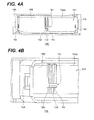
- Fig. 4A is a schematic side view when the case body portion is viewed from the opening side in the inclination sensor device according to Embodiment 1.
- Fig. 4B is a view showing an outline of the positioning mechanism which is provided on the inner wall of the case body portion.
- Fig. 5A is a schematic plan view of the substrate.
- Fig. 5B is a plan perspective view showing a schematic structure of an inner portion of the inclination sensor device.
- illustrations of the inclination sensor 110, the CPU 122, or the like mounted on the substrate 120 are omitted.
- Fig. 5A and 5B illustrations of the inclination sensor 110, the CPU 122, or the like mounted on the substrate 120 are omitted.
- Fig. 5A and 5B illustrations of the inclination sensor 110, the CPU 122, or the like mounted on the substrate 120 are omitted.
- Fig. 5A and 5B illustrations of the inclination sensor 110, the CPU 122, or the like mounted on the substrate 120 are omitted
- a substrate receiving portion 160 and a substrate receiving portion 162, which abut the upper surface of the substrate 120, are indicated by dashed lines.
- a direction, which is parallel to the main surface of the case 140 and is perpendicular to two side walls 142b, is referred to as a lateral direction
- a direction, which is parallel to the main surface of the case 140 and the side wall 142b is referred to as a longitudinal direction
- a direction which is perpendicular to the main surface of the case 140 is referred to as a vertical direction.
- a protrusion 158 is provided on a first inner wall 156 of the main body portion 142 opposite to the cover portion 144 while interposing the substrate 120.
- the first inner wall 156 is an inner side surface of a side wall approximately perpendicular to the side wall 142b.
- the main body portion 142 and the protrusion 158 are integrally molded by a resin material such as polybutylene terephthalate (PBT) which is softer than the substrate 120 configured of a glass epoxy substrate or the like.
- PBT polybutylene terephthalate
- the protrusion 158 protrudes so as to have a side surface parallel to the side wall 142b from the first inner wall 156 toward the cover portion 144 or the opening 142a.
- the protrusion 158 extends in the vertical direction of the first inner wall 156.
- the protrusion 158 is provided at an approximately center of the first inner wall 156 in the position in the lateral direction, and is provided at approximately the same position as two substrate guides 146 in the position in the vertical direction.
- the substrate receiving portion 160 which is opposite to the main surface of the lower side of the main body portion 142, is provided on the upper end side of the protrusion 158.
- a protrusion 161 extending in the lateral direction is provided on the first inner wall 156, and the protrusion 161 contacts the upper end of the protrusion 158.
- the protrusion 161 further protrudes to the cover portion 144 side than the protrusion 158, and extends so as to be longer in the lateral direction than the protrusion 158.
- the protrusion 161 includes a plane opposite to the main surface of the lower side of the main body portion 142, and the plane configures the substrate receiving portion 160. Moreover, as shown in Fig.
- two substrate receiving portions 162 which protrude to the accommodation space 141 and are disposed with a predetermined interval in the lateral direction, are provided on the cover portion 144.
- Two substrate receiving portions 162 are provided in the further inner side in the lateral direction than the two side walls 142, and are disposed in the accommodation space 141 in a state where the cover portion 144 is fitted to the main body portion 142.
- the substrate receiving portion 162 is disposed so that the upper end of the receiving portion 162 and the height (distance from the main surface of the case 140) of the lower end of the substrate guide 146 approximately coincide with each other.
- a protrusion 164 which protrudes toward the first inner wall 156 of the main body portion 142, is provided at approximately the center in the lateral direction of the surface facing the accommodation space 141 side.
- a protrusion receiving portion 128 is provided on a first side surface 126 opposite to the first inner wall 156 of the main body portion 142.
- the protrusion receiving portion 128 is configured of a groove in which the substrate 120 is cut into so as to be approximately parallel to an insertion direction D of the substrate 120 to the main body portion 142 from the first side surface 126.
- the protrusion receiving portion 128 is disposed at approximately the center in the lateral direction of the first side surface 126, and extends from the first main surface 121a of the substrate 120 to a second main surface 121b (refer to Fig. 6B )of the opposite side.
- a protrusion receiving portion 132 is provided on a second side surface 130 opposite to the cover portion 144.
- the protrusion receiving portion 132 is configured of a groove in which the substrate 120 is cut into so as to be approximately parallel to the insertion direction D from the second side surface 130.
- the protrusion receiving portion 132 is disposed at an approximately center in the lateral direction of the second side surface 136, and extends from the first main surface 121a of the substrate 120 to a second main surface 121b.
- a mutual dimension relationship between the protrusion receiving portion 128 of the substrate 120 and the protrusion 158 of the main body portion 142 is determined so that a width dimension (the length in the direction approximately perpendicular to the protrusion direction of the protrusion 158) of the protrusion 158 is slightly larger than a width dimension of the protrusion receiving portion 128.
- the mutual dimension relationship is determined so that a protrusion length of the protrusion 158 is smaller than a depth of the groove of the protrusion receiving portion 128.
- a mutual dimension relationship between the protrusion receiving portion 132 of the substrate 120 and the protrusion 164 of the cover portion 144 is determined so that a width dimension of the protrusion 164 is approximately the same as or slightly smaller than a width dimension of the protrusion receiving portion 132.
- the mutual dimension relationship is determined so that a protrusion length of the protrusion 164 is smaller than a depth of the groove of the protrusion receiving portion 132.
- the dimension relationship between the protrusion 158 and the protrusion receiving portion 128 can be appropriately designed so that press-fitting of the protrusion into the protrusion receiving portion described below is performed.
- an area 134 around the protrusion receiving portion 128 is an area in which the substrate receiving portion 160 abuts the substrate in a state where the substrate 120 is accommodated in the case 140.
- areas 136, which are positioned on right and left corners of the second side surface 130 side are areas in which the substrate receiving portion 162 abuts the substrate in the state where the substrate 120 is accommodated in the case 140.
- the protrusion 158 of the main body portion 142 is press-fitted into the protrusion receiving portion 128 of the substrate 120.
- the insertion direction D of the substrate 120 to the main body portion 142 is the same as the press-fitting direction of the protrusion 158 to the protrusion receiving portion 128.
- the protrusion 158 is formed of a material which is softer than that of the substrate 120, when the protrusion 158 enters the protrusion receiving portion 128, the protrusion 158 is pressed by the side surfaces of the protrusion receiving portion 128 and is deformed. In this way, since the protrusion 158 is press-fitted to the protrusion receiving portion 128, positioning in a first direction of the substrate 120 relative to the case 140 is mainly accomplished.
- the cover portion 144 is fitted to the main body portion 142, the protrusion 164 of the cover portion 144 is inserted into the protrusion receiving portion 132 of the substrate 120.
- the attachment direction of the cover portion 144 to the main body portion 142 is the same as the insertion direction of the protrusion 164 to the protrusion receiving portion 132, the cover portion 144 is fitted to the main body portion 142 and the protrusion 164 is inserted into the protrusion receiving portion 132.
- the positioning in the first direction of the substrate 120 relative to the case 140 can be more certainly accomplished.
- the substrate 120 is inserted into the main body portion 142, the areas 135 of the substrate 120 engage with the substrate guide 146. Moreover, the substrate 120 enters the lower side of the protrusion 161 (refer to Fig. 4 ), and the area 134 of the first main surface 121a abuts the substrate receiving portion 160. In addition, if the cover portion 144 is fitted to the main body portion 142, the substrate 120 enters the lower side of the substrate receiving portion 162, and the substrate receiving portion 162 abuts the areas 136 of the first main surface 121a. Thereby, positioning in a second direction of the substrate 120 relative to the case 140 is accomplished.
- the positioning of the substrate and the case in the second direction is accomplished to a certain degree.
- the above-described first positioning mechanism has a structure which is configured of the protrusions 158 and 164 provided in the case 140 and the protrusion receiving portions 128 and 132 provided in the substrate 120, and in which the protrusion 158 is press-fitted to the protrusion receiving portion 128, the protrusion 164 is inserted into the protrusion receiving portion 132, and the substrate 120 is positioned relative to the case 140.
- the above-described second positioning mechanism is configured of the substrate guide 146, the substrate receiving portions 160 and 162, and upper and lower main surfaces of the substrate 120.
- the inclination sensor device 102 includes the substrate 120 which mounts the inclination sensor 110, the case 140 which accommodates the substrate 120, the first positioning mechanism which positions the substrate 120 relative to the case 140 in the first direction approximately parallel to the main surface of the substrate 120, and the second positioning mechanism which positions the substrate 120 relative to the case 140 in the second direction approximately perpendicular to the main surface of the substrate 120.
- the first positioning mechanism has a structure which includes protrusions 158 and 164 provided in the case 140 and protrusion receiving portions 128 and 132 provided in the substrate 120, and in which the protrusion 158 is press-fitted to the protrusion receiving portion 128, the protrusion 164 is inserted into the protrusion receiving portion 132, and thus the substrate 120 is positioned relative to the case 140.
- the insertion direction D of the substrate 120 to the main body portion 142 and the press-fitting direction of the protrusion 158 to the protrusion receiving portion 128 are set so as to be the same as each other.
- the substrate 120 is inserted into the main body portion 142 and the protrusion 158 can be press-fitted to the protrusion receiving portion 128. Therefore, assembly of the inclination sensor device 102 can be simplified.
- the protrusion 164 is provided in the cover portion 144, and the protrusion receiving portion 132 is provided on the second side surface 130 of the substrate 120 opposite to the cover portion 144. Thereby, the positioning in the first direction of the substrate 120 relative to the case 140 can be performed with higher accuracy.
- the protrusions 158 and 164 are provided in the case 140 and the protrusion receiving portions 128 and 132 are provided in the substrate 120.
- the protrusions may be provided in the substrate 120
- the protrusion receiving portions may be provided in the case 140.
- the second positioning mechanism may also have a structure which includes the protrusion provided in one of the substrate 120 and the case 140 and the protrusion receiving portion provided in the other, and in which the protrusion is press-fitted to the protrusion receiving portion and the substrate 120 is positioned relative to the case 140.
- only the second positioning mechanism may have the structure in which the substrate 120 is positioned relative to the case 140 by the press-fitting of the protrusion and the protrusion receiving portion.
- the inclination sensor device 102 according to Embodiment 2 is the same as that of Embodiment 1 except that the first positioning mechanism and the second positioning mechanism are different from those of Embodiment 1.
- the inclination sensor device 102 according to Embodiment 2 configurations different from those of Embodiment 1 will be mainly described.
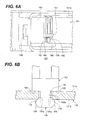
- Fig. 6A is a view showing an outline of a positioning mechanism which is provided on an inner wall of a case body portion in the inclination sensor device according to Embodiment 2.
- Fig. 6B is a schematic view for illustrating the positioning mechanism in the inclination sensor device according to Embodiment 2.
- the protrusion 158 which is provided on the first inner wall 156 of the main body portion 142, includes two press-fit margin portions 166 in the lower end of the protrusion.
- the two press-fit margin portions 166 are configured of a convex portion which protrudes from the side surface of the protrusion 158 opposite to one side wall 142b to the one side wall 142b side, and a convex portion which protrudes from the side surface of the protrusion 158 opposite to the other side wall 142b to the other side wall 142b side.
- the pressure-fit margin portion 166 has a semicircular shape when it is viewed from a direction parallel to the insertion direction D (refer to Fig. 3 ) of the substrate 120, and an arc portion protrudes laterally. Therefore, in the protrusion 158, the width dimension in the lower end is larger.
- the press-fit margin portion 166 is disposed so that a distance from the upper end 166a to the substrate receiving portion 160 is smaller than a thickness of the substrate 120.
- the protrusion 158 enters the protrusion receiving portion 128 of the substrate 120.
- the press-fit margin portion 166 of the protrusion 158 is press-fitted to the protrusion receiving portion 128.
- the press-fit margin portion 166 is integrally formed with the protrusion 158 by a resin material or the like which is softer than the substrate 120.
- the press-fit margin portion 166 is pressed to the corner 138 and is deformed, or the surface of the margin portion is shaved off by the corner 138.
- the press-fit margin portion 166 is press-fitted to the protrusion receiving portion 128, and thus, the positioning of the substrate 120 relative to the case 140 in the first direction is accomplished.
- the width dimensions of the protrusion 158 and the protrusion receiving portion 128 are adjusted so that the protrusion 158 is press-fitted to the protrusion receiving portion 128, the protrusion 158 is press-fitted to the protrusion receiving portion 128, and thus, the substrate 120 are positioned relative to the case 140.
- the protrusion 158 includes the press-fit margin portion 166, which protrudes the width direction of the protrusion receiving portion 128, in the lower end of the protrusion.
- the corner 138 of the substrate 120 is fitted to the press-fit margin portion 166. That is, in the fitting structure of the substrate 120 and the case 140, the corner 138 from the side surface of the protrusion receiving portion 128 serves as the fitting portion of the substrate 120 side. Moreover, the press-fit margin portion 166 from the side surface of the protrusion 158 serves as the fitting portion of the case 140 side.
- the first positioning mechanism of the present embodiment even when deviation (error) in the dimension relationship of the protrusion receiving portion 128 and the protrusion 158 occurs due to dimension tolerances of the appearances of the substrate 120 and the case 140 or dimension tolerances of the protrusion receiving portion 128 and the protrusion 158, an embedding amount of the corner 138 to the press-fit margin portion 166 is changed according to the deviation, and the press-fitting of the protrusion 158 to the protrusion receiving portion 128 can be secured. That is, the above-described deviation of the dimension relationship can be absorbed by the increase and decrease of the embedding amount of the corner 138 to the press-fit margin portion 166.
- the shape of the press-fit margin portion 166 may be a triangular shape in which the width of the press-fit margin portion is gradually widened toward the lower end of the protrusion 158 when the press-fit margin portion is viewed from a direction parallel to the insertion direction D.
- the press-fit margin portion 166 of the protrusion 158 is press-fitted to the area (the area from the center portion in the thickness direction of the substrate 120 to the second main surface 121b) near the second main surface 121b opposite to the first main surface 121a on which the inclination sensor 110 is mounted. Therefore, distortion of the first main surface 121a side of the substrate 120 which is generated by the press-fitting of the protrusion 158 can be decreased, and stress, which is applied to the inclination sensor 110 or the like due to the distortion of the substrate 120, can be decreased.
- the present embodiment has the structure in which the corner 138 of the substrate 120 and the press-fit margin portion 166 are fitted to each other, a deformed portion of the protrusion 158 can be decreased. Thereby, stress itself which is applied to the substrate 120 can be decreased, and the distortion of the substrate 120 can be decreased. As a result, since elements such as the inclination sensor 110 can be securely connected by the substrate 120, a decrease in accuracy of the auto-leveling control can be suppressed.
- the protrusion 164 of the cover portion 144 is inserted into the protrusion receiving portion 132 which is provided on the second side surface 130 of the substrate 120, and thus, the positioning of the substrate 120 relative to the case 140 in the first direction is accomplished.
- the first main surface 121a of the substrate 120 abuts the substrate receiving portion 160
- the corner 138 is embedded to the press-fit margin portion 166
- the second main surface 121b of the substrate 120 abuts the press-fit margin portion 166. That is, the substrate 120 (protrusion) is press-fitted to the groove (protrusion receiving portion) which is formed by the substrate receiving portion 160 and the protrusion 158.
- the press-fit margin portion 166 of the protrusion 158 configures a portion of the first positioning mechanism and a portion of the second positioning mechanism.
- the groove extends over the entire area from the first main surface 121a side of the first side surface 126 to the second surface 121b side.
- a structure may be used in which the groove is provided on only the area near the second main surface 121b and the protrusion 158 is press-fitted to the groove provided on the area near the second main surface 121b.
- the inclination sensor device 102 according to Embodiment 3 is the same as that of Embodiment 1 except that the first positioning mechanism and the second positioning mechanism are different from those of Embodiment 1.
- the inclination sensor device 102 according to Embodiment 3 configurations different from those of Embodiment 1 will be mainly described.
- Fig. 7A is a plan perspective view showing a schematic structure of an inner portion of the inclination sensor device according to Embodiment 3.
- Fig. 7B is a schematic view of a cover portion of the inclination sensor device according to Embodiment 3.
- illustrations of the inclination sensor 110, the CPU 122, the connector 124, or the like mounted on the substrate 120 are omitted in Fig. 7A .
- the case 140 includes an approximately triangular protrusion 158 on the first inner wall 156 of the main body portion 142 when viewed from the direction approximately perpendicular to the main surface of the case 140.
- the protrusion 158 is disposed so that one of vertexes of the triangle protrudes the cover portion 144 side. If the substrate 120 is inserted into the main body portion 142, two corners 139a, which are formed by the side surface of the protrusion receiving portion 128 and the first side surface 126 of the substrate 120, abut two tapered surfaces 159a corresponding to sides of the triangle of the protrusion 158.
- the case 140 includes an approximately triangular protrusion 164 on the surface facing the accommodation space 141 side of the cover portion 144 when viewed from the direction approximately perpendicular to the main surface of the case 140.
- the protrusion 164 is disposed so that one of vertexes of the triangle protrudes the first side surface 126 side. If the cover portion 144 is fitted into the main body portion 142, two corners 139b, which are formed by the side surface of the protrusion receiving portion 132 and the second side surface 130 of the substrate 120, abut two tapered surfaces 159b corresponding to sides of the triangle of the protrusion 164.
- the cover portion 144 can be elastically deformed, and for example, as shown in Fig.
- the cover portion in a state before the cover portion is fitted to the main body portion 142, the cover portion has a curved shape in which a wall portion 167 including the protrusion 164 protrudes in the protrusion direction of the hook 152.
- the wall portion 167 is elastically deformed to an approximately flat shape (refer to Fig. 7A ).
- a biasing force F can be generated by the elastic deformation of the wall portion 167, and thus, the substrate 120 can be biased toward the first inner wall 156 of the main body portion 142.
- the biasing of the substrate 120 due to the wall portion 167 of the cover portion 144 the positioning of the substrate 120 relative to the case 140 in the first direction is accomplished.
- the substrate 120 can be fixed to the case 140 with zero play.
- the protrusion is press-fitted to the protrusion receiving portion, significantly high dimension accuracy is required in the protrusion and the protrusion receiving portion.
- the dimension accuracy required in the protrusion and the protrusion receiving portion can be relieved.
- the corner 139a of the substrate 120 abuts the tapered surface 159a of the protrusion 158.
- the corner 139b of the substrate 120 abuts the tapered surface 159b of the protrusion 164.
- the substrate 120 is biased to the main body portion 142 due to elastic deformation in the insertion direction D of the cover portion 144. Therefore, since an elastic deformation amount of the cover portion 144 can be changed according to the deviation of the position of the substrate 120, the deviation of the position of the substrate 120 can be absorbed. Thereby, the positioning of the substrate 120 relative to the case 140 can be achieved with high accuracy.
- a protruding amount I (refer to Fig. 7B ) of the wall portion 167 to the main body portion 142 side be determined so that the wall portion 167 is flat in the state where the cover portion 144 is fitted to the main body portion 142. Therefore, in a completion state of the inclination sensor device 102, it is possible to make the deformation of the cover portion 144 unnoticeable.
- the protruding amount I of the wall portion 167 can be set based on a total value of the dimension tolerance of the appearance of the substrate 120 or the case 140, the dimension tolerance of the protrusion receiving portions 128 and 132 and the protrusions 158 and 164, or the like.
- the protruding amount I is set so that the wall portion 167 is flat when the total value of the dimension tolerance is minimum.
- the second positioning mechanism of the inclination sensor device 102 can be realized by the substrate guide 146, the substrate receiving portions 160 and 162, and the first main surface 121a and the second main surface 121b of the substrate 120.
- the second positioning mechanism may be a structure in which the substrate 120 is biased to the inner wall of the main body portion 142 by elasticity of the cover portion 144.
- the protrusions 158 and 164 are provided in the case 140, and the protrusion receiving portions 128 and 132 are provided in the substrate 120.
- the protrusions may be provided in the substrate 120, and the protrusion receiving portion may be provided in the case 140.
- a vehicle lamp system is configured of the inclination sensor device 102 according to each embodiment described above, a lamp unit 10 which is a vehicle lamp capable of adjusting the optical axis O, and the CPU 122 which is a control device.
- the CPU 122 is mounted on the substrate 120.
- the CPU 122 may be provided at other locations.
- the positions or the number of installations of the protrusions and the protrusion receiving portions can be appropriately set.
- the acceleration sensor is used as the inclination sensor 110.
- the inclination sensor 110 may be a gyro sensor (angular velocity sensor or angular acceleration sensor), a magnetic field sensor, or the like.
Landscapes
- Engineering & Computer Science (AREA)
- Microelectronics & Electronic Packaging (AREA)
- Physics & Mathematics (AREA)
- General Physics & Mathematics (AREA)
- Radar, Positioning & Navigation (AREA)
- Remote Sensing (AREA)
- Mechanical Engineering (AREA)
- General Engineering & Computer Science (AREA)
- Lighting Device Outwards From Vehicle And Optical Signal (AREA)
Abstract
Description
- The present disclosure relates to an inclination sensor device and a vehicle lamp system using the inclination sensor device, and particularly to an inclination sensor device which is provided in a vehicle such as an automobile, and a vehicle lamp system which includes the inclination sensor device.
- In the related art, an auto-leveling control is known which changes an irradiation direction of a vehicle headlamp by automatically controlling an optical axis position of the vehicle headlamp according to an inclination angle of a vehicle. In general, in the auto-leveling control, the optical axis position of the headlamp is adjusted based on a pitch angle of the vehicle which is obtained from an output value of a vehicle height sensor.
JP-A-2012-030782 JP-A-2012-030783 - Compared to when a vehicle height sensor is used, when an inclination sensor such as an acceleration sensor, a gyro sensor (angular velocity sensor or angular acceleration sensor) or a magnetic field sensor is used, costs of an auto-leveling system can be reduced, and weight reduction can be improved. As a result, cost reduction and weight reduction of a vehicle can be improved. On the other hand, even in the case where the inclination sensor such as an acceleration sensor is used, a demand to enhance accuracy of the auto-leveling control continuously exists.
- One of aspects of the present invention is to provide a technology which enhances accuracy of an auto-leveling control of a vehicle lamp.
- According to one or more aspects of the present invention, there is provided an inclination sensor device. The inclination sensor device comprises: a substrate which mounts an inclination sensor configured to calculate an inclination angle of a vehicle; a case which accommodates the substrate; a first positioning mechanism which positions the substrate relative to the case in a first direction that is substantially parallel to a first main surface of the substrate; and a second positioning mechanism which positions the substrate relative to the case in a second direction that is substantially perpendicular to the first main surface of the substrate.
- According to one or more aspects of the present invention, there is provided a vehicle lamp system. The vehicle lamp system comprises: a vehicle lamp configured to adjust an optical axis; the inclination sensor device, wherein an inclination sensor is mounted in the inclination sensor device; and a control device configured to generate a vehicle inclination angle information based on an output value of the inclination sensor and to control the vehicle lamp to adjust the optical axis of the vehicle lamp based on the vehicle inclination angle information.
-
-
Fig. 1 is a schematic view for illustrating a mounting position of an inclination sensor device according toEmbodiment 1; -
Fig. 2 is a schematic vertical cross-sectional view of a headlamp unit which includes a vehicle lamp; -
Fig. 3 is a schematic exploded perspective view of a sensor mounting structure which mounts the inclination sensor device and an inclination sensor according toEmbodiment 1 to a vehicle body; -
Fig. 4A is a schematic side view when a case body portion is viewed from an opening side in the inclination sensor device according toEmbodiment 1; -
Fig. 4B is a view showing an outline of a positioning mechanism which is provided on an inner wall of the case body portion; -
Fig. 5A is a schematic plan view of a substrate; -
Fig. 5B is a perspective plan view showing a schematic structure of an inner portion of the inclination sensor device; -
Fig. 6A is a view showing an outline of a positioning mechanism which is provided on an inner wall of a case body portion in an inclination sensor device according to Embodiment 2; -
Fig. 6B is a schematic view for illustrating the positioning mechanism in the inclination sensor device according to Embodiment 2; -
Fig. 7A is a perspective plan view showing a schematic structure of an inner portion of an inclination sensor device according to Embodiment 3; and -
Fig. 7B is a schematic view of a cover portion of the inclination sensor device according to Embodiment 3. - Hereinafter, the present invention will be described based on preferred embodiments with reference to drawings. The same reference numerals are attached to the same or equivalent components and members shown in each drawing, and overlapped descriptions are appropriately omitted. Moreover, the embodiments do not limit the present invention but exemplify the invention, and all characteristics described in embodiments or combinations thereof are not necessarily the essentials of the invention.
-
Fig. 1 is a schematic view for illustrating a mounting position of an inclination sensor device according toEmbodiment 1. The inclination sensor device is included in a levelingECU 1, and for example, the levelingECU 1 is installed near a dashboard of avehicle body 300. Moreover, the installation position of the levelingECU 1 or the inclination sensor is not particularly limited, and for example, may be provided in aheadlamp unit 210. For example, if the levelingECU 1 receives an instruction with respect to operation of an auto-leveling control from a light switch or the like which is mounted on a vehicle, the levelingECU 1 starts the auto-leveling control. - In the auto-leveling control, the leveling
ECU 1 generates information of an inclination angle in a pitch direction of the vehicle using an output value of the inclination sensor. Moreover, the levelingECU 1 controls a leveling actuator 226 (refer toFig. 2 ) using the obtained information, and adjusts an optical axis of a lamp unit 10 (refer toFig. 2 ), which is a vehicle lamp mounted on theheadlamp unit 210, to an angle corresponding to a vehicle attitude. In this way, the auto-leveling control, which performs the leveling adjustment of the lamp unit in real time based on the vehicle attitude, is carried out, and thus, an arrival distance of front irradiation can be optimally adjusted even when the vehicle attitude is changed. -
Fig. 2 is a schematic vertical cross-sectional view of the headlamp unit which includes the vehicle lamp. Theheadlamp unit 210 is configured so that a pair of headlamp units formed symmetrically in the left and right is disposed one by one on the left and right in a vehicle width direction of the vehicle. Since the headlamp units disposed in the left and right have substantially the same configuration, hereinafter, a structure of a rightside headlamp unit 210R is described, and descriptions of a leftside headlamp unit 210L are appropriately omitted herein. Theheadlamp unit 210R includes alamp body 212 which includes an opening portion in a vehicle front side, and atranslucent cover 214 which covers the opening portion. Thelamp body 212 includes adetachable cover 212a in a vehicle rear side. Alamp chamber 216 is formed by thelamp body 212 and thetranslucent cover 214. Thelamp unit 10 is accommodated in thelamp chamber 216. - A
lamp bracket 218, which includes apivot mechanism 218a that becomes a swivel center in vertical and lateral directions of thelamp unit 10, is formed in thelamp unit 10. Thelamp bracket 218 is screwed to an aimingadjustment screw 220 which is supported by thelamp body 212. A rotatingshaft 222a of aswivel actuator 222 is fixed to a lower surface of thelamp unit 10. Theswivel actuator 222 is fixed to aunit bracket 224. The levelingactuator 226 is connected to theunit bracket 224. For example, the levelingactuator 226 is configured of a motor, which extends and contracts arod 226a in arrow directions M and N, or the like. Therod 226a is expanded and contracted in arrow directions M and N, and thus, thelamp unit 10 has a backward inclined attitude and a forward inclined attitude, and a leveling adjustment is performed in which a pitch angle of an optical axis O faces downward or upward. - The
lamp unit 10 includes ashade mechanism 18 which includes arotary shade 12, abulb 14, alamp housing 17 which supports areflector 16 on an inner wall, and aprojection lens 20. As thebulb 14, an incandescent bulb, a halogen lamp, a discharge bulb, an LED, or the like may be used. At least a portion of thereflector 16 has a shape of an elliptic spherical surface, and reflects light which is radiated from thebulb 14. A portion of the light from thebulb 14 and the light reflected by thereflector 16 is led to theprojection lens 20 via therotary shade 12. Therotary shade 12 is a cylindrical member which can rotate about arotating shaft 12a, and includes a cutout portion and a plurality of shade plates (not shown). The cutout portion or the shade plate moves on an optical axis O, and thus, a predetermined light distribution pattern is formed. Theprojection lens 20 is configured of a plano-convex aspherical lens, and projects an image of a light source, which is formed on a backward focal plane, on a virtual vertical screen in front of the lamp as a reverted image. - Subsequently, an inclination sensor device according to
Embodiment 1 will be described in detail.Fig. 3 is a schematic exploded perspective view of a sensor mounting structure which mounts the inclination sensor device and the inclination sensor according toEmbodiment 1 to the vehicle body. Asensor mounting structure 100 is a structure for mounting the inclination sensor to thevehicle body 300, and includes aninclination sensor device 102 and a mountingportion 104 which mounts theinclination sensor device 102 to a predetermined position of thevehicle body 300. - The
inclination sensor device 102 includes asubstrate 120 which mounts aninclination sensor 110 used for calculation of an inclination angle of a vehicle, and acase 140 which accommodates thesubstrate 120. Thesubstrate 120 includes a predetermined wiring pattern on a firstmain surface 121a, and mounts: aninclination sensor 110; aCPU 122 which is a control device; a ROM which stores various control programs; a RAM which is used as a work area for storing data or performing the programs; an input interface (input I/F) for observation of input voltage to thesubstrate 120, input signals from various switches or communication; an output interface (output I/F) for output of control signals to the levelingactuator 226 or communication; a memory. TheCPU 122 generates information of the inclination angle of the vehicle by using an output value of theinclination sensor 110, and controls an optical-axis adjustment of thelamp unit 10 by using the information. Therefore, theinclination sensor device 102 configures a portion of the levelingECU 1. In the present embodiment, theinclination sensor 110 is an acceleration sensor. Moreover, aconnector 124 for inputting vehicle speed signals, light switch signals, or the like from the vehicle side or outputting the generated information to the outside is mounted on thesubstrate 120. In the present embodiment, thesubstrate 120 is formed in a rectangle shape in a plan view, and theconnector 124 is provided on one side of the substrate. - The
case 140 has a flat rectangular parallelepiped shape, and includes amain body portion 142 and acover portion 144. Themain body portion 142 is a container-like member which includes anaccommodation space 141 of thesubstrate 120. Themain body portion 142 includes anopening 142a on a surface corresponding to a side wall of thecase 140. In addition, themain body portion 142 includes asubstrate guide 146 which intersects an extension direction of theopening 142a and extends to be parallel to the main surface of thecase 140 on inner side surfaces of twoside walls 142b opposite to each other. A lance engagingconvex portion 148 to thecover portion 144 is provided in an area near theopening 142a on the outer side surfaces of twoside walls 142b. Moreover, an engagingconvex portion 150 to the mountingportion 104 is provided in the center portion of the outer side surfaces of twoside walls 142b. Thecover portion 144 is a member which closes theopening 142a of themain body portion 142, and configures the side wall of thecase 140. Alance engaging hook 152 is provided on a side wall of thecover portion 144 which is connected to theside wall 142b of themain body portion 142. Thehook 152 includes an opening portion having a shape matching theconvex portion 148. In addition, thecover portion 144 includes anopening portion 154 for making theconnector 124 of thesubstrate 120 accommodated in themain body portion 142 face the outside. - Moreover, the
inclination sensor device 102 includes a first positioning mechanism which positions thesubstrate 120 relative to thecase 140 in a first direction (directions shown by arrows A and B inFig. 3 ) approximately parallel to the main surface of thesubstrate 120, and a second positioning mechanism which positions thesubstrate 120 relative to thecase 140 in a second direction (a direction shown by an arrow C inFig. 3 ) approximately perpendicular to the main surface of thesubstrate 120. The first positioning mechanism and the second position structure will be described in detail hereinafter. - The mounting
portion 104 is an approximately flat plate-like member, and two flat plate-like arm portions 105 are provided in one end side of the mounting portion. The twoarm portions 105 are disposed so that the main surfaces are opposite to each other with an interval which is wider than an interval of twoside walls 142b of thecase 140 and is narrower than a distance between top portions of twoconvex portions 150. Acircular opening portion 106 is provided in each of twoarm portions 105. A connectingportion 107 which is connected to thevehicle body 300 is provided in the other end side of the mountingportion 104. A through hole (not shown), through which afastening member 108 such as a screw is inserted, is provided at a predetermined position of the connectingportion 107. - The
substrate 120 is inserted from the end opposite to theconnector 124 into theaccommodation space 141 of themain body portion 142 via theopening 142a, and is inserted along thesubstrate guide 146. In the present embodiment, thesubstrate 120 is accommodated in themain body portion 142 so that theinclination sensor 110 or theCPU 122 is disposed on an upper side (upper side inFig. 3 ) of thesubstrate 120. After thesubstrate 120 is accommodated in themain body portion 142, thecover portion 144 is loosely connected to theopening 142a. Thecover portion 144 is fitted to theopening 142a of themain body portion 142 so that theconnector 124 is inserted into theopening portion 154, and is fixed to themain body portion 142 by a lance engagement between theconvex portion 148 and thehook 152. Theconnector 124 is exposed to the outside of the case from theopening portion 154. A harness for connecting thesubstrate 120 and external equipment is connected to theconnector 124. - The
case 140 is connected to the mountingportion 104 in a state where theconvex portion 150 of theside wall 142b is fitted to the opening portion 106b of thearm portion 105 and the case is held by twoarm portions 105. The mountingportion 104 is positioned so that the through hole of the connectingportion 107 and a connectinghole 302 of thevehicle body 300 are overlapped with each other, and is fixed to thevehicle body 300 by inserting thefastening member 108 into the through hole and the connectinghole 302. - Hereinafter, the first positioning mechanism and the second positioning mechanism of the
inclination sensor device 102 according to the present embodiment will be described.Fig. 4A is a schematic side view when the case body portion is viewed from the opening side in the inclination sensor device according toEmbodiment 1.Fig. 4B is a view showing an outline of the positioning mechanism which is provided on the inner wall of the case body portion.Fig. 5A is a schematic plan view of the substrate.Fig. 5B is a plan perspective view showing a schematic structure of an inner portion of the inclination sensor device. InFigs. 5A and 5B , illustrations of theinclination sensor 110, theCPU 122, or the like mounted on thesubstrate 120 are omitted. Moreover, inFig. 5B , asubstrate receiving portion 160 and asubstrate receiving portion 162, which abut the upper surface of thesubstrate 120, are indicated by dashed lines. Hereinafter, for convenience, a direction, which is parallel to the main surface of thecase 140 and is perpendicular to twoside walls 142b, is referred to as a lateral direction, a direction, which is parallel to the main surface of thecase 140 and theside wall 142b, is referred to as a longitudinal direction, and a direction which is perpendicular to the main surface of thecase 140 is referred to as a vertical direction. - As shown in
Figs. 4A and 4B , in thecase 140, aprotrusion 158 is provided on a firstinner wall 156 of themain body portion 142 opposite to thecover portion 144 while interposing thesubstrate 120. The firstinner wall 156 is an inner side surface of a side wall approximately perpendicular to theside wall 142b. Themain body portion 142 and theprotrusion 158 are integrally molded by a resin material such as polybutylene terephthalate (PBT) which is softer than thesubstrate 120 configured of a glass epoxy substrate or the like. Theprotrusion 158 protrudes so as to have a side surface parallel to theside wall 142b from the firstinner wall 156 toward thecover portion 144 or theopening 142a. In addition, theprotrusion 158 extends in the vertical direction of the firstinner wall 156. Theprotrusion 158 is provided at an approximately center of the firstinner wall 156 in the position in the lateral direction, and is provided at approximately the same position as two substrate guides 146 in the position in the vertical direction. - The
substrate receiving portion 160, which is opposite to the main surface of the lower side of themain body portion 142, is provided on the upper end side of theprotrusion 158. In the present embodiment, aprotrusion 161 extending in the lateral direction is provided on the firstinner wall 156, and theprotrusion 161 contacts the upper end of theprotrusion 158. Theprotrusion 161 further protrudes to thecover portion 144 side than theprotrusion 158, and extends so as to be longer in the lateral direction than theprotrusion 158. Theprotrusion 161 includes a plane opposite to the main surface of the lower side of themain body portion 142, and the plane configures thesubstrate receiving portion 160. Moreover, as shown inFig. 3 , twosubstrate receiving portions 162, which protrude to theaccommodation space 141 and are disposed with a predetermined interval in the lateral direction, are provided on thecover portion 144. Twosubstrate receiving portions 162 are provided in the further inner side in the lateral direction than the twoside walls 142, and are disposed in theaccommodation space 141 in a state where thecover portion 144 is fitted to themain body portion 142. Moreover, thesubstrate receiving portion 162 is disposed so that the upper end of the receivingportion 162 and the height (distance from the main surface of the case 140) of the lower end of thesubstrate guide 146 approximately coincide with each other. In addition, in thecover portion 144, aprotrusion 164, which protrudes toward the firstinner wall 156 of themain body portion 142, is provided at approximately the center in the lateral direction of the surface facing theaccommodation space 141 side. - As shown in
Fig. 5A , in thesubstrate 120, aprotrusion receiving portion 128 is provided on afirst side surface 126 opposite to the firstinner wall 156 of themain body portion 142. In the present embodiment, theprotrusion receiving portion 128 is configured of a groove in which thesubstrate 120 is cut into so as to be approximately parallel to an insertion direction D of thesubstrate 120 to themain body portion 142 from thefirst side surface 126. Theprotrusion receiving portion 128 is disposed at approximately the center in the lateral direction of thefirst side surface 126, and extends from the firstmain surface 121a of thesubstrate 120 to a secondmain surface 121b (refer toFig. 6B )of the opposite side. Moreover, in thesubstrate 120, aprotrusion receiving portion 132 is provided on asecond side surface 130 opposite to thecover portion 144. In the present embodiment, theprotrusion receiving portion 132 is configured of a groove in which thesubstrate 120 is cut into so as to be approximately parallel to the insertion direction D from thesecond side surface 130. Theprotrusion receiving portion 132 is disposed at an approximately center in the lateral direction of thesecond side surface 136, and extends from the firstmain surface 121a of thesubstrate 120 to a secondmain surface 121b. - A mutual dimension relationship between the
protrusion receiving portion 128 of thesubstrate 120 and theprotrusion 158 of themain body portion 142 is determined so that a width dimension (the length in the direction approximately perpendicular to the protrusion direction of the protrusion 158) of theprotrusion 158 is slightly larger than a width dimension of theprotrusion receiving portion 128. Moreover, the mutual dimension relationship is determined so that a protrusion length of theprotrusion 158 is smaller than a depth of the groove of theprotrusion receiving portion 128. On the other hand, a mutual dimension relationship between theprotrusion receiving portion 132 of thesubstrate 120 and theprotrusion 164 of thecover portion 144 is determined so that a width dimension of theprotrusion 164 is approximately the same as or slightly smaller than a width dimension of theprotrusion receiving portion 132. In addition, the mutual dimension relationship is determined so that a protrusion length of theprotrusion 164 is smaller than a depth of the groove of theprotrusion receiving portion 132. The dimension relationship between theprotrusion 158 and theprotrusion receiving portion 128 can be appropriately designed so that press-fitting of the protrusion into the protrusion receiving portion described below is performed. - In the first
main surface 121a of the upper side of thesubstrate 120, anarea 134 around theprotrusion receiving portion 128 is an area in which thesubstrate receiving portion 160 abuts the substrate in a state where thesubstrate 120 is accommodated in thecase 140.Areas 135, which extend from thefirst side surface 126 toward asecond side surface 130 on right and left ends of thesubstrate 120, are areas in which the substrate engages with thesubstrate guide 146 in the state where thesubstrate 120 is accommodated in thecase 140. In the firstmain surface 121a of the upper side of thesubstrate 120,areas 136, which are positioned on right and left corners of thesecond side surface 130 side, are areas in which thesubstrate receiving portion 162 abuts the substrate in the state where thesubstrate 120 is accommodated in thecase 140. - As shown in
Fig. 5B , if thesubstrate 120 is inserted into themain body portion 142, theprotrusion 158 of themain body portion 142 is press-fitted into theprotrusion receiving portion 128 of thesubstrate 120. In the present embodiment, the insertion direction D of thesubstrate 120 to themain body portion 142 is the same as the press-fitting direction of theprotrusion 158 to theprotrusion receiving portion 128. Thereby, thesubstrate 120 is inserted into themain body portion 142 and theprotrusion 158 is press-fitted to theprotrusion receiving portion 128. Since theprotrusion 158 is formed of a material which is softer than that of thesubstrate 120, when theprotrusion 158 enters theprotrusion receiving portion 128, theprotrusion 158 is pressed by the side surfaces of theprotrusion receiving portion 128 and is deformed. In this way, since theprotrusion 158 is press-fitted to theprotrusion receiving portion 128, positioning in a first direction of thesubstrate 120 relative to thecase 140 is mainly accomplished. - Moreover, if the
cover portion 144 is fitted to themain body portion 142, theprotrusion 164 of thecover portion 144 is inserted into theprotrusion receiving portion 132 of thesubstrate 120. In the present embodiment, since the attachment direction of thecover portion 144 to themain body portion 142 is the same as the insertion direction of theprotrusion 164 to theprotrusion receiving portion 132, thecover portion 144 is fitted to themain body portion 142 and theprotrusion 164 is inserted into theprotrusion receiving portion 132. Since thefirst side surface 126 side of thesubstrate 120 is positioned by the press-fitting of theprotrusion 158 to theprotrusion receiving portion 128 and thesecond side surface 130 side opposite to thefirst side surface 126 is positioned by the inserting of theprotrusion 164 to theprotrusion receiving portion 132, the positioning in the first direction of thesubstrate 120 relative to thecase 140 can be more certainly accomplished. - In addition, if the
substrate 120 is inserted into themain body portion 142, theareas 135 of thesubstrate 120 engage with thesubstrate guide 146. Moreover, thesubstrate 120 enters the lower side of the protrusion 161 (refer toFig. 4 ), and thearea 134 of the firstmain surface 121a abuts thesubstrate receiving portion 160. In addition, if thecover portion 144 is fitted to themain body portion 142, thesubstrate 120 enters the lower side of thesubstrate receiving portion 162, and thesubstrate receiving portion 162 abuts theareas 136 of the firstmain surface 121a. Thereby, positioning in a second direction of thesubstrate 120 relative to thecase 140 is accomplished. In addition, also by the press-fitting of theprotrusion 158 to theprotrusion receiving portion 128 and/or the insertion of theprotrusion 164 to theprotrusion receiving portion 132, the positioning of the substrate and the case in the second direction is accomplished to a certain degree. - Therefore, in the
inclination sensor device 102 of the present embodiment, the above-described first positioning mechanism has a structure which is configured of theprotrusions case 140 and theprotrusion receiving portions substrate 120, and in which theprotrusion 158 is press-fitted to theprotrusion receiving portion 128, theprotrusion 164 is inserted into theprotrusion receiving portion 132, and thesubstrate 120 is positioned relative to thecase 140. Moreover, the above-described second positioning mechanism is configured of thesubstrate guide 146, thesubstrate receiving portions substrate 120. - As described above, the
inclination sensor device 102 according to the present embodiment includes thesubstrate 120 which mounts theinclination sensor 110, thecase 140 which accommodates thesubstrate 120, the first positioning mechanism which positions thesubstrate 120 relative to thecase 140 in the first direction approximately parallel to the main surface of thesubstrate 120, and the second positioning mechanism which positions thesubstrate 120 relative to thecase 140 in the second direction approximately perpendicular to the main surface of thesubstrate 120. Thereby, since the positioning accuracy of thesubstrate 120 relative to thecase 140 can be increased, theinclination sensor 110 can be accurately mounted on the vehicle. For this reason, the auto-leveling control of thelamp unit 10 which is a vehicle lamp can be performed with high accuracy. - Moreover, the first positioning mechanism has a structure which includes
protrusions case 140 andprotrusion receiving portions substrate 120, and in which theprotrusion 158 is press-fitted to theprotrusion receiving portion 128, theprotrusion 164 is inserted into theprotrusion receiving portion 132, and thus thesubstrate 120 is positioned relative to thecase 140. Thereby, it is possible to position thesubstrate 120 relative to thecase 140 by a simpler structure without increasing the number of parts. Moreover, the insertion direction D of thesubstrate 120 to themain body portion 142 and the press-fitting direction of theprotrusion 158 to theprotrusion receiving portion 128 are set so as to be the same as each other. Thereby, thesubstrate 120 is inserted into themain body portion 142 and theprotrusion 158 can be press-fitted to theprotrusion receiving portion 128. Therefore, assembly of theinclination sensor device 102 can be simplified. In addition, theprotrusion 164 is provided in thecover portion 144, and theprotrusion receiving portion 132 is provided on thesecond side surface 130 of thesubstrate 120 opposite to thecover portion 144. Thereby, the positioning in the first direction of thesubstrate 120 relative to thecase 140 can be performed with higher accuracy. - Moreover, in the present embodiment, the
protrusions case 140 and theprotrusion receiving portions substrate 120. However, the protrusions may be provided in thesubstrate 120, and the protrusion receiving portions may be provided in thecase 140. Moreover, similar to the first positioning mechanism, the second positioning mechanism may also have a structure which includes the protrusion provided in one of thesubstrate 120 and thecase 140 and the protrusion receiving portion provided in the other, and in which the protrusion is press-fitted to the protrusion receiving portion and thesubstrate 120 is positioned relative to thecase 140. Moreover, only the second positioning mechanism may have the structure in which thesubstrate 120 is positioned relative to thecase 140 by the press-fitting of the protrusion and the protrusion receiving portion. - The
inclination sensor device 102 according to Embodiment 2 is the same as that ofEmbodiment 1 except that the first positioning mechanism and the second positioning mechanism are different from those ofEmbodiment 1. Hereinafter, with respect to theinclination sensor device 102 according to Embodiment 2, configurations different from those ofEmbodiment 1 will be mainly described. -
Fig. 6A is a view showing an outline of a positioning mechanism which is provided on an inner wall of a case body portion in the inclination sensor device according to Embodiment 2.Fig. 6B is a schematic view for illustrating the positioning mechanism in the inclination sensor device according to Embodiment 2. As shown inFig. 6A , theprotrusion 158, which is provided on the firstinner wall 156 of themain body portion 142, includes two press-fit margin portions 166 in the lower end of the protrusion. The two press-fit margin portions 166 are configured of a convex portion which protrudes from the side surface of theprotrusion 158 opposite to oneside wall 142b to the oneside wall 142b side, and a convex portion which protrudes from the side surface of theprotrusion 158 opposite to theother side wall 142b to theother side wall 142b side. In the present embodiment, the pressure-fit margin portion 166 has a semicircular shape when it is viewed from a direction parallel to the insertion direction D (refer toFig. 3 ) of thesubstrate 120, and an arc portion protrudes laterally. Therefore, in theprotrusion 158, the width dimension in the lower end is larger. The press-fit margin portion 166 is disposed so that a distance from theupper end 166a to thesubstrate receiving portion 160 is smaller than a thickness of thesubstrate 120. - As shown in
Fig. 6B , if thesubstrate 120 is inserted in to themain body portion 142, theprotrusion 158 enters theprotrusion receiving portion 128 of thesubstrate 120. At this time, the press-fit margin portion 166 of theprotrusion 158 is press-fitted to theprotrusion receiving portion 128. The press-fit margin portion 166 is integrally formed with theprotrusion 158 by a resin material or the like which is softer than thesubstrate 120. Thereby, if thesubstrate 120 is inserted to themain body portion 142, acorner 138 of thesubstrate 120, which is formed by the side surface of theprotrusion receiving portion 128 and the secondmain surface 121b, is embedded to the surface of the press-fit margin portion 166. The press-fit margin portion 166 is pressed to thecorner 138 and is deformed, or the surface of the margin portion is shaved off by thecorner 138. The press-fit margin portion 166 is press-fitted to theprotrusion receiving portion 128, and thus, the positioning of thesubstrate 120 relative to thecase 140 in the first direction is accomplished. - Similar to
Embodiment 1, in the structure in which theprotrusion 158 does not include the press-fit margin portion 166, the width dimensions of theprotrusion 158 and theprotrusion receiving portion 128 are adjusted so that theprotrusion 158 is press-fitted to theprotrusion receiving portion 128, theprotrusion 158 is press-fitted to theprotrusion receiving portion 128, and thus, thesubstrate 120 are positioned relative to thecase 140. However, in this case, significantly high dimension accuracy is required in theprotrusion receiving portion 128 and theprotrusion 158. On the other hand, in the present embodiment, theprotrusion 158 includes the press-fit margin portion 166, which protrudes the width direction of theprotrusion receiving portion 128, in the lower end of the protrusion. Moreover, thecorner 138 of thesubstrate 120 is fitted to the press-fit margin portion 166. That is, in the fitting structure of thesubstrate 120 and thecase 140, thecorner 138 from the side surface of theprotrusion receiving portion 128 serves as the fitting portion of thesubstrate 120 side. Moreover, the press-fit margin portion 166 from the side surface of theprotrusion 158 serves as the fitting portion of thecase 140 side. - Therefore, according to the first positioning mechanism of the present embodiment, even when deviation (error) in the dimension relationship of the
protrusion receiving portion 128 and theprotrusion 158 occurs due to dimension tolerances of the appearances of thesubstrate 120 and thecase 140 or dimension tolerances of theprotrusion receiving portion 128 and theprotrusion 158, an embedding amount of thecorner 138 to the press-fit margin portion 166 is changed according to the deviation, and the press-fitting of theprotrusion 158 to theprotrusion receiving portion 128 can be secured. That is, the above-described deviation of the dimension relationship can be absorbed by the increase and decrease of the embedding amount of thecorner 138 to the press-fit margin portion 166. Thereby, the dimension accuracy required in theprotrusion receiving portion 128 and theprotrusion 158 can be relieved. Moreover, the shape of the press-fit margin portion 166 may be a triangular shape in which the width of the press-fit margin portion is gradually widened toward the lower end of theprotrusion 158 when the press-fit margin portion is viewed from a direction parallel to the insertion direction D. - Moreover, in the present embodiment, in the grooves which configure the
protrusion receiving portion 128, the press-fit margin portion 166 of theprotrusion 158 is press-fitted to the area (the area from the center portion in the thickness direction of thesubstrate 120 to the secondmain surface 121b) near the secondmain surface 121b opposite to the firstmain surface 121a on which theinclination sensor 110 is mounted. Therefore, distortion of the firstmain surface 121a side of thesubstrate 120 which is generated by the press-fitting of theprotrusion 158 can be decreased, and stress, which is applied to theinclination sensor 110 or the like due to the distortion of thesubstrate 120, can be decreased. Moreover, compared to the structure in which the side surface of theprotrusion 158 and the side surface of theprotrusion receiving portion 128 are pressed to each other, since the present embodiment has the structure in which thecorner 138 of thesubstrate 120 and the press-fit margin portion 166 are fitted to each other, a deformed portion of theprotrusion 158 can be decreased. Thereby, stress itself which is applied to thesubstrate 120 can be decreased, and the distortion of thesubstrate 120 can be decreased. As a result, since elements such as theinclination sensor 110 can be securely connected by thesubstrate 120, a decrease in accuracy of the auto-leveling control can be suppressed. - Moreover, similar to
Embodiment 1, theprotrusion 164 of thecover portion 144 is inserted into theprotrusion receiving portion 132 which is provided on thesecond side surface 130 of thesubstrate 120, and thus, the positioning of thesubstrate 120 relative to thecase 140 in the first direction is accomplished. In addition, the firstmain surface 121a of thesubstrate 120 abuts thesubstrate receiving portion 160, thecorner 138 is embedded to the press-fit margin portion 166, and thus, the secondmain surface 121b of thesubstrate 120 abuts the press-fit margin portion 166. That is, the substrate 120 (protrusion) is press-fitted to the groove (protrusion receiving portion) which is formed by thesubstrate receiving portion 160 and theprotrusion 158. Thereby, the positioning in the second direction of thesubstrate 120 relative to thecase 140 is accomplished. Therefore, the press-fit margin portion 166 of theprotrusion 158 configures a portion of the first positioning mechanism and a portion of the second positioning mechanism. - Moreover, in the present embodiment, the groove extends over the entire area from the first
main surface 121a side of thefirst side surface 126 to thesecond surface 121b side. However, a structure may be used in which the groove is provided on only the area near the secondmain surface 121b and theprotrusion 158 is press-fitted to the groove provided on the area near the secondmain surface 121b. - The
inclination sensor device 102 according to Embodiment 3 is the same as that ofEmbodiment 1 except that the first positioning mechanism and the second positioning mechanism are different from those ofEmbodiment 1. Hereinafter, with respect to theinclination sensor device 102 according to Embodiment 3, configurations different from those ofEmbodiment 1 will be mainly described. -
Fig. 7A is a plan perspective view showing a schematic structure of an inner portion of the inclination sensor device according to Embodiment 3.Fig. 7B is a schematic view of a cover portion of the inclination sensor device according to Embodiment 3. In addition, illustrations of theinclination sensor 110, theCPU 122, theconnector 124, or the like mounted on thesubstrate 120 are omitted inFig. 7A . As shown inFig. 7A , thecase 140 includes an approximatelytriangular protrusion 158 on the firstinner wall 156 of themain body portion 142 when viewed from the direction approximately perpendicular to the main surface of thecase 140. Theprotrusion 158 is disposed so that one of vertexes of the triangle protrudes thecover portion 144 side. If thesubstrate 120 is inserted into themain body portion 142, twocorners 139a, which are formed by the side surface of theprotrusion receiving portion 128 and thefirst side surface 126 of thesubstrate 120, abut two taperedsurfaces 159a corresponding to sides of the triangle of theprotrusion 158. - In addition, the
case 140 includes an approximatelytriangular protrusion 164 on the surface facing theaccommodation space 141 side of thecover portion 144 when viewed from the direction approximately perpendicular to the main surface of thecase 140. Theprotrusion 164 is disposed so that one of vertexes of the triangle protrudes thefirst side surface 126 side. If thecover portion 144 is fitted into themain body portion 142, twocorners 139b, which are formed by the side surface of theprotrusion receiving portion 132 and thesecond side surface 130 of thesubstrate 120, abut two taperedsurfaces 159b corresponding to sides of the triangle of theprotrusion 164. Here, thecover portion 144 can be elastically deformed, and for example, as shown inFig. 7B , in a state before the cover portion is fitted to themain body portion 142, the cover portion has a curved shape in which awall portion 167 including theprotrusion 164 protrudes in the protrusion direction of thehook 152. In addition, if thecover portion 144 is fitted to themain body portion 142, thewall portion 167 is elastically deformed to an approximately flat shape (refer toFig. 7A ). - That is, in the state where the
cover portion 144 is fitted to themain body portion 142, a biasing force F can be generated by the elastic deformation of thewall portion 167, and thus, thesubstrate 120 can be biased toward the firstinner wall 156 of themain body portion 142. In the present embodiment, by the biasing of thesubstrate 120 due to thewall portion 167 of thecover portion 144, the positioning of thesubstrate 120 relative to thecase 140 in the first direction is accomplished. In this case, since the appearance dimension of thesubstrate 120 or the deviation (error) in the dimensions of theprotrusion receiving portions case 140 or the deviation in the dimensions of theprotrusions cover portion 144, thesubstrate 120 can be fixed to thecase 140 with zero play. Moreover, in the structure in which the protrusion is press-fitted to the protrusion receiving portion, significantly high dimension accuracy is required in the protrusion and the protrusion receiving portion. However, according to the structure which positions thesubstrate 120 and themain body portion 142 by biasing thesubstrate 120 to themain body portion 142 through elasticity of thecover portion 144, the dimension accuracy required in the protrusion and the protrusion receiving portion can be relieved. - Moreover, in the present embodiment, the
corner 139a of thesubstrate 120 abuts the taperedsurface 159a of theprotrusion 158. In addition, thecorner 139b of thesubstrate 120 abuts the taperedsurface 159b of theprotrusion 164. Thereby, the above-described deviation of the dimension can be converted to the deviation of the position in the insertion direction D of thesubstrate 120. On the other hand, in the present embodiment, thesubstrate 120 is biased to themain body portion 142 due to elastic deformation in the insertion direction D of thecover portion 144. Therefore, since an elastic deformation amount of thecover portion 144 can be changed according to the deviation of the position of thesubstrate 120, the deviation of the position of thesubstrate 120 can be absorbed. Thereby, the positioning of thesubstrate 120 relative to thecase 140 can be achieved with high accuracy. - It is preferable that a protruding amount I (refer to
Fig. 7B ) of thewall portion 167 to themain body portion 142 side be determined so that thewall portion 167 is flat in the state where thecover portion 144 is fitted to themain body portion 142. Therefore, in a completion state of theinclination sensor device 102, it is possible to make the deformation of thecover portion 144 unnoticeable. For example, the protruding amount I of thewall portion 167 can be set based on a total value of the dimension tolerance of the appearance of thesubstrate 120 or thecase 140, the dimension tolerance of theprotrusion receiving portions protrusions wall portion 167 is flat when the total value of the dimension tolerance is minimum. - For example, similar to
Embodiment 1, the second positioning mechanism of theinclination sensor device 102 according to the present embodiment can be realized by thesubstrate guide 146, thesubstrate receiving portions main surface 121a and the secondmain surface 121b of thesubstrate 120. Alternatively, the second positioning mechanism may be a structure in which thesubstrate 120 is biased to the inner wall of themain body portion 142 by elasticity of thecover portion 144. In addition, in the present embodiment, theprotrusions case 140, and theprotrusion receiving portions substrate 120. However, the protrusions may be provided in thesubstrate 120, and the protrusion receiving portion may be provided in thecase 140. - A vehicle lamp system according to an embodiment is configured of the
inclination sensor device 102 according to each embodiment described above, alamp unit 10 which is a vehicle lamp capable of adjusting the optical axis O, and theCPU 122 which is a control device. In the present embodiment, theCPU 122 is mounted on thesubstrate 120. However, theCPU 122 may be provided at other locations. - In each embodiment described above, the positions or the number of installations of the protrusions and the protrusion receiving portions can be appropriately set. Moreover, in each embodiment described above, the acceleration sensor is used as the
inclination sensor 110. However, theinclination sensor 110 may be a gyro sensor (angular velocity sensor or angular acceleration sensor), a magnetic field sensor, or the like.
Claims (7)
- An inclination sensor device (102) comprising:a substrate (120) which mounts an inclination sensor (110) configured to calculate an inclination angle of a vehicle;a case (140) which accommodates the substrate;a first positioning mechanism which positions the substrate relative to the case in a first direction that is substantially parallel to a first main surface (121a) of the substrate; anda second positioning mechanism which positions the substrate relative to the case in a second direction that is substantially perpendicular to the first main surface (121a) of the substrate.
- The inclination sensor device according to claim 1,
wherein at least one of the first positioning mechanism and the second positioning mechanism comprises:a protrusion (158, 164) provided on one of the substrate and the case;
anda protrusion receiving portion (128, 132) provided in the other of the substrate and the case, andwherein the substrate is positioned relative to the case by press-fitting the protrusion to the protrusion receiving portion. - The inclination sensor device according to claim 2,
wherein the substrate (120) comprises:the first main surface (121a) on which the inclination sensor (110) is mounted;a second main surface (121b) opposite to the first main surface (121a); anda side surface between the first main surface (121a) and the second main surface (121b),wherein the protrusion receiving portion (128) is provided in the substrate and comprises a groove which is formed in the side surface of the substrate and closer to the second main surface than the first main surface, andwherein the protrusion (158) provided on the case is press-fitted to the groove. - The inclination sensor device according to claim 2,
wherein the case (140) comprises:a main body portion (142) having a first inner wall (156) and an opening (142a) opposite to the first inner wall; anda cover portion (144) which covers the opening to face the first inner wall,wherein
the substrate (120) comprises:the first main surface (121a) of the substrate (120) on which the inclination sensor (110) is mounted;a second main surface (121b) opposite to the first main surface (121a); anda first side surface (126) between the first main surface (121a) and the second main surface (121b) and facing the first inner wall (156),whereinthe protrusion (158) is provided on one of the first inner wall (156) and the first side surface (126), andthe protrusion receiving portion (128) is provided in the other of the first inner wall (156) and the first side surface (126), andwhereinan insertion direction of the substrate (120) to the main body portion (142) is the same as a press-fitting direction of the protrusion (158, 164) to the protrusion receiving portion (128, 132), andwhile the substrate is inserted into the main body portion, the protrusion is press-fitted to the protrusion receiving portion. - The inclination sensor device according to claim 4,
wherein the substrate (120) further comprises:a second side surface (130) opposite to the first side surface (126) and facing the cover portion (144), andwhereinin addition to the protrusion (158), another protrusion (164) is provided on one of the cover portion (144) and the second side surface (130), andin addition to the protrusion receiving portion (128), another protrusion receiving portion (132) is provided in the other of the cover portion (144) and the second side surface (130). - The inclination sensor device according to claim 1,
wherein the case (140) comprises:a main body portion (142) having a first inner wall (156) and an opening (142a) opposite to the first inner wall; anda cover portion (144) which covers the opening to face the first inner wall, wherein the cover portion is configured to press against the substrate (120) toward the first inner wall (156), andwherein when the cover portion presses against the substrate toward the first inner wall, the substrate is positioned relative to the case in at least one of the first direction and the second direction. - A vehicle lamp system comprising:a vehicle lamp (210) configured to adjust an optical axis;an inclination sensor device (102) according to any one of claims 1 to 6, wherein an inclination sensor (110) is mounted in the inclination sensor device; anda control device configured to generate a vehicle inclination angle information based on an output value of the inclination sensor and to control the vehicle lamp to adjust the optical axis of the vehicle lamp based on the vehicle inclination angle information.
Applications Claiming Priority (1)
| Application Number | Priority Date | Filing Date | Title |
|---|---|---|---|
| JP2012129521A JP6101436B2 (en) | 2012-06-07 | 2012-06-07 | Inclination sensor device and vehicle lamp system |
Publications (3)
| Publication Number | Publication Date |
|---|---|
| EP2672791A2 true EP2672791A2 (en) | 2013-12-11 |
| EP2672791A3 EP2672791A3 (en) | 2018-03-21 |
| EP2672791B1 EP2672791B1 (en) | 2020-11-11 |
Family
ID=48625780
Family Applications (1)
| Application Number | Title | Priority Date | Filing Date |
|---|---|---|---|
| EP13170827.3A Active EP2672791B1 (en) | 2012-06-07 | 2013-06-06 | Inclination sensor device and vehicle lamp system using the same |
Country Status (4)
| Country | Link |
|---|---|
| US (1) | US9200773B2 (en) |
| EP (1) | EP2672791B1 (en) |
| JP (1) | JP6101436B2 (en) |
| CN (1) | CN103487028B (en) |
Families Citing this family (6)
| Publication number | Priority date | Publication date | Assignee | Title |
|---|---|---|---|---|
| US9534759B2 (en) * | 2014-03-14 | 2017-01-03 | Ford Global Technologies, Llc | Lamp adjuster to control margins |
| JP6328989B2 (en) * | 2014-04-24 | 2018-05-23 | 株式会社小糸製作所 | Tilt sensor housing case and vehicle lamp system |
| WO2018078690A1 (en) | 2016-10-24 | 2018-05-03 | 三菱電機株式会社 | Vehicle-mounted electronic device |
| CN109808591B (en) * | 2019-03-20 | 2024-01-30 | 莱科(衢州市)科技有限公司 | Lamp bracket assembly for luminous tail throat |
| JP2021040019A (en) * | 2019-09-03 | 2021-03-11 | 住友電装株式会社 | Substrate case and electric connection box |
| JP7337681B2 (en) * | 2019-12-10 | 2023-09-04 | 新電元工業株式会社 | electronic device |
Family Cites Families (26)
| Publication number | Priority date | Publication date | Assignee | Title |
|---|---|---|---|---|
| JPH0856090A (en) * | 1994-08-10 | 1996-02-27 | Taiyo Yuden Co Ltd | Cover case mount structure |
| JP2867914B2 (en) * | 1995-02-22 | 1999-03-10 | 住友電装株式会社 | Board fixing structure |
| JP2791295B2 (en) * | 1995-09-05 | 1998-08-27 | 富士通テン株式会社 | Substrate holding structure |
| DE19803359A1 (en) | 1998-01-29 | 1999-08-12 | Telefunken Microelectron | Case for direction-sensitive component, e.g. position sensor or accelerometer in motor vehicle |
| JP2980591B1 (en) * | 1998-07-27 | 1999-11-22 | 三菱電機株式会社 | Board mounting device |
| JP2000085459A (en) | 1998-09-16 | 2000-03-28 | Mitsubishi Electric Corp | Automatic optical axis adjustment device for headlights |
| JP2000188491A (en) * | 1998-12-22 | 2000-07-04 | Fujitsu Ten Ltd | Board holding structure |
| JP2002337599A (en) * | 2001-05-18 | 2002-11-27 | Ichikoh Ind Ltd | Automatic optical axis adjustment device for vehicle headlights |
| JP4130345B2 (en) * | 2002-09-20 | 2008-08-06 | 株式会社小糸製作所 | Vehicle headlamp device |
| JP2004155232A (en) * | 2002-11-05 | 2004-06-03 | Koito Mfg Co Ltd | Headlight device vehicular |
| JP4184159B2 (en) | 2003-06-06 | 2008-11-19 | 三菱電機株式会社 | Vehicle headlight optical axis control device |
| JP2005101088A (en) * | 2003-09-22 | 2005-04-14 | Aisin Seiki Co Ltd | Fixed member |
| DE102004003180A1 (en) * | 2004-01-22 | 2005-08-18 | Robert Bosch Gmbh | Component such as a sensor in a vehicle with a housing and an electrical connector in its cover |
| JP4395767B2 (en) * | 2005-04-04 | 2010-01-13 | 株式会社デンソー | PCB holding structure |
| DE102005022399B4 (en) * | 2005-05-13 | 2021-11-18 | Robert Bosch Gmbh | Device for fastening a circuit carrier having at least one sensor |
| JP2007062692A (en) * | 2005-09-02 | 2007-03-15 | Honda Motor Co Ltd | Vehicle tilt angle sensor arrangement structure |
| DE102006006078B4 (en) * | 2006-02-09 | 2008-12-11 | Continental Automotive Gmbh | Electronic control unit, in particular for controlling a safety system and / or comfort system in a motor vehicle |
| JP2007227824A (en) * | 2006-02-27 | 2007-09-06 | Fujitsu Ten Ltd | Substrate housing case |
| JP4518505B2 (en) | 2006-10-12 | 2010-08-04 | 株式会社小糸製作所 | Vehicle lamp |
| DE102009023317A1 (en) * | 2008-07-07 | 2010-01-14 | Continental Automotive Gmbh | Electronic control device for controlling e.g. airbag in motor vehicle, has reinforcement frames at which housing, connecting unit and carrier are mechanically fastened in region of sensor, where carrier is formed as printed circuit board |
| WO2010110294A1 (en) * | 2009-03-25 | 2010-09-30 | パナソニック電工株式会社 | Substrate fixing structure and physical quantity sensor |
| JP5577080B2 (en) * | 2009-12-02 | 2014-08-20 | スタンレー電気株式会社 | Headlamp optical axis adjustment device |
| JP2011174910A (en) * | 2010-01-26 | 2011-09-08 | Panasonic Electric Works Co Ltd | Tilt sensor unit |
| US8858046B2 (en) | 2010-06-28 | 2014-10-14 | Koito Manufacturing Co., Ltd. | Control apparatus for vehicle lamp, vehicle lighting system, and vehicle lamp |
| EP2402212B1 (en) | 2010-07-01 | 2014-08-06 | Koito Manufacturing Co., Ltd. | Control device for vehicle lamp, vehicle lamp, and method of controlling vehicle lamp |
| JP5591067B2 (en) * | 2010-11-02 | 2014-09-17 | 株式会社小糸製作所 | VEHICLE LIGHT CONTROL DEVICE, VEHICLE LIGHT SYSTEM, AND VEHICLE LIGHT CONTROL METHOD |
-
2012
- 2012-06-07 JP JP2012129521A patent/JP6101436B2/en active Active
-
2013
- 2013-06-06 EP EP13170827.3A patent/EP2672791B1/en active Active
- 2013-06-06 US US13/911,794 patent/US9200773B2/en active Active
- 2013-06-07 CN CN201310225168.8A patent/CN103487028B/en active Active
Also Published As
| Publication number | Publication date |
|---|---|
| JP6101436B2 (en) | 2017-03-22 |
| US20130329441A1 (en) | 2013-12-12 |
| JP2013252793A (en) | 2013-12-19 |
| CN103487028B (en) | 2016-08-17 |
| CN103487028A (en) | 2014-01-01 |
| EP2672791A3 (en) | 2018-03-21 |
| US9200773B2 (en) | 2015-12-01 |
| EP2672791B1 (en) | 2020-11-11 |
Similar Documents
| Publication | Publication Date | Title |
|---|---|---|
| EP2672791B1 (en) | Inclination sensor device and vehicle lamp system using the same | |
| CN105043349B (en) | Inclination sensor houses shell and lamp system for vehicle | |
| US9964274B2 (en) | Light emitting diode vehicle headlight | |
| CN109556078B (en) | Vehicle lamps | |
| US10807514B2 (en) | Vehicular lamp | |
| EP1925497A2 (en) | Vehicle headlight leveling device and vehicle headlight equipped with leveling device | |
| CN109564091B (en) | Stereo camera | |
| CN107543117B (en) | Car light device with optical element pinned by flexible support element | |
| US9897272B2 (en) | Vehicle lighting device | |
| CN112739949B (en) | Vehicle lighting module including locating pin having flexible portion and rigid portion | |
| CN107448854B (en) | Rotary lamp module | |
| US9857046B2 (en) | Lamp for vehicles | |
| CN108243619A (en) | Projection optics and headlamp units | |
| EP2554432A1 (en) | Sensor mounting structure | |
| CN102022699A (en) | Light emitting module and vehicle lamp | |
| US7798691B2 (en) | Lighting device and method for directing light | |
| CN114008381B (en) | Lighting device for motor vehicle headlight | |
| JP7407668B2 (en) | lighting unit | |
| JP4803166B2 (en) | Vehicle lighting | |
| JPWO2017183449A1 (en) | Power supply attachment and vehicle lamp | |
| CN219695571U (en) | Head-up display device | |
| US9377619B2 (en) | Compact wide-angle optical beam steering assemblies and methods thereof | |
| JP2015200533A (en) | Electronic apparatus | |
| EP3832199A1 (en) | Automotive lighting and/or signaling device and related assembly method | |
| JP6175893B2 (en) | Vehicle lighting |
Legal Events
| Date | Code | Title | Description |
|---|---|---|---|
| PUAI | Public reference made under article 153(3) epc to a published international application that has entered the european phase |
Free format text: ORIGINAL CODE: 0009012 |
|
| 17P | Request for examination filed |
Effective date: 20130606 |
|
| AK | Designated contracting states |
Kind code of ref document: A2 Designated state(s): AL AT BE BG CH CY CZ DE DK EE ES FI FR GB GR HR HU IE IS IT LI LT LU LV MC MK MT NL NO PL PT RO RS SE SI SK SM TR |
|
| AX | Request for extension of the european patent |
Extension state: BA ME |
|
| PUAL | Search report despatched |
Free format text: ORIGINAL CODE: 0009013 |
|
| AK | Designated contracting states |
Kind code of ref document: A3 Designated state(s): AL AT BE BG CH CY CZ DE DK EE ES FI FR GB GR HR HU IE IS IT LI LT LU LV MC MK MT NL NO PL PT RO RS SE SI SK SM TR |
|
| AX | Request for extension of the european patent |
Extension state: BA ME |
|
| RIC1 | Information provided on ipc code assigned before grant |
Ipc: H05K 5/00 20060101AFI20180213BHEP Ipc: F21S 8/10 00000000ALI20180213BHEP Ipc: G01C 9/06 20060101ALI20180213BHEP Ipc: B60Q 1/115 20060101ALI20180213BHEP |
|
| RIC1 | Information provided on ipc code assigned before grant |
Ipc: G01C 9/06 20060101ALI20180213BHEP Ipc: H05K 5/00 20060101AFI20180213BHEP Ipc: F21S 8/10 20181130ALI20180213BHEP Ipc: B60Q 1/115 20060101ALI20180213BHEP |
|
| RIC1 | Information provided on ipc code assigned before grant |
Ipc: G01C 9/06 20060101ALI20180213BHEP Ipc: H05K 5/00 20060101AFI20180213BHEP Ipc: F21S 8/10 20060101ALI20180213BHEP Ipc: B60Q 1/115 20060101ALI20180213BHEP |
|
| STAA | Information on the status of an ep patent application or granted ep patent |
Free format text: STATUS: EXAMINATION IS IN PROGRESS |
|
| 17Q | First examination report despatched |
Effective date: 20190625 |
|
| GRAP | Despatch of communication of intention to grant a patent |
Free format text: ORIGINAL CODE: EPIDOSNIGR1 |
|
| STAA | Information on the status of an ep patent application or granted ep patent |
Free format text: STATUS: GRANT OF PATENT IS INTENDED |
|
| RIC1 | Information provided on ipc code assigned before grant |
Ipc: B60Q 1/115 20060101ALI20200703BHEP Ipc: F21S 41/00 20180101ALI20200703BHEP Ipc: H05K 5/00 20060101AFI20200703BHEP Ipc: G01C 9/06 20060101ALI20200703BHEP |
|
| INTG | Intention to grant announced |
Effective date: 20200803 |
|
| GRAS | Grant fee paid |
Free format text: ORIGINAL CODE: EPIDOSNIGR3 |
|
| GRAA | (expected) grant |
Free format text: ORIGINAL CODE: 0009210 |
|
| STAA | Information on the status of an ep patent application or granted ep patent |
Free format text: STATUS: THE PATENT HAS BEEN GRANTED |
|
| AK | Designated contracting states |
Kind code of ref document: B1 Designated state(s): AL AT BE BG CH CY CZ DE DK EE ES FI FR GB GR HR HU IE IS IT LI LT LU LV MC MK MT NL NO PL PT RO RS SE SI SK SM TR |
|
| REG | Reference to a national code |
Ref country code: GB Ref legal event code: FG4D |
|
| REG | Reference to a national code |
Ref country code: CH Ref legal event code: EP |
|
| REG | Reference to a national code |
Ref country code: AT Ref legal event code: REF Ref document number: 1334706 Country of ref document: AT Kind code of ref document: T Effective date: 20201115 |
|
| REG | Reference to a national code |
Ref country code: DE Ref legal event code: R096 Ref document number: 602013073933 Country of ref document: DE |
|
| REG | Reference to a national code |
Ref country code: IE Ref legal event code: FG4D |
|
| REG | Reference to a national code |
Ref country code: NL Ref legal event code: MP Effective date: 20201111 |
|
| REG | Reference to a national code |
Ref country code: AT Ref legal event code: MK05 Ref document number: 1334706 Country of ref document: AT Kind code of ref document: T Effective date: 20201111 |
|
| PG25 | Lapsed in a contracting state [announced via postgrant information from national office to epo] |
Ref country code: PT Free format text: LAPSE BECAUSE OF FAILURE TO SUBMIT A TRANSLATION OF THE DESCRIPTION OR TO PAY THE FEE WITHIN THE PRESCRIBED TIME-LIMIT Effective date: 20210311 Ref country code: NO Free format text: LAPSE BECAUSE OF FAILURE TO SUBMIT A TRANSLATION OF THE DESCRIPTION OR TO PAY THE FEE WITHIN THE PRESCRIBED TIME-LIMIT Effective date: 20210211 Ref country code: FI Free format text: LAPSE BECAUSE OF FAILURE TO SUBMIT A TRANSLATION OF THE DESCRIPTION OR TO PAY THE FEE WITHIN THE PRESCRIBED TIME-LIMIT Effective date: 20201111 Ref country code: RS Free format text: LAPSE BECAUSE OF FAILURE TO SUBMIT A TRANSLATION OF THE DESCRIPTION OR TO PAY THE FEE WITHIN THE PRESCRIBED TIME-LIMIT Effective date: 20201111 Ref country code: GR Free format text: LAPSE BECAUSE OF FAILURE TO SUBMIT A TRANSLATION OF THE DESCRIPTION OR TO PAY THE FEE WITHIN THE PRESCRIBED TIME-LIMIT Effective date: 20210212 |
|
| PG25 | Lapsed in a contracting state [announced via postgrant information from national office to epo] |
Ref country code: IS Free format text: LAPSE BECAUSE OF FAILURE TO SUBMIT A TRANSLATION OF THE DESCRIPTION OR TO PAY THE FEE WITHIN THE PRESCRIBED TIME-LIMIT Effective date: 20210311 Ref country code: PL Free format text: LAPSE BECAUSE OF FAILURE TO SUBMIT A TRANSLATION OF THE DESCRIPTION OR TO PAY THE FEE WITHIN THE PRESCRIBED TIME-LIMIT Effective date: 20201111 Ref country code: LV Free format text: LAPSE BECAUSE OF FAILURE TO SUBMIT A TRANSLATION OF THE DESCRIPTION OR TO PAY THE FEE WITHIN THE PRESCRIBED TIME-LIMIT Effective date: 20201111 Ref country code: SE Free format text: LAPSE BECAUSE OF FAILURE TO SUBMIT A TRANSLATION OF THE DESCRIPTION OR TO PAY THE FEE WITHIN THE PRESCRIBED TIME-LIMIT Effective date: 20201111 Ref country code: BG Free format text: LAPSE BECAUSE OF FAILURE TO SUBMIT A TRANSLATION OF THE DESCRIPTION OR TO PAY THE FEE WITHIN THE PRESCRIBED TIME-LIMIT Effective date: 20210211 Ref country code: AT Free format text: LAPSE BECAUSE OF FAILURE TO SUBMIT A TRANSLATION OF THE DESCRIPTION OR TO PAY THE FEE WITHIN THE PRESCRIBED TIME-LIMIT Effective date: 20201111 |
|
| REG | Reference to a national code |
Ref country code: LT Ref legal event code: MG9D |
|
| PG25 | Lapsed in a contracting state [announced via postgrant information from national office to epo] |
Ref country code: HR Free format text: LAPSE BECAUSE OF FAILURE TO SUBMIT A TRANSLATION OF THE DESCRIPTION OR TO PAY THE FEE WITHIN THE PRESCRIBED TIME-LIMIT Effective date: 20201111 |
|
| PG25 | Lapsed in a contracting state [announced via postgrant information from national office to epo] |
Ref country code: LT Free format text: LAPSE BECAUSE OF FAILURE TO SUBMIT A TRANSLATION OF THE DESCRIPTION OR TO PAY THE FEE WITHIN THE PRESCRIBED TIME-LIMIT Effective date: 20201111 Ref country code: SK Free format text: LAPSE BECAUSE OF FAILURE TO SUBMIT A TRANSLATION OF THE DESCRIPTION OR TO PAY THE FEE WITHIN THE PRESCRIBED TIME-LIMIT Effective date: 20201111 Ref country code: RO Free format text: LAPSE BECAUSE OF FAILURE TO SUBMIT A TRANSLATION OF THE DESCRIPTION OR TO PAY THE FEE WITHIN THE PRESCRIBED TIME-LIMIT Effective date: 20201111 Ref country code: CZ Free format text: LAPSE BECAUSE OF FAILURE TO SUBMIT A TRANSLATION OF THE DESCRIPTION OR TO PAY THE FEE WITHIN THE PRESCRIBED TIME-LIMIT Effective date: 20201111 Ref country code: EE Free format text: LAPSE BECAUSE OF FAILURE TO SUBMIT A TRANSLATION OF THE DESCRIPTION OR TO PAY THE FEE WITHIN THE PRESCRIBED TIME-LIMIT Effective date: 20201111 Ref country code: SM Free format text: LAPSE BECAUSE OF FAILURE TO SUBMIT A TRANSLATION OF THE DESCRIPTION OR TO PAY THE FEE WITHIN THE PRESCRIBED TIME-LIMIT Effective date: 20201111 |
|
| PGFP | Annual fee paid to national office [announced via postgrant information from national office to epo] |
Ref country code: FR Payment date: 20210615 Year of fee payment: 9 |
|
| REG | Reference to a national code |
Ref country code: DE Ref legal event code: R097 Ref document number: 602013073933 Country of ref document: DE |
|
| PG25 | Lapsed in a contracting state [announced via postgrant information from national office to epo] |
Ref country code: DK Free format text: LAPSE BECAUSE OF FAILURE TO SUBMIT A TRANSLATION OF THE DESCRIPTION OR TO PAY THE FEE WITHIN THE PRESCRIBED TIME-LIMIT Effective date: 20201111 |
|
| PLBE | No opposition filed within time limit |
Free format text: ORIGINAL CODE: 0009261 |
|
| STAA | Information on the status of an ep patent application or granted ep patent |
Free format text: STATUS: NO OPPOSITION FILED WITHIN TIME LIMIT |
|
| 26N | No opposition filed |
Effective date: 20210812 |
|
| PG25 | Lapsed in a contracting state [announced via postgrant information from national office to epo] |
Ref country code: NL Free format text: LAPSE BECAUSE OF FAILURE TO SUBMIT A TRANSLATION OF THE DESCRIPTION OR TO PAY THE FEE WITHIN THE PRESCRIBED TIME-LIMIT Effective date: 20201111 Ref country code: AL Free format text: LAPSE BECAUSE OF FAILURE TO SUBMIT A TRANSLATION OF THE DESCRIPTION OR TO PAY THE FEE WITHIN THE PRESCRIBED TIME-LIMIT Effective date: 20201111 Ref country code: IT Free format text: LAPSE BECAUSE OF FAILURE TO SUBMIT A TRANSLATION OF THE DESCRIPTION OR TO PAY THE FEE WITHIN THE PRESCRIBED TIME-LIMIT Effective date: 20201111 |
|
| PG25 | Lapsed in a contracting state [announced via postgrant information from national office to epo] |
Ref country code: ES Free format text: LAPSE BECAUSE OF FAILURE TO SUBMIT A TRANSLATION OF THE DESCRIPTION OR TO PAY THE FEE WITHIN THE PRESCRIBED TIME-LIMIT Effective date: 20201111 Ref country code: SI Free format text: LAPSE BECAUSE OF FAILURE TO SUBMIT A TRANSLATION OF THE DESCRIPTION OR TO PAY THE FEE WITHIN THE PRESCRIBED TIME-LIMIT Effective date: 20201111 |
|
| PG25 | Lapsed in a contracting state [announced via postgrant information from national office to epo] |
Ref country code: MC Free format text: LAPSE BECAUSE OF FAILURE TO SUBMIT A TRANSLATION OF THE DESCRIPTION OR TO PAY THE FEE WITHIN THE PRESCRIBED TIME-LIMIT Effective date: 20201111 |
|
| REG | Reference to a national code |
Ref country code: CH Ref legal event code: PL |
|
| GBPC | Gb: european patent ceased through non-payment of renewal fee |
Effective date: 20210606 |
|
| REG | Reference to a national code |
Ref country code: BE Ref legal event code: MM Effective date: 20210630 |
|
| PG25 | Lapsed in a contracting state [announced via postgrant information from national office to epo] |
Ref country code: LU Free format text: LAPSE BECAUSE OF NON-PAYMENT OF DUE FEES Effective date: 20210606 |
|
| PG25 | Lapsed in a contracting state [announced via postgrant information from national office to epo] |
Ref country code: LI Free format text: LAPSE BECAUSE OF NON-PAYMENT OF DUE FEES Effective date: 20210630 Ref country code: IE Free format text: LAPSE BECAUSE OF NON-PAYMENT OF DUE FEES Effective date: 20210606 Ref country code: GB Free format text: LAPSE BECAUSE OF NON-PAYMENT OF DUE FEES Effective date: 20210606 Ref country code: CH Free format text: LAPSE BECAUSE OF NON-PAYMENT OF DUE FEES Effective date: 20210630 |
|
| PG25 | Lapsed in a contracting state [announced via postgrant information from national office to epo] |
Ref country code: IS Free format text: LAPSE BECAUSE OF FAILURE TO SUBMIT A TRANSLATION OF THE DESCRIPTION OR TO PAY THE FEE WITHIN THE PRESCRIBED TIME-LIMIT Effective date: 20210311 |
|
| PG25 | Lapsed in a contracting state [announced via postgrant information from national office to epo] |
Ref country code: BE Free format text: LAPSE BECAUSE OF NON-PAYMENT OF DUE FEES Effective date: 20210630 |
|
| PG25 | Lapsed in a contracting state [announced via postgrant information from national office to epo] |
Ref country code: FR Free format text: LAPSE BECAUSE OF NON-PAYMENT OF DUE FEES Effective date: 20220630 |
|
| PG25 | Lapsed in a contracting state [announced via postgrant information from national office to epo] |
Ref country code: HU Free format text: LAPSE BECAUSE OF FAILURE TO SUBMIT A TRANSLATION OF THE DESCRIPTION OR TO PAY THE FEE WITHIN THE PRESCRIBED TIME-LIMIT; INVALID AB INITIO Effective date: 20130606 |
|
| P01 | Opt-out of the competence of the unified patent court (upc) registered |
Effective date: 20230509 |
|
| PG25 | Lapsed in a contracting state [announced via postgrant information from national office to epo] |
Ref country code: CY Free format text: LAPSE BECAUSE OF FAILURE TO SUBMIT A TRANSLATION OF THE DESCRIPTION OR TO PAY THE FEE WITHIN THE PRESCRIBED TIME-LIMIT Effective date: 20201111 |
|
| PG25 | Lapsed in a contracting state [announced via postgrant information from national office to epo] |
Ref country code: MK Free format text: LAPSE BECAUSE OF FAILURE TO SUBMIT A TRANSLATION OF THE DESCRIPTION OR TO PAY THE FEE WITHIN THE PRESCRIBED TIME-LIMIT Effective date: 20201111 |
|
| PG25 | Lapsed in a contracting state [announced via postgrant information from national office to epo] |
Ref country code: MT Free format text: LAPSE BECAUSE OF FAILURE TO SUBMIT A TRANSLATION OF THE DESCRIPTION OR TO PAY THE FEE WITHIN THE PRESCRIBED TIME-LIMIT Effective date: 20201111 |
|
| PGFP | Annual fee paid to national office [announced via postgrant information from national office to epo] |
Ref country code: DE Payment date: 20250429 Year of fee payment: 13 |
|
| PG25 | Lapsed in a contracting state [announced via postgrant information from national office to epo] |
Ref country code: TR Free format text: LAPSE BECAUSE OF FAILURE TO SUBMIT A TRANSLATION OF THE DESCRIPTION OR TO PAY THE FEE WITHIN THE PRESCRIBED TIME-LIMIT Effective date: 20201111 |