EP2670808B1 - Method for preparing a suspension of nanoparticles - Google Patents
Method for preparing a suspension of nanoparticles Download PDFInfo
- Publication number
- EP2670808B1 EP2670808B1 EP11770526.9A EP11770526A EP2670808B1 EP 2670808 B1 EP2670808 B1 EP 2670808B1 EP 11770526 A EP11770526 A EP 11770526A EP 2670808 B1 EP2670808 B1 EP 2670808B1
- Authority
- EP
- European Patent Office
- Prior art keywords
- suspension
- dispersant
- metal oxide
- primary mixture
- grinding
- Prior art date
- Legal status (The legal status is an assumption and is not a legal conclusion. Google has not performed a legal analysis and makes no representation as to the accuracy of the status listed.)
- Active
Links
Images


Classifications
-
- C—CHEMISTRY; METALLURGY
- C09—DYES; PAINTS; POLISHES; NATURAL RESINS; ADHESIVES; COMPOSITIONS NOT OTHERWISE PROVIDED FOR; APPLICATIONS OF MATERIALS NOT OTHERWISE PROVIDED FOR
- C09K—MATERIALS FOR MISCELLANEOUS APPLICATIONS, NOT PROVIDED FOR ELSEWHERE
- C09K23/00—Use of substances as emulsifying, wetting, dispersing, or foam-producing agents
-
- B—PERFORMING OPERATIONS; TRANSPORTING
- B82—NANOTECHNOLOGY
- B82Y—SPECIFIC USES OR APPLICATIONS OF NANOSTRUCTURES; MEASUREMENT OR ANALYSIS OF NANOSTRUCTURES; MANUFACTURE OR TREATMENT OF NANOSTRUCTURES
- B82Y30/00—Nanotechnology for materials or surface science, e.g. nanocomposites
-
- C—CHEMISTRY; METALLURGY
- C09—DYES; PAINTS; POLISHES; NATURAL RESINS; ADHESIVES; COMPOSITIONS NOT OTHERWISE PROVIDED FOR; APPLICATIONS OF MATERIALS NOT OTHERWISE PROVIDED FOR
- C09C—TREATMENT OF INORGANIC MATERIALS, OTHER THAN FIBROUS FILLERS, TO ENHANCE THEIR PIGMENTING OR FILLING PROPERTIES ; PREPARATION OF CARBON BLACK ; PREPARATION OF INORGANIC MATERIALS WHICH ARE NO SINGLE CHEMICAL COMPOUNDS AND WHICH ARE MAINLY USED AS PIGMENTS OR FILLERS
- C09C1/00—Treatment of specific inorganic materials other than fibrous fillers; Preparation of carbon black
- C09C1/36—Compounds of titanium
- C09C1/3607—Titanium dioxide
- C09C1/3615—Physical treatment, e.g. grinding, treatment with ultrasonic vibrations
- C09C1/3623—Grinding
-
- C—CHEMISTRY; METALLURGY
- C09—DYES; PAINTS; POLISHES; NATURAL RESINS; ADHESIVES; COMPOSITIONS NOT OTHERWISE PROVIDED FOR; APPLICATIONS OF MATERIALS NOT OTHERWISE PROVIDED FOR
- C09C—TREATMENT OF INORGANIC MATERIALS, OTHER THAN FIBROUS FILLERS, TO ENHANCE THEIR PIGMENTING OR FILLING PROPERTIES ; PREPARATION OF CARBON BLACK ; PREPARATION OF INORGANIC MATERIALS WHICH ARE NO SINGLE CHEMICAL COMPOUNDS AND WHICH ARE MAINLY USED AS PIGMENTS OR FILLERS
- C09C1/00—Treatment of specific inorganic materials other than fibrous fillers; Preparation of carbon black
- C09C1/36—Compounds of titanium
- C09C1/3607—Titanium dioxide
- C09C1/3669—Treatment with low-molecular organic compounds
-
- C—CHEMISTRY; METALLURGY
- C09—DYES; PAINTS; POLISHES; NATURAL RESINS; ADHESIVES; COMPOSITIONS NOT OTHERWISE PROVIDED FOR; APPLICATIONS OF MATERIALS NOT OTHERWISE PROVIDED FOR
- C09C—TREATMENT OF INORGANIC MATERIALS, OTHER THAN FIBROUS FILLERS, TO ENHANCE THEIR PIGMENTING OR FILLING PROPERTIES ; PREPARATION OF CARBON BLACK ; PREPARATION OF INORGANIC MATERIALS WHICH ARE NO SINGLE CHEMICAL COMPOUNDS AND WHICH ARE MAINLY USED AS PIGMENTS OR FILLERS
- C09C1/00—Treatment of specific inorganic materials other than fibrous fillers; Preparation of carbon black
- C09C1/36—Compounds of titanium
- C09C1/3692—Combinations of treatments provided for in groups C09C1/3615 - C09C1/3684
-
- C—CHEMISTRY; METALLURGY
- C09—DYES; PAINTS; POLISHES; NATURAL RESINS; ADHESIVES; COMPOSITIONS NOT OTHERWISE PROVIDED FOR; APPLICATIONS OF MATERIALS NOT OTHERWISE PROVIDED FOR
- C09K—MATERIALS FOR MISCELLANEOUS APPLICATIONS, NOT PROVIDED FOR ELSEWHERE
- C09K23/00—Use of substances as emulsifying, wetting, dispersing, or foam-producing agents
- C09K23/002—Inorganic compounds
-
- C—CHEMISTRY; METALLURGY
- C01—INORGANIC CHEMISTRY
- C01P—INDEXING SCHEME RELATING TO STRUCTURAL AND PHYSICAL ASPECTS OF SOLID INORGANIC COMPOUNDS
- C01P2004/00—Particle morphology
- C01P2004/60—Particles characterised by their size
- C01P2004/62—Submicrometer sized, i.e. from 0.1-1 micrometer
-
- C—CHEMISTRY; METALLURGY
- C01—INORGANIC CHEMISTRY
- C01P—INDEXING SCHEME RELATING TO STRUCTURAL AND PHYSICAL ASPECTS OF SOLID INORGANIC COMPOUNDS
- C01P2004/00—Particle morphology
- C01P2004/60—Particles characterised by their size
- C01P2004/64—Nanometer sized, i.e. from 1-100 nanometer
-
- C—CHEMISTRY; METALLURGY
- C01—INORGANIC CHEMISTRY
- C01P—INDEXING SCHEME RELATING TO STRUCTURAL AND PHYSICAL ASPECTS OF SOLID INORGANIC COMPOUNDS
- C01P2006/00—Physical properties of inorganic compounds
- C01P2006/12—Surface area
-
- C—CHEMISTRY; METALLURGY
- C01—INORGANIC CHEMISTRY
- C01P—INDEXING SCHEME RELATING TO STRUCTURAL AND PHYSICAL ASPECTS OF SOLID INORGANIC COMPOUNDS
- C01P2006/00—Physical properties of inorganic compounds
- C01P2006/22—Rheological behaviour as dispersion, e.g. viscosity, sedimentation stability
-
- Y—GENERAL TAGGING OF NEW TECHNOLOGICAL DEVELOPMENTS; GENERAL TAGGING OF CROSS-SECTIONAL TECHNOLOGIES SPANNING OVER SEVERAL SECTIONS OF THE IPC; TECHNICAL SUBJECTS COVERED BY FORMER USPC CROSS-REFERENCE ART COLLECTIONS [XRACs] AND DIGESTS
- Y10—TECHNICAL SUBJECTS COVERED BY FORMER USPC
- Y10S—TECHNICAL SUBJECTS COVERED BY FORMER USPC CROSS-REFERENCE ART COLLECTIONS [XRACs] AND DIGESTS
- Y10S977/00—Nanotechnology
- Y10S977/70—Nanostructure
- Y10S977/773—Nanoparticle, i.e. structure having three dimensions of 100 nm or less
Definitions
- the present subject matter relates to methods of preparing suspensions of inorganic nanoparticles.
- Nanoparticles typically, inorganic nanoparticles, such as titanium dioxide nanoparticles and zinc oxide nanoparticles, are used in a variety of products, for example, in high grade paints, adhesives, tinting agents, solar cells, cosmetics, personal care, and health care products. Further, it may be required that the nanoparticles possess certain particular physical and chemical properties, such as a particular range of particle size, so that they can be used in the products.
- nanoparticles are used as a pigment in paints for absorption, reflection, and scattering of visible light; and are used as anti-ultra violet (UV) agents for absorption, reflection, and scattering of UV radiations.
- UV anti-ultra violet
- absorption, reflection, and scattering depend primarily on particle size of the nanoparticles.
- Method(s) for preparing suspensions of inorganic nanoparticles are described herein.
- the methods described herein can be implemented for the preparation of suspensions of nanoparticles of a variety of metal oxides, for example oxides of metals, such as titanium, iron, silicon, zirconium, and zinc.
- the suspensions of inorganic nanoparticles are used in a range of applications, for example, Titanium dioxide (TiO 2 ) or titania is used as white pigment in high grade paints, as fillers in adhesives to improve quality, in optically transparent UV-absorbing coatings and for photocatalysis to purify air and water and in antibacterial applications.
- TiO 2 Titanium dioxide
- titania is used as white pigment in high grade paints, as fillers in adhesives to improve quality, in optically transparent UV-absorbing coatings and for photocatalysis to purify air and water and in antibacterial applications.
- a suspension of nanoparticles of Titanium can be prepared by hydrolysis of titanyl sulfate via acid-base chemistry followed by calcinations, flame hydrolysis of titanium tetrachloride (TiCl 4 ), and hydrolysis of titanium oxide followed by a condensation reaction to produce titania particles.
- TiCl 4 flame hydrolysis of titanium tetrachloride
- TiCl 4 flame hydrolysis of titanium oxide followed by a condensation reaction to produce titania particles.
- the obtained nanoparticles are dispersed in a medium to make suspensions, the particles tend to agglomerate.
- further processing is required to make suitable suspensions, which may be used for their intended purpose.
- a stable suspension may be understood as a suspension in which inorganic nanoparticles either do not agglomerate for long durations, say, several months or years, or form weak agglomerates that may be disintegrated by imparting small energy.
- a metal oxide powder, a dispersing medium, and a dispersant are mixed to form a primary mixture.
- the average particle size in the metal oxide powder may be in the range of about 0.1 - 100 ⁇ m.
- the dispersing medium may be an aqueous medium or a non-aqueous medium.
- a dispersant may be understood as a substance added to a medium to promote uniform suspension of particles and prevent agglomeration.
- a dispersant is selected based on a measurement related to interaction of the dispersant with a given metal oxide powder and the dispersing medium. The interaction may be measured as the interaction energy of a given dispersant with surface of the metal oxide particles in the presence of the dispersing medium. The selection of a dispersant based on the interaction energy helps identify a dispersant that is strongly attracted to metal oxide particles surfaces, allowing strong dispersant absorption. Consequently, the metal oxide particles repel each other, which in turn prevents agglomeration.
- the dispersants that may be used include, but are not limited to, carboxylic acids, which may be aliphatic, aromatic, or polymeric acids, esters, ethers, alcohols, cellulose, sugar derivatives or any combination thereof.
- the primary mixture is then ground to produce a suspension of nanoparticles.
- the metal oxide powder and the dispersant are dispersed in the dispersing medium, for example, using magnetic stirring, to form a primary mixture slurry. This helps to evenly distribute the particles of metal oxide in the primary mixture and avoids agglomeration of the particles. It would be understood by those skilled in the art that different methods of dispersion known in the art, such as ultrasonication may also be used to disperse the primary mixture and to form a slurry of the primary mixture.
- the primary mixture is ground to form a suspension of nanoparticles.
- the primary mixture is ground using wet milling techniques.
- the primary mixture is ground till average particle size becomes of the order of 100 nm or less.
- the dispersant and the dispersing medium are added after predetermined time intervals to maintain the viscosity and state of dispersion. It will be understood that the dispersant and the dispersing medium may be added separately or as a mixture.
- the suspension of the nanoparticles thus produced contains a high concentration of nanoparticles and the concentration varies between 10 to 40 wt% (weight percentage), where the concentration in weight percentage reflects the weight percentage of the metal oxide particles in the primary mixture.
- the dispersant which is selected based on the interaction energy criteria, provides for a suspension that is stable for longer durations. Also, since the nanoparticles in the obtained suspension were formed by wet milling in the presence of the dispersant and dispersing medium, the nanoparticles do not tend to agglomerate. Further, the addition of dispersants during grinding, after predetermined time intervals, also provides additional stability and prevents agglomeration.
- various process parameters such as grinding time, size of grinding medium, grinding medium to powder ratio, primary mixture slurry concentration, and the amount of dispersants are also controlled and monitored.
- the suspension may be diluted with the dispersant and the dispersing medium to obtain a diluted suspension of the nanoparticles.
- the diluted suspension formed may then also be dispersed using dispersion techniques known in the art, such as ultrasonication, and magnetic dispersion.
- the present method provides for reduction in the cost of identifying a required dispersant to obtain a stable suspension of a given metal oxide. Further, the present method may also facilitate not only small scale production, but also commercial production of the suspensions of the metal oxide nanoparticles with reduced costs.
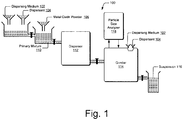
- Fig. 1 illustrates a block diagram representation of a system 100 for preparation of suspension of inorganic nanoparticles. It will be understood that intermediate mixtures produced at different levels and stages of preparation of the suspension may be produced in different batches and in various quantities, as would be understood by those skilled in the art.
- a dispersing medium 102, a dispersant 104, and a metal oxide powder 106 which may include particles of at least one metal oxide are mixed together to form a primary mixture 110.
- the metal oxide powder 106 may include oxides of metals, such as, titanium, iron, silicon, zirconium, and zinc. Further, it would be appreciated that in other implementations, the metal oxide powder 106 may include particles of metals, metal alloys, and combinations thereof. In an example, when the metal oxide powder 106 includes titanium dioxide, the metal oxide powder 106 may be rutile type or anatase type.
- average particle size of the metal oxide powder is greater than 100 nm, for example, in the range of about 0.1 to 1.0 ⁇ m. In an example of said implementation, average particle size of the metal oxide powder is in the range of about 0.5-0.7 ⁇ m.
- the dispersing medium 102 may be an aqueous solution or an organic solvent.
- examples of the dispersing medium 102 include, but are not limited to, water, oils such as mineral turpentine oil; esters, such as aliphatic esters like ethyl or n-butyl acetate; alcohols, such as aliphatic alcohols like ethyl or propyl alcohol; glycols, or combination thereof.
- the dispersant 104 may be a suitable substance for the chosen dispersing medium 102 and may include, but is not limited to, carboxylic acids, esters, ethers, alcohols, sugar and its derivatives or polymers, phosphates, amines, and the like or combinations thereof.
- the dispersant 104 for the given dispersing medium 102 and the metal oxide powder 106 is selected based on interaction energy.
- the interaction energy is computed using molecular modeling techniques.
- the molecular modeling techniques may be understood as theoretical or computational techniques used to quantify the interaction of dispersant molecules with the dispersing medium 102 and particle surface of the metal oxide in the metal oxide powder 106. For the purpose, any molecular modeling technique known in the art may be used.
- the interaction energy thus computed may is to select a suitable dispersant 104 for the given dispersing medium 104 and the metal oxide powder 106. For example, from a set of multiple probable dispersants, a dispersant having highest negative interaction energy is selected as the dispersant 104 for a given dispersing medium 102 and a metal oxide powder 106.
- Citric acid Lauric acid, Myristic acid, Palmitic acid, Stearic acid, and Oleic acid as probable dispersants that can be used to prepare a suspension of titanium dioxide in the presence of water as a dispersing medium.
- Table 1 Dispersant Interaction Energy (Kcal/mol) Lauric acid -19.59 Myristic acid -20.74 Palmitic acid -22.35 Stearic acid -24.83 Oleic acid -27.43 Citric acid -45.72
- Citric acid has the lowest interaction energy or to say has the most negative interaction energy and is therefore considered to be a suitable dispersant for preparing the suspension of titanium dioxide in the presence of water.
- other criteria such as cost, may be used along with the interaction energy data to select the suitable dispersant.
- a dispersant is chosen such that its interaction energy with respect to a metal oxide surface in the presence of molecules of a dispersing medium is low, the dispersant molecules would embed themselves at interfaces between metal oxide particles and the dispersing medium molecules, thereby preventing agglomeration of the metal oxide particles.
- the primary mixture is prepared by mixing the dispersing medium 102 and the dispersant 104 with about 30-40 wt % of the metal oxide powder 106.
- the primary mixture 110 is dispersed using a disperser 112.
- the disperser 112 may use any physical dispersing technique known in the art, such as ultrasonication, and magnetic stirring, for dispersing the primary mixture 110.
- the dispersed primary mixture may be ground using a grinder 114 to reduce the particle size of metal oxide powder 106 to provide a suspension of metal oxide nanoparticles 116.
- the un-dispersed primary mixture 110 may also be directly ground by the grinder 114.
- the grinder 114 is amilling device, for example, a planetary ball mill, stirred media mill, attrition mill, and a bead mill.
- the primary mixture 110 may be ground using wet milling.
- the grinder 114 may have multiple jars to receive and grind the primary mixture.
- the grinder 114 includes a grinding medium, such as. Yttrium stabilized Zirconium Dioxide.
- various process parameters such as the grinding time, grinding speed, size of grinding media, percentage filling of the jars, grinding media to metal oxide powder ratio, primary mixture concentration, and the amount of dispersants, may be controlled and monitored.
- the average particle size of the grinding medium is in the range of about range of 0.4 - 3.3 millimeter (mm); the ratio of the grinding media and the metal oxide powder in the grinder 114 is in the range of about 16.67:1 to 40:1; percentage filling of the jars is in the range of about 50 - 70%; grinding time is in the range of about 30 minutes -24 hours; and grinding speed may be about 420 revolutions per minute (rpm).
- the average particle size of the grinding medium is in the range of about 0.4-0.7 mm; the ratio of the grinding media and the metal oxide powder in the grinder 114, in terms of weight, is in the range of about 25:1 - 40:1 percentage filling of the jars is in the range of about 55 - 65%; grinding time is in the range of about 2-6 hours.
- particle size of the metal oxides may be analyzed after every pre-determined time interval using a particle size analyzer 118.
- the pre-determined time interval is one hour.
- the particle size analyzer 118 may utilize different techniques known in the art to analyze particle size, such as laser diffraction technique, acoustic spectroscopy technique, and ultrasound attenuation spectroscopy technique.
- a laser scattering particle size analyzer is used to analyze the size of particle in the grinder 114.
- small amounts of dispersing medium 102 and the dispersant 104 are added to the mixture inside the grinder 114 after every pre-determined time interval to modify the viscosity and keep the produced nanoparticles well dispersed, i.e., to ensure that the suspension 116 is well dispersed and remains stable.
- the dispersant 104 coats the metal oxide particles so as to prevent agglomeration.
- the average size of the nanoparticles in the suspension is in the range of about 5-300 nm.
- the suspension may be diluted using the dispersing medium 102 and the dispersant 104.
- the diluted suspension thus prepared may be dispersed using a second disperser to evenly mix the nanoparticles of the metal oxide powder 106 and provide stability to the diluted suspension.
- another disperser may use any physical dispersing technique known in the art for dispersing the primary mixture 100 to obtain a dispersed diluted suspension.
- the second disperser may implement an ultrasonication technique.
- a method for preparing a suspension of inorganic nanoparticles includes mixing a dispersing medium 102 with a dispersant 104 and a metal oxide powder 106 to form a primary mixture 110.
- the dispersant 104 is selected based on interaction energy of the dispersant 104 with respect to the dispersing medium 102 and the metal oxide powder 106.
- the metal oxide powder 106 includes particles of at least one metal oxide and the have an average particle size greater than 100nm.
- the mixing may further include dispersing the primary mixture 112 to form a slurry of the primary mixture 110.
- the primary mixture 102 may be dispersed using one of ultrasonication and magnetic stirring.
- the interaction energy for a plurality of probable dispersants with respect to the dispersing medium 102 and the metal oxide powder 106 is computed using a molecular modeling technique to select the dispersant 104 from the plurality of probable dispersants based on the computed interaction.
- the method includes grinding, for example, wet milling, the primary mixture 110 to obtain a suspension 116. Additionally, the dispersant 104 is added to the primary mixture 110 during the grinding after predetermined time intervals. For instance, the primary mixture 110 may be ground using planetary mill.
- the method further comprises, while grinding the primary mixture 110, periodically measuring particle size of the metal oxide powder in the primary mixture 110. Further, the primary mixture 110 is ground till the average particle size of the metal oxide powder is less than about 100nm.
- the method may further include adding the dispersant 104 and the dispersing medium 102 to the suspension 116 to obtain a diluted suspension and dispersing the diluted suspension to obtain a dispersed diluted suspension.
- the diluted suspension may be dispersed using one of ultrasonication and magnetic stirring
- the metal oxide particles in at least one of the suspension and the dispersed diluted suspension may have an average size of less than 100 nm.
- the dispersing medium 102 is at least one of water, a polyol, a glycol, an alcohol, and an oil; the dispersant 104 is at least one of a carboxylic acid, an ester, an ether, an alcohol, sugar, a sugar derivative, a phosphate, and an amine; and the metal oxide powder 106 includes an oxide of at least one of titanium, iron, silicon, zirconium, and zinc.
- the present method provides for in-situ production of the suspensions of the nanoparticles.
- the suspensions prepared through the methods described herein are stable for longer time durations.
- the suspension is stable for days or months and, if at all agglomeration takes place, it results in formation of weak agglomerates, which may be broken down with small amounts of energy, for example, using magnetic stirring or ultrasonication.
- diluted suspensions as described herein typically, do not agglomerate for several years.
- the preparation of suspension of nanoparticles using a dispersant selected based on its interaction energy with respect to the metal oxide particles facilitates preparation of stable suspensions.
- the present method does not involve high pressure or temperature, it provides for reduction in the cost of manufacture, and therefore may be used for commercial production of the nanoparticle suspensions
- Example 1 In the present example, titanium dioxide powder is taken as the metal oxide powder 106, and water is taken as the dispersing medium 102. Further, based on table 1. Citric acid is selected as the dispersant 102. In said example, 10 grams (gm) of sodium citrate was dissolved in 100 milliliters (ml) water and, to this solution, 40gm of titanium dioxide or titania powder obtained from Sumitomo Co., Japan was added to obtain the primary mixture 110. The primary mixture 110 was dispersed using magnetic stirring. Further, to grind the primary mixture 110, a planetary ball mill having four well cleaned agate jars having volume 500 ml each was used.
- the jars were charged with 1000 gm ot 0.4 - 0.7 mm Zirconox grinding media, obtained from Jyothi Ceramics, Nasik, India, to make the effective volume of the jar correspond to about 2/3 rd of the total volume.
- the dispersed primary mixture was poured into the each jar and ground at 234 rpm for one hour.
- the grinding was continued for another six hours and the particle size of the ground slurry was analyzed every hour till further grinding, i.e., reduction in particle size, was observed to be minimal.
- an additional dosage of 2 gm of citrate and 10 ml of water was added after 4 hours of grinding to modify the viscosity and keep the produced nanoparticles well dispersed.
- Example 2 Further, to check for the stability of the suspension, the suspension was monitored with respect to time.
- a sample of the primary suspension obtained after 4 hrs of grinding by the procedure described in example 1 was stored for 30 days at room temperature and pressure.
- the particles in this original sample had d 50 size of 80 nm and 92.3% particles were finer than 100 nm.
- the d 50 particle size represents the median or the 50th percentile of the particle size distribution as measured by volume.
- the d 50 particle size is a value on the particle size distribution such that 50% of the particles have a diameter of this value or less.
- the stored sample was diluted with citric acid-water and ultrasonicated for 4 minutes and was subjected to particle size analysis. The sample showed some agglomeration and 41.2% fraction was below 100 nm.
- the sample was reground again for 1 hour under similar condition as described in example 1 and analyzed for particle size distribution. It may be observed from particle size analysis graphs 200 and 202 illustrated in Fig 2a , that the suspensions regained its original status and particles size distribution was almost identical to that of original suspension, i.e., suspension had d 50 as 80 nm and 92.0% particle finer than 100 nm.
- the sample, with d 50 size of 80 nm and having 92.3% particles finer than 100 nm, obtained after 4 hrs of grinding by the procedure described in example 1, was diluted to 5 wt% nanotitania in water and diluted sample was stored further for 3 years at room temperature and pressure and analyzed for particle size distribution.
- the suspension, which was stored for 3 years, had d 50 size of 81 nm and having 92% particles were finer than 100 nm.
- the suspension showed similar particles size distribution to that of original suspension.
- Example 3 In order to study the effect of various dispersants and verify the selection of a dispersant based on the interaction energy, example 1 was repeated with Polyacrylic acid and carboxymethyl cellulose as dispersants, titanium dioxide as metal oxide powder, and water as the dispersing medium.
- Fig. 2b illustrates effect of Citric acid, Polyacrylic acid, and Carboxymethyl cellulose on size of titanium dioxide particles with respect to grinding time.
- curve 205 depicts effect of Citric acid
- curve 210 depicts effect of Polyacrylic acid
- curve 215 depicts effect of Carboxymethyl cellulose on particle size. From Fig. 2b , it can be observed that median particle size after 9 hours of grinding is about 60 nm with Citric acid as the dispersant, while median particle size after 11 hours of grinding is about 200 nm with Polyacrylic acid as the dispersant and median particle size after 6 hours of grinding is about 210 nm with Carboxymethyl cellulose as the dispersant.
- Fig. 2c illustrates effect of Citric acid, Polyacrylic acid, and Carboxymethyl cellulose on surface area uf titanium dioxide particles with respect to grinding time.
- curve 225 depicts effect of Citric acid
- curve 230 depicts effect of Polyacrylic acid
- curve 235 depicts effect of Carboxymethyl cellulose on surface area of the titanium dioxide particles.
- Fig. 2d illustrates various plots depicting variations in fraction of particles having size less than 100nm with respect to grinding time when Citric acid, Polyacrylic acid, and Carboxymethyl cellulose are used as dispersants.
- curve 245 depicts variation in fraction of titanium dioxide particles having size less than 100 nm when Citric acid is used as a dispersant
- curve 250 depicts variation in fraction of titanium dioxide particles having size less than 100 nm when Polyacrylic acid is used as a dispersant
- curve 255 depicts variation in fraction of titanium dioxide particles having size less than 100 nm when carboxymethyl cellulose is used a dispersant.
- the fraction of titanium dioxide particles below 100 nm is about 90% after about 9 hours of grinding when Citric acid is used as a dispersant, while the fraction is 20% after about 11 hours grinding when Polyacrylic acid and the fraction is about 10% after 6 hours of grinding when Carboxymethyl cellulose is used.
- Fig. 2b, Fig. 2c , and Fig. 2d illustrate that the Citric acid as a dispersant yields the better results as compared to Polyacrylic acid and Carboxymethyl cellulose. Accordingly, it may be understood that selection of a dispersant based on its interaction energy with respect to the metal oxide powder and dispersing medium facilitates production of stable suspension of nanoparticles. Additionally, it can be seen that selection of right dispersant also provides for formation of nanoparticles during grinding.
- Example 4 The described method was also checked for a new combination of dispersant and dispersing medium.
- example 1 was repeated with ethyl alcohol as the dispersing medium 102.
- p-hydroxybenzoic acid obtained from SD Fine Chem Ltd., India was selected as the dispersant 104.
- Example 5 Similar to example 3, the described method was again checked for a new combination of dispersant and dispersing medium.
- example 1 was repeated with p-Span-80 Fluka, USA obtained from SD Fine Chem Ltd., India as the dispersant 104 and n-butyl acetate as the dispersing medium 102.
- the properties of the non-aqueous titania nanoparticles suspensions thus obtained are presented in Table 5.
Landscapes
- Chemical & Material Sciences (AREA)
- Organic Chemistry (AREA)
- Engineering & Computer Science (AREA)
- Materials Engineering (AREA)
- Nanotechnology (AREA)
- Condensed Matter Physics & Semiconductors (AREA)
- General Physics & Mathematics (AREA)
- Physics & Mathematics (AREA)
- Crystallography & Structural Chemistry (AREA)
- Composite Materials (AREA)
- Inorganic Chemistry (AREA)
- Inorganic Compounds Of Heavy Metals (AREA)
- Colloid Chemistry (AREA)
- Crushing And Grinding (AREA)
- Pigments, Carbon Blacks, Or Wood Stains (AREA)
Description
- The present subject matter relates to methods of preparing suspensions of inorganic nanoparticles.
- Generally, a particle having one or more dimensions of the order of 100 nanometer (nm) or less is referred as a nanoparticle. Nanoparticles, typically, inorganic nanoparticles, such as titanium dioxide nanoparticles and zinc oxide nanoparticles, are used in a variety of products, for example, in high grade paints, adhesives, tinting agents, solar cells, cosmetics, personal care, and health care products. Further, it may be required that the nanoparticles possess certain particular physical and chemical properties, such as a particular range of particle size, so that they can be used in the products. For example, nanoparticles are used as a pigment in paints for absorption, reflection, and scattering of visible light; and are used as anti-ultra violet (UV) agents for absorption, reflection, and scattering of UV radiations. In both the examples, absorption, reflection, and scattering depend primarily on particle size of the nanoparticles.
- Various techniques of dispersing nanoparticles, such as, milling and ultra-sonication have been used conventionally to prepare suspensions of these nanoparticles. Typically, it is required that the suspensions include particles such that they remain dispersed for long durations. However, such techniques often fail to produce suspensions, which are stable for long durations, say, for several months or years. In other words, such techniques may provide suspensions where the nanoparticles agglomerate or form strong agglomerates that may require large amounts of energy for disintegration. Further, such techniques may facilitate only small scale production of suspensions of the nanoparticles.
The publication LU ET AL, "Theoretical analysis of colloidal interaction energy in nanoparticle suspensions", CERAMICS INTERNATIONAL, ELSEVIER, AMSTERDAM, NL, vol. 34, no. 6, doi:10.1016/J.CERAMINT.2007.02.016, as well asUS 2006/027484 A1 andWO 2010/110726 A1 each disclose stable suspensions of metal oxide particles showing an average particle size of less than 100nm and comprising a dispersant. Furthermore,US 2009/140198 A1 discloses a process for the preparation of stable alumina nanoparticles suspensions comprising the steps of mixing alumina, citric acid and water to form a slurry and milling the obtained slurry till the average particle size is less than 100nm. The dispersant is chosen to have an absorption ability higher than that of the solvent, i.e. based on its interaction energy of the dispersant with respect to the metal oxide in the presence of the dispersing medium. - This summary is provided to introduce concepts related to methods for preparation of suspensions of inorganic nanoparticles and these concepts are further described below in the detailed description. This summary is neither intended to identify essential features of the claimed subject matter nor is it intended for use in determining or limiting the scope of the claimed subject matter.
- Herein, a method for preparing a suspension of nanoparticles according to claim 1 is described and claimed.
- The detailed description is described with reference to the accompanying figures. In the figures, the left-most digit(s) of a reference number identifies the figure in which the reference number first appears. The same numbers are used throughout the figures to reference like features and components. Some embodiments of the method(s) in accordance with the present subject matter are described, by way of example only, and with reference to the accompanying figures, in which:
-
Fig. 1 illustrates a schematic block diagram representation of a system for preparation of suspension of inorganic nanoparticles, in accordance with an embodiment of the present subject matter. -
Fig. 2a illustrates particle size analysis graphs for the suspension of nanoparticles, according to an embodiment of the present subject matter. -
Fig. 2b, 2c , and2d illustrate effect of various dispersants on particle size, surface area, and fraction of particles having size less than 100 nm, according to an embodiment of the present subject matter. - It should be appreciated by those skilled in the art that any block diagrams herein represent conceptual views of illustrative systems embodying the principles of the present subject matter.
- Method(s) for preparing suspensions of inorganic nanoparticles are described herein. The methods described herein can be implemented for the preparation of suspensions of nanoparticles of a variety of metal oxides, for example oxides of metals, such as titanium, iron, silicon, zirconium, and zinc. The suspensions of inorganic nanoparticles are used in a range of applications, for example, Titanium dioxide (TiO2) or titania is used as white pigment in high grade paints, as fillers in adhesives to improve quality, in optically transparent UV-absorbing coatings and for photocatalysis to purify air and water and in antibacterial applications.
- Various methods can be used for preparation of the suspension of the inorganic nanoparticles. For example, a suspension of nanoparticles of Titanium can be prepared by hydrolysis of titanyl sulfate via acid-base chemistry followed by calcinations, flame hydrolysis of titanium tetrachloride (TiCl4), and hydrolysis of titanium oxide followed by a condensation reaction to produce titania particles. However, when the obtained nanoparticles are dispersed in a medium to make suspensions, the particles tend to agglomerate. Generally, further processing is required to make suitable suspensions, which may be used for their intended purpose.
- According to an embodiment of the present subject matter, methods for preparing stable suspensions of inorganic nanoparticles are described herein. A stable suspension may be understood as a suspension in which inorganic nanoparticles either do not agglomerate for long durations, say, several months or years, or form weak agglomerates that may be disintegrated by imparting small energy. In one implementation, a metal oxide powder, a dispersing medium, and a dispersant are mixed to form a primary mixture. The average particle size in the metal oxide powder may be in the range of about 0.1 - 100 µm. The dispersing medium may be an aqueous medium or a non-aqueous medium.
- Further, a dispersant may be understood as a substance added to a medium to promote uniform suspension of particles and prevent agglomeration. In one implementation, a dispersant is selected based on a measurement related to interaction of the dispersant with a given metal oxide powder and the dispersing medium. The interaction may be measured as the interaction energy of a given dispersant with surface of the metal oxide particles in the presence of the dispersing medium. The selection of a dispersant based on the interaction energy helps identify a dispersant that is strongly attracted to metal oxide particles surfaces, allowing strong dispersant absorption. Consequently, the metal oxide particles repel each other, which in turn prevents agglomeration. Examples of the dispersants that may be used include, but are not limited to, carboxylic acids, which may be aliphatic, aromatic, or polymeric acids, esters, ethers, alcohols, cellulose, sugar derivatives or any combination thereof.
- The primary mixture is then ground to produce a suspension of nanoparticles. Before grinding the primary mixture, the metal oxide powder and the dispersant are dispersed in the dispersing medium, for example, using magnetic stirring, to form a primary mixture slurry. This helps to evenly distribute the particles of metal oxide in the primary mixture and avoids agglomeration of the particles. It would be understood by those skilled in the art that different methods of dispersion known in the art, such as ultrasonication may also be used to disperse the primary mixture and to form a slurry of the primary mixture.
- Subsequent to dispersion, the primary mixture is ground to form a suspension of nanoparticles. In one implementation, the primary mixture is ground using wet milling techniques. The primary mixture is ground till average particle size becomes of the order of 100 nm or less. Further, while the primary mixture is being ground, the dispersant and the dispersing medium are added after predetermined time intervals to maintain the viscosity and state of dispersion. It will be understood that the dispersant and the dispersing medium may be added separately or as a mixture.
- The suspension of the nanoparticles thus produced contains a high concentration of nanoparticles and the concentration varies between 10 to 40 wt% (weight percentage), where the concentration in weight percentage reflects the weight percentage of the metal oxide particles in the primary mixture. During the preparation of the primary mixture and the grinding process, addition of the dispersant, which is selected based on the interaction energy criteria, provides for a suspension that is stable for longer durations. Also, since the nanoparticles in the obtained suspension were formed by wet milling in the presence of the dispersant and dispersing medium, the nanoparticles do not tend to agglomerate. Further, the addition of dispersants during grinding, after predetermined time intervals, also provides additional stability and prevents agglomeration. Moreover, to prepare a stable suspension, various process parameters, such as grinding time, size of grinding medium, grinding medium to powder ratio, primary mixture slurry concentration, and the amount of dispersants are also controlled and monitored.
- In one implementation, the suspension may be diluted with the dispersant and the dispersing medium to obtain a diluted suspension of the nanoparticles. The diluted suspension formed may then also be dispersed using dispersion techniques known in the art, such as ultrasonication, and magnetic dispersion.
- Since, a suitable dispersant is selected based on interaction energy criteria prior to the preparation of the suspension, multiple suspensions with different dispersants do not have to be prepared and checked for stability to finally identify a suitable dispersant. Thus, the present method provides for reduction in the cost of identifying a required dispersant to obtain a stable suspension of a given metal oxide. Further, the present method may also facilitate not only small scale production, but also commercial production of the suspensions of the metal oxide nanoparticles with reduced costs.
- It should be noted that the description illustrates the principles of the present subject matter. It will thus be appreciated that those skilled in the art will be able to devise various arrangements that, although not explicitly described herein, embody the principles of the present subject matter and are included within its scope. Furthermore, all examples recited herein are principally intended expressly to be only for pedagogical purposes to aid the reader in understanding the principles of the present subject matter and the concepts contributed by the inventor(s) to furthering the art.
- While aspects of described methods for preparing stable suspension of the metal oxide nanoparticles can be implemented in any number of different production environments, and/or configurations, the embodiments are described in the context of the following environment(s).
-
Fig. 1 illustrates a block diagram representation of asystem 100 for preparation of suspension of inorganic nanoparticles. It will be understood that intermediate mixtures produced at different levels and stages of preparation of the suspension may be produced in different batches and in various quantities, as would be understood by those skilled in the art. - In one implementation, a dispersing
medium 102, adispersant 104, and ametal oxide powder 106 which may include particles of at least one metal oxide are mixed together to form aprimary mixture 110. Themetal oxide powder 106 may include oxides of metals, such as, titanium, iron, silicon, zirconium, and zinc. Further, it would be appreciated that in other implementations, themetal oxide powder 106 may include particles of metals, metal alloys, and combinations thereof. In an example, when themetal oxide powder 106 includes titanium dioxide, themetal oxide powder 106 may be rutile type or anatase type. In one implementation, average particle size of the metal oxide powder is greater than 100 nm, for example, in the range of about 0.1 to 1.0 µm. In an example of said implementation, average particle size of the metal oxide powder is in the range of about 0.5-0.7 µm. - Further, the dispersing
medium 102 may be an aqueous solution or an organic solvent. Examples of the dispersing medium 102 include, but are not limited to, water, oils such as mineral turpentine oil; esters, such as aliphatic esters like ethyl or n-butyl acetate; alcohols, such as aliphatic alcohols like ethyl or propyl alcohol; glycols, or combination thereof. - Similarly, the
dispersant 104 may be a suitable substance for the chosen dispersingmedium 102 and may include, but is not limited to, carboxylic acids, esters, ethers, alcohols, sugar and its derivatives or polymers, phosphates, amines, and the like or combinations thereof. Thedispersant 104 for the given dispersingmedium 102 and themetal oxide powder 106 is selected based on interaction energy. The interaction energy is computed using molecular modeling techniques. The molecular modeling techniques may be understood as theoretical or computational techniques used to quantify the interaction of dispersant molecules with the dispersingmedium 102 and particle surface of the metal oxide in themetal oxide powder 106. For the purpose, any molecular modeling technique known in the art may be used. The interaction energy thus computed may is to select asuitable dispersant 104 for the given dispersingmedium 104 and themetal oxide powder 106. For example, from a set of multiple probable dispersants, a dispersant having highest negative interaction energy is selected as thedispersant 104 for a given dispersingmedium 102 and ametal oxide powder 106. - For example, consider Citric acid, Lauric acid, Myristic acid, Palmitic acid, Stearic acid, and Oleic acid as probable dispersants that can be used to prepare a suspension of titanium dioxide in the presence of water as a dispersing medium. The interaction energy computed for each of the probable dispersants using material studio software from Accelrys® is depicted in table 1:
Table 1 Dispersant Interaction Energy (Kcal/mol) Lauric acid -19.59 Myristic acid -20.74 Palmitic acid -22.35 Stearic acid -24.83 Oleic acid -27.43 Citric acid -45.72 - From the aforementioned table, it can be observed that Citric acid has the lowest interaction energy or to say has the most negative interaction energy and is therefore considered to be a suitable dispersant for preparing the suspension of titanium dioxide in the presence of water. In another implementation, other criteria, such as cost, may be used along with the interaction energy data to select the suitable dispersant.
- As it is known, smaller is the particle size, larger is the surface area and in turn more intense are the Van der Waal's forces between the particles, in the present case, metal oxide particles. Further, owing to strong Van der Waal's forces, particles tend to drift towards each other and form agglomerates. However, addition of a suitable dispersant prevents agglomeration of the metal oxide particles in a suspension. The dispersant caps or coats the metal oxide particles such that the particles then tend to repel each other and, as a result, metal oxides stay dispersed in the suspension. Thus, in the absence of a suitable dispersant, the metal oxide particles do not remain dispersed for long durations and eventually agglomerate.
- Therefore, if a dispersant is chosen such that its interaction energy with respect to a metal oxide surface in the presence of molecules of a dispersing medium is low, the dispersant molecules would embed themselves at interfaces between metal oxide particles and the dispersing medium molecules, thereby preventing agglomeration of the metal oxide particles.
- Referring back to preparation of
primary mixture 110, in one example, the primary mixture is prepared by mixing the dispersingmedium 102 and thedispersant 104 with about 30-40 wt % of themetal oxide powder 106. In one implementation, to prevent agglomeration and precipitation of metal oxide particles, theprimary mixture 110 is dispersed using adisperser 112. Thedisperser 112 may use any physical dispersing technique known in the art, such as ultrasonication, and magnetic stirring, for dispersing theprimary mixture 110. - The dispersed primary mixture may be ground using a
grinder 114 to reduce the particle size ofmetal oxide powder 106 to provide a suspension of metal oxide nanoparticles 116. However, it will be understood that the un-dispersedprimary mixture 110 may also be directly ground by thegrinder 114. In one implementation, thegrinder 114 is amilling device, for example, a planetary ball mill, stirred media mill, attrition mill, and a bead mill. In one implementation, theprimary mixture 110 may be ground using wet milling. Further, thegrinder 114 may have multiple jars to receive and grind the primary mixture. Additionally, thegrinder 114 includes a grinding medium, such as. Yttrium stabilized Zirconium Dioxide. During milling, various process parameters, such as the grinding time, grinding speed, size of grinding media, percentage filling of the jars, grinding media to metal oxide powder ratio, primary mixture concentration, and the amount of dispersants, may be controlled and monitored. - In an implementation, the average particle size of the grinding medium is in the range of about range of 0.4 - 3.3 millimeter (mm); the ratio of the grinding media and the metal oxide powder in the
grinder 114 is in the range of about 16.67:1 to 40:1; percentage filling of the jars is in the range of about 50 - 70%; grinding time is in the range of about 30 minutes -24 hours; and grinding speed may be about 420 revolutions per minute (rpm). In an example of said implementation, the average particle size of the grinding medium is in the range of about 0.4-0.7 mm; the ratio of the grinding media and the metal oxide powder in thegrinder 114, in terms of weight, is in the range of about 25:1 - 40:1 percentage filling of the jars is in the range of about 55 - 65%; grinding time is in the range of about 2-6 hours. - Further, during grinding, particle size of the metal oxides may be analyzed after every pre-determined time interval using a
particle size analyzer 118. In one example, the pre-determined time interval is one hour. However, it will be understood that as the milling process nears completion, the time period after which the particle size are analyzed may be smaller as compared to the initial stages of the milling process. Theparticle size analyzer 118 may utilize different techniques known in the art to analyze particle size, such as laser diffraction technique, acoustic spectroscopy technique, and ultrasound attenuation spectroscopy technique. In an implementation, a laser scattering particle size analyzer is used to analyze the size of particle in thegrinder 114. - In one implementation, small amounts of dispersing medium 102 and the
dispersant 104 are added to the mixture inside thegrinder 114 after every pre-determined time interval to modify the viscosity and keep the produced nanoparticles well dispersed, i.e., to ensure that the suspension 116 is well dispersed and remains stable. As mentioned previously, thedispersant 104 coats the metal oxide particles so as to prevent agglomeration. In one example, the average size of the nanoparticles in the suspension is in the range of about 5-300 nm. - Further, in an implementation, the suspension may be diluted using the dispersing
medium 102 and thedispersant 104. The diluted suspension thus prepared may be dispersed using a second disperser to evenly mix the nanoparticles of themetal oxide powder 106 and provide stability to the diluted suspension. Similar to thedisperser 112, another disperser may use any physical dispersing technique known in the art for dispersing theprimary mixture 100 to obtain a dispersed diluted suspension. In one implementation, to obtain the dispersed diluted suspension, the second disperser may implement an ultrasonication technique. - A method for preparing a suspension of inorganic nanoparticles is described. The method includes mixing a dispersing medium 102 with a
dispersant 104 and ametal oxide powder 106 to form aprimary mixture 110. In said embodiment, thedispersant 104 is selected based on interaction energy of thedispersant 104 with respect to the dispersingmedium 102 and themetal oxide powder 106. Themetal oxide powder 106 includes particles of at least one metal oxide and the have an average particle size greater than 100nm. In an example, the mixing may further include dispersing theprimary mixture 112 to form a slurry of theprimary mixture 110. Theprimary mixture 102 may be dispersed using one of ultrasonication and magnetic stirring. - The interaction energy for a plurality of probable dispersants with respect to the dispersing
medium 102 and themetal oxide powder 106 is computed using a molecular modeling technique to select thedispersant 104 from the plurality of probable dispersants based on the computed interaction. - Further, the method includes grinding, for example, wet milling, the
primary mixture 110 to obtain a suspension 116. Additionally, thedispersant 104 is added to theprimary mixture 110 during the grinding after predetermined time intervals. For instance, theprimary mixture 110 may be ground using planetary mill. - The method further comprises, while grinding the
primary mixture 110, periodically measuring particle size of the metal oxide powder in theprimary mixture 110. Further, theprimary mixture 110 is ground till the average particle size of the metal oxide powder is less than about 100nm. - The method may further include adding the
dispersant 104 and the dispersing medium 102 to the suspension 116 to obtain a diluted suspension and dispersing the diluted suspension to obtain a dispersed diluted suspension. The diluted suspension may be dispersed using one of ultrasonication and magnetic stirring - Further, the metal oxide particles in at least one of the suspension and the dispersed diluted suspension may have an average size of less than 100 nm.
- In an implementation, the dispersing
medium 102 is at least one of water, a polyol, a glycol, an alcohol, and an oil; thedispersant 104 is at least one of a carboxylic acid, an ester, an ether, an alcohol, sugar, a sugar derivative, a phosphate, and an amine; and themetal oxide powder 106 includes an oxide of at least one of titanium, iron, silicon, zirconium, and zinc. - Thus, the present method provides for in-situ production of the suspensions of the nanoparticles. The suspensions prepared through the methods described herein are stable for longer time durations. Typically, the suspension is stable for days or months and, if at all agglomeration takes place, it results in formation of weak agglomerates, which may be broken down with small amounts of energy, for example, using magnetic stirring or ultrasonication. Further, diluted suspensions as described herein, typically, do not agglomerate for several years. Thus, the preparation of suspension of nanoparticles using a dispersant selected based on its interaction energy with respect to the metal oxide particles facilitates preparation of stable suspensions. Further, since the present method does not involve high pressure or temperature, it provides for reduction in the cost of manufacture, and therefore may be used for commercial production of the nanoparticle suspensions
- The results of methods for preparing suspensions of nanoparticles have been validated using titanium dioxide and the same is indicated in the following examples. It will be understood that the examples discussed herein are only for the purpose of explanation and not to limit the scope of the present subject matter.
- Example 1:In the present example, titanium dioxide powder is taken as the
metal oxide powder 106, and water is taken as the dispersingmedium 102. Further, based on table 1. Citric acid is selected as thedispersant 102. In said example, 10 grams (gm) of sodium citrate was dissolved in 100 milliliters (ml) water and, to this solution, 40gm of titanium dioxide or titania powder obtained from Sumitomo Co., Japan was added to obtain theprimary mixture 110. Theprimary mixture 110 was dispersed using magnetic stirring. Further, to grind theprimary mixture 110, a planetary ball mill having four well cleaned agatejars having volume 500 ml each was used. The jars were charged with 1000 gm ot 0.4 - 0.7 mm Zirconox grinding media, obtained from Jyothi Ceramics, Nasik, India, to make the effective volume of the jar correspond to about 2/3rd of the total volume. - The dispersed primary mixture was poured into the each jar and ground at 234 rpm for one hour. A sample, 1ml in volume, was withdrawn after every hour of grinding interval, diluted with 30 ml of aqueous citrate solution and analyzed by the
particle size analyzer 118, which in the present example was Horiba LA-910, Horiba Japan. The grinding was continued for another six hours and the particle size of the ground slurry was analyzed every hour till further grinding, i.e., reduction in particle size, was observed to be minimal. Further, an additional dosage of 2 gm of citrate and 10 ml of water was added after 4 hours of grinding to modify the viscosity and keep the produced nanoparticles well dispersed. The experiment was repeated for four sets, A, B, C, and D, and the properties of the titania nanoparticles suspensions thus obtained in each of these sets are presented in Table 2.Grinding Time (Hour) Median size (nm) Fraction less than 100nm diameter (%) Specific area (m2/gm) Mean size (nm) Sample Sample Sample Sample A B C D A B C D A B C D A B C D 1 211 232 222 227 6.3 4 39 6.1 8.2 7.38 7.65 7.55 215 238 227 232 2 128 144 135 338 33.6 28 29.9 8.3 12.6 11.73 12.16 6.19 147 189 151 326 3 89 87 93 245 60.5 43.9 44.5 16.6 15.8 16.18 15.1 7.09 113 108 118 257 4 82 81 85 84 73 77 64.5 69.1 17.3 17.71 15.64 16.92 99 95 873 100 5 76 76 79 79 87.9 87 89 87.9 19.3 19.16 20.57 20.43 83 85 79 79 6 74 73 74 78 92.7 93.2 92.4 90.3 19.6 20.17 19.92 20.77 83 78 79 78 - Example 2: Further, to check for the stability of the suspension, the suspension was monitored with respect to time. For the purpose, a sample of the primary suspension obtained after 4 hrs of grinding by the procedure described in example 1 was stored for 30 days at room temperature and pressure. The particles in this original sample had d50 size of 80 nm and 92.3% particles were finer than 100 nm. The d50 particle size represents the median or the 50th percentile of the particle size distribution as measured by volume. The d50 particle size is a value on the particle size distribution such that 50% of the particles have a diameter of this value or less. The stored sample was diluted with citric acid-water and ultrasonicated for 4 minutes and was subjected to particle size analysis. The sample showed some agglomeration and 41.2% fraction was below 100 nm.
- Additionally, to check if the agglomerates were soft or weak, the sample was reground again for 1 hour under similar condition as described in example 1 and analyzed for particle size distribution. It may be observed from particle
size analysis graphs Fig 2a , that the suspensions regained its original status and particles size distribution was almost identical to that of original suspension, i.e., suspension had d50 as 80 nm and 92.0% particle finer than 100 nm. - Further, in another case, the sample, with d50 size of 80 nm and having 92.3% particles finer than 100 nm, obtained after 4 hrs of grinding by the procedure described in example 1, was diluted to 5 wt% nanotitania in water and diluted sample was stored further for 3 years at room temperature and pressure and analyzed for particle size distribution. The suspension, which was stored for 3 years, had d50 size of 81 nm and having 92% particles were finer than 100 nm. Thus, the suspension showed similar particles size distribution to that of original suspension. Thus, it can be seen from the above examples that method described herein provided for preparation of suspensions of nanoparticles that are stable for several years.
- Example 3: In order to study the effect of various dispersants and verify the selection of a dispersant based on the interaction energy, example 1 was repeated with Polyacrylic acid and carboxymethyl cellulose as dispersants, titanium dioxide as metal oxide powder, and water as the dispersing medium.
-
Fig. 2b illustrates effect of Citric acid, Polyacrylic acid, and Carboxymethyl cellulose on size of titanium dioxide particles with respect to grinding time. As shown,curve 205 depicts effect of Citric acid,curve 210 depicts effect of Polyacrylic acid, andcurve 215 depicts effect of Carboxymethyl cellulose on particle size. FromFig. 2b , it can be observed that median particle size after 9 hours of grinding is about 60 nm with Citric acid as the dispersant, while median particle size after 11 hours of grinding is about 200 nm with Polyacrylic acid as the dispersant and median particle size after 6 hours of grinding is about 210 nm with Carboxymethyl cellulose as the dispersant. - Similar to
Fig. 2b, Fig. 2c illustrates effect of Citric acid, Polyacrylic acid, and Carboxymethyl cellulose on surface area uf titanium dioxide particles with respect to grinding time. As shown,curve 225 depicts effect of Citric acid,curve 230 depicts effect of Polyacrylic acid, andcurve 235 depicts effect of Carboxymethyl cellulose on surface area of the titanium dioxide particles. FromFig. 2c , it can be observed that surface area of the particles after 9 hours of grinding is about 17 m2/gm with Citric acid as the dispersant, while surface area of the particles after 6 hours of grinding is about 9 m2/gm with Polyacrylic acid and surface area of the particles after 11 hours of grinding is about 9 m2/gm with Carboxymethyl cellulose as the dispersant. - Likewise,
Fig. 2d illustrates various plots depicting variations in fraction of particles having size less than 100nm with respect to grinding time when Citric acid, Polyacrylic acid, and Carboxymethyl cellulose are used as dispersants. As shown,curve 245 depicts variation in fraction of titanium dioxide particles having size less than 100 nm when Citric acid is used as a dispersant,curve 250 depicts variation in fraction of titanium dioxide particles having size less than 100 nm when Polyacrylic acid is used as a dispersant, andcurve 255 depicts variation in fraction of titanium dioxide particles having size less than 100 nm when carboxymethyl cellulose is used a dispersant. As it can be observed fromFig. 2d , the fraction of titanium dioxide particles below 100 nm is about 90% after about 9 hours of grinding when Citric acid is used as a dispersant, while the fraction is 20% after about 11 hours grinding when Polyacrylic acid and the fraction is about 10% after 6 hours of grinding when Carboxymethyl cellulose is used. - Thus,
Fig. 2b, Fig. 2c , andFig. 2d illustrate that the Citric acid as a dispersant yields the better results as compared to Polyacrylic acid and Carboxymethyl cellulose. Accordingly, it may be understood that selection of a dispersant based on its interaction energy with respect to the metal oxide powder and dispersing medium facilitates production of stable suspension of nanoparticles. Additionally, it can be seen that selection of right dispersant also provides for formation of nanoparticles during grinding. - Example 4: The described method was also checked for a new combination of dispersant and dispersing medium. For the purpose, example 1 was repeated with ethyl alcohol as the dispersing
medium 102. Based on table 3, p-hydroxybenzoic acid obtained from SD Fine Chem Ltd., India was selected as thedispersant 104.Table 3 Dispersant Interaction Energy (Kcal/mol) p-hydroxybenzoic acid -58.65 Glycerol trioleate -45.50 Sorbita oleate (Span 80) -33.59 Phosphoric acid tris 2-ethylhexyl ester -26.74 Methyl ester of dodecyliminobismethylene phosphonic acid -12.25 Monovalerate of 12-hydroxy stearic acid -0.52 Dodecyl amine -0.16 - Further, the properties of the non-aqueous titania nanoparticles suspensions thus obtained are presented in Table 4:
Table 4 Grinding Time (Hour) Median size (nm) Fraction less than 100nm diameter (%) Specific area (m2/gm) Mean size (nm) 2 226 1.2 7.14 345 4 196 3.6 7.89 245 5 79 88.3 20.57 79 - Example 5: Similar to example 3, the described method was again checked for a new combination of dispersant and dispersing medium. For the purpose, example 1 was repeated with p-Span-80 Fluka, USA obtained from SD Fine Chem Ltd., India as the
dispersant 104 and n-butyl acetate as the dispersingmedium 102. The properties of the non-aqueous titania nanoparticles suspensions thus obtained are presented in Table 5.Table 5 Grinding Time (Hour) Median size (nm) Fraction less than 100nm diameter (%) Specific area (m2/gm) Mean size (nm) 2 106 44.1 13.41 138 3 109 34.1 13.61 120 4 68 93.7 22.80 74 - Although implementations for preparation of stable suspensions of nanoparticles has been described in language specific to structural features and/or methods, it is to be understood that the specific features and methods are disclosed as examples and implementations for preparing the stable suspensions.
Claims (8)
- A method for preparing suspension of nanoparticles, the method comprising:computing an interaction energy for a plurality of probable dispersants with respect to a dispersing medium (102) and a metal oxide powder (106) using a molecular modeling technique;selecting a dispersant (104) from the plurality of probable dispersants based on computed interaction energies, wherein the dispersant having the most negative interaction energy among the plurality of probable dispersants is selected;mixing the dispersing medium (102) with the dispersant (104) and the metal oxide powder (106) to form a primary mixture (110), wherein the metal oxide powder (106) includes particles of at least one metal oxide having an average particle size in the range of 0.1 µm to 100 µm and is present in a range of 10-40 % by weight of the primary mixture;dispersing the primary mixture (110) to form a slurry of the primary mixture (110);grinding the slurry of the primary mixture (110) to obtain a suspension (116);adding the dispersant (104) and the dispersing medium (102) to the primary mixture (110) during the grinding after predetermined time intervals;periodically measuring the average particle size of metal oxide particles in the primary mixture (110); andmonitoring and controlling grinding time, size of grinding medium, grinding medium to powder ratio, and primary mixture slurry concentration to obtain the suspension (116), wherein the primary mixture (110) is ground till the average particle size of the particles is less than 100 nm.
- The method as claimed in claim 1, wherein the method further comprises:adding the dispersant (104) and the dispersing medium (102) to the suspension (116) to obtain a diluted suspension; anddispersing the diluted suspension to obtain dispersed diluted suspension.
- The method as claimed in claim 1 or claim 2, wherein the dispersing is performed using one of ultrasonication and magnetic stirring.
- The method as claimed in claim 2, wherein metal oxide particles in the dispersed diluted suspension have an average size less than 100 nm.
- The method as claimed in claim 1, wherein the grinding the primary mixture (110) comprises wet milling the primary mixture (110) to obtain the suspension (116).
- The method as claimed in claim 1, wherein the dispersing medium (102) is at least one of water, an oil, a glycol, an alcohol, and an ester.
- The method as claimed in claim 1, wherein the dispersant (104) is at least one of a carboxylic acid, an ester, an ether, an alcohol, sugar, a sugar derivative, a phosphate, and an amine.
- The method as claimed in claim 1, wherein the metal oxide powder (106) includes an oxide of at least one of titanium, iron, silicon, zirconium, and zinc.
Applications Claiming Priority (2)
| Application Number | Priority Date | Filing Date | Title |
|---|---|---|---|
| IN319MU2011 | 2011-02-04 | ||
| PCT/IN2011/000576 WO2012104860A1 (en) | 2011-02-04 | 2011-08-25 | Suspension of nanoparticles |
Publications (2)
| Publication Number | Publication Date |
|---|---|
| EP2670808A1 EP2670808A1 (en) | 2013-12-11 |
| EP2670808B1 true EP2670808B1 (en) | 2018-10-17 |
Family
ID=44802336
Family Applications (1)
| Application Number | Title | Priority Date | Filing Date |
|---|---|---|---|
| EP11770526.9A Active EP2670808B1 (en) | 2011-02-04 | 2011-08-25 | Method for preparing a suspension of nanoparticles |
Country Status (5)
| Country | Link |
|---|---|
| US (1) | US9138704B2 (en) |
| EP (1) | EP2670808B1 (en) |
| JP (1) | JP6076266B2 (en) |
| CN (1) | CN103649235B (en) |
| WO (1) | WO2012104860A1 (en) |
Families Citing this family (10)
| Publication number | Priority date | Publication date | Assignee | Title |
|---|---|---|---|---|
| JP2014151311A (en) * | 2013-02-13 | 2014-08-25 | Nippon Soda Co Ltd | Aqueous suspension composition |
| US9353266B2 (en) * | 2013-03-15 | 2016-05-31 | Tronox Llc | Process for manufacturing titanium dioxide pigments using ultrasonication |
| US20160133497A1 (en) * | 2014-11-07 | 2016-05-12 | International Business Machines Corporation | Multi-layer laser debonding structure with tunable absorption |
| US20180141381A1 (en) * | 2015-06-11 | 2018-05-24 | Bridgestone Americas Tire Operations, Llc | Belt assemblies coated with a magnetic rubber composition and tires including the same |
| US10562783B2 (en) * | 2015-10-20 | 2020-02-18 | Fujimi Incorporated | Processing of alumina |
| RU2610171C1 (en) * | 2015-12-28 | 2017-02-08 | Федеральное Государственное бюджетное научное учреждение Всероссийский научно-исследовательский институт мясного скотоводства | Method for preparation of suspension of metal nanoparticles for external and internal application |
| US20180342640A1 (en) * | 2017-05-24 | 2018-11-29 | Tesla, Inc. | Colored photovoltaic module with nanoparticle layer |
| US11583924B2 (en) * | 2018-12-31 | 2023-02-21 | Tata Consultancy Services Limited | Synthesis of nano particles |
| US12065368B2 (en) * | 2019-01-03 | 2024-08-20 | Split Rock Filter Systems Llc | Method and diffusiophoretic water filter with chemical contaminant removal capability |
| US11691155B2 (en) * | 2020-09-17 | 2023-07-04 | U.S. Silica Company | Methods and apparatus for producing nanometer scale particles utilizing an electrosterically stabilized slurry in a media mill |
Citations (3)
| Publication number | Priority date | Publication date | Assignee | Title |
|---|---|---|---|---|
| US20060027484A1 (en) * | 2004-08-05 | 2006-02-09 | Leck Thomas J | Fine particle dispersion compositions and uses thereof |
| US20090140198A1 (en) * | 2005-04-21 | 2009-06-04 | Samsung Corning Co., Ltd. | Method of preparing metal oxide suspension |
| WO2010110726A1 (en) * | 2009-03-23 | 2010-09-30 | Välinge Innovation AB | Production of titania nanoparticle colloidal suspensions with maintained crystallinity by using a bead mill with micrometer sized beads |
Family Cites Families (10)
| Publication number | Priority date | Publication date | Assignee | Title |
|---|---|---|---|---|
| DE2725210A1 (en) | 1977-06-03 | 1978-12-14 | Bayer Ag | HIGH SOLID SUSPENSIONS |
| US4599114A (en) | 1985-02-11 | 1986-07-08 | Atkinson George K | Treatment of titanium dioxide and other pigments to improve dispersibility |
| GB8712752D0 (en) * | 1987-05-30 | 1987-07-01 | Tioxide Group Plc | Particulate material |
| US6139617A (en) | 1997-09-08 | 2000-10-31 | Kerr-Mcgee Chemical Llc | Titanium dioxide pigments |
| US20050217427A1 (en) | 2000-12-21 | 2005-10-06 | Suthersan Suthan S | Method of making and using nanoscale metal |
| US20050129634A1 (en) * | 2003-12-16 | 2005-06-16 | Frerichs Scott R. | Passivated nano-titanium dioxide particles and methods of making the same |
| US7208054B2 (en) * | 2004-02-20 | 2007-04-24 | Nippon Paint Co., Ltd. | Concentrated solution for preparing a surface conditioner, surface conditioner and method of surface conditioning |
| US8357426B2 (en) | 2008-01-11 | 2013-01-22 | Nanomateriales S.A. De C.V. | Single step milling and surface coating process for preparing stable nanodispersions |
| JP5679640B2 (en) * | 2008-06-20 | 2015-03-04 | キヤノン株式会社 | Method for producing inorganic fine particle dispersion and method for producing organic optical element |
| JP5608844B2 (en) * | 2009-06-24 | 2014-10-15 | サンノプコ株式会社 | Dispersant for inorganic powder slurry |
-
2011
- 2011-08-25 JP JP2013552324A patent/JP6076266B2/en active Active
- 2011-08-25 CN CN201180069572.XA patent/CN103649235B/en active Active
- 2011-08-25 EP EP11770526.9A patent/EP2670808B1/en active Active
- 2011-08-25 US US13/983,522 patent/US9138704B2/en active Active
- 2011-08-25 WO PCT/IN2011/000576 patent/WO2012104860A1/en not_active Ceased
Patent Citations (3)
| Publication number | Priority date | Publication date | Assignee | Title |
|---|---|---|---|---|
| US20060027484A1 (en) * | 2004-08-05 | 2006-02-09 | Leck Thomas J | Fine particle dispersion compositions and uses thereof |
| US20090140198A1 (en) * | 2005-04-21 | 2009-06-04 | Samsung Corning Co., Ltd. | Method of preparing metal oxide suspension |
| WO2010110726A1 (en) * | 2009-03-23 | 2010-09-30 | Välinge Innovation AB | Production of titania nanoparticle colloidal suspensions with maintained crystallinity by using a bead mill with micrometer sized beads |
Also Published As
| Publication number | Publication date |
|---|---|
| EP2670808A1 (en) | 2013-12-11 |
| US9138704B2 (en) | 2015-09-22 |
| WO2012104860A1 (en) | 2012-08-09 |
| JP6076266B2 (en) | 2017-02-08 |
| US20140056992A1 (en) | 2014-02-27 |
| CN103649235A (en) | 2014-03-19 |
| CN103649235B (en) | 2016-06-08 |
| JP2014511262A (en) | 2014-05-15 |
Similar Documents
| Publication | Publication Date | Title |
|---|---|---|
| US9138704B2 (en) | Suspension of nanoparticles | |
| US8668955B2 (en) | Single step milling and surface coating process for preparing stable nanodispersions | |
| EP1613702B1 (en) | Thin coating aluminum pigments, method for the production thereof, and use of said aluminum pigments | |
| EP2411141B1 (en) | Production of titania nanoparticle colloidal suspensions with maintained crystallinity by using a bead mill with micrometer sized beads | |
| US9656874B2 (en) | Method for producing metal oxide-containing particles, and method for producing aggregates of metal oxide colloidal particles | |
| US7384560B2 (en) | Method for reducing the size of metallic compound particles | |
| EP2072462A1 (en) | Process for producing dispersion of fine metal compound particles and the dispersion | |
| JP5575609B2 (en) | Lead-based piezoelectric material and manufacturing method thereof | |
| EP2100927A1 (en) | Carbon-containing titanium dioxide photocatalyst and process the production thereof | |
| JP5510521B2 (en) | Photocatalyst particle dispersion and process for producing the same | |
| JPH0788391A (en) | Manufacturing method of ultra fine powder | |
| JP5407549B2 (en) | Photocatalyst particle dispersion and process for producing the same | |
| JP2015067469A (en) | Rare earth titanate powder and production method thereof, and fluid dispersion containing the same | |
| CN1017421B (en) | Barium titanate coforms | |
| DE112011101392B4 (en) | Process for the production of particles | |
| CN102659152B (en) | Method for preparing nanometer alumina slurry with good water dispersibility | |
| JP5644877B2 (en) | Method for producing dispersion of photocatalyst particles | |
| Benammar et al. | The good colloidal stability and the aggregation kinetics of sol–gel pyrochlore-type Y2Ti2O7 nanoparticle doped with rare earth (Er, Yb) element | |
| DE102018103526A1 (en) | Stabilized suspension and process for the preparation of a stabilized suspension | |
| WO2017110053A1 (en) | Composite particles in which titanium dioxide microparticles are dispersed, and cosmetic | |
| WO2024195193A1 (en) | Method for producing photocatalyst coating agent | |
| Lang et al. | Green synthesis of ZnO nanoparticles using edible plant leaf extract for antioxidant and antibacterial activities | |
| WO2021072643A1 (en) | Method for preparing bacl2-based nano-material | |
| CN106433281A (en) | Application of silica powder and titanium dioxide composition in paint |
Legal Events
| Date | Code | Title | Description |
|---|---|---|---|
| PUAI | Public reference made under article 153(3) epc to a published international application that has entered the european phase |
Free format text: ORIGINAL CODE: 0009012 |
|
| 17P | Request for examination filed |
Effective date: 20130805 |
|
| AK | Designated contracting states |
Kind code of ref document: A1 Designated state(s): AL AT BE BG CH CY CZ DE DK EE ES FI FR GB GR HR HU IE IS IT LI LT LU LV MC MK MT NL NO PL PT RO RS SE SI SK SM TR |
|
| DAX | Request for extension of the european patent (deleted) | ||
| 17Q | First examination report despatched |
Effective date: 20160511 |
|
| GRAP | Despatch of communication of intention to grant a patent |
Free format text: ORIGINAL CODE: EPIDOSNIGR1 |
|
| STAA | Information on the status of an ep patent application or granted ep patent |
Free format text: STATUS: GRANT OF PATENT IS INTENDED |
|
| INTG | Intention to grant announced |
Effective date: 20180514 |
|
| GRAS | Grant fee paid |
Free format text: ORIGINAL CODE: EPIDOSNIGR3 |
|
| GRAA | (expected) grant |
Free format text: ORIGINAL CODE: 0009210 |
|
| STAA | Information on the status of an ep patent application or granted ep patent |
Free format text: STATUS: THE PATENT HAS BEEN GRANTED |
|
| AK | Designated contracting states |
Kind code of ref document: B1 Designated state(s): AL AT BE BG CH CY CZ DE DK EE ES FI FR GB GR HR HU IE IS IT LI LT LU LV MC MK MT NL NO PL PT RO RS SE SI SK SM TR |
|
| REG | Reference to a national code |
Ref country code: GB Ref legal event code: FG4D |
|
| REG | Reference to a national code |
Ref country code: CH Ref legal event code: EP |
|
| REG | Reference to a national code |
Ref country code: IE Ref legal event code: FG4D |
|
| REG | Reference to a national code |
Ref country code: DE Ref legal event code: R096 Ref document number: 602011053000 Country of ref document: DE Ref country code: AT Ref legal event code: REF Ref document number: 1053985 Country of ref document: AT Kind code of ref document: T Effective date: 20181115 |
|
| REG | Reference to a national code |
Ref country code: CH Ref legal event code: NV Representative=s name: REUTELER AND CIE S.A., CH |
|
| REG | Reference to a national code |
Ref country code: NL Ref legal event code: MP Effective date: 20181017 |
|
| REG | Reference to a national code |
Ref country code: SE Ref legal event code: TRGR |
|
| REG | Reference to a national code |
Ref country code: LT Ref legal event code: MG4D |
|
| REG | Reference to a national code |
Ref country code: AT Ref legal event code: MK05 Ref document number: 1053985 Country of ref document: AT Kind code of ref document: T Effective date: 20181017 |
|
| PG25 | Lapsed in a contracting state [announced via postgrant information from national office to epo] |
Ref country code: NL Free format text: LAPSE BECAUSE OF FAILURE TO SUBMIT A TRANSLATION OF THE DESCRIPTION OR TO PAY THE FEE WITHIN THE PRESCRIBED TIME-LIMIT Effective date: 20181017 |
|
| PG25 | Lapsed in a contracting state [announced via postgrant information from national office to epo] |
Ref country code: AT Free format text: LAPSE BECAUSE OF FAILURE TO SUBMIT A TRANSLATION OF THE DESCRIPTION OR TO PAY THE FEE WITHIN THE PRESCRIBED TIME-LIMIT Effective date: 20181017 Ref country code: LV Free format text: LAPSE BECAUSE OF FAILURE TO SUBMIT A TRANSLATION OF THE DESCRIPTION OR TO PAY THE FEE WITHIN THE PRESCRIBED TIME-LIMIT Effective date: 20181017 Ref country code: ES Free format text: LAPSE BECAUSE OF FAILURE TO SUBMIT A TRANSLATION OF THE DESCRIPTION OR TO PAY THE FEE WITHIN THE PRESCRIBED TIME-LIMIT Effective date: 20181017 Ref country code: LT Free format text: LAPSE BECAUSE OF FAILURE TO SUBMIT A TRANSLATION OF THE DESCRIPTION OR TO PAY THE FEE WITHIN THE PRESCRIBED TIME-LIMIT Effective date: 20181017 Ref country code: IS Free format text: LAPSE BECAUSE OF FAILURE TO SUBMIT A TRANSLATION OF THE DESCRIPTION OR TO PAY THE FEE WITHIN THE PRESCRIBED TIME-LIMIT Effective date: 20190217 Ref country code: NO Free format text: LAPSE BECAUSE OF FAILURE TO SUBMIT A TRANSLATION OF THE DESCRIPTION OR TO PAY THE FEE WITHIN THE PRESCRIBED TIME-LIMIT Effective date: 20190117 Ref country code: FI Free format text: LAPSE BECAUSE OF FAILURE TO SUBMIT A TRANSLATION OF THE DESCRIPTION OR TO PAY THE FEE WITHIN THE PRESCRIBED TIME-LIMIT Effective date: 20181017 Ref country code: BG Free format text: LAPSE BECAUSE OF FAILURE TO SUBMIT A TRANSLATION OF THE DESCRIPTION OR TO PAY THE FEE WITHIN THE PRESCRIBED TIME-LIMIT Effective date: 20190117 Ref country code: PL Free format text: LAPSE BECAUSE OF FAILURE TO SUBMIT A TRANSLATION OF THE DESCRIPTION OR TO PAY THE FEE WITHIN THE PRESCRIBED TIME-LIMIT Effective date: 20181017 Ref country code: HR Free format text: LAPSE BECAUSE OF FAILURE TO SUBMIT A TRANSLATION OF THE DESCRIPTION OR TO PAY THE FEE WITHIN THE PRESCRIBED TIME-LIMIT Effective date: 20181017 |
|
| PG25 | Lapsed in a contracting state [announced via postgrant information from national office to epo] |
Ref country code: RS Free format text: LAPSE BECAUSE OF FAILURE TO SUBMIT A TRANSLATION OF THE DESCRIPTION OR TO PAY THE FEE WITHIN THE PRESCRIBED TIME-LIMIT Effective date: 20181017 Ref country code: AL Free format text: LAPSE BECAUSE OF FAILURE TO SUBMIT A TRANSLATION OF THE DESCRIPTION OR TO PAY THE FEE WITHIN THE PRESCRIBED TIME-LIMIT Effective date: 20181017 Ref country code: PT Free format text: LAPSE BECAUSE OF FAILURE TO SUBMIT A TRANSLATION OF THE DESCRIPTION OR TO PAY THE FEE WITHIN THE PRESCRIBED TIME-LIMIT Effective date: 20190217 Ref country code: GR Free format text: LAPSE BECAUSE OF FAILURE TO SUBMIT A TRANSLATION OF THE DESCRIPTION OR TO PAY THE FEE WITHIN THE PRESCRIBED TIME-LIMIT Effective date: 20190118 |
|
| REG | Reference to a national code |
Ref country code: DE Ref legal event code: R097 Ref document number: 602011053000 Country of ref document: DE |
|
| PG25 | Lapsed in a contracting state [announced via postgrant information from national office to epo] |
Ref country code: DK Free format text: LAPSE BECAUSE OF FAILURE TO SUBMIT A TRANSLATION OF THE DESCRIPTION OR TO PAY THE FEE WITHIN THE PRESCRIBED TIME-LIMIT Effective date: 20181017 |
|
| PLBE | No opposition filed within time limit |
Free format text: ORIGINAL CODE: 0009261 |
|
| STAA | Information on the status of an ep patent application or granted ep patent |
Free format text: STATUS: NO OPPOSITION FILED WITHIN TIME LIMIT |
|
| PG25 | Lapsed in a contracting state [announced via postgrant information from national office to epo] |
Ref country code: RO Free format text: LAPSE BECAUSE OF FAILURE TO SUBMIT A TRANSLATION OF THE DESCRIPTION OR TO PAY THE FEE WITHIN THE PRESCRIBED TIME-LIMIT Effective date: 20181017 Ref country code: EE Free format text: LAPSE BECAUSE OF FAILURE TO SUBMIT A TRANSLATION OF THE DESCRIPTION OR TO PAY THE FEE WITHIN THE PRESCRIBED TIME-LIMIT Effective date: 20181017 Ref country code: SM Free format text: LAPSE BECAUSE OF FAILURE TO SUBMIT A TRANSLATION OF THE DESCRIPTION OR TO PAY THE FEE WITHIN THE PRESCRIBED TIME-LIMIT Effective date: 20181017 Ref country code: SK Free format text: LAPSE BECAUSE OF FAILURE TO SUBMIT A TRANSLATION OF THE DESCRIPTION OR TO PAY THE FEE WITHIN THE PRESCRIBED TIME-LIMIT Effective date: 20181017 |
|
| 26N | No opposition filed |
Effective date: 20190718 |
|
| PG25 | Lapsed in a contracting state [announced via postgrant information from national office to epo] |
Ref country code: SI Free format text: LAPSE BECAUSE OF FAILURE TO SUBMIT A TRANSLATION OF THE DESCRIPTION OR TO PAY THE FEE WITHIN THE PRESCRIBED TIME-LIMIT Effective date: 20181017 |
|
| PG25 | Lapsed in a contracting state [announced via postgrant information from national office to epo] |
Ref country code: TR Free format text: LAPSE BECAUSE OF FAILURE TO SUBMIT A TRANSLATION OF THE DESCRIPTION OR TO PAY THE FEE WITHIN THE PRESCRIBED TIME-LIMIT Effective date: 20181017 |
|
| PG25 | Lapsed in a contracting state [announced via postgrant information from national office to epo] |
Ref country code: MC Free format text: LAPSE BECAUSE OF FAILURE TO SUBMIT A TRANSLATION OF THE DESCRIPTION OR TO PAY THE FEE WITHIN THE PRESCRIBED TIME-LIMIT Effective date: 20181017 Ref country code: LU Free format text: LAPSE BECAUSE OF NON-PAYMENT OF DUE FEES Effective date: 20190825 |
|
| PG25 | Lapsed in a contracting state [announced via postgrant information from national office to epo] |
Ref country code: IE Free format text: LAPSE BECAUSE OF NON-PAYMENT OF DUE FEES Effective date: 20190825 |
|
| PG25 | Lapsed in a contracting state [announced via postgrant information from national office to epo] |
Ref country code: CY Free format text: LAPSE BECAUSE OF FAILURE TO SUBMIT A TRANSLATION OF THE DESCRIPTION OR TO PAY THE FEE WITHIN THE PRESCRIBED TIME-LIMIT Effective date: 20181017 |
|
| PG25 | Lapsed in a contracting state [announced via postgrant information from national office to epo] |
Ref country code: MT Free format text: LAPSE BECAUSE OF FAILURE TO SUBMIT A TRANSLATION OF THE DESCRIPTION OR TO PAY THE FEE WITHIN THE PRESCRIBED TIME-LIMIT Effective date: 20181017 Ref country code: HU Free format text: LAPSE BECAUSE OF FAILURE TO SUBMIT A TRANSLATION OF THE DESCRIPTION OR TO PAY THE FEE WITHIN THE PRESCRIBED TIME-LIMIT; INVALID AB INITIO Effective date: 20110825 |
|
| PG25 | Lapsed in a contracting state [announced via postgrant information from national office to epo] |
Ref country code: MK Free format text: LAPSE BECAUSE OF FAILURE TO SUBMIT A TRANSLATION OF THE DESCRIPTION OR TO PAY THE FEE WITHIN THE PRESCRIBED TIME-LIMIT Effective date: 20181017 |
|
| P01 | Opt-out of the competence of the unified patent court (upc) registered |
Effective date: 20230526 |
|
| PGFP | Annual fee paid to national office [announced via postgrant information from national office to epo] |
Ref country code: DE Payment date: 20250708 Year of fee payment: 15 |
|
| PGFP | Annual fee paid to national office [announced via postgrant information from national office to epo] |
Ref country code: IT Payment date: 20250722 Year of fee payment: 15 |
|
| PGFP | Annual fee paid to national office [announced via postgrant information from national office to epo] |
Ref country code: BE Payment date: 20250716 Year of fee payment: 15 Ref country code: GB Payment date: 20250710 Year of fee payment: 15 |
|
| PGFP | Annual fee paid to national office [announced via postgrant information from national office to epo] |
Ref country code: FR Payment date: 20250708 Year of fee payment: 15 |
|
| PGFP | Annual fee paid to national office [announced via postgrant information from national office to epo] |
Ref country code: CH Payment date: 20250901 Year of fee payment: 15 Ref country code: SE Payment date: 20250710 Year of fee payment: 15 |
|
| PGFP | Annual fee paid to national office [announced via postgrant information from national office to epo] |
Ref country code: CZ Payment date: 20250818 Year of fee payment: 15 |